The fund’s investment objective is to seek total return with an emphasis on high income exempt from federal income tax, but also considering capital appreciation.
This table describes the fees and expenses that you may pay when you buy, hold, and sell shares of the fund. Investors may also pay commissions or other fees to their financial intermediaries when they buy, hold, and sell shares of the fund, which are not reflected below.
You may qualify for sales charge reductions if, with respect to Class A shares, you and certain members of your family invest, or agree to invest in the future, at least $100,000 in MFS funds. More information about these and other waivers and reductions is available from your financial intermediary and in “Sales Charges and Waivers and Reductions” on page 11 and “Appendix A – Waivers and Reductions of Sales Charges” on page A-1 of the fund’s prospectus.
Shareholder Fees - MFS Municipal High Income Fund |
Class A |
Class B |
Class C |
Class I |
Class R6 |
|
|---|---|---|---|---|---|---|
| Maximum Sales Charge (Load) Imposed on Purchases (as a percentage of offering price) | 4.25% | none | none | none | none | |
| Maximum Deferred Sales Charge (Load) (as a percentage of original purchase price or redemption proceeds, whichever is less) | 1.00% | [1] | 4.00% | 1.00% | none | none |
| [1] | This contingent deferred sales charge (CDSC) applies to shares purchased without an initial sales charge and redeemed within 18 months of purchase. |
Annual Fund Operating Expenses - MFS Municipal High Income Fund |
Class A |
Class B |
Class C |
Class I |
Class R6 |
|
|---|---|---|---|---|---|---|
| Management Fee | 0.53% | 0.53% | 0.53% | 0.53% | 0.53% | |
| Distribution and/or Service (12b-1) Fees | none | 1.00% | 1.00% | none | none | |
| Other Expenses | 0.17% | 0.17% | 0.17% | 0.17% | 0.09% | |
| Total Annual Fund Operating Expenses | 0.70% | 1.70% | 1.70% | 0.70% | 0.62% | |
| Fee Reductions and/or Expense Reimbursements | [1] | (0.09%) | (0.34%) | (0.09%) | (0.09%) | (0.10%) |
| Total Annual Fund Operating Expenses After Fee Reductions and/or Expense Reimbursements | 0.61% | 1.36% | 1.61% | 0.61% | 0.52% | |
| [1] | Massachusetts Financial Services Company (MFS) has agreed in writing to waive at least 0.01% of the fund's management fee as part of an agreement pursuant to which MFS has agreed to reduce its management fee by a specified amount if certain MFS mutual fund assets exceed thresholds agreed to by MFS and the fund's Board of Trustees. The agreement to waive at least 0.01% of the management fee will continue until modified by the fund's Board of Trustees, but such agreement will continue until at least May 31, 2026. MFS Fund Distributors, Inc. (MFD), has agreed in writing to waive the Class B service fee to 0.00% of the class' average daily net assets annually until modified by the fund’s Board of Trustees, but such agreement will continue until at least May 31, 2026. MFS has agreed in writing to bear the fund's expenses, excluding interest, taxes, extraordinary expenses, brokerage and transaction costs, certain tax reclaim recovery expenses (including contingency fees and closing agreement expenses), and investment-related expenses (such as interest and borrowing expenses incurred in connection with the fund's investment activity), such that "Total Annual Fund Operating Expenses" do not exceed 0.59% of the class' average daily net assets annually for each of Class A and Class I shares, 1.34% of the class' average daily net assets annually for Class B shares, 1.59% of the class' average daily net assets annually for Class C shares, and 0.50% of the class' average daily net assets annually for Class R6 shares. ("Other Expenses" include 0.02% of interest and/or investment-related expenses incurred in connection with the fund's investment activity which are excluded from the expense limitation described in the prior sentence.) This written agreement will continue until modified by the fund's Board of Trustees, but such agreement will continue until at least May 31, 2026. |
This example is intended to help you compare the cost of investing in the fund with the cost of investing in other mutual funds.
The example assumes that: you invest $10,000 in the fund for the time periods indicated and you redeem your shares at the end of the time periods (unless otherwise indicated); your investment has a 5% return each year; and the fund’s operating expenses remain the same.
Expense Example - MFS Municipal High Income Fund - USD ($) |
Class A |
Class B |
[1] | Class C |
[1] | Class I |
Class R6 |
|---|---|---|---|---|---|---|---|
| 1 Year | $ 485 | $ 538 | $ 264 | $ 62 | $ 53 | ||
| 3 Years | 631 | 803 | 527 | 215 | 188 | ||
| 5 Years | 790 | 1,091 | 915 | 381 | 336 | ||
| 10 Years | $ 1,250 | $ 1,713 | $ 1,735 | $ 862 | $ 765 | ||
| [1] | Shares automatically convert to Class A shares approximately eight years after purchase; therefore, the expense examples reflect Class A share expenses after eight years. |
Expense Example, No Redemption - MFS Municipal High Income Fund - USD ($) |
Class B |
Class C |
|
|---|---|---|---|
| 1 Year | [1] | $ 138 | $ 164 |
| 3 Years | [1] | 503 | 527 |
| 5 Years | [1] | 891 | 915 |
| 10 Years | [1] | $ 1,713 | $ 1,735 |
| [1] | Shares automatically convert to Class A shares approximately eight years after purchase; therefore, the expense examples reflect Class A share expenses after eight years. |
The fund pays transaction costs, such as commissions, when it buys and sells securities (or “turns over” its portfolio). A higher portfolio turnover rate may indicate higher transaction costs and may result in higher taxes when shares are held in a taxable account. These transaction costs, which are not reflected in “Annual Fund Operating Expenses” or in the “Example,” affect the fund’s performance. During the most recent fiscal year, the fund’s portfolio turnover rate was 12% of the average value of its portfolio.
The fund invests, under normal market conditions, at least 80% of its net assets in securities and other investments, the interest on which is exempt from federal income tax. Interest from the fund’s investments may be subject to the federal alternative minimum tax.
MFS (Massachusetts Financial Services Company, the fund's investment adviser) normally invests the fund’s assets primarily in municipal instruments.
MFS may invest 25% or more of the fund’s total assets in municipal instruments that finance similar types of projects, such as those relating to education, healthcare, housing, utilities, water, or sewers.
MFS may invest up to 100% of the fund’s assets in below investment grade quality debt instruments.
MFS may invest a significant percentage of the fund's assets in issuers in a single state, territory, or possession, or a small number of states, territories, or possessions.
While MFS may use derivatives for any investment purpose, to the extent MFS uses derivatives, MFS expects to use derivatives primarily to increase or decrease exposure to a particular market, segment of the market, or security, to increase or decrease interest rate exposure, or as alternatives to direct investments. Derivatives include futures, forward contracts, options, inverse floating rate instruments, and swaps.
MFS uses an active bottom-up investment approach to buying and selling investments for the fund. Investments are selected primarily based on fundamental analysis of individual instruments and their issuers. Quantitative screening tools that systematically evaluate instruments may also be considered. In structuring the fund, MFS also considers top-down factors.
For purposes of the fund's 80% policy, net assets include the amount of any borrowings for investment purposes.
Risk Table - MFS Municipal High Income Fund |
Risk [Text Block] |
|---|---|
| Principal Risks | Principal Risks As with any mutual fund, the fund may not achieve its objective and/or you could lose money on your investment in the fund. An investment in the fund is not a bank deposit and is not insured or guaranteed by the Federal Deposit Insurance Corporation or any other governmental agency. The principal risks of investing in the fund are: |
| Risk Lose Money [Member] | As with any mutual fund, the fund may not achieve its objective and/or you could lose money on your investment in the fund. |
| Risk Not Insured [Member] | An investment in the fund is not a bank deposit and is not insured or guaranteed by the Federal Deposit Insurance Corporation or any other governmental agency. |
| Investment Selection Risk | Investment Selection Risk: MFS' investment analysis and its selection of investments may not produce the intended results and/or can lead to an investment focus that results in the fund underperforming other funds with similar investment strategies and/or underperforming the markets in which the fund invests. In addition, to the extent MFS considers quantitative tools in managing the fund, such tools may not produce the intended results. |
| Debt Market Risk | Debt Market Risk: Debt markets can be volatile and can decline significantly in response to changes in, or investor perceptions of, issuer, market, economic, industry, political, regulatory, geopolitical, environmental, public health, and other conditions. These conditions can affect a single instrument, issuer, or borrower, a particular type of instrument, issuer, or borrower, a segment of the debt markets or the debt markets generally. Certain events can have a dramatic adverse effect on debt markets and may lead to periods of high volatility and reduced liquidity in a debt market or segment of a debt market. |
| Interest Rate Risk | Interest Rate Risk: In general, the price of a debt instrument falls when interest rates rise and rises when interest rates fall. Interest rate risk is generally greater for instruments with longer maturities or durations, or that do not pay current interest. |
| Credit Risk | Credit Risk: The price of a debt instrument depends, in part, on the credit quality of the issuer, borrower, counterparty, or other entity responsible for payment, or underlying collateral or assets and the terms of the instrument. The price of a debt instrument can decline in response to changes in, or perceptions of, the financial condition of the issuer, borrower, counterparty, or other entity, or underlying collateral or assets, or changes in, or perceptions of, specific or general market, economic, industry, political, regulatory, geopolitical, environmental, public health, and other conditions. Debt instruments may be more susceptible to downgrades or defaults during economic downturns or similar periods of economic stress, which in turn could negatively affect the market value and liquidity of a debt instrument. The credit quality of, and the ability to pay principal and interest when due by, an issuer of a municipal instrument depends on the credit quality of the entity supporting the municipal instrument, how essential any services supported by the municipal instrument are, the sufficiency of any revenues or taxes that support the municipal instrument, and/or the willingness or ability of the appropriate government entity to approve any appropriations necessary to support the municipal instrument. In addition, the price of a municipal instrument also depends on its credit quality and ability to meet the credit support obligations of any insurer or other entity providing credit support to a municipal instrument. Below investment grade quality debt instruments (commonly referred to as “high yield securities” or “junk bonds”) can involve a substantially greater risk of default or can already be in default, and their values can decline significantly. Below investment grade quality debt instruments are regarded as having predominantly speculative characteristics. Below investment grade quality debt instruments tend to be more sensitive to adverse news about the issuer, or the market or economy in general, than higher quality debt instruments. |
| Municipal Risk | Municipal Risk: The price of a municipal instrument can be volatile and significantly affected by adverse tax changes or court rulings, legislative or political changes, changes in specific or general market and economic conditions and developments, and the financial condition of municipal issuers and insurers. Because many municipal instruments are issued to finance similar projects, conditions in certain industries can significantly affect the fund and the overall municipal market. Municipal instruments may be more susceptible to downgrades or defaults during economic downturns or similar periods of economic stress, which in turn could affect the market values and marketability of many or all municipal obligations of issuers in a state, U.S. territory, or possession. |
| Focus Risk | Focus Risk: The fund’s performance will be closely tied to the issuer, market, economic, industry, political, regulatory, geopolitical, environmental, public health, and other conditions in the states, territories, and possessions of the United States in which the fund's assets are invested. If MFS invests a significant percentage of the fund's assets in a single state, territory, or possession, or a small number of states, territories, or possessions, these conditions will have a significant impact on the fund's performance and the fund's performance may be more volatile than the performance of more geographically-diversified funds. |
| Prepayment/Extension Risk | Prepayment/Extension Risk: Instruments subject to prepayment and/or extension can reduce the potential for gain for the instrument’s holders if the instrument is prepaid and increase the potential for loss if the maturity of the instrument is extended. |
| Derivatives Risk | Derivatives Risk: Derivatives can be highly volatile and involve risks in addition to the risks of the underlying indicator(s) on which the derivative is based. Gains or losses from derivatives can be substantially greater than the derivatives’ original cost. Derivatives can involve leverage. |
| Leveraging Risk | Leveraging Risk: Leverage involves investment exposure in an amount exceeding the initial investment. Leverage can cause increased volatility by magnifying gains or losses. |
| Counterparty and Third Party Risk | Counterparty and Third Party Risk: Transactions involving a counterparty or third party other than the issuer of the instrument are subject to the credit risk of the counterparty or third party, and to the counterparty’s or third party’s ability or willingness to perform in accordance with the terms of the transaction. |
| Liquidity Risk | Liquidity Risk: It may be difficult to value, and it may not be possible to sell, certain investments, types of investments, and/or investments in certain segments of the market, and the fund may have to sell certain of these investments at prices or times that are not advantageous in order to meet redemptions or other cash needs. |
| Large Shareholder Risk | Large Shareholder Risk: From time to time, shareholders of the fund (which may include institutional investors, financial intermediaries, or other MFS funds) may make relatively large redemptions or purchases of fund shares. These transactions may cause the fund to sell securities or invest additional cash, as the case may be, at disadvantageous prices. Redemptions of a large number of shares also may increase transaction and other costs or have adverse tax consequences for shareholders of the fund by requiring a sale of portfolio securities. Purchases of a large number of shares may adversely affect the fund's performance to the extent that it takes time to invest new cash and the fund maintains a larger cash position than it ordinarily would. |
The bar chart and performance table below are intended to provide some indication of the risks of investing in the fund by showing changes in the fund’s performance over time and how the fund’s performance over time compares with that of (i) a broad measure of market performance and (ii) the performance of an additional index that the adviser believes more closely reflects the market segments in which the fund invests.
The fund’s past performance (before and after taxes) does not necessarily indicate how the fund will perform in the future. Updated performance is available online at mfs.com or by calling 1-800-225-2606.
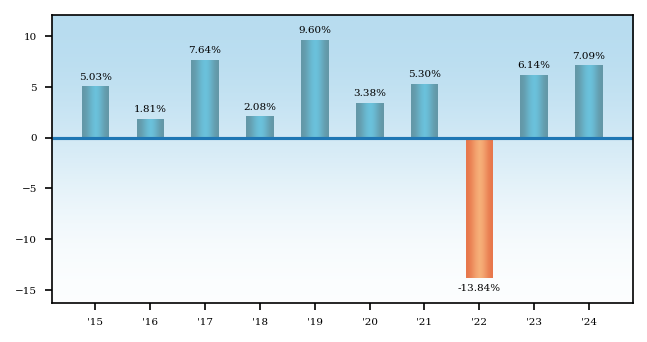
The total return for the three-month period ended March 31, 2025, was (0.01)%. During the period(s) shown in the bar chart, the highest quarterly return was 8.26% (for the calendar quarter ended December 31, 2023) and the lowest quarterly return was (7.11)% (for the calendar quarter ended March 31, 2022).
Average Annual Total Returns - MFS Municipal High Income Fund |
Label |
1 Year |
5 Years |
10 Years |
|---|---|---|---|---|
| Class A | Returns Before Taxes | 2.54% | 0.41% | 2.77% |
| Class A | After Taxes on Distributions | Returns After Taxes on Distributions | 2.49% | 0.36% | 2.73% |
| Class A | After Taxes on Distributions and Sales | Returns After Taxes on Distributions and Sale of Fund Shares | 3.20% | 1.11% | 2.99% |
| Class B | Returns Before Taxes | 2.30% | 0.22% | 2.60% |
| Class C | Returns Before Taxes | 5.03% | 0.31% | 2.40% |
| Class I | Returns Before Taxes | 7.09% | 1.31% | 3.23% |
| Class R6 | Returns Before Taxes | 7.32% | 1.39% | 3.28% |
| Bloomberg Municipal Bond Index | Bloomberg Municipal Bond Index | 1.05% | 0.99% | 2.25% |
| MFS Municipal High Income Fund Blended Index | MFS Municipal High Income Fund Blended Index | 3.86% | 1.79% | 3.37% |
As of December 31, 2024, the MFS Municipal High Income Fund Blended Index (the Blended Index) consisted of the following indices and weightings: 50% Bloomberg Municipal Bond Index and 50% Bloomberg Municipal High Yield 2% Issuer Capped Index. The components and weightings of the Blended Index may have differed during the periods and may differ in the future.
After-tax returns are calculated using the historical highest individual federal marginal income tax rates and do not reflect the impact of state and local taxes. Your actual after-tax returns will depend on your own tax situation, and may differ from those shown. The after-tax returns shown are not relevant to investors who hold their shares through tax-advantaged arrangements, such as 401(k) plans or individual retirement accounts (IRAs). The after-tax returns are shown for only one of the fund’s classes of shares, and after-tax returns for the fund’s other classes of shares will vary from the returns shown.