Exhibit D
THE REPUBLIC OF TURKEY
This description of the Republic of Turkey (the “Republic of Türkiye” or the “Republic” or “Türkiye”) is dated as of September 30, 2025 and appears as Exhibit D to the Republic of Türkiye’s Annual Report on Form 18-K to the U.S. Securities and Exchange Commission for the fiscal year ended December 31, 2024.
| Page | ||||
| 3 | ||||
| 4 | ||||
| 20 | ||||
| 20 | ||||
| 26 | ||||
| 27 | ||||
| 32 | ||||
| 39 | ||||
| 80 | ||||
| 82 | ||||
| 85 | ||||
| 87 | ||||
| 88 | ||||
| 106 | ||||
| 107 | ||||
| 108 | ||||
| 110 | ||||
| 112 | ||||
| 112 | ||||
| 113 | ||||
| 116 | ||||
| 118 | ||||
| 120 | ||||
| 122 | ||||
| 128 | ||||
| 128 | ||||
| 133 | ||||
| 134 | ||||
| 135 | ||||
| 136 | ||||
| 138 | ||||
| 140 | ||||
| 141 | ||||
| 142 | ||||
| 142 | ||||
| 143 | ||||
| 151 | ||||
| 163 | ||||
| 170 | ||||
| 170 | ||||
| 175 | ||||
| 177 | ||||
| 190 | ||||
| 195 | ||||
| 200 | ||||
| 201 | ||||
| 201 | ||||
| 201 | ||||
| 202 | ||||
| 202 | ||||
| 203 | ||||
| 234 | ||||
| 241 | ||||
2
Türkiye has made forward-looking statements in this Annual Report on Form 18-K. Statements that are not historical facts are forward-looking statements. These statements are based on Türkiye’s current plans, estimates, assumptions and projections. Therefore, you should not place undue reliance on them. Forward-looking statements speak only as of the date they are made. Türkiye undertakes no obligation to update any of them in light of new information or future events.
Forward-looking statements involve inherent risks. Türkiye cautions you that a number of factors could cause actual results to differ materially from those contained in any forward-looking statements. These factors include, but are not limited to:
| | External factors, such as: |
| | interest rates in financial markets outside Türkiye; |
| | the impact of changes in the credit rating of Türkiye; |
| | the impact of changes in the international prices of commodities; |
| | economic conditions in Türkiye’s major export markets; |
| | the decisions of international financial institutions regarding the terms of their financial arrangements with Türkiye; |
| | the impact of any delays or other adverse developments in Türkiye’s accession to the European Union; and |
| | the impact of adverse developments in the region where Türkiye is located. |
| | Internal factors, such as: |
| | general economic and business conditions in Türkiye; |
| | political, military or internal security events in Türkiye; |
| | present and future exchange rates of the Turkish currency; |
| | foreign currency reserves; |
| | the level of domestic debt; |
| | domestic inflation; |
| | natural events, such as climate changes and earthquakes; |
| | the ability of Türkiye to effect key economic reforms; |
| | the level of foreign direct and portfolio investment in Türkiye; and |
| | the level of Turkish domestic interest rates. |
3
RECENT DEVELOPMENTS AND SUMMARY
GENERAL
In 2023, the Republic’s GDP increased by 4.5% compared to the previous year. The Republic’s GDP increased by 2.5% in the second quarter of 2024 compared with the same quarter of 2023. See “ — Economic Developments” for more information.
In 2024, the Republic’s GDP increased by 3.3% compared to the previous year. The Republic’s GDP increased by 2.8% in the third quarter of 2024 compared with the same quarter of 2023. The Republic’s GDP increased by 2.3% in the first quarter of 2025 compared with the same quarter of 2024. The Republic’s GDP increased by 4.8% in the second quarter of 2025 compared with the same quarter of 2024. See “ —Economic Developments” for more information.
The Republic’s presidential and parliamentary elections are held every five years on the same date. The next presidential and parliamentary elections are scheduled to be held on May 14, 2028.
On February 14, 2025, Republican People’s Party (“CHP”) issued a directive and calendar outlining CHP’s primary election for the party’s presidential candidacy. On March 18, 2025, İstanbul University revoked the diploma of Ekrem İmamoğlu on the grounds of nullity and clear error, which meant that Ekrem İmamoğlu lost one of the qualifications for official presidential candidacy pursuant to the Article 101/1 of the Constitution. On March 19, 2025, Ekrem İmamoğlu was detained on charges of establishing and leading a criminal organization, being involved in bribery, extortion, unlawfully recording personal data, bid rigging and aiding an armed terrorist organization. On March 23, 2025, Ekrem İmamoğlu was arrested on the aforementioned charges, excluding the charge of aiding an armed terrorist organization. On March 23, 2025, The Ministry of the Interior subsequently announced that, pursuant to Article 127/4 of the Constitution, Ekrem İmamoğlu was suspended from his position as Mayor of İstanbul. On March 27, 2025, the CHP parliamentary group unanimously voted to nominate Ekrem İmamoğlu as the party’s candidate for the presidency, based on the results of the primary election held on March 23, 2025.
In response to Mr. İmamoğlu’s arrest, large protests have taken place in İstanbul and throughout Türkiye. On April 18, 2025, a mass trial involving 189 people began in İstanbul. Many of the defendants are accused of offenses related to participation in unauthorized demonstrations.
On April 6, 2025, Özgur Özel was re-elected as leader of the CHP during an extraordinary convention in Ankara.
Cybersecurity Law No. 7545 was published in the Official Gazette on March 19, 2025. The Law is a framework legislation that aims to provide a comprehensive legal basis for the cybersecurity efforts carried out in Türkiye. It particularly aims to ensure enhanced control over cybersecurity measures, particularly in monitoring, threat detection, and incident management.
Between March 23, 2025 and September 21, 2025, several suspects including 15 municipality mayors were arrested as part of the probe into various allegations held against CHP municipalities.
Türkiye’s first Climate Law No. 7552 was published in the Official Gazette No. 32951 on July 7, 2025 and has entered into force. In line with Türkiye’s net zero target for 2053, the Law sets forth the fundamental principles to combat climate change, the duties of the institutions and organizations responsible for the policies to be implemented and monitored for the reduction of greenhouse gas emissions, and the procedures and principles regarding the implementation of the emissions trading system
On September 2, 2025, a Turkish court ordered the removal of the İstanbul provincial head of the main opposition CHP. On September 8, 2025 during the replacement of the court appointee there has been a standoff between the police and opposition party supporters.
On September 21, 2025, Özgur Özel was re-elected as leader of the CHP during an extraordinary convention in Ankara.
4
POLITICAL CONDITIONS
The following table sets forth the composition of the Grand National Assembly of Türkiye by total number of seats as of September 22, 2025:
| Number of Seats |
||||
| Justice and Development Party (AKP) |
272 | |||
| Republican People’s Party (CHP) |
137 | |||
| Peoples’ Equality and Democracy Party (DEM Party) |
56 | |||
| Nationalist Action Party (MHP) |
47 | |||
| İYİ Party |
29 | |||
| New Path Party (YYP) |
21 | |||
| New Welfare Party (YRP) |
4 | |||
| Free Cause Party (HÜDA PAR) |
4 | |||
| Turkish Workers Party (TİP) |
3 | |||
| Democratic Regions Party (DBP) |
2 | |||
| Labour Party (EMEP) |
2 | |||
| Felicity Party (SP) |
1 | |||
| Democratic Party (DP) |
1 | |||
| Democratic Left Party (DSP) |
1 | |||
| Independent |
12 | |||
|
|
|
|||
| Total |
592 | |||
|
|
|
|||
Source: The Grand National Assembly of Türkiye
FOREIGN POLICY AND INTERNATIONAL RELATIONS
The EU
On January 24, 2025, EU foreign policy chief Kaja Kallas stated that as a candidate country and a major NATO ally, Türkiye plays a central role in European security during a joint press conference with Turkish Foreign Minister Hakan Fidan. Kallas commended Türkiye’s efforts in hosting Syrian refugees and emphasized the importance of ensuring conditions for their safe and dignified return.
On February 24, 2025, Turkish President Recep Tayyip Erdogan said that Türkiye and its full EU membership can save the European Union from its deadlock, ranging from the economy to defense and from politics to international standing. President Erdogan stressed that Türkiye can throw a lifeline to the EU’s rapidly aging economy and work force. President Erdogan underlined that Türkiye is eager to advance its membership process based on mutual benefit and respect, with a constructive approach.
During a videoconference meeting organized by the EU on March 7, 2025, Turkish President Recep Tayyip Erdogan said that Europe planning the continent’s security together with Türkiye would be in the interests of both sides. President Erdogan stated that the challenges the EU faces once again highlight how critical the relationship between Türkiye and the EU is for Europe’s economic security and defense. Türkiye is continuing its EU membership bid, President Erdogan said, adding that Türkiye expects the EU to adopt a more strategic approach to revitalizing membership negotiations.
On April 11, 2025, Turkish President Recep Tayyip Erdogan said that European security cannot be considered without Türkiye, adding that Türkiye is ready to take responsibility for European security in the future as well, in a speech at the Antalya Diplomacy Forum in which he also addressed certain other geopolitical matters. President Erdogan stated that Türkiye should immediately gain its seat as a full member. President Erdogan underlined that Türkiye is ready and determined to advance the EU accession process, and expects concrete steps from the EU.
World Bank
On April 1, 2025, the World Bank Board approved U.S.$500 million in funding to create inclusive jobs and revitalize the economy in areas that were devastated by the February 2023 earthquakes in Türkiye.
On June 3, 2025, Board of Executive Directors of the World Bank has approved a 757.1 million loan for the modernization of Türkiye’s irrigation infrastructure under the Türkiye Irrigation Modernization-2 Project.
United States
On January 4, 2022, the United States Court of Appeals for the Second Circuit put the federal government’s prosecution of Türkiye Halk Bankası A.Ş. (“Halkbank”). on hold while the bank appeals to the U.S. Supreme Court. The prosecution relates to a six-count indictment for fraud, money laundering, and sanctions offenses in connection with the bank’s alleged participation in a scheme to evade unilateral U.S. sanctions on Iran. On October 3, 2022, the U.S. Supreme Court agreed to hear Turkish state-owned lender Halkbank’s bid to avoid criminal charges of money laundering, bank fraud and conspiracy for allegedly helping Iran evade economic sanctions. On January 17, 2023, the U.S. Supreme Court heard oral arguments on this matter. On April 19, 2023, the U.S. Supreme Court rejected certain arguments by Halkbank that the 1976 U.S. Foreign Sovereign Immunities Act shields the bank from prosecution but did not
5
consider Halkbank’s common law defenses. The U.S. Supreme Court ordered the U.S. Court of Appeals for the Second Circuit to reconsider Halkbank’s effort to dismiss the case based on these defenses. On January 9, 2024, Halkbank announced the dismissal of the first civil lawsuit filed against the bank in the U.S. on March 27, 2020. The case was dismissed first by the U.S. District Court for the Southern District of New York and then the U.S. Court of Appeals for the Second Circuit “on grounds of forum non conveniens”. On October 22, 2024, the U.S. Court of Appeals for the Second Circuit ruled that Halkbank is not entitled to immunity and can be prosecuted on the criminal charges laid out in the indictment, and remanded the case to the U.S. District Court for the Southern District of New York for further proceedings. The U.S. Supreme Court had given Halkbank until May 5, 2025 to file a petition appealing the October 2024 ruling by the U.S. Court of Appeals for the Second Circuit, which cleared the way for the prosecution. On May 5, 2025, Halkbank asked the U.S. Supreme Court to review a lower court ruling that Halkbank can be prosecuted for allegedly helping Iran evade American sanctions.
On March 16, 2025, Turkish President Recep Tayyip Erdogan spoke to U.S. President Donald Trump and expressed his full confidence that Türkiye and the United States will advance bilateral cooperation through solidarity, a result-oriented approach and in a sincere manner in the new era of relations. President Erdogan said that Türkiye supports Trump’s decisive and direct initiative to end the war between Russia and Ukraine. President Erdogan said that it is necessary to end sanctions imposed pursuant to the Countering America’s Adversaries Through Sanctions Act (“CAATSA”), finalize the F-16 procurement process and finalize the issues of Türkiye’s re-participation in the F-35 program, in order to develop defense industry cooperation between Türkiye and the United States.
On April 10, 2025, a second round of talks between Russia and the United States took place in İstanbul. The meeting followed an initial round of discussions held in İstanbul on February 27, 2025.
On May 17, 2025, President Recep Tayyip Erdoğan said the Türkiye-US partnership is vital for establishing stability in the region and in the world. President Erdogan stated that Turkiye is striving to create a constructive and result-oriented dialogue platform. President Erdoğan addressed longstanding tensions related to defense cooperation and sanctions, saying: “Regarding CAATSA, we can comfortably say there is a softening.” and adding that there should be no constraints on defense collaboration between the two nations.
On June 25, 2025, Turkish President Recep Tayyip Erdoğan welcomed recent progress on the delivery of F-35 fighter jets to Türkiye. President Erdoğan said that teams are continuing work on the maintenance and modernization of F-16s as well as on procurement related to the F-35s, in a news conference in The Hague after a NATO summit.
On September 24, 2025, Minister of Energy and Natural Resources Alparslan Bayraktar said that BOTAŞ Petroleum Pipeline Corporation signed a 20-year liquefied natural gas (LNG) supply deal with energy trader Mercuria, part of efforts to bolster energy security and diversify sources.
On September 25, 2025, Turkish President Recep Tayyip Erdogan met with U.S. President Donald Trump at the White House for talks on a range of bilateral issues, including trade, investment, and defense cooperation. President Trump told reporters after two hours of talks that their meeting was “very conclusive” on a variety of issues. After the meeting, Türkiye and the U.S. signed a Memorandum of Understanding on Strategic Civilian Nuclear Cooperation to deepen their partnership in the nuclear energy field.
Russia and Ukraine
On February 18, 2025, Ukrainian President Volodymyr Zelenskyy visited Türkiye. Turkish President Recep Tayyip Erdogan said Ukraine’s territorial integrity and sovereignty are Türkiye’s sine qua non, in a joint press conference. President Erdogan said Türkiye would be an ideal host for possible upcoming meetings between Russia, Ukraine and the United States to end the war.
On February 24, 2025, Turkish President Recep Tayyip Erdogan said that Türkiye welcomes, in principle, U.S. President Donald Trump’s intention to resolve the Russia-Ukraine war via talks expressing readiness to support a path to lasting peace, including hosting negotiations. President Erdogan underlined that the approach of ending the war at the negotiating table aligns with the policy Türkiye has pursued over the past several years. President Erdogan stressed that the path to a just and lasting peace can only be opened through a framework in which all relevant parties are represented.
On February 26, 2025, Turkish Foreign Minister Hakan Fidan said that Türkiye will play an important role in both attaining and continuing peace, and maintaining a possible ceasefire.
On March 12, 2025, Turkish President Recep Tayyip Erdogan said in a joint news conference with Polish Prime Minister Donald Tusk that Türkiye welcomes Ukraine’s acceptance of a 30-day ceasefire proposal, and expressed hope that Moscow will respond constructively. President Erdogan stressed Türkiye’s readiness to give any support, including hosting talks, in response to Poland’s proposal that Türkiye takes an active role in initiating Russia-Ukraine peace talks. President Erdogan stressed that if the EU wants to prevent or even reverse its loss of strength and influence, it can only achieve this through Türkiye’s full membership in the EU.
On March 16, 2025, Turkish President Recep Tayyip Erdogan had a phone conversation with U.S. President Donald Trump and stated that Türkiye supported U.S. President Donald Trump’s decisive and direct initiative to end the war between Russia and Ukraine.
On May 11, 2025, Russian President Vladimir Putin invited Ukraine to resume peace talks in Türkiye, which had most recently occurred in March 2022. On May 11, 2025, Turkish President Recep Tayyip Erdoğan said during a phone call with the Russian President that Türkiye stands ready to host negotiations that will lead to a lasting solution and welcomed President Putin’s statement on resuming peace talks between Russia and Ukraine in İstanbul. On May 11, 2025, Ukrainian President Volodymyr Zelenskyy said that Ukraine accepted Russia’s proposal to resume peace talks in İstanbul and that he is prepared to attend a potential meeting with the Russian president on May 15, 2025.
6
On May 15, 2025, Ukrainian President Volodymyr Zelenskyy confirmed that he has agreed to send a delegation to İstanbul, but he would not be taking part in talks with Russian officials after Russian President Vladimir Putin’s decision not to attend to the meeting. President Zelenskyy also said that he decided to send a top-level delegation to İstanbul even though Russia sent a lower-level team there “out of respect” for U.S. President Donald Trump and Turkish President Recep Tayyip Erdogan.
On May 15, 2025, President Recep Tayyip Erdoğan held a meeting with President Volodymyr Zelenskyy of Ukraine in Ankara. The meeting addressed efforts to resolve the Russia-Ukraine conflict, along with bilateral and regional matters. President Erdoğan emphasized that at this stage, the course of the Ukraine-Russia war has made it necessary to resolve it through direct negotiations and that reaching a consensus on minimum common ground is of critical importance to prevent further loss of life. President Erdoğan stated that a historic opportunity has been seized to initiate negotiations and that he strongly supports talks both at the technical level and at the level of leaders. President Erdoğan underlined that Türkiye attaches importance to keeping channels of dialogue open between Ukraine and Russia for the swift establishment of peace and that, as the host country, they would be pleased to welcome the leaders of both countries when they are ready.
On May 16, 2025, delegations from Russia and Ukraine met in İstanbul, where the two sides failed to agree on a ceasefire. Head of the Russian delegation Vladimir Medinsky said on Friday that Moscow was satisfied with the results of the peace talks with Ukraine in İstanbul. “On the whole, we are satisfied with the results and are ready to continue contacts. We have agreed on three things. First, in the coming days, there will be a large-scale exchange of prisoners of war, 1,000 for 1,000 people,” Medinsky said. The Ukrainian side requested direct talks between the heads of state and the Russian delegation has “taken note of this request,” he added. “The third: we have agreed that each side will present its vision of a possible future ceasefire and describe it in detail,” he said. Turkish Foreign Minister Hakan Fidan, who chaired the meeting, told the delegations there were “two paths” ahead of them. “One road will take us on a process that will lead to peace, while the other will lead to more destruction and death. The sides will decide on their own, with their own will, which path they choose,” Minister Fidan said.
On May 26, 2025, Turkish Foreign Minister Hakan Fidan met Russia’s President Vladimir Putin in a meeting that addresses recent initiatives aimed at ending Russia-Ukraine war. On May 30, 2025, Turkish Foreign Minister Hakan Fidan met Ukrainian President Volodymyr Zelenskyy in Kyiv. Minister Fidan, who traveled to Ukraine on an official visit, also met Andriy Yermak, head of the Ukrainian presidential office, and Ukrainian Defense Minister Rustem Umerov as well as his Ukrainian counterpart Andrii Sybiha.
On May 30, 2025, President Recep Tayyip Erdoğan told his Ukrainian counterpart over phone that holding talks at the leadership level between Ukraine and Russia after negotiations between delegations will benefit peace process. President Erdoğan said discussing a possible ceasefire in the second round of Russia-Ukraine talks planned to be held in Istanbul will pave way for peace.
On June 2, 2025, delegations from Russia and Ukraine met in İstanbul for the second round of Russia-Ukraine peace talks, with Türkiye serving as the facilitator. Turkish Foreign Minister Hakan Fidan delivered the opening speech at the meeting. Minister Fidan said the priority is to achieve a lasting peace between the two countries, stressing Türkiye stands ready to take any step necessary to facilitate the process. Later, Minister Fidan praised the constructive atmosphere of the second Russia-Ukraine peace talks in Istanbul. Minister Fidan said that the parties agreed on an expanded humanitarian exchange, shared memorandums reflecting their perspectives on the ceasefire and settlement, and agreed to begin technical-level work on these texts in the coming days.
On June 2, 2025, President Recep Tayyip Erdoğan said his greatest wish is to bring Russian President Vladimir Putin and Ukrainian President Volodymyr Zelenskyy together in Istanbul or Ankara. President Erdoğan said that he would like to bring the US President Donald Trump along as well. In response, the White House spokesperson Karoline Leavitt told President Trump is open to sitting down with his Russian and Ukrainian counterparts in Türkiye as part of a broader initiative to end the war.
On July 23, 2025, Russia and Ukraine concluded a third round of peace talks in Istanbul, during which they agreed on a new prisoner exchange with at least 1,200 people from each side.
Palestine & Israel
On February 26, 2025, Turkish Foreign Minister Hakan Fidan said that Türkiye would not accept U.S. President Donald Trump’s proposal for the United States to take over Gaza and forcibly displace its people.
On April 9, 2025, the first technical meeting between Türkiye and Israel on a conflict prevention mechanism aimed at avoiding unwanted incidents in Syria was held in Azerbaijan. On April 10, 2025, Turkish National Defense Ministry said Israel must immediately end its provocative attacks, which are threatening Syria’s territorial integrity and destabilizing its security and stability.
On April 9, 2025, Turkish Foreign Minister Hakan Fidan stressed that Türkiye has no intention of entering into a conflict with any country in Syria, including Israel. Minister Hakan Fidan reiterated that Türkiye does not seek a conflict with any country in the region but warned that Ankara cannot remain indifferent if Syria faces internal unrest, operations, or provocations that could threaten Turkish national security.
7
On April 11, 2025, Turkish President Recep Tayyip Erdogan said Israel has been openly committing genocide against the Palestinian people, disregarding basic human rights and trampling on international law, in a speech at the Antalya Diplomacy Forum, in which he also addressed certain other geopolitical matters. President Erdogan urged the international community, particularly the UN Security Council, to take action and end the bloodshed, calling on them to stand with the Palestinian people.
On August 29, 2025, Türkiye’s parliament adopted a parliamentary motion condemning Israel’s expanded occupation in Gaza and its genocide against the Palestinian people. The resolution emphasized that the massacres and Israel’s use of famine in Gaza as a weapon constitute genocide, and called on the international community to intensify efforts to pressure Israel into agreeing to a lasting ceasefire, pulling back its forces, and ensuring the continuous flow of humanitarian aid into Gaza. The resolution urged that Israel’s membership in the UN and other international bodies be suspended until it halts its genocidal policies, adding that all national parliaments should cut military and commercial ties with Israel and work to lift the embargo imposed on Palestine.
On August 29, 2025, speaking at an extraordinary session of the Turkish parliament on Gaza, Turkish Foreign Minister Hakan Fidan said that Türkiye has cut off all trade with Israel, closed its airspace to Israeli aircraft, and does not allow Turkish ships to go to Israeli ports.
On September 15, 2025, Türkiye’s President Recep Tayyip Erdogan held a meeting with Qatar’s Emir Sheikh Tamim bin Hamad Al Thani in Doha, where he attended the Extraordinary Summit of the Organization of Islamic Cooperation and the Arab League. President Erdogan said Israel’s attack on Qatar is unacceptable and that Türkiye stands alongside Qatar. President Erdogan emphasized that Israel’s attack aims to undermine peace negotiations, that continuing negotiations under any circumstances would be beneficial, and that Türkiye will continue to support mediation efforts.
On September 18, 2025, Türkiye’s President Recep Tayyip Erdogan welcomed his Palestinian counterpart Mahmoud Abbas in Ankara. During a meeting with his Palestinian counterpart, Recep Tayyip Erdogan said that Israel continues to undermine peace, and that Türkiye will be the voice of Palestine at UN General Assembly.
On September 22 2025, Türkiye’s President Recep Tayyip Erdogan addressed a high-level conference, sponsored by France and Saudi Arabia, on Palestinian statehood at the UN General Assembly in New York.
Iran & Israel
On June 16, 2025, Turkish President Recep Tayyip Erdogan said Türkiye has advocated discussions on Iran’s nuclear program taking place at the negotiating table from the very start, and it has the same stance today. President Erdogan said that Türkiye has been making intense diplomatic effort to halt clashes in the Israel-Iran conflict.
On June 17, 2025, Türkiye’s parliament unanimously accepted a motion condemning in the strongest terms Israel’s genocide in Gaza, all actions threatening regional peace, and its attacks on Iran.
On June 20, 2025, Turkish President Recep Tayyip Erdogan said that the spiral of violence triggered by Israel’s attacks could harm the region and Europe in terms of migration and the possibility of nuclear leakage in a phone call with German Chancellor Friedrich Merz.
On June 27, 2025, Turkish Foreign Minister Hakan Fidan said there is currently a period of silence in the Israel-Iran conflict, but that an agreement between Iran and the United States is necessary to make the cessation of hostilities more permanent. Minister Fidan said that “it is in [Türkiye’s] interest and in the interest of the region that wars do not break out and that existing ones come to an end”.
Iraq & Syria
On January 26, 2025, Turkish Foreign Minister Hakan Fidan stated that Türkiye’s ultimate expectation from Iraq, which declared the PKK terror group as a “banned organization,” is to recognize it as a terrorist organization, in a joint news conference with his Iraqi counterpart Fuad Hussein in Baghdad. Minister Fidan stated that Türkiye, Iraq and Syria must combine all their means and destroy both ISIS (Daesh) and PKK terror groups.
On March 1, 2025, the PKK declared a cease fire with Türkiye after PKK’s jailed leader Abdullah Öcalan called on the movement, designated as a terrorist group by the Turkish government as well as numerous countries including the United States and the European Union, to lay down its arms and dissolve. On May 12, 2025, the PKK announced that it decided to lay down its arms and to disband. Furthermore, in order to ensure that the process is addressed within the framework of democratic legitimacy and subject to institutional oversight, a Parliamentary Inquiry Commission was established within the Grand National Assembly of Türkiye. The commission has been mandated to examine the social, political and legal dimensions of the dissolution process, to assess prospective developments following the laying down of arms, and present policy recommendations aimed at safeguarding national security, consolidating democratic stability and strengthening social cohesion.
8
On March 9, 2025, representatives of Türkiye, Jordan, Iraq, Lebanon and Syria met in Jordan’s capital, Amman, where they reaffirmed their countries’ support for the new Syrian government and agreed to establish an operations room to combat the ISIS (Daesh) terrorist group, while also condemning Israeli attacks on the country.
On March 30, 2025, Türkiye’s Foreign Ministry said that Türkiye welcomed the formation of a new transitional government in Syria. Türkiye’s Foreign Ministry added that Türkiye will continue to support a comprehensive and inclusive political process, which remains one of the cornerstones of establishing security and stability in Syria. The Foreign Ministry also called on the international community to focus on stabilizing Syria, emphasizing the need for the unconditional lifting of sanctions and the initiation of reconstruction efforts.
On May 24, 2025, Turkish Foreign Ministry spokesperson Oncu Keceli said that the recent U.S. and EU moves to lift sanctions on Syria are encouraging. The spokesperson also told that Türkiye will continue to support initiatives that contribute to Syria’s economic development through its institutional capacity, the entrepreneurial strength of its private sector, and activities carried out in collaboration with all third-country partners.
On May 24, 2025, Turkish President Recep Tayyip Erdogan emphasized the strengthening of Türkiye-Syria bilateral ties and cooperation in all areas, especially energy, defense, and transportation, during his meeting with his Syrian counterpart Ahmed al-Sharaa. During the meeting, President Erdogan expressed his belief that Syria will see brighter and more peaceful days ahead, and he affirmed that Türkiye will continue to stand by Syria as it has until now.
On August 20, 2025, Turkish Interior Ministry announced that passport-based crossings have officially begun at its land border gates with Syria, as part of the normalization process following the country’s liberation last December.
Eastern Mediterranean
On March 17-18, 2025, Turkish Foreign Minister Hakan Fidan participated in an informal meeting on Cyprus with the leaders of the divided island and guarantor powers at the UN Office in Geneva. Turkish Republic of Northern Cyprus President, Greek Cypriot administration leader, Turkish Foreign Minister, Greek Foreign Minister, and UK’s State Minister for Europe, North America and Overseas Territories in the Foreign, Commonwealth & Development Office attended the meeting, hosted by UN Secretary-General Antonio Guterres. Turkish Foreign Ministry announced after the meeting that leaders agreed on various cooperation efforts, including opening new crossing points, demining operations and generating solar energy in the island’s UN buffer zone. It was also announced that another informal meeting in a similar format has been scheduled for the end of July 2025, and that there is an agreement to open four new crossing points.
On August 1, 2025, Turkish President Recep Tayyip Erdogan received Italian Prime Minister Giorgia Meloni and Libyan Prime Minister Abdul Hamid Dbeibeh in Istanbul as part of a cooperation summit of Türkiye, Italy and Libya.
South Caucasus
On August 8, 2025, Türkiye welcomed progress toward lasting peace between Azerbaijan and Armenia, following a trilateral peace roadmap the two South Caucasus nations signed with the United States.
On September 1, 2025, Turkish President Recep Tayyip Erdogan met with Azerbaijani President Ilham Aliyev and with Armenian Prime Minister Nikol Pashinyan separately during the Shanghai Cooperation Organization summit. President Erdogan expressed satisfaction with progress in the Armenia-Azerbaijan peace process and said Türkiye supports peace, stability and development in the region while continuing to contribute to the process. President Erdogan noted that Ankara evaluates steps to increase cooperation between Türkiye and Armenia during the meeting with Prime Minister Pashinyan.
On September 12, 2025, Türkiye’s special representative for the normalization process, retired Ambassador Serdar Kilic, and his Armenian counterpart, Deputy Parliament Ruben Rubinyan, met for a sixth round of talks. During the meeting in Yerevan, they reiterated their commitment to pursue the normalization process without preconditions and agreed to accelerate the process to implement an agreement on border crossings between the two countries. The two confirmed the issues agreed upon in their previous discussions, which aimed to advance the full normalization process between the two countries.
Africa
On April 10, 2025, Türkiye’s Energy and Natural Resources Minister Alparslan Bayraktar announced that Turkish Petroleum Corporation and Somali Petroleum Authority signed the onshore hydrocarbon exploration and production agreement. The Minister said that oil and gas exploration activities will begin in the coming months in three key onshore fields covering approximately 16,000 square kilometers.
9
BRICS
On February 24, 2025, Turkish Foreign Minister Hakan Fidan said that Türkiye had shown interest in joining the BRICS bloc of emerging economies, however since the organization has currently frozen the admission of new members as part of its institutional consolidation, no membership offer has been extended to Türkiye.
Migration Issues
The Republic is continuing its humanitarian efforts to provide shelter to those fleeing the conflict in Syria. As of September 18, 2025, Türkiye had granted temporary protection to 2,463,042 Syrians.
On September 7, 2025, Turkish Minister of Interior Ali Yerlikaya announced that 474,018 Syrians in Türkiye have returned to Syria voluntarily, after the overthrow of the government of Bashar Al-Assad in December 2024.
ECONOMIC DEVELOPMENTS
Nominal GDP was approximately TL 15,012 billion in 2022. In the first quarter of 2023, nominal GDP was TL 4,799 billion. In the second quarter of 2023, nominal GDP was TL 5,697 billion. In the third quarter of 2023, nominal GDP was TL 7,894 billion. In the fourth quarter of 2023, nominal GDP was TL 8,702 billion. Nominal GDP was approximately TL 27,091 billion in 2023. In the first quarter of 2024, nominal GDP was TL 9,076 billion. In the second quarter of 2024, nominal GDP was TL 10,142 billion. In the third quarter of 2024, nominal GDP was TL 12,308 billion. In the fourth quarter of 2024, Türkiye’s nominal GDP was TL 13,061 billion. Nominal GDP was approximately TL 44,587 billion in 2024. In the first quarter of 2025, nominal GDP was TL 12,493 billion. In the second quarter of 2025, nominal GDP was TL 14,579 billion.
The following table sets forth the percentage of GDP represented by type of economic activity (at current prices, expressed in percentages, and calculated in constant TL with a purchasing power set as of September 1, 2025) for the periods indicated:
| GDP by Type of Economic Activity* (in %) | 2023 Q4 |
2024 Q1 |
2024 Q2 |
2024 Q3 |
2024 Q4 |
2025 Q1 |
2025 Q2 |
|||||||||||||||||||||||
| 1. | A- Agriculture, forestry and fishing | 5.2 | 2.5 | 4.3 | 10.2 | 5.2 | 2.4 | 3.9 | ||||||||||||||||||||||
| 2. | BCDE- Industry | 22.6 | 21.5 | 19.8 | 18.7 | 19.3 | 18.8 | 18.6 | ||||||||||||||||||||||
| 3. | F- Construction | 5.3 | 5.9 | 6.4 | 5.8 | 5.4 | 6.0 | 6.5 | ||||||||||||||||||||||
| 4. | GHI- Services | 26.3 | 24.5 | 25.2 | 24.3 | 25.5 | 23.5 | 25.2 | ||||||||||||||||||||||
| 5. | J- Information and communication | 2.7 | 2.3 | 2.5 | 2.3 | 2.9 | 2.5 | 2.6 | ||||||||||||||||||||||
| 6. | K- Financial and insurance activities | 2.8 | 4.2 | 3.6 | 3.0 | 2.8 | 4.0 | 3.8 | ||||||||||||||||||||||
| 7. | L- Real estate activities | 5.5 | 7.2 | 8.0 | 7.6 | 7.7 | 10.0 | 9.5 | ||||||||||||||||||||||
| 8. | MN- Professional, administrative and support service activities | 5.6 | 5.3 | 5.4 | 4.7 | 6.1 | 5.4 | 5.5 | ||||||||||||||||||||||
| 9. | OPQ- Public administration, education, human health and social work activities | 9.6 | 13.0 | 11.7 | 11.1 | 10.9 | 13.4 | 11.2 | ||||||||||||||||||||||
| 10. | RST- Other service activities | 2.7 | 3.0 | 1.9 | 1.6 | 2.5 | 2.9 | 1.8 | ||||||||||||||||||||||
| 11. | Sectoral total | 88.3 | 89.3 | 88.8 | 89.3 | 88.2 | 89.0 | 88.8 | ||||||||||||||||||||||
| 12. | Taxes-Subsidies | 11.7 | 10.7 | 11.2 | 10.7 | 11.8 | 11.0 | 11.2 | ||||||||||||||||||||||
| 13. | Gross Domestic Product (Purchaser’s Price) | 100.0 | 100.0 | 100.0 | 100.0 | 100.0 | 100.0 | 100.0 | ||||||||||||||||||||||
| * | Based on the statistical classification of economic activities in the European Community, NACE Rev. 2 |
Source: TURKSTAT
The following table sets forth increases or decreases in GDP (in the chain linked volume index and expressed in percentages) for the periods indicated:
| GDP growth rates | Q1 | Q2 | Q3 | Q4 | ||||||||||||
| (in %) | ||||||||||||||||
| 2021 |
7.5 | 22.3 | 8.0 | 9.7 | ||||||||||||
| 2022 |
7.8 | 7.6 | 4.1 | 3.3 | ||||||||||||
| 2023 |
4.0 | 4.6 | 6.5 | 4.9 | ||||||||||||
| 2024 |
5.3 | 2.3 | 2.8 | 3.2 | ||||||||||||
| 2025 |
2.3 | 4.8 | ||||||||||||||
Source: TURKSTAT
In August 2025, the Republic’s monthly CPI increased by 2.04% and domestic PPI increased by 2.48% compared to the previous month. In August 2025, the Republic’s annual CPI and domestic PPI increased by 32.95% and 25.16%, respectively, as compared to the same month of the previous year.
10
On September 10, 2025, the Government offered an interest rate of 41.12% for its 672-day TL denominated fixed coupon Government Bond, compared to 40.93% for its 693-day TL denominated fixed coupon Government Bond on September 18, 2024.
On September 10, 2025, the Government offered an interest rate of 37.63% for its 1764-day TL denominated fixed coupon bond issuance compared to 33.42% for its 1820-day TL denominated fixed coupon Government Bond on September 18, 2024.
The industrial production index increased by 5.0% in July 2025 compared to the same month of the previous year.
In July 2025, the seasonally adjusted unemployment rate decreased by 0.4 percentage points to 8.0% as compared to the previous month. In July 2025, the seasonally adjusted employment rate realized as 49.1% and remained unchanged compared to the previous month and the number of employed people increased by 18,000 to 32.582 million. The following table indicates seasonally adjusted unemployment figures for the periods indicated:
| 2025 | Unemployment (%) |
Unemployment (thousands) |
||||||
| January |
8.5 | 3,007 | ||||||
| February |
8.2 | 2,899 | ||||||
| March |
8.0 | 2,841 | ||||||
| April |
8.5 | 3,025 | ||||||
| May |
8.3 | 2,958 | ||||||
| June |
8.4 | 2,992 | ||||||
| July |
8.0 | 2,828 | ||||||
Source: TURKSTAT
On September 8, 2025 the Medium-Term Program (MTP) for the period covering 2026-2028 was announced. The MTP outlines key economic targets for the upcoming years. According to the MTP, the Turkish government aims to increase GDP growth to 3.3% in 2025, 3.8% in 2026, 4.3% in 2027, and 5% in 2028. Inflation is expected to be 28.5% by the end of 2025, 16% in 2026, 9% in 2027, and 8% in 2028. On the other hand, the budget deficit is projected to be 3.5% of GDP in 2026 and 2.8% at the end of the program period. The unemployment rate is projected to be 8.5% at the end of this year, with a target of 8.4% for 2026, 8.2% for 2027, and 7.8% for 2028.
TOURISM
In 2024, the number of foreign visitors visiting the Republic increased by 6.95% to 52,629,283 people compared to the previous year. In August 2025, the number of foreign visitors visiting the Republic increased by 2.05% to 6,965,343 people compared to the same month in 2024. In the fourth quarter of 2024, tourism revenues increased by 14.5% compared to the same period of 2023 and reached U.S.$13,788,036,000. In 2024, tourism income increased by 8.3% and reached U.S.$61,103,419,000 compared to the previous year. In the second quarter of 2025, tourism income increased by 8.4% compared to the same period of 2024 and reached U.S.$16,284,322,000.
EMPLOYMENT AND WAGES
In 2024, the total civilian employment was 32.620 million and the labor force participation rate was at 54.2%, which represented a 0.9 percentage point increase compared to the previous year. In the second quarter of 2025, the seasonally adjusted total civilian employment was 32.435 million and the seasonally adjusted labor force participation rate was at 53.5% without any change compared to the previous quarter. In July 2025, the seasonally adjusted total civilian employment was 32.582 million and the seasonally adjusted labor force participation rate was at 53.3% with 0.3 percentage point decrease compared to the previous month.
As of August 2025, the total asset value of the Unemployment Insurance Fund amounted to approximately TL 517.243 billion.
As of August 2025, 74.10 % of the Unemployment Insurance Fund was invested in bonds, 25.84% of the assets were held in deposits and 0.06% of the assets were held in Takasbank Money Market.
As of June 2025, there were 396 pension funds offered to the public. As of June 2025, the total net asset value of these funds increased to approximately TL 1.582 billion from approximately TL 1.024 billion in June 2024.
On February 1, 2025, the Presidential Decree No. 9488 approving the National Employment Strategy (2025-2028), prepared by the Ministry of Labor and Social Security, was published in the Official Gazette No.32800. The National Employment Strategy (2025-2028) aims to reduce the unemployment rate to 7.5% and informal employment to 23.4% by 2028. The strategy also seeks to increase the employment rate to 52.5% and female workforce participation to 40.1%. The strategy is built upon four key policy areas, which are promoting green and digital transformation in the labor market, enhancing inclusive employment, strengthening the link between social protection and employment, and developing sustainable employment in rural areas.
11
On February 4, 2025, President Recep Tayyip Erdogan announced the launch of İŞKUR Youth Programme, which is a new work model where university students can work for a salary. President Erdogan said “we will provide support of TL 5,415 for students who participate in the program for five days a month with a daily payment of TL 1,083, and approximately TL 15,162 for those who participate for 14 days.”
FOREIGN TRADE AND BALANCE OF PAYMENTS
In July 2025, the trade balance posted a deficit of U.S.$6.444 billion, with a 11.8% decrease compared with July 2024. In July 2025, total goods imported (c.i.f.), including gold imports increased by 5.4% over the same in July 2024, reaching U.S.$31.383 billion. In July 2025, the import of capital goods, which are used in the production of physical capital, increased by 14.2% over the same period in 2024; the import of intermediate goods such as partly finished goods and raw materials, which are used in the production of other goods, increased by 0.1% over the same period in 2024; and the import of consumption goods increased by 17.2% over the same period in 2024. In July 2025, total goods exported (f.o.b.), increased by 11% to U.S.$24.938 billion, as compared to approximately U.S.$22.476 billion during the same period of 2024. As of July 2025, 12 months rolling total exports (f.o.b.) were approximately U.S$268 billion. Total exports (f.o.b.) and imports (c.i.f.) for 2024 amounted to U.S.$261.8 billion and U.S.$344.0 billion respectively. According to provisional data, foreign direct investment inflows into Türkiye amounted to U.S.$1.243 billion in June 2025. The following table summarizes the balance of payments of Türkiye for the period indicated:
| July 2025* | ||||
| in millions of U.S. Dollars |
||||
| CURRENT ACCOUNT |
1,766 | |||
| Trade Balance |
-4,635 | |||
| Goods Exports |
24,607 | |||
| Goods Imports |
29,242 | |||
| Services |
8,024 | |||
| Primary Income |
-1,462 | |||
| Secondary Income |
-161 | |||
| CAPITAL ACCOUNT |
-120 | |||
| FINANCIAL ACCOUNT |
1,064 | |||
| Direct Investment: Net acquisition of financial assets |
802 | |||
| Direct Investment: Net incurrence of liabilities |
2,026 | |||
| Portfolio Investment: Net acquisition of financial assets |
1,091 | |||
| Portfolio Investment: Net incurrence of liabilities |
6,188 | |||
| Other Investment: Net acquisition of financial assets |
-6,554 | |||
| Other Investment: Net incurrence of liabilities |
2,262 | |||
| RESERVE ASSETS |
18,597 | |||
| NET ERRORS AND OMISSIONS |
-582 | |||
| * | Analytic Presentation |
In June 2025, the volume of crude oil imports increased by 2.84% compared to June 2024. In June 2025, natural gas imports increased by 36.87% to 3,168.39 million cubic meters compared to 2,314.93 million cubic meters in June 2024. In June 2025, liquefied petroleum gas imports decreased by 5.78% to 289,803.68 tons compared to 307,571.25 tons in June 2024.
As of August 2025, total gross international reserves were U.S.$178,357 million (compared to U.S.$149,373 million as of August 2024). As of August 2025, gold reserves were U.S.$87,326 million (compared to U.S.$60,043 million as of August 2024) and the Central Bank gross foreign exchange reserves were U.S.$83,326 million as of August 2025 (compared to U.S.$81,738 million as of August 2024).
As of August 2025, the Central Bank reported contingent liabilities in foreign currency, including commercial banks’ reserve requirements held at the Central Bank, to be approximately U.S.$59,386 million (compared to approximately U.S.$49,763 million as of August 2024). As of August 2025, the Central Bank reported foreign currency loans, securities and deposits to be approximately U.S.$43,921 million (compared to approximately U.S.$43,724 million as of August 2024).
As of September 18, 2025, the Central Bank held approximately TL 762.34 billion in public sector deposits.
12
MONETARY POLICY
According to the latest inflation report published by the Central Bank on August 14, 2025, inflation is projected to decline to 9% in 2027 before stabilizing at the medium-term inflation target of 5%. On September 19, 2025, the Central Bank foreign exchange buying rate for U.S. Dollars was TL 41.2344 per U.S. Dollar. The following table displays the period-end foreign exchange buying rate of Turkish Lira per U.S. Dollar, euro, and Japanese Yen and against the U.S. Dollar-euro currency basket:
| Period-End Exchange Rates | 2024** | |||
| Turkish Lira per U.S. Dollar |
35.28 | |||
| Turkish Lira per euro |
36.74 | |||
| Turkish Lira per 100 Japanese Yen |
22.49 | |||
| Turkish Lira per Currency Basket* |
36.01 | |||
| * | The basket consists of U.S.$0.5 and 0.5. |
| ** | As of December 31, 2024. |
Source: Central Bank
As of September 12, 2025, the Central Bank’s international reserve level was approximately U.S.$177.9 billion. The Republic deems it necessary to consider both official reserves and external foreign exchange deposits of the banking system and corporations when evaluating the adequacy of all reserve assets held against external liabilities, due to the typical inclination of households and corporations towards foreign exchange deposits in the banking sector. The Central Bank aims to strengthen its international reserves and effectively manage its reserves. However, as a result of the implementation of certain monetary and exchange rate policies, short-term fluctuations can be observed in the level of foreign exchange reserves. Of these policies, banks’ use of the foreign exchange and gold swap facilities provided by the Central Bank has been the main cause of temporary fluctuations in the level of foreign exchange reserves. Other factors affecting foreign exchange reserves include changes in foreign exchange and Turkish Lira required reserve ratios, changes in banks’ free foreign currency accounts, foreign exchange sales to energy importing state-owned enterprises, foreign debt and other current foreign exchange transactions carried out on behalf of the Ministry of Treasury and Finance, onshore and offshore foreign exchange denominated issuances by the Ministry of Treasury and Finance, and export rediscount credit foreign exchange repayments.
On January 23, 2025, the Monetary Policy Committee decided to reduce the policy rate (the one-week repo auction rate) from 47.5% to 45%. The Committee stated that the decisiveness regarding tight monetary stance is strengthening the disinflation process through moderation in domestic demand, real appreciation in Turkish lira, and improvement in inflation expectations. The Committee also added that increased coordination of fiscal policy will also contribute significantly to this process.
On February 4, 2025, the CBRT announced that it had revised the reserve requirement ratios to strengthen the monetary transmission mechanism. Accordingly, among banks’ Turkish lira liabilities with maturities up to one year (including one year), the reserve requirement ratios have been raised from 8% to 12% for:
| | Funds from repo transactions from abroad, |
| | Loans obtained from abroad, and |
| | Deposits/participation funds from banks abroad. |
On February 7, 2025, the Central Bank released the first Inflation Report of 2025. In this report, the Central Bank stated that inflation was projected to be 24% at the end of 2025, 12% at the end of 2026, and 8% at the end of 2027.
On February 13, 2025, the CBRT signed a Memorandum of Understanding with the State Bank of Pakistan, laying the groundwork for enhanced cooperation on central banking issues. In the framework of the Memorandum of Understanding, the two central banks aspire to foster cooperation and carry out technical activities in the field of central banking.
On February 15, 2025, the CBRT announced that legal entities would no longer be able to open or renew FX-protected deposit accounts, including YUVAM accounts. Furthermore, FX-protected deposit accounts held by legal entities will no longer be included in the targets for FX-protected deposit accounts’ renewal and transition to Turkish lira.
On March 1, 2025, the CBRT announced that, taking into account recent developments in foreign currency loans, it decided to support its tight monetary stance with the following adjustments to the loan growth-based reserve requirement practice:
| | The monthly growth limit for foreign currency loans has been reduced from 1% to 0.5%. |
| | The scope of foreign currency loans exempted from the growth limit has been narrowed. |
13
On March 6, 2025, the Monetary Policy Committee decided to reduce the policy rate (the one-week repo auction rate) from 45% to 42.5%. The Committee stated that decisiveness regarding tight monetary stance was strengthening the disinflation process through moderation in domestic demand, real appreciation in Turkish lira, and improvement in inflation expectations. The Committee also added that increased coordination of fiscal policy would also contribute significantly to this process.
On March 18, 2025 the CBRT announced that an investigation was being carried out by judicial authorities against companies under its oversight and supervision including Pay Fix Elektronik Para ve Ödeme Hizmetleri A.Ş. (Pay Fix), İninal Ödeme ve Elektronik Para Hizmetleri A.Ş. (İninal), and Aypara Ödeme Kuruluşu A.Ş. (Aypara).
On March 20, 2025, the CBRT announced that it will start conducting Turkish lira-settled foreign exchange forward selling transactions in order to ensure the sound functioning of the foreign exchange market, prevent possible volatilities in exchange rates and to stabilize foreign exchange liquidity.
On March 20, 2025, the CBRT announced that the Monetary Policy Committee (the Committee) had convened to exchange views on recent financial market developments. Assessing the risks that these developments may pose to the inflation outlook, measures have been taken to support the tight monetary stance. Accordingly, the Committee has decided to raise the Central Bank’s overnight lending rate to 46 percent. The policy rate (the one-week repo auction rate), and the Central Bank overnight borrowing rate were kept at 42.5 percent and 41 percent, respectively. Furthermore, TL and FX liquidity measures have been introduced to limit market volatility. It was also stated that additional actions would be taken if deemed necessary to maintain the sound functioning of financial markets.
On March 20, 2025, the CBRT announced that considering the developments in the financial markets, it had decided to suspend one-week repo auctions for a period of time.
On March 21, 2025, the CBRT announced that it would issue liquidity bills with maturities of up to 91 days as part of the effective use of implementing sterilization tools to strengthen the monetary transmission mechanism and support the tight monetary stance.
On April 17, 2025, the Monetary Policy Committee decided to increase the policy rate (the one-week repo auction rate) from 42.5% to 46%. The Committee stated that its tight monetary stance will be maintained until price stability is achieved via a sustained decline in inflation. The Monetary Policy Committee added that the policy rate will be determined in a way to ensure the tightness required by the projected disinflation path taking into account realized and expected inflation, and the underlying trend of inflation, and that the Committee will adjust the policy rate prudently on a meeting-by-meeting basis with a focus on the inflation outlook. The Committee stressed that the monetary policy stance will be tightened in case a significant and persistent deterioration in inflation is foreseen.
On April 24, 2025, the CBRT announced that the CBRT and the National Bank of the Republic of Kazakhstan signed a Turkish lira-Kazakhstani tenge bilateral swap arrangement. According to the announcement, the swap arrangement allows for the exchange of local currencies between the two central banks of up to TL 28.0 billion or Kazakhstani tenge 423 billion. The arrangement will be effective for three years and could be extended by mutual agreement between the two sides. This arrangement is designed to promote bilateral trade through a swap-financed trade settlement facility and financial cooperation between the two countries.
On May 3, 2025, the CBRT announced that the following changes have been made in the macroprudential framework to support transition to the Turkish lira;
1. Reserve requirement ratios for FX deposits have been raised by 200 basis points across all maturities.
2. The reserve requirement ratio for funds that are derived from FX repo transactions with residents of a maturity up to one year has been raised by 400 basis points and the calculation method has been changed.
3. A monthly increase target of 0.3 points for TL deposit share of legal persons has been introduced for banks with a share lower than 60%.
4. The remuneration rate applied to required reserves maintained for Turkish lira deposits has been raised from 84% to 86% of the CBRT’s weighted average funding cost.
5. With an amendment made to the Exports Circular as per the decision of the Ministry of Treasury and Finance, the minimum share of export proceeds to be sold to the CBRT shall be 35% until July 31, 2025.
14
6. The FX conversion support rate, which is applied to firms’ foreign currency conversions of export proceeds to the Turkish lira, has been raised to 3% until July 31, 2025.
On May 22, 2025, the Central Bank released the second Inflation Report of 2025. In this report, the Central Bank stated that inflation was projected to be 24% at the end of 2025, 12% at the end of 2026, and 8% at the end of 2027.
On May 24, 2025, the CBRT announced the following changes to the reserve requirement ratios for short-term Turkish lira-denominated funding obtained from abroad. The reserve requirement ratio which was 12% for maturities up to 1 year for Turkish lira-denominated funds from repo transactions abroad has been differentiated across maturities and loans obtained from abroad have been raised to:
| | 18% for maturities up to one month, and |
| | 14% for maturities up to three months. |
On May 27, 2025, as part of the investigation no. 2024/231483 of Istanbul Chief Public Prosecutor’s Office based on the reports of the Central Bank of the Republic of Türkiye (CBRT), the Financial Crimes Investigation Board (MASAK) and other relevant institutions, the Savings Deposit Insurance Fund (SDIF) has been appointed as trustee of Papara Elektronik Para A.Ş. (the Institution) by the relevant court.
On June 13, 2025, the Central Bank of the Republic of Türkiye and the People’s Bank of China signed a Memorandum of Understanding (MoU) on establishing the renminbi clearing arrangements which would promote the facilitation of bilateral trade and investment. Governor Fatih Karahan, Ph.D., and Governor Pan Gongsheng, Ph.D., signed the MoU.
On June 13, 2025, the Central Bank of the Republic of Türkiye and the People’s Bank of China renewed the Turkish lira-Chinese yuan bilateral swap arrangement. Governor Fatih Karahan, Ph.D., and Governor Pan Gongsheng, Ph.D., signed the arrangement.
On June 19, 2025, the Monetary Policy Committee (the Committee) decided to keep the policy rate (the one-week repo auction rate) at 46 percent. The Committee has also maintained the Central Bank overnight lending rate and the overnight borrowing rate at 49 percent and 44.5 percent, respectively. The Committee stated that the decisiveness regarding tight monetary stance was strengthening the disinflation process through moderation in domestic demand, real appreciation in Turkish lira, and improvement in inflation expectations. The Committee also added that increased coordination of fiscal policy would also contribute significantly to this process.
On June 21, 2025, the CBRT announced that the following changes have been made in the macroprudential framework to support transition to the Turkish lira:
| 1) | The growth targets for real-person TL deposit shares have been increased for banks with a share below 60%, while a monthly growth target of 0.4 points has been introduced for banks with a share between 60% and 65%. |
| 2) | The reserve requirement ratio for FX-protected deposit (KKM) accounts has been raised from 33% to 40%. |
| 3) | The minimum interest rate applicable to KKM accounts has been reduced from 50% to 40% of the policy rate. |
| 4) | The target for transition of KKM accounts to TL has been abolished, while the total target for KKM renewals and transition to TL has been maintained. |
| 5) | Floating-rate TL deposit accounts can now be opened with maturities longer than one month. Furthermore, the reserve requirement ratios for CPI-, PPI-, and TLREF-indexed deposits have been set at 10% for all maturities. |
| 6) | The ratio for TL-denominated required reserves that should be maintained for FX deposits has been reduced from 4% to 2.5%. |
On July 24, 2025, the Monetary Policy Committee (the Committee) decided to reduce the policy rate (the one-week repo auction rate) from 46% to 43%. The Committee also lowered the Central Bank overnight lending rate from 49% to 46% and the overnight borrowing rate from 44.5% to 41.5%. The Committee stated the decisiveness regarding the tight monetary stance which will help to support the disinflation process through moderation in domestic demand, real appreciation in Turkish lira, and improvement in inflation expectations. The Committee also added that increased coordination of fiscal policy would also contribute to this process.
On August 14, 2025, the Central Bank released the third Inflation Report of 2025. In this report, the Central Bank stated that inflation was projected to be 24% at the end of 2025, 16% at the end of 2026, and 9% at the end of 2027.
On August 23, 2025, the Central Bank has decided to terminate the opening and renewal of FX-Protected Accounts (excluding YUVAM accounts), effective August 23, 2025. Accounts opened prior to this date will remain valid until their maturity.
15
On September 11, 2025, the Monetary Policy Committee (the Committee) decided to reduce the policy rate (the one-week repo auction rate) from 43% to 40.5%. The Committee also lowered the Central Bank overnight lending rate from 46% to 43.5% and the overnight borrowing rate from 41.5% to 39%. The Committee stated that the tight monetary policy stance, which will be maintained until price stability is achieved, will strengthen the disinflation process through demand, exchange rate, and expectation channels. The Committee also noted that the macroeconomic framework outlined in the Medium-Term Program 2026-2028 will contribute to this process. The Committee will determine the policy rate by taking into account realized and expected inflation and its underlying trend in a way to ensure the tightness required by the projected disinflation path in line with the interim targets, with the step size to be reviewed prudently on a meeting-by-meeting basis with a focus on the inflation outlook. Monetary policy stance will be tightened in case of a significant deviation in inflation outlook from the interim targets. The Committee added that case of unanticipated developments in credit and deposit markets, monetary transmission mechanism will be supported via additional macroprudential measures, and that liquidity conditions will continue to be closely monitored and liquidity management tools will continue to be used effectively.
BANKING SYSTEM
As of July 2025, the banking system in the Republic had a capital adequacy ratio of 18.20% and a relatively low non-performing loan ratio of 2.18%.
As of July 2025, the loan to deposit ratio and return on average assets of the banking sector were 88.28% and 1.57%, respectively.
As of June 21, 2025, the reserve requirement ratios (“RRRs”) for Turkish Lira deposits/participation accounts and other liabilities were between 0% and 40% depending on maturity. As of that date, RRRs were 17% for Turkish Lira demand deposits, notice deposits and private current accounts, and deposits/participation accounts with maturities up to one month and three months (including three months). As of same date, RRRs were 10% for deposits/participation accounts with maturities up to six months (including six months) and one-year, with one-year or longer maturity. Furthermore, as of same date, the RRRs were 40% for KKM accounts up to six-month maturity (including six-month), and 22% for KKM accounts up to one-year, with one-year or longer maturity.
With its decision dated May 29, 2025 (published in the Official Gazette dated June 4, 2025), the BRSA granted an operating license to Aytemiz Yatırım Bankası A.Ş., which was granted an establishment license pursuant to the Board’s Decision dated 23 May 2024.
With its decision dated May 30, 2025 (published in the Official Gazette dated June 4, 2025), the BRSA allowed Halk Katılım Bankası A.Ş., to be established as a participation bank.
With its decision dated June 13, 2025 (published in the Official Gazette dated June 4, 2025), the BRSA granted an operating license to Galata Varlık Yönetim A.Ş., which was granted an establishment license pursuant to the Board’s Decision dated December 12, 2024.
With its decision dated June 19, 2025 (published in the Official Gazette dated June 24, 2025), the BRSA granted an operating license to Fair Finansal Kiralama A.Ş., which was granted an establishment license pursuant to the Board’s Decision dated February 6, 2025.
With its decision dated June 19, 2025 (published in the Official Gazette dated June 24, 2025), the BRSA granted an operating license to Ortak Finans Katılım Faktöring A.Ş., which was granted an establishment license pursuant to the Board’s Decision dated January 9, 2025.
With its decision dated July 7, 2025 (published in the Official Gazette dated July 10, 2025), the BRSA granted an operating license to Albayrak Tasarruf Finansman A.Ş.,which was granted an establishment license pursuant to the Board’s Decision dated December 12, 2024.
With its decision dated July 7, 2025 (published in the Official Gazette dated July 10, 2025), the BRSA granted an operating license to Adil Tasarruf Finansman A.Ş., which was granted an establishment license pursuant to the Board’s Decision dated April 17, 2025.
With its decision dated July 24, 2025 (published in the Official Gazette dated July 30, 2025), the BRSA granted an operating license to Emlak Katılım Tasarruf Finansman A.Ş., which was granted an establishment license pursuant to the Board’s Decision dated January 30, 2025.
With its decision dated August 8, 2025 (published in the Official Gazette dated August 16, 2025), the BRSA granted an operating license to Team Finansman A.Ş., which was granted an establishment license pursuant to the Board’s Decision dated November 23, 2023.
16
With its decision dated August 21, 2025 (published in the Official Gazette dated August 23, 2025), the BRSA has deemed it appropriate to approve the registration of the division decisions taken at the extraordinary general meetings of QNB Bank A.Ş. and Enpara Bank A.Ş.pursuant to the Board’s Decision dated November 23, 2023.
PUBLIC FINANCE AND BUDGET
From January to December 2024, the Central Government consolidated budget expenditures were approximately TL 10,777.01 billion (compared to approximately TL 6,588.02 billion in the same period in 2023), the Central Government consolidated budget revenues were approximately TL 8,670.87 billion (compared to approximately TL 5,207.57 billion in 2023), the Central Government consolidated budget deficit was approximately TL 2,106.15 billion (compared to a deficit of approximately TL 1,380.45 billion in 2023), and the Central Government consolidated budget primary deficit was approximately TL 836 billion (compared to a deficit of approximately TL 706 billion in 2023). In December 2024, the Turkish Grand National Assembly approved the 2025 budget. The 2025 budget projects expenditures of TL 14.7 trillion and revenues of TL 12.8 trillion for the upcoming year.
From January to August 2025, the Central Government consolidated budget expenditures were approximately TL 8,891.20 billion (compared to approximately TL 6,226.57 billion in the same period in 2024), the Central Government consolidated budget revenues were approximately TL 7,983.57 billion (compared to approximately TL 5,253.02 billion in 2024), the Central Government consolidated budget deficit was approximately TL 907.63 billion (compared to a deficit of approximately TL 973.55 billion in 2024), and the Central Government consolidated budget primary surplus was approximately TL 518.12 billion (compared to a deficit of approximately TL 209.55 billion in 2024).
In August 2025, the Central Government consolidated budget expenditures were approximately TL 1,191.37 billion (compared to approximately TL 820.31 billion during the same month of 2024), the Central Government consolidated budget revenues were approximately TL 1,288.07 billion (compared to approximately TL 690.72 billion during the same month of 2024), the Central Government consolidated budget surplus was approximately TL 96.70 billion (compared to a deficit of approximately TL 129.59 billion during the same month of 2024), and the Central Government consolidated budget primary surplus was approximately TL 276.44 billion (compared to a deficit of approximately TL 32.55 billion during the same month of 2024).
17
The following table sets forth the details of the Central Government budget for the periods indicated:
| 2022 | 2023 | 2024 (January- December Cumulative) |
2025 (August) | |||||||||||||
| Budget Expenditures |
2,942,748 | 6,588,016 | 10,780,614 | 1,191,367 | ||||||||||||
| 1-Excluding Interest |
2,631,845 | 5,913,401 | 9,510,159 | 1,011,636 | ||||||||||||
| Compensation of Employees |
615,296 | 1,324,584 | 2,666,027 | 303,078 | ||||||||||||
| Social Security Contributions |
96,864 | 185,783 | 332,217 | 36,652 | ||||||||||||
| Purchase of Goods and Services |
257,660 | 453,895 | 747,046 | 83,305 | ||||||||||||
| Current Transfers |
1,126,363 | 2,373,847 | 3,863,915 | 449,363 | ||||||||||||
| Capital Expenditures |
276,896 | 544,011 | 944,083 | 110,500 | ||||||||||||
| Capital Transfers |
48,822 | 858,256 | 640,357 | 8,383 | ||||||||||||
| Lending |
209,944 | 173,025 | 316,513 | 20,354 | ||||||||||||
| 2-Interest |
310,903 | 674,615 | 1,270,455 | 179,731,606 | ||||||||||||
| Budget Revenues |
2,800,088 | 5,207,566 | 8,672,832 | 1,288,072 | ||||||||||||
| 1-General Budget Revenues |
2,738,809 | 5,097,258 | 8,443,014 | 1,263,799 | ||||||||||||
| Taxes |
2,353,438 | 4,501,109 | 7,305,279 | 1,150,403 | ||||||||||||
| Property Income |
104,705 | 133,137 | 135,666 | 9,600 | ||||||||||||
| Grants and Aids and Special Revenues |
28,000 | 24,987 | 165,866 | 7,058 | ||||||||||||
| Interest, Shares and Fines |
237,727 | 413,162 | 792,085 | 88,487 | ||||||||||||
| Capital Revenues |
12,357 | 17,507 | 32,390 | 8,200 | ||||||||||||
| Collections from Loans |
2,583 | 7,356 | 11,727 | 52 | ||||||||||||
| 2-Special Budget Institutions |
48,430 | 85,135 | 185,839 | 20,282 | ||||||||||||
| 3-Regularity & Supervisory Institutions |
12,849 | 25,174 | 43,979 | 3,992 | ||||||||||||
| Budget Balance |
-142,660 | -1,380,450 | -2,107,782 | 96,705 | ||||||||||||
| Balance Excluding Interest |
168,243 | -705,835 | -837,327 | 276,436 | ||||||||||||
Source: Ministry of Treasury and Finance
According to the Medium Term Program covering the period 2025-2027, primary surplus/GDP projections are 0% for 2025, 0.3% for 2026 and 0.6% for 2027.
PRIVATIZATION
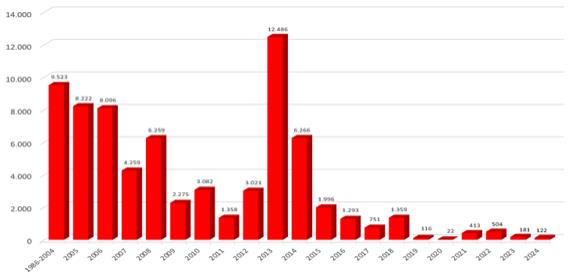
As of September 19, 2025, the privatization implementations of Türkiye amounted to approximately U.S.$121.7 million in 2024 and approximately U.S.$1.613 billion in 2025.
Total privatization proceeds realized by the Turkish Privatization Administration since 1986 amounted to approximately U.S.$73.21 billion as of September 19, 2025.
DEBT
As of August 2025, the average maturity of the Republic’s domestic cash borrowing was 34.1 months, as compared to 49.6 months as of August 2024. The average annual interest rate on domestic cash borrowing (including discounted treasury bills/government bonds) on a compounded basis was 38.85% as of August 2025, compared to 37.33% as of August 2024.
18
The total gross outstanding external debt of the Republic was approximately U.S.$527,495 million (at then- current exchange rates) at the end of the first quarter of 2025. The following table summarizes the gross external debt profile of the Republic (at period end):
| Gross External Debt Profile (in millions of U.S. Dollars) | 2023 Q4 |
2024 Q1 |
2024 Q2 |
2024 Q3 |
2024 Q4 |
2025 Q1 |
||||||||||||||||||
| GROSS EXTERNAL DEBT |
490,741 | 493,241 | 504,234 | 516,738 | 515,976 | 527,495 | ||||||||||||||||||
| SHORT-TERM |
175,748 | 173,952 | 178,645 | 177,214 | 179,894 | 178,877 | ||||||||||||||||||
| Public Sector |
34,473 | 37,681 | 38,310 | 39,576 | 39,834 | 42,093 | ||||||||||||||||||
| Central Bank |
46,360 | 46,158 | 44,691 | 38,372 | 34,775 | 30,096 | ||||||||||||||||||
| Private Sector |
94,915 | 90,113 | 95,644 | 99,266 | 105,285 | 106,688 | ||||||||||||||||||
| LONG-TERM |
314,993 | 319,289 | 325,589 | 339,514 | 336,082 | 348,618 | ||||||||||||||||||
| Public Sector |
166,698 | 169,524 | 172,815 | 180,412 | 176,540 | 178,442 | ||||||||||||||||||
| Central Bank |
0 | 0 | 0 | 0 | 0 | 0 | ||||||||||||||||||
| Private Sector |
148,294 | 149,765 | 152,774 | 159,103 | 159,542 | 170,175 | ||||||||||||||||||
Source: Ministry of Treasury and Finance
The Republic’s EU-defined general government gross debt to GDP ratio was 25.3% in the first quarter of 2025. The Republic also maintains a large cash balance to cover its financing needs. As of September 18, 2025, the Republic’s cash account with CBRT was approximately TL 1,325 billion.
Since 2003, the Republic’s strategic benchmarking policy, together with high growth rates and prudent fiscal policies, has helped to mitigate the risk exposure of its debt portfolio. For 2025, the Republic’s primary pillars of borrowing strategies are:
| | To borrow mainly in TL; |
| | To borrow in foreign currencies besides U.S. dollar, if possible, in international markets for market diversification; |
| | To keep the share of debt maturing within 12 months and the share of debt stock with interest rate refixing period of less than 12 months at a certain level, by taking into account appropriate instrument and maturity composition to optimize interest payments; and |
| | To keep a strong level of cash reserve in order to reduce the liquidity risk associated with cash and debt management. |
The Republic prepares its domestic and external borrowing programs by factoring in these strategies. By implementing a strategic benchmarking policy, the sensitivity of Ministry of Treasury and Finance’s debt portfolio to risks associated with foreign exchange, interest rate and liquidity have been significantly reduced. The Republic has also strengthened its debt sustainability.
SUMMARY OF KEY ECONOMIC INDICATORS
The following table summarizes the key economic indicators of Türkiye for the periods indicated:
| 2020 | 2021 | 2022 | 2023 | 2024 | 2025 | |||||||||||||||||||
| Nominal GDP (in billions of TL) |
5,142 | 7,434 | 15,326 | 27,091 | 44,587 | 14,579 | ** | |||||||||||||||||
| Real GDP Growth (%) |
1.8 | 11.8 | 5.4 | 5.0 | 3.3 | 4.8 | ** | |||||||||||||||||
| Unemployment (%) |
13.1 | 12.0 | 10.4 | 9.4 | 8.7 | 8.0 | *** | |||||||||||||||||
| Consumer Price Index (%) |
14.60 | 36.08 | 64.27 | 64.77 | 44.38 | 32.95 | **** | |||||||||||||||||
| Domestic Producer Price Index (%) |
25.15 | 79.89 | 97.72 | 44.22 | 28.52 | 25.16 | **** | |||||||||||||||||
| Current Account Balance (in millions of U.S.$) |
-30,980 | -6,221 | -46,283 | -41,469 | -10,457 | 1,766 | *** | |||||||||||||||||
| Central Government External Debt Stock (in millions of U.S.$) |
102,317 | 109,732 | 113,715 | 119,607 | 121,785 | 127,187 | *** | |||||||||||||||||
| Public Sector Borrowing Requirement/GDP (%) |
3.93 | 2.54 | 2.38 | 5.62 | 4.92 | | 2.74 | * | ||||||||||||||||
| * | 2025-2027 Medium Term Program. |
| ** | As of Q2. |
| *** | As of July 2025. Unemployment data for July 2025 is seasonally adjusted. |
| **** | As of August 2025. |
| | Provisional. |
Sources: TURKSTAT, Central Bank, Ministry of Treasury and Finance
From August 28, 2025 to September 19, 2025, the İstanbul Stock Exchange National 100 Index decreased by 0.65%.
19
DESCRIPTION OF THE REPUBLIC OF TÜRKİYE
Türkiye has an executive presidential system of government. Since its founding in 1923, Türkiye has aligned itself with the west and is a member of numerous international organizations, including the North Atlantic Treaty Organization (“NATO”), the Council of Europe, the World Bank, the International Monetary Fund (“IMF”) and the Organization for Economic Cooperation and Development (the “OECD”). Türkiye is also an associate member of the EU and a founding member of the European Bank for Reconstruction and Development (the “EBRD”).
Since 1980, the Turkish Government has embarked upon a series of market-oriented reforms which, among other things, were designed to remove price controls and reduce subsidies, reduce the role of the public sector in the economy, emphasize growth in the industrial and service sectors, encourage private investment and savings, liberalize foreign trade, reduce tariffs and promote export growth, ease capital transfer and exchange controls and encourage foreign investment, increase the independence of the Central Bank of the Republic of Türkiye (the “Central Bank” and “CBRT”) and reform the tax system. Türkiye moved towards full convertibility of the Turkish Lira by accepting the obligations of Article VIII of the IMF Articles of Agreement in March 1990. Türkiye has undergone an important restructuring process after a 2001 crisis by implementing fundamental fiscal, financial, economic and legal transformation. These reforms include increasing financial liberalization by improving the banking sector, decreasing the public share in the economy via privatization, increasing and improving the regulatory role of the government in the economy, liberalization of energy, communication, education, health and agricultural sectors, and promoting competition and transformation in these sectors. As a result, the Turkish economy achieved striking growth rates. Türkiye has developed a market-oriented, highly diversified economy with growing industrial and service sectors, while retaining a prominent agricultural sector that makes the country largely self-sufficient in foodstuffs. According to the Turkish Statistical Institute (“TURKSTAT”), in 2024, agriculture, industrial sector and services sector accounted for 5.6%, 20.0% and 62.8% of GDP respectively. The average GDP growth rate during the 2019-2024 period was 4.7%. See “Economy—Services,” “Economy—Principal Industries” and “Economy—Agriculture” for details.
Türkiye, situated at the junction of Europe and Asia, is an important crossroads between Western Europe, the Middle East and Asia. Türkiye’s location has been a central feature of its history, culture and politics. Türkiye’s land borders extend for more than 2,600 kilometers and are shared with eight countries: Greece and Bulgaria in the west and northwest, Iran in the east, Armenia, Georgia and Azerbaijan in the northeast, and Iraq and Syria in the south.
20
Türkiye’s coastline extends for approximately 7,200 kilometers along the Black Sea in the north, the Aegean Sea in the southwest and the Mediterranean Sea in the south, all of which are connected by the Strait of İstanbul, the Sea of Marmara and the Strait of Çanakkale.
Türkiye has an area of approximately 814,578 square kilometers (inclusive of its lakes), and its topography is varied. Most of the country consists of highland plateau surrounded by mountainous areas which rise toward the east. Climatic conditions differ widely among the regions.
Türkiye is among the countries that are most affected by natural disasters on a global scale due to its tectonic, seismic, topographic, and climactic structure. Although disasters such as floods, avalanches, landslides, and fires are common in the country, earthquakes are typically the most devastating natural disasters in Türkiye. According to the 2018 Earthquake Hazard Map of Türkiye, a significant portion of Türkiye’s population and most of its economic resources are located in seismically hazardous areas. On average, Türkiye and its surrounding areas experience two 5 to 5.9 magnitude earthquakes per month and have experienced a large number of earthquakes in recent years, some quite significant in magnitude, which renders the proper management and coordination of disasters absolutely crucial. In the event of future earthquakes, effects from the direct impact of such events could result in a significant loss of lives and have a material adverse effect on Türkiye’s economy. In addition to natural disasters, man-made disasters are also an area of concern for AFAD. In 2025, the total number of earthquake monitoring stations across Türkiye reached 1,204, which includes GPS and borehole stations.
The 1999 Marmara earthquake marked the turning point in the area of disaster management and coordination and clearly demonstrated the need to reform disaster management, compelling Türkiye to establish a single government institution to coordinate and exercise legal authority in cases of disaster and emergencies. Since that time, the reforms enacted and decisions taken in the field of disaster management have been implemented following the 2023 Kahramanmaraş earthquakes, which constituted yet another milestone for our country in terms of seismic risk and preparedness.
The Turkish Parliament passed Law No. 5902 in 2009 to form the Disaster and Emergency Management Authority (“AFAD”) under the Turkish Prime Ministry and abolish various agencies which previously held jurisdiction over issues of disaster management. After Türkiye adopted a presidential system of governance on April 16, 2017 and the new executive presidential system entered into force with the June 24, 2018 elections, Presidential Decree No. 4, which was published in the Official Gazette on July 15, 2018, reformed AFAD (previously an agency under the office of the Prime Ministry) as an agency under the Ministry of Interior. Decree No. 4 defines the purpose and scope of the Presidency as follows: “to take the necessary measures for the effective provision of services concerning disaster and emergency recovery and civil defense at a country level, ensuring preparedness and risk reduction before events occur; to provide coordination among institutions and agencies in charge of response and recovery operations during and after such events; to conduct and coordinate humanitarian aid operations at home and abroad; and to formulate and implement policy recommendations related to these issues.”
AFAD works to prevent disasters and minimize disaster-related damages, plan and coordinate post-disaster responses, and promote cooperation among various government agencies. Notwithstanding its position as the sole authority on disasters and emergencies, AFAD cooperates with a range of government institutions and non-governmental organizations depending on the nature and severity of disasters.
The mission of AFAD for the period from 2019 to 2023 – as indicated in the 2019-2023 strategic plan – was “to engage in the efforts required for the effective management of processes relating to disasters and emergencies, to ensure coordination among the relevant institutions and agencies, and to formulate policies in this field.” From 2024 onwards, AFAD’s mission has been designed in a more comprehensive and holistic manner within the framework of the objectives set out in the 2024-2028 strategic plan. In this sense, AFAD aims to serve as an organization that focuses on risk management, with an awareness of the importance of sustainable development that takes care to ensure efficiency, effectiveness and reliability in the provision of services, that is influential on an international level and that effectively coordinates all agencies involved in disaster management. Considering the need to raise public awareness of disasters and emergencies, as well as the level of preparedness, in parallel with efforts to reduce risks in the strategic plan period, the Presidency’s vision was revised to “Building a disaster-resilient community”.
Under the National Earthquake Strategy Action Plan (UDSEP-2023) prepared by Earthquake Department, AFAD is responsible for updating and developing the Building Earthquake Code, taking into account the Eurocode, under the principle of “safe settlement and earthquake-resistant construction”. The updated “Turkish Building Earthquake Code” was published in the Official Gazette dated March 18, 2018 and numbered 30364 and entered into force as of January 1, 2019. Coordination efforts carried out by our Presidency for the revision and updating of the “Turkish Building Earthquake Code” are ongoing.
21
The National Earthquake Research Program (UDAP), which was published in the Official Gazette dated April 27, 2012 and numbered 28276, is intended to support scientific research in order to produce new information and solve technological problems, and to use the country’s resources effectively and efficiently by transforming these researches into projects that can be transferred to a multi-participatory structure and practice. Within the scope of UDAP, 67 projects were supported between 2012-2024. Within the scope of the “Cooperation Protocol on Scientific Research and Development, Innovation and Human Resources” signed between AFAD and TÜBİTAK on October 30, 2023, a joint financing model has been adopted, with 20% provided by AFAD and 80% by TÜBİTAK
AFAD’s strategic plan, developed with a participatory approach on a solid foundation that takes into account national and international conjuncture, was created around six components, which are “Coordination and Communication, Risk Mitigation, During and Post-disaster, Social Awareness, International Influence and Institutional Capacity”, as well as the goals that serve these themes. As the successor of the Hyogo Framework for Action, covering the period from 2015 to 2030, the Sendai Framework seeks to reduce losses resulting from disasters, prevent new risks, mitigate existing risks and enhance resilience to disasters. The Sendai Framework for Disaster Risk Reduction (“SFDRR”) defines the basic building blocks for disaster management until 2030 and is the main reference source for the national development plans and programs, as well as for AFAD’s Strategic Plan.
Türkiye’s first earthquake risk reduction strategy document, the National Earthquake Strategy and Action Plan 2012-2023 (UDSEP-2023) was prepared by AFAD in order to achieve the goal of mitigating earthquake-related risks at national level. UDSEP-2023 was published in the Official Gazette No. 28029 of August 18, 2011. As of 2024, the duration for the implementation of UDSEP-2023 has ended and 66% of the strategy has been successfully completed. The activities of the remaining actions continue under the Disaster Risk Reduction Plan of Türkiye (TARAP). In order to enhance coordination and improve the management of risks and dangers posed by disasters in Türkiye, AFAD introduced a novel disaster management model known as the “Integrated Disaster Management System”, which is intended to prioritize Türkiye’s transition from crisis management to risk management.
The Integrated Disaster Management System consists of four axes:
1-Mitigation: This axis covers activities focused on reducing or eliminating the likelihood of loss or lessening its intensity through risk evaluation.
2-Preparedness: This axis covers preparation and training activities for disaster intervention procedures through coordination of people and institutions.
3-Response: This axis covers activities focused on determining and meeting all necessities that may arise as a result of disasters and emergencies as promptly as possible.
4-Recovery: This axis covers the activities that are focused on normalizing, and if possible, further improving all life systems that have been disrupted due to disaster or emergency, in the fastest and most targeted way.
Within the framework of the integrated disaster management system, there are various initiatives designed to correctly distribute tasks among all stakeholders and to encourage effective monitoring and evaluation of these tasks for management policies, strategies and practices regarding disasters and emergencies. The Türkiye Disaster Management Strategy (TAYS), a strategic plan that will serve as the framework document of Türkiye’s disaster management system, is being prepared. TAYS will include the responsibilities and task distribution of all stakeholders related to disaster management. The objectives of this plan are (i) to increase the effectiveness of all sectors in disaster management, (ii) to prioritize urgent needs and (iii) to increase social resilience against disasters. The commission established by Directorate (AFAD) Decree No. 814206 dated January 11, 2024, conducted its work on January 18, 2024 within the framework of the existing draft document (TAYS). Institutional assessments under the scope of the document were prepared during the 2024 and made ready for use in the next stage.
TARAP is a sustainability plan that defines the activities that need to be carried out before the outbreak of disasters to minimize disaster risks, together with responsible parties and their respective responsibilities within the process. With TARAP, the major aim is to reduce the risk by means of effective and efficient use of resources. Disaster-related losses will be prevented or mitigated, if possible, by creating resilient societies and safe living spaces. TARAP is a roadmap plan in this regard and will contribute to sustainable development. Strategic priorities in line with the Sendai Disaster Risk Reduction Framework (2015-2030) have been set forth in the document, which has been shaped with the contributions from academics, stakeholders, and experts within the institution. The internationally accepted strategic priorities in the Sendai Framework have also formed the strategic priorities of TARAP. For each strategic priority, the target, purpose, actions, the institution responsible for their realization as well as the relevant institutions and organizations that will support the responsible institution have been defined. Types of disasters for which a strategy is developed are as follows: “Earthquake, Mass Movements, Flood, Climate Change, Forest Fires, Infectious and Epidemic Diseases, Chemical-Biological-Radiological-Nuclear Threats (CBRN), Major Industrial Accident, Hazardous Material Transportation, Mining Accidents, Mass Migration and Other Disasters”. There are 17 objectives, 66 targets and 227 risk reduction actions in TDRRP. TDRRP was published on July 8, 2022 and entered into force. The monitoring and evaluation process of the actions included in TARAP is ongoing.
22
Provincial Level Disaster Risk Reduction Plan (“İRAP”) is a plan that reveals the disaster nature of the province and the possible effects of disasters, and defines the responsible parties for disaster management, setting forth precautions to be taken in advance to minimize the impacts of possible disasters. İRAP is a road map to be developed by the institutions/organizations in the provinces and all other relevant stakeholders. It is a plan that should be adopted by the entire province, not by any particular institution or organization. IRAP is not a document to be prepared and reported only once. İRAP is a plan that includes goals, objectives and actions to reduce risk in our cities. Responsible stakeholders are identified in the plan for each action to reduce disaster risks. İRAP addresses the need to manage underlying disaster risk drivers and to strengthen good governance in disaster risk management, with a focus on local governments including local authorities and managers or other sub-national levels. It provides an important boost to efforts aimed at meeting a key target in the Sendai Framework, Target (E), which seeks to increase the number of countries with national and local strategies for Disaster Risk Reduction (DRR) and is also directly related with other SFDRR targets.
The Türkiye Disaster Response Plan (“TAMP”) has been in effect since 2014 and the Türkiye Post-Disaster Recovery Plan (TASIP) is in the preparation phase.
After the Van Earthquake in October 2011, the need for a comprehensive action plan became clear as then-current legislation in Türkiye was no longer fulfilling present day’s needs. New studies and plans on disaster management emerged due to advances in technology and increased disaster awareness. Following a detailed inspection of various types of events; TAMP was created to define the roles and responsibilities for all parties involved in disaster and emergency response situations to determine the basic principles of a response plan in all three phases: before, during and after disaster and emergency situations.
TAMP is flexible, modularly-structured and adaptable to all types and scales of disasters and guides the planning and coordination of public institutions and non-governmental organizations in the event of a local- or national-level disaster to minimize the loss of life and property via efficient resource management. TAMP gives responsibilities to personnel of all parties involved (ministries, the public institutions and non-governmental organizations) in the wake of a local- or national-level disaster to work under different disaster groups. Personnel, equipment and resource analysis is carried out to analyze the current situation and identify the strengths and weaknesses in current disaster response procedures so as to increase the disaster and emergency management capacity in Türkiye. Currently, TAMP is in force and is applied in every disaster situation.
Since its foundation, AFAD has been adhering to the philosophy of switching from crisis management to risk management. As a result, the risk management and risk reduction efforts in the Republic have been given fresh impetus. As of year-end 2020, the Disaster Risk Reduction System (ARAS) Project systems have been made available in the 81 provinces, and these systems continue to be actively used. Landslide, rockfall, avalanche susceptibility and hazard maps have been produced for all provinces and shared with the public institutions and organizations that act as stakeholders in disaster risk mitigation.
In line with its strategic goals, AFAD is conducting several capacity-building activities to improve disaster resilience in society. Some of these key activities include disaster risk reduction activities, situational awareness efforts, and humanitarian assistance.
Focusing seriously on disaster risk reduction activities, AFAD completed the pilot study that resulted in the first provincial-level disaster risk reduction plan of Türkiye in Kahramanmaraş. IRAP (the provincial level disaster risk reduction plan) has 3 goals, 21 targets and 225 actions. Most of the actions address the recommendations of the Sendai Framework priorities, and thus aim to reduce and prevent disaster risks. In the plan, relevant stakeholders have been designated to accomplish actions in a specific implementation period. By the end of 2021, a guide had been prepared and published with a circular. In line with the guideline, 80 provinces had prepared their plans by the end of 2021. IRAP addresses the need to manage underlying disaster risk drivers and strengthen good governance in disaster risk management with a focus on local governments, including authorities and managers at city or other sub-national levels.
Between 2013 and 2020, more than 32 million citizens were reached under the “Disaster Prepared Türkiye Raising Awareness and Training Project” through face-to-face indoor trainings, practices at three mobile earthquake simulation trucks and three simulation centers at key cities in Türkiye. The main objective of this project was to raise awareness among citizens about the disaster risks, with a special focus on earthquakes, in the area they live in, to take measures to reduce the damage that they and their families may experience in their homes and work places, and to prepare them for the moment of disaster and the aftermath.
Within the framework of the integrated disaster risk management approach and with the mission of creating a disaster-resilient society, between July 2019 and August 2020, AFAD conducted a risk information and communication campaign titled “Year of Disaster Preparedness”. Under this campaign, awareness-raising activities were carried out on the provincial and national level with different themes of disaster management such as “Preparing Emergency Kit”, “Emergency Assembly Areas”, “Disaster Insurance”, “Safe Buildings”, “First Aid”, “Volunteering”, “Fire” and “Disaster Drills”.
23
2021 was declared the “Disaster Training Year”, as a continuation of previous projects, with the purpose of increasing the public’s level of disaster awareness and initiating a change in disaster risk reduction and prevention habits. The overall target of this campaign is to reach 50 million people through various activities carried out in cooperation with ministries and public agencies, nongovernmental organizations (such as search and rescue and humanitarian NGOs, chambers, unions of different professions, sport federations etc.), the private sector and universities:
| | Since the beginning of 2021, over 15 million citizen received one hour of online or face to face “Disaster Awareness Training”, covering topics of prevention and preparedness for earthquake, flood, landslide, fire and avalanche at the individual and household levels. Other trainings such as “Fire Awareness”, and “Basics of Search and Rescue” are also conducted for citizens widely. |
| | In order to raise awareness levels of public authorities and improve local capacities relating to disaster and emergency management at the local and national level, Governors, local administrators, Mukhtars/Heads of Villages and Village Council Members attend disaster awareness and disaster management training programs. |
| | Public spot videos, animations, posters and booklets (in Turkish, English and Arabic) concerning different types of disaster risks were prepared and accessible through official web sites and social media accounts. |
The following trainings were completed as of 2024.
| I. | Disaster Awareness Training was given to 56,232,958 citizens and Disaster Awareness Instructor Training was provided to 18,169 personnel. |
| II. | 240,410 people were given CBRN Awareness and Suspicious Mail Training. |
| III. | The number of views of educational videos about disasters on social media is 12,907,770. |
| IV. | Disaster Awareness Training was provided in numerous provinces throughout Türkiye through the use of the Republic’s Mobile Simulation Trucks. |
| V. | Training was given to 47,120 headmen and 142,308 village committee members. |
| VI. | Disaster Awareness Training was provided to 25,268 neighborhood security officers, 30,189 village security guards and volunteer village security guards, and 157,595 private security guards. |
| VII. | Training was provided to 356,956 association members from 9,365 associations. |
| VIII. | Disaster Awareness Trainings are given to the mosque community in mosques; 6,495,241 people have been reached through these trainings. |
| IX. | Tent Setting Training is given to Gendarmerie General Command, General Directorate of Police, Coast Guard Command, Ministry of National Education and Fire Brigade personnel and members of AFAD Volunteers and non-governmental organizations, and 86,761 people have been given this training. |
| X. | Disaster Training Tents have started to been placed in city squares as of June 2021, reaching 2,442,585 citizens. |
| XI. | 161,000 Disaster and Emergency Bags, 12,785,000 Posters and Brochures, 650,000 Disaster Awareness Manuals for children, 15,000 Disaster Box Games, 350,000 coloring books and 73,000 puzzle games were distributed to our provinces. |
| XII. | Disaster Awareness Area in Konya Science Center was opened to visitors and a 3D animation film was prepared for the planetarium center; 217,809 people visited the center in 2021. |
| XIII. | Between October 30 and November 3, 2023, an Urban Search and Rescue Coordination Training (UC) was held in Istanbul. Fifteen AFAD personnel and 17 foreign search and rescue personnel participated in this international training, which we hosted. |
| XIV. | Within the scope of INSARAG accreditation activities and trainer training, 85 personnel were trained in 4 different provinces. |
| XV. | In 2023, disaster awareness trainer training was provided to 918 individuals and disaster awareness training was provided to 15,922,255 individuals. |
| XVI. | 549 people received urban search and rescue training and 31,232 people received light search and rescue training. |
24
| XVII. | To train 100,000 search and rescue personnel to provide support during major disasters, the “Earthquake Search and Rescue Training Module” has been developed. Within this scope, training has been provided to 102 instructors. With these instructors, 692 individuals from public and private institutions and organisations, as well as civil society organisations, have been trained as instructors. |
| XVIII. | Traffic Accident Response and Rescue Training has been organised and a curriculum programme has been prepared on the subject. Within this scope, a total of 1,628 AFAD personnel have been trained. |
| XIX. | Within the scope of training activities conducted by AFADEM and Provincial AFAD Directorates: |
| | 109 individuals from public institutions and organisations received Basic Civil Defence Training |
| | 16,599 individuals received Civil Defence Awareness Training |
| | 94 individuals received Basic CBRN Training |
| | 19,049 individuals received CBRN Awareness and Suspicious Mail Training |
| | 245 individuals received Fire Instructor Training |
| | 1,009,667 individuals received Fire Awareness Training |
| | 31,683 individuals received Tent Setup Training |
| | 26,407 individuals received Emergency Response Team Training |
| | 10,075 individuals received Humanitarian Aid and Psychosocial Support Training |
| XX. | In 2023: |
| | 6,387,389 people participated in the earthquake drill |
| | 6,075,110 people participated in the evacuation drill |
| | 299,119 people participated in the fire drill |
| XXI. | Disaster Awareness Training was provided to 7,516,418 people in 2024. |
| XXII. | The General Directorate of Earthquake and Risk Reduction has four Mobile Disaster and Emergency Simulation Vehicles (one of which is located at Istanbul AFAD). As part of the training programme, these vehicles have been operating throughout the year in all 81 provinces. In 2024, 79,085 Disaster Awareness Training sessions were delivered using the Mobile Disaster and Emergency Simulation Vehicle. |
| XXIII. | In 2024, a total of 3,424 personnel were trained, with: |
| | 1,114 receiving training in 26 different in-service training programmes at the AFAD Presidency |
2,310 receiving training in 9 different in-service training programmes at provincial directorates
Aiming to get volunteers involved in disaster management, AFAD initiated the AFAD Volunteerism System Project in 2018. The scope of the project is to ensure that persons wishing to take a voluntary role in any phase of the disaster management cycle can participate in accordance with certain standards, identify the fields of volunteer activity, increase volunteer capacities through trainings and monitor volunteer performance within the system. The aim here is to construct a voluntary pool within the AFAD Volunteerism System, aimed at directing people in the pool to be able to work effectively in coordination with professional staff during every phase of disaster management cycle.
The Turkish nation has an enduring tradition of humanitarian aid emanating from its history and culture. In addition to disaster and emergency management activities within Türkiye, AFAD also carries out humanitarian aid operations abroad. Türkiye has always perceived providing international aid to countries during times of natural disasters, war, poverty and social clashes as a humanitarian duty and an important element in achieving a stable international community.
25
Between 2009 and 2024, Türkiye has carried out humanitarian aid operations in order to help people affected by disasters and emergencies such as earthquakes, floods, drought, famine, fire and internal conflicts within the framework of the humanitarian aid principles. AFAD’s contributions have increased over the years and humanitarian assistances of AFAD have been received above 76 countries across 5 continents. According to the Global Humanitarian Assistance Report, Türkiye provides the most humanitarian aid as a percentage of its gross national product.
In addition to implementing activities within the scope of humanitarian aid in different parts of the world under the coordination of AFAD, Türkiye carries out many projects in northern Syria.
Between 2018 and 2023, under the coordination of AFAD with NGO and INGO, Türkiye’s humanitarian aid activities have continued in Northwest Syria. Many projects are carried out to find permanent solutions to problems in the region, in particular the issue of housing. Briquette houses were built in cooperation with civil society. Attempts to provide permanent shelter have now been initiated. It is aimed to constitute not only areas for sheltering, but also places for economic pursuits that enhance livelihoods according to the potential of the region, as well as educational and social areas. Throughout 2024, humanitarian aid efforts for Syria continued. By the end of 2024, 116,731 briquette houses had been completed and handed over to Syrian citizens. As of 2024, 110,000 tonnes of flour had been delivered to the region. 145,000 food parcels were dispatched to the region to be distributed to those in need. In addition, at the request of local authorities, on 16 December 2024, a 123-person team completed search and screening operations in a 70,000 m² area at Sednaya Prison in accordance with INSARAG standards.
After the devastating earthquakes on February 6, 2023, State of Emergency Presidential Decrees regarding health, economy, settlement and construction were issued in the provinces under the state of emergency declared by Presidential Decree No. 6785 dated April 8, 2023. Issues regarding settlement and construction that are not temporary measures have been given a legal basis by Law No. 7542 dated April 10, 2023. In addition, many secondary regulations were issued for the implementation of these Presidential Decrees and Law No. 7452.
According to estimates of the TURKSTAT, the population of Türkiye was 85,664,944 on December 31, 2023. The annual population growth rate for Türkiye in 2024 was 0.34%, compared to an annual growth rate of 0.11% in 2023. Türkiye’s population is relatively young compared to other European countries, and the transformation of Türkiye’s economy from a largely agricultural economy to an industrial and service-oriented economy has led to an increasingly urban population. In 2024, the median age of the population in Türkiye was 34.4, with a median age of 33.7 for males and 35.2 for females. Persons of working age, the age group of 15-64, constituted 68.4% of the total population in 2024.
The largest city in Türkiye, with a population of about 15.7 million, is İstanbul, the country’s commercial center. Ankara, the capital city of Türkiye, with a population of about 5.9 million is the second largest city. İzmir, with a population of about 4.5 million, is third largest. Other cities with populations in excess of one million are (in alphabetical order) Adana, Antalya, Aydın, Balıkesir, Bursa, Denizli, Diyarbakır, Gaziantep, Hatay, Kahramanmaraş, Kayseri, Kocaeli, Konya, Manisa, Mersin, Muğla, Sakarya, Samsun, Şanlıurfa, Tekirdağ and Van.
In 2024, total employment was 32.62 million, with approximately 14.8% employed in agriculture, 20.7% in industry and 64.5% in services (including construction). The unemployment rate was 8.7% in 2024. See “Economy—Employment and Wages” for further details.
Türkiye has made significant progress in improving social welfare over the last decade. Life expectancy increased from an average of 67.4 years in 1990 to an average of 78.1 years for the period of 2022-2024. The infant mortality rate decreased from 51.5 per thousand live births for the year 1990 to 9.0 per thousand live births for the year 2024. According to the Address-Based Population Registration System, the adult literacy rate among individuals aged 6 years and over increased from 91.8% in 2008 to 97.8% in 2024.
Türkiye is constitutionally a secular state. The vast majority of the Turkish population is Muslim. There are very small numbers of non-Muslims in Türkiye, including mostly Greek Orthodox, Armenian Christians and Jews. The official language of Türkiye is Turkish.
26
GOVERNMENT ORGANIZATION AND POLITICAL BACKGROUND
Overview
A popular nationalist movement began in Türkiye before the turn of the 20th century and gathered momentum in the aftermath of World War I. Türkiye was declared a republic on October 29, 1923, upon the abolition of the Sultanate. Mustafa Kemal Atatürk was elected as Türkiye’s first President. Atatürk instituted a series of sweeping social reforms that have played a central role in the development of modern Türkiye. The first Constitution of Republic of Türkiye was adopted in 1924 and provided for an elected Grand National Assembly (the “Assembly”) to be the repository of sovereign power. Executive authority was vested in the Prime Minister and the Council of Ministers (the “Cabinet”). Changes were made in the legal, political, social and economic structure of Türkiye, and Islamic legal codes were replaced by Western ones. Atatürk’s reforms and Western orientation continue to be the dominant ideological element in Türkiye today.
Türkiye’s current Constitution (the “Constitution”), which was revised and ratified by popular referendum in 1982, contains a system of checks and balances aimed at ensuring a strong central government and reducing factionalism in the Assembly.
On April 16, 2017, a new constitutional reform package was approved in a public referendum. The constitutional reform package included, among other things, the following changes: giving executive powers to the president and vice presidents while abolishing the post of prime minister, lowering the age of candidacy for parliament from 25 to 18, and increasing the number of parliamentarians from 550 to 600.
The package of constitutional amendments allowed the winner of the presidential election to assume control of the government and transform the parliamentary system into an executive presidential system. Among the executive presidential system related articles in the constitutional reform package, the article that gives the President the right to have a political party affiliation and the articles related to changes in the judicial system became effective immediately. The new executive presidential system became fully effective after the first parliamentary and presidential elections were held on June 24, 2018 under the amended constitution. The Constitution provides for the Assembly and a President. Both presidential and parliamentary elections will be held every five years on the same date. Pursuant to a 2007 amendment to the Constitution, the President is elected by the absolute majority vote of the public. Prior to this amendment, the President was elected by the Assembly. The President is elected for a five-year term, and can serve a maximum of two terms. Under the new presidential system, the President appoints the members of the Cabinet, and the Cabinet, chaired by the President, exercises the executive powers of the Government.
The members of the Assembly are elected for five-year terms. The Constitution provides for a system of proportional representation and forbids the formation of political parties based on class, religion or ethnic identity. Pursuant to an amendment made to the Law No. 2839 with the Law No. 7393 published in the Official Gazette on April 6, 2022, parties whose nationwide vote in general elections is less than 7% will not be eligible for seats in the Assembly. In the case of an alliance of two or more political parties, the total number of these parties’ votes is taken into consideration to meet the 7% eligibility ratio. In this case, these parties’ votes are not taken into consideration individually. According to another amendment to the Law No. 2389, each party will win seats in the Parliament according to the votes they receive in a particular electoral district, whereas previously parliamentary seats were distributed according to the total votes mustered by members of an alliance.
Elections & Executive Powers
According to the official results announced by the Supreme Election Council after the general and presidential elections held on June 24, 2018, President Erdoğan won an absolute majority in the presidential election with 52.59% of the vote. Justice and Development Party (AKP) garnered 42.56% of the votes, Republican People’s Party (CHP) garnered 22.65%, Nationalist Movement Party (MHP) garnered 11.10%, People’s Democratic Party (HDP) garnered 11.70%, İYİ Party garnered 9.96%, and other participant political parties and independent candidates garnered 2.03% of votes.
The elections results marked Türkiye’s transition to an executive presidential system of government, abolishing the prime ministry post, among other constitutional changes. Statutory Decree No. 703 published on July 9, 2018, abolished some laws on the organizations and functions of some ministries and institutions. Under the decree, Prime Ministry Undersecretariat of Treasury and the Ministry of Finance were consolidated into one ministry and the new ministry was named the “Ministry of Treasury and Finance” and is the agency with the authority to raise funding in international capital markets on behalf of the Republic of Türkiye.
In the newly established executive presidential system, the cabinet involves the following ministries: Ministry of Treasury and Finance, Ministry of Justice, Ministry of Interior, Ministry of National Education, Ministry of National Defense, Ministry of Health, Ministry of Energy and Natural Resources, Ministry of Environment, Urbanization and Climate Change, Ministry of Culture and Tourism, Ministry
27
of Youth and Sports, Ministry of Transport and Infrastructure, Ministry of Foreign Affairs, Ministry of Labor, Social Services and Family, Ministry of Agriculture and Forestry, Ministry of Industry and Technology, and Ministry of Trade. On April 21, 2021, the Ministry of Labor, Social Services and Family was split in two; the Ministry of Labor and Social Security and the Ministry of Family and Social Services were established.
Some of the most important changes imposed by the executive presidential system are as follows:
| | Article 77. Parliamentary terms are extended from four to five years. Parliamentary and presidential elections will be held on the same day every five years, with presidential elections going to a run-off if no candidate wins a simple majority in the first round. |
| | Article 87. The functions of the Parliament are to: prepare, change, and remove laws; accept international contracts; discuss, increase or decrease budget (on Budget Commission) figures and accept or reject the budget in the General Assembly; appoint seven members of the Council of Judges and Prosecutors (“HSK”); and, exercise other powers in the Constitution. |
| | Article 104. The President becomes both the head of state and head of government, with the power to appoint and remove ministers and the Vice President. The President can issue decrees based on his executive powers. If legislation is enacted on the same topic about which the President issued an executive order, the decree will become invalid and parliamentary law becomes valid. |
| | Article 106. The President can appoint one or more Vice Presidents. If the presidency falls vacant, then presidential elections must be held within forty-five days. |
| | Article 116. The President and three-fifths of the Parliament can decide to renew elections. In this case, the enactor also dissolves itself until elections. |
| | Article 125. The acts of the President are now subject to judicial review. |
The articles related to changes to the judicial system are as follows:
| | Article 146. The President used to appoint one judge from the High Military Court of Appeals, and one from the High Military Administrative Court. As military courts are now abolished, the number of judges in the Constitutional Court is reduced to fifteen from seventeen. Consequently, presidential appointees are reduced to twelve from fourteen, while the Parliament continues to appoint three. |
| | The High Council of Judges and Prosecutors is renamed to “Council of Judges and Prosecutors”. The number of members is reduced to thirteen from twenty-two and departments are reduced to two from three. Four members are appointed by the President and seven will be appointed by the Parliament. Council of Judges and Prosecutors candidates will need to get two-thirds, or 400, votes to pass the first round and will need three-fifths, or 360 votes in the second round to become a member of HSK. The other two members, the Justice Minister and Ministry of Justice Undersecretary, remain the same. |
On May 17, 2021, a new political party, the Homeland Party, was founded by former CHP deputy Muharrem İnce. Later on July 22, 2025, at the parties’ second extraordinary congress the decision to close the party was accepted with a majority vote.
On August 26, 2021, a new political party, the “Victory Party”, was founded by former İYİ Party deputy Ümit Özdag.
On March 22, 2023, Mithat Sancar, co-leader of HDP, announced that the HDP’s candidates for parliament would run under the Green Left Party. On August 27, 2023, HDP announced that it would hand over active political work to the Green Left Party. On October 15, 2023, the Green Left Party changed its name to the Peoples’ Equality and Democracy Party (DEM) and co leadership in DEM party switch to Mr. Tuncer Bakırhan and Ms. Ayşegül Doğan.
In the most recent presidential and parliamentary elections held on May 14, 2023, Recep Tayyip Erdoğan received 49.52%, Kemal Kılıçdaroğlu received 44.88% and Sinan Oğan received 5.17% of the votes. As no candidate received more than 50% of the valid votes to win directly, a second round of elections, between Recep Tayyip Erdoğan and Kemal Kılıçdaroğlu was held on May 28, 2023. On May 28, 2023, Recep Tayyip Erdoğan was reelected as President by receiving 52.18% of the votes. Kemal Kılıçdaroğlu received 47.82% of the votes.
On November 5, 2023, Özgur Özel was elected chairman of Türkiye’s CHP, replacing Kemal Kılıçdaroğlu.
28
The following table sets forth the composition of the Grand National Assembly of Türkiye following the elections in May 2023 by total number of seats as of September 5, 2025:
| Number of Seats |
||||
| Justice and Development Party (AKP) |
272 | |||
| Republican People’s Party (CHP) |
137 | |||
| Peoples’ Equality and Democracy Party (DEM Party) |
56 | |||
| Nationalist Action Party (MHP) |
47 | |||
| İYİ Party |
29 | |||
| New Path Party (YYP) |
21 | |||
| New Welfare Party (YRP) |
4 | |||
| Free Cause Party (HÜDA PAR) |
4 | |||
| Turkish Workers Party (TİP) |
3 | |||
| Democratic Regions Party (DBP) |
2 | |||
| Labour Party (EMEP) |
2 | |||
| Felicity Party (SP) |
1 | |||
| Democratic Party (DP) |
1 | |||
| Democratic Left Party (DSP) |
1 | |||
| Independent |
12 | |||
|
|
|
|||
| Total |
592 | |||
|
|
|
|||
Source: The Grand National Assembly of Türkiye
The most recent local elections were held on March 31, 2024. According to the official results from the Election Board, while CHP, AKP, Peoples’ Equality and Democracy Party (DEM Party), MHP and New Welfare Party (YRP) won 35, 24, 10, 8 and 2 provincial municipalities respectively, İYİ Party and Great Unity Party (BBP) each won 1 provincial municipality. Furthermore, the main opposition party, CHP, won across the biggest Turkish cities such as İstanbul, İzmir, Bursa and the capital Ankara. In particular, the party’s candidates in Türkiye’s largest city İstanbul, and the capital Ankara, Ekrem İmamoğlu and Mansur Yavaş, were re-elected.
On April 27, 2024, Müsavat Dervişoğlu was elected as the new leader of İYİ Party at an extraordinary congress held on that date.
In accordance with a decree published in the Official Gazette No. 32590 dated July 2, 2024, Mr. Fahrettin Koca was dismissed, and Mr. Kemal Memişoğlu was appointed as the new Minister of Health. According to the same decree, Mr. Mehmet Özhaseki was dismissed, and Mr. Murat Kurum was appointed as the new Minister of Environment, Urbanization and Climate Change.
Political Judicial Proceedings
As of November 4, 2018, 9 deputies including the HDP’s co-chairs have been under arrest over alleged links to terrorist groups including the PKK. On June 4, 2020, a CHP deputy and two HDP deputies were sentenced for “being part of an armed terrorist group” and “leaking state secrets” a day after the parliament revoked their seats. Parliamentary status of these deputies has been removed due to the finalized sentences given by the courts. The final judgements of the judicial proceedings against the deputies were read out in the General Assembly of the Parliament. The CHP deputy was found guilty of disclosing secret state documents by the 2nd Penal Department of the Istanbul Regional Court of Justice. HDP’s lawmakers, on the other hand, were arrested for being members of the PKK terrorist group.
On February 11, 2021, the CHP deputy regained his deputyship after a court order for his retrial. On March 17, 2021, the parliamentary status of another HDP deputy was removed due to his sentencing on terrorism charges, but his deputyship was restored on July 16 2021. On March 17, 2021, the chief public prosecutor of the Supreme Court of Appeals filed an indictment seeking dissolution of the opposition party, HDP. On March 31, 2021, Türkiye’s Constitutional Court (the “Constitutional Court”) returned the indictment on the closure of HDP over procedural deficiencies. On June 7, 2021, the chief public prosecutor of the Supreme Court of Appeals refiled the indictment that sought the dissolution of HDP. On June 21, 2021, the Constitutional Court accepted the new indictment for the case. On November 5, 2021, HDP handed over its preliminary defense. On November 29, 2021, the chief public prosecutor of the Supreme Court of Appeal completed his opinion and demanded that the objections and requests raised by the HDP in its preliminary defense be rejected and the HDP be permanently closed. After the Constitutional Court handed the chief public prosecutor’s opinion to HDP on January 20, 2022, HDP demanded an additional 4 months to prepare its defense. On February 16, 2022, the Constitutional Court decided to grant
29
HDP an additional 60 days for its defense. On April 19, 2022, HDP has provided its defense to the Constitutional Court over the ongoing case. On September 12, 2022, the Constitutional Court accepted new evidence presented to the Court by the General Prosecution Office of the Supreme Court of Appeal. On September 20, 2022, the Constitutional Court decided to grant HDP an additional 30 days for its defense in response to HDP’s demand for additional time to prepare its defense. On November 25, 2022, HDP provided its additional defense to the Constitutional Court. On January 5, 2023, the Constitutional Court ruled to freeze state financing to HDP as a temporary measure on the grounds that money from HDP was transferred to a terrorist organization, upon an indictment by the chief public prosecutor of the Supreme Court of Appeal. On January 26, 2023, the Constitutional Court declined HDP’s request to delay judicial proceedings on the case until after presidential and parliamentary elections of 2023. On March 9, 2023, the Constitutional Court ruled to unfreeze state financing to HDP. On the same day, the Constitutional Court postponed the hearing of HDP’s verbal defense to April 11, 2023, due to the recent earthquakes. On March 22, 2023, the Constitutional Court declined HDP’s request to delay its verbal defense until after the presidential and parliamentary elections of 2023. Also on March 22, 2023, Mithat Sancar, co-leader of HDP, announced that HDP’s candidates for parliament would run under the Green Left Party.
Following the local elections held on March 31, 2024, there have been a number of interventions taken against province and district majors of different opposition parties such as CHP and DEM. These interventions have ranged from detainment, arrest, removal from office and appointment of a state-trustee.
Judicial Power
Judicial power in Türkiye is exercised by courts whose independence is guaranteed by the Constitution. The Constitutional Court decides issues relating to the form and substance of laws, decrees and rules of the Assembly and matters relating to public officials and political parties. The Constitutional Court also examines and adjudicates on the merits of individual applications. The High Court of Appeals is the court of last resort for most civil and criminal matters.
The implementation process of the Third Judicial Reform Strategy for 2019-2023, announced on May 30, 2019 by President Recep Tayyip Erdoğan, was successfully concluded by the end of 2023. This process was marked by the adoption of a series of legislative and administrative measures through nine consecutive reform packages and subsidiary regulations that contribute to strengthening the rule of law, improving the effectiveness of the judiciary, enhancing access to and the administration of justice, and strengthening the independence and impartiality of the judiciary in line with the principle of “separation of powers”. Some of the important changes implemented in this process are set out below:
| | With a view to preventing long pre-trial detentions, amendments to the Criminal Procedure Code were introduced, emphasizing the use of detention as a last resort. |
| | In decisions regarding detention, continued detention and dismissal of requests for release, it was defined as a prerequisite to prove that judicial control measures would be insufficient. |
| | Regarding the catalogue crimes for which strong suspicion constitutes a ground for detention, an additional requirement that the suspicion be “based on concrete evidence” was introduced. |
| | For judicial control measures, an upper time limit and the use of technological means were introduced. |
| | The possibility of release was introduced in respect of those arrested outside work hours upon an arrest warrant for statement-taking, on the condition that he/she will be present before the competent legal authority on the determined date. |
| | After the acceptance of an indictment, the criminal court of first instance may decide to apply the simple trial procedure for crimes that require a judicial fine or a maximum imprisonment of 2 years or less. |
| | The scope of the exceptional provisions previously accepted to be implemented at the appeal stage was expanded. |
| | Objections to a higher court were introduced against detention and judicial control decisions. The decisions of criminal courts of peace regarding detention and judicial control would be appealed to criminal courts of first instance. |
| | The scope of the decisions of the criminal offices of the regional court of cassation that can be appealed has been expanded. The decision will be made without a hearing, and an appeal may be filed against this decision. The acceptance of a request for postponement or suspension may be subject to assurance or other condition. |
30
| | The scope of situations where judges may decide to conduct legal proceedings confidentially under the Civil Procedure Law were expanded. In this respect, if the relevant parties’ superior interests require confidentiality, trials could be held closed to the public. |
| | The procedure for holding hearings via audio or video transmission was revised and the e-hearing procedure was made more effective and widely integrated into the system. |
| | The response time of administrative requests was reduced from 60 days to 30 days. The waiting period from the date of application, if the response provided by the authorities within the thirty-day period was not a final determination, was reduced from 6 months to 4 months. The response time for mandatory applications made to the administration before bringing an action was also reduced from 60 days to 30 days. |
| | Mediation as a pre-condition for filing a lawsuit was added to the Law on Consumer Protection for some consumer disputes. In this respect, an application to a mediator was made mandatory before the lawsuit was filed. |
| | Standard application forms were prepared and added to the Lawyer Portal as well as the e-Government Portal with a view to facilitating application for legal aid for persons with financial difficulties. |
| | Victim rights were strengthened to protect the rights of those harmed by a crime. An independent unit was established within the Ministry of Justice to provide services in this area. |
| | Stricter criteria were introduced for law education. The law school entrance threshold was raised and equivalency standards for law faculties were redefined to improve the quality of graduates. |
| | Law clinics were expanded to offer students practical training in judicial and administrative units. |
| | A legal profession entrance exam which requires a higher standard for those entering the field was introduced. |
| | The assistant judge and prosecutor positions were established to make the preparatory period for judges and prosecutors more effective and to increase professional experience. |
| | Judges appointed to specialized courts for the first time are now sent to training programs related to their areas of expertise before taking office. |
| | The promotion and inspection criteria for judges and prosecutors were updated. Objective performance criteria such as adherence to target deadlines, adequate reasoning, decision accuracy and sensitivity to human rights were introduced. |
Further information on other legislative and administrative measures taken in line with the Judicial Reform Strategy are presented elsewhere in this report. See “—Foreign Policy—Human Rights” and “—International Relations—Political Reforms”.
The Fourth Judicial Reform Strategy covering 2025-2029 was announced by President Recep Tayyip Erdoğan on January 23, 2025. The new Strategy outlines a roadmap to complement previous reforms and to address new needs with a view to ensuring a justice system based on the rule of law and respect for human rights. It encompasses a series of goals and measures under certain thematic pillars such as “Rule of Law: the independence and impartiality of the judiciary”, “Legal Security” and “Effectiveness of the Judiciary”.
31
“Peace at Home, Peace in the World” has remained the guiding principle of the Republic of Türkiye’s foreign policy since its founding in 1923. As a democratic, secular, and economically vibrant country located at the heart of a strategic and dynamic region, Türkiye actively pursues a responsible, constructive, and multidimensional foreign policy. Confronted with both opportunities and challenges in her neighborhood, Türkiye is committed to fostering stability, security, and prosperity in its region and beyond.
In pursuit of lasting peace and prosperity in its region, Türkiye seeks to further strengthen its relations with neighboring countries through initiatives that promote political dialogue, economic interdependence, and social-cultural interaction. Anchored in the principle of regional ownership, this approach encourages all actors to contribute to collective solutions based on shared interests and a common vision. As part of its broader foreign policy goals, Türkiye aims to reinforce its strategic position on the global stage, contribute to international efforts toward a more just and equitable world order and deepen regional integration.
With growing political and economic capacity, Türkiye has expanded its diplomatic reach and global engagement. Türkiye actively builds partnerships across Africa, Asia-Pacific, Latin America, and the Caribbean, both bilaterally and through regional organizations.
With 262 diplomatic missions, Türkiye holds the third largest diplomatic network worldwide and continues to expand its global presence.
Türkiye utlizes economic and commercial instruments in its relations within its region and beyond. These instruments include, among others: Free Trade Agreements (“FTAs”), preferential regimes, incentives and integration of customs. Due to its economic and commercial cooperation with various geographies, Türkiye is a signatory to 27 Free Trade Agreements, 24 of which are in force (subsequently, the Türkiye-Qatar Trade and Economic Partnership Agreement entered into force as of August 1, 2025), and 3 of which are in the process of being ratified. Türkiye’s FTA negotiations are ongoing with 3 countries and organizations, namely Japan, Indonesia and the Gulf Cooperation Council. In addition, negotiations have been launched to update the existing Türkiye-UK Free Trade Agreement. Through these efforts, Türkiye’s exports reached a record high of U.S.$255.8 billion in 2023, while the cumulative amount of foreign direct investment (“FDI”) in 2004-2023 was U.S.$261 billion.
Türkiye actively contributes to global governance efforts at the Group of Twenty (“G20”) and other multilateral fora, while taking on ever growing responsibilities in humanitarian and development efforts. According to the data published in January 2025 by the Turkish Cooperation and Coordination Agency (“TİKA”), Türkiye’s international humanitarian assistance totaled U.S.$5.3 billion in 2022 and U.S.$6.05 billion in 2023. Türkiye ranked as one of the world’s largest donor countries and “most generous” humanitarian donors in terms of the proportion of Gross National Income (“GNI”) spent on international humanitarian assistance. Simultaneously, according to UN figures, Türkiye continues to be one of the world’s leading refugee-hosting countries. Türkiye’s official development assistance (“ODA”) was U.S.$8.1 billion in 2020, U.S.$7.7 billion in 2021, U.S.$7.1 billion in 2022 and U.S.$6.8 billion in 2023. These figures also correspond respectively to 1.14%, 0.96%, 0.79% and 0.62% of Türkiye’s GNI, significantly exceeding the UN’s ODA/GNI target of 0.7% until 2023. According to the preliminary data for 2024, Türkiye’s ODA amounts to U.S.$7.4 billion, representing 0.56% of GNI. Türkiye remains committed to 0.7% target by 2030. The Least Developed Countries (“LDCs”) are a priority in Türkiye’s development cooperation. Particularly since the İstanbul Declaration and Plan of Action (2011), the share of Türkiye’s ODA to the LDCs has become significant, amounting to U.S.$99.4 million in 2020, U.S.$116.3 million in 2021, U.S.$63.7 million in 2022 and U.S.$61.6 million in 2023. Türkiye hosts the UN Technology Bank for LDCs, which was inaugurated on June 4, 2018, marking the achievement of the first of the Sustainable Development Goals (SDG) target 17.8.
Türkiye, in line with its geographical location between continents and regions, supports the development of regional transportation projects. Located at a strategic point where continents meet, Türkiye offers access to 67 countries within a four-hour flight radius. This makes it possible to reach 1.5 billion people and a U.S.$51.2 trillion GDP.
Türkiye plays a prominent role in peace building and conflict prevention efforts, acting as a mediator or facilitator in various conflicts around the world and spearheading multilateral initiatives. In this regard, Türkiye plays a leading role in raising awareness and capacity-building for mediation, by simultaneously co-chairing three distinct mediation-focused initiatives within the UN, Organization for Security and Co-operation in Europe (“OSCE”), Organization of Islamic Cooperation (“OIC”), by organizing annual mediation conferences, and by convening the Mediation for Peace Certificate Training Program.
Türkiye supports innovative platforms that promote dialogue and exchange in today’s rapidly changing global environment. The Antalya Diplomacy Forum (“ADF”), launched in 2019 and first held in 2021, has become a prominent venue for addressing complex international issues. The fourth edition of ADF in 2024 brought together over 4,700 participants from 148 countries, including 19 heads of state or government, 64 ministers, 57 high-level representatives of international organizations, and featured 315 official bilateral meetings.
32
Türkiye has been a candidate for EU membership since 1999, with accession negotiations launched in 2005. EU membership remains a strategic priority for Türkiye. Türkiye-EU Customs Union, in effect since 1996, continues to serve as the backbone of economic ties, with the EU being Türkiye’s largest trading partner. As a candidate country, Türkiye also receives Instrument for Pre-Accession funds from the EU.
Strong commitment to human rights, the rule of law and democracy are the guiding principles advocated by Turkish foreign policy. Türkiye gives its full support to the protection, promotion, and effective implementation of fundamental human rights in its region and beyond, as well as making significant contributions to the international standard-setting activities with respect to human rights.
Türkiye is party to the core human rights conventions of the UN and cooperates with the international and regional human rights mechanisms. Türkiye is also party to the European Convention on Human Rights and to a large number of protocols and other Council of Europe Conventions, including Protocol 6 and 13, abolishing the death penalty in all circumstances.
Türkiye signed the Agreement under the United Nations Convention on the Law of the Sea on the Conservation and Sustainable Use of Marine Biological Diversity of Areas beyond National Jurisdiction (“BBNJ Agreement”) on September 27, 2024. This agreement will complement the collective efforts for conserving and sustainably using biodiversity in a comprehensive and integrated manner.
International Organizations
Türkiye is a founding member of the UN, the Council of Europe, Organization for Economic Cooperation and Development (“OECD”), the European Bank for Reconstruction and Development (“EBRD”), the Asia Infrastructure Investment Bank (“AIIB”), the Organization for Security and Cooperation in Europe (“OSCE”), the Organization of the Black Sea Economic Cooperation (“BSEC”), the Organization of Islamic Cooperation (“OIC”), the Economic Cooperation Organization (“ECO”), Organization of Turkic States (“OTS”) and the Developing Eight (“D-8”) Organization for Economic Cooperation. Actively functioning since June 2022, the OECD Istanbul Center officially opened on March 28, 2023 with the participation of OECD Secretary General. Türkiye is among the biggest contributors to the UN budget, with a contribution of U.S.$26.6 million in 2024 and a member of the UN Geneva Group since 2014. Türkiye is also a member of the North Atlantic Treaty Organization (“NATO”), the World Bank, the International Monetary Fund (“IMF”), the World Trade Organization (“WTO”), the World Customs Organization (“WCO”), the Islamic Development Bank (“IsDB”), the Conference on Interaction and Confidence Building Measures in Asia (“CICA”) and the Asian Development Bank (“ADB”). Türkiye became a regional member of ADB in December 2024.
Türkiye joined the Blue Dot Network (“BDN”) as a Steering Committee member in 2024. The first project to receive BDN certification was the “Eurasia Tunnel” in İstanbul.
As a prominent and capable NATO Ally, Türkiye continues its contributions to the Alliance in every way in terms of operational and financial contributions, capabilities, as well as hosting high-level NATO meetings in Türkiye. Subsequently, the Informal Meeting of NATO Ministers of Foreign Affairs was held in Antalya, from May 14-15, 2025. As a token of Türkiye’s steadfast commitment to NATO, Türkiye will host the NATO Summit in Ankara from July 7-8, 2026.
Moreover, Türkiye is an active member of the Financial Action Task Force (“FATF”) which is the global money laundering and terrorist financing watchdog. Türkiye rigorously implements FATF standards in order to preserve its strong anti-money laundering and countering terrorism financing regime. FATF’s 5th Round of Mutual Evaluation of Türkiye is still ongoing and is expected to finish in June 2026.
Türkiye hosted the 13th Islamic Summit of the OIC from April 14-15, 2016, in Istanbul and held the Summit Chairmanship of the OIC until 2019. Türkiye also hosted the 8th Summit of the OTS on November 12, 2021 in Istanbul, handing over the Chairmanship to Uzbekistan and the Extraordinary Summit of the OTS on March 16, 2023 in Ankara. Subsequently, as Term President of the OIC Council of Foreign Ministers Meeting of the OIC, Türkiye hosted the 51st Session of the OIC Council of Foreign Ministers Meeting in İstanbul from June 21-22, 2025.
G20 membership is an important component of Türkiye’s soft power. Türkiye assumed the G20 Presidency in 2015 and pursued an ambitious agenda. Throughout the ensuing G20 Presidencies, including the current G20 Presidency of South Africa, Türkiye has actively participated in the high-level and working group meetings in both the Finance and Sherpa Tracks.
Türkiye is also a member of MIKTA, established by the Foreign Ministers of five G20 countries (Mexico, Indonesia, South Korea, Türkiye and Australia) in September 2013. Since then, MIKTA has held twenty-six meetings of Foreign Ministers as of 2024, ten Speakers of the Parliaments consultations, several meetings at the levels of senior officials and experts, and carried out exchange programs, workshops, and outreach activities. Türkiye assumed the MIKTA Chairmanship in March 2022 for the second time. Türkiye’s Chairmanship priorities were global health, food security and effective migration management.
33
Türkiye hosts the Secretariat of the Organization of the Black Sea Economic Cooperation (“BSEC”), the most comprehensive cooperation platform in the wider Black Sea region, in İstanbul. Türkiye held the BSEC Chairmanship-in-Office in the second half of 2023 and accomplished all its Chairmanship priorities, including the adoption of the updated BSEC Economic Agenda.
Türkiye, is one of the founding members of the Organization of Turkic States (“OTS”) which aims to strengthen ties and deepen cooperation among Turkic States and its affiliated/related organizations, namely the International Organization of Turkic Culture (“TURKSOY”), the Parliamentary Assembly of Turkic States (“TURKPA”), the International Turkic Culture and Heritage Foundation (“ITCHF”), the Turkic Academy (“TA”) and the Turkic Investment Fund (“TIF”). Türkiye hosts the Secretariat of the OTS and the office of the TIF in Istanbul and the General Secretariat of TURKSOY in Ankara.
Türkiye, as a founding and active member of the D-8 Organization for Economic Cooperation, hosts the D-8 Secretariat in İstanbul. Türkiye assumed Chairmanship of the D-8 for the 2017-2021 term. Türkiye supported the process that led to Azerbaijan’s acceptance as a full member of the D-8 at the Summit held under the Egyptian Presidency from December 16-19, 2024. This marked the Organization’s first expansion since its establishment.
The Economic Cooperation Organization (“ECO”) is another regional development organization that came into existence through Türkiye’s efforts. Türkiye actively participates in ECO workstreams and is an ardent supporter of reform within the organization in order to transform it to better address the development agendas of the member states.
In 2021, Türkiye hosted the online 14th ECO Summit and handed over the Chairmanship to Turkmenistan.
Türkiye emphasizes the need for dialogue, openness, diversity, inclusive policies in international relations. In this regard, Türkiye has assumed leadership roles in endeavors to foster mutual respect and common values among different cultures and religions, including co-sponsoring (with Spain) the UN Alliance of Civilizations. Furthering these efforts, Türkiye also championed the UN General Assembly resolution entitled “Measures to Combat Islamophobia” adopted on March 15, 2024 which constituted the basis for the appointment of a UN Special Envoy to Combat Islamophobia. Subsequently, in 2025, the UN Secretary-General subsequently appointed Miguel Ángel Moratinos, High Representative for the United Nations Alliance of Civilizations (“UNAOC”), to this position.
Türkiye regards ASEAN as the key organization in Southeast Asia and has been a Sectoral Dialogue Partner with ASEAN since August 2017. Türkiye applied for Dialogue Partnership with ASEAN in March 2024.
Türkiye also increased its cooperation with MERCOSUR in Latin America and established a Political Dialogue and Cooperation Mechanism with the organization in December 2010. In line with Türkiye’s commitment to strengthening relations with Africa, Türkiye became a strategic partner of the African Union in January 2008.
Türkiye is a member of the Asia Cooperation Dialogue (“ACD”) since 2013, a continent-wide forum, which aims to consolidate Asia’s strengths and competitiveness. Türkiye held ACD Chairmanship from September 2019 until November 2021. Türkiye actively participates in all meetings of the ACD and is represented at high-level meetings. Minister of Youth and Sports Osman Aşkın Bak attended the 3rd Summit of the ACD with the theme of “Sport Diplomacy” held in Doha from October 2-3, 2024.
Türkiye is one of the founding members of the Conference on Interaction and Confidence Building Measures in Asia (“CICA”), which is a multi-national forum for enhancing cooperation towards promoting peace, security and stability in Asia. Since the Astana Summit in 2022, there has been an ongoing process to transform CICA into a full-fledged regional international organization. Türkiye actively participates in and contributes to the work of CICA.
Türkiye is also a member of the UN World Tourism Organization (“UNWTO”). During the 64th Meeting of the Commission for Europe of the UNWTO held in Zagreb from May 27-30, 2019, Türkiye was elected to the Executive Council of UNWTO for the period 2020-2023.
Additionally, Türkiye has “observer” or “partner” status at various regional organizations. Türkiye also participates in the Union for the Mediterranean. Türkiye is a member of the European Resettlement Fund, the Multilateral Investment Guarantee Agency, and the Bank for International Settlements and is a participant in the International Convention on the Harmonized Commodity Description and Coding System.
Türkiye is one of the founding members of the International Maritime Organization (“IMO”) and has been a member of its Council since 1999. Türkiye has intensified its efforts to improve the standards of its merchant fleet and to harmonize its legislation with the EU acquis in areas like maritime safety, fisheries, and shipping. Türkiye is also a party to major IMO Conventions and Protocols.
34
Türkiye, a founding member of the International Civil Aviation Organization (“ICAO”), was elected to the ICAO Council for the 2016-2019 period.
İGA Istanbul Airport, Europe’s busiest and one of the world’s most important global transfer hubs handled 65.2 million passengers in 2022, with a total of 426,000 flights. Türkiye’s global flag-carrier, Turkish Airlines, enjoys the largest air transport network in the world, flying to 299 cities in 131 countries as of December 31, 2024. Turkish Airlines ranked first in Europe in terms of daily flights among network carriers consecutively in 2020, 2021, 2022, 2023 and 2024. Likewise, Istanbul Airport (IGA) was the busiest airport in Europe consecutively in 2020, 2021, 2022, 2023 and 2024.
Türkiye became an Associate Member of the European Organization for Nuclear Research (“CERN”), on May 6, 2015, following Türkiye’s ratification of the Associate Member Agreement signed in 2014. Türkiye’s Associate Membership strengthens the long-term partnership between CERN and the Turkish scientific community.
Türkiye and the Office of the UN High Commissioner for Refugees (“UNHCR”) maintain close cooperation focused on the protection of and assistance to Syrians under temporary protection, stateless persons and people under international protection. The relations with UNHCR have intensified, and the frequency of mutual contacts and visits has increased especially after the fall of Assad regime in Syria and with the increase of voluntary returns.
With the collapse of the Assad regime in Syria, approximately 350,000 Syrians under temporary protection have voluntarily returned between December 9, 2024, and July 2025.
Non-Proliferation and Disarmament
Türkiye’s security policies prohibit the production and use of all kinds of weapons of mass destruction (“WMD”). As a party to all international non-proliferation instruments and export control regimes, Türkiye supports their effective implementation in good faith. With the goal of fulfilling the provisions of these instruments and arrangements, Türkiye has an enhanced system of export controls in line with the standards of the European Union.
Türkiye pursues a comprehensive and integrated policy in its region. Due to its proximity to areas of conflict, Türkiye also closely monitors developments in its region and takes part in collective efforts aimed at containing and reversing alarming trends in proliferation. In this respect, Türkiye supports all efforts towards the establishment of an effectively verifiable zone free of WMD and their means of delivery in the Middle East, as an important confidence building measure that would contribute to the peace, security, and stability in the region.
Fight Against Terrorism
Fighting against terrorism on multiple fronts over decades, Türkiye has been effectively countering terrorism in all its forms and manifestations through a multidimensional strategy.
Türkiye’s simultaneous fight against multiple terrorist organizations is carried out in compliance with the principles of the rule of law and fundamental rights and freedoms.
PKK/PYD/YPG, DHKP/C, FETO, DAESH, Al-Qaida and their extensions pose a direct existential threat to Türkiye’s national security, its democratic constitutional order and the safety of its citizens.
PKK, its Syrian affiliate “People’s Protection Units” (“YPG”) and its other affiliates: PKK is a proscribed terrorist organization by the EU, the UK, Germany, France, the US, Canada, Australia, New Zealand, and Japan, among others. The PKK operates in different countries under different names, as Tevgera Azadi in Iraq; PJAK in Iran; PYD/YPG in Syria, with its “women’s branch” in Syria referred to as YPJ. The so-called “Syrian Democratic Forces (SDF)” are also run by PYD/YPG. PKK/PYD/YPG/SDF’s violations, including ethnic persecution, forced migration and child recruitment, have been exposed by various UN mechanisms and independent institutions. PKK also exploits women and vulnerable groups wherever it operates. Moreover, PKK off-shoots in Iraq, Iran and Syria, continuing their terrorist attacks and causing many casualties of civilians and members of security forces. At the third meeting of the High-Level Security Mechanism with Iraq, held in Baghdad on March 14, 2024, the Iraqi side announced the decision of the Iraqi National Security Council to recognize the PKK as a “prohibited organization” in Iraq.
In addition to its armed activities in Türkiye, Iraq, Syria and Iran, the main strategy of the PKK terrorist organization abroad is to create quasi-legal front entities in order to freely pursue its terrorist propaganda, financing and recruitment activities. Europol stated in its EU Terrorism Situation and Trend Report (“TE-SAT”) 2025 that the main activities carried out by PKK members and cells in the EU continued to be fundraising, recruitment of new members and fighters, training and propaganda.
35
PKK’s financing entity, which illegally and illegitimately labels itself as the “Kurdish Red Crescent (HSK) 1,” continues to operate in several countries. Article 15.2 of the Charter of KCDK-E (“European Democratic Kurdish Council”) stipulates that the assets of the KCDK-E will be transferred to HSK in case of its dissolution. This article proves the organic link between PKK (KCDK-E) and HSK. The assets of HSK and its branches were frozen in Türkiye. Türkiye conveys asset-freeze and law-enforcement measure requests to the countries where this terrorist financing entity operates.
TE-SAT and the German Protection of the Constitution Authority’s reports between 2019-2025 point to the surge in the so-called “donation campaign” of the PKK terrorist organization to finance its terrorist activities through such front entities. According to TE-SAT 2024 Report, PKK carried out its regular annual fundraising campaign, raising millions of Euros across Europe. Sources of funds to the PKK are believed to originate from criminal activities, such as money laundering, drug trafficking or migrant smuggling, in order to finance its activities.
Subsequently, thanks to our firm stance and resolute fight against terrorism, the PKK decided to dissolve itself and held a ceremony in July of 2025 to mark a first act in laying down its arms. Türkiye is overseeing the developments to ensure that the PKK dismantles not only its armed capabilities, but also its organizational structures and affiliated networks all around the world.
The Revolutionary People’s Liberation Party/Front (DHKP/C): DHKP/C is a terrorist organization designated as such by the US and EU among others. It aims to establish a Marxist-Leninist state by disrupting the current constitutional order in Türkiye through armed struggle. DHKP/C targets top government officials, politicians, members of the judiciary and security forces in addition to civilians in Türkiye.
DHKP/C perpetrated terrorist attacks against, among others, the US diplomatic missions in Türkiye in 2013 and 2015 as part of its anti-NATO ideology.
Islamic State of Iraq and the Levant (DAESH): Terror attacks by DAESH in Türkiye have taken the lives of 312 citizens. Türkiye has long been at the forefront of efforts to counter DAESH, significantly reducing DAESH’s threat, and narrowing down its terrorist activities.
Türkiye continues to be a key stakeholder in the fight against DAESH and foreign terrorist fighters (“FTFs”). From 2011 to the end of 2024, more than 127,000 individuals were included in a no-entry list, and more than 11,000 foreign nationals suspected of FTF-related activity were deported.
As an active member of the Global Coalition Against DAESH since its inception, Türkiye contributed to the Coalition’s efforts in Syria and Iraq through the use of its own national assets and capabilities. Türkiye is the only NATO ally within the Coalition which deployed its troops on the ground and entered into direct combat against DAESH. Turkish security forces eliminated more than 4,500 DAESH members in Syria and Iraq, including Abu Hussein al-Qurashi, the so-called leader of DAESH terrorist organization in northwest of Syria. Under the coalition, Türkiye is co-chairing the Terrorist Travel Working Group (previously the Foreign Terrorist Fighters Working Group) which focuses on information sharing, border security and measures to prevent terrorist travel between conflict zones and third countries. Türkiye also co-chairs DAESH-Afghanistan Diplomatic Grouping founded separately by the UK in 2023, which is set to align itself with the Coalition under the name “DAESH-Afghanistan Focus Group.”
Türkiye served as the co-chair of the Global Counter Terrorism Forum (“GCTF”), starting with its creation in 2011, for almost 5 years, until it handed over its responsibilities to Morocco in 2016. The GCTF was launched to act as a platform to share unique experiences and best practices; channel national contributions into joint civilian-led counter terrorism efforts and contribute to the implementation of the global counter-terrorism framework of the UN. Türkiye continues to actively contribute to the GCTF.
Türkiye also supports the repatriation efforts to vacate the camps and detention centers in north-east of Syria whereby DAESH inmates and their relatives are kept.
Türkiye’s response to terrorist threats emanating from outside of its borders has been based on the notion of self-defense, as outlined in Article 51 of the UN Charter. Certain UN Security Council resolutions, such as Resolution 2610 (2021), also stress that UN Member States have the responsibility to counter terrorism.
Fetullahist Terrorist Organization (FETO): The fight both within Türkiye and abroad against FETO, which staged the coup attempt of 2016, constitutes one of the main priorities of the Turkish government. Türkiye successfully conducts its fight at home against this organization, in compliance with the principles of the rule of law and fundamental rights and freedoms. It also continues to inform its allies and partners about the terrorists as well as organized crime activities of FETO and expects and requests that they take necessary steps against FETO affiliated individuals and entities.
36
Countering Terrorist Financing
Türkiye conducts its counter-terrorist financing activities based on the Code 6415 on the Prevention of Terrorist Financing. In accordance with this code, designations provided by the relevant committees of the UN Security Council are transposed into Turkish national regulations without delay. Furthermore, requests are made to third countries pursuant to UN Security Council Resolution 1373 (2001), and such requests from third countries are duly evaluated.
Türkiye also co-operates with the U.S. in countering terrorist financing. In 2023, 7 individuals and entities and in 2024, 3 individuals were jointly designated with the U.S., and their assets in Türkiye were frozen.
Moreover, Türkiye took concrete steps and made remarkable progress on strengthening its countering terrorism financing regime. With the advances in terrorism financing research, investigations and prosecutions, Türkiye is able to enhance investigations to detect wider financial networks and effectively use financial intelligence to develop investigations. The international community showed its appreciation for Türkiye’s development in CFT measures in FATF Plenary in June 2024.
Countering Illicit Narcotics and Organized Crime
In March 2023, the Regional Office of South-Eastern Europe of the UN Office on Drugs and Crime (“UNODC”) started its operations in Istanbul, with the aim of building capacity and providing expertise to countries in South-Eastern Europe.
Türkiye has adopted six Strategy Documents and seven Plans of Action between 2006-2024, aligning domestic efforts with evolving challenges and international best practices. The latest version, the 2024–2028 National Strategy Document and Action Plan for Combating Drugs, outlines a holistic road map for combating drugs until 2028. Türkiye has also adopted three Strategy Documents and five Plans of Action for countering organized crime between 2010-2024.
Turkish efforts to counter illicit narcotics continue. Turkish law enforcement authorities have been cooperating with INTERPOL, Southeast European Law Enforcement Center (“SELEC”) and EU’s law enforcement agencies such as EUROPOL and EUROJUST. As a recent example, subsequently the Turkish national police together with their Spanish, French, Dutch, Belgian and German counterparts conducted a successful operation in April 2025 within the EUROPOL framework. They dismantled four major criminal networks responsible for fueling the flow of drugs into the EU and Türkiye, through “Operation ORKINOS BULUT.”
Annually, the amount of illicit drugs Türkiye seizes is almost 3 times that of the European Union. According to the EUDA Drug Report, in 2023 EU Member States reported 17,000 heroin seizure cases; Belgium (2.9 tons), France (1.1 tons), Spain (322 kg), and Italy (260 kg) were the countries reporting the largest amounts seized. Türkiye seized 3.3 tons of heroin in 2023. Türkiye established the Turkish International Academy against Drugs and Organized Crime (“TADOC”) in 2000 through an agreement with UNODC. Recognized by the UNODC as a “Center of Excellence,” TADOC has trained over 13,000 law enforcement officers from 101 countries through more than 700 international training programs, underscoring Türkiye’s dedication to enhancing regional and global security.
In order to increase the effectiveness of law enforcement authorities both at sea and on land, the Turkish National Police and Coast Guard Command recently went through a structural reform.
Türkiye has been using state of the art technology and systems in order to combat narcotic crimes such as General Directorate of Customs Protection’s MIL-TAR program and MUHAFIZ (AI) project and Turkish National Police-Counter Narcotics Department’s AI backed Analysis Systems Narcotics Network (“ASENA”) and Narcotic Crime Analysis System (“NARVAS”) projects. It has been improving the capacity of customs detection technologies and utilizing big data and artificial intelligence solutions.
Türkiye has concluded bilateral security cooperation agreements with over 110 countries. Thus, the Turkish law enforcement authorities enjoy strong cooperation with institutions that undertake similar missions in different geographies in the form of joint operations. As a result of this cooperation, 43 joint operations were conducted with 24 different countries in the past 6 years (2018-2024). As a member of the Global Coalition to Address Synthetic Drug Threats, Türkiye is also vigilant on new psychotropic substances (“NPS”). Türkiye has been using Early Warning System (EWS) to identify and make risk assessments of new psychoactive substances in cooperation with the EUDA, UNODC and INCB with a pro-active and generic listing approach, which led to taking 1068 NPS under legal control at the national level since 2008.
Human Rights
Türkiye’s will to protect and promote human rights and to further advance democracy remains firm even in the face of severe and multiple security challenges emanating from various terrorist organizations.
37
The three fundamental pillars of Türkiye’s reform strategy for setting the necessary basis to ensure full respect for fundamental rights and freedoms are: (1) adherence to fundamental international human rights conventions, (2) making legislative amendments as necessary, and (3) taking relevant measures for the full implementation of the reforms.
The Judicial Reform Strategies and the Human Rights Action Plans constitute important components of Türkiye’s human rights reform agenda. These documents were prepared with the participation of all relevant national stakeholders and in consultation with the Council of Europe and the European Union. For their implementation, detailed schedules were published and the Monitoring and Evaluation Boards were established.
As highlighted in the Judicial Reform Strategy of 2019, the Human Rights Action Plan covering 2021-2023 was announced on March, 2, 2021. The implementation process of the Action Plan which was successfully concluded in April 2023, has been marked by the adoption of various legislative and administrative measures that contribute to further protection and promotion of human rights and freedoms.
In line with the Human Rights Action Plan of 2021 and the Judicial Reform Strategy of 2019, a series of legal amendments have been introduced through nine consecutive judicial packages and a number of other measures have been put to practice through subsidiary legislation and regulation. Significant measures that were taken are summarized below:
| | With an addition to the Anti-Terror Law, statements of thought that do not exceed the limits of reporting or are made for criticism will not constitute a crime. |
| | With the amendment made to the Law on the regulation of broadcasts on the internet and the fight against crimes committed through these publications, the decision to block access for some crimes will be made by blocking access to content. |
| | One-sided acts of persistent stalking were defined as a separate crime, providing increased protection to victims. |
| | The offense committed against a spouse/ex-spouse or a woman has been regulated as an aggravated crime. |
| | The minimum sentences for intentional homicide, intentional injury, torture, torment, deprivation of liberty and threats committed against women were increased. |
| | The crime of intentional injury against women was included among the offenses that can be a ground for a pre-trial detention. |
| | Special investigation bureaus set up to cover cases of domestic violence were expanded. |
| | Women who are victims of violence have been granted, if they so request, free legal aid and assistance of a lawyer appointed by the Bar Association. |
| | Legal amendments have been made to ensure that issues pertaining to private life which are not relevant to the offense or alleged incident shall not be reflected in judicial proceedings. |
| | The process to apply for legal aid was simplified for individuals with limited financial means. |
| | Judges and prosecutors continue to be given pre-service and in-service training programs about human rights, including the case-law of the Constitutional Court and the European Court of Human Rights. |
| | Compatibility of judgments and decisions by judges and prosecutors with the case-law of the Constitutional Court and the European Court of Human Rights was adopted as criteria in promotion and oversight processes. |
| | Fundamental human rights topics were included in pre-service and in-service trainings for all public officials.The new Human Rights Action Plan is currently being drafted under coordinated efforts. |
The 2nd Strategy Paper and Action Plan for the Empowerment of Women (2024-2028), which was adopted on March 8, 2024, includes “5 objectives” (education, economy, health, leadership and participation in decision-making mechanisms, and environment and climate change), “20 strategies” and “83 activities.”
38
The European Union (EU)
Türkiye has had an Association Agreement with the EU since 1964. As contemplated in the Association Agreement, a Customs Union was established in 1995. Türkiye was officially given “candidate country” status in December 1999 and accession negotiations began in October 2005.
The 35 chapters of the EU acquis form the basis of Türkiye’s accession process. All decisions of the EU Council on enlargement must be unanimously adopted. In Türkiye’s EU accession negotiations, 16 chapters have been opened, while only one chapter has been provisionally closed.
Chapters opened to negotiations (EU Presidency and Date):
Chapter 25- Science and Research (provisionally closed) (Austria, December 6, 2006)
Chapter 20- Enterprise and Industrial Policy (Germany, March 29, 2007)
Chapter 18- Statistics (Germany, June 26, 2007)
Chapter 32- Financial Control (Germany, June 26, 2007)
Chapter 21- Trans-European Networks (Portugal, December 19, 2007)
Chapter 28- Consumer and Health Protection (Portugal, December 19, 2007)
Chapter 6- Company Law (Slovenia, June 17, 2008)
Chapter 7- Intellectual Property Law (Slovenia, June 17, 2008)
Chapter 4- Free Movement of Capital (France, December 19, 2008)
Chapter 10- Information Society and Media (France, December 19, 2008)
Chapter 16- Taxation (Czech Republic, June 30, 2009)
Chapter 27- Environment (Sweden, December 21, 2009)
Chapter 12- Food Safety, Veterinary and Phytosanitary Policy (Spain, June 30, 2010)
Chapter 22- Regional Policy and Coordination of Structural Instruments (Lithuania, May 11, 2013)
Chapter 17- Economic and Monetary Policy (Luxembourg, December 14, 2015)
Chapter 33- Financial and Budgetary Provisions (Netherlands, June 30, 2016)
According to the EU General Affairs and External Relations Council Decision of December 11, 2006, fulfilment of Türkiye’s commitments under the Additional Protocol is the opening benchmark for 8 chapters and the closing benchmark for all chapters.
Chapters suspended by the General Affairs and External Relations Council Decision of December 11, 2006:
Chapter 1 - Free Movement of Goods
Chapter 3 - Right of Establishment and Freedom to Provide Services
Chapter 9 - Financial Services
Chapter 11 - Agriculture and Rural Development
39
Chapter 13 - Fisheries and Aquaculture
Chapter 14 - Transport Policy
Chapter 29 - Customs Union
Chapter 30 - External Relations
During the EU General Affairs Council meeting of December 8, 2009, the Greek Cypriot Administration (“GCA”) declared that the unilateral “normalization” of relations was set as a precondition for progress in 6 chapters.
Chapters unilaterally blocked by the Greek Cypriot Administration:
Chapter 2 - Free Movement of Workers
Chapter 15 - Energy
Chapter 23 - Judiciary and Fundamental Rights
Chapter 24 - Justice, Freedom and Security
Chapter 26 - Education and Culture
Chapter 31 - Foreign, Security and Defense Policy
At the Türkiye-EU Summit of November 29, 2015, Türkiye and the EU agreed to complete the preparatory work for the opening of Chapter 15 - Energy, Chapter 23 - Judiciary and Fundamental Rights, Chapter 24 - Justice, Freedom and Security, Chapter 26 - Education and Culture and Chapter 31 - Foreign, Security and Defense Policy and to start preparations regarding the remaining Chapters. Türkiye’s contribution regarding these chapters was sent to the Commission. However, the EU has not finalized its preparations for the opening of these five chapters.
After the July 15, 2016 coup attempt and in the Term Presidency Conclusions of December 13, 2016 (which decision could not be adopted due to lack of unanimity) it was stated that “under the currently prevailing circumstances, no new chapters are considered for opening.”
The EU Council maintains its stance regarding the accession negotiations. Most recently, in the General Affairs Council Conclusions of December 17 2024, it was stated, by referring to previous conclusions, that the accession negotiations have effectively come to a standstill and no further chapters can be considered for opening or closing.
Important Developments since 2020
Regional and global developments, including the COVID-19 pandemic, tensions in the Eastern Mediterranean, the war in Ukraine, the developments in Syria and Gaza, have all played a significant role in shaping Türkiye-EU relations in recent years.
At the EU Foreign Affairs Council of July 15, 2019, regarding the measures on activities in the Eastern Mediterranean, the Council decided not to hold the Association Council and further meetings of the EU-Türkiye high-level dialogues until the Council decides otherwise. As a result, cooperation and consultation mechanisms were put on hold. However, after the new European Commission and the political leadership came into office in December 2019, high-level contacts between the EU institutions and the Turkish government gained renewed momentum. On March 9, 2020, President Erdoğan met with the Presidents of the European Council and the European Commission in Brussels. The leaders discussed Türkiye-EU relations, the implementation of the EU-Türkiye March 18 Statement regarding refugees, and regional security and stability, including the situation in Syria.
Then-President of the European Council Charles Michel visited Türkiye on January 11, 2020 and March 4, 2020 and met with President Erdoğan. On April 6, 2021, President Michel and President of the European Commission Ursula von der Leyen visited Türkiye upon the invitation of President Erdoğan. President Erdoğan also held bilateral meetings with Presidents Michel and von der Leyen on the margins of the G20 Summit held in Rome from October 30-31, 2021.
40
While high-level contacts have continued since the second half of 2020, Türkiye-EU relations have been largely influenced by developments in the Eastern Mediterranean. A number of decisions were adopted at the European Council meetings which took place from October 1-2, 2020, December 10-11, 2020, March 25, 2021, and June 24-25, 2021. In particular, from June 24-25, 2021, the EU proposed a positive agenda on a conditional basis, including the modernization of the Customs Union and trade facilitation, people-to-people contacts, high-level dialogues, and continued cooperation on migration, in line with the March 18, 2016 EU-Türkiye Statement on irregular migration. However, the EU has largely failed to take concrete steps to implement this agenda. In 2022, Türkiye played a vital role in mediating the launch of the Black Sea Grain Initiative as well as facilitating prisoner exchanges during the Russian-Ukraine war. Throughout this period, high level dialogue between the EU and Türkiye continued. On October 6, 2022, a trilateral meeting was held on the margins of the first meeting of the European Political Community among President Erdoğan, Prime Minister of the Czech Republic Petr Fiala, and President of the European Commission von der Leyen, focusing on the Russia-Ukraine war and Türkiye-EU relations. President Erdoğan also met with the then-President of the European Council Michel on the margins of the NATO Summits in 2022 and 2023 to discuss developments related to the war in Ukraine. The 79th Türkiye-EU Joint Parliamentary Committee (“JPC”) meeting was held on March 17, 2022 in Brussels and the Türkiye-EU Political Dialogue Meeting at the Level of Political Directors was held on May 31, 2022 in Ankara.
In 2023, after the severe earthquake in Türkiye on February 6 of that year, the solidarity shown by the EU and its Member States created a positive atmosphere in Türkiye-EU relations. then-European Commissioner for Neighbourhood and Enlargement Várhelyi and then-Minister for International Development Cooperation and Foreign Trade of the Kingdom of Sweden Johan Forssell, representing the EU Council Presidency, visited Türkiye on February 22, 2023.
Then-Foreign Minister Çavuşoğlu visited Brussels on March 20, 2023, in order to participate in the International Donors’ Conference organized by the EU in support of the people affected by the earthquakes in Türkiye and Syria. President Erdoğan addressed the opening session of this Conference virtually. Following the elections in Türkiye on May 14 and 28, 2023, President Erdoğan had phone conversations with the then-President of the European Council, Charles Michel and with the President of the European Commission, Ursula von der Leyen on the occasion of his re-election.
At the European Council meeting held from June 29-30, 2023, EU leaders “invited the High Representative and the Commission to submit a report on the state of EU-Türkiye relations, building on the instruments and options identified by the European Council, with a view to proceeding in a strategic and forward-looking manner.”
President Erdoğan met with the then President of the European Council, Charles Michel, on July 10, 2023, and with President of the European Commission, Ursula von der Leyen, on July 12, 2023 on the margins of the NATO Summit in Vilnius. President Erdoğan also had a phone conversation with the President of the Government of Spain, Pedro Sanchez, in his capacity as the rotating President of the Council of the EU on September 28, 2023. During these contacts, President Erdoğan underlined Türkiye’s expectation for the EU to take concrete steps towards advancing Türkiye-EU relations. As requested by the European Council in its June 29-30 conclusions, a Joint Communication on the state of play of EU-Türkiye political, economic, and trade relations was adopted by the College of Commissioners on November 29, 2023. The report highlighted several positive developments, including the initiation of negotiations for the modernization of the Customs Union, the reinstatement of suspended high-level dialogue mechanisms, and the invitation extended to the Turkish Foreign Minister to attend the Informal EU Foreign Ministers’ meetings (Gymnich). It also discussed efforts to facilitate visa procedures for Turkish citizens and to enhance collaboration on migration management. These measures aimed to improve cooperation and dialogue between the EU and Türkiye, addressing key issues that are vital for both parties in fostering a constructive relationship. Following the elections in Türkiye, newly appointed Foreign Minister Hakan Fidan held phone conversations with the then-HR Borrell and then-Commissioner Várhelyi on June 9, 2023. Minister Fidan also met with the then-HR Borrell on July 14, 2023, in Jakarta, on the margins of the 56th ASEAN Foreign Ministers’ Meeting.
On September 6, 2023, Foreign Minister Fidan met with then-Commissioner for Neighbourhood and Enlargement Várhelyi in Ankara where the Commissioner was also received by Vice President Cevdet Yılmaz.
Foreign Minister Fidan met with then-EU Commissioner for Home Affairs Ylva Johansson on September 20, 2023, and then-HR Borrell on September 21, 2023, on the margins of the 78th Session of the UN General Assembly.
Minister Fidan visited Berlin on November 2, 2023, to attend the Ministerial Conference on EU enlargement and reform, hosted by the Federal Foreign Office of the Federal Republic of Germany and had a bilateral meeting with Annalena Baerbock, the then Federal Minister for Foreign Affairs of Germany.
Special Envoy for the Implementation of EU Sanctions David O’Sullivan visited Türkiye from March 6-8 and July 11-13, 2023.
41
The 80th Türkiye-EU JPC meeting was held from December 19-20, 2023 in Ankara.
On February 16, 2024, Foreign Minister Fidan met with the then-HR Borrell in Germany on the sidelines of the 60th Munich Security Conference.
A Special European Council Meeting was held in Brussels from April 17-18, 2024. In the Summit Conclusions, it was stated that it is in the EU’s strategic interest to develop a stable and secure environment in the Eastern Mediterranean and a relationship based on cooperation and mutual benefit with Türkiye. The Conclusions also emphasized that Türkiye’s constructive engagement would be beneficial for progress in the various areas of cooperation defined in the Joint Statement. The Committee of Permanent Representatives (“COREPER”) was mandated by the Council of the EU to work on the recommendations of the Joint Statement in a phased, proportionate and reversible manner.
European Commissioner for Cohesion and Reforms Elisa Ferreira visited Türkiye from April 25-26, 2024, followed by the visit of Gert Jan Koopman, Director-General of the Neighbourhood Policy and Enlargement Negotiations (“DG NEAR”), from May 5-7, 2024.
Subsequently, the then-European Commissioner for Neighbourhood Policy and Enlargement Negotiations Oliver Varhelyi paid a visit to Türkiye from May 22-24, 2024. The 54th meeting of the Customs Cooperation Committee was held in Brussels on May 30, 2024.
On June 14, 2024, President Erdoğan met with the then-President of the European Council Michel in Italy on the sidelines of the G7 Summit.
On August 29, 2024, Foreign Minister Fidan participated in the Informal Meeting of the EU Foreign Ministers (Gymnich) in Brussels where he exchanged views with his counterparts on regional and global developments, with a particular focus on Türkiye-EU relations.
On October 30, 2024, the European Commission released the 2024 Enlargement Strategy and the Country Reports prepared for all candidate and potential candidate countries, including Türkiye. The assessments in the Report, particularly on the political criteria and internal political dynamics, were rejected with a statement released by Turkish Ministry of Foreign Affairs on October 31, 2024. Nevertheless, the Report made reference to the progress in macroeconomic policies and emphasized the advanced level of Türkiye’s functioning market economy as well as its capacity to cope with competitive pressures and market forces within the Union. The Report confirmed that Türkiye has made significant progress in aligning with the EU standards in many areas by harmonizing its legislation with the EU acquis; highlighted that Türkiye has played a constructive role in the Eastern Mediterranean, improved its relations with Greece and enhanced trade cooperation with the EU.
From November 7–8, 2024, President Erdoğan participated in the 5th meeting of the European Political Community (“EPC”) held in Budapest, Hungary. On the margins of the Summit, President Erdoğan met with the President of the European Commission Ursula von der Leyen.
The 81st Türkiye-EU JPC Meeting was held in Strasbourg from November 27-28, 2024.
The meeting of the 40th Customs Union Joint Committee was held from December 4-5, 2024 in Brussels.
Between December 12-14, 2024, Nacho Sánchez Amor, Member of the European Parliament and Rapporteur on Türkiye, paid a visit to Türkiye.
This was followed by the visit of Ursula von der Leyen, President of the European Commission, on December 17, 2024.
On the same day, EU General Affairs Council meeting was held in Brussels. In its Conclusions, the Council noted positive developments in Türkiye-EU relations, the first meeting of the High-Level Dialogue on Trade, the revitalization of the High-Level Dialogue on Economy, and the continuation of high-level dialogues on foreign policy and regional issues, as well as on sectors of common interest. The Conclusions also acknowledged Türkiye’s progress in macroeconomic policies and the positive steps taken to address trade-related issues arising from the implementation of the Customs Union. Moreover, Türkiye’s efforts to de-escalate tensions in the Eastern Mediterranean and its constructive role regarding the Russia-Ukraine war were also recognized. The Conclusions were endorsed by the EU Heads of State and Government Summit at the European Council meeting held on December 19, 2024. Engagement between Türkiye and the EU has notably intensified in recent months, reflecting a mutual interest in revitalizing dialogue and cooperation across key areas. A series of high-level visits, political consultations, and summit-level interactions have underscored the growing momentum in bilateral relations.
42
High Level Dialogue Platforms (HLD)
The General Affairs Council Meeting on Enlargement and Stabilisation and Association Process on December 16, 2014 welcomed the broad and coherent strategic engagement and comprehensive regular political dialogue with Türkiye within the established framework, including at Ministerial level. The Council also welcomed cooperation with Türkiye in key areas of joint interest and challenges such as migration, counterterrorism, energy, economy and trade.
At the meeting of Türkiye—EU Heads of State or Government on November 29, 2015, agreement was reached to launch the High Level Economic Dialogue (“HLED”) Mechanism which would contribute to further enhancement of economic relations and to create a business platform to bring business circles together. The meeting participants also welcomed the establishment of a High Level Energy Dialogue and Strategic Energy Cooperation, which was launched in Ankara on March 16, 2015, and agreed to hold its second meeting in the first quarter of 2016.
Accordingly, high level political, economy, energy and transport dialogue meetings were held from 2016 to July 2019. The high-level “transport” dialogue meeting was held in Brussels on January 15, 2019. The third Türkiye-EU HLED meeting was held in İstanbul on February 28, 2019. Türkiye-EU High Level Political Dialogue meeting was held on November 22, 2018, followed by political dialogue meetings at the level of political directors, on September 13, 2019 and May 31, 2022.
The EU Foreign Affairs Council meeting was held on July 15, 2019, and agreed not to hold further meetings of the existing EU-Türkiye high-level dialogues referring to Türkiye’s drilling activities in the Eastern Mediterranean.
However, at the March 25 and June 24, 2021 European Council meetings, the EU proposed a positive agenda for Türkiye and decided to launch new high level dialogues on issues of mutual concern, such as public health, climate and counterterrorism as well as regional issues.
Consequently, the following Minister-Commissioner Level High Level Dialogue (“HLD”) meetings have been held thus far:
| I. | On September 16, 2021, HLD on Climate; |
| II. | On October 12, 2021, HLD on Migration and Security; |
| III. | On November 30, 2021, HLD on Health; |
| IV. | On April 21, 2022, HLD on Climate; |
| V. | On May 11-12, 2022, HLD on Agriculture; |
| VI. | On November 15, 2022, HLD on Science, Research, Technology and Innovation; |
| VII. | On November 23, 2023, HLD on Migration and Security; |
| VIII. | On November 30, 2023, HLD on Agriculture; |
| IX. | On April 18, 2024, 2nd HLD on Health; |
| X. | On April 25, 2024, 2nd HLD on Science, Research, Technology and Innovation; |
| XI. | On July 8, 2024, HLD on Trade; |
Subsequently, three other Minister-Commissioner Level HLD’s were held in 2025:
| I. | On April 3, 2025, HLD on Economy; |
| II. | On July 1, 2025, HLD on Trade; |
| III. | On July 2, 2025, HLD on Migration and Security. |
Türkiye considers these HLDs important and believes that they have a high potential for developing Türkiye-EU cooperation. Türkiye however, is of the opinion that they cannot substitute the established structural mechanisms (Summits, Association Council meetings), and expects the structural mechanisms as well as the HLDs on political, transport and energy matters to become operational again.
43
Political Reforms
Türkiye transitioned to the presidential system of government as of July 9, 2018. In this new system, the executive and the legislative bodies are separately elected, creating a strict separation of powers. There is no longer a dual authority in the executive power and judicial power is exercised by independent courts. Regarding checks and balances, the laws prevail over the presidential decrees in the hierarchy of norms. Furthermore, a presidential decree shall not regulate fundamental rights; rights and duties of the individual; political rights; or matters explicitly regulated by law. Judicial remedy before the Constitutional Court has also become available for Presidential decrees. Judicial remedies are available against the acts and actions of the President, as compared to the previous system. Contrary to the parliamentary system, the President is now accountable.
In order to enhance the democratic participation, the election threshold has been reduced from 10% to 7% with the Law no. 7393 published on April 6, 2022.
The Reform Action Group (formerly named the Reform Monitoring Group) (“RAG”) is an inter-ministerial mechanism, which constitutes an important factor of momentum in the political reform process in Türkiye’s EU accession process. The Reform Monitoring Group organized thirty meetings since its establishment in 2003 and restructured as the RAG to reflect its active role in the cycle of the reform agenda, contributing to the preparation, adoption and implementation phases. In the new presidential system, 3 RAG meetings were convened and the last RAG meeting was held under the chairmanship of the President. The conclusions of the RAG meetings delivered a clear message to continue the political reforms.
Türkiye continues its efforts to enhance the fundamental rights and freedoms of the citizens. Accordingly, a series of legal and administrative measures have been taken through nine consecutive judicial packages and subsidiary regulations, in line with the Judicial Reform Strategy of 2019, Human Rights Action Plan of 2021 and National Action Plan for EU Accession.
Among other items, Türkiye’s National Action Plan for the EU Accession (2021-2023), including concrete measures on independence of the judiciary, human rights institutions, protection of fundamental rights, in particular freedom of expression and assembly, women’s rights, children’s rights, rights of the disabled, victims’ rights and on enhancing transparency as well as migration and border management, is being revised and will be published soon.
Regarding civilian oversight, there has been significant progress. The Gendarmerie General and Coast Guard Commands now report to the Ministry of Interior and the Service Commands report to the Ministry of National Defense. The composition of the Supreme Military Council has changed and now has more civilian members.
In the new system, civilian oversight has been further enforced (Affiliation of Turkish Armed Forces to the Ministry of National Defense, the National Security Council having a further civilian composition).
Within the scope of the implementation of the Third Judicial Reform Strategy of 2019 and the Human Rights Action Plan of 2021, the nine judicial packages entered into force on October 24, 2019, April 15, 2020, July 28, 2020, July 14, 2021, November 30, 2021, June 24, 2022, April 5, 2023, March 12, 2024, and November 14, 2024, respectively.
The first Judicial Package brought amendments for preventing violations of rights in implementation, protecting the rights of children and victims of crime, ensuring more efficient functioning of the judiciary, increasing the quality of judicial organs and human resources, protecting the right to a fair trial by speeding up criminal proceedings, alleviating the workload of the judiciary and providing more effective protection of freedom of expression. In addition, the Anti-Terror Law was amended to further safeguard freedom of expression and the press, and the appeal mechanism for judgements of regional courts of appeal has been extended, particularly for cases with direct effects on the freedom of expression. A specific provision stating that “the expression of thoughts which do not exceed the limits of reporting or made for the purpose of criticism shall not constitute an offence” was incorporated to the Anti-Terror Law.
With the second Judicial Package, measures were introduced to prevent overcrowding in prisons, in particular during the COVID-19 pandemic. To this end, the periods to be spent in penal institutions were redefined, a provisional arrangement was made regarding the practice of probation; the scope of special execution procedures has been expanded and execution services in general have been improved.
The third Judicial Package brought amendments mainly relating to the simplification and enhancement of civil proceedings and procedural provisions. Comprehensive amendments were made concerning civil disputes and the appeal system (regional courts of appeal). A series of legal amendments were introduced to overcome challenges such as long trial periods, the use of unnecessary effort and time and some uncertainties and hesitation encountered during trials. These amendments contributed especially to the improvement of the efficiency of the judiciary and protection of the right to a fair trial. The “Accelerated Trial Procedure” and the “Simple Trial Procedure” were introduced by the third judicial package, the implementation of which commenced on January 1, 2020, in order to accelerate judicial services.
44
The fourth Judicial Package brought, among other improvements: a vertical appeal system to decisions of criminal peace judgeships, in line with EU and CoE recommendations; an amendment to the Criminal Procedure Code (“CPC”) such that the explicit requirement of “concrete evidence” was introduced for pre-trial detention orders in respect of certain listed crimes listed (known as “catalogue crimes”) under Article 100/3 of the Criminal Procedure Code in line with the EU recommendation; with regard to court decisions on arrests, a new requirement was introduced to justify with concrete facts why the judicial control would be insufficient in a specific case; and penalties for certain crimes (killing, wounding, torture, forced detention, etc.) are applied more heavily in the event that they are committed against divorced spouse.
The fifth Judicial Package brought improvements for more simplified and efficient civil and administrative proceedings. Additionally, with the purpose of enhancing protection of rights of children, implementation of court decisions regarding handover of a child or establishing a personal relationship with the child, which was previously dealt with by enforcement offices, will be carried out by the legal support and victim services directorates, free of charge and accompanied by experts.
The sixth Judicial Package brought amendments mainly regarding the independence and efficiency of the judiciary, simplifying judicial processes and facilitating access to justice.
The seventh Judicial Package brought increased sentences for drug trafficking and migrant smuggling, mandatory rehabilitation programs for drug addicts in penitentiary institutions, a strengthened legal aid system, mandatory mediation for rental disputes, and the right to sentence postponement for convicts who are mothers of sick children.
The eighth Judicial Package brought significant amendments to increase the effectiveness and speed of judicial services, expand the freedom to seek remedy, ensure effective combating of crime and effective protection of personal data.
The ninth Judicial Package brought regulations, including the implementation of Constitutional Court decisions, to strengthen the right of access to court within the scope of the right to a fair trial, increase the effectiveness of mediation meetings and the enforcement of decisions reached through mediation, reinforce the right to be tried within a reasonable time and improve quality of judicial training.
The Judicial Efficiency Bureau, established in 2021 within the Council of Judges and Prosecutors, continues its efforts to prevent lengthy proceedings, strengthen the right to a trial within a reasonable time, monitor implementation of target time practice and support judicial units having extraordinary workload in the context of the performance-based monitoring system that enables planning and determination of judicial policies, training needs, establishment of courts, human resources, etc.
The entrance exam for admissions to the professions of judges and prosecutors, lawyers, and notaries, and the preliminary exam for administrative judiciary was introduced with the 1st Judicial Package within the scope of the Judicial Reform Strategy. The procedures and conditions of the entrance exam are regulated by the By-Law on Entrance Exam for Legal Professions and Preliminary Exam for Administrative Judiciary, which entered into force on May 8, 2024. The subjects to be covered in the exams and the distribution of points are specified in the By-Law. The exams are compulsory for candidates to legal professions who completed an undergraduate program after March 31, 2024. The entrance exam for legal professions will be held twice a year, in April and September, while the preliminary exam for the administrative judiciary will be held once a year, in September. The first legal professions entrance exam and preliminary exam for administrative judiciary was held on September 29, 2024. With the amendments by the 9th Judicial Package, the number of questions increased (from 100 to 120), new subjects were added into the exam curriculum (international law, international private law, public law and social security law) and the point distribution for each exam subject was rearranged. These changes will come into effect from the second entrance exam on April 27, 2025 and onwards.
Various electronic portals have been used to integrate the latest IT technologies into the judiciary. E-trial, e-sales, lawyer, citizen, institution and expert portals have improved communication and collaboration between the stakeholders of the judicial process. In particular, the e-trial application has enabled the online conduct of hearings, eliminating geographical barriers and contributing to the acceleration of the judicial process. 1,244,371 e-trials were realized in 5,185 civil courts in 2024.
As of December 31, 2024, there are 593 courthouses with 161 centres of heavy criminal jurisdiction throughout the country. 2,601 new courts in civil and criminal judiciary and 58 new courts in administrative judiciary were established. The number of specialised courts has reached 2,674. There are 10,054 established (8,399 active) first instance courts in civil and criminal judiciary, and 304 established (233 active) first instance courts in administrative judiciary. Specialized jurisdiction has been granted to 84 courts in 33 locations to hear cases arising from offences regulated in the Tax Procedure Code, 20 courts in 11 locations to hear cases arising from cybercrimes, 9 courts in 9 locations within the scope of Juvenile Protection Law, 107 courts in 85 locations for smuggling offences, 30 courts in 20 locations to hear cases arising from the Expropriation Law, and 9 courts in 6 locations for commercial cases.
45
There are 17 regional courts of appeal (Adana, Ankara, Antalya, Bursa, Diyarbakır, Erzurum, Gaziantep, Istanbul, Izmir, Kayseri, Konya, Sakarya, Samsun, Trabzon, Van, Denizli, Malatya and Tekirdağ) with 300 established (238 active) criminal chambers and 320 established (267 active) civil chambers in total; and 9 administrative courts of appeal (Adana, Ankara, Bursa, Erzurum, Gaziantep, Istanbul, Izmir, Konya and Samsun) with 83 established (70 active) administrative chambers and 40 established (27 active) tax chambers in total.
There has been a significant process in the institutionalization of human rights. Democratic institutions continue to function efficiently. The Ombudsman Institution has functioned effectively and, since its establishment, the compliance rate to its decisions increased steadily and reached 71.29% in 2024. The Human Rights and Equality Institution (“HREI”) operates as both an equality body and as a national preventive mechanism within the framework of the provisions of Optional Protocol to the UN Convention against Torture and Other Cruel, Inhuman or Degrading Treatment or Punishment. The HREI continues to receive applications in those areas. In October 2022, HREI was accredited with “B status” by the Global Alliance of National Human Rights Institutions.
The individual application mechanism to the Constitutional Court has proven useful. As of December 31, 2024, a total of 650,453 individual applications have been made to the Constitutional Court. The Court has concluded 551,913 of them, which corresponds 84.8% of total applications. Law Enforcement Surveillance Commission has been operational since 2019 to ensure that the law enforcement complaint system operates promptly and effectively. In 2024, a total of 65,108 notifications/complaints were filed through the Law Enforcement Notification/Complaint System concerning 80,649 law enforcement personnel. Of these, investigations concerning 57,544 personnel mentioned in 44,307 cases have been completed and proceedings are ongoing for the rest. It is possible to submit both complaints and satisfaction notifications through the System. Within this scope, a total of 2,518 satisfaction notifications were submitted to the Law Enforcement Notification/Complaint System in 2024.
Competence of the Human Rights Compensation Commission has been expanded. With the transfer of existing individual applications to the Constitutional Court on long trials, and non-execution or delayed/partial execution of court decisions to the Commission, the effectiveness of the Constitutional Court is enhanced.
Following the coup attempt of July 15, 2016 by FETO, the Inquiry Commission on the State of Emergency Measures (“ICSEM”) was established on January 23, 2017. As of July 17, 2017, the ICSEM started to accept applications regarding the measures taken during the state of emergency. As of January 22, 2023, the ICSEM rendered decisions in respect of all applications filed with it and thus, completed its term of office. As of January 12, 2022, 127,292 applications were filed with the ICSEM. The Commission has delivered 127,292 (17,960 accepted, 109,332 rejected) decisions. 72 of the acceptance decisions are related to the opening of organizations that were shut down (associations, foundations, television channels). Thus, the Commission has rendered decisions about all of the applications during its mandate.
The ICSEM decided on applications in a transparent manner and its decisions are subject to judicial review. The action for annulment against the decisions of the Commission may be filed with the designated administrative courts in Ankara. The European Court of Human Rights (“ECtHR”) with its decision on Köksal v. Türkiye dated June 12, 2017, has recognized the Inquiry Commission as an effective domestic remedy that should be exhausted before applying to the Court.
Türkiye has continued its efforts with respect to women’s rights. The Fourth National Action Plan on Combatting Violence against Women covering the period from 2021-2025 was adopted in July 2021. The Monitoring Committee for Violence against Women continues to convene regularly. The Presidential Circular on Combating Violence against Women entered into force after being published in the Official Gazette on November 25, 2023, on the International Day for the Elimination of Violence against Women. In order to ensure the effective implementation of the 4th NAP, the Annual Activity Plans have also been prepared and implemented in cooperation with the Ministry of Justice, Ministry of Interior, Ministry of Health, Ministry of National Education, and the Directorate of Religious Affairs since 2022. In this context, the 2025 AAP was enacted on November 25, 2024. The Coordination Board for Combating Violence Against Women was convened on January 11, 2024. The Provincial Commission for Coordination, Monitoring and Evaluation for Combating Violence against Women, continues to convene every six months under the chairmanship of the Governor, with the highest level of participation of relevant institutions in 81 provinces. The “Coordination Plan on Combating Violence against Women,” covering 2020 and 2021, was successfully implemented. The Ministry of Justice’s Circular on “Implementation of the Law on Protection of Family and Prevention of Violence against Women” and Ministry of Interior’s Circular on “Combating Violence against Women” are in force.
The New Women Empowerment Strategy and Action Plan (2024-2028) was adopted on March 8, 2024. The Action Plan includes five main policy pillars (education, economy, health, economy, leadership and participation in decision-making mechanisms and environment and climate change).
An extensive legislative package against domestic violence entered into force on May 27, 2022 (The Law Amending Turkish Criminal Law and Others). Heavier penalties were introduced for crimes committed against women, and stalking is defined as a separate crime and the assurance provided to the victims expanded. Women who are victims of violence can benefit from the legal assistance free of charge including support of a lawyer. Furthermore, in November 2023, Presidential Circular 2023/16 on “Combating Violence Against Women” aiming at combatting violence against women via a multifaceted and holistic approach involving all stakeholders, including public institutions, civil society and the private sector, was published.
46
The principle of Gender Responsive Budgeting (“GRB”) has been integrated into the Budget Preparation Guideline (general) by the Strategy and Budget Presidency and the Local Authorities Budget Preparation Guideline prepared by the Ministry of Environment, Urbanisation and Climate Change with the contributions of Implementing Gender-Responsive Planning and Budgeting Project implemented under the IPA Fundamental Rights 2016 programming year.
The principles of GRB have also been integrated into the Investment Program Preparation Guide (2024-2026) for the first time and to the 12th Development Plan (2024-2028) with the contributions of the Implementing Gender-Responsive Planning and Budgeting Project under IPA Fundamental Rights. The Strategy Document and Action Plan for Gender Responsive Planning and Budgeting was prepared and launched in the first quarter of the year 2024. According to the latest 2022 OECD Survey on Gender Budgeting (2022), Türkiye is now among the 23 countries that have successfully introduced gender budgeting into their planning and budgeting system.
The number of ministries with specific measures on women’s empowerment in the Presidential Annual Programme increased from 4 to 11. Similarly, the number of performance indicators on women’s empowerment in annual budget programs rose from 39 to 60.
A side event titled “Gender Responsive Budgeting as a Transformative Approach towards an Inclusive and Equitable Society” was organized within the scope of 68th Session of the United Nations Commission on the Status of Women. At the event, the GRB Project was presented as a best practice with a focus on the activities carried out at both the central and local levels.
The Strategy Paper on Roma People for the years 2016-2021 was successfully implemented and the implementation of the Second Phase Action Plan (2019-2021) of Türkiye’s National Roma Strategy Paper was completed. Following the Presidential Circular dated April 8, 2021, April 8 is celebrated as the “Roma Day” in Türkiye. Moreover, the Circular aims at overcoming any problems that Roma citizens encounter, eliminating all forms of discrimination and protecting and promoting the Roma culture. Implementation of the Strategy Document for Roma Citizens and Phase I Action Plan started in January 2023. The National Monitoring and Evaluation Board Meeting was held on September 30, 2024 for the Action Plan, in line with the predetermined target indicators based on data.
The judicial packages introduced effective mechanisms for women and children who are victims of violence. For example, upon the amendment made to Criminal Procedure Code, interviews and statement-taking in the investigation and prosecution stages concerning children who have fallen victim to the crime of aggravated sexual abuse shall be carried out only in Child Monitoring Centers as a legal obligation.
On November 20, 2021, Türkiye’s first Juvenile Justice Center opened in Erzurum, followed by similar centers in Gaziantep and Bursa. Juvenile Justice Center in Eskişehir started to operate on November 15, 2024.
The By-law on Probation Services was published on November 10, 2021. With the new By-law, “juvenile services offices” were established in all probation directorates to provide services for juveniles driven to crime within the scope of probation. As of 2024, 85 juvenile courts and 15 juvenile high criminal courts are active.
By-Law on the Fulfillment of Orders and Measures Regarding Delivery of a Child and Establishing Personal Relationship with the Child was published in the Official Gazette on August 4, 2022 and entered into force.
By-Law about Child Protection Services Planning and Child Care Working Procedures and Principles of the Organizations was published in the Official Gazette on September 6, 2022 and entered into force.
The 2023-2028 Children’s Rights Strategy Document and Action Plan of Türkiye have entered into force on April 18, 2023 via a Presidential Circular.
With regard to the rights of persons with disabilities, the 2030 Barrier Free Vision Document was adopted in December 2021 to strengthen rights-based policies and accessibility for persons with disabilities. The structure of the Monitoring and Evaluation Board on the Rights of Persons with disabilities was strengthened by a new Circular numbered 2021/23 dated December 2, 2021. On December 28, 2022, the first National Action Plan for the Rights of Persons with Disabilities covering the years 2023-2025, prepared under the coordination of the Ministry of Family and Social Services, was announced for the implementation of the Barrier Free Vision Document. In the National Action Plan, 275 activities to be carried out in 2023-2025 were determined for 107 action areas corresponding to 31 targets under the eight objectives of the 2030 Barrier Free Vision Document. It is anticipated that Barrier Free Vision Document will be implemented in 3 different phases. The implementation of the 1st phase National Action Plan for the Rights of Persons with Disabilities started in December 2022.
47
Freedom of religion and faith is guaranteed within the Constitution of the Republic of Türkiye. Everyone has the freedom of conscience, religious belief and conviction. There has been considerable progress in terms of strengthening the climate of tolerance and mutual understanding in Türkiye.
Significant steps have been taken to enhance the dialogue with different faith groups. Ministers and Government officials have been continuously holding meetings with the representatives of religious communities to address their problems.
Regarding property rights, following the entry into force of the new Foundations Law no. 5737 on February 27, 2008, the legislation on community foundations was updated and an approach towards solving the problems of the community foundations was adopted. With the Decree Law no. 651, the Provisional Article 11 was added to Foundations Law, and within this framework, 333 immovable properties were registered in the names of their owner foundations and the cash value of 21 immovable properties was reimbursed to their previous foundations. No problems regarding the usage of the immovable property to the Syriac community were encountered up until their return. Moreover, the Syriac Orthodox Mor Efrem Church in Istanbul was opened to service on October 8, 2023. The Mar Petyun Chaldean Church in Diyarbakır, whose restoration works began in 2019, was reopened on October 14, 2023 with a ceremony that was attended by high level representatives of the Chaldean Catholic community in Türkiye.
On December 2, 2020, the implementation period of the provisional Article 6 of the Electricity Market Law, which constitutes the legal ground for funding the electricity bills of places of worship under the budget of the Directorate of Religious Affairs, has been extended until December 31, 2025. The By-law on the Payment of Lighting Expenses of Cemevis was published in the Official Gazette No. 32523 on April 20, 2024.
The election of the fifth term members of the Council of Foundations was completed on December 30, 2020.
The Human Rights Action Plan of 2021 includes goals and activities aimed at protecting freedom of religion and conscience, solving the problems of non-Muslim communities and securing the activities of non-Muslim community representatives and foundations.
The By-Law on the elections for community foundations, which is stipulated in the Human Rights Action Plan, was prepared in consultation with the relevant communities and published on June 18, 2022.
Türkiye is among the countries that host the largest number of asylum seekers and refugees in the world, with over 2.59 million Syrians under temporary protection and over 190,000 international protection applicants and status holders from other nationalities. Syrians have access to education, legal and health services. Their access to the labor market is also regulated by a by-law. Social assistance is provided to vulnerable groups both through Türkiye’s national budget as well as through international projects including but not limited to Facility for Refugees in Türkiye (“FRiT”). In addition, relevant ministries continue to work on refugees’ access to public services in an effective and continuous manner. Türkiye also continues its efforts to support self-sustenance of Syrians.
Türkiye- EU Visa Liberalization Dialogue
The launch of the Visa Liberalization Dialogue on December 16, 2013, was an important point in Türkiye-EU relations. The Readmission Agreement was signed on the same day. Steps towards ensuring timely completion of the Visa Liberalization Dialogue and effective implementation of the Türkiye-EU Readmission Agreement are being taken together with all the relevant Turkish institutions and with the collaboration of the European Commission.
The Visa Liberalization Dialogue is based on a Roadmap towards a visa-free regime with Türkiye setting out the requirements to meet in order to enable the European Parliament and the Council to amend Regulation (EC) No 539/2001 (Repealed by Regulation (EU) No 2018/1806) which would allow Turkish citizens holding a biometric passport in line with EU standards to travel for short stays in the Schengen area without a visa. The 72 requirements listed in the Roadmap are organized in five thematic groups: (1) document security, (2) migration management, (3) public order and security, (4) fundamental rights, and (5) readmission of irregular migrants. The European Commission reports regularly to the Council and the Parliament on Türkiye’s progress in fulfilling the Roadmap requirements.
The Commission adopted its Third Report on progress and stated that Türkiye fulfilled 65 out of 72 benchmarks in the Roadmap. The European Commission also presented the proposal to amend Regulation (EC) No 539/2001 (Repealed by Regulation (EU) No 2018/1806) to lift the visa requirement for Turkish citizens on the understanding that Türkiye will fulfill outstanding benchmarks of the Roadmap. The fulfillment of the 65 benchmarks has been confirmed at the other regular reports of the Commission.
48
After the European Commission had confirmed the fulfillment of a benchmark on issuing second-generation passports in line with EU and ICAO standards on December 8, 2018, the European Commission confirmed that the benchmark related to passports had been fulfilled as of December 2018. Currently, there are 6 remaining benchmarks to be fulfilled. The 2019 Regular Report of the European Commission also confirms that Turkish biometric passports are now compatible with EU standards. Fulfillment of remaining benchmarks are ongoing.
Türkiye has recorded significant progress on two of the six remaining benchmarks regarding the Türkiye-EU Readmission Agreement and the Europol agreement. The state of play with regard to the remaining benchmarks are as follows:
Visa liberalization and full implementation of the Türkiye-EU Readmission Agreement will start simultaneously.
Four rounds of negotiations were held to conclude the agreement between Türkiye and the EU concerning exchange of personal data related to the fight against serious crimes and terrorism between the Europol and competent Turkish Authorities. Adoption of the Law on Protection of Personal Data in line with EU acquis is a pre-condition before signature.
With respect to the benchmarks related to personal data protection, the Ministry of Justice established a scientific commission with academicians to draft revisions in line with EU acquis. The scientific commission has held 23 meetings to revise the current law in line with the EU acquis.
The Anti-Terror Law was amended to further safeguard the freedom of expression and of the press by the first Judicial Package. Article 7 of the Anti-Terror Law was amended to include the following text: “the expression of thought which do not exceed the limits of reporting or made for the purpose of criticism shall not constitute an offence.” The fourth Judicial Package amended the Criminal Procedure Code (CPC) with respect to evidentiary standards for “catalogue crimes” in line with the EU recommendation. The Turkish Penal Code was amended by the Eighth Judicial Package, which was published in the Official Gazette on March 12, 2024. With this amendment, the act of “committing a crime on behalf of an organization” is regulated as a separate crime.
The Ministry of Justice continues to coordinate the implementation of GRECO recommendations. The Action Plan on Human Rights envisages the Strategy Paper on increasing transparency and further reinforcing the fight against corruption being updated and its implementation being actively pursued. The Presidency of Strategy and Budget is currently coordinating the drafting process.
As it had been proposed, Türkiye anticipates a proposal of the European Commission that will allow the establishment of judicial cooperation with all member states.
Subsequently, on July 15, 2025, the European Commission introduced improvements in the Schengen visa regime for Turkish citizens.
Harmonization with the EU Acquis
The Accession Partnership (“AP”) Document for Türkiye was approved by the Council of the European Union on March 8, 2001. On March 19, 2001, the Turkish Government adopted its National Program for the Adoption of the Acquis (NPAA), outlining the measures Türkiye would take to implement the AP. The AP was revised by the EU in 2003, 2006 and 2008 by the EU, each followed by corresponding updates to the NPAA by Türkiye. Since 2008, the EU has not revised the AP. In light of subsequent developments in the EU acquis, Türkiye prepared its own acquis alignment roadmap, entitled the National Action Plan for the EU Accession (NAP). The first NAP covered the 2016-2019 period and was updated in 2020. The most recent NAP covering 2021-2023 period included 204 primary and secondary legislative measures and 126 administrative capacity building measures. Work on updating the NAP commenced in 2023.
Subsequently, the NAP was updated for the 2025-2028 period. The updated Plan includes 147 legislative measures and 166 institutional capacity building measures. As in previous editions, its implementation will be regularly monitored by the Ministry of Foreign Affairs Directorate for EU Affairs in coordination with relevant public institutions. To ensure that new legislation is drafted in line with the EU acquis, the European Union Coordination Board (“EUCB”) was established by the Presidential Circular No. 2019/22, published in the Official Gazette No. 30921 on October 17, 2019.
Chaired by the Deputy Minister of Foreign Affairs and the Director for EU Affairs, the EUCB is tasked with overseeing and coordinating accession negotiations and the efforts towards harmonization with the EU acquis. According to the Circular, “EUCB will identify the priority areas and the work to be done with regard to alignment with the EU acquis; steer, monitor and evaluate the work carried out by the public institutions and organizations on the alignment with and implementation of the acquis; analyze and evaluate the proposals of the public institutions and organizations, private sector, civil society organizations and universities on alignment with and implementation of the acquis.”
49
The last EUCB meeting was held on January 15, 2024. Moreover, in line with the Presidential Circular, the principles to be applied during the drafting of legislation for alignment with the acquis as well as the procedures for referring to the EU legislation are outlined in the guidelines issued on the official website of the Directorate for EU Affairs.
In addition to screening the harmonization process through the through NAP, the incorporation and implementation of the EU legislation into Turkish legislation is also carried out through institutional mechanisms such as the Association Council, Association Committee and its sub-committees. However, the Association Council has not convened since the Foreign Affairs Council Conclusions of July 15, 2019, and the last meeting of the Association Committee was held in 2018.
Sub-Committees
In order to follow the developments concerning the alignment of the Turkish legislation with the EU acquis, 8 Subcommittees, serving under the Association Committee, were established pursuant to Decision No. 3/2000 of the EC-Türkiye Association Council, dated April 11, 2000.
Sub-Committees are important platforms to discuss new developments in the EU acquis and to assess Türkiye’s harmonization process.
Meetings of the 8 Sub-Committees were held in 2021, 2022, 2023 and 2024:
| | Sub-Committee 1—Agriculture and Fisheries (October 19-21, 2021, videoconference, and July 11-12, 2023, Brussels) |
| | Sub-Committee 2- Internal Market and Competition (December 15 and 16, 2022 and June 6, 2024, videoconference) |
| | Sub-Committee 3—Trade, Industry and ECSC Products (December 14-15, 2021 and December 12, 2023, hybrid in Ankara) |
| | Sub-Committee 4—Economic and Monetary Issues Capital Movements and Statistics (October 11-12, 2022, December 13, 2023 and October 22, 2024 hybrid in Brussels) |
| | Sub-Committee 5—Innovation (Telecoms, audiovisual, culture, R&D, education) (September 30—October 1, 2021 and March 28-29, 2023, videoconference) |
| | Sub-Committee 6—Transport, Environment, Energy, and Trans-European Networks (April 20-22, 2021 and November 14-16, 2023, videoconference) |
| | Sub-Committee 7—Social Policy & Employment, Regional Development (November 9-10, 2021 and June 12-13, 2023, videoconference) |
| | Sub-Committee 8—Customs, Taxation, Drug Trafficking, Money Laundering (Justice and Home affairs) (February 24-25, 2021, April 25-26, 2022, April 27-28, 2023, videoconference and November 26-27, 2024, hybrid in Brussels) |
Türkiye continues its reform process in every field of the acquis and some of the recent significant developments are summarized below.
In order to increase Türkiye’s share in knowledge-intensive and high-value-added investments, which also create high-quality jobs, the Investment and Finance Office of the Presidency prepared “Türkiye’s Foreign Direct Investment (FDI) Strategy (2024–2028)” in cooperation with all public and private industry organizations. Additionally, the Investment Office prepared guidelines for investment procedures in various sectors in 2020 which include permits, approvals and licenses for investments. All bureaucratic procedures including application documents, designated authority to apply, procedural times, and application costs are clearly declared in the guidelines. These guidelines will increase transparency and predictability in investment procedures and reduce the information asymmetry.
The regulatory and supervisory framework of Türkiye’s banking sector is recognized as third country equivalent to the EU legislation in terms of the EU Regulation 575/2013 on Prudential Requirements for Credit Institutions and Investment Firms. Similarly, according to the results of the Regulatory Consistency Assessment Program (RCAP), which was carried out by the Basel Committee, Türkiye’s risk-based capital regulations and liquidity coverage ratio regulation are considered fully in line with international standards, known as Basel III standards. According to the results of the RCAP carried out from 2024-2025 for Türkiye’s net stable funding ratio regulations and large exposure regulations, the regulations are graded compliant, meaning they are compliant with Basel III standards.
With the amendments made in the Law No. 6493 in November 2019, all responsibilities regarding licensing and supervision of non-bank payment service providers and regulation of all types of payment services are given to the Central Bank of Türkiye (“CBRT”) from January 1, 2020. Additionally, in line with the Payment Service Directive 2 (“PSD2”), payment initiation and payment account
50
information services have been included in the Law as payment services. The Payment and E-Money Institutions Association of Türkiye (“TÖDEB”) was established on June 28, 2020. TÖDEB maintains a wide range of activities to increase financial inclusiveness and literacy, create and implement a strategy to develop financial technology and innovation specifically in the payment services sector. As of March 2024, TÖDEB had 82 members.
As the regulatory authority of payment institutions and electronic money institutions, the CBRT has issued a Communiqué on information systems of payment and electronic money institutions and data sharing services in the field of payment services which was published in the Official Gazette No. 31676 on December 1, 2021 to enhance digital operational resilience. The provisions of the Communiqué cover issues such as implementation of information system management, information security policy, the responsibility of senior management, information systems risk management, information systems controls, separation of duties, physical safety, network security, authentication, the integrity of transactions, records and data, data confidentiality, management of outsourced services relating to information systems, the confidentiality of client data, use of community cloud services and availability of information systems.
The amendment in the Communiqué on the Procedures and Principles for the Book-Keeping of Dematerialized Capital Market Instruments, which was published in the Official Gazette No. 30809 on June 22, 2019, ensures an opportunity for the foreign central securities depository (“FCSD”) accounts to be opened at Merkezi Kayıt Kuruluşu A.Ş. (“MKK”) for capital market instruments collectively held on behalf of non-resident beneficial owners. As the first FCSD member of MKK, Euroclear Bank started to provide services to its clients from more than 55 countries. In accordance with the Capital Markets Board (“CMB”) Decision dated November 22, 2023, it was decided that the Risk Center, aimed at increasing the effectiveness of risk monitoring in the capital markets and preventing the risk of abuse that may occur on customer assets, would be developed and operated on the MKK infrastructure. In this context, Investor Risk Monitoring System (YRTS) has been launched by MKK with the aim of monitoring systemic risk and maintaining financial stability. Not only can the intermediary institution risks be measured by YRTS, but a system to measure the risks of their clients (investors) who engage in margin trading, short selling and securities lending transactions can also be provided. YRTS also includes the default position data with respect to settlement obligations.
The immediate payment system, the Instant and Continuous Transfer of Funds (“FAST”) System, was launched on December 18, 2020, as a pilot run where only bank employees could send payments, and was put into service for all customers on January 8, 2021. Payment and electronic money institutions became participants in the FAST System on November 3, 2023. As of end 2024, there are 42 participants in the FAST System, 12 of them are payment and electronic money institutions. As of April 4, 2024, FAST transaction limits for money transfers were increased from 50,000 TL to 100,000 TL.
The Law No. 7222, effective February 2020, amended the Banking Law. The new legislation ensures harmonization with recent changes in the related international standards and principles, and brings new clauses for further development of participation, development and investment banking and further strengthening of corporate structures of factoring companies, and allows imposition of ban on access against unauthorized banking activities, and increases amounts of administrative fines for the sake of increase of deterrence.
In line with the EU Directive 2014/59/EU on Bank Recovery and Resolution, the Financial Stability Board’s (“FSB”) Key Attributes of Effective Resolution Regimes for Financial Institutions and the International Association of Deposit Insurers (“IADI”) Core Principles, the necessary amendments were made in the Banking Law on February 25, 2020 regarding requirements for preparing recovery plans and the submission of these plans to the Banking Regulation and Supervision Agency (“BRSA”) for domestic systemically important banks. The definition of “risk group” has also been expanded to ensure full compliance with Basel standards. The By-law on Recovery Plans to Be Prepared by Systemically Important Banks, which established the principles and procedures regarding the recovery plans, was published in the Official Gazette No. 31425 on 16 March 2021 and entered into force on the same date.
The By-Law on Manipulation and Misleading Transactions in Financial Markets was published in the Official Gazette No. 31120 on May 7, 2020 as per the provisions of the EU’s Regulation 596/2014 on market abuse (Market Abuse Regulation-MAR).
The amendments to Law No. 5411, Law No. 5464 and Law No. 6361 were published in Official Gazette No. 31167 of June 26, 2020, introducing for banks, leasing companies, factoring companies and financing companies the possibility of identifying customers in long distance through an electronic communication device.
Banks have been subject to By-law on Calculation of the Net Stable Funding Ratio of Banks prepared in compliance with the Basel III rules text. This Regulation was published in the Official Gazette No. 32202 on May 26, 2023. The reporting requirement started as of the beginning of May 2023 and other provisions have been in effect since January 2024. Disclosure requirements have been in effect since January 2024, whereby banks are required to disclose both solo and consolidated net stable funding ratios and their related disclosures/templates.
51
The Regulation on Determination of Group of Connected Clients and Loan Limits, prepared in compliance with the “Supervisory Framework for Measuring and Controlling Large Exposures” issued by the Basel Committee on Banking Supervision, was published in the Official Gazette No. 32406 on December 21, 2023 and entered into force on January 1, 2024. In compliance with the Basel Standards, the Regulation limits the sum of the exposure values of the loans extended by banks to a real or legal person or a group of connected clients to 25% of the Tier 1 capital and the sum of the exposure values of the loans extended to the bank’s related party to 20% of the Tier 1 capital, in addition to the loan limits calculated based on own funds in the Banking Law.
Furthermore, the BRSA has issued two draft regulations in line with EBA regulations and Basel standards (the “Draft Guideline on Effective Management of Climate-related Financial Risks by Banks,” and the “Draft Communiqué on Green Asset Ratio”). Additionally, with regard to adoption of the relevant Basel standards in line with “Basel III: Finalizing Post-Crisis Reforms (The Consolidated Framework),” several working groups have been established under the BRSA to draft related regulations.
The BRSA shared its roadmap of green banking by publishing the “Sustainable Banking Strategic Plan 2022-2025” in December 2021. In addition, the Agency has plans to develop green finance activities in line with international regulations by publishing a guide on climate risk management, reporting, data infrastructure and corporate governance within the scope of the 2022-2024 strategic plan.
Türkiye’s Green Deal Action Plan has been prepared under the coordination of Ministry of Trade with the contribution of related public institutions and the private sector. The Action Plan was made public on July 16, 2021. With 81 actions and 32 objectives under 9 priority headings, namely: “Carbon Border Adjustments,” “Green and Circular Economy,” “Green Financing,” “Clean Economic and Secure Energy Supply,” “Sustainable Agriculture, “Sustainable Smart Mobility”, “Combating Climate Change”, “Diplomacy”, “European Green Deal Information and Awareness-raising Activities,” Green Deal Action Plan is the primary document on plans with respect to all actions that are being taken in relation to climate change, including the promotion of sustainable finance and a comprehensive roadmap for transition to a more sustainable and greener economy.
Within the scope of the Green Deal Action Plan, Ministry of Treasury and Finance published the Sustainable Finance Framework on November 12, 2021. The Framework forms the basis for the Ministry of Treasury and Finance to issue debt instruments such as green, social or sustainability bonds or sukuk in the international capital markets.
CMB Guidelines on Green Debt Instruments, Sustainable Debt Instruments, Green Lease Certificates and Sustainable Lease Certificates were published on February 24, 2022. The Guidelines acknowledge the increasing importance of sustainable finance in light of the climate crisis, the COVID-19 pandemic, the European Green Deal, as well as international commitments in relation to climate change, and aim to incentivize the financing of sustainable investments. The Guidelines are based on the Green Bond Principles of the International Capital Markets Association and they aim to ensure that the issuance of green bonds, sustainable bonds, green sukuk and sustainable sukuk is conducted under best practices and standards applicable in international markets, and to increase transparency, honesty, consistency and comparability in the financing of sustainable and green projects. With a decision of the CMB Executive Board on June 23, 2022, a reporting template has entered into force with respect to environmental, social, and governance (“ESG”) disclosures. The use of the new ESG reporting template for 2022 and the incorporation of the template in the Public Disclosure Platform started in 2023.
In addition, standards on sustainability and climate published by the International Sustainability Standards Board (“ISSB”) (Exposure Drafts IFRS S1 General Sustainability-Related Disclosures and IFRS S2 Climate-Related Disclosures) were translated into Turkish and are included in Turkish financial reporting standards by the Public Oversight, Accounting and Auditing Standards Authority (“KGK”), and were published on December 29, 2023. Companies which are above a certain threshold began preparing their sustainability reports beginning January 1, 2024.
In accordance with Türkiye’s Green Deal Action Plan, the Finance Office of the Presidency of the Republic of Türkiye (“CBFO”) published the “Green Sukuk Working Report” on May 26, 2022. The CBFO has also published the Turkish FinTech Guidelines in 2023 to outline the digital finance ecosystem in Türkiye and to provide guidance to businesses and investors in relation to digital finance.
Regarding crypto assets, the Law No. 7518 Amending the Capital Markets Law No. 6362 was published in the Official Gazette No. 32590 on June 26, 2024, and has entered into force. The Law regulates the procedures and principles regarding crypto assets and crypto asset service providers. The Law also stipulates that the principles for issuing capital market instruments as crypto assets will be determined by the CMB. The CMB is authorized to establish regulatory procedures, make specific and general decisions, and impose measures and sanctions regarding crypto assets that provide rights specific to capital market instruments.
The CMB has been engaging in various activities for investor education over the past years, such as providing training seminars to university students and organizing events open to public attendance. On May 22, 2024, the CMB launched the financial literacy platform, which offers training videos on budgeting, banking, loans, investment, the securities exchange and crypto assets. The material is available to all investors free of charge. Furthermore, with the protocols being concluded between the CMB and relevant public institutions and non-governmental organizations (“NGOs”), more targeted activities are being presented to specific investor groups and corporations.
52
In order to evaluate and develop the capacity of the financial sector to manage climate-related financial risks and support the transition to a sustainable economy in the light of international principles and standards and good practices, Türkiye demanded that “climate risks” and “green finance” be included in the Financial Sector Assessment Program (“FSAP”). In this context, in the first half of 2022, detailed studies and meetings were held with the FSAP delegation consisting of IMF and World Bank officials. These studies detailed problem areas, areas that needed improvement and included recommendations for such improvements. With regard to savings deposit insurance, the coverage limit was increased from TL 650,000 to TL 950,000 by the By-law Amending the By-law on Deposits and Participation Funds Subject to Insurance and Premiums Collected by The Savings Deposit Insurance Fund, which was published in the Official Gazette No. 32745 on December 7, 2024.
Based on the amendment made in the Regulation on Deposits and Participation Funds Subject to Insurance and Premiums Collected by Savings Deposit Insurance Fund (Premium Regulation) on December 16, 2021, the deposit insurance coverage limit is to be increased every year by the SDIF Board, starting from the beginning of 2022 and taking into account the revaluation rate of the previous year. Accordingly, the coverage limit was increased to TL 400,000 for 2023 and to TL 650,000 for 2024. In July 2021, a central platform for the purchase and sale of pension fund units was established. The “Private Pension Fund Trading Platform” (“BEFAS”), operated by Takasbank, enables investors to access pension funds most suitable to their investment objectives and increase competitiveness and performance in the pension fund industry.
Regarding the private pension system (“PPS”), Law No. 7351 on Amendments to the Law on Individual Pension Savings and Investments Systems Law and Certain Laws and Decree Law No. 375, which was published in the Official Gazette No. 31727 on January 22, 2022, introduced significant changes. The state contribution to the system was increased from 25% to 30%. Also, employees over 45 are allowed to participate in the auto-enrollment system upon request. In case of purchasing a home, marriage, education, or in cases of natural disasters, up to half of the savings can be withdrawn without the need to leave the IPS and later on that partial withdrawal mechanism came into effect on July 1, 2024.
Amendments made to the Capital Markets Law entered into force upon their publication in the Official Gazette No. 31050 on February 25, 2020. The amendments were made with the purpose of resolving existing practical difficulties, simplifying regulations, defining the infrastructure for new capital market instruments and services, and enhancing the efficiency of supervision and monitoring. Following the amendments enabling debt instrument holders to convene a general assembly, the CMB published the secondary regulation, including implementing measures, in September 2020. The related Communiqué includes regulation on procedures enabling investors to take common action in response to changing conditions and reaching an agreement with issuers with respect to changes in the terms of debt instruments.
An amendment to the CMB Communiqué on Shares was published in July 2020 with the purpose of enhancing disclosures and investor protection, as well as limiting the effects of new sales of shares on market prices.
Amendments to the CMB Communiqué on Sales of Capital Market Instruments and CMB decisions were published in March 2023 to protect investors’ interests and ensure equal distribution practices among investors in initial public offerings when total demand exceeds the number of shares offered to public. Newly introduced distribution practices are expected to be beneficial in achieving the aim of creating more reliable, transparent, effective, stable, fair and competitive Turkish capital markets and in increasing investors’ confidence. In addition, a CMB Resolution relating to the distribution of shares in initial public offerings in order to meet a high proportion of investment demand was published on September 19, 2024 .
Amendments to the CMB Communiqué II-53.3 on Real Estate Investment Funds were published on July 17, 2024, in order to enable real estate investment funds to contribute to the construction of residential projects. Under the amendments, real estate investment funds labelled as “project real estate investment funds” are able to invest in real estate projects where over half of the independent units are designated as residences. Regulations were also introduced to simplify the procedures in relation to applications with the CMB.
An amendment to the CMB Communiqué on Venture Capital/Private Equity Investment Funds was published on September 21, 2024 with the purpose of fostering growth in the venture capital/private equity ecosystem. Among other changes, this amendment primarily permits funds to invest a higher ratio of their capital in venture companies established abroad, allows the use of instruments such as SAFEs (simple agreements for future equity), and introduces changes to facilitate the establishment procedures of funds.
A new Turkish Industrial Strategy Paper was launched in March 2025 covering the period 2024-2030. The aim of the Industrial Strategy Paper is to meet the closing benchmark for Chapter 20 (Enterprise and Industrial Policy).
53
In order to solve the structural problems of the labor market, to increase the growth’s contribution to employment in the medium and long term, and to develop permanent solutions for unemployment, the National Employment Strategy for the 2025-2028 period, prepared by the Ministry of Labor and Social Security (“MoLSS”), was entered into force on February 1, 2025.
Law No. 6892 corresponding to the ratification of the Convention for the Protection and Promotion of the Diversity of Cultural Expressions was adopted and published in the Official Gazette No. 30018 on March 25, 2017.
The Cooperation Plan for 2020-2022, prepared on the basis of the Memorandum of Understanding between Türkiye and Frontex was signed on January 30, 2020.
The Strategy Paper and National Action Plan to Combat Irregular Migration (2021-2025) was adopted on December 18, 2020.
The status of Directorate-General of Migration Management (DGMM) of Ministry of Interior was strengthened via restructuring as the Presidency of Migration Management (PMM) on October 29, 2021.
Türkiye has joined the commitment process under the Global Forum on Transparency and Exchange of Information in Tax Matters. Türkiye put into force the Multilateral Competent Authority Agreement on The Exchange of Country-By-Country Reports (CbC MCAA) on October 1, 2020.
Türkiye gives utmost importance to strengthening its capacity in the area of fight against money laundering and terrorism financing. The following improvements were made to strengthen Türkiye’s AML/CFT in line with both the EU acquis and FATF standards such as;
| | Political commitment letters were sent to the FATF and European Commission to abide by the action plan items, |
| | Law No. 7262 on the Proliferation of Financing of Weapons of Mass Destruction and its secondary legislation adopted in 2020 and 2021, |
| | Banking Data Retrieval System has been put in operation in line with Article 32/A of the EU Directive No 2015/849, |
| | MASAK General Communique No. 21 on Political Exposed Persons entered into force in November 2022, |
| | Türkiye has been in contact with EU Global Facility to strengthen its AML/CFT, and |
| | In 2024, MASAK updated the guides on Suspicious Transactions Reporting for the Crypto Asset Service Providers and Payment and Electronic Money Institutions. In addition, the Suspicious Transaction Reporting Guide for the banking sector was updated in May 2024. |
Law No. 7246 amending the Law on the Protection of Competition published in the Official Gazette No. 31165 on June 24, 2020. The new Law introduces many new provisions to the Competition Act including settlement procedure, commitment procedure, de Minimis procedure, structural remedies, and the “Significant Lessening of Effective Competition” test for mergers and harmonization with EU regulation with regard to collection of evidence. The amendments to the Competition Law aim to increase the effectiveness of the Competition Board, decrease the burden and the cost of the applications and align the Competition Law with the EU antitrust legislation
Law No. 7223 on Product Safety and Technical Regulations (“PSTR”), dated March 5, 2020, repeals the Law No. 4703 on The Preparation and Implementation of Technical Legislation on Products, which was published in the Official Gazette No. 31066 on March 12, 2020 and entered into force on March 12, 2021 in order to comply with the EU’s New Legislative Framework. Like its predecessor, the Law No. 7223 on PSTR requires all products in the Turkish market to be safe and to comply with the requirements of the relevant technical regulations. To this end, the PTSR lays out the obligations of the economic operators and conformity assessment bodies (“CABs”) and specifies the duties and powers of the competent authorities.
Implementation of the Southeastern Anatolia Project (“GAP”) for development continues. GAP includes a wide array of investment products from agriculture to health, education, and transportation. An investment of TL7.8 billion (approximately U.S.$192,687,747) was allocated to the region in total according to 2024-2028 GAP Action Plan. Moreover, Konya Plain, Eastern Black Sea, and Eastern Anatolia development action plans were adopted and have been implemented by their respective development administrations.
In line with the objectives of the Paris Agreement, Türkiye declared its “net zero emissions target by 2053” as a part of its “green development initiative”. Moreover, Türkiye submitted its updated Nationally Determined Contribution (contribution to the Paris Agreement) to the UNFCCC Secretariat on April 13, 2023. Türkiye expects to reduce its greenhouse gas (“GHG”) emissions by 41% by 2030 (695 Mt CO2 eq in the year 2030) compared to the Business-as-Usual (“BAU”) scenario at the 27th Conference of the Parties
54
(COP27) of the UN Framework Convention on Climate Change (“UNFCCC”) in Egypt. Türkiye announced its Long-Term Climate Strategy before COP29 which comprises a total of 18 sectors and 89 strategies spanning mitigation, adaptation, and cross-cutting areas, and has been developed in line with the outcomes of the first Global Stocktake (“GST”) under the Paris Agreement. Additionally, the Climate Law, including the Emission Trading System, was adopted by Turkish Grand National Assembly on July 3, 2025.
Türkiye submitted its candidacy to host the COP31 summit, to be held in 2026.
Amendments to Türkiye’s definition of “SME” were made via the Small and Medium-Sized Enterprises Regulation published in the Official Gazette No. 32201 on May 25, 2023. Pursuant to this regulation, Türkiye’s SME definition of enterprises has been harmonized with the EU.
On January 8, 2025, the Cybersecurity Directorate was established with the Presidential Decree No. 177 under the authority of the Presidency. The Directorate is authorized mainly to implement national cybersecurity policies and to strengthen the fight against cyber threats systematically and efficiently.
Recently, the engagement between Türkiye and the EU on digital trade related matters has increased. Within the scope of the Turkey-EU High-Level Trade Dialogue, Digital Trade Dialogue meetings are held to discuss the trade related aspects of the EU digital regulations and explore bilateral cooperation areas in digital matters. The first Digital Trade Dialogue meeting was held on May 29, 2024 and the second meeting was held on December 17, 2024.
Since 1991, Türkiye has been a member of the Financial Action Task Force (“FATF”), an inter-governmental global standard setting body responsible for developing and promoting policies to combat money laundering and terrorist financing (AML/CFT). To date, Türkiye has been evaluated by the FATF four times and is undergoing the fifth round of the FATF mutual evaluation process.
In relation to the fourth round of the FATF mutual evaluation process, between March 5, 2019 and March 21, 2019, an onsite visit was made to Türkiye by the assessment team comprised of other FATF member states’ experts and the FATF representatives. Subsequently, Türkiye’s Mutual Evaluation Report was adopted by the FATF Plenary in October 2019. The adopted report, which indicated that in regard to the results achieved in relation to the effectiveness (Immediate Outcome or IO), Türkiye has been placed in the observation period by the International Cooperation Review Group (one of the five working groups under FATF), was published on the FATF’s website in December 2019 and this observation period took 20 months.
In this process, Türkiye has remedied its deficiencies in 5 additional FATF recommendations in which the Republic has been re-rated as at least “largely compliant”. Türkiye is now rated as “largely compliant” or “compliant” with respect to 39 out of 40 FATF recommendations.
Despite all of the steps taken by the Republic, FATF Plenary has concluded that there is further room for improvement and has therefore placed Türkiye on the list of “Jurisdictions under Increased Monitoring”, also called the “Grey List” in October 2021.
At that time, FATF did not recommend that other jurisdictions take any action against Türkiye, which provided a high-level commitment to work with the FATF to strengthen the effectiveness of its AML/CFT regime. In this framework, together with Türkiye, FATF has provided an “action plan” in the issues of concern. Based on the decision taken by the FATF Plenary in February 2024, it was adopted that Türkiye completed all action items of the plan and the FATF decided to pay an onsite visit to Türkiye to see the enhancements on the ground.
In this regard, the Europe Eurasia Joint Group, which consist of experts from member countries, under the FATF’s International Cooperation Review Group (ICRG), conducted an onsite visit to Türkiye between May 2, 2024 and May 6, 2024. Following the onsite visit, an Onsite Visit Report was prepared and circulated to all FATF members. This report was also discussed in FATF/ICRG meetings during the FATF June 2024 Plenary and working group meetings. Consequently, the Plenary approved Türkiye’s exit from the “Grey List”.
Progress (Country) Reports
Since 1998, the European Commission annually publishes its regular Progress Reports on Türkiye, as well as the Enlargement Strategy Paper, which evaluate developments in all candidate and potential candidate countries.
The European Commission published the 2020 Enlargement Package, including Country Reports of all candidate and potential candidate countries, on October 6, 2020. The 2020 Country Report on Türkiye noted that Türkiye is a candidate country and remains a key partner for the EU.
55
The 2020 Türkiye Report summarized European Council decisions and referred to the positive agenda and potential areas of cooperation between Türkiye and the EU with a specific emphasis on the modernization of the Customs Union and trade facilitation, people to people contacts, high-level dialogues, continued cooperation on migration issues, in line with the 2016 EU-Türkiye Statement.
However, in the Report, the Political Criteria section and the Chapter on the Judiciary and Fundamental Rights in particular were written from a position that undervalues certain challenges faced by Türkiye specifically, including but not limited to the threats posed by terrorist organizations, such as PKK/PYD/YPG, FETO and DAESH. Moreover, representatives of Türkiye maintain the Report did not adequately highlight Türkiye’s efforts to continue the political reform process and the steps Türkiye has taken in this direction. Of note, the section on Political Criteria failed to accurately recount the current political situation in Türkiye.
The 2021 Country Report emphasized that Türkiye continued its enormous efforts to host the largest refugee population in the world with, at that time, around 3.7 million Syrians under temporary protection and more than 320,000 non-Syrians, including those who hold or have applied for international protection status.
With regard to economic criteria, the Report acknowledged that Türkiye’s economy is well-advanced, and Türkiye is well-integrated with the EU market in terms of both trade and investment. The Report emphasized that Türkiye’s economy has a good level of preparation in achieving the capacity to cope with the competitive pressure and market forces within the EU.
With respect to acquis alignment, the Report indicated that Türkiye has reached a good level of alignment in 21 Chapters and also various levels of progress have been achieved in 17 Chapters.
The European Commission published the 2021 Enlargement Package, including Country Reports of all candidate and potential candidate countries on October 19, 2021. The 2021 Country Report on Türkiye noted that Türkiye is a candidate country and remains a key partner for the EU. The Report highlighted important developments in the reporting period like High Level Dialogue Meetings on Climate; Migration and Security; and Health, and approval of Paris Agreement. Moreover, the Report noted that in the European Council of March and June 2021, leaders expressed readiness to engage with Türkiye in a phased, proportionate and reversible manner in a number of areas of common interest, subject to Türkiye meeting the established conditionalities set out in previous European Council conclusions, and provided that the de-escalation in the Eastern Mediterranean is sustained. Instead of “positive agenda” the Report stated that the leaders offered to nurture a more “positive dynamic in EU-Türkiye relations”.
However, the political criteria and the Chapter on Judiciary and Fundamental Rights sections of the Report contained assessments of Türkiye’s governmental and political system, fundamental rights, certain court rulings/administrative decisions and fight against terrorism which Türkiye believes were unjust and disproportionate. In Türkiye’s view, the Report disregarded the challenges faced by Türkiye and threats posed by terrorist organizations such as PKK/PYD/YPG, FETO and DAESH and, despite Türkiye’s calls for updating the March 18 Türkiye-EU Statement in all its aspects, the EU mentioned only the migration aspect of the Statement and praised Türkiye while not referring to its own obligations.
With regard to economic criteria, the Report noted that Türkiye’s economic revival has reached pre-crisis levels thanks to the measures taken in response to the COVID-19 pandemic and that the economic recovery still continues, while stressing the advanced level of development of Türkiye’s economy. It stated that the authorities delivered a sizeable and wide-ranging set of measures to boost domestic demand and soften the economic repercussions of the COVID-19 pandemic. As a result, the economy rebounded quickly from the crisis. The Report underlined that the banking sector remained well capitalized, benefiting from regulatory forbearance and other crisis-mitigation measures. Moreover, it emphasized that progress was made with regard to the diversification of energy supplies and the development of the renewable energy sector. Supported by favorable financing conditions and concessional lending, investment activity rebounded in 2020. The Report also stated that Türkiye had made limited progress and had a good level of preparation in achieving the capacity to cope with the competitive pressure and market forces within the EU.
The 2021 Country Report confirmed that Türkiye had reached, in general, a good level of alignment in 20 Chapters and achieved progress at various levels in 20 Chapters during the past year.
The European Commission published the 2022 Enlargement Package, including Country Reports, on October 12, 2022. The 2022 Country Report on Türkiye (the “2022 Country Report”) noted that Türkiye is a candidate country and remains a key partner for the EU. The 2022 Country Report underlined that the EU has re-affirmed that it has a strategic interest in a stable and secure environment in the Eastern Mediterranean and in developing a cooperative and mutually beneficial relationship with Türkiye. The 2022 Country Report also stated that the EU and Türkiye continued to have high-level engagement in areas of common interest such as climate, health or migration and security, and highlighted this engagement with Türkiye as the part of more positive dynamic in Türkiye-EU relations, and expressed EU’s readiness to engage with Türkiye in a phased, proportionate and reversible manner in a number of areas of common
56
interest, subject to the conditions set out by the European Council. The 2022 Country Report praised Türkiye on energy as being an important and reliable transit country and for its remarkable efforts to host one of the largest refugee populations worldwide. The 2022 Country Report also stated that the March 18 Statement continued to yield results, and also referred to Türkiye’s calls to update the March 18 Statement. Regarding the Russia-Ukraine war, the 2022 Country Report appreciated the role Türkiye played during the reporting period, stating that Türkiye played a role to facilitate talks between Ukraine and Russia and work on de-escalation and bringing about a cease-fire, and also undertook a diplomatic initiative to facilitate the export of Ukrainian grain. The 2022 Country Report further recognized that the deal agreed by Ukraine and Russia would not have been possible without the constructive role of Türkiye, which is also involved in facilitating the implementation of the deal.
In Türkiye’s view, the 2022 Country Report did not adequately address Türkiye’s efforts to continue the political reform process and the steps Türkiye has taken in this direction. In this way, Türkiye’s view is that the section on Political Criteria failed to comprehend the current political situation in Türkiye. On economic criteria the 2022 Country Report acknowledged that Turkish economy is well advanced, and recovered strongly from the COVID-19-crisis, growing by 11.4% in 2021, and more than 7% in the first half of 2022 despite the fallout of Russia’s invasion of Ukraine. Further, 2022 Country Report noted that the banking sector remained largely stable, capital adequacy is above the regulatory requirements, and that the labor market recovered from the pandemic.
With regard to economic criteria in 2022, the Report noted that the Turkish economy was well advanced, but made no progress over the reporting period. The economy had recovered strongly from the COVID-19-crisis, growing by 11.4% in 2021, and more than 7% in the first half of 2022 despite the fallout of Russia’s invasion of Ukraine. The 2022 Country Report noted that Türkiye has a good level of preparation and has made limited progress during the reporting period in developing its capacity to cope with the competitive pressure and market forces in the EU.
The 2022 Country Report indicated that Türkiye had reached, in general, a good level of alignment in 21 Chapters and achieved progress at various levels in 17 Chapters during the past year.
The 2023 Country Report emphasized that Türkiye is a candidate country and a key partner for the EU. However, it underlined that the accession negotiations are at a standstill in line with the decisions of the EU Summit in June 2018 and alleged that Türkiye continues to move away from the EU in the areas of democratic standards, rule of law, independence of the judiciary and respect for fundamental rights. It claimed that despite Türkiye’s reiterated determination on the target of participation in the EU, the negative trend towards the reform agenda has not been reversed.
Regarding the economic criteria, the Report praised the Turkish economy for being developed in terms of a functioning market economy, but stated that there was a regression in terms of the monetary policy and institutional and regulatory framework. While referring to the strong growth rate, the Report stated that moving away from market-oriented policies weakened economic foundations and increased its fragility and risks. While emphasizing a decrease in inflation slightly, the Report noted that inflation remained at a very high level due to extremely negative real interest rates and regulatory measures. However, it acknowledged that tightening and simplification started after the elections. It emphasized that fiscal discipline was shaken due to earthquake-related and pre-election expenditures. It also stated that fiscal policy tightened after June 2023 with measures such as tax increases. The tight monetary and fiscal policies implemented after June 2023 were briefly mentioned.
The 2023 Country Report indicated that Türkiye had reached, in general, a good level of alignment in 21 Chapters and achieved progress at various levels in 17 Chapters in the reporting period.
The 2024 Country Report reaffirmed Türkiye’s status as both a key partner and a candidate country for EU membership. The EU reiterated its strategic interest in ensuring stability in the Eastern Mediterranean and in fostering a cooperative and mutually beneficial relationship with Türkiye, underlining the importance of resuming settlement talks on Cyprus to further advance bilateral relations. The report also reiterated, with reference to the Conclusions of the European Council meetings held in June 2018 and December 2023, that accession negotiations remain at a standstill, with no chapters under consideration for opening or closing. It noted that the EU’s concerns regarding democratic standards, the rule of law, judicial independence, and fundamental rights had yet to be addressed. In terms of alignment with the EU acquis, the Report highlighted that Türkiye had generally reached a good level of alignment in 21 Chapters and has made varying degrees of progress in the same number of Chapters during the reporting period.
Similar to the previous year, the 2024 Türkiye Report stated that high-level interaction on migration continued with the High-Level Dialogue held in November 2023, with the next meeting expected to be held in July 2025. The meeting was subsequently held on that date.
57
In the area of migration and asylum, the Report stated that the implementation of the EU-Turkey Agreement of March 18, 2016 continued to yield concrete results in reducing irregular and dangerous crossings to Europe from the Eastern Mediterranean and saving lives at sea.
Economic Criteria
The European Commission has considered Türkiye a functioning market economy in all its annual Progress Reports since 1998. The recent Progress Reports have highlighted Türkiye’s robust financial sector, public finances, and resilience of the Turkish economy, with a special emphasis on its sustained growth rate despite a difficult international economic environment.
Since 2001, Türkiye has been annually submitting the Pre-Accession Economic Programs (“PEP”) and the Fiscal Notifications to the EU. As of 2015, the Pre-Accession National Economic Reform Program (“ERP”) has replaced the PEP. In addition, since 2001, the economic performance of Türkiye has been monitored by the European Commission in the context of annual sub-committee meetings on economic and financial affairs. Türkiye participates in the pre-accession economic policy coordination and surveillance procedures and will continue to do so in the accession process. The ERP for the 2024-2026 period was submitted in January 2024.
The Turkish economy grew by 1.9% in 2020, 11.4% in 2021, 5.5% in 2022, 5.1% in 2023 and in 3.2% 2024. According to the ERP, Türkiye’s economy is expected to grow by 4.0% in 2025 and 4.5% in 2026 and 5% in 2027. The year-end consumer price inflation rate was 14.6% in 2020, 36.08% in 2021, 64.3% in 2022, 64.8% in 2023 and 44.4% in 2024. According to the ERP, the inflation rate is expected to be 17.5% in 2025, 9.7% in 2026 and 7.0% in 2027. Türkiye’s unemployment rates were 13.1% in 2020, 12% in 2021, 10.4% in 2022, 9.2% in 2023 and 9.3% in 2024. The unemployment rate is expected to be 9.6% in 2025, 9.2% in 2026 and 8.8% in 2027. The current account deficit/GDP ratio was 4.3% in 2020, 0.8% in 2021, 5.1% in 2022, 4.2% in 2023 and 1.7% in 2024. ERP forecasts the current account balance/GDP ratio as -2.0%, -1.6% and -1.3% in 2025, 2026 and 2027, respectively.
Updating of the Customs Union
For Türkiye, the Customs Union is considered a stepping stone supporting and complementing the accession process, rather than an alternate path to Türkiye’s EU membership. The reason Türkiye entered into such an asymmetric structure was that there was an expectation of EU membership within a foreseeable period of time. Because Türkiye has yet to achieve EU membership and the systemic problems within the Customs Union continue to exist, Türkiye and the EU have agreed to update the Customs Union.
With the updated package, Türkiye expects sound and sustainable solutions to the structural problems due to the asymmetries of the Customs Union and an extension of trade relations to new areas which will boost bilateral trade relations. Türkiye’s main expectations are the removal of existing barriers hindering free movements of goods such as road quotas and inclusion of Türkiye in EU’s policymaking mechanisms in areas directly related with the Customs Union which would enable Türkiye to benefit simultaneously from the Free Trade Agreements concluded by the EU with other countries.
The European Commission asked the Council for a mandate to launch negotiations regarding the modernization of Türkiye-EU Customs Union on December 21, 2016. Since then, the Council has yet to adopt the negotiating mandate due to blockages of some Member States on political grounds. The process of updating the Customs Union is pending.
Financial Assistance
The Instrument for Pre-Accession Assistance (“IPA”) is the main financial instrument for providing EU support in implementing reforms to move towards EU membership.
The pre-accession funds allocated to Türkiye between the years 2014-2020 amounted to 4.45 billion Euros. As a result of the recent cuts, the total support provided has been reduced to 3.2 billion Euros.
In order to use these funds, financing agreements between the European Commission and Türkiye are required to be signed. The Financing Agreements of the Programs for all the years of the IPA period (2014-2020) have been signed and have entered into force.
The total amount of funds for all EU candidate countries for the IPA period from 2021-2027 are increased from 12.8 billion to 14.5 billion in comparison with the previous period. In the new IPA period there will be no fund allocations for countries.
Based on the Programming Framework document, which was adopted by a European Commission Implementing decision of December 10, 2021, there are 5 priority windows for the period from 2021-2027:
| a) | Rule of Law, Fundamental Rights and Democracy, |
58
| b) | Good Governance, Acquis Alignment, Strategic Communication and Good Neighbourly Relations, |
| c) | Green Agenda and Sustainable Connectivity, |
| d) | Competitiveness and Inclusive Growth, and |
| e) | Territorial and Cross Border Cooperation. |
These priorities are the basis for sector programs promoting not only political but also structural reforms, allowing more targeted assistance and improving the impact of financial assistance.
The fund committed to Türkiye by the EU under the IPA mechanism amounted to 885.2 million for 2021, 2022, 2023 and 2024 in total.
Türkiye, as a candidate country to the EU, has been participating in EU Programs and Agencies since 2002 in line with its accession commitments and priorities.
EU Programs enable associated countries to develop cooperation projects with European stakeholders in areas such as single market, higher education, culture, art, digitalization, industry, green technologies, civil protection and contribute to progress by increasing the ability to adapt to the changes in the EU economy. Additionally, through these programs Türkiye and the EU promote European integration through people to people exchange.
In the 2021-2027 period, Türkiye participates in the Horizon Europe, Erasmus+, European Solidarity Corps. Customs, Union Civil Protection Mechanism, Digital Europe and Single Market Programs.
Türkiye is also a member of European Environment Agency and European Union Drugs Agency.
Since 2004, Türkiye actively participates in the Cross-Border Cooperation (“CBC”) Programmes which support cooperation for economic and social development in border regions in the EU and serve as tools for both the EU Regional Policy and the European Neighbourhood Policy.
Türkiye’s experience on CBC Programmes started with the 2004-2006 Bulgaria-Türkiye CBC. In 2007-2013 and 2014-2020 period, Türkiye had participated in two cross-border cooperation programs, namely the Bulgaria-Türkiye IPA CBC Programme and the European Neighbourhood Instrument Black Sea Basin CBC Programme. As designated by the Article 62 of the Presidential Decree No. 2018/4 of July 15, 2018, the DEUA, affiliated with the Ministry of Foreign Affairs, acts as the National Authority (NA) in Türkiye of the CBC programs.
Türkiye is participating in three CBC programmes in the 2021-2027 IPA period, namely Interreg IPA Bulgaria-Türkiye CBC Programme, Interreg NEXT Black Sea Basin CBC Programme and Interreg NEXT Mediterranean Sea Basin CBC Programme.
EU Process at the Local Level
The Ministry of Foreign Affairs Directorate for EU Affairs organized many events and meetings between 2020-2024 within the scope of the European Union Communication Strategy (“EUCS”). During the specified period, numerous activities were carried out in various domains of public diplomacy, including sports, culture, education, and gastro-diplomacy across Türkiye and the EU countries. Based on this strategy, Turkish citizens were informed about the EU accession process, Türkiye-EU relations, EU funds, and education & scholarship opportunities provided by the EU for Türkiye. Within the context of the EUCS, the flagship domestic events were Digital Communication Campaign, IPA Experience Sharing Campaign, the meeting series of “The Future of Europe and Youth,” “EU Meetings with Turkish Youth: Our EU Process and Opportunities for Youth,” “EU Membership Process at Provinces” and May 9 Europe Day events.
Through these events, the Directorate met representatives from public institutions, local administrations, civil society, business circles, media and academia, and informed them of the current developments in Türkiye-EU relations and EU projects, grants and training opportunities available for Turkish citizens.
59
The United States
The Turkish-American alliance continues to be a linchpin of the security and stability of the Euro-Atlantic political landscape. The two countries have shared interests on many regional and global issues, including the Middle East, Ukraine, Afghanistan, the Caucasus, Africa, Libya, anti-terrorism, energy and food security. The partnership is of strategic nature, serving both the U.S. and Türkiye as well as the region. The cooperation between Türkiye and the U.S. has continued to diversify and deepen, covering many areas, notably defense, security, trade, investments, energy and education.
Türkiye and the U.S. have maintained active and structured dialogue in 2024 within the framework of the Türkiye-U.S. Strategic Mechanism.
The Türkiye-U.S. Strategic Mechanism, launched in 2021, is designed to address bilateral differences and enhance cooperation through a structured, sustained and comprehensive dialogue. Since its launch, seven meetings have taken place as of December 2024. Counter-Terrorism Consultations were reinvigorated and the Syria Working Group convened three times within this mechanism. Especially after the collapse of the Assad regime in December 2024, Syria has been marked as an important cooperation area with the U.S. Moreover, Türkiye and the U.S. have been in close cooperation in stemming the flow of illegal migrants to the U.S. through Mexican border. The current regional and global environment – including the war in Ukraine – has once again highlighted the relevance and importance of Turkish-U.S. partnership. Accordingly, there has been a marked increase in the level and frequency of bilateral contacts, which has helped create and bolster the current positive momentum in the relations.
However, some serious bilateral issues directly related to Türkiye’s national security (PKK/PYD/YPG, FETÖ, unilateral sanctions) continue to burden the relationship.
Even though Türkiye’s removal from the F-35 Program remains a major source of contention, the launch of consultations between Turkish and U.S. military authorities in October 2021 reflects the willingness of both sides to address and resolve their disagreements through dialogue. Türkiye is working closely and constructively with its US partners towards the removal of the CAATSA sanctions. The U.S. is one of the major trade partners of Türkiye. The bilateral trade volume between Türkiye and the U.S. was U.S.$21.7 billion in 2020, U.S.$27.8 billion in 2021, U.S.$32.1 billion in 2022, U.S.$30.6 billion in 2023 and U.S.$32.5 billion in 2024. Turkish exports to the U.S. amounted to U.S.$10.2 billion in 2020, U.S.$14.7 billion in 2021, U.S.$16.8 billion in 2022, U.S.$14.8 billion in 2023 and U.S.$16.3 billion in 2024. The total import volume was U.S.$11.5 billion in 2020, U.S.$13.1 billion in 2021, U.S.$15.2 billion in 2022, U.S.$15.7 billion in 2023 and U.S.$16.2 billion in 2024. In 2024, the U.S. was Türkiye’s second largest export market after Germany.
The two countries set out a U.S.$100 billion trade volume target in 2019, which appears more achievable in light of the upward trends in economic and trade figures. However, trade barriers such as anti-dumping and countervailing measures hinder the trade partnership. Türkiye expects the U.S. to lift those trade measures as well as to revert additional tariffs on steel (25%) and aluminum (10%) which were introduced in 2018.
Furthermore, the U.S. is an important liquefied natural gas (“LNG”) exporter to Türkiye and is one of the largest importers of U.S. LNG in Europe. Türkiye imported 4.74 billion cubic meters (bcm) of LNG from the U.S. in 2021, 5.64 bcm in 2022, 4.01 bcm in 2023 and 5.58 bcm in 2024. The U.S. was Türkiye’s fourth largest supplier of natural gas and largest exporter of LNG in 2024. The U.S. supplied 10.7% of Türkiye’s total natural gas imports whereas it accounted for 44% of Türkiye’s total LNG imports in 2024.
Türkiye hosts more than 2,000 U.S. companies and mutual investments continue to increase.
Russian Federation
While Türkiye and Russian Federation differ on a number of international issues, the two countries keep their channels of dialogue open and cooperate where possible.
On January 8, 2020, President Putin paid a visit to Türkiye on the occasion of the opening of the TurkStream Gas Pipeline. On August 5, 2022 President Erdoğan met with President Putin in Sochi. On the margins of the meeting, the two leaders exchanged views on regional and international issues, including the joint fight against terrorism and the situation in Syria. On September 4, 2023, President Erdoğan visited Sochi and met with President Putin. Foreign Minister Fidan visited Moscow from August 31-September 1, 2023 and met with Foreign Minister Lavrov. More recently, from October 22-24, 2024 Foreign Minister Fidan met with Foreign Minister Lavrov in Kazan on the margins of BRICS Summit.
Russia is traditionally a major trade partner of Türkiye. In 2024 the bilateral trade volume between Türkiye and Russia amounted to U.S.$52.4 billion.
60
Türkiye imported 22.5 bcm of natural gas and 16.9 million tons (mt) of crude oil from Russia in 2024. Türkiye imported 21.3 bcm of natural gas and 10.7 mt of crude oil in 2023, 21.6 bcm of natural gas and 12 mt of crude oil in 2022 and 26.3 bcm of natural gas and 5.4 mt of crude oil in 2021.
The Intergovernmental Agreement between Türkiye and the Russian Federation concerning the TurkStream Pipeline Project was signed on October 10, 2016 and came into force on February 21, 2017. The Agreement provides the construction of two parallel pipelines, each 15.75 bcm/a capacity. The construction of the offshore part of the project was completed in November 2018. The pipeline became operational on January 1, 2020. TurkStream-1 supplies Russian gas to the Turkish market, while Turkstream-2 supplies gas to Europe. The supply of Russian gas via TurkStream-2 to European markets started in January 2021. Approximately 15-16 bcm of natural gas is delivered to Europe from Russia through the TurkStream Pipeline annually.
Work related to the Akkuyu Nuclear Power Plant project is ongoing in accordance with the contractual commitments inscribed in the Intergovernmental Agreement signed on May 12, 2010. The groundbreaking ceremony to mark the start of construction on the nuclear power plant was held in Ankara on April 3, 2018 during President Putin’s visit. Construction work for all four reactors are underway. Türkiye plans to commission all four reactors by 2028.
Tourism constitutes another important aspect of Turkish-Russian bilateral relations. 6,504,350 Russian tourists visited Türkiye in 2024. Another field of economic cooperation is the construction sector. Turkish construction companies have completed projects in Russia, the total value of which has reached U.S$103.1 billion as of 2024.
Ukraine
Ukraine has been a strategic partner of Türkiye since 2011. Trade and economic cooperation constitutes an important aspect of Turkish-Ukrainian relations. Despite the war in Ukraine, bilateral trade surpassed the previous year (U.S.$7.42 billion) and reached U.S.$7.6 billion with a slight increase in 2022. It was nearly preserved a year later, in 2023, with a capacity of U.S.$7.13 billion. In 2024, the bilateral trade volume between Ukraine and Türkiye amounted to U.S.$6.2 billion, representing a decline from the previous year. The common goal is to increase this figure to U.S.$10 billion with the help of the Free Trade Agreement (“FTA”), which was concluded between the two countries during President Erdogan’s visit to Kyiv on February 3, 2022. The ratification process was completed in Turkish Grand National Assembly on October 4, 2024 and the Agreement is pending ratification by the Ukrainian Parliament.
The reconstruction of Ukraine after the war is another area of economic cooperation between the two countries. At the start of the war, Turkish contractors in Ukraine had 50 ongoing projects that amounted to U.S.$3.2 billion. Despite the ongoing conflict, Turkish contractors continue to implement several projects in Ukraine. Türkiye is committed to supporting Ukraine from early to long-term recovery. The countries signed a memorandum of understanding during President Erdoğan’s visit to Lviv on August 18, 2022, regarding cooperation in Ukraine’s post-war reconstruction efforts. This strong partnership was further formalized during the visit of Ukraine’s former Deputy Prime Minister for Reconstruction, Oleksandr Kubrakov, to Türkiye on January 31, 2024. During this visit, the Türkiye-Ukraine Reconstruction Task Force was established to coordinate and advance rebuilding efforts.
Defense industry cooperation has also intensified in recent years.
Passport-free travel has been enabled between Türkiye and Ukraine since 2017, which has significantly contributed to tourism relations. Türkiye hosted 2 million Ukrainian tourists in 2021. Despite the war, 675 thousand Ukrainian tourists visited Türkiye in 2022, 840 thousand visited in 2023 and 941 thousand visited in 2024.
Türkiye supports Ukraine’s territorial integrity, sovereignty and independence. Türkiye does not recognize the illegal annexation of Crimea as well as the four regions occupied in 2022, namely Donetsk, Kherson, Luhansk and Zaporizhia.
The 1936 Montreux Convention is an essential element in the context of Black Sea security and has been impartially implemented by Türkiye for more than eight decades. Thanks to the delicate balance established by the Convention and its implementation by Türkiye, the Black Sea has not turned into a sea of military confrontation and escalation. Türkiye will continue its efforts to manage and prevent escalation in the Black Sea.
Türkiye believes that a just and sustainable peace can only be reached through diplomacy. Accordingly, Türkiye will continue its efforts for a diplomatic settlement, the end goal of which is an independent, sovereign Ukraine which preserves its territorial integrity.
61
Upon the request of the UN and Ukraine, Türkiye played a key facilitating role in finalizing the UN plan for the safe export of Ukrainian grain through the Black Sea. As a result of Türkiye’s contacts with Ukraine and Russia, which included consultations at the highest level, the Black Sea Grain Initiative was signed in İstanbul on July 22, 2022. Until the initiative was ceased on July 17, 2023, nearly 33 million grains were exported from Ukraine to global markets. This deal helped stabilize global food prices and avert a major food shortage.
Türkiye provided direct humanitarian assistance to Ukrainians impacted by the war. Notably, through the Ministry of Family and Social Services and in coordination with UNICEF, Türkiye hosted nearly 2,000 Ukrainian orphans and their caregivers. The children were provided with safe accommodation, educational opportunities, and psychological support.
The Balkans
Türkiye’s policy towards the Balkans aims for a peaceful, stable and prosperous region. This policy is based on four main pillars: security for all, high-level political dialogue, economic interdependence, and the preservation of the multi-ethnic, multi-cultural, and multi-religious social fabric of the region.
Apart from political support, Türkiye also provides assistance to the countries of the region in various areas including economy, energy, culture, education, health, military, and security through its relevant public institutions, municipalities, NGOs, and universities.
Türkiye has played a leading role in launching major initiatives such as the South-Eastern European Cooperation Process (“SEECP”), its operational arm, the Regional Cooperation Council, and the Multinational Peace Force Southeast Europe/South-Eastern Europe Brigade. Türkiye held the Chairmanship of the SEECP between July 2020 and July 2021 for the third time. Türkiye continues to be active within the Southeast European Law Enforcement Center as well.
Türkiye encourages regional cooperation and promotes the principles of “regional ownership” and “inclusiveness.” The trilateral mechanisms pioneered by Türkiye between Türkiye-Bosnia and Herzegovina-Serbia and Türkiye-Bosnia and Herzegovina-Croatia are significant consultation platforms in this regard. The latest Foreign Ministerial Meeting of the Türkiye-Bosnia and Herzegovina-Croatia Trilateral Advisory Mechanism was held in April 2025 in Antalya at the sidelines of the 4th Antalya Diplomacy Forum.
Türkiye also directly contributes to strengthening peace and security in the region through the prominent role it plays in international peacekeeping missions in the Balkans, namely EUFOR Althea and KFOR. As a concrete manifestation of its unwavering commitment to the security and stability in the Balkans, Türkiye assumed the Command of KFOR (“COMKFOR”) between October 2023-October 2024 for the first time. Following the successful command and Türkiye’s continued contributions to the security in the region, Türkiye, for the second time, will take over the role of COMKFOR for the period of October 2025-October 2026.
High-level visits regained momentum with the countries of the region. In 2024 frequent reciprocal visits took place, at the levels of President/Prime Minister, Speaker of the Parliament and Minister, as well numerous technical visits.
There are also established high-level political dialogue mechanisms between Türkiye and many Balkan countries. Currently there are functioning High Level Cooperation Councils with Bulgaria, Serbia, North Macedonia and Albania and a High-Level Strategic Cooperation Council with Romania.
Apart from these, Antalya Diplomacy Forum (“ADF”) was the site of high level meetings between Türkiye and the Balkans. Balkan countries participated in ADF as following; President of Bulgaria, President of Kosovo and members of the Bosnia and Herzegovina’s Presidential Council, and Foreign Ministers of North Macedonia, Albania, Bosnia and Herzegovina, Montenegro, Kosovo, Romania and Serbia.
Türkiye’s overall trade volume with the countries of this region (Albania, Bosnia and Herzegovina, Bulgaria, Croatia, Kosovo, North Macedonia, Montenegro, Romania, Serbia, and Slovenia) continue to expand. In 2024, trade volume with the Balkan countries exceeded U.S.$30.5 billion. Located on the transit route between Türkiye and the Western European countries, the Balkans offer significant opportunities for Turkish investors. Turkish companies’ interest towards the region continues to grow. As of the end of 2024, total Turkish investments in the region increased to almost U.S.$20 billion. In many of the Balkan countries, Türkiye is among the top investors.
Tourism constitutes an important dimension of the regional countries’ economic-commercial relations. Türkiye is one of the most favored destinations for the tourists from the Balkan countries. The number of tourists visiting Türkiye from the Balkans increase every year. Türkiye received around 4.3 million tourists from the Balkans in 2019. While the numbers dropped in 2020 and 2021 due to the pandemic, in 2022 and 2023 the number of tourists increased to approximately 5 million and exceeded that number in 2024. Additionally, increasing social contacts have positive effects on the countries’ economic relations.
62
Greece
High-level visits between Türkiye and Greece continued over the last several years.
Turkish President Recep Tayyip Erdoğan and Greek Prime Minister Kyriakos Mitsotakis met on the margins of the NATO Summits in 2021, 2023, 2024 and 2025.
The then Greek Minister of Foreign Affairs Nikos Dendias paid a working visit to Türkiye from April 15, 2021 and the then Turkish Minister of Foreign Affairs Mevlüt Çavuşoğlu visited Greece from May 30-31, 2021.
Furthermore, Political Consultations were held in Athens on March 17, 2021 between the Deputy Minister and the Secretary General of the respective Foreign Ministries. After an interval of two and a half years, the Political Consultations were organized in Athens on October 17, 2023 between the Deputy Foreign Ministers. Afterwards, the mechanism was renamed as the “Political Dialogue” and was held in Ankara on March 11, 2024 and in Athens on December 3, 2024 at the level of Deputy Foreign Ministers.
In 2023, high-level contacts between the two countries increased. Following the earthquake disaster in Türkiye on February 6, 2023, the then-Greek Foreign Minister Dendias visited Türkiye and met with the then-Turkish Foreign Minister Çavuşoğlu on February 12, 2023 to demonstrate Greece’s solidarity. Then-Minister Çavuşoğlu and his Greek counterpart Dendias also met during the International Donors Conference in Brussels on March 20, 2023. During the conference, Greece pledged 4 million of financial assistance to Türkiye to be used in the reconstruction of the earthquake-affected areas.
During the forest fires in Greece in the summer of 2023, Türkiye sent 2 airplanes and a helicopter to assist in the fire extinguishing efforts.
President Erdoğan and Prime Minister Mitsotakis met on the margins of the UN General Assemblies in September 2023 and 2024. They agreed to develop relations further and continue high level contacts.
Turkish Foreign Minister Hakan Fidan and Greek Foreign Minister George Gerapetritis met several times on the margins of international meetings.
Greek Foreign Minister Gerapetritis paid a working visit to Ankara and met with Turkish Foreign Minister Hakan Fidan on September 5, 2023. In return, Minister Fidan visited Athens on November 8, 2024 upon the invitation of Minister Gerapetritis. The then-Greek Minister of Migration and Asylum Dimitris Kairidis visited Ankara on November 23, 2023 and the then-Greek Minister of Maritime and Insular Policy Christos Stylianides visited Ankara on January 18, 2024. They met with Turkish Interior Minister Ali Yerlikaya in order to discuss cooperation on preventing irregular migration.
Minister Stylianides also visited Istanbul and met with Minister of Transport and Infrastructure Abdülkadir Uraloğlu on November 22, 2024. They discussed cooperation on commercial maritime and tourism. After an interval of 7 years, the 5th Meeting of High-Level Cooperation Council (“HLCC”) took place under the co-chairmanship of President Erdoğan and Prime Minister Mitsotakis on December 7, 2023 in Athens. During the Council, the leaders signed the “Athens Declaration on Friendly Relations and Good Neighbourliness.” Moreover, 15 agreements, memoranda of understanding and joint statements were signed on various fields such as economy, transport, tourism, education, sports, science and technology.
Shortly afterwards, Greek Prime Minister Mitsotakis paid a working visit to Ankara on May 13, 2024 and met with President Erdoğan. In the context of the visit, 3 agreements on economy, health and disaster management were signed. A Joint Business Council was established with the agreement signed between DEIK (Foreign Economic Relations Board) and the Association of Greek Chambers of Commerce during the visit.
The Turkish Minister of Culture and Tourism Mehmet Nuri Ersoy and the Greek Minister of Culture Lina Mendoni both exchanged visits on April 26, 2024 and May 16, 2024 and met in Istanbul and Athens respectively. Minister Ersoy visited Athens again on December 19, 2024 and met with both Culture Minister Mendoni and Tourism Minister Olga Kefalogianni. During his visit, the 5th Joint Tourism Committee was organised. Also, historical coins which were seized by the Greek authorities in 2019 while they were being smuggled from Türkiye, were returned during a ceremony in Athens with the presence of the Turkish Minister of Culture and Tourism and the Greek Minister of Culture.
63
Relations on science and technology also developed recently. Turkish Minister of Industry and Technology Mehmet Fatih Kacır visited Thessaloniki upon the invitation of Greek Minister of Digital Governance Dimitrios Papastergiou on April 26, 2024. During his visit, the Turkish Minister Mr. Kacır delivered a speech at the “South East Europe BEYOND Leadership Dialogue” event and held a bilateral meeting with the Greek Minister Mr. Papastergiou to discuss possible areas of cooperation.
Transport is another field where both sides wish to intensify their cooperation. The planned construction of a second bridge at the İpsala-Kipi border gate will pave the way for an intensified cooperation in road transport between Türkiye and Greece. Technical preparations are ongoing and relevant Turkish and Greek institutions are in direct contact. The last meeting of the Joint Planning and Monitoring Project Committee was organised in Istanbul from November 13-15, 2024.
The positive momentum in bilateral relations helped enhance cooperation in international fora as well. Türkiye and Greece submitted joint candidatures for two high level positions in the OSCE and made joint demarches. During the OSCE Ministerial Council on December 6, 2024 both candidates were endorsed (Ambassador Feridun Sinirlioğlu as OSCE Secretary General and Maria Telalian as ODIHR Director).
The countries’ mutual desire to bridge differences through dialogue and promote cooperation has had a positive impact on other dimensions of bilateral relations, such as trade, economy, and tourism. In 2021, Türkiye and Greece launched a “Joint Action Plan” to promote bilateral economic and trade ties. There has been concrete progress on various items of the Joint Action Plan in areas including tourism, transport, environment, trade, health, education and energy. By the end of 2024, eight meetings were held within the scope of the Joint Action Plan, at the level of Deputy Ministries of Foreign Affairs.
After an interval of 12 years, the 5th Meeting of the Joint Economic Commission (JEC) was held on January 24, 2022 in Athens at the level of Deputy Ministers. Two years later, the 6th Meeting of the JEC was held on February 2, 2024 in Istanbul, again at the level of Deputy Ministers. A Turkish-Greek business forum was also organized on the margins of the 6th JEC.
The bilateral trade volume between Türkiye and Greece decreased to U.S.$3.1 billion in 2020 due to the overall decrease in imports in Türkiye and global trade disruptions by the COVID-19 pandemic. However, in 2021, the trade volume increased by 69% compared to 2020 and registered at U.S.$5.28 billion. In 2021, Türkiye’s exports to Greece amounted to U.S.$3.12 billion, while its imports reached U.S.$2.16 billion. In 2022, the trade volume was noted as U.S.$5.49 billion. Türkiye’s exports to Greece amounted to U.S.$3.30 billion. Its imports, on the other hand, reached U.S.$2.19 billion. In 2023, the trade volume increased to U.S.$5.79 billion. Türkiye’s exports to Greece reached U.S.$ 4.17 billion, while its imports were recorded as U.S.$1.62 billion. In 2024, the trade volume further increased to U.S.$6.17 billion. Türkiye’s exports to Greece climbed to U.S.$ 4.82 billion, while its imports from Greece decreased to U.S.$1.35 billion.
During the December 2023 HLCC meeting in Athens, President Erdoğan and Prime Minister Mitsotakis declared their intention of increasing the trade volume to U.S.$10 billion.
Concerning statistics on investment, Greek foreign direct investment (stock) in Türkiye was U.S.$57 million in 2020, U.S.$204 million in 2021, U.S.$130 million in 2022, U.S.$96 million in 2023 and U.S.$60 million in 2024.
The amount of Turkish foreign direct investment in Greece (stock) was U.S.$47 million in 2020, U.S$77 million in 2021, U.S.$59 million in 2022, U.S.$64 million in 2023 and U.S.$65 million in 2024.
In 2020, about 136,000 tourists from Türkiye visited Greece and Türkiye received 135,000 tourists from Greece. In 2021, about 144,000 tourists from Türkiye visited Greece and Türkiye received 134,000 tourists from Greece. In 2022, 567,819 tourists from Türkiye visited Greece and Türkiye received 569,795 tourists from Greece. In 2023, 890,442 tourists from Türkiye visited Greece, while Türkiye received 686,480 tourists from Greece. In 2024, 1,212,496 tourists from Türkiye traveled to Greece, whereas Türkiye received 707,133 tourists from Greece.
The current delivery capacity of the Trans-Anatolian natural gas pipeline (“TANAP”) to Türkiye and Europe is 16 bcm and is intended to increase initially to 23 bcm and 31 bcm. The Trans Adriatic Pipeline (“TAP”) started commercial operations on November 15, 2020.
The Aegean Sea and Outstanding Aegean Issues
There are a number of closely linked and interrelated disputes in the Aegean between Türkiye and Greece, which include: the breadth of territorial sea and national airspace, delimitation of territorial sea and continental shelf, sovereignty of small islands, islets and rocks, violation of demilitarized status of Eastern Aegean islands, and service areas FIR, SAR, NAVTEX.
64
Türkiye is in favor of achieving a comprehensive, fair and lasting solution to all Aegean disputes, namely the “outstanding Aegean issues,” in accordance with international law.
Firstly, the breadth of territorial waters in the Aegeanis is currently 6 nautical miles for both Türkiye and Greece. Greece’s efforts to extend the breadth of its territorial waters is one of the major disputes in the Aegean Sea. Any further extension of Greek territorial waters beyond 6 nautical miles would block Türkiye’s access to high seas and severely hinder freedom of navigation in the Aegean Sea. Secondly, the continental shelf boundary between the two countries has yet to be delimited. The main factor distorting the equity and complicating the delimitation of the continental shelf is the Greek islands located in the close vicinity of Turkish mainland. Türkiye aims for an equitable delimitation of the continental shelf in the Aegean Sea, where special geographical circumstances prevail.
Thirdly, Greece claims that the breadth of its national airspace is 10 nautical miles in the Aegean Sea, although the breadth of its territorial waters is only 6 nautical miles. This is in contravention of international law. A US State Department report to the Congress in 2020 confirmed that Greece is the only country in the world with misaligned territorial sea and airspace claims. In this respect, Greek claims on the so-called airspace violations of Türkiye are baseless. In fact, Greek military aircraft violate Turkish airspace over Turkish territorial waters and even Turkish mainland. Greek military aircraft also harass Turkish aircraft within the Turkish and international airspace.
Fourthly, there is also the dispute regarding the legal status of certain geographical formations in the Aegean Sea, which were not ceded to Greece through valid international treaties. The dispute is closely related to a lack of a territorial sea delimitation agreement between the two countries.
Violation of the demilitarized status of the Eastern Aegean Islands by Greece in violation of international treaties is the fifth dispute in the Aegean. The sovereignty of those islands was ceded to Greece by the 1923 Lausanne and 1947 Paris Peace Treaties with the condition that they would be kept demilitarized. Greece has been in material breach of its legal obligations of the 1923 Lausanne and 1947 Paris Peace Treaties since the 1960s, through troop concentrations, establishing permanent military installations and conducting military activities in the Eastern Aegean Islands. Those islands are in close proximity to the Turkish mainland. Their location and status have implications for Türkiye’s national security. Türkiye rejected and protested these violations from the very outset, both at bilateral level and at the UN and NATO. Türkiye sent three letters in 2021 and 2022 to the UN and urged Greece to reinstate the demilitarized status of the Aegean islands. Greece avoids taking up this issue in bilateral negotiations and referring it to the ICJ. In order to conceal its open denial of the conventional obligations, Greece chose to distort Türkiye’s messages and present them as provocations in order to mislead international public opinion.
The dispute of service areas is another source of dispute in the Aegean. Flight Information Region (“FIR”) is an area defined for providing air navigation services. Greece has been attempting to impose FIR as an area of sovereignty and labels the use of international airspace over the Aegean by Turkish military aircraft without submitting flight plans to Greek side as violations. This interpretation of FIR has no legal basis.
Also, Turkish and Greek search and rescue regions overlap in the Aegean Sea. Cooperation and coordination are essential and the foremost concern in SAR operations is the safety of human life. However, Greece strongly objects to coordination for that purpose. In order to ensure the safety of human life in the region Türkiye is prepared to engage in discussions to establish the required arrangements on search and rescue services as stipulated in the Articles 2.1.4 and 2.1.5 in the Annex to 1979 Hamburg Convention, to which Türkiye and Greece are both parties. Türkiye stands ready to enter into an honest and meaningful dialogue to address the interrelated Aegean issues with Greece and does not rule out any peaceful means of settlement, including recourse to the ICJ, to be mutually agreed by the Parties. In this regard, it is important to recall that Greece introduced reservations to the compulsory jurisdiction of the ICJ regarding the vast majority of the Aegean issues.
Türkiye and Greece have established multiple dialogue mechanisms to address the Aegean disputes. Türkiye is fully committed to the peaceful settlement of these disputes through sincere dialogue and meaningful negotiations in a spirit of mutual understanding in accordance with international law and jurisprudence. It would serve the interests of both countries and the whole region to defuse tension and create conditions that would promote communication and dialogue. In this regard, Türkiye expects Greece to adhere to good neighborly relations and believes in the utmost necessity of engaging in bilateral contacts to resolve the outstanding disputes in the Aegean and the Eastern Mediterranean.
65
Cyprus
Developments in the Cyprus Settlement Process
The leader of the National Unity Party and Prime Minister Ersin Tatar, who advocated a two-state settlement, won the elections held in the Turkish Republic of Northern Cyprus (“TRNC”) on October 18, 2020.
Following the elections, UN senior official Ms. Jane Holl Lute resumed her contacts with the two sides on the Island and the guarantor states with a view to holding an informal five-plus-UN meeting.
The UN Secretary General, in his letter dated October 26, 2020, proposed to convene an informal meeting, in line with the then Minister H.E. Mevlüt Çavuşoğlu’s previous offer, to determine if there was a common ground between the two sides on the Island with a view to launching formal negotiations. The Turkish and Greek Cypriot sides both indicated their readiness for the meeting.
This informal 5+UN meeting, hosted by the UN Secretary General, was held between April 27-29, 2021 in Geneva with the participation of the Turkish and Greek Cypriot sides as well as the guarantor states Türkiye, Greece, and the UK.
During the meeting, TRNC President Ersin Tatar explained in detail why the federation model failed to provide any solution to the Cyprus issue in the last 50 years. He stated that the sovereign equality and equal international status of the Turkish Cypriot people should be reaffirmed first, and that the two states could then launch negotiations in order to establish a cooperative relationship. Accordingly, he submitted a written, six point proposal, which was comprised of the following six items: 1. The UN Security Council’s adoption of a new Resolution that guarantees sovereign equality and equal international status of Turkish Cypriot people; 2. Launching negotiations towards a cooperative relationship on this new basis; 3. Negotiations on bilateral relations as well as the issues of property, security, border arrangements, and relations with the EU; 4. Negotiations to be supported by the guarantor countries and the EU as an observer when necessary; 5. Two states’ recognition of each other within the framework of a reached agreement; and 6. Holding separate referenda.
On the other hand, the Greek Cypriot side insisted on the resumption of the negotiations from where they were “left off” in Crans-Montana in July 2017, and supported the bi-zonal, bi-communal federation model, efforts for which Türkiye also has contended are exhausted.
Following the meeting, the UN Secretary General expressed that “sufficient common ground could not be found” to launch formal negotiations between the parties. However, he indicated that he would continue his efforts and another meeting would be held in the near future.
UN senior official Jane Holl Lute, who was appointed by the UN Secretary-General to consult with the parties, left her post at the end of August 2021.
The UN Secretary General hosted an unofficial lunch with the participation of both leaders in September 2021, on the margins of UN General Assembly. No press statements were made after the meeting.
UN Secretary-General Guterres appointed Canadian diplomat Colin Stewart as Special Representative of the UN Secretary-General and Head of UNFICYP replacing Elizabeth Spehar, whose term of office ended on November 30, 2021. Stewart took office on December 6, 2021 and hosted a New Year’s Reception with the participation of the two leaders on December 14, 2021.
TRNC President Ersin Tatar conveyed cooperation proposals based on the sovereign equality of the two sides with two letters dated July 1 and 8, 2022 to the Greek Cypriot side through the UN. In these letters, cooperation on (i) hydrocarbon resources, (ii) electricity interconnection, (iii) renewable energy, (iv) water, (v) irregular migration and (vi) demining were proposed to the Greek Cypriot side.
In his address to the 77th General Assembly of the United Nations on September 20, 2022, President Erdoğan pointed out that there are two separate peoples and States on the Island, and that the key to a settlement is the reaffirmation of the sovereign equality and equal international status of the Turkish Cypriot people, President Erdoğan made a call to the international community to recognize the TRNC as soon as possible. The essence of this call was to eliminate the difference of status between the Sides on the Island through the recognition of the TRNC by the UN member states, as the UN Security Council has not yet taken a step towards the reaffirmation of sovereign equality and equal international status of the Turkish Cypriot people since the 5+UN unofficial meeting held in Geneva in April 2021.
On September 19, 2023, President Erdoğan reiterated his call on the international community to recognize the TRNC, stating that diplomatic and commercial relations should be established with the TRNC to bring an end to the unjust and inhumane isolation imposed upon the Turkish Cypriots.
66
On January 5, 2024, the UN Secretary General announced the appointment of Maria Ángela Holguin Cuéllar, former Foreign Minister of Colombia, as his Personal Envoy on Cyprus. Türkiye and the Turkish Cypriot side gave their consent to the said appointment on two conditions. The first was that the mandate of the Personal Envoy would be limited to exploring whether common ground exists or not between the two sides on the Island for the start of new, formal settlement negotiations. The second was that the duration of the Personal Envoy’s mandate would not exceed six months.
At the end of her six-month mandate, Ms. Holguin submitted her report to the UN Secretary General in July 2024. This report has not been made public.
The UN Secretary General hosted an informal dinner with the two leaders in New York on October 15, 2024. Following the dinner, the UN Secretary General’s spokesperson officially put on record the lack of common ground between the two sides, referencing the work of former Personal Envoy Holguin. The two leaders agreed during the dinner to explore the possibility of opening new crossing points between the North and the South and to meet in a broader format (the two sides, the two motherlands Türkiye and Greece, the UN, and the UK with lower-level participation) in the period ahead to exchange views on how to move forward.
The Greek Cypriot Administration (“GCA”) approved a so-called “Maritime Spatial Plan” (“MSP”) on December 20, 2023. The areas specified in the MSP violates the rights of both Türkiye and the Turkish Republic of Northern Cyprus (“TRNC”). The Greek Cypriot side’s attempt to exploit the European Union’s Directive on MSP is another example of the Greek Cypriots’ unilateral acts and attempts to create fait accomplis in the region.
The Greek Cypriots’ Unilateral Hydrocarbon-related Activities in the Eastern Mediterranean
In the past decade, the Greek Cypriots’ hydrocarbon-related activities in the Eastern Mediterranean have become a primary destabilizing factor for the region. Following the Greek Cypriots’ unilateral declaration of claimed licensing blocks and the beginning of the Greek Cypriots’ first offshore drilling activities in September 2011, a continental shelf delimitation agreement was signed between Türkiye and the Turkish Republic of Northern Cyprus (TRNC). This was a necessary counter-step to the Greek Cypriots’ unilateral offshore drilling activities, even though the Turkish side was, in principle, opposed to such undertakings in the absence of a comprehensive settlement. The Government of the TRNC subsequently issued licenses for the exploration and exploitation of oil and gas reserves around the Island to the Turkish Petroleum Corporation and signed an Oil Field Services and Production Sharing Agreement with the Corporation.
The Greek Cypriot side continued its unilateral offshore activities throughout the remainder of the 2008-2017 negotiation process. In the interim between the Geneva and Crans-Montana sessions of the Conference on Cyprus, the Greek Cypriots signed exploration and exploitation contracts with several international hydrocarbon companies and consortiums in April 2017.
Both the Turkish Republic of Northern Cyprus and Türkiye protested, drawing attention to the problematic nature of activities carried out by hydrocarbon companies in maritime areas over which the Turkish Cypriots have rights. Türkiye also emphasized yet again that significant parts of Greek Cypriots’ unilaterally declared blocs number 1, 4, 5, 6 and 7 fall within Türkiye’s continental shelf and that foreign companies shall not be permitted to carry out unauthorized hydrocarbon exploration and exploitation activities in Türkiye’s maritime jurisdiction areas. Türkiye reiterated its call to the Greek Cypriot side to take into consideration the inalienable rights of the Turkish Cypriot people to the Island’s natural resources. Türkiye also emphasized that it would continue to take all necessary measures to protect its rights and interests in its continental shelf as well as the rights and interests of the Turkish Republic of Northern Cyprus.
Similar warnings were issued by Türkiye when a drilling vessel arrived in the region in July 2017 as well as in December 2017 as part of the activities carried out by the Greek Cypriot Administration. Türkiye finds it unfortunate that despite all the cautionary messages given by the Turkish and Turkish Cypriot sides, the Greek Cypriots insist on carrying out unilateral activities related to hydrocarbon resources. In February 2018, a drilling vessel’s arrival in the so-called block number 3, which falls within the area licensed to the Turkish Petroleum by the TRNC constitutes another example.
In this vein, Turkish flagged drilling ships Fatih and Yavuz had launched offshore drilling operations between 2018 and 2020, and the Barbaros Hayreddin Paşa and Oruç Reis ships conducted seismic survey operations between 2017 and 2020 within the Turkish continental shelf that had been declared to the UN on March 18, 2020 and in the licensed areas granted to Turkish Petroleum by the TRNC Government on behalf of TRNC.
Turkish Cypriot authorities presented an official proposal concerning the hydrocarbon resources of the Island on July 13, 2019. The proposal, which Türkiye fully supports, envisages that Turkish Cypriots and Greek Cypriots, as the co-owners of the Island, cooperate on hydrocarbon resources over which they have equal rights (including revenue sharing) and benefit from these resources simultaneously. The Greek Cypriot side has rejected the proposal thus far, but it is still on the table and workable.
67
Türkiye continues to emphasize that the Island’s natural resources do not belong only to the Greek Cypriots, as the rights of the Turkish Cypriots are inherent. Türkiye continues to encourage the establishment of a mechanism that will allow the Turkish Cypriots to participate equally in decision-making from the initial stage with regard to hydrocarbon exploration and exploitation is necessary.
Türkiye stands committed to protecting its, as well as the Turkish Cypriots’ legitimate rights and interests in the Eastern Mediterranean and taking all necessary steps to this end.
On the other hand, the issue of hydrocarbons could be taken up independently of the Cyprus settlement process, irrespective of the direction the settlement process might take in the future.
In order to facilitate dialogue and cooperation in the Eastern Mediterranean, Türkiye has called for a regional conference on the Eastern Mediterranean that could be an opportunity to create an inclusive cooperation mechanism in which none of the actors in the region will be excluded.
Iraq
Türkiye wishes to see a secure, stable, democratic, and prosperous Iraq. Turkish-Iraqi relations are characterized by the principle of indivisibility of security, geographical continuity, and complementarity in economic, commercial and transportation fields as well as on deep rooted historical, cultural and demographic affinities. These strong bonds offer a tremendous potential to develop political, security, and economic cooperation between Iraq and Türkiye in the region.
Türkiye seeks enduring stability in Iraq while strongly supporting Iraq’s political unity and territorial integrity. Türkiye is promoting social cohesion and an inclusive approach in Iraq as it reaches out to all segments of Iraqi society.
Türkiye continues working on efforts to enhance its cooperation with Iraq especially in the fields of security, reconstruction, energy, sustainable use of water, transportation, connectivity and investment.
President Recep Tayyip Erdoğan’s visit to Iraq, after 13 years, on the 22nd of April 2024 constituted a turning point in this regard. During the visit, 27 agreements in various fields including the Development Road Project, commerce, industry, social security, energy and transboundary waters were signed.
The Türkiye-Iraq Strategic Framework Agreement for Joint Cooperation was signed during President Erdoğan’s visit to Baghdad in 2024 with the purpose to institutionalize bilateral relations and build a structural framework to this end. This agreement stipulates the establishment of a Joint Planning Group co-chaired by the Foreign Ministers under the High Level Strategic Cooperation Council (“HLSC,” established in 2008), and Joint Standing Committees for addressing different aspects of bilateral relations. All these mechanisms are expected to sustain continuing dialogue and engagement between the two countries.
Economy and trade are among the primary areas of cooperation between the two neighbors. Iraq is one of the largest export destinations for Türkiye. The trade volume between Türkiye and Iraq was over U.S.$17 billion in 2024 (exports: U.S.$13 billion; imports: U.S.$4.5 billion). Türkiye remains determined to further increase this amount by also contributing to Iraq’s reconstruction process with the infrastructure projects undertaken by the Turkish construction companies. The total value of construction projects completed by Turkish companies as of the end of 2024 exceeded U.S.$35 billion. Iraq ranks 3rd in the world in terms of the projects undertaken by Turkish construction companies.
The 19th session of the Joint Economic Commission between Türkiye and Iraq, held in Baghdad from November 21-22, 2023, provided the opportunity to address key issues in bilateral economic relations and obstacles to free trade. The first meeting of the Joint Economic and Trade Committee (“JETCO”) was held from 2-3 December 2024 in İstanbul.
The field of energy is one of the main pillars of bilateral relations between Türkiye and Iraq. Türkiye offers a safe and secure transit outlet for Iraqi oil and possible gas exports. Iraq was the largest supplier of crude oil to Türkiye, with Iraqi crude oil constituting around 40% of Turkish crude oil imports in 2020 and 42.5% in 2021. In 2022, Türkiye imported 12.5 million tons of crude oil from Iraq, while in 2023, due to the temporary closure of the ITP pipeline following the damage from the 2023 earthquake, Türkiye’s imports of Iraqi oil stood at 9.8 million tons in 2023 and 4.79 million tons in 2024. Türkiye informed the Iraqi side of the readiness of Türkiye to resume oil flow from ITP in October 2023. However, the Iraqi Central Government has not yet taken any steps to resume the export of oil via the ITP Pipeline.
68
The ITP Agreement is set to expire on July 27, 2026. Türkiye has proposed a new agreement to the Iraqi side to replace the ITP agreement.
Türkiye continues to support Iraq’s Development Road Project, and considers its implementation as a step towards ensuring Iraq’s reintegration with the region and promoting regional connectivity. The Project envisages the transportation of goods from Asia and the Gulf countries to Europe by connecting Al-Faw Port to Türkiye with a 1.200 km two-way highway and railway. During President Erdoğan’s visit to Baghdad in 2024, two agreements – a bilateral and a quadrilateral between Türkiye, Iraq, Qatar and the UAE – were signed, reaffirming Türkiye’s commitment to the Development Road Project. The Quadrilateral Agreement established a Ministerial Council which held its first meeting in Istanbul on August 29, 2024 and its second meeting on October 31, 2024 in Baghdad. Türkiye continues to encourage other regional countries to contribute to the Project in the light of “regional ownership” and “inclusivity”.
Türkiye proposed the establishment of the “Joint Standing Committee” to enhance cooperation in the field of water on a rational and scientific basis, taking into account the common interests of both countries. Its first meeting was held in Ankara from November 16-17, 2023 and the fourth and last Joint Standing Committee meeting on water was held in Baghdad on February 24, 2025 and constituted a significant platform to carry forward the cooperation in the field of sustainable and efficient use of water. Türkiye believes Iraq harbors many opportunities with its young and dynamic population and economic potential. Türkiye is convinced that eradicating all forms of terrorism, including PKK, from the Iraqi soil will create the necessary environment to tap into this potential. In December 2023, Iraq officially acknowledged that the PKK poses a “common threat” to the security and prosperity of Türkiye, Iraq and the entire region within the context of the high-level security talks between two countries. This was followed by designation of the PKK as a “proscribed organization” in Iraq. While Türkiye welcomed this step, it stressed its ultimate expectation from Iraq to officially recognize PKK as a terrorist organization and to remove it from its soil. Türkiye declared its readiness to cooperate with Iraq to this end.
Iran
Turkish-Iranian bilateral relations are evolving based on the principles of non-interference in domestic affairs, mutual respect, and good neighborliness. Efforts are made to further enhance the political dialogue both on bilateral and regional issues, through reciprocal visits and mechanisms such as the High Level Cooperation Council (“HLCC”), and joint commissions in different sectors. Since the formation of the HLCC in 2014, Turkish-Iranian relations have been carried out in a structural framework. As of December 2024, eight HLCC meetings were co-chaired by the Turkish and Iranian Presidents. Türkiye has constantly sought to engage Iran in efforts to improve regional stability. Therefore, Türkiye’s relationship with Iran is an asset not only for Türkiye but also for the region and international community.
Given the already volatile and unstable security environment, Türkiye believes that only negotiated and cooperative solutions can provide lasting settlement for issues that are of regional and global concern. Türkiye is of the view that diplomacy and dialogue should be the basis of resolving international issues. In this regard, Türkiye believes that negotiations are the only solution to the dispute over Iran’s nuclear program and that a lasting solution can be achieved through diplomacy and dialogue. Türkiye supports all efforts to revitalize the diplomatic talks, including for a follow-up to the JCPOA before the October 18, 2025 deadline. Türkiye supports the International Atomic Energy Agency’s (“IAEA”) critical role in global nonproliferation regime through implementation of nuclear safeguards in accordance with relevant agreements of member states, including Iran.
Iran is an important neighbor and trading partner of Türkiye. The COVID-19 pandemic and U.S. sanctions negatively affected the volume of trade in 2020 (U.S.$3.44 billion). Bilateral trade has recovered after the pandemic, reaching U.S.$5.59 billion in 2021, U.S.$6.42 billion in 2022, U.S.$5.49 billion in 2023 and U.S.$7.76 billion in 2024, respectively. Türkiye’s major products exported to Iran are internal combustion engines, extracts of tobacco and similar products, hygienic products and diapers, zinc ores, passenger cars, components for land vehicles, particle boards, paper and cardboards. Türkiye’s major import products from Iran are natural gas, raw zinc, aluminum, plastics in various forms and fertilizers.
The tourism sector constitutes a major part of services and goods traded between the two countries. The number of Iranian tourists visiting Türkiye decreased to 385 thousand in 2020 due to the COVID-19 pandemic. The number of Iranian tourists visiting Türkiye has increased as the COVID-19 pandemic has waned, reaching 1.5 million in 2021, 2.3 million in 2022, and 2.5 million in 2023 and 3,27 million in 2024. As such, Iranians rank 4th in terms of number of foreign tourists visiting Türkiye. On the other hand, 580 thousand Turkish citizens visited Iran in 2024.
69
As a matter of geopolitical necessity and good neighborly relations, Türkiye aims to develop its economic and trade relations with Iran. Türkiye believes that increased trade would further the well-being of the people of the region and help improve regional stability. In this regard, the Preferential Trade Agreement (“PTA”) between Türkiye and Iran, which came into effect in 2015, was instrumental in increasing bilateral trade. However, Iran started to partially implement the PTA after the U.S. re-introduced the sanctions on Iran in 2018.
Syria
Türkiye has invested substantial resources for the resolution of the conflict in Syria as well as the protection and well-being of Syrians. Prior to the conflict that began in March 2011, the thriving relations between Türkiye and Syria had contributed positively to regional security and stability as well as bilateral trade, investment, and tourism.
The Assad regime’s aggression and the growing presence of extremist and terror elements (particularly in the northern parts of Syria) constituted a deep and increasing concern for Türkiye’s national security. This threat became more acute and manifold with the emergence of DAESH in Syria in the beginning of 2014. DAESH terrorism quickly became a threat to regional security and had a direct impact on Türkiye’s national security. (See “Description of the Republic—Foreign Policy—Terrorism” for more information on Türkiye’s fight against DAESH.)
Due to the absence of a central authority capable of neutralizing the terrorist elements posing a significant threat not only to Syria and Syrians but also to Türkiye, its citizens, and the entire region, Türkiye conducted counter-terrorism operations in the north of Syria on the basis of the right of legitimate defense enshrined in Article 51 of the UN Charter. Through three separate counter terrorism operations (Operation Euphrates Shield, Olive Branch, and Peace Spring) Türkiye cleared 8,315 square kilometers of territory from DAESH and PKK/YPG/SDF terror elements in Syria.
In response to the regime’s increasing ceasefire violations in Idlib and following its deliberate targeting of a Turkish military convoy on February 27, 2020, Türkiye launched “Operation Spring Shield” on the same day on the basis of its right of self-defense. The operation was conducted with the aims of protecting civilians by ending the regime’s aggression and preventing a new humanitarian crisis as well as mass displacement movements into Türkiye. Following Operation Spring Shield, Türkiye and Russia signed an Additional Protocol to the 2018 Sochi Memorandum on March 5, 2020 in Moscow. The Additional Protocol re-established ceasefire in Idlib.
Following the terrorist attack in Istanbul in November 2022 which was planned and ordered by high ranking members of the PKK/PYD in Syria, which resulted in killing of 6 civilians including 2 children, Operation Claw-Sword was carried out from November 19-20, 2022, in line with Türkiye’s right to self-defense arising from the Article 51 of the UN Charter. Terrorist elements in Syria and Iraq were targeted during this operation.
In October 2023, following the terrorist attack in Ankara on October 1, 2023, Türkiye conducted airstrikes targeting the direct sources of income and capabilities of the terrorist organization PKK/PYD/YPG. These counter-terrorism strikes were again initiated in December 2023 upon the continued attacks from the terrorist organization in Syria and Iraq.
As a response to the shattering infrastructure and lack of services within Syria, Türkiye mobilized its own resources to address and alleviate the suffering of the Syrian people through on-the-ground humanitarian assistance in conformity with international legitimacy and humanitarian principles. The total value of the aid channeled to Syria through zero point operations was approximately U.S.$1.365 billion as of December 2024. It has also facilitated the passage of humanitarian aid sent by third countries to Syria following the earthquakes. Since July 2014, Türkiye has also been cooperating closely with the UN to enable UN cross-border humanitarian operations into northern Syria within the framework of relevant UN Security Council Resolutions. However, the UN Security Council failed to extend the resolution authorizing UN cross-border aid delivery to north-west of Syria via Cilvegözü/Bab Al-Hawa in July 2023. Shortly thereafter, an understanding emerged between the Assad regime and the UN and its partners for a six-month continuation of the utilization of the Bab Al-Hawa crossing to deliver humanitarian aid from Türkiye to civilians in need in the north-west of Syria, starting from July 13, 2023. Opened briefly after the February 2023 earthquakes, the Öncüpınar/Bab Al-Salam and Çobanbey/Al Ra’ee crossings also continued to be used by humanitarian actors based on consent from the Syrian regime to support the affected populations. After the fall of the Assad regime in December 2024, the new Syrian government has also extended this consent. As of December 31, 2024, a total of 61,491 trucks of UN humanitarian shipments have been sent to Syria through Turkish border gates.
70
By the end of the conflict on December 8, 2024, the number of Syrians who sought refuge in neighboring countries reached approximately 4.9 million and the death toll surpassed 500,000. As of December 31, 2024, the number of those in need of assistance inside Syria has risen to 16.5 million.
Further, the Turkish Government as of December 2024 has spent more than U.S.$40 billion (inclusive of NGOs and municipalities), whereas the total contribution Türkiye has received from the international community has not met Türkiye’s expectations. Türkiye continues to be one of the biggest host countries in the world according to the UN figures.
Following the ousting of the Assad regime, Foreign Minister Hakan Fidan became the first high level foreign dignitary to pay a visit to Damascus on December 22, 2024 demonstrating Türkiye’s full support to the new administration in Syria. The Turkish Embassy in Damascus re-opened on December 14, reestablishing diplomatic relations with Syria after 12 years. Türkiye encouraged the new Syrian administration to form inclusive governance reflecting the diversity of the Syrian population and to overcome the divisions caused by the Assad regimes’ policies. Türkiye has also conveyed to the new Syrian administration that they should work towards building a new Syria where the basic rights of all components of the society are guaranteed, that is at peace with itself and its neighbors, free from all terrorist elements, proxy groups and weapons of mass destruction, and able to fully address the needs of its own people.
The new period in Syria requires sustained efforts to ensure peace and stability in the country on the basis of its territorial integrity and unity. To achieve this, Türkiye has mobilized the international community to engage with the new administration. Türkiye continues to cooperate with the relevant regional and international stakeholders including the United States to preserve and strengthen Syria’s territorial integrity and unity, to achieve a smooth political transition in line with the legitimate aspirations of the Syrian people, to alleviate the suffering of the Syrian people by lifting the sanctions imposed during the Assad era, to remove terrorist elements from the Syrian soil and prevent Syria becoming a safe haven for terrorist organizations, to stop the risk of irregular migration, and consequently to enable Syria to stand on its own feet again.
Palestine & Israel
After October 7, 2023, finding a just, lasting, and comprehensive settlement to the Israeli-Palestinian conflict has become more important and urgent than ever. Türkiye supports all efforts for the resumption of direct negotiations for the resolution of the Israeli-Palestinian conflict, through a two-state solution based on 1967 borders that would lead to the establishment of an independent, sovereign and contiguous State of Palestine with East Jerusalem as its capital, to live in peace and security side by side with the State of Israel.
On October 7, 2023, Türkiye strongly condemned the loss of civilian lives and called on the parties to act with restraint. Since then, in the face of continuation of indiscriminate Israeli attacks despite all international calls, the resolutions of the UN Security Council as well as the provisional measures indicated by the International Court of Justice, Türkiye has exerted every diplomatic effort to help achieve a permanent ceasefire in Gaza. Turkish efforts aim to end the civilian bloodshed and prevent expansion of the war to other parts of the region.
Considering the deteriorating humanitarian situation, Türkiye has also provided a significant amount of humanitarian aid to Gaza and strongly supports unhindered humanitarian access in accordance with international humanitarian law. Türkiye continues to work for regional and global peace in collaboration with its regional and international partners and allies. Türkiye is among the founders of OIC-AL Contact Group on Gaza, mandated to contribute to end the war in Gaza and to implement a two-State solution.
Türkiye has maintained its bilateral program of assistance and its contributions to the international efforts aimed at improving the economic and humanitarian situation in Palestine. Türkiye carries out projects relating to health, education, technical assistance, protection of cultural heritage, and water supply in the Palestinian territory through the Turkish Cooperation and Coordination Agency (“TIKA”), the Turkish Disaster and Emergency Management Authority, and the Turkish Red Crescent. The total number of assistance projects reached 1,100, carried out by TİKA.
As part of Turkish support to Palestine and Palestinian refugees, Türkiye contributed U.S.$10 million to UNRWA in 2020 and U.S.$1 million to the Development Waqf Fund for Palestine Refugees, established under the Organization for Islamic Cooperation (“OIC”).Türkiye contributed U.S.$10 million to UNRWA in 2021, 2022 and 2023. Due to the catastrophic humanitarian situation in the Gaza Strip since October 7, 2023, upon the OCHA’s Flash Appeal for the Occupied Palestinian Territory, Türkiye made an additional voluntary contribution of U.S.$1 million to UNRWA in 2023. In 2024 Türkiye contributed U.S.$15 million to UNRWA. In 2025, Türkiye plans to donate 120,000 tons of flour to Gaza, an amount nearly equivalent to the annual consumption of the entire population, valued at approximately U.S.$65 million. Turkish state-run aid agencies, alongside the Turkish Red Crescent and various non-governmental organizations, have been actively distributing assistance both in Gaza and the West Bank since the conflict’s inception.
71
In coherence with its unwavering commitment to humanitarian support and solidarity, Türkiye continues to extend substantial aid to the people of Palestine, particularly those impacted by the ongoing crisis in the Gaza Strip. Türkiye remains among the leading nations in providing assistance to the people of Gaza since the outbreak of hostilities. Türkiye is resolute in its efforts to alleviate the suffering of Palestinian civilians through a range of humanitarian initiatives, providing life-saving assistance to those in dire need. Since the onset of Israeli attacks in October 2023, Türkiye has delivered more than 101,000 tons of aid to Gaza, including field hospitals that, regrettably, could not be established due to Israeli restrictions. Furthermore, Türkiye has evacuated nearly 900 sick and wounded individuals from Gaza, along with their companions, for medical treatment.
Until October 2023, Türkiye and Israel had successfully concluded the normalization process and resumed full diplomatic relations. Both sides had agreed on maintaining relations based on mutual respect for one another’s sensitivities and shared interests. Several high-level visits and contacts marked the normalization in the relations. Yet, the ongoing conflict in Gaza since October 7, 2023 and continuance of indiscriminate Israeli attacks have had adverse effects on Turkish-Israeli relations.
In the face of continuing humanitarian catastrophe and civilian loss of lives in Gaza, Türkiye cut off its trade with Israel in May 2024. This measure will apply until Israel ends its aggression in Gaza and allows unhindered humanitarian aid flow to Gaza.
Tunisia
Türkiye emphasizes the potential of Tunisia as an important trade partner and a commercial hub not only for North Africa but also for the whole continent.
The two countries continue to uphold their Free Trade Agreement, reaffirmed through a revised Joint Council Decision signed in December 2023. In 2024, the trade volume stood at approximately U.S.$1.5 billion. Over time, Türkiye has extended roughly U.S.$500 million in grants to Tunisia, underscoring its long-standing support and confidence in the partnership.
This positive economic dialogue was reinforced in 2024 with a series of reciprocal visits of Trade Ministers in June of that year. The same month, the Türkiye–Tunisia Partnership and Investment Forum was successfully convened both in İstanbul and in Tunisia, bringing together policymakers and private sector actors. Türkiye remains committed to expanding cooperation in sectors ranging from industry and infrastructure to defense, while supporting inclusive and stable political development in Tunisia.
Libya
Türkiye maintains an inclusive and comprehensive approach towards Libya and continues to contribute to the Libyan-led, Libyan-owned political process, under UN auspices. Legitimacy of the Libyan administrative system should be built by the Libyan people, through free, fair and credible nationwide presidential and parliamentary elections. To this end, the necessity of establishing a solid legal basis for elections in Libya with a broad consensus is considered to be of utmost importance.
The signing of the “Libyan Political Agreement” on December 17, 2015 in Morocco opened the door for a new push in Libya towards re-establishing peace and stability. Since then, Türkiye has actively supported the political process based on the Libya Political Agreement. Türkiye has also given full support to the UN efforts and encouraged all stakeholders in Libya to act in a spirit of dialogue, compromise, and reconciliation, with an end game goal of fair, free and credible elections.
Türkiye consistently played an active role in convening the First Berlin Conference on January 19, 2020 and later attended the Second Berlin Conference on June 23, 2021. Türkiye has also been an active party to regional and international activities resulting from the Conference. Through its military training and consultation programs, Türkiye supports Presidency Council (“PC”) and Government of National Unity (“GNU”) in reforming Libya’s security sector, delivering public services and holding elections in a timely manner.
Türkiye-Libya bilateral relations continued to develop after handover of power took place from the former PC to the new one, and during the transition from the GNA to the GNU in March 2021. The first High-Level Strategic Cooperation Council (“HLSCC”) meeting between Türkiye and Libya took place on April 12, 2021 in Ankara. Prime Minister Dbaiba and 13 ministers from GNU have participated to the HLSCC meeting. At the meeting, President Erdogan and Prime Minister Dbaiba signed a joint declaration in which they emphasized their commitments to the Memoranda of Understanding and strengthening bilateral ties. Türkiye and Libya continue also to advance their bilateral relations through strengthening the legal framework.
72
The Turkish Embassy in Tripoli was reopened at the beginning of 2017. Trade volume between Türkiye and Libya reached U.S.$3.35 billion in 2024, with exports totaling U.S.$2.8 billion and imports amounting U.S.$550 million, demonstrating the close economic relations between the two countries, which have the potential for further development. Libya ranks fourth among the countries where Turkish contracting companies undertakes the most projects, with the value of current projects exceeding U.S.$2 billion. Reactivation of the Turkish Consulate General in Benghazi back in May 2024 is believed to have contributed to this mutually beneficial process. Turkish Airlines’ Libya flights, which relaunched in March 2024, also provide not only a commercial but also social link to the world, from Libya via Türkiye.
Egypt
The normalization of relations between Türkiye and Egypt gained momentum in the wake of the meeting between President Erdoğan and President Sisi on November 20, 2022, in Doha. The subsequent reciprocal visits at the level of Foreign Ministers in March and April also paved the way towards full normalization of relations. In 2023, Türkiye and Egypt restored their diplomatic representation to ambassadorial level. This momentum was further accelerated in 2024 through a series of high-level visits. President Erdoğan’s visit to Cairo in February was reciprocated by President Sisi’s visit to Ankara in September. These frequent presidential-level exchanges reflect a shared political will to consolidate relations and coordinate on regional matters. Additionally, ministries and institutions from both countries have maintained a close dialogue, particularly in areas such as trade energy, and transport, demonstrating a maturing and multidimensional partnership.
Egypt is one of the leading trade and investment partners for Türkiye in the African continent. The trade volume of U.S.$8.8 billion in 2024, characterized by its balanced nature with potential for further growth, underscores the mutual benefits derived from the existing Free Trade Agreement between the two countries. Additionally, Turkish investments totaling approximately U.S.$3 billion in Egypt, coupled with around 200 Turkish companies creating employment for nearly 100,000 Egyptians, have significantly enhanced economic relations and contributed to mutual economic prosperity. As both countries’ Presidents endorsed the common will to develop relations in all possible fields, we have witnessed a rapid increase in Ministerial visits and inter-agency contacts. In 2023, both Turkish and Egyptian Ministers of Foreign Affairs have undertaken two reciprocal visits. In addition, during the Egyptian Minister of Trade and Industry’s official visit to Türkiye in August 2023, both parties have agreed on a roadmap to increase the trade volume to U.S.$15 billion within 5 years. Energy is an important area of cooperation between Türkiye and Egypt. Egypt was a significant exporter of LNG to Türkiye between 2021 and 2023, with Egypt having exported 1.35 bcm of natural gas in 2021, 2.23 bcm of natural gas in 2022 and 1.31 bcm of natural gas in 2023. However, in 2024 export opportunities for Egyptian gas were constrained by rising domestic demand and therefore Türkiye was only able to import 0.18 bcm of natural gas in 2024. On the other hand, the subsequent agreement between Türkiye and Egypt whereby Egypt will lease Türkiye’s Floating Storage and Regasification Unit (“FSRU”) to Egypt is an important step in terms of energy cooperation.
Algeria
Türkiye enjoys excellent political and fraternal relations with Algeria. Algeria stands as one of Türkiye’s principal economic partners in the North Africa region, with a trade volume of US$6.42 billion in 2024. The biggest Turkish investment in the African continent is in Algeria, amounting to U.S.$7.7 billion as of the end of 2024.
Turkish companies are engaged in a diverse range of sectors in Algeria, including mining and metallurgy, textiles, construction, and the pharmaceutical industry. Over 1,400 Turkish enterprises operating in the country provide employment to more than 30,000 Algerians, making Türkiye the country that makes the most investments and provides the most employment in Algeria, excluding oil and natural gas.
Additionally, since 1994, Türkiye has been importing LNG from Algeria under the LNG Purchase and Sale Agreement dated April 14, 1988. Algeria supplied Türkiye with 5.38 bcm of LNG in 2024, making Algeria one of Türkiye’s main LNG suppliers.
During 2024, bilateral engagement between the two countries continued through ministerial visits and sectoral cooperation. The strong rapport between the two leaders provides a stable political framework, allowing the relationship to maintain its positive trajectory and laying the groundwork for future strategic initiatives.
Yemen
Türkiye supports the resolution of the conflict in Yemen on the basis of international law, UN Security Council Resolutions and the political and territorial integrity of Yemen. Following the forceful seizure of power in Yemen by the Houthis in February 2015, Türkiye has supported the constitutional legitimacy in Yemen represented by President Abd Rabbu Mansour Hadi and later on by the Presidential Leadership Council.
73
Türkiye continued to support the UN-led efforts towards finding a lasting political settlement in Yemen in 2024. In this regard, Türkiye supports resumption of the diplomatic efforts and implementation of the roadmap announced by the Special Representative of the UN Secretary General in December.
Türkiye is concerned that the ongoing Israeli aggression in Gaza, and the resulting tensions in Yemen and the Red Sea region, could significantly worsen the already fragile stability and severe humanitarian situation in Yemen.
Gulf Cooperation Council
Türkiye has strong political, economic, commercial, and cultural ties with the Gulf countries. Türkiye views its relations with the Gulf countries from a strategic perspective and wishes to boost them further. In this regard, high-level visits and bilateral institutional mechanisms represent important tools to strengthen Türkiye’s relations with the Gulf countries.
High-level bilateral visits are frequently held between Türkiye and the Gulf countries and numerous agreements have been signed, contributing to the expansion of relations in all fields. Additionally, Türkiye has established particular institutional mechanisms with several Gulf countries. These initiatives aim to strengthen the foundation of bilateral diplomatic relations and foster greater cooperation.
The regional tour of President Erdoğan to Qatar, United Arab Emirates and Saudi Arabia in July 2023 was a milestone for the relations between Türkiye and Gulf countries. Within the framework of these visits, 13 bilateral documents with the UAE, 5 bilateral documents with Saudi Arabia and a joint statement with Qatar were signed.
The tenth session of the Supreme Strategic Committee was held in Ankara on November 14, 2024, co-chaired by President Erdoğan and Sheikh Tamim Bin Hamad Al Thani, Amir of Qatar, with the participation of the relevant Ministers. On that occasion, 8 agreements and a Joint Statement were signed.
Efforts to establish new high-level institutional mechanisms or to strengthen existing ones with the Gulf countries continued in 2024. High-level visits and meetings with Gulf countries continued throughout 2024. In this vein, President Erdoğan hosted the leaders of Kuwait, Qatar and Oman and undertook a visit to the UAE in 2024.
Amir of Kuwait Sheikh Mishal paid an official visit to Ankara from May 7-8, 2024, as one of his first official visits abroad after assuming his duties in December 2023. During the visit, 6 agreements were signed.
Sultan of Oman Haitham bin Tarik paid an official visit to Ankara from November 28-29, 2024, as the first official visit ever by an Omani Sultan to Türkiye. During the visit, 10 agreements were signed.
President Erdoğan paid a visit to the UAE from February 12-14, 2024 on the occasion of the World Governments Summit held in Dubai.
With a Memorandum of Understanding signed on the occasion of the official visit of the Amir of Kuwait to Türkiye on May, 7 2024, “Joint Strategic Dialogue” with Kuwait at the level of Foreign Ministers was established.
Türkiye also places an emphasis on improving its ties with the Gulf Cooperation Council (“GCC”), an umbrella organization consisting of Saudi Arabia, the UAE, Bahrain, Kuwait, Oman, and Qatar. In this regard, important developments have taken place in recent years in the framework of Türkiye-GCC cooperation, especially since the end of 2023. In this regard, President Erdoğan participated in the 44th GCC Summit held in Doha on December 5, 2023 as guest of honor. In March 2024, the Türkiye-GCC Free Trade Agreement negotiations resumed which had been suspended in 2010. Three rounds of negotiations were held in 2024, respectively from July 29-31 in Ankara, November 26-28 in Riyadh and from April 15-17, 2024 in Ankara. Furthermore, the sixth meeting of the Türkiye-GCC High Level Strategic Dialogue meeting of the Ministers of Foreign Affairs was held in Doha on June 9, 2024 after an eight year break.
Economic and trade relations are an important component of Turkish-GCC relations. Türkiye’s economic and trade relations are on a steadily growing track. With the involvement of its private sector, Türkiye is carrying out many projects to enhance these bilateral economic relations in a wide range of potential areas of cooperation with a view to supporting regional development and stability. To that end, Türkiye’s bilateral trade volume with the GCC members has seen remarkable growth. From approximately U.S.$1.6 billion in 2002, it expanded nearly 20-fold over the past 22 years, reaching around U.S.$30 billion as of today.
74
South Caucasus
Since the independence of the countries in the South Caucasus, Türkiye always strived for regional peace and prosperity. In that regard, Türkiye became one of the first countries to recognize the independence of Azerbaijan, Georgia and Armenia. Although relations with Azerbaijan and Georgia improved in a short time, relations with Armenia lagged behind due to its occupation of Azerbaijani territories for almost 30 years.
Türkiye’s vision for the region is to create an inclusive atmosphere of cooperation and shared prosperity. To this end, Türkiye supports various cooperation initiatives to utilize the full economic potential of the South Caucasus on the basis of regional ownership, particularly through trilateral and quadrilateral cooperation mechanisms. With this understanding, various regional projects have already been implemented with Azerbaijan and Georgia, namely Baku-Tbilisi-Ceyhan oil pipeline, Baku-Tbilisi-Kars railway, Southern Gas Corridor with Baku-Tbilisi-Erzurum, TANAP and TAP natural gas pipelines and Igdir-Nakhchivan natural gas pipeline and railway, which offer safe and secure energy and transport connectivity with Europe. Türkiye also attaches importance to the 3+3 Regional Cooperation Platform, a mechanism consisting of Türkiye, Azerbaijan, Russia, Iran and Armenia. Georgia is also invited to participate in this Platform, however they have not taken due to their bilateral issues with Russia. Nevertheless, the seat of Georgia remains in the Platform for their future participation. Türkiye’s aim is further institutionalization of the 3+3 Platform based on “regional ownership.”
To deepen regional cooperation, signing of the peace agreement between Azerbaijan and Armenia remains crucial. Türkiye supports all good faith endeavors to this end and encourages both Azerbaijan and Armenia to sign the peace agreement without further delay.
Türkiye and Azerbaijan enjoy excellent relations. After the establishment of the High Level Strategic Cooperation Council in 2011, relations elevated to the level of alliance with the signing of the Susha Declaration on June 15, 2021. Mutual high level visits take place frequently to maintain this momentum.
After Azerbaijan liberated its occupied territories in November 2020, and reinforced its territorial integrity, a unique opportunity appeared in the region to foster peace and stability. As part of its vision for a durable peace, stability and welfare in the region, Türkiye initiated a normalization process with Armenia. To this end, Special Representatives were reciprocally appointed. As a result of their meetings throughout the period between 2021 and 2024, the Special Representatives have agreed on certain concrete steps. The Special Representatives held their last meeting on July 30, 2024, on the Turkish-Armenian common border.
Georgia is a close neighbor and a strategic partner for Türkiye. Türkiye firmly supports peaceful resolution of the Abkhazia and South Ossetia conflicts within the territorial integrity and sovereignty of Georgia. Following the October 2024 Parliamentary and December 2024 Presidential elections and especially after the Georgian Government’s decision to suspend EU accession negotiations until 2028, the country has been subject to heavy criticisms from the Western World. In the current political atmosphere and considering the regional context, Türkiye maintains that strategic vision, patience, and constructive dialogue should be prioritized instead of sanctions.
Türkiye’s annual trade volume with the countries of the region was U.S.$11.6 billion in 2024.
Central Asia
Central Asia constitutes a strategic aspect of Türkiye’s multi-dimensional foreign policy. Türkiye shares common historical, linguistic and cultural ties with the Central Asian Republics. Türkiye believes that a secure, stable and prosperous Central Asia will be in the interest of wider region and the world.
Türkiye has High Level Strategic Cooperation Council mechanisms with Kyrgyzstan, Kazakhstan and Uzbekistan where bilateral cooperation agenda from energy to trade and multilateral relations as well as regional and global issues are reviewed at the highest level. Türkiye’s trade volume with the countries of the region reached U.S.$16.3 billion at the end of 2024. In addition, Turkish construction companies have completed more than U.S.$91.6 billion worth of projects in Central Asia where Türkiye is one of the top five investment and trade partners.
The Organization of Turkic States is a regional intergovernmental organization among Turkic States, aimed at fostering multifaceted cooperation among Türkiye, Azerbaijan, Kazakhstan, Kyrgyzstan and Uzbekistan as full members, while Hungary, Turkmenistan and Turkish Republic of Northern Cyprus as well as the Organisation of Economic Cooperation participate in the work of the organization as observers.
Afghanistan
Having strong historical and cultural bonds with Afghan people, Türkiye has unique relations with Afghanistan and actively contributes to international efforts to establish lasting stability in the country.
75
Türkiye has been active in supporting the security of Afghanistan since 2001 and is committed to helping the Afghan people in the path towards a peaceful, stable, and prosperous Afghanistan. The total amount of Official Development Aid (“ODA”) of Türkiye to Afghanistan between 2004 and 2021 exceeded U.S.$1.1 billion. This has been one of Türkiye’s most significant foreign development assistance programs. Turkish ODA to Afghanistan mainly focused on education, health, water and water sanitation, and transportation. Türkiye has built more than 100 schools in Afghanistan and over 130,000 Afghan citizens received education in these schools. Türkiye has also granted medical assistance to more than 10 million Afghan citizens since 2005.
As part of the efforts to reach out to different parts of Afghanistan, Türkiye opened her second Consulate General in the country in Herat in June 2020.
Türkiye was a “framework nation”, along with the U.S., Germany, and Italy, in the Resolute Support Mission (“RSM”), which was launched by NATO on January 1, 2015 and terminated in early September 2021. Türkiye carried out the task of providing safety and ensuring operations of the Kabul International Airport between 2015 and 2021 as part of the NATO’s RSM. Türkiye also encouraged regional cooperation through the Heart of Asia-Istanbul Process. This Process, which was initiated by Türkiye and Afghanistan at the Istanbul Conference for Afghanistan on November 2, 2011, served as a regional cooperation platform with Afghanistan at its center, engaging regional countries in political dialogue and practical cooperation through the implementation of confidence building measures (CBMs). The Ninth and the last Ministerial Conference of the Heart of Asia-Istanbul Process was held in Dushanbe on March 30, 2021.
Türkiye has also taken several initiatives to build confidence between Afghanistan and its neighbors, and in this framework encouraged constructive and result oriented dialogue. In that vein, Türkiye held trilateral meetings with Afghanistan’s key neighbors, namely Pakistan and Iran. Ministers of Foreign Affairs of Türkiye, Afghanistan and Pakistan met in Istanbul on April 23, 2021, followed by the Trilateral Meeting among the Foreign Ministers of Türkiye, Afghanistan and Iran in Antalya on June 20, 2021 at the margins of Antalya Diplomacy Forum.
Türkiye remains committed to playing a stabilizing role in Afghanistan—through non-military means, following the Taliban takeover in August 2021. After the Taliban seized de facto control of Afghanistan on August 15, 2021, Türkiye has played a key role in facilitating access to Kabul International Airport for evacuation of many foreign nationals through continued engagement with the Taliban.
Türkiye kept its Embassy open during the Taliban takeover.
As the Afghan people face a devastating humanitarian and economic crisis following the Taliban takeover in August 2021, Türkiye has been supporting efforts to mitigate this humanitarian crisis in Afghanistan both on a bilateral level and through the UN and other international organizations, while sustaining practical and constructive engagement with the Afghan Interim Government to address Afghan people’s sufferings. Through this engagement, Türkiye continues to directly convey messages to the Afghan Interim Government on political inclusivity and fundamental human rights, including girls’ education.
Turkish aid agencies and NGOs continue to provide essential assistance, including urgent food relief, to Afghan people. Türkiye has sent 21 “charity trains”, amounting to approximately 9,550 tons of aid. In 2024, a Turkish military aircraft provided urgent assistance to flood victims. Furthermore, in the aftermath of the earthquake in Herat in 2023, Türkiye responded swiftly by deploying search and rescue teams along with essential relief supplies via two Turkish military cargo planes. The Turkish Disaster and Emergency Management Authority (AFAD), TİKA, Turkish Red Crescent, Turkish Diyanet Foundation, and various Turkish non-governmental organizations have been actively engaged in humanitarian relief efforts across Afghanistan.
Türkiye has also extended its humanitarian efforts to those at the border, offering aid to individuals being sent from Pakistan to Afghanistan, ensuring that the distribution of assistance is carried out impartially, regardless of regional or ethnic affiliation.
Türkiye also contributed U.S.$3.5 million to the UNDP-led Afghanistan Special Trust Fund.
Türkiye is also participating in the Doha meetings initiated by UN Secretary General for the engagement of the international community with the Interim Government in Afghanistan. The first Doha meeting was held from May 1-2, 2023, while the second and third meetings were held from February 18-19 and June 30-July 1, 2024 respectively.
Asia-Pacific
In view of the growing economic and political significance of Asia, Türkiye has adopted reinvigorated policies to develop a more dynamic relationship with the region in a more systematic and consistent manner under the “Asia Anew Initiative.” The main elements of the Initiative include fostering economic and trade relations, enhancing political dialogue and cooperation, supporting comprehensive, inclusive and cooperative security, promoting sustainable development establishing necessary legal frameworks, and strengthening cultural ties both at bilateral and regional levels.
76
Bilateral relations with the G20 members of the region, namely Australia, China, Indonesia, Japan and the Republic of Korea remain strong. Since 2010, Türkiye has successfully developed its relations with China, Japan, Indonesia, Korea, Malaysia, Singapore and Vietnam.
Türkiye’s economic relations with the Asia-Pacific region followed global trends towards increased trade and investment with the countries in the region. The total trade between Türkiye and the East Asian countries (China: U.S.$48.3 billion, Japan: U.S.$5.4 billion, and the Republic of Korea: U.S.$10.2 billion) was U.S.$64 billion in 2024. Trade volume with ten ASEAN members was around U.S.$15.7 billion in 2024.
Türkiye-Malaysia FTA came into force in August 2015 and is the first FTA with an ASEAN member. The First Protocol to Amend the Free Trade Agreement between the Government of Malaysia and the Government of the Republic of Türkiye, which was signed on September 29, 2022, expanded the FTA to cover investment and services as well. As of 2024, Türkiye’s negotiations for signing Economic Partnership Agreements with Japan and Indonesia are ongoing.
Türkiye became a Dialogue Partner to Indian Ocean Rim Association (“IORA”) in 2018. Türkiye is represented at high-level IORA meetings. In May 2022, “Disaster Risk Management” training was held in Ankara under the coordination of TIKA, in cooperation with IORA and the Turkish Red Crescent. Türkiye’s first voluntary contribution was transferred to the IORA Secretariat in 2023 to be used on its project proposals.
Türkiye’s Dialogue Partnership with the Shanghai Cooperation Organization (“SCO”) in June 2012, Sectoral Dialogue Partnership with ASEAN in August 2017 and its participation in the Pacific Islands Forum (“PIF”) as a Forum Dialogue Partner since 2014 are examples of its outreach to the Asia-Pacific region. The 22nd Summit of the SCO Council of Heads of State was held in Samarkand in 2022. The President of the Republic of Türkiye attended the summit as a special guest upon the invitation of the President of Uzbekistan. In 2024, President Erdogan attended the 24th Summit of the SCO Council of Heads of State, held in Astana from 3-4 July 2024, as a guest of honor.
Türkiye regards ASEAN as the key organization in Southeast Asia and continues to develop new partnerships with all its members. The Turkish Embassy in Jakarta is currently accredited to ASEAN and Türkiye is represented in all ASEAN capitals. Türkiye continues its engagement with the ASEAN Economic Community, ASEAN Political-Security Community, and ASEAN Socio-Cultural Community in various sectors. Türkiye’s Sectoral Dialogue Partnership (“SDP”) with ASEAN is leading to a stronger dialogue and sectoral cooperation. The SDP with ASEAN includes various sectors such as smart agriculture, e-commerce, tourism, social media and digital journalism, public-private partnership, humanitarian mine action, combatting transnational crimes, research and development, language education, small and medium enterprises, natural disaster management, food security, human resources, connectivity and health. The Third ASEAN-Türkiye Trilateral Ministerial Meeting was held on August 19, 2021 via videoconference. The Fourth ASEAN-Türkiye Trilateral Meeting was held on August 3, 2022 in Phnom Penh. Hosted by the Ministry of Trade of the Republic of Türkiye and the Foreign Economic Relations Board (“DEİK”), the “New Perspectives on Türkiye-ASEAN Economic and Trade Relations Conference” was held in Istanbul on December 14, 2022. The Fifth ASEAN-Türkiye Trilateral Meeting was held on the margins of the 56th AMM in Jakarta on July 12, 2023. The Grand National Assembly of the Republic of Türkiye was granted observer status at the ASEAN Inter-Parliamentary Assembly (“AIPA”) at the conclusion of the 44th AIPA General Assembly on August 11, 2023. The Sixth ASEAN-Türkiye Trilateral Meeting was held on the margins of the 57th AMM in Vientiane on July 26, 2024. Türkiye applied for Dialogue Partnership with ASEAN in March 2024.
Türkiye was represented at high-level at the Dialogue Partners Meeting in Tonga on the margins of 53rd PIF Leaders Meeting in August 2024. Türkiye supports Pacific island nations’ aspiration to become resilient, as set out in the 2050 Strategy for the Blue Pacific Continent and became the first Dialogue Partner to transfer its voluntary contribution to the Pacific Resilience Facility in 2021.
Türkiye’s involvement in development aid in the Asia-Pacific region is growing. TIKA has been carrying out various projects in the area ranging from health to capacity building.
Turkish Airlines flies to all major capitals in the Asia-Pacific region and expanded its flight network in the region by adding Cebu, Turkistan, Aktau, Samarkand, Bukhara, Ferghana, Urgench, Phuket, and Denpasar to its existing destinations. The number of tourist arrivals in Türkiye from the Asia-Pacific countries reached 1,010,879 people in 2022. Approximately 750,000 tourists from East Asian countries (China: 409,733, Japan: 134,697 and Korea: 206,931) and 700,000 tourists from Southeast Asian and Pacific countries visited Türkiye in 2024.
77
China
Türkiye-China bilateral relations have developed in recent years on the basis of mutual respect and cooperation. The year 2021 marked the 50th anniversary of the establishment of diplomatic relations between the two countries. Over the years, a number of consultation mechanisms have been established at different levels with China.
In 2022, President Erdoğan met President Xi met on the margins of the Shanghai Cooperation Organization Summit in Samarkand on September 16, 2022 and the two leaders met again on the margins of the SCO Summit in Astana on July 4, 2024. State Councilor and Foreign Minister of the People’s Republic of China Wang Yi paid a visit to Türkiye on March 25, 2021 as part of a regional tour. The then Minister of Foreign Affairs of the Republic of Türkiye Mevlüt Çavuşoğlu met his counterpart Mr. Wang Yi on January 12, 2022 in Wuxi, China, as well as on the sidelines of the 55th ASEAN Foreign Ministers’ Meeting on August 3, 2022 in Phnom Penh, Cambodia. On the occasion of President Erdoğan’s re-election, Ding Zhongli, President Xi Jinping’s Special Representative and Deputy Chairman of the Standing Committee of the National People’s Congress, attended the oath ceremony held in Ankara on June 3, 2023. In the framework of his visit on July 26, 2023, Minister of Foreign Affairs Wang Yi held meetings with Minister of Foreign Affairs Hakan Fidan and was received by President Erdoğan. Minister of Industry and Technology Mehmet Fatih Kacır held meetings with the Minister of Science and Technology and Minister of Industry and Information Technologies of the People’s Republic of China during his visit to the People’s Republic of China on December 19-22, 2023. He also met with high level officials of China’s major electric vehicle and battery companies.
Türkiye-China relations have continued to develop through mutual high-level visits. President Erdoğan and President Xi Jinping held three meetings in 2024. The first took place on July 4, on the margins of the Shanghai Cooperation Organization Summit, then in October during the BRICS Summit. The third meeting occurred on November 19 when the leaders met during the G20 Summit. Relations were also dynamic at the intergovernmental level, with a series of thematic visits contributing to the deepening of bilateral cooperation. Minister of Energy and Natural Resources of Türkiye Alparslan Bayraktar held talks in Beijing between May 20-22, 2024. During the visit, a “Memorandum of Understanding on Energy Transformation” was signed with the National Energy Administration of China. From June 3-5, 2024, Minister of Foreign Affairs Hakan Fidan paid a three-day official visit to China and traveled to Beijing, Urumqi and Kashgar, marking the highest-level visit to the Xinjian Uyghur Autonomous Region since President Erdogan’s 2012 trip. From June 5-9, Minister of Culture and Tourism of China Sun Yeli visited Türkiye, during which two countries signed a “Tourism Cooperation Agreement.” The second meeting of the Türkiye-China Intergovernmental Cooperation Committee was held in Beijing on November 7, 2024, co-chaired by Minister of Treasury and Finance of Türkiye Mehmet Şimşek and Chinese Vice Premier Zhang Guoqing. China is Türkiye’s 3rd largest trade partner. In 2023, total trade volume was U.S.$48.3 billion (exports to China: U.S.$3.3 billion, imports from China: U.S.$44.8 billion). In 2024, total trade volume was U.S.$48.3 billion (exports to China: U.S.$3.4 billion, imports from China: U.S.$44.9 billion.) Chinese investments in Türkiye were approximately U.S.$2 billion in total. On July 2024, BYD signed an investment agreement with the Ministry of Industry and Technology of Türkiye to establish a production facility with an annual capacity of 150.000 electric vehicles. Türkiye closely follows the human rights situation in the Xinjiang Uyghur Autonomous Region. It expresses its views and expectations consistently to the Chinese side at all levels.
Türkiye emphasizes that the fundamental rights, religious freedoms and cultural identities of the Uyghur Turks and other Muslim minorities must be respected and guaranteed by the Chinese authorities.
Africa
Relations with Africa are one of the key tenets of Turkish foreign policy. In recent years, Türkiye’s relations with the region have been transformed into a comprehensive and mutually reinforced political-economic partnership. Türkiye develops an institutionalized and sustainable framework with Africa at both bilateral and multilateral levels.
Türkiye was declared a strategic partner by the African Union in January 2008. As a strategic partner, three Summits at the level of Heads of State and Government were organized with the African Union. The Third Summit, convened from December 16-18, 2021 provided a unique opportunity to show the determination of the Parties to further develop relations under the guidance of the Joint Declaration and Joint Action Plan for 2022-2026, which were adopted during the Summit. The Joint Action Plan 2022-2026 constitutes a road map to further enhance cooperation between Türkiye and the African Union, in line with the priorities of African Union’s Agenda 2063 and its Ten-Year Implementation Plans. The implementation of the decisions and projects approved at the Summit is still ongoing in close cooperation with the African Union and member countries. In this context, regular review meetings are held with the African Union authorities to overview and evaluate the joint projects. The Third Türkiye-Africa Partnership Ministerial Review Conference was held in Djibouti in November 2024. At the end of the Conference, a Joint Declaration and a Joint Implementation Report covering the period 2022-2024 were adopted. Moreover, during the Conference, a Joint Monitoring and Evaluation Working Group was established between the Ministry of Foreign Affairs of Türkiye and the African Union Commission, to support Türkiye-African Union partnership with appropriate follow-up mechanisms. The Fourth Türkiye-Africa Partnership Summit will be convened in 2026 in Libya.
78
Currently Türkiye is represented by 44 Embassies in Africa. 38 African countries have Embassies in Ankara. Türkiye is planning to open 6 more Embassies in the Continent in the near future. President Erdoğan, during his Presidency and in his tenure as Prime Minister, has paid 50 official visits to 31 African countries.
Türkiye’s trade volume with Sub-Saharan Africa showed a steady increase, amounting to U.S.$9.8 billion in 2020, U.S.$11.65 billion in 2021 and U.S.$15.59 billion in 2022. Overall trade volume with the African Continent as a whole almost doubled within the last five years, amounting to U.S.$25.3 billion in 2020, U.S.$34.53 billion in 2021 and U.S.$40.73 billion in 2022. Due to the global economic trends/contraction, there has been a slight decrease in the trade volume in 2023, U.S.$12.4 billion with Sub-Saharan Africa and U.S.$37 billion with the whole Continent. By the end of 2024, the trade volume with the whole Continent totaled U.S.$36.6 billion, U.S.$11.4 billion with Sub-Saharan Africa. Türkiye aims to bring its trade volume with Africa to U.S.$50 billion in the future.
By the end of 2024, Türkiye has signed Trade and Economic Cooperation Agreements with 49 African countries, Reciprocal Promotion and Protection of Investment Agreements with 32 African countries, and Elimination of Double Taxation Agreements with 17 African countries. Türkiye has also held Joint Economic Commission meetings with 44 countries from Africa. The Foreign Economic Relations Board of Türkiye has established Business Councils with 49 African countries.
The value of Turkish direct investment in Sub-Saharan African countries is also steadily increasing. As of December 2024, the estimated total value of Turkish direct investments in Africa is more than U.S.$10 billion.
By the close of the 2024 fiscal year, the share of African countries in the international business volume of Turkish contractors has reached 29.8%. As of December, 2024, Turkish contractors have undertaken more than 2030 projects worth more than U.S.$97 billion. In Sub-Saharan Africa, Turkish contractors have invested in large-scale projects, such as highways and railways (in Uganda, Ethiopia, Tanzania, Senegal, Somalia, Nigeria, Guinea and Congo), bridges and sewage systems (in Sudan), airports (in Somalia, Ghana, Senegal, Niger, Sierra Leone, Madagascar, Guinea, Guinea Bissau and Nigeria), ports (in Somalia, the Gambia, Congo and Guinea), water management systems (in Ghana), conference centers (in Equatorial Guinea, Senegal, Rwanda, Congo, DRC, Nigeria and Ghana), mining activities (in Angola, Senegal, Sierra Leone, Liberia, Niger, Guinea, Congo and Burkina Faso), electricity generation (in Sierra Leone, Côte d’Ivoire, the Gambia, Angola, Ghana, Guinea-Bissau, Congo, Mali, Gabon, Senegal, Mozambique, Niger and Nigeria), hotel management (Nigeria, Niger, the Gambia and Congo), shopping centers (in Equatorial Guinea), hotel constructions (in Benin, Niger, Senegal, Congo, Mali, Somalia, Guinea, Nigeria, the Gambia, Gabon, Sao Tome and Principe and Zimbabwe), stadiums (in Ruanda, Guinea Bissau, Cameroon, Comoros and Senegal) and hospitals (Niger, Somalia, Sudan, Sierra Leone and Ghana). There are also various other projects in the pipeline that are currently under review.
Turkish Airlines has become a major international airline connecting the continent to the world with flights from Istanbul to 64 destinations in 41 African countries by the end of 2024. Türkiye, under various cooperation mechanisms, has been sharing its experience in the fields of agriculture, health, education, energy, tourism and environment, as well as supporting small and medium size enterprises.
In collaboration with the African Union, Türkiye hosted the first Türkiye-Africa Economy and Business Forum (“TABEF”) in 2016 with high level participation of 46 African countries and regional organizations. The second and third TABEF were held from October 10-11, 2018 and October 21-22, 2021 in Türkiye respectively. Finally, the Fourth TABEF was held in Istanbul, Türkiye from October 12-13, 2023. The Forum provided a unique platform for the highest-level trade policy dialogue between Türkiye and African countries as well as a means for interaction between the business circles leading to stronger links and networks. The 5th Forum is scheduled to take place in Istanbul from October 16-17, 2025.
TIKA provides humanitarian aid to the IDPs and refugees in conflict-affected regions in Mozambique, Somalia, Libya, South Sudan and Chad, and maintains support for education, including renovation and refurbishment of schools and various other educational institutions, vocational training and women entrepreneurship through many projects in post-conflict regions.
Türkiye has substantially increased its official development assistance to Africa. Turkish official development assistance to the African Continent has exceeded U.S.$2.5 billion as of 2022. In Somalia alone, Türkiye has spent more than U.S.$1 billion from its national budget to provide humanitarian and development assistance. To enhance cooperation in education, Türkiye has been providing scholarships to more than 15,000 African students since 1992. As of December, 2024, a total of 62,480 students from 53 African countries are studying and a total of 234 academics from 23 African countries are working at Turkish universities.
79
Latin America and the Caribbean
Türkiye started its outreach policy for Latin America and the Caribbean (“LAC”) in 1998 in order to expand the network of its cooperation at the bilateral and regional levels. Within this framework, mutual high-level visits between Türkiye and the countries of the region have gained momentum. The then Foreign Minister Çavuşoğlu visited six countries in Latin America and the Caribbean in 2022. The Presidents of El Salvador, Colombia, Venezuela and Cuba visited Türkiye in 2022. Foreign Minister Fidan visited Brazil, Mexico, Venezuela in 2024. The Foreign Ministers of Brazil, Venezuela and Panama and the Deputy Prime Minister of Cuba visited Türkiye in 2024.
Türkiye has 19 Embassies in the LAC region. Türkiye opened Embassies in Montevideo in 2021, in San Salvador in 2022 and in Managua in 2025. Latin American countries also increased their representation in Türkiye. Currently LAC countries have 18 Embassies in Ankara. TIKA has Coordination Offices in Mexico City and Bogota. Through such enhanced representation, Türkiye is better equipped to further its relations and cooperation in the region.
Turkish Airlines has expanded its flight network in Latin America. Turkish Airlines’ increased flight number is a factor that enhances relations in the fields of tourism, culture, economy and trade. As of the end of 2024, Turkish Airlines offers direct passenger flights to 9 destinations (Mexico City, Cancun, Buenos Aires, Sao Paulo, Bogota, Panama City, Havana, Caracas, Santiago) in the region. These flights and the commercial agreements concluded with the major airlines in the region contribute to strengthening the relations in the field of tourism, culture, economy and trade between the countries.
Türkiye’s economic and commercial relations with the region increased in recent years. Trade volume between Türkiye and the LAC region amounted to U.S.$10.4 billion (export U.S.$3 billion, import U.S.$7 billion) in 2020, U.S.$14.9 billion (export U.S.$6 billion, import U.S.$8.9 billion) in 2021, U.S.$17.4 billion (export U.S.$ 6.1 billion, import U.S.$11.3 billion) in 2022, and U.S.$13.9 billion (export U.S.$5.3 billion, import U.S.$8.6 billion) in 2023 and U.S.$15.6 billion (export U.S.$5.7 billion, import U.S.$9.9 billion) in 2024.
Chile is the first country in the region with which Türkiye concluded a Free Trade Agreement. Türkiye is currently negotiating similar agreements with other countries in the region including Mexico, Colombia, Peru, and Ecuador.
A Trade Development Agreement was signed with Venezuela in 2018. An Agreement on Trade and Economic Cooperation was signed with El Salvador and Panama in 2022. Additionally, a Reciprocal Promotion and Protection of Investments Agreement was signed with Uruguay in 2022 and with Venezuela in 2023. Furthermore, a Reciprocal Promotion and Protection of Investments Agreement with Cuba was updated in 2024. Thus, the number of countries that Türkiye has signed such agreements in the region has risen to seven. Also, an Agreement for the Elimination of Double Taxation with Respect to Taxes on Income and the Prevention of Tax Evasion and Avoidance was signed with Cuba and Uruguay in 2024. Hence, the number of countries that Türkiye has signed such Agreements has risen to six.
In addition to bilateral relations, Türkiye has increased its cooperation with regional organizations. Türkiye enjoys permanent observer status in the Organization of American States, the Association of Caribbean States, the Pacific Alliance, the Central American Integration System, the Latin American Parliament (PARLATINO), the Andean Parliament and the Andean Community. Türkiye became a member of the UN Economic Commission for Latin America and the Caribbean in 2017. Türkiye established a Cooperation and Consultation Mechanism with the Caribbean Community, a Political Dialogue and Cooperation Mechanism with MERCOSUR, and a Consultation Mechanism with the Community of Latin American and Caribbean States Quartet (CELAC).
After the 1980s, significant progress was made in Türkiye towards establishing a full-fledged market economy. In this respect, a radical policy shift from government intervention and import substitution to a greater reliance on market forces and trade liberalization was necessary. In order to complete this process, the capital account was entirely liberalized in 1989. In addition, a Customs Union covering Türkiye’s industrial product and the last stage of the association agreement between Türkiye and the European community both began in 1996. Public sector share in production decreased via privatization, which amounted to U.S.$61.6 billion for 2003-2018. Furthermore, the regulatory role of government increased and improved in liberalized sectors, particularly for sectors such as banking, energy, and telecommunication. These reforms contributed significantly to the dynamic growth of the private sector and underpinned the flexibility of the Turkish economy to adapt to both internal and external factors. The success of those reforms implemented in Türkiye resulted in a strong performance in terms of productivity, investments and employment in the Turkish economy in the last decade. Following these reforms and political stability, there has been a strong economic performance with maintained stability since 2002.
Türkiye’s real GDP annual growth rate averaged 4.9% during the period from 2017 to 2021. Over this period, the Turkish economy became more diversified. In particular, the industrial base was broadened, and exports of goods and services grew rapidly. In addition, financial markets expanded and became more sophisticated. Türkiye’s long-term gross external debt levels decreased in absolute terms from U.S.$340.9 billion in 2017 to approximately U.S.$320.8 billion in 2021. See “Debt-External Debt and Debt Management” for details.
80
In 2021, growth was mainly driven by increases in both domestic demand and external demand in a balanced manner. There are several reasons that Türkiye faced robust economic growth. The carry-over effect, which started in 2020, continued in 2021. COVID-19 vaccinations, which the Republic began administering in 2021, resulted in low fatality rates from COVID-19 and enabled the removal of most restrictions by the middle of 2021. The loosening of Türkiye’s monetary policy stance in the fourth quarter of 2021 led households to bring their consumption forward to the last quarter of the year. Besides the foregoing, there was also a strong base effect in the first half of 2021. As a result of the foregoing factors, the economy successfully maintained its strong growth momentum in 2021. The unemployment rate fell to 8.7% in 2024. The inflation rate increased in 2021, due primarily to rising global commodity prices in the last quarter of the year. The Republic’s current account deficit improved in 2021, largely due to revived foreign demand in the post-Covid period. Additionally, there was been a significant decline in gold imports and a rise in tourism revenues.
In 2022, the Turkish economy grew by 5.6% and maintained its strong outlook. The complete removal of COVID-19 restrictions as well as strong domestic demand ensured that the growth trend continued. The services sector played a decisive role in this positive outlook. Trade, transportation and accommodation sectors and financial and insurance activities recorded high growth rates and contributed to GDP by 2.8% and 1.0%, respectively. The Republic’s unemployment rate fell to 10.4% in 2022. Inflation rates increased and remained elevated during 2022 as the war between Russia and Ukraine led to increases in global energy and commodity prices.
In 2023, the Turkish economy grew by 5.1% based on the strong course of private consumption expenditures and investments. While the growth rate in private household consumption showed a limited slowdown, the increase in gross fixed capital investments and the government’s final consumption expenditures rose compared to 2022. The contributions of private household consumption and gross fixed capital investments to GDP growth were 9.5 percentage points and 2.0 percentage points, respectively. From the production side, the growth rate of overall sectors decreased from 6.2% to 4.2%, while the growth in taxes and subsidies on products increased to 12.6%. The increase in indirect taxes in July 2023, implemented to fund earthquake expenditures after the election, was influential in this change. In 2023, the services sector contributed 3.1 percentage points to growth, the construction sector contributed 0.3 percentage point, and the industrial sector contributed a limited 0.3 percentage point. In the second half of 2023, macroeconomic policies were set in a mix to balance domestic demand to reduce inflation and prevent increasing risks and imbalances in the economy, while macro-prudential measures were simplified. The immediate effects of the measures taken were positively reflected in the financial markets, and Türkiye’s sovereign risk premium diverged positively compared to peer countries. While the high growth rate of consumption expenditures was balanced in the third quarter of 2023, a more balanced growth composition was achieved, with fixed capital investments and exports contributing to growth.
In 2024, the Turkish economy grew by 3.2% with a notable slowdown in comparison to the previous year driven primarily by domestic demand which contributed 2.1 percentage points to growth. The implementation of tight economic policies played a key role in curbing domestic demand and rebalancing economic growth towards net exports. Despite the tight monetary policy stance, investment and net exports also contributed positively to growth throughout 2024. Furthermore, although slowing significantly compared to previous years, private consumption growth continued to exceed national income growth. During this period, net exports contributed 1.1 percentage points to growth, and the decline in gold imports significantly contributed to the positive contribution of net exports. On the production side, the construction sector recorded a 9.3% increase in total value added largely due to reconstruction activities in earthquake affected region. In parallel taxes-subsidies increased by 7.7%, agriculture by 3.9%, services by 2.6%, and industry by 0.5%.
81
On June 4, 2009, the Government announced a new stimulus package that included investment incentives, certain measures to enhance employment and a new credit guarantee fund for small and medium-sized enterprises. On June 18, 2009, Law No. 5909, which enables the Turkish Treasury to transfer up to TL 1 billion of resources to the “Credit Guarantee Fund,” was approved by Assembly and was published in the Official Gazette on June 24, 2009 (No. 27268). The purpose of this law is to ensure that the Credit Guarantee Fund is adequately capitalized. The investment incentives program was renewed in 2012 with Decree No. 2012/3305 and is still being implemented.
The Government prepared the 12th Development Plan (2024-2028) and it was approved during the 15th plenary session of the Grand National Assembly of Türkiye at the end of October 2023. In line with the objectives of the Plan, Türkiye will pursue a stable growth approach based on exports, with a production structure focusing on productivity and competitiveness, in which the industrial sector plays a leading role in growth by increasing its interaction with agriculture and services sectors, creates employment by making maximum use of the demographic window of opportunity, and provides quality financing opportunities through a healthy structure in balance of payments. Türkiye’s growth perspective is to further increase the limits of potential growth by utilizing all physical, financial and natural resources, especially human capital, in economic activity effectively and efficiently. In line with the objective of becoming a regional base and center of attraction in the world trade, policies to support the functioning of rule-based free market economy will be maintained, and predictable, transparent and facilitating market conditions will be established. By the end of the Plan period, current GDP is expected to reach U.S.$1,589 billion and per capita income is projected to reach U.S.$17,554, placing Türkiye in the class of high- income countries. OECD-defined PPP-denominated GDP per capita is anticipated to exceed U.S.$58,000, continuing the trend of convergence to the economies of developed countries. The main objective of the Business and Investment Climate section of the 12th Development Plan (2024-2028) is to make the economy more competitive by carrying out transactions in the business and investment environment with the minimum number of documents, in the shortest time and at the lowest cost, to further strengthen bureaucratic and legal predictability, to increase investment, production, employment and exports by making more use of qualified FDI, and to become a supply and production center for domestic and international markets. This section has policies and measures that are collected under 3 subtitles, namely: Enhancing Bureaucratic and Legal Predictability, Effective Use of Incentives and Supports and Increasing Foreign Direct Investments. The plan targets increasing Türkiye’s share in global FDI to 1.5% and increasing the ratio of Planned Industrial Areas (IZ, OIZ, SIZ) to total surface area of country to 0.50% by 2028. In 2023, Türkiye’s share in global FDI was 0.2% and the ratio of Planned Industrial Areas (IZ, OIZ, SIZ) to the total surface area of country was 0.18%.
On July 4, 2016, the Government announced measures designed to boost economic activity. Among other things, these new measures simplify stamp tax regulation, provide tax exemption for international firms, and ease access to loans for Turkish companies.
On December 8, 2016, the Government revealed extraordinary measures to revive Türkiye’s economy. According to these measures, the Government would establish a loan volume of TL 250 billion (U.S.$73 billion) with the Credit Guarantee Fund and would also give additional support to projects investing in the manufacturing industry in an effort to encourage and increase private sector investments in 2017. Additionally, value added tax (“VAT”) for construction investments would be refunded for 2017. The Government also announced that social security premiums in the first quarter of 2017 would be postponed for nine months without interest. On February 3, 2017, the Government removed special consumption taxes on a number of electronic home appliances, cut VAT on furniture, and extended VAT cuts on property acquisitions, in a bid to support domestic demand. On April 29, 2017, the Government extended tax cuts on home appliances and furniture for a further five-month period in a bid to stir sluggish consumer demand.
On January 22, 2018, the Government announced an extension to the Credit Guarantee Fund scheme worth TL 55 billion (consisting of the remaining TL 50 billion from last year’s Fund scheme and TL 5 billion from returns). Under the new scheme, TL 25 billion of the total amount is strictly channeled towards industrial companies and TL 15 billion towards export companies. Special guarantee limits have been reserved for agricultural enterprises and female entrepreneurs. On May 18, 2018, the Credit Guarantee Fund introduced a new loan guarantee package of TL 35 billion. This package is allocated for use by enterprises with export operations and foreign exchange earning activities, together with use in business financing. On October 11, 2018, the Government announced that creditors will be able to restructure loans more than once and change the maturity of loans for credits pledged by the Credit Guarantee Fund, provided that after the opening date of the loans, their maturity will not exceed 96 months for business loans and 156 months for investment loans. The restructuring is expected to be implemented in a way that will not impose any additional burden on the Ministry of Treasury and Finance. In order to support SMEs, in early 2019, two Credit Guarantee Fund schemes, totaling TL 50 billion, were announced. The first scheme provided 80,269 SMEs with about TL 25 billion in two months, January-February 2019. The second scheme was initiated in March 2019.
On April 9, 2018, a new set of economic incentives worth TL 135 billion (U.S.$33 billion) was announced to support 23 projects by 19 Turkish firms. The new incentives system aims to help manufacture high and medium scale value-added products, narrow the current account deficit and increase the share of value-added products in exports. It is estimated that these incentives will add 169,000 jobs to the Turkish economy.
82
As of October 31, 2018, SCT and VAT reductions covering automotive, white goods, furniture and housing were implemented until the end of the year in order to support the collective inflation reduction program, to balance the economy and to support employment.
In 2019, SCT and VAT reductions for automotive, furniture and white goods were extended to June 2019. For housing, reductions for VAT and title deed fees were extended to December 31, 2019. Additionally, to combat the adverse effects of inflation on consumers, the Republic established temporary foodstuff sale spots which offered subsidized prices to consumers. The Republic announced the Economy Value Credit Package, in the amount of TL 25 billion, which is aimed at mitigating the financial burden on SMEs. The Republic also announced the IVME (Advanced, Efficient, National Industry) Package in the amount of TL 30 billion, which is aimed at supporting investments in the agriculture, intermediate goods, raw material and machinery production sectors.
With the decision published in the Official Gazette, some regulations have been amended to grant Turkish citizenship to foreigners. According to the new regulations, a fixed amount of capital provided for Türkiye to qualify for citizenship was reduced from U.S.$2 million to U.S.$500 thousand. In addition, the minimum immovable property required to acquire citizenship was reduced from U.S.$1 million to U.S.$250 thousand.
In 2020, in order to mitigate the devastating effects of the COVID-19 pandemic, a comprehensive series of measures were implemented under a program named the “Economic Stability Shield,” including short-time working allowance, layoff bans, supports for SME’s which were forced to shut down due to lockdowns and/or were facing revenue losses due to the pandemic, extraordinary interest rate cuts on consumer loans, tax cancellations, etc. As of April 2021, the total amount of support from the Economic Stability Shield has exceeded TL 60 billion.
In 2021, support provided to firms and households continued to ensure that the economy continued to function properly in the face of COVID-19. Short-time working payments, tax rate cuts in some sectors, postponement of Social Security Institution premium payments and grant supports to businesses and SME’s were the main tools used for the advancement and preservation of the economy. According to the decision published in the Official Gazette, grants of 3,000 TL and 5,000 TL were given to tradesmen and craftsmen who were income taxpayers and real traders, as determined by the Ministry of Commerce. Moreover, there have still been credit rate cuts and financing supports to maintain consumption and investment. At the end of the third quarter, the Republic began to implement expansionary monetary policy through a series of policy interest rate cuts. Since this policy stance led to increases in inflation and exchange rates, the Government introduced a new financial instrument in December 2021 called “Exchange Rate-Protected Deposit Accounts” in order to prevent the economy from the negative effects of volatility in exchange rates.
In 2022, in order to ensure sustainable growth, selective credit facilities were provided to firms and commercial loans were also facilitated; SME’s continued to be provided with those selective credit facilities to promote both employment and growth. Moreover, there were credit rate cuts and financing supports to maintain a sustainable consumption and investment path. Additionally, wage adjustments and support policies were implemented so as to protect the purchasing power of households against inflation.
In 2023, in order to protect the economy from the devastating effects of the Kahramanmaraş and Hatay Earthquakes, significant steps have been taken. In addition to basic supports such as shelter, food aid, heating, and medical supplies, many other measures were taken in the quake zone. The Small and Medium-Scale Enterprises Development and Support Administration (“KOSGEB”) announced a program which aims to contribute to economic revival in provinces affected by the earthquake and to enable businesses to continue their activities. In this project, up to TL 750 thousand was provided to support SMEs depending on the damage situation, scale and location. With this financing support, which was implemented together with the World Bank, a resource of U.S.$450 million was made available to businesses. This completely interest-free support, which had a 24–month grace period, helped to ensure the recovery and business continuity of SMEs in these regions. Moreover, according to the Ministry of Agriculture and Forestry, a total amount of approximately TL 14 billion agricultural support payments were made to producers in the provinces affected by the earthquake to ensure that agricultural production continues without disruption in the region. Additionally, many solutions such as grants, debt cancellation and debt postponement have been offered to citizens living in the earthquake zone. Additionally, tight monetary policy stance was adopted to start disinflationary process especially after the second half of the year. The growth composition, which improved with the policies implemented, contributed significantly to the disinflation process. Structural reforms focusing on high value-added production and productivity increase, as well as ensuring price stability for permanent welfare increase, continued. In this context, although interest rates were increased, selective credit facilities were provided to firms so as to mitigate investments and exports.
83
In 2024, a series of expenditure consolidation measures and stringent fiscal policies along with a tight monetary policy stance were implemented to curb inflation and steer economic growth towards a more balanced composition. The adoption of tight economic policies played a pivotal role in moderating domestic demand, while investment and net exports continued to support growth throughout the year. Although private consumption growth slowed compared to previous years, it still outpaced national income growth, reflecting ongoing resilience in household spending. Overall, these measures contributed to initiating a disinflationary process, strengthening fiscal discipline, and promoting a shift toward a more sustainable and balanced economic structure.
Table 1
| 2020 | 2021 | 2022 | 2023 | 2024 | ||||||||||||||||
| Real GDP (millions of TL) |
1,804,389 | 2,010,800 | 2,122,067 | 2,230,529 | 2,301,550 | |||||||||||||||
| Nominal GDP (millions of TL) |
5,141,711 | 7,433,800 | 15,325,857 | 27,091,469 | 44,587,225 | |||||||||||||||
| Turkish Lira/US dollar (annual average) |
7.039 | 8.981 | 16.573 | 23.492 | 32.827 | |||||||||||||||
| Nominal GDP (millions of U.S. Dollars) |
717,141 | 807,924 | 905,814 | 1,130,009 | 1,322,408 | |||||||||||||||
| Population (mid-year, in thousands) |
83,385 | 84,147 | 84,980 | 85,326 | 85,519 | |||||||||||||||
| Per capita GDP (at current prices, in U.S. Dollars) |
8,600 | 9,601 | 10,659 | 13,243 | 15,463 | |||||||||||||||
| GDP per capita (constant 2015 U.S. Dollars) |
12,180 | 13,450 | 14,055 | 14,713 | 15,148 | |||||||||||||||
Source: TURKSTAT, World Bank
In 2020, the COVID-19 pandemic severely impacted the Turkish economy, as it did many other countries. However, thanks to effective measures against the spread of the disease and support programs for households and firms, Türkiye was among the few countries that recorded economic growth in 2020. In this period, the Turkish economy grew by 1.8%. Since the first Covid-19 case was observed in mid-March, the primary detrimental effects of the pandemic were seen during the second quarter of 2020. In the second half of the year GDP growth was robust thanks to industrial production, while growth in the services sector was weak due to the restrictions that mainly hit accommodation-food services and transportation. In 2020, the ongoing depreciation of the Turkish Lira carried on to affect net exports negatively while domestic demand uplifted GDP growth. Total consumption expenditures increased by 3% while total investment expenditures rose by 6.5%, which was the first such increase in two years. On the production side, the agricultural sector grew by 5.7%, while the industrial sector and the services sector recorded relatively weak growth rates, at 3.2% and -0.3%, respectively. The agriculture, industrial, and services sectors accounted for 6.7%, 22.8% and 59.5% of GDP, respectively.
In 2021, Turkish economy experienced robust economic growth as the vaccination process accelerated and most COVID-19 restrictions were lifted by the middle of the year. GDP increased by 11.4%, the strongest rate of year-over-year growth within the last ten years, primarily in the industrial and services sectors on the production side. These sectors grew by 17.2% and 12.9%, respectively, in 2021. Thanks in part to the removal of COVID-19-related restrictions and the gradual normalization process, the services sector contributed more in the second half of the year than it did in the first half. The services sector contributed 8.0% of GDP growth in 2021, and the industrial sector contributed 3.4%. Both strong foreign and domestic demand supported the industrial sectors’ performance. On the other hand, the agricultural sector shrank by 2.9% due to the adverse outlook for crop production. On the expenditure side, private consumption contributed 9.1 % to growth, while public consumption’s contribution was relatively limited. Private consumption grew by 15.3% in 2021, based in part on loose monetary policy practices and interest rate cuts applied at the end of the third quarter which caused high inflationary expectations of consumers.
In 2022, the Turkish economy recorded a growth of 5.6%, above the Medium Term Program (2023-2025) estimate of 5%. On the production side, due to strong external demand, both industrial and services sectors’ contribution were robust in the first half of 2022. The industrial and services sectors contributed to GDP by 1.8% and 6.2% respectively during this period. However, due to the Russia–Ukraine War, global recession concerns began to dominate the market. External demand lost momentum especially in the second half of the year. This adversely affected the industrial sectors’ performance in the second half, resulting in its negative contribution to the Republic’s GDP for the year. On the other hand, the services sector, which grew by 7.7% over the course of 2022, was the main driver of growth. On the expenditure side, private consumption grew substantially by 17% in 2022 due to strengthened domestic demand.
In 2023, the Turkish economy grew by 5.1%, which is slightly above the Medium Term Program (2024-2026)’s estimate. When looking at the GDP from the production side, rebalancing in economic activity is generally confirmed in the last quarter of the year. According to the economic activity branches, even though the services sector was the main driver of the growth during 2023, it has lost momentum by the end of the year. The sector recorded a growth of 5.2% and contributed to the Republic’s GDP by 3.1%. Construction sector’s performance was quite strong mostly due to the reconstruction activities in the quake zone and exhibited a growth of 7.2% in the mentioned period. However, the industrial sector grew only by 1.7%, primarily due to weak external demand. Also, taxes-subsidies value added increased robustly by 12.6% in this period. On the consumption side, private consumption continued to make a significant contribution to the growth rate by 9.5 points, although it lost momentum compared to the previous year. Total fixed capital investments contributed 2.0 points to economic growth, while net exports of goods and services made a negative contribution of 3.1 points.
84
In 2024, the Turkish economy exhibited moderate growth, expanding by 3.2% on an annual basis. From the production perspective, the services sector, including construction, remained the primary driver of GDP growth, increasing by 3.1% and contributing 2.0 percentage points to the economy. The construction sector performed strongly, growing by 9.3%, largely due to ongoing reconstruction efforts in quake-affected areas. However, the industrial sector, which was impacted by tight monetary policies, showed limited growth of 0.5%, while agriculture grew by 3.9%, adding 0.2 percentage points to GDP. On the expenditure side, private consumption rose by 3.7%, contributing 2.8 percentage points to growth, and fixed capital investments increased by 3.9%, adding 1.0 percentage point. Net exports of goods and services provided a positive contribution of 1.1 percentage points, supported by a 0.9% rise in exports and a 4.1% decline in imports.
Table 2
| Years |
GDP at Current prices (in millions of Turkish Lira) |
Percentage change from prior year (%) |
GDP at Current prices (in millions of U.S. Dollars) |
Percentage change from prior year (%) |
Real GDP (in millions of Turkish Lira, Chained Volume) |
Percentage change from prior year (%) |
||||||||||||||||||
| 2020 |
5,048,568 | 16.9 | 717,141 | -5.7 | 1,804,389 | 1.9 | ||||||||||||||||||
| 2021 |
7,256,142 | 43.7 | 807,924 | 12.7 | 2,010,800 | 11.4 | ||||||||||||||||||
| 2022 |
15,011,776 | 106.9 | 905,814 | 12.1 | 2,122,067 | 5.5 | ||||||||||||||||||
| 2023 |
26,545,722 | 76.8 | 1,130,009 | 24.8 | 2,230,529 | 5.1 | ||||||||||||||||||
| 2024 |
43,410,513 | 63.5 | 1,322,408 | 17.0 | 2,301,550 | 3.2 | ||||||||||||||||||
Source: TURKSTAT
85
The following table presents the composition of GDP at current prices for the periods indicated:
Table 3
| Composition of GDP by Sectors (%) |
2020 | 2021 | 2022 | 2023 | 2024 | |||||||||||||||
| Agriculture, forestry and fishing |
6.9 | 5.7 | 6.7 | 6.4 | 5.8 | |||||||||||||||
| Mining and quarrying |
1.1 | 1.3 | 1.3 | 1.0 | 0.9 | |||||||||||||||
| Manufacturing |
19.0 | 22.1 | 21.8 | 19.5 | 16.8 | |||||||||||||||
| Electricity, gas, steam and air conditioning supply |
1.8 | 1.6 | 2.2 | 1.7 | 1.3 | |||||||||||||||
| Water Supply, sewerage, waste management and remediation activities |
0.7 | 0.8 | 0.7 | 0.7 | 0.7 | |||||||||||||||
| Construction |
5.2 | 5.0 | 4.8 | 5.4 | 5.8 | |||||||||||||||
| Wholesale and retail trade; repair of motor vehicles and motorcycles |
12.3 | 12.8 | 13.3 | 13.6 | 13.0 | |||||||||||||||
| Transport and storage |
7.3 | 8.1 | 9.2 | 8.7 | 8.2 | |||||||||||||||
| Accommodation and food service activities |
2.0 | 2.6 | 3.2 | 3.5 | 3.7 | |||||||||||||||
| Information and communication |
2.7 | 2.7 | 2.3 | 2.4 | 2.5 | |||||||||||||||
| Financial and insurance activities |
3.9 | 3.0 | 3.4 | 3.2 | 3.3 | |||||||||||||||
| Real estate activities |
7.6 | 6.7 | 5.4 | 5.7 | 7.6 | |||||||||||||||
| Professional, scientific and technical activities |
2.1 | 2.1 | 2.0 | 2.1 | 2.1 | |||||||||||||||
| Administrative and support service activities |
2.5 | 2.5 | 2.5 | 2.9 | 3.2 | |||||||||||||||
| Public administration and defence; compulsory social security |
5.2 | 4.5 | 3.8 | 4.2 | 4.7 | |||||||||||||||
| Education |
4.0 | 3.5 | 2.9 | 3.2 | 3.7 | |||||||||||||||
| Human health and social work activities |
2.8 | 2.6 | 2.2 | 2.7 | 3.2 | |||||||||||||||
| Arts, entertainment and recreation |
1.2 | 1.4 | 1.2 | 1.4 | 1.4 | |||||||||||||||
| Other service activities |
0.8 | 0.8 | 0.7 | 0.8 | 0.8 | |||||||||||||||
| Activities of household as employers |
0.1 | 0.1 | 0.1 | 0.1 | 0.1 | |||||||||||||||
| Sectoral total |
89.3 | 89.7 | 89.8 | 88.9 | 88.8 | |||||||||||||||
| Taxes-Subsidies |
10.7 | 10.3 | 10.2 | 11.1 | 11.2 | |||||||||||||||
| GDP Total* |
100.0 | 100.0 | 100.0 | 100.0 | 100.0 | |||||||||||||||
Source: TURKSTAT
| * | Figures in table may not sum to 100% due to rounding. |
The following table presents real growth in output for GDP for the periods indicated:
Table 4
| Real growth in output for GDP (% change) |
2020 | 2021 | 2022 | 2023 | 2024 | |||||||||||||||
| Agriculture, forestry and fishing |
5.3 | -2.5 | 1.2 | 0.4 | 5.1 | |||||||||||||||
| Mining and quarrying |
-0.1 | 15.1 | -6.1 | -14.4 | 0.9 | |||||||||||||||
| Manufacturing |
2.9 | 19.5 | 3.4 | 3.4 | -0.5 | |||||||||||||||
| Electricity, gas, steam and air conditioning supply |
5.4 | 2.0 | -20.8 | 7.5 | 5.5 | |||||||||||||||
| Water Supply, sewerage, waste management and remediation activities |
-1.4 | 21.2 | -5.2 | -8.1 | 6.5 | |||||||||||||||
| Construction |
-5.4 | -0.3 | -7.5 | 6.5 | 9.9 | |||||||||||||||
| Wholesale and retail trade; repair of motor vehicles and motorcycles |
5.2 | 19.6 | 9.4 | 11.1 | 6.2 | |||||||||||||||
| Transport and storage |
-9.5 | 16.2 | 11.1 | 3.6 | -0.5 | |||||||||||||||
| Accommodation and food service activities |
-35.6 | 43.6 | 32.2 | 3.4 | 2.3 | |||||||||||||||
| Information and communication |
14.0 | 22.4 | 6.2 | 3.1 | 3.8 | |||||||||||||||
| Financial and insurance activities |
25.6 | -7.2 | 21.7 | 5.3 | 4.3 | |||||||||||||||
| Real estate activities |
3.6 | 8.9 | 9.8 | 3.4 | 4.6 | |||||||||||||||
| Professional, scientific and technical activities |
-0.9 | 16.1 | 11.4 | -2.8 | 0.1 | |||||||||||||||
| Administrative and support service activities |
-12.0 | 18.7 | 11.2 | 4.2 | 5.9 | |||||||||||||||
| Public administration and defence; compulsory social security |
5.9 | 5.8 | -0.3 | 3.6 | 0.8 | |||||||||||||||
| Education |
-2.9 | 6.0 | 3.6 | 1.5 | 1.8 | |||||||||||||||
| Human health and social work activities |
8.1 | 12.6 | 5.4 | 3.8 | 1.5 | |||||||||||||||
| Arts, entertainment and recreation |
16.8 | 28.6 | 12.2 | 2.2 | 0.9 | |||||||||||||||
| Other service activities |
-7.9 | 17.8 | 7.3 | 9.9 | 1.5 | |||||||||||||||
| Activities of household as employers |
-30.1 | -12.6 | 21.1 | 5.8 | -0.8 | |||||||||||||||
| Sectoral total |
1.0 | 13.0 | 6.0 | 4.2 | 2.9 | |||||||||||||||
| Taxes-Subsidies |
9.5 | 2.2 | 0.6 | 12.6 | 6.4 | |||||||||||||||
| GDP Total |
1.8 | 11.8 | 5.4 | 5.0 | 3.3 | |||||||||||||||
Source: TURKSTAT
86
Türkiye has a well-developed and increasingly diversified industrial sector. Since 1995, industrial production has increased primarily as a result of the expansion of domestic demand since the second quarter of 1995. In addition, decreased import costs as a result of the Customs Union with the EU and an increase in investment contributed to the rapid growth of industrial production.
The manufacturing sector has undergone an important transformation after 2001. As a result of restructuring in the economy, investment rates increased significantly and the share of low technology sectors in production decreased whereas the share of medium-high technology sectors in production increased.
In 2020, in spite of the COVID-19 pandemic, industrial production recorded growth over the period. After a significant collapse in the second quarter, industrial production began to recover rapidly as of the third quarter. As a result, industrial production grew 2.2% over the course of the year. Industrial value added grew by 2% while the capacity utilization rate declined to 71.9%.
In 2021, in large part due to a 42.8% growth performance in the second quarter, industrial production grew 16.5% over the course of the year. This performance is one of the most significant annual increases in recent years. Capacity utilization rate was 76.6%.
In 2022, industrial production grew 6.2% over the course of the year. The capacity utilization rate was 77.2 % in 2022.
In 2023, two major earthquakes hit Türkiye, which affected 11 provinces. The majority of the production activities in the region are carried out in the service, industry and agriculture sectors. The provinces affected by the earthquakes had a share of 9.8% of the GDP in 2021 and generated approximately U.S.$79 million of national income. The 11 earthquake-affected provinces have an 8.6% share in exports in 2022. After these disasters, industrial production rose 2% over the course of 2023. The capacity utilization rate declined to 76.3% in 2023.
In 2024, the services sector (including construction) was the leading contributor to national income growth, recording a 3.1% increase in value added and contributing 2.0 percentage points to overall growth. The industrial sector grew by 0.5%, contributing 0.1 percentage points. Meanwhile, the agriculture sector grew by 3.9%, contributing 0.2 percentage points to national income, a notable improvement from its modest performance the previous year.
The following table presents industrial output value for products for the periods indicated:
Table 5-a*
| Annual (in million TL) | Percentage Change (%) | |||||||||||||||||||||||||||||||||||
| 2020 | 2021 | 2022 | 2023 | 2024 | 21/20 | 22/21 | 23/22 | 24/23 | ||||||||||||||||||||||||||||
| Hard Coal |
862 | 1,475 | 4,832 | 5,114 | 6,060 | 71.1 | 227.6 | 5.8 | 18.5 | |||||||||||||||||||||||||||
| Lignite |
11,091 | 15,998 | 47,246 | 54,085 | 59,133 | 44.2 | 195.3 | 14.5 | 9.3 | |||||||||||||||||||||||||||
| Natural Gas |
n/a | n/a | n/a | n/a | n/a | n/a | n/a | n/a | n/a | |||||||||||||||||||||||||||
| Iron Ores |
5,311 | 11,604 | 21,305 | 26,385 | 36,656 | 118.5 | 83.6 | 23.8 | 38.9 | |||||||||||||||||||||||||||
| Lead, Zink, Tin Ores |
2,133 | 4,522 | 7,377 | 8,495 | 14,639 | 112.0 | 63.1 | 15.2 | 72.3 | |||||||||||||||||||||||||||
| Other Non-Iron Metal Ores |
2,300 | 5,085 | 10,737 | 17,917 | 28,778 | 121.0 | 11.2 | 66.9 | 60.6 | |||||||||||||||||||||||||||
| Marble and Building Stones |
5,450 | 8,459 | 14,258 | 21,407 | 28,629 | 55.2 | 68.6 | 50.3 | 33.6 | |||||||||||||||||||||||||||
| Limestone and Gypsum |
1,273 | 1,864 | 3,914 | 9,564 | 14,913 | 46.4 | 110.0 | 144.4 | 55.9 | |||||||||||||||||||||||||||
| Granules and Pebble Stones |
4,484 | 6,014 | 14,593 | 31,740 | 54,591 | 34.1 | 142.7 | 117.5 | 72 | |||||||||||||||||||||||||||
| Other Minerals |
4,866 | 9,495 | 18,618 | 25,128 | 45,544 | 95.1 | 96.1 | 35.0 | 81.2 | |||||||||||||||||||||||||||
| Meat of Bovine Animals (Fresh or Cooled) |
9,525 | 14,560 | 26,337 | 63,338 | 87,822 | 52.9 | 80.9 | 140.5 | 38.7 | |||||||||||||||||||||||||||
| Poultry (Fresh or Cooled) |
17,422 | 28,446 | 57,052 | 98,640 | 162,840 | 63.3 | 100.6 | 72.9 | 65.1 | |||||||||||||||||||||||||||
| Cigarette |
8,850 | n/a | n/a | n/a | n/a | n/a | n/a | n/a | n/a | |||||||||||||||||||||||||||
| Cotton Yarn |
28,520 | 59,725 | 108,761 | 116,319 | 145,802 | 109.4 | 82.1 | 6.9 | 25.3 | |||||||||||||||||||||||||||
| Woven Fabrics of Cotton |
19,708 | 35,164 | 70,534 | 89,770 | 114,704 | 78.4 | 100.6 | 27.3 | 27.8 | |||||||||||||||||||||||||||
| Aluminum (unwrought) |
5,578 | 12,872 | 29,672 | 32,589 | 49,295 | 130.8 | 130.5 | 9.8 | 51.3 | |||||||||||||||||||||||||||
| Tractor (37 kw < engine power < 59 kw) |
602 | 2,471 | 6,802 | 12,601 | 16,418 | 310.4 | 175.3 | 85.3 | 30.3 | |||||||||||||||||||||||||||
| Automobile (1500 cm3 cylinder volume 3000 cm3) |
n/a | n/a | n/a | n/a | n/a | n/a | n/a | n/a | n/a | |||||||||||||||||||||||||||
| Tankers |
260 | 330 | n/a | n/a | 3,839 | 27.0 | n/ac | n/ac | n/ac | |||||||||||||||||||||||||||
Source: TURKSTAT
87
Table 5-b*
| Annual (output) | Percentage Change (%) | |||||||||||||||||||||||||||||||||||
| 2020 | 2021 | 2022 | 2023 | 2024 | 21/20 | 22/21 | 23/22 | 24/23 | ||||||||||||||||||||||||||||
| Hard Coal (in thousands of tons) |
2,514 | 2,833 | 4,569 | 2,949 | 2,713 | 12.7 | 61.3 | -35.5 | -8.0 | |||||||||||||||||||||||||||
| Lignite (in thousands of tons) |
82,269 | 100,563 | 111,659 | 83,236 | 70,096 | 22.2 | 11.0 | -25.5 | -15.8 | |||||||||||||||||||||||||||
| Natural Gas (in thousands of tons) |
n/ac | n/ac | n/ac | n/ac | n/ac | n/ac | n/ac | n/ac | n/ac | |||||||||||||||||||||||||||
| Iron Ores (in thousands of tons) |
15,310 | 17,067 | 18,150 | 15,290 | 18,043 | 11.5 | 6.3 | -15.8 | 18.0 | |||||||||||||||||||||||||||
| Lead, Zink, Tin Ores (in thousands of tons) |
787 | 990 | 878 | 1,519 | 1,601 | 25.8 | -11.3 | 72.9 | 5.4 | |||||||||||||||||||||||||||
| Other Non-Iron Metal Ores (in thousands of tons) |
2,785 | 3,710 | 3,349 | 3,378 | 3,890 | 33.2 | -9.7 | 0.9 | 15.2 | |||||||||||||||||||||||||||
| Marble and Building Stones (in thousands of tons) |
9,410 | 11,327 | 12,225 | 10,263 | 10,073 | 20.4 | 7.9 | -16.0 | -1.9 | |||||||||||||||||||||||||||
| Limestone and Gypsum (in thousands of tons) |
113,829 | 128,617 | 117,283 | 115,684 | 104,198 | 13.0 | -8.8 | -1.4 | -9.9 | |||||||||||||||||||||||||||
| Granules and Pebble Stones (in thousands of tons) |
309,513 | 301,255 | 279,243 | 291,128 | 311,675 | -2.7 | -7.3 | 4.3 | 7.1 | |||||||||||||||||||||||||||
| Other Minerals (in thousands of tons) |
18,152 | 24,932 | 23,086 | 17,972 | 18,785 | 37.4 | -7.4 | -22.2 | 4.5 | |||||||||||||||||||||||||||
| Meat of Bovine Animals (Fresh or Cooled) (in thousand of tons) |
264 | 323 | 280 | 288 | 245 | 22.2 | -13.2 | 2.9 | -14.9 | |||||||||||||||||||||||||||
| Poultry (Fresh or Cooled) (in thousand of tons) |
1,901 | 1,886 | 1,911 | 1,853 | 1,965 | -0.8 | 1.4 | -3.1 | 6.0 | |||||||||||||||||||||||||||
| Cigarette (number of item in million) |
152,577 | n/a | n/a | n/a | n/a | n/a | n/a | n/a | n/a | |||||||||||||||||||||||||||
| Cotton Yarn (ton) |
1,575 | 1,966 | 1,751 | 1,585 | 1,599 | 24.8 | -10.9 | -9.5 | 0.9 | |||||||||||||||||||||||||||
| Woven Fabrics of Cotton (Million Square meter) |
1,705 | 2,122 | 2,235 | 1,878 | 1,872 | 24.5 | 5.3 | -16.0 | -0.3 | |||||||||||||||||||||||||||
| Aluminum (unwrought) (ton) |
403 | 478 | 556 | 486 | 529 | 18.7 | 16.3 | -12.6 | 8.9 | |||||||||||||||||||||||||||
| Tractor (37 kw < engine power < 59 kw) (number of items) |
4,673 | 15,202 | 18,120 | 1919,213 | 12,935 | 225.3 | 19.2 | 6.0 | -32.7 | |||||||||||||||||||||||||||
| Automobile (1500 cm3 cylinder volume 3000 cm3) |
n/a | n/a | n/a | n/a | n/a | n/a | n/a | n/a | n/a | |||||||||||||||||||||||||||
| Tankers (number of items) |
23,481 | 14,461 | n/a | 50,783 | n/a | -38.4 | n/a | n/a | n/a | |||||||||||||||||||||||||||
Source: TURKSTAT
NOTES: Table 5-a indicates industrial products value of production while Table 5-b shows industrial products volume of production.
Türkiye imported 30.0 million metric tons of crude oil in 2024, 31.4 million metric tons of crude oil in 2023, 33.5 million metric tons of crude oil in 2022, 31.4 million metric tons of crude oil in 2021 and 29.4 million metric tons of crude oil in 2020, marking a 2% increase measured over the last five years. Türkiye imported 52.2 billion cubic meters (“bcm”) in 2024, 50.5 bcm in 2023, 54.7 bcm of natural gas in 2022, 58.7 bcm of natural gas in 2021 and 48.1 bcm in 2020, marking an 8.5% increase measured over the last five years. Türkiye imported 24.8 million metric tons of oil equivalent (“mtoe”) in coal in 2023, 23.7 mtoe in coal in 2022, 23.7 mtoe in coal in 2021 and 25.4 mtoe in coal in 2020.
88
The following table presents Türkiye’s oil imports by source country for the years indicated:
Table 6
| Oil Imports (million tons) |
2020 | 2021 | 2022 | 2023 | 2024 | |||||||||||||||
| Angola |
0.1 | 0.0 | 0.0 | 0.0 | 0.0 | |||||||||||||||
| Azerbaijan |
0.2 | 0.5 | 0.2 | 0.0 | 0.0 | |||||||||||||||
| Gabon |
0.0 | 0.0 | 0.1 | 0.1 | 0.0 | |||||||||||||||
| Ghana |
0.0 | 0.0 | 0.1 | 0.0 | 0.0 | |||||||||||||||
| Iraq |
11.8 | 13.3 | 12.5 | 9.9 | 4.7 | |||||||||||||||
| Iran |
0.0 | 0.0 | 0.0 | 0.0 | 0.0 | |||||||||||||||
| Italy |
0.0 | 0.2 | 0.1 | 0.6 | 0.6 | |||||||||||||||
| Canada |
0.0 | 0.0 | 0.0 | 0.0 | 0.0 | |||||||||||||||
| Kazakhstan |
3.3 | 4.5 | 4.2 | 5.7 | 2.9 | |||||||||||||||
| Colombia |
0.0 | 0.0 | 0.0 | 0.0 | 0.0 | |||||||||||||||
| Kuwait |
0.0 | 0.0 | 0.0 | 0.0 | 0.0 | |||||||||||||||
| Libya |
1.0 | 2.0 | 0.8 | 0.6 | 0.5 | |||||||||||||||
| Egypt |
0.2 | 0.1 | 0.0 | 0,1 | 0.2 | |||||||||||||||
| Nigeria |
2.5 | 1.1 | 1.2 | 1.1 | 0.9 | |||||||||||||||
| Norway |
2.8 | 1.7 | 0.3 | 0.3 | 0.7 | |||||||||||||||
| Russian Federation |
3.3 | 5.4 | 12.0 | 10.7 | 16.9 | |||||||||||||||
| Saudi Arabia |
3.2 | 1.7 | 1.7 | 1.9 | 1.6 | |||||||||||||||
| Tunisia |
0.1 | 0.2 | 0.1 | 0.0 | 0.1 | * | ||||||||||||||
| Turkmenistan |
0.9 | 0.7 | 0.1 | 0.0 | 0.0 | |||||||||||||||
| Greece |
0.0 | * | 0.1 | 0.0 | 0.0 | 0.1 | * | |||||||||||||
| ABD |
0.0 | 0.0 | 0.0 | 0.2 | 0.3 | |||||||||||||||
| Guyana |
0.0 | 0.0 | 0.0 | 0.1 | 0.4 | |||||||||||||||
| Equatorial Guinea |
0.0 | 0.0 | 0.0 | 0.1 | 0.0 | |||||||||||||||
| Total Crude Oil Imports |
29.4 | 31.4 | 33.5 | 31.4 | 30.0 | |||||||||||||||
| Total Crude Oil Imports and Petroleum Products Imports |
40.5 | 44.3 | 47.4 | 49.0 | 48.7 | |||||||||||||||
| * | less than 100,000 tons |
Source: Energy Market Regulatory Authority
The policies and strategies of the Ministry of Energy and Natural Resources (“MENR”) are based on enhancing Türkiye’s energy supply security and reducing our import dependency by increasing the use of domestic/renewable energy resources and maintaining clean energy transition to comply with our net zero target by 2053.
At the end of 2022, MENR declared long term Türkiye National Energy Plan covering the period between 2020-2035. In developing the report, basic indicators such as population, economic development and fuel prices were taken into account in order to estimate the sectoral activities that make up the energy demands of the industry, residential, services, agriculture and transport sectors. The plan also constitutes a base for the net-zero target of Türkiye by 2053 and includes recommendations for the 2035-2053 horizon. Key targets of the study for the period 2020-2035 are as follows:
| | an increase in primary energy consumption to 205.3 mtoe; |
| | an increase in electricity consumption to 510.5 Terawatt-hour (“TWh”); |
| | an increase in the share of electricity in final energy consumption to 24.9%; |
| | a 35.3% decrease in energy intensity; |
| | increases in the installed capacity to: |
| | 189.7 GW in total; |
| | 52.9 GW in solar power; |
89
| | 29.6 GW in wind power; (24.6 GW onshore, 5 GW offshore); |
| | 7.2 GW in nuclear power; |
| | 35.1 GW in hydroelectric; and |
| | 5.1 GW in geothermal and biomass power; |
| | an increase in the share of renewable energy sources in electricity generation to 54.7%; |
| | an increase in the share of renewable energy sources in installed capacity to 64.7%; |
| | in order to meet the need for flexibility: |
| | an increase in battery capacity to 7.5 GW (2 hours charging time); |
| | an increase in electrolyzer capacity to 5.0 GW; and |
| | an increase in demand-side response to 1.7 GW. |
For the period 2035-2053:
| | an increase in annual average rate of electricity consumption to 5.2%; |
| | an increase in the share of renewable energy sources in installed capacity to 69.1% by 2053; |
| | an increase in the share of intermittent renewable energy sources in electricity generation to 61.4% by 2053; and |
| | an increase in the share of renewable energy sources in primary energy consumption by 50% by 2053. |
According to the Hydrogen Technologies Strategy and Roadmap of Türkiye, which was published by MENR, electrolyzer installed capacity is expected to be 2 GW for the year 2030 and 5 GW and 70 GW for the years 2035 and 2053, respectively.
In October 2024, the Renewable Energy Roadmap for 2035 was launched. It is aimed to increase Türkiye’s cumulative solar and wind installed power capacity to 120 GW in 2035, which is 32.7 GW by the end of 2024 and it is estimated that U.S.$80 billion of investment will be needed. According to the Renewable Energy Roadmap, it is planned that 14,700 km HVDC, with a total capacity of 40 GW, approximately 15,000 km AC line and 40 HVDC converter centers will be built and the interconnection capacity will be increased to 6,750 MW in exports and 6,600 MW in imports within the context of the green transmission infrastructure. The total cost needed for the transmission grid investment is estimated to be approximately U.S.$28 billion. These additions are expected to increase Türkiye’s offshore wind capacity to 5 GW by 2035.
To ensure energy supply security, Türkiye is enhancing the natural gas infrastructure through investments in new pipeline projects and capacity increases, floating storage regasification units (“FSRU”), liquefied natural gas, and storage facilities. BOTAŞ has 2 FSRU and 1 LNG import terminal, and in total, Türkiye has 3 FSRU, 2 LNG import terminals and 2 underground storage terminals, including private sector investments. Türkiye’s first and second FSRUs became operational in 2017 and February 2018, respectively and the third FSRU was put into service in 2023. A FSRU vessel named “Ertugrul Gazi”, which is owned by BOTAŞ and is registered to the Turkish International Ship Registry became operational on June 2021. The first gas delivery from TANAP to Türkiye occurred in June 2018, which also contributes to Türkiye’s diversification efforts, ensuring the security of Türkiye’s energy supply, and the first gas delivery via TANAP to Europe occurred in 2020. The first gas delivery via TurkStream to Europe was initiated on January 1, 2020.
The initial capacity of the TANAP for deliveries to Türkiye is 6 bcm, and for deliveries to Europe is 10 bcm. Türkiye has also invested in exploration and drilling activities, and to that end has acquired four drilling ships. As a result of these activities, a natural gas reserve was discovered in the Black Sea in 2020, and the natural gas from this reserve began to be used as of September 2023.
The last pillar of Türkiye’s strategy is ensuring predictable market conditions. The liberalization process of Turkish electricity and gas markets dates back to 2001 when electricity and gas markets laws were published in line with EU alignment efforts. In the electricity sector, as of the end of 2024, 84.3% of the electricity generation comes from the private sector (licensed power producers, unlicensed power units, BOO, BOT, and TOOR power plants), compared to 72.0% in 2014. The major achievements in the gas sector include the expansion of the distribution system by private distribution companies through auctions held by the Energy Market Regulatory Authority (“EMRA”), the establishment of wholesale companies that sell natural gas to eligible consumers, a gas release process which enables the transfer of certain contracts of the Petroleum Pipeline Corporation of Türkiye (“BOTAŞ”) to new private import companies. In 2015, Energy Exchange Istanbul was established to contribute to the development of the energy market by providing reliable reference price
90
formation for market players. The electricity wholesale market has been operational since 2015 and wholesale gas trading activities started on September 2018. “Power Futures Market” By-law was opened on June 1, 2021 under the operation of Energy Exchange Istanbul (EPİAŞ), the market operator. “Natural Gas Futures Market” entered into force following its publication in the Official Gazette dated March 12, 2021. The implementation and testing of the software for the Natural Gas Futures Market was completed in the third quarter of 2021 and futures products have been available for trading in the organized Natural Gas Futures Market since October 1, 2021.
Energy development and power generation were priority areas for public investment. In particular, in the second half of the 1970s, Türkiye embarked on a power and irrigation project (“GAP”) in Southeastern Anatolia. The GAP region covers an area of 27,340 square miles, which corresponds to 9.5% of the total area of Türkiye. GAP is a combination of 13 major installations primarily for irrigation and hydroelectric power generation. The project includes the construction of 22 dams and 19 hydroelectric power plants on the Euphrates and the Tigris rivers and their tributaries. At the end of 2023, 18 dams were constructed, 14 hydroelectric power plants were completed and 91.2% physical realization was achieved in GAP energy investments. A total area of 663,919 ha in the Euphrates and Tigris Basin was opened to irrigation by the end of 2023, and 62.8% of irrigation projects are operational. Within the scope of irrigation projects, 1,496,265 meters of main canal construction was completed by the end of 2023. With the HEPPs put into operation, an annual electricity generation capacity of 20.6 billion kilowatt-hours has been created in the Region. A new 5-year GAP Action Plan for 2024-2028, aiming to boost agriculture, industry, and employment in the region, with a focus on smart farming technologies and infrastructure improvement, was launched in September 2024. Under the Plan, approximately 496 billion TL will be allocated for 198 projects between 2024-2028, and the Plan is expected to create over 570,000 jobs. The total cost of GAP is expected to be U.S.$25.0 billion (excluding expropriation and overhead costs).
Pursuant to the Law No. 7346 amending the Electricity Market Law No. 6446, which was published in the Official Gazette No. 31700 of December 25, 2021, MENR is obligated to prepare a long-term National Energy Plan in every 5 years. The first National Energy Plan was published in 2022.
Türkiye ratified the Paris Agreement on October 6, 2021. By doing so, Türkiye has set a net-zero carbon target by 2053.
Türkiye needs alternative fuels and technologies that can be substituted for fossil fuels in order to reduce its energy bill and to establish more environmentally friendly policies. To this end, the Republic views the dissemination of electric vehicles that serve this purpose as crucial. With the amendment to the Law dated 25/12/2021, the first legal regulations were put into force and regulatory authority regarding the activities of charging stations was given to EMRA. Accordingly, EMRA published the Charging Service Regulation and secondary regulations for the establishment of charging stations for electric vehicles, the development of charging infrastructure and the creation of an integrated charging network that will cover the whole country. The regulations aim to provide high quality, continuous and uninterrupted charging service to electric vehicle users. Companies can operate charging networks within the scope of the charging network operator license they obtained from EMRA. These licensed companies can operate the charging stations themselves or have them operated by third parties with the certificates they will issue. Licensees are required to establish a charging network of at least fifty charging units in at least five different districts within six months of obtaining such a license. Companies must serve all electric vehicle models at charging stations and set the price of the charging service based on the unit energy (kWh) price. Regulations have also been put in place to increase the number of fast charging stations and to enable electric vehicle users to access the charging service price in a simple and comparable way. Steps to integrate smart grid applications such as vehicle-to-grid energy transfer and other innovative developments in e-mobility into the electric vehicle ecosystem are being discussed.
Natural Gas
Natural gas has been used extensively for power generation in Türkiye since the late 1980s. Türkiye is increasingly utilizing natural gas, both from its own reserves and from abroad, having established long-term purchase contracts with the Russian Federation, Algeria, Iran and Azerbaijan and also buys spot liquefied natural gas (“LNG”) from the market in order to maintain a supply-demand balance. Türkiye has limited domestic gas reserves, and national gas production represents 4.2 % of total domestic demand. As a result of the Black Sea natural gas discovery in 2020, Türkiye increased its domestic production nearly fourfold. There has been a significant increase in production with the use of Black Sea gas in the network beginning in September 2023. 2,259.14 million standard cubit meters (Sm3) of natural gas was produced in 2024 by 8 companies. Even with this increase in domestic production, nearly 95% of natural gas demand is satisfied by import.
BOTAŞ is the state-owned crude oil and natural gas pipeline operator and gas trader. At present, BOTAŞ has six long-term sale and purchase contracts in effect (four of which are via pipelines and two is in LNG form). In 2024, primary natural gas supply into National Transmission System amounted to 55bcm. In 2024, 52.2 bcm of natural gas was imported and 2.6 bcm natural gas was produced. 39.5 bcm has been imported via pipeline and 12.6 bcm via LNG, 93.04% of which was imported by BOTAŞ and 6.96% of which was imported by the private sector. By the end of 2024, the breakdown of consumption, which totaled 53.2 bcm, was 25.3%
91
transformation (electricity generation, refineries, etc.) 25.1% industry, 35.59% households, and 10.4% service sector. Distribution is carried out by local distribution companies. As of the end of 2024, 73 distribution zones were supplied with natural gas. Recent analysis suggests that natural gas demand will increase parallel to the growth expected in primary energy demand.
In 2024, Türkiye imported 21.57 bcm of natural gas from Russian Federation, 7.04 bcm of natural gas from Iran and 11.47 bcm of natural gas from Azerbaijan. Türkiye also imported 5.5 bcm and 5.3 bcm of natural gas in LNG from USA and Algeria, respectively. Türkiye also imported spot LNG from Equatorial Guinea, France, Egypt, Nigeria, Trinidad and Tobago, Cameroon, Spain and Norway in 2024.
In 2024, natural gas exports via pipeline were made by BOTAŞ to Hungary and Bulgaria, and liquefied natural gas (LNG) was exported to Bulgaria, North Macedonia and Serbia, respectively, by BOTAŞ and Tmak Natural Gas İhracat Ticaret Limited Şirketi. LNG exports constituted 0.17% of the total natural gas exports of 1.77 billion Sm3 in 2024.
Considering the new pipeline projects as well as recent increases in spot trading in Türkiye, utilization of spot pipeline gas as a strategic instrument for the cross-border trade is essential for improving the status of Türkiye in international natural gas markets. Within this scope, “The Regulation on Determination of Spot Pipeline Import Methods and Quantities” came into force in September 2019. The regulation allows license holders reserve annual, quarterly and monthly import capacities. Spot import capacity auctions are conducted monthly via a platform implemented and operated by EMRA. The first spot pipeline imports were realized via the Malkoçlar Interconnection Point by two private firms in 2020 utilizing spot capacities allocated by the capacity auctions held by EMRA. In 2021, the first capacity reservation for spot imports from Azerbaijan via Türkgözü Interconnection Point was finalized. In 2024, a total of 11.08 bcm of natural gas was imported via spot pipeline imports, from the Kiyiköy and Türkgözü Interconnection points.
A regulation entitled “Procedures and Principles Regarding the Use of Natural Gas Export Exit Points” was approved by the EMRA Board and entered into force in April 2023. This regulation aims to ensure that natural gas export activities are carried out in a transparent and non-discriminatory manner between equal parties.
Türkiye’s domestic natural gas transmission system exceeds 19,985 km in length. Distribution is carried out by local distribution companies. In 2024, the number of active Distribution System Operators was 73. In December 2012, the EMRA Board decided that all customers except households (customers under the eligibility threshold for household customers of 75,000 cubic meters) are eligible to choose their supplier.
The Organized Natural Gas Wholesale Market By-law aims to let the market players trade natural gas anonymously in an organized liberal market operating by continuous trade principles, as well as let the transmission system operator balance the system by entering the Continuous Trade Platform (“STP”) when needed and was published in the Official Gazette dated March 31, 2017. Market Usage Procedures and Principles, which aim to provide detailed rules about the market, were published in the Official Gazette dated September 23, 2017. Market simulations on the STP began in April 1, 2018 and the market started operation on September 1, 2018, with transactions posing financial and delivery obligations according to the By-law. The foundation of the Organized Natural Gas Wholesale Market is an important step towards establishing Türkiye as an international gas trade center allowing the trade of gas from different sources. EMRA Board Decision No.9138 (published in the Official Gazette No. 31023 of January 23, 2020) amending the Organized Natural Gas Wholesale Market Operation Procedures and Principles (PUE), launched the physically delivered natural gas weekly products on June 1, 2020. In line with the EMRA Board Decision, EPİAŞ introduced the physically delivered natural gas weekly products to the market on June 1, 2020. The Natural Gas Market Weekly Products offers natural gas market participants up to 7 days of delivery options and flexible imbalance management. Natural Gas Market participants are offered the opportunity to trade for HS—weekend (2 days), HI—weekdays (5 days) and HT—whole week (7 days), with which they can trade similar to daily spot transactions.
As of the end of 2024, the total transaction volume in the organized market reached 51 billion TL (U.S.$3.5 billion) and the natural gas trade amount was around 8.7 bcm. During this period, 51 license holders participated in the market and more than 43 thousand matchings were cleared. The Daily Reference Price, which is an objective and transparent indicator formed by the spot trade activities on the STP, has become an indicator of the Turkish Reference Price and is considered as an important step towards Türkiye’s aim to become a regional gas hub.
The legislation on Natural Gas Futures Market was finalized by EMRA in December 2020 and entered into force following its publication in the Official Gazette No. 31421 of March 12, 2021. The futures products became available in the organized market on October 1, 2021. The organized market is the first natural gas future market in the region, and it is expected to contribute considerably to the price discovery for the gas markets of the region. It is expected that this market will enable natural gas trade in Türkiye to be carried out under more competitive conditions and increase market depth and market transparency.
92
The regasification capacity of the LNG terminals is 161 mcm/day as a result of the upgrades to the terminals and the new FSRUs, are another step towards liberalization in the natural gas market. Tariffs on LNG terminals including FSRUs were liberalized as of the end of 2017, in line with the Natural Gas Market Law articles dictating that such storage tariffs should be freely set between parties provided that there is sufficient capacity.
Restructuring the Electricity Sector
Significant steps have been made towards a fundamental restructuring of the electricity sector. The Electricity Market Law (No. 6446) (the “Electricity Market Law”), which became effective in March 2013, includes rules and regulations regarding the electricity market to increase transparency and efficiency in the investment environment.
Auto-production is regulated by Law No. 3096 by Decree No. 85/9799 which allows MENR to grant permission to industrial plants, residential complexes with more than 5,000 dwellings, five star hotels, industrial zones, universities, and municipal institutions to generate their own electricity. With the passing of amendments to the Electricity Market Law in 2014, the auto-production license was abolished and, accordingly, all such licenses have been changed into generation licenses. As of the end of 2024, Independent Power Producers generated 266.6 TWh, which constituted approximately 76.4% of Türkiye’s total electricity generation. As of the end of 2024, the share of private sector in electricity generation is approximately 84.3%, taking into account the licensed power producers, unlicensed power units, BOO, BOT, and TOOR power plants.
According to the provisional data, Türkiye consumed 348.9 TWh of electricity in 2024. As of the end of 2024, installed capacity has reached 115,975 MW. By the Presidential Decree No. 2949, which was published in the Official Gazette No. 31248 of September 18, 2020, the current renewable energy support mechanism’s duration was extended from December 31, 2020 to June 30th, 2021. In this way, production facilities that entered operation by this date were entitled to benefit from prices in Dollars in Schedule I of the Law No. 5346 on the Use of Renewable Energy Resources for Electricity Generation until December 31, 2030. On May 1, 2023 new YEKDEM mechanism was entered into force. The renewable facilities having RES certificate that are commissioned between July 1, 2021 and December 31, 2030 can benefit from this mechanism.
By the Presidential Decree No. 3453, which was published in the Official Gazette No. 31380 of January 30, 2021, the prices to be applied for the RES Certified electricity generation facilities that will come into operation between July 1, 2021 and December 31, 2030 have been determined in Turkish Lira.
The prices are escalated on the basis of source monthly, according to Domestic Producers Price Index, Consumer Price Index, US dollar and Euro foreign exchange buying rates and announced by EXIST.
According to the Presidential Decree published in the Official Gazette No. 32177 dated May 1, 2023, regarding the pricing of electricity produced in RES Certified electricity generation facilities that will come into operation between July 1, 2021 and December 31, 2030 based on renewable energy sources, the prices and periods to be applied for these facilities have been determined. The prices for these generation facilities have dollar-based ceiling and floor prices and are updated monthly.
It has been decided to put the attached Decision regarding the update of prices into force in accordance with Articles 6 and 6/B of the Law No. 5346 on the Use of Renewable Energy Resources for Electricity Generation.
Under the YEKDEM, licensed electricity generation facilities commissioned before July 1, 2021, benefit from a 10-year purchase guarantee tariff denominated in US Dollars. Licensed geothermal and pumped storage hydroelectric power plants covered by YEKDEM that become operational between July 1, 2021, and December 31, 2030, receive a purchase guarantee in Turkish Lira per kWh produced for 15 years, while other renewable energy power plants receive a purchase guarantee for 10 years. The floor and ceiling prices are set in US dollars. The main purpose of setting the floor and ceiling prices in US dollars is to facilitate the financing of investments.
In this context, various studies have been conducted to support R&D capacity, encourage the use of domestic equipment, and create additional employment. If certain mechanical or electromechanical components of licensed renewable energy power plants with YEK Certificates that have entered or will enter into operation between July 1, 2021, and December 31, 2030, are manufactured domestically, domestic component support is provided for the first 5 or 10 years after commissioning, depending on the type of production facility.
93
The prices given below were applied in December 2024, for electricity generation facilities based on renewable energy resources with RES Certificate which are commissioned from July 1, 2021 until December 31, 2030.
Table 7
| Type of Power Generation Facility Based on Renewable Source |
RES Support Mechanism Implementation Price (Turkish Lira kuruş/kWh) |
RES Support Mechanism Implementation Period (Year) |
RES Support Mechanism Base Price (US$ cent/kWh) |
RES Support Mechanism Ceiling Price (US$ cent/kWh) |
Local Content Support (Turkish Lira kuruş/kWh) |
Local Content Support Period (Year) |
||||||||||||||||||||
| Hydroelectric |
With reservoir (only for the facilities with reservoir space between 1 km2 and 15 km2) | 259.10 | 10 | 6.75 | 8.25 | 51.83 | 5 | |||||||||||||||||||
| Run-of-the-river type | 242.90 | 10 | 6.30 | 7.70 | 51.83 | 5 | ||||||||||||||||||||
| Wind |
Onshore | 190.72 | 10 | 4.95 | 6.05 | 51.83 | 5 | |||||||||||||||||||
| Offshore | 259.10 | 10 | 6.75 | 8.25 | 69.17 | 5 | ||||||||||||||||||||
| Geothermal |
363.50 | 15 | 9.45 | 11.55 | 51.83 | 5 | ||||||||||||||||||||
| Biomass |
Landfill Gas/Resources from by-products of the processing of waste tires | 190.72 | 10 | 4.95 | 6.05 | 51.83 | 5 | |||||||||||||||||||
| Biomethanisation | 311.29 | 10 | 8.10 | 9.90 | 51.83 | 5 | ||||||||||||||||||||
| Thermal Disposal (municipal wastes, vegetable oil wastes, agricultural wastes without food and feed value, forest products other than industrial wood, industrial waste sludge and treatment sludge) | 242.75 | 10 | 5.75 | 8.00 | 38.82 | 5 | ||||||||||||||||||||
| Solar |
190.72 | 10 | 4.95 | 6.05 | 51.83 | 5 | ||||||||||||||||||||
| Electricity storage facility integrated with wind and solar plants (The electrical energy supplied to the system after being generated in the wind and solar energy-based generation facility and stored in the electricity storage unit integrated with it) |
243.93 | 10 | 5.85 | 7.15 | 69.17 | 10 | ||||||||||||||||||||
| Pumped-storage hydroelectricity |
363.50 | 15 | 9.45 | 11.55 | 69.17 | 10 | ||||||||||||||||||||
| Wave and current energy based |
242.90 | 10 | 6.30 | 7.70 | 69.17 | 10 | ||||||||||||||||||||
Prices are updated according to the method specified in the Decision. They are escalated on the basis of source monthly, according to Domestic Producer Price Index, Consumer Price Index, the average daily US dollar and Euro forex buying rates.
The By-law on Competition for the Pre-License Applications of the Wind and Solar Power Plant Projects published in the Official Gazette dated May 13, 2017 (No. 30065) outlines the principles and procedures related to applications for projects to be connected to the grid. The By-law requires that eligibility criteria be determined by the lowest bidding price to be paid per kWh.
EMRA issued the By-law on Certification and Promotion of Renewable Energy Sources published in the Official Gazette dated October 1, 2013 (No. 28782), which identifies the methods and principles for the certification of renewable energy facilities and the establishment and operation of such facilities.
With the amendment in Regulation on Documentation and Support of Renewable Energy, which was published in the Official Gazette on April 29, 2016, participants in the renewable energy support mechanism have the responsibility for electricity sales and imbalances. They can sell to the day-ahead market, intraday market, and through bilateral contracts. The support amount is determined by feed-in-tariff plus the difference between the sales and the produced amount multiplied by a different coefficient for each resource type of the Day Ahead Market price.
94
The Regulation on Storage Activities in the Electricity Market published on May 9, 2021, set forth the procedures and principles to be applied to investors who want to establish storage facilities in Türkiye and with the amendment to the Regulation made on November 19, 2022, legal entities holding a generation license have been given the opportunity to establish storage facilities in their existing licensed generation facility.
The Law published in the Official Gazette on July 5, 2022 (No. 31887), permits legal entities undertaking to establish an electricity storage facility to establish an electricity generation facility based on wind and/or solar energy up to the installed capacity of the electricity storage facility they have undertaken to establish. Subsequently, amendments were made to secondary legislations, and Energy Market Regulatory Authority (EMRA) accepted applications from November 2022 to September 2023 for renewable projects incorporating storage facilities. As of the end of 2024, EMRA has granted 568 prelicenses for such renewable power projects with energy storage systems, amounting to a combined capacity of 18 GW of wind and 14.6 GW of solar power generation.
The Regulation on Renewable Energy Source Zones (“YEKA”) was published in the Official Gazette on October 9, 2016. It is an investment model for the construction of renewable energy zones including solar and wind energy. As of the end of 2024, construction of onshore wind zones, with a total capacity of 279 MW, and solar power zones, with a total capacity of 1,550 MW were completed.
By the end of 2024, the share of renewable energy sources in total electricity generation was 45.6% and total wind and solar capacity reached 12,864 and 19,873 MW, respectively.
There are two main state-owned companies in the electricity sector of Türkiye, covering generation, trading, and transmission activities: Turkish Electricity Transmission Corp. (“TEİAŞ”) and Electricity Generation Corp. (“EÜAŞ”). Within the context of the Decree Law No. 703 published in the Official Gazette No. 30473 (bis) of July 9, 2018, Turkish Electricity Trading and Contracting Co. (TETAŞ) and Electricity Generation Company (EÜAŞ) were unified under the structure of EÜAŞ and duties, authorities and responsibilities of former TETAŞ are now being performed by EÜAŞ. As of end of 2020, the share of publicly held installed capacity stayed below privately held installed capacity due to continuous and increasing private investments in the sector. In 2023 and 2024, 86.3% and 84% of electricity generation was held by the private sector, respectively. 5 hydro power plants with a total installed capacity of 175.9 MW and one natural gas power plant with an installed capacity of 253.4 MW (Gebze Dilovası Natural Gas Combined Cycle Power Plant) were privatized in 2021. In 2022, 2 hydro power plants with a total installed capacity of 14.08 MW were privatized. As of year-end 2024, 1 wind power plant with an installed capacity of 10,2 MW, 5 thermal power plants with an installed capacity of 1,936 MW and 14 hydraulic power plants with an installed capacity of 519,68 MW have been included in the privatization scope and program. 7 hydroelectric power plants with an installed capacity of 1,957.9 MW were included in the privatization scope but were not included in the program.
While EÜAŞ, a state-owned company, held 21.6% of all installed capacity in 2020, its share in total installed capacity was reduced to 18.7% by the end of 2024. The total installed capacity of EÜAŞ by the end of 2024 was 21,717 MW. Independent power producers owned 62.3% of total capacity in 2024. Unlicensed power units, BOO, BOT and TOOR power plants had 19.1% of capacity.
To ensure a stable supply of energy, the MENR is responsible for monitoring the security of the electricity supply and adopting measures concerning supply security. According to the amendment made on December 21, 2021, the following provisions have been introduced:
| | All licensed legal entities operating in the electricity market are obliged to comply with the measures specified by MENR regarding the security of the electricity supply, to contribute to the transactions to be made, and to submit necessary information and documents within the specified time. |
| | MENR may organize capacity allocation competitions in order to ensure supply security in the medium-to-long term, taking into account the Turkish National Energy Plan. |
| | For the power generation facilities to be established within the scope of capacity allocation competitions, the lowest price to be offered will be applied within the Renewable Energy Resources Support Mechanism (“YEKDEM”) for a period to be determined by MENR. |
| | Turkish Electricity Transmission Company (“TEİAŞ”) may lodge a tender to establish a new power generation facility or lease the capacities of existing production facilities under ancillary services agreements to maintain system reliability and meet regional system needs that may occur due to insufficient capacity. |
The issue of “EVs and charging stations” under the Electricity Market Law No. 6446 (“Law No. 6446”) was regulated with the amendment made in December 2021. Pursuant to this amendment, the definitions of EVs and charging stations were added to Law No. 6446, and the term “charging service” was regulated.
95
Under the Electricity Market Law, EMRA is permitted to differentiate consumer groups are based on consumer characteristics or separate tariffs to support renewable energy sources. Consumers, upon their demand, can benefit from the tariffs set to support renewable energy sources. On December 21, 2021, the relevant provision in the Electricity Market Law was amended to introduce additional criteria for separate tariffs. Accordingly, EMRA can introduce different tariffs for consumer according to their respective levels of electricity consumption (based on whether they are below or above the set energy consumption limit).
Türkiye is planning to install three nuclear power plants (“NPP”) over the long term. The Republic signed an IGA with the Russian Federation on May 12, 2010 for the installation of the first nuclear power plant, which is comprised of four units of VVER-1200 reactors at Akkuyu site in Mersin province. The construction of the first, second, third and fourth units of the Akkuyu NPP formally started in April of 2018, April of 2020, March of 2021 and July of 2022 respectively. On April 27, 2023, the first fresh fuel assembly was delivered to the plant site. It is expected to start generating electricity for the first unit by the end of 2025. Other units will be put into commercial operation at one-year intervals.
An IGA with Japan was signed on May 3, 2013 for the installation of the second NPP, with an installed capacity of 4.480 MWe and that consists of 4 units, each of which has an installed capacity of 1.120 MWe in Sinop province. However, both sides agreed to cease further cooperation on the NPP project. Currently, Türkiye is seeking a new partner country for the NPP project. At the same time, Turkish Nuclear Energy Company (TÜNAŞ) submitted site approval application to Nuclear Regulatory Authority (NDK) on May 30, 2023. NDK completed the compliance check of the application documents for the purpose of conducting review and assessment studies on June 16, 2023, and NDK granted site approval in April 2024. Additionally, a positive environmental impact assessment decision was made in September 2020 regarding the NPP project.
The site selection process for Türkiye’s third NPP project is ongoing.
In addition to NPP projects, the upcoming technology of SMR is on the agenda of the Turkish government. MENR is in talks with American, British and French technology vendor companies (Rolls-Royce SMR, NuScale, Nuward-EDF) for deployment of SMRs in the country.
On the other hand, watching closely the new developments throughout the world, EMRA has released the legislation for Renewable Energy Guarantees of Origin in Electricity Market (aka YEK-G system), which is considered as a first step for entering the EU’s Guarantees of Origin certificate system. The system enables the trade of YEK-G certificates issued for each megawatt-hour green energy generation from renewable energy power plants. YEK-G certificates are tradeable between licenced market players via bilateral agreements, and also at the organized wholesale YEK-G market for the time being (unlicensed power producers will be granted access to the system at phase-2). The system framework and certificate properties were designed similar to the GO system. The system has been operated by EPİAŞ (the energy market operator of Türkiye) since June 2021. EMRA anticipates that the YEK-G system will widely be used for compliance with future green energy compliances and carbon footprint reduction initiatives.
Moreover, the amendment to the Electricity Market Law in July 2022, and the corresponding changes in secondary legislations in November 2022, gave investors the right to apply for the construction of electricity storage units integrated with wind or solar power plants without having to participate in the capacity allocation auction or conduct wind or solar measurement. This mechanism will help to improve system flexibility and provide a more stable electricity generation system by controlling the intermittent nature of wind or solar resources. The Energy Market Regulatory Authority (EMRA) received pre-license applications from November 19, 2022, to September 28, 2023. As of the end of 2024, pre-licenses had been granted to 568 projects and amendments had been made to 5 licensed projects.
In addition, a new electricity market activity known as “aggregation” became operational in December 2022 as a result of an amendment to the Electricity Market Law. At the end of 2022, the aggregator activity in the future of energy trade, especially in European markets, was added to the Electricity Market Law No. 6446. As a result of the studies carried out, the Regulation on Aggregator Activities in the Electricity Market was published in the Official Gazette No. 32755 dated December 17, 2024 and entered into force on January 1, 2025, and the Board decisions and secondary legislation regulations regarding aggregator activities were completed. In this context, the Aggregator License began to be issued as of February, and aggregators began to operate as market participants. Following the completion of secondary legislation pertaining to this market operation, aggregators will conduct aggregation operations by receiving either an aggregation license or a supply license. Aggregation activity is a method used by system operators for system security; as a result of this activity, electricity consumers’ costs are expected to be reduced, and the integration of small-scale renewable energy plants into the system is expected to increase. The “aggregator” company will create a portfolio of small producers, and through this portfolio, the consumption of the companies in the portfolio will be reduced instead of increasing production during the peak hours, and the income from this transaction will be shared with the companies in the portfolio. More consumers will be included in the system as a result of the aggregation activity, the system’s flexibility will be increased, demand side participation will be achieved, and significant benefits will be provided for maintaining the supply-demand balance.
96
The Republic commenced efforts to enact energy efficiency legislation and to pursue EU alignment process with the adoption of the Energy Efficiency Law No. 5627 (the “EE Law”) in 2007 which targets industrial facilities, the building, service and transport sectors, and also power plants; generation, transmission and distribution networks. The EE Law sets requirements and measures including energy audits, energy management program, the establishment of EE companies and financial support schemes. The Regulation on Energy Performance of Buildings (EPB), Energy Performance Certificates, the Regulation on Energy Efficiency of the Utilization of Energy Resources and Energy, the Regulation for Supporting Energy Efficiency in SMEs, the Regulation for Efficiency Calculation for Cogeneration and Micro-cogeneration were issued in accordance with the EE Law. And also, as per the EE Law, By-Law on the Principles and Procedures for Increasing Energy Efficiency in Transportation is in force. This includes measures such as mandatory EV charging infrastructure, incentives for alternative fuel vehicles, and the development of low-emission and zero-emission zones (ZEZs). Together, these initiatives aim to align Türkiye’s urban mobility policies with global sustainability goals, fostering inclusive, climate-resilient, and efficient transport systems.
Moreover, Türkiye has adopted the EU Eco-Design Framework Directive (2009/125/EU) and Framework Labelling Directive (2017/1369/EU) and continuously adopted their communiques. The EU Regulation of 2024/1781/EU, published on June 13, 2024, has been establishing a Framework Directive for the setting of ecodesign requirements for sustainable products, amending Directive (EU) 2020/1828 and Regulation (EU) 2023/1542 and repealing Directive 2009/125/EC. The Ministry of Industry and Technology in Türkiye has prepared a draft regulation aligned with the new EU ecodesign framework. This draft will repeal the existing national regulation on ecodesign requirements for energy-related products. The new regulation is expected to enter into force by the end of 2025. Existing communiqués for product groups under the 2009/125/EU Directive will be revised accordingly. Additionally, provisions on sustainable public procurement and the Digital Product Passport (“DPP”) included in the new EU directive will be applied in Türkiye once the country is integrated into the EU DPP system.
Türkiye acknowledges the need to reduce energy dependency and to improve energy efficiency. To that end, in January 2018, the government issued the National Energy Efficiency Action Plan (the “NEEAP”) for the period of 2017-2023, which is in line with EU Directive 2012/27/EU. The efforts conducted within the scope of the NEEAP between 2017 and 2023 involved an investment of U.S.$8.47 billion, leading to 24.625 mtoe of cumulative energy savings and a reduction of 68.62 million tons of CO2 equivalent emissions.
Furthermore, energy efficiency studies have been accelerated and expanded in line with Türkiye’s net zero by 2053 targets. Energy Efficiency 2030 Strategy and the 2nd NEEAP (2024-2030) were developed and announced to the public on January 8, 2024, with the aim of achieving Türkiye’s new energy efficiency vision and strategy. The 2nd NEEAP defines 61 actions and 266 activities in 7 sectors. To reach the set targets by 2030, a total investment of U.S.$20.2 billion is expected from both the public and private sectors. Over the period 2024-2030, it is projected to achieve cumulatively 37.1 mtoe of energy savings and a reduction of 100 million tons of CO2 equivalent emissions.
According to the results of the Impact Analysis for 2024 evaluating developments under the 2nd NEEAP, a total of U.S.$3.352 billion was invested in energy efficiency in 2024. As a result of these investments, 1.544 million tons of oil equivalent (toe) of energy savings were achieved, along with a reduction of 4.775 million tons of CO₂ equivalent emissions.
Within the scope of the grant programs of MENR, Energy Efficiency Improvement Projects (“EEIPs”) offer financial support of up to 15 million TL for energy efficiency investments across all sectors, from energy production to final consumption, for both natural and legal persons. Under the framework of Voluntary Agreements (“VAs”), industrial enterprises with an annual energy consumption of 500 toe or more must apply to MENR to sign conditions and commitments to reduce their energy intensity by an average of 10% or more over a three-year monitoring period. If this commitment is fulfilled at the end of the three years, a grant of up to 1 million TL will be provided, based on the energy consumption value of the application year. As of 2024, the VA grant program has been replaced by the Energy and Carbon Reduction (“ECR”) Support Program. The ECR program supports the energy expenditures of applicants who, in accordance with criteria set by MENR, reduce one of the following based on their current situation: energy intensity, carbon intensity, or specific energy consumption. Applicants who reduce the reference carbon intensity/energy intensity/specific energy consumption calculated for the reference period at the rate stipulated in the monitoring period are supported with a grant of 30% of their energy expenses (maximum 10,000,000 TL for 2024).
The amount of financial support provided under both the EEIPs and the ECR Program is updated annually in line with the revaluation rate published by the authorities.
97
Between 2020 and 2024, MENR provided a total of 195.22 million TL in grants under the EEIPs, which led to annual energy savings of 86,800 tons of oil equivalent (toe) and supported a total investment volume of 842.70 million TL. In the same period, eight industrial enterprises participated in the VAs program, investing a total of 30.90 million TL, with MENR providing 7.98 million TL in grants. These projects achieved annual energy savings of 1,962 toe and financial savings of 10.64 million TL.
A legal obligation was introduced by a decree requiring public buildings to save at least 15% of their energy bill compared to the building’s calculated average consumption between 2016 and 2018. During the period from 2019-2024, a total of 82,630 toe energy savings have been achieved by public organizations. The energy saving target in the public sector has been updated to 30% by 2030 with a new presidential decree.
In 2018, Türkiye adopted an article related to Energy Performance Contracts (“EPCs”), which allow energy efficiency implementations in public buildings and facilities through Energy Service Companies (“ESCOs”), which article was added into the EE Law. Pursuant to this article, public buildings and facilities would contract to lower their energy consumption or expenditures through EPCs, not exceeding 15 years.
The second phase of the Türkiye Sustainable Energy Financing Program (TurSEFF), for which the European Bank for Reconstruction and Development (EBRD) has provided a 400 million facility, is ongoing. Furthermore, the World Bank (WB) has provided U.S.$450 million for green transformation in the industry sector. However, there is a need for investment of U.S.$25 billion to enhance energy efficiency in the industry sector and U.S.$10 billion for renewable energy and electrification in low-heat demand plants. Given that shorter payback period of these investments gives an opportunity for ESCOs.
Within the scope of the Sustainable Cities Project-II, an agreement for a loan package amounting to 500 million was signed with the World Bank in 2019. The project targets such sectors as: water and wastewater services, public transport, solid waste management, energy efficiency and renewable energy, municipal social infrastructure and services, firefighting services and pollution reduction through marine waste management, reduction of plastic waste and implementation of clean air compliance plans.
Aiming to realize the energy efficiency potential in the public sector, the Energy Efficiency in Public Buildings (“KABEV”) project with a credit of U.S.$200 million was launched in 2022 in collaboration with the World Bank, Ministry of Environment, Urbanization and Climate Change (“MoEUCC”) and MENR. Within the KABEV project 372 public buildings were renewed in an energy efficient way to combat climate change by providing energy savings, increasing comfort and reducing greenhouse gases. The second phase of the U.S.$300 million budgeted KABEV Project has been initiated by the MoEUCC. In addition to the KABEV Projects, Seismic Resilience and Energy Efficiency in Public Buildings Project with a budget of U.S.$250 million and Public and Municipal Renewable Energy Project (SPP installation) with a budget of U.S.$450 million were launched in 2021 and 2023, respectively.
The Organized Power Markets
In Türkiye, there are liberal spot and future markets that are operated by Enerji Piyasaları İşletme A.Ş. (“EPİAŞ”). EPİAŞ is responsible for managing and operating energy markets, including power, gas and environmental commodities. EPİAŞ is intended to ensure transparent, reliable and trustworthy market conditions as well as equal access for all market participants by providing a counterparty guarantee of the transactions. EPİAŞ operates Day-Ahead and Intraday Spot Power Markets, Spot Natural Gas Market, Power Futures Market, Natural Gas Futures Market and Renewable Energy Guarantees of Origin System & Organized YEK-G Market. EPİAŞ also performs financial transactions such as settlement, collateral and invoicing in these markets, settlement activities regarding the Balancing Power Market (BPM) and Ancillary Services Market, imbalance settlement activities in natural gas market, the operation of the Renewable Energy Resources Support Mechanism and carries out eligible costumer transactions. EPİAŞ develops all of the markets and services software in-house.
Energy market regulations are published in English on EPİAŞ’s website.
Day Ahead Market (DAM):
The liberalization process of Türkiye’s energy market started with the Electricity Market Law, which was aimed at creating an electricity market based on transparency, integrity, and competition; and integrated with other countries’ electricity markets.
The Day-Ahead Market brought to the Turkish electricity market of the option for the demand side to adjust its consumption based on price levels. Another important improvement introduced by the Day-Ahead Market is financial settlement on a daily basis and performance of daily clearing of payables/receivables due to commercial transactions the next day after commercial transactions date. The Day Ahead Market also marked the introduction of the collateral mechanism which provided insurance for receivables of electricity market and market participants against possible cash-flow problems, thus mitigating effects of cash-flow problems within the market.
98
Table 8. Annual Average Market Clearing Price (MPC) on DAM (TL/MWh)
Table 9. Annual Matching Quantity (TWh) on DAM
99
Table 10. Annual Trade Volume (Billion TL) on DAM
100
Intra-Day Market (IDM)
Efforts continue to ensure that the Turkish Electricity Market becomes more transparent and efficient; that it has strong financial grounds and that it has an integrated structure with the European Union Electricity Markets. The establishment of the Intraday Market for electricity in 2015 was intended to ensure that participants in the Turkish Electricity Market take a well-balanced and active responsibility in ensuring that these goals are met.
In addition to operational Day ahead, Ancillary Services and Balancing Markets, the Intraday Market gives participants the opportunity to engage in near-real-time trading and to balance their portfolios in the short term.
Table 11. Annual Weighted Average Price (WAP) on IDM
Table 12. Annual Matching Quantity (TWh) on IDM
101
Table 13. Annual Trade Volume (Billion TL) on IDM
Power Futures Market (PFM):
Power Futures Market was launched on June 1, 2021.
Electricity markets in Türkiye operated within EPİAŞ are by definition spot markets due to the short maturities of transactions. The operated Day Ahead and Intra Day markets have been put into practice with domestic and national resources within EPİAŞ and offered to our energy sector. In Türkiye, long-term electricity contracts that are subject to regulation and provide central counterparty services are operated within BIST and only cash settlement is offered. In addition, long-term electricity contracts that are not regulated and do not provide central counterparty services are traded both in cash and physically in the over-the-counter (“OTC”) markets. After all the stakeholders came to an agreement that a need had arisen for a new market, with long-term, central counterparty service and physical delivery, the Power Futures Market (PFM), was designed and developed with national and domestic resources within EPİAŞ, and, since June 1, 2021, is open to participants in the sector. In the spot electricity markets, market participants can balance their portfolios and make optimization physically. In the Power Futures Market, market participants have the opportunity to hedge against price risk and to see price prospects for the future (price discovery). Therefore, spot and Power Futures Markets respond to different needs of market participants and they complement each other in this respect. Forward transactions can be made in organized markets as well as in OTC markets through bilateral agreements. There is counterparty risk in transactions made in OTC markets and the price discovery function for the future is not realized since details of OTC transactions are not regularly published. With the emergence of sound price expectations for the future, feasibility studies for electricity and electricity-based investments will become easier, and an atmosphere of trust is ensured for new investments.
Renewable Energy Guarantees of Origin System (YEK-G) & Organized YEK-G Market:
Organized YEK-G Market is a market organized and operated by EPİAŞ where YEK-G certificates are traded among market participants. It launched on June 21, 2021.
In the organized YEK-G market, contracts that obligate buyers and sellers to receive or deliver YEK-G certificates at the matched price for the matched amount of YEK-G certificates are processed by the Market Operator in line with the continuous trading model. Market participants can place buying and/or selling offers on the contracts that are open during the session.
During the market process, the maximum and minimum price is determined by EPİAŞ and market transaction collateral is obtained against the financial risks that may arise regarding the invoice payments due from transactions entered into by market participants. Market participants shall trade in the Organized YEK-G Market as much as at the amount of transaction collateral in the current market.
With the amendments to the Renewable Energy Guarantees of Origin (also known as YEK-G) legislation and the Charging Services legislation, the concept of green charging in Türkiye has acquired a strong legal foundation. Historically, many EV charging operators made claims about green charging, although these claims were not supported by legislation. With the relevant changes in the legislation, the definition of a “green charging station” has been incorporated, thereby putting an end to the green charging debate in Türkiye. By 2024, all green charging stations must ensure that their electricity usage is accompanied by YEK -G certificates. Additionally, these stations must adhere to standardized branding for the green charging service they provide.
102
Electricity Interconnections
Türkiye has the following existing interconnections with neighboring countries, and import/export figures are as follows:
| | Azerbaijan/Nakhchivan: There are two 154 kV interconnection lines between Türkiye and Azerbaijan/Nakhchivan namely Babek (Nakhchivan)—Aralik (Türkiye) and Arpacay (Nakhchivan)—Igdir (Türkiye). Imports from these connections were discontinued on May 31, 2014. In 2020, 2021, 2022, 2023 and 2024 no imports/exports were realized. |
| | Iran: There is a 400 kV interconnection between Khoy (Iran) and Van (Türkiye). In 2020, 2021, 2022, 2023 and 2024 no imports/exports were realized. The name of the 400 kV Başkale-Khoy interconnection line has been changed to 400 kV Van Back to Back-Khoy with the completion of the 600 MW DC Back to Back station (Van/Türkiye) in 2021. The Operational Agreement of this line was signed in February 2024. Another interconnection line, 154 kV Doğubayazıt (Türkiye) -Bazargan (Iran) interconnection line is not in use. |
| | Georgia: Two interconnection lines exist between Türkiye and Georgia. The first one is 220 kV Hopa (Türkiye)-Batum (Georgia) interconnection line which is operated only in emergency situations since 2014. The second interconnection line is 400 kV interconnection line between Borçka (Türkiye) and Akhaltsikhe (Georgia), with a DC back-to-back station in Akhaltsikhe completed in 2013 and operated since July 2014. 10,158,614,000 kWh of energy was imported from Georgia to Türkiye via the Borçka-Akhaltsikhe interconnection line from January 1, 2019 to December 31, 2024. 438,974,000 kWh of energy was exported from Türkiye to Georgia via Borçka-Akhaltsikhe interconnection line in 2020 and 2021. |
| | Iraq: There is one 400 kV interconnection line between Cizre (Türkiye) and Zakho (Iraq) (operated in 154 kV). 642,009,000 kWh of energy was exported from Türkiye to Iraq via the Cizre-Zakho interconnection line in 2021. There was no export/import in 2022, 2023 and 2024. Installation of second 400 kV interconnection line between Cizre (Türkiye) to Kasek (Iraq) has been completed in September, 2021 and Operational Agreement of this line was signed in 2022 which allows only export from Türkiye to Iraq. Electricity export via the line commenced on July 21, 2024 with a capacity of 300 MW. Between July 21, 2024 and December 31, 2024, 1,150,362,000 kWh of energy was transferred via the line. |
| | Syria: There are three interconnection lines between Syria and Türkiye. 66 kV double circuit Reyhanlı-Afrin, 66 kV double circuit Reyhanlı-Harem and 66 kV Elbeyli-Çobanbey interconnection lines are operated within the scope of humanitarian aid. In 2020, 2021, 2022, 2023 and 2024 1,982,531,000 kWh energy was exported from Türkiye to Syria. |
| | Bulgaria: There are two 400 kV separate interconnection lines between Hamitabat (Türkiye) and Maritsa East 3 (Bulgaria), and each of them currently operates in synchronous mode with the ENTSO-E Continental Europe Synchronous Area (CESA). 2,721,242,000 kWh of energy was imported from Bulgaria to Türkiye and 5,044,136,000 kWh of energy was exported from Türkiye to Bulgaria from January 1, 2020 to December 31, 2024. |
| | Greece: There is one 400 kV interconnection line between Babaeski (Türkiye) and Nea Santa (Greece), which is currently operating in synchronous mode with the ENTSO-E CESA. 647,198,000 kWh of energy was imported from Greece to Türkiye and 2,490,540,000 kWh of energy was exported from Türkiye to Greece from January 1, 2020 to December 31, 2024. |
EMRA issued the By-law on Electricity Market Import and Export, published in the Official Gazette dated May 17, 2014 (No. 29003), in order to identify rules and exceptions governing the export and import of electricity through interconnections between the national grid and transmission grids of neighboring countries and to determine methods and principles of capacity allocation in international interconnections. This regulation was amended and published in the Official Gazette dated April 24, 2021 (No. 31464). The amendments mainly cover new rules on the construction of new lines (mainly on distribution) constructed by users.
Trial synchronous operation of the Turkish Power System with the ENTSO-E Continental Europe Synchronous Area (“CESA”) began on September 18, 2010. After the positive results of trial parallel operation, ENTSO-E decided in favor of the permanent synchronous operation of Turkish power system with the CESA in April 2014. Following the fulfilment of the standards/obligations set down in the ENTSO-E Operation Handbook by TEİAŞ, the Long Term Agreement was signed in April 2015, which is a requirement of the ENTSO-E Articles of Association for permanent operation, which makes the standards and obligations binding for TEİAŞ. TEİAŞ, therefore, became an integral part of the European network. Studies for the revision of the existing Long Term Agreement between TEİAŞ and ENTSO-E within the framework of the Synchronous Area Framework Agreement has been completed and a revised Long Term Agreement was signed between TEIAS and ENTSO-E in April 2021.
103
On December 10, 2015, ENTSO-E approved TEİAŞ’s application to be an observer and an Observer-Membership Agreement was signed between TEİAŞ and ENTSO-E on January 14, 2016. Observer Membership agreement has a duration of 3 years, in this regard TEİAŞ has applied ENTSO-E for the renewal of the Observer Membership status. Observer Membership status of TEİAŞ was renewed on January 1, 2023 for a 3 year period.
Crude oil and natural gas pipelines and pipeline projects
Pipelines in Operation
The Russia-Türkiye Natural Gas Pipeline (West Line) spans Ukraine, Romania, and Bulgaria, enters Türkiye at the Malkoçlar border point and passes through Hamitabat, Ambarlı, İstanbul, İzmit, Bursa and Eskişehir before reaching Ankara. The pipeline is 845 km long. Upon the commissioning of the TurkStream Project, the Russian gas flow to Türkiye through West Line has been diverted to the TurkStream.
The TurkStream Gas Pipeline which delivers gas to Türkiye and Europe started on January 1, 2020, running from Russia through the Black Sea to the receiving terminal in Kıyıköy/Kırklareli in the Thrace region of Türkiye. It has an annual capacity of 31.5 bcm on two lines, each having capacity of 15.75 bcm per year. It runs from Russia through the Black Sea to a receiving terminal in Kıyıköy, the Thrace region in Türkiye. From the receiving terminal, one of the two onshore pipelines connects to domestic natural gas transmission system at Lüleburgaz. The second pipeline extends to the Turkish-European border.
The Blue Stream natural gas pipeline, which delivers natural gas to Türkiye from the Russian Federation through the Black Sea has a total length of 1,213 km, of which 396 km lies at the Black Sea offshore section. The part of the Blue Stream Project in Türkiye starts from Samsun and reaches Ankara via Amasya, Çorum, Kırıkkale and is connected to the Main Line. The line was put into operation on February 20, 2003, and the official opening ceremony was held on November 17, 2005. About 16 bcm of natural gas is supplied to Türkiye annually through this pipeline.
The Baku-Tblisi-Erzurum Pipeline, also known as the South Caucasus Pipeline, was built to export Shah Deniz gas from Azerbaijan to Georgia and Türkiye. The pipeline starts from the Sangachal terminal near Baku. It follows the route of the Baku-Tbilisi-Ceyhan crude oil pipeline through Azerbaijan and Georgia to Türkiye, where it is linked to the Turkish gas transmission system. The pipeline is 980 km long. The pipeline is expanded to accommodate additional gas from the second stage of the Shah Deniz (Shah Deniz Stage 2) development project to feed the TANAP Project.
The Trans-Anatolian Natural Gas Pipeline Project (the “TANAP Project”), a pipeline carrying gas from Azerbaijan to Türkiye and Europe, became fully functional as of November 26, 2019. First gas flow to Türkiye after the commissioning of the connection to the domestic natural gas transmission system started on June 30, 2018, and flow to Europe started in 2020. TANAP is critical to meeting the natural gas demand of both Türkiye and Europe. This pipeline is the first to take gas from the Caspian Sea and transmit it to Europe from the Caucasus. During the plateau period, 6 bcm of the total 16 bcm of gas to be taken from the Stage 2 of the Shah Deniz Offshore Gas Field is being used in Türkiye and the remaining 10 bcm is being transmitted to Europe through TANAP. TANAP is designed as the backbone of the Southern Gas Corridor and will contribute to the diversification of natural gas sources for Türkiye and Europe.
With its existing international oil pipelines, Türkiye not only meets its needs and generates income but also increases its strategic importance by transferring energy resources. Oil produced in Caspian region, especially Azeri oil, is transported from Azerbaijan to Ceyhan Marine Terminal through Georgia via a safe, economically and environmentally suitable pipeline system and it travels onwards to world markets from Ceyhan Marine Terminal via tankers through Baku – Tbilisi – Ceyhan Main Export Crude Oil Pipeline. The Baku-Tbilisi-Ceyhan Pipeline carries oil, primarily, from the Azeri-Chirag-Deepwater Gunashli field and condensate from Shah Deniz across Azerbaijan and Georgia to Türkiye. It links the Sangachal terminal on the shores of the Caspian Sea to the Ceyhan Haydar Aliyev Marine Terminal, owned and operated by BOTAŞ, on the Turkish Mediterranean coast. The pipeline also transports crude oil from Turkmenistan and Kazakhstan. The pipeline has a total length of 1,768 km, of which 443 km sits in Azerbaijan, 249 km sits in Georgia, and 1,076 km sits in Türkiye. BP operates the Azerbaijan and Georgia sections of the pipeline on behalf of its shareholders in BTC Co. while BOTAS International Limited, a wholly owned subsidiary of BOTAŞ, operates the Turkish section.
Additionally, the Kirkuk-Yumurtalık Oil Pipeline (Iraq-Türkiye Crude Oil Pipeline) that transports oil of the Kirkuk region from the north of Iraq to Yumurtalık district of Adana is Iraq’s largest oil export route. The 970-kilometer-long pipelines, which have been in use for the previous 45 years, were affected by the devastating earthquakes that struck our country in February 2023. However, after comprehensive inspections, the pipelines and related facilities have been ready to start operations since October 4, 2023.
104
These important pipelines have both strategic and economic importance because they ensure an uninterrupted and safe energy flow. From this perspective, while Türkiye develops projects to meet its own energy demand, it will continue to serve as the most convenient route on the road to European and World Markets.
The following table presents Türkiye’s energy supply (by resource) for the years indicated:
Table 14
| Years | Coal (mtoe) | % | Oil (mtoe) | % | Gas (mtoe) | % | Hydro (mtoe) | % | Electricity (mtoe) | % | Other (mtoe) | % | Total (mtoe) | % | ||||||||||||||||||||||||||||||||||||||||||||||
| Production |
2019 | 17.35 | 12.00 | % | 3.14 | 2.17 | % | 0.40 | 0.28 | % | 7.64 | 5.30 | % | 16.30 | 11.30 | % | 44.82 | 31.08 | % | |||||||||||||||||||||||||||||||||||||||||
| 2020 | 15.72 | 10.70 | % | 3.36 | 2.29 | % | 0.38 | 0.26 | % | 6.72 | 4.56 | % | 17.89 | 12.16 | % | 44.06 | 29.94 | % | ||||||||||||||||||||||||||||||||||||||||||
| 2021 | 17.86 | 11.20 | % | 3.61 | 2.26 | % | 0.34 | 0.21 | % | 4.80 | 3.01 | % | 22.11 | 13.86 | % | 46.72 | 29.30 | % | ||||||||||||||||||||||||||||||||||||||||||
| 2022 | 19.63 | 12.44 | % | 3.76 | 2.38 | % | 0.34 | 0.21 | % | 5.75 | 3.64 | % | 21.35 | 13.53 | % | 50.83 | 32.22 | % | ||||||||||||||||||||||||||||||||||||||||||
| 2023 | 15.52 | 9.80 | % | 4.31 | 2.72 | % | 0.70 | 0.44 | % | 5.50 | 3.47 | % | 23.19 | 14.64 | % | 49.22 | 31.07 | % | ||||||||||||||||||||||||||||||||||||||||||
| Import |
2019 | 24.27 | 16.83 | % | 53.69 | 37.20 | % | 37.30 | 25.87 | % | 0.19 | 0.13 | % | 115.45 | 80.06 | % | ||||||||||||||||||||||||||||||||||||||||||||
| 2020 | 25.40 | 17.26 | % | 49.01 | 33.31 | % | 39.70 | 26.98 | % | 0.16 | 0.11 | % | 114.28 | 77.66 | % | |||||||||||||||||||||||||||||||||||||||||||||
| 2021 | 23.67 | 14.84 | % | 32.99 | 20.69 | % | 48.43 | 30.38 | % | 0.20 | 0.13 | % | 124.30 | 77.96 | % | |||||||||||||||||||||||||||||||||||||||||||||
| 2022 | 23.66 | 14.99 | % | 55.82 | 35.38 | % | 45.10 | 28.58 | % | 0.55 | 0.35 | % | 125.13 | 79.31 | % | |||||||||||||||||||||||||||||||||||||||||||||
| 2023 | 24.84 | 15.68 | % | 58.84 | 37.14 | % | 41.65 | 26.29 | % | 0.52 | 0.33 | % | 125.85 | 79.44 | % | |||||||||||||||||||||||||||||||||||||||||||||
| Export |
2019 | 0.16 | 0.11 | % | 9.73 | 6.75 | % | 0.63 | 0.44 | % | 0.24 | 0.17 | % | 10.76 | 7.46 | % | ||||||||||||||||||||||||||||||||||||||||||||
| 2020 | 0.22 | 0.15 | % | 7.93 | 5.39 | % | 0.47 | 0.32 | % | 0.21 | 0.15 | % | 8.84 | 6.01 | % | |||||||||||||||||||||||||||||||||||||||||||||
| 2021 | 0.20 | 0.12 | % | 8.22 | 5.15 | % | 0.31 | 0.20 | % | 0.36 | 0.22 | % | 9.01 | 5.65 | % | |||||||||||||||||||||||||||||||||||||||||||||
| 2022 | 0.57 | 0.36 | % | 9.53 | 6.04 | % | 0.48 | 0.30 | % | 0.32 | 0.20 | % | 10.89 | 6.90 | % | |||||||||||||||||||||||||||||||||||||||||||||
| 2023 | 0.50 | 0.32 | % | 9.85 | 6.22 | % | 0.74 | 0.47 | % | 0.18 | 0.11 | % | 11.27 | 7.11 | % | |||||||||||||||||||||||||||||||||||||||||||||
| Bunkers |
2019 | 5.64 | 3.91 | % | 5.64 | 3.91 | % | |||||||||||||||||||||||||||||||||||||||||||||||||||||
| 2020 | 2.50 | 1.70 | % | 2.50 | 1.70 | % | ||||||||||||||||||||||||||||||||||||||||||||||||||||||
| 2021 | 3.38 | 2.12 | % | 3.38 | 2.12 | % | ||||||||||||||||||||||||||||||||||||||||||||||||||||||
| 2022 | 4.80 | 3.04 | % | 4.80 | 3.04 | % | ||||||||||||||||||||||||||||||||||||||||||||||||||||||
| 2023 | 5.27 | 3.33 | % | 5.27 | 3.33 | % | ||||||||||||||||||||||||||||||||||||||||||||||||||||||
| Stock Changes |
2019 | 0.46 | 0.32 | % | -0.19 | -0.13 | % | 0.06 | 0.04 | % | 0.33 | 0.23 | % | |||||||||||||||||||||||||||||||||||||||||||||||
| 2020 | -0.28 | -0.19 | % | 0.24 | 0.17 | % | 0.05 | 0.03 | % | 0.16 | 0.11 | % | ||||||||||||||||||||||||||||||||||||||||||||||||
| 2021 | -0.24 | -0.15 | % | -0.21 | -0.13 | % | 0.77 | 0.48 | % | 0.80 | 0.50 | % | ||||||||||||||||||||||||||||||||||||||||||||||||
| 2022 | -0.70 | -0.44 | % | -0.15 | -0.09 | % | -1.65 | -1.05 | % | -2.50 | -1.58 | % | ||||||||||||||||||||||||||||||||||||||||||||||||
| 2023 | 0.17 | 0.11 | % | -0.19 | -0.12 | % | -0.09 | -0.06 | % | -0.11 | -0.07 | % | ||||||||||||||||||||||||||||||||||||||||||||||||
| Statistical Difference |
2019 | 0.80 | 0.55 | % | 0.46 | 0.32 | % | 1.26 | 0.88 | % | ||||||||||||||||||||||||||||||||||||||||||||||||||
| 2020 | 0.37 | 0.25 | % | 0.32 | 0.21 | % | 0.68 | 0.46 | % | |||||||||||||||||||||||||||||||||||||||||||||||||||
| 2021 | 0.00 | 0.64 | 0.71 | 0.49 | % | |||||||||||||||||||||||||||||||||||||||||||||||||||||||
| 2022 | 0.74 | 0.47 | % | -0.51 | -0.32 | % | 0.23 | 0.15 | % | |||||||||||||||||||||||||||||||||||||||||||||||||||
| 2023 | 0.35 | 0.22 | % | -0.20 | -0.12 | % | 0.15 | 0.09 | % | |||||||||||||||||||||||||||||||||||||||||||||||||||
| Total Supply |
2019 | 41.92 | 29.07 | % | 41.27 | 28.62 | % | 37.13 | 25.75 | % | 7.64 | 5.30 | % | -0.05 | -0.03 | % | 16.30 | 11.30 | % | 144.21 | 100.00 | % | ||||||||||||||||||||||||||||||||||||||
| 2020 | 40.62 | 27.60 | % | 42.19 | 28.67 | % | 39.81 | 27.05 | % | 6.72 | 4.60 | % | -0.05 | -0.03 | % | 17.89 | 12.16 | % | 147.17 | 100.00 | % | |||||||||||||||||||||||||||||||||||||||
| 2021 | 41.57 | 26.07 | % | 43.98 | 27.59 | % | 49.23 | 30.88 | % | 4.01 | 3.02 | % | -0.16 | 0.00 | % | 20.64 | 12.94 | % | 159.43 | 100.00 | % | |||||||||||||||||||||||||||||||||||||||
| 2022 | 42.02 | 26.63 | % | 45.11 | 28.59 | % | 43.30 | 27.45 | % | 5.75 | 3.64 | % | 0.23 | 0.15 | % | 21.35 | 13.53 | % | 157.77 | 100.00 | % | |||||||||||||||||||||||||||||||||||||||
| 2023 | 40.03 | 25.27 | % | 47.83 | 30.19 | % | 41.52 | 26.21 | % | 5.50 | 3.47 | % | 0.35 | 0.22 | % | 23.19 | 14.64 | % | 158.42 | 100.00 | % | |||||||||||||||||||||||||||||||||||||||
| (1) | Million Metric tons of oil equivalent. Calorific unit of energy is taken as 860 kcal/10 kWh |
| (2) | Includes coke and petrocoke |
| (3) | Includes marine bunkers. |
| (4) | Includes crude oil and oil products |
Source: MENR
105
While agriculture has historically been a very important sector in Türkiye, the contribution of this sector to the country’s GDP and total employment has diminished in the past few years. Nevertheless, this sector is crucial to the Republic since the agricultural sector employs a significant portion of Türkiye’s work force, generates most of the income and employment in rural areas, supplies products to many other sectors, and contributes significantly to total exports of the country.
The strategic objectives of the Republic’s agricultural policies are to develop a globally competitive and environmentally-friendly agricultural sector, providing sufficient and balanced nutrition to Turkish people. Particular emphasis is given to research and development, innovation, productivity growth, improvement and strengthening of the food safety infrastructure and increased efficiency of water use in agriculture.
In recent years, support schemes that contribute to productivity have been given increased importance. Premium payments, area-based supports and animal husbandry supports are among the major schemes in the support program. In 2023, those major support schemes have accounted for 12.2%, 29.3% and 24.3% of the total support budget, respectively.
In 2021, agriculture, forestry, and fishing production contracted, and in 2022 and 2023, it grew below the real national income growth rate. In 2024, the agriculture sector’s value-added share in GDP was 5.6%, following a 3.9% increase in production. Unlike the post-pandemic period, abundant supply led to the sector’s price deflator (43%) being lower than the GDP deflator (58.5%), which contributed to the decrease in its share of GDP.
Although agricultural production in Türkiye is generally less efficient than elsewhere in Europe, Türkiye is mostly self-sufficient in many crops. Türkiye is a net exporter country in terms of agricultural raw and processed products trade in the world market. Moreover, there have been significant improvements in the quality and productivity of some crops in recent years, such as most cereals and sunflower seeds.
The following table presents Türkiye’s agricultural output (by crop) for the years indicated:
Table 15
Agricultural Output
| Annual (in thousands of tons) | Percentage Change (%) | |||||||||||||||||||||||||||||||||||
| 2020 | 2021 | 2022 | 2023 | 2024 | 2021/20 | 2022/21 | 2023/22 | 2024/23 | ||||||||||||||||||||||||||||
| Cereal |
||||||||||||||||||||||||||||||||||||
| Wheat |
20,500 | 17,650 | 19,750 | 22,000 | 20,800 | -13.9 | 11.9 | 11.4 | -5.5 | |||||||||||||||||||||||||||
| Barley |
8,300 | 5,750 | 8,500 | 9,200 | 8,100 | -30.7 | 47.8 | 8.2 | -12.0 | |||||||||||||||||||||||||||
| Maize |
6,500 | 6,750 | 8,500 | 9,000 | 8,100 | 3.8 | 25.9 | 5.9 | -10.0 | |||||||||||||||||||||||||||
| Pulses |
||||||||||||||||||||||||||||||||||||
| Lentils (red) |
328 | 228 | 400 | 424 | 405 | -30.5 | 75.4 | 6.0 | -4.5 | |||||||||||||||||||||||||||
| Chick Peas |
630 | 475 | 580 | 580 | 575 | -24.6 | 22.1 | 0.0 | -0.9 | |||||||||||||||||||||||||||
| Dry Beans |
280 | 305 | 270 | 240 | 279 | 8.9 | -11.5 | -11.1 | 16.3 | |||||||||||||||||||||||||||
| Industrial Crops |
||||||||||||||||||||||||||||||||||||
| Sugar Beet |
23,026 | 17,767 | 19,254 | 25,250 | 23,000 | -22.8 | 8.4 | 31.1 | -8.9 | |||||||||||||||||||||||||||
| Cotton (raw) |
1,774 | 2,250 | 2,750 | 2,100 | 2,243 | 26.8 | 22.2 | -23.6 | 6.8 | |||||||||||||||||||||||||||
| Tobacco |
79 | 71 | 88 | 86 | 108 | -10.1 | 23.9 | -2.3 | 25.6 | |||||||||||||||||||||||||||
| Oil Seeds |
||||||||||||||||||||||||||||||||||||
| Sunflower |
2,067 | 2,415 | 2,550 | 2,198 | 2,195 | 16.8 | 5.6 | -13.8 | -0.1 | |||||||||||||||||||||||||||
| Soybeans |
155 | 182 | 155 | 136 | 180 | 17.4 | -14.8 | -12.3 | 32.4 | |||||||||||||||||||||||||||
| Rapeseed |
122 | 140 | 150 | 120 | 101 | 14.8 | 7.1 | -20.0 | -15.8 | |||||||||||||||||||||||||||
| Groundnut |
216 | 234 | 186 | 185 | 247 | 8.3 | -20.5 | -0.5 | 33.5 | |||||||||||||||||||||||||||
106
| Annual (in thousands of tons) | Percentage Change (%) | |||||||||||||||||||||||||||||||||||
| Tuber Crops |
2020 | 2021 | 2022 | 2023 | 2024 | 2021/20 | 2022/21 | 2023/22 | 2024/23 | |||||||||||||||||||||||||||
| Potatoes |
5,200 | 5,100 | 5,200 | 5,700 | 6,900 | -1.9 | 2.0 | 9.6 | 21.1 | |||||||||||||||||||||||||||
| Dry Onions |
2,280 | 2,500 | 2,350 | 2,115 | 2,632 | 9.6 | -6.0 | -10.0 | 24.4 | |||||||||||||||||||||||||||
| Fruit Bearing Vegetables |
||||||||||||||||||||||||||||||||||||
| Watermelons and Melons |
5,216 | 5,108 | 4,982 | 4,551 | 4,677 | -2.1 | -2.5 | -8.7 | 2.8 | |||||||||||||||||||||||||||
| Tomatoes |
13,204 | 13,095 | 13,000 | 13,300 | 14,617 | -0.8 | -0.7 | 2.3 | 9.9 | |||||||||||||||||||||||||||
| Fruits and Nuts |
||||||||||||||||||||||||||||||||||||
| Grapes |
4,209 | 3,670 | 4,165 | 3,400 | 3,468 | -12.8 | 13.5 | -18.4 | 2.0 | |||||||||||||||||||||||||||
| Figs |
320 | 320 | 350 | 356 | 375 | 0.0 | 9.4 | 1.7 | 5.3 | |||||||||||||||||||||||||||
| Citrus Fruits |
4,348 | 5,362 | 4,710 | 7,877 | 5,482 | 23.3 | -12.2 | 67.2 | -30.4 | |||||||||||||||||||||||||||
| Hazelnuts |
665 | 684 | 765 | 650 | 717 | 2.9 | 11.8 | -15.0 | 10.3 | |||||||||||||||||||||||||||
| Apples |
4,209 | 3,670 | 4,165 | 3,400 | 4,420 | -12.8 | 13.5 | -18.4 | 30.0 | |||||||||||||||||||||||||||
| Olives |
320 | 320 | 350 | 356 | 375 | 0.0 | 9.4 | 1.7 | 5.3 | |||||||||||||||||||||||||||
| Tea |
1,451 | 1,454 | 1,270 | 1,357 | 1,414 | 0.2 | -12.7 | 6.9 | 4.2 | |||||||||||||||||||||||||||
| Value Added in Agriculture (chained volume, in billions of Turkish Lira) |
118,468 | 114,866 | 116,325 | 116,522 | 121,094 | -3.0 | 1.3 | 0.2 | 3.9 | |||||||||||||||||||||||||||
Source: TURKSTAT
The services sector is composed of a wide range of activities including construction, wholesale and retail trade, tourism, transport, communications, finance and commerce, health, education, and social services. In 2020, the services sector was the most negatively-impacted sector due to the effects of the COVID-19 pandemic and related lockdown measures. While the value added of the services sector contracted by 0.3% throughout the year, its share in GDP declined to 59.5%. The services sector grew rapidly with the end of the negative effects of the pandemic, expanding by 12.9% in 2021 and 7.7% in 2022. However, the share of the services sector in GDP declined to 57.8% and 56% in 2021 and 2022, respectively. This was mainly driven by the declines in Construction and Real estate activities sub-sectors despite the positive performances in Trade, Transport and Accommodation sectors. The construction sector became a key driver of national income in 2023 and 2024 due to earthquake-related recovery efforts. In 2024, construction was the fastest-growing sector, contributing the second-highest to national income growth after the services sector. The services sector (covering trade, logistics, accommodation, and food services) grew below the national income rate but provided the highest contribution to growth. The “other services” sector (including information, communication, finance, insurance, real estate, public administration, education, health, and other services) grew by 2.5% in real terms, with its share in national income rising from 27.3% to 30.8%.
Tourism
Tourism has become a major growth sector in Türkiye’s economy, contributing significantly to foreign exchange earnings and generating demand for other activities including transportation and construction. The government policy has been to support and promote growth in the tourism sector by expediting improvements in infrastructure and by facilitating both foreign and domestic private investment.
Tourism in Türkiye has shown a strong recovery trajectory since the sharp pandemic-induced contraction in 2020, when foreign visitor arrivals fell by 71.7% and total receipts dropped by 64.6%. Over the past five years, average annual growth has been buoyed by the post-2021 rebound, with visitor numbers nearly doubling in 2021 and rising a further 64–65% in 2022. In 2023, the pace of expansion moderated to 12.3% in foreign arrivals and 12.1% in receipts, reflecting a shift from rapid post-crisis recovery toward more sustainable growth. This trend continued into 2024, with arrivals and receipts increasing by 8.3% year-on-year, reaching 61.1 million visitors and U.S.$60.5 billion respectively—both record highs. Compared with the 2020–2022 recovery phase, the 2023–2024 figures indicate that Türkiye’s tourism sector has not only regained but surpassed its pre-pandemic performance, consolidating its position as one of the world’s leading destinations. In order to improve tourism statistics, TURKSTAT revised tourism income statistics by using new data sources and updated the data for the period of 2012-2023. As part of the revision made for Tourism Statistics in 2022, the number of overnight stays included in the package tour has been updated in the Departing Visitor Survey, Interbank Card Center credit card data has been integrated into the system and the results of the Health Tourism Survey were reflected in tourism statistics.
A further revision was made in 2024 as a continuation of the 2022 revision. This revision introduced the use of data on same-day visitors received from the General Directorate of Security and included updates to calculations and sampling design based on the type of border gate (water, rail, air, road). As a result, the planned revisions to tourism statistics have been completed.
107
The following table presents overall foreign visitor arrivals, receipts and the percentage changes for the years indicated:
Table 16
| Year |
Total Foreign Visitor Arrivals (in thousands) |
Percentage Increase Foreign Visitor Arrivals (%) |
Total Receipts (in millions of U.S. dollars) |
Percentage Increase in Total Receipts (%) |
||||||||||||
| 2020 |
15,288 | -71.7 | 15,169 | -64.6 | ||||||||||||
| 2021 |
30,528 | 99.7 | 30,310 | 99.8 | ||||||||||||
| 2022 |
50,249 | 64.6 | 49,857 | 64.5 | ||||||||||||
| 2023 |
56,440 | 12.3 | 55,874 | 12.1 | ||||||||||||
| 2024 |
61,103 | 8.3 | 60,497 | 8.3 | ||||||||||||
Sources: TURKSTAT, Ministry of Culture and Tourism
Trade, Transport, Accommodation and Information and Communication Technologies
The trade, transport, and accommodation sector experienced a 5.6% contraction in 2020, reducing its share of GDP to 22.4%. This was followed by a strong rebound in 2021, with growth of 21.1% and an increased GDP share of 24.4%. The upward trend continued in 2022, as the sector expanded by 12.7% and accounted for 26.7% of GDP. Growth moderated to 7.5% in 2023, with the sector’s share edging up to 26.8%, and further slowed to 3.1% in 2024, when its GDP share slightly declined to 26%. The information and communication technologies (ICT) sector expanded by 13.9% in 2020, maintaining its share of GDP at 2.8%. Growth accelerated sharply in 2021 to 23.2%, before moderating to 8.2% in 2022 and 2.6% in 2023. Over this period, the sector’s GDP share fluctuated, holding at 2.8% in 2021, dipping to 2.4% in 2022, and recovering slightly to 2.5% in 2023. In 2024, growth picked up modestly to 3.4%, with the GDP share inching up to 2.6%. In 2019 and 2020, the wholesale and retail trade sector grew by 1.0% and 4.7%, and its share in GDP accounted for 12.4% and 12.4%, respectively. In 2021, the wholesale and retail trade sector grew by 20.5% and accounted for 13.7% of GDP. In 2022, the sector’s growth rate was 9.4%, and the share of the GDP was 14.2%.
Since its liberalization in 2004, the telecommunications sector has experienced rapid growth with a total of 848 authorizations granted to 466 telecommunications operators as of 2023. In 2023, the value of the information technologies and telecommunications market was U.S.$22.6 billion. Mobile subscription penetration was 108% by 2023, while fixed line telephone penetration was 11.6%. By the end of 2023, total broadband penetration reached 109.3% and mobile broadband usage reached 86.3%. 4G mobile broadband services were launched in April 2016, and currently, 3 telecommunication operators provide these services. By the end of 2024, the number of 4.5G subscribers reached 87.7 million.
In 2020, the sector shrank by 8.8% mainly due to the pandemic, and its share of GDP was 7.5%. In each of 2021 and 2022, the sector grew by 16.1% and 11.7%, respectively, and its share of the GDP was 7.8% and 8.3%, respectively. In 2024, the transport and storage sector maintained its expansion trend, growing by 3.1%. Despite the more moderate pace compared to previous years, the sector consolidated its position in the economy, accounting for 8.2% of GDP.
Construction
Due to unfavorable economic circumstances during the pandemic period, the construction sector shrank by 5.5% in 2020 and by 0.6% in 2021. In 2022, the sector contracted by 7.1% due to adverse conditions in material supply chain and high material costs. The construction sector was buoyed by reconstruction efforts in earthquake-affected areas, with 7.2% growth in 2023 and 9.3% increase in 2024. The total contracting amounts in foreign markets in 2020, 2021 and 2022 were U.S.$16.2 billion, U.S.$30.8 billion and U.S.$19.1 billion, respectively. The decline in contracting amounts in foreign markets in2022 was primarily caused by political instability in host countries and worldwide economic fluctuations. In 2023 and 2024, contracting amounts in foreign markets significantly increased to U.S.$28.6 billion and U.S.$31.2 billion, respectively.
The total civilian labor force in Türkiye was 35,733 thousand people in 2024. Türkiye has a large pool of unskilled and semi-skilled workers. Turnover in the labor force has been high in certain industries, particularly in those that are labor-intensive. Despite the extraordinary negative impact of Covid-19 on the labor force participation rate in 2020, the rate increased by an average of 1.3% per year between 2020 and 2024.
108
Total civilian employment was 32,620 thousand people in 2024, of whom approximately 14.8% were employed in agriculture, 20.7% in industry and 64.5% in services (including construction). There were 5,249,928 public sector workers at the end of 2024. The rate of unemployment was 8.7% in 2024. The following table sets forth information with respect to the labor force and employment in Türkiye for the dates indicated:
Table 17
| Employment (in thousands) |
2020 | 2021 | 2022 | 2023 | 2024 | |||||||||||||||
| Civilian labor force |
30,735 | 32,716 | 34,334 | 34,896 | 35,733 | |||||||||||||||
| Civilian Employment |
26,695 | 28,797 | 30,752 | 31,632 | 32,620 | |||||||||||||||
| Agriculture |
4,737 | 4,948 | 4,866 | 4,695 | 4,827 | |||||||||||||||
| Industry |
5,482 | 6,143 | 6,663 | 6,711 | 6,746 | |||||||||||||||
| Services |
16,476 | 17,705 | 19,224 | 20,227 | 21,048 | |||||||||||||||
| Unemployed |
4,040 | 3,919 | 3,582 | 3,264 | 3,113 | |||||||||||||||
| Unemployment rate (%) |
13.1 | 12.0 | 10.4 | 9.4 | 8.7 | |||||||||||||||
Source: TURKSTAT
The following table sets forth information on the employment rate with respect to age and gender in Türkiye for the dates indicated:
Table 18
| Employment Rate (%) | Youth* Employment Rate (%) | |||||||||||||||||||||||
| Year |
Total | Male | Female | Total | Male | Female | ||||||||||||||||||
| 2020 |
42.7 | 59.4 | 26.2 | 29.5 | 39.1 | 19.5 | ||||||||||||||||||
| 2021 |
45.2 | 62.8 | 28.0 | 32.2 | 42.8 | 21.2 | ||||||||||||||||||
| 2022 |
47.5 | 65.0 | 30.4 | 35.3 | 46.9 | 23.2 | ||||||||||||||||||
| 2023 |
48.3 | 65.7 | 31.3 | 37.7 | 49.2 | 25.4 | ||||||||||||||||||
| 2024 |
49.5 | 66.9 | 32.5 | 39.5 | 51.7 | 26.4 | ||||||||||||||||||
| (*) | Young people in the 15-24 age group |
Source: TURKSTAT
The collective bargaining system in Türkiye covers workers in the public and private sectors. The public sector includes employees who are defined under Union and Collective Bargaining Law No. 6356 and work for state-owned enterprises.
In 2020, labor costs in the public sector increased by 8.8% (-3.1% in real terms), compared to 2019. Labor costs (including salaries and benefits) for civil servants increased by 11.7% (-0.5% in real terms) in 2020.
In 2021, labor costs in the public sector increased by 1.1% (-15.5% in real terms), compared to 2020. Labor costs (including salaries and benefits) for civil servants increased by 15% (-3.9% in real terms) in 2021.
In 2022, labor costs in the public sector increased by 60.4% (-6.9% in real terms), compared to 2021. Labor costs (including salaries and benefits) for civil servants increased by 64.7% (-4.4% in real terms) in 2022.
In 2023, labor costs in the public sector increased by 172.8% (77.3% in real terms), compared to 2022. Labor costs (including salaries and benefits) for civil servants increased by 103.1% (32% in real terms) in 2023.
In 2024 labor costs in the public sector increased by 55.1% (-2,2% in real terms) compared to 2023. Labor costs (including salaries and benefits) for civil servants increased by 103.8% (28.6% in real terms) in 2024.
109
The following table sets forth the real and nominal changes in costs of labor to public and private employers from the prior year for the public and private sectors and civil servants for the years indicated:
Table 19
Changes in Labor Costs (percentage change)
| Public Sector | Civil Servants | |||||||||||||||
| Year |
Nominal | Real (1) | Nominal | Real (1) | ||||||||||||
| 2020 |
8.8 | -3.1 | 11.7 | -0.5 | ||||||||||||
| 2021 |
1.1 | -15.5 | 15.0 | -3.9 | ||||||||||||
| 2022 |
60.4 | -6.9 | 64.7 | -4.4 | ||||||||||||
| 2023 |
172.8 | 77.3 | 103.1 | 32.0 | ||||||||||||
| 2024 |
55.1 | -2.2 | 103.8 | 28.6 | ||||||||||||
| (1) | Deflated by the wholesale price index. Labor costs presented in this table include costs of employment in addition to wages. |
Sources: Turkish Confederation of Employer Associations, TURKSTAT, Ministry of Treasury and Finance
The salaries of civil servants increased by 5.49% in the first period of 2020 and 5.75% in the second period of 2020, 7.33% in the first period of 2021 and 8.45% in the second period of 2021, 30.95% in the first period of 2022 and 41.69% in the second period of 2022, 30% in the first period of 2023 and 17.55% in the second period of 2023, 49.25% in the first period of 2024 and 19.31% in the second period of 2024.
For 2020, the minimum wage for both private and public sector workers increased by 15% and was raised to TL 2,325. For 2021, the minimum wage for both private and public sector workers increased by 21.56% and was raised to TL 2,826. For the first period of 2022, the minimum wage for both private and public sector workers increased by 50.5% and was raised to TL 4,253, and for the second period of 2022, the minimum wage for both private and public sector workers increased by 29.3% and was raised to TL 5,500. For the first period of 2023, the minimum wage for both private and public sector workers increased by 54.6% and was raised to TL 8,506, and for the second period of 2023, the minimum wage for both private and public sector workers increased by 34% and was raised to TL 11,402. For 2024, the minimum wage for both private and public sector workers increased by 49.1% and was raised to TL 17,002.
As of the end of 2024, slightly above 7 million workers were on minimum wage payroll in Türkiye.
In 2024, 2,319,157 employees were members of a trade union (in public), compared to 1,195,102 employees at the beginning of 2013. The ratio of civil servants who were union members was 76.88% in 2024, compared to 74.54% in 2023.
In 2020, CPI inflation reached 14.60%. While annual headline inflation remained almost flat around 12% over the first ten months of the year, the pandemic and the measures taken against it led to a different path, outcomes of which had an adverse effect on inflation and inflation expectations. In 2020, the main driver of consumer inflation was exchange rate developments. International commodity prices, excluding energy, gained momentum in the second half of the year and even exceeded pre-pandemic levels in the last quarter.
The elevated cost pressure, which was aggravated by the exchange rate developments and disruptions in global supply chains, pushed producer prices higher and exerted pressure on consumer prices as an additional factor. On the other hand, the government introduced a number of measures to contain pandemic-related cost pressures. Short-time work allowance, which was aimed at preventing layoffs and reducing labor costs amid shorter working hours, temporary reductions in value added tax rates in certain services sector groups, and the implementation of the sliding scale system in fuel products over the last quarter constitute the top of the list in this respect. Against this backdrop, annual inflation in services, where the effects of the lockdown and the change in consumer preferences were more visible, and in energy fell in 2020. Food group as well as the core goods group, excluding the clothing and footwear group that was adversely affected by the pandemic, registered increases in their annual inflation. Particularly, annual inflation in durables, which are highly sensitive to exchange rate and credit developments, increased to 30.40%. Fresh fruits and vegetables, and items which are classified under other unprocessed food with high import content were the leading factors in higher food inflation. In accordance with these developments, PPI inflation increased to 25.15% from a low base, keeping cost pressures on consumer prices elevated.
110
CPI inflation increased by 21.48 points and ended 2021 at 36.08%. While headline inflation increased by 6.71 points during the first eleven month of the year, following the exchange rate depreciation, it increased by 14.77 points in December. In 2021, increasing price trends in international energy, food and other commodities, disruptions in global supply chains and the increments in freight costs, easing of pandemic-related restrictions, strong demand conditions and exchange rate developments were the main determinants of the rise in consumer inflation. While TL-denominated international energy prices put upward pressure on consumer prices both directly, through domestic energy prices, and indirectly by increasing production costs across the domestic supply chain, the government put a series of measures in place to contain these inflationary pressures. In addition to the implementation of the sliding scale system applied to fuel prices, which helped to curb both direct and indirect inflationary effects of increasing energy prices, the government also subsidized electricity and natural gas prices for household consumption and thereby were able to ease related inflationary effects. At the same time, increases in TL-denominated agricultural commodity prices coupled with adverse weather conditions led to a rise in inflation in food and non-alcoholic beverages. While rising food inflation affected consumer prices in food services, the inflationary effects of steps taken with respect to the pandemic-related normalization process were also observed in several subgroups of services. In the core goods group, exchange rate depreciation in addition to increasing commodity prices, sectoral supply constraints and the effects of disruptions in global supply chains were the main determinants of the rise in inflation. Finally, in line with this background, PPI inflation reached 79.89% and producer price-based cost pressures on consumer inflation remained throughout the year.
In 2022, CPI inflation increased in the first half of the year due to the depreciation of the TL as well as increasing energy and other commodity prices. However, it decelerated in the second half on the back of waning effects of negative global supply shocks and relatively stable exchange rate, and stood at 64.3% at the end of the year. Underlying inflation also increased in 2022, and the core indicators of B and C indices realized at 57.7% and 51.9%, respectively. Accordingly, producer prices surged by 97.7% in 2022.
In 2023, annual CPI inflation slowed down in the first half of the year, which was attributed to the decline in international commodity prices, particularly energy prices, and the stable course of the Turkish Lira. However, in the third quarter of 2023, a combination of multiple shocks with respect to exchange rates, wages, taxes and energy price hikes in quick succession caused a significant deterioration in price-setting behavior and caused inflation to rise significantly. Due to monetary tightening in the third quarter of 2023, monthly inflation rates decelerated in the fourth quarter of 2023 and the annual consumer price inflation ended the year at 64.8% amid the improvement in the underlying inflation, while annual inflation in the core indicators B and C stood at 68.0% and 70.6%, respectively.
In 2023, the changes in inflation were mainly driven by a variety of cost-push factors, particularly exchange rate developments, wage adjustments and tax regulations. Aggregate demand conditions lost momentum in the second half of 2023, yet remained inflationary throughout the year. On the other hand, the decline in import prices in USD terms had a favorable impact on inflation. While the reduction in household electricity tariffs and the subsidy of natural gas had a favorable impact on the inflation outlook, tax measures and administered price adjustments announced in the second half of 2023 drove inflation upwards. Inflation expectations, which had been elevated throughout the year, improved as of September 2023 due to certain monetary policy decisions. Annual producer inflation declined significantly during the first several months of 2023 due to the favorable outlook in international commodity prices and the base effect. However, during the rest of 2023, producer price pressures were exacerbated by cost developments, the exchange rate in particular.
In the first quarter of 2024, annual consumer inflation rose, primarily driven by wage adjustments, the backward indexation behavior in items with a high tendency for time-dependent pricing, and persistent cost-side pressures. Annual inflation peaked in May, largely due to the base effect stemming from the expiration of the one-year policy that granted households 25 cubic meters of natural gas free of charge. In June, the disinflation started. In the third quarter, energy prices and the implementation of lump-sum tax adjustments, alongside changes in administered prices, played a significant role in shaping the inflation outlook. In the final quarter of the year, annual inflation continued on a downward trajectory; nevertheless, temporary supply-side shocks—particularly those affecting unprocessed food—limited the extent of improvement in headline inflation. Annual consumer price inflation closed the year at 44.4% amid the improvement in the underlying inflation. Meanwhile, the core indicators B and C registered annual inflation rates of 43.9% and 45.3%, respectively.
Throughout 2024, backward indexation behavior had a notable influence on consumer inflation, particularly by sustaining inertia in services prices—most prominently in rents. While wage pressures were pronounced during the first half of the year, they moderated in the latter half. At the same time, domestic demand conditions gradually softened, supporting disinflation in the second half of the year. A more stable Turkish lira and declining commodity prices, especially in energy, reduced external cost pressures. Although inflation expectations improved over the year, they remained above target projections. Producer price inflation also moderated in the second half, ending the year at 28.5%, which was well below the consumer inflation rate. This favorable outcome was attributed to a more supportive global cost environment, exchange rate stability, and a mild trajectory in real unit labor costs.
111
Table 20 displays the uncertainty band around target and actual inflation between 2020-2024, and Table 21 presents the annual percentage changes in CPI and PPI for the same period.
Table 20
Uncertainty Band around Target and Actual Inflation
| Dec. 2020 | Dec. 2021 | Dec. 2022 | Dec. 2023 | Dec. 2024 | ||||||||||||||||
| Uncertainty Band (upper limit) |
7.0 | 7.0 | 7.0 | 7.0 | 7.0 | |||||||||||||||
| Uncertainty Band (lower limit) |
3.0 | 3.0 | 3.0 | 3.0 | 3.0 | |||||||||||||||
| Realization |
14.6 | 36.1 | 64.3 | 64.8 | 44.4 | |||||||||||||||
Source: TURKSTAT, CBRT
Table 21
Inflation (%)
| Year |
CPI Inflation | PPI Inflation | ||||||
| 2020 |
14.6 | 25.2 | ||||||
| 2021 |
36.1 | 79.9 | ||||||
| 2022 |
64.3 | 97.7 | ||||||
| 2023 |
64.8 | 44.2 | ||||||
| 2024 |
44.4 | 28.5 | ||||||
Source: TURKSTAT
The literacy rate among individuals aged 6 years and over increased from 96.7% in 2017 to 97.8% in 2024. The literacy rates for men and women were 99.3% and 96.2% in 2024, respectively.
According to the Ministry of National Education statistics, the number of students (including open education students) in the educational year 2023-2024 was 25.3 million, of whom 7.7% were in pre-primary school, 22.3% were in primary school, 21% were in lower secondary school, 22.9% were in secondary school, and 26% were in university.
The 12th National Development Plan of Türkiye (2024-2028) has placed sustainable development and green growth at its center. To protect and improve the quality of the environment, implement sustainable development principles, and internalize green growth approach, strategies and policies have been adopted, and projects and programs on strengthening legislation and institutional structure have been implemented.
In July 2019, Türkiye presented its second Voluntary National Review (“VNR”) report on the implementation of the 2030 Agenda for Sustainable Development at the High Level Political Forum on Sustainable Development (“HLPF”) under the auspices of the United Nations Economic and Social Council. This VNR Report assesses the progress between 2010-2018 with an emphasis on the period after the adoption of the 2030 Agenda. In the overall context of SDGs, Türkiye has reached an advanced level in respect of policies, strategies and legislation, while there is room for improvement with regards to practices and projects. Significant progress has been achieved towards the following SDGs: SDG 1: No poverty, SDG 3: Good health and well-being, SDG 6: Clean water and sanitation, SDG 7: Affordable and clean energy, SDG 9: Industry, innovation and infrastructure and SDG 11: Sustainable cities and communities.
The second VNR report indicates that forestry areas increased from 21.2 million hectares in 2007, to 22.6 million hectares in 2018, as a result of reforestation efforts. While this increases carbon sequestration in the atmosphere, it also strengthens the resilience of ecosystems and improves climate adaptation. Furthermore, Türkiye was one of the first countries which set the Land Degradation Neutrality Targets.
112
Türkiye’s greenhouse gas (“GHG”) emissions have increased, primarily due to economic and population growth, paired with a corresponding increase in energy demand and industrialization. Türkiye’s total GHG emissions reached 558.3 million tons CO2 eq. in 2022. As of the end of 2022, GHG emissions per capita in Türkiye were 6.6 tons of CO2 equivalent.
Türkiye ratified the Paris Agreement on October 7, 2021, in which Türkiye aims to realize its reduction targets through measures taken and policies implemented in the energy, industrial processes, agriculture, land use, and waste sectors. The first Nationally Determined Contribution (“NDC”) of Türkiye pledges to a 21% GHG emissions reduction compared to the business-as-usual level by 2030. Türkiye has revised and increased its target to 41% with its updated first NDC. Moreover, Türkiye aims for net-zero emissions by 2053, and the updated NDC aims for peak emissions by 2038.
Almost the entire population has access to clean water and sanitation as a result of targeted investments. The ratio of population who benefit from drinking and using water supplies was 99.0% as of 2023. 91.0% of the population benefited from sanitation systems in 2023. In the context of efficient management of water resources, master plans for 25 basins and river basin management plans for 11 basins have been completed.
Türkiye is a party to most of the multilateral environmental agreements. Türkiye is active in regional environmental initiatives such as the Mediterranean Technical Assistance Program, the Mediterranean Action Plan, and the Black Sea Environment Program pursuant to which these countries will operate under the same agenda regarding environmental issues.
In 2023 and 2024, Türkiye made significant strides in addressing environmental and climate change issues. In 2023, the Ministry of Environment, Urbanization, and Climate Change updated the NDC, raising the emission reduction target from 21% to 41% in line with the 2053 Net Zero Emission goal. In 2024, the “Climate Change Mitigation Strategy and Action Plan (2024-2030)” and the “Climate Change Adaptation Strategy and Action Plan” were published, outlining 49 strategies and 260 actions across sectors like energy, industry, transportation, agriculture, and waste. Türkiye’s Climate Roadmap, announced at COP29, aimed to increase renewable energy to 50% and nuclear energy to 30% of the energy mix. The “National Strategy to Combat Desertification” doubled desertification resources, while the “Zero Waste” project marked its seventh year. In 2024, the renewable energy sector grew, ranking Türkiye 11th globally, reducing carbon emissions by 7%, and creating 60,000 jobs.
The Law on the Protection of Competition (Act no. 4054, the “Competition Act”) is the basic legislation which provides the framework for antitrust and merger control rules. The purpose of the Competition Act, which was adopted by the Grand National Assembly of Türkiye on December 7, 1994, is to ensure the protection of competition by providing necessary supervision and regulations.
The Competition Act prohibits the following:
| | Agreements, concerted practices, decisions and practices of undertakings (or commercial entities), or associations of undertakings which have as their objective or effect, or likely effect, the prevention, distortion or restriction of competition directly or indirectly in a particular market for goods or services (for example, agreements involving price fixing, market sharing, et cetera); |
| | Abuse, by one or more undertakings, of their dominant position in a market for goods and services within the whole or a part of the country on their own or through agreements with others or through concerted practices (for example preventing, directly or indirectly, another undertaking from entering into the commercial activity); and |
| | Mergers or acquisitions of two or more undertakings that would result in a significant lessening of effective competition within a market for goods or services in the entirety or a portion of the country, particularly in the form of creating or strengthening a dominant position. |
The Competition Act has been enforced by the Turkish Competition Authority (the “TCA”) since 1997, when the TCA was formed. The Competition Board is the decision-making body of the TCA and has the authority to adopt secondary legislation designed to assist in the implementation of the Competition Act, which is in line with the legislation of the European Union.
The TCA is a stand-alone entity and is granted administrative and financial autonomy. The TCA is a related body of the Ministry of Trade, but is independent in fulfilling its duties. The TCA is empowered to submit its opinions regarding draft legislation to relevant administrative and legislative bodies.
113
The Competition Board has the power to impose an administrative fine of up to 10% of the annual gross revenue of an applicable entity that violates the Competition Act. Moreover, an additional administrative fine of up to 5% of the fine referenced in the previous sentence is imposed on an firm’s/association of firm’s managers or employees who are determined to have had a decisive influence with respect to the violation. Firms or associations of firms or their managers and employees who apply for leniency with the TCA may not be fined or may have their fines reduced due to such application for leniency. The Competition Act also provides for turnover-based fines for certain procedural violations, such as failure to provide requested information; providing incomplete, false or misleading information; hindering or complicating on-the-spot inspections; executing unauthorized mergers or acquisitions, which are subject to review by the Competition Board, or failure to comply with the decisions of the Competition Board.
The Competition Act empowers the Competition Board to impose structural remedies (i.e., divestiture of certain assets) and behavioral remedies (i.e. elimination of certain conduct such as refusal to deal or amendments to certain provisions in agreements involving resale of goods by dealers) in the event the Competition Act is violated.
The following table presents a summary of the cases concluded by the TCA between 2020 and 2024:
Table 22
| Year |
Competition Infringement |
Exemptions and Negative Clearance |
Mergers and Acquisitions (including Privatizations) |
TOTAL | ||||||||||||
| 2020 |
65 | 34 | 220 | 319 | ||||||||||||
| 2021 |
74 | 22 | 309 | 405 | ||||||||||||
| 2022 |
78 | 19 | 245 | 342 | ||||||||||||
| 2023 |
145 | 8 | 217 | 370 | ||||||||||||
| 2024 |
166 | 10 | 311 | 487 | ||||||||||||
| TOTAL |
528 | 93 | 1302 | 1923 | ||||||||||||
Source: TCA
In 2020, the following legislation was adopted:
| | On June 16, 2020, the Grand National Assembly of Türkiye (TGNA) passed the Act No: 7246 amending the Act on the Protection of Competition No. 4054. It came into force on June 24, 2020 after it was published in the Official Gazette No: 31165. |
The amendments to the Act aim at increasing the efficiency of the Competition Authority and application of the Law. This can be understood from the fact that the Bill includes the “commitment” and “settlement” procedures, it grants the Competition Board (the Board) the power of determining a safe harbor for agreements between undertakings that the Board considers to have non-appreciable effects on competition (de minimis), and it also introduces the “significant lessening of effective competition test” instead of the “dominance test” for mergers and acquisitions. Another major amendment clarified investigative powers regarding methods that are used to collect electronic data. In that regard, the new wording of the article provides legal clarity and predictability, and in doing so empowers the investigative tools of the TCA. In addition to these changes, the new amendment also grants the Board the power to set structural remedies.
In 2021, certain secondary legislation in line with the amendments to the law in 2020 were completed. Pursuant to this secondary legislation, the Republic issued the De Minimis Communiqué, Settlement Regulation and Commitments Communiqué. Additionally, Communiqué Amending the Block Exemption Communiqué on Vertical Agreements was issued. Significant legislation that was adopted in 2021 includes:
| | Communiqué on the commitments to be offered in preliminary inquiries and investigations concerning agreements, concerted practices and decisions restricting competition, and abuse of dominant position: The communiqué was prepared in accordance with Article 43.3 of the Act no. 4054 regulating the commitment procedure, adopted by the Board on February 11, 2021, and came into effect after its publication in the Official Gazette dated March 16, 2021 and numbered 31425. |
114
| | Communiqué on agreements, concerted practices and decisions and practices of associations of undertakings that do not significantly restrict competition: In accordance with Article 41.2 of the Act no. 4054, the communiqué was adopted by the Board on February 18, 2021. It became effective after its publication in the Official Gazette dated March 16, 2021 and numbered 31425. |
| | Regulation on the settlement procedure applicable in investigations on agreements, concerted practices and decisions restricting competition and abuse of dominant position: The regulation has been prepared in order to specify the rules and procedures concerning the settlement process to be applied to those undertakings or associations of undertakings under investigation for behavior in violation of the Articles 4 and 6 of the Act, provided they accept the existence and scope of the violation. The regulation became effective after its publication in the Official Gazette dated July 15, 2021 and numbered 31542. |
| | Communiqué Amending the Block Exemption Communiqué on Vertical Agreements: The communiqué, which was issued in November 2021, provides that the vertical block exemption will apply on the condition that the market share held by the relevant supplier does not exceed 30% of the relevant market. Previously, a 40% market share threshold was applied. |
In 2022, the following legislation was adopted:
| | Communiqué on amending the communiqué concerning the mergers and acquisitions calling for the authorization of the Competition Board: This communiqué defined technology enterprises as undertakings or related assets operating in the fields of digital platforms, software and game software, financial technologies, biotechnology, pharmacology, agrochemicals and health technologies. It then removed the notification thresholds for technology enterprises operating in Türkiye. As a result, transactions involving these undertakings, regardless of their size, will be subject to a comprehensive review by the Competition Authority. |
In 2023, the following legislation was adopted:
| | Regulation on Active Cooperation for Detecting Cartels: The terms “Cartel Facilitator” and “Value-Added Document” have been added to the relevant regulation. With this change, cartel facilitators (undertakings and associations of undertakings which mediate in organizing and/or maintaining a cartel, or facilitate the organization and/or maintenance of a cartel with their activities, without carrying out activities at the same level of production or distribution chain as the cartel parties) can benefit from the leniency mechanism if they actively cooperate with the TCA in revealing cartel violations. Additionally, the upper and lower limits for administrative fines specified in the regulation have been revised. Accordingly, lower limits have generally been reduced, while upper limits have been increased. |
In 2024, the following legislation was adopted:
| | With the “Law No. 7511 on Amendments to the Turkish Commercial Code and Certain Laws” published in the Official Gazette on May 29, 2024, Articles 34, 43, and 45 of Act no. 4054 have been amended. Within this scope: |
| | The third paragraph of Article 34, which regulates the institutional personnel structure, has been revised. |
| | The second paragraph of Article 43, titled “Initiating an Investigation, Commitments and Settlements” has been amended to read as follows: “The Board notifies the parties concerned of the investigations initiated by it, within 15 days as of issuing the decision for the initiation of investigation. The Board sends to the parties concerned this notification letter, accompanied by adequate information as to the type and nature of the claims.” |
| | Article 45, titled “Notice and Reply” has been amended to read as follows: “Parties are notified that they should submit their written pleas to the Board within 30 days as of the notification of the investigation report. In case justifiable grounds are provided, this period may be extended only once and by one fold at the most. Those charged with conducting the investigation shall notify their written opinion to all members of the Board and the parties concerned within 15 days in case there is a change in their opinions in the investigation report as a result of the written pleas sent. The parties may reply to such opinion within 30 days. The pleas of the parties not submitted within due period shall not be taken into account.” |
115
| | Regulation on Administrative Fines to Apply in Cases of Agreements, Concerted Practices and Decisions Limiting Competition and Abuses of Dominant Position: The Regulation has been repealed and published in the Official Gazette no. 32765 of December 27, 2024. Amended Regulation on Administrative Fines to Apply in Cases of Agreements, Concerted Practices and Decisions Limiting Competition and Abuses of Dominant Position has adopted to enhance the effectiveness of penalty policies, strengthen the objective of deterrence, and ensure legal certainty and predictability. Amended Regulation aims to establish transparency and legal certainty in the method of calculating administrative fines and to ensure both special and general deterrence in administrative fines imposed for competition violations. Accordingly, the approach where the base fine rate was determined solely based on the classification of the violation as either “cartel” or “other violations” abandoned. Instead, a new method adopted, particularly taking into account the nature of the violation and its adverse effects on competition. In parallel, the lower and upper limits imposed based on the “cartel” and “other violations” distinction in determining the base fine rate removed. This aims to reflect the nature of the violation and its potential or actual negative effects on competition more accurately in the determination of the base fine rate. Time intervals considered for increases based on the duration of the violation shortened to ensure that the objective conditions of the violation are fairly reflected in the penalty. Aggravating and mitigating factors regulated in line with the Board’s precedents to allow for adjustments of fines based on the subjective conditions of the undertakings. The lower limit for increases due to aggravating factors and the lower and upper limits for reductions due to mitigating factors abolished. |
Guidelines on Competition Infringements in Labor Markets: Restriction of labor rights and prevention of competition in labor markets by means of non-compete clauses or no-poaching agreements have taken the attention of competition authorities throughout the world especially in the last few years. The design of competition policy for labor markets is a very sensitive issue as the existence of intensive state regulations and interventions concerning those markets have direct effects on the output markets. Along with the evolving case law related to the evaluation of such violations, secondary legislation has also gained importance. In this regard, the “Guidelines on Competition Infringements in Labor Markets” prepared to ensure legal certainty and predictability within the scope of Act no. 4054, were adopted by the Board’s decision dated November 21, 2024 and numbered 24-49/1087-RM(4). Turkish competition law is parallel to EU competition law and the implementation of competition policy in Türkiye is one element of a much larger national initiative to advance beyond the Customs Union Agreement and achieve formal membership in the European Union. Regarding legislative alignment with the acquis in the field of competition rules and administrative capacity of the TCA, the Türkiye 2024 Report prepared by the European Commission reiterates that Türkiye’s legislative framework is broadly aligned with the acquis.
The TCA actively participates in the meetings of the Organization for Economic Cooperation and Development, United Nations Conference on Trade and Development, and International Competition Network on a regular basis, presents written papers and oral presentations, and attends other meetings at the international level. In recent years, the TCA has signed Memorandums of Understanding with the competition agencies of Azerbaijan (2020), Morocco (2021), Libya (2022), North Macedonia (2023), Uzbekistan (2023), Egypt (2024), Greece (2024), Hungary (2024), Malaysia (2024), Montenegro (2024) and Turkish Republic of Northern Cyprus (2024) each in an aim to promote cooperation in the field of competition law and policy.
Turkish Copyright Law No. 5846 (as amended, the “Copyright Law”) provides protection for scientific and literary works (including computer programs), musical works, works of fine art (including textile and fashion designs), cinematographic works, and derivations. Under the Copyright Law, an author has the exclusive right to perform or authorize or prohibit the use of his works which fall into one of the above-mentioned categories, including the rights of adaptation, reproduction, distribution, performance, presentation and communication to the public (which includes broadcasting, retransmission, and “making available” rights).
The Copyright Law has a 70-year term of protection for these economic rights and also recognizes moral rights, which include an author’s right to claim authorship of the work and to object to any distortion, mutilation, or other modification of their work that would be prejudicial to their honor or reputation. Performers, cinema and music producers, and broadcasting organizations have related rights according to Article 80 of the Copyright Law.
Within the provisions of the Copyright Law, copyright collecting societies carry out collective rights management activities relating to the exercise of economic rights on covered works and subject matters with related rights (including performances, cinema and music products, broadcasts), including determining the tariffs, making contracts, collecting revenues, and making distributions to right-holders.
Intellectual Property Academy was established to carry out training, consultancy, research and coordination activities regarding intellectual property rights. Educational activities regarding copyrights under the Academy are carried out by the Copyright Education Center established within the Ministry of Culture and Tourism.
116
The main task of the Turkish Patent and Trademark Office (“TÜRKPATENT”) is to perform registration pursuant to provisions of relevant acts of industrial property rights, which concerns patents and utility models, trademarks, industrial designs, topographies of layout-designs of integrated circuits and geographical indications. In addition, TÜRKPATENT acts as a mediator in the performance of license transactions, acts as an expert before the courts, guides technological transfers and submits such information for the benefit of the public, cooperates with national/international institutions, and ensures the implementation of agreements in the field of industrial property rights.
As a founding member of the World Trade Organization (“WTO”), Türkiye adopted its contemporary national industrial property legislation in 1995. Türkiye’s intellectual property legislation was further updated and the new Turkish Industrial Property Code No: 6769 (the “IP Code No: 6769”), entered into force on January 10, 2017. The IP Code No: 6769 brought a number of substantial changes in the Turkish intellectual property system, including updates in administrative structure and capacity of TÜRKPATENT.
The Development Plan (the “12th DP”) of Türkiye covering the period of 2024-2028, involves a major objective, 10 corresponding policies and related measures on intellectual property, which has been identified under the Competitive Production with Green and Digital Transformation section.
The main objective of Türkiye on intellectual property rights under the 12th DP is to develop an enabling environment for innovative ideas, to effectively protect intellectual property rights of rights holders both domestically and abroad, to enable innovation and the creation of value-added global brands with the supports to be implemented, and to effectively fight against rights violations.
In line with Türkiye’s 12th DP, TÜRKPATENT’s four-year strategic plan was published in the beginning of 2024.
Türkiye’s intellectual property legislation was reviewed successfully by the WTO Member States during the Trade Policy Review Mechanism of the WTO, amongst other obligations arising from the WTO Agreements, between November 13-15, 2023, following the latest review in March, 2016.
The 12th meeting of the European Union—Türkiye Intellectual Property Rights (IPR) Working Group was held in hybrid format on December 28, 2024, in Ankara. The agenda items such as, IPR developments in both parties and enforcement issues were discussed with the participation of all IP-related institutions.
TÜRKPATENT has been an International Search and Examination Authority (“ISEA”) for patent applications through the Patent Cooperation Treaty since October 2016, and has been one of the top ten offices globally with respect to PCT applications, as well as prepared reports.
Türk Sınai Mülkiyet Değerleme Mühendislik ve Danışmanlık Hizmetleri Anonim Şirketi (TÜRKSMD) was established in 2018 as an affiliate of TÜRKPATENT. TÜRKSMD provides services in the field of industrial property valuation, which is considered the first step of commercialization, as well as consultancy services with regards to venture capital partnerships and industrial property portfolio management. TÜRKSMD has cooperation protocols with various Technology Transfer Offices (TTOs).
Türkiye has various types of government-backed funds focused on fostering R&D activities and industrial property, within the scope of relevant governmental bodies, in particular the Small and Medium Enterprises Development Organization (KOSGEB) and Scientific and Technological Research Council of Türkiye (TÜBİTAK) under the Ministry of Industry and Technology and special programs under the Ministry of Trade. The 1702-Patent Based Technology Transfer Support Call, among other programs, was initiated in order to transfer patented technologies developed by higher education councils, research infrastructures, public enterprises, public research centers and institutes and early stage technology companies,, to industry and enable their commercialization. A report transferring Türkiye’s experience on IP-Backed Financing has been published, under the World Intellectual Property Organization (WIPO) report series on “Unlocking IP-backed Financing Series—Country Perspectives”, as a joint work with WIPO.
TÜRKPATENT emphasizes training and awareness-raising activities on IPRs and arranges events where developments and current practices are shared. In this way, TÜRKPATENT seeks to develop cooperation between IP related institutions and universities, chambers of industry and trade, governmental and non-governmental organizations. Different stakeholders of the IP ecosystem, from judges, attorneys, custom and police officials to SMEs, etc. are in regular contact and collaborate on sharing best practices and current developments in the field, during events organized primarily by TÜRKPATENT. Furthermore, PATLIB centers (Information and Documentation Units), located across the country, provide direct technical support, free of charge.
All transactions before TURKPATENT are conducted electronically. The Mobile Application for Patent, Trademark and Design Searching was launched on June 2, 2023.
117
A Digital Transformation Project was initiated in early 2025 in collaboration with TÜBİTAK Informatics and Information Security Research Center, in order to improve TURKPATENT’s programs to increase efficiency by using information technologies, including artificial intelligence (AI).
Joint projects are being developed between Türkiye and WIPO to enhance Türkiye’s national IP infrastructure, support its capacity-building efforts, and to further promote innovation. In this context, a joint project on the “Commercialization of Intellectual Property in Academia (Pilot University: Karadeniz Technical University – KTÜ)” was launched on November 5, 2024.
Türkiye is among the most active users of WIPO’s international registration systems. According to the World IP Indicators 2024 Report, Türkiye ranked 2nd in designs (number of designs in resident applications), 6th in trademarks, for filings by residents and 12th with regards to resident patent applications to offices.
By the end of 2023, TÜRKPATENT held active bilateral cooperation protocols with the Industrial Property Offices of the following countries: Albania, Azerbaijan, Austria, Belarus, Bulgaria, Czech Republic, People’s Republic of China, Germany, Morocco, France, South Korea, Georgia, Spain, Sweden, Italy, Japan, Qatar, Kazakhstan, Kirgizstan, Moldova, Pakistan, Palestine, Saudi Arabia, Romania, Russian Federation, Singapore, Serbia, Tajikistan, Tunisia, Ukraine and USA, as well as the European Patent Office, European Union Intellectual Property Office, World Intellectual Property Organization and the International Trademark Association.
Table 23
| Statistics Regarding Industrial Property Rights Applications |
2020 | 2021 | 2022 | 2023 | 2024 | |||||||||||||||
| Number of Patent Applications |
18,705 | 17,566 | 15,856 | 16,433 | 18,639 | |||||||||||||||
| Number of Utility Model Applications |
3,627 | 4,490 | 5,558 | 3,400 | 3,118 | |||||||||||||||
| Number of Trademark Applications |
170,590 | 191,779 | 212,636 | 183,149 | 183,590 | |||||||||||||||
| Number of Industrial Design Applications |
11,306 | 15,608 | 20,492 | 15,955 | 12,523 | |||||||||||||||
Table 24
| Statistics Regarding Industrial Property Rights Registrations/Grants |
2020 | 2021 | 2022 | 2023 | 2024 | |||||||||||||||
| Number of Patent Granted |
13,017 | 12,566 | 10,335 | 9,934 | 11,512 | |||||||||||||||
| Number of Utility Model Issued |
1,179 | 2,591 | 2,369 | 1,655 | 2,996 | |||||||||||||||
| Number of Trademarks Registered |
98,782 | 129,423 | 156,640 | 135,802 | 137,125 | |||||||||||||||
| Number of Industrial Designs Registered |
10,076 | 13,036 | 14,778 | 14,525 | 11,989 | |||||||||||||||
Source: TURKPATENT
The defined benefit social security system in Türkiye has been run by the Social Security Institution (the “SSI”) since 2006. The SSI is responsible for conducting all operations of the active/passive insured and their dependents regarding retirement and health services. In 2008, the social security system was amended by the Social Security and Universal Health Insurance Law (Law No. 5510).
118
The most important parameters of the social security system are provided in the table below.
Table 25
| Before the Reform |
After the Reform (Law 5510) | |||
| Retirement Age (women/men) | 58 / 60 (for new entries) | Gradual increase to 65 for both genders starting from 2036 | ||
| Contribution Period | ||||
Workers Others |
7000 days 9000 days |
7200 days 9000 days | ||
| Valorization of Contribution for Workers and Self-Employed Valorization of Contribution for Civil Servants |
100% real GDP growth + 100% CPI Last Salary |
30% real GDP growth + 100% CPI 30% real GDP growth + 100% CPI | ||
| Replacement Rate Civil servant Others |
50% + 1% for each year 3.5% for the first 10 years; 2% for the next 15 years; 1.5% for the remaining years | 2% for each year |
Source: Ministry of Treasury and Finance
Total budgetary transfers from the central budget to the SSI were 3.3% of GDP in 2024.
Table 26
| Revenues and Expenditures of Social Security Institution (in billions of Turkish Lira) |
2020 | 2021 | 2022 | 2023 | 2024 | |||||||||||||||
| Revenues |
473 | 633 | 1,000 | 2,193 | 3,963 | |||||||||||||||
| Expenditures |
540 | 655 | 1,040 | 2,232 | 3,973 | |||||||||||||||
| Rev.—Exp. |
-67 | -22 | -40 | -39 | -10 | |||||||||||||||
| Revenues and Expenditures of Social Security Institution (in billions of Turkish Lira) |
2020 | 2021 | 2022 | 2023 | 2024 | |||||||||||||||
| Budgetary Transfers (“BT”) |
249 | 252 | 389 | 850 | 1,443 | |||||||||||||||
| BT as % of GDP |
4.9 | % | 3.5 | % | 2.6 | % | 3.2 | % | 3,3 | % | ||||||||||
Source: Social Security Institution
The goals of pension reforms are eliminating the gap among insured in terms of services and gradually decreasing the deficit of the social security system.
The goals of the reform in health services are implementation of Universal Health Insurance which covers the entire population, ensuring countrywide coverage of family medicine and enabling easier access to all health care services by the insured.
The mandatory unemployment insurance system was introduced in 1999. The Turkish Employment Agency (ISKUR) is responsible for all transactions and services related to unemployment insurance. Contribution rates for unemployment insurance are 2% for the employer, 1% for the employee and 1% for the State based on the employee’s gross salary. As of December 31, 2024, the total asset value of the Unemployment Insurance Fund was TL 359 billion.
Private Pension System
Law No. 4632 (Private Pension Savings and Investment System Law) (a) establishes the regulation and supervision of the private pension system which is complementary to the state social security system on the basis of voluntary participation and a fully-funded defined contribution, directing private pension savings to long term investments, (b) improves welfare level during retirement by providing a supplementary pension income, and (c) contributes to economic development by creating long-term resources for the economy and thereby increasing opportunities for employment. The Private Pension Savings and Investment System commenced on October 27, 2003.
Law No. 6327, effective on January 1, 2013, established a state match of 25% for the contributions made by the system participants, which is capped at 25% of the annual gross minimum wage for each participant. As a result of Law No. 6327, the number of new participants who have entered into the system has increased by approximately 4 million between 2013 and 2021. As of January 2022, the state match rate has been increased to 30%.
119
“Automatic Enrollment” that is applied to workplace-based private pension schemes and based on Law No. 6740 amending the Private Pension Savings and Investment System Law No. 4632 commenced on January 1, 2017. Under Automatic Enrollment, employees are automatically enrolled in a private pension scheme by their employers using a certificate based upon the pension contract between the employer and the pension company, but have the discretion to opt out of the scheme at any time. The state matching required by Law No. 6327 also applies to Automatic Enrollment, with additional incentives of a welcoming bonus and an additional state match of 5% for the contributions of any employee who elects to receive his or her retirement benefit as an at least ten-year period annuity product.
As of the end of 2024, in the individual-voluntary pension system, there were 15 pension companies, 9,526,795 participants, and 11,764,179 active pension contracts. As of the end of 2024, there were 7,572,367 employees enrolled in the Automatic Enrollment program and 11,388,096 certificates. The total amount of funds held by these two systems was TL 1.084 trillion (and TL 1.227 trillion including state match contributions).
EXCHANGE RATES AND EXCHANGE POLICIES
Türkiye adopted the floating exchange rate regime in 2001 and the Central Bank of the Republic of Türkiye (the “CBRT”) began to practice the inflation targeting regime in 2006. Under the floating exchange rate regime, the foreign exchange supply and demand are mainly determined by economic fundamentals, the monetary and fiscal policies implemented, international developments and expectations. The CBRT has no nominal or real exchange rate target. Nevertheless, if the exchange rate movements do not reflect the economic fundamentals and affect the price stability, the CBRT will take necessary measures to prevent excessive volatility. Moreover, the CBRT closely monitors exchange rate developments and related risk factors and takes necessary measures and employs due instruments to ensure that the FX markets operate efficiently.
The principles regarding foreign exchange transactions are set forth in the Decree No. 32 on the Protection of the Value of Turkish Currency. Pursuant to this Decree, foreign exchange (“FX”) shall be freely imported into and exported from the country, residents and non-residents may freely keep and transfer foreign exchange abroad through banks. Taking out foreign currency banknotes greater than 10,000 or its equivalent shall be made in accordance with the principles set forth by the Ministry of Treasury and Finance. The CBRT, banks and other establishments determined by the Ministry of Treasury and Finance shall conduct foreign exchange transactions specified by this Decree.
Additionally, to prevent the exposure of economic actors that do not have adequate foreign exchange income to exchange rate risk, a new regulatory framework for FX credit acquisition has been introduced. This regulation became effective as of May 2, 2018. According to this regulation, companies with an outstanding FX loan balance below U.S.$15 million will be eligible for using FX loans limited with their total FX revenues of the last three consecutive fiscal years. Companies residing in Türkiye with no foreign currency income may not use foreign currency loans, subject to a number of exceptions set forth in the Capital Movement Circular. The regulation also bans FX-indexed loans. In addition, on November 6, 2018, a new regulation became effective regarding the procedures and principles regarding the repatriation of export proceeds. According to this regulation, the repatriation of such proceeds shall be finalized within 180 days from the date of dispatch of goods. The surrender requirements established by that regulation in 2021, which initially set a minimum of 40 percent to the CBRT, were reduced to 30 percent in June 2024.
In 2018, in response to elevated exchange rate volatility and unhealthy price formations in the market, the CBRT expanded its instrument set and used these instruments optimally to ensure efficient functioning of the markets and to support the transmission mechanism. Accordingly, the CBRT started to conduct Turkish Lira-settled forward foreign exchange transactions with corporate and retail investors at the Derivatives Market (“VIOP”) operating under Borsa İstanbul (“BIST”). The CBRT ceased these transactions in May 2023, as market conditions stabilized in this organized market.
On November 1, 2018, TL currency swap market was opened to enhance banks’ efficiency in TL and FX liquidity management. These transactions are conducted at one-week maturities via quotation method with banks and the maximum amount for these transactions is determined in line with market needs. On August 5, 2019, the CBRT decided that Turkish Lira currency swap transactions conducted via quotation method would also be executed with one, three and six month maturities via traditional auction (multiple price) method. To contribute to banks’ TL and FX liquidity management, the CBRT continued to conduct buy-side swap (where the CBRT buys FX at the value date) auctions via the traditional method as well as buy side swap market transactions via the quotation method until 2024. However, in accordance with the market conditions, the amount of buy side swap transactions carried out by the CBRT gradually decreased in 2024 and starting from May 2, 2024, buy-side swap auctions were halted. Likewise, the total limit of outstanding TL currency swap market transactions conducted via the quotation method was decreased from 30% to 3% and then to 0.5% of banks’ total transaction limits at the Foreign Exchange and Banknote Markets on January 31, 2024 and June 27, 2024 respectively and buy side TL currency swap market transactions have been terminated on July 25, 2024.
120
Upon the accumulation of excess TL liquidity in the system, the CBRT started to conduct sell-side TL currency swap auctions (where the CBRT sells foreign currency at the settlement date) via the traditional method in August 2024, with a view to diversifying the sterilization toolset. There is no limit granted to banks for sell-side swap transactions. The CBRT’s total outstanding amount of sell-side TL currency swap transactions was reduced to zero in March 2025.
The CBRT also conducted foreign exchange Turkish Lira swap transactions with maturities longer than one week in U.S. Dollar and Euro in the organized swap market under the BIST. However, as of December 27, 2021, the CBRT decided to shift transactions in the BIST Swap Market to traditional swap auctions with a maturity of 2 weeks. Starting from 2022, the BIST Swap Market was not used for CBRT swaps, bringing the outstanding amount in this market down to zero by January 13, 2022. Since then, all swap transactions have been conducted in the markets at the CBRT.
The CBRT introduced TL-settled FX forward selling transactions in December 2021 in order to assist exporters and importers in managing exchange rate risk, however the CBRT terminated this facility in February 2022 as these transactions attracted insufficient bids. Subsequently, to increase instrument diversity, the CBRT restarted TL-settled FX forward selling transactions at the CBRT on April 14, 2023, and these transactions continued until mid-July 2023. None of these transaction took place until March 2024, and the CBRT’s total short position amount was reduced to zero in June 2024.
The CBRT continued to closely monitor the FX supply and demand developments and take necessary measures in 2023 to stabilize FX liquidity. Accordingly, effective on July 3, 2023, liquidity needs in the FX market that may arise at maturity dates of FX-protected deposit and participation accounts are to be met via the CBRT’s outright FX sales to banks in exchange for TL.
With the aim of increasing reserves by bringing residents’ gold savings into the economy, purchases of standard gold transformed from wrought or scrap gold collected from residents and standard gold domestically produced from ore against Turkish Lira started in 2018 and continued in 2019 and 2020. Starting from October 2020, purchases of gold domestically produced from ore against Turkish Lira were suspended. However, as residents’ gold demand decreased, purchases of gold domestically produced from ore against Turkish Lira re-started in May 2021.
To bring out domestic gold savings into the financial system, transactions at the Gold Buying/Selling Against Foreign Exchange Market at the CBRT were launched in 2018, and banks used Gold Against Foreign Exchange Market at the CBRT in line with their gold liquidity needs until 2021. Banks are also provided with the location swap facility.
Turkish Lira Gold Swap Market (for transactions on the buy side) and Foreign Exchange Gold Swap Market (for transactions on both the buy and sell sides) were introduced in May 2019 and October 2019, respectively in order to contribute to the liquidity management of the banks and to promote making use of gold savings within the financial system. The CBRT also started to hold buy-side gold swap transactions conducted via the traditional (multi-price) auction method on April 24, 2020. To contribute to banks’ TL and FX liquidity management, the CBRT continued to conduct buy-side swap auctions via the traditional method as well as buy-side swap market transactions via quotation method in the first half of 2024. On the other hand, buy-side gold swap auctions ceased starting from April. Similarly, Turkish Lira Gold Swap Market transactions were terminated in June of 2024 while Foreign Exchange Gold Swap Market transactions were terminated in July of 2024.
Upon the accumulation of excess liquidity in the system, the CBRT started to conduct sell-side TL Gold Swap Auctions (where the CBRT sells gold at the settlement date) in October 2024, with a view to diversifying the sterilization toolset.
Moreover, the CBRT started to sell gold against FX at the BIST Precious Metals and Diamond Market in September 2020 in order to contribute to banks’ gold liquidity management and to meet local gold demand. In addition, to strengthen gold reserves, gold purchase transactions against Turkish Lira at the BIST Precious Metals and Diamond Market started in June 2021. Between 2020-2023, a portion of the increased domestic demand for physical gold was met by the CBRT through gold selling.
121
Regarding exchange rates, Table 27 displays the average rates of exchange of Turkish Lira per U.S. Dollar, Euro, and Japanese Yen and against the U.S. Dollar-Euro currency basket:
Table 27
Exchange Rates
| Period Average Year |
Turkish Lira per U.S. Dollar |
Turkish Lira per Euro |
Turkish Lira per 100 Japanese Yen |
Turkish Lira per Currency Basket* |
||||||||||||
| 2020 |
7.01 | 8.03 | 6.56 | 7.52 | ||||||||||||
| 2021 |
8.89 | 10.47 | 8.04 | 9.68 | ||||||||||||
| 2022 |
16.56 | 17.38 | 12.55 | 16.97 | ||||||||||||
| 2023 |
23.74 | 25.68 | 16.77 | 24.71 | ||||||||||||
| 2024 |
32.79 | 35.49 | 21.65 | 34.14 | ||||||||||||
| * | The basket consisting of U.S.$0.5 and 0.5. |
Source: CBRT
Between January 1, 2020 and December 31, 2024, Türkiye received approximately U.S.$13.72 billion from the International Bank for Reconstruction and Development (“IBRD”). This IBRD package consists of investment loans.
The World Bank Group provides financing for private sector investments through the International Finance Corporation (“IFC”), and guarantees for non-commercial risks through the Multilateral Investment Guarantee Agency (“MIGA”). Türkiye received approximately U.S.$8.5 billion from IFC between Fiscal Years 2020 and 2024, all in IFC own-account short- and long-term investments. MIGA guarantees issued for investments in Türkiye reached almost U.S.$0.37 billion in the same period.
A summary of the program and investment loans approved by IBRD between January 1, 2020, and December 31, 2024, are as follows:
Table 28
| Investment Loans |
Original Amount |
U.S. Dollar Equivalent |
Board Approval | Loan Agreement | Spread | Interest Rates* | Maturity Dates |
|||||||||||||||||||||
| Türkiye Emergency COVID-19 Health Project |
| 91,400,000 | $ | 100,000,000 | April 24, 2020 | May 4, 2020 | Fixed | EURIBOR+0.50 | % | July 15, 2030 | ||||||||||||||||||
| Formal Employment Creation Project |
| 316,000,000 | $ | 347,350,000 | March 31, 2020 | June 1, 2020 | Variable | EURIBOR+1.19 | % | March 15, 2045 | ||||||||||||||||||
| Long Term Export Finance Guarantee |
| 190,000,000 | $ | 208,800,000 | June 26, 2020 | June 26, 2020 | Fixed | EURIBOR+2.24 | % | June 22, 2030 | ||||||||||||||||||
| Safe Schooling and Distance Education Project |
| 143,800,000 | $ | 160,000,000 | June 25, 2020 | July 23, 2020 | Fixed | EURIBOR+0.65 | % | July 15, 2030 | ||||||||||||||||||
| Rail Logistics Improvement Project |
| 314,500,000 | $ | 350,000,000 | June 30, 2020 | July 24, 2020 | Fixed | EURIBOR+0.65 | % | July 15, 2030 | ||||||||||||||||||
| Emergency Firm Support Project-TKYB |
$ | 250,000,000 | $ | 250,000,000 | August 28, 2020 | September 9, 2020 | Variable | LIBOR+1.20 | % | April 15, 2045 | ||||||||||||||||||
| Emergency Firm Support Project-Vakıfbank |
$ | 250,000,000 | $ | 250,000,000 | August 28, 2020 | September 9, 2020 | Fixed | LIBOR+1.40 | % | March 1, 2043 | ||||||||||||||||||
| Renewable Energy Integration—Add. Finance |
| 289,500,000 | $ | 325,000,000 | February 28, 2020 | December 1, 2020 | Variable | EURIBOR+0.60 | % | November 15, 2033 | ||||||||||||||||||
| Türkiye Organized Industrial Zones Project |
| 250,300,000 | $ | 300,000,000 | January 25, 2021 | February 26, 2021 | Fixed | EURIBOR+0.65 | % | February 15, 2031 | ||||||||||||||||||
| Türkiye Rapid Support for Micro and Small Enterprises Project |
$ | 300,000,000 | $ | 300,000,000 | December 18, 2020 | March 8, 2021 | Fixed | LIBOR+0.80 | % | June 1, 2031 | ||||||||||||||||||
| Municipal Services Improvement Project |
| 135,355,000 | $ | 148,800,000 | March 31, 2020 | March 17, 2021 | Fixed | EURIBOR+1.55 | % | January 15, 2050 | ||||||||||||||||||
| Long Term Export Finance Guarantee |
| 60,000,000 | $ | 65,900,000 | May 20, 2021 | May 20, 2021 | Fixed | EURIBOR+1.61 | % | May 20, 2031 | ||||||||||||||||||
122
| Investment Loans |
Original Amount |
U.S. Dollar Equivalent |
Board Approval | Loan Agreement | Spread | Interest Rates* | Maturity Dates |
|||||||||||||||||||||
| Seismic Resilience and Energy Efficiency in Public Buildings Project |
| 219,400,000 | $ | 265,000,000 | June 9, 2021 | September 7, 2021 | Variable | EURIBOR+0.53 | % | July 15, 2031 | ||||||||||||||||||
| Türkiye Resilient Landscape Integration Project |
| 111,800,000 | $ | 135,000,000 | June 9, 2021 | September 7, 2021 | Variable | EURIBOR+0.53 | % | July 15, 2031 | ||||||||||||||||||
| Türkiye Geothermal Development Project- TKYB |
$ | 150,000,000 | $ | 150,000,000 | December 16, 2021 | December 21, 2021 | Variable | LIBOR+1.23 | % | August 15, 2046 | ||||||||||||||||||
| Türkiye Geothermal Development Project- TSKB |
$ | 150,000,000 | $ | 150,000,000 | December 16, 2021 | December 21, 2021 | Variable | LIBOR+1.23 | % | October 15, 2049 | ||||||||||||||||||
| Türkiye Climate Smart and Competitive Agricultural Growth Project |
| 304,800,000 | $ | 341,270,000 | March 30, 2022 | May 16, 2022 | Variable | EURIBOR+0.46 | % | April 15, 2032 | ||||||||||||||||||
| Additional Financing Emergency COVID-19 Health Project |
| 450,700,000 | $ | 500,000,000 | May 26, 2022 | May 27, 2022 | Variable | EURIBOR+0.46 | % | October 15, 2032 | ||||||||||||||||||
| Türkiye Earthquake, Floods and Wildfires Emergency Reconstruction Project |
| 420,000,000 | $ | 449,250,000 | June 29, 2022 | December 30, 2022 | Variable | EURIBOR+1.18 | % | April 15, 2052 | ||||||||||||||||||
| Climate and Disaster Resilient Cities Project—MoEUCC |
| 330,500,000 | $ | 338,530,000 | September 27, 2022 | December 30, 2022 | Variable | EURIBOR+0.48 | % | October 15, 2032 | ||||||||||||||||||
| Türkiye Climate Resilient Forests Project |
| 364,200,000 | $ | 400,000,000 | June 15, 2023 | July 31, 2023 | Variable | EURIBOR+0.44 | % | October 15, 2033 | ||||||||||||||||||
| Türkiye Post-Earthquake Micro, Small and Medium Enterprises Recovery Project |
$ | 450,000,000 | $ | 450,000,000 | June 27, 2023 | August 1, 2023 | Variable | SOFR+0.64 | % | September 15, 2033 | ||||||||||||||||||
| Turkiye Green Industry Project – MoIT |
| 22,800,000 | $ | 25,000,000 | May 8, 2023 | August 1, 2023 | Variable | EURIBOR+0.47 | % | October 15, 2033 | ||||||||||||||||||
| Turkiye Green Industry Project- TÜBİTAK |
$ | 175,000,000 | $ | 175,000,000 | May 8, 2023 | August 1, 2023 | Variable | SOFR+0.50 | % | September 15, 2033 | ||||||||||||||||||
| Turkiye Green Industry Project – KOSGEB |
$ | 250,000,000 | $ | 250,000,000 | May 8, 2023 | August 1, 2023 | Variable | SOFR+0.50 | % | September 15, 2033 | ||||||||||||||||||
| Türkiye Earthquake Recovery and Reconstruction Project |
| 910,500,000 | $ | 1,000,000,000 | June 7, 2023 | September 1, 2023 | Variable | EURIBOR+0.72 | % | April 15, 2041 | ||||||||||||||||||
| Türkiye Water Circularity and Efficiency Improvement Project – İller Bankası |
| 75,000,000 | $ | 82,372,500 | May 23, 2023 | September 20, 2023 | Variable | EURIBOR+1.12 | % | February 15, 2053 | ||||||||||||||||||
| Türkiye Water Circularity and Efficiency Improvement Project – DSİ |
| 320,750,000 | $ | 352,279,726 | May 23, 2023 | September 20, 2023 | Variable | EURIBOR+0.42 | % | October 15, 2033 | ||||||||||||||||||
| Public and Municipal Renewable Energy Project – MoEUCC |
| 250,000,000 | $ | 274,580,000 | June 12, 2023 | September 20, 2023 | Variable | EURIBOR+0.42 | % | October 15, 2033 | ||||||||||||||||||
| Public and Municipal Renewable Energy Project – İller Bankası |
| 250,000,000 | $ | 274,580,000 | June 12, 2023 | September 20, 2023 | Variable | EURIBOR+0.52 | % | April 15, 2039 | ||||||||||||||||||
| Land Management Infrastructure for Green and Sustainable Development Project |
| 77,800,000 | $ | 85,440,000 | May 23, 2023 | September 21, 2023 | Variable | EURIBOR+0.42 | % | October 15, 2033 | ||||||||||||||||||
| Türkiye Green Finance Project |
$ | 155,000,000 | $ | 155,000,000 | October 31, 2023 | December 12, 2023 | Variable | SOFR+1.21 | % | May 15, 2047 | ||||||||||||||||||
123
| Investment Loans |
Original Amount |
U.S. Dollar Equivalent |
Board Approval | Loan Agreement | Spread | Interest Rates* | Maturity Dates |
|||||||||||||||||||||
| Climate and Disaster Resilient Cities Project – İller Bankası |
| 169,500,000 | $ | 173,618,000 | September 27, 2022 | March 21, 2024 | Variable | EURIBOR+1.19 | % | August 15, 2052 | ||||||||||||||||||
| Türkiye Industrial Emissions Reduction Project – EUR |
| 200,000,000 | $ | 216,700,000 | March 28, 2024 | April 18, 2024 | Variable | EURIBOR+1.19 | % | January 15, 2049 | ||||||||||||||||||
| Türkiye Industrial Emissions Reduction Project – USD |
$ | 200,000,000 | $ | 200,000,000 | March 28, 2024 | April 18, 2023 | Variable | SOFR+1.64 | % | January 15, 2049 | ||||||||||||||||||
| Turkiye Green Export Project |
| 600,000,000 | $ | 654,900,000 | February 22, 2024 | May 7, 2024 | Variable | EURIBOR+2.01 | % | May 7, 2034 | ||||||||||||||||||
| Accelerating the Market Transition for Distributed Energy Program as part of ECARES MPA—TKYB |
| 300,000,000 | $ | 332,200,000 | March 28, 2024 | May 16, 2024 | Variable | EURIBOR+1.13 | % | December 15, 2048 | ||||||||||||||||||
| Accelerating the Market Transition for Distributed Energy Program as part of ECARES MPA—TSKB |
| 300,000,000 | $ | 332,200,000 | March 28, 2024 | May 16, 2024 | Variable | EURIBOR+1.13 | % | March 15, 2053 | ||||||||||||||||||
| Türkiye Socially Inclusive Green Transition Project |
| 369,100,000 | $ | 400,000,000 | March 28, 2024 | October 22, 2024 | Variable | EURIBOR+0.59 | % | November 15, 2036 | ||||||||||||||||||
| Second Energy Efficiency in Public Buildings under the E3 MPA |
| 279,700,000 | $ | 300,000,000 | June 25, 2024 | October 22, 2024 | Variable | EURIBOR+0.59 | % | April 15, 2037 | ||||||||||||||||||
| Türkiye Flood and Drought Management Project |
| 559,300,000 | $ | 600,000,000 | June 27, 2024 | October 22, 2024 | Variable | EURIBOR+0.59 | % | April 15, 2037 | ||||||||||||||||||
| Türkiye Small Industrial Estates Reconstruction and Regional Economic Recovery Project |
| 553,000,000 | $ | 600,000,000 | July 29, 2024 | October 22, 2024 | Variable | EURIBOR+0.61 | % | April 15, 2037 | ||||||||||||||||||
| Eastern Türkiye Middle Corridor Railway Development Project |
| 607,400,000 | $ | 660,000,000 | December 5, 2024 | December 18, 2024 | Variable | EURIBOR+0.61 | % | September 15, 2037 | ||||||||||||||||||
| Türkiye Preparedness for Public Health Emergencies Project |
| 230,100,000 | $ | 250,000,000 | December 5, 2024 | December 18, 2024 | Variable | EURIBOR+0.61 | % | November 15, 2037 | ||||||||||||||||||
| Agriculture Sector Recovery in Türkiye’s Earthquake-affected Provinces |
| 230,100,000 | $ | 250,000,000 | December 11, 2024 | December 18, 2024 | Variable | EURIBOR+0.61 | % | November 15, 2037 | ||||||||||||||||||
| Additional Financing for the Türkiye Irrigation Modernization Project |
| 87,700,000 | $ | 95,000,000 | September 17,2024 | December 18, 2024 | Variable | EURIBOR+0.61 | % | April 15, 2037 | ||||||||||||||||||
| * | For the variable spread loans, the spread rates are determined quarterly by the World Bank. |
Effective from January 1, 2022, the reference rates for variable-spread loans have switched to SOFR for USD loans. Effective from July 1, 2023, the reference rates for fixed-spread loans have switched to SOFR for USD loans.
A note purchase agreement between the International Monetary Fund (the “IMF”) and the Central Bank of the Republic of Türkiye, totaling U.S.$2.15 billion, was signed on October 8, 2020, and became effective in January 2021. On August 10, 2024, the agreement was extended until the 16th General Review of Quotas becomes effective.
124
Due to the COVID-19 pandemic, the IMF postponed all country Article IV consultations for a period of 6 months as of April 2020. As a result of the postponement, Türkiye could not hold an Article IV meeting in 2020.
Türkiye’s 2021 Article IV regular consultations were held from January 11 to 25, 2021, including the follow-up discussions that ended on April 30, 2021, and were held in a virtual format due to the pandemic. On June 11, 2021, the staff report was published. The Article IV report underlined that the initial policy response to the pandemic—and subsequent sharp growth rebound—set Türkiye apart from its peers. The report noted that rapid monetary and credit expansion and large liquidity support meant that Türkiye was among the few countries to experience positive economic growth in 2020. However, the IMF also underlined that these policies also aggravated pre-existing economic and financial vulnerabilities.
For the 2021 FSAP Update of Türkiye, the IMF and World Bank staff mission began consultations with related authorities of Türkiye in September 2021. The first consultations were held in virtual format between September 20, 2021 and October 1, 2021. The second consultations were held in virtual format between January 31, 2022 and February 28, 2022. The IMF and World Bank staff mission made two separate visits to Türkiye within the scope of the 2021 FSAP Update of Türkiye and met with representatives from both the public and private sectors to examine the stability and soundness of the Turkish Financial System in detail. The first visit occurred between May 10, 2022 and May 16, 2022. The second visit occurred between June 15, 2022 and July 5, 2022. IMF and World Bank staff produced technical reports on relevant areas on the assessment in addition to the main reports, namely the Financial System Stability Assessment and Financial Sector Assessment Reports. From October 14 to 26, 2022, the IMF mission visited Türkiye to hold discussions for the 2022 Article IV regular consultation.
Discussions regarding the Article IV Report, together with the 2021 FSAP Financial System Stability Assessment Report, were held at the Executive Board of the IMF on January 18, 2023. Both Reports were published on August 18, 2023 and the Financial Sector Assessment Report was published on August 28, 2023.
The 2022 Article IV Report commended Türkiye for its remarkable recovery from the COVID-19 pandemic, noting the contribution of stimulative policies and a dynamic private sector. On the other hand, it emphasized that inflation was reaching multi-year highs and core reserves were remaining deeply negative. The Report also commended Türkiye’s commitment to fiscal discipline, particularly its maintenance of low public debt burden. The Report also highlighted the need for targeted structural reforms to foster stronger sustainable growth and increase the economy’s resilience to shocks.
A staff team from the IMF, led by Mr. James P. Walsh, visited Türkiye from September 25 to 29, 2023, to discuss recent economic developments, the outlook, and policy priorities. A concluding statement was published on October 6, 2023. In addition, a virtual staff visit was held from March 4 to 8, 2024, to further assess macroeconomic developments.
Türkiye’s 2024 Article IV consultations took place from May 29 to June 11, 2024. Following virtual follow-up discussions from August 19 to 20, a press release was issued on August 8, 2024. The staff report was subsequently published on October 11, 2024.
The report emphasized that a decisive shift in economic policies over the past year has resulted in a marked tightening of Türkiye’s overall policy stance. This substantial tightening of macroeconomic policy since mid-2023 has significantly reduced crisis risks. However, the IMF staff also cautioned that risks to the baseline outlook remain considerable and are tilted to the downside. These risks include stronger-than-anticipated wage and price inertia, a potential reversal in capital flows, rising global energy prices, and intensifying geopolitical tensions.
Türkiye is one of the founding members of the Islamic Development Bank. Islamic Development Bank Group (“IsDBG”) has provided U.S.$14 billion in financing since its establishment. Türkiye has ranked fourth in terms of cumulative approvals among IsDBG members. In 2022, IsDBG provided financing for Ziraat Katılım Bank under Treasury guarantee in the amount of 92 million. In 2023, IsDBG provided financing for the Development and Investment Bank of Türkiye (“TKYB”) under Treasury guarantee in the amount of U.S.$100 million and for the Industrial Development Bank of Türkiye (“TSKB”) under Treasury guarantee in the amount of U.S.$100 million. In 2024, IsDBG provided project financing for the Ministry of Health for Disaster-Resilient Health Infrastructure Development Project in the amount of U.S.$120 million. In 2024, IsDBG provided financing for Türk Eximbank under Treasury guarantee for post-earthquake economic support and green finance facility in the amount of USD 100 million. In 2024, IsDBG also financed the Middle Corridor Railway Development Project which was implemented by the Ministry of Transport and Infrastructure, with co-financing of the AIIB and World Bank. The amount of the IsDBG’s participation was 246.400.000. In 2024, International Islamic Trade Finance Corporation (ITFC) provided financing for TSKB under Treasury guarantee for Financing the Reconstruction and Strengthening of Economic Activities in Provinces Affected by the Earthquakes in Türkiye on February 6, 2023 in the amount of U.S.$50 million. Additionally, in 2024, ITFC provided financing for TKYB under Treasury guarantee for Financing of International Trade of Businesses in Earthquake Zones or Affected by Earthquakes and International Trade of Businesses throughout Türkiye in the amount of U.S.$100 million.
125
As one of the founding members, Türkiye became a recipient country of the European Bank for Reconstruction and Development (“EBRD”) in 2008. Türkiye holds the Director position permanently representing Türkiye, Romania, Azerbaijan, Moldova, Kyrgyz Republic and Algeria at the Board of Directors of EBRD. As of the end of 2024, EBRD has provided more than 22 billion of financing for projects in Türkiye, almost entirely in the private sector. The annual bank investment (signed operations) of EBRD in Türkiye was 2.6 billion in 2024. Türkiye has been one of the largest individual recipients on average between 2016-2024 at the EBRD. The EBRD leads Türkiye’s operations under a separate managing director in two resident offices in Istanbul and Ankara. In 2021, the EBRD provided financing for the Ispartakule-Çerkezköy Railway Line Project with a 150 million loan. In 2024, EBRD provided financing for Gaziantep Duzbag Water Project in the amount of 150 million, this Project aims to play an important role in meeting the clean water needs of the earthquake affected region.
Türkiye is one of the founding members of the Black Sea Trade and Development Bank (“BSTDB”). As of the end of 2024, Türkiye represents the greatest share (26.59%) of BSTDB’s active portfolio in terms of signings. Cumulatively, the BSTDB approved 1.7 billion in financing for 56 projects in Türkiye.
Türkiye signed a total of approximately 500 million worth of various financing agreements with the European Investment Bank from 2017 to 2018. In 2023, Türkiye signed a Loan Agreement amounting 400 million within the scope of the “Türkiye Post-Earthquake Reconstruction Project.” This project aims to support municipalities affected by the Kahramanmaraş earthquakes through the İlbank in the areas of rehabilitation, construction and extension of drinking water, sewerage and stormwater networks as well as installation of water utilities’ smart systems, machinery and equipment.
Türkiye is one of the founding members of the Council of Europe Development Bank (the “CEB”). CEB provided a Public Sector Program Loan in the amount of 200 million for supporting the Turkish health system to cope with the spread and consequences of Covid-19 in 2020. In 2021, CEB provided financing for the Marmaray Project in the amount of 150 million and for the Istanbul Seismic Risk Mitigation and Emergency Preparedness (ISMEP) Project in the amount of 100.0 million. In 2022, the CEB provided financing for Türk Eximbank under Treasury guarantee in the amount of 150 million. In 2023, a Loan Agreement amounting to 200 million was signed between CEB and IlBank under the Treasury repayment guarantee for the purchase of firefighting vehicles and equipment, construction and renovation of firefighting buildings in order to mitigate climate change. Also in 2023 and 2024, CEB provided two Public Sector Program Loans in the total amount of 500 million for supporting the Turkish health system to mitigate the effects of Kahramanmaraş earthquakes.
In 2024, ECO Trade and Development Bank (“ECO Bank”) provided a program loan in the amount of 30 million for supporting the Turkish health system to mitigate the effects of Kahramanmaraş earthquakes. ECO Bank also provided a program loan in the amount of 15 million to cope with the spread and consequences of COVID-19 in 2020.
In 2023, the Kreditanstalt für Wiederaufbau (“KfW”) provided on-lending financing in the amount of 100 million to TKYB and in the amount of 100 million to TSKB for the “Climate Finance.” In 2024, KfW provided financing for ISMEP in the amount of 140 million. Ilbank and French Development Agency (“AFD”), signed a 63 million agreement on December 6, 2021, under the guarantee of Treasury for the “Municipal Services Project II.”
Türkiye is one of the founding members of the Asian Infrastructure Investment Bank (“AIIB”), established in January 2016. Pakistan is currently holding the Director position representing Türkiye, Pakistan, Azerbaijan, Georgia, Kyrgyz Republic and Brunei Darussalam at the Board of Directors of AIIB. Türkiye holds the Alternate Director position and will take over the Director position on January 1, 2026. Türkiye currently has U.S.$3.9 billion of active portfolio. With this, it ranks 3rd in AIIB’s total active portfolio. The AIIB mainly supports the energy and transport sectors in Türkiye. In 2020, AIIB provided financing (i) to alleviate liquidity constraints faced by Turkish companies as a result of the COVID-19 pandemic Project for TKYB and TSKB under Treasury guarantee in the amount of U.S.$500 million (ii) to ISMEP and (iii) to support the Government of Türkiye in strengthening its healthcare emergency response against the COVID-19 pandemic. In 2021, AIIB provided financing for (i) the COVID-19 Credit Line Project for Türk Eximbank under Treasury guarantee in the amount of U.S.$250 million, (ii) a Renewable Energy and Energy Efficiency Loan for TKYB under Treasury guarantee in the amount of U.S.$100 million and (iii) the Ispartakule-Çerkezköy Railway Line Project with a 300 million loan. In 2022, AIIB provided a loan for the financing of COVID-19 Vaccines in the amount of 225,347,000 and provided financing for TSKB under Treasury guarantee in the amount of U.S.$200 million. In 2023, AIIB provided financing for Earthquake Response Project for Türk Eximbank under Treasury guarantee in the amount of U.S.$100 million. In addition AIIB provided financing for the ISMEP Project in the amount of 150 million. In 2024, Standard Chartered Bank, Societe Generale and ING Bank provided financing for Türk Eximbank for the financing of investments to be made by Turkish exporters within the scope of sustainable infrastructure and energy efficiency under AIIB guarantee and under Treasury counter-guarantee in the
126
amount of U.S.$175,700,000 and 103,131,445.72 and in this financing, the amount of AIIB guarantee and under Treasury counter-guarantee was U.S.$122,990,000 and 72,192,012. In addition, in 2024, AIIB provided financing for the ISMEP Project in the amount of 300 million. In 2024, AIIB provided financing for the Middle Corridor Railway Development Project which was implemented by the Ministry of Transport and Infrastructure, with co-financing of the IsDBG and World Bank. The amount of the AIIB’s participation was 223,400,000. The Türkiye Emergency Road Rehabilitation and Reconstruction Project, which restores connectivity and enables safe and efficient movement of goods and people by rehabilitating essential transportation infrastructure located in the earthquake affected areas of Türkiye, was financed by the AIIB in the amount of 186,760,000.Türkiye has long lasting relations with Japan Bank for International Cooperation (“JBIC”). Türkiye has been providing loans from JBIC regarding energy and energy efficiency projects under Treasury guarantee for TKYB and TSKB since 2013. In 2021, JBIC provided financing for TKYB under Treasury guarantee in the amount of U.S.$170 million. In 2022, JBIC provided financing for TSKB under Treasury guarantee in the amount of U.S.$220 million. In 2023, JBIC provided financing for TKYB under Treasury guarantee in the amount of U.S.$200 million and for TSKB under Treasury guarantee in the amount of U.S.$200 million.
Small and Medium Enterprises Development Organization of Türkiye (“KOSGEB”) and Ilbank have provided financing from Japan International Cooperation Agency (“JICA”) in 2021 under Treasury guarantee in the amount of U.S.$300 million and JPY 45 billion respectively. In 2023, JICA provided financing for the Post-Earthquake Support Project for KOSGEB under Treasury guarantee in the amount of JPY 20 billion. In 2024, JICA provided financing in the amount of the JPY 60 billion for Earthquake Disaster Emergency Reconstruction Project, which aims at stabilizing the lives of residents in the earthquake affected areas in Türkiye by reconstructing/constructing municipal infrastructure, ambulance stations, rural housing and village infrastructure, and procuring ambulances and other related equipment, thereby contributing to improving the socio-economic growth in the earthquake area.
In 2024, OPEC Fund provided financing in the amount of U.S.$20 million for the Ministry of Health for the Post-Earthquake Emergency Hospitals Project. Additionally, OPEC Fund provided on-lending financing in the amount of U.S.$50 million to TKYB for the Food Security and Resilience Project (FSRP).
In 2024, Saudi Fund for Development (“SFD”) provided financing for ISMEP Project in the amount of 206,250,000 million Saudi Riyals.
In 2024, International Fund for Agricultural Development (“IFAD”) provided financing in the amount of 60 million to the Ministry of Agriculture and Forestry (“MoAF”) for the Euphrates River Watershed Rehabilitation Project.
In 2021, TKYB provided financing from China Development Bank (“CDB”) under Treasury guarantee in the amount of U.S.$200 million.
In addition to the above-mentioned railway projects, approximately 5.9 billion in ECA financing has been provided for four railway projects in Türkiye for the last five years:
| | First, an agreement for a 2.4 billion financing guaranteed by UK Export Finance and structured and coordinated by Credit Suisse and Standard Chartered for the Ankara-Izmir High Standard Railway Project. |
| | Second, an agreement for a 1.24 billion facility provided by Standard Chartered Bank (SCB), Danish Export Credit Agency (EKF), and Swedish Export Credit Agency (EKN), financing extended through Swedish Export Credit Corporation (SEK) for the Bandırma – Bursa – Yenişehir – Osmaneli High-Standard Railway Project. |
| | Third, an agreement for a 923 million financing provided by JP Morgan SE, UK Export Credit Agency (UKEF) for the Mersin-Adana-Gaziantep Railway Project. |
| | Fourth, an agreement for a 1.25 billion facility provided by MUFG Securities EMEA Plc. (MUFG), UK Export Credit Agency (UKEF) for the Yerköy—Kayseri High-Standard Railway Project. |
Additionally, BOTAŞ obtained a 925 million financing from Deutsche Bank in 2022 and a 400 million financing from İşBank London Branch in 2021 under the Treasury repayment guarantee.
Türkiye Wealth Fund (TWF) provided syndicate loans under Treasury guarantee in 2021 in the amount of 1.0 billion from a consortium of banks led by Citibank, N.A., London Branch and ICBC and in 2023 in the amount of 790 million from a consortium of banks coordinated by ICBC and Emirates NBD Capital Limited.
127
In order to finance the “Sakarya Natural Gas Field Development Project,” Turkish Petroleum has obtained financing in the amount of U.S.$368,790,395 under the export insurance of the Norwegian Export Credit Corporation (Eksfin) and U.S.$242,905,054 under the export insurance of the Italian Export Credit Corporation (SACE) through Citibank N.A. London Branch under the Treasury repayment guarantee in 2023 and U.S.$660,553,670 from JP Morgan Chase Bank (as coordinating bank and certain financial institutions) under the export insurance of the Italian Export Credit Corporation (SACE) and Treasury repayment guarantee in 2024.
In 2024, Sumitomo Mitsui Banking Corporation (SMBC), ING Bank and Deutsche Bank provided financing to Türk Eximbank under the 100% Insurance of the Nippon Export and Investment Insurance (NEXI) and under Treasury guarantee in the amount of 140 million in order to meet the working capital needs of exporters.
FOREIGN TRADE AND BALANCE OF PAYMENTS
In 2020, mainly due to the pandemic, exports fell by 6.2% to U.S.$169.6 billion, while imports rose by 4.4% to U.S.$219.5 billion, widening the trade deficit. A strong rebound followed in 2021, with exports surging by 32.8% to U.S.$225.2 billion and imports climbing by 23.6% to U.S.$271.4 billion, reflecting the global post-pandemic recovery. In 2022, export growth was recorded at 12.9% (U.S.$254.2 billion), and imports grew by 34% (U.S.$363.7 billion), driven largely by high energy prices and strong domestic demand. In 2023, with exports increased by 0.6% to U.S.$255.6 billion and imports decreased by 0.5% to U.S.$361.8 billion. In 2024, exports grew by 2.4% to U.S.$261.8 billion, while imports fell by 5% to U.S.$344 billion, narrowing the trade deficit.
In 2020, Türkiye recorded a current account deficit of U.S.$31.0 billion (4.3% of GDP), alongside a trade deficit of U.S.$37.9 billion, reflecting pandemic-related disruptions and weaker tourism revenues. In 2021, the current account deficit sharply to U.S.$6.2 billion (0.8% of GDP), supported by strong export growth and a partial recovery in services, while the trade deficit declined to U.S.$29.3 billion. However, external balances deteriorated again in 2022, with the current account deficit widening to U.S.$46.3 billion (5.1% of GDP) and the trade deficit reaching a record U.S.$89.6 billion, driven by surging energy import costs and robust domestic demand. In 2023, both deficits slowed—current account to U.S.$39.9 billion (3.5% of GDP) and trade deficit to U.S.$86.3 billion—amid a slowdown in import growth. By 2024, the current account deficit fell sharply to U.S.$10.2 billion (1.0% of GDP), while the trade deficit narrowed to U.S.$56.4 billion, indicating a significant improvement in external balances and an easing of external financing pressures.
In the long run, the composition of Turkish exports has shifted substantially from agricultural products to industrial products. Manufacturing share of total exports is close to 95% in recent years, while the agriculture is about 3.5%. Between 2020 and 2024, Türkiye’s exports expanded from U.S.$169.6 billion to U.S.$261.8 billion, recording an average annual growth rate of around 11%. The sharp 6.2% contraction in 2020 due to the pandemic was followed by a strong rebound of 32.8% in 2021 and 12.9% in 2022, before growth slowed to 0.6% in 2023 and 2.4% in 2024, signaling a transition from post-pandemic recovery to more moderate, sector-driven expansion. In 2024, the manufacturing continued to dominate, representing 94.2% of total exports, with motor vehicles and trailers (13.2%), machinery and equipment (7.1%), and electrical equipment (6.9%) standing out as top contributors. Automotive-related exports, particularly motor vehicles and trailers, grew by 6.0%, while machinery and equipment and electrical equipment expanded by 1.1% and 6.0%, respectively. Overall, the 2024 figures highlight a maturing export structure where high-value manufacturing sectors drive growth, even as traditional industries face external headwinds.
Türkiye’s principal trading partners have traditionally been EU member countries. In 2024, EU member countries accounted for 41.4% of total exports and 32.1% of total imports. The largest total export market for Turkish products was Germany, which accounted for 7.8% of total exports in 2024. The other important export partner countries of Türkiye’s economy are the U.S., the United Kingdom, Iraq, and Italy in 2024. China, Russia, Germany, the U.S., and Italy are the countries with the highest imports in 2024.
The following table presents Türkiye’s total imports, exports and terms of trade for the years indicated:
Table 29
Terms of Trade-Foreign Trade, Value, Volume
| (in billions of U.S. dollars unless otherwise indicated) |
2020 | 2021 | 2022 | 2023 | 2024 | |||||||||||||||
| Exports f.o.b. |
169.6 | 225.2 | 254.2 | 255.6 | 261.8 | |||||||||||||||
| Imports c.i.f. |
219.5 | 271.4 | 363.7 | 362.0 | 344.0 | |||||||||||||||
| Consumption goods |
24.1 | 24.9 | 30.5 | 47.6 | 54.5 | |||||||||||||||
| Capital goods |
31.8 | 35.9 | 40.5 | 52.7 | 50.6 | |||||||||||||||
| Intermediate goods |
163.0 | 210.1 | 292.4 | 261.3 | 238.3 | |||||||||||||||
128
| (in billions of U.S. dollars unless otherwise indicated) |
2020 | 2021 | 2022 | 2023 | 2024 | |||||||||||||||
| Total Exports |
||||||||||||||||||||
| Value |
-6.2 | 32.8 | 12.9 | 0.6 | 2.4 | |||||||||||||||
| Price |
-0.8 | 9.4 | 9.5 | 0.1 | 1.1 | |||||||||||||||
| Volume |
-5.5 | 21.4 | 3.1 | 0.4 | 1.3 | |||||||||||||||
| Total Imports |
||||||||||||||||||||
| Value |
4.4 | 23.6 | 34.0 | -0.5 | -5.0 | |||||||||||||||
| Price |
-4.8 | 25.4 | 24.2 | -10.9 | -0.7 | |||||||||||||||
| Volume |
9.6 | -1.4 | 7.9 | 11.6 | -4.2 | |||||||||||||||
| Terms of Trade |
4.2 | -12.7 | -11.9 | -12.3 | 1.9 | |||||||||||||||
Source: TURKSTAT
The following table presents the composition of Türkiye’s exports by sector of trade for the periods indicated:
Table 30
Exports (FOB)* by Sectors and Commodity
| (in millions of U.S. Dollars and percent changes) |
2020 | 2021 | 2022 | 2023 | 2024 | 21/20 | 22/21 | 23/22 | 24/23 | |||||||||||||||||||||||||||
| Total |
169,638 | 225,214 | 254,170 | 255,627 | 261,778 | 32.8 | 12.9 | 0.6 | 2.4 | |||||||||||||||||||||||||||
| Agriculture, forestry and fishing |
5,957 | 7,156 | 7,768 | 9,633 | 9,484 | 20.1 | 8.5 | 24.0 | -1.5 | |||||||||||||||||||||||||||
| Mining and Quarrying |
2,932 | 4,060 | 4,620 | 3,803 | 4,494 | 38.5 | 13.8 | -17.7 | 18.2 | |||||||||||||||||||||||||||
| Mining of coal and lignite |
6 | 13 | 280 | 73 | 49 | 126.0 | 2,039.6 | -74.0 | -32.8 | |||||||||||||||||||||||||||
| Extraction of crude petroleum and natural |
93 | 78 | 227 | 39 | 338 | -15.9 | 189.2 | -82.8 | 768.0 | |||||||||||||||||||||||||||
| Mining of metal ores |
1,346 | 2,082 | 2,182 | 1,954 | 2,291 | 54.7 | 4.8 | -10.5 | 17.3 | |||||||||||||||||||||||||||
| Other mining and quarrying |
1,488 | 1,886 | 1,931 | 1,737 | 1,816 | 26.8 | 2.4 | -10.0 | 4.5 | |||||||||||||||||||||||||||
| Mining support service activities |
— | — | — | — | — | — | — | — | — | |||||||||||||||||||||||||||
| Manufacturing |
159,953 | 212,809 | 240,378 | 240,912 | 246,469 | 33.0 | 13.0 | 0.2 | 2.3 | |||||||||||||||||||||||||||
| Food Products |
14,000 | 17,298 | 21,454 | 20,810 | 22,417 | 23.6 | 24.0 | -3.0 | 7.7 | |||||||||||||||||||||||||||
| Beverages |
289 | 396 | 485 | 455 | 496 | 37.3 | 22.3 | -6.1 | 8.9 | |||||||||||||||||||||||||||
| Tobacco products |
643 | 527 | 618 | 698 | 731 | -18.0 | 17.2 | 13.0 | 4.7 | |||||||||||||||||||||||||||
| Textiles |
11,485 | 14,803 | 14,232 | 12,947 | 13,013 | 28.9 | -3.9 | -9.0 | 0.5 | |||||||||||||||||||||||||||
| Wearing apparel |
15,212 | 18,598 | 19,810 | 18,656 | 17,830 | 22.3 | 6.5 | -5.8 | -4.4 | |||||||||||||||||||||||||||
| Leather and related products |
1,182 | 1,646 | 1,963 | 1,837 | 1,742 | 39.3 | 19.3 | -6.4 | -5.2 | |||||||||||||||||||||||||||
| Wood and rod. of wood and cork except furniture; articles of straw and plaitIig materials |
966 | 1,457 | 1,767 | 1,776 | 1,742 | 50.8 | 21.2 | 0.5 | -1.9 | |||||||||||||||||||||||||||
| Paper and paper products |
2,484 | 2,925 | 3,835 | 3,621 | 3,602 | 17.8 | 31.1 | -5.6 | -0.5 | |||||||||||||||||||||||||||
| Printing and reproduction of recorded media |
19 | 32 | 32 | 32 | 28 | 62.8 | 1.1 | 0.3 | -12.0 | |||||||||||||||||||||||||||
| Coke and refined petroleum products |
4,111 | 7,452 | 14,404 | 14,817 | 15,011 | 81.3 | 93.3 | 2.9 | 1.3 | |||||||||||||||||||||||||||
| Chemicals and chemical products |
9,700 | 13,514 | 18,401 | 16,812 | 16,864 | 39.3 | 36.2 | -8.6 | 0.3 | |||||||||||||||||||||||||||
| Basic pharmaceutical products and pharmaceutical preparations |
1,833 | 1,899 | 1,916 | 2,218 | 2,285 | 3.6 | 0.9 | 15.8 | 3.0 | |||||||||||||||||||||||||||
| Rubber and plastics products |
8,047 | 10,374 | 11,252 | 10,960 | 11,082 | 28.9 | 8.5 | -2.6 | 1.1 | |||||||||||||||||||||||||||
| Other non-metallic mineral products |
5,140 | 6,373 | 7,452 | 6,533 | 6,375 | 24.0 | 16.9 | -12.3 | -2.4 | |||||||||||||||||||||||||||
| Basic metals |
16,467 | 28,901 | 26,688 | 22,220 | 22,292 | 75.5 | -7.7 | -16.7 | 0.3 | |||||||||||||||||||||||||||
| Fabricated metal products except machinery and equipment |
8,856 | 12,015 | 13,601 | 14,237 | 14,805 | 35.7 | 13.2 | 4.7 | 4.0 | |||||||||||||||||||||||||||
| Computer electronic and optical products |
2,364 | 2,731 | 2,969 | 3,625 | 3,433 | 15.5 | 8.7 | 22.1 | -5.3 | |||||||||||||||||||||||||||
| Electrical equipment |
11,292 | 14,657 | 16,063 | 16,940 | 17,961 | 29.8 | 9.6 | 5.5 | 6.0 | |||||||||||||||||||||||||||
| Machinery and equipment n.e.c. |
10,599 | 13,565 | 15,804 | 18,269 | 18,473 | 28.0 | 16.5 | 15.6 | 1.1 | |||||||||||||||||||||||||||
| Motor Vehicles and Trailers |
23,696 | 26,771 | 28,048 | 32,532 | 34,483 | 13.0 | 4.8 | 16.0 | 6.0 | |||||||||||||||||||||||||||
| Other Transport equipment |
3,330 | 4,443 | 5,227 | 6,371 | 6,442 | 33.4 | 17.6 | 21.9 | 1.1 | |||||||||||||||||||||||||||
| Furniture |
3,069 | 3,853 | 4,212 | 4,148 | 4,097 | 25.6 | 9.3 | -1.5 | -1.2 | |||||||||||||||||||||||||||
129
The following table presents Türkiye’s exports by country for the periods indicated:
Table 31
| (in thousands of U.S. dollars |
2020 | 2021 | 2022 | 2023 | 2024 | 2020 | 2021 | 2022 | 2023 | 2024 | ||||||||||||||||||||||||||||||
| Total |
169,637,755 | 225,214,458 | 254,169,748 | 255,627,429 | 261,778,131 | 100 | 100 | 100 | 100 | 100 | ||||||||||||||||||||||||||||||
| A-European Union (EU 27) |
70,019,688 | 93,052,537 | 103,049,092 | 104,283,598 | 108,500,605 | 41.3 | 41.3 | 40.5 | 40.8 | 41.4 | ||||||||||||||||||||||||||||||
| B-Other countries |
99,618,068 | 132,161,921 | 151,120,655 | 151,343,831 | 153,277,526 | 58.7 | 58.7 | 59.5 | 59.2 | 58.6 | ||||||||||||||||||||||||||||||
| 1-Other European Countries |
24,406,435 | 31,465,045 | 36,629,316 | 39,680,164 | 40,105,593 | 14.4 | 14.0 | 14.4 | 15.5 | 15.3 | ||||||||||||||||||||||||||||||
| 2-North African Countries |
9,224,060 | 13,336,357 | 14,110,008 | 13,674,210 | 14,410,518 | 5.4 | 5.9 | 5.6 | 5.3 | 5.5 | ||||||||||||||||||||||||||||||
| 3-Other African Countries |
6,016,613 | 7,875,566 | 9,508,862 | 7,724,257 | 7,113,624 | 3.5 | 3.5 | 3.7 | 3.0 | 2.7 | ||||||||||||||||||||||||||||||
| 4-North American Countries |
11,188,515 | 16,407,568 | 18,773,070 | 16,507,075 | 18,056,900 | 6.6 | 7.3 | 7.4 | 6.5 | 6.9 | ||||||||||||||||||||||||||||||
| 5-Central America and Caribbean |
1,452,892 | 2,443,192 | 2,768,266 | 2,758,493 | 2,799,379 | 0.9 | 1.1 | 1.1 | 1.1 | 1.1 | ||||||||||||||||||||||||||||||
| 6-South American Countries |
1,928,598 | 3,592,875 | 3,356,209 | 2,539,580 | 2,917,401 | 1.1 | 1.6 | 1.3 | 1.0 | 1.1 | ||||||||||||||||||||||||||||||
| 7-Near and Middle Eastern |
31,333,151 | 38,354,547 | 44,981,533 | 45,556,083 | 43,593,802 | 18.5 | 17.0 | 17.7 | 17.8 | 16.7 | ||||||||||||||||||||||||||||||
| 8-Other Asian Countries |
12,775,610 | 17,233,730 | 18,323,886 | 19,344,568 | 20,780,214 | 7.5 | 7.7 | 7.2 | 7.6 | 7.9 | ||||||||||||||||||||||||||||||
| 9-Australia and New Zealand |
837,289 | 1,127,649 | 1,088,991 | 1,075,200 | 1,255,394 | 0.5 | 0.5 | 0.4 | 0.4 | 0.5 | ||||||||||||||||||||||||||||||
| 10-Other Countries |
454,904 | 325,394 | 1,580,514 | 2,484,200 | 2,244,701 | 0.3 | 0.1 | 0.6 | 1.0 | 0.9 | ||||||||||||||||||||||||||||||
| Selected country groups |
||||||||||||||||||||||||||||||||||||||||
| 1-OECD Countries |
95,055,097 | 125,880,141 | 135,580,953 | 133,587,520 | 136,314,534 | 56.0 | 55.9 | 53.3 | 52.3 | 52.1 | ||||||||||||||||||||||||||||||
| 2- EFTA Countries |
1,847,595 | 2,225,501 | 2,133,972 | 3,362,349 | 2,427,799 | 1.1 | 1.0 | 0.8 | 1.3 | 0.9 | ||||||||||||||||||||||||||||||
| 3-Organization of the Blacksea Economic Cooperation |
20,301,135 | 27,699,352 | 35,706,610 | 38,757,687 | 39,808,176 | 12.0 | 12.3 | 14.0 | 15.2 | 15.2 | ||||||||||||||||||||||||||||||
| 4- Organization for Economic Cooperation |
8,684,248 | 11,267,261 | 12,535,194 | 14,280,897 | 15,834,498 | 5.1 | 5.0 | 4.9 | 5.6 | 6.0 | ||||||||||||||||||||||||||||||
| 5-Commonwealth of Independent States |
10,261,584 | 13,625,495 | 18,414,898 | 22,493,880 | 21,186,472 | 6.0 | 6.1 | 7.2 | 8.8 | 8.1 | ||||||||||||||||||||||||||||||
| 6-Turkish Republics |
5,429,515 | 7,206,443 | 7,990,817 | 9,842,195 | 11,100,924 | 3.2 | 3.2 | 3.1 | 3.9 | 4.2 | ||||||||||||||||||||||||||||||
| 7-Organization of Islamic Cooperation |
43,736,501 | 56,662,800 | 64,297,644 | 66,050,933 | 69,862,268 | 25.8 | 25.2 | 25.3 | 25.8 | 26.7 | ||||||||||||||||||||||||||||||
| Germany |
15,978,698 | 19,311,023 | 21,141,783 | 21,083,354 | 20,430,837 | 9.4 | 8.6 | 8.3 | 8.2 | 7.8 | ||||||||||||||||||||||||||||||
| USA |
10,182,966 | 14,720,364 | 16,885,325 | 14,879,654 | 16,351,106 | 6.0 | 6.5 | 6.6 | 5.8 | 6.2 | ||||||||||||||||||||||||||||||
| United Kingdom |
11,235,582 | 13,703,695 | 13,004,798 | 12,463,116 | 15,288,584 | 6.6 | 6.1 | 5.1 | 4.9 | 5.8 | ||||||||||||||||||||||||||||||
| Iraq |
9,142,047 | 11,125,650 | 13,750,276 | 12,759,358 | 13,001,359 | 5.4 | 4.9 | 5.4 | 5.0 | 5.0 | ||||||||||||||||||||||||||||||
| Italy |
8,082,560 | 11,473,021 | 12,386,045 | 12,372,779 | 12,947,403 | 4.8 | 5.1 | 4.9 | 4.8 | 4.9 | ||||||||||||||||||||||||||||||
| France |
7,195,168 | 9,111,137 | 9,534,619 | 10,287,542 | 10,043,494 | 4.2 | 4.0 | 3.8 | 4.0 | 3.8 | ||||||||||||||||||||||||||||||
| Spain |
6,683,488 | 9,619,642 | 9,654,318 | 9,783,655 | 9,781,479 | 3.9 | 4.3 | 3.8 | 3.8 | 3.7 | ||||||||||||||||||||||||||||||
| Netherlands |
5,195,120 | 6,764,786 | 8,026,254 | 7,857,412 | 8,567,464 | 3.1 | 3.0 | 3.2 | 3.1 | 3.3 | ||||||||||||||||||||||||||||||
| Russia |
4,506,681 | 5,774,392 | 9,342,796 | 10,906,585 | 8,561,686 | 2.7 | 2.6 | 3.7 | 4.3 | 3.3 | ||||||||||||||||||||||||||||||
| UAE |
2,828,043 | 5,493,362 | 5,252,673 | 8,572,809 | 8,295,812 | 1.7 | 2.4 | 2.1 | 3.4 | 3.2 | ||||||||||||||||||||||||||||||
| Romania |
3,893,981 | 5,175,021 | 6,947,484 | 6,951,714 | 7,779,940 | 2.3 | 2.3 | 2.7 | 2.7 | 3.0 | ||||||||||||||||||||||||||||||
| Poland |
3,474,726 | 4,673,825 | 5,417,452 | 5,955,208 | 6,262,363 | 2.0 | 2.1 | 2.1 | 2.3 | 2.4 | ||||||||||||||||||||||||||||||
| Bulgaria |
2,634,444 | 3,953,436 | 4,721,645 | 4,226,695 | 5,150,370 | 1.6 | 1.8 | 1.9 | 1.7 | 2.0 | ||||||||||||||||||||||||||||||
| Greece |
1,799,836 | 3,118,900 | 3,302,681 | 4,171,507 | 4,817,377 | 1.1 | 1.4 | 1.3 | 1.6 | 1.8 | ||||||||||||||||||||||||||||||
| Belgium |
3,634,672 | 4,899,300 | 4,778,506 | 4,365,608 | 4,361,711 | 2.1 | 2.2 | 1.9 | 1.7 | 1.7 | ||||||||||||||||||||||||||||||
| Egypt |
3,136,160 | 4,513,693 | 4,556,656 | 3,352,651 | 4,175,858 | 1.8 | 2.0 | 1.8 | 1.3 | 1.6 | ||||||||||||||||||||||||||||||
| Saudi Arabia |
2,505,020 | 265,400 | 1,046,453 | 2,621,416 | 3,985,352 | 1.5 | 0.1 | 0.4 | 1.0 | 1.5 | ||||||||||||||||||||||||||||||
| Ukraine |
2,090,327 | 2,900,545 | 3,059,409 | 3,443,800 | 3,537,514 | 1.2 | 1.3 | 1.2 | 1.3 | 1.4 | ||||||||||||||||||||||||||||||
130
| (in thousands of U.S. |
2020 | 2021 | 2022 | 2023 | 2024 | 2020 | 2021 | 2022 | 2023 | 2024 | ||||||||||||||||||||||||||||||
| Morocco |
2,057,158 | 2,976,888 | 3,094,082 | 3,060,347 | 3,440,903 | 1.2 | 1.3 | 1.2 | 1.2 | 1.3 | ||||||||||||||||||||||||||||||
| China |
2,865,866 | 3,662,748 | 3,281,335 | 3,306,084 | 3,388,418 | 1.7 | 1.6 | 1.3 | 1.3 | 1.3 | ||||||||||||||||||||||||||||||
| Others |
60,515,214 | 81,977,633 | 94,985,158 | 93,206,135 | 91,609,102 | 35.7 | 36.4 | 37.4 | 36.5 | 35.0 | ||||||||||||||||||||||||||||||
| (1) | Countries are ranked by 2021 figures. |
Source: TURKSTAT
Türkiye’s total imports grew steadily from U.S.$220 billion in 2020 to U.S.$271 billion in 2021 and peaked at U.S.$364 billion in 2022, before slightly declining to U.S.$362 billion in 2023 and further to U.S.$344 billion in 2024. This reflects robust growth in 2021 (23.6%) and 2022 (34.0%), followed by a slowdown in 2023 (-0.5%) and a contraction in 2024 (-5.0%), indicating a cooling in overall import demand. The EU 27’s share in Türkiye’s total imports fluctuated, starting at 33.4% in 2020, recorded at 31.5% in 2021, dropping to 25.6% in 2022, and then reaching 29.3% in 2023 and 32.1% in 2024. Despite the overall import contraction, the EU 27’s imports grew consistently year-on-year, with growth rates of 8.0% in 2020, 16.4% in 2021, 9.3% in 2022, 13.7% in 2023, and 4.1% in 2024. This resilience in EU 27 import growth, particularly the strong recovery in share from 2022 to 2024, underscores the EU’s enduring importance as a key trading partner for Türkiye. Historically, the main import commodity group of Turkish economy has been intermediate goods. The share of intermediate goods in total imports rises to relatively higher levels in the years when commodity prices are higher. The following table presents the composition (by Broad Economic Classification) of Türkiye’s imports by sector of trade for the periods indicated. In 2023, among the main commodity groups, the share of intermediate goods in total imports was 72.2%, while the shares of capital goods and consumption goods in total imports were 14.6% and 13.2%, respectively. In 2024, among the main commodity groups, the share of intermediate goods in total imports was 69.3%, while the shares of capital goods and consumption goods in total imports were 14.7% and 15.8%, respectively.
Table 32
| (in thousands of U.S. Dollars and percent changes) |
2020 | 2021 | 2022 | 2023 | 2024 | 21/20 | 22/21 | 23/22 | 24/23 | |||||||||||||||||||||||||||
| Total |
219,516,807 | 271,425,553 | 363,710,575 | 361,966,913 | 344,010,273 | 23.6 | 34.0 | -0.5 | -5.0 | |||||||||||||||||||||||||||
| Capital goods |
31,817,025 | 35,948,045 | 40,535,094 | 52,742,287 | 50,632,559 | 13.0 | 12.8 | 30.1 | -4.0 | |||||||||||||||||||||||||||
| Capital goods (except transportations vehicles) |
26,984,428 | 31,376,581 | 34,995,031 | 44,189,535 | 42,350,104 | 16.3 | 11.5 | 26.3 | -4.2 | |||||||||||||||||||||||||||
| Transportation vehicles incidental to industry |
22,151,831 | 26,805,118 | 29,454,969 | 35,636,783 | 34,067,650 | 21.0 | 9.9 | 21.0 | -4.4 | |||||||||||||||||||||||||||
| Intermediate goods |
4,832,597 | 4,571,464 | 5,540,063 | 8,552,752 | 8,282,454 | -5.4 | 21.2 | 54.4 | -3.2 | |||||||||||||||||||||||||||
| Unprocessed materials incidental to industry |
163,014,731 | 210,142,495 | 292,436,708 | 261,310,954 | 238,253,202 | 28.9 | 39.2 | -10.6 | -8.8 | |||||||||||||||||||||||||||
| Processed materials incidental to industry |
12,618,720 | 20,815,073 | 20,710,838 | 15,071,572 | 16,411,788 | 65.0 | -0.5 | -27.2 | 8.9 | |||||||||||||||||||||||||||
| Unprocessed fuels and oils |
88,488,283 | 99,495,642 | 131,409,189 | 128,020,988 | 111,389,449 | 12.4 | 32.1 | -2.6 | -13.0 | |||||||||||||||||||||||||||
| Parts of investment goods |
2,737,185 | 4,093,953 | 8,191,305 | 5,553,080 | 5,029,953 | 49.6 | 100.1 | -32.2 | -9.4 | |||||||||||||||||||||||||||
| Parts of transportation vehicles |
11,935,191 | 14,818,173 | 16,156,218 | 18,403,700 | 17,364,709 | 24.2 | 9.0 | 13.9 | -5.6 | |||||||||||||||||||||||||||
| Unprocessed materials of food and beverages |
13,669,267 | 15,398,841 | 16,350,079 | 19,622,379 | 19,824,043 | 12.7 | 6.2 | 20.0 | 1.0 | |||||||||||||||||||||||||||
| Processed materials of food and beverages |
5,729,894 | 6,569,197 | 7,720,067 | 8,396,754 | 5,281,427 | 14.6 | 17.5 | 8.8 | -37.1 | |||||||||||||||||||||||||||
| Processed fuels and oils |
2,298,526 | 3,263,596 | 4,940,129 | 4,003,782 | 3,881,410 | 42.0 | 51.4 | -19.0 | -3.1 | |||||||||||||||||||||||||||
| Confidential data (1) |
7,510,496 | 12,407,377 | 22,130,088 | 23,233,763 | 23,230,727 | 65.2 | 78.4 | 5.0 | 0.0 | |||||||||||||||||||||||||||
| Consumption goods |
18,027,167 | 33,280,644 | 64,828,793 | 39,004,937 | 35,839,696 | 84.6 | 94.8 | -39.8 | -8.1 | |||||||||||||||||||||||||||
| Automobiles |
24,117,886 | 24,947,170 | 30,482,323 | 47,641,638 | 54,469,141 | 3.4 | 22.2 | 56.3 | 14.3 | |||||||||||||||||||||||||||
| Durable consumption goods |
7,926,952 | 6,728,062 | 7,976,621 | 18,182,467 | 17,719,170 | -15.1 | 18.6 | 127.9 | -2.5 | |||||||||||||||||||||||||||
| Semidurable consumption goods |
2,879,873 | 3,468,178 | 4,470,300 | 6,968,930 | 11,984,767 | 20.4 | 28.9 | 55.9 | 72.0 | |||||||||||||||||||||||||||
| Nondurable consumption goods |
3,560,378 | 4,100,901 | 5,621,198 | 7,342,799 | 8,689,459 | 15.2 | 37.1 | 30.6 | 18.3 | |||||||||||||||||||||||||||
| Unprocessed of food and beverages |
4,940,492 | 5,284,024 | 5,580,621 | 6,565,075 | 6,797,615 | 7.0 | 5.6 | 17.6 | 3.5 | |||||||||||||||||||||||||||
| Processed of food and beverages |
1,698,886 | 1,855,728 | 2,238,441 | 2,783,285 | 2,775,548 | 9.2 | 20.6 | 24.3 | -0.3 | |||||||||||||||||||||||||||
| Gasoline |
2,230,453 | 2,434,723 | 3,614,296 | 4,132,869 | 4,389,497 | 9.2 | 48.4 | 14.3 | 6.2 | |||||||||||||||||||||||||||
| Transportation vehicles not incidental to industry |
386,728 | 302,174 | 362,086 | 632,723 | 745,404 | -21.9 | 19.8 | 74.7 | 17.8 | |||||||||||||||||||||||||||
| Others |
494,123 | 773,380 | 618,760 | 1,033,490 | 1,367,682 | 56.5 | -20.0 | 67.0 | 32.3 | |||||||||||||||||||||||||||
| Other goods not elsewhere specified |
567,165 | 387,844 | 256,450 | 272,034 | 655,372 | -31.6 | -33.9 | 6.1 | 140.9 | |||||||||||||||||||||||||||
Source: TURKSTAT
| (1) | Due to confidentiality requirements, the total value related to commodities combined in a Commodity Code under the same chapter was given in a different group as “confidential data” to prevent any missing value in main group total in classifications. The subgroup values in the mentioned commodities contain remained commodities’ values after subtracting values of confidential data. |
131
The following table presents imports (other than non-monetary gold) by country or region of origin for the periods indicated:
Table 33
| (in thousands of U.S. |
2020 | 2021 | 2022 | 2023 | 2024 | 2020 | 2021 | 2022 | 2023 | 2024 | ||||||||||||||||||||||||||||||
| Total |
219,516,807 | 271,425,553 | 363,710,575 | 361,966,913 | 344,010,273 | 100 | 100 | 100 | 100 | 100 | ||||||||||||||||||||||||||||||
| A-European Union (EU 27) |
73,337,528 | 85,383,160 | 93,286,796 | 106,050,351 | 110,399,282 | 33.4 | 31.5 | 25.6 | 29.3 | 32.1 | ||||||||||||||||||||||||||||||
| B-Other countries |
146,179,279 | 186,042,393 | 270,423,779 | 255,916,562 | 233,610,991 | 66.6 | 68.5 | 74.4 | 70.7 | 67.9 | ||||||||||||||||||||||||||||||
| 1-Other European Countries |
35,754,498 | 44,757,747 | 87,506,200 | 78,330,281 | 67,807,048 | 16.3 | 16.5 | 24.1 | 21.6 | 19.7 | ||||||||||||||||||||||||||||||
| 2-North African Countries |
4,757,326 | 5,417,703 | 6,099,116 | 7,291,323 | 8,153,775 | 2.2 | 2.0 | 1.7 | 2.0 | 2.4 | ||||||||||||||||||||||||||||||
| 3-Other African Countries |
2,552,458 | 2,814,891 | 3,411,589 | 3,076,184 | 3,161,329 | 1.2 | 1.0 | 0.9 | 0.8 | 0.9 | ||||||||||||||||||||||||||||||
| 4-North American Countries |
12,603,357 | 14,227,398 | 16,544,552 | 17,084,589 | 17,443,125 | 5.7 | 5.2 | 4.5 | 4.7 | 5.1 | ||||||||||||||||||||||||||||||
| 5-Central America and Caribbean |
1,030,980 | 1,098,955 | 1,420,714 | 1,495,908 | 1,622,024 | 0.5 | 0.4 | 0.4 | 0.4 | 0.5 | ||||||||||||||||||||||||||||||
| 6-South American Countries |
5,997,999 | 7,771,653 | 9,919,105 | 7,160,729 | 8,244,600 | 2.7 | 2.9 | 2.7 | 2.0 | 2.4 | ||||||||||||||||||||||||||||||
| 7-Near and Middle Eastern |
20,275,717 | 16,125,835 | 21,345,978 | 24,823,596 | 20,015,299 | 9.2 | 5.9 | 5.9 | 6.9 | 5.8 | ||||||||||||||||||||||||||||||
| 8-Other Asian Countries |
49,030,863 | 68,242,145 | 87,935,400 | 90,837,085 | 87,936,498 | 22.3 | 25.1 | 24.2 | 25.1 | 25.6 | ||||||||||||||||||||||||||||||
| 9-Australia and New Zealand |
442,416 | 1,157,608 | 1,689,667 | 1,219,703 | 1,196,340 | 0.2 | 0.4 | 0.5 | 0.3 | 0.3 | ||||||||||||||||||||||||||||||
| 10-Other Countries |
13,733,664 | 24,428,458 | 34,551,458 | 24,597,163 | 18,030,953 | 6.3 | 9.0 | 9.5 | 6.8 | 5.2 | ||||||||||||||||||||||||||||||
| Selected country groups 1-OECD Countries |
108,318,120 | 120,833,412 | 147,333,069 | 164,205,108 | 157,932,515 | 49.3 | 44.5 | 40.5 | 45.4 | 45.9 | ||||||||||||||||||||||||||||||
| 2- EFTA Countries |
8,479,771 | 3,955,588 | 16,435,192 | 20,819,878 | 12,037,539 | 3.9 | 1.5 | 4.5 | 5.8 | 3.5 | ||||||||||||||||||||||||||||||
| 3-Organization of the Blacksea Economic Cooperation |
28,044,303 | 43,741,733 | 74,179,429 | 60,341,968 | 58,659,852 | 12.8 | 16.1 | 20.4 | 16.7 | 17.1 | ||||||||||||||||||||||||||||||
| 4- Organization for Economic Cooperation |
4,609,606 | 8,311,685 | 11,109,425 | 10,875,141 | 10,751,302 | 2.1 | 3.1 | 3.1 | 3.0 | 3.1 | ||||||||||||||||||||||||||||||
| 5-Commonwealth of Independent States |
20,991,494 | 34,042,205 | 65,767,695 | 52,528,565 | 51,171,799 | 9.6 | 12.5 | 18.1 | 14.5 | 14.9 | ||||||||||||||||||||||||||||||
| 6-Turkish Republics |
2,971,786 | 4,943,973 | 7,120,528 | 8,084,387 | 7,575,193 | 1.4 | 1.8 | 2.0 | 2.2 | 2.2 | ||||||||||||||||||||||||||||||
| 7-Organization of Islamic Cooperation |
30,992,576 | 30,548,776 | 40,293,259 | 44,872,185 | 42,794,756 | 14.1 | 11.3 | 11.1 | 12.4 | 12.4 | ||||||||||||||||||||||||||||||
| China |
23,041,354 | 32,238,052 | 41,354,561 | 45,047,968 | 44,928,378 | 10.5 | 11.9 | 11.4 | 12.4 | 13.1 | ||||||||||||||||||||||||||||||
| Russia |
17,829,309 | 28,959,361 | 58,848,948 | 45,599,587 | 44,018,357 | 8.1 | 10.7 | 16.2 | 12.6 | 12.8 | ||||||||||||||||||||||||||||||
| Germany |
21,732,759 | 21,726,305 | 24,033,074 | 28,687,775 | 27,084,054 | 9.9 | 8.0 | 6.6 | 7.9 | 7.9 | ||||||||||||||||||||||||||||||
| Italy |
9,199,617 | 11,562,694 | 14,082,252 | 14,994,186 | 19,310,662 | 4.2 | 4.3 | 3.9 | 4.1 | 5.6 | ||||||||||||||||||||||||||||||
| USA |
11,524,951 | 13,147,623 | 15,228,078 | 15,779,725 | 16,226,248 | 5.3 | 4.8 | 4.2 | 4.4 | 4.7 | ||||||||||||||||||||||||||||||
| France |
6,988,074 | 7,931,536 | 9,429,702 | 11,547,686 | 12,499,802 | 3.2 | 2.9 | 2.6 | 3.2 | 3.6 | ||||||||||||||||||||||||||||||
| Switzerland |
7,770,804 | 3,054,869 | 15,335,897 | 19,905,177 | 11,173,800 | 3.5 | 1.1 | 4.2 | 5.5 | 3.2 | ||||||||||||||||||||||||||||||
| Spain |
5,039,428 | 6,311,611 | 7,004,013 | 9,507,243 | 9,362,739 | 2.3 | 2.3 | 1.9 | 2.6 | 2.7 | ||||||||||||||||||||||||||||||
| South Korea |
5,734,268 | 7,597,023 | 9,004,399 | 9,487,978 | 9,245,625 | 2.6 | 2.8 | 2.5 | 2.6 | 2.7 | ||||||||||||||||||||||||||||||
| UAE |
5,603,801 | 2,442,660 | 4,470,951 | 11,530,205 | 7,363,388 | 2.6 | 0.9 | 1.2 | 3.2 | 2.1 | ||||||||||||||||||||||||||||||
| India |
4,830,115 | 7,936,146 | 10,697,077 | 7,932,008 | 7,021,135 | 2.2 | 2.9 | 2.9 | 2.2 | 2.0 | ||||||||||||||||||||||||||||||
132
| (in thousands of U.S. |
2020 | 2021 | 2022 | 2023 | 2024 | 2020 | 2021 | 2022 | 2023 | 2024 | ||||||||||||||||||||||||||||||
| United Kingdom |
5,582,666 | 5,558,194 | 5,904,556 | 6,523,078 | 6,845,513 | 2.5 | 2.0 | 1.6 | 1.8 | 2.0 | ||||||||||||||||||||||||||||||
| Poland |
3,005,108 | 3,635,826 | 4,294,369 | 5,074,133 | 5,574,868 | 1.4 | 1.3 | 1.2 | 1.4 | 1.6 | ||||||||||||||||||||||||||||||
| Netherlands |
3,628,586 | 4,508,587 | 4,497,087 | 4,420,492 | 5,021,340 | 1.7 | 1.7 | 1.2 | 1.2 | 1.5 | ||||||||||||||||||||||||||||||
| Japan |
3,743,373 | 4,389,292 | 4,640,815 | 5,466,847 | 4,737,223 | 1.7 | 1.6 | 1.3 | 1.5 | 1.4 | ||||||||||||||||||||||||||||||
| Malaysia |
1,989,963 | 3,098,059 | 4,288,755 | 4,139,184 | 4,667,018 | 0.9 | 1.1 | 1.2 | 1.1 | 1.4 | ||||||||||||||||||||||||||||||
| Egypt |
1,722,944 | 2,211,760 | 2,550,803 | 3,647,448 | 4,410,613 | 0.8 | 0.8 | 0.7 | 1.0 | 1.3 | ||||||||||||||||||||||||||||||
| Romania |
2,769,253 | 3,434,434 | 3,335,646 | 3,685,521 | 3,984,494 | 1.3 | 1.3 | 0.9 | 1.0 | 1.2 | ||||||||||||||||||||||||||||||
| Belgium |
3,716,088 | 5,628,385 | 4,420,585 | 4,302,475 | 3,874,260 | 1.7 | 2.1 | 1.2 | 1.2 | 1.1 | ||||||||||||||||||||||||||||||
| Brazil |
3,228,347 | 3,827,073 | 4,830,904 | 4,139,999 | 3,864,457 | 1.5 | 1.4 | 1.3 | 1.1 | 1.1 | ||||||||||||||||||||||||||||||
| Others |
70,835,999 | 92,226,063 | 115,458,103 | 100,548,195 | 92,796,300 | 32.3 | 34.0 | 31.7 | 27.8 | 27.0 | ||||||||||||||||||||||||||||||
| (1) | Countries are ranked by 2021 figures. |
Sources: TURKSTAT Presidency of Strategy and Budget
In 2020, Türkiye’s net international reserves were approximately U.S.$128 billion. In 2020, gross foreign exchange reserves of the Central Bank were approximately U.S.$50 billion, and commercial banks and special finance house gross foreign exchange reserves (excluding gold and securities portfolio) were approximately U.S.$34.4 billion. In 2020, net portfolio inflow from Türkiye was U.S.$9.8 billion.
In 2021, Türkiye’s net international reserves were approximately U.S.$156.7 billion. In 2021, gross foreign exchange reserves of the Central Bank were approximately U.S.$72.7 billion, and commercial banks and special finance house gross foreign exchange reserves (excluding gold and securities portfolio) were approximately U.S.$45.5 billion. In 2021, net portfolio inflow to Türkiye was U.S.$7.6 billion.
In 2022, Türkiye’s net international reserves were approximately U.S.$166.4 billion. In 2022, gross foreign exchange reserves of the Central Bank were approximately U.S.$82.9 billion, and commercial banks and special finance house gross foreign exchange reserves (excluding gold and securities portfolio) were approximately U.S.$37.7 billion. In 2022, net portfolio inflow to Türkiye was U.S.$18.5 billion.
In 2023, Türkiye’s net international reserves were approximately U.S.$180.5 billion. In 2023, gross foreign exchange reserves of the Central Bank were approximately U.S.$92.7 billion, and commercial banks and special finance house gross foreign exchange reserves (excluding gold and securities portfolio) were approximately U.S.$39.8 billion. In 2023, net portfolio outflow to Türkiye was U.S.$5.7 billion.
In 2024, Türkiye’s net international reserves were approximately U.S.$194.6 billion. In 2024, gross foreign exchange reserves of the Central Bank were approximately U.S.$90.9 billion, and commercial banks and special finance house gross foreign exchange reserves (excluding gold and securities portfolio) were approximately U.S.$39.4 billion. In 2024, net portfolio outflow to Türkiye was U.S.$12.0 billion.
OTHER GOODS, SERVICES AND INCOME
In addition to merchandise exports and imports, Türkiye’s current account is composed of earnings from other goods, services and income. This item includes travel revenues, interest earnings and other invisible revenues, such as earnings from shipment and transportation, investment income, contractors’ earnings and other official and private services (a residual category).
In 2020, due to the pandemic, Türkiye’s travel revenues decreased by 63.3% to U.S.$14.2 billion. In addition, earnings from primary income were U.S.$8.6 billion in 2020, compared to U.S.$11.8 billion in 2019.
Türkiye’s receipts from all services amounted to approximately U.S.$39.1 billion in 2020, which represented a decrease of 45.4% from 2019. Secondary income amounted to U.S.$0.2 billion in 2020. On the other hand, the debit for all services and income account amounted to approximately U.S.$38.8 billion (U.S.$14.8 billion from primary income) in 2020, representing a decrease of 17.6 % (a decrease of 18.5% for primary income) from 2019.
133
In 2021, Türkiye’s travel revenues increased by 96.2% to U.S.$27.9 billion. In addition, earnings from primary income were U.S.$10.7 billion in 2021, compared to U.S.$8.6 billion in 2020.
Türkiye’s receipts from all services amounted to approximately U.S.$62.6 billion in 2021, which represented a decrease of 60.1% from 2020. Secondary income amounted to U.S.$1.0 billion in 2021. On the other hand, the debit for all services and income account amounted to approximately U.S.$47.4 billion (U.S.$17.4 billion from primary income) in 2021, representing an increase of 22.3% (an increase of 17.5% for primary income) from 2020.
In 2022, Türkiye’s travel revenues increased by 62.8% to U.S.$45.4 billion. In addition, earnings from primary income were U.S.$8.8 billion in 2022, compared to U.S.$10.7 billion in 2021.
Türkiye’s receipts from all services amounted to approximately U.S.$93 billion in 2022, which represented an increase of 48.5% from 2021. Secondary income amounted to U.S.$0.4 billion in 2022. On the other hand, the debit for all services and income account amounted to approximately U.S.$57.3 billion (U.S.$17.2 billion from primary income) in 2022, representing an increase of 20.7% (a decrease of 1.2% for primary income) from 2021.
In 2023, Türkiye’s travel revenues increased by 9.2% to U.S.$50.1 billion. In addition, earnings from primary income were U.S.$8 billion in 2023, compared to U.S.$5.6 billion in 2022.
Türkiye’s receipts from all services amounted to approximately U.S.$106.6 billion in 2023, which represented an increase of 14.3% from 2022. Secondary income amounted to U.S.$0.6 billion in 2023. On the other hand, the debit for all services and income account amounted to approximately U.S.$68.8 billion (U.S.$19.4 billion from primary income) in 2023, representing an increase of 24.6% (an increase of 34.8% for primary income) from 2022.
In 2024, Türkiye’s travel revenues increased by 12.5% to U.S.$56.3 billion. In addition, earnings from primary income were U.S.$9.5 billion. Türkiye’s receipts from all services amounted to approximately U.S.$115.2 billion in 2024, which represented an increase of 8.1% from 2023. On the other hand, the debit for all services and income account amounted to approximately U.S.$78.7 billion (U.S.$25.4 billion from primary income) in 2024.
The following table summarizes the balance of payments of Türkiye for the periods indicated:
Table 34
| in millions of U.S. Dollars |
2020 | 2021 | 2022 | 2023 | 2024 | |||||||||||||||
| CURRENT ACCOUNT |
-30,976 | -6,221 | -46,283 | -39,877 | -10,190 | |||||||||||||||
| Trade Balance |
-37,874 | -29,321 | -89,586 | -86,280 | -56,381 | |||||||||||||||
| Goods Exports |
168,378 | 224,673 | 253,352 | 250,999 | 257,438 | |||||||||||||||
| Goods Imports |
206,252 | 253,994 | 342,938 | 337,279 | 313,819 | |||||||||||||||
| Services |
15,301 | 32,838 | 52,488 | 57,266 | 61,992 | |||||||||||||||
| Credit |
39,260 | 62,863 | 93,250 | 106,589 | 115,249 | |||||||||||||||
| Debit |
23,959 | 30,025 | 40,762 | 49,323 | 53,257 | |||||||||||||||
| Primary Income | -8,604 | -10,688 | -8,816 | -11,420 | -15,873 | |||||||||||||||
| Secondary Income |
201 | 950 | -369 | 557 | 72 | |||||||||||||||
| CAPITAL ACCOUNT | -36 | -63 | -35 | -204 | -126 | |||||||||||||||
| FINANCIAL ACCOUNT |
-38,746 | 3,438 | -17,497 | -51,406 | -23,721 | |||||||||||||||
| Direct Investment (net) |
-4,271 | -6,224 | -8,850 | -4,694 | -5,087 | |||||||||||||||
| Portfolio Investment (net) |
9,785 | 7,597 | 18,471 | -5,652 | -11,977 | |||||||||||||||
| Other Investment (net) |
-12,398 | -21,265 | -39,429 | -39,033 | -7,215 | |||||||||||||||
| Reserve Assets |
-31,862 | 23,330 | 12,311 | -2,027 | 558 | |||||||||||||||
| NET ERRORS AND OMISSIONS |
-7,734 | 9,722 | 28,821 | -11,325 | -13,405 | |||||||||||||||
Source: CBRT
134
In 2020, the course of the current account was mainly determined by the pandemic-related developments. The adverse impacts of the pandemic on the domestic and global economy started to become more evident as of mid-March and intensified in April with mobility restrictions. Accordingly, exports declined sharply, and tourism revenues came to a halt in the second quarter, leading to a rapid deterioration in the current account balance. The fall in commodity prices mitigated the deterioration to some extent. Despite the rapid recovery in exports of goods in the succeeding period, the boosting effect of the strong credit growth on imports and the increased gold demand of residents played a role in relatively high current account deficit in the second half of the year. In the meantime, as tourism and transport revenues were interrupted by the pandemic, the positive contribution of the balance of services to the current account balance fell to as low as U.S.$15.3 billion. Against this background, the current account yielded a deficit of U.S.$31.0 billion in 2020. Excluding gold, the current account deficit was around U.S.$8.6 billion, which is a much lower level than its historical average.
In 2021, the current account deficit decreased from U.S.$31.0 billion to U.S.$6.2 billion, by U.S.$24.8 billion, with gold imports declining sharply, goods exports showing remarkable strength, and tourism and transportation revenues recovering rapidly. The easing of travel restrictions both domestically and globally, along with the strong momentum in vaccination efforts, played a significant role in the improvement in current account balance. Goods exports exhibited unprecedented growth in both nominal and quantity terms due to buoyant demand from Türkiye’s main trading partners, whereas the rise in imports resulted from price increases. As a result of these factors, there was a rapid and evident re-balancing of the goods trade in terms of volume. In the meantime, the energy trade deficit widened as a result of rising oil prices, but this rise was more than offset by swiftly falling gold imports. The complete or partial removal of trade restrictions and the success of vaccination efforts led to an influx of foreign visitors, which substantially increased tourism and transportation revenues as well as services trade surplus.
In 2022, the current account deficit widened significantly to U.S.$46.3 billion, owing mainly to the marked increase in global commodity prices, energy in particular, and the strong course of gold imports. In the first half of the year, exports were robust due to the strong course in external demand and the flexibility of exporters to diversify markets, while imports assumed a rapid upward trend due to the rise in energy, oil and natural gas in particular, and other commodity prices driven by increased geopolitical risks. The global increase in inflation and tighter monetary policies led to a slowdown in global growth, which placed a downward pressure on exports, and the fall in the euro-dollar parity also caused export revenues from European countries, Türkiye’s largest trade partner, to decrease. Against this background, exports decelerated as of the third quarter of the year, and imports remained strong due to the momentum in gold imports. The foreign trade balance excluding gold and energy continued to contribute positively to the current account balance, while the positive contribution of services items increased significantly compared to the previous year.
In 2023, the current account deficit decreased by U.S.$6.4 billion from the previous year to U.S.$39.9 billion. While improvement in the energy balance contributed positively to the current account balance, attributable to the decline in global energy prices, strong gold imports and trade imbalance, excluding gold and energy, due to robust domestic demand limited the annual decline in the current account deficit. Services revenue continued to grow, driven by sizeable contributions from the tourism and transport sectors. During the first half of 2023, despite the short-term negative effect of earthquakes on export supply and the ongoing weak course in the economic activity of Türkiye’s main export markets, exports remained resilient. On the other hand, albeit marked by a decline in energy imports, while in line with the developments in energy prices, the strong domestic demand and high gold imports led to an increase in total imports. In the second half of the year, imports decelerated amid the moderation in domestic demand due to monetary policy tightening, as reflected in the financial conditions, while exports picked up, mainly driven by the increase in the last quarter of 2023. While the foreign trade balance excluding gold and energy had a negative impact on the current account balance, the positive contribution of services items to the current account balance continued to rise despite regional geopolitical conflicts.
In 2024, the current account deficit narrowed markedly to U.S.$10.2 billion, down from U.S.$39.9 billion in the previous year. This improvement was primarily driven by a reduction in the foreign trade deficit and a strong performance in the services balance. Despite subdued economic activity in Türkiye’s main trading partners throughout the year, exports rose annually, while imports declined, contributing positively to the trade balance. Imports of consumption goods remained robust; however, when excluding jewelry, which accounted for a substantial portion of the increase, the annual growth in consumption goods appeared moderate. Although a real appreciation of the lira would typically lead to a rise in goods imports, this effect was largely mitigated or even offset by the slowdown in domestic demand. Additionally, the continued decline in energy prices supported the energy trade balance. Gold imports declined significantly compared to 2023, reflecting the impact of both the slowdown in domestic demand and the quota on unprocessed gold imports. The services balance remained strong, supported by increased travel revenues and higher inflows of foreign visitors. Overall, improvements in the gold, energy, and core foreign trade balances, combined with the solid performance of the services balance, contributed to the substantial narrowing of the current account deficit in 2024.
135
Pro-business foreign direct investment (“FDI”) policies were introduced as part of the modernization of the Turkish economy. FDI legislation, which has been in force since June 17, 2003, provides a secure environment for foreign investors by ensuring equal treatment of domestic and foreign investors and guaranteeing the transfer of profits.
The main principles of the FDI Regime are:
| | No Pre-entry Screening Requirement |
| | No Minimum Capital Requirement |
| | Equal Treatment of Domestic and Foreign Investors |
| | Guarantee to Transfer of Proceeds |
| | Key Expatriate Personnel Employment |
| | Protection Against Expropriation |
| | Right to resort to International Dispute Settlement |
Türkiye has been a member of several international organizations and party to bilateral and multilateral agreements, which provide a secure investment environment for foreign investors, such as:
| | The Organization for Economic Co-operation and Development (the “OECD”), the World Trade Organization (“WTO”), the International Monetary Fund (“IMF”), the World Bank and various organizations of the World Bank, including the Multinational International Guaranty Agency (“MIGA”), |
| | Agreements to protect and promote investment which have been signed with 114 countries, 89 of which are currently in force, |
| | Active participation in meetings and activities of the OECD Investment Committee and its working parties, |
| | The International Center for Settlement of Disputes (ICSID) Convention, |
| | Investment-related agreements on WTO platforms such as Trade Related Investment Measures and Trade Related Intellectual Property Rights. |
Net FDI inflows into Türkiye (assets-liabilities) amounted to U.S.$4.7 billion and U.S.$5.1 billion in 2023 and 2024, respectively.
The following table sets forth foreign direct investment inflows for the years indicated:
Table 35
Foreign Direct Investment (in millions of U.S. Dollars)
| Foreign Direct Investment (in millions of U.S. Dollars) Year |
Inflows | Equity Capital Liquidation Outflows |
Net | Other Capital (Intra- Company Loans) Net |
Real Estate Net |
Total (Net Incurrence of Liabilities) Net |
||||||||||||||||||
| 2020 |
5,791 | 1,390 | 4,401 | -833 | 3,954 | 7,522 | ||||||||||||||||||
| 2021 |
7,148 | 225 | 6,923 | 117 | 5,634 | 12,674 | ||||||||||||||||||
| 2022 |
6,963 | 582 | 6,381 | 1,130 | 6,273 | 13,784 | ||||||||||||||||||
| 2023 |
5,863 | 374 | 5,489 | 1,608 | 3,560 | 10,657 | ||||||||||||||||||
| 2024 |
6,695 | 515 | 6,180 | 2,697 | 2,822 | 11,699 | ||||||||||||||||||
136
Manufacturing, Wholesale and Retail Trade and Financial and Insurance Activities are the leading sectors for the FDI, while manufacturing accounted for 30% and 35% of total FDI inflows for 2023 and 2024, respectively. The following table sets forth FDI inflows (Equity Capital) by sector:
Table 36
Foreign Direct Investment (Equity Capital) by Sector
| (Sector in millions of US Dollars) |
2020 | 2021 | 2022 | 2023 | 2024 | |||||||||||||||
| Agriculture, Forestry and Fishing |
17 | 148 | 71 | 28 | 178 | |||||||||||||||
| Mining and Quarrying |
128 | 65 | 174 | 173 | 181 | |||||||||||||||
| Manufacturing |
1,010 | 1,655 | 1,565 | 1,743 | 2,311 | |||||||||||||||
| Electricity, Gas, Steam and Air-conditioning Supply |
49 | 129 | 360 | 497 | 98 | |||||||||||||||
| Water Supply; Sewerage, Waste Management and Remediation |
1 | 1 | 0 | 1 | 0 | |||||||||||||||
| Construction |
56 | 42 | 55 | 144 | 252 | |||||||||||||||
| Wholesale and Retail Trade |
803 | 3,392 | 1,579 | 1,020 | 1,699 | |||||||||||||||
| Transportation and Storage |
576 | 216 | 392 | 240 | 480 | |||||||||||||||
| Accommodation and Food Service Activities |
77 | 115 | 332 | 46 | 54 | |||||||||||||||
| Information and Communication Services |
1,362 | 677 | 277 | 321 | 288 | |||||||||||||||
| Financial and Insurance Activities |
1,401 | 227 | 1,764 | 595 | 449 | |||||||||||||||
| Real Estate Activities |
64 | 26 | 43 | 298 | 108 | |||||||||||||||
| Professional, Scientific and Technical Activities |
45 | 59 | 23 | 472 | 466 | |||||||||||||||
| Administrative and Support Service Activities |
4 | 36 | 155 | 4 | 8 | |||||||||||||||
| Public Administration and Defense Compulsory Social Security |
0 | 0 | 0 | 0 | 0 | |||||||||||||||
| Education |
6 | 0 | 8 | 9 | 3 | |||||||||||||||
| Human Health and Social Work Activities |
78 | 195 | 51 | 132 | 47 | |||||||||||||||
| Arts, Entertainment and Recreation |
17 | 6 | 2 | 23 | 13 | |||||||||||||||
| Other Service Activities |
97 | 159 | 112 | 117 | 60 | |||||||||||||||
| Activities of Extra-Territorial Organizations and Bodies |
0 | 0 | 0 | 0 | 0 | |||||||||||||||
| Activities of International Organizations and Representatives |
0 | 0 | 0 | 0 | 0 | |||||||||||||||
| TOTAL |
5,791 | 7,148 | 6,963 | 5,863 | 6,695 | |||||||||||||||
Source: CBRT
Historically, firms from the EU member states have had the largest share of FDI in Türkiye. In 2020, FDI inflows to Türkiye contracted by 20.9% to U.S.$7.5 billion due to the pandemic. In 2021, in line with global trends, annual FDI inflows recovered sharply by 68.5% after back to back contraction in 2019 and 2020 and reached U.S.$12.7 billion. In 2022 FDI inflows remained steady at U.S.$13.8 billion. In 2023, FDI inflows decreased down to U.S.$10.7 billion. In 2024, FDI inflows increased to U.S.$11.7 billion. FDI inflows to Türkiye from EU member states continue to maintain a dominant share of all FDI inflows to the country. The share of FDI inflows to Türkiye from EU countries was 49.7% in 2023, while Europe as a whole accounted for 65.4% with notable contributions from the Netherlands and Germany. Asian countries were also remained as an important investor region with 29.7% share in total inflows in 2023. The share of FDI inflows to Türkiye from EU countries increased to 54.7% in 2024, and Europe as a whole accounted for 69.9% of FDI inflows with notable contributions from the Netherlands and Germany. Asian countries also remained as an important investor region with an 18.8% share of total inflows in 2024.
137
The following table sets forth foreign direct investment inflows (Equity Capital) by country:
Table 37
Foreign Direct Investment (Equity Capital) by Country
| (in millions of U.S. Dollars) |
2020 | 2021 | 2022 | 2023 | 2024 | |||||||||||||||
| EUROPE |
3,760 | 4,244 | 5,767 | 3,837 | 4,682 | |||||||||||||||
| Austria |
57 | 94 | 187 | 48 | 77 | |||||||||||||||
| France |
168 | 127 | 177 | 403 | 241 | |||||||||||||||
| Germany |
287 | 479 | 972 | 511 | 773 | |||||||||||||||
| Greece |
4 | 0 | 0 | 1 | 1 | |||||||||||||||
| Italy |
977 | 40 | 259 | 68 | 87 | |||||||||||||||
| Luxembourg |
425 | 368 | 221 | 108 | 97 | |||||||||||||||
| Netherlands |
598 | 749 | 788 | 1,167 | 1,581 | |||||||||||||||
| Spain |
87 | 58 | 1,559 | 127 | 95 | |||||||||||||||
| United Kingdom |
472 | 1,392 | 401 | 325 | 372 | |||||||||||||||
| Other EU Countries |
406 | 410 | 465 | 484 | 710 | |||||||||||||||
| EFTA Countries |
277 | 523 | 704 | 215 | 631 | |||||||||||||||
| OTHER EUROPEAN COUNTRIES |
2 | 4 | 34 | 380 | 17 | |||||||||||||||
| AFRICA |
18 | 2 | 1 | 9 | 15 | |||||||||||||||
| AMERICA |
816 | 1,235 | 328 | 273 | 734 | |||||||||||||||
| NORTH AMERICA |
815 | 1,221 | 316 | 221 | 691 | |||||||||||||||
| USA |
812 | 1,180 | 316 | 206 | 688 | |||||||||||||||
| Canada |
3 | 41 | 0 | 15 | 3 | |||||||||||||||
| CENTRAL AMERICA |
1 | 14 | 12 | 52 | 41 | |||||||||||||||
| SOUTH AMERICA |
0 | 0 | 0 | 0 | 2 | |||||||||||||||
| ASIA |
1,197 | 1,667 | 859 | 1,742 | 1,256 | |||||||||||||||
| NEAR AND MIDDLE EAST COUNTRIES |
754 | 841 | 447 | 1,372 | 808 | |||||||||||||||
| OTHER ASIAN COUNTRIES |
443 | 826 | 412 | 370 | 448 | |||||||||||||||
| AUSTRALIA |
0 | 0 | 8 | 0 | 8 | |||||||||||||||
| UNCLASSIFIED |
0 | 0 | 0 | 1 | 0 | |||||||||||||||
| TOTAL WORLD |
5,791 | 7,148 | 6,963 | 5,863 | 6,695 | |||||||||||||||
In order to attract more FDI, streamline investment related procedures and reduce red tape, Türkiye built its own structure based on a comprehensive reform program which was launched in 2001. The reform program included setting up the Coordination Council for the Improvement of the Investment Environment (“YOIKK”), which is a key structure where private sector through NGOs make contributions to the ongoing reform agenda of Türkiye.
YOIKK aims to rationalize the regulations on investments in Türkiye, develop policies by determining the necessary amendments that will enhance the competitiveness of the investment environment, generate solutions to the administrative barriers encountered by the domestic and international investors in all phases of the investment process including the operating period. YOIKK’s structure was revised and the new structure was published in the Official Gazette on March 14, 2019. According to this new structure, the presidency of YOIKK was set to be carried out by the Deputy President in order to enhance political ownership of the reform process.
With its ad-hoc working groups on various investment climate related topics, YOIKK continues working on annual action items comprised of flexible and sustainable policy options based on comprehensive consultations and feedback from its private sector stakeholders.. The agenda setting process is a dynamic one that takes place throughout the year; YOIKK members, both public and
138
private sector representatives, can raise new issues and formulate them into actionable policy recommendation themes. In March 2024, the latest YOIKK Action Plan which included 57 action items and which was developed through extensive consultations with stakeholders, was announced to the public on YOIKK’s website (yoikk.gov.tr). The action items in the plan focused on a wide range of areas: i.e. enhancing and streamlining administrative and judicial procedures, advancing investment locations with a primary focus on the industrial sector, ensuring target-oriented and selective investment financing, supporting the entrepreneurial ecosystem, expanding communication and logistical networks, expediting the digital and green transformation within the industrial landscape, implementing progressive measures such as emission trading systems and carbon regulations, addressing requirements in vocational education and labor markets, harmonizing the education system and other public policies to aptly meet the demands of the workforce. Significant progress has already been made in implementing several reforms, including regulatory amendments to harmonize data protection laws with international standards, legislative changes to streamline legal proceedings and enhance investor confidence, the prioritization of high-value-added technology-focused investments through the Advance Loans Against Investment Commitment (ALAIC) program and measures to facilitate remote working arrangements in Technology Development Zones and R&D or Design Centers aim to foster innovation and productivity. The progress on the Action Plan was regularly monitored through monthly progress reports.
Investment incentives, which are designed and implemented by the Ministry of Industry and Technology, are based on the provisions of Presidential Decrees and implementing communiqués. Türkiye’s current Investment Incentive Program became effective by the Council of Minister’s Decree No. 2012/3305 dated June 15, 2012. The Decree aims to steer savings into high value-added investments, to boost production and employment, to encourage large scale and strategic investments with high R&D content for increased international competitiveness, to increase foreign direct investments, to reduce regional development disparities and to promote investment clustering and environment protection for the production and export-oriented growth strategy in line with the projected targets in Development Plans and Annual Programs as well as international agreements. Investments are supported through four different incentive schemes designed within the scope of the Incentive Program. Contributions provided to investors through incentive measures depend on the characteristics of the investment and one or more of the following applicable schemes: regional investment incentive scheme, priority investment incentive scheme, strategic investment incentive scheme, and general investment incentive scheme. In order to strengthen the regional investment incentive scheme, the Attraction Centers Program was entered into force by Law No: 2018/11201 on January 25, 2018. The main goal of the Program is to support manufacturing investments along with call center and data center investments which are carried out in Organized Industry Zones, located in relatively less developed regions of the country.
Additionally, the Project Based Incentive Scheme was enacted by Law No. 6745, published in the Official Gazette dated September 7th, 2016. The related Decree No: 2016/9495 was published on November 26th, 2016. The Decree aims to determine the procedures and principles of supporting investments which can meet the current and future needs of the Republic, ensure supply security, reduce external supply dependency, provide technological transformation and projects possessing high R&D intensity/high added value, on a project basis and in line with the targets envisaged in Development Plans and Annual Programs. In the appraisal process, applications for certain investment areas designated within the context and purpose of system, with a minimum fixed investment amount of TL 1 billion (TL 50 million for Technology Focused Industry Movement projects), will be collected through invitations or announcements issued by the Ministry of Industry and Technology. Projects deemed appropriate by the Ministry of Industry and Technology will be submitted to the Presidency to determine applicable support measures and their rates, durations and amounts, the anticipated investment period, the rights and obligations of the investors and the responsibilities of the other supporting government institutions. A Presidential Decree (Support Decree) will be issued for each selected Project. An incentive certificate will be issued by the Ministry of Industry and Technology pursuant to the promulgation of each Support Decree so that investors can benefit from the support elements.
According to the Interim Article 3/2/c of the Law No. 3218, the transactions and documents related to the activities carried out in these zones are exempted from stamp duties and fees.
In 2024, an amendment was made to subparagraph (a) of the second paragraph in the Interim Article 3 of the Law No. 3218 (Law No. 7524, Article 24, Official Gazette Number 32620 and dated August 2, 2024). In this amendment, the word “abroad” was added to the first sentence of the subparagraph (a).
The latest version of the Interim Article 3/2/(a) and 3/2/(b) of the Law No. 3218 is as follows:
“Until the end of the taxation year, including the date Türkiye becomes a full member of the European Union:
(a) The earnings of manufacturer taxpayers generated through the abroad sales of the goods they produce in the free zones, and the earnings of service companies in free zones generated through maintenance, repair, assembly, disassembly, handling, sorting, packaging, labelling, testing, storage services given completely to persons not residing in Türkiye and to those whose office, legal or business center is located abroad, provided that the goods subject to these services shall not enter Türkiye in any way after being sent to a foreign country from free zones, are exempted from the income or corporate taxes, as applicable. This exemption has no effect on the deduction carried out within the scope of sub-clause (b) of sub-paragraph 6 under the first paragraph of Article 94 of the Income Tax Law No. 193 dated December 31, 1960 and Articles 15 and 30 of the Corporate Tax Law No. 5520.
139
(b) The income tax calculated after the minimum livelihood discount is applied to the wages of personnel employed by the taxpayers that export at least 85% of the FOB value of the products manufactured in these zones to other countries shall be foregone by deducting the tax that is accrued on the final tax return. The President has the authority to reduce this rate to 50% and to increase it to its statutory level. The President may enforce this authority by differentiating or grading it according to the region, sector, or field of activity of strategic, large-scale, or priority investments, and of any investment that has been selected to be supported on a project-based scheme due to its subject, sector or quality. Taxes which had not been collected when due from the taxpayers whose annual sales to other countries remains below this rate shall be collected along with delinquency fees without penalties.”
A new provision was enacted in 2021 pursuant to Additional Article 4 of Law No. 3218 (Law No. 7341, Article 7, Official Gazette No. 31651 and dated November 6, 2021).
The latest version of the Additional Article 4 of the Law No. 3218 is as follows:
“Upon effectiveness of the provision, for the free zones that are to be operational for the first time pursuant to the interim article 2, the earnings of the free zone operator companies obtained from the activities related to the free zone operations, are exempted from income or corporate tax for a period not more than 30 years and limited by the period of the first operating license given by the Ministry of Trade. This exemption does not cover the gains obtained exclusively from users holding purchasing-selling or warehouse operation licenses, and tax deductions to be made pursuant to the Income Tax Law No. 193 dated 31/12/1960 and the Corporate Tax Law No. 5520 dated 13/6/2006. The Ministry of Treasury and Finance is authorized to determine the procedures and principles regarding the implementation of this article.”
In 2020, net foreign direct investment recorded U.S.$4.3 billion inflow, while portfolio investment registered U.S.$9.8 billion outflow. Under portfolio investment, the decline in external liabilities was mainly due to decreases of U.S.$6.4 billion and U.S.$4.3 billion observed in non-residents’ holdings of domestic government bonds and equity securities respectively, in contrast to net purchases of U.S.$2.5 billion observed in government’s eurobond issuances. For the long-term loans, banks and other sectors were both net repayers of U.S.$5.0 billion and U.S.$4.5 billion, respectively. For the short-term loans, banks and other sectors borrowed U.S.$3.2 billion and U.S.$0.1 billion, respectively, on net basis. The official reserve assets recorded net outflow of U.S.$31.9 billion, and the reserves of the banks decreased by U.S.$1.7 billion. Consequently, the net errors and omissions item recorded U.S.$7.7 billion outflow.
In 2021, under foreign direct investment, residents’ external assets registered an increase of U.S.$6.5 billion, while the corresponding liabilities increased by U.S.$12.7 billion, resulting in a net inflow of U.S.$6.2 billion on net basis. Portfolio investment registered a net outflow of U.S.$7.6 billion, stemming from the decrease in non-residents’ liabilities by U.S.$6.6 billion, in addition to residents’ purchases of U.S.$1.0 billion in external assets. With respect to other investment, the banking sector was a net repayer of U.S.$2.3 billion and U.S.$1.6 billion for short and long-term loans, respectively. On the other hand, other sectors borrowed U.S.$6.5 billion on net basis, almost all in long-term loans. The official reserve assets of the CBRT and the foreign currency reserves of domestic banks yielded an increase of U.S.$23.3 billion and U.S.$2.4 billion, respectively.
In 2022, net foreign direct investment recorded U.S.$8.9 billion inflows, while portfolio investment registered U.S.$18.5 billion outflows. Under portfolio investment, the decline in external liabilities was mainly due to decreases of U.S.$13.6 billion and U.S.$4.0 billion observed respectively in non-residents’ holdings of debt securities and equity securities, in addition to net sales of U.S.$4.1 billion observed in government’s eurobond issuances. With respect to other investment, non-residents’ deposit holdings within the CBRT and within other domestic banks increased by U.S.$7.3 billion and U.S.$22.1 billion, respectively, on a net basis. For long-term loans, banks were net repayers of U.S.$5.6 billion, while other sectors borrowed U.S.$7.0 billion on a net basis. For short-term loans, banks were repayers of U.S. $0.2 billion whereas other sectors borrowed U.S.$0.3 billion, respectively, on net basis. Official reserve assets recorded a net increase of U.S.$12.3 billion, and the reserves of the banks showed a net decrease of U.S.$4.8 billion. Consequently, the net errors and omissions item recorded U.S.$28.8 billion inflow.
In 2023, net financial inflows recorded U.S.$51.4 billion. Of this figure, the inflows in net direct investment and portfolio were U.S.$4.7 billion and U.S.$5.7 billion, respectively. On the liability side of portfolio investment, banks’ and governments’ Eurobond issuances were U.S.$0.5 billion and U.S.$5.0 billion, respectively. The inflows in net other investment were U.S.$39.0 billion, of which the increases in non-residents’ currency and deposit holdings within the CBRT and other domestic banks by U.S.$13.5 billion and U.S.$14.1 billion had the greatest share. The banks and other sectors were net borrowers with U.S.$7.5 billion and U.S.$0.9 billion, respectively. The official reserves decreased by U.S.$2.0 billion and the net errors and omissions item recorded U.S.$11.3 billion outflow.
140
In 2024, financial account recorded net inflow of U.S.$ 23.7 billion, mainly stemming from net inflow of portfolio investment with U.S.$12.0 billion. In addition, net foreign direct investment recorded U.S.$5.1 billion inflow. Under portfolio investment, U.S.$21.5 billion increase in external liabilities was mainly due to increases of U.S.$16.0 billion and U.S.$3.5 billion observed respectively in non-residents’ holdings of domestic government bonds and banks’ Eurobond issuances, in contrast to net sales of U.S.$2.5 billion observed in equity securities. For the long-term loans, banks and other sectors were both net borrowers of U.S.$10.3 billion and U.S.$2.1 billion, respectively. For the short-term loans, banks and other sectors borrowed U.S.$14.7 billion and U.S.$0.5 billion, respectively, on net basis. The official reserve assets of the CBRT increased by U.S.$0.6 billion, as reserves of the banks increased by U.S.$9.1 billion. Consequently, the net errors and omissions item recorded U.S.$13.4 billion outflow.
In 2020, total international reserves (including central bank reserves, as well as currency and deposits of the domestic banks) were U.S.$128.0 billion. In 2021, total international reserves increased by U.S.$28.7 billion to U.S.$156.7 billion. In 2022, total international reserves continued to increase reaching U.S.$166.4 billion. In 2023, total international reserves held its strong upward trend, increasing by U.S.$14.1 billion to U.S.$180.5 billion, mainly due to an increase in the CBRT’s foreign exchange and gold reserves. Diversification of reserve sources and policy steps taken contributed significantly to the international reserves uptrend. In 2024, total international reserves increased by U.S. $14.1 billion to U.S.$194.6 billion.
In March 2020, in order to contain possible adverse effects of the global uncertainty caused by the COVID-19 pandemic, the CBRT introduced the following measures regarding rediscount credits to mitigate the likely adverse impacts of recent global economic uncertainties and adversities in international trade on real sector firms:
| | The maturities for repayments of rediscount credits, which would be due from March 18, 2020 to June 30, 2020, could be extended by up to 90 days. As a result, U.S.$3.9 billion worth of rediscount credit repayments were postponed for up to 3 months. |
| | An additional 12 months export commitment fulfillment time was offered for the rediscount credits whose export commitment had not been fulfilled yet and for the rediscount credits to be used from March 18, 2020 to June 30, 2020. |
| | Effective from March 20, 2020, the maximum maturities for rediscount credits were extended to 240 days from 120 days for short-term credit utilization, and to 720 days for longer-term credit utilization. |
To facilitate goods and services exporting firms’ access to finance and to support sustainability of employment, Turkish Lira-denominated rediscount credits for export and foreign exchange earning services with a maximum maturity of 360 days were temporarily extended. The total limit for Turkish Lira rediscount credits was initially TL 60 billion and later, in June 2020, revised to TL 40 billion. The interest rate for these credits would initially be 150 basis points lower than the one-week repo rate, i.e., the CBRT’s policy rate. Starting from October 2021, rediscount credit procedures have been amended in order to reduce FX risk of firms and to prioritize SMEs. Interest rate of the Turkish Lira credits with a 360 days maturity was set to the CBRT policy rate.
141
The following table presents the level of international reserves at the end of the years indicated:
Table 38
International Reserves (in billions of U.S. Dollars)
| Years |
CBRT Foreign Exchange Reserves (A) |
Gold (B) |
CBRT Total Reserves (C=A+B) |
Banks Correspondence Accounts and Foreign Banknotes (D) |
Total International Reserves (E=C+D) |
|||||||||||||||
| 2020 |
50.04 | 43.55 | 93.59 | 34.44 | 128.02 | |||||||||||||||
| 2021 |
72.69 | 38.49 | 111.18 | 45.51 | 156.69 | |||||||||||||||
| 2022 |
82.89 | 45.85 | 128.74 | 37.68 | 166.41 | |||||||||||||||
| 2023 |
92.72 | 48.16 | 140.88 | 39.64 | 180.52 | |||||||||||||||
| 2024 |
90.87 | 64.28 | 155.16 | 39.44 | 194.60 | |||||||||||||||
Source: CBRT
Bilateral Currency Swap Agreements
On May 17, 2020, the existing swap agreement between the CBRT and the Qatar Central Bank was amended. With the swap amendment agreement, the overall limit was increased from U.S.$.5 billion equivalent of Turkish Lira and Qatari Riyal to U.S.$15 billion equivalent of Turkish Lira and Qatari riyal.
On June 15, 2021, the existing bilateral currency swap agreement’s limit between the CBRT and People’s Bank of China has been increased by TL 35.1 billion and 23 billion Chinese Yuan, reaching a total of TL 46 billion and 35 billion Chinese yuan. The Agreement was renewed on June 6, 2022 with a total limit of TL 85 billion and 35 billion Chinese Yuan.
On August 12, 2021, the CBRT and the Bank of Korea entered into a Turkish Lira-Korean Won bilateral swap agreement, up to TL 17.5 billion or KRW 2.3 trillion.
On January 19, 2022, the CBRT and the Central Bank of the United Arab Emirates announced the establishment of a bilateral currency swap agreement between the TL and the UAE Dirham. The nominal size of this swap agreement is mutually TL 64 billion and AED 18 billion.
The CBRT and the Bank of Korea renewed the Agreement on August 12, 2024 with a total limit of TL 56 billion and KRW 2.3 trillion.
The Law on the CBRT (No. 1715) was enacted on June 11, 1930. The CBRT was established in October 1931 and opened officially on January 1, 1932. On January 14, 1970, a new CBRT Law No. 1211 was enacted. The goal of the new CBRT Law was to redefine the authorities and responsibilities of the CBRT and to enrich the monetary policy tools of the CBRT so as to enable the CBRT to play a more active and efficient role in the economy.
The CBRT has the exclusive right to issue bank notes in Türkiye. As the sole regulator of the volume and circulation of the national currency, the CBRT controls the monetary supply through open market operations and by setting reserve requirements. The CBRT’s open market operations desk maintains a portfolio of Government securities and conducts repurchases, reverse repurchases, direct sales and direct purchases. The CBRT also regulates liquidity through the CBRT Interbank Money Market and Borsa Istanbul Repo and Reverse Repo Market. Moreover, the CBRT uses Turkish Lira deposit buying auctions to sterilize the excess liquidity, whenever needed. As of August 2024, in addition to the tools of sterilization through auctions, the CBRT decided to expand the sterilization toolset to permit borrowing from banks and non-bank financial institutions in other money markets via the quotation method. The CBRT manages the official gold and foreign exchange reserves. The CBRT holds foreign exchange reserves in support of a range of objectives, which include assisting the Turkish government in meeting its FX-denominated domestic and foreign debt obligations, maintaining FX liquidity against external shocks, supporting the monetary and exchange rate policies and providing confidence to the markets. The CBRT’s foreign currency reserves consist primarily of U.S. Dollar and Euro-denominated deposits and marketable securities issued by foreign governments, supra-nationals and institutions, which have an explicit government guaranty. Besides the foreign exchange market, the CBRT oversees the domestic markets for Turkish Lira deposits, foreign currency notes and foreign currency deposits. At the end of 2024 as part of the simplification steps, haircuts on collateral applicable to the Open Market, Interbank Money Market and Foreign Exchange Market operations at the CBRT were revised. Accordingly, the haircut for the CPI-indexed GDDS and lease certificates was reduced from 80% to 30%.
142
The CBRT performs the traditional functions of a central bank, including the issuance of banknotes, establishing monetary and exchange rate policy in accordance with the needs of the economy so as to maintain price stability, support growth and employment policies of the government provided that it shall not conflict with the objective of maintaining price stability and advising the government regarding financial matters.
In the aftermath of the February 2001 economic crisis, a series of reforms were put into effect in 2001 and 2002, including an amendment to the CBRT Law that provided instrument independence, accountability and transparency, declared price stability as the sole and overriding objective of monetary policy and established a Monetary Policy Committee (the “MPC”) with the responsibility of setting the inflation target together with the government. Further, in 2002, these reforms also included the establishment of the Turkish Lira Interbank Offer Rate, which plays an important role in the pricing of credit and other financial instruments, including forward foreign exchange rates, and the commencement of a primary dealership system supported by the CBRT.
On January 31, 2004, the Law on the Currency Unit of Türkiye (Law No. 5083) was published in the Official Gazette (No. 25363). In accordance with Law No. 5083, a new currency, known as “New Turkish Lira” or YTL, was introduced on January 1, 2005. The conversion rate of the old Turkish Lira to the new Turkish Lira is: 1,000,000 TL=1 YTL. The sub-unit of the new Turkish Lira is “New Kurus” or YKr; 1 YTL is equal to 100 YKr. Turkish Lira and new Turkish Lira banknotes and coins have been in physical circulation since January 2005, and on January 1, 2006, the old Turkish Lira banknotes were withdrawn from circulation.
The primary objective of the CBRT is to achieve and maintain price stability. The CBRT formulates monetary policy to bring inflation to the target gradually in a manner to create a foundation for sustainable price stability. The CBRT will also continue to work to safeguard financial stability, which is a supporting factor for price stability. The end-year inflation targets are set jointly with the government and announced through the publication of “Monetary Policy” documents at the end of each year. The target variable is year-end inflation rates calculated by the annual percentage change of the CPI. As part of the accountability mechanism, a symmetric uncertainty band for the inflation target is also announced. An “Open Letter” is submitted to the government if inflation falls outside the uncertainty band at the end of the year. The implementation of the floating exchange rate regime continues, and exchange rates are determined by supply and demand factors balancing under healthy free market conditions. For effective monetary policy and financial stability, the CBRT aims to strengthen its international reserves.
In 2024, the inflation target was kept at 5% as per the agreement reached with the government, and the uncertainty band around the inflation target was kept at 2 percentage points in both directions, as in previous years. Throughout the year, the monetary policy stance is determined to ensure that inflation remains aligned with the projected disinflation path, paying attention to inflation expectations and underlying monthly inflation. Accordingly, taking into account the deterioration in the inflation outlook, the policy rate, which had been 45% in January 2024, was raised to 50% in March 2024. The CBRT lowered the policy rate by 250 basis points in December 2024 to 47.5%. This decision was mainly driven by the improvements seen in the underlying inflation, the price setting behavior and expectations, which are accompanied by disinflationary levels of demand conditions. In 2024, the CBRT kept implementing macroprudential policies to support its tight monetary stance and to enhance the effectiveness of monetary transmission against the divergence in expectations of economic units and possible volatility.
The CBRT delivered policy rate cuts during March-May of 2020 in order to limit the economic and financial impact of the pandemic. In addition, the CBRT implemented a comprehensive set of measures within the framework of liquidity management. Moreover, the CBRT lowered foreign currency reserve requirement ratios for banks meeting specific credit conditions. Assessing that the supply-side constraints, which emerged shortly after the adoption of COVID-19 measures, would gradually disappear and disinflationary effects would become more pronounced in the second half of the year, the CBRT kept its policy rate constant in June and July. However, assessing that uncertainties regarding the course of domestic and external demand conditions remained significant due to the progress of the pandemic, the CBRT decided to keep the policy rate unchanged and continued to maintain liquidity measures in August. Coordinated tightening steps had been taken in pandemic-related policies starting from early August. In September, the CBRT assessed that the tightening steps taken since August should be strengthened in order to contain inflation expectations and limit the risks to the inflation outlook, and accordingly the policy rate was raised by 200 basis points. In November, in order to eliminate risks to the inflation outlook, to contain inflation expectations and rapidly restore the disinflation process, the CBRT hiked its policy rate from 10.25% to 15% and decided to provide all short-term funding through its main policy instrument, the one-week repo auction rate, within a simple operational framework.
143
In 2021, the CBRT kept the policy rate constant at 17% in January and February. The CBRT also shared its assessment that the decelerating impact of the strong monetary tightening in 2020 on credit and domestic demand was expected to become more significant; hence the effects of demand and cost factors on inflation were envisaged to wane gradually. In March 2021, considering the upside risks to inflation expectations, pricing behavior and the medium-term inflation outlook, the CBRT decided to implement a front-loaded monetary tightening and increased the policy rate from 17% to 19%. In the second quarter of 2021, the CBRT communicated that the monetary stance would continue to be determined at a degree of tightness that would restore the disinflation process as soon as possible and ensure the attainment of the medium-term targets. Accordingly, taking into account the outlook of inflation and inflation expectations, the CBRT kept the policy rate constant at 19% during April-August period.
Steep increases in external factors such as global commodity prices, especially with respect to energy and food prices, supply constraints caused by ongoing disruptions in the global supply chain, and exchange rate developments became the main determinants of the increase in inflation. The CBRT evaluated the analyses to decompose the impact of demand factors that the monetary policy can affect, core inflation developments and supply shocks. In addition to considering the effectiveness of the macroprudential policies that curbed personal loan growth, the CBRT observed that the existing tightness in the monetary stance had started to have a higher-than-envisaged contractionary effect on commercial loans. Therefore, the CBRT reduced the policy rate by a total of 500 basis points in the September-December 2021 period to 14%. In December 2021, the CBRT decided to complete the use of the room implied by transitory effects of supply-side factors and other factors beyond monetary policy’s control on price increases. The monetary policy stance was set by taking into account the evaluations on the source and permanence of risks, along with the extent to which they can be contained by monetary policy, with a focus on bringing inflation down permanently in a cautious manner.
In January and February 2022, the CBRT’s official statements indicated that the increase in inflation was driven by exchange rate-indexed pricing behavior due to unhealthy price formations in the foreign exchange market, supply side factors such as the rise in global food and agricultural commodity prices as well as supply constraints, and demand developments. Accordingly, stating that it expected disinflation process to start on the back of measures taken for sustainable price and financial stability along with the decline in inflation owing to the base effect, the CBRT decided to keep the policy rate unchanged at 14%. To create a foundation for sustainable price stability, it announced that a comprehensive review of the policy framework was being conducted that prioritizes Turkish Lira in all its policy tools.
In March and April 2022, the CBRT noted that the increase in inflation in the recent period had been driven by rising energy costs resulting from geopolitical developments, temporary effects of pricing formations that were not supported by economic fundamentals, supply-side factors such as the rise in global energy, food and agricultural commodity prices as well as supply constraints, and demand developments. Accordingly, it kept the policy rate constant at 14%. Additionally, the CBRT underlined that to create an institutional basis for sustainable price stability, the comprehensive review of the policy framework was continuing with the aim of encouraging permanent and strengthened liraization in all its policy tools.
In August and September 2022, noting that the leading indicators for the third quarter pointed to a continued loss of momentum in economic activity due to the decreasing foreign demand, the CBRT said it was important that financial conditions remained supportive to preserve the growth momentum in industrial production and the positive trend in employment in a period of increasing uncertainties regarding global growth as well as escalating geopolitical risks. Accordingly, the policy rate was reduced by 100 basis points each in both months to 12%.
The CBRT pointed to a further increase in uncertainties regarding global growth and geopolitical risks in October and November 2022, and said it was critical that financial conditions remained supportive to preserve the growth momentum in industrial production and the positive trend in employment. Accordingly, the policy rate was cut to 9% by way of 150 basis point cuts in each of these months. Additionally, considering the increasing risks regarding global demand, the CBRT evaluated in November 2022 that the current policy rate was adequate and decided to end the rate-cut cycle that started in August.
In December 2022, the CBRT did not change the policy rate and underlined that to create an institutional basis for sustainable price stability, the comprehensive review of the policy framework would continue. The CBRT also added that the credit, collateral and liquidity policy actions, of which the review process was finalized, would continue to be implemented to strengthen the effectiveness of the monetary policy transmission mechanism.
In January 2023, the CBRT did not change the policy rate and kept it at 9%. At its February meeting, the CBRT noted the uncertainty of the indicators related to economic activity after the earthquakes, and stated that in addition to direct effects, the earthquakes would have indirect effects through reconstruction activities and supportive policies, which would have various sectoral and regional effects that would change over time. The CBRT also stated that the impact of the earthquakes on production, consumption, employment and expectations were being extensively evaluated. Assessing that it became even more important to keep financial conditions supportive to preserve the growth momentum in industrial production and the positive trend in employment after the earthquakes, the CBRT cut the policy rate by 50 basis points in February. During March – May period, the CBRT, evaluating that the current monetary policy stance was adequate to support the necessary post-earthquakes recovery by maintaining price stability and financial stability, kept the policy rate unchanged at 8.5%.
144
In view of the inflation outlook and upside risks, the CBRT assessed that the current monetary policy framework should be made more effective to bring inflation down to the medium-term target of 5%. Therefore, in June, the CBRT made a significant change in the policy stance considering the need to create the monetary and financial conditions to ensure a decline in the underlying trend of inflation and to achieve the medium-term target of 5%. The CBRT underlined the importance of achieving price stability in terms of macroeconomic stability and financial stability, in particular. It was decided to further strengthen the monetary tightening in a timely and gradual manner until a significant improvement in the inflation outlook was achieved, the CBRT raised the policy rate from 8.5% to 15% at the June meeting and to 17.5% at the July meeting. In addition, selective credit and quantitative tightening measures were implemented to support the monetary tightening.
In August, the CBRT stated that the rise in the underlying trend of inflation continued. The strong course of domestic demand, cost pressures stemming from wages and exchange rates, stickiness of services inflation and tax regulations were the main drivers. Moreover, inflation further increased due to the additional deterioration in pricing behavior caused by the concurrence of these developments within a short period of time. Subsequently, the CBRT informed the public, in a timely manner, that inflation would climb in the short term, and at the end of the year, it would hover close to the upper bound of the forecast range provided in the Inflation Report-2023-III. The CBRT continued to tighten monetary policy in order to anchor inflation expectations, to control the deterioration in the pricing behavior and to achieve disinflation in 2024 as envisaged. Accordingly, the policy rate was raised from 17.5% to 25% in August, to 30% in September and to 35% in October.
The CBRT raised the policy rate from 35% to 40% in November, noting that inflationary pressures were alive due to the strong course of domestic demand, the stickiness in services prices and geopolitical risks. In November, the CBRT also provided forward guidance that it would slow down the pace of rate hikes in the coming months. In line with the forward guidance, the CBRT slowed down the pace of monetary tightening in December by raising the policy rate to 42.5%.
In 2023, monetary tightening was accompanied by quantitative tightening and selective credit policies as a complement to interest rate hikes. Concurrently with the monetary tightening, the CBRT simplified the macroprudential framework so as to enhance the functionality of market mechanisms and strengthen macro financial stability. In this context, the CBRT decided to implement a gradual simplification policy to ensure a smooth transition. Moreover, at the beginning of the simplification process, the CBRT communicated that the pace and sequence of the transformation in the simplification process would depend on impact analyses. Accordingly, impact analyses were conducted for all components of this framework from a holistic perspective, including their impacts on inflation, interest rates, exchange rates, reserves, expectations, securities and financial stability.
In January 2024, the CBRT raised the policy rate from 42.5% to 45%, stating that the level of monetary tightening required to establish the disinflation course had been reached. However, taking into account the lagged impact of monetary tightening, the CBRT noted that the level of monetary tightness achieved would be maintained as long as needed. Moreover, it was stated that the current level of the policy rate would be maintained until there was a significant decline in the underlying trend of monthly inflation and inflation expectations converged to the projected forecast range. It was also noted that the stance of monetary policy would be reassessed if notable and persistent risks to the inflation outlook emerged.
In February 2024, the CBRT kept the policy rate unchanged at 45%, taking into account the lagged effects of monetary tightening and other policy actions supporting the monetary transmission. According to the CBRT, the February inflation print indicated that the underlying trend of monthly inflation was higher than expected. Nevertheless, recent indicators pointed out that the resilient course of domestic demand had continued to strengthen, partly due to the changes in the methodology. Medium-term inflation expectations continued to decline, while year-end inflation expectations for 2024 and 2025 rose. Accordingly, in response to the deterioration in the inflation outlook, the CBRT raised the policy rate to 50% at the March 2024 meeting. The CBRT has also decided to adjust the monetary policy operational framework by setting the Central Bank overnight borrowing and lending rates 300 basis points below and above the one-week repo auction rate, respectively. The adjustment in the operational framework was a technical correction considering the high level of interest rates and the one-week repo auction rate continued to be used as the key policy rate. Moreover, it was stated that a tight monetary stance will be maintained until a significant and sustained decline in the underlying trend of monthly inflation is observed, and inflation expectations converge to the projected forecast range. It was also noted that monetary policy stance would be tightened in case a significant and persistent deterioration in inflation is foreseen.
145
In March, the underlying trend of monthly inflation turned out higher than expected despite the ongoing weakening. However, the actions taken in March led to a significant tightening in financial conditions. Noting that the effects of monetary tightening on credit conditions and domestic demand were closely monitored, and considering the lagged effects of the monetary tightening, the CBRT kept the policy rate unchanged in April. In addition, the CBRT emphasized its cautious stance against upside risks to inflation and reiterated its forward guidance that the monetary policy stance would be tightened if a significant and persistent deterioration in inflation is foreseen.
The weakening in the underlying monthly inflation in April was temporarily interrupted in May. Subsequently, the underlying inflation, which registered a notable decline in June, gave way to a limited and temporary seasonal increase in July. According to the CBRT, recent indicators confirmed that domestic demand had lost pace, but remained at an inflationary level. The high level and the stickiness in services inflation, inflation expectations, geopolitical developments, and food prices kept inflationary pressures alive. The CBRT closely monitored the consistency of inflation expectations and pricing behavior with the projections. In this context, The CBRT kept the policy rate constant in the May-July period, taking into account the lagged effects of monetary tightening. Nevertheless, in this period, the CBRT communicated that it remained highly attentive to upside inflation risks. The CBRT maintained its messaging that the tight monetary stance will be maintained until a significant and sustained decline in the underlying monthly inflation is observed, and inflation expectations converge to the projected forecast range. The CBRT also reiterated that the monetary policy stance will be tightened if a significant and persistent deterioration in inflation is foreseen. The CBRT also indicated that it expected that the decisiveness regarding the tight monetary stance will bring down the underlying monthly inflation through moderation in domestic demand, real appreciation in the Turkish lira, and improvement in inflation expectations, and consequently, the disinflation process will gain strength.
In July, the underlying trend of monthly inflation increased month-on-month; however, there was no significant change in August. The underlying trend of inflation increased slightly in September, while a slowdown was recorded in October. Indicators for the third quarter suggested that domestic demand continued to slow down with a diminishing inflationary impact. In this context, the CBRT kept the policy rate constant at 50% in the August-October period. The CBRT maintained its view that the alignment of inflation expectations and pricing behavior with the projections continue to pose risks to disinflation process. In October, the CBRT stated that the uncertainty regarding the pace of improvement in inflation increased in light of the incoming data. The CBRT maintained its position that the tight monetary stance will be maintained until a significant and sustained decline in the underlying trend of monthly inflation is observed, and inflation expectations converge to the projected forecast range. The CBRT also stated that monetary policy tools will be used effectively in case a significant and persistent deterioration in inflation is foreseen. Reiterating its cautious stance against the upside risks to inflation, the CBRT kept the policy rate unchanged at 50% in November.
The underlying trend of inflation was essentially flat in November. Leading indicators pointed to a decline in the underlying trend in December. Indicators for the last quarter of the year suggested that domestic demand, standing at disinflationary levels, continued to slow down. While core goods inflation remained low, the improvement in services inflation became more apparent. Under this outlook, the CBRT reduced the policy rate from 50% to 47.5% in December. Additionally, the CBRT adjusted the operational framework by setting the overnight borrowing and lending rates 150 basis points below and above the one-week repo auction rate. The CBRT reiterated that monetary policy tools will be used effectively in case a significant and persistent deterioration in inflation is foreseen and stated that it will make its decisions prudently on a meeting-by-meeting basis with a focus on the inflation outlook. The CBRT also stated that the policy rate will be determined in a way to ensure the tightness required by the projected disinflation path taking into account both realized and expected inflation.
To support its tight monetary stance and increase the effectiveness of monetary transmission, the CBRT implemented several macroprudential policies in 2024. Deposit regulations, such as those targeting an increase in the Turkish lira deposit share in total deposits and a transition from FX-Protected Deposit Accounts (“KKM accounts”) to Turkish lira accounts, strengthened the monetary policy transmission in this period. Regulations on credit growth supported the transmission mechanism and helped prevent fluctuations in credit demand. In addition, the securities maintenance regulation was repealed as part of the simplification steps. Liquidity policy actions were also taken to manage the excess Turkish lira liquidity in the system.
Reserve Requirements
The CBRT actively utilizes reserve requirements to improve the effectiveness of the monetary transmission mechanism and to support financial stability.
In 2020, within the scope of the Reserve Option Mechanism (ROM), the upper limit of the facility of holding standard gold was decreased from 30% to 20% and the upper limit of the facility of holding standard gold converted from wrought or scrap gold collected from residents was increased from 10% to 15% of Turkish Lira reserve requirements. In November 2020, the CBRT decided to repeal the reserve requirement practice that links the reserve requirement ratios and remuneration rates to real loan growth rates, and to apply the same reserve requirement ratios and remuneration rates to all banks. The TL weighted average required reserve ratio increased from 3.6% to 5.7% while FX weighted average required reserve ratio increased from 16% to 17.2%. Additionally, to support Turkish Lira deposits, a commission rate regarding required reserves for FX deposit accounts was introduced.
146
In 2021, steps were taken regarding reserve requirements in order to improve effectiveness of the monetary transmission mechanism. Turkish Lira reserve requirement ratios were increased by 200 basis points and TL weighted average reserve requirement ratio increased from 5.7% to 7.7%. The upper limit of the facility for holding FX for TL reserve requirements was gradually decreased and this FX facility was terminated by the maintenance period of October 1, 2021. The upper limit of the facility for holding standard gold for TL reserve requirements was also decreased from 20% to 10% in 2021. Throughout 2021, the CBRT took a number of steps to increase the share of Turkish Lira on banks’ balance sheets. FX required reserve ratios were increased three times throughout 2021 and FX weighted average reserve requirement ratio increased from 17.2% to 21.8%. Additionally, incentive schemes (KKM accounts), including exemptions from TL required reserves, were introduced.
In April 2022, the asset side of balance sheets has been subject to reserve requirements in order to strengthen the macroprudential policy toolkit (prior to this change only the liability side of balance sheets had been subject to reserve requirements). In this context, selected TL-denominated commercial cash loans provided by banks and financing companies were made subject to reserve requirements. FX deposit/participation fund reserve requirement ratios were differentiated according to the conversion rate of real person’s FX accounts to TL accounts, and additional reserve requirements were implemented based on this conversion rate. This implementation was terminated as of December 23, 2022. The reserve requirement ratios of financing companies, which had been 0%, were set at the same level as banks, and their liabilities to domestic banks have been included in the scope of reserve requirements. In June 2022, the reserve requirement ratio for Turkish Lira-denominated commercial cash loans, which was announced as 10% in April 2022, was increased to 20%. In December 2022, the facilities of maintaining gold for Turkish Lira reserve requirements were terminated effective as of June 23, 2023.
Since the second half of 2023, the CBRT took comprehensive steps to simplify reserve requirement ratio (“RRR”) and securities maintenance practices as part of micro and macroprudential policies to increase the functionality of market mechanisms and strengthen the monetary transmission mechanism in line with the monetary tightening policy. These steps included termination of the additional RRR according to TL deposit share and 20% RRR for TL-denominated cash loans extended by financing companies (reintroduced for banks in March 2024). Within the scope of the RR practice, steps were taken to prioritize long-term TL deposits and to increase the RR liabilities on KKM and FX deposits. Within this framework, RRR for KKM accounts, which were 0%, was increased initially to 15% then differentiated depending on maturity. Regarding foreign currency RRR rates, the RRR rate of current deposits and time deposits up to 1 month were increased for FX in August. To sterilize excess TL liquidity, for foreign currency deposit accounts (excluding deposits in foreign banks and precious metal deposit accounts) an additional 4% RRR maintained in TL was introduced in November 2023. As of the calculation date of December 22, 2023, the average weighted TRY and FX reserve requirement ratios were 12.4% and 22.8% (excluding RRR to be maintained in TL), respectively.
In 2023, to mitigate the negative effects of the earthquake that occurred in Turkey on February 6, 2023 and to contribute to the recovery, it was decided to exempt the loans extended to the earthquake zone from the RRR and securities regulations until end of 2024.
In January 2024, the RRR applied to KKM accounts up to 6-month maturity were decreased from 30% to 25%, and additional RRR for FX-denominated deposits maintained in TL was increased from 4% to 8%. In May, RRRs were increased from 8% to 12% for TL deposits with up to 3-month maturities, from 0% to 8% for TL deposits with longer than 3-month maturities, from 25% to 33% for KKM accounts with up to 6-month maturities, and from 10% to 22% for KKM accounts with longer than 6-month maturities. In September, RRRs were increased from 12% to 15% for TL deposits with up to 3-month maturities, from 8% to 10% for TL deposits longer than 3-month maturity, and additional RRR for FX-denominated deposits maintained in TL was decreased from 8% to 5%. In November, the RRR applied to TL deposits were increased from 15% to 17% for maturities up to 3-month, and additional RRR for FX-denominated deposits maintained in TL was decreased from 5% to 4%.
In February 2024, in order to strengthen the monetary transmission mechanism, increase the share of TL deposits, and support the transition from KKM to TL deposits, remuneration have been applied every three months to the RRR maintained for TL deposits and KKM accounts for banks that meet the specified conditions. In December, the remuneration for KKM has been removed for newly opened and renewed KKM accounts.
On the other hand, the monetary transmission mechanism continued to be supported by macroprudential measures. These measures were taken to achieve two main objectives, which are (i) strengthening transmission from policy rate to TL deposit rates and reducing dollarization; (ii) balancing loan growth and loan composition. For these purposes, RRR practices based on TL deposit share and loan growth rates were implemented.
147
Security Maintenance
In June 2022, the CBRT decided that banks commence maintaining Turkish Lira long-term fixed-rate securities for foreign currency deposits/participation funds in addition to reserve requirements. Security maintenance ratio for banks’ foreign currency deposits/participation funds was determined as 3%. Also, according to their conversions to Turkish Lira deposit/ participation accounts, banks have to maintain additional TL long-term fixed-rate securities for FX deposits/participation funds. In August 2022, the CBRT decided to replace the reserve requirement practice applied at a ratio of 20% for selected TL-denominated commercial cash loans with maintenance of securities at 30% for banks to enhance efficiency. Additionally, the CBRT introduced two other practices of maintenance of securities based on loan growth rate and annual compound interest rate of loans extended. Excluded loan types are also subject to securities maintenance in case they are not extended against expenditure. In October 2022, the securities maintenance ratio for banks’ foreign currency deposits/participation funds was revised to 5%, and it was decided that by the beginning of 2023 securities would be maintained based on the targets of the Turkish Lira deposits share, instead of the conversion rate. After 2022, other financial institutions have also been included in the scope of the securities maintenance.
Beginning from the second half of 2023, the securities maintenance framework was gradually simplified and terminated completely on May 9, 2024.
Targeted Loan Programs
In August 2020, the maximum maturity for FX rediscount credits was lowered back to 360 days from 720 days. The interest rate for TL rediscount credits was changed to the CBRT’s policy rate and these credits started to be extended only to SMEs.
In December 2020, maximum maturity for FX rediscount credits was lowered to 240 days from 360 days, whereas credits utilized for the exports of high-tech industrial products, the exports to new markets and foreign exchange earning services were allowed a maximum maturity of 360 days. On December 31, 2020, TL rediscount credit program was terminated.
In 2020, rediscount credits’ contribution to the CBRT’s international reserves amounted to U.S.$23.1 billion.
In 2021, rediscount credits have been restructured so as to ensure that credit amounts are channeled into payment of costs linked with exports operations, thus transforming them into targeted loans. Accordingly, on October 1, 2021, following conditions have been introduced:
| | Some exceptions notwithstanding, credits will be extended to net exporters whose exports surpasses imports by at least 10% in the last three fiscal years or the last fiscal year. |
| | Credits can only be used for payments of specified expenditures in Turkish Liras. |
| | Firms can obtain TL rediscount credits. |
| | Borrowing firms that pledge to sell their FX export proceeds to the CBRT besides credit repayments have been offered some benefits regarding loan maturities and loan costs. |
| | Further arrangements to simplify procedures have been introduced on October 27, 2021. |
In 2022, credit user firms were appointed to surrender at least 70 percent of their export revenues throughout the Turkish Lira rediscount credit loan term to the CBRT. The requirement was reduced to 30 percent in 2023. Meanwhile, the credit loan interest calculations were reorganized in 2023 to protect credit users from rising interest rates.
In 2022, a total of U.S.$20.92 billion worth of rediscount credits were extended, of which U.S.$8.2 billion was in FX and U.S.$12.7 billion was in TL. The contribution of rediscount credit repayments to reserves was U.S.$17.62 billion in total. Additionally, the contribution made to CBRT reserves through the additional FX export proceeds sales amounted to U.S.$4.5 billion.
Conditions to access rediscount credits were eased as part of the simplification process. Accordingly, the requirement to sell an additional 30% of export proceeds to use rediscount credits was abolished, and foreign currency purchases for import payments were exempted from the scope of the commitment not to buy foreign currency during the rediscount credit term.
In 2023, a total of TL 398.12 billion of rediscount credits were extended with a breakdown of TL 57.45 billion in foreign currency and TL 340.67 billion.
148
As of July 1, 2024, the minimum rate of FX selling obligation for Turkish lira rediscount credits, which were extended under Additional Articles 1 and 2 of the Implementation Instructions on Rediscount Credits for Export and FX Earning Services, was reduced from 40% to 30%.
On October 8, 2024, the reference interest rate for rediscount credits was updated as the CME Term SOFR rate calculated based on the secured overnight financing rates (SOFR) by CME Group for U.S. Dollar-denominated transactions, instead of the London Interbank Offered Rate (LIBOR), as LIBOR interest rates were no longer announced as of September 30, 2024.
In 2024, a total of TL 580.58 billion of rediscount credits for export and FX earning services were extended with a breakdown of TL 74.18 billion in foreign currency and TL 506.40 billion in Turkish lira.
In 2023, originating from currency swap agreements, rediscount credits amounting to 721.12 million Chinese Yuan (U.S.$100.2 million) were extended to finance trade or investment activities in local currency between the Republic of Türkiye and the People’s Republic of China; and 136.68 million United Arab Emirates dirham (U.S.$37.21 million) were extended to finance trade or investment activities in local currency between the Republic of Türkiye and the United Arab Emirates (UAE).
In 2024, rediscount credits originating from currency swap agreements amounting to approximately 2.35 billion Chinese Yuan (U.S.$326.36 million) were extended in local currency to finance trade or investment activities between the Republic of Türkiye and the People’s Republic of China; and approximately 99.90 million United Arab Emirates dirham (U.S.$27.19 million) were extended in local currency to finance trade or investment activities between the Republic of Türkiye and the United Arab Emirates (UAE).
Another targeted loan program, called “Advanced Loans Against Investment Commitment”, was introduced in June 2020. The initial aim of the program was to support highly efficient investments that reduce imports and boost exports, lower external dependency, reduce the current account deficit and support sustainable growth. The advance loan program’s total loan limit has been increased to TL 150 billion in 2022. Credits are extended through commercial banks to firms that hold Investment Incentive Certificates.
In 2022, advance loan borrowings and installment payments amounted to TL 26.7 billion and TL 275 million, respectively.
On November 23, 2023, the credit program was dismissed and reformed.
The new “Advanced Loans Against Investment Commitment” (“ALAIC”) loan program is aimed to finance investment growth of at least 1 billion Turkish Liras if the equity capital will be used at a minimum of 20 percent of the total investment amount. The program is carried out with the cooperation of the Ministry of Industry and Technologies. The Ministry of Industry and Technologies evaluates the investments and provides a certain technology/strategy score for each such investment. Investments qualify for a loan only if such technology/strategy score is above 70 out of 100. Loan rates are also determined based on the technology/strategy score of each investment, the financial solidity of the firm seeking such investment and the foreign financial sources of such investment. Firms that have received a credit rating of A and above by credit rating agencies are considered financially solid. Credits are extended through commercial banks to firms.
New programs limits are announced as TL 300 billion for 3 years in total, and as TL 100 billion for each year.
The minimum investment amount is set at TL 1 billion. The amount of loans to be allocated for the investment is limited to a maximum of 70% of the total investment amount, provided that it does not exceed TL 5 billion, the maximum limit per firm.
In order to be eligible for the ALAIC credit program, firms should have a net FX position below 5% of their total assets and should not have account balances under any CBRT protection against exchange rates/price changes.
The CBRT may deem it appropriate to allocate a credit/financing limit of up to TL 2.5 billion for investments with a total fixed amount of TL 1.5 billion or more for firms that produce renewable energy or high-tech products that will reduce carbon footprint as part of sustainable, strategic and green transformation.
By the end of 2023, TL 86.58 billion was used out of the total loan allocation of TL 111.11 billion under the ALAIC to investing firms through banks.
149
As of May 17, 2024, the CBRT decided to set a minimum score threshold for the Technology and Strategy Score (TSS), which score is provided by the Ministry of Industry and Technology of the Republic of Türkiye, at 70 points, and that investment projects that fall below this threshold would not be eligible for loans under the ALAIC credit program.
In 2024, TL 11.97 billion was used out of the total loan allocation of TL 20.87 billion in advance loans against investment commitments to investing firms through banks.
Table 39
| Selected CBRT Balance Sheet Data (in millions of Turkish Lira) |
2020 | 2021 | 2022 | 2023 | 2024 | |||||||||||||||
| ASSET |
820,158.7 | 1,636,372.8 | 3,148,980.1 | 6,520,597.0 | 8,297,110.7 | |||||||||||||||
| Foreign Assets |
699,465.0 | 1,478,087.9 | 2,445,956.7 | 4,206,687.8 | 5,538,776.1 | |||||||||||||||
| Domestic Assets |
188,639.1 | 211,895.9 | 373,886.3 | 1,497,468.5 | 2,267,157.1 | |||||||||||||||
| Cash Operations |
— | — | — | — | — | |||||||||||||||
| FX Revaluation Account |
-67,945.4 | -53,611.0 | 329,137.2 | 816,440.8 | 491,177.4 | |||||||||||||||
| IMF Emergency Assistance |
— | — | — | — | — | |||||||||||||||
| LIABILITY |
820,158.7 | 1,636,372.8 | 3,148,980.1 | 6,520,597.0 | 8,297,110.7 | |||||||||||||||
| Total Foreign Liabilities |
673,546.2 | 1,489,673.1 | 2,124,854.6 | 3,403,832.7 | 3,594,647.6 | |||||||||||||||
| Liabilities to Non-Residents |
41,739.4 | 173,950.6 | 315,087.7 | 898,152.1 | 706,163.0 | |||||||||||||||
| Liabilities to Residents |
631,806.8 | 1,315,722.4 | 1,809,766.9 | 2,505,680.6 | 2,888,484.6 | |||||||||||||||
| Central Bank Money |
146,612.5 | 146,699.7 | 1,024,125.5 | 3,116,764.3 | 4,702,463.0 | |||||||||||||||
| Reserve Money |
382,288.5 | 620,479.5 | 1,045,521.9 | 2,261,648.5 | 4,133,985.5 | |||||||||||||||
| Currency Issued |
188,369.4 | 235,377.4 | 341,798.6 | 448,822.9 | 645,236.5 | |||||||||||||||
| Deposits of Banking Sector |
193,601.8 | 384,715.9 | 700,839.3 | 1,807,151.3 | 3,480,642.1 | |||||||||||||||
| Extra Budgetary Funds |
163.6 | 194.0 | 188.8 | 179.0 | 784.3 | |||||||||||||||
| Deposits of Non-Banking Sector |
153.6 | 192.2 | 2,695.2 | 5,495.3 | 7,322.6 | |||||||||||||||
| Other Central Bank Money |
-235,676.0 | -473,779.7 | -21,396.3 | 855,115.8 | 568,477.6 | |||||||||||||||
| Open Market Operations |
-277,038.2 | -563,598.5 | -174,498.4 | 361,403.0 | 250,782.1 | |||||||||||||||
| Deposits of Public Sector |
41,362.2 | 89,818.8 | 153,102.1 | 493,712.8 | 317,695.5 | |||||||||||||||
Source: CBRT
The following table presents key monetary aggregates for the dates indicated:
Table 40
| (in millions of Turkish Lira) |
2020 | 2021 | 2022 | 2023 | 2024 | |||||||||||||||
| M1 |
1,219,207.54 | 2,111,942.76 | 3,116,244.50 | 4,763,762.10 | 6,303,763.37 | |||||||||||||||
| M2 |
3,326,512.02 | 5,108,132.70 | 8,209,273.69 | 13,665,141.25 | 17,589,298.32 | |||||||||||||||
| M3 (M2 + funds received from repo transactions + money market funds + debt securities issued with maturity of less than 2 years) |
3,421,903.27 | 5,209,545.80 | 8,460,684.93 | 14,032,110.77 | 19,498,736.56 | |||||||||||||||
M1 = Currency in circulation + Demand deposits (TL, FX)
M2 = M1 + Time deposits (TL, FX)
Source: CBRT
150
The following table presents the discount rates of the CBRT for the dates indicated:
Table 41
Discount Rates
| Year |
Discount Rates | |||
| 2020 |
15.75 | % | ||
| 2021 |
14.75 | % | ||
| 2022 |
9.75 | % | ||
| 2023 |
43.25 | % | ||
| 2024 |
48.25 | % | ||
Source: CBRT
The Turkish Banking System (the “TBS”) is currently regulated and supervised by the Banking Regulation and Supervision Agency (“BRSA”), which is an independent public entity with administrative and financial autonomy that has supervised banks and certain other financial institutions since August 31, 2000. BRSA, whose administrative body is the Banking Regulation and Supervision Board (the “BRSB”), was established under the Law No. 4389, as amended by the current Banking Law (Law No. 5411). The Banking Law was prepared in accordance with EU directives and international principles and standards and published in the Official Gazette dated November 1, 2005 (No. 25983).
The Savings Deposit Insurance Fund (the “SDIF”) is a public legal entity with independent authority and duty to insure savings deposits and resolve instances where BRSA intervenes in banks through the transfer or merger of these banks with another bank, the transfer of its shares to third parties, or liquidation. The duties and powers of the SDIF are currently regulated by the above-mentioned Banking Law.
The financial sector, particularly the banking industry, plays a pivotal role in fostering healthy and sustainable economic growth by accelerating capital formation and efficiently channeling mobilized savings into productive investments. Given the intricate interconnections among various segments of a nation’s production structure, the financial sector serves as one of the principal engines of economic expansion.
In this context, BRSA, as the authority overseeing 80.2% of the financial sector, contributes significantly to strengthening the efficiency of financial intermediation. It does so by ensuring that financial markets operate soundly and effectively, while also reinforcing trust in the financial system.
The Turkish financial system is dominated by the banking sector, which represents about 77.8 percent of total financial sector assets. As of the end of 2024, 63 banks were operating in Türkiye, including 20 investment and development banks, 9 participation (Islamic) banks, and 34 commercial deposit banks, of which 3 were state banks, 9 were private banks, 21 were foreign banks and 1 was the SDIF bank. The asset share of local private banks and foreign banks stood at 29.7% and 24.4%, respectively, as of 2024 year-end. The aforementioned shares were 29.5% and 25% at the end of the previous year. During that period, the asset share of state banks increased from 45.5% to 46%. As of year-end 2024, the total assets to GDP ratio for the TBS was 75.3%.
A major forbearance measure which was taken during the Covid-19 pandemic period and that remains in effect is the foreign exchange rate fixation in the calculation of risk weighting assets (CAR fixation measure), due to the conditions of the Turkish economy and financial system. However, BRSA has continuously reviewed the exchange rates used in CAR calculation, in order not to cause any dramatic fluctuations in CAR while lifting these temporary measures. In this context, in December 2024 (effective beginning on January 1, 2025), the exchange rate used in CAR calculation was updated so that the banks can use the fixed exchange rate dated June 28, 2024, instead of using the fixed exchange rate dated June 26, 2023.
In February, 2023, in order to decrease residential mortgages, BRSA has differentiated and tightened loan-to-value ratios based on the energy performance, value and type of house (i.e., whether it is new or second-hand).
On June 23, 2023, the Central Bank of the Republic of Turkey (the “CBRT”) implemented its first interest rate hike, raising the policy rate by 650 basis points from 8.5% to 15%. This marked the beginning of a series of consecutive rate hikes. On January 25, 2024, the CBRT carried out the first hike of 2024, lifting the policy rate from 42.5% to 45%. Subsequently, on March 21, 2024, the CBRT conducted the last increase of 2024, raising the policy rate to 50%. On December 26, 2024, the CBRT implemented the first interest rate cut of the year, reducing the policy rate from 50% to 47.5%.
151
As of December 2024, the Turkish banking sector reached an asset size of TL 32.7 trillion—equivalent to approximately 75.2% of the country’s gross domestic product (“GDP”). Despite ongoing macroeconomic uncertainties, the sector achieved an annual growth rate of 38.7%.
The sector’s balance sheet, heavily weighted toward loans, demonstrates its intermediation function. Total loans stood at TL 16.1 trillion, while total deposits reached TL 18.9 trillion by end-2024. Loans accounted for 49.2% of the sector’s total assets, and approximately 76% of loans were extended to real sector firms, which underscores the sector’s critical role in supporting production and employment. Adjusted for exchange rate and parity effects, annual loan growth stood at 29.9%. In line with macroprudential policy efforts, loan growth entered a more balanced trajectory beginning in the second quarter of 2023, and this trend continued throughout 2024. While commercial loan growth remained moderate and stable, retail lending decelerated compared to previous periods.
Historically, the Turkish banking sector has relied predominantly on deposits for funding, with deposits comprising 57.9% of total liabilities. Adjusted for currency effects, deposits grew by 19.6% annually. Moreover, Turkish banks have continued to access international funding with ease, successfully rolling over external liabilities without difficulty. Benefiting from an improved country risk premium, the sector has expanded its external borrowing capacity. Rollover ratios for foreign funding, particularly syndicated loans, have consistently exceeded 100% in recent periods. As of December 2024, total foreign borrowings reached U.S.$138.4 billion, up from U.S.$112.3 billion as of the end of 2023.
The ratio of non-performing loans (“NPLs”) to total loans remained low, standing at 1.6% in December 2023 and rising only slightly to 1.8% in December 2024. The limited increase in NPLs, combined with healthy credit expansion, has kept asset quality at favorable levels. BRSA anticipates a modest uptick in the NPL ratio in line with broader economic activity, the sector continues to manage credit risk effectively through its strong capital buffers, profitability, high provisioning levels, and sound balance sheet management. As of December 2024, the coverage ratio for NPLs stood at 76.6%, while provisioning for Group 2 loans was 17.0%, which are both significantly above the EU averages, underscoring the sector’s capacity to absorb potential credit shocks.
Considering NPL ratios, BRSA allowed the restructuring of personal credit cards and consumer loans in September 2024 with maturities of up to 60 months.
A defining strength of the Turkish banking sector lies in its solid capital structure. The sector’s capital adequacy ratio stood at a robust 19.7% as of December 2024, well above the statutory minimum of 8% and the regulatory target of 12%. Furthermore, the core capital adequacy ratio and the Tier 1 capital adequacy ratio were 16.8% and 15.5%, respectively, far exceeding the minimum thresholds of 4.5% and 6%.
In terms of profitability, the Turkish banking sector recorded a net income of TL 659.5 billion in 2024, marking an annual increase of 6.2% (TL 38.7 billion). This sustained profitability has significantly bolstered the sector’s capital position. Although net income growth has moderated somewhat, internal capital generation remains strong. Beginning in the second quarter of 2024, a moderate decline in Turkish lira loan interest rates and relative stability in TL deposit rates exerted downward pressure on net interest margins. However, increased income from fees, commissions, banking services, and interest payments on required reserves partially offset this impact. Consequently, the sector’s profitability remained healthy and sustainable throughout the year. As of December 2024, return on assets stood at 2.3%, while return on equity reached 30.5%.
The sector also maintained its strength across other key financial soundness metrics in 2023, including liquidity, foreign exchange position, and leverage. All banks comfortably complied with the Basel III Liquidity Coverage Ratio (“LCR”) requirements. The introduction of the Net Stable Funding Ratio (NSFR) in 2023 marked an important milestone in strengthening the system’s resilience against liquidity risk.
The TBS has strong ties and integration with the international financial system, allowing commercial banks to engage in banking and other financial services. The major Turkish commercial banks, three of which are state-owned, are internationally recognized institutions with nationwide branch networks and deposit bases.
Main indicators demonstrate that the TBS has strong fundamentals with its independent regulatory and supervisory authority, careful consideration for banking licenses, compliance with international standards and best banking practices, risk-based supervision, liquidity and CAR with their high levels implying strong liquidity and capital buffers and the BRSA approval for dividend distribution.
152
Nevertheless, the sector is not without external challenges. A decelerating global economy—particularly in the EU and China—increased risk aversion toward emerging markets, weakening global demand, and intensifying geopolitical tensions in neighboring regions all pose downside risks. Despite these pressures, the Turkish banking sector has remained resilient, supported by its robust financial structure, high asset quality, and prudent risk management practices. Throughout 2024 Turkish banks continued to support the economy by extending credit to the corporate sector, individuals, and the public sector.
Main figures and indicators of the TBS are given below.
Table 42
| Main Figures of Banking Sector* (in billions U.S. Dollars) |
2020 | 2021 | 2022 | 2023 | 2024 | |||||||||||||||
| Total Assets |
826.5 | 697.7 | 767.9 | 802.1 | 929.6 | |||||||||||||||
| Loans |
484.1 | 370.9 | 405.8 | 397.7 | 457.0 | |||||||||||||||
| Securities Portfolio |
138.4 | 111.7 | 126.9 | 135.2 | 148.8 | |||||||||||||||
| Deposits |
467.8 | 401.6 | 474.4 | 506.1 | 538.5 | |||||||||||||||
| Own Funds |
81.1 | 54,1 | 75.2 | 73.4 | 82.6 | |||||||||||||||
| * | Includes the data of participation banks. |
Source: BRSA
Table 43
Main Indicators of TBS
| (%) |
2020-12 | 2021-12 | 2022-12 | 2023-12 | 2024-12 | |||||||||||||||
| 1 NPL RATIO* |
4.1 | 3.2 | 2.1 | 1.6 | 1.8 | |||||||||||||||
| 2 CAPITAL ADEQUACY RATIO |
18.7 | 18.4 | 19.4 | 19.1 | 19.7 | |||||||||||||||
| 3 LOAN TO DEPOSIT RATIO* |
100.6 | 88.0 | 82.4 | 75.2 | 81.1 | |||||||||||||||
| 4 RETURN ON ASSETS |
1.1 | 1.3 | 3.7 | 3.3 | 2.3 | |||||||||||||||
| 5 RETURN ON EQUITY |
11.4 | 15.5 | 49.9 | 42.7 | 30.5 | |||||||||||||||
| 6 NET INTEREST MARGIN |
3.9 | 3.8 | 6.5 | 3.8 | 3.5 | |||||||||||||||
| 7 TOTAL ASSETS / GDP |
121.0 | 127.8 | 95.6 | 89.6 | 75.2 | |||||||||||||||
| 8 LEVERAGE RATIO |
8.0 | 6.6 | 7.9 | 6.8 | 6.4 | |||||||||||||||
| * | Leasing receivables and non-performing loans included in total loans. |
Source: BRSA
153
Table 44
Share of Main Figures by Bank Groups
| LOANS | TOTAL ASSETS | DEPOSITS | OWN FUNDS | |||||||||||||||||||||||||||||||||||||||||||||||||||||||||||||||||||||||||||||
| % Shares |
2020-12 | 2021-12 | 2022-12 | 2023-12 | 2024-12 | 2020-12 | 2021-12 | 2022-12 | 2023-12 | 2024-12 | 2020-12 | 2021-12 | 2022-12 | 2023-12 | 2024-12 | 2020-12 | 2021-12 | 2022-12 | 2023-12 | 2024-12 | ||||||||||||||||||||||||||||||||||||||||||||||||||||||||||||
| Commercial Banks |
84.4 | 84.7 | 85.9 | 85.3 | 85.5 | 86.4 | 85.5 | 86.0 | 85.6 | 86.1 | 90.7 | 89.4 | 89.9 | 89.8 | 90.6 | 86.5 | 85.8 | 87.2 | 86.1 | 83.0 | ||||||||||||||||||||||||||||||||||||||||||||||||||||||||||||
| -State Owned |
39.4 | 37 | 38.7 | 38.8 | 37.1 | 38 | 35.6 | 37.7 | 37.3 | 38.0 | 40.6 | 37.8 | 40.8 | 42.4 | 42.7 | 30.5 | 27 | 28.4 | 29.3 | 29.0 | ||||||||||||||||||||||||||||||||||||||||||||||||||||||||||||
| -Private |
27.2 | 27.6 | 27.1 | 26.3 | 27.6 | 28.4 | 29.3 | 28.3 | 28.2 | 28.2 | 29.5 | 30.2 | 28.7 | 27.7 | 28.1 | 33 | 35 | 36.7 | 33.6 | 29.2 | ||||||||||||||||||||||||||||||||||||||||||||||||||||||||||||
| -Foreign |
19.8 | 20.1 | 20.1 | 20.2 | 20.9 | 20 | 20.6 | 20 | 20.1 | 19.8 | 20.6 | 21.4 | 20.4 | 19.7 | 19.8 | 23 | 23.83 | 22.1 | 23.2 | 24.8 | ||||||||||||||||||||||||||||||||||||||||||||||||||||||||||||
| Participation Banks |
6.2 | 6.8 | 7.6 | 7.8 | 7.4 | 7.2 | 7.8 | 8.3 | 8.7 | 8.1 | 9.3 | 10.5 | 10.1 | 10.2 | 9.4 | 4.6 | 5.1 | 6 | 6.7 | 7.4 | ||||||||||||||||||||||||||||||||||||||||||||||||||||||||||||
| Inv.& Dev. Banks |
7.2 | 8.4 | 6.4 | 6.9 | 7.1 | 6.4 | 6.7 | 5.7 | 5.7 | 5.8 | 0 | 0 | 0 | 0 | 0 | 8.8 | 9 | 6.8 | 7.2 | 9.6 | ||||||||||||||||||||||||||||||||||||||||||||||||||||||||||||
| SDIF |
0 | 0.1 | 0.1 | 0 | 0 | 0 | 0 | 0 | 0 | 0 | 0 | 0.1 | 0 | 0 | 0 | 0.1 | 0.1 | 0 | 0 | 0 | ||||||||||||||||||||||||||||||||||||||||||||||||||||||||||||
|
|
|
|
|
|
|
|
|
|
|
|
|
|
|
|
|
|
|
|
|
|
|
|
|
|
|
|
|
|
|
|
|
|
|
|
|
|
|
|
|
|||||||||||||||||||||||||||||||||||||||||
| TOTAL |
100 | 100 | 100 | 100 | 100 | 100 | 100 | 100 | 100 | 100 | 100 | 100 | 100 | 100 | 100 | 100 | 100 | 100 | 100 | 100 | ||||||||||||||||||||||||||||||||||||||||||||||||||||||||||||
Source: BRSA
State-owned Banks
The non-performing loan volume of the three deposit-taking state-owned banks was U.S.$2.6 billion as of December 2024. The provision set aside for these non-performing loans was U.S.$1.9 billion in 2024. The non-performing loan ratio of these banks decreased from 1.6% in 2022 to 1.54% in 2024. The shareholders’ equity of these banks was U.S.$24 billion in 2024.
SDIF Banks
SDIF has taken over 26 private banks since 1994. Of these 26 banks, banking operating licenses of 6 banks were revoked and bankruptcy orders were issued for these banks and the management and control of 20 other banks were transferred to SDIF along with the shareholders’ rights except dividends. SDIF banks were subject to an intensive financial and operational restructuring process following their takeover. SDIF continues to carry out liquidation, resolution and recovery processes for the banks transferred to SDIF along with shareholders’ rights except dividends, and the banks with revoked operating licenses and bankruptcy orders.
As of December 31, 2024, the total cost of financial restructuring and repayment of insured deposits amounted to U.S.$32.2 billion for 26 banks. Of this amount, U.S.$27.2 billion was obtained from public sector resources (the Ministry of Treasury and Finance (former Undersecretariat of Treasury) and the Central Bank of the Republic of Türkiye (the “CBRT”)), and U.S.$4.2 billion from private sector resources. A considerable portion of SDIF’s income comes from insurance premiums collected from banks. Cash penalties, collections, income generated from bank sales and deposits which have been subject to prescription constitute other sources of income for SDIF. As part of the resolution operations, of the amount of U.S.$27.2 billion obtained from public sector resources, U.S.$13.93 billion was repaid to the Ministry of Treasury and Finance and the CBRT as of December 31, 2024 and SDIF will continue to repay the remaining amount.
Recovery Activities
As a result of the proceedings carried out with powers entrusted to SDIF by Banking Law and Act No. 6183 on Procedures for Collection of Public Receivables, SDIF made significant progress in the collection of public receivables. The total amount of collections made as a result of resolution operations reached U.S.$23.96 billion as of December 31, 2024.
Of this amount, U.S.$255.10 million was collected in 2024, with U.S.$52.10 million collected from non-performing receivables, U.S.$82.72 million collected from subsidiaries, real estate and movables, U.S.$2.80 million collected from Banks under the management of SDIF, U.S.$100.65 million collected from other miscellaneous collection transactions. In addition, U.S.$16.83 million financial income was obtained in 2024.
Collection of Non-Performing Receivables
As a part of the resolution of banks transferred to SDIF, a total of 208 thousand files of receivables worth TL 8.83 billion were transferred and assigned from the relevant banks and through other firms as of the end of 2024. The net amount of collections (after deducting refunds, payments, et cetera from collections and adding collections in kind made from debtors) from non-performing loans of SDIF in 2024 totaled U.S.$2.06 million and the total cumulative net amount reached U.S.$9.36 billion as of December 31, 2024.
154
Receivables from Bank Majority Shareholders
SDIF collects receivables acquired from majority shareholders and those stemming from misuse of bank resources by majority shareholders via proceedings under Law No. 2004 and Law No. 6183, and protocols, which are agreements relating to payment of debts, or Financial Restructuring Agreements (“FRAs”) signed with majority shareholders or by exercising the authority entrusted by the Banking Law.
SDIF has completed deals with bank majority shareholders relating to loans and terms of refunds, and has made substantial progress in collecting public receivables. If a bank majority shareholder does not fulfill its obligations, including not making payments as required by the protocols, SDIF is entitled to exercise its legal rights under any protocol or FRA.
Status of Certain Majority Shareholders
Total amounts expected to be collected from bank majority shareholders in resolution/liquidation processes can vary due to a number of factors, such as existing protocol and repayment agreements, ongoing lawsuits and legal proceedings against bank majority shareholders, and additional liabilities of such bank majority shareholders. SDIF’s recoveries from bank majority shareholders as of December 31, 2024 are explained below:
Çukurova Group: A total of U.S.$150 thousand was collected from the Çukurova Group in 2024 and the total sum of collections from the Çukurova Group amounted to U.S.$2,468.89 million as of December 31, 2024.
Balkaner Group-Yurtbank: The legal follow up process and collections associated with third parties and companies, to which Ali Avni Balkaner, the majority shareholder of the Yurtbank, transferred the Bank’s resources, are still in progress. In 2024, a total of U.S.$3.18 thousand was collected from the Balkaner Group and related third party borrowers, and the total sum of collections from the Balkaner Group reached U.S.$334.02 million as of December 31, 2024.
Uzan Group-İmar Bank: In accordance with the provisions of Law No. 6183 and the provisions of Article 15 of Banking Law No. 4389, abolished and amended by Law No. 5354, SDIF continued to track and collect goods, rights and assets seized in line with the provisions of Law No. 6183. The gross collection from the İmar Bankası reached U.S.$7.62 billion as of December 31, 2024. Of this amount, a total of U.S.$6.57 billion was transferred to third parties, public institutions and organizations in accordance with the Law on Amendment for Banking Law No.5472 amended by clause 5 of Article 134 of Banking Law No. 5411, and provisions of provisional Article 24. In addition, U.S.$29.68 million in collection tracked in apportioned accounts will be shared in accordance with the priority lists to be formed upon the conclusion of the lawsuit subject to various appeals. In 2024, a total of U.S.$124.67 thousand was collected from the Uzan Group and the total amount of net collections amounted to U.S.$ 1.02 billion as of December 31, 2024.
Erol Aksoy Group-İktisat Bankası: In 2024, U.S.$41.83 thousand was collected from the Erol Aksoy Group and the total amount of collections reached U.S.$265.14 million as of December 31, 2024.
EGS Group-EGS Bank: In 2024, a total of U.S.$9.86 thousand was collected from the EGS Group and as of December 31, 2024, the total collection amount (including a total of U.S.$2.78 million from the Güçbirliği Group) reachedU.S.$120.77 million.
Korkmaz Yiğit-Bank Ekspres: The legal follow up process and collections from the Korkmaz Yiğit Group are still in progress. In 2024, a total of U.S.$17.99 thousand was collected from Korkmaz Yiğit Group and the total sum of collections from the Korkmaz Yiğit Group reached U.S.$85.53 million as of December 31, 2024.
Toprak Group- Toprak Bank: A fourth additional protocol was signed on May 29, 2024, between the SDIF and real and legal persons belonging to the Toprak Group. The cash debt covered by this protocol has since been settled. In 2024, a total of U.S.$160 thousand was collected from the Toprak Group and the total sum of collections from the Toprak Group reached U.S.$395.60 million as of December 31, 2024.
Bayındır Group-Bayındırbank: The legal follow up process and collections from the Bayındır Group are still in progress. In 2024, a total of U.S.$167.23 thousand was collected from the Bayındır Group and the total sum of collections from the Bayındır Group reached U.S.$81.88 million as of December 31, 2024.
155
Dinç Bilgin Group- Etibank: The legal follow up process and collections from the Dinç Bilgin Group are still in progress. In its May 2, 2024 decision, the SDIF Board resolved to enforce the provisions governing the default of the Protocol signed on November 28, 2008. In 2024, a total of U.S.$30 thousand was collected from the Dinç Bilgin Group and the total sum of collections from the Dinç Bilgin Group reached U.S.$915.84 million as of December 31, 2024.
Litigation
Several claimants have filed claims against the Republic of Türkiye and SDIF, ranging from U.S.$20 million to U.S.$68 billion before the International Center for the Settlement of Investment Disputes (“ICSID”) the United Nations Commission on International Trade Arbitration Rules (“UNCITRAL”) and before the Paris Civil Court alleging either the Republic of Türkiye or SDIF impaired their investments and/or companies by illegal actions. There are also execution proceedings of local court awards against the shareholders of the banks that have been taken over by SDIF in certain jurisdictions including but not limited to the USA, Greece, Luxembourg and France.
SDIF initiated legal proceedings to recover and collect the arbitration costs resulting from the case award of Saba Fakes v Republic of Türkiye under file no. ICSID/ARB/07/20. Although the case is closed, the recovery process for the costs awarded in favor of the Republic of Türkiye is still ongoing as of December 31, 2024. The recovery amount is approximately U.S.$1.6 million.
Due to its trusteeship authority, SDIF has been appointed to pursue five international arbitration cases before ICSID and UNCITRAL that were initiated against the Republic of Türkiye. The cases are pursued with cooperation of the Legal Affairs Department of the Presidency of the Republic of Türkiye.
İpek Investment, a UK-based company that alleged that it owns 100% of the shares of Koza-İpek Holding A.Ş., initiated an arbitration case before ICSID under file no ARB/18/18 against the Republic of Türkiye claiming that the Republic of Türkiye allegedly breached the Investment Treaty between the Republic of Türkiye and Great Britain on May 29, 2018. The total compensation claim of the Applicant was approximately U.S.$5-6 billion. Türkiye was represented by King & Spalding, a UK-based law firm, and Lexist, a law firm based in the Republic of Türkiye. The Tribunal awarded in favor of the Republic of Türkiye on December 8, 2022, on grounds that the Tribunal had no jurisdiction for this claimant’s case.
Cascade Investments NV, a Belgium-based company that alleged that it owns 99.94% of the shares of Cihan Medya Dağıtım A.Ş., initiated an arbitration case before ICSID under file no ARB/18/4 against the Republic of Türkiye claiming that the Republic of Türkiye allegedly breached the Investment Treaty between the Republic of Türkiye and Belgium-Luxemburg Economic Cooperation on February 28, 2018. The total compensation claim of the Applicant was around 120,000,000 Euro. The Republic of Türkiye was represented by King & Spalding, a UK-based law firm, and Lexist, a law firm based in the Republic of Türkiye. The Tribunal dismissed the claims of this claimant on September 20, 2020.
Waleed Y J H Aljarallah, a Kuwait citizen who alleged that he owns 4% of the shares of Aydinli Hazir Giyim Sanayi ve Ticaret A.Ş., initiated an arbitration case before UNCITRAL under PCS Case No 2020-04 against the Republic of Türkiye claiming that Türkiye breached the Investment Treaty between the Republic of Türkiye and Kuwait. The applicant claimed full undistributed profit share as of 2017 as well as compensation and reinstatement of his membership to the Board of Directors for an amount up around to U.S.$22 million plus costs and interest. The Republic of Türkiye was represented by Offit-Kurman, a U.S. based law firm. The Tribunal dismissed the claims of this claimant on October 18, 2023.
Akfel Commodities Pte. Ltd. (Akfel Singapur), a company incorporated in Singapore, and ISystems Global B.V. (I-Systems Global), a company incorporated in Holland, initiated an arbitration case before ICSID under Case No ARB/20/36 against the Republic of Türkiye claiming that the Republic of Türkiye breached the Investment Treaty between the Republic of Türkiye and Singapore as well as the Investment Treaty between the Republic of Türkiye and Holland. The applicants claim full compensation of their damages related to the alleged breach of approximately U.S.$1.2 billion. The proceedings are ongoing.
Encore Investment Group Ltd. (Encore), a company incorporated in Malta, initiated an arbitration case before ICSID under Case No. ARB/24/46 against the Republic of Türkiye claiming that Türkiye has breached the Investment Treaty between the Republic of Türkiye and Malta. The applicant claims compensation of its damages related to the alleged breach of approximately U.S.$11 million. The proceedings are ongoing. There are also cases which have been filed against the Republic before the European Court of Human Rights. These cases, which are related to various banks which have been taken over by SDIF, are generally handled by the Ministry of Justice. For the cases that are handled by other Ministries, SDIF only supports these Ministries by providing documents and other evidence.
156
Trusteeship Operations
In accordance with the article 19 and the article 20 of the Law No. 6758, published in the duplicate Official Gazette No. 29898 dated November 24, 2016, SDIF has been assigned as trustee of companies placed or to be placed under the control of trustees due to their affiliation, cohesion, or connection to the FETÖ/PDY terrorist organization pursuant to the article 133 of the Code of Criminal Procedures.
As of December 31, 2024, SDIF has been assigned as trustee of (or has been assigned the powers of the trustees of) 837 businesses (with an estimated TL 326.4 billion in total assets and 23,723 employees). SDIF has also been assigned as trustee for the assets of 125 individuals and trustee for 66 companies, of which SDIF controls less than 50% of the outstanding shares.
Regulatory and Supervisory Framework
BRSA is responsible for the regulation and supervision of the establishment and operating permissions of:
| | Banks, foreign bank representatives, financial holding companies and asset management companies pursuant to the Banking Law No. 5411; |
| | Factoring, financial leasing, financing and saving financing companies pursuant to the Financial Leasing, Factoring, Financing and Saving Financing Companies Law No. 6361; |
| | Organizations and entities which establish a card system, issue cards and enter into merchant agreements, as well as merchants and card holders pursuant to the Law on Bank Cards and Credit Cards No. 5464. |
Furthermore, BRSA authorizes independent audit, rating and valuation companies that provide services to banks or financial holding companies.
According to the Banking Law No. 5411, in order to ensure confidence and stability in financial markets, sound operation of the credit system, development of the financial sector and protection of the rights and interests of depositors, the responsibilities of BRSA include:
| | To regulate, enforce and ensure the enforcement thereof, and to monitor and supervise the establishment and implementation of certain activities, management and organizational structure, and the merger, disintegration, change of shares and liquidation of banks, financial holding companies along with other institutions under supervision of BRSA (such as asset management companies and leasing, factoring, financing and saving financing companies) without prejudice to the provisions of other laws and related legislation; |
| | To become members of international financial, economic and professional organizations in which domestic and foreign equivalent agencies participate, and to sign memoranda of understanding with the authorized bodies of foreign countries regarding the issues that fall under BRSA’s duty field; and |
| | To fulfill other duties assigned by the Banking Law. |
The main sub-regulations of the Banking Law concern capital adequacy, own funds, liquidity, risk management, large exposures and lending limits, provisioning, digital banks and banking as a service model, corporate governance, accounting and information systems, independent audit, valuation, rating and outsourcing.
As the Prudential Regulatory Authority of banking sector in Türkiye, BRSA has a risk focused, dynamic supervision methodology. BRSA monitors banks off-site, individually and sector wide, through its extensive database consisting of daily, weekly, monthly and quarterly call reports. BRSA also carries out regular on-site examinations through annual supervision plans approved by the Chairman of the Agency. On-site supervision frequency of banks is determined by two inputs: the sector share of the bank’s total risk weighted exposure amount and the bank’s most recent composite score that reflects the financial soundness and general risk level. BRSA periodically reviews and revises its supervisory framework in order to further increase its compliance with international standards and best practices. Within the context of its revision efforts, in 2022 BRSArenounced the CAMELS approach and adopted SREP as supervisory framework, which is largely based on the European Banking Authority’s (the “EBA”) “Guidelines on common procedures and methodologies for the supervisory review and evaluation process (SREP) and supervisory testing under Directive 2013/36/EU”. Generally, each year the BRSA conducts on-site examinations in 20-25 banks, which compose 85-90% of the total banking sector in terms of total assets. Within the scope of regular on-site examinations, BRSA teams assess banks’ internal governance and control structure, business model, capital and liquidity adequacy, inherent risks that banks are exposed to and the quality of the management of those risks.
The BRSA also conducts on-site and off-site supervision of non-bank financial institutions with a risk focused approach.
157
The Law No. 6361 was amended by Law No. 7292 on March 4, 2021 and its name was changed to “Financial Leasing, Factoring, Financing and Savings Financing Companies Law.” The amended law authorized the BRSA to supervise and oversee the saving financing companies. In this context, the supervision of 35 saving financing companies that applied for BRSA oversight was completed in 2021. 21 of these companies were not found to have sufficient adaptation plans and as a result, the BRSA decided to liquidate them compulsorily. An additional 6 companies were directed to voluntary liquidation, and the BRSA decided to continue the adaptation processes of 6 companies which were formed as a result of the merger of some of the remaining 8 companies. As a result of these processes, the 6 saving financing companies were authorized by the BRSA as of April 28, 2022.
The main sub-regulations of the Law No. 6361 concern establishment and operating principles, accounting practices and financial statements, management and audit of information systems of financial leasing, factoring, financing and saving financing companies, as well as principles and procedures relating to their contracts.
The Law on Bank Cards and Credit Cards No. 5464 and the Regulation on Bank Cards and Credit Cards set forth procedures and principles regarding the issuance, use, rules surrounding the licensing and operation of card system organizations and card issuing organizations, rules concerning the legal form and general transaction terms of bank card and credit card contracts, operating principles of the institutions in card payments systems, minimum payment amounts and the ratio for a particular credit card debt associated with the holder’s card limit.
The Law on Payment and Security Settlement Systems, Payment Services and Electronic Money Institutions No. 6493 (“Law No. 6493”), the Regulation on Payment and Securities Settlement Systems, Payment Services and Electronic Money Institutions and the Communiqué on Principles to be Considered in Information Systems Management and Audit in e-Money and Payment Institutions, set forth the rules surrounding licensing and operation of payment institutions and electronic money institutions and the procedures and principles regarding the issuance of electronic money and payment services. With the amendment of Law No. 6493, published in the Official Gazette No. 30956 on November 22, 2019, BRSA’s authorization and obligations related to Law No. 6493 transferred to the CBRT on January 1, 2020. Thus, the CBRT is the competent authority to grant a license to payment and electronic money institutions and to supervise them as of January 1, 2020.
In order to meet new needs arising due to the development in the Republic’s banking sector and to comply with international best practices, amendments were made to the Banking Law No. 5411, the Law on Bank Cards and Credit Cards No. 5464, and the law entitled Financial Leasing, Factoring, Financing and Saving Financing Companies Law No. 6361 as of February 25, 2020. The changes made are aimed at ensuring compliance with changes in international standards and principles. Furthermore, major changes introduced with the amendments of the abovementioned laws are: strengthening the institutional structures of factoring companies; enforcement of the ban on access to unauthorized banking activities; widening the scope of risk group exposures; further improvement in participation, development and investment banking activities; enforcement of higher administrative fines to address violations or to ensure deterrence in banking sector; the introduction administrative fines against manipulation and misleading activities in financial markets; to preparation of recovery plans by systemically important banks; authorization of the BRSB to enact a prohibition on the transfer of any customer and bank confidential data abroad, as well as making amendments aimed at eliminating concerns surrounding the issue of whether the provisions of the Personal Data Protection Law will be applied to the processing and transfer of customer secrets data.
Through its regulation activities, BRSA aims to align the banking sector’s prudential regulations with international standards and best practices, mainly the EU Directives, Basel Standards and International Accounting Standards. The risk-based supervision activities of BRSA are conducted in order to ensure that the provisions of the Banking Law and other laws are properly adopted by supervised institutions, to assess the financial soundness of these institutions and to evaluate the effectiveness and sufficiency of the structures developed for monitoring and managing risks that may arise from the usage of IT systems in banking activities.
The Regulatory Consistency Assessment Program ( “RCAP”) was conducted between September 2015 and March 2016 and all underlying components of the risk-based capital framework and liquidity coverage ratio framework were assessed as compliant. A new RCAP process was conducted starting in September 2024 to assess Türkiye’s banking regulations regarding the limitation of large exposures for the measurement of credit concentration risk and the net stable funding ratio for the measurement of liquidity risk. Türkiye’s regulations were found to be “fully compliant” under the RCAP assessment.
Moreover, the EBA provided its opinion to the European Commission in December of 2015, that the supervisory and regulatory framework applicable to credit institutions as documented in domestic laws and regulations in Türkiye can be regarded as equivalent to those applied in the European Union. As requested by the Commission, the EBA published this Opinion on January 11, 2017 after the Commission’s approval and the publication of the related Decision on Equivalence.
158
In order to ensure full compliance with Basel III standards, local regulations have been entered into force as of January 1, 2024 regarding the “Standard for Measuring and Controlling Large Exposures” and “Net Stable Funding Ratio” published by the Basel Committee on Banking Supervision (the “BCBS”).
In 2024 September, the RCAP assessment team examined the consistency and completeness of the adopted net stable funding ratio and large exposures standards in relation to Turkish national regulations and assessed these frameworks as compliant.
On the sustainability front, the “Draft Communiqué on the Calculation of Green Asset Ratio of Banks” which establishes a taxonomy-based metric to objectively assess banks’ contributions to the green transition and the “Draft Guideline on the Effective Management of Climate-Related Financial Risks” which aims to align domestic supervisory expectations with the BCBS’s principles on climate risk management were published for public consultation. These efforts aim to enhance transparency, risk governance, and financial system resilience in the face of climate change.
Additionally, BRSA is committed to adopting a regulatory and supervisory framework that is in line with the Basel framework. With the objective of adaptation of the Basel III: Finalising post-crisis reforms on capital adequacy of the banking sector, efforts are ongoing for full compliance. As of 2024, draft regulations have begun to be presented to the public for consultation.
Regulations currently in act are listed in the Annex below.
ANNEX - Regulations in Act
A. Laws
| 1. | Banking Law No. 5411 |
| 2. | Law on Bank Cards and Credit Cards No. 5464 |
| 3. | Financial Leasing, Factoring, Financing and Saving Financing Companies Law No. 6361 |
B. Main Regulations regarding the Banking Law
B.1. Regulations
| | Regulation on Determination of Service Level and Quality of Bank Call Centres |
| | Regulation on Recovery Plans to Be Prepared by Systematically Important Banks |
| | Regulation on the disclosure of Confidential Information |
| | Regulation on Indirect Shareholding and Transactions Subject to Permission of Banks |
| | Regulation on Accessibility of Banking Services |
| | Regulation on the Principles Regarding Authorization and Activities of Rating Agencies |
| | Regulation on the Corporate Governance Principles of Banks |
| | Regulation on Financial Holding Companies |
| | Regulation Governing the Principles of Incorporation and Operations of Asset Management Companies and Transactions Related to the Acquisition of Receivables |
| | Regulation on the Donations and Aids to be made by Banks and Institutions Subject to Consolidated Supervision |
| | Regulation on Procurement of Support Services by Banks |
| | Regulation on the Procurement of Valuation Services by Banks and the Authorization and Activities of Organizations Providing Valuation Services to Banks |
| | Regulation on Merger, Acquisition, Division and Changes in Shares of Banks |
| | Regulation on the Procedures and Principles for Sales and Purchase of Precious Metal by Banks |
| | Regulation on Voluntary Liquidation of Banks |
| | Regulation on the Principles and Procedures Concerning the Preparation of and Publishing Annual Report by Banks |
159
| | Regulation on Independent Audit of Banks |
| | Regulation on Procedures and Principles Regarding Notification , Oath and Declaration of Property, of Individuals to be Appointed to Top Management of Banks, and Keeping of Decision Books by Banks |
| | Regulation on the Procedures and Principles for Accounting Practices and Retention of Documents by Banks |
| | Regulation on the Principles and Procedures for Accepting, Withdrawal of Deposits and Participation Funds As Well As the Prescribed Deposits, Participation Funds Custody and Receivables |
| | Regulation on Loan Operations of Banks |
| | Regulations on Measurement and Evaluation of Liquidity Adequacy of Banks |
| | Regulation on Measurement and Evaluation of Interest Rate Risk in the Banking Book by Standard Shock Method |
| | Regulation on Calculation and Application of Foreign Exchange Net General Position /Own Funds Standard Ratio by Banks on Consolidated and Non-Consolidated Basis |
| | Regulation on Procedures and Principles for Classification of Loans and Provisions to be Set Aside |
| | Regulations on Measurement and Assessment of Leverage Levels of Banks |
| | Regulation on Capital Conservation and Counter Cyclical Capital Buffers |
| | Regulation on Systemically Important Banks |
| | Regulation on Internal Systems and Internal Capital Adequacy Assessment Process of Banks |
| | Regulations on Principles Relating to Repo and Reverse Repo Transactions of Banks |
| | Regulation on Own Funds of Banks |
| | Regulation on Calculation of Liquidity Coverage Ratio of Banks |
| | Regulation On Competitive, Authorization, And Proficiency Examinations and Working Procedures and Principles of The Banking Regulation and Supervision Agency’s Professional Staff |
| | Regulation On Audit of Bank Information Systems and Banking Processes to Be Conducted by Independent Audit Firms |
| | Regulation On the Establishment and Operating Principles of Asset Management Companies |
| | Regulation on Measurement and Assessment of Capital Adequacy of Banks |
| | Regulation on Restructuring of Debts to Financial Sector |
| | Regulation on Manipulation and Misleading Transactions in Financial Markets |
| | Regulation on Uniform Chart of Account and the BRSB Decisions on Uniform Chart of Account of Banks |
| | Regulation on the Operating Principles of Digital Banks and Banking as a Service Model |
| | Regulation on Principles and Procedures Regarding Supervision to be Conducted by Banking Regulation and Supervision Agency |
| | Regulation on Determination of Group of Connected Clients and Loan Limits |
| | Regulation on Calculation of the Net Stable Funding Ratio of Banks |
B.2. Regulations on Information Systems and Banking Processes
| | Regulation on Remote Identification Methods to be Used by Banks and the Establishment of Contractual Relation in Electronic Environment |
| | Regulation on Information Systems and Electronic Banking Services of Banks |
| | Communiqué on Independent Audit of Information Systems and Business Processes |
| | Communiqué on Information Systems Management and Audit of Information Exchange Institutions and Risk Center |
160
| | Communiqué on the Report on Information Systems and Business Processes Independent Audit |
| | Circular on Independent Audit Tracking System (BADES) |
| | Circular on Penetration Tests for Information Systems |
| | Circular on Criteria to be Met for Identity Verification and Transaction Security in Electronic Banking Services and the Establishment of Contractual Relationships in Electronic Environments |
B.3. Communiqué
| | The Communiqué on the Principles and Procedures for the Administrative Fines to be Imposed on Reportings Made Within the Scope of Banking Data Transfer System |
| | Communiqué on Principles and Procedures Concerning the Activities of Representative Offices in Türkiye |
| | Communiqué on Preparation of Consolidated Financial Statements of Banks |
| | Communiqué on Financial Statements to be Disclosed to the Public by Banks, and Explanations and Footnotes Thereof |
| | Communiqué on Disclosures About Risk Management to be Announced to Public by Banks |
| | Communiqué on Calculation of the Risk Weighted Exposure Amount for Operational Risk by Advanced Measurement Approach |
| | Communiqué On Banks’ Green Asset Ratio Calculation |
B.4. Communiqué and Guidelines Regarding Capital Adequacy
| | Communiqué on Structural Position |
| | Communiqué on the Calculation of Capital Requirement for Market Risk of Options, Using Standardized Approach |
| | Communiqué on the Calculation of Market Risk by Risk Measurement Models and Assessment of Risk Measurement Model |
| | Communiqué on the Calculation of Risk Weighted Exposures Related to Securitisation |
| | Communiqué on Calculation of the Risk Weighted Exposure Amount for Operational Risk by Advanced Measurement Approach |
| | Communiqué on Calculation of the Risk Weighted Exposure Amount for Credit Risk by Internal-rating Based Approaches |
| | Communiqué on Credit Risk Mitigation Techniques |
| | Guideline for Assessment, Validation, and Corporate Governance of Internal Rating Based Approaches and Advanced Measurement Approach |
| | Guideline for Application Processes for Internal Rating Approaches and Advanced Measurement Approach |
| | Communiqué on The Capital Instruments That Will Be Included in Own Funds of Banks |
B.5. Communiqués Regarding Interest-Free Banking
| | Communiqué on Compliance with the Principles and Standards of Interest-Free Banking |
| | Communiqué on the Procedures and Principles on Informing the Customers and Public in terms of Interest-Free Banking Principles and Standards |
161
B.6 Guidelines
| | Guideline on Interest Rate Risk Management |
| | Guideline on Market Risk Management |
| | Guideline on Country Risk Management |
| | Guideline for Liquidity Risk Management |
| | Guideline on Best Compensation Practices of Banks |
| | Guideline for Reputation Risk Management |
| | Guideline on ICAAP Report |
| | Guideline on Counterparty Credit Risk Management |
| | Guideline on Credit Management of Banks |
| | Guideline on Operational Risk Management |
| | Guideline on The Management of Concentration Risk |
| | Guideline on Stress Testing to be Used by Banks in Capital and Liquidity Planning |
| | Guideline on Fair Value Measurement |
| | Guideline on Calculating Expected Credit Allowances in accordance with TFRS 9 |
| | Guidelines on Credit Granting and Monitoring |
| | Non-performing Exposures Workout Guidelines |
| | Guideline on the Assessment Criteria Considered in the Supervisory Review Process |
| | Guideline on Recovery Plans to Be Prepared by Banks |
C. Regulations Regarding Financial Leasing, Factoring, Financing and Saving Financing Companies Law
| | Regulation on Remote Identification Methods to be Used by Financial Leasing, Factoring, Financing and Saving Financing Companies and Establishment of Contractual Relationship in the Electronic Environment |
| | Regulation on Procedures and Principles to Be Applied in Factoring Transactions |
| | Regulation Governing the Accounting Practices and Financial Statements of Financial Leasing, Factoring, Financing and Saving Financing Companies |
| | Regulation on Establishment and Operation Principles of Financial Leasing, Factoring and Financing Companies |
| | Regulation on Establishment and Operation Principles of Saving Financing Companies |
| | Regulation on Uniform Chart of Account and the BRSB Decision on Uniform Chart of Account of Companies |
| | Communiqué on Management and Supervision of Information Systems of Financial Leasing, Factoring and Financing Companies |
| | Regulation Governing the Incorporation and Operating Principles of Saving Financing Companies |
| | Regulation On Principles for Establishment and Operations of Financial Leasing, Factoring and Financing Companies |
D. Regulations on Bank Cards and Credit Cards Law
| | Regulation on Bank Cards and Credit Cards |
| | Credit Card Installment Limits and Prohibitions |
E. Regulations for Protection of Financial Consumers
| | Financial Consumer Protection Action Plan Background Document Prime Ministry Circular on Financial Access, Financial Education and Financial Consumer Protection Strategy and Action Plans |
162
Capital Markets Law No. 6362 (the “CML”) dated December 30, 2012 and published in the Official Gazette numbered 28513 includes several rules regarding capital market instruments and issuers, financial reporting, independent external auditing, credit rating and appraisal agencies, capital market activities, intermediary institutions, portfolio management companies, portfolio custodians, self-regulatory organizations, institutional investors, supervision and measures, capital market crimes and penalties. Secondary regulations within the scope of the CML are compatible with the EU Directives and constitute the legal infrastructure.
Exchanges and Trading Platforms
The CML stipulates the operations and structure of stock exchanges. Under the CML, stock exchanges may be established as a joint stock corporation subject to private law, and Borsa İstanbul A.Ş. (“Borsa İstanbul”) is incorporated accordingly. The CML has ensured a professional and competitive environment for Turkish stock markets with respect to market operators and tradable instruments.
As of December 2024, 694 publicly-held companies were subject to the CML, of which 572 were traded on Borsa İstanbul. There were 316 corporations traded on the BIST Stars (former National Market), 208 corporations on the BIST Main Market (former Second National Market), 16 corporations on the Sub-Market (including the previous Emerging Companies Market) 14 corporations on the Watch List Market, and 18 corporations on the Pre-Market Trading Platform.
The following table sets forth IPOs in the last 5 years:
Table 45 - IPOs in 2020-2024
| Year |
Number of IPOs realized |
Funds Raised (in millions of U.S. Dollars) |
||||||
| 2020 |
8 | 151.2 | ||||||
| 2021 |
52 | 1,315.6 | ||||||
| 2022 |
44 | 1,249.6 | ||||||
| 2023 |
54 | 1,756.6 | ||||||
| 2024 |
33 | 1,772.2 | ||||||
| TOTAL |
191 | 6,245.2 | ||||||
Source: Capital Markets Board
Issuers
According to the CML, when securities are offered to the public or admitted to trading on a regulated market, their prospectus must be approved by the CMB. The Communiqué on Prospectus and Issue Document (II-5.1) came into force on June 22, 2013. The regulation relates to the implementation of the CML in respect of drafting, approving and distributing a prospectus. With this Communiqué, regulations contained in Directive 2003/71/EC of the European Parliament and of the Council have been adopted in order to harmonize the CML, and in turn Turkish legislation, with EU legislation. Prospectus formats in line with the EU regulations have been approved by CMB and activities conducted in collaboration with the European Securities and Markets Authority (“ESMA”) regarding harmonization of prospectus formats are complete. ESMA, with its opinion dated February 8, 2016, considered that a prospectus drawn up for share issuances according to Turkish laws and regulations can constitute a valid prospectus under the Directive 2003/71/EC for the purposes of its approval by the home competent authority of a Member State.
In order to enhance the protection of rights and interests of holders of debt securities, thereby increasing investor confidence and interest in corporate bond markets, the general assembly of debt instrument holders was introduced with an amendment to the CML enacted in February 2020. The secondary regulation with respect to the general assembly of debt instrument holders was published by the CMB in September 2020. The new regulations will enable bond holders to convene and take collective actions to protect their rights in the event of default in relation to corporate bonds. Furthermore, with the purpose of providing a swifter alternative to lending, collateralization for certain capital market instruments was introduced to the CML under the title of “Collateral Management Contract and Collateral Manager”. Accordingly, collateral assets would be transferred to a bank or qualified investment firm as trustee, and in cases where the debt cannot be repaid, the trustee would be able to sell the assets to cover receivables of creditors.
163
In order to facilitate public offerings, avoid concentration of all transactions in relation to public offers within a short period of time, and to enable sufficient assessment of corporations by competent authorities and by investors, the CMB Executive Board published resolutions on February 10, 2022 and June 9, 2022, providing two-week extension periods for the validity of interim financial statements that would attached to the prospectus for IPOs conducted during certain periods.
In February 2022, the guidelines on green debt instruments, sustainable debt instruments, green lease certificates and sustainable lease certificates was published by the CMB. These guidelines, which were prepared on the basis of the International Capital Markets Association (ICMA) Green Bond and other Sets of Principles, regulates green debt instruments, sustainable debt instruments and sustainable lease certificates creating green positive impact and green and social positive impact.
It has been decided to reduce the ratio of 50% of the Board fees to be charged in accordance with the relevant provisions of the capital market legislation for the issuance of capital market instruments within the scope of the guidelines. Similarly, Borsa Istanbul and the MKK have reduced their fees by 50% for green and sustainable debt instruments as an incentive.
In accordance with the concept of sustainability, where investor dialogue and holistic approaches are important, cooperation is made with local, foreign public and sector stakeholders in preparations for regulation, and international workshops are organized by CMB for the promotion of the green finance market on a national and international scale. In this context, “Green Bonds and Green Lease Certificate Conference” was held in Istanbul on June 30, 2022 with the cooperation of the CMB, Borsa Istanbul and EBRD.
In March 2024, the CMB announced that the legal limits for the net sales revenue and total assets for the corporations operating in the renewable energy sector, petrochemical sector, defense industry sector, agriculture sector and green and digital transformation sector were reduced in the initial public offering of these corporations. Therefore, this amendment facilitates the initial public offering of the corporations that operate in these sectors.
Collective Investment Schemes
Under the structure introduced in the CML, investment funds can serve as a medium of collective investment that meets the demands of Turkish investors. Portfolio management companies (“PMCs”) are centered into the system as the only founders of investment funds. The current structure aims to increase competition in the investment fund sector, and to enhance investment funds’ performance. PMCs that are not affiliated with any banking conglomerates have previously lacked distribution channels to market their products. Under the CML, PMCs with good performance in both the investment fund sector and other alternative investments may access distribution channels that enable them to more effectively reach investors. Also, the CML regulates additional types of funds such as venture capital investment funds and real estate investment funds. Investment fund portfolios must be held by portfolio custodians in order to inject more credibility into the system. Portfolio custodians are assigned foremost with the task to monitor portfolio management activities, check if these activities are in line with the objectives of the funds, and calculate the net asset value of the funds.
The introduction of Türkiye Electronic Fund Distribution Platform (“TEFAS”) in 2015 has been an important development for fostering a competitive distribution structure in fund sector. TEFAS is a trading platform for funds which facilitates access by investors to funds through a single investment account. TEFAS is operated by Istanbul Settlement and Custody Bank. All individual and institutional investors holding an investment account with investment institutions authorized by the Capital Markets Board or who are clients of portfolio management companies can use TEFAS. Between January 1 and December 31, 2024, over U.S.$55.89 billion worth of fund shares were traded on TEFAS. As of July 1, 2021, the Pension Fund Trading Platform (BEFAS) became effective through which the units of pension funds are traded.
Variable capital investment companies, which are a hybrid of investment funds and investment companies, are also regulated by the CML. This collective investment scheme combines the advantages of investment companies and investment funds. Principles regarding investment companies with variable capital are regulated by the provisions of Securities Investment Companies Communiqué. Investment funds, including those established by non-bank financial institutions, are differentiated based on portfolio structure.
To encourage individuals to invest in the capital markets;
| | Withholding tax is not applicable for the income derived from the disposal of participation certificates of both investment funds if 51% of their portfolio is comprised of shares trading on the Borsa İstanbul provided that the holding period is more than one year and investment funds if 80% of their portfolio is comprised of shares (except securities investment companies) trading on the Borsa İstanbul. |
| | The withholding tax rate is set at 0% for both domestic and foreign legal entities. |
| | 0% tax is applied to the sales income of investors who hold private equity and real estate fund units for more than 2 years. |
164
Furthermore, an amendment to the CML enacted in February 2020 introduced project finance funds and project bonds as a new type of collective investment scheme and security designed to finance capital-intensive long term projects on areas such as infrastructure, energy, transportation, communication and health.
As of the end of 2024, the number of domestic investment funds (excluding Foreign investment funds, ETFs, real estate investment funds and venture capital funds) available to investors equaled 1.567 and total net asset value of these investment funds was U.S.$115,683 billion. Between the years 2021-2024, the number of foreign investment funds offered to the public in Türkiye remained stable at 9 and total net asset value of the foreign investment funds has remained stable at U.S.$2million. Pension funds started to operate in October 2003. As of the end of 2024, the number of pension funds offered to the public was 380. The total portfolio value of these funds was U.S.$ 34.643 billion. According to the Communiqué on Principles of Investment Funds, an umbrella fund structure is obligatory for all types of investment funds.
As of the end of 2024, 1,019 hedge funds were registered, with a total net asset value of U.S.$62.39 billion as investors have turned to alternative investment vehicles against inflation. As of the end of 2024, there were 22 exchange traded funds (ETFs) offered to the public with a total net asset value of U.S.$3.067 million. The number of ETFs were relatively stable between 2022 and 2023, and 2 more ETFS were offered to investors in 2024.
Securities investment companies, real estate investment companies and private equity/venture capital investment companies are other types of collective investment schemes subject to the CML. To improve the institutional investor base, the Government has exempted these investment companies from corporate tax.
As of 2024, the number of listed securities investment companies was 9, listed real estate investment companies was 49 and listed venture capital investment companies was 7. The market capitalization of securities investment companies was U.S.$118 million, the total net asset value of securities investment companies was U.S.$48 million, the market value of listed private equity/venture capital investment companies was U.S.$552.7 million and the market value of real estate investment companies equaled U.S.$15.7 billion.
As of the end of 2024, 178 real estate investment funds and 348 private equity/venture capital investment funds have been formed. As of the end of 2024, total net asset value of issued real estate investment funds was U.S.$4.24 billion, total net asset value of issued private equity/venture capital investment funds was U.S.$6.97 billion. There was considerable growth in real estate and private equity/venture capital investment funds. There were 76 real estate investment funds with a total value of U.S.$1.181 billion in 2021, while at the end of 2024 the number of real estate investment funds had increased to 178 with a total value of U.S.$4.24 billion. This growth can be attributed to an amendment to the Turkish tax regime in 2020 which reduced withholding tax to 0% from gains derived from real estate investment funds. Rising property prices in Türkiye and the increase in the number of investors in real estate have also contributed to the increase in real estate investment funds. A similar growth pattern was also observed with respect to private equity/venture capital investment funds, the number of which increased from 93 in 2021 to 348 in 2024. During the same period the total value of these funds rose from U.S.$1.23 billion to U.S.$5.47 billion. This growth is due mostly to a favorable tax regime as well as amendments to the CMB Communiqué on Venture Capital Investment Funds published in 2020, which facilitated investments in private equity and venture capital investment funds. The amendments in the Communique were mostly in response to industry comments on practical difficulties encountered in practice, and they include issues such as the definition of venture companies and portfolio limitations. In addition to this, with the amendments to Turkish tax regime, corporations were exempted from withholding tax with respect to gains from private equity/venture capital investment funds, and individuals were also exempted from withholding tax in cases where private equity/venture capital investment fund units are held for a period longer than 2 years.
The following table sets forth statistics regarding the collective investment schemes:
Table 46 - Collective Investment Schemes - 2020-2024 (Leading Funds and Companies)
| Investment Funds | Pension Funds | Portfolio Management Companies |
Real Estate Investment Comp. |
|||||||||||||||||||||||||||||
| Number | Net Asset Value (in billions of U.S. Dollars) |
Number | Portfolio Value (in billions of U.S. Dollars) |
Number | AuM (in billions of U.S. Dollars) |
Number | Market Value (in billions of U.S. Dollars) |
|||||||||||||||||||||||||
| 2020 |
636 | 17.29 | 408 | 22.94 | 49 | 48.98 | 33 | 7.44 | ||||||||||||||||||||||||
| 2021 |
807 | 20.06 | 375 | 18.33 | 52 | 48.84 | 37 | 6.6 | ||||||||||||||||||||||||
| 2022 |
1,146 | 36.33 | 374 | 23.43 | 59 | 83.51 | 39 | 13.1 | ||||||||||||||||||||||||
| 2023 |
1,573 | 51.68 | 376 | 25.68 | 64 | 107.08 | 48 | 11.83 | ||||||||||||||||||||||||
| 2024 |
1,601 | 116.80 | 380 | 34.86 | 73 | 188.05 | 49 | 15.77 | ||||||||||||||||||||||||
Source: Capital Markets Board
165
Table 47 Further data on developments concerning specific fund types — 2020-2024
| Foreign Investment Funds | Exchange Traded Funds | Real Estate Investment Funds | Private Equity/ Venture Capital Investment Funds* |
|||||||||||||||||||||||||||||
| Number | Portfolio Value (in millions of U.S. Dollars) |
Number | Net Asset Value (in millions of U.S. Dollars) |
|||||||||||||||||||||||||
| 2020 |
9 | 2 | 13 | 535.99 | 43 | 1,137.50 | 38 | 417.27 | ||||||||||||||||||||||||
| 2021 |
9 | 2 | 15 | 569.35 | 76 | 1,113.71 | 93 | 1,224.30 | ||||||||||||||||||||||||
| 2022 |
9 | 2 | 15 | 772.88 | 108 | 1,859.26 | 174 | 2,398.68 | ||||||||||||||||||||||||
| 2023 |
9 | 2 | 20 | 188.31 | 143 | 1,771.81 | 256 | 4,271.15 | ||||||||||||||||||||||||
| 2024 |
9 | 2 | 22 | 3,067.53 | 178 | 4,244.22 | 34 | 5,473.60 | ||||||||||||||||||||||||
Source: Capital Markets Board
| * | These two phrases are used interchangeably. |
Market Intermediaries and Infrastructure
Market infrastructures such as central counterparties, trade repositories, custody services, and Investor Compensation Center are regulated under the CML. The law also defines investment services, including the concept of ancillary services. In order to explain those new concepts in detail, several regulatory works have been concluded, including the adoption of regulations contained in Directive 2004/39/EC of the European Parliament and of the Council in order to harmonize Turkish capital markets legislation with EU legislation.
Considering the impact of the pandemic on business conduct in capital markets, with a 2020 amendment to the CML a provision was introduced to enable intermediary institutions and portfolio management companies to conclude online contracts with new clients and use remote identification methods. Following the legal amendment, the CMB Communiqué (III-42.1) on Remote Identification Methods and Conclusion of Online Contracts by Intermediary Institutions and Portfolio Management Companies was published on 8 February 2022. The new Communiqué regulates procedures and principles in relation to remote identification methods that may be used, as well as principles on the conclusion of contracts employing digital or electronic communication devices; and remote contracts. The Communiqué has entered into force one month after its publication. It is expected to increase investor access to financial services.
Intermediation in leveraged transactions on foreign exchange, commodities, precious metals or other assets which are widely known as “forex” has been put under the responsibility of the CMB since August 31, 2011. Under the CML, forex is classified as a derivative instrument and in the communiqué the principles are revised to comply with the principles for other derivative instruments.
The Regulation on Central Clearing was published in July 2013 and the Regulation on Central Counter Party was published in August 2013. With the publication of Regulation on Investor Compensation Center in June of 2013, the Center was officially established as a legal entity. In line with the CML, the scope of the compensation consists of claims arising from failure to fulfill cash payment or capital market instrument delivery obligations with regard to assets belonging to investors kept or managed by investment firms in the name of investor in relation to investment services and activities or ancillary services.
The Central Registry Agency (“MKK”) is the only Trade Repository officially authorized to operate in Türkiye.
Banks and brokerage houses started to report their OTC and organized market derivatives data as of November 30, 2018. From January 1, 2019, other legal entity counterparties (financial institutions and real sector firms whose foreign exchange positions are supervised by Central Bank of Türkiye) also began to submit derivatives data to MKK. Currently, MKK collects derivatives data fully compatible with EMIR and provides necessary reporting to Turkish competent authorities. Also, regarding short selling transactions by intermediary institutions, the nominal and current values of net short positions on a security-by-security and a customer-by-customer basis as of the end of the day, and the contract information on a security-by-security and a customer-by-customer basis regarding the lending transactions executed in the over-the-counter markets as of the day of the transaction are reported to the Turkish competent authorities.
166
Dematerialization of Capital Market Instruments
The dematerialized system has been in place for equities traded on the Borsa İstanbul since 2005, for mutual fund certificates and corporate bonds since 2006, for commercial paper since 2007 and for bank bills since 2009. As of June 30, 2012, retail clients’ holdings of government bonds and bills were also dematerialized by MKK. As of 2024, the market value of those government bonds and bills held by MKK was U.S.$12.44 billion.
Licensing of Individual Market Professionals
On June 16, 2011, the Capital Markets Licensing, Registration and Training Corporation (the “SPL”) was established. Since 2013, licensing examinations have been organized by the SPL, the CMB and the Anadolu University. As of the end of 2024, the total number of licenses for professionals who engage in capital markets activities granted reached 120,036 as described in further detail below:
Table 48
| Types of Licenses |
Licenses Issued 2002-2024 |
|||
| Capital Market Activities Level 1 |
37,685 | |||
| Capital Market Activities Level 2 |
19,669 | |||
| Capital Market Activities Level 3 |
18,364 | |||
| Derivative Instruments |
14,348 | |||
| Real Estate Appraiser |
16,245 | |||
| Credit Rating |
6,352 | |||
| Corporate Governance Rating |
5,451 | |||
| Residential Real Estate Appraiser |
1,693 | |||
| IT Auditor |
229 | |||
| TOTAL |
120,036 | |||
Source: SPL
Financial Reporting and Auditing Standards
Turkish Accounting Standards, as the official translation of International Financial Reporting Standards issued by the International Accounting Standards Board, that are disclosed by Turkish Public Oversight Accounting and Auditing Standards Authority, have been adopted for financial reporting of listed companies, intermediary institutions and portfolio management companies. Similarly, Turkish Auditing Standards, as the official translation of International Standards on Auditing issued by the International Federation of Accountants (“IFAC”), that are also disclosed by Public Oversight, Accounting and Auditing Standards Authority of Türkiye, have been applied to audits of securities market companies and institutions according to Article 14 of the CML. There are 112 authorized audit firms operating in Turkish capital markets and 67 of them have an international membership.
Corporate Governance
Corporate governance principles are regulated by Article 17 of CML. In line with the authority given by the CML, the Communiqué on Corporate Governance (II-17.1) came into force on January 3, 2014. With this Communiqué, principles of corporate governance to be applied by the listed companies are determined in detail. The “Comply or explain” approach has been valid since the publication of CMB Corporate Governance Principles in 2003. Provisions such as independent board members, shareholders’ rights and high standards of disclosure are compulsory with the purpose of enhancing corporate governance for listed companies. Moreover, the CMB is explicitly granted the authority to make regulations and require listed companies to comply (partially or fully) with such rules. The concept of “significant transactions” is defined in the CML and the CMB is authorized to make rules regarding these transactions, which include mergers and divisions, sale of all or a significant portion of assets, a significant change in the field of activity, introduction of privileges or changes in the scope and content of existing privileges and delisting. In case of significant transactions, minority shareholders who vote against the transaction in the general assembly are granted a sell-out right. Quorums are defined for general assembly meetings of publicly held corporations depending on the circumstances under which meetings are held and agenda items. Also, online general assembly meetings have been enabled.
167
An amendment to the Corporate Governance Communiqué published in October 2020 introduced the Sustainability Principles Compliance Outline, which entails the establishment of strategies, policies and objectives in relation to sustainability principles by corporations and annual disclosures of related objectives and activities, to ensure that investors are informed with respect to activities in relation to environmental and social principles through public disclosures. In June 2022, the CMB decided to make the disclosures required by the partnerships traded in the Main Market, Star Market and Sub-Market of the Stock Exchange within the scope of the Sustainability Principles Compliance Outline, using a Sustainability Report template on the Public Disclosure Platform (PDP).
In 2024, the CMB published Stewardship Principles to be implemented by portfolio management companies in order to create long-term value for all relevant stakeholders of the companies that investment funds invest in. The aim is to strengthen corporate governance practices in invested companies through the establishment and implementation of responsible management principles policies by portfolio management companies. The set of principles consists of five guidelines in the areas of “monitoring activities towards invested companies,” “interaction activities with invested companies,” “collaboration activities with all relevant stakeholders,” “use of voting rights of assets in managed portfolios,” and “inclusion of environmental, social, and governance factors in responsible management policies.” The Principles are implemented on a “comply or explain” basis and reporting on implementation will start in 2026.
Derivatives Market
According to Article 138 of the CML, organized markets are designed to operate under a single structure and under this provision the previous Turkish Derivatives Exchange has merged with Borsa İstanbul. The derivatives market established within Borsa İstanbul, the Futures and Options Market (“VIOP”), continues operations for both futures and options as well as other derivative contracts. Futures contracts comprised 99.6% and option contracts 0.4% of the total traded value in 2024. The total traded value of the Derivatives Market in 2024 was TL 16,349 billion (includes options and futures).
Market Statistics
The following table shows market activity in the Turkish capital markets for the periods indicated:
Table 49
| 2020 | 2021 | 2022 | 2023 | 2024 | ||||||||||||||||
| Outstanding Securities (in millions of TL) |
1,286,936 | 1,595,397 | 2,270,688 | 3,703,291 | 5,705,547 | |||||||||||||||
| Private |
226,583 | 274,207 | 365,357 | 494,039 | 745,637 | |||||||||||||||
| Public |
1,060,353 | 1,321,189 | 1,905,331 | 3,209,251 | 4,959,910 | |||||||||||||||
| Traded value on the Borsa Istanbul Markets (in millions of TL) |
||||||||||||||||||||
| Stock Market |
6,594,272 | 7,513,262 | 17,706,168 | 32,740,325 | 34,308,455 | |||||||||||||||
| Bonds and Bills Market |
21,470,168 | 17,126,622 | 14,482,353 | 33,054,347 | 173,993,247 | |||||||||||||||
| Off-exchange bonds & bills transactions |
1,690,687 | 1,824,636 | 3,374,353 | 18,131,254 | 52,166,966 | |||||||||||||||
| Derivatives Market |
2,883,066 | 4,480,448 | 7,887,369 | 11,602,373 | 16,349,000 | |||||||||||||||
| Stock Market Capitalization (in millions of TL) |
1,782,648 | 2,182,454 | 6,207,883 | 10,043,102 | 13,422,951 | |||||||||||||||
| BIST National 100 Index (on TL basis) |
1,477 | * | 1,857 | 5,509 | 7,470 | 9,830 | ||||||||||||||
| Number of Companies Traded |
394 | 446 | 483 | 538 | 572 | |||||||||||||||
Sources: Monthly Statistics Bulletin, 2024/12, Capital Markets Board, Borsa İstanbul, Consolidated Data, Stock Markets, Traded Value, Traded Volume
| * | As of July 2020, two zeros were removed from BIST share indices. |
Under the CML, a system of prospectus and issue document approval was adopted for capital market instruments to be issued or offered to the public. Data for securities sold based on approved prospectuses/issue documents of publicly held companies (cash capital increases only) for the 2020-2024 period are presented below:
Table 50
|
Securities Sold (in millions of TL) |
Share | Asset Backed Securities |
Covered Bonds |
Corporate Bonds |
Lease Certificates |
Warrants/ Certificates |
Total | |||||||||||||||||||||
| 2020 |
19,654 | 1,203 | 44,065 | 248,652 | 58,810 | 274 | 372,658 | |||||||||||||||||||||
| 2021 |
25,246 | 425 | 250 | 312,588 | 105,546 | 453 | 444,055 | |||||||||||||||||||||
| 2022 |
46,690 | 5,708 | — | 359,621 | 102,225 | 492 | 514,737 | |||||||||||||||||||||
| 2023 |
78,411 | 9,959 | — | 746,890 | 133,654 | 1,124 | 970,040 | |||||||||||||||||||||
| 2024 |
41,412 | 23,516 | — | 1,680,270 | 189,776 | 4,100 | 1,939,074 | |||||||||||||||||||||
Source: Capital Markets Board
168
In 2024, approximately TL 57,313,2 million (U.S.$1,772 million) was raised through initial public offerings based on approved prospectuses/issue documents.
The corporate bond market has accelerated since 2010. The total market value of outstanding corporate bonds issued domestically rose from TL 2.8 billion in 2010 to TL 439,896 billion by the end of 2024.
As of December 31, 2024, there were 121 (which number includes 4 investment firms whose activities temporarily suspended in 2024) investment firms (6 of which are authorized for reception and transmission of orders in relation to capital market instruments and cannot directly transmit investors’ orders to stock exchange, but must transmit the orders to another investment firm which has an authorization for transmitting the orders directly to stock exchange) and one bank (investment bank) licensed to trade on the equity market and 53 banks and 68 investment firms licensed to trade in debt securities markets at Borsa İstanbul.
With respect to crypto assets and crypto asset service providers, Law No. 7518 on the Amendment of Capital Markets Law, known as the Crypto Asset Law, entered into force upon its publication in the Official Gazette No. 32590 on July 2, 2024. The Law defines crypto asset service providers as crypto asset platforms, institutions providing crypto asset custody services and other institutions designated by regulations under the Law, with respect to services in relation to crypto assets including initial sale and dissemination of crypto assets. The Law regulates crypto asset service providers, the activities of crypto asset platforms, custody of crypto assets, purchase, sale and transfer transactions in crypto assets by persons resident in Türkiye, requirements for CMB authorization for the establishment and operation of crypto asset service providers, and the authorities of the CMB with respect to the regulation of principles and procedures with which service providers must comply. The Law applies to two categories of crypto assets: (i) those traded on crypto asset platforms or sold or distributed for the first time, and (ii) those providing rights specific to capital market instruments. However, the CMB may establish regulations governing the sale or distribution of crypto assets developed through the use of distributed ledger technology (or a similar technological infrastructure that is closely associated with this technology) on platforms that are not subject to the capital market instrument provisions of the Law.
Clearing and Settlement, Central Counterparty
The Istanbul Settlement and Custody Bank Inc. (“Takasbank”), is “the Clearing and Settlement Center” for the Borsa İstanbul, the custodian for pension funds and “the National Numbering Agency of Türkiye.” Also, Takasbank is a specialized bank established under the Turkish Banking Law and incorporated as a non-deposit taking investment bank dedicated to securities services in Türkiye. Takasbank provides its members with a money market facility and banking services including cash credits, securities, lending and cross-border settlement and custody services via SWIFT and correspondent accounts. Takasbank was authorized as a FOREX Trade Repository Institution by the CMB in 2011.
Takasbank began providing central counterparty services for the Securities Lending Market (by September 2013), the Organized Derivatives Market (by March 2014), the Equity Market (by June 2017), the Debt Securities Market (by July 2018) and the Swap Market (by October 2018) of the Borsa İstanbul. In 2013, Takasbank was authorized as the Pre-Local Operating Unit authorized to assign Legal Entity Identifier Codes with CMB sponsorship by the Financial Stability Board.
CMB has been effectively maintaining the oversight and supervision of Financial Market Infrastructures operating in Turkish capital markets, including Takasbank. After thorough examination of Takasbank’s operations in the context of Committee on Payments and Market Infrastructures (“CPMI”)—International Organization of Securities Commissions (“IOSCO”) Principles on Financial Market Infrastructures (“PFMIs”), Takasbank was found to observe the CPMI-IOSCO PFMIs. The Board of the CMB, at its meeting on March 23, 2016 decided to declare the acceptance of CPMI-IOSCO PFMIs applicable to financial market infrastructures operating in Turkish capital markets and to assume the responsibilities given to itself by the PFMIs for the purposes of protecting the rights of market participants and the stability in the markets and fulfilling its oversight function towards all financial market infrastructures operating in Turkish capital markets.
169
International Relations
With respect to the integration of the Turkish capital markets with the EU and the alignment of Turkish legislation with the EU acquis, the CMB has been working in close contact with the European Commission and the Delegation of the European Union to Türkiye as well as other EU institutions.
The CMB attaches great importance to international relations and international principles and standards in market development. In this context, besides the studies concerning the compliance with the EU standards, the CMB continues its efforts to strengthen its relation with the IOSCO—of which the CMB is a member—and to enhance the cooperation with foreign authorities. To this end, the CMB has signed various Memoranda of Understanding (“MoU”) and entered into collaborative arrangements with foreign regulatory and enforcement authorities and continues its efforts to sign MoUs concerning the cooperation and exchange of information with foreign authorities.
The CMB, which was one of the first signatories of the IOSCO Multilateral MoU, has also signed bilateral MoUs with foreign financial regulatory authorities of 36 countries until 2023. Moreover, the CMB has signed bilateral MoUs with 18 European countries (15 EU members) concerning the cooperation and the exchange of information for the supervision of Alternative Investment Fund Managers.
In the course of EU accession negotiations, Türkiye has reformed its public financial management in accordance with EU practices and improved budget coverage, formulation, execution, accounting, audit and procurement. The main change was the introduction of the Public Financial Management and Control Law (“PFMC Law”), adopted by the Turkish Parliament in December 2003 (Law No. 5018, as amended in 2005, Law No. 5436). The enactment of the PFMC Law was the defining event that provided for a new legal framework for modern public financial management and accountability, which continues to develop in Türkiye today. Since the enactment of the PFMC Law, such key concepts of a modern public financial management system as managerial responsibility models, effective and efficient use of resources, strategic planning, performance-based budgeting, a multi-year budgeting framework, accountability, fiscal transparency, modern internal audit/controls and external audit practices have been put into practice.
The public sector in Türkiye includes central government agencies, social security institutions (“SSIs”), local governments (provincial governments, municipalities and villages), financial and non-financial state owned enterprises (“SOEs”) and extra-budgetary funds.
The PFMC Law covers central government agencies, social security institutions and local governments which are referred to as the “general government.” The central government consists of three types of agencies: (1) general budget agencies, which are government entities, (2) special budget agencies which are public administrations affiliated with or related to a ministry which perform a specific public service, to which revenues are allocated, and which are authorized to spend from such revenues, with the establishment and operation principles arranged through special laws and (3) regulatory and supervisory agencies which are established in the form of boards, agencies or supreme boards (agencies which are given a high degree of autonomy) by special laws. All central government administrations prepare their own expenditure budget proposals. Special budget agencies prepare their own budget revenue proposals and the central government budget revenue is estimated by the Revenue Administration. The preparation phases and the implementation of central government budget is coordinated by Treasury and Finance Ministry and the Strategy and Budget Presidency, in collaboration. Expenditure and revenue budget proposals are then consolidated by the Strategy and Budget Presidency and presented to the Turkish Grand National Assembly by the President. Social security institutions and local administrations prepare, approve and implement their own budgets.
The PFMC Law has been fully implemented and covers public financial management and control at all levels of general government. Yet, there are some exceptions for the regulatory and supervisory agencies. The PFMC Law requires in many instances enacting of secondary legislation for its implementation, all of which has been completed.
The budgeting process, accounting system, internal and external audits have each been amended to be in line with the PFMC Law.
Budgeting
The new system has modernized the budgeting process according to international standards. The central budget remains the pivotal point of public finance and is prepared according to a schedule commonly used in OECD countries. There is a rolling multi-year budget framework covering the budget year and the following two years. The annual budget law is accompanied by the appropriation indicators for the following two years. The fiscal year is the calendar year.
170
As the initial step of the Central Government Budget preparation, a medium-term program is prepared collaboratively by the Ministry of Treasury and Finance (“Treasury” or “MTF”) and the Presidency of Strategy and Budget (“PSB”), covering macro policies, principles, targets and main economic indicators in the context of development and strategic plans and the requirements of general economic conditions. The medium-term program includes total revenue and total expenditure projections, budgetary targets and proposed budget appropriation ceilings for public administrations for the following three years and is endorsed by the President.
The annual budget process of the administrations begins in June, following a general announcement made by the PSB. Budget proposals are prepared by the administrations and reviewed collaboratively by Treasury and the PSB. The general budget revenue proposal is prepared by Treasury and PSB and the revenue proposals of other budgets are prepared by the relevant administrations. The Central Government Budget Draft Law, together with supporting information, is submitted to the Parliament by the President in mid-October. Following plenary debates, the Annual Budget Law is approved by the Parliament and promulgated by the President no later than December 31.
Along with the Government Financial Statistics standards, each spending item within the budget is identified in accordance with the analytical budget classification system, which consists of institutional, functional, financial and economic terms. All budgets and budget reports of the general government entities are compiled according to this codification system. On the other hand, with the transition to the program budget, the functional classification will be removed from the structure of each spending item within the budget, but the functional classification will be monitored over information systems in order to preserve the ability to produce statistical data and to prevent historical data loss.
In addition to the analytical budget classification, a performance budgeting system is in place. Performance budgeting is one of the key pillars of the PFMC Law which requires effective, economic, and efficient utilization of public resources and is based on accountability and fiscal transparency. Within the framework of the performance budgeting system, public administrations prepare their strategic plans and annual performance programs based on government policies. Annual performance programs are used to link the government’s policy documents with the budget. The results from implementation are made public through annual accountability reports.
The studies based on the program budget approach, which will enable the performance budget to be implemented more effectively, have been carried out by the PSB in cooperation with Treasury since 2019.
In this context, program classification and performance information were created within the framework of the studies carried out in cooperation with the administration. Infrastructure works were carried out in order to make the necessary software revisions in the e-budget system. Studies for ensuring budget integration with the investment program were conducted.
Regarding the budgetary reform program, studies for the transition to the performance-based program budget system were completed, and the necessary legislative amendments were also made in the Law No. 5018 in 2020. In this context with Law No. 5018, it was arranged that the central government budget will be prepared and implemented by the Presidency based on the program structure in a way to ensure that institutional and economic results are visible. Thus, the performance-based program budget system was put into practice with 2021 budget. The 2021 and subsequent central government budget laws were also prepared on the program basis and approved by the Grand National Assembly of Türkiye. Likewise, administration performance programs were prepared in accordance with the performance-based program budget and submitted to the Grand National Assembly of Türkiye.
Each of the SOEs adopts an annual financial program, which is approved by the President. Although separate budgets for the SOEs do not exist in the Central Government Budget, there are sections in the budget of Treasury for capital transfers to and duty losses of the SOEs.
The preparation and implementation of the budgets of social security institutions (SSIs) and local administrations and their other financial transactions are subject to the provisions of the relevant laws without prejudice to the provisions of the PFMC Law. SSIs and local administrations prepare their own budgets that are approved by their own boards of directors/councils. In line with the ongoing budgetary reform program, studies are being undertaken to support the transition of SSIs and local administrations to the performance-based program budget system.
171
Accounting and Reporting
Accounting services include the collection of revenues and receivables, the payment of expenses to beneficiaries, the receipt and storage of money and monetary values and deposits and delivery of the same to the relevant parties, and recording and reporting of all other financial transactions. Public accounts are kept for the purpose of providing necessary information to the public and the administration and auditing authorities, by means of recording income, expenses and assets of public administrations, and all kinds of transactions that cause financial consequences and increases or decreases in equity as well as guarantees and liabilities, in a determined order. Public revenues and expenditures are shown in the accounts of the fiscal year in which they are accrued. Budget revenues are recognized in the year they are collected and budget expenditures are recognized in the year they are paid. Public accounts are kept on a fiscal year basis. The General Directorate of Public Accounts (GDPA) is responsible for developing a unified accounting system for general administration matters, as well as for examining and supervising the accounts and transactions of the accounting offices and institutions as necessary. Additionally, GDPA performs the certification procedures of the accounting authorities to be employed in the public administrations within the scope of the general government and the accounting services of the public administrations within the scope of the general budget. The Turkish Court of Accounts carries out external audits of accounting transactions and reporting of the public administrations within the scope of the general government.
The Directorate General of Public Accounts of the Ministry of Treasury and Finance prepares financial statistics of the central government sub-sector on a monthly basis, while it prepares the financial statistics of the general government sub-sector on a quarterly and annual basis. It discloses these statistics to the International Monetary Fund (IMF) and the public on a monthly, quarterly and annual basis. The Directorate General of Public Accounts furnishes the Central Bank of Turkish Republic (CBRT) and the Turkish Statistical Institute (TURKSTAT) with data which constitutes the basis for the financial statements under the scope of the European System of Accounts (ESA) and Excessive Deficit Procedure (EDP), which need to be sent by the CBRT and TURKSTAT to Statistical Office of the European Union (EUROSTAT). This data is also used in the calculation of Gross Domestic Product, which is published by TURKSTAT quarterly.
The accounting and reporting standards for the general government are set by the Public Accounting Standards Board, which is a board within the MoTF, established in 2006, consisting of members from the MoTF, the Court of Accounts, the Ministry ofEnvironment, Urbanization and Climate Change, Presidency of the Republic of Türkiye Strategy and Budget Office, the Social Security Institution and the Council of Higher Education. National Accounting Standards are published by the Board based on International Public Sector Accounting Standards (“IPSAS”). Secondary regulations in accounting were renewed according to accounting standards by the MoTF in 2015. The Harmonization of International Public Sector Accounting Standards and the General Government Accounting Legislation Project were implemented by the MoTF’s General Directorate of Public Accounts with the World Bank in 2017 and secondary regulations have been renewed according to these standards in 2018. The Board started work on drafting the “The Conceptual Framework for General Purpose Financial Reporting by Public Sector Entities” in 2017 and presented the draft for public comment by publishing it on its website in 2019. Due to the update of some parts of the Conceptual Framework by the IPSAS Board (IPSASB), The Board still continues its work on this draft. With the adoption of IPSAS, the MoTF has made significant progress in terms of accountability, financial transparency, consistency, and comparability data. The “Technical Assistance for Enhanced Capacity for Public Sector Accounting Standards (PSAS) Project” was carried out by the MoTF’s General Directorate of Public Accounts between 2019 and 2021. The Board has begun work on updating the Public Accounting Standard 1 (PAS 1)—Presentation of Financial Statements in 2021 and PAS 1—Presentation of Financial Statements was published in the Official Gazette in 2022.
In 2024, PAS 6—Consolidated and Separate Financial Statements, PAS 7—Investments in Associates and PAS 8—Interests in Joint Ventures were repealed; and PAS 34—Separate Financial Statements, PAS 35—Consolidated Financial Statements, PAS 36—Investments in Associates and Joint Ventures, PAS 37—Joint Arrangements and PAS 38—Disclosure of Interests in Other Entities were published in the Official Gazette. As of the end of 2024, thirty-two Public Accounting Standards have been published.
The MoTF sets rules for the preparation of the final accounts and supervises the compilation of an administration’s final accounts prepared by the strategy units of each administration within the framework of the final account legislation. The proposal of the Final Accounts Draft Law is prepared by the MoTF. The Presidency of the Republic of Türkiye Strategy and Budget Office finalizes the proposal. Then the proposal is submitted to Parliament by the President by the end of June of the subsequent fiscal year and a copy is sent to the Turkish Court of Accounts (the “TCA”). The TCA submits a General Conformity Statement, which is drafted for public administration within the scope of the central government, to Parliament no later than 75 days from the submission of the proposal. The proposal of the Final Accounts Law is deliberated by the Plan and Budget Commission of Parliament together with the proposal of the Central Government Budget Law.
172
Internal Audit
The PFMC Law requires each public administration to assign internal auditors. Internal auditors within the line ministries and agencies are responsible for system, performance, financial, compliance and IT audits. The internal auditors are required to report to the head of the agency. As of the end of 2024, 2,096 internal auditor positions were reserved, 938 of which were appointed.
External Audit
Scope of the External Audit
External audits are carried out by the Turkish Court of Accounts (the “TCA”) in Türkiye. With the radical reforms introduced in the public financial management system since the 2000s, the TCA has been authorized to conduct post-expenditure external audits with its independent status guaranteed in the Constitution, and has started to apply modern auditing techniques in accordance with international auditing standards as well as traditional account judgment. Both in the Public Financial Management and Control Law (the “PFMC Law”) No. 5018 and the Law on the TCA (the “TCA Law”) No. 6085, it is prescribed that the TCA audits shall be carried out in accordance with international auditing standards.
The independence of the TCA and its audit mandate are guaranteed against any interference in the Constitution. The TCA is a court-type supreme audit institution and it carries out judicial functions as well. Article 9 of Constitution clearly states that the judicial power shall be exercised by independent courts. Apart from this, it is explicitly stated in the TCA Law (Article 3) that Turkish Court of Accounts has functional and institutional independence in carrying out its duties of examination, audit and taking final decision conferred by this law and other laws.
The TCA prepares its own budget and directly presents it to the Parliament. It decides on its own audit program. The president and members of the TCA are elected by the Parliament. The tenures of members and auditors continue until the age of 65. The president, members and auditors cannot be employed in positions other than those expressly designated for them. Members of the TCA cannot be dismissed, and without prejudice to the provision of Article 65 of the TCA Law, they do not have to retire before the age of 65, unless they desire so. However, those who have been convicted of an offense which results in dismissal from public service, shall be automatically relieved of their duties. Those who certify with a medical report from the board of health of a fully equipped hospital that they have been incapacitated by reasons of health shall be removed from office upon the decision of the TCA General Assembly. The TCA is responsible for conducting the financial, compliance and performance audits of all general governmental agencies. Article 68 of the PFMC Law and Article 4 of the TCA Law specify that the TCA shall audit:
(a) Public administrations within the scope of the central government budget and social security institutions, local governments, joint stock companies, which are established by special laws or Presidential decrees and have a share of its capital directly or indirectly owned by the public sector and other public administrations (with the exception of professional organizations having a public status);
(b) All types of administrations, organizations, institutions, associations, enterprises and companies, which are affiliated with or founded by the administrations listed in point (a), or which they are directly or indirectly partners with;
(c) All types of domestic and foreign borrowing, lending, repayments, utilization of foreign grants received, giving grants, Treasury guarantees, Treasury receivables, cash management and other matters related to these, all transfers of resources and their utilization and the utilization of domestic and foreign resources and funds, including European Union funds; and
(d) All public accounts, including private accounts, funds, resources and activities regardless of whether these are in the public administrations budget.
Of the companies falling under points (a) and (b), the audit of those companies, their affiliates and subsidiaries, whose public shares are less than 50% directly or indirectly and are subject to independent audit as per the relevant legislation, is performed based on the independent audit reports, which are prepared as per the relevant legislation and sent to the TCA. The TCA submits to the Parliament the report, which it will prepare based on the independent audit reports submitted to it exclusively.
The TCA shall also audit the accounts and transactions of international institutions and organizations within the framework of the principles set out in the relevant treaty or agreement.
Audits of public institutions, organizations and partnerships within the scope of Article 2 of Law No. 3346 on Regulating the Audit of State Economic Enterprises and Funds by the Turkish Grand National Assembly, dated April 2, 1987, shall be performed within the framework of the procedures and principles indicated in this Law and other laws.
173
The TCA submits the individual audit reports (the General Evaluation Report on Accountability, the Financial Statistics Evaluation Report, the Statement of General Conformity and the Annual Audit Reports of State Economic Enterprises) of public administrations to the Parliament by attaching them to the General Evaluation Report on External Audit. The TCA Law requires that reports of the TCA, except for the cases forbidden to be announced by laws, shall be announced to the public.
Functions of the TCA
Audit Function
The TCA and its qualified auditors are required to adhere to the INTOSAI Framework of Professional Pronouncements (the “IFPP”). TCA audit manuals have been prepared on the basis of International Standards of Supreme Audit Institutions (“ISSAIs”) and audits are carried out in accordance with the TCA Law no. 6085, generally accepted International Auditing Standards (“ISAs”), the secondary legislation of the TCA and relevant audit guidelines.
The TCA carries out regularity (financial and compliance) and performance audits. Financial audits consist of an evaluation and an opinion on the accuracy of public administrative bodies’ financial reports and statements, and whether or not those bodies’ financial decisions and transactions and any programs and activities are compliant with law. The auditors also evaluate the auditees’ financial management and internal control systems.
Compliance audits take the form of an examination as to whether auditees’ revenues, expenditures, assets and other accounts and transactions comply with the law and other legal arrangements.
In a performance audit, the auditors evaluate whether or not public resources have been used effectively, efficiently and economically. They also assess auditees’ activities against the goals and indicators which the latter have set with regard to accountability.
Judicial Function
The TCA is a supreme audit institution which performs audits on behalf of the Parliament with the aim of ensuring the power of the purse, and has judicial authority.
Judicial reports concerning the public losses detected in the course of audits are decided on by the chambers of trial, each of which is a court of accounts. There are 8 chambers in the TCA. The final decision body of the writs issued by the chambers is the Board of Appeals of the TCA. Appeal is possible against the decisions of the chambers. The Office of the Chief Prosecutor of the TCA takes part in the trial process, as well.
Judicial reports are prepared and inquiries are initiated in case the following are detected during the audit of the accounts and transactions of public entities:
| | A decision, transaction or action against the legislation, |
| | A public loss resulting from a decision, transaction or action against the legislation, |
| | Determination of the public officer leading to this public loss, |
| | A connection between the public loss and the decision, transaction or action of the determined public officer against the legislation. |
Inquiries are notified to the public officers held responsible and their defense statements are taken within the relevant legal period. Provided that the audit team maintains the same conviction on the public loss and responsibility after they assess the statements, a judicial report is prepared and sent to the relevant chamber for the initiation of the trial process.
Guidance
The TCA implements a three-phase systematic method with the aim of creating a better public administration, facilitating the functioning of public entities and strengthening their institutional structures.
In the first phase, the functioning of the internal control systems of the public entities and such entities’ financial management and performance management are assessed through the answers given to certain questions uploaded in the Audit Management Program by the audit teams during TCA audits. By these means, public entities are assessed in terms of their internal control, financial management and performance management.
174
In the second phase, within the scope of the classification of findings carried out by the TCA, annual audit findings concerning the public entities are classified in detail, and the deficiencies and weaknesses of each public entity in the abovementioned systems are determined. Classification of findings informs the TCA about the areas which the auditors should focus on in the audit of a specific public entity.
In the final phase, the TCA monitors the issues detected in the audits and uses the data obtained from monitoring to shape the audit plans of the next year. Thanks to this system, the TCA can determine the focus of audits for improving the internal control, financial management and performance management systems of the public entities and can also plan trainings for the improvement of these systems based on its findings.
Quality Management System in TCA
In accordance with the international standards, the TCA has established a two-phase quality management system with the aim of ensuring quality in audits.
The first phase consists of the quality control works conducted during the execution of the audit, before the audit report is finalized.
The second phase of the quality management system includes quality assurance works. Quality assurance works are carried out with the aim of assessing the effectiveness of quality control processes and the compliance of completed audits with the audit manuals, and determining the necessary actions for building capacity. Reviews for quality assurance are performed by a team of auditors who have sufficient professional experience and who have not participated in the audit under review.
Review for quality assurance contributes to the TCA by ensuring the following matters:
| | Audit works are in accordance with law, the TCA’s procedures and the international auditing standards, |
| | Audit opinions are fully corroborated by the audit evidence, |
| | The formation of accurate audit opinions by the audit teams, |
| | The generalization of the good practice examples, which have been obtained through the audits, to the whole TCA, |
| | Detecting areas in the regularity audit manual that need to be developed. |
Follow-up System
TCA auditors perform follow-up activities in order to ensure compliance with the recommendations given in the TCA reports of previous years.
Ethics
The TCA has issued “Ethical Principles and Rules for TCA Auditors”, which are in line with the ISSAI 130 INTOSAI Code of Ethics. The ethical principles include independence, neutrality, objectivity, integrity, equality, refraining from conflict of interest, competence, professional care, professional and institutional awareness, and not using the profession for affording advantage. TCA Auditors acknowledge the importance of professional ethical rules; and they are committed to those rules under all circumstances.
Despite adverse global and domestic developments and the devastating earthquakes, the Turkish economy recorded an average growth rate of 5.4% in the 2020-2024 period. Fiscal stability was maintained in the 2020-2024 period and the central government budget deficit average was 3.5% during this period.
In 2020, the central government budget revenues and expenditures reached TL 1 trillion (20.4% of GDP) and TL1.2 trillion (23.8% of GDP), respectively. The budget deficit was TL 175.3 billion (3.5% of GDP) and primary deficit was TL 41.3 billion (0.8% of GDP).
175
In 2021, the central government budget expenditures were TL 1.6 trillion (22.1% of GDP) and the central government budget revenues reached TL 1.4 trillion (19.3% of GDP). Consequently, the central government budget deficit was TL 201.5 billion (2.8% of GDP) and primary deficit was TL 20.7 billion (0.3% of GDP).
In 2022, the central government budget expenditures were TL 2.9 trillion (19.6% of GDP) and the central government budget revenues reached TL 2.8 trillion (18.7% of GDP). Consequently, the central government budget deficit was TL 142.7 billion (1% of GDP) and primary surplus was TL 168.2 billion (1.1% of GDP).
In 2023, the central government budget expenditures were TL 6.6 trillion (24.8% of GDP) and the central government budget revenues reached TL 5.2 trillion (19.6% of GDP). Consequently, the central government budget deficit was TL 1.380 billion (5.2% of GDP) and primary deficit was TL 705.8 billion (2.7% of GDP). Earthquake-related spending reached TL 959.7 billion (3.6% of GDP). When temporary earthquake-related spending is excluded, the central government budget deficit was TL 420.8 billion (1.6% of GDP, which is below the Maastricht criteria).
In 2024, the central government budget expenditures were TL 10.8 trillion (24.8% of GDP) and the central government budget revenues reached TL 8.7 trillion (20% of GDP). Consequently, the central government budget deficit was TL 2.106 billion (4.9% of GDP) and primary deficit was TL 835.7 billion (1.9% of GDP). Earthquake-related spending reached TL 819 billion (1.9% of GDP). When temporary earthquake-related spending is excluded, the central government budget deficit was TL 1.287 billion (3% of GDP).
The main objectives of the Medium Term Program of 2025-2027, announced in September 2024, are, in the short run, to restore price stability and financial stability, to assure economic rebalancing and budget discipline and, in the medium term, to realize an economic transformation towards sustainable growth and fair share. The Medium Term Program of 2025-2027 targets a deficit of 3.1%, 2.8% and 2.5% for the central government budget for 2025, 2026 and 2027, respectively.
Table 51. Central Government Budget Balance and Financing
| 2020 | 2021 | 2022 | 2023 | 2024* | ||||||||||||||||
| (in millions of Turkish Lira) | ||||||||||||||||||||
| CENTRAL GOVERNMENT BUDGET REVENUES |
1,028,446 | 1,402,038 | 2,800,088 | 5,207,566 | 8,670,863 | |||||||||||||||
| I. GENERAL BUDGET REVENUES |
999,147 | 1,364,107 | 2,738,809 | 5,097,258 | 8,439,045 | |||||||||||||||
| Tax Revenues |
833,251 | 1,164,988 | 2,353,438 | 4,501,109 | 7,304,863 | |||||||||||||||
| Direct Taxes |
281,179 | 418,743 | 890,471 | 1,554,928 | 2,496,795 | |||||||||||||||
| Indirect Taxes |
552,071 | 746,245 | 1,462,966 | 2,946,181 | 4,808,069 | |||||||||||||||
| Other |
165,896 | 199,119 | 385,371 | 596,148 | 1,134,182 | |||||||||||||||
| Enterprise and Ownership Revenues |
60,216 | 55,543 | 104,705 | 133,137 | 135,593 | |||||||||||||||
| Grants, Aids and Special Revenues |
8,346 | 11,293 | 28,000 | 24,987 | 175,283 | |||||||||||||||
| Interests, Shares and Fines |
88,630 | 122,107 | 237,727 | 413,162 | 787,914 | |||||||||||||||
| Capital Revenues |
7,535 | 8,814 | 12,357 | 17,507 | 23,665 | |||||||||||||||
| Receivable Collections |
1,169 | 1,362 | 2,583 | 7,356 | 11,727 | |||||||||||||||
| II. REVENUES OF SPECIAL BUDGET AGENCIES |
21,536 | 28,958 | 48,430 | 85,135 | 187,878 | |||||||||||||||
| III-REVENUES OF REG. & SUPERVISORY INSTITUTIONS |
7,762 | 8,972 | 12,849 | 25,174 | 43,941 | |||||||||||||||
| CENTRAL GOVERNMENT BUDGET EXPENDITURES |
1,203,737 | 1,603,545 | 2,942,748 | 6,588,016 | 10,777,009 | |||||||||||||||
| A) Primary Expenditures |
1,069,775 | 1,422,693 | 2,631,845 | 5,913,401 | 9,506,553 | |||||||||||||||
| Compensation of Employees |
287,785 | 346,279 | 615,296 | 1,324,584 | 2,665,963 | |||||||||||||||
| Social Security Contributions |
48,294 | 57,380 | 96,864 | 185,783 | 332,157 | |||||||||||||||
| Good and Services Purchases |
96,971 | 133,455 | 257,660 | 453,895 | 744,865 | |||||||||||||||
| Current Transfers |
498,063 | 626,828 | 1,126,363 | 2,373,847 | 3,863,599 | |||||||||||||||
| 1. Duty Losses |
11,006 | 41,928 | 48,387 | 261,570 | 456,495 | |||||||||||||||
| 2. Treasury Aid |
275,858 | 294,324 | 449,696 | 1,044,626 | 1,744,541 | |||||||||||||||
| 3. Transfers to Non-Financial Establishment |
3,976 | 5,551 | 9,310 | 27,829 | 127,073 | |||||||||||||||
| 4. Transfers to Households |
7,661 | 9,152 | 14,231 | 23,529 | 39,978 | |||||||||||||||
| 5. Agricultural Subsidy |
21,944 | 24,125 | 39,642 | 63,326 | 91,466 | |||||||||||||||
| 6. Other Transfers to Households |
25,407 | 42,125 | 157,880 | 229,307 | 179,015 | |||||||||||||||
| 7. Social Transfers |
22,990 | 26,907 | 44,385 | 78,094 | 135,187 | |||||||||||||||
| 8. Foreign Transfers |
4,971 | 6,308 | 10,757 | 19,606 | 30,382 | |||||||||||||||
| 9. Shares from Revenues |
124,249 | 176,408 | 352,076 | 625,961 | 1,059,462 | |||||||||||||||
| Capital Expenditures |
93,742 | 131,282 | 276,896 | 544,011 | 943,100 | |||||||||||||||
| Capital Transfers |
15,171 | 25,492 | 48,822 | 858,256 | 640,357 | |||||||||||||||
| Lending |
29,750 | 101,978 | 209,944 | 173,025 | 316,513 | |||||||||||||||
176
| 2020 | 2021 | 2022 | 2023 | 2024* | ||||||||||||||||
| (in millions of Turkish Lira) | ||||||||||||||||||||
| B) Interest |
133,962 | 180,852 | 310,903 | 674,615 | 1,270,455 | |||||||||||||||
| Domestic Interest |
90,847 | 119,744 | 195,528 | 373,602 | 897,458 | |||||||||||||||
| Foreign Debt Interest |
31,347 | 40,278 | 79,565 | 130,448 | 200,861 | |||||||||||||||
| Discount and Short Term Transactions |
11,767 | 20,830 | 35,811 | 170,565 | 172,136 | |||||||||||||||
| CENTRAL GOVERNMENT BUDGET PRIMARY BALANCE |
-41,329 | -20,655 | 168,243 | -705,835 | -835,690 | |||||||||||||||
| CENTRAL GOVERNMENT BUDGET BALANCE |
-175,292 | -201,507 | -142,660 | -1,380,450 | -2,106,145 | |||||||||||||||
| DEFERRED PAYMENTS |
4,472 | 75,868 | 16,065 | 809,974 | 247,532 | |||||||||||||||
| OTHER DEFERRED PAYMENTS |
0 | 0 | 0 | 0 | 0 | |||||||||||||||
| ADVANCES |
-683 | -2,982 | -20,142 | -48,413 | -133,326 | |||||||||||||||
| CENTRAL GOVERNMENT BUDGET CASH BALANCE |
-171,503 | -128,621 | -146,737 | -618,888 | -1,991,939 | |||||||||||||||
| CENTRAL GOVERNMENT BUDGET FINANCING |
171,503 | 128,621 | 146,737 | 618,888 | 1,991,939 | |||||||||||||||
| BORROWING (NET) |
246,949 | 116,525 | 469,430 | 961,213 | 1,743,109 | |||||||||||||||
| FOREIGN BORROWING (NET) |
25,172 | 29,325 | 95,836 | 100,151 | 120,227 | |||||||||||||||
| Receipts |
68,255 | 92,041 | 215,090 | 263,628 | 466,415 | |||||||||||||||
| Payments |
-43,083 | -62,716 | -119,255 | -163,477 | -346,187 | |||||||||||||||
| DOMESTIC BORROWING (NET) |
221,776 | 87,200 | 373,594 | 861,062 | 1,622,882 | |||||||||||||||
| -TL Denominated T-Bills |
-18,261 | 9,920 | 8,977 | -17,645 | 65,069 | |||||||||||||||
| Receipts |
23,937 | 9,920 | 25,453 | 4,260 | 66,320 | |||||||||||||||
| Payments |
-42,197 | 0 | -16,476 | -21,905 | -1,251 | |||||||||||||||
| -FX Denominated T-Bills |
0 | 0 | 0 | 0 | 0 | |||||||||||||||
| Receipts |
0 | 0 | 0 | 0 | 0 | |||||||||||||||
| Payments |
0 | 0 | 0 | 0 | 0 | |||||||||||||||
| -TL Denominated G-Bonds |
112,207 | 128,840 | 399,858 | 928,860 | 1,565,207 | |||||||||||||||
| Receipts |
255,109 | 279,471 | 554,348 | 1,132,059 | 1,713,329 | |||||||||||||||
| Payments |
-142,902 | -150,631 | -154,490 | -203,199 | -148,122 | |||||||||||||||
| -FX Denominated G-Bonds |
127,830 | -51,560 | -35,240 | -50,153 | -7,395 | |||||||||||||||
| Receipts |
160,890 | 112,925 | 70,657 | 177,615 | 430,034 | |||||||||||||||
| Payments |
-33,060 | -164,485 | -105,897 | -227,768 | -437,428 | |||||||||||||||
| NET LENDING (-) |
-775 | -1,356 | -2,934 | -1,691 | -186 | |||||||||||||||
| LENDING |
367 | 242 | 0 | 865 | 4,832 | |||||||||||||||
| REPAYMENT (-) |
1,142 | 1,598 | 2,934 | 2,556 | 5,018 | |||||||||||||||
| PRIVATIZATION RECEIPTS |
0 | 0 | 0 | 0 | 0 | |||||||||||||||
| SDIF REVENUE SURPLUS |
0 | 0 | 0 | 0 | 0 | |||||||||||||||
| CURRENCY/DEPOSIT AND OTHER TRANSACTIONS |
-76,220 | 10,741 | -325,627 | -344,016 | 248,645 | |||||||||||||||
| * | Provisional |
Sources: Ministry of Treasury and Finance
The Government collects taxes on personal and corporate income, real estate, goods and services (including the value added tax), and foreign trade.
Personal Income Tax
Personal income tax is levied on a scheduler basis and includes the following features:
| | Earned income received from a single employer is subject to a progressive withholding tax at marginal rates from 15% to 40%. Wage earners who earn taxable income from a single employer and whose wages exceed TL 1,900,000 in total and wage earners who earn taxable income with deductions from one more than one employer and whose total wages from the next employer exceed TL 230,000 for 2024 and wage earners who earn wage income through deductions from one more than employer and whose total wages exceed TL 3,000,000 for |
177
| 2024 including the wage from the first employer, will submit an annual return. These regulations were introduced with law numbered 7194, dated December 5, 2019. These regulations started to be implemented in 2020 with respect to wage income. |
| | Wage income from more than one employer is subject to declaration if the sum of all wage incomes (excluding wage income attributable to the first employer) exceeds a threshold level of TL 40,000 for 2019, TL 49,000 for 2020, and TL 53,000 for 2021, TL 70,000 for 2022 ,TL 150,000 for 2023 and TL 230,000 for 2024. |
According to Duplicate Article 80, the below-listed gains shall be taxed as gains from appreciation (capital gains):
1. Gains arised from disposition of securities and other capital market instruments except gains arised from gratuitously acquired securities and securities from full taxpayer institutions and held over a 2 year period.
2. Gains from disposition of rights (except patents) stated in the 5th sub-article of Article 70.
3. Gains from disposition of patents and copyrights by persons except their editors, inventors or their legal inheriters.
4. Gains from disposition of shares.
5.Gains from disposition of inactivated enterprises, either partly or fully.
6.Apart from those gratuitously acquired, gains from disposition of goods and rights listed in the 1st, 2nd, 4th and 7th sub-articles of Article 70, including real estate used in agricultural activity.
a. Land, buildings (Rental fees for furniture are included in those rented as furnished) spring water sources and sparkling water sources ,mines, quarries, production places of sand and gravel, brickyards and tileries, saltworks and their fixtures and appurtenances.
b.Spaces covered by a cast of circular fishing net and fishponds.
c.Rights registered as immovable property.
d.Ships and shares of ships , all motorised shipment and discharging vehicles.
Gains from the disposition of gratuitously acquired houses aren’t subject to personal income tax (“PIT”). Additionally, gains from the disposition of houses except those gratuitously acquired are exempted from PIT if the sum does not exceed the designated exemption amount for the year of disposition.(which was 87,000 TL for 2024). Other gains are taxed in a progressive tariff with rates ranging from 15% to 40%.
Taxation of earnings derived from the sale and retention of marketable securities and other capital market instruments, and taxation of deposit interests, repo gains and income that is derived from private finance institutions is regulated by Temporary Article 67, which was added to the Income Tax Law through Article 30 of the Law No.5281. These regulations will be applied during the period between January 1, 2006 and December 31, 2025. In particular:
| | Interest income derived from government bonds issued prior to January 1, 2006 is subject to declaration if the total indexed amount of the earning derived from these government bonds is above a threshold level of TL 49,000 for 2020, and TL 53,000 for 2021, TL 70,000 for 2022, TL 150,000 for 2023 and TL 230,000 for 2024. Income derived from Eurobonds is subject to this procedure regardless of the date of issue. |
| | Pursuant to the relevant Presidential Decision, the withholding tax rate with respect to the retention and sale of Government bonds and Treasury bills for both non-residents and residents, which had been 10%, was set to 0% between the dates of December 22, 2021 and July 31, 2025. In addition, withholding tax rates for the holding and sale of bonds and bills issued and acquired by banks, depending on the maturity and holding period, were applied as 0%, 3% and 5% between December 23, 2020 and April 30, 2024; as 2.5%, 5% and 7.5% between May 1, 2024 and October 31, 2024; as 5%, 7.5% and 10% between November 1, 2024 and January 31, 2025; and as 10% starting from February 1, 2025. |
| | Income from the sale of shares which trade on the Borsa İstanbul is subject to a withholding tax (0% for both residents and non-residents as of November 14, 2008). This provision of Temporary Article 67 of Income Tax Law does not apply to the shares of fully liable corporations listed on the Borsa İstanbul, held for more than one year. |
| | On July 23, 2010, the Assembly approved Law No. 6009 which reduces the withholding tax rate to 0% for corporations and foreign taxpayers that are determined by the Ministry of Treasury and Finance to be similar to investment funds and investment trusts established in accordance with the Capital Markets Code. From October 1, 2010 onwards, the withholding tax rate is 10% for resident and non-resident natural persons. |
| | Dividends (excluding dividends from investment trusts) are subject to 10% withholding tax as of December 22, 2021. 50% of dividends earned in a year will be exempted from income tax. And if the remaining 50% is above a threshold level of TL 49,000 for 2020, TL 53,000 for 2021, TL 70,000 for 2022, and TL 150,000 for 2023 and TL |
178
| 230,000 for 2024, the remaining 50% will be included in taxable income and all withholding tax can be credited. Dividends derived from investment funds and trusts are subject to withholding tax (0% for resident and non-resident corporations and foreign taxpayers that are determined by the Minister of Treasury and Finance to be investment funds and investment trusts established in accordance with the Capital Markets Code, 10% for resident and non- resident natural persons and corporations other than stated above) . However, for dividends obtained from investment funds (excluding variable, mixed, Eurobond, foreign debt, foreign, hedge funds and funds that include the expression ‘foreign exchange investment’ in their names), this rate was applied as 0% for those acquired between December 23, 2020 and April 30, 2024, and 7.5% for those acquired between May 1, 2024 and October 31, 2024. The withholding rate for dividends obtained from all investment funds acquired between November 1, 2024 and January 31, 2025 was determined as 10%, and for those acquired after February 1, 2025,as the rate has been set to 15%. The provisions of Temporary Article 67 of Income Tax Law do not cover the sale of participating certificates (held for more than one year), of Investment Funds of which at least 51% of such fund’s portfolio is traded on the Istanbul Stock Exchange (Borsa İstanbul). |
| | Since January 1, 2013, the withholding tax rate were applied on income from bank deposits at 10%, 12% and 15% depending on account type. However, these rates were applied as 0%, 3% and 5% for bank deposits opened and renewed between September 30, 2020 and April 30, 2024, as 2.5%, 5% and 7.5% for bank deposits opened and renewed between May 1, 2024 and October 31, 2024, as 5%, 7.5% and 10% for bank deposits opened and renewed between November 1, 2024 and January 2025. Starting from February 1, 2025 withholding tax rates applicable to the bank deposits have been reset to 10%, 12% and 15%. Since June 28, 2023, the witholding tax rate on the revenue of foreign currency bank deposits has been 25%. Since September 22, 2017, Gold-based government domestic debt securities issued by the Ministry of Treasury and Finance are subject to withholding of 0%. Since May 24, 2020, bonds approved by the Capital Markets Board and short term lease certificates listed by asset leasing companies are subject to a 15% withholding tax. Since January 1, 2021, income derived from leveraged transactions on foreign currencies, precious metals and other assets determined by the Capital Markets Board are subject to a withholding tax of either 10%, for both resident and non-resident natural persons, or 0%, for corporations. |
| | Between the dates of December 25, 2021 and July 31, 2024, the rate of withholding tax applicable to time deposit and participation accounts with currency protection, fx deposit accounts or fx participation funds, which are converted into Turkish lira at the conversion rate, has been set to 0%. Effective from December 31, 2021, the withholding rate applicable to deposit and participation accounts converted into Turkish lira over the conversion price from gold accounts has been applied as 0%. Additionally, between the dates of December 31, 2021 and July 31, 2024, the withholding rate for deposit and participation accounts converted into Turkish lira over the conversion price from gold accounts has been applied as 0%. For these accounts withholding tax rates are redetermind depending on the maturity since July 31, 2024 and tax rates were applied as as 2.5%, 5% and 7.5% for accounts opened or with renewed maturities between August 1, 2024 and October 31, 2024, and as 5%, 7.5% and 10% for accounts opened or with renewed maturities between November 1, 2024 and January 31, 2025, and as 10%, 12% and 15% starting from February 1, 2025. |
179
Corporate Income Tax
In 2006, a new Corporation Tax Law (Law No. 5520) was enacted and the corporate income tax rate was reduced from 30% to 20%. With Law No.7061, the corporate income tax rate increased to 22% for the taxation periods 2018, 2019 and 2020. With Law No. 7316, this rate increased to 25% for the taxation period 2021.
According to the Law No. 7316, the corporate tax rate of corporations has been determined as 25% for the corporate income of the 2021 taxation period and 23% for the corporate income of the 2022 taxation period. In addition, according to Law No. 7394, the corporate tax rate for the corporate income of banks, companies within the scope of Law No. 6361, electronic payment and money institutions, authorized foreign exchange institutions, asset management companies, capital market institutions, insurance and reinsurance companies and pension companies for the 2022 taxation period has been 25%.
With the regulation made by Law No. 7440, 10% (5% for some taxable elements) additional tax is levied on the exemption and discount amounts deducted from corporate earnings and on the bases subject to reduced corporate tax. The additional tax is not tied to the period earnings and must be reported in the corporate tax return for 2022.
With the regulation made by Law No. 7456, corporate tax is collected at a rate of 25% on corporate income obtained in 2023. However, corporate tax is collected at a rate of 30% on the corporate earnings obtained in 2023 for banks, companies within the scope of Law No. 6361, electronic payment and money institutions, authorized foreign exchange institutions, asset management companies, capital market institutions, insurance and reinsurance companies and pension companies.
According to Tax Procedure Law, the duration of the useful life of the asset is taken into account for the calculation of the depreciation rate of assets acquired after December 31, 2003. The duration of the useful life of an asset and the depreciation rates are determined by the Ministry of Treasury and Finance. The Ministry of Treasury and Finance has announced the useful lives and depreciation rates of depreciable assets through communiqués numbered 333, 339, 365, 389, 399, 406, 418, 439, 458 and 506. Taxpayers are free to choose, either the declining balances method or straight-line method of depreciation.
Law No. 7338 an amended Article 320 of the Tax Procedure Law such that, taxpayers, as their discretion, can set aside depreciation on a daily basis for economic assets that will be newly recorded in as operating assets. In order to calculate this depreciation period in days, the useful life periods determined and announced by the Ministry of Treasury and Finance are multiplied by three hundred and sixty-five.
Taxpayers are free to determine the depreciation period, not to be shorter than the useful lives determined and announced by the Ministry of Treasury and Finance, for economic assets, provided that it is at the same rate for each year. This period cannot exceed twice the period determined by the Ministry of Treasury and Finance and cannot exceed fifty years. The depreciation period and rate determined in this way cannot be changed in subsequent periods.
Law No. 5520 also provided that losses can be carried forward for 5 years and that the gains obtained from investments are subject to the reduced corporation tax up to the amount of investment contribution determined by the President. In cases of insufficient earnings, a reduced corporate tax is applied for such investment expenditures without time constraints.
Article 32/C of Law No. 7524, published in the Official Gazette dated August 2, 2024, Article 32/C, introduced a Domestic Minimum Corporate Tax into the Corporate Tax Law. According to this article, the applicable corporate tax payable by corporate taxpayers shall not be lower than 10% of a corporation’s profit before deductions, exemptions and credits. This article shall come into effect for corporate earnings obtained in calendar year 2025 and any special accounting period starting from the year 2025.
Investment Incentive System
The incentive system became effective with a Council of Ministers decree dated July 14, 2009 (numbered 2009/15199), as amended by the Council of Ministers decree dated June 15, 2012 (numbered 2012/3305). General incentive applications, regional incentive applications, incentives of priority investments, and strategic investment incentives all fall within the scope of the new incentive system.
The minimum amount of fixed investment for the general incentive system and regional incentive applications are TL 3 million for the first and second regions and TL 1,500,000 for the third through sixth regions. The minimum amount of fixed investments for strategic incentive applications must be at least TL 50 million.
180
VAT Exemption: In accordance with the measure, value added tax (“VAT”) is not paid for imported and/or domestically provided machinery and equipment within and for the sales and rentals of software and intangible rights therein within the scope of the investment encouragement certificate.
Customs Duty Exemption: Customs duty is not paid for the machinery and equipment provided from abroad (imported) within the scope of the investment encouragement certificate.
Corporate/Income Tax Reduction:
It is stipulated that profits obtained from investments which are granted an incentive certificate by the Ministry of Industry and Technology will be subject to corporate tax at reduced rates from the accounting period in which the investment begins to be operated partially or completely, until the amount of investment contribution is reached.
On the other hand, taxpayers benefiting from the above stipulation will be able to subject their earnings from other activities during the investment period to corporate tax at a reduced rate, within the limits determined by the President.
As of January 1, 2021, the earnings of at least 20% of institutions (excluding banks, financial leasing companies, factoring companies, financing companies, payment and electronic money institutions, authorized foreign exchange institution, asset management companies, capital market institutions, insurance and reinsurance companies and pension companies) will be subject to a corporate tax rate with a discount of 2% to corporate earnings for five accounting periods, starting from the accounting period in which their shares are offered to the public for the first time.
As a result of the amendment in Law No. 7351, the corporate tax rate is applied with a 1 point discount on the income of exporting organizations exclusively from exports.
With the regulation made by Law No. 7456, a five-point reduction in the corporate income tax rate applies to income derived exclusively from export activities in 2023.
With the regulation made by Law No. 7491, based on the intermediated export contract, manufacturers or supplier institutions are also allowed to benefit from a 5-point discount for the earnings they generate from export activities carried out through foreign trade capital companies or sectoral foreign trade companies in 2023.
Income Tax Withholding Support: The measure stipulates that the income tax regarding the additional employment generated by the investment within the scope of the investment encouragement certificate will not be subject to withholding. It is provided for regional, priority and strategic investment only in Region 6.
Interest Support: A financial support provided for certain investment loans with a duration of at least one year that covers a certain part of payable interest or payable profit share on loans. The measure is applicable for investments to be made in Regions 3, 4, 5 or 6 and for strategic and priority investments.
Land Allocation: Allocation of land for investments relating to which incentive certificates are issued is within the framework of the principles and procedures determined by the Ministry of Environment, Urbanization and Climate Change.
VAT Refund: VAT collected on building and construction expenses of investments with a minimum fixed investment amount of TL 500 million will be rebated. The President of the Republic is authorized to decrease the minimum fixed investment amount by sector or collectively to as low as TL 50 million or to increase it up to TL 1 billion.
Social Security Premium Support for Employer’s Share: A part of Social Security Premium Support for Employer’s Share required to be paid for additional employment, corresponding to minimum wage is met by the Ministry of Industry and Technology within the scope of incentive certificate.
Social Security Premium Support for Employee’s Share: A part of Social Security Premium Support for Employee’s Share required to be paid for additional employment, corresponding to minimum wage is met by the Ministry of Industry and Technology within the scope of incentive certificate. It is provided for regional and strategic investments only in Region 6.
181
Social security contributions are payable by employees at a rate of 14% and by employers at a rate of 20.5% of gross wages. For employees whose gross earnings are below the base or above ceiling earnings, which are determined at least twice a year, these contribution rates are applied to base or ceiling amounts respectively. According to the Social Security Law amended by Law No. 5198, the base wage for Social Security contributions has been equalized to the minimum wage since July 1, 2004. Social security contributions were paid into funds that were not consolidated under the central government accounts. These funds have been combined under the Social Security Institution by the Social Security Law No. 5502. Within the same income range, there is an additional contribution to the unemployment fund of 1% by the employee and 2% by the employer.
According to Article 28 of Law No.5763, as of January 1, 2008, the amount corresponding to 5 points of an employer’s contributions shall be matched by the Treasury. Taking into account the socio-economic development index, an additional 6 points of employer’s contribution has also been provided in the insured employment workplaces which employ 10 or more insured employees in 52 provinces determined by the Council of Ministers. Article 20 of the same law provides that a percentage of social security employers’ contributions of male employees between ages 18-29 and female employees regardless of age that were recruited within 2 years of January 7, 2008 will be paid by the unemployment insurance fund according to the following scale: 100% for the first year of employment, 80% for the second year, 60% for the third year, 40% for the fourth year and 20% for the fifth year.
Value Added Tax
VAT is a broad based tax on consumer spending and normally has a neutral effect on businesses because the input VAT is deductible from the output VAT. The following transactions performed in Türkiye, among others, are subject to VAT:
| | the supply of goods and services in the course of commercial, industrial, agricultural, and professional activities; |
| | the importation of all goods and services; and |
| | activities described under VAT Law Article 1 as “deliveries and services arising from other activities”. |
Exemptions under the VAT Law can either be full or partial exemptions. Full exemptions permit deductions and refund of taxes imposed. While partial exemptions do not allow deduction and/or refund of taxes incurred and, based on the scope of work, provide for the incurrence of taxes as cost or expense.
The following transactions are fully exempt with the right to deduct input VAT:
| | the exportation of goods; |
| | the supply of services abroad; |
| | the processing of goods for exports; |
| | the supply of ships, aircraft, and rail transportation vehicles, and the supply of services related to the manufacture of such vehicles; |
| | the supply of services to ships and aircraft at harbors or airports; |
| | the supply of international transport services; |
| | the supply of goods and services to persons engaged in the exploration for petroleum prospecting activities; |
| | the supply of machinery and equipment and the sale and lease of software and royalties to persons who are normally subject to tax but who have provided an investment encouragement certificate showing that the machinery and equipment are part of an investment; |
| | the supply of services provided in Türkiye for customers abroad within the framework of international roaming contracts, provided that it is reciprocal; |
| | the supply of goods and services related to the exploration, operation and refining of gold, silver and platinum; |
| | the supply of goods and services related to national security; |
| | the supply of goods and construction works related to the construction, renovation and enlargement of railways connected to seaports, seaports and airports; |
| | the supply of goods and services related to diplomatic exemptions; |
| | the supply of fuel to the tanks of trucks and semi trailers with refrigerating units transporting export goods; and |
182
| | any kind of equipment and computer programs designated exclusively for education, employment and to improve the daily life of disabled persons. |
The following transactions are exempt from VAT without the right to deduct input VAT or refund VAT (Partial Exemptions):
| | Exemptions for cultural and educational purposes; |
| | Exemptions for social purposes; |
| | Exemptions for military purposes; and |
| | Other exemptions listed under VAT Law Article 17. |
Currently, the statutory rate of VAT is 10% for each transaction subject to VAT. However, the standard rate of 20% is applied pursuant to the Council of Ministers decree No 2007/13033. A reduced rate of 1% is applied to goods and services listed on List (I) annexed to the Council of Ministers decree, which includes food products, funeral services, used passenger cars and tractors, leases of specified machinery and equipment, the part of the residences up to 150 square meters (for residences which are built in risky areas and within the scope of transformation projects for risky buildings) and some agricultural products. A reduced rate of 10% is applied to goods and services listed on List (II), which is annexed in the Council of Ministers decree, which includes cash registers, blood and blood components, cinema, theatre, opera and ballet tickets, private educational services, vaccines, some medical products and services, ambulance services, medicine, medical equipment, textile and confection products and products and services involved in their custom manufacture, accommodation services, meal services (excluding alcoholic beverages), services provided by orphanages and nursing homes, some furniture, clothing, waste water services, up to the 150 square meters of residences, plot and land deliveries, electricity delivery to residences and agricultural irrigation subscribers, and toothbrushes, toothpastes, dental floss and hygiene products, foods for special medical purposes which are licensed or allowed to be imported by the Ministry of Health (even if they are included in the List (I)) (Source: Presidential Decree No: 9126). Goods and services that do not fall onto either List (I) or List (II) are subject to the standard rate.
Developments in Tax Policy
Excise Tax
With a view toward simplifying and harmonizing the indirect tax system with the EU, a unified Excise Tax was enacted in June 2002 to consolidate a range of selective taxes on energy products, vehicles, alcohol and tobacco products, and a range of luxury consumer goods into a single tax charged on importation and domestic production of selected goods.
The Excise Tax is an important tax which comprised approximately 24.9% of total tax revenues (excluding social security contributions) in 2020, 17.6% in 2021, 17.8% in 2022, 20.62% in 2023 and 19.86% in 2024.
The Excise Tax tariff is composed of four lists:
| | List I includes petroleum products, natural gas, lubricating oil, solvents and derivatives of solvents; |
| | List II includes registered and non-registered motor vehicles; |
| | List III covers alcoholic beverages, non-alcoholic beer, packaged fruit juice (excluding 100 % juices), cola, soda, soda pops, tobacco products and macarons; and |
| | List IV covers a range of consumer durables and luxury goods. |
The taxpayers for List I, III and IV are producers or importers and sellers through public auction. The taxpayers for vehicles under List II which are subject to entry and registration are the persons who carry out the trade, import to use or sale by auction and the taxpayers for vehicles under List II not subject to entry and registration are their importers, manufacturers and sellers by auction before excise duty is applied.
In 2019 (thorough July 1), the excise duty of certain motor vehicles was reduced by 15% to fight against inflation and support the general economy.
Investment Tax Allowance System
Taxpayers can deduct, regardless of any time limitation, the amount of investment allowance exemption. However, the deductible amount may not exceed 25% of the related annual gain. On February 9, 2012, the Constitutional Court cancelled that restriction on the deductible investment allowance, so corporate taxpayers could deduct the entire amount of investment allowance. The aforementioned amendment provision came into force on the date of its publication, to be implemented from calendar year 2010 earnings.
183
Since July 1, 2015, within the accounting periods of capital stock companies (except entities engaged in banking, finance and insurance activities and state owned enterprises), over the monetary increases in paid-in or issued capitals which are registered with the trade registry or disbursed part of paid-in capital in the capital stock companies recently established, by taking into consideration “the weighted annual average interest rate which is applied to commercial credits accredited by the banks” which is announced by the Central Bank of the Republic of Türkiye for the period in which the deduction is obtained, 50% of the amount calculated up to the end of relevant account period. This rate is applied as 75% for the part of their cash capital, which is covered by people from abroad in general.
After the amendment in Law No. 7417, this discount is benefited separately for the accounting period in which the decision on capital increase or the accounting period at the stage of the first establishment when the charter was registered and for the following accounting periods.
As a result of the amendment in Law No. 7421, 50% of the income of institutions operating in the Istanbul Financial Center Region by obtaining a certificate of participation in accordance with the provisions of the Istanbul Financial Center Law No. 7412 will be deducted from the declared corporate income.
Minimum Living Allowance
The minimum living allowance was repealed as of January 1, 2022 pursuant to the Law No. 7349 published in the Official Gazette on December 25, 2021. Instead of this regulation, an income tax and stamp duty exemption will also apply to minimum wage, and going forward, there will be no income tax or stamp duty withholding on payroll. This exemption is also extended to higher-than-minimum wage earners, limited to the minimum wage amount.
Article 32 of the Law No. 193 (Personal Income Tax Law) relating to the minimum living allowance was repealed, and Article 23/18 entered into force.
VAT
Article 26 of the Law No. 6552 amended Article 17/4-g of Law No. 3065 on September 11, 2014, so that importation of precious stones (diamond, brilliant, ruby, emerald, topaz, sapphire, chrysotile, pearl) for trading within exchanges situated in Türkiye pursuant to the Capital Market Law No. 6362 and certain related activities are exempted from VAT.
With the temporary Article 34 added to the Law No. 3065 on April 7, 2015, supplies of goods and services to those that modernize and construct transit petroleum pipe line projects which are exempt from VAT within the context of international convention provisions are included in the exemption.
Article 13/ı was added to the Law No. 3065 on February 10, 2016. This article provides that supplies of fertilizers registered by the Ministry of Agriculture and Forestry, supplies of raw materials used in these products to fertilizer producers, supplies of oil cake and feeds (except for cat-dog food) are exempted from VAT.
Temporary Article 20 (paragraph 1) of the Law No. 3065 was amended on February 26, 2016, so that supplies of services in the form of system management, data management, business applications, sectoral, internet, games, mobile and military command control application software produced by entrepreneurs operating in technology development zone and specialty technology development zone are exempted from VAT.
Bond deliveries are exempted from VAT (under Article 17/4-g of Law No.3065). Law No. 6728 (dated August 9, 2016) also included financial services provided by purchasing bonds, limited to the interest income obtained, within the scope of this exemption. Under the same Law, participation banks, development and investment banks engaging in sale-lease back transactions are exempted from VAT.
Effective August 9, 2016, Article 44 of Law No. 6728 has been amended so that the VAT amounts paid when importing goods or and taxes on disguised profit distributions through transfer pricing are no longer considered a nondeductible VAT.
On November 24, 2016, Article 17/4-ı of the Law No. 3065 was amended so that transportation of goods to and from free zones with exportation purposes is also exempt from VAT.
184
On July 15, 2023, Article 17/4-r of the Law No. 3065 was amended so that the sale of immovables that have been in the assets of taxpayers for at least two years is no longer exempt from VAT. (This regulation applies to immovables that become the assets of the taxpayers after July 14, 2023.)
According to Article 9 of Law No.6741 on the establishment and management of the Turkish Wealth Fund, as of August 26, 2016, transfer of assets and rights to the Turkish Wealth Fund and sub-funds related to the Turkish Wealth Fund, and supply and services made through the management of these assets and rights by the Turkish Wealth Fund Management Joint Stock Company are exempted from VAT.
With the amendment to Article 13 of Value Added Tax Law (via Law No. 6824), in order to increase inflow of foreign currency and encourage construction sector, first sale of workplace and housing to non-residents has been exempted from VAT, provided that sale value is paid in foreign currency.
With the amendment to Article 9 of Value Added Tax Law (via Law No. 7061), electronic services supplied by non-residents to real person in Türkiye who are not VAT taxpayer will be declared and paid by non-residents.
With the amendment to Article 17 of Value Added Tax Law (via Law No. 7061), roaming services received from abroad within the framework of international roaming agreements and reflecting these services to customers in Türkiye are exempted from VAT. With the amendment to Article 13 of Value Added Tax Law (via Law No. 7104), new machinery and equipment deliveries made exclusively for those engaged in research and development, innovation and design activities have been exempted from VAT.
With the amendment to Article 29 of Value Added Tax Law (via Law No. 7104), the input VAT deduction time limit was expanded. The input VAT may now be deducted until the end of the next fiscal year as long as it is recorded in the statutory books. This new time limit entered into force on January 1, 2019.
With the amendment to Articles 29 and 30 of Value Added Tax Law (via Law No. 7104), relief is provided for VAT declared and paid in relation to receivables that turned into bad debt as per Article 322 of Tax Procedures Law. Such VAT can be deducted in the period in which the bad debt is recorded as a loss. Thus, a supplier who has recorded and paid VAT on a supply, but who has not been paid for that supply, will be able to deduct the VAT paid. This relief entered into force on January 1, 2019.
With the amendment to Article 30 of Value Added Tax Law (via Law No. 7104), a facility of deduction was introduced (through the parenthetical provision added into the Article) for VAT incurred with respect to the loss of depreciable economical assets following the accomplishment of their useful life or delivered within the scope of an exemption, or with respect to the loss of depreciable economical assets without accomplishing their useful life or which were delivered within the scope of an exemption. However, proportional VAT deduction is allowed, so only the VAT corresponding to the undepreciated portion must be paid.
With an amendment made by Law No. 7104, the repealed Article 38 of the Value Added Tax Law has been re-arranged with the title “turnover-based taxation” and a new VAT declaration method has been introduced for those who are self-employed or whose commercial income is determined based on simplified accounting methods. Under this new method, the VAT liability is calculated by simply multiplying taxpayer turnover with the coefficients determined by the President based on sector and occupational cluster, without deducting any input VAT incurred on purchases. The purpose of this is the simplification of the processes to be handled by small volume taxpayers, so as to make their compliance with the system easier. The simplified VAT method is optional, but once the taxpayer chooses to be taxed by the simplified method, he cannot switch to the normal method for a period of two years. The new method became available starting on January 1, 2019.
With the amendment made to the temporary Article 37 of the Value Added Tax Law by Law No. 7394, deliveries of goods and services related to construction works within the scope of the certificate to taxpayers who hold investment incentive certificates for the manufacturing industry and tourism are exempt from VAT until December 31, 2025.
With the amendment made to temporary Article 39 of the Value Added Tax Law by Law No. 7103, delivery of new machinery and equipment to be used exclusively in the manufacturing industry for value added taxpayers with an industrial registry certificate, as well as new machinery and equipment deliveries made to research and development, innovation and design activities in technology development zones, research and design centers and research laboratories within the scope of Law No. 6550 are exclusively exempt from VAT until December 31, 2024.
With the amendment made to Article 17/4-ö of the Value Added Tax Law by Law No. 7104, in the bonded areas where customs warehouses and temporary storage sites and customs services are provided, the goods subject to import and export operations and the storage, terminal and storage services provided for the goods traded under the transit regime are exempt from VAT.
185
Under the amendment enacted by Article 13/n of the Value Added Tax Law by Law No. 7166, the delivery of printed books and periodicals is exempt from VAT, except for those who are packed and sold according to the provisions of the Law on the Protection of Children (Law No. 1117).
With the amendment made to temporary Article 23 of the Value Added Tax Law by Law No. 7256, free delivery of computers and equipment to the Ministry of National Education, as well as software delivery and services related thereto, delivery and performance of these goods and services, respectively, to those who donate such equipment are exempt from Value Added Tax until December 31, 2023.
With temporary Article 41 added to the Law No. 3065 on December 2, 2020, transfers in accordance with additional Article 1 of the Natural Gas Market Law dated April 18, 2001 and numbered 4646 are exempt from Value Added Tax.
With the amendment made to Article 17/4-a of the Value Added Tax Law by Law No. 7338, delivery and services subject to income tax exemptions for those who produce social content on the internet and who develop mobile applications are exempt from VAT. This exemption entered into force on October 26, 2021.
With the amendment made to temporary Article 42 of the Value Added Tax Law by Law No. 7394, Engineering services provided to taxpayers who manufacture electric motor vehicles developed as a result of their research and development activities in Turkey in order to develop technologies that will completely eliminate greenhouse effect exhaust gas emissions and which are within the scope of investment incentive certificate, are exempt from VAT until December 31, 2023. This exemption entered into force on April 15, 2022.
With the amendment made to temporary Article 44 of the Value Added Tax Law by Law No. 7456, in places considered as disaster areas due to the earthquakes on February 6, 2023, deliveries and services made to professional organizations with the status of public institutions due to the construction of houses to be donated to disaster victims within the scope of the protocol signed with the Disaster and Emergency Management Presidency are exempt from VAT until December 31, 2024.
With the temporary article 45 added to the Value Added Tax Law by Law No. 7524, it has been regulated that in places considered as disaster areas affecting general life due to the earthquakes that occurred on June 2, 2023, deliveries and services related to the construction of real estate such as residences, workplaces, schools, student dormitories, hospitals, places of worship, culture and art centers, libraries to be donated to general budget public administrations within the scope of the protocol signed between general budget public administrations and foreign state institutions and organizations, as of January 1, 2024, and the delivery of houses to be donated to general budget public administrations within the scope of the protocol signed between general budget public administrations and foreign state institutions and organizations in these places, will be exempt from value added tax until December 31, 2025.
Income Tax
(1) Personal Income Tax
With the amendment of Article 75 of the Personal Income Tax Law by Article 80 of Law No. 6111, effective February 25, 2011, the income derived from leasing certificates issued by leasing companies will be considered capital gains. Therefore, income derived from leasing certificates issued abroad will be considered within the scope of withholding according to article 94 of the Personal Income Tax Law. Provisions of Temporary article 67 of the Personal Income Tax Law will be applicable to income derived from leasing certificates issued in Türkiye as for the taxation of sales and incomes derived from holding period of securities and other capital market instruments.
With the new article added to the Personal Income Tax Law by Law No. 6322, effective May 31, 2012, within the scope of the investment incentive certificates issued by the Ministry of Industry and Technology for the investments made in the provinces determined by the President—by taking into account the classification of statistical regional units, national income per capita or socioeconomic development levels—the income tax calculated on the part of the wages of the workers corresponding to the gross amount of the minimum wage applied to workers over the age of 16 working in the industrial sector, as outlined in the incentive certificates and actually employed in the investments realized by December 31, 2023, shall be deducted from the tax accrued on the withholding tax return to be submitted for 10 years as of the date of the partial or full operation of the investment.
With the new provisional article added to the Personal Income Tax Law by Law No. 6327, effective June 13, 2012, until December 31, 2027, fully liable natural persons who are investors (provided that hold participation shares of joint-stock companies for at least two years) will be able to deduct from their income tax base up to 75% of the capital they invest.
Effective June 13, 2012, the above mentioned deduction rate has been set at 100% for fully liable natural persons who hold participations in corporations whose projects have been supported within the last five years within the scope of programs determined by Ministry of Industry and Technology, Scientific and Technological Research Council of Türkiye, Small and Medium Enterprises Development Organization.
186
Since September 22, 2017, gold-based government domestic debt securities issued by Ministry of Treasury and Finance are subject to withholding of 0%.
(2) Corporate Income Tax
According to Law No. 6728, as of July 15, 2016, provided that the relevant assets are acquired back at the end of the contract period with the aim of lease back under the Law No. 6361 on Financial Leasing, Factoring and Financing Companies, the profits arising from the sale of assets from source institutions (originators) to leasing companies, participation banks, development and investment banks to the transferor institution are exempted from corporation tax. Also, profits arising from the transfer of such assets from leasing companies, participation banks, development and investment banks to the transferor institution are exempted from corporation tax. The profits arising from the sale of assets and rights by source institutions (originators) to asset leasing companies with the aim of issuing lease certificates, provided that those assets will be reacquired, and profits from the resale of such assets by asset leasing companies to the transferor institution are exempted from corporation tax.
With Law No. 7061, 50% of the earnings obtained from the sale of immovable properties and 75% of the earnings obtained from the sale of founders’ shares, redeemed shares and preferential rights which are held in the assets of the corporations for at least two full years have been exempted from corporate tax. The scope of the exemption which covered the earnings obtained from the transfer of immovables and stocks to banks (due to credit default) has been expanded to cover leasing and financing companies. 50% of the earnings from the sale of immovables acquired due to insolvency, and 75% of the earnings from the sale of other assets have been exempted from corporation tax.
Law No. 7103 (dated March 21, 2018) amended Article 4/1-ö of Law No. 5520 (the Corporate Tax Law) and provided that the corporate tax exemption on regional management centers was to be repealed within the context of harmonizing international standards. This provision was enacted on January 1, 2019 (to be effective from January 1, 2022 for the regional management centers established as of January 1, 2019). Further, under the same law, depreciation durations to be applied for new machinery and equipment (acquired from May 1, 2018 to the end of the 2024 calendar year) to be used in manufacturing industry and research and development, innovation and design activities and investment incentive certificated activities were shortened.
With Presidential Decree No. 476 (dated December 18, 2018 and effective January 1, 2019), payments made to those providing advertising services supplied on the internet, or acting as an intermediary in delivering these services, have been included into the scope of withholding tax. The purchaser of these services is required to deduct 15% tax on the payment to the service provider or to the party acting as intermediary. There is no withholding tax if the supplier of the online advertising is a Turkish resident company.
(3) New Incentive System in Corporate Income Tax Law
According to Article 32/A (1) of the Corporate Tax Law No. 5520, earnings from investments, which are specified in sub-article 2, and for which the Ministry of Industry and Technology issued “investment incentive certificates” (certificates were formerly issued by the Ministry of Industry and Technology), are subject to reduced corporate tax rates starting from the accounting period in which the investment becomes partially or completely operational, up until the “investment contribution amount” is reached.
Within the scope of this article’s implementation, the “investment contribution amount” refers to the amount to be covered by the State through the tax that is waived by applying reduced corporate tax. The corporate tax amount to be waived is calculated by applying the reduced corporate tax rate to the earnings obtained from the investment. The tax amount to be waived cannot exceed the investment contribution amount.
The President is authorized to determine the investment contribution rate –the ratio of the investment contribution amount to the total investment amount—for each province group, strategic investments, or for regions and places in sub-paragraph (a) of sub-article 2 of Article 32/A, up to a rate not exceeding 55%. Provided that the investment amount exceeds TL 50 million, the President is authorized to determine the investment contribution rate up to 65%. The President may apply a discount of up to 90% to the corporate tax rate.
Other Taxes
Effective June 15, 2012, a new article added to the Tax Procedural Law by Law No. 6322, permits venture capital funds founded in Türkiye under the supervision of the Capital Markets Board to set aside from relevant corporate earnings up to the lesser of 10% of declared income or 20% of shareholder’s equity, for the purpose of adding capital to venture capital trusts and funds or purchasing shares from these funds and trusts.
187
With the Law Amending Some of the Laws for Improving Investment Environment (No. 6728) the Article related to exemption in lease certificates was amended establishing a new regulation that entered into force on August 9, 2016 requiring that papers issued in accordance with the different lease certificate types determined by Capital Markets Board, lease certificate payments and all kinds of papers issued in accordance with their securities are exempted from stamp tax and, the scope of fees exemption was extended taking into account the amendments made in lease certificate issue in the capital markets regulations.
With the amendment made by Law no. 6728 dated July 15, 2016, usage of credits, insurance and lease certificates papers and certain related contracts have been exempted from stamp duty taxes. With the same amendment, share transfers of joint stock, limited partnerships and limited liability companies and any assets and rights that constitute the basis for the export of lease certificates and any guarantees, mortgages and similar transactions have been exempted from stamp duty taxes.
With the amendment made by Law No. 7061, the papers issued by Special Purpose Vehicles established for providing funding through an issuance of securities abroad to finance projects of public-private partnership have been exempt from stamp duty. The President has been authorized to differentiate the duty amounts of certain types of paper. Law No. 7061 also exempts the transactions of the Special Purpose Vehicles established for providing funding through an issuance of securities abroad to finance public private partnership projects from fees (excluding judicial fees). Law No. 7061 abolishes the fees related to method determination agreement for transfer pricing. Law No. 7061 increases the Inheritance and Gift Tax rate applied to prizes from contests and draws from 10% to 20%.
With the Law on Digital Service Tax and Amendment of Some Laws and Amendment of the Decree No: 375 (Law number 7194), digital service tax and accommodation tax was legislated on December 7, 2019.
The digital service tax (“DST”) rate is 7.5% and applies to the revenue generated from rendering digital services in Türkiye covered by the Law on Digital Service Tax. Principally, all digital service providers that generate revenue from such services are defined as the taxpayer, however, tax is applied practically only to taxpayers whose generated revenue exceeds EUR 750 million globally and TL 20 million in Türkiye, according to exemption thresholds determined by the aforementioned Law on Digital Service Tax. DST entered into force on March 1, 2020.
The accommodation tax rate is 2% and applies to the accommodation services rendered by hotels, motels, holiday resorts, pensions, apartments, camping, and guesthouses. Accommodation tax entered into force on January 1, 2023.
188
Tax Revenues
The following table sets forth tax revenues for the years indicated:
Table 52
| (in million of TL) |
2020 | 2021 | 2022 | 2023 | 2024 | |||||||||||||||
| Total Tax Revenues |
833,251 | 1,164,988 | 2,353,438 | 4,501,109 | 7,305,279 | |||||||||||||||
| Personal Income Tax |
158,842 | 219,656 | 356,464 | 694,044 | 1,527,665 | |||||||||||||||
| Corporate Income tax |
105,057 | 177,973 | 507,454 | 786,318 | 890,216 | |||||||||||||||
| Motor vehicle tax |
15,983 | 18,836 | 23,627 | 70,253 | 72,491 | |||||||||||||||
| Valuable Property Tax |
— | 23 | 40 | 75 | 83 | |||||||||||||||
| Domestic Value Added Tax |
71,555 | 123,458 | 175,143 | 505,496 | 992,685 | |||||||||||||||
| Excise Tax |
207,283 | 205,392 | 419,791 | 928,197 | 1,451,260 | |||||||||||||||
| Petroleum Consumption Tax (Within Excise Tax) |
69,009 | 31,292 | 76,765 | 172,835 | 398,047 | |||||||||||||||
| Banking and Insurance Transaction Tax |
27,069 | 33,029 | 58,639 | 132,742 | 343,539 | |||||||||||||||
| Stamp Duty |
20,964 | 28,203 | 41,945 | 82,602 | 147,827 | |||||||||||||||
| Fees |
30,741 | 42,085 | 76,774 | 129,718 | 207,296 | |||||||||||||||
| (in million of TL) |
2020 | 2021 | 2022 | 2023 | 2024 | |||||||||||||||
| Special Communication Tax |
4,488 | 6,618 | 9,298 | 16,650 | 30,272 | |||||||||||||||
| VAT on Imports |
159,206 | 261,885 | 578,965 | 949,510 | 1,333,932 | |||||||||||||||
| Other Tax Revenues |
32,063 | 47,830 | 105,298 | 205,504 | 308,013 | |||||||||||||||
Source: Ministry of Finance General Directorate of Public Accounts; UT
The following table sets forth the components of tax revenues as a percentage of GDP for the years indicated:
Table 53
| (% of GDP) |
2020 | 2021 | 2022 | 2023 | 2024 | |||||||||||||||
| Total Tax Revenues |
16.50 | % | 16.06 | % | 15.68 | % | 16.69 | % | 16.83 | % | ||||||||||
| Personal Income Tax |
3.15 | % | 3.03 | % | 2.37 | % | 2.61 | % | 3.52 | % | ||||||||||
| Corporate Income tax |
2.08 | % | 2.45 | % | 3.38 | % | 2.96 | % | 2.05 | % | ||||||||||
| Motor vehicle tax |
0.32 | % | 0.26 | % | 0.16 | % | 0.26 | % | 0.17 | % | ||||||||||
| Domestic Value Added Tax |
1.42 | % | 1.70 | % | 1.17 | % | 1.90 | % | 2.29 | % | ||||||||||
| Excise Tax |
4.11 | % | 2.83 | % | 2.80 | % | 3.50 | % | 3.34 | % | ||||||||||
| Petroleum Consumption Tax (Within Excise Tax) |
1.37 | % | 0.43 | % | 0.51 | % | 0.65 | % | 0.92 | % | ||||||||||
| Banking and Insurance Transaction Tax |
0.54 | % | 0.46 | % | 0.39 | % | 0.50 | % | 0.79 | % | ||||||||||
| Stamp Duty |
0.42 | % | 0.39 | % | 0.28 | % | 0.31 | % | 0.34 | % | ||||||||||
| Fees |
0.61 | % | 0.58 | % | 0.51 | % | 0.49 | % | 0.48 | % | ||||||||||
| Special Communication Tax |
0.09 | % | 0.09 | % | 0.06 | % | 0.06 | % | 0.07 | % | ||||||||||
| VAT on Imports |
3.15 | % | 3.61 | % | 3.86 | % | 3.58 | % | 3.07 | % | ||||||||||
| Other Tax Revenues |
0.64 | % | 0.66 | % | 0.70 | % | 0.77 | % | 0.71 | % | ||||||||||
Source: Ministry of Finance General Directorate of Public Accounts; UT
189
GRANTS, AIDS AND SPECIAL REVENUES
According to the Public Financial Management and Control Law No. 5018, “special revenue” refers to the revenues obtained from the activities of the administrations within the scope of the general budget, other than public duties and services, specified in the relevant laws or Presidential decrees and from the delivery of priceable goods and services and shown in the general budget.
Special revenues of general budget administrations are recorded as revenue in the General Budget Table (B) and their equivalent is allocated as special appropriations to general budget administrations.
The Higher Education Student Loans and Dormitories Institution and the General Directorate of Sports, which were among the special budget administrations, were included in the general budget administrations beginning in 2018 with the Decree Law No. 703.
As a result of this change, revenues from the delivery of priceable goods and services of these two institutions, such as tuition loan repayments revenues and dormitory bed fees obtained by the Higher Education Student Loans and Dormitories Institution, which were previously included in their own revenues are now considered special revenues and are recorded within the scope of “Grants and Aids and Special Revenues.” Increases in the amounts recorded in the special revenue item since 2019 are due primarily to the fact that the revenue items of the aforementioned institutions are now recorded within the scope of the revenues of general budget administrations.
In 2024, Grants and Aids and Special Revenues was approximately TL 165,866 billion. Special Revenues, which are a sustainable source of revenue, constitute 14.8% of this revenue item. In 2024, the decrease in the share of private revenues was due to the increase in the share of Revenues for Service Delivery. Special revenues consists of 29.8% from Education Loan Reimbursement Revenues, 17.5% from Spor-Toto Share Revenues and .,6% from Dormitory Revenues obtained by the Ministry of Youth and Sports,
Grants and Aids Received from Institutions and Individuals constitute 8.3% of Grants and Aids and Special Revenues, with TL 13.725 billion in revenue in2024. In the sub-heading of this revenue item, the most dominant item is “Grants and Aids Received from Institutions and Individuals”, which constitute 8.3% of Grants and Aids and Special Revenues. Grants and aids received from institutions and individuals are not considered sustainable as this income can change from year to year and is unpredictable, and such grants and aids are given on a voluntary basis.
Revenues for Service Delivery were TL 127,624 billion in revenue in 2024, and represented a share of 76.9% in the total Grants and Aids and Special Revenues. This item does not constitute sustainable source of revenue. Revenues Received for Service Provision are generated depending on the service needs of the institutions which are outside the scope of the Central Government Budget, to be provided by institutions which are within the scope of the Central Government Budget. In this respect, these revenues will be high in periods when service needs are high and low in periods when service needs are low.
State owned enterprises (“SOEs”) (companies that are subject to Decree Law 233 and 100% of shares of which are owned by the State) continue to play an important role in the Turkish economy. As of December 31, 2024 there are 20 SOEs that are subject to Decree Law No. 233 (including Turkish State Railways Transport Inc., an affiliate of General Directorate of Turkish State Railways (TCDD)). Besides these companies, there are public enterprises that are subject to Law No. 4046 in the portfolio of the Privatization Administration, an affiliate agency under the Ministry of Treasury and Finance.
There are also wholly or majority state owned banks, such as: T.C. Ziraat Bank, T. Halkbank, T. Vakıfbank, T. Kalkınma ve Yatırım Bank, T. Emlak Katılım Bank and Eximbank.
In addition to these banks, there are companies that also have respective legislation of establishment, e.g: publicly owned satellite company (TÜRKSAT A.Ş.), a postal company (PTT A.Ş.), Military Factory and Shipyard Management Joint Stock Company (ASFAT A.Ş.), International Health Services Inc. (USHAŞ), Mechanical and Chemical Industries Corporation (MKE) and Turkish Reassurance Company. There are also various publicly majority-owned companies, which are the subsidiaries of state agencies, municipalities and foundations controlled by the state.
190
The Türkiye Wealth Fund (“TWF”) is a sovereign wealth fund, founded in August 2016. In 2017, ownership of Ziraat Bank, TÜRKSAT, Petroleum Pipeline Corporation (BOTAŞ), PTT, Turkish Petroleum Corporation (TPAO), Eti Maden Operations General Directorate (Eti Maden), General Directorate of Tea Enterprises (ÇAYKUR), state stakes of Turkish Airlines (49.12%), Türk Telekom (6.68%), Istanbul Stock Exchange (Borsa İstanbul) (73.6%), Turkish Maritime Organization (TDİ) (49.0%)1 and Halkbank (51.11%) were transferred to the TWF.
As a result of TWF’s capital injection to state banks in 2024, the ownership shares of the TWF in Halkbank and Vakıfbank are 91.49% and 74.79% respectively. As a result of TWF’s ownership share, together with the Ministry of Treasury and Finance’s 14.75% share in Vakıfbank, the public share in Vakıfbank is 89.54%. In 2018, Nasdaq OMX sold its 7% equity stake, and in 2019 EBRD sold its 10% equity stake in Borsa İstanbul to the TWF. Thus, TWF’s stake in Borsa İstanbul increased from 73.6% to 90.6%. In 2020 TWF sold 10% of its equity stake in Borsa İstanbul to the Qatar Investment Authority, and as a result of this sale the TWF’s stake in Borsa İstanbul decreased to 80.6%. Ownership of Turkish Sugar Factories Inc. (TÜRKŞEKER) was transferred to the TWF in 2021. In 2022, the TWF acquired 55% of shares in Türk Telekom from LYY Telekomünikasyon A.Ş. and thereby raised TWF’s total share in the company to 61.68%. As a result of TWF’s ownership share, together with the Ministry of Treasury and Finance’s 25% share in Türk Telekom, the public share in Türk Telekom is 86.68%.
State owned enterprises subject to Decree Law 233 are, Turkish Grain Board (TMO), Electricity Generation Corporation (EÜAŞ), Turkish Electricity Transmission Corporation (TEİAŞ), BOTAŞ, TCDD, General Directorate of State Airports Authority (DHMİ), General Directorate of Coastal Safety (KEGM), General Directorate of State Supply Office (DMO), General Directorate of Turkish Coal Enterprises (TKİ), Turkish Hard Coal Enterprises (TTK), Eti Maden, TPAO, ÇAYKUR, Turkey Rail System Utilities Industry Corporation (TÜRASAŞ), TÜRKŞEKER, General Directorate of Meat and Milk Board (ESK), Turkish Electricity Distribution Company (TEDAŞ), Türkiye Electromechanic Industry Corporation (TEMSAN), General Directorate of Agricultural Enterprises (TİGEM) and TCDD Transportation Inc. Regulation, supervision and audit of the SOEs are executed by the Ministry of Treasury and Finance, the Turkish Court of Accounts and line ministries—if applicable by the Privatization Administration—in accordance with the relevant legislation.
SOEs are also subject to independent external audit based on the International Standards on Auditing (i.e. SOEs must also report their financial statements according to International Financial Reporting Standards).SOEs are required to establish internal control systems in order to enhance their corporate governance and control mechanisms in line with the international corporate governance principles.
State-owned banks T.C. Ziraat Bank, T. Halkbank and T. Vakıfbank are public joint-stock companies that conduct their market operations under banking and commercial laws only. T.C: Ziraat Bank, T. Halkbank and T. Vakıfbank are among the largest commercial banks as they account for 43.02% of total savings deposits in Türkiye as of December 31, 2024.
In addition to receiving funding directly from the central budget in the form of capital injection, SOEs can borrow from domestic commercial banks and foreign banks.
The borrowing requirements of SOEs decreased from approximately TL 1.425 trillion in 2023 to TL 695.8 billion in 2024. Borrowing Requirement and Financing of SOEs and the Enterprises in Privatization Portfolio Statistics are calculated on the basis of inflation adjusted data in accordance with the General Communique No. 555 on the Tax Procedure Act, published in the Official Gazette dated December 30, 2023 and numbered 32415. As a result of the fact that the marginal amount of change in assets in 2024 was lower than the marginal amount of change in assets in 2023, the borrowing requirements of SOEs increased less in 2024 than in the previous year. Likewise, the marginal amount of change in liabilities from 2023 to 2024 lead to a marginal decrease in deferred payments.
The following table summarizes information related to the financing requirements of the above-mentioned SOE System for the years indicated:
| 1 | In 2022, TDİ has transferred back to the portfolio of the Privatization Administration. |
191
Table 54
| Financing Requirements of SOE System (in thousands of Turkish Lira)2 |
2020 | 2021 | 2022 | 2023 | 2024* | |||||||||||||||
| Total financing requirement |
-26,939,976 | -53,044,343 | -218,457,109 | -1,600,033,164 | -878,886,235 | |||||||||||||||
| Increase (reduction) from internally generated funds |
9,013,459 | -50,668,298 | -226,010,667 | -122,280,250 | -310,296,618 | |||||||||||||||
| Net financing requirement from outside sources |
-17,926,517 | -103,712,641 | -444,467,775 | -1,722,313,415 | -1,189,182,853 | |||||||||||||||
| Transfers from consolidated budget |
18,521,184 | 63,508,229 | 247,102,105 | 297,012,861 | 493,379,952 | |||||||||||||||
| Borrowing requirement |
594,667 | -40,204,412 | -197,365,670 | -1,425,300,553 | -695,802,901 | |||||||||||||||
| Deferred payments |
8,550,147 | 36,572,455 | 179,919,080 | 1,206, 424,079 | 715,072,090 | |||||||||||||||
| Advance payments |
-9,774,703 | -83,972,412 | -56,078,130 | 38,556,702 | -57,063,761 | |||||||||||||||
| Cash financing requirement |
-629,889 | -87,604,368 | -73,524,719 | -180,319,772 | -37,794,571 | |||||||||||||||
| Change in cash |
-9,299,873 | 511,752 | -113,487,602 | 61,350,186 | 164,639,146 | |||||||||||||||
| Securities and deposits |
1,973,215 | -718,537 | -2,135,186 | -1,269,814 | -4,320,037 | |||||||||||||||
| Domestic bank borrowing, net |
2,351,015 | 33,270,117 | 96,952,885 | 47,291,318 | -24,332,584 | |||||||||||||||
| Foreign borrowing, net |
5,605,532 | 54,541,036 | 92,194,622 | 72,948,082 | -98,191,954 | |||||||||||||||
| Government bonds |
0 | 0 | 0 | 0 | 0 | |||||||||||||||
| 2 | Statistics of SOEs that are subject to Decree Law No: 233 and enterprises in Law No: 4046 that are subject to annual investment and financing program are available on the Ministry of Treasury and Finance website (https://en.hmb.gov.tr/state-owned-enterprises). |
| * | Provisional |
Source: Ministry of Treasury and Finance
In 2024, the SOE System reported a loss of TL 20 billion.
SOE System investments accounted for 14.89% of total public sector fixed investments in 2020, 16.74% in 2021, 20.16% in 2022, 17.98% in 2023 and 15.35% in 2024 (total public sector fixed investments consist of SOEs, central government, local administrations and social security institutions’ figures).
Budgetary transfers to the SOE System accounted for approximately 1.54%, 3.96%, 8.40%, 4.51% and 4.58% of central budget expenditures in 2020, 2021, 2022, 2023 and 2024 respectively.
The following table summarizes the profits and losses of the SOE System for the years indicated:
Table 55
|
Profits and Losses of SOE System (in thousands of Turkish Lira) |
2020 | 2021 | 2022 | 2023 | 2024* | |||||||||||||||
| Total Revenues |
193,673,876 | 394,553,784 | 1,198,939,159 | 1,453,735,418 | 2,170,581,558 | |||||||||||||||
| Total Expenditures |
191,249,664 | 415,351,695 | 1,187,459,290 | 1,362,018,482 | 2,190,589,561 | |||||||||||||||
| Profit (loss) |
2,424,212 | -20,797,911 | 11,479,869 | 91,716,935 | -20,008,003 | |||||||||||||||
| * | Provisional |
Source: Ministry of Treasury and Finance
Electricity Sector
The restructuring process for electricity markets in Türkiye has been in progress since the early 2000s. Significant steps were taken towards a fundamental restructuring of SOEs in the electricity sector after the Electricity Market Law (Law No. 4628), came into effect in March 2001. The ultimate goal is to develop a transparent, competitive and liberalized electricity market, to achieve stability of supply, and to ensure environmentally friendly electricity at a low cost and of good quality.
192
In Türkiye, electricity generation can be carried out by public and private companies with a generation license obtained from the Energy Market Regulatory Authority (EMRA). EÜAŞ, a state-owned company established to carry out electricity generation activities, owns and operates the state owned power plants. As of 2024, EÜAŞ has 10 thermal power plants, 45 hydroelectric power plants and 2 wind power plants, and it has an installed capacity of 21,717 MW in total (7,334 MW of which is from thermal power plants, 14,366 MW of which is from hydroelectric power plants and 17 MW of which is from the wind power plants). While Türkiye has 115,939 MW installed capacity as of 2024, the share of EÜAŞ is 18.7% which amounts to 16% of Türkiye’s licensed electricity production. The share of hydroelectric power plants in total electricity generation increased from 19.7% in 2023 to 21.6% in 2024, whereas the share of thermal power plants using natural gas decreased from 21.1% in 2023 to 18.7% in 2024. For 2024, the share of renewable installed capacity was 59.4% and the share of installed capacity for domestic sources was 69.3%, the share of electricity generation was 45.7% from renewable sources, and the share of generation from domestic sources was 59.4%.
Türkiye’s electricity distribution network has been divided into 21 distribution regions. After completing the process of privatization in 2013, each distribution company (each was privatized through transfer of operations rights of the network within its own region) obtained a distribution license from EMRA. Although the distribution system assets are still owned by the state-owned TEDAŞ, such assets are now operated and the distribution activities are now carried out, by the private sector. TEİAŞ is a state-owned company that owns and operates the electricity transmission throughout the country. It is also responsible for operating the balancing power market and the ancillary services market. Pursuant to the Presidential Decision published in the Official Gazette dated July 3, 2021, TEİAŞ was brought within the scope of privatization with public offering as the chosen method.
Türkiye regulates the electricity sector through the EMRA. Standard regulatory functions include licensing, tariff setting, market monitoring and dispute settlement.
Electricity wholesaling activities are carried out by both the state-owned EÜAŞ and by private entities with licenses from EMRA. The state-owned wholesale company Turkish Electricity Trading and Contracting Company (TETAŞ) merged into EÜAŞ in 2018. Since this merger, EÜAŞ has been the sole state-owned wholesale company responsible for selling electricity to market players. Prior to the merger, TETAŞ was primarily responsible for purchasing electricity from privately owned Build-Operate, Build-Operate-Transfer and Transfer of Operating Rights power plants and EÜAŞ hydro power plants, selling the purchased electricity to electricity distribution companies and assigned supplier companies (incumbent retailers), and exporting and importing electricity. Since then, these activities have been carried out by EÜAŞ.
The Turkish electricity wholesale market mostly relies on bilateral contracts, complemented by a spot market and a balancing mechanism. As part of the transition to a liberal and competitive energy market model, day-ahead, intraday and balancing power markets were established to provide market participants a trading platform based on integrity, transparency and competition. The Energy Exchange Istanbul (EXIST) operates the day-ahead and intraday electricity spot market. EXIST’s main activities include planning, establishing, developing and operating energy markets in an efficient, transparent and reliable manner. EXIST is positioned to secure reliable reference price determination without discrimination among providers. TEİAŞ holds 30%, Borsa İstanbul holds 34.16% shares in EXIST, with 97 private market participants holding the remaining 35.84% shares.
Within the scope of the privatization program in the electricity sector, as of 2013, all of the distribution companies have been privatized. As for the electricity generation companies, the privatization process for Yeniköy, Yatağan, Kemerköy, Çatalağzı Thermal Power Plants and Kayaköy, Esendal, Isıklar, Dere and İvriz hydro power plants, which have a total 1,986 MW installed capacity, was completed in 2014. The privatization process for Orhaneli, Tunçbilek, Soma thermal power plants, which have a total 1,565 MW installed capacity, was completed in June 2015. The privatization process of Hopa power plant was completed in 2016. In 2017, ten hydroelectric power plants with a total installed capacity of 324 MW were privatized. In 2018, 2019, 2021, 2022 and 2023 Türkiye completed the privatization processes of ten, three, five, two and two hydroelectric power plants respectively.
Gas Sector
The sector is dominated by the state-owned BOTAŞ, which is one of the most prominent SOEs in the energy sector and owns pipeline infrastructure for oil and gas transmission, LNG terminals, and gas distribution facilities. The total natural gas imports of Türkiye were 52,213.12 mcm (million Sm3), in 2024; 93.04% of this total was covered by BOTAŞ and 6.96% was executed by other companies holding import licenses (imports). In 2024, natural gas production broke the all-time record and realized as 2,259.14 mcm, an increase of 179.85% compared to 2023. Türkiye’s natural gas consumption in 2024 was 53,225.55 mcm and natural gas export in 2024 is 1,778.05 mcm, which is also a record amount.
193
To ensure supply security, Silivri Natural Gas Storage Facility, with storage capacity of 2.84 bcm (billion Sm3), was taken over by BOTAŞ as of September 1, 2016. As of the end of 2024, the facility has 4.6 bcm storage capacity and 75 mcm daily back production capacity. The first phase of Salt Lake Storage Project has a storage capacity of 1 bcm and started the first gas filling process in February 2017. By the end of 2024, the facility has a 1.2 bcm storage capacity and 80 mcm daily back production capacity.
The first Floating Storage and Regasification Unit (“FSRU”) of Türkiye in Aliağa/İzmir was commissioned on December 23, 2016, and second FSRU Terminal in Dörtyol/Hatay was commissioned on February 7, 2018. With these terminals, Türkiye aims to achieve supply security and diversification of gas sources. In addition to these FSRU facilities, Ertuğrul Gazi, Türkiye’s first FSRU ship, was put into service on June 25, 2021 at BOTAŞ Dörtyol Terminal located in Dörtyol district of Hatay. The Trans Anatolian Natural Gas Pipeline Project (TANAP) brings natural gas produced from Azerbaijan’s Shah Deniz-2 gas field and other areas of the Caspian Sea, not only to Türkiye, but also to Europe. The TANAP, along with the South Caucasus Pipeline and the Trans-Adriatic Pipeline, forms the elements of the Southern Gas Corridor. The Southern Gas Corridor Closed Joint Stock Company (51%), BOTAŞ (30%), British Petroleum Limited (12%), and SOCAR Türkiye Enerji A.Ş. (7% ) are the partners in the project. The Groundbreaking Ceremony of the TANAP occurred on March 17, 2015 and commercial gas flow to Türkiye has started as of June, 2018. Construction on the connection for gas transmission to Europe within the TANAP was completed on November 26, 2019 and the first gas flow started in 2020. In total, 6 bcm gas is expected to be transmitted to meet Türkiye’s gas demand under the TANAP, and 10 bcm gas is expected to be transmitted to Europe via the pipeline.
The TürkAkım Natural Gas Pipeline Project agreement was signed with Russia on October 10, 2016 and as of January 2020 natural gas flow began pursuant to the terms of the agreement. The project has a gas transmission capacity of 32 bcm.
On August 21, 2020 and on July 4, 2021 TPAO discovered a new natural gas field in the Sakarya region of the Black Sea with a total capacity of 710 bcm through its drilling activities. It is expected that gas from this new field will increase Türkiye’s coverage ratio for natural gas demand.
Mining Sector
Eti Maden, with U.S.$1.32 billion revenue in 2024, is an important SOE in the mining sector. The company’s operations include mining, processing and marketing of Türkiye’s boron resources and rare earth elements. Presently, Eti Maden has 73% of the world boron reserves, and meets approximately 61% of the global boron demand, according to Eti Maden’s Boron Sector Report 2024.
TKİ holds 13.15% of the Türkiye’s lignite reserves as of the end of 2024 and sells its products mainly to thermal power plants. Industrial enterprises (cement factories, sugar factories, and other industrial sectors) are also among TKİ’s customers. Additionally, TKİ sells the lignite it produces for heating purposes to the domestic markets through dealers. In accordance with relevant legislation, TKİ also distributes lignite to low-income households and public schools, and in return, receives funding from the central government budget via the Ministry of Treasury and Finance.
As of the end of 2024, Türkiye’s total lignite reserve amount reached 20.53 billion tons. EÜAŞ, the General Directorate of Mineral Research and Exploration (MTA) and the private sector cumulatively owns 86.85% share of total lignite reserves in Türkiye.
TTK is an SOE that produces hard coal in the Zonguldak basin of Türkiye. The company primarily sells its product to the energy sector. The iron and steel industry is the second largest consumer for hard coal. TTK has been receiving capital transfers from the Ministry of Treasury and Finance. Additionally, like TKİ, TTK sells coal to low-income households under relevant legislation and receives budgetary payments in return through the Ministry of Treasury and Finance.
Petroleum Sector
The Turkish Petroleum Law No. 6491, which aims to provide more competitive, transparent, reliable and stable conditions for domestic and foreign investors for upstream activities, entered into force in June 2013.
TPAO, formerly an integrated company engaged in all the activity fields of the oil industry including exploration, production, refinery, marketing and transportation, is currently only involved in the exploration, drilling and production sector in the domestic market. TPAO is responsible for approximately 87% of Türkiye’s crude oil production and 95% of Türkiye’s natural gas production as of the end of 2024. In 2024, Türkiye’s crude oil production reached 106,637 barrels per day from 82,235 barrels per day in 2023.
On May 26, 2014, TPAO reached an agreement to acquire the French energy firm TOTAL’s 10% stake in Azerbaijan’s Shah Deniz gas project and Southern Caucasian Pipeline. The deal increased TPAO’s stake in the project to 19% from 9%, positioning TPAO as the second largest partner in the multinational consortium.
194
TPAO purchased its first drill ship, Deepsea Metro 2, from Norway in 2017 to prospect oil in the Eastern Mediterranean and the Black Sea and this ship started the drilling of Alanya-1 deep sea well on 29 October 2018 for the first time. In 2018, the new drilling ship Yavuz was added to the TPAO’s Inventory and Türkiye has enhanced its deep sea exploration capabilities. On January 31, 2021 and in November 2021, respectively, drilling ship Kanuni and drilling ship Abdülhamid Han were added to the TPAO’s inventory.
On May 10, 2021, an oil discovery was made by TPAO in the Şehit Esma Çevik-1 exploration well in Şırnak province. In addition, Şehit Aybüke Yalçın-1 well in Cudi-Gabar region became the largest and most important discovery for Türkiye, and it was one of the largest continental discoveries globally in 2023.
In 2024, a total of 194 wells were drilled, including 92 exploration and detection wells and 102 production wells across the country. 168 of these wells were drilled by TPAO.
An estimated U.S.$25 billion has been invested by TPAO both domestically and abroad between 2015 and 2024.
Agriculture Sector
In Türkiye, TMO, ÇAYKUR, ESK, TİGEM and TÜRKŞEKER operate as profit-oriented SOEs in agricultural sector. They are associated with the Ministry of Agriculture and Forestry. TMO is a company that regulates the grain and legume markets by performing buying, selling and stocking activities when required. At the end of 2024, TMO had nearly 4 million metric tons of storage capacity. ESK operates mainly in the meat sector by processing and selling red meat, chicken meat and its products. Since 2016, ESK has occasionally performed regulation activities in the milk sector by buying milk and selling milk powder. ÇAYKUR produces and sells tea, and as of the end of 2024, ÇAYKUR operates 49 factories and had 50-55% market share. TİGEM’s core mission is to increase the quality, quantity and variety of agricultural production by producing seed, breeding livestock and providing raw materials for agriculture. TÜRKŞEKER processes sugar beets to produce sugar and byproducts.
Railways
Law No. 6461 concerning the “Liberalization of the Turkish Railway Transport”, which became effective on May 1, 2013, ensures that railway infrastructure and freight transportation can be operated both by public and private companies and railway infrastructure and train/transportation operations will be separated. The law required that TCDD become an infrastructure operator and required that TCDD Transportation Inc.be established as a subsidiary of TCDD in order to be responsible for train/transportation operations. TCDD Transportation Inc. began operating on January 1, 2017. TCDD Transportation Inc. collaborated with the first private railway train operator, OMSAN Logistics and leased electric locomotives and wagons to the company in October 2017.
Körfez Ulaştırma A.Ş., a wholly owned subsidiary of TÜPRAŞ, is the second private railway train operator that provides freight transportation service.
As of the end of 2024, TCDD owned 13,919 km of track, 2,251 km of which is a high-speed train track, and TCDD Transportation Inc. owned 659 locomotives, 91 EMUs, 98 DMUs, 31 high-speed train sets, 623 passenger cars, and 17,378 wagons.
Türkiye aims to further enhance its functioning market economy through ensuring openness and competitiveness, upgrading productivity, strengthening the investment climate to attract more Foreign Direct Investment, encouraging private initiative/entrepreneurial skills and, as a result, promoting employment.
Privatization proceeds realized by the Privatization Administration of Republic of Türkiye (the “Privatization Administration”) have reached U.S.$71.60 billion (on a commitment basis) as of December 31, 2024, U.S.$51.3 billion of which has been generated from the privatization of blue chip companies, including: Türk Telekom, Tüpraş, Erdemir, Halkbank, Petkim, Ports and other power generation and distribution companies.
Cash transfers to the Treasury from the Privatization Administration (including transfers from privatized companies) were U.S.$588 million, U.S.$497 million, U.S.$355 million, U.S.$346 and U.S.$276 million for the years , 2020, 2021, 2022, 2023 and 2024 respectively. The total amount realized from January 1, 1986 through December 31, 2024 was U.S.$52.4 billion.
195
From the period January 1, 2020 through December 31, 2024, the privatization implementations of Türkiye have resulted in net proceeds of U.S.$1.2 billion (privatization implementations completed by the Privatization Administration). The following is a summary of the most significant privatization implementations completed between January 1, 2020 and December 31, 2024:
Table 56
| Name of the Company | Field of Operation | Date of Privatization | Amount (Million U.S.$) |
|||||||||
| Çamlıca-1 HPP Power Generation |
Power Generation | 11/05/2021 | 59.9 | |||||||||
| Topçam HPP Power Generation |
Power Generation | 12/24/2021 | 80.8 | |||||||||
| Various Real Estate of the Government during 2021 |
Real Estate | Year round 2021 | 187.2 | |||||||||
| Taşucu Port |
Port Operation | 01/21/2022 | 50.8 | |||||||||
| Various Real Estate of the Government during 2022 |
Real Estate | Year round 2022 | 441,2 | |||||||||
| Various Real Estate of the Government during 2023 |
Real Estate | Year round 2023 | 179.1 | |||||||||
| Various Real Estate of the Government during 2024 |
Real Estate | Year round 2024 | 121.7 | |||||||||
Note: Only privatizations worth U.S.$50 million or more are listed above.
Source: Privatization Administration
Table 57
Privatization implementations by the Privatization Administration by years (Million U.S.$)
Source: Privatization Administration
Energy Sector
Electric Power Generation
(1) Hydroelectric Power Plant (HPP)
Ahiköy I – II HPPs: The tender for Ahiköy I – II HPPs and their related real estate and tangible assets was made on January 20, 2020. The tender was held on September 20, 2020. The highest bid was U.S.$1.5 million. The sales agreement was signed on January 22, 2021.
Çamlıca I HPP: Çamlıca HPP and its related real estate and tangible assets owned by EÜAŞ were privatized under the TOR method. The highest bid was U.S.$67.03 million. The sales agreement was signed on November 5, 2021.
196
Tortum HPP: Tortum HPP and its related real estate and tangible assets owned by EÜAŞ were privatized under the TOR method. The highest bid was U.S.$22.9 million. The sales agreement was signed on December 8, 2021.
Topçam HPP: Topçam HPP and its related real estate and tangible assets owned by EÜAŞ were privatized under the TOR method. The highest bid was U.S.$78.9 million. The sales agreement was signed on December 24, 2021.
Çal HPP: Çal HPP and its related real estate and tangible assets owned by EÜAŞ were privatized under the TOR method. The highest bid was U.S.$0.6 million. The sales agreement was signed on February 28, 2022.
Akköprü HPP: Akköprü HPP and its related real estate and tangible assets owned by EÜAŞ were to be privatized under the TOR method, but the first tender was canceled by a Presidential Decision. The second tender (held in 2024) and the 3rd tender (held in 2025) were cancelled because the price offers from investors were lower than the auction starting price determined by the tender commission.Girlevik II and Mercan (HPPs): The tender announcement for the privatization of Girlevik II and Mercan HPPs under the TOR method, valid for 49 years, was made in February of 2021. The final negotiations were held in December of 2021. The highest bid was U.S.$10.1 million. The TOR agreement was signed on August 5, 2022.
Dereiçi HPP: The tender announcement for the privatization of Dereiçi HPP with TOR method for 49 years was made on November 15, 2022. The final negotiations were held on January 17, 2023. The highest bid was U.S.$1.16 million. but the tender was canceled by a Presidential Decision. The second tender for Dereiçi HPP was held in 2024. The highest bid was U.S.$1.12 million. The tender was cancelled because the highest bidder could not fulfill its obligations.
(2) Aliağa Natural Gas Combined Cycle Power Plant
Aliağa Natural Gas Cycle Power Plant of EÜAŞ was included in the scope and the program of privatization by the decision of the High Council of Privatization dated June 15, 2015 and numbered 2015/55. Since the electricity generation license of the power plant was revoked by EMRA in 2017, the power plant and the real estate on which the plant is located were planned to be privatized by an“Asset Sale” method.
| | The zoning plans prepared by the Administration for the immovable property was approved by the Presidential Decree dated June 2, 2022, and numbered 5644. The zoning plan was made effective after being published in the Official Gazette dated June 3, 2022 and numbered 31855. |
| | The tender announcement for Aliağa Natural Gas Cycle Power Plant, and the real estate on which the power plant is located, was announced on both October 10, 2022 and on January 10,2025. However, both tenders were not concluded |
(3) Esenyurt Natural Gas Combined Cycle Power Plant
Esenyurt Power Plant with 180 MW installed power, started its operations on May 22, 1999 with the Build-Operate-Transfer method was taken over by EÜAŞ after the 20-Year Concession Agreement which expired on May 22, 2019.
Tender announcement for Esenyurt Natural Gas Combined Cycle Power Plant, and the immovable property on which it is located through asset sale method was announced on April 2024. The final negotiations were held in June 2024 and The highest bid was U.S.$18.5 million. The sales agreement signing process is ongoing.
197
Çamlıgöze and Koyulhisar (HPPs): The tender announcement for the privatization of Çamlıgöze and Koyulhisar HPPs under the TOR method, valid for 49 years, was made in October 2024. The final negotiations were held in December 2024. The highest bid was U.S$61.6 million. The transfer process is ongoing.
Seyhan 2 and Yüreğir (HPPs): The tender announcement for the privatization of Seyhan 2 and Yüreğir HPPs under the TOR method, valid for 49 years, was made in November 2024. The final negotiations were held in January 2025. The highest bid was U.S$5.3 million. The transfer process of the HPPs is ongoing.
Kesikköprü and Kapulukaya (HPPs): The tender announcement for the privatization of Kesikköprü and Kapulukaya HPPs under the TOR method, valid for 49 years, was made in January 2025. The final negotiations were held in March 2025. The highest bid was U.S$99 million. The transfer process of the HPPs is ongoing.
Gaziler (HPP): The tender announcement for the privatization of Gaziler HES under the TOR method, valid for 49 years, was made in April 2025. The final negotiations were held in June 2025. The highest bid was U.S$15 million. The transfer process of the HPP is ongoing.
(4) Çayırhan “A” Thermal Power Plant and Mining Site
The contract for the Operating Rights of Çayırhan Thermal Power Plant, which was operated by Ciner Group for 20 years, beginning as of July 1, 2000, within the scope of the Law No. 3096, expired as of June 30, 2020.
With the Presidential Decision dated November 11, 2021 and numbered 4770;
| | Çayırhan Thermal Power Plant owned by EÜAŞ, |
| | immovable property indicated in the Decision owned by EÜAŞ and the Treasury, |
| | movables owned by Çayırhan Lignite Enterprise owned by EÜAŞ, |
| | immovables in Uluköy and Karaköy districts, owned by EÜAŞ and the Treasury, |
were planned to be privatized through an “Asset Sale” method.
In this context, Tender Announcement was published on September 13, 2024 for Çayırhan Thermal Power Plant, owned by EÜAŞ, the movable properties used by Çayırhan Lignite Enterprise, and the immovable properties used by Çayırhan Thermal Power Plant and Çayırhan Lignite Enterprise as a whole, through the “Asset Sale” method; and the LICENSES, through the “Grant of Operating Rights” method. The final negotiations were held on March 17, 2025 and the highest bid was U.S.$544.5 million.
Licenses No. 23405 and 30963 registered in the name of EÜAŞ and the mentioned mining sites are planned to be privatized through a “Transfer of Operating Rights” method. A contract was signed with the Technical Consultant on March 2022. The preparatory work for the privatization of the power plant is ongoing. Estimated tender date is the last quarter of 2024.
(5) Tekirdağ “A” and “B” Natural Gas Combined Cycle Power Plants
Tekirdağ “A” Natural Gas Combined Cycle Power Plant, located in Tekirdağ Province, Marmara Ereğlisi District, with an installed power of 488.88 MWm and 478 Mwe, started commercial production in 1999 and was transferred to EÜAŞ from Uni-mar Enerji Yatırımlar A.Ş. in 2019.
With the President’s Decisions dated March 8, 2022 and numbered 5276 and 5277,
| | Tekirdağ Natural Gas Combined Cycle A Power Plant was included in its scope and program with its immovables and other assets. |
| | The Tekirdağ Natural Gas Combined Cycle B Power Plant, together with its immovables, has been included in the privatization scope in accordance with the “program of certain land and sea waters under the rule and disposal of the State.” |
A contract was signed with the technical consultant in April 2022 and the Preparatory work is underway for the privatization of Tekirdağ A and B power plants with investment conditions.
198
Turkish Electricity Transmission Corporation (Türkiye Elektrik İletim A.Ş (TEİAŞ.)):
Turkish Electricity Transmission Corporation (Türkiye Elektrik İletim A.Ş (TEİAŞ.): TEİAŞ was included in the privatization portfolio by Presidential Decree on July 2, 2021. It was decided to privatize TEİAŞ through a public offering.
The Privatization Administration hired legal, technical and financial consultants to prepare the company for the public offering. The Privatization Administration signed contracts with three consulting firms:
1-Legal consultancy consortium (Erdem & Erdem-Morgan Lewis),
2- IPO readiness consultant (Ernst & Young) who will carry out the IPO preparation process.
3- Technical consultant (MRC).
The baseline and recommendations report was received from all consultants assigned by the Administration.
In addition to these consultants, TEİAŞ signed a contract with an International audit firm (PwC) to audit TEİAŞ’s 2018-2023 financial records to support the IPO preparation and to finalize draft financial statements and notes to the financial statements of TEİAŞ for the fiscal years 2018 through 2022.
| | In preparation for the IPO, meetings were held with 23 international infrastructure funds in Istanbul, London, Stockholm, Frankfurt, Copenhagen, New York, Tampa, Boston and investor feedback reports were prepared by Ernst and Young. |
| | In addition, TEİAŞ signed a contract with “Denge Real Estate Appraisal Consultancy Company” to determine the current values of fixed assets for Fixed Asset Valuation and The process of determining the current value of fixed assets of TEİAŞ has been completed. Preparatory work for the privatization of TEİAŞ is going on. |
Sugar Sector
All of the shares in Turkish Sugar Mills Inc.’s (“Türkşeker”) capital were excluded from the scope and program of privatization under the Presidential Decision dated April 29, 2021 and numbered 3923. Türkşeker’s shares were instead transferred to the Türkiye Wealth Fund (TWF).
Türkşeker was subsequently affiliated to the Ministry of Agriculture and Forestry with the Presidential Decision dated November 12, 2021 and numbered 4803.
Ports
Güllük Marina: Güllük Marina was privatized with TOR method for 36 on June 21, 2021. U.S.$4.1 million was raised from the privatization of Güllük Marina.
Taşucu Port and Rear Area: The tender announcement for the privatization of the Taşucu Port and its rear area under the TOR method for 40 years was made on May 7, 2021; the final bidding date was September 8, 2021. Final negotiations were held on September 22, 2021. The highest bid was U.S.$79.2 million. The Agreement for Transfer of Operational Rights was entered into on January 21, 2022 and all procedures have been accomplished.
Fenerbahçe Kalamış Marina: The marina is located in the Anatolian side of Istanbul and is classified as the most significant marina in Türkiye. A tender announcement for privatization of Fenerbahçe Kalamış Marina via the TOR method for 40 years was made on March 27, 2021. The final bidding date was July 7, 2021. However, the tender was cancelled. Another tender announcement was made on July 7, 2022 and the tender was cancelled on November 4, 2022 due to insufficient number of investors. A final trial for privatization initiated on April 6, 2024. The tender was finalized with U.S.$505 million and pending for closing period.
Other Sectors
Doğusan Pipe Industry Trade Inc.: The Privatization Administration has attempted to privatize its 56.09% shares in Doğusan Pipe Industry Trade Inc. several times. The first and second tenders (2008 and 2009) were cancelled because no bids were received. The third and fourth tenders (2011 and 2012) were canceled because of the bidders refraining from signing the Share Purchase Agreement.
199
The fifth tender (2016) was cancelled due to inadequacy of the bids. The Privatization Administration continues its efforts to privatize Doğusan.
Periodic Inspection Services: Periodic inspection services carried out within the framework of the Measures and Adjustments Law No. 3516 were included in the scope and program of privatization with the Presidential Decree No. 3124 dated October 22, 2020. Tender preparation works are ongoing.
Vehicle Inspection Services: The privatization tender for the construction, maintenance, and operation of vehicle inspection stations for 20 years was held on December 20, 2004. The contracts will expire on August 15, 2027. In this context, preparations have begun for a new privatization tender. The tender announcement was made on October 22, 2024.
Bailiff services which carried out by the Ministry of Justice: In order to provide more efficient and effective services, bailiff services which have heretofore been carried out by the Ministry of Justice were taken into privatization portfolio pursuant to the Presidential Decision dated September 29, 2021 (no: 4528).
According to this Presidential Decision, the bailiff services will be continue to be provided by the Ministry of Justice until the completion of the privatization process, which, pursuant to this Presidential Decision, will be completed by December 31, 2025.
Therefore, on June 12, 2024, the Strategic Consultancy Service Procurement Agreement for the Licensing Privatization of Bailiff Services was signed between our the Turkish Privatization Administration and the International Consulting Organization Ltd. Şti.–Örnek Çabaklı Law Partnership Joint Venture. The privatization methodology will be either the transfer of operational rights or a profit sharing model and other legal dispositions conforming to the particular transaction. Studies regarding the privatization process are ongoing. The Privatization Sale Agreement will be signed jointly by the Privatization Administration and the Ministry of Justice together with the potential investor.
Bridge and Motorway Project: Currently, there are 8 highways and 2 bridges in the scope and program of the Privatization Administration. The maintenance, repair, restore and operation conditions will be determined by General Directorate of Highways and Privatization Administration. Governance and examination are under the responsibility of General Directorate of Highways.
Other Real Estate: In addition to these above-mentioned privatizations, from January 1, 2024 to December 31, 2024, the total amount of real estate privatizations reached approximately U.S.$121.7 million.
In 1984, due to increasing budgetary restrictions, the Government established a number of Extra Budgetary Funds (“EBFs”) with the objective of financing the implementation and administration of specific Government programs, such as incentive programs for exports and investment, social and housing programs, and public investment projects. At the beginning of the 2000s, most of the extra-budgetary funds were closed in order to ensure unification of the government budget and improve accountability of the government budget. Since 2002, the consolidated EBFs balance included only Privatization, Defense, Solidarity and Support Price Stabilization Funds.
The following table presents, for the years indicated, the operating balance and financing of four EBFs, including the Privatization Fund, the Defense Industries Support Fund, the Social Aid and Solidarity Incentive Fund and the Support Price Stabilization Fund, for the 2020-2024 period:
Table 58
| Extra Budgetary Funds (in millions of Turkish Lira) |
2020 | 2021 | 2022 | 2023 | 2024(1) | |||||||||||||||
| Revenues |
33,240 | 44,273 | 83,905 | 139,911 | 260,927 | |||||||||||||||
| Expenditures |
33,151 | 33,599 | 63,930 | 127,821 | 258,439 | |||||||||||||||
| Surplus (Deficit) |
89 | 10,674 | 19,975 | 12,090 | 2,488 | |||||||||||||||
| Financing |
-89 | -10,674 | -19,975 | -12,090 | -2,488 | |||||||||||||||
| (1) | Provisional |
Source: Presidency of the Republic of Türkiye Presidency of Strategy and Budget.
200
The operations of local authorities expanded rapidly following the Government’s 1984 decision to decentralize some responsibilities and to transfer substantial amounts of tax revenues to local authorities. Local authorities cover municipalities, special provincial administrations, municipally owned utilities, municipal unions and İlbank operations. In 2020, total expenditures by local authorities increased 6.22% to TL 137,749 million, and the surplus was TL 3,717 million. In 2021, total expenditures by local authorities increased 38.27% to TL 190,459 million, and the surplus was TL 5,420 million. In 2022, total expenditures by local authorities increased 111.36% to TL 402,561 million, and the deficit was TL 39,830 million. In 2023, total expenditures by local authorities increased 88.06% to TL 757,056 million, and the deficit was TL 93,236 million. In 2024, total expenditures by local authorities is projected to have increased 65.55% to TL 1,253,294 million, and the deficit to TL 89,629 million. The following table presents the operating balance of the local authorities for the years indicated:
Table 59
| Local Authorities (in millions of Turkish Lira) |
2020 | 2021 | 2022 | 2023 | 2024(1) | |||||||||||||||
| Revenues |
141,466 | 195,879 | 362,730 | 663,820 | 1,163,666 | |||||||||||||||
| Expenditures |
137,749 | 190,459 | 402,560 | 757,056 | 1,253,294 | |||||||||||||||
| Surplus (Deficit) |
3,717 | 5,420 | -39,830 | -93,236 | -89,629 | |||||||||||||||
| (1) | Provisional |
Source: Presidency of Strategy and Budget
PUBLIC SECTOR FIXED INVESTMENT
The following table summarizes public sector fixed investment, including that of the SOEs and the EBFs, by economic sector for the years indicated:
Table 60
| Public Sector Fixed Investment (at current prices) (In % of total public sector fixed investment unless otherwise indicated) |
2020 | 2021 | 2022 | 2023 | 2024(1) | |||||||||||||||
| Agriculture |
6.0 | 7.3 | 8.4 | 9.5 | 10.6 | |||||||||||||||
| Mining |
3.5 | 6.0 | 10.0 | 8.0 | 6.2 | |||||||||||||||
| Manufacturing |
0.5 | 0.5 | 0.5 | 0.5 | 0.6 | |||||||||||||||
| Energy |
7.4 | 7.9 | 7.8 | 4.8 | 4.5 | |||||||||||||||
| Transport and communication |
42.1 | 37.1 | 35.9 | 34.1 | 33.7 | |||||||||||||||
| Tourism |
0.2 | 0.2 | 0.1 | 0.2 | 0.2 | |||||||||||||||
| Housing |
1.0 | 0.9 | 0.5 | 1.6 | 1.7 | |||||||||||||||
| Education |
10.1 | 11.0 | 9.7 | 11.9 | 13.8 | |||||||||||||||
| Health |
5.2 | 4.9 | 5.2 | 7.4 | 8.7 | |||||||||||||||
| Other Services |
24.0 | 24.2 | 21.9 | 22.1 | 19.9 | |||||||||||||||
| Total |
100.0 | 100.0 | 100.0 | 100.0 | 100.0 | |||||||||||||||
| Total (in millions of Turkish Lira) |
159,947 | 234,076 | 542,159 | 970,616 | 1,696,966 | |||||||||||||||
| (1) | Provisional estimate. |
Source: Presidency of Strategy and Budget
PUBLIC SECTOR BORROWING REQUIREMENT
In 2020, the central budget deficit was TL 175.3 billion, representing 3.47% of GDP. In 2021, the central budget deficit was TL 201.5 billion, representing 2.78% of GDP. In 2021, the central budget deficit was TL 142.7 billion, representing 0.95% of GDP. In 2023, the central budget deficit was TL 1,380.4 billion, representing 5.20% of GDP. In 2024, the central budget deficit was TL 2,148.5 billion, representing 4.86% of GDP.
201
In 2020, total public debt stock (gross) as a percentage of GDP increased to 38.7%, and the net debt of the public sector realized as 19.1%. In 2021, total public debt stock (gross) as a percentage of GDP increased to 40.9%, and the net debt of public sector realized as 19.9%. In 2022, total public debt stock (gross) as percentage of GDP increased to 29.6%, and the net debt of public sector realized as 16.1%. In 2023, total public debt stock (gross) as percentage of GDP increased to 27.6%, and the net debt of public sector realized as 20.2%. In 2024, total public debt stock (gross) as percentage of GDP decreased to 22.9%, and the net debt of public sector realized as 16.5%.
The following table sets forth information as to Türkiye’s public sector borrowing requirement based on the Medium Term Program 2025-2027:
Table 61
| Public Sector Borrowing Requirement (as a percentage of GDP) |
2020 | 2021 | 2022 | 2023 | 2024(1) | |||||||||||||||
| Central Government Budget |
3.47 | 2.78 | 0.95 | 5.20 | 4.86 | |||||||||||||||
| Local administrations |
0.07 | 0.07 | -0.27 | -0.35 | -0.20 | |||||||||||||||
| Social Security Institutions |
-0.03 | 0.00 | -0.05 | -0.06 | 0.00 | |||||||||||||||
| Unemployment Insurance Fund |
0.56 | 0.17 | -0.22 | -0.27 | -0.30 | |||||||||||||||
| Revolving Funds |
0.01 | -0.09 | -0.01 | 0.01 | 0.02 | |||||||||||||||
| EBFs |
0.00 | -0.15 | -0.13 | -0.05 | -0.01 | |||||||||||||||
| SOEs |
-0.01 | -0.09 | 1.58 | 0.43 | 0.14 | |||||||||||||||
| SOEs not under privatization |
-0.04 | -0.09 | 1.58 | 0.43 | 0.14 | |||||||||||||||
| SOEs under privatization |
0.04 | 0.00 | 0.00 | 0.00 | 0.00 | |||||||||||||||
| Total |
3.93 | 2.54 | 2.38 | 5.62 | 4.92 | |||||||||||||||
| (1) | Provisional estimate (Medium Term Program) |
Source: Presidency of Strategy and Budget
In Türkiye, the Ministry of Treasury and Finance (the “Treasury” or “MTF”) conducts domestic and external borrowing operations and issues government securities through direct sales, TAP, public offerings and auctions. A TAP sale is non-auction borrowing method used by the Government to enhance market access pursuant to which the Treasury is permitted to reissue bills or bonds of a specific amount and maturity at any time. The Treasury issues various borrowing instruments, such as lease certificates, zero coupon, inflation indexed, foreign exchange-denominated, gold denominated securities and government bonds with fixed coupon payments, floating rate notes and Turkish Lira Overnight Reference Rate-indexed notes.
The Treasury issues two kinds of domestic borrowing securities: (1) Treasury Bills, which have a maturity shorter than one year and (2) Government Bonds, which have a maturity longer than one year. These are considered “marketable” instruments. Auctions are the primary means of borrowing in domestic markets and fixed rate government bonds are the primary external borrowing instruments utilized by Türkiye.
Türkiye has not defaulted on any principal or interest payment on any external debt represented by bonds issued in public international markets since it began issuing such bonds in 1985.
On October 31, 2024, the Treasury published the 2025 financing program based on the 2025-2027 Medium Term Program projections. According to the financing program, the total amount of debt service in 2025 is projected to be TL 3,241.9 billion, comprising payments of TL 1,373.2 billion in principal and TL 1,868.7 billion in interest. Total domestic debt service is expected to be TL 2,385.0 billion while total external debt service is expected to be TL 856.9 billion. On the external financing front, the Treasury announced that up to U.S.$11.0 billion equivalent external financing is planned in 2025 through bond and lease certificate issuances in international markets.
The total gross outstanding external debt of Türkiye was approximately U.S.$493.2 billion at the end of March 2024, U.S.$504.2 billion at the end of June 2024, U.S.$516.7 billion at the end of September 2024, and U.S.$516 billion at the end of December 2024. It was approximately U.S.$490.7 billion as of the end of 2023.
202
As of December 31, 2024, the aggregate amount of scheduled repayment of principal and interest of external debt of Türkiye is U.S.$105.2 billion for 2025 (February-December), U.S.$55 billion for 2026, U.S.$42 billion for 2027 and U.S.$41.4 billion for 2028.
Türkiye’s central government domestic debt was approximately TL 4,959,910 million on December 31, 2024, compared to TL 3,209,252 million on December 31, 2023. These numbers represent an approximate 0.7 percentage point (pp) decrease (from 12.1% in 2023 to 11.4% in 2024 in the ratio of domestic debt to GDP between two years.
The EU-defined general government debt to GDP ratio in 2024 was 24.7%.
The share of foreign investors in total domestic debt followed a fluctuating course between 2020 and 2024. The ratios at the end of each year from 2020 to 2024 were 4.0%, 2.9%, 0.8%, 1.9%, and 9.9%, respectively. Within the context of debt management policy, for attaining reasonable risk level and reducing borrowing cost, strategic benchmark implementation was maintained in 2024 similar to the previous years. The sensitivity of the debt stock to macroeconomic variables was decreased by issuing TL-denominated, fixed-rate and long-term securities and positive developments were acquired in terms of maturity, cost of borrowing and composition of domestic borrowing.
With the implementation of strategic benchmark policy, benchmark government bonds were reopened on a regular basis. For this purpose, TL-denominated 2-, 5- and 10-year fixed rate coupon bonds have been issued on a regular basis as in international practice.
In order to reduce the sensitivity of the debt stock to fluctuations in the exchange rate, FX-denominated domestic borrowing of U.S.$2.3 billion and 1.2 billion was realized in the domestic market during the January-December 2024 period in return for the principal redemption of US$1.6 billion and 2.9 billion. One of the key borrowing strategies of the Ministry is to lower the proportion of domestic debt stock that is denominated in foreign currency. Thus, the share of foreign currency debt stock in total domestic debt stock, which was 24.9% at the end of 2023, was realized as 18.2% at the end of 2024.
In accordance with the objectives of diversifying borrowing instruments, broadening the investor base and lengthening borrowing maturities, the Republic began to issue Turkish Lira Overnight Reference Rate indexed government bonds in 2020, the first such bonds issued by a sovereign in the world. The Republic continued issuing these bonds in 2024.
With the aim of increasing domestic savings, diversifying borrowing instruments and broadening the investor base, lease certificates were issued for the first time both in domestic and international markets in 2012. Gold bond and gold lease certificates are designed for retail investors and have been issued via public offering through intermediary banks in the local market since 2017. For gold-denominated lease certificates or bonds issuances, physical gold is used as a means of payment during issuance and redemption. Gold bonds and gold-denominated lease certificates were issued for institutional investors for the first time in 2019. With these issuances, the Treasury has collected 113.7, 141.6, 49.2 and 131.8 tons of gold (1000/1000 purity) for the years 2020, 2021, 2022 and 2024 respectively. The Treasury issued neither gold bonds nor gold-denominated lease certificates in 2023. Also, 2.8 billion Euro-denominated and U.S.$2.5 billion USD-denominated bonds and lease certificates were issued in 2021 and U.S.$1.6 billion USD-denominated bonds were issued in the domestic market for institutional investors in 2022. In 2023 and 2024, the Treasury issued U.S.$6.6 billion and U.S.$2.3 billion worth of USD-denominated bonds and lease certificates in the domestic market, respectively. In 2024, the Treasury issued 1.2 billion worth of EUR-denominated bonds and lease certificates in the domestic market. By issuing lease certificates, the Treasury has raised U.S.$13 billion from the international markets between 2020 and 2024 and TL 685 billion from the domestic markets between 2020 and 2024.
In order to issue these lease certificates, the Republic enters into transactions with Hazine Müstesarligi Varlik Kiralama Anonim Sirketi, an asset leasing company incorporated in Türkiye in accordance with Article 7/A of Law Number 4749 (the “Issuer”), which in turn issues these lease certificates from time to time in the domestic and global markets. On April 3, 2013, the parliamentary members of the main opposition party filed a constitutional objection with the Turkish Constitutional Court (the “Court”) challenging the legislation which allows the transactions between the Republic and the Issuer to be exempted from certain formal requirements. On November 1, 2013, the Court announced its decision to reject the constitutional objection.
In March 2016, the Treasury began implementing regular buyback auctions in the domestic market in order to contribute to market liquidity and to ensure a balanced debt redemption profile. Buyback auctions had been held every week since March 17, 2016. Furthermore, the Treasury had initiated switch auctions to smooth debt redemption profile and facilitate secondary markets by switching a net of TL 24.1 and 20.0 billion worth of bonds in 2020 and 2021, respectively. There have been no buyback auctions since February 2019 and no switch auctions since July 2021.
203
The average maturity of cash borrowing was 34 months in 2020, 54 months in 2021, 70 months in 2022, 65 months in 2023 and 48 months in 2024. The cost of domestic public debt in local currency (including discounted treasury bills/government bonds and fixed rate government bonds) on a compounded basis was 10.5%, 17.5%, 16.3%, 20.6%, and 36.6% in 2020, 2021, 2022, 2023 and 2024, respectively. The Treasury aims to increase maturity of borrowings in the upcoming years, while pursuing policies to mitigate market and liquidity risks and to enhance liquidity and efficiency in both the primary and secondary markets.
In June 2022, in order to encourage domestic savings in TL denominated assets, to diversify borrowing instruments and to broaden the investor base, the Treasury issued TL 6.6 billion worth of revenue indexed notes via public offerings. The quarterly coupon payments of these instruments are calculated by revaluing the determined rate of return by the rate of realized and expected revenues of the state owned enterprises within a guaranteed minimum and maximum range.
Treasury Auctions
The following tables show the domestic debt securities auctioned in years 2020-2024:
Table 62
Auctions for zero coupon treasury notes in 2020:
| Sales Amount (Inc. Switching) (in thousands of Turkish Lira) |
||||||||||||||||||||||||||||||||||||
| Auction Date (dd.mm.yyyy) |
Value Date (dd.mm.yyyy) |
Maturity Date (dd.mm.yyyy) |
Average Interest Rate | Net Bid Amount |
Nominal | Net | ||||||||||||||||||||||||||||||
| Term | Simple | Compound | ||||||||||||||||||||||||||||||||||
| 15 Month G. Bond (455 days) |
14.01.2020 | 15.01.2020 | 14.04.2021 | 13.23 | 10.59 | 10.45 | 7,255,021 | 7,433,856 | 6,565,118 | |||||||||||||||||||||||||||
| 3 Month T. Bill (91 days) |
21.01.2020 | 22.01.2020 | 22.04.2020 | 2.32 | 9.26 | 9.59 | 3,858,754 | 2,045,063 | 1,998,765 | |||||||||||||||||||||||||||
| 14 Month G. Bond (434 days) (r-o) |
4.02.2020 | 5.02.2020 | 14.04.2021 | 12.26 | 10.28 | 10.18 | 4,837,685 | 4,900,561 | 4,365,429 | |||||||||||||||||||||||||||
| 15 Month G. Bond (455 days) |
10.03.2020 | 11.03.2020 | 9.06.2021 | 14.12 | 11.30 | 11.14 | 3,891,375 | 5,581,747 | 4,891,167 | |||||||||||||||||||||||||||
| 14 Month G. Bond (427 days) (r-o) |
6.04.2020 | 8.04.2020 | 9.06.2021 | 14.21 | 12.11 | 11.99 | 5,598,290 | 8,682,274 | 7,602,294 | |||||||||||||||||||||||||||
| 5 Month T. Bill (161 days) (r-o) |
27.04.2020 | 29.04.2020 | 7.10.2020 | 3.37 | 7.63 | 7.79 | 5,037,094 | 6,782,192 | 6,560,899 | |||||||||||||||||||||||||||
| 13 Month G. Bond (399 days) (r-o) |
4.05.2020 | 6.05.2020 | 9.06.2021 | 9.12 | 8.32 | 8.29 | 9,780,652 | 10,949,292 | 10,034,244 | |||||||||||||||||||||||||||
| 7 Month T. Bill (196 days) |
22.05.2020 | 27.05.2020 | 9.12.2020 | 4.25 | 7.89 | 8.03 | 1,790,415 | 1,916,078 | 1,838,013 | |||||||||||||||||||||||||||
| 12 Month G. Bond (364 days) (r-o) |
9.06.2020 | 10.06.2020 | 9.06.2021 | 8.45 | 8.45 | 8.45 | 2,081,744 | 2,117,994 | 1,952,900 | |||||||||||||||||||||||||||
| 6 Month T. Bill (175 days) (r-o) |
16.06.2020 | 17.06.2020 | 9.12.2020 | 3.87 | 8.04 | 8.21 | 3,080,920 | 2,576,021 | 2,480,092 | |||||||||||||||||||||||||||
| 13 Month G. Bond (392 days) |
21.07.2020 | 22.07.2020 | 18.08.2021 | 10.30 | 9.57 | 9.53 | 2,039,745 | 1,705,010 | 1,545,779 | |||||||||||||||||||||||||||
| 2020 Total |
49,251,694 | 54,690,088 | 49,834,701 | |||||||||||||||||||||||||||||||||
Source: Ministry of Treasury and Finance
204
Table 63
Auctions for zero coupon treasury notes in 2021:
| Sales Amount (Inc. Switching) (in thousands of Turkish Lira) |
||||||||||||||||||||||||||||||||||||
| Auction Date | Value Date | Maturity Date | Average Interest Rate | Net Bid | ||||||||||||||||||||||||||||||||
| (dd.mm.yyyy) | (dd.mm.yyyy) | (dd.mm.yyyy) | Term | Simple | Compound | Amount | Nominal | Net | ||||||||||||||||||||||||||||
| 15 Month G. Bond (448 days) |
19.01.2021 | 20.01.2021 | 13.04.2022 | 19.39 | 15.76 | 15.49 | 1,893,033 | 1,949,505 | 1,632,864 | |||||||||||||||||||||||||||
| 14 Month G. Bond (413 days) (r-o) |
23.02.2021 | 24.02.2021 | 13.04.2022 | 17.81 | 15.70 | 15.54 | 936,591 | 587,527 | 498,704 | |||||||||||||||||||||||||||
| 14 Month G. Bond (406 days) |
4.05.2021 | 5.05.2021 | 15.06.2022 | 20.46 | 18.34 | 18.16 | 1,777,476 | 1,013,159 | 841,085 | |||||||||||||||||||||||||||
| 12 Month G. Bond (371 days) (r-o) |
8.06.2021 | 9.06.2021 | 15.06.2022 | 19.09 | 18.73 | 18.70 | 1,614,438 | 1,000,257 | 839,883 | |||||||||||||||||||||||||||
| 11 Month T. Bill (322 days) (r-o) |
27.07.2021 | 28.07.2021 | 15.06.2022 | 16.68 | 18.85 | 19.05 | 1,723,153 | 1,602,410 | 1,373,394 | |||||||||||||||||||||||||||
| 9 Month T. Bill (266 days) (r-o) |
21.09.2021 | 22.09.2021 | 15.06.2022 | 13.24 | 18.11 | 18.54 | 3,688,608 | 6,278,611 | 5,544,644 | |||||||||||||||||||||||||||
| 8 Month T. Bill (238 days) (r-o) |
19.10.2021 | 20.10.2021 | 15.06.2022 | 11.79 | 18.03 | 18.58 | 2,393,246 | 3,355,328 | 3,001,474 | |||||||||||||||||||||||||||
| 13 Month G. Bond (392 days) |
8.11.2021 | 10.11.2021 | 7.12.2022 | 18.85 | 17.5 | 17.39 | 2,625,027 | 5,001,241 | 4,208,041 | |||||||||||||||||||||||||||
| 2021 Total |
16,651,573 | 20,788,038 | 17,940,089 | |||||||||||||||||||||||||||||||||
Source: Ministry of Treasury and Finance
Table 64
Auctions for zero coupon treasury notes in 2022:
| Sales Amount (Inc. Switching) (in thousands of Turkish Lira) |
||||||||||||||||||||||||||||||||||||
| Auction Date | Value Date | Maturity Date | Average Interest Rate | Net Bid | ||||||||||||||||||||||||||||||||
| (dd.mm.yyyy) | (dd.mm.yyyy) | (dd.mm.yyyy) | Term | Simple | Compound | Amount | Nominal | Net | ||||||||||||||||||||||||||||
| 13 Month G. Bond (378 days) |
10.01.2022 | 12.01.2022 | 25.01.2023 | 24.78 | 23.86 | 23.76 | 2,589,066 | 4,045,352 | 3,242,034 | |||||||||||||||||||||||||||
| 11 Month T. Bill (343 days) (r-o) |
15.02.2022 | 16.02.2022 | 25.01.2023 | 18.14 | 19.25 | 19.35 | 5,713,621 | 4,960,098 | 4,198,627 | |||||||||||||||||||||||||||
| 11 Month T. Bill (322 days) (r-o) |
8.03.2022 | 9.03.2022 | 25.01.2023 | 19.6 | 22.16 | 22.43 | 4,396,264 | 4,613,840 | 3,857,683 | |||||||||||||||||||||||||||
| 11 Month T. Bill (315 days) |
12.04.2022 | 13.04.2022 | 22.02.2023 | 19.31 | 22.31 | 22.63 | 3,234,799 | 4,042,001 | 3,387,807 | |||||||||||||||||||||||||||
| 9 Month T. Bill (273 days) (r-o) |
24.05.2022 | 25.05.2022 | 22.02.2023 | 18.02 | 24.03 | 24.73 | 3,093,912 | 6,747,812 | 5,717,409 | |||||||||||||||||||||||||||
| 8 Month T. Bill (252 days) (r-o) |
13.06.2022 | 15.06.2022 | 22.02.2023 | 16.39 | 23.67 | 24.51 | 897,288 | 2,018,772 | 1,734,548 | |||||||||||||||||||||||||||
| 13 Month G. Bond (385 days) |
20.09.2022 | 21.09.2022 | 11.10.2023 | 15.71 | 14.85 | 14.79 | 853,977 | 3,403,459 | 2,941,441 | |||||||||||||||||||||||||||
| 13 Month G. Bond (399 days) |
7.11.2022 | 9.11.2022 | 13.12.2023 | 16.35 | 14.91 | 14.81 | 1,838,101 | 3,761,466 | 3,232,937 | |||||||||||||||||||||||||||
| 2022 Total |
22,617,028 | 33,592,800 | 28,312,486 | |||||||||||||||||||||||||||||||||
Source: Ministry of Treasury and Finance
205
Table 65
Auctions for zero coupon treasury notes in 2023:
| Sales Amount (Inc. Switching) (in thousands of Turkish Lira) |
||||||||||||||||||||||||||||||||||||
| Auction Date | Value Date | Maturity Date | Average Interest Rate | Net Bid | ||||||||||||||||||||||||||||||||
| (dd.mm.yyyy) | (dd.mm.yyyy) | (dd.mm.yyyy) | Term | Simple | Compound | Amount | Nominal | Net | ||||||||||||||||||||||||||||
| 11 Month T. Bill (329 days) (r-o) |
17.01.2023 | 18.01.2023 | 13.12.2023 | 9.66 | 10.69 | 10.74 | 1,292,928 | 1,029,048 | 938,419 | |||||||||||||||||||||||||||
| 9 Month T. Bill (280 days) (r-o) |
6.03.2023 | 8.03.2023 | 13.12.2023 | 7.54 | 9.81 | 9.91 | 1,249,939 | 2,226,517 | 2,070,351 | |||||||||||||||||||||||||||
| 15 Month G. Bond (455 days) |
18.07.2023 | 19.07.2023 | 16.10.2024 | 21.74 | 17.39 | 17.05 | 986,195 | 1,572,869 | 1,291,954 | |||||||||||||||||||||||||||
| 12 Month G. Bond (364 days) (r-o) |
16.10.2023 | 18.10.2023 | 16.10.2024 | 26.35 | 26.35 | 26.35 | 2,462,714 | 2,963,089 | 2,345,226 | |||||||||||||||||||||||||||
| 11 Month T. Bill (343 days) (r-o) |
6.11.2023 | 8.11.2023 | 16.10.2024 | 37.34 | 39.62 | 40.03 | 4,621,859 | 1,718,345 | 1,251,184 | |||||||||||||||||||||||||||
| 2023 Total |
10,613,636 | 9,509,869 | 7,897,134 | |||||||||||||||||||||||||||||||||
Source: Ministry of Treasury and Finance
Table 66
Auctions for zero coupon treasury notes in 2024:
| Sales Amount (Inc. Switching) (in thousands of Turkish Lira) |
||||||||||||||||||||||||||||||||||||
| Auction Date | Value Date | Maturity Date | Average Interest Rate | Net Bid | ||||||||||||||||||||||||||||||||
| (dd.mm.yyyy) | (dd.mm.yyyy) | (dd.mm.yyyy) | Term | Simple | Compound | Amount | Nominal | Net | ||||||||||||||||||||||||||||
| 15 Month G. Bond (455 days) |
8.01.2024 | 10.01.2024 | 9.04.2025 | 54.18 | 43.34 | 41.39 | 11,918,955 | 9,704,720 | 6,294,574 | |||||||||||||||||||||||||||
| 14 Month G. Bond (420 days) (r-o) |
12.02.2024 | 14.02.2024 | 9.04.2025 | 50.51 | 43.78 | 42.52 | 3,760,907 | 7,629,984 | 5,069,435 | |||||||||||||||||||||||||||
| 13 Month G. Bond (392 days) (r-o) |
11.03.2024 | 13.03.2024 | 9.04.2025 | 52.92 | 49.14 | 48.35 | 2,917,905 | 2,686,498 | 1,756,811 | |||||||||||||||||||||||||||
| 12 Month T. Bill (357 days) (r-o) |
15.04.2024 | 17.04.2024 | 9.04.2025 | 48.26 | 49.21 | 49.41 | 5,900,686 | 4,499,854 | 3,035,063 | |||||||||||||||||||||||||||
| 11 Month T. Bill (336 days) (r-o) |
6.05.2024 | 8.05.2024 | 9.04.2025 | 45.86 | 49.69 | 50.52 | 5,730,231 | 8,130,644 | 5,574,133 | |||||||||||||||||||||||||||
| 10 Month T. Bill (301 days) (r-o) |
10.06.2024 | 12.06.2024 | 9.04.2025 | 39.81 | 48.15 | 49.97 | 10,816,347 | 16,903,754 | 12,090,230 | |||||||||||||||||||||||||||
| 9 Month T. Bill (273 days) (r-o) |
8.07.2024 | 10.07.2024 | 9.04.2025 | 34.61 | 46.15 | 48.63 | 20,317,860 | 17,313,482 | 12,861,649 | |||||||||||||||||||||||||||
| 13 Month G. Bond (385 days) |
19.08.2024 | 21.08.2024 | 10.09.2025 | 47.36 | 44.78 | 44.27 | 23,200,468 | 18,493,056 | 12,549,744 | |||||||||||||||||||||||||||
| 12 Month G. Bond (364 days) (r-o) |
9.09.2024 | 11.09.2024 | 10.09.2025 | 45.86 | 45.86 | 45.86 | 4,262,010 | 11,917,842 | 8,170,508 | |||||||||||||||||||||||||||
| 11 Month T. Bill (336 days) (r-o) |
8.10.2024 | 9.10.2024 | 10.09.2025 | 43.5 | 47.12 | 47.88 | 14,851,913 | 19,913,655 | 13,877,192 | |||||||||||||||||||||||||||
| 10 Month T. Bill (308 days) (r-o) |
4.11.2024 | 6.11.2024 | 10.09.2025 | 39.31 | 46.45 | 47.96 | 11,293,579 | 11,254,280 | 8,078,781 | |||||||||||||||||||||||||||
| 9 Month T. Bill (273 days) (r-o) |
10.12.2024 | 11.12.2024 | 10.09.2025 | 32.31 | 43.08 | 45.25 | 18,827,811 | 14,293,414 | 10,802,936 | |||||||||||||||||||||||||||
| 2024 Total |
133,798,673 | 142,741,181 | 100,161,057 | |||||||||||||||||||||||||||||||||
Source: Ministry of Treasury and Finance
206
Table 67
Fixed Coupon TL Denominated Treasury Auctions in 2020:
| Sales Amount (Inc. Switching) (in thousands of Turkish Lira) |
||||||||||||||||||||||||||||||||||||
| Auction Date | Value Date | Maturity Date | Average Interest Rate (%) | Net Bid | ||||||||||||||||||||||||||||||||
| (dd.mm.yyyy) | (dd.mm.yyyy) | (dd.mm.yyyy) | Term | Simple | Compound | Amount | Nominal | Net | ||||||||||||||||||||||||||||
| 2 Year Semi Annual Coupon G. Bond (630 days) (r-o) |
27.01.2020 | 29.01.2020 | 20.10.2021 | 4.93 | 9.85 | 10.09 | 3,798,563 | 3,233,449 | 3,550,938 | |||||||||||||||||||||||||||
| 2 Year Semi Annual Coupon G. Bond (602 days) (r-o) |
24.02.2020 | 26.02.2020 | 20.10.2021 | 5.75 | 11.51 | 11.84 | 3,750,578 | 3,015,632 | 3,259,901 | |||||||||||||||||||||||||||
| 2 Year Semi Annual Coupon G. Bond (574 days) (r-o) |
23.03.2020 | 25.03.2020 | 20.10.2021 | 5.33 | 10.65 | 10.94 | 2,541,216 | 4,359,915 | 4,807,768 | |||||||||||||||||||||||||||
| 2 Year Semi Annual Coupon G. Bond (539 days) (r-o) |
28.04.2020 | 29.04.2020 | 20.10.2021 | 4.39 | 8.77 | 8.97 | 3,485,330 | 3,158,808 | 3,383,117 | |||||||||||||||||||||||||||
| 2 Year Semi Annual Coupon G. Bond (728 days) |
5.05.2020 | 6.05.2020 | 4.05.2022 | 4.72 | 9.43 | 9.65 | 7,914,432 | 7,366,080 | 7,309,273 | |||||||||||||||||||||||||||
| 2 Year Semi Annual Coupon G. Bond (497 days) (r-o) |
11.05.2020 | 13.05.2020 | 22.09.2021 | 4.36 | 8.71 | 8.90 | 2,214,196 | 2,517,957 | 2,564,185 | |||||||||||||||||||||||||||
| 2 Year Semi Annual Coupon G. Bond (693 days) (r-o) |
8.06.2020 | 10.06.2020 | 4.05.2022 | 4.51 | 9.02 | 9.22 | 3,698,730 | 3,197,140 | 3,223,414 | |||||||||||||||||||||||||||
| 3 Year Semi Annual Coupon G. Bond (938 days) (r-o) |
23.06.2020 | 24.06.2020 | 18.01.2023 | 4.74 | 9.48 | 9.70 | 3,774,406 | 3,182,995 | 3,540,608 | |||||||||||||||||||||||||||
| 2 Year Semi Annual Coupon G. Bond (665 days) (r-o) |
6.07.2020 | 8.07.2020 | 4.05.2022 | 4.75 | 9.50 | 9.72 | 3,935,028 | 3,332,221 | 3,356,181 | |||||||||||||||||||||||||||
| 3 Year Semi Annual Coupon G. Bond (910 days) (r-o) |
20.07.2020 | 22.07.2020 | 18.01.2023 | 5.24 | 10.49 | 10.76 | 2,681,975 | 1,921,525 | 1,992,200 | |||||||||||||||||||||||||||
| 2 Year Semi Annual Coupon G. Bond (630 days) (r-o) |
11.08.2020 | 12.08.2020 | 4.05.2022 | 6.79 | 13.57 | 14.03 | 2,256,145 | 2,925,217 | 2,794,726 | |||||||||||||||||||||||||||
| 4 Year Semi Annual Coupon G. Bond (1428 days) (r-o) |
24.08.2020 | 26.08.2020 | 24.07.2024 | 6.81 | 13.61 | 14.07 | 1,941,518 | 4,220,572 | 3,672,189 | |||||||||||||||||||||||||||
| 2 Year Semi Annual Coupon G. Bond (595 days) (r-o) |
15.09.2020 | 16.09.2020 | 4.05.2022 | 6.44 | 12.88 | 13.29 | 3,403,167 | 1,453,678 | 1,420,342 | |||||||||||||||||||||||||||
| 5 Year Semi Annual Coupon G. Bond (1967 days) (r-o) |
22.09.2020 | 23.09.2020 | 11.02.2026 | 6.69 | 13.37 | 13.82 | 2,993,318 | 2,766,314 | 2,505,315 | |||||||||||||||||||||||||||
| 5 Year Semi Annual Coupon G. Bond (1820 days) |
6.10.2020 | 7.10.2020 | 1.10.2025 | 6.29 | 12.59 | 12.98 | 2,709,157 | 3,748,160 | 3,749,732 | |||||||||||||||||||||||||||
| 2 Year Semi Annual Coupon G. Bond (560 days) (r-o) |
20.10.2020 | 21.10.2020 | 4.05.2022 | 6.73 | 13.45 | 13.90 | 2,717,415 | 2,334,717 | 2,291,245 | |||||||||||||||||||||||||||
| 2 Year Semi Annual Coupon G. Bond (728 days) |
10.11.2020 | 11.11.2020 | 9.11.2022 | 7.10 | 14.20 | 14.70 | 2,038,551 | 1,848,160 | 1,838,881 | |||||||||||||||||||||||||||
| 5 Year Semi Annual Coupon G. Bond (1785 days) (r-o) |
10.11.2020 | 11.11.2020 | 1.10.2025 | 6.63 | 13.27 | 13.71 | 2,028,926 | 1,615,936 | 1,596,900 | |||||||||||||||||||||||||||
| 10 Year Semi Annual Coupon G. Bond (3640 days) |
24.11.2020 | 25.11.2020 | 13.11.2030 | 5.98 | 11.96 | 12.32 | 3,388,248 | 3,688,447 | 3,633,421 | |||||||||||||||||||||||||||
| 2 Year Semi Annual Coupon G. Bond (700 days) (r-o) |
7.12.2020 | 9.12.2020 | 9.11.2022 | 6.96 | 13.92 | 14.40 | 1,324,013 | 1,599,993 | 1,616,168 | |||||||||||||||||||||||||||
| 5 Year Semi Annual Coupon G. Bond (1757 days) (r-o) |
7.12.2020 | 9.12.2020 | 1.10.2025 | 6.60 | 13.21 | 13.64 | 1,411,960 | 2,139,844 | 2,140,124 | |||||||||||||||||||||||||||
| 10 Year Semi Annual Coupon G. Bond (3626 days) (r-o) |
8.12.2020 | 9.12.2020 | 13.11.2030 | 6.39 | 12.78 | 13.19 | 2,579,308 | 3,506,049 | 3,311,220 | |||||||||||||||||||||||||||
| 2020 Total |
66,586,179 | 67,132,808 | 67,557,848 | |||||||||||||||||||||||||||||||||
Source: Ministry of Treasury and Finance
207
Table 68
Fixed Coupon TL Denominated Treasury Auctions in 2021:
| Sales Amount (Inc. Switching) (in thousands of Turkish Lira) |
||||||||||||||||||||||||||||||||||||
| Auction Date | Value Date | Maturity Date | Average Interest Rate (%) | Net Bid | ||||||||||||||||||||||||||||||||
| (dd.mm.yyyy) | (dd.mm.yyyy) | (dd.mm.yyyy) | Term | Simple | Compound | Amount | Nominal | Net | ||||||||||||||||||||||||||||
| 2 Year Semi Annual Coupon G. Bond (672 days) (r-o) |
4.01.2021 | 6.01.2021 | 9.11.2022 | 7.26 | 14.51 | 15.04 | 4,740,332 | 4,104,583 | 4,150,634 | |||||||||||||||||||||||||||
| 5 Year Semi Annual Coupon G. Bond (1729 days) (r-o) |
4.01.2021 | 6.01.2021 | 1.10.2025 | 6.50 | 13.00 | 13.42 | 4,950,821 | 4,979,707 | 5,065,357 | |||||||||||||||||||||||||||
| 10 Year Semi Annual Coupon G. Bond (3598 days) (r-o) |
5.01.2021 | 6.01.2021 | 13.11.2030 | 6.39 | 12.78 | 13.19 | 5,794,743 | 7,094,525 | 6,765,709 | |||||||||||||||||||||||||||
| 10 Year Semi Annual Coupon G. Bond (3556 days) (r-o) |
15.02.2021 | 17.02.2021 | 13.11.2030 | 6.32 | 12.64 | 13.04 | 6,018,185 | 5,221,153 | 5,087,657 | |||||||||||||||||||||||||||
| 2 Year Semi Annual Coupon G. Bond (630 days) (r-o) |
16.02.2021 | 17.02.2021 | 9.11.2022 | 7.23 | 14.47 | 14.99 | 2,141,344 | 1,692,947 | 1,741,009 | |||||||||||||||||||||||||||
| 5 Year Semi Annual Coupon G. Bond (1687 days) (r-o) |
16.02.2021 | 17.02.2021 | 1.10.2025 | 6.54 | 13.07 | 13.50 | 3,418,302 | 3,551,961 | 3,656,893 | |||||||||||||||||||||||||||
| 10 Year Semi Annual Coupon G. Bond (3528 days) (r-o) |
15.03.2021 | 17.03.2021 | 13.11.2030 | 6.91 | 13.82 | 14.29 | 2,759,504 | 2,943,248 | 2,720,415 | |||||||||||||||||||||||||||
| 2 Year Semi Annual Coupon G. Bond (602 days) (r-o) |
16.03.2021 | 17.03.2021 | 9.11.2022 | 7.94 | 15.87 | 16.50 | 2,561,514 | 2,022,283 | 2,062,364 | |||||||||||||||||||||||||||
| 5 Year Semi Annual Coupon G. Bond (1659 days) (r-o) |
16.03.2021 | 17.03.2021 | 1.10.2025 | 7.51 | 15.01 | 15.57 | 3,614,731 | 3,130,745 | 3,061,580 | |||||||||||||||||||||||||||
| 2 Year Semi Annual Coupon G. Bond (791 days) (r-o) |
12.04.2021 | 14.04.2021 | 14.06.2023 | 9.09 | 18.19 | 19.02 | 3,464,621 | 4,925,353 | 5,012,583 | |||||||||||||||||||||||||||
| 2 Year Semi Annual Coupon G. Bond (567 days) (r-o) |
19.04.2021 | 21.04.2021 | 9.11.2022 | 8.62 | 17.24 | 17.98 | 2,863,489 | 2,136,368 | 2,173,178 | |||||||||||||||||||||||||||
| 5 Year Semi Annual Coupon G. Bond (1624 days) (r-o) |
20.04.2021 | 21.04.2021 | 1.10.2025 | 8.91 | 17.83 | 18.62 | 2,962,462 | 8,743,308 | 7,417,114 | |||||||||||||||||||||||||||
| 2 Year Semi Annual Coupon G. Bond (623 days) (r-o) |
3.05.2021 | 5.05.2021 | 18.01.2023 | 8.68 | 17.36 | 18.11 | 2,911,957 | 1,402,246 | 1,347,405 | |||||||||||||||||||||||||||
| 5 Year Semi Annual Coupon G. Bond (1589 days) (r-o) |
24.05.2021 | 26.05.2021 | 1.10.2025 | 9.04 | 18.09 | 18.90 | 2,949,713 | 4,219,988 | 3,610,282 | |||||||||||||||||||||||||||
| 2 Year Semi Annual Coupon G. Bond (532 days) (r-o) |
25.05.2021 | 26.05.2021 | 9.11.2022 | 8.90 | 17.8 | 18.59 | 897,486 | 715,542 | 684,637 | |||||||||||||||||||||||||||
| 5 Year Semi Annual Coupon G. Bond (1575 days) (r-o) |
7.06.2021 | 9.06.2021 | 1.10.2025 | 9.26 | 18.52 | 19.38 | 4,972,914 | 7,612,936 | 6,470,629 | |||||||||||||||||||||||||||
| 2 Year Semi Annual Coupon G. Bond (721 days) (r-o) |
22.06.2021 | 23.06.2021 | 14.06.2023 | 8.93 | 17.87 | 18.66 | 2,324,614 | 3,471,689 | 3,388,961 | |||||||||||||||||||||||||||
| 2 Year Semi Annual Coupon G. Bond (700 days) (r-o) |
12.07.2021 | 14.07.2021 | 14.06.2023 | 9.04 | 18.08 | 18.90 | 3,718,119 | 4,285,686 | 4,210,995 | |||||||||||||||||||||||||||
| 10 Year Semi Annual Coupon G. Bond (3395 days) (r-o) |
26.07.2021 | 28.07.2021 | 13.11.2030 | 8.48 | 16.96 | 17.68 | 3,586,206 | 6,739,619 | 5,238,976 | |||||||||||||||||||||||||||
| 2 Year Semi Annual Coupon G. Bond (791 days) (r-o) |
16.08.2021 | 18.08.2021 | 18.10.2023 | 9.00 | 18.00 | 18.81 | 5,373,931 | 5,612,362 | 6,180,602 | |||||||||||||||||||||||||||
| 10 Year Semi Annual Coupon G. Bond (3374 days) (r-o) |
17.08.2021 | 18.08.2021 | 13.11.2030 | 8.39 | 16.78 | 17.48 | 2,749,315 | 2,614,685 | 2,069,859 | |||||||||||||||||||||||||||
| 5 Year Semi Annual Coupon G. Bond (1820 days) |
7.09.2021 | 8.09.2021 | 2.09.2026 | 8.48 | 16.96 | 17.67 | 4,386,650 | 6,604,159 | 6,592,062 | |||||||||||||||||||||||||||
| 2 Year Semi Annual Coupon G. Bond (728 days) |
20.09.2021 | 22.09.2021 | 20.09.2023 | 8.67 | 17.34 | 18.09 | 2,366,920 | 3,581,034 | 3,573,053 | |||||||||||||||||||||||||||
| 5 Year Semi Annual Coupon G. Bond (1792 days) (r-o) |
5.10.2021 | 6.10.2021 | 2.09.2026 | 9.06 | 18.12 | 18.94 | 4,713,011 | 4,716,906 | 4,593,273 | |||||||||||||||||||||||||||
| 2 Year Semi Annual Coupon G. Bond (700 days) (r-o) |
18.10.2021 | 20.10.2021 | 20.09.2023 | 9.06 | 18.11 | 18.93 | 2,167,073 | 7,006,238 | 6,995,655 | |||||||||||||||||||||||||||
| 5 Year Semi Annual Coupon G. Bond (1757 days) (r-o) |
9.11.2021 | 10.11.2021 | 2.09.2026 | 9.29 | 18.58 | 19.44 | 4,157,843 | 4,221,632 | 4,121,545 | |||||||||||||||||||||||||||
| 2 Year Semi Annual Coupon G. Bond (665 days) (r-o) |
23.11.2021 | 24.11.2021 | 20.09.2023 | 9.90 | 19.79 | 20.77 | 2,152,083 | 1,634,509 | 1,619,276 | |||||||||||||||||||||||||||
| 5 Year Semi Annual Coupon G. Bond (1729 days) (r-o) |
7.12.2021 | 8.12.2021 | 2.09.2026 | 10.77 | 21.54 | 22.70 | 1,166,795 | 1,413,522 | 1,282,334 | |||||||||||||||||||||||||||
| 2 Year Semi Annual Coupon G. Bond (644 days) (r-o) |
13.12.2021 | 15.12.2021 | 20.09.2023 | 10.17 | 20.33 | 21.36 | 1,306,481 | 2,034,767 | 2,022,536 | |||||||||||||||||||||||||||
| 2021 Total |
97,191,159 | 118,433,701 | 112,916,573 | |||||||||||||||||||||||||||||||||
Source: Ministry of Treasury and Finance
208
Table 69
Fixed Coupon TL Denominated Treasury Auctions in 2022:
| Sales Amount (Inc. Switching) (in thousands of Turkish Lira) |
||||||||||||||||||||||||||||||||||||
| Auction Date | Value Date | Maturity Date | Average Interest Rate (%) | Net Bid | ||||||||||||||||||||||||||||||||
| (dd.mm.yyyy) | (dd.mm.yyyy) | (dd.mm.yyyy) | Term | Simple | Compound | Amount | Nominal | Net | ||||||||||||||||||||||||||||
| 5 Year Semi Annual Coupon G. Bond (1694 days) (r-o) |
10.01.2022 | 12.01.2022 | 02.09.2026 | 12.40 | 24.80 | 26.34 | 1,997,414 | 5,445,916 | 4,608,011 | |||||||||||||||||||||||||||
| 2 Year Semi Annual Coupon G. Bond (602 days) (r-o) |
24.01.2022 | 26.01.2022 | 20.09.2023 | 11.02 | 22.04 | 23.25 | 3,579,194 | 4,330,423 | 4,306,051 | |||||||||||||||||||||||||||
| 2 Year Semi Annual Coupon G. Bond (581 days) (r-o) |
14.02.2022 | 16.02.2022 | 20.09.2023 | 10.09 | 20.17 | 21.19 | 5,666,016 | 9,481,818 | 9,765,425 | |||||||||||||||||||||||||||
| 5 Year Semi Annual Coupon G. Bond (1652 days) (r-o) |
21.02.2022 | 23.02.2022 | 02.09.2026 | 11.13 | 22.26 | 23.49 | 3,471,378 | 6,614,666 | 6,147,603 | |||||||||||||||||||||||||||
| 2 Year Semi Annual Coupon G. Bond (560 days) (r-o) |
08.03.2022 | 09.03.2022 | 20.09.2023 | 11.97 | 23.93 | 25.36 | 2,777,605 | 4,640,503 | 4,623,893 | |||||||||||||||||||||||||||
| 5 Year Semi Annual Coupon G. Bond (1624 days) (r-o) |
22.03.2022 | 23.03.2022 | 02.09.2026 | 12.92 | 25.85 | 27.52 | 2,007,221 | 8,232,873 | 6,396,614 | |||||||||||||||||||||||||||
| 2 Year Semi Annual Coupon G. Bond (728 days) |
19.04.2022 | 20.04.2022 | 17.04.2024 | 10.62 | 21.25 | 22.37 | 2,482,913 | 3,771,894 | 3,751,485 | |||||||||||||||||||||||||||
| 5 Year Semi Annual Coupon G. Bond (1596 days) (r-o) |
19.04.2022 | 20.04.2022 | 02.09.2026 | 11.55 | 23.11 | 24.44 | 2,893,118 | 4,813,923 | 4,106,517 | |||||||||||||||||||||||||||
| 2 Year Semi Annual Coupon G. Bond (707 days) (r-o) |
09.05.2022 | 11.05.2022 | 17.04.2024 | 11.35 | 22.70 | 23.99 | 1,861,520 | 6,280,435 | 6,182,209 | |||||||||||||||||||||||||||
| 10 Year Semi Annual Coupon G. Bond (3640 days) |
10.05.2022 | 11.05.2022 | 28.04.2032 | 11.31 | 22.62 | 23.90 | 3,349,362 | 3,649,557 | 3,489,600 | |||||||||||||||||||||||||||
| 5 Year Semi Annual Coupon G. Bond (1561 days) (r-o) |
23.05.2022 | 25.05.2022 | 02.09.2026 | 12.83 | 25.67 | 27.31 | 5,208,382 | 9,095,389 | 7,405,463 | |||||||||||||||||||||||||||
| 2 Year Semi Annual Coupon G. Bond (679 days) (r-o) |
06.06.2022 | 08.06.2022 | 17.04.2024 | 12.41 | 24.82 | 26.36 | 2,583,042 | 5,401,681 | 5,245,465 | |||||||||||||||||||||||||||
| 10 Year Semi Annual Coupon G. Bond (3612 days) (r-o) |
07.06.2022 | 08.06.2022 | 28.04.2032 | 11.21 | 22.43 | 23.69 | 3,124,238 | 3,271,109 | 3,203,818 | |||||||||||||||||||||||||||
| 5 Year Semi Annual Coupon G. Bond (1820 days) |
14.06.2022 | 15.06.2022 | 09.06.2027 | 9.29 | 18.59 | 19.45 | 19,926,078 | 28,243,937 | 29,687,192 | |||||||||||||||||||||||||||
| 10 Year Semi Annual Coupon G. Bond (3584 days) (r-o) |
04.07.2022 | 06.07.2022 | 28.04.2032 | 9.07 | 18.13 | 18.95 | 7,825,379 | 13,877,067 | 16,433,792 | |||||||||||||||||||||||||||
| 5 Year Semi Annual Coupon G. Bond (1799 days) (r-o) |
05.07.2022 | 06.07.2022 | 09.06.2027 | 9.35 | 18.70 | 19.57 | 5,381,797 | 12,663,429 | 13,401,710 | |||||||||||||||||||||||||||
| 5 Year Semi Annual Coupon G. Bond (1764 days) (r-o) |
08.08.2022 | 10.08.2022 | 09.06.2027 | 8.40 | 16.81 | 17.51 | 11,432,832 | 15,742,838 | 17,943,664 | |||||||||||||||||||||||||||
| 2 Year Semi Annual Coupon G. Bond (616 days) (r-o) |
09.08.2022 | 10.08.2022 | 17.04.2024 | 10.20 | 20.40 | 21.44 | 2,117,168 | 5,905,346 | 6,318,312 | |||||||||||||||||||||||||||
| 10 Year Semi Annual Coupon G. Bond (3542 days) (r-o) |
15.08.2022 | 17.08.2022 | 28.04.2032 | 8.07 | 16.14 | 16.79 | 11,071,955 | 14,339,583 | 18,866,454 | |||||||||||||||||||||||||||
| 10 Year Semi Annual Coupon G. Bond (3514 days) (r-o) |
12.09.2022 | 14.09.2022 | 28.04.2032 | 5.49 | 10.97 | 11.27 | 9,060,116 | 9,923,052 | 16,782,271 | |||||||||||||||||||||||||||
| 2 Year Semi Annual Coupon G. Bond (581 days) (r-o) |
13.09.2022 | 14.09.2022 | 17.04.2024 | 7.07 | 14.13 | 14.63 | 1,997,955 | 1,239,001 | 1,459,049 | |||||||||||||||||||||||||||
| 5 Year Semi Annual Coupon G. Bond (1820 days) |
19.09.2022 | 21.09.2022 | 15.09.2027 | 5.15 | 10.30 | 10.56 | 15,140,214 | 23,180,839 | 23,166,262 | |||||||||||||||||||||||||||
| 5 Year Semi Annual Coupon G. Bond (1799 days) (r-o) |
10.10.2022 | 12.10.2022 | 15.09.2027 | 5.23 | 10.45 | 10.73 | 9,903,632 | 22,760,523 | 22,743,679 | |||||||||||||||||||||||||||
| 10 Year Semi Annual Coupon G. Bond (3640 days) |
24.10.2022 | 26.10.2022 | 13.10.2032 | 5.24 | 10.49 | 10.76 | 6,666,137 | 19,204,362 | 19,103,519 | |||||||||||||||||||||||||||
| 2 Year Semi Annual Coupon G. Bond (539 days) (r-o) |
25.10.2022 | 26.10.2022 | 17.04.2024 | 7.42 | 14.84 | 15.39 | 2,272,359 | 2,047,919 | 2,215,580 | |||||||||||||||||||||||||||
| 10 Year Semi Annual Coupon G. Bond (3626 days) (r-o) |
07.11.2022 | 09.11.2022 | 13.10.2032 | 5.86 | 11.73 | 12.07 | 4,880,959 | 7,217,148 | 6,689,917 | |||||||||||||||||||||||||||
| 5 Year Semi Annual Coupon G. Bond (1757 days) (r-o) |
22.11.2022 | 23.11.2022 | 15.09.2027 | 4.93 | 9.87 | 10.11 | 7,863,838 | 19,872,058 | 20,527,421 | |||||||||||||||||||||||||||
| 2 Year Semi Annual Coupon G. Bond (728 days) |
05.12.2022 | 07.12.2022 | 04.12.2024 | 5.40 | 10.80 | 11.09 | 1,669,825 | 2,170,570 | 2,113,445 | |||||||||||||||||||||||||||
| 5 Year Semi Annual Coupon G. Bond (1743 days) (r-o) |
06.12.2022 | 07.12.2022 | 15.09.2027 | 5.13 | 10.26 | 10.52 | 20,529,876 | 30,069,586 | 30,735,906 | |||||||||||||||||||||||||||
| 10 Year Semi Annual Coupon G. Bond (3591 days) (r-o) |
12.12.2022 | 14.12.2022 | 13.10.2032 | 5.49 | 10.97 | 11.28 | 5,099,850 | 7,339,187 | 7,189,608 | |||||||||||||||||||||||||||
| 2022 Total |
183,841,372 | 310,826,632 | 324,609,934 | |||||||||||||||||||||||||||||||||
Source: Ministry of Treasury and Finance
209
Table 70
Fixed Coupon TL Denominated Treasury Auctions in 2023:
| Sales Amount (Inc. Switching) (in thousands of Turkish Lira) |
||||||||||||||||||||||||||||||||||||
| Auction Date | Value Date | Maturity Date | Average Interest Rate (%) | Net Bid | ||||||||||||||||||||||||||||||||
| (dd.mm.yyyy) | (dd.mm.yyyy) | (dd.mm.yyyy) | Term | Simple | Compound | Amount | Nominal | Net | ||||||||||||||||||||||||||||
| 10 Year Semi Annual Coupon G. Bond (3556 days) (r-o) |
16.01.2023 | 18.01.2023 | 13.10.2032 | 5.06 | 10.11 | 10.37 | 13,967,848 | 24,265,926 | 25,269,775 | |||||||||||||||||||||||||||
| 2 Year Semi Annual Coupon G. Bond (686 days) (r-o) |
17.01.2023 | 18.01.2023 | 4.12.2024 | 5.17 | 10.35 | 10.62 | 923,627 | 783,989 | 778,475 | |||||||||||||||||||||||||||
| 5 Year Semi Annual Coupon G. Bond (1659 days) (r-o) |
23.01.2023 | 25.01.2023 | 11.08.2027 | 4.83 | 9.67 | 9.9 | 32,291,890 | 44,764,278 | 48,185,695 | |||||||||||||||||||||||||||
| 2 Year Semi Annual Coupon G. Bond (665 days) (r-o) |
6.02.2023 | 8.02.2023 | 4.12.2024 | 5.27 | 10.55 | 10.82 | 1,599,372 | 1,809,972 | 1,802,006 | |||||||||||||||||||||||||||
| 10 Year Semi Annual Coupon G. Bond (3535 days) (r-o) |
7.02.2023 | 8.02.2023 | 13.10.2032 | 5.68 | 11.36 | 11.68 | 8,425,821 | 13,646,789 | 13,295,243 | |||||||||||||||||||||||||||
| 5 Year Semi Annual Coupon G. Bond (1820 days) |
20.02.2023 | 22.02.2023 | 16.02.2028 | 4.64 | 9.29 | 9.5 | 18,032,354 | 32,927,893 | 32,684,888 | |||||||||||||||||||||||||||
| 10 Year Semi Annual Coupon G. Bond (3507 days) (r-o) |
6.03.2023 | 8.03.2023 | 13.10.2032 | 5.78 | 11.56 | 11.9 | 10,978,847 | 19,026,045 | 18,476,741 | |||||||||||||||||||||||||||
| 2 Year Semi Annual Coupon G. Bond (623 days) (r-o) |
20.03.2023 | 22.03.2023 | 4.12.2024 | 6.04 | 12.08 | 12.44 | 578,551 | 291,399 | 286,942 | |||||||||||||||||||||||||||
| 5 Year Semi Annual Coupon G. Bond (1792 days) (r-o) |
21.03.2023 | 22.03.2023 | 16.02.2028 | 5.61 | 11.22 | 11.53 | 12,816,443 | 37,873,759 | 35,162,348 | |||||||||||||||||||||||||||
| 3 Year Semi Annual Coupon G. Bond (1239 days) (r-o) |
11.04.2023 | 12.04.2023 | 2.09.2026 | 7.23 | 14.47 | 14.99 | 442,726 | 221,851 | 239,466 | |||||||||||||||||||||||||||
| 10 Year Semi Annual Coupon G. Bond (3472 days) (r-o) |
11.04.2023 | 12.04.2023 | 13.10.2032 | 6.01 | 12.02 | 12.39 | 8,762,625 | 15,908,627 | 15,227,082 | |||||||||||||||||||||||||||
| 5 Year Semi Annual Coupon G. Bond (1764 days) (r-o) |
18.04.2023 | 19.04.2023 | 16.02.2028 | 8.49 | 16.98 | 17.71 | 7,472,456 | 12,306,696 | 9,354,092 | |||||||||||||||||||||||||||
| 10 Year Semi Annual Coupon G. Bond (3451 days) (r-o) |
2.05.2023 | 3.05.2023 | 13.10.2032 | 6.52 | 13.04 | 13.46 | 4,636,608 | 6,933,952 | 5,968,110 | |||||||||||||||||||||||||||
| 2 Year Semi Annual Coupon G. Bond (574 days) (r-o) |
8.05.2023 | 10.05.2023 | 4.12.2024 | 7.49 | 14.97 | 15.53 | 276,221 | 1,881,250 | 1,809,706 | |||||||||||||||||||||||||||
| 5 Year Semi Annual Coupon G. Bond (1764 days) (r-o) |
9.05.2023 | 10.05.2023 | 8.03.2028 | 8.45 | 16.9 | 17.61 | 12,512,112 | 12,965,647 | 11,327,069 | |||||||||||||||||||||||||||
| 2 Year Semi Annual Coupon G. Bond (539 days) (r-o) |
12.06.2023 | 14.06.2023 | 4.12.2024 | 8.19 | 16.38 | 17.05 | 1,270,641 | 1,271,796 | 1,159,727 | |||||||||||||||||||||||||||
| 10 Year Semi Annual Coupon G. Bond (3409 days) (r-o) |
13.06.2023 | 14.06.2023 | 13.10.2032 | 8.67 | 17.34 | 18.09 | 11,266,147 | 24,831,875 | 17,326,138 | |||||||||||||||||||||||||||
| 5 Year Semi Annual Coupon G. Bond (1722 days) (r-o) |
19.06.2023 | 21.06.2023 | 8.03.2028 | 8.63 | 17.25 | 17.99 | 29,597,464 | 56,817,395 | 50,005,528 | |||||||||||||||||||||||||||
| 5 Year Semi Annual Coupon G. Bond (1820 days) |
24.07.2023 | 26.07.2023 | 19.07.2028 | 9.35 | 18.7 | 19.58 | 14,347,124 | 24,560,203 | 23,471,170 | |||||||||||||||||||||||||||
| 10 Year Semi Annual Coupon G. Bond (3640 days) |
25.07.2023 | 26.07.2023 | 13.07.2033 | 9.47 | 18.94 | 19.83 | 7,105,593 | 8,825,852 | 8,382,621 | |||||||||||||||||||||||||||
| 2 Year Semi Annual Coupon G. Bond (784 days) (r-o) |
7.08.2023 | 9.08.2023 | 1.10.2025 | 8.76 | 17.52 | 18.28 | 1,013,340 | 423,037 | 405,211 | |||||||||||||||||||||||||||
| 5 Year Semi Annual Coupon G. Bond (1806 days) (r-o) |
7.08.2023 | 9.08.2023 | 19.07.2028 | 9.8 | 19.59 | 20.55 | 29,910,198 | 50,681,978 | 47,418,971 | |||||||||||||||||||||||||||
| 10 Year Semi Annual Coupon G. Bond (3619 days) (r-o) |
15.08.2023 | 16.08.2023 | 13.07.2033 | 10.54 | 21.07 | 22.18 | 11,686,625 | 19,590,051 | 17,155,431 | |||||||||||||||||||||||||||
| 2 Year Semi Annual Coupon G. Bond (749 days) (r-o) |
11.09.2023 | 13.09.2023 | 1.10.2025 | 11.86 | 23.73 | 25.14 | 2,162,734 | 1,148,562 | 1,013,067 | |||||||||||||||||||||||||||
| 5 Year Semi Annual Coupon G. Bond (1771 days) (r-o) |
12.09.2023 | 13.09.2023 | 19.07.2028 | 13.18 | 26.36 | 28.09 | 12,129,873 | 35,127,979 | 27,458,812 | |||||||||||||||||||||||||||
| 10 Year Semi Annual Coupon G. Bond (3584 days) (r-o) |
18.09.2023 | 20.09.2023 | 13.07.2033 | 13.19 | 26.38 | 28.12 | 19,657,210 | 39,198,663 | 28,591,055 | |||||||||||||||||||||||||||
| 5 Year Semi Annual Coupon G. Bond (1736 days) (r-o) |
16.10.2023 | 18.10.2023 | 19.07.2028 | 14.27 | 28.54 | 30.57 | 13,455,623 | 16,645,998 | 12,568,570 | |||||||||||||||||||||||||||
| 10 Year Semi Annual Coupon G. Bond (3640 days) |
17.10.2023 | 18.10.2023 | 5.10.2033 | 13.74 | 27.48 | 29.36 | 19,219,204 | 14,401,507 | 13,783,834 | |||||||||||||||||||||||||||
| 2 Year Semi Annual Coupon G. Bond (707 days) (r-o) |
23.10.2023 | 25.10.2023 | 1.10.2025 | 15.34 | 30.67 | 33.03 | 2,819,912 | 2,839,962 | 2,147,290 | |||||||||||||||||||||||||||
| 2 Year Semi Annual Coupon G. Bond (693 days) (r-o) |
7.11.2023 | 8.11.2023 | 1.10.2025 | 19.24 | 38.48 | 42.18 | 16,119,035 | 18,264,563 | 12,472,153 | |||||||||||||||||||||||||||
| 10 Year Semi Annual Coupon G. Bond (3619 days) (r-o) |
7.11.2023 | 8.11.2023 | 5.10.2033 | 14.88 | 29.77 | 31.98 | 14,707,567 | 13,514,277 | 12,190,163 | |||||||||||||||||||||||||||
210
| Sales Amount (Inc. Switching) (in thousands of Turkish Lira) |
||||||||||||||||||||||||||||||||||||
| Auction Date | Value Date | Maturity Date | Average Interest Rate (%) | Net Bid | ||||||||||||||||||||||||||||||||
| (dd.mm.yyyy) | (dd.mm.yyyy) | (dd.mm.yyyy) | Term | Simple | Compound | Amount | Nominal | Net | ||||||||||||||||||||||||||||
| 5 Year Semi Annual Coupon G. Bond (1820 days) |
13.11.2023 | 15.11.2023 | 8.11.2028 | 16.48 | 32.96 | 35.68 | 11,668,773 | 9,774,087 | 9,337,581 | |||||||||||||||||||||||||||
| 2 Year Semi Annual Coupon G. Bond (665 days) (r-o) |
4.12.2023 | 6.12.2023 | 1.10.2025 | 18.54 | 37.07 | 40.51 | 35,484,153 | 26,609,678 | 19,029,371 | |||||||||||||||||||||||||||
| 10 Year Semi Annual Coupon G. Bond (3591 days) (r-o) |
5.12.2023 | 6.12.2023 | 5.10.2033 | 12.64 | 25.28 | 26.87 | 40,208,917 | 24,975,246 | 26,644,806 | |||||||||||||||||||||||||||
| 5 Year Semi Annual Coupon G. Bond (1792 days) (r-o) |
11.12.2023 | 13.12.2023 | 8.11.2028 | 14.28 | 28.56 | 30.6 | 33,270,189 | 20,890,128 | 22,709,048 | |||||||||||||||||||||||||||
| 2023 Total |
460,817,824 | 636,000,908 | 573,138,188 | |||||||||||||||||||||||||||||||||
Source: Ministry of Treasury and Finance
Table 71
Fixed Coupon TL Denominated Treasury Auctions in 2024:
| Sales Amount (Inc. Switching) (in thousands of Turkish Lira) |
||||||||||||||||||||||||||||||||||||
| Auction Date | Value Date | Maturity Date | Average Interest Rate (%) | Net Bid | ||||||||||||||||||||||||||||||||
| (dd.mm.yyyy) | (dd.mm.yyyy) | (dd.mm.yyyy) | Term | Simple | Compound | Amount | Nominal | Net | ||||||||||||||||||||||||||||
| 10 Year Semi Annual Coupon G. Bond (3556 days) (r-o) |
8.01.2024 | 10.01.2024 | 5.10.2033 | 13.13 | 26.26 | 27.98 | 72,875,275 | 24,856,965 | 26,261,655 | |||||||||||||||||||||||||||
| 2 Year Semi Annual Coupon G. Bond (630 days) (r-o) |
9.01.2024 | 10.01.2024 | 1.10.2025 | 18.38 | 36.77 | 40.14 | 33,276,420 | 35,205,886 | 26,115,794 | |||||||||||||||||||||||||||
| 5 Year Semi Annual Coupon G. Bond (1750 days) (r-o) |
22.01.2024 | 24.01.2024 | 8.11.2028 | 14.35 | 28.7 | 30.75 | 37,293,019 | 35,384,999 | 39,543,480 | |||||||||||||||||||||||||||
| 10 Year Semi Annual Coupon G. Bond (3521 days) (r-o) |
12.02.2024 | 14.02.2024 | 5.10.2033 | 12.5 | 25 | 26.56 | 52,868,374 | 22,232,947 | 25,058,284 | |||||||||||||||||||||||||||
| 2 Year Semi Annual Coupon G. Bond (728 days) |
19.02.2024 | 21.02.2024 | 18.02.2026 | 19.44 | 38.88 | 42.66 | 14,682,646 | 14,030,340 | 13,685,491 | |||||||||||||||||||||||||||
| 5 Year Semi Annual Coupon G. Bond (1722 days) (r-o) |
19.02.2024 | 21.02.2024 | 8.11.2028 | 13.79 | 27.59 | 29.49 | 24,959,851 | 17,315,906 | 20,267,060 | |||||||||||||||||||||||||||
| 10 Year Semi Annual Coupon G. Bond (3493 days) (r-o) |
12.03.2024 | 13.03.2024 | 5.10.2033 | 12.67 | 25.34 | 26.94 | 33,154,538 | 18,134,493 | 20,586,098 | |||||||||||||||||||||||||||
| 2 Year Semi Annual Coupon G. Bond (700 days) (r-o) |
18.03.2024 | 20.03.2024 | 18.02.2026 | 21.44 | 42.89 | 47.49 | 10,086,678 | 6,224,279 | 5,937,516 | |||||||||||||||||||||||||||
| 5 Year Semi Annual Coupon G. Bond (1694 days) (r-o) |
19.03.2024 | 20.03.2024 | 8.11.2028 | 15.16 | 30.32 | 32.62 | 21,178,664 | 18,092,954 | 20,326,309 | |||||||||||||||||||||||||||
| 2 Year Semi Annual Coupon G. Bond (672 days) (r-o) |
15.04.2024 | 17.04.2024 | 18.02.2026 | 20.23 | 40.46 | 44.55 | 16,048,227 | 18,086,738 | 18,288,070 | |||||||||||||||||||||||||||
| 5 Year Semi Annual Coupon G. Bond (1666 days) (r-o) |
16.04.2024 | 17.04.2024 | 8.11.2028 | 15.71 | 31.42 | 33.88 | 15,850,182 | 12,528,124 | 14,057,919 | |||||||||||||||||||||||||||
| 10 Year Semi Annual Coupon G. Bond (3451 days) (r-o) |
22.04.2024 | 24.04.2024 | 5.10.2033 | 13.57 | 27.14 | 28.98 | 30,985,103 | 30,611,369 | 29,791,520 | |||||||||||||||||||||||||||
| 2 Year Semi Annual Coupon G. Bond (651 days) (r-o) |
6.05.2024 | 8.05.2024 | 18.02.2026 | 20.45 | 40.91 | 45.09 | 39,238,995 | 36,414,671 | 37,421,544 | |||||||||||||||||||||||||||
| 10 Year Semi Annual Coupon G. Bond (3437 days) (r-o) |
7.05.2024 | 8.05.2024 | 5.10.2033 | 13.48 | 26.96 | 28.77 | 61,760,106 | 48,639,134 | 48,091,876 | |||||||||||||||||||||||||||
| 5 Year Semi Annual Coupon G. Bond (1631 days) (r-o) |
21.05.2024 | 22.05.2024 | 8.11.2028 | 14.88 | 29.76 | 31.97 | 51,203,500 | 42,240,626 | 43,810,347 | |||||||||||||||||||||||||||
| 2 Year Semi Annual Coupon G. Bond (623 days) (r-o) |
3.06.2024 | 5.06.2024 | 18.02.2026 | 19.14 | 38.28 | 41.94 | 72,966,254 | 43,421,120 | 47,227,942 | |||||||||||||||||||||||||||
| 10 Year Semi Annual Coupon G. Bond (3409 days) (r-o) |
4.06.2024 | 5.06.2024 | 5.10.2033 | 12.92 | 25.84 | 27.5 | 34,268,868 | 40,167,806 | 42,030,053 | |||||||||||||||||||||||||||
| 5 Year Semi Annual Coupon G. Bond (1610 days) (r-o) |
11.06.2024 | 12.06.2024 | 8.11.2028 | 15.3 | 30.6 | 32.94 | 23,605,683 | 28,564,454 | 29,527,575 | |||||||||||||||||||||||||||
| 5 Year Semi Annual Coupon G. Bond (1582 days) (r-o) |
9.07.2024 | 10.07.2024 | 8.11.2028 | 14.26 | 28.51 | 30.54 | 23,375,251 | 20,636,010 | 22,853,741 | |||||||||||||||||||||||||||
| 2 Year Semi Annual Coupon G. Bond (574 days) (r-o) |
22.07.2024 | 24.07.2024 | 18.02.2026 | 19.27 | 38.54 | 42.25 | 27,238,000 | 29,116,307 | 33,114,818 | |||||||||||||||||||||||||||
| 10 Year Semi Annual Coupon G. Bond (3360 days) (r-o) |
23.07.2024 | 24.07.2024 | 5.10.2033 | 13.22 | 26.45 | 28.19 | 20,380,128 | 12,274,585 | 13,012,900 | |||||||||||||||||||||||||||
| 2 Year Semi Annual Coupon G. Bond (728 days) |
12.08.2024 | 14.08.2024 | 12.08.2026 | 18.85 | 37.69 | 41.24 | 52,205,476 | 36,486,192 | 35,668,938 | |||||||||||||||||||||||||||
| 5 Year Semi Annual Coupon G. Bond (1547 days) (r-o) |
13.08.2024 | 14.08.2024 | 8.11.2028 | 15.09 | 30.18 | 32.45 | 12,978,202 | 9,738,899 | 10,671,972 | |||||||||||||||||||||||||||
| 10 Year Semi Annual Coupon G. Bond (3332 days) (r-o) |
20.08.2024 | 21.08.2024 | 5.10.2033 | 13.44 | 26.88 | 28.68 | 34,499,130 | 9,306,734 | 9,923,661 | |||||||||||||||||||||||||||
| 10 Year Semi Annual Coupon G. Bond (3311 days) (r-o) |
10.09.2024 | 11.09.2024 | 5.10.2033 | 13.43 | 26.87 | 28.67 | 14,449,384 | 15,408,625 | 16,674,091 | |||||||||||||||||||||||||||
| 2 Year Semi Annual Coupon G. Bond (693 days) (r-o) |
16.09.2024 | 18.09.2024 | 12.08.2026 | 18.72 | 37.43 | 40.93 | 25,486,968 | 38,163,829 | 38,695,069 | |||||||||||||||||||||||||||
| 5 Year Semi Annual Coupon G. Bond (1820 days) |
17.09.2024 | 18.09.2024 | 12.09.2029 | 15.51 | 31.02 | 33.42 | 15,609,481 | 21,897,023 | 21,348,537 | |||||||||||||||||||||||||||
| 10 Year Semi Annual Coupon G. Bond (3640 days) |
8.10.2024 | 9.10.2024 | 27.09.2034 | 14 | 28 | 29.95 | 37,628,568 | 20,935,480 | 20,730,893 | |||||||||||||||||||||||||||
211
| Sales Amount (Inc. Switching) (in thousands of Turkish Lira) |
||||||||||||||||||||||||||||||||||||
| Auction Date | Value Date | Maturity Date | Average Interest Rate (%) | Net Bid | ||||||||||||||||||||||||||||||||
| (dd.mm.yyyy) | (dd.mm.yyyy) | (dd.mm.yyyy) | Term | Simple | Compound | Amount | Nominal | Net | ||||||||||||||||||||||||||||
| 2 Year Semi Annual Coupon G. Bond (665 days) (r-o) |
14.10.2024 | 16.10.2024 | 12.08.2026 | 19.54 | 39.08 | 42.89 | 23,357,566 | 29,137,427 | 29,749,043 | |||||||||||||||||||||||||||
| 5 Year Semi Annual Coupon G. Bond (1792 days) (r-o) |
15.10.2024 | 16.10.2024 | 12.09.2029 | 15.79 | 31.59 | 34.08 | 15,148,147 | 22,305,491 | 21,932,055 | |||||||||||||||||||||||||||
| 10 Year Semi Annual Coupon G. Bond (3612 days) (r-o) |
5.11.2024 | 6.11.2024 | 27.09.2034 | 14.53 | 29.05 | 31.16 | 17,884,111 | 16,778,706 | 16,388,810 | |||||||||||||||||||||||||||
| 2 Year Semi Annual Coupon G. Bond (637 days) (r-o) |
11.11.2024 | 13.11.2024 | 12.08.2026 | 19.67 | 39.34 | 43.21 | 42,160,130 | 54,524,873 | 57,049,357 | |||||||||||||||||||||||||||
| 5 Year Semi Annual Coupon G. Bond (1764 days) (r-o) |
12.11.2024 | 13.11.2024 | 12.09.2029 | 16.37 | 32.73 | 35.41 | 29,361,842 | 37,521,391 | 36,749,650 | |||||||||||||||||||||||||||
| 5 Year Semi Annual Coupon G. Bond (1736 days) (r-o) |
10.12.2024 | 11.12.2024 | 12.09.2029 | 15.95 | 31.91 | 34.45 | 20,255,427 | 23,010,152 | 23,498,691 | |||||||||||||||||||||||||||
| 2 Year Semi Annual Coupon G. Bond (602 days) (r-o) |
16.12.2024 | 18.12.2024 | 12.08.2026 | 19.94 | 39.88 | 43.85 | 43,451,792 | 28,955,916 | 31,189,319 | |||||||||||||||||||||||||||
| 10 Year Semi Annual Coupon G. Bond (3570 days) (r-o) |
17.12.2024 | 18.12.2024 | 27.09.2034 | 14.34 | 28.69 | 30.74 | 24,204,404 | 10,620,847 | 10,824,230 | |||||||||||||||||||||||||||
| 2024 Total |
1,125,976,394 | 928,971,297 | 958,104,311 | |||||||||||||||||||||||||||||||||
Source: Ministry of Treasury and Finance
Table 72
Floating Rate Note Auctions of 2020:
| Sales Amount (Inc. Switching) (in thousands of Turkish Lira) |
||||||||||||||||||||||||||||||||||||
| Auction Date | Value Date | Maturity Date | Average Interest Rate | Net Bid | ||||||||||||||||||||||||||||||||
| (dd.mm.yyyy) | (dd.mm.yyyy) | (dd.mm.yyyy) | Term | Simple | Compound | Amount | Nominal | Net | ||||||||||||||||||||||||||||
| 7 Year Semi Annual Coupon G. Bond (2485 days) (r-o) |
14.01.2020 | 15.01.2020 | 4.11.2026 | 7.17 | 14.34 | 14.86 | 3,443,690 | 3,523,746 | 3,602,814 | |||||||||||||||||||||||||||
| 7 Year Semi Annual Coupon G. Bond (2457 days) (r-o) |
11.02.2020 | 12.02.2020 | 4.11.2026 | 7.19 | 14.37 | 14.89 | 2,557,553 | 1,472,390 | 1,519,521 | |||||||||||||||||||||||||||
| 7 Year Semi Annual Coupon G. Bond (2429 days) (r-o) |
10.03.2020 | 11.03.2020 | 4.11.2026 | 7.21 | 14.41 | 14.93 | 2,730,325 | 2,766,489 | 2,880,941 | |||||||||||||||||||||||||||
| 3 Year Semi Annual Coupon G. Bond (919 days) (r-o) |
27.04.2020 | 29.04.2020 | 4.11.2026 | 7.25 | 14.50 | 15.03 | 3,686,333 | 4,756,009 | 5,029,062 | |||||||||||||||||||||||||||
| 7 Year Semi Annual Coupon G. Bond (2548 days) |
11.05.2020 | 13.05.2020 | 5.05.2027 | 4.90 | 9.81 | 10.05 | 4,597,425 | 3,683,529 | 3,626,880 | |||||||||||||||||||||||||||
| 7 Year Semi Annual Coupon G. Bond (2520 days) (r-o) |
9.06.2020 | 10.06.2020 | 5.05.2027 | 4.95 | 9.90 | 10.14 | 3,494,503 | 4,668,192 | 4,609,935 | |||||||||||||||||||||||||||
| 7 Year Semi Annual Coupon G. Bond (2492 days) (r-o) |
6.07.2020 | 8.07.2020 | 5.05.2027 | 4.96 | 9.93 | 10.17 | 3,526,126 | 4,802,023 | 4,771,004 | |||||||||||||||||||||||||||
| 7 Year Semi Annual Coupon G. Bond (2443 days) (r-o) |
24.08.2020 | 26.08.2020 | 5.05.2027 | 4.97 | 9.95 | 10.20 | 2,502,065 | 2,343,840 | 2,356,657 | |||||||||||||||||||||||||||
| 7 Year Semi Annual Coupon G. Bond (2422 days) (r-o) |
14.09.2020 | 16.09.2020 | 5.05.2027 | 4.90 | 9.79 | 10.03 | 3,306,710 | 2,076,138 | 2,114,815 | |||||||||||||||||||||||||||
| 7 Year Semi Annual Coupon G. Bond (2387 days) (r-o) |
20.10.2020 | 21.10.2020 | 5.05.2027 | 4.88 | 9.77 | 10.01 | 2,640,821 | 2,435,479 | 2,506,544 | |||||||||||||||||||||||||||
| 7 Year Semi Annual Coupon G. Bond (2548 days) |
24.11.2020 | 25.11.2020 | 17.11.2027 | 6.86 | 13.72 | 14.19 | 2,669,259 | 2,080,318 | 2,063,571 | |||||||||||||||||||||||||||
| 2020 Total |
35,154,810 | 34,608,154 | 35,081,744 | |||||||||||||||||||||||||||||||||
Source: Ministry of Treasury and Finance
212
Table 73
Floating Rate Note Auctions of 2021:
| Sales Amount (Inc. Switching) (in thousands of Turkish Lira) |
||||||||||||||||||||||||||||||||||||
| Auction Date (dd.mm.yyyy) |
Value Date (dd.mm.yyyy) |
Maturity Date (dd.mm.yyyy) |
Average Interest Rate (%) | Net Bid Amount |
Nominal | Net | ||||||||||||||||||||||||||||||
| Term | Simple | Compound | ||||||||||||||||||||||||||||||||||
| 7 Year Semi Annual Coupon G. Bond (2506 days) (r-o) |
5.01.2021 | 6.01.2021 | 17.11.2027 | 6.95 | 13.91 | 14.39 | 1,984,605 | 2,360,028 | 2,358,164 | |||||||||||||||||||||||||||
| 7 Year Semi Annual Coupon G. Bond (2464 days) (r-o) |
15.02.2021 | 17.02.2021 | 17.11.2027 | 7.00 | 13.99 | 14.48 | 1,358,121 | 1,702,271 | 1,721,421 | |||||||||||||||||||||||||||
| 7 Year Semi Annual Coupon G. Bond (2436 days) (r-o) |
15.03.2021 | 17.03.2021 | 17.11.2027 | 7.09 | 14.18 | 14.69 | 1,410,182 | 1,329,511 | 1,347,924 | |||||||||||||||||||||||||||
| 7 Year Semi Annual Coupon G. Bond (2401 days) (r-o) |
20.04.2021 | 21.04.2021 | 17.11.2027 | 7.28 | 14.57 | 15.10 | 1,210,740 | 1,782,052 | 1,803,010 | |||||||||||||||||||||||||||
| 7 Year Semi Annual Coupon G. Bond (2366 days) (r-o) |
25.05.2021 | 26.05.2021 | 17.11.2027 | 8.98 | 17.95 | 18.76 | 1,501,530 | 1,307,391 | 1,247,863 | |||||||||||||||||||||||||||
| 7 Year Semi Annual Coupon G. Bond (2352 days) (r-o) |
8.06.2021 | 9.06.2021 | 17.11.2027 | 9.10 | 18.20 | 19.03 | 1,511,758 | 1,106,117 | 1,052,860 | |||||||||||||||||||||||||||
| 7 Year Semi Annual Coupon G. Bond (2303 days) (r-o) |
26.07.2021 | 28.07.2021 | 17.11.2027 | 9.15 | 18.29 | 19.13 | 1,978,485 | 3,891,763 | 3,780,307 | |||||||||||||||||||||||||||
| 7 Year Semi Annual Coupon G. Bond (2548 days) |
21.09.2021 | 22.09.2021 | 13.09.2028 | 9.40 | 18.81 | 19.69 | 1,846,649 | 4,820,119 | 4,675,559 | |||||||||||||||||||||||||||
| 7 Year Semi Annual Coupon G. Bond (2520 days) (r-o) |
19.10.2021 | 20.10.2021 | 13.09.2028 | 9.67 | 19.33 | 20.27 | 1,181,933 | 2,321,235 | 2,238,364 | |||||||||||||||||||||||||||
| 7 Year Semi Annual Coupon G. Bond (2485 days) (r-o) |
23.11.2021 | 24.11.2021 | 13.09.2028 | 9.86 | 19.72 | 20.69 | 1,792,146 | 3,006,293 | 2,910,151 | |||||||||||||||||||||||||||
| 7 Year Semi Annual Coupon G. Bond (2471 days) (r-o) |
7.12.2021 | 8.12.2021 | 13.09.2028 | 10.00 | 20.01 | 21.01 | 1,082,303 | 2,157,670 | 2,081,979 | |||||||||||||||||||||||||||
| 2021 Total |
16,858,453 | 25,784,449 | 25,217,604 | |||||||||||||||||||||||||||||||||
Source: Ministry of Treasury and Finance
213
Table 74
Floating Rate Note Auctions of 2022:
| Sales Amount (Inc. Switching) (in thousands of Turkish Lira) |
||||||||||||||||||||||||||||||||||||
| Auction Date (dd.mm.yyyy) |
Value Date (dd.mm.yyyy) |
Maturity Date (dd.mm.yyyy) |
Average Interest Rate (%) | Net Bid Amount |
Nominal | Net | ||||||||||||||||||||||||||||||
| Term | Simple | Compound | ||||||||||||||||||||||||||||||||||
| 7 Year Semi Annual Coupon G. Bond (2436 days) (r-o) |
11.01.2022 | 12.01.2022 | 13.09.2028 | 10.26 | 20.52 | 21.57 | 5,029,073 | 4,729,764 | 4,566,533 | |||||||||||||||||||||||||||
| 7 Year Semi Annual Coupon G. Bond (2394 days) (r-o) |
21.02.2022 | 23.02.2022 | 13.09.2028 | 10.29 | 20.57 | 21.63 | 6,299,202 | 7,483,295 | 7,376,944 | |||||||||||||||||||||||||||
| 7 Year Semi Annual Coupon G. Bond (2366 days) (r-o) |
21.03.2022 | 23.03.2022 | 13.09.2028 | 11.90 | 23.79 | 25.21 | 3,124,862 | 6,016,906 | 5,498,075 | |||||||||||||||||||||||||||
| 6 Year Semi Annual Coupon G. Bond (2345 days) (r-o) |
12.04.2022 | 13.04.2022 | 13.09.2028 | 11.94 | 23.89 | 25.31 | 4,344,572 | 7,209,334 | 6,653,118 | |||||||||||||||||||||||||||
| 6 Year Semi Annual Coupon G. Bond (2317 days) (r-o) |
10.05.2022 | 11.05.2022 | 13.09.2028 | 12.02 | 24.05 | 25.49 | 6,860,428 | 8,328,317 | 7,780,332 | |||||||||||||||||||||||||||
| 6 Year Semi Annual Coupon G. Bond (2289 days) (r-o) |
07.06.2022 | 08.06.2022 | 13.09.2028 | 12.10 | 24.19 | 25.66 | 4,384,566 | 9,169,847 | 8,678,079 | |||||||||||||||||||||||||||
| 6 Year Semi Annual Coupon G. Bond (2261 days) (r-o) |
04.07.2022 | 06.07.2022 | 13.09.2028 | 12.21 | 24.41 | 25.90 | 3,660,309 | 3,910,272 | 3,741,227 | |||||||||||||||||||||||||||
| 6 Year Semi Annual Coupon G. Bond (2226 days) (r-o) |
09.08.2022 | 10.08.2022 | 13.09.2028 | 12.24 | 24.48 | 25.98 | 3,760,555 | 3,567,954 | 3,483,652 | |||||||||||||||||||||||||||
| 6 Year Semi Annual Coupon G. Bond (2184 days) (r-o) |
19.09.2022 | 21.09.2022 | 13.09.2028 | 9.78 | 19.56 | 20.52 | 3,611,000 | 5,710,802 | 5,490,021 | |||||||||||||||||||||||||||
| 7 Year Semi Annual Coupon G. Bond (2548 days) |
11.10.2022 | 12.10.2022 | 03.10.2029 | 9.90 | 19.81 | 20.79 | 4,325,433 | 5,524,224 | 5,154,210 | |||||||||||||||||||||||||||
| 7 Year Semi Annual Coupon G. Bond (2520 days) (r-o) |
08.11.2022 | 09.11.2022 | 03.10.2029 | 9.98 | 19.95 | 20.95 | 7,788,433 | 7,506,285 | 7,068,984 | |||||||||||||||||||||||||||
| 7 Year Semi Annual Coupon G. Bond (2492 days) (r-o) |
06.12.2022 | 07.12.2022 | 03.10.2029 | 10.11 | 20.22 | 21.25 | 5,016,232 | 6,708,649 | 6,347,787 | |||||||||||||||||||||||||||
| 2022 Total |
58,204,665 | 75,865,650 | 71,838,962 | |||||||||||||||||||||||||||||||||
Source: Ministry of Treasury and Finance
214
Table 75
Floating Rate Note Auctions of 2023:
| Sales Amount (Inc. Switching) (in thousands of Turkish Lira) |
||||||||||||||||||||||||||||||||||||
| Auction Date (dd.mm.yyyy) |
Value Date (dd.mm.yyyy) |
Maturity Date (dd.mm.yyyy) |
Average Interest Rate (%) | Net Bid Amount |
Nominal | Net | ||||||||||||||||||||||||||||||
| Term | Simple | Compound | ||||||||||||||||||||||||||||||||||
| 7 Year Semi Annual Coupon G. Bond (2450 days) (r-o) |
16.01.2023 | 18.01.2023 | 3.10.2029 | 10.31 | 20.63 | 21.69 | 2,662,992 | 3,566,597 | 3,402,326 | |||||||||||||||||||||||||||
| 7 Year Semi Annual Coupon G. Bond (2415 days) (r-o) |
20.02.2023 | 22.02.2023 | 3.10.2029 | 10.6 | 21.2 | 22.32 | 2,451,307 | 2,175,603 | 2,074,719 | |||||||||||||||||||||||||||
| 7 Year Semi Annual Coupon G. Bond (2387 days) (r-o) |
20.03.2023 | 22.03.2023 | 3.10.2029 | 10.65 | 21.3 | 22.44 | 5,066,995 | 6,025,368 | 5,815,438 | |||||||||||||||||||||||||||
| 6 Year Semi Annual Coupon G. Bond (2359 days) (r-o) |
17.04.2023 | 19.04.2023 | 3.10.2029 | 6.78 | 13.56 | 14.02 | 1,826,761 | 1,977,594 | 1,700,393 | |||||||||||||||||||||||||||
| 6 Year Semi Annual Coupon G. Bond (2338 days) (r-o) |
8.05.2023 | 10.05.2023 | 3.10.2029 | 6.86 | 13.72 | 14.19 | 1,695,014 | 5,501,196 | 4,734,602 | |||||||||||||||||||||||||||
| 7 Year Semi Annual Coupon G. Bond (2548 days) |
13.06.2023 | 14.06.2023 | 5.06.2030 | 8.26 | 16.51 | 17.2 | 3,367,200 | 6,492,051 | 5,718,258 | |||||||||||||||||||||||||||
| 7 Year Semi Annual Coupon G. Bond (2513 days) (r-o) |
18.07.2023 | 19.07.2023 | 5.06.2030 | 8.62 | 17.24 | 17.99 | 2,679,990 | 4,208,133 | 3,652,666 | |||||||||||||||||||||||||||
| 7 Year Semi Annual Coupon G. Bond (2485 days) (r-o) |
14.08.2023 | 16.08.2023 | 5.06.2030 | 9.01 | 18.01 | 18.82 | 2,463,434 | 3,631,212 | 3,095,831 | |||||||||||||||||||||||||||
| 7 Year Semi Annual Coupon G. Bond (2450 days) (r-o) |
18.09.2023 | 20.09.2023 | 5.06.2030 | 8.9 | 17.8 | 18.6 | 3,306,472 | 12,084,164 | 10,559,864 | |||||||||||||||||||||||||||
| 7 Year Semi Annual Coupon G. Bond (2415 days) (r-o) |
24.10.2023 | 25.10.2023 | 5.06.2030 | 9.37 | 18.74 | 19.62 | 3,655,436 | 3,332,318 | 2,857,300 | |||||||||||||||||||||||||||
| 7 Year Semi Annual Coupon G. Bond (2394 days) (r-o) |
13.11.2023 | 15.11.2023 | 5.06.2030 | 9.43 | 18.86 | 19.75 | 14,185,940 | 19,924,196 | 17,184,813 | |||||||||||||||||||||||||||
| 7 Year Semi Annual Coupon G. Bond (2366 days) (r-o) |
11.12.2023 | 13.12.2023 | 5.06.2030 | 20.62 | 41.24 | 45.49 | 22,919,376 | 11,168,412 | 10,060,711 | |||||||||||||||||||||||||||
| 2023 Total |
66,280,918 | 80,086,844 | 70,856,920 | |||||||||||||||||||||||||||||||||
Source: Ministry of Treasury and Finance
215
Table 76
Floating Rate Note Auctions of 2024:
| Sales Amount (Inc. Switching) (in thousands of Turkish Lira) |
||||||||||||||||||||||||||||||||||||
| Auction Date (dd.mm.yyyy) |
Value Date (dd.mm.yyyy) |
Maturity Date (dd.mm.yyyy) |
Average Interest Rate (%) | Net Bid Amount |
Nominal | Net | ||||||||||||||||||||||||||||||
| Term | Simple | Compound | ||||||||||||||||||||||||||||||||||
| 6 Year Semi Annual Coupon |
23.01.2024 | 24.01.2024 | 5.06.2030 | 20.55 | 41.11 | 45.33 | 19,630,245 | 17,024,960 | 16,061,378 | |||||||||||||||||||||||||||
| 6 Year Semi Annual Coupon |
13.02.2024 | 14.02.2024 | 5.06.2030 | 20.79 | 41.58 | 45.9 | 14,956,327 | 13,297,011 | 12,690,947 | |||||||||||||||||||||||||||
| 6 Year Semi Annual Coupon |
12.03.2024 | 13.03.2024 | 5.06.2030 | 20.75 | 41.49 | 45.79 | 13,661,216 | 11,206,283 | 11,030,924 | |||||||||||||||||||||||||||
| 7 Year Semi Annual Coupon |
22.04.2024 | 24.04.2024 | 16.04.2031 | 22.9 | 45.79 | 51.03 | 11,866,494 | 14,159,352 | 12,608,327 | |||||||||||||||||||||||||||
| 7 Year Semi Annual Coupon |
21.05.2024 | 22.05.2024 | 16.04.2031 | 23.16 | 46.32 | 51.68 | 6,698,044 | 11,919,366 | 10,840,407 | |||||||||||||||||||||||||||
| 7 Year Semi Annual Coupon |
4.06.2024 | 5.06.2024 | 16.04.2031 | 23.39 | 46.78 | 52.25 | 9,916,620 | 9,935,005 | 9,097,969 | |||||||||||||||||||||||||||
| 7 Year Semi Annual Coupon |
8.07.2024 | 10.07.2024 | 16.04.2031 | 23.38 | 46.75 | 52.21 | 12,139,154 | 8,363,302 | 7,979,332 | |||||||||||||||||||||||||||
| 7 Year Semi Annual Coupon |
20.08.2024 | 21.08.2024 | 16.04.2031 | 23.53 | 47.07 | 52.6 | 10,513,085 | 8,575,492 | 8,540,084 | |||||||||||||||||||||||||||
| 7 Year Semi Annual Coupon |
10.09.2024 | 11.09.2024 | 16.04.2031 | 23.87 | 47.74 | 53.43 | 8,217,624 | 9,859,037 | 9,945,121 | |||||||||||||||||||||||||||
| 7 Year Semi Annual Coupon |
14.10.2024 | 16.10.2024 | 16.04.2031 | 24.14 | 48.28 | 54.11 | 8,870,461 | 9,752,637 | 10,160,410 | |||||||||||||||||||||||||||
| 6 Year Semi Annual Coupon |
11.11.2024 | 13.11.2024 | 16.04.2031 | 23.31 | 46.62 | 52.06 | 5,889,876 | 16,912,974 | 14,603,014 | |||||||||||||||||||||||||||
| 6 Year Semi Annual Coupon |
16.12.2024 | 18.12.2024 | 16.04.2031 | 23.33 | 46.66 | 52.1 | 14,157,050 | 9,680,806 | 8,697,026 | |||||||||||||||||||||||||||
| 2024 Total |
136,516,194 | 140,686,224 | 132,254,940 | |||||||||||||||||||||||||||||||||
Source: Ministry of Treasury and Finance
216
Table 77
CPI Indexed TL Denominated Auctions in 2020:
| Sales Amount (Inc. Switching) (in thousands of Turkish Lira) |
||||||||||||||||||||||||||||||||||||
| Auction Date (dd.mm.yyyy) |
Value Date (dd.mm.yyyy) |
Maturity Date (dd.mm.yyyy) |
Average Interest Rate (%) | Net Bid Amount |
Nominal | Net | ||||||||||||||||||||||||||||||
| Term | Simple | Compound | ||||||||||||||||||||||||||||||||||
| 5 Year Semi Annual Coupon G. Bond (1820 days) |
3.02.2020 | 5.02.2020 | 29.01.2025 | 1.16 | 2.31 | 2.32 | 4,161,342 | 4,977,941 | 4,989,383 | |||||||||||||||||||||||||||
| 5 Year Semi Annual Coupon G. Bond (1785 days) (r-o) |
9.03.2020 | 11.03.2020 | 29.01.2025 | 1.20 | 2.39 | 2.41 | 3,337,927 | 2,852,469 | 2,885,104 | |||||||||||||||||||||||||||
| 8 Year Semi Annual Coupon G. Bond (3003 days) (r-o) |
6.04.2020 | 8.04.2020 | 28.06.2028 | 1.77 | 3.55 | 3.58 | 3,969,531 | 3,889,887 | 4,997,650 | |||||||||||||||||||||||||||
| 3 Year Semi Annual Coupon G. Bond (1106 days) (r-o) |
21.04.2020 | 22.04.2020 | 3.05.2023 | 0.99 | 1.99 | 1.99 | 13,056,392 | 6,176,583 | 12,370,034 | |||||||||||||||||||||||||||
| 5 Year Semi Annual Coupon G. Bond (1729 days) (r-o) |
5.05.2020 | 6.05.2020 | 29.01.2025 | 1.00 | 1.99 | 2.00 | 4,343,144 | 4,190,063 | 4,388,836 | |||||||||||||||||||||||||||
| 8 Year Semi Annual Coupon G. Bond (2968 days) (r-o) |
12.05.2020 | 13.05.2020 | 28.06.2028 | 1.24 | 2.48 | 2.49 | 3,817,589 | 2,601,044 | 3,632,569 | |||||||||||||||||||||||||||
| 5 Year Semi Annual Coupon G. Bond (1820 days) |
23.06.2020 | 24.06.2020 | 18.06.2025 | 0.79 | 1.58 | 1.58 | 5,212,944 | 3,844,481 | 3,830,300 | |||||||||||||||||||||||||||
| 5 Year Semi Annual Coupon G. Bond (1806 days) (r-o) |
7.07.2020 | 8.07.2020 | 18.06.2025 | 0.77 | 1.55 | 1.55 | 4,670,711 | 5,703,769 | 5,722,698 | |||||||||||||||||||||||||||
| 5 Year Semi Annual Coupon G. Bond (1771 days) (r-o) |
11.08.2020 | 12.08.2020 | 18.06.2025 | 0.95 | 1.89 | 1.90 | 2,210,164 | 1,390,336 | 1,394,977 | |||||||||||||||||||||||||||
| 2020 Total |
44,779,743 | 35,626,572 | 44,211,550 | |||||||||||||||||||||||||||||||||
Source: Ministry of Treasury and Finance
Table 78
CPI Indexed TL Denominated Auctions in 2021:
| Sales Amount (Inc. Switching) (in thousands of Turkish Lira) |
||||||||||||||||||||||||||||||||||||
| Auction Date (dd.mm.yyyy) |
Value Date (dd.mm.yyyy) |
Maturity Date (dd.mm.yyyy) |
Average Interest Rate (%) | Net Bid Amount |
Nominal | Net | ||||||||||||||||||||||||||||||
| Term | Simple | Compound | ||||||||||||||||||||||||||||||||||
| 6 Year Semi Annual Coupon G. Bond (2324 days) (r-o) |
23.02.2021 | 24.02.2021 | 7.07.2027 | 1.19 | 2.39 | 2.4 | 8,750,202 | 5,057,219 | 8,491,636 | |||||||||||||||||||||||||||
| 5 Year Semi Annual Coupon G. Bond (1757 days) (r-o) |
23.03.2021 | 24.03.2021 | 14.01.2026 | 1.38 | 2.76 | 2.78 | 3,445,915 | 2,030,267 | 3,869,505 | |||||||||||||||||||||||||||
| 4 Year Semi Annual Coupon G. Bond (1519 days) (r-o) |
19.04.2021 | 21.04.2021 | 18.06.2025 | 1.43 | 2.86 | 2.88 | 3,296,727 | 2,939,356 | 3,184,960 | |||||||||||||||||||||||||||
| 4 Year Semi Annual Coupon G. Bond (1505 days) (r-o) |
4.05.2021 | 5.05.2021 | 18.06.2025 | 1.49 | 2.98 | 3 | 4,518,008 | 4,792,943 | 5,197,998 | |||||||||||||||||||||||||||
| 10 Year Semi Annual Coupon G. Bond (3640 days) |
7.06.2021 | 9.06.2021 | 28.05.2031 | 1.59 | 3.19 | 3.21 | 2,849,191 | 3,519,749 | 3,463,462 | |||||||||||||||||||||||||||
| 10 Year Semi Annual Coupon G. Bond (3605 days) (r-o) |
13.07.2021 | 14.07.2021 | 28.05.2031 | 1.57 | 3.15 | 3.17 | 6,142,738 | 7,432,370 | 7,480,069 | |||||||||||||||||||||||||||
| 10 Year Semi Annual Coupon G. Bond (3570 days) (r-o) |
17.08.2021 | 18.08.2021 | 28.05.2031 | 1.6 | 3.2 | 3.23 | 7,526,662 | 8,244,577 | 8,416,235 | |||||||||||||||||||||||||||
| 10 Year Semi Annual Coupon G. Bond (3549 days) (r-o) |
7.09.2021 | 8.09.2021 | 28.05.2031 | 1.63 | 3.27 | 3.3 | 3,942,994 | 4,772,134 | 4,915,345 | |||||||||||||||||||||||||||
| 4 Year Semi Annual Coupon G. Bond (1575 days) (r-o) |
20.09.2021 | 22.09.2021 | 14.01.2026 | 1.49 | 2.98 | 3 | 4,276,347 | 2,683,169 | 5,499,125 | |||||||||||||||||||||||||||
| 4 Year Semi Annual Coupon G. Bond (1561 days) (r-o) |
5.10.2021 | 6.10.2021 | 14.01.2026 | 1.51 | 3.02 | 3.04 | 6,249,890 | 4,133,517 | 8,529,133 | |||||||||||||||||||||||||||
| 9 Year Semi Annual Coupon G. Bond (3451 days) (r-o) |
14.12.2021 | 15.12.2021 | 28.05.2031 | 0.13 | 0.26 | 0.26 | 12,668,918 | 6,021,104 | 8,301,586 | |||||||||||||||||||||||||||
| 2021 Total |
63,667,591 | 51,626,405 | 67,349,054 | |||||||||||||||||||||||||||||||||
Source: Ministry of Treasury and Finance
217
Table 79
CPI Indexed TL Denominated Auctions in 2022:
| Sales Amount (Inc. Switching) (in thousands of Turkish Lira) |
||||||||||||||||||||||||||||||||||||
| Auction Date (dd.mm.yyyy) |
Value Date (dd.mm.yyyy) |
Maturity Date (dd.mm.yyyy) |
Average Interest Rate (%) | Net Bid Amount |
Nominal | Net | ||||||||||||||||||||||||||||||
| Term | Simple | Compound | ||||||||||||||||||||||||||||||||||
| 6 Year Semi Annual Coupon |
24.01.2022 | 26.01.2022 | 12.01.2028 | -1.29 | -2.59 | -2.57 | 29,462,643 | 7,319,878 | 18,436,278 | |||||||||||||||||||||||||||
| 3 Year Semi Annual Coupon |
14.02.2022 | 16.02.2022 | 18.06.2025 | -3.06 | -6.12 | -6.03 | 15,164,995 | 6,315,619 | 11,658,387 | |||||||||||||||||||||||||||
| 10 Year Semi Annual Coupon |
22.02.2022 | 23.02.2022 | 11.02.2032 | -0.34 | -0.68 | -0.68 | 21,052,235 | 7,908,751 | 8,470,449 | |||||||||||||||||||||||||||
| 10 Year Semi Annual Coupon |
22.03.2022 | 23.03.2022 | 11.02.2032 | -1.20 | -2.40 | -2.38 | 11,397,189 | 5,774,570 | 8,122,738 | |||||||||||||||||||||||||||
| 10 Year Semi Annual Coupon |
18.04.2022 | 20.04.2022 | 11.02.2032 | -1.18 | -2.37 | -2.35 | 19,166,326 | 9,444,137 | 14,031,035 | |||||||||||||||||||||||||||
| 10 Year Semi Annual Coupon |
24.05.2022 | 25.05.2022 | 11.02.2032 | -1.53 | -3.06 | -3.04 | 7,911,506 | 4,684,783 | 7,881,066 | |||||||||||||||||||||||||||
| 10 Year Semi Annual Coupon |
14.06.2022 | 15.06.2022 | 11.02.2032 | -1.17 | -2.34 | -2.33 | 4,679,933 | 1,117,385 | 1,829,113 | |||||||||||||||||||||||||||
| 10 Year Semi Annual Coupon |
05.07.2022 | 06.07.2022 | 11.02.2032 | -0.34 | -0.67 | -0.67 | 4,483,383 | 1,383,122 | 2,004,461 | |||||||||||||||||||||||||||
| 10 Year Semi Annual Coupon |
16.08.2022 | 17.08.2022 | 04.08.2032 | -0.29 | -0.59 | -0.58 | 10,726,159 | 1,977,234 | 2,096,655 | |||||||||||||||||||||||||||
| 10 Year Semi Annual Coupon |
20.09.2022 | 21.09.2022 | 04.08.2032 | -0.80 | -1.60 | -1.60 | 9,624,566 | 2,241,044 | 2,731,719 | |||||||||||||||||||||||||||
| 10 Year Semi Annual Coupon |
25.10.2022 | 26.10.2022 | 04.08.2032 | -1.55 | -3.11 | -3.08 | 7,763,256 | 3,660,175 | 5,275,087 | |||||||||||||||||||||||||||
| 10 Year Semi Annual Coupon |
22.11.2022 | 23.11.2022 | 04.08.2032 | -1.62 | -3.24 | -3.21 | 6,861,784 | 6,094,512 | 9,099,840 | |||||||||||||||||||||||||||
| 10 Year Semi Annual Coupon |
13.12.2022 | 14.12.2022 | 04.08.2032 | -1.61 | -3.23 | -3.20 | 4,859,477 | 1,720,551 | 2,620,589 | |||||||||||||||||||||||||||
| 2022 Total |
153,153,452 | 59,641,760 | 94,257,417 | |||||||||||||||||||||||||||||||||
Source: Ministry of Treasury and Finance
218
Table 80
CPI Indexed TL Denominated Auctions in 2023:
| Sales Amount (Inc. Switching) (in thousands of Turkish Lira) |
||||||||||||||||||||||||||||||||||||
| Auction Date (dd.mm.yyyy) |
Value Date (dd.mm.yyyy) |
Maturity Date (dd.mm.yyyy) |
Average Interest Rate (%) | Net Bid Amount |
Nominal | Net | ||||||||||||||||||||||||||||||
| Term | Simple | Compound | ||||||||||||||||||||||||||||||||||
| 10 Year Semi Annual Coupon |
24.01.2023 | 25.01.2023 | 12.01.2033 | -1.31 | -2.62 | -2.6 | 7,108,478 | 1,929,976 | 2,512,538 | |||||||||||||||||||||||||||
| 10 Year Semi Annual Coupon |
21.02.2023 | 22.02.2023 | 12.01.2033 | -2.5 | -5 | -4.94 | 28,569,415 | 2,240,848 | 3,760,904 | |||||||||||||||||||||||||||
| 10 Year Semi Annual Coupon |
21.03.2023 | 22.03.2023 | 12.01.2033 | -2.3 | -4.59 | -4.54 | 18,776,693 | 2,343,265 | 3,940,837 | |||||||||||||||||||||||||||
| 10 Year Semi Annual Coupon |
18.04.2023 | 19.04.2023 | 12.01.2033 | -0.88 | -1.76 | -1.76 | 4,761,833 | 1,650,173 | 2,170,789 | |||||||||||||||||||||||||||
| 10 Year Semi Annual Coupon |
9.05.2023 | 10.05.2023 | 12.01.2033 | -0.03 | -0.07 | -0.07 | 9,571,835 | 5,917,530 | 6,715,139 | |||||||||||||||||||||||||||
| 10 Year Semi Annual Coupon |
20.06.2023 | 21.06.2023 | 12.01.2033 | -0.86 | -1.72 | -1.72 | 10,469,542 | 2,461,703 | 3,383,222 | |||||||||||||||||||||||||||
| 5 Year Semi Annual Coupon |
25.07.2023 | 26.07.2023 | 19.07.2028 | -3.9 | -7.8 | -7.64 | 80,330,120 | 17,748,996 | 26,416,195 | |||||||||||||||||||||||||||
| 5 Year Semi Annual Coupon |
15.08.2023 | 16.08.2023 | 19.07.2028 | -5.61 | -11.23 | -10.91 | 104,335,390 | 31,501,846 | 56,830,324 | |||||||||||||||||||||||||||
| 10 Year Semi Annual Coupon |
19.09.2023 | 20.09.2023 | 7.09.2033 | -1.38 | -2.76 | -2.74 | 41,780,926 | 16,164,274 | 21,341,522 | |||||||||||||||||||||||||||
| 5 Year Semi Annual Coupon |
24.10.2023 | 25.10.2023 | 18.10.2028 | -2.82 | -5.63 | -5.55 | 28,540,767 | 7,257,957 | 9,656,795 | |||||||||||||||||||||||||||
| 5 Year Semi Annual Coupon |
14.11.2023 | 15.11.2023 | 18.10.2028 | -0.68 | -1.35 | -1.35 | 22,991,024 | 9,458,499 | 10,536,397 | |||||||||||||||||||||||||||
| 5 Year Semi Annual Coupon |
12.12.2023 | 13.12.2023 | 18.10.2028 | 0 | -0.01 | -0.01 | 9,618,171 | 8,016,288 | 8,674,492 | |||||||||||||||||||||||||||
| 2023 Total |
366,854,194 | 106,691,355 | 155,939,154 | |||||||||||||||||||||||||||||||||
Source: Ministry of Treasury and Finance
219
Table 81
CPI Indexed TL Denominated Auctions in 2024:
| Sales Amount (Inc. Switching) (in thousands of Turkish Lira) |
||||||||||||||||||||||||||||||||||||
| Auction Date (dd.mm.yyyy) |
Value Date (dd.mm.yyyy) |
Maturity Date (dd.mm.yyyy) |
Average Interest Rate (%) | Net Bid Amount |
Nominal | Net | ||||||||||||||||||||||||||||||
| Term | Simple | Compound | ||||||||||||||||||||||||||||||||||
| 5 Year Semi Annual Coupon G. Bond |
9.01.2024 | 10.01.2024 | 18.10.2028 | 0.21 | 0.42 | 0.42 | 15,424,446 | 12,215,403 | 13,347,262 | |||||||||||||||||||||||||||
| 5 Year Semi Annual Coupon G. Bond |
20.02.2024 | 21.02.2024 | 14.02.2029 | 0.24 | 0.49 | 0.49 | 13,117,637 | 8,599,294 | 8,391,870 | |||||||||||||||||||||||||||
| 5 Year Semi Annual Coupon G. Bond |
18.03.2024 | 20.03.2024 | 14.02.2029 | 0.47 | 0.93 | 0.94 | 10,339,389 | 9,075,389 | 9,105,148 | |||||||||||||||||||||||||||
| 5 Year Semi Annual Coupon G. Bond |
16.04.2024 | 17.04.2024 | 14.02.2029 | 1.28 | 2.57 | 2.58 | 11,001,431 | 10,433,766 | 10,165,950 | |||||||||||||||||||||||||||
| 5 Year Semi Annual Coupon G. Bond |
7.05.2024 | 8.05.2024 | 2.05.2029 | 1.61 | 3.22 | 3.24 | 14,736,485 | 17,724,143 | 17,125,253 | |||||||||||||||||||||||||||
| 5 Year Semi Annual Coupon G. Bond |
3.06.2024 | 5.06.2024 | 2.05.2029 | 1.73 | 3.46 | 3.49 | 12,322,899 | 11,567,945 | 11,396,388 | |||||||||||||||||||||||||||
| 5 Year Semi Annual Coupon G. Bond |
22.07.2024 | 24.07.2024 | 2.05.2029 | 1.92 | 3.85 | 3.88 | 11,708,576 | 10,923,196 | 11,193,205 | |||||||||||||||||||||||||||
| 3 Year Semi Annual Coupon G. Bond |
19.08.2024 | 21.08.2024 | 18.08.2027 | 2.37 | 4.73 | 4.79 | 13,700,692 | 16,608,132 | 15,811,946 | |||||||||||||||||||||||||||
| 3 Year Semi Annual Coupon G. Bond |
16.09.2024 | 18.09.2024 | 18.08.2027 | 2.46 | 4.92 | 4.98 | 9,698,453 | 19,111,042 | 18,605,191 | |||||||||||||||||||||||||||
| 3 Year Semi Annual Coupon G. Bond |
15.10.2024 | 16.10.2024 | 18.08.2027 | 2.54 | 5.08 | 5.14 | 4,474,488 | 10,112,847 | 10,095,550 | |||||||||||||||||||||||||||
| 3 Year Semi Annual Coupon G. Bond |
5.11.2024 | 6.11.2024 | 18.08.2027 | 2.62 | 5.23 | 5.3 | 6,951,449 | 14,398,115 | 14,609,034 | |||||||||||||||||||||||||||
| 3 Year Semi Annual Coupon G. Bond |
17.12.2024 | 18.12.2024 | 15.12.2027 | 2.62 | 5.25 | 5.31 | 8,951,719 | 12,588,621 | 11,813,039 | |||||||||||||||||||||||||||
| 2024 Total |
132,427,663 | 153,357,894 | 151,659,834 | |||||||||||||||||||||||||||||||||
Source: Ministry of Treasury and Finance
220
Table 82
TLREF Indexed TL Denominated Auctions in 2020:
| Sales Amount (Inc. Switching) (in thousands of Turkish Lira) |
||||||||||||||||||||||||||||||||||||
| Auction Date (dd.mm.yyyy) |
Value Date (dd.mm.yyyy) |
Maturity Date (dd.mm.yyyy) |
Average Interest Rate (%) | Net Bid Amount |
Nominal | Net | ||||||||||||||||||||||||||||||
| Term | Simple | Compound | ||||||||||||||||||||||||||||||||||
| 2 Year Quarterly Coupon G. Bond (728 days) |
28.01.2020 | 29.01.2020 | 26.01.2022 | 2.46 | 9.84 | 10.21 | 9,745,881 | 4,669,637 | 4,682,715 | |||||||||||||||||||||||||||
| 2 Year Quarterly Coupon G. Bond (700 days) (r-o) |
25.02.2020 | 26.02.2020 | 26.01.2022 | 2.50 | 9.99 | 10.37 | 3,563,100 | 3,041,114 | 3,064,659 | |||||||||||||||||||||||||||
| 3 Year Quarterly Coupon G. Bond (1183 days) |
24.03.2020 | 25.03.2020 | 21.06.2023 | 2.52 | 10.10 | 10.49 | 2,474,935 | 3,570,832 | 3,561,092 | |||||||||||||||||||||||||||
| 3 Year Quarterly Coupon G. Bond (1169 days) (r-o) |
7.04.2020 | 8.04.2020 | 21.06.2023 | 2.62 | 10.47 | 10.89 | 4,450,136 | 6,240,272 | 6,185,173 | |||||||||||||||||||||||||||
| 3 Year Quarterly Coupon G. Bond (1134 days) (r-o) |
12.05.2020 | 13.05.2020 | 21.06.2023 | 2.58 | 10.31 | 10.71 | 6,018,106 | 5,002,196 | 5,028,348 | |||||||||||||||||||||||||||
| 3 Year Quarterly Coupon G. Bond (1099 days) (r-o) |
16.06.2020 | 17.06.2020 | 21.06.2023 | 2.56 | 10.24 | 10.64 | 3,702,398 | 3,148,729 | 3,201,823 | |||||||||||||||||||||||||||
| 4 Year Quarterly Coupon G. Bond (1456 days) |
21.07.2020 | 22.07.2020 | 17.07.2024 | 2.57 | 10.28 | 10.69 | 3,013,523 | 2,846,824 | 2,820,688 | |||||||||||||||||||||||||||
| 4 Year Quarterly Coupon G. Bond (1435 days) (r-o) |
10.08.2020 | 12.08.2020 | 17.07.2024 | 2.61 | 10.45 | 10.86 | 3,367,728 | 3,255,705 | 3,227,636 | |||||||||||||||||||||||||||
| 4 Year Quarterly Coupon G. Bond (1400 days) (r-o) |
15.09.2020 | 16.09.2020 | 17.07.2024 | 2.53 | 10.11 | 10.50 | 3,565,572 | 1,857,690 | 1,879,835 | |||||||||||||||||||||||||||
| 4 Year Quarterly Coupon G. Bond (1379 days) (r-o) |
6.10.2020 | 7.10.2020 | 17.07.2024 | 2.52 | 10.07 | 10.46 | 6,388,713 | 3,699,487 | 3,769,046 | |||||||||||||||||||||||||||
| 2020 Total |
46,290,092 | 37,332,487 | 37,421,017 | |||||||||||||||||||||||||||||||||
Source: Ministry of Treasury and Finance
221
Table 83
TLREF Indexed TL Denominated Auctions in 2021:
| Sales Amount (Inc. Switching) (in thousands of Turkish Lira) |
||||||||||||||||||||||||||||||||||||
| Auction Date (dd.mm.yyyy) |
Value Date (dd.mm.yyyy) |
Maturity Date (dd.mm.yyyy) |
Average Interest Rate (%) | Net Bid Amount |
Nominal | Net | ||||||||||||||||||||||||||||||
| Term | Simple | Compound | ||||||||||||||||||||||||||||||||||
| 5 Year Quarterly Coupon G. Bond (1820 days) |
19.01.2021 | 20.01.2021 | 14.01.2026 | 4.28 | 17.11 | 18.24 | 3,956,151 | 4,520,687 | 4,503,744 | |||||||||||||||||||||||||||
| 5 Year Quarterly Coupon G. Bond (1785 days) (r-o) |
22.02.2021 | 24.02.2021 | 14.01.2026 | 4.31 | 17.25 | 18.4 | 3,478,453 | 3,210,029 | 3,235,248 | |||||||||||||||||||||||||||
| 5 Year Quarterly Coupon G. Bond (1757 days) (r-o) |
23.03.2021 | 24.03.2021 | 14.01.2026 | 4.43 | 17.73 | 18.94 | 2,359,746 | 2,913,439 | 2,930,918 | |||||||||||||||||||||||||||
| 5 Year Quarterly Coupon G. Bond (1736 days) (r-o) |
12.04.2021 | 14.04.2021 | 14.01.2026 | 4.43 | 17.74 | 18.95 | 3,718,680 | 4,529,700 | 4,601,412 | |||||||||||||||||||||||||||
| 5 Year Quarterly Coupon G. Bond (1911 days) |
24.05.2021 | 26.05.2021 | 19.08.2026 | 4.99 | 19.95 | 21.5 | 5,069,727 | 5,981,395 | 5,836,701 | |||||||||||||||||||||||||||
| 5 Year Quarterly Coupon G. Bond (1883 days) (r-o) |
22.06.2021 | 23.06.2021 | 19.08.2026 | 5.01 | 20.06 | 21.62 | 5,656,311 | 5,896,428 | 5,821,714 | |||||||||||||||||||||||||||
| 5 Year Quarterly Coupon G. Bond (1848 days) (r-o) |
27.07.2021 | 28.07.2021 | 19.08.2026 | 5.05 | 20.2 | 21.78 | 5,778,979 | 6,390,898 | 6,401,808 | |||||||||||||||||||||||||||
| 5 Year Quarterly Coupon G. Bond (1827 days) (r-o) |
16.08.2021 | 18.08.2021 | 19.08.2026 | 5.06 | 20.22 | 21.81 | 5,245,107 | 5,712,995 | 5,783,906 | |||||||||||||||||||||||||||
| 2 Year Quarterly Coupon G. Bond (819 days) |
6.09.2021 | 8.09.2021 | 6.12.2023 | 4.99 | 19.96 | 21.51 | 5,525,618 | 4,386,634 | 4,342,852 | |||||||||||||||||||||||||||
| 2 Year Quarterly Coupon G. Bond (791 days) (r-o) |
4.10.2021 | 6.10.2021 | 6.12.2023 | 5.04 | 20.16 | 21.73 | 3,737,066 | 2,799,724 | 2,804,207 | |||||||||||||||||||||||||||
| 5 Year Quarterly Coupon G. Bond (1911 days) |
18.10.2021 | 20.10.2021 | 13.01.2027 | 5.19 | 20.76 | 22.44 | 1,879,142 | 1,540,358 | 1,493,575 | |||||||||||||||||||||||||||
| 5 Year Quarterly Coupon G. Bond (1890 days) (r-o) |
9.11.2021 | 10.11.2021 | 13.01.2027 | 5.25 | 21 | 22.72 | 1,446,712 | 710,821 | 692,099 | |||||||||||||||||||||||||||
| 2021 Total |
47,851,691 | 48,593,108 | 48,448,184 | |||||||||||||||||||||||||||||||||
Source: Ministry of Treasury and Finance
Table 84
TLREF Indexed TL Denominated Auctions in 2022:
| Sales Amount (Inc. Switching) (in thousands of Turkish Lira) |
||||||||||||||||||||||||||||||||||||
| Auction Date (dd.mm.yyyy) |
Value Date (dd.mm.yyyy) |
Maturity Date (dd.mm.yyyy) |
Average Interest Rate (%) | Net Bid Amount |
Nominal | Net | ||||||||||||||||||||||||||||||
| Term | Simple | Compound | ||||||||||||||||||||||||||||||||||
| 5 Year Quarterly Coupon G. Bond (1638 days) |
11.01.2022 | 12.01.2022 | 08.07.2026 | 5.47 | 21.89 | 23.75 | 3,601,169 | 1,957,293 | 1,853,263 | |||||||||||||||||||||||||||
| 4 Year Quarterly Coupon G. Bond (1596 days) (r-o) |
22.02.2022 | 23.02.2022 | 08.07.2026 | 5.61 | 22.46 | 24.42 | 3,433,996 | 2,219,535 | 2,120,181 | |||||||||||||||||||||||||||
| 4 Year Quarterly Coupon G. Bond (1568 days) (r-o) |
21.03.2022 | 23.03.2022 | 08.07.2026 | 5.65 | 22.60 | 24.59 | 2,452,357 | 1,445,621 | 1,399,116 | |||||||||||||||||||||||||||
| 4 Year Quarterly Coupon G. Bond (1274 days) |
21.11.2022 | 23.11.2022 | 20.05.2026 | 4.00 | 16.00 | 16.99 | 2,594,312 | 2,585,935 | 2,394,528 | |||||||||||||||||||||||||||
| 3 Year Quarterly Coupon G. Bond (1253 days) (r-o) |
13.12.2022 | 14.12.2022 | 20.05.2026 | 4.07 | 16.29 | 17.31 | 2,522,625 | 2,076,903 | 1,926,135 | |||||||||||||||||||||||||||
| 2022 Total |
14,604,458 | 10,285,287 | 9,693,223 | |||||||||||||||||||||||||||||||||
Source: Ministry of Treasury and Finance
222
Table 85
TLREF Indexed TL Denominated Auctions in 2023:
| Sales Amount (Inc. Switching) (in thousands of Turkish Lira) |
||||||||||||||||||||||||||||||||||||
| Auction Date (dd.mm.yyyy) |
Value Date (dd.mm.yyyy) |
Maturity Date (dd.mm.yyyy) |
Average Interest Rate (%) | Net Bid Amount |
Nominal | Net | ||||||||||||||||||||||||||||||
| Term | Simple | Compound | ||||||||||||||||||||||||||||||||||
| 3 Year Quarterly Coupon G. Bond (1211 days) (r-o) |
23.01.2023 | 25.01.2023 | 20.05.2026 | 4.11 | 16.45 | 17.49 | 6,524,629 | 4,718,587 | 4,438,828 | |||||||||||||||||||||||||||
| 3 Year Quarterly Coupon G. Bond (1197 days) (r-o) |
7.02.2023 | 8.02.2023 | 20.05.2026 | 4.19 | 16.76 | 17.84 | 9,801,689 | 8,976,222 | 8,430,537 | |||||||||||||||||||||||||||
| 5 Year Quarterly Coupon G. Bond (1820 days) |
7.03.2023 | 8.03.2023 | 1.03.2028 | 3.56 | 14.26 | 15.04 | 14,477,789 | 15,666,533 | 13,864,572 | |||||||||||||||||||||||||||
| 5 Year Quarterly Coupon G. Bond (1785 days) (r-o) |
10.04.2023 | 12.04.2023 | 1.03.2028 | 3.41 | 13.62 | 14.33 | 14,753,839 | 16,142,510 | 14,815,917 | |||||||||||||||||||||||||||
| 5 Year Quarterly Coupon G. Bond (1764 days) (r-o) |
2.05.2023 | 3.05.2023 | 1.03.2028 | 3.49 | 13.95 | 14.7 | 14,060,326 | 19,635,373 | 17,949,501 | |||||||||||||||||||||||||||
| 4 Year Quarterly Coupon G. Bond (1456 days) |
19.06.2023 | 21.06.2023 | 16.06.2027 | 3.46 | 13.84 | 14.57 | 7,246,802 | 9,047,624 | 8,433,280 | |||||||||||||||||||||||||||
| 4 Year Quarterly Coupon G. Bond (1428 days) (r-o) |
17.07.2023 | 19.07.2023 | 16.06.2027 | 3.59 | 14.37 | 15.16 | 14,402,684 | 16,479,139 | 15,275,472 | |||||||||||||||||||||||||||
| 4 Year Quarterly Coupon G. Bond (1407 days) (r-o) |
8.08.2023 | 9.08.2023 | 16.06.2027 | 3.95 | 15.79 | 16.74 | 17,105,583 | 20,600,192 | 18,459,227 | |||||||||||||||||||||||||||
| 4 Year Quarterly Coupon G. Bond (1372 days) (r-o) |
12.09.2023 | 13.09.2023 | 16.06.2027 | 3.75 | 15 | 15.87 | 30,368,310 | 23,608,765 | 21,959,482 | |||||||||||||||||||||||||||
| 4 Year Quarterly Coupon G. Bond (1456 days) |
17.10.2023 | 18.10.2023 | 13.10.2027 | 7.9 | 31.6 | 35.54 | 33,826,891 | 13,188,229 | 12,719,245 | |||||||||||||||||||||||||||
| 4 Year Quarterly Coupon G. Bond (1435 days) (r-o) |
6.11.2023 | 8.11.2023 | 13.10.2027 | 7.94 | 31.78 | 35.77 | 22,156,508 | 20,354,562 | 19,898,391 | |||||||||||||||||||||||||||
| 4 Year Quarterly Coupon G. Bond (1407 days) (r-o) |
5.12.2023 | 6.12.2023 | 13.10.2027 | 7.91 | 31.65 | 35.61 | 25,302,561 | 16,230,895 | 16,288,343 | |||||||||||||||||||||||||||
| 2023 Total |
210,027,612 | 184,648,629 | 172,532,796 | |||||||||||||||||||||||||||||||||
Source: Ministry of Treasury and Finance
223
Table 86
TLREF Indexed TL Denominated Auctions in 2024:
| Sales Amount (Inc. Switching) (in thousands of Turkish Lira) |
||||||||||||||||||||||||||||||||||||
| Auction Date (dd.mm.yyyy) |
Value Date (dd.mm.yyyy) |
Maturity Date (dd.mm.yyyy) |
Average Interest Rate (%) | Net Bid Amount |
Nominal | Net | ||||||||||||||||||||||||||||||
| Term | Simple | Compound | ||||||||||||||||||||||||||||||||||
| 4 Year Querterly Coupon G. Bond (1456 days) |
23.01.2024 | 24.01.2024 | 19.01.2028 | 10.72 | 42.89 | 50.3 | 37,023,569 | 18,998,308 | 18,850,687 | |||||||||||||||||||||||||||
| 4 Year Querterly Coupon G. Bond (1435 days) (r-o) |
13.02.2024 | 14.02.2024 | 19.01.2028 | 10.66 | 42.62 | 49.93 | 29,493,318 | 15,009,221 | 15,322,297 | |||||||||||||||||||||||||||
| 4 Year Querterly Coupon G. Bond (1407 days) (r-o) |
11.03.2024 | 13.03.2024 | 19.01.2028 | 10.68 | 42.73 | 50.07 | 19,695,210 | 13,836,356 | 14,546,129 | |||||||||||||||||||||||||||
| 4 Year Querterly Coupon G. Bond (1372 days) (r-o) |
16.04.2024 | 17.04.2024 | 19.01.2028 | 10.62 | 42.5 | 49.76 | 28,269,890 | 26,127,060 | 28,669,222 | |||||||||||||||||||||||||||
| 4 Year Querterly Coupon G. Bond (1456 days) |
20.05.2024 | 22.05.2024 | 17.05.2028 | 12.57 | 50.26 | 60.55 | 22,742,236 | 29,404,115 | 29,274,161 | |||||||||||||||||||||||||||
| 4 Year Querterly Coupon G. Bond (1435 days) (r-o) |
11.06.2024 | 12.06.2024 | 17.05.2028 | 12.6 | 50.42 | 60.77 | 19,609,952 | 31,640,584 | 32,291,146 | |||||||||||||||||||||||||||
| 4 Year Querterly Coupon G. Bond (1407 days) (r-o) |
9.07.2024 | 10.07.2024 | 17.05.2028 | 12.64 | 50.57 | 60.99 | 60,402,676 | 34,904,921 | 36,858,927 | |||||||||||||||||||||||||||
| 4 Year Querterly Coupon G. Bond (1372 days) (r-o) |
13.08.2024 | 14.08.2024 | 17.05.2028 | 12.66 | 50.63 | 61.07 | 44,708,373 | 33,949,266 | 37,498,351 | |||||||||||||||||||||||||||
| 4 Year Querterly Coupon G. Bond (1456 days) |
9.09.2024 | 11.09.2024 | 6.09.2028 | 12.69 | 50.77 | 61.27 | 28,993,722 | 43,282,100 | 42,725,917 | |||||||||||||||||||||||||||
| 4 Year Querterly Coupon G. Bond (1428 days) (r-o) |
7.10.2024 | 9.10.2024 | 6.09.2028 | 12.83 | 51.33 | 62.08 | 32,077,184 | 42,683,618 | 43,318,242 | |||||||||||||||||||||||||||
| 4 Year Querterly Coupon G. Bond (1400 days) (r-o) |
4.11.2024 | 6.11.2024 | 6.09.2028 | 13 | 51.98 | 63.02 | 28,008,081 | 29,323,046 | 30,577,441 | |||||||||||||||||||||||||||
| 4 Year Querterly Coupon G. Bond (1456 days) |
9.12.2024 | 11.12.2024 | 6.12.2028 | 12.81 | 51.23 | 61.93 | 51,714,865 | 54,042,011 | 52,936,254 | |||||||||||||||||||||||||||
| 2024 Total |
402,739,076 | 373,200,607 | 382,868,776 | |||||||||||||||||||||||||||||||||
Source: Ministry of Treasury and Finance
Direct Sales
The following tables show direct sales of domestic debt securities in years 2020-2024:
Table 87
2020 Sales—Direct Sales
| Description | Issue Date (dd.mm.yyyy) |
Settlement Date (dd.mm.yyyy) |
Maturity | Net Amount(1) | ||||||||||||||||
| Lease Certificate—TL |
Semiannually couponed | 29.01.2020 | 26.01.2022 | 2 years | 2,925,980 | |||||||||||||||
| Lease Certificate—TL |
Semiannually couponed | 12.02.2020 | 9.02.2022 | 2 years | 2,204,680 | |||||||||||||||
| Lease Certificate—TL |
Semiannually couponed | 25.03.2020 | 23.03.2022 | 2 years | 600,000 | |||||||||||||||
| Lease Certificate—TL—CPI Indexed |
Semiannually couponed | 8.04.2020 | 2.04.2025 | 5 years | 1,470,000 | |||||||||||||||
| Lease Certificate—TL |
Semiannually couponed | 29.04.2020 | 28.10.2020 | 6 month | 5,705,200 | |||||||||||||||
| Lease Certificate—TL—CPI Indexed |
Semiannually couponed | 29.04.2020 | 25.10.2023 | 3.5 years | 9,460,100 | |||||||||||||||
| Lease Certificate—TL |
Semiannually couponed | 13.05.2020 | 11.11.2020 | 6 month | 5,353,600 | |||||||||||||||
| Lease Certificate—TL |
Semiannually couponed | 13.05.2020 | 11.05.2022 | 2 years | 6,456,530 | |||||||||||||||
| Lease Certificate—TL |
Semiannually couponed | 8.07.2020 | 6.07.2022 | 2 years | 1,095,920 | |||||||||||||||
| Lease Certificate—TL |
Semiannually couponed | 26.08.2020 | 21.08.2024 | 4 years | 547,500 | |||||||||||||||
224
| Description | Issue Date (dd.mm.yyyy) |
Settlement Date (dd.mm.yyyy) |
Maturity | Net Amount(1) | ||||||||||||||||
| Lease Certificate—TL—CPI Indexed |
Semiannually couponed | 23.09.2020 | 17.09.2025 | 5 years | 816,000 | |||||||||||||||
| Lease Certificate—TL |
Semiannually couponed | 9.12.2020 | 3.12.2025 | 5 years | 519,650 | |||||||||||||||
| (1) | In thousands of Turkish Lira |
Source: Ministry of Treasury and Finance
Table 88
2020 Sales—Direct Sales
| Description | Issue Date (dd.mm.yyyy) |
Settlement Date (dd.mm.yyyy) |
Maturity | Net Amount(1) | ||||||||||||||||
| Lease Certificate—Dollar |
Semiannually couponed | 28.02.2020 | 25.02.2022 | 2 years | 1,100,000 | |||||||||||||||
| Lease Certificate—Dollar |
Semiannually couponed | 29.05.2020 | 28.05.2021 | 1 years | 666,403 | |||||||||||||||
| Lease Certificate—Dollar |
Semiannually couponed | 17.07.2020 | 16.07.2021 | 1 years | 160,889 | |||||||||||||||
| Lease Certificate—Dollar |
Semiannually couponed | 29.07.2020 | 26.07.2023 | 3 years | 500,000 | |||||||||||||||
| (1) | In thousands of Dollars |
Source: Ministry of Treasury and Finance
Table 89
2020 Sales—Direct Sales
| Description | Issue Date (dd.mm.yyyy) |
Settlement Date (dd.mm.yyyy) |
Maturity | Net Amount(1) | ||||||||||||||||
| Lease Certificate—Euro |
Semiannually leased | 13.03.2020 | 12.03.2021 | 1 years | 255,710 | |||||||||||||||
| Lease Certificate—Euro |
Semiannually leased | 29.05.2020 | 28.05.2021 | 1 years | 232,754 | |||||||||||||||
| (1) | In thousands of Euros |
Source: Ministry of Treasury and Finance
Table 90
2020 Sales—Direct Sales
| Description | Issue Date (dd.mm.yyyy) |
Settlement Date (dd.mm.yyyy) |
Maturity | Net Amount(1) | ||||||||||||||||
| G.Bond—Euro |
Semiannually couponed | 13.03.2020 | 12.03.2021 | 1 years | 1,005,500 | |||||||||||||||
| G.Bond—Euro |
Semiannually couponed | 29.05.2020 | 28.05.2021 | 1 years | 1,410,776 | |||||||||||||||
| (1) | In thousands of Euros |
Source: Ministry of Treasury and Finance
225
Table 91
2020 Sales—Direct Sales
| Description | Issue Date (dd.mm.yyyy) |
Settlement Date (dd.mm.yyyy) |
Maturity | Net Amount(1) | ||||||||||||||||
| G.Bond—Dollar |
Semiannually couponed | 29.05.2020 | 28.05.2021 | 1 years | 683,094 | |||||||||||||||
| G.Bond—Dollar |
Semiannually couponed | 17.07.2020 | 16.07.2021 | 1 years | 2,358,962 | |||||||||||||||
| G.Bond—Dollar |
Semiannually couponed | 29.07.2020 | 26.07.2023 | 3 years | 2,500,000 | |||||||||||||||
| G.Bond—Dollar |
Semiannually couponed | 14.08.2020 | 12.08.2022 | 2 years | 3,000,000 | |||||||||||||||
| G.Bond—Dollar |
Semiannually couponed | 28.08.2020 | 25.08.2023 | 3 years | 3,000,000 | |||||||||||||||
| (1) | In thousands of Dollars |
Source: Ministry of Treasury and Finance
Table 92
2020 Sales—Direct Sales
| Description | Issue Date (dd.mm.yyyy) |
Settlement Date (dd.mm.yyyy) |
Maturity | Net Amount(1) | ||||||||||||||||
| Bond—Gold |
Semiannually couponed | 3.02.2020 | 31.01.2022 | 2 years | 13,608,615 | |||||||||||||||
| Bond—Gold |
Semiannually couponed | 6.03.2020 | 5.03.2021 | 1 years | 18,081,140 | |||||||||||||||
| Bond—Gold |
Semiannually couponed | 17.04.2020 | 16.04.2021 | 1 years | 8,663,465 | |||||||||||||||
| Bond—Gold |
Semiannually couponed | 15.05.2020 | 14.05.2021 | 1 years | 11,089,275 | |||||||||||||||
| Bond—Gold |
Semiannually couponed | 10.07.2020 | 9.07.2021 | 1 years | 7,061,515 | |||||||||||||||
| Bond—Gold |
Semiannually couponed | 9.10.2020 | 8.10.2021 | 1 years | 4,139,200 | |||||||||||||||
| (1) | In grams |
Source: Ministry of Treasury and Finance
Table 93
2020 Sales—Direct Sales
| Description | Issue Date (dd.mm.yyyy) |
Settlement Date (dd.mm.yyyy) |
Maturity | Net Amount(1) | ||||||||||||||||
| Lease Certificate—Gold |
Semiannually couponed | 3.02.2020 | 31.01.2022 | 2 years | 14,578,740 | |||||||||||||||
| Lease Certificate—Gold |
Semiannually couponed | 6.03.2020 | 5.03.2021 | 1 years | 7,514,240 | |||||||||||||||
| Lease Certificate—Gold |
Semiannually couponed | 17.04.2020 | 16.04.2021 | 1 years | 6,738,140 | |||||||||||||||
| Lease Certificate—Gold |
Semiannually couponed | 15.05.2020 | 14.05.2021 | 1 years | 2,465,610 | |||||||||||||||
| Lease Certificate—Gold |
Semiannually couponed | 10.07.2020 | 9.07.2021 | 1 years | 5,597,870 | |||||||||||||||
| Lease Certificate—Gold |
Semiannually couponed | 9.10.2020 | 8.10.2021 | 1 years | 14,210,590 | |||||||||||||||
| (1) | In grams |
Source: Ministry of Treasury and Finance
Table 94
2021 Sales—Direct Sales
| Description | Issue Date (dd.mm.yyyy) |
Settlement Date (dd.mm.yyyy) |
Maturity | Net Amount(1) | ||||||||||||||||
| Lease Certificate—TL |
Semiannually couponed | 10.02.2021 | 8.02.2023 | 2 years | 1,468,130 | |||||||||||||||
| Lease Certificate—TL—CPI Indexed |
Semiannually couponed | 21.04.2021 | 15.04.2026 | 5 years | 1,361,000 | |||||||||||||||
| Lease Certificate—TL—CPI Indexed |
Semiannually couponed | 9.06.2021 | 28.05.2031 | 10 years | 951,250 | |||||||||||||||
| Lease Certificate—TL |
Semiannually couponed | 14.07.2021 | 12.07.2023 | 2 years | 1,143,740 | |||||||||||||||
226
| Description | Issue Date (dd.mm.yyyy) |
Settlement Date (dd.mm.yyyy) |
Maturity | Net Amount(1) | ||||||||||||||||
| Lease Certificate—TL |
Semiannually couponed | 18.08.2021 | 16.08.2023 | 2 years | 921,700 | |||||||||||||||
| Lease Certificate—TL |
Semiannually couponed | 22.09.2021 | 16.09.2026 | 5 years | 725,000 | |||||||||||||||
| Lease Certificate—TL |
Semiannually couponed | 20.10.2021 | 18.10.2023 | 2 years | 1,914,500 | |||||||||||||||
| Lease Certificate—TL |
Semiannually couponed | 15.12.2021 | 13.12.2023 | 2 years | 2,992,530 | |||||||||||||||
| (1) | In thousands of Turkish Lira |
Source: Ministry of Treasury and Finance
Table 95
2021 Sales—Direct Sales
| Description | Issue Date (dd.mm.yyyy) |
Settlement Date (dd.mm.yyyy) |
Maturity | Net Amount(1) | ||||||||||||||||
| Lease Certificate—Dollar |
Semiannually couponed | 16.07.2021 | 14.07.2023 | 2 years | 232,929 | |||||||||||||||
| (1) | In thousands of Dollars |
Source: Ministry of Treasury and Finance
Table 96
2021 Sales—Direct Sales
| Description | Issue Date (dd.mm.yyyy) |
Settlement Date (dd.mm.yyyy) |
Maturity | Net Amount(1) | ||||||||||||||||
| Lease Certificate—Euro |
Semiannually leased | 5.02.2021 | 2.02.2024 | 3 years | 697,360 | |||||||||||||||
| Lease Certificate—Euro |
Semiannually leased | 28.05.2021 | 24.05.2024 | 3 years | 365,548 | |||||||||||||||
| (1) | In thousands of Euros |
Source: Ministry of Treasury and Finance
Table 97
2021 Sales—Direct Sales
| Description | Issue Date (dd.mm.yyyy) |
Settlement Date (dd.mm.yyyy) |
Maturity | Net Amount(1) | ||||||||||||||||
| G.Bond—Euro |
Semiannually couponed | 5.02.2021 | 2.02.2024 | 3 years | 802,640 | |||||||||||||||
| G.Bond—Euro |
Semiannually couponed | 28.05.2021 | 24.05.2024 | 3 years | 994,210 | |||||||||||||||
| (1) | In thousands of Euros |
Source: Ministry of Treasury and Finance
Table 98
2021 Sales—Direct Sales
| Description | Issue Date (dd.mm.yyyy) |
Settlement Date (dd.mm.yyyy) |
Maturity | Net Amount(1) | ||||||||||||||||
| G.Bond—Dollar |
Semiannually couponed | 16.07.2021 | 14.07.2023 | 2 years | 2,267,071 | |||||||||||||||
| (1) | In thousands of Dollars |
Source: Ministry of Treasury and Finance
227
Table 99
2021 Sales—Direct Sales
| Description | Issue Date (dd.mm.yyyy) |
Settlement Date (dd.mm.yyyy) |
Maturity | Net Amount(1) | ||||||||||||||||
| Bond—Gold |
Semiannually couponed | 24.02.2021 | 21.02.2024 | 3 years | 21,021,365 | |||||||||||||||
| Bond—Gold |
Semiannually couponed | 24.03.2021 | 20.03.2024 | 3 years | 10,312,180 | |||||||||||||||
| Bond—Gold |
Semiannually couponed | 16.04.2021 | 12.04.2024 | 3 years | 8,649,535 | |||||||||||||||
| Bond—Gold |
Semiannually couponed | 21.05.2021 | 20.05.2022 | 1 years | 10,759,930 | |||||||||||||||
| Bond—Gold |
Semiannually couponed | 18.06.2021 | 14.06.2024 | 3 years | 5,278,475 | |||||||||||||||
| Bond—Gold |
Semiannually couponed | 9.07.2021 | 5.07.2024 | 3 years | 6,646,600 | |||||||||||||||
| Bond—Gold |
Semiannually couponed | 13.10.2021 | 9.10.2024 | 3 years | 1,389,020 | |||||||||||||||
| (1) | In grams |
Source: Ministry of Treasury and Finance
Table 100
2021 Sales—Direct Sales
| Description | Issue Date (dd.mm.yyyy) |
Settlement Date (dd.mm.yyyy) |
Maturity | Net Amount(1) | ||||||||||||||||
| Lease Certificate—Gold |
Semiannually couponed | 24.02.2021 | 21.02.2024 | 3 years | 27,954,525 | |||||||||||||||
| Lease Certificate—Gold |
Semiannually couponed | 24.03.2021 | 20.03.2024 | 3 years | 10,472,375 | |||||||||||||||
| Lease Certificate—Gold |
Semiannually couponed | 16.04.2021 | 12.04.2024 | 3 years | 9,777,865 | |||||||||||||||
| Lease Certificate—Gold |
Semiannually couponed | 21.05.2021 | 20.05.2022 | 1 years | 4,462,575 | |||||||||||||||
| Lease Certificate—Gold |
Semiannually couponed | 18.06.2021 | 14.06.2024 | 3 years | 10,091,290 | |||||||||||||||
| Lease Certificate—Gold |
Semiannually couponed | 9.07.2021 | 5.07.2024 | 3 years | 4,638,690 | |||||||||||||||
| Lease Certificate—Gold |
Semiannually couponed | 13.10.2021 | 9.10.2024 | 3 years | 10,152,980 | |||||||||||||||
| (1) | In grams |
Source: Ministry of Treasury and Finance
228
Table 101
2022 Sales—Direct Sales
| Description | Issue Date (dd.mm.yyyy) |
Settlement Date (dd.mm.yyyy) |
Maturity | Net Amount(1) | ||||||||||||||||
| Lease Certificate—TL—CPI Indexed |
Semiannually couponed | 26.01.2022 | 20.01.2027 | 5 years | 13,333,320 | |||||||||||||||
| Lease Certificate—TL |
Semiannually couponed | 16.02.2022 | 14.02.2024 | 2 years | 5,561,460 | |||||||||||||||
| Lease Certificate—TL |
Semiannually couponed | 23.03.2022 | 20.03.2024 | 2 years | 4,098,810 | |||||||||||||||
| Lease Certificate—TL—CPI Indexed |
Semiannually couponed | 20.04.2022 | 7.04.2032 | 10 years | 11,064,320 | |||||||||||||||
| Lease Certificate—TL |
Semiannually couponed | 11.05.2022 | 8.05.2024 | 2 years | 2,271,520 | |||||||||||||||
| Lease Certificate—TL |
Semiannually couponed | 6.07.2022 | 23.06.2032 | 10 years | 8,240,030 | |||||||||||||||
| Lease Certificate—TL |
Semiannually couponed | 17.08.2022 | 4.08.2032 | 10 years | 10,290,430 | |||||||||||||||
| Lease Certificate—TL |
Semiannually couponed | 14.09.2022 | 8.09.2027 | 5 years | 19,718,500 | |||||||||||||||
| Lease Certificate—TL |
Semiannually couponed | 12.10.2022 | 6.10.2027 | 5 years | 11,484,000 | |||||||||||||||
| Lease Certificate—TL |
Semiannually couponed | 9.11.2022 | 27.10.2032 | 10 years | 6,892,400 | |||||||||||||||
| (1) | In thousands of Turkish Lira |
Source: Ministry of Treasury and Finance
Table 102
2022 Sales—Direct Sales
| Description | Issue Date (dd.mm.yyyy) |
Settlement Date (dd.mm.yyyy) |
Maturity | Net Amount(1) | ||||||||||||||||
| G.Bond—Dollar |
Semiannually couponed | 12.08.2022 | 9.08.2024 | 2 years | 1,578,149 | |||||||||||||||
| (1) | In thousands of Dollars |
Source: Ministry of Treasury and Finance
Table 103
2022 Sales—Direct Sales
| Description | Issue Date (dd.mm.yyyy) |
Settlement Date (dd.mm.yyyy) |
Maturity | Net Amount(1) | ||||||||||||||||
| Bond—Gold |
Semiannually couponed | 31.01.2022 | 27.01.2025 | 3 years | 6,147,110 | |||||||||||||||
| Bond—Gold |
Semiannually couponed | 25.05.2022 | 21.05.2025 | 3 years | 8,213,725 | |||||||||||||||
| (1) | In grams |
Source: Ministry of Treasury and Finance
Table 104
2022 Sales—Direct Sales
| Description | Issue Date (dd.mm.yyyy) |
Settlement Date (dd.mm.yyyy) |
Maturity | Net Amount(1) | ||||||||||||||||
| Lease Certificate—Gold |
Semiannually couponed | 31.01.2022 | 27.01.2025 | 3 years | 22,272,080 | |||||||||||||||
| Lease Certificate—Gold |
Semiannually couponed | 25.05.2022 | 21.05.2025 | 3 years | 12,561,875 | |||||||||||||||
| (1) | In grams |
Source: Ministry of Treasury and Finance
229
Table 105
2023 Sales—Direct Sales
| Description | Issue Date (dd.mm.yyyy) |
Settlement Date (dd.mm.yyyy) |
Maturity | Net Amount(1) | ||||||||||||||||
| Lease Certificate—TL |
Semiannually couponed | 25.01.2023 | 19.01.2028 | 5 years | 14,008,700 | |||||||||||||||
| Lease Certificate—TL |
Semiannually couponed | 22.02.2023 | 16.02.2028 | 5 years | 9,946,000 | |||||||||||||||
| Lease Certificate—TL |
Semiannually couponed | 8.03.2023 | 23.02.2033 | 10 years | 5,413,000 | |||||||||||||||
| Lease Certificate—TL |
Semiannually couponed | 21.06.2023 | 14.06.2028 | 5 years | 12,086,000 | |||||||||||||||
| Lease Certificate—TL |
Semiannually couponed | 9.08.2023 | 2.08.2028 | 5 years | 27,148,000 | |||||||||||||||
| Lease Certificate—TL |
Semiannually couponed | 20.09.2023 | 7.09.2033 | 10 years | 9,898,400 | |||||||||||||||
| Lease Certificate—TL |
Semiannually couponed | 18.10.2023 | 11.10.2028 | 5 years | 28,927,230 | |||||||||||||||
| Lease Certificate—TL |
Semiannually couponed | 15.11.2023 | 8.11.2028 | 5 years | 3,566,900 | |||||||||||||||
| Lease Certificate—TL |
Semiannually couponed | 13.12.2023 | 6.12.2028 | 5 years | 10,000,000 | |||||||||||||||
| (1) | In thousands of Turkish Lira |
Source: Ministry of Treasury and Finance
Table 106
2023 Sales—Direct Sales
| Description | Issue Date (dd.mm.yyyy) |
Settlement Date (dd.mm.yyyy) |
Maturity | Net Amount(1) | ||||||||||||||||
| Lease Certificate—Dollar |
Semiannually couponed | 26.07.2023 | 23.07.2025 | 2 years | 132,734 | |||||||||||||||
| Lease Certificate—Dollar |
Semiannually couponed | 25.08.2023 | 22.08.2025 | 2 years | 164,051 | |||||||||||||||
| (1) | In thousands of Dollars |
Source: Ministry of Treasury and Finance
Table 107
2023 Sales—Direct Sales
| Description | Issue Date (dd.mm.yyyy) |
Settlement Date (dd.mm.yyyy) |
Maturity | Net Amount(1) | ||||||||||||||||
| G. Bond—Dollar |
Semiannually couponed | 26.07.2023 | 23.07.2025 | 2 years | 3,870,000 | |||||||||||||||
| G. Bond—Dollar |
Semiannually couponed | 25.08.2023 | 22.08.2025 | 2 years | 2,401,730 | |||||||||||||||
| (1) | In thousands of Dollars |
Source: Ministry of Treasury and Finance
230
Table 108
2024 Sales—Direct Sales
| Description | Issue Date (dd.mm.yyyy) |
Settlement Date (dd.mm.yyyy) |
Maturity | Net Amount(1) | ||||||||||||||||
| Lease Certificate—TL |
Semiannually couponed | 24.01.2024 | 17.01.2029 | 5 years | 5,856,100 | |||||||||||||||
| Lease Certificate—TL |
Semiannually couponed | 21.02.2024 | 14.02.2029 | 5 years | 3,569,500 | |||||||||||||||
| Lease Certificate—TL |
Semiannually couponed | 20.03.2024 | 14.03.2029 | 5 years | 3,562,300 | |||||||||||||||
| Lease Certificate—TL |
Semiannually couponed | 17.04.2024 | 15.04.2026 | 2 years | 5,683,850 | |||||||||||||||
| Lease Certificate—TL |
Semiannually couponed | 8.05.2024 | 6.05.2026 | 2 years | 4,357,200 | |||||||||||||||
| Lease Certificate—TL - CPI Indexed |
Semiannually couponed | 5.06.2024 | 2.06.2027 | 3 years | 14,220,000 | |||||||||||||||
| Lease Certificate—TL |
Semiannually couponed | 24.07.2024 | 22.07.2026 | 2 years | 12,000,000 | |||||||||||||||
| Lease Certificate—TL |
Semiannually couponed | 14.08.2024 | 12.08.2026 | 2 years | 3,477,500 | |||||||||||||||
| Lease Certificate—TL |
Semiannually couponed | 18.09.2024 | 16.09.2026 | 2 years | 4,464,000 | |||||||||||||||
| Lease Certificate—TL |
Semiannually couponed | 16.10.2024 | 14.10.2026 | 2 years | 12,533,000 | |||||||||||||||
| Lease Certificate—TL |
Semiannually couponed | 13.11.2024 | 11.11.2026 | 2 years | 12,079,710 | |||||||||||||||
| Lease Certificate—TL |
Semiannually couponed | 18.12.2024 | 16.12.2026 | 2 years | 1,469,011 | |||||||||||||||
| (1) | In thousands of Turkish Lira |
Source: Ministry of Treasury and Finance
Table 109
2024 Sales—Direct Sales
| Description | Issue Date (dd.mm.yyyy) |
Settlement Date (dd.mm.yyyy) |
Maturity | Net Amount(1) | ||||||||||||||||
| Lease Certificate—Euro |
Semiannually couponed | 7.02.2024 | 4.02.2026 | 2 years | 119,740 | |||||||||||||||
| Lease Certificate—Euro |
Semiannually couponed | 24.05.2024 | 22.05.2026 | 2 years | 122,110 | |||||||||||||||
| (1) | In thousands of Euros |
Source: Ministry of Treasury and Finance
Table 110
2024 Sales—Direct Sales
| Description | Issue Date (dd.mm.yyyy) |
Settlement Date (dd.mm.yyyy) |
Maturity | Net Amount(1) | ||||||||||||||||
| G. Bond—Euro |
Semiannually couponed | 7.02.2024 | 4.02.2026 | 2 years | 779,443 | |||||||||||||||
| G. Bond—Euro |
Semiannually couponed | 24.05.2024 | 22.05.2026 | 2 years | 172,620 | |||||||||||||||
| (1) | In thousands of Euros |
Source: Ministry of Treasury and Finance
231
Table 111
2024 Sales—Direct Sales
| Description | Issue Date (dd.mm.yyyy) |
Settlement Date (dd.mm.yyyy) |
Maturity | Net Amount(1) | ||||||||||||||||
| Lease Certificate—Dollar |
Semiannually couponed | 13.11.2024 | 13.05.2026 | 1.5 years | 208,370 | |||||||||||||||
| (1) | In thousands of Euros |
Source: Ministry of Treasury and Finance
Table 112
2024 Sales—Direct Sales
| Description | Issue Date (dd.mm.yyyy) |
Settlement Date (dd.mm.yyyy) |
Maturity | Net Amount(1) | ||||||||||||||||
| G. Bond—Dollar |
Semiannually couponed | 9.08.2024 | 8.08.2025 | 1 years | 1,550,100,000 | |||||||||||||||
| G. Bond—Dollar |
Semiannually couponed | 13.11.2024 | 13.05.2026 | 1.5 years | 562,000,000 | |||||||||||||||
| (1) | In thousands of Euros |
Source: Ministry of Treasury and Finance
Table 113
2024 Sales—Direct Sales
| Description | Issue Date (dd.mm.yyyy) |
Settlement Date (dd.mm.yyyy) |
Maturity | Net Amount(1) | ||||||||||||||||
| Lease Certificate—Gold |
Semiannually couponed | 21.02.2024 | 18.02.2026 | 2 years | 24,316,805 | |||||||||||||||
| Lease Certificate—Gold |
Semiannually couponed | 20.03.2024 | 18.03.2026 | 2 years | 9,677,370 | |||||||||||||||
| Lease Certificate—Gold |
Semiannually couponed | 17.04.2024 | 15.04.2026 | 2 years | 10,740,030 | |||||||||||||||
| Lease Certificate—Gold |
Semiannually couponed | 14.06.2024 | 12.06.2026 | 2 years | 12,829,530 | |||||||||||||||
| Lease Certificate—Gold |
Semiannually couponed | 5.07.2024 | 3.07.2026 | 2 years | 6,106,315 | |||||||||||||||
| Lease Certificate—Gold |
Semiannually couponed | 9.10.2024 | 7.10.2026 | 2 years | 19,641,300 | |||||||||||||||
| (1) | In grams |
Source: Ministry of Treasury and Finance
Table 114
2024 Sales—Direct Sales
| Description | Issue Date (dd.mm.yyyy) |
Settlement Date (dd.mm.yyyy) |
Maturity | Net Amount(1) | ||||||||||||||||
| Bond—Gold |
Semiannually couponed | 21.02.2024 | 18.02.2026 | 2 years | 16,890,125 | |||||||||||||||
| Bond—Gold |
Semiannually couponed | 20.03.2024 | 18.03.2026 | 2 years | 11,310,165 | |||||||||||||||
| Bond—Gold |
Semiannually couponed | 17.04.2024 | 15.04.2026 | 2 years | 7,687,370 | |||||||||||||||
| Bond—Gold |
Semiannually couponed | 14.06.2024 | 12.06.2026 | 2 years | 2,026,815 | |||||||||||||||
| Bond—Gold |
Semiannually couponed | 5.07.2024 | 3.07.2026 | 2 years | 5,178,975 | |||||||||||||||
| Bond—Gold |
Semiannually couponed | 9.10.2024 | 7.10.2026 | 2 years | 5,358,075 | |||||||||||||||
| (1) | In grams |
Source: Ministry of Treasury and Finance
232
Public Offers
The following tables show public offers of domestic debt securities in years 2020-2024:
Table 115
2022 Sales—Public Offers
Revenue Indexed Notes
| Description | Issue Date (dd.mm.yyyy) |
Settlement Date (dd.mm.yyyy) |
Maturity | Net Amount(1) | ||||||||||||||||
| 6 Month T. Bill —TL |
Quarterly couponed | 24.06.2022 | 23.12.2022 | 6 months | 6,556,776 | |||||||||||||||
| (1) | In thousands of Turkish Lira |
Source: Ministry of Treasury and Finance
Within the framework of the government’s economic program, aimed at sustainable growth, continued disinflation and a viable debt position, there has been significant improvement in both the level and structure of the Treasury’s domestic debt in recent years, resulting from strong fiscal performance, strategic benchmarking policy and improving market sentiment. The ratio of domestic debt to GDP, which was 22.3% at the end of 2013, has gradually declined to 12.1% as of the end of 2023 and to 11.4% as of the end of 2024.
233
The following table presents Türkiye’s central government domestic debt at the end of the years indicated:
Table 116
Central Government Domestic Debt
| (in millions of Turkish Lira) |
2020 | 2021 | 2022 | 2023 | 2024 | |||||||||||||||
| Total Domestic Debt |
1,060,354 | 1,321,189 | 1,905,331 | 3,209,252 | 4,959,910 | |||||||||||||||
| Cash |
983,869 | 1,226,449 | 1,742,028 | 2,895,406 | 4,745,032 | |||||||||||||||
| Bonds |
983,869 | 1,216,530 | 1,723,132 | 3,894,155 | 4,678,711 | |||||||||||||||
| Bills |
0 | 9,920 | 18,896 | 1,251 | 66,320 | |||||||||||||||
| Non-Cash |
76,485 | 94,740 | 163,303 | 313,846 | 214,878 | |||||||||||||||
| Bonds |
76,485 | 94,740 | 163,303 | 313,846 | 214,878 | |||||||||||||||
| Bills |
0 | 0 | 0 | 0 | 0 | |||||||||||||||
Source: Ministry of Treasury and Finance
The following table presents Türkiye’s central government domestic debt service at the end of the years indicated:
Table 117
Domestic Debt Service (1)
| (in millions of Turkish Lira) |
2020 | 2021 | 2022 | 2023 | 2024 | |||||||||||||||
| Total Domestic Debt Service |
313,907 | 440,999 | 482,758 | 876,025 | 1,675,726 | |||||||||||||||
| Principal |
218,159 | 315,116 | 276,863 | 452,872 | 715,129 | |||||||||||||||
| Interest |
95,748 | 125,883 | 205,895 | 423,153 | 960,597 | |||||||||||||||
| (1) | Payments on non-cash basis are included. |
Source: Ministry of Treasury and Finance
EXTERNAL DEBT AND DEBT MANAGEMENT
According to the data announced on June 28, 2025, Türkiye’s gross external debt increased from U.S.$422.8 billion in 2020 to U.S.$516 billion in 2024.
The external debt to GDP ratio was 59% at the end of 2020, and the ratio decreased to 39% in 2024. The public sector external debt to GDP ratio decreased from 24.7% in 2020 to 16.4% in 2024 and private sector debt to GDP decreased from 31.2% in 2020 to 20% in 2024, while the Central Bank’s external debt to GDP decreased from 3% in 2020 to 2.6% in 2024.
With respect to the maturity composition of the gross external debt, short-term external debt increased by 61.6% (from U.S.$111.3 billion to U.S.$179.9 billion) while long-term external debt increased by 7.9% (from U.S.$311.5 billion to U.S.$336.1 billion) from 2020 to 2024. At the end of 2020, the share of the short and long-term external debt to total external debt was 26.3% and 73.7%, and realized as 34.9% and 65.1%, respectively, in 2024. From 2020 to 2024, the external debt of the public sector and the private sector increased by 21.9% (from U.S.$177.4 billion to U.S.$.216.4 billion) and increased 18.2% (from U.S.$224 billion to U.S.$264.8 billion), respectively, while the external debt of CBRT increased by 62.9% (from U.S.$21.3 billion to U.S.$34.8 billion). The share of public sector debt, CBRT’s debt and private sector debt in the total external debt stock was 41.9%, 6.7% and 51.3%, respectively, as of the end of 2024.
At the end of 2024, Treasury-guaranteed external debt stock was U.S.$16.4 billion, representing an increase of approximately U.S.$1 billion compared to the end of 2020.
The Treasury issued 17 U.S. dollar denominated eurobonds with total size of U.S.$35.75 billion, 5 U.S. dollar denominated lease certificates with total size of U.S.$13 billion, and 2 euro denominated eurobonds with total size of 3.5 billion in the international capital markets between 2020-2024.
234
The following tables provide information as to the public and private share of external debt stock of Türkiye for the periods indicated:
Table 118. Gross Outstanding External Debt of Türkiye (1)
| GROSS EXTERNAL DEBT- by BORROWER (Million U.S.$) |
2020 | 2021 | 2022 | 2023 | 2024 | |||||||||||||||
| TOTAL |
422,781 | 427,360 | 448,781 | 490,741 | 515,976 | |||||||||||||||
| SHORT TERM (2) |
111,309 | 118,133 | 148,355 | 175,748 | 179,894 | |||||||||||||||
| PUBLIC SECTOR |
24,892 | 22,219 | 28,895 | 34,473 | 39,834 | |||||||||||||||
| GENERAL GOVERNMENT |
0 | 0 | 0 | 0 | 0 | |||||||||||||||
| Central Government |
0 | 0 | 0 | 0 | 0 | |||||||||||||||
| Local Administrations |
0 | 0 | 0 | 0 | 0 | |||||||||||||||
| Funds |
0 | 0 | 0 | 0 | 0 | |||||||||||||||
| FINANCIAL INSTITUTIONS |
24,892 | 22,219 | 28,895 | 34,473 | 39,834 | |||||||||||||||
| Banks |
24,892 | 22,219 | 28,895 | 34,473 | 39,799 | |||||||||||||||
| Non-Banking Institutions |
0 | 0 | 0 | 0 | 35 | |||||||||||||||
| NON-FINANCIAL INSTITUTIONS |
0 | 0 | 0 | 0 | 0 | |||||||||||||||
| SOE’s |
0 | 0 | 0 | 0 | 0 | |||||||||||||||
| Other |
0 | 0 | 0 | 0 | 0 | |||||||||||||||
| CBRT |
21,344 | 26,052 | 32,790 | 46,360 | 34,775 | |||||||||||||||
| Dresdner Bank Scheme |
21,344 | 26,052 | 32,790 | 46,360 | 34,775 | |||||||||||||||
| Other |
0 | 0 | 0 | 0 | 0 | |||||||||||||||
| PRIVATE SECTOR |
65,073 | 69,862 | 86,670 | 94,915 | 105,285 | |||||||||||||||
| FINANCIAL INSTITUTIONS |
31,822 | 27,480 | 33,662 | 34,678 | 43,649 | |||||||||||||||
| Banks |
30,804 | 26,938 | 33,367 | 33,902 | 42,191 | |||||||||||||||
| Non-Banking Institutions |
1,018 | 542 | 295 | 776 | 1,458 | |||||||||||||||
| NON-FINANCIAL INSTITUTIONS |
33,251 | 42,382 | 53,008 | 60,237 | 61,636 | |||||||||||||||
| LONG TERM |
311,472 | 309,227 | 300,426 | 314,993 | 336,082 | |||||||||||||||
| PUBLIC SECTOR |
152,550 | 156,199 | 156,005 | 166,698 | 176,540 | |||||||||||||||
| GENERAL GOVERNMENT |
106,584 | 113,664 | 117,569 | 124,100 | 126,001 | |||||||||||||||
| Central Government |
102,317 | 109,732 | 113,716 | 119,608 | 121,790 | |||||||||||||||
| Local Administrations |
4,268 | 3,932 | 3,853 | 4,491 | 4,210 | |||||||||||||||
| Funds |
0 | 0 | 0 | 0 | 0 | |||||||||||||||
| FINANCIAL INSTITUTIONS (3) |
33,628 | 30,138 | 25,589 | 29,871 | 38,570 | |||||||||||||||
| Banks |
32,400 | 28,724 | 24,256 | 28,997 | 37,746 | |||||||||||||||
| Non-Banking Institutions |
1,227 | 1,414 | 1,333 | 874 | 824 | |||||||||||||||
| NON-FINANCIAL INSTITUTIONS |
12,338 | 12,397 | 12,847 | 12,727 | 11,970 | |||||||||||||||
| SOE’s |
2,348 | 3,086 | 3,892 | 3,888 | 3,696 | |||||||||||||||
| Other (4) |
9,990 | 9,311 | 8,955 | 8,839 | 8,274 | |||||||||||||||
| CBRT |
0 | 0 | 0 | 0 | 0 | |||||||||||||||
| CBRT Loans |
0 | 0 | 0 | 0 | 0 | |||||||||||||||
| Dresdner Bank Scheme |
0 | 0 | 0 | 0 | 0 | |||||||||||||||
| NGTA |
0 | 0 | 0 | 0 | 0 | |||||||||||||||
| PRIVATE SECTOR (5) |
158,923 | 153,028 | 144,420 | 148,294 | 159,542 | |||||||||||||||
| FINANCIAL INSTITUTIONS |
72,833 | 66,008 | 55,158 | 58,937 | 65,865 | |||||||||||||||
| Banks |
63,360 | 57,770 | 46,255 | 50,651 | 58,050 | |||||||||||||||
| Non-Banking Institutions |
9,473 | 8,238 | 8,903 | 8,286 | 7,815 | |||||||||||||||
| NON-FINANCIAL INSTITUTIONS |
86,089 | 87,020 | 89,262 | 89,358 | 93,677 | |||||||||||||||
235
| GROSS EXTERNAL DEBT - by LENDER (Million U.S.$) |
2020 | 2021 | 2022 | 2023 | 2024 | |||||||||||||||
| TOTAL |
422,781 | 427,360 | 448,781 | 490,741 | 515,976 | |||||||||||||||
| LOAN |
297,766 | 301,297 | 326,507 | 360,902 | 364,830 | |||||||||||||||
| SHORT TERM |
110,845 | 117,700 | 147,679 | 174,045 | 172,207 | |||||||||||||||
| PRIVATE CREDITORS |
110,770 | 117,677 | 147,649 | 173,718 | 171,933 | |||||||||||||||
| MONETARY INSTITUTIONS |
45,020 | 60,200 | 73,767 | 95,237 | 92,305 | |||||||||||||||
| NONMONETARY INSTITUTIONS |
65,750 | 57,477 | 73,882 | 78,481 | 79,628 | |||||||||||||||
| OFFICIAL CREDITORS |
75 | 23 | 30 | 327 | 274 | |||||||||||||||
| LONG TERM |
186,921 | 183,597 | 178,828 | 186,857 | 192,623 | |||||||||||||||
| PRIVATE CREDITORS |
129,139 | 124,258 | 120,853 | 129,168 | 138,340 | |||||||||||||||
| MONETARY INSTITUTIONS |
120,439 | 116,639 | 112,512 | 120,553 | 128,778 | |||||||||||||||
| NONBANK FINANCIAL INSTITUTIONS |
14,966 | 15,099 | 14,966 | 16,993 | 17,538 | |||||||||||||||
| PRIVATE INVESTMENT & DEV, BANKS |
0 | 0 | 0 | 0 | 45 | |||||||||||||||
| FOREIGN COMMERCIAL BANKS |
72,788 | 69,649 | 68,682 | 74,644 | 83,080 | |||||||||||||||
| FOREIGN BRANCHES OF DOMESTIC BANKS AND OTHERS |
32,685 | 31,891 | 28,864 | 28,916 | 28,115 | |||||||||||||||
| NONMONETARY INSTITUTIONS |
8,700 | 7,619 | 8,340 | 8,615 | 9,562 | |||||||||||||||
| OFFICIAL CREDITORS |
57,782 | 59,338 | 57,975 | 57,689 | 54,284 | |||||||||||||||
| GOVERNMENTAL ORGANIZATIONS |
18,742 | 17,011 | 17,199 | 15,987 | 14,739 | |||||||||||||||
| PUBLIC FINANCE INSTUTITIONS |
3,846 | 2,328 | 3,721 | 3,503 | 3,461 | |||||||||||||||
| CENTRAL BANKS |
0 | 0 | 0 | 0 | 0 | |||||||||||||||
| CENTRAL GOVERNMENTS |
23 | 15 | 10 | 8 | 7 | |||||||||||||||
| OFFICIAL DEVELOPMENT BANKS |
14,873 | 14,669 | 13,468 | 12,475 | 11,271 | |||||||||||||||
| MULTILATERAL ORGANIZATIONS |
39,041 | 42,327 | 40,776 | 41,702 | 39,544 | |||||||||||||||
| IMF-INTERNATIONAL MONETARY FUND |
1,386 | 7,587 | 7,238 | 7,293 | 7,082 | |||||||||||||||
| IMF SDR ALLOCATION |
1,386 | 7,587 | 7,238 | 7,293 | 7,082 | |||||||||||||||
| IBRD |
11,964 | 11,209 | 11,259 | 12,028 | 11,924 | |||||||||||||||
| OTHER MULTILATERAL INST, |
25,691 | 23,530 | 22,279 | 22,381 | 20,538 | |||||||||||||||
| BONDS (6) |
125,015 | 126,064 | 122,274 | 129,838 | 151,146 | |||||||||||||||
| SHORT TERM |
464 | 433 | 676 | 1,703 | 7,687 | |||||||||||||||
| LONG TERM |
124,551 | 125,631 | 121,598 | 128,135 | 143,459 | |||||||||||||||
| (1) | Provisional. |
| (2) | Source: CBRT. |
| (3) | Public Deposit Banks and Public Development & Investment Banks. |
| (4) | Public Corporations, Regulatory Institutions and Organizations. |
| (5) | Since October 1, 2001, CBRT is responsible for monitoring private sector debt. |
| (6) | All the bonds issued in foreign markets are long-term securities and the lender class of the bonds is “monetary institutions” according to the primary market issuance. |
Source : MoTF, CBRT
236
The following tables present the relationship of Türkiye’s public and private external debt to other financial indicators for, or at the end of, the periods indicated:
Table 119. Currency Composition of Outstanding External Debt (1) (2)
| % |
2020 | 2021 | 2022 | 2023 | 2024 | |||||||||||||||
| TOTAL |
100 | 100 | 100 | 100 | 100 | |||||||||||||||
| CHF |
0.3 | 0.3 | 0.2 | 0.2 | 0.2 | |||||||||||||||
| ECU/EUR |
31.0 | 28.9 | 28.3 | 27.0 | 25.3 | |||||||||||||||
| GBP |
0.4 | 0.4 | 0.7 | 0.9 | 0.8 | |||||||||||||||
| JPY |
2.2 | 1.6 | 1.2 | 1.0 | 0.8 | |||||||||||||||
| SDR |
0.3 | 1.8 | 1.6 | 1.5 | 1.4 | |||||||||||||||
| USD |
56.1 | 58.6 | 58.2 | 59.0 | 58.9 | |||||||||||||||
| TL |
5.3 | 3.2 | 4.1 | 4.6 | 6.8 | |||||||||||||||
| Other |
4.4 | 5.3 | 5.7 | 5.7 | 5.9 | |||||||||||||||
| (1) | Provisional. |
| (2) | Reflects figures at the end of the periods indicated. |
Source : MoTF, CBRT
Table 120. Debt Ratios(1)
| 2020 | 2021 | 2022 | 2023 | 2024 | ||||||||||||||||
| DOD / GDP (%) |
||||||||||||||||||||
| Total |
59.0 | 52.9 | 49.5 | 43.4 | 39.0 | |||||||||||||||
| Short Term |
15.5 | 14.6 | 16.4 | 15.6 | 13.6 | |||||||||||||||
| Long Term |
43.4 | 38.3 | 33.2 | 27.9 | 25.4 | |||||||||||||||
| Public Sector |
24.7 | 22.1 | 20.4 | 17.8 | 16.4 | |||||||||||||||
| Central Bank |
3.0 | 3.2 | 3.6 | 4.1 | 2.6 | |||||||||||||||
| Private Sector |
31.2 | 27.6 | 25.5 | 21.5 | 20.0 | |||||||||||||||
| FINANCIAL RATIOS (%) |
||||||||||||||||||||
| T.EXTERNAL DEBT / EXPORTS (FOB) |
249.2 | 189.8 | 176.6 | 192.0 | 197.1 | |||||||||||||||
| EXTERNAL DEBT SERVICE / GDP |
10.0 | 9.4 | 7.5 | 6.7 | 6.5 | |||||||||||||||
| EXTERNAL DEBT SERVICE / EXPORTS (FOB) |
42.2 | 33.6 | 26.6 | 29.6 | 32.8 | |||||||||||||||
| PRIVATE SECTOR/ EXPORTS (FOB) |
132.0 | 99.0 | 90.9 | 95.1 | 101.2 | |||||||||||||||
| INTEREST / GDP |
1.8 | 1.6 | 1.4 | 1.6 | 1.7 | |||||||||||||||
| INTEREST / EXPORTS (FOB) |
7.6 | 5.8 | 4.9 | 7.1 | 8.6 | |||||||||||||||
| INTERNATIONAL RESERVES (TOTAL) / T. EXTERNAL DEBT |
22.1 | 26.0 | 28.7 | 28.7 | 30.1 | |||||||||||||||
| INTERNATIONAL RESERVES (TOTAL) / SHORT TERM DEBT |
84.1 | 94.1 | 86.8 | 80.2 | 86.2 | |||||||||||||||
| INTERNATIONAL RESERVES (GROSS) / T. EXTERNAL DEBT |
11.8 | 17.0 | 18.5 | 18.9 | 17.6 | |||||||||||||||
| INTERNATIONAL RESERVES (GROSS) / SHORT TERM DEBT |
45.0 | 61.5 | 55.9 | 52.8 | 50.5 | |||||||||||||||
| CBRT RESERVES (GROSS) / IMPORTS (CIF) |
22.8 | 26.8 | 22.8 | 25.6 | 26.4 | |||||||||||||||
| CBRT RESERVES (TOTAL) / IMPORTS (CIF) |
42.6 | 41.0 | 35.4 | 38.9 | 45.1 | |||||||||||||||
| CURRENT ACCOUNT BALANCE / CBRT RESERVES (GROSS) |
-61.9 | -8.6 | -55.8 | -43.0 | -11.1 | |||||||||||||||
| CURRENT ACCOUNT BALANCE / CBRT RESERVES (TOTAL) |
-33.1 | -5.6 | -36.0 | -28.3 | -6.5 | |||||||||||||||
| CURRENT ACCOUNT BALANCE / GDP |
-4.3 | -0.8 | -5.1 | -3.5 | -0.8 | |||||||||||||||
| (1) | Provisional. |
Source : MoTF, CBRT, TURKSTAT
Table 121. External Debt Service(1) (2)
| (Million $) |
2020 | 2021 | 2022 | 2023 | 2024 | |||||||||||||||
| Total External Debt Service |
70,293 | 74,204 | 66,411 | 72,844 | 82,232 | |||||||||||||||
| Principal |
58,730 | 62,535 | 55,191 | 57,348 | 63,532 | |||||||||||||||
| Interest |
11,563 | 11,669 | 11,220 | 15,496 | 18,700 | |||||||||||||||
| (1) | Provisional. |
| (2) | Includes only long term external debt service data. |
Source: CBRT (Balance of Payment Statistics, April 2025)
237
The aggregate amount of scheduled repayment of principal and interest on the total external public and private debt of Türkiye (disbursed and undisbursed) is set forth below for the periods indicated:
Table 122. Total External Debt Service Projections (1) (2) (3)
| (Million $) |
2025 (May-December) |
2026 | 2027 | 2028 | 2029 | 2030+ | TOTAL | |||||||||||||||||||||
| GROSS TOTAL |
75,341 | 69,902 | 45,357 | 45,589 | 43,714 | 166,303 | 446,206 | |||||||||||||||||||||
| PUBLIC SECTOR |
30,822 | 33,223 | 24,871 | 22,145 | 18,378 | 97,094 | 226,533 | |||||||||||||||||||||
| PRINCIPAL |
24,806 | 24,788 | 17,782 | 16,139 | 13,529 | 73,348 | 170,392 | |||||||||||||||||||||
| INTEREST |
6,016 | 8,435 | 7,090 | 6,006 | 4,848 | 23,746 | 56,141 | |||||||||||||||||||||
| PRIVATE SECTOR |
44,519 | 36,679 | 20,486 | 23,444 | 25,336 | 69,209 | 219,673 | |||||||||||||||||||||
| PRINCIPAL |
40,729 | 31,893 | 16,589 | 18,936 | 21,662 | 56,191 | 186,000 | |||||||||||||||||||||
| INTEREST |
3,790 | 4,785 | 3,897 | 4,508 | 3,675 | 13,018 | 33,673 | |||||||||||||||||||||
| (1) | Provisional. |
| (2) | Cross rates based on April 30, 2025. |
| (3) | Repayments regarding Non-Guaranteed Trade Arrears (NGTA), deposits within CBRT, short term private sector trade credits, short term private bank deposits and private sector bank loans with maturity less than 180 days are excluded. |
Source: MoTF, CBRT
The following table presents Türkiye’s central government external debt issued between January 1, 2019 and December 31, 2023:
Table 123. Central Government External Debt of Türkiye (as of December 31, 2024)
| Central Government External Debt Of Türkiye (as of December 31, 2024) | ||||||||||||||||
| (issued between January 1, 2020 and December 31, 2024) | ||||||||||||||||
| Agreement Date | Currency | Maturity (Years) |
Outstanding Amount (Million USD) |
|||||||||||||
| Bond |
|
50,926 | ||||||||||||||
| Govermental Organizations |
|
Various (15-June-2021 - 6-Oct-2022) |
|
USD | |
Various (3 - 5) |
|
1,250 | ||||||||
| Monetary Institutions |
|
Various (6-Feb-2020 - 19-Nov-2024) |
|
USD-EUR | |
Various (3 - 12) |
|
49,676 | ||||||||
| Loan |
|
7,425 | ||||||||||||||
| Govermental Organizations |
|
Various (15-Apr-2021 - 25-Apr-2024) |
|
USD-EUR | |
Various (10 - 40) |
|
660 | ||||||||
| Monetary Institutions |
|
Various (16-Aug-2021 - 28-Apr-2023) |
|
EUR | |
Various (8 - 19) |
|
3,079 | ||||||||
| International Organizations |
|
Various (07-Jan-2020 - 29-Aug-2024) |
|
USD-EUR | |
Various (6 - 31) |
|
3,686 | ||||||||
|
|
|
|||||||||||||||
| Total |
|
58,351 | ||||||||||||||
|
|
|
|||||||||||||||
Source: MoTF
238
The following table presents Türkiye’s Treasury Repayment Guaranteed external debt provided between January 1, 2020 and December 31, 2024:
Table 124. External Debt of Türkiye (Treasury Repayment Guaranteed)
239
| Agreement Date (dd.mm.yyyy) | Currency | Debt Disbursed and Outstanding($) |
Maturity (Year) |
Interest Type | Interest Rate /Margin |
|||||||||||||
| 6.05.2020 |
USD | 34,615,384.62 | 10.12 | SOFR6M | 1.95 | |||||||||||||
| 6.05.2020 |
USD | 42,307,692.31 | 10.12 | SOFR6M | 5.05 | |||||||||||||
| 1.06.2020 |
EUR | 365,517,200.00 | 24.80 | EURIBOR6MD | 1.19 | |||||||||||||
| 26.06.2020 |
EUR | 274,716,250.00 | 10.01 | EURIBOR6MD | 2.44 | |||||||||||||
| 9.09.2020 |
USD | 160,625,000.00 | 24.61 | SOFR6M | 1.20 | |||||||||||||
| 9.09.2020 |
USD | 250,000,000.00 | 21.99 | SOFR6M | 1.40 | |||||||||||||
| 1.12.2020 |
EUR | 266,158,324.28 | 12.46 | EURIBOR6MD | 0.60 | |||||||||||||
| 8.03.2021 |
USD | 299,166,088.69 | 10.24 | SOFR6M | 0.80 | |||||||||||||
| 17.03.2021 |
EUR | 80,550.,722.82 | 28.85 | EURIBOR6MD | 1.55 | |||||||||||||
| 29.03.2021 |
USD | 136,000,000.00 | 12.00 | SOFR-DAILY | 1.93 | |||||||||||||
| 15.04.2021 |
USD | 299,700,000.00 | 15.00 | SOFR6M | 1.43 | |||||||||||||
| 20.05.2021 |
EUR | 104,103,000.00 | 10.01 | EURIBOR6MD | 1.61 | |||||||||||||
| 26.05.2021 |
USD | 250,000,000.00 | 4.48 | SOFR6MAVG | 0.65 | |||||||||||||
| 20.08.2021 |
JPY | 195,836,406.00 | 25.02 | TORF6M | 0.95 | |||||||||||||
| 8.11.2021 |
USD | 100,000,000.00 | 14.28 | SOFR6MAVG | 0.60 | |||||||||||||
| 6.12.2021 |
EUR | 5,783,500.00 | 25.17 | EURIBOR6MD | 2.10 | |||||||||||||
| 21.12.2021 |
USD | 30,375,000.00 | 24.67 | SOFR6M | 1.23 | |||||||||||||
| 21.12.2021 |
USD | 62,168,622.45 | 27.84 | SOFR6M | 1.23 | |||||||||||||
| 28.12.2021 |
USD | 153,846,153.83 | 8.25 | SOFR-DAILY | 0.21 | |||||||||||||
| 10.02.2022 |
USD | 206,027,019.91 | 12.01 | SOFR6M | 2.26 | |||||||||||||
| 27.11.2022 |
EUR | 53,208,200.00 | 3.05 | 4.83 | ||||||||||||||
| 1.12.2022 |
USD | 184,802,187.00 | 14.88 | SOFR6M | 0.60 | |||||||||||||
| 13.12.2022 |
EUR | 26,025,750.00 | 8.52 | EURIBOR6MD | 0.41 | |||||||||||||
| 13.12.2022 |
EUR | 40,484,500.00 | 8.52 | EURIBOR6MD | 0.49 | |||||||||||||
| 13.12.2022 |
EUR | 46,268,000.00 | 8.52 | EURIBOR6MD | 0.47 | |||||||||||||
| 13.12.2022 |
EUR | 48,195,833.34 | 8.52 | EURIBOR6MD | 0.37 | |||||||||||||
| 30.12.2022 |
EUR | 25,251,034.47 | 29.31 | EURIBOR6MD | 1.18 | |||||||||||||
| 30.05.2023 |
USD | 289,963,335.75 | 10.26 | 1.98 | ||||||||||||||
| 30.05.2023 |
USD | 201,648,821.82 | 10.25 | SOFR6M | 2.25 | |||||||||||||
| 1.08.2023 |
USD | 449,296,738.92 | 10.13 | SOFR6MAVG | 0.85 | |||||||||||||
| 1.08.2023 |
USD | 47,340,467.42 | 10.13 | SOFR6MAVG | 0.85 | |||||||||||||
| 1.08.2023 |
USD | 22,050,000.00 | 10.13 | SOFR6MAVG | 0.85 | |||||||||||||
| 20.09.2023 |
EUR | 216,881.25 | 29.43 | EURIBOR6MD | 1.12 | |||||||||||||
| 20.09.2023 |
EUR | 1,879,637.50 | 15.08 | EURIBOR6MD | 0.52 | |||||||||||||
| 4.12.2023 |
USD | 100,000,000.00 | 10.12 | SOFR-DAILY | 0.50 | |||||||||||||
240
| 12.12.2023 |
USD | 20,387,500.00 | 23.44 | SOFR6MAVG | 1.64 | |||||||||||||
| 19.12.2023 |
USD | 8,000,000.00 | 10.69 | DIBSFRN | 2.65 | |||||||||||||
| 20.12.2023 |
JPY | 135,154,715.96 | 40.03 | 0.10 | ||||||||||||||
| 21.12.2023 |
USD | 66,937,369.83 | 12.01 | SOFR-DAILY | 2.77 | |||||||||||||
| 21.12.2023 |
EUR | 2,313,400.00 | 15.81 | EURIBOR6MD | 0.64 | |||||||||||||
| 22.12.2023 |
USD | 78,147,925.00 | 12.00 | SOFR6M | 2.81 | |||||||||||||
| 21.03.2024 |
EUR | 1,993,861.63 | 28.42 | EURIBOR6MD | 1.19 | |||||||||||||
| 22.03.2024 |
EUR | 161,938,000.00 | 10.01 | EURIBOR6MD | 0.90 | |||||||||||||
| 18.04.2024 |
EUR | 578,350.00 | 24.76 | EURIBOR6MD | 1.19 | |||||||||||||
| 18.04.2024 |
USD | 60,500,000.00 | 24.76 | SOFR6M | 1.64 | |||||||||||||
| 7.05.2024 |
EUR | 1,156,700,000.00 | 10.01 | EURIBOR6MD | 2.01 | |||||||||||||
| 7.05.2024 |
USD | 119,292,143.26 | 10.01 | EURIBOR6MD | 1.40 | |||||||||||||
| 7.05.2024 |
USD | 175,700,000.00 | 10.01 | SOFR6M | 2.20 | |||||||||||||
| 16.05.2024 |
EUR | 98,706,763.16 | 24.60 | EURIBOR6MD | 1.21 | |||||||||||||
| 16.05.2024 |
EUR | 78,944,775.00 | 28.85 | EURIBOR6MD | 1.21 | |||||||||||||
| 16.05.2024 |
USD | 67,500.00 | 29.60 | 1.24 | ||||||||||||||
| 16.05.2024 |
USD | 67,500.00 | 29.85 | SOFR6M | 1.24 | |||||||||||||
| 5.11.2024 |
USD | 50,000,000.00 | 10.38 | 6.46 |
Source: Ministry of Treasury and Finance
In order to increase fiscal discipline, transparency, accountability and effectiveness in the management of debt and claims, Law No. 4749 implemented an active risk management strategy and took measures to limit the potential effects of guarantees and on-lent loans and debt assumption commitments for PPPs provided by the Treasury. In this context, to establish the necessary legal and organizational infrastructure for the management of public debt and receivables based on risk analysis, a Risk Management Unit was established. In addition, a Debt and Risk Management Committee was established within the Treasury to ensure coordination and efficiency in debt management. Within this framework, the debt management strategy is executed in line with the main principles of transparency, accountability and predictability. With the help of this institutional infrastructure, the risk management unit has been operational since 2004 and continues to perform its routinely assigned duties, such as providing monthly and quarterly risk monitoring and analysis notes to the Debt and Risk Management Committee. Monthly and annual debt management reports have been published to discuss the developments in the area of public debt and risk management.
Furthermore, the Risk Management Unit developed a debt strategy analysis model for the medium-term and produces valuation of the portfolio of explicit contingent liabilities (Treasury debt assumption commitments, Treasury repayment guarantees and on-lent loans) of the state. An Internal Credit Rating Model has been developed in order to manage credit risk arising from explicit contingent liabilities. This model, which has been in use since 2007, takes into account the performance and financial data of the institutions that have guaranteed debt and receivables stock against the Ministry of Treasury and Finance. In this context, the model’s outputs are used to determine and implement tools such as annual Treasury repayment guarantee and on-lent limit, guarantee and on-lent fee, and Risk Account allowance that are used to reduce risks arising from contingent liabilities. In 2009, the revenues of the Risk Account, which was established in 2003 to ensure fiscal discipline, reached a level sufficient to cover the undertaken amounts. As a result, no budgetary appropriations have been used for the Risk Account since 2009. Possible effects of risks that the Ministry of Treasury and Finance is exposed to within the scope of contingent liabilities on debt stock, debt sustainability and fiscal discipline are measured, monitored and reported regularly by various risk management tools and scenario analyses as part of the risk management.
Also, the Risk Management Unit produces cash flow reports, risk indicator reports and medium and long-term borrowing scenarios in order to evaluate financial risks.
241
The operational risk management (“ORM”) processes including debt, cash and receivables management have been implemented by the General Directorate of Public Finance since 2008. In this framework, the ORM system consists of activities, risks related with these activities, risk sources, likelihood and impact of risks, current control mechanisms and new control mechanisms for minimizing those risks. Under this system, risks are monitored through periodic reporting and kept under control. Besides, Emergency and Business Continuity Plan (“EBCP”) has been prepared in 2013 and updated regularly to keep critical processes under control and ensure sustainability. In 2020, the ISO 9001 Quality Management System became operational in the General Directorate of Public Finance for better internal management and improved efficiency.
The borrowing strategy aims to enhance transparency and the effectiveness of public debt management at an appropriate cost with a prudent level of risk. This is achieved through strategic benchmarking which has been used since 2003. Major components of this strategy, which are determined for a three-year period with a rolling basis in accordance with the aforementioned cost and risk analysis, are as follows for the period 2025-2027:
| | To borrow mainly in Turkish Lira, |
| | To borrow in foreign currencies besides the U.S. Dollar, if possible, in international markets for market diversification, |
| | To keep the share of debt maturing within 12 months and the share of debt stock with interest rate refixing period of less than 12 months at a certain level, by taking into account appropriate instrument and maturity composition to optimize interest payments, |
| | To keep a strong level of cash reserve in order to reduce the liquidity risk associated with cash and debt management. |
Tight fiscal policies created room for the implementation of decisive strategic benchmarks which in turn strengthened the structure of the public debt portfolio substantially against adverse shocks.
As a result of borrowing policies based on strategic benchmarks and prudent fiscal policies, especially in the last two decades, debt sustainability has been strengthened. The sensitivity of Treasury’s debt portfolio to foreign exchange, interest rate and liquidity risks has been reduced. The EU-defined general government debt-to-GDP ratio, which was 71.5% in 2002, declined to 24.7% in 2024.
242