
Exhibit 4.1
ELEMENTAL ALTUS ROYALTIES CORP.
ANNUAL INFORMATION FORM
FOR THE FINANCIAL YEAR ENDED DECEMBER 31, 2024
AUGUST 18, 2025
-2-
TABLE OF CONTENTS
| INTRODUCTORY NOTES | 3 |
| Technical and Third-Party Information | 4 |
| Currency Presentation | 6 |
| Corporate Structure | 6 |
| general development of the business | 7 |
| Description of the business | 14 |
| Risk Factors | 15 |
| Material assets | 31 |
| DIVIDENDS AND DISTRIBUTIONS | 41 |
| DESCRIPTION OF CAPITAL STRUCTURE | 42 |
| Market for Securities | 42 |
| PRIOR SALES | 42 |
| Escrowed Securities and Securities Subject to Contractual Restriction on Transfer | 43 |
| DIRECTORS AND OFFICERS | 43 |
| LEGAL PROCEEDINGS AND REGULATORY ACTIONS | 44 |
| INTEREST OF MANAGEMENT AND OTHERS IN MATERIAL TRANSACTIONS | 45 |
| TRANSFER AGENT AND REGISTRARS | 45 |
| MATERIAL CONTRACTS | 45 |
| AUDIT COMMITTEE | 46 |
| ADDITIONAL INFORMATION | 48 |
| SCHEDULE “A” - AUDIT COMMITTEE CHARTER | 49 |
-3-
INTRODUCTORY NOTES
General Matters
The information contained in this annual information form (“AIF”), unless otherwise indicated, is given as of December 31, 2024. More current information may be available on our public website www.elementalaltus.com or on our SEDAR+ profile at www.sedarplus.ca.
Unless otherwise noted or the context otherwise indicates, the term “Elemental Altus” or the “Company” refers to Elemental Altus Royalties Corp. and its subsidiaries and, for greater certainty, does not refer to Fengro Industries Corp. prior to the completion of the reverse takeover transaction described below.
For reporting purposes, the Company presents its financial statements in U.S. dollars and its annual financial statements are prepared in conformity with International Financial Reporting Standards (“IFRS”) as adopted by the International Accounting Standards Board.
Cautionary Note Regarding Forward-Looking Statements
This AIF contains “forward-looking information” or “forward-looking statements” within the meaning of applicable securities legislation (collectively, “forward-looking information”). Forward-looking information is provided as of the date of this AIF and Elemental Altus Royalties Corp. (“Elemental Altus” or the “Company”) does not intend to and does not assume any obligation to update forward-looking information, except as required by applicable securities law. Accordingly, investors should not place undue reliance on forward-looking statements.
Generally, forward-looking information can be identified by the use of forward-looking terminology such as “plans”, “expects”, “is expected”, “budget”, “scheduled”, “estimates”, “forecasts”, “intends”, “anticipates”, or “believes”, or variations (including negative and grammatical variations) of such words and phrases or statements that certain actions, events or results “may”, “could”, “would”, “might” or “will be taken”, “occur” or “be achieved”. Forward-looking information is based on reasonable assumptions that have been made by Elemental Altus as at the date of such information and is subject to known and unknown risks, uncertainties and other factors that may cause the actual results, level of activity, performance or achievements of Elemental Altus to be materially different from those expressed or implied by such forward-looking information, including but not limited to: the terms of the Amended Facility Agreement (as defined herein) and its corresponding maturity date; the Company’s ability to receive payment from Rambler Metals and Mining Limited as a result of its secured creditor claim; the Company’s continued development through organic growth and through acquisitions of royalties, streams and other rights; the Company’s continued expectation to purchase royalties and other rights; changes in revenue; the receipt of royalty and streaming revenue from mines or operations in Australia, Burkina Faso, Canada, Chile, Côte d’Ivoire, Kenya, and Mexico; the receipt of royalty and streaming payments from mines or operations in other countries; changes in legislation, regulation or governments; the impact of the COVID-19 pandemic on the Company and on its royalties, stream and other rights; changes in commodity prices; deviations with respect to the Mineral Reserve and Mineral Resource (as each such term is defined herein) estimates; the ability of the Company’s counterparties to comply with the terms of any other obligations under agreements with the Company; information with respect to the cost of future production; information regarding future operating costs and capital costs; statements or information concerning the Company’s growth strategy and the Company’s future performance and business prospects and opportunities; statements and information concerning the Company’s investments, as well as those risk factors discussed under the heading “Risk Factors” in this AIF.
Forward-looking information in this AIF includes disclosure regarding the royalty and stream payments to be paid to Elemental Altus by property owners or operators of mining projects pursuant to net smelter returns (“NSR”), gross revenue royalty (“GRR”), and other royalty and streaming agreements (“royalties” or “streams” and individually a “royalty” or a “stream”), the future outlook of Elemental Altus and the mineral reserve (“Mineral Reserve”) and mineral resource (“Mineral Resource”) estimates for the mines that are covered by royalties, stream and other rights owned by Elemental Altus. Forward-looking statements are based on a number of material assumptions, which management of Elemental Altus believe to be reasonable, including, but not limited to, the continuation of mining operations at the mines from which Elemental Altus will receive royalty and stream payments, that commodity prices will not experience a material adverse change, mining operations that underlie royalties and streams will operate in accordance with disclosed parameters and such other assumptions as may be set out herein.
-4-
Although Elemental Altus has attempted to identify important factors that could cause actual results to differ materially from those contained in forward-looking information, there may be other factors that cause results to not be as anticipated, estimated or intended. There can be no assurance that such information will prove to be accurate, as actual results and future events could differ materially from those anticipated in such information. Accordingly, readers should not place undue reliance on forward-looking information. Readers of this AIF should carefully review the risk factors set out in this AIF under the heading “Risk Factors”.
Cautionary Note Regarding Mineral Reserve and Mineral Resource Estimates
This AIF has been prepared in accordance with the requirements of Canadian securities laws. Unless otherwise indicated, all Mineral Resource and Mineral Reserve Estimates included in this AIF have been prepared by the owners or operators of the relevant properties (as and to the extent indicated by them) in accordance with National Instrument 43-101 — Standards of Disclosure for Mineral Projects (“NI 43-101”) and the Canadian Institute of Mining and Metallurgy Classification System. NI 43-101 is a rule developed by the Canadian securities regulatory authorities which establishes standards for public disclosure that apply when an issuer discloses scientific and technical information concerning its material mineral projects. NI 43-101 permits a historical estimate made prior to the adoption of NI 43-101 that does not comply with NI 43-101 to be disclosed using the historical terminology if, among other things, the disclosure: (a) identifies the source and date of the historical estimate; (b) comments on the relevance and reliability of the historical estimate; (c) states whether the historical estimate uses categories other than those prescribed by NI 43-101; and (d) includes any more recent estimates or data available.
Technical and Third-Party Information
Except where otherwise stated, the disclosure in this AIF relating to properties and operations on the properties in which Elemental Altus holds royalty or stream interests is based on information publicly disclosed by the owners or operators of these properties and information/data available in the public domain as at August 18, 2025 (except where stated otherwise), and none of this information has been independently verified by Elemental Altus. Specifically, as a royalty or stream holder, Elemental Altus has limited, if any, access to properties included in its portfolio of royalties and stream interests. Additionally, Elemental Altus may from time to time receive operating information from the owners and operators of the properties which it is not permitted to disclose to the public. Elemental Altus is dependent on the operators of the properties and their qualified persons to provide information to Elemental Altus or on publicly available information to prepare disclosure pertaining to properties and operations on the properties on which Elemental Altus holds royalty and stream interests and generally has limited or no ability to independently verify such information. Although Elemental Altus does not have any knowledge that such information may not be accurate, there can be no assurance that such third-party information is complete or accurate. Some information publicly reported by operators may relate to a larger property than the area covered by Elemental Altus’s royalty and stream interests. Elemental Altus’s royalty and stream interests can cover less than 100% and sometimes only a portion of the publicly reported Mineral Reserves and Mineral Resources.
Except where otherwise noted, the disclosure in this AIF relating to Mineral Reserve and Mineral Resource statements for individual properties is made as at December 31, 2024. In addition, numerical information presented in this AIF which has been derived from information publicly disclosed by owners or operators may have been rounded by Elemental Altus and, therefore, there may be some inconsistencies between the information presented in this AIF and the information publicly disclosed by owners and operators of mineral properties.
-5-
Elemental Altus considers its royalty or stream interests, as applicable, in the Karlawinda Mine and the Caserones Mine to be its only material mining projects (the “Material Projects”) for the purposes of NI 43-101.
Information contained in this AIF with respect to each of the Material Projects has been prepared in accordance with the exemption set forth in section 9.2 of NI 43-101. Unless otherwise noted, the disclosure contained in this AIF of a scientific or technical nature for the Karlawinda Mine is based on Elemental Altus’ technical report entitled “Amended NI 43-101 Technical Report Karlawinda Gold Project, Western Australia, Australia” dated December 31, 2020 with an effective date of December 21, 2020 and authored by Timothy J. Strong, MIMMM (the “Karlawinda Technical Report”), as amended August 4, 2021. The Karlawinda Technical Report was prepared in accordance with NI 43-101 and a copy is available under the Company’s profile at www.sedarplus.ca. Unless otherwise noted, the disclosure contained in this AIF of a scientific or technical nature for the Caserones Mine is based on Lundin Mining’s technical report entitled “NI 43-101 Technical Report Caserones Mining Operation Caserones Project, Atacama Region, Chile” dated July 13, 2023, and authored by AGP Mining Consultants Inc. (the “Caserones Technical Report”). The Caserones Technical Report was prepared in accordance with NI 43-101 and is available on Lundin Mining Corporation’s company profile at www.sedarplus.ca.
Cautionary Note to United States Investors Concerning Mineral Resources Estimates
The mineral resource estimates contained in or incorporated by reference in this AIF were prepared in accordance with the requirements of Canadian securities laws in effect in Canada, which differ from the requirements of U.S. securities laws. Unless otherwise indicated, all mineral resource estimates included or incorporated by reference in this AIF have been prepared in accordance with NI 43-101. NI 43-101 is an instrument developed by the Canadian Securities Administrators that establishes standards for all public disclosure an issuer makes of scientific and technical information concerning mineral projects. The terms “mineral resource”, “measured mineral resource”, “indicated mineral resource”, and “inferred mineral resource” are defined in accordance with the CIM (defined hereunder) standards for mineral resource estimation which were incorporated by reference in NI 43-101.
Reconciliation to CIM Definitions
In this AIF, Elemental Altus has disclosed a number of Mineral Resource and Mineral Reserve Estimates covering properties related to the mining assets that are not based on Canadian Institute of Mining, Metallurgy and Petroleum (“CIM”) definitions, but instead have been prepared in reliance upon JORC (as defined herein) (“Acceptable Foreign Code”). Estimates based on the Acceptable Foreign Code are recognized under NI 43-101 in certain circumstances. In each case, the Mineral Resources and Mineral Reserves reported in this AIF are based on estimates previously disclosed by the relevant mineral property owner or operator, without reference to the underlying data used to calculate the estimates. Accordingly, Elemental Altus is not able to reconcile the Mineral Resource and Mineral Reserve Estimates prepared in reliance on an Acceptable Foreign Code with that of CIM definitions. Elemental Altus previously sought confirmation from its Qualified Person who is experienced in the preparation of resource and reserve estimates using CIM and the Acceptable Foreign Code, of the extent to which an estimate prepared under the Acceptable Foreign Code would differ from that prepared under CIM definitions. Elemental Altus was advised that, while the CIM definitions are not identical to those of the Acceptable Foreign Code, the Mineral Resource and Mineral Reserve definitions and categories are substantively the same as the CIM definitions mandated in NI 43-101 and will typically result in reporting of substantially similar Mineral Reserve and Mineral Resource Estimates. Elemental Altus’s Qualified Person further confirmed, without reference to the procedures in which the estimates prepared using the Acceptable Foreign Code that are reproduced in this AIF were conducted, that in the course of preparation of a Mineral Resource or Mineral Reserve Estimate, effectively the same procedures would be used to prepare and report the Mineral Resource or Mineral Reserve Estimate regardless of the reliance on CIM or the Acceptable Foreign Code. See “Cautionary Note Regarding Mineral Reserve and Resource Reporting Estimates”.
-6-
Currency Presentation
All dollar amounts referenced as “C$”, “CAD” or “CAD$” are references to Canadian dollars, all references to “$”, “US$”, “USD” or “USD$” are references to United States dollars, and all references to “A$”, “AUD” or “AUS$” are references to Australian dollars.
The following table sets out for each period indicated: (i) the high and low daily exchange rates during such period; (ii) the average daily exchange rates for such period; and (iii) the daily exchange rate in effect at the end of the period, for one United States dollar, expressed in Canadian dollars, as quoted by the Bank of Canada.
| Years ended December 31, | ||||||||
| 2024 | 2023 | |||||||
| CAD$ | CAD$ | |||||||
| High | 1.4416 | 1.3875 | ||||||
| Low | 1.3316 | 1.3128 | ||||||
| Average | 1.3698 | 1.3497 | ||||||
| End of Period | 1.4389 | 1.3226 | ||||||
The daily exchange rate on August 13, 2025 as reported by the Bank of Canada for the conversion of Canadian dollars into United States dollars was CAD$1.00 equals US$0.7264 and for the conversion of United States dollars into Canadian dollars was US$1.00 equals CAD$1.3767.
The following table sets out for each period indicated: (i) the high and low daily exchange rates during such period; (ii) the average daily exchange rates for such period; and (iii) the daily exchange rate in effect at the end of the period, for one Canadian dollar, expressed in Australian dollars, as quoted by the Bank of Canada.
| Years ended December 31, | ||||||||
| 2024 | 2023 | |||||||
| A$ | A$ | |||||||
| High | 1.1444 | 1.1625 | ||||||
| Low | 1.0715 | 1.0537 | ||||||
| Average | 1.1070 | 1.1158 | ||||||
| End of Period | 1.1217 | 1.1110 | ||||||
The daily exchange rate on August 13, 2025 as reported by the Bank of Canada for the conversion of Australian dollars into Canadian dollars was A$1.00 equals CAD$0.9011 and for the conversion of Australian dollars into United States dollars was A$1.00 equals US$0.6532.
Corporate Structure
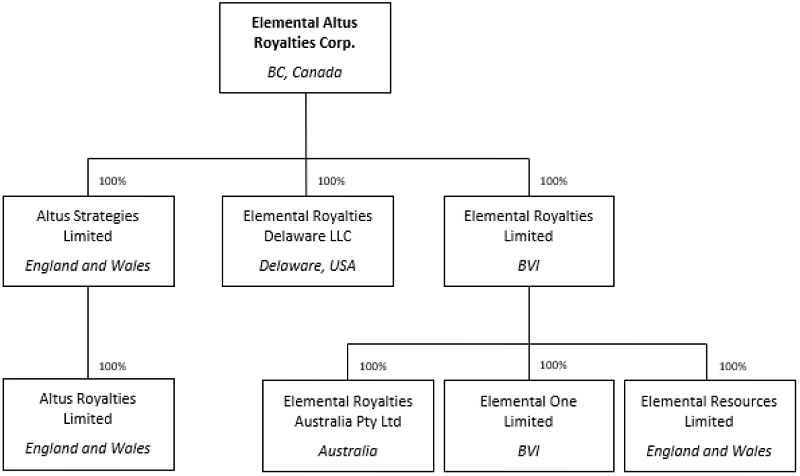
Elemental Royalties Limited, a British Virgin Islands company (“ERL BVI”), was incorporated under the BVI Business Companies Act 2004 on July 15, 2016. Pursuant to a reverse takeover, Fengro Industries Corp. (“Fengro”) acquired all of the issued and outstanding common shares of ERL BVI on July 27, 2020. Immediately prior to the completion of the reverse takeover of Fengro by ERL BVI, Fengro consolidated its common shares on the basis of one (1) common share for every 209 common shares outstanding. On July 27, 2020, Fengro changed its name to “Elemental Royalties Corp.” in connection with the completion of the reverse takeover pursuant to which it acquired ERL BVI.
Fengro, the predecessor to Elemental Royalties Corp. (“Elemental”), was incorporated on March 11, 2004, under the name “Ordorado Resources Corp.” It then changed its name to “Eagle Star Petroleum Corp.” on June 13, 2006, to “Eagle Star Minerals Corp.” on July 6, 2010, to “DuSolo Fertilizers Inc.” on February 28, 2014, and to “Fengro Industries Corp.” on December 18, 2017. On July 19, 2016, Fengro was continued from the federal jurisdiction of Canada into British Columbia pursuant to the Business Corporations Act (British Columbia).
-7-
Pursuant to a merger of equals, Elemental acquired all of Altus Strategies plc’s (“Altus”) issued and outstanding share capital in exchange for common shares in the capital of Elemental (the “Common Shares”) (the “Merger”). The Merger was completed by way of a court-sanctioned scheme of arrangement under the laws of the United Kingdom and was subject to approval by shareholders of Altus. The Merger was approved by Altus shareholders at two special shareholder meetings held on August 8, 2022, and the issuance of Elemental Common Shares under the terms of the Merger was approved by Elemental shareholders at Elemental’s annual general and special meeting held on August 8, 2022. On August 12, 2022, the United Kingdom High Court of Justice approved the court-sanctioned scheme of arrangement under section 899 of the Companies Act 2006. Under the Merger terms, Elemental acquired all issued and to be issued share capital of Altus, with each Altus share exchanged for 0.594 Elemental shares (the “Exchange Ratio”). The Exchange Ratio was agreed between the boards of Elemental and Altus taking into account the market capitalizations and relative net asset values of both companies.
On September 26, 2022, Elemental changed its name to “Elemental Altus Royalties Corp.” in connection with the completion of the Merger with Altus.
The head and registered office of the Company is located at 1020 – 800 West Pender Street, Vancouver, British Columbia, V6C 2V6. The following chart illustrates the corporate structure of the Company and its material subsidiaries:
general development of the business
2022
Hostile Bid
On January 11, 2022, Gold Royalty formally commenced its offer to acquire all of the outstanding Common Shares on the same terms as previously announced on December 20, 2021. On January 26, 2022, Elemental announced that Elemental’s Board of Directors, following the unanimous recommendation of a special committee of independent directors, has unanimously determined that the all-share hostile takeover bid from Gold Royalty is not in the best interests of Elemental or its shareholders. Furthermore, a majority of Elemental’s shareholders communicated to Elemental that they did not intend to accept the hostile bid.
-8-
On April 27, 2022, Gold Royalty announced that it had extended the expiry date of the hostile bid to acquire all of the outstanding Common Shares of Elemental by 10 business days to 5:00 p.m. (Toronto time) on May 12, 2022, subject to any further abridgement, extension or withdrawal.
On May 12, 2022, Elemental announced that an all-share hostile takeover bid made by Gold Royalty for Elemental was not successful. Based on available sources, Elemental estimated that significantly less than 5% of its shares were tendered to the hostile bid. Having failed to meet the statutory minimum tender condition of more than 50% of Elemental’s shares outstanding (excluding the shares beneficially owned, or over which control or direction is exercised by, Gold Royalty or by any persons acting jointly or in concert with Gold Royalty), Gold Royalty allowed the hostile bid to expire.
Acquisition of the Ming Gold Stream
On March 16, 2022, Elemental entered into a gold purchase and sale agreement (the “Ming Gold Stream”) with Rambler Metals and Mining Canada Limited, a wholly owned subsidiary of Rambler Metals and Mining PLC (“Rambler”) (AIM: RMM), the owner of the Ming Copper-Gold Mine (the “Ming Mine”) in Newfoundland and Labrador in Canada. The acquisition of the Ming Gold Stream by Elemental was completed on April 4, 2022.
Under the terms of the Ming Gold Stream, in exchange for consideration of US$11 million, Elemental will receive 50% of payable gold production until Rambler has delivered 10,000 ounces of gold to Elemental, after which Elemental will receive 35% of payable gold production until Rambler has delivered a further 5,000 ounces to Elemental. After Rambler has delivered a total of 15,000 ounces of gold, Elemental will receive 25% of payable gold production for the life of mine.
Elemental will make ongoing payments equal to 20% of the market price of gold with minimum gold recoveries set at 85%. Rambler will make minimum gold deliveries of 1,200 ounces to Elemental in each of the first three years of the Ming Gold Stream.
All-Share Merger of Equals of Altus and Elemental
On June 14, 2022, the boards of Elemental and Altus reached agreement on the terms and conditions of a recommended Merger, with the entire issued and to be issued share capital of Altus to be acquired by Elemental, by way of a court-sanctioned scheme of arrangement under Part 26 of the Companies Act 2006 (the “Scheme”).
On August 16, 2022, Elemental completed the Merger with Altus. The Merger was completed by way of the Scheme under the laws of the United Kingdom and was approved by Altus shareholders at two special shareholder meetings held on August 8, 2022, and approved by Elemental’s shareholders on August 8, 2022. The Scheme was approved by the United Kingdom High Court of Justice on August 12, 2022. Each Altus issued and outstanding share (“Altus Share”) was exchanged for 0.594 of an Elemental Common Share, and Altus became a wholly-owned subsidiary of Elemental. Upon completion of the Merger, shareholders of Elemental owned 52.9 percent and Altus shareholders owned 47.1 percent of the total issued share capital of the combined entity.
Following the closing of the Merger, the Company’s board comprised of the following eight directors: Steven Poulton (Executive Chairman), Frederick Bell (CEO), John Robins, Karim Nasr, Peter Williams, Martin Turenne, David Netherway, and Robert Milroy.
As a result of the Merger, South32 Limited (including its affiliate, South32 Royalty Investments Pty. Ltd.) ceased to be an insider of the Company.
In connection to the Merger, Elemental changed its name to “Elemental Altus Royalties Corp.” on September 22, 2022.
-9-
Generation of 16 New Royalties
On October 25, 2022, Elemental Altus completed the vend-out transaction of its 100% owned Morocco-focused copper subsidiary, Aterian Resources Ltd., to Eastinco Mining and Exploration plc (“Eastinco”). In consideration, Elemental Altus received the following: (a) a 2.50% NSR over 15 projects primarily targeting copper and silver covering 762km², with Eastinco retaining certain buyback rights of up to 1.0% of each NSR royalty for US$0.5 million per 0.5%; (b) a 0.5% NSR royalty over Eastinco’s Musasa tantalum operation in Rwanda; (c) 241,173,523 shares in Eastinco; (d) five-year warrant to purchase up to an additional 10% of the enlarged share capital of Eastinco; and (e) Eastinco reimbursing Elemental Altus up to £250,000 (approximately US$287,404) in cash in respect of certain historic exploration expenditures.
US$50 Million Credit Facility
On December 1, 2022, Elemental Altus entered into an agreement with National Bank of Canada (“NBC”) and Canadian Imperial Bank of Commerce (“CIBC”) for a revolving credit facility which allows Elemental Altus to borrow up to US$40 million with an option to increase to US$50 million subject to satisfaction of certain conditions (the “Facility”). The Facility has a term of three (3) years that is extendable through mutual agreement between Elemental Altus, NBC and CIBC. Elemental Altus withdrew an initial US$30 million from the Facility, approximately US$25,274,442 of which was used to settle the outstanding loan principal together with any accrued and unpaid interest and fees owed to Sprott Private Resources Lending II (Collector), LP (“Sprott”) in its entirety, in connection to the senior secured credit facility between Sprott and Elemental, dated January 22, 2020, as amended and restated on December 29, 2020.
Debt Conversion
On December 1, 2022, La Mancha Investments S.à r.l. (“La Mancha”), LMH Explorers S.à r.l (“LMHE”) a subsidiary of La Mancha Resource Fund SCSp, Elemental Altus and Altus entered into a loan facility conversion and termination agreement pursuant to which La Mancha agreed to convert approximately US$27,559,844 of loan principal and accumulated interest into 28,959,797 Common Shares of Elemental Altus at a deemed price of C$1.28 per Common Share of Elemental Altus. All amounts owed by Elemental Altus to La Mancha were satisfied in full.
La Mancha Investor Rights Agreement
On December 1, 2022, LMHE and Elemental Altus entered into an investor rights agreement (the “IRA”) that notably includes the following: (a) the right for LMHE to nominate a number of directors proportionate to its and its affiliates’ ownership interest in Elemental, whereby “ownership interest” means at any time the percentage obtained by dividing the aggregate number of Common Shares or other voting shares or equity shares of Elemental (collectively, the “Voting Shares”) held by LMHE and its affiliates at such time, by the aggregate number of issued and outstanding Voting Shares of Elemental at such time, rounded down to the nearest whole number; (b) anti-dilution and top-up rights allowing LMHE and its affiliates to maintain their ownership interest in the Voting Shares for as long as LMHE and its affiliates’ ownership interest in the Voting Shares is at least 15%; (c) a two-year standstill period and one-year restrictions on disposition period, subject to customary exceptions, and certain provisions to ensure the orderly disposition of any Voting Shares or securities convertible into Voting Shares held by LMHE and its affiliates representing more than 10% of Elemental Altus’s then outstanding Voting Shares; and (d) customary demand registration and piggy-back registration rights in favour of LMHE and its affiliates, provided that LMHE and its affiliates’ ownership interest in the Voting Shares is at least 15%.
2023
Acquisition of Royalty Portfolio from First Mining
On February 21, 2023, Elemental Altus completed an acquisition of 19 royalties (the “FM Royalties”) from a wholly owned subsidiary of First Mining Gold Corp. As consideration for the FM Royalties, Elemental Altus made a cash payment of USD$3.5 million and USD$1.5 million of Common Shares based on the 20-day volume weighted average price of shares traded on the TSX Venture Exchange (“TSX-V”) prior to February 21, 2023, at a price of C$1.253.
-10-
Update regarding the Ming Gold Stream
On February 17, 2023, Elemental Altus noted Rambler’s decision to pause operations at the Ming Mine until February 24, 2023, pending the delivery of key supplies to the mine. Rambler previously announced an efficiency improvement program in November 2022 alongside its ongoing discussions with Newgen Resources Lending Inc. with a view to a refinancing or restructuring. On February 9, 2023, Elemental Altus delivered a written notice of default to Rambler for non-delivery of gold under the Ming Gold Stream. Rambler is contracted to make minimum gold deliveries of 1,200 gold ounces to Elemental Altus for the first three years of the Gold Stream and no sale and delivery of gold has occurred in the last two financial quarters. On February 28, 2023, Rambler announced that it was in the best interest of Rambler and its shareholders to commence proceedings in Canada pursuant to the Companies’ Creditors Arrangement Act and following a brief restart of operations, the Ming Mine moved into care and maintenance on March 29, 2023. On April 17, 2023, the Rambler Group announced the commencement of a Sale and Investment Solicitation Process in respect of the business, assets and undertakings of the Rambler Group.
Acquisition of Further Royalty Interest on Caserones Copper Mine
On March 9, 2023, Elemental Altus entered into a binding agreement to acquire an additional 0.025% effective NSR on the producing Caserones Mine (as defined hereunder), for consideration of approximately US$2 million in cash (the “Caserones Acquisition”). On closing, the Caserones Acquisition increased the effective royalty held by Elemental Altus to 0.443% NSR.
Acquisition of Further Royalty Interest on Caserones Copper Mine
On July 12, 2023, Elemental Altus acquired an additional 0.030% NSR on the producing Caserones Mine in Chile, for a total cash consideration of US$2.6 million. Subsequently, Lundin Mining Corporation acquired a 51% interest in Caserones Mine on July 19, 2023.
Sale of Elemental Altus’ 100% owned Diba and Lakanfla Gold Licences
On July 20, 2023, Elemental Altus announced that it entered into a sale and purchase agreement with Allied Gold Corporation for the sale of Elemental Altus’ 100% of the Korali-Sud small scale mining licence and the Lakanfla exploration licence (together, the “Mali Project”) in western Mali. As consideration, Allied Gold Corporation agreed to pay up to US$6 million in cash and grant a NSR of up to 3% on gold produced from the Mali Project.
Generation of Two New Gold Copper Royalties in Ethiopia
On July 25, 2023, Elemental Altus generated two new gold and copper 2.5% NSR royalties, through the execution of a sale and purchase agreement for the sale of 95% of its Ethiopian focused subsidiary, Altau Resources Ltd., to ANS Exploration Corp.
Acquisition of an Existing Royalty on Arizona Sonoran’s Cactus Project
On August 23, 2023, Elemental Altus entered into a binding agreement to acquire two existing royalties (“Cactus Project Royalties”) from RCF Opportunities Fund L.P. for consideration of US$10,000,000 payable in Common Shares of Elemental Altus. The Cactus Project Royalties include an aggregate 0.68% NSR on the Cactus Project in Arizona, which is 100% owned by Arizona Sonoran Copper Company Inc., and a 0.5% GRR on the Nyanga Project in Gabon, which is 100% owned by Armada Metals Limited.
Elemental Altus Partners Egyptian Assets for Cash and Royalties
On August 28, 2023, Elemental Altus completed a subscription agreement with In2Metals Explorer S.à r.l. (“In2Metals”) in respect of Akh Gold Ltd. (the “In2Metals Subscription Agreement”). In accordance with the IN2Metals Subscription Agreement, In2Metals acquired an 80.1% interest in and assumed management control of Elemental Altus’ subsidiary, Akh Gold Ltd., through the subscription for US$10 million in new Akh Gold Inc. shares over a four year period. The proceeds from the subscription will be applied to fund exploration of Akh Gold’s projects in Egypt. Elemental Altus received US$1.5 million, a 1.5% NSR royalty across Akh Gold Inc.’s current projects in Egypt and retained a 19.9% equity interest in Akh Gold Inc., with pro rata co-funding rights thereafter.
-11-
Completion of Acquisition of Existing Royalty on Arizona Sonoran’s Cactus Project from RCF Opportunities Fund L.P.
On September 11, 2023, Elemental Altus completed the acquisition of two existing royalties from RCF Opportunities Fund L.P. for consideration of US$10,000,000 paid in 11,111,111 Common Shares of Elemental Altus at a price of C$1.20/Common Share. The royalties that Elemental Altus acquired include an aggregate of 0.68% NSR royalty on the Cactus Project in Arizona, which is 100% owned by Arizona Sonoran Copper Company Inc., and a 0.5% gross revenue royalty on the Nganga Copper-Nickel Project in Gabon, which is 100% owned by Armada Metals Limited.
Development Approval of Diba Project by Allied Gold Corporation
On September 18, 2023, Elemental Altus announced that Allied Gold Corporation approved commencement of development work at the Diba gold project, whereby production is expected to commence the first half of 2024. Elemental Altus holds an initial 3% NSR royalty, along with additional milestone payments.
Completion of Sale of Diba Gold Project in Mali to Allied Gold Corporation for Royalty and Milestone Payments
On November 9, 2023, Elemental Altus closed the sale of the Mali Project (defined herein) to Allied Gold Corporation. As consideration, Elemental Altus received 3.0% NSR royalty on the first 226,000 ounces of gold produced from the defined Mali Project deposit, and 2.0% NSR royalty on all future production in excess of 226,000 ounces from the Mali Project, as well as US$1 million payable on closing, and up to US$5 million in deferred production based milestones.
Announcement of Director Change
On December 27, 2023, Stephen Poulton, Elemental Altus’ former executive chairman advised Elemental Altus of his intention to retire, effective January 1, 2024.
2024
Announcements of Board Refreshment
On January 2, 2024, Elemental Altus announced the appointment of Vincent Benoit and Jack Lunnon from La Mancha Resource Capital LLP to the board of directors and the appointment of the existing director, John Robins as chairman of the board of directors of Elemental Altus. The appointments of Vincent Benoit and Jack Lunnon replaced La Mancha Resource Capital LLP’s former director nominee, Karim Nasr, and appointed La Mancha Resource Capital LLP’s second director nominee. Karim Nasr has resigned from the board of directors of Elemental Altus to focus on his appointment as chief executive officer at another La Mancha Resource Fund SCSp investee company. Jack Lunnon resigned from the Board effective December 31, 2024 and Matthieu Bos was appointed to the Board as an independent director and La Mancha Resource Capital LLP’s second director nominee.
On November 29, 2024, the Company announced its decision to make changes to reduce the overall size of the Board but also increase overall independence and stability for decision-making. As such, Peter Williams and David Netherway notified the Company that they were withdrawing from standing for re-election as directors. With the appointment of Prashant Francis to the Board as per the Company’s announcement of October 29, 2024, the total size of the Board was reduced from nine to seven directors.
-12-
Announcement of $12 Million in Payments from Ming Sale
On February 20, 2024, Elemental Altus announced that it expected to receive an initial US$12.1 million in cash and equity as a result of its secured creditor claim against Rambler Metals and Mining Limited in relation to Elemental Altus’ Ming gold stream. Following a sale relating to Rambler Metals and Mining Limited, the Supreme Court of Newfoundland and Labrador approved a bid from Firefly Metal Ltd. to acquire Rambler Metals and Mining Limited for a total consideration of up to A$65 million on September 11, 2023. Accordingly, Elemental Altus had the right to submit a secured claim against the total consideration being paid alongside other secured creditors. On February 20, 2024, Elemental Altus received A$3.5 million in Firefly Metal Ltd.’s common shares, and on April 23, 2025, a further A$7.5 million in cash and A$7.5 million in equity, based on the volume weighted average price at the time was received. There is a further amount of up to C$1.2 million potentially receivable, which has been held back subject to determination of final claims.
Announcement of the acquisition of a Lithium Royalty
On April 22, 2024, the Company received a 1.25%-1.40% NSR royalty on the Lithium HCK Project in the Republic of Rwanda, with Rio Tinto Mining and Exploration Limited (“Rio Tinto”) having the license to operate. The royalty serves as repayment for the Company’s $0.23 million receivable balance from Aterian Plc.
Announcement of the acquisition of two tungsten royalties
On July 22, 2024, the Company announced a binding agreement to acquire two existing tungsten royalties, including an uncapped 4% NSR royalty over the Mactung project operated by Fireweed Metals Corp. for total consideration of $4.5 million (with $3 million being paid on closing and a deferred payment of $1.5 million due 1 year after closing). The transaction closed on August 1, 2024.
Announcement of the completion of the sale of the Company’s Ethiopian exploration business
On August 28, 2024, the Company completed the sale of a 95% ownership interest in Altau Resources Ltd. (“Altau”) and its subsidiaries to ANS Exploration Corp. (“ANS”) (the “Transaction”). The consideration for this transaction consists of US$200,000 in cash, with US$50,000 received at closing and five quarterly instalments of US$30,000. The Transaction also included the following consideration:
| • | Up to US$500,000 in milestone-based performance payments. | |
| • | Up to a 5% equity stake in ANS, contingent upon any future Initial Public Offering (“IPO”) of ANS shares. |
The Company has also received two uncapped 2.5% Net Smelter Return royalties from Altau, which have been valued at US$0.2 million. ANS retains a five-year option to buy back up to 1% of these royalties for US$1.5 million each.
Announcement of the acquisition of a portfolio of royalties from AlphaStream
On October 28, 2024, the Company completed the acquisition from AlphaStream of an additional 50% ownership of Alpha 2 SPV Limited (“Alpha 2”) and Alpha 3 SPV Limited (“Alpha 3”), entities holding 24 existing royalties, from Alpha 1 SPV Limited (“Acquisition”). The consideration for the Acquisition was US$28 million paid in 34,444,580 newly issued Common Shares of the Company.
Following the Acquisition, the Company now holds 100% ownership of both Alpha 2 and Alpha 3, which hold the producing royalties of Bonikro (4.5% NSR), Ballarat (2.5% NSR), and SKO (AUD$10/oz).
Additionally, on October 28, 2024, the Company completed a private placement offering following the exercise of La Mancha’s anti-dilution rights pursuant to the IRA, for 16,141,940 Common Shares issued to La Mancha for aggregate proceeds of C$17,756,134 (“Private Placement”).
Following the Acquisition and Private Placement, the Company had 245,762,591 Common Shares outstanding as of October 28, 2024.
Expansion of credit facility
On November 13, 2024, the Company amended its Credit Facility to exercise a US$10 million accordion feature, increasing the total available facility from US$40 million to US$50 million. This amendment introduced Royal Bank of Canada as a new lender to the facility, alongside the National Bank of Canada and the Canadian Imperial Bank of Commerce.
-13-
2025
The events of 2025 have occurred after the end of the 2024 financial year and are recent developments.
Announcement of Board Refreshment
On March 3, 2025, the Company announced the appointment of Sandeep Singh to the Board. Mr. Singh brings extensive experience in the mining and royalty sector, including his tenure as President and CEO of Osisko Gold Royalties, where he successfully led its strategic turnaround. The Company also announced Robert Milroy’s retirement from the Board.
Announcement of Normal Course Issuer Bid
On March 18, 2025, the Company announced its intention to implement a Normal Course Issuer Bid (“NCIB”) to be transacted through the facilities of the TSX Venture Exchange (or by such other means as may be permitted under applicable securities laws during the term of the NCIB). Pursuant to the NCIB, the Company may, during a 12-month period commencing March 25, 2025, and ending March 24, 2026, purchase up to 12,288,129 Common Shares, being up to 5% of the Company’s issued and outstanding Common Shares as at March 18, 2025. The price that the Company will pay for any such Shares will be the prevailing market price at the time of acquisition. The number of Common Shares which may be purchased pursuant to the NCIB and the timing of any such purchases will be determined by the Company’s management. Purchases under the NCIB will be made from time to time by Raymond James Ltd (the “Broker”) on behalf of the Company. All Shares purchased pursuant to the NCIB will be returned to treasury for cancellation. The Company had not purchased any of its Shares in the previous twelve-month period. In connection with the NCIB, the Company will enter into an automatic purchase price plan (the “Plan”) with the Broker to allow for purchases of the Shares during black-out or closed periods under the Company’s stock trading policy. Such purchases would be at the discretion of the Broker on parameters established by the Company prior to any blackout or closed period. The Plan may be terminated by the Company or the Broker in accordance with its terms or will terminate on the expiry of the NCIB.
Transfer of investor rights
On March 21, 2025, the investor rights of LMHE were transferred to LMHE’s parent company, La Mancha Investments S. à r. l., pursuant to a novation agreement among the Company, LMHE and La Mancha Investments S. à r. l.
Tether Investments as New Cornerstone Shareholder
On June 10, 2025, Tether Investments S.A. de C.V. purchased, pursuant to a private agreement, an aggregate of 78,421,780 Common Shares from La Mancha Investments S. à r. l. in a transaction outside of Canada (the “Tether Transaction”), causing La Mancha Investments S. à r. l. to cease to beneficially own and control any Common Shares of the Company. Pursuant to the Tether Transaction, Tether Investments S.A. de C.V. beneficially owns approximately 31.9% of the issued and outstanding Common Shares. Concurrent with the Tether Transaction, Tether Investments S.A. de C.V entered into an option agreement with Alphastream Limited and Alpha 1 SPV Limited dated June 10, 2025, pursuant to which Alpha 1 SPV Limited granted to Tether Investments S.A. de C.V. the option to acquire an aggregate of 34,444,580 Common Shares owned by Alpha 1 SPV Limited as of the date hereof (the “Alpha Option”). The Alpha Option will not become exercisable prior to October 29, 2025 without the consent of the Company.
As La Mancha sold all of the Common Shares previously held by La Mancha to Tether Investments S.A. de C.V. pursuant to the Tether Transaction, the IRA expired and was terminated with no further effect.
-14-
Announcement of Board Refreshment
On June 17, 2025, the Company announced the appointment of Juan Sartori, Simon Vumbaca and Ravi Sood to the Board. The Company also announced Frederick Bell, John Robins, Martin Turenne, Matthieu Bos and Vincent Benoit’s resignation from the Board.
Regulatory Approval for Karlawinda Expansion
On July 29, 2025, the Company noted the announcement by Capricorn Metals Limited of regulatory approval for the development of the Karlawinda Expansion Project from the Western Australian Department of Energy, Mines, Industry Regulation and Safety. The expansion is expected to increase annual gold production by approximately 25% to 150,000 ounces per annum.
Description of the business
The Company’s core business is the acquisition of royalties, streams and other rights over mining projects. Since the Company’s first acquisition in 2017, it has acquired a diversified portfolio of royalties and stream interests providing exposure primarily to gold and silver producing or development stage mines. The Company’s management team has been able to identify and acquire revenue producing royalties and stream interests. The Company’s objective is to become a leading precious metals royalty and streaming company and to maximize returns for its shareholders through the growth of its portfolio of royalty and other similar rights, both through organic growth and through acquisitions of royalties, streams and other rights that the Company’s management expects to be accretive.
Royalty Portfolio
The following table summarizes the producing and development stage royalty interests that Elemental Altus owns directly, or indirectly through one of its wholly-owned subsidiaries:
| Name | Operator | Location | Interest | Project Stage |
| Ballarat | Victory Minerals Pty Ltd | Australia | 1.25% NSR | Producing |
| Bonikro | Allied Gold Corp. | Cote d’Ivoire | Up to 2.25% NSR | Producing |
| Caserones | Lundin Mining Corporation | Chile | 0.473% NSR | Producing |
| Karlawinda | Capricorn Metals Ltd | Australia | 2.0% NSR | Producing |
| Korali Sud | Allied Gold Corp | Mali | Up to 3% NSR | Producing |
| Mercedes | Bear Creek Mining Corporation | Mexico | 1.0% NSR | Producing |
| Mt Pleasant | Zijin Mining Group Company Limited | Australia | 5.0% NPI or A$10/oz | Producing |
| South Kalgoorlie | Northern Star Resources Limited | Australia | A$5/oz | Producing |
| Wahgnion | Société de Participation Minière du Burkina | Burkina Faso | 1.0% NSR | Producing |
| Cactus | Arizona Sonoran Copper Company | Arizona | 0.54% NSR | Development |
| Hope Brook | Big Ridge Gold Corp | Canada | 1.5% NSR | Development |
| Hope Brook | Big Ridge Gold Corp | Canada | US$1/t aggregate | Development |
| Pickle Crow | Auteco Minerals Ltd | Canada | 2.25% NSR | Development |
| Tabakorole | Marvel Gold Limited | Mali | 2.5% NSR | Development |
| Western Queen | Rumble Resources Limited | Australia | Up to A$20/Oz Au + 2% other | Development |
-15-
In addition to the above producing and development stage royalty interests, Elemental Altus also has a portfolio of 68 exploration stage royalty interests that are located in various jurisdictions including Australia, Burkina Faso, Cameroon, Canada, Cote D’Ivoire, Ethiopia, Egypt, Liberia, Mali, Mexico, Morocco, Rwanda, Gabon, and USA.
Further details regarding the agreements entered into by Elemental Altus can be found under the heading “General Development of the Business” above.
Stream Portfolio
As at the date of this AIF, Elemental Altus does not own directly, or indirectly, any stream interests.
Competitive Conditions
Elemental Altus competes with other companies that operate in the royalty and streaming market segment to acquire royalties. Elemental Altus also competes with other companies which provide financing to mining companies. The Company faces significant competition in Australia and Canada as it seeks to acquire a limited pool of cash or near-cash generating royalties from global mineral projects. The Company’s current employees have experience in mining analysis and acquisitions, with a particular understanding of the royalty sector.
Components
Elemental Altus expects to continue to purchase royalties, streams and other rights in the future. Commodity market trends can be cyclical in nature, and a general change in commodity prices would result in changes in revenue received.
Changes to Contracts
Elemental Altus does not anticipate that its business will be materially affected in the current financial year by the renegotiation or termination of any other contracts or sub-contracts.
Employees
As at the date of this AIF, Elemental Altus has a total of 13 employees.
Foreign Operations
Elemental Altus currently receives or expects to receive royalty and streaming payments from mining and processing operations in Australia, Burkina Faso, Chile, Côte d’Ivoire, Mali, and Mexico. Elemental Altus may in the future receive payments from mines or operations in other countries. Changes in legislation, regulations or governments in such countries are beyond the Company’s control and could adversely affect the Company’s business. The effect of these factors cannot be predicted with any accuracy by Elemental Altus or its management.
Reorganization
There have been no material reorganizations of Elemental Altus or any of Elemental Altus’ subsidiaries within the three most recently completed financial years as at the date of this AIF.
Risk Factors
Investors should carefully consider all the information disclosed in this AIF prior to investing in the securities of Elemental Altus. In addition to the other information presented in this AIF, the following risk factors should be given special consideration when evaluating an investment in such securities. These risk factors could materially affect the Company’s future financial position and operating results and could cause the Company’s actual financial position and operating results to differ materially from those described in forward-looking statements relating to Elemental Altus. The risk factors described in this AIF are not the only risks that Elemental Altus faces. Additional risks or uncertainties that Elemental Altus does not have any knowledge of or are currently deemed as immaterial, could also materially adversely affect Elemental Altus and its business, financial condition and results of operations.
-16-
Risks Relating to Elemental Altus
Changes in commodity prices will affect the revenues generated from the Company’s asset portfolio as well as the profitability of the Company
The revenue derived by the Company from its asset portfolio will be significantly affected by changes in the prices of the commodities underlying the Company’s royalty or stream interests. Commodity prices, including those to which the Company is exposed, fluctuate on a daily basis and are affected by numerous factors beyond the control of the Company, including levels of supply and demand, industrial investment levels, inflation and the level of interest rates, the strength of the U.S. dollar, geopolitical events or future pandemics. Such external economic factors are in turn influenced by changes in international investment patterns, monetary systems and political developments. In addition, geo-political tensions, including, for example, tensions with Russia due to its war with Ukraine and resulting sanctions, may serve to further compound supply constraints in the near term. Geopolitical and other international issues could materially and adversely impact the quantum of production and increase the costs of production of some or all the Company’s royalties or stream interests. This may reduce the returns calculated from any or all of the mines in which Elemental Altus holds royalty or stream interests.
Future material price declines may result in a decrease in revenue or, in the case of severe declines that cause a suspension or termination of production by relevant operators, a complete cessation of revenue from royalties applicable to one or more relevant commodities. Moreover, despite the Company’s commodity diversification, the broader commodity market tends to be cyclical, and a general downturn in overall commodity prices could result in a significant decrease in overall revenue. Any such price decline may result in a material adverse effect on the Company’s business, financial condition, results of operations and the trading price of its securities.
The precious metals that are subject to the royalty or stream interests in the Company’s asset portfolio are produced or will be produced as by-product metals at some of the properties in respect of which the Company holds a royalty or stream interest; therefore, production decisions and the economic cut-off applied to the reporting of Mineral Reserves and Mineral Resources, as applicable, is influenced by changes in the commodity prices of other metals at the mines. Where the Company’s interest is in respect of a by-product metal, commodity prices of the by-product metal and the principal metal may diverge such that the interests of owners or operators of the mines, and those of the Company, may not be aligned.
The Company has no or limited control over the operation of the properties in respect of which the Company holds an interest and the operators’ failure to perform or decision to cease or suspend operations will affect the revenues of the Company
The Company is not directly involved in the operation of mines. The revenue derived from its royalty and streaming portfolio is based on production by third-party property owners and operators of mines. The owners and operators generally will have the power to determine the manner in which the properties are exploited, including decisions to expand, continue or reduce, suspend or discontinue production from a property, decisions about the marketing of products extracted from the property and decisions to advance exploration efforts and conduct development of non-producing properties. The interests of third-party owners and operators and those of the Company on the relevant properties may not always be aligned. As an example, it will usually be in the interest of the Company to advance development and production on properties as rapidly as possible in order to maximize near-term cash flow, while third-party owners and operators may take a more cautious approach to development as they are at risk with respect to the cost of development and operations. Likewise, it may be in the interest of property owners to invest in the development of and emphasize production from projects or areas of a project that are not subject to royalty or stream interests. The inability of the Company to control the operations for the properties in respect of which it has a royalty or stream interest may result in a material adverse effect on the Company’s profitability, results of operations and financial condition and the trading price of its securities. In addition, the owners or operators may take action contrary to the Company’s objectives, be unable or unwilling to fulfill their obligations under their contracts with the Company, have difficulty obtaining or be unable to obtain the financing necessary to advance projects or experience financial, operational or other difficulties, including insolvency, which could limit the owner or operator’s ability to perform its obligations under agreements with the Company.
-17-
At any time, any of the operators of the properties in respect of which the Company holds a royalty or stream interest or their successors may decide to suspend or discontinue operations. In particular, many mining projects may be forced to temporarily suspend mining operations again in the event of additional outbreaks or waves of the COVID-19 pandemic in the future. The Company may not be entitled to any material compensation if any of the properties in respect of which it holds a royalty interest shuts down or discontinues its operations on a temporary or permanent basis.
The Company currently has two material assets. Other assets and properties may become significant to the Company from time to time and any adverse development related to any such assets will affect the revenue derived from such assets.
As of the date of this AIF, Elemental Altus considers that the royalty revenue derived from the Karlawinda Mine and the Caserones Mine as its only material assets. As new assets are acquired or existing or new assets move into production, the materiality of each of the Company’s assets will be reconsidered. Any adverse development affecting the development or operation of, production from or recoverability of Mineral Reserves, or any other significant property in the Company’s royalty and streaming portfolio from time to time, including, but not limited to, unusual and unexpected geologic formations, seismic activity, rock bursts, cave-ins, pit wall failures, tailings dam failures, flooding and other conditions involved in the drilling and removal of material, any of which could result in damage to, or destruction of, mines and other producing facilities, damage to life or property, environmental damage, or the inability to hire suitable personnel and engineering contractors or secure supply agreements on commercially suitable terms, may have a material adverse effect on the Company’s business, financial condition, results of operations and the trading price of its securities. Any adverse decision made by the owners and operators of the mines that are the subject of royalties that are material to the Company, including for example, alterations to development or mine plans or production schedules, may impact the timing and amount of revenue that the Company receives from its royalties and streams and could have a material adverse effect on the Company’s business, financial condition, results of operations and the trading price of its securities.
Some of the properties in respect of which the Company has an interest may never achieve commercial production
Some of the projects or properties in respect of which the Company has a royalty interest are in the construction, development or exploration stage. There can be no assurance that construction, development or exploration will be completed on a timely basis or at all.
To the extent that any of the owners or operators of properties in respect of which the Company holds a royalty or stream interest default under their credit and other financing documents, this could delay or inhibit operations at the relevant properties, which could have a material adverse effect on the Company’s business, financial condition, results of operations and the trading price of its securities.
Any sale of assets in respect of which the Company holds a royalty or stream interest may result in a new operator and any failure of such operator to perform could affect the Company
The owners or operators of the projects or mines in respect of which the Company holds a royalty or stream interest may from time to time announce transactions, including the sale or transfer of the projects or mines or of the operator itself, over which the Company has little or no control. If any such transaction is completed, it may result in a new operator controlling the project or mine, who may or may not operate the project or mine in a similar manner to the current operator, and which may positively or negatively impact the Company and could have a material adverse effect on the Company’s business, financial condition, results of operations and the trading price of its securities. If any such transaction is announced, there is no certainty that such transaction will be completed, or be completed as announced, and any consequences of such non-completion on the Company may be difficult or impossible to predict.
-18-
The Company may acquire royalties or other interests in respect of properties that are speculative and there can be no guarantee that mineable deposits will be discovered, developed or mined
Exploration for metals and minerals is a speculative venture necessarily involving substantial risk. There is no certainty that the expenditures made by the operator of any given project will result in discoveries of commercial quantities of minerals on lands where the Company holds royalties.
If mineable deposits are discovered, substantial expenditures will be required to establish Mineral Reserves through drilling, to develop processes to extract the resources and, in the case of new properties, to develop the extraction and processing facilities and infrastructure to facilitate mineral extraction. Although substantial benefits may be derived from the discovery of a major deposit, no assurance can be given that resources will be discovered in sufficient quantities to justify commercial operations or that the funding required for development can be obtained on terms acceptable to the operator or at all. Although, in respect of these properties, the Company intends to hold only royalties, streams or other interests and not be responsible for these expenditures, the operator may not be in a financial position to obtain the necessary funding to advance the project, thereby resulting in the Company not earning revenues from the interests it holds in such properties.
The Company may have limited access to data and disclosure regarding the operation of properties in respect of which it has an interest, which may affect its ability to assess and predict the performance of its royalties, streams or other interests
As a holder of royalties and streams, the Company generally has limited access to data on the operations or to the actual properties themselves. Accordingly, the Company needs to rely on the accuracy and timeliness of the public disclosure and other information it receives from the owners and operators of the properties in respect of which it holds royalties. The Company will use such information, including production estimates, in its analyses, forecasts and assessments relating to its own business. If such information contains material inaccuracies or omissions, the Company’s ability to assess and accurately forecast its own performance or achieve its stated objectives may be materially impaired. In addition, some royalties or streams may be subject to confidentiality arrangements which govern the disclosure of information with regard to the royalties or streams and, as such, the Company may not be in a position to publicly disclose such information with respect to certain royalties. The limited access to data and disclosure regarding the operations of the properties in respect of which the Company will acquire an interest may restrict the Company’s ability to assess, forecast or enhance its performance, which could result in a material adverse effect on the Company’s business, financial condition, results of operations and the trading price of its securities.
Although the Company will attempt to secure contractual rights when it creates new royalty, stream or other interests, such as audit or access rights that will permit it to monitor operators’ compliance with their obligations to the Company, there can be no assurance that the Company will be able to secure such rights, or that such rights will be sufficient to ensure such compliance or to affect operations in ways that would be beneficial to the Company.
The Company depends on the operators of the properties in respect of which it holds a royalty or stream interest for the calculation of payments, and it may not be possible to detect errors in payment calculations
Payments and deliveries to the Company pursuant to royalties or streams are calculated by the operators of the relevant properties based on reported production. Each operator’s calculations are subject to and dependent upon the adequacy and accuracy of its production and accounting functions, and errors may occur from time to time in the calculations made by an operator. Certain contracts for royalties or streams to be acquired by the Company will require the operators to provide the Company with production and operating information that may, depending on the completeness and accuracy of such information, enable the Company to detect errors in such calculations. However, the Company may not have the contractual right to receive complete production information for all of its royalties and streams. As a result, the Company’s ability to detect payment errors in respect of royalties through its monitoring program of its interests and its associated internal controls and procedures will be limited, and the possibility will exist that the Company will need to make retroactive revenue adjustments in respect of royalties or streams. The contracts for royalties in the Company’s asset portfolio generally provide the right to audit the operational calculations and production data for the associated payments and deliveries in respect of such royalties or streams; however, such audits may occur many months following the Company’s recognition of the revenue in respect of the royalties or streams and may require the Company to adjust its revenue in later periods.
-19-
The Company is dependent on the payment by the owners and operators of the properties in respect of which the Company has a royalty or stream and any delay in or failure of such payments will affect the revenues generated by the Company’s asset portfolio.
The Company is dependent, to a large extent, upon the financial viability of the owners and operators of the relevant properties in respect of which it holds royalties. Payments from production will generally flow through the operator and there is a risk of delay and additional expense in receiving such payments. Payments may be delayed as a result of restrictions imposed by lenders, delays in the sale or delivery of products, the ability or willingness of smelters and refiners to process mine products, blowouts or other accidents, recovery by the operators of expenses incurred in the operation of the properties, the establishment by the operators of Mineral Reserves for such expenses or the insolvency of the operator. The Company’s rights to payment pursuant to royalties or streams will, in some cases, be enforced by contract without the protection of the ability to liquidate a property. This will inhibit the Company’s ability to collect outstanding payments in respect of such royalties or streams upon a default. Additionally, some contracts may provide limited recourse in particular circumstances which may further inhibit the Company’s ability to recover or obtain equitable relief in the event of a default by the owner or operator under such contracts. In the event of a bankruptcy of an operator or owner, it is possible that an operator may claim that the Company should be treated as an unsecured creditor and, therefore, have a limited prospect for full recovery of revenue. There is also a possibility that a creditor or the owner or operator may claim that the royalty or stream contract should be terminated in the insolvency proceeding. Alternatively, in order to preserve its interest in a royalty or stream interest in the context of an insolvency or similar proceeding, the Company may be required to make additional investments in, or provide funding to, owners or operators, which would increase its exposure to the relevant interest and counterparty risk. Failure to receive payments from the owners and operators of the relevant properties or termination of the Company’s rights could result in a material adverse effect on the Company’s business, financial condition, results of operations and the trading price of its securities.
Global financial conditions may destabilize
Global financial conditions could suddenly and rapidly destabilize in response to future events. Government authorities may also have limited ability or resources to respond to future crises. Future crises may be precipitated by any number of causes, including natural disasters, geopolitical instability, tariffs and trade wars, changes to energy prices or sovereign defaults. Any sudden or rapid destabilization of global economic conditions could, for example, negatively impact the Company’s ability, or the ability of the owners or operators of the properties in respect of which the Company holds royalties, to obtain equity or debt financing or make other suitable arrangements to finance their projects. In the event of increased levels of volatility or a rapid destabilization of global economic conditions, the Company’s business, financial condition, results of operations and the trading price of its securities could be materially and adversely affected. Certain countries including Canada and the United States have imposed strict financial and trade sanctions against Russia in connection with the ongoing military conflict between Russia and Ukraine, which sanctions may have far-reaching effects on the global economy in addition to the near-term effects on Russia. The long-term impacts of the conflict remain uncertain. In addition, the United States has imposed tariffs against Canada, Mexico, China and the European Union, among others, and those countries have imposed reciprocal tariffs in a developing trade war which may have an adverse effect on supply and demand and global economic conditions.
-20-
The Company is exposed to counterparty, liquidity, insolvency and bankruptcy risk, and any delay or failure of counterparties to make payments will affect the revenues of the Company
The Company is exposed to various counterparty risks including, but not limited to (i) the Company’s royalty or stream counterparties; (ii) other companies that have payables owing to the Company; (iii) the Company’s insurance providers; and (iv) the Company’s lenders. The Company is also exposed to liquidity, insolvency and bankruptcy risks in meeting its operating expenditure requirements in instances where cash positions are unable to be maintained or appropriate financing is unavailable. These factors may impact the ability of the Company to obtain loans or other credit facilities or obtain equity financing in the future or to obtain them on terms favorable to the Company.
Royalties or streams may not be honored by operators of a project
Royalties and streams in respect of natural resource properties are largely contractual in nature. Parties to contracts do not always honor contractual terms and contracts themselves may be subject to interpretation or technical defects. To the extent grantors of royalties or streams do not abide by their contractual obligations, the Company may be forced to take legal action to enforce its contractual rights. Such legal action may be time consuming and costly and there is no guarantee of success. Any pending proceedings or actions or any decisions determined adversely to the Company could have a material adverse effect on the Company’s business, financial condition, results of operations and the trading price of its securities.
Not all of the Company’s royalties are secured and the Company’s security interests, if any, may be subordinated and difficult to enforce
Although certain of the Company’s royalties and its stream are secured, certain of the Company’s royalty interests are unsecured. In a default, liquidation or realization situation, any unsecured royalty interest of the Company will be satisfied pro rata with all other unsecured claims after all secured claims, property claims, and prior ranking claims are satisfied in full. Absent a security interest, the Company’s likely potential recourse against a defaulting property owner or mining operator would be for breach of the applicable contract which would result in damages and unsecured claims for which the likelihood of recovery is remote and time-consuming. In the event that a mining operator or property owner has insufficient funds to pay its liabilities and obligations as they become due, it is possible that other liabilities and obligations will be satisfied prior to those owing to the Company. Even valid security interests which are or may be held by the Company could be (i) subordinated to other indebtedness; (ii) unenforceable; (iii) difficult to enforce; or (iv) subject to attack by other creditors or stakeholders. Further, in insolvency proceedings, any security or other interest held by the Company will likely be further subordinated by court-ordered charges or other court-ordered relief, including for interim financing.
The Company’s profitability, results of operations and financial condition are subject to variations in foreign exchange rates
Certain of the Company’s activities and its head office are located in Canada and the costs associated with these activities are largely denominated in Canadian dollars. Additionally, the Company has subsidiaries in the United Kingdom and Australia, creating potential foreign currency fluctuations between these subsidiaries. Additionally, some of the Company’s royalties may be subject to foreign currency fluctuations and inflationary pressures, which could have a material adverse effect on the Company’s business, financial condition, results of operations and the trading price of its securities. Pronounced fluctuations in the exchange rate of Canadian dollars resulting from or in connection with, for example, tariffs or a trade war with the United States, may have an adverse or unexpected effect on the Company’s business, financial condition and results of operations. There can be no assurance that the steps taken by management to address variations in foreign exchange rates will eliminate all adverse effects and the Company may suffer losses due to adverse foreign currency rate fluctuations.
-21-
Operators of mines may not be able to replace depleted Mineral Reserves and Mineral Resources, which would reduce the Company’s revenue from royalties
The revenue generated by the Company will principally be based on the exploitation of Mineral Reserves on assets underlying the Company’s royalties or streams. Mineral Reserves are continually being depleted through extraction and the long-term viability of the Company’s portfolio will depend on the replacement of Mineral Reserves by owners or operators of the associated properties through new producing assets and increases in Mineral Reserves on existing producing assets. As any mine in respect of which the Company has a royalty or stream matures, the Company expects overall declines in production over the years unless the operator of such mine is able to replace Mineral Reserves that are mined through mine expansion or successful new exploration. Exploration for minerals is a speculative venture necessarily involving substantial risk. There is no certainty that the expenditures made by the operator of any given mineral project will result in discoveries of commercial quantities of minerals on properties underlying the Company’s royalty or stream interest or that discoveries will be located on properties covered by the relevant royalty or stream. Even in those cases where a significant mineral deposit is identified and covered by a royalty or stream owned by the Company, there is no guarantee that the deposit can be economically extracted. Substantial expenditures are required to establish Mineral Reserves through drilling, to develop processes to extract the Mineral Reserves and, in the case of new properties, to develop the extraction and processing facilities and infrastructure at any site chosen for extraction. Although substantial benefits may be derived from the discovery of a major deposit covered by a royalty or stream owned by the Company, no assurance can be given that new Mineral Reserves will be identified to replace or increase the amount of Mineral Reserves underlying a royalty or stream interest held by the Company. This includes Mineral Resources, as the Mineral Resources that have been discovered may not have been subjected to sufficient analysis to justify commercial operations or the allocation of funds required for development. The inability of operators to add additional Mineral Reserves or to replace existing Mineral Reserves through either the development of existing Mineral Resources or the acquisition of new mineral producing assets, in each case covered by a royalty or stream owned by the Company, could result in a material adverse effect on the Company’s business, financial condition, results of operations and the trading price of its securities.
The Company may enter into acquisitions or other royalty or stream transactions from time to time, which may be material, may involve the issuance of the Company’s securities or may involve the incurrence of indebtedness and will be subject to transaction-specific risks
The Company regularly reviews opportunities to acquire existing royalties or streams, to create new royalties, streams or other arrangements through the financing of mining projects, financing of new acquisitions or to acquire companies that hold royalties or streams in respect of mineral properties. At any given time, the Company may have various types of transactions and acquisition opportunities in various stages of active review, including submissions of indications of interest and participation in discussions or negotiations in respect of such transactions. This process also involves the engagement of consultants and advisors to assist in analyzing particular opportunities. Any such acquisition or transaction could be material to the Company and may involve the issuance of Common Shares or other securities by the Company or the incurrence of indebtedness to fund any such acquisition. In addition, any such transaction may have other transaction-specific risks associated with it, including risks related to the completion of the transaction, the project operators or the jurisdictions in which assets may be acquired or underlying properties located. Additionally, the Company may consider opportunities to restructure its royalty or stream arrangements where it believes such a restructuring may provide a long-term benefit to the Company, even if such restructuring may reduce near-term revenues or result in the Company incurring transaction-related costs.
Increased competition for royalties or streams could adversely affect the Company’s ability to acquire additional royalties or streams in mineral properties
Many companies are engaged in the search for and the acquisition of mineral interests, including royalties and streams and there is a limited supply of desirable mineral interests. The mineral exploration and mining businesses are competitive in all phases. Many companies are engaged in the acquisition of mineral interests, including large, established companies with substantial financial resources, operational capabilities and long earnings records. The Company may be at a competitive disadvantage in acquiring those interests, whether by way of royalty or stream as competitors may have greater financial resources and technical staff. There can be no assurance that the Company will be able to compete successfully against other companies in acquiring new royalties or streams. In addition, the Company may be unable to acquire royalties or streams at acceptable valuations which could result in a material adverse effect on the Company’s business, financial condition, results of operations and the trading price of its securities.
-22-
The Company can provide no assurance that it will be able to obtain adequate financing in the future or that the terms of such financing will be favorable
There can be no assurance that the Company will be able to obtain adequate financing in the future or that the terms of such financing will be favorable. Failure to obtain such additional financing could impede the Company’s funding obligations, or result in delay or postponement of further business activities which could result in a material adverse effect on the Company’s business, financial condition, results of operations and the trading price of its securities.
The Company may experience difficulty attracting and retaining qualified management and technical personnel to efficiently operate its business
The Company is dependent upon the continued availability and commitment of its key management personnel, whose contributions to immediate and future operations of the Company are of significant importance. The loss of any such key management personnel, and, in particular, of its chief executive officer, could negatively affect the Company’s business operations. From time to time, the Company may also need to identify and retain additional skilled management and specialized technical personnel to efficiently operate its business. In addition, the Company expects to frequently retain third-party specialized technical personnel to assess and execute on opportunities. These individuals may have conflicts of interest or scheduling conflicts, which may delay or inhibit the Company’s ability to employ such individuals’ expertise. The number of persons skilled in the acquisition, exploration and development of royalties and streams in natural resource properties is limited and competition for such persons is intense. Recruiting and retaining qualified personnel will be critical to the Company’s success and there can be no assurance that the Company will be able to recruit and retain such personnel. If the Company is not successful in recruiting and retaining qualified personnel, the Company’s ability to execute its business model and growth strategy could be affected, which could have a material adverse effect on its business, financial condition, results of operations and the trading price of its securities.
Certain of the Company’s directors and officers may serve as directors and officers with other companies, which could put them in a conflict position from time to time
Certain of the directors and officers of the Company may also serve as directors or officers of, or have significant shareholdings in, other companies involved in natural resource exploration, development and production and, to the extent that such other companies may engage in transactions or participate in the same ventures in which the Company participates, or in transactions or ventures in which the Company may seek to participate, the directors and officers of the Company may have a conflict of interest in negotiating and concluding terms respecting the extent of such participation.
Such conflicts of the directors and officers could result in a material adverse effect on the Company’s business, financial condition, results of operations and the trading price of its securities.
Changes in or in the interpretation of tax legislation or accounting rules could affect the profitability of the Company
Changes to, or differing interpretation of, taxation laws or regulations in any of Canada or any of the countries in which the Company’s assets or relevant contracting parties or underlying properties are located could result in some or all of the Company’s profits being subject to additional taxation. No assurance can be given that new taxation rules or accounting policies will not be enacted or that existing rules will not be applied in a manner which could result in the Company’s profits being subject to additional taxation or which could otherwise have a material adverse effect on the Company’s profitability, results of operations and financial condition and the trading price of its securities. In addition, the introduction of new tax rules or accounting policies, or changes to, or differing interpretations of, or application of, existing tax rules or accounting policies could make royalties held by the Company less attractive to counterparties. Such changes could adversely affect the Company’s ability to acquire new assets or make future investments.
-23-
The Company may be unable to repay its indebtedness and comply with its obligations under a credit facility
The Company’s ability to make scheduled payments of the principal of, to pay interest on, or to refinance indebtedness will depend on its future performance, which is subject to economic, financial, competitive and other factors beyond its control. The Company may not generate future cash flow that is sufficient to service debt and make necessary capital expenditures. If the Company is unable to generate such cash flow, it may be required to adopt one or more alternatives, such as reducing or eliminating dividends, if any, restructuring debt or obtaining additional equity capital on terms that may be onerous or highly dilutive. The Company’s ability to refinance indebtedness will depend on the capital markets and its financial condition at such time. The Company may not be able to engage in any of these activities or engage in these activities on desirable terms, which could result in a default on its debt obligations.
There can be no assurances that, in the future, the Company will not be limited in its ability to respond to changes in its business or competitive activities or be restricted in its ability to engage in mergers, acquisitions or dispositions of assets. Furthermore, a failure to comply with the covenants of the Facility, could likely result in an event of default under such credit facilities and would allow the lenders to accelerate the debt, which could materially and adversely affect the Company’s business, financial condition, results of operations and the trading price of its securities.
The Company’s operations will depend on information systems that may be vulnerable to cyber security threats
The Company’s operations depend, in part, on its IT systems, networks, equipment and software and the security of these systems. The Company depends on various IT systems to process and record financial and technical data, administer its contracts with its counterparties and communicate with employees and third parties. These IT systems, and those of its third-party service providers and vendors and the counterparties under its contracts for royalties may be vulnerable to an increasing number of continually evolving cyber security risks. Unauthorized third parties may be able to penetrate network security and misappropriate or compromise confidential information, create system disruptions or cause shutdowns. Any such breach or compromise may go undetected for an extended period of time.
A significant breach of the Company’s IT systems or data security or misuse of data, particularly if such breach or misuse goes undetected for an extended period of time, could result in significant costs, loss of revenue, fines or lawsuits and damage to reputation. The costs to eliminate or alleviate cyber or other security problems, including bugs, viruses, worms, malware and other security vulnerabilities, could be significant, and the Company’s efforts to address these problems may not be successful. The significance of any cyber-security breach is difficult to quantify, but may in certain circumstances be material and could have a material adverse effect on the Company’s financial condition, results of operations and the trading price of its securities.
Enforcement of Foreign Judgements
The Company is incorporated under the laws of British Columbia, Canada and a substantial portion of the Company’s assets are located outside of the U.S. As a result, it may be difficult for U.S. or foreign investors to effect service of process within their jurisdiction upon the Company or upon such persons who are not residents of the United States or the foreign jurisdiction, or to realize in the United States or foreign jurisdictions upon judgments of U.S. or foreign courts predicated upon civil liabilities under U.S. or foreign securities laws. A judgment of a U.S. or foreign court predicated solely upon such civil liabilities may be enforceable in Canada by a Canadian court if the U.S. or foreign court in which the judgment was obtained had jurisdiction, as determined by the Canadian court, in the matter. There is substantial doubt whether an original action could be brought successfully in Canada against any of such persons or the Company predicated solely upon such civil liabilities.
-24-
Risks Relating to Mines and Mining Operations
The Company is indirectly exposed to many of the same risk factors as the owners and operators of properties in respect of which it holds a royalty or stream
The Company is indirectly subject to the risk factors applicable to the owners and operators of properties in respect of which the Company holds a royalty or stream, to the extent that such risks relate to the production of minerals from, or the continued operation of, such mines or projects.
Production at mines and projects in respect of which the Company holds a royalty or stream is dependent on operators’ employees
Production from the properties in respect of which the Company holds a royalty or stream interest depends on the efforts of the operators’ employees. There is competition for geologists and persons with mining expertise. The ability of the owners and operators of such properties to hire and retain geologists and persons with mining expertise is key to those operations. Further, relations with employees may be affected by changes in the scheme of labor relations that may be introduced by the relevant governmental authorities in the jurisdictions in which those operations are conducted. Changes in such legislation or otherwise in the relationships of the owners and operators of such properties with their employees may result in strikes, lockouts or other work stoppages, or could result in the owners and operators of such properties to decide to cease production at one or more of the properties, any of which could have a material adverse effect on the Company’s business, financial condition, results of operations and the trading price of its securities.
Mineral Reserves and Mineral Resources are estimates based on interpretation and assumptions and actual production may differ from amounts identified in such estimates
The Mineral Reserves and Mineral Resources on properties in respect of which the Company holds royalties or streams are estimates only, and no assurance can be given that the estimated Mineral Reserves and Mineral Resources will be accurate or that the indicated level of minerals will be produced. Mineral Reserve and Mineral Resource Estimates for certain of the Company’s royalties will be prepared by the operators of the underlying properties. The Company will not participate in the preparation or verification of such estimates (or the reports in which they are presented) and the Company will not independently assess or verify the accuracy of such estimates. Such estimates are, in large part, based on interpretations of geological data obtained from drill holes and other sampling techniques. Actual mineralization or formations may be different from those predicted. Further, it may take many years from the initial phase of drilling before production is possible and during that time the economic feasibility of exploiting a mineral deposit discovery may change.
Market price fluctuations of the applicable commodity, as well as increased production and capital costs or reduced recovery or throughput rates, may render the Proven and Probable Mineral Reserves on properties underlying the Company’s royalties unprofitable to develop at a particular site or sites for periods of time or may render Mineral Reserves containing relatively lower-grade mineralization uneconomic. Moreover, short-term operating factors relating to the Mineral Reserves, such as the need for the orderly development of ore bodies or the processing of new or different ore grades, may cause Mineral Reserves to be reduced or not extracted. Estimated Mineral Reserves may have to be recalculated based on actual production experience. The economic viability of a mineral deposit may also be impacted by other attributes of a particular deposit, such as size, grade and proximity to infrastructure, governmental regulations and policy relating to price, taxes, royalties, land tenure, land use permitting, the import and export of minerals and environmental protection and by political and economic stability. While these risks may exist for all of the Company’s assets, they will be heightened in the case of interests in properties which have not yet commenced production.
-25-
Mineral Resource Estimates, in particular, must be considered with caution. Mineral Resource Estimates for properties that have not commenced production are based, in many instances, on limited and widely-spaced drill hole or other limited information including costs and plant performance, which is not necessarily indicative of the conditions between and around drill holes. Such Mineral Resource Estimates may require revision as more drilling or other exploration information becomes available or as actual production experience is gained. Further, Mineral Resources may not have demonstrated economic viability and may never be extracted by the operator of a property. It should not be assumed that all or any part of the Mineral Resources on properties underlying the Company’s royalties constitute or will be converted into Mineral Reserves.
Any of the foregoing factors may require operators to reduce their Mineral Reserves and Mineral Resources, which could result in a material adverse effect on the Company’s business, financial condition, results of operations and the trading price of its securities.
Production forecasts may not prove to be accurate
The Company prepares estimates and forecasts of future mineral production attributable to the Company pursuant to the properties in respect of which it holds royalties and, in doing so, the Company relies on public disclosure and other information it receives from the owners, operators and independent experts of such properties to prepare such estimates. Such information may necessarily be imprecise because it depends upon the judgment of the individuals who operate such properties as well as those who review and assess the geological and engineering information. These production estimates and forecasts will typically be based on existing mine plans and other assumptions with respect to such properties, which may change from time to time and over which the Company will have no control, including the availability, accessibility, sufficiency and quality of ore, the costs of production, the operators’ ability to sustain and increase production levels, the sufficiency of infrastructure, the performance of personnel and equipment, the availability of materials and equipment including reagents and fuel, the ability to maintain and obtain mining interests and permits and compliance with existing and future laws and regulations. Any such information is forward-looking and no assurance can be given that such production estimates and forecasts will be achieved. Actual production attributable to the Company’s royalty or stream interests may vary from the Company’s estimates for a variety of reasons, including: actual ore mined varying from estimates of grade, tonnage, dilution and metallurgical and other characteristics; actual ore mined being less amenable than expected to mining or treatment; lower than expected mill feed grades; lower than anticipated sweep efficiency at certain mines; short-term operating factors relating to the Mineral Reserves, such as the need for sequential development of ore bodies and the processing of new or different ore grades; delays in the commencement of production and ramp up at new mines; revisions to mine plans; unusual or unexpected ore body formations; risks and hazards associated with the properties in respect of which the Company holds royalties, including but not limited to cave-ins, rock falls, rock bursts, pit wall failures, seismic activity, weather-related complications, fires or flooding or as a result of other operational problems such as production drilling or material removal challenges, power failures or a failure of a key production component such as a hoist, an autoclave, a filter press or a grinding mill; and unexpected labor shortages, strikes, local community opposition or blockades. Occurrences of this nature and other accidents, adverse conditions or operational problems in future years may result in the Company’s failure to realize the benefits of its production forecasts anticipated from time to time. If the Company’s production forecasts prove to be incorrect, it could result in a material adverse effect on the Company’s business, financial condition, results of operations and the trading price of its securities.
The exploration and development of mineral properties are inherently dangerous and subject to risks beyond the control of the Company
Companies engaged in mining activities are subject to all of the hazards and risks inherent in exploring for and developing natural resource projects. These risks and uncertainties include, but are not limited to, environmental hazards, industrial accidents, labor disputes, increases in the cost of labor, social unrest, changes in the regulatory environment, permitting and title risks, impact of non-compliance with laws and regulations, fires, explosions, blowouts, cratering, encountering unusual or unexpected geological formations or other geological or grade problems, unanticipated metallurgical characteristics or less than expected mineral recovery, encountering unanticipated ground or water conditions, cave-ins, pit wall failures, flooding, rock bursts, tailings dam failures, periodic interruptions due to inclement or hazardous weather conditions, earthquakes, seismic activity, other natural disasters or unfavorable operating conditions and losses. Should any of these risks or hazards affect a company’s exploration or development activities, it may (i) result in an environmental release or environmental pollution and liability; (ii) cause the cost of development or production to increase to a point where it would no longer be economic to produce the metal from the mineral projects in respect of which the Company holds a royalty or stream; (iii) result in a write-down or write-off of the carrying value of one or more mineral projects; (iv) cause delays or stoppage of mining or processing; (v) result in the destruction of properties, processing facilities or third-party facilities necessary to the company’s operations; (vi) cause personal injury or death and related legal liability; (vii) result in regulatory fines and penalties or the revocation or suspension of licences; (viii) result in the loss of insurance coverage; or (ix) result in the loss of social licence to operate. The occurrence of any of the above-mentioned risks or hazards could result in an interruption or suspension of operations of the properties in respect of which the Company holds a royalty or stream, which in turn could have a material adverse effect on the Company’s business, financial condition, results of operations and the trading price of its securities.
-26-
Defects in title to properties underlying the Company’s royalties or streams may result in a loss of entitlement by the operator and a loss of the Company’s interest
A defect in the chain of title to any of the properties underlying one of the Company’s royalties or stream interests or necessary for the anticipated development or operation of a particular project to which a royalty or stream relates may arise to defeat or impair the claim of the operator to a property which could in turn result in a loss of the Company’s interest in respect of that property. In addition, claims by third parties or indigenous groups may impact the operator’s ability to conduct activities on a property to the detriment of the Company’s royalties. To the extent an owner or operator does not have title to the property, it may be required to cease operations or transfer operational control to another party. Many royalties are contractual, rather than an interest in land, with the risk that an assignment or bankruptcy or insolvency proceedings by an owner will result in the loss of any effective royalty or stream in a particular property. Further, even in those jurisdictions where there is a right to record or register royalties held by the Company in land registries or mining recorder’s offices, such registrations may not necessarily provide any protection to the Company. As a result, known title defects, as well as unforeseen and unknown title defects, may impact operations at a project in respect of which the Company has a royalty or stream and could result in a material adverse effect on the Company’s business, financial condition, results of operations and the trading price of its securities.
Future litigation affecting the properties in respect of which the Company holds its royalties or streams could have an adverse effect on the Company
Potential litigation may arise on a property on which the Company holds a royalty or stream (for example, litigation between joint venture partners or between operators and original property owners or neighboring property owners). As a holder of such interests, the Company does not generally have any influence on the litigation and does not generally have access to data. Any such litigation that results in the cessation or reduction of production from a property (whether temporary or permanent) or the expropriation or loss of rights to a property could have a material adverse effect on the Company’s business, results of operations and financial condition and the trading price of its securities.
Moreover, the courts in some of the jurisdictions in which the Company has a royalty or stream may offer less certainty as to the judicial outcome of legal proceedings or a more protracted judicial process than is the case in more established economies. Accordingly, there can be no assurance that contracts, joint ventures, licences, licence applications or other legal arrangements will not be adversely affected by the actions of government authorities and the effectiveness of and enforcement of such arrangements in these jurisdictions. Moreover, the commitment of local businesses, government officials and agencies and the judicial system in these jurisdictions to abide by legal requirements and negotiated agreements may be more uncertain and may be susceptible to revision or cancellation, and legal redress may be uncertain or delayed. These uncertainties and delays could have a material adverse effect on the business, financial condition, results of operations of the Company and on the trading price of its securities.
-27-
Defects or disputes relating to the Company’s royalties or streams could have an adverse effect on the Company
Defects in or disputes relating to the royalties or streams in the Company’s portfolio may prevent the Company from realizing the anticipated benefits from these interests. Material changes could also occur that may adversely affect management’s estimate of the carrying value of the Company’s royalties and could result in impairment charges. While the Company seeks to confirm the existence, validity, enforceability, terms and geographic extent of the royalties or streams it acquires, there can be no assurance that disputes or other problems concerning these and other matters or other problems will not arise. Confirming these matters is complex and is subject to the application of the laws of each jurisdiction to the particular circumstances of each parcel of mineral property and to the documents reflecting the royalties. The discovery of any defects in, or any disputes in respect of, the royalties or streams, could have a material adverse effect on the Company’s profitability, results of operations and financial condition and the trading price of its securities.
The operations in respect of which the Company holds a royalty or stream requires various property rights, permits and licences to be held by the operator in order to conduct current and future operations, and delays or a failure to obtain or maintain such property rights, permits and licences, or a failure to comply with the terms of any of such property rights, permits and licences could result in the interruption or closure of operations or exploration on the properties.
The exploration, development and operation of mining properties are subject to laws and regulations governing health and worker safety, employment standards, environmental matters, mine development, project development, mineral production, permitting and maintenance of titles, exports, taxes, labor standards, reclamation obligations, heritage, historic and archaeological matters and other matters. The owners and operators of the properties in respect of which the Company holds royalties require licences and permits from various governmental authorities in order to conduct their operations. Future changes in such laws and regulations or in such licences and permits could have a material adverse effect on the revenue that the Company will derive from its royalties. Such licences and permits are subject to change in various circumstances and are required to be kept in good standing through a variety of means, including cash payments and satisfaction of conditions of issues. Such licences and permits are subject to expiration, relinquishment and/or termination without notice to, control of or recourse by the Company. There can be no guarantee that the owners or operators of those properties in respect of which the Company holds royalties or streams are able to obtain or maintain all necessary licences and permits in good standing that may be required to explore, develop and operate the properties, commence the construction or operation of mining facilities, or maintain operations that economically justify the cost. Any failure to comply with applicable laws and regulations, permits and licences, or to maintain permits and licences in good standing, even if inadvertent, could result in interruption or closure of exploration, development or mining operations or in fines, penalties or other liabilities accruing to the owner or operator of a project. Any such occurrence could substantially decrease production or cause the termination of operations on a property in which the Company holds a royalty or stream interest and could have a material adverse effect on the Company’s business, financial condition, results of operations and the trading price of its securities.
The Company will be exposed to risks related to the construction, development and/or expansion in relation to the mines, projects and properties in respect of which it holds a royalty or stream
Many of the projects or properties in respect of which the Company holds an interest are in the construction or development stage, and such projects are subject to numerous risks, including, but not limited to delays in obtaining equipment, materials and services essential to the construction and development of such projects in a timely manner, currency exchange rates, labor shortages, cost escalations and fluctuations in metal prices. There can be no assurance that the owners or operators of such projects will have the financial, technical and operational resources to complete construction, development and/or expansion of such projects in accordance with current expectations or at all.
-28-
The operations in respect of which the Company holds a royalty or stream interests are subject to environmental and endangered species laws and regulations that may increase the costs of doing business and may restrict operations, which could reduce the Company’s revenues
All phases of the mining business present environmental risks and hazards and are subject to environmental regulation pursuant to a variety of government laws and regulations, including laws and regulations relating to the protection of endangered and threatened species. Compliance with such laws and regulations can require significant expenditures and a breach may result in the imposition of fines and penalties, which may be material. In addition, such laws and regulations can constrain or prohibit the exploration and development of new projects or the development or expansion of existing projects. Environmental legislation is evolving in a manner expected to result in stricter standards and enforcement, increases in land-use restrictions, larger fines and liability and potentially increased capital expenditures and operating costs. Any breach of environmental legislation by owners or operators of any of the properties underlying the Company’s royalty and stream portfolio, could have a material impact on the viability of the relevant property and impair the revenue derived by the Company from the applicable royalty or stream, which could have a material adverse effect on the Company’s business, financial condition, results of operations and the trading price of its securities.
Changes in government regulation could inhibit exploration, construction and development on, or production from, the mineral properties in respect of which the Company holds royalties and streams
The properties on which the Company holds a royalty or stream interest may be located in multiple legal jurisdictions and political systems. There can be no assurance that future political and economic conditions in such countries will not result in the adoption of different policies or attitudes respecting the development and ownership of resources. Changes in applicable laws, regulations, or in their enforcement or regulatory interpretation could result in adverse changes to mineral development or operations. Any such changes in policy or attitudes may result in changes in laws affecting ownership of assets, land tenure and resource concessions, licensing fees, taxation, royalties, price controls, exchange rates, export controls, environmental protection, labor relations, foreign investment, nationalization, expropriation, repatriation of income and return of capital, which may affect both the ability to undertake exploration, construction and development on, or production from, the properties in respect of which the Company holds royalty or stream interests or the payments under such royalties or streams. In certain areas where the Company holds a royalty or stream, the regulatory environment is in a state of continuing change, and new laws, regulations and requirements may be retroactive in their effect and implementation. Any changes in governmental laws, regulations, economic conditions or shifts in political attitudes or stability are beyond the control of the Company and the owners and operators of the properties in respect of which the Company holds a royalty or stream interest and such changes could result in a material adverse effect on the Company’s business, financial condition, results of operations and the trading price of its securities.
The Company is subject to risks related to certain operations in developing economies
The Company is subject to risks normally associated with the conduct of business in developing economies. Risks may include, among others, problems relating to power supply, labor disputes, delays or invalidation of governmental orders and permits, corruption, uncertain political and economic environments, civil disturbances and crime, arbitrary changes in laws or policies, foreign taxation and exchange controls, nationalization of assets, opposition to mining from environmental or other non-governmental organizations or changes in the political attitude towards mining, empowerment of previously disadvantaged people, local ownership requirements, limitations on foreign ownership, power supply issues, limitations on repatriation of earnings, infrastructure limitations and increased financing costs. The above risks could limit, disrupt or negatively impact the Company’s business, financial condition, results of operations and the trading price of its securities.
-29-
Mineral properties in respect of which the Company holds royalties or streams may be subject to risks related to indigenous peoples, which could inhibit operations at such properties
Various international, national, state and provincial laws, codes, resolutions, conventions, guidelines, treaties and other principles and considerations relate to the rights of indigenous peoples. The Company holds royalties and streams in respect of operations located in some areas currently or previously inhabited or used by indigenous peoples. In these areas, governments may have obligations to respect the rights of indigenous peoples. Some mandate consultation with indigenous peoples regarding actions which may affect indigenous peoples, including actions to approve or grant mining rights or permits. The obligations of government and private parties under the various international and national requirements, principles and considerations pertaining to indigenous people continue to evolve and be defined. The properties in respect of which the Company holds royalty and stream interests are subject to the risk that one or more groups of indigenous peoples may oppose operations or new development. Such opposition may be directed through legal or administrative proceedings or protests, roadblocks or other forms of public expression against the operator’s or the Company’s activities. Opposition by indigenous peoples to such activities may require modification of or preclude operation or development of projects or may require the entering into of agreements with indigenous peoples. Claims and protests of indigenous peoples may disrupt or delay activities of the operators of properties in respect of which the Company holds royalty or stream interests which could result in a material adverse effect on the Company’s business, financial condition, results of operations and the trading price of its securities.
The risks arising from a pandemic may have a significant impact on the Company
There can be no assurance that the Company will not be impacted by adverse consequences that may be brought about by a pandemic’s impact on global industrial and financial markets which may reduce commodity prices, share prices and financial liquidity, thereby limiting access to additional capital.
Risks Related to the Securities of Elemental Altus
The market price of the Common Shares may be volatile, which could result in substantial losses for holders of Common Shares
The market price of the Common Shares could be subject to significant fluctuations. In addition, securities markets worldwide have experienced, and are likely to continue to experience, significant price and volume fluctuations. This market volatility, as well as general economic, market or political conditions and the risk factors described in this AIF could subject the market price of the Common Shares to wide price fluctuations regardless of the Company’s operating performance.
The Company may have to raise additional capital through the issuance of additional equity, which could result in dilution to shareholders
The issuance of additional Common Shares or of securities convertible into or exchangeable or exercisable for Common Shares may have a dilutive effect on the interests of shareholders. The number of Common Shares that the Company is authorized to issue is unlimited. The Company may, in its sole discretion, subject to applicable law and the rules of the TSX-V, issue additional Common Shares from time to time (including pursuant to any equity-based compensation plans that may be introduced in the future), and the equity interest in the Company of the holders of its Common Shares may be diluted thereby.
The Company may require new capital to continue to grow its business and there are no assurances that capital will be available when needed, if at all. It is likely that, at least to some extent, such additional capital will be raised through the issuance of additional equity, which could result in substantial dilution to shareholders.
-30-
The Canada Revenue Agency’s (“CRA”) recent focus on foreign income earned by Canadian companies may result in adverse tax consequences for the Company
There has been a recent focus by the CRA on income earned by foreign subsidiaries of Canadian companies. The majority of the Company’s royalty assets will be owned by and the related revenue is received by subsidiaries of Elemental Altus. Elemental Altus has not received any reassessment or proposal from the CRA in connection with income earned by its foreign subsidiaries. Although management believes that the Company will be in full compliance with Canadian tax law, there can be no assurance that the Company’s structure may not be challenged in future. In the event the CRA successfully challenges the Company’s structure, this could potentially result in additional federal and provincial taxes and penalties, which may have a material adverse effect on the Company’s business, results of operations and financial condition and the trading price of its securities.
Changes in or in the interpretation of tax legislation or accounting rules could affect the profitability of the Company
Changes to, or differing interpretation of, taxation laws or regulations in any of Canada or any of the countries in which the Company’s assets or relevant contracting parties or underlying properties are located could result in some or all of the Company’s profits being subject to additional taxation. No assurance can be given that new taxation rules or accounting policies will not be enacted or that existing rules will not be applied in a manner which could result in the Company’s profits being subject to additional taxation or which could otherwise have a material adverse effect on the Company’s profitability, results of operations and financial condition and the trading price of its securities. In addition, the introduction of new tax rules or accounting policies, or changes to, or differing interpretations of, or application of, existing tax rules or accounting policies could make royalties or other interests held by the Company less attractive to counterparties. Such changes could adversely affect the Company’s ability to acquire new assets or make future investments.
The Company’s operations will depend on information systems that may be vulnerable to cyber security threats
The Company’s information technology and internal infrastructure is susceptible to damage from computer viruses, unauthorized access, natural disasters, terrorism, war and telecommunication and electrical failures. Significant disruption to the availability of information technology and internal infrastructure could cause delays in research and development work. The Company would incur liability and development of product candidates would be delayed if any disruption or security breach were to result in a loss of, or damage to, the Company’s data.
The Company may be, or may become, a “passive foreign investment company,” which may result in adverse U.S. federal income tax consequences for U.S. investors
In general, a non-U.S. corporation is a “passive foreign investment company” (a “PFIC”) for U.S. federal income tax purposes for any taxable year in which (i) 75% or more of its gross income consists of passive income or (ii) 50% or more of the value of its assets consists of assets that produce, or are held for the production of, passive income. Generally, “passive income” includes, for example, dividends, interest, certain rents and royalties, certain gains from the sale of stock and securities, and certain gains from commodities transactions. Based on its current and expected income, assets, and activities, the Company does not believe that it is currently a PFIC, nor does it anticipate becoming a PFIC in the foreseeable future. However, the classification of the Company under the PFIC rules will depend, in part, on whether certain of its income qualifies for the exception for active business gains arising from the sale of commodities for purposes of the PFIC asset and income tests. The determination of whether any corporation is a PFIC for a particular taxable year also depends on the application of complex U.S. federal income tax rules, which are subject to differing interpretations and uncertainty. There is limited authority regarding the application of the active business gains exception and other relevant PFIC rules to entities such as the Company and its subsidiaries. Accordingly, no assurance can be provided regarding the Company’s PFIC status for its current taxable year or any future taxable year, and there can be no assurance that the Internal Revenue Service (“IRS”) will not challenge the views of the Company concerning its PFIC status. If the Company were a PFIC for any taxable year during which a U.S. investor held common shares, the U.S. investor generally would be subject to certain adverse U.S. federal income tax consequences, including increased tax liability on gain from the disposition of common shares and on certain distributions, an interest charge on certain taxes deemed deferred as a result of the Company’s non-U.S. status, and a requirement to file annual reports with the IRS. Certain elections might be available to mitigate the foregoing adverse tax consequences. U.S. investors should consult their own tax advisors regarding the implications of the PFIC rules for an investment in common shares of the Company.
-31-
Material assets
As at the date of this AIF, Elemental Altus considers the interests it holds on the Karlawinda Mine and the Caserones Mine to be the only material mineral projects in which it holds royalty interests.
Karlawinda Mine, Australia
A technical report was prepared for the Company pursuant to NI 43-101 entitled “Amended NI 43-101 Technical Report Karlawinda Gold Project, Western Australia, Australia” dated August 4, 2021 with an effective date of December 21, 2020, as amended on August 4, 2021, and authored by Timothy J. Strong, MIMMM (the “Karlawinda Technical Report”).
The following description of the Karlawinda Mine has been prepared in reliance on the Karlawinda Technical Report and the Capricorn announcement dated August 1, 2024 “KGP Ore Reserve Increases to 1.43Moz’s” (the “Capricorn Announcement”). Readers should consult the Karlawinda Technical Report and the Capricorn Announcement dated August 1, 2024. The Karlawinda Technical Report has been prepared in accordance with NI 43-101 and is available on the Company’s profile at www.sedarplus.ca. The Capricorn Announcement has been prepared in accordance with the JORC and ASX requirements and is available on the Capricorn website.
While the Company does not have any knowledge that such information is not accurate, the Company has not independently verified this information and there can be no assurance that such third-party information is complete or accurate. See “Technical and Third-Party Information”.
Property Description, Location and Access
The Karlawinda Gold Project is located in the Pilbara Region of Western Australia, approximately 65 km south-east of the town of Newman. The property is approximately 1,000 km by road from the city of Perth, the State capital.
The Karlawinda Gold Project can be reached via access dirt roads (Coobine Road) from the main Great Northern Highway, which in turn is connected by asphalt road to Newman and Perth. Newman has limited infrastructure but is a center for the local mining industry and well prepared to support fly-in fly-out operations. Services and consumable supplies are delivered by existing roads and a 40km access road from the Great Northern Highway to the project.
Construction of the Karlawinda Gold Project commenced in December 2019 and was completed in the June 2021 quarter with the successful commissioning of the processing plant culminating in first gold poured at the end of June 2021. Steady state operations were achieved by the end of the September 2021 quarter.
Mining is well established in the region and there is a ready source of trained and informal employees.
History
The Karlawinda Gold Project (Francopan discovery) was first discovered in 2005 by WMC Resources Ltd. In 2016 the project was acquired by Capricorn who now hold 100% of the property. Capricorn have subsequently drilled out the Bibra and associated orebodies to define the current Mineral Resource Estimate. All work since 2016 has been completed by Capricorn.
-32-
Geology, Mineralization and Deposit Type
The Karlawinda Gold Project is located on the southern edge of the Pilbara craton within the exposed Sylvania Inlier. The Sylvania Inlier is a small, elongated Archean granite-greenstone geological province which consists of low to medium grade metavolcanics, mafic and ultramafic intrusions and metasedimentary rocks which have been extensively intruded by granitoid bodies.
The Sylvania Inlier is the southmost granite-greenstone terrane of the Pilbara Craton. It is a section of the Pilbara Archean Basement thought to have formed due to the collision between the Yilgarn and Pilbara Cratons. Rocks of the Pilbara Supergroup are in conformable contact with the Inlier on the east-south-eastern margin, and in turn, are unconformably overlain by rocks of the Fortescue Hamersley Groups. Mineralisation at Karlawinda is hosted in psammites, pelites, schists and amphibolites.
The site predominantly consists of east-west striking metasediments in contact with the Sylvania Inlier to the north of a high-strain zone, and in unconformable contact with Collier Group sediments to the south of Bibra.
Mapping has indicated five main lithologies in the vicinity of Bibra. These include basement metasediments, basement amphibolites, basement quartz-feldspar mylonite, granites of the Sylvania Inlier and Cainozic and Quaternary colluvium, alluvium, and laterites. The basement host package comprises of interbedded psammites, pelites, schists and amphibolites with a weathering depth of approximately 50 metres.
The basement stratigraphy at Karlawinda has been recrystallized during amphibolite facies metamorphism and most primary textures have been destroyed. Lithological boundaries are predominantly gradational; however, amphibolite and para-amphibolite contacts are often sharper. Foliated, and foliation-cross-cutting quartz with or without sulphide, quartz carbonate with or without sulphide and carbonate with or without sulphide veins are common throughout diamond drill cores.
Gold mineralisation is present in two parts including laterite and oxide/primary mineralisation. The laterite mineralisation lies just below the surface and consists of pisolitic lateritic duricrust composed of maghemite, goethite and hematite. The laterite zone is 1.25 kilometres long by 1.15 kilometres wide.
Oxide gold mineralisation occurs below the laterite gold mineralisation, approximately 10 metres below surface, and is hosted in kaolin and smectite rich clays and is approximately 60 metres deep.
The oxide/primary gold mineralisation has developed on at least two parallel, 40 metres thick, shallow dipping sandstone units, which dip to the west-north-west at 22°. The gold mineralisation is strata-form with lineations identified as controlling higher-grade shoots. The lodes are typically wide intercepts (e.g. 40 metres at 0.9 grams per tonne of gold) but high-grade shoots have developed parallel to the metamorphic fabric plunging to the west-north-west in a rod-like geometry. Down-plunge the grades and thicknesses remain consistent whilst along strike they are more variable. The primary mineralisation in fresh rock is marked by the presence of 3 to 10% sulphide minerals, subhedral magnetite grains, quartz veins/veinlets, and fine-grained gold.
Outside of the main mineralization, more discrete lodes occur. In the hanging wall to the main mineralisation, Port Rush, Easky, Finns and Easky East ore domains occur and to the south of Bibra, mineralisation continues south from the main pit area into the Southern Corridor and Tramore lode.
In 2024 the operator published an initial Mineral Resource Estimate for the first deposit outside of the Bibra Complex, with a small Indicated and Inferred Resource at KGP East, including the Muirfield and Berwick prospects which have similar geological and mineralisation styles to the main project; and part of the Berwick deposit was included as Probable Reserve. KGP East is within the Elemental Altus royalty area.
-33-
Exploration
Elemental Altus is exempted under Section 9.2 (Exemptions for Royalty or Similar Interests) of NI 43-101 from providing this disclosure, as the information required to provide such disclosure is not available to Elemental Altus.
Drilling
Elemental Altus is exempted under Section 9.2 (Exemptions for Royalty or Similar Interests) of NI 43-101 from providing this disclosure, as the information required to provide such disclosure is not available to Elemental Altus.
Sampling, Analysis and Data Verification
Elemental Altus is exempted under Section 9.2 (Exemptions for Royalty or Similar Interests) of NI 43-101 from providing this disclosure, as the information required to provide such disclosure is not available to Elemental Altus.
Mineral Processing and Metallurgical Testing
A processing flowsheet, materials balance, water balance, equipment identification, mechanical and electrical layouts were all developed to FS standard. A tertiary crushing single ball mill comminution circuit followed by a conventional gravity and carbon in leach (CIL) process is proposed. This process is considered appropriate for the Bibra ore, which is classified as free-milling. The metallurgical process is commonly used in the Australian and international gold mining industry and is considered to be well-tested and proven technology.
The original feasibility testwork was conducted on 35 composites (30 variability and 5 master) prepared from 779 meters of diamond drill core, totalling 90 intervals from 52 drill holes. These samples amount to 4,103kg and represent the four main weathering horizons in the Bibra deposit.
The test work demonstrated Bibra ore contains a gravity recoverable gold component and is free milling with high gold extractions achievable by conventional cyanidation. Production to date supports the metallurgical and processing assumptions.
In October 2024 the operator announced approval for an expansion of processing facilities to allow the production of 6.5Mtpa ore processing and gold delivery in the order of 150kozpa, with construction targeted for completion by end Q2 2026.
Mineral Resource and Mineral Reserve Estimates
Mineral Resources
The Mineral Resource Estimate (effective date 30 June 2024) for KGP is 85.0 million tonnes (Mt) with a grade of 0.7 g/t Au containing 1,965koz Au of Indicated Resources. The Inferred Resources were reported as 13.6 Mt with a grade of 0.7 g/t Au containing 287koz Au.
-34-
The Karlawinda Gold Project Mineral Resource Estimate, inclusive of Mineral Reserves, is tabulated below:
| Indicated | Inferred | Total Mineral Resources | ||||||||||||||||||||||||||||||
| Deposit | Type | Cut-Off | Tonnes (Mt) | Gold Grade (g/t) | Gold Metal (koz) | Tonnes (Mt) | Gold Grade (g/t) | Gold Metal (koz) | Tonnes (Mt) | Gold Grade (g/t) | Gold Metal (koz) | |||||||||||||||||||||
| Bibra | Open Pit | 0.3 < | 45.1 | 0.8 | 1,174 | 4.7 | 0.7 | 113 | 49.8 | 0.8 | 1,287 | |||||||||||||||||||||
| Southern Corridor | Open Pit | 0.3 < | 30.1 | 0.7 | 640 | 7.5 | 0.6 | 152 | 37.7 | 0.7 | 792 | |||||||||||||||||||||
| Easky | Open Pit | 0.3 < | 3.2 | 0.5 | 51 | 1.3 | 0.5 | 22 | 4.5 | 0.5 | 73 | |||||||||||||||||||||
| KGP East | Open Pit | 0.3 | 1.7 | 0.7 | 39 | 0.0 | 1.3 | 0 | 1.7 | 0.7 | 39 | |||||||||||||||||||||
| Stockpiles | Stockpiles | 0.3 < | 4.9 | 0.5 | 61 | - | - | - | 4.9 | 0.4 | 61 | |||||||||||||||||||||
| Total | Total | 85.0 | 0.7 | 1,965 | 13.6 | 0.7 | 287 | 98.6 | 0.7 | 2,252 | ||||||||||||||||||||||
| Notes: | 1. | Mineral Resources are estimated using a gold price of A$2400/ounce. | |
| 2. | Mineral Resources are estimated using a cut-off grade between 0.3g/t and 0.4g/t Au. | ||
| 3. | The above data has been rounded to the nearest 100,000 tonnes, 0.1 g/t gold grade and 1,000 ounces. Errors of summation may occur due to rounding. |
Mineral Reserve Estimate
Capricorn provided an updated JORC 2012 compliant Mineral Reserve Estimate with an effective date of June 30, 2024. The KGP Proven and Probable Mineral Reserves are 57.7 million tonnes with a grade of 0.8 g/t Au containing 1,428koz.
The updated Karlawinda Open Pit Mineral Reserve Estimate statement is tabled below:
| Proved | Probable | Total Ore Reserve | ||||||||||||||||||||||||||||||
| Deposit | Type | Cut-Off | Tonnes (Mt) | Gold Grade (g/t) | Gold Metal (koz) | Tonnes (Mt) | Gold Grade (g/t) | Gold Metal (koz) | Tonnes (Mt) | Gold Grade (g/t) | Gold Metal (koz) | |||||||||||||||||||||
| Bibra | Open Pit | 0.3 < | - | - | - | 32.7 | 0.9 | 927 | 32.7 | 0.9 | 927 | |||||||||||||||||||||
| Southern Corridor | Open Pit | 0.3 < | - | - | - | 19.3 | 0.7 | 419 | 19.3 | 0.7 | 419 | |||||||||||||||||||||
| Berwick | Open Pit | 0.3 | - | - | - | 0.8 | 0.8 | 20 | 0.8 | 0.8 | 20 | |||||||||||||||||||||
| Stockpiles | Stockpiles | 0.3 < | - | - | - | 4.9 | 0.4 | 61 | 4.9 | 0.4 | 61 | |||||||||||||||||||||
| Total | Total | - | - | - | 57.7 | 0.8 | 1,428 | 57.7 | 0.8 | 1,428 | ||||||||||||||||||||||
| Notes: | 1. | Ore Reserves are a subset of Mineral Resources. | |
| 2. | Ore Reserves are estimated using a gold price of A$2200/ounce. | ||
| 3. | Ore Reserves are estimated using cut-off grades between 0.3g/t and 0.4g/t Au. | ||
| 4. | The above data has been rounded to the nearest 100,000 tonnes, 0.1 g/t gold grade and 1,000 ounces. Errors of summation may occur due to rounding. |
Mining Operations
Elemental Altus is exempted under Section 9.2 (Exemptions for Royalty or Similar Interests) of NI 43–101 from providing this disclosure, as the information required to provide such disclosure is not available to Elemental Altus.
Processing and Recovery Operations
Elemental Altus is exempted under Section 9.2 (Exemptions for Royalty or Similar Interests) of NI 43–101 from providing this disclosure, as the information required to provide such disclosure is not available to Elemental Altus.
Infrastructure, Permitting and Compliance Activities
The project site is within economic distances of existing infrastructure in the east Pilbara region. Services and consumable supplies will be delivered by existing roads and a new 40 km access road from the Great Northern Highway to the Karlawinda Mine.
Land availability is unlikely to be an issue, with the mining and exploration tenure held by Capricorn covering project needs. The project lies at the northern boundary of the Weelerrana cattle station. Tailings disposal is intended to be within an Integrated Waste Landform whereby tailings are encapsulated by mining waste, rather than having separate waste dumps and tailings facilities.
-35-
The workforce is fly-in and fly-out and based at a camp on site during rostered periods on. Either commercial flights to Newman airport, 55 km north of the project or an onsite airstrip will be used. Pump testing and modelling of the potential yield from the Karlawinda borefield indicate that there is sufficient groundwater to service the needs of the project for the life-of-mine. This requires the development of numerous water production bores, of which a number have already been developed. Miscellaneous licence applications to secure the tenure required for all infrastructure not covered by Mining Lease have been approved.
Power is generated on site utilising natural gas, requiring a 56 km pipeline.
Environmental and Social
As of October 2022, flooding risk has been analyzed by an independent external expert and deemed to be minimal. No significant flora or fauna species, including subterranean species have been identified that will be significantly impacted by the Karlawinda Gold Project in a manner that could not be adequately managed. Waste rock and tailings characterization work has been completed and all waste types and tailings are non-acid forming and have limited metal leachate potential.
All mining tenure required for the project has been obtained. Approvals required to enable the Karlawinda Gold Project to operate have been obtained. Any amendments to current approvals required to accommodate the increased ore and expansion will be made in due course.
Capital and Operating Costs
Elemental Altus is exempted under Section 9.2 (Exemptions for Royalty or Similar Interests) of NI 43-101 from providing this disclosure, as the information required to provide such disclosure is not available to Elemental Altus.
Exploration, Development and Production
Elemental Altus is exempted under Section 9.2 (Exemptions for Royalty or Similar Interests) of NI 43-101 from providing this disclosure, as the information required to provide such disclosure is not available to Elemental Altus.
Caserones Mine, Chile
A technical report was prepared for Lundin Mining Corporation, pursuant to NI 43-101 entitled “Technical Report Caserones Mining Operation, Caserones Project, Atacama Region, Chile”, dated July 13, 2023, with an effective date of December 31, 2022.
The following description of the Caserones Copper Mine has been prepared with reliance on the Caserones Technical Report and the Lundin announcement dated February 12, 2025 “Lundin Mining Announces 2024 Mineral Resource and Mineral Reserve Estimates” (the “Lundin Announcement”). Production information was sourced with reliance from Lundin Mining’s 2024 Annual MD&A prepared as of February 19, 2025 (the “Lundin MD&A”). Readers should consult the Caserones Technical Report, the Lundin Announcement and the Lundin MD&A to obtain further particulars on the Caserones Mine. The Caserones Technical Report and the Lundin Announcement were prepared in accordance with NI 43-101 and are available on Lundin Mining Corporation’s company profile at www.sedarplus.ca.
While the Company does not have any knowledge that such information is not accurate, the Company has not independently verified this information and there can be no assurance that such third-party information is complete or accurate. See “Technical and Third-Party Information”.
-36-
Property Description, Location and Access
The operations at the mine are located in the Atacama Region (Region III) in the Province of Copiapó, in the Chilean commune of Tierra Amarilla, at an approximate 28°10’ latitude south and 69°35’ longitude west. The Caserones Mine is 165 km by road, southeast from Copiapó. The Caserones Mine is located within the Caserones Royalty Concessions.
The region is characterized by cool dry summers and mostly dry cold winters. Mining operations are year-round. There can be short-term interruptions in June–August if there are major snowfall events. Due to extreme temperatures and snowfall conditions between May to August, exploration activities are limited to September to April.
On March 9, 2023, Elemental Altus acquired an additional 0.025% effective NSR on the Caserones Mine and on July 13, 2023, Elemental Altus acquired a further 0.030% NSR on the Caserones Mine (together, the “Caserones Acquisition”). In total as of the date of this AIF, Elemental Altus holds a 0.473% NSR in the Caserones mine.
History
Prior to becoming a mine, Caserones Mine was previously known as Regalito (“Regalito”) and historical references may refer to the Regalito project or deposit rather than the Caserones project or deposit. The first evidence of mining activity in the area dates back to pre-Colombian times and consisted of artisanal turquoise mining operations along the Quebrada Central and the Quebrada Tamberias.
In January 1984, SMC California Uña de la Sierra Peña Negra (“SMC California”) Compañia Minera Caserones (“CMC”) carried out a five-day regional reconnaissance in the Andean range of Copiapó that included portions of the Caserones Mine area. Subsequent to this, SMC California and CMC, and LCM Caserones both staked claims in the area.
Between 1988 and 2000, four mining companies completed surface mapping of the Regalito prospect, initiating exploration by means of both reverse circulation (RC) and diamond drilling (DD).
| 1. | 1988–1990 Compañia Minera Newmont Chile (Minera Newmont) | |
| 2. | 1990–1991 Inversiones Mineras del Inca SA (INCA) and Niugini Mining (Niugini) | |
| 3. | 1994–1998 BHP Chile Inc. | |
| 4. | 2000 South American Gold and Copper Company (SAGC) |
Lumina Copper Canada (“Lumina Copper”) conducted an exploration drilling and surface mapping campaign at the Caserones Mine in 2004. A total of 32,189 m was drilled in 114 holes. In February 2005, a district-scale geological-structural mapping was completed. A relogging program on the drill holes was completed by Rojas y Asociados Chile Lda, based in Santiago.
Lumina Copper completed exploration programs to capture information to support pre-feasibility and feasibility engineering studies. In 2009, Lumina Copper engaged Golder Associates to complete a Mineral Resource Estimate for Caserones Mine and Lumina Copper prepared an internal feasibility study, which was the first mining production study for the Caserones Mine.
Lundin Mining Corporation through a wholly owned subsidiary, originally held a 51% majority interest in Minera Lumina Copper Chile, owner of the Caserones Mine. JX Nippon Mining and Metals Corporation, the former operator, together with certain of its affiliates, held the remaining 49% interest. During 2024 Lundin exercised its right to acquire an additional 19% of the operation and now owns 70% and is the operator.
Caserones Mine Geology
Caserones is an Andean copper-molybdenum porphyry deposit. The basement assemblage in the Caserones Mine is a Carboniferous assemblage of metavolcanic and metasedimentary rocks. This assemblage has been intruded by the Caserones Granite in the Upper Carboniferous and the El Colorado Granite in the Permo–Triassic. Overlying these units are Mesozoic volcanic assemblages and sedimentary rocks of the La Ternada, Quebrada Seca, and Monardes Formations.
-37-
Mineralization
The Caserones deposit is hosted in a monzogranite within the Caserones Granite. It is about 2,000 metres long and has a width of approximately 1,500 metres. The oxide and secondary copper zones form a surface parallel blanket over 1,200 metres in diameter with a central “core” of at least 1,000 metres in diameter, with thicknesses averaging 300 metres and exceeding 400 metres in the central part. The oxide zone forms a cap that sits on top of the secondary copper zone in the northwest margin of the deposit area. Flanking the oxide zone and overlying the supergene zone, is a zone of “leached” material. Primary copper mineralization remains open at depth, and laterally in some areas.
The secondary copper mineralization in the Caserones Mine consists of chalcanthite with subordinate chrysocolla, brochantite and minor amounts of malachite, azurite and antlerite in the oxide zone. Oxide minerals are predominantly fracture-filling but can also occur as replacements of disseminated primary sulphides. In the supergene-enriched zone, the primary copper minerals are chalcocite and lesser covellite, forming disseminations or hairline veinlets. The leached zone contains only patchy, discontinuous copper mineralization. Primary sulphide mineralization generally comprises of 2% to 5% sulphides, primarily pyrite, with lesser chalcopyrite, molybdenite, and bornite and rare sphalerite. Molybdenite is present in all of the zones and generally occurs with quartz in veinlets and rarely as disseminated grains.
Exploration
Minera Lumina Copper Chile 2006 – Present
Up until 2011, exploration was focused on the area of the mine in support of pre-feasibility and feasibility studies. Initial prospecting, geophysical surveys and drilling was conducted on the Cerro Sur, Angelica and Caserones Sur prospects to the west and south of Caserones. Between 2011 and 2018, exploration activities were suspended during this period of mine operations. In 2019, exploration was reprised around the Caserones Mine.
-38-
The map below presents a location of the exploration prospects in and around Caserones Mine:
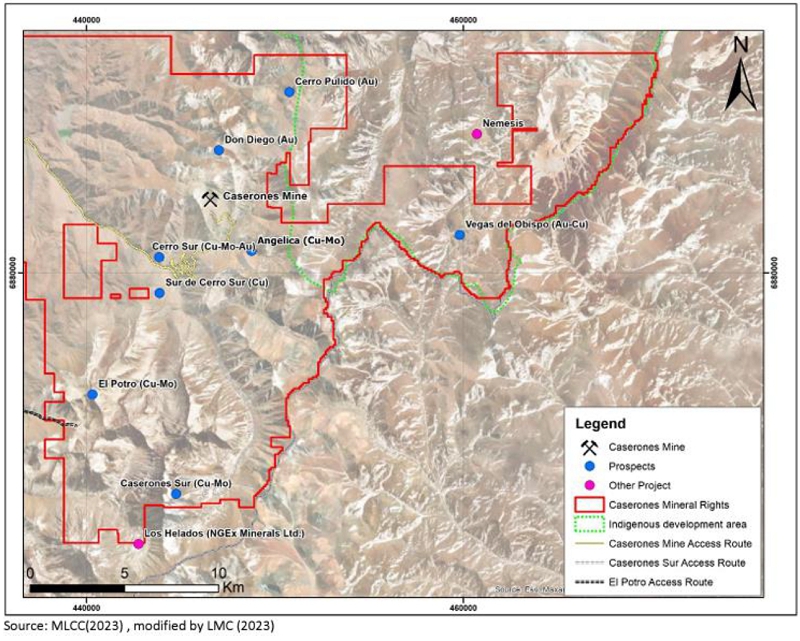
Minera Lumina Copper Chile conducted several of the exploration activities through third party contractors or direct subsidiaries of JX Nippon Mining & Metals (“JX Nippon”). These companies include:
| 1. | Japan Oil, Gas and Metals National Corporation (“JOGMEC”) | |
| 2. | JX Nippon, part owner of the Caserones Mine |
| a. | JX Nippon Mining Metals Exploration Chile Lda (“JXE”) is an exploration company; subsidiary of JX Nippon | |
| b. | Nikko Exploration & Development Company (“NED”), subsidiary of JX Nippon |
| 3. | Pan Pacific Copper (“PPC”) was created in October 2000, and is a partnership formed by JX Nippon (66%) and Mitsui Mining & Smelting (34%) | |
| 4. | Pan Pacific Copper Exploration Chile Ltda. (“PPCE”) is a geological services company and subsidiary of PPC |
Caserones Main Orebody
Since taking ownership of the Project Lundin has reported commencing additional deep drilling of the main mineralised system with a view to understanding the distribution of high-grade breccia zones within the orebody and testing the depth extent of the system. No results have yet been released.
Cerro Sur, Sur de Cerro Sur Prospects
The Cerro Sur and the Sur de Cerro Sur prospects are situated approximately 4 km southwest of the Caserones Mine operation. In 2008 and 2009, Nikko Exploration & Development Co. (NED), a subsidiary to JX Nippon, completed several exploration programs and rock analyses, in the Cerro Sur area. In 2009, Minera Lumina Copper Chile followed up with a limited drill program of 3 diamond drill holes (900 m total). The assay analyses included total copper, sequential copper, and molybdenum.
-39-
Angelica Prospect
In 2005, Minera Lumina Copper Chile originally completed a geological mapping and surface rock sampling in the Angelica prospect. In late 2008, NED, a subsidiary of JX Nippon carried out a more detailed mapping and geochemical sampling program that found several copper and molybdenum anomalies. NED followed up these anomalies by retaining Zonge to complete an IP/resistivity ground geophysical survey. In 2009, with the support of JOGMEC, Minera Lumina Copper Chile and PPC conducted the first of several exploration diamond drill holes. These were subsequently followed 4 drill holes in 2010 and 12 RC drill holes in 2011. The results intersected an oxide zone. Between 2020 and 2024, further additional exploration diamond drill campaigns were completed discovering secondary sulphides. Work is continuing to define the system and potentially locate primary sulphides.
Caserones Oeste – Caserones Este Prospects
The Caserones Oeste – Caserones Este prospects are located approximately 3.5 km southeast of the Caserones operation.
Caserones Sur Prospect
The Caserones Sur Prospect is located approximately 16 km south of the Caserones Mine, at the head of the Rio Ramadillas. This area is characterized by outcrops of altered breccias, typically associated with copper-molybdenum porphyry systems. Minera Lumina Copper Chile, in partnership with JX Nippon and JXE, completed geological surface mapping and rock sampling and completed an airborne geophysical survey.
Vegas del Obispo Prospect
The Vegas del Obispo prospect is situated approximately 14 km east of the Caserones Mine. The Vegas del Obispo is an area of hydrothermal alteration with potential for hosting for gold or copper mineralization but has not been fully investigated. There is limited historical exploration on this prospect. Other than a brief site inspection and geology review in 2021, Minera Lumina Copper Chile has not conducted any further exploration activities on this prospect.
Cerro Pulido Prospect
The Cerro Pulido prospect is situated approximately 6 km northeast of the Caserones Mine. Cerro Pulido is an area of hydrothermal alteration with potential for hosting gold or copper mineralization but has not been fully investigated. Early exploration was completed in the late 1980s and early 1990s. Minera Lumina Copper Chile has not conducted any exploration activities on this prospect.
Sample Preparation, Analyses, and Data Verification
RC samples were collected on 2 m intervals at the drill using a cyclone. In a few areas where water was a problem, a rotary wet splitter was used. Core samples were marked on 2 m intervals and the core was cut in half using a diamond saw. Activation Laboratories Ltd. (Actlabs) in La Serena, Chile was used for RC and core sample preparation and analysis from 2000–2006. At the time, the laboratory held ISO/IEC 17025 accreditations. SGS Minerals, Copiapó, was used for RC and core sample preparation and analysis from 2007–2017. The laboratory holds ISO 14001 and NCh-ISO17065:2013 accreditations.
Both laboratories are independent of Lundin Mining Corporation and Minera Lumina Copper Chile. Currently, grade control samples are assayed at Bureau Veritas in Copiapó that holds ISO/IEC 27001:2013 accreditations. Depending on the laboratory, samples were crushed to 95% passing 10 mesh and pulverized to 95% passing 150 mesh (RC) or passing 10 mesh (core). Analytical methods consisted of acid digestion followed by atomic absorption (AA) readings for total copper (CuT), acid-soluble copper (CuAS), cyanide-soluble copper (CuCNS), and molybdenum. Density determinations were conducted in 2004–2008 using the wet/dry method. There are 977 measurements from 87 drill holes in the Project database. QA/QC procedures used from 2004 onwards include submission of blank, duplicate, and certified reference materials (CRMs) in the sample stream. A review of the results indicates no material issues arising from the QA/QC programs. Drill core is stored at a secure site on core racks at the Carizalillo base camp, 5 km from Juntas del Potro, which is fenced and guarded.
Mineral Processing and Metallurgical Testing
The Caserones Mine started producing cathodes in 2013 and the mineral processing facility has been producing copper and molybdenum concentrates since 2014. Primary and secondary sulphide ores are generally fed to the flotation plant and oxides are mixed with some secondary sulphides, and directed to the dump leach area.
-40-
LOM projection of copper feed grade is expected to be 0.13-0.25% Cu (dump leach) and 0.31% - 0.44% Cu (flotation). The LOM projection for copper concentrate grade is expected to be 28-32% Cu and reflects the gradual increase in the amount of primary mineralization (mostly chalcopyrite as the copper-bearing mineral) as plant feed. The projected LOM copper recovery for the flotation plant and dump leach are 82.7% and 53.7% respectively. However, improvements to the flotation plant and revised blending strategies have resulted in enhanced copper sulphide recoveries, averaging 91.0% in 2023.
Projected molybdenum production is based on a 110–170 ppm Mo head grade, a fixed 50% Mo concentrate grade and fixed 60% recovery.
Mineral Resource and Mineral Reserve Estimates
Mineral Resource Estimation
Caserones Mineral Resource Estimates are reported within a conceptual pit shell using a cut-off grade of 0.13% and 0.08% copper for the concentrator and dump leach, respectively. Mineral Reserves for the Caserones open pit are estimated using open pit discard NSR cut-off values of $11.08/t for ore processed at concentrating and $2.98/t for ore delivered to the heap leach and SX/EW processing. Claudio Araya, Global Practice Lead, Reserves & Mine Planning, Lundin Mining has reviewed and verified the Mineral Reserves Estimates.
Mineral Resource Statement
The December 31, 2024 Mineral Resource Estimate statement can be found in the table below:
| Grade | Contained Metal | |||||||||||||||||||
| Tonnes (kt) | Cu (%) | Mo (%) | Cu (kt) | Mo (kt) | ||||||||||||||||
| Measured | 376,427 | 0.33 | 0.01 | 1,254 | 42 | |||||||||||||||
| Indicated | 958,390 | 0.26 | 0.01 | 2,463 | 104 | |||||||||||||||
| M&I | 1,334,817 | 0.28 | 0.01 | 3,717 | 145 | |||||||||||||||
| Inferred | 116,466 | 0.22 | 0.01 | 256 | 12 | |||||||||||||||
Mineral Reserve Statement
The Mineral Reserve Estimate statement can be found in the table below:
| Grade | Contained Metal | |||||||||||||||||||
| Tonnes (kt) | Cu (%) | Mo (%) | Cu (kt) | Mo (kt) | ||||||||||||||||
| Proven | 362,249 | 0.33 | 0.01 | 1,197 | 40 | |||||||||||||||
| Probable | 522,057 | 0.27 | 0.01 | 1,405 | 53 | |||||||||||||||
| Total | 884,306 | 0.29 | 0.01 | 2,602 | 93 | |||||||||||||||
-41-
Mining Operations
Caserones is an established operating mine with mature mining practices. Mining at Caserones Mine is conducted via open pit methods, using a conventional truck and shovel fleet. The fleet is managed via a mine dispatch system. All equipment is manned.
Lundin reported total ore mined in 2024 to be 30,820kt with average grades of 0.40% copper and 0.015% molybdenum. Ore placed on the leach pads was 10,320kt and the total tonnage milled was 32,141kt.
Processing and Recovery Operations
The Caserones Mine mineral processing facility uses a process flowsheet typical for treating copper oxides and sulphides. The SX-EW plant has a nominal capacity of 34.5 kt/y. The processing facilities historically produced approximately 100–120 kt/y copper in concentrate, 1,700–2,500 t/y molybdenum in concentrate and approximately 25 kt/y of copper cathodes. Run-of-mine (ROM) oxide ore is treated via a dump heap leach.
Lundin reported total copper in concentrate production to be 100.8kt and cathode production was 23.92kt. Molybdenum production for 2024 was 3.18kt according to Lundin.
Infrastructure, Permitting and Compliance Activities
The Caserones Mine infrastructure includes waste rock facilities, dump leach and SX-EW facilities, truck shop, wash bay, fuel stations, explosive facilities, El Tambo and La Brea TSFs, camps and accommodations, power infrastructure, reagents storage facilities, administration building, mine and mill office building, sulphide concentrator (crushing, grinding, Cu and Mo flotation circuits), and assay/metallurgical laboratory. The mine is connected to Chile’s national grid via a 190 km double circuit 220 kV line which connects to the Jorqueria substation near Vallenar, close to the main north-south high voltage corridor. Power is supplied under a long-term contract to 2037. The processing facility has fresh (raw) water and process water systems. Process water from the various thickener overflows is collected in a process water pond and reused in the plant. Reclaim water from the tailings management facilities is also reused as process water, through this pond. Approximately 80% of process water is reclaimed water. The Caserones Mine fresh water supply comes from a wellfield connected to the Copiapó river basin. Water consumption is 409 l/s on average. Caserones Mine has a 518 l/s water usage permit and 1,280.5 l/s of water rights.
Capital and Operating Costs
Lundin reported the Caserones capital costs (100% basis) to be US$144M.
2024 operating costs averaged US$2.51/lb as reported by Lundin.
Exploration, Development and Production
Elemental Altus is exempted under Section 9.2 (Exemptions for Royalty or Similar Interests) of NI 43-101 from providing this disclosure, as the information required to provide such disclosure is not available to Elemental Altus.
DIVIDENDS AND DISTRIBUTIONS
Since becoming a public issuer, the Company has not paid any cash dividends or distributions on its securities. The Company has no dividend or distribution policy.
-42-
DESCRIPTION OF CAPITAL STRUCTURE
Common Shares
The authorized capital of the Company consists of an unlimited number of Common Shares without par value of which 246,722,591 Common Shares were issued and outstanding on August 18, 2025.
The Common Shares of the Company are without par value and entitle the holders thereof to receive notice of, attend and vote at all meetings of the shareholders of the Company. Each Common Share carries one vote at such meetings. Holders of Common Shares are entitled to dividends as and when declared by the Board of Directors. In the event of the voluntary or involuntary liquidation, dissolution or winding-up of the Company, after payment of all outstanding debts, the remaining assets of the Company available for distribution will be distributed to the holders of Common Shares.
Market for Securities
Trading Price and Volume
The Common Shares are listed and posted for trading on the TSX-V under the trading symbol “ELE”. The following table sets forth information relating to the trading of the Common Shares on the TSX-V for the months indicated.
| Period | High (C$) | Low (C$) | Close (C$) | Volume | ||||||||||||||
| 2024 | January | 1.1100 | 1.0000 | 1.0759 | 630,144 | |||||||||||||
| 2024 | February | 1.1100 | 1.0200 | 1.0640 | 534,594 | |||||||||||||
| 2024 | March | 1.2000 | 1.0200 | 1.1175 | 2,970,233 | |||||||||||||
| 2024 | April | 1.2300 | 1.1300 | 1.1855 | 918,040 | |||||||||||||
| 2024 | May | 1.2400 | 1.1400 | 1.1850 | 467,108 | |||||||||||||
| 2024 | June | 1.1700 | 1.0500 | 1.1073 | 496,405 | |||||||||||||
| 2024 | July | 1.1500 | 1.0500 | 1.0936 | 750,627 | |||||||||||||
| 2024 | August | 1.1100 | 0.9700 | 1.0302 | 2,043,987 | |||||||||||||
| 2024 | September | 1.2400 | 1.0000 | 1.1295 | 969,230 | |||||||||||||
| 2024 | October | 1.2900 | 1.1100 | 1.2118 | 1,320,460 | |||||||||||||
| 2024 | November | 1.2800 | 1.0700 | 1.1657 | 703,916 | |||||||||||||
| 2024 | December | 1.2100 | 1.0700 | 1.1605 | 1,114,938 | |||||||||||||
| 2025 | January | 1.2500 | 1.0900 | 1.1582 | 1,404,308 | |||||||||||||
| 2025 | February | 1.2500 | 1.1300 | 1.1837 | 1,932,568 | |||||||||||||
| 2025 | March | 1.4200 | 1.1500 | 1.2752 | 1,329,757 | |||||||||||||
| 2025 | April | 1.5200 | 1.1800 | 1.3743 | 1,522,213 | |||||||||||||
| 2025 | May | 1.6000 | 1.3200 | 1.4310 | 1,872,196 | |||||||||||||
| 2025 | June | 1.9900 | 1.3200 | 1.5739 | 5,513,654 | |||||||||||||
| 2025 | July | 2.2000 | 1.8800 | 2.0614 | 3,714,820 | |||||||||||||
| 2025 | August 1-13 | 2.0800 | 1.9500 | 2.0150 | 382,700 | |||||||||||||
The only securities of Elemental Altus that are outstanding but not listed or quoted on a marketplace are Elemental Altus’ stock options, performance share units, and restricted share units.
PRIOR SALES
On October 29, 2024, Elemental Altus completed the acquisition of an additional 50% ownership of entities holding 24 existing royalties from an affiliate of AlphaStream Limited for consideration of US$28 million paid in 34,444,580 newly issued common shares of Elemental Altus at a price of C$1.10/share. See “General Development of the Business - Announcement of the acquisition of a portfolio of royalties from AlphaStream”.
-43-
Escrowed Securities and Securities Subject to Contractual Restriction on Transfer
Elemental Altus does not have any securities to Elemental Altus’ knowledge, in escrow or that are subject to a contractual restriction on transfer.
DIRECTORS AND OFFICERS
The following table sets forth the name, province/state and country of residence, position held with Elemental Altus and principal occupation of each person who is a director and/or an officer of Elemental Altus. Directors are elected at each annual meeting of the Company’s shareholders and serve as such until the next annual meeting of shareholders or until their successors are elected or appointed.
| Name
and Municipality of Residence |
Position
with the Company |
Principal Occupation |
Juan Sartori Monte Carlo, Monaco |
Executive Chairman | Chairman and Founder of Union Group (Including Union Acquisition Corp. II, Union Acquisition Corp. III and Union Growth Corp.) |
Frederick Bell London, UK |
Chief Executive Officer | Chief Executive Officer of the Company |
Simon Vumbaca(1, 2, 3) West Sussex, UK |
Director | Founder and Principal of ASV Private Office |
Ravi Sood(1, 2, 3) Ontario, Canada |
Director | Chief Executive Officer of Golconda Gold Ltd. |
Prashant Francis (1, 3) Abu Dhabi, UAE |
Director | Founder of AlphaStream Limited |
Sandeep Singh(2) Ontario, Canada |
Director | CEO of Western Copper and Gold Corp |
David Baker London, UK |
Chief Financial Officer | Chief Financial Officer of the Company |
David Gossen Denver, USA |
General Counsel and Corporate Secretary | General Counsel and Corporate Secretary of the Company |
(1) Member of the Audit Committee (chair: Ravi Sood)
(2) Member of the Compensation Committee (chair: Sandeep Singh)
(3) Member of the Nomination and Governance Committee (chair: Prashant Francis)
All directors and executive officers of Elemental Altus in the aggregate own 3,497,571 Common Shares, a total percentage of 1.4% of Elemental Altus.
Cease Trade Orders, Bankruptcies, Penalties or Sanctions
No director or executive officer of the Company is, as at the date hereof, or was within ten (10) years before the date hereof, a director, chief executive officer or chief financial officer of any company (including the Company) that,
| (i) | was subject to a cease trade order, an order similar to a cease trade order or an order that denied the relevant company access to any exemption under securities legislation, that was in effect for a period of more than 30 consecutive days, and that was issued while the director or executive officer was acting in the capacity as director, chief executive officer or chief financial officer; or |
-44-
| (ii) | was subject to a cease trade order, an order similar to a cease trade order or an order that denied the relevant company access to any exemption under securities legislation, that was in effect for a period of more than 30 consecutive days, that was issued after the director or executive officer ceased to be a director, chief executive officer or chief financial officer and which resulted from an event that occurred while that person was acting in the capacity as director, chief executive officer or chief financial officer. |
No director or executive officer of the Company, or a shareholder holding a sufficient number of securities of the Company to materially affect control of the Company,
| (i) | is, or within ten years prior to the date hereof has been, a director or executive officer of any company (including the Company) that, while that person was acting in that capacity, or within a year of that person ceasing to act in that capacity, became bankrupt, made a proposal under any legislation relating to bankruptcy or insolvency or was subject to or instituted any proceedings, arrangement or compromise with creditors or had a receiver, receiver manager or trustee appointed to hold its assets; or |
| (ii) | has, within ten years prior to the date hereof, become bankrupt, made a proposal under any legislation relating to bankruptcy or insolvency, or become subject to or instituted any proceedings, arrangement or compromise with creditors, or had a receiver, receiver manager or trustee appointed to hold the assets of the director, executive officer or shareholder. |
No director or executive officer of the Company, or a shareholder holding a sufficient number of securities of the Company to affect materially the control of the Company, has been subject to,
| (i) | any penalties or sanctions imposed by a court relating to securities legislation or by a securities regulatory authority or has entered into a settlement agreement with a securities regulatory authority; or |
| (ii) | any other penalties or sanctions imposed by a court or regulatory body that would likely be considered important to a reasonable investor in making an investment decision. |
Conflicts of Interest
To the best of the Company’s knowledge, and other than as disclosed in this AIF, there are no known existing or potential material conflicts of interest between the Company and any director or officer of the Company, except that certain of the directors and officers serve as directors and officers of other public companies and therefore it is possible that a conflict may arise between their duties as a director or officer of the Company and their duties as a director or officer of such other companies.
Directors and officers of the Company also serve as directors and/or officers of other companies involved in natural resource exploration and development or investment in natural resource companies and consequently there exists the possibility for such directors and officers to be in a position of conflict. Any decision made by any of such directors and officers involving the Company will be made in accordance with their duties and obligations to deal fairly and in good faith with a view to the best interests of the Company and its shareholders. In addition, each of the directors is required to declare and refrain from voting on any matter in which such directors may have a conflict of interest in accordance with the procedures set forth in the Business Corporations Act (British Columbia) and other applicable laws.
LEGAL PROCEEDINGS AND REGULATORY ACTIONS
The Company is not party to any material legal proceedings or regulatory actions as of the date of this AIF. The Company is not aware of any material contemplated legal proceedings involving it or its operations.
-45-
INTEREST OF MANAGEMENT AND OTHERS IN MATERIAL TRANSACTIONS
The Company has not engaged in any transaction with the Company’s executive officers or directors, a person or company that beneficially owns ten (10) percent of the Company or its affiliates or associates, or an associate or affiliate of the Company’s executive officers or directors within the three most recently completed financial years that has materially affected or is reasonably expected to material affect the Company.
TRANSFER AGENT AND REGISTRARS
The transfer agent and registrar for the Common Shares of the Company is Computershare Investor Services Inc., through its offices located at 510 Burrard St, 3rd Floor Vancouver, British Columbia, Canada V6C 3B9.
PROMOTERS
No director or executive officer of the Company is, as at the date hereof, a “promoter” of the Company as that term is defined in applicable Canadian securities laws.
MATERIAL CONTRACTS
Other than in the ordinary course of business, the Company entered into the following material contracts within the financial year ended December 31, 2024, or since such time or before such time, which are still in effect:
US$50 Million Credit Facility
On December 1, 2022, Elemental Altus entered into an agreement with National Bank of Canada (“NBC”) and Canadian Imperial Bank of Commerce (“CIBC”) for a revolving credit facility which allows Elemental Altus to borrow up to US$40 million with an option to increase to US$50 million subject to satisfaction of certain conditions. On November 14, 2024, Elemental Altus announced the signing of an amendment to increase the facility to US$50 million and introduced Royal Bank of Canada as a new lending on the facility. See “General Developments – US$50 Million Credit Facility.”
Acquisition of Further Royalty Interest on Caserones Copper Mine
On March 9, 2023, Elemental Altus entered into a binding agreement to acquire an additional 0.025% effective NSR on the producing Caserones Mine. See “General Developments – Acquisition of Further Royalty Interest on Caserones Copper Mine.”
Generation of Two New Gold Copper Royalties in Ethiopia
On July 25, 2023, Elemental Altus generated two new gold and copper 2.5% NSR royalties, through the execution of a sale and purchase agreement for the sale of 95% of its Ethiopian focused subsidiary, Altau to ANS. See “General Developments – Generation of Two New Gold Copper Royalties in Ethiopia.”
Acquisition of an Existing Royalty on Arizona Sonoran’s Cactus Project
On August 23, 2023, Elemental Altus entered into a binding agreement to acquire two existing royalties (“Cactus Project Royalties”) from RCF Opportunities Fund L.P. for consideration of US$10,000,000 payable in Common Shares of Elemental Altus. See “General Developments – Acquisition of an Existing Royalty on Arizona Sonoran’s Cactus Project.”
Elemental Altus Partners Egyptian Assets for Cash and Royalties
On August 28, 2023, Elemental Altus completed a subscription agreement with In2Metals Explorer S.à r.l. (“In2Metals”) in respect of Akh Gold Ltd. (the “In2Metals Subscription Agreement”). See “General Developments – Elemental Altus Partners Egyptian Assets for Cash and Royalties.”
-46-
Acquisition of Existing Tungsten Royalties
On September 11, 2024, Elemental Altus completed the acquisition of a royalty on Fireweed Metals’ Mactung Project from Cornish Metals plc. See “General Developments - Announcement of the acquisition of two tungsten royalties.”
Acquisition of a portfolio of Royalties from AlphaStream
On October 28, 2024, the company completed the acquisition fromAalphaStream of an additional 50% ownership of Alpha 2 SPV limited (“Alpha 2”) and alpha 3 SPV limited (“Alpha 3”), entities holding 24 existing royalties, from Alpha 1 SPV limited. See “general development - announcement of the acquisition of a portfolio of royalties from Alphastream”.
Tether Investments as New Cornerstone Shareholder
On June 10, 2025, Tether Investments S.A. de C.V. entered into the Tether Transaction, causing La Mancha Investments S. à r. l. to cease to beneficially own and control any Common Shares of the Company. Pursuant to the Tether Transaction, Tether Investments S.A. de C.V. beneficially owned approximately 31.9% of the issued and outstanding Common Shares. Concurrent with the Tether Transaction, Tether Investments S.A. de C.V entered into the Alpha Option. The Alpha Option will not become exercisable prior to October 29, 2025 without the consent of the Company, which was granted on June 17, 2025.
Interests of Experts
Richard Evans, BSc (Hons) GradDip Business FAusIMM, is Senior Vice President Technical for Elemental Altus, and a “qualified person” under NI 43-101, has reviewed and approved the scientific and technical disclosure contained in this document.
To the knowledge of Elemental Altus, Mr. Evans holds 1.5% of the outstanding Common Shares of Elemental Altus or of any associate or affiliate of Elemental Altus as of the date hereof. Mr. Evans has not and will not receive any direct or indirect interest in any securities of Elemental Altus as a result of the review and approval of the scientific and technical disclosure included in this AIF.
Additionally, Timothy Strong, BSc (Hons) ACSM FGS MIMMM RSci, is also a “qualified person” as defined in NI 43-101 and authored the Karlawinda Technical Report. As of August 18, 2025, Mr. Strong holds nil securities in the Company. Mr. Strong has not received any direct or indirect interest in the Company’s property and did not receive any direct or indirect interest in any of the Company’s securities or the securities of any associate or affiliate of the Company in connection with his review of the scientific and technical information in the Karlawinda Technical Report.
The auditors of the Company are PricewaterhouseCoopers LLP, Chartered Professional Accountants, through their offices at 18 York Street, Suite 2500, Toronto, Ontario, Canada. PricewaterhouseCoopers LLP has confirmed that they are independent of the Company within the meaning of the Chartered Professional Accountants of Ontario Code of Professional Conduct.
AUDIT COMMITTEE
The Company’s Audit Committee is responsible for monitoring the Company’s systems and procedures for financial reporting and internal control, reviewing certain public disclosure documents and monitoring the performance and independence of the Company’s external auditors. The committee is also responsible for reviewing the Company’s annual audited financial statements, unaudited quarterly financial statements and management’s discussion and analysis of financial results of operations for both annual and interim financial statements and review of related operations prior to their approval by the full board of directors of the Company.
The Audit Committee’s charter sets out its responsibilities and duties, qualifications for membership, procedures for committee member removal and appointment and reporting to the Company’s board of directors. A copy of the charter is attached hereto as Schedule “A”.
-47-
The current members of the Audit Committee are:
| Ravi Sood (1) | Independent | Financially literate |
| Simon Vumbaca | Independent | Financially literate |
| Prashant Francis | Independent | Financially literate |
Notes:
| (1) | Chairman of the Audit Committee | |
| (2) | The terms “independent” and “financially literate” are defined by National Instrument 52-110 Audit Committees (“NI 52-110”). |
Relevant Education and Experience
As noted above, each member of the Audit Committee is financially literate. Collectively, the Audit Committee members have the education and experience to fulfill their responsibilities as outlined in the Audit Committee Charter. Set out below is a description of the education and experience of each Audit Committee member that is relevant to the performance of his responsibilities as an Audit Committee member.
Ravi Sood is the managing director of Signal 8 Limited based in Toronto, Canada. Mr. Sood has been a founder of and the principal investor in several businesses in emerging markets and currently serves as Chief Executive Officer of Golconda Gold Ltd. (TSXV) and Executive Chairman of Abraxas Power Corp. Mr. Sood was the founder and Chief Executive Officer of Navina Asset Management Inc., a global asset management firm headquartered in Toronto, Canada. Mr. Sood led the investment activities of Navina and its predecessor company, Lawrence Asset Management Inc., from its founding in 2001 until he sold the firm in 2010. Mr. Sood received a Bachelor Degree of Mathematics at the University of Waterloo where he was a Descartes Fellow and the recipient of numerous national awards.
Simon Vumbaca is currently principal of London-based private investment office ASV Private Office where he works with businesses to set and to execute sophisticated value creation strategies. Over the past three decades, Mr. Vumbaca has led complex, high profile, and high value corporate and commercial negotiations, including most recently the sale of Pit Stop Betting in 2019. He operates in a peer group of investors including high-net worth individuals, overseas royal families, international conglomerates, private investors, financial institutions, elite athletes, artists, and sports club owners. Mr. Vumbaca currently serves as a non-executive director of Sunderland AFC, a professional English premier league football club, and is the Chair of AIG, an Agro conglomerate, amongst other appointments. Mr. Vumbaca holds a Masters (DEA) graduate degree from the Université Paris II Panthéon-Assas and is a licensed member of the Law Society of England and Wales and of the Colegi.
Prashant Francis has over 20 years of experience in the investment banking, M&A and business development space. Prashant is the co-founder and co-Chief Executive Officer of AlphaStream, a private mining investment company based in Abu Dhabi. In his role at AlphaStream, he has helped build a platform that invests across the capital structure in the mining space globally. Prashant began his career at J.P. Morgan Chase focused on Mining M&A and then evolved into a more generalist M&A role and then a TMT focused role. In 2017, he co-founded Portman Partners, a merchant banking platform that is the co-owner of AlphaStream.
Reliance on Certain Exemptions
At no time since the commencement of the Company’s most recently completed financial year has the Company relied on the exemption in Section 2.4 (De Minimis Non-audit Services) of NI 52-110, Section 3.2 of NI 52-110 (Initial Public Offerings), Section 3.4 of NI 52-110 (Events Outside Control of Member), Section 3.5 of NI 52-110 (Death, Disability or Resignation of Audit Committee Member) or Section 3.6 of NI 52-110 (Temporary Exemption for Limited and Exceptional Circumstances), or an exemption from NI 52-110, in whole or in part, granted under Part 8 of NI 52-110 (Exemptions) or on Section 3.8 of NI 52-110 (Acquisition of Financial Literacy).
-48-
Audit Committee Oversight
At no time since the commencement of the Company’s most recently completed financial year was there a recommendation of the Audit Committee to nominate or compensate an external auditor not adopted by the Board of Directors.
Pre-Approval Policies and Procedures
The Audit Committee’s charter sets out responsibilities regarding the provision of non-audit services by the Company’s external auditors. This policy encourages consideration of whether the provision of services other than audit services is compatible with maintaining the auditor’s independence and requires Audit Committee pre-approval of permitted audit and audit-related services.
External Auditor Service Fees
The aggregate fees incurred by the Company’s external auditors for each of the last two fiscal years for audit fees are as follows:
| Financial Year Ending | Auditor | Audit Fees(1) | Audit Related Fees(2) | Tax Fees(3) | All Other Fees(4) | Total | |||||||||||||||||
| 2023 | PricewaterhouseCoopers LLP | 204,688 | - | - | - | 204,688 | |||||||||||||||||
| 2024 | PricewaterhouseCoopers LLP | 212,082 | - | - | - | 212,082 | |||||||||||||||||
Notes:
| 1. | The aggregate audit fees incurred. | |
| 2. | The aggregate fees incurred for assurance and related services that are reasonably related to the performance of the audit or review of the Company’s financial statements and which are not included under the heading “Audit Fees”. | |
| 3. | Fees incurred for preparation of Company’s corporate tax return. | |
| 4. | The aggregate fees incurred for products and services other than as set out under the headings “Audit Fees”, “Audit Related Fees” and “Tax Fees”. |
ADDITIONAL INFORMATION
Additional information relating to the Company can be found on SEDAR+ at www.sedarplus.ca. Additional information, including directors’ and officers’ remuneration and indebtedness, principal holders of the Company’s securities and securities authorized for issuance under equity compensation plans is contained in the filing statement of the Company as filed on SEDAR+ at www.sedarplus.ca. Additional financial information is provided in the Company’s audited financial statements and management’s discussion and analysis for the financial year ended December 31, 2024.
-49-
SCHEDULE “A” - AUDIT COMMITTEE CHARTER
ELEMENTAL ALTUS ROYALTIES CORP.
AUDIT COMMITTEE CHARTER
(the “Charter”)
INTRODUCTION
This Charter sets forth the purpose, composition, responsibilities and authority of the Audit Committee (the “Committee”) of the board of directors (the “Board”) of Elemental Altus Royalties Corp. (the “Company”).
| 1. | STATEMENT OF PURPOSE |
The purpose of the Committee is to assist the Board in fulfilling its oversight responsibilities with respect to:
| • | Financial reporting and related financial disclosure; | |
| • | Risk management; | |
| • | Internal control over financial reporting and disclosure controls and procedures; | |
| • | The annual independent audit of the Company’s financial statements; | |
| • | Legal and regulatory compliance and compliance with the Code of Conduct; | |
| • | Related party transactions; and | |
| • | Compliance with public disclosure requirements. |
| 2. | COMMITTEE MEMBERSHIP |
The Committee shall consist of as many directors of the Board as the Board may determine (the “Members”), but in any event, not less than three (3) Members. Each Member shall be independent and financially literate within the meaning of National Instrument 52-110 — Audit Committees (“NI 52-110”) and any other applicable securities laws and the rules of any stock exchanges upon which the Company’s securities are listed. NI 52-110 requires, among other things, that to be independent, a Member be free of any relationship which could, in the view of the Board, reasonably interfere with the exercise of a Member’s independent judgment. No Member shall: (i) accept, directly or indirectly, any consulting or advisory or other compensatory fee from the Company or any of its subsidiaries (other than remuneration for acting in his or her capacity as a member of the Board and as a member of Board Committees); or (ii) be an “affiliated entity” within the meaning of NI 52-110.
Members shall be appointed by the Board. Any Member may be removed and replaced at any time by the Board, and will automatically cease to be a Member if he or she ceases to meet the qualifications required of Members. The Board will fill vacancies on the Committee by appointment from among qualified directors of the Board. If a vacancy exists on the Committee, the remaining Members may exercise all of the Committee’s powers so long as there is a quorum in accordance with Section 3 below.
Chair
The Board will designate one of the independent directors of the Board to be the chair of the Committee (the “Chair”) and the Chair may be removed or replaced at any time by the Board.
Qualifications
Subject to the permitted phase-in periods contemplated by Section 3.2 and Section 3.8 of NI 52-110, all Members shall be independent and financially literate as described above. Members must have suitable experience and must be familiar with auditing and financial matters.
-50-
Attendance of Management and other Persons
The Committee may invite, at its discretion, senior executives of the Company or such persons as it sees fit to attend meetings of the Committee and to take part in the discussion and consideration of the affairs of the Committee. The Committee may also require senior executives or other employees of the Company to produce such information and reports as the Committee may deem appropriate in the proper exercise of its duties. Senior executives and other employees of the Company shall attend a Committee meeting if invited by the Committee. The Committee may meet without senior executives in attendance for a portion of any meeting of the Committee.
Delegation
Subject to applicable law, the Committee may delegate any or all of its functions to any of its Members or any subset thereof, or other persons, from time to time as it sees fit.
| 3. | COMMITTEE OPERATIONS |
Meetings
The Chair, in consultation with the other Members, shall determine the schedule and frequency of meetings of the Committee. Meetings of the Committee shall be held at such times and places as the Chair may determine. To the extent possible, advance notice of each meeting will be given to each Member unless all Members are present and waive notice, or if those absent waive notice before or after a meeting. Members may attend all meetings of the Committee either in person or by telephone, video or other electronic means. Powers of the Committee may also be exercised by written resolutions signed by all Members.
At the request of the external auditors of the Company, the Chief Executive Officer or the Chief Financial Officer of the Company or any Member, the Chair shall convene a meeting of the Committee. Any such request shall set out in reasonable detail the business proposed to be conducted at the meeting so requested.
Agenda and Reporting
To the extent possible, in advance of every regular meeting of the Committee, the Chair shall prepare and distribute, or cause to be prepared and distributed, to the Members and others as deemed appropriate by the Chair, an agenda of matters to be addressed at the meeting together with appropriate briefing materials.
The Chair shall report to the Board on the Committee’s activities since the last Board meeting. However, the Chair may report orally to the Board on any matter in his or her view requiring the immediate attention of the Board. Minutes of each meeting of the Committee shall be circulated to the Board following approval of the minutes by the Members.
The Committee shall oversee the preparation of, review and approve the applicable disclosure for inclusion in the Company’s annual information form.
Secretary and Minutes
The Corporate Secretary of the Company may act as the secretary of the Committee unless an alternative secretary is appointed by the Committee. The secretary of the Committee shall keep regular minutes of Committee proceedings and shall circulate such minutes to all Members and to the chair of the Board (and to any other director of the Board that requests that they be sent to him or her) on a timely basis.
-51-
Quorum and Procedure
A quorum for any meeting of the Committee will be a simple majority of the Members in office. The procedure at meetings will be determined by the Committee. The powers of the Committee may be exercised by a simple majority of Members at a meeting where a quorum is present or by resolution in writing signed by all Members. In the absence of the Chair, the Committee may appoint one of its other Members to act as Chair of any meeting.
Exercise of Power between Meetings
Between meetings, the Chair, or any Member designated for such purpose by the Committee, may, if required in the circumstance, exercise any power delegated by the Committee on an interim basis. The Chair or other designated Member will promptly report to the other Members in any case in which this interim power is exercised.
| 4. | DUTIES AND RESPONSIBILITIES |
The Committee is responsible for performing the duties set out below and any other duties that may be assigned to it by the Board, as well as any other functions that may be necessary or appropriate for the performance of its duties.
Financial Reporting and Disclosure
Review and recommend to the Board for approval, the interim and audited annual financial statements, including the auditors’ report thereon, management’s discussion and analysis, financial reports, press releases related to such financial statements and reports, and other applicable financial disclosure, prior to the public disclosure of such information.
Review and recommend to the Board for approval, where appropriate, financial information contained in any prospectuses, annual information forms, annual reports to shareholders, management proxy circulars, material change disclosures of a financial nature and similar disclosure documents, prior to the public disclosure of such documents or information.
Review with senior executives of the Company, and with external auditors, significant accounting principles and disclosure issues and alternative treatments under International Financial Reporting Standards (“IFRS”), with a view to gaining reasonable assurance that financial statements are accurate, complete and present fairly the Company’s financial position and the results of its operations in accordance with IFRS, as applicable.
Seek to ensure that adequate procedures are in place for the review of the Company’s public disclosure of financial information extracted or derived from the Company’s financial statements, the Company’s disclosure controls and procedures and periodically assess the adequacy of those procedures and recommend any proposed changes to the Board for consideration.
Risk Management
Review the Company’s major financial risk exposures and the steps taken to monitor and control such exposures, including the use of any financial derivatives and hedging activities.
Review and make recommendations to the Board regarding the adequacy of the Company’s risk management policies and procedures with regard to identification of the Company’s principal risks and implementation of appropriate systems and controls to manage such risks including an assessment of the adequacy of insurance coverage maintained by the Company.
-52-
Internal Controls and Internal Audit
Review the adequacy and effectiveness of the Company’s internal control and management information systems through discussions with senior executives of the Company and the external auditor relating to the maintenance of (i) necessary books, records and accounts in sufficient detail to accurately and fairly reflect the Company’s transactions; (ii) effective internal control over financial reporting; and (iii) adequate processes for assessing the risk of material misstatements in the financial statements and for detecting control weaknesses or fraud. From time to time the Committee shall assess any requirements or changes with respect to the establishment or operations of the internal audit function having regard to the size and stage of development of the Company at any particular time. Satisfy itself, through discussions with senior executives of the Company that the adequacy of internal controls, systems and procedures has been periodically assessed in accordance with regulatory requirements and recommendations.
Periodically review the Company’s policies and procedures for reviewing and approving or ratifying related- party transactions.
External Audit
Recommend to the Board a firm of external auditors to be nominated for appointment as the external auditors of the Company.
Ensure the external auditors report directly to the Committee on a regular basis. Review the independence of the external auditors.
Review and recommend to the Board the fee, scope and timing of the audit and other related services rendered by the external auditors.
Review and approve the audit plan of the external auditors, including the scope and staffing of the audit, prior to the commencement of the audit. Establish and maintain a direct line of communication with the Company’s external auditors.
At each meeting, the Committee shall meet in private session, if required, and may meet with the external auditors, with management, and with the Committee members only.
Review and assess the compensation and oversight of the work of the external auditors of the Company with respect to preparing and issuing an audit report or performing other audit or review services for the Company, including the resolution of issues between senior executives of the Company and the external auditors regarding financial reporting. The external auditor shall report directly to the Committee.
Review the results of the external audit and the external auditors’ report thereon, including discussions with the external auditors as to the quality of accounting principles used and any alternative treatments of financial information that have been discussed with senior executives of the Company and any other matters.
Review any material written communications between senior executives of the Company and the external auditors and any significant disagreements between the senior executives and the external auditors regarding financial reporting.
Discuss with the external auditors their perception of the Company’s financial and accounting personnel, records and systems, the cooperation which the external auditors received during their course of their review and availability of records, data and other requested information and any recommendations with respect thereto.
Discuss with the external auditors their perception of the Company’s identification and management of risks, including the adequacy or effectiveness of policies and procedures implemented to mitigate such risks.
-53-
Recommend to the Board any change of the external auditors and oversee any such change to ensure compliance with NI 52-110 and other applicable securities laws and any other significant issues related to the change, including the response of the incumbent auditors, and enquire as to the qualifications of the proposed auditors before making its recommendations to the Board.
Review and assess, at least annually, the performance of the external auditors, including (i) reviewing and evaluating the lead partner on the external auditor’s engagement with the Company; and (ii) considering whether the auditor’s quality controls are adequate and the provision of permitted non-audit services are compatible with maintaining the auditor’s independence.
Associated Responsibilities
Monitor and periodically review the Code of Conduct of the Company and associated procedures for:
| • | The receipt, retention and treatment of complaints received by the Company regarding accounting and internal accounting controls or auditing matters; | |
| • | The confidential, anonymous submission by directors, officers and employees of the Company of concerns regarding questionable accounting or auditing matters; and | |
| • | Any violations of applicable law, rules or regulations that relate to corporate reporting and disclosure, or violations of the Company’s Code of Conduct. |
Review and approve the Company’s hiring policies regarding employees and partners, and former employees and partners, of the present and former external auditors of the Company.
Non-Audit Services
Pre-approve all non-audit services to be provided to the Company or any subsidiary entities by its external auditors or by the external auditors of such subsidiary entities, in accordance with NI 52-110 and other applicable securities laws, if any. The Committee may delegate to one or more of its Members the authority to pre-approve non-audit services but pre-approval by such Member or Members so delegated shall be presented to the full Committee at its first scheduled meeting following such pre-approval.
Other Duties
Direct and supervise the investigation into any matter brought to its attention within the scope of the Committee’s duties. Perform such other duties as may be assigned to it by the Board from time to time or as may be required by applicable law.
| 5. | THE COMMITTEE CHAIR |
In addition to the responsibilities of the Chair described above, the Chair has the primary responsibility for overseeing and reporting on the evaluations to be conducted by the Committee, as well as monitoring developments with respect to accounting and auditing matters in general and reporting to the Committee on any related significant developments.
| 6. | COMMITTEE EVALUATION |
The performance of the Committee shall be evaluated by the Board as part of its regular evaluation of the Board committees.
| 7. | ACCESS TO INFORMATION AND AUTHORITY TO RETAIN INDEPENDENT ADVISORS |
The Committee shall be granted unrestricted access to all information regarding the Company that is necessary or desirable to fulfil its duties and all directors, officers and employees of the Company will be directed to cooperate as requested by Members. The Committee has the authority to retain, at the Company’s expense, independent legal, financial, and other advisors, consultants and experts to assist the Committee in fulfilling its duties and responsibilities, including sole authority to retain and to approve their fees. In selecting such advisors, consultants and experts, the Committee shall take into account factors relevant to their independence from the Company’s management and other relevant considerations.
-54-
The Committee shall discharge its responsibilities, and shall assess the information provided by the Company’s management and the external advisors, in accordance with its business judgment. Members are entitled to rely, absent knowledge to the contrary, on the integrity of the persons and organizations from whom they receive information, and on the accuracy and completeness of the information provided. Nothing in this Charter is intended or may be construed as imposing on any member of the Committee or the Board a standard of care or diligence that is in any way more onerous or extensive than the standard to which the directors of the Board are subject under applicable law.
The Committee also has the authority to communicate directly with internal and external auditors. While the Committee has the responsibilities and powers set forth in this Charter, it is not the duty of the Committee to plan or conduct audits or to determine that the Company’s financial statements are complete and accurate or comply with IFRS and other applicable requirements. These are the responsibilities of the senior executives of the Company responsible for such matters and the external auditors. The Committee, the Chair and any Members identified as having accounting or related financial expertise are directors of the Board, appointed to the Committee to provide broad oversight of the financial, risk and control related activities of the Company, and are specifically not accountable or responsible for the day-to-day operation or performance of such activities. Although the designation of a Member as having accounting or related financial expertise for disclosure purposes is based on that individual’s education and experience, which that individual will bring to bear in carrying out his or her duties on the Committee, such designation does not impose on such person any duties, obligations or liability that are greater than the duties, obligations and liability imposed on such person as a member of the Committee and the Board in the absence of such designation. Rather, the role of a Member who is identified as having accounting or related financial expertise, like the role of all Members, is to oversee the process, not to certify or guarantee the internal or external audit of the Company’s financial information or public disclosure. This Charter is not intended to change or interpret the constating documents of the Company or applicable law or stock exchange rule to which the Company is subject, and this Charter should be interpreted in a manner consistent with the constating documents of the Company and all applicable laws and rules.
The Board may, from time to time, permit departures from the terms of this Charter, either prospectively or retrospectively. This Charter is not intended to give rise to civil liability on the part of the Company or its directors or officers, to shareholders, security holders, customers, suppliers, competitors, employees or other persons, or to any other liability whatsoever on their part.
| 8. | REVIEW OF CHARTER |
The Committee shall periodically review and assess the adequacy of this Charter and recommend any proposed changes to the Board for consideration.