Exhibit 4.1
BOYD GROUP SERVICES INC.
ANNUAL INFORMATION FORM
FOR FISCAL YEAR ENDED
DECEMBER 31, 2024
March 18, 2025
1745 ELLICE AVENUE, UNIT C1
WINNIPEG, MB R3H 1A6
BOYD GROUP SERVICES INC.
ANNUAL INFORMATION FORM
TABLE OF CONTENTS
| 4 | ||||
| 4 | ||||
| 6 | ||||
| 8 | ||||
| 8 | ||||
| 8 | ||||
| 8 | ||||
| 8 | ||||
| 10 | ||||
| 10 | ||||
| 10 | ||||
| 10 | ||||
| 10 | ||||
| 11 | ||||
| 12 | ||||
| 12 | ||||
| 13 | ||||
| 28 | ||||
| 28 | ||||
| 28 | ||||
| 29 | ||||
| 30 | ||||
| 30 | ||||
| 31 | ||||
| 31 | ||||
| 32 | ||||
| 32 | ||||
| 33 | ||||
| 34 | ||||
| 34 | ||||
| 34 | ||||
| Relevant Education and Experience of Audit Committee Members |
34 | |||
| 35 | ||||
| 35 | ||||
| 36 | ||||
| 36 | ||||
| 36 | ||||
| 37 | ||||
| 37 |
2
BOYD GROUP SERVICES INC.
Unless otherwise specified, the information in this AIF has been presented as at December 31, 2024. Throughout this document, all amounts are in United States dollars unless otherwise indicated. All references to C$ are to Canadian dollars.
Boyd Group Services Inc. (“BGSI”) is a company incorporated under the Canada Business Corporations Act .
BGSI owns all of The Boyd Group Inc.’s (“Boyd” or “Company”) business and assets. BGSI common shares are listed on the Toronto Stock Exchange and trade under the symbol “BYD.TO”. The principal and head office of BGSI is located at 1745 Ellice Avenue, Unit C1, Winnipeg, Manitoba, R3H 1A6.
As of March 18, 2025 there were 21,467,807 Shares of BGSI issued and outstanding.
4
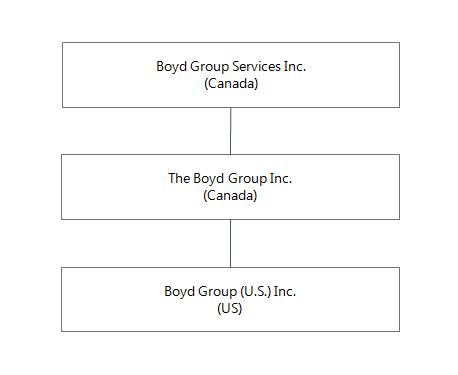
Structure of BGSI as at December 31, 2024
The following diagram sets forth the organizational structure of BGSI as at December 31, 2024:
* Each of The Boyd Group Inc. (Canada) and Boyd Group (U.S.) Inc. have a number of operating subsidiaries that are 100% owned by the parent as further detailed under the heading of “Corporate Structure”.
5
BGSI Corporate Structure as at December 31, 2024 is:
Boyd Group Services Inc. –
The Boyd Group Inc.
Assured Automotive (2017) Inc.
Blacksmith Technologies Inc.
Mobile Auto Solutions (Canada) Inc.
The Boyd Group (U.S.) Inc.
The Gerber Group Inc.
Cars Collision Center, L.L.C.
True2Form Collision Repair Centers, Inc.
True2Form Collision Repairs Centers, LLC
Service Collision Center (Georgia), Inc.
Gerber Collision & Glass (Kansas), Inc.
Service Collision Center (Oklahoma) Inc.
Collision Works of Oklahoma, LLC
Collision Works Holdings II, LLC
Collision Works Real Estate Holdings, LLC
Collision Works of Tulsa, LLC
Hail Works, LLC
Collision Works of Kansas, LLC
Collision Service Repair Center, Inc.
AMPB Acquisition Corp.
Kingswood Collision, Inc.
Gerber Collision (Northeast), Inc.
Gerber Collision (Colorado) Inc.
Gerber Collision (Idaho/Hawaii), Inc.
Gerber Real Estate Inc.
Gerber Payroll Services, Inc.
Master Collision Repair, Inc.
Hansen Collision, Inc.
Hansen Leasing, Inc.
Collision Revision, Inc.
Collex Collision Experts, Inc.
Gerber Collision (Louisiana), Inc.
Champ’s Holding Company, L.L.C.
Gerber Collision (Oregon), Inc.
Gerber Collision (Utah), Inc.
Gerber Collision (Tennessee), Inc.
Gerber Collision (NY), Inc.
Carubba Collision Corp.
Gerber Collision (Texas), Inc.
Gerber Collision (Midwest), Inc.
6
Gerber Collision (California), Inc.
Mobile Auto Solutions (2021), Inc.
Gerber Glass Holdings Inc.
Gerber Glass, LLC
Glass America LLC
Gerber National Claim Services, LLC
Gerber Glass (District 2), LLC
Gerber Glass (District 3), LLC
Gerber Glass (District 4), LLC
Gerber Glass (District 5), LLC
S&L Auto Glass, LLC
Gerber Glass (District 6), LLC
Gerber Glass (District 7), LLC
Glass America (California), LLC
Glass America Southeast LLC
Glass America Midwest LLC
Hansen Auto Glass, LLC
Auto Glass Only, LLC
Glass America Illinois LLC
Glass America Massachusetts LLC
Glass America Michigan LLC
Glass America Midwest Lindenhurst LLC
Glass America Midwest North Canton LLC
Glass America Missouri LLC
Glass America New York LLC
Glass America Ohio LLC
Glass America Texas LLC
Glass America Vermont LLC
Glass America Alabama LLC
Glass America Kentucky LLC
Glass America Maryland LLC
Glass America Virginia LLC
* Indentation of companies indicates they are subsidiaries of the company directly above.
7
GENERAL DEVELOPMENT OF THE BUSINESS
As at December 31, 2024, BGSI has no convertible debt offerings outstanding.
During 2022, 2023 and 2024, the Company acquired a number of businesses, which were not individually significant.
See page 29 of this report under the heading “Dividends” and page 20 of BGSI’s 2024 Annual Report, under the heading “Dividends” for a detailed description of dividends which description is incorporated by reference, herein.
On March 26, 2024, the Company entered into a fourth amended and restated credit agreement to extend the revolving credit facilities in the aggregate amount of $550 million with an accordion feature which can increase the facilities to a maximum of $850 million (the “Facilities”). The Facilities are accompanied by a fixed-rate Term Loan A maturing in March 2027, in the amount of $125 million at an interest rate of 3.455%. The Facilities are with a syndicate of Canadian and U.S. banks and are secured by the shares and assets of the Company as well as guarantees by BGSI and subsidiaries, while the Term Loan A is with one of the syndicated banks. The interest rate for draws on the Facilities are based on a pricing grid of BGSI’s ratio of total funded debt to EBITDA as determined under the credit agreement. The Company can draw on the Facilities in either the U.S. or in Canada, in either U.S. or Canadian dollars. The Company can make draws in tranches as required. Tranches bear interest only and are not repayable until the maturity date but can be voluntarily repaid at any time. The Company has the ability to choose the base interest rate between Prime, Canadian Overnight Repo Rate Average (“CORRA”), U.S. Prime or Secured Overnight Financing Rate (“SOFR”) at the Company’s election. The credit agreement provides for CORRA as the Canadian benchmark replacement rate on Canadian dollar term advances when the publication of Canadian Dollar Offered Rate (“CDOR”) ceased in June 2024. The total syndicated Facilities include a swing line up to a maximum of $10.0 million for the Canadian borrower and $30.0 million for the U.S. borrower. As at December 31, 2024, the Company has drawn $370.0 million U.S. (December 31, 2023 - $264.5 million U.S.) and $nil Canadian (December 31, 2023 - $nil million) on the revolving credit facility and swing line and $125.0 million U.S. (December 31, 2023- $125.0 million U.S.) on the Term Loan A.
The Company is subject to certain financial covenants which must be maintained to avoid acceleration of the termination of the credit agreement. The financial covenants require BGSI to maintain a senior funded debt to EBITDA ratio of no greater than 3.50 and an interest coverage ratio of not less than 2.75. For four quarters following a material acquisition, the senior funded
8
debt to EBITDA ratio may be increased to less than 4.00. For purposes of covenant calculations, property lease payments are deducted from EBITDA, and EBITDA is further adjusted to reflect pro-forma annualized acquisition results.
For a detailed description of the debt arrangement, which descriptions are incorporated by reference herein, see page 26 of BGSI’s 2024 Annual Report, under the heading “Debt Financing”.
9
Boyd Group Services Inc. is a Canadian corporation and controls Boyd and its subsidiaries.
Boyd Group Services Inc. (“BGSI”), through its operating company, The Boyd Group Inc. and its subsidiaries (“Boyd” or the “Company”), is one of the largest operators of non-franchised collision repair centers in North America in terms of number of locations and sales. The Company currently operates locations in Canada under the trade name Boyd Autobody & Glass and Assured Automotive, as well as in the U.S. under the trade name Gerber Collision & Glass. The Company is also a major retail auto glass operator in the U.S., under the trade names Gerber Collision & Glass, Glass America, Auto Glass Service, Auto Glass Authority and Autoglassonly.com. In addition, the Company operates a third party administrator, Gerber National Claims Services (“GNCS”), that offers glass, emergency roadside and first notice of loss services.The Company also operates a Mobile Auto Solutions (“MAS”) service that offers scanning and calibration services.
Boyd provides collision repair services to individual vehicle owners; however, the highest percentage of the Company’s revenue is derived from insurance-paid collision repair services. Formal relationships with insurance companies such as Direct Repair Programs (“DRPs”), either at the local or national level, play an important role in generating sales volumes for the Company. Although automobile owners still have the freedom of choice of repair provider, insurance companies may educate the owner on the benefits of choosing a repairer in their DRP network. Of the top five insurance companies that the Company deals with, which in aggregate account for approximately 51% of total sales, one insurance company represents approximately 16% of the Company’s total sales, while a second insurance company represents approximately 12%. Emphasis is placed by Boyd on establishing and maintaining these referral arrangements and Boyd continues to work at developing and strengthening its relationships with insurance carriers in these markets.
10
The following table shows Boyd’s percentage of sales in Canada and the United States during its three fiscal years ended December 31, 2022, 2023 and 2024.
| Period Ended |
Percentage of Sales in Canada |
Percentage of Sales in United States | ||
| December 31, 2022 |
8.0% | 92.0% | ||
| December 31, 2023 |
7.9% | 92.1% | ||
| December 31, 2024 |
8.0% | 92.0% | ||
The following table shows Boyd’s number of employees in Canada and the United States during its three fiscal years ended December 31, 2022, 2023 and 2024.
| Period Ended |
Number of Employees in Canada |
Number of Employees in United States |
Total Number of Employees | |||
| December 31, 2022 |
1,435 | 10,956 | 12,391 | |||
| December 31, 2023 |
1,541 | 11,934 | 13,475 | |||
| December 31, 2024 |
1,558 | 11,891 | 13,449 | |||
The collision repair industry in North America is estimated by Boyd to represent over $50 billion in annual revenue. The industry is highly fragmented, consisting of many small independent family owned businesses operating in local markets. It is estimated that car dealerships have approximately 15% of the total market. It is believed that multi-unit collision repair operators with greater than $20 million in annual revenues (including multi-unit car dealerships), now have approximately 39% of the total market.
The industry is very competitive. Major insurers in both the public and private insurance markets use performance-based measurements in selecting collision repair partners. In Alberta, Ontario and in the United States, where private insurers operate, a greater emphasis is placed on establishing and maintaining DRP referral arrangements with insurance companies. Boyd continues to work at developing and strengthening its DRP relationships with insurance carriers in both Canada and the United States. DRP’s are established between insurance companies and collision repair businesses to better manage automobile repair claims and increase levels of customer satisfaction. Insurance companies select collision repair operators to participate in their programs based on integrity, convenience and physical appearance of the facility, quality of work, customer service, cost of repair, cycle time and other key performance metrics. Local, regional DRP’s, and national DRP relationships, represent an opportunity for Boyd to increase its business. Boyd’s management also believes there is some preference among some insurance carriers to do business with multi-location collision repairers in order to increase efficiency,
11
reduce the number and complexity of contacts in the collision repair process and to achieve a higher level of consistent performance.
Boyd intends to grow its business through increasing same-store sales and the opening or acquiring of new locations in addition to being alert to opportunities for accelerated growth through the acquisition of other multi-location businesses.
See pages 10-13 of BGSI’s 2024 Annual Report, under the heading “Business Environment & Strategy”, for a detailed description of competitive conditions, which description is incorporated by reference herein.
During 2022, as part of various acquisitions, as detailed on pages 27-28 of BGSI’s 2022 Annual Report under the heading “Acquisitions and Development of Businesses”, $13,903,000 of customer relationships and $466,000 of non-compete agreements were recognized. The customer relationships are finite life intangible assets that are being amortized on a straight-line basis over a period of twenty years. The non-compete agreements are being amortized on a straight-line basis over a five year term.
During 2023, as part of various acquisitions, as detailed on pages 28-30 of BGSI’s 2023 Annual Report under the heading “Acquisitions and Development of Businesses”, $25,158,000 of customer relationships and $1,372,000 of non-compete agreements were recognized. The customer relationships are finite life intangible assets that are being amortized on a straight-line basis over a period of twenty years. The non-compete agreements are being amortized on a straight-line basis over a five year term.
During 2024, as part of various acquisitions, as detailed on pages 27-28 of BGSI’s 2024 Annual Report under the heading “Acquisitions and Development of Businesses”, $19,975,000 of customer relationships and $980,000 of non-compete agreements were recognized. The customer relationships are finite life intangible assets that are being amortized on a straight-line basis over a period of twenty years. The non-compete agreements are being amortized on a straight-line basis over a five year term.
The Company’s operating results have been and are expected to continue to be subject to quarterly fluctuations due to a variety of factors including changes in purchasing patterns, pricing policies, general and regional economic downturns, unemployment rates and weather conditions. The Company’s geographic diversification may lessen the effect of this risk.
For more information about Boyd, please see pages 10-13 of BGSI’s 2024 Annual Report, under the heading “Business Environment & Strategy”, for a more detailed description of Boyd’s business, which description is incorporated by reference herein.
12
BUSINESS RISKS AND UNCERTAINTIES
The following information is a summary of certain risk factors relating to the business of BGSI and its subsidiaries, and is qualified in its entirety by reference to, and must be read in conjunction with, the detailed information appearing elsewhere in this Annual Report and the documents incorporated by reference herein.
BGSI and its subsidiaries are subject to certain risks inherent in the operation of the business. BGSI and its subsidiaries manage risk and risk exposures through a combination of management oversight, insurance, systems of internal controls and disclosures and sound operating policies and practices.
The Board of Directors has the responsibility to identify the principal risks of BGSI’s business and ensure that appropriate systems are in place to manage these risks. The Audit Committee has the responsibility to discuss with management BGSI’s major financial risk exposures and the steps management has taken to monitor and control such exposures, including BGSI’s risk assessment and risk management policies. In order to support these responsibilities, management has a risk and sustainability management committee which meets on an ongoing basis to evaluate and assess BGSI’s risks.
The process being followed by the risk and sustainability management committee is a systematic one which includes identifying risks; analyzing the likelihood and consequence of risks; and then evaluating risks as to risk tolerance and control effectiveness. This approach stratifies risks into four risk categories as follows:
| Extreme Risks: |
Immediate/ongoing action is required – involvement of senior management is required. Avoidance of the item may be necessary if risk reduction techniques are insufficient to address the risk. | |
| High Risks: |
Risk item is significant and management responsibility should be specified and appropriate action taken. | |
| Moderate Risks: |
Managed by specific monitoring or response procedures. Additional risk mitigation techniques could be considered if benefits exceed the cost. | |
| Low Risks: |
Management by routine procedures. No further action is required at this time. |
Risks can be reduced by limiting the likelihood or the consequence of a particular risk. This can be achieved by adjusting the Company’s activities, implementing additional control/monitoring processes, or insuring/hedging against certain outcomes. Residual risk remains after mitigation and control techniques are applied to an identified risk. Awareness of the residual risk that BGSI ultimately accepts is a key benefit of the risk management process.
The following describes the risks that are most material to BGSI’s business; however, this is not a complete list of the potential risks BGSI faces. There may be other risks that BGSI is not aware of, or risks that are not material today that could become material in the future.
13
Decline in Number of Insurance Claims
The automobile collision repair industry is dependent on the number of accidents which occur and, for the most part, become repairable insurance claims. The automobile collision repair industry could experience a decrease in repairable claims, higher total loss rates as well as a deferral in repairs and an increase in non-filed claims. This could be driven by several factors including significant insurance premium inflation and overall economic uncertainty. There can be no assurance that a continued decline in insurance claims will not occur, which could reduce Boyd’s revenues and result in a material adverse effect on the Company’s business.
The volume of accidents and related insurance claims can also be significantly impacted by technological disruption and changes in technology such as ride sharing, collision avoidance systems, driverless vehicles and other safety improvements made to vehicles. Other changes which have and can continue to affect insurance claim volumes include, but are not limited to, weather, general economic conditions, unemployment rates, changing demographics, vehicle miles driven, new vehicle production, insurance policy deductibles and auto insurance premiums. In addition, repairable claims volumes have been and can continue to be impacted by an increased number of non-repairable claims or total loss. There can be no assurance that a continued decline in insurance claims will not occur, which could reduce Boyd’s revenues and result in a material adverse effect on the Company’s business.
Employee Relations and Staffing
Boyd currently employs approximately 13,449 people, of which 1,558 are in Canada and 11,891 are in the U.S. The current workforce is not unionized, except for approximately 62 employees located in the U.S. who are subject to collective bargaining agreements. The collision repair industry typically experiences competition for talent, and, in particular, a limited pool of qualified technicians and estimators. This can result in a shortage of qualified employees as well as wage pressure, which could adversely impact the volume and pace at which collision repair shops can fix damaged vehicles and the Company’s financial results.
Attracting, training, developing and retaining employees at all levels of the organization are required to effectively manage Boyd’s operations. The Company has rolled out various training, retention and recruitment initiatives to mitigate this risk. Failure to attract, train, develop and retain employees at all levels of the organization could lead to a lack of production capacity, knowledge, skills and experience required to effectively manage the business and could have a material adverse effect on the Company’s business, financial condition and future performance.
Acquisition and New Location Risk
The Company plans to continue to increase revenues and earnings through the acquisition and start-up of additional collision repair facilities and other businesses. The Company follows a detailed process of due diligence and approvals to limit the possibility of acquiring or building out a non-performing location or business. There can be no assurance that the Company will be able to find suitable acquisition targets at acceptable pricing levels, or that the Company will be
14
able to find and build out locations without incurring cost overruns, or that the new locations will achieve sales and profitability levels to justify the Company’s investment.
Boyd views the United States and Canada as having significant potential for further expansion of its business. There can be no assurance that any market for the Company’s services and products will develop either at the local, regional or national level. Economic instability, laws and regulations, increasing acquisition valuations and the presence of competition in all or certain jurisdictions may limit the Company’s ability to successfully expand operations.
The Company has grown rapidly through multi-location acquisitions as well as single location growth opportunities and new location development. Rapid growth can put a strain on managerial, operational, financial, human and other resources. Risks related to rapid growth include administrative and operational challenges such as the management of an expanded number of locations, the assimilation of financial reporting systems, technology and other systems of acquired companies, increased pressure on senior management and increased demand on systems and internal controls. The ability of the Company to manage its operations and expansion effectively depends on the continued development and implementation of plans, systems and controls that meet its operational, financial and management needs. If Boyd is unable to continue to develop and implement these plans, systems or controls or otherwise manage its operations and growth effectively, the Company will be unable to maintain or increase margins or achieve sustained profitability, and the business could be harmed.
A key element of the Company’s strategy is to successfully integrate and manage new locations in order to sustain and enhance profitability. There can be no assurance that the Company will be able to profitably integrate and manage additional locations. Successful integration and management can depend upon a number of factors, including the ability to establish, maintain and grow DRP relationships, the ability to attract, retain and motivate certain key management and staff, establishing, retaining and leveraging client and supplier relationships and implementing standardized procedures and best practices. In the event that new location growth cannot be successfully integrated into Boyd’s operations or performs below expectations, the business could be materially and adversely affected.
To the extent that the prior owners of businesses acquired by BGSI failed to comply with or otherwise violated applicable laws, the Company, as the successor owner, may be financially responsible for these violations and any associated undisclosed liability. The Company seeks, through systematic investigation and due diligence, and through indemnification by former owners, to minimize the risk of material undisclosed liabilities associated with acquisitions. The discovery of any material liabilities, including but not limited to tax, legal and environmental liabilities, could have a material adverse effect on the Company’s business, financial condition and future prospects.
Operational Performance
In order to compete in the marketplace, the Company must consistently meet the operational performance metrics expected by its insurance company clients and its customers. Failing to deliver on metrics such as cycle time, quality of repair, customer satisfaction and cost of repair
15
can, over time, result in reductions to pricing, repair volumes, or both. The Company has implemented processes as well as measuring and monitoring systems to assist it in delivering on these key metrics. However, there can be no assurance that the Company will be able to continue to deliver on these metrics or that the metrics themselves will not change in the future.
The Company’s principal source of funds is cash generated from operations. Fluctuations in required capital expenditures, the need to maintain productive capacity, required funding to meet growth targets, and debt repayments expected to be funded by cash flows generated from operations may potentially impact the amount of cash available for dividends to be declared and paid by the Company or its subsidiaries in the future.
Brand Management and Reputation
The Company’s success is impacted by its ability to protect, maintain and enhance the value of its brands and reputation. Brand value and reputation can be damaged by isolated incidents, particularly if the incident receives considerable publicity or if it draws litigation. Incidents may occur as a result of events beyond the Company’s control or may be isolated to actions that occur in one particular location. Demand for the Company’s services could diminish significantly if an incident or other matter damages its brand or erodes the confidence of its insurance company clients or directly with the vehicle owners themselves. Social media has increased the ability for individuals to adversely affect the brand and reputation of the Company. There can be no assurance that past or future incidents will not negatively affect the Company’s brand or reputation.
Market Environment Change
The collision repair industry is subject to continual change in terms of regulations, repair processes and equipment, technology and changes in the strategic direction of clients, suppliers and competitors. The Company endeavors to stay abreast of developments and preferences in the industry and make strategic decisions to manage these changes and potential disruptions to the traditional business model. In certain situations, the Company is involved in leading change by anticipating or developing new methods to address changing market needs. The Company however, may not be able to correctly anticipate the need for change, may not effectively implement changes, or may be required to increase spending on capital equipment to maintain or improve its relative position with competitors. There can be no assurance that market environment changes will not occur that could negatively affect the financial performance of the Company.
Reliance on Technology
As is the case with most businesses in today’s environment, there is a risk associated with Boyd’s reliance on computerized operational and reporting systems. Boyd makes reasonable efforts to ensure that back-up systems and redundancies are in place and functioning appropriately. Boyd has disaster recovery programs to protect against significant system failures. Although a computer system failure would not be expected to critically damage the Company in the long
16
term, there can be no assurance that a computer system crash or like event would not have a material impact on its financial results.
Reliance on technology in order to gain or maintain competitive advantage is becoming more significant and therefore the Company is faced with determining the appropriate level of investment in new technology in order to be competitive. There can be no assurance that the Company will correctly identify or successfully implement the appropriate technologies for its operations. In addition, there is a risk that third party provided systems are unable to meet business needs, emerging requirements or provide support of their product, which could adversely impact Boyd’s performance.
Increased reliance on computerized operational and reporting systems also results in increased cyber security risk, including potential unauthorized access to customer, supplier and employee sensitive information, corruption or loss of data and release of sensitive or confidential information. Disruptions due to cyber security incidents could adversely affect the business, results of operations and financial condition of the Company. Cyber security incidents could result in operational delays, disruption to work flow and reputational harm. There can be no assurance that Boyd will be able to anticipate, prevent or mitigate rapidly evolving types of cyber-attacks.
Supply Chain Risk
The Company requires access to parts, materials and paint in order to complete repairs. Disruptive events can negatively impact supply chains, which can adversely impact Boyd’s ability to complete repairs. This may result in increased repair cycle time, high levels of work-in-process and decreased margins, and could adversely impact the Company’s financial results.
Certain of the Company’s suppliers operate in unionized environments, where their workers are subject to collective bargaining agreements. A prolonged strike at a supplier could adversely impact Boyd’s ability to complete repairs. It is possible that a prolonged strike could disrupt the Company’s supply chain, which could have a material impact on the Company’s financial results.
Global issues, such as outbreaks and the spread of contagious diseases, political instability, war or other disruptive events can negatively impact global supply chains, which could adversely impact Boyd’s ability to complete repairs. It is possible that global issues could further disrupt the Company’s supply chain, which could have a material impact on the Company’s financial results.
Margin Pressure and Sales Mix Changes
The Company’s costs to repair vehicles, including the cost of labor, parts and materials are market driven and can fluctuate. There can be no assurance that increases in the costs to repair vehicles will ultimately be recoverable from the Company’s clients or customers.
17
The Company’s margin is also impacted by the mix of collision repair, retail glass and glass network sales, scanning and calibration, as well as the mix of parts, labor and materials within each business area. There can be no assurance that changes to sales mix will not occur that could negatively impact the financial performance of the Company.
The Company currently makes its own part sourcing decisions for parts used in the provision of vehicle repair services. The Company’s clients could, in the future, decide to source products directly, impose the use of certain parts suppliers on the Company or otherwise change the parts sourcing process. Such a decision could have an adverse effect on the Company’s margin.
Economic Downturn
Historically the collision repair industry has proven to be resilient to typical economic downturns along with the accompanying unemployment, and while the Company works to mitigate the effect of economic downturn on its operations, economic conditions, which are beyond the Company’s control, could lead to a decrease in accident repair claims volumes due to fewer miles driven, less traffic congestion, or due to vehicle owners being less inclined to have their vehicles repaired. It is difficult to predict the severity and the duration of any decrease in claims volumes resulting from an economic downturn and the accompanying unemployment and what effect it may have on the collision repair industry, in general, and the financial performance of the Company in particular. There can be no assurance that an economic downturn would not negatively affect the financial performance of the Company.
Changes in Client Relationships
A high percentage of the Company’s revenues are derived from insurance companies. Over the past 25+ years, many private insurance companies have implemented customer referral arrangements known as Direct Repair Programs (DRP’s) with collision repair operators who have been recognized as consistent high quality, performance based repairers in the industry. The Company’s ability to continue to grow its business, as well as maintain existing business volume and pricing, is largely reliant on its ability to maintain these DRP relationships. The Company continues to develop and monitor these relationships through ongoing measurement of the success factors considered critical by insurance clients. The loss of any existing material DRP relationship, or a material component of a significant DRP relationship, could have a material adverse effect on Boyd’s operations and business prospects. Of the top five insurance companies that the Company deals with, which in aggregate account for approximately 51% (2023 – 53%) of total sales, one insurance company represents approximately 16% (2023 – 19%) of the Company’s total sales, while a second insurance company represents approximately 12% (2023 – 11%).
DRP relationships are governed by agreements that are usually cancellable upon short notice. These relationships can change quickly, both in terms of pricing and volumes, depending upon collision repair shop performance, cycle time, cost of repair, customer satisfaction, competition, insurance company management, program changes and general economic activity. To mitigate this risk, management fosters close working relationships with its insurance company clients and
18
customers and the Company continually seeks to diversify and grow its client base both in Canada and the U.S. There can be no assurance that relationships with insurance company clients will not change in the future, which could impair Boyd’s revenues and/or margins, and result in a material adverse effect on the Company’s business.
Environmental, Health and Safety Risk
The nature of the collision repair business means that hazardous substances must be used, which could cause damage to the environment or individuals if not handled properly. The Company’s environmental protection policy requires environmental site assessments to be performed on all business locations prior to acquisition, start-up or relocation so that any existing or potential environmental situations can be remedied or otherwise appropriately addressed. It is also Boyd’s practice to secure environmental indemnification from landlords and former owners of acquired collision repair businesses, where such indemnification is available. Boyd also engages a private environmental consulting firm to perform regular compliance reviews to ensure that the Company’s environmental and health and safety policies are followed.
To date, the Company has not encountered any environmental protection requirements or issues which would be expected to have a material financial or operational effect on its current business and it is not aware of any material environmental issues that could have a material impact on future results or prospects. No assurance can be given, however, that the prior activities of Boyd, or its predecessors, or the activities of a prior owner or lessee, have not created a material environmental problem or that future uses or evolving regulations will not result in the imposition of material environmental, health or safety liability upon Boyd.
Climate Change and Weather Conditions
Climate change is exacerbated in part by the burning of fossil fuels in order to generate electricity for consumers and industry. Greenhouse gasses from fossil fuels is leading to climate change and global warming, which is leading to increased frequency and severity of natural disasters and extreme weather condition events. The collision repair industry is not particularly carbon intensive. The business is focused on the collision repair industry and as such its primary product is providing a service. In providing this service, major inputs include replacement parts, water-based paint, skilled labor, and energy to run spray booths, compressors, lighting, HVAC and other equipment. The industry is highly fragmented with many independent owner operators who are not able to operate at scale. There are efforts to consolidate the industry and the Company is a leader in this effort. By doing so, the industry can operate more efficiently and have the central coordination and capital to invest in sustainability areas to reduce the impact the industry has on the environment.
Transitioning to a low carbon environment and sustainable business model will require additional investments in the long-term. Capital investments in energy saving or renewable energy technologies to operate the shop, can reduce or offset the contribution to carbon emissions that the Company currently emits. Investments could be necessary for sensors and other systems to manage electricity usage or identify future opportunities. Facility management
19
and landscape management are areas of opportunity to improve the impact Boyd’s locations have on global warming.
The primary climate related risks for the business relate to the expected increase in extreme weather events, such as blizzards, hurricanes, wild-fires, torrential rain, and tornadoes. These events can cause physical damage to shops or hinder Boyd’s ability to process work and also tend to result in higher damage levels that result in more vehicles being non-repairable. Extreme weather can also slow or halt delivery of parts and in some cases prevent employees from attending work, which slows down cycle-time and therefore sales.
A number of initiatives related to climate change can benefit the Company. For example investing in LED lighting improves the working conditions for technicians and can improve the quality of the work they do, as well as lowering operating costs and reducing emissions. Continuous improvement and efficiency gains can improve quality and reduce repair cycle time, causing less waste, higher customer satisfaction and generating higher sales with the same level of inputs. A greater focus on repairing damaged parts as opposed to replacing those parts reduces waste and in some cases can improve profitability. Alignment with vehicle owner, insurance company and original equipment manufacturer objectives improves Boyd’s customer relationships and demonstrates an ability to align and partner with these stakeholders.
There is good alignment between climate change initiatives and the Company’s strategy. Core strategies of operational excellence, expense management and optimizing the business as well as new location and acquisition growth have overlap with sustainability. Being efficient, reducing waste and bringing corporate resources and investment to a fragmented industry supports a long-term alignment with sustainability. Environment, social and governance objectives are being integrated into the Company’s strategic projects. There is often a dimension of each business initiative that relates to sustainability. Boyd is committed to identifying those dimensions and bringing awareness throughout the company so that business objectives naturally contribute to our sustainability goals, which have been outlined in Boyd’s Environmental, Social and Governance Report, which is available on the Boyd website at www.boydgroup.com/sustainability.
The Board is investing more time on sustainability issues and has assigned the oversight responsibility for sustainability, including climate change risk management and disclosure to the Governance & Sustainability Committee. The topic is a standing agenda item with internal metrics and reporting being developed. Management has a Risk and Sustainability Committee tasked with developing sustainability objectives and processes for the company. Its current mandate is to work with the various operating groups to identify the key sustainability metrics for future reporting and target setting. These key metrics and targets will be focused on the priority areas defined for each of the environmental, social and governance pillars that have been outlined in Boyd’s Environmental, Social and Governance Report.
The effect of global warming and its impact on weather conditions may reduce collision repair volume and represent an element of risk to the Company’s ability to maintain sales. Historically, extremely mild winters and dry weather conditions have had a negative impact on collision
20
repair sales volumes. Natural disasters resulting in business interruption, or supply chain interruption could also negatively impact the Company’s operations. Even with market share gains, weather-related decline in market size can result in sales declines which could have a material impact on the Company’s business. Business interruption due to natural disasters and extreme weather condition events, including supply chain interruption, may result in temporary store closures or limit production volume and could adversely impact Boyd’s ability to complete repairs, which could have a material adverse effect on the Company’s business.
Pandemic Risk
A local, regional, national or international outbreak of a contagious disease, such as the COVID-19 coronavirus, Middle East Respiratory Syndrome, Severe Acute Respiratory Syndrome, H1N1 influenza virus, avian flu or any other similar illness, could decrease the willingness of the general population to travel or customers to patronize the Company’s facilities, cause shortages of employees to staff the Company’s facilities, interrupt supplies from third parties upon which the Company relies, result in governmental regulation adversely impacting the Company’s business and otherwise have a material adverse effect on the Company’s business, financial condition and results of operations.
The outbreak of a contagious illness, such as the COVID-19 pandemic, could require the Company to develop and execute revised operating procedures intended to mitigate safety and health risks in the work environment. However, there can be no assurance that the enhanced protocols put in place will protect against an outbreak that could result in lost time and negatively affect the financial performance of the Company.
Competition
The collision repair industry in North America, estimated by Boyd to represent over $50 billion in annual revenue, is very competitive. The main competitive factors are cost of repair, cycle time, quality, customer satisfaction and adherence to various insurance company processes and performance requirements. There can be no assurance that Boyd’s competitors will not achieve greater market acceptance due to performance or other factors.
Although competition exists mainly on a regional basis, Boyd competes with a small number of other multi-location collision repair operators in multiple markets in which it operates.
Given these industry characteristics, existing or new competitors, including other automotive-related businesses, may become significantly larger and have greater financial and marketing resources than Boyd. Competitors may compete with Boyd in rendering services in the markets in which Boyd currently operates and also in seeking existing facilities to acquire, or new locations to open, in markets in which Boyd desires to expand. There can be no assurance that the Company will be able to maintain or achieve its desired market share.
21
Access to Capital
The Company grows, in part, through acquisition or start-up of collision and glass repair and replacement businesses. There can be no assurance that Boyd will have sufficient capital resources available to implement its growth strategy. Inability to raise new capital, in the form of debt or equity, could limit Boyd’s future growth through acquisition or start-up.
The Company will endeavor, through a variety of strategies, to ensure in advance that it has sufficient capital for growth. Potential sources of capital that the Company has been successful at accessing in the past include public and private equity placements, convertible debt offerings, using equity securities to directly pay for a portion of acquisitions, capital available through strategic alliances with trading partners, lease financing, seller financing and both senior and subordinate debt facilities or by deferring possible future purchase price payments using contingent consideration and call or put options. There can be no assurance that the Company will be successful in accessing these or other sources of capital in the future.
The Company and its subsidiaries use financial leverage through the use of debt, which have debt service obligations. The Company’s ability to refinance or to make scheduled payments of interest or principal on its indebtedness will depend on its future operating performance and cash flow, which are subject to prevailing economic conditions, prevailing interest rates, and financial, competitive, business and other factors, many of which are beyond its control.
The Company’s revolving credit facilities contain restrictive covenants that limit the discretion of the Company’s management and the ability of the Company to incur additional indebtedness, to make acquisitions of collision repair businesses, to create liens or other encumbrances, to pay dividends, to redeem any equity or debt, or to make investments, capital expenditures, loans or guarantees and to sell or otherwise dispose of assets and merge or consolidate with another entity. In addition, the revolving credit facilities contain a number of financial covenants that require BGSI and its subsidiaries to meet certain financial ratios and financial condition tests. A failure to comply with the obligations under these credit facilities could result in an event of default, which, if not cured or waived, could permit acceleration of the relevant indebtedness. If the indebtedness were to be accelerated, there can be no assurance that the assets of the Company and its subsidiaries would be sufficient to repay the indebtedness in full. There can also be no assurance that the Company will be able to refinance the credit facilities as and when they mature. The revolving credit facility is secured by the assets of the Company.
22
Dependence on Key Personnel
The success of the Company is dependent on the services of a number of members of management. The experience and talent of these individuals is a significant factor in Boyd’s continued success and growth. The loss of one or more of these individuals could have a material adverse effect on the Company’s business operations and prospects. The Company has entered into management agreements with key members of management and succession plans are in place for key executive positions, in order to mitigate this risk.
Tax Position Risk
BGSI and its subsidiaries account for income tax positions in accordance with accounting standards for income taxes, which require that the Company recognize in the financial statements, the impact of a tax position, if that position is more likely than not of being sustained on examination by taxation authorities, based on the technical merits of the position.
Inherent risks and uncertainties can arise over tax positions taken, or expected to be taken, with respect to matters including but not limited to acquisitions, transfer pricing, inter-company charges and allocations, financing charges, fees, related party transactions, tax credits, tax based incentives and stock based transactions. Management uses tax experts to assist in correctly applying and accounting for tax and government assistance program rules, however there can be no assurance that a position taken will not be challenged by the taxation authorities that could result in an unexpected material financial obligation.
Expenses incurred by BGSI and its subsidiaries are only deductible to the extent they are reasonable. There can be no assurance that the taxation authorities will not challenge the reasonableness of certain expenses. If such a challenge were successful, it may materially and adversely affect the financial results of BGSI and its subsidiaries.
BGSI’s shares are qualified investments for a Registered Plan under the Tax Act as the Shares are listed on a “designated stock exchange” (as defined in the Tax Act).
There can be no assurance that additional changes to the taxation of corporations or changes to other government laws, rules and regulations, either in Canada or the U.S., will not be undertaken which could have a material adverse effect on BGSI’s share price and business. There can be no assurance BGSI will benefit from these rules, that the rules will not change in the future or that BGSI will avail itself of them.
Corporate Governance
Securities law imposes statutory civil liability for misrepresentations in continuous disclosure documents including failure to make timely disclosure. Investors have a right of action if they are harmed by a misrepresentation in an issuer’s disclosure document or in a public oral statement relating to an issuer, or the failure of an issuer to make timely disclosure of a material change. Potentially liable parties include the issuer, each officer, and each Director of the issuer who
23
authorizes, permits or acquiesces in the release of the document containing a misrepresentation, the making of the public statement containing a misrepresentation or in the failure to make a timely disclosure.
Under the Ontario Securities Act, section 138.4(6), a due diligence defense is available. The due diligence defense requires the following items to be addressed:
| | the issuer must have a system designed to ensure the issuer is meeting its disclosure obligations; |
| | the defendant must have conducted a reasonable investigation to support reliance on the system; and |
| | defendants must have no reasonable grounds to believe that the document or a public oral statement contained a misrepresentation or that the failure to make the required disclosure would occur. |
BGSI is keenly aware of the significance of these laws and the interrelationships between civil liability, disclosure controls and good governance. BGSI has adopted policies, practices and processes to reduce the risk of a governance or control breakdown. A statement of BGSI’s governance practices is included in its most recent information circular which can be found at www.sedarplus.com. Although BGSI believes it follows good corporate governance practices, there can be no assurance that these practices will eliminate or mitigate the impact of a material lawsuit in this area.
The area of governance is growing to encompass not only traditional governance matters, but also environmental and social matters. This area is often referred to as Environmental, Social and Governance, or “ESG”. Increased awareness and attention by investors to ESG matters means that the Company needs to become more transparent in developing and reporting on ESG initiatives and increase or add ESG initiatives where there are significant gaps. BGSI is developing and enhancing ESG reporting and initiatives. Boyd publishes an ESG report, which complements previously adopted policies on reporting and anti-retaliation, occupational health and safety, non-discrimination and anti-harassment, human rights, diversity, code of business conduct and ethics, business partner code of conduct and anti-corruption. These policies, along with the ESG Report, are available on the Boyd website at www.boydgroup.com/sustainability.
Increased Government Regulation and Tax Risk
BGSI and its subsidiaries are subject to various federal, provincial, state and local laws, regulations and taxation authorities. Various federal, provincial, state and local agencies as well as other governmental departments administer such laws, regulations and their related rules and policies. New laws governing BGSI or its business could be enacted or changes or amendments to existing laws and regulations could be enacted which could have a significant impact on Boyd. For example, privacy legislation continues to evolve rapidly and tariff changes are being introduced with greater frequency. BGSI utilizes the services of professional advisors in the areas of taxation, environmental, health and safety, labor and general business law to mitigate the risk of non-compliance. Failure to comply with the applicable laws, regulations or tax changes
24
may subject BGSI to civil or regulatory proceedings and no assurance can be given that this will not have a material impact on financial results.
BGSI and its subsidiaries operate distinct businesses in Canada and the U.S. The Company operates a service business and a major component of our services is labor which would not be subject to tariffs. The Company sources parts and materials from domestic vendors in Canada and the U.S. Any changes in tariffs on exports or imports to and from Canada and the U.S may impact the cost of repairs and decrease margins. There can be no assurance that the changes in tariffs would not negatively affect the financial performance of the Company.
A number of jurisdictions in which the Company operates have regulations to limit emissions and pollutants. The Company has adapted its processes in an effort to comply with these regulations. Although to date, there have been no negative consequences as a result of these regulations, there can be no assurance that these regulations will not have a material adverse impact on BGSI’s business or financial results. Future emission or pollutant regulation compliance requirements may have a material adverse impact on BGSI’s business or financial results.
Fluctuations in Operating Results and Seasonality
The Company’s operating results have been and are expected to continue to be subject to quarterly fluctuations due to a variety of factors including changes in customer purchasing patterns, pricing paid to insurance companies, general operating effectiveness, automobile technologies, general and regional economic downturns, unemployment rates, employee vacation timing and weather conditions. These factors can affect Boyd’s financial results.
Risk of Litigation
BGSI and its subsidiaries could become involved in various legal actions in the ordinary course of business. Litigation loss accruals may be established if it becomes probable that BGSI will incur an expense and the amount can be reasonably estimated. BGSI’s management and internal and external experts are involved in assessing the probability of litigation loss and in estimating any amounts involved. Changes in these assessments may lead to changes in recorded litigation loss accruals. Claims are reviewed on a case by case basis, taking into consideration all information available to BGSI.
The actual costs of resolving claims could be substantially higher or lower than the amounts accrued. In certain cases, legal claims may be covered under BGSI’s various insurance policies.
Execution on New Strategies
New initiatives are introduced from time to time in order to grow Boyd’s business. Initiatives such as entering new markets, introducing and improving related products and services, or identifying new strategies to capture additional market share have the potential to be accretive to the Company’s business when the opportunity is accurately identified and executed. There can
25
be no assurance that the Company identifies new strategies that are accretive to the business or that it is successful in implementing such initiatives.
Insurance Risk
BGSI insures its property, plant and equipment, including vehicles, through insurance policies with insurance carriers located in Canada and the U.S. Included within these policies is insurance protection against property loss and general liability. BGSI also insures its directors and officers against liabilities arising from errors, omissions and wrongful acts. Management uses its knowledge, as well as the knowledge of experienced brokers, to ensure that insurable risks are insured appropriately under terms and conditions that would protect BGSI and its subsidiaries from losses. There can be no assurance that all perils would be fully covered or that a material loss would be recoverable under such insurance policies.
Interest Rates
The Company occasionally fixes the interest rate on its debt using interest rate swap contracts or other provisions available in its debt facilities. There can be no guarantee that interest rate swaps or other contract terms that effectively turn variable rate debt into fixed rates will be an effective hedge against long-term interest rate fluctuations.
The Company has not fixed interest rates within its revolving credit facility. There can be no assurance that interest rates either in Canada or the U.S. will not increase in the future, which could result in a material adverse effect on the Company’s business.
U.S. Health Care Costs and Workers Compensation Claims
BGSI accrues for the estimated amount of U.S. health care claims and workers compensation claims that may have occurred but were not reported at the end of the reporting period under its health care and workers compensation plans. The accruals are based upon the Company’s knowledge of current claims as well as third party estimates derived from past experience. Significant claim occurrences which remain unreported for a number of months could materially impact this accrual. In addition, as U.S health care costs increase, there can be no assurance given that the Company can continue to offer health care insurance to its employees at a reasonable cost.
Foreign Currency Risk
A substantial portion of Boyd’s revenue and cash flow are now, and are expected to continue to be, generated in U.S. dollars. Fluctuations in the exchange rates between the Canadian dollar and the U.S. currency may have a material adverse effect on BGSI’s share price, which is denominated and trades in Canadian dollars as well as BGSI’s ability to make future Canadian dollar cash dividends.
26
Capital Expenditures
The business of the Company requires ongoing capital maintenance. Moreover, opportunities may arise for capital upgrades providing returns or cost savings that may not be realized in the immediate future, but rather over several years. As vehicle technology advances and market needs change, the capital intensity of the industry is changing, requiring expenditures in excess of historical capital maintenance levels. To the extent that capital expenditures are in excess of amounts budgeted, the amounts of cash available for dividends may decrease.
Low Capture Rates
Sales growth can be enhanced if the Company is effective at booking repair orders for all sales opportunities that are identified. The Company is exposed to missed jobs when capacity is constrained and to the extent that employees are ineffective at capturing all sales opportunities. Measurement of capture rates, management support and training are methods that are employed to enhance capture rates. Efforts to increase capacity are limited by availability of qualified labor. It is possible that the Company may not be able to capture sales effectively enough to maximize sales.
Energy Costs
The Company is exposed to fluctuations in the price of energy. These costs not only impact the costs associated with occupying and operating collision repair facilities but may also affect costs of parts and materials used in the repair process as well as miles driven by automobile owners. There can be no assurance that escalating costs which cannot be offset by energy conservation practices, price increases to clients and customers or productivity gains, would not result in materially lower operating margins. As well, there can be no assurance that escalating energy costs will not materially reduce automobile miles driven and in turn reduce the number of collisions.
27
DESCRIPTION OF CAPITAL STRUCTURE
An unlimited number of common shares (“Shares”) of BGSI are authorized and may be issued pursuant to the Articles of Incorporation of BGSI. All Shares have equal rights and privileges. Each Share is redeemable and transferable. A Share entitles the holder thereof to participate equally in dividends, including the dividends of net earnings and net realized capital gains of BGSI and dividends on termination or winding-up of BGSI, is fully paid and non-assessable and entitles the holder thereof to one vote at all meetings of shareholders for each Share held.
BGSI has a stock option plan (“Stock Option Plan”) which provides for the granting of options to certain officers and senior management. The maximum number of options available under the Stock Option Plan is 250,000, which is less than 1.2% of the total outstanding Shares of BGSI.
Subject to any adjustments pursuant to the provisions of the Stock Option Plan, the exercise price of any option shall be as determined and approved by the People, Culture and Compensation Committee of the Board of Directors of BGSI, but under no circumstances will such price be lower than the Fair Market Value (as defined in the Stock Option Plan) of the Shares on the Grant Date (as defined in the Stock Option Plan). The term of an option shall be as determined and approved by the People, Culture and Compensation Committee in the Grant Agreement (as defined in the Stock Option Plan); provided, however, that the term shall be no more than ten years from the Grant Date.
During fiscal 2024, BGSI issued 18,269 (2023 -28,292; 2022 - 18,878) options under the Stock Option Plan. As of December 31, 2024, there are 67,762 outstanding Options under the Stock Option Plan, which is less than 0.4% of the total outstanding common shares.
28
The Board of Directors of BGSI have adopted a dividend policy which is more specifically described on page 65 of the Management Information Circular dated October 14, 2019 under the heading “Payment of Dividends”, which description is incorporated by reference herein.
The following table sets forth the per share dividends declared to shareholders during fiscal year 2023 and 2024 (in Canadian dollars):
| In Canadian dollars |
2024 | 2023 | ||
| March |
0.150 | 0.147 | ||
| June |
0.150 | 0.147 | ||
| September |
0.150 | 0.147 | ||
| December |
0.153 | 0.150 |
29
The Shares of BGSI are listed and posted for trading on the Toronto Stock Exchange under the symbol “BYD” beginning January 2, 2020.
The monthly trading volume and price ranges of the Shares traded at the TSX over BGSI’s last financial year are as follows (in Canadian dollars):
| In Canadian dollars Month |
High |
Low |
Volume | |||
| January 2024 |
300.36 | 267.00 | 1,579,128 | |||
| February 2024 |
324.75 | 288.01 | 1,031,505 | |||
| March 2024 |
319.11 | 279.00 | 1,711,381 | |||
| April 2024 |
289.13 | 252.35 | 1,873,941 | |||
| May 2024 |
272.82 | 224.00 | 2,619,609 | |||
| June 2024 |
270.60 | 227.10 | 3,150,204 | |||
| July 2024 |
268.66 | 225.69 | 3,253,444 | |||
| August 2024 |
232.41 | 211.22 | 2,734,129 | |||
| September 2024 |
228.99 | 198.61 | 2,430,296 | |||
| October 2024 |
226.82 | 201.13 | 2,536,473 | |||
| November 2024 |
233.60 | 201.06 | 3,421,865 | |||
| December 2024 |
218.01 | 200.80 | 2,928,617 |
See page 26 of BGSI’s 2024 Annual Report, under the heading “Debt Financing”, for a more detailed description of securities and more specifically debt instruments issued by Boyd, which description is incorporated by reference herein.
30
The Articles of Incorporation of BGSI provide for a minimum of three directors and a maximum of fifteen (15) directors. At the annual meeting of shareholders of BGSI held on May 15, 2024, the shareholders of BGSI fixed the number of directors of BGSI at ten (10). Directors are reappointed or replaced every year as may be determined by a majority of votes cast at an annual meeting of shareholders. The names, municipalities of residence and principal occupations for the previous five years of the Directors are outlined in the following table:
| Name and Municipality of Residence |
Current Office |
Principal Occupation | ||
| David Brown Manitoba, Canada |
Independent Chair (Since May 2021) Director (Since Jun 2012) |
Executive Vice President of Richardson Financial Group Limited and Managing Director of RBM Capital Limited | ||
| Brock Bulbuck Manitoba, Canada |
Director (Since Dec 2002) |
Independent Board Chair of North West Company; Executive Chair of Boyd (2020-2021); previously President & CEO of Boyd (2010-2019) | ||
| Robert Espey (3) Alberta, Canada |
Director (Since May 2021) |
President & CEO of Parkland Corporation | ||
| Christine Feuell (1) Michigan, USA |
Director (Since May 2023) |
CEO of Chrysler Brand at Stellantis | ||
| Robert Gross (4) Nevada, USA |
Director (Since Nov 2012) |
Board member | ||
| John Hartmann (1) (2) Illinois, USA |
Director (Since June 2020) |
CEO of Ascend Wellness Holdings Inc.; COO of Bed Bath & Beyond and President of buybuyBaby (2020-2022); previously President & CEO at True Value Company (2014-2019) | ||
| Violet Konkle (2) Ontario, Canada |
Director (Since May 2017) |
Board member | ||
| Timothy O’Day Illinois, USA |
Chief Executive Officer and Director (Director since Mar 2012) |
Chief Executive Officer of Boyd; previously Chief Operating Officer of Boyd (2008-2019); previously President of Boyd (2017-2024) | ||
| William Onuwa (1) (3) Ontario, Canada |
Director (Since June 2020) |
EVP & Chief Audit Executive at Royal Bank of Canada | ||
| Sally Savoia (3) Florida, USA |
Director (Since May 2015) |
Independent Corporate Consultant (2014 - 2020) | ||
Committee members as at December 31, 2024
| (1) | Member of the Audit Committee |
| (2) | Member of the People, Culture and Compensation Committee |
| (3) | Member of the Governance & Sustainability Committee |
| (4) | Mr. Gross passed away on November 18, 2024 |
31
As a group, the Directors own or control, directly or indirectly, 68,371 Shares of BGSI being approximately 0.3% of all the issued and outstanding Shares of BGSI as of March 18, 2025. Each Share is entitled to one vote at meetings of shareholders.
See pages 92-94 of BGSI’s 2024 Annual Report under the heading “Board of Directors”, for a more detailed description of the Directors, which description is incorporated by reference herein.
The Directors of BGSI also served as the Directors of Boyd.
The following table sets forth the name, municipality of residence and principal occupation of each of the current executive officers, who are not also Directors, of BGSI, as well as Boyd and The Boyd Group (U.S.) Inc. (“Primary Subsidiaries”):
| Name and Municipality of Residence |
Position with Boyd | |
| Jason Hope (1) New York, USA |
Chief Corporate Development Officer | |
| Brian Kaner Indiana,USA |
President and Chief Operating Officer | |
| Kim Morin Illinois, USA |
Vice President and Chief Human Resources Officer | |
| Jeff Murray Manitoba, Canada |
Executive Vice President and Chief Financial Officer | |
| Creighton Warren Illinois, USA |
Chief Information Officer | |
| John Wysseier (1) Florida, USA |
Chief Operating Officer, Glass | |
(1) Jason Hope and John Wysseier were executive officers of Boyd at December 31, 2024 but ceased to hold these positions prior to March 18, 2025.
Other than the following changes, each of the foregoing persons has held the same principal position for the previous five years. On January 1, 2022, John Wysseier was appointed Chief Operating Officer, Glass. On October 28, 2022, Brian Kaner was appointed Executive Vice President and Chief Operating Officer for Boyd Group’s collision business. On January 1, 2023, Jeff Murray was appointed Interim Chief Financial Officer. On June 19, 2023, Creighton Warren was appointed Chief Information Officer. On July 12, 2023, Jeff Murray was appointed Executive Vice-President and Chief Financial Officer. On March 25, 2024, Jason Hope was appointed Chief Corporate Development Officer. On December 2, 2024, Brian Kaner was appointed President and Chief Operating Officer.
As of March 18, 2025, 75,471 Shares of BGSI were beneficially owned or controlled directly or indirectly by the directors and officers of Boyd as a group, which represented approximately 0.4% of the issued and outstanding Shares of BGSI.
Cease Trade Orders, Bankruptcies, Penalties or Sanctions
32
To the knowledge of BGSI, and except as described below, no Director of BGSI, or a person or company that is the direct or indirect owner of, or who exercises control or direction over, a sufficient number of Shares so as to materially affect the control of BGSI:
| (a) | is, as at the date of this Annual Information Form or has been, within the 10 years before the date of this Annual Information Form, a director or executive officer of any company, that while the person was acting in that capacity: |
| (i) | was the subject of a cease trade or similar order or an order that denied the relevant company access to any exemption under securities legislation, for a period of more than 30 consecutive days; |
| (ii) | was subject to an event that resulted, after the director or executive officer ceased to be a director or officer, in the company being the subject of a cease trade or similar order or an order that denied the relevant company access to any exemption under securities legislation, for a period of more than 30 consecutive days; |
| (iii) | or within a year of the person ceasing to act in that capacity, became bankrupt, made a proposal under any legislation relating to bankruptcy or insolvency or was subject to or instituted any proceedings, arrangement or compromise with creditors or had a receiver, receiver manager or trustee appointed to hold its assets; or |
| (b) | has, within the 10 years before the date of this Annual Information Form, become bankrupt, made a proposal under any legislation relating to bankruptcy or insolvency or was subject to or instituted any proceedings, arrangement or compromise with creditors or had a receiver, receiver manager or trustee appointed to hold its assets. |
To the knowledge of BGSI, no Director of BGSI has an existing or potential material conflict of interest with BGSI or any of its subsidiaries.
33
The Audit Committee Charter is attached as Appendix A to this Annual Information Form.
Composition of Audit Committee
The Audit Committee of BGSI is chaired by William Onuwa and includes Christine Feuell and John Hartmann. Each member of the audit committee is independent and none receives, directly or indirectly, any compensation from BGSI other than for service as a member of the Board of Directors and its committees, of which amounts are less than $300,000 annually for each member. All members of the Audit Committee are financially literate as defined under Multilateral Instrument 51-102 – Audit Committees.
Relevant Education and Experience of Audit Committee Members
The members of BGSI’s Audit Committee bring with them considerable education and business experience, as described below:
Christine Feuell has nearly 30 years of career experience transforming brands and business units to deliver strong customer value and profitable growth in the automotive, supply chain automation and building technologies industries. Ms. Feuell’s automotive industry experiences include OEMs (Ford, Stellantis) and Tier 1 Suppliers (Johnson Controls, Adient) in which she created and launched innovative products, technologies and services for the OEM and Aftermarket Channels. Ms. Feuell is currently the CEO for Chrysler and Alfa Romeo. Since 2021, she has been serving as CEO, Chrysler Brand at Stellantis, a leading global automotive mobility and technology leader, where she is transforming the Chrysler brand to full-electrification and delivering break-through seamlessly connected technologies and experiences. Prior to her role at Chrysler, Ms. Feuell was the Chief Commercial Officer at Honeywell, where she was responsible for creating and delivering advanced automation software and technology solutions for E-Commerce, Retail, Logistics, Health and Pharma industries. Ms. Feuell also serves as an Advisory Board Member for the Michigan State University Broad School of Business, Board Director for Friends of the Children Detroit Chapter Non-Profit, and is a champion for diversity and mentoring programs at Stellantis, Michigan State and her local communities. Ms. Feuell is the Executive Sponsor for the Women of Stellantis and Diversibilities Business Resource Groups.
John Hartmann currently serves on the Boards of Franchise Group, Inc., a private holding company which owns The Vitamin Shoppe, Pet Supplies Plus and Buddy’s Home Furnishings; and Ascend Wellness Holdings Inc., a U.S. publicly listed company, where he was previously Chief Executive Officer. Mr. Hartmann is the former President of buybuyBaby and COO of Bed Bath & Beyond from 2020 to 2022. Previously, from 2013-2020, he was the President & Chief Executive Officer at True Value Company, a privately owned U.S. hardware wholesaler and
34
manufacturer. Mr. Hartmann also led New Zealand-based Mitre 10 as Chief Executive Officer from 2010 to 2013, and held various executive positions at HD Supply, The Home Depot, and Cardinal Health. Prior to his corporate career, he served as a special agent of the Federal Bureau of Investigation. Mr. Hartmann previously served on the Board and Audit Committee of AmeriGas, prior to UGI’s acquisition, and Board of HD Supply.
William Onuwa is currently EVP and Chief Audit Executive at Royal Bank of Canada (“RBC”). Prior to this role, he was the SVP & Chief Risk Officer for Wealth Management, RBC Georgia and the Insurance Group. He held a number of executive positions for GE Capital Corporation in both the U.S. and the U.K. before joining RBC in 2007. He holds a Doctorate degree from the University of Surrey, U.K. Mr. Onuwa was recently the Chair of two not-for-profit boards, Yonge Street Mission and Holland Bloorview Kids Rehabilitation Hospital. Mr. Onuwa also served on the subsidiary boards of various RBC insurance companies as an executive director from 2007 to 2016. Mr. Onuwa is currently a member of the board of governors at University of Guelph and also on the board of Plan International Canada where he sits on various committees.
Pre-Approval Policies and Procedures
The Audit Committee has considered whether the provision of services other than audit services is compatible with maintaining the auditors’ independence. The Audit Committee has adopted a policy that prohibits the Company from engaging auditors for “prohibited” categories of non-audit services and requires pre-approval by the Audit Committee of audit services and other services within permissible categories of non-audit services.
Deloitte LLP has served as BGSI’s sole auditing firm for the past two years. Fees billed or accrued for the years ended December 31, 2024 and December 31, 2023 by Deloitte LLP and its affiliates are C$1,731,220 and C$1,604,586, as detailed below:
| 2024 | 2023 | |||||||
| Audit fees |
$ | 840,900 | $ | 925,939 | ||||
| Audit-related fees |
577,557 | 373,508 | ||||||
| Tax compliance/preparation fees |
312,763 | 305,139 | ||||||
| Other fees |
- | - | ||||||
|
|
|
|
|
|
| |||
| $ | 1,731,220 | $ | 1,604,586 | |||||
The nature of each category of fees is described below.
Audit fees
Audit fees were paid for professional services rendered by the auditors for the audit of the annual financial statements of BGSI, and its subsidiaries or services provided in connection with statutory and regulatory filings or engagements.
35
Audit-related fees were paid for assurance and related services that are reasonably related to the performance of the audit or review of the annual financial statements and are not reported under the audit fees item above. The services consisted of:
| | special attest services not required by statute or legislation; |
| | reporting on the effectiveness of internal controls; |
| | acquisition due diligence; |
| | identifying financial reporting issues |
| | travel and out-of-pocket costs |
These services were pre-approved by the audit committee.
Tax compliance/preparation fees
Tax fees were paid for tax compliance services including the preparation of original and amended Canadian and U.S. tax returns.
Other fees were paid for assistance with special matters relating to peer review matters.
36
Neither BGSI, Boyd nor any of its subsidiaries are involved in any legal proceedings which are material in any respect.
INTEREST OF MANAGEMENT AND OTHERS IN MATERIAL TRANSACTIONS
See page 30 of BGSI’s 2024 Annual Report under the heading “Related Party Transactions” for a detailed description of the interest of management and others in material transactions, which description is incorporated by reference herein.
TRANSFER, DISTRIBUTION AGENTS AND REGISTRARS
Computershare Trust Company of Canada (as successor to Valiant Trust Company) is the distribution agent of BGSI with respect to payment of dividends on the common shares of BGSI, with an office in Calgary, Alberta.
Neither BGSI, Boyd nor any of its subsidiaries have entered into any material contracts requiring disclosure pursuant to National Instrument 51-102 during the most recently completed financial year, or before the most recently completed financial year.
37
Deloitte LLP is the independent auditor of BGSI.
Additional information, including Directors’ and officers’ remuneration and indebtedness, principal holders of BGSI’s securities and interests of insiders in material transactions, if applicable, will be contained in BGSI’s 2024 Information Circular dated March 25, 2025, which information upon issuance of the Information Circular, will be incorporated by reference herein. Copies of the Information Circular may be obtained upon request from the Chief Financial Officer of BGSI.
BGSI will also provide any person with, upon request of the Chief Financial Officer at 1745 Ellice Avenue, Unit C1, Winnipeg, Manitoba, R3H 1A6:
- one copy of this Annual Information Form, together with one copy of any document, or the pertinent pages of any document, incorporated by reference therein; or
- one copy of the financial statements of BGSI discussed above, together with the accompanying report of the auditor and one copy of the most recent interim financial statements of BGSI that have been filed, if any, for any period after the end of its most recently completed financial year provided that BGSI may require the payment of a reasonable charge if the request is made by a person or company who is not a shareholder.
Additional financial information, along with management’s discussion and analysis for the most recently completed financial year can be found in BGSI’s 2024 Annual Report.
Additional information relating to BGSI may also be found on SEDAR+ at www.sedarplus.com.
38
APPENDIX A: AUDIT COMMITTEE CHARTER
Purpose
The primary purpose of the Audit Committee (the “Audit Committee”) of the Board of Directors (the “Board”) of the Boyd Group Services Inc. (“BGSI”) is to assist the Board in fulfilling its oversight responsibilities by:
| | Reviewing the integrity of the consolidated financial statements of BGSI; |
| | Reviewing BGSI’s compliance with legal and regulatory requirements; |
| | Recommending to the Board the appointment of the external auditors; |
| | Reviewing the performance of BGSI’s external auditors; |
| | Reviewing financial information contained in public filings of BGSI prior to filing; |
| | Reviewing earnings announcements of BGSI prior to release to the public; |
| | Overseeing BGSI’s systems of internal financial controls and management’s compliance for reporting on internal controls; |
| | Monitoring BGSI’s auditing, accounting and financial reporting processes, including the risk of fraud and error; |
| | Reviewing the performance of the internal audit function; |
| | Resolving complaints regarding accounting, internal accounting controls or auditing practices; |
| | Identifying, monitoring and reviewing the principal risks of BGSI’s business and ensuring appropriate systems are in place to manage these risks; and |
| | Assisting with certain assigned Environmental, Social and Governance (“ESG”) activities as determined by the Board and Governance & Sustainability Committee. |
Composition
The Audit Committee shall be composed of not less than three members.
The members of the Audit Committee shall: (i) be free from any relationship that, in the opinion of the Board, would interfere with the exercise of his or her independent judgment as a member of the Audit Committee; and (ii) meet the independence and experience requirements of all applicable corporate, exchange and securities act rules, instruments and regulations in Canada (the “Regulations”) including, but not limited to the Toronto Stock Exchange (“TSX”) and Canadian national and provincial securities rules and regulations.
All members of the Audit Committee shall be “financially literate” as such term is defined by the Regulations. Notwithstanding the foregoing, a member who is not financially literate may be appointed to the Audit Committee provided that the member becomes financially literate within a reasonable period of time following his or her appointment.
39
The members of the Audit Committee shall be appointed by the Board. Once appointed, members shall serve for a one year term unless they resign, and may be reappointed to serve consecutive terms.
The Board shall normally designate the Chair of the Audit Committee. In the event that a Board designation is not made, the members of the Audit Committee shall elect a Chair by majority vote of the full Audit Committee membership.
In the event that the Chair of the Audit Committee does not attend a meeting of the Audit Committee, the members of the Audit Committee shall elect a temporary Chair for such meeting by majority vote of the members in attendance at the meeting.
Meetings
The Audit Committee shall meet at least quarterly, and may meet as often as it determines necessary in fulfilling its duties.
Greater than 50% of Audit Committee membership is required for meeting quorum.
Meetings of the Audit Committee shall normally be attended by the CEO, President & COO, and Executive-Vice President & CFO of BGSI. Others may also attend meetings as the Audit Committee may request.
The Audit Committee shall meet at least annually with the external auditor in a separate in-camera session.
The Audit Committee shall have access to any officer or employee of BGSI or BGSI’s outside counsel or external auditor. The external auditor will have direct access to the Committee at their own initiative.
Resolutions
Resolutions of the Audit Committee shall require approval by a simple majority of members voting on such resolution.
Responsibilities
The Audit Committee shall document minutes from each meeting held and such minutes shall be made available to all members of the Board. The Audit Committee will report periodically the committee’s findings and recommendations to the Board.
40
Internal Audit
The Audit Committee shall:
| | have the authority to communicate directly with the internal auditor; |
| | review the performance and ensure processes are in place for the independence of the internal audit function; |
| | review annually the internal audit plan; |
| | evaluate the performance and effectiveness of audit services, including the Director of Internal Audit’s performance and compensation package |
External Auditor
With respect to BGSI’s external auditors the Audit Committee shall:
| | have the sole authority to recommend to the Board the appointment or replacement of the external auditor (subject, if applicable, to shareholder approval) |
| | have the external auditor report directly to the Audit Committee |
| | meet with the external auditor prior to the annual audit to discuss the planning, scope and staffing of the audit |
| | be directly responsible for establishing the compensation of the external auditor, subject to applicable Board and shareholder approval |
| | ensure the periodic rotation of the audit partner having primary responsibility for the audit and the engagement quality control partner as required by independence standards |
| | at least on an annual basis, evaluate the qualifications, performance and independence of the external auditor and the audit partner having primary responsibility for the audit, including considering whether the auditor’s quality controls are adequate |
| | obtain and review a report from the external auditor at least annually regarding: (i) the external auditors’ internal quality-control procedures, (ii) any material issues raised by the most recent internal quality-control review, or peer review, of the firm, or raised by any inquiry or investigation by governmental or professional authorities within the preceding five years respecting one or more external audits carried out by the firm, (iii) any steps taken to deal with any issues, and (iv) all relationships between the external auditor and BGSI |
| | review and approve BGSI’s hiring policies regarding partners, employees, or contractors of the independent auditor |
| | pre-approve all auditing services and permitted non-audit services (including fees and terms thereof) to be performed for BGSI or its subsidiaries by its external auditor in accordance with BGSI’s policy regarding the approval of audit and non-audit services provided by the independent auditor |
41
| | oversee the work of the external auditor, including the resolution of disagreements between management and the external auditor regarding financial reporting |
Financial Reporting
With respect to BGSI’s reporting of unaudited quarterly financial results, the Audit Committee shall:
| | Prior to their public release and filing with securities regulatory agencies, review and discuss with management and the external auditor the: |
| o | press release |
| o | consolidated financial statements and notes thereto |
| o | management’s discussion and analysis |
The Audit Committee must be satisfied that adequate procedures are in place for the review of BGSI’s public disclosure of financial information extracted or derived from BGSI’s financial statements and shall periodically assess the adequacy of such procedures. The Audit Committee will engage the external auditor to review the unaudited quarterly financial results prior to the Audit Committee’s review of such financial statements.
| | The review of BGSI’s unaudited quarterly financial results shall include, but not be limited to: |
| o | any significant judgments made in the preparation of financial statements |
| o | the extent to which changes or improvements in financial or accounting practices have been implemented |
| o | significant financial reporting issues identified in connection with the preparation of BGSI’s financial statements, including any significant changes in BGSI’s selection or application of accounting principles, any major issues as to the adequacy of BGSI’s internal controls and any special steps adopted in light of material control deficiencies |
| o | BGSI’s use of non-GAAP information |
| o | BGSI’s use of forward-looking financial guidance |
| o | critical accounting policies and practices |
| o | the effect of regulatory and accounting initiatives |
| o | off-balance sheet structures on BGSI’s financial statements |
| o | management certifications of reports filed by BGSI pursuant to the Regulations |
| o | integrity of BGSI’s financial reporting processes |
42
| o | any correspondence with regulators or governmental agencies and any published reports which raise material issues regarding BGSI’s financial statements or accounting policies |
| | Recommend to the Board whether the unaudited financial results should be approved by the Board |
Annual Audit
With respect to BGSI’s annual audit, the Audit Committee shall:
| | Prior to their public release and filing with securities regulatory agencies, review and discuss with management and the external auditor the: |
| o | consolidated financial statements and notes thereto |
| o | press release |
| o | management’s discussion and analysis |
| o | results of the audit performed by the external auditor |
| | The review of BGSI’s audited financial results shall include, but not be limited to: |
| o | all matters described above with respect to unaudited quarterly financial results |
| o | results of the audit performed by the external auditor |
| o | any significant disagreements among management and the external auditor in connection with the preparation of financial statements |
| o | matters required to be discussed by Canadian Auditing Standard 260, Communication with Those Charged with Governance, including any difficulties encountered in the course of the audit work, any restrictions on the scope of activities or access to requested information, and any significant disagreements with management |
| o | any written communications between the external auditor and management (e.g., management letters, schedule of unadjusted differences) |
| | Recommend to the Board whether the audited financial results should be approved by the Board |
Regulatory Filings
Except for the Compensation Discussion & Analysis which is reviewed and recommended to the Board for approval by the People, Culture and Compensation Committee, the Audit Committee shall review and recommend to the Board the approval of all documents filed with securities regulatory agencies including, but not limited to:
43
| | The Annual Report |
| | The Annual Information Form |
| | Management Proxy Circulars |
| | ProspectuseAccounting, Internal Accounting Controls or Auditing Practice Complaints |
The Audit Committee shall have procedures for the receipt, retention and treatment of confidential or anonymous complaints received by BGSI regarding accounting, internal accounting controls or auditing practice matters.
Fraud
The Audit Committee shall inquire of management on a periodic basis whether there has been any incident of fraud or any changes to internal controls specifically designed to prevent or detect fraud.
Legal Matters
The Audit Committee shall review with management, and if necessary, BGSI’s counsel, any legal matter which could reasonably be expected to have a material impact on BGSI’s financial statements or accounting policies.
Risk Management
The Audit Committee shall discuss with management BGSI’s major financial risk exposures and the steps management has taken to monitor and control such exposures, including BGSI’s risk assessment processes and risk management policies.
Internal Controls
The Audit Committee shall review and assess BGSI’s system of internal controls, control culture, and risk assessment and control activities and shall ensure that management has designed and implemented an appropriate internal control system.
Corporate Knowledge
The Audit Committee shall strive to expand continually its knowledge of BGSI’s activities.
Review of Charter
The Audit Committee shall review and reassess the adequacy of this Charter annually.
Self Assessment
The Audit Committee shall biannually review the Audit Committee’s own performance.
44
Other
The Audit Committee shall undertake any other activities consistent with this Charter, BGSI’s by-laws and governing law, that the Audit Committee or the Board deem necessary or appropriate.
Approval of Charter
This Audit Committee Charter requires approval by the Board.
Future changes to this Charter require approval by the Board based on the recommendation of the Audit Committee.
Other Advisors
The Audit Committee shall have the authority, to the extent it deems necessary or appropriate, to retain independent legal, accounting or other advisors including consulting with the national office of the external auditor. BGSI shall provide for appropriate funding, as determined by the Audit Committee, for payment of compensation to the external auditor for the purpose of rendering or issuing an audit report and to any advisors employed by the Audit Committee.
Limitation
While the Audit Committee has the responsibilities and power set forth in this Charter, it is the responsibility of management and the external auditor - not the Audit Committee - to plan or conduct audits or to determine that BGSI’s financial statements and disclosures are complete and accurate and are in accordance with generally accepted accounting principles and applicable rules and regulations.
45