Exhibit 99.2
Exhibit 99.2

Lithium Argentina AG (“Lithium Argentina”, the “Company” or “LAR”), formerly Lithium Americas (Argentina) Corp. and Lithium Americas Corp., is a Swiss-domiciled resource company with lithium projects located in Argentina. The Company’s head office and principal address is Dammstrasse 19, 6300 Zug, Switzerland. On January 23, 2025, the Company completed a plan of arrangement under the laws of the province of British Columbia (the “Arrangement”) involving the Company’s continuation from the province of British Columbia under the name “Lithium Americas (Argentina) Corp.” into Zug, Canton of Zug, Switzerland, as a Swiss share corporation under the name “Lithium Argentina AG.” As a result, the Company ceased to be governed by the Business Corporations Act (British Columbia). Following the Arrangement, the shareholders of the Company prior to the Arrangement continued to hold all the issued and outstanding registered common shares of the Company (the “Continuation”). On January 27, 2025, the Company began trading under the new symbol “LAR” on the Toronto Stock Exchange (“TSX”) and the New York Stock Exchange (“NYSE”).
This Management’s Discussion and Analysis (“MD&A”) of Lithium Argentina provides an overview of Lithium Argentina's financial condition and results of operations for the three and nine months ended September 30, 2025, and has been prepared as of November 10, 2025. It analyzes key factors influencing the Company's performance of the Cauchari-Olaroz lithium operation (“Cauchari-Olaroz”), financing activities, and market conditions.
This MD&A should be read in conjunction with the Company’s unaudited condensed consolidated interim financial statements and the notes thereto for the three and nine months ended September 30, 2025 (“Q3 2025 financial statements”), and the audited consolidated financial statements and notes thereto for the year ended December 31, 2024 (“YE 2024 financial statements”). Refer to Notes 2 and 3 of the Q3 2025 financial statements and YE 2024 financial statements for disclosure of the Company’s material accounting policies. All amounts are expressed in United States dollars (“US dollars” or “US$”), unless otherwise stated. References to CDN$ are in Canadian dollars. This MD&A includes certain statements that may be deemed “forward-looking statements,” “forward-looking information,” “future-oriented financial information,” and/or “financial outlook.” Readers should refer to the cautionary note in the section titled “Forward-Looking Statements” of this MD&A. Information contained on the Company’s website or in other documents referred to in this MD&A is not incorporated by reference herein and does not form part of this MD&A unless otherwise specifically stated.
Cauchari-Olaroz is a lithium carbonate operation located in Jujuy Province, northwestern Argentina. The Company owns a 44.8% interest in the operation through its equity stake in Exar S.A. (“Exar”), an Argentine entity. Operations related to Cauchari-Olaroz are conducted through equity investees Exar and Exar Capital B.V. (“Exar Capital”), a Netherlands entity that provides project funding. The Company and Ganfeng Lithium Co. Ltd. (“Ganfeng”) collectively own 91.5% of Exar (with the remaining 8.5% held by Jujuy Energía y Minería Sociedad del Estado (“JEMSE”)), and 100% of Exar Capital, under a shareholders’ agreement.
The Company also holds interests in two exploration and evaluation stage projects in adjacent Salta Province: the Pastos Grandes project (“Pastos Grandes”) (85.1% interest, held through Proyecto Pastos Grandes S.A. (“PGCo”) and the Sal de la Puna project (“Sal de la Puna”) (65% interest, held through Sal de la Puna Holdings S.à r.l.). Lithium Argentina and Ganfeng have begun development plans for joint development of Ganfeng’s solely owned Pozuelos-Pastos Grandes project and the jointly owned Pastos Grandes and Sal de la Puna, (collectively, “PPG” or “PPG Project”)). Upon closing a previously announced new joint venture (“New JV”) consolidating the three projects, Ganfeng will hold 67% and Lithium Argentina 33% of PPG, with ownership based on resources, capital contributions and technology inputs.
Additional information relating to the Company, including key risk factors which may impact the Company’s business and financial condition, as well as other information, is contained in the Company’s Annual Report on Form 20-F for the year ended December 31, 2024 (“Form 20-F”), and other filings, which are available on the Company’s website at www.lithium-argentina.com, on SEDAR+ at www.sedarplus.ca and on EDGAR at www.sec.gov.
1
Cauchari-Olaroz1
Regional Growth and Cauchari-Olaroz Expansion
1 Information in this section is presented on a 100% basis of the Cauchari-Olaroz operation; the Company’s economic interest is 44.8%
2 Cash operating costs includes all expenditures incurred at the site such as brine management, lithium plant processing, site and provincial office overheads and inventory adjustments. These costs also include project general and administrative costs and sales logistics costs. Cash operating cost per tonne is a non-GAAP financial measure or ratio and does not have a standardized meaning under IFRS and might not be comparable to similar financial measures disclosed by other issuers. See “Non-IFRS and Other Financial Measures”.
3 Refer to section titled “Non-IFRS and Other Financial Measures” below.
4 Refer to section titled “Non-IFRS and Other Financial Measures” below.
2
Financial and Corporate
The Total Recordable Injury Frequency rate for Cauchari-Olaroz for the twelve months ended September 30, 2025, was 0.76 per 200,000 hours worked (including contractors at site).
The Lost Time Injury Frequency Rate for Cauchari-Olaroz for the twelve months ended September 30, 2025, was 0.08 per 200,000 hours worked (including contractors at site).
The Company remains committed to maintaining a safe, and supportive work environment, with ongoing efforts focused on strengthening safety practices.
Operational Performance
Lithium Carbonate Operations |
2025 |
||||
(100% basis unless otherwise indicated) |
Units |
3Q |
2Q |
QoQ |
YTD |
Lithium Carbonate Production |
k tonnes |
8.3 |
8.5 |
2% |
24.0 |
During the third quarter of 2025, production at Cauchari-Olaroz reached approximately 8,300 tonnes. The operation prioritized stability and reliability of production, focusing on consistent output while implementing improvements designed to enhance long-term efficiency to better position the operation in the future. The production volumes for the first nine months of the year reached approximately 24,000 tonnes, keeping the operation on track to achieve the full-year production guidance of 30,000 to 35,000 tonnes.
The cost of sales for the third quarter of 2025 was $57 million, with cash operating costs of $6,285 per tonne5 of lithium carbonate sold. For the nine months ended September 30, 2025, cash operating costs totaled about $6,322. Q3 costs were consistent with the year-to-date average and slightly higher than the prior quarter due to planned maintenance, recognition of deferred maintenance costs, and higher reagent use from ongoing optimization programs.
PPG Project
Ganfeng and Lithium Argentina have entered into a framework agreement with respect to the New JV6 to develop PPG. The New JV will be modeled on the Cauchari-Olaroz joint venture including proportional ownership and funding, shared governance with clear decision rights, and pro-rata offtake allocation. Under the contemplated structure, Ganfeng will act as the lead technical partner and operator, incorporating its technical expertise for Direct Lithium Extraction (“DLE”) (as defined herein) and downstream processing, while Lithium Argentina will provide its strong upstream and local knowledge and bring expertise to support the permitting, in-country execution, and stakeholder engagement. Definitive agreements are being finalized, subject to customary board and regulatory approvals. Upon closing, the New JV will be structured with Ganfeng holding 67% and Lithium Argentina 33% of PPG, with ownership based on resources, capital contributions and technology inputs.
5 Cash operating costs includes all expenditures incurred at the site such as brine management, lithium plant processing, site and provincial office overheads and inventory adjustments. These costs also include project general and administrative costs and sales logistics costs. Cash operating cost per tonne is a non-GAAP financial measure or ratio and does not have a standardized meaning under IFRS and might not be comparable to similar financial measures disclosed by other issuers. See “Non-IFRS and Other Financial Measures”.
6 For more information, please see press release filed on August 12, 2025.
3
Results for a Scoping Study (“Scoping Study”) for PPG outline a phased development with initial 50,000 tpa of LCE increasing to 150,000 tpa using a hybrid DLE flowsheet that pre-concentrates brine in ponds, then selectively recovers lithium from concentrated brine before final purification and production of lithium carbonate. The technical approach aims to lower reagent and environmental intensity versus traditional processes and is expected to improve product consistency and quality, while reducing costs at a large production scale.
The Secretariat of Mining and Energy of the Province of Salta, Argentina, issued the Environmental Impact Statement, Declaración de Impacto Ambiental, (“DIA”) for Stage 1 of the PPG Project, closing a 14-month review of the project and the technology.
The PPG Project preserves product-path flexibility, allowing built-in product optionality to tailor the final lithium product to meet offtake specifications and market conditions. Development will be executed stage by stage, leveraging existing on-site infrastructure and sequencing permits, community engagement, and financing ahead of major commitments.
The partners will jointly pursue financing options, including collaboration with potential partners and strategic partners for offtake and minority ownership interests.
4
Scoping Study Summary7
Key Results |
|
Operating Profile |
|
Annual Production |
150,000 tpa |
Annual Production – Stage 1 |
50,000 tpa |
Project life |
30 years |
Economic Parameters8 |
|
Lithium Carbonate Price |
$18,000 / t |
NPV8% |
$8.1 B |
NPV10% |
$5.8 B |
IRR |
32.7% |
Payback |
7 years |
Financial Metrics |
|
Capital Costs |
$3.3 B |
Capital Costs – Stage 1 |
$1.1 B |
Operating Costs |
$5,027 / t |
Sustaining Capex |
$324 / t |
7 All dollar figures are in United States dollars and are on a 100% basis unless otherwise indicated. The Company expects to file a technical report relating to the Scoping Study, prepared in accordance with National Instrument 43-101 Standards of Disclosure for Mineral Projects (“NI 43-101”) and Subpart 1300 of Regulation S-K (“SK 1300”), within 45 days.
8 After-tax economic results.
5
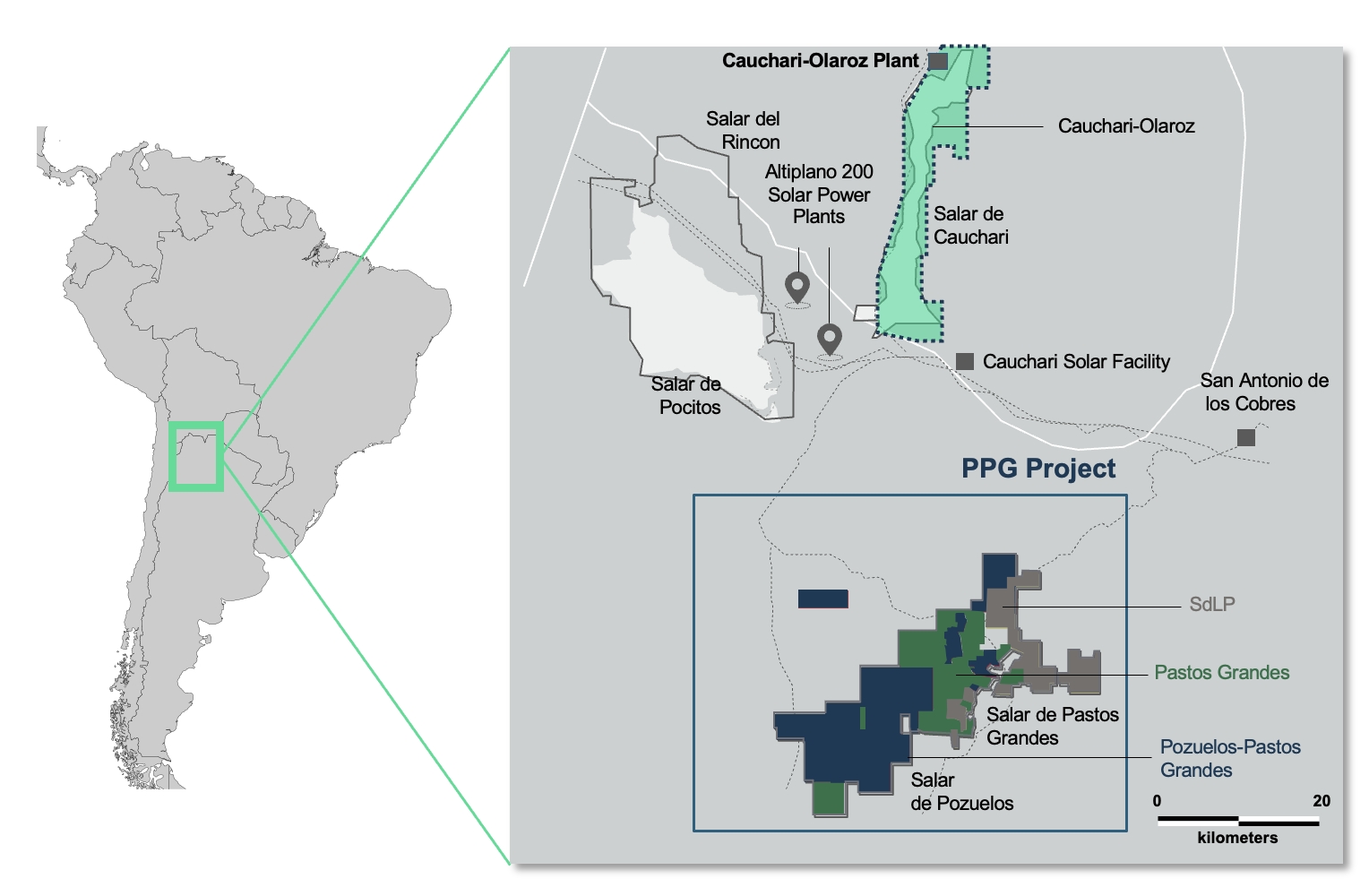 Property Location — Pozuelos–Pastos Grandes Basins, Salta Province (see map below).
Operating Costs
The operating cost estimates have been reviewed and confirmed by Golder Associates (“Golder”) in accordance with applicable Canadian Institute of Mining, Metallurgy and Petroleum (CIM) standards and NI 43-101 and SK 1300.
The average operating costs calculated for life of project of 150,000 tpa of LCE are presented in the table below.
Operating Costs – Full Project |
($ per tonne) |
Category |
|
Reagents |
$1,444 |
Energy |
$1,481 |
Labour |
$381 |
Maintenance |
$429 |
Salts harvesting |
$291 |
G&A |
$98 |
Others |
$664 |
Sub-Total |
$4,788 |
Contingency |
$239 |
Total |
$5,027 |
6
The average operating costs were calculated for a Stage 1 production of 50,000 tpa of LCE and are presented in the table below.
Operating Costs – Stage 1 |
($ per tonne) |
Category |
|
Reagents |
$1,444 |
Energy |
$1,416 |
Labour |
$634 |
Maintenance |
$429 |
Salts Harvesting |
$305 |
G&A |
$154 |
Others |
$707 |
Sub-Total |
$5,089 |
Contingency |
$254 |
Total |
$5,344 |
RIGI Related Benefits
Argentina’s Régimen de Incentivo para Grandes Inversiones (RIGI) is a government framework designed to attract large-scale investment by providing stable, long-term tax, regulatory and foreign exchange benefits. PPG will seek access to Argentina’s RIGI framework to enhance long-term competitiveness and support ongoing financing efforts. Opting into this regime is subject to securing RIGI eligibility and approvals and is expected to materially improve after-tax cash flow through a series of fiscal incentives, including but not limited to (1) a 25% corporate income tax rate (vs. 35% general regime), (2) export-duty relief (exemption after a qualifying period and minimum investment), and (3) accelerated tax depreciation (e.g. equipment over ~2 years; plant/property at ~1.6x the usual rate). In aggregate, these features are assumed in the base case model and lift post-tax NPV by $0.9 billion, with an IRR improving by 7.6%. The Company’s eligibility for benefits under the RIGI program remains subject to approval.
Capital Costs
The capital cost for life of project at PPG is estimated at $3.3 billion, inclusive of a 16% contingency, based on construction and are based on Argentine costs for labor and materials. This reflects a total capital intensity of approximately $21,900 per tonne of annual LCE production.
Capital Cost – Life of Project |
($ millions) |
Total Direct Costs (including contingency) |
|
Wellfield, Ponds and Brine Systems |
$1,318 |
Plants Capital Costs |
$1,377 |
Infrastructure/Power/TMA Costs |
$430 |
Sub-Total |
$3,125 |
Total Indirect Costs |
|
Owner Costs |
$91 |
VAT |
$85 |
Total Capital Costs (including contingency) |
$3,301 |
7
The capital costs for Stage 1 development at PPG is estimated at $1.1 billion, inclusive of a 16% contingency based on construction and are based on Argentine costs for labor and materials. This reflects a total capital intensity of approximately $22,000 per tonne of annual LCE production.
Capital Cost – Stage 1 |
($ millions) |
Total Direct Costs (including contingency) |
|
Wellfield, Ponds and Brine Systems |
$337 |
Plants Capital Costs |
$459 |
Infrastructure/Power/TMA Costs |
$248 |
Sub-Total |
$1,045 |
Total Indirect Costs |
|
Owner Costs |
$32 |
VAT |
$47 |
Total Capital Costs (including contingency) |
$1,124 |
The Scoping Study contemplates a staged development underpinned by both existing site infrastructure and new process facilities. Wellfields, ponds and brine system infrastructure are largely related to the construction of these items. Plants’ capital costs include all the capital for the lithium plant, including: DLE plant, purification plant, utilities and LCE processing facilities.
Infrastructure, Power/Tailing Management Area (“TMA”) and energy costs relate to water supply, transformers, warehouse office buildings, camps, effluent plant, and waste yard infrastructure, power lines, fuel plant and emergency generation and salts disposal costs.
The sustaining capital requirement for the life of project is estimated at an average of approximately $324 per tonne of LCE produced.
PPG Project Valuation Price Sensitivities and Returns
The financial results are derived from inputs based on an annual production schedule included in the Scoping Study. The PPG Scoping Study estimates strong returns with incremental after-tax NPV10% of $5.8 billion and NPV8% of $8.1 billion. A sensitivity analysis of long-term lithium carbonate price on the economic results for the 150,000 tpa of LCE over a 30-year operating period is summarized below.
Key Parameters |
Scenario 1 |
Scenario 2 |
Scenario 3 (Base Case) |
Scenario 4 |
Lithium Carbonate Price |
$12,000/t |
$16,000/t |
$18,000/t |
$20,000/t |
After-Tax NPV8% |
$3.6B |
$6.6B |
$8.1B |
$9.6B |
After-Tax NPV10% |
$2.4B |
$4.6B |
$5.8B |
$6.9B |
After-Tax IRR |
21.1% |
29.1% |
32.7% |
36.1% |
Payback (years) |
10.0 |
7.8 |
7.0 |
6.7 |
Mineral Resource
Golder and Atacama Waters were engaged to prepare the Scoping Study, including the mineral resource estimation in brine for the consolidated PPG Project in accordance with the guidelines for lithium brines set forth by the Canadian Institute of Mining, Metallurgy and Petroleum (CIM 2012), NI 43-101 and SK-1300.
8
Mineral Resource Estimation
The Mineral Resources for PPG as described in the Scoping Study are summarized in the table below. Prior to the consolidation, Lithium Argentina’s proportionate interest in PPG was 35%.
Resource Category |
Pozuelos |
Pastos Grandes |
Subtotal |
||
Li (mg/L) |
LCE (tonnes) |
Li (mg/L) |
LCE (tonnes) |
LCE (tonnes) |
|
Measured |
491 |
5,836,244 |
451 |
7,406,000 |
13,242,244 |
Indicated |
529 |
1,180,383 |
78 |
654,000 |
1,834,383 |
Inferred |
581 |
3,920,437 |
456 |
2,793,000 |
6,713,437 |
Notes:
Next Steps
With the receipt of the environmental permit application, the RIGI application is expected during the first half of 2026. The Company and Ganfeng are exploring financing options including debt offtake and minority equity investments to support funding for Stage 1 of PPG.
Ganfeng and Lithium Argentina continue to advance optimization efforts and integration of the resources into a unified hydrological model. The results of the integration and optimization efforts will support further technical information used to support Stage 1 development.
Non-IFRS Measures
All-in sustaining cost per tonne and operating cash costs per tonne are non-IFRS measures or ratios and do not have a standardized meaning under IFRS and may not be comparable to similar financial measures used by other issuers. The Company believes that this measure provides investors with an improved ability to evaluate the prospects of the Company and the PPG Project. As the PPG Project is not in production, all-in sustaining cost and operating cash cost may not be reconciled to the nearest comparable measures under IFRS and the equivalent historical non-IFRS measure discussed herein is $nil.
9
Operating Cash Cost |
$ per tonne of LCE |
Projected Operating Cash Cost – Stage 1 |
$5,344 |
Projected Operating Cash Cost |
$5,027 |
Projected AISC9 |
$5,351 |
In September 2025, Cauchari-Olaroz held a monitoring session with twelve participants from the communities.
Cauchari-Olaroz initiated the Responsible Minerals Initiative (RMI) Responsible Sourcing Assurance Process (“RMAP”) to ensure its supply chain adheres to the highest ethical and environmental standards. In December 2024, it was officially added to the RMAP active list. Subsequently, in June 2025, the operation successfully completed an on-site audit as part of the RMAP requirements.
9 AISC includes sustaining capex, tailings management and closing costs. Provincial royalties represent an additional $217/t - $463/t at a price range of $12,000/t - $20,000/t.
10
FINANCIAL INFORMATION OF EXAR
The following is the condensed financial information of Exar on a 100% basis, as amended to reflect the Company’s accounting policies. The Company holds a 44.8% economic interest in Exar and accounts for its interest using the equity method of accounting. Accordingly, the recorded results and financial position of Exar are included in a single line item in the Company’s consolidated statements of comprehensive loss and financial position, respectively.
|
|
Three months ended September 30, |
|
|
Nine months ended September 30, |
|
||||||||
Exar Income Statement (in US$ millions) |
|
|
2025 |
|
|
2024 |
|
|
|
2025 |
|
|
2024 |
|
(100% basis unless otherwise indicated) |
|
$ |
|
$ |
|
|
$ |
|
$ |
|
||||
Sales |
|
|
58.5 |
|
|
57.0 |
|
|
|
179.9 |
|
|
130.9 |
|
Cost of sales |
|
|
(57.0 |
) |
|
(48.6 |
) |
|
|
(174.0 |
) |
|
(111.0 |
) |
Gross profit |
|
|
1.5 |
|
|
8.4 |
|
|
|
5.9 |
|
|
19.9 |
|
|
|
|
|
|
|
|
|
|
|
|
|
|
|
|
Other (loss)/income |
|
|
(68.2 |
) |
|
78.6 |
|
|
|
(75.9 |
) |
|
(52.3 |
) |
Net (loss)/income |
|
|
(66.7 |
) |
|
87.0 |
|
|
|
(70.0 |
) |
|
(32.4 |
) |
Other loss of $68.2 million for the three months ended September 30, 2025, primarily reflects a non-cash foreign exchange loss on loans from Exar Capital and PGCo, as well as accrued interest on intercompany loans, partially offset by a deferred tax recovery.
Exar Balance Sheet (in US$ millions) |
|
September 30, 2025 |
|
December 31, 2024 |
|
||
(100% basis unless otherwise indicated) |
|
$ |
|
$ |
|
||
Current assets: |
|
|
|
|
|
|
|
Cash and cash equivalents |
|
|
53.6 |
|
|
11.2 |
|
Other current assets |
|
|
314.4 |
|
|
301.2 |
|
Total current assets |
|
|
368.0 |
|
|
312.4 |
|
Non-current assets |
|
|
1,461.3 |
|
|
1,480.0 |
|
Current liabilities: |
|
|
|
|
|
|
|
Third-party loans |
|
|
(235.6 |
) |
|
(161.1 |
) |
Loans from Exar Capital |
|
|
- |
|
|
(584.5 |
) |
Derivative liability on loans from Exar Capital |
|
|
- |
|
|
(53.2 |
) |
Other current liabilities |
|
|
(53.7 |
) |
|
(72.8 |
) |
Non-current liabilities: |
|
|
|
|
|
|
|
Third-party loans |
|
|
(49.5 |
) |
|
(49.3 |
) |
Loans from Exar Capital |
|
|
(905.4 |
) |
|
(455.8 |
) |
Loans from PGCo |
|
|
(72.0 |
) |
|
(67.4 |
) |
Derivative liability on loans from Exar Capital and PGCo |
|
|
(49.3 |
) |
|
(47.4 |
) |
Other non-current liabilities |
|
|
(94.0 |
) |
|
(89.0 |
) |
Net assets |
|
|
369.8 |
|
|
211.9 |
|
The increase in current assets reflects higher cash and cash equivalents, trade receivables, and prepayments for reagents, partially offset by inventory sold during the period. Cash and cash equivalents included the remaining proceeds from the $120 million debt facilities closed in Q2 2025, as further detailed below.
During the nine months ended September 30, 2025, as part of a restructuring of loans (the “Restructuring”), the Company and Ganfeng amended and restated loan agreements relating to loans advanced to Exar Capital. Concurrently, Exar Capital amended and restated agreements relating to the loans advanced to Minera Exar (collectively, the “Amendments”), revising interest rates to market levels effective for fiscal year 2025 and subsequent periods and extending the maturity dates, with revised maturity dates ranging from 2028 to 2035. These modifications were treated as an extinguishment of the existing loans and the
11
issuance of new loans at market rates of interest. As part of the Restructuring, on August 27, 2025, Exar Capital assigned certain loan receivables from Exar to the Company and Ganfeng in exchange for the cancellation of a portion of the loans outstanding from Exar Capital to the Company and Ganfeng. The total carrying value of the loans assigned was $208.1 million, with the Company’s portion amounting to $101.9 million. In exchange, the Company cancelled loans owed by Exar Capital with carrying value of $99.4 million. The assigned loans receivable from Exar were subsequently settled through a capital contribution by the Company and Ganfeng to Exar. As such, during the nine months ended September 30, 2025, loans from Exar Capital decreased as a result of the capitalization of certain loans to Exar’s equity by the Company and Ganfeng, partially offset by accrued interest.
As of September 30, 2025, Exar held $285.1 million in third-party debt at the official foreign exchange rate (2024 – $210.4 million) and $53.6 million in cash (2024 – $11.2 million), resulting in net debt of $231.5 million (2024 – $199.2 million). The Company’s proportionate share of this net debt is $113.5 million.
Exar’s debt includes $50 million of bonds issued in Argentina in November 2024, bearing 8% annual interest, payable semi-annually. The bonds mature in two tranches in May and November 2027, and the proceeds were used to repay Exar’s short-term debt.
As of September 30, 2025, the remaining $235.1 million of debt is scheduled to mature within the next 12 months. The Company and Ganfeng have negotiated a three-year extension for $100 million of this amount, which has been approved by the regulatory authority and is currently in the process of implementation. Accordingly, together with the bonds, approximately $150 million of third-party debt is being refinanced into long-term debt with a maturity of three years, with the remaining $135.1 million due within the next 12 months. The remaining $135.1 million of debt includes the $120 million in bank debt facilities closed in Q2 2025 and fully drawn in Q3 2025 to refinance maturing short-term loans and for other purposes. These loans were competitively priced at an approximate rate of SOFR plus 2.5%, including fees, reflecting Exar’s ability to access credit on favorable terms. A portion of these debt proceeds remained in Exar’s cash balance at September 30, 2025. The Company continues to work with Ganfeng to pursue additional long-term financing options as lending conditions in Argentina improve, supporting Exar’s longer-term growth plans.
In addition to the Company’s equity interest in Exar, the Company has total outstanding loans of $374.1 million to the Cauchari-Olaroz project as of September 30, 2025, comprising $302.0 million through Exar Capital and $72.1 million to Exar through PGCo. (including accrued interest). Exar Capital, in turn, has an outstanding balance of $905.4 million owed by Exar.
SELECTED FINANCIAL INFORMATION OF THE COMPANY
As of September 30, 2025, the Company had a cash and cash equivalents balance of $64.0 million, receivables of $19.5 million from purchasers of lithium carbonate, and $75.0 million available under its undrawn limited recourse loan facility with Ganfeng (available until the end of 2025), to settle current liabilities of $25.1 million, being payables from purchases of lithium carbonate of $19.5 million and other payables of $5.6 million (excluding equity-settled Convertible Notes).
In August 2025, Ganfeng agreed to provide a $130 million Debt Facility to Lithium Argentina. The Debt Facility is subject to the completion of the New JV and other customary closing conditions. Closing is expected to occur in early 2026.
12
Selected consolidated financial information is as follows:
|
2025 |
|
2024 |
|
2023 |
|
||||||||||||||||||
|
|
|
|
|
|
|
||||||||||||||||||
(in US$ millions) |
Q3 |
|
Q2 |
|
Q1 |
|
Q4 |
|
Q3 |
|
Q2 |
|
Q1 |
|
Q4 |
|
||||||||
|
$ |
|
$ |
|
$ |
|
$ |
|
$ |
|
$ |
|
$ |
|
$ |
|
||||||||
Total assets (excluding assets held for distribution) |
|
1,078.7 |
|
|
1,141.1 |
|
|
1,130.8 |
|
|
1,131.2 |
|
|
1,121.8 |
|
|
1,046.1 |
|
|
1,046.1 |
|
|
1,055.0 |
|
Property, plant and equipment |
|
8.9 |
|
|
9.0 |
|
|
8.8 |
|
|
9.0 |
|
|
9.1 |
|
|
9.6 |
|
|
9.8 |
|
|
9.2 |
|
Current assets |
|
84.6 |
|
|
132.1 |
|
|
133.1 |
|
|
117.4 |
|
|
111.8 |
|
|
112.3 |
|
|
98.8 |
|
|
133.6 |
|
Current liabilities excluding equity-settleable convertible notes(3) |
|
(25.1 |
) |
|
(31.7 |
) |
|
(27.2 |
) |
|
(31.8 |
) |
|
(23.7 |
) |
|
(22.3 |
) |
|
(14.3 |
) |
|
(14.6 |
) |
Total liabilities (excluding liabilities held for distribution) |
|
(251.7 |
) |
|
(252.8 |
) |
|
(242.5 |
) |
|
(240.3 |
) |
|
(228.1 |
) |
|
(222.1 |
) |
|
(226.0 |
) |
|
(226.1 |
) |
Expenses - continuing operations |
|
(60.4 |
) |
|
(11.0 |
) |
|
(10.7 |
) |
|
(9.2 |
) |
|
(8.8 |
) |
|
(21.5 |
) |
|
(20.8 |
) |
|
(5.6 |
) |
(Loss)/income from continuing operations |
|
(64.5 |
) |
|
(4.1 |
) |
|
(7.2 |
) |
|
(4.8 |
) |
|
(2.4 |
) |
|
2.2 |
|
|
(10.2 |
) |
|
(1.1 |
) |
Income from discontinued operations |
|
- |
|
|
- |
|
|
- |
|
|
- |
|
|
- |
|
|
- |
|
|
- |
|
|
1,263.4 |
|
Net (loss)/income |
|
(64.5 |
) |
|
(4.1 |
) |
|
(7.2 |
) |
|
(4.8 |
) |
|
(2.4 |
) |
|
2.2 |
|
|
(10.2 |
) |
|
1,262.3 |
|
Notes:
On July 31, 2023, at the annual general and special meeting of the Company, the shareholders approved the separation of the former Lithium Americas Corp. into Lithium Argentina and a new entity, Lithium Americas Corp. (“Lithium Americas (NewCo)”), pursuant to a statutory plan of arrangement (the “Separation”). The Separation was completed on October 3, 2023. As a result of the transaction, the Company transferred its North American business, including, among other assets, the Thacker Pass Project (“Thacker Pass”) and $275.5 million of cash to Lithium Americas (NewCo).
Discussion of Quarterly Trends
Total liabilities decreased mainly due to the derecognition of the deferred tax liability and lower payables to Exar, partially offset by accrued interest on the Convertible Notes.
13
Financial results |
Nine Months Ended September 30, |
|
Change |
|
|||||
(in US$ million) |
2025 |
|
2024 |
|
|
|
|
||
|
$ |
|
$ |
|
$ |
|
|||
EXPENSES |
|
|
|
|
|
|
|
|
|
Exploration and evaluation expenditures |
|
(5.3 |
) |
|
(7.6 |
) |
|
2.3 |
|
General and administrative |
|
(11.4 |
) |
|
(10.6 |
) |
|
(0.8 |
) |
Equity compensation |
|
(11.8 |
) |
|
(5.1 |
) |
|
(6.7 |
) |
Share of loss of Cauchari-Olaroz Project |
|
(53.4 |
) |
|
(27.8 |
) |
|
(25.6 |
) |
Share of loss of Sal de la Puna Project |
|
(0.1 |
) |
|
(0.1 |
) |
|
- |
|
|
|
(82.0 |
) |
|
(51.2 |
) |
|
(30.8 |
) |
|
|
|
|
|
|
|
|
|
|
Transaction costs |
|
(3.2 |
) |
|
(2.1 |
) |
|
(1.1 |
) |
Gain on financial instruments measured at fair value |
|
0.1 |
|
|
11.1 |
|
|
(11.0 |
) |
Finance and other costs |
|
(22.1 |
) |
|
(18.6 |
) |
|
(3.5 |
) |
Foreign exchange (loss)/gain |
|
(0.3 |
) |
|
1.8 |
|
|
(2.1 |
) |
Loss from JEMSE receivable |
|
(9.3 |
) |
|
- |
|
|
(9.3 |
) |
Finance and other income |
|
41.1 |
|
|
37.9 |
|
|
3.2 |
|
|
|
6.3 |
|
|
30.1 |
|
|
(23.8 |
) |
|
|
|
|
|
|
|
|
|
|
LOSS BEFORE TAXES |
|
(75.7 |
) |
|
(21.1 |
) |
|
(54.6 |
) |
|
|
|
|
|
|
|
|
|
|
Deferred tax recovery |
|
- |
|
|
10.7 |
|
|
(10.7 |
) |
|
|
|
|
|
|
|
|
|
|
NET LOSS |
|
(75.7 |
) |
|
(10.4 |
) |
|
(65.3 |
) |
The Company reported a net loss (attributable to equity holders of Lithium Argentina) of $75.7 million for the nine months ended September 30, 2025, compared to a net loss of $10.4 million for the same period in 2024. The higher loss was primarily driven by:
14
These were partially offset by:
Purchases and sales of lithium carbonate
During the nine months ended September 30, 2025, the Company purchased its share of Exar’s lithium carbonate shipped during the period, with Ganfeng purchasing the remaining product shipped. The Company sold the purchased lithium carbonate to Ganfeng and BCP Innovation PTE. LTD (“Bangchak”), a wholly-owned subsidiary of Bangchak Corporation Public Company Ltd. and acted in the capacity of agent in such sales transactions, as the Company’s acquisition of title to lithium carbonate was simultaneous with its sale to Ganfeng and Bangchak. As a result, the Company was not directly exposed to inventory or price risk related to the lithium carbonate.
Since there was no net commission earned by the Company, there was no impact on the Company’s statement of comprehensive loss for the nine months ended September 30, 2025.
As at September 30, 2025, the Company had a payable of $19.5 million to Exar for lithium carbonate purchases and receivables totaling $19.5 million from Ganfeng for sales of lithium carbonate, as disclosed on the statement of financial position.
Expenses
15
Other Items
16
Financial results |
Three Months Ended September 30, |
|
Change |
|
|||||
(in US$ million) |
2025 |
|
2024 |
|
|
|
|
||
|
$ |
|
$ |
|
$ |
|
|||
EXPENSES |
|
|
|
|
|
|
|
|
|
Exploration and evaluation expenditures |
|
(1.3 |
) |
|
(1.8 |
) |
|
0.5 |
|
General and administrative |
|
(3.4 |
) |
|
(3.5 |
) |
|
0.1 |
|
Equity compensation |
|
(3.2 |
) |
|
(2.5 |
) |
|
(0.7 |
) |
Share of loss of Cauchari-Olaroz Project |
|
(52.5 |
) |
|
(1.3 |
) |
|
(51.2 |
) |
Share of (loss)/income of Sal de la Puna Project |
|
- |
|
|
0.3 |
|
|
(0.3 |
) |
|
|
(60.4 |
) |
|
(8.8 |
) |
|
(51.7 |
) |
OTHER ITEMS |
|
|
|
|
|
|
|
|
|
Transaction costs |
|
(0.9 |
) |
|
(0.8 |
) |
|
(0.1 |
) |
(Loss)/gain on financial instruments measured at fair value |
|
(0.4 |
) |
|
0.2 |
|
|
(0.6 |
) |
Finance and other costs |
|
(8.1 |
) |
|
(6.4 |
) |
|
(1.7 |
) |
Foreign exchange (loss)/gain |
|
(0.1 |
) |
|
0.2 |
|
|
(0.3 |
) |
Loss from JEMSE receivable |
|
(9.3 |
) |
|
- |
|
|
(9.3 |
) |
Finance and other income |
|
12.9 |
|
|
13.2 |
|
|
(0.3 |
) |
|
|
(5.9 |
) |
|
6.4 |
|
|
(12.3 |
) |
|
|
|
|
|
|
|
|
|
|
LOSS BEFORE TAXES |
|
(66.3 |
) |
|
(2.4 |
) |
|
(63.9 |
) |
|
|
|
|
|
|
|
|
|
|
Deferred tax recovery |
|
1.8 |
|
|
- |
|
|
1.8 |
|
|
|
|
|
|
|
|
|
|
|
NET LOSS |
|
(64.5 |
) |
|
(2.4 |
) |
|
(62.1 |
) |
The Company reported a net loss (attributable to equity holders of Lithium Argentina) of $64.5 million for Q3 2025, compared to a net loss of $2.4 million for Q3 2024. The higher loss in Q3 2025 was primarily attributable to:
These impacts were partially offset by:
17
Cash Flow Highlights |
|
Nine months Ended September 30, |
|
||||
(in US$ million) |
|
2025 |
|
2024 |
|
||
|
|
$ |
|
$ |
|
||
Net cash used in operating activities |
|
|
(27.4 |
) |
|
(17.0 |
) |
Net cash provided/(used) in investing activities |
|
|
6.4 |
|
|
(83.6 |
) |
Net cash (used)/provided by financing activities |
|
|
(0.2 |
) |
|
68.8 |
|
Effect of foreign exchange on cash |
|
|
(0.3 |
) |
|
1.8 |
|
Change in cash and cash equivalents |
|
|
(21.5 |
) |
|
(30.0 |
) |
Cash and cash equivalents - beginning of the period |
|
|
85.5 |
|
|
122.3 |
|
Cash and cash equivalents - end of the period |
|
|
64.0 |
|
|
92.3 |
|
As at September 30, 2025, the Company had cash and cash equivalents of $64.0 million and an undrawn $75 million available under the limited recourse loan facility with Ganfeng.
The Company expects that its existing cash balance, proceeds from operations, and other sources of financing will provide sufficient resources to fund the planned expenditures at Pastos Grandes, Sal de la Puna, its share of Cauchari-Olaroz planned expenditures, as well as general and administrative costs and other obligations.
The timing and amount of expenditures for Pastos Grandes are within the Company’s control due to its controlling interests in the project. However, pursuant to the agreements governing Cauchari-Olaroz and Sal de la Puna, decisions regarding capital budgets for these projects require agreement between Lithium Argentina and the projects’ co-owner, Ganfeng.
The Company continues to support the operation of Cauchari-Olaroz and the development of its other projects. The Company’s capital resources are driven by the status of its assets, the operation at Cauchari-Olaroz, and its ability to secure investor support for its initiative.
In the long-term, the Company expects to meet its obligations and fund the development of its projects through the financing plans described above. However, given the conditions associated with such financing, there can be no assurance that the Company will successfully complete all of its contemplated financing plans. Except as disclosed, the Company is not aware of any trends, demands, commitments, events, or uncertainties that are likely to materially affect its liquidity and capital resources, either positively or negatively, in the near or foreseeable future. The Company does not engage in currency hedging to mitigate any risks related to currency fluctuations.
Cash used in operating activities for the nine months ended September 30, 2025, was $27.4 million (2024 – $17.0 million). The significant components of operating activities are discussed in the “Results of Operations” section above.
Cash provided by investing activities for the nine months ended September 30, 2025, was $6.4 million (2024 – $83.6 million cash used in investing activities).
During the nine months ended September 30, 2025, the Company received a partial repayment of its outstanding loan to Exar Capital totaling $3.9 million. Additionally, the Company received $3.0 million from the sale of Cauchari East mineral rights to the Cauchari-Olaroz project, which was partially offset by a $0.3 million contribution to its investment in Sal de la Puna and $0.2 million in capital expenditures, including additions to exploration and evaluation assets.
18
Equity-settleable Convertible Notes
On December 6, 2021, the Company closed an offering (the “Offering”) of $225 million aggregate principal amount of 1.75% convertible senior notes due in 2027 (the “Convertible Notes,” “Equity-settleable Convertible Notes,” or “Notes”). On December 9, 2021, the initial purchasers under the Offering exercised, in full, their option to purchase up to an additional $33.75 million aggregate principal amount of the Convertible Notes, increasing the total Offering size to $258.75 million.
Pursuant to the indenture governing the terms of the Convertible Notes, as amended by a first supplemental indenture to reflect the name change of the Company in connection with the Separation and a second supplemental indenture to reflect the effects of the Continuation (the “Indenture”), the holders of the Convertible Notes, at their election, were permitted to surrender the Convertible Notes for conversion (i) into shares of the Company during the approximate 30-trading day period prior to the closing of the Continuation and (ii) into shares of the Company during the period from and after the closing of the Continuation until approximately the 35th trading day after the closing of the Continuation. The Conversion Rate (as defined in the Indenture) for the Convertible Notes was initially 21.2307 shares per $1,000 principal amount of the Convertible Notes. Pursuant to the terms and conditions of the Indenture, the Conversion Rate for the Convertible Notes was adjusted on October 17, 2023, to 52.6019 shares of the Company per $1,000 principal amount of the Convertible Notes based on the trading prices of the Company’s shares over the preceding 10-trading day period due to the Separation transaction. The Conversion Rate for the Convertible Notes was not adjusted as a result of the Continuation. None of the Convertible Notes were surrendered for conversion during the permitted conversion period in connection with the Continuation.
The Convertible Notes are convertible at the option of the holders upon satisfaction of certain conditions that are beyond the control of the Company. If such conditions are satisfied, the Convertible Notes would be convertible at the option of the holders and upon conversion, the Notes may be settled, at the Company’s election, in common shares of the Company, cash or a combination thereof. As a result, the Company does not have the right to defer settlement of the Convertible Notes for more than 12 months after the end of the reporting periods.
Loan Facility
As at September 30, 2025, the limited recourse loan facility with Ganfeng remains undrawn with $75 million available under the facility until the end of 2025.
Issued and outstanding securities of the Company as at the date of this MD&A are as follows:
Shares issued and outstanding |
162.3 million |
Restricted Share Units (RSUs) |
7.4 million |
Deferred Share Units (DSUs) |
1.0 million |
Stock Options |
2.7 million |
Performance Share Units (PSUs) |
0.2 million |
Shares, fully diluted |
173.6 million |
In February 2023, General Motors Holdings LLC (“GM”) acquired approximately 15,000,000 shares of the Company. In connection with that transaction, GM agreed to a ‘lock-up’ restricting the transfer of those shares pursuant to the terms of an investor rights agreement with the Company. The principal lock-up expired in October 2024 (with certain specified transfer limitations remaining in place), and GM is no longer contractually restricted from selling its shares of the Company through the facilities of a stock exchange.
19
Any transactions between the Company with Exar, Exar Capital, and Sal de la Puna are considered related party transactions (refer Note 5, 6, 7 and 8 of the Q3 2025 financial statements).
Exar, the Company’s equity accounted investee, entered into the following transactions with companies controlled by the family of its director, who is also a director of Lithium Argentina:
As of September 30, 2025, Exar’s outstanding third-party debt amounted to $285.1 million (2024 – $210.4 million), while its cash balance was $53.6 million (2024 – $11.2 million), resulting in a total net debt of $231.5 million (2024 – $199.2 million). The total debt includes the following:
As of September 30, 2025, $235.1 million is scheduled to mature within the next 12 months. The Company and Ganfeng have negotiated a three-year extension for $100 million of this amount, which has been approved by the regulatory authority and is in the process of implementation. As such, together with the bonds, approximately $150 million of the third-party debt is being refinanced into long-term debt with maturity of three years, with the remaining $135.1 million due within the next 12 months. The remaining $135.1 million of debt includes the $120 million in bank debt facilities closed in Q2 2025 and fully drawn in Q3 2025 to refinance maturing short-term loans and for other corporate purposes. These loans were competitively priced at an approximate rate of SOFR plus 2.5%, including fees, reflecting Exar’s ability to access credit on favorable terms. A portion of these debt proceeds remained in Exar’s cash balance at September 30, 2025. The Company continues to work with Ganfeng to pursue additional long-term financing options as lending conditions in Argentina improve, supporting Exar’s longer-term growth plans.
Compensation of Key Management
The Company’s key management consists of the executive management team, who supervise day-to-day operations, and independent directors on the Company’s Board of Directors, who oversee management.
20
Their compensation was as follows:
|
|
Three Months Ended September 30, |
|
|
Nine Months Ended September 30, |
|
||||||||
|
|
|
2025 |
|
|
2024 |
|
|
|
2025 |
|
|
2024 |
|
|
|
$ |
|
$ |
|
|
$ |
|
$ |
|
||||
Equity compensation |
|
|
3.2 |
|
|
2.9 |
|
|
|
11.3 |
|
|
6.1 |
|
Salaries, bonuses, benefits and directors' fees included in general & administrative expenses |
|
|
0.9 |
|
|
0.7 |
|
|
|
2.6 |
|
|
1.7 |
|
Salaries, bonuses and benefits included in exploration expenditures |
|
|
0.1 |
|
|
0.1 |
|
|
|
0.2 |
|
|
0.2 |
|
Salaries and benefits capitalized to Investment in Cauchari-Olaroz project |
|
|
- |
|
|
0.1 |
|
|
|
- |
|
|
0.4 |
|
|
|
|
4.2 |
|
|
3.8 |
|
|
|
14.1 |
|
|
8.4 |
|
Amounts due to directors at September 30, 2025, include $0.1 million owed to the independent directors of the Company for 2025 directors’ fees, which were paid subsequent to Q3 2025.
|
|
September 30, 2025 |
|
|
December 31, 2024 |
|
||
|
|
$ |
|
|
$ |
|
||
Total due to directors |
|
|
0.1 |
|
|
|
0.1 |
|
As of January 23, 2025, the Company entered into new employment contracts with certain members of the executive management team. These contracts were implemented to ensure compliance with Swiss law and include amendments to provisions related to termination and termination upon a change of control. In consideration for entering into these new employment agreements, the affected executive management team members were granted RSUs, with a total aggregate grant date fair value of $3.9 million for all impacted individuals.
Offtake Arrangements
Each of the Company and Ganfeng are entitled to a share of offtake from production at Cauchari-Olaroz. The Company will be entitled to 49% of the offtake, which would amount to approximately 19,600 tpa of lithium carbonate, assuming full capacity is achieved. The Company has entered into offtake agreements with both Ganfeng and Bangchak to sell a fixed amount of offtake production at market-based prices, with Ganfeng entitled to 80% of the first 12,250 tpa of lithium carbonate (9,800 tpa assuming full production capacity) and Bangchak entitled to up to 6,000 tpa of lithium carbonate (assuming full production capacity). The balance of the Company’s offtake entitlement, amounting to up to approximately 3,800 tpa of lithium carbonate, remains uncommitted, except for limited residual rights available to Bangchak if production does not meet full capacity
As at September 30, 2025, the Company had the following contractual obligations on an undiscounted basis:
|
|
Years ending December 31, |
|
|
|
|
|||||||
|
|
2025 |
|
2026 |
|
2027 and later |
|
Total |
|
||||
|
|
$ |
|
$ |
|
$ |
|
$ |
|
||||
Convertible Notes |
|
|
- |
|
|
4.5 |
|
|
261.0 |
|
|
265.5 |
|
Accounts payable and accrued liabilities |
|
|
24.0 |
|
|
- |
|
|
- |
|
|
24.0 |
|
Obligations under office leases¹ |
|
|
0.1 |
|
|
0.3 |
|
|
0.5 |
|
|
0.9 |
|
Total |
|
|
24.1 |
|
|
4.8 |
|
|
261.5 |
|
|
290.4 |
|
¹Include principal and interest/finance charges.
The Convertible Notes are classified as current liabilities as at September 30, 2025, since the Notes are convertible at the option of the holders upon satisfaction of certain conditions that are beyond the control of the Company. If such conditions are satisfied, the Notes would be convertible at the option of the holders and upon conversion, the Notes may be settled, at the Company’s election, in shares, cash, or a combination thereof. The table above summarizes the contractual maturities as of September 30, 2025, with respect to the Convertible Notes, assuming that such conditions will not be satisfied before the due date.
21
The Company’s commitments related to royalties and other payments are disclosed in Note 11 of the Q3 2025 financial statements filed on SEDAR+ and EDGAR, most of which will be incurred in the future if the Company continues to hold the subject property, proceeds with construction, or begins production.
Cash Operating Costs and Total Cash Costs per Tonne
Lithium Argentina reports “Cash Operating Costs per tonne” and “Total Cash Costs per tonne” as key non-GAAP financial measures or ratios. These non-GAAP financial measures or ratios do not have a standardized meaning under IFRS and might not be comparable to similar financial measures disclosed by other issuers. The most directly comparable IFRS measure is Cost of Sales. These metrics provide investors with insight into the Company’s cost structure by excluding non-cash and non-operating items, thereby enabling better comparability of operating performance.
Cash Operating Cost (C1) includes all expenditures incurred at the site, such as brine management, lithium plant processing, site and provincial office overheads, and inventory adjustments. These costs also include project general and administrative costs and sales logistics costs. Total Cash Costs (C2) include all C1 costs, along with selling costs, export duties (net of refunds) and provincial royalties. Tonnes are reported on a tonnes sold basis at FOB Buenos Aires port. Exar covers the cost of transporting lithium carbonate to the port, while the delivery cost to the buyer's factory in China, along with processing and other costs are subtracted from the sales price.
RECONCILIATION TO NON-GAAP MEASURES |
|
|
|
|
|
|
|
|
|
|
YTD |
|
|
(Exar on a 100% basis) |
|
Q1 2025 |
|
Q2 2025 |
|
Q3 2025 |
|
September 30, 2025 |
|
||||
In USD millions (unless stated otherwise) |
|
|
|
|
|
|
|
|
|
|
|
|
|
Cost of sales |
M$ |
|
54 |
|
|
63 |
|
|
57 |
|
|
174 |
|
(-) Depreciation and inventory net realizable value adjustments |
M$ |
|
(12 |
) |
|
(15 |
) |
|
(13 |
) |
|
(40 |
) |
(+) General & administration and sales logistics |
M$ |
|
5 |
|
|
4 |
|
|
4 |
|
|
15 |
|
C1: Cash Operating Costs |
M$ |
|
47 |
|
|
53 |
|
|
49 |
|
|
149 |
|
(+) Selling costs, duties and royalties |
M$ |
|
2 |
|
|
2 |
|
|
2 |
|
|
6 |
|
C2: Total Cash Costs |
M$ |
|
49 |
|
|
55 |
|
|
51 |
|
|
155 |
|
Li2CO3 Shipments (dry base) |
tns |
|
7,146 |
|
|
8,635 |
|
|
7,775 |
|
|
23,556 |
|
C1 Total Cash Operating Costs per tonne |
M$/tn |
|
6,634 |
|
|
6,098 |
|
|
6,285 |
|
|
6,322 |
|
C2 Total Cash Costs per tonne |
M$/tn |
|
6,875 |
|
|
6,366 |
|
|
6,514 |
|
|
6,569 |
|
Notes:
Lithium Argentina reports “average realized lithium price” as a key non-GAAP financial measure. This non-GAAP financial measure does not have a standardized meaning under IFRS and might not be comparable to similar financial measures disclosed by other issuers. Average realized lithium price per tonne is defined as lithium revenue divided by total lithium tonnes sold.
Lithium Argentina reports “current liabilities excluding equity-settleable Convertible Notes” as a key non-GAAP financial measure. This non-GAAP financial measure does not have a standardized meaning under IFRS and might not be comparable to similar financial measures disclosed by other issuers. Current liabilities excluding equity-settleable Convertible Notes are defined as total current liabilities less the equity-settleable Convertible Notes that the Company may settle in equity.
22
RECONCILIATION TO NON-GAAP MEASURES |
2025 |
|
2024 |
|
2023 |
|
||||||||||||||||||
In USD millions (unless stated otherwise) |
Q3 |
|
Q2 |
|
Q1 |
|
Q4 |
|
Q3 |
|
Q2 |
|
Q1 |
|
Q4 |
|
||||||||
|
$ |
|
$ |
|
$ |
|
$ |
|
$ |
|
$ |
|
$ |
|
$ |
|
||||||||
Current liabilities |
|
250.6 |
|
|
250.8 |
|
|
240.7 |
|
|
240.2 |
|
|
228.2 |
|
|
221.8 |
|
|
214.8 |
|
|
215.0 |
|
(-) Equity-settleable Convertible Notes |
|
(225.5 |
) |
|
(219.1 |
) |
|
(213.5 |
) |
|
(208.4 |
) |
|
(204.5 |
) |
|
(199.5 |
) |
|
(200.5 |
) |
|
(200.4 |
) |
Current liabilities excluding equity-settleable Convertible Notes |
|
25.1 |
|
|
31.7 |
|
|
27.2 |
|
|
31.8 |
|
|
23.7 |
|
|
22.3 |
|
|
14.3 |
|
|
14.6 |
|
Management believes this metric provides a useful indication of the Company’s cash-based obligations, as the Convertible Notes may be settled in shares at the Company’s discretion and therefore do not necessarily represent an imminent cash outflow. Current liabilities excluding equity-settleable Convertible Notes are intended to provide additional information only and do not have any standardized definition under IFRS and should not be considered in isolation or as a substitute measure of performance prepared in accordance with IFRS.
Measurement
Financial instruments recorded at fair value on the consolidated statements of financial position of Q3 2025 financial statements and presented in fair value disclosures are classified using a fair value hierarchy that reflects the significance of the inputs used in making the measurements. The fair value hierarchy has the following levels:
Level 1 – Unadjusted quoted prices in active markets for identical assets or liabilities;
Level 2 – Inputs other than quoted prices that are observable for assets or liabilities, either directly or indirectly; and
Level 3 – Inputs for assets and liabilities that are not based on observable market data.
The fair value hierarchy requires the use of observable market inputs whenever such inputs are available. A financial instrument is classified at the lowest level of the hierarchy for which a significant input has been used in measuring fair value. The Convertible Notes derivatives are classified at level 2 of the fair value hierarchy and are measured at fair value on a recurring basis. Cash and cash equivalents, receivables and payable associated with lithium carbonate sales and purchases, other receivables/payables, and the debt host of the Convertible Notes are measured at amortized cost on the statement of financial position. As at September 30, 2025, the fair value of financial instruments measured at amortized cost approximates their carrying value.
Risk
The Company manages risks to minimize potential losses. Its primary objective is to ensure that risks are properly identified and monitored, and that its capital base is adequate relative to those risks. The principal risks affecting the Company’s financial instruments are described below.
Credit Risk
Credit risk refers to the potential for loss due to a counterparty’s inability to meet its financial obligations. The Company is exposed to credit risk through its cash, cash equivalents, receivables, and loans to Exar Capital and Exar. To limit its exposure, the Company places its cash and cash equivalents with reputable financial institutions and regularly monitors their creditworthiness. While a significant portion of the Company’s cash is currently held with a single financial institution, the Company plans to diversify its holdings to reduce concentration risk.
The Company actively monitors credit exposure to Minera Exar and Exar Capital, which are related parties involved in the Cauchari-Olaroz Project. Management reviews their financial position regularly and, given the strategic nature of these relationships and the support from project partners, ensures that credit risk on these balances is maintained at acceptable levels.
As at September 30, 2025, the Company performed an expected credit loss assessment on the loans to Exar Capital and Exar, considering the anticipated future performance of the Cauchari-Olaroz project and its associated cash flows. The assessment did not indicate any significant credit risk or factors that would lead
23
to default. Similarly, the Company assessed the credit risk for its receivables, which did not identify any significant credit risk or factors that would result in default, as the majority of these receivables were settled after September 30, 2025.
Liquidity Risk
Liquidity risk is the risk that the Company may not be able to meet its financial obligations as they come due. The Company manages liquidity by assessing both current and projected liquidity requirements under normal and stressed conditions. This ensures it maintains adequate reserves of cash and cash equivalents to meet its short- and long-term obligations. The Company prepares annual budgets, which are regularly monitored and updated as necessary.
Market Risk
Market risk encompasses various risks, including those related to market prices, share price fluctuations, and currency movements, which can affect the fair values of financial assets and liabilities. The Company is exposed to foreign currency risk, as described below.
Foreign Currency Risk
The Company’s operations in foreign countries are subject to currency fluctuations, which may affect its financial results. The Company and its subsidiaries and associates have a US dollar functional currency, and it incurs expenditures in Canadian dollars (“CDN$”), Argentine Pesos (“ARS$”), Swiss francs (“CHF”) and US$, with the majority of the expenditures being incurred in US$ by the Company’s subsidiaries and investees. As at September 30, 2025, the Company did not hold significant amounts of cash and cash equivalents denominated in CDN$, ARS$, and CHF.
Please refer to the Company’s annual MD&A for the year ended December 31, 2024, for Estimation Uncertainty and Accounting Policy Judgments disclosure. The nature and amount of significant estimates and judgements made by management in applying the Company’s accounting policies and the key sources of estimation uncertainty as well as accounting policies applied during the nine months ended September 30, 2025, were substantially the same as those that management applied to the consolidated financial statements as at and for the year ended December 31, 2024.
IFRS 18 Presentation and Disclosure in Financial Statements
In April 2024, the International Accounting Standards Board (“IASB”) issued IFRS 18, Presentation and Disclosure in Financial Statements which will replace IAS 1, Presentation of Financial Statements. IFRS 18 introduces new requirements on presentation within the statement of profit or loss, including specified totals and subtotals. It also requires disclosure of management-defined performance measures and includes new requirements for aggregation and disaggregation of financial information based on the identified ‘roles’ of the primary financial statements and the notes.
In addition, there are consequential amendments to other accounting standards; some requirements previously included in IAS 1 have been moved to IAS 8 and limited amendments have been made to IAS 7 and IAS 34. IFRS 18 is effective for the reporting period beginning on or after January 1, 2027, with early application permitted. Retrospective application is required in both annual and interim financial statements. The Company is currently assessing the impact of this standard on its financial statements and has not yet applied it.
Amendments to IFRS 9 and IFRS 7 – Amendments to the Classification and Measurement of Financials Instruments
In May 2024, the IASB issued amendments to IFRS 9 and IFRS 7, Amendments to the Classification and Measurement of Financials Instruments. These amendments updated classification and measurement requirements in IFRS 9 Financial Instruments and related disclosure requirements in IFRS 7 Financial
24
Instruments: Disclosures. The IASB clarified the recognition and derecognition date of certain financial assets and liabilities, and amended the requirements related to settling financial liabilities using an electronic payment system. It also clarified how to assess the contractual cash flow characteristics of financial assets in determining whether they meet the solely payments of principal and interest criterion, including financial assets that have environmental, social and corporate governance (ESG)-linked features and other similar contingent features. These amendments require additional disclosures for financial instruments with contingent features that do not relate directly to basic lending risks and costs and amended disclosures relating to equity instruments designated at fair value through other comprehensive income.
The amendments are effective for annual periods beginning on or after January 1, 2026. Early adoption is permitted, with an option to early adopt the amendments for contingent features only. The Company is currently assessing the impact of these amendments on its financial statements and has not yet applied it.
The Scoping Study was prepared by James Wang of Golder, a “qualified person” as defined by National Instrument 43-101 – Standards of Disclosure for Minerals Projects and Subpart 1300 of Regulation S-K by virtue of his experience, education, and professional association, and his independence from the Company, and has reviewed and approved of scientific and technical information relating to the Scoping Study in this MD&A.
The scientific and technical information in this MD&A in respect of Cauchari-Olaroz has been reviewed and approved by David Burga, P.Geo., a “qualified person” as defined by National Instrument 43-101 – Standards of Disclosure for Mineral Projects and Subpart 1300 of Regulation S-K by virtue of his experience, education, and professional association, and his independence from the Company.
The scientific and technical information in this MD&A in respect of PPG has been reviewed and approved by the independent qualified persons (“QPs”) listed below, each of whom is a “qualified person” as defined in NI 43-101.
Disclosure controls and procedures are designed to provide reasonable assurance that information required to be disclosed in reports filed or submitted by us under U.S. and Canadian securities legislation is recorded, processed, summarized and reported within the time periods specified in those rules, and include controls and procedures designed to ensure that information required to be disclosed in reports filed or submitted by us under U.S. and Canadian securities legislation is accumulated and communicated to management, including the Company’s Chief Executive Officer (“CEO”) and Chief Financial Officer (“CFO”), as appropriate, to permit timely decisions regarding required disclosure. Management, including the CEO and CFO, has evaluated the effectiveness of the design and operation of our disclosure controls and procedures, as defined in the rules of the SEC and the Canadian Securities Administrators, as at September 30, 2025. Based on this evaluation, the CEO and CFO have concluded that our disclosure controls and procedures were effective as at September 30, 2025.
The Company’s management, including the CEO and CFO, is responsible for establishing and maintaining adequate internal control over financial reporting. Any system of internal control over financial reporting, no matter how well-designed, has inherent limitations. Therefore, even those systems determined to be effective can provide only reasonable assurance with respect to financial statement preparation and presentation.
25
There have been no significant changes in our internal controls over financial reporting during the nine months ended September 30, 2025, that have materially affected, or are reasonably likely to materially affect, the Company’s internal control over financial reporting.
Management, including the CEO and CFO, has used the Committee of Sponsoring Organizations of the Treadway Commission (COSO) 2013 framework to evaluate the effectiveness of our internal control over financial reporting. Based on this assessment, the Company’s management, including the CEO and CFO, has concluded that as at September 30, 2025, the Company’s internal control over financial reporting was effective.
The effectiveness of our internal controls over financial reporting has been audited by PricewaterhouseCoopers LLP, an independent registered public accounting firm, which has expressed its opinion in its report included with our annual consolidated financial statements for the financial year ended December 31, 2024.
This MD&A contains “forward-looking information” within the meaning of applicable Canadian securities legislation and “forward-looking statements” within the meaning of the United States Private Securities Litigation Reform Act of 1995 (collectively referred to herein as “forward-looking information”). These statements relate to future events or the Company’s future performance. All statements, other than statements of historical fact, may be forward-looking information. Forward-looking information generally can be identified by the use of words such as “seek,” “anticipate,” “plan,” “continue,” “estimate,” “expect,” “may,” “will,” “project,” “predict,” “propose,” “potential,” “targeting,” “intend,” “could,” “might,” “should,” “believe” and similar expressions. These statements involve known and unknown risks, uncertainties and other factors that may cause actual results or events to differ materially from those anticipated in such forward-looking information.
In particular, this MD&A contains forward-looking information, including, without limitation, with respect to the following matters or the Company’s expectations relating to such matters: goals of the Company; development of Cauchari-Olaroz, including timing, progress, approach, continuity or change in plans, anticipated production and results thereof, such as expectations that Cauchari-Olaroz remains on track to meet the annual production guidance for 2025, anticipated expansion plans for additional production and improved quality, and expectations relating to the processes and technologies utilized for Stage 2; Stage 2 plans and targeted production capacity; optimization and expansion plans including timing of a feasibility study, planned use of DLE technologies and construction of demonstration plant and the benefits thereof; expected cash operating costs for Cauchari-Olaroz including targeted cost reductions for Cauchari-Olaroz; expectations with respect to generating positive cash flow and the timing thereof; expectations regarding the completion of the construction of the demonstration plant in China and the undertaking of next steps relating to the confirmation of new processing technology at a commercial scale upon its completion as well as the expected timing for the installation of the demonstration plant in Argentina; the updated technical report for Cauchari-Olaroz and the expected timing thereof; the preparation of the RIGI application for Stage 2; the formation of the New JV; the regional development plan of the Company and Ganfeng with respect to PPG, including expectations regarding its advancement and benefits, the targeted production capacity, and the potential production of lithium chloride; the expected economics of PPG, including its NPV, IRR and capital costs; the filing of the technical report for the Scoping Study in respect of PPG; the results of the Scoping Study, including, without limitation, expected mine life, production, capital and operating costs, IRR, NPV and other economic and operating parameters of PPG; financing of the New JV and development of PPG; planned expenditures to be made by the Company on its properties; financial and operating guidance; liquidity outlook; debt repayment and financing strategies and plans, the restructuring of certain loans in respect of the Cauchari-Olaroz project to better align maturities with project cash flows; expectations regarding the Company’s cash balance, proceeds from operations and other sources of financing, as well as the sufficiency of such resources to fund the Company’s planned expenditures at its projects, costs and other obligations; the Company’s expectations with respect to meeting its funding obligations through its financing plans; and the Company’s plans to diversify its cash holdings with additional financial institutions to reduce concentration risk in connection with credit risk.
26
Forward-looking information does not take into account the effect of transactions or other items announced or occurring after the statements are made. Forward-looking information contained in this MD&A is based upon a number of expectations and assumptions and is subject to a number of risks and uncertainties, many of which are beyond the Company’s control, that could cause actual results to differ materially from those that are disclosed in or implied by such forward-looking information. With respect to forward-looking information listed above, the Company has made assumptions regarding, among other things:
27
Many of these expectations, assumptions, risk and uncertainties are beyond the Company’s control and could cause actual results to differ materially from those that are disclosed in or implied by such forward-looking information. Although the Company believes that the assumptions and expectations reflected in such forward-looking information are reasonable, the Company can give no assurance that these assumptions and expectations will prove to be correct. Since forward-looking information inherently involves risks and uncertainties, undue reliance should not be placed on such information. The Company’s actual results could differ materially from those anticipated in any forward-looking information as a result of the risk factors set out herein and, in the Company’s Form 20-F and other filings, which are available on the Company’s website at www.lithium-argentina.com, on SEDAR+ at www.sedarplus.ca and on EDGAR at www.sec.gov.
All forward-looking information contained in this MD&A is expressly qualified by the risk factors set out in the latest Form 20-F, this MD&A and other public filings. Such risks include, but are not limited to the following: the Company’s mineral properties, or the mineral properties in which it has an interest, may not be developed or operate as planned and uncertainty of whether there will ever be production at the Company’s mineral exploration properties, or the properties in which it has an interest; cost overruns; risks associated with the Company’s ability to successfully secure adequate additional funding; market prices affecting the ability to develop or operate the Company's mineral properties and properties in which it has an interest; risks associated with co-ownership and/or joint venture arrangements; risks related to acquisitions, integration and dispositions; risk to the growth of lithium markets; lithium prices; inability to obtain required governmental permits and government-imposed limitations on operations; technology risk; inability to achieve and manage expected growth; political risk associated with foreign operations, including co-ownership arrangements with foreign domiciled partners; risks arising from the outbreak of hostilities in Ukraine, Israel, the Middle East and other parts of the world and the international response, including but not limited to their impact on commodity markets, supply chains, equipment and construction; emerging and developing market risks; risks relating to tariff wars, including but not limited to their impact on stock markets, interest rates, the availability of financing, commodity markets, supply chains, equipment and construction; risks associated with not having production experience; operational risks; changes in government regulations; changes to environmental requirements; failure to obtain or maintain necessary licenses, permits or approvals; insurance risk; receipt and security of mineral property titles and mineral tenure risk; changes in project parameters as plans continue to be refined; changes in legislation, governmental or community policy; regulatory risks with respect to strategic minerals; mining industry competition; market risk; volatility in global financial conditions; uncertainties associated with estimating Mineral Resources and Mineral Reserves, including uncertainties relating to the assumptions underlying Mineral Resource and Mineral Reserve estimates; whether certain Mineral Resources will ever be converted into Mineral Reserves; uncertainties with respect to estimates of operating costs and related economics for the Cauchari-Olaroz Project; uncertainties with respect to the formation of the New JV, the development of PPG and the expected economics of PPG; risk that the Company may not be able to file the RIGI application and obtain the
28
anticipated benefits therefrom as anticipated, or at all; risk that the Company may not be able to finance the development of PPG as contemplated, or at all; risk that the Company may not be able to attract third party investors for the development of PPG as contemplated, or at all; risk that the Company will not be able to implement DLE technology; uncertainties inherent to the results of technical and economic studies, such as the Scoping Study, which are subject to significant assumptions and a high degree of uncertainty; risks in connection with the Company’s existing debt financing; risks related to investments in Argentine bonds and equities; opposition to development of the Company’s mineral properties; lack of brine management regulations; surface access risk; risks related to climate change; geological, technical, drilling or processing problems; uncertainties in estimating capital and operating costs, cash flows and other project economics; liabilities and risks, including environmental liabilities and risks inherent in mineral extraction operations; health and safety risks; risks related to the stability and inflation of the Argentine Peso, including any foreign exchange or capital controls which may be enacted in respect thereof, and the effect of current and any additional regulations on the Company’s operations; risks related to unknown financial contingencies, including litigation costs, on the Company’s operations; unanticipated results of exploration activities; unpredictable weather conditions; unanticipated delays in preparing technical studies; inability to generate profitable operations; restrictive covenants in debt instruments; lack of availability of additional financing on terms acceptable to the Company, or to the Company and its co-owners for any co-ownership interests; shareholder dilution; intellectual property risk; dependency on consultants and key personnel; payment of dividends; competition for, amongst other things, capital, undeveloped lands and skilled personnel; fluctuations in currency exchange and interest rates; regulatory risk, including as a result of the Company’s dual-exchange listing and increased costs thereof; conflicts of interest; share price volatility; and cybersecurity risks and threats. Such risk factors are not exhaustive. The Company does not undertake any obligation to update or revise any forward-looking information, whether as a result of new information, future events or otherwise, except as required by law. All forward-looking information contained in this MD&A is expressly qualified in its entirety by this cautionary statement. Additional information about the above-noted assumptions, risks and uncertainties is contained in the Company’s Form 20-F and other public filings, which are available on the Company’s website at www.lithium-argentina.com, on SEDAR+ at www.sedarplus.ca and on EDGAR at www.sec.gov.
29