Calamos Bitcoin Structured Alt Protection ETF® — July (the "Fund") seeks to provide investment results that, before taking total fund operating fees and expenses into account, track the positive price return of the CME CF Bitcoin Reference Rate — New York Variant ("BRRNY") ("Spot bitcoin").
As described below, the Fund seeks to achieve its investment objective through investments in over-the-counter Options ("OTC Options") and/or, if and when available, FLexible EXchange Options ("FLEX Options") and/or listed exchange traded options ("Listed Options") — each of which reference the price performance of either (A) one or more of the iShares Bitcoin Trust ETF ("IBIT"), Grayscale Bitcoin Mini Trust ("BTC"), Bitwise Bitcoin ETF ("BITB"), Fidelity® Wise Origin® Bitcoin Fund ("FBTC") and ARK 21 Shares Bitcoin ETF ("ARKB") (each, an "Underlying ETP" and collectively, the "Underlying ETPs") which, in turn, own bitcoin that is held by a bitcoin custodian in each instance on behalf of the respective Underlying ETPs and/or (B) one or more indexes that are designed to track the price of bitcoin ("Bitcoin Index") — up to a cap of 10.00% (the "Cap"), while seeking to protect against 100% of the negative price return of Spot bitcoin (before total fund operating fees and expenses) over the Outcome Period for the period from July 8, 2025 through July 7, 2026.
The following table describes the fees and expenses that you may pay if you buy, hold and sell shares of the Fund ("Fund Shares"). Investors may pay other fees, such as brokerage commissions and other fees to financial intermediaries, which are not reflected in the tables and examples below.
|
Annual Fund Operating Expenses (expenses that you pay each year as a percentage of the value of your investment): |
|||||||
|
Management Fees |
0.69 |
% |
|||||
|
Distribution and/or Service Fees (12b-1) |
0.00 |
% |
|||||
|
Other Expenses |
0.00 |
% |
|||||
|
Total Annual Operating Expenses |
0.69 |
% |
|||||
This example is intended to help you compare the cost of investing in the Fund with the cost of investing in other funds. The example assumes that you invest $10,000 in the Fund for the time periods indicated, and then sell all of your Fund Shares at the end of those periods. The example also assumes that your investment has a 5% return each year and that the Fund's operating expenses remain the same. Although your actual costs may be higher or lower, based on these assumptions your costs, whether you sell or hold your Fund Shares, would be:
| One Year |
Three Years |
Five Years |
Ten Years |
||||||||||||
| $ |
70 |
$ |
221 |
$ |
384 |
$ |
859 |
||||||||
| One Year |
Three Years |
Five Years |
Ten Years |
||||||||||||
| $ |
70 |
$ |
221 |
$ |
384 |
$ |
859 |
||||||||
The Fund pays transaction costs, such as commissions, when it buys and sells securities (or "turns over" its portfolio). A higher portfolio turnover rate may indicate higher transaction costs and may result in higher taxes when Fund Shares are held in a taxable account. These costs, which are not reflected in Annual Fund Operating Expenses or in the example, affect the Fund's performance.
During the period from July 8, 2025 (commencement of operations) through July 31, 2025, the Fund's portfolio turnover rate was 0% of the average value of its portfolio.
The Fund is an actively managed exchange-traded fund ("ETF") that seeks to provide investment results that, before taking total fund operating fees and expenses into account, track the positive price return of Spot bitcoin up to the Cap over a specified period of time of approximately one (1) year (the "Outcome Period"), while seeking to provide protection against decreases in the price of Spot bitcoin over the same Outcome Period (before taking total fund operating fees and expenses into account). The "Spot bitcoin price" for determining the Cap for any Outcome Period will be determined by taking the BRRNY as of the first day of the Outcome Period. The BRRNY is a once a day benchmark index price for bitcoin that aggregates trade data from multiple bitcoin-USD markets operated by major cryptocurrency exchanges that conform to the CME CF Constituent Exchange Criteria.1
Based on market conditions and other factors at the commencement of the Outcome Period, Calamos Advisors LLC ("Calamos Advisors" or the "Advisor") seeks to provide investment exposure to the price performance of Spot bitcoin through various means of portfolio construction and management, including the two methods/approaches as may be implemented by the Advisor in its discretion as described below.
In the first method/approach, the Fund's portfolio will be comprised of options, cash, cash equivalents, box spreads, and/or U.S. Treasuries. Under this approach, and under normal market conditions, the Fund will invest substantially all of its assets in U.S. Treasury securities with remaining maturities of one (1) year or less (the "Treasury Portfolio"), cash, cash equivalents, box spreads and, if and when available, FLexible EXchange Options ("FLEX Options") and/or listed exchange traded options ("Listed Options"). Options used in utilizing box spreads will reference the underlying asset of the box spread trade, which is expected to be the SPX or SPY. Options utilized in seeking to track the positive price return of Spot bitcoin will each reference the price performance of either: (A) one or more of the iShares Bitcoin Trust ETF (IBIT), Grayscale Bitcoin Mini Trust ("BTC"), Bitwise Bitcoin ETF ("BITB"), Fidelity® Wise Origin® Bitcoin Fund ("FBTC") and ARK 21 Shares Bitcoin ETF ("ARKB") (each an "Underlying ETP" and collectively, the "Underlying ETPs") and/or (B) one or more indexes that are designed to track the price of bitcoin ("Bitcoin Index"). One example of a Bitcoin Index is the Cboe Bitcoin U.S. ETF Index (ticker: CBTX), which is designed to reflect the price return performance of U.S. exchange-listed spot Bitcoin ETPs. The ETPs whose price return performance a Bitcoin Index seeks to reflect can include the BITB, FBTC, and ARKB, among others.
In the second method/approach, the Fund's portfolio will be comprised of options and cash and cash equivalents. Under this approach, and under normal market conditions, the Fund will invest substantially all of its assets in cash and cash equivalents and, if and when available, FLEX Options and/or Listed Options. The FLEX Options and/or Listed Options will each reference the price performance of one or more of the Underlying ETPs and/or a Bitcoin Index.
With respect to each method/approach described above, each of the Underlying ETPs has as a primary investment objective to seek investment results that generally correspond to the price performance of bitcoin (as measured to a stated index or defined bitcoin reference rate) and therefore the performance of the Underlying ETPs and/or Bitcoin index is expected to be positively correlated to the price performance of Spot bitcoin. Each Bitcoin Index will be designed to track the price performance of bitcoin and therefore each Bitcoin Index is expected to be positively correlated to the price performance of Spot bitcoin.
If and when they become available, the Fund intends to utilize either FLEX Options and/or Listed Options in place of all OTC Options. The Fund will not invest directly in bitcoin. Instead, the Fund seeks to track the positive price return of Spot bitcoin by investing in options that reference the price performance of one or more of the Underlying ETPs which, in turn, own bitcoin and/or options that reference one or more Bitcoin Indexes. The portfolio of options utilized by the Advisor may consist of options on one or more of the Underlying ETPs and/or Bitcoin Index at the determination of the Advisor based on then-current market factors.
Each Underlying ETP issues shares representing fractional undivided beneficial interests in its net assets. The assets of each Underlying ETP consist primarily of bitcoin held by a custodian on behalf of the Underlying ETP. The Underlying ETPs seek to reflect generally the performance of the price of bitcoin. Each Underlying ETP seeks to reflect such performance before
1 The Constituent Exchange Criteria requires each Constituent Exchange to implement policies and procedures designed to ensure fair and transparent market conditions and to identify and impede illegal, unfair or manipulative trading practices. Additionally, each Constituent Exchange must comply with, among other things, capital market regulations, money transmission regulations, client money custody regulations, know-your-client regulations and anti-money laundering regulations.
payment of the Underlying ETP's expenses and liabilities. The shares of each Underlying ETP are backed by the assets of the respective Underlying ETP and are intended to constitute a simple means of making an investment similar to an investment in bitcoin rather than by acquiring, holding and trading bitcoin directly on a peer-to-peer or other basis or via a digital asset trading platform. See "The Underlying ETPs" for more information.
The returns an investor will receive from an investment in the Fund have characteristics that are distinct from many other investment vehicles, including the Underlying ETPs. It is important that you understand these characteristics before making an investment in the Fund.
The Fund may use OTC Options and, if and when available, FLEX Options and/or Listed Options (each such method/approach, as applicable, an "Options Portfolio"), U.S. Treasury securities with remaining maturities of one (1) year or less, if applicable, box spread trades, and cash and cash equivalents to employ a "capital protected target outcome strategy". Target outcome strategies seek to produce pre-determined investment outcomes based upon the performance of an underlying security, commodity or index. The pre-determined outcomes sought by the Fund, which include capital protection to absorb 100% of the negative price return (before total fund operating fees and expenses) in Spot bitcoin (the "Capital Protection") and upside participation to a stated cap (before total fund operating fees and expenses) (the "Cap"), are based on the price performance of Spot bitcoin over an Outcome Period. As noted above, each type of option or a combination of each such options are expected to be used by the Fund if and when they do become available.
The outcomes the Fund seeks for investors that hold Fund Shares for an entire Outcome Period are as follows, though there can be no guarantee these results will be achieved:
• If the price of Spot bitcoin appreciates over the Outcome Period, the OTC Options and, if and when available, FLEX Options and/or Listed Options held by the Fund seek to provide upside participation tracking that of Spot bitcoin, up to a Cap that is determined at the start of the Outcome Period by taking the BRRNY price as of the first day of the Outcome Period.
• If the price of Spot bitcoin decreases over the Outcome Period, the Protection Layer consisting of some combination of U.S. Treasury securities with remaining maturities of twelve months or less, box trades, cash and cash equivalents, FLEX Options and/or Listed Options held by the Fund (depending on which method/approach the Advisor employs) seeks to provide protection against 100% of such losses (prior to taking into account total fund operating fees and expenses).
The Fund does not seek to provide the capital protection described herein as of any time other than the end of the Outcome Period.
For the Outcome Period beginning on July 8, 2025 through July 7, 2026, the Cap is 10.00% and the Capital Protection is 100%. When the Fund's total fund operating fees and expenses are taken into account, the Cap is 9.31% and the Capital Protection is 99.31%. The Cap and Capital Protection will be further reduced by any brokerage commissions, trading fees, taxes and extraordinary expenses not included in the Fund's management fee.
The current Outcome Period is from July 8, 2025 through July 7, 2026. The Fund will not terminate after the conclusion of the Outcome Period. After the conclusion of the Outcome Period, another will begin. On the first day of each new Outcome Period, the Fund determines a new cap rate for Spot bitcoin and resets by investing in a new set of OTC Options and, if and when available, FLEX Options and/or Listed Options that are designed to provide returns in order to meet the new Cap for the new Outcome Period. This means that the Cap will change for each Outcome Period based upon prevailing market conditions at the beginning of each Outcome Period. The Capital Protection will remain the same for each Outcome Period. The Capital Protection and Cap, and the Fund's value relative to each, should be considered before investing in the Fund. The Fund is expected to be perpetually offered and not terminate after the current or any subsequent Outcome Period. Approximately one week prior to the end of an Outcome Period, the Fund's website will be updated to alert existing shareholders that the Outcome Period is approaching its conclusion and will disclose the anticipated Cap range for the next Outcome Period. See "Subsequent Outcome Periods" for more information.
Upon conclusion of the Outcome Period, the Fund will receive the cash value of all the OTC Options and, if and when available, FLEX Options and/or Listed Options and U.S. Treasury securities, if applicable, it held for that Outcome Period. It will
then invest in a new series of OTC Options and, if and when available, FLEX Options and/or Listed Options and U.S. Treasury securities, if applicable, with an expiration date, in the case of the options, and a maturity date in the case of the U.S. Treasury securities, if applicable, of approximately one (1) year in the future, and a new Outcome Period will begin. Each of the OTC Options' and, if and when available, FLEX Options' and Listed Options' value is derived from the performance of the Underlying ETPs and/or Bitcoin Index. As the terms of the OTC Options, FLEX Options and Listed Options do not generally change during an Outcome Period, the outcomes, including the Cap and Capital Protection discussed below, will be measured to the Fund's net asset value ("NAV") on the first day of the Outcome Period.
The stated Cap and Capital Protection may only be realized by investors who continuously hold Fund Shares from the commencement of an Outcome Period until its conclusion. An investor who purchases Fund Shares other than on the first day of an Outcome Period and/or sells Fund Shares prior to the end of an Outcome Period may experience results that are very different from the target outcomes sought by the Fund for that Outcome Period. While the Cap and Capital Protection provide the intended outcomes only for investors that hold their Fund Shares throughout the complete term of the Outcome Period, an investor can expect the value of their Fund Shares to generally move in the same direction as the price of Spot bitcoin during the Outcome Period. If investors buy or sell on a date other than the start or end date of the Outcome Period, their returns will be different and they may incur losses in excess of the Capital Protection level (i.e., losses exceeding 0%) and they may not experience gains up to the Cap. See "Capital Protection and Cap" for more information.
The Fund's website, www.calamos.com, provides information relating to the possible outcomes for an investor of an investment in the Fund on a daily basis, if purchased on that date and held through the end of the Outcome Period, including the Fund's value relative to the Cap and Capital Protection. Before purchasing Fund Shares, an investor should visit the Fund's website to review this information and understand the possible outcomes of an investment in Fund Shares on a particular day and held through the end of the Outcome Period.
The Fund's investment objective is not a fundamental policy, and therefore may be changed by the Board without shareholder approval.
The Fund seeks to generate returns that track the price of Spot bitcoin, up to the Cap (discussed in detail below), while attempting to limit downside losses. The hypothetical illustrations provided below are designed to illustrate the outcomes that the Fund seeks to provide for investors who hold Fund Shares for the entirety of the Outcome Period.
The Fund has adopted a non-fundamental operating policy that requires it, under normal circumstances, to invest at least 80% of its net assets (plus borrowings for investment purposes, if any) in investments that provide exposure to Spot bitcoin. As described herein, the investments that the Fund intends to utilize for its 80% investment policy may include OTC Options and/or, if and when available, FLEX Options and/or Listed Options in one or more of the Underlying ETPs and/or Bitcoin Index. For purposes of compliance with this investment policy, derivative contracts will be valued at their notional value. Although this requirement may be changed by the Board of Trustees without shareholder approval, the Fund will notify shareholders in writing at least 60 days prior to any change in its 80% policy.
The Fund may invest up to 25% of its total assets in a wholly-owned subsidiary (a "Subsidiary"), organized under the laws of the Cayman Islands. Investment in the Subsidiary is expected to provide the Fund with exposure to Spot bitcoin within the limitations of Subchapter M of the Internal Revenue Code of 1986, as amended (the "Code") and Internal Revenue Service guidance. The Subsidiary may invest primarily in derivative instruments, including options on the Underlying ETPs and/or Bitcoin Index.
The Fund complies with the provisions of the 1940 Act governing investment policies, capital structure, custody, and leverage on an aggregate basis with the Subsidiary. Except as noted herein, for purposes of this Prospectus, references to the Fund's investment strategies and risks include those of the Subsidiary.
Explanation of diagram — First Method/Approach:
The hypothetical examples set forth below do not represent the performance of the Fund and investors should not rely on the hypothetical examples shown below as an indication of the actual or future performance of the Fund. There is no guarantee that the Fund will be successful in its attempt to provide the target outcomes for an Outcome Period. The returns that the Fund
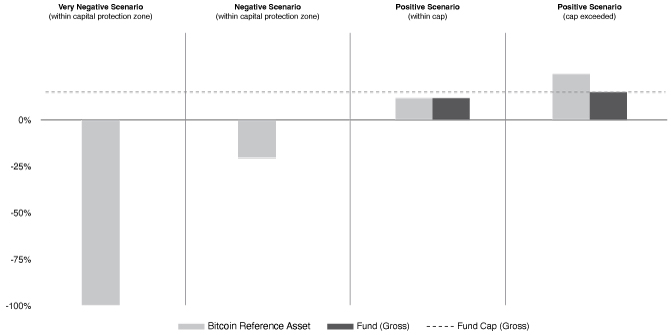
seeks to provide do not include the costs associated with purchasing Fund Shares and certain expenses incurred by the Fund. In the payoff profile illustration, the dotted line represents the performance of one or more Underlying ETPs and/or Bitcoin Index, and the solid line represents the return profile gross of total fund operating fees and expenses sought by the Fund in relation to the indicated performance of the Underlying ETPs and/or Bitcoin Index. The bar chart below represents the Fund's hypothetical intended return profile based upon the performance of the Underlying ETPs and/or Bitcoin Index. References to the Bitcoin Reference Asset in the charts below are intended to refer to the Underlying ETPs and/or Bitcoin Index. The portfolio of options utilized by the Advisor may consist of options on one or more of the Underlying ETPs and/or Bitcoin Index at the determination of the Advisor based on then current market factors.
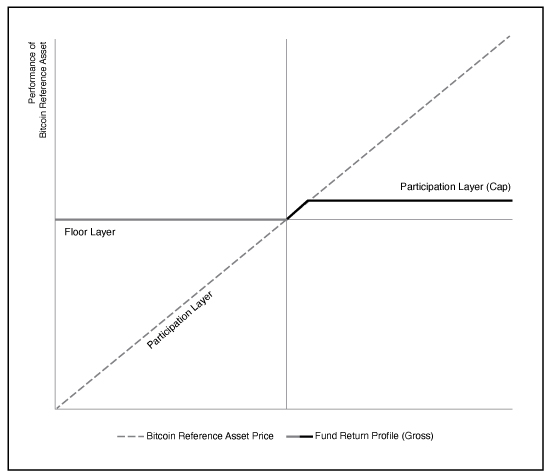
The Advisor seeks to provide investment exposure to the price performance experienced by Spot bitcoin by investing in options referencing one or more Underlying ETPs and/or Bitcoin Index while seeking to limit losses against significant decreases in the price of one or more of the Underlying ETPs and/or Bitcoin Index through the Fund's Protection Layer, which consists of a combination of cash, cash equivalents, box spreads, and/or U.S. Treasury securities. The Advisor seeks to specifically select the strike price for each contract in the Options Portfolio such that if the options were exercised on the expiration date (the final day of the option term set at approximately one (1) year), the Fund's portfolio would experience the price return of Spot bitcoin subject to a maximum gain on the price performance of Spot bitcoin over the duration of the options contracts and would seek to be protected from losses to the extent of the value of the Protection Layer.
|
PORTFOLIO INVESTMENT |
INVESTMENT TERMS |
PORTFOLIO INVESTMENT PERCENTAGE |
TARGET PORTFOLIO MATURITY |
||||||||||||
|
Some combination of cash, cash equivalents, box spreads, and/or U.S. Treasury securities |
Multiple series of U.S. Treasury Bills supported by full faith and credit of U.S. government, cash, cash equivalents, and/or box spreads |
Approximately 96% at the time of investment |
12 months | ||||||||||||
|
Purchased call option contracts on Underlying ETPs and/or Bitcoin Index |
"At-the-money" (i.e., strike price equal to the current bitcoin reference asset market price) call options at approximately 100% of the respective Underlying ETPs and/or Bitcoin Index price at the time of investment |
Approximately 21% at the time of investment |
12 months | ||||||||||||
|
Sold call option contracts on Underlying ETPs and/or Bitcoin Index |
"Out-of-the-money" (i.e., strike price is more than the current bitcoin reference asset market price) options used to help fund purchased call option contracts |
Approximately -18% at the time of investment |
12 months | ||||||||||||
1. Calamos Bitcoin Structured Alt Protection ETF® — July Bitcoin Reference Price: The dotted grey line represents the Bitcoin reference price. The price at the origin of the axes represents the Bitcoin reference price at the beginning of the subject current Outcome Period.
2. Calamos Bitcoin Structured Alt Protection ETF® — July Capital Protection Layer: The grey line represents the Capital Protection Layer. The Fund purchases some combination of cash, cash equivalents, box spreads, and/or U.S. Treasury securities with weighted average maturities of approximately twelve (12) months or less to provide the protection level. In the event that the price of Spot bitcoin, and correspondingly the Underlying ETPs and/or Bitcoin Index decrease in value over the duration of the option contracts to a price that is lower than the strike price of the purchased option contract, the Fund's options positions would not be exercised and the Fund's value would be comprised primarily of some combination of cash, cash equivalents, box spreads, and/or U.S. Treasury securities. These securities held by the Fund are intended to provide the downside protection against decreases in the price of Spot bitcoin and, correspondingly, the Underlying ETPs and/or Bitcoin Index. There is no guarantee that the portion of the Fund's portfolio consisting of these securities will retain sufficient value to provide the level of portfolio protection sought by the Fund. The value of the Fund's holdings in these securities may increase (providing a higher protection level and therefore more protection to shareholders) or decrease (providing a lower protection level and therefore less protection to shareholders).
3. Calamos Bitcoin Structured Alt Protection ETF® — July Capped Upside Layer (the "Cap"): The black line represents the capped upside layer — The Fund simultaneously enters into long at-the-money call options related to one or more of the Underlying ETPs and/or Bitcoin Index, and a short out-of-the money call option (to help offset the cost of the long call Options), which allows the Fund's participation in the upside price movement of Spot bitcoin, and correspondingly, the Underlying ETPs and/or Bitcoin Index, to a specific cap rate. The Fund's sold options effectively set an upper limit on the Fund's possible performance relative to the Underlying ETPs and/or Bitcoin Index by selling the Fund's ability to participate in increases in the share price of each of the Underlying ETPs and/or Bitcoin Index beyond the strike price of the sold call options over the duration of the Outcome Period and setting a limit on the Underlying ETPs and/or Bitcoin Index price performance gains for the duration of the Outcome Period. The strike price for the sold call options is dependent upon prevailing market conditions at the times the Fund originally enters into the options contracts. There can be no guarantee that the Options Portfolio, Underlying ETPs and/or Bitcoin Index will perform as expected.
The percentages in the table above are updated shortly before the beginning of a new Outcome Period. Please refer to the section titled "Subsequent Outcome Periods" for more details regarding updates pertaining to new Outcome Periods.
While the Advisor will seek to invest the Fund's portfolio in OTC Options and, if and when available, FLEX Options and/or Listed Options and some combination of cash, cash equivalents, box spreads, and/or U.S. Treasury securities, each with twelve (12) months expiration in the case of options, or twelve (12) months or less maturities in the case of U.S. Treasury securities, these
expiration and maturity dates may not be precisely twelve (12) months as a result of market conditions at the time of purchase. In addition, the percentage of the Fund's net assets allocated to (i) the cash, cash equivalents, box spreads, and/or U.S. Treasury securities at the time of purchase compared to the percentage allocated to (ii) the OTC Options and, when and if available, FLEX Options and/or Listed Options that are established to reference the Underlying ETPs and/or Bitcoin Index at the time of purchase may be greater than or less than the sought-after allocation due to market conditions at the time of executing the Fund's OTC Options and FLEX Options and/or Listed Options, and the allocation may change due to market conditions over the Outcome Period.
The Chart below represents the Capped upside as a dotted line and the solid line shows the Fund's gross return not falling to less than zero based on the capital protection strategy.
Explanation of diagram — Second Method/Approach:
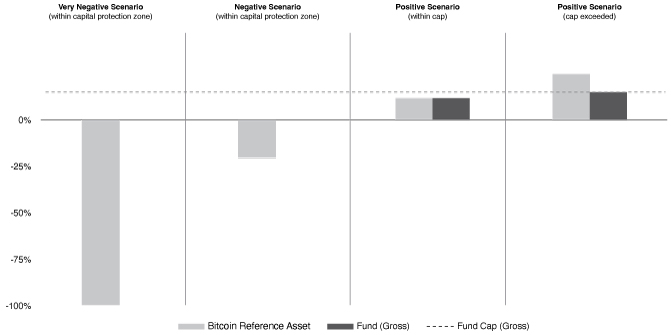
The hypothetical examples set forth below do not represent the performance of the Fund and investors should not rely on the hypothetical examples shown below as an indication of the actual or future performance of the Fund. There is no guarantee that the Fund will be successful in its attempt to provide the target outcomes for an Outcome Period. The returns that the Fund seeks to provide do not include the costs associated with purchasing Fund Shares and certain expenses incurred by the Fund. In the payoff profile illustration, the dotted line represents the performance of one or more Underlying ETPs and/or Bitcoin Index, and the solid line represents the return profile gross of total fund operating fees and expenses sought by the Fund in relation to the indicated performance of the Underlying ETPs and/or Bitcoin Index. The bar chart below represents the Fund's hypothetical intended return profile based upon the performance of the Underlying ETPs and/or Bitcoin Index. References to the Bitcoin Reference Asset in the charts below are intended to refer to the Underlying ETPs and/or Bitcoin Index. The portfolio of options utilized by the Advisor may consist of options on one or more of the Underlying ETPs and/or Bitcoin Index at the determination of the Advisor based on then current market factors.
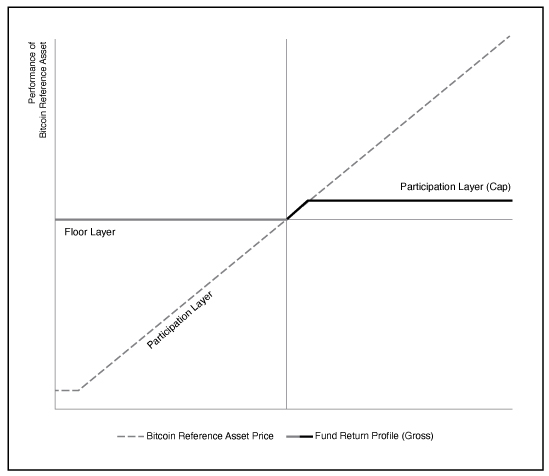
The Advisor seeks to provide investment exposure to the price performance experienced by Spot bitcoin by investing in options referencing one or more Underlying ETPs and/or Bitcoin Index while seeking to limit losses against significant decreases in the price of one or more of the Spot bitcoin. through the protection layer provided by an at-the-money put option on the Underlying ETPs and/or Bitcoin Index. The Advisor seeks to specifically select the strike price for each contract in the Options Portfolio such that if the options were exercised on the expiration date (the final day of the option term set at approximately one (1) year), the Fund's portfolio would experience the price return of Spot bitcoin subject to a maximum gain on the price performance of Spot bitcoin over the duration of the options contracts and would seek to be protected from losses to the extent of the value of the at-the-money put option.
|
PORTFOLIO INVESTMENT |
INVESTMENT TERMS |
PORTFOLIO INVESTMENT PERCENTAGE |
TARGET PORTFOLIO MATURITY |
||||||||||||
|
Purchased deep in-the-money call option contracts on Underlying ETPs and/or Bitcoin Index |
Involves purchasing a near zero-strike (i.e., deep in-the-money) call on the reference asset, at a pre-determined strike to provide approximately full participation to the price return of the underlying reference asset. In other words, the approximately full participation provided by this layer provides potential gains and losses that are tantamount to that of owning the Underlying ETPs and/or Bitcoin Index outright. |
Approximately 99% at the time of investment |
12 months | ||||||||||||
|
Purchased at-the-money put option contracts on Underlying ETPs and/or Bitcoin Index |
Involves purchasing an at-the-money put option, which produces protection equal to 100% of losses (before total fund operating fees and expenses) of the price return of the reference asset, over the Outcome Period. |
Approximately 17% at the time of investment |
12 months | ||||||||||||
|
Sold out-of-the-money call option contracts on Underlying ETPs and/or Bitcoin Index |
Involves selling an out-of-the-money call, thereby creating the upside cap. The strike price at which the call is sold is determined so that the combined net options purchase price is approximately equal to the underlying asset's current value. The cost of this layer is a credit equal to the price that would make the total package "no-cost" or fully financed. |
Approximately -17% at the time of investment |
12 months | ||||||||||||
1. Calamos Bitcoin Structured Alt Protection ETF® — July Participation Layer: The dotted grey line represents the first layer, which involves purchasing a near zero-strike (i.e., deep in-the-money) call on the reference asset, at a pre-determined strike to provide approximately full participation to the price return of the underlying reference asset. In other words, the full price participation provided by this layer provides potential gains and losses that are tantamount to that of owning the Underlying ETPs and/or Bitcoin Index outright.
2. Calamos Bitcoin Structured Alt Protection ETF® — July Capital Protection Layer: The solid grey line represents the second layer, which involves purchasing an at-the-money put option, which produces protection equal to 100% of losses (before total fund operating fees and expenses) of the price return of the reference asset, over the Outcome Period.
3. Calamos Bitcoin Structured Alt Protection ETF® — July Capped Upside Layer (the "Cap"): The solid black line illustrates the final layer, which involves selling an out-of-the-money call, thereby creating the upside cap. The strike price at which the call is sold is determined so that the combined net options purchase price is approximately equal to the underlying asset's current value. The cost of this layer is a credit equal to the price that would make the total package "no-cost" or fully financed. There can be no guarantee that the Options Portfolio, Underlying ETPs and/or Bitcoin Index will perform as expected.
The percentages in the table above are updated shortly before the beginning of a new Outcome Period. Please refer to the section titled "Subsequent Outcome Periods" for more details regarding updates pertaining to new Outcome Periods.
The Chart below represents the Capped upside as a dotted line and the solid line shows the Fund's gross return not falling to less than zero based on the capital protection strategy.
The Fund is classified as "non-diversified" under the Investment Company Act of 1940, as amended (the "1940 Act").
Capital Protection and Cap — First Method/Approach
The Fund seeks to provide capital protection to absorb 100% of the negative price return (before total fund operating fees and expenses) of the price of Spot bitcoin at the end of each Outcome Period as measured by the BRRNY. When the Fund's total fund operating fees and expenses are also taken into account, the Capital Protection level is reduced to 99.31%.
In the event that the price of Spot bitcoin, and correspondingly the Underlying ETPs and/or Bitcoin Index decrease in value over the duration of the option contracts to a price that is lower than the strike price of the option contract, the Fund's options positions would not be exercised and the Fund's value would be comprised primarily of the U.S. Treasury securities, box spreads, and/or cash and cash equivalents. The Protection Layer is intended to provide the downside protection against decreases in the price of Spot bitcoin.
The Capital Protection level will be further reduced by any brokerage commissions, trading fees, taxes and extraordinary expenses not included in the Fund's management fee. If the Fund is required to increase its holdings of cash during the Outcome Period to pay total fund operating fees and expenses incurred by the Fund, the Capital Protection level may be further reduced. The Fund does not seek to provide capital protection against 100% of the negative price return (before total fund operating fees and expenses) of Spot bitcoin as of any time other than the end of the Outcome Period.
During the Outcome Period, there may be periods of significant disparity between the Fund's NAV and the BRRNY's price performance. As the BRRNY's prices and the Fund's NAV change over the Outcome Period, an investor acquiring Fund Shares after the start of the Outcome Period will likely have a different return potential than an investor who purchased Fund Shares at the start of the Outcome Period. This is because while the Cap and Capital Protection for the Outcome Period are fixed levels that are calculated in relation to the BRRNY price and the Fund's NAV at the start of an Outcome Period and remain constant throughout the Outcome Period, an investor purchasing Fund Shares at market value during the Outcome Period likely purchased Fund Shares at a price that is different from the Fund's NAV at the start of the Outcome Period (i.e., the NAV that the Cap and Capital Protection reference). For example, if an investor purchases Fund Shares during an Outcome Period at a time when the Fund has increased in value from the value of the Fund on the first day of the Outcome Period (the "Initial Fund Value"), that investor's Cap will essentially be decreased by the amount of the BRRNY's value, and the capital protection will not set in until the Fund's NAV returns to its Initial Fund Value (i.e., a shareholder must experience losses prior to gaining the
protection offered by the Fund's Capital Protection because the Fund must first decrease in value to its Initial Fund Value for the Outcome Period before subsequent losses will be protected by the Capital Protection). Conversely, if an investor purchases Fund Shares during an Outcome Period at a time when the BRRNY's price has decreased in value, the Fund's NAV may dip below the Initial Fund Value. However, in this scenario, that investor's potential gain could be larger than the Fund's Cap for the Outcome Period because the investor may experience the full gain if the Fund recovers the value it has lost from the first day of the Outcome Period through the date the investor purchased its Fund Shares plus any additional gains between the Initial Fund Value and the Cap. There is no guarantee that the Fund will recover such value or experience such gains. The Cap and Capital Protection relative to the Initial Fund Value, however, will not change over the Outcome Period.
While the Fund seeks to provide 100% protection against the negative price return of Spot bitcoin (before total fund operating fees and expenses) for shareholders who hold Fund Shares for an entire Outcome Period, there is no guarantee it will successfully do so. If the Fund's NAV has increased significantly, a shareholder that purchases Fund Shares after the first day of an Outcome Period could lose their entire investment. An investment in the Fund is only appropriate for shareholders willing to bear those losses. There is no guarantee the Capital Protection and Cap will be successful and a shareholder investing at the beginning of an Outcome Period could also lose their entire investment.
The returns of the Fund are subject to a Cap for each Outcome Period, determined by taking the Spot bitcoin price as of the first day of the Outcome Period, calculated (before total fund operating fees and expenses) at the beginning of each Outcome Period. Unlike other investment products, the potential returns an investor can receive from the Fund are subject to a pre-determined upside return Cap that represents the maximum percentage return an investor can achieve from an investment in the Fund for an entire Outcome Period. If Spot bitcoin experiences any percentage gains over the amount of the Cap, Fund shareholders will not experience those gains. Therefore, regardless of the price of Spot bitcoin, the Cap (net of total fund operating fees and expenses) is the maximum return an investor can achieve from an investment in the Fund for that Outcome Period. The Cap is set on the first day of each Outcome Period. The Cap is provided prior to taking into account annual Fund management fees of 0.69% of the Fund's daily net assets, brokerage commissions, trading fees, taxes and any extraordinary expenses (such as unexpected litigation) incurred by the Fund. The pre-determined Cap applicable to an Outcome Period will vary based on prevailing market conditions at the time that the Cap is set, including interest rate levels, spot bitcoin and the BRRNY volatility, and, by way of example, the relationship of long and short calls on the OTC options and, if and when available, FLEX Options and/or Listed Options.
The Cap level is a result of the design of the Fund's principal investment strategy. To provide the Capital Protected Target Outcome, the Fund will engage in investment strategies to purchase U.S. Treasury securities, and purchase and sell a series of OTC call Options and, if and when available, FLEX Options and/or Listed Options on or around the last business day of the month prior to the beginning of an Outcome Period. The Fund's purchased call options are intended to provide the Fund exposure to the price return of Spot bitcoin through the Underlying ETPs and/or Bitcoin Index (gains and losses) starting at 100% of the BRRNY. The Options Portfolio, through these purchased call options, seeks to provide investment returns that track the performance of Spot bitcoin. As the purchaser of these derivative positions, the Fund is obligated to pay, in the case of options, a premium to the seller of those options in addition to paying other specified transaction costs. The Fund also sells call options to help pay the premium of the purchased call options that allow the Fund's participation in the Underlying ETPs and/or Bitcoin Index price performance. The Fund's sold call options effectively sell the Fund's ability to participate in increases in the share price of the Underlying ETPs and/or Bitcoin Index beyond the strike price of the sold call options over the duration of the Options Portfolio and sets an upper limit (the Cap) on the Underlying ETPs and/or Bitcoin Index price performance gains for the duration of the options contracts (the Target Outcome Period). The strike price for the sold call options (i.e., the Cap) is dependent upon prevailing market conditions at the times the Fund originally enters into the call options contracts. The Cap, and the Fund's value relative to it on any given day, should be considered before investing in the Fund. If an investor purchases Fund Shares during an Outcome Period, and the Fund has already increased in value above its Initial Fund Value for that Outcome Period to a level near the Cap, an investor purchasing Fund Shares will have limited to no gain potential for the remainder of the Outcome Period (because the investor's potential gain will be limited to the difference between the Fund's NAV on the date the investor purchased the Fund Shares and the Cap). However, the investor will remain vulnerable to significant downside risk because the investor will bear the losses between the price at which it purchased its Fund Shares and
the Initial Fund Value for the Outcome Period before subsequent losses will be protected by the Capital Protection. If an investor buys Fund Shares when the price exceeds the Cap, an investor selling their shares at the end of the Outcome Period will not experience any gain regardless of the price return of Spot bitcoin. There is no guarantee that the Fund will be successful in providing these investment outcomes for any Outcome Period, and an investor may experience returns on the Fund significantly below the Cap.
In periods of extreme market volatility or during market disruption events, the Fund's ability to offset investor losses through the use of derivative transactions and U.S. Treasury securities to achieve the stated Capital Protection, or provide a return up to the stated upside Cap may be impaired, resulting in an upside limit significantly below the Cap and downside protection significantly lower than full capital protection (i.e., losses greater than 0%), because the Fund may not be able to trade or exercise existing OTC Options, and when and if available FLEX Options and/or Listed Options or may not receive timely payment from its counterparties. In addition, while the Advisor will target a certain asset allocation approach at the time of entering into the OTC Options and when and if available FLEX Options and/or Listed Options the value of the assets comprising the Protection Layer will also increase and decrease due to market conditions over the Outcome Period. An investor may lose their entire investment and an investment in the Fund is only appropriate for investors willing to bear those losses.
For each Outcome Period, in addition to any investment in options comprising the box spread, the Fund will invest in both purchased and written call OTC Options, and if and when available, purchased and written call FLEX Options and purchased put FLEX Options and/or Listed Options that reference the Underlying ETPs and/or Bitcoin Index. Because the value of the Fund is based on options that reference the Underlying ETPs and/or Bitcoin Index and not the Underlying ETPs and/or Bitcoin Index directly, variations in the value of such derivative positions impact the correlation between the Fund's NAV and the price of the Underlying ETPs and/or Bitcoin Index. As noted above, each type of option or a combination of each such options are expected to be used by the Fund if and when they do become available.
The BRRNY is calculated by CF Benchmarks Ltd. ("CF Benchmarks") based on an aggregation of executed trade flow of major bitcoin spot exchanges. BRRNY is designed to reflect the performance of bitcoin in U.S. dollars and currently uses substantially the same methodology as the CME CF Bitcoin Reference Rate ("BRR"), including utilizing the same six bitcoin exchanges, which is the underlying rate to determine settlement of CME bitcoin futures contracts, except that BRRNY is calculated as of 4:00 p.m. Eastern time ("ET"), whereas the BRR is calculated as of 4:00 p.m. London time.
BRRNY was developed by CF Benchmarks and has a limited performance history. Although BRRNY is based on materially the same methodology (except calculation time) as the BRR, which was first introduced in November 2016, BRRNY itself has only been in operation since February 2022, and it has only featured its current roster of Constituent Exchanges since May 2022. A longer history of actual performance through various economic and market conditions would provide greater and more reliable information for an investor to assess BRRNY's performance. CF Benchmarks has substantial discretion at any time to change the methodology used to calculate BRRNY, including the spot markets that contribute prices to the Trust's NAV. CF Benchmarks does not have any obligation to take the needs of the Trust, the Trust's Shareholders, or anyone else into consideration in connection with such changes. There is no guarantee that the methodology currently used in calculating BRRNY will appropriately track the price of bitcoin in the future.
Many of the digital asset trading venues that facilitate the buying and selling of bitcoin and other digital assets and that are used by BRRNY refer to themselves as "exchanges," but they are not registered with, or supervised by, the SEC or CFTC and do not meet the regulatory standards of a national securities exchange or designated contract market. For these reasons, among others, purchases and sales of bitcoin may be subject to temporary distortions or other disruptions due to various factors, including the lack of liquidity in the markets and government regulation and intervention. These circumstances could affect the price of bitcoin used in Index calculations and, therefore, could adversely affect the bitcoin price as reflected by BRRNY.
BRRNY is based on various inputs which include price data from various third-party bitcoin spot markets. CF Benchmarks does not guarantee the validity of any of these inputs, which may be subject to technological error, manipulative activity, or fraudulent reporting from their initial source.
Capital Protection and Cap — Second Method/Approach
Under the Second Method/Approach, the Fund seeks to provide capital protection to absorb 100% of the negative price return (before total fund operating fees and expenses) of the price of Spot bitcoin at the end of each Outcome Period as measured by the BRRNY. When the Fund's total fund operating fees and expenses are taken into account, the Capital Protection level is reduced to 99.31%. The Capital Protection level will be further reduced by any brokerage commissions, trading fees, taxes and extraordinary expenses not included in the Fund's management fee. If the Fund is required to increase its holdings of cash during the Outcome Period to pay total fund operating fees and expenses incurred by the Fund, the Capital Protection level may be further reduced. The Fund does not seek to provide capital protection against 100% of the negative price return (before total fund operating fees and expenses) of Spot bitcoin as of any time other than the end of the Outcome Period.
During the Outcome Period, there may be periods of significant disparity between the Fund's NAV and the reference asset(s) price performance. As the Underlying ETP price and/or Bitcoin Index price and the Fund's NAV change over the Outcome Period, an investor acquiring Fund Shares after the start of the Outcome Period will likely have a different return potential than an investor who purchased Fund Shares at the start of the Outcome Period. This is because while the Cap and Capital Protection for the Outcome Period are fixed levels that are calculated in relation to the BRRNY price and the Fund's NAV at the start of an Outcome Period and remain constant throughout the Outcome Period, an investor purchasing Fund Shares at market value during the Outcome Period likely purchased Fund Shares at a price that is different from the Fund's NAV at the start of the Outcome Period (i.e., the NAV that the Cap and Capital Protection reference). For example, if an investor purchases Fund Shares during an Outcome Period at a time when the Fund has increased in value from the value of the Fund on the first day of the Outcome Period (the "Initial Fund Value"), that investor's Cap will essentially be decreased by the amount of the increase in the Underlying ETPs and/or Bitcoin Index value, and the capital protection will not set in until the Fund's NAV returns to its Initial Fund Value (i.e., a shareholder must experience losses prior to gaining the protection offered by the Fund's Capital Protection because the Fund must first decrease in value to its Initial Fund Value for the Outcome Period before subsequent losses will be protected by the Capital Protection). Conversely, if an investor purchases Fund Shares during an Outcome Period at a time when the Underlying ETPs and/or Bitcoin Index has decreased in value, the Fund's NAV may dip below the Initial Fund Value. However, in this scenario, that investor's potential gain could be larger than the Fund's Cap for the Outcome Period because the investor may experience the full gain if the Fund recovers the value it has lost from the first day of the Outcome Period through the date the investor purchased its Fund Shares plus any additional gains between the Initial Fund Value and the Cap. There is no guarantee that the Fund will recover such value or experience such gains. The Cap and capital protection relative to the Initial Fund Value, however, will not change over the Outcome Period.
While the Fund seeks to provide 100% protection against the negative price return of Spot bitcoin (before total fund operating fees and expenses) for shareholders who hold Fund Shares for an entire Outcome Period, there is no guarantee it will successfully do so. If the Fund's NAV has increased significantly, a shareholder that purchases Fund Shares after the first day of an Outcome Period could lose their entire investment. An investment in the Fund is only appropriate for shareholders willing to bear those losses. There is no guarantee the capital protection and cap will be successful and a shareholder investing at the beginning of an Outcome Period could also lose their entire investment.
The returns of the Fund are subject to a cap for each Outcome Period, calculated (before total fund operating fees and expenses) at the beginning of each Outcome Period. Unlike other investment products, the potential returns an investor can receive from the Fund are subject to a pre-determined upside return Cap that represents the maximum percentage return an investor can achieve from an investment in the Fund for an entire Outcome Period. If the Underlying ETPs and/or Bitcoin Index experience any percentage gains over the amount of the Cap, Fund shareholders will not experience those gains. Therefore, regardless of the price return of the Underlying ETPs and/or Bitcoin Index, the Cap (net of total fund operating fees and expenses) is the maximum return an investor can achieve from an investment in the Fund for that Outcome Period. The Cap is set on the first day of each Outcome Period. The Cap is provided prior to taking into account annual Fund management fees of 0.69% of the Fund's daily net assets, brokerage commissions, trading fees, taxes and any extraordinary expenses (such as unexpected litigation) incurred by the Fund. The pre-determined Cap applicable to an Outcome Period will vary based on prevailing market conditions at the time that the Cap is set, including interest rate levels, Underlying ETPs and/or Bitcoin Index volatility, and the relationship of puts and calls on the FLEX Options.
The Cap level is a result of the design of the Fund's principal investment strategy. To provide the Capital Protected Target Outcome, the Fund purchases and sells a series of put and call FLEX Options on or around the last business day of the month prior to the beginning of an Outcome Period. As the purchaser of these FLEX Options, the Fund is obligated to pay a premium to the seller of those FLEX Options. The Advisor will calculate the amount of premiums that the Fund will owe on the put options acquired to provide the Capital Protection and will then sell call FLEX Options with terms that entitle the Fund to receive premiums such that the net amount of premiums paid per unit of the Underlying ETPs and/or Bitcoin Index is approximately equal to the price per unit of shares of the Underlying ETPs and/or Bitcoin Index. The Cap is the strike price of those FLEX Options the Fund is selling. The Cap, and the Fund's value relative to it on any given day, should be considered before investing in the Fund. If an investor purchases Fund Shares during an Outcome Period, and the Fund has already increased in value above its Initial Fund Value for that Outcome Period to a level near the Cap, an investor purchasing Fund Shares will have limited to no gain potential for the remainder of the Outcome Period (because the investor's potential gain will be limited to the difference between the Fund's NAV on the date the investor purchased the Fund Shares and the Cap). However, the investor will remain vulnerable to significant downside risk because the investor will bear the losses between the price at which it purchased its Fund Shares and the Initial Fund Value for the Outcome Period before subsequent losses will be protected by the Capital Protection. If an investor buys Fund Shares when the price exceeds the Cap, an investor selling their shares at the end of the Outcome Period will not experience any gain regardless of the price return of the Underlying ETPs and/or Bitcoin Index.
There is no guarantee that the Fund will be successful in providing these investment outcomes for any Outcome Period, and an investor may experience returns on the Fund significantly below the Cap.
In periods of extreme market volatility or during market disruption events, the Fund's ability to offset investor losses through the use of the FLEX Options to achieve the stated Capital Protection, or provide a return up to the stated upside Cap may be impaired, resulting in an upside limit significantly below the Cap and downside protection significantly lower than full capital protection (i.e., losses greater than 0%), because the Fund may not be able to trade or exercise existing FLEX Options, or may not receive timely payment from its counterparties. An investor may lose their entire investment and an investment in the Fund is only appropriate for investors willing to bear those losses.
For each Outcome Period, the Fund will seek to invest in both purchased and written call FLEX Options and/or Listed Options and purchased put FLEX Options and/or Listed Options, if and when available, that reference one or more Underlying ETPs and/or Bitcoin Index. Because the value of the Fund is based on FLEX Options and/or Listed Options that reference the Underlying ETPs and/or Bitcoin Index and not the Underlying ETPs and/or Bitcoin Index directly, variations in the value of the FLEX Options impact the correlation between the Fund's NAV and the price of the Underlying ETPs and/or Bitcoin Index.
General Information about OTC Options
Over-the-counter (OTC) Options are purchased from or sold to sellers or purchasers ("Counterparties") through direct bilateral agreements with the Counterparties. In contrast to exchange listed options, which generally have standardized terms and performance mechanics, all the terms of an OTC Option, including such terms as method of settlement, length of option contract, exercise price, premium, guarantees and security, are set by negotiation of the parties.
Unless the parties provide for it, there is no central clearing or guaranty function in an OTC Option. As a result, if the Counterparty fails to make or take delivery of the security, currency or other instrument underlying an OTC Option it has entered into with the Fund or fails to make a cash settlement payment due in accordance with the terms of that option, the Fund will lose any premium it paid for the option as well as any anticipated benefit of the transaction. Accordingly, the Advisor must assess the creditworthiness of each such Counterparty or any guarantor or credit enhancement of the Counterparty's credit to determine the likelihood that the terms of the OTC Option will be satisfied. The staff of the SEC currently takes the position that OTC Options purchased by a Fund, and portfolio securities "covering" the amount of a Fund's obligation pursuant to an OTC Option sold by it (or the amount of assets equal to the formula price for the repurchase of the option, if any, less the amount by which the option is "in the money") are illiquid, and are subject to a Fund's limitation on investing no more than 15% of its net assets in illiquid securities.
The OTC Options that the Fund will hold that reference the Underlying ETPs will give the Fund the right or the obligation to either receive or deliver shares of the Underlying ETPs, or the right or the obligation to either receive or deliver a cash payment on the option expiration date based upon the difference between the Underlying ETPs' value and a strike price, depending on whether the Fund purchases or sells the option. The Fund expects to enter into European style options, which are exercisable at the strike price only on the OTC Option expiration date. From time to time, the Fund may enter into American style options, which are exercisable at any time during the life of the option. The Fund will generally, under normal conditions, hold OTC Options for each Outcome Period. The Fund will purchase call options (giving the Fund the right to receive shares of the Underlying ETPs or a cash payment), while simultaneously selling (i.e., writing) call options (giving the Fund the obligation to deliver shares of the Underlying ETPs or a cash payment). With respect to box spreads, the Fund will purchase call options (giving the Fund the right to receive shares of the box spread reference asset (SPX or SPY) or a cash payment), put options (giving the Fund the right to deliver shares of SPX or SPY or a cash payment), and may sell (i.e., write) call options (giving the Fund the obligation to deliver shares of SPX or SPY or a cash payment) and put options (giving the Fund the obligation to receive shares of SPX or SPY or a cash payment) in instances where it is deemed necessary or desirable to construct the Box Spread. In instances where the purchased call and/or put options are substantially in-the-money and the synthetic long and short positions comprising the Box Spread can effectively be constructed without writing call or put options, the Fund may elect not to write call or put options. The Fund intends to the extent permitted to structure the OTC Options so that any amount owed by the Fund on the written OTC Options will be covered by payouts at expiration from the purchased OTC Options. As a result, the Fund expects the OTC Options to be fully covered and no additional collateral will be necessary during the life of the Fund. The Fund receives premiums in exchange for the written OTC Options and pays premiums in exchange for the purchased OTC Options. Each of the OTC Options purchased and sold throughout the Outcome Period will have the same terms, such as strike price and expiration date, as the OTC Options purchased and sold on the first day of the Outcome Period. On the OTC Options expiration date, the Fund intends to sell the OTC Options prior to their expiration or cash-settle the OTC Options and use the resulting proceeds to purchase new OTC Options for the next Outcome Period.
Additional Information Regarding the Availability of FLEX Options and Listed Options
As noted above, each type of option or a combination of each such options are expected to be used by the Fund in place of OTC Options if and when they do become available.
FLEX Options are customizable exchange-traded option contracts guaranteed for settlement by the OCC. The OCC guarantees performance by each of the counterparties to the FLEX Options and/or Listed Options, becoming the "buyer for every seller and the seller for every buyer," with the goal of protecting clearing members and options traders from counterparty risk. The OCC may make adjustments to FLEX Options and/or Listed Options for certain significant events. Although guaranteed for settlement by the OCC, FLEX Options and Listed Options are still subject to counterparty risk with the OCC and subject to the risk that the OCC may fail to perform the settlement of the FLEX Options and/or Listed Options due to bankruptcy or other adverse reasons. The FLEX Options and/or Listed Options that the Fund will hold that reference one or more Underlying ETPs will give the Fund the right or the obligation to either receive or deliver shares of the applicable Underlying ETP, or the right or the obligation to either receive or deliver a cash payment on the option expiration date based upon the difference between the Underlying ETP's value and a strike price, depending on whether the Fund purchases or sells the option. The FLEX Options and/or Listed Options held by the Fund primarily are generally expected to be European style options, which are exercisable at the strike price only on the FLEX Option or Listed Option expiration date. The Fund will generally, under normal conditions, hold FLEX Options and/or Listed Options for each Outcome Period. The Fund will purchase call options (giving the Fund the right to receive shares of the Underlying ETP or a cash payment), while simultaneously selling (i.e., writing) call options (giving the Fund the obligation to deliver shares of the Underlying ETP or a cash payment). With respect to box spreads, the Fund will purchase call options (giving the Fund the right to receive shares of the box spread reference asset (SPX or SPY) or a cash payment), put options (giving the Fund the right to deliver shares of SPX or SPY or a cash payment), and may sell (i.e., write) call options (giving the Fund the obligation to deliver shares of SPX or SPY or a cash payment) and put options (giving the Fund the obligation to receive shares of SPX or SPY or a cash payment) in instances where it is deemed necessary or desirable to construct the Box Spread. In instances where the purchased call and/or put options are substantially in-the-money and the synthetic long and short positions comprising the Box Spread can effectively be constructed without writing call or put options, the Fund may elect not to write call or put options. The Fund intends to the extent permitted to structure the FLEX Options
and/or Listed Options so that any amount owed by the Fund on the written FLEX Options and/or Listed Options will be covered by payouts at expiration from the purchased FLEX Options and/or Listed Options. The Fund receives premiums in exchange for the written FLEX Options and/or Listed Options and pays premiums in exchange for the purchased FLEX Options and/or Listed Options. The OCC and securities exchanges on which the FLEX Options and/or Listed Options are listed do not charge ongoing fees to writers or purchasers of the FLEX Options and/or Listed Options during their life for continuing to hold the option contracts but may charge transaction fees. Each of the FLEX Options and/or Listed Options purchased and sold throughout the Outcome Period will have many of the same terms, such as strike price and expiration date, as the FLEX Options and/or Listed Options purchased and sold on the first day of the Outcome Period. On the FLEX Options and/or Listed Options expiration date, the Fund intends to sell the FLEX Options or Listed Options prior to their expiration or cash-settle the FLEX Options or Listed Options and use the resulting proceeds to purchase new FLEX Options or Listed Options for the next Outcome Period.
General information about box spreads
A Box Spread is an offsetting set of options, which may include Flexible Exchange Options ("FLEX Options"). Box Spreads consists of a synthetic long position coupled with an offsetting synthetic short position through a combination of options contracts on a reference asset at the same expiration date. The synthetic long position consists of (i) buying a call option and (ii) selling a put option, each on the same reference asset and each with the same strike price and expiration date. The reference asset in the context of box spreads is likely the SPY or SPX, whereas options utilized for reasons other than Box Spreads are ones that reference the price performance one or more of Underlying ETPs which own bitcoin and/or options that reference one or more Bitcoin Indexes. The synthetic short position consists of (i) buying a put option and (ii) selling a call option, each on the same reference asset and each with the same expiration date as the synthetic long but with a different strike price from the synthetic long position. The difference between the strike prices of the synthetic long position and the synthetic short position determines the expiration value (or value at maturity) of the Box Spread. An important feature of the Box Spread construction process is that it seeks to eliminate market risk tied to price movements associated with the underlying options' reference asset. Once the Box Spread is initiated, its return from the initiation date through expiration will not change due to price movements in the underlying options' reference assets. The Fund may purchase Box Spreads on various indices or securities based on risk and return considerations.
The Underlying ETPs
iShares Bitcoin ETF (IBIT) Description
IBIT or "the iShares Bitcoin Trust ETF" for purposes of this section is an exchange-traded investment vehicle that seeks to reflect generally the performance of the price of bitcoin, before payment of the iShares Bitcoin Trust ETF's expenses and liabilities. iShares Delaware Trust Sponsor LLC serves as the iShares Bitcoin Trust ETF's sponsor. You can find the iShares Bitcoin Trust ETF's prospectus and other information, including the most recent reports to shareholders, online at https://www.ishares.com/us/products/333011/ishares-bitcoin-trust-etf.
The summary information below regarding the iShares Bitcoin Trust ETF comes from its filings with the SEC. You are urged to refer to the SEC filings made by the iShares Bitcoin Trust ETF and to other publicly available information to obtain an understanding of the iShares Bitcoin Trust ETF's business and financial prospects. The following description of the iShares Bitcoin Trust ETF's principal investment strategies was taken directly from the iShares Bitcoin Trust ETF's prospectus, dated July 31, 2025 ("IBIT" refers to the iShares Bitcoin Trust ETF; other defined terms have been modified).
IBIT seeks to achieve its investment objective by holding bitcoin, with the value of the iShares Bitcoin Trust ETF's bitcoin holdings intended to reflect the price performance of bitcoin as measured by the CF Benchmarks Index. The iShares Bitcoin Trust ETF values its bitcoin holdings based on the CF Benchmarks Index, which is calculated based on the bitcoin trading activity on several major bitcoin trading platforms (the "Constituent Platforms"). To maintain accurate pricing, the CF Benchmarks Index aggregates the trade flow of the Constituent Platforms during an observation window between 3:00 p.m. and 4:00 p.m. ET into the U.S. dollar price of one bitcoin at 4:00 p.m. ET.
The iShares Bitcoin Trust ETF is not actively managed and will not seek to sell bitcoin at times when its price is high or acquire bitcoin when its price is low. The iShares Bitcoin Trust ETF does not use leverage, derivatives or any similar arrangements in seeking to meet its investment objective.
The assets of the iShares Bitcoin Trust ETF consist primarily of bitcoin held by a custodian on behalf of the iShares Bitcoin Trust ETF. The Bitcoin Custodian keeps custody of all of the iShares Bitcoin Trust ETFs bitcoin, other than that which is maintained in a Trading Balance with the Prime Execution Agent, in accounts that are required to be segregated from the assets held by the Bitcoin Custodian as principal and the assets of its other customers (the "Vault Balance"). The Bitcoin Custodian keeps all of the private keys associated with the iShares Bitcoin Trust ETF's bitcoin held by the Bitcoin Custodian in the Vault Balance in "cold storage", which refers to a safeguarding method by which the private keys corresponding to the iShares Bitcoin Trust ETF's bitcoins are generated and stored in an offline manner using computers or devices that are not connected to the Internet, which is intended to make them more resistant to hacking.
The iShares Bitcoin Trust ETF issues and redeems Shares only in blocks of 40,000 Shares or integral multiples thereof ("Baskets"). The iShares Bitcoin Trust ETF issues and redeems Baskets only to Authorized Participants in exchange for cash or bitcoin. The iShares Bitcoin Trust ETF may incur certain transaction costs when buying and selling bitcoin in connection with the creation and redemption of Baskets. These costs, which are not reflected in the iShares Bitcoin Trust ETF's estimated annual ordinary operating expenses, affect the iShares Bitcoin Trust ETF's performance.
The iShares Bitcoin Trust ETF pays a sponsor's fee that accrues daily at an annualized rate of 0.25% of the net asset value of the iShares Bitcoin Trust ETF. The iShares Bitcoin Trust ETF does not hold or trade futures or swaps and is not a commodity pool. Although the iShares Bitcoin Trust ETF may fail to track the price of bitcoin precisely at any particular time, the iShares Bitcoin Trust ETF generally will be substantially invested in bitcoin, which should result in a close correspondence between the performance of bitcoin and the performance of the iShares Bitcoin Trust ETF.
The CF Benchmarks Index serves as the iShares Bitcoin Trust ETF's reference rate for bitcoin value. The index is designed to provide a reliable and representative benchmark for the bitcoin market, incorporating trading data from multiple major cryptocurrency exchanges that meet strict criteria for inclusion. The index has been recognized by financial regulators and serves as a pricing source for various bitcoin investment products.
As of June 27, 2025, the net asset value of iShares Bitcoin Trust ETF was $74,198,915,391 and the NAV was $60.70. The iShares Bitcoin Trust ETF maintains substantial exposure to digital assets through its bitcoin holdings, and investors should be aware of the unique risks associated with digital asset investments, including but not limited to technological, regulatory, and market volatility risks.
Bitwise Bitcoin ETF (BITB) Description
BITB or "the Bitwise Bitcoin Trust" for purposes of this section is an exchange-traded investment vehicle that seeks to provide exposure to the value of bitcoin held by the Bitwise Bitcoin Trust, less the expenses of the Bitwise Bitcoin Trust's operations and other liabilities. Bitwise Investment Advisers, LLC serves as the Bitwise Bitcoin Trust's sponsor. The investment objective of the Bitwise Bitcoin Trust is to seek investment results that correspond to the performance of bitcoin as measured by the CME CF Bitcoin Reference Rate — New York Variant (BRRNY). You can find the Bitwise Bitcoin Trust's prospectus and other information, including the most recent reports to shareholders, online at https://bitbetf.com/
The summary information below regarding the Bitwise Bitcoin Trust comes from its filings with the SEC. You are urged to refer to the SEC filings made by the Bitwise Bitcoin Trust and to other publicly available information to obtain an understanding of the Bitwise Bitcoin Trust's business and financial prospects. The following description of the Bitwise Bitcoin Trust's principal investment strategies was taken directly from the Bitwise Bitcoin Trust's prospectus ("BITB" refers to the Bitwise Bitcoin Trust; other defined terms have been modified).
BITB seeks to achieve its investment objective by holding bitcoin, with the value of the Bitwise Bitcoin Trust's bitcoin holdings intended to reflect the price performance of bitcoin as measured by the BRRNY. The Bitwise Bitcoin Trust is passively managed and does not pursue active management investment strategies. The Bitwise Bitcoin Trust will not sell bitcoin at times when its price is high or acquire bitcoin when its price is low. The Bitwise Bitcoin Trust does not use leverage or any similar arrangements in seeking to meet its investment objective.
The Bitwise Bitcoin Trust's assets consist primarily of bitcoin held by Coinbase Custody Trust Company, LLC as the Bitcoin Custodian on behalf of the Bitwise Bitcoin Trust. The Bitcoin Custodian maintains custody of all of the Bitwise Bitcoin Trust's bitcoin, other than that which is temporarily maintained in a Trading Balance with the Prime Execution Agent, in segregated
cold storage wallets. Cold storage refers to a safeguarding method where private keys are generated and stored offline on hardware that has never been connected to the internet, making them more resistant to hacking.
The Bitwise Bitcoin Trust issues and redeems Shares only in blocks of 10,000 Shares ("Baskets"). The Bitwise Bitcoin Trust issues and redeems Baskets only to Authorized Participants in exchange for cash. As of August 1, 2025, BITB is able to conduct creations and redemptions of Shares in-kind. The Bitwise Bitcoin Trust may incur certain transaction costs when buying and selling bitcoin in connection with the creation and redemption of Baskets. These costs affect the Bitwise Bitcoin Trust's performance.
The Bitwise Bitcoin Trust will pay a unitary Sponsor Fee of 0.20% per annum of the Bitwise Bitcoin Trust's bitcoin holdings. The Bitwise Bitcoin Trust does not engage in any activities designed to derive a profit from changes in the price of bitcoin.
The Bitwise Bitcoin Trust values its bitcoin holdings based on the BRRNY, which is calculated based on the bitcoin trading activity on several major bitcoin trading platforms (the "Constituent Platforms"). The BRRNY aggregates the trade flow of the Constituent Platforms during an observation window between 3:00 p.m. and 4:00 p.m. ET into the U.S. dollar price of one bitcoin at 4:00 p.m. ET.
The Bitwise Bitcoin Trust maintains substantial exposure to digital assets through its bitcoin holdings, and investors should be aware of the unique risks associated with digital asset investments, including but not limited to technological, regulatory, and market volatility risks.
Grayscale Bitcoin Mini Trust (BTC) Description
BTC or "the Grayscale Bitcoin Mini Trust ETF" for purposes of this section is an exchange-traded investment vehicle that seeks to reflect generally the performance of the price of bitcoin, before payment of the Grayscale Bitcoin Mini Trust ETF's expenses and liabilities. Grayscale Investments Sponsors, LLC serves as the Grayscale Bitcoin Mini Trust ETF's sponsor. The investment objective of the Grayscale Bitcoin Mini Trust ETF is to seek investment results that generally correspond to the performance of bitcoin as measured by the CoinDesk Bitcoin Price Index (XBX). You can find the Grayscale Bitcoin Mini Trust ETF's prospectus and other information, including the most recent reports to shareholders, online at https://etfs.grayscale.com/btc.
The summary information below regarding the Grayscale Bitcoin Mini Trust ETF comes from its filings with the SEC. You are urged to refer to the SEC filings made by the Grayscale Bitcoin Mini Trust ETF and to other publicly available information to obtain an understanding of the Grayscale Bitcoin Mini Trust ETF's business and financial prospects. The following description of the Grayscale Bitcoin Mini Trust ETF's principal investment strategies was taken directly from the Grayscale Bitcoin Mini Trust ETF's prospectus ("BTC" refers to the Grayscale Bitcoin Mini Trust ETF; other defined terms have been modified).
BTC seeks to achieve its investment objective by holding bitcoin, with the value of the Grayscale Bitcoin Mini Trust ETF's bitcoin holdings intended to reflect the price performance of bitcoin. The Grayscale Bitcoin Mini Trust ETF is not actively managed and will not seek to sell bitcoin at times when its price is high or acquire bitcoin when its price is low. The Grayscale Bitcoin Mini Trust ETF does not use leverage, derivatives or any similar arrangements in seeking to meet its investment objective.
The assets of the Grayscale Bitcoin Mini Trust ETF consist primarily of bitcoin held by a custodian on behalf of the Grayscale Bitcoin Mini Trust ETF. Coinbase Custody Trust Company, LLC serves as the custodian and keeps custody of all of the Grayscale Bitcoin Mini Trust ETF's bitcoin in segregated custody accounts, with a substantial portion held in "cold storage" — an offline safeguarding method where private keys are generated and stored using computers disconnected from the internet to enhance security against hacking.
The Grayscale Bitcoin Mini Trust ETF issues and redeems Shares only in blocks of 10,000 Shares ("Baskets"). The Grayscale Bitcoin Mini Trust ETF issues and redeems Baskets only to Authorized Participants, currently in exchange for cash through facilitated transactions with Liquidity Providers. Subject to regulatory approval, these transactions may also take place through in-kind exchanges of bitcoin in the future.
The Grayscale Bitcoin Mini Trust ETF pays a sponsor's fee that accrues daily at an annualized rate of 0.15% of the Grayscale Bitcoin Mini Trust ETF's NAV. The Grayscale Bitcoin Mini Trust ETF does not hold or trade futures or swaps and is not a commodity pool. Although the Grayscale Bitcoin Mini Trust ETF may fail to track the price of bitcoin precisely at any particular
time, the Grayscale Bitcoin Mini Trust ETF generally will be substantially invested in bitcoin, which should result in a close correspondence between the performance of bitcoin and the performance of the Grayscale Bitcoin Mini Trust ETF.
The Grayscale Bitcoin Mini Trust ETF values its bitcoin holdings based on the CoinDesk Bitcoin Price Index (XBX), which is calculated based on the bitcoin trading activity on several major bitcoin trading platforms including Coinbase, Bitstamp, Kraken, LMAX Digital and Crypto.com. The Index Price represents the U.S. dollar value of bitcoin at 4:00 p.m., New York time, each business day.
The Grayscale Bitcoin Mini Trust ETF maintains substantial exposure to digital assets through its bitcoin holdings, and investors should be aware of the unique risks associated with digital asset investments, including but not limited to technological, regulatory, and market volatility risks.
Fidelity Wise Origin Bitcoin Fund (FBTC) Description
FBTC or "the Fidelity Wise Origin Bitcoin Fund" for purposes of this section is an exchange-traded investment vehicle that seeks to track the performance of bitcoin, as measured by the performance of the Fidelity Bitcoin Reference Rate (the "Index"), adjusted for the Fidelity Wise Origin Bitcoin Fund's expenses and other liabilities. FD Funds Management LLC serves as the Fidelity Wise Origin Bitcoin Fund's sponsor. The investment objective of the Fidelity Wise Origin Bitcoin Fund is to seek investment results that correspond to the performance of bitcoin as measured by the Index. You can find the Fidelity Wise Origin Bitcoin Fund's prospectus and other information, including the most recent reports to shareholders, online at https://www.fidelity.com/etfs/crypto-funds-prospectus.
The summary information below regarding the Fidelity Wise Origin Bitcoin Fund comes from its filings with the SEC. You are urged to refer to the SEC filings made by the Fidelity Wise Origin Bitcoin Fund and to other publicly available information to obtain an understanding of the Fidelity Wise Origin Bitcoin Fund's business and financial prospects. The following description of the Fidelity Wise Origin Bitcoin Fund's principal investment strategies was taken directly from the Fidelity Wise Origin Bitcoin Fund's prospectus ("FBTC" refers to the Fidelity Wise Origin Bitcoin Fund; other defined terms have been modified).
FBTC seeks to achieve its investment objective by holding bitcoin, with the value of the Fidelity Wise Origin Bitcoin Fund's bitcoin holdings intended to reflect the price performance of bitcoin as measured by the Index. The Fidelity Wise Origin Bitcoin Fund is passively managed and does not pursue active management investment strategies. The Fidelity Wise Origin Bitcoin Fund will not invest in derivatives.
All of the Fidelity Wise Origin Bitcoin Fund's bitcoin is held by Fidelity Digital Asset Services, LLC ("FDAS" or the "Custodian"), an affiliate of the Sponsor. The Custodian maintains custody of all of the Fidelity Wise Origin Bitcoin Fund's bitcoin. The Custodian holds a majority of bitcoin in cold storage and manages the allocation of bitcoin between cold and hot storage for the omnibus wallets. Within such omnibus hot and cold wallets, the Custodian keeps a substantial majority of assets in cold wallets (generally targeting greater than 98%), to promote security, while the balance of assets is kept in hot wallets to facilitate timely withdrawals.
The Fidelity Wise Origin Bitcoin Fund issues and redeems Shares in blocks of 25,000 Shares ("Baskets"). The Fidelity Wise Origin Bitcoin Fund issues and redeems Baskets only to Authorized Participants in exchange for cash. For a subscription for Shares, the subscription shall be in the amount of either bitcoin represented by the Basket being created or cash needed to purchase the amount of bitcoin represented by the Basket being created.
The Fidelity Wise Origin Bitcoin Fund pays the Sponsor an annual unified fee of 0.25% of the Fidelity Wise Origin Bitcoin Fund's Bitcoin Holdings. The Fidelity Wise Origin Bitcoin Fund is not a registered investment company under the Investment Company Act of 1940 and is not subject to regulation under the Act. The Sponsor is not an "Investment Adviser" and therefore the Sponsor's provision of services to the Fidelity Wise Origin Bitcoin Fund will not be governed by the Investment Advisers Act of 1940. The Fidelity Wise Origin Bitcoin Fund is not a commodity pool for purposes of the Commodity Exchange Act, and the Sponsor is not subject to regulation by the Commodity Futures Trading Commission as a commodity pool operator or commodity trading advisor.
The Index is constructed using bitcoin price feeds from eligible bitcoin spot markets and a volume-weighted median price ("VWMP") methodology, calculated every 15 seconds based on VWMP spot market data over rolling sixty-minute increments.
The current bitcoin spot markets included in the Index calculation are Bitstamp, Coinbase, Crypto.com, Gemini, Kraken, and LMAX Digital.
The Fidelity Wise Origin Bitcoin Fund maintains substantial exposure to digital assets through its bitcoin holdings, and investors should be aware of the unique risks associated with digital asset investments, including but not limited to technological, regulatory, and market volatility risks. Additionally, the Fidelity Wise Origin Bitcoin Fund's regulatory structure differs from traditional investment vehicles.
ARK 21Shares Bitcoin ETF (ARKB) Description
ARKB or "the ARK 21Shares Bitcoin ETF" for purposes of this section is an exchange-traded investment vehicle that seeks to track the performance of bitcoin, as measured by the performance of the CME CF Bitcoin Reference Rate — New York Variant (the "Index"), adjusted for the ARK 21Shares Bitcoin ETF's expenses and other liabilities. 21Shares US LLC serves as the ARK 21Shares Bitcoin ETF's sponsor. You can find the ARK 21Shares Bitcoin ETF's prospectus and other information, including the most recent reports to shareholders, online at https://www.21shares.com/en-us/product/arkb. The summary information below regarding the ARK 21Shares Bitcoin ETF comes from its filings with the SEC. You are urged to refer to the SEC filings made by the ARK 21Shares Bitcoin ETF and to other publicly available information to obtain an understanding of the ARK 21Shares Bitcoin ETF's business and financial prospects. The following description of the ARK 21Shares Bitcoin ETF's principal investment strategies was taken directly from the ARK 21Shares Bitcoin ETF's prospectus ("ARKB" refers to the ARK 21Shares Bitcoin ETF; other defined terms have been modified).
ARKB seeks to achieve its investment objective by holding bitcoin and will value its Shares daily based on the Index. The ARK 21Shares Bitcoin ETF is passively managed and does not pursue active management investment strategies. The ARK 21Shares Bitcoin ETF will not invest in derivatives or utilize leverage, derivatives or any similar arrangements in seeking to meet its investment objective.
All of the ARK 21Shares Bitcoin ETF's bitcoin is held by Coinbase Custody Trust Company, LLC ("Coinbase Custody" or the "Bitcoin Custodian"), which will keep custody of all of the ARK 21Shares Bitcoin ETF's bitcoin, although the Trust may retain one or more additional custodians at a later date. The Bitcoin Custodian maintains custody of all of the ARK 21Shares Bitcoin ETF's bitcoin in segregated wallets that are therefore not commingled with corporate or other customer assets. The Bitcoin Custodian will keep a substantial portion of the private keys associated with the ARK 21Shares Bitcoin ETF's bitcoin in "cold storage" or similarly secure technology. Cold storage in the context of bitcoin means keeping the reserve of bitcoin offline, which is a widely-used security precaution, especially when dealing with large amount of bitcoin.
The ARK 21Shares Bitcoin ETF issues and redeems Shares in blocks of 5,000 Shares ("Baskets"). The ARK 21Shares Bitcoin ETF issues and redeems Baskets only to Authorized Participants in exchange for cash. This will cause the Sponsor, on behalf of the ARK 21Shares Bitcoin ETF, to automatically instruct a Bitcoin Counterparty to purchase the amount of bitcoin equivalent in value to the cash deposit amount associated with the order and deposit the resulting bitcoin deposit amount in the ARK 21Shares Bitcoin ETF's account with the Bitcoin Custodian.
The ARK 21Shares Bitcoin ETF pays the unitary Sponsor Fee of 0.21% of the ARK 21Shares Bitcoin ETF's bitcoin holdings. The ARK 21Shares Bitcoin ETF is not a registered investment company under the Investment Company Act of 1940 and is not subject to regulation under the Act.
The Index is designed based on the IOSCO Principals for Financial Benchmarks. The Index is calculated daily and aggregates the notional value of bitcoin trading activity across major bitcoin spot exchanges. The Index currently uses six constituent exchanges: Coinbase, Bitstamp, Gemini, itBit, Kraken, and LMAX Digital.
The ARK 21Shares Bitcoin ETF maintains substantial exposure to digital assets through its bitcoin holdings, and investors should be aware of the unique risks associated with digital asset investments, including but not limited to technological, regulatory, and market volatility risks.
Bitcoin
Bitcoin is a digital asset that is created and transmitted through the operations of the peer-to-peer bitcoin network, a decentralized network of computers that operates on cryptographic protocols. No single entity owns or operates the bitcoin
network, the infrastructure of which is collectively maintained by its user base. The bitcoin network allows people to exchange tokens of value, called bitcoin, which are recorded on a public transaction ledger known as the Bitcoin Blockchain. Bitcoin can be used to pay for goods and services, or it can be converted to fiat currencies, such as the U.S. dollar, at rates determined on bitcoin platforms that enable trading in bitcoin or in individual end-user-to-end-user transactions under a barter system.
The bitcoin network is commonly understood to be decentralized and does not require governmental authorities or financial institution intermediaries to create, transmit or determine the value of bitcoin. Rather, bitcoin is created and allocated by the bitcoin network protocol through a "mining" process. The value of bitcoin is determined by the supply of and demand for bitcoin-on-bitcoin platforms or in private end-user-to-end-user transactions.
New bitcoin are created and rewarded to the miners of a block in the Bitcoin Blockchain for verifying transactions. The Bitcoin Blockchain is a shared database that includes all blocks that have been solved by miners and it is updated to include new blocks as they are solved. Each bitcoin transaction is broadcast to the bitcoin network and, when included in a block, recorded in the Bitcoin Blockchain. As each new block records outstanding bitcoin transactions, and outstanding transactions are settled and validated through such recording, the Bitcoin Blockchain represents a complete, transparent and unbroken history of all transactions of the bitcoin network.
The bitcoin network was initially contemplated in a white paper that also described bitcoin and the operating software to govern the bitcoin network. The white paper was purportedly authored by Satoshi Nakamoto. However, no individual with that name has been reliably identified as bitcoin's creator, and the general consensus is that the name is a pseudonym for the actual inventor or inventors. The first bitcoins were created in 2009 after Nakamoto released the bitcoin network source code (the software and protocol that created and launched the Bitcoin network). The bitcoin network has been under active development since that time by a loose group of software developers who have come to be known as core developers.
The bitcoin network is kept running by computers all over the world. In order to incentivize those who incur the computational costs of securing the network by validating transactions (e.g., "miners"), there is a reward that is given to the computer that was able to create the latest block on the chain. Every 10 minutes, on average, a new block is added to the Bitcoin Blockchain with the latest transactions processed by the network, and the computer that generated this block is currently awarded 3.125 bitcoin. Over time, rewards are expected to be proportionate to the computational power of each machine. New bitcoins are only created through the mining process. This deliberately controlled rate of bitcoin creation means that the number of bitcoin in existence will increase at a controlled rate until the number of bitcoin in existence reaches the pre-determined 21 million bitcoin. As of December 31, 2023, approximately 19.6 million bitcoins were outstanding and the date when the 21 million bitcoin limitation will be reached is estimated to be the year 2140. However, the 21 million supply limit could be changed in a hard fork meaning a protocol change that creates a new set of rules for the computers that make up the blockchain network.
Each bitcoin network address, or wallet, is associated with a unique "public key" and "private key" pair. To receive bitcoin, the bitcoin recipient must provide its public key to the party initiating the transfer. This activity is analogous to a recipient for a transaction in U.S. dollars providing a routing address in wire instructions to the payor so that cash may be wired to the recipient's account. The payor approves the transfer to the address provided by the recipient by "signing" a transaction that consists of the recipient's public key with the private key of the address from where the payor is transferring the bitcoin. The recipient, however, does not make public or provide to the sender its related private key. Since every computation on the bitcoin network requires the payment of bitcoin, including verification and memorialization of bitcoin transfers, there is a transaction fee involved with the transfer, which is based on computation complexity and not on the value of the transfer and is paid by the payor with a fractional number of bitcoin.
Neither the recipient nor the sender reveals their private keys in a transaction because the private key authorizes transfer of the funds in that address to other users. Therefore, if a user loses his private key, the user may permanently lose access to the bitcoin contained in the associated address. Likewise, bitcoin is irretrievably lost if the private key associated with them is deleted and no backup has been made. When sending bitcoin, a user's bitcoin network software program must validate the transaction with the associated private key. The resulting digitally validated transaction is sent by the user's bitcoin network software program to the Bitcoin network to allow transaction confirmation.
Upon the addition of a block included in the Bitcoin Blockchain, the bitcoin network software program of both the spending party and the receiving party will show confirmation of the transaction on the Bitcoin Blockchain and reflect an adjustment to the bitcoin balance in each party's bitcoin network public key, completing the bitcoin transaction. Once a transaction is confirmed on the Bitcoin Blockchain, it is irreversible.
Some bitcoin transactions are conducted "off-blockchain" and are therefore not recorded in the Bitcoin Blockchain. Some "off-blockchain transactions" involve the transfer of control over, or ownership of, a specific digital wallet holding bitcoin or the reallocation of ownership of certain bitcoin in a digital wallet containing assets owned by multiple persons, such as a digital wallet maintained by a digital assets platform. In contrast to on-blockchain transactions, which are publicly recorded on the Bitcoin Blockchain, information and data regarding off-blockchain transactions are generally not publicly available.
Therefore, off-blockchain transactions are not truly bitcoin transactions in that they do not involve the transfer of transaction data on the bitcoin network and do not reflect a movement of bitcoin between addresses recorded in the Bitcoin Blockchain. For these reasons, off-blockchain transactions are subject to risks as any such transfer of bitcoin ownership is not protected by the protocol behind the bitcoin network or recorded in, and validated through, the blockchain mechanism.
The Bitcoin Blockchain has a number of impediments that would need to be addressed in order for it to be adopted as a more mainstream payment system, including:
• Scalability: Blockchain networks can be slow and inefficient due to the high computational requirements needed to validate transactions. As the number of users, transactions, and applications increases, the ability of blockchain networks to process and validate them in a timely way becomes strained. This makes blockchain networks difficult to use in applications that require fast transaction processing speeds.
• Transaction fees: Bitcoin's network requires fees to process transactions, which can fluctuate dramatically based on network congestion and the data size of a transaction. During periods of high demand, these fees can increase greatly, making small, everyday transactions, like buying a coffee, impractical. This volatility in transaction costs significantly undermines bitcoin's utility as a medium for daily financial activities.
• Volatility of bitcoin: The price of bitcoin is primarily determined by supply and demand in the cryptocurrency markets. As a relatively new and speculative asset, its price can fluctuate wildly based on investor sentiment, news, and market trends. It also has a fixed maximum supply of 21 million coins, which scarcity can lead to price volatility as demand fluctuates against a capped supply. Further, unlike traditional currencies backed by governments or commodities with industrial uses, bitcoin's value is largely based on belief in its future potential, making it susceptible to rapid changes in public perception.
• Interoperability: There are currently many different blockchain platforms — each with its own protocols and standards — and they often do not work well together. This lack of interoperability can lead to inefficiencies, as individuals and companies may need to navigate multiple platforms and use a number of tokens or cryptocurrencies to interact with different networks. This fragmentation can also hinder collaboration, stifle innovation, and prevent the seamless exchange of data and value between different blockchain ecosystems.
Further development of the Bitcoin Blockchain is increasingly dependent on the development of second-layer protocols due to inherent scalability limitations in its base layer. bitcoin's primary blockchain prioritizes security and decentralization, which comes at the cost of limited transaction throughput and higher fees during periods of high demand. Second-layer protocols, such as the Lightning Network, aim to address these limitations by enabling faster and cheaper transactions off-chain while still leveraging bitcoin's security model. These protocols allow for micropayments, increased privacy, and improved scalability without compromising the core principles of the bitcoin network. As adoption grows, second-layer solutions become crucial for bitcoin to function as a viable medium of exchange for everyday transactions, in addition to its role as a store of value.
The bitcoin network was first launched in 2009 and bitcoins were the first cryptographic digital assets created to gain global adoption and critical mass. Although the bitcoin network is the most established digital asset network, the bitcoin network and other cryptographic and algorithmic protocols governing the issuance of digital assets represent a new and rapidly evolving industry that is subject to a variety of factors that are difficult to evaluate. Moreover, because digital assets, including bitcoin, have been in existence for a short period of time and are continuing to develop, there may be additional risks in the future that
are impossible to predict as of the date of this prospectus. Digital assets represent a new and rapidly evolving industry, and the value of the Underlying ETPs' shares depends on the acceptance of bitcoin. The realization of one or more of the following risks could materially adversely affect the value of the Underlying ETPs.
Digital assets, including bitcoin, are controllable only by the possessor of both the unique public key and private key or keys relating to the bitcoin network address, or "wallet", at which the digital assets are held. Private keys must be safeguarded and kept private in order to prevent a third-party from accessing the digital asset held in such wallet. The loss, theft, compromise or destruction of a private key required to access a digital asset may be irreversible. If a private key is lost, stolen, destroyed or otherwise compromised and no backup of the private key is accessible, the owner would be unable to access the digital asset corresponding to that private key and the private key will not be capable of being restored by the digital asset network resulting in the total loss of the value of the digital asset linked to the private key.
Over the past decade, bitcoin mining operations have evolved from individual users mining with computer processors, graphics processing units and first-generation application specific integrated circuit machines to "professionalized" mining operations using proprietary hardware or sophisticated machines. If the profit margins of bitcoin mining operations are not sufficiently high, including due to an increase in electricity costs or a decline in the market price of bitcoin, or if bitcoin mining operations are unable to arrange alternative sources of financing (e.g., if lenders refuse to make loans to such miners), bitcoin miners are more likely to immediately sell more bitcoins than they otherwise would, resulting in an increase in liquid supply of bitcoin, which would generally tend to reduce bitcoin's market price.
More than 10,000 other digital assets have been developed since the inception of bitcoin. However, bitcoin is currently the most developed digital asset because of the length of time it has been in existence, the investment in the infrastructure that supports it, and the network of individuals and entities that are using bitcoin in transactions. Some industry groups are also creating private, permissioned blockchain versions of digital assets.
Cash Equivalents and Short-Term Investments
The Fund may invest in securities with maturities of less than one (1) year or cash equivalents, or it may hold cash. The percentage of the Fund invested in such holdings varies and depends on several factors, including market conditions. For temporary defensive purposes and during periods of high cash inflows or outflows, the Fund may invest part or all of its assets in these securities or it may hold cash. During such periods, the Fund may not be able to achieve its investment objective. The Fund may adopt a defensive strategy when the portfolio managers believe securities in which such Fund normally invests have elevated risks due to political or economic factors and in other extraordinary circumstances. For more information on eligible short-term investments, see the SAI.
Subsequent Outcome Periods
The Fund will alert existing shareholders to the new Cap at the beginning of each new Outcome Period in the following manner:
1. Approximately one week prior to the end of the current Outcome Period, the Fund will make a sticker filing with the SEC that will alert existing shareholders that the Outcome Period is approaching its conclusion and disclose the anticipated Cap range for the next Outcome Period. This filing will be mailed to existing shareholders.
2. Following the close of business on the last day of the Outcome Period, the Fund will make a sticker filing with the SEC that discloses the Fund's Cap for the next Outcome Period. This filing will be mailed to existing shareholders.
3. On the first day of the new Outcome Period, the Fund will file a full prospectus that incorporates the sticker filing from the previous evening which replaces the Caps/dates associated with the previous Outcome Period with the Caps/dates associated with the new Outcome Period. Correspondingly, the Fund will file a revised summary prospectus that reflects such changes.
The information referenced above will also be available on the Fund's website at www.calamos.com.
The Fund commenced operations on July 8, 2025, and thus does not yet have annual returns for a full calendar year. Accordingly, performance data is not included. Performance information is available at no cost by visiting www.calamos.com. Past performance (before and after taxes) is not an indication of future performance.