
Exhibit 14.2
Investment Adviser Code of Ethics
Sound Point Capital Management, LP
Sound Point Clo C-Moa LLC
Sound Point Luna LLC
Sound Point Meridian Management Company LLC
Sound Point Commercial Real Estate Finance LLC
SPCRE InPoint Advisors, LLC
Sound Point CRE Management LP
BlueMountain Fuji Management, LLC
FINAL AS OF OCTOBER 1, 2025
Code of Ethics
This Code of Ethics (“Code”) is adopted in compliance with the requirements of U.S. securities laws applicable to registered investment advisers. Registered investment advisers are required by Rule 204A-1 under the Investment Advisers Act of 1940, as amended (“Advisers Act”) and Rule 17j-1 under the Investment Company Act of 1940, as amended (“Investment Company Act”) (where applicable), to adopt a code of ethics which, among other things, sets forth the standards of business conduct required of their Supervised Persons and Access Persons and requires those individuals to comply with the federal securities laws. This Code has been adopted to prevent prohibited conduct as set forth below.
| 1. | Standards of Business Conduct |
Sound Point seeks to foster a reputation for integrity and professionalism. That reputation is a vital business asset. The confidence and trust placed in us by our clients is something we value and endeavor to protect. To further that goal, we have adopted this Code and implemented policies and procedures to prevent fraudulent, deceptive, and manipulative practices and to ensure compliance with the Federal Securities Laws and the fiduciary duties owed to our clients.
| 1.1. | Fiduciary Duty |
We are fiduciaries and as such, we have affirmative duties of care, honesty, loyalty and good faith to act in the best interests of our clients. Our clients’ interests are paramount and come before our personal interests. Our Access Persons and Supervised Persons, as those terms are defined in this Code, are also expected to behave as fiduciaries with respect to our clients. This means that each must render disinterested advice, protect client assets (including nonpublic information about a client or a client account) and act always in the best interest of our clients. We must also strive to identify and avoid conflicts of interest; however, such conflicts may arise.
Supervised Persons and Access Persons of Sound Point must not:
| ● | employ any device, scheme or artifice to defraud a client; |
| ● | make to a client any untrue statement of a material fact or omit to state to a client a material fact necessary in order to make the statements made, in light of the circumstances under which they are made, not misleading; |
| ● | engage in any act, practice, or course of business which operates or would operate as a fraud or deceit upon a client; |
| ● | engage in any manipulative practice with respect to a client; |
| ● | use their positions, or any investment opportunities presented by virtue of their positions, to personal advantage or to the detriment of a client; or |
| ● | conduct personal trading activities in contravention of this Code or applicable legal principles or in such a manner as may be inconsistent with the duties owed to clients as a fiduciary. |
| 1.2. | Fair Treatment |
Supervised Persons and Access Persons must avoid taking any action which would favor one client or group of clients over another, in violation of our fiduciary duties and applicable law. Supervised Persons and Access Persons must comply with relevant provisions of this Manual designed to detect, prevent, or mitigate such conflicts.
2
To ensure compliance with these restrictions and the Federal Securities Laws, as defined in this Code, we have adopted, and agreed to be governed by, the provisions of this Code. However, Supervised Persons and Access Persons are expected to comply not merely with the “letter of the law,” but also with the spirit of the law, this Code, and Sound Point’s Investment Adviser Policies and Procedures Manual.
Should you have any doubt as to whether this Code applies to you, please contact the Chief Compliance Officer of Sound Point (“CCO”).
| 2. | Definitions |
As used in the Code, the following terms have the following meanings:
Access Person is a Supervised Person who has access to nonpublic information regarding clients’ purchase or sale of securities, is involved in making securities recommendations to clients or who has access to such recommendations that are nonpublic. With the exception of James Carey and Dominic Frederico, who are subject to oversight by Stone Point and Assured Guaranty respectively and have no access to Sound Point’s portfolio, all Supervised Persons of Sound Point are generally presumed to be Access Persons.
Beneficial Ownership generally means (i) having a direct or indirect pecuniary interest in a security and is legally defined to be a beneficial owner as such term is used in Rule 16a-1(a)(2) under Section 16 of the Securities Exchange Act of 1934, as amended (the “Exchange Act”); (ii) joint accounts; (iii) accounts of any Family Member (as defined in this Code); (iv) an estate for the benefit of the Access Person or Family Member; (v) accounts of any person in a relationship with the Access Person that the CCO determines could lead to conflicts of interest; or (vi) accounts where the Access Person exercises investment control. However, transactions or holdings reports required by this Code may contain a statement that the report will not be construed as an admission that the person making the report has any direct or indirect beneficial ownership in the security or securities to which the report relates.
Family Member means the Access Person’s spouse, domestic partner, parent, step-parent, child, step-child, sibling, grandparent or in-law (including mother, father, sister, brother, daughter or son) or relatives sharing the same household as the Access Person.1
Federal Securities Laws means: (i) the Securities Act of 1933, as amended (the “Securities Act”); (ii) Exchange Act; (iii) the Sarbanes-Oxley Act of 2002; (iv) the Investment Company Act; (v) the Advisers Act; (vi) Title V of the Gramm-Leach-Bliley Act; (vii) any rules adopted by the SEC under the foregoing statutes; (viii) the Bank Secrecy Act, as it applies to funds and investment advisers; and (ix) any rules adopted under relevant provisions of the Bank Secrecy Act by the SEC or the Department of the Treasury.
3rd Party Managed Accounts means a Securities Account for which an Access Person has completely relinquished decision making authority to a professional money manager (who is not a Family Member or not otherwise subject to this Code) and over which the Access Person has no direct or indirect influence or control.
Initial Public Offering (“IPO”) means an offering of securities registered under the Securities Act, the issuer of which, immediately before the registration, was not subject to the reporting requirements of Exchange Act Sections 13 or 15(d).
Limited Offering means an offering that is exempt from registration under Securities Act Sections 4(a)(2) or 4(a)(6), or pursuant to Securities Act Rules 504, 505 or 506. Limited Offerings include, without limitation, offerings of securities issued by the private funds advised by Sound Point.
| 1 | The definition of Family Member does not typically include house mates or roommates unless that individual qualifies as a domestic partner or is an individual that would benefit in a manner substantially equivalent to that of ownership. If you are unsure whether an individual in your household meets the definition of a Family Member, please reach out to Compliance for verification. |
3
Purchase or Sale of a Security includes, among other things, the writing of an option to purchase or sell a security.
Reportable Security are all securities as defined in Advisers Act Section 202(a)(18) and Investment Company Act Section 2(a)(36), including listed and unlisted securities, private transactions (including private placements, non-public stock, warrants, etc.), EXCEPT: (i) direct obligations of the United States Government; (ii) bankers’ acceptances, bank certificates of deposit, commercial paper and high quality short-term debt instruments, including repurchase agreements; (iii) shares issued by money market funds; (iv) shares issued by Investment Company Act registered open-end funds that are not advised or sub-advised by Sound Point; and (v) shares issued by unit investment trusts that are invested exclusively in one or more open-end funds.
Security Held by a Client means any Reportable Security which is currently held as an investment in any Sound Point managed fund or account. This definition also includes any option to purchase or sell, and any security convertible into or exchangeable for, a Reportable Security.
Supervised Person means any partner, member, officer, director (or other person occupying a similar status or performing similar functions) (excluding Stone Point employees), employees of Sound Point (including interns who work for four (4) weeks or more and contract employees), or other person who provides investment advice on behalf of Sound Point and is subject to the supervision and control of Sound Point. Sound Point may also designate any partner, officer, director (or other persons occupying a similar status or performing a similar function) or employee of any independent contractor or other third-party as deemed appropriate as a Supervised Person.
| 3. | Reporting Requirements |
| 3.1. | Initial Disclosure of Securities Holdings, Securities Accounts and Associated Accounts |
| ● | Upon joining the Firm, Access Persons are required to disclose the following to Compliance within 10 calendar days of becoming an Access Person: |
| ○ | All investments, including Reportable Securities holdings and private investments, held/beneficially owned by the Access Person and Family Members (also known as the “Initial Holdings Report”). |
| ○ | All Securities Accounts and Associated Accounts maintained with any broker, dealer, investment adviser, bank or other financial institution. |
| ● | All Access Persons will be given a username and password in MyComplianceOffice, the Firm’s automated compliance reporting and surveillance system. Securities Accounts and Associated Accounts are reported to Compliance via MyComplianceOffice. |
| ● | While not all Securities Accounts and Associated Accounts require ongoing reporting to Compliance, initial disclosure of such accounts to Compliance is required (Note: Disclosure of personal checking and savings accounts is not required). |
4
| ● | The following are examples of the types of Securities Accounts and Associated Accounts that require disclosure to Compliance upon joining the Firm: |
| Securities Accounts | Associated Accounts |
| Securities Accounts maintained with any broker, dealer, investment adviser, bank or other financial institution that are beneficially owned or controlled by the Access Person | Securities Accounts maintained with any broker, dealer, investment adviser, bank or other financial institution that are beneficially owned or controlled by Family Member(s) |
| 3rd Party Managed Account of the Access Person that are fully managed by a third-party broker-dealer or investment advisers | 3rd Party Managed Account of Family Member(s) that are fully managed by a third-party broker-dealer or investment advisers |
| Securities Accounts of the Access Person which hold only non-Reportable Securities (e.g., employer 401k accounts, 529 college savings accounts, IRA accounts) | Securities Accounts of Family Member(s) which holds only non-Reportable Securities (e.g., employer 401k accounts, 529 college savings accounts, IRA accounts) |
| Securities accounts over which the Access Person controls or directs securities trading for another person or entity, even if the Access Person is not the Beneficial Owner of the account | Securities Accounts over which a Family Member controls or directs securities trading for another person or entity, even if the Family Member is not the Beneficial Owner of the account |
| Crypto-currency accounts beneficially owned or controlled by the Access Person | Crypto-currency accounts beneficially owned or controlled by a Family Member |
| ● | Approved Broker Requirement. Access Persons joining Sound Point with existing Securities Accounts and/or Associated Accounts that are maintained at a broker-dealer that does not provide an automated data feed of the transactions effected in the account to Sound Point’s automated compliance and reporting surveillance system, MyComplianceOffice, will be required to transfer the securities held in the account to a broker-dealer on the Approved Broker List (see below) unless an exception is granted by the CCO. The Approved Broker List and exceptions to the approved broker requirement are provided in Section 4 below. |
| ● | The Initial Holdings Report provided to Compliance must be current as of a date no more than forty-five (45) days prior to the date the individual becomes an Access Person and include, among other things: |
| ○ | the title and type of security and as applicable, the exchange ticker symbol or CUSIP number (if applicable), number of shares, and principal amount of each security; |
| ○ | the name of any broker, dealer or bank with which the Access Person maintains an account in which any securities are held for the Access Person’s direct or indirect benefit (please note that 3rd Party Managed Accounts and accounts which hold only non-Reportable Securities, must also be disclosed); and, |
| ○ | the date the Access Person submits the report. |
| ● | New Employees: New employees have the option to submit their Initial Holdings to Compliance prior to their first day of joining Sound Point so that Compliance can reconcile any Reportable Securities against Sound Point’s permanent restricted list so that the new employees will have the opportunity to sell holdings before they are obliged to hold such Reportable Securities for the duration of their restricted status or employment at Sound Point, whichever is shorter. |
5
| 3.2. | Annual Reporting Obligations |
| ● | Annual Holdings Reports: Access Persons are required to submit to Compliance via MyComplianceOffice their Reportable Securities annually, on a date selected by the CCO, as of a date not more than forty five (45) days prior to the date the report was submitted. The Annual Holdings Report must contain the same information that is required in the Initial Holdings Report. |
| ● | Access Persons with Securities Accounts and/or Associated Accounts maintained with a broker-dealer on the Approved Broker List automatically meet this requirement provided the automatic feed between the Approved Broker and Sound Point’s automated compliance and reporting surveillance system, MyComplianceOffice, has been established for the relevant account. |
| ● | Access Persons with Securities Accounts and/or Associated Accounts that have been granted an exception to the Approved Broker List requirement by the CCO are obligated to meet the duplicate statement requirement outlined in Section 3.5 below. |
| 3.3. | Quarterly Transaction Reporting Obligations |
| ● | Access Persons are required to submit to Compliance via MyComplianceOffice a report covering all transactions in Reportable Securities during the preceding calendar quarter within thirty (30) calendar days after the end of each calendar quarter. |
| ● | Quarterly Transaction Reports uploaded to MyComplianceOffice must contain the following information: |
| ○ | the date of the transaction, the title and as applicable, the exchange ticker symbol or CUSIP number, interest rate and maturity date, number of shares, and principal amount of each Reportable Security involved; |
| ○ | the nature of the transaction (i.e., purchase, sale or any other type of acquisition or disposition); |
| ○ | the price of the security at which the transaction was effected; |
| ○ | the name of the broker, dealer or bank with or through which the transaction was effected; and the date the Access Person submits the report. |
| ● | Access Persons with Securities Accounts and/or Associated Accounts maintained with a broker-dealer on the Approved Broker List automatically meet this requirement provided the automatic feed between the Approved Broker and Sound Point’s automated compliance and reporting surveillance system, MyComplianceOffice, has been established for the relevant account. |
| ● | Access Persons with Securities Accounts and/or Associated Accounts that have been granted an exception to the Approved Broker List requirement by the CCO are obligated meet the duplicate statement requirement outlined in Section 3.5 below. |
| 3.4. | Matching of Reports |
| ● | Reports submitted pursuant to this Section 3 shall be matched (i) to prior pre-approval submissions to confirm Access Persons are correctly requesting necessary pre-approvals and (ii) to Initial Holdings Reports to ensure all Reportable Securities are disclosed. |
6
| 3.5. | Exceptions to Quarterly and Annual Reporting Obligations: Exceptions to the quarterly and annual reporting obligations are only granted under limited circumstances at the discretion of the CCO. Please note, none of the exceptions noted below apply to the initial reporting requirement outlined in Section 3.1 above. |
| ● | 3rd Party Managed Accounts are generally exempt from ongoing reporting requirements. Please note, evidence of 3rd party full trading discretion is required to qualify for this exception (i.e., Investment Management Agreement and/or Attestation Letter provided by the 3rd party manager). |
| ● | Securities Accounts and/or Associated Accounts that do not have the ability to trade Reportable Securities (i.e., most employer sponsored 401k programs, 529 college savings plans, which are generally limited to trading mutual funds or are fully managed) are generally exempt from the ongoing reporting requirements outlined herein. Please note, evidence of the necessary account limitations is required to qualify for this exception. |
| ● | Access Persons will be notified by Compliance in writing after submitting their Initial Holdings Report (or a new account pre-clearance request) if any of their Securities Accounts and/or Associated Accounts qualify for an exception to the ongoing reporting requirements outlined herein. Exceptions to the ongoing reporting obligations can only be granted by Compliance in writing and are granted at the discretion of the CCO. Please do not make this determination on your own. |
| ● | Duplicate Statement Requirements: certain Securities Accounts and Associated Accounts that have been granted an exception to the quarterly and annual reporting obligations by the CCO will be required to meet the Duplicate Statement Requirement, which requires the provision of monthly brokerage statements to Compliance. |
| ● | Quarterly Attestation Requirement: Access Persons who represent that their Securities Accounts and/or Associated Accounts meet one of the expressed exceptions set forth herein will be required to attest on a quarterly basis that the subject account(s) still qualifies for the exception. |
| 4. | Opening a New Securities Account and/or Associated Account |
| 4.1. | Pre-Approval Required. Before opening a new Securities Account and/or Associated Account, Access Persons are required to obtain pre-clearance from Compliance. Pre-clearance requests can be submitted via MyComplianceOffice. |
| 4.2. | Approved Broker Requirement. Access Persons (both U.S. and U.K. based) may only open new Securities Accounts and/or Associated Accounts with financial institutions on the Approved Broker List. As noted below, exceptions to the Approved Broker List requirement are only granted under limited circumstances at the discretion of the CCO. |
| 4.3. | Approved Broker List: the following financial institutions have an established automated data feed and are currently the only financial institutions on the Approved Broker List (if you have an account with an institution not listed below, please contact Compliance): |
| ○ | AXA/LPA | ○ | Ameriprise | |
| ○ | Bank of America/Merrill Lynch | ○ | Charles Schwab | |
| ○ | CitiGroup | ○ | E*Trade | |
| ○ | Fidelity (US) | ○ | Fidelity International | |
| ○ | Goldman | ○ | Goldman Private Wealth Management | |
| ○ | Hargreaves | ○ | Interactive Brokers | |
| ○ | JPM Chase Wealth Management | ○ | JPM Private Bank | |
| ○ | Kestra Investment Services LLC | ○ | Morgan Stanley Smith Barney | |
| ○ | Northwestern | ○ | Robinhood | |
| ○ | TD Ameritrade | ○ | UBS | |
| ○ | Vanguard | ○ | Wells Fargo |
7
| 4.4. | Exceptions to Approved Broker Requirement: Exceptions for accounts not listed on the Approved Broker List are only granted under limited circumstances at the discretion of the CCO. Please note, none of the exceptions noted below apply to the initial reporting requirement outlined in Section 3.1 above. |
| ● | 3rd Party Managed Accounts are generally exempt from the Approved Broker List requirement. Please note, evidence of 3rd party full trading discretion is required (i.e., Investment Management Agreement and/or Attestation Letter provided by the 3rd party manager). |
| ● | Securities Accounts and/or Associated Accounts that do not have the ability to trade Reportable Securities (i.e., most employer sponsored 401k programs, 529 college savings plans, which are generally limited to trading mutual funds or are fully managed) are generally exempt from the Approved Broker List requirement. Please note, evidence of the necessary account limitations is required to qualify for this exception. |
| ● | Duplicate Statement Requirements: certain Securities Accounts and Associated Accounts that have been granted an exception to the Approved Broker Requirement by the CCO will be required to meet the Duplicate Statement Requirement, which requires the provision of monthly brokerage statements to Compliance. |
| ● | Quarterly Attestation Requirement: Access Persons who represent that their Securities Accounts and/or Associated Accounts meet one of the expressed exceptions set forth herein will be required to attest on a quarterly basis that the subject account(s) still qualifies for the exception. |
| 5. | Personal Trading Activities – Pre-Clearance and other Requirements |
| 5.1. | Pre-Clearance Required |
Access Persons may not engage in a transaction in any Reportable Securities absent prior approval in writing from the CCO (or their designee):
| ● | Reportable Securities are defined in Section 2 above. |
| ● | When considering an Access Person’s request to engage in a transaction involving a Reportable Security, the CCO shall consider whether the transaction involves a Reportable Security on Sound Point’s Restricted List/Watch or is a Reportable Security held by a Client, in which case the approval shall not be granted, and whether the transaction is otherwise consistent with the Code. |
| ● | Pre-clearance is required for transactions in Sound Point Meridian Capital, Inc.(NYSE: SPMC) as well as any future registered fund advised and/or sub-advised by Sound Point. |
| ● | Pre-clearance is required for transactions in Assured Guaranty Ltd. (NYSE: AGO). |
| ● | Pre-clearance is required for transactions in derivatives of any security, including those exempted from the definition of Reportable Security (e.g., transactions in ETF options require pre-clearance). |
| ● | Private Placements. Access Persons may not engage in any transaction made by private placement absent prior approval in writing from the CCO (or their designee). Access Persons shall preclear all new and additional subscriptions to private placements, including Sound Point managed funds, through MyComplianceOffice. NOTE: capital calls related to an approved investment in a drawdown fund do not require pre-clearance provided the full capital commitment was previously pre-cleared with Compliance. |
8
| 5.2. | Pre-Clearance Process |
| ● | Pre-clearance can be obtained via MyComplianceOffice. |
| ● | The number of shares or contracts precleared should be the same or greater than the contemplated size of the personal trade. |
| ● | Pre-approval shall be valid for the date of such approval and the next trading day (commonly known as “T+1”). If execution is not completed by T+1, the approval will be stale, and a new pre-approval must be obtained. |
| 5.3. | Exceptions/Modifications to the Preclearance Requirement/Process |
| ● | Exception for 3rd Party Managed Accounts: transactions in Reportable Securities held in 3rd Party Managed Accounts do not require pre-clearance provided the Access Person has provided Compliance with sufficient evidence that the account meets the definition of a 3rd Party Managed Account and makes the required quarterly attestations that the account continues to meet the definition. |
| ● | Exception for Specified Securities: The securities listed below, regardless of the type of account they are held in, are exempt from being classified as Reportable Securities and, consequently, do not require pre-clearance: |
| ○ | Shares of exchange-traded funds (e.g., ETFs, ETNs, ETPs), except for CLO ETFs or narrow-based ETFs2 |
| ○ | Mutual Funds, 40 Act Open End Funds, and 40 Act Closed End Funds not advised or sub-advised by Sound Point, or a competitor to a Sound Point advised fund. |
| ○ | Money Market Funds |
| ○ | U.S. 529 Investment Plans |
| ○ | US Government Obligations |
| ○ | Cryptocurrency |
| ● | Exception for Forced Option Sale: the forced sale upon the expiration of an option does not require pre-clearance given the expiration date is known at the time of purchase; |
| ● | Exception/Modification for DRIPs: Reportable Securities acquired through automatic dividend reinvestment programs do not generally require preclearance; however, Compliance must be notified of the election in advance. Please note, although Reportable Securities acquired via an automatic dividend reinvestment program do not require preclearance, discretionary transactions by an Access Person in the Reportable Security require preclearance and if such Reportable Security is on the Restricted List/Watch List or is Client held, approval may not be granted. |
| ● | Modification for Corporate Actions: a forced transaction in a Reportable Security due to a corporate action – given the exact time/date of the transaction is not commonly known – Access Persons are required to pre-clear once they are notified that a forced transaction is pending due to an upcoming corporate action. |
| 2 | A narrow-based ETF is typically comprised of a limited number of companies and focuses on a specific sector, industry, or market segment, as opposed to a broker market index. |
9
| 5.4. | Prohibited Personal Trading Activities: |
| ● | Transactions in Securities of Restricted List issuers. Access Persons may not engage in a transaction in any security of any issuer on Sound Point’s Restricted List. An exception for a Reportable Security acquired through an automatic dividend reinvestment program may be granted if the Reportable Security was acquired and the decision to participate in the automatic dividend reinvestment program was effected prior to the issuer being added to Sound Point’s Restricted List. |
| ● | Transactions in Securities Held by a Client. Access Persons may not engage in a transaction in any security that is currently held, or contemplated to be held, by a Sound Point managed account or fund. NOTE: Shares of exchange-traded funds and registered closed-end funds not advised or sub-advised by Sound Point are exempt from this requirement. |
| ● | IPO and Limited Offering Restrictions. Access Persons may not acquire any securities issued as part of an IPO or a Limited Offering, absent prior approval in writing from the CCO. Any such approval will take into account, among other factors, whether the investment opportunity should be reserved for a client and whether the investment opportunity is being offered to the person because of their position with Sound Point. |
| ● | Personal Borrowing via Marketplace Lending Platforms. Access Persons may not personally borrow through marketplace lending platforms such as Lending Club, Prosper, or Lending Point. |
| ● | Special Purpose Acquisition Company (“SPAC”). Access Persons may not transact in any SPAC in their personal accounts, including in SPACs that had identified a target company but is awaiting shareholder approval or otherwise has yet to consummate the purchase. |
| ● | Options on Single Name Securities. Access Persons may not transact in options on single name securities. |
| 5.5. | Thirty (30) Day Holding Period |
| ● | Absent the prior written consent of the CCO, transactions in Reportable Securities by an Access Person within thirty (30) calendar days of a transaction in the same Reportable Security in the opposite direction are not permitted. |
| ● | For example, if an Access Person sells a Reportable Security, they are not permitted to buy the same Reportable Security until the 30 Day Holding Period has expired. |
| ● | Conversely, if an Access Person buys a Reportable Security, they are not permitted to sell that Reportable Security until the 30 Day Holding Period has expired. |
| ● | Please see Section 5.7 below for details on how the Holding Period impacts trading of permitted options contracts. |
| 5.6. | Exceptions / Modifications to the 30 Day Holding Period: |
| ● | Exception: transactions in cryptocurrency are not subject to the 30 Day Holding Period. |
| ● | Exception: transactions in government and municipal authority securities, obligations of the U.S. Government; bankers’ acceptances; CDs; commercial paper; high quality short-term debt instruments, including repos; money market funds; registered open-ended funds (i.e., mutual funds) and registered closed-end funds not advised or sub-advised by Sound Point or a competitor to a Sound Point advised fund are not subject to the 30 Day Holding Period. |
| ● | Exception for 3rd Party Managed Accounts: transactions in Reportable Securities held in 3rd Party Managed Accounts are not subject to the 30 Day Holding Period. |
10
| 5.7. | Options Contracts |
| ● | Options on Single Name Equity. Access Persons may not transact in any options on single name equities. |
| ● | Options on Exchange-Traded Funds. Access Persons are permitted to engage in transactions involving options on exchange-traded funds (e.g., SPY) but should note that permitted options transactions are subject to Sound Point’s 30-day holding period requirement. |
| ● | Impact of Holding Period Requirement on Permitted Options Contracts |
| ○ | Transacting in offsetting options contracts within the same 30 day time period is not permitted. |
| ○ | Exercising an option contract that effects an opposite directional trade of a Reportable Security purchased or sold within the same 30 day time period is not permitted. For example, you purchase SPY on January 1 and also buy a put option on SPY or sell a call option on SPY (both of which have the equivalent effect of a sale transaction), you can’t exercise the option contract until 30 days after your purchase of SPY (January 31) because the exercise of the option would result in an effective sale of the ETF within the 30 day holding period. |
| 6. | Prohibition on Self Pre-clearance or Approval |
Access Persons shall not pre-clear their own trades, review their own reports or approve their own exemptions from this Code. When such actions are to be undertaken with respect to the CCO, the Chief Financial Officer (or their designee) will perform such actions as are required of the CCO by this Code.
| 7. | Code Notification and Access Persons Certifications |
The CCO shall provide notice to all Access Persons of their status under this Code and shall deliver a copy of the Code to each Access Person annually. Additionally, each Access Person will be provided a copy of any significant Code amendments upon such amendment. After reading the Code or amendment, each Access Person shall make the initial certification contained in MyComplianceOffice. Annual certifications are due within ten (10) days after the end of each calendar year. Certifications with respect to amendments to the Code, if requested, must be returned to the CCO within a reasonably prompt time. Both of these certificates are also available on MyComplianceOffice and will be generated by Compliance as required. To the extent that any Code-related training sessions or seminars are held, the CCO shall keep records of such sessions and the Access Persons attending.
| 8. | Review of Required Code Reports |
| 8.1. | Reports required to be submitted pursuant to the Code will be reviewed by the CCO or a designee on a periodic basis. |
| 8.2. | Any material violation or potential material violation of the Code must be promptly reported to the CCO. The CCO will investigate any such violation or potential violation and determine the nature and severity of the violation. All violations will be handled on a case-by-case basis in a manner deemed appropriate by the CCO. In each case of a violation, the CCO must determine what actions, if any, are required to cure the violation and prevent future violations. |
11
| 8.3. | The CCO will keep a written record of all investigations in connection with any Code violations, including any action taken as a result of the violation. |
| 8.4. | General sanctions are described in the Compliance Monitoring Policy. Sanctions for violations of the Code are subject to the CCO’s discretion, but will generally adhere to the following sentencing guidelines: |
First Offense: A written warning from Compliance;
Second Offense: 30-day trading ban from personal trading, escalation of the offense to the Access Person’s manager and the Compliance Committee, and mandatory retraining of the Code;
Third (Plus) Offense: 60-day trading ban from personal trading, escalation of the offense to the Access Person’s manager and the Compliance Committee, mandatory retraining of the Code, and possible censure, monetary sanctions, disgorgement, suspension or dismissal.
The CCO has discretion to take into account the duration of the Access Person’s tenure, the severity of the offense(s) and the length of time since the employee’s last breach when issuing sanctions.
| 9. | Recordkeeping and Review |
| 9.1. | Sound Point will maintain records (which shall be available for examination by the SEC staff) in accordance with Sound Point’s Recordkeeping Policy, and specifically shall maintain: |
| (i) | a copy of this Code and any other preceding code of ethics that, at any time within the past five (5) years, has been in effect in an easily accessible place; |
| (ii) | a record of any Code violation and of any sanctions imposed for a period of not less than five (5) years following the end of the fiscal year in which the violation occurred, the first two (2) years in an easily accessible place; |
| (iii) | a copy of each report made by an Access Person under this Code for a period of not less than five (5) years from the end of the fiscal year in which it is made, the first two (2) years in an easily accessible place; |
| (iv) | a record of all persons who are, or within the past five (5) years have been, required to submit reports under this Code, or who are or were responsible for reviewing these reports for a period of at least five (5) years after the end of the fiscal year in which the report was submitted, the first two (2) years in an easily accessible place; and |
| (v) | a record of any decision, and the reasons supporting the decision, to approve the acquisition by an Access Person of securities acquired in an Initial Public Offering or Limited Offering, for a period of at least five (5) years after the end of the fiscal year in which the approval is granted, the first two (2) years in an easily accessible place. |
| 9.2. | To the extent appropriate and permissible, the CCO may choose to keep such records electronically. |
| 9.3. | The CCO shall review this Code and its operation annually and may determine to make amendments to the Code as a result of that review. Annually, the CCO will, where required: |
| (i) | create a written report that describes any material violations that arose under the Code since the last annual report, remedial steps taken, and sanctions imposed; |
12
| (ii) | certify that Sound Point has adopted procedures reasonably necessary to prevent violations of the Code; and present this report and certification to Sound Point’s Senior Management and to the Board of Trustees/Directors of all registered investment companies advised by Sound Point. |
| 10. | Reporting Violations |
Any Supervised Person who believes that a violation of this Code has taken place must promptly report that violation to the CCO or to the CCO’s designee. To the extent that such reports are provided to a designee, the designee shall provide periodic updates to the CCO with respect to violations reported. Supervised Persons may make these reports anonymously and no adverse action shall be taken against a Supervised Person making such a report in good faith.
| 11. | Waivers |
The CCO may grant waivers of any substantive restriction in appropriate circumstances (e.g., personal hardship) and will maintain records necessary to justify such waivers.
| 12. | Confidentiality |
All reports of securities transactions and other information filed pursuant to this Code shall be treated as confidential to the extent permitted by law.
| 13. | Gifts, rebates, contributions, or other payments |
| 13.1. | General Requirements: Sound Point will take reasonable steps to ensure that neither it nor its Supervised Persons offer or give, or solicit or accept, in the course of business, any inducements which may lead to conflicts of interest between Sound Point and its Clients. |
| ● | Supervised Persons generally may not solicit gifts or gratuities nor give inducements, except in accordance with this Code. |
| ● | The term “inducements” means gifts, entertainment and similar benefits which are offered to or given by Supervised Persons. |
| ● | Gifts of nominal value or those that are customary in the industry such as meals or entertainment may be appropriate. |
| ● | Any cash gift or any form of a loan by a Supervised Person to a Client or by a Client to a Supervised Person is prohibited (retailer/establishment specific gift cards are permissible, provided they are pre-approved). |
| ● | Gifts to/from government officials (here in the U.S. as well as abroad) is prohibited. |
| ● | A relaxation of, or exemption from, these procedures may only be granted by the CCO. |
| 13.2. | Pre-Clearance of Gifts and Entertainment. |
| ● | The CCO (or their designee) has the authority to pre-approve gifts and entertainment in accordance with the provisions of this Code and will be responsible for maintaining the required books and records with respect to gifts and entertainment. |
13
| ● | Pre-Clearance Requirements: |
| ○ | any inducement/gift with a value greater than $150 (on a per person basis), given or received in connection with that Supervised Person’s employment or association with Sound Point must be pre-cleared with Compliance. |
| ○ | entertainment given or received with a value greater than $150 (on a per person basis) in connection with that Supervised Person’s employment or association with Sound Point must be pre-cleared with Compliance. |
| ○ | NOTE: $0 pre-clearance threshold for any gift or entertainment (given or received) if such gift or entertainment involves trading counterparties, sell-side (i.e., broker/dealer community). |
| ○ | For practical reasons, if said approval request was not submitted prior to the date of the entertainment, Supervised Persons are to report details of such entertainment to Compliance immediately after. |
| 14. | Outside Employment or Other Activities |
| 14.1. | General Requirements: Supervised Persons are generally prohibited from being employed or compensated by any other entity, serving on the board of directors of any publicly traded companies, and similar conduct except with the prior authorization of the CCO. Any employment or other outside activity by a Supervised Person may result in possible conflicts of interests for the Supervised Person or for Sound Point and therefore must be reviewed and approved by the CCO. Outside activities, which must be reviewed and approved, include the following: |
| (1) | being employed or compensated by any other entity; |
| (2) | engaging in any other business including part-time, evening or weekend employment; or |
| (3) | serving as an officer, director, partner, etc., in any other entity (including on the investment committee or in a similar role of a charitable organization). |
| 14.2. | Pre-Clearance Required: |
| ● | Written approval for any of the above activities is to be obtained by a Supervised Person before undertaking any such activity so that a determination may be made that the activities do not interfere with any of the Supervised Person’s responsibilities at Sound Point and any conflicts of interest which may be created by such activities may be addressed. |
| ● | Pre-Clearance for Outside Business Activities should be requested via MyComplianceOffice. |
| ● | Supervised Person seeking approval shall provide the following information to the CCO: (1) the name and address of the outside business organization; (2) a description of the business of the organization; (3) compensation, if any, to be received; (4) a description of the activities to be performed; and (5) the amount of time per month that will be spent on the outside activity. Because Sound Point encourages Supervised Person involvement in charitable, nonpublic organization, civic and trade association activities, these outside activities will generally be approved unless a clear conflict of interest exists. |
| ● | Supervised Persons must update annually any requests for approval of an outside activity. |
14
| ● | Clients governed by the Investment Company Act, may place additional restrictions on outside business activities and the CCO shall ensure that Supervised Persons adhere to such restrictions. |
| ● | Records of requests for approval along with the reasons such requests were granted or denied are maintained by the CCO in MyComplianceOffice. |
| 15. | Where/how to Submit Pre-Clearance Requests via MyComplianceOffice |
Supervised Persons can submit pre-clearance requests at https://www.mycomplianceoffice.com. Please note the corresponding submission option in MyComplianceOfffice with the pre-clearance requests listed below:
| ● | Personal Trade Pre-Clearance [A] |
| ● | New Securities Account/Associated Account Request [B] |
| ● | Gifts and Entertainment Approval Request [C] |
| ● | Outside Business Activities Approval Request [D] |
| ● | Political Contribution Approval Request [E] |
| ● | Private Investment Approval Request [F] |
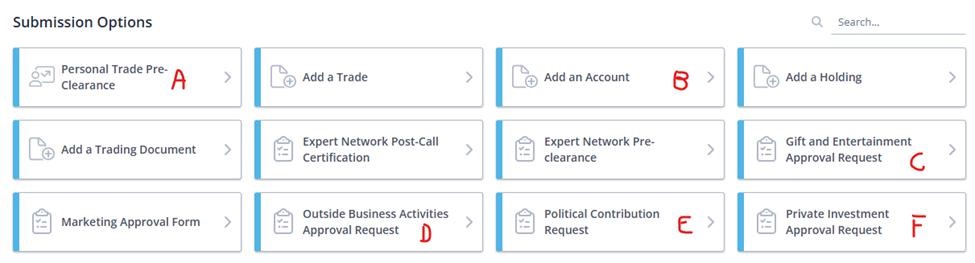
Please also note that Securities Account/Associated Account statements can be updated to a Supervised Person’s account using the “Add a Trading Document” option above.
| 16. | Enforcement of this Code of Ethics |
| 16.1. | CCO’s Duties and Responsibilities |
The CCO shall be primarily responsible for administering and enforcing the provisions of this Code. The CCO shall:
| (i) | supervise, implement and enforce the terms of this Code; |
| (ii) | (a) provide each Supervised Person with a current copy of this Code and any amendments thereto, (b) notify each person who becomes a Supervised Person of the reporting requirements and other obligations under this Code at the time such person becomes a Supervised Person, and (c) require each Supervised Person to provide a signed Certificate of Compliance for this Code and the Firm’s Policy Regarding Management of Material Non-Public Information; |
15
| (iii) | maintain a list of all securities and other financial instruments and assets which Sound Point recommends, holds, or is purchasing or selling, or intends to recommend purchase or sell on behalf of its Clients; |
| (iv) | determine whether any particular personal securities transactions should be exempted pursuant to the provisions this Code; |
| (v) | maintain files of statements and other information to be reviewed for the purpose of monitoring compliance with this Code, which information shall be kept confidential by Sound Point, except as required to enforce this Code, or to participate in any investigation concerning violations of applicable law; |
| (vi) | review all Holdings Reports required to be provided by each Access Person pursuant to this Code: (a) for each new Supervised Person, to determine if any conflict of interest or other violation of this Code results from such person becoming a Supervised Person; and (b) for all Supervised Persons, to determine whether a violation of this Code has occurred; |
| (vii) | review on a quarterly basis all securities reported on the quarterly transaction reports required to be provided by each Access Person pursuant to this Code for such calendar quarter to determine whether a Code violation may have occurred; |
| (viii) | review any other statements, records and reports required by this Code; and |
| (ix) | review on a periodic basis and update as necessary, this Code. |
| 16.2. | Violations of this Code of Ethics |
If the CCO determines that a violation of this Code has occurred, the CCO shall prepare a record of explanatory material regarding such violation and shall immediately take remedial or corrective action. The CCO shall monitor their own securities holdings and transactions in accordance with the reporting requirements set forth in this Policy.
If the CCO finds that a Supervised Person has violated this Code, the CCO will impose upon such Supervised Person sanctions that the CCO deems appropriate in view of the facts and circumstances. Sanctions with respect to any Supervised Person (other than a principal) may include written warning, suspension or termination of employment, a letter of censure and/or restitution of an amount equal to the difference between the price paid or received by the offending Supervised Person. In addition, Sound Point reserves the right to require the offending Supervised Person to reverse, cancel or freeze, at the Supervised Person’s expense, any transaction or position in a specific Security if Sound Point believes the transaction or position violates this Code and/or Sound Point’s general fiduciary duty to its Clients, or otherwise appears improper.
All violations of this Code must be immediately reported to the CCO.
16