EXHIBIT 99.28
 |
 |
Date and Signature Page
This report entitled NI 43-101 Technical Report Caballo Mining Operations, near Potosi Bolivia effective as of January 1, 2024 was prepared and signed by the following authors:
Original document signed and sealed by:
| [Richard Goodwin] | July 4, 2024 | |
| Richard Goodwin, P.Eng. | Date Signed | |
| Original document signed and sealed by: | ||
| [Garth Kirkham] | July 4, 2024 | |
| Garth Kirkham, P.Geo. | Date Signed | |
| Original document signed and sealed by: | ||
| [Tad Crowie] | July 4, 2024 | |
| Tad Crowie, P.Eng. | Date Signed |
| SANTACRUZ SILVER MINING LTD. | CABALLO BLANCO TECHNICAL REPORT | PAGE i |
| |
|
NOTICE
JDS Energy & Mining, Inc. prepared this National Instrument 43-101 Technical Report, in accordance with Form 43-101F1, for Santacruz Silver Mining Ltd. The quality of information, conclusions and estimates contained herein is based on: (i) information available at the time of preparation; (ii) data supplied by outside sources, and (iii) the assumptions, conditions, and qualifications set forth in this report.
Santacruz Silver Mining Ltd. filed this Technical Report with the Canadian Securities Regulatory Authorities pursuant to provincial securities legislation. Except for the purposes legislated under provincial securities law, any other use of this report by any third party is at that party’s sole risk.
| SANTACRUZ SILVER MINING LTD. | CABALLO BLANCO TECHNICAL REPORT | PAGE ii |
| |
|
Table of Contents
| 1 | Executive Summary | 1-1 | ||
| 1.1 | Introduction | 1-1 | ||
| 1.2 | Ownership | 1-1 | ||
| 1.3 | Location | 1-1 | ||
| 1.4 | History | 1-2 | ||
| 1.5 | Geology and Mineralization | 1-3 | ||
| 1.6 | Metallurgical Testing and Mineral Processing | 1-4 | ||
| 1.7 | Mineral Resource Estimate | 1-5 | ||
| 1.8 | Mineral Reserve Estimate | 1-7 | ||
| 1.9 | Mining | 1-8 | ||
| 1.9.1 | Reserva | 1-8 | ||
| 1.9.2 | Colquechaquita Mine | 1-9 | ||
| 1.9.3 | Tres Amigos Mine | 1-10 | ||
| 1.9.4 | Mine Equipment | 1-12 | ||
| 1.10 | Recovery Methods | 1-13 | ||
| 1.11 | Infrastructure | 1-15 | ||
| 1.11.1 | Mina Reserva | 1-15 | ||
| 1.11.2 | Mina Tres Amigos | 1-17 | ||
| 1.11.3 | Mina Colquechaquita | 1-19 | ||
| 1.12 | Environmental and Permitting | 1-21 | ||
| 1.12.1 | Environmental Considerations | 1-21 | ||
| 1.12.2 | Waste and Water Management | 1-21 | ||
| 1.12.3 | Permitting | 1-23 | ||
| 1.12.4 | Community Relations | 1-24 | ||
| 1.12.5 | Mine Closure | 1-27 | ||
| 1.13 | Capital and Operating Cost Estimates | 1-28 | ||
| 1.13.1 | Capital Costs | 1-28 | ||
| 1.13.2 | Operating Costs | 1-29 | ||
| 1.14 | Economic Analysis | 1-30 | ||
| 1.14.1 | Result | 1-30 | ||
| 1.14.2 | Sensitivities | 1-34 | ||
| SANTACRUZ SILVER MINING LTD. | CABALLO BLANCO TECHNICAL REPORT | PAGE iii |
| |
|
| 1.15 | Observations, Risks, Opportunities and Recommendations | 1-35 | ||
| 1.15.1 | Observations | 1-35 | ||
| 1.15.2 | Risks | 1-36 | ||
| 1.15.3 | Opportunities | 1-38 | ||
| 1.15.4 | Recommendations | 1-38 | ||
| 2 | Introduction | 2-1 | ||
| 2.1 | Terms of Reference | 2-1 | ||
| 2.2 | Qualification Persons | 2-1 | ||
| 2.3 | Site Visit | 2-2 | ||
| 2.4 | Units, Currency and Rounding | 2-3 | ||
| 2.5 | Sources of Information | 2-3 | ||
| 2.6 | List Of Previous Relevant Technical Reports | 2-3 | ||
| 3 | Reliance on Other Experts | 3-1 | ||
| 4 | Property Description and Location | 4-1 | ||
| 4.1 | Location | 4-1 | ||
| 4.2 | Property Description and Tenure | 4-3 | ||
| 4.3 | Environmental, Permitting and Social Relations | 4-6 | ||
| 4.3.1 | Regulatory Framework | 4-7 | ||
| 4.3.2 | Health, Safety and Economic Development | 4-8 | ||
| 4.3.3 | Environmental Management | 4-9 | ||
| 4.3.4 | Community Interaction | 4-10 | ||
| 5 | Accessibility, Climate, Local Resources, Infrastructure and Physiography | 5-1 | ||
| 5.1 | Accessibility | 5-1 | ||
| 5.2 | Climate and Physiography | 5-2 | ||
| 5.3 | Infrastructure | 5-2 | ||
| 6 | History | 6-1 | ||
| 6.1 | Management and Ownership | 6-1 | ||
| 6.2 | Historical Resource Estimates | 6-2 | ||
| 6.3 | Production 2018 to 2022 | 6-7 | ||
| 7 | Geological Setting and Mineralization | 7-1 | ||
| 7.1 | Introduction | 7-1 | ||
| SANTACRUZ SILVER MINING LTD. | CABALLO BLANCO TECHNICAL REPORT | PAGE iv |
| |
|
| 7.2 | Geological Tectonic Framework | 7-1 | ||
| 7.3 | Regional Geology | 7-4 | ||
| 7.3.1 | Eastern Cordillera Introduction | 7-4 | ||
| 7.3.2 | Tacsarian Cycle (Upper Cambrian to Ordovician) | 7-10 | ||
| 7.3.3 | The Cordilleran Cycle (Late Ordovician to Late Devonian) | 7-11 | ||
| 7.3.4 | Subandean (Gondwana) Cycle (Upper Paleozoic) | 7-11 | ||
| 7.3.5 | The Mesozoic to Cenozoic Andean Cycle: The Serere, Puca and Corcoro Supersequences | 7-12 | ||
| 7.3.6 | The Andean Orogeny | 7-13 | ||
| 7.3.7 | Mesozoic to Cenozoic Magmatism | 7-13 | ||
| 7.4 | Local Geology | 7-14 | ||
| 7.5 | Property Geology | 7-15 | ||
| 7.6 | Mineralization | 7-16 | ||
| 7.6.1 | Reserva Mine | 7-16 | ||
| 7.6.2 | Colquechaquita Mine | 7-17 | ||
| 7.6.3 | Three Amigos Mine | 7-18 | ||
| 8 | Deposit Types | 8-1 | ||
| 9 | Exploration | 9-1 | ||
| 10 | Drilling | 10-1 | ||
| 10.1 | Drilling Summary | 10-1 | ||
| 10.2 | Drilling Programs | 10-5 | ||
| 11 | Sample Preparation, Analyses and Security | 11-1 | ||
| 11.1 | Drillhole and Sub-Surface Sampling and Security | 11-1 | ||
| 11.1.1 | Drill Core Logging, Photography, Sampling and Security | 11-1 | ||
| 11.1.2 | Sub-Surface Sampling and Logging | 11-6 | ||
| 11.2 | Sample Preparation and Analysis | 11-7 | ||
| 11.3 | QA/QC Procedures and Discussion of Results | 11-10 | ||
| 11.4 | QP Statement | 11-19 | ||
| 12 | Data Verification | 12-1 | ||
| 12.1 | Verifications by the Authors of this Technical Report | 12-1 | ||
| 12.1.1 | Site Visit & Verification | 12-1 | ||
| 12.1.2 | Sample Database Verification | 12-2 | ||
| 12.1.3 | Independent Sampling | 12-2 | ||
| SANTACRUZ SILVER MINING LTD. | CABALLO BLANCO TECHNICAL REPORT | PAGE v |
| |
|
| 12.1.4 | Geological Model Verification | 12-6 | ||
| 12.1.5 | Resource Estimation Verification | 12-6 | ||
| 12.1.6 | Conclusions | 12-7 | ||
| 12.1.7 | Adequacy Statement | 12-7 | ||
| 13 | Mineral Processing and Metallurgical Testing | 13-1 | ||
| 13.1 | Company Feed Processing | 13-1 | ||
| 13.1.1 | Mill Throughput | 13-1 | ||
| 13.1.2 | Feed Grades | 13-2 | ||
| 13.1.3 | Lead Production | 13-4 | ||
| 13.1.4 | Zinc Production | 13-5 | ||
| 13.2 | Toll Feed Processing | 13-7 | ||
| 13.2.1 | Mill Throughput | 13-7 | ||
| 13.2.2 | Feed Grades | 13-8 | ||
| 13.2.3 | Lead Production | 13-10 | ||
| 13.2.4 | Zinc Production | 13-12 | ||
| 13.3 | Metallurgical Assumptions | 13-13 | ||
| 14 | Mineral Resource Estimate | 14-1 | ||
| 14.1 | Introduction | 14-1 | ||
| 14.2 | Data | 14-1 | ||
| 14.2.1 | Geology Model | 14-2 | ||
| 14.3 | Data Analysis | 14-5 | ||
| 14.4 | Composites | 14-15 | ||
| 14.5 | Evaluation of Outlier Assay Values | 14-22 | ||
| 14.6 | Specific Gravity Estimation | 14-27 | ||
| 14.7 | Block Model Definition | 14-31 | ||
| 14.8 | Resource Estimation Methodology | 14-34 | ||
| 14.9 | Mineral Resource Classification | 14-36 | ||
| 14.10 | ZnEq and NSR Calculation | 14-38 | ||
| 14.11 | Mined Out and Sterilized Areas | 14-38 | ||
| 14.12 | Resource Validation | 14-40 | ||
| 14.13 | Sensitivity of the Block Model to Selection Cut-off Grade | 14-44 | ||
| 14.14 | Mineral Resource Statement | 14-45 | ||
| 14.15 | Discussion with Respect to Potential Material Risks to the Resources | 14-45 | ||
| SANTACRUZ SILVER MINING LTD. | CABALLO BLANCO TECHNICAL REPORT | PAGE vi |
| |
|
| 15 | Mineral Reserve Estimate | 15-1 | ||
| 15.1 | Summary | 15-1 | ||
| 15.2 | Definitions | 15-1 | ||
| 15.3 | NSR and COG Determinations | 15-2 | ||
| 15.3.1 | Operating Costs | 15-2 | ||
| 15.3.2 | Metal Prices | 15-3 | ||
| 15.3.3 | Metallurgical Recoveries | 15-3 | ||
| 15.3.4 | Smelter Terms | 15-3 | ||
| 15.4 | Net Smelter Return and Cut-off Criteria | 15-3 | ||
| 15.5 | Estimation Methodology | 15-3 | ||
| 15.6 | Mineral Reserve Estimate | 15-4 | ||
| 16 | Mining Methods | 16-1 | ||
| 16.1 | Overview | 16-1 | ||
| 16.2 | Geotech Considerations | 16-2 | ||
| 16.3 | Mine Layout and Mining Method | 16-3 | ||
| 16.3.1 | Reserva Mine | 16-3 | ||
| 16.3.2 | Colquechaquita Mine | 16-4 | ||
| 16.3.3 | Tres Amigos Mine | 16-5 | ||
| 16.4 | Development | 16-7 | ||
| 16.5 | Mine Services | 16-7 | ||
| 16.5.1 | Haulage | 16-7 | ||
| 16.5.2 | Electrical | 16-10 | ||
| 16.5.3 | Ventilation | 16-12 | ||
| 16.5.4 | Mine Dewatering | 16-14 | ||
| 16.6 | Mine Equipment | 16-16 | ||
| 16.7 | Mine Personnel | 16-17 | ||
| 17 | Process Description / Recovery Methods | 17-1 | ||
| 17.1 | Plant Flowsheet | 17-1 | ||
| 17.2 | Mill Circuits | 17-4 | ||
| 17.2.1 | Crushing | 17-4 | ||
| 17.2.2 | Grinding | 17-5 | ||
| SANTACRUZ SILVER MINING LTD. | CABALLO BLANCO TECHNICAL REPORT | PAGE vii |
| |
|
| 17.2.3 | Flotation | 17-5 | ||
| 17.2.4 | Concentrate Dewatering | 17-6 | ||
| 17.2.5 | Tailings | 17-6 | ||
| 18 | Project Infrastructure and Services | 18-1 | ||
| 18.1 | Mina Reserva | 18-1 | ||
| 18.2 | Mina Tres Amigos | 18-3 | ||
| 18.3 | Mina Colquechaquita | 18-5 | ||
| 19 | Market Studies and Contracts | 19-1 | ||
| 19.1 | Contracts | 19-1 | ||
| 19.2 | Market Studies | 19-1 | ||
| 19.3 | Smelting | 19-1 | ||
| 19.4 | Metal Prices | 19-2 | ||
| 20 | Environmental Studies, Permitting and Social or Community Impacts | 20-1 | ||
| 20.1 | Environmental Considerations | 20-1 | ||
| 20.1.1 | Climate Change | 20-2 | ||
| 20.2 | Waste and Water Management | 20-3 | ||
| 20.2.1 | Solid Waste | 20-8 | ||
| 20.2.2 | Water Management | 20-11 | ||
| 20.3 | Permitting | 20-12 | ||
| 20.4 | Community Relations | 20-14 | ||
| 20.4.1 | Education | 20-19 | ||
| 20.4.2 | Community and Economic Development | 20-20 | ||
| 20.4.3 | Environmental Initiatives | 20-20 | ||
| 20.4.4 | Local Needs | 20-20 | ||
| 20.4.5 | Health and Sports | 20-21 | ||
| 20.5 | Mine Closure | 20-21 | ||
| 21 | Capital and Operating Costs | 21-1 | ||
| 21.1 | Capital Costs | 21-1 | ||
| 21.2 | Operating Costs | 21-2 | ||
| 22 | Economic Analysis | 22-1 | ||
| 22.1 | Result | 22-1 | ||
| 22.2 | Sensitivities | 22-5 | ||
| 23 | Adjacent Properties | 23-1 | ||
| 24 | Other Relevant Data and Information | 24-1 | ||
| 25 | Interpretations and Conclusions | 25-1 | ||
| 25.1 | Observations | 25-1 | ||
| 25.2 | Risks | 25-4 | ||
| 25.3 | Opportunities | 25-6 | ||
| 26 | Recommendations | 26-1 | ||
| 27 | References | 27-1 | ||
| 28 | Units of Measure, Abbreviations, Acronyms, and Glossary of Spanish Terms | 28-1 | ||
| SANTACRUZ SILVER MINING LTD. | CABALLO BLANCO TECHNICAL REPORT | PAGE viii |
| |
|
List of Figures
| Figure 1-1: Project History | 1-3 |
| Figure 1-2: Long Section Reserva Mine | 1-8 |
| Figure 1-3: Avoca Mining at Reserva Mine | 1-9 |
| Figure 1-4: Long Section Colquechaquita Mine | 1-10 |
| Figure 1-5: Isometric of the Tres Amigos Mine | 1-11 |
| Figure 1-6: Shrinkage Mining as Practiced at Tres Amigos | 1-11 |
| Figure 1-7: Don Diego Mill Flowsheet | 1-14 |
| Figure 1-8: Infrastructure for Mina Reserva | 1-16 |
| Figure 1-9: Infrastructure for Mina Tres Amigos | 1-18 |
| Figure 1-10: Infrastructure for Mina Colquechaquita | 1-20 |
| Figure 1-11: Caballo Blanco Mine Water Balance | 1-23 |
| Figure 1-12: Caballo Blanco Surrounding Communities | 1-26 |
| Figure 1-13: Caballo Blanco Community Investment | 1-27 |
| Figure 1-14: Univariate Sensitivities | 1-35 |
| Figure 4-1: Location Map | 4-2 |
| Figure 4-2: Project Location Map | 4-3 |
| Figure 4-3: Colquechaquita, Reserva and Tres Amigos Mineral Tenure | 4-5 |
| Figure 5-1: Location of Caballo Blanco Mines and Don Diego Plant | 5-1 |
| Figure 5-2: Caballo Blanco Power Generation | 5-2 |
| Figure 6-1: Project History | 6-2 |
| Figure 6-2: Veins and Structures for Caballo Blanco | 6-4 |
| Figure 7-1: Regional Geology Setting | 7-1 |
| Figure 7-2: Regional Geology Setting with Deposit Types | 7-2 |
| Figure 7-3: Plate Tectonic Reconstructions of the Neoproterozoic Subcontinent and the Late Precambrian Supercontinent after the Opening of the Southern Iapetus Ocean | 7-5 |
| Figure 7-4: Plate Tectonic Reconstructions of the Neoproterozoic and Late Precambrian Subcontinents | 7-6 |
| Figure 7-5: Paleogeography of SW Gondwana Margin in the Early Ordovician | 7-7 |
| Figure 7-6: The Famatinian – Taconic Orogen in the Middle Ordovician | 7-8 |
| Figure 7-7: The Ordovician of the Central Andes | 7-9 |
| Figure 8-1: Conceptual Model of Bolivian Polymetallic Vein Type Deposits (modif. From Heuschmidt, 2000) | 8-3 |
| SANTACRUZ SILVER MINING LTD. | CABALLO BLANCO TECHNICAL REPORT | PAGE ix |
| |
|
| Figure 10-1: Plan View of Drillhole Locations at Caballo Blanco | 10-3 |
| Figure 10-2: Section View A-A’ (azimuth 15°) Showing the Colquechaquita Deposit | 10-3 |
| Figure 10-3: Section View B-B’ (azimuth 350°) Showing the Reserva Deposit | 10-4 |
| Figure 10-4: Section View C-C’ (azimuth 335°) Showing the Tres Amigos Deposit | 10-4 |
| Figure 11-1: Example of Core Marked for Splitting | 11-2 |
| Figure 11-2: Core Splitting Facilities | 11-3 |
| Figure 11-3: Samples Prepared for Analysis Transport | 11-4 |
| Figure 11-4: Sample Submission Form | 11-5 |
| Figure 11-5: Drill Core Storage Facilities | 11-6 |
| Figure 11-6: Assay Methods Employed at the Caballo Blanco Mine | 11-8 |
| Figure 11-7: Example of Don Diego Laboratory Assay Certificate | 11-9 |
| Figure 11-8: Plot of Ag g/t Values for Field Blanks | 11-12 |
| Figure 11-9: Plot of Pb% Vaues for Field Blanks | 11-13 |
| Figure 11-10: Plot of Zn% Vaues for Field Blanks | 11-14 |
| Figure 11-11: Plot of Coarse Reject Duplicates – Ag g/t | 11-15 |
| Figure 11-12: Plot of Coarse Reject Duplicates – Pb% | 11-16 |
| Figure 11-13: Plot of Coarse Reject Duplicates – Zn% | 11-17 |
| Figure 11-14: Plot of Pulp Duplicates – Ag g/t | 11-18 |
| Figure 11-15: Plot of Pulp Duplicates – Pb% | 11-18 |
| Figure 11-16: Plot of Pulp Duplicates – Zn% | 11-19 |
| Figure 12-1: Results of Independent Verification Sampling for Ag g/t | 12-4 |
| Figure 12-2: Results of Independent Verification Sampling for Pb% | 12-5 |
| Figure 12-3: Results of Independent Verification Sampling for Zn% | 12-6 |
| Figure 13-1: Don Diego Mill Company Feed Throughput 2020/2021 | 13-1 |
| Figure 13-2: Zinc Feed Grade 2020/2021 | 13-2 |
| Figure 13-3: Lead Feed Grade 2020/2021 | 13-3 |
| Figure 13-4: Silver Feed Grade 2020/2021 | 13-3 |
| Figure 13-5: Mill Lead Concentrate Recovery vs. Lead Feed Grade | 13-4 |
| Figure 13-6: Silver Recovery to the Lead Concentrate vs. Mill Feed Silver Grade | 13-5 |
| Figure 13-7: Zinc Recovery to the Zinc Concentrate vs. Mill Feed Zinc Grade | 13-6 |
| Figure 13-8: Silver Recovery to the Zinc Concentrate vs. Mill Feed Silver Grade | 13-7 |
| Figure 13-9: Don Diego Mill Toll Feed Throughput 2020/2021 | 13-8 |
| Figure 13-10: Toll Feed Zinc Grade 2020/2021 | 13-9 |
| Figure 13-11: Toll Feed Lead Grade 2020/2021 | 13-9 |
| SANTACRUZ SILVER MINING LTD. | CABALLO BLANCO TECHNICAL REPORT | PAGE x |
| |
|
| Figure 13-12: Toll Feed Silver Grade 2020/2021 | 13-10 |
| Figure 13-13: Mill Lead Concentrate Recovery vs. Lead Feed Grade | 13-11 |
| Figure 13-14: Silver Recovery to the Lead Concentrate vs. Mill Feed Silver Grade | 13-12 |
| Figure 13-15: Zinc Recovery to the Zinc Concentrate vs. Mill Feed Zinc Grade | 13-12 |
| Figure 13-16: Silver Recovery to the Zinc Concentrate vs. Mill Feed Silver Grade | 13-13 |
| Figure 14-1: Plan View of Caballo Blanco Drillholes and Channel Samples | 14-2 |
| Figure 14-2: Plan View of Caballo Blanco Mineralized Zones and Drillholes | 14-3 |
| Figure 14-3: Long Section View of Colquechaquita Mineralized Zones and Drillholes Looking West | 14-3 |
| Figure 14-4: Long Section View of Reserva Mineralized Zones and Drillholes Looking West | 14-4 |
| Figure 14-5: Long Section View of Tres Amigos Mineralized Zones and Drillholes Looking West | 14-4 |
| Figure 14-6: Assay Interval Lengths for Colqechequita | 14-11 |
| Figure 14-7: Assay Interval Lengths for Reserva | 14-12 |
| Figure 14-8: Assay Interval Lengths for Tres Amigos | 14-12 |
| Figure 14-9: Assay Interval Lengths vs Silver Grades for Colquechaquita | 14-13 |
| Figure 14-10: Assay Interval Lengths vs Silver Grades for Reserva | 14-14 |
| Figure 14-11: Assay Interval Lengths vs Silver Grades for Tres Amigos | 14-14 |
| Figure 14-12: Box Plot of Zn Composites for the Caballo Blanco Deposit - Reserva | 14-17 |
| Figure 14-13: Box Plot of Zn Composites for the Caballo Blanco Deposit - Colquechaquita | 14-18 |
| Figure 14-14: Box Plot of Zn Composites for the Caballo Blanco Deposit – Tres Amigos | 14-18 |
| Figure 14-15: Box Plot of Pb Composites for the Caballo Blanco Deposit - Reserva | 14-19 |
| Figure 14-16: Box Plot of Pb Composites for the Caballo Blanco Deposit - Colquechaquita | 14-20 |
| Figure 14-17: Box Plot of Pb Composites for the Caballo Blanco Deposit – Tres Amigos | 14-20 |
| Figure 14-18: Box Plot of Ag Composites for the Caballo Blanco Deposit - Reserva | 14-21 |
| Figure 14-19: Box Plot of Ag Composites for the Caballo Blanco Deposit - Colquechaquita | 14-21 |
| Figure 14-20: Box Plot of Zn Composites for the Caballo Blanco Deposit – Tres Amigos | 14-22 |
| Figure 14-21: Scatterplot of Zinc vs Density | 14-27 |
| Figure 14-22: Scatterplot of Lead vs Density | 14-28 |
| Figure 14-23: Scatterplot of Iron vs Density | 14-28 |
| Figure 14-24: Scatterplot of Silver vs Density | 14-29 |
| Figure 14-25: Scatterplot of Measured Density vs Calculated Density with Iron | 14-30 |
| Figure 14-26: Scatterplot of Measured Density vs Calculated Density without Iron | 14-31 |
| Figure 14-27: Dimensions, Origin and Orientation for Colquechaquita | 14-32 |
| Figure 14-28: Dimensions, Origin and Orientation for Reserva | 14-33 |
| Figure 14-29: Dimensions, Origin and Orientation for Tres Amigos | 14-34 |
| SANTACRUZ SILVER MINING LTD. | CABALLO BLANCO TECHNICAL REPORT | PAGE xi |
| |
|
| Figure 14-30: Long Section View of the Reserva Deposit Showing Resource Block by Classification | 14-37 |
| Figure 14-31: Long Section View of the Colquechequita Deposit Showing Resource Block by Classification | 14-37 |
| Figure 14-32: Long Section View of the Tres Amigos Deposit Showing Resource Block by Classification | 14-38 |
| Figure 14-33: Plan View of Development, Pillars, Mined Out and Sterilized Areas for the Reserva Mine | 14-39 |
| Figure 14-34: Plan View of Development, Pillars, Mined Out and Sterilized Areas for the Colquechaquita Mine | 14-39 |
| Figure 14-35: Plan View of Development, Pillars, Mined Out and Sterilized Areas for the Tres Amigos Mine | 14-40 |
| Figure 14-36: Long Section View of Reserva Deposit Block Model with ZnEq Cut-off Grades | 14-41 |
| Figure 14-37: Long Section View of Reserva Deposit Block Model with ZnEq Cut-off Grades with Mined Out and Sterilized Areas (blue) | 14-42 |
| Figure 14-38: Long Section View of Colquechaquita Deposit Block Model with ZnEq Cut-off Grades | 14-42 |
| Figure 14-39: Long Section View of Colquechaquita Deposit Block Model with ZnEq Cut-off Grades with Mined Out and Sterilized Areas (blue) | 14-43 |
| Figure 14-40: Long Section View of Tres Amigos Deposit (Catalina Veins) Block Model with ZnEq Cut-off Grades | 14-43 |
| Figure 14-41: Long Section View of Tres Amigos Deposit (Catalina Veins) Block Model with ZnEq Cut-off Grades with Mined Out and Sterilized Areas (blue) | 14-43 |
| Figure 16-1: Mine Locations on the Mineralized Trend | 16-1 |
| Figure 16-2: Caballo Blanco Reserve and Mineable Targets | 16-2 |
| Figure 16-3: Long Section Reserva Mine | 16-3 |
| Figure 16-4: Avoca Mining at Reserva Mine | 16-4 |
| Figure 16-5: Long Section Colquechaquita Mine | 16-5 |
| Figure 16-6: Shrinkage Mining as Practiced at Tres Amigos | 16-6 |
| Figure 16-7: Isometric of the Tres Amigos Mine | 16-6 |
| Figure 16-8: Evolution of the Rock Mass Support System | 16-7 |
| Figure 16-9: Ore Haulage System Diagram – Reserva Mine | 16-8 |
| Figure 16-10: Ore Haulage System Diagram – Colquechaquita Mine | 16-9 |
| Figure 16-11: Extraction System Diagram – Tres Amigos Mine | 16-10 |
| Figure 16-12: Single Line Diagram of Electrical Distribution System | 16-11 |
| Figure 16-13: Ventilation Scheme – Colquechaquita Mine | 16-12 |
| Figure 16-14: Ventilation Scheme – Reserva Mine | 16-13 |
| Figure 16-15: Ventilation Scheme – Tres Amigos Mine | 16-13 |
| Figure 16-16: Dewatering System – Colquechaquita Mine | 16-14 |
| SANTACRUZ SILVER MINING LTD. | CABALLO BLANCO TECHNICAL REPORT | PAGE xii |
| |
|
| Figure 16-17: Dewatering System Scheme – Reserva Mine | 16-15 |
| Figure 16-18: Dewatering System Scheme – Tres Amigos Mine | 16-15 |
| Figure 17-1: Don Diego Mill Flowsheet | 17-2 |
| Figure 17-2: Don Diego Grinding Circuit | 17-3 |
| Figure 17-3: Don Diego Zinc Flotation | 17-4 |
| Figure 18-1: Infrastructure for Mina Reserva | 18-2 |
| Figure 18-2: Infrastructure for Mina Tres Amigos | 18-4 |
| Figure 18-3: Infrastructure for Mina Colquechaquita | 18-6 |
| Figure 19-1: Historical Silver Price | 19-2 |
| Figure 19-2: Historical Lead Price | 19-2 |
| Figure 19-3: Historical Zinc Price | 19-3 |
| Figure 20-1: Santacruz Bolivia Operations Energy Consumption | 20-3 |
| Figure 20-2: Waste Classification by Process Source | 20-4 |
| Figure 20-3: Water Treatment Process | 20-6 |
| Figure 20-4: Santacruz Bolivia Water Balance | 20-8 |
| Figure 20-5: Volume profile of the Chilimocko Dam by Stage Height | 20-9 |
| Figure 20-6: Aerial Photography of the Chilimocko TSF | 20-10 |
| Figure 20-7: Caballo Blanco Mine Water Balance | 20-12 |
| Figure 20-8: Total Investment in Communities | 20-16 |
| Figure 20-9: Caballo Blanco Surrounding Communities | 20-19 |
| Figure 20-10: Caballo Blanco Community Investment | 20-21 |
| Figure 22-1: Univariate Sensitivities | 22-5 |
| SANTACRUZ SILVER MINING LTD. | CABALLO BLANCO TECHNICAL REPORT | PAGE xiii |
| |
|
List of Tables
| Table 1-1: Recovery and Concentrate Grade Estimates | 1-5 |
| Table 1-2: Base-Case Total Mineral Resources at 10.0% ZnEq Cut-off | 1-6 |
| Table 1-3: Mineral Reserve Estimate for Caballo Blanco (January 1, 2023) | 1-7 |
| Table 1-4: Key Production Data from 2022 | 1-12 |
| Table 1-5: Environmental Licenses Held by Santacruz | 1-24 |
| Table 1-6: Actual Combined Capital Requirement for All Bolivian Operations, 2017 to 2022 ($M) | 1-28 |
| Table 1-7: Projected Capital Requirement for all Caballo Operations, 2021 to 2027 ($M) | 1-28 |
| Table 1-8: Unit Operating Costs ($/t) | 1-29 |
| Table 1-9: Production Forecast – Mining and Processing | 1-30 |
| Table 1-10: Production Forecast - Concentrate | 1-31 |
| Table 1-11: Revenue and Cost Projection ($M) | 1-32 |
| Table 1-12: Cashflow Projection ($M) | 1-33 |
| Table 2-1: QP Responsibilities | 2-2 |
| Table 2-2: QP Site Visits | 2-2 |
| Table 4-1: Mineral Tenures for Reserva and Tres Amigos Mines | 4-4 |
| Table 4-2: Mineral Tenures for Colquechaquita Mine | 4-6 |
| Table 6-1: Historic Mineral Resource Estimate | 6-3 |
| Table 6-2: Historic Mineral Resource Estimate for 2018 and 2019 | 6-3 |
| Table 6-3: Composite Statistics and Cut-off Grade Thresholds | 6-5 |
| Table 6-4: Estimation Parameters | 6-6 |
| Table 6-5: Production from the Caballo Blanco Mines, 2018 to 2022 | 6-7 |
| Table 10-1: Colquechaquita Drilling Programs in 2010 and 2021 | 10-1 |
| Table 10-2: Reserva Drilling Programs from 2010 through 2021 | 10-2 |
| Table 10-3: Tres Amigos Drilling Programs from 2010 through 2023 | 10-2 |
| Table 10-4: Caballo Blanco Drilling Details from 2010 through January 2023 | 10-5 |
| Table 10-5: Reserva Drilling Details from 2000 through January 2023 | 10-5 |
| Table 10-6: Tres Amigos Drilling Details from 2000 through January 2023 | 10-6 |
| Table 11-1: Underground Sample Mineralization Codes | 11-7 |
| Table 11-2: QA/QC Sample Insertion Rates | 11-10 |
| Table 11-3: Quantity of Control Samples by Type | 11-11 |
| Table 12-1: Caballo Blanco Independent Verification Sampling | 12-3 |
| SANTACRUZ SILVER MINING LTD. | CABALLO BLANCO TECHNICAL REPORT | PAGE xiv |
| |
|
| Table 13-1: Recovery and Concentrate Grade Estimates | 13-14 |
| Table 14-1: Statistics for the Colquechaquita Deposit Database | 14-1 |
| Table 14-2: Statistics for the Reserva Deposit Database | 14-1 |
| Table 14-3: Statistics for the Tres Amigos Deposit Database | 14-2 |
| Table 14-4: Summary Statistics for the Caballo Blanco Project Database | 14-2 |
| Table 14-5: Vein Codes and Descriptions for the Caballo Blanco Project by Mine | 14-5 |
| Table 14-6: Statistics Silver, Lead and Zinc for the Reserva Deposit by Vein | 14-6 |
| Table 14-7: Statistics Silver, Lead and Zinc for the Colquechaquita Deposit by Vein | 14-7 |
| Table 14-8: Statistics Silver, Lead and Zinc for the Tres Amigos Deposit by Vein | 14-8 |
| Table 14-9: Statistics Iron for the Caballo Blanco Deposit by Mine | 14-9 |
| Table 14-10: Statistics Assay Interval Lengths for the Caballo Blanco Deposit by Mine | 14-10 |
| Table 14-11: Zn Composite Statistics for the Caballo Blanco by Deposit and Vein | 14-15 |
| Table 14-12: Pb Composite Statistics for the Caballo Blanco by Deposit and Vein | 14-15 |
| Table 14-13: Ag Composite Statistics for the Caballo Blanco by Deposit and Vein | 14-16 |
| Table 14-14: Outlier Cutting Analysis for the Caballo Blanco Deposit | 14-23 |
| Table 14-15: Outlier Cutting Analysis for Zinc | 14-24 |
| Table 14-16: Outlier Cutting Analysis for Lead | 14-25 |
| Table 14-17: Outlier Cutting Analysis for Silver | 14-26 |
| Table 14-18: Search Ellipse Parameters for the Caballo Blanco Deposit | 14-35 |
| Table 14-19: Sensitivity Analyses at Various ZnEq Cut-off Grades for Measured, Indicated and Inferred Resources | 14-44 |
| Table 14-20: Base-Case Total Mineral Resources at 10.0% ZnEq Cut-off | 14-45 |
| Table 14-21: Base-Case Total Mineral Resources at 10.0% ZnEq Cut-off Split by Area | 14-45 |
| Table 15-1: Actual Operating Costs for 2022 by Category | 15-2 |
| Table 15-2: Stope Optimization Parameters by Mine and Stoping Method | 15-4 |
| Table 15-3: Mineral Reserve Estimate for Caballo Blanco (January 1, 2023) | 15-4 |
| Table 16-1: Electric Requirements | 16-10 |
| Table 16-2: Mine Equipment Inventory | 16-16 |
| Table 16-3: Mine Personnel (2022) | 16-17 |
| Table 19-1: Metal Price and Exchange Rate | 19-3 |
| Table 20-1: Total Waste Quantification and Treatment/Disposal | 20-5 |
| Table 20-2: Santacruz Bolivia Water Volumes | 20-7 |
| Table 20-3: Stored Tonnes of Waste Rock by Category (2022) | 20-11 |
| Table 20-4: Environmental Licenses Held by Santacruz | 20-13 |
| SANTACRUZ SILVER MINING LTD. | CABALLO BLANCO TECHNICAL REPORT | PAGE xv |
| |
|
| Table 20-5: Communities and Population Proximal to Santacruz Operations | 20-14 |
| Table 20-6: Concerns Put Forth by Proximal Communities in 2022 | 20-15 |
| Table 20-7: Caballo Blanco Local Populations | 20-18 |
| Table 21-1: Actual Combined Capital Requirement for All Bolivian Operations, 2017 to 2022 ($M) | 21-1 |
| Table 21-2: Projected Capital Requirement for all Caballo Operations, 2023 to 2028 ($M) | 21-1 |
| Table 21-3: Unit Operating Costs ($/t) | 21-2 |
| Table 22-1: Production Forecast – Mining and Processing | 22-1 |
| Table 22-2: Production Forecast - Concentrate | 22-2 |
| Table 22-3: Revenue and Cost Projection ($M) | 22-3 |
| Table 22-4: Cashflow Projection ($M) | 22-4 |
| Table 25-1: Base-Case Total Mineral Resources at 10.0% ZnEq Cut-off | 25-3 |
| SANTACRUZ SILVER MINING LTD. | CABALLO BLANCO TECHNICAL REPORT | PAGE xvi |
| |
|
| 1 | Executive Summary |
| 1.1 | Introduction |
JDS Energy & Mining Inc. (JDS) was commissioned by Santacruz Silver Mining Ltd. (Santacruz) to carry out a Technical Report for the Caballo Blanco operation (Caballo Blanco or CB) located in the state of Potosi, Bolivia.
Caballo Blanco has three operating mines: the Reserva, Colquechaquita, and Tres Amigos. All mined ore feeds the Don Diego processing plant.
This report is the first declaration of resources and reserves, for the Bolivar base metals underground mining operation since its acquisition by Santacruz. The mine is fully operational at the time of this report’s preparation. The effective date of both the resource and the reserve is January 1, 2023, which is approximately 18 months before the report date. Production data for the calendar year 2023 has been included in Section 24 Other Relevant Data and information to show the depletion and typical replenishment of resources and reserves over a calendar year.
| 1.2 | Ownership |
On October 11, 2021, Santacruz entered into the Definitive Agreement with Glencore whereby Santacruz agreed to acquire a portfolio of Bolivian silver assets from Glencore, including the following: (a) a 45% interest in the Bolivar Mine and the Porco Mine, held through an unincorporated joint venture between Glencore’s wholly-owned subsidiary Contrato de Asociación Sociedad Minera Illapa S.A. (Illapa) and COMIBOL, a Bolivian state-owned entity; (b) a 100% interest in the Sinchi Wayra S.A. (Sinchi Wayra) business, which includes the producing Caballo Blanco mining complex; (c) the Soracaya exploration project; and (d) the San Lucas ore sourcing and trading business.
On March 21, 2022, Santacruz completed this purchase, including Glencore’s interest in the Caballo Blanco mining complex.
Santacruz thus owns 100% of the two Bolivian operating companies Illapa and Sinchi Wayra, which in turn own 45% of the Bolivar Mine, 45% of the Porco Mine, and 100% of the Caballo Blanco mining complex.
Sinchi Wayra is the operating company for all three active mining operations, including the Caballo mining complex.
| 1.3 | Location |
The Caballo Blanco project consists of three separate mines and one process plant operating as one to produce Zinc and Lead concentrates. An Important part of the supporting infrastructure includes two off-site power plants that produce supplemental electric power to the mines. The mines are relatively close together and located as follows:
Reserva and Tres Amigos Mines are located 31 km southeast of the city of Potosi, in the Canton Concepcion of the first section of the Tomas Frias Province of the Department of Potosi, at an average elevation of 4,536 masl, at UTM coordinates WGS-84: 218764E and 7814967N.
| SANTACRUZ SILVER MINING LTD. | CABALLO BLANCO TECHNICAL REPORT | PAGE 1-1 |
| |
|
Colquechaquita Mine is located 30 km southeast of the city of Potosi, in the Canton Concepcion of the first section of the Tomas Frias Province of the Department of Potosi, at an average elevation of 4,520 masl, at UTM coordinates WGS-84: 219915E and 7819380N.
The Don Diego Process plant is located about 23 km Northeast of the city of Potosi, in the Don Diego Canton, Municipality of Chaqui, Cornelio Saavedra Province, of the Department of Potosi. At an elevation of 3,550 masl at UTM coordinates WGS-84: 228933E and 7841150N.
There is a 60 km drive from the mines to the Don Diego Processing plant.
The Mines and Process plant have easy access to Potosi City which is a large industrial, mining, and population center. Road access to the Reserva mine from Potosi is 23 km south via the Potosi-Tarija interdepartmental paved highway towards Kuchu Ingenio, then 8 km East on gravel road. Road access to the Colquechaquita mine from Potosi is 16 km south via the Potosi-Tarija interdepartmental paved highway towards Kuchu Ingenio, for approximately 16 km, then 11 km East on gravel access road.
Don Diego plant also has site access to a rail spur for direct transport of concentrates to the preferred Port of Antofagasta Chile, or alternative ports of Arica, Chile, and Matarani, Peru.
| 1.4 | History |
Caballo Blanco is a result of business consolidation over time.
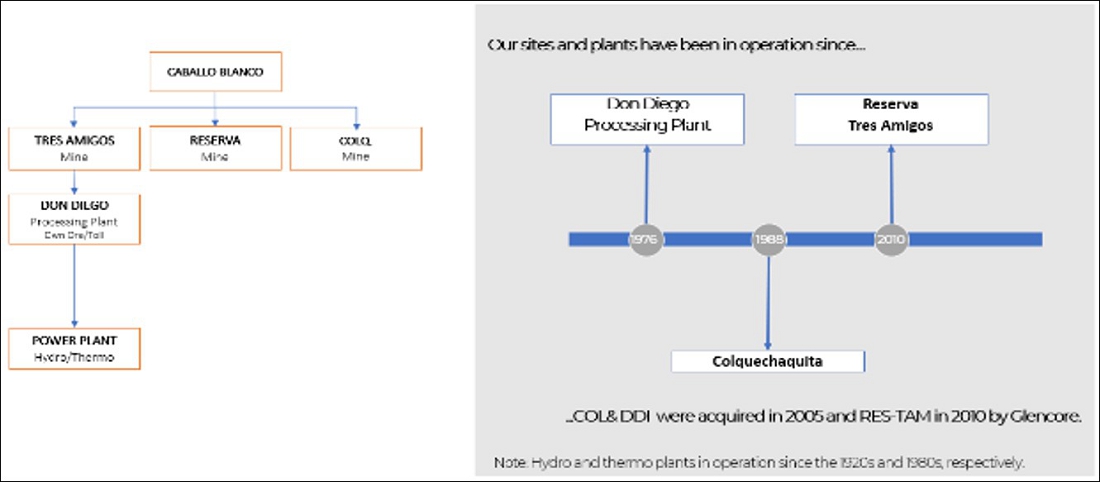
The Don Diego Plant began processing in 1977 and was originally acquired by the precursor of Sinchi Wayra S.A. (Sinchi Wayra); Compania Minera del Sur (COMSUR) in 1976. COMSUR purchased the specific mining interests from small private owners and operators loosely organized into cooperativas. The Colquechaquita mine began operating in 1977, passing to COMSUR in 1991, later changing its name to SINCHI WAYRA S.A. Sinchi Wayra took over the Reserva/TresAmigos mines in 2010. Tres Amigos obtained its environmental licenses to operate in 2005 by Sociedad Minero Metalúrgica Reserva Ltda. for its two sections of Exploitation Reserva and Tres Amigos, with a small-scale mining operation. Glencore became involved in 2005 with the purchase of COMSUR and effecting the name change to Sinchi Wayra.
Sinchi Wayra S.A. owns and operates all facets of the Caballo Blanco business; The Don Diego processing plant and Colquechaquita mine since their acquisition by Glencore in 2005, and Reserva and Tres Amigos mines from their acquisition in 2010. Glencore immediately began to develop the deposits with a higher degree of mechanization. The Power plants, Aroifilla thermal power plant, and the Yocalla hydro-electric plant which provide supplementary electric power are also owned and operated by Sinchi Wayra and are included under the management of Caballo Blanco Project.
On October 11, 2021, Santacruz entered into the Definitive Agreement with Glencore whereby Santacruz agreed to acquire a portfolio of Bolivian silver assets from Glencore. The Assets include: (a) Glencore’s 45% interest in the Bolivar Mine and the Porco Mine, held through an unincorporated joint venture between Glencore’s wholly-owned subsidiary Illapa and COMIBOL, a Bolivian state-owned entity; (b) a 100% interest in the Sinchi Wayra business, which includes the producing Caballo Blanco mining complex; (c) the Soracaya exploration project; and (d) the San Lucas ore sourcing and trading business.
| SANTACRUZ SILVER MINING LTD. | CABALLO BLANCO TECHNICAL REPORT | PAGE 1-2 |
| |
|
On March 18, 2022, Santacruz completed this purchase, including Glencore’s interest in the Caballo Blanco mining complex. The Caballo Blanco mining complex has continued to operate since that date under the management of Santacruz.
Figure 1-1: Project History
Source: Glencore (2021)
| 1.5 | Geology and Mineralization |
The Bolivar, Porco and Caballo Blanco deposits are located in the central part of the Eastern Cordillera, a thick sequence of Paleozoic marine siliciclastic and argillaceous sedimentary rocks deposited on the western margin of Gondwana and deformed in a fold-thrust belt. There were two major tectonic cycles in the Paleozoic: The Lower Paleozoic Famatinian cycle (the Tacsarian and Cordilleran cycles of Bolivia), and the Upper Paleozoic Gondwana cycle (Subandean cycle of Bolivia).
The Caballo Blanco zinc, silver, lead mine, situated south of Potosi, is located in the Jayaquila – Victoria corridor, a 5-7 km north-south structural zone with three sectors, from north to south, the Colquchaquita, Reserva, and Tres Amigos mines. They are not described in the published literature. They are hosted by volcanic rocks of the Kari-Kari volcanic complex, with dimensions of 32 km north-south and 12 km wide, located on the SE side of the Los Frailes felsic volcanic field that covers an area of 8,500 square kilometre (km2) at altitudes of 4,000 - 5,200 masl. The history started with intrusion of small granitoids at about 25 Ma at Kumurana, at the southern end of the Kari massif, and Azanaques. These were followed by the formation of Kari at about 20 Ma that is interpreted to be a resurgent caldera with welded ignimbrite fill. Ash flows, domes and stocks formed in the Cebadillas episode at 17-10 Ma, including the Cerro Rico dome with Ag-Sn mineralization at 13.8 Ma (Zartman & Cunningham, 1995; Cunningham et al., 1996; Rice et al., 2005). Huge volume felsic ash flows were erupted to form the Livicucho and Condor Nasa ignimbrites at 8-7 Ma and the main Los Frailes ignimbrites at 3.5-1.5 Ma. The final stages were the eruption of large resurgent rhyolitic domes at 4-1 Ma, and the Nuevo Mundo volcanic province at <1 Ma. (Francis et al., 1981; Schneider, 1985, 1987; Schneider & Halls, 1985; Kato, 2013; Kato et al., 2014; Kay et al., 2018).
| SANTACRUZ SILVER MINING LTD. | CABALLO BLANCO TECHNICAL REPORT | PAGE 1-3 |
| |
|
The rocks of the Kari complex are felsic, peraluminous, and rich in garnet, cordierite and tourmaline (Schneider, 1987).
Mineralization in its generality is characterized by being housed in Philonian structures divided into three domain orientations:
| 1. | Oriented at N 10° to 20° E, are Colquechaquita (Karina, Viviana, Camila), and some veins of Tres Amigos (Catalina, Milagros Este and Central); |
| 2. | Oriented N 10° to 30° W°; Reserve veins (Rosario, Wendy, Juanita and Blanquita), in Tres Amigos there is also within this system the vein (Ramo Catalina); and |
| 3. | Corresponding to veins of the Porvenir sector where they have an N-S orientation, corresponding to Reserva (Veta Rosita) and in Tres Amigos (Milagros veins). |
General mineralogy is composed of quartz-pyrite-chalcopyrite and marmatite, sphalerite, galena, boulangerite (Tres Amigos) as primary minerals; as accessory minerals we have siderite, calcite and ankerite at the trace level.
The mineralogy is quartz, pyrite, chalcopyrite, marmatite, sphalerite, galena and boulangerite with minor siderite, calcite and ankerite.
| 1.6 | Metallurgical Testing and Mineral Processing |
The metallurgical assumptions for recoveries and concentrate grades can be found in Table 1-1.
While both the lead and the zinc concentrates pay for the metal they are named for and for silver, a lead concentrate does not pay for zinc contained and the zinc concentrate does not pay for lead contained. The recoveries included in this report only include recovery to concentrates in which they can be paid.
| SANTACRUZ SILVER MINING LTD. | CABALLO BLANCO TECHNICAL REPORT | PAGE 1-4 |
| |
|
Table 1-1: Recovery and Concentrate Grade Estimates
| Parameter | Unit | Concentrates | |||
| Lead Concentrate | Zinc Concentrate | ||||
| Company Feed | Toll Feed | Company Feed | Toll Feed | ||
| Zn Recovery | % | N/A | N/A | 94 | 1.0753*(zinc feed grade) + 83.221 |
| Pb Recovery | % | 3.65*(lead feed grade %) + 75.69 | 13.149*(lead feed grade) + 39.576 | N/A | N/A |
| Ag Recovery | % | 0.0459*(silver feed grade) +67.256 | -0.0398*(silver feed) + 42.791 | -0.0225 x (silver feed grade) + 20.655 | 0.0246*(silver feed grade) + 42.991 |
| Concentrate Grade | |||||
| Zn | % | 3.5 | 9.0 | 51 | 48 |
| Pb | % | 61 | 45.0 | 1.4 | 1.4 |
| Ag | g/t | 6460 | 4050 | 280 | 440 |
| 1.7 | Mineral Resource Estimate |
The Caballo Blanco Project is an “advanced property” and has been in continuous production since 1993. Glencore and subsequently Santacruz Silver has performed exploration and resource expansion drilling of surface and underground drillholes at the Caballo Blanco since 2010 totalling 39,562.55 m. The 128 drillholes and 19,644 underground channels in the database were supplied in electronic format by Santacruz. This included collars, downhole surveys, lithology data and assay data (i.e., Ag g/t, Pb%, Zn%, Fe%, Sn%).
Verification of the Caballo Blanco drillhole and underground sample assay databases are primarily focused on silver, lead and zinc in addition to iron, arsenic, sulphur and tin. Sample databases were supplied in ExcelTM format and in LeapFrogTM. Checks against source data and assay certificates showed agreement. Statistical analyses used to investigate and identify errors were performed and resulted in minor issues. These have been corrected and it is recommended that a continued program of random “spot checking” the database against assay certificates be employed.
During the 2023 site visit, an extensive independent sampling verification plan was implemented with a total of 80 samples collected across from the Bolivar, Porco and Caballo Blanco operations. The Don Diego laboratory is an NB/ISO/IEC 17025:2018 accredited laboratory which performs all assay analyses for the mining and processing operations for Sinchi Wayra including Caballo Blanco. The Don Diego laboratory in owned and operated by the Issuer, Santacruz.
Results of the verification samples indicates that the regression predictions perfectly fit the data meaning that the check sampling program successfully verified and validated the data and although, these results are not a complete audit of the laboratory, they do verify that the assay results are suitable for resource estimation purposes.
| SANTACRUZ SILVER MINING LTD. | CABALLO BLANCO TECHNICAL REPORT | PAGE 1-5 |
| |
|
The geological and lithological solid domain models were supplied by Santacruz in both DatamineTM and LeapFrogTM which are both industry-leading software systems. The QP imported the multiple vein domains into a similar system called MineSightTM to verify solids volumes and ensure matching of the solids domains against the drillhole and sample database. Results confirmed location and extent of volumes are appropriate to resource estimation purposes.
Resource block models were supplied in DatamineTM format which is an industry recognized software system used for resource estimation. These models were then imported to MineSightTM for verification of the resource estimation. In addition, independent estimations were run using the verified sample data and vein domains employing inverse distance estimations to ensure reasonableness and verify the resources independently. Results illustrated good agreement between the original and verification models. Verification of the SG regression analysis was also performed by comparing measured versus calculated density values.
The Qualified Person evaluated the resource in order to ensure that it meets the condition of “reasonable prospects of eventual economic extraction” as suggested under NI 43-101. The criteria considered were confidence, continuity and economic cut-off. The resource listed below is considered to have “reasonable prospects of eventual economic extraction”.
Table 1-2 shows the Mineral Resource Statement for the Caballo Blanco deposit.
Table 1-2: Base-Case Total Mineral Resources at 10.0% ZnEq Cut-off
| Total Caballo Blanco 2023 Mineral Resources | |||||
| Mine | Category | Tonnes (‘000) | Zn (%) | Pb (%) | Ag (g/t) |
| Caballo Blanco | Measured | 726 | 15.96 | 3.03 | 321 |
| Indicated | 502 | 14.32 | 2.86 | 269 | |
| Total M+I | 1,227 | 15.29 | 2.96 | 300 | |
| Inferred | 2,217 | 13.28 | 2.12 | 199 | |
Notes:
| 1) | The current Resource Estimate was prepared by Garth Kirkham, P.Geo., of Kirkham Geosystems Ltd. |
| 2) | All mineral resources have been estimated in accordance with Canadian Institute of Mining and Metallurgy and Petroleum (CIM) definitions, as required under National Instrument 43-101 (NI43-101). |
| 3) | The Mineral Resource Estimate was prepared using a 10.0% zinc equivalent cut-off grade. Cut-off grades were derived from $25.20/oz silver, $1.38/lb zinc and $1.20/lb lead, and process recoveries of 92.1% for zinc, 77.2% for lead, and 90.8% for silver. This cut-off grade was based on current smelter agreements and total OPEX costs of $106.94/t based on 2022 actual costs plus capital costs of $42.33/t. All prices are stated in $USD. |
| 4) | An Inferred Mineral Resource has a lower level of confidence than that applying to an Indicated Mineral Resource and must not be converted to a Mineral Reserve. It is reasonably expected that the majority of Inferred Mineral Resources could be upgraded to Indicated Mineral Resources with continued exploration. |
| 5) | Mineral resources are not mineral reserves until they have demonstrated economic viability. Mineral resource estimates do not account for a resource’s mineability, selectivity, mining loss, or dilution. All figures are rounded to reflect the relative accuracy of the estimate and therefore numbers may not appear to add precisely. |
| SANTACRUZ SILVER MINING LTD. | CABALLO BLANCO TECHNICAL REPORT | PAGE 1-6 |
| |
|
| 1.8 | Mineral Reserve Estimate |
The January 1, 2023 reserve estimate represents the validation of Santacruz’s internally-generated mineral reserve estimate by QP Goodwin. All work on the reserve by the Santacruz mine design team and the validation exercises were done in DeswikTM. The following process was used for this work:
| ● | An NSR calculation and cut-off grade (COG) was developed by the QP using data provided by Santacruz; |
| ● | The reserve estimation methodology was reviewed, checked, and approved by the QP; |
| ● | Mine technical staff prepared a Life of Mine Plan (LOM) for the deposits using the NSR and COG provided by the QP. The LOM plan was prepared specifically for this reserve estimation and does not include inferred resources; and |
| ● | All LOM models were downloaded and reviewed by the QP for conformance to the methodology, proper application of the NSR cut-off grade, and correct application of agreed upon dilution and recovery factors. |
The QP is satisfied that this exercise resulted in a valid reserve determination.
The Mineral Reserve Estimate for Caballo Blanco is shown in Table 1-3.
Table 1-3: Mineral Reserve Estimate for Caballo Blanco (January 1, 2023)
| Mine | Category | Tonnes | Zn (%) | Pb (%) | Ag (g/t) |
| Colquechaquita | Proven | 207,000 | 10.49 | 2.16 | 174 |
| Probable | 212,000 | 8.68 | 2.77 | 187 | |
| Total | 420,000 | 9.57 | 2.47 | 181 | |
| Reserva | Proven | 168,000 | 9.21 | 1.34 | 110 |
| Probable | 177,000 | 8.74 | 1.08 | 93 | |
| Total | 345,000 | 8.97 | 1.21 | 101 | |
| Tres Amigos | Proven | 194,000 | 9.88 | 1.95 | 355 |
| Probable | 75,000 | 6.16 | 1.73 | 272 | |
| Total | 269,000 | 8.84 | 1.89 | 332 | |
| Total Caballo Blanco | Proven | 569,000 | 9.90 | 1.85 | 217 |
| Probable | 465,000 | 8.30 | 1.96 | 165 | |
| Total | 1,034,000 | 9.18 | 1.90 | 193 |
| SANTACRUZ SILVER MINING LTD. | CABALLO BLANCO TECHNICAL REPORT | PAGE 1-7 |
| |
|
| 1.9 | Mining |
The Caballo Blanco Mine has been in operation for 20 years. Although the mine is managed as a single business, it is actually composed of three different mines on the same mineralized trend: Reserva, Tres Amigos and Colquechaquita.
Although development to connect the mines is in process, there still exists some autonomy in how each are operated. The application of mining methods has thus been an adaptation of mining equipment technologies, evaluation and monitoring tools to the specific mineralized zones. The last decade of operations under the guidance of Glencore, the mine has seen a move to more mechanized methods to improve safety performance and mine productivity.
The three mining operations follow steeply dipping veins striking predominantly North/South. Veins vary in width from 0.2 to 2.5 m, the wider and more consistent veins being mined using more productive longhole methods.
| 1.9.1 | Reserva |
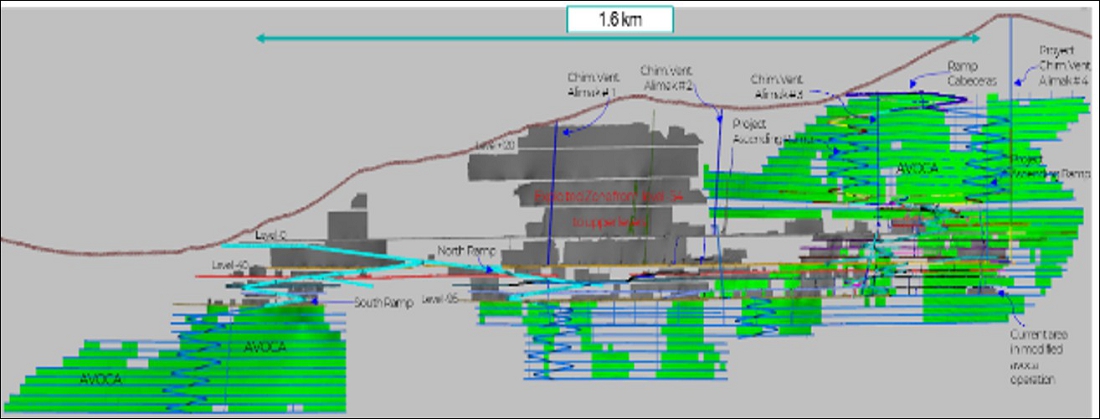
Reserva mine is the youngest and most modern of the three mines. Mine production is about 275 t/d. A long section of the Reserva mine is shown in Figure 1-2.
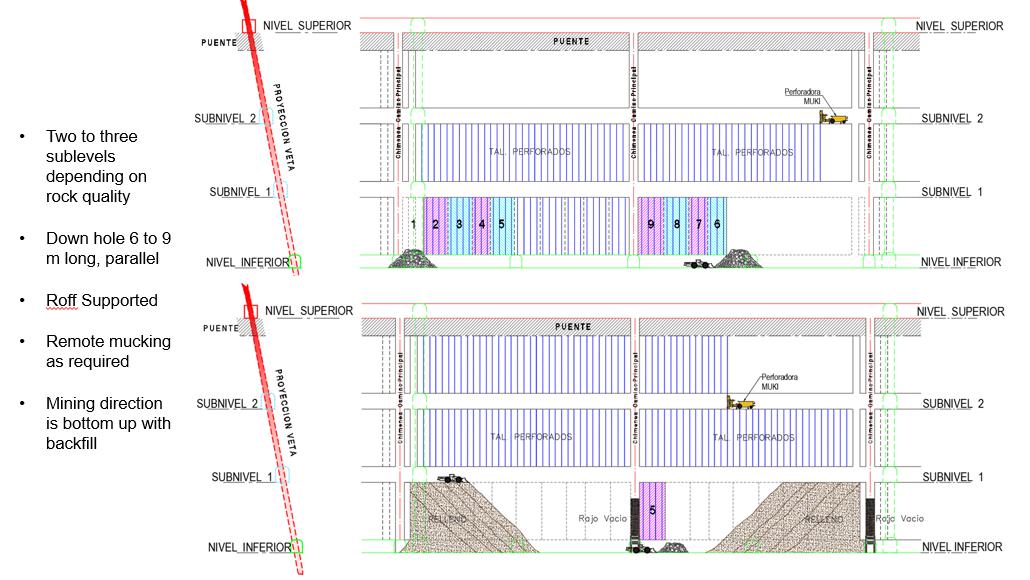
All mining is done with sublevel longhole methods and trackless development. In principle, the AVOCA method being used has all the productivity advantages of longhole stoping and allows for concurrent backfill to continuously support the relatively weak hanging wall. Backfill for stoping is generated from development mining. The method is demonstrated in Figure 1-3.
Figure 1-2: Long Section Reserva Mine
Source: Glencore (2021)
| SANTACRUZ SILVER MINING LTD. | CABALLO BLANCO TECHNICAL REPORT | PAGE 1-8 |
| |
|
Figure 1-3: Avoca Mining at Reserva Mine
Source: Glencore (2021)
| 1.9.2 | Colquechaquita Mine |
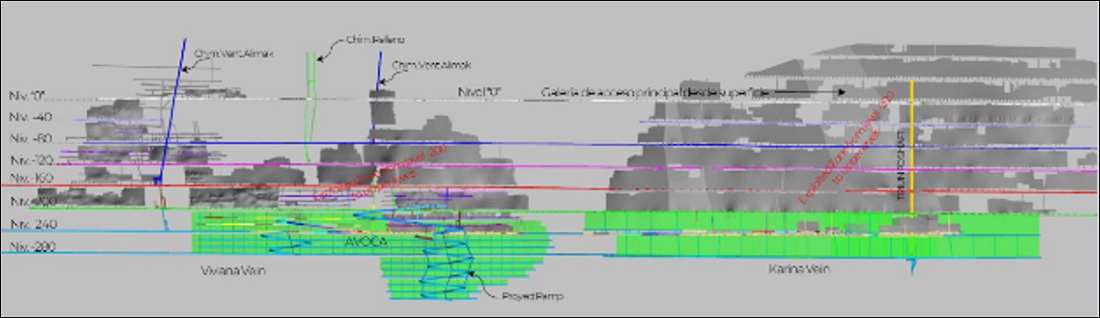
Colquechaquita mine has been in production since 1991 using tracked development, and stoping by conventional shrinkage and cut and fill methods. The mine produces about 230 tonnes (t) of mineralized material per day. A long section of the Colquechaquita Mine is shown in Figure 1-4.
The transition to mechanized mining is in process but still in the early stages. Approximately 50% production continues to be generated from conventional methods. The southern portion of the mine is moving to trackless development. However, equipment brought into the mine must be disassembled and moved in the shaft which is time consuming and labor intensive.
| SANTACRUZ SILVER MINING LTD. | CABALLO BLANCO TECHNICAL REPORT | PAGE 1-9 |
| |
|
Figure 1-4: Long Section Colquechaquita Mine
Source: Glencore (2021)
| 1.9.3 | Tres Amigos Mine |
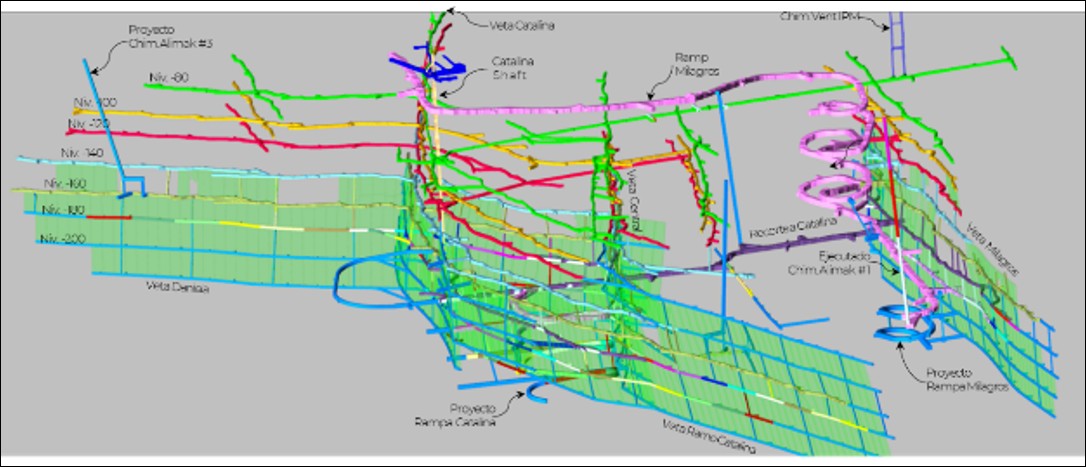
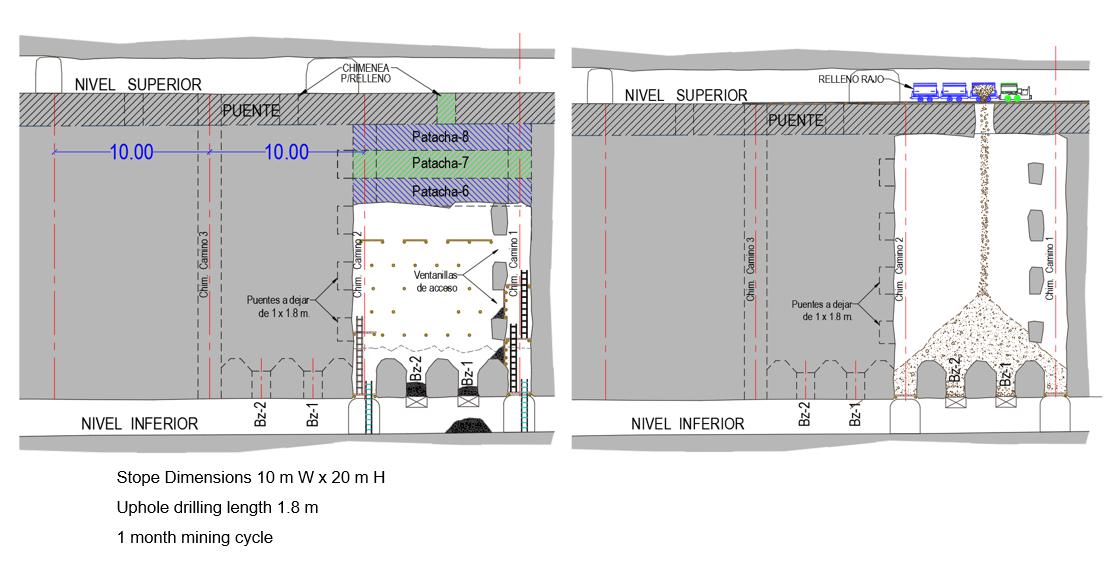
Tres Amigos, shown in Figure 1-5, remains a conventional tracked mine using mostly a modified shrinkage stoping method, as shown in Figure 1-6.
The mineralized zones are narrow and high-grade making them well suited to these more selective stoping methods. However, higher productivity trackless mechanized methods are used for primary development and ramps. Stoping takes place generally above the -200 level and mineralized material production averages approximately 300 t/d. Mineralized material is hauled by rail either to the main Catalina shaft for hoisting to surface or hauled directly to surface using trucks.
| SANTACRUZ SILVER MINING LTD. | CABALLO BLANCO TECHNICAL REPORT | PAGE 1-10 |
| |
|
Figure 1-5: Isometric of the Tres Amigos Mine
Source: Glencore (2021)
Figure 1-6: Shrinkage Mining as Practiced at Tres Amigos
Source: Glencore (2021)
| SANTACRUZ SILVER MINING LTD. | CABALLO BLANCO TECHNICAL REPORT | PAGE 1-11 |
| |
|
| 1.9.4 | Mine Equipment |
The mine employs the following mining equipment:
| ● | Five Resemin Muki FF single boom jumbo rigs with a power of 75 HP that drill between 2.40 and 3.0 m long holes. They are generally used for secondary development (horizontal vein developments) to prepare sublevels whose nominal dimensions are 3.0 m x 3.5 m. Occasionally they are used in small primary development headings; |
| ● | Two Atlas Copco Boomer single boom jumbo rigs with a power of 75 HP that drill between 3.7 and 4.0 m long holes. They are generally used for primary development headings; |
| ● | Two Resemin Small Bolter 77 units to install rockbolts and mesh. These units have a power of 75 HP with a drilling capacity of 3.0 m; |
| ● | Three Resemin long hole drills are used for drilling long holes using the “Sub Level Stoping” method. These have a drill range of 15 to 20 m; |
| ● | Thirteen scooptrams ranging in size from 0.54 to 4.5 cubic meter (m3) bucket capacity; and |
| ● | Six Dux Volquete 12 t haulage trucks. |
Key production data from 2022 are shown by mine on Table 1-4.
Table 1-4: Key Production Data from 2022
| Reserva Mine | Tres Amigos Mine | Colquechaquita Mine | Total | |
| Production (tonnes) | 81,938 | 118,633 | 77,504 | 278,074 |
| Waste rock moved (tonnes) | 52,563 | 71,551 | 30,863 | 154,977 |
| Backfill Hauled (tonnes) | ||||
| Zinc (%) | 6.90 | 6.40 | 6.39 | 6.55 |
| Lead (%) | 0.99 | 2.13 | 1.24 | 1.55 |
| Silver (g/t) | 95 | 284 | 103 | 178.21 |
| Primary Devt Horizontal (m) | 1,834 | 1,353 | 1,044 | 4,232 |
| Primary Devt Vertical (m) | 207 | 228 | 415 | 851 |
| Secondary Devt Horizontal (m) | 1,426 | 3,282 | 1,320 | 6,028 |
| Secondary Devt Vertical (m) | 191 | 549 | 403 | 1,142 |
| SANTACRUZ SILVER MINING LTD. | CABALLO BLANCO TECHNICAL REPORT | PAGE 1-12 |
| |
|
| 1.10 | Recovery Methods |
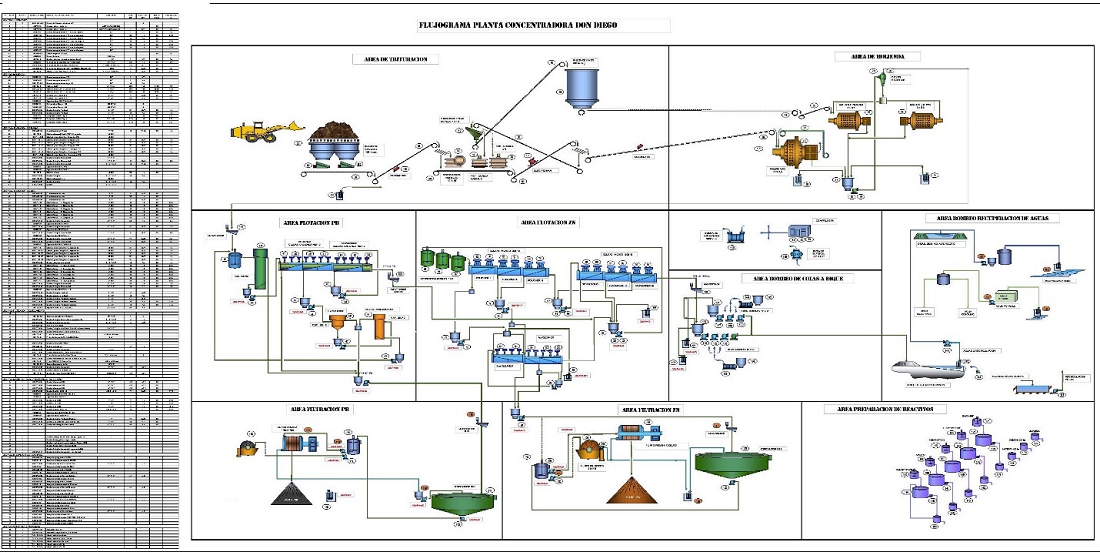
The plant flowsheet for the Don Diego mill is a typical sequential flotation circuit for lead and zinc. The feed is crushed in preparation for the grinding circuit. The grinding circuit utilizes a SAG/Ball mill combination to produce a product size P80 of 100 µm for the flotation circuit.
The flotation circuit starts with the lead recovery circuit. In this circuit a rougher concentrate is produced, which is then cleaned without regrinding, in column flotation cells. The lead rougher tailings and cleaner tailings are combined and fed to the zinc circuit. The zinc circuit consists of rougher flotation and one stage of cleaning to produce a zinc concentrate. The zinc circuit tailings are deposited in the tailings pond. Both of the concentrates are filtered for shipping to the smelter. The lead concentrate is bagged for shipping, while the zinc concentrate is shipped bulk in trucks.
| SANTACRUZ SILVER MINING LTD. | CABALLO BLANCO TECHNICAL REPORT | PAGE 1-13 |
| |
|
Figure 1-7: Don Diego Mill Flowsheet
Source: Glencore (2021)
| SANTACRUZ SILVER MINING LTD. | CABALLO BLANCO TECHNICAL REPORT | PAGE 1-14 |
| |
|
| 1.11 | Infrastructure |
Each of the three mining complexes that form the Caballo Blanco Project is supported by its own infrastructure, as detailed by mine in this section.
| 1.11.1 | Mina Reserva |
The Mina Reserva operation is surrounded by a facilities fence, inside of which are the following facilities:
| ● | Various technical, administrative offices, and mine operations office; |
| ● | A maintenance facility for all surface and underground equipment; |
| ● | A mud dam for settling solids from the mine water; |
| ● | Warehousing facilities; |
| ● | A worker camp; |
| ● | A dining hall for technical and administrative staff; |
| ● | A first aid station; |
| ● | Water treatment; and |
| ● | Mine services, such as power, water supply, and compressed air. |
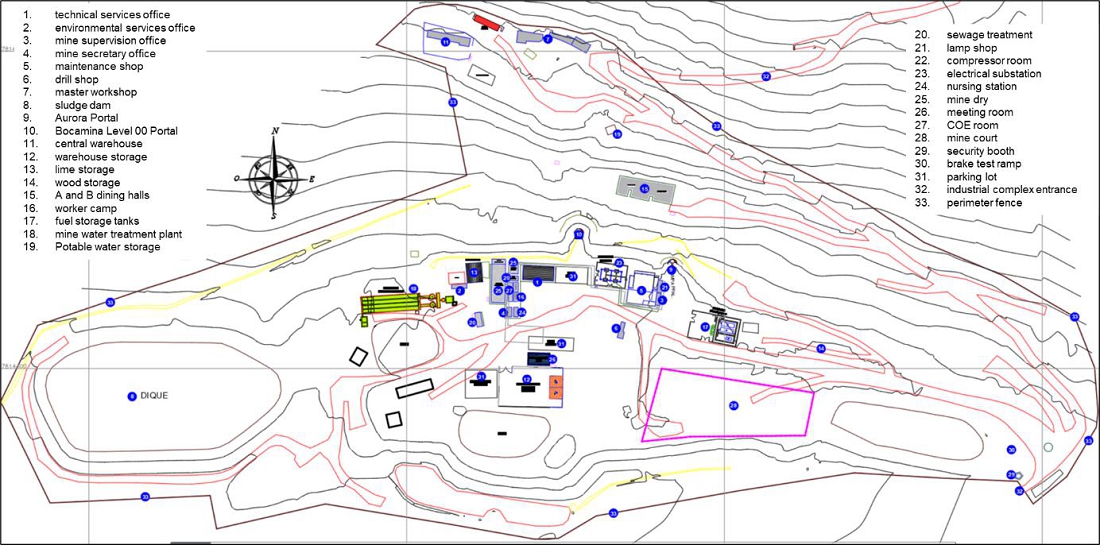
The existing infrastructure for Mina Reserva is shown in Figure 1-8. Key facilities are identified by number on the drawing.
| SANTACRUZ SILVER MINING LTD. | CABALLO BLANCO TECHNICAL REPORT | PAGE 1-15 |
| |
|
Figure 1-8: Infrastructure for Mina Reserva
Source: Santacruz (2023)
| SANTACRUZ SILVER MINING LTD. | CABALLO BLANCO TECHNICAL REPORT | PAGE 1-16 |
| |
|
| 1.11.2 | Mina Tres Amigos |
The Mina Tres Amigos operation is also surrounded by a perimeter fence and similarly equipped with all mine services, including, inside of which are the following facilities:
| ● | Various technical, administrative offices, and mine operations office; |
| ● | A maintenance facility for all surface and underground equipment; |
| ● | A mud dam for settling solids from the mine water; |
| ● | Warehousing facilities; |
| ● | A worker camp; |
| ● | A dining hall for technical and administrative staff; |
| ● | A first aid station; |
| ● | Water treatment; |
| ● | Mine services, such as power, water supply, and compressed air; and |
| ● | The Catalina headframe atop the mine shaft. |
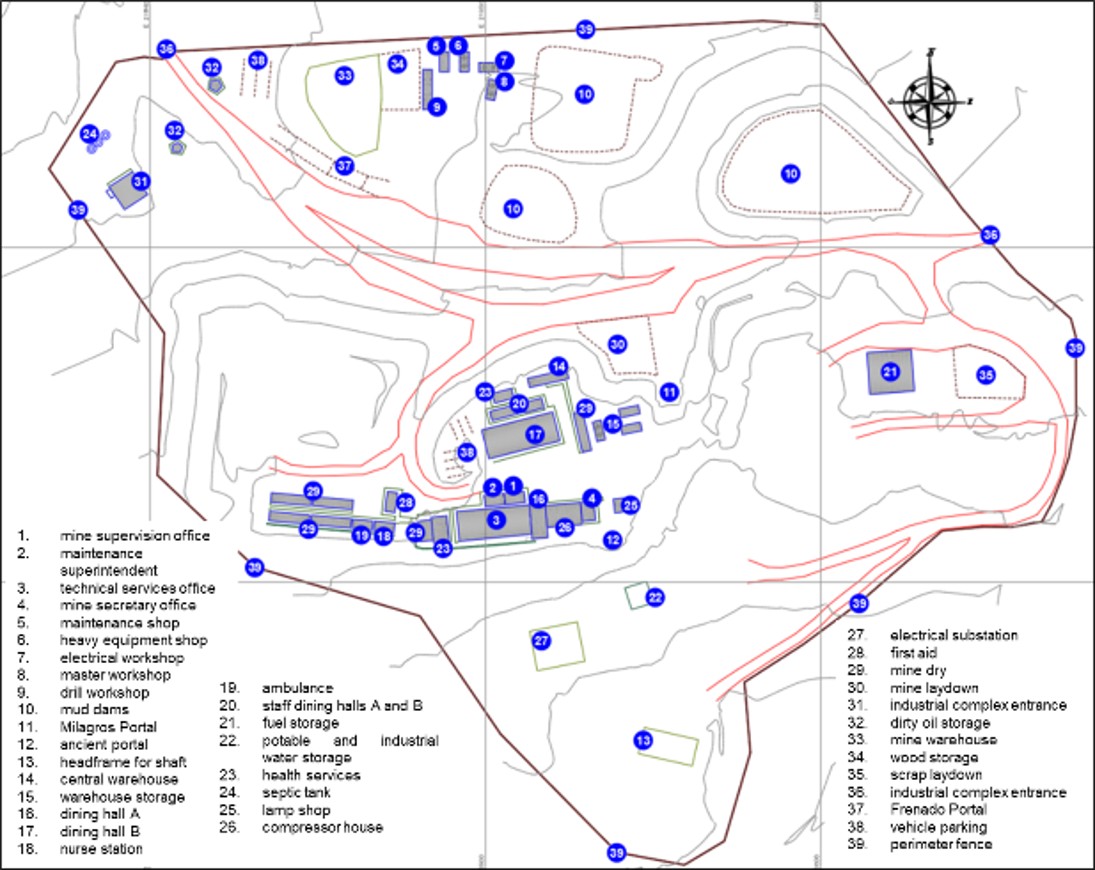
The existing infrastructure for Mina Reserva is shown in Figure 1-9. Key facilities are identified by number on the drawing.
| SANTACRUZ SILVER MINING LTD. | CABALLO BLANCO TECHNICAL REPORT | PAGE 1-17 |
| |
|
Figure 1-9: Infrastructure for Mina Tres Amigos
Source: Santacruz (2023)
| SANTACRUZ SILVER MINING LTD. | CABALLO BLANCO TECHNICAL REPORT | PAGE 1-18 |
| |
|
| 1.11.3 | Mina Colquechaquita |
The Mina Colquechaquita operation is also surrounded by a perimeter fence and similarly equipped with all mine services, including, inside of which are the following facilities:
| ● | Various technical, administrative offices, and mine operations office; |
| ● | A maintenance facility for all surface and underground equipment; |
| ● | A mud dam for settling solids from the mine water; |
| ● | Warehousing facilities; |
| ● | A worker camp; |
| ● | A dining hall for technical and administrative staff; |
| ● | A first aid station; |
| ● | Water treatment; and |
| ● | Mine services, such as power, water supply, and compressed air. |
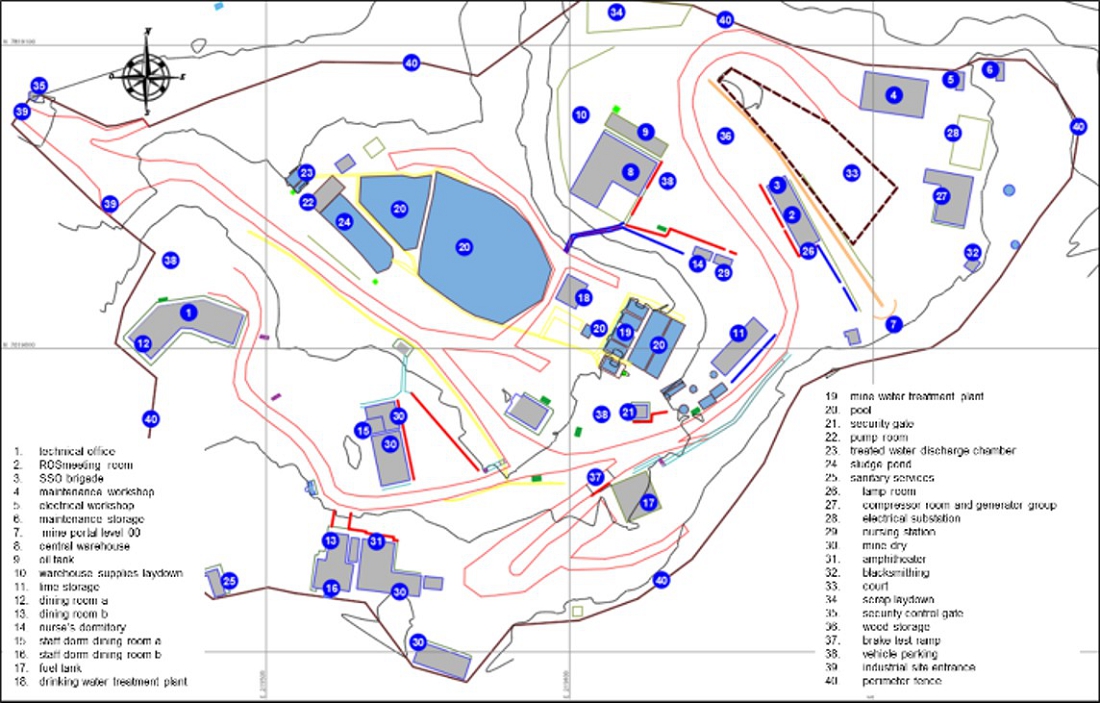
The existing infrastructure for Mina Reserva is shown in Figure 18-2Figure 1-10. Key facilities are identified by number on the drawing.
| SANTACRUZ SILVER MINING LTD. | CABALLO BLANCO TECHNICAL REPORT | PAGE 1-19 |
| |
|
Figure 1-10: Infrastructure for Mina Colquechaquita
Source: Santacruz (2023)
| SANTACRUZ SILVER MINING LTD. | CABALLO BLANCO TECHNICAL REPORT | PAGE 1-20 |
| |
|
| 1.12 | Environmental and Permitting |
| 1.12.1 | Environmental Considerations |
Responsible environmental management is a critical part of Santacruz’s license to operate and our responsible, compliant operation of Bolivian assets has continued for the last 30 years. Environmental Compliance with national laws and regulations is the basis of Santacruz’s environmental management system and is governed by a framework of oversight by the relevant Environmental Authority. Its environmental commitments are reported to the authorities annually in an Environmental Monitoring Report, which summarizes environmental management of its operations under applicable laws and regulations.
| 1.12.2 | Waste and Water Management |
Waste management is an important part of Santacruz’s Comprehensive Environmental Management, which includes a waste management plan to classify, handle, and store waste separately for proper disposal or treatment. Waste management complies with Environmental Law No. 1333, its Regulations on Solid Waste Management, and its supplementary regulations, focusing primarily on the sectoral requirements of the Environmental Regulation for Mining Activities for waste rock and tailings.
| 1.12.2.1 | Solid Waste |
The Don Diego process plant is distal from the mines which feed it. The process plant along with the Tailings Storage Facility are located about 23 km Northeast of the city of Potosi, in the Don Diego Canton, Municipality of Chaqui, Cornelio Saavedra Province, of the Department of Potosi. At an elevation of 3,550 masl at UTM coordinates WGS-84: 228933E and 7841150N. There is a 60 km drive from the mines to the Don Diego Processing plant.
The Chilimocko tailings storage facility at Don Diego is inspected regularly and maintained to the standards set out by the Canadian Dam Association guidelines. The dam is under the supervision of engineers from AMEC (now Wood Engineering) and recently an external audit was conducted by Knight Piésold Consulting. The Chilimocko Dam is 55 m high, downstream-constructed dam. The Stage IV raise was completed in 2019 and current crest elevation is 3,625 m. Construction for the next expansion is planned to begin in 2024 and conclude 12 months later.
The company also monitors and manages 4 inactive tailings facilities (1, 2, 3 & Yanakasa) at the Don Diego location.
Yana Khasa is a 40 m high, upstream-constructed dam, which contains 2.2 Mm3 of tailings. Recent activities at the site include Repositioning piezometers, cleaning of the standpipe piezometers to improve groundwater monitoring, and Installation of fences to protect instrumentation; and
Dikes 1, 2, and 3 are, upstream constructed dams which contain a total of 0.4 Mm3 of tailings. Recent activities at the sites include cleaning of the standpipe piezometers to improve groundwater monitoring and Installation of fences to protect the instrumentation.
| SANTACRUZ SILVER MINING LTD. | CABALLO BLANCO TECHNICAL REPORT | PAGE 1-21 |
| |
|
Although mine waste rock is preferentially stored underground or used as backfill, each of the mines has a permitted and designed waste rock storage area designed for stability, as well as the prevention of acid rock drainage and metal leaching. Sludge from the water treatment plants is deposited in lined ponds adjacent to the treatment plants. Given the mines’ proximity to the City of Potosi, Domestic and Medical waste disposal are managed through the Municipal Garbage Collection Service. Industrial waste such as scrap metal, used Oil, tires, etc. is temporarily stored at each mining unit and collected by companies specialized in recycling.
| 1.12.2.2 | Water Management |
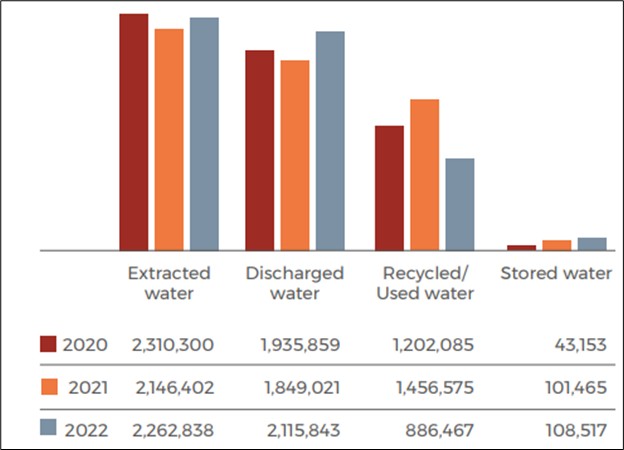
Each of the mines produces enough water to treat and reuse for industrial use on site. Excess treated water is discharged to the environment at regulated quality standards. Annually, a total of 2.5 Mm3 of mine water is treated and 2.4 Mm3 discharged from two water treatment plants.
Given the remote location of the process plant, which is usually the largest water consumer, each mine treats and discharges excess water to the environment. These discharges are regulated for quality and quantity by the environmental license. End uses include consumption by neighboring communities and agricultural/industrial use by llama ranchers and mining cooperatives downstream. Caballo Blanco supplies two thousand cubic meters of treated water per year to the local sanitary administration (AAPOS) to support industrial activities and discharges the remaining treated water to the Jayaquila and Mocaña rivers. Caballo Blanco is able to meet discharge requirements with aeration, pH adjustment and clarification by settling.
Don Diego process plant maximizes the recirculation of water from its tailing storage facility and draws makeup water from permitted surface sources.
| SANTACRUZ SILVER MINING LTD. | CABALLO BLANCO TECHNICAL REPORT | PAGE 1-22 |
| |
|
Figure 1-11: Caballo Blanco Mine Water Balance
Source: Sustainability Report, Sinchi Wayra (2022)
| 1.12.3 | Permitting |
Santacruz Silver operates the Bolivar mine as a joint venture with the Bolivian Government (COMIBOL) The structure of the contract with COMIBOL is a “Partnership Contract governing Bolivar and Porco Mines (CA-MBP), and its purpose is to develop and implement a mining operation for the treatment of the existing mineralogical reserves and resources in the Bolívar and Porco Mines, by the exploitation, preparation, beneficiation and sale of mineral concentrates. Contrato de Asociación Sociedad Minera Illapa S.A. is authorized as operator and responsible of executing on behalf of COMIBOL, all the operations and activities of the association contract. The shares of CA-MBP are 55% for COMIBOL and 45% for Contrato de Asociación Sociedad Minera Illapa S.A.” This renewable agreement expires in 2028.
| SANTACRUZ SILVER MINING LTD. | CABALLO BLANCO TECHNICAL REPORT | PAGE 1-23 |
| |
|
Mining Contracts that grant the right to the subsoil mining resource are granted by the Mining Administrative Jurisdictional Authority (AJAM) over the ATE mining areas, and a contract is granted for each area or contiguous group of areas. Recent changes to the laws and government personnel have pushed Santacruz contract updates into a transitionary period waiting for final signatures and approvals. Santacruz holds Special Transitory Authorizations for each contract area which are officially designated “Mining Administrative Contracts for Adaptation”. As of the effective date, approximately half of the applications have been transitioned, and the remainder fall under Article 187 of Law No. 535 on Mining and Metallurgy, which states:
ARTICLE 187. (CONTINUITY OF MINING ACTIVITIES). Holders of Special Transitory Authorizations to be adapted or in the process of adaptation will continue their mining activities, with all the effects of their acquired or pre-constituted rights until the conclusion of the adaptation procedure.
Santacruz has fully complied with this administrative procedure and is waiting for the Mining Administrative Authority to issue the relevant documents. It should be noted that this public entity has a considerable delay in the issuance of these documents.
Environmental Licenses have been formally granted to allow operation for all mining activity, by the Ministry of Environment and Water. The following table shows the licenses held by Santacruz.
Table 1-5: Environmental Licenses Held by Santacruz
| Operation | License |
| Bolívar | 040603-02-da-0324/14 |
| Porco | 051203-02-da-0031/14 |
| Caballo Blanco – Colquechaquita Mine | 050101-02-da-131/11 |
| Caballo Blanco – Mina Reserva and Tres Amigos | 050101-02-da-561/11 |
| Caballo Blanco – Don Diego Concentrator Plant | 050302-02-da-003/2024 |
| Caballo Blanco – San Lorenzo Mine | 050101-02-da-005/06 |
| Comco | 050101-02-da-006/09 |
| Soracaya | 050801-02-CD-C3-002/2017 |
| Aroifilla Thermoelectric Plant | 050101-04-da-007/2023 |
| Yocalla Hydroelectric Plant | 050103-05-da-006/2023 |
| 1.12.4 | Community Relations |
Santacruz mining projects are mostly well-established operations with a long history and a developed infrastructure, which provide direct benefits to employees and supporting businesses. However, the mines are located in rural to semirural areas in which the surrounding mostly agricultural communities can benefit from each operation only indirectly or through company outreach. Santacruz supports these communities by addressing services that are lacking, and helping to create value with economic development programs, and other forms of support.
| SANTACRUZ SILVER MINING LTD. | CABALLO BLANCO TECHNICAL REPORT | PAGE 1-24 |
| |
|
| 1.12.4.1 | Caballo Blanco |
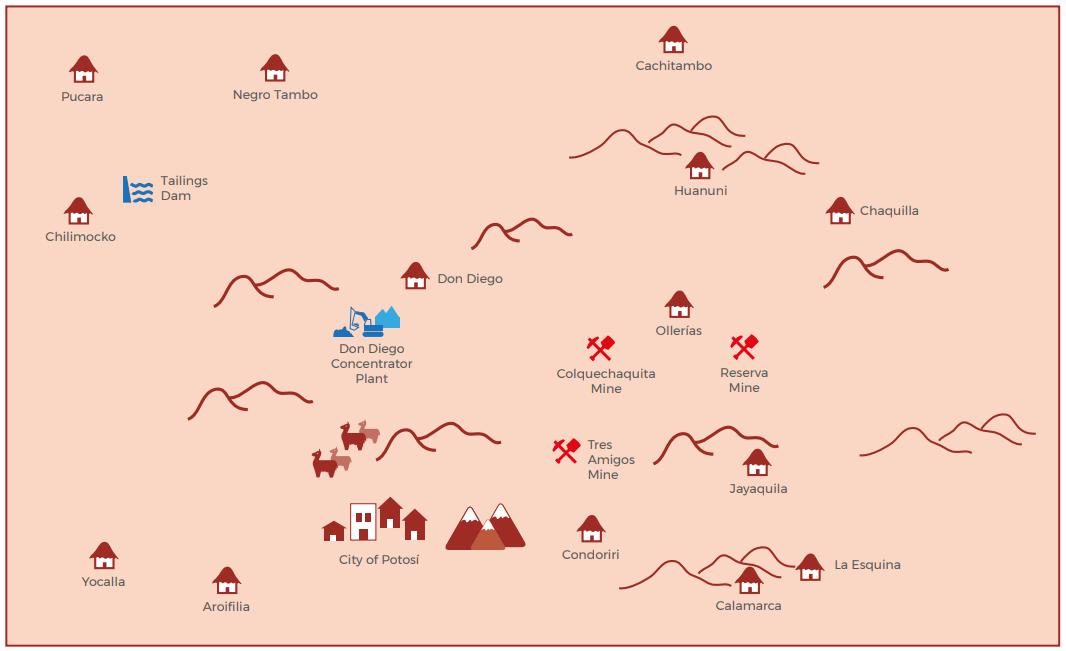
Caballo Blanco comprises a business unit with mines spread across several kilometers on the same mineralized trend and an offsite process plant and tailing facility, all proximal to the city of Potosí. Unlike Bolívar and Porco, Caballo Blanco does not have an adjacent campsite. Most employees live in the communities surrounding the city of Potosí. The mines are named Colquechaquita, Reserva, and Tres Amigos. The Don Diego Plant is located 60km away by road; other supporting units are central administrative offices in Potosí, the Thermal Power Plant in Aroifilla, and the Hydroelectric Power Plant in Yocalla. Operations at Caballo Blanco are not yet consolidated and require independent management and support. Mine operations, maintenance, planning, safety and environment, groups are separate for each mine.
Since Caballo Blanco covers a wide area, it affects many small communities. Consequently, at Caballo Blanco a large area is monitored including 13 small communities which include a population of more than 500 families or around 2,500 community members. Several mining cooperatives are also involved.
In the area of Colquechaquita, Reserva and Tres Amigos, the communities are scattered and sparsely populated, but host the settlement of cooperative miners downstream from our mining operations. Additionally, camelids are bred near the wetlands of the Jayaquilla River and Mocaña Mayu.
Adjacent to the Concentrator Plant is the settlement of Don Diego, where several Santacruz employees live. There are also other more distant and less populated communities.
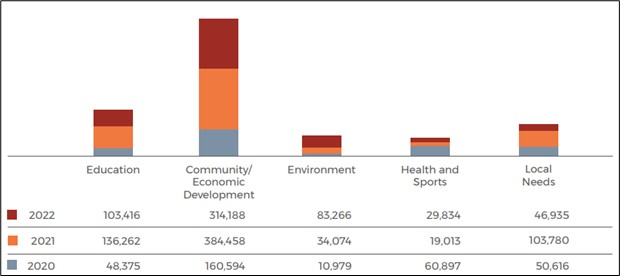
Santacruz’s community investment programs are aimed mostly at communities directly influenced by the operations. Community investments are designed to maximize positive impact, recognizing that each community has unique requirements and living conditions; therefore, Santacruz prioritizes based on number of beneficiaries, vulnerability, long-term sustainability, and urgency of need.
| SANTACRUZ SILVER MINING LTD. | CABALLO BLANCO TECHNICAL REPORT | PAGE 1-25 |
| |
|
Figure 1-12: Caballo Blanco Surrounding Communities
Source: Sustainability Report, Sinchi Wayra (2022)
| SANTACRUZ SILVER MINING LTD. | CABALLO BLANCO TECHNICAL REPORT | PAGE 1-26 |
| |
|
Figure 1-13: Caballo Blanco Community Investment
Source: Sustainability Report, Sinchi Wayra (2022)
| 1.12.5 | Mine Closure |
Closure Planning for Operations has social, economic, workforce, and environmental impacts, so conceptual closure plans are shared with communities. Santacruz’s goal is to recover areas by establishing a healthy ecosystem capable of sustaining productive land use, ensuring the best possible environmental conditions, including physical, chemical, biological, and ecosystem aspects, at closure. Environmental superintendents are responsible for monitoring the environmental closure planning, and periodic reviews of these plans are conducted, including surveys of areas and activities to adjust financial provisions for closure.
Land Use and Rehabilitation - environmental challenges related to biodiversity protection, soil restoration, and land use, are addressed through dialogue with stakeholders, including local communities and relevant authorities. Our comprehensive environmental management focuses on minimizing disturbed areas. In 2022, Santacruz managed a total of 6,600 hectares of land covered by Temporary Special Authorizations (ATEs) granted by the Mining Administrative Jurisdiction Authority (AJAM), under leasing contracts with the Government through COMIBOL. However, Santacruz’s processing activities, services, and related infrastructure (industrial area) currently occupy only 400.5 hectares of land, including areas of previous mining operations and other areas with environmental closure located within the properties Santacruz manage.
In 2022, Santacruz continued with the reforestation plan in the Queaqueani Dam area, in accordance with an agreement with the community of the same name, and significant progress was made in the progressive closure of the old tailings facilities at the Don Diego Concentrator Plant.
| SANTACRUZ SILVER MINING LTD. | CABALLO BLANCO TECHNICAL REPORT | PAGE 1-27 |
| |
|
| 1.13 | Capital and Operating Cost Estimates |
| 1.13.1 | Capital Costs |
The Caballo Blanco mine has been in continuous operation for many years. There will be, as the reserve is expanded and developed, the need for step changes in mine access, production or haulage methods, that may require large capital outlays. These will be financially justified as needed. However, the capital needs for continued operation to exploit the remaining reserves is limited to Primary mine development, Capital equipment rebuilds and replacements, and Tailing Storage Facility expansions. Average annual capital has been and is projected to be in the 11 to 12 $M range.
The historic total capital requirement for all the Bolivian operations is shown in Table 1-6, with Caballo Blanco requirements bolded and italicized. Caballo Blanco’s projected capital requirements for 2023 to 2027 is shown in Table 1-7.
Table 1-6: Actual Combined Capital Requirement for All Bolivian Operations, 2017 to 2022 ($M)
| 2017 | 2018 | 2019 | 2020 | 2021 | 2022 | |
| Bolivar | 8.8 | 13.7 | 13.7 | 6.3 | 11.3 | 10.2 |
| Porco | 3.0 | 8.8 | 8.4 | 3.6 | 5.3 | 3.1 |
| Reserva | 1.3 | 2.4 | 2.1 | 2.0 | 4.3 | 3.5 |
| Tres Amigos | 2.1 | 2.6 | 1.5 | 1.8 | 2.2 | 3.0 |
| Don Diego | 0.9 | 6.9 | 1.4 | 0.9 | 1.1 | 1.2 |
| Colquechaquita | 1.2 | 2.0 | 1.4 | 1.0 | 3.0 | 2.5 |
| La Paz | 3.3 | 0.6 | 0.3 | 0.4 | 0.2 | 0.7 |
| Soracaya | 0.5 | 2.1 | 0.2 | 0.1 | ||
| San Lucas | 0.8 | 0.0 | 0.0 | 0.1 | 0.4 | |
| Total | 21.8 | 39.0 | 28.5 | 16.3 | 27.8 | 24.3 |
Source: Santacruz (2023)
Table 1-7: Projected Capital Requirement for all Caballo Operations, 2021 to 2027 ($M)
| 2023 | 2024 | 2025 | 2026 | 2027 | 2028 | |
| Engineering/Admin | 0.0 | 0.0 | ||||
| Safety/Environmental | 0.8 | 3.0 | 2.1 | 2.0 | 0.1 | |
| Mobile Equipment/Maint | 1.6 | 3.7 | 2.6 | 3.8 | 2.1 | 1.8 |
| Plant | 0.4 | 0.7 | 0.7 | 0.7 | 0.5 | 0.5 |
| Exploration | 0.4 | 0.3 | 1.5 | 1.4 | 1.3 | 0.7 |
| Primary development | 6.5 | 6.0 | 6.8 | 5.6 | 4.4 | 2.4 |
| Corporate | ||||||
| Total | 9.8 | 13.7 | 13.7 | 13.5 | 8.3 | 5.4 |
Source: Santacruz (2023)
| SANTACRUZ SILVER MINING LTD. | CABALLO BLANCO TECHNICAL REPORT | PAGE 1-28 |
| |
|
Recurring exploration and primary development costs have been included in the COG calculations to better anticipate and account for total costs and make the COG more meaningful for reserve estimation and mine planning.
| 1.13.2 | Operating Costs |
Costs used for cut-off grade analysis were taken from actual costs for 2022. The actual cost of corporate G&A was allocated to each of the businesses.
Table 1-8: Unit Operating Costs ($/t)
| Mine | 75.66 |
| Mine operations | 42.13 |
| Mine maintenance | 19.19 |
| Indirect | 14.34 |
| Plant | 17.10 |
| Warehouse | 0.89 |
| G&A | 13.28 |
| Total | 106.94 |
Source: Santacruz (2023)
Mine operations include direct costs of mining, including labor, energy, materials, and services.
Mine Equipment Maintenance Costs includes maintenance to all equipment related to direct development, exploitation and haulage, as well as service equipment such as pumping, ventilation, winches, etc.
Indirect costs would include Site Management, Technical services, Site Administration, Environmental and Social, Safety and Security.
| SANTACRUZ SILVER MINING LTD. | CABALLO BLANCO TECHNICAL REPORT | PAGE 1-29 |
| |
|
Plant costs include direct Beneficiation costs as well as plant maintenance, and indirect costs.
Warehouse costs refer to Concentrate handling and storage.
General and Administration includes allocated Bolivian corporate costs.
| 1.14 | Economic Analysis |
| 1.14.1 | Result |
The Reserve Estimate was generated using actual costs experienced during a stable production period following the change in management after the purchase of the mine by Santacruz Silver (2022 and beginning of 2023). Actual costs were used for mine operating, concentrate overland transport, port costs, and shipping as well as smelting fees, payment terms, and penalty charges. A simplified Cash flow model was built to model the costs and conditions used to generate the Reserve estimates stated in this report.
The Caballo Blanco mine is part of a multi-operation business. However, the Economic model treats it as a separate financial entity with Bolivian corporate costs allocated for the analysis. As well, the operation is comprised of three mines which feed one offsite Process plant. The financial modelling examines the value of the consolidated operation on a 100% basis to support the Reserve statement.
The Caballo Blanco mines have been in continuous operation for several decades and the deposits are a network of relatively narrow veins. These two aspects drive the normal exploitation process of the mine, where inferred resources are converted and exploited in the same budget year. Resources are generally proven-up by drifting and sampling instead of drilling. Therefor normal budgeting and mine planning includes resources outside of the Reserve estimate.
For the current exercise in this report, only Proven and Probable reserves are included in financial evaluation, so the production schedule represents the depletion of these reserves at average grade and current production rates. The context of the production schedule exploits the Proven and Probable reserves as part of a continuous operation and as such does not include the closure activities.
Table 1-9: Production Forecast – Mining and Processing
| Unit | 2023 | 2024 | 2025 | 2026 | |
| Mine Production | |||||
| Tonnes Mined | (DMT) | 300,000 | 300,000 | 300,000 | 133,512 |
| Tonnes Processed | (DMT) | 300,000 | 300,000 | 300,000 | 133,512 |
| Head Grades | |||||
| Zinc | (%) | 9.18 | 9.18 | 9.18 | 9.18 |
| Lead | (%) | 1.90 | 1.90 | 1.90 | 1.90 |
| Silver | g/t | 193 | 193 | 193 | 193 |
Notes:
FMT = Fine Metric Tonnes; DMT = Dry Metric Tonnes; FOT = Fine Ounces Troy
Source: Santacruz (2023)
| SANTACRUZ SILVER MINING LTD. | CABALLO BLANCO TECHNICAL REPORT | PAGE 1-30 |
| |
|
Metallurgical recoveries and concentrate qualities are actual for the times and head grades that were actually mined. These parameters will necessarily be conservative considering the higher grades in the production schedule.
Table 1-10: Production Forecast - Concentrate
| Unit | 2023 | 2024 | 2025 | 2026 | |
| Concentrates | |||||
| Zinc | (DMT) | 50,298 | 50,298 | 50,298 | 22,384 |
| Zn Conc. Grade | (%) | 50 | 50 | 50 | 50 |
| Ag (in Zinc) | g/t | 218 | 218 | 218 | 218 |
| Zn Recovery | (%) | 92 | 92 | 92 | 92 |
| Ag (in Zinc) | (%) | 19 | 19 | 19 | 19 |
| Lead | (DMT) | 7,531 | 7,531 | 7,531 | 3,352 |
| Pb Conc. Grade | (%) | 58 | 58 | 58 | 58 |
| Ag (in lead) | g/t | 5,482 | 5,482 | 5,482 | 5,482 |
| Pb Recovery | (%) | 77 | 77 | 77 | 77 |
| Ag (in Lead) | (%) | 72 | 72 | 72 | 72 |
| Metal Recovery | |||||
| Zinc | (FMT) | 25,356 | 25,356 | 25,356 | 11,284 |
| Silver (in Zinc) | (FOT) | 352,759 | 352,759 | 352,759 | 156,992 |
| Lead | (FMT) | 4,402 | 4,402 | 4,402 | 1,959 |
| Silver (in Lead) | (FOT) | 1,330,079 | 1,330,079 | 1,330,079 | 591,938 |
| Silver (Total) | (FOT) | 1,682,838 | 1,682,838 | 1,682,838 | 748,930 |
Notes:
FMT = Fine Metric Tonnes; DMT = Dry Metric Tonnes; FOT = Fine Ounces Troy
Source: Santacruz (2023)
| SANTACRUZ SILVER MINING LTD. | CABALLO BLANCO TECHNICAL REPORT | PAGE 1-31 |
| |
|
That same logic follows to the net revenue generation (Table 1-11) which includes smelter charges and penalty fees.
Table 1-11: Revenue and Cost Projection ($M)
| Unit | 2023 | 2024 | 2025 | 2026 | |
| Payable Metal Revenue | |||||
| Zinc | 64 | 64 | 64 | 29 | |
| Metallurgical Deduction | 10 | 10 | 10 | 5 | |
| Gross Payable Zinc | 54 | 54 | 54 | 24 | |
| Lead | 10 | 10 | 10 | 4 | |
| Metallurgical Deduction | - | - | - | - | |
| Gross Payable Lead | 9 | 9 | 9 | 4 | |
| Silver | 35 | 35 | 35 | 16 | |
| Metallurgical Deduction in Zinc | 4 | 4 | 4 | 4 | |
| Metallurgical Deduction in Lead | 1 | 1 | 1 | 1 | |
| Gross Payable Silver | 30 | 30 | 30 | 13 | |
| Gross Revenue (Total) | 93 | 93 | 93 | 41 | |
| Smelter Charges and Penalties | |||||
| Treatment charges Zn | (USD/t) | 277 | 277 | 277 | 277 |
| Treatment charges Zn | 14 | 14 | 14 | 6 | |
| Treatment charges Pb | (USD/t) | 133 | 133 | 133 | 133 |
| Treatment charges Pb | 1 | 1 | 1 | - | |
| Penalties in Zn | (USD/t) | 3 | 3 | 3 | 3 |
| Penalties in Zn | - | - | - | - | |
| Penalties in Lead | (USD/t) | 71 | 71 | 71 | 71 |
| Penalties in Lead | 1 | 1 | 1 | - | |
| Refining Charges in Pb | (USD/FOZ) | 1 | 1 | 1 | 1 |
| Refining Charges in Pb | 2 | 2 | 2 | 1 | |
| Smelter Fees and Penalties | 15 | 17 | 17 | 17 | |
| Net Revenue | 277 | 277 | 277 | 277 | |
| Operating Costs | |||||
| Production Costs | 30 | 30 | 30 | 14 | |
| Cost of Sales | |||||
| Rail Freight Zn | - | - | - | - | |
| Rail Freight Pb | - | - | - | - | |
| Port Expenses Zn | 2 | 2 | 2 | 1 | |
| Port Expenses Pb | - | - | - | - | |
| Rollback Fee Zn | 5 | 5 | 5 | 2 | |
| Rollback Fee Pb | 1 | 1 | 1 | - | |
| Concentrate Freight and Port Costs | 8 | 8 | 8 | 8 | |
| Mine Royalty | 6 | 6 | 6 | 3 | |
| Communities and Unions | 2 | 2 | 2 | 1 | |
| Selling Costs | 16 | 16 | 16 | 7 | |
| Total Cost of Sales | 46 | 46 | 46 | 21 | |
Source: Santacruz (2023)
| SANTACRUZ SILVER MINING LTD. | CABALLO BLANCO TECHNICAL REPORT | PAGE 1-32 |
| |
|
Depreciation is a product of previous operation and annual capital expenditure incurred for the exploitation of the reserve tonnage. Capital is limited to that required to support mining, processing, and tailing storage for the reserve. Corporate G&A is that part of the in-country costs allocated to the Caballo Blanco mine.
Table 1-12: Cashflow Projection ($M)
| 2023 | 2024 | 2025 | 2026 | |
| Income Statement | ||||
| Net Revenue | 76 | 76 | 76 | 34 |
| Production Costs | -30 | -30 | -30 | -14 |
| Selling Costs | -16 | -16 | -16 | -7 |
| Depreciation | -10 | -9 | -9 | -11 |
| Gross Profit | 19 | 20 | 21 | 2 |
| Corporate G&A | -3 | -4 | -4 | -2 |
| Operating profit | 16 | 16 | 17 | 0 |
| EBIT | 16 | 16 | 17 | 0 |
| Income Tax Expense (CIT) | -6 | -6 | -6 | 0 |
| Net Gain/(Loss) for the year | 10 | 10 | 10 | 0 |
| Cashflow Statement | ||||
| Cash from Operations Activities | ||||
| Net Income | 10 | 10 | 10 | 0 |
| Depreciation | 10 | 9 | 9 | 11 |
| Subtotal | 20 | 19 | 19 | 11 |
| Cash from Investing Activities | ||||
| Sustaining Capital Expenditure | -9 | -13 | -7 | 0 |
| Subtotal | -9 | -13 | -7 | 0 |
| Cash Balance | ||||
| Beginning | 0 | 11 | 17 | 29 |
| Change in Cash | 11 | 6 | 12 | 11 |
| Ending | 11 | 17 | 29 | 40 |
Source: Santacruz (2023)
| SANTACRUZ SILVER MINING LTD. | CABALLO BLANCO TECHNICAL REPORT | PAGE 1-33 |
| |
|
Income tax is 37.5% of the EBIT. As seen, the operations generate a positive cash flow after tax upon exploitation of the stated reserve at the metal prices used to generate the reserve.
| 1.14.2 | Sensitivities |
A univariate sensitivity analysis was performed to examine which factors most affect the Project economics when acting independently of all other cost and revenue factors. Each variable evaluated was tested using the same percentage range of variation, from -20% to +20%, although some variables may experience significantly larger or smaller percentage fluctuations over the LOM. For instance, the metal prices were evaluated at a ±20% range to the base case, while the capex and all other variables remained constant. This may not be truly representative of market scenarios, as metal prices may not fluctuate in a similar trend. The variables examined in this analysis are those commonly considered in similar studies – their selection for examination does not reflect any particular uncertainty.
Notwithstanding the above noted limitations to the sensitivity analysis, which are common to studies of this sort, the analysis revealed that the Project is most sensitive to metal pricing. The Project showed the least sensitivity to capital costs. Figure 1-14 shows the results of the sensitivity analysis.
| SANTACRUZ SILVER MINING LTD. | CABALLO BLANCO TECHNICAL REPORT | PAGE 1-34 |
Figure 1-14: Univariate Sensitivities
|
|
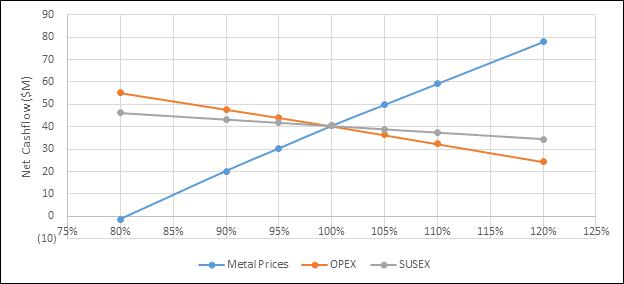
| 1.15 | Observations, Risks, Opportunities and Recommendations |
|
1.15.1 | Observations |
The Caballo Blanco Project is located in the Cordillera de los Azanaques, forming the western edge of the Cordillera Oriental, which is detached from the Cordillera de los Frailes, belonging to the group of central mountain ranges. Characterized by the essence of undulating plateaus, outstanding mountains parallel to the course of the Andes, with elevations that vary between 3,400 and 4,600 masl. The area is part of the polymetallic belt of the altiplano and the Cordillera Occidental.
The most important ore deposits of the Eastern Cordillera are polymetallic hydrothermal deposits mined principally for Sn, W, Ag and Zn, with sub-product Pb, Cu, Bi, Au and Sb. They are related to stocks, domes and volcanic rocks of Middle and Late Miocene age (22 to 4 Ma). Mineralization occurs in veins, fracture swarms, disseminations and breccias. The deposits of the Eastern Cordillera are epithermal vein and disseminated systems of Au, Ag, Pb, Sb, as that have been telescoped on to higher temperature mesothermal Sn-W veins and, in some cases, porphyry Sn deposits. The telescoping is a characteristic of these deposits and is the result of collapse of the hydrothermal systems, with lower temperature fluids overprinting higher temperature mineralization. The systems show a fluid evolution from a high temperature, low sulphidation state to intermediate sulphidation epithermal and high sulphidation epithermal.
The Caballo Blanco Project is an “advanced property” and has been in continuous production since 1993.
| SANTACRUZ SILVER MINING LTD. | CABALLO BLANCO TECHNICAL REPORT | PAGE 1-35 |
|
|
The QPs found that Caballo Blanco is a well-managed operation that should be capable of sustaining profitable operations for many years to come in the same fashion as it has operated for the past several years.
The reserves were found to be estimated correctly using industry-standard techniques and procedures and industry-standard software by diligent and competent professionals.
The mine has an ample provision of skilled workers. Typical and reasonable ore control systems were in place, but it is possible that the results could be improved with a closer attention to appropriate mining widths, minimizing them wherever possible to minimize dilution.
The availability and utilization statistics show that the mines are well equipped, but these statistics can sometimes be misleading depending on how the factors are calculated. Mine supervision sited equipment reliability as an impediment to achieving targets.
The processing plant appears to be well run as evidenced by a lack of spillage. The metallurgical team has a good understanding of the processing variable that determine how material will respond to the Don Diego processing facility.
| 1.15.2 | Risks |
Many risks exist which are common to most mining projects including operating and capital cost escalation, permitting and environmental compliance, unforeseen schedule delays, changes in regulatory requirements, ability to raise financing and metal price. Many of these ever-present risks can be mitigated with adequate engineering, planning and pro-active management. The most significant risks to this project and its continued development are related socio-economic and geo-political factors.
The Project also subject to site-specific risks, including the following:
| ● | The activity that is prevalent throughout the region related to Cooperativas and artisanal miners may cause issues for access and for reasonable prospects of eventual economic extraction and may condemn or reduce resources and reserves in those areas. The Caballo Blanco mines are relatively isolated and not flanked by camps or towns. Attention to community relations has developed strong mutually beneficial working relationships with many of the local population and mining cooperatives which has created a sustained period of stable political and socio-economic cooperation. However, changes in this relationship and instability would pose a significant risk to continued operation of the mines in addition to risks related to tenure and ownership; | |
| ● | The current political and socio-economic climate in Bolivia poses risks and uncertainties that could delay or even stop development as reported within the Fraser Institute Annual Report 2022 where Bolivia ranks very low in many non-technical metrics. Bolivia has been ranked consistently low for the past five years and ranks in the lower quartile on all metrics that gauge risk and uncertainty. It is difficult to gauge or qualify the level or extents of the risks however, all companies working in Bolivia must continue to be aware of the potential risks and develop mitigation strategies. A significant risk related to the Santacruz Bolivian mineral assets and in particular the mineral resources and mineral reserves is the significant artisanal activity that continues to exist. This activity is not only a socio-economic risk but also affects access to resources and reserves along with potential sterilization of mineral resources; |
| SANTACRUZ SILVER MINING LTD. | CABALLO BLANCO TECHNICAL REPORT | PAGE 1-36 |
|
|
| ● | Geological interpretations may be subjective and may result in the location and extent of some of the mineralized structure although as the Caballo Blanco mines are comprised of well constrained veins, this risk is minimal; | |
| ● | As vein thicknesses are narrow, resources may be sensitive to dilution although the relative high grades that exist at the Caballo Blanco mines are successful mitigating such risks to date; | |
| ● | Varying resource classification methods and criteria may vary as more data is considered; | |
| ● | There is no guarantee that further drilling will result in additional resources or increased classification; | |
| ● | Further work may disprove previous models and therefore result in condemnation of targets and potential negative economic outcomes; | |
| ● | Lower commodity prices could change the size and grade of the potential targets; | |
| ● | Ability to replace mined reserves on an annual basis; and | |
| ● | Maintenance of permitting. |
As the mines continues to expand to depth, the following aspects of mine operations will be challenged:
| ● | Worker travel time (reduced time at the face); | |
| ● | Dewatering inflow quantities, infrastructure and costs; and | |
| ● | Ventilation system needs and costs. |
This will be particularly felt in Colquechaquita, as it is a shaft access mine with most of its remaining reserve at depth. The shaft will ultimately require extension to depth or trackless equipment will be required to haul the ore to the shaft bottom.
Supply and delivery of backfill was observed to be behind schedule which could have been caused by low development production, haulage bottlenecks, etc. The outcome, however, increases risk of hanging wall failure in the stopes and ore dilution from over-mucking; and
The process plant is not located on site, so ore transport costs can be significant and factors such as dilution have a greater impact on mineralized material value.
As is shown on Figure 1-14, the greatest risk to the economic results in this study is from changes to metal prices.
| SANTACRUZ SILVER MINING LTD. | CABALLO BLANCO TECHNICAL REPORT | PAGE 1-37 |
|
|
| 1.15.3 | Opportunities |
Project opportunities include:
| ● | The primary opportunity for the mine is to improve the grade to the mill by incorporating a mine dilution control program. As is typical with all narrow width mining, dilution is very sensitive to the mined widths of veins, which must be kept at minimum to accommodate equipment widths. Often, however, veins are over-mined to ensure complete recovery of the ore. This practice significantly increases dilution due to overbreak of the hangingwall and footwall; | |
| ● | The mines would all benefit from more diamond drilling, particularly the Tres Amigos with is long strike length and little lateral development; | |
| ● | A systematic exploration program could provide an excellent opportunity for successfully uncovering new discoveries; | |
| ● | An increased understanding and derivation of alternative theories may result in further discovery and expansion for the Project; | |
| ● | A hydrogeological study could help the operation to better characterize and understand water inflows, aiding design work and planning to reduce the impact of major seasonal inflows; | |
| ● | Caballo Blanco group of mines is firmly established as a producing property but has yet to be consolidated into a fully integrated mine. Each mine is independently managed and operated and there are very few, if any, shared services. All three mines are on the same mineralized trend and consolidation is a possibility; | |
| ● | Higher commodity prices could change size and grade of the potential targets; | |
| ● | Potential for expansion and classification upgrade of resources as mining activities progress; and | |
| ● | Caballo Blanco group of mines is firmly established as a producing property but has yet to be consolidated into a fully integrated mine. Each mine is independently managed and operated and there are very few, if any, shared services. All three mines are on the same mineralized trend and consolidation is a possibility. |
| 1.15.4 | Recommendations |
To advance the Caballo Blanco mining operation and further evaluate the potential additional veins and increase resources thereby displacing depletion due to ongoing mining activities, the following is recommended:
| ● | Regional exploration for identification of new veins; | |
| ● | Incorporate structural interpretations to assist regional understanding; |
| SANTACRUZ SILVER MINING LTD. | CABALLO BLANCO TECHNICAL REPORT | PAGE 1-38 |
|
|
| ● | QA/QC program review and improvement; | |
| ● | Investigate source of anomalous lead values experienced with the field blanks; | |
| ● | Incorporation of externally certified blanks and standards into the QA/QC program; | |
| ● | Insertion of QA/QC samples throughout at a rate of 1 in 20 for blanks, standards and duplicates; | |
| ● | Analysis of thickness and grade-thickness profiles for resource targeting and predictive dilution study; | |
| ● | Hydrogeological study and modelling should be done to better understand water inflows and minimize their impact on production; | |
| ● | Plan and execute a resource expansion program including drilling and underground sampling to fully identify and upgrade resources proximal to active mining areas for inclusion in the 2-year mine plan. This is important so that existing mine development can be fully utilized, and reductions in mine development requirements and rate of vertical descent realized; | |
| ● | Resource drilling to justify more integrated mine development is also important for stable long-term production and growth. Moving the properties toward a more integrated operation can add value to the project; | |
| ● | Extensive surface drilling for near surface targets along with underground drilling for resource delineation and extension; | |
| ● | As is typical with all narrow width mining, dilution is very sensitive to the mined widths of veins. Good work is being done on identifying and qualifying specific stope dilution. Analysis and incorporation of findings into the stope planning and mine operations is an opportunity to increase project value; Often veins are over-mined to ensure complete recovery, but this practice comes with significantly increased dilution due to overbreak of the hangingwall and footwall. The operation should conduct a thorough test stoping experiment to ensure the most economic balance between incomplete recovery and excessive dilution; | |
| ● | Underground operations that use three x 8 hour shifts typically lose much worker productivity due to excessive travel and break time over such a short shift. The current operation has an effective time of 5.5 hours per worker on an 8-hour shift. Consideration should be given to test a longer shift, say a schedule of 4 x 10 hours per week with three days off. With the same 2.5 hours of travel and break time, the effective time would increase to 7.5 hours per shift, resulting in an increase from 68% to 75% shift effectiveness or actual working time. The workers are apt to find that the longer days are harder, but that the three days off provide more rest on the balance of the week; | |
| ● | The methodology for calculating equipment and utilization factors should be reviewed and adjusted if necessary. If equipment availability is, in fact, impeding production as was reported by supervision, it is not currently reflected in these statistics; |
| SANTACRUZ SILVER MINING LTD. | CABALLO BLANCO TECHNICAL REPORT | PAGE 1-39 |
|
|
| ● | Devote attention to optimizing material transport. Transport of waste rock is critical to stope productivity and stability with the mining methods being used, thus its supply and transport are critical to mine production; | |
| ● | The possibility for ore sorting or should be evaluated. As the mines each have a considerable haulage distance for run-of-mine ore, reducing the quantity to reduce haulage costs could be economically beneficial. On site crushing may be required to conduct sorting, however, offsetting or exceeding the savings it would provide to the trucking costs; | |
| ● | At Don Diego Plant, the period analyzed from August 2020 to July 2021 exhibited more downtime than planned. Investigate opportunities to raise Process Plant throughput and reduce downtime to improve project economics; | |
| ● | Metallurgical testwork to investigate opportunities to increase recoveries, through grinding, reagent dosage or newer flotation technologies; | |
| ● | Investigate geo-metallurgical characteristics of the feed; | |
| ● | The operation should continue to maintain diligent accounting centers to determine each mine’s profitability and, if necessary, shift resources or assets to maximize profits; and | |
| ● | Continue open communication and fair business practices with mining cooperatives and surrounding communities to minimize risk of asset subjugation. |
These recommendations have not been costed, as they represent changes to current practices that can be funded by existing operating budgets.
| SANTACRUZ SILVER MINING LTD. | CABALLO BLANCO TECHNICAL REPORT | PAGE 1-40 |
|
|
| 2 | INTRODUCTION |
| 2.1 | Terms of Reference |
JDS Energy & Mining Inc. (JDS) was commissioned by Santacruz Silver Mining Ltd. (Santacruz)to prepare a Technical Report in accordance with the Canadian Securities Administrators’ National Instrument 43-101 and Form 43-101F1, collectively referred to as National Instrument (NI) 43-101 for the Caballo Blanco Project (CB or the Project) located in the state of Potosi, Bolivia.
Santacruz is based in Vancouver, British Columbia and is engaged in the operation, acquisition, exploration and development of mineral properties in Latin America, with a primary focus on silver and zinc. Santacruz was incorporated on January 24, 2011 under the laws of British Columbia and is listed on the TSX Venture Exchange under the trading symbol “SCZ”.
On October 11, 2021, Santacruz entered into the Definitive Agreement with Glencore whereby Santacruz agreed to acquire a portfolio of Bolivian silver assets from Glencore, including the following: (a) a 45% interest in the Bolivar Mine and the Porco Mine, held through an unincorporated joint venture between Glencore’s wholly-owned subsidiary Contrato de Asociación Sociedad Minera Illapa S.A. (Illapa) and COMIBOL, a Bolivian state-owned entity; (b) a 100% interest in the Sinchi Wayra S.A. (Sinchi Wayra) business, which includes the producing Caballo Blanco mining complex; (c) the Soracaya exploration project; and (d) the San Lucas ore sourcing and trading business.
On March 18, 2022, Santacruz completed this purchase, including Glencore’s interest in the Caballo Blanco mining complex.
Santacruz thus owns 100% of the two Bolivian operating companies Illapa and Sinchi Wayra, which in turn own 45% of the Bolivar Mine, 45% of the Porroco Mine, and 100% of the Caballo Blanco mining complex.
Sinchi Wayra is the operating company for all three active mining operations, including the Caballo mining complex.
This report is the first declaration of resources and reserves, for the Bolivar base metals underground mining operation since its acquisition by Santacruz. The mine is fully operational at the time of this report’s preparation. The effective date of both the resource and the reserve is January 1, 2023, which is approximately 18 months before the report date. Production data for the calendar year 2023 has been included in Section 24 Other Relevant Data and information to show the depletion and typical replenishment of resources and reserves over a calendar year.
| 2.2 | Qualification Persons |
The Qualified Persons (QPs) preparing this report are specialists in the fields of geology, exploration, mineral resource estimation, metallurgy and mining.
| SANTACRUZ SILVER MINING LTD. | CABALLO BLANCO TECHNICAL REPORT | PAGE 2-1 |
|
|
None of the QPs or any associates employed in the preparation of this report has any beneficial interest in Santacruz and neither are any insiders, associates, or affiliates. The results of this report are not dependent upon any prior agreements concerning the conclusions to be reached, nor are there any undisclosed understandings concerning any future business dealings between Santacruz and the QPs. The QPs are being paid a fee for their work in accordance with normal professional consulting practice.
The following individuals, by virtue of their education, experience and professional association, are considered QPs as defined in the NI 43-101, and are members in good standing of appropriate professional institutions / associations. The QPs are responsible for the specific report sections as listed in Table 2-1.
Table 2-1: QP Responsibilities
| Qualified Person | Company | QP Responsibility / Role | Report Section(s) |
| Richard Goodwin, P.Eng. | JDS | Author, Mining, Project Manager | 1.1 to 1.2, 1.8 to 1.9, 1.11 to 1.15, 2 to 6.1, 12.1, 12.3, 12.5, 15, 16, 18 to 26, 28 |
| Garth Kirkham, P.Geo. | Kirkham Geosystems Inc. | Geology, QA/QC, Data Verification, Drilling, Resource Estimate | 1.3 to 1.5, 1.7, 6.2, 7 to 11, 12.2, 9, 10, 11, 12.2, 14, 27 |
| Tad Crowie, P.Eng. | JDS | Metallurgy | 1.6, 1.10, 12.4, 13, 17 |
| 2.3 | Site Visit |
In accordance with National Instrument 43-101 guidelines, site visits are summarized in Table 2-2. Sinchi Wayra staff and management were cooperative and helpful during the course of each visit. Access to all requested information and physical sites was provided voluntarily.
Table 2-2: QP Site Visits
| Qualified Person | Company | Date | Description of Inspection |
| Richard Goodwin, P.Eng. | JDS | January 30-31, 2023 | Mr. Goodwin met with technical and operating staff and toured the mines (Colquechaquita, Tres Amigos, and Reserva) with SW personnel and management. |
| Garth Kirkham, P. Geo. | Kirkham Geosystems Inc. | August 10-13, 2021 March 15-30, 2023 |
Collquechaquita, Reserva and Tres Amigos mines and Caballo Blanco Project sites; including select working areas and faces underground, Potosi professional offices, Don Diego Mill Complex, sample storage facilities, La Paz company offices, discussions with site and company personnel. |
| Tad Crowie, P.Eng. | JDS | August 10-13, 2021 | Collquechaquita, Reserva and Tres Amigos mines and Caballo Blanco Project sites; including select working areas and faces underground, Potosi professional offices, Don Diego Mill Complex, sample storage facilities, La Paz company offices, discussions with site and company personnel. |
| SANTACRUZ SILVER MINING LTD. | CABALLO BLANCO TECHNICAL REPORT | PAGE 2-2 |
|
|
| 2.4 | Units, Currency and Rounding |
The units of measure used in this report are as per the International System of Units (SI) or metric, except for Imperial units that are commonly used in industry (e.g., ounces (oz.) and pounds (lb.) for the mass of precious and base metals).
All dollar figures quoted in this report refer to United States dollars (US$ or $) unless otherwise noted.
Frequently used abbreviations and acronyms can be found in Section 28. This report includes technical information that required subsequent calculations to derive subtotals, totals and weighted averages. Such calculations inherently involve a degree of rounding and consequently introduce a margin of error. Where these occur, the QPs do not consider them to be material.
This report may include technical information that requires subsequent calculations to derive sub-totals, totals and weighted averages. Such calculations inherently involve a degree of rounding and consequently introduce a margin of error. Where these occur, JDS does not consider them to be material.
| 2.5 | Sources of Information |
This report is based on information collected by the QPs during their site visits performed on August 12, 2021 (Kirkham and Crowie), on February 1, 20323 (Goodwin) and on additional information provided by Glencore and Sinchi Wayra throughout the course of the QPs investigations. Other information was obtained from the public domain. The QPs conducted adequate verification of the information and take responsibility for the information provided by Santacruz.
| 2.6 | List Of Previous Relevant Technical Reports |
There has been one technical report published which was the subject of the Caballo Blanco Project entitled “NI 43-101 Technical Report, Caballo Blanco, Potosi, Bolivia” dated December 21, 2021. This report was produced by JDS on behalf of Santacruz and authored by Kirkham and Crowie who are also QPs for this Technical Report.
| SANTACRUZ SILVER MINING LTD. | CABALLO BLANCO TECHNICAL REPORT | PAGE 2-3 |
|
|
| 3 | RELIANCE ON OTHER EXPERTS |
The QP’s have relied on information provided by the Issuer on claims, ownership, property agreements, royalties, environmental liabilities, and permits as described in Section 4. The information appears reasonable but has not independently verified beyond the information that is publicly available.
The QPs have relied upon a legal opinion provided by Enrique Barrios of the firm Dentons Guevara & Gutierrez S.C., located in La Paz, Bolivia, in the documents “Local Counsel Legal Opinion on the Porco Mine”, “Local Counsel Legal Opinion on the Caballo Blanco Project”, “Local Counsel Legal Opinion on Empresa Minera San Lucas S.A.”, “Local Counsel Legal Opinion on Sociedad Minero Metalúrgica Reserva Ltda.”, “Local Counsel Legal Opinion on Sociedad Minera Illapa S.A.”, “Local Counsel Legal Opinion on Sinchi Wayra S.A.”, and “Local Counsel Legal Opinion on the Illapa Joint Venture”, all dated March 18, 2022 with regards to the Property’s location, title, and environmental licenses described in Section 4 of this report.
The QPs have relied on information provided by Arturo Prestamo of Santacruz for the information contained in Section 20 and for the smelter agreements used for the determination of the resources, reserves, and economic model.
| SANTACRUZ SILVER MINING LTD. | CABALLO BLANCO TECHNICAL REPORT | PAGE 3-1 |
|
|
| 4 | PROPERTY DESCRIPTION AND LOCATION |
| 4.1 | Location |
The Caballo Blanco Project consists of three separate mines and one process plant operating as one to produce Zinc and Lead concentrates. An Important part of the supporting infrastructure includes two off-site power plants that produce supplemental electric power to the mines. The mines are relatively close together and located as follows:
Reserva and Tres Amigos Mines are located 31 km southeast of the city of Potosi, in the Canton Concepcion of the first section of the Tomas Frias Province of the Department of Potosi, at an average elevation of 4,536 masl, at UTM coordinates WGS-84: 218764E and 7814967N.
Colquechaquita Mine is located 30 km southeast of the city of Potosi, in the Canton Concepcion of the first section of the Tomas Frias Province of the Department of Potosi, at an average elevation of 4,520 masl, at UTM coordinates WGS-84: 219915E and 7819380N.
The Don Diego Process plant is located about 23 km Northeast of the city of Potosi, in the Don Diego Canton, Municipality of Chaqui, Cornelio Saavedra Province, of the Department of Potosi. At an elevation of 3,550 masl at UTM coordinates WGS-84: 228933E and 7841150N.
There is a 60 km drive from the mines to the Don Diego Processing plant.
| SANTACRUZ SILVER MINING LTD. | CABALLO BLANCO TECHNICAL REPORT | PAGE 4-1 |
|
|
Figure 4-1: Location Map
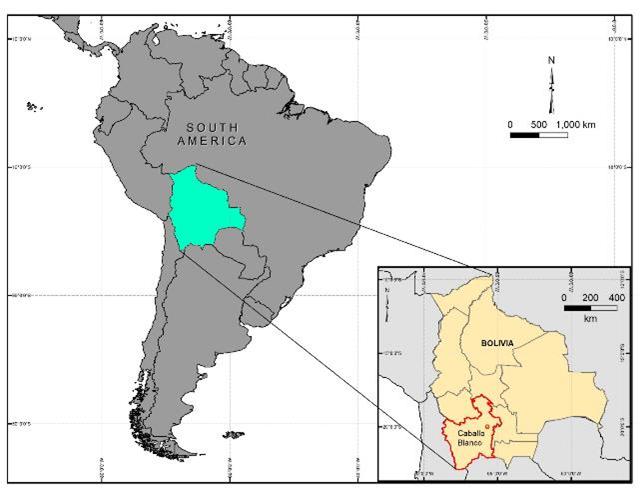
| SANTACRUZ SILVER MINING LTD. | CABALLO BLANCO TECHNICAL REPORT | PAGE 4-2 |
|
|
Figure 4-2: Project Location Map
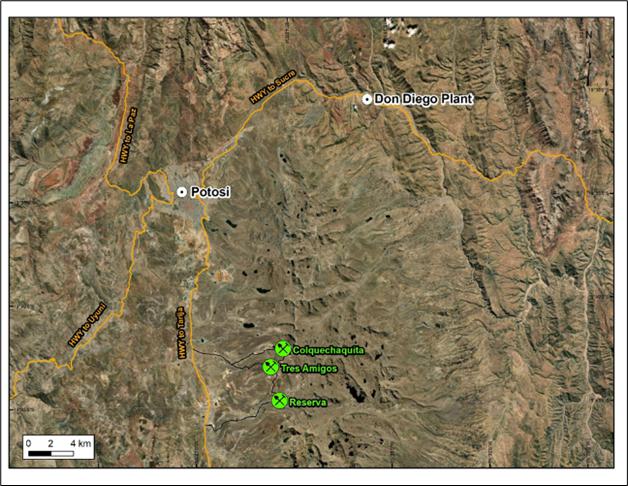
| 4.2 | Property Description and Tenure |
Caballo Blanco brings together, in a single production unit, three independently operated underground mines, a single and remotely located Processing plant and two power plants. Each mine has independent infrastructure to support its operations, as well as independent site management:
| ● | Reserva Mine and Tres Amigos Mine are grouped together at times based on their common access route from the main paved highway; and | |
| ● | Colquechaquita Mine. |
| SANTACRUZ SILVER MINING LTD. | CABALLO BLANCO TECHNICAL REPORT | PAGE 4-3 |
|
|
All mining activity is directed exclusively to the exploration and production of zinc, lead and silver. The Don Diego Processing plant and Chilimocko tailing storage facility with a capacity of 1,100 t/d takes production from all three mines as well as third party toll feed. Haulage distance from the mines to Don Diego process plant and train station is approximately 60 km. Two independent power plants, Yocalla which is a Hydroelectric plant and Aroifilia which is Natural gas driven, provide about 50% of the power to the mines. Each mine is also serviced with power from the Bolivian National Grid.
Off-take Agreements with Glencore International are in place for the Bolivar Mine production: Contract No. 180-03-10309-P and Contract No. 062-03-10276-P, including all its addendums and amendments. These Off-Take Agreements are in effect through the life of the mine.
On March 18, 2022 Santacruz acquired 100% of the shares of Illapa, as more particularly described in Section 2. There was a 1.5% NSR royalty to Glencore, provided as part of the purchase price that Santacruz paid pursuant to the Definitive Agreement, however on March 28, 2024, Santacruz and Glencore entered into a binding term sheet (the Term Sheet) which, among other things, terminated the 1.5% NSR royalty to Glencore. The only known existing agreements that will bind Santacruz is that of the Illapa JV. Environmental liabilities observed consist mostly of historic tailing storage facilities at Don Diego and mine workings at each mine site. Recent audits verify environmental legal compliance and associated closure plan costing.
Table 4-1: Mineral Tenures for Reserva and Tres Amigos Mines
| Area | Ates |
Reserva – Tres Amigos (red) Hectáreas: 3,498 |
Reserva, Reservita, Elfy Cristina, Catalina, Tres Amigos, Sucesivas Tres Amigos, Demasías Tres Amigos, Pablito, TNT1, TNT2, TNT4, TNT5, TNT6, TNT 10 |
Contrato Individual (Hectár) Hectáreas:225 |
TNT 11 |
Contrato Individual (purple) Hectáreas: 825 |
TNT 3 |
Contrato Individual (green) Hectáreas: 30 |
Tio Dorado |
Source: Glencore (2021)
| SANTACRUZ SILVER MINING LTD. | CABALLO BLANCO TECHNICAL REPORT | PAGE 4-4 |
|
|
Figure 4-3: Colquechaquita, Reserva and Tres Amigos Mineral Tenure
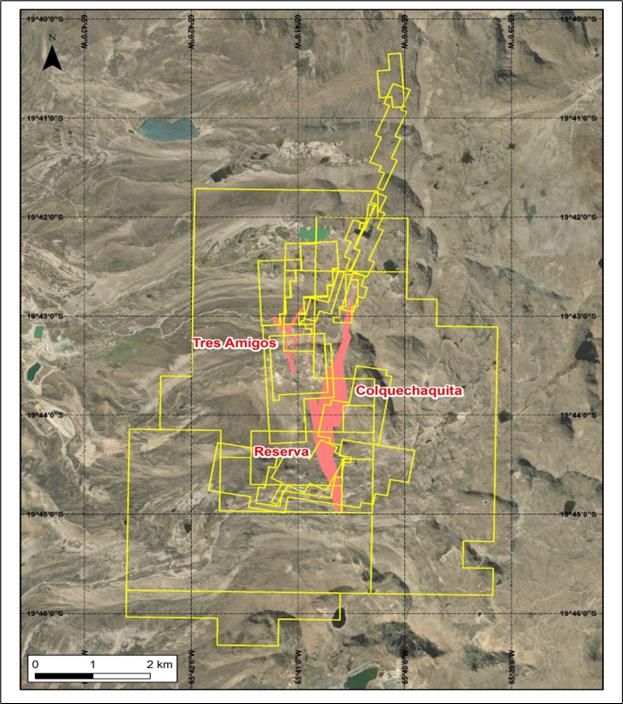
| SANTACRUZ SILVER MINING LTD. | CABALLO BLANCO TECHNICAL REPORT | PAGE 4-5 |
|
|
Reserva and Tres Amigos Mines are located 31 km southeast of the city of Potosi, in the Canton Concepcion of the first section of the Tomas Frias Province of the Department of Potosi, at an average elevation of 4,536 masl, at UTM coordinates WGS-84: 218764E and 7814967N 1,050 m.
Table 4-2: Mineral Tenures for Colquechaquita Mine
| Area | Ates |
Colquechaquita (green) Hectáreas: 115 |
Colquechaquita, Colquechaquita II Ates = Empresa Mineral San Lucas |
Sofia (purple) Hectáreas: 55 |
Sofia, Sucesivas Sofia, Demasias Sofia Ates = Empresa Mineral San Lucas |
Dinosaurio (white) Hectáreas: 52 |
Dinosaurio, Carmelita Ates = Sinchi Wayra |
Contrato Individual (white) Hectáreas: 3 |
Marcela Ates = Sinchi Wayra |
Source: Glencore (2023)
Colquechaquita Mine is located 30 km southeast of the city of Potosi, in the Canton Concepcion of the first section of the Tomas Frias Province of the Department of Potosi, at an average elevation of 4,520 masl, at UTM coordinates WGS-84: 219915E and 7819380N.
| 4.3 | Environmental, Permitting and Social Relations |
Santacruz Silver continues to manage its operations using a sophisticated management approach to sustainability consistent international standards. From the 2022 Sustainability Report:
We are: “A leading Business Group in the mining industry in Bolivia, sustainable, committed to the safety, health, and well-being of our Human Capital, and the preservation of the environment, with an entrepreneurial spirit, openness to change and innovation, and we strive to generate value and positive impact for society as a whole.”
| SANTACRUZ SILVER MINING LTD. | CABALLO BLANCO TECHNICAL REPORT | PAGE 4-6 |
|
|
This integrative approach is evident in the Caballo Blanco operation. Areas addressed and monitored include:
| ● | Employees; | |
| ● | Occupational Health & Safety; | |
| ● | Governance and Compliance; | |
| ● | Stakeholder Engagement; | |
| ● | Contributing to Community; | |
| ● | Environment; and | |
| ● | Product Stewardship & Material Handling. |
| 4.3.1 | Regulatory Framework |
Bolivia’s central statute governing environment protection is Law 1333, of 27 April 1992; specific regulations for which are set out in Regulation of Environmental Prevention and Control, December 8, 1995. Special Decree No. 24782 of 31 July 1997 sets out specific environmental requirements related to mining. Breaching environmental obligations can result in criminal liability under the Bolivian Constitution, in addition to other administrative penalties (such as a loss of mining rights).
An Environmental Impact Assessment (EIA) would be required for a project the scale of a mining and processing operation. As well, public consultation with any potentially affected indigenous communities and local populations may also be necessary. Granting of the operating permit allows the proponent to obtain the appropriate operating licenses, which must be updated with any relevant changes during the life of the operation.
Specialized environmental authorities control compliance. As required under the license, any impact on the environment must be reported to these authorities. Remediation measures and rehabilitation projects are compulsory, and financial reserve funds are maintained annually to cover closure costs. A final closing study on the effect on the environment will also be required, and restitution met.
Sinchi Wayra was granted the Mining Identification Number 02-0002-03, by the SENARECOM (National Service of Control and Registration of Minerals and Metals Commercialization, for its acronym in Spanish), and its certificate expires on July 3, 2022.
Don Diego Concentrator Plant:
| ● | Environmental License: N° 050302-02-DAA-003/97, granted on July 31, 1997. Last update: February 15,2011 (N° 050302-02-DAA-003/11). |
| SANTACRUZ SILVER MINING LTD. | CABALLO BLANCO TECHNICAL REPORT | PAGE 4-7 |
|
|
Colquechaquita Mine
| ● | Environmental license: N°050101-02-DAA-131/97, granted on July 31, 1997. Last update: February 07, 2011 (N° 050101- 02-DAA-131/11); and | |
| ● | The General Direction of War Logistics and Material issued a Registration Certificate under number 0053/2021, for the use of explosives and accessories in mining activities. Expiry date: August 26, 2023. |
Contrato de Asociación Sociedad Minera Reserva Ltda.´s (Reserva – Tres Amigos Mine)
Reserva was granted the Mining Identification Number 05-0020-04, by the National Service of Control and Registration of Minerals and Metals Commercialization (SENARECOM), and its certificate expires on October 15, 2022:
| ● | Environmental license N° 050101-02-DAA-561/11, granted on June 03, 2011. Last update: May 04, 2015; | |
| ● | The General Direction of War Logistics and Material issued a Registration Certificate under number 753/2021(Tres Amigos Mine) Expiry date: June 29, 2023 and 210/2021 (Reserva Mine) Expiry date: August 26, 2023, for the use of explosives and accessories in mining activities; and | |
| ● | The General Direction of Controlled Substances issued a Certificate of Registration with Number 9000-09240-073, Fifth Category, Mining. Registering Maria Elsa Reyes Cors as Legal Representative and titleholder, with expiration date September 24, 2022. |
| 4.3.2 | Health, Safety and Economic Development |
The Caballo Blanco business is spread amongst various locations, and each operation has its own effect on the surrounding communities. Linking the properties is a transport network to deliver mineralized plant feed that extends approximately 60km. Each operating unit is managed independently, with individual teams responsible for planning, safety and environmental management. Most employees live in the communities surrounding the city of Potosí. Consequently, at Caballo Blanco a large area is monitored including 13 small communities which include a population of more than 500 families or around 2,500 community members. Several mining cooperatives are also involved.
As per the Santacruz Sustainability program:
| ● | Employees - Establishing relationships based on trust and promoting a culture of prevention and safe environments. Quality employment opportunities are offered with non-discriminatory hiring. In 2022, Bolívar employed total of 370 employees and 314 contractors, 7% of whom were women. Given the labor benefits offered, Bolívar has a low turnover rate. 71% of employees at Bolívar are unionized. Santacruz guarantees freedom of association and the right to collective bargaining; |
| SANTACRUZ SILVER MINING LTD. | CABALLO BLANCO TECHNICAL REPORT | PAGE 4-8 |
|
|
| ● | Occupational Health & Safety - Realizing the inherent personal risks of mining, and the incremental increase in incident rates over the last three years, emphasis continued in 2022 in program development and training in proper work practices at Bolívar;
| |
| ● | Health – Medical care is provided to employees through third party health insurers at Santa Rita Hospital. Regular Occupational Health examinations are given to all workers and treatment provided when prescribed. In 2022, occupational health factors at Bolívar, continue to be monitored after baseline date indicated most parameters fell within acceptable limits; | |
| ● | Community - The neighboring communities house workers, contractors, and their families. Most of them reside in Antequera, which lies adjacent to the mine. In 2022, USD 660,000 was invested in the development of neighboring communities, benefitting approximately 1,900 families; | |
| ● | Education - One of the schools in Antequera continues to be financed by Santacruz and serves 500 students. The program includes funding of teachers’, directors’ and supporting personnel’s wages, supplies and equipment, payment of services and school infrastructure. 29 scholarships were awarded for study abroad in the capital cities. These programs not only help the local communities, but they provide Caballo Blanco with trained professionals. Public education is also supported through extracurricular sports and cultural activities; | |
| ● | Economic Development - Bolívar offers a professional training workshop for women who live in the mining camp and that make up the Housewives’ Committee. Fire extinguisher training was provided for 100 people this year and five houses were renovated as well as other help to nearly 100 families in two communities; | |
| ● | Environment - Reforestation continued throughout the Queaqueani tailings dam area, and a water diversion project in Antequera focused on improving farming performance that benefited 200 people; and | |
| ● | Local needs - Cultural activities were sponsored including a safety management contest, sponsorship of trips for the Sebastián Pagador graduates, cooking courses for housewives, support for the elderly in purchasing groceries, and the anniversary celebration of Antequera. |
| 4.3.3 | Environmental Management |
Each mine and plant have their own environmental management teams who are responsible for compliance with corporate standards and their environmental license.
| 4.3.3.1 | Water Management |
Given the remote location of the process plant, which is usually the largest water consumer, each mine treats and discharges excess water to the environment. These discharges are regulated for quality and quantity by the environmental license. End uses include consumption by neighboring communities and agricultural/industrial use by llama ranchers and mining cooperatives downstream. Caballo Blanco supplies two thousand cubic meters of treated water per year to the local sanitary administration (AAPOS) to support industrial activities and discharges the remaining treated water to the Jayaquila and Mocaña rivers. Caballo Blanco is able to meet discharge requirements with aeration, pH adjustment and clarification by settling.
| SANTACRUZ SILVER MINING LTD. | CABALLO BLANCO TECHNICAL REPORT | PAGE 4-9 |
|
|
Don Diego process plant maximizes the recirculation of water from its tailing storage facility and draws makeup water from permitted surface sources.
| 4.3.3.2 | Tailings Management |
The Chilimocko tailings storage facility at Don Diego is inspected regularly and maintained to the standards set out by the Canadian Dam Association guidelines. The dam is under the supervision of engineers from AMEC (now Wood Engineering) and recently an external audit was conducted by Knight Piésold Consulting. The dam is of downstream construction. In 2019, the monitoring of the Chilimocko Tailings Dam at Don Diego was updated to keep aligned with new standards.
The company also monitors and manages 4 inactive tailings facilities (1, 2, 3 & Yanakasa) on site.
| 4.3.3.3 | Waste Management |
Although mine waste rock is preferentially stored underground or used as backfill, each of the mines had a permitted and designed waster rock storage area designed for stability and the prevention of acid rock drainage and metal leaching. Sludge from the water treatment plants is deposited in lined ponds adjacent to the treatment plants. Given the mines’ proximity to the City of Potosi, Domestic and Medical waste disposal are managed through the Municipal Garbage Collection Service. Industrial waste such as scrap metal, used Oil, tires, etc. is temporarily stored at each mining unit and collected by companies specialized in recycling.
| 4.3.4 | Community Interaction |
A total of US$332,000 was invested in community support in the areas of education, economic development, environment, local needs, and health and wellbeing. Caballo Blanco has a team who manage the community relations and the aid that is provided.
Although the response to COVID-19 has dominated the community support in 2012, programs active and established in 2019 continued. Some of them included:
| 4.3.4.1 | Educational Programs |
| ● | Scholarship program for outstanding students that graduate from the Ollerías school at the elementary, high school and university levels; | |
| ● | Sponsoring and support of school breakfast at community schools; | |
| ● | Hiring of full-time computer teacher for schools in Jayaquilla and Don Diego; |
| SANTACRUZ SILVER MINING LTD. | CABALLO BLANCO TECHNICAL REPORT | PAGE 4-10 |
|
|
| ● | Support the School Board of Don Diego by paying the salaries of service staff and teachers; and | |
| ● | Providing school transportation for students between the scattered houses in the communities of Pucara, Negro Tambo, Chaquilla, Ollerias, Jayaquilla, Condoriri, Huanuni, Cachitambo, La Esquina and Calamarca. |
| 4.3.4.2 | Economic Development |
| ● | At Don Diego, implementing the potential identification and promotion program; | |
| ● | Supporting textile ventures led by ladies from nearby communities; | |
| ● | Provide support by sponsoring projects of the Community of Chilimocko, in coordination with its authorities and its annual management plan; | |
| ● | As part of the area’s economic diversity, providing support by completely repairing the agricultural tractor and purchasing the plowing equipment and the ridger for sowing; and | |
| ● | “Garment Making Enterprise” project, we incorporated improvements to the electrical installation and donated inputs for the dressmaking equipment. |
| 4.3.4.3 | Environment |
| ● | Supporting the maintenance of the area’s fauna and economic diversity, by donating 400 quintals of food supplement for llama cria and females; and | |
| ● | Managed support works in residential restroom infrastructure and electric power in the communities of Ollerias and Condoriri. |
| 4.3.4.4 | Local Needs |
| ● | Supported the improvement of the houses of the community of Huanuni; | |
| ● | Improved the park, as a space of recreation for the community, building the carousel, sidewalks, planters, and improving the entrances; and | |
| ● | Sponsored social and cultural activities in several communities. |
| 4.3.4.5 | Health and Well-Being |
| ● | Fostered well-being by promoting, supporting and sponsoring various sports events; and | |
| ● | Supported sporting activities through the construction of grandstands and maintenance of the artificial turf field. |
| SANTACRUZ SILVER MINING LTD. | CABALLO BLANCO TECHNICAL REPORT | PAGE 4-11 |
|
|
| 5 | ACCESSIBILITY, CLIMATE, LOCAL RESOURCES, INFRASTRUCTURE AND PHYSIOGRAPHY |
| 5.1 | Accessibility |
The Mines and Process plant have easy access to Potosi City which is a large industrial, mining, and population center. Road access to the Reserva mine from Potosi is 23 km south via the Potosi-Tarija interdepartmental paved highway towards Kuchu Ingenio, then 8 km East on gravel road. Road access to the Colquechaquita mine from Potosi is 16 km south via the Potosi-Tarija interdepartmental paved highway towards Kuchu Ingenio, for approximately 16 km, then 11 km East on gravel access road.
Don Diego plant also has site access to a rail spur for direct transport of concentrates to the preferred Port of Antofagasta Chile, or alternative ports of Arica, Chile, and Matarani, Peru.
The mines have telephone and broadband radio communications.
Figure 5-1: Location of Caballo Blanco Mines and Don Diego Plant
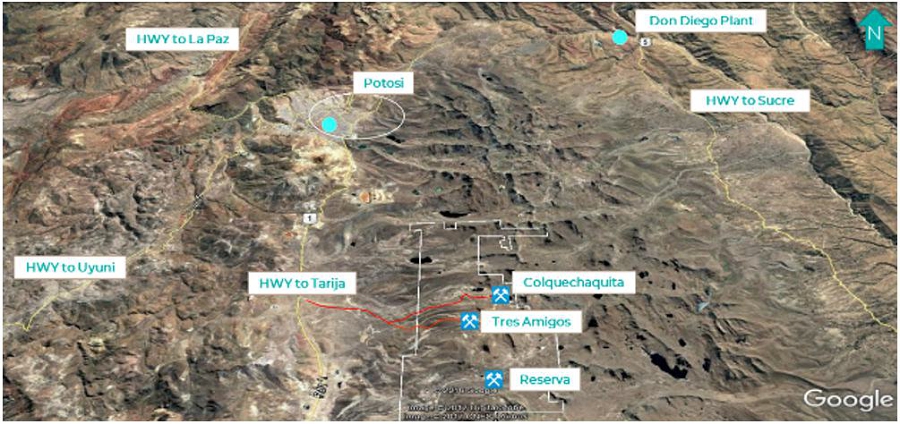
| SANTACRUZ SILVER MINING LTD. | CABALLO BLANCO TECHNICAL REPORT | PAGE 5-1 |
|
|
| 5.2 | Climate and Physiography |
The predominant landscape in the mining areas is mountainous topography, hills and streams with typical flora and fauna. The area in which the mining concessions lie is the Bolivian physiographic province A2 Cordillera Central Oriental, elevation vary from 5,008 masl. (Cerro Jatun Condori) to 4,200 masl (Estancia La Esquina) with a wavy mountain geomorphology. The mines are located in the Eastern Cordillera on the line that follows the Cordillera Kari, with outcrops of Tertiary age igneous rock, and sedimentary rocks, which do not support appreciable vegetative cover.
Generally, the region is semi-arid with rainy season beginning in earnest between the months of October and March, and the dry season from April to September. However, precipitation events are common throughout June, July and August as well.
Weather stations at the mines showed 2019 temperatures ranging from -7 to 19.5oC. Total precipitation was 50 centimeters (cm).
The project lies within the Altiplano, an extensive volcanic plateau where regional flora includes dry plants such as queña, or quenua, which is a dwarf tree found at higher elevations. In addition, abundant yareta is present which is a species of moss that grows on the ubiquitous rocky surfaces.
Faura such as llamas and alpaca are the most distinctive animal populations in the area and are mostly domesticated with wild populations being fairly rare. Another similar animal, the vicuna, exists in the region however it is thought to be on the verge of extinction. In the air, condors inhabit the remote caves of the high peaks, flying over the plateaus.
| 5.3 | Infrastructure |
Proximity to the city of Potosi, allows use of the established system of paved highways to provide access by truck to any services, or supplies required for mine operations. Labor supply is also nearby in Potosi. The secondary access roads to the mines off the main pave highway are gravel and serviceable but not well maintained.
Electric power to the Mines is supplied via the State grid (SEPSA) with supplementary power provided by two generating plants owned and operated by Sinchi Wayra. The Yocalla plant runs on hydro power and the Aroifilia on natural gas. Currently the mines buy approximately 50% of their power from the grid (SEPSA) and generate the remainder. Power is provided on separate lines from each provider and distributed with the mine’s distribution system to regulate power to each mine. Both Sinchi Wayra plants are older and in need of capital investment to remain viable.
Each of the mines produces enough water to treat and reuse for industrial use on site. Excess treated water is discharged to the environment at regulated quality standards. Annually, a total of 2.5 Mm3 of mine water is treated and 2.4 Mm3 discharged from two water treatment plants.
The Tailings storage facility is located at the Don Diego process plant.
Figure 5-2: Caballo Blanco Power Generation
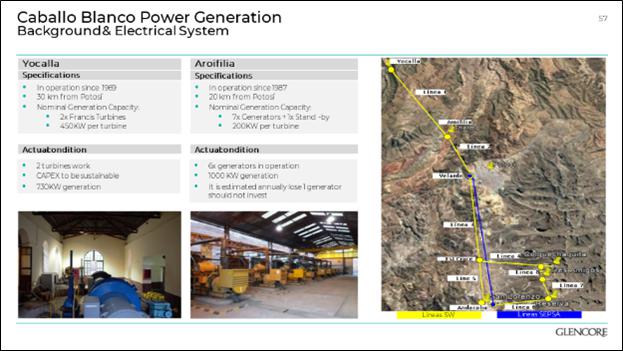
Source: Glencore (2021)
| SANTACRUZ SILVER MINING LTD. | CABALLO BLANCO TECHNICAL REPORT | PAGE 5-2 |
|
|
| 6 | HISTORY |
| 6.1 | Management and Ownership |
Caballo Blanco is a result of business consolidation over time.
The Don Diego Plant began processing in 1977 and was originally acquired by the precursor of Sinchi Wayra S.A. (Sinchi Wayra); Compania Minera del Sur (COMSUR) in 1976. COMSUR purchased the specific mining interests from small private owners and operators loosely organized into cooperativas. The Colquechaquita mine began operating in 1977, passing to COMSUR in 1991, later changing its name to SINCHI WAYRA S.A. Sinchi Wayra took over the Reserva/TresAmigos mines in 2010. Tres Amigos obtained its environmental licenses to operate in 2005 by Sociedad Minero Metalúrgica Reserva Ltda. for its two sections of Exploitation Reserva and Tres Amigos, with a small-scale mining operation. Glencore became involved in 2005 with the purchase of COMSUR and effecting the name change to Sinchi Wayra.
Sinchi Wayra S.A. owns and operates all facets of the Caballo Blanco business; The Don Diego processing plant and Colquechaquita mine since their acquisition by Glencore in 2005, and Reserva and Tres Amigos mines from their acquisition in 2010. Glencore immediately began to develop the deposits with a higher degree of mechanization. The Power plants, Aroifilla thermal power plant, and the Yocalla hydro-electric plant which provide supplementary electric power are also owned and operated by Sinchi Wayra and are included under the management of Caballo Blanco Project.
On October 11, 2021, Santacruz entered into the Definitive Agreement with Glencore whereby Santacruz agreed to acquire a portfolio of Bolivian silver assets from Glencore. The Assets include: (a) Glencore’s 45% interest in the Bolivar Mine and the Porco Mine, held through an unincorporated joint venture between Glencore’s wholly-owned subsidiary Contrato de Asociación Sociedad Minera Illapa S.A. (Illapa) and COMIBOL, a Bolivian state-owned entity; (b) a 100% interest in the Sinchi Wayra business, which includes the producing Caballo Blanco mining complex; (c) the Soracaya exploration project; and (d) the San Lucas ore sourcing and trading business (the Assets).
On March 18, 2022, Santacruz completed this purchase, including Glencore’s interest in the Caballo Blanco mining complex. The Caballo Blanco mining complex has continued to operate since that date under the management of Santacruz.
On May 10, 2023, Santacruz and Glencore entered into a framework agreement to amend certain terms of the transaction documents pertaining to the acquisition of the Assets. On March 28, 2024, Santacruz and Glencore entered into the binding Term Sheet which amends the terms of certain deferred consideration and ancillary documents pertaining to the acquisition of the Assets.
| SANTACRUZ SILVER MINING LTD. | CABALLO BLANCO TECHNICAL REPORT | PAGE 6-1 |
|
|
Figure 6-1: Project History
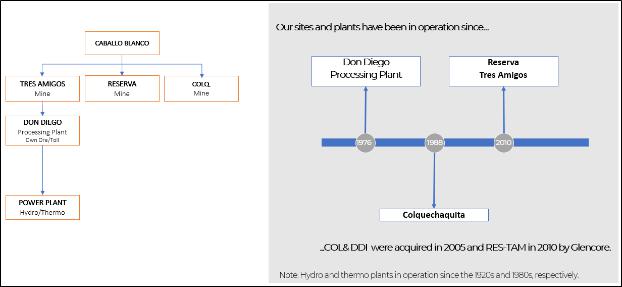
Source: Glencore (2021)
| 6.2 | Historical Resource Estimates |
Glencore’s Resources & Reserves report as of December 31, 2020 disclosed Bolivar, Porco and Caballo Blanco mineral resource statements as well as mineral reserve estimates as of December 31, 2020 Given the source of the estimates, Santacruz considers them reliable and relevant for the further development of the Project; and accordingly, they should be relied upon only as a historical resource and reserve estimate of Glencore, which pre-dates Santacruz’s agreement to acquire the Assets however, the Company is not treating the historical estimates as current Mineral Resources or Mineral Reserves.
A “Qualified Person” as per NI 43-101 has not done sufficient work to classify the historical estimate as current Mineral Resources or Mineral Reserves and Santacruz is not treating the historical estimate as current Mineral Resources or Mineral Reserves. Further drilling and resource modelling would be required to upgrade or verify these historical estimates as current mineral resources or reserves for the respective assets.
| SANTACRUZ SILVER MINING LTD. | CABALLO BLANCO TECHNICAL REPORT | PAGE 6-2 |
|
|
The resources have been reported for Caballo Blanco as of December 31, 2020 at a Zinc Equivalent (ZnEq) cut-off grade 2% as follows in Table 6-1.
Table 6-1: Historic Mineral Resource Estimate
| Category | Tonnes | Zinc | Lead | Silver |
| (Mt) | (%) | (%) | (g/t) | |
| Measured Mineral Resources | 0.9 | 13.68 | 3.66 | 364 |
| Indicated Mineral Resources | 0.6 | 13.08 | 3.17 | 317 |
| Measured + Indicated Mineral Resources | 1.6 | 13.44 | 3.47 | 346 |
| Inferred Mineral Resources | 2.3 | 12.21 | 2.37 | 241 |
Notes:
| 1) | The Mineral Resources have been calculated in accordance with definitions in accordance with the 2012 edition of the Australasian Code for Reporting of Exploration Results, Mineral Resources and Ore Reserves (JORC Code), the 2016 edition of the South African Code for Reporting of Mineral Resources and Mineral Reserves (SAMREC) and the Canadian Institute of Mining, Metallurgy and Petroleum (CIM) Standards on Mineral Resources and Reserves (2014). |
| 2) | The ZnEq = (Zn% + (Pb% * 0.50) + (Ag g/t * 0.0268)). |
| 3) | The Mineral Resources have been calculated in accordance with definitions adopted by the Canadian Institute of Mining, Metallurgy and Petroleum on August 20, 2000. Employees of Glencore have prepared these calculations. |
| 4) | Mineral resources are not mineral reserves until they have demonstrated economic viability. Mineral resource estimates do not account for a resource’s mineability, selectivity, mining loss, or dilution. |
| 5) | An Inferred Mineral Resource has a lower level of confidence than that applying to an Indicated Mineral Resource and must not be converted to a Mineral Reserve. It is reasonably expected that the majority of Inferred Mineral Resources could be upgraded to Indicated Mineral Resources with continued exploration. |
| 6) | All figures are rounded to reflect the relative accuracy of the estimate and therefore numbers may not appear to add precisely. |
| 7) | Reported in-situ Mineral Resources do not consider mineral availability by underground mining methods. |
| 8) | Historical Mineral Reserves and Resources are inclusive of Mineral Reserves shown at 100% ownership. |
Source: Glencore (2020)
For comparison, Table 6-2 shows the Measured and Indicated Resources for 2018 and 2019, respectively which reflects mining depletion and changes in classification due to additional drilling and sampling during operations. The Indicated and Inferred Resources are reported at a 2% ZnEq cut-off grade.
Table 6-2: Historic Mineral Resource Estimate for 2018 and 2019
| Measured | Indicated | Total | ||||
| 2019 | 2018 | 2019 | 2018 | 2019 | 2018 | |
| Ore (Mt) | 0.9 | 0.9 | 0.6 | 0.7 | 1.5 | 1.6 |
| Zinc (%) | 13.7 | 13.2 | 13 | 13 | 13.4 | 13.1 |
| Lead (%) | 3.8 | 3.2 | 3.2 | 2.6 | 3.6 | 2.9 |
| Silver (g/t) | 382 | 301 | 320 | 252 | 357 | 279 |
Source: Glencore (2020)
| SANTACRUZ SILVER MINING LTD. | CABALLO BLANCO TECHNICAL REPORT | PAGE 6-3 |
|
|
Glencore reports resources and reserves in accordance with the 2012 edition of the Australasian Code for Reporting of Exploration Results, Mineral Resources and Ore Reserves (JORC Code), the 2016 edition of the South African Code for Reporting of Mineral Resources and Mineral Reserves (SAMREC) and the Canadian Institute of Mining, Metallurgy and Petroleum (CIM) Standards on Mineral Resources and Reserves (2014 edition). The term ‘Ore Reserves’, as defined in Clause 28 of the JORC Code, has the same meaning as ‘Mineral Reserves’ as defined in the CIM Definition Standards for Mineral Resources and Mineral Reserves. All tonnage information has been rounded to reflect the relative uncertainty in the estimates; there may therefore be small differences in the totals. The Measured and Indicated resources are reported inclusive of those resources modified to produce reserves, unless otherwise noted. Commodity prices and exchange rates used to establish the economic viability of reserves are based on long-term forecasts applied at the time the reserve was estimated.
The parameters and methodology for each step of the resource estimation and manipulation were reviewed by the Qualified Person and are detailed as follows:
| ● | Sixteen separate veins were modelled in the resource estimate, form sets of sets of sub-parallel, north striking and steeply dipping mineralized zones which are extending from between 70 m to 950 m and depths of between 50 m and 400 m and still open; |
Figure 6-2: Veins and Structures for Caballo Blanco
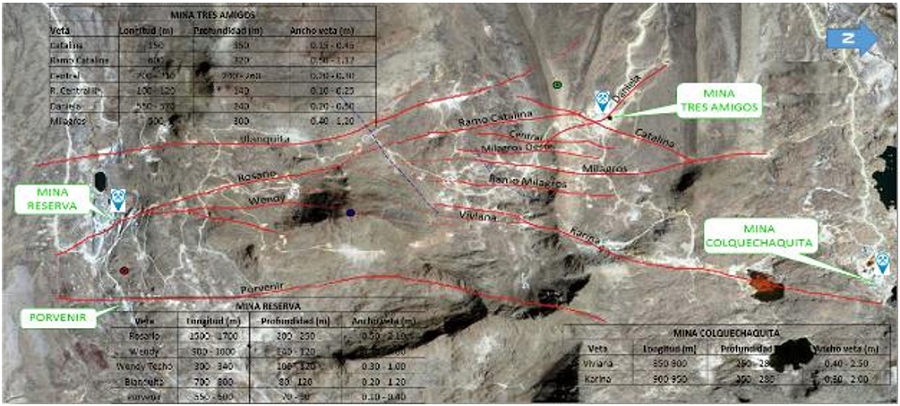
Source: Glencore (2020)
| SANTACRUZ SILVER MINING LTD. | CABALLO BLANCO TECHNICAL REPORT | PAGE 6-4 |
|
|
| ● | A total of 104 drillholes and 14,837 channel samples were used in the estimations into 6,227,265 m3 of vein domain solids; | |
| ● | The estimate was carried out using separate block models for each of the veins constrained by 3D wireframes of the individual mineralized zones. The block model is comprised of an array of blocks measuring 5 m x 5 m x 5 m rotated 47o from North, which are sub-blocked to 5 m x 1.25 m x 1.25 m, with grades for Ag, Pb and Zn interpolated using either Inverse Distance Weighting or Ordinary Kriging depending on the data density within each of the veins. Zinc equivalent values were subsequently calculated from the interpolated block grades; | |
| ● | Bulk densities at Caballo Blanco were based on density sample interval measurements taken by Glencore while SG estimates are based on a multilinear regression formula as follows: |
Density = 2.5253757+0.0176*Zn%+0.05611*Pb%+0.04176*Fe%
| ● | Silver, zinc and lead composite values have been capped in order to remove the effects of potential overestimation due to statistical outliers. The threshold chosen was dependent upon the individual vein as shown in Table 6-3; |
Table 6-3: Composite Statistics and Cut-off Grade Thresholds
| Domain | Vein | Zn | Pb | Ag | |||
| Max | Cap. | Max | Cap. | Max | Cap. | ||
| 1000 | Rosario | 47 | 45 | 49 | 11 | 4,404 | 721 |
| 1001 | Wendy | 52 | 39 | 44 | 12 | 1,813 | 631 |
| 1002 | Wendy Techo | 47 | 44 | 35 | 11 | 2,287 | 715 |
| 1010 | Viviana | 51 | 48 | 44 | 15 | 5,140 | 1,380 |
| 1011 | Karina | 36 | 27 | 52 | 21 | 6,054 | 1,634 |
| 1012 | Camila | 40 | 20 | 29 | 17 | 3,400 | 1,600 |
| 1020 | Catalina | 64 | 32 | 62 | 32 | 7,520 | 3,411 |
| 1021 | Ramo Catalina | 52 | 42 | 49 | 33 | 7,093 | 3,739 |
| 1022 | Daniela | 58 | 40 | 66 | 32 | 13,440 | 4,403 |
| 1023 | Milagros | 52 | 22 | 65 | 19 | 5,423 | 1,890 |
| 1024 | Central | 44 | 36 | 42 | 18 | 10,399 | 2,330 |
| 1025 | Central Este | 40 | 33 | 52 | 25 | 4,484 | 2,450 |
| 1026 | Ramo Central II | 40 | 40 | 69 | 21 | 5,464 | 1,750 |
| 1027 | Crucera | 37 | 31 | 47 | 25 | 2,534 | 1,400 |
| 1028 | Ramo Central Este | 36 | 33 | 26 | 25 | 2,600 | 2,450 |
| 1029 | Ramo Milagros | 28 | 22 | 23 | 19 | 2,100 | 1,890 |
Source: Glencore (2020)
| ● | The interpolation was carried out in three passes using multiples of the ellipse ranges as described in Table 6-4: |
| SANTACRUZ SILVER MINING LTD. | CABALLO BLANCO TECHNICAL REPORT | PAGE 6-5 |
|
|
Table 6-4: Estimation Parameters
| Vein | Range 1 (m) | Range 2 (m) | Range 3 (m) | Min # of Samples | Max # Samples |
| 1000 | 69 | 41 | 19 | 5 | 25 |
| 1001 | 43 | 58 | 19 | 5 | 40 |
| 1002 | 45 | 27 | 19 | 5 | 35 |
| 1010 | 69 | 51 | 25 | 4 | 22 |
| 1011 | 51 | 41 | 35 | 5 | 23 |
| 1012 | 41 | 52 | 21 | 4 | 26 |
| 1020 | 38 | 39 | 20 | 5 | 24 |
| 1021 | 42 | 45 | 21 | 5 | 20 |
| 1022 | 58 | 39 | 22 | 4 | 20 |
| 1023 | 31 | 29 | 20 | 4 | 35 |
| 1024 | 34 | 36 | 20 | 4 | 20 |
| 1025 | 33 | 30 | 26 | 5 | 20 |
| 1026 | 32 | 31 | 20 | 4 | 20 |
| 1027 | 35 | 33 | 20 | 4 | 20 |
| 1028 | 33 | 30 | 26 | 5 | 20 |
| 1029 | 31 | 29 | 20 | 5 | 20 |
Source: Glencore (2020)
| ● | The mineralized wire frames were defined using a combination of geological constraints and grade boundaries with no minimum mining thickness applied; | |
| ● | For all veins, the resource classification criteria are determined according to the variography, and it has been established using the methodology as follows: |
| - | Measured Resources: variogram range of 2/3 of the variogram range with a minimum of 5 samples being informed per block; | |
| - | Indicated resources: to the full variogram range with a minimum of 4 samples being informed per block; | |
| - | Inferred resources: extended to twice the variogram range with a minimum of 2 samples being informed per block; and | |
| - | However, an interpreted boundary is the final determination of indicated and inferred resources in order to remove outlier blocks and the “spotted dog” effect. |
| SANTACRUZ SILVER MINING LTD. | CABALLO BLANCO TECHNICAL REPORT | PAGE 6-6 |
|
|
Mineral Resources that are not Mineral Reserves do not have demonstrated economic viability. Inferred Resources are considered too speculative geologically to have economic considerations applied to them that would enable them to be classified as Mineral Reserves. An Inferred Mineral Resource has a lower level of confidence than that applying to an Indicated Mineral Resource and must not be converted to a Mineral Reserve. It is reasonably expected that the majority of Inferred Mineral Resources could be upgraded to Indicated Mineral Resources with continued exploration.
| 6.3 | Production 2018 to 2022 |
The historical production generated from the Caballo Blanco Mines from the period 2018 to 2022 is shown in Table 6-5.
Table 6-5: Production from the Caballo Blanco Mines, 2018 to 2022
| Year | Tonnes | Zn% | Pb% | Ag g/t |
| 2018 | 233,175 | 6.38 | 1.86 | 198 |
| 2019 | 249,416 | 6.78 | 1.90 | 214 |
| 2020 | 199,674 | 6.83 | 2.13 | 245 |
| 2021 | 242,876 | 6.84 | 1.90 | 220 |
| 2022 | 275,263 | 6.55 | 1.55 | 178 |
| SANTACRUZ SILVER MINING LTD. | CABALLO BLANCO TECHNICAL REPORT | PAGE 6-7 |
|
|
| 7 | GEOLOGICAL SETTING AND MINERALIZATION |
| 7.1 | Introduction |
The geological setting and framework detailed herein, is primarily referenced from the definitive publications for Bolivian geology such as Redwood (2021) and Arce-Burgoa (2009).
| 7.2 | Geological Tectonic Framework |
The geologic-tectonic framework of Bolivia can be divided into six physiographic provinces. From east to west (Figure 7-1), these are the Precambrian Shield, the Chaco-Beni Plains, the Sub Andean zone, the Eastern Cordillera (or Cordillera Oriental), the Altiplano, and the Western Cordillera (or Cordillera Occidental). The latter four provinces are elements of the Mesozoic-Cenozoic Andean orogen in Bolivia (Arce-Burgoa, 2002, 2007), which hosts an abundance of mineral deposits (Figure 7-2). The landward Precambrian Shield, exposed far to the east of the Andes, represents an area of great mineral potential, but has had limited exploration.
Figure 7-1: Regional Geology Setting
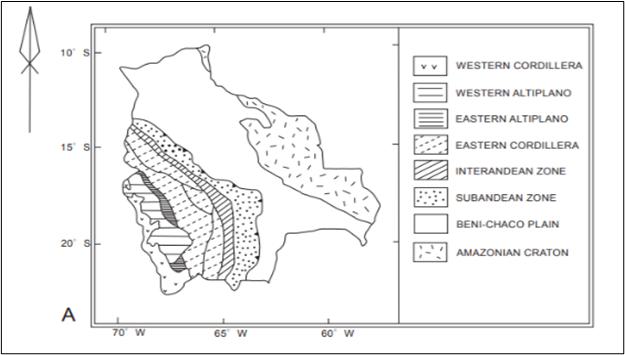
Source: Arce-Burgoa (2009)
| SANTACRUZ SILVER MINING LTD. | CABALLO BLANCO TECHNICAL REPORT | PAGE 7-1 |
|
|
Figure 7-2: Regional Geology Setting with Deposit Types
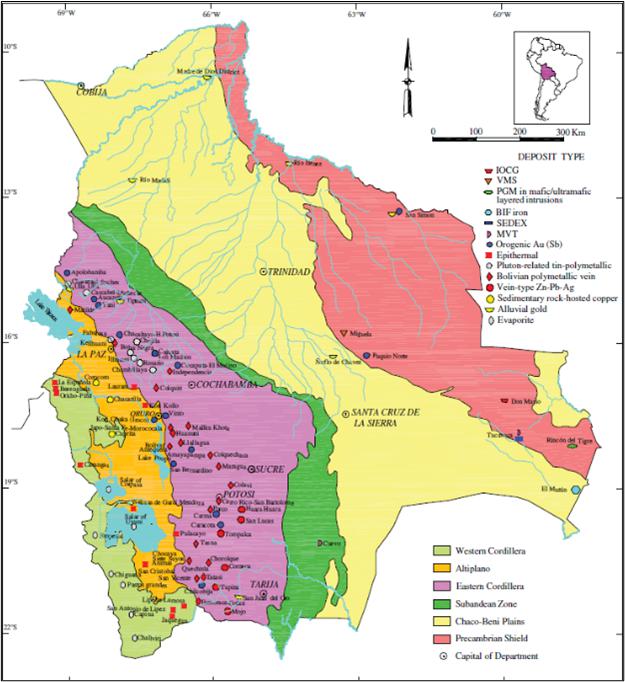
Source: Arce-Burgoa (2009)
| SANTACRUZ SILVER MINING LTD. | CABALLO BLANCO TECHNICAL REPORT | PAGE 7-2 |
|
|
Rocks of the Precambrian Shield in easternmost Bolivia have commonly been hypothesized to represent the southwestern part of the Amazon craton, covering an area of approximately 200,000 km2, or 18% of Bolivia. The lithological units are mainly Mesoproterozoic medium and high-grade metasedimentary and meta-igneous rocks, which have been covered by Tertiary laterites and Quaternary alluvial basin deposits. Earlier studies have referred to this as the Guaporé craton, but Santos et al. (2008) proposed that are not basement rocks belonging to the craton proper but rather, that they represent the 1.45–1.10 Ga Sunsas orogen, formed along the craton margin. Major tectonic events in the orogen are dated 1465– 1420, 1370–1320, and 1180–1110 Ma. The subsequent Brazilian tectonism (ca. 600–500 Ma) only had minor effects on the orogen (Litherland et al., 1986, 1989).
The Chaco-Beni plains, located in the central part of the country, cover 40% of Bolivia. The topography is dominated by the southwestern Amazon basin wetlands. Lying below 250 m elevation the wetlands offer little relief or outcrop. These extensive plains are part of the foreland basin of the Central Andes and include a 1 to 3 km thick sequence of Cenozoic foreland alluvial sediment in the west and much thinner accumulations atop a broad forebulge to the east (Horton and DeCelles, 1997). This sequence overlies Tertiary red-bed sediments that are >6 km thick which in turn rest unconformably on the Precambrian crystalline basement to the east and Paleozoic and Mesozoic sedimentary rocks to the west. The alluvial accumulations are products of several Neogene to Holocene episodes of post-kinematic and epeirogenetic isostatic adjustment in the Eastern Andes and its piedmont.
Rocks of the Bolivian Andean orogen include the Subandean zone, Eastern Cordillera, Altiplano, and the Western Cordillera, represent approximately 42% of Bolivia. These physiographic provinces form a series of mountain chains, isolated mountain ranges, and plains, with a north-to-south trend (Ahlfeld and Schneider-Scherbina, 1964). This part of the orogen has a length of 1,100 km, with a maximum width of 700 km, and an average crustal thickness of 70 km. The orogen displays a distinct oroclinal bend in the main fabric orientation at the Arica Elbow (18°–19°S).
The Subandean zone is the thin inland margin of an orogen-parallel fold-and-thrust belt, which is partly obscured by sediments of the western side of the active foreland basin. It is characterized by north- south- trending, narrow mountain ranges with elevations between 500 and 2,000 m. The dominant lithologies include Paleozoic siliciclastic marine and Mesozoic and Tertiary continental sedimentary rocks.
The Eastern Cordillera, the uplifted interior of the Andean thrust belt, includes polydeformed sequences of shale, siltstone, limestone, sandstone, slate, and quartzite deposited since the Ordovician. The largely Paleozoic clastic flysch basin sediments and metamorphic rocks extend over an area of approximately 280,000 km2 were deposited along the ancient Gondwana margin and first deformed in the middle to late Paleozoic. After Permian to Jurassic rifting, they were uplifted, folded and displaced on thrust faults during the Andean compression, which may have been as early as Late Cretaceous (McQuarrie et al., 2005).
The Altiplano is comprised of a series of intermontane, continental basins with a combined length of approximately 850 km, an average width of 130 km, and an area of approximately 110,000 km2. The basins have been uplifted to form a high plateau at elevations between 3,600 and 4,100 m. Geomorphologically, the province consists of an extensive flat plain that is interrupted by isolated mountain ranges. Crustal shortening, rapid subsidence, and, with concurrent sedimentation accumulated a sequence thickness of as much as 15 km during the Andean orogeny (Richter et al., in USGS and GEOBOL, 1992). Basin fill was dominated by erosion of the Western Cordillera during Late Eocene-Oligocene, but Neogene shortening in the Eastern Cordillera and Subandean zone led to a subsequent dominance of younger sediments derived from the east (Horton et al., 2002).
| SANTACRUZ SILVER MINING LTD. | CABALLO BLANCO TECHNICAL REPORT | PAGE 7-3 |
|
|
The Western Cordillera consists of a volcanic mountain chain that is 750 km in length and 40 km in average width, with an area of about 30,000 km2. Late Jurassic and Early Cretaceous flows and pyroclastic rocks and marine sandstone and siltstone sequences dominate the Cordillera in Peru and Chile. Lesser Late Cretaceous continental sediment was deposited above the marine rocks and, simultaneously, large granitoid plutons, many of which are associated with large porphyry orebodies, were emplaced along the coasts of adjacent Peru and Chile. In Bolivia, the province is dominated by high andesitic to dacitic strata volcanoes, erupted since ca. 28 Ma, which define the narrow, main Central Andes magmatic arc.
| 7.3 | Regional Geology |
| 7.3.1 | Eastern Cordillera Introduction |
The Bolivar, Porco and Caballo Blanco deposits are located in the central part of the Eastern Cordillera, a thick sequence of Paleozoic marine siliciclastic and argillaceous sedimentary rocks deposited on the western margin of Gondwana and deformed in a fold-thrust belt. There were two major tectonic cycles in the Paleozoic: The Lower Paleozoic Famatinian cycle (the Tacsarian and Cordilleran cycles of Bolivia), and the Upper Paleozoic Gondwana cycle (Subandean cycle of Bolivia).
The late Precambrian supercontinent broke up with the opening of the southern Iapetus Ocean and the spreading of Laurentia away from Gondwana in the latest Precambrian or early Cambrian (Figure 7-3 through Figure 7-5). Ocean closure and collision of Laurentia and the South American segment of Gondwana during the Ordovician formed the Famatinian orogenic belt of NW Argentina (Dalla Salda et al., 1992a) which has been correlated with its probable Laurentian equivalent, the Taconic event of the Appalachian orogen (Dalla Salda et al., 1992b). The Famatinian belt records extension in the latest Precambrian with establishment of subduction during the Cambrian and closure of the ocean basin and continent-continent collision in the Ordovician (480-460 Ma) (Figure 7-6). The Pre-Cordillera Terrane carbonate platform of western Argentina, which has faunal similarities with eastern North America, may be a sliver of eastern Laurentia detached in the late Ordovician when Laurentia separated from Gondwana again (Dalla Salda et al., 1992a; b) (Figure 7-7).
| SANTACRUZ SILVER MINING LTD. | CABALLO BLANCO TECHNICAL REPORT | PAGE 7-4 |
|
|
Figure 7-3: Plate Tectonic Reconstructions of the Neoproterozoic Subcontinent and the Late Precambrian Supercontinent after the Opening of the Southern Iapetus Ocean
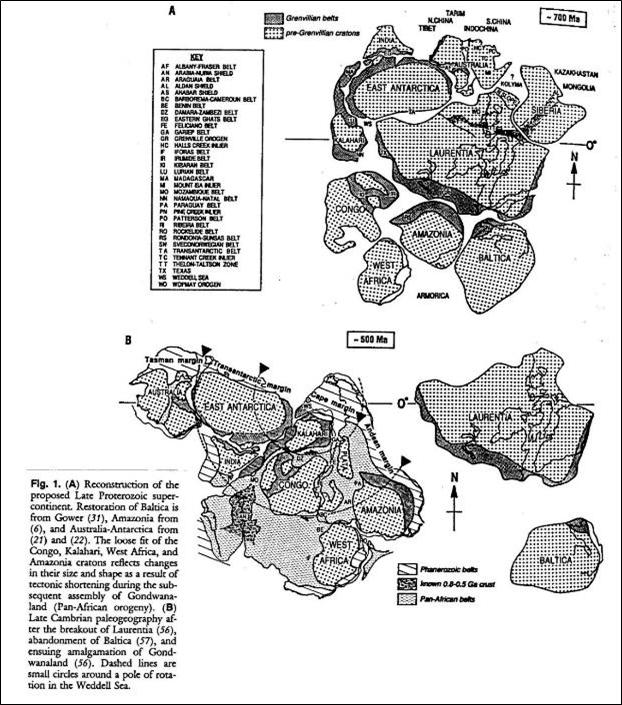
Source: Dallas, Salda et al (1992b)
| SANTACRUZ SILVER MINING LTD. | CABALLO BLANCO TECHNICAL REPORT | PAGE 7-5 |
|
|
Figure 7-4: Plate Tectonic Reconstructions of the Neoproterozoic and Late Precambrian Subcontinents
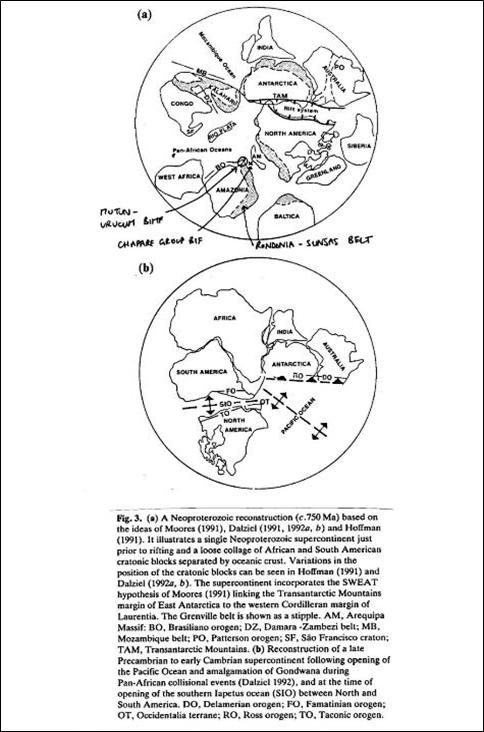
Source: Story (1993)
| SANTACRUZ SILVER MINING LTD. | CABALLO BLANCO TECHNICAL REPORT | PAGE 7-6 |
|
|
Figure 7-5: Paleogeography of SW Gondwana Margin in the Early Ordovician
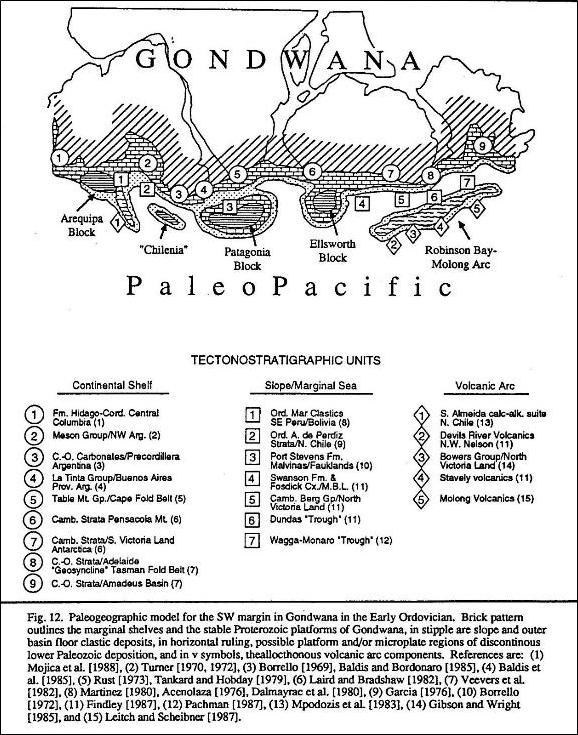
Source: Forsythe et al, (1993)
| SANTACRUZ SILVER MINING LTD. | CABALLO BLANCO TECHNICAL REPORT | PAGE 7-7 |
|
|
Figure 7-6: The Famatinian – Taconic Orogen in the Middle Ordovician
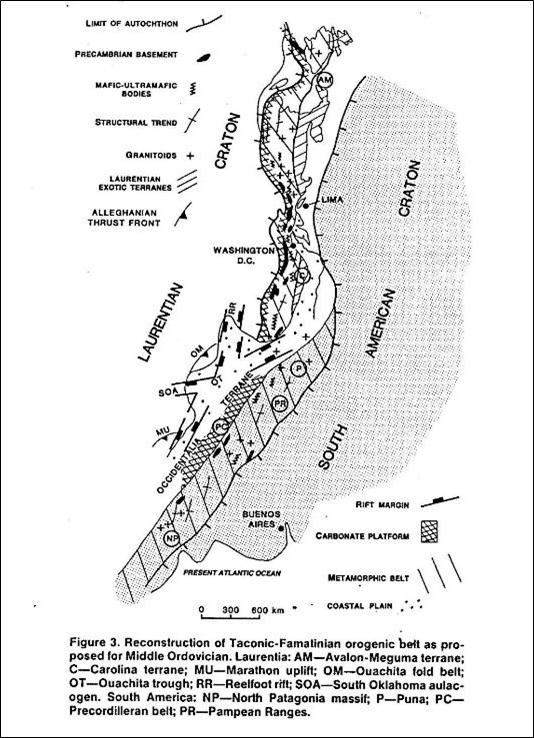
Source: Dalla Salda et al, (1992b)
| SANTACRUZ SILVER MINING LTD. | CABALLO BLANCO TECHNICAL REPORT | PAGE 7-8 |
|
|
Figure 7-7: The Ordovician of the Central Andes
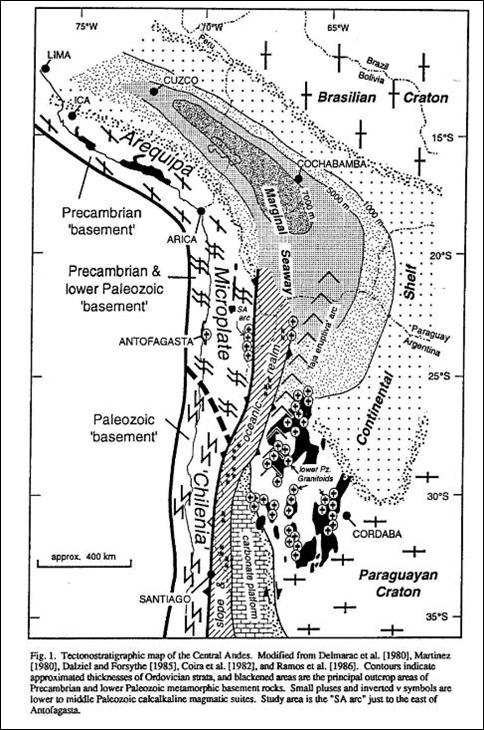
Source: Forsythe et al, (1993)
| SANTACRUZ SILVER MINING LTD. | CABALLO BLANCO TECHNICAL REPORT | PAGE 7-9 |
|
|
| 7.3.2 | Tacsarian Cycle (Upper Cambrian to Ordovician) |
During the Upper Cambrian to Caradoc Tacsarian Cycle a broad marine back-arc rift basin existed in Bolivia-Peru with its axis in the Eastern Cordillera. There was oceanic spreading in the southern part of the basin (Figure 7-6), the Puna Straits in NW Argentina, preserved as ophiolites, with intrusion of basic dikes and sills further north in the Bolivian basin. A possible magmatic arc on the Arequipa Terrane to the west of the basin, represented by calc-alkaline plutonic and volcanic rocks dated at 487-429 Ma (Mpodozis & Ramos, 1989), separated the back arc basin from a forearc. The Arequipa microplate swung about a hinge to the NW to form the Puna Straits and Bolivia-Peru back arc basin, as a Gulf of California-type basin (Sempere, 1991) or Japan-type basin (Forsythe et al., 1993). This was bordered to the east by another subduction-related magmatic arc in western Argentina, the Puna arc and its southward continuation, the Sierras Pampeanas magmatic arc represented by a granitoid belt (Mpodozis & Ramos, 1989). The Ocloyic Orogeny closed the Puna Straits Ocean basin during the Llanvirn-Caradoc as evidenced by granitic magmatism.
In SW Bolivia the sedimentary sequence begins with shallow marine clastic sediments of the basal Tremadoc transgression, which grade upwards into open marine thick graptolitic shales intercalated with subordinate turbidites and slumps of late Cambrian – Llanvirn age. The base of this super sequence outcrops in several localities along the Cochabamba-Chapare Road (central part of the Eastern Cordillera), which were described as part of the Limbo Group and of other Cambrian formations (Castaños & Rodrigo, 1978). In most of the outcrops, thick and monotonous Lower to Middle Ordovician shale beds, with subordinate siltstones and sandstones are part of the Cochabamba Group, which from base to top includes the Capinota, Anzaldo, and San Benito Formations. In the southern part of Tarija, the sequence base includes shallow marine clastic rocks. These grade upward to thick, marine graptolitic shales with subordinate Cambrian turbidites of the Condado, Torohuayco, and Sama Formations (Castaños & Rodrigo, 1978).
The majority of the sequence consists of thick and monotonous Lower to Middle Ordovician shale beds, with subordinate siltstones and sandstones are part of the Cochabamba Group, which from base to top includes the Capinota, Anzaldo, and San Benito Formations. In the southern part of Tarija, the sequence base includes shallow marine clastic rocks. These grade upward to thick, marine graptolitic shales with subordinate Cambrian turbidites of the Condado, Torohuayco, and Sama Formations (Castaños & Rodrigo, 1978). Farther north, the sequence consists of thick graptolitic and cephalopodic shales: which have localized the main decollement zone during the Neogene, and consequently older rocks are rarely exposed in the Bolivian Andes.
In southern Bolivia the shales were affected by the Ocloyic deformation with development of folding, cleavage and schistosity. The effects of this orogeny diminished to the east and north, and are not identified north of 20°S. In the north and east, the basin developed as a marine foreland basin during deformation which was infilled with the deposition of a thick, monotonous sequence of shallowing upward, shallow marine siliciclastic interbedded sandstone and shale in the Middle to Late Ordovician (Llanvirn - Caradoc) (Sempere, 1990a, b, 1991, 1993).
| SANTACRUZ SILVER MINING LTD. | CABALLO BLANCO TECHNICAL REPORT | PAGE 7-10 |
|
|
| 7.3.3 | The Cordilleran Cycle (Late Ordovician to Late Devonian) |
During the Late Ordovician to Late Devonian Cordilleran Cycle (Chuquisaca Super sequence), the Bolivia-Peru basin occupied a back-arc setting, then from the late Llandovery formed a marine foreland basin. These basins lay east of the Puna arc on the Arequipa block, which continued south as the Sierra Pampeanas magmatic arc granitoid belt until the Early Carboniferous. These arcs were related to an eastward-dipping subduction regime east of the Precordillera. The cratonic Chilenia Terrane of the Cordillera Frontal collided with the continental margin in the latest Devonian to early Carboniferous, and the collision caused intense deformation in the western Precordillera. (Mpodozis & Ramos, 1989; Ramos et al., 1986; Ramos, 1988; Sempere, 1993).
The Cordilleran cycle began in Bolivia with rapid deepening of the basin as a back-arc with black pyritic-shale deposition (Tokochi Formation) followed by resedimented glacial-marine diamictites sediments in the Ashgill (Cancañiri Formation) with rare thin fossiliferous limestones. These are overlain by thickly bedded, thinning-upward turbidites (Llallagua Formation) and/or dark shales with minor turbidites (Uncía/Kirusillas Formation) from late Llandovery to Ludlow. Deposition in the basin was controlled by active normal faulting with facies succession induced by a major glacio-eustatic sea level low (the Ashgillian ice age) which developed between two maximum flooding episodes. The Uncía/Kirusillas Formation was the first of three main shallowing-up megasequences, which began with thick dark shales and ended with sandstone dominated units, of late Llandovery – Lochkovian, Pragian – early Giventian and late Giventian – middle Famennian ages. These were deposited in a large subsiding marine foreland basin covering the Bolivian Andes, Subandean zone and Chaco-Beni plains, reaching as far as the SW edge of the craton where they onlap the Chiquitos Supergroup (Litherland et al., 1986). This interval was a time of onlap towards the northeast and of deposition of major hydrocarbon source rocks in Bolivia. (Sempere, 1990a; b;1991; 1993).
The Cordilleran Cycle is generally considered to have been terminated by the Late Devonian to Early Carboniferous Hercynian Orogeny, which has been defined in Perú where the effects are more evident. The presence of Hercynian orogenesis in Bolivia has been questioned however, due to Late Triassic U-Pb zircon age dates of 225 Ma (Farrar et al., 1990) for both foliated and weakly foliated facies of the Zongo-Yani granite, and by implication its wide metamorphic aureole, which was assigned an “Eohercynian” age by Bard et al. (1974).
| 7.3.4 | Subandean (Gondwana) Cycle (Upper Paleozoic) |
The Upper Paleozoic Gondwana Cycle was characterized by establishment of eastward subduction along the new Pacific margin west of Chilenia (Cordillera Frontal) and development of a broad forearc accretionary prism, which contains blue schists and ocean floor fragments. A magmatic arc lay to the east of the subduction zone. This cycle was terminated by deformation during the lower Triassic Gondwanide orogeny, the effects of which increase southward. (Mpodozis & Ramos, 1989; Ramos et al., 1986; Ramos, 1988).
In Bolivia the Upper Paleozoic Subandean Cycle is characterized by the Late Devonian (Late Famennian) – Early Carboniferous (Mississippian) Villamontes Supersequence, deposited in the Subandean zone, Chaco and Titicaca basin, is mainly marine and comprises mudstone, black shale, sandstone, coal, glacial-marine sediments, diamictites and slumps, the stratigraphy of which is conflictive due to rapid facies variations (Sempere, 1993). The Eastern Cordillera was emergent. This was a period of high epeirogenic activity and synsedimentary tectonic instability coeval with the Hercynian deformation in Peru. Sempere (1993) considers the Mississippian sedimentation to have been the culmination of the Silurian – Devonian evolution.
| SANTACRUZ SILVER MINING LTD. | CABALLO BLANCO TECHNICAL REPORT | PAGE 7-11 |
|
|
Subsequently, late Carboniferous (Pennsylvanian) – Early Triassic Cueva Supersequence was developed during a period of low subsidence and subtropical climate. In western Bolivia there was a shallow carbonate platform in the Titicaca Basin (Copacabana Formation) with deposition of white littoral-fluvial-eolian sands and evaporites on the eastern platform in the Subandean zone. The compressional Gondwana (Late Hercynian) deformation in the middle Permian of the Eastern Cordillera of Peru had weak effects in the Eastern Cordillera of Bolivia. This deformation was accompanied by transgression of the marine carbonate platform to the east. Post-orogenic calc-alkaline magmatism in the Early – Middle Triassic evolved in the late Middle Triassic toward continental tholeiitic compositions, reflecting the extension which initiated the Andean Cycle (Sempere, 1990a; b; 1993; Soler & Sempere, 1993).
| 7.3.5 | The Mesozoic to Cenozoic Andean Cycle: The Serere, Puca and Corcoro Supersequences |
The Andes developed during the Mesozoic to Cenozoic Andean Orogenic Cycle. Distension in the Middle to Upper Triassic related to the initial break up of Gondwana marked the start of the Andean Cycle. In the first part of the cycle, from Triassic to mid Cretaceous, an eastward dipping subduction zone existed along the length of the Pacific margin of Peru and Chile with a magmatic arc and back-arc basin, which in some segments had oceanic crust. In Chile, the arc was superimposed on the Late Paleozoic accretionary prism and an eastward younging coastal batholith intruded. (Cobbing, 1985; Dalziel, 1986; Mpodozis & Ramos, 1989).
During the Middle Triassic - Middle Jurassic, the Andean region of Bolivia was part of a stable cratonic regime. An initial rifting process of late Middle Triassic age developed in several areas, and numerous narrow grabens were filled by fluvio-lacustrine red beds and evaporites, accompanied by tholeiitic to transitional basalts (Sempere, 1990a; 1993; Soler & Sempere, 1993). Cessation of rifting in Bolivia was probably a consequence of a regional tectonic reorganization at about 220 Ma, which probably marked the resumption of subduction along the Pacific margin. The subsequent Late Triassic - Middle? Jurassic onlapping sedimentation of fluvial and eolian sands was probably controlled by post-rift thermal subsidence. The environment was of sandy deserts on the craton, akin to the Arabian Shield (Sempere, 1990a; 1993). These deposits of the Serere Supersequence occur in the Eastern Cordillera and Subandean Zone.
Since the Late Jurassic, Bolivia has been part of the Pacific subduction regime. This was marked by a Kimmeridgian rifting event in Bolivia, the “Araucana Phase”, with extrusion of alkaline basalts which initiated the Puna Supersequence (Sempere et al., 1989; Sempere, 1993; Soler & Sempere, 1993). Bolivia was set in a back arc setting to the east of the Pacific margin arc and back-arc basin, with deposition of coarse clastic continental sediments and alkali basalts in the Potosí and Titicaca basins in a distensive regime related to a transtensional continental margin until the Aptian (Sempere et al., 1989).
| SANTACRUZ SILVER MINING LTD. | CABALLO BLANCO TECHNICAL REPORT | PAGE 7-12 |
|
|
The Upper Cretaceous and Cenozoic of Perú - Chile was characterized by a subduction-related continental magmatic arc with no back-arc basin. In Peru, the 110 - 60 Ma Coastal Batholith was emplaced into the Jurassic - Early Cretaceous back-arc basin volcanic pile between the Mochica and Incaic 1-fold phases (Pitcher et al., 1985). At the same time in the Central Andes the magmatic arc migrated eastwards. Large parts of the forearc zone and Mesozoic arc were removed during the Cretaceous and Tertiary, either by subduction erosion or by longitudinal strike-slip faults such as the Atacama Fault (Mpodozis & Ramos, 1989).
The mid Cretaceous compressive event inverted the Tarapacá back-arc basin of north Chile (Late Triassic - Early Cretaceous) to form the proto-Domeyko Cordillera fold-thrust belt (Mpodozis & Ramos, 1989). In Bolivia, sedimentation of the Puca Supergroup continued in a distal external foreland basin, with deposition controlled by rifting and eustatic marine transgressions from the NW. The sequence is transgressive with successively younger units covering greater areas and reaching a total thickness of up to 5,600 m in the Sevaruyo area. The strata consist of fine red-bed sediments, evaporites and alkali basalts, with marine red shales in the Aptian and marine carbonates in the Cenomanian, Campanian and Maastrichtian. (Riccardi, 1988; Sempere et al., 1989; Soler & Sempere, 1993). The end of the Puca Supersequence is marked by an important unconformity developed at the end of the Paleocene, followed by deposition of thick red beds in the Altiplano and Eastern Cordillera in an external continental foreland basin during the Eocene and Oligocene (53 - 27 Ma; Sempere 1990a).
The Cenozoic evolution of Bolivia was dominated by considerable horizontal shortening (Sempere, 1990). Cenozoic basins of the Corocoro Supersequence developed in the Cordillera and in the plains in that time are related to the uplift of the Andes. During the Lower Paleocene-Lower Oligocene, a foreland basin formed east of the Andes. A thickening of the crust enabled the accumulation of 2.5 km of red beds in the Altiplano and Eastern Cordillera (Sempere, 1995).
| 7.3.6 | The Andean Orogeny |
The first major deformation in the Andean Cycle in Bolivia occurred during the Late Oligocene to Early Miocene (27-19 Ma) when the orogenic front jumped from west of Bolivia to the Eastern Cordillera, and the Bolivian Andes started to develop as a mountain belt. Major crustal shortening by thrusting occurred in the Eastern Cordillera, and deformation of the Subandean Zone also began. Since the Late Oligocene, the Altiplano has functioned as an intermontane foreland basin with deposition of thick continental sediments, with smaller intermontane basins in the Eastern Cordillera.
The external foreland basin moved east to the Subandean – Llanura (Beni-Chaco) Basin. The second major period of thrusting occurred between 11-5 Ma. Thrusting is mainly eastward-verging towards the foreland, with an important west-verging back-thrust belt in the eastern Altiplano and western side of the Eastern Cordillera.
| 7.3.7 | Mesozoic to Cenozoic Magmatism |
Extension-related granites were intruded in the Cordillera Real in the Triassic–Jurassic (227-180 Ma) (Everden et al., 1977; McBride, 1977; Grant et al., 1979; Farrar et al., 1990).
| SANTACRUZ SILVER MINING LTD. | CABALLO BLANCO TECHNICAL REPORT | PAGE 7-13 |
|
|
Alkaline volcanic activity was initiated in the Late Oligocene (28-21 Ma) in the Western Cordillera and western Altiplano, coincident with the first major period of deformation. At the same time granitoid plutons intruded in the southern part of the Cordillera Real (Illimani, Quimsa Chata, Santa Vera Cruz) with related tin-tungsten-silver-lead-zinc-polymetallic mineralization (28-20 Ma). Similar deposits also developed to the south as far as Potosi, such as Colquiri and Chicote Grande. These deposits are hosted by Paleozoic sediments and related to buried plutons of this age. The main period of magmatism was the Middle Miocene (17-12 Ma) with an eastward “breakout” of magmatism in an unusually broad arc across the Western Cordillera, Altiplano and Eastern Cordillera, generally forming small extrusive (domes) and intrusive (stocks, sills) bodies. Further magmatism occurred across this wide arc during the Late Miocene (10-5 Ma) during the second main period of crustal shortening. This was characterized by stratovolcanoes, ash-flow calderas, and major ignimbrite shields such as Los Frailes and Morococala in the Eastern Cordillera. (Baker, 1981; Baker & Francis, 1978; Evernden et al., 1977; Grant et al., 1979; McBride et al., 1983; Redwood, 1987; Redwood & Macintyre, 1989; Soler & Jimenez, 1993; Thorpe et al., 1982.).
| 7.4 | Local Geology |
The Caballo Blanco zinc, silver, lead mine, situated south of Potosi, is located in the Jayaquila – Victoria corridor, a 5-7 km north-south structural zone with three sectors, from north to south, the Colquchaquita, Reserva, and Tres Amigos mines. They are not described in the published literature. They are hosted by volcanic rocks of the Kari-Kari volcanic complex, with dimensions of 32 km north-south and 12 km wide, located on the SE side of the Los Frailes felsic volcanic field that covers an area of 8,500 km2 at altitudes of 4,000 – 5,200 masl. Deposit genesis initiated with the intrusion of small granitoids at about 25 Ma at Kumurana, at the southern end of the Kari massif, and Azanaques. These were followed by the formation of Kari at about 20 Ma that is interpreted to be a resurgent caldera with welded ignimbrite fill. Ash flows, domes and stocks formed in the Cebadillas episode at 17-10 Ma, including the Cerro Rico dome with Ag-Sn mineralization at 13.8 Ma (Zartman & Cunningham, 1995; Cunningham et al., 1996; Rice et al., 2005). Huge volumes of felsic ash flows erupted to form the Livicucho and Condor Nasa ignimbrites at 8-7 Ma and the main Los Frailes ignimbrites at 3.5-1.5 Ma. The final stages were the eruption of large resurgent rhyolitic domes at 4-1 Ma, and the Nuevo Mundo volcanic province at <1 Ma. (Francis et al., 1981; Schneider, 1985, 1987; Schneider & Halls, 1985; Kato, 2013; Kato et al., 2014; Kay et al., 2018)
The rocks of the Kari complex are felsic, peraluminous, and rich in garnet, cordierite and tourmaline (Schneider, 1987).
Mineralization in its generality is characterized by being housed in Philonian structures divided into three domain orientations:
| 1. | Oriented at N 10°-20° E, are Colquechaquita such as Karina, Viviana, Camila, and some Tres Amigos veins namely, Catalina, Milagros, Milagros Este, Tatiana and Central; | |
| 2. | Oriented N 10°-30° W are the Reserve veins called Rosario, Wendy, Juanita and Blanquita, along with Ramo Catalina at Tres Amigos; | |
| 3. | Corresponding to veins in the Porvenir region which have an N-S orientation, the Veta Rostia at Reserva the Milagros veins at Tres Amigos; and | |
| 4. | Oriented N 40°-45° W° is the Daniela vein at Tres Amigos. |
| SANTACRUZ SILVER MINING LTD. | CABALLO BLANCO TECHNICAL REPORT | PAGE 7-14 |
|
|
General mineralogy is composed of quartz-pyrite-chalcopyrite and marmatite, sphalerite, galena, boulangerite as primary minerals in addition to accessory minerals such as siderite, calcite and ankerite at the trace amounts.
| 7.5 | Property Geology |
Field observations and geological mapping carried out, it has been possible to differentiate by their location seven local lithological units, which are classified based on their texture, structure and color.
Lithologically, the mineralized corridor named the Jayaquila – Victoria is made up of these seven local units classified as: 1) The DaOGM unit which corresponds to a dark medium grained dacite of; 2) The DaFVO unit which corresponds to an olive green dacite; 3) The BxFV unit which is a volcanic flow; 4) The DaGF unit which is a fine grained dacite; 5) The DaGM unit which is a medium grained dacite; 6) The DaP unit which is a porphyritic dacite and; 7) The LimOrd which is an Ordovician limonite’s:
| ● | Medium grained dark dacite (DaOGM) – It is characterized by being a rock of high resistance, has dark gray aphanitic texture similar to volcanic glass, where the crystals are composed of plagioclases and feldspars that are equigranular and locally have porphyry appearance. The unit has disseminated syngenetic pyrite present along with fine red-pink garnet. This unit can be greater than 200 m thick and is located at the central west end of the Reserva-Colquechaquita corridor; | |
| ● | Olive green dacite (DaFVO) – Adjacent to the (DaOGM), the DaFVO’s main characteristic is that of lamination and/or foliation. It is of fine to medium grained and gray to olive green. It has low hardness and as a result forms geomorphologically depressions. In addition, there are increases in limonite and slate xenoliths in the matrix, however, locally may be joined by isolated blebs of medium grain light gray dacite. The unit varies in thickness from 80 m to the north to 150 m to the south; | |
| ● | Volcanic flow gap (BxFV) – This unit is located at the base of the (DaOGM). It is greenish gray in color with an olive-green aphanitic matrix mixed with sedimentary Ordovician lithoclasts of slate and limonite and older clasts of fine-grained dacite. At surface it is found with oxidized zones shown in outcrop, possibly due to the presence of pyrite without genetics. The thickness of this unit varies from 10 m to the north to 60 m to the south. This package is truncated to the north close to Tres Amigos; | |
| ● | Fine-grained dacite (DaGF) – This unit is not a dominant unit as it is only present locally to the South of the corridor, apart from Reseva and Porvenir. This unit is light gray in color, is silicified with small garnet present; | |
| ● | Medium grain dacite (DaGM) – This unit is the predominant unit throughout the Colquechaquita, Reserva, Porvenir and in Tres Amigos mine areas. It is gray to light gray in color but can present whitish in isolated instances where there is elevated garnet and reduced biotite. This unit is also part of the Dacitic Dome (Cerro Molle Punco). At Colquechaquita, this unit appears to be the oldest rocks due relative distribution and the mesh-like fracturing characteristics present; and | |
| ● | Porphyritic dacite (DaP) – This unit has greater development at Tres Amigos enveloping the Dacite Dome. This unit are of moderate hardness having a matrix that is light gray aphanitic color, has medium to coarse grain inequigranular texture where plagioclases reach 1 cm in diameter and are related to the mineralization in Colquechaquita South and Tres Amigos. To the south of the corridor this unit is not present. |
| SANTACRUZ SILVER MINING LTD. | CABALLO BLANCO TECHNICAL REPORT | PAGE 7-15 |
|
|
| 7.6 | Mineralization |
| 7.6.1 | Reserva Mine |
Rosario Vein (ROS 1000)
The Rosario is a major Philonian type, mesothermal phase structure, it is split into a North Zone and South Zone, with a strike of N 10 ° W and dip of 65 ° to 70 ° extending 1,000 m in length from the intersection with the Wendy vein. The mineralization is composed of marmatite, sphalerite, galena and jamesonite in addition to pyrite, siderite and quartz.
Wendy Vein (WE 1001)
The Wendy vein is a pre-mineral, fracture-filled brecciated unit that is oriented from North to South, with dip of 75° NE, and a strike length of 900 m with widths being on average 0.70 m. The Wendy vein is composed mainly of marmatite, sphalerite, galena and jamesonite with the addition of pyrite, siderite, marcasite and quartz.
Porvenir Vein (POR 1003)
The Porvenir Vein, located in the Porvenir area, is a secondary structure, with widths ranging between 0.20 to 1.50 m. The Porvenir extends for over 2.6 km, striking N-S and dipping 60° to 78° to the east. It has been developed for approximately 300 m on the +40 and +80 levels, where widths range between 0.25 to 0.50 m. On the surface it is recognized for its pervasive argillic alteration and oxidation, accompanied by faulted and fractured material. Mineralization is composed of sphalerite, galena, pyrite, quartz and siderite. It is not currently being explored or developed by the company.
Wendy Ceiling Vein (WT 1002)
The Wendy Ceiling vein is located east of the main Wendy vein striking N 20 E, dipping between 75° to 85° to the East, however it is quite thin ranging from between 0.10 to 0.40 m in width, with a recognized and exploited length of 300m. Its general mineralogy is composed of quartz, sphalerite, galena, pyrite. It presents itself in the form of a failed fault gap with extensive argillization and oxidation.
Blanquita Vein (BLA 1004)
The Blanquita vein is located west and sub-parallel to the Juanita vein, possibly joining the Juanita vein to the south.
| SANTACRUZ SILVER MINING LTD. | CABALLO BLANCO TECHNICAL REPORT | PAGE 7-16 |
|
|
This vein outcrops and is presented as a limonitized gap accompanied by argillization and with quartz present locally. It has a horizontal extension of 2.4 km, oriented from 10° to 20° NW, dipping between 65° to 80° NE however dips steeply locally to 70° toward the southwest, with thicknesses ranging between 0.15 to 0.50 m.
This vein is developed to the south for approximately 600 m and to the north of Tres Amigos for between 250 to 400 m. The thickness of the vein being mined is approximately 0.6 m.
Mineralogically it is composed of marmatite, galena, limonite, quartz, sphalerite and argillite.
| 7.6.2 | Colquechaquita Mine |
Colquechaquita is a hydrothermal system where zinc, lead and silver minerals have filled fractures., sphalerite, galena, jamesonite are the predominant economic minerals, however pyrite, chalcopyrite, quartz, siderite and pyrrhotite, are present as gangue minerals. The system shows vertical zonation, which has been observed historically as the mine was originally according to historical data this mine is considered as a silver deposit in the in the upper levels however, at current mining levels such as Level -215, there is an increase in, sphalerite, marmatite, chalcopyrite, pyrrhotite.
Karina Vein (KA 1011)
The Karina Vein is a rosary-like hydrothermal Philonian fault filled structure. Distributed throughout two sectors, North and South, with strike of N10°W and dip of 80° to 90° to the northeast extending 450 m from the Triunfo headframe. The South zone is oriented N 10°-25° W, dipping 65° to 85° to the northeast, extends for 530 m. Economic mineralization is composed of sphalerite, marmatite, galena and jamesonite while the gangue is composed of pyrite, siderite and quartz. The predominant alteration minerals are siliceous, argillic, chloritization and sericitization. The average width of the vein is 1.5 m. The most relevant characteristic is the presence of kaolin associated with faulting and mylonite. The average width of the vein ranges from 0.50 to 2.0 m.
Viviana Vein (VI 1010)
The Viviana Vein is a splay or branch from the Karina vein to the east, Viviana vein possibly corresponds to a second magmatic event, located on the south side of Karina vein, in an area called Z-2 (zone 2), whose predominant characteristic is that it is the result of normal faulting with a preferential strike of N 15° W and dipping 65° to the northeast. This vein has a general strike direction of N 20° E with dip between 55° to 85° to the southeast, and is traced for 900 m. The average width of the Viviana vein is 1.60 m composed mainly of marmatite, sphalerite, galena, jamesonite with the addition of pyrite, siderite, marcasite and quartz.
Camila Vein (CA 1012)
The Camilla vein corresponds to a ramp in the roof of the Karina vein, which dips from 40° to 85° in an easterly direction. However, it extends in two directions; 1) the first being from S 34°E in the north section and 2) oriented at S 16°W in the southern section, with the latter joining the Karina vein with the north section appearing to have more favorable grades and thicknesses. The Camilla is structurally controlled predominantly related to a significant fault oriented at S45°E / 82°NE. Outboard from this fault towards the south, the mineralization reduced in concentration and thickness. The mineralogy of the vein is composed by sphalerite, galena, pyrite, siderite, which forms rosaries in both horizontal and vertical directions, with an average width of 0.5 m extending 160 m in length along levels -120, -160, -200 and -240.
| SANTACRUZ SILVER MINING LTD. | CABALLO BLANCO TECHNICAL REPORT | PAGE 7-17 |
|
|
| 7.6.3 | Three Amigos Mine |
Catherine (CAT 1020)
It is a rosary-type Philonian structure, the ore corresponds to the filling of fault of Hydrothermal origin. Distributed in two sectors, North Zone and South Zone, the first with an average course N 25 ° E and 80 to 85 ° of inclination in se direction recognized and exploited along 750 m in length. The ore is composed of sphalerite, marmatite, galena and jamesonite. In addition, there is pyrite, siderite and quartz. The predominant alteration types are argillic, chloritic and sericitic. The average width of the vein is 0.50 m with the most predominant feature being the presence of kaolin within the fault and the argillic alteration anulus where the rock is fractured.
Ramo Catalina (RCAT 1021)
It is a Ramo de la Veta Catalina, in the area called Zona Sur Cuya. La Veta has a general course of North – South with 75° to 80° the SE, recognized along 750 m. The average width of the vein is 0.45 m. composed mainly of marmatite, galena, sphalerite and jamesonite with the addition of pyrite, siderite and quartz.
Daniela Vein (DAN 2022)
The Daniela vein is transverse to the Catalina vein, with general heading N49°W and widths of between 0.20 m to 0.8 m extending 500 m. It is mineralogically comprising of marmatite, galena, sphalerite, quartz and jamesonite.
Miragos Vein (MIL 1023)
The Miragros vein is an argentiferous vein that has a recognized extension of 2.0 km, varying in orientation where to the south it has a strike of N-S changing to 10° NW to the north, with dips that are also variable from between 60° to 80° E-NE, shifting to subvertical at depth. It has been traced to the -160 level with thicknesses varying between 0.3 to 0.75 m, however, at surface the thickness ranges between 0.20 to 1.20 m.
The Miragos vein is recognized by its argillic alteration and oxidation accompanied by fault material. Its mineralogy is comprised of sphalerite, galena, quartz, pyrite.
Central Vein (CE 1024)
The Central vein is structurally controlled corresponding to the Veta fault, dipping from 80° to 85° in an easterly direction. It is oriented at N22°E, eventually intersecting the Karina and Daniela veins. The main characteristic of the vein is that it has a massive mineralization which is composed of sphalerite, galena, pyrite, siderite, in the form of rosaries horizontally with an average width of 0.5 m extending 330 m in length on Level 200.
| SANTACRUZ SILVER MINING LTD. | CABALLO BLANCO TECHNICAL REPORT | PAGE 7-18 |
|
|
Veta Tatiana (TA 1032)
Veta Tatiana was discovered during the execution of the integration ramp, it corresponds to a fault type vein, with an average thickness of 0.45m, recognized along 220 m at Level 220. The vein is composed of marmatite, galena, sphalerite, pyrite, siderite, and jamesonite.
Veta Milagros Este
Veta Milagros Este is a branch to the south of the Milagros vein, with an average thickness of 0.40 m, recognized along 200m at Level 220. The vein is composed of marmatite, sphalerite, pyrite, siderite, and galena.
Erlinda Vein
The Erlinda vein is located to the east of the Tatiana vein, it corresponds to a fracture-filled vein, with an average thickness of 0.2 m, mineralogically composed of sphalerite, pyrite, siderite, and galena, the vein extends 40 m at Level -250.
| SANTACRUZ SILVER MINING LTD. | CABALLO BLANCO TECHNICAL REPORT | PAGE 7-19 |
|
|
| 8 | Deposit Types |
The most important ore deposits of the Eastern Cordillera are polymetallic hydrothermal deposits mined principally for Sn, W, Ag and Zn, with sub-product Pb, Cu, Bi, Au and Sb. They are related to stocks, domes and volcanic rocks of Middle and Late Miocene age (22 to 4 Ma). Mineralization occurs in veins, fracture swarms, disseminations and breccias. The deposits of the Eastern Cordillera are epithermal vein and disseminated systems of Au, Ag, Pb, Sb, as that have been telescoped on to higher temperature mesothermal Sn-W veins and, in some cases, porphyry Sn deposits. The “telescoping” is a characteristic of these deposits and is the product of the collapse of a hydrothermal system, whereby younger lower temperature fluids overprint the alteration and mineralization developed by older higher temperature fluids. The systems show a fluid evolution from a high temperature, low sulfidation state to intermediate sulfidation epithermal and high sulfidation epithermal.
A typical example is the Cerro Rico where high temperature veins at depth, with a low sulfidation assemblage of cassiterite, wolframite, pyrite, arsenopyrite, bismuthinite and minor pyrrhotite (the main tin-tungsten ore stage), are overprinted at higher levels by an intermediate sulfidation epithermal assemblage of Ag-Pb-Sb sulfosalts (the main silver ore stage), with disseminated high sulfidation epithermal silver mineralization in the upper part of the system (a major silver resource).
These polymetallic deposits have been described as Bolivian Polymetallic Vein Deposits by the U.S. Geological Survey with the following characteristics (Ludington et al., 1992; Redwood, 1993; Sillitoe et al., 1975):
| 1. | Lithological Control. Paleozoic, Mesozoic and Cenozoic sedimentary rocks and metsediments; | |
| 2. | Structural Control. Hinge zones of regional anticlines; | |
| 3. | Subvolcanic Intrusions. Spatially and genetically related to stocks and volcanic rocks with 60-70 % SiO2, clusters of dikes and/or porphyritic domes of rhyolite, dacite, rhyodacite, or quartz latitite composition with alkaline tendencies. The mineralization can occur within the stocks and domes, in volcanic rocks (e.g., Porco, Caballo Blanco), or in sedimentary rocks distal to stocks (e.g., Bolivar) or inferred to be related to buried stocks (e.g., Huanuni); | |
| 4. | Style of Mineralization. Disseminated, parallel veins, veinlets, fracture swarms, breccias; | |
| 5. | Ore Minerals. Pyrite, marcasite, pyrrhotite, sphalerite, galena, cassiterite, arsenopyrite, chalcopyrite, stibnite, stannite, teallite, tetrahedrite, tennantite, wolframite, bismuth, bismuthinite, argentite, gold, and Ag-Sb-sulphosalts (freibergite, andorite), Pb-Sb-sulfosalts (zinkenite, boulangerite, jamesonite), Pb-Sn-Sb-sulfosalts (franckeite, cylindrite), and Bi sulfosalts. Telescoping of intermediate sulphidation epithermal mineralization of Au, Ag, Pb, Sb, As, etc. on to higher temperature mesothermal, low sulphidation Sn-W mineralization is characteristic; | |
| 6. | Gangue Minerals. Quartz, barite, and Mn carbonate. There is a transition upward from massive sulfides, to quartz, quartz-barite, and barite-chalcedony towards the upper parts of the deposits; and |
| SANTACRUZ SILVER MINING LTD. | CABALLO BLANCO TECHNICAL REPORT | PAGE 8-1 |
|
|
| 7. | Hydrothermal Alteration. Sericitic (sericite-quartz-pyrite) often with tourmaline in the central part and zoned outward to argillic and propylitic alteration. The upper zones have advanced argillic lithocaps with alunite, residual vuggy silica and silicification. Breccias are common. |
The Cballo Blanco, Porco and Reserva deposits is considered a “Bolivian-type” polymetallic which has the primary reference and quoted as described in Arce-Burgao (2009). The Bolivian vein deposits can be identified into three subgroups:
| 1. | Deposits associated with tin porphyries; | |
| 2. | Deposits associated with volcanic domes and sub volcanic stocks; and | |
| 3. | Deposits associated with sedimentary rocks. This classification is based mainly on host rock lithology. |
One of the most common types of mineralization in the country, the Bolivar-type is the product of widespread hydrothermal activity between 22 Ma and 4 Ma. The deposits are characterized by a polymetallic signature which is usually telescoped coexistence of low and high temperature minerals and are spatially related to epi-zonal and meso-zonal intrusions. Early stages of mineralization are high temperature, high salinity, and high pressure, indicative of great formations depths. Several overlapping stages of lower temperature events, due to later igneous events and supergene process is during evolution of the Andes, occurred between 11 and 4 Ma. Several of these deposits are classified as giant, such as Sierra Rico de Potosi and Llallagua or “world class” such as Oruro and Huanumi.
On a district scale, deposits from the different subgroups may sometimes be spatially and or genetically associated. The style of mineralization includes groups of veins, subsidiary vane swarms, veinlets, stockwork, and dissemination mineralization. The veins are hosted in a variety of host rocks that include Paleozoic sedimentary and metasedimentary rocks, meso-zonal and epi-zonal stocks, and syn-kinematic flows, dikes and volcanic domes that are generally of rhyolitic, dacitic, and acidic compositions. In general, the deposits have similar origins although they differ with respect to metal signatures and/or fluid geochemistry.
The main metallic minerals, although not necessarily present in every deposit, are cassiterite, sphalerite, galena, pyrite, pyrrhotite, arsenopyrite, chalcopyrite, stibnite, stannite, tetrahedrite, wolframite, native bismuth, bismuthinite, argentite, native gold, and complex sulphosalts such as teallite, franckeite, and cylindiite. The main economical exploitable minerals are tin and silver, with less important tungsten, bismuth, an antimony.
The temperatures of homogenization and the salinities obtained from fluid inclusions in quartz and in sphalerite, and less commonly in cassiderite and barite, average 300oC and 20% weight equivalent NaCl, respectively. Turneaure (1970), identified an early boiling during mineral deposition examining fluid inclusions, which was confirmed by later studies that showed boiling occurred intermittently during all stages of mineral deposition (Arce Burgoa and Nambu 1989).
The Bolivar zinc-tin deposit is located 90 km southeast of Oruro, in the Canadon Antequera district (Figure 8-1). Mineralogy of the deposit includes sphalerite, galena, cassiterite, jamesonite, pyrite, arsenopyrite and marcasite in a dominant gangue of quartz.
| SANTACRUZ SILVER MINING LTD. | CABALLO BLANCO TECHNICAL REPORT | PAGE 8-2 |
|
|
Figure 8-1: Conceptual Model of Bolivian Polymetallic Vein Type Deposits (modif. From Heuschmidt, 2000)
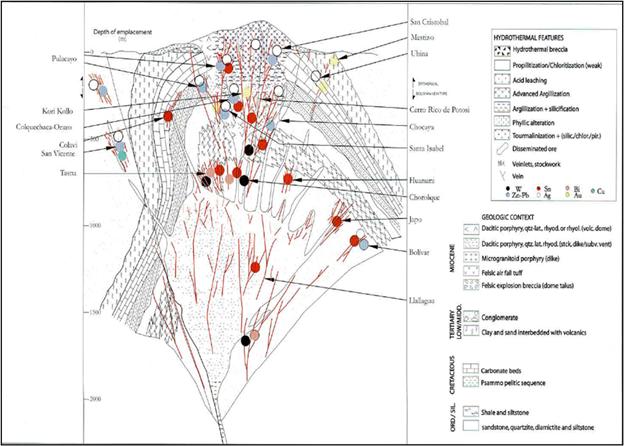
Source: Heuschmidt (2000)
| SANTACRUZ SILVER MINING LTD. | CABALLO BLANCO TECHNICAL REPORT | PAGE 8-3 |
|
|
| 9 | Exploration |
There has been no exploration performed on behalf of the Santacruz.
| SANTACRUZ SILVER MINING LTD. | CABALLO BLANCO TECHNICAL REPORT | PAGE 9-1 |
|
|
| 10 | Drilling |
| 10.1 | Drilling Summary |
The Caballo Blanco Project, which is comprised of the Colquechaquita, Reserva and Tres Amigo mines, is an “advanced property” and is a well-established, active mining operation. Glencore and subsequently Santacruz Silver has performed exploration and resource expansion drilling of 123 surface and underground drillholes at the Caballo Blanco Project since 2010 totalling 39,562.55 m.
As of January 2023, Santacruz had drilled approximately 19 holes for a total of 5,061 m at the Caballo Blanco operations since the acquisition from Glencore. Table 10-1, through Table 10-3 summarizes the historical drilling at Colquechaquita, Reserva and Tres Amigos, respectively. Note that the Santacruz drilling is highlighted in blue.
Table 10-1: Colquechaquita Drilling Programs in 2010 and 2021
| Phase | Date | Hole ID | Type | Total (m) | Core Size | Target | Total Program Budget ($US) |
| I | 2010 | CQT_01 - CQT_03 | UG | 998.8 | HQ/NQ | vn Viviana | 194,115 |
| II | 2021 | DDH_COC_VI_04s - DDH_COC_VI_05s | Surface | 1,009 | HQ/NQ | vn Viviana | 139,666 |
| SANTACRUZ SILVER MINING LTD. | CABALLO BLANCO TECHNICAL REPORT | PAGE 10-1 |
|
|
Table 10-2: Reserva Drilling Programs from 2010 through 2021
| Phase | Year | Hole ID | Type | Total (m) | Core Size | Target | Total Program Budget ($US) |
| I | 2010 | DDH_02 - DDH_11 | Surface | 2,221.85 | HQ/NQ | vn: Rosario | 346,609 |
| II | 2011 | DDH_01 - DDH_13 | Surface | 3,598.60 | HQ/NQ | vn: Reserva | 561,382 |
| III | 2011 -2012 | DDH_RES_ROS_02s - DDH_RES_ROS_11s; DDH_RES_WE_01s - DDH_RES_WE_9s | Surface | 5,570.00 | HQ/NQ | vn: Rosario, Wendy | 868,920 |
| IV | 2014 | DDH_RES_ROS_13s - DDH_RES_ROS_30s; DDH_RES_BLA_33s - DDH_RES_BLA_34s; DDH_RES_VI_23s - DDH_RES_VI_35s; DDH_RES_WE_17s - DDH_RES_WE_18s | Surface | 8,787.70 | HQ/NQ | vn: Rosario, Wendy, Blanquita, Viviana | 1,142,401 |
| V | 2015 | DDH_RES_BLA_36s - DDH_RES_BLA_39s | Surface | 1,608.00 | HQ/NQ | vn: Blanquita | 201,978 |
| VI | 2017 | DDH_RES_ROS_40s; DDH_RES_ROS_41i - DDH_RES_ROS_46i | Surface / UG | 1,354.00 | HQ/NQ | vn: Rosario | 213,542 |
| VII | 2021 | DDH_RES_ROS_47i - DDH_RES_ROS_49i; DDH_RES_ROS_50s DDH_RES_ROS_52s | Surface / UG | 774 | HQ/NQ | 120,592 |
Table 10-3: Tres Amigos Drilling Programs from 2010 through 2023
| Phase | Year | Hole ID | Type | Total (m) | Core Size | Target | Total Program Budget ($US) |
| I | 2010 | DDH_14 - DDH_16 | Surface | 790.3 | HQ/NQ | vn: Catalina | 106,764 |
| II | 2011 | DDH_3AMG_CAT_01 - DDH_3AMG_CAT_04s; DDH-3AMG_MIL_08s; DDH_3AMG_RCAT_06s DDH_3AMG_RACT_07s | Surface | 2,007.80 | HQ/NQ | vn: Catalina, Milagros, Ramo Catalina | 361,314 |
| III | 2013 | DDH_TAM_MIL_09s - DDH_TAM_MIL_10s | Surface | 381 | HQ/NQ | vn: Milagros | 49,721 |
| IV | 2014 | DDH_TAM_RCAT_11s - DDH_TAM_RCAT_15s; DDH_TAM_MIL_13s - DDH_TAM_MIL_14s; | Surface | 1,398.50 | HQ/NQ | vn: Ramo Catalina, Milagros | 182,504 |
| V | 2017 | DDH_TAM_MIL_16s - DDH_TAM_MIL_20s; DDH_TAM_DA_17s - DDH_TAM_DA_18s; DDH_TAM_CAT_19s; DDH_TAM_CEN_21s; DDH_TAM_RCAT_22s; DDH_TAM_CRU_23s; DDH_TAM_BLA_24i - DDH_TAM_BLA_25i | Surface / UG | 2,651.00 | HQ/NQ | vn: Milagros, Daniela, Catalina; Central, Ramo Catalina, Crucera, Blanquita | 361,287 |
| VI | 2020 | DDH_TAM_RCAT_26i - DDH_TAM_RCAT_37i; DDH_TAM_MIL_27i - DDH_TAM_MIL_33i; DDH_TAM_DA_28i - DDH_TAM_DA_32i | Surface | 2,777.00 | HQ/NQ | vn: Ramo Catalina, Milagros, Daniela | 482,307 |
| VII | 2022 | DDH_TAM_ELY_38i - DDH_TAM_ELY_41i; DDH_TAM_TA_39i - DDH_TAM_TA_43i | Surface | 1,732.00 | HQ/NQ | vn: Ely, Tatiana | 204,620 |
| VIII | 2023 | DDH_TAM_RCAT_44i - DDH_TAM_RCAT_46i; DDH_TAM_VI_47i; DDH_TAM_MIL_48i - DDH_TAM_MIL_50i; DDH_TAM_MER_51i | Surface | 1,903.00 | HQ/NQ | vn: Ramo Catalina, Viviana, Milagros, Mercedes | 252,767 |
The drilling has been primarily focused upon the extension of the veins to depth particularly for definition and delineation of inferred resources. Figure 10-1 shows a plan view of drillhole locations along with the underground channel sample data. Figure 10-2 through Figure 10-4 shows representative section views of the drilling along with channel sample data and topography for Colquechaquita, Reserva and Tres Amigos, respectively.
| SANTACRUZ SILVER MINING LTD. | CABALLO BLANCO TECHNICAL REPORT | PAGE 10-2 |
|
|
Figure 10-1: Plan View of Drillhole Locations at Caballo Blanco
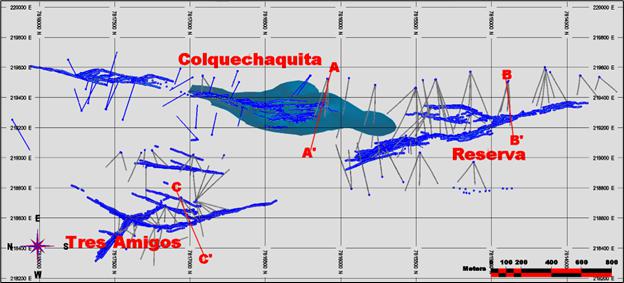
Figure 10-2: Section View A-A’ (azimuth 15°) Showing the Colquechaquita Deposit
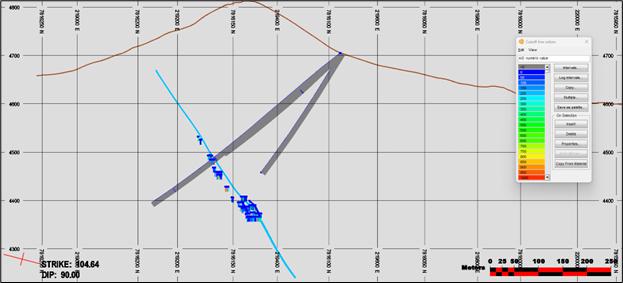
| SANTACRUZ SILVER MINING LTD. | CABALLO BLANCO TECHNICAL REPORT | PAGE 10-3 |
|
|
Figure 10-3: Section View B-B’ (azimuth 350°) Showing the Reserva Deposit
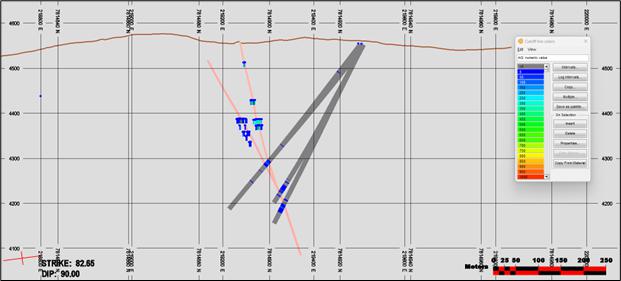
Figure 10-4: Section View C-C’ (azimuth 335°) Showing the Tres Amigos Deposit
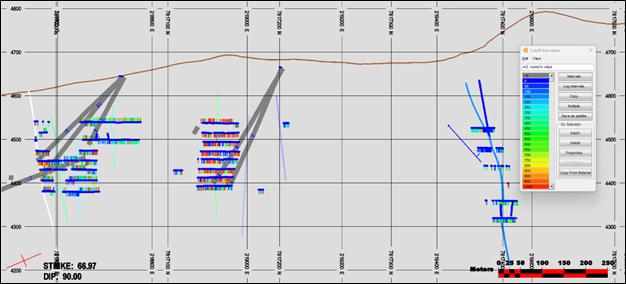
| SANTACRUZ SILVER MINING LTD. | CABALLO BLANCO TECHNICAL REPORT | PAGE 10-4 |
|
|
| 10.2 | Drilling Programs |
Drills were operated by Maldonado Exploraciones of La Paz, Bolivia, Xplomine of Lima, Peru and Geodrill S.A. of La Serena, Chile. The surface and underground drilling was performed by drilling larger diameter HQ core at the early stage of the hole and reduced to NQ size if drilling conditions became difficult.
Drillhole collar surveys were completed using a differential GPS (UTM WGS-84) and the collars of the underground holes are surveyed in using total station by company survey staff. Downhole surveys were derived using either Tropary, Flexit or Reflex depending on the year and the drilling contractor.
The details for the surface and underground drilling program for the Caballo Blanco Project from 2010 to 2023 are summarized in Table 10-4.
Table 10-4: Caballo Blanco Drilling Details from 2010 through January 2023
| Contractor Company | Phase | Year | Holes Drilled | Meters Drilled | Downhole Survey Instrument |
| Surface | |||||
| Maldonado Exploraciones | II | 2021 | 2 | 1009 | Trópary |
| Underground | |||||
| Geodrill | I | 2010 | 2 | 998.8 | Flexit |
Table 10-5: Reserva Drilling Details from 2000 through January 2023
| Contractor/Company | Phase | Year | Holes Drilled | Meters drilled | Downhole Survey Instrument |
| Surface | |||||
| Geodrill | I | 2010 | 5 | 2221.85 | Flexit |
| Geodrill | II | 2011 | 8 | 3598.6 | Flexit |
| Xplomine | III | 2011-2012 | 12 | 5570 | Flexit |
| Maldonado Exploraciones | IV | 2014 | 23 | 8787.7 | Tropary |
| Maldonado Exploraciones | V | 2015 | 4 | 1608 | Reflex |
| Maldonado Exploraciones | VI | 2017 | 1 | 161 | Reflex |
| Maldonado Exploraciones | VII | 2021 | 3 | 417 | Reflex |
| Underground | |||||
| Maldonado Exploraciones | VI | 2017 | 6 | 1193 | Reflex |
| Maldonado Exploraciones | VII | 2012 | 3 | 357 | Reflex |
| SANTACRUZ SILVER MINING LTD. | CABALLO BLANCO TECHNICAL REPORT | PAGE 10-5 |
|
|
Table 10-6: Tres Amigos Drilling Details from 2000 through January 2023
| Contractor/Company | Phase | Year | Holes Drilled | Meters drilled | Downhole Survey Instrument |
| Surface | |||||
| Geodrill | I | 2010 | 3 | 790.3 | Flexit |
| Xplomine | II | 2011 | 8 | 2007.8 | Flexit |
| Maldonado Exploraciones | III | 2013 | 2 | 381 | Tropary |
| Maldonado Exploraciones | IV | 2014 | 5 | 1398.5 | Reflex |
| Maldonado Exploraciones | V | 2017 | 8 | 2171 | Reflex |
| Underground | |||||
| Maldonado Exploraciones | V | 2017 | 2 | 480 | Reflex |
| Maldonado Exploraciones | VI | 2020 | 12 | 2777 | Reflex |
| Maldonado Exploraciones | VII | 2022 | 6 | 1732 | Reflex |
| Maldonado Exploraciones | VIII | 2023 | 8 | 1903 | Reflex |
Downhole survey measurements were taken every 25 m and survey results were corrected for magnetic declination however the existence of pyrrhotite may occasionally causes downhole survey anomalies that require mitigation. These are identified by the geologist during the survey measurement process and corrected by taking another survey measurement above or below the point giving the faulty readings.
Prior to commencement of drilling, the exploration geology supervisor set out the number of runs needed to reach total depth using steel bars and the blocks to be inserted by the driller into the core boxes at the appropriate depth delineated using permanent marker. Unless issues are encountered, the standard drill run length is 3 m. Then the exploration geology supervisor verifies this process by counting the number of steel bars introduced in the hole against the remaining steel bars left to complete total length of hole. Completed core is placed in wooden core boxes which are covered by wooden lids and secured with metal nails prior to being transported by mine staff from drill site to core logging facility.
For underground drillholes, orientations are marked before drill enters to drill site area, with the locations being measured using total station. The orientation of the drillhole is painted on both walls of the drift by the exploration geologist to insure correct alignment and positioning of the drill. Once the equipment mobilized and installed, the drill is leveled, and the direction is set. Finally, the dip is checked with a clinometer or compass.
Core recoveries were high, and by utilizing several drill core sizes, Glencore and Santacruz were able to ensure drillhole target completion. The majority of drillholes were drilled perpendicular to the strike and dip of the veining and therefore significantly represent true thickness of the veining.
There are no known drilling or core recovery factors that could materially impact the accuracy of these results.
| SANTACRUZ SILVER MINING LTD. | CABALLO BLANCO TECHNICAL REPORT | PAGE 10-6 |
|
|
| 11 | Sample Preparation, Analyses and Security |
| 11.1 | Drillhole and Sub-Surface Sampling and Security |
As reported in Section 10 Drilling, the surface and sub-surface diamond drilling was performed primarily by Maldonado Exploraciones, Xplomine and GeoDrill S.A. from 2010-2023. The surface diamond drilling is utilized primarily for resource expansion and delineation identify extensions of structures and specifically to define inferred resources. However, the sub-surface drift and slope development sampling is the primary and significant data source for defining and estimating resources which is performed by Santacruz geological staff.
The secure, sealed core and channel samples are delivered by Santacruz mine staff for analysis to the ISO Certified (NB/ISO/IEC 17025: 2018) Don Diego assay laboratory which is located within the Don Diego mill and processing complex. The Don Diego Complex including the assay laboratory is owned and operated by the Issuer, Santacruz Silver. All samples undergo both assay preparation and assaying at the Don Diego laboratory which also employs industry accepted QA/QC programs.
All analytical results are entered and reside upon the centralized database called LIMS Laboratory Information Management System which is the responsibility and under the supervision of the Don Deigo laboratory staff. The assay information is provided to geological staff via live, non-read-write access for import into the industry recognised geological modelling and estimation software systems such as LeapFrogTM and DatamineTM.
Sample rejects and remaining half-core is stored in a secure location and labelled for access and retrieval. These facilities are fully controlled by perimeter fencing and security on the property.
| 11.1.1 | Drill Core Logging, Photography, Sampling and Security |
Drill core from surface and underground was stored in wooden labelled boxes, from the drill and transported from the drill to the core logging facility. Before core splitting and logging commences, drill core is systematically photographed using tripod-mounted camera in high resolution and digitally archived for reference as part of the drill and sample database.
Logging and sampling were undertaken on site by company personnel under a QA/QC protocol developed by Glencore. Technicians first prepared the core boxes by reviewing drillhole depth tags, re-assembling broken sections, and mis-placed or mis-aligned core. Core is then washed and cleaned, then marked every meter using permanent marker. Core logging is performed to identify lithology, alteration, RQD, structure, mineralization and sampling selection for core sawing was completed by technicians under the direction of the geologist.
A digital photographic record was performed on each core box, with each photo containing two to a maximum of three boxes. These photos are taken with natural light and each box are marked with their general description, such as project, sample name, box number, and start and end depths.
| SANTACRUZ SILVER MINING LTD. | CABALLO BLANCO TECHNICAL REPORT | PAGE 11-1 |
|
|
The exploration geologist is responsible for marking core interval depending on interest structure in mineralization zones, from one to two meters. The typical sample lengths are 1.0 to 1.5 m with a minimum sample width of 1m and maximum lengths of approximately 2.0 m; sample lengths were based on the lithology and alteration. The geologist also marks the saw line along the core, with each side containing roughly an equivalent amount of mineralization, and also marks the start and end of each sample interval as shown in Figure 11-1. The technician records the core intervals entering then into an ExcelTM spreadsheet.
Figure 11-1: Example of Core Marked for Splitting
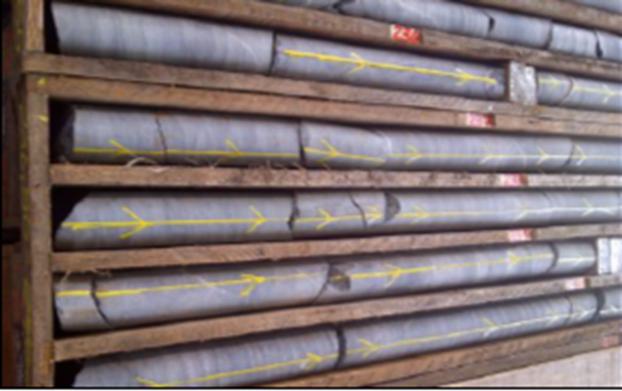
Technicians secure the sample boxes while they are transported to the dedicated enclosure for cutting. Samples cutting is performed by trained, specialized personnel equipped with appropriate personal protective equipment (PPE) operating a Target PortasawTM brand diamond disc cutting machine as shown in Figure 11-2. This type of cutting machine is used because it allows the operator to safely split the core longitudinally with precision. It is also possible to make perpendicular cuts and to cut segments greater than 45 cm can be split.
| SANTACRUZ SILVER MINING LTD. | CABALLO BLANCO TECHNICAL REPORT | PAGE 11-2 |
|
|
Figure 11-2: Core Splitting Facilities
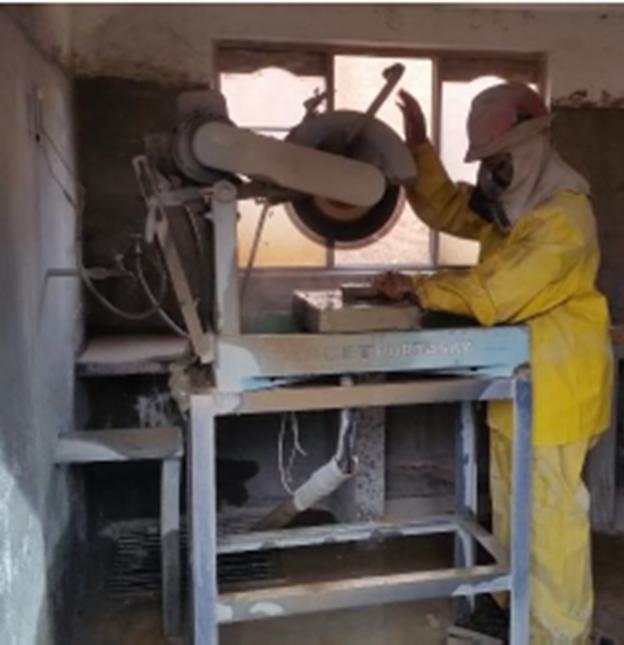
Once the core is cut, half of the drill core is inserted into sample bags along with a sample ticket, tied with plastic straps and then placed in consecutive order according to sequential coding. Then, seven to ten samples are placed in rice bags, based on weight and not exceeding 25 kg. Then the rice sacks are grouped into batches and order maintaining as shown Figure 11-3.
| SANTACRUZ SILVER MINING LTD. | CABALLO BLANCO TECHNICAL REPORT | PAGE 11-3 |
|
|
Figure 11-3: Samples Prepared for Analysis Transport
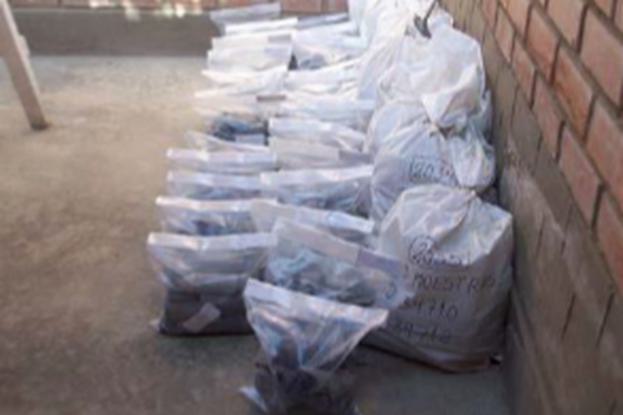
The samples are then delivered to the laboratory through an analysis request form which lists the required elements for reporting. The form also includes details about the quantity of samples sent, how many sacks they are transported in, and indicate if they are special samples as shown in Figure 11-4.
| SANTACRUZ SILVER MINING LTD. | CABALLO BLANCO TECHNICAL REPORT | PAGE 11-4 |
|
|
Figure 11-4: Sample Submission Form
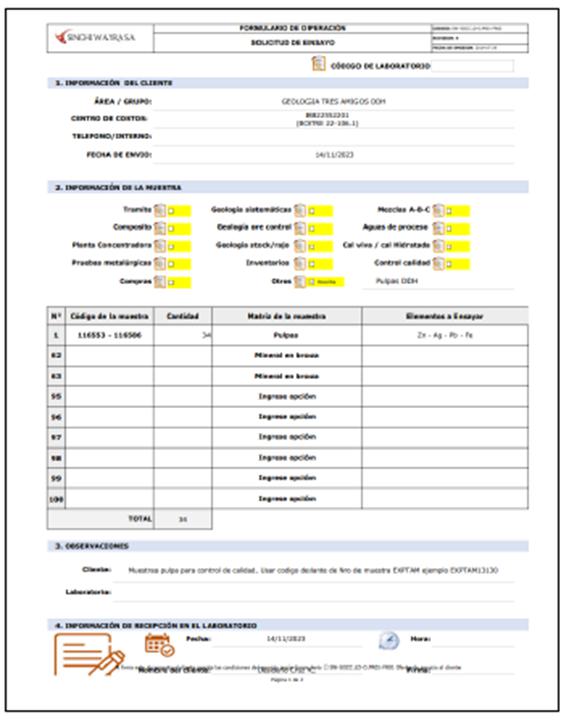
| SANTACRUZ SILVER MINING LTD. | CABALLO BLANCO TECHNICAL REPORT | PAGE 11-5 |
|
|
All core boxes that have completed the entire logging and sampling process are stored in the logging area sequentially. They are then transported to the permanent secured core storage facilities and then stored on covered metal shelves as shown in Figure 11-5. Each core box is labelled and coded for easy identification and access.
Figure 11-5: Drill Core Storage Facilities
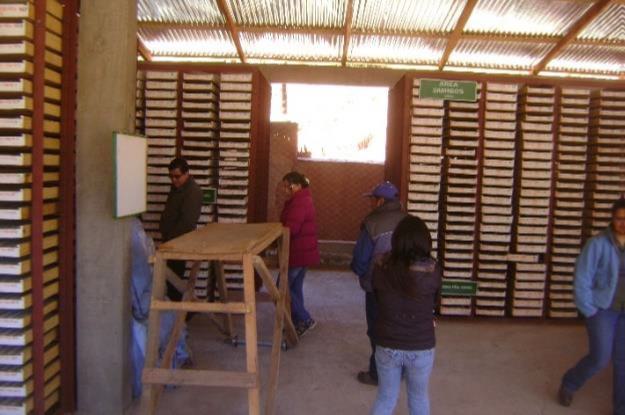
| 11.1.2 | Sub-Surface Sampling and Logging |
The sub-surface sampling is primarily performed within horizontal drift development in addition to face and stope development. Prior to entering the designated underground sampling areas, inspection is performed to ensure or establish adequate ventilation and to perform scaling to eliminate hazards. The structure is washed by pressure hose prior to sampling and the faces marked with white spray paint to delineate length and orientation of sampling transverses. Then a ladder is secured if samples are being taken from the back or at heights up the drift walls to insure safe access. Samples are the taken using a hammer and chisel, collected into an un-used sample bag. Alternatively, samples are collected onto a cleaned and washed tarp, or a specialized tarp lined sample collection pocket for transfer into sample bags. Samples are collected from a 10 cm wide and at least 2 cm depth channel using the hammer and chisel by following the white painted markings. The sampling is performed as two person teams with one operating the hammer and chisel, and the other collected the rock and mineralized fragments. A new sample bag or freshly cleaned tarp is used for each sample. In the case where the sample width is greater than approximately 1 m then more than one sample must be taken. For stope sampling, systematic samples are taken every 4 m. These samples are split depending upon the structure being sampled and the character of the mineralization encountered as shown in Table 11-1. Samples are then introduced to a polyethylene bag with its sample number labeled, sample tag inserted and gathered for transport to the surface for delivery to the analytical laboratory by Santacruz staff of analysis.
| SANTACRUZ SILVER MINING LTD. | CABALLO BLANCO TECHNICAL REPORT | PAGE 11-6 |
|
|
Table 11-1: Underground Sample Mineralization Codes
| Code | Description |
| BM | Mineralized Breccia |
| CM | Mineralization Stock |
| VM | Massive Vein |
| VB | Brecciated Vein |
| F | Fault |
| CM | Wall, back, floor, shoulder waste |
| FM | Mineralized Fault |
| 11.2 | Sample Preparation and Analysis |
Samples were transported to the Don Diego laboratory, which is ISO-17025 accredited, for sample preparation and analysis where they are documented and entered to the Laboratory Information Management System (LIMS) for tracking and secure reporting of data and results. It is important to note that the Don Diego Laboratory is owned and operated by the Issuer, Santacruz, and the was owned and operated by Glencore prior to the purchase of all of the Sinchi Wayra operations.
Once received the samples are laid out for sample preparation which entails crushing and pulverizing the drill core down to 95% passing -140 µm. The resulting pulps are weighed and individually packaged into envelopes and loaded onto carts for assaying. The resulted prepared samples are then assayed for silver, lead, zinc and iron using an Atomic Absorption Spectroscopy (AAS) for silver, lead, zinc and iron followed by a Gravimetric finish for silver samples > 2100 g/t and Volumetric for lead > 16% and zinc > 20% as shown in Figure 11-6.
| SANTACRUZ SILVER MINING LTD. | CABALLO BLANCO TECHNICAL REPORT | PAGE 11-7 |
|
|
Figure 11-6: Assay Methods Employed at the Caballo Blanco Mine
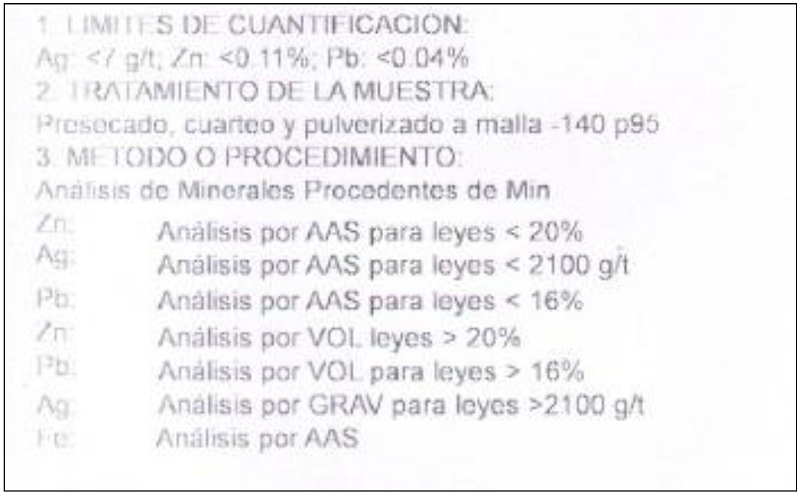
Analytical results are provided via secure servers and pdf formatted assay certificates as shown in Figure 11-7.
| SANTACRUZ SILVER MINING LTD. | CABALLO BLANCO TECHNICAL REPORT | PAGE 11-8 |
|
|
Figure 11-7: Example of Don Diego Laboratory Assay Certificate
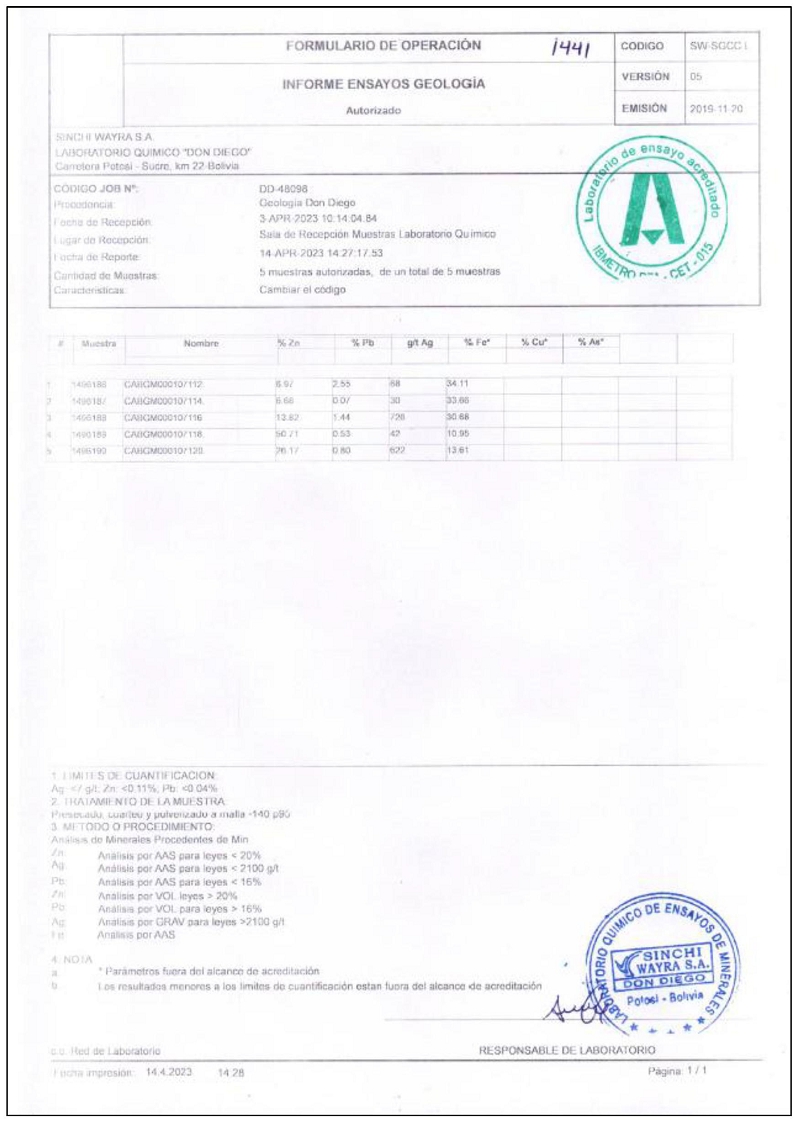
| SANTACRUZ SILVER MINING LTD. | CABALLO BLANCO TECHNICAL REPORT | PAGE 11-9 |
|
|
Santacruz database files are stored and managed in Access and ExcelTM formats before being transferred to LeapFrogTM and DatamineTM software.
All half-core is stored at a dedicated core storage facility that is locked and is within a fully controlled perimeter wall and fencing with security on the property.
| 11.3 | QA/QC Procedures and Discussion of Results |
The purpose of Quality Assurance and Quality Control (QA/QC) is to ensure that the laboratory procedures may be relied upon by guarding against sample contamination and test whether the equipment used to prepare the samples has been sufficiently cleaned between sequential assays. In addition, it is standard and highly recommended practice to insert additional “control” samples to continually test the precision and accuracy of the resulting analyses.
Since 2000, Sinchi Wayra has implemented QA/QC programs to varying degrees which employ industry standards and accepted practices for drillcore and channel sampling. This includes the regular insertion of blanks and standards randomly into the sample stream along with performing duplicate analysis of pulps and coarse rejects to assess analytical precision and accuracy. Additionally, beginning in 2012, the practice of including coarse and pulp duplicate QA/QC samples was employed.
Field blanks are non-mineralized material sourced locally and inserted into the sample series one every 20 samples (5%). Field blanks are inserted to test for any potential carry-over contamination which might occur in the crushing phase of sample preparation, because of laboratory poor cleaning practices.
Duplicate analysis of pulps and quarter-core are used to evaluate analytical precision and to determine if any biases exist between laboratories. Duplicate analysis of coarse rejects is used to analyze preparation error. Table 11-2 details the QA/QC sample insertion rate.
Table 11-2: QA/QC Sample Insertion Rates
| Sample Type | Insertion Rates | Notes |
| Blanks | 1 every 20 | Usually inserted at the end of mineralized runs to measure carry-over |
| Pulp Duplicates | 1 every 20 | Undertaken at second laboratory with same analytical technique. High- and low-grade mineralized samples are usually chosen |
| Coarse Duplicates | 1 every 20 | Normally choose mineralized samples, used to measure laboratory sample preparation |
In 2022, a total of 417 control samples within a sample population of as shown in Table 11-3 were assigned for QA/QC purposes and accounted for approximately 15% of total samples taken during the program.
| SANTACRUZ SILVER MINING LTD. | CABALLO BLANCO TECHNICAL REPORT | PAGE 11-10 |
|
|
Table 11-3: Quantity of Control Samples by Type
| Control Type | # |
| Field Blanks | 140 |
| Coarse Duplicates | 133 |
| Pulp Duplicates | 144 |
| Total | 417 |
Contamination and determining whether adequate cleaning practices are being performed at the laboratory is evaluated through the direct incorporation of sample blanks. Blank samples are do typically have some level of very low grade, background values depending upon where they are sourced from so the results should be at that value or within acceptable error (±) thresholds. The placement of blanks within the sample stream is typically in the middle of an identified mineralized structure or immediately at the end of the section or sample run. Figure 11-8 through Figure 11-10 show results show three failures or 2% for silver while the performance for lead is significantly higher with 16 failures and one warning for a failure rate of 11%. This should be investigated as to the source which may be background or remnant lead contamination at the laboratory. The results of the blank analysis for zinc show not excellent but moderately good performance with eight failures for a failure rate of 6%.
| SANTACRUZ SILVER MINING LTD. | CABALLO BLANCO TECHNICAL REPORT | PAGE 11-11 |
|
|
Figure 11-8: Plot of Ag g/t Values for Field Blanks
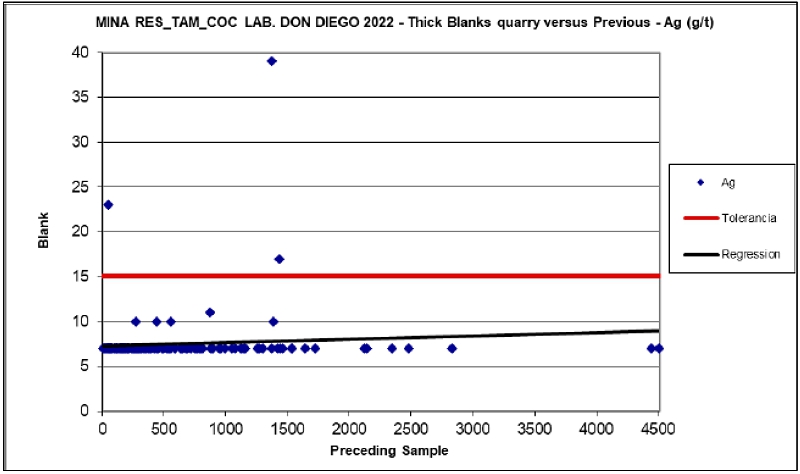
| SANTACRUZ SILVER MINING LTD. | CABALLO BLANCO TECHNICAL REPORT | PAGE 11-12 |
|
|
Figure 11-9: Plot of Pb% Vaues for Field Blanks
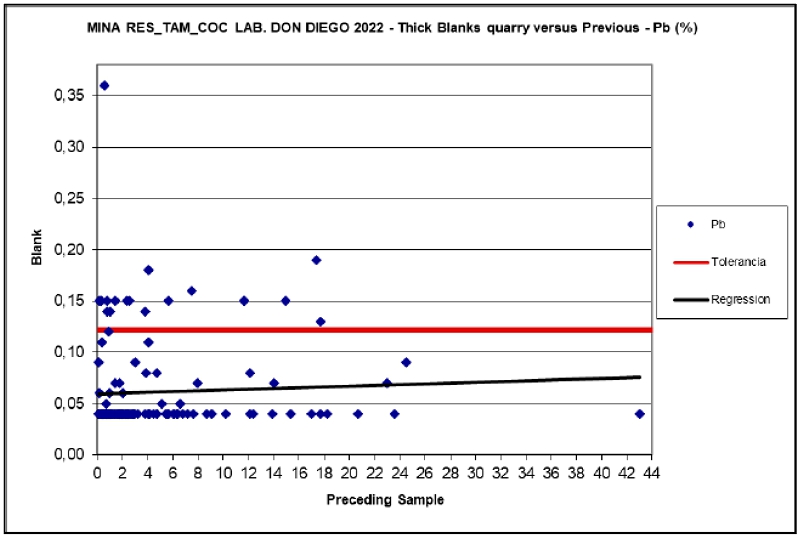
| SANTACRUZ SILVER MINING LTD. | CABALLO BLANCO TECHNICAL REPORT | PAGE 11-13 |
|
|
Figure 11-10: Plot of Zn% Vaues for Field Blanks
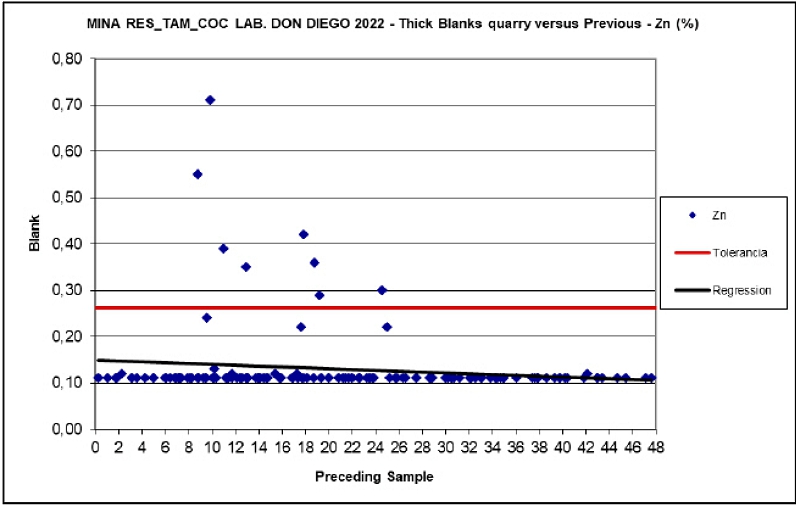
Precision is a measure of reproducibility which is measured by introducing duplicate samples randomly into the sample stream. At the Caballo Blanco mine, both coarse and pulp duplicates are performed in order to ensure appropriate levels of precision are being attained at the Don Diego laboratory facilities. Coarse duplicates entail taking a physical split of the sample at the sample collection stage and then including that duplicate blindly into the sample stream. Pulp duplicates entail taking a physical split of the sample at the culmination of the sample preparation stage at the laboratory and re-inserted into the sample stream.
Figure 11-11 through Figure 11-13 shows the comparative results for the original versus duplicate grades for silver, lead and zinc, respectively. Note that a ±10% relative difference threshold is denoted as a red line. Of the 133 coarse duplicate analyses, the results show fair results with nine significant failures and eight warnings for a failure rate of 6% as shown in Figure 11-11. Figure 11-12 also shows poor results for lead where there are seven failures and ten warnings for a failure rate of 5%. Although the failure rate for lead is not particularly high, where a high failure rate would be greater than 10%, it is recommended that the sampling practices be reviewed to determine whether there may be a reason for potential cross-contamination at the sampling and perhaps assay stage. Figure 11-13 shows only three failure and one warnings for the zinc coarse duplicates for a failure rate of 2%.
| SANTACRUZ SILVER MINING LTD. | CABALLO BLANCO TECHNICAL REPORT | PAGE 11-14 |
|
|
Figure 11-11: Plot of Coarse Reject Duplicates – Ag g/t
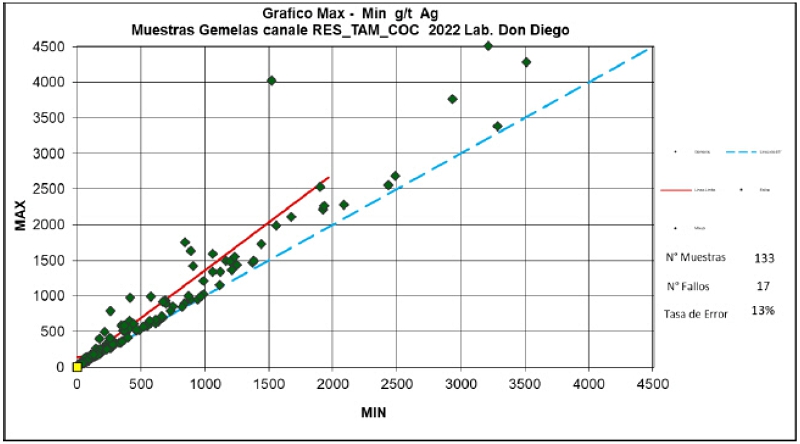
| SANTACRUZ SILVER MINING LTD. | CABALLO BLANCO TECHNICAL REPORT | PAGE 11-15 |
|
|
Figure 11-12: Plot of Coarse Reject Duplicates – Pb%
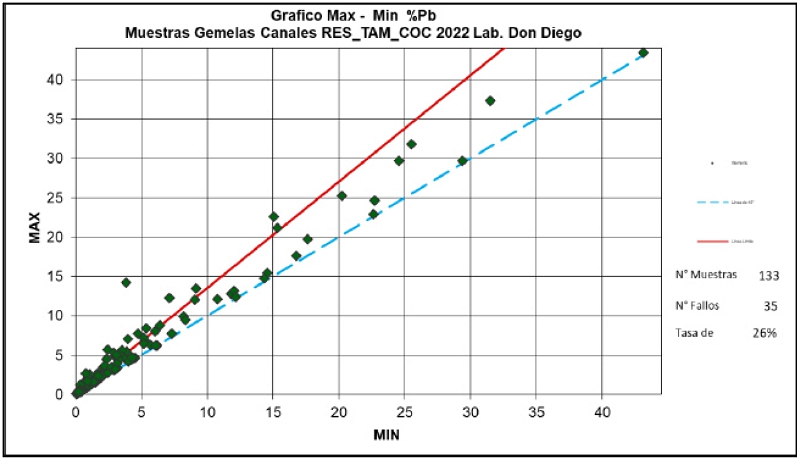
| SANTACRUZ SILVER MINING LTD. | CABALLO BLANCO TECHNICAL REPORT | PAGE 11-16 |
|
|
Figure 11-13: Plot of Coarse Reject Duplicates – Zn%
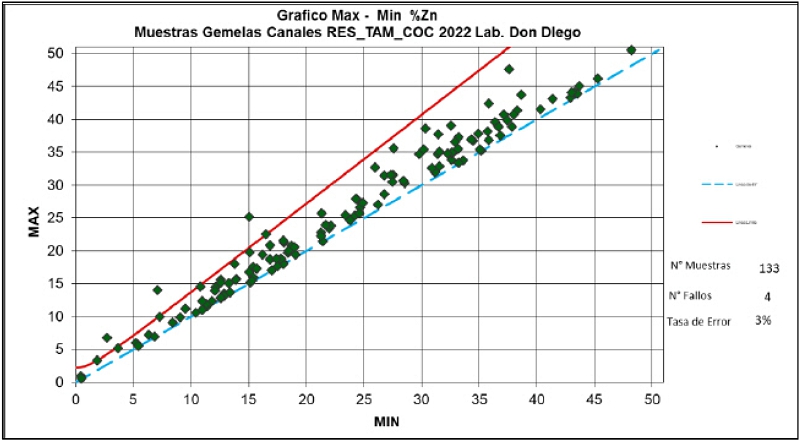
Figure 11-14 through Figure 11-16 shows the comparative results for the original versus duplicate grades for silver, lead and zinc pulp duplicates, respectively. Again, note that a ±10% relative difference threshold is denoted as a red line. Of the 144 pulp duplicate analyses, the results show excellent results with only one silver and one zinc failure and no warning for a failure rate of less than 0.7% as shown in Figure 11-14 through Figure 11-16. In addition, results for lead show there are no failures and no warnings for a failure rate of 0%. The difference between the pulp and coarse duplicate failure rates indicates that there may be issues related to sampling methods and/or contamination occurring during the sampling or transport process that should be investigated and mitigated.
| SANTACRUZ SILVER MINING LTD. | CABALLO BLANCO TECHNICAL REPORT | PAGE 11-17 |
|
|
Figure 11-14: Plot of Pulp Duplicates – Ag g/t
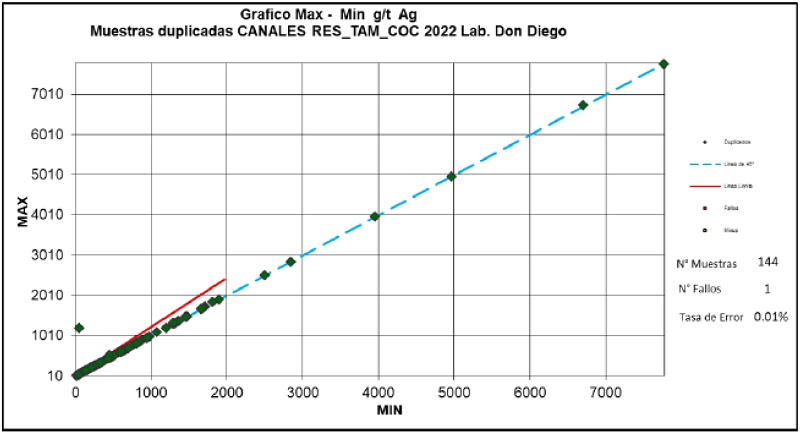
Figure 11-15: Plot of Pulp Duplicates – Pb%
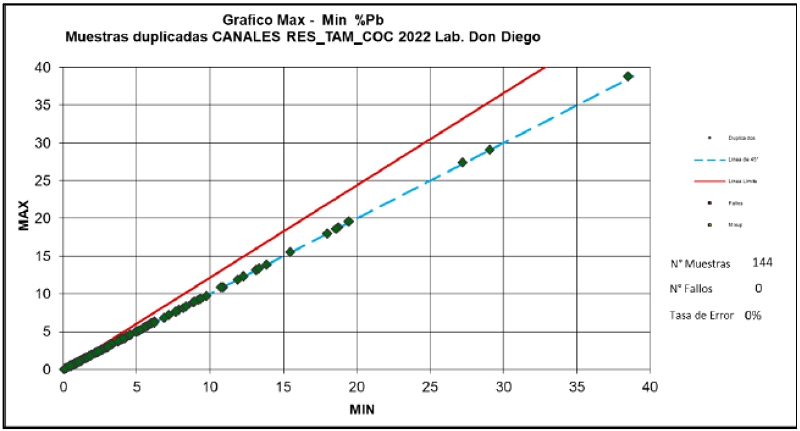
| SANTACRUZ SILVER MINING LTD. | CABALLO BLANCO TECHNICAL REPORT | PAGE 11-18 |
|
|
Figure 11-16: Plot of Pulp Duplicates – Zn%
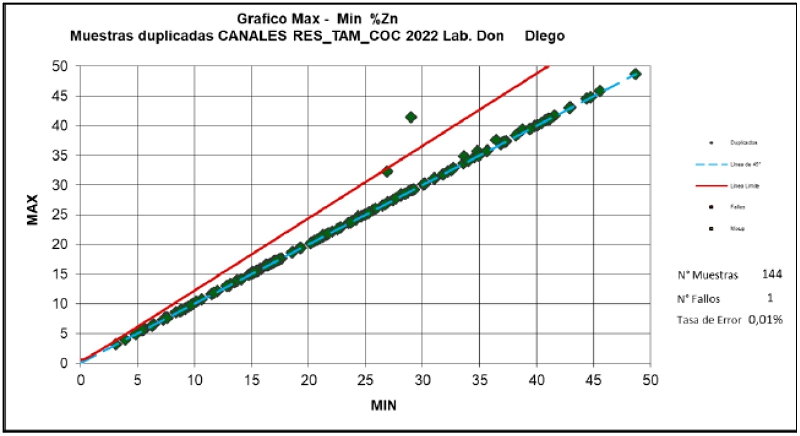
In summary, the quality assurance and quality practices and methods employed are reasonable and produce relatively good results although issues should be investigated to insure reliability or results. Recommendations with respect to the QA/QC sample selections that the company should investigate obtaining Certified Reference Material form an outside accredited source for blanks, particularly barren blanks, and for specific Ag, Pb, Zn standards.
The LIMS system is widely used and accepted at the laboratory while interfaces to users are automated and trusted. The system is also highly secure which is critical in ensuring that data is not tampered with or prone to inadvertent error however, this also makes it difficult to access, review and report data externally. In addition, reporting functions are relatively dated and system upgrades should be investigated, and some additional customization would also be desirable.
| 11.4 | QP Statement |
It is the opinion of the QP, Garth Kirkham, P.Geo., that the sampling preparation, security, analytical procedures and quality control protocols used by Santacruz are consistent with generally accepted industry best practices and therefore reliable for the purpose of resource estimation.
| SANTACRUZ SILVER MINING LTD. | CABALLO BLANCO TECHNICAL REPORT | PAGE 11-19 |
|
|
| 12 | Data Verification |
| 12.1 | Verifications by the Authors of this Technical Report |
The following details the data verification performed by the Qualified Persons for the completion of this Technical Report. Verification activities were performed on sampling methods and results, assay database, geological interpretation and lithological models, resource estimation procedures, models and results, metallurgy and processing, mining design and dilution, along with reserves models and results.
Multiple site visits were conducted by the QPs, as detailed in Section 2.
There have been no limitations or failures to conduct data verification that were identified by the QPs in the preparation of this Technical Report.
| 12.1.1 | Site Visit & Verification |
The purpose of these visits is to fulfill the requirements specified under NI 43-101, to gain familiarization with the property, to validate the existence, location, extent and the mineralization and deposits. In addition, the site visits are an important component for verification of all information and data being submitted by the company for inclusion into the NI43-101 technical report including sample data, geology, QA/QA procedures and mineral resource models and results. These site visits consisted of underground tours of non-mineralized development headings, sampling, storage areas and existing infrastructure. In addition to gathering on-site data and reports, performing interviews, walking through procedures, and investigating areas of discrepancy, the identification and collection of independent verification data such as samples are all critical activities that make up a site visit.
Prior to the site visits, the author reviewed all collected data sources and reports. The primary sources of data for inspection were the drillhole and underground channel sample data, related assay data, QA/QC data and analyses, assay certificates and LIMS databases. In addition, internal company reports and demonstrations were provided detailing the methods and procedures for sample collection, handling and chain-of-custody, QA/QC procedures and results, and resource estimation methods and reporting.
The QP, Garth Kirkham, P.Geo., visited the property between August 10 through August 13, 2021 and March 15 through March 30, 2023. The site visit included an inspection of the property, offices, underground operations, core storage facilities, and tours of major centres and surrounding villages most likely to be affected by any potential mining operation.
The August 2021 site visit performed by the QP to support the Technical Report dated December 17, 2021 included a tour of the offices, core logging, and storage facilities which showed clean, well-organized, professional environments. Santacruz geological staff and on-site personnel led the QP through the chain of custody and methods used at each stage of the logging and sampling process. All methods and processes are to common industry standards and common best practices, and no issues were identified. The 2021 site visit also entailed attending all operations including the Boliva miner, Porco mine and the Caballo Blanco complex which included separate attendance to the Tres Amigos, Colquechaquita and Reserva mines. Visits to the underground operations showed extensive, on-going mining operations. In addition, the tour included tours through the Don Diego Milling and Processing Complex along with the sample storage facilities.
| SANTACRUZ SILVER MINING LTD. | CABALLO BLANCO TECHNICAL REPORT | PAGE 12-1 |
|
|
The tour of the property showed a clean, well-organized, professional environment. On-site staff led the author through the methods used at each stage of the resource estimation process. All methods and processes are up to industry standards and reflect leading practices, and no issues were identified.
| 12.1.2 | Sample Database Verification |
Verification of the Caballo Blanco drillhole and underground sample assay database was primarily focused on silver, lead and zinc in addition to iron, arsenic, sulphur and tin. Sample databases were supplied in ExcelTM format and in LeapFrogTM. Checks against source data and assay certificates showed agreement. Statistical analyses used to investigate and identify errors were performed and resulted in minor issues. These have been corrected and it is recommended that a continued program of random “spot checking” the database against assay certificates be employed.
| 12.1.3 | Independent Sampling |
No verification samples were taken during the 2021 site visit due to severe limitations on transport of materials due to COVID at that time. In addition, the 2021 site visit was performed in support of the Technical Report which did not include a resource estimate and was performed prior to transfer of ownership of all properties from Glencore and Santacruz.
The 2023 site visit included a visit of the Don Diego mill complex which included a tour of the Don Diego laboratory which included an extensive review of the methods and procedures along with gathering appropriate documentation for reporting.
Also, during the 2023 site visit, an extensive independent sampling verification plan was implemented with a total of 80 samples collected across from the Bolivar, Porco and Caballo Blanco operations. The Don Diego laboratory is an NB/ISO/IEC 17025:2018 accredited laboratory which performs all assay analyses for the mining and processing operations for Sinchi Wayra including Caballo Blanco.
In order to ensure reliability of results particularly as the data is being used for resource estimation purposes with this Technical Report, independent verification duplicate samples are sent to an accredited external umpire laboratory. These verification samples were secured and transported to SGS Peru for analysis and comparison. SGS Peru is a well-established certified assay laboratory that possess and maintains ISO 14000 accreditation. Individual samples were placed in plastic bags with a uniquely numbered tag, after which all samples were collectively placed in a larger bag and delivered by independent transport to the SGS laboratory in Lima Peru for analysis. The selection was a combination of acid digestion and Induced Coupled-Plasma Atomic Emission Spectroscopy (ICP) along with screening and hydroxide precipitation for overlimit values.
| SANTACRUZ SILVER MINING LTD. | CABALLO BLANCO TECHNICAL REPORT | PAGE 12-2 |
|
|
A total of 45 samples which were comprised of 15 coarse duplicated and 30 pulp duplicates were sent for independent analysis as shown in Table 12-1.
Table 12-1: Caballo Blanco Independent Verification Sampling
| Mine | Sample | Ag ppm | As ppm | Cu ppm | Fe% | Pb% | S% | Sn ppm | Zn% |
| COLQUECHAQUITA | 11128 | 142 | >10000 | 611.9 | 10.54 | 1.66 | 17.97 | 405 | 16.79 |
| 11130 | 197 | >10000 | 850 | >15 | 1.45 | 31.11 | 975 | 13.29 | |
| 11132 | 119 | >10000 | 754.2 | >15 | 0.61 | 30.29 | 598 | 12.51 | |
| 11134 | 417 | >10000 | 1303.6 | 13.85 | 0.83 | 28.4 | 721 | 30.68 | |
| 11137 | 310 | >10000 | 697.5 | >15 | 1.43 | 25.4 | 868 | 10.07 | |
| 8658 | 122 | >10000 | 742.2 | >15 | 0.71 | 37.9 | 556 | 11.55 | |
| 8659 | 70 | >10000 | 255.1 | 9.94 | 1.12 | 13.6 | 203 | 10.68 | |
| 8660 | 31.2 | >10000 | 92.9 | 9.36 | 0.64 | 7.23 | 116 | 2.72 | |
| 8661 | 118 | >10000 | 209.9 | >15 | 0.70 | 27.5 | 314 | 6.54 | |
| 8662 | 25.4 | >10000 | 85.1 | 10.05 | 0.42 | 8.73 | 82 | 2.42 | |
| 12007 | 237 | >10000 | 1110.8 | >15 | 2.95 | 29.5 | 1591 | 14.14 | |
| 12008 | 126 | >10000 | 496.8 | >15 | 2.13 | 23.1 | 336 | 9.83 | |
| 12009 | 97.8 | >10000 | 475.5 | >15 | 0.79 | 14.6 | 476 | 6.63 | |
| 12010 | 178 | >10000 | 417.5 | >15 | 1.71 | 23.8 | 1046 | 9.70 | |
| 12011 | 46.7 | 1512 | 91.7 | 3.99 | 0.61 | 4.22 | 39 | 2.06 | |
| RESERVA | 64904 | 118 | 3565 | 435.6 | 12.06 | 1.82 | 15.14 | 354 | 10.06 |
| 64908 | 57.5 | >10000 | 571.5 | 12.24 | 0.72 | 21.11 | 230 | 14.42 | |
| 64915 | 57.3 | 4669 | 365.8 | 10.85 | 0.89 | 16.95 | 192 | 10.52 | |
| 64920 | 588 | >10000 | 655.4 | 14.2 | 14.49 | 25.3 | 677 | 12.29 | |
| 64923 | 96 | 4813 | 593.6 | 11.64 | 1.53 | 18.56 | 248 | 15.02 | |
| 15515 | 434 | 1337 | 408.3 | 5.81 | 9.71 | 15.58 | 2493 | 15.28 | |
| 15516 | 253 | 3518 | 400.7 | 12.57 | 5.76 | 27.88 | 3731 | 23.72 | |
| 15517 | 2 | 4 | 9.9 | 3.43 | 0.03 | 1.55 | 14 | 0.07 | |
| 15518 | 411 | >10000 | 493.9 | 10.45 | 3.66 | 15.21 | 490 | 5.23 | |
| 15519 | 183 | 26 | 8.6 | 7.76 | 8.07 | 26.44 | 3957 | 28.39 | |
| 15520 | 0.5 | 5 | 8.9 | 3.14 | 0.01 | 0.96 | <10 | 0.04 | |
| 15521 | 1131 | 7200 | 1215.8 | 8.44 | 8.37 | 17.38 | 2339 | 13.08 | |
| 15522 | 242 | 23 | 9.1 | 3.53 | 11.79 | 27.32 | 7097 | 42.97 | |
| 15524 | 2.5 | 46 | 12.9 | 2.89 | 0.05 | 2.24 | 18 | 0.09 | |
| 15525 | 300 | >10000 | 1005 | 10.74 | 2.33 | 17.76 | 1053 | 11.93 | |
| TRES AMIGOS | 114044 | 651 | 494 | 1325.3 | 11.19 | 1.519 | 30.8 | 128 | 42.86 |
| 114046 | 1174 | 263 | 2342 | 10.07 | 3.121 | 26.8 | 171 | 37.37 | |
| 114048 | 578 | 597 | 1232.3 | 10.54 | 4.87 | 29.6 | 101 | 40.91 | |
| 114050 | 292 | 734 | 1292.9 | 10.77 | 1.804 | 29.2 | 101 | 37.13 | |
| 114052 | 588 | 591 | 1293.5 | 10.45 | 2.566 | 28.9 | 79 | 41.54 | |
| 113742 | 407 | 886 | 1191.8 | 14.09 | 1.956 | 27.3 | 133 | 29.36 | |
| 113743 | 191 | 866 | 1253.1 | 10.86 | 1.782 | 24 | 156 | 28.68 | |
| 113744 | 670 | 771 | 1163 | 9.98 | 2.147 | 26.7 | 86 | 36.62 | |
| 113745 | 464 | 1310 | 810 | 13.29 | 7.2 | 24.5 | 161 | 24.27 | |
| 113746 | 573 | 752 | 574 | 8.15 | 8.53 | 19 | 103 | 22.95 | |
| 113521 | 1006 | 1262 | 1212.3 | 5.43 | 3.324 | 9.23 | 115 | 8.82 | |
| 113522 | 1028 | 1329 | 1350.1 | 5.94 | 3.076 | 10.7 | 126 | 10.65 | |
| 113523 | 1294 | 1563 | 1623.6 | 6.65 | 3.54 | 12.8 | 128 | 11.97 | |
| 113524 | 1497 | 1405 | 1902.8 | 7.31 | 3.811 | 14.6 | 147 | 15.13 | |
| 113525 | 1407 | 1444 | 1774.7 | 6.24 | 3.312 | 9.82 | 121 | 10.46 |
Results of the verification samples are presented in Figure 12-1 through Figure 12-3 for silver, lead and zinc, respectively. In all cases, the correlation between the original source Don Diego assay data and that of the duplicate SGS umpire analyses, are perfect as evidenced by the respective R2 being 1. R2 is a measure of the goodness of fit of a model. In regression, the R2 coefficient of determination is a statistical measure of how well the regression predictions approximate the real data points. This sentence is inserted to confirm if this report has been reviewed, please confirm. An R2 of 1 indicates that the regression predictions perfectly fit the data.
Although, these results are not a complete audit of the laboratory, they do verify that the assay results are suitable for resource estimation purposes.
| SANTACRUZ SILVER MINING LTD. | CABALLO BLANCO TECHNICAL REPORT | PAGE 12-3 |
|
|
Figure 12-1: Results of Independent Verification Sampling for Ag g/t
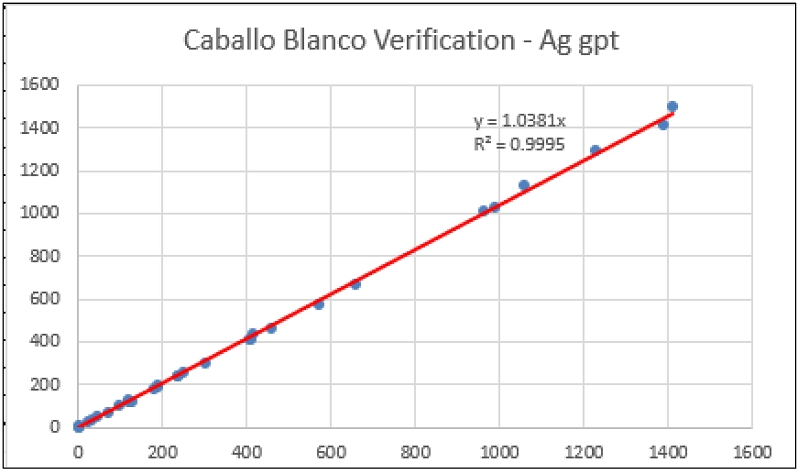
| SANTACRUZ SILVER MINING LTD. | CABALLO BLANCO TECHNICAL REPORT | PAGE 12-4 |
|
|
Figure 12-2: Results of Independent Verification Sampling for Pb%
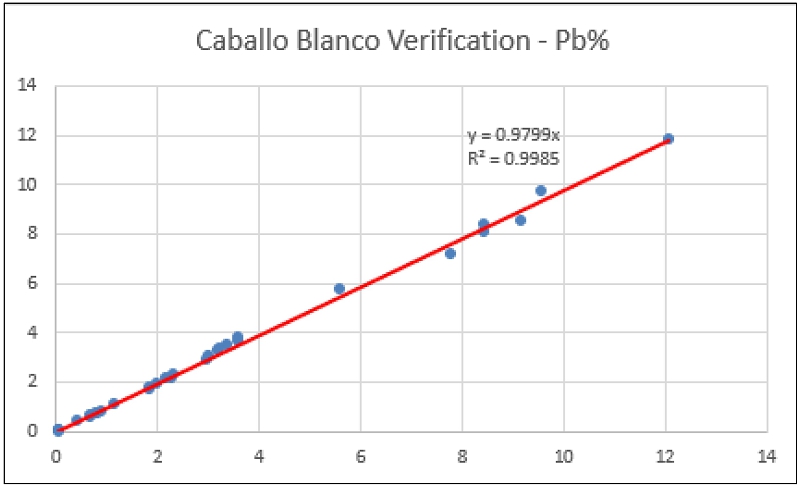
| SANTACRUZ SILVER MINING LTD. | CABALLO BLANCO TECHNICAL REPORT | PAGE 12-5 |
|
|
Figure 12-3: Results of Independent Verification Sampling for Zn%
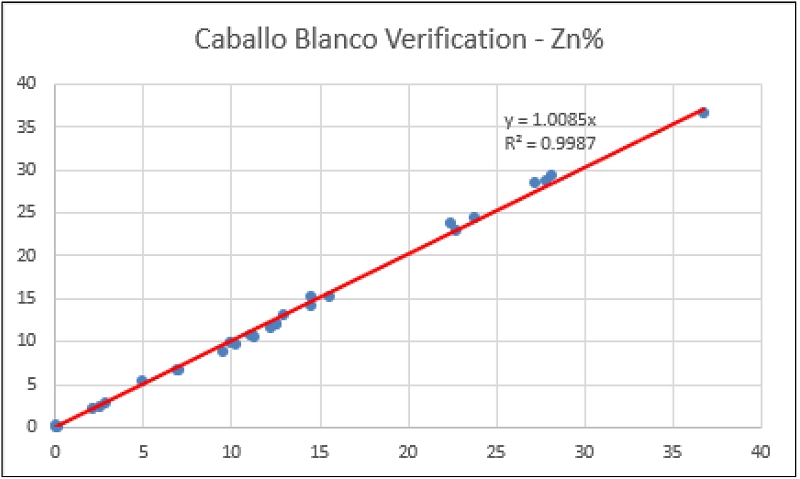
| 12.1.4 | Geological Model Verification |
The geological and lithological solid domain models were supplied by Santacruz in both DatamineTM and LeapFrogTM which are both industry-leading software systems. The QP imported the multiple vein domains into a similar system called MineSightTM to verify solids volumes and ensure matching of the solids domains against the drillhole and sample database. Results confirmed location and extent of volumes are appropriate to resource estimation purposes.
| 12.1.5 | Resource Estimation Verification |
Resource block models were supplied in DatamineTM format which is an industry recognized software system used for resource estimation. These models were then imported to MineSightTM for verification of the resource estimation. In addition, independent estimations were run using the verified sample data and vein domains employing inverse distance estimations to ensure reasonableness and verify the resources independently. Results illustrated good agreement between the original and verification models.
Verification of the SG regression analysis was also performed by comparing measured versus calculated density values.
| SANTACRUZ SILVER MINING LTD. | CABALLO BLANCO TECHNICAL REPORT | PAGE 12-6 |
|
|
| 12.1.6 | Conclusions |
The QP is confident that the data and results are valid based on the site visits and inspection of all aspects of the project, including the methods and procedures used. It is the opinion of the QP that all work, procedures, and results have adhered to best practices and industry standards as required by NI 43-101.
| 12.1.7 | Adequacy Statement |
It is the opinion of Kirkham that the data used for estimating the current mineral resources for the Caballo Blanco operations is adequate for this Resource Estimate and may be relied upon to report the mineral resources contained in this report.
| SANTACRUZ SILVER MINING LTD. | CABALLO BLANCO TECHNICAL REPORT | PAGE 12-7 |
|
|
| 13 | Mineral Processing and Metallurgical Testing |
Data from August 2020 to July 2021 was used to develop the expected metallurgical performance of the Don Diego mill. This data was used to determine throughput, recovery and concentrate grade relationships. The results will be discussed in the upcoming sections.
| 13.1 | Company Feed Processing |
| 13.1.1 | Mill Throughput |
The expected availability for the mill is 95.5% and the utilization is 95% for an expected operating time of 90.7%. The actual throughput from August 2020 to July 2021 can be found in Figure 13-1.
Figure 13-1: Don Diego Mill Company Feed Throughput 2020/2021
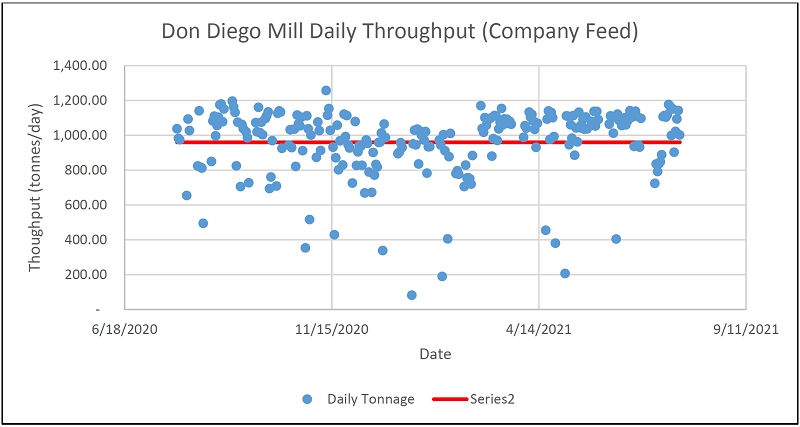
The throughput of company feed through the Don Diego mill during the analyzed period was a little lower than the stated target, with the average of the days it operated being 960 t/d. During the analyzed period, the mill ran company feed over 247 whole or partial days and processed 239,103 t of feed. The grinding circuit targets a P80 of 100 µm. The data suggests that the feed rate is not achieving the target throughput for company feed.
| SANTACRUZ SILVER MINING LTD. | CABALLO BLANCO TECHNICAL REPORT | PAGE 13-1 |
|
|
| 13.1.2 | Feed Grades |
For the period examined, the unreconciled feed grades for the company feed were 6.87% zinc, 2.10% lead, and 237 g/t silver. The feed was somewhat variable with standard deviations of 0.66, 0.32, and 37.99 for zinc, lead, and silver respectively. These values fall within the expected ranges for Don Diego feed. The unreconciled feed grades can be seen in Figure 13-2 through Figure 13-4.
Figure 13-2: Zinc Feed Grade 2020/2021
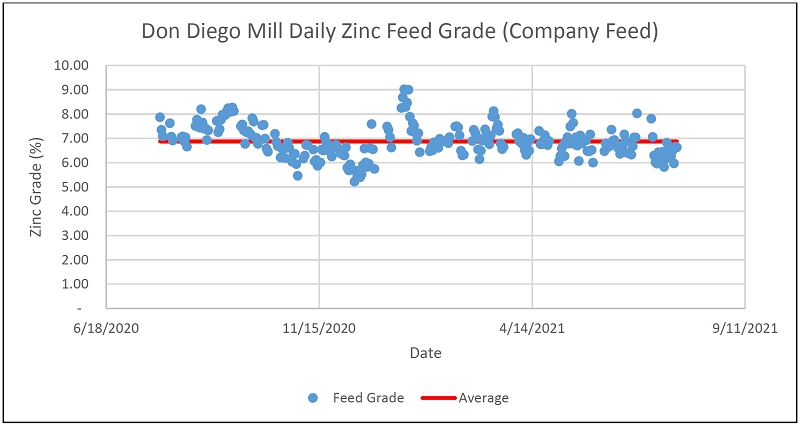
| SANTACRUZ SILVER MINING LTD. | CABALLO BLANCO TECHNICAL REPORT | PAGE 13-2 |
|
|
Figure 13-3: Lead Feed Grade 2020/2021
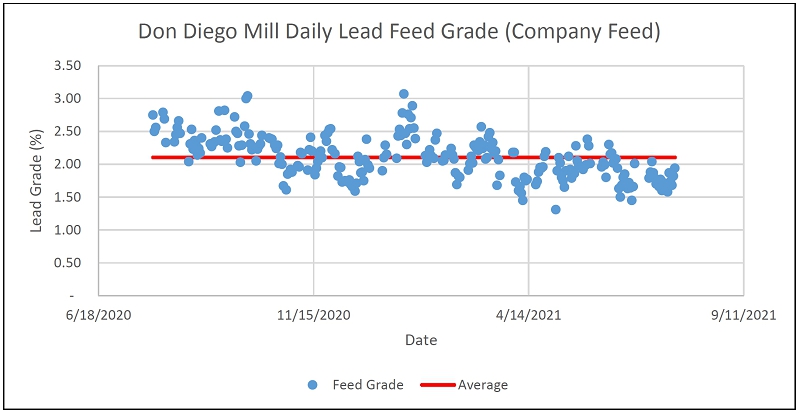
Figure 13-4: Silver Feed Grade 2020/2021
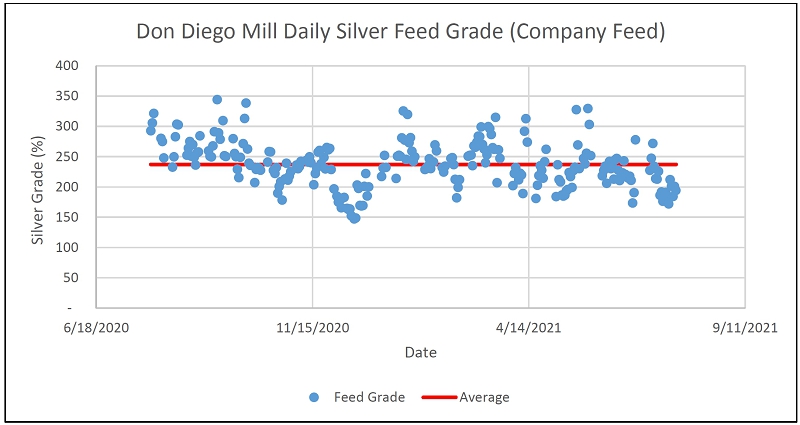
| SANTACRUZ SILVER MINING LTD. | CABALLO BLANCO TECHNICAL REPORT | PAGE 13-3 |
|
|
The mill feed grades are measured at the lead circuit flotation feed.
| 13.1.3 | Lead Production |
The lead concentrate produced during the evaluated period measured 6,882 t which represents 2.88% of the feed to the plant.
The average grade of the lead concentrate was 61.03% lead, 3.5% zinc, and 6,460 g/t silver. The recoveries to the lead concentrate were 83.31%, 78.15%, and 1.47% for lead, silver, and zinc respectively.
The relationship between the lead feed grade and the lead recovery to the lead concentrate can be seen in Figure 13-5. While there is some variability, especially in the lower lead feed grades, a relationship can be seen between lead feed grade and recovery to the lead concentrate.
Figure 13-5: Mill Lead Concentrate Recovery vs. Lead Feed Grade
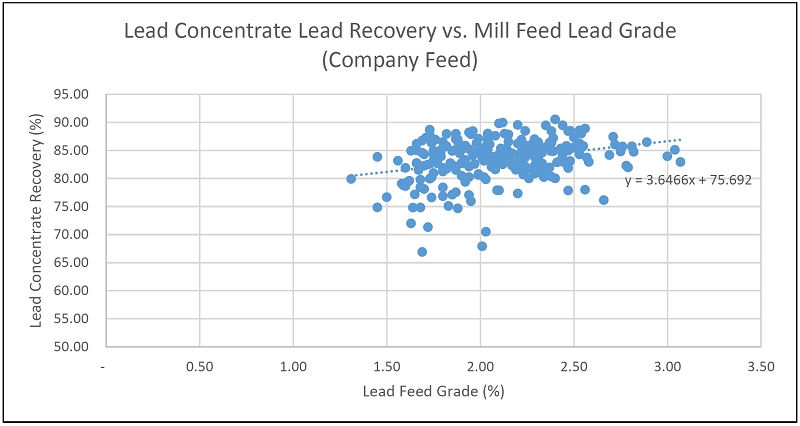
From the above analysis, the recovery relationship for lead to the lead concentrate will be considered: 3.65*(lead feed grade %) + 75.69.
The silver recovery to both the lead and zinc concentrates is a byproduct of the flotation process; the silver is associated with the lead and zinc minerals and follows them into the concentrates. The recovery of silver to the lead concentrate can be seen in Figure 13-6, In this case, the silver recovery appears to have a reasonable correlation to the silver grade in the feed and therefor the relationship of 0.0459*(Silver feed grade %) + 67.256 will be used for this report.
| SANTACRUZ SILVER MINING LTD. | CABALLO BLANCO TECHNICAL REPORT | PAGE 13-4 |
|
|
Figure 13-6: Silver Recovery to the Lead Concentrate vs. Mill Feed Silver Grade
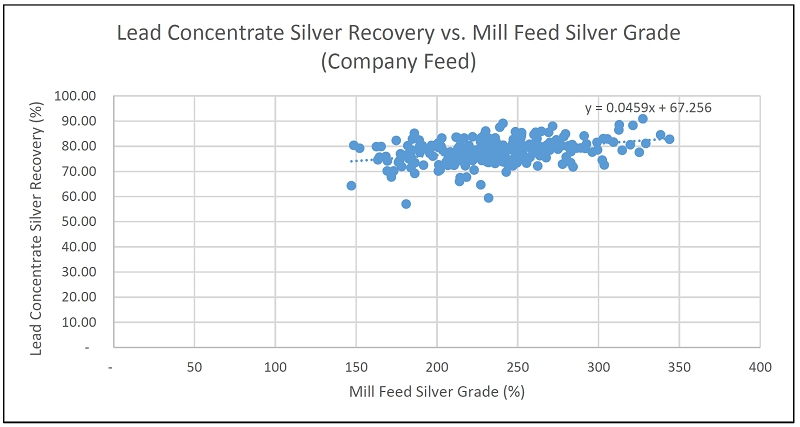
| 13.1.4 | Zinc Production |
The zinc concentrate accounts for approximately 12.81% of the feed mass.
Over the period analyzed, the unreconciled zinc concentrate production was 30,629 t with average grades of 50.67% zinc, 1.39% lead, and 282 g/t silver. The recoveries to the zinc concentrate were 94.41%, 15.35%, and 8.55% for zinc, silver, and lead respectively.
The zinc recovery as a function of the feed grade was examined and found to be a poor relationship for determining expected zinc recovery to the zinc concentrate as can be seen in Figure 13-7. It was determined in this case that the best option was to assign a zinc recovery to the zinc concentrate of 94%, which is the average value over the period examined.
| SANTACRUZ SILVER MINING LTD. | CABALLO BLANCO TECHNICAL REPORT | PAGE 13-5 |
|
|
Figure 13-7: Zinc Recovery to the Zinc Concentrate vs. Mill Feed Zinc Grade
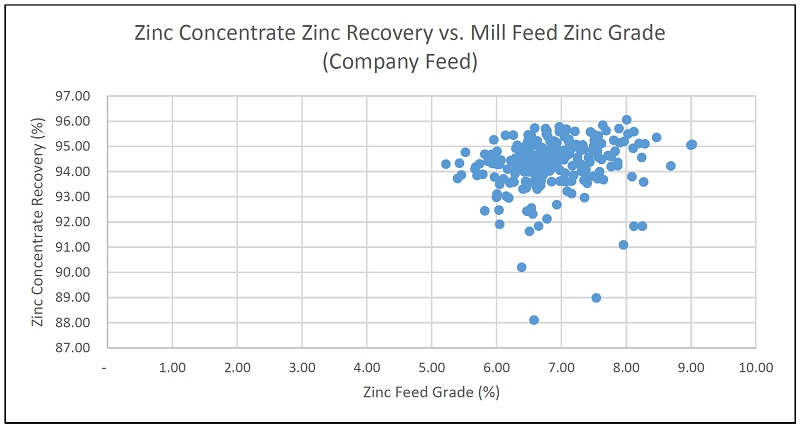
The silver recovery to the zinc concentrate can be seen in Figure 13-8. In this case, the recovery has a negative relationship to the feed grade, presumably due to the positive correlation that the silver recovery to the lead concentrate has with the silver feed grade. The relationship for the silver recovery to the zinc concentrate will be taken as -0.0225 x (Silver Feed Grade) + 20.655.
| SANTACRUZ SILVER MINING LTD. | CABALLO BLANCO TECHNICAL REPORT | PAGE 13-6 |
|
|
Figure 13-8: Silver Recovery to the Zinc Concentrate vs. Mill Feed Silver Grade
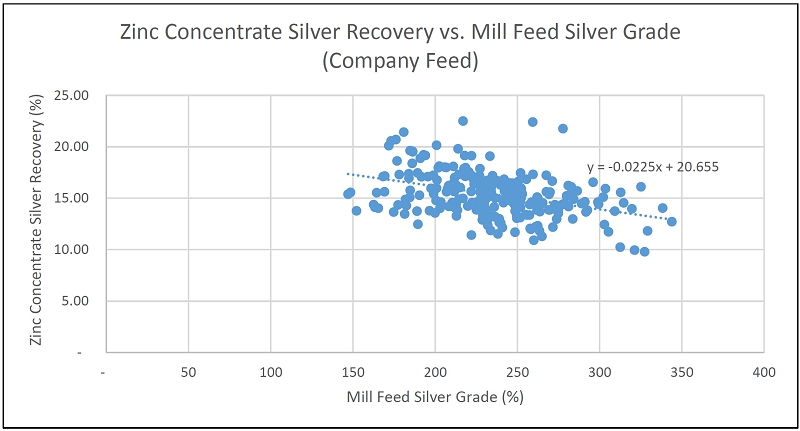
| 13.2 | Toll Feed Processing |
Data from the same time period, August 2020 to July 2021, was used to develop the expected metallurgical performance of the Don Diego mill on toll feed. As was the case for the company feed, the data was used to determine throughput, recovery and concentrate grade relationships.
| 13.2.1 | Mill Throughput |
As with the company feed, the expected availability for the mill is 95.5% and the utilization is 95% for an expected operating time of 90.7% for the toll feed. A summary of the throughput from August 2020 to July 2021 can be found in Figure 13-9.
| SANTACRUZ SILVER MINING LTD. | CABALLO BLANCO TECHNICAL REPORT | PAGE 13-7 |
|
|
Figure 13-9: Don Diego Mill Toll Feed Throughput 2020/2021
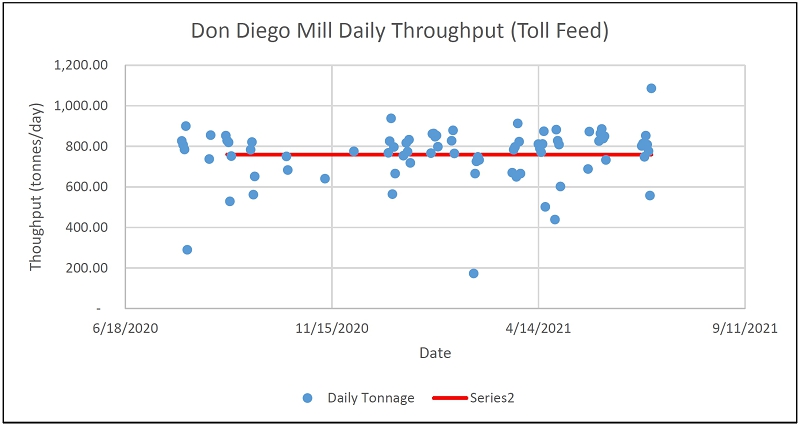
The throughput of company feed through the Don Diego mill during the analyzed period was a slightly lower than the stated target, with the average of the days it operated being 760 t/d. During the analyzed period, the mill ran company feed over 79 whole or partial days and processed 60,002 t of feed. The data suggests that the feed rate is not achieving the target throughput for company ore.
The target grind for the Don Diego plant toll feed is a P80 of 100 µm.
| 13.2.2 | Feed Grades |
For the period examined, the unreconciled feed grades for the toll feed were 8.08% zinc, 0.99% lead, and 144 g/t silver. The feed was somewhat variable with standard deviations of 2.21, 0.66, and 55.4 for zinc, lead, and silver respectively. These values fall within the expected ranges for Don Diego toll feed. The unreconciled feed grades can be seen in Figure 13-10 through Figure 13-12.
| SANTACRUZ SILVER MINING LTD. | CABALLO BLANCO TECHNICAL REPORT | PAGE 13-8 |
|
|
Figure 13-10: Toll Feed Zinc Grade 2020/2021
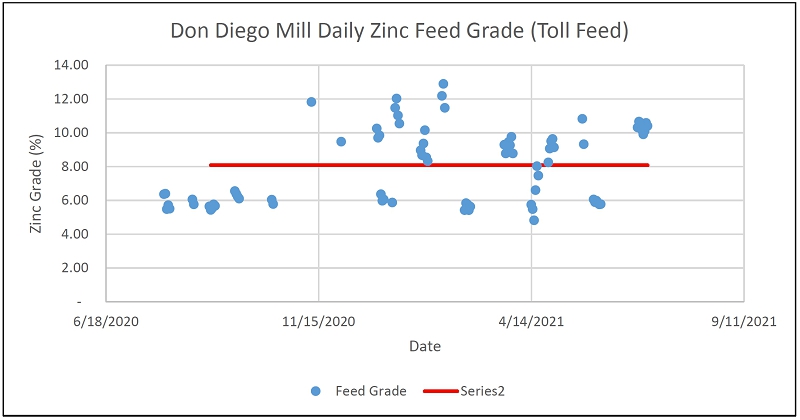
Figure 13-11: Toll Feed Lead Grade 2020/2021
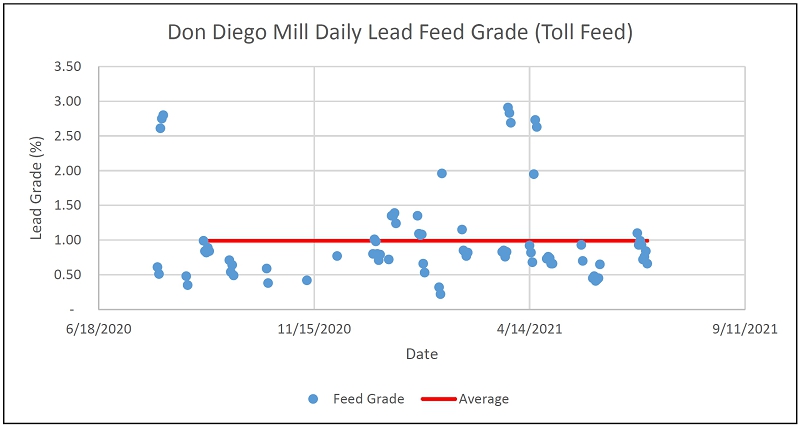
| SANTACRUZ SILVER MINING LTD. | CABALLO BLANCO TECHNICAL REPORT | PAGE 13-9 |
|
|
Figure 13-12: Toll Feed Silver Grade 2020/2021
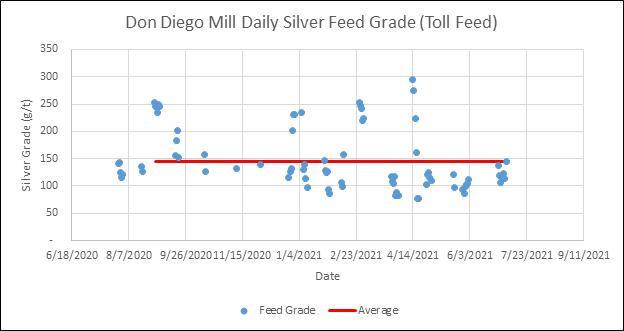
The toll feed head grades were measured in the same location as the company feed.
| 13.2.3 | Lead Production |
The toll feed utilizes the same reagents as the company feed. The lead concentrate produced during evaluated period measured 771 t which represents 1.28% of the feed to the plant.
The average grade of the lead concentrate was 44.86% lead, 9.01% zinc, and 4,064 g/t silver. The recoveries to the lead concentrate were 52.64%, 36.90%, and 1.61% for lead, silver, and zinc respectively.
The relationship between the lead feed grade and the lead recovery to the lead concentrate can be seen in Figure 13-13. This relationship does not appear as distinct as the relationship for the company ore, but still can be used for a recovery prediction. The recovery relationship for lead to the lead concentrate was determined to be: 13.149 x (lead feed grade %) + 39.576.
| SANTACRUZ SILVER MINING LTD. | CABALLO BLANCO TECHNICAL REPORT | PAGE 13-10 |
|
|
Figure 13-13: Mill Lead Concentrate Recovery vs. Lead Feed Grade
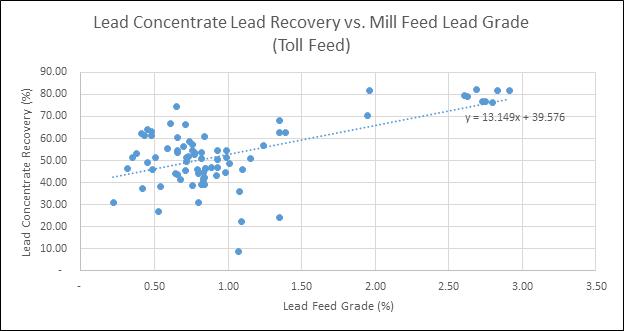
The silver recovery to both the lead and zinc concentrates is a byproduct of the flotation process; the silver is associated with the lead and zinc minerals and follows them into the concentrates. The recovery of silver to the lead concentrate, which can be seen in Figure 13-14, does not demonstrate a strong correlation, but does offer a pattern which is used to develop a feed grade vs. recovery relationship. The silver recovery will be taken as -0.0398*(Silver grade in the feed) + 42.791 for this report.
| SANTACRUZ SILVER MINING LTD. | CABALLO BLANCO TECHNICAL REPORT | PAGE 13-11 |
|
|
Figure 13-14: Silver Recovery to the Lead Concentrate vs. Mill Feed Silver Grade
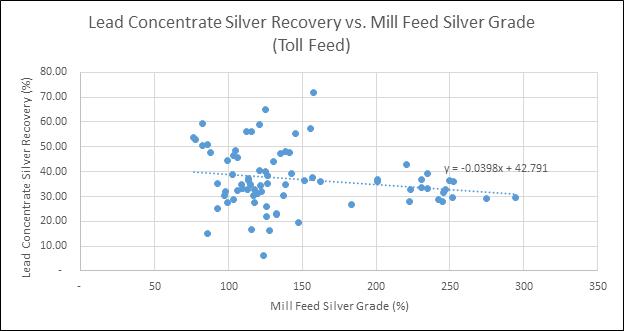
| 13.2.4 | Zinc Production |
Over the period analyzed, the unreconciled zinc concentrate production was 9,396 t with average grades of 47.75% zinc, 1.42% lead, and 437 g/t silver. The recoveries to the zinc concentrate were 91.95%, 46.84%, and 25.45% for zinc, silver, and lead respectively. The higher lead in the zinc concentrate is due to the low recovery of lead to the lead concentrate.
The zinc recovery as a function of the feed grade was examined and although it did not have a strong correlation, it was found to have a trend which can be used to predict zinc recovery to the zinc concentrate. The zinc recovery to the zinc concentrate relationship can be seen in Figure 13-15. The relationship used for the purposes of this report for the zinc recovery to the zinc concentrate is 1.0753*(toll feed zinc grade) + 83.221.
Figure 13-15: Zinc Recovery to the Zinc Concentrate vs. Mill Feed Zinc Grade
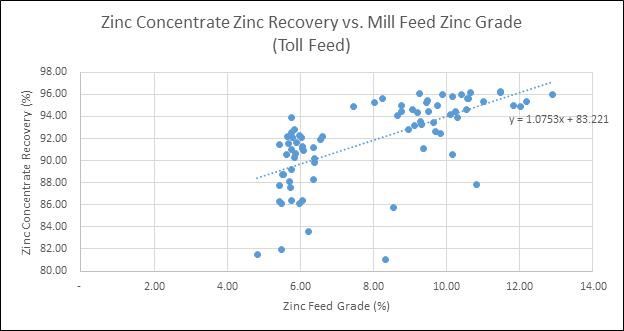
The recovery of silver to the zinc concentrate, can be seen in Figure 13-16. In this case, the relationship between the siler feed grade and silver recovered to the zinc concentrate shows that it was a little more likely for silver to report to the zinc concentrate vs. the lead concentrate. Figure 13-16 demonstrates that although there is a relationship, the silver recovery to the zinc concentrate is affected by other factors than feed grade. A silver recovery of 0.0246*(silver feed grade) + 42.991 was used for this report.
| SANTACRUZ SILVER MINING LTD. | CABALLO BLANCO TECHNICAL REPORT | PAGE 13-12 |
|
|
Figure 13-16: Silver Recovery to the Zinc Concentrate vs. Mill Feed Silver Grade
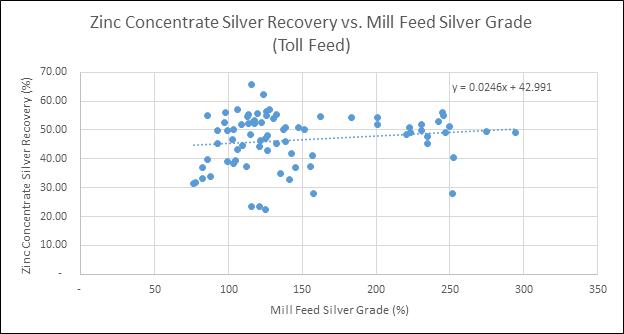
| 13.3 | Metallurgical Assumptions |
The metallurgical assumptions for recoveries and concentrate grades can be found in Table 13-1.
While both the lead and the zinc concentrates pay for the metal they are named for and for silver, a lead concentrate does not pay for zinc contained and the zinc concentrate does not pay for lead contained. The recoveries included in this report only include recovery to concentrates in which they can be paid.
| SANTACRUZ SILVER MINING LTD. | CABALLO BLANCO TECHNICAL REPORT | PAGE 13-13 |
| |
|
Table 13-1: Recovery and Concentrate Grade Estimates
| Parameter | Unit | Concentrates | |||
| Lead Concentrate | Zinc Concentrate | ||||
| Company Feed | Toll Feed | Company Feed | Toll Feed | ||
| Zn Recovery | % | N/A | N/A | 94 | 1.0753*(zinc feed grade) + 83.221 |
| Pb Recovery | % | 3.65*(lead feed grade %) + 75.69 | 13.149*(lead feed grade) + 39.576 | N/A | N/A |
| Ag Recovery | % | 0.0459*(silver feed grade) +67.256 | -0.0398*(silver feed) + 42.791 | -0.0225 x (silver feed grade) + 20.655 | 0.0246*(silver feed grade) + 42.991 |
| Concentrate Grade | |||||
| Zn | % | 3.5 | 9.0 | 51 | 48 |
| Pb | % | 61 | 45.0 | 1.4 | 1.4 |
| Ag | g/t | 6460 | 4050 | 280 | 440 |
| SANTACRUZ SILVER MINING LTD. | CABALLO BLANCO TECHNICAL REPORT | PAGE 13-14 |
| |
|
| 14 | Mineral Resource Estimate |
| 14.1 | Introduction |
The purpose of this report is to document the resource estimations for the Caballo Blanco Project which includes the Colquechaquita, Reserva and Tres Amigos deposits and operating mine complexes. This section describes the work undertaken by Kirkham Geosystems, including key assumptions and parameters used to prepare the mineral resource models for Caballo Blanco which herein to be reporting using zinc-equivalent (ZnEq) cut-offs based upon updated commodity pricing and actual operating costs.
In addition, this Technical Report serves as a first-time disclosure for mineral resources for the Caballo Blanco Project, together with appropriate commentary regarding the merits and possible limitations of such assumptions.
| 14.2 | Data |
A total of 128 drillholes and 19,644 underground channels in the database were supplied in electronic format by Santacruz for each of the deposits as shown in Table 14-1 through Table 14-4 which included 28 drillholes and 5, 520 channels for Colquechaquita, 60 drillholes and 6,272 channels for Reserva and, 40 drillholes and 7,852 channels for Tres Amigos. This included collars, downhole surveys, lithology data and assay data (i.e., Ag g/t, Pb%, Zn%, Fe%, As%). Validation and verification checks were performed during importation of data to ensure there were no overlapping intervals, typographic errors or anomalous entries. Anomalies and errors were validated and corrected. Figure 14-1 shows a plan view of the supplied drillholes and underground channel samples delineated by mine area.
Table 14-1: Statistics for the Colquechaquita Deposit Database
| Collar | Survey | Assay | Assay Zn |
Assay Pb |
Assay Ag | Assay Fe |
Lith | Struct | |
| # | 5,578 | 5,903 | 7,625 | 7,625 | 7,504 | 7,625 | 464 | 724 | 1,099 |
Table 14-2: Statistics for the Reserva Deposit Database
| Collar | Survey | Assay | Assay Zn | Assay Pb | Assay Ag | Assay Fe | Assay As | Lith | Struct | |
| # | 6,333 | 7,318 | 12,917 | 12,917 | 12,917 | 12,917 | 881 | 19 | 5,779 | 6,731 |
| SANTACRUZ SILVER MINING LTD. | CABALLO BLANCO TECHNICAL REPORT | PAGE 14-1 |
| |
|
Table 14-3: Statistics for the Tres Amigos Deposit Database
| Collar | Survey | Assay | Assay Zn | Assay Pb | Assay Ag | Assay Fe | Lith | Struct | |
| # | 7,892 | 8,191 | 9,834 | 9,834 | 9,834 | 9,834 | 1,094 | 2,838 | 3,818 |
Table 14-4: Summary Statistics for the Caballo Blanco Project Database
| Collar | Survey | Assay | Assay Zn | Assay Pb | Assay Ag | Assay Fe | Assay As | Lith | Struct | |
| # | 19,803 | 21,412 | 30,376 | 30,376 | 30,255 | 30,376 | 2,439 | 19 | 9,341 | 11,648 |
Figure 14-1: Plan View of Caballo Blanco Drillholes and Channel Samples
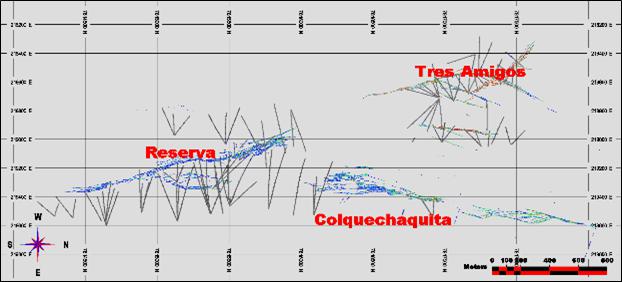
| 14.2.1 | Geology Model |
Solid models (Figure 14-2 through Figure 14-4) were created within LeapFrogTM from drillhole intersections based on a combination of lithology, grades and site knowledge. It is important to note that the resource estimate includes three mines and related deposits which have twenty-nine individual veins that constitute the Caballo Blanco Project which has been producing for many years. This means that a great deal is known about the mineralized structures such that there is a high level of confidence in the location, orientation and dimensions of the modelled geological domains.
| SANTACRUZ SILVER MINING LTD. | CABALLO BLANCO TECHNICAL REPORT | PAGE 14-2 |
| |
|
Figure 14-2: Plan View of Caballo Blanco Mineralized Zones and Drillholes
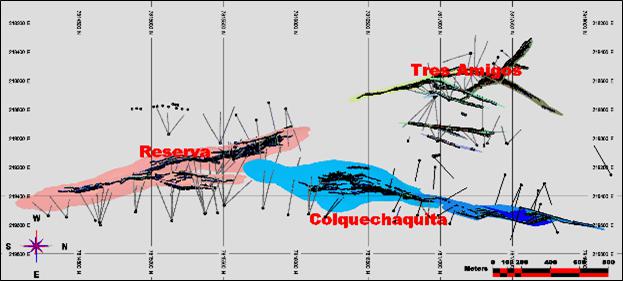
Figure 14-3: Long Section View of Colquechaquita Mineralized Zones and Drillholes Looking West
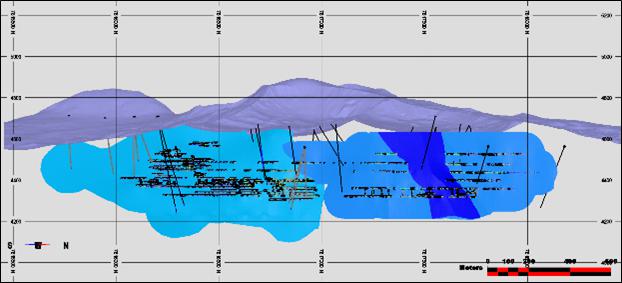
| SANTACRUZ SILVER MINING LTD. | CABALLO BLANCO TECHNICAL REPORT | PAGE 14-3 |
| |
|
Figure 14-4: Long Section View of Reserva Mineralized Zones and Drillholes Looking West
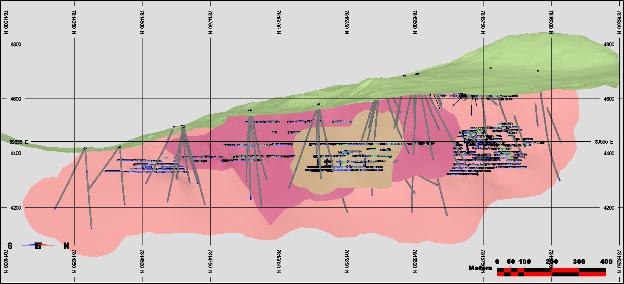
Figure 14-5: Long Section View of Tres Amigos Mineralized Zones and Drillholes Looking West
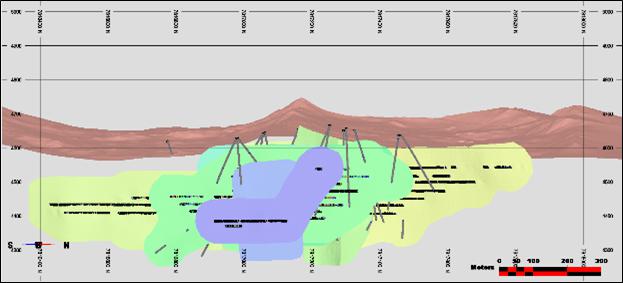
All zones were modelled based on current drilling and assay data using LeapFrogTM and then imported into MineSightTM for interpretation and refinement. Intersections were inspected, and the solids were then manually adjusted to match the drill intercepts. Once the solid model imported, they were used to code the drillhole assays and composites for subsequent statistical and geostatistical analysis. The solid zones were used to constrain the block model by matching assays to those within the zones. The orientation and ranges (distances) used for search ellipsoids in the estimation process were derived from strike and dip of the mineralized zone, site knowledge and on-site observations by Santacruz geological staff.
| SANTACRUZ SILVER MINING LTD. | CABALLO BLANCO TECHNICAL REPORT | PAGE 14-4 |
| |
|
| 14.3 | Data Analysis |
Each of the veins within the Caballo Blanco deposit is identified and individually coded as shown in Table 14-5.
Table 14-5: Vein Codes and Descriptions for the Caballo Blanco Project by Mine
| Vein Code | Vein Name |
| Colquechaquita Mine | |
| 1000 | Rosario |
| 1001 | Wendy |
| 1002 | Wendy Techo |
| 1005 | Rosario Techo |
| 1006 | Ramo Rosario |
| 1007 | VN1 |
| 1008 | Cabeceras |
| 1009 | Blanquita |
| Reserva Mine | |
| 1010 | Viviana |
| 1011 | Karina |
| 1012 | Camila |
| 1014 | Karina_1 |
| 1016 | Ojal_V |
| 1019 | Ramo2 |
| Tres Amigos Mine | |
| 1020 | Catalina |
| 1021 | Ramo |
| 1022 | Daniela |
| 1023 | Milagros |
| 1024 | Central |
| 1025 | Central Este |
| 1026 | Ramo Central II |
| 1028 | Ramo Central Este |
| 1029 | Milagros Este |
| 1030 | Erlinda |
| 1031 | Carmen |
| 1032 | Tatiana |
| 1038 | nn |
| 1042 | Ramo Oeste |
| 1044 | Tatiana |
| 1045 | Estacion |
| SANTACRUZ SILVER MINING LTD. | CABALLO BLANCO TECHNICAL REPORT | PAGE 14-5 |
| |
|
The database was then numerically coded using these individual mineralized solids. Furthermore, the database was then inspected and manually adjusted to ensure accuracy of zonal intercepts. Table 14-6 through Table 14-8 show the statistics for the silver, lead and zinc assays for Reserva, Colquechaquita and Tres Amigos, respectively.
Note that all the vein domains possess a relatively low degree of variability which is evidenced by the low Coefficient of Variation (CV) which is a unit independent quantitative measure of variability. With CV’s being quite low at values of <2 with only two veins within any of the deposits having a CV = 1.9.
The Reserva deposit has modest grades in comparison to other deposits with modest mean grades of 14.63% zinc, 2.03% lead and 161 g/t silver and relatively low levels of variability. However, there are a small number of very high grades with maximums of up to 54% zinc, 48.95% lead and 4,404 g/t silver which should be addressed through a prudent outlier limiting strategy.
Table 14-6: Statistics Silver, Lead and Zinc for the Reserva Deposit by Vein
| Vein# | # | Length (m) |
Min | Max | Mean | 1st Q | Median | 3rd Q | SD | Var | CV | |
| Zn | 1000 | 8,742 | 5,613.02 | 0 | 54 | 14.82 | 5.03 | 13.44 | 22.13 | 11.11 | 123.36 | 0.7 |
| 1001 | 854 | 461.1 | 0.046 | 51.57 | 11.27 | 4.58 | 9.85 | 16.54 | 8.32 | 69.25 | 0.7 | |
| 1002 | 1,117 | 451.88 | 0.01 | 47.35 | 15.38 | 7.03 | 13.64 | 21.98 | 10.81 | 116.84 | 0.7 | |
| 1005 | 29 | 17.26 | 1.045 | 31.02 | 8.68 | 5.55 | 7.60 | 10.92 | 6.24 | 38.95 | 0.7 | |
| 1006 | 86 | 30.45 | 0.25 | 46.32 | 22.40 | 15.24 | 23.65 | 31.42 | 11.33 | 128.45 | 0.5 | |
| 1007 | 9 | 2.63 | 0.456 | 26.9 | 9.81 | 6.13 | 8.28 | 11.65 | 7.10 | 50.46 | 0.7 | |
| 1008 | 230 | 103.29 | 0.11 | 48.28 | 13.08 | 7.06 | 11.85 | 18.73 | 8.27 | 68.33 | 0.6 | |
| 1009 | 27 | 17.56 | 1.83 | 41.46 | 25.49 | 12.84 | 30.42 | 34.89 | 12.52 | 156.70 | 0.5 | |
| Total | 11,094 | 6,697.19 | 0 | 54 | 14.63 | 5.17 | 13.10 | 21.79 | 10.94 | 119.78 | 0.7 | |
| All | 12,908 | 7,572.40 | 0 | 54 | 13.25 | 2.98 | 11.41 | 20.74 | 11.20 | 125.50 | 0.8 | |
| Pb | 1000 | 8,742 | 5,613.02 | 0 | 48.95 | 1.96 | 0.21 | 0.66 | 2.14 | 3.73 | 13.93 | 1.9 |
| 1001 | 854 | 461.1 | 0.01 | 33.32 | 2.33 | 0.31 | 1.01 | 2.90 | 3.53 | 12.45 | 1.5 | |
| 1002 | 1,117 | 451.88 | 0 | 35.12 | 2.34 | 0.43 | 1.14 | 2.78 | 3.20 | 10.25 | 1.4 | |
| 1005 | 29 | 17.26 | 0.18 | 21.15 | 2.45 | 0.98 | 1.81 | 2.89 | 3.49 | 12.15 | 1.4 | |
| 1006 | 86 | 30.45 | 0.04 | 8.53 | 0.81 | 0.15 | 0.42 | 0.91 | 1.26 | 1.58 | 1.6 | |
| 1007 | 9 | 2.63 | 0.308 | 10.75 | 2.86 | 0.33 | 0.45 | 2.28 | 3.98 | 15.82 | 1.4 | |
| 1008 | 230 | 103.29 | 0.04 | 22.48 | 3.63 | 1.21 | 2.36 | 4.44 | 3.90 | 15.18 | 1.1 | |
| 1009 | 27 | 17.56 | 0.09 | 16.75 | 2.74 | 0.21 | 1.51 | 2.39 | 3.74 | 13.97 | 1.4 | |
| Total | 11,094 | 6,697.19 | 0 | 48.95 | 2.03 | 0.23 | 0.73 | 2.28 | 3.69 | 13.60 | 1.8 | |
| All | 12,908 | 7,572.40 | 0 | 48.95 | 1.84 | 0.18 | 0.57 | 2.01 | 3.53 | 12.48 | 1.9 | |
| Ag | 1000 | 8,742 | 5,613.02 | 0 | 4,404 | 158 | 37 | 91 | 185 | 233 | 54,411 | 1.5 |
| 1001 | 854 | 461.1 | 1 | 1,813 | 172 | 34 | 103 | 229 | 210 | 43,964 | 1.2 | |
| 1002 | 1,117 | 451.88 | 0 | 2,787 | 146 | 38 | 90 | 184 | 181 | 32,679 | 1.2 | |
| 1005 | 29 | 17.26 | 15 | 1,095 | 203 | 48 | 138 | 258 | 218 | 47,381 | 1.1 | |
| 1006 | 86 | 30.45 | 2.84 | 3,207 | 261 | 63 | 150 | 281 | 416 | 172,901 | 1.6 | |
| 1007 | 9 | 2.63 | 13 | 370 | 138 | 27 | 55 | 220 | 133 | 17,733 | 1.0 | |
| 1008 | 230 | 103.29 | 5 | 1,676 | 277 | 82 | 216 | 410 | 248 | 61,491 | 0.9 | |
| 1009 | 27 | 17.56 | 1.89 | 3,050 | 245 | 20 | 172 | 309 | 475 | 225,911 | 1.9 | |
| Total | 11,094 | 6,697.19 | 0 | 4,404 | 161 | 38 | 93 | 193 | 232 | 53,596 | 1.4 | |
| All | 12,908 | 7,572.40 | 0 | 4,404 | 146 | 26 | 80 | 175 | 224 | 50,135 | 1.5 |
The Colquechaquita deposit has modest grades in comparison to other deposits with modest mean grades of 14.63% zinc, 2.03% lead and 161 g/t silver and relatively low levels of variability. However, there are a small number of very high grades with maximums of up to 54% zinc, 48.95% lead and 4,404 g/t silver which should be addressed through a prudent outlier limiting strategy.
| SANTACRUZ SILVER MINING LTD. | CABALLO BLANCO TECHNICAL REPORT | PAGE 14-6 |
| |
|
Table 14-7: Statistics Silver, Lead and Zinc for the Colquechaquita Deposit by Vein
| Vein# | # | Length (m) | Min | Max | Mean | 1st Q | Median | 3rd Q | SD | Var | CV | |
| Zn | 1010 | 4,511 | 3,559.32 | 0 | 52.58 | 17.24 | 9.21 | 15.51 | 23.56 | 10.51 | 110.41 | 0.6 |
| 1011 | 2,153 | 2,519.93 | 0 | 36.32 | 7.58 | 3.20 | 6.48 | 10.54 | 5.84 | 34.11 | 0.8 | |
| 1012 | 313 | 216.84 | 0 | 40.33 | 12.02 | 5.76 | 10.09 | 16.72 | 8.06 | 64.99 | 0.7 | |
| 1014 | 42 | 59.83 | 0.17 | 15.17 | 7.65 | 3.23 | 8.27 | 11.39 | 4.53 | 20.48 | 0.6 | |
| 1016 | 21 | 9.25 | 6.61 | 43.67 | 22.74 | 14.70 | 20.57 | 25.86 | 11.06 | 122.36 | 0.5 | |
| 1019 | 6 | 2.58 | 8.65 | 36.47 | 19.33 | 8.65 | 14.66 | 26.16 | 9.98 | 99.61 | 0.5 | |
| Total | 7,046 | 6,367.75 | 0 | 52.58 | 13.16 | 5.57 | 10.80 | 18.35 | 10.00 | 99.91 | 0.8 | |
| All | 7,619 | 6,782.04 | 0 | 52.58 | 12.64 | 4.97 | 10.36 | 17.88 | 10.10 | 101.95 | 0.8 | |
| Pb | 1010 | 4,511 | 3,559.32 | 0 | 71.91 | 3.14 | 0.92 | 1.87 | 3.73 | 3.99 | 15.93 | 1.3 |
| 1011 | 2,153 | 2,519.93 | 0 | 51.87 | 4.58 | 1.24 | 2.92 | 6.25 | 4.97 | 24.66 | 1.1 | |
| 1012 | 313 | 216.84 | 0 | 47.61 | 5.82 | 1.75 | 3.77 | 8.09 | 6.04 | 36.51 | 1.0 | |
| 1014 | 42 | 59.83 | 0.07 | 9.40 | 3.44 | 0.95 | 2.88 | 5.58 | 2.85 | 8.13 | 0.8 | |
| 1016 | 21 | 9.25 | 0.38 | 19.69 | 2.89 | 1.38 | 2.52 | 3.51 | 2.99 | 8.93 | 1.0 | |
| 1019 | 6 | 2.58 | 0.67 | 19.08 | 7.10 | 0.67 | 5.52 | 8.59 | 6.90 | 47.65 | 1.0 | |
| Total | 7,046 | 6,367.75 | 0 | 71.91 | 3.81 | 1.03 | 2.25 | 4.74 | 4.54 | 20.64 | 1.2 | |
| All | 7,502 | 6,629.84 | 0 | 72 | 4 | 1 | 2 | 5 | 5 | 20 | 1.2 | |
| Ag | 1010 | 4,511 | 3,559.32 | 0 | 9735 | 343 | 84 | 164 | 374 | 543 | 294476 | 1.6 |
| 1011 | 2,153 | 2,519.93 | 0 | 6054 | 390 | 131 | 285 | 540 | 430 | 184830 | 1.1 | |
| 1012 | 313 | 216.84 | 0 | 3400 | 393 | 149 | 275 | 467 | 423 | 179297 | 1.1 | |
| 1014 | 42 | 59.83 | 16 | 1269 | 369 | 137 | 331 | 545 | 288 | 83075 | 0.8 | |
| 1016 | 21 | 9.25 | 86 | 1620 | 285 | 176 | 234 | 385 | 232 | 53707 | 0.8 | |
| 1019 | 6 | 2.58 | 56 | 1062 | 384 | 67 | 181 | 439 | 379 | 143743 | 1.0 | |
| Total | 7,046 | 6,367.75 | 0 | 9735 | 363 | 97 | 209 | 454 | 495 | 245328 | 1.4 | |
| All | 7,619 | 6,782.04 | 0 | 9735 | 347 | 86 | 195 | 437 | 489 | 239159 | 1.4 |
It is clear that the Caballo Blanco Project is extremely high grade and although not demonstrating high levels of variability, with grades up to 60.8% zinc, 61.6% lead and 17,446 g/t silver, it is prudent to ensure that extremely high grades do not unduly over-influence the resource as a whole. So, the goal of compositing and grade cutting will be to temper the effect of extreme grades so as not to spread or smear those outliers beyond reasonable distances.
| SANTACRUZ SILVER MINING LTD. | CABALLO BLANCO TECHNICAL REPORT | PAGE 14-7 |
| |
|
Table 14-8: Statistics Silver, Lead and Zinc for the Tres Amigos Deposit by Vein
| Vein# | # | Length (m) |
Min | Max | Mean | 1st Q | Median | 3rd Q | SD | Var | CV | |
| Zn | 1020 | 1,303 | 508.8 | 0.03 | 64.33 | 12.25 | 6.16 | 11.64 | 17.00 | 8.18 | 66.99 | 0.7 |
| 1021 | 1,798 | 696.73 | 0.03 | 52.13 | 27.63 | 18.99 | 29.12 | 37.32 | 12.23 | 149.62 | 0.4 | |
| 1022 | 1,740 | 653 | 0.03 | 58.19 | 18.71 | 10.48 | 17.83 | 25.69 | 10.72 | 114.91 | 0.6 | |
| 1023 | 1,444 | 368.03 | 0.03 | 52.16 | 17.68 | 9.84 | 16.72 | 24.66 | 10.20 | 104.05 | 0.6 | |
| 1024 | 1,069 | 426.773 | 0.03 | 47.85 | 11.94 | 5.19 | 10.98 | 17.51 | 8.27 | 68.35 | 0.7 | |
| 1025 | 331 | 105.36 | 0.2 | 40.45 | 11.61 | 7.63 | 10.36 | 15.31 | 6.78 | 45.99 | 0.6 | |
| 1026 | 481 | 146.14 | 0.2 | 48.20 | 15.61 | 8.04 | 14.33 | 21.45 | 10.02 | 100.44 | 0.6 | |
| 1027 | 26 | 6.15 | 8.59 | 35.46 | 21.44 | 14.83 | 21.86 | 27.66 | 7.86 | 61.78 | 0.4 | |
| 1029 | 102 | 30.63 | 0.03 | 36.03 | 12.19 | 6.50 | 12.31 | 17.30 | 7.68 | 58.92 | 0.6 | |
| 1030 | 21 | 3.1 | 1.44 | 20.93 | 6.90 | 5.30 | 6.00 | 7.69 | 3.60 | 12.98 | 0.5 | |
| 1031 | 14 | 4.15 | 1.6 | 18.60 | 10.23 | 6.86 | 9.43 | 12.60 | 4.53 | 20.56 | 0.4 | |
| 1032 | 121 | 35.9 | 0.51 | 44.44 | 15.54 | 8.75 | 14.73 | 21.63 | 8.16 | 66.66 | 0.5 | |
| 1038 | 5 | 1.6 | 7.46 | 17.35 | 12.55 | 10.37 | 10.71 | 15.58 | 3.61 | 13.02 | 0.3 | |
| 1042 | 4 | 0.92 | 0.164 | 20.50 | 8.92 | 0.16 | 4.91 | 13.35 | 8.14 | 66.33 | 0.9 | |
| 1044 | 88 | 24.38 | 0.2 | 37.42 | 14.23 | 10.90 | 14.02 | 16.74 | 6.31 | 39.75 | 0.4 | |
| 1045 | 10 | 4.79 | 4.76 | 32.52 | 18.49 | 14.55 | 21.16 | 21.79 | 7.04 | 49.61 | 0.4 | |
| Total | 8,557 | 3,016.45 | 0.03 | 64.33 | 18.03 | 9.06 | 16.17 | 25.93 | 11.68 | 136.35 | 0.6 | |
| All | 9,831 | 3,576.73 | 0.003 | 64.33 | 15.48 | 4.78 | 13.55 | 23.63 | 12.37 | 153.12 | 0.8 | |
| Pb | 1020 | 1,303 | 508.8 | 7E-04 | 62.32 | 10.22 | 2.07 | 5.95 | 14.71 | 11.19 | 125.13 | 1.1 |
| 1021 | 1,798 | 696.73 | 0.001 | 52.58 | 5.93 | 1.30 | 2.97 | 7.88 | 7.44 | 55.41 | 1.3 | |
| 1022 | 1,740 | 653 | 0.04 | 66.49 | 10.60 | 2.11 | 6.03 | 16.36 | 11.29 | 127.40 | 1.1 | |
| 1023 | 1,444 | 368.03 | 0.001 | 65.10 | 11.08 | 1.45 | 5.13 | 17.32 | 12.92 | 167.05 | 1.2 | |
| 1024 | 1,069 | 426.773 | 0.001 | 41.62 | 4.17 | 0.98 | 2.49 | 5.19 | 4.89 | 23.89 | 1.2 | |
| 1025 | 331 | 105.36 | 0 | 51.92 | 6.43 | 2.59 | 4.24 | 7.12 | 7.39 | 54.60 | 1.1 | |
| 1026 | 481 | 146.14 | 0.04 | 46.23 | 4.67 | 0.98 | 2.32 | 5.65 | 6.28 | 39.43 | 1.3 | |
| 1027 | 26 | 6.15 | 1.51 | 41.47 | 9.45 | 2.74 | 4.57 | 14.95 | 10.11 | 102.17 | 1.1 | |
| 1029 | 102 | 30.63 | 0.001 | 43.21 | 5.63 | 1.48 | 3.05 | 7.17 | 7.09 | 50.21 | 1.3 | |
| 1030 | 21 | 3.1 | 0.78 | 28.98 | 10.09 | 2.57 | 6.68 | 15.80 | 8.77 | 76.90 | 0.9 | |
| 1031 | 14 | 4.15 | 0.59 | 32.73 | 12.44 | 8.05 | 8.68 | 17.64 | 8.39 | 70.33 | 0.7 | |
| 1032 | 121 | 35.9 | 0.25 | 31.84 | 5.54 | 1.19 | 2.84 | 5.62 | 7.23 | 52.25 | 1.3 | |
| 1038 | 5 | 1.6 | 0.69 | 5.42 | 2.55 | 1.36 | 2.85 | 3.50 | 1.59 | 2.52 | 0.6 | |
| 1042 | 4 | 0.92 | 0.111 | 8.52 | 2.38 | 0.11 | 0.50 | 1.89 | 3.39 | 11.46 | 1.4 | |
| 1044 | 88 | 24.38 | 0.1 | 46.79 | 9.23 | 2.86 | 6.25 | 13.63 | 8.91 | 79.42 | 1.0 | |
| 1045 | 10 | 4.79 | 0.47 | 14.44 | 9.10 | 4.83 | 8.34 | 12.58 | 4.57 | 20.86 | 0.5 | |
| Total | 8,557 | 3,016.45 | 0 | 66.49 | 8.04 | 1.49 | 3.92 | 10.85 | 9.93 | 98.61 | 1.2 | |
| All | 9,831 | 3,576.73 | 0 | 69.00 | 6.92 | 0.79 | 2.97 | 8.83 | 9.58 | 91.75 | 1.4 | |
| Ag | 1020 | 1,303 | 508.8 | 0 | 9,590 | 934 | 156 | 514 | 1,294 | 1,152 | 1,328,074 | 1.2 |
| 1021 | 1,798 | 696.73 | 1 | 21,114 | 1,151 | 353 | 775 | 1,585 | 1,222 | 1,493,666 | 1.1 | |
| 1022 | 1,740 | 653 | 1.61 | 18,584 | 1,880 | 560 | 1,371 | 2,535 | 1,893 | 3,581,713 | 1.0 | |
| 1023 | 1,444 | 368.03 | 1 | 8,713 | 1,189 | 242 | 746 | 1,780 | 1,247 | 1,554,129 | 1.0 | |
| 1024 | 1,069 | 426.773 | 1 | 10,399 | 463 | 113 | 293 | 612 | 574 | 329,184 | 1.2 | |
| 1025 | 331 | 105.36 | 7 | 4,484 | 608 | 277 | 476 | 759 | 537 | 288,864 | 0.9 | |
| 1026 | 481 | 146.14 | 7 | 6,698 | 616 | 151 | 339 | 741 | 849 | 720,502 | 1.4 | |
| 1027 | 26 | 6.15 | 142 | 2,718 | 942 | 452 | 636 | 1,371 | 676 | 457,256 | 0.7 | |
| 1029 | 102 | 30.63 | 1 | 2,327 | 451 | 121 | 308 | 622 | 451 | 203,214 | 1.0 | |
| 1030 | 21 | 3.1 | 70 | 1,655 | 614 | 179 | 333 | 972 | 554 | 306,979 | 0.9 | |
| 1031 | 14 | 4.15 | 57 | 2,505 | 859 | 428 | 635 | 1,292 | 589 | 347,047 | 0.7 | |
| 1032 | 121 | 35.9 | 15 | 3,766 | 531 | 160 | 319 | 622 | 591 | 348,870 | 1.1 | |
| 1038 | 5 | 1.6 | 87 | 326 | 188 | 126 | 223 | 223 | 81 | 6,546 | 0.4 | |
| 1042 | 4 | 0.92 | 13 | 441 | 174 | 13 | 151 | 181 | 161 | 25,940 | 0.9 | |
| 1044 | 88 | 24.38 | 7 | 2,534 | 579 | 187 | 438 | 829 | 520 | 270,651 | 0.9 | |
| 1045 | 10 | 4.79 | 54 | 1,390 | 984 | 552 | 1,025 | 1,382 | 436 | 190,339 | 0.4 | |
| Total | 8,557 | 3,016.45 | 0 | 21,114 | 1,113 | 235 | 625 | 1,503 | 1,365 | 1,862,215 | 1.2 | |
| All | 9,831 | 3,576.73 | 0 | 21,114 | 950 | 112 | 462 | 1,295 | 1,313 | 1,725,275 | 1.4 |
Iron statistics show relatively low values for all veins however this is based on little data which makes it difficult to draw any meaningful inference from. The lack of iron data will factor into the discussion related to the determination of density and specific gravity. As such, a potential regression relationship will not factor Fe% content.
| SANTACRUZ SILVER MINING LTD. | CABALLO BLANCO TECHNICAL REPORT | PAGE 14-8 |
| |
|
Table 14-9: Statistics Iron for the Caballo Blanco Deposit by Mine
| Mine | Vein# | Length (m) | Min | Max | Mean | SD | CV |
| Colquechaquita | 1000 | 5,613.02 | 0 | 30.73 | 0.61 | 2.84 | 4.6 |
| 1001 | 461.1 | ||||||
| 1002 | 451.88 | ||||||
| 1005 | 17.26 | ||||||
| 1006 | 30.45 | 0 | 14.06 | 0.96 | 2.70 | 2.8 | |
| 1007 | 2.63 | ||||||
| 1008 | 103.29 | 0 | 22.79 | 4.38 | 5.67 | 1.3 | |
| 1009 | 17.56 | ||||||
| Reserva | 1010 | 3,559.32 | 0 | 31.2 | 0.94 | 3.85 | 4.1 |
| 1011 | 2,519.93 | 0 | 29.61 | 0.33 | 2.45 | 7.5 | |
| 1012 | 216.84 | ||||||
| 1014 | 59.83 | ||||||
| 1016 | 9.25 | ||||||
| 1019 | 2.58 | 10.34 | 30.15 | 21 | 6.71 | 0.3 | |
| Tres Amigos | 1020 | 508.8 | 0 | 23.87 | 0.63 | 2.62 | 4.1 |
| 1021 | 696.73 | 0 | 32.19 | 2.43 | 5.11 | 2.1 | |
| 1022 | 653 | 0 | 25.31 | 1.10 | 3.61 | 3.3 | |
| 1023 | 368.03 | 0 | 28.35 | 0.77 | 3.63 | 4.7 | |
| 1024 | 426.773 | 0 | 25.80 | 1.39 | 4.21 | 3.0 | |
| 1025 | 105.36 | ||||||
| 1026 | 146.14 | 0 | 24.81 | 3.51 | 5.70 | 1.6 | |
| 1027 | 6.15 | ||||||
| 1029 | 30.63 | 0 | 29.99 | 3.01 | 6.74 | 2.2 | |
| 1030 | 3.1 | ||||||
| 1031 | 4.15 | ||||||
| 1032 | 35.9 | ||||||
| 1038 | 1.6 | ||||||
| 1042 | 0.92 | ||||||
| 1044 | 24.38 | ||||||
| 1045 | 4.79 |
Table 14-10 shows the statistical analysis of assay interval lengths shows that the mean sample length is 0.6, 0.9 and 0.4 m in length for Reserva, Colquechaquita and Tres Amigos, respectively. Additionally, the median (or the value where 50% of the data is above and below) values are 0.6, 0.8, 0.3 m in length for Reserva, Colquechaquita and Tres Amigos, respectively. Therefore, for all three mines, the data is negatively skewed for meaning that there is a preponderance of small sample lengths in comparison to greater thicknesses which is as expected for thin vein deposits such as these however not significantly so. Figure 14-6 also illustrates this negative skewness particularly and also illustrates that the assay lengths are predominately <1 m in length with 45% 18% and 3% of vein sample lengths being greater than or equal to 1 m for Reserva, Colquechaquita and Tres Amigos, respectively. The Tres Amigos deposit consists of mostly very thin veins that pose issues related to mining and recovery particularly with respect to dilution.
| SANTACRUZ SILVER MINING LTD. | CABALLO BLANCO TECHNICAL REPORT | PAGE 14-9 |
| |
|
Table 14-10: Statistics Assay Interval Lengths for the Caballo Blanco Deposit by Mine
| Mine | Vein# | # | Min | Max | Mean | 1st Q | Median | 3rd Q | SD | Var | CV |
| Reserva | 1000 | 8,742 | 0 | 4.3 | 0.64 | 0.40 | 0.60 | 0.80 | 0.34 | 0.11 | 0.5 |
| 1001 | 854 | 0.05 | 1.7 | 0.54 | 0.30 | 0.50 | 0.80 | 0.28 | 0.08 | 0.5 | |
| 1002 | 1,117 | 0.05 | 1.1 | 0.41 | 0.25 | 0.40 | 0.50 | 0.21 | 0.04 | 0.5 | |
| 1005 | 29 | 0.2 | 1.3 | 0.60 | 0.30 | 0.50 | 0.85 | 0.35 | 0.12 | 0.6 | |
| 1006 | 86 | 0.1 | 1 | 0.35 | 0.20 | 0.30 | 0.40 | 0.24 | 0.06 | 0.7 | |
| 1007 | 9 | 0.11 | 0.52 | 0.29 | 0.22 | 0.26 | 0.40 | 0.13 | 0.02 | 0.5 | |
| 1008 | 230 | 0.1 | 1 | 0.45 | 0.30 | 0.40 | 0.60 | 0.22 | 0.05 | 0.5 | |
| 1009 | 27 | 0.1 | 1.8 | 0.65 | 0.45 | 0.55 | 0.80 | 0.37 | 0.14 | 0.6 | |
| Colquechaquita | 1010 | 4,511 | 0.1 | 3.40 | 0.79 | 0.60 | 0.80 | 0.95 | 0.34 | 0.12 | 0.4 |
| 1011 | 2,153 | 0.1 | 3.40 | 1.17 | 0.70 | 1.00 | 1.60 | 0.56 | 0.32 | 0.5 | |
| 1012 | 313 | 0.1 | 2.10 | 0.69 | 0.50 | 0.70 | 0.90 | 0.35 | 0.12 | 0.5 | |
| 1014 | 42 | 0.3 | 2.30 | 1.43 | 1.10 | 1.40 | 1.60 | 0.45 | 0.20 | 0.3 | |
| 1016 | 21 | 0.2 | 0.80 | 0.44 | 0.30 | 0.40 | 0.60 | 0.20 | 0.04 | 0.5 | |
| 1019 | 6 | 0.08 | 0.68 | 0.43 | 0.26 | 0.43 | 0.58 | 0.22 | 0.05 | 0.5 | |
| Tres Amigos | 1020 | 1,303 | 0.05 | 1.28 | 0.39 | 0.25 | 0.35 | 0.50 | 0.21 | 0.05 | 0.5 |
| 1021 | 1,798 | 0.08 | 1.20 | 0.39 | 0.25 | 0.35 | 0.50 | 0.20 | 0.04 | 0.5 | |
| 1022 | 1,740 | 0.05 | 1.35 | 0.38 | 0.20 | 0.30 | 0.50 | 0.23 | 0.05 | 0.6 | |
| 1023 | 1,444 | 0.05 | 1.50 | 0.26 | 0.15 | 0.20 | 0.30 | 0.16 | 0.03 | 0.6 | |
| 1024 | 1,069 | 0.08 | 1.80 | 0.40 | 0.20 | 0.35 | 0.50 | 0.24 | 0.06 | 0.6 | |
| 1025 | 331 | 0.05 | 1.00 | 0.32 | 0.20 | 0.30 | 0.40 | 0.19 | 0.04 | 0.6 | |
| 1026 | 481 | 0.1 | 1.50 | 0.30 | 0.15 | 0.25 | 0.40 | 0.19 | 0.04 | 0.6 | |
| 1027 | 26 | 0.1 | 0.50 | 0.24 | 0.15 | 0.20 | 0.30 | 0.11 | 0.01 | 0.5 | |
| 1029 | 102 | 0.1 | 0.90 | 0.30 | 0.20 | 0.30 | 0.40 | 0.16 | 0.03 | 0.5 | |
| 1030 | 21 | 0.1 | 0.30 | 0.15 | 0.10 | 0.10 | 0.15 | 0.08 | 0.01 | 0.5 | |
| 1031 | 14 | 0.2 | 0.45 | 0.30 | 0.20 | 0.30 | 0.40 | 0.09 | 0.01 | 0.3 | |
| 1032 | 121 | 0.1 | 0.85 | 0.30 | 0.20 | 0.25 | 0.40 | 0.16 | 0.03 | 0.6 | |
| 1038 | 5 | 0.25 | 0.40 | 0.32 | 0.25 | 0.35 | 0.35 | 0.07 | 0.01 | 0.2 | |
| 1042 | 4 | 0.13 | 0.34 | 0.23 | 0.13 | 0.21 | 0.24 | 0.09 | 0.01 | 0.4 | |
| 1044 | 88 | 0.06 | 0.60 | 0.28 | 0.20 | 0.25 | 0.35 | 0.12 | 0.02 | 0.4 | |
| 1045 | 10 | 0.1 | 1.00 | 0.48 | 0.26 | 0.30 | 0.85 | 0.34 | 0.12 | 0.7 |
| SANTACRUZ SILVER MINING LTD. | CABALLO BLANCO TECHNICAL REPORT | PAGE 14-10 |
| |
|
Figure 14-6: Assay Interval Lengths for Colqechequita
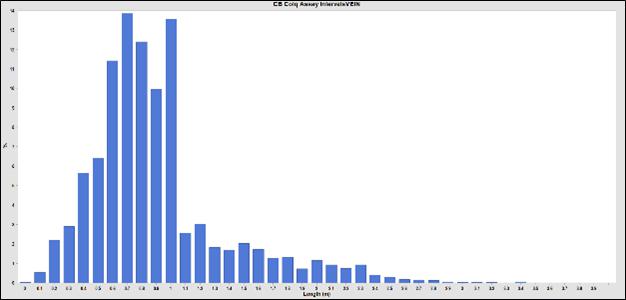
| SANTACRUZ SILVER MINING LTD. | CABALLO BLANCO TECHNICAL REPORT | PAGE 14-11 |
| |
|
Figure 14-7: Assay Interval Lengths for Reserva
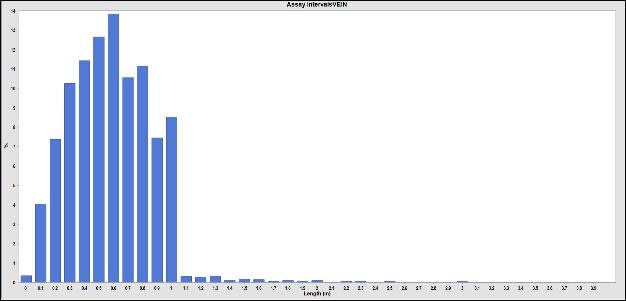
Figure 14-8: Assay Interval Lengths for Tres Amigos
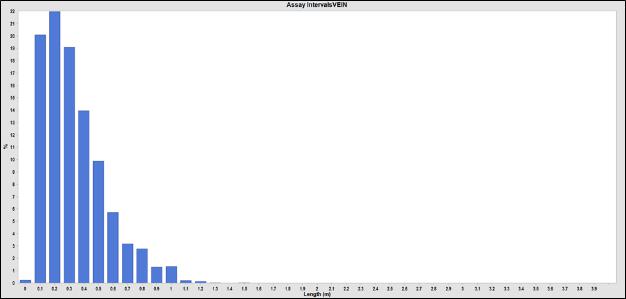
| SANTACRUZ SILVER MINING LTD. | CABALLO BLANCO TECHNICAL REPORT | PAGE 14-12 |
| |
|
A significant concern related to having very small sample widths is the potential for bias due to selectively sampled or high grading. Figure 14-9 through Figure 14-11 shows the distribution of silver values compared with sample lengths where there are a large number of high grades that coincide with small intervals. Compositing to larger intervals will understandably smooth out or dilute the effect of these high grades, it is also clear that an outlier strategy that reduces the extreme effects is also warranted even though variabilities remain low.
Figure 14-9: Assay Interval Lengths vs Silver Grades for Colquechaquita
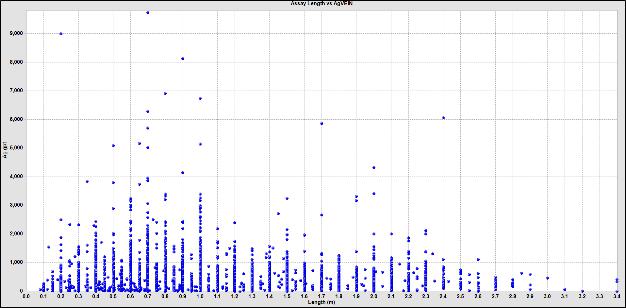
| SANTACRUZ SILVER MINING LTD. | CABALLO BLANCO TECHNICAL REPORT | PAGE 14-13 |
| |
|
Figure 14-10: Assay Interval Lengths vs Silver Grades for Reserva
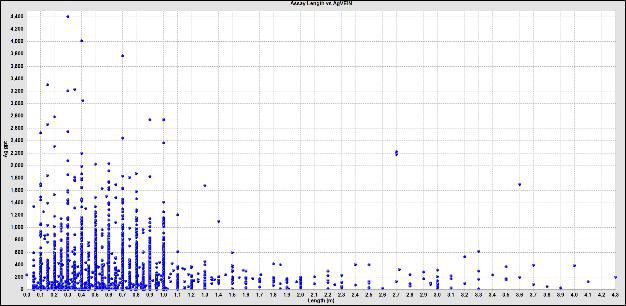
Figure 14-11: Assay Interval Lengths vs Silver Grades for Tres Amigos
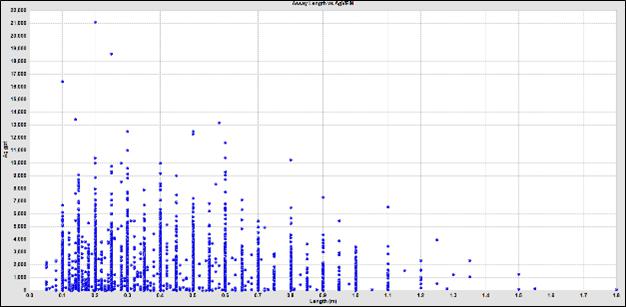
| SANTACRUZ SILVER MINING LTD. | CABALLO BLANCO TECHNICAL REPORT | PAGE 14-14 |
| |
|
| 14.4 | Composites |
It was determined that a maximum of 1.0 m composite length offered the best balance between supplying common support for samples and minimizing the smoothing of the grades with ~80% of the samples within the mineralized zones being <1 m in length. The 1.0 m sample length also was consistent with the distribution of sample lengths within the mineralized domains as shown in the histogram of assay lengths.
Table 14-11 through Table 14-13 shows the basic statistics for the zinc, lead and silver composite grades within the mineralized vein domains by deposit. It should be noted that although 1.0 m is the maximum composite length, all residual composites were retained to represent a composite. Note that the composite data was not declustered however analysis shows that there are small variations in the mean grades between native and declustered composites. Due to the high degree of reliance on underground sample data for the estimation process, consideration should always include review of declustering to ensure appropriate data support.
All deposits and veins have relatively high mean zinc grades ranging from 10.8% to 27.3% and all have low CV’s or variability around approximately 0.6. It is important to note that Tres Amigos zinc grades are ~25% higher than Reserva and Colquechaquita which is significant insofar as is has reduced widths so the higher grades allow for higher dilution.
Table 14-11: Zn Composite Statistics for the Caballo Blanco by Deposit and Vein
| Mine | Vein# | # | Length (m) | Min | Max | Mean | 1st Q | Median | 3rd Q | SD | Var | CV |
| Reserva | 1000 | 12,928 | 11,348.9 | 0 | 50.76 | 14.69 | 7.23 | 13.72 | 20.74 | 9.23 | 85.23 | 0.6 |
| 1001 | 1,540 | 964.4 | 0.046 | 51.57 | 10.82 | 4.88 | 9.00 | 15.86 | 7.95 | 63.13 | 0.7 | |
| 1002 | 1,598 | 923.6 | 0.01 | 47.35 | 15.06 | 8.73 | 14.62 | 20.64 | 8.45 | 71.37 | 0.6 | |
| Total | 16,066 | 13,236.8 | 0 | 51.57 | 14.43 | 7.10 | 13.45 | 20.35 | 9.15 | 83.69 | 0.6 | |
| Colquechaquita | 1010 | 8,100 | 7,084.9 | 0 | 52.58 | 17.22 | 9.76 | 15.68 | 23.03 | 9.87 | 97.49 | 0.6 |
| 1011 | 5,454 | 5,013.5 | 0 | 36.14 | 7.57 | 3.25 | 6.53 | 10.54 | 5.73 | 32.82 | 0.8 | |
| 1012 | 578 | 431.9 | 0 | 40.33 | 12.04 | 6.38 | 10.09 | 16.26 | 7.76 | 60.19 | 0.6 | |
| Total | 14,132 | 12,530.2 | 0 | 52.58 | 13.18 | 5.80 | 11.05 | 18.43 | 9.60 | 92.21 | 0.7 | |
| Tres Amigos | 1020 | 2,314 | 1,028.4 | 0.03 | 64.33 | 12.13 | 6.88 | 11.50 | 16.50 | 7.55 | 57.05 | 0.6 |
| 1021 | 3,318 | 1,411.4 | 0.03 | 52.13 | 27.31 | 18.54 | 28.45 | 36.69 | 11.71 | 137.12 | 0.4 | |
| 1022 | 3,222 | 1,332.0 | 0.09 | 58.19 | 18.40 | 10.33 | 17.51 | 25.23 | 10.51 | 110.42 | 0.6 | |
| 1023 | 2,814 | 755.9 | 0.03 | 52.16 | 17.23 | 9.36 | 16.45 | 24.12 | 10.08 | 101.58 | 0.6 | |
| 1024 | 1,872 | 866.1 | 0.03 | 47.85 | 11.78 | 5.38 | 10.73 | 16.53 | 7.82 | 61.14 | 0.7 | |
| 1025 | 662 | 216.7 | 0.2 | 40.45 | 11.33 | 7.01 | 10.03 | 15.30 | 6.85 | 46.94 | 0.6 | |
| 1026 | 910 | 298.7 | 0.2 | 48.20 | 15.31 | 7.62 | 13.60 | 21.33 | 9.87 | 97.45 | 0.6 | |
| 1029 | 202 | 71.8 | 0.03 | 36.03 | 10.65 | 5.50 | 10.13 | 15.16 | 7.24 | 52.39 | 0.7 | |
| 1032 | 234 | 71.8 | 0.51 | 44.44 | 15.54 | 8.74 | 14.16 | 22.06 | 7.91 | 62.54 | 0.5 | |
| Total | 15,548 | 6,052.8 | 0.03 | 64.33 | 17.79 | 8.99 | 15.81 | 25.32 | 11.38 | 129.55 | 0.6 |
Lead grades at Reserva are 50% lower than Colquechaquita and variability, although not meaningfully high, is elevated as shown by the CV being 1.6. For all veins, lead grades range from 1.94% to 10.8% however, as with the zinc, Tres Amigos has significantly higher grades (100% of Colquchequita) which allows for higher levels of dilution.
Table 14-12: Pb Composite Statistics for the Caballo Blanco by Deposit and Vein
| Mine | Vein# | # | Length (m) | Min | Max | Mean | 1st Q | Median | 3rd Q | SD | Var | CV |
| Reserva | 1000 | 12,928 | 11,348.9 | 0 | 45.12 | 1.94 | 0.31 | 0.91 | 2.30 | 3.28 | 10.76 | 1.7 |
| 1001 | 1,540 | 964.4 | 0.018 | 33.32 | 2.23 | 0.33 | 1.00 | 2.78 | 3.30 | 10.91 | 1.5 | |
| 1002 | 1,598 | 923.6 | 0.001 | 23.19 | 2.29 | 0.62 | 1.33 | 2.90 | 2.71 | 7.35 | 1.2 | |
| Total | 16,066 | 13,236.8 | 0 | 45.12 | 1.99 | 0.32 | 0.94 | 2.37 | 3.25 | 10.55 | 1.6 | |
| Colquechaquita | 1010 | 8,100 | 7,084.9 | 0 | 48.29 | 3.14 | 1.00 | 1.95 | 3.83 | 3.66 | 13.41 | 1.2 |
| 1011 | 5,454 | 5,013.5 | 0 | 51.87 | 4.59 | 1.27 | 2.99 | 6.40 | 4.86 | 23.61 | 1.1 | |
| 1012 | 578 | 431.9 | 0 | 47.61 | 5.83 | 1.92 | 3.85 | 7.85 | 5.81 | 33.79 | 1.0 | |
| Total | 14,132 | 12,530.2 | 0 | 51.87 | 3.81 | 1.09 | 2.30 | 4.80 | 4.34 | 18.83 | 1.1 | |
| Tres Amigos | 1020 | 2,314 | 1,028.4 | 7E-04 | 62.32 | 10.12 | 2.75 | 6.34 | 14.08 | 10.45 | 109.17 | 1.0 |
| 1021 | 3,318 | 1,411.4 | 0.001 | 52.58 | 5.87 | 1.41 | 3.04 | 7.74 | 7.20 | 51.84 | 1.2 | |
| 1022 | 3,222 | 1,332.0 | 0.04 | 66.49 | 10.41 | 2.25 | 6.07 | 16.05 | 10.94 | 119.64 | 1.1 | |
| 1023 | 2,814 | 755.9 | 0.001 | 65.10 | 10.81 | 1.39 | 5.03 | 15.88 | 12.76 | 162.94 | 1.2 | |
| 1024 | 1,872 | 866.1 | 0.001 | 29.40 | 4.12 | 1.19 | 2.58 | 4.99 | 4.44 | 19.74 | 1.1 | |
| 1025 | 662 | 216.7 | 0 | 51.92 | 6.26 | 2.35 | 4.07 | 7.06 | 7.35 | 54.02 | 1.2 | |
| 1026 | 910 | 298.7 | 0.04 | 44.53 | 4.58 | 0.98 | 2.36 | 5.65 | 6.13 | 37.52 | 1.3 | |
| 1029 | 202 | 71.8 | 0.001 | 43.21 | 4.89 | 1.36 | 2.24 | 5.53 | 6.68 | 44.63 | 1.4 | |
| 1032 | 234 | 71.8 | 0.27 | 31.84 | 5.54 | 1.28 | 2.76 | 5.47 | 7.22 | 52.08 | 1.3 | |
| Total | 15,548 | 6,052.8 | 0 | 66.49 | 7.89 | 1.58 | 3.99 | 10.52 | 9.60 | 92.16 | 1.2 |
| SANTACRUZ SILVER MINING LTD. | CABALLO BLANCO TECHNICAL REPORT | PAGE 14-15 |
| |
|
Mean silver grades for all veins range from 157 to 1,846 g/t however there are extreme values greater than 8,000 to a maximum of 21,114 g/t which are predominantly within Tres Amigos. As with the lead grades the mean silver grades at Reserva are approximately 50% of those at Colquechaquita. An average CV of approximately 1.2 is relatively low for such a high-grade deposit however, it remains prudent to develop an outlier strategy that mitigates the risk of these extreme grades having an outsized influence on the resource estimation.
Table 14-13: Ag Composite Statistics for the Caballo Blanco by Deposit and Vein
| Mine | Vein# | # | Length (m) | Min | Max | Mean | 1st Q | Median | 3rd Q | SD | Var | CV |
| Reserva | 1000 | 12,928 | 11,348.9 | 0 | 3304 | 157 | 50 | 99 | 187 | 202 | 40856 | 1.3 |
| 1001 | 1,540 | 964.4 | 2 | 1813 | 165 | 38 | 100 | 218 | 202 | 40808 | 1.2 | |
| 1002 | 1,598 | 923.6 | 1 | 2529 | 143 | 52 | 94 | 171 | 158 | 24890 | 1.1 | |
| Total | 16,066 | 13,236.8 | 0 | 3304 | 157 | 49 | 99 | 188 | 199 | 39756 | 1.3 | |
| Colquechaquita | 1010 | 8,100 | 7,084.9 | 0 | 8116 | 343 | 89 | 170 | 387 | 503 | 252702 | 1.5 |
| 1011 | 5,454 | 5,013.5 | 0 | 6054 | 391 | 134 | 290 | 540 | 428 | 182779 | 1.1 | |
| 1012 | 578 | 431.9 | 0 | 3400 | 394 | 159 | 280 | 470 | 416 | 172925 | 1.1 | |
| Total | 14,132 | 12,530.2 | 0 | 8116 | 364 | 103 | 213 | 458 | 472 | 222548 | 1.3 | |
| Tres Amigos | 1020 | 2,314 | 1,028.4 | 0 | 9590 | 924 | 212 | 574 | 1241 | 1082 | 1170821 | 1.2 |
| 1021 | 3,318 | 1,411.4 | 1 | 21114 | 1138 | 369 | 785 | 1554 | 1164 | 1355947 | 1.0 | |
| 1022 | 3,222 | 1,332.0 | 1.61 | 18584 | 1846 | 561 | 1318 | 2474 | 1862 | 3466638 | 1.0 | |
| 1023 | 2,814 | 755.9 | 1 | 8713 | 1159 | 228 | 728 | 1704 | 1230 | 1513653 | 1.1 | |
| 1024 | 1,872 | 866.1 | 1 | 10399 | 457 | 134 | 295 | 598 | 521 | 271804 | 1.1 | |
| 1025 | 662 | 216.7 | 7 | 4484 | 593 | 254 | 461 | 729 | 538 | 289077 | 0.9 | |
| 1026 | 910 | 298.7 | 7 | 6698 | 604 | 158 | 338 | 730 | 839 | 703627 | 1.4 | |
| 1029 | 202 | 71.8 | 1 | 2327 | 392 | 113 | 251 | 530 | 420 | 176227 | 1.1 | |
| 1032 | 234 | 71.8 | 15 | 3766 | 531 | 166 | 317 | 622 | 589 | 347303 | 1.1 | |
| Total | 15,548 | 6,052.8 | 0 | 21114 | 1101 | 253 | 636 | 1462 | 1333 | 1775830 | 1.2 |
| SANTACRUZ SILVER MINING LTD. | CABALLO BLANCO TECHNICAL REPORT | PAGE 14-16 |
| |
|
In summary, all three deposits have fairly consistent high zinc grades. The lead and silver grades for Colquechaquita are high being elevated by about 100% of the grades at Reserva. However, the lead and silver grades are two to three times those at Colquechaquita. The high and extreme grades, particularly for Tres Amigos, are important when considering the relatively narrow vein widths.
The box plots for the zinc composites shown in Figure 14-12 through Figure 14-14 illustrate that each of the individual vein domains have differing statistical characteristics and grade distributions. These illustrate that there is not a case combine any or all of the vein domains for estimation and as such, they are treated independently utilizing hard boundaries.
Figure 14-12: Box Plot of Zn Composites for the Caballo Blanco Deposit - Reserva
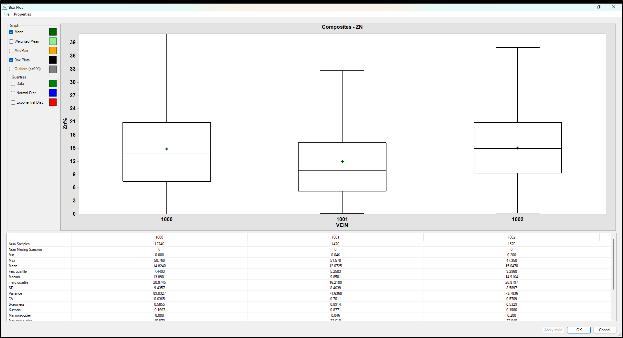
| SANTACRUZ SILVER MINING LTD. | CABALLO BLANCO TECHNICAL REPORT | PAGE 14-17 |
| |
|
Figure 14-13: Box Plot of Zn Composites for the Caballo Blanco Deposit - Colquechaquita
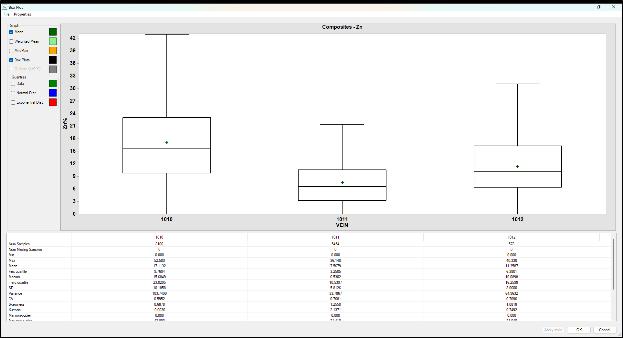
Figure 14-14: Box Plot of Zn Composites for the Caballo Blanco Deposit – Tres Amigos
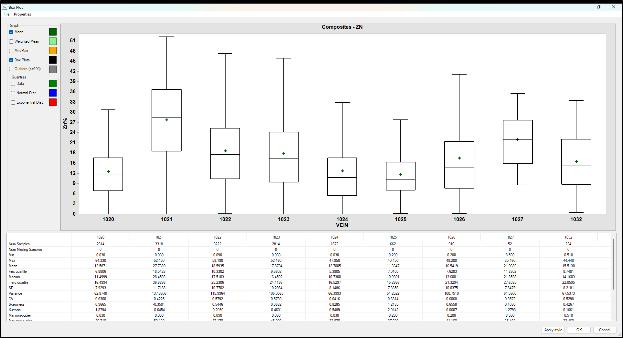
| SANTACRUZ SILVER MINING LTD. | CABALLO BLANCO TECHNICAL REPORT | PAGE 14-18 |
| |
|
The box plots for the lead and silver composites shown in Figure 14-15 through Figure 14-17 for lead and Figure 14-18 through Figure 14-20 for silver, illustrate that each of the individual vein domains have differing statistical characteristics and grade distributions. At Reserva, there is a case for combining the veins or employing soft boundaries as the veins show very similar characteristics. The same may be considered for the Colquechaquita veins however Tres Amigos shows that the various veins are quite dis-similar. It was decided to continue to employ hard boundaries to mitigate the potential of spreading high-grades across fault boundaries.
Figure 14-15: Box Plot of Pb Composites for the Caballo Blanco Deposit - Reserva
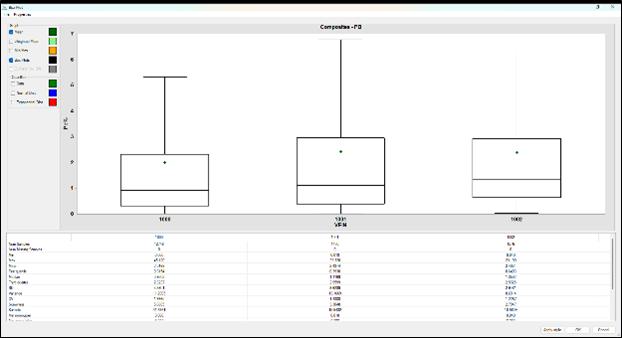
| SANTACRUZ SILVER MINING LTD. | CABALLO BLANCO TECHNICAL REPORT | PAGE 14-19 |
| |
|
Figure 14-16: Box Plot of Pb Composites for the Caballo Blanco Deposit - Colquechaquita
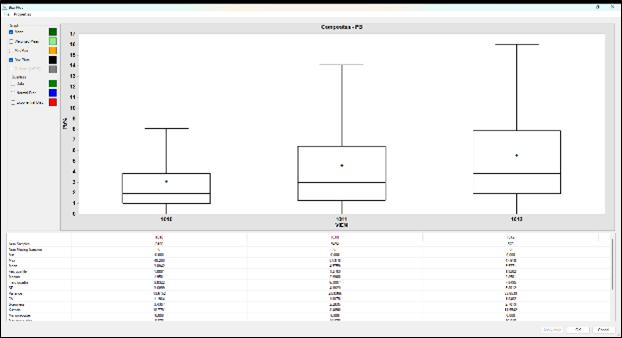
Figure 14-17: Box Plot of Pb Composites for the Caballo Blanco Deposit – Tres Amigos
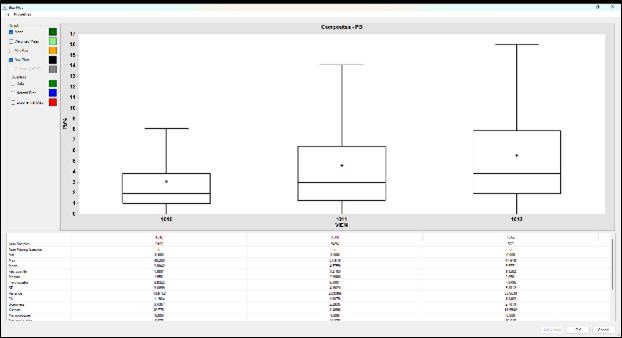
| SANTACRUZ SILVER MINING LTD. | CABALLO BLANCO TECHNICAL REPORT | PAGE 14-20 |
| |
|
Figure 14-18: Box Plot of Ag Composites for the Caballo Blanco Deposit - Reserva
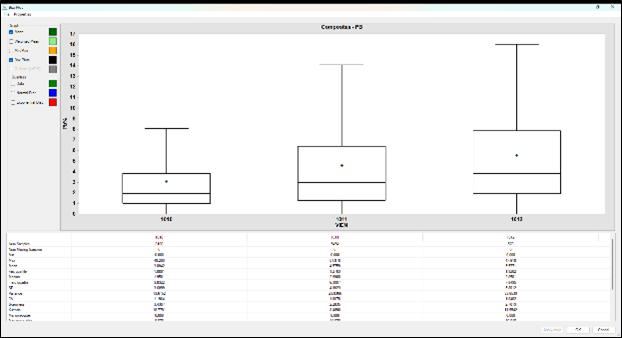
Figure 14-19: Box Plot of Ag Composites for the Caballo Blanco Deposit - Colquechaquita
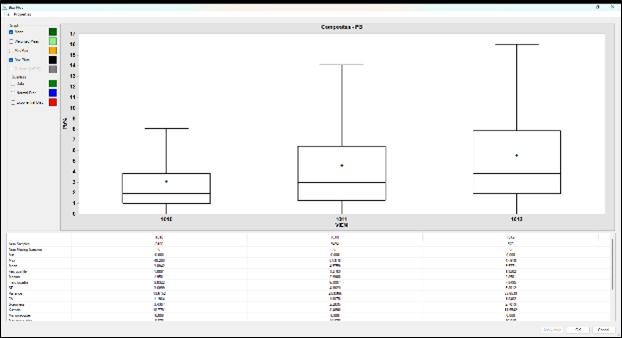
| SANTACRUZ SILVER MINING LTD. | CABALLO BLANCO TECHNICAL REPORT | PAGE 14-21 |
| |
|
Figure 14-20: Box Plot of Zn Composites for the Caballo Blanco Deposit – Tres Amigos
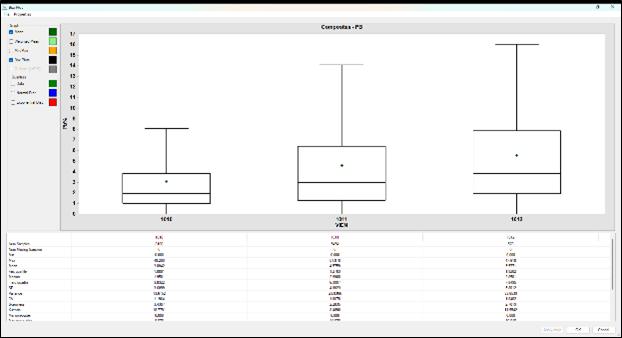
| 14.5 | Evaluation of Outlier Assay Values |
An evaluation of the probability plots suggests that there may be outlier assay values that could result in an overestimation of resources as previously discussed. Although it is believed that this risk is relatively low due to the very low variability as shown by consistently reduced CV’s, it was considered prudent to cut the zinc, lead and silver composites to varying thresholds for each mineralized vein to reduce the effects of high-grade outliers. This may be mitigated or resolved by 1) compositing and 2) cutting or grade limiting.
An evaluation of the probability plots suggests that there may be outlier values or populations that could result in an overestimation or smearing of grade. Probability plots for Colquechaquita, Reserva and Tres Amigos for the zinc, lead and silver demonstrate “breaks” or shift at the >99-percentile that indicate an outlier population. Therefore, for composites above those “breaks” or thresholds, the composites are limited or capped.
Table 14-14 lists the cut thresholds applied to the composite data for each individual vein at each deposit for zinc, lead and silver, respectively.
| SANTACRUZ SILVER MINING LTD. | CABALLO BLANCO TECHNICAL REPORT | PAGE 14-22 |
| |
|
Table 14-14: Outlier Cutting Analysis for the Caballo Blanco Deposit
| Vein Code | Vein Name | Zn | Pb | Ag |
| Reserva Mine | ||||
| 1000 | Rosario | 45 | 11 | 721 |
| 1001 | Wendy | 38.6 | 12 | 631 |
| 1002 | Wendy Techo | 44 | 11 | 715 |
| Colquechaquita Mine | ||||
| 1010 | Viviana | 48.2 | 15 | 1380 |
| 1011 | Karina | 27.2 | 21 | 1634 |
| 1012 | Camila | 20 | 17 | 1600 |
| Tres Amigos Mine | ||||
| 1020 | Catalina | 32 | 32 | 3411 |
| 1021 | Ramo | 42.1 | 33 | 3739 |
| 1022 | Daniela | 40.3 | 32 | 4403 |
| 1023 | Milagros | 22 | 19 | 1890 |
| 1024 | Central | 35.5 | 18 | 2330 |
| 1025 | Central Este | 33.3 | 25 | 2450 |
| 1026 | Ramo Central II | 40.4 | 21 | 1750 |
| 1028 | Ramo Central Este | 30.5 | 25 | 1400 |
| 1032 | Tatiana | 33.3 | 24.5 | 2450 |
The outlier analysis for zinc as shown in Table 14-15 illustrates the effect of each process from assay data, composites and cut composites along with the reduction in average grade and corresponding CV. Throughout, the results show a modest reduction of metal as illustrated by the reductions of the mean grades from assay versus cut composites as shown as red bold. In addition, variability is modestly to significantly reduced as illustrated by the reduction in the CV’s.
| SANTACRUZ SILVER MINING LTD. | CABALLO BLANCO TECHNICAL REPORT | PAGE 14-23 |
| |
|
Table 14-15: Outlier Cutting Analysis for Zinc
| Mine | Vein # | Assays | Comp | Cut Grades | Comps Vs Cut | Assays vs Cut | ||||||||||
| Max | Mean | CV | Max | Mean | CV | Max | Mean | CV | Max | Mean | CV | Max | Mean | CV | ||
| Reserva | 1000 | 54.00 | 14.72 | 0.8 | 50.76 | 14.69 | 0.6 | 45 | 14.69 | 0.6 | -11% | 0% | 0% | -17% | 0% | -17% |
| 1001 | 51.57 | 11.03 | 0.8 | 51.57 | 10.82 | 0.7 | 38.6 | 10.80 | 0.7 | -25% | 0% | -1% | -25% | -2% | -6% | |
| 1002 | 47.35 | 15.38 | 0.7 | 47.35 | 15.06 | 0.6 | 44 | 15.05 | 0.6 | -7% | 0% | 0% | -7% | -2% | -21% | |
| Total | 54.00 | 14.50 | 0.8 | 51.57 | 14.43 | 0.6 | 45 | 14.43 | 0.6 | -13% | 0% | 0% | -17% | -1% | -16% | |
| Colquechaquita | 1010 | 52.58 | 17.23 | 0.6 | 52.58 | 17.22 | 0.6 | 48.2 | 17.22 | 0.6 | -8% | 0% | 0% | -8% | 0% | -6% |
| 1011 | 38.28 | 7.58 | 0.8 | 36.14 | 7.57 | 0.8 | 27.2 | 7.54 | 0.7 | -25% | 0% | -2% | -29% | 0% | -4% | |
| 1012 | 40.33 | 11.94 | 0.6 | 40.33 | 12.04 | 0.6 | 20 | 11.04 | 0.5 | -50% | -8% | -18% | -50% | -8% | -17% | |
| Total | 52.58 | 13.26 | 0.8 | 52.58 | 13.18 | 0.7 | 48.2 | 13.14 | 0.7 | -8% | 0% | 0% | -8% | -1% | -4% | |
| Tres Amigos | 1020 | 64.33 | 12.56 | 0.7 | 64.33 | 12.13 | 0.6 | 32 | 12.06 | 0.6 | -50% | -1% | -3% | -50% | -4% | -9% |
| 1021 | 52.13 | 27.69 | 0.4 | 52.13 | 27.31 | 0.4 | 42.1 | 27.01 | 0.4 | -19% | -1% | -3% | -19% | -2% | -7% | |
| 1022 | 58.19 | 19.03 | 0.6 | 58.19 | 18.40 | 0.6 | 40.3 | 18.27 | 0.6 | -31% | -1% | -2% | -31% | -4% | 0% | |
| 1023 | 52.16 | 17.85 | 0.6 | 52.16 | 17.23 | 0.6 | 22 | 14.94 | 0.5 | -58% | -13% | -21% | -58% | -16% | -19% | |
| 1024 | 47.85 | 11.92 | 0.7 | 47.85 | 11.78 | 0.7 | 35.5 | 11.74 | 0.7 | -26% | 0% | -1% | -26% | -1% | -6% | |
| 1025 | 38.32 | 11.56 | 0.6 | 40.45 | 11.33 | 0.6 | 33.3 | 11.27 | 0.6 | -18% | 0% | -2% | -13% | -2% | 2% | |
| 1026 | 48.20 | 16.52 | 0.6 | 48.20 | 15.31 | 0.6 | 40.4 | 15.23 | 0.6 | -16% | -1% | -2% | -16% | -8% | -1% | |
| 1032 | 44.44 | 15.58 | 0.5 | 44.44 | 15.54 | 0.5 | 33.3 | 15.48 | 0.5 | -25% | 0% | -2% | -25% | -1% | -4% | |
| Total | 64.33 | 18.19 | 0.6 | 64.33 | 17.79 | 0.6 | 42.1 | 17.38 | 0.6 | -35% | -2% | -3% | -35% | -4% | -3% | |
The outlier analysis for lead as shown in Table 14-16 show a marked reduction of metal from assay versus cut composites as shown as red bold. In addition, variability is significantly reduced as illustrated by the reduction in the CV’s.
| SANTACRUZ SILVER MINING LTD. | CABALLO BLANCO TECHNICAL REPORT | PAGE 14-24 |
| |
|
Table 14-16: Outlier Cutting Analysis for Lead
| Mine | Vein # | Assays | Comp | Cut Grades | Comps vs Cut | Assays vs Cut | ||||||||||
| Max | Mean | CV | Max | Mean | CV | Max | Mean | CV | Max | Mean | CV | Max | Mean | CV | ||
| Reserva | 1000 | 48.95 | 1.95 | 1.9 | 45.12 | 1.94 | 1.7 | 11 | 1.80 | 1.3 | -76% | -8% | -24% | -78% | -8% | -33% |
| 1001 | 33.32 | 2.25 | 1.6 | 33.32 | 2.23 | 1.5 | 12 | 2.12 | 1.3 | -64% | -5% | -12% | -64% | -6% | -16% | |
| 1002 | 35.12 | 2.34 | 1.4 | 23.19 | 2.29 | 1.2 | 11 | 2.23 | 1.1 | -53% | -3% | -9% | -69% | -5% | -21% | |
| Total | 48.95 | 1.99 | 1.8 | 45.12 | 1.99 | 1.6 | 12 | 1.85 | 1.3 | -73% | -7% | -22% | -75% | -7% | -31% | |
| Colquechaquita | 1010 | 71.91 | 3.13 | 1.3 | 48.29 | 3.14 | 1.2 | 15 | 3.04 | 1.0 | -69% | -3% | -11% | -79% | -3% | -18% |
| 1011 | 51.87 | 4.52 | 1.1 | 51.87 | 4.59 | 1.1 | 21 | 4.51 | 1.0 | -60% | -2% | -6% | -60% | 0% | -9% | |
| 1012 | 47.61 | 6.08 | 1.0 | 47.61 | 5.83 | 1.0 | 17 | 5.46 | 0.8 | -64% | -6% | -17% | -64% | -10% | -17% | |
| Total | 71.91 | 3.79 | 1.2 | 51.87 | 3.81 | 1.1 | 21 | 3.71 | 1.0 | -60% | -3% | -8% | -71% | -2% | -13% | |
| Tres Amigos | 1020 | 62.32 | 10.27 | 1.1 | 62.32 | 10.12 | 1.0 | 32 | 9.64 | 0.9 | -49% | -5% | -9% | -49% | -6% | -14% |
| 1021 | 49.15 | 5.77 | 1.3 | 52.58 | 5.87 | 1.2 | 33 | 5.79 | 1.2 | -37% | -1% | -4% | -33% | 0% | -7% | |
| 1022 | 66.49 | 10.53 | 1.1 | 66.49 | 10.41 | 1.1 | 32 | 9.92 | 1.0 | -52% | -5% | -9% | -52% | -6% | -9% | |
| 1023 | 65.10 | 11.29 | 1.2 | 65.10 | 10.81 | 1.2 | 19 | 8.08 | 0.9 | -71% | -25% | -24% | -71% | -28% | -22% | |
| 1024 | 41.62 | 4.17 | 1.2 | 29.40 | 4.12 | 1.1 | 18 | 4.04 | 1.0 | -39% | -2% | -5% | -57% | -3% | -13% | |
| 1025 | 51.92 | 6.47 | 1.1 | 51.92 | 6.26 | 1.2 | 25 | 5.90 | 1.0 | -52% | -6% | -16% | -52% | -9% | -14% | |
| 1026 | 46.23 | 4.13 | 1.4 | 44.53 | 4.58 | 1.3 | 21 | 4.35 | 1.2 | -53% | -5% | -12% | -55% | 5% | -15% | |
| 1032 | 31.84 | 5.56 | 1.3 | 31.84 | 5.54 | 1.3 | 24.5 | 5.32 | 1.2 | -23% | -4% | -6% | -23% | -4% | -6% | |
| Total | 66.49 | 8.02 | 1.2 | 66.49 | 7.89 | 1.2 | 33 | 7.33 | 1.1 | -50% | -7% | -11% | -50% | -9% | -13% | |
The outlier analysis for silver as shown in Table 14-17 also show a marked reduction of metal and variability from assay versus cut composites as shown as red bold.
| SANTACRUZ SILVER MINING LTD. | CABALLO BLANCO TECHNICAL REPORT | PAGE 14-25 |
| |
|
Table 14-17: Outlier Cutting Analysis for Silver
| Mine | Vein # | Assays | Comp | Cut Grades | Comps vs Cut | Assays vs Cut | ||||||||||
| Max | Mean | CV | Max | Mean | CV | Max | Mean | CV | Max | Mean | CV | Max | Mean | CV | ||
| Reserva | 1000 | 4404 | 157 | 1.5 | 3304 | 157 | 1.3 | 721 | 148 | 1.0 | -78% | -6% | -21% | -84% | -6% | -31% |
| 1001 | 1813 | 168 | 1.3 | 1813 | 165 | 1.2 | 631 | 155 | 1.0 | -65% | -6% | -17% | -65% | -8% | -19% | |
| 1002 | 2787 | 146 | 1.2 | 2529 | 143 | 1.1 | 715 | 140 | 1.0 | -72% | -2% | -11% | -74% | -4% | -21% | |
| Total | 4404 | 157 | 1.5 | 3304 | 157 | 1.3 | 721 | 148 | 1.0 | -78% | -5% | -20% | -84% | -6% | -30% | |
| Colquechaquita | 1010 | 9735 | 342 | 1.6 | 8116 | 343 | 1.5 | 1380 | 311 | 1.1 | -83% | -9% | -25% | -86% | -9% | -31% |
| 1011 | 6054 | 387 | 1.1 | 6054 | 391 | 1.1 | 1634 | 377 | 0.9 | -73% | -4% | -21% | -73% | -2% | -23% | |
| 1012 | 3400 | 423 | 1.0 | 3400 | 394 | 1.1 | 1600 | 376 | 0.8 | -53% | -5% | -21% | -53% | -11% | -15% | |
| Total | 9735 | 362 | 1.4 | 8116 | 364 | 1.3 | 1634 | 340 | 1.0 | -80% | -7% | -24% | -83% | -6% | -28% | |
| Tres Amigos | 1020 | 9590 | 966 | 1.2 | 9590 | 924 | 1.2 | 3411 | 878 | 1.0 | -64% | -5% | -12% | -64% | -9% | -16% |
| 1021 | 21114 | 1134 | 1.1 | 21114 | 1138 | 1.0 | 3439 | 1073 | 0.8 | -84% | -6% | -18% | -84% | -5% | -22% | |
| 1022 | 18584 | 1918 | 1.0 | 18584 | 1846 | 1.0 | 4403 | 1669 | 0.8 | -76% | -10% | -21% | -76% | -13% | -21% | |
| 1023 | 8713 | 1202 | 1.0 | 8713 | 1159 | 1.1 | 1890 | 894 | 0.8 | -78% | -23% | -26% | -78% | -26% | -24% | |
| 1024 | 10399 | 459 | 1.2 | 10399 | 457 | 1.1 | 2330 | 449 | 1.0 | -78% | -2% | -11% | -78% | -2% | -18% | |
| 1025 | 4484 | 612 | 0.9 | 4484 | 593 | 0.9 | 2450 | 581 | 0.8 | -45% | -2% | -9% | -45% | -5% | -6% | |
| 1026 | 6698 | 645 | 1.4 | 6698 | 604 | 1.4 | 1,750 | 513 | 1.0 | -74% | -15% | -30% | -74% | -21% | -31% | |
| 1032 | 3766 | 533 | 1.1 | 3766 | 531 | 1.1 | 2,450 | 513 | 1.0 | -35% | -3% | -11% | -35% | -4% | -11% | |
| Total | 21114 | 1128 | 1.2 | 21114 | 1101 | 1.2 | 4,403 | 1007 | 1.0 | -79% | -9% | -18% | -79% | -11% | -19% | |
| SANTACRUZ SILVER MINING LTD. | CABALLO BLANCO TECHNICAL REPORT | PAGE 14-26 |
| |
|
| 14.6 | Specific Gravity Estimation |
Bulk densities were based on a total of 1,032 individual measurements taken by Company field personnel throughout the Caballo Blanco deposit. These density values ranged om 1.07 t/m3 to 8.68 t/m3 and average to 3.28 t/m3. However, based on the metal content as for two samples with densities of 1.07 t/m3 and 1.77 t/m3, it appears that these may be outliers or more likely errors.
A multiple-element linear regression formula was used to determine the density, which includes weighted factors for the zinc, lead and iron. Figure 14-21 through Figure 14-23 shows the scatterplots which illustrates comparable relationships for density versus zinc, lead and iron, respectively. It is important to note that silver has not been considered due to the low correlatability with density as shown in Figure 14-24.
Figure 14-21: Scatterplot of Zinc vs Density
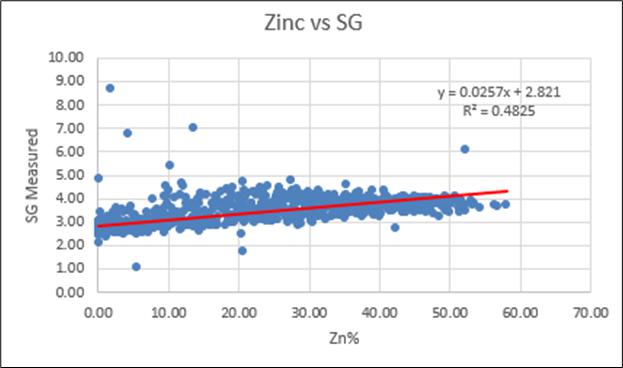
| SANTACRUZ SILVER MINING LTD. | CABALLO BLANCO TECHNICAL REPORT | PAGE 14-27 |
| |
|
Figure 14-22: Scatterplot of Lead vs Density
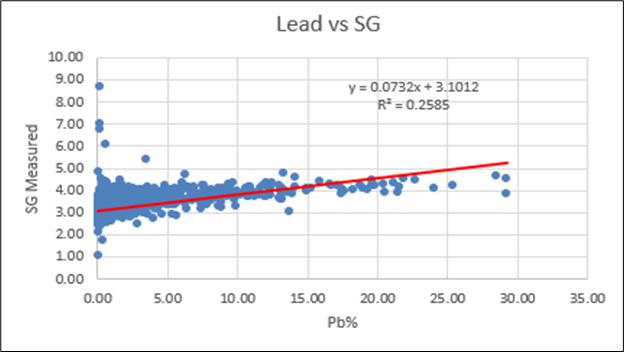
Figure 14-23: Scatterplot of Iron vs Density
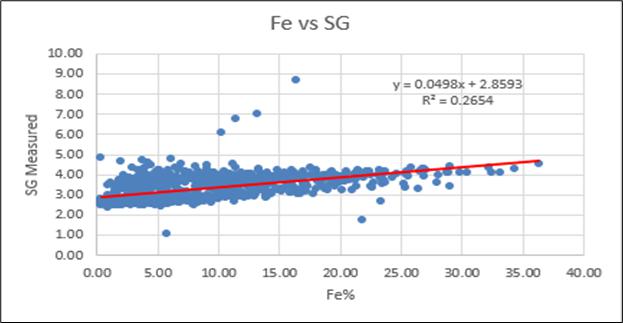
| SANTACRUZ SILVER MINING LTD. | CABALLO BLANCO TECHNICAL REPORT | PAGE 14-28 |
| |
|
Figure 14-24: Scatterplot of Silver vs Density
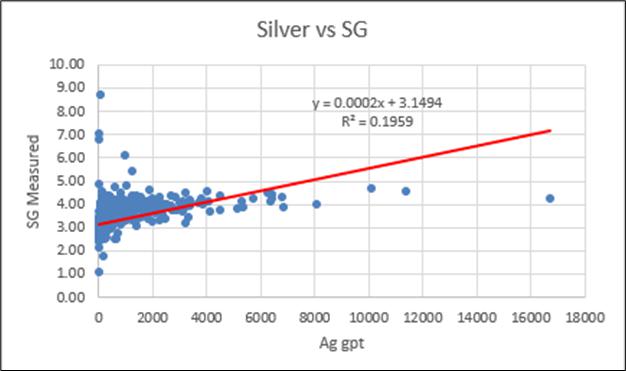
The multiple-element linear regression formula was calculated with the use of a Python script based on the 1,032 density samples analyzed locally which has been consistent 2021. No new samples were added to the database however it recommended that going forward additional samples be collected and measured to re-test the regression formula.
Due to the fact that not all of the dataset has Fe analysis, two formulas have been established for the calculation of density, the first utilizing Zn, Pb and Fe whilst the second considers only Zn and Pb. There the Multiple Linear Regression Formula is in the form of SGcalculated = Intersection + Coefficient * Assay Value as follows:
| ● | If the Fe analysis is available: |
Density =2.53757+0.0176*Zn+0.05611*Pb+0.04176*Fe
| ● | If the Fe analysis is not available: |
Density = 2.83179+0.02252*Zn+0.04516*Pb
Figure 14-25 and Figure 14-26 shows the scatterplot of measured versus calculated density for each case, with and without iron. Th correlation for the formula with iron is good (R2=0.72) however a handful of outliers are causing a less than ideal result however upon removal of the four outliers the correlation is excellent (R2=0.88). Therefore, going forward is recommended to continue to gather density data in addition to ensuring that iron is included in the analysis.
| SANTACRUZ SILVER MINING LTD. | CABALLO BLANCO TECHNICAL REPORT | PAGE 14-29 |
| |
|
Specific gravities assigned on a block-by-block basis using the calculated values. A default density of 3.1 t/m3 was assigned to any blocks that were not assigned a calculated value.
Figure 14-25: Scatterplot of Measured Density vs Calculated Density with Iron
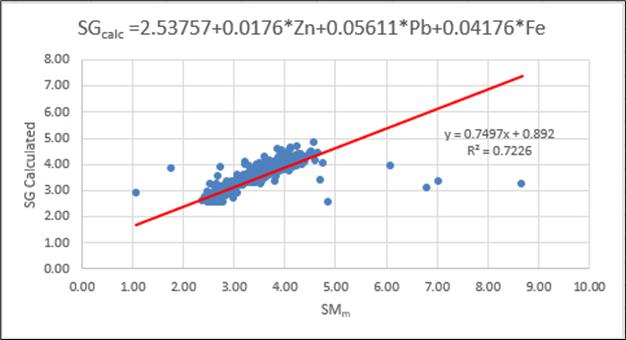
| SANTACRUZ SILVER MINING LTD. | CABALLO BLANCO TECHNICAL REPORT | PAGE 14-30 |
| |
|
Figure 14-26: Scatterplot of Measured Density vs Calculated Density without Iron
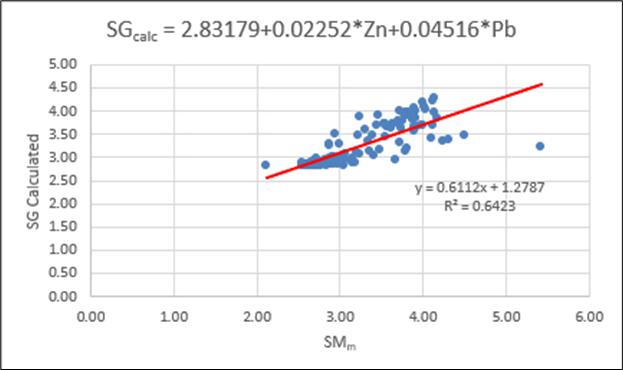
| 14.7 | Block Model Definition |
The block model used to estimate the resources was defined according to the limits specified in Figure 14-27 through Figure 14-29 for Colquechaquita, Reserva and Tres Amigos, respectively. The block model is orthogonal and non-rotated, reflecting the orientation of the deposit and approximate selective mining unit. The chosen block size was 5 m x 5 m x 5 m and subsequently sub-blocked to 1 m x 0.1 m x 1 m to facilitate underground mine planning and scheduling. Note that MineSightTM uses the centroid of the blocks as the origin.
| SANTACRUZ SILVER MINING LTD. | CABALLO BLANCO TECHNICAL REPORT | PAGE 14-31 |
| |
|
Figure 14-27: Dimensions, Origin and Orientation for Colquechaquita
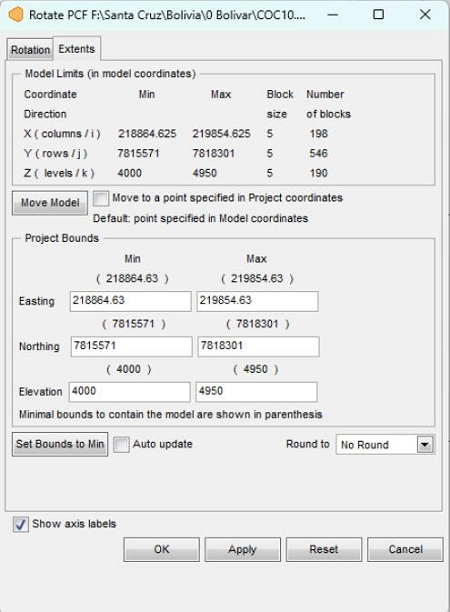 |  |
| SANTACRUZ SILVER MINING LTD. | CABALLO BLANCO TECHNICAL REPORT | PAGE 14-32 |
| |
|
Figure 14-28: Dimensions, Origin and Orientation for Reserva
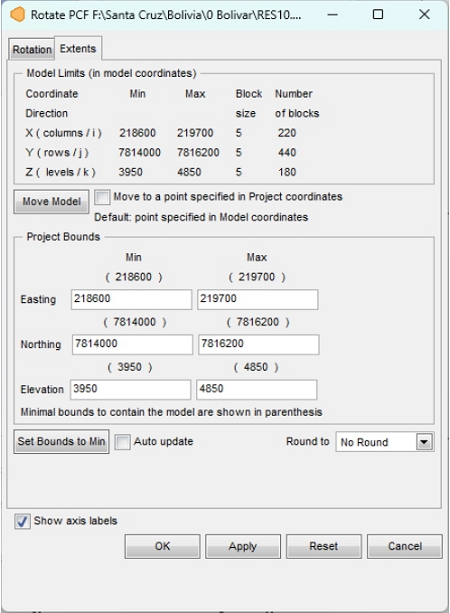 |
 |
| SANTACRUZ SILVER MINING LTD. | CABALLO BLANCO TECHNICAL REPORT | PAGE 14-33 |
| |
|
Figure 14-29: Dimensions, Origin and Orientation for Tres Amigos
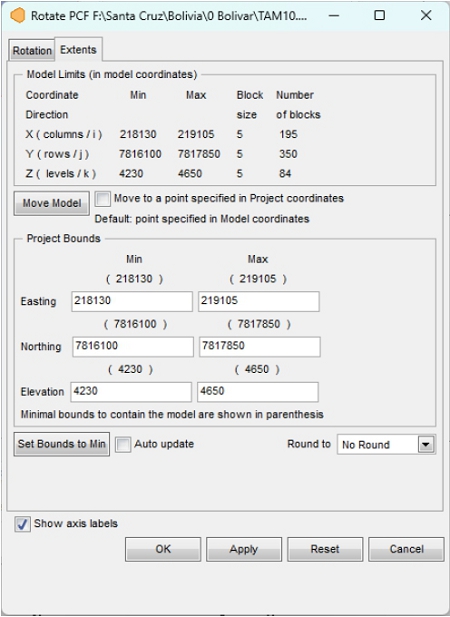 |  |
| 14.8 | Resource Estimation Methodology |
Experimental variograms and variogram models in the form of correlograms were generated for silver, lead and zinc grades which were utilized for the estimation via ordinary kriging. However, Wendy and Wendy Techo (1001 and 1002) at Reserva, Camila (1012) at Colquechaquita and Central Este, Ramo Central Este, Ramo Central Este and Tatiana (1025, 1026, 1028 and 1032) at Tres Amigos do not have sufficient data to generate meaningful variogram results. For this reason, it was decided at this time to use inverse distance to the second power for these veins as the interpolator.
The resource estimation plan includes the following items:
| ● | Mineralized zone code of modelled mineralization in each block; |
| ● | Estimated block silver, lead, and zinc grades by ordinary kriging with the exception of inverse distance to the second power being employed for Wendy and Wendy Techo (1001 and 1002) at Reserva, Camila (1012) at Colquechaquita and Central Este, Ramo Central Este, Ramo Central Este and Tatiana (1025, 1026, 1028 and 1032) at Tres Amigos; |
| SANTACRUZ SILVER MINING LTD. | CABALLO BLANCO TECHNICAL REPORT | PAGE 14-34 |
| |
|
| ● | Three-pass estimation strategy for each mineralized vein domain as detailed in Table 14-18. The three passes enable better estimation of local metal grades and infill of interpreted solids and to facilitate classification; and |
| ● | Assignment on pillars, sterilized and mined out areas coded into the block model for exclusion. |
Table 14-18 summarizes the search ellipse dimensions for the two estimation passes for each zone.
Table 14-18: Search Ellipse Parameters for the Caballo Blanco Deposit
| Mine | Vein | Pass | Range 1 (m) | Range 2 (m) | Range 3 (m) | Min # Composites | Max # Composites |
| Reserva | 1000 | 1 | 46 | 27 | 12 | 5 | 20 |
| 2 | 69 | 41 | 19 | 5 | 25 | ||
| 3 | 138 | 82 | 38 | 3 | 20 | ||
| 1001 | 1 | 29 | 39 | 13 | 5 | 20 | |
| 2 | 43 | 58 | 19 | 5 | 40 | ||
| 3 | 86 | 116 | 38 | 1 | 23 | ||
| 1002 | 1 | 30 | 18 | 13 | 5 | 20 | |
| 2 | 45 | 27 | 19 | 5 | 35 | ||
| 3 | 90 | 54 | 38 | 2 | 25 | ||
| Colquechaquita | 1010 | 1 | 46 | 34 | 17 | 4 | 20 |
| 2 | 69 | 51 | 25 | 4 | 22 | ||
| 3 | 138 | 102 | 50 | 2 | 15 | ||
| 1011 | 1 | 34 | 27 | 23 | 6 | 20 | |
| 2 | 51 | 41 | 35 | 5 | 23 | ||
| 3 | 102 | 82 | 70 | 3 | 15 | ||
| 1012 | 1 | 27 | 35 | 14 | 5 | 20 | |
| 2 | 41 | 52 | 21 | 4 | 26 | ||
| 3 | 82 | 104 | 42 | 2 | 20 | ||
| Tres Amigos | 1020 | 1 | 25 | 26 | 13 | 5 | 20 |
| 2 | 38 | 39 | 20 | 5 | 24 | ||
| 3 | 76 | 78 | 40 | 2 | 25 | ||
| 1021 | 1 | 28 | 30 | 14 | 3 | 20 | |
| 2 | 42 | 45 | 21 | 5 | 20 | ||
| 3 | 84 | 90 | 42 | 2 | 20 | ||
| 1022 | 1 | 39 | 26 | 15 | 4 | 20 | |
| 2 | 58 | 39 | 22 | 4 | 20 | ||
| 3 | 116 | 78 | 44 | 2 | 24 | ||
| 1023 | 1 | 21 | 19 | 13 | 5 | 20 | |
| 2 | 31 | 29 | 20 | 4 | 35 | ||
| 3 | 62 | 58 | 40 | 2 | 23 | ||
| 1024 | 1 | 23 | 24 | 13 | 5 | 20 | |
| 2 | 34 | 36 | 20 | 4 | 20 | ||
| 3 | 68 | 72 | 40 | 2 | 20 | ||
| 1025 | 1 | 22 | 20 | 17 | 6 | 20 | |
| 2 | 33 | 30 | 26 | 5 | 20 | ||
| 3 | 66 | 60 | 52 | 3 | 23 | ||
| 1026 | 1 | 21 | 21 | 13 | 5 | 20 | |
| 2 | 32 | 31 | 20 | 4 | 20 | ||
| 3 | 64 | 62 | 40 | 2 | 21 | ||
| 1028 | 1 | 23 | 22 | 13 | 5 | 20 | |
| 2 | 35 | 33 | 20 | 4 | 20 | ||
| 3 | 70 | 66 | 40 | 3 | 20 | ||
| 1032 | 1 | 22 | 20 | 17 | 5 | 20 | |
| 1 | 33 | 30 | 26 | 5 | 20 | ||
| 1 | 66 | 60 | 52 | 3 | 20 |
| SANTACRUZ SILVER MINING LTD. | CABALLO BLANCO TECHNICAL REPORT | PAGE 14-35 |
| |
|
| 14.9 | Mineral Resource Classification |
Mineral resources were estimated in conformity with generally accepted CIM Estimation of Mineral Resources and Mineral Reserves Best Practice Guidelines (2019). Mineral resources are not mineral reserves and do not have demonstrated economic viability.
The mineral resources may be impacted by further infill and exploration drilling that may result in an increase or decrease in future resource evaluations. The mineral resources may also be affected by subsequent assessment of mining, environmental, processing, permitting, taxation, socio-economic and other factors. There is insufficient information in this early stage of study to assess the extent to which the mineral resources will be affected by factors such as these that are more suitably assessed in a scoping or conceptual study.
Mineral resources for the Caballo Blanco deposit were classified according to the CIM Definition Standards for Mineral Resources and Mineral Reserves (2014) as approved by Garth Kirkham, P.Geo., an “independent qualified person” as defined by National Instrument 43-101.
Drillhole spacing in the Caballo Blanco deposit is sufficient for preliminary geostatistical analysis and evaluating spatial grade variability. Kirkham Geosystems is, therefore, of the opinion that the amount of sample data is adequate to demonstrate very good confidence in the grade estimates for the deposit.
The estimated blocks were classified according to the following:
| ● | Confidence in interpretation of the mineralized zones; |
| ● | Number of data used to estimate a block; |
| ● | Number of composites allowed per drillhole; and |
| ● | Distance to nearest composite used to estimate a block. |
The classification of resources was based primarily on distance to the nearest composite; however, all the quantitative measures, as listed here, were inspected and taken into consideration. In addition, the classification of resources for each zone was considered individually by virtue of their relative depth from surface and the ability to derive meaningful geostatistical results.
The estimation plan entailed a multiple pass strategy where each pass utilized increasingly restrictive search distances and parameters. Each individual vein employs differing search distances and parameters as listed in Table 14-18. Therefore, blocks that are estimated within the first pass are assigned as measured, those estimated within the second pass are assigned indicated and those estimated in the third pass are assigned as inferred.
Furthermore, an interpreted boundary was created for the indicated and inferred threshold in order to exclude orphans and reduce “spotted dog” effect. The remaining blocks may be unclassified and may be considered as geologic potential for further exploration.
Furthermore, in consideration for the requirement for resources to possess a “reasonable prospect of eventual economic extraction” (RP3E), underground mineable shapes were created that displayed continuity based on cut-off grades and classification. Additionally, these RP3E shapes also took into account must-take material that may fall below cut-off grade but will be extracted by mining in the event that adjacent economic material is extracted making below cut-off material by virtue of the mining costs being paid for.
| SANTACRUZ SILVER MINING LTD. | CABALLO BLANCO TECHNICAL REPORT | PAGE 14-36 |
| |
|
Figure 14-30: Long Section View of the Reserva Deposit Showing Resource Block by Classification
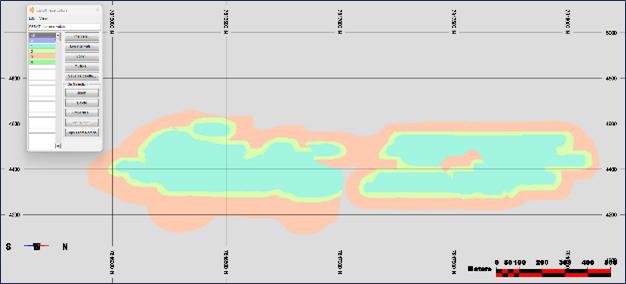
Figure 14-31: Long Section View of the Colquechequita Deposit Showing Resource Block by Classification
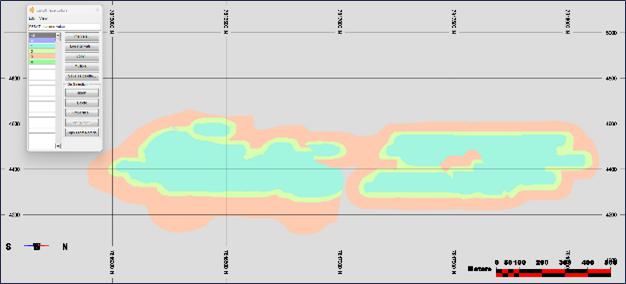
| SANTACRUZ SILVER MINING LTD. | CABALLO BLANCO TECHNICAL REPORT | PAGE 14-37 |
| |
|
Figure 14-32: Long Section View of the Tres Amigos Deposit Showing Resource Block by Classification
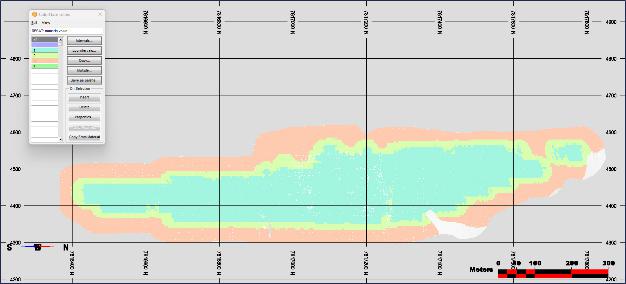
| 14.10 | ZnEq and NSR Calculation |
The mineral resources reported herein are reporting based on zinc equivalent or ZnEq. The formula that was considered for the ZnEq calculation is as follows:
ZnEq = Zn% + 1.22 x Pb% + 0.051 x Ag (g/t)
| 14.11 | Mined Out and Sterilized Areas |
Due to the fact that the Colquechaquita, Reserva and Tres Amigos mines have been in continuous production for a significant number of years and are actively producing operations, it is extremely important to identify and exclude areas that are no longer available for future mining. This includes areas that have development and ramping, areas that have been mined out, areas that have been sterilized by mining operations or other reasons and pillars that have been left behind but not accessible. Figure 14-33 through Figure 14-35 shows a plan view of the existing underground development, pillars, mined out areas along with areas sterilized be mining or geotechnical hazards.
| SANTACRUZ SILVER MINING LTD. | CABALLO BLANCO TECHNICAL REPORT | PAGE 14-38 |
| |
|
Figure 14-33: Plan View of Development, Pillars, Mined Out and Sterilized Areas for the Reserva Mine
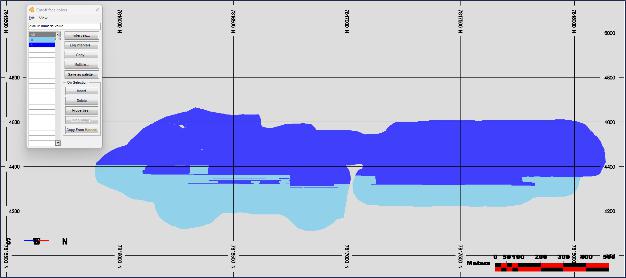
Figure 14-34: Plan View of Development, Pillars, Mined Out and Sterilized Areas for the Colquechaquita Mine
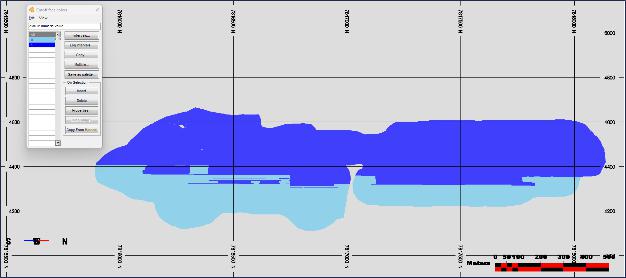
| SANTACRUZ SILVER MINING LTD. | CABALLO BLANCO TECHNICAL REPORT | PAGE 14-39 |
| |
|
Figure 14-35: Plan View of Development, Pillars, Mined Out and Sterilized Areas for the Tres Amigos Mine
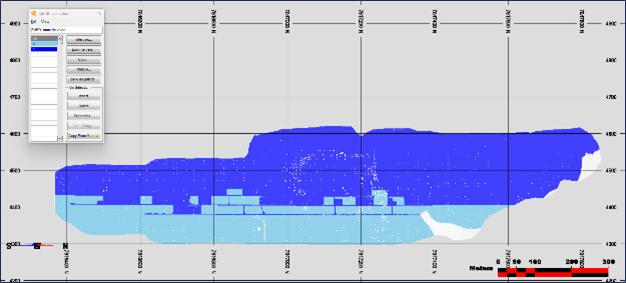
| 14.12 | Resource Validation |
A graphical validation was completed on the block model. This type of validation serves the following purposes:
| ● | Checks the reasonableness of the estimated grades based on the estimation plan and the nearby composites; |
| ● | Checks that the general drift and the local grade trends compare to the drift and local grade trends of the composites; |
| ● | Ensures that all blocks in the core of the deposit have been estimated; |
| ● | Checks that topography has been properly accounted for; |
| ● | Checks against manual approximate estimates of tonnages to determine reasonableness; and |
| ● | Inspects for and explains potentially high-grade block estimates in the neighborhood of the extremely high assays. |
A full set of cross sections, long sections and plans were used to digitally check the block model; these showed the block grades and composites. There was no indication that a block was wrongly estimated, and it appears that every block grade could be explained as a function of the surrounding composites and the applied estimation plan.
| SANTACRUZ SILVER MINING LTD. | CABALLO BLANCO TECHNICAL REPORT | PAGE 14-40 |
| |
|
The validation techniques included the following:
| ● | Visual inspections on a section-by-section and plan-by-plan basis; |
| ● | Use of grade-tonnage curves; |
| ● | Swath plots comparing kriged estimated block grades with inverse distance and nearest neighbor estimates; and |
| ● | Inspection of histograms showing distance from first composite to nearest block, and average distance to blocks for all composites which gives a quantitative measure of confidence that blocks are adequately informed in addition to assisting in the classification of resources. |
Figure 14-36: Long Section View of Reserva Deposit Block Model with ZnEq Cut-off Grades
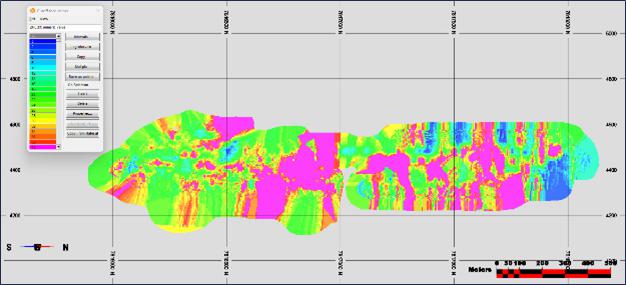
| SANTACRUZ SILVER MINING LTD. | CABALLO BLANCO TECHNICAL REPORT | PAGE 14-41 |
| |
|
Figure 14-37: Long Section View of Reserva Deposit Block Model with ZnEq Cut-off Grades with Mined Out and Sterilized Areas (blue)
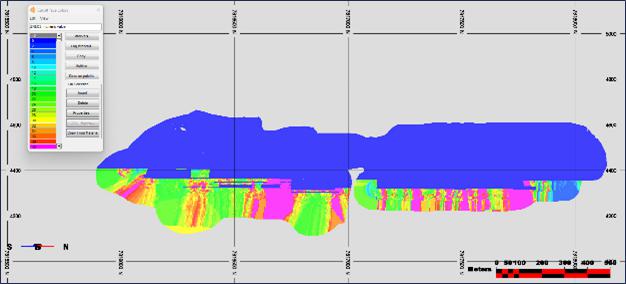
Figure 14-38: Long Section View of Colquechaquita Deposit Block Model with ZnEq Cut-off Grades
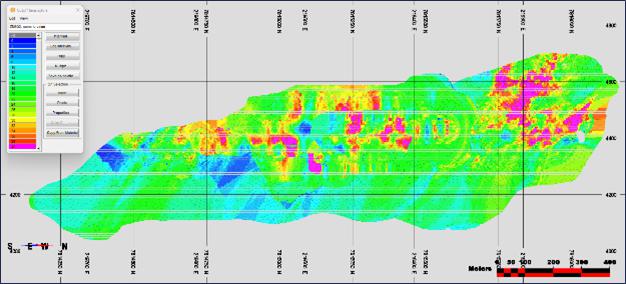
| SANTACRUZ SILVER MINING LTD. | CABALLO BLANCO TECHNICAL REPORT | PAGE 14-42 |
| |
|
Figure 14-39: Long Section View of Colquechaquita Deposit Block Model with ZnEq Cut-off Grades with Mined Out and Sterilized Areas (blue)
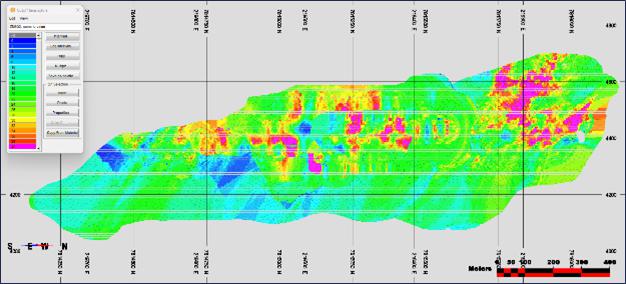
Figure 14-40: Long Section View of Tres Amigos Deposit (Catalina Veins) Block Model with ZnEq Cut-off Grades
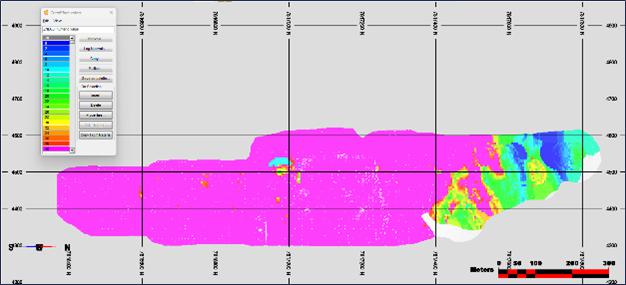
Figure 14-41: Long Section View of Tres Amigos Deposit (Catalina Veins) Block Model with ZnEq Cut-off Grades with Mined Out and Sterilized Areas (blue)
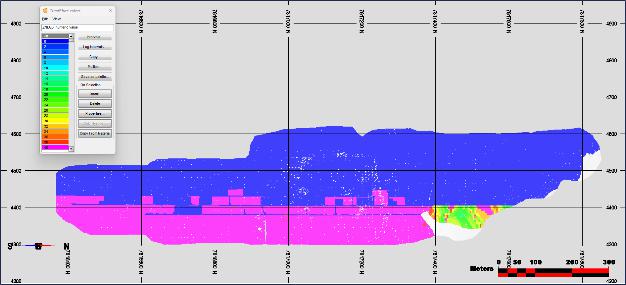
| SANTACRUZ SILVER MINING LTD. | CABALLO BLANCO TECHNICAL REPORT | PAGE 14-43 |
| |
|
| 14.13 | Sensitivity of the Block Model to Selection Cut-off Grade |
The mineral resources are not particularly sensitive to the selection of cut-off grade. Table 14-19 shows the total resources for all metals at varying ZnEq cut-off grades. The reader is cautioned that these values should not be misconstrued as a mineral reserve. The reported quantities and grades are only presented as a sensitivity of the resource model to the selection of cut-off grades.
Note that the base case cut-off grades presented in Table 14-19 are based on potentially underground, mineable resources at the base case of 10.0% zinc equivalent.
Table 14-19: Sensitivity Analyses at Various ZnEq Cut-off Grades for Measured, Indicated and Inferred Resources
| Classification | Cut-off | Tonnes | ZnEq | Sg | Thickness | Zn | Ag | Pb |
| Measured | >=14 | 669,034 | 38.04 | 3.29 | 1.01 | 16.66 | 342.29 | 3.22 |
| >=12 | 697,086 | 37.03 | 3.28 | 1.01 | 16.32 | 331.36 | 3.13 | |
| >=10 | 725,530 | 36.01 | 3.27 | 1.02 | 15.96 | 320.70 | 3.03 | |
| >=8 | 746,621 | 35.25 | 3.26 | 1.03 | 15.67 | 313.01 | 2.97 | |
| >=6 | 758,546 | 34.81 | 3.26 | 1.04 | 15.49 | 308.77 | 2.93 | |
| >=4 | 766,031 | 34.52 | 3.25 | 1.04 | 15.36 | 306.10 | 2.91 | |
| >=2 | 768,003 | 34.44 | 3.25 | 1.04 | 15.32 | 305.37 | 2.90 | |
| Indicated | >=14 | 457,870 | 33.41 | 3.25 | 1.17 | 14.95 | 288.89 | 3.06 |
| >=12 | 480,024 | 32.47 | 3.24 | 1.17 | 14.64 | 278.94 | 2.96 | |
| >=10 | 501,558 | 31.55 | 3.23 | 1.17 | 14.32 | 269.31 | 2.86 | |
| >=8 | 518,499 | 30.81 | 3.22 | 1.17 | 14.04 | 262.21 | 2.79 | |
| >=6 | 532,371 | 30.19 | 3.21 | 1.17 | 13.78 | 256.41 | 2.73 | |
| >=4 | 543,690 | 29.67 | 3.20 | 1.17 | 13.54 | 251.84 | 2.69 | |
| >=2 | 546,882 | 29.52 | 3.20 | 1.17 | 13.48 | 250.50 | 2.68 | |
| Inferred | >=14 | 1,773,439 | 29.36 | 3.21 | 1.10 | 14.46 | 232.78 | 2.48 |
| >=12 | 2,088,441 | 26.94 | 3.21 | 1.04 | 13.78 | 205.34 | 2.21 | |
| >=10 | 2,216,948 | 26.02 | 3.19 | 1.06 | 13.28 | 198.99 | 2.12 | |
| >=8 | 2,285,187 | 25.51 | 3.18 | 1.07 | 13.02 | 195.34 | 2.08 | |
| >=6 | 2,314,702 | 25.28 | 3.17 | 1.07 | 12.90 | 193.53 | 2.05 | |
| >=4 | 2,350,067 | 24.98 | 3.17 | 1.07 | 12.75 | 191.26 | 2.03 | |
| >=2 | 2,354,062 | 24.94 | 3.17 | 1.07 | 12.73 | 190.97 | 2.03 |
Notes:
| 1) | The current Resource Estimate was prepared by Garth Kirkham, P.Geo., of Kirkham Geosystems Ltd. |
| 2) | All mineral resources have been estimated in accordance with CIM definitions, as required under NI43-101. |
| 3) | The Mineral Resource Estimate was prepared using a 10.0% zinc equivalent cut-off grade. Cut-off grades were derived from $25.20/oz silver, $1.38/lb zinc and $1.20/lb lead, and process recoveries of 92.1% for zinc, 77.2% for lead, and 90.8% for silver. This cut-off grade was based on current smelter agreements and total OPEX costs of $106.94/t based on 2022 actual costs plus capital costs of $42.33/t. All prices are stated in $USD. |
| 4) | An Inferred Mineral Resource has a lower level of confidence than that applying to an Indicated Mineral Resource and must not be converted to a Mineral Reserve. It is reasonably expected that the majority of Inferred Mineral Resources could be upgraded to Indicated Mineral Resources with continued exploration. |
| 5) | Mineral resources are not mineral reserves until they have demonstrated economic viability. Mineral resource estimates do not account for a resource’s mineability, selectivity, mining loss, or dilution. All figures are rounded to reflect the relative accuracy of the estimate and therefore numbers may not appear to add precisely. |
| SANTACRUZ SILVER MINING LTD. | CABALLO BLANCO TECHNICAL REPORT | PAGE 14-44 |
| |
|
| 14.14 | Mineral Resource Statement |
Table 14-20 shows the Mineral Resource Statement for the Caballo Blanco deposit.
The Qualified Person evaluated the resource in order to ensure that it meets the condition of “reasonable prospects of eventual economic extraction” as suggested under NI 43-101. The criteria considered were confidence, continuity and economic cut-off. The resource listed below is considered to have “reasonable prospects of eventual economic extraction”.
Table 14-20: Base-Case Total Mineral Resources at 10.0% ZnEq Cut-off
| Total Caballo Blanco 2023 Mineral Resources | |||||
| Mine | Category | Tonnes (‘000) | Zn (%) | Pb (%) | Ag (g/t) |
| Caballo Blanco | Measured | 726 | 15.96 | 3.03 | 321 |
| Indicated | 502 | 14.32 | 2.86 | 269 | |
| Total M+I | 1,227 | 15.29 | 2.96 | 300 | |
| Inferred | 2,217 | 13.28 | 2.12 | 199 | |
Notes:
| 1) | The current Resource Estimate was prepared by Garth Kirkham, P.Geo., of Kirkham Geosystems Ltd. |
| 2) | All mineral resources have been estimated in accordance CIM definitions, as required under NI43-101. |
| 3) | The Mineral Resource Estimate was prepared using a 10.0% zinc equivalent cut-off grade. Cut-off grades were derived from $25.20/oz silver, $1.38/lb zinc and $1.20/lb lead, and process recoveries of 92.1% for zinc, 77.2% for lead, and 90.8% for silver. This cut-off grade was based on current smelter agreements and total OPEX costs of $106.94/t based on 2022 actual costs plus capital costs of $42.33/t. All prices are stated in $USD. |
| 4) | An Inferred Mineral Resource has a lower level of confidence than that applying to an Indicated Mineral Resource and must not be converted to a Mineral Reserve. It is reasonably expected that the majority of Inferred Mineral Resources could be upgraded to Indicated Mineral Resources with continued exploration. |
| 5) | Mineral resources are not mineral reserves until they have demonstrated economic viability. Mineral resource estimates do not account for a resource’s mineability, selectivity, mining loss, or dilution. All figures are rounded to reflect the relative accuracy of the estimate and therefore numbers may not appear to add precisely. |
Table 14-21: Base-Case Total Mineral Resources at 10.0% ZnEq Cut-off Split by Area
| Caballo Blanco Mineral Resources (Jan 1, 2023) | |||||
| Mine | Category | Tonnes (‘000) | Zn (%) | Pb (%) | Ag (g/t) |
| Colquechauita | Measured | 252 | 15.04 | 3.54 | 259 |
| Indicated | 185 | 13.71 | 3.99 | 284 | |
| Total M+I | 437 | 14.48 | 3.73 | 270 | |
| Inferred | 632 | 15.13 | 3.37 | 258 | |
| Reserva | Measured | 342 | 13.68 | 1.84 | 152 |
| Indicated | 248 | 12.84 | 1.50 | 127 | |
| Total M+I | 590 | 13.33 | 1.69 | 142 | |
| Inferred | 1,329 | 11.41 | 1.04 | 83 | |
| Tres Amigos | Measured | 132 | 23.59 | 5.18 | 874 |
| Indicated | 68 | 21.38 | 4.75 | 747 | |
| Total M+I | 200 | 22.84 | 5.03 | 831 | |
| Inferred | 255 | 18.45 | 4.66 | 656 | |
| Total Caballo Blanco | Measured | 726 | 15.96 | 3.03 | 321 |
| Indicated | 502 | 14.32 | 2.86 | 269 | |
| Total M+I | 1,227 | 15.29 | 2.96 | 300 | |
| Inferred | 2,217 | 13.28 | 2.12 | 199 | |
Notes:
| 1) | The current Resource Estimate was prepared by Garth Kirkham, P.Geo., of Kirkham Geosystems Ltd. |
| 2) | All mineral resources have been estimated in accordance with CIM definitions, as required under NI43-101. |
| 3) | The Mineral Resource Estimate was prepared using a 10.0% zinc equivalent cut-off grade. Cut-off grades were derived from $25.20/oz silver, $1.38/lb zinc and $1.20/lb lead, and process recoveries of 92.1% for zinc, 77.2% for lead, and 90.8% for silver. This cut-off grade was based on current smelter agreements and total OPEX costs of $106.94/t based on 2022 actual costs plus capital costs of $42.33/t. All prices are stated in $USD. |
| 4) | An Inferred Mineral Resource has a lower level of confidence than that applying to an Indicated Mineral Resource and must not be converted to a Mineral Reserve. It is reasonably expected that the majority of Inferred Mineral Resources could be upgraded to Indicated Mineral Resources with continued exploration. |
| 5) | Mineral resources are not mineral reserves until they have demonstrated economic viability. Mineral resource estimates do not account for a resource’s mineability, selectivity, mining loss, or dilution. All figures are rounded to reflect the relative accuracy of the estimate and therefore numbers may not appear to add precisely. |
| 14.15 | Discussion with Respect to Potential Material Risks to the Resources |
The current political and socio-economic climate in Bolivia poses risks and uncertainties that could delay or even stop development as reported within the Fraser Institute Annual Report 2022 where Bolivia ranks very low in many non-technical metrics. Bolivia has been ranked consistently low for the past five years and ranks in the lower quartile on all metrics that gauge risk and uncertainty. It is difficult to gauge or qualify the level or extents of the risks however, all companies working in Bolivia must continue to be aware of the potential risks and develop mitigation strategies. A significant risk related to the Santacruz Bolivian mineral assets and in particular the mineral resources and mineral reserves is the significant artisanal activity that continues to exist. This activity is not only a socio-economic risk but also affects access to resources and reserves along with potentially resulting in potential sterilization of mineral resources.
Apart from political and socio-economic risks there are no other known environmental, permitting, legal, taxation, title or other relevant factors that materially affect the resources apart from commodity price fluctuations particularly on the downside.
The Caballo Blanco Project consists of very many high-grade thin veins. These types of deposits are very sensitive to grade as the size and geometry must be economically viable as they must support selective mining methods and be able to withstand high levels of dilutive material.
| SANTACRUZ SILVER MINING LTD. | CABALLO BLANCO TECHNICAL REPORT | PAGE 14-45 |
| |
|
| 15 | Mineral Reserve Estimate |
| 15.1 | Summary |
The January 1, 2023 reserve estimate represents the validation of Santacruz’s internally-generated mineral reserve estimate by QP Goodwin. All work on the reserve by the Santacruz mine design team and the validation exercises were done in DeswikTM. The following process was used for this work:
| ● | An NSR calculation and cut-off grade (COG) was developed by the QP using data provided by Santacruz ; |
| ● | The reserve estimation methodology was reviewed, checked, and approved by the QP; |
| ● | Mine technical staff prepared a Life of Mine Plan (LOM) for the deposits using the NSR and COG provided by the QP. The LOM plan was prepared specifically for this reserve estimation, as the annual budget includes mining in inferred resources; and |
| ● | All LOM models were downloaded and reviewed by the QP for conformance to the methodology, proper application of the NSR COG, and correct application of agreed upon dilution and recovery factors. |
The QP is satisfied that this exercise resulted in a valid reserve determination.
| 15.2 | Definitions |
A Mineral Reserve is the economically mineable part of a Measured and/or Indicated Mineral Resource. It includes diluting materials and allowances for losses, which may occur when the material is mined or extracted and is defined by studies at Pre-Feasibility or Feasibility level as appropriate that include application of Modifying Factors. This Feasibility Study includes adequate information and considerations on mining, processing, metallurgical, infrastructure, economic, marketing, environmental and other relevant factors that demonstrate, at the time of reporting, that economic extraction could reasonably be justified.
Mineral Reserves are those parts of Mineral Resources which, after the application of all mining factors, result in an estimated tonnage, and grade which, in the opinion of the Qualified Person(s) making the estimates, is the basis of an economically viable project after taking account of all relevant Modifying Factors. Mineral Reserves are inclusive of diluting material that will be mined in conjunction with the Mineral Reserves and delivered to the treatment plant or equivalent facility. The term “Mineral Reserve” need not necessarily signify that extraction facilities are in place or operative or that all governmental approvals have been received. It does signify that there are reasonable expectations of such approvals.
Mineral Reserves are subdivided in order of increasing confidence into Probable Mineral Reserves and Proven Mineral Reserves. A Probable Mineral Reserve has a lower level of confidence than a Proven Mineral Reserve.
| SANTACRUZ SILVER MINING LTD. | CABALLO BLANCO TECHNICAL REPORT | PAGE 15-1 |
| |
|
The reserve classifications used in this report conform to the Canadian Institute of Mining, Metallurgy and Petroleum (CIM) classification of NI 43-101 resource and reserve definitions and Companion Policy 43-101CP. These are listed below.
A “Proven Mineral Reserve” is the economically mineable part of a Measured Mineral Resource. A Proven Mineral Reserve implies a high degree of confidence in the Modifying Factors.
Application of the Proven Mineral Reserve category implies that the Qualified Person has the highest degree of confidence in the estimate with the consequent expectation in the minds of the readers of the report. The term should be restricted to that part of the deposit where production planning is taking place and for which any variation in the estimate would not significantly affect potential economic viability of the deposit. Proven Mineral Reserve estimates must be demonstrated to be economic, at the time of reporting, by at least a Pre-Feasibility Study. Within the CIM Definition standards the term Proved Mineral Reserve is an equivalent term to a Proven Mineral Reserve.
A “Probable Mineral Reserve” is the economically mineable part of an Indicated Mineral Resource, and in some circumstances a Measured Mineral Resource. The confidence in the Modifying Factors applying to a Probable Mineral Reserve is lower than that applying to a Proven Mineral Reserve.
| 15.3 | NSR and COG Determinations |
| 15.3.1 | Operating Costs |
Operating costs for the reserve estimation were based on actual costs derived from 2022 operations, as summarized in Table 15-1.
Table 15-1: Actual Operating Costs for 2022 by Category
| Category | $/t |
| Mining | 75.66 |
| Processing | 17.10 |
| G&A | 14.17 |
| Total | 106.94 |
| SANTACRUZ SILVER MINING LTD. | CABALLO BLANCO TECHNICAL REPORT | PAGE 15-2 |
| |
|
| 15.3.2 | Metal Prices |
The metal prices used to determine the 2023 Mining Reserve are as follows:
| ● | Lead $1.00 /lb; |
| ● | Zinc $1.15 /lb; and |
| ● | Silver $21.00 /oz. |
The derivation and rationale for these price selections is discussed in discussed in Section 19.
| 15.3.3 | Metallurgical Recoveries |
The metallurgical recoveries of payable metals were based on 2022 mill operating performance as follows:
| Lead: | 77.2% to the lead concentrate |
| Zinc: | 92.1% to the zinc concentrate |
| Silver: | A total of 90.8% recovery; 71.8% to the lead concentrate and 19.0% to the zinc concentrate. |
| 15.3.4 | Smelter Terms |
There are two concentrates that are sent to Antofagasta in Chile for shipment overseas. Both concentrates are sold to Glencore. Smelter terms were based on actual invoicing. These include typical payment terms for all payable metals (Pb, Zn, Ag) and deductions for deleterious elements (Sb and Bi in the zinc concentrate and SiO2 in the lead concentrate. Off-site costs for freight, port fees, sampling, and silver refining are included in the analysis at the actual rates.
| 15.4 | Net Smelter Return and Cut-off Criteria |
The combination of all factors discussed in this section results in the following NSR formula for the 2023 Mining Reserve:
NSR = $9.01 x Zn% + 10.95 x Pb% + 0.46 x Ag (g/t)
Cut-off criteria was developed based on a ZnEq formula as follows:
ZnEq = Zn% + 1.22 x Pb% + 0.051 x Ag (g/t)
A cut-off grade of 11.9% ZnEq was applied to the reserve estimation based on this equation.
| 15.5 | Estimation Methodology |
The reserves were estimated in Deswik. The NSR formula and ZnEq were applied to the block model. Stope optimization was then performed to the resource to generate stope shapes for evaluation.
| SANTACRUZ SILVER MINING LTD. | CABALLO BLANCO TECHNICAL REPORT | PAGE 15-3 |
| |
|
Table 15-2 shows the stope optimization parameters that were used for the three mines of Cabello Blanco, segregated by mine and stoping method.
Table 15-2: Stope Optimization Parameters by Mine and Stoping Method
| Mine | Method | Vein | Min Stope Width (m) | Minimum
Stope dip |
Min. Waste Pillar Width (m) | Max.
Stope Width (m) |
Min. Stope Height (m) | Max Stope Height (m) |
| Reserva | SLOS | 1000 | 1.50 | 40 | 5 | 10 | 8 | 10 |
| Reserva | SLOS | 1000 | 2.30 | 40 | 5 | 10 | 8 | 10 |
| Reserva | Shrinkage | 1001 | 0.85 | 40 | 3 | 10 | 10 | 18 |
| Reserva | Shrinkage | 1002 | 0.80 | 40 | 3 | 10 | 10 | 18 |
| Tres Amigos | Shrinkage | All | 1.00 | 40 | 3 | 10 | 18 | 24 |
| Colquechaquita | SLOS | All | 1.50 | 30 | 5 | 10 | 10 | 15 |
| Colquechaquita | Shrinkage | All | 1.50 | 50 | 5 | 10 | 40 | 45 |
Dilution and recovery factors were varied by stoping method as follows:
| ● | Development: 95% recovery without dilution applied; |
| ● | Sublevel Open Stoping mining method: 85% recovery and 12.5% dilution; and |
| ● | Shrinkage Stoping: 80% recovery and 10% dilution. |
Once generated, solids below the COG of 11.9% ZnEq were then eliminated as well as any inferred resources.
A development layout was then prepared for each stope to determine access requirements. A development and production schedule were then prepared in Deswik.
| 15.6 | Mineral Reserve Estimate |
The Mineral Reserve Estimate for Caballo Blanco Mine is shown in Table 15-3.
Table 15-3: Mineral Reserve Estimate for Caballo Blanco (January 1, 2023)
| Mine | Category | Tonnes | Zn (%) | Pb (%) | Ag (g/t) |
| Colquechaquita | Proven | 207,000 | 10.49 | 2.16 | 174 |
| Probable | 212,000 | 8.68 | 2.77 | 187 | |
| Total | 420,000 | 9.57 | 2.47 | 181 | |
| Reserva | Proven | 168,000 | 9.21 | 1.34 | 110 |
| Probable | 177,000 | 8.74 | 1.08 | 93 | |
| Total | 345,000 | 8.97 | 1.21 | 101 | |
| Tres Amigos | Proven | 194,000 | 9.88 | 1.95 | 355 |
| Probable | 75,000 | 6.16 | 1.73 | 272 | |
| Total | 269,000 | 8.84 | 1.89 | 332 | |
| Total Caballo Blanco | Proven | 569,000 | 9.90 | 1.85 | 217 |
| Probable | 465,000 | 8.30 | 1.96 | 165 | |
| Total | 1,034,000 | 9.18 | 1.90 | 193 |
These reserves could be impacted by changes to mine operating costs, metallurgical recoveries, changes to permitting status, and the availability of tailings storage. No significant variations from current assumptions for these aspects are currently anticipated.
| SANTACRUZ SILVER MINING LTD. | CABALLO BLANCO TECHNICAL REPORT | PAGE 15-4 |
| |
|
| 16 | Mining Methods |
| 16.1 | Overview |
The Caballo Blanco Mine has been in operation for 20 years. Although the mine is managed as a single business, it is actually composed of three different mines on the same mineralized trend: Reserva, Tres Amigos and Colquechaquita.
Although development to connect the mines is in process, there still exists some autonomy in how each are operated. The application of mining methods has thus been an adaptation of mining equipment technologies, evaluation and monitoring tools to the specific mineralized zones. The last decade of operations under the guidance of Glencore, the mine has seen a move to more mechanized methods to improve safety performance and mine productivity.
Variation in the characteristics of each mineralized zone coupled with the historic infrastructure present to support their development and exploitation has resulted in different mining systems for each property. While steeply dipping and relatively wide mineralized zones were intuitively adaptable to mechanization, narrow high-grade veins are amenable to quite profitable conventional selective mining techniques. In addition to historical and empirical knowledge about the deposit, a systematic evaluation included such other deposit qualities to determine workable mining methods:
| ● | Safety aspects, Environmental risks, Social impacts; |
| ● | Shape, geometry, consistency, and volume; |
| ● | Both mineralization and wall rock quality (strength, Fracture characterizations, in-situ strength, regional stress); |
| ● | Stability, and Support requirements; |
| ● | Grades, NSR Value, potential extraction rate; |
| ● | Mechanization/automation, use of gravity, flexibility and adaptability; and |
| ● | Unit costs, time to production, dilution, development requirements. |
Based on continuously evaluated performance of the selected mining systems, improvements are always being considered based on the aforementioned criteria and economic performance.
As a unit, Caballo Blanco produces about 850 t/d of mineralized material. Approximately 60% of mine production is generated by conventional shrinkage and cut & fill methods. The remainder is produced by more modern trackless sublevel stoping. Run-of-mine mineralized material is hauled to the Don Diego Process plant in highway dump trucks.
Although each mine is currently an autonomous operation, all three mines are exploiting the same mineralized trend and there is no reason to believe that as mining continues additional opportunities to plan common development, infrastructure and other shared services will arise. One example would be current plans for a trackless connection between Tres Amigos and Colquechaquita which would increase haulage capacity at Colquechaquita and provide trackless access to additional mineralized zones.
Figure 16-1: Mine Locations on the Mineralized Trend
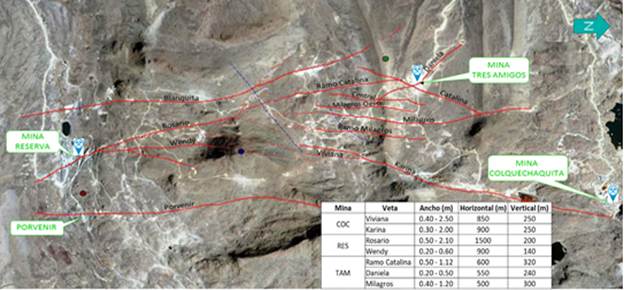
Source: Glencore (2021)
| SANTACRUZ SILVER MINING LTD. | CABALLO BLANCO TECHNICAL REPORT | PAGE 16-1 |
| |
|
Figure 16-2: Caballo Blanco Reserve and Mineable Targets
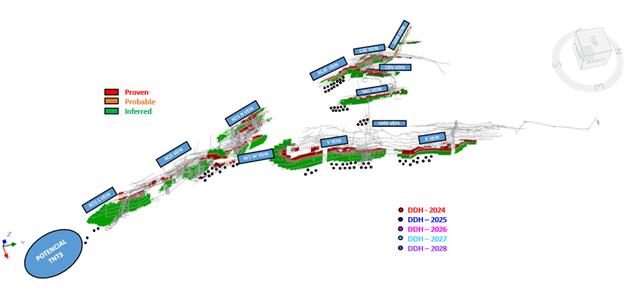
Source: Santacruz (2023)
The mine currently operates at a production rate of approximately 820 t/d with a current LOM of four years based on the current reserve.
| 16.2 | Geotech Considerations |
Rock mass ratings are an integral part of the evaluation process and play a large part in the selection of safe and productive mining systems.
| ● | Reserva mine has relatively weak wall rocks which preclude the use of selective methods that could put miners at risk of rock falls, so mechanized techniques are being used with particular attention being devoted to the potential dilution; |
| ● | Colquechaquita utilizes conventional and mechanized techniques partially on Geotechnical and geometrical characteristics. Narrow steeply dipping high grade areas with strong wall rocks are being mined conventionally, while the wider, more consistent bodies are amenable long hole stoping; and |
| ● | Tres Amigos has the advantage of many parallel and intersecting high grade narrow vein structures in strong ground with proximity to the surface by Ramp Access. Thus, selective conventional mining coupled with more efficient access and haulage create a hybrid system that is quite effective. |
| SANTACRUZ SILVER MINING LTD. | CABALLO BLANCO TECHNICAL REPORT | PAGE 16-2 |
| |
|
| 16.3 | Mine Layout and Mining Method |
The three mining operations follow steeply dipping veins striking predominantly North/South. Veins vary in width from 0.2 to 2.5 m, the wider and more consistent veins being mined using more productive longhole methods.
| 16.3.1 | Reserva Mine |
Reserva mine is the youngest and most modern of the three mines. Mine production is about 275 t/d. All mining is done with sublevel longhole methods and trackless development. In principle, the AVOCA method being used has all the productivity advantages of longhole stoping and allows for concurrent backfill to continuously support the relatively weak hanging wall. Backfill for stoping is generated from development mining.
The primary access drift is at Level 0, from where two internal ramps are driven; South and North which currently access down to the -95 m level. Mineral extraction from each level is via these main ramps directly to surface using rubber tired mechanized equipment. Waste rock is preferentially stored underground or used directly as stope backfill.
Reserva mine has its own support services including electrical and mechanical shop for both surface and underground, drill shop for both conventional air tools and electric/hydraulic jumbos, and a diesel shop to service the trackless fleet.
Figure 16-3 shows a general layout of developed areas currently being mined and planned development in the North and downdip to the south.
The Reserva Mine maintains its own mechanical and electrical shops to service the mine.
Figure 16-3: Long Section Reserva Mine
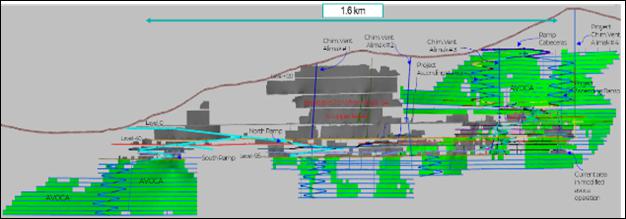
Source: Santacruz (2022)
| SANTACRUZ SILVER MINING LTD. | CABALLO BLANCO TECHNICAL REPORT | PAGE 16-3 |
| |
|
Figure 16-4: Avoca Mining at Reserva Mine
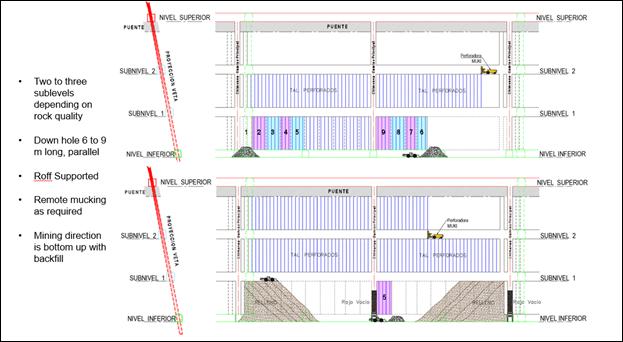
Source: Glencore (2021)
| 16.3.2 | Colquechaquita Mine |
Colquechaquita mine has been in production since 1991 using tracked development, and stoping by conventional shrinkage and cut and fill methods. The mine produces about 230 t of mineralized material per day. The transition to mechanized mining is in process but still in the early stages. Approximately 50% production continues to be generated from conventional methods. The southern portion of the mine is moving to trackless development. However, equipment brought into the mine must be disassembled and moved in the shaft which is time consuming and labor intensive.
The main access to the mine is via Level 0, and current mining activity extends down to the -240 m level. Old workings are maintained were advantageous for dewatering and as ventilation ways.
| SANTACRUZ SILVER MINING LTD. | CABALLO BLANCO TECHNICAL REPORT | PAGE 16-4 |
| |
|
The Colquechaquita Mine maintains its own mechanical and electrical shops to service the mine.
Figure 16-5: Long Section Colquechaquita Mine
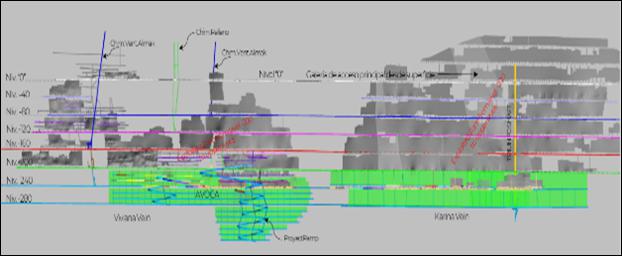
Source: Santacruz (2023)
| 16.3.3 | Tres Amigos Mine |
Tres Amigos remains a conventional tracked mine using mostly a modified shrinkage stoping method, as shown in Figure 16-6. The mineralized zones are narrow and high-grade making them well suited to these more selective stoping methods. However, higher productivity trackless mechanized methods are used for primary development and ramps. Stoping takes place generally above the -200 level and mineralized material production averages approximately 300 t/d. Mineralized material is hauled by rail either to the main Catalina shaft for hoisting to surface or hauled directly to surface using trucks.
The production from Tres Amigos is consistent. The impression was that the workforce is skilled, well trained, and well supported by capable technical support and planning.
Figure 16-7 is a general layout of developed areas currently being mined and planned development downdip.
| SANTACRUZ SILVER MINING LTD. | CABALLO BLANCO TECHNICAL REPORT | PAGE 16-5 |
| |
|
Figure 16-6: Shrinkage Mining as Practiced at Tres Amigos
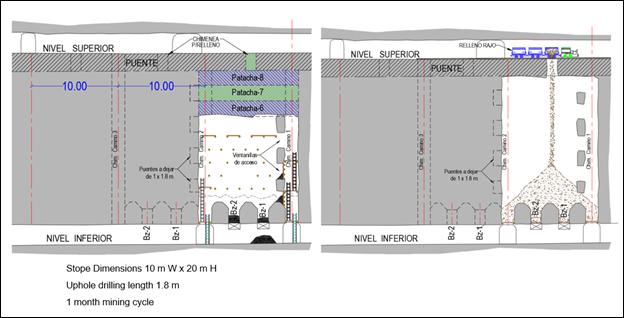
Source: Glencore (2021)
Figure 16-7: Isometric of the Tres Amigos Mine
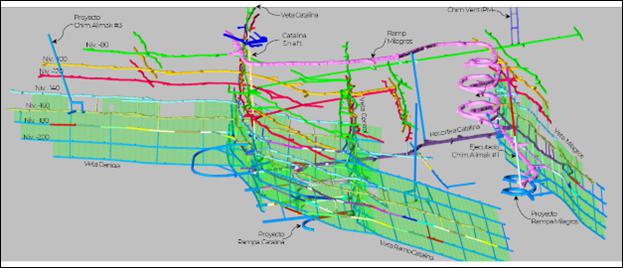
Source: Santacruz (2023)
| SANTACRUZ SILVER MINING LTD. | CABALLO BLANCO TECHNICAL REPORT | PAGE 16-6 |
| |
|
| 16.4 | Development |
Mine Access is trackless at Reserva and Tres Amigos mines via ramps which access the deepest levels of each mining area from the surface. Colquechaquita mine is shaft entry which limits production and productivity. This condition prompted the capital project now it progresses to link Tres Amigos with Colquechaquita via an integration ramp which will allow trackless development and Mineralized material haulage from Colquechaquita and allow for decommissioning of the existing shaft.
The methods for driving development openings have evolved over the past decade or so in response to a period of high accident frequency rates where it was determined that the main cause of severe injuries was related to rock falls. A systematic and progressive program was established to implement controls and methods to mitigate exposure to this danger.
Until 2014, support was only carried out with timber in the worst sectors according to informal evaluations of the rock conditions. Subsequently, the specific installation of support bolts (Split set or Hydrabolt) was implemented in the back of the drifts according to the evaluation of the rock mass. Currently the primary developments (ramps, counter galleries, cutouts, entrances, etc.) have support in the back and ribs with steel mesh and hydrabolts.
The galleries of the secondary developments (levels, sublevels, etc.) are supported in the back and ribs with electro-welded mesh and Split Set bolts.
Figure 16-8 shows the evolution of the ground support system as the mine responded to the requirements of the rock mass.
Figure 16-8: Evolution of the Rock Mass Support System
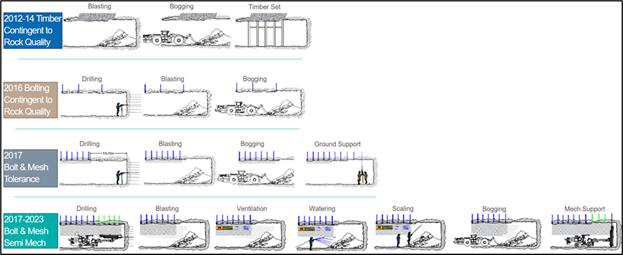
Source: Glencore (2021)
In 2017, the installation of bolts (Split set or Hydrabolt) and electro-welded mesh on the back of the drift was standardized with a tolerance margin of 10 to 15 m without support on the advance front according to the quality assessment of the rock mass.
Currently, the support standard consists of the installation of bolts and electro-welded mesh on the roof and sides of the gallery (up to the gradient) to the advance front using electro-hydraulic equipment applying the two “golden rules”:
| ● | Meter advanced equals meter supported; and |
| ● | Drilled hole, bolt installed. |
The use of Jacklegs for horizontal development is minimized. Currently, the only “conventional” development being done is short raises which are driven with jacklegs and timber at all the mines, and conventional rail drifting at the Colquechaquita and Tres Amigos mine which uses jackleg drills and pneumatic overshot rail muckers.
| 16.5 | Mine Services |
| 16.5.1 | Haulage |
Reserva mine is completely trackless and mechanized so all rock is moved with scooptrams and trucks. There exist two mining haulage circuits; the upper area, which is above level 152, hauls their Mineralized material via truck directly to the Cabaceras Portal at level 200. Mineralized material from all other areas is moved to level -40 by truck or rockpass for haulage out the primary access drift at Level 0.
Waste rock is preferentially stored underground or used directly as stope backfill.
| SANTACRUZ SILVER MINING LTD. | CABALLO BLANCO TECHNICAL REPORT | PAGE 16-7 |
| |
|
Figure 16-9: Ore Haulage System Diagram – Reserva Mine
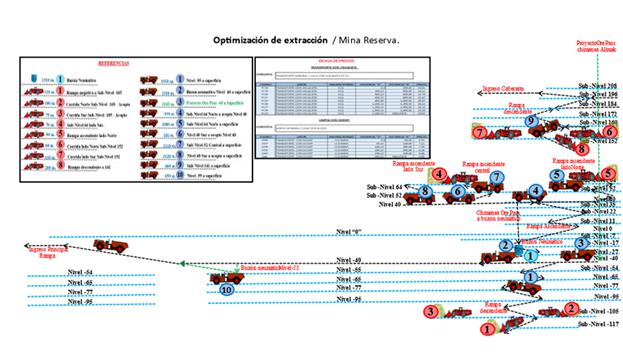
Source: Santacruz (2023)
Colquechaquita supports two separate mining areas. Currently, all rock is moved via rail to the shaft where it is hoisted to the main haulage level (Level 0) and then hoisted to surface. Some trackless equipment is being use in the AVOCA area of the mine where rock is mucked from the stopes with diesel LHD and then loaded into railcars for haulage to the shaft.
About half of the mineralized material comes from conventional shrinkage mining which is serviced by rail haulage and winze hoisting. However, some smaller trackless equipment was brought into the mine during the past couple of years to begin a mechanized section. Mineralized material coming from this area is mucked with Scooptram and truck to a central loading level where it is transferred to rail cars and hauled to the winze for hoisting. The completion of the Integration Ramp will connect Colquechaquita to Tres Amigos and provide trackless access to surface for rock haulage as well as men and material movement.
| SANTACRUZ SILVER MINING LTD. | CABALLO BLANCO TECHNICAL REPORT | PAGE 16-8 |
| |
|
Figure 16-10: Ore Haulage System Diagram – Colquechaquita Mine
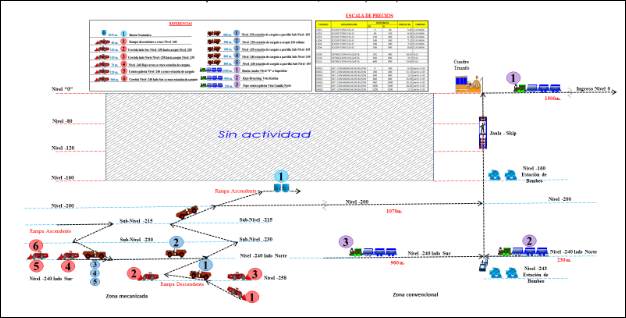
Source: Santacruz 2023
Tres Amigos utilizes a hybrid system of mining where the primary development is driven with large scale trackless equipment allowing efficient haulage. However, the stoping is done in a very selective way to match the narrow vein geometry of the mineralized material. Conventional stoping methods still utilize track haulage and chutes for stope cleaning, however, the material is collected for transfer to trucks for haulage to surface.
| SANTACRUZ SILVER MINING LTD. | CABALLO BLANCO TECHNICAL REPORT | PAGE 16-9 |
| |
|
Figure 16-11: Extraction System Diagram – Tres Amigos Mine
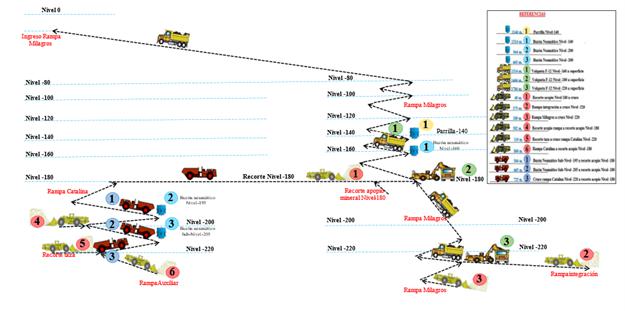
Source: Santacruz 2023
| 16.5.2 | Electrical |
Electrical supply is remarkable at Caballo Blanco, in that part of the power is self-generated. Santacruz Silver owns two power generation plants; One hydro power and the other with Gas fired gensets. Currently, Colquechaquita and Tres Amigos are powered mostly by these Generating stations, although all three mines are connected to the national grid (SEPSA).
Table 16-1: Electric Requirements
| Operation | Connected Load (MVA) | Average Consumption (MVA) |
| Colquechaquita | 3.339 | 1.982 |
| Tres Amigos | 2.054 | 0.661 |
| Reserva | 2.054 | 1.203 |
| Total | 7.447 | 3.846 |
Source: Santacruz (2023)
| SANTACRUZ SILVER MINING LTD. | CABALLO BLANCO TECHNICAL REPORT | PAGE 16-10 |
| |
|
YOCALLA Hydroelectric plant, consists of two hydroelectric generators with a capacity of 750 KVA each, one of the generators is currently inoperative.
AROIFILIA Thermo-electric, consists of 8 thermo-electric generators with capacities of 230 KW each. However, only 3 units are in operating condition, with 2 currently under repair and the other 3 units out of service. Natural gas is supplied by the national gas company (YPFB)
The generated power is incorporated into the national grid, distributed by SEPSA, controlled by SEGIMBOL contractor personnel. Although the mines need to supplement the power supply by with the grid, the savings is substantial. Generated power cost is US .043 /kWH vs. US .071 /kWH for grid power.
Figure 16-12: Single Line Diagram of Electrical Distribution System
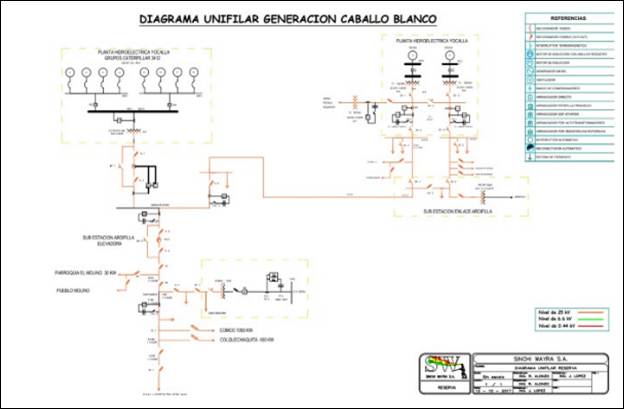
Source: Santacruz 2023
Each mine has its own dedicated 24.9 KV main feeder and transformers. Reserva mine distributes power into the mine at 6600 and 440 KV, Colquechaquita and Tres Amigos step down to 4160 and 440 KV for mine distribution.
| SANTACRUZ SILVER MINING LTD. | CABALLO BLANCO TECHNICAL REPORT | PAGE 16-11 |
| |
|
| 16.5.3 | Ventilation |
Each of the mines is ventilated separately and based on the mining system and equipment utilized, each has very different needs. Ventilation uses a combination of natural pressure through the old drifts and airways, and exhaust fans in a series of drifts and raises. All systems utilize mechanical ventilation on the exhaust side to augment natural flows.
Ventilation at Colquechaquita (shown in Figure 16-13) uses a combination of natural pressure through the old drifts and airways, and exhaust fans in a series of drifts and raises. Colquechaquita is mostly conventional and has the lowest fresh air requirements at 24 kcfm.
Reserva mine (shown in Figure 16-14) has the highest needs based on the use of exclusively diesel equipment for operations, requiring 60 kcfm.
Tres Amigos (shown in Figure 16-15) is a hybrid system using diesel equipment for development only, requiring 48 kcfm. At Tres Amigos, fresh air enters through the main access of Level 0 and the north ventilation raise with a flow rate of 18,700 m3/h, as shown in Figure 16-15 Used air is exhausted via three ventilation raises to surface.
Connection of the Colquechaquita and Tres Amigos mines the Integration ramp will provide a more flexible ventilation system for the combined operations.
Figure 16-13: Ventilation Scheme – Colquechaquita Mine
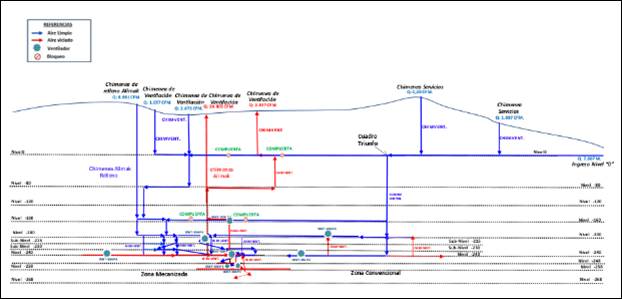
Source: Santacruz 2023
| SANTACRUZ SILVER MINING LTD. | CABALLO BLANCO TECHNICAL REPORT | PAGE 16-12 |
| |
|
Figure 16-14: Ventilation Scheme – Reserva Mine
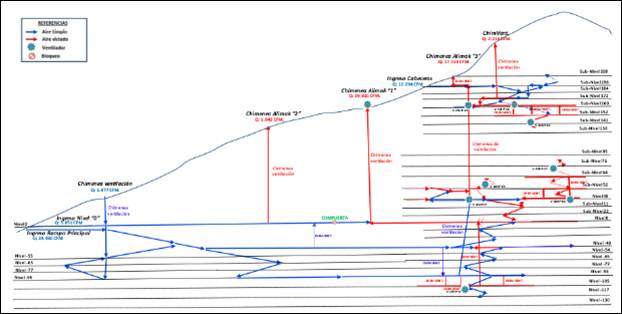
Source: Santacruz 2023
Figure 16-15: Ventilation Scheme – Tres Amigos Mine
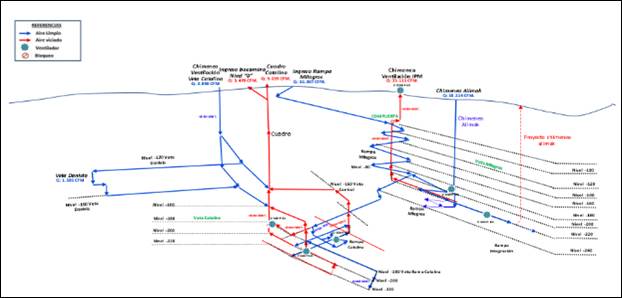
Source: Santacruz 2023
| SANTACRUZ SILVER MINING LTD. | CABALLO BLANCO TECHNICAL REPORT | PAGE 16-13 |
| |
|
| 16.5.4 | Mine Dewatering |
Water issues do not have a significant impact issue at Caballo Blanco, however, since there is no process plant at site, there is an excess of water, and treatment of mine water is required prior to discharge, consisting of clarification and pH adjustment. Colquechaquita discharges approximately 40 l/s, Reserva 33 l/s, and Tres Amigos <5 l/s.
Dewatering at Colquechaquita is accomplished with a series of pumping stations at the main shaft on nominal 40 m intervals. Water is pumped up to Level 0 where it is conveyed to the water treatment plant via gravity in a ditch.
The dewatering schemes of the three mines are shown in Figure 16-16 through Figure 16-18.
Figure 16-16: Dewatering System – Colquechaquita Mine
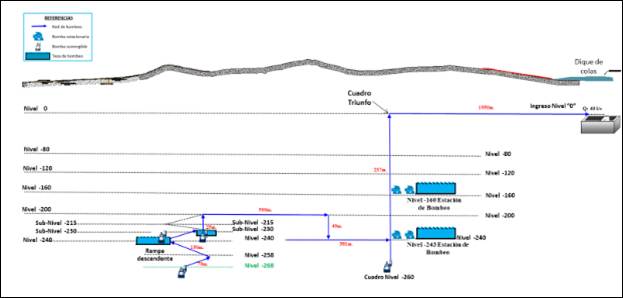
Source: Santacruz 2023
| SANTACRUZ SILVER MINING LTD. | CABALLO BLANCO TECHNICAL REPORT | PAGE 16-14 |
| |
|
Figure 16-17: Dewatering System Scheme – Reserva Mine
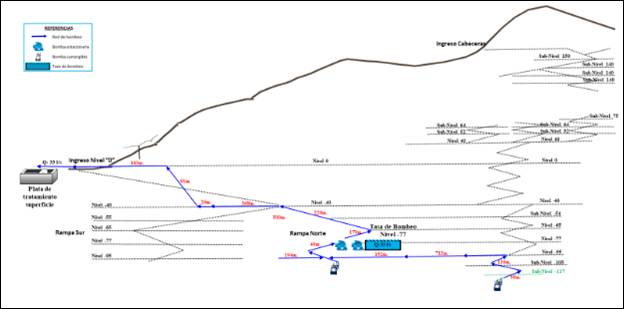
Source: Santacruz 2023
Figure 16-18: Dewatering System Scheme – Tres Amigos Mine
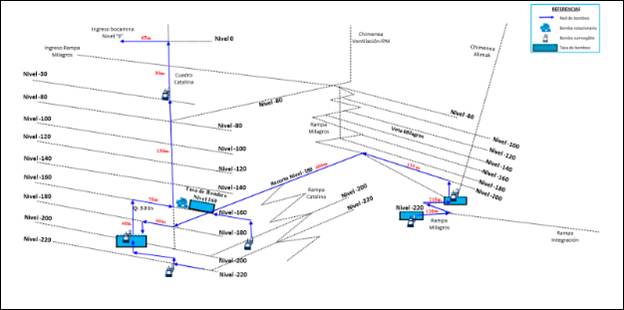
Source: Santacruz 2023
| SANTACRUZ SILVER MINING LTD. | CABALLO BLANCO TECHNICAL REPORT | PAGE 16-15 |
| |
|
| 16.6 | Mine Equipment |
The list of mining equipment allocated of the three mines is shown in Table 16-2. The equipment codes are the unit names. Availability and utilization factors from 2022 are shown for each unit.
Table 16-2: Mine Equipment Inventory
| Item | Category | Mine/Zone | Equipment Code | Model | Brand | Capacity
/ Range |
HP | Availability (%) | Utilization (%) |
| 1 | Jumbo Drills | Reserva | Peh-03 | Muki Ff | Resemin | 2.4 m | 75 | 77% | 18% |
| 2 | Reserva | Peh-06 | Muki Ff | Resemin | 2.4 m | 75 | 76% | 18% | |
| 3 | Reserva | Peh-08 | Muki Ff | Resemin | 2.4 m | 75 | 73% | 19% | |
| 4 | Colquechaquita | Peh-05 | Muki Ff | Resemin | 2.4 m | 75 | 92% | 21% | |
| 5 | Colquechaquita | Peh-09 | Muki Ff | Resemin | 2.4 m | 75 | 35% | 10% | |
| 6 | Tres Amigos | Jb-01 | Boomer H104 | Atlas Copco | 3.7 m | 74 | 33% | 7% | |
| 7 | Tres Amigos | Jb-02 | Boomer S1d | Atlas Copco | 4 m | 78 | 80% | 22% | |
| 1 | Longhole Drills | Reserva | Peh-02 | Raptor 44 | Resemin | 20 m | 100 | 92% | 6% |
| 2 | Reserva | Peh-10 | Raptor 44 XP | Resemin | 20 m | 100 | 42% | 3% | |
| 3 | Colquechaquita | Peh-04 | Muki 22 | Resemin | 15 m | 75 | 73% | 16% | |
| 1 | Rockbolters | Tres Amigos | Je-01 | Small Bolter 77 | Resemin | 3 m | 75 | 31% | 5% |
| 2 | Tres Amigos | Je-02 | Small Bolter 77 | Resemin | 3 m | 75 | 80% | 28% | |
| 1 | Scooptrams | Reserva | St-02 | Scooptram Lh203 | Sandvik | 1.5 m3 | 95 | 68% | 51% |
| 2 | Reserva | St-03 | Scooptram Lh203 | Sandvik | 1.5 m3 | 95 | 57% | 43% | |
| 3 | Reserva | St-04 | Scooptram Toro 151d | Tamrock | 1.5 m3 | 95 | 68% | 28% | |
| 4 | Reserva | St-08 | Scooptram Lh203 | Sandvik | 1.5 m3 | 95 | 51% | 37% | |
| 5 | Reserva | St-16 | Scooptram Lh203 | Sandvik | 1.5 m3 | 95 | 78% | 63% | |
| 6 | Tres Amigos | St-14 | Microscoop 100d | Sandvik | 0.54 m3 | 45 | 90% | 29% | |
| 7 | Tres Amigos | St-15 | Microscoop Xlh05d | Overprime | 0.54 m3 | 45 | 88% | 55% | |
| 8 | Tres Amigos | St-11 | Microscoop Xlh05d | Overprime | 0.54 m3 | 45 | 95% | 0% | |
| 9 | Tres Amigos | St-05 | Scooptram St7 | Atlas Copco | 3.1 m3 | 193 | 83% | 37% | |
| 10 | Tres Amigos | St-18 | Scooptram St1030 | Atlas Copco | 4.5 m3 | 250 | 80% | 78% | |
| 11 | Tres Amigos | St-06 | Scooptram St1030 | Atlas Copco | 4.5 m3 | 250 | 76% | 80% | |
| 12 | Colquechaquita | St-07 | Scooptram Toro 151d | Tamrock | 1.5 m3 | 95 | 85% | 62% | |
| 3 | Colquechaquita | St-17 | Scooptram Lh203 | Sandvik | 1.5 m3 | 95 | 62% | 29% | |
| 1 | Trucks | Reserva | Mt-02 | Volquete Dt12 | Dux | 12 tn. | 148 | 77% | 63% |
| 2 | Reserva | Mt-05 | Volquete Dt12 | Dux | 12 tn. | 148 | 56% | 37% | |
| 3 | Reserva | Mt-06 | Volquete Dt12 | Dux | 12 tn. | 148 | 75% | 60% | |
| 4 | Tres Amigos | Mt-04 | Volquete Dts12 | Dux | 12 tn. | 148 | 66% | 39% | |
| 5 | Colquechaquita | Mt-01 | Volquete Dt12 | Dux | 12 tn. | 148 | 79% | 38% | |
| 6 | Colquechaquita | Mt-03 | Volquete Dt12 | Dux | 12 tn. | 148 | 88% | 29% | |
| 1 | Auxiliary Equipment | Reserva | Sl-01 | Camion Utilitario S1-Sl5000n | Dux | 5 tn. | 148 | 92% | 39% |
Source: Santacruz (2023)
| SANTACRUZ SILVER MINING LTD. | CABALLO BLANCO TECHNICAL REPORT | PAGE 16-16 |
| |
|
This list suggests that there is ample equipment with acceptable availability (70% to 73%) and low utilization (29% to 35%).
| 16.7 | Mine Personnel |
Total Manpower at the mine site including Mine, Plant, Maintenance, Services, and General and administrative in 2022 totaled 611 people consisting of 449 direct employees and 162 contractors. In the breakout table below, the contractors fill mostly the services roles.
The work in the mine takes place in three eight-hour shifts, with daylight shift starting at 7 am.
Table 16-3: Mine Personnel (2022)
| Mine | 309 |
| Plant | 43 |
| Engineering and Maintenance | 62 |
| General & Administrative | 35 |
| Contractors | 162 |
| Total | 611 |
Source: Santacruz 2023
| SANTACRUZ SILVER MINING LTD. | CABALLO BLANCO TECHNICAL REPORT | PAGE 16-17 |
| |
|
| 17 | Process Description / Recovery Methods |
The processing plant at the Don Diego accepts feed from the Cabello Blanco deposit as well as toll feed from artisanal miners. The Don Diego process uses sequential flotation to produce two concentrates: lead and zinc. Both concentrates contain high values of Silver with the lead concentrates containing approximately 6,500 g/t Ag and the zinc concentrates containing approximately 300 g/t Ag for company feed and 4,000 g/t Ag in the lead concentrate and 450 g/t Ag in the zinc concentrate for toll feed.
The mill uses a crushing, grinding, and flotation flowsheet to recover a lead concentrate and a zinc concentrate. Both concentrates are sold to Glencore, via overseas shipment from Antafagasta, Chile. The mill flowsheet can be found in Figure 17-1 in Section 17.1.
The mill generally separates company and toll feed into different days, but there are a few days where the feed is processed on the same day, with a shutdown separate the 2 feeds.
The company feed grade is determined by sampling the cyclone overflow, flotation tailings and lead and zinc concentrates. The production is reconciled monthly using smelter shipments, the tailings grade and the tonnes fed to the mill, which is standard practice for reconciling mill production. The toll ore is received by San Lucas, often in 1-2 t lots, where it is weighed and sampled. The ore is combined on a toll feed stockpile to be fed to the mill. The toll feed is reconciled in the mill the same as company feed.
The mill utilizes similar reagents strategies for the toll and company feed materials. The processing plant targets approximately 20% of the feed to be toll material.
| 17.1 | Plant Flowsheet |
The plant flowsheet for the Don Diego mill is a typical sequential flotation circuit for lead and zinc. The feed is crushed in preparation for the grinding circuit. The grinding circuit utilizes a SAG/Ball mill combination to produce a product size of 100 µm for the flotation circuit.
The flotation circuit starts with the lead recovery circuit. In this circuit a rougher concentrate is produced, which is then cleaned without regrinding, in column flotation cells. The lead rougher tailings and cleaner tailings are combined and fed to the zinc circuit. The zinc circuit consists of rougher flotation and one stage of cleaning to produce a zinc concentrate. The zinc circuit tailings are deposited in the tailings pond. Both of the concentrates are filtered for shipping to the smelter. The lead concentrate is bagged for shipping, while the zinc concentrate is shipped bulk in trucks.
| SANTACRUZ SILVER MINING LTD. | CABALLO BLANCO TECHNICAL REPORT | PAGE 17-1 |
| |
|
Figure 17-1: Don Diego Mill Flowsheet
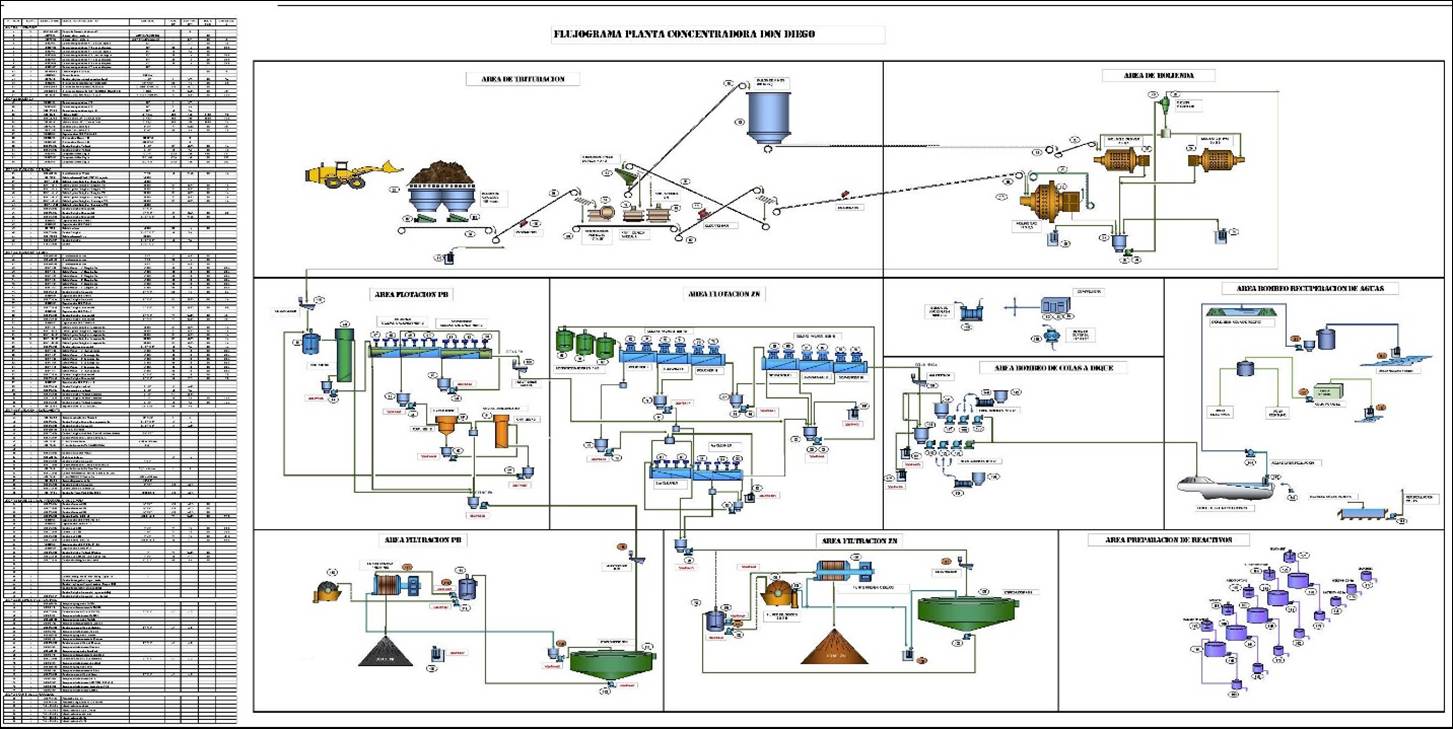
Source: Glencore (2021)
| SANTACRUZ SILVER MINING LTD. | CABALLO BLANCO TECHNICAL REPORT | PAGE 17-2 |
| |
|
The process plant is in good condition as can be seen in Figure 17-2 and Figure 17-3. Figure 17-2 shows the grinding circuit of the Don Diego mill and Figure 17-3 shows a section of the lead flotation circuit.
Figure 17-2: Don Diego Grinding Circuit
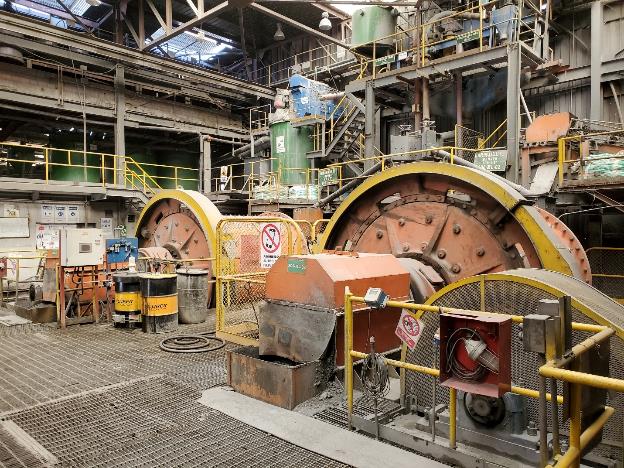
| SANTACRUZ SILVER MINING LTD. | CABALLO BLANCO TECHNICAL REPORT | PAGE 17-3 |
| |
|
Figure 17-3: Don Diego Zinc Flotation
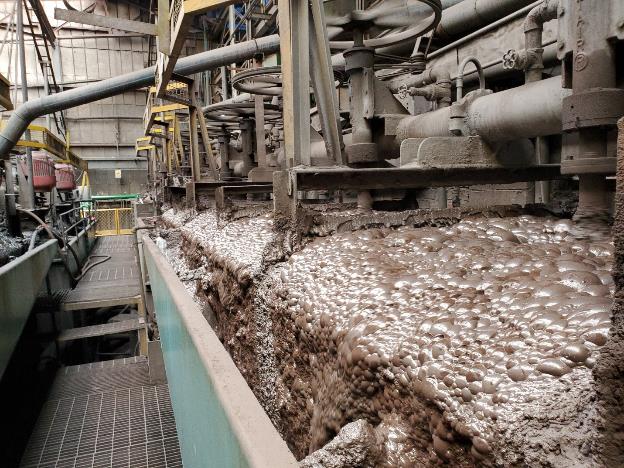
| 17.2 | Mill Circuits |
The processing plant is designed to process 1,100 tonnes/day of company feed or 800 t/d of toll feed. The plant produces two concentrates; a lead concentrate and zinc concentrate, both of which are high in silver.
| 17.2.1 | Crushing |
The plant feed is brought to the surface via haul truck and dumped into the crushing feed bin. The mineralized material is fed to a 12” x 36” jaw crusher via vibrating grizzly feeder. The jaw crusher discharge reports to a 4’ x 12’ vibrating screen. The screen undersize is conveyed to the fine ore bin. The screen oversize returned to a pair of cone crushers: a Svedala H-3000I-C/B/C-32 and a Symons 3’ short head crusher. The tertiary crusher discharge is returned to the screen.
| SANTACRUZ SILVER MINING LTD. | CABALLO BLANCO TECHNICAL REPORT | PAGE 17-4 |
| |
|
| 17.2.2 | Grinding |
The coarse ore stockpile is reclaimed by underground vibratory feeder to a 12’ dia. x 6.5’ EGL SAG mill. The SAG mill has a trommel screen to return oversize material to the SAG mill. The fine particles are pumped to a cyclone cluster with 400 mm cyclones for size classification. The undersize is split between two 8’ dia. X 9.5’ EGL ball mills.
| 17.2.3 | Flotation |
The flotation circuit at the Don Diego mill utilizes sequential flotation to produce a lead and a zinc concentrate. The feed is directed to a lead flotation rougher circuit, which recovers lead and silver to be further cleaned. The tailings from the lead rougher circuit are conditioned with zinc activation reagents and then floated to make a zinc rougher concentrate.
| 17.2.3.1 | Lead Flotation Circuit |
The primary cyclone overflow reports to a sampler which collects the feed sample and then to a 7’ dia. X 8’ tall conditioning tank. where Aerophine 3418A, Aerofloat 232, and sodium isopropyl xanthate (Z-11) are added.
The conditioning tank discharges into a flotation column which is followed by a single 100 cubic foot and six-200 cubic foot rougher flotation cells. The rougher flotation cell tailings report to a bank of four 200 cubic foot continues to the lead scavenger flotation circuit which consists of four 200 cubic foot mechanical flotation cells and a single 100 ft3 mechanical flotation cell.
The concentrate from the first 3 rougher flotation cells reports to the final lead concentrate pumpbox. The concentrate from the remaining rougher flotation cells reports to the 1st cleaner column and the cleaner scavenger column. The tailings from the cleaner scavenger column reports back to the lead circuit conditioning tank. The concentrate from the two columns is combined and pumped to the lead final concentrate.
The lead scavenger flotation tailings reports to the zinc flotation circuit conditioning tanks.
| 17.2.3.2 | Zinc Flotation Circuit |
The zinc flotation circuit starts with three conditioning tanks: two 7’ dia. X 8’ tall tanks and a single 6’ dia. X 7’ tall tank. Copper sulphate is added to encourage flotation of sphalerite. Once again, Z-11 is added as a collector. The zinc rougher circuit consists of six 150 cubic foot Wemco flotation cells. The zinc rougher circuit tailings is scavenged in a bank of six 300 ft3 Wemco flotation cells.
The concentrate from the first two zinc rougher flotation cells is directed to the 2nd cleaner flotation circuit, which consists of four 300 ft3 Galigher style flotation cells.
| SANTACRUZ SILVER MINING LTD. | CABALLO BLANCO TECHNICAL REPORT | PAGE 17-5 |
| |
|
The concentrate from the final four zinc rougher cells reports to the zinc 1st cleaner which consists of five 300 cubic foot Galigher flotation cells. The concentrate from the 1st cleaner flotation cells is pumped to the second cleaner flotation cells.
The rougher flotation tailings is directed to a bank of six 300 cubic foot zinc scavenger cells. The concentrate from the first four cells report to the zinc circuit conditioning tanks. The concentrate from the final two zinc circuit scavenger cells is directed back to the zinc scavenger feed.
The concentrate from the zinc 2nd cleaner flotation cells reports to the final zinc concentrate pumpbox. The tailings from the 2nd cleaner flotation cells is gravity fed into the feed of the 1st cleaner flotation cells.
| 17.2.4 | Concentrate Dewatering |
The concentrate dewatering circuit consists of two circuits, the lead concentrate dewatering circuit and the zinc concentrate dewatering circuit.
The concentrates produced at the Don Diego processing plant are sold to the Glencore refinery in Antafagasta, Chile. The zinc concentrate is shipped as a bulk product. The lead concentrate, due to local laws, is bagged prior to shipping.
| 17.2.4.1 | Lead Concentrate Dewatering |
The lead dewatering circuit consists of a 30 ft diameter lead concentrate thickener. The thickener overflow returns to the process water tank. The thickener underflow is pumped to a lead concentrate stock tank. The lead concentrate is then filtered in a 1.3 m x 1.3 m pressure filter. Alternatively, the Don Diego plant has a 4’ diameter disc filter which can be used to filter lead concentrates when the pressure filter is not available.
Filtered lead concentrate is bagged for transport to the smelter, as is required by Bolivian law.
| 17.2.4.2 | Zinc Concentrate Dewatering |
The zinc concentrate is pumped to a 40 ft diameter zinc concentrate thickener. The thickener overflow returns to the process water tank. The thickener underflow is pumped to a zinc concentrate stock tank. The zinc concentrate is then filtered in either a 1.5 m x 1.5 m pressure filter or an 8.5 ft dia. x 6 disc filter.
| 17.2.5 | Tailings |
The Chilimocko tailings dam at Don Diego is inspected regularly and maintained to the standards set out by the Canadian Dam Association guidelines. The dam is under the supervision of engineers from AMEC (now Wood Engineering) and recently an external audit was conducted by Knight Piésold Consulting. The Chilimocko Dam is 55 m high, downstream-constructed dam, which contains 2.33 Mm3 of tailings. The Stage IV raise was completed in 2019 and current crest elevation is 3,625 m. At current production rates, Chilimocko facility has capacity for 5 to 6 years before another raise to the dam is required.
There are also 4 closed tailings storage facilities associated with Don Diego Plant:
| ● | Yana Khasa is a 40 m high, upstream-constructed dam, which contains 2.2 Mm3 of tailings. Recent activities at the site include Repositioning piezometers, cleaning of the standpipe piezometers to improve groundwater monitoring, and Installation of fences to protect instrumentation; and |
| ● | Dikes 1, 2, and 3 are, upstream constructed dams which contain a total of 0.4 Mm3 of tailings. Recent activities at the sites include cleaning of the standpipe piezometers to improve groundwater monitoring and Installation of fences to protect the instrumentation. |
| SANTACRUZ SILVER MINING LTD. | CABALLO BLANCO TECHNICAL REPORT | PAGE 17-6 |
| |
|
| 18 | Project Infrastructure and Services |
Each of the three mining complexes that form the Caballo Blanco Project is supported by its own infrastructure, as detailed by mine in this section.
| 18.1 | Mina Reserva |
The Mina Reserva operation is surrounded by a facilities fence, inside of which are the following facilities:
| ● | Various technical, administrative offices, and mine operations office; |
| ● | A maintenance facility for all surface and underground equipment; |
| ● | A mud dam for settling solids from the mine water; |
| ● | Warehousing facilities; |
| ● | A worker camp; |
| ● | A dining hall for technical and administrative staff; |
| ● | A first aid station; |
| ● | Water treatment; and |
| ● | Mine services, such as power, water supply, and compressed air. |
The existing infrastructure for Mina Reserva is shown in Figure 18-1. Key facilities are identified by number on the drawing.
| SANTACRUZ SILVER MINING LTD. | CABALLO BLANCO TECHNICAL REPORT | PAGE 18-1 |
| |
|
Figure 18-1: Infrastructure for Mina Reserva
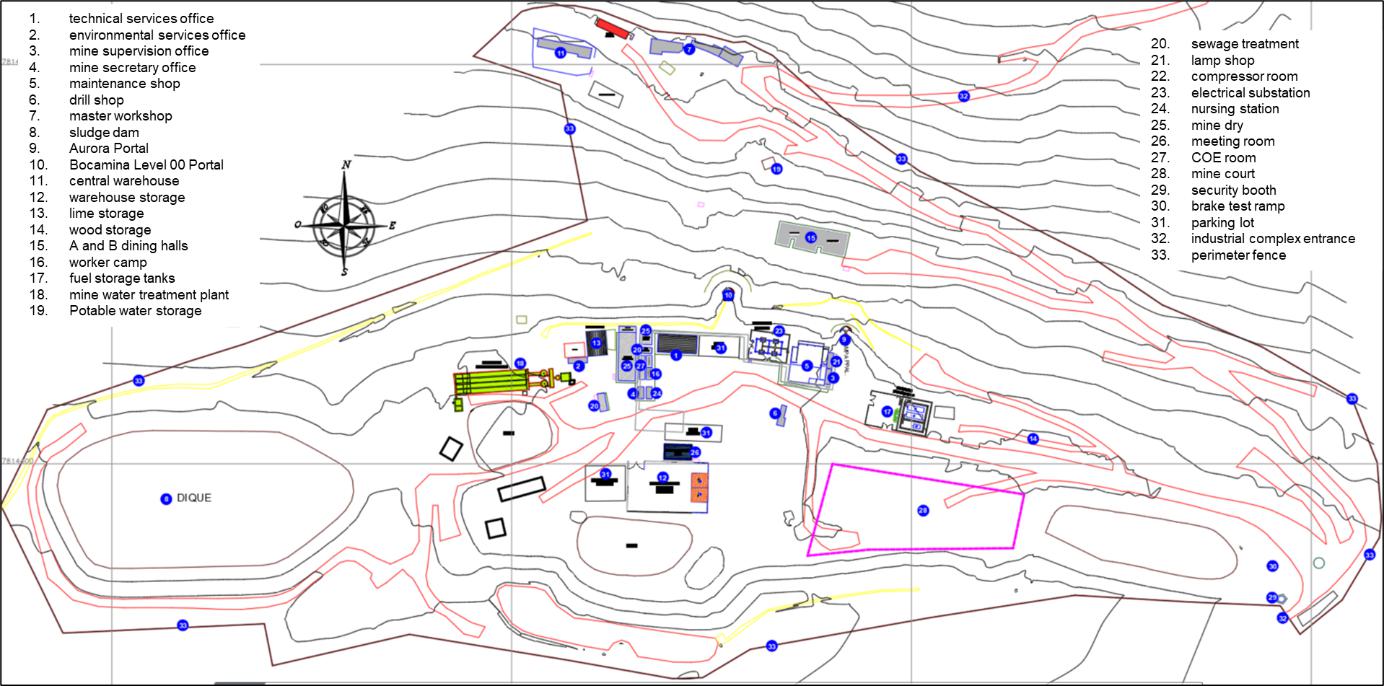
| SANTACRUZ SILVER MINING LTD. | CABALLO BLANCO TECHNICAL REPORT | PAGE 18-2 |
| |
|
| 18.2 | Mina Tres Amigos |
The Mina Tres Amigos operation is also surrounded by a perimeter fence and similarly equipped with all mine services, including, inside of which are the following facilities:
| ● | Various technical, administrative offices, and mine operations office; |
| ● | A maintenance facility for all surface and underground equipment; |
| ● | A mud dam for settling solids from the mine water; |
| ● | Warehousing facilities; |
| ● | A worker camp; |
| ● | A dining hall for technical and administrative staff; |
| ● | A first aid station; |
| ● | Water treatment; |
| ● | Mine services, such as power, water supply, and compressed air; and |
| ● | The Catalina headframe atop the mine shaft. |
The existing infrastructure for Mina Reserva is shown in Figure 18-2. Key facilities are identified by number on the drawing.
| SANTACRUZ SILVER MINING LTD. | CABALLO BLANCO TECHNICAL REPORT | PAGE 18-3 |
| |
|
Figure 18-2: Infrastructure for Mina Tres Amigos
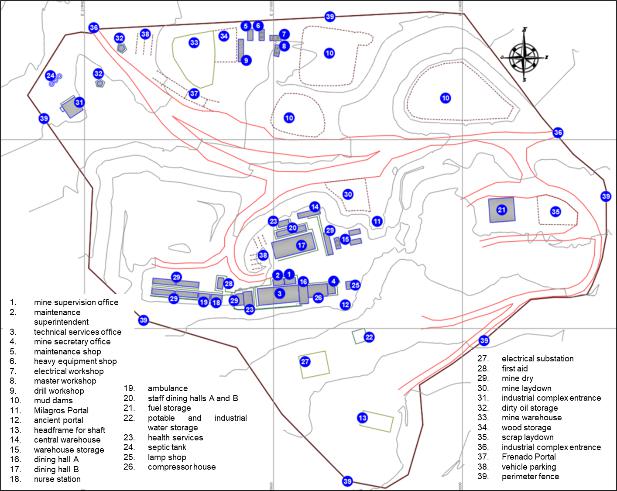
| SANTACRUZ SILVER MINING LTD. | CABALLO BLANCO TECHNICAL REPORT | PAGE 18-4 |
| |
|
| 18.3 | Mina Colquechaquita |
The Mina Colquechaquita operation is also surrounded by a perimeter fence and similarly equipped with all mine services, including, inside of which are the following facilities:
| ● | Various technical, administrative offices, and mine operations office; |
| ● | A maintenance facility for all surface and underground equipment; |
| ● | A mud dam for settling solids from the mine water; |
| ● | Warehousing facilities; |
| ● | A worker camp; |
| ● | A dining hall for technical and administrative staff; |
| ● | A first aid station; |
| ● | Water treatment; and |
| ● | Mine services, such as power, water supply, and compressed air. |
The existing infrastructure for Mina Reserva is shown in Figure 18-3Figure 18-2. Key facilities are identified by number on the drawing.
| SANTACRUZ SILVER MINING LTD. | CABALLO BLANCO TECHNICAL REPORT | PAGE 18-5 |
| |
|
Figure 18-3: Infrastructure for Mina Colquechaquita
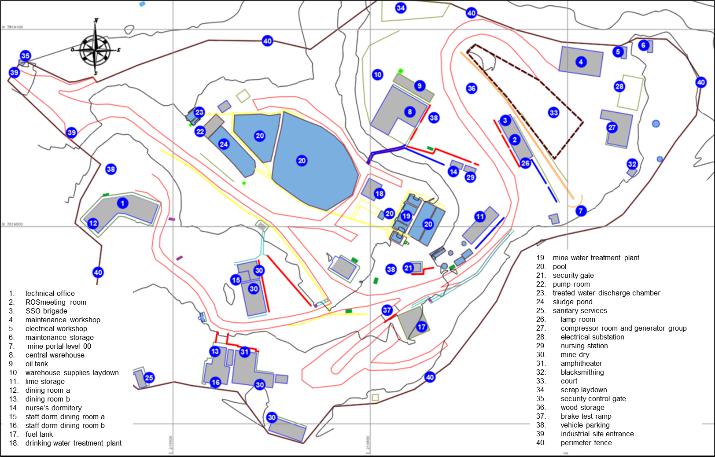
| SANTACRUZ SILVER MINING LTD. | CABALLO BLANCO TECHNICAL REPORT | PAGE 18-6 |
| |
|
| 19 | Market Studies and Contracts |
| 19.1 | Contracts |
Off-take Agreements with Glencore International are in place for the Caballo Blanco Mine production: Contract No. 180-03-10309-P and Contract No. 062-03-10276-P, including all its addendums and amendments. These Off-Take Agreements are in effect through the life of the mine.
| 19.2 | Market Studies |
No market studies have been completed for the Project at this time. All commodities produced by the mine are regularly sold on vast international markets and the operation has an arrangement with a smelter to ensure continued product sales.
| 19.3 | Smelting |
The mine produces two saleable concentrates: lead, and zinc. Both are sent to Antafagasta, Chile for shipment overseas. Both are sold to Glencore. These include typical payment terms for all payable metals (Pb, Zn, Ag) and deductions for deleterious elements which potentially include Sb and Bi in the lead concentrate; and Cd, SiO2, and Fe in the zinc concentrate.
The approximate percentage net revenue by concentrate is ranked as follows:
| ● | Zn Concentrate: 59% |
| ● | Pb Concentrate: 41% |
The approximate percentage revenue by metal is ranked as follows:
| ● | Ag: | 58% |
| ● | Zn: | 39% |
| ● | Pb: | 3% |
| SANTACRUZ SILVER MINING LTD. | CABALLO BLANCO TECHNICAL REPORT | PAGE 19-1 |
| |
|
| 19.4 | Metal Prices |
Historical silver, lead, and zinc prices are shown in Figure 19-1 through Figure 19-3.
Figure 19-1: Historical Silver Price
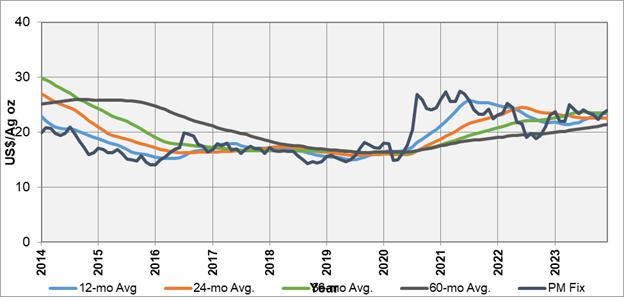
Source: London Metals Exchange (2023)
Figure 19-2: Historical Lead Price
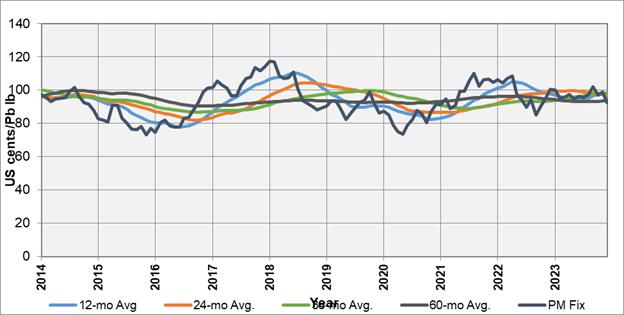
Source: London Metals Exchange (2023)
| SANTACRUZ SILVER MINING LTD. | CABALLO BLANCO TECHNICAL REPORT | PAGE 19-2 |
| |
|
Figure 19-3: Historical Zinc Price
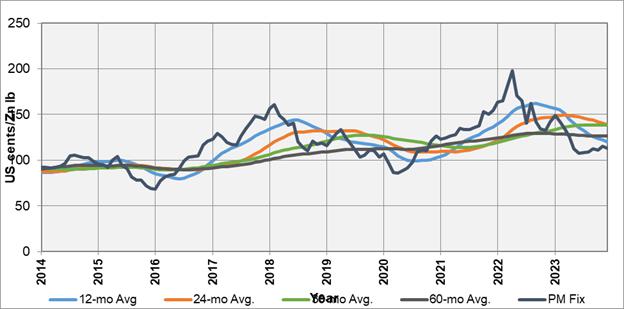
Source: London Metal Exchange (2023
The zinc, silver and lead prices used in this Technical Report were selected based on the average of three years past and forward projections by CIBC and Consensus Economics, as shown in Table 19-1. These parameters are in line with other recently released comparable Technical Reports. These prices were used as the basis for the resource estimate, reserve estimate, and economic model.
Table 19-1: Metal Price and Exchange Rate
| Metal | Three Year Average | CIBC (Long Term) | Consensus Economics Forecast (Log Term) | Assumed Value |
| Silver | 23.39 | 22.96 | 20.48 | 21.00 |
| Zinc | 1.20 | 1.27 | 1.14 | 1.15 |
| Lead | 0.97 | 0.94 | 0.88 | 1.00 |
It must be noted that metal prices are highly variable and are driven by complex market forces and are difficult to predict.
Current (May 3, 2024) spot prices are as follows:
| ● | Ag: | $26.50/oz |
| ● | Zn: | $1.32/lb |
| ● | Pb: | $1.00/lb |
The QPs do not consider the difference between metal current prices and those assumed in this study to be material with regard to the estimation of the mineral resources, reserves, or financial model.
| SANTACRUZ SILVER MINING LTD. | CABALLO BLANCO TECHNICAL REPORT | PAGE 19-3 |
| |
|
| 20 | Environmental Studies, Permitting and Social or Community Impacts |
| 20.1 | Environmental Considerations |
Responsible environmental management is a critical part of Santacruz’s license to operate and our responsible, compliant operation of Bolivian assets has continued for the last 30 years. Control of potential environmental impacts that can affect Santacruz’s performance and the interests of internal and external stakeholders is paramount. Santacruz’ environmental management approach is divided into three major areas; Water Management, Tailings Management, and Climate Change. However, other environmental issues are addressed as needed outside of these major management areas such as Waste Management, Land Use, Environmental Closure, and Biodiversity.
Environmental Compliance with national laws and regulations is the basis of Santacruz’s environmental management system and is governed by a framework of oversight by the relevant Environmental Authority. However, the company’s environmental management system allows it to identify and assess all effects of its operations in order to establish controls and improvement targets guided by best environmental practices and its responsibility to the communities in which it operates. Its environmental commitments are reported to the authorities annually in an Environmental Monitoring Report, which summarizes environmental management of its operations under applicable laws and regulations.
Santacruz is part of the Environmental Working Table within the Bolivia Network of the United Nations Global Compact, where it supports initiatives for raising awareness and environmental care, while also sharing experience from the field.
Based on comparison to the Baseline Environmental Audit Studies (ALBAs), mining activities in Santacruz’s operations have not had a significant impact on the area’s biodiversity. However, Santacruz actively manage risks related to land use by analyzing impacts on water resources and agriculture, adhering to national regulatory requirements, and applying relevant best practices from the ICMM for environmental closure. In the context of continuous improvement, Santacruz carried out partial remediation and rehabilitation tasks in industrial areas in accordance with the Progressive Closure Plan, in compliance with the Environmental Regulation for Mining Activities (RAAM) of Law No. 1333. None of Santacruz’s mining operations are in direct proximity to a sensitive biodiversity area, and no species listed on the IUCN Red List or national conservation lists are identified as threatened by Santacruz’s activities. However, Reserva Mine in Caballo Blanco is located near a Municipal protected area.
| SANTACRUZ SILVER MINING LTD. | CABALLO BLANCO TECHNICAL REPORT | PAGE 20-1 |
| |
|
| 20.1.1 | Climate Change |
The impacts and costs of addressing climate change is driven by global commitments, such as the Paris Agreement in 2015, which was signed by 193 countries, including Bolivia. The Agreement proposes, through international action, the reduction of global emissions to prevent the increase of 2° C in the planet’s temperature. In this regard, the Bolivian government, through Law No. 835 of 2016, committed to preserving the integrity of Mother Earth, and private industry is expected to join global initiatives on climate change. Climate change has been identified as a material topic due to its potential negative impacts in the medium and long term, particularly in terms of water use and the energy limitations that the mining sector must face. This has been evaluated in Santacruz’s corporate risk matrix, and Santacruz is taking actions to address this risk. Santacruz recognize the importance of the required actions in response to Climate Change and strive to ensure mining operations with the least possible environmental impact. focus its efforts mainly on efficient water management and energy efficiency. The cost of energy is one of the largest components of Santacruz’s operating expenditures. Ninety percent of the electricity consumed in Santacruz’s operations is purchased from the national power grid which relies mostly on fossil fuels (73%). One of Santacruz’s direct actions is the management of two power plants that supply electricity to Colquechaquita Mine (Caballo Blanco):
| ● | Hydropower Plant - Renewable energy from Yocalla, which generates 870 CVA s a generation facility that converts the potential energy from falling water into electricity, with a generation capacity of 870 CV; and |
| ● | Aroifilla Thermoelectric Plant, which operates on natural gas and has a generation capacity of 200 KW. |
Santacruz’s operations consumed a total of 91,500 M Watt-hours from the national grid and Santacruz’s own power plants, representing a 3% increase compared with the previous year’s consumption against a 7% growth in production. 90% of the electricity consumed is purchased from the National Grid, while the remaining electricity is generated by Santacruz’s Aroifilla thermoelectric power plant (5%) and Yocalla Renewable hydroelectric power plant (4%).
Electric energy and natural gas are measured via dedicated meters installed for this purpose. Gasoline and diesel fuel consumption is tracked through the records of outgoing supplies managed by warehouses, which are solely for the company’s equipment and vehicles. Energy intensity can then be calculated to allow monitoring of overall energy efficiency. In 2022, Santacruz’s energy intensity per tonne of concentrate was 2,544 MJ/ton, a 10% reduction compared with the previous year, and 30.5% decrease since 2018. This reduction is attributed to more efficient production processes and increases in production that allow energy to be used more effectively.
| SANTACRUZ SILVER MINING LTD. | CABALLO BLANCO TECHNICAL REPORT | PAGE 20-2 |
| |
|
Figure 20-1: Santacruz Bolivia Operations Energy Consumption
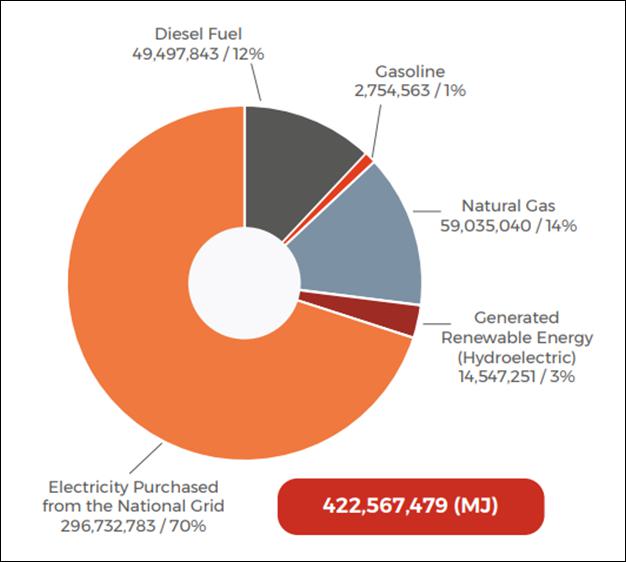
Source: Sustainability Report, Sinchi Wayra (2022)
Atmospheric Emissions are associated with the transportation of materials and personnel to and between the mines, resulting from dust and particulate matter generated by truck transport on unpaved roads. To prevent dust and particulate material dispersion in the air, Santacruz has implemented controls, such as frequent watering of gravel roads. In 2022, Santacruz continued to perform ambient air quality monitoring at specific points designated in Santacruz’s environmental permits. These monitoring activities assess the levels of PM-10 and metallic contents in the air, and the results are well below the permissible limits. Santacruz also reports the emissions of SOx and NOx resulting from the combustion of natural gas in Santacruz’s Aroifilla thermoelectric plant in Potosí. These emissions are also below the permissible limits established by law. The calculation of these emissions is based on measurements conducted by an independent certified environmental laboratory.
| 20.2 | Waste and Water Management |
Waste management is an important part of Santacruz’s Comprehensive Environmental Management, which includes a waste management plan to classify, handle, and store waste separately for proper disposal or treatment. Waste management complies with Environmental Law No. 1333, its Regulations on Solid Waste Management, and its supplementary regulations, focusing primarily on the sectoral requirements of the Environmental Regulation for Mining Activities for waste rock and tailings.
Waste management extends beyond Santacruz’s production operations and includes administrative activities and healthcare facilities managed by Santacruz. Santacruz has begun initiatives for recycling and reuse of domestic waste at several of Santacruz’s operations, including plastic recycling campaigns, paper reuse, and compost generation from food waste. Industrial wastes such as oils, greases, scrap, and tires, are sold to recognized recyclers. It ensures that these recyclers are regulated and certified by the environmental authorities to ensure compliant reuse and recycling.
Santacruz classifies waste based on its source of generation. Waste Management then addresses separation by kind of waste, collection, temporary storage and final disposal.
| SANTACRUZ SILVER MINING LTD. | CABALLO BLANCO TECHNICAL REPORT | PAGE 20-3 |
| |
|
Figure 20-2: Waste Classification by Process Source
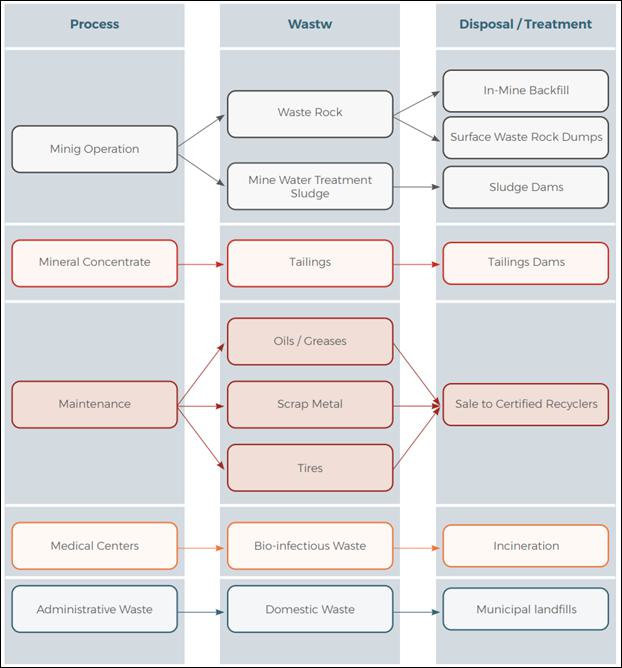
Source: Sustainability Report, Sinchi Wayra (2022)
| SANTACRUZ SILVER MINING LTD. | CABALLO BLANCO TECHNICAL REPORT | PAGE 20-4 |
| |
|
Table 20-1: Total Waste Quantification and Treatment/Disposal
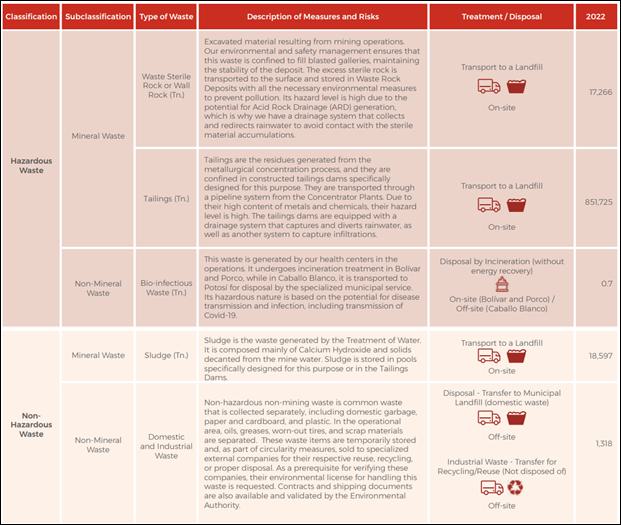
Source: Sustainability Report, Sinchi Wayra (2022)
Water management has been identified as the most critical environmental area. Water is a shared resource of high social, environmental, and economic value, which is also a critical component of Santacruz’s mining and metallurgical activities. Mining operations are located in the Bolivian Highlands, in areas with low precipitation, high evapotranspiration, and threats of drought.
According to data presented in the “Ecological Threat Register”, which ranks countries and watersheds worldwide based on their exposure to water-related risks, Bolivia has a low country risk (10- 20%) of water vulnerability and is not considered a water-stressed country. However, in accordance with the “Aqueduct Water Risk Atlas” by the World Resources Institute, the highland areas where Santacruz operates are considered as Medium Risk (Bolívar) and High Risk (Caballo Blanco and Porco). According to these recognized international public tools, Santacruz deems the care and preservation of water critical aspects of Santacruz’s management system and strives to ensure access to water for communities and operational needs.
| SANTACRUZ SILVER MINING LTD. | CABALLO BLANCO TECHNICAL REPORT | PAGE 20-5 |
| |
|
During the mining production process, water comes into contact with heavy metals, so it must be treated before being use or discharge. Monitoring water quality and quantity and the use of water balance monitoring, Santacruz is able to comply with the criteria required by the Regulations on Water Pollution (RMCH) of Environmental Law No. 1333. Santacruz is also subject to periodic inspections by applicable environmental authorities and community representatives. Water balances for each operation are verified using flow meters and reservoir level bathymetry to ensure accurate and validated information for assessing, proposing, and identifying opportunities for improving water management.
Water Treatment - The underground mining activities produce an excess of water which must be pumped from the mine. This water may contain suspended solids and chemical contaminants (such as pyrite and heavy metals), which would require treatment for reuse of discharge. Water treatment includes the following steps:
Figure 20-3: Water Treatment Process
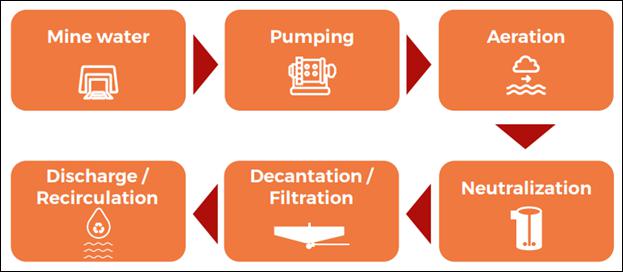
Source: Sustainability Report, Sinchi Wayra (2022)
| SANTACRUZ SILVER MINING LTD. | CABALLO BLANCO TECHNICAL REPORT | PAGE 20-6 |
| |
|
Table 20-2: Santacruz Bolivia Water Volumes
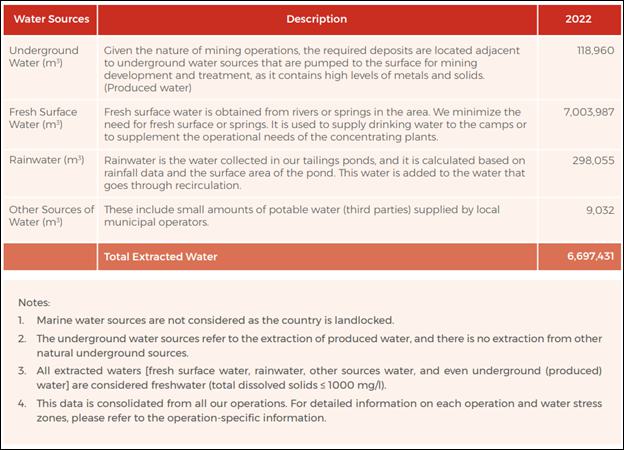
Source: Sustainability Report, Sinchi Wayra (2022)
Operational consumption is used for drilling, mine services, irrigation, and process water sourced by reclaim from the Tailings Dam. The actual water consumption is the difference between “extracted” water and “discharged water”, resulting in 1,9 million m3 consumed in 2022 for all mines.
Santacruz treats excess water to meet applicable required standards and discharge it to surface water at authorized points specified in Santacruz’s environmental permits. The discharge parameters as set out in Water Pollution Regulations Law No. 1333, include pH, iron, zinc, lead, and suspended solids, which are typical in the water treated from the mine.
| SANTACRUZ SILVER MINING LTD. | CABALLO BLANCO TECHNICAL REPORT | PAGE 20-7 |
| |
|
Figure 20-4: Santacruz Bolivia Water Balance
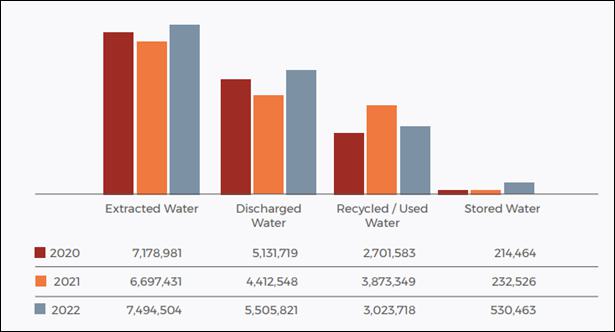
Source: Sustainability Report, Sinchi Wayra (2022)
| 20.2.1 | Solid Waste |
The Don Diego process plant is distal from the mines which feed it. The process plant along with the Tailings Storage Facility are located about 23 km Northeast of the city of Potosi, in the Don Diego Canton, Municipality of Chaqui, Cornelio Saavedra Province, of the Department of Potosi. At an elevation of 3,550 masl at UTM coordinates WGS-84: 228933E and 7841150N. There is a 60 km drive from the mines to the Don Diego Processing plant.
The Chilimocko tailings storage facility at Don Diego is inspected regularly and maintained to the standards set out by the Canadian Dam Association guidelines. The dam is under the supervision of engineers from AMEC (now Wood Engineering) and recently an external audit was conducted by Knight Piésold Consulting. The Chilimocko Dam is 55 m high, downstream-constructed dam. The Stage IV raise was completed in 2019 and current crest elevation is 3,625 m. Construction for the next expansion is planned to begin in 2024 and conclude 12 months later.
| SANTACRUZ SILVER MINING LTD. | CABALLO BLANCO TECHNICAL REPORT | PAGE 20-8 |
| |
|
Figure 20-5: Volume profile of the Chilimocko Dam by Stage Height
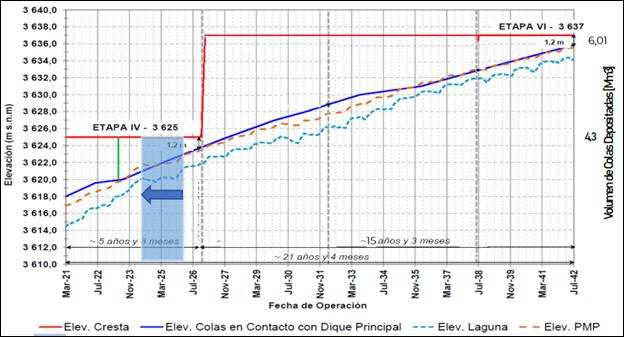
| SANTACRUZ SILVER MINING LTD. | CABALLO BLANCO TECHNICAL REPORT | PAGE 20-9 |
| |
|
Figure 20-6: Aerial Photography of the Chilimocko TSF
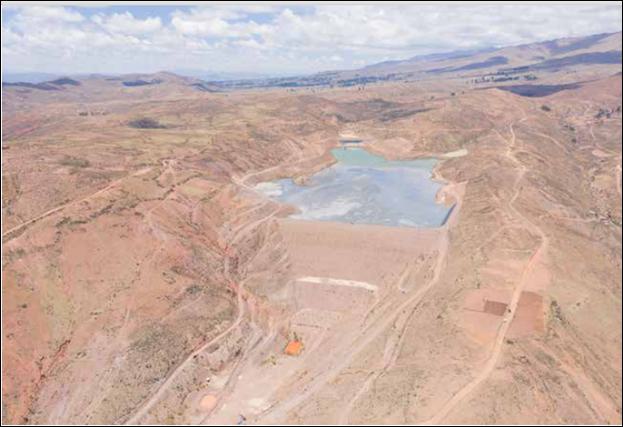
Source: Glencore (2019)
The company also monitors and manages 4 inactive tailings facilities (1, 2, 3 & Yanakasa) at the Don Diego location.
Yana Khasa is a 40 m high, upstream-constructed dam, which contains 2.2 Mm3 of tailings. Recent activities at the site include Repositioning piezometers, cleaning of the standpipe piezometers to improve groundwater monitoring, and Installation of fences to protect instrumentation; and
Dikes 1, 2, and 3 are, upstream constructed dams which contain a total of 0.4 Mm3 of tailings. Recent activities at the sites include cleaning of the standpipe piezometers to improve groundwater monitoring and Installation of fences to protect the instrumentation.
| SANTACRUZ SILVER MINING LTD. | CABALLO BLANCO TECHNICAL REPORT | PAGE 20-10 |
| |
|
Although mine waste rock is preferentially stored underground or used as backfill, each of the mines has a permitted and designed waste rock storage area designed for stability, as well as the prevention of acid rock drainage and metal leaching. Sludge from the water treatment plants is deposited in lined ponds adjacent to the treatment plants. Given the mines’ proximity to the City of Potosi, Domestic and Medical waste disposal are managed through the Municipal Garbage Collection Service. Industrial waste such as scrap metal, used Oil, tires, etc. is temporarily stored at each mining unit and collected by companies specialized in recycling.
Table 20-3: Stored Tonnes of Waste Rock by Category (2022)
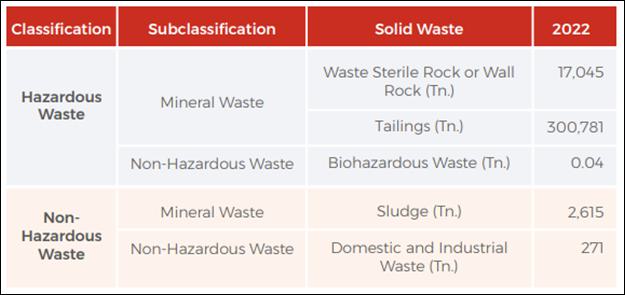
| 20.2.2 | Water Management |
Each of the mines produces enough water to treat and reuse for industrial use on site. Excess treated water is discharged to the environment at regulated quality standards. Annually, a total of 2.5 Mm3 of mine water is treated and 2.4 Mm3 discharged from two water treatment plants.
Given the remote location of the process plant, which is usually the largest water consumer, each mine treats and discharges excess water to the environment. These discharges are regulated for quality and quantity by the environmental license. End uses include consumption by neighboring communities and agricultural/industrial use by llama ranchers and mining cooperatives downstream. Caballo Blanco supplies two thousand cubic meters of treated water per year to the local sanitary administration (AAPOS) to support industrial activities and discharges the remaining treated water to the Jayaquila and Mocaña rivers. Caballo Blanco is able to meet discharge requirements with aeration, pH adjustment and clarification by settling.
| SANTACRUZ SILVER MINING LTD. | CABALLO BLANCO TECHNICAL REPORT | PAGE 20-11 |
| |
|
Don Diego process plant maximizes the recirculation of water from its tailing storage facility and draws makeup water from permitted surface sources.
Figure 20-7: Caballo Blanco Mine Water Balance
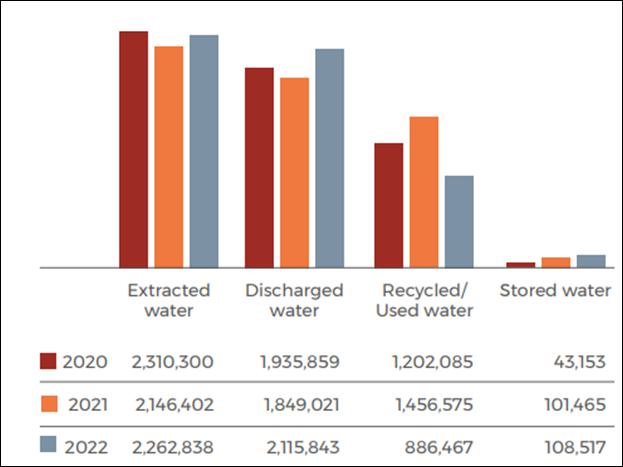
Source: Sinchi Wayra 2022 Sustainability Report
| 20.3 | Permitting |
Santacruz Silver operates the Bolivar mine as a joint venture with the Bolivian Government (COMIBOL) The structure of the contract with COMIBOL is a “Partnership Contract governing Bolivar and Porco Mines (CA-MBP), and its purpose is to develop and implement a mining operation for the treatment of the existing mineralogical reserves and resources in the Bolívar and Porco Mines, by the exploitation, preparation, beneficiation and sale of mineral concentrates. Contrato de Asociación Sociedad Minera Illapa S.A. is authorized as operator and responsible of executing on behalf of COMIBOL, all the operations and activities of the association contract. The shares of CA-MBP are 55% for COMIBOL and 45% for Contrato de Asociación Sociedad Minera Illapa S.A.” This renewable agreement expires in 2028.
| SANTACRUZ SILVER MINING LTD. | CABALLO BLANCO TECHNICAL REPORT | PAGE 20-12 |
| |
|
Mining Contracts that grant the right to the subsoil mining resource, is granted by the Mining Administrative Jurisdictional Authority (AJAM) over the ATE mining areas, and a contract is granted for each area or contiguous group of areas. Recent changes to the laws and government personnel have pushed Santacruz contract updates into a transitionary period waiting for final signatures and approvals. Santacruz holds Special Transitory Authorizations for each contract area which are officially designated “Mining Administrative Contracts for Adaptation”. As of the effective date, approximately half of the applications have been transitioned, and the remainder fall under Article 187 of Law No. 535 on Mining and Metallurgy, which states:
ARTICLE 187. (CONTINUITY OF MINING ACTIVITIES). Holders of Special Transitory Authorizations to be adapted or in the process of adaptation will continue their mining activities, with all the effects of their acquired or pre-constituted rights until the conclusion of the adaptation procedure.
Santacruz has fully complied with this administrative procedure and is waiting for the Mining Administrative Authority to issue the relevant documents. It should be noted that this public entity has a considerable delay in the issuance of these documents.
Environmental Licenses have been formally granted to allow operation for all mining activity, by the Ministry of Environment and Water. The following table shows the licenses held by Santacruz:
Table 20-4: Environmental Licenses Held by Santacruz
| Operation | License |
| Bolívar | 040603-02-da-0324/14 |
| Porco | 051203-02-da-0031/14 |
| Caballo Blanco – Colquechaquita Mine | 050101-02-da-131/11 |
| Caballo Blanco – Mina Reserva and Tres Amigos | 050101-02-da-561/11 |
| Caballo Blanco – Don Diego Concentrator Plant | 050302-02-da-003/2024 |
| Caballo Blanco – San Lorenzo Mine | 050101-02-da-005/06 |
| Comco | 050101-02-da-006/09 |
| Soracaya | 050801-02-CD-C3-002/2017 |
| Aroifilla Thermoelectric Plant | 050101-04-da-007/2023 |
| Yocalla Hydroelectric Plant | 050103-05-da-006/2023 |
| SANTACRUZ SILVER MINING LTD. | CABALLO BLANCO TECHNICAL REPORT | PAGE 20-13 |
| |
|
| 20.4 | Community Relations |
Santacruz mining projects are mostly well-established operations with a long history and a developed infrastructure, which provide direct benefits to employees and supporting businesses. However, the mines are located in rural to semirural areas in which the surrounding mostly agricultural communities can benefit from each operation only indirectly or through company outreach. Santacruz supports these communities by addressing services that are lacking, and helping to create value with economic development programs, and other forms of support.
Mining represents a significant portion of the Bolivian economy and is especially critical to local economies through employment, tax revenue and local procurement or supply. The high dependency on mining of areas influenced by Santacruz operations obliges responsible action and support for the health of these communities, as well as its employees and their families. Santacruz is interested in fostering an environment of social peace, respect, and mutual progress. The Social Management team for each operations consists of a dedicated Superintendent along with supporting personnel who ensure the fulfillment of its commitment to the communities.
To be most effective local Social Management groups have established communication channels to learn about the perceptions, concerns, requests, or complaints from within stakeholder communities. The communities can communicate their inquiries, complaints, concerns, and issues through letters addressed to the company, formal meetings, or the Santacruz “Ethics Hotline” channel. The local Social Management team routinely conducts community and area visits inspections and, in the case of a complaint, conducts the necessary verifications. The main channel of communication is through in-person meetings involving community leaders where minutes are recorded. As such, all parties can move cooperatively forward with acceptable initiatives and mitigations.
Prior to action, Santacruz must take into consideration social challenges faced by the country and the communities, as well as each initiative’s possible impacts on the life of people. Its actions are aimed at identifying vulnerable groups and obtaining their participation. It identifies impacts and assess risks associated with each initiative, as well as changes in Santacruz’s operations that may have repercussions on the community.
Table 20-5: Communities and Population Proximal to Santacruz Operations
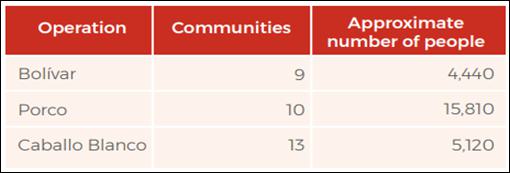
Source: Santacruz (2023)
| SANTACRUZ SILVER MINING LTD. | CABALLO BLANCO TECHNICAL REPORT | PAGE 20-14 |
| |
|
Common concerns addressed during the meetings with community leaders focus on job opportunities within the company and monitoring medium- to long-term commitments. The change of shareholders that occurred with the Santacruz purchase in March 2022 generated uncertainty in several communities, and a process of communication and meetings was necessary to assure and demonstrate that the company will maintain normal operations and fulfill its commitments to the fullest extent. The major concerns of the proximal communities put forth in 2022 are outlined in Table 20-6.
Table 20-6: Concerns Put Forth by Proximal Communities in 2022
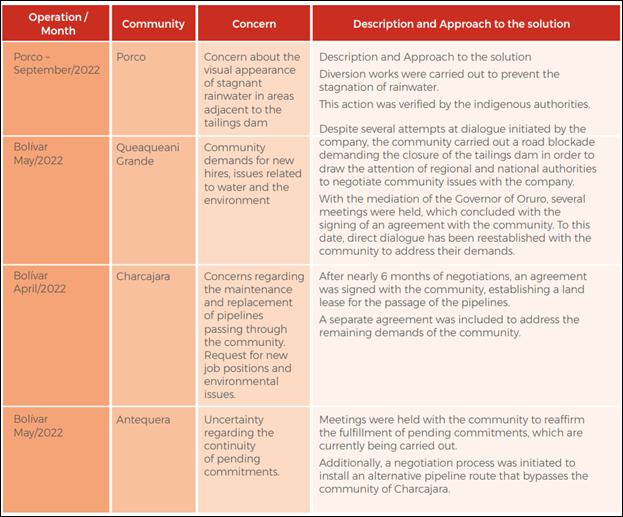
Source: Sustainability Report, Sinchi Wayra (2022)
| SANTACRUZ SILVER MINING LTD. | CABALLO BLANCO TECHNICAL REPORT | PAGE 20-15 |
| |
|
Santacruz’s investments focus on donation of assets, goods, products, and in-kind services, minimizing cash disbursements to directly benefit the communities. As part of Santacruz’s support, Santacruz has invested over $300,000 in infrastructure, including housing, pedestrian bridges, electrification, water diversion systems for irrigation, and basic sanitation, among other infrastructure projects. As a company, Santacruz encourages the communities to manage and prioritize long-term projects with a greater impact. At all times, and particularly during implementation, the communities are heavily involved in each project.
A rigorous company due diligence policy governs the contributions and investments made to community projects, so that they are made in accordance with the company’s values and ethics codes. The process begins with the requests proposed by the communities through their leaders, followed by meetings held between the Community leaders and the company during which, formal agreements are executed, which approve mutually accepted projects to be implemented.
Figure 20-8: Total Investment in Communities
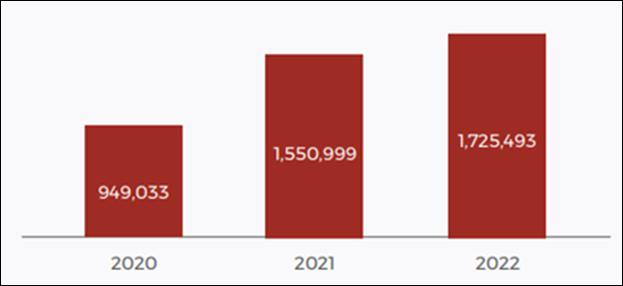
Source: Sustainability Report, Sinchi Wayra (2022)
A key player connected with all Bolivian Mines and surrounding areas are the mining cooperatives which are organized independent mining entities, some quite capable and organized with their own equipment. Recognized by the government as a valid economic activity for local development, they conduct their activities in abandoned mines or expropriating active mines, which can pose risks to business. The relationship is not completely one-sided as the Cooperatives sell mineralized material to process their product, thus mechanisms are in place to face possible subjugations, protect mine employees and the communities.
| SANTACRUZ SILVER MINING LTD. | CABALLO BLANCO TECHNICAL REPORT | PAGE 20-16 |
| |
|
More importantly, proactive solutions and agreements to avoid conflict and coexist peacefully with the different cooperatives are in place. As much as possible, with cooperatives as toll processors at Santacruz Process Plants, compliance with occupational health and safety, human rights, and good work practice is sought.
To incorporate a new supplier, an assessment is required, including:
| ● | Submission of legal documents proving that they are up to date with regard to any rules in force; |
| ● | The mineral supplier’s background is verified; for this purpose, we have access to the Thomson Reuters and Info center systems, which report their background globally. This system informs us whether the supplier has any negative local or international background; in that case, Santacruz would not deal with them; |
| ● | Commercial visit to the supplier’s operations, to directly verify the standards such as the 132 company’s Code of Ethics; In particular, whether or not child labor is employed in the operations, and any other Human Rights violations, and observations of the use of safety equipment and personal protective equipment; and |
| ● | Machinery is assessed to ensure good condition safe operation. |
Once all these steps are completed and upon the in-situ verification of legal documents, the relationship with the cooperative is authorized. A pilot support program was launched in 2019 to supply advisors and technical assistance on environment, human rights, occupational health & safety, and administrative management. The goal being to help mineral suppliers improve their internal systems and processes to ensure sustainability and compliance with Santacruz sustainability standards.
Caballo Blanco comprises a business unit with mines spread across several kilometers on the same mineralized trend and an offsite process plant and tailing facility, all proximal to the city of Potosí. Unlike Bolívar and Porco, Caballo Blanco does not have an adjacent campsite. Most employees live in the communities surrounding the city of Potosí. The mines are named Colquechaquita, Reserva, and Tres Amigos. The Don Diego Plant is located 60km away by road; other supporting units are central administrative offices in Potosí, the Thermal Power Plant in Aroifilla, and the Hydroelectric Power Plant in Yocalla. Operations at Caballo Blanco are not yet consolidated and require independent management and support. Mine operations, maintenance, planning, safety and environment, groups are separate for each mine.
Since Caballo Blanco covers a wide area, it affects many small communities. Consequently, at Caballo Blanco a large area is monitored including 13 small communities which include a population of more than 500 families or around 2,500 community members. Several mining cooperatives are also involved.
In the area of Colquechaquita, Reserva and Tres Amigos, the communities are scattered and sparsely populated, but host the settlement of cooperative miners downstream from our mining operations. Additionally, camelids are bred near the wetlands of the Jayaquilla River and Mocaña Mayu.
| SANTACRUZ SILVER MINING LTD. | CABALLO BLANCO TECHNICAL REPORT | PAGE 20-17 |
| |
|
Adjacent to the Concentrator Plant is the settlement of Don Diego, where several Santacruz employees live. There are also other more distant and less populated communities.
Santacruz’s community investment programs are aimed mostly at communities directly influenced by the operations. Community investments are designed to maximize positive impact, recognizing that each community has unique requirements and living conditions; therefore, Santacruz prioritizes based on number of beneficiaries, vulnerability, long-term sustainability, and urgency of need.
Table 20-7: Caballo Blanco Local Populations
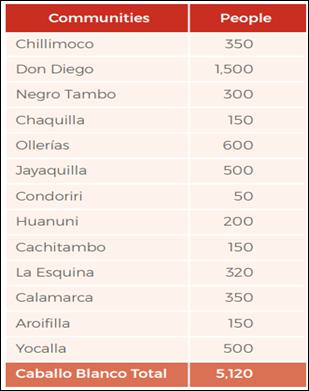
Source: Sustainability Report, Sinchi Wayra (2022)
| SANTACRUZ SILVER MINING LTD. | CABALLO BLANCO TECHNICAL REPORT | PAGE 20-18 |
| |
|
Figure 20-9: Caballo Blanco Surrounding Communities
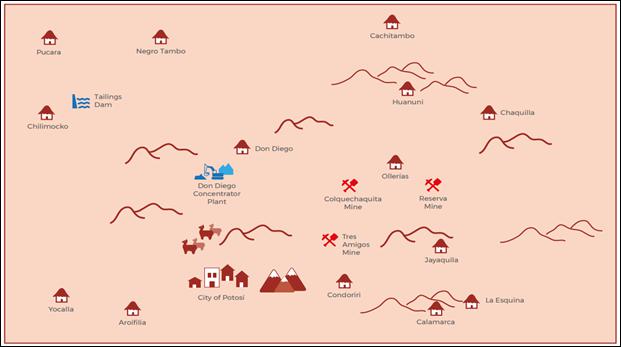
Source: Sustainability Report, Sinchi Wayra (2022)
| 20.4.1 | Education |
Santacruz has engaged in the following activities to support education in the region:
| ● | Established a scholarship program for outstanding students, children of employees that graduate from the Ollerías school at the elementary, high school and university levels. In 2021, 16 scholarships were awarded; |
| ● | Sponsored the school breakfast program in the schools within the area of influence which benefited more than 300 students; |
| ● | Provided a full-time salary for a full-time computer teacher in schools in Jayaquilla and Don Diego, which benefits more than 120 students; |
| ● | Supported the School Board of Don Diego by paying the salaries of service staff and teachers, benefiting 300 students; and |
| ● | Provide student transportation in the communities of Pucara, Negro Tambo, Chaquilla, Ollerías, Jayaquilla, Condoriri, Huanuni, Cachitambo and Calamarca, benefiting approximately 500 children. |
| SANTACRUZ SILVER MINING LTD. | CABALLO BLANCO TECHNICAL REPORT | PAGE 20-19 |
| |
|
| 20.4.2 | Community and Economic Development |
Santacruz has encouraged community and economic development in the region following ways:
| ● | Supported the administrative capacity of economic development projects in the community, promoting their production located in Don Diego, Chilimocko, Negro Tambo, Palcamayo, Huanuni, Chaquilla B, and Ollerias. This benefits more than one thousand people; |
| ● | Established a workforce training program and microenterprise creation in alternative sectors in Don Diego, working in collaboration with the Center of Mothers; and |
| ● | Donated and installed 4.4 km of irrigation pipelines in Yocalla, benefiting 800 people. |
| 20.4.3 | Environmental Initiatives |
Santacruz has undertaken several environmental initiatives, including the following:
| ● | Donated 400 quintals of food supplements for camelid cria and females, in support of the maintenance of the fauna in the area and the economic diversity; |
| ● | Purchased materials and aggregates for road improvement, benefiting 60 families; and |
| ● | Provided support works to provide water by drilling wells with a capacity of 2 liters per second, which benefits 15 families. |
In August 2022, one person from the Ollerías community filed a lawsuit with the Agro environmental court against the Tres Amigos Mine operation, alleging contamination in the area due to the runoff of material containing minerals caused by rainfall. The relevant legal process was conducted by the assigned Agro-environmental Judge, and the company presented the necessary defense documents. The plaintiff withdrew their complaint, and the judicial authorities requested the company to submit an environmental improvement plan for the area, thus concluding the proceedings.
| 20.4.4 | Local Needs |
Santacruz has responded to local needs in several ways including the following:
| ● | Sponsored social and cultural activities in several communities, benefiting more than 1,600 people; |
| ● | Provided maintenance for an agricultural tractor to ensure its optimal functioning; and |
| ● | Improved two high-voltage power line networks and made enhancements to the transformer, increasing the electrical capacity in the area and benefiting 25 families. |
| SANTACRUZ SILVER MINING LTD. | CABALLO BLANCO TECHNICAL REPORT | PAGE 20-20 |
| |
|
| 20.4.5 | Health and Sports |
Santacruz has supported health and sports for the local communities in several ways including:
| ● | Promoted, supported and sponsored sports events, benefiting more than 800 people; and |
| ● | Proceeded with the next stage of improving the sports infrastructure at the Jayaquilla Educational Unit’s sports field. |
Figure 20-10: Caballo Blanco Community Investment
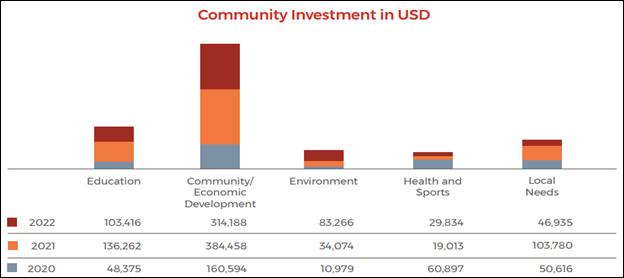
Source: Sustainability Report, Sinchi Wayra (2022)
| 20.5 | Mine Closure |
Closure Planning for Operations has social, economic, workforce, and environmental impacts, so conceptual closure plans are shared with communities. Santacruz’s goal is to recover areas by establishing a healthy ecosystem capable of sustaining productive land use, ensuring the best possible environmental conditions, including physical, chemical, biological, and ecosystem aspects, at closure. Environmental superintendents are responsible for monitoring the environmental closure planning, and periodic reviews of these plans are conducted, including surveys of areas and activities to adjust financial provisions for closure.
Land Use and Rehabilitation - environmental challenges related to biodiversity protection, soil restoration, and land use, are addressed through dialogue with stakeholders, including local communities and relevant authorities. Our comprehensive environmental management focuses on minimizing disturbed areas. In 2022, Santacruz managed a total of 6,600 hectares of land covered by Temporary Special Authorizations (ATEs) granted by the Mining Administrative Jurisdiction Authority (AJAM), under leasing contracts with the Government through COMIBOL. However, Santacruz’s processing activities, services, and related infrastructure (industrial area) currently occupy only 400.5 hectares of land, including areas of previous mining operations and other areas with environmental closure located within the properties Santacruz manage.
In 2022, Santacruz continued with the reforestation plan in the Queaqueani Dam area, in accordance with an agreement with the community of the same name, and significant progress was made in the progressive closure of the old tailings facilities at the Don Diego Concentrator Plant.
| SANTACRUZ SILVER MINING LTD. | CABALLO BLANCO TECHNICAL REPORT | PAGE 20-21 |
| |
|
| 21 | Capital and Operating Costs |
| 21.1 | Capital Costs |
The Caballo Blanco mine has been in continuous operation for many years. There will be, as the reserve is expanded and developed, the need for step changes in mine access, production or haulage methods, that may require large capital outlays. These will be financially justified as needed. However, the capital needs for continued operation to exploit the remaining reserves is limited to Primary mine development, Capital equipment rebuilds and replacements, and Tailing Storage Facility expansions. Average annual capital has been and is projected to be in the 11 to 12 $M range.
The historic total capital requirement for all the Bolivian operations is shown in Table 21-1, with Caballo Blanco requirements bolded and italicized. Caballo Blanco’s projected capital requirements for 2023 to 2027 is shown in Table 21-2.
Table 21-1: Actual Combined Capital Requirement for All Bolivian Operations, 2017 to 2022 ($M)
| 2017 | 2018 | 2019 | 2020 | 2021 | 2022 | |
| Bolivar | 8.8 | 13.7 | 13.7 | 6.3 | 11.3 | 10.2 |
| Porco | 3.0 | 8.8 | 8.4 | 3.6 | 5.3 | 3.1 |
| Reserva | 1.3 | 2.4 | 2.1 | 2.0 | 4.3 | 3.5 |
| Tres Amigos | 2.1 | 2.6 | 1.5 | 1.8 | 2.2 | 3.0 |
| Don Diego | 0.9 | 6.9 | 1.4 | 0.9 | 1.1 | 1.2 |
| Colquechaquita | 1.2 | 2.0 | 1.4 | 1.0 | 3.0 | 2.5 |
| La Paz | 3.3 | 0.6 | 0.3 | 0.4 | 0.2 | 0.7 |
| Soracaya | 0.5 | 2.1 | 0.2 | 0.1 | ||
| San Lucas | 0.8 | 0.0 | 0.0 | 0.1 | 0.4 | |
| Total | 21.8 | 39.0 | 28.5 | 16.3 | 27.8 | 24.3 |
Source: Santacruz (2023)
Table 21-2: Projected Capital Requirement for all Caballo Operations, 2023 to 2028 ($M)
| 2023 | 2024 | 2025 | 2026 | 2027 | 2028 | |
| Engineering/Admin | 0.0 | 0.0 | ||||
| Safety/Environmental | 0.8 | 3.0 | 2.1 | 2.0 | 0.1 | |
| Mobile Equipment/Maint | 1.6 | 3.7 | 2.6 | 3.8 | 2.1 | 1.8 |
| Plant | 0.4 | 0.7 | 0.7 | 0.7 | 0.5 | 0.5 |
| Exploration | 0.4 | 0.3 | 1.5 | 1.4 | 1.3 | 0.7 |
| Primary development | 6.5 | 6.0 | 6.8 | 5.6 | 4.4 | 2.4 |
| Corporate | ||||||
| Total | 9.8 | 13.7 | 13.7 | 13.5 | 8.3 | 5.4 |
Source: Santacruz (2023)
| SANTACRUZ SILVER MINING LTD. | CABALLO BLANCO TECHNICAL REPORT | PAGE 21-1 |
| |
|
Recurring exploration and primary development costs have been included in the COG calculations to better anticipate and account for total costs and make the COG more meaningful for reserve estimation and mine planning.
| 21.2 | Operating Costs |
Costs used for cut-off grade analysis were taken from actual costs from the last six months of 2022, and the first three months of 2023. This most recent cost history was deemed the most accurate and stable period, and which best represented the true costs of the operation. Sinchi Wayra was acquired by Santacruz Silver in March of 2022, so it was decided to use actual costs incurred while the mines were under current ownership. The actual cost of corporate G&A was allocated to each of the businesses.
Table 21-3: Unit Operating Costs ($/t)
| Mine | 75.66 |
| Mine operations | 42.13 |
| Mine maintenance | 19.19 |
| Indirect | 14.34 |
| Plant | 17.10 |
| Warehouse | 0.89 |
| G&A | 13.28 |
| Total | 106.94 |
Source: Santacruz (2023)
Mine operations include direct costs of mining, including labor, energy, materials, and services.
Mine Equipment Maintenance Costs includes maintenance to all equipment related to direct development, exploitation and haulage, as well as service equipment such as pumping, ventilation, winches, etc.
Indirect costs would include Site Management, Technical services, Site Administration, Environmental and Social, Safety and Security.
Plant costs include direct Beneficiation costs as well as plant maintenance, and indirect costs.
Warehouse costs refer to Concentrate handling and storage.
General and Administration includes allocated Bolivian corporate costs.
| SANTACRUZ SILVER MINING LTD. | CABALLO BLANCO TECHNICAL REPORT | PAGE 21-2 |
| |
|
| 22 | Economic Analysis |
| 22.1 | Result |
The Reserve Estimate was generated using actual costs experienced during a stable production period following the change in management after the purchase of the mine by Santacruz Silver (2022 and beginning of 2023). Actual costs were used for mine operating, concentrate overland transport, port costs, and shipping as well as smelting fees, payment terms, and penalty charges in effect during that period. A simplified Cash flow model was built to model the costs and conditions used to generate the Reserve estimates stated in this report.
The Caballo Blanco mine is part of a multi-operation business. However, the Economic model treats it as a separate financial entity with Bolivian corporate costs allocated for the analysis. As well, the operation is comprised of three mines which feed one offsite Process plant. The financial modelling examines the value of the consolidated operation on a 100% basis to support the Reserve statement.
The Caballo Blanco mines have been in continuous operation for several decades and the deposits are a network of relatively narrow veins. These two aspects drive the normal exploitation process of the mine, where inferred resources are converted and exploited in the same budget year. Resources are generally proven-up by drifting and sampling instead of drilling. Therefor normal budgeting and mine planning includes resources outside of the Reserve estimate.
For the current exercise in this report, only Proven and Probable reserves are included in financial evaluation, so the production schedule represents the depletion of these reserves at average grade and current production rates. The context of the production schedule exploits the Proven and Probable reserves as part of a continuous operation and as such does not include the closure activities.
Table 22-1: Production Forecast – Mining and Processing
| Unit | 2023 | 2024 | 2025 | 2026 | |
| Mine Production | |||||
| Tonnes Mined | (DMT) | 300,000 | 300,000 | 300,000 | 133,512 |
| Tonnes Processed | (DMT) | 300,000 | 300,000 | 300,000 | 133,512 |
| Head Grades | |||||
| Zinc | (%) | 9.18 | 9.18 | 9.18 | 9.18 |
| Lead | (%) | 1.90 | 1.90 | 1.90 | 1.90 |
| Silver | g/t | 193 | 193 | 193 | 193 |
Source: Santacruz (2023)
| SANTACRUZ SILVER MINING LTD. | CABALLO BLANCO TECHNICAL REPORT | PAGE 22-1 |
| |
|
Metallurgical recoveries and concentrate qualities are actual for the times and head grades that were actually mined. These parameters will necessarily be conservative considering the higher grades in the production schedule.
Table 22-2: Production Forecast - Concentrate
| Unit | 2023 | 2024 | 2025 | 2026 | |
| Concentrates | |||||
| Zinc | (DMT) | 50,298 | 50,298 | 50,298 | 22,384 |
| Zn Conc. Grade | (%) | 50 | 50 | 50 | 50 |
| Ag (in Zinc) | g/t | 218 | 218 | 218 | 218 |
| Zn Recovery | (%) | 92 | 92 | 92 | 92 |
| Ag (in Zinc) | (%) | 19 | 19 | 19 | 19 |
| Lead | (DMT) | 7,531 | 7,531 | 7,531 | 3,352 |
| Pb Conc. Grade | (%) | 58 | 58 | 58 | 58 |
| Ag (in lead) | g/t | 5,482 | 5,482 | 5,482 | 5,482 |
| Pb Recovery | (%) | 77 | 77 | 77 | 77 |
| Ag (in Lead) | (%) | 72 | 72 | 72 | 72 |
| Metal Recovery | |||||
| Zinc | (FMT) | 25,000 | 25,000 | 25,000 | 11,000 |
| Silver (in Zinc) | (FOT) | 353,000 | 353,000 | 353,000 | 157,000 |
| Lead | (FMT) | 4,000 | 4,000 | 4,000 | 2,000 |
| Silver (in Lead) | (FOT) | 1,330,000 | 1,330,000 | 1,330,000 | 592,000 |
| Silver (Total) | (FOT) | 1,683,000 | 1,683,000 | 1,683,000 | 749,000 |
Notes:
FMT = Fine Metric Tonnes; DMT = Dry Metric Tonnes; FOT = Fine Ounces Troy
Source: Santacruz (2023)
That same logic follows to the net revenue generation (Table 22-3) which includes smelter charges and penalty fees.
| SANTACRUZ SILVER MINING LTD. | CABALLO BLANCO TECHNICAL REPORT | PAGE 22-2 |
| |
|
Table 22-3: Revenue and Cost Projection ($M)
| Unit | 2023 | 2024 | 2025 | 2026 | |
| Payable Metal Revenue | |||||
| Zinc | 64 | 64 | 64 | 29 | |
| Metallurgical Deduction | 10 | 10 | 10 | 5 | |
| Gross Payable Zinc | 54 | 54 | 54 | 24 | |
| Lead | 10 | 10 | 10 | 4 | |
| Metallurgical Deduction | - | - | - | - | |
| Gross Payable Lead | 9 | 9 | 9 | 4 | |
| Silver | 35 | 35 | 35 | 16 | |
| Metallurgical Deduction in Zinc | 4 | 4 | 4 | 4 | |
| Metallurgical Deduction in Lead | 1 | 1 | 1 | 1 | |
| Gross Payable Silver | 30 | 30 | 30 | 13 | |
| Gross Revenue (Total) | 93 | 93 | 93 | 41 | |
| Smelter Charges and Penalties | |||||
| Treatment charges Zn | (USD/t) | 277 | 277 | 277 | 277 |
| Treatment charges Zn | 14 | 14 | 14 | 6 | |
| Treatment charges Pb | (USD/t) | 133 | 133 | 133 | 133 |
| Treatment charges Pb | 1 | 1 | 1 | - | |
| Penalties in Zn | (USD/t) | 3 | 3 | 3 | 3 |
| Penalties in Zn | - | - | - | - | |
| Penalties in Lead | (USD/t) | 71 | 71 | 71 | 71 |
| Penalties in Lead | 1 | 1 | 1 | - | |
| Refining Charges in Pb | (USD/FOZ) | 1 | 1 | 1 | 1 |
| Refining Charges in Pb | 2 | 2 | 2 | 1 | |
| Smelter Fees and Penalties | 15 | 17 | 17 | 17 | |
| Net Revenue | 277 | 277 | 277 | 277 | |
| Operating Costs | |||||
| Production Costs | 30 | 30 | 30 | 14 | |
| Cost of Sales | |||||
| Rail Freight Zn | - | - | - | - | |
| Rail Freight Pb | - | - | - | - | |
| Port Expenses Zn | 2 | 2 | 2 | 1 | |
| Port Expenses Pb | - | - | - | - | |
| Rollback Fee Zn | 5 | 5 | 5 | 2 | |
| Rollback Fee Pb | 1 | 1 | 1 | - | |
| Concentrate Freight and Port Costs | 8 | 8 | 8 | 8 | |
| Mine Royalty | 6 | 6 | 6 | 3 | |
| Communities and Unions | 2 | 2 | 2 | 1 | |
| Selling Costs | 16 | 16 | 16 | 7 | |
| Total Cost of Sales | 46 | 46 | 46 | 21 | |
Source: Santacruz (2023)
| SANTACRUZ SILVER MINING LTD. | CABALLO BLANCO TECHNICAL REPORT | PAGE 22-3 |
| |
|
Depreciation is a product of previous operation and annual capital expenditure incurred for the exploitation of the reserve tonnage. Capital is limited to that required to support mining, processing, and tailing storage for the reserve. Corporate G&A is that part of the in-country costs allocated to the Caballo Blanco mine.
Table 22-4: Cashflow Projection ($M)
| 2023 | 2024 | 2025 | 2026 | |
| Income Statement | ||||
| Net Revenue | 76 | 76 | 76 | 34 |
| Production Costs | -30 | -30 | -30 | -14 |
| Selling Costs | -16 | -16 | -16 | -7 |
| Depreciation | -10 | -9 | -9 | -11 |
| Gross Profit | 19 | 20 | 21 | 2 |
| Corporate G&A | -3 | -4 | -4 | -2 |
| Operating Profit | 16 | 16 | 17 | 0 |
| EBIT | 16 | 16 | 17 | 0 |
| Income Tax Expense (CIT) | -6 | -6 | -6 | 0 |
| Net Gain/(Loss) for the Year | 10 | 10 | 10 | 0 |
| Cashflow Statement | ||||
| Cash from Operations Activities | ||||
| Net Income | 10 | 10 | 10 | 0 |
| Depreciation | 10 | 9 | 9 | 11 |
| Subtotal | 20 | 19 | 19 | 11 |
| Cash from Investing Activities | ||||
| Sustaining Capital Expenditure | -9 | -13 | -7 | 0 |
| Subtotal | -9 | -13 | -7 | 0 |
| Cash Balance | ||||
| Beginning | 0 | 11 | 17 | 29 |
| Change in Cash | 11 | 6 | 12 | 11 |
| Ending | 11 | 17 | 29 | 40 |
Source: Santacruz (2023)
| SANTACRUZ SILVER MINING LTD. | CABALLO BLANCO TECHNICAL REPORT | PAGE 22-4 |
| |
|
Income Tax is 37.5% of the EBIT. As seen, the operations generate a positive cash flow after tax upon exploitation of the stated reserve at the metal prices used to generate the reserve.
| 22.2 | Sensitivities |
A univariate sensitivity analysis was performed to examine which factors most affect the Project economics when acting independently of all other cost and revenue factors. Each variable evaluated was tested using the same percentage range of variation, from -20% to +20%, although some variables may experience significantly larger or smaller percentage fluctuations over the LOM. For instance, the metal prices were evaluated at a ±20% range to the base case, while the capex and all other variables remained constant. This may not be truly representative of market scenarios, as metal prices may not fluctuate in a similar trend. The variables examined in this analysis are those commonly considered in similar studies – their selection for examination does not reflect any particular uncertainty.
Notwithstanding the above noted limitations to the sensitivity analysis, which are common to studies of this sort, the analysis revealed that the Project is most sensitive to metal pricing. The Project showed the least sensitivity to capital costs. Figure 22-1 shows the results of the sensitivity analysis.
Figure 22-1: Univariate Sensitivities
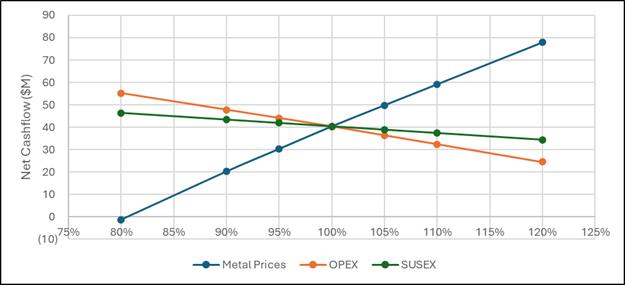
| SANTACRUZ SILVER MINING LTD. | CABALLO BLANCO TECHNICAL REPORT | PAGE 22-5 |
| |
|
| 23 | Adjacent Properties |
There are no adjacent properties to any of the Caballo Blanco mining operations.
| SANTACRUZ SILVER MINING LTD. | CABALLO BLANCO TECHNICAL REPORT | PAGE 23-1 |
| |
|
| 24 | Other Relevant Data and Information |
Mining has been ongoing since the effective date of this report through 2023 and into 2024. Total mining in 2023 was 316,718 t at a grade of 166 g/t Ag, 1.32% Pb, and 6.92% Zn, resulting in the production of 1.54 Moz of Ag, 3,237 t of Pb, and 20,335 t of Zn.
This production cannot simply be subtracted from the January 1, 2023, resource or reserve estimates contained in this report, however. As described previously, reserves and resources are adjusted as the mining progresses based on development along vein and associated sampling. These adjustments can be significant, and the geologic block model is updated to account for this new information. The operations team at Caballo Blanco uses the considerable modelling tools and methods at their disposal to incorporate these operational updates to guide their mine planning.
The January 1, 2023 Reserves statement is based on a fixed model. However, block model updates are generated for annual budgeting and forecasting. These updates incorporate projected operating costs, updated block grades and NSR factors as applicable.
A significant amount of the 2023 production came from blocks that were not included in the stated January 1, 2023 reserves.
However, actual dilution was higher than estimated in the January 1, 2023 reserves. Actual dilution in the Sublevel open stopes was 20.7% compared to an estimate of 12.5%. In the avoca stopes, actual dilution was 16.2% compared to an estimate of 10%.
This ongoing estimation process provides a good mine planning guide as well as an accurate empirical tool for reconciliation. A direct reconciliation with the January 1, 2023 Reserve and Resource blocks stated in this report shows that:
| ● | 56% of the mined mineralized production for 2023 originated from the Proven and Probable reserves; |
| ● | 38% of mined mineralized production for 2023 originated from Measured, Indicated, and inferred Resources outside of the reserve base, which were converted into reserves as mining progressed; and |
| ● | 6% of mined mineralized production for 2023 originated from the increased external dilution. |
This analysis provides a good indication of the reserve drawdown and continuous level of replenishment resulting from normal operations in identified and active mineralized veins.
Details of the 2023 production and economic results are included in Santacruz’s MD&A filing.
| SANTACRUZ SILVER MINING LTD. | CABALLO BLANCO TECHNICAL REPORT | PAGE 24-1 |
| |
|
| 25 | Interpretations and Conclusions |
| 25.1 | Observations |
The Caballo Blanco Project is located in the Cordillera de los Azanaques, forming the western edge of the Cordillera Oriental, which is detached from the Cordillera de los Frailes, belonging to the group of central mountain ranges. Characterized by the essence of undulating plateaus, outstanding mountains parallel to the course of the Andes, with elevations that vary between 3,400 and 4,600 masl. The area is part of the polymetallic belt of the altiplano and the Cordillera Occidental.
The most important ore deposits of the Eastern Cordillera are polymetallic hydrothermal deposits mined principally for Sn, W, Ag and Zn, with sub-product Pb, Cu, Bi, Au and Sb. They are related to stocks, domes and volcanic rocks of Middle and Late Miocene age (22 to 4 Ma). Mineralization occurs in veins, fracture swarms, disseminations and breccias. The deposits of the Eastern Cordillera are epithermal vein and disseminated systems of Au, Ag, Pb, Sb, as that have been telescoped on to higher temperature mesothermal Sn-W veins and, in some cases, porphyry Sn deposits. The telescoping is a characteristic of these deposits and is the result of collapse of the hydrothermal systems, with lower temperature fluids overprinting higher temperature mineralization. The systems show a fluid evolution from a high temperature, low sulphidation state to intermediate sulphidation epithermal and high sulphidation epithermal.
The Caballo Blanco Project is an “advanced property” and has been in continuous production since 1993. Glencore and subsequently Santacruz Silver has performed exploration and resource expansion drilling of surface and underground drillholes at the Caballo Blanco since 2010 totalling 39,562.55 m. The 128 drillholes and 19,644 underground channels in the database were supplied in electronic format by Santacruz. This included collars, downhole surveys, lithology data and assay data (i.e., Ag g/t, Pb%, Zn%, Fe%, Sn%).
Verification of the Caballo Blanco drillhole and underground sample assay databases are primarily focused on silver, lead and zinc in addition to iron, arsenic, sulphur and tin. Sample databases were supplied in ExcelTM format and in LeapFrogTM. Checks against source data and assay certificates showed agreement. Statistical analyses used to investigate and identify errors were performed and resulted in minor issues. These have been corrected and it is recommended that a continued program of random “spot checking” the database against assay certificates be employed.
During the 2023 site visit, an extensive independent sampling verification plan was implemented with a total of 80 samples collected across from the Bolivar, Porco and Caballo Blanco operations. The Don Diego laboratory is an NB/ISO/IEC 17025:2018 accredited laboratory which performs all assay analyses for the mining and processing operations for Sinchi Wayra including Caballo Blanco. The Don Diego laboratory in owned and operated by the Issuer, Santacruz.
Results of the verification samples indicates that the regression predictions perfectly fit the data meaning that the check sampling program successfully verified and validated the data and although, these results are not a complete audit of the laboratory, they do verify that the assay results are suitable for resource estimation purposes.
| SANTACRUZ SILVER MINING LTD. | CABALLO BLANCO TECHNICAL REPORT | PAGE 25-2 |
| |
|
The geological and lithological solid domain models were supplied by Santacruz in both DatamineTM and LeapFrogTM which are both industry-leading software systems. The QP imported the multiple vein domains into a similar system called MineSightTM to verify solids volumes and ensure matching of the solids domains against the drillhole and sample database. Results confirmed location and extent of volumes are appropriate to resource estimation purposes.
Resource block models were supplied in DatamineTM format which is an industry recognized software system used for resource estimation. These models were then imported to MineSightTM for verification of the resource estimation. In addition, independent estimations were run using the verified sample data and vein domains employing inverse distance estimations to ensure reasonableness and verify the resources independently. Results illustrated good agreement between the original and verification models. Verification of the SG regression analysis was also performed by comparing measured versus calculated density values.
The mineral resources were estimated in conformity with CIM’s “Estimation of Mineral Resources and Mineral Reserves Best Practices Guidelines” (December 2019) and are reported in accordance with NI 43-101 guidelines. The Qualified Person evaluated the resource in order to ensure that it meets the condition of “reasonable prospects of eventual economic extraction” as suggested under NI 43-101. The criteria considered were confidence, continuity and economic cut-off. The resource listed below is considered to have “reasonable prospects of eventual economic extraction”.
Using a cut-off grade of 10.0% ZnEq, the Caballo Blanco operations resources are presented in Table 25-1.
Table 25-1: Base-Case Total Mineral Resources at 10.0% ZnEq Cut-off
| Total Caballo Blanco 2023 Mineral Resources | |||||
| Mine | Category | Tonnes (‘000) | Zn (%) | Pb (%) | Ag (g/t) |
| Caballo Blanco | Measured | 726 | 15.96 | 3.03 | 321 |
| Indicated | 502 | 14.32 | 2.86 | 269 | |
| Total M+I | 1,227 | 15.29 | 2.96 | 300 | |
| Inferred | 2,217 | 13.28 | 2.12 | 199 | |
Notes:
| 1) | The current Resource Estimate was prepared by Garth Kirkham, P.Geo., of Kirkham Geosystems Ltd. |
| 2) | All mineral resources have been estimated in accordance with CIM definitions, as required under NI43-101. |
| 3) | The Mineral Resource Estimate was prepared using a 10.0% zinc equivalent cut-off grade. Cut-off grades were derived from $25.20/oz silver, $1.38/lb zinc and $1.20/lb lead, and process recoveries of 92.1% for zinc, 77.2% for lead, and 90.8% for silver. This cut-off grade was based on current smelter agreements and total OPEX costs of $106.94/t based on 2022 actual costs plus capital costs of $42.33/t. All prices are stated in $USD. |
| 4) | An Inferred Mineral Resource has a lower level of confidence than that applying to an Indicated Mineral Resource and must not be converted to a Mineral Reserve. It is reasonably expected that the majority of Inferred Mineral Resources could be upgraded to Indicated Mineral Resources with continued exploration. |
| 5) | Mineral resources are not mineral reserves until they have demonstrated economic viability. Mineral resource estimates do not account for a resource’s mineability, selectivity, mining loss, or dilution. All figures are rounded to reflect the relative accuracy of the estimate and therefore numbers may not appear to add precisely. |
| SANTACRUZ SILVER MINING LTD. | CABALLO BLANCO TECHNICAL REPORT | PAGE 25-3 |
| |
|
The QPs found that Caballo Blanco is a well-managed operation that should be capable of sustaining profitable operations for many years to come in the same fashion as it has operated for the past several years.
The reserves were found to be estimated correctly using industry-standard techniques and procedures and industry-standard software by diligent and competent professionals.
The mine has an ample provision of skilled workers. Typical and reasonable ore control systems were in place, but it is possible that the results could be improved with a closer attention to appropriate mining widths, minimizing them wherever possible to minimize dilution.
The availability and utilization statistics show that the mines are well equipped, but these statistics can sometimes be misleading depending on how the factors are calculated. Mine supervision sited equipment reliability as an impediment to achieving targets.
The processing plant appears to be well run as evidenced by a lack of spillage. The metallurgical team has a good understanding of the processing variable that determines how material will respond to the Don Diego processing facility.
| 25.2 | Risks |
Many risks exist which are common to most mining projects including operating and capital cost escalation, permitting and environmental compliance, unforeseen schedule delays, changes in regulatory requirements, ability to raise financing and metal price. Many of these ever-present risks can be mitigated with adequate engineering, planning and pro-active management. The most significant risks to this project and its continued development are related socio-economic and geo-political factors.
The Project also subject to site-specific risks, including the following:
| ● | The activity that is prevalent throughout the region related to Cooperativas and artisanal miners may cause issues for access and for reasonable prospects of eventual economic extraction and may condemn or reduce resources and reserves in those areas. The Caballo Blanco mines are relatively isolated and not flanked by camps or towns. Attention to community relations has developed strong mutually beneficial working relationships with many of the local population and mining cooperatives which has created a sustained period of stable political and socio-economic cooperation. However, changes in this relationship and instability would pose a significant risk to continued operation of the mines in addition to risks related to tenure and ownership; |
| ● | The current political and socio-economic climate in Bolivia poses risks and uncertainties that could delay or even stop development as reported within the Fraser Institute Annual Report 2022 where Bolivia ranks very low in many non-technical metrics. Bolivia has been ranked consistently low for the past five years and ranks in the lower quartile on all metrics that gauge risk and uncertainty. It is difficult to gauge or qualify the level or extents of the risks however, all companies working in Bolivia must continue to be aware of the potential risks and develop mitigation strategies. A significant risk related to the Santacruz Bolivian mineral assets and in particular the mineral resources and mineral reserves is the significant artisanal activity that continues to exist. This activity is not only a socio-economic risk but also affects access to resources and reserves along with potential sterilization of mineral resources; |
| SANTACRUZ SILVER MINING LTD. | CABALLO BLANCO TECHNICAL REPORT | PAGE 25-4 |
| |
|
| ● | Geological interpretations may be subjective and may result in the location and extent of some of the mineralized structure although as the Caballo Blanco mines are comprised of well constrained veins, this risk is minimal; |
| ● | As vein thicknesses are narrow, resources may be sensitive to dilution although the relative high grades that exist at the Caballo Blanco mines are successful mitigating such risks to date; |
| ● | Varying resource classification methods and criteria may vary as more data is considered; |
| ● | There is no guarantee that further drilling will result in additional resources or increased classification; |
| ● | Further work may disprove previous models and therefore result in condemnation of targets and potential negative economic outcomes; |
| ● | Lower commodity prices could change the size and grade of the potential targets; |
| ● | Ability to replace mined reserves on an annual basis; and |
| ● | Maintenance of permitting. |
As the mines continues to expand to depth, the following aspects of mine operations will be challenged:
| ● | Worker travel time (reduced time at the face); |
| ● | Dewatering inflow quantities, infrastructure and costs; |
| ● | Ventilation system needs and costs; |
| ● | This will be particularly felt in Colquechaquita, as it is a shaft access mine with most of its remaining reserve at depth. The shaft will ultimately require extension to depth or trackless equipment will be required to haul the ore to the shaft bottom; |
| ● | Supply and delivery of backfill was observed to be behind schedule which could have been caused by low development production, haulage bottlenecks, etc. The outcome, however, increases risk of hanging wall failure in the stopes and ore dilution from over-mucking; |
| ● | The process plant is not located on site, so ore transport costs can be significant and factors such as dilution have a greater impact on mineralized material value; and |
| ● | As is shown on Figure 22-1, the greatest risk to the economic results in this study is from changes to metal prices. |
| SANTACRUZ SILVER MINING LTD. | CABALLO BLANCO TECHNICAL REPORT | PAGE 25-5 |
| |
|
| 25.3 | Opportunities |
Project opportunities include:
| ● | The primary opportunity to the mine is to improve the grade to the mill by focusing on mine dilution. As is typical with all narrow width mining, dilution is very sensitive to the mined widths of veins, which must be kept at minimum to accommodate equipment widths. Often veins are over-mined to ensure complete recovery of the ore. This practice significantly increases dilution due to overbreak of the hangingwall and footwall; |
| ● | The mines would all benefit from more diamond drilling, particularly the Tres Amigos with is long strike length and little lateral development; |
| ● | A systematic exploration program could provide an excellent opportunity for successfully uncovering new discoveries; |
| ● | An increased understanding and derivation of alternative theories may result in further discovery and expansion for the Project; |
| ● | A hydrogeological study could help the operation to better characterize and understand water inflows, aiding design work and planning to reduce the impact of major seasonal inflows; |
| ● | Higher commodity prices could change the size and grade of the potential targets; and |
| ● | Potential for expansion and classification upgrade of resources as mining activities progress. |
Caballo Blanco group of mines is firmly established as a producing property but has yet to be consolidated into a fully integrated mine. Each mine is independently managed and operated and there are very few, if any, shared services. All three mines are on the same mineralized trend and consolidation is a possibility.
| SANTACRUZ SILVER MINING LTD. | CABALLO BLANCO TECHNICAL REPORT | PAGE 25-6 |
| |
|
| 26 | Recommendations |
To advance the Caballo Blanco mining operation and further evaluate the potential additional veins and increase resources thereby displacing depletion due to ongoing mining activities, the following is recommended:
| ● | Regional exploration for identification of new veins; |
| ● | Incorporate structural interpretations to assist regional understanding; |
| ● | QA/QC program review and improvement; |
| ● | Investigate source of anomalous lead values experienced with the field blanks; |
| ● | Incorporation of externally certified blanks and standards into the QA/QC program; |
| ● | Insertion of QA/QC samples throughout at a rate of 1 in 20 for blanks, standards and duplicates; |
| ● | On-going verification of assay by way of umpire laboratory analysis which may include cross-validation with the company’s Mexico laboratory at Zimapan; |
| ● | Analysis of thickness and grade-thickness profiles for resource targeting and predictive dilution study; |
| ● | Hydrogeological study and modelling should be done to better understand water inflows and minimize their impact on production; |
| ● | Plan and execute a resource expansion program including drilling and underground sampling to fully identify and upgrade resources proximal to active mining areas for inclusion in the 2-year mine plan. This is important so that existing mine development can be fully utilized, and reductions in mine development requirements and rate of vertical descent realized; |
| ● | Resource drilling to justify more integrated mine development is also important for stable long-term production and growth. Moving the properties toward a more integrated operation can add value to the project; |
| ● | Extensive surface drilling for near surface targets along with underground drilling for resource delineation and extension; |
| ● | As is typical with all narrow width mining, dilution is very sensitive to the mined widths of veins. Good work is being done on identifying and qualifying specific stope dilution. Analysis and incorporation of findings into the stope planning and mine operations is an opportunity to increase project value; Often veins are over-mined to ensure complete recovery, but this practice comes with significantly increased dilution due to overbreak of the hangingwall and footwall. The operation should conduct a thorough test stoping experiment to ensure the most economic balance between incomplete recovery and excessive dilution; |
| SANTACRUZ SILVER MINING LTD. | CABALLO BLANCO TECHNICAL REPORT | PAGE 26-1 |
| |
|
| ● | Underground operations that use three x 8 hour shifts typically lose much worker productivity due to excessive travel and break time over such a short shift. The current operation has an effective time of 5.5 hours per worker on an 8-hour shift. Consideration should be given to test a longer shift, say a schedule of 4 x 10 hours per week with three days off. With the same 2.5 hours of travel and break time, the effective time would increase to 7.5 hours per shift, resulting in an increase from 68% to 75% shift effectiveness or actual working time. The workers are apt to find that the longer days are harder, but that the three days off provide more rest on the balance of the week; |
| ● | The methodology for calculating equipment and utilization factors should be reviewed and adjusted if necessary. If equipment availability is, in fact, impeding production as was reported by supervision, it is not currently reflected in these statistics; |
| ● | Devote attention to optimizing material transport. Transport of waste rock is critical to stope productivity and stability with the mining methods being used, thus its supply and transport are critical to mine production; |
| ● | The possibility for ore sorting or should be evaluated. As the mines each have a considerable haulage distance for run-of-mine ore, reducing the quantity to reduce haulage costs could be economically beneficial. On site crushing may be required to conduct sorting, however, offsetting or exceeding the savings it would provide to the trucking costs; |
| ● | At Don Diego Plant, the period analyzed from August 2020 to July 2021 exhibited more downtime than planned. Investigate opportunities to raise Process Plant throughput and reduce downtime to improve project economics; |
| ● | Metallurgical testwork to investigate opportunities to increase recoveries, through grinding, reagent dosage or newer flotation technologies; |
| ● | Investigate geo-metallurgical characteristics of the feed; |
| ● | The operation should continue to maintain diligent accounting centers to determine each mine’s profitability and, if necessary, shift resources or assets to maximize profits; and |
| ● | Continue open communication and fair business practices with mining cooperatives and surrounding communities to minimize risk of asset subjugation. |
These recommendations have not been costed, as they represent changes to current practices that can be funded by existing operating budgets.
| SANTACRUZ SILVER MINING LTD. | CABALLO BLANCO TECHNICAL REPORT | PAGE 26-2 |
| |
|
| 27 | References |
2019 Sustainability Report – Sinchi Wayra S.A. Illapa S.A. – used as the basis for section 14
2020 Sustainability Report – Sinchi Wayra S.A. Illapa S.A. – used as the basis for section 14
Ahlfeld, F.E. & Schneider-Scherbina, A., 1964. Los yacimientos minerales y de hidrocarburos de Bolivia. Departamento Nacional de Geología (Bolivia) Boletín 5 (Especial), 388 p.
Arce Burgoa, O.R., 2009. Metalliferous Ore Deposits of Bolivia p. 45-47.
Barrios, Enrique, Dentons Guevara & Gutierrez S.C., 18 March 2022 “Local Counsel Legal Opinion on the Porco Mine”
Barrios, Enrique, Dentons Guevara & Gutierrez S.C., 18 March “Local Counsel Legal Opinion on the Caballo Blanco Project”,
Barrios, Enrique, Dentons Guevara & Gutierrez S.C., 18 March 2022 “Local Counsel Legal Opinion on Empresa Minera San Lucas S.A.”
Barrios, Enrique, Dentons Guevara & Gutierrez S.C., 18 March 2022 “Local Counsel Legal Opinion on Sociedad Minero Metalúrgica Reserva Ltda.”
Barrios, Enrique, Dentons Guevara & Gutierrez S.C., 18 March 2022 “Local Counsel Legal Opinion on Sociedad Minera Illapa S.A.”
Barrios, Enrique, Dentons Guevara & Gutierrez S.C., 18 March 2022 “Local Counsel Legal Opinion on Sinchi Wayra S.A.”
Barrios, Enrique, Dentons Guevara & Gutierrez S.C., 18 March 2022 “Local Counsel Legal Opinion on the Illapa Joint Venture”
Cunningham, C. G., Aparicio, H., Murillo, F., Jimenez, N., Lizeca, J. L., Ericksen, G. E. & Tavera, F., 1993. The Porco, Bolivia, Ag-Zn-Pb-Sn deposit is along the ring fracture of the newly recognized Porco caldera. GSA Abstracts with Programs, Vol. 25, No. 5, p. 26.
Cunningham, C. G., Aparicio, H., Murillo, F., Jiménez, N., Lizeca, J. L., McKee, E. H., Ericksen, G. E. & Tavera, F., 1994a. The relationship between the Porco, Bolivia, Ag-Zn-Pb-Sn Deposit and the Porco Caldera. U.S. Geological Survey, Open-File Report 94-238, 19 p.
Cunningham, C. G., Aparicio, H., Murillo, F., Jiménez, N., Lizeca, J. L., McKee, E. H., Ericksen, G. E. & Tavera, F., 1994b. Relationship between the Porco, Bolivia, Ag-Zn-Pb-Sn Deposit and the Porco Caldera. Economic Geology, Vol. 89, p. 1833-1841.
Cunningham, C.G., Zartman, R.E., McKee, E.H., Rye, R.O., Naeser, C.W., Sanjines, V.O., Ericksen, G.E. and Tavera, V.F., 1996. The age and thermal history of Cerro Rico de Potosi, Bolivia. Mineralium Deposita, v. 31, p. 374-385.
| SANTACRUZ SILVER MINING LTD. | CABALLO BLANCO TECHNICAL REPORT | PAGE 27-1 |
| |
|
Demoulin Black – provided legal description of the financial transaction between Santacruz Silver Mining Ltd and Glencore Plc. – Used in Section 2
Encyclopedia Britannica – Bolivian Mining History used in section 6.1
Francis, P.W., Baker, M.C.W. & Halls, C., 1981. The Kari caldera, Bolivia, and the Cerro Rico stock. Journal of Volcanology and Geothermal Research, v. 10, p. 113-124.
Glencore – HSEC Assurance Report – Verification 3 Assessment – Zinc, Sinchi Wayra, Bolivia Tailing Storage Facilities, December 2020 – Klohn Crippen Berger. – TSF description and condition section 5.3
Glencore – Management Presentation Silver Belt Bolivia March/April 2021 –, Mining section diagrams and general material movement. Sections 5, 6
Jiménez, N., Sanjinés, O., Cunningham, Ch., Lizeca, J.L., Aparicio, H., McKee, E., Tavera, F. & Ericksen, G., 1998, La Caldera resurgente de Porco y su relación con la mineralización de Ag-Zn-Pb. Memorias del XI Congreso Geológico de Bolivia, Tarija, p.132-146.
Kato, J. J., 2013. Geochemistry of the Neogene Los Frailes Ignimbrite Complex on the Central Andean Altiplano Plateau. Unpublished MSc thesis, Cornell University, xiv + 173 p.
Kato, J. J., Kay, S. M., Coira, B. L., Jicha, B. R., Harris, C., Caffe, P. J. & Jimenez, N., 2014. Evolution and Geochemistry of the Neogene Los Frailes Ignimbrite Complex on the Bolivian Altiplano Plateau. XIX Congreso Geológico Argentino, Córdoba, Argentina, June 2014, abstract S24-3-6.
Kay, S. M., Kato, J. J., Coira, B. L. & Jimenez, N., 2018. Isotopic and Geochemical Signals of the Neogene Los Frailes Volcanic Complex as Recorders of Delamination and Lower Crustal Flow under the Southern Altiplano of the Central Andes. 11th South American Symposium on Isotope Geology, Cochabamba, Bolivia, 22-25 July 2018, abstract.
Ludington, S., Orris, G.J., Cox, D.P., Long, K.R. & Asher-Bolinder, S., 1992. Mineral deposit models. In USGS-Geobol, Geology and Mineral Resources of the Altiplano and Cordillera Occidental, Bolivia. USGS Bulletin 1975, p. 63-89.
Presentación Caballo Blanco March 2020 – Microsoft PowerPoint - Presented by Mr. Olaf Meijer – Mine overview. Section 6
Production Reports 2021 – Microsoft Excel Worksheet (.xlsx) provided by Mr Grover Ignacio – updates for all plant production 1 year rolling, through July 2021 – Section 6.3
Redwood, S. D., 1993. The Metallogeny of the Bolivian Andes. Mineral Research Unit, Short Course No. 15. UBC, Vancouver, B.C., Canada, 59 p.
Rice, C.M., Steele, G.B., Barfod, D., Boyce, A.J., and Pringle, M.S., 2005. Duration of magmatic, hydrothermal and supergene activity at Cerro Rico de Potosi, Bolivia. Economic Geology, v. 100, p. 1647-1656.
| SANTACRUZ SILVER MINING LTD. | CABALLO BLANCO TECHNICAL REPORT | PAGE 27-2 |
| |
|
Schneider, A., 1985. Eruptive processes, mineralization and isotopic evolution of the Los Frailes Kari Region, Bolivia. Unpublished Ph.D. thesis, Royal School of Mines, Imperial College, University of London, London, 290p.
Schneider, A., 1987. Eruptive processes, mineralization and isotopic evolution of the Los Frailes-Kari Kari region, Bolivia. Revista Geológica de Chile, v. 30, p. 27-33.
Schneider, A., & Halls, C., 1985. Chronology of eruptive processes and mineralization of the Frailes - Kari volcanic field, Eastern Cordillera, Bolivia. Comunicaciones, Departamento de Geología, University of Chile, Santiago, v. 35, p. 217-224.
Sillitoe, R. H., Halls, C. & Grant, J. N., 1975. Porphyry tin deposits in Bolivia. Economic Geology, Vol. 70, p. 913-927.
Summary of Mobile Mining Equipment - Aug 2021 - Microsoft Excel Worksheet (.xlsx) – Provided by Olaf Miejer. Lists mine mobile Production equipment for all subject mines with make, model, model year, operational hours. Used in Mining section 6.2 and as the basis for tables 6-1,6-2,6-3.
Sugaki, A., Ueno, H., Shimada, N., Kitakaze, A., Hayashi, K., Shima, H., Sanjines, O. & Saavedra, A., 1981a. Geological study on polymetallic ore deposits in the Oruro district, Bolivia. Science Reports of the Tohoku University, Series III, Vol. 15, p. 1-52.
Sugaki, A., Ueno, H. & Saavedra, A., 1981b. Mineralization and Mineral Zoning in the Avicaya and Bolivar Mining District, Bolivia. Science Reports of the Tohoku University, Series III, Vol. 15, p. 53-64.
Sugaki, A., Ueno, H., Shimada, N., Kusachi, I., Kitakaze, A., Hayashi, K., Kojima, S. & Sanjines, O., 1983. Geological study on the polymetallic ore deposits in the Potosi district, Bolivia. Science Reports of the Tohoku University, Series III, Vol. 15, p. 409-460.
Sugaki, A., Shimada, N., Ueno, H. & Kano, S., 2003. K-Ar Ages of Tin-Polymetallic Mineralization in the Oruro Mining District, Central Bolivian Tin Belt. Resource Geology, Vol. 53, p. 273-282.
Zartman, R.E., & Cunningham, C.G., 1995. U-Th-Pb zircon dating of the 13.8 Ma dacite volcanic dome at Cerro Rico de Potosi, Bolivia. Earth and Planetary Science Letters, v. 133, p. 227-237.
| SANTACRUZ SILVER MINING LTD. | CABALLO BLANCO TECHNICAL REPORT | PAGE 27-3 |
| |
|
| 28 | Units of Measure, Abbreviations, Acronyms, and Glossary of Spanish Terms |
| Symbol / Abbreviation | Description |
| ° | degree |
| $ | United States Dollars |
| $M | One Million United States Dollars |
| °C | degrees Celsius |
| μm | micrometres |
| 3D | three-dimensions |
| a | annum (year) |
| ACAD | AutoCADTM, a commercially produced design software by Autodesk |
| Ag | silver |
| amsl | above mean sea level |
| Au | gold |
| Bi | bismuth |
| Ca | calcium |
| CAPEX | Capital expense |
| cfm | cubic feet per minute |
| CIM | Canadian Institute of Mining, Metallurgy and Petroleum |
| cm | centimetre |
| cm2 | square centimetre |
| cm3 | cubic centimetre |
| CIBC | Canadian Imperial Bank of Commerce |
| CIT | Corporate income tax |
| COMIBOL | Bolivian Government owned mining company; joint venture partner to Santacruz through the Illapa JV |
| CQA | Quality Assurance (for tailings disposal) |
| CQC | Quality control management (for tailings disposal) |
| Cu | copper |
| CV | Coefficient of Variation |
| DAA | Declaration of Environmental Adequacy |
| DMT | Dry metric tonnes |
| E | East |
| EBIT | Earnings before interest and taxes |
| EIA | Environmental Impact Assessment |
| ENDE | National Electricity Company (Bolivia) |
| SANTACRUZ SILVER MINING LTD. | CABALLO BLANCO TECHNICAL REPORT | PAGE 28-1 |
| |
|
| Symbol
/ Abbreviation |
Description |
| ft3 | cubic foot |
| g | gram |
| G&A | general and administrative |
| g/t | grams per tonne |
| hp | horsepower |
| HSEC | health, safety, environment and community |
| IDW | Inverse distance weighting |
| JDS | JDS Energy & Mining Inc. |
| JORC | Australasian Joint Ore Reserves Committee |
| JV | Joint venture |
| kg | kilogram |
| km | kilometre |
| km/h | kilometres per hour |
| kPa | kilopascal |
| kt | kilotonne |
| kV | kilovolt |
| kVA | kilovolt-ampere |
| kW | kilowatt |
| L | litre |
| L/min | litres per minute |
| L/s | litres per second |
| LOM | life of mine |
| m | metre |
| M | million |
| Ma | million years |
| masl | metres above sea level |
| mm | millimetre |
| Mm3 | Millions of cubic metres |
| MPa | megapascal |
| Mt | million metric tonnes |
| MW | megawatt |
| N | north |
| NI 43-101 | National Instrument 43-101 |
| NSR | net smelter return |
| OPEX | Operating cost |
| oz | troy ounce |
| OK | Ordinary kriging |
| SANTACRUZ SILVER MINING LTD. | CABALLO BLANCO TECHNICAL REPORT | PAGE 28-2 |
| |
|
| Symbol
/ Abbreviation |
Description |
| P.Eng. | Professional engineer (a Canadian designation) |
| P.Geo. | Professional Geologist (a Canadian designation) |
| Pb | lead |
| ppm | parts per million |
| PVC | Polymerization of vinyl chloride (a plastic) |
| QA/QC | quality assurance/quality control |
| QP | qualified person |
| RMR | rock mass rating |
| S | South |
| SAG | Semi-autogenous grinding |
| SAMREC | South African Code for the Reporting of Exploration Results |
| Sb | Antimony |
| SDG | Sustainable development goals |
| SG | specific gravity |
| Sn | selenium |
| t | metric tonne |
| t/d | tonnes per day |
| t/m3 | Tonnes per cubic metre |
| TSF | tailings storage facility |
| UTM | universal transverse mercator |
| V | volt |
| W | West |
| Zn | zinc |
| ZnEq | Zinc equivalent (other payable metal values have been converted to the same value of zinc metal) |
| SANTACRUZ SILVER MINING LTD. | CABALLO BLANCO TECHNICAL REPORT | PAGE 28-3 |
| |
|
| Glossary | |
| Spanish Term | English Translation |
| 1er | primary |
| 2do | secondary |
| Acceso | Sublevel access |
| Aire limpio | Fresh air |
| Aire viciado | Exhaust |
| Altura de banco | Bench height |
| Ancho | Width |
| Ángulo | Dip |
| Bomba estacionaria | Stationary pump |
| Bomba sumergible | Submersible pump |
| Bombeo | pumping |
| Buzon | Ore bin |
| Cara libre | Free face |
| Chimenea | Raise |
| Chimenea de ventilacion | Ventilation raise |
| Circuito | circuit |
| Desarollos | Development |
| Dique de colas | TSF |
| Direccion de tumbe | Ore mining direction |
| Exploración | Exploration |
| Filtracion | filtration |
| Flotacion | flotation |
| Flujograma | Flowsheet |
| Galería | Drift (gallery), classified as Superior (main) and Inferior (secondary) |
| Ingeniera | Engineering |
| Ingreso rampa | Portal |
| Mantenimiento | Maintenance |
| Media ambiente | environment |
| Mina | mine |
| Nivel | Level |
| Perforación | drilling |
| Planta Concentradora | Processing Plant |
| Plomo | lead |
| Puente | Pillar |
| Red de bombeo | Pumping system |
| Relleno | Backfill |
| Seccion longitudinal | Long section |
| Seccion transversal | Cross section |
| Seguridad | Security |
| Sistema | System |
| Subnivel | Sublevel |
| Subnivel de relleno | Backfill drift |
| Taladros | Drillholes |
| Taza de bombeo | Water storage pond |
| Ventilador | Fan |
| Veta | Vein |
| Zonas explotadas | Mined zones |
| SANTACRUZ SILVER MINING LTD. | CABALLO BLANCO TECHNICAL REPORT | PAGE 28-4 |