Exhibit 99.1
MAYFAIR GOLD CORP.
ANNUAL INFORMATION FORM
FOR THE YEAR ENDED DECEMBER 31, 2024
October 28, 2025
489 MacDougall Street
Matheson, Ontario, P0K 1N0, Canada
www.mayfairgold.ca
Exhibit 99.1
MAYFAIR GOLD CORP.
ANNUAL INFORMATION FORM
FOR THE YEAR ENDED DECEMBER 31, 2024
October 28, 2025
489 MacDougall Street
Matheson, Ontario, P0K 1N0, Canada
www.mayfairgold.ca
TABLE OF CONTENTS
| Page | ||||
| CAUTIONARY NOTES |
3 | |||
| CORPORATE STRUCTURE |
6 | |||
| GENERAL DEVELOPMENT OF THE BUSINESS |
6 | |||
| DESCRIPTION OF THE BUSINESS |
8 | |||
| MATERIAL MINERAL PROPERTY |
11 | |||
| RISK FACTORS |
11 | |||
| DIVIDENDS |
27 | |||
| DESCRIPTION OF CAPITAL STRUCTURE |
27 | |||
| MARKET FOR SECURITIES |
28 | |||
| ESCROWED SECURITIES AND SECURITIES SUBJECT TO CONTRACTUAL RESTRICTIONS ON TRANSFER |
28 | |||
| DIRECTORS AND OFFICERS |
29 | |||
| PROMOTERS |
31 | |||
| LEGAL PROCEEDINGS AND REGULATORY ACTIONS |
31 | |||
| INTEREST OF MANAGEMENT AND OTHERS IN MATERIAL TRANSACTIONS |
32 | |||
| TRANSFER AGENTS AND REGISTRARS |
32 | |||
| MATERIAL CONTRACTS |
32 | |||
| INTERESTS OF EXPERTS |
32 | |||
| AUDIT COMMITTEE |
32 | |||
| ADDITIONAL INFORMATION |
35 | |||
| SCHEDULE “A” – SUMMARY FROM TECHNICAL REPORT |
36 | |||
| SCHEDULE “B” – AUDIT COMMITTEE CHARTER |
42 | |||
This Annual Information Form (“AIF”) is prepared in the form prescribed by National Instrument 51-102 – Continuous Disclosure Obligations of the Canadian Securities Administrators. All dollar amounts in this AIF are expressed in Canadian dollars unless otherwise indicated. All information in this AIF is as of December 31, 2024, unless otherwise indicated. References in this AIF to “Mayfair”, the “Company” or “our” are to Mayfair Gold Corp. References in this AIF to the “Fenn-Gib Project” is as defined under “Description of the Business – Overview”. References in this AIF to “Common Shares” are to common shares in the capital of the Company. References in this AIF to the “Board” are to the board of directors of the Company.
All scientific and technical information contained in this AIF has been reviewed and approved by Drew Anwyll, P.Eng., Chief Operating Officer of the Company, a “Qualified Person”, as defined by National Instrument 43-101 – Standards of Disclosure for Mineral Projects (“NI 43-101”).
CAUTIONARY NOTES
Cautionary Note Regarding Forward-Looking Information
This AIF contains forward-looking information within the meaning of applicable Canadian securities legislation. Often, but not always, forward-looking information can be identified by the use of words such as “plans”, “proposes”, “expects”, “estimates”, “intends”, “anticipates”, or “believes”, or variations (including negative and grammatical variations) of such words and phrases that state that certain actions, events or results “may”, “could”, “would”, “might” or “will” be taken, occur or be achieved. Forward-looking information involves known and unknown risks, uncertainties and other factors which may cause actual results, performance or achievements of Mayfair Gold Corp. (“Mayfair” or the “Company”) to be materially different from future results, performance or achievements expressed or implied by the forward-looking information. Forward-looking information relates to future events or the Company’s future performance, business prospects or opportunities. All statements other than statements of historical fact may be forward-looking information. In particular, forward-looking information in this AIF includes, but is not limited to, information concerning: the expected timing of the Company’s plans and strategy for the Fenn-Gib Project; general exploration and development plans and activities, including costs and timing related thereto; the interpretation of drill results, and mineral resource estimates; the future price of minerals, particularly gold; mineral resource estimates and realization thereof; the development, operational and economic results of economic studies, including with respect to a PFS (as defined below); timing and completion of the PFS; results of the PFS being consistent with management’s expectations and with the results of the metallurgical test program; other plans with respect to the Fenn-Gib Project; statements regarding perceived merit of the Fenn-Gib Project; magnitude of mineral deposits; exploration and drilling results at the Company’s mineral properties; prospecting licenses and permits; budgets (including the cost of the recommended work program in the Technical Report (as defined below); work programs (including the recommended work program in the Technical Report, and the ability to achieve the desired results thereof); permitting or other timelines; strategic plans; market price of precious metals; success of exploration activities; and government regulation. Such information is also included, among other places, in this AIF under the headings “General Development of the Business”, “Description of the Business”, “Risk Factors” and Schedule “A” to this AIF and in the documents incorporated by reference herein. Estimates regarding the anticipated timing, amount and cost of exploration and drilling activities are based on assumptions underlying mineral resource estimates and the realization of such estimates.
Forward-looking information is necessarily based upon a number of factors and assumptions that, if untrue, could cause actual results, performance or achievements to be materially different from future results, performance or achievements expressed or implied by such information. Such forward-looking information is based on the opinions, assumptions and estimates of management, which management considered reasonable as at the date the information is provided. The material factors or assumptions used to develop
- 3 -
forward-looking information herein include, but are not limited to: general business, financial and economic conditions, including stress in the global economy; supply and demand for, and the level and volatility of prices of precious metals, in particular, gold; the availability of financing for the Company’s exploration and development projects on reasonable terms; the ability to procure equipment and operating supplies in sufficient quantities and on a timely basis; the ability to attract and retain skilled staff; the accuracy of mineral resource estimates (including, with respect to size, grade and recoverability) and the geological, operational and price assumptions on which it is based; prevailing and projected market prices and foreign exchange rates; exploitation and drilling estimates and results will not change in a materially adverse manner; proposed developments of mineral projects will be viable operationally and economically as planned; exploration and development activities will be completed as planned and yield expected results; permitting and construction on a continual basis; the Company not experiencing unforeseen delays, issues, unexpected geological or other effects, equipment failures, permitting delays or issues with prospecting licenses and permits; and general economic, market or business conditions will not change in a materially adverse manner. Assumptions relating to the mineral resource estimates, development, and future economic benefit reported in respect of the Fenn-Gib Project are discussed in the Technical Report. Forward-looking information and other information contained herein concerning mineral exploration and our general expectations concerning mineral exploration are based on estimates prepared by us using data from publicly available industry sources as well as from market research and industry analysis and on assumptions based on data and knowledge of this industry which the Company believes to be reasonable.
Forward-looking information involves risks and uncertainties relating to, among other things, the Company’s reliance on the Fenn-Gib Project; the Company’s ability to continue as a going concern; the Company’s operating losses and no history of earnings; liquidity and financing risks; risks related to title to the Company’s property interests; the Company’s ability to obtain necessary permits and licenses, including renewals thereof, in a timely manner or at all; there being no mineral resources or mineral reserves in production at the Fenn-Gib Project; uncertainty of calculation of mineral resources and metal recoveries; risks related to exploration cost estimates; risks inherent in mineral exploration and development; environmental risks and hazards; reclamation costs and risks; the Company’s ability to secure infrastructure, energy and water supplies; business risks and dependence on personnel; reputational risks; litigation risks; volatility in trading price and volume; risks related to relationships with local communities; geotechnical, hydrological and climate events; adverse economic conditions; compliance with Canada’s Extractive Sector Transparency Measures Act; government regulation risks; breach of confidentiality; growth risks; liability for actions of employees, contractors and consultants; competition; market conditions; fluctuations in commodity prices; possible dilution to present and prospective shareholders; political uncertainty; the current global financial condition; international conflicts; inflationary risks; risks related to increasing interest rates; failure to comply with anti-bribery and anti-corruption laws; uninsurable risks; stress in the global economy; tariffs and imposition of other restrictions on trade; public health crises; natural disasters, terrorists acts, civil unrest and other disruptions; information systems and cybersecurity threats; internal control systems and disclosure controls and procedures; conflicts of interest; acquisition and integration risks; shareholder activism; substantial number of authorized but unissued Common Shares; future sales of Common Shares by existing shareholders; and the Company’s dividend policy, as these factors are discussed under the “Risk Factors” section of this AIF, as well as the risk factors in the Company’s annual Management’s Discussion and Analysis (“MD&A”) as at and for the years ended December 31, 2024 and 2023 available under the Company’s SEDAR+ profile at www.sedarplus.ca. Although the Company has attempted to identify important factors that could cause actual actions, events or results to differ materially from those described in forward-looking information, there may be other factors that cause actions, events or results not to be as anticipated, estimated or intended and accordingly, the foregoing list is not exhaustive. There can be no assurance that forward-looking information will prove to be accurate, and the Company undertakes no obligation to update forward-looking information if circumstances or management’s estimates, assumptions or opinions should change, except as required by applicable law. Accordingly, investors should not place undue reliance on forward-looking information.
- 4 -
Mineral resources are not mineral reserves, and do not have demonstrated economic viability, but do have reasonable prospects for economic extraction. Measured and indicated mineral resources are sufficiently well defined to allow geological and grade continuity to be reasonably assumed and permit the application of technical and economic parameters in assessing the economic viability of the mineral resource. Inferred mineral resources are estimated on limited information not sufficient to verify geological and grade continuity or to allow technical and economic parameters to be applied. Inferred mineral resources are too speculative geologically to have economic considerations applied to them to enable them to be categorized as mineral reserves. As at the date of this AIF, the Company has not declared a mineral reserve estimate in respect of the Fenn-Gib Project and there is no certainty that mineral resources of any classification can be upgraded to mineral reserves through continued exploration.
The Company’s mineral resource figures are estimates and the Company can provide no assurances that the indicated levels of mineral will be economically produced, or at all. Such estimates are expressions of judgment based on knowledge, mining experience, analysis of drilling results and industry practices. Valid estimates made at a given time may significantly change when new information becomes available. While the Company believes that its mineral resource estimates are well established and the best estimates of the Company’s management, by their nature mineral resource estimates are imprecise and depend, to a certain extent, upon the analysis of drilling results and statistical inferences which may ultimately prove unreliable. If the Company’s mineral resource estimates are inaccurate or are reduced in the future, this could have an adverse effect on the Company’s future cash flows, earnings, results of operations and financial condition.
Mineral resource estimates and other scientific and technical information contained herein are based on assumptions and parameters set out herein, in the Technical Report and on the opinion of the qualified person.
Cautionary Note to U.S. Readers Concerning Estimates of Mineral Reserves and Resources
Any Mineral Reserve and Mineral Resource estimates in this AIF and any documents incorporated by reference herein have been disclosed in accordance with NI 43-101, which differs from the requirements of the U.S. Securities and Exchange Commission (the “SEC”), and information with respect to mineralization and Mineral Reserves and Mineral Resources contained herein may not be directly comparable to similar information disclosed by U.S. companies.
The SEC has adopted amendments to its disclosure rules to modernize the mineral property disclosure requirements under the U.S. Securities Exchange Act of 1934, as amended. These amendments became effective February 25, 2019 (the “SEC Modernization Rules”) with compliance required for the first fiscal year beginning on or after January 1, 2021. Under the SEC Modernization Rules, the historical property disclosure requirements for mining registrants included in Industry Guide 7 under the U.S. Securities Act of 1933, as amended, were rescinded and replaced with disclosure requirements in subpart 1300 of SEC Regulation S-K. As a result of the adoption of the SEC Modernization Rules, the SEC now recognizes estimates of “Measured Mineral Resources”, “Indicated Mineral Resources” and “Inferred Mineral Resources.” In addition, the SEC has amended its definitions of “Proven Mineral Reserves” and “Probable Mineral Reserves” to be “substantially similar” to the corresponding standards under NI 43-101. While the SEC will now recognize “Measured Mineral Resources”, “Indicated Mineral Resources” and “Inferred Mineral Resources”, U.S. readers should not assume that any part or all of the mineralization in these categories will ever be converted into a higher category of Mineral Resources or into Mineral Reserves. Mineralization described using these terms has a greater amount of uncertainty as to its existence and feasibility than mineralization that has been characterized as reserves. Accordingly, U.S. readers are cautioned not to assume that any Measured Mineral Resources, Indicated Mineral Resources, or Inferred Mineral Resources that the Company reports are or will be economically or legally mineable. Further, “Inferred Mineral Resources” have a greater amount of uncertainty as to their existence and as to whether
- 5 -
they can be mined legally or economically. Therefore, U.S. readers are also cautioned not to assume that all or any part of the “Inferred Mineral Resources” exist. There is no assurance that any Mineral Reserves or Mineral Resources that the Company may report as “Proven Mineral Reserves”, “Probable Mineral Reserves”, “Measured Mineral Resources”, “Indicated Mineral Resources” and “Inferred Mineral Resources” under NI 43-101 would be the same had the Company prepared the reserve or resource estimates under the standards adopted under the SEC Modernization Rules.
CORPORATE STRUCTURE
The Company was incorporated pursuant to the Business Corporations Act (British Columbia) (the “BCBCA”) on July 30, 2019. The Company’s registered office is located at Suite 700 – 1199 West Hastings Street, Vancouver, BC, Canada, V6E 3T5. The Company’s head office is located at 489 MacDougall Street, Matheson, ON, Canada, P0K 1N0.
The Company does not have any subsidiaries as at the date of this AIF.
GENERAL DEVELOPMENT OF THE BUSINESS
Three Year History
During the Year Ended December 31, 2022
On June 30, 2022, the Company announced that the Common Shares had commenced trading on the OTCQX Best Market under the ticker symbol MFGCF.
On June 30, 2022, the Company completed a non-brokered private placement, issuing 4,300,000 Common Shares on a flow-through basis at a price of $1.63 per share for gross proceeds of $7,009,000.
On October 18, 2022, the Company announced an updated mineral resource estimate for the Fenn-Gib Project, with an effective date of October 14, 2022, of a pit constrained indicated mineral resource of 3.06 million ounces of gold and an inferred mineral resource of 0.31 million ounces of gold.
On December 19, 2022, the Company completed the first tranche of a non-brokered private placement, issuing 3,000,000 Common Shares on a flow-through basis at a price of $1.66 per Common Share for gross proceeds of $4,980,000.
During the Year Ended December 31, 2023
On January 11, 2023, the Company completed the second tranche of a non-brokered private placement, issuing 3,000,000 Common Shares at a price of $1.15 per Common Share for gross proceeds of $3,450,000.
On May 17, 2023, the Company completed a non-brokered private placement, issuing 2,420,000 Common Shares on a flow-through basis at a price of $2.48 per Common Share for gross proceeds of $6,001,600.
On June 8, 2023, the Company completed a non-brokered private placement, issuing 1,729,000 Common Shares at a price of $1.75 per Common Share for gross proceeds of $3,025,750 to two subscribers: a director of the Company and funds under the direction and control of Muddy Waters Capital, LLC (“Muddy Waters”).
- 6 -
On June 14, 2023, the Company announced an updated mineral resource estimate for the Fenn-Gib Project, with an effective date of April 6, 2023, increasing indicated mineral resources to 3.38 million ounces of gold, supported by the Technical Report. See below under “Material Mineral Property”.
On November 3, 2023, the Company completed a non-brokered private placement, issuing 2,040,000 Common Shares on a flow-through basis at a price of $2.94 per Common Share and 2,881,000 Common Shares at a price of $2.10 per Common Share for gross proceeds of $12,047,700.
During the Year Ended December 31, 2024
On March 19, 2024, Muddy Waters, on behalf of certain investment funds managed by it with control and direction over aggregate shares representing approximating 16.77% of the issued and outstanding Common Shares, announced its intent to reconstitute the Board at the next meeting of shareholders of the Company.
On March 28, 2024, the Company announced that it had received a shareholder meeting requisition (the “Requisition”) submitted by MWCGOF SPV III LP, an investment fund controlled by Muddy Waters, indicating their intent to seek shareholder support for the removal of all the directors of the Company at that time and the appointment of Muddy Waters’ nominees to the Board.
On April 17, 2024, the Company announced it had scheduled its annual general and special meeting (the “Meeting”) to be held on June 5, 2024, in response to the Requisition.
On April 18, 2024, the Company announced the appointment of Richard Klue as Vice President, Technical Services of the Company.
On June 5, 2024, the Company held the Meeting at which shareholders voted overwhelmingly in favor of a new slate of directors nominated by Muddy Waters. As a result, Darren McLean, Carson Block, Freddy Brick and Anthony Jew were elected to the Board. Following the Meeting, Sean Pi, a co-founder of the Company, was appointed as an additional director. Subsequently, Darren McLean was appointed as Chair of the Board and also assumed the roles of Interim Chief Executive Officer and President. This Board reconstitution followed a contested proxy campaign and represented a significant shift in the Company’s governance and strategic direction.
On June 10, 2024, the Company announced the appointment of Darren Prins as Interim Chief Financial Officer and Corporate Secretary of the Company, effective July 7, 2024, and the resignations of Justin Byrd as Chief Financial Officer and Corporate Secretary of the Company, effective July 6, 2024, and Howard Bird as Vice President, Exploration of the Company, effective June 6, 2024.
On June 20, 2024, the Company announced the appointment of Zach Allwright and Christine Hsieh to the Board, replacing Freddy Brick and Anthony Jew.
On September 10, 2024, the Company announced an updated mineral resource estimate for the Fenn-Gib Project, with an effective date of September 3, 2024, increasing indicated mineral resources to 4.31 million ounces of gold.
On October 17, 2024, the Company completed a non-brokered private placement, issuing 3,340,000 Common Shares at a price of $1.80 per Common Share for gross proceeds of $6,012,000.
On October 28, 2024, the Company announced the appointment of Nicholas Campbell to the position of Vice President of Corporate Development of the Company.
- 7 -
Subsequent to the Year Ended December 31, 2024
On January 28, 2025, the Company announced the appointment of Nicholas Campbell to the position of Chief Executive Officer of the Company.
On February 13, 2025, the Company announced the appointment of Drew Anwyll to the position of Chief Operating Officer of the Company effective March 1, 2025.
On May 27, 2025, the Company provided an update on its metallurgical test program conducted to advance the Pre-Feasibility Study (“PFS”). The program demonstrated excellent gold discovery in rougher flotation concentrate across all flotation feed grades, achieving between 94-97% recovery of gold to the concentrate. After rougher concentrate regrind and cyanidation, the tests indicate an overall metallurgical gold recovery of approximately 82.5% at a feed grade of 0.8 g/t and 88.4% at 1.5 g/t. The results from this program will contribute to the PFS scheduled to be completed by year-end 2025.
On September 16, 2025, the Company completed a brokered private placement, issuing 24,244,000 Common Shares at a price of $1.65 per Common Share for gross proceeds of $40,002,600 (the “September 2025 Financing”).
DESCRIPTION OF THE BUSINESS
Overview
The Company is an exploration and development stage company primarily focused on the exploration, development and operation of the 100% owned Fenn-Gib Project (the “Fenn-Gib Project”), a mineral property located in the Guibord, Munro, Michaud and McCool Townships in northeast Ontario, Canada. The Company acquired the Fenn-Gib Project on December 31, 2020 from Lake Shore Gold Corp. (“Lake Shore”) for US$11 million in cash and the grant to Lake Shore of a 1.0% net smelter returns royalty. As of the date hereof, the Fenn-Gib Project has not commenced commercial production.
Further information about the Company can be found in the Company’s regulatory filings available on SEDAR+ at www.sedarplus.ca and on the Company’s website at www.mayfairgold.ca.
Specialized Skill and Knowledge
The Company’s business requires specialized skills and knowledge, including in the areas of mining, environmental permitting, engineering, geology, drilling, metallurgy, construction, community engagement, government relations, logistical planning, project management and implementation of exploration and development programs as well as legal compliance, finance and accounting. The Company competes with numerous other companies for the recruitment and retention of qualified employees and consultants in such fields. In particular, the success of the Company is currently largely dependent on the performance of its directors and officers. To date, the Company has been able to meet its staffing requirements. See “Risk Factors – Business Risk and Dependence on Personnel” for more information.
Competitive Conditions
The precious metal mineral exploration and development business is competitive in all phases. The Company competes with a number of other companies that have resources significantly in excess of those of the Company in the search for and the acquisition of attractive mineral properties, qualified service providers, labour, equipment and suppliers. The Company also competes with other mining companies for production from mineral concessions, claims, leases and other interests, as well as for the recruitment and
- 8 -
retention of qualified employees and consultants. The ability of the Company to acquire mineral properties in the future will depend not only on its ability to develop its present property, but also on its ability to select and acquire suitable producing properties or prospects for development or mineral exploration. There can be no assurance that additional capital or other types of financing will be available if needed or that, if available, the terms of such financing will be favourable to the Company. Factors beyond the control of the Company may affect the marketability of minerals discovered by the Company. See “Risk Factors – Competition”.
Components
The Company uses critical components such as water, diesel, drilling consumables and electrical power in its business, all of which are readily available.
Cycles
The Company’s business is not cyclical or seasonal. The Company is able to conduct exploration activities throughout the entire year, however, work is made difficult during transitional seasons where the ground is saturated with water from the melting snow in spring, and before winter when lakes are not frozen. Further, the precious metals sector is volatile and cyclical, and mining in general is subject to commodity price cycles. These cycles can create a weaker financial market for the general mining sector, and in particular for earlier stage development and exploration focused companies within the sector. The Company’s ability to continue to fund exploration and development is impacted by the availability of financing which in turn may be driven by the strength of the precious metals market environment. There is no certainty that gold prices will remain at current levels and that there will be a robust financial market for the precious metals sector.
Economic Dependence
The Company’s business is not substantially dependent on any single commercial contract or group of contracts either from suppliers or contractors.
Changes to Contracts
It is not expected that the Company’s business will be materially affected in the current financial year by the renegotiation or termination of any contracts or sub-contracts.
Environmental Protection
The mining industry is subject to environmental regulations pursuant to applicable legislation. Such legislation provides for restrictions and prohibitions on release or emission of various substances produced in association with certain mining industry operations, in addition to environmental monitoring, reporting and reclamation.
Environmental legislation is evolving in a manner that means stricter standards, and enforcement, fines and penalties for non-compliance are more stringent. Environmental assessments of proposed projects carry a heightened degree of responsibility for companies including their directors, officers and employees.
Due to the early stage of the Company’s activities, environmental protection requirements have had a minimal impact on the Company’s capital expenditures and competitive position. If needed, the Company will make and will continue to make expenditures to ensure compliance with applicable laws and regulations. New environmental laws and regulations, amendments to existing laws and regulations, or more stringent implementations of existing laws and regulations, as well as the costs of complying with such laws and regulations, could have a material adverse effect on the Company by potentially increasing capital and/or operating costs and reducing potential for profitability, see “Risk Factors”. The Company did not have any environmental liabilities as at December 31, 2024.
- 9 -
Employees and Contractors
As of December 31, 2024, the Company had approximately six full-time employees. In addition, the Company retains a number of geologists, engineers and other consultants on a temporary contract basis, as required. To continue with the development of its assets, the Company is likely to require additional experienced employees and/or third-party consultants and contractors. The Company has not experienced, and does not expect to experience, significant difficulty in attracting and retaining qualified personnel. However, no assurance can be given that the Company will be able to retain a sufficient number of qualified employees and contractors when necessary. See “Risk Factors – Business Risk and Dependence on Personnel” for more information.
Social and Environmental Policies
Protecting the environment and maintaining a social license with the communities in which the Company operates is integral to the success of the Company. The Company’s approach to social and environmental policies is informed by both the legal guidelines in the jurisdictions in which the Company operates, as well as by a combination of Company-specific policies and standards with a commitment to best practice management. In connection with the latter, the Company is guided by the following principles and practices:
| • | upholding responsible operations that protect environmental conditions; |
| • | being a responsible member of the communities in which the Company operates by engaging in open dialogue and supporting local development; and |
| • | promoting a positive workplace culture that empowers growth and protects work safety as well as diversity and inclusivity. |
The Company’s current exploration and development activities are, and any future exploration or development projects will be, subject to environmental laws and regulations in the jurisdictions in which it operates. There are environmental laws in Canada that apply to the Company’s operations, exploration and development projects and land holdings. These laws address such matters as protection of the natural environment, employee health and safety, waste disposal, remediation of environmental sites, reclamation, control of toxic substances, air and water quality and emissions standards. See “Risk Factors – Environmental Risks and Hazards” for more information. The Company seeks to adopt leading practice environmental programs to manage environmental matters and ensure compliance with applicable legislation.
On February 1, 2024, the Company announced the publication of the Company’s third annual ESG report from Digbee. In Digbee’s latest assessment, Mayfair achieved an overall ESG score of “A” from Digbee’s independent panel of qualified mining ESG experts who reviewed the Company’s performance against rigorous and standardized scoring criteria.
- 10 -
MATERIAL MINERAL PROPERTY
As of the date hereof, the only mineral property material to the Company is the Fenn-Gib Project. The summary set out in Schedule “A” to this AIF is extracted from, and is qualified in its entirety with reference to, the full text of the technical report entitled “National Instrument 43-101 Technical Report – Mineral Resource Estimate Update Fenn-Gib Project, Ontario, Canada” dated September 23, 2025, with an effective date of September 3, 2024 (the “Technical Report”) prepared by T. Maunula & Associates Consulting Inc. The Technical Report is incorporated by reference in this AIF. Readers are encouraged to review the full text of the Technical Report, available under the Company’s profile on SEDAR+ at www.sedarplus.ca or on its website at www.mayfairgold.ca. The Technical Report supports the scientific and technical information set out in this AIF. All capitalized terms not otherwise defined herein are defined in the Technical Report.
RISK FACTORS
The principal activity of the Company is the acquisition and exploration of mineral property assets which is inherently risky. There is intensive government legislation from provincial, federal, municipal and First Nations governments surrounding the exploration for and production of minerals from our and any mining operations. Exploration and development is capital intensive and the Company currently has no source of income. Only the skills of its management and staff in mineral exploration and exploration financing serve to mitigate these risks, and therefore constitute one of the main assets of the Company. The following risk factors could materially affect the Company’s financial condition and/or future operating results and could cause actual events to differ materially from those described in forward-looking information relating to the Company. Additional risks and uncertainties, including those that the Company does not know about now or that it currently deems immaterial, may also adversely affect the Company’s business.
Reliance on the Fenn-Gib Project
The Company’s sole mineral property is the Fenn-Gib Project, and as a consequence, the Company may be exposed to some heightened degree of risk due to the lack of property diversification. Adverse changes or developments affecting Fenn-Gib Project would have a material and adverse effect on the Company’s business, financial condition, results of operations and prospects. The chance of ever reaching the development or production stage at the Fenn-Gib Project is uncertain. If the Company does not obtain new financings, the amount of funds available to the Company to pursue any further exploration or development activities at the Fenn-Gib Project could be reduced and the Company’s plan of operations may be adversely affected. The Company has relied primarily on equity financings to fund our exploration and development programs, including our drilling programs at the Fenn-Gib Project. The Company will continue to require additional financing to complete our plan of operations to carry out any further exploration and development activities on the Fenn-Gib Project. Any impairment in the Company’s ability to raise additional funds through financings would reduce the available funds for such exploration activities, with the result that the Company’s plan of operations may be adversely affected.
Operating Losses and No History of Earnings
To date, the Company has not generated revenues from operations and the Company will continue to incur operating losses and there is no guarantee that we will achieve operating profits. The Company has incurred operating losses on an annual basis for a number of years, primarily arising out of the costs related to continued exploration of mineral resource properties. As of December 31, 2024, the Company had an accumulated deficit of $60,526,467. It is anticipated that the Company could experience an operating loss in future periods until the Company discovers economically mineable mineralized material and successfully develops a mine. There can be no assurance that the Company will ever achieve significant revenues or profitable operations. The Company has no history of earnings or of a return on investment, and there is no assurance that the Fenn-Gib Project or any other property or business that the Company may acquire or undertake will generate earnings, operate profitably or provide a return on investment in the future.
- 11 -
Liquidity and Financing Risk
The Company has no source of operating cash flow and may need to raise additional funding in the future through the sale of equity or debt securities or by optioning or selling its properties. Any additional equity financing will dilute shareholdings, and debt financing, if available, may involve restrictions on financing and operating activities. No assurance can be given that additional funding will be available for further exploration and development of the Company’s properties when required, upon terms acceptable to the Company or at all. Failure to obtain such additional financing could result in the delay or indefinite postponement of further exploration and development of its properties, or even a loss of property interest, which would have a material adverse impact upon the Company.
Title
Title to mineral properties, as well as the location of boundaries on the grounds, may be disputed. Moreover, additional amounts may be required to be paid to surface right owners in connection with any mining development. At the properties where there are current or planned exploration activities, the Company believes that it has either contractual, statutory, or common law rights to make such use of the surface as is reasonably necessary relating to those activities. Although the Company believes it has taken reasonable measures to ensure proper title to its properties, there is no guarantee that title to its properties will not be challenged or impaired. Successful challenges to the title of the Company’s properties could impair the development of operations on those properties.
Permits and Licenses
Although the Company either currently holds or has applied for or is about to apply for all consents which it requires to carry out its current drilling programs, the Company cannot be certain that it will receive the necessary permits and licenses on acceptable terms or at all, to conduct further exploration and to develop its properties. The failure to obtain such permits, or delays in obtaining such permits, could adversely affect the operations of the Company. Government approvals and permits are currently and may in the future be required in connection with the operations of the Company. To the extent such approvals are required and not obtained, the Company may be curtailed or prohibited from continuing its mining operations or from proceeding with planned exploration or development of mineral properties.
If the Company discovers economically mineable mineralized material, the Company must obtain various approvals, licenses or permits pertaining to environmental protection and use of water resources in connection with the development, if any, of the Fenn-Gib Project. In addition to requiring permits for the development of our mineral concessions where the Fenn-Gib Project is located, the Company may need to obtain other permits and approvals during the life of the project. Obtaining, renewing and continuing to comply with the necessary governmental permits and approvals can be a complex and time-consuming process. The failure to obtain or renew the necessary permits or licenses or continue to meet their requirements could delay future development and could increase the costs related to such activities.
No Mineral Resources or Mineral Reserves in Production
The Fenn-Gib Project is in the pre-development stage only and is without a known body of ore in commercial production. Mineral resources are not mineral reserves and have a greater degree of uncertainty as to their existence and feasibility. Mineral resources that are not mineral reserves do not have demonstrated economic viability. There is no assurance that mineral resources will be converted to proven or probable mineral reserves. Inferred and indicated mineral resources have a substantial degree of uncertainty as to their existence, and economic and legal feasibility. Accordingly, there is no assurance that inferred or indicated mineral resources reported herein or incorporated by reference herein will ever be upgraded to a higher category. Investors are cautioned not to assume that part or all of an inferred or indicated mineral resource exists, or is economically or legally mineable.
- 12 -
Uncertainty of Calculation of Mineral Resources and Metal Recoveries
Although the Company’s reported mineral resources have been prepared by qualified persons, these amounts are estimates only by independent geologists, and the Company cannot be certain that any specified level of recovery of mineral will in fact be realized or that any identified mineral deposit will ever qualify as a commercially mineable (or viable) ore body that can be economically exploited. Mineral resources have not demonstrated economic viability. Any material changes in the quantity of mineralization, grade or stripping ratio, or the metal price may affect the economic viability of the Company’s properties. In addition, the Company cannot be certain that metal recoveries in small-scale laboratory tests will be duplicated in larger scale tests under on-site conditions or during production.
The mineral resource figures included herein and in the documents incorporated by reference are estimates, which are, in part, based on forward-looking information, and no assurance can be given that the indicated level of precious or base metals will be produced. Although resource estimates require a high degree of assurance in the underlying data when the estimates are made, unforeseen events and uncontrollable factors can have significant adverse or positive impacts on the estimates. Factors such as inherent sample variability, metal price fluctuations, variations in mining and processing parameters, increased production costs, reduced recovery rates and adverse changes in environmental or mining laws and regulations may render the present proven and probable reserves unprofitable to develop at a particular site or sites for periods of time and/or may require a reassessment of the commercial feasibility of a particular project. Such a reassessment may be the result of a management decision related to a particular project. Even if a project is ultimately determined to be economically viable, the need to conduct such a reassessment may cause substantial delays in development or may interrupt operations, if any, until the reassessment can be completed. Further, it may take many years before production is possible, and during that time the economic feasibility of exploiting a discovery may change. These estimates may, therefore, require adjustments or downward revisions based upon further exploration or development work, drilling or actual production experience.
Mineral resource estimates are based on drill hole information, which is not necessarily indicative of conditions between and around the drill holes. Accordingly, such mineral resource estimates may require revision as more geologic and drilling information becomes available and as actual production experience is gained. There is a degree of uncertainty in estimating mineral resources and of the grades and tonnages that are forecast to be mined and, as a result, the grade and volume of gold that the Company mines, processes and recovers (if any) may not be the same as currently anticipated. Any material reductions in estimates of mineral resources, or of the Company’s ability to economically extract these mineral resources, could have a material adverse effect on the Fenn-Gib Project and the Company’s business, financial condition, results of operations, cash flows or prospects.
Exploration Cost Estimates
The Company prepares future exploration and capital cost estimates. Actual costs may vary from the estimates for a variety of reasons such as adverse weather conditions, unexpected labour shortages or strikes, equipment failures and other interruptions in development capabilities. Exploration and development costs may also be affected by increased mine development costs, increases in drilling costs, labour costs, raw material costs, inflation and fluctuations in currency exchange rates. Failure to achieve cost estimates could have a material adverse impact on the Company’s cash flow and overall financial performance.
- 13 -
The Company’s actual financial position and results of operations may differ materially from management’s expectations. As a result, the Company’s revenue, net income and cash flow may differ materially from the Company’s projected revenue, net income and cash flow. The process for estimating the Company’s revenue, net income and cash flow requires the use of judgment in determining the appropriate assumptions and estimates. These estimates and assumptions may be revised as additional information becomes available and as additional analyses are performed. In addition, the assumptions used in planning may not prove to be accurate, and other factors may affect the Company’s financial condition or results of operations.
Risks Inherent in Mineral Exploration and Development
Mineral exploration and development involves a high degree of risk and few properties which are explored are developed into producing mines. The exploration and development efforts of the Company on the Fenn-Gib Project may not result in the discovery of commercial bodies of mineralization which would require the Company to discontinue the Fenn-Gib Project. Substantial expenditures are required to determine if the Fenn-Gib Project has economically mineable mineralized material. It could take several years (or may prove impossible) to establish proven and probable mineral reserves. There is no certainty that the expenditures to be made by the Company in the exploration and development of its Fenn-Gib Project will result in discoveries of mineralized material in commercial quantities or any level of recovery of ore reserves being realized or that any identified mineral deposit will ever be qualify as a commercially mineable (or viable) ore body which can be legally and economically exploited.
Due to these uncertainties, there can be no assurance that current and future exploration and development programs will result in the discovery of mineral reserves.
Environmental Risks and Hazards
All phases of the Company’s operations are subject to environmental regulation. Environmental legislation is evolving in a manner which will require stricter standards and enforcement, increased fines and penalties for non-compliance, more stringent environmental assessments of proposed projects and heightened degree of responsibility for companies and their officers, directors and employees. There is no assurance that future changes in environmental regulation, if any, will not adversely affect the Company’s operations. Environmental hazards may exist on the properties on which the Company holds interests which are unknown to the Company at present which have been caused by previous or existing owners or operators of the properties. The Company may become liable for such environmental hazards caused by previous owners and operators of the properties even where it has attempted to contractually limit its liability.
Compliance with existing regulations governing the discharge of materials into the environment, or otherwise relating to environmental protection, in the jurisdictions where the Company has property interests, may have a material adverse effect on its exploration activities, results of operations and competitive position. New or expanded regulations, if adopted, could affect the exploration, development, or operation of the Company’s projects or otherwise have a material adverse effect on its operations. Mining and processing gold from the Company’s future development projects will require mining, environmental, and other permits and approvals from the applicable governmental authorities. The increases in permitting requirements could affect the Company’s environmental management activities including, but not limited to, tailings disposal facilities and water management projects at its mines. As a result of the foregoing risks, project expenditures, production quantities and rates, estimates of rehabilitation expenditures and cash operating costs, among other things, could be materially and adversely affected and could differ materially from anticipated expenditures, production quantities and rates, and costs. In addition, estimated production dates could be delayed materially. Any such events could have a materially adverse effect on the Company’s business, financial condition, results of operations and cash flows.
- 14 -
Reclamation Costs and Risks
Reclamation requirements for the Company’s Fenn-Gib Project and any future properties may be burdensome. There is a risk that monies allotted for reclamation may not be sufficient to cover all risks, due to changes in the nature of any potential waste rock and/or tailings and/or revisions to government regulations. Therefore, additional funds, or reclamation bonds or other forms of financial assurance may be required over the tenure of the properties to cover potential risks. These additional costs may have material adverse impact on the financial condition and results of the Company.
Infrastructure, Energy and Water Supplies
The Company’s business activities depend, to one degree or another, on adequate infrastructure. Reliable roads, bridges, power sources and water supply are important elements of infrastructure, which affect capital and operating costs. If adequate infrastructure becomes unavailable in the future, there can be no assurance that operations will be able to proceed as anticipated; or that the anticipated ongoing operating costs will not be higher than anticipated. Furthermore, unusual, or infrequent weather phenomena, sabotage, government neglect or other interference in the maintenance or provision of necessary infrastructure could adversely affect the Company’s operations and profitability.
Business Risk and Dependence on Personnel
The success of the operations and activities of the Company is dependent to a significant extent on the efforts, abilities, experience and expertise of its management, outside contractors, experts and other advisors, a reliance that is expected to continue in the foreseeable future. As operations grow, the Company may require additional human and material resources to support its development. There is no assurance the Company can maintain the services of its directors, officers or other qualified personnel required to operate its business. Due to the relatively small size of the Company, the loss of these persons or the Company’s inability to attract and retain additional highly skilled employees may lead to the Company having to delay our exploration activities or adversely affect our business and future operations. Although the Company has done so in the past, the Company cannot assure that it will be successful in attracting and re-training skilled and experienced personnel.
The Company’s ability to remain competitive and achieve its growth objectives depends on timely and cost-effective access to skilled labour, equipment, and critical components. There is no assurance that these resources will be consistently available when needed. Any inability to attract or retain qualified personnel, or to secure necessary equipment and supplies, could have a material adverse impact on the Company’s operations and overall performance.
If the loss of any of the Company’s key technical personnel occurs at the Fenn-Gib Project, the Company may have difficulty finding qualified replacements. The Company’s inability to hire and retain the services of qualified persons for these positions in a timely manner could impede the Company’s exploration activities at the Fenn-Gib Project, which would have a material adverse effect on the Company’s ability to conduct business.
Shareholder Activism
Publicly traded companies are often subject to demands or publicity campaigns from activist shareholders advocating for changes to corporate governance practices, such as executive compensation practices, social issues, or for certain corporate actions or reorganizations. The Company faced such a contested proxy campaign in 2024. There can be no assurance that the Company will not again be subject to such campaigns in the future, including proxy contests, media campaigns, or other activities. Responding to challenges from
- 15 -
activist shareholders can be costly and time consuming and may divert the attention and resources of the Company’s management, which could have an adverse effect on the Company’s business and results of operations. Even if the Company were to undertake changes or actions in response to activism, activist shareholders may continue to promote or attempt to effect further changes and may attempt to acquire control of the Company. If shareholder activists are ultimately elected to the Board, this could adversely affect the Company’s business and future operations. This type of activism can also create uncertainty about the Company’s future strategic direction, resulting in loss of future business opportunities, which could adversely affect the Company’s business, future operations, profitability, and the Company’s ability to attract and retain qualified personnel.
Reputation Risk
As a result of the increased usage and the speed and global reach of social media and other web-based tools used to generate, publish and discuss user-generated content and to connect with other users, companies today are at much greater risk of losing control over how they are perceived in the marketplace. Damage to the Company’s reputation can be the result of the actual or perceived occurrence of any number of events, and could include any negative publicity (for example, with respect to the Company’s handling of environmental matters or the Company’s dealings with community groups), whether true or not. The Company places a great emphasis on protecting its image and reputation, but does not ultimately have direct control over how it is perceived by others. Reputation loss may lead to increased challenges in developing and maintaining community relations, decreased investor confidence and an impediment to the Company’s overall ability to advance its operations, thereby having a material adverse impact on financial performance, cash flows and growth prospects
Litigation Risks
All industries, including the mining industry, are subject to legal claims, with and without merit. Although the Company is not currently aware of any threatened or pending legal proceedings, there is no guarantee that the Company will not become subject to additional proceedings in the future. There can be no guarantee of the outcome of any such claim. In addition, defense and settlement costs for any legal proceeding can be substantial, even with respect to claims that have no merit. Due to the inherent uncertainty of the litigation process, including the effects of discovery of new evidence or advancement of new legal theories, the difficulty of predicting decisions of judges and juries and the possibility that decisions may be reversed on appeal, there can be no assurance that the resolution of any particular legal proceeding will not have a material effect on the Company’s financial position or results of operations.
Acquisitions and Integration
From time to time, the Company may examine opportunities to acquire additional mining assets and businesses. Any acquisition that the Company may choose to complete may be of a significant size, may change the scale of the Company’s business and operations, and may expose the Company to new geographic, political, operating, financial and geological risks. The Company’s success in its acquisition activities depends on its ability to identify suitable acquisition candidates, negotiate acceptable terms for any such acquisition, and integrate the acquired operations successfully with those of the Company. Any acquisitions would be accompanied by risks. For example, there may be a significant change in commodity prices after the Company has committed to complete the transaction and established the purchase price or exchange ratio; a material property may prove to be below expectations; the Company may have difficulty integrating and assimilating the operations and personnel of any acquired companies, realizing anticipated synergies and maximizing the financial and strategic position of the combined enterprise, and maintaining uniform standards, policies and controls across the organization; the integration of the acquired business or assets may disrupt the Company’s ongoing business and its relationships with employees, customers,
- 16 -
suppliers and contractors; and the acquired business or assets may have unknown liabilities which may be significant. In the event that the Company chooses to raise debt capital to finance any such acquisition, the Company’s leverage will be increased. If the Company chooses to use equity as consideration for such acquisition, existing shareholders may experience dilution. Alternatively, the Company may choose to finance any such acquisition with its existing resources. There can be no assurance that the Company would be successful in overcoming these risks or any other problems encountered in connection with such acquisitions, nor can there be any assurance that any acquisitions materialize into a viable business opportunity.
Trading Price and Volume
The trading volume of the Common Shares may limit the liquidity of an investment in the Common Shares. The market price for the Common Shares may be volatile and subject to wide fluctuations in response to numerous factors, many of which are beyond the Company’s control, including the following: (i) actual or anticipated changes in gold prices; (ii) actual or anticipated fluctuations in the Company’s quarterly financial performance; (iii) recommendations by securities research analysts; (iv) changes in the economic performance or market valuations of other companies that investors deem comparable to the Company; (v) the addition or departure of the Company’s executive officers and other key personnel; (vi) sales or perceived sales of additional Common Shares; (vii) significant acquisitions or business combinations, strategic partnerships, joint ventures or capital commitments by or involving the Company or its competitors; and (viii) news reports relating to trends, concerns, technological or competitive developments, regulatory changes and other related issues in the Company’s industry or target markets.
Financial markets have experienced significant price and volume fluctuations in the last several years that have particularly affected the market prices of equity securities of companies and that have, in many cases, been unrelated to the operating performance, underlying asset values or prospects of such companies. Accordingly, the market price of the Common Shares may decline even if the Company’s operating results, underlying asset values or prospects, have not changed. Additionally, these factors, as well as other related factors, may cause decreases in asset values that are deemed to be other than temporary, which may result in impairment losses.
As well, certain institutional investors may base their investment decisions on consideration of the Company’s environmental, governance and social practices and performance against such institutions’ respective investment guidelines and criteria, and failure to meet such criteria may result in a limited or no investment in the Common Shares by those institutions, which could adversely affect the trading price of the Common Shares. There can be no assurance that continuing fluctuations in the price and volume of publicly traded equity securities will not occur. If such increased levels of volatility and market turmoil continue, the Company’s operations could be adversely impacted, and the trading price of the Common Shares may be adversely affected.
In the past, securities class action litigation has often been initiated following periods of volatility in the market price of a company’s securities. Such litigation, if brought against the Company, could result in substantial costs and a diversion of management’s attention and resources, which could have a material adverse effect on the Company’s business, financial position and results of operations.
Relationships with Local Communities
First Nations interests and rights as well as related consultation issues may impact the Company’s ability to pursue exploration, development and mining at its properties. The Company intends to enter into agreements with First Nations communities in order to manage its relationship with those groups but there is no assurance that claims or other assertions of rights by First Nations communities or consultation issues will not arise on or with respect to the Company’s properties or activities. These could result in significant costs and delays or materially restrict the Company’s activities.
- 17 -
Geotechnical, Hydrological and Climatic Events
All mining operations face geotechnical, hydrological and climate challenges. Unanticipated adverse geotechnical and hydrological conditions, such as landslides, subsidence and uplift, embankment failures and natural hazards may occur in the future and such events may not be detected in advance. Geotechnical instabilities and adverse climatic conditions can be difficult to predict and are often affected by risks and hazards outside of the Company’s control, such as severe weather and seismic activity. Geotechnical failures could result in limited or restricted access to mines, suspension of operations, environmental damage, government investigations, increased monitoring costs, remediation costs, loss of ore and other impacts, which could result in increased costs, and could result in a material adverse effect on the Company’s business, financial condition, results of operations, and prospects.
Adverse Economic Conditions
Any credit crisis and related instability in the global financial system, has had, and may continue to have, an impact on the Company’s business and the Company’s financial condition. The Company may face significant challenges if conditions in the financial markets do not continue to improve. The Company’s ability to access the capital markets may be severely restricted at a time when the Company wishes or needs to access such markets, which could have a materially adverse impact on the Company’s flexibility to react to changing economic and business conditions or carry on our operations.
Market events and conditions, including the disruptions in the international credit markets and other financial systems and the deterioration of global economic conditions have caused significant volatility in commodity prices. These conditions also caused a loss of confidence in global credit and financial markets and resulted in the collapse of, and government intervention in, major banks, financial institutions and insurers and created a climate of greater volatility, less liquidity, widening of credit spreads, a lack of price transparency, increased credit losses and tighter credit conditions. The possibility of a global recession and attempts to control it may impact metals demand and prices. More recently, there has been mounting government debt in many western nations and significant volatility in the price of commodities. Further, the imposition of protectionist or retaliatory trade tariffs by countries may impact the Company’s ability to import materials needed to conduct its operations, construct its projects, or to export its products at prices that are economically feasible.
These events are illustrative of the effect that events beyond the Company’s control may have on commodity prices, demand for metals, availability of credit, investor confidence and general financial market liquidity, all of which may affect the Company’s business. Any or all of these economic factors, as well as other related factors, may cause decreases in asset values that are deemed to be other than temporary, resulting in impairment losses. If such increased levels of volatility and market turmoil reoccur, the Company’s operations could be adversely impacted and the trading price of the Common Shares may be adversely affected.
Canada’s Extractive Sector Transparency Measures Act
The Canadian Extractive Sector Transparency Measures Act (“ESTMA”), which became effective June 1, 2015, requires public disclosure of payments to governments by entities engaged in the commercial development of oil, gas and minerals who are either publicly listed in Canada or with business or assets in Canada. Mandatory annual reporting is required for extractive companies with respect to payments made to foreign and domestic governments at all levels, including entities established by two or more
- 18 -
governments, including indigenous groups. ESTMA requires reporting on the payments of any taxes, royalties, fees, production entitlements, bonuses, dividends, infrastructure improvement payments and any other prescribed payment over $100,000. Failure to report, false reporting or structuring payments to avoid reporting may result in fines of up to $250,000 (which may be concurrent). The Company is currently compliant with its obligations under ESTMA.
Government Regulation
The exploration and development activities of the Company are subject to various federal, provincial and local laws governing prospecting, development, production, taxes, labour standards and occupational health, mine safety, toxic substance and other matters. Exploration and development activities are also subject to various federal, provincial and local laws and regulations relating to the protection of the environment. These laws mandate, among other things, the maintenance of air and water quality standards, and land reclamation. These laws also set forth limitations on the generation, transportation, storage and disposal of solid and hazardous waste. Although the Company’s exploration and development activities are currently carried out in accordance with all applicable rules and regulations, no assurance can be given that new rules and regulations will not be enacted or that existing rules and regulations will not be applied in a manner which could limit or curtail production or development.
Failure to comply with applicable laws, regulations and permitting requirements may result in enforcement actions there under, including orders issued by regulatory or judicial authorities causing operations to cease or be curtailed, and may include corrective measures requiring capital expenditures, installation of additional equipment, or remedial actions. Parties engaged in mining operations may be required to compensate those suffering loss or damage by reason of the mining activities and may have civil or criminal fines or penalties imposed for violations of applicable laws or regulations. Amendments to current laws, regulations and permits governing operations and activities of mining companies, or more stringent implementation thereof, could have a material adverse impact on the Company and cause increases in exploration expenses, capital expenditures or production costs or reduction in levels of production at producing properties or require abandonment or delays in development of new mining properties.
Breach of Confidentiality
While discussing potential business relationships or other transactions with third parties, the Company may disclose confidential information relating to the business, operations, or affairs of the Company. Although confidentiality agreements are to be signed by third parties prior to the disclosure of any confidential information, a breach of such confidentiality agreement could put the Company at competitive risk and may cause significant damage to its business. The harm to the Company’s business from a breach of confidentiality cannot presently be quantified but may be material and may not be compensable in damages. There can be no assurance that, in the event of a breach of confidentiality, the Company will be able to obtain equitable remedies, such as injunctive relief from a court of competent jurisdiction in a timely manner, if at all, in order to prevent or mitigate any damage to its business that such a breach of confidentiality may cause.
Management of Growth
The Company may be subject to growth-related risks including capacity constraints and pressure on its internal systems and controls. The ability of the Company to manage growth effectively will require it to continue to implement and improve its operational and financial systems and to expand, train and manage its employee base. The inability of the Company to deal with this growth may have a material adverse effect on the Company’s business, financial condition, results of operations and prospects.
- 19 -
Liability for Actions of Employees, Contractors and Consultants
The Company could be liable for fraudulent or illegal activity by its employees, contractors and consultants resulting in significant financial losses to claims against the Company. The Company is exposed to the risk that its employees, contractors and consultants may engage in fraudulent or other illegal activity. It is not always possible for the Company to identify and deter misconduct by its employees and other third parties and the precautions taken by the Company to detect and prevent this activity may not be effective in controlling unknown or unmanaged risks or losses or in protecting the Company from governmental investigations or other actions or lawsuits stemming from a failure to comply with such laws or regulations. If any such actions are instituted against the Company and it is not successful in defending itself or asserting its rights, those actions could have a significant impact on its business, including the imposition of civil, criminal and administrative penalties, damages, monetary fines, contractual damages, reputational harm, diminished profits and future earnings, the curtailment of the Company’s operations or asset seizures, any of which could have a material adverse effect on the Company’s business, financial condition and results of operations.
Competition
The mining industry is intensively competitive in all its phases. The Company competes with companies possessing greater financial resources and technical facilities than itself for the acquisition of mineral interests as well as for the recruitment and retention of qualified personnel.
Market Conditions
Share market conditions may affect the value of the Company’s quoted securities regardless of the Company’s operating performance. Market prices for shares of early-stage companies are often volatile. Share market conditions are affected by many factors such as: announcement of mineral discoveries; financial results; general economic outlook; introduction of tax reform or other new legislation; interest rates and inflation rates; changes in investor sentiment toward particular market sectors; the demand for, and supply of, capital; and terrorism or other hostilities. The market price of securities can fall as well as rise and may be subject to varied and unpredictable influences on the market for equities in general and resource exploration stocks in particular.
Commodity Prices
The future profitability of the Company will be directly related to the market price of metals, particularly the future price of gold. Metal prices fluctuate considerably and are affected by numerous factors beyond the Company’s control, such as industrial demand, inflation and expectations with respect to the rate of inflation, the strength of the U.S. dollar and of other currencies, interest rates, forward sales by producers, production and cost levels and changes in investment trends. The effect of these factors on the prices of metals, and therefore the economic viability of the Fenn-Gib Project, cannot be accurately determined. If these prices were to decline significantly or for an extended period of time, the Company might be unable to continue its operations, develop its properties or fulfill its obligations under its agreements with its partners or under its permits and licenses. As a result, the Company might lose its interest in, or be forced to sell, some of its properties. In the event of a sustained, significant drop in metal prices, the Company may be required to reevaluate its assets, resulting in reduced estimates of reserves and resources and in material write-downs of the Company’s investment in mining properties and increased amortization, reclamation and closure charges. Furthermore, since metal prices are established in U.S. dollars, a significant increase in the value of the Canadian dollar relative to the U.S. dollar, coupled with stable or declining metal prices, could adversely affect the Company’s results with respect to development of, and eventual sale of these metals.
- 20 -
Possible Dilution to Present and Prospective Shareholders
To support its ongoing operations and strategic objectives, the Company may issue additional equity securities or securities convertible into equity, and may also consider debt financing. Any such issuance of Common Shares or convertible instruments could result in dilution—potentially significant—to both current and future shareholders. The Company cannot predict the size of future sales and issuances of equity securities or the effect, if any, that future sales and issuances of equity securities will have on the market price of the Common Shares. Sales or issuances of a substantial number of equity securities, or the perception that such sales could occur, may adversely affect prevailing market prices for the Common Shares. With any additional sale or issuance of equity securities, investors will suffer dilution of their voting power and may experience dilution in our earnings per Common Share.
Furthermore, the exercise of existing convertible securities, including stock options and share purchase warrants, may also dilute the ownership interests of shareholders. As the Company continues to rely on equity-based financing to fund exploration and development activities, the risk of dilution remains a material consideration for investors.
Political Uncertainty
Political, legal, and regulatory changes in Canada, and other countries can impact the Company’s operations and business performance. In 2024 and in 2025 to date, there were national elections in several of the world’s largest economies, including Japan, India, the European Union, France, the United Kingdom, Mexico, the United States, Canada and Germany. These elections have brought, or may bring, new political leadership with substantially different political, social, and economic policy priorities than their predecessors on both domestic and foreign policy matters, including the environment, trade and tariffs, and energy.
These political shifts may create uncertainty about future government policies, regulations, and trade relationships between major global economies which could result in broad-based volatility and decreased investor confidence.
Political risks faced by the Company that could impact its operations or planned operation include:
| • | changes in government policy and regulations; |
| • | new interpretations of existing laws; |
| • | implementation of new, or expansion of existing, tariffs on exported and/or imported products; |
| • | opposition from government or other political actors to industrial activities; |
| • | extended regulatory review periods and third-party consultation requirements; |
| • | delays or denials of necessary permits and licenses; and |
| • | disruption of critical third-party infrastructure and supply chains. |
Changing environmental regulations pose additional challenges. Changes in assessment processes and expanding stakeholder consultation requirements and expectations, including with stakeholders, may extend project timelines, increase compliance costs, increase project execution risk, and limit business opportunities.
- 21 -
Other potential governmental impacts include:
| • | tax increases; |
| • | higher government royalty rates, including possible retroactive claims; |
| • | new efficiency standards; |
| • | alternative fuel mandates; |
| • | tax and other subsidies for competing energy sources; and |
| • | government support for research into, and mandated uses of, alternative energy technologies. |
These government initiatives, particularly those promoting emissions reductions and alternative energy sources, could reduce demand for the Company’s future products.
Current Global Financial Condition
In recent years, global financial markets have experienced significant volatility, affecting a wide range of industries, including the mining and exploration sector. These conditions remain susceptible to sudden disruptions triggered by economic shocks, geopolitical events, or shifts in government policy. The ability of governments and financial institutions to respond effectively to future crises may be constrained by limited fiscal and monetary capacity.
A prolonged or sharp downturn in global economic conditions—such as rising inflation, fluctuating interest rates, constrained credit markets, or declining investor confidence—could adversely impact Mayfair’s ability to raise capital, manage costs, or advance its exploration and development activities. Factors such as commodity price volatility, geopolitical instability, armed conflict, natural disasters, and broader macroeconomic uncertainty may further amplify these risks.
Should global financial conditions deteriorate, the Company may face challenges in securing equity or debt financing on favorable terms, or at all. This could delay or impair the advancement of the Fenn-Gib Project or other strategic initiatives and may have a material adverse effect on Mayfair’s financial condition, business operations, and long-term growth prospects.
International Conflicts
International conflicts and other geopolitical tensions and events, including war, military action, terrorism, trade disputes and international responses thereto have historically led to, and may in the future, lead to, uncertainty or volatility in global commodity and financial markets and supply chains. Russia’s invasion of Ukraine in February 2022 has led to sanctions being levied against Russia by the international community and may result in additional sanctions or other international action, any of which may have a destabilizing effect on commodity prices, supply chains and global economies more broadly. In October 2023, Israel and Palestine engaged in a series of violent exchanges, primarily in southern Israel and the Gaza Strip. This has resulted in a significant increase in tension in the region and may have far reaching effects on the global economy. Volatility in commodity prices and supply chain disruptions may adversely affect the Company’s business, financial condition and results of operations. The extent and duration of the current conflicts in the Ukraine and Palestine and related international action cannot be accurately predicted at this time and the effects of such conflict may magnify the impact of the other risks identified in this AIF, including those relating to commodity price volatility and global financial conditions. The outcome of these conflicts is uncertain, and these conflicts may escalate and may result in escalating tensions within and outside of Eastern Europe and the Middle East, respectively. This could result in significant disruption of supplies of base and precious metals from the region and could cause a significant worldwide supply shortage of base and precious metals and have a significant impact on worldwide prices of metals. The situation is rapidly changing and unforeseeable impacts, including on the shareholders of the Company and counterparties on which the Company relies and transacts with, may materialize and may have an adverse effect on the Company’s operations and trading price of the Common Shares.
- 22 -
Inflationary Risks
The global economic economy has recently experienced relatively high rates of inflation. High inflation rates could cause the prices of materials obtained to be higher. Generally, the Company’s operating costs could escalate and become uncompetitive due to supply chain disruptions, inflationary cost pressures, equipment limitations, escalating supply costs, commodity prices and additional government intervention through stimulus spending or additional regulations. The Company’s inability to manage costs may impact, among other things, future development decisions, which could have a material adverse impact on the Company’s financial performance.
Interest Rate Risks
Increases to benchmark interest rates may have an impact on the Company’s cost of borrowing under any debt financing the Company may negotiate, resulting in a reduced amounts available to fund the Company’s operating activities and could negatively impact the market price of its Common Shares and/or the price of metals, which could have a material adverse effect on the Company’s operations and/or financial condition.
Failure to Comply with Anti-Bribery and Anti-Corruption Laws
The Company’s activities are subject to a number of laws that prohibit various forms of corruption, including local laws that prohibit both commercial and official bribery and anti-bribery laws that have a global reach. The increasing number and severity of enforcement actions in recent years present particular risks with respect to the Company’s business activities, to the degree that any employee or other person acting on the Company’s behalf might offer, authorize or make an improper payment to a foreign government official, party official, candidate for political office, or political party, an employee of a foreign state-owned or state-controlled enterprise, or an employee of a public international organization. A failure to comply with antibribery and anticorruption laws could have an adverse impact on the Company’s reputation, future profitability and financial condition.
Uninsurable Risks
In the course of exploration, development and production of mineral properties, risks and hazards, including, but not limited to, unexpected or unusual geological or operating conditions, natural disasters, inclement weather conditions, pollution, rock bursts, cave-ins, fires, flooding, earthquakes, civil unrest, terrorism and political violence may occur. These occurrences could result in damage to, or the destruction of, processing facilities, personal injury or death, environmental damage, delays in the Company’s operating activities, asset write-downs, monetary losses and possible legal liability. It is not always possible to fully insure against all risks associated with the Company’s operations or the Company may decide not to take out insurance against certain risks where the premium costs are disproportionate to the Company’s perception of the relevant risks or for other reasons. In other cases, insurance may not be available for certain risks. Should such liabilities arise, they could reduce the funds available for exploration activities or reduce or eliminate any future profitability, and result in increasing costs and a decline in the value of the securities of the Company.
- 23 -
Stress in the Global Economy
Reduction in credit, combined with reduced economic activity and the fluctuations in the U.S. dollar may adversely affect businesses and industries that purchase commodities, affecting commodity prices in more significant and unpredictable ways than the normal risks associated with commodity prices. The availability of services such as drilling contractors and geological service companies and/or the terms on which these services are provided may be adversely affected by the economic impact on the service providers. The adverse effects on the capital markets generally make the raising of capital by equity or debt financing much more difficult and the Company is dependent upon the capital markets to raise financing. Any of these events, or any other events causing turmoil in world financial markets, may have a material adverse effect on the Company’s business, operating results and financial condition.
Tariffs and Imposition of Other Restrictions on Trade
The Company’s ability to procure inputs and equipment required for its operations in Canada, and access to markets for the Canada’s future products, may be subject to interruptions or trade barriers due to policies and tariffs or import/export restrictions of individual countries. The Company’s future products may also be subject to tariffs that do not apply to producers based in other countries which could result in changes to its customer base and disrupt the Company anticipated sales processes. Any disruption to current trade practices could have a material impact on the Company’s ability to procure inputs and equipment for its operations and projects and to market its future products. The Company is reviewing its exposure to the potential tariffs and alternatives to inputs sourced from suppliers that may be subject to the tariffs. There is uncertainty as to whether current tariffs will be enforceable or whether proposed or retaliatory tariffs will be implemented, the quantum of such tariffs, the goods on which they may be applied and the ultimate effect on the Company’s supply chain and costs. Other countries may also adopt other protectionist measures including tariffs, trade barriers and other protectionist or retaliatory measures that could limit the Company’s ability to procure goods and services either in response to the imposition of tariffs or otherwise. Such tariffs or retaliatory actions taken by governments could adversely impact the Company’s business, financial condition and profitability.
Public Health Crises
The Company’s business, financial condition, and results of operations could be materially adversely affected by the outbreak of public health crises, including epidemics, pandemics, or the emergence of new infectious diseases. These events can lead to significant disruptions in global supply chains, financial markets, and labor availability, and may result in increased operational costs, reduced productivity, and delays in project development.
In particular, such crises may impact the Company’s ability to raise capital, maintain workforce health and safety, and access critical services, equipment, and personnel. Restrictions on travel, quarantines, and other public health measures could delay exploration and development activities at the Company’s properties. Additionally, public health emergencies may result in the suspension of operations, cancellation of contracts, or increased insurance premiums and medical-related costs.
There is no assurance that future public health events will not adversely affect global economic conditions in a manner that negatively impacts the demand for precious metals, investor sentiment, or the Company’s share price. The extent and duration of any such impact are inherently uncertain and will depend on future developments beyond the Company’s control, including the effectiveness of governmental responses and the resilience of global markets.
Natural Disasters, Terrorist Acts, Civil Unrest and Other Disruptions
Natural disasters, armed conflicts, civil unrest, and other large-scale disruptive events can significantly impair the ability of affected regions to recover efficiently, potentially resulting in adverse consequences for the Company, its stakeholders, and its operations. Events such as wars, terrorist attacks, public health emergencies, trade disruptions, infrastructure failures, and technological threats can destabilize local and global supply chains, restrict the movement of goods and people, and create volatility in financial markets.
- 24 -
Information Systems and Cybersecurity Threats
The Company relies on secure and adequate operations of information technology systems in the conduct of its operations. Access to and security of the information technology systems are critical to the Company’s operations. To the Company’s knowledge, it has not experienced any material losses relating to disruptions to its information technology systems. The Company has implemented ongoing policies, controls and practices to manage and safeguard the Company and its stakeholders from internal and external cybersecurity threats and to comply with changing legal requirements and industry practice. Given that cyber risks cannot be fully mitigated and the evolving nature of these threats, the Company may not have the resources or technical sophistication to anticipate, prevent, or recover from cyber-attacks and cannot assure that its information technology systems are fully protected from cybercrime or that the systems will not be inadvertently compromised, or without failures or defects. Disruptions to the Company’s information technology systems, including, without limitation, security breaches, power loss, theft, computer viruses, cyber-attacks, natural disasters, non-compliance by third-party service providers and inadequate levels of cybersecurity expertise and safeguards of third-party information technology service providers, may adversely affect the operations of the Company as well as present significant costs and risks including, without limitation, loss or disclosure of confidential, proprietary, personal or sensitive information and third-party data, material adverse effect on its financial performance, compliance with its contractual obligations, compliance with applicable laws, damaged reputation, remediation costs, potential litigation, regulatory enforcement proceedings and heightened regulatory scrutiny.
Internal Control Systems and Disclosure Controls and Procedures
Internal controls over financial reporting are procedures designed to provide reasonable assurance that transactions are properly authorized, assets are safeguarded against unauthorized or improper use, and transactions are properly recorded and reported. A control system, no matter how well designed and operated, can provide only reasonable, not absolute, assurance with respect to the reliability of financial reporting and financial statement preparation.
Venture issuers are not required to provide representations in the annual filings relating to the establishment and maintenance of disclosure controls and procedures (“DC&P”) and internal control over financial reporting (“ICFR”), as defined in National Instrument 52-109 — Certification of Disclosure in Issuers’ Annual and Interim Filings. In particular, the chief executive officer and chief financial officer certifying officers do not make any representations relating to the establishment and maintenance of: (a) controls and other procedures designed to provide reasonable assurance that information required to be disclosed by the issuer in its annual filings, interim filings or other reports filed or submitted under securities legislation is recorded, processed, summarized and reported within the time periods specified in securities legislation; and (b) a process to provide reasonable assurance regarding the reliability of financial reporting and the preparation of financial statements for external purposes in accordance with IFRS. The Company’s certifying officers are responsible for ensuring that processes are in place to provide them with sufficient knowledge to support the representations they are making in their certificates regarding the absence of misrepresentations and fair disclosure of financial information. Investors should be aware that inherent limitations on the ability of certifying officers of a venture issuer to design and implement, on a cost-effective basis, DC&P and ICFR may result in additional risks to the quality, reliability, transparency and timeliness of interim and annual filings and other reports provided under securities legislation.
- 25 -
Conflicts of Interests
Certain directors and officers of the Company are or may become associated with other companies involved in natural resource exploration and development and consequently there exists the possibility for such directors to be in a position of conflict. In the event that a director or executive officer has a material interest in any transaction being considered by the Company, any such conflict will be subject to and governed by procedures prescribed by the Business Corporations Act (British Columbia) (the “BCBCA”), which require a director or officer of a corporation experiencing such a conflict to disclose their interest and refrain from voting on any such matter unless otherwise permitted by the BCBCA. In addition, Section 142 of the BCBCA provides that every director must act honestly and in good faith with a view to the best interests of the Company. As a fiduciary, a director may not interfere with, or take advantage of, any opportunities that rightfully belong to the Company. Any failure of the directors or officers of the Company to address these conflicts in an appropriate manner, or to allocate opportunities that they become aware of to the Company, could have a material adverse effect on the Company’s business, financial condition, results of operations or prospects.
Substantial Number of Authorized but Unissued Shares
The Company has an unlimited number of Common Shares which may be issued by the Board without further action or approval of the Company’s shareholders. While the Board is required to fulfil its fiduciary obligations in connection with the issuance of such Common Shares, the Common Shares may be issued in transactions with which not all shareholders agree, and the issuance of such Common Shares will cause dilution to the ownership interests of the Company’s shareholders.
Future Sales of Shares by Existing Shareholders
Sales of a large number of Common Shares in the public markets, or the potential for such sales, could decrease the trading price of the Common Shares and could impair the Company’s ability to raise capital through future sales of Common Shares. The Company has previously completed private placements at prices per Common Share which may be, from time to time, lower than the market price of the Common Shares. Accordingly, a significant number of the Company’s shareholders at any given time may have an investment profit in the Common Shares that they may seek to liquidate.
Dividends
The Company has never declared or paid any cash dividends on the Common Shares. The Company currently intends to retain future earnings, if any, for future operations, expansion and/or debt repayment, if necessary. The Board does not anticipate paying dividends in the near future. Any decision to declare and pay dividends will be made at the discretion of the Board and will depend on, among other things, the Company’s financial performance, current and anticipated cash requirements and surplus, financial condition, contractual restrictions and financing agreement covenants, solvency tests imposed by corporate law and other factors that the Board may consider relevant.
In addition to the foregoing, the Company’s ability to institute and pay dividends now or in the future may be limited by covenants contained in the agreements governing any indebtedness that the Company may incur in the future including the terms of any credit facilities the Company may enter into with third party lenders. It is not uncommon that credit facilities will prevent a borrower from declaring or paying any dividends (excluding stock dividends) to any of its shareholders or returning any capital (including by way of dividend) to any of its shareholders.
- 26 -
DIVIDENDS
The Company does not intend to pay dividends. The Company intends to retain its future earnings, if any, to fund the development and growth of its business. There are no restrictions in the articles of the Company or elsewhere which prevent the Company from paying dividends. However, the Company has not paid any dividends in the three most recently completed financial years and does not anticipate paying any dividends in the near future. Any decision to pay dividends on any shares of the Company will be made by the Board on the basis of the Company’s earnings, financial requirements and other factors existing at such future time, including, but not limited to, commodity prices, production levels (if any), capital expenditure requirements, debt service requirements (if any), operating costs, royalty burdens, foreign exchange rates and the satisfaction of the liquidity and solvency tests imposed by the BCBCA for the declaration and payment of dividends.
DESCRIPTION OF CAPITAL STRUCTURE
Authorized Capital
The Company is authorized to issue an unlimited number of Common Shares without par value. As of the date of this AIF, there were 133,527,007 Common Shares issued and outstanding.
Common Shares
The holders of the Common Shares are entitled to receive notice of and attend all meetings of the shareholders of the Company and are entitled to one vote in respect of each Common Share held at such meetings. In the event of liquidation, dissolution or winding-up of the Company, the holders of Common Shares are entitled to share rateably the remaining property or assets of the Company.
- 27 -
MARKET FOR SECURITIES
Trading Price and Volume
The Common Shares are listed and posted for trading on the TSX.V under the symbol “MFG.V”, on the OTCQX Market under the symbol “MFGCF” and on the Frankfurt Stock Exchange under the symbol “9M5”.
The following table sets forth information relating to the monthly trading of the Common Shares on the TSX.V for the year ended December 31, 2024.
| Month |
Low ($) | High ($) | Volume | |||||||||
| January 2024 |
2.41 | 2.74 | 733,532 | |||||||||
| February 2024 |
2.11 | 2.44 | 549,659 | |||||||||
| March 2024 |
2.06 | 2.28 | 411,819 | |||||||||
| April 2024 |
2.10 | 2.65 | 1,586,379 | |||||||||
| May 2024 |
1.90 | 2.50 | 1,958,447 | |||||||||
| June 2024 |
1.81 | 2.28 | 723,446 | |||||||||
| July 2024 |
1.83 | 2.05 | 579,819 | |||||||||
| August 2024 |
1.51 | 1.95 | 1,070,024 | |||||||||
| September 2024 |
1.69 | 2.04 | 987,752 | |||||||||
| October 2024 |
1.88 | 2.40 | 1,741,671 | |||||||||
| November 2024 |
1.85 | 2.30 | 740,958 | |||||||||
| December 2024 |
1.67 | 1.92 | 465,312 | |||||||||
Prior Sales
The only equity securities that the Company has outstanding that are not listed or quoted on a marketplace are the stock options granted under the Company’s stock option plan. Set forth below is information with respect to stock options granted during the year ended December 31, 2024.
| Date of Issue |
Date of Expiry |
Number of stock options granted |
Exercise price of stock options issued |
|||||||
| April 17, 2024 |
April 17, 2029 | 100,000 | $ | 2.54 | ||||||
| June 20, 2024 |
June 20, 2029 | 100,000 | $ | 1.90 | ||||||
| October 28, 2024 |
October 27, 2029 | 300,000 | $ | 2.03 | ||||||
ESCROWED SECURITIES AND SECURITIES SUBJECT TO CONTRACTUAL RESTRICTIONS ON TRANSFER
As of the date hereof, there are no securities of the Company that, to the knowledge of the Company, are subject to escrow or a contractual restriction on transfer.
- 28 -
DIRECTORS AND OFFICERS
The following table sets forth, for each director and executive officer of the Company, the name, province or state and country of residence, the currently-held position with the Company, the period during which each such director and executive officer of the Company has served as a director and/or executive officer, and the principal occupation during the five preceding years. All directors of the Company hold office until the next annual meeting of shareholders of the Company or until their successors are elected or appointed.
| Name, Residence and |
Principal Occupation, Business or |
Director and/or Executive | ||
| Darren McLean(3)(4) Director, Chairman Ontario, Canada |
Director of Research, DFridge Capital Corp. since 2023; Consultant to Muddy Waters Capital LLC since 2023; Vice President, K2 from 2014 to 2023. |
June 5, 2024 | ||
| Carson C. Block(2)(4) Director Texas, United States |
Founder and Chief Investment Officer of Muddy Waters Capital LLC since 2015. |
June 5, 2024 | ||
| Zach Allwright Director British Columbia, Canada |
Vice President - Projects and Evaluations for Faraday Copper Corp. (Lundin Group company) since October 2021; Director, North America, Mining Plus Pty Ltd from 2018 to 2021. |
June 20, 2024 | ||
| Christine Hsieh(2)(3)(4) Director Laax, Switzerland |
General Counsel for Nebari Partners, LLC since September 2024; Partner, 42 Legal since September 2024; General Counsel, Promethiem AG from November 2020 to August 2024. |
June 20, 2024 | ||
| Sean Pi(2)(3)(4) Director Florida, United States |
Vice President of New York private equity firm since October 2014. |
June 5, 2024 | ||
| Nicholas Campbell Chief Executive Officer British Columbia, Canada |
Vice President of Corporate Development of the Company from October 2024 to January 2025; Vice President of Capital Markets of Artemis Gold Inc. from July 2020 to February 2023, Executive Vice President of Business Development of SilverCrest Metals Inc. from October 2016 to June 2020. |
January 27, 2025 | ||
| Drew Anwyll Chief Operating Officer Ontario, Canada |
COO for Generation Mining from March 2020 to February 2025; President, Mines d’Or Orbec Inc. from 2019 to 2020; Senior Vice-President at Detour Gold from 2014 to 2018. |
March 1, 2025 | ||
- 29 -
| Name, Residence and |
Principal Occupation, Business or |
Director and/or Executive | ||
| Darren Prins Interim Chief Financial Officer and Corporate Secretary British Columbia, Canada |
Interim Chief Financial Officer and Corporate Secretary of the Company since July 2024, Partner at Invictus Accounting Group LLP since 2018. |
July 7, 2024 | ||
| Richard Klue Vice President Technical Services British Columbia, Canada |
Vice President, Technical Services of the Company since April 2024; Vice President, Engineering and Studies at Hudbay Minerals Inc. from January 2023 to March 2024; Vice President, Technical Services at Copper Mountain Mining Corp from January 2021 to December 2022; Regional Director, Mining &Metals from January 2019 to December 2020. |
April 18, 2024 | ||
| (1) | The information as to principal occupation, business or employment is not within the knowledge of the Company and has been provided by the respective directors and executive officers of the Company individually. |
| (2) | Member of the Audit Committee. |
| (3) | Member of the Compensation Committee. |
| (4) | Member of the Corporate Governance Committee. |
As at the date of this AIF, the directors and executive officers of the Company, as a group, beneficially owned, or controlled or directed, directly or indirectly, an aggregate of 31,671,462 Common Shares, representing approximately 23.72% of the issued and outstanding Common Shares. The information as to the number of Common Shares beneficially owned, or controlled or directed, not being within the knowledge of the Company, has been provided by the respective directors and executive officers of the Company individually and as reported on SEDI.
Corporate Cease Trade Orders, Bankruptcies, Penalties or Sanctions
No director or executive officer of the Company is, as at the date hereof, or has been, within the 10 years before the date hereof, a director, chief executive officer or chief financial officer of any company that:
| 1. | was subject to a cease trade order, an order similar to a cease trade order or an order that denied the relevant company access to any exemption under securities legislation, that was in effect for a period of more than 30 consecutive days and that was issued while the director or executive officer was acting in the capacity as director, chief executive officer or chief financial officer; or |
| 2. | was subject to a cease trade order, an order similar to a cease trade order or an order that denied the relevant company access to any exemption under securities legislation, that was in effect for a period of more than 30 consecutive days, that was issued after the director or executive officer ceased to be a director, chief executive officer or chief financial officer and which resulted from an event that occurred while that person was acting in the capacity as director, chief executive officer or chief financial officer. |
Other than as described below, no director or executive officer of the Company, or a shareholder holding a sufficient number of securities of the Company to affect materially the control of the Company:
| 1. | is, as at the date hereof, or has been within the 10 years before the date hereof, a director or executive officer of any company that, while that person was acting in that capacity, or within a year of that person ceasing to act in that capacity, became bankrupt, made a proposal under any legislation relating to bankruptcy or insolvency or was subject to or instituted any proceedings, arrangement or compromise with creditors or had a receiver, receiver manager or trustee appointed to hold its assets; or |
- 30 -
| 2. | has, within the 10 years before the date hereof, become bankrupt, made a proposal under any legislation relating to bankruptcy or insolvency, or become subject to or instituted any proceedings, arrangement or compromise with creditors, or had a receiver, receiver manager or trustee appointed to hold the assets of the director, executive officer or shareholder. |
Mr. McLean was a director of Sonco Gaming UK Ltd. (“Sonco”), a private corporation incorporated in the United Kingdom which operated a land-based casino in London, United Kingdom. A liquidator was appointed on July 6, 2022 and Sonco underwent liquidation and voluntary winding-up as a result of restrictions imposed because of COVID-19.
No director or executive officer of the Company, or a shareholder holding a sufficient number of securities of the Company to affect materially the control of the Company, has been subject to any penalties or sanctions imposed by a court relating to securities legislation or by a securities regulatory authority or has entered into a settlement agreement with a securities regulatory authority, or has been subject to any other penalties or sanctions imposed by a court or regulatory body that would likely be considered important to a reasonable Shareholder in making an investment decision.
Conflicts of Interest
To the best of the Company’s knowledge, and other than as disclosed herein, there are no known existing or potential conflicts of interest between the Company and any directors or officers of the Company, except that certain of the directors and officers serve as directors and officers of other public or private companies and therefore it is possible that a conflict may arise between their duties as a director or officer of the Company and their duties as a director or officer of such other companies.
The directors and officers of the Company are required by law to act honestly and in good faith with a view to the best interests of the Company and to disclose any interests that they may have in any project or opportunity of the Company. If a conflict of interest arises at a meeting of the Board, any director in a conflict is required to disclose his or her interest and abstain from voting on such matter in accordance with the BCBCA.
PROMOTERS
No person has been a promoter of the Company within the two most recently completed financial years or during the current financial year.
LEGAL PROCEEDINGS AND REGULATORY ACTIONS
There are no material legal proceedings that the Company is or was a party to, or that any of the Company’s property is or was the subject of, during the most recently completed financial year and there are no such legal proceedings that the Company knows to be contemplated.
There were no: (i) penalties or sanctions imposed against the Company by a court relating to securities legislation or by a securities regulatory authority during the most recently completed financial year; (ii) other penalties or sanctions imposed by a court or regulatory body against the Company that would likely be considered important to a reasonable investor in making an investment decision; or (iii) settlement agreements that the Company entered into before a court relating to securities legislation or with a securities regulatory authority during the most recently completed financial year.
- 31 -
INTEREST OF MANAGEMENT AND OTHERS IN MATERIAL TRANSACTIONS
No director, executive officer or beneficial holder of 10% or more of the Common Shares, or any associate or affiliate thereof, had any interest, direct or indirect, in any transaction within the three most recently completed financial years or during the current financial year that has materially affected or is reasonably expected to materially affect the Company.
TRANSFER AGENTS AND REGISTRARS
The registrar and transfer agent for the Common Shares is Computershare Investor Services Inc. at its office in Vancouver, British Columbia.
MATERIAL CONTRACTS
The only material contract that the Company has entered into is the agency agreement dated September 16, 2025 between Mayfair and Beacon Securities Limited, as lead agent and sole bookrunner, Haywood Securities Inc., Paradigm Capital Inc., BMO Nesbitt Burns Inc., Desjardins Securities Inc., and Red Cloud Securities Inc. in connection with the September 2025 Financing.
INTERESTS OF EXPERTS
Tim Maunula, P.Geo., of T. Maunula and Associates Consulting Inc. and Steven C. Haggarty, P.Eng., of Haggarty Technical Services Corporation, have prepared the Technical Report that is incorporated by reference herein.
To the best knowledge of the Company, none of the above persons or companies, held at the time of preparing the Technical Report, received after preparing the Technical Report, or will receive any registered or beneficial interests, direct or indirect, in any securities or other property of the Company or of one of the Company’s associates or affiliates in connection with the preparation or certification of the Technical Report. None of the above persons or firms, nor any directors, officers or employees of such firms, is or is expected to be elected, appointed or employed as a director, officer or employee of the Company or of any associate or affiliate of the Company.
The auditor of the Company, Davidson & Company LLP, Chartered Professional Accountants, is independent of the Company within the meaning of the Rules of Professional Conduct of the Chartered Professional Accountants of British Columbia.
AUDIT COMMITTEE
In accordance with applicable Canadian securities legislation and, in particular, National Instrument 52-110 – Audit Committees (“NI 52-110”), information with respect to the Company’s audit committee (the “Audit Committee”) is contained below. The full text of the Audit Committee’s charter is attached hereto as Schedule “B”.
- 32 -
Composition of the Audit Committee
The following persons are members of the Audit Committee:
| Sean Pi |
Independent |
Financially Literate | ||
| Carson Block |
Independent |
Financially Literate | ||
| Christine Hsieh |
Independent |
Financially Literate |
An Audit Committee member is independent if the member has no direct or indirect material relationship with the Company that could, in the view of the Board, reasonably interfere with the exercise of a member’s independent judgment.
An Audit Committee member is financially literate if he has the ability to read and understand a set of financial statements that present a breadth of complexity of accounting issues that are generally comparable to the breadth and complexity of the issues that can reasonably be expected to be raised by the Company’s financial statements.
Relevant Education and Experience
Each member of the Company’s Audit Committee has adequate education and experience relevant to their performance as an Audit Committee member and, in particular, the requisite education and experience that provides the member with:
| (a) | an understanding of the accounting principles used by the Company to prepare its financial statements and the ability to assess the general application of those principles in connection with estimates, accruals and reserves; |
| (b) | experience preparing, auditing, analysing or evaluating financial statements that present a breadth and level of complexity of accounting issues that are generally comparable to the breadth and complexity of issues that can reasonably be expected to be raised by the Company’s financial statements or experience actively supervising individuals engaged in such activities; and |
| (c) | an understanding of internal controls and procedures for financial reporting. |
The education and experience of each member of the Audit Committee relevant to the performance of his responsibilities as an Audit Committee member is set forth below.
Sean Pi
Mr. Sean Pi, a partner at Heeney Capital, is a co-founder of the Company and previously served as a director since the formation of the Company in 2019 until March 26, 2024. Previously, Mr. Pi was an investment banker at Evercore Partners, primarily covering diversified industrial companies, and started his career with the same coverage at Wells Fargo. Mr. Pi holds a bachelor’s degree in economics from Princeton University and is a Chartered Financial Analyst charter holder.
Carson C. Block
Mr. Carson C. Block is the founder and Chief Investment Officer of Muddy Waters. Mr. Block began his career in investment banking and equity research prior to moving to Shanghai, China to work as an attorney with the international law firm Jones Day. While at Jones Day, he focused on mergers and acquisitions and foreign direct investment. He subsequently started what is believed to be the first self-storage business in Mainland China. Mr. Block started the predecessor activist investment firm to Muddy Waters in 2010. Bloomberg BusinessWeek named Mr. Block One of the 50 Most Influential in Global Finance” in 2011. He obtained his Juris Doctorate with high honors from the Chicago-Kent College of Law and a Bachelor of Science in Business Administration from the University of Southern California.
- 33 -
Christine Hsieh
Ms. Christine Hsieh is an international commercial lawyer with 25 years of global practice experience, including 13 years focusing on resources. In her most recent role, Ms. Hsieh was the General Counsel for Nebari Partners and a Partner at 42 Legal. Previously Ms. Hsieh was the Group General Counsel for Promethiem and the Executive Director – M&A of Eurasian Resources Group where she dealt with legal matters related to mining and infrastructure projects. Additionally, she served as Legal Counsel at Glencore International AG and gained early career experience at various law firms in Texas, Switzerland, Singapore, China and Australia, specializing in the global energy and resources sector. She holds a Bachelor of Arts in Economics from the University of California, Berkeley and a law degree from Georgetown University.
Reliance on Certain Exemptions
Since the commencement of the Company’s most recently completed financial year, the Company has not relied on any exemptions under NI 52-110.
Audit Committee Oversight
The Audit Committee has not made any recommendations to the Board to nominate or compensate any auditor other than Davidson & Company LLP, Chartered Professional Accountants.
Pre-Approval Policies and Procedures
Formal policies and procedures for the engagement of non-audit services have yet to be formulated and adopted. Subject to the requirements of NI 52-110, the engagement of non-audit services is considered by, as applicable, the Board and the Audit Committee, on a case-by-case basis.
External Auditor Services Fees
The Audit Committee has reviewed the nature and amount of the non-audit services provided by Davidson & Company LLP, Chartered Professional Accountants, to the Company to ensure auditor independence. Payments to Davidson & Company LLP, Chartered Professional Accountants, for audit and non-audit services in the years ended December 31, 2024 and December 31, 2023 are outlined in the following table:
| Year Ended |
Audit Fees(1) | Audit Related Fees(2) |
Tax Fees(3) | All Other Fees(4) | ||||||||||
| 2024 |
$ | 52,128 | Nil | $ | 3,500 | $ | 26,093 | |||||||
| 2023 |
$ | 59,293 | Nil | $ | 5,000 | Nil | ||||||||
Notes:
| (1) | “Audit Fees” include fees necessary to perform the annual audit and quarterly reviews of the Company’s financial statements. Audit Fees include fees for review of tax provisions and for accounting consultations on matters reflected in the financial statements. Audit Fees also include audit or other attest services required by legislation or regulation, such as comfort letters, consents, reviews of securities filings and statutory audits. |
| (2) | “Audit-Related Fees” include services that are traditionally performed by the auditor. These audit-related services include employee benefit audits, due diligence assistance, accounting consultations on proposed transactions, internal control reviews and audit or attest services not required by legislation or regulation. |
| (3) | “Tax Fees” include fees for all tax services other than those included in “Audit Fees” and “Audit-Related Fees”. This category includes fees for tax compliance, tax planning and tax advice. Tax planning and tax advice includes assistance with tax audits and appeals, tax advice related to mergers and acquisitions, and requests for rulings or technical advice from tax authorities. |
| (4) | “All Other Fees” include all other non-audit services. |
- 34 -
ADDITIONAL INFORMATION
Additional information relating to the Company may be found under the Company’s SEDAR+ profile at www.sedarplus.ca.
Additional information, including directors’ and officers’ remuneration and indebtedness, principal holders of the Company’s securities and securities authorized for issuance under equity compensation plans is contained in the Company’s management information circular dated August 1, 2025 and filed in connection with the annual general and special meeting of shareholders held on September 4, 2025.
Additional financial information is provided in the Company’s annual financial statements and MD&A for the year ended December 31, 2024, each of which is available under the Company’s SEDAR+ profile at www.sedarplus.ca.
- 35 -
SCHEDULE “A” – SUMMARY FROM TECHNICAL REPORT
The below summary has been extracted from the Technical Report:
1. Summary
T. Maunula & Associates Consulting Inc. (TMAC) prepared this Technical Report for Mayfair Gold Corp. (Mayfair Gold or the Company) in accordance with the Canadian Securities Administrators’ National Instrument (NI) 43-101 and Form 43-101F1, collectively referred to as NI 43101 for the Fenn–Gib Project (Fenn–Gib or the Project) located in Ontario, Canada.
1.1 Project Description, Location, and Ownership
The Fenn–Gib Project is in Guibord and Munro Townships in northeast Ontario. The Project is 43 km northwest of Kirkland Lake and 21 km east of Matheson, south of Abitibi Lake. The property center is at UTM 17N 559078 5374037 (NAD 83) or 48°31’ N 80°12’ W. The Project is accessible year round by Highway 101, which passes through the Project. Highway 101 connects with the Trans-Canada Highway at Matheson. The nearest airport is 20 km north of Timmins, which itself is 80 km from the property. The Project is in a very mining-friendly jurisdiction amongst dozens of historical mines and several active mines between Rouyn and Timmins gold-mining camps.
Mayfair Gold owns a 100% interest in 21 fee simple patented properties, 145 unpatented mining claims, and six mining lease properties in the Guibord, Munro, Michaud, and McCool Townships in northeast Ontario, Canada (collectively, the Fenn–Gib Project) that cover 1,877.8 ha. Lake Shore Gold Corp (LSG) agreed to sell the Fenn–Gib Project to Mayfair Gold pursuant to an asset purchase agreement dated June 8, 2020. The Project is subject to a 1.0% net smelter royalty held by Metalla Royalty and Streaming Ltd. (Metalla).
1.2 History
From its initial discovery and work in 1911 the Fenn–Gib Property has been explored and developed by various operators, including Pangea Goldfields Incorporated, Lake Shore Gold Corp. (LSG), and Tahoe Resources Inc. (Tahoe).
In 2011, LSG completed a program of eight drill holes, three of which were twins used for verification purposes. In addition, SGS (2011) authored an NI 43-101 technical report and Mineral Resource estimate.
During 2012, exploration activities conducted on the Fenn–Gib Property in the southwest half of Lot 5 Concession VI consisted of LSG’s drilling contractors, Norex Drilling Ltd., completing 34 diamond drill holes (DDH) totalling 15,802 m. Reconnaissance mapping and prospecting were also carried out on both the North and South claim blocks during 2012.
During 2014, LSG carried out outcrop investigations and prospecting consisting of 14 samples.
During 2017, Tahoe conducted a surface-definition diamond drilling program on the Fenn–Gib Deposit, which included 98 holes for a total of 40,235 m.
After 2017, Tahoe completed no further exploration activities or drilling at Fenn–Gib.
- 36 -
1.3 Mayfair Gold Exploration and Diamond Drilling
The Company acquired a 100% interest in the Fenn–Gib Property on December 31, 2020, and in mid-January 2021 commenced infill and expansion resource drilling on the Fenn–Gib Deposit on the North Block. As of June 20, 2025, the Company has completed approximately 190,000 m in 339 drill holes.
Exploration conducted by Mayfair Gold since 2021 includes:
| • | SHA Geophysics Ltd. (SHA) carried out a Heli-GT helicopter-towed, three-axis magnetic gradiometer survey over the North and South property blocks in 2021 (Munroe, 2021). |
| • | Surface work on the North Block included an orientation soil and vegetation sample mobile-metal-ion (MMI) and soil-gas hydrocarbons (SGH) test sampling program during 2022 (Aurora Geosciences, 2023). |
| • | Aurora conducted a direct current (DC) resistivity-induced polarization (IP) survey for the Company on the North Block’s Grid A and Grid B of the Fenn–Gib Project in 2022 and 2023 (Jelenic, 2023). |
In 2022, a LiDAR survey and aerial photography acquisition over both the Fenn-Gib Project North and South Blocks was contracted to McElhanney (2022).
The Company commissioned three NI 43-101 Mineral Resource estimate updates on the Fenn–Gib Deposit (Kirkham et al., 2021; Mayfair Gold, 2022; Maunula, 2023).
1.4 Geology and Mineralization
Significant concentrations of gold mineralization on the Fenn–Gib Project primarily occur within two zones: 1) the Main Zone and 2) the Deformation Zone. These two zones overlap and are shown in Figure 11. The third zone, Footwall Zone, also contains gold mineralization and is approximately 100 m north of the Main Zone.
The Main Zone is a broad zone of disseminated gold mineralization up to 500 m wide, with grades for gold between 0.50 and 3.00 g/t Au. Massive, pillowed, and variolitic basalts crop out and can be seen in diamond drill core from holes collared near Highway 101. Hydrothermally altered variolitic basalts are the principal hosts of the Main Zone mineralization. These basalts were affected by pervasive and vein silicification, carbonatization, albitization, pervasive but weak hematization, and vein sericitization. Syenite and lamprophyre dykes intruded the basalts and are locally mineralized. Pyrite is the main sulphide mineral and occurs as disseminations and in veins, locally up to 50%, over narrow intervals (average 5% to 10%).
- 37 -
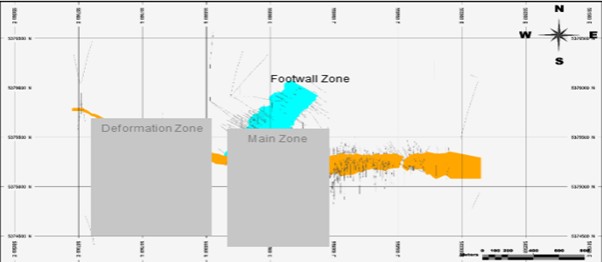
Source: Maunula (2024)
Figure 11: Plan View of Mineralized Envelopes
The Deformation Zone contains narrower and higher-grade intersections associated with altered sediments, intermediate dykes, and grey syenite. Gold mineralization is associated with pyrite either in quartz-healed breccias or as very fine disseminations. The Contact Fault has been interpreted to have acted as a channel for gold-bearing hydrothermal fluids and is host to the Deformation Zone and the southern boundary of the Main Zone. The Deformation Zone mineralization has been defined for approximately 2.0 km along strike.
The Footwall Zone is north of the Main Zone (Figure 11). The Footwall Zone structural and mineralized corridor strikes in a north-easterly direction and drilling has intercepted the zone over a strike length of approximately 500 m to a vertical depth of about 600 m below surface (open in all directions). The Footwall Zone consists of multiple mineralized zones hosted primarily in the footwall mafic volcanic assemblage, with a steep northerly dip. Mineralization consists of bleached, buff-altered (silica-albite-sericite-carbonate alteration), pillowed mafic volcanic with pyrite ranging from 2% to over 20%.
1.5 Metallurgical Testing and Mineral Processing
Metallurgical testing of Fenn-Gib composite samples over a range in head grade from 0.2 to 19.1 g/t Au and 0.3 to 8.1% S2- resulted in the development of a hybrid process approach, which is applicable to all associated deposit lithologies and rock types.
Treatment of Fenn-Gib mineralization considers a P80 106 µm flotation feed size with an approximate 23% mass pull to a rougher concentrate. Subsequent regrinding of the concentrate to P80 10 to 13 µm is followed by cyanidation yielding an estimated overall 89.6% Au extraction at a 1.5 g/t Au feed grade.
Direct cyanidation of Fenn-Gib mineralization was evaluated and established as not applicable due to losses in Au recovery with increased sulphide content at coarser material grind sizes, relative to secondary processing of a lower weight percentage reground flotation concentrate.
Metallurgical testwork and associated process criteria defined to date is representative and supports the associated Mineral Resource Estimate and is complete to support a Pre-Feasibility study. Future testwork will focus on specific parameters required for process design and advanced engineering, along with additional variability testwork to improve technical confidence and statistical accuracy of gold recovery estimates.
- 38 -
1.6 Mineral Resource Estimate
Mr. Tim Maunula, P.Geo., Principal Geologist, of T. Maunula & Associates Consulting Inc. (TMAC), is the QP responsible for completing the Project’s Mineral Resources estimate.
The Mineral Resource estimate incorporates extensive drill hole data from surface diamond drill programs combining both historical drilling completed prior to 2017 and Mayfair Gold’s drilling campaigns completed from 2021–2024. The cut-off date for assay data used in the 2024 Mineral Resource estimate was April 30, 2024. All data received were in NAD 83 UTM coordinates (Zone 17).
The Mineral Resource estimate was:
| • | Prepared using Hexagon Mining, HxGN MinePlan 16.2.1 (MinePlan) |
| • | Classified according to the CIM Definition Standards |
| • | Reported at a 0.3 g/t Au cut-off grade, which is amenable to open pit extraction. |
The Mineral Resource estimate for the Project is based on diamond drill hole data consisting of gold assays, geological descriptions, and density measurements.
The drill-hole database for the Mineral Resource estimate used 457 historical drill holes (140,283 m) and 291 Mayfair Gold drill holes, which together yielded 217,334 assays used in the Mineral Resource estimate.
The primary gold mineralization for the Project was modelled in three domains: Main Zone, Deformation Zone, and Footwall Zone (which included a Footwall Zone High Grade). However, gold mineralization is also contained within the other contiguous geological domains: mafic volcanics, pyroxenite, ultramafic volcanics, and sediments (Section 14.3). Mayfair Gold modelled the rock type groups using Datamine Studio EM (Datamine). TMAC reviewed and validated these wireframes for use in the Mineral Resource estimate. Gold grades were estimated separately by rock type within each domain.
The Fenn–Gib block model was estimated using three interpolation methods: nearest neighbour (NN), inverse distance weighting squared (IDW2), and ordinary kriging (OK). Uncapped and capped gold grades were estimated for the OK model. Only capped gold grades were estimated for the NN and IDW2 models.
The Fenn-Gib Project hosts Mineral Resources at a 0.3 g/t Au cut-off grade comprised of an Indicated Resource of 181.3 Mt grading 0.74 g/t Au for 4.3 million contained gold ounces plus an additional Inferred Resource of 8.9 Mt at 0.49 g/t Au containing 141,000 gold ounces. Table 11 presents the Mineral Resource estimate reported within a constraining resource pit shell and categorized by resource classification. The Mineral resource estimate has an effective date of September 3, 2024, and was prepared by TMAC.
- 39 -
Table 11: Fenn–Gib Project Mineral Resource Estimate
| Resource Category |
Cut-Off (Au g/t) |
Tonnes | Au (g/t) |
Au (oz) | ||||||||||||
| Indicated |
0.3 | 181,302,000 | 0.74 | 4,313,000 | ||||||||||||
| Inferred |
0.3 | 8,921,000 | 0.49 | 141,000 | ||||||||||||
Source: Maunula (2024)
Notes:
| • | Effective date of this updated mineral resource estimate is September 3, 2024. The assay cut-off date for drill holes included in the mineral resource was April 30, 2024. |
| • | All mineral resources have been estimated in accordance with the CIM Definitions Standards, as required under National Instrument (NI) 43-101. Mineral Resource Statement prepared by Tim Maunula, P.Geo. (TMAC) in accordance with NI 43101. |
| • | Mineral Resources reported demonstrate reasonable prospect of eventual economic extraction, as required under NI 43-101. Mineral Resources are not Mineral Reserves and do not have demonstrated economic viability. The Mineral Resources may be materially affected by environmental, permitting, legal, marketing, and other relevant issues. |
| • | Mineral Resources are reported at a cut-off grade of 0.30 g/t Au for an open-pit mining scenario using a 50° pit slope angle. Cut-off grades are based on a price of US$2,000/oz gold, and an open pit mining cost of $3.25/t, process cost of $15.50/t and G&A $2.00/t. Metallurgical recovery of 94% was used. Densities were assigned based on interpreted lithology. |
| • | Troy ounce = tonnes x grade / 31.10348. All numbers have been rounded to reflect the relative accuracy of the estimate. |
| • | The quantity and grade of reported Inferred Resources are uncertain in nature and there has not been sufficient work to define these Inferred Resources as Indicated or Measured Resources. It is reasonably expected that many of the Inferred Mineral Resources could be upgraded to Indicated Mineral Resources with continued exploration. |
| • | Tonnages and ounces in the tables are rounded to the nearest thousand. Numbers may not total due to rounding. |
1.7 Recovery Methods
This section is not applicable to this Technical Report.
1.8 Conclusions and Recommendations
The Fenn–Gib Project represents an advanced-stage-of-exploration project with a substantial gold resource base of over 4.3 million ounces of gold in the Indicated classification category. Based on the positive results to date, TMAC recommends advancing the project through targeted work programs designed to both grow and expand the current Mineral Resource and evaluate the economic potential of both the Fenn–Gib Project and the broader property area.
The next phases of work are recommended to evaluate the economic potential of the Fenn–Gib Project are:
| • | Environmental studies and the continued collection of baseline environmental data to support the pre-development of the Project |
| • | Process engineering and design work to support a pre-feasibility study for the development of a 4,800 t/d operation. |
A summary of the proposed work program, including a budget estimate, is outlined in Table 12.
- 40 -
Table 12: Recommended Work Programs and Cost Estimate
| Activity |
Description |
Estimate Cost ($) |
||||
| Phase 1—Environmental Studies |
| |||||
| Environmental studies including baseline data collection |
Advance work and studies to understand the site study area environmental baseline conditions to support a 4,800 t/d operation |
4,000,000 | ||||
| Phase 1 Total |
4,000,000 | |||||
| Phase 2—Engineering and Design |
| |||||
| Engineering and design to advance an economic evaluation of the Project |
Advance the Project designs and engineering to complete a pre-feasibility study to define a 4,800 t/d operation |
6,000,000 | ||||
| Phase 2 Total |
6,000,000 | |||||
| Phases 1 and 2 Total |
10,000,000 | |||||
| 10.0% Contingency |
1,000,000 | |||||
| Grand Total |
11,000,000 | |||||
TMAC also recommends additional infill drilling to upgrade the Inferred Mineral Resources to Indicated Mineral Resources. This program may also allow for the upgrade of all portions of the deposit to Measured Mineral Resources. The mineralized zones encountered at the Fenn–Gib Deposit remain open at depth and along strike east and west, additional targeted expansion drilling is therefore warranted.
A Pre-Feasibility study is currently underway to evaluate the economic potential of developing a 4,800 t/d operation, with completion expected in Q4 2025. Future drilling programs will be planned strategically to further expand and upgrade the resource base.
- 41 -
SCHEDULE “B” – AUDIT COMMITTEE CHARTER
MAYFAIR GOLD CORP.
(the “Company”)
AUDIT COMMITTEE CHARTER
| 1. | PURPOSE AND PRIMARY RESPONSIBILITY |
1.1 This charter sets out the Audit Committee’s (the “Committee”) purpose, composition, member qualification, member appointment and removal, responsibilities, operations, manner of reporting to the Board of Directors (the “Board”) of the Company, annual evaluation and compliance with this charter.
1.2 The primary responsibility of the Committee is that of oversight of the financial reporting process on behalf of the Board. This includes oversight responsibility for financial reporting and continuous disclosure, oversight of external audit activities, oversight of financial risk and financial management control, and oversight responsibility for compliance with tax and securities laws and regulations as well as whistle blowing procedures. The Committee is also responsible for the other matters as set out in this charter and/or such other matters as may be directed by the Board from time to time. The Committee should exercise continuous oversight of developments in these areas.
| 2. | MEMBERSHIP |
2.1 The Committee will consist of at least three members, all of whom must be directors of the Company and whom shall be financially literate, provided that a Committee member who is not financially literate may be appointed to the Committee if such member becomes financially literate within a reasonable period of time following his or her appointment. Upon graduating to a more senior stock exchange, if required under the rules or policies of such exchange, the Committee will consist of at least three members, all of whom shall meet the experience, financial literacy, and independence requirements of such exchange and of National Instrument 52- 110 – Audit Committees.
2.2 The members of the Committee will be appointed annually (and from time to time thereafter to fill vacancies on the Committee) by the Board. A Committee member may be removed or replaced at any time at the discretion of the Board and will cease to be a member of the Committee on ceasing to be a director.
2.3 The chairperson (the “Chair”) of the Committee will be appointed by the Board.
2.4 A majority of the members of the Committee must not be officers, employees or control persons of the Company or any of its associates or affiliates.
- 42 -
| 3. | AUTHORITY |
3.1 In addition to all authority required to carry out the duties and responsibilities included in this charter, the Committee has specific authority to:
| (a) | engage, set and pay the compensation for independent counsel and other advisors as it determines necessary to carry out its duties and responsibilities, and any such consultants or professional advisors so retained by the Committee will report directly to the Committee; |
| (b) | communicate directly with management and any internal auditor, and with the external auditor without management involvement; and |
| (c) | incur ordinary administrative expenses that are necessary or appropriate in carrying out its duties, which expenses will be paid for by the Company. |
| 4. | DUTIES AND RESPONSIBILITIES |
4.1 The duties and responsibilities of the Committee include:
| (a) | recommending to the Board the external auditor to be nominated by the Board; |
| (b) | recommending to the Board the compensation of the external auditor to be paid by the Company in connection with: |
| (i) | preparing and issuing the audit report on the Company’s financial statements, and |
| (ii) | performing other audit, review or attestation services; |
| (c) | reviewing the external auditor’s annual audit plan, fee schedule and any related services proposals (including meeting with the external auditor to discuss any deviations from or changes to the original audit plan, as well as to ensure that no management restrictions have been placed on the scope and extent of the audit examinations by the external auditor or the reporting of their findings to the Committee); |
| (d) | overseeing the work of the external auditor; |
| (e) | ensuring that the external auditor is independent by receiving a report annually from the external auditors with respect to their independence, such report to include disclosure of all engagements (and fees related thereto) for non-audit services provided to Company; |
| (f) | ensuring that the external auditor is in good standing with the Canadian Public Accountability Board by receiving, at least annually, a report by the external auditor on the audit firm’s internal quality control processes and procedures, such report to include any material issues raised by the most recent internal quality control review, or peer review, of the firm, or any governmental or professional authorities of the firm within the preceding five years, and any steps taken to deal with such issues; |
- 43 -
| (g) | ensuring that the external auditor meets the rotation requirements for partners and staff assigned to the Company’s annual audit by receiving a report annually from the external auditors setting out the status of each professional with respect to the appropriate regulatory rotation requirements and plans to transition new partners and staff onto the audit engagement as various audit team members’ rotation periods expire; |
| (h) | reviewing and discussing with management and the external auditor the annual audited and quarterly unaudited financial statements and related Management Discussion and Analysis (“MD&A”), including the appropriateness of the Company’s accounting policies, disclosures (including material transactions with related parties), reserves, key estimates and judgements (including changes or variations thereto) and obtaining reasonable assurance that the financial statements are presented fairly in accordance with International Financial Reporting Standards and the MD&A is in compliance with appropriate regulatory requirements; |
| (i) | reviewing and discussing with management and the external auditor major issues regarding accounting principles and financial statement presentation, including any significant changes in the selection or application of accounting principles to be observed in the preparation of the financial statements of the Company and its subsidiaries; |
| (j) | reviewing and discussing with management and the external auditor the external auditor’s written communications to the Committee in accordance with generally accepted auditing standards and other applicable regulatory requirements arising from the annual audit and quarterly review engagements; |
| (k) | reviewing the external auditor’s report to the shareholders on the Company’s annual financial statements; |
| (l) | reporting on and recommending to the Board the approval of the annual financial statements and the external auditor’s report on those financial statements, the quarterly unaudited financial statements, and the related MD&A and press releases for such financial statements, prior to the dissemination of these documents to shareholders, regulators, analysts and the public; |
| (m) | satisfying itself on a regular basis through reports from management and related reports, if any, from the external auditors, that adequate procedures are in place for the review of the Company’s disclosure of financial information extracted or derived from the Company’s financial statements that such information is fairly presented; |
| (n) | overseeing the adequacy of the Company’s system of internal accounting controls and obtaining from management and the external auditor summaries and recommendations for improvement of such internal controls and processes, together with reviewing management’s remediation of identified weaknesses; |
| (o) | reviewing with management and the external auditors the integrity of disclosure controls and internal controls over financial reporting; |
- 44 -
| (p) | reviewing and monitoring the processes in place to identify and manage the principal risks that could impact the financial reporting of the Company and assessing, as part of its internal controls responsibility, the effectiveness of the over-all process for identifying principal business risks and report thereon to the Board; |
| (q) | satisfying itself that management has developed and implemented a system to ensure that the Company meets its continuous disclosure obligations through the receipt of regular reports from management and the Company’s legal advisors on the functioning of the disclosure compliance system (including any significant instances of non-compliance with such system), in order to satisfy itself that such system may be reasonably relied upon; |
| (r) | resolving disputes between management and the external auditor regarding financial reporting; |
| (s) | as necessary or required, establishing procedures for: |
| (i) | the receipt, retention and treatment of complaints received by the Company from employees and others regarding accounting, internal accounting controls or auditing matters and questionable practices relating thereto, and |
| (ii) | the confidential, anonymous submission by employees of the Company of concerns regarding questionable accounting or auditing matters; |
| (t) | as necessary or required, reviewing and approving the Company’s hiring policies with respect to partners or employees (or former partners or employees) of either a former or the present external auditor; |
| (u) | pre-approving all non-audit services to be provided to the Company or any subsidiaries by the Company’s external auditor; |
| (v) | overseeing compliance with regulatory authority requirements for disclosure of external auditor services and Committee activities; |
| (w) | as necessary or required, establishing procedures for: |
| (i) | reviewing the adequacy of the Company’s insurance coverage, including the Directors’ and Officers’ insurance coverage; |
| (ii) | reviewing activities, organizational structure, and qualifications of the chief financial officer (“CFO”) and the staff in the financial reporting area and ensuring that matters related to succession planning within the Company are raised for consideration at the Board; |
- 45 -
| (iii) | obtaining reasonable assurance as to the integrity of the chief executive officer (“CEO”) and other senior management and that the CEO and other senior management strive to create a culture of integrity throughout the Company; |
| (iv) | reviewing fraud prevention policies and programs, and monitoring their implementation; and |
| (v) | reviewing regular reports from management and others (e.g., external auditors, legal counsel) with respect to the Company’s compliance with laws and regulations having a material impact on the financial statements including: |
| (A) | tax and financial reporting laws and regulations; |
| (B) | legal withholding requirements; |
| (C) | environmental protection laws and regulations; and |
| (D) | other laws and regulations which expose directors to liability. |
4.2 A regular part of Committee meetings involves the appropriate orientation of new members as well as the continuous education of all members. Items to be discussed include specific business issues as well as new accounting and securities legislation that may impact the organization. The Chair of the Committee will regularly canvass the Committee members for continuous education needs and in conjunction with the Board education program, arrange for such education to be provided to the Committee on a timely basis.
4.3 On an annual basis the Committee shall review and assess the adequacy of this charter taking into account all applicable legislative and regulatory requirements as well as any best practice guidelines recommended by regulators or stock exchanges with whom the Company has a reporting relationship and, if appropriate, recommend changes to the Committee charter to the Board for its approval.
| 5. | MEETINGS |
5.1 The quorum for a meeting of the Committee is a majority of the members of the Committee.
5.2 The Chair of the Committee shall be responsible for leadership of the Committee, including scheduling and presiding over meetings, preparing agendas, overseeing the preparation of briefing documents to circulate during the meetings as well as pre-meeting materials, and making regular reports to the Board. The Chair of the Committee will also maintain regular liaison with the CEO, CFO, and the lead external audit partner.
5.3 The Committee will meet in camera separately with each of the CEO and the CFO of the Company at least annually to review the financial affairs of the Company.
- 46 -
5.4 The Committee will meet with the external auditor of the Company in camera at least once each year, at such time(s) as it deems appropriate, to review the external auditor’s examination and report.
5.5 The external auditor must be given reasonable notice of, and has the right to appear before and to be heard at, each meeting of the Committee.
5.6 Each of the Chair of the Committee, members of the Committee, Chairperson of the Board, external auditor, CEO, CFO or secretary shall be entitled to request that the Chair of the Committee call a meeting which shall be held within 48 hours of receipt of such request to consider any matter that such individual believes should be brought to the attention of the Board or the shareholders.
| 6. | REPORTS |
6.1 The Committee will report, at least annually, to the Board regarding the Committee’s examinations and recommendations.
6.2 The Committee will report its activities to the Board to be incorporated as a part of the minutes of the Board meeting at which those activities are reported.
| 7. | MINUTES |
7.1 The Committee will maintain written minutes of its meetings, which minutes will be filed with the minutes of the meetings of the Board.
- 47 -