Shareholder Transaction Expenses |
Class A |
Class C |
Class I |
Class L |
Maximum Sales Load (as a percent of offering price) |
5.75% |
None |
None |
4.25% |
Contingent Deferred Sales Charge1 |
None |
1.00% |
None |
None |
|
1 |
Class C shareholders may be subject to a contingent deferred sales charge on shares repurchased during the first 365 days after their purchase. |
Annual Expenses (as a percentage of net assets attributable to shares) |
|
|
||
Management Fees |
1.50% |
1.50% |
1.50% |
1.50% |
Interest Payments on Borrowed Funds2 |
0.23% |
0.24% |
0.24% |
0.21% |
Other Expenses3 |
0.46% |
1.21% |
0.21% |
0.71% |
Shareholder Servicing Expenses |
||||
Distribution Fee4 |
None |
0.75% |
None |
0.25% |
Remaining Other Expenses |
0.21% |
0.21% |
0.21% |
0.21% |
Total Annual Expenses5 |
2.19% |
2.95% |
1.95% |
2.42% |
Fee Waiver and/or Expense Reimbursement6 |
(0.05)% |
(0.05)% |
(0.05)% |
(0.05)% |
Total Annual Expenses After Fee Waiver and/or Expense Reimbursement |
2.14% |
2.90% |
1.90% |
2.37% |
|
2 |
“Interest payments on borrowed funds” is based on the interest rate currently in effect with respect to the Credit Facilities and includes the ongoing commitment fees payable under the terms of the Credit Facilities. |
|
3 |
Other Expenses represents the Fund expenses as they are calculated in the Fund’s Annual Report. Other Expenses does not include the indirect fees and expenses of the underlying Private Investment Funds that are treated as REITs, as discussed further in footnote 5 below. The Fund’s Other Expenses will increase as a percentage of the Fund’s average net assets if the Fund’s assets decrease. Actual fees and expenses may be greater or less than those shown. The expenses in this fee table may not correlate to the expense ratio in the Fund’s financial highlights due to certain adjustments. |
|
4 |
Class C shares will pay to the Distributor a Distribution Fee that will accrue at an annual rate equal to 0.75% of the average daily net assets attributable to Class C shares and is payable on a monthly basis. Class L shares will pay to the Distributor a Distribution Fee that will accrue at an annual rate equal to 0.25% of the average daily net assets attributable to Class L shares and is payable on a monthly basis. See “Plan of Distribution.” |
|
5 |
Total Annual Expenses do not include the indirect fees and expenses of the Private Investment Funds that are treated as REITs. The indirect fees and expenses of the Private Investment Funds typically range from 0.80% to 1.00% on an annual basis and include management fees, administration fees and professional and other direct, fixed fees and expenses of the Private Investment Funds. |
|
6 |
The Adviser and the Fund have entered into an expense limitation and reimbursement agreement (the “Expense Limitation Agreement”) under which the Adviser has agreed contractually to waive its fees and to pay or absorb the ordinary operating expenses of the Fund (including offering expenses, but excluding interest, brokerage commissions, acquired fund fees and expenses and extraordinary expenses), to the extent that they exceed 1.91%, 2.66%,1.66%, and 2.16% per annum of the Fund’s average daily net assets attributable to Class A, Class C, Class I and Class L shares, respectively (the “Expense Limitation”). In consideration of the Adviser’s agreement to limit the Fund’s expenses, the Fund has agreed to repay the Adviser in the amount of any fees waived and Fund expenses paid or absorbed, subject to the limitations that: (1) the reimbursement will be made only for fees and expenses incurred not more than three years from the date in which they were incurred; and (2) the reimbursement may not be made if it would cause the lesser of the Expense Limitation in place at the time of |
waiver or at the time of reimbursement to be exceeded. The Expense Limitation Agreement will remain in effect, at least until May 31, 2027, unless and until the Board approves its modification or termination. This agreement may be terminated only by the Board on 60 days’ written notice to the Adviser. After May 31, 2027, the Expense Limitation Agreement may be renewed at the Adviser’s discretion.
Share Class |
1 Year |
3 Years |
5 Years |
10 Years |
Class A |
$78 |
$122 |
$168 |
$295 |
Class C |
$29 |
$91 |
$155 |
$326 |
Class I |
$19 |
$61 |
$105 |
$227 |
Class L |
$65 |
$114 |
$166 |
$306 |
The following table describes the fees and expenses that you may pay if you buy and hold shares of the Fund. “Other Expenses” are estimated for the current year and may vary. You may qualify for sales load discounts on purchases of Class A shares if you and your family invest, or agree to invest in the future, at least $100,000 in the Fund. More information about these and other discounts is available from your financial professional and in “Purchase Terms” starting on page 49 of this prospectus. More information about management fees, fee waivers and other expenses is available in “Management of the Fund” starting on page 38 of this prospectus. Actual fees and expenses may be greater or less than those shown.
|
For
the Year |
For
the Year |
For
the Year |
For
the Year |
For
the Year |
|||||||||||||||
Lines of Credit Total Amount Outstanding (000’s) |
$ | 42,000 | $ | 399,200 | $ | 211,750 | $ | 172,750 | $ | 139,000 | ||||||||||
Asset Coverage Per $1,000 of Lines of Credit Outstanding(a) |
$ | 88,825 | $ | 12,284 | $ | 24,755 | $ | 35,648 | $ | 32,691 | ||||||||||
|
For
the Year |
For
the Year |
For
the Year |
For
the Year |
For
the Year |
|||||||||||||||
Lines of Credit Total Amount Outstanding (000’s) |
N/A | N/A | N/A | $ | 69,500 | $ | 214,500 | |||||||||||||
Asset Coverage Per $1,000 of Lines of Credit Outstanding(a) |
N/A | N/A | N/A | $ | 27,956 | $ | 6,438 | |||||||||||||
|
(a) |
Calculated by subtracting the Fund’s total liabilities (excluding the indebtedness represented by the Lines of Credit) from the Fund’s total assets and dividing by the total amount outstanding on the Lines of Credit. The Asset Coverage ratio is then multiplied by $1,000 to determine the “Asset Coverage Per $1,000 of Lines of Credit Outstanding.” |
INVESTMENT OBJECTIVE, POLICIES AND STRATEGIES
Investment Objective and Policies
The Fund’s investment objective is to generate a return comprised of both current income and capital appreciation with moderate volatility and low correlation to the broader markets.
The Fund pursues its investment objective by strategically investing across private institutional real estate investment funds as well as a diversified set of public real estate securities. This approach enables the Adviser to allocate between public and private real estate securities and allows the Fund to invest across a diversified set of investment managers and strategies, while also providing investment exposure across property types and geographies. Under normal circumstances, at least 80% of the Fund’s net assets plus borrowings for investment purposes will be invested in real estate securities, primarily in Private Investment Funds, selected by the Adviser, in conjunction with the Private Sub-Adviser. The Fund will also invest directly in publicly traded income producing equity selected by the Public Sub-Adviser. The Fund concentrates investments in the real estate industry, meaning that under normal circumstances, it invests over 25% of its assets in real estate securities.
The Fund defines real estate securities to include common stock, preferred equity, partnership or similar interests, convertible or non-convertible preferred stock, and convertible or non-convertible secured or unsecured debt issued by: Private Investment Funds; publicly traded real estate securities such as Public REITs; Public REOCs; ETFs; Index Funds; and Other Investment Vehicles. “Real estate securities” also includes CMBS, RMBS and other real estate credit investments such as CLOs and other structured products. The Portfolio Managers of the Fund consider an issuer to be principally invested in real estate if 50% or more of its assets are attributable to ownership, construction, management or sale of real estate.
The Fund executes its investment strategy primarily by seeking to invest in a broad portfolio of real estate securities across two major categories – Private Investment Funds and publicly traded real estate securities. By investing in the Fund, the Adviser expects that shareholders may realize (either directly or indirectly) the following potential benefits:
|
● |
Access to Institutional Managers — Many of the Private Investment Funds in which the Fund invests are intended for large, institutional investors and have a large minimum investment size and other investor criteria that might otherwise limit their availability to individual, non-institutional investors. Thus, the Fund enables investors to invest in Private Investment Funds managed by leading institutional investment managers that may not be otherwise available to individual, non-institutional investors. |
|
● |
Multi-Strategy, Multi-Manager Investment Strategy — Given the investment strategy of the Fund, investors are able to execute a multi-strategy, multi-manager, multi-sector strategy by making a single investment in the Fund, whereas due to the large minimums of many of the Private Investment Funds in which the Fund invests, such a strategy may not otherwise be feasible to the individual investor. |
|
● |
More Attractive Investment Terms — By taking advantage of volume and other discounts that typically are not available to individual investors, the Adviser believes that the Fund may be able to provide certain economies of scale to investors through a reduction in the fees charged by the Private Investment Funds in which the Fund invests and which may not otherwise be permitted or available to individual investors. |
● |
Customized Public Market Strategy in line with Fund Objectives – CenterSquare has managed a U.S. REIT strategy focused on providing current income and long-term capital appreciation since 1995. The Fund provides access to CenterSquare’s proprietary investment process, which typically is reserved for institutional investors and seeks to identify real estate securities that are undervalued relative to their peers. |
The Fund may invest in debt securities of any duration, maturity, or credit quality, including high yield securities. The Fund may also invest in issuers in foreign and emerging markets.
Credit Facilities & Securities Lending
The Fund has entered into the Credit Facilities for the purpose of investment purchases subject to the limitations of the 1940 Act for borrowings.
As collateral for the Credit Facilities, the Fund grants the Banks a first position security interest in and lien on securities of any kind or description held by the Fund in the collateral accounts.
The BNP Credit Facility also permits, subject to certain conditions, BNP to rehypothecate portfolio securities pledged by the Fund up to the amount of the loan balance outstanding. The Fund continues to receive dividends and interest on rehypothecated securities. The Fund also has the right under the BNP Credit Facility to recall the rehypothecated securities from BNP on demand. If BNP fails to deliver the recalled security in a timely manner, the Fund will be compensated by BNP for any fees or losses related to the failed delivery or, in the event a recalled security will not be returned by BNP, the Fund, upon notice to BNP, may reduce the loan balance outstanding by the amount of the recalled security failed to be returned. The Fund may not benefit from any future appreciation of any such security not returned to the Fund. The Fund may receive a portion of the fees earned by BNP in connection with the rehypothecation of portfolio securities. This rehypothecation provision of the BNP Credit Facility is intended to permit the Fund to reduce the cost of its borrowings under the BNP Credit Facility.
The SAI contains a list of the fundamental (those that may not be changed without a shareholder vote) and non-fundamental investment policies of the Fund under the heading “Investment Objective and Policies.”
Fund’s Target Investment Portfolio
The Fund executes its investment strategy primarily by seeking to invest in a broad portfolio of ‘best in class’ real estate securities across two major categories – Private Investment Funds and publicly traded real estate securities. The Fund may also invest in ETFs, Index Funds, and Other Investment Vehicles, as well as other publicly traded income producing equity and debt securities. The term “best-in-class” refers to Private Investment Funds, Public REITs, Public REOCs, ETFs, Index Funds, and Other Investment Vehicles that the Adviser has identified as likely providing above average risk adjusted returns based on information provided through the Adviser’s selection process. The Adviser may also select agency and non-agency CMBS and RMBS and real estate credit investments such as CLOs and other structured credit products in each case, relating to real estate-related companies or assets.
The Adviser, in conjunction with the Sub-Advisers, employs a regimen of quantitative and qualitative criteria in its selection process to arrive at a universe of investments that the Adviser considers to be ‘best in class.’ By combining historical quantitative analysis with a sound knowledge of key qualitative attributes, the Adviser, in conjunction with the Sub-Advisers, will evaluate a prospective investment’s potential for generating sustainable, positive, risk-adjusted returns under a wide variety of market conditions. The Adviser is assisted in the ongoing monitoring and maintenance of its research database by the Sub-Advisers whom employ systematic monitoring practices of the private fund management marketplace as well as the publicly traded equity and debt markets.
Utilizing Apollo’s platform, the Adviser engages in a process of sourcing, screening, pricing, review, selection and monitoring of potential real estate credit investments for the Fund. The Adviser leverages the Apollo platform to conduct both fundamental and quantitative analyses of the real estate credit investment universe, focusing on location, property condition, loan structure and sponsor quality, among other factors.
Private Investment Funds. Private Investment Funds are investment funds that invest primarily in real estate or real estate debt and are managed by institutional investment managers with expertise in investing in real estate and real estate-related securities. Due to sizable minimum investment requirements and selective investor qualification criteria, many Private Investment Funds limit their direct investors to mainly institutions such as endowments and pension funds. The Fund allows investors to gain access to Private Investment Funds that may not otherwise be available to individual investors. Further, due to the Fund’s multi-manager, multi-sector, and multi-strategy approach, investors can gain access to a broad range of strategies and sectors in real estate and real estate-related securities. The Fund may invest up to 10% of its assets in private funds employing hedging strategies (commonly known as “hedge funds”, i.e., investment funds that would be investment companies but for the exemptions under Rule 3(c)(1) or 3(c)(7) under the 1940 Act).
REITs. The Fund may invest in REITs, both directly and through its investments in Private Investment Funds. REITs are investment vehicles that invest primarily in income-producing real estate or mortgages and other real estate-related loans or interests. Public REITs are listed on major stock exchanges, such as the NYSE and NASDAQ.
REOCs. The Fund may invest in REOCs, both directly and through its investments in Private Investment Funds. REOCs are companies that invest in real estate and whose shares trade on a public exchange. A REOC is similar to a REIT, except that a REOC will reinvest its earnings, rather than distributing them to unit holders as REITs do.
Exchange Traded Funds. ETFs are traded similarly to stocks and listed on major stock exchanges. Potential benefits of ETFs include diversification, cost and tax efficiency, liquidity, marginability, utility for hedging, the ability to go long and short, and (in some cases) quarterly dividends. An ETF may attempt to track a particular market segment or index.
Index Funds. An Index Fund is a mutual fund with an investment objective of seeking to replicate the performance of a specific securities index, such as the National Association of Real Estate Investment Trusts (NAREIT) Index or the MSCI REIT Index. Index Funds are typically not actively managed, and potential benefits include low operating expenses, broad market exposure and low portfolio turnover.
CLOs. A CLO is a type of structured product that issues securities collateralized by a pool of loans, which may include, among others, domestic and foreign senior secured loans, senior unsecured loans, second lien loans, and subordinate corporate loans. The underlying loans may be rated below investment grade by a rating agency. A CLO is not merely a conduit to a portfolio of loans; it is a pooled investment vehicle that may be actively managed by the collateral manager.
CMBS. CMBS include securities that reflect an interest in, and are secured by, mortgage loans on commercial real property. Many of the risks of investing in CMBS reflect the risks of investing in the real estate securing the underlying mortgage loans. These risks reflect the effects of local and other economic conditions on real estate markets, the ability of tenants to make loan payments and the ability of a property to attract and retain tenants. CMBS may be less liquid and exhibit greater price volatility than other types of mortgage- or asset-backed instruments.
RMBS. RMBS include securities that reflect an interest in, and are secured by, mortgage loans on residential real property. Similar to the risks of investing in CMBS, many of the risks of investing in RMBS reflect the risks of investing in the real estate securing the underlying mortgage loans. RMBS are particularly susceptible to prepayment risks, as residential mortgage loans generally do not impose prepayment penalties.
Reverse Repurchase Agreements. The Fund may enter into reverse repurchase agreements, which are forms of borrowing. In a reverse repurchase agreement, the Fund sells a security to a securities dealer or bank for cash and also agrees to repurchase the same security at an agreed upon price on an agreed upon date. Reverse repurchase agreements expose the Fund to credit risk (that is, the risk that the counterparty will fail to resell the security to the Fund). Engaging in reverse repurchase agreements also may involve the use of leverage, in that the Fund may reinvest the cash it receives in additional securities.
Under a reverse repurchase agreement, the Fund sells securities to a bank or broker dealer and agrees to repurchase the securities at a mutually agreed future date and price. Generally, the effect of a reverse repurchase agreement is that the Fund can recover and reinvest all or most of the cash invested in the portfolio securities involved during the term of the agreement and still be entitled to the returns associated with those portfolio securities, thereby resulting in a transaction similar to a borrowing and giving rise to leverage for the Fund. The Fund will incur interest expense as a cost of utilizing reverse repurchase agreements. In the event the buyer of securities under a reverse repurchase agreement files for bankruptcy or becomes insolvent, the Fund’s use of the proceeds of the agreement may be restricted pending a determination by the other party, or its trustee or receiver, whether to enforce the Fund’s obligation to repurchase the securities.
Other Investment Vehicles. The Fund may make investments in other investment vehicles such as closed-end funds, mutual funds and unregistered funds that invest principally, directly or indirectly, in real estate. Shares of closed-end funds are typically listed for trading on major stock exchanges and, in some cases, may be traded in other over-the-counter markets.
Criteria Used in Selecting Private Investment Funds
The Adviser, in conjunction with Aon Investments, will use both a quantitative screening process and a qualitative selection process when selecting securities for investment by the Fund in connection with its strategy.
The Fund utilizes a multi-manager, multi-sector, and multi-strategy approach. The Adviser, with assistance from Aon Investments, selects Private Investment Funds believed to have the best risk adjusted return prospects from a peer group of issuers in a particular real estate sector with similar market capitalization and/or credit quality. When constructing and balancing the Fund’s portfolio, the Adviser selects Private Investment Funds that it believes have relatively low volatility and will not be highly correlated to the broader equity or fixed income markets.
Aon Investments conducts on-going research on various real estate investment managers and investment options in order to establish a selection of investments to fulfill the Fund’s investment objective as well as to provide the Adviser information to make ongoing portfolio management decisions. By combining historical quantitative analysis with a sound knowledge of key qualitative attributes, the Adviser will evaluate a prospective investment’s potential for generating sustainable, positive, risk-adjusted returns under a wide variety of market conditions.
On-going monitoring of the Fund’s investments is utilized to assist the Adviser in maintaining portfolio allocations and managing cash in-flows and outflows. The Adviser may strategically rebalance its investment strategies according to the current market conditions, but will remain true to its fundamental analysis with respect to real estate asset class and sector risk over time. The Adviser manages investments over a long-term time horizon while being mindful of the historical context of the markets.
Investment Strategy – Multi-Manager Diversification
The Fund employs a multi-manager approach by identifying and investing with various institutional asset managers with expertise in managing portfolios of real estate and real estate-related securities. Many of the Private Investment Funds have large minimum investment size and stringent investor qualification criteria intended to limit their direct investors to mainly institutions such as endowments and pension funds - as such, the Fund enables investors to invest with institutional investment managers that may not be otherwise permitted or available to them.
In addition to pursuing a multi-manager approach, the Fund employs a multi-strategy approach in an attempt to diversify the risk-reward profiles and the underlying types of real estate in which it invests, with the strategies noted below. Because each real estate strategy performs differently throughout the overall real estate and economic cycle, investment strategies that include multiple strategies generally have lower volatility than single strategy funds. Thus, a multi-strategy approach should assist the Fund in achieving its objective of lower portfolio volatility as well as lower correlation with the broader markets.
Core. The Fund’s ‘core’ strategy targets high-quality portfolios with real estate assets that provide relatively lower and more stable returns. Such investments are typically located in primary markets and in the main property types (retail, office, industrial and multi-family). Properties are stable, well-maintained, well-leased and often of the Class A variety. For example, office properties, including life sciences, tend to be Class A buildings with investment grade tenants. Multifamily properties are usually in major metropolitan cities with higher rental rates. Retail would typically be more traditional neighborhood and community strip-mall centers, as well as regional and super regional malls. The Adviser believes
that warehouse and research and development properties in strong distribution centers typically provide the opportunity for predictable cash flow within the industrial sector. Class A properties are the most prestigious buildings competing for premier tenants with rents above average for the area.
Core Plus. The Fund’s ‘core plus’ strategy seeks moderate risk portfolios with real estate that provides moderate returns. Such investments are predominantly core but with an emphasis on a modest value add management approach. A core plus portfolio requires slightly more complex financial structuring and management intensive focus than core portfolio of investments. Focus is on the main property types, in both primary and secondary markets, in Class A or lower quality buildings that require some form of enhancement (i.e. repositioning, redevelopment and/or releasing). In comparison, a Class B property may be renovated and/or in good condition, potentially smaller in size, in a good location in a primary or secondary metropolitan market. Class B properties compete for a wide range of users with rents in the average range for the area.
Value Add. The Fund’s ‘value add’ strategy typically focuses on more aggressive active asset management and often employs more leverage. Such investments typically are lower quality buildings, in both primary and secondary markets in the main property types. Properties are considered value add when they exhibit management or operational problems, require physical improvement, and/or suffer from capital constraints. Buildings often require enhancement to upgrade them to higher quality properties (i.e., redevelopment/repositioning/ re-tenanting).
The Fund employs a multi-sector approach to diversify its investments by property sector - for example, across retail, office, multifamily, hospitality, industrial, residential, medical and/or self-storage sectors. Because each real estate sector has its own investment cycle, correlations across property sectors are generally low. Thus, employing a multi-sector approach should assist the Fund in achieving its objective of lower portfolio volatility as well as lower correlation with the broader markets.
Investment Strategy and Process – Aon Investments
Aon Investments uses InView, an internal database as a repository for research notes, ratings, quantitative analysis, due diligence questionnaires, and manager assessment reports. Across all asset classes InView contains over 29,000 investment strategies from over 10,000 managers. Aon Investments has over 4,600 real estate partnerships covering over 1,400 investment managers in this database, including global and U.S. real estate investment opportunities and managers, with over ten years of useable performance data. The data is generated through relationships with managers who desire access to Aon Investments’ institutional client base. Through the database, Aon Investments tracks what managers are currently in the market and when managers will be coming back to market.
Through this process, each potential investment is initially screened for factors such as strategy, value proposition, peer universe comparison, terms, and potential portfolio fit. Quarterly planning meetings are conducted by a senior due diligence team to set priorities.
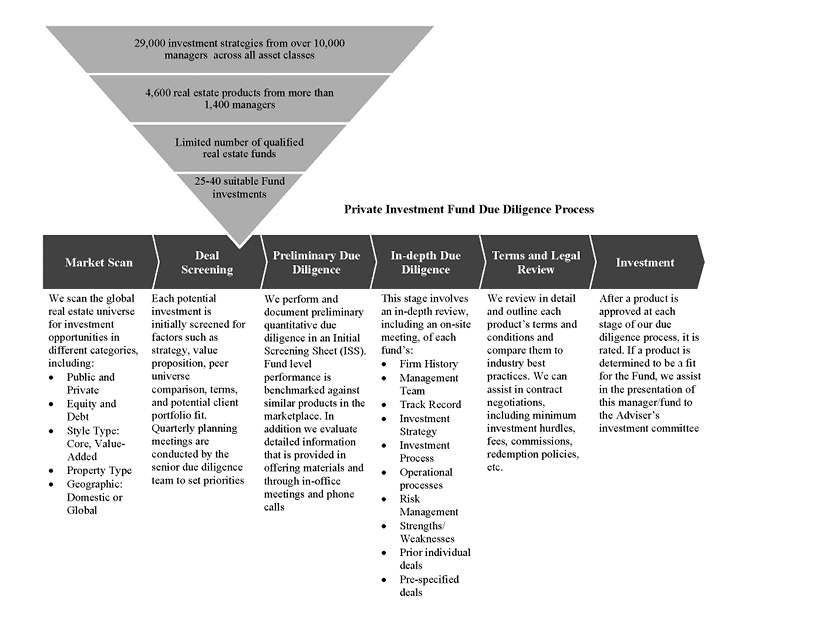
The Adviser, in conjunction with Aon Investments, employs a regimen of quantitative and qualitative criteria to arrive at a universe of investments which the Adviser considers to be “high caliber.” By combining historical quantitative analysis with a sound knowledge of key qualitative attributes, the Adviser will evaluate a prospective investment’s potential for generating sustainable, positive, risk-adjusted returns under a wide variety of market conditions. The systematic global manager research approach that Aon Investments follows is an ongoing process of continually monitoring the fund management marketplace. This process is illustrated in the schematic below:

Aon Investments applies strong fundamental viewpoints and in-depth quantitative excellence to evaluate and rate products according to a myriad of factors. Aon Investments’ process is a clear reflection of Aon Investments’ operational and research excellence, and consists of two main stages:
Quantitative Research
Aon Investments’ proprietary InForm model quantitatively analyzes a wide opportunity set of strategies on a quarterly basis. Aon Investments developed the InForm model to cover those elements also assessed during their fundamental research. Eight factors, as listed below, each with several underlying sub-factors, are weighted according to importance and scored to arrive at an overall rating of either Qualified or Not Recommended.
|
● |
Business |
|
● |
Investment staff |
|
● |
Investment process |
|
● |
Investment risk |
|
● |
Performance |
|
● |
Terms and conditions |
|
● |
Operations |
|
● |
ESG |
The InForm model not only allows to have a view on thousands of investment strategies but helps identify products/strategies for comprehensive due diligence and monitor trends within the industry.
Given the vast and ever-increasing universe of managers and strategies, this quantitative model gives Aon Investments a clear advantage over their competitors. This initial scoring process allows the research professionals to quickly identify investment products with the strongest potential of ultimately obtaining a “Buy” rating after the extensive due diligence and rating process.
The initial screening process helps identify a shortlist of products/strategies for comprehensive qualitative due diligence, which is the second stage of their research process.
Qualitative Research
Products that meet predetermined scores based on the quantitative screens proceed through the comprehensive due diligence, depicted below:
The goal of the qualitative research is to deliver high-conviction ideas, consisting of buy-rated strategies in each asset class, to deploy their asset class building block portfolios. The qualitative evaluation process is robust and gives a deep understanding of a manager’s capabilities and the nuances of a particular strategy. The process involves portfolio and risk analyses on products and strategies, in-person meetings with the managers (typically on-site) and vetting by a team of researchers. The same eight factors included in the InForm model, are also the areas of focus for the fundamental qualitative research:
|
● |
Business: Profitability, stability, and spread of ownership, client base, remuneration policy |
|
● |
Staff: Quality, depth of resource, team dynamic, staff turnover |
|
● |
Investment Process: Competitive advantage, repeatability, skill, implementation |
|
● |
Risk: Embedded in process, independent verification, mix of measurements |
|
● |
Performance Analysis: Consistent with stated process, risk-adjusted, persistent |
|
● |
Terms and Conditions: Client service, fees, best practices in documentation |
|
● |
Operational Due Diligence: Operational controls, valuation of assets, independent directors, third-party vendors |
|
● |
ESG: Policies, staffing, process, stewardship, outcomes |
Upon the conclusion of the due diligence by the manager research teams, each product is scored and rated through a formal voting process of senior research professionals. The debrief process is intended to help ensure a robust debate of issues related to a product/strategy among the senior investment professionals responsible for conducting manager research. The products are voted on by the individuals who conducted the due diligence on a strategy, in addition to three independent senior voters. The goal of their qualitative research is to deliver high-conviction ideas, consisting of buy-rated strategies in each asset class, to deploy the asset class building block portfolios.
A critical part of Aon Investments’ process is to play an active and value-added role after an investment has been made, resulting in a robust investment monitoring system. This is an important tool in reducing risk, improving or creating liquidity, properly reviewing valuations, reporting performance, and assuring conformance with various terms.
Aon Investments monitors investment activity and realization events during the life of the investment and believes that effective post-investment review can enhance the value of primary real estate investments. Aon Investments seeks to maintain an active dialogue with fund managers regarding issues such as approving various waivers, amendments, or extensions to the partnership documents, checking the allocations of income or loss, reviewing the distribution procedures and allocations, extension periods, fund reductions, conflicts of interest, advisory board matters, and related significant issues.
Aon Investments will provide the Adviser with investment performance reporting and analysis, including discussions on investment strategy, portfolio construction, and market update reports. An overview of Aon Investments’ monitoring activities is included below:
Investment Monitoring
|
● |
Monitor incoming communications on a daily basis |
|
● |
Review financial statements and other manager reports |
|
● |
Track portfolio activity for compliance with fund investment strategy and guidelines |
|
● |
Coordinate required actions and provide guidance to clients for such items as partnership agreement amendments, consents, and waivers |
|
● |
Proactively identify potential portfolio issues and update investment ratings quarterly |
Manager Monitoring
|
● |
Meet with each manager at least annually |
|
● |
Participate on quarterly calls |
|
● |
Monitor manager communications and industry news for developments |
|
● |
Proactively identify potential manager issues |
Performance Reporting
|
● |
Track all client contact, and portfolio information in SunGard InvestranTM |
|
● |
Provide comprehensive streamlined reporting |
Additionally, Aon Investments has entered into a sub-advisory relationship with a third party to assist in manager research and underwriting. Due diligence is reviewed and approved by Aon Investments’ Real Estate team.
Criteria Used in Selecting Public Real Estate Securities
The Adviser has retained CenterSquare, a registered investment adviser under the Advisers Act, to manage the portion of the Fund’s investment portfolio that is allocated to publicly traded securities, including common and preferred equity. Under normal circumstances, such securities will likely comprise between 5% and 50% of the Fund’s portfolio. For purposes of the strategy’s investment policies, CenterSquare considers a company to be in the real estate industry if it has at least 50% of its assets in companies principally engaged in the real estate industry, including REITs. With regard to the portion of the portfolio invested in common equity, the strategy usually holds approximately 40 to 60 stocks.
The Adviser with CenterSquare has developed a customized public market investment strategy in line with the objectives of the Fund. This strategy is comprised of a diversified portfolio of real estate securities identified as undervalued relative to their peers to provide investors with attractive, risk-adjusted returns. CenterSquare aims to uncover low-relative price opportunities across sectors and at different turning points in the real estate cycle by looking beyond the obvious factors of stock price and underlying real estate value. CenterSquare’s strategy recognizes that real estate securities are not simply stock, or real estate, but hybrid financial investments. As such, securities are valued on a number of factors, such as the value of the firm’s property portfolio, as well as critical business and market factors, which include: the company’s capitalization, its position within public capital markets, and quality of its management team. Based on industry-specific analyses that evaluate stock values as well as operational and qualitative factors. With regard to the portion of the portfolio invested in common equity, CenterSquare
selects approximately 40 to 60 stocks that it believes offer the most promising total return potential. The portfolio is diversified across sector, region and company. Stock weightings are determined through the use of a rigorous risk control process, which helps enable CenterSquare to maximize the portfolio’s risk-adjusted total returns.
Investment Strategy – CenterSquare Process
With respect to the Fund’s common equity securities and certain real estate debt securities, CenterSquare follows a rigorous investment process for determining individual position sizes, including both top-down and bottom-up analyses. The process has three primary components:
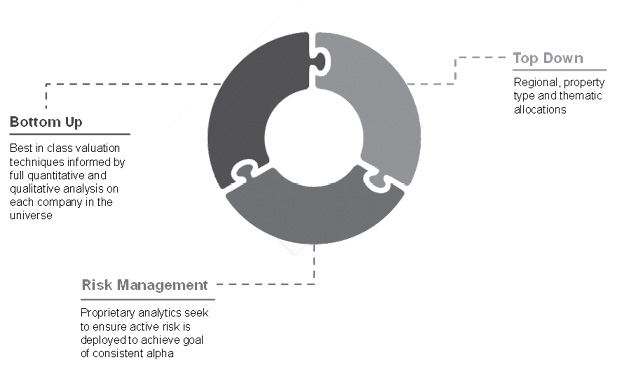
1: Top-down Research
CenterSquare’s research process begins by considering the macroeconomic landscape. CenterSquare examines factors such as economic growth, interest rates, inflation, employment, and consumer spending. From this perspective, CenterSquare refines and forms an opinion on how each of these macroeconomic factors will impact the different real estate sectors within the U.S. (including office, apartment, retail, hotel, industrial, etc.) CenterSquare layers pricing considerations into this relative value analysis in order to determine which property sectors to over or underweight.
2: Bottom-up Research
The bottom-up element focuses on detailed stock-level analysis. Real estate is a management-intensive business, and so CenterSquare starts with a qualitative assessment of each REIT by understanding each company’s strategic vision, governance practices, and history of value creation in varying economic cycles. Next, CenterSquare quantifies the fundamentals and valuation of the underlying real estate using traditional real estate valuation tools, such as implied capitalization rates, net asset value, and replacement costs. CenterSquare evaluates each underlying property from an operating perspective, considering items such as rental rates, occupancy, expenses, property locations, and quality of buildings, as well as quality of tenants and tenant turnover. The final phase of the bottom-up portion of the CenterSquare process involves evaluating each security using proprietary valuation models. CenterSquare strives to understand how independent variables drive valuation. The proprietary models look at leverage, growth, size, property type and other critical factors to derive CenterSquare’s view of relative value. A critical component is a rigorous underwriting of each company’s balance sheet to understand the impact of debt and debt maturities on a company’s ability to navigate the capital markets and successfully implement its strategy. This disciplined financial modeling allows CenterSquare to compare valuations across the REIT universe on a like-for-like basis over time.
3: Risk Management
While identifying attractive securities is an important element of the process, portfolio optimization ensures a proper balance between alpha generation and risk minimization. The third step of CenterSquare’s process focuses on identifying and understanding factor exposures and active bets relative to the benchmark. CenterSquare monitors exposures across a number of facets, including, but not limited to, VaR, tracking error, beta, sector weights, active bet exposures, correlation, standard deviation, and Sharpe ratio.
The outputs of the quantitative models and qualitative scorings are used as inputs in the portfolio construction process, along with top-down macroeconomic themes, capital market considerations, and many other factors. Buy and sell decisions are then made to bring model portfolio weights in line with target weights for each security. The target weights are first determined by the level of conviction for each investment, and then adjusted based on the risk parameters vis-a-vis the benchmark.
Other Information Regarding Investment Strategy
The Fund may, from time to time, take defensive positions that are inconsistent with the Fund’s principal investment strategy in attempting to respond to adverse market, economic, political or other conditions. During such times, the Adviser may determine that the Fund should invest up to 100% of its assets in cash or cash equivalents, including money market instruments, prime commercial paper, repurchase agreements, Treasury
bills and other short-term obligations of the U.S. government, its agencies or instrumentalities. In these and in other cases, the Fund may not achieve its investment objective. The Adviser may invest the Fund’s cash balances in any investments it deems appropriate. The Adviser expects that such investments will be made, without limitation and as permitted under the 1940 Act, in money market funds, repurchase agreements, U.S. Treasury and U.S. agency securities, municipal bonds and bank accounts. Any income earned from such investments is ordinarily reinvested by the Fund in accordance with its investment program. Many of the considerations entering into recommendations and decisions of the Adviser and the Fund’s Portfolio Managers are subjective. The Fund may engage in borrowings and the use of leverage in acquiring investments.
The frequency and amount of portfolio purchases and sales (known as the “portfolio turnover rate”) will vary from year to year. The portfolio turnover rate is not expected to exceed 100%, but may vary greatly from year to year and will not be a limiting factor when the Adviser deems portfolio changes appropriate. The Fund may engage in short-term trading strategies, and securities may be sold without regard to the length of time held when, in the opinion of the Adviser, investment considerations warrant such action. These policies may have the effect of increasing the annual rate of portfolio turnover of the Fund. Further, the Underlying Funds in which the Fund invests may experience high rates of portfolio turnover. High rates of portfolio turnover in the Underlying Funds may negatively impact their returns and, thus, negatively impact the returns of the Fund. Higher rates of portfolio turnover would likely result in higher brokerage commissions and may generate short-term capital gains taxable as ordinary income. If securities are not held for the applicable holding periods, dividends paid on them will not qualify for the advantageous federal tax rates. See “Tax Status” in the Fund’s SAI.
There is no assurance what portion, if any, of the Fund’s investments will qualify for the reduced federal income tax rates applicable to qualified dividends under the Code. As a result, there can be no assurance as to what portion of the Fund’s distributions will be designated as qualified dividend income. See “U.S. Federal Income Tax Matters.”
As part of its investment process, for certain of the Fund’s investments, the Adviser considers financially material environmental, social and governance (“ESG”) factors (alongside other relevant factors) in its investment decisions in connection with general risk management and assessing the financial attractiveness of the opportunity. ESG integration does not change the Fund’s investment objective, exclude specific types of companies or investments or constrain the Fund’s investable universe. The Adviser’s assessments related to ESG factors may not be conclusive and investments that may be negatively impacted by such factors may be purchased and retained by the Fund while the Fund may divest or not invest in investments that may be positively impacted by such factors.
Notwithstanding anything herein and for the avoidance of doubt, it is not contemplated that the Adviser will subordinate the Fund’s performance or increase the Fund’s investment risks as a result of (or in connection with) the consideration of any ESG factors nor will it promote ESG characteristics ahead of other investment considerations.
Co-Investments
The 1940 Act imposes significant limits on co-investments with affiliates of the Fund. The Fund, the Adviser and certain affiliates received an exemptive order from the SEC that permits the Fund, among other things, to co-invest with other funds and accounts managed by the Adviser or its affiliates, in certain private placement securities that involve the negotiation of certain terms of the private placement securities to be purchased (other than price-related terms), subject to certain conditions (the “Order”). There can be no assurance that the Fund will be permitted to co-invest with certain of its affiliates other than in the circumstances currently permitted by regulatory guidance and the Order. An inability to receive the desired allocation to potential investments may affect Fund’s ability to achieve the desired investment returns.
RISK FACTORS
An investment in the Fund’s shares is subject to risks. The value of the Fund’s investments will increase or decrease based on changes in the prices of the investments it holds. This will cause the value of the Fund’s shares to increase or decrease. You could lose money by investing in the Fund. By itself, the Fund does not constitute a balanced investment program. Before investing in the Fund you should consider carefully the following risks. There may be additional risks that the Fund does not currently foresee or consider material. You may wish to consult with your legal or tax advisers before deciding whether to invest in the Fund.
Risks Related to an Investment in the Fund
Allocation Risk. The ability of the Fund to achieve its investment objective depends, in part, on the ability of the Adviser to allocate effectively the Fund’s assets among the various instruments in which the Fund invests and, with respect to each such asset class, among equities and fixed income securities. There can be no assurance that the actual allocations will be effective in achieving the Fund’s investment objective or delivering positive returns.
Private Investment Fund Risk. The Fund’s investment in Private Investment Funds will require it to bear a pro rata share of the vehicles’ expenses, including management and performance fees. The fees the Fund pays to invest in a Private Investment Fund may be higher than if the manager of the Private Investment Fund managed the Fund’s assets directly. The incentive fees charged by certain Private Investment Funds may create an incentive for its manager to make investments that are riskier and/or more speculative than those it might have made in the absence of an incentive fee. The Private Investment Funds are not publicly traded and therefore may not be as liquid as other types of investments. Furthermore, Private Investment Funds, like the other Underlying Funds in which the Fund may invest, are subject to specific risks, depending on the nature of the vehicle and also may employ leverage such that their returns are more than one times that of their benchmark which will amplify losses suffered by the Fund when compared to unleveraged investments. For example, these Private Investment Funds need not have independent boards, shareholder approval of advisory contracts may not be required, the Private Investment Funds may utilize leverage and may engage in joint transactions with affiliates. These characteristics present additional risks for shareholders.
The managers of Private Investment Funds may draw down on the Fund’s capital commitment all at once or in a series of capital calls. The portion of the Fund’s commitment to a Private Investment Fund that has not been called is referred to as an “unfunded commitment.” The Fund may have a contractual obligation to provide capital to meet its unfunded commitment when the managers of a Private Investment Fund draw upon the commitment. Pursuant to regulations governing unfunded commitments, at the time the Fund enters into an unfunded commitment,
it must have a reasonable belief that it will have sufficient cash and cash equivalents to meet its obligations with respect to all of its unfunded commitment agreements, in each case as they come due. These regulations could reduce the Fund’s flexibility to make investments in Private Investment Funds and require the Fund to modify its investment strategies. In order to meet its obligations, and these regulatory requirements, the Fund may be required to hold a substantial amount of its assets in money market securities, cash or cash equivalents, possibly for prolong periods of time; liquidate portfolio securities at an inopportune time; or borrow under a line of credit. This could make it difficult or impossible to take or liquidate a position in a particular security at a price consistent with the Adviser’s strategy.
Investment in Private Investment Funds carries the risk of loss due to Private Investment Funds’ fraud, intentional or inadvertent deviations from a predefined investment strategy (including excessive concentration, directional investing outside of predefined ranges, excessive leverage or new capital markets), or poor judgment. During the lifetime of the Fund, there could be material changes in one or more Private Investment Funds, including changes in control and mergers. The effect of such changes on a Private Investment Fund cannot be predicted but could be material and adverse. Given the limited liquidity of the Private Investment Funds, the Fund may not be able to alter its portfolio allocation in sufficient time to respond to any such changes, resulting in substantial losses from risks of Private Investment Funds.
Lack of Control Over Private Investment Funds and Other Portfolio Investments. Once the Adviser has selected Underlying Funds, the Adviser will have no control over the investment decisions made by any such Underlying Fund. Although the Adviser will regularly evaluate each Underlying Fund and its manager to determine whether their respective investment programs are consistent with the Fund’s investment objective, the Adviser will not have any control over the investments made by any Underlying Fund. Even though the Underlying Funds are subject to certain constraints, the managers may change aspects of their investment strategies. The managers may do so at any time (for example, such change may occur immediately after providing the Adviser with the quarterly unaudited financial information for a Private Investment Fund). The Adviser may reallocate the Fund’s investments among the Underlying Funds, but the Adviser’s ability to do so may be constrained by the withdrawal limitations imposed by the Underlying Funds, which may prevent the Fund from reacting rapidly to market changes should an Underlying Fund fail to effect portfolio changes consistent with such market changes and the demands of the Adviser. Such withdrawal limitations may also restrict the Adviser’s ability to terminate investments in Underlying Funds that are poorly performing or have otherwise had adverse changes. The Adviser will be dependent on information provided by the Underlying Fund, including quarterly unaudited financial statements, which if inaccurate could adversely affect the Adviser’s ability to manage the Fund’s investment portfolio in accordance with its investment objective. By investing in the Fund, a shareholder will not be deemed to be an investor in any Underlying Fund and will not have the ability to exercise any rights attributable to an investor in any such Underlying Fund related to their investment.
Issuer Risk. The value of a specific security can be more volatile than the market as a whole and can perform differently from the value of the market as a whole. The value of an issuer’s securities that are held in the Fund’s portfolio may decline for a number of reasons which directly relate to the issuer, such as management performance, financial leverage and reduced demand for the issuer’s goods and services.
Liquidity Risk. The Fund is a closed-end investment company structured as an “interval fund” and designed for long-term investors. Unlike many closed-end investment companies, the Fund’s shares are not listed on any securities exchange and are not publicly traded. There currently is no secondary market for the shares and the Adviser does not expect that a secondary market will develop. Limited liquidity is provided to shareholders only through the Fund’s quarterly repurchase offers for no less than 5% of the Fund’s shares outstanding at net asset value. There is no guarantee that shareholders will be able to sell all of the shares they desire in a quarterly repurchase offer. The Fund’s investments are also subject to liquidity risk. Liquidity risk exists when particular investments of the Fund would be difficult to purchase or sell, possibly preventing the Fund from selling such illiquid securities at an advantageous time or price, or possibly requiring the Fund to dispose of other investments at unfavorable times or prices in order to satisfy its obligations.
Management Risk. The net asset value of the Fund changes daily based on the performance of the securities in which it invests. The Adviser’s judgments about the attractiveness, value and potential appreciation of a particular real estate segment and securities in which the Fund invests may prove to be incorrect and may not produce the desired results. The Fund’s Portfolio Managers and the other principals of the Adviser have limited experience in managing a closed-end fund.
General Market Conditions Risk. An investment in shares is subject to investment risk, including the possible loss of the entire principal amount invested. An investment in shares represents an indirect investment in the securities owned by the Fund. The value of these securities, like other market investments, may move up or down, sometimes rapidly and unpredictably. The value of your shares at any point in time may be worth less than the value of your original investment, even after taking into account any reinvestment of distributions. The Fund may also use leverage, which would magnify the Fund’s investment, market and certain other risks. No guarantee or representation is made that the Fund’s investment objectives will be achieved.
Failure of Financial Institutions and Sustained Financial Market Illiquidity. The failure of certain financial institutions, namely banks, may increase the possibility of a sustained deterioration of financial market liquidity, or illiquidity at clearing, cash management and/or custodial financial institutions. The failure of a bank (or banks) with which the Fund and/or the Fund’s underlying investments have a commercial relationship could adversely affect, among other things, the Fund and/or the Fund’s underlying investments’ ability to pursue key strategic initiatives, including by affecting the Fund’s ability to borrow from financial institutions on favorable terms.
Market Disruptions Risk. The Fund may incur major losses in the event of market disruptions and other extraordinary events in which historical pricing relationships become materially distorted. The risk of loss from pricing distortions is compounded by the fact that in disrupted markets many positions become illiquid, making it difficult or impossible to close out positions against which the markets are moving. Market disruptions caused by unexpected political, military and terrorist events may from time to time cause dramatic losses for the Fund and such events can result in otherwise historically low-risk strategies performing with unprecedented volatility and risk.
Changes in Trade Negotiations. In recent years, the U.S. government has indicated its intent to alter its approach to international trade policy and in some cases to renegotiate, or potentially terminate, certain existing bilateral or multi-lateral trade agreements and treaties with foreign countries, and has made proposals and taken actions related thereto. Tariffs on imported goods could further increase costs, decrease margins, reduce the competitiveness of products and services offered by current and future portfolio companies and adversely affect the revenues and profitability of portfolio companies whose businesses rely on goods imported from such impacted jurisdictions.
Highly Volatile Markets. The prices of financial instruments in which the Fund may invest can be highly volatile. The prices of instruments in which the Fund may invest are influenced by numerous factors, including interest rates, currency rates, default rates, governmental policies and political and economic events (both domestic and global). Moreover, political or economic crises, or other events may occur that can be highly disruptive to the markets in which the Fund may invest. In addition, governments from time to time intervene (directly and by regulation), which intervention may adversely affect the performance of the Fund and its investment activities. The Fund is also subject to the risk of a temporary or permanent failure of the exchanges and other markets on which its investments may trade. Sustained market turmoil and periods of heightened market volatility make it more difficult to produce positive trading results, and there can be no assurance that the Fund’s strategies will be successful in such markets.
U.S. Debt Ceiling and Budget Deficit Risks. U.S. debt ceiling and budget deficit concerns have increased the possibility of additional credit-rating downgrades and economic slowdowns, or a recession in the United States. Although U.S. lawmakers have historically passed legislation to raise the federal debt ceiling on multiple occasions, ratings agencies have lowered or threatened to lower the long-term sovereign credit rating on the United States. In August 2023, Fitch Ratings Inc., downgraded the U.S. credit rating to AA+ from AAA, citing fiscal deterioration over the next three years and close encounters with default due to ongoing political dysfunction. The impact of a U.S. default on its obligations or any further downgrades to the U.S. government’s sovereign credit rating or its perceived creditworthiness could adversely affect the U.S. and global financial markets and economic conditions. In addition, disagreement over the federal budget has caused the U.S. federal government to shut down for periods of time. Continued adverse political and economic conditions could have a material adverse effect on the Fund’s business, financial condition and results of operations.
Concentration of Credit Risk. The Fund places its cash with one banking institution, which is insured by the Federal Deposit Insurance Corporation (“FDIC”). The FDIC limit is $250,000. At various times throughout the year, the amount on deposit may exceed the FDIC limit and subject the Fund to a credit risk. The Fund does not believe that such deposits are subject to any unusual risk associated with investment activities. The Fund may invest cash balances in an open-end Money Market Mutual Fund (“Money Market Fund”). The Money Market Fund is valued at its closing NAV. The Money Market Fund is not subject to FDIC insurance.
Correlation Risk. The Fund seeks to produce returns that are less correlated to the broader financial markets over time. Although the prices of equity securities and fixed income securities, as well as other asset classes, often rise and fall at different times so that a fall in the price of one may be offset by a rise in the price of the other, in down markets the prices of these securities and asset classes can also fall in tandem. Because the Fund allocates its investments among different asset classes, the Fund is subject to correlation risk.
Repurchase Policy Risks. Quarterly repurchases by the Fund of its shares typically will be funded from available cash or sales of portfolio securities. However, payment for repurchased shares may require the Fund to liquidate portfolio holdings earlier than the Adviser otherwise would liquidate such holdings, potentially resulting in losses, and may increase the Fund’s portfolio turnover. The Adviser may take measures to attempt to avoid or minimize such potential losses and turnover, and instead of liquidating portfolio holdings, may borrow money to finance repurchases of shares. If the Fund borrows to finance repurchases, interest on any such borrowing will negatively affect shareholders who do not tender their shares in a repurchase offer by increasing the Fund’s expenses and reducing any net investment income. To the extent the Fund finances repurchase proceeds by selling investments, the Fund may hold a larger proportion of its net assets in less liquid securities. Also, the sale of securities to fund repurchases could reduce the market price of those securities, which in turn would reduce the Fund’s net asset value.
Repurchase of shares will tend to reduce the amount of outstanding shares and, depending upon the Fund’s investment performance, its net assets. A reduction in the Fund’s net assets may increase the Fund’s expense ratio, to the extent that additional shares are not sold. In addition, the repurchase of shares by the Fund may be a taxable event to shareholders.
Distribution Policy Risk. The Fund’s distribution policy is to make quarterly distributions to shareholders. All or a portion of a distribution may consist solely of a return of capital (i.e. from your original investment) and not a return of net profit. Shareholders should not assume that the source of a distribution from the Fund is net profit. Shareholders should note that return of capital will reduce the tax basis of their shares and potentially increase the taxable gain, if any, upon disposition of their shares.
Shareholders May Experience Dilution. All distributions declared in cash payable to shareholders that are participants in our distribution reinvestment plan will generally be automatically reinvested in Fund shares. As a result, shareholders that do not participate in our distribution reinvestment plan may experience dilution over time.
Anti-Takeover Provisions. The Fund’s Declaration of Trust (the “Declaration of Trust”) includes provisions that could limit the ability of other entities or persons to acquire control of the Fund or convert the Fund to open-end status. See “Anti-Takeover Provisions in the Declaration of Trust.”
Limitation on Liability of Trustees and Officers; Indemnification and Advance of Expenses. Delaware law permits a Delaware statutory trust to include in its declaration of trust a provision to indemnify and hold harmless any trustee or beneficial owner or other person from and against any and all claims and demands whatsoever. Our Declaration of Trust provides that our Trustees will not be liable to us or our shareholders for monetary damages for breach of fiduciary duty as a trustee to the fullest extent permitted by Delaware law. Our Declaration of Trust provides for the indemnification of any person to the full extent permitted, and in the manner provided, by Delaware law. In accordance with the 1940 Act, we will not indemnify certain persons for any liability to which such persons would be subject by reason of such person’s willful misfeasance, bad faith, gross negligence or reckless disregard of the duties involved in the conduct of his office.
Cybersecurity Risk. Cybersecurity refers to the combination of technologies, processes and procedures established to protect information technology systems and data from unauthorized access, attack or damage. The Fund and its affiliates and third-party service providers are subject to cybersecurity risks. Cybersecurity risks have significantly increased in recent years and the Fund could suffer such losses in the future. The Fund’s and its affiliates’ and third-party service providers’ computer systems, software, and networks may be vulnerable to unauthorized access, computer viruses or other malicious code, and other events that could have a security impact. If one or more of such events occur, this potentially could jeopardize confidential and other information, including nonpublic personal information and sensitive business data, processed and stored in, and transmitted through, computer systems and networks, or otherwise cause interruptions or malfunctions in the Fund’s operations or the operations of their respective affiliates and third-party service providers. This could result in significant losses, reputational damage, litigation, regulatory fines or penalties, or otherwise adversely affect the Fund’s business, financial condition or results of operations. Privacy and information security laws and regulation changes, and compliance with those changes, may result in cost increases due to system changes and the development of new administrative processes. In addition, the Fund may be required to expend significant additional resources to modify the Fund’s protective measures and to investigate and remediate vulnerabilities or other exposures arising from operational and security risks.
Risks Related to Our Investments
Real Estate Industry Concentration Risk. Because the Fund will concentrate its investments in real estate securities, its portfolio will be significantly impacted by the performance of the real estate market and may experience more volatility and be exposed to greater risk than a more diversified portfolio. In addition, the Fund may invest in real estate equity or debt and therefore may be subject to risks similar to those associated with direct investment in real property. The value of the Fund’s shares will be affected by factors affecting the value of real estate and the earnings of companies engaged in the real estate industry. These factors include, among others: (i) changes in general economic and market conditions; (ii) changes in the value of real estate properties; (iii) risks related to local economic conditions, overbuilding and increased competition; (iv) increases in property taxes and operating expenses; (v) changes in zoning laws; (vi) casualty and condemnation losses; (vii) variations in rental income, neighborhood values or the appeal of property to tenants; (viii) the availability of financing and (ix) changes in interest rates. Many real estate companies utilize leverage, which increases investment risk and could adversely affect a company’s operations and market value in periods of rising interest rates. The value of securities of companies in the real estate industry may go through cycles of relative under-performance and over-performance in comparison to equity securities markets in general.
There are also special risks associated with particular real estate sectors, or real estate operations generally, as described below:
Retail Properties. Retail properties are affected by the overall health of the economy and may be adversely affected by, among other things, the growth of alternative forms of retailing, bankruptcy, departure or cessation of operations of a tenant, a shift in consumer demand due to demographic changes, changes in spending patterns and lease terminations.
Office Properties. Office properties are affected by the overall health of the economy, and other factors such as a downturn in the businesses operated by their tenants, obsolescence, remote work policies of their tenants, and non-competitiveness.
Industrial Properties. Industrial properties are affected by the overall health of the economy and other factors such as downturns in the manufacture, processing and shipping of goods.
Hospitality Properties. The risks of hotel, motel and similar hospitality properties include, among other things, the necessity of a high level of continuing capital expenditures, competition, increases in operating costs which may not be offset by increases in revenues, dependence on business and commercial travelers and tourism, increases in fuel costs and other expenses of travel, and adverse effects of general and local economic conditions. Hotel properties tend to be more sensitive to adverse economic conditions and competition than many other commercial properties.
Healthcare and Life Sciences Properties. Healthcare and life sciences properties and healthcare providers are affected by several significant factors, including federal, state and local laws governing licenses, certification, adequacy of care, pharmaceutical distribution, rates, equipment, personnel and other factors regarding operations, continued availability of revenue from government reimbursement programs and competition on a local and regional basis. The failure of any healthcare operator to comply with governmental laws and regulations may affect its ability to operate its facility or receive government reimbursements.
Student Housing Properties. Student housing properties are affected by seasonal leasing, cash flow risks, and are subject to unique demand drivers.
Multifamily Properties. The value and successful operation of a multifamily property may be affected by a number of factors such as the location of the property, the ability of the management team, the level of mortgage interest rates, the presence of competing properties, adverse economic conditions in the locale, oversupply and rent control laws or other laws affecting such properties.
Residential Properties. Residential properties can be significantly affected by the national, regional and local real estate markets. This segment of the real estate industry also is sensitive to interest rate fluctuations which can cause changes in the availability of mortgage capital and directly affect the purchasing power of potential homebuyers. Thus, residential properties can be significantly affected by changes in government spending, consumer confidence, demographic patterns and the level of new and existing home sales.
Shopping Centers. Shopping center properties are dependent upon the successful operations and financial condition of their tenants, particularly certain of their major tenants, and could be adversely affected by bankruptcy of those tenants. In some cases, a tenant may lease a significant portion of the space in one center, and the filing of bankruptcy could cause significant revenue loss, including the loss of revenue from smaller tenants with co-tenancy rights. Like others in the commercial real estate industry, community centers are subject to environmental risks and interest rate risk. They also face the need to enter into new leases or renew leases on favorable terms to generate rental revenues. Community center properties could be adversely affected by changes in the local markets where their properties are located, as well as by adverse changes in national economic and market conditions.
Self-Storage Properties. The value and successful operation of a self-storage property may be affected by a number of factors, such as the ability of the management team, the location of the property, the presence of competing properties, changes in traffic patterns and effects of general and local economic conditions with respect to rental rates and occupancy levels.
Other factors may contribute to the risk of real estate investments:
Development Issues. Certain real estate companies may engage in the development or construction of real estate properties. These companies in which the Fund invests (“portfolio companies”) are exposed to a variety of risks inherent in real estate development and construction, such as the risk that there will be insufficient tenant demand to occupy newly developed properties, and the risk that prices of construction materials or construction labor may rise materially during the development.
Lack of Insurance. Certain of the portfolio companies in the Fund’s portfolio may fail to carry comprehensive liability, fire, flood, earthquake extended coverage and rental loss insurance, or insurance in place may be subject to various policy specifications, limits and deductibles. Should any type of uninsured loss occur, the portfolio company could lose its investment in, and anticipated profits and cash flows from, a number of properties and, as a result, adversely affect the Fund’s investment performance.
Dependence on Tenants. The value of the Fund’s portfolio companies’ properties and the ability of these companies to make distributions to their shareholders depends upon the ability of the tenants at the properties to generate enough income in excess of their tenant operating expenses to make their lease payments. Changes beyond the control of our portfolio companies may adversely affect their tenants’ ability to make their lease payments and, in such event, would substantially reduce both their income from operations and ability to make distributions to our portfolio companies and, consequently, the Fund.
Financial Leverage. Real estate companies may be highly leveraged and financial covenants may affect the ability of real estate companies to operate effectively.
Environmental Issues. In connection with the ownership (direct or indirect), operation, management and development of real properties that may contain hazardous or toxic substances, a portfolio company may be considered an owner, operator or responsible party of such properties and, therefore, may be potentially liable for removal or remediation costs, as well as certain other costs, including governmental fines and liabilities for injuries to persons and property. The existence of any such material environmental liability could have a material adverse effect on the results of operations and cash flow of any such portfolio company and, as a result, the amount available to make distributions on shares of the Fund could be reduced.
Financing Issues. Financial institutions in which the Fund may invest are subject to extensive government regulation. This regulation may limit both the amount and types of loans and other financial commitments a financial institution can make, and the interest rates and fees it can charge. In addition, interest and investment rates are highly sensitive and are determined by many factors beyond a financial institution’s control, including general and local economic conditions (such as inflation, recession, money supply and unemployment) and the monetary and fiscal policies of various governmental agencies such as the Federal Reserve Board. These limitations may have a significant impact on the profitability of a financial institution since profitability is attributable, at least in part, to the institution’s ability to make financial commitments such as loans. Profitability of a financial institution is largely dependent upon the availability and cost of the institution’s funds, and can fluctuate significantly when interest rates change.
REIT Risk. Investments (directly or indirectly) in REITs will subject the Fund to various risks. REIT share prices may decline because of adverse developments affecting the real estate industry and real property values. In general, real estate values can be affected by a variety of factors, including supply and demand for properties, the economic health of the country or of different regions, and the strength of specific industries that rent properties. REITs often invest in highly leveraged properties. Returns from REITs, which typically are small or medium capitalization stocks, may trail returns from the overall stock market. In addition, changes in interest rates may hurt real estate values or make REIT shares less attractive than other income-producing investments. REITs are also subject to heavy cash flow dependency, defaults by borrowers and self-liquidation.
Qualification as a REIT under the Code in any particular year is a complex analysis that depends on a number of factors. There can be no assurance that an entity in which the Fund invests with the expectation that it will be taxed as a REIT will, in fact, qualify as a REIT. An entity that fails to qualify as a REIT would be subject to a corporate level tax, would not be entitled to a deduction for dividends paid to its shareholders and would not pass through to its shareholders the character of income earned by the entity. If the Fund were to invest in an entity that failed to qualify as a REIT, such failure could significantly reduce the Fund’s yield on that investment. REITs can be classified as equity REITs, mortgage REITs, and hybrid REITs. Equity REITs invest primarily in real property and earn rental income from leasing those properties. They may also realize gains or losses from the sale of properties. Equity REITs will be affected by conditions in the real estate rental market and by changes in the value of the properties they own. Mortgage REITs invest primarily in mortgages and similar real estate interests and receive interest payments from the owners of the mortgaged properties. Mortgage REITs will be affected by changes in creditworthiness of borrowers and changes in interest rates. Hybrid REITs invest both in real property and in mortgages. Equity and mortgage REITs are dependent upon management skills, may not be diversified and are subject to the risks of financing projects.
Dividends paid by REITs will not generally qualify for the reduced U.S. federal income tax rates applicable to qualified dividends under the Code. See “U.S. Federal Income Tax Matters.” The Fund’s investments in REITs may include an additional risk to shareholders. Some or all of a REIT’s annual distributions to its investors may constitute a non-taxable return of capital. Any such return of capital will generally reduce the Fund’s basis in the REIT investment, but not below zero. To the extent the distributions from a particular REIT exceed the Fund’s basis in such REIT, the Fund will generally recognize gain. In part because REIT distributions often include a nontaxable return of capital, Fund distributions to shareholders may also include a nontaxable return of capital. Shareholders that receive such a distribution will also reduce their tax basis in their shares of the Fund, but not below zero. To the extent the distribution exceeds a shareholder’s basis in the Fund’s shares, such shareholder will generally recognize a capital gain. The Fund does not have any investment restrictions with respect to investments in REITs.
REOC Risk. REOCs, like REITs, expose the Fund to the risks of the real estate market. These risks can include fluctuations in the value of underlying properties; destruction of underlying properties; defaults by borrowers or tenants; market saturation; changes in general and local economic conditions; decreases in market rates for rents; increases in vacancies; competition; property taxes; capital expenditures, or operating expenses; and other economic, political or regulatory occurrences affecting the real estate industry. REOCs may also be affected by risks similar to investments in debt securities, including changes in interest rates and the quality of credit extended. REOCs require specialized management and pay management expenses; may have less trading volume; may be subject to more abrupt or erratic price movements than the overall securities markets; and may invest in a limited number of properties, in a narrow geographic area, or in a single property type which increase the risk that the portfolio could be unfavorably affected by the poor performance of a single investment or investment type. In addition, defaults on or sales of investments that the REOC holds could reduce the cash flow needed to make distributions to investors.
Commercial Mortgage-Backed Securities Risk. Commercial mortgage-backed securities include securities that reflect an interest in, and are secured by, mortgage loans on commercial real property (such as office properties, retail properties, hospitality properties, industrial properties, healthcare-related properties or other types of income producing real property). Many of the risks of investing in commercial mortgage-backed securities reflect the risks of investing in the real estate securing the underlying mortgage loans, which include the risks associated with the effects of local and other economic conditions on real estate markets, the ability of tenants to make loan payments, increases in interest rates, real estate tax rates and other operating expenses, changes in governmental rules, regulations and fiscal policies, the effects of and responses to infectious illness outbreaks, epidemics of pandemics, and the ability of a property to attract and retain tenants. Commercial mortgage-backed securities depend on cash flows generated by underlying commercial real estate loans, receivables, and other assets, and can be significantly affected by changes in market and economic conditions, the availability of information regarding the underlying assets and their structures, and the creditworthiness of the borrowers or tenants. Commercial mortgage-backed securities may be less liquid and exhibit greater price volatility than other types of mortgage- or asset-backed securities. Commercial mortgage-backed securities issued by private issuers may offer higher yields than commercial mortgage-backed securities issued by government issuers, but also may be subject to greater volatility than commercial mortgage-backed securities issued by government issuers. The commercial mortgage-backed securities market may experience substantially lower valuations and greatly reduced liquidity. Commercial mortgage-backed securities held by the Fund may be subordinated to one or more other classes of securities of the same series for purposes of, among other things, establishing payment priorities and offsetting losses and other shortfalls with respect to the related underlying mortgage loans. There can be no assurance that the subordination will be sufficient on any date to offset all losses or expenses incurred by the underlying trust. The value of CMBS and other mortgage-backed securities in which the Fund may invest generally will have an inverse relationship with interest rates. Accordingly, if interest rates rise, the value of such securities will decline. In addition, to the extent that the mortgage loans which underlie specific mortgage-backed securities are pre-payable, the value of such mortgage securities may be negatively affected by increasing prepayments, which generally occur when interest rates decline.
Residential Mortgage-Backed Securities Risk. The Fund may invest certain of its assets in residential mortgage-backed securities and become a holder of RMBS. Holders of RMBS bear various risks, including credit, market, interest rate, structural and legal risks. RMBS represent interests in pools of residential mortgage loans secured by residential mortgage loans. Such loans may be prepaid at any time. Residential mortgage loans are obligations of the borrowers thereunder only and are not typically insured or guaranteed by any other person or entity, although such loans may be securitized and the securities issued in such securitization may be guaranteed or credit enhanced. The rate of defaults and losses on residential mortgage loans will be affected by a number of factors, including general economic conditions and those in the area where the related mortgaged property is located, the borrower’s equity in the mortgaged property and the financial circumstances of the borrower. If a residential mortgage loan is in default, foreclosure of such residential mortgage loan may be a lengthy and difficult process, and may involve significant expenses. Furthermore, the market for defaulted residential mortgage loans or foreclosed properties may be very limited.
Structured Products Risk. Holders of structured products bear risks of the underlying investments, index or reference obligation and are subject to counterparty risk. The Fund may have the right to receive payments only from the structured product, and generally does not have direct rights against the issuer or the entity that sold the assets to be securitized. While certain structured products enable the investor to acquire interests in a pool of securities without the brokerage and other expenses associated with directly holding the same securities, investors in structured products generally pay their share of the structured product’s administrative and other expenses. Although it is difficult to predict whether the prices of indices and securities underlying structured products will rise or fall, these prices (and, therefore, the prices of structured products) will be influenced by the same types of political and economic events that affect issuers of securities and capital markets generally. If the issuer of a structured product uses shorter term financing to purchase longer term securities, the issuer may be forced to sell its securities at below market prices if it experiences difficulty in obtaining short-term financing, which may adversely affect the value of the structured products owned by the Fund.
Investments in structured notes involve risks, including credit risk and market risk. Where the Fund’s investments in structured notes are based upon the movement of one or more factors, including currency exchange rates, interest rates, referenced bonds and stock indices, depending on the factor used and the use of multipliers or deflators, changes in interest rates and movement of the factor may cause significant price fluctuations. Additionally, changes in the reference instrument or security may cause the interest rate on the structured note to be reduced to zero, and any further changes in the reference instrument may then reduce the principal amount payable on maturity. Structured notes may be less liquid than other types of securities and more volatile than the reference instrument or security underlying the note.
CLO Risk. In addition to the general risks associated with real estate securities, debt securities and structured products discussed herein, CLOs carry additional risks, including, but not limited to (i) the possibility that distributions from collateral securities will not be adequate to make interest or other payments; (ii) the quality of the collateral may decline in value or default; (iii) the possibility that the investments in CLOs are subordinate to other classes or tranches thereof, (iv) the potential of spread compression in the underlying loans of the CLO, which could reduce credit enhancement in the CLOs and (v) the complex structure of the security may not be fully understood at the time of investment and may produce disputes with the issuer or unexpected investment results.
CLO junior debt securities that the Fund may acquire are subordinated to more senior tranches of CLO debt. CLO junior debt securities are subject to increased risks of default relative to the holders of superior priority interests in the same securities. In addition, at the time of issuance, CLO equity securities are under-collateralized in that the liabilities of a CLO at inception exceed its total assets. Though not exclusively, the Fund will typically be in a first loss or subordinated position with respect to realized losses on the assets of the CLOs in which it is invested. The Fund may recognize phantom taxable income from its investments in the subordinated tranches of CLOs.
Between the closing date and the effective date of a CLO, the CLO collateral manager will generally expect to purchase additional collateral obligations for the CLO. During this period, the price and availability of these collateral obligations may be adversely affected by a number of market factors, including price volatility and availability of investments suitable for the CLO, which could hamper the ability of the collateral manager to acquire a portfolio of collateral obligations that will satisfy specified concentration limitations and allow the CLO to reach the initial par amount of collateral prior to the effective date. An inability or delay in reaching the target initial par amount of collateral may adversely affect the timing and amount of interest or principal payments received by the holders of the CLO debt securities and distributions of the CLO on equity securities and could result in early redemptions which may cause CLO debt and equity investors to receive less than face value of their investment.
The failure by a CLO in which the Fund invests to satisfy financial covenants, including with respect to adequate collateralization and/or interest coverage tests, could lead to a reduction in the CLO’s payments to the Fund. In the event that a CLO fails certain tests, holders of CLO senior debt may be entitled to additional payments that would, in turn, reduce the payments the Fund would otherwise be entitled to receive. Separately, the Fund may incur expenses to the extent necessary to seek recovery upon default or to negotiate new terms, which may include the waiver of certain financial covenants, with a defaulting CLO or any other investment the Fund may make. If any of these occur, it could adversely affect the Fund’s operating results and cash flows.
The Fund’s CLO investments are exposed to leveraged credit risk. If certain minimum collateral value ratios and/or interest coverage ratios are not met by a CLO, primarily due to senior secured loan defaults, then cash flow that otherwise would have been available to pay distributions to the Fund on its CLO investments may instead be used to redeem any senior notes or to purchase additional senior secured loans, until the ratios again exceed the minimum required levels or any senior notes are repaid in full.
Underlying Funds Risk. The Underlying Funds in which the Fund may invest are subject to investment advisory and other expenses, which will be indirectly paid by the Fund. As a result, the cost of investing in the Fund will be higher than the cost of investing directly in the Underlying Funds and also may be higher than other funds that invest directly in securities. The Underlying Funds are subject to specific risks, depending on the nature of the specific Underlying Fund. The Fund’s performance depends in part upon the performance of the Underlying Fund managers and selected strategies, the adherence by such Underlying Fund managers to such selected strategies, the instruments used by such Underlying Fund managers and the Adviser’s ability to select Underlying Fund managers and strategies and effectively allocate Fund assets among them. Additionally, the market value of shares of Underlying Funds that are closed-end funds may differ from their net asset value. This difference in price may be due to the fact that the supply and demand in the market for fund shares at any point in time is not always identical to the supply and demand in the market for the underlying basket of securities.
Rehypothecated Securities Risk. In connection with the use of the BNP Credit Facility for leverage, the Fund permits the lender, subject to certain conditions, to rehypothecate (i.e., lend to other counterparties) portfolio securities pledged by the Fund up to the amount of the loan balance outstanding. The terms of the BNP Credit Facility provide that the Fund continue to receive dividends and interest on rehypothecated securities. The Fund has the right under the BNP Credit Facility to recall rehypothecated securities from BNP on demand. If BNP fails to deliver a recalled security in a timely manner, the BNP Credit Facility provides for compensation by BNP to the Fund for any fees or losses related to the failed delivery or, in the event a recalled security will not be returned by BNP, for the Fund, upon notice to BNP, to reduce the loan balance outstanding by the amount of the recalled security failed to be returned. The terms of the BNP Credit Facility pursuant to which portfolio securities pledged by the Fund are rehypothecated may provide for receipt by the Fund, either directly or indirectly through a reduction in the costs associated with the BNP Credit Facility, of a portion of the fees earned by BNP in connection with the rehypothecation of such portfolio securities. Rehypothecation by BNP of the Fund’s pledged portfolio securities entails risks, including the risk that BNP will be unable or unwilling to return rehypothecated securities, which could result in, among other things, the inability of the Fund to find suitable investments to replace the unreturned securities, thereby impairing the ability the Fund to achieve its investment objective.
Use of Leverage by the Fund. Although the Fund has the option to borrow, including through the Credit Facilities, there are significant risks that may be assumed in connection with such borrowings. Investors in the Fund should consider the various risks of financial leverage, including, without limitation, the matters described below. There is no assurance that a leveraging strategy would be successful. Financial leverage involves risks and special considerations for shareholders including: (i) the likelihood of greater volatility of NAV of the shares than a comparable portfolio without leverage; (ii) the risk that fluctuations in interest rates on borrowings and short-term debt that the Fund must pay will reduce the return to the shareholders; (iii) the effect of financial leverage in a market experiencing rising interest rates, which would likely cause a greater decline in the NAV of the shares than if the Fund were not leveraged; and (iv) the potential for an increase in operating costs, which may reduce the Fund’s total return.
In the event that the Fund would be required to sell assets at a loss, including in order to redeem or pay off any borrowing, such a sale would reduce the Fund’s NAV and may make it difficult for the NAV to recover. The Fund nevertheless may continue to use financial leverage if the Adviser expects that the benefits to the shareholders of maintaining the leveraged position likely would outweigh a resulting reduction in the current return.
Certain types of borrowings by the Fund would result in the Fund being subject to covenants in credit agreements relating to asset coverage and Fund composition requirements that are more stringent than those currently imposed on the Fund by the 1940 Act. In addition, borrowings by the Fund may be made on a secured basis. The Custodian will then either segregate the assets securing the Fund’s borrowings for the benefit of the Fund’s lenders or arrangements will be made with a suitable sub-custodian. If the assets used to secure a borrowing decrease in value, the Fund may be required to pledge additional collateral to the lender in the form of cash or securities to avoid liquidation of those assets. In the event of a default, the lenders will have the right, through the Custodian, to redeem the Fund’s investments in underlying Investment Funds without consideration of whether doing so would be in the best interests of the Fund’s shareholders. The rights of any lenders to the Fund to receive payments of interest on and repayments of principal of borrowings will be senior to the rights of the Fund’s shareholders, and the terms of the Fund’s borrowings may contain provisions that limit certain activities of the Fund and could result in precluding the purchase of instruments that the Fund would otherwise purchase.
The use of financial leverage involves financial risk and would increase the exposure of the Fund’s investment returns to adverse economic factors such as rising interest rates, downturns in the economy or deterioration in the condition of the investments. There would be a risk that operating cash flow available to the Fund would be insufficient to meet required payments and a risk that it would not be possible to refinance existing indebtedness or that the terms of such refinancing would not be as favorable as the terms of existing indebtedness. Borrowings by the Fund may be secured by any or all of the assets of the Fund, with the consequences that the Fund may lose more than its equity stake in any one investment, and may lose all of its capital.
Reverse Repurchase Agreements Risk. The Fund’s use of reverse repurchase agreements involves many of the same risks involved in the Fund’s use of leverage, as the proceeds from reverse repurchase agreements generally will be invested in additional securities. There is a risk that the market value of the securities acquired in the reverse repurchase agreement may decline below the price of the securities that the Fund has sold but remains obligated to repurchase. In addition, there is a risk that the market value of the securities retained by the Fund may decline. If the buyer of securities under a reverse repurchase agreement were to file for bankruptcy or experiences insolvency, the Fund may be adversely affected. Also, in entering into reverse repurchase agreements, the Fund would bear the risk of loss to the extent that the proceeds of the reverse repurchase agreement are less than the value of the underlying securities. In addition, due to the interest costs associated with reverse repurchase agreements transactions, the Fund’s NAV will decline, and, in some cases, the Fund may be worse off than if it had not used such instruments.
Use of Leverage by Underlying Funds. In addition to any borrowing utilized by the Fund, the Underlying Funds in which the Fund invests may utilize financial leverage. The Underlying Funds may be able to borrow, subject to the limitations of their charters and operative documents. In the case of Private Investment Funds, such funds are not subject to the limitations imposed by the 1940 Act regarding the use of leverage with respect to which registered investment companies, including the Fund, are subject. To that end, the Fund intends to limit its direct borrowing to an amount that does not exceed 33 1/3% of the Fund’s gross asset value. Furthermore, Underlying Funds typically will hold their investments in entities organized as REITs, corporations or other entities and this may allow the Fund’s risk of loss to be limited to the amount of its investment in the Underlying Fund. While leverage presents opportunities for increasing the Fund’s total return, it has the effect of potentially increasing losses as well.
Valuation of Private Investment Funds. While the valuation of the Fund’s publicly-traded securities are more readily ascertainable, the Fund’s ownership interest in Private Investment Funds are not publicly traded and the Fund will depend on the institutional asset manager to a Private Investment Fund to provide a valuation of the Fund’s investment. Moreover, the valuation of the Fund’s investment in a Private Investment Fund, as provided by an institutional asset manager as of a specific date, may vary from the fair value of the investment that may be obtained if such investment were sold to a third party. For information about the value of the Fund’s investment in Private Investment Funds, the Adviser will be dependent on information provided by the Private Investment Funds, including quarterly unaudited financial statements which if inaccurate could adversely affect the Adviser’s ability to value accurately the Fund’s shares.
Preferred Securities Risk. There are various risks associated with investing in preferred securities, including credit risk, interest rate risk, deferral and omission of distributions, subordination to bonds and other debt securities in a company’s capital structure, limited liquidity, limited voting rights and special redemption rights. Interest rate risk is, in general, the risk that the price of a preferred security falls when interest rates rise. Securities with longer maturities tend to be more sensitive to interest rate changes. Credit risk is the risk that an issuer of a security may not be able to make principal and interest or dividend payments on the security as they become due. Holders of preferred securities may not receive dividends, or the payment can be deferred for some period of time. In bankruptcy, creditors are generally paid before the holders of preferred securities.
Convertible Securities Risk. Convertible securities are hybrid securities that have characteristics of both bonds and common stocks and are subject to risks associated with both debt securities and equity securities. Convertible securities are similar to fixed income securities because they usually pay a fixed interest rate (or dividend) and are obligated to repay principal on a given date in the future. The market value of fixed income and preferred securities tends to decline as interest rates increase and tends to increase as interest rates decline. Convertible securities have characteristics of a fixed income security and are particularly sensitive to changes in interest rates when their conversion value is lower than the value of the bond or preferred share. Fixed income and preferred securities also are subject to credit risk, which is the risk that an issuer of a security may not be able to make principal and interest or dividend payments on the security as they become due. Fixed income and preferred securities also may be subject to prepayment or redemption risk. If a convertible security held by the Fund is called for redemption, the Fund will be required to surrender the security for redemption, convert it into the issuing company’s common stock or cash or sell it to a third party at a time that may be unfavorable to the Fund. Convertible securities have characteristics similar to common stocks especially when their conversion value is the same as the value of the bond or preferred share. The price of equity securities may rise or fall because of economic or political changes. Stock prices in general may decline over short or even extended periods of time. Market prices of equity securities in broad market segments may be adversely affected by a prominent issuer having experienced losses or by the lack of earnings or such an issuer’s failure to meet the market’s expectations with respect to new products or services, or even by factors wholly unrelated to the value or condition of the issuer, such as changes in interest rates.
High Yield Securities Risk. The Fund may invest in debt securities and preferred securities rated less than investment grade that are sometimes referred to as high yield or “junk.” These securities are speculative investments that carry greater risks and are more susceptible to real or perceived adverse economic and competitive industry conditions than higher quality securities. High yield securities offer the potential for higher return, but also involve greater risk than bonds of higher quality, including an increased possibility that the security’s issuer, obligor or guarantor may not be able to make its payments of interest and principal (credit quality risk). If that happens, the value of the security may decrease. An economic downturn or period of rising interest rates (interest rate risk) could adversely affect the market for these securities and reduce the Fund’s ability to sell its securities (liquidity risk). Such securities also may be subject to resale restrictions. The lack of a liquid market for these securities could decrease the Fund’s share price.
Credit Risk. Credit risk is the risk that one or more loans in the Fund’s portfolio will decline in price or fail to pay interest or principal when due because the issuer of the instrument experiences a decline in its financial status. While a senior position in the capital structure of a borrower or issuer may provide some protection with respect to the Fund’s investments in certain loans, losses may still occur because the market value of loans is affected by the creditworthiness of borrowers or issuers and by general economic and specific industry conditions and the Fund’s other
investments will often be subordinate to other debt in the issuer’s capital structure. To the extent the Fund invests in below investment grade instruments, it will be exposed to a greater amount of credit risk than a fund which invests in investment grade securities. The prices of lower grade instruments are more sensitive to negative developments, such as a decline in the issuer’s revenues or a general economic downturn, than are the prices of higher grade instruments. Instruments of below investment grade quality are predominantly speculative with respect to the issuer’s capacity to pay interest and repay principal when due and therefore involve a greater risk of default.
Interest Rate Risk. The fixed-income instruments that the Fund may invest in are subject to the risk that market values of such securities will decline as interest rates increase. These changes in interest rates have a more pronounced effect on securities with longer durations. Typically, the impact of changes in interest rates on the market value of an instrument will be more pronounced for fixed-rate instruments than it will for floating rate instruments. Fluctuations in the value of portfolio securities will not affect interest income on existing portfolio securities but will be reflected in the Fund’s NAV. Actions by the Federal Reserve and other central banks may have a significant effect on interest rates and on the U.S. and world economies generally. Market volatility, rising interest rates, uncertainty around interest rates and/or unfavorable economic conditions could adversely affect the Fund’s business.
Foreign Securities and Emerging Markets Risk. The Fund may have investments in foreign securities. Foreign securities have investment risks different from those associated with domestic securities. Changes in foreign economies and political climates are more likely to affect the Fund with investments in foreign securities than another fund that invests exclusively in domestic securities. The value of foreign currency denominated securities or foreign currency contracts is affected by the value of the local currency relative to the U.S. dollar. There may be less government supervision of foreign markets, resulting in non-uniform accounting practices and less publicly available information about issuers of foreign securities. The value of foreign investments may be affected by changes in exchange control regulations, application of foreign tax laws (including withholding tax), changes in governmental economic or monetary policy (in this country or abroad), or changed circumstances in dealings between nations. In addition, foreign brokerage commissions, custody fees, and other costs of investing in foreign securities are often higher than in the United States. Investments in foreign issues could be affected by other factors not present in the United States, including expropriation, armed conflict, confiscatory taxation, and potential difficulties in enforcing contractual obligations.
The Fund may also invest in emerging markets, which are markets of countries in the initial stages of industrialization and have low per capita income. In addition to the risks of foreign securities in general, countries in emerging markets are more volatile and can have relatively unstable governments, social and legal systems that do not protect shareholders, economies based on only a few industries, and securities markets that trade a small number of issues which could reduce liquidity.
Risks Associated with Debt Financing
Leveraging Risk. The use of leverage, such as borrowing money to purchase securities, by the Fund will magnify the Fund’s gains or losses. The use of leverage via short selling and short positions in futures contracts will also magnify the Fund’s gains or losses. Generally, the use of leverage also will cause the Fund to have higher expenses (especially interest and/or short selling related dividend expenses) than those of funds that do not use such techniques. In addition, a lender to the Fund may terminate or refuse to renew any credit facility. If the Fund is unable to access additional credit, it may be forced to sell investments at inopportune times, which may further depress the returns on the Fund.
Credit Risk. There is a risk that debt issuers will not make payments, resulting in losses to the Fund. In addition, the credit quality of securities may be lowered if an issuer’s financial condition changes. Lower credit quality may lead to greater volatility in the price of a security and in shares of the Fund. Lower credit quality also may affect liquidity and make it difficult to sell the security. Default, or the market’s perception that an issuer is likely to default, could reduce the value and liquidity of securities, thereby reducing the value of your investment in Fund shares. In addition, default may cause the Fund to incur expenses in seeking recovery of principal or interest on its portfolio holdings.
Inflation/Deflation Risk. Inflation risk is the risk that the value of certain assets or income from the Fund’s investments will be worth less in the future as inflation decreases the value of money. As inflation increases, the real value of the Fund and its distributions can decline.
In addition, during any periods of rising inflation, the dividend rates or borrowing costs associated with the Fund’s use of leverage would likely increase, which would tend to further reduce returns to shareholders. Deflation risk is the risk that prices throughout the economy decline over time—the opposite of inflation. Deflation may have an adverse effect on the creditworthiness of issuers and may make issuer defaults more likely, which may result in a decline in the value of the Fund’s portfolio.
Legal and Regulatory Risks
Compliance Failures. Apollo, certain of its affiliates, and the Sub-Advisers, are regulated entities, and any compliance failures or other inappropriate behavior by them may have a material and/or adverse effect on the Fund. The provision of investment management services is regulated in most relevant jurisdictions, and the Sub-Advisers and Apollo must maintain their regulatory authorizations to continue to be involved both in the management of the Fund’s investments and to continue their businesses generally. The Adviser’s or Sub-Advisers’ ability to source and execute investment transactions for the Fund, and investor sentiment with respect to the Fund, may be adversely affected by negative publicity arising from any regulatory compliance failures or other inappropriate behavior by any Apollo affiliate or its investment professionals.
Legal, Tax and Regulatory Risks. Legal, tax and regulatory changes could occur that may adversely affect the Fund or its portfolio companies. There has been, and it is possible that there will be, further involvement of governmental and regulatory authorities in financial markets around the world. For example, the Fund expects to make investments in a number of different industries, some of which are or may become subject to regulation by one or more governmental agencies or authorities. New and existing regulations, changing regulatory requirements and the burdens of regulatory compliance all may have an adverse effect on the performance of investments that operate in these industries.
Neither the Adviser nor Sub-Advisers can predict whether new legislation or regulation (including new tax measures) will be enacted by legislative bodies or governmental agencies, nor can either of them predict what effect such legislation or regulation might have. There can be no assurance that new legislation or regulation, including changes to existing laws and regulations, will not have an adverse effect on the Fund’s investment performance.
The enforceability of agreements governing hedging transactions may depend on compliance with applicable statutory and other regulatory requirements and, depending on the identity of the counterparty, applicable international requirements. New or amended regulations may be imposed by the Commodity Futures Trading Commission (the “CFTC”), the SEC, the Federal Reserve, the European Union (the “EU”) or other financial regulators, other governmental or intergovernmental regulatory authorities or self-regulatory organizations that supervise the financial markets, and could adversely affect the Fund. In particular, the CFTC and the SEC are empowered to promulgate a variety of new rules pursuant to recently enacted financial reform legislation in the United States. The Fund also may be adversely affected by changes in the enforcement or interpretation of statutes and rules by these regulatory authorities or self-regulatory organizations.
Possible Risk of Conflicts
Possible Competition Between Underlying Funds and Between the Fund and the Underlying Funds. The Underlying Funds trade independently of each other and may pursue investment strategies that “compete” with each other for execution or that cause the Fund to participate in positions that offset each other (in which case the Fund would bear its pro rata share of commissions and fees without the potential for a profit). Also, the Fund’s investments in any particular Underlying Fund could increase the level of competition for the same trades that other Underlying Funds might otherwise make, including the priorities of order entry. This could make it difficult or impossible to take or liquidate a position in a particular security at a price consistent with the Adviser’s strategy.
Allocation of Investment Opportunities Risk. The Sub-Advisers, directly or through their affiliates, may manage or advise multiple investment vehicles or accounts that have investment objectives that are similar to the Fund and that may seek to make investments or sell investments in the same securities or other instruments, sectors or strategies as the Fund. This may create potential conflicts, particularly in circumstances where the availability of such investment opportunities is limited or where the liquidity of such investment opportunities is limited. The results of the Fund’s investment activities may differ significantly from the results achieved by such other managed investment vehicles or accounts. It is possible that one or more of such vehicles or accounts will achieve investment results that are substantially more or less favorable than the results achieved by the Fund.
Title |
Amount |
Amount Held by Fund |
Amount Outstanding Excluding |
Class A Shares |
Unlimited |
||
Class C Shares |
Unlimited |
||
Class I Shares |
Unlimited |
||
Class M Shares |
Unlimited |
None |
38,521,730 |
Class L Shares |
Unlimited |
Allocation Risk. The ability of the Fund to achieve its investment objective depends, in part, on the ability of the Adviser to allocate effectively the Fund’s assets among the various instruments in which the Fund invests and, with respect to each such asset class, among equities and fixed income securities. There can be no assurance that the actual allocations will be effective in achieving the Fund’s investment objective or delivering positive returns.
Private Investment Fund Risk. The Fund’s investment in Private Investment Funds will require it to bear a pro rata share of the vehicles’ expenses, including management and performance fees. The fees the Fund pays to invest in a Private Investment Fund may be higher than if the manager of the Private Investment Fund managed the Fund’s assets directly. The incentive fees charged by certain Private Investment Funds may create an incentive for its manager to make investments that are riskier and/or more speculative than those it might have made in the absence of an incentive fee. The Private Investment Funds are not publicly traded and therefore may not be as liquid as other types of investments. Furthermore, Private Investment Funds, like the other Underlying Funds in which the Fund may invest, are subject to specific risks, depending on the nature of the vehicle and also may employ leverage such that their returns are more than one times that of their benchmark which will amplify losses suffered by the Fund when compared to unleveraged investments. For example, these Private Investment Funds need not have independent boards, shareholder approval of advisory contracts may not be required, the Private Investment Funds may utilize leverage and may engage in joint transactions with affiliates. These characteristics present additional risks for shareholders.
The managers of Private Investment Funds may draw down on the Fund’s capital commitment all at once or in a series of capital calls. The portion of the Fund’s commitment to a Private Investment Fund that has not been called is referred to as an “unfunded commitment.” The Fund may have a contractual obligation to provide capital to meet its unfunded commitment when the managers of a Private Investment Fund draw upon the commitment. Pursuant to regulations governing unfunded commitments, at the time the Fund enters into an unfunded commitment,
it must have a reasonable belief that it will have sufficient cash and cash equivalents to meet its obligations with respect to all of its unfunded commitment agreements, in each case as they come due. These regulations could reduce the Fund’s flexibility to make investments in Private Investment Funds and require the Fund to modify its investment strategies. In order to meet its obligations, and these regulatory requirements, the Fund may be required to hold a substantial amount of its assets in money market securities, cash or cash equivalents, possibly for prolong periods of time; liquidate portfolio securities at an inopportune time; or borrow under a line of credit. This could make it difficult or impossible to take or liquidate a position in a particular security at a price consistent with the Adviser’s strategy.
Investment in Private Investment Funds carries the risk of loss due to Private Investment Funds’ fraud, intentional or inadvertent deviations from a predefined investment strategy (including excessive concentration, directional investing outside of predefined ranges, excessive leverage or new capital markets), or poor judgment. During the lifetime of the Fund, there could be material changes in one or more Private Investment Funds, including changes in control and mergers. The effect of such changes on a Private Investment Fund cannot be predicted but could be material and adverse. Given the limited liquidity of the Private Investment Funds, the Fund may not be able to alter its portfolio allocation in sufficient time to respond to any such changes, resulting in substantial losses from risks of Private Investment Funds.
Lack of Control Over Private Investment Funds and Other Portfolio Investments. Once the Adviser has selected Underlying Funds, the Adviser will have no control over the investment decisions made by any such Underlying Fund. Although the Adviser will regularly evaluate each Underlying Fund and its manager to determine whether their respective investment programs are consistent with the Fund’s investment objective, the Adviser will not have any control over the investments made by any Underlying Fund. Even though the Underlying Funds are subject to certain constraints, the managers may change aspects of their investment strategies. The managers may do so at any time (for example, such change may occur immediately after providing the Adviser with the quarterly unaudited financial information for a Private Investment Fund). The Adviser may reallocate the Fund’s investments among the Underlying Funds, but the Adviser’s ability to do so may be constrained by the withdrawal limitations imposed by the Underlying Funds, which may prevent the Fund from reacting rapidly to market changes should an Underlying Fund fail to effect portfolio changes consistent with such market changes and the demands of the Adviser. Such withdrawal limitations may also restrict the Adviser’s ability to terminate investments in Underlying Funds that are poorly performing or have otherwise had adverse changes. The Adviser will be dependent on information provided by the Underlying Fund, including quarterly unaudited financial statements, which if inaccurate could adversely affect the Adviser’s ability to manage the Fund’s investment portfolio in accordance with its investment objective. By investing in the Fund, a shareholder will not be deemed to be an investor in any Underlying Fund and will not have the ability to exercise any rights attributable to an investor in any such Underlying Fund related to their investment.
Issuer Risk. The value of a specific security can be more volatile than the market as a whole and can perform differently from the value of the market as a whole. The value of an issuer’s securities that are held in the Fund’s portfolio may decline for a number of reasons which directly relate to the issuer, such as management performance, financial leverage and reduced demand for the issuer’s goods and services.
Liquidity Risk. The Fund is a closed-end investment company structured as an “interval fund” and designed for long-term investors. Unlike many closed-end investment companies, the Fund’s shares are not listed on any securities exchange and are not publicly traded. There currently is no secondary market for the shares and the Adviser does not expect that a secondary market will develop. Limited liquidity is provided to shareholders only through the Fund’s quarterly repurchase offers for no less than 5% of the Fund’s shares outstanding at net asset value. There is no guarantee that shareholders will be able to sell all of the shares they desire in a quarterly repurchase offer. The Fund’s investments are also subject to liquidity risk. Liquidity risk exists when particular investments of the Fund would be difficult to purchase or sell, possibly preventing the Fund from selling such illiquid securities at an advantageous time or price, or possibly requiring the Fund to dispose of other investments at unfavorable times or prices in order to satisfy its obligations.
Management Risk. The net asset value of the Fund changes daily based on the performance of the securities in which it invests. The Adviser’s judgments about the attractiveness, value and potential appreciation of a particular real estate segment and securities in which the Fund invests may prove to be incorrect and may not produce the desired results. The Fund’s Portfolio Managers and the other principals of the Adviser have limited experience in managing a closed-end fund.
General Market Conditions Risk. An investment in shares is subject to investment risk, including the possible loss of the entire principal amount invested. An investment in shares represents an indirect investment in the securities owned by the Fund. The value of these securities, like other market investments, may move up or down, sometimes rapidly and unpredictably. The value of your shares at any point in time may be worth less than the value of your original investment, even after taking into account any reinvestment of distributions. The Fund may also use leverage, which would magnify the Fund’s investment, market and certain other risks. No guarantee or representation is made that the Fund’s investment objectives will be achieved.
Failure of Financial Institutions and Sustained Financial Market Illiquidity. The failure of certain financial institutions, namely banks, may increase the possibility of a sustained deterioration of financial market liquidity, or illiquidity at clearing, cash management and/or custodial financial institutions. The failure of a bank (or banks) with which the Fund and/or the Fund’s underlying investments have a commercial relationship could adversely affect, among other things, the Fund and/or the Fund’s underlying investments’ ability to pursue key strategic initiatives, including by affecting the Fund’s ability to borrow from financial institutions on favorable terms.
Market Disruptions Risk. The Fund may incur major losses in the event of market disruptions and other extraordinary events in which historical pricing relationships become materially distorted. The risk of loss from pricing distortions is compounded by the fact that in disrupted markets many positions become illiquid, making it difficult or impossible to close out positions against which the markets are moving. Market disruptions caused by unexpected political, military and terrorist events may from time to time cause dramatic losses for the Fund and such events can result in otherwise historically low-risk strategies performing with unprecedented volatility and risk.
Changes in Trade Negotiations. In recent years, the U.S. government has indicated its intent to alter its approach to international trade policy and in some cases to renegotiate, or potentially terminate, certain existing bilateral or multi-lateral trade agreements and treaties with foreign countries, and has made proposals and taken actions related thereto. Tariffs on imported goods could further increase costs, decrease margins, reduce the competitiveness of products and services offered by current and future portfolio companies and adversely affect the revenues and profitability of portfolio companies whose businesses rely on goods imported from such impacted jurisdictions.
Highly Volatile Markets. The prices of financial instruments in which the Fund may invest can be highly volatile. The prices of instruments in which the Fund may invest are influenced by numerous factors, including interest rates, currency rates, default rates, governmental policies and political and economic events (both domestic and global). Moreover, political or economic crises, or other events may occur that can be highly disruptive to the markets in which the Fund may invest. In addition, governments from time to time intervene (directly and by regulation), which intervention may adversely affect the performance of the Fund and its investment activities. The Fund is also subject to the risk of a temporary or permanent failure of the exchanges and other markets on which its investments may trade. Sustained market turmoil and periods of heightened market volatility make it more difficult to produce positive trading results, and there can be no assurance that the Fund’s strategies will be successful in such markets.
U.S. Debt Ceiling and Budget Deficit Risks. U.S. debt ceiling and budget deficit concerns have increased the possibility of additional credit-rating downgrades and economic slowdowns, or a recession in the United States. Although U.S. lawmakers have historically passed legislation to raise the federal debt ceiling on multiple occasions, ratings agencies have lowered or threatened to lower the long-term sovereign credit rating on the United States. In August 2023, Fitch Ratings Inc., downgraded the U.S. credit rating to AA+ from AAA, citing fiscal deterioration over the next three years and close encounters with default due to ongoing political dysfunction. The impact of a U.S. default on its obligations or any further downgrades to the U.S. government’s sovereign credit rating or its perceived creditworthiness could adversely affect the U.S. and global financial markets and economic conditions. In addition, disagreement over the federal budget has caused the U.S. federal government to shut down for periods of time. Continued adverse political and economic conditions could have a material adverse effect on the Fund’s business, financial condition and results of operations.
Concentration of Credit Risk. The Fund places its cash with one banking institution, which is insured by the Federal Deposit Insurance Corporation (“FDIC”). The FDIC limit is $250,000. At various times throughout the year, the amount on deposit may exceed the FDIC limit and subject the Fund to a credit risk. The Fund does not believe that such deposits are subject to any unusual risk associated with investment activities. The Fund may invest cash balances in an open-end Money Market Mutual Fund (“Money Market Fund”). The Money Market Fund is valued at its closing NAV. The Money Market Fund is not subject to FDIC insurance.
Correlation Risk. The Fund seeks to produce returns that are less correlated to the broader financial markets over time. Although the prices of equity securities and fixed income securities, as well as other asset classes, often rise and fall at different times so that a fall in the price of one may be offset by a rise in the price of the other, in down markets the prices of these securities and asset classes can also fall in tandem. Because the Fund allocates its investments among different asset classes, the Fund is subject to correlation risk.
Repurchase Policy Risks. Quarterly repurchases by the Fund of its shares typically will be funded from available cash or sales of portfolio securities. However, payment for repurchased shares may require the Fund to liquidate portfolio holdings earlier than the Adviser otherwise would liquidate such holdings, potentially resulting in losses, and may increase the Fund’s portfolio turnover. The Adviser may take measures to attempt to avoid or minimize such potential losses and turnover, and instead of liquidating portfolio holdings, may borrow money to finance repurchases of shares. If the Fund borrows to finance repurchases, interest on any such borrowing will negatively affect shareholders who do not tender their shares in a repurchase offer by increasing the Fund’s expenses and reducing any net investment income. To the extent the Fund finances repurchase proceeds by selling investments, the Fund may hold a larger proportion of its net assets in less liquid securities. Also, the sale of securities to fund repurchases could reduce the market price of those securities, which in turn would reduce the Fund’s net asset value.
Repurchase of shares will tend to reduce the amount of outstanding shares and, depending upon the Fund’s investment performance, its net assets. A reduction in the Fund’s net assets may increase the Fund’s expense ratio, to the extent that additional shares are not sold. In addition, the repurchase of shares by the Fund may be a taxable event to shareholders.
Distribution Policy Risk. The Fund’s distribution policy is to make quarterly distributions to shareholders. All or a portion of a distribution may consist solely of a return of capital (i.e. from your original investment) and not a return of net profit. Shareholders should not assume that the source of a distribution from the Fund is net profit. Shareholders should note that return of capital will reduce the tax basis of their shares and potentially increase the taxable gain, if any, upon disposition of their shares.
Shareholders May Experience Dilution. All distributions declared in cash payable to shareholders that are participants in our distribution reinvestment plan will generally be automatically reinvested in Fund shares. As a result, shareholders that do not participate in our distribution reinvestment plan may experience dilution over time.
Anti-Takeover Provisions. The Fund’s Declaration of Trust (the “Declaration of Trust”) includes provisions that could limit the ability of other entities or persons to acquire control of the Fund or convert the Fund to open-end status. See “Anti-Takeover Provisions in the Declaration of Trust.”
Limitation on Liability of Trustees and Officers; Indemnification and Advance of Expenses. Delaware law permits a Delaware statutory trust to include in its declaration of trust a provision to indemnify and hold harmless any trustee or beneficial owner or other person from and against any and all claims and demands whatsoever. Our Declaration of Trust provides that our Trustees will not be liable to us or our shareholders for monetary damages for breach of fiduciary duty as a trustee to the fullest extent permitted by Delaware law. Our Declaration of Trust provides for the indemnification of any person to the full extent permitted, and in the manner provided, by Delaware law. In accordance with the 1940 Act, we will not indemnify certain persons for any liability to which such persons would be subject by reason of such person’s willful misfeasance, bad faith, gross negligence or reckless disregard of the duties involved in the conduct of his office.
Cybersecurity Risk. Cybersecurity refers to the combination of technologies, processes and procedures established to protect information technology systems and data from unauthorized access, attack or damage. The Fund and its affiliates and third-party service providers are subject to cybersecurity risks. Cybersecurity risks have significantly increased in recent years and the Fund could suffer such losses in the future. The Fund’s and its affiliates’ and third-party service providers’ computer systems, software, and networks may be vulnerable to unauthorized access, computer viruses or other malicious code, and other events that could have a security impact. If one or more of such events occur, this potentially could jeopardize confidential and other information, including nonpublic personal information and sensitive business data, processed and stored in, and transmitted through, computer systems and networks, or otherwise cause interruptions or malfunctions in the Fund’s operations or the operations of their respective affiliates and third-party service providers. This could result in significant losses, reputational damage, litigation, regulatory fines or penalties, or otherwise adversely affect the Fund’s business, financial condition or results of operations. Privacy and information security laws and regulation changes, and compliance with those changes, may result in cost increases due to system changes and the development of new administrative processes. In addition, the Fund may be required to expend significant additional resources to modify the Fund’s protective measures and to investigate and remediate vulnerabilities or other exposures arising from operational and security risks.
Real Estate Industry Concentration Risk. Because the Fund will concentrate its investments in real estate securities, its portfolio will be significantly impacted by the performance of the real estate market and may experience more volatility and be exposed to greater risk than a more diversified portfolio. In addition, the Fund may invest in real estate equity or debt and therefore may be subject to risks similar to those associated with direct investment in real property. The value of the Fund’s shares will be affected by factors affecting the value of real estate and the earnings of companies engaged in the real estate industry. These factors include, among others: (i) changes in general economic and market conditions; (ii) changes in the value of real estate properties; (iii) risks related to local economic conditions, overbuilding and increased competition; (iv) increases in property taxes and operating expenses; (v) changes in zoning laws; (vi) casualty and condemnation losses; (vii) variations in rental income, neighborhood values or the appeal of property to tenants; (viii) the availability of financing and (ix) changes in interest rates. Many real estate companies utilize leverage, which increases investment risk and could adversely affect a company’s operations and market value in periods of rising interest rates. The value of securities of companies in the real estate industry may go through cycles of relative under-performance and over-performance in comparison to equity securities markets in general.
There are also special risks associated with particular real estate sectors, or real estate operations generally, as described below:
Retail Properties. Retail properties are affected by the overall health of the economy and may be adversely affected by, among other things, the growth of alternative forms of retailing, bankruptcy, departure or cessation of operations of a tenant, a shift in consumer demand due to demographic changes, changes in spending patterns and lease terminations.
Office Properties. Office properties are affected by the overall health of the economy, and other factors such as a downturn in the businesses operated by their tenants, obsolescence, remote work policies of their tenants, and non-competitiveness.
Industrial Properties. Industrial properties are affected by the overall health of the economy and other factors such as downturns in the manufacture, processing and shipping of goods.
Hospitality Properties. The risks of hotel, motel and similar hospitality properties include, among other things, the necessity of a high level of continuing capital expenditures, competition, increases in operating costs which may not be offset by increases in revenues, dependence on business and commercial travelers and tourism, increases in fuel costs and other expenses of travel, and adverse effects of general and local economic conditions. Hotel properties tend to be more sensitive to adverse economic conditions and competition than many other commercial properties.
Healthcare and Life Sciences Properties. Healthcare and life sciences properties and healthcare providers are affected by several significant factors, including federal, state and local laws governing licenses, certification, adequacy of care, pharmaceutical distribution, rates, equipment, personnel and other factors regarding operations, continued availability of revenue from government reimbursement programs and competition on a local and regional basis. The failure of any healthcare operator to comply with governmental laws and regulations may affect its ability to operate its facility or receive government reimbursements.
Student Housing Properties. Student housing properties are affected by seasonal leasing, cash flow risks, and are subject to unique demand drivers.
Multifamily Properties. The value and successful operation of a multifamily property may be affected by a number of factors such as the location of the property, the ability of the management team, the level of mortgage interest rates, the presence of competing properties, adverse economic conditions in the locale, oversupply and rent control laws or other laws affecting such properties.
Residential Properties. Residential properties can be significantly affected by the national, regional and local real estate markets. This segment of the real estate industry also is sensitive to interest rate fluctuations which can cause changes in the availability of mortgage capital and directly affect the purchasing power of potential homebuyers. Thus, residential properties can be significantly affected by changes in government spending, consumer confidence, demographic patterns and the level of new and existing home sales.
Shopping Centers. Shopping center properties are dependent upon the successful operations and financial condition of their tenants, particularly certain of their major tenants, and could be adversely affected by bankruptcy of those tenants. In some cases, a tenant may lease a significant portion of the space in one center, and the filing of bankruptcy could cause significant revenue loss, including the loss of revenue from smaller tenants with co-tenancy rights. Like others in the commercial real estate industry, community centers are subject to environmental risks and interest rate risk. They also face the need to enter into new leases or renew leases on favorable terms to generate rental revenues. Community center properties could be adversely affected by changes in the local markets where their properties are located, as well as by adverse changes in national economic and market conditions.
Self-Storage Properties. The value and successful operation of a self-storage property may be affected by a number of factors, such as the ability of the management team, the location of the property, the presence of competing properties, changes in traffic patterns and effects of general and local economic conditions with respect to rental rates and occupancy levels.
Other factors may contribute to the risk of real estate investments:
Development Issues. Certain real estate companies may engage in the development or construction of real estate properties. These companies in which the Fund invests (“portfolio companies”) are exposed to a variety of risks inherent in real estate development and construction, such as the risk that there will be insufficient tenant demand to occupy newly developed properties, and the risk that prices of construction materials or construction labor may rise materially during the development.
Lack of Insurance. Certain of the portfolio companies in the Fund’s portfolio may fail to carry comprehensive liability, fire, flood, earthquake extended coverage and rental loss insurance, or insurance in place may be subject to various policy specifications, limits and deductibles. Should any type of uninsured loss occur, the portfolio company could lose its investment in, and anticipated profits and cash flows from, a number of properties and, as a result, adversely affect the Fund’s investment performance.
Dependence on Tenants. The value of the Fund’s portfolio companies’ properties and the ability of these companies to make distributions to their shareholders depends upon the ability of the tenants at the properties to generate enough income in excess of their tenant operating expenses to make their lease payments. Changes beyond the control of our portfolio companies may adversely affect their tenants’ ability to make their lease payments and, in such event, would substantially reduce both their income from operations and ability to make distributions to our portfolio companies and, consequently, the Fund.
Financial Leverage. Real estate companies may be highly leveraged and financial covenants may affect the ability of real estate companies to operate effectively.
Environmental Issues. In connection with the ownership (direct or indirect), operation, management and development of real properties that may contain hazardous or toxic substances, a portfolio company may be considered an owner, operator or responsible party of such properties and, therefore, may be potentially liable for removal or remediation costs, as well as certain other costs, including governmental fines and liabilities for injuries to persons and property. The existence of any such material environmental liability could have a material adverse effect on the results of operations and cash flow of any such portfolio company and, as a result, the amount available to make distributions on shares of the Fund could be reduced.
Financing Issues. Financial institutions in which the Fund may invest are subject to extensive government regulation. This regulation may limit both the amount and types of loans and other financial commitments a financial institution can make, and the interest rates and fees it can charge. In addition, interest and investment rates are highly sensitive and are determined by many factors beyond a financial institution’s control, including general and local economic conditions (such as inflation, recession, money supply and unemployment) and the monetary and fiscal policies of various governmental agencies such as the Federal Reserve Board. These limitations may have a significant impact on the profitability of a financial institution since profitability is attributable, at least in part, to the institution’s ability to make financial commitments such as loans. Profitability of a financial institution is largely dependent upon the availability and cost of the institution’s funds, and can fluctuate significantly when interest rates change.
REIT Risk. Investments (directly or indirectly) in REITs will subject the Fund to various risks. REIT share prices may decline because of adverse developments affecting the real estate industry and real property values. In general, real estate values can be affected by a variety of factors, including supply and demand for properties, the economic health of the country or of different regions, and the strength of specific industries that rent properties. REITs often invest in highly leveraged properties. Returns from REITs, which typically are small or medium capitalization stocks, may trail returns from the overall stock market. In addition, changes in interest rates may hurt real estate values or make REIT shares less attractive than other income-producing investments. REITs are also subject to heavy cash flow dependency, defaults by borrowers and self-liquidation.
Qualification as a REIT under the Code in any particular year is a complex analysis that depends on a number of factors. There can be no assurance that an entity in which the Fund invests with the expectation that it will be taxed as a REIT will, in fact, qualify as a REIT. An entity that fails to qualify as a REIT would be subject to a corporate level tax, would not be entitled to a deduction for dividends paid to its shareholders and would not pass through to its shareholders the character of income earned by the entity. If the Fund were to invest in an entity that failed to qualify as a REIT, such failure could significantly reduce the Fund’s yield on that investment. REITs can be classified as equity REITs, mortgage REITs, and hybrid REITs. Equity REITs invest primarily in real property and earn rental income from leasing those properties. They may also realize gains or losses from the sale of properties. Equity REITs will be affected by conditions in the real estate rental market and by changes in the value of the properties they own. Mortgage REITs invest primarily in mortgages and similar real estate interests and receive interest payments from the owners of the mortgaged properties. Mortgage REITs will be affected by changes in creditworthiness of borrowers and changes in interest rates. Hybrid REITs invest both in real property and in mortgages. Equity and mortgage REITs are dependent upon management skills, may not be diversified and are subject to the risks of financing projects.
Dividends paid by REITs will not generally qualify for the reduced U.S. federal income tax rates applicable to qualified dividends under the Code. See “U.S. Federal Income Tax Matters.” The Fund’s investments in REITs may include an additional risk to shareholders. Some or all of a REIT’s annual distributions to its investors may constitute a non-taxable return of capital. Any such return of capital will generally reduce the Fund’s basis in the REIT investment, but not below zero. To the extent the distributions from a particular REIT exceed the Fund’s basis in such REIT, the Fund will generally recognize gain. In part because REIT distributions often include a nontaxable return of capital, Fund distributions to shareholders may also include a nontaxable return of capital. Shareholders that receive such a distribution will also reduce their tax basis in their shares of the Fund, but not below zero. To the extent the distribution exceeds a shareholder’s basis in the Fund’s shares, such shareholder will generally recognize a capital gain. The Fund does not have any investment restrictions with respect to investments in REITs.
REOC Risk. REOCs, like REITs, expose the Fund to the risks of the real estate market. These risks can include fluctuations in the value of underlying properties; destruction of underlying properties; defaults by borrowers or tenants; market saturation; changes in general and local economic conditions; decreases in market rates for rents; increases in vacancies; competition; property taxes; capital expenditures, or operating expenses; and other economic, political or regulatory occurrences affecting the real estate industry. REOCs may also be affected by risks similar to investments in debt securities, including changes in interest rates and the quality of credit extended. REOCs require specialized management and pay management expenses; may have less trading volume; may be subject to more abrupt or erratic price movements than the overall securities markets; and may invest in a limited number of properties, in a narrow geographic area, or in a single property type which increase the risk that the portfolio could be unfavorably affected by the poor performance of a single investment or investment type. In addition, defaults on or sales of investments that the REOC holds could reduce the cash flow needed to make distributions to investors.
Commercial Mortgage-Backed Securities Risk. Commercial mortgage-backed securities include securities that reflect an interest in, and are secured by, mortgage loans on commercial real property (such as office properties, retail properties, hospitality properties, industrial properties, healthcare-related properties or other types of income producing real property). Many of the risks of investing in commercial mortgage-backed securities reflect the risks of investing in the real estate securing the underlying mortgage loans, which include the risks associated with the effects of local and other economic conditions on real estate markets, the ability of tenants to make loan payments, increases in interest rates, real estate tax rates and other operating expenses, changes in governmental rules, regulations and fiscal policies, the effects of and responses to infectious illness outbreaks, epidemics of pandemics, and the ability of a property to attract and retain tenants. Commercial mortgage-backed securities depend on cash flows generated by underlying commercial real estate loans, receivables, and other assets, and can be significantly affected by changes in market and economic conditions, the availability of information regarding the underlying assets and their structures, and the creditworthiness of the borrowers or tenants. Commercial mortgage-backed securities may be less liquid and exhibit greater price volatility than other types of mortgage- or asset-backed securities. Commercial mortgage-backed securities issued by private issuers may offer higher yields than commercial mortgage-backed securities issued by government issuers, but also may be subject to greater volatility than commercial mortgage-backed securities issued by government issuers. The commercial mortgage-backed securities market may experience substantially lower valuations and greatly reduced liquidity. Commercial mortgage-backed securities held by the Fund may be subordinated to one or more other classes of securities of the same series for purposes of, among other things, establishing payment priorities and offsetting losses and other shortfalls with respect to the related underlying mortgage loans. There can be no assurance that the subordination will be sufficient on any date to offset all losses or expenses incurred by the underlying trust. The value of CMBS and other mortgage-backed securities in which the Fund may invest generally will have an inverse relationship with interest rates. Accordingly, if interest rates rise, the value of such securities will decline. In addition, to the extent that the mortgage loans which underlie specific mortgage-backed securities are pre-payable, the value of such mortgage securities may be negatively affected by increasing prepayments, which generally occur when interest rates decline.
Residential Mortgage-Backed Securities Risk. The Fund may invest certain of its assets in residential mortgage-backed securities and become a holder of RMBS. Holders of RMBS bear various risks, including credit, market, interest rate, structural and legal risks. RMBS represent interests in pools of residential mortgage loans secured by residential mortgage loans. Such loans may be prepaid at any time. Residential mortgage loans are obligations of the borrowers thereunder only and are not typically insured or guaranteed by any other person or entity, although such loans may be securitized and the securities issued in such securitization may be guaranteed or credit enhanced. The rate of defaults and losses on residential mortgage loans will be affected by a number of factors, including general economic conditions and those in the area where the related mortgaged property is located, the borrower’s equity in the mortgaged property and the financial circumstances of the borrower. If a residential mortgage loan is in default, foreclosure of such residential mortgage loan may be a lengthy and difficult process, and may involve significant expenses. Furthermore, the market for defaulted residential mortgage loans or foreclosed properties may be very limited.
Structured Products Risk. Holders of structured products bear risks of the underlying investments, index or reference obligation and are subject to counterparty risk. The Fund may have the right to receive payments only from the structured product, and generally does not have direct rights against the issuer or the entity that sold the assets to be securitized. While certain structured products enable the investor to acquire interests in a pool of securities without the brokerage and other expenses associated with directly holding the same securities, investors in structured products generally pay their share of the structured product’s administrative and other expenses. Although it is difficult to predict whether the prices of indices and securities underlying structured products will rise or fall, these prices (and, therefore, the prices of structured products) will be influenced by the same types of political and economic events that affect issuers of securities and capital markets generally. If the issuer of a structured product uses shorter term financing to purchase longer term securities, the issuer may be forced to sell its securities at below market prices if it experiences difficulty in obtaining short-term financing, which may adversely affect the value of the structured products owned by the Fund.
Investments in structured notes involve risks, including credit risk and market risk. Where the Fund’s investments in structured notes are based upon the movement of one or more factors, including currency exchange rates, interest rates, referenced bonds and stock indices, depending on the factor used and the use of multipliers or deflators, changes in interest rates and movement of the factor may cause significant price fluctuations. Additionally, changes in the reference instrument or security may cause the interest rate on the structured note to be reduced to zero, and any further changes in the reference instrument may then reduce the principal amount payable on maturity. Structured notes may be less liquid than other types of securities and more volatile than the reference instrument or security underlying the note.
CLO Risk. In addition to the general risks associated with real estate securities, debt securities and structured products discussed herein, CLOs carry additional risks, including, but not limited to (i) the possibility that distributions from collateral securities will not be adequate to make interest or other payments; (ii) the quality of the collateral may decline in value or default; (iii) the possibility that the investments in CLOs are subordinate to other classes or tranches thereof, (iv) the potential of spread compression in the underlying loans of the CLO, which could reduce credit enhancement in the CLOs and (v) the complex structure of the security may not be fully understood at the time of investment and may produce disputes with the issuer or unexpected investment results.
CLO junior debt securities that the Fund may acquire are subordinated to more senior tranches of CLO debt. CLO junior debt securities are subject to increased risks of default relative to the holders of superior priority interests in the same securities. In addition, at the time of issuance, CLO equity securities are under-collateralized in that the liabilities of a CLO at inception exceed its total assets. Though not exclusively, the Fund will typically be in a first loss or subordinated position with respect to realized losses on the assets of the CLOs in which it is invested. The Fund may recognize phantom taxable income from its investments in the subordinated tranches of CLOs.
Between the closing date and the effective date of a CLO, the CLO collateral manager will generally expect to purchase additional collateral obligations for the CLO. During this period, the price and availability of these collateral obligations may be adversely affected by a number of market factors, including price volatility and availability of investments suitable for the CLO, which could hamper the ability of the collateral manager to acquire a portfolio of collateral obligations that will satisfy specified concentration limitations and allow the CLO to reach the initial par amount of collateral prior to the effective date. An inability or delay in reaching the target initial par amount of collateral may adversely affect the timing and amount of interest or principal payments received by the holders of the CLO debt securities and distributions of the CLO on equity securities and could result in early redemptions which may cause CLO debt and equity investors to receive less than face value of their investment.
The failure by a CLO in which the Fund invests to satisfy financial covenants, including with respect to adequate collateralization and/or interest coverage tests, could lead to a reduction in the CLO’s payments to the Fund. In the event that a CLO fails certain tests, holders of CLO senior debt may be entitled to additional payments that would, in turn, reduce the payments the Fund would otherwise be entitled to receive. Separately, the Fund may incur expenses to the extent necessary to seek recovery upon default or to negotiate new terms, which may include the waiver of certain financial covenants, with a defaulting CLO or any other investment the Fund may make. If any of these occur, it could adversely affect the Fund’s operating results and cash flows.
The Fund’s CLO investments are exposed to leveraged credit risk. If certain minimum collateral value ratios and/or interest coverage ratios are not met by a CLO, primarily due to senior secured loan defaults, then cash flow that otherwise would have been available to pay distributions to the Fund on its CLO investments may instead be used to redeem any senior notes or to purchase additional senior secured loans, until the ratios again exceed the minimum required levels or any senior notes are repaid in full.
Underlying Funds Risk. The Underlying Funds in which the Fund may invest are subject to investment advisory and other expenses, which will be indirectly paid by the Fund. As a result, the cost of investing in the Fund will be higher than the cost of investing directly in the Underlying Funds and also may be higher than other funds that invest directly in securities. The Underlying Funds are subject to specific risks, depending on the nature of the specific Underlying Fund. The Fund’s performance depends in part upon the performance of the Underlying Fund managers and selected strategies, the adherence by such Underlying Fund managers to such selected strategies, the instruments used by such Underlying Fund managers and the Adviser’s ability to select Underlying Fund managers and strategies and effectively allocate Fund assets among them. Additionally, the market value of shares of Underlying Funds that are closed-end funds may differ from their net asset value. This difference in price may be due to the fact that the supply and demand in the market for fund shares at any point in time is not always identical to the supply and demand in the market for the underlying basket of securities.
Rehypothecated Securities Risk. In connection with the use of the BNP Credit Facility for leverage, the Fund permits the lender, subject to certain conditions, to rehypothecate (i.e., lend to other counterparties) portfolio securities pledged by the Fund up to the amount of the loan balance outstanding. The terms of the BNP Credit Facility provide that the Fund continue to receive dividends and interest on rehypothecated securities. The Fund has the right under the BNP Credit Facility to recall rehypothecated securities from BNP on demand. If BNP fails to deliver a recalled security in a timely manner, the BNP Credit Facility provides for compensation by BNP to the Fund for any fees or losses related to the failed delivery or, in the event a recalled security will not be returned by BNP, for the Fund, upon notice to BNP, to reduce the loan balance outstanding by the amount of the recalled security failed to be returned. The terms of the BNP Credit Facility pursuant to which portfolio securities pledged by the Fund are rehypothecated may provide for receipt by the Fund, either directly or indirectly through a reduction in the costs associated with the BNP Credit Facility, of a portion of the fees earned by BNP in connection with the rehypothecation of such portfolio securities. Rehypothecation by BNP of the Fund’s pledged portfolio securities entails risks, including the risk that BNP will be unable or unwilling to return rehypothecated securities, which could result in, among other things, the inability of the Fund to find suitable investments to replace the unreturned securities, thereby impairing the ability the Fund to achieve its investment objective.
Use of Leverage by the Fund. Although the Fund has the option to borrow, including through the Credit Facilities, there are significant risks that may be assumed in connection with such borrowings. Investors in the Fund should consider the various risks of financial leverage, including, without limitation, the matters described below. There is no assurance that a leveraging strategy would be successful. Financial leverage involves risks and special considerations for shareholders including: (i) the likelihood of greater volatility of NAV of the shares than a comparable portfolio without leverage; (ii) the risk that fluctuations in interest rates on borrowings and short-term debt that the Fund must pay will reduce the return to the shareholders; (iii) the effect of financial leverage in a market experiencing rising interest rates, which would likely cause a greater decline in the NAV of the shares than if the Fund were not leveraged; and (iv) the potential for an increase in operating costs, which may reduce the Fund’s total return.
In the event that the Fund would be required to sell assets at a loss, including in order to redeem or pay off any borrowing, such a sale would reduce the Fund’s NAV and may make it difficult for the NAV to recover. The Fund nevertheless may continue to use financial leverage if the Adviser expects that the benefits to the shareholders of maintaining the leveraged position likely would outweigh a resulting reduction in the current return.
Certain types of borrowings by the Fund would result in the Fund being subject to covenants in credit agreements relating to asset coverage and Fund composition requirements that are more stringent than those currently imposed on the Fund by the 1940 Act. In addition, borrowings by the Fund may be made on a secured basis. The Custodian will then either segregate the assets securing the Fund’s borrowings for the benefit of the Fund’s lenders or arrangements will be made with a suitable sub-custodian. If the assets used to secure a borrowing decrease in value, the Fund may be required to pledge additional collateral to the lender in the form of cash or securities to avoid liquidation of those assets. In the event of a default, the lenders will have the right, through the Custodian, to redeem the Fund’s investments in underlying Investment Funds without consideration of whether doing so would be in the best interests of the Fund’s shareholders. The rights of any lenders to the Fund to receive payments of interest on and repayments of principal of borrowings will be senior to the rights of the Fund’s shareholders, and the terms of the Fund’s borrowings may contain provisions that limit certain activities of the Fund and could result in precluding the purchase of instruments that the Fund would otherwise purchase.
The use of financial leverage involves financial risk and would increase the exposure of the Fund’s investment returns to adverse economic factors such as rising interest rates, downturns in the economy or deterioration in the condition of the investments. There would be a risk that operating cash flow available to the Fund would be insufficient to meet required payments and a risk that it would not be possible to refinance existing indebtedness or that the terms of such refinancing would not be as favorable as the terms of existing indebtedness. Borrowings by the Fund may be secured by any or all of the assets of the Fund, with the consequences that the Fund may lose more than its equity stake in any one investment, and may lose all of its capital.
Reverse Repurchase Agreements Risk. The Fund’s use of reverse repurchase agreements involves many of the same risks involved in the Fund’s use of leverage, as the proceeds from reverse repurchase agreements generally will be invested in additional securities. There is a risk that the market value of the securities acquired in the reverse repurchase agreement may decline below the price of the securities that the Fund has sold but remains obligated to repurchase. In addition, there is a risk that the market value of the securities retained by the Fund may decline. If the buyer of securities under a reverse repurchase agreement were to file for bankruptcy or experiences insolvency, the Fund may be adversely affected. Also, in entering into reverse repurchase agreements, the Fund would bear the risk of loss to the extent that the proceeds of the reverse repurchase agreement are less than the value of the underlying securities. In addition, due to the interest costs associated with reverse repurchase agreements transactions, the Fund’s NAV will decline, and, in some cases, the Fund may be worse off than if it had not used such instruments.
Use of Leverage by Underlying Funds. In addition to any borrowing utilized by the Fund, the Underlying Funds in which the Fund invests may utilize financial leverage. The Underlying Funds may be able to borrow, subject to the limitations of their charters and operative documents. In the case of Private Investment Funds, such funds are not subject to the limitations imposed by the 1940 Act regarding the use of leverage with respect to which registered investment companies, including the Fund, are subject. To that end, the Fund intends to limit its direct borrowing to an amount that does not exceed 33 1/3% of the Fund’s gross asset value. Furthermore, Underlying Funds typically will hold their investments in entities organized as REITs, corporations or other entities and this may allow the Fund’s risk of loss to be limited to the amount of its investment in the Underlying Fund. While leverage presents opportunities for increasing the Fund’s total return, it has the effect of potentially increasing losses as well.
Valuation of Private Investment Funds. While the valuation of the Fund’s publicly-traded securities are more readily ascertainable, the Fund’s ownership interest in Private Investment Funds are not publicly traded and the Fund will depend on the institutional asset manager to a Private Investment Fund to provide a valuation of the Fund’s investment. Moreover, the valuation of the Fund’s investment in a Private Investment Fund, as provided by an institutional asset manager as of a specific date, may vary from the fair value of the investment that may be obtained if such investment were sold to a third party. For information about the value of the Fund’s investment in Private Investment Funds, the Adviser will be dependent on information provided by the Private Investment Funds, including quarterly unaudited financial statements which if inaccurate could adversely affect the Adviser’s ability to value accurately the Fund’s shares.
Preferred Securities Risk. There are various risks associated with investing in preferred securities, including credit risk, interest rate risk, deferral and omission of distributions, subordination to bonds and other debt securities in a company’s capital structure, limited liquidity, limited voting rights and special redemption rights. Interest rate risk is, in general, the risk that the price of a preferred security falls when interest rates rise. Securities with longer maturities tend to be more sensitive to interest rate changes. Credit risk is the risk that an issuer of a security may not be able to make principal and interest or dividend payments on the security as they become due. Holders of preferred securities may not receive dividends, or the payment can be deferred for some period of time. In bankruptcy, creditors are generally paid before the holders of preferred securities.
Convertible Securities Risk. Convertible securities are hybrid securities that have characteristics of both bonds and common stocks and are subject to risks associated with both debt securities and equity securities. Convertible securities are similar to fixed income securities because they usually pay a fixed interest rate (or dividend) and are obligated to repay principal on a given date in the future. The market value of fixed income and preferred securities tends to decline as interest rates increase and tends to increase as interest rates decline. Convertible securities have characteristics of a fixed income security and are particularly sensitive to changes in interest rates when their conversion value is lower than the value of the bond or preferred share. Fixed income and preferred securities also are subject to credit risk, which is the risk that an issuer of a security may not be able to make principal and interest or dividend payments on the security as they become due. Fixed income and preferred securities also may be subject to prepayment or redemption risk. If a convertible security held by the Fund is called for redemption, the Fund will be required to surrender the security for redemption, convert it into the issuing company’s common stock or cash or sell it to a third party at a time that may be unfavorable to the Fund. Convertible securities have characteristics similar to common stocks especially when their conversion value is the same as the value of the bond or preferred share. The price of equity securities may rise or fall because of economic or political changes. Stock prices in general may decline over short or even extended periods of time. Market prices of equity securities in broad market segments may be adversely affected by a prominent issuer having experienced losses or by the lack of earnings or such an issuer’s failure to meet the market’s expectations with respect to new products or services, or even by factors wholly unrelated to the value or condition of the issuer, such as changes in interest rates.
High Yield Securities Risk. The Fund may invest in debt securities and preferred securities rated less than investment grade that are sometimes referred to as high yield or “junk.” These securities are speculative investments that carry greater risks and are more susceptible to real or perceived adverse economic and competitive industry conditions than higher quality securities. High yield securities offer the potential for higher return, but also involve greater risk than bonds of higher quality, including an increased possibility that the security’s issuer, obligor or guarantor may not be able to make its payments of interest and principal (credit quality risk). If that happens, the value of the security may decrease. An economic downturn or period of rising interest rates (interest rate risk) could adversely affect the market for these securities and reduce the Fund’s ability to sell its securities (liquidity risk). Such securities also may be subject to resale restrictions. The lack of a liquid market for these securities could decrease the Fund’s share price.
Credit Risk. Credit risk is the risk that one or more loans in the Fund’s portfolio will decline in price or fail to pay interest or principal when due because the issuer of the instrument experiences a decline in its financial status. While a senior position in the capital structure of a borrower or issuer may provide some protection with respect to the Fund’s investments in certain loans, losses may still occur because the market value of loans is affected by the creditworthiness of borrowers or issuers and by general economic and specific industry conditions and the Fund’s other
investments will often be subordinate to other debt in the issuer’s capital structure. To the extent the Fund invests in below investment grade instruments, it will be exposed to a greater amount of credit risk than a fund which invests in investment grade securities. The prices of lower grade instruments are more sensitive to negative developments, such as a decline in the issuer’s revenues or a general economic downturn, than are the prices of higher grade instruments. Instruments of below investment grade quality are predominantly speculative with respect to the issuer’s capacity to pay interest and repay principal when due and therefore involve a greater risk of default.
Foreign Securities and Emerging Markets Risk. The Fund may have investments in foreign securities. Foreign securities have investment risks different from those associated with domestic securities. Changes in foreign economies and political climates are more likely to affect the Fund with investments in foreign securities than another fund that invests exclusively in domestic securities. The value of foreign currency denominated securities or foreign currency contracts is affected by the value of the local currency relative to the U.S. dollar. There may be less government supervision of foreign markets, resulting in non-uniform accounting practices and less publicly available information about issuers of foreign securities. The value of foreign investments may be affected by changes in exchange control regulations, application of foreign tax laws (including withholding tax), changes in governmental economic or monetary policy (in this country or abroad), or changed circumstances in dealings between nations. In addition, foreign brokerage commissions, custody fees, and other costs of investing in foreign securities are often higher than in the United States. Investments in foreign issues could be affected by other factors not present in the United States, including expropriation, armed conflict, confiscatory taxation, and potential difficulties in enforcing contractual obligations.
The Fund may also invest in emerging markets, which are markets of countries in the initial stages of industrialization and have low per capita income. In addition to the risks of foreign securities in general, countries in emerging markets are more volatile and can have relatively unstable governments, social and legal systems that do not protect shareholders, economies based on only a few industries, and securities markets that trade a small number of issues which could reduce liquidity.
Leveraging Risk. The use of leverage, such as borrowing money to purchase securities, by the Fund will magnify the Fund’s gains or losses. The use of leverage via short selling and short positions in futures contracts will also magnify the Fund’s gains or losses. Generally, the use of leverage also will cause the Fund to have higher expenses (especially interest and/or short selling related dividend expenses) than those of funds that do not use such techniques. In addition, a lender to the Fund may terminate or refuse to renew any credit facility. If the Fund is unable to access additional credit, it may be forced to sell investments at inopportune times, which may further depress the returns on the Fund.
Credit Risk. There is a risk that debt issuers will not make payments, resulting in losses to the Fund. In addition, the credit quality of securities may be lowered if an issuer’s financial condition changes. Lower credit quality may lead to greater volatility in the price of a security and in shares of the Fund. Lower credit quality also may affect liquidity and make it difficult to sell the security. Default, or the market’s perception that an issuer is likely to default, could reduce the value and liquidity of securities, thereby reducing the value of your investment in Fund shares. In addition, default may cause the Fund to incur expenses in seeking recovery of principal or interest on its portfolio holdings.
Inflation/Deflation Risk. Inflation risk is the risk that the value of certain assets or income from the Fund’s investments will be worth less in the future as inflation decreases the value of money. As inflation increases, the real value of the Fund and its distributions can decline.
In addition, during any periods of rising inflation, the dividend rates or borrowing costs associated with the Fund’s use of leverage would likely increase, which would tend to further reduce returns to shareholders. Deflation risk is the risk that prices throughout the economy decline over time—the opposite of inflation. Deflation may have an adverse effect on the creditworthiness of issuers and may make issuer defaults more likely, which may result in a decline in the value of the Fund’s portfolio.
Compliance Failures. Apollo, certain of its affiliates, and the Sub-Advisers, are regulated entities, and any compliance failures or other inappropriate behavior by them may have a material and/or adverse effect on the Fund. The provision of investment management services is regulated in most relevant jurisdictions, and the Sub-Advisers and Apollo must maintain their regulatory authorizations to continue to be involved both in the management of the Fund’s investments and to continue their businesses generally. The Adviser’s or Sub-Advisers’ ability to source and execute investment transactions for the Fund, and investor sentiment with respect to the Fund, may be adversely affected by negative publicity arising from any regulatory compliance failures or other inappropriate behavior by any Apollo affiliate or its investment professionals.
Legal, Tax and Regulatory Risks. Legal, tax and regulatory changes could occur that may adversely affect the Fund or its portfolio companies. There has been, and it is possible that there will be, further involvement of governmental and regulatory authorities in financial markets around the world. For example, the Fund expects to make investments in a number of different industries, some of which are or may become subject to regulation by one or more governmental agencies or authorities. New and existing regulations, changing regulatory requirements and the burdens of regulatory compliance all may have an adverse effect on the performance of investments that operate in these industries.
Neither the Adviser nor Sub-Advisers can predict whether new legislation or regulation (including new tax measures) will be enacted by legislative bodies or governmental agencies, nor can either of them predict what effect such legislation or regulation might have. There can be no assurance that new legislation or regulation, including changes to existing laws and regulations, will not have an adverse effect on the Fund’s investment performance.
The enforceability of agreements governing hedging transactions may depend on compliance with applicable statutory and other regulatory requirements and, depending on the identity of the counterparty, applicable international requirements. New or amended regulations may be imposed by the Commodity Futures Trading Commission (the “CFTC”), the SEC, the Federal Reserve, the European Union (the “EU”) or other financial regulators, other governmental or intergovernmental regulatory authorities or self-regulatory organizations that supervise the financial markets, and could adversely affect the Fund. In particular, the CFTC and the SEC are empowered to promulgate a variety of new rules pursuant to recently enacted financial reform legislation in the United States. The Fund also may be adversely affected by changes in the enforcement or interpretation of statutes and rules by these regulatory authorities or self-regulatory organizations.
Possible Competition Between Underlying Funds and Between the Fund and the Underlying Funds. The Underlying Funds trade independently of each other and may pursue investment strategies that “compete” with each other for execution or that cause the Fund to participate in positions that offset each other (in which case the Fund would bear its pro rata share of commissions and fees without the potential for a profit). Also, the Fund’s investments in any particular Underlying Fund could increase the level of competition for the same trades that other Underlying Funds might otherwise make, including the priorities of order entry. This could make it difficult or impossible to take or liquidate a position in a particular security at a price consistent with the Adviser’s strategy.
Allocation of Investment Opportunities Risk. The Sub-Advisers, directly or through their affiliates, may manage or advise multiple investment vehicles or accounts that have investment objectives that are similar to the Fund and that may seek to make investments or sell investments in the same securities or other instruments, sectors or strategies as the Fund. This may create potential conflicts, particularly in circumstances where the availability of such investment opportunities is limited or where the liquidity of such investment opportunities is limited. The results of the Fund’s investment activities may differ significantly from the results achieved by such other managed investment vehicles or accounts. It is possible that one or more of such vehicles or accounts will achieve investment results that are substantially more or less favorable than the results achieved by the Fund.
Interest Rate Risk. The fixed-income instruments that the Fund may invest in are subject to the risk that market values of such securities will decline as interest rates increase. These changes in interest rates have a more pronounced effect on securities with longer durations. Typically, the impact of changes in interest rates on the market value of an instrument will be more pronounced for fixed-rate instruments than it will for floating rate instruments. Fluctuations in the value of portfolio securities will not affect interest income on existing portfolio securities but will be reflected in the Fund’s NAV. Actions by the Federal Reserve and other central banks may have a significant effect on interest rates and on the U.S. and world economies generally. Market volatility, rising interest rates, uncertainty around interest rates and/or unfavorable economic conditions could adversely affect the Fund’s business.
Shareholder Transaction Expenses |
Class M |
Maximum Sales Load (as a percent of offering price)1 |
None |
Contingent Deferred Sales Charge |
None |
|
1 |
While neither the Fund nor the Distributor imposes an initial sales charge, if you buy Class M shares through certain financial firms, they may directly charge you transaction or other fees in such amount as they may determine. Please consult your financial firm for additional information. |
Annual Expenses (as a percentage of net assets attributable to shares) |
|
Management Fees |
1.50% |
Interest Payments on Borrowed Funds2 |
0.24% |
Other Expenses3 |
0.95% |
Shareholder Servicing Expenses |
None |
Distribution Fee4 |
0.75% |
Remaining Other Expenses |
0.20% |
Total Annual Expenses5 |
2.69% |
Less Fee Waiver and/or Expense Limitation6 |
0.05% |
Total Annual Expenses After Fee Waiver and/or Expense Limitation |
2.64% |
|
2 |
“Interest payments on borrowed funds” is based on the interest rate currently in effect with respect to the Fund’s Credit Facilities and includes the ongoing commitment fees payable under the terms of the Credit Facilities. |
|
3 |
Other Expenses represents the Fund expenses as they are calculated in the Fund’s Annual Report. Other Expenses does not include the indirect fees and expenses of the underlying Private Investment Funds that are treated as REITs, as discussed further in footnote 5 below. The Fund’s Other Expenses will increase as a percentage of the Fund’s average net assets if the Fund’s assets decrease. Actual fees and expenses may be greater or less than those shown. The expenses in this fee table may not correlate to the expense ratio in the Fund’s financial highlights due to certain adjustments. |
|
4 |
Class M shares will pay to the Distributor a Distribution Fee that will accrue at an annual rate equal to 0.75% of the average daily net assets attributable to Class M shares and is payable on a monthly basis. See “Plan of Distribution.” |
|
5 |
Total Annual Expenses do not include the indirect fees and expenses of the Private Investment Funds that are treated as REITs. The indirect fees and expenses of the Private Investment Funds typically range from 0.80% to 1.00% on an annual basis and include management fees, administration fees and professional and other direct, fixed fees and expenses of the Private Investment Funds. |
|
6 |
The Adviser and the Fund have entered into an expense limitation and reimbursement agreement (the “Expense Limitation Agreement”) under which the Adviser has agreed contractually to waive its fees and to pay or absorb the ordinary operating expenses of the Fund (including offering expenses, but excluding interest, brokerage commissions, acquired fund fees and expenses and extraordinary expenses), to the extent that they exceed 2.41% per annum of the Fund’s average daily net assets attributable to Class M shares (the “Expense Limitation”). In consideration of the Adviser’s agreement to limit the Fund’s expenses, the Fund has agreed to repay the Adviser in the amount of any fees waived and Fund expenses paid or absorbed, subject to the limitations that: (1) the reimbursement will be made only for fees and expenses incurred not more than three years from the date in which they were incurred; and (2) the reimbursement may not be made if it would cause the lesser of the Expense Limitation in place at the time of waiver or at the time of reimbursement to be exceeded. The Expense Limitation Agreement will remain in effect, at least until May 31, 2027, unless and until the Board approves its modification or termination. This agreement may be terminated only by the Board on 60 days’ written notice to the Adviser. After May 31, 2027, the Expense Limitation Agreement may be renewed at the Adviser’s discretion. |
Share Class |
1 Year |
3 Years |
5 Years |
10 Years |
Class M |
$27 |
$83 |
$142 |
$301 |
The following table describes the fees and expenses that you may pay if you buy and hold shares of the Fund. “Other Expenses” are estimated for the current year and may vary. You may qualify for sales load discounts on purchases of Class A shares if you and your family invest, or agree to invest in the future, at least $100,000 in the Fund. More information about these and other discounts is available from your financial professional and in “Purchase Terms” starting on page 43 of this prospectus. More information about management fees, fee waivers and other expenses is available in “Management of the Fund” starting on page 32 of this prospectus. Actual fees and expenses may be greater or less than those shown.
|
For the Year Ended September 30, 2025 |
For
the Year |
For
the Year |
For
the Year |
For
the Year |
For
the Year |
|||||||||||||||||
Lines of Credit Total Amount Outstanding (000’s) |
$ | 42,000 | $ | 399,200 | $ | 211,750 | $ | 172,750 | $ | 139,000 | N/A | ||||||||||||
Asset Coverage Per $1,000 of Lines of Credit Outstanding(a) |
$ | 88,825 | $ | 12,284 | $ | 24,755 | $ | 35,648 | $ | 32,691 | N/A | ||||||||||||
|
(a) |
Calculated by subtracting the Fund’s total liabilities (excluding the indebtedness represented by the Lines of Credit) from the Fund’s total assets and dividing by the total amount outstanding on the Lines of Credit. The Asset Coverage ratio is then multiplied by $1,000 to determine the “Asset Coverage Per $1,000 of Lines of Credit Outstanding.” |
INVESTMENT OBJECTIVE, POLICIES AND STRATEGIES
Investment Objective and Policies
The Fund’s investment objective is to generate a return comprised of both current income and capital appreciation with moderate volatility and low correlation to the broader markets.
The Fund pursues its investment objective by strategically investing across private institutional real estate investment funds as well as a diversified set of public real estate securities. This approach enables the Adviser to allocate between public and private real estate securities and allows the Fund to invest across a diversified set of investment managers and strategies, while also providing investment exposure across property types and geographies. Under normal circumstances, at least 80% of the Fund’s net assets plus borrowings for investment purposes will be invested in real estate securities, primarily in Private Investment Funds, selected by the Adviser, in conjunction with the Private Sub-Adviser. The Fund will also invest directly in publicly traded income producing equity selected by the Public Sub-Adviser. The Fund concentrates investments in the real estate industry, meaning that under normal circumstances, it invests over 25% of its assets in real estate securities.
The Fund defines real estate securities to include common stock, preferred equity, partnership or similar interests, convertible or non-convertible preferred stock, and convertible or non-convertible secured or unsecured debt issued by: Private Investment Funds; publicly traded real estate securities such as Public REITs; Public REOCs; ETFs; Index Funds; and Other Investment Vehicles. “Real estate securities” also includes CMBS, RMBS and other real estate credit investments such as CLOs and other structured products. The Portfolio Managers of the Fund consider an issuer to be principally invested in real estate if 50% or more of its assets are attributable to ownership, construction, management or sale of real estate.
The Fund executes its investment strategy primarily by seeking to invest in a broad portfolio of real estate securities across two major categories – Private Investment Funds and publicly traded real estate securities. By investing in the Fund, the Adviser expects that shareholders may realize (either directly or indirectly) the following potential benefits:
|
● |
Access to Institutional Managers — Many of the Private Investment Funds in which the Fund invests are intended for large, institutional investors and have a large minimum investment size and other investor criteria that might otherwise limit their availability to individual, non-institutional investors. Thus, the Fund enables investors to invest in Private Investment Funds managed by leading institutional investment managers that may not be otherwise available to individual, non-institutional investors. |
|
● |
Multi-Strategy, Multi-Manager Investment Strategy — Given the investment strategy of the Fund, investors are able to execute a multi-strategy, multi-manager, multi-sector strategy by making a single investment in the Fund, whereas due to the large minimums of many of the Private Investment Funds in which the Fund invests, such a strategy may not otherwise be feasible to the individual investor. |
|
● |
More Attractive Investment Terms — By taking advantage of volume and other discounts that typically are not available to individual investors, the Adviser believes that the Fund may be able to provide certain economies of scale to investors through a reduction in the fees charged by the Private Investment Funds in which the Fund invests and which may not otherwise be permitted or available to individual investors. |
● |
Customized Public Market Strategy in line with Fund Objectives — CenterSquare has managed a U.S. REIT strategy focused on providing current income and long-term capital appreciation since 1995. The Fund provides access to CenterSquare’s proprietary investment process, which typically is reserved for institutional investors and seeks to identify real estate securities that are undervalued relative to their peers. |
The Fund may invest in debt securities of any duration, maturity, or credit quality, including high yield securities. The Fund may also invest in issuers in foreign and emerging markets.
Credit Facilities & Securities Lending
The Fund has entered into the Credit Facilities for the purpose of investment purchases subject to the limitations of the 1940 Act for borrowings.
As collateral for the Credit Facilities, the Fund grants the Banks a first position security interest in and lien on securities of any kind or description held by the Fund in the collateral accounts.
The BNP Credit Facility also permits, subject to certain conditions, BNP to rehypothecate portfolio securities pledged by the Fund up to the amount of the loan balance outstanding. The Fund continues to receive dividends and interest on rehypothecated securities. The Fund also has the right under the BNP Credit Facility to recall the rehypothecated securities from BNP on demand. If BNP fails to deliver the recalled security in a timely manner, the Fund will be compensated by BNP for any fees or losses related to the failed delivery or, in the event a recalled security will not be returned by BNP, the Fund, upon notice to BNP, may reduce the loan balance outstanding by the amount of the recalled security failed to be returned. The Fund may not benefit from any future appreciation of any such security not returned to the Fund. The Fund may receive a portion of the fees earned by BNP in connection with the rehypothecation of portfolio securities. This rehypothecation provision of the BNP Credit Facility is intended to permit the Fund to reduce the cost of its borrowings under the BNP Credit Facility.
The SAI contains a list of the fundamental (those that may not be changed without a shareholder vote) and non-fundamental investment policies of the Fund under the heading “Investment Objective and Policies.”
Fund’s Target Investment Portfolio
The Fund executes its investment strategy primarily by seeking to invest in a broad portfolio of ‘best in class’ real estate securities across two major categories – Private Investment Funds and publicly traded real estate securities. The Fund may also invest in ETFs, Index Funds, and Other Investment Vehicles, as well as other publicly traded income producing equity and debt securities. The term “best-in-class” refers to Private Investment Funds, Public REITs, Public REOCs, ETFs, Index Funds, and Other Investment Vehicles that the Adviser has identified as likely providing above average risk adjusted returns based on information provided through the Adviser’s selection process. The Adviser may also select agency and non-agency CMBS and RMBS and real estate credit investments such as CLOs and other structured credit products in each case, relating to real estate-related companies or assets.
The Adviser, in conjunction with the Sub-Advisers, employs a regimen of quantitative and qualitative criteria in its selection process to arrive at a universe of investments that the Adviser considers to be ‘best in class.’ By combining historical quantitative analysis with a sound knowledge of key qualitative attributes, the Adviser, in conjunction with the Sub-Advisers, will evaluate a prospective investment’s potential for generating sustainable, positive, risk-adjusted returns under a wide variety of market conditions. The Adviser is assisted in the ongoing monitoring and maintenance of its research database by the Sub-Advisers whom employ systematic monitoring practices of the private fund management marketplace as well as the publicly traded equity and debt markets.
Utilizing Apollo’s platform, the Adviser engages in a process of sourcing, screening, pricing, review, selection and monitoring of potential real estate credit investments for the Fund. The Adviser leverages the Apollo platform to conduct both fundamental and quantitative analyses of the real estate credit investment universe, focusing on location, property condition, loan structure and sponsor quality, among other factors.
Private Investment Funds. Private Investment Funds are investment funds that invest primarily in real estate or real estate debt and are managed by institutional investment managers with expertise in investing in real estate and real estate-related securities. Due to sizable minimum investment requirements and selective investor qualification criteria, many Private Investment Funds limit their direct investors to mainly institutions such as endowments and pension funds. The Fund allows investors to gain access to Private Investment Funds that may not otherwise be available to individual investors. Further, due to the Fund’s multi-manager, multi-sector, and multi-strategy approach, investors can
gain access to a broad range of strategies and sectors in real estate and real estate-related securities. The Fund may invest up to 10% of its assets in private funds employing hedging strategies (commonly known as “hedge funds”, i.e., investment funds that would be investment companies but for the exemptions under Rule 3(c)(1) or 3(c)(7) under the 1940 Act).
REITs. The Fund may invest in REITs, both directly and through its investments in Private Investment Funds. REITs are investment vehicles that invest primarily in income-producing real estate or mortgages and other real estate-related loans or interests. Public REITs are listed on major stock exchanges, such as the NYSE and NASDAQ.
REOCs. The Fund may invest in REOCs, both directly and through its investments in Private Investment Funds. REOCs are companies that invest in real estate and whose shares trade on a public exchange. A REOC is similar to a REIT, except that a REOC will reinvest its earnings, rather than distributing them to unit holders as REITs do.
Exchange Traded Funds. ETFs are traded similarly to stocks and listed on major stock exchanges. Potential benefits of ETFs include diversification, cost and tax efficiency, liquidity, marginability, utility for hedging, the ability to go long and short, and (in some cases) quarterly dividends. An ETF may attempt to track a particular market segment or index.
Index Funds. An Index Fund is a mutual fund with an investment objective of seeking to replicate the performance of a specific securities index, such as the National Association of Real Estate Investment Trusts (NAREIT) Index or the MSCI REIT Index. Index Funds are typically not actively managed, and potential benefits include low operating expenses, broad market exposure and low portfolio turnover.
CLOs. A CLO is a type of structured product that issues securities collateralized by a pool of loans, which may include, among others, domestic and foreign senior secured loans, senior unsecured loans, second lien loans, and subordinate corporate loans. The underlying loans may be rated below investment grade by a rating agency. A CLO is not merely a conduit to a portfolio of loans; it is a pooled investment vehicle that may be actively managed by the collateral manager.
CMBS. CMBS include securities that reflect an interest in, and are secured by, mortgage loans on commercial real property. Many of the risks of investing in CMBS reflect the risks of investing in the real estate securing the underlying mortgage loans. These risks reflect the effects of local and other economic conditions on real estate markets, the ability of tenants to make loan payments and the ability of a property to attract and retain tenants. CMBS may be less liquid and exhibit greater price volatility than other types of mortgage- or asset-backed instruments.
RMBS. RMBS include securities that reflect an interest in, and are secured by, mortgage loans on residential real property. Similar to the risks of investing in CMBS, many of the risks of investing in RMBS reflect the risks of investing in the real estate securing the underlying mortgage loans. RMBS are particularly susceptible to prepayment risks, as residential mortgage loans generally do not impose prepayment penalties.
Reverse Repurchase Agreements. The Fund may enter into reverse repurchase agreements, which are forms of borrowing. In a reverse repurchase agreement, the Fund sells a security to a securities dealer or bank for cash and also agrees to repurchase the same security at an agreed upon price on an agreed upon date. Reverse repurchase agreements expose the Fund to credit risk (that is, the risk that the counterparty will fail to resell the security to the Fund). Engaging in reverse repurchase agreements also may involve the use of leverage, in that the Fund may reinvest the cash it receives in additional securities.
Under a reverse repurchase agreement, the Fund sells securities to a bank or broker dealer and agrees to repurchase the securities at a mutually agreed future date and price. Generally, the effect of a reverse repurchase agreement is that the Fund can recover and reinvest all or most of the cash invested in the portfolio securities involved during the term of the agreement and still be entitled to the returns associated with those portfolio securities, thereby resulting in a transaction similar to a borrowing and giving rise to leverage for the Fund. The Fund will incur interest expense as a cost of utilizing reverse repurchase agreements. In the event the buyer of securities under a reverse repurchase agreement files for bankruptcy or becomes insolvent, the Fund’s use of the proceeds of the agreement may be restricted pending a determination by the other party, or its trustee or receiver, whether to enforce the Fund’s obligation to repurchase the securities.
Other Investment Vehicles. The Fund may make investments in other investment vehicles such as closed-end funds, mutual funds and unregistered funds that invest principally, directly or indirectly, in real estate. Shares of closed-end funds are typically listed for trading on major stock exchanges and, in some cases, may be traded in other over-the-counter markets.
Criteria Used in Selecting Private Investment Funds
The Adviser, in conjunction with Aon Investments, will use both a quantitative screening process and a qualitative selection process when selecting securities for investment by the Fund in connection with its strategy.
The Fund utilizes a multi-manager, multi-sector, and multi-strategy approach. The Adviser, with assistance from Aon Investments, selects Private Investment Funds believed to have the best risk adjusted return prospects from a peer group of issuers in a particular real estate sector with similar market capitalization and/or credit quality. When constructing and balancing the Fund’s portfolio, the Adviser selects Private Investment Funds that it believes have relatively low volatility and will not be highly correlated to the broader equity or fixed income markets.
Aon Investments conducts on-going research on various real estate investment managers and investment options in order to establish a selection of investments to fulfill the Fund’s investment objective as well as to provide the Adviser information to make ongoing portfolio management decisions. By combining historical quantitative analysis with a sound knowledge of key qualitative attributes, the Adviser will evaluate a prospective investment’s potential for generating sustainable, positive, risk-adjusted returns under a wide variety of market conditions.
On-going monitoring of the Fund’s investments is utilized to assist the Adviser in maintaining portfolio allocations and managing cash in-flows and outflows. The Adviser may strategically rebalance its investment strategies according to the current market conditions, but will remain true to its fundamental analysis with respect to real estate asset class and sector risk over time. The Adviser manages investments over a long-term time horizon while being mindful of the historical context of the markets.
Investment Strategy – Multi-Manager Diversification
The Fund employs a multi-manager approach by identifying and investing with various institutional asset managers with expertise in managing portfolios of real estate and real estate-related securities. Many of the Private Investment Funds have large minimum investment size and stringent investor qualification criteria intended to limit their direct investors to mainly institutions such as endowments and pension funds - as such, the Fund enables investors to invest with institutional investment managers that may not be otherwise permitted or available to them.
In addition to pursuing a multi-manager approach, the Fund employs a multi-strategy approach in an attempt to diversify the risk-reward profiles and the underlying types of real estate in which it invests, with the strategies noted below. Because each real estate strategy performs differently throughout the overall real estate and economic cycle, investment strategies that include multiple strategies generally have lower volatility than single strategy funds. Thus, a multi-strategy approach should assist the Fund in achieving its objective of lower portfolio volatility as well as lower correlation with the broader markets.
Core. The Fund’s ‘core’ strategy targets high-quality portfolios with real estate assets that provide relatively lower and more stable returns. Such investments are typically located in primary markets and in the main property types (retail, office, industrial and multi-family). Properties are stable, well-maintained, well-leased and often of the Class A variety. For example, office properties, including life sciences, tend to be Class A buildings with investment grade tenants. Multifamily properties are usually in major metropolitan cities with higher rental rates. Retail would typically be more traditional neighborhood and community strip-mall centers, as well as regional and super regional malls. The Adviser believes that warehouse and research and development properties in strong distribution centers typically provide the opportunity for predictable cash flow within the industrial sector. Class A properties are the most prestigious buildings competing for premier tenants with rents above average for the area.
Core Plus. The Fund’s ‘core plus’ strategy seeks moderate risk portfolios with real estate that provides moderate returns. Such investments are predominantly core but with an emphasis on a modest value add management approach. A core plus portfolio requires slightly more complex financial structuring and management intensive focus than core portfolio of investments. Focus is on the main property types, in both primary and secondary markets, in Class A or lower quality buildings that require some form of enhancement (i.e. repositioning, redevelopment and/or releasing). In comparison, a Class B property may be renovated and/or in good condition, potentially smaller in size, in a good location in a primary or secondary metropolitan market. Class B properties compete for a wide range of users with rents in the average range for the area.
Value Add. The Fund’s ‘value add’ strategy typically focuses on more aggressive active asset management and often employs more leverage. Such investments typically are lower quality buildings, in both primary and secondary markets in the main property types. Properties are considered value add when they exhibit management or operational problems, require physical improvement, and/or suffer from capital constraints. Buildings often require enhancement to upgrade them to higher quality properties (i.e., redevelopment/repositioning/ re-tenanting).
The Fund employs a multi-sector approach to diversify its investments by property sector - for example, across retail, office, multifamily, hospitality, industrial, residential, medical and/or self-storage sectors. Because each real estate sector has its own investment cycle, correlations across property sectors are generally low. Thus, employing a multi-sector approach should assist the Fund in achieving its objective of lower portfolio volatility as well as lower correlation with the broader markets.
Investment Strategy and Process – Aon Investments
Aon Investments uses InView, an internal database as a repository for research notes, ratings, quantitative analysis, due diligence questionnaires, and manager assessment reports. Across all asset classes InView contains over 29,000 investment strategies from over 10,000 managers. Aon Investments has over 4,600 real estate partnerships covering over 1,400 investment managers in this database, including global and U.S. real estate investment opportunities and managers, with over ten years of useable performance data. The data is generated through relationships with managers who desire access to Aon Investments’ institutional client base. Through the database, Aon Investments tracks what managers are currently in the market and when managers will be coming back to market.
Through this process, each potential investment is initially screened for factors such as strategy, value proposition, peer universe comparison, terms, and potential portfolio fit. Quarterly planning meetings are conducted by a senior due diligence team to set priorities.
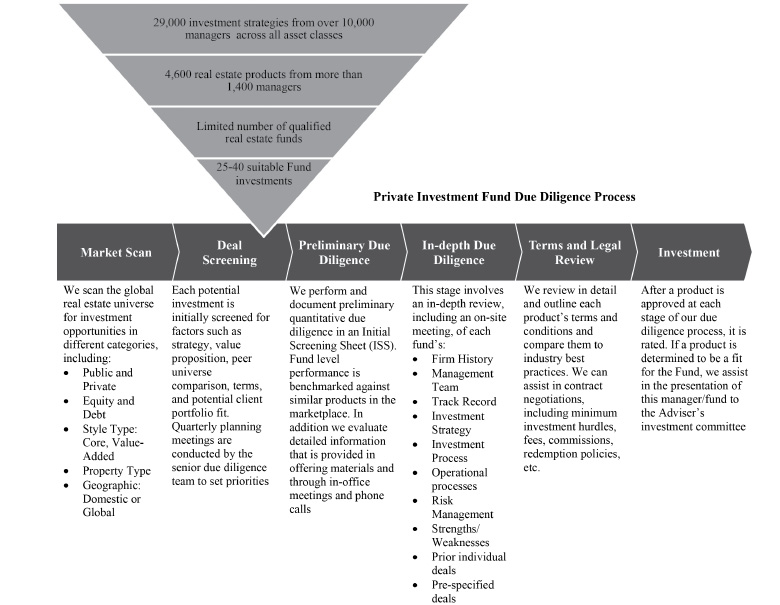
The Adviser, in conjunction with Aon Investments, employs a regimen of quantitative and qualitative criteria to arrive at a universe of investments which the Adviser considers to be “high caliber.” By combining historical quantitative analysis with a sound knowledge of key qualitative attributes, the Adviser will evaluate a prospective investment’s potential for generating sustainable, positive, risk-adjusted returns under a wide variety of market conditions. The systematic global manager research approach that Aon Investments follows is an ongoing process of continually monitoring the fund management marketplace. This process is illustrated in the schematic below:

Aon Investments applies strong fundamental viewpoints and in-depth quantitative excellence to evaluate and rate products according to a myriad of factors. Aon Investments’ process is a clear reflection of Aon Investments’ operational and research excellence, and consists of two main stages:
Quantitative Research
Aon Investments’ proprietary InForm model quantitatively analyzes a wide opportunity set of strategies on a quarterly basis. Aon Investments developed the InForm model to cover those elements also assessed during their fundamental research. Eight factors, as listed below, each with several underlying sub-factors, are weighted according to importance and scored to arrive at an overall rating of either Qualified or Not Recommended.
|
● |
Business |
|
● |
Investment staff |
|
● |
Investment process |
|
● |
Investment risk |
|
● |
Performance |
|
● |
Terms and conditions |
|
● |
Operations |
|
● |
ESG |
The InForm model not only allows to have a view on thousands of investment strategies but helps identify products/strategies for comprehensive due diligence and monitor trends within the industry.
Given the vast and ever-increasing universe of managers and strategies, this quantitative model gives Aon Investments a clear advantage over their competitors. This initial scoring process allows the research professionals to quickly identify investment products with the strongest potential of ultimately obtaining a “Buy” rating after the extensive due diligence and rating process.
The initial screening process helps identify a shortlist of products/strategies for comprehensive qualitative due diligence, which is the second stage of their research process.
Qualitative Research
Products that meet predetermined scores based on the quantitative screens proceed through the comprehensive due diligence, depicted below:
The goal of the qualitative research is to deliver high-conviction ideas, consisting of buy-rated strategies in each asset class, to deploy their asset class building block portfolios. The qualitative evaluation process is robust and gives a deep understanding of a manager’s capabilities and the nuances of a particular strategy. The process involves portfolio and risk analyses on products and strategies, in-person meetings with the managers (typically on-site) and vetting by a team of researchers. The same eight factors included in the InForm model, are also the areas of focus for the fundamental qualitative research:
|
● |
Business: Profitability, stability, and spread of ownership, client base, remuneration policy |
|
● |
Staff: Quality, depth of resource, team dynamic, staff turnover |
|
● |
Investment Process: Competitive advantage, repeatability, skill, implementation |
|
● |
Risk: Embedded in process, independent verification, mix of measurements |
|
● |
Performance Analysis: Consistent with stated process, risk-adjusted, persistent |
|
● |
Terms and Conditions: Client service, fees, best practices in documentation |
|
● |
Operational Due Diligence: Operational controls, valuation of assets, independent directors, third-party vendors |
|
● |
ESG: Policies, staffing, process, stewardship, outcomes |
Upon the conclusion of the due diligence by the manager research teams, each product is scored and rated through a formal voting process of senior research professionals. The debrief process is intended to help ensure a robust debate of issues related to a product/strategy among the senior investment professionals responsible for conducting manager research. The products are voted on by the individuals who conducted the due diligence on a strategy, in addition to three independent senior voters. The goal of their qualitative research is to deliver high-conviction ideas, consisting of buy-rated strategies in each asset class, to deploy the asset class building block portfolios.
A critical part of Aon Investments’ process is to play an active and value-added role after an investment has been made, resulting in a robust investment monitoring system. This is an important tool in reducing risk, improving or creating liquidity, properly reviewing valuations, reporting performance, and assuring conformance with various terms.
Aon Investments monitors investment activity and realization events during the life of the investment and believes that effective post-investment review can enhance the value of primary real estate investments. Aon Investments seeks to maintain an active dialogue with fund managers regarding issues such as approving various waivers, amendments, or extensions to the partnership documents, checking the allocations of income or loss, reviewing the distribution procedures and allocations, extension periods, fund reductions, conflicts of interest, advisory board matters, and related significant issues.
Aon Investments will provide the Adviser with investment performance reporting and analysis, including discussions on investment strategy, portfolio construction, and market update reports. An overview of Aon Investments’ monitoring activities is included below:
Investment Monitoring
|
● |
Monitor incoming communications on a daily basis |
|
● |
Review financial statements and other manager reports |
|
● |
Track portfolio activity for compliance with fund investment strategy and guidelines |
|
● |
Coordinate required actions and provide guidance to clients for such items as partnership agreement amendments, consents, and waivers |
|
● |
Proactively identify potential portfolio issues and update investment ratings quarterly |
Manager Monitoring
|
● |
Meet with each manager at least annually |
|
● |
Participate on quarterly calls |
|
● |
Monitor manager communications and industry news for developments |
|
● |
Proactively identify potential manager issues |
Performance Reporting
|
● |
Track all client contact, and portfolio information in SunGard InvestranTM |
|
● |
Provide comprehensive streamlined reporting |
Additionally, Aon Investments has entered into a sub-advisory relationship with a third party to assist in manager research and underwriting. Due diligence is reviewed and approved by Aon Investments’ Real Estate team.
Criteria Used in Selecting Public Real Estate Securities
The Adviser has retained CenterSquare, a registered investment adviser under the Advisers Act, to manage the portion of the Fund’s investment portfolio that is allocated to publicly traded securities, including common and preferred equity. Under normal circumstances, such securities will likely comprise between 5% and 50% of the Fund’s portfolio. For purposes of the strategy’s investment policies, CenterSquare considers a company to be in the real estate industry if it has at least 50% of its assets in companies principally engaged in the real estate industry, including REITs. With regard to the portion of the portfolio invested in common equity, the strategy usually holds approximately 40 to 60 stocks.
The Adviser with CenterSquare has developed a customized public market investment strategy in line with the objectives of the Fund. This strategy is comprised of a diversified portfolio of real estate securities identified as undervalued relative to their peers to provide investors with attractive, risk-adjusted returns. CenterSquare aims to uncover low-relative price opportunities across sectors and at different turning points in the real estate cycle by looking beyond the obvious factors of stock price and underlying real estate value. CenterSquare’s strategy recognizes that real estate securities are not simply stock, or real estate, but hybrid financial investments. As such, securities are valued on a number of factors, such as the value of the firm’s property portfolio, as well as critical business and market factors, which include: the company’s capitalization, its position within public capital markets, and quality of its management team. Based on industry-specific analyses that evaluate stock values as well as operational and qualitative factors. With regard to the portion of the portfolio invested in common equity, CenterSquare selects approximately 40 to 60 stocks that it believes offer the most promising total return potential. The portfolio is diversified across sector, region and company. Stock weightings are determined through the use of a rigorous risk control process, which helps enable CenterSquare to maximize the portfolio’s risk-adjusted total returns.
Investment Strategy – CenterSquare Process
With respect to the Fund’s common equity securities and certain real estate debt securities, CenterSquare follows a rigorous investment process for determining individual position sizes, including both top-down and bottom-up analyses. The process has three primary components:
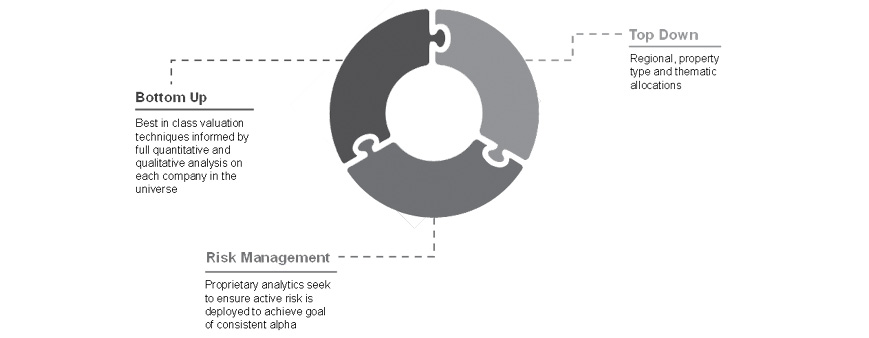
1: Top-down Research
CenterSquare’s research process begins by considering the macroeconomic landscape. CenterSquare examines factors such as economic growth, interest rates, inflation, employment, and consumer spending. From this perspective, CenterSquare refines and forms an opinion on how each of these macroeconomic factors will impact the different real estate sectors within the U.S. (including office, apartment, retail, hotel, industrial, etc.) CenterSquare layers pricing considerations into this relative value analysis in order to determine which property sectors to over or underweight.
2: Bottom-up Research
The bottom-up element focuses on detailed stock-level analysis. Real estate is a management-intensive business, and so CenterSquare starts with a qualitative assessment of each REIT by understanding each company’s strategic vision, governance practices, and history of value creation in varying economic cycles. Next, CenterSquare quantifies the fundamentals and valuation of the underlying real estate using traditional real estate valuation tools, such as implied capitalization rates, net asset value, and replacement costs. CenterSquare evaluates each underlying property from an operating perspective, considering items such as rental rates, occupancy, expenses, property locations, and quality of buildings, as well as quality of tenants and tenant turnover. The final phase of the bottom-up portion of the CenterSquare process involves evaluating each security using proprietary valuation models. CenterSquare strives to understand how independent variables drive valuation. The proprietary models look at leverage, growth, size, property type and other critical factors to derive CenterSquare’s view of relative value. A critical component is a rigorous underwriting of each company’s balance sheet to understand the impact of debt and debt maturities on a company’s ability to navigate the capital markets and successfully implement its strategy. This disciplined financial modeling allows CenterSquare to compare valuations across the REIT universe on a like-for-like basis over time.
3: Risk Management
While identifying attractive securities is an important element of the process, portfolio optimization ensures a proper balance between alpha generation and risk minimization. The third step of CenterSquare’s process focuses on identifying and understanding factor exposures and active bets relative to the benchmark. CenterSquare monitors exposures across a number of facets, including, but not limited to, VaR, tracking error, beta, sector weights, active bet exposures, correlation, standard deviation, and Sharpe ratio.
The outputs of the quantitative models and qualitative scorings are used as inputs in the portfolio construction process, along with top-down macroeconomic themes, capital market considerations, and many other factors. Buy and sell decisions are then made to bring model portfolio weights in line with target weights for each security. The target weights are first determined by the level of conviction for each investment, and then adjusted based on the risk parameters vis-a-vis the benchmark.
Other Information Regarding Investment Strategy
The Fund may, from time to time, take defensive positions that are inconsistent with the Fund’s principal investment strategy in attempting to respond to adverse market, economic, political or other conditions. During such times, the Adviser may determine that the Fund should invest up to 100% of its assets in cash or cash equivalents, including money market instruments, prime commercial paper, repurchase agreements, Treasury bills and other short-term obligations of the U.S. government, its agencies or instrumentalities. In these and in other cases, the Fund may not achieve its investment objective. The Adviser may invest the Fund’s cash balances in any investments it deems appropriate. The Adviser expects that such investments will be made, without limitation and as permitted under the 1940 Act, in money market funds, repurchase agreements, U.S. Treasury and U.S. agency securities, municipal bonds and bank accounts. Any income earned from such investments is ordinarily reinvested by the Fund in accordance with its investment program. Many of the considerations entering into recommendations and decisions of the Adviser and the Fund’s Portfolio Managers are subjective. The Fund may engage in borrowings and the use of leverage in acquiring investments.
The frequency and amount of portfolio purchases and sales (known as the “portfolio turnover rate”) will vary from year to year. The portfolio turnover rate is not expected to exceed 100%, but may vary greatly from year to year and will not be a limiting factor when the Adviser deems portfolio changes appropriate. The Fund may engage in short-term trading strategies, and securities may be sold without regard to the length of time held when, in the opinion of the Adviser, investment considerations warrant such action. These policies may have the effect of increasing the annual rate of portfolio turnover of the Fund. Further, the Underlying Funds in which the Fund invests may experience high rates of portfolio turnover. High rates of portfolio turnover in the Underlying Funds may negatively impact their returns and, thus, negatively impact the returns of the Fund. Higher rates of portfolio turnover would likely result in higher brokerage commissions and may generate short-term capital gains taxable as ordinary income. If securities are not held for the applicable holding periods, dividends paid on them will not qualify for the advantageous federal tax rates. See “Tax Status” in the Fund’s SAI.
There is no assurance what portion, if any, of the Fund’s investments will qualify for the reduced federal income tax rates applicable to qualified dividends under the Code. As a result, there can be no assurance as to what portion of the Fund’s distributions will be designated as qualified dividend income. See “U.S. Federal Income Tax Matters.”
As part of its investment process, for certain of the Fund’s investments, the Adviser considers financially material environmental, social and governance (“ESG”) factors (alongside other relevant factors) in its investment decisions in connection with general risk management and assessing the financial attractiveness of the opportunity. ESG integration does not change the Fund’s investment objective, exclude specific types of companies or investments or constrain the Fund’s investable universe. The Adviser’s assessments related to ESG factors may not be conclusive and investments that may be negatively impacted by such factors may be purchased and retained by the Fund while the Fund may divest or not invest in investments that may be positively impacted by such factors.
Notwithstanding anything herein and for the avoidance of doubt, it is not contemplated that the Adviser will subordinate the Fund’s performance or increase the Fund’s investment risks as a result of (or in connection with) the consideration of any ESG factors nor will it promote ESG characteristics ahead of other investment considerations.
Co-Investments
The 1940 Act imposes significant limits on co-investments with affiliates of the Fund. The Fund, the Adviser and certain affiliates received an exemptive order from the SEC that permits the Fund, among other things, to co-invest with other funds and accounts managed by the Adviser or its affiliates, in certain private placement securities that involve the negotiation of certain terms of the private placement securities to be purchased (other than price-related terms), subject to certain conditions (the “Order”). There can be no assurance that the Fund will be permitted to co-invest with certain of its affiliates other than in the circumstances currently permitted by regulatory guidance and the Order. An inability to receive the desired allocation to potential investments may affect Fund’s ability to achieve the desired investment returns.
RISK FACTORS
An investment in the Fund’s shares is subject to risks. The value of the Fund’s investments will increase or decrease based on changes in the prices of the investments it holds. This will cause the value of the Fund’s shares to increase or decrease. You could lose money by investing in the Fund. By itself, the Fund does not constitute a balanced investment program. Before investing in the Fund you should consider carefully the following risks. There may be additional risks that the Fund does not currently foresee or consider material. You may wish to consult with your legal or tax advisers before deciding whether to invest in the Fund.
Risks Related to an Investment in the Fund
Allocation Risk. The ability of the Fund to achieve its investment objective depends, in part, on the ability of the Adviser to allocate effectively the Fund’s assets among the various instruments in which the Fund invests and, with respect to each such asset class, among equities and fixed income securities. There can be no assurance that the actual allocations will be effective in achieving the Fund’s investment objective or delivering positive returns.
Private Investment Fund Risk. The Fund’s investment in Private Investment Funds will require it to bear a pro rata share of the vehicles’ expenses, including management and performance fees. The fees the Fund pays to invest in a Private Investment Fund may be higher than if the manager of the Private Investment Fund managed the Fund’s assets directly. The incentive fees charged by certain Private Investment Funds may create an incentive for its manager to make investments that are riskier and/or more speculative than those it might have made in the absence of an incentive fee. The Private Investment Funds are not publicly traded and therefore may not be as liquid as other types of investments. Furthermore, Private Investment Funds, like the other Underlying Funds in which the Fund may invest, are subject to specific risks, depending on the nature of the vehicle and also may employ leverage such that their returns are more than one times that of their benchmark which will amplify losses suffered by the Fund when compared to unleveraged investments. For example, these Private Investment Funds need not have independent boards, shareholder approval of advisory contracts may not be required, the Private Investment Funds may utilize leverage and may engage in joint transactions with affiliates. These characteristics present additional risks for shareholders.
The managers of Private Investment Funds may draw down on the Fund’s capital commitment all at once or in a series of capital calls. The portion of the Fund’s commitment to a Private Investment Fund that has not been called is referred to as an “unfunded commitment.” The Fund may have a contractual obligation to provide capital to meet its unfunded commitment when the managers of a Private Investment Fund draw upon the commitment. Pursuant to regulations governing unfunded commitments, at the time the Fund enters into an unfunded commitment, it must have a reasonable belief that it will have sufficient cash and cash equivalents to meet its obligations with respect to all of its unfunded commitment agreements, in each case as they come due. These regulations could reduce the Fund’s flexibility to make investments in Private Investment Funds and require the Fund to modify its investment strategies. In order to meet its obligations, and these regulatory requirements, the Fund may be required to hold a substantial amount of its assets in money market securities, cash or cash equivalents, possibly for prolong periods of time; liquidate portfolio securities at an inopportune time; or borrow under a line of credit. This could make it difficult or impossible to take or liquidate a position in a particular security at a price consistent with the Adviser’s strategy.
Investment in Private Investment Funds carries the risk of loss due to Private Investment Funds’ fraud, intentional or inadvertent deviations from a predefined investment strategy (including excessive concentration, directional investing outside of predefined ranges, excessive leverage or new capital markets), or poor judgment. During the lifetime of the Fund, there could be material changes in one or more Private Investment Funds, including changes in control and mergers. The effect of such changes on a Private Investment Fund cannot be predicted but could be material and adverse. Given the limited liquidity of the Private Investment Funds, the Fund may not be able to alter its portfolio allocation in sufficient time to respond to any such changes, resulting in substantial losses from risks of Private Investment Funds.
Lack of Control Over Private Investment Funds and Other Portfolio Investments. Once the Adviser has selected Underlying Funds, the Adviser will have no control over the investment decisions made by any such Underlying Fund. Although the Adviser will regularly evaluate each Underlying Fund and its manager to determine whether their respective investment programs are consistent with the Fund’s investment objective, the Adviser will not have any control over the investments made by any Underlying Fund. Even though the Underlying Funds are subject to certain constraints, the managers may change aspects of their investment strategies. The managers may do so at any time (for example, such change may occur immediately after providing the Adviser with the quarterly unaudited financial information for a Private Investment Fund). The Adviser may reallocate the Fund’s investments among the Underlying Funds, but the Adviser’s ability to do so may be constrained by the withdrawal limitations imposed by the Underlying Funds, which may prevent the Fund from reacting rapidly to market changes should an Underlying Fund fail to effect portfolio changes consistent with such market changes and the demands of the Adviser. Such withdrawal limitations may also restrict the Adviser’s ability to terminate investments in Underlying Funds that are poorly performing or have otherwise had adverse changes. The Adviser will be dependent on information provided by the Underlying Fund, including quarterly unaudited financial statements, which if inaccurate could adversely affect the Adviser’s ability to manage the Fund’s investment portfolio in accordance with its investment objective. By investing in the Fund, a shareholder will not be deemed to be an investor in any Underlying Fund and will not have the ability to exercise any rights attributable to an investor in any such Underlying Fund related to their investment.
Issuer Risk. The value of a specific security can be more volatile than the market as a whole and can perform differently from the value of the market as a whole. The value of an issuer’s securities that are held in the Fund’s portfolio may decline for a number of reasons which directly relate to the issuer, such as management performance, financial leverage and reduced demand for the issuer’s goods and services.
Liquidity Risk. The Fund is a closed-end investment company structured as an “interval fund” and designed for long-term investors. Unlike many closed-end investment companies, the Fund’s shares are not listed on any securities exchange and are not publicly traded. There currently is no secondary market for the shares and the Adviser does not expect that a secondary market will develop. Limited liquidity is provided to shareholders only through the Fund’s quarterly repurchase offers for no less than 5% of the Fund’s shares outstanding at net asset value. There is no guarantee that shareholders will be able to sell all of the shares they desire in a quarterly repurchase offer. The Fund’s investments are also subject to liquidity risk. Liquidity risk exists when particular investments of the Fund would be difficult to purchase or sell, possibly preventing the Fund from selling such illiquid securities at an advantageous time or price, or possibly requiring the Fund to dispose of other investments at unfavorable times or prices in order to satisfy its obligations.
Management Risk. The net asset value of the Fund changes daily based on the performance of the securities in which it invests. The Adviser’s judgments about the attractiveness, value and potential appreciation of a particular real estate segment and securities in which the Fund invests may prove to be incorrect and may not produce the desired results. The Fund’s Portfolio Managers and the other principals of the Adviser have limited experience in managing a closed-end fund.
General Market Conditions Risk. An investment in shares is subject to investment risk, including the possible loss of the entire principal amount invested. An investment in shares represents an indirect investment in the securities owned by the Fund. The value of these securities, like other market investments, may move up or down, sometimes rapidly and unpredictably. The value of your shares at any point in time may be worth less than the value of your original investment, even after taking into account any reinvestment of distributions. The Fund may also use leverage, which would magnify the Fund’s investment, market and certain other risks. No guarantee or representation is made that the Fund’s investment objectives will be achieved.
Failure of Financial Institutions and Sustained Financial Market Illiquidity. The failure of certain financial institutions, namely banks, may increase the possibility of a sustained deterioration of financial market liquidity, or illiquidity at clearing, cash management and/or custodial financial institutions. The failure of a bank (or banks) with which the Fund and/or the Fund’s underlying investments have a commercial relationship could adversely affect, among other things, the Fund and/or the Fund’s underlying investments’ ability to pursue key strategic initiatives, including by affecting the Fund’s ability to borrow from financial institutions on favorable terms.
Market Disruptions Risk. The Fund may incur major losses in the event of market disruptions and other extraordinary events in which historical pricing relationships become materially distorted. The risk of loss from pricing distortions is compounded by the fact that in disrupted markets many positions become illiquid, making it difficult or impossible to close out positions against which the markets are moving. Market disruptions caused by unexpected political, military and terrorist events may from time to time cause dramatic losses for the Fund and such events can result in otherwise historically low-risk strategies performing with unprecedented volatility and risk.
Changes in Trade Negotiations. In recent years, the U.S. government has indicated its intent to alter its approach to international trade policy and in some cases to renegotiate, or potentially terminate, certain existing bilateral or multi-lateral trade agreements and treaties with foreign countries, and has made proposals and taken actions related thereto. Tariffs on imported goods could further increase costs, decrease margins, reduce the competitiveness of products and services offered by current and future portfolio companies and adversely affect the revenues and profitability of portfolio companies whose businesses rely on goods imported from such impacted jurisdictions.
Highly Volatile Markets. The prices of financial instruments in which the Fund may invest can be highly volatile. The prices of instruments in which the Fund may invest are influenced by numerous factors, including interest rates, currency rates, default rates, governmental policies and political and economic events (both domestic and global). Moreover, political or economic crises, or other events may occur that can be highly
disruptive to the markets in which the Fund may invest. In addition, governments from time to time intervene (directly and by regulation), which intervention may adversely affect the performance of the Fund and its investment activities. The Fund is also subject to the risk of a temporary or permanent failure of the exchanges and other markets on which its investments may trade. Sustained market turmoil and periods of heightened market volatility make it more difficult to produce positive trading results, and there can be no assurance that the Fund’s strategies will be successful in such markets.
U.S. Debt Ceiling and Budget Deficit Risks. U.S. debt ceiling and budget deficit concerns have increased the possibility of additional credit-rating downgrades and economic slowdowns, or a recession in the United States. Although U.S. lawmakers have historically passed legislation to raise the federal debt ceiling on multiple occasions, ratings agencies have lowered or threatened to lower the long-term sovereign credit rating on the United States. In August 2023, Fitch Ratings Inc., downgraded the U.S. credit rating to AA+ from AAA, citing fiscal deterioration over the next three years and close encounters with default due to ongoing political dysfunction. The impact of a U.S. default on its obligations or any further downgrades to the U.S. government’s sovereign credit rating or its perceived creditworthiness could adversely affect the U.S. and global financial markets and economic conditions. In addition, disagreement over the federal budget has caused the U.S. federal government to shut down for periods of time. Continued adverse political and economic conditions could have a material adverse effect on the Fund’s business, financial condition and results of operations.
Concentration of Credit Risk. The Fund places its cash with one banking institution, which is insured by the Federal Deposit Insurance Corporation (“FDIC”). The FDIC limit is $250,000. At various times throughout the year, the amount on deposit may exceed the FDIC limit and subject the Fund to a credit risk. The Fund does not believe that such deposits are subject to any unusual risk associated with investment activities. The Fund may invest cash balances in an open-end Money Market Mutual Fund (“Money Market Fund”). The Money Market Fund is valued at its closing NAV. The Money Market Fund is not subject to FDIC insurance.
Correlation Risk. The Fund seeks to produce returns that are less correlated to the broader financial markets over time. Although the prices of equity securities and fixed income securities, as well as other asset classes, often rise and fall at different times so that a fall in the price of one may be offset by a rise in the price of the other, in down markets the prices of these securities and asset classes can also fall in tandem. Because the Fund allocates its investments among different asset classes, the Fund is subject to correlation risk.
Repurchase Policy Risks. Quarterly repurchases by the Fund of its shares typically will be funded from available cash or sales of portfolio securities. However, payment for repurchased shares may require the Fund to liquidate portfolio holdings earlier than the Adviser otherwise would liquidate such holdings, potentially resulting in losses, and may increase the Fund’s portfolio turnover. The Adviser may take measures to attempt to avoid or minimize such potential losses and turnover, and instead of liquidating portfolio holdings, may borrow money to finance repurchases of shares. If the Fund borrows to finance repurchases, interest on any such borrowing will negatively affect shareholders who do not tender their shares in a repurchase offer by increasing the Fund’s expenses and reducing any net investment income. To the extent the Fund finances repurchase proceeds by selling investments, the Fund may hold a larger proportion of its net assets in less liquid securities. Also, the sale of securities to fund repurchases could reduce the market price of those securities, which in turn would reduce the Fund’s net asset value.
Repurchase of shares will tend to reduce the amount of outstanding shares and, depending upon the Fund’s investment performance, its net assets. A reduction in the Fund’s net assets may increase the Fund’s expense ratio, to the extent that additional shares are not sold. In addition, the repurchase of shares by the Fund may be a taxable event to shareholders.
Distribution Policy Risk. The Fund’s distribution policy is to make quarterly distributions to shareholders. All or a portion of a distribution may consist solely of a return of capital (i.e. from your original investment) and not a return of net profit. Shareholders should not assume that the source of a distribution from the Fund is net profit. Shareholders should note that return of capital will reduce the tax basis of their shares and potentially increase the taxable gain, if any, upon disposition of their shares.
Anti-Takeover Provisions. The Fund’s Declaration of Trust (the “Declaration of Trust”) includes provisions that could limit the ability of other entities or persons to acquire control of the Fund or convert the Fund to open-end status. See “Anti-Takeover Provisions in the Declaration of Trust.”
Limitation on Liability of Trustees and Officers; Indemnification and Advance of Expenses. Delaware law permits a Delaware statutory trust to include in its declaration of trust a provision to indemnify and hold harmless any trustee or beneficial owner or other person from and against any and all claims and demands whatsoever. Our Declaration of Trust provides that our Trustees will not be liable to us or our shareholders for monetary damages for breach of fiduciary duty as a trustee to the fullest extent permitted by Delaware law. Our Declaration of Trust provides for the indemnification of any person to the full extent permitted, and in the manner provided, by Delaware law. In accordance with the 1940 Act, we will not indemnify certain persons for any liability to which such persons would be subject by reason of such person’s willful misfeasance, bad faith, gross negligence or reckless disregard of the duties involved in the conduct of his office.
Cybersecurity Risk. Cybersecurity refers to the combination of technologies, processes and procedures established to protect information technology systems and data from unauthorized access, attack or damage. The Fund and its affiliates and third-party service providers are subject to cybersecurity risks. Cybersecurity risks have significantly increased in recent years and the Fund could suffer such losses in the future. The Fund’s and its affiliates’ and third-party service providers’ computer systems, software, and networks may be vulnerable to unauthorized access, computer viruses or other malicious code, and other events that could have a security impact. If one or more of such events occur, this potentially could jeopardize confidential and other information, including nonpublic personal information and sensitive business data, processed and stored in, and transmitted through, computer systems and networks, or otherwise cause interruptions or malfunctions in the Fund’s operations or the operations of their respective affiliates and third-party service providers. This could result in significant losses, reputational damage, litigation, regulatory fines or penalties, or otherwise adversely affect the Fund’s business, financial condition or results of operations. Privacy and
information security laws and regulation changes, and compliance with those changes, may result in cost increases due to system changes and the development of new administrative processes. In addition, the Fund may be required to expend significant additional resources to modify the Fund’s protective measures and to investigate and remediate vulnerabilities or other exposures arising from operational and security risks.
Risks Related to Our Investments
Real Estate Industry Concentration Risk. Because the Fund will concentrate its investments in real estate securities, its portfolio will be significantly impacted by the performance of the real estate market and may experience more volatility and be exposed to greater risk than a more diversified portfolio. In addition, the Fund may invest in real estate equity or debt and therefore may be subject to risks similar to those associated with direct investment in real property. The value of the Fund’s shares will be affected by factors affecting the value of real estate and the earnings of companies engaged in the real estate industry. These factors include, among others: (i) changes in general economic and market conditions; (ii) changes in the value of real estate properties; (iii) risks related to local economic conditions, overbuilding and increased competition; (iv) increases in property taxes and operating expenses; (v) changes in zoning laws; (vi) casualty and condemnation losses; (vii) variations in rental income, neighborhood values or the appeal of property to tenants; (viii) the availability of financing and (ix) changes in interest rates. Many real estate companies utilize leverage, which increases investment risk and could adversely affect a company’s operations and market value in periods of rising interest rates. The value of securities of companies in the real estate industry may go through cycles of relative under-performance and over-performance in comparison to equity securities markets in general.
There are also special risks associated with particular real estate sectors, or real estate operations generally, as described below:
Retail Properties. Retail properties are affected by the overall health of the economy and may be adversely affected by, among other things, the growth of alternative forms of retailing, bankruptcy, departure or cessation of operations of a tenant, a shift in consumer demand due to demographic changes, changes in spending patterns and lease terminations.
Office Properties. Office properties are affected by the overall health of the economy, and other factors such as a downturn in the businesses operated by their tenants, obsolescence, remote work policies of their tenants, and non-competitiveness.
Industrial Properties. Industrial properties are affected by the overall health of the economy and other factors such as downturns in the manufacture, processing and shipping of goods.
Hospitality Properties. The risks of hotel, motel and similar hospitality properties include, among other things, the necessity of a high level of continuing capital expenditures, competition, increases in operating costs which may not be offset by increases in revenues, dependence on business and commercial travelers and tourism, increases in fuel costs and other expenses of travel, and adverse effects of general and local economic conditions. Hotel properties tend to be more sensitive to adverse economic conditions and competition than many other commercial properties.
Healthcare and Life Sciences Properties. Healthcare and life sciences properties and healthcare providers are affected by several significant factors, including federal, state and local laws governing licenses, certification, adequacy of care, pharmaceutical distribution, rates, equipment, personnel and other factors regarding operations, continued availability of revenue from government reimbursement programs and competition on a local and regional basis. The failure of any healthcare operator to comply with governmental laws and regulations may affect its ability to operate its facility or receive government reimbursements.
Student Housing Properties. Student housing properties are affected by seasonal leasing, cash flow risks, and are subject to unique demand drivers.
Multifamily Properties. The value and successful operation of a multifamily property may be affected by a number of factors such as the location of the property, the ability of the management team, the level of mortgage interest rates, the presence of competing properties, adverse economic conditions in the locale, oversupply and rent control laws or other laws affecting such properties.
Residential Properties. Residential properties can be significantly affected by the national, regional and local real estate markets. This segment of the real estate industry also is sensitive to interest rate fluctuations which can cause changes in the availability of mortgage capital and directly affect the purchasing power of potential homebuyers. Thus, residential properties can be significantly affected by changes in government spending, consumer confidence, demographic patterns and the level of new and existing home sales.
Shopping Centers. Shopping center properties are dependent upon the successful operations and financial condition of their tenants, particularly certain of their major tenants, and could be adversely affected by bankruptcy of those tenants. In some cases, a tenant may lease a significant portion of the space in one center, and the filing of bankruptcy could cause significant revenue loss, including the loss of revenue from smaller tenants with co-tenancy rights. Like others in the commercial real estate industry, community centers are subject to environmental risks and interest rate risk. They also face the need to enter into new leases or renew leases on favorable terms to generate rental revenues. Community center properties could be adversely affected by changes in the local markets where their properties are located, as well as by adverse changes in national economic and market conditions.
Self-Storage Properties. The value and successful operation of a self-storage property may be affected by a number of factors, such as the ability of the management team, the location of the property, the presence of competing properties, changes in traffic patterns and effects of general and local economic conditions with respect to rental rates and occupancy levels.
Other factors may contribute to the risk of real estate investments:
Development Issues. Certain real estate companies may engage in the development or construction of real estate properties. These companies in which the Fund invests (“portfolio companies”) are exposed to a variety of risks inherent in real estate development and construction, such as the risk that there will be insufficient tenant demand to occupy newly developed properties, and the risk that prices of construction materials or construction labor may rise materially during the development.
Lack of Insurance. Certain of the portfolio companies in the Fund’s portfolio may fail to carry comprehensive liability, fire, flood, earthquake extended coverage and rental loss insurance, or insurance in place may be subject to various policy specifications, limits and deductibles. Should any type of uninsured loss occur, the portfolio company could lose its investment in, and anticipated profits and cash flows from, a number of properties and, as a result, adversely affect the Fund’s investment performance.
Dependence on Tenants. The value of the Fund’s portfolio companies’ properties and the ability of these companies to make distributions to their shareholders depends upon the ability of the tenants at the properties to generate enough income in excess of their tenant operating expenses to make their lease payments. Changes beyond the control of our portfolio companies may adversely affect their tenants’ ability to make their lease payments and, in such event, would substantially reduce both their income from operations and ability to make distributions to our portfolio companies and, consequently, the Fund.
Financial Leverage. Real estate companies may be highly leveraged and financial covenants may affect the ability of real estate companies to operate effectively.
Environmental Issues. In connection with the ownership (direct or indirect), operation, management and development of real properties that may contain hazardous or toxic substances, a portfolio company may be considered an owner, operator or responsible party of such properties and, therefore, may be potentially liable for removal or remediation costs, as well as certain other costs, including governmental fines and liabilities for injuries to persons and property. The existence of any such material environmental liability could have a material adverse effect on the results of operations and cash flow of any such portfolio company and, as a result, the amount available to make distributions on shares of the Fund could be reduced.
Financing Issues. Financial institutions in which the Fund may invest are subject to extensive government regulation. This regulation may limit both the amount and types of loans and other financial commitments a financial institution can make, and the interest rates and fees it can charge. In addition, interest and investment rates are highly sensitive and are determined by many factors beyond a financial institution’s control, including general and local economic conditions (such as inflation, recession, money supply and unemployment) and the monetary and fiscal policies of various governmental agencies such as the Federal Reserve Board. These limitations may have a significant impact on the profitability of a financial institution since profitability is attributable, at least in part, to the institution’s ability to make financial commitments such as loans. Profitability of a financial institution is largely dependent upon the availability and cost of the institution’s funds, and can fluctuate significantly when interest rates change.
REIT Risk. Investments (directly or indirectly) in REITs will subject the Fund to various risks. REIT share prices may decline because of adverse developments affecting the real estate industry and real property values. In general, real estate values can be affected by a variety of factors, including supply and demand for properties, the economic health of the country or of different regions, and the strength of specific industries that rent properties. REITs often invest in highly leveraged properties. Returns from REITs, which typically are small or medium capitalization stocks, may trail returns from the overall stock market. In addition, changes in interest rates may hurt real estate values or make REIT shares less attractive than other income-producing investments. REITs are also subject to heavy cash flow dependency, defaults by borrowers and self-liquidation.
Qualification as a REIT under the Code in any particular year is a complex analysis that depends on a number of factors. There can be no assurance that an entity in which the Fund invests with the expectation that it will be taxed as a REIT will, in fact, qualify as a REIT. An entity that fails to qualify as a REIT would be subject to a corporate level tax, would not be entitled to a deduction for dividends paid to its shareholders and would not pass through to its shareholders the character of income earned by the entity. If the Fund were to invest in an entity that failed to qualify as a REIT, such failure could significantly reduce the Fund’s yield on that investment. REITs can be classified as equity REITs, mortgage REITs, and hybrid REITs. Equity REITs invest primarily in real property and earn rental income from leasing those properties. They may also realize gains or losses from the sale of properties. Equity REITs will be affected by conditions in the real estate rental market and by changes in the value of the properties they own. Mortgage REITs invest primarily in mortgages and similar real estate interests and receive interest payments from the owners of the mortgaged properties. Mortgage REITs will be affected by changes in creditworthiness of borrowers and changes in interest rates. Hybrid REITs invest both in real property and in mortgages. Equity and mortgage REITs are dependent upon management skills, may not be diversified and are subject to the risks of financing projects.
Dividends paid by REITs will not generally qualify for the reduced U.S. federal income tax rates applicable to qualified dividends under the Code. See “U.S. Federal Income Tax Matters.” The Fund’s investments in REITs may include an additional risk to shareholders. Some or all of a REIT’s annual distributions to its investors may constitute a non-taxable return of capital. Any such return of capital will generally reduce the Fund’s basis in the REIT investment, but not below zero. To the extent the distributions from a particular REIT exceed the Fund’s basis in such REIT, the Fund will generally recognize gain. In part because REIT distributions often include a nontaxable return of capital, Fund distributions to shareholders may also include a nontaxable return of capital. Shareholders that receive such a distribution will also reduce their tax basis in their shares of the Fund, but not below zero. To the extent the distribution exceeds a shareholder’s basis in the Fund’s shares, such shareholder will generally recognize a capital gain. The Fund does not have any investment restrictions with respect to investments in REITs.
REOC Risk. REOCs, like REITs, expose the Fund to the risks of the real estate market. These risks can include fluctuations in the value of underlying properties; destruction of underlying properties; defaults by borrowers or tenants; market saturation; changes in general and local economic conditions; decreases in market rates for rents; increases in vacancies; competition; property taxes; capital expenditures, or operating expenses; and other economic, political or regulatory occurrences affecting the real estate industry. REOCs may also be affected by risks similar to investments in debt securities, including changes in interest rates and the quality of credit extended. REOCs require specialized management and
pay management expenses; may have less trading volume; may be subject to more abrupt or erratic price movements than the overall securities markets; and may invest in a limited number of properties, in a narrow geographic area, or in a single property type which increase the risk that the portfolio could be unfavorably affected by the poor performance of a single investment or investment type. In addition, defaults on or sales of investments that the REOC holds could reduce the cash flow needed to make distributions to investors.
Commercial Mortgage-Backed Securities Risk. Commercial mortgage-backed securities include securities that reflect an interest in, and are secured by, mortgage loans on commercial real property (such as office properties, retail properties, hospitality properties, industrial properties, healthcare-related properties or other types of income producing real property). Many of the risks of investing in commercial mortgage-backed securities reflect the risks of investing in the real estate securing the underlying mortgage loans, which include the risks associated with the effects of local and other economic conditions on real estate markets, the ability of tenants to make loan payments, increases in interest rates, real estate tax rates and other operating expenses, changes in governmental rules, regulations and fiscal policies, the effects of and responses to infectious illness outbreaks, epidemics of pandemics, and the ability of a property to attract and retain tenants. Commercial mortgage-backed securities depend on cash flows generated by underlying commercial real estate loans, receivables, and other assets, and can be significantly affected by changes in market and economic conditions, the availability of information regarding the underlying assets and their structures, and the creditworthiness of the borrowers or tenants. Commercial mortgage-backed securities may be less liquid and exhibit greater price volatility than other types of mortgage- or asset-backed securities. Commercial mortgage-backed securities issued by private issuers may offer higher yields than commercial mortgage-backed securities issued by government issuers, but also may be subject to greater volatility than commercial mortgage-backed securities issued by government issuers. The commercial mortgage-backed securities market may experience substantially lower valuations and greatly reduced liquidity. Commercial mortgage-backed securities held by the Fund may be subordinated to one or more other classes of securities of the same series for purposes of, among other things, establishing payment priorities and offsetting losses and other shortfalls with respect to the related underlying mortgage loans. There can be no assurance that the subordination will be sufficient on any date to offset all losses or expenses incurred by the underlying trust. The value of CMBS and other mortgage-backed securities in which the Fund may invest generally will have an inverse relationship with interest rates. Accordingly, if interest rates rise, the value of such securities will decline. In addition, to the extent that the mortgage loans which underlie specific mortgage-backed securities are pre-payable, the value of such mortgage securities may be negatively affected by increasing prepayments, which generally occur when interest rates decline.
Residential Mortgage-Backed Securities Risk. The Fund may invest certain of its assets in residential mortgage-backed securities and become a holder of RMBS. Holders of RMBS bear various risks, including credit, market, interest rate, structural and legal risks. RMBS represent interests in pools of residential mortgage loans secured by residential mortgage loans. Such loans may be prepaid at any time. Residential mortgage loans are obligations of the borrowers thereunder only and are not typically insured or guaranteed by any other person or entity, although such loans may be securitized and the securities issued in such securitization may be guaranteed or credit enhanced. The rate of defaults and losses on residential mortgage loans will be affected by a number of factors, including general economic conditions and those in the area where the related mortgaged property is located, the borrower’s equity in the mortgaged property and the financial circumstances of the borrower. If a residential mortgage loan is in default, foreclosure of such residential mortgage loan may be a lengthy and difficult process, and may involve significant expenses. Furthermore, the market for defaulted residential mortgage loans or foreclosed properties may be very limited.
Structured Products Risk. Holders of structured products bear risks of the underlying investments, index or reference obligation and are subject to counterparty risk. The Fund may have the right to receive payments only from the structured product, and generally does not have direct rights against the issuer or the entity that sold the assets to be securitized. While certain structured products enable the investor to acquire interests in a pool of securities without the brokerage and other expenses associated with directly holding the same securities, investors in structured products generally pay their share of the structured product’s administrative and other expenses. Although it is difficult to predict whether the prices of indices and securities underlying structured products will rise or fall, these prices (and, therefore, the prices of structured products) will be influenced by the same types of political and economic events that affect issuers of securities and capital markets generally. If the issuer of a structured product uses shorter term financing to purchase longer term securities, the issuer may be forced to sell its securities at below market prices if it experiences difficulty in obtaining short-term financing, which may adversely affect the value of the structured products owned by the Fund.
Investments in structured notes involve risks, including credit risk and market risk. Where the Fund’s investments in structured notes are based upon the movement of one or more factors, including currency exchange rates, interest rates, referenced bonds and stock indices, depending on the factor used and the use of multipliers or deflators, changes in interest rates and movement of the factor may cause significant price fluctuations. Additionally, changes in the reference instrument or security may cause the interest rate on the structured note to be reduced to zero, and any further changes in the reference instrument may then reduce the principal amount payable on maturity. Structured notes may be less liquid than other types of securities and more volatile than the reference instrument or security underlying the note.
CLO Risk. In addition to the general risks associated with real estate securities, debt securities and structured products discussed herein, CLOs carry additional risks, including, but not limited to (i) the possibility that distributions from collateral securities will not be adequate to make interest or other payments; (ii) the quality of the collateral may decline in value or default; (iii) the possibility that the investments in CLOs are subordinate to other classes or tranches thereof, (iv) the potential of spread compression in the underlying loans of the CLO, which could reduce credit enhancement in the CLOs and (v) the complex structure of the security may not be fully understood at the time of investment and may produce disputes with the issuer or unexpected investment results.
CLO junior debt securities that the Fund may acquire are subordinated to more senior tranches of CLO debt. CLO junior debt securities are subject to increased risks of default relative to the holders of superior priority interests in the same securities. In addition, at the time of issuance, CLO equity securities are under-collateralized in that the liabilities of a CLO at inception exceed its total assets. Though not exclusively, the Fund will typically be in a first loss or subordinated position with respect to realized losses on the assets of the CLOs in which it is invested. The Fund may recognize phantom taxable income from its investments in the subordinated tranches of CLOs.
Between the closing date and the effective date of a CLO, the CLO collateral manager will generally expect to purchase additional collateral obligations for the CLO. During this period, the price and availability of these collateral obligations may be adversely affected by a number of market factors, including price volatility and availability of investments suitable for the CLO, which could hamper the ability of the collateral manager to acquire a portfolio of collateral obligations that will satisfy specified concentration limitations and allow the CLO to reach the initial
par amount of collateral prior to the effective date. An inability or delay in reaching the target initial par amount of collateral may adversely affect the timing and amount of interest or principal payments received by the holders of the CLO debt securities and distributions of the CLO on equity securities and could result in early redemptions which may cause CLO debt and equity investors to receive less than face value of their investment.
The failure by a CLO in which the Fund invests to satisfy financial covenants, including with respect to adequate collateralization and/or interest coverage tests, could lead to a reduction in the CLO’s payments to the Fund. In the event that a CLO fails certain tests, holders of CLO senior debt may be entitled to additional payments that would, in turn, reduce the payments the Fund would otherwise be entitled to receive. Separately, the Fund may incur expenses to the extent necessary to seek recovery upon default or to negotiate new terms, which may include the waiver of certain financial covenants, with a defaulting CLO or any other investment the Fund may make. If any of these occur, it could adversely affect the Fund’s operating results and cash flows.
The Fund’s CLO investments are exposed to leveraged credit risk. If certain minimum collateral value ratios and/or interest coverage ratios are not met by a CLO, primarily due to senior secured loan defaults, then cash flow that otherwise would have been available to pay distributions to the Fund on its CLO investments may instead be used to redeem any senior notes or to purchase additional senior secured loans, until the ratios again exceed the minimum required levels or any senior notes are repaid in full.
Underlying Funds Risk. The Underlying Funds in which the Fund may invest are subject to investment advisory and other expenses, which will be indirectly paid by the Fund. As a result, the cost of investing in the Fund will be higher than the cost of investing directly in the Underlying Funds and also may be higher than other funds that invest directly in securities. The Underlying Funds are subject to specific risks, depending on the nature of the specific Underlying Fund. The Fund’s performance depends in part upon the performance of the Underlying Fund managers and selected strategies, the adherence by such Underlying Fund managers to such selected strategies, the instruments used by such Underlying Fund managers and the Adviser’s ability to select Underlying Fund managers and strategies and effectively allocate Fund assets among them. Additionally, the market value of shares of Underlying Funds that are closed-end funds may differ from their net asset value. This difference in price may be due to the fact that the supply and demand in the market for fund shares at any point in time is not always identical to the supply and demand in the market for the underlying basket of securities.
Rehypothecated Securities Risk. In connection with the use of the BNP Credit Facility for leverage, the Fund permits the lender, subject to certain conditions, to rehypothecate (i.e., lend to other counterparties) portfolio securities pledged by the Fund up to the amount of the loan balance outstanding. The terms of the BNP Credit Facility provide that the Fund continue to receive dividends and interest on rehypothecated securities. The Fund has the right under the BNP Credit Facility to recall rehypothecated securities from BNP on demand. If BNP fails to deliver a recalled security in a timely manner, the BNP Credit Facility provides for compensation by BNP to the Fund for any fees or losses related to the failed delivery or, in the event a recalled security will not be returned by BNP, for the Fund, upon notice to BNP, to reduce the loan balance outstanding by the amount of the recalled security failed to be returned. The terms of the BNP Credit Facility pursuant to which portfolio securities pledged by the Fund are rehypothecated may provide for receipt by the Fund, either directly or indirectly through a reduction in the costs associated with the BNP Credit Facility, of a portion of the fees earned by BNP in connection with the rehypothecation of such portfolio securities. Rehypothecation by BNP of the Fund’s pledged portfolio securities entails risks, including the risk that BNP will be unable or unwilling to return rehypothecated securities, which could result in, among other things, the inability of the Fund to find suitable investments to replace the unreturned securities, thereby impairing the ability the Fund to achieve its investment objective.
Use of Leverage by the Fund. Although the Fund has the option to borrow, including through the Credit Facilities, there are significant risks that may be assumed in connection with such borrowings. Investors in the Fund should consider the various risks of financial leverage, including, without limitation, the matters described below. There is no assurance that a leveraging strategy would be successful. Financial leverage involves risks and special considerations for shareholders including: (i) the likelihood of greater volatility of NAV of the shares than a comparable portfolio without leverage; (ii) the risk that fluctuations in interest rates on borrowings and short-term debt that the Fund must pay will reduce the return to the shareholders; (iii) the effect of financial leverage in a market experiencing rising interest rates, which would likely cause a greater decline in the NAV of the shares than if the Fund were not leveraged; and (iv) the potential for an increase in operating costs, which may reduce the Fund’s total return.
In the event that the Fund would be required to sell assets at a loss, including in order to redeem or pay off any borrowing, such a sale would reduce the Fund’s NAV and may make it difficult for the NAV to recover. The Fund nevertheless may continue to use financial leverage if the Adviser expects that the benefits to the shareholders of maintaining the leveraged position likely would outweigh a resulting reduction in the current return.
Certain types of borrowings by the Fund would result in the Fund being subject to covenants in credit agreements relating to asset coverage and Fund composition requirements that are more stringent than those currently imposed on the Fund by the 1940 Act. In addition, borrowings by the Fund may be made on a secured basis. The Custodian will then either segregate the assets securing the Fund’s borrowings for the benefit of the Fund’s lenders or arrangements will be made with a suitable sub-custodian. If the assets used to secure a borrowing decrease in value, the Fund may be required to pledge additional collateral to the lender in the form of cash or securities to avoid liquidation of those assets. In the event of a default, the lenders will have the right, through the Custodian, to redeem the Fund’s investments in underlying Investment Funds without consideration of whether doing so would be in the best interests of the Fund’s shareholders. The rights of any lenders to the Fund to receive payments of interest on and repayments of principal of borrowings will be senior to the rights of the Fund’s shareholders, and the terms of the Fund’s borrowings may contain provisions that limit certain activities of the Fund and could result in precluding the purchase of instruments that the Fund would otherwise purchase.
The use of financial leverage involves financial risk and would increase the exposure of the Fund’s investment returns to adverse economic factors such as rising interest rates, downturns in the economy or deterioration in the condition of the investments. There would be a risk that operating cash flow available to the Fund would be insufficient to meet required payments and a risk that it would not be possible to refinance existing indebtedness or that the terms of such refinancing would not be as favorable as the terms of existing indebtedness. Borrowings by the Fund may be secured by any or all of the assets of the Fund, with the consequences that the Fund may lose more than its equity stake in any one investment, and may lose all of its capital.
Reverse Repurchase Agreements Risk. The Fund’s use of reverse repurchase agreements involves many of the same risks involved in the Fund’s use of leverage, as the proceeds from reverse repurchase agreements generally will be invested in additional securities. There is a risk that the market value of the securities acquired in the reverse repurchase agreement may decline below the price of the securities that the Fund has sold but remains obligated to repurchase. In addition, there is a risk that the market value of the securities retained by the Fund may decline. If the buyer of securities under a reverse repurchase agreement were to file for bankruptcy or experiences insolvency, the Fund may be adversely affected. Also, in entering into reverse repurchase agreements, the Fund would bear the risk of loss to the extent that the proceeds of the reverse repurchase agreement are less than the value of the underlying securities. In addition, due to the interest costs associated with reverse repurchase agreements transactions, the Fund’s NAV will decline, and, in some cases, the Fund may be worse off than if it had not used such instruments.
Use of Leverage by Underlying Funds. In addition to any borrowing utilized by the Fund, the Underlying Funds in which the Fund invests may utilize financial leverage. The Underlying Funds may be able to borrow, subject to the limitations of their charters and operative documents. In the case of Private Investment Funds, such funds are not subject to the limitations imposed by the 1940 Act regarding the use of leverage with respect to which registered investment companies, including the Fund, are subject. To that end, the Fund intends to limit its direct borrowing to an amount that does not exceed 33 1/3% of the Fund’s gross asset value. Furthermore, Underlying Funds typically will hold their investments in entities organized as REITs, corporations or other entities and this may allow the Fund’s risk of loss to be limited to the amount of its investment in the Underlying Fund. While leverage presents opportunities for increasing the Fund’s total return, it has the effect of potentially increasing losses as well.
Valuation of Private Investment Funds. While the valuation of the Fund’s publicly-traded securities are more readily ascertainable, the Fund’s ownership interest in Private Investment Funds are not publicly traded and the Fund will depend on the institutional asset manager to a Private Investment Fund to provide a valuation of the Fund’s investment. Moreover, the valuation of the Fund’s investment in a Private Investment Fund, as provided by an institutional asset manager as of a specific date, may vary from the fair value of the investment that may be obtained if such investment were sold to a third party. For information about the value of the Fund’s investment in Private Investment Funds, the Adviser will be dependent on information provided by the Private Investment Funds, including quarterly unaudited financial statements which if inaccurate could adversely affect the Adviser’s ability to value accurately the Fund’s shares.
Preferred Securities Risk. There are various risks associated with investing in preferred securities, including credit risk, interest rate risk, deferral and omission of distributions, subordination to bonds and other debt securities in a company’s capital structure, limited liquidity, limited voting rights and special redemption rights. Interest rate risk is, in general, the risk that the price of a preferred security falls when interest rates rise. Securities with longer maturities tend to be more sensitive to interest rate changes. Credit risk is the risk that an issuer of a security may not be able to make principal and interest or dividend payments on the security as they become due. Holders of preferred securities may not receive dividends, or the payment can be deferred for some period of time. In bankruptcy, creditors are generally paid before the holders of preferred securities.
Convertible Securities Risk. Convertible securities are hybrid securities that have characteristics of both bonds and common stocks and are subject to risks associated with both debt securities and equity securities. Convertible securities are similar to fixed income securities because they usually pay a fixed interest rate (or dividend) and are obligated to repay principal on a given date in the future. The market value of fixed income and preferred securities tends to decline as interest rates increase and tends to increase as interest rates decline. Convertible securities have characteristics of a fixed income security and are particularly sensitive to changes in interest rates when their conversion value is lower than the value of the bond or preferred share. Fixed income and preferred securities also are subject to credit risk, which is the risk that an issuer of a security may not be able to make principal and interest or dividend payments on the security as they become due. Fixed income and preferred securities also may be subject to prepayment or redemption risk. If a convertible security held by the Fund is called for redemption, the Fund will be required to surrender the security for redemption, convert it into the issuing company’s common stock or cash or sell it to a third party at a time that may be unfavorable to the Fund. Convertible securities have characteristics similar to common stocks especially when their conversion value is the same as the value of the bond or preferred share. The price of equity securities may rise or fall because of economic or political changes. Stock prices in general may decline over short or even extended periods of time. Market prices of equity securities in broad market segments may be adversely affected by a prominent issuer having experienced losses or by the lack of earnings or such an issuer’s failure to meet the market’s expectations with respect to new products or services, or even by factors wholly unrelated to the value or condition of the issuer, such as changes in interest rates.
High Yield Securities Risk. The Fund may invest in debt securities and preferred securities rated less than investment grade that are sometimes referred to as high yield or “junk.” These securities are speculative investments that carry greater risks and are more susceptible to real or perceived adverse economic and competitive industry conditions than higher quality securities. High yield securities offer the potential for higher return, but also involve greater risk than bonds of higher quality, including an increased possibility that the security’s issuer, obligor or guarantor may not be able to make its payments of interest and principal (credit quality risk). If that happens, the value of the security may decrease. An economic downturn or period of rising interest rates (interest rate risk) could adversely affect the market for these securities and reduce the Fund’s ability to sell its securities (liquidity risk). Such securities also may be subject to resale restrictions. The lack of a liquid market for these securities could decrease the Fund’s share price.
Credit Risk. Credit risk is the risk that one or more loans in the Fund’s portfolio will decline in price or fail to pay interest or principal when due because the issuer of the instrument experiences a decline in its financial status. While a senior position in the capital structure of a borrower or issuer may provide some protection with respect to the Fund’s investments in certain loans, losses may still occur because the market value of loans is affected by the creditworthiness of borrowers or issuers and by general economic and specific industry conditions and the Fund’s other investments will often be subordinate to other debt in the issuer’s capital structure. To the extent the Fund invests in below investment grade instruments, it will be exposed to a greater amount of credit risk than a fund which invests in investment grade securities. The prices of lower grade instruments are more sensitive to negative developments, such as a decline in the issuer’s revenues or a general economic downturn, than are the prices of higher grade instruments. Instruments of below investment grade quality are predominantly speculative with respect to the issuer’s capacity to pay interest and repay principal when due and therefore involve a greater risk of default.
Interest Rate Risk. The fixed-income instruments that the Fund may invest in are subject to the risk that market values of such securities will decline as interest rates increase. These changes in interest rates have a more pronounced effect on securities with longer durations. Typically, the impact of changes in interest rates on the market value of an instrument will be more pronounced for fixed-rate instruments than it will for floating rate instruments. Fluctuations in the value of portfolio securities will not affect interest income on existing portfolio securities but will be reflected in the Fund’s NAV. Actions by the Federal Reserve and other central banks may have a significant effect on interest rates and on the U.S. and world economies generally. Market volatility, rising interest rates, uncertainty around interest rates and/or unfavorable economic conditions could adversely affect the Fund’s business.
Foreign Securities and Emerging Markets Risk. The Fund may have investments in foreign securities. Foreign securities have investment risks different from those associated with domestic securities. Changes in foreign economies and political climates are more likely to affect the Fund with investments in foreign securities than another fund that invests exclusively in domestic securities. The value of foreign currency denominated securities or foreign currency contracts is affected by the value of the local currency relative to the U.S. dollar. There may be less government supervision of foreign markets, resulting in non-uniform accounting practices and less publicly available information about issuers of foreign securities. The value of foreign investments may be affected by changes in exchange control regulations, application of foreign tax laws (including withholding tax), changes in governmental economic or monetary policy (in this country or abroad), or changed circumstances in dealings between nations. In addition, foreign brokerage commissions, custody fees, and other costs of investing in foreign securities are often higher than in the United States. Investments in foreign issues could be affected by other factors not present in the United States, including expropriation, armed conflict, confiscatory taxation, and potential difficulties in enforcing contractual obligations.
The Fund may also invest in emerging markets, which are markets of countries in the initial stages of industrialization and have low per capita income. In addition to the risks of foreign securities in general, countries in emerging markets are more volatile and can have relatively unstable governments, social and legal systems that do not protect shareholders, economies based on only a few industries, and securities markets that trade a small number of issues which could reduce liquidity.
Risks Associated with Debt Financing
Leveraging Risk. The use of leverage, such as borrowing money to purchase securities, by the Fund will magnify the Fund’s gains or losses. The use of leverage via short selling and short positions in futures contracts will also magnify the Fund’s gains or losses. Generally, the use of leverage also will cause the Fund to have higher expenses (especially interest and/or short selling related dividend expenses) than those of funds that do not use such techniques. In addition, a lender to the Fund may terminate or refuse to renew any credit facility. If the Fund is unable to access additional credit, it may be forced to sell investments at inopportune times, which may further depress the returns on the Fund.
Credit Risk. There is a risk that debt issuers will not make payments, resulting in losses to the Fund. In addition, the credit quality of securities may be lowered if an issuer’s financial condition changes. Lower credit quality may lead to greater volatility in the price of a security and in shares of the Fund. Lower credit quality also may affect liquidity and make it difficult to sell the security. Default, or the market’s perception that an issuer is likely to default, could reduce the value and liquidity of securities, thereby reducing the value of your investment in Fund shares. In addition, default may cause the Fund to incur expenses in seeking recovery of principal or interest on its portfolio holdings.
Inflation/Deflation Risk. Inflation risk is the risk that the value of certain assets or income from the Fund’s investments will be worth less in the future as inflation decreases the value of money. As inflation increases, the real value of the Fund and its distributions can decline.
In addition, during any periods of rising inflation, the dividend rates or borrowing costs associated with the Fund’s use of leverage would likely increase, which would tend to further reduce returns to shareholders. Deflation risk is the risk that prices throughout the economy decline over time—the opposite of inflation. Deflation may have an adverse effect on the creditworthiness of issuers and may make issuer defaults more likely, which may result in a decline in the value of the Fund’s portfolio.
Legal and Regulatory Risks
Compliance Failures. Apollo, certain of its affiliates, and the Sub-Advisers, are regulated entities, and any compliance failures or other inappropriate behavior by them may have a material and/or adverse effect on the Fund. The provision of investment management services is regulated in most relevant jurisdictions, and the Sub-Advisers and Apollo must maintain their regulatory authorizations to continue to be involved both in the management of the Fund’s investments and to continue their businesses generally. The Adviser’s or Sub-Advisers’ ability to source and execute investment transactions for the Fund, and investor sentiment with respect to the Fund, may be adversely affected by negative publicity arising from any regulatory compliance failures or other inappropriate behavior by any Apollo affiliate or its investment professionals.
Legal, Tax and Regulatory Risks. Legal, tax and regulatory changes could occur that may adversely affect the Fund or its portfolio companies. There has been, and it is possible that there will be, further involvement of governmental and regulatory authorities in financial markets around the world. For example, the Fund expects to make investments in a number of different industries, some of which are or may become subject to regulation by one or more governmental agencies or authorities. New and existing regulations, changing regulatory requirements and the burdens of regulatory compliance all may have an adverse effect on the performance of investments that operate in these industries.
Neither the Adviser nor Sub-Advisers can predict whether new legislation or regulation (including new tax measures) will be enacted by legislative bodies or governmental agencies, nor can either of them predict what effect such legislation or regulation might have. There can be no assurance that new legislation or regulation, including changes to existing laws and regulations, will not have an adverse effect on the Fund’s investment performance.
The enforceability of agreements governing hedging transactions may depend on compliance with applicable statutory and other regulatory requirements and, depending on the identity of the counterparty, applicable international requirements. New or amended regulations may be imposed by the Commodity Futures Trading Commission (the “CFTC”), the SEC, the Federal Reserve, the European Union (the “EU”) or other financial regulators, other governmental or intergovernmental regulatory authorities or self-regulatory organizations that supervise the financial
markets, and could adversely affect the Fund. In particular, the CFTC and the SEC are empowered to promulgate a variety of new rules pursuant to recently enacted financial reform legislation in the United States. The Fund also may be adversely affected by changes in the enforcement or interpretation of statutes and rules by these regulatory authorities or self-regulatory organizations.
Possible Risk of Conflicts
Possible Competition Between Underlying Funds and Between the Fund and the Underlying Funds. The Underlying Funds trade independently of each other and may pursue investment strategies that “compete” with each other for execution or that cause the Fund to participate in positions that offset each other (in which case the Fund would bear its pro rata share of commissions and fees without the potential for a profit). Also, the Fund’s investments in any particular Underlying Fund could increase the level of competition for the same trades that other Underlying Funds might otherwise make, including the priorities of order entry. This could make it difficult or impossible to take or liquidate a position in a particular security at a price consistent with the Adviser’s strategy.
Allocation of Investment Opportunities Risk. The Sub-Advisers, directly or through their affiliates, may manage or advise multiple investment vehicles or accounts that have investment objectives that are similar to the Fund and that may seek to make investments or sell investments in the same securities or other instruments, sectors or strategies as the Fund. This may create potential conflicts, particularly in circumstances where the availability of such investment opportunities is limited or where the liquidity of such investment opportunities is limited. The results of the Fund’s investment activities may differ significantly from the results achieved by such other managed investment vehicles or accounts. It is possible that one or more of such vehicles or accounts will achieve investment results that are substantially more or less favorable than the results achieved by the Fund.
Title |
Amount |
Amount Held by Fund |
Amount Outstanding |
Class A Shares |
Unlimited |
None |
17,561,819 |
Class C Shares |
Unlimited |
None |
14,048,389 |
Class I Shares |
Unlimited |
None |
72,941,657 |
Class M Shares |
Unlimited |
||
Class L Shares |
Unlimited |
None |
2,836,866 |
Allocation Risk. The ability of the Fund to achieve its investment objective depends, in part, on the ability of the Adviser to allocate effectively the Fund’s assets among the various instruments in which the Fund invests and, with respect to each such asset class, among equities and fixed income securities. There can be no assurance that the actual allocations will be effective in achieving the Fund’s investment objective or delivering positive returns.
Private Investment Fund Risk. The Fund’s investment in Private Investment Funds will require it to bear a pro rata share of the vehicles’ expenses, including management and performance fees. The fees the Fund pays to invest in a Private Investment Fund may be higher than if the manager of the Private Investment Fund managed the Fund’s assets directly. The incentive fees charged by certain Private Investment Funds may create an incentive for its manager to make investments that are riskier and/or more speculative than those it might have made in the absence of an incentive fee. The Private Investment Funds are not publicly traded and therefore may not be as liquid as other types of investments. Furthermore, Private Investment Funds, like the other Underlying Funds in which the Fund may invest, are subject to specific risks, depending on the nature of the vehicle and also may employ leverage such that their returns are more than one times that of their benchmark which will amplify losses suffered by the Fund when compared to unleveraged investments. For example, these Private Investment Funds need not have independent boards, shareholder approval of advisory contracts may not be required, the Private Investment Funds may utilize leverage and may engage in joint transactions with affiliates. These characteristics present additional risks for shareholders.
The managers of Private Investment Funds may draw down on the Fund’s capital commitment all at once or in a series of capital calls. The portion of the Fund’s commitment to a Private Investment Fund that has not been called is referred to as an “unfunded commitment.” The Fund may have a contractual obligation to provide capital to meet its unfunded commitment when the managers of a Private Investment Fund draw upon the commitment. Pursuant to regulations governing unfunded commitments, at the time the Fund enters into an unfunded commitment, it must have a reasonable belief that it will have sufficient cash and cash equivalents to meet its obligations with respect to all of its unfunded commitment agreements, in each case as they come due. These regulations could reduce the Fund’s flexibility to make investments in Private Investment Funds and require the Fund to modify its investment strategies. In order to meet its obligations, and these regulatory requirements, the Fund may be required to hold a substantial amount of its assets in money market securities, cash or cash equivalents, possibly for prolong periods of time; liquidate portfolio securities at an inopportune time; or borrow under a line of credit. This could make it difficult or impossible to take or liquidate a position in a particular security at a price consistent with the Adviser’s strategy.
Investment in Private Investment Funds carries the risk of loss due to Private Investment Funds’ fraud, intentional or inadvertent deviations from a predefined investment strategy (including excessive concentration, directional investing outside of predefined ranges, excessive leverage or new capital markets), or poor judgment. During the lifetime of the Fund, there could be material changes in one or more Private Investment Funds, including changes in control and mergers. The effect of such changes on a Private Investment Fund cannot be predicted but could be material and adverse. Given the limited liquidity of the Private Investment Funds, the Fund may not be able to alter its portfolio allocation in sufficient time to respond to any such changes, resulting in substantial losses from risks of Private Investment Funds.
Lack of Control Over Private Investment Funds and Other Portfolio Investments. Once the Adviser has selected Underlying Funds, the Adviser will have no control over the investment decisions made by any such Underlying Fund. Although the Adviser will regularly evaluate each Underlying Fund and its manager to determine whether their respective investment programs are consistent with the Fund’s investment objective, the Adviser will not have any control over the investments made by any Underlying Fund. Even though the Underlying Funds are subject to certain constraints, the managers may change aspects of their investment strategies. The managers may do so at any time (for example, such change may occur immediately after providing the Adviser with the quarterly unaudited financial information for a Private Investment Fund). The Adviser may reallocate the Fund’s investments among the Underlying Funds, but the Adviser’s ability to do so may be constrained by the withdrawal limitations imposed by the Underlying Funds, which may prevent the Fund from reacting rapidly to market changes should an Underlying Fund fail to effect portfolio changes consistent with such market changes and the demands of the Adviser. Such withdrawal limitations may also restrict the Adviser’s ability to terminate investments in Underlying Funds that are poorly performing or have otherwise had adverse changes. The Adviser will be dependent on information provided by the Underlying Fund, including quarterly unaudited financial statements, which if inaccurate could adversely affect the Adviser’s ability to manage the Fund’s investment portfolio in accordance with its investment objective. By investing in the Fund, a shareholder will not be deemed to be an investor in any Underlying Fund and will not have the ability to exercise any rights attributable to an investor in any such Underlying Fund related to their investment.
Issuer Risk. The value of a specific security can be more volatile than the market as a whole and can perform differently from the value of the market as a whole. The value of an issuer’s securities that are held in the Fund’s portfolio may decline for a number of reasons which directly relate to the issuer, such as management performance, financial leverage and reduced demand for the issuer’s goods and services.
Liquidity Risk. The Fund is a closed-end investment company structured as an “interval fund” and designed for long-term investors. Unlike many closed-end investment companies, the Fund’s shares are not listed on any securities exchange and are not publicly traded. There currently is no secondary market for the shares and the Adviser does not expect that a secondary market will develop. Limited liquidity is provided to shareholders only through the Fund’s quarterly repurchase offers for no less than 5% of the Fund’s shares outstanding at net asset value. There is no guarantee that shareholders will be able to sell all of the shares they desire in a quarterly repurchase offer. The Fund’s investments are also subject to liquidity risk. Liquidity risk exists when particular investments of the Fund would be difficult to purchase or sell, possibly preventing the Fund from selling such illiquid securities at an advantageous time or price, or possibly requiring the Fund to dispose of other investments at unfavorable times or prices in order to satisfy its obligations.
Management Risk. The net asset value of the Fund changes daily based on the performance of the securities in which it invests. The Adviser’s judgments about the attractiveness, value and potential appreciation of a particular real estate segment and securities in which the Fund invests may prove to be incorrect and may not produce the desired results. The Fund’s Portfolio Managers and the other principals of the Adviser have limited experience in managing a closed-end fund.
General Market Conditions Risk. An investment in shares is subject to investment risk, including the possible loss of the entire principal amount invested. An investment in shares represents an indirect investment in the securities owned by the Fund. The value of these securities, like other market investments, may move up or down, sometimes rapidly and unpredictably. The value of your shares at any point in time may be worth less than the value of your original investment, even after taking into account any reinvestment of distributions. The Fund may also use leverage, which would magnify the Fund’s investment, market and certain other risks. No guarantee or representation is made that the Fund’s investment objectives will be achieved.
Failure of Financial Institutions and Sustained Financial Market Illiquidity. The failure of certain financial institutions, namely banks, may increase the possibility of a sustained deterioration of financial market liquidity, or illiquidity at clearing, cash management and/or custodial financial institutions. The failure of a bank (or banks) with which the Fund and/or the Fund’s underlying investments have a commercial relationship could adversely affect, among other things, the Fund and/or the Fund’s underlying investments’ ability to pursue key strategic initiatives, including by affecting the Fund’s ability to borrow from financial institutions on favorable terms.
Market Disruptions Risk. The Fund may incur major losses in the event of market disruptions and other extraordinary events in which historical pricing relationships become materially distorted. The risk of loss from pricing distortions is compounded by the fact that in disrupted markets many positions become illiquid, making it difficult or impossible to close out positions against which the markets are moving. Market disruptions caused by unexpected political, military and terrorist events may from time to time cause dramatic losses for the Fund and such events can result in otherwise historically low-risk strategies performing with unprecedented volatility and risk.
Changes in Trade Negotiations. In recent years, the U.S. government has indicated its intent to alter its approach to international trade policy and in some cases to renegotiate, or potentially terminate, certain existing bilateral or multi-lateral trade agreements and treaties with foreign countries, and has made proposals and taken actions related thereto. Tariffs on imported goods could further increase costs, decrease margins, reduce the competitiveness of products and services offered by current and future portfolio companies and adversely affect the revenues and profitability of portfolio companies whose businesses rely on goods imported from such impacted jurisdictions.
Highly Volatile Markets. The prices of financial instruments in which the Fund may invest can be highly volatile. The prices of instruments in which the Fund may invest are influenced by numerous factors, including interest rates, currency rates, default rates, governmental policies and political and economic events (both domestic and global). Moreover, political or economic crises, or other events may occur that can be highly
disruptive to the markets in which the Fund may invest. In addition, governments from time to time intervene (directly and by regulation), which intervention may adversely affect the performance of the Fund and its investment activities. The Fund is also subject to the risk of a temporary or permanent failure of the exchanges and other markets on which its investments may trade. Sustained market turmoil and periods of heightened market volatility make it more difficult to produce positive trading results, and there can be no assurance that the Fund’s strategies will be successful in such markets.
U.S. Debt Ceiling and Budget Deficit Risks. U.S. debt ceiling and budget deficit concerns have increased the possibility of additional credit-rating downgrades and economic slowdowns, or a recession in the United States. Although U.S. lawmakers have historically passed legislation to raise the federal debt ceiling on multiple occasions, ratings agencies have lowered or threatened to lower the long-term sovereign credit rating on the United States. In August 2023, Fitch Ratings Inc., downgraded the U.S. credit rating to AA+ from AAA, citing fiscal deterioration over the next three years and close encounters with default due to ongoing political dysfunction. The impact of a U.S. default on its obligations or any further downgrades to the U.S. government’s sovereign credit rating or its perceived creditworthiness could adversely affect the U.S. and global financial markets and economic conditions. In addition, disagreement over the federal budget has caused the U.S. federal government to shut down for periods of time. Continued adverse political and economic conditions could have a material adverse effect on the Fund’s business, financial condition and results of operations.
Concentration of Credit Risk. The Fund places its cash with one banking institution, which is insured by the Federal Deposit Insurance Corporation (“FDIC”). The FDIC limit is $250,000. At various times throughout the year, the amount on deposit may exceed the FDIC limit and subject the Fund to a credit risk. The Fund does not believe that such deposits are subject to any unusual risk associated with investment activities. The Fund may invest cash balances in an open-end Money Market Mutual Fund (“Money Market Fund”). The Money Market Fund is valued at its closing NAV. The Money Market Fund is not subject to FDIC insurance.
Correlation Risk. The Fund seeks to produce returns that are less correlated to the broader financial markets over time. Although the prices of equity securities and fixed income securities, as well as other asset classes, often rise and fall at different times so that a fall in the price of one may be offset by a rise in the price of the other, in down markets the prices of these securities and asset classes can also fall in tandem. Because the Fund allocates its investments among different asset classes, the Fund is subject to correlation risk.
Repurchase Policy Risks. Quarterly repurchases by the Fund of its shares typically will be funded from available cash or sales of portfolio securities. However, payment for repurchased shares may require the Fund to liquidate portfolio holdings earlier than the Adviser otherwise would liquidate such holdings, potentially resulting in losses, and may increase the Fund’s portfolio turnover. The Adviser may take measures to attempt to avoid or minimize such potential losses and turnover, and instead of liquidating portfolio holdings, may borrow money to finance repurchases of shares. If the Fund borrows to finance repurchases, interest on any such borrowing will negatively affect shareholders who do not tender their shares in a repurchase offer by increasing the Fund’s expenses and reducing any net investment income. To the extent the Fund finances repurchase proceeds by selling investments, the Fund may hold a larger proportion of its net assets in less liquid securities. Also, the sale of securities to fund repurchases could reduce the market price of those securities, which in turn would reduce the Fund’s net asset value.
Repurchase of shares will tend to reduce the amount of outstanding shares and, depending upon the Fund’s investment performance, its net assets. A reduction in the Fund’s net assets may increase the Fund’s expense ratio, to the extent that additional shares are not sold. In addition, the repurchase of shares by the Fund may be a taxable event to shareholders.
Distribution Policy Risk. The Fund’s distribution policy is to make quarterly distributions to shareholders. All or a portion of a distribution may consist solely of a return of capital (i.e. from your original investment) and not a return of net profit. Shareholders should not assume that the source of a distribution from the Fund is net profit. Shareholders should note that return of capital will reduce the tax basis of their shares and potentially increase the taxable gain, if any, upon disposition of their shares.
Anti-Takeover Provisions. The Fund’s Declaration of Trust (the “Declaration of Trust”) includes provisions that could limit the ability of other entities or persons to acquire control of the Fund or convert the Fund to open-end status. See “Anti-Takeover Provisions in the Declaration of Trust.”
Cybersecurity Risk. Cybersecurity refers to the combination of technologies, processes and procedures established to protect information technology systems and data from unauthorized access, attack or damage. The Fund and its affiliates and third-party service providers are subject to cybersecurity risks. Cybersecurity risks have significantly increased in recent years and the Fund could suffer such losses in the future. The Fund’s and its affiliates’ and third-party service providers’ computer systems, software, and networks may be vulnerable to unauthorized access, computer viruses or other malicious code, and other events that could have a security impact. If one or more of such events occur, this potentially could jeopardize confidential and other information, including nonpublic personal information and sensitive business data, processed and stored in, and transmitted through, computer systems and networks, or otherwise cause interruptions or malfunctions in the Fund’s operations or the operations of their respective affiliates and third-party service providers. This could result in significant losses, reputational damage, litigation, regulatory fines or penalties, or otherwise adversely affect the Fund’s business, financial condition or results of operations. Privacy and
information security laws and regulation changes, and compliance with those changes, may result in cost increases due to system changes and the development of new administrative processes. In addition, the Fund may be required to expend significant additional resources to modify the Fund’s protective measures and to investigate and remediate vulnerabilities or other exposures arising from operational and security risks.
Real Estate Industry Concentration Risk. Because the Fund will concentrate its investments in real estate securities, its portfolio will be significantly impacted by the performance of the real estate market and may experience more volatility and be exposed to greater risk than a more diversified portfolio. In addition, the Fund may invest in real estate equity or debt and therefore may be subject to risks similar to those associated with direct investment in real property. The value of the Fund’s shares will be affected by factors affecting the value of real estate and the earnings of companies engaged in the real estate industry. These factors include, among others: (i) changes in general economic and market conditions; (ii) changes in the value of real estate properties; (iii) risks related to local economic conditions, overbuilding and increased competition; (iv) increases in property taxes and operating expenses; (v) changes in zoning laws; (vi) casualty and condemnation losses; (vii) variations in rental income, neighborhood values or the appeal of property to tenants; (viii) the availability of financing and (ix) changes in interest rates. Many real estate companies utilize leverage, which increases investment risk and could adversely affect a company’s operations and market value in periods of rising interest rates. The value of securities of companies in the real estate industry may go through cycles of relative under-performance and over-performance in comparison to equity securities markets in general.
There are also special risks associated with particular real estate sectors, or real estate operations generally, as described below:
Retail Properties. Retail properties are affected by the overall health of the economy and may be adversely affected by, among other things, the growth of alternative forms of retailing, bankruptcy, departure or cessation of operations of a tenant, a shift in consumer demand due to demographic changes, changes in spending patterns and lease terminations.
Office Properties. Office properties are affected by the overall health of the economy, and other factors such as a downturn in the businesses operated by their tenants, obsolescence, remote work policies of their tenants, and non-competitiveness.
Industrial Properties. Industrial properties are affected by the overall health of the economy and other factors such as downturns in the manufacture, processing and shipping of goods.
Hospitality Properties. The risks of hotel, motel and similar hospitality properties include, among other things, the necessity of a high level of continuing capital expenditures, competition, increases in operating costs which may not be offset by increases in revenues, dependence on business and commercial travelers and tourism, increases in fuel costs and other expenses of travel, and adverse effects of general and local economic conditions. Hotel properties tend to be more sensitive to adverse economic conditions and competition than many other commercial properties.
Healthcare and Life Sciences Properties. Healthcare and life sciences properties and healthcare providers are affected by several significant factors, including federal, state and local laws governing licenses, certification, adequacy of care, pharmaceutical distribution, rates, equipment, personnel and other factors regarding operations, continued availability of revenue from government reimbursement programs and competition on a local and regional basis. The failure of any healthcare operator to comply with governmental laws and regulations may affect its ability to operate its facility or receive government reimbursements.
Student Housing Properties. Student housing properties are affected by seasonal leasing, cash flow risks, and are subject to unique demand drivers.
Multifamily Properties. The value and successful operation of a multifamily property may be affected by a number of factors such as the location of the property, the ability of the management team, the level of mortgage interest rates, the presence of competing properties, adverse economic conditions in the locale, oversupply and rent control laws or other laws affecting such properties.
Residential Properties. Residential properties can be significantly affected by the national, regional and local real estate markets. This segment of the real estate industry also is sensitive to interest rate fluctuations which can cause changes in the availability of mortgage capital and directly affect the purchasing power of potential homebuyers. Thus, residential properties can be significantly affected by changes in government spending, consumer confidence, demographic patterns and the level of new and existing home sales.
Shopping Centers. Shopping center properties are dependent upon the successful operations and financial condition of their tenants, particularly certain of their major tenants, and could be adversely affected by bankruptcy of those tenants. In some cases, a tenant may lease a significant portion of the space in one center, and the filing of bankruptcy could cause significant revenue loss, including the loss of revenue from smaller tenants with co-tenancy rights. Like others in the commercial real estate industry, community centers are subject to environmental risks and interest rate risk. They also face the need to enter into new leases or renew leases on favorable terms to generate rental revenues. Community center properties could be adversely affected by changes in the local markets where their properties are located, as well as by adverse changes in national economic and market conditions.
Self-Storage Properties. The value and successful operation of a self-storage property may be affected by a number of factors, such as the ability of the management team, the location of the property, the presence of competing properties, changes in traffic patterns and effects of general and local economic conditions with respect to rental rates and occupancy levels.
Other factors may contribute to the risk of real estate investments:
Development Issues. Certain real estate companies may engage in the development or construction of real estate properties. These companies in which the Fund invests (“portfolio companies”) are exposed to a variety of risks inherent in real estate development and construction, such as the risk that there will be insufficient tenant demand to occupy newly developed properties, and the risk that prices of construction materials or construction labor may rise materially during the development.
Lack of Insurance. Certain of the portfolio companies in the Fund’s portfolio may fail to carry comprehensive liability, fire, flood, earthquake extended coverage and rental loss insurance, or insurance in place may be subject to various policy specifications, limits and deductibles. Should any type of uninsured loss occur, the portfolio company could lose its investment in, and anticipated profits and cash flows from, a number of properties and, as a result, adversely affect the Fund’s investment performance.
Dependence on Tenants. The value of the Fund’s portfolio companies’ properties and the ability of these companies to make distributions to their shareholders depends upon the ability of the tenants at the properties to generate enough income in excess of their tenant operating expenses to make their lease payments. Changes beyond the control of our portfolio companies may adversely affect their tenants’ ability to make their lease payments and, in such event, would substantially reduce both their income from operations and ability to make distributions to our portfolio companies and, consequently, the Fund.
Financial Leverage. Real estate companies may be highly leveraged and financial covenants may affect the ability of real estate companies to operate effectively.
Environmental Issues. In connection with the ownership (direct or indirect), operation, management and development of real properties that may contain hazardous or toxic substances, a portfolio company may be considered an owner, operator or responsible party of such properties and, therefore, may be potentially liable for removal or remediation costs, as well as certain other costs, including governmental fines and liabilities for injuries to persons and property. The existence of any such material environmental liability could have a material adverse effect on the results of operations and cash flow of any such portfolio company and, as a result, the amount available to make distributions on shares of the Fund could be reduced.
Financing Issues. Financial institutions in which the Fund may invest are subject to extensive government regulation. This regulation may limit both the amount and types of loans and other financial commitments a financial institution can make, and the interest rates and fees it can charge. In addition, interest and investment rates are highly sensitive and are determined by many factors beyond a financial institution’s control, including general and local economic conditions (such as inflation, recession, money supply and unemployment) and the monetary and fiscal policies of various governmental agencies such as the Federal Reserve Board. These limitations may have a significant impact on the profitability of a financial institution since profitability is attributable, at least in part, to the institution’s ability to make financial commitments such as loans. Profitability of a financial institution is largely dependent upon the availability and cost of the institution’s funds, and can fluctuate significantly when interest rates change.
REIT Risk. Investments (directly or indirectly) in REITs will subject the Fund to various risks. REIT share prices may decline because of adverse developments affecting the real estate industry and real property values. In general, real estate values can be affected by a variety of factors, including supply and demand for properties, the economic health of the country or of different regions, and the strength of specific industries that rent properties. REITs often invest in highly leveraged properties. Returns from REITs, which typically are small or medium capitalization stocks, may trail returns from the overall stock market. In addition, changes in interest rates may hurt real estate values or make REIT shares less attractive than other income-producing investments. REITs are also subject to heavy cash flow dependency, defaults by borrowers and self-liquidation.
Qualification as a REIT under the Code in any particular year is a complex analysis that depends on a number of factors. There can be no assurance that an entity in which the Fund invests with the expectation that it will be taxed as a REIT will, in fact, qualify as a REIT. An entity that fails to qualify as a REIT would be subject to a corporate level tax, would not be entitled to a deduction for dividends paid to its shareholders and would not pass through to its shareholders the character of income earned by the entity. If the Fund were to invest in an entity that failed to qualify as a REIT, such failure could significantly reduce the Fund’s yield on that investment. REITs can be classified as equity REITs, mortgage REITs, and hybrid REITs. Equity REITs invest primarily in real property and earn rental income from leasing those properties. They may also realize gains or losses from the sale of properties. Equity REITs will be affected by conditions in the real estate rental market and by changes in the value of the properties they own. Mortgage REITs invest primarily in mortgages and similar real estate interests and receive interest payments from the owners of the mortgaged properties. Mortgage REITs will be affected by changes in creditworthiness of borrowers and changes in interest rates. Hybrid REITs invest both in real property and in mortgages. Equity and mortgage REITs are dependent upon management skills, may not be diversified and are subject to the risks of financing projects.
Dividends paid by REITs will not generally qualify for the reduced U.S. federal income tax rates applicable to qualified dividends under the Code. See “U.S. Federal Income Tax Matters.” The Fund’s investments in REITs may include an additional risk to shareholders. Some or all of a REIT’s annual distributions to its investors may constitute a non-taxable return of capital. Any such return of capital will generally reduce the Fund’s basis in the REIT investment, but not below zero. To the extent the distributions from a particular REIT exceed the Fund’s basis in such REIT, the Fund will generally recognize gain. In part because REIT distributions often include a nontaxable return of capital, Fund distributions to shareholders may also include a nontaxable return of capital. Shareholders that receive such a distribution will also reduce their tax basis in their shares of the Fund, but not below zero. To the extent the distribution exceeds a shareholder’s basis in the Fund’s shares, such shareholder will generally recognize a capital gain. The Fund does not have any investment restrictions with respect to investments in REITs.
REOC Risk. REOCs, like REITs, expose the Fund to the risks of the real estate market. These risks can include fluctuations in the value of underlying properties; destruction of underlying properties; defaults by borrowers or tenants; market saturation; changes in general and local economic conditions; decreases in market rates for rents; increases in vacancies; competition; property taxes; capital expenditures, or operating expenses; and other economic, political or regulatory occurrences affecting the real estate industry. REOCs may also be affected by risks similar to investments in debt securities, including changes in interest rates and the quality of credit extended. REOCs require specialized management and
pay management expenses; may have less trading volume; may be subject to more abrupt or erratic price movements than the overall securities markets; and may invest in a limited number of properties, in a narrow geographic area, or in a single property type which increase the risk that the portfolio could be unfavorably affected by the poor performance of a single investment or investment type. In addition, defaults on or sales of investments that the REOC holds could reduce the cash flow needed to make distributions to investors.
Commercial Mortgage-Backed Securities Risk. Commercial mortgage-backed securities include securities that reflect an interest in, and are secured by, mortgage loans on commercial real property (such as office properties, retail properties, hospitality properties, industrial properties, healthcare-related properties or other types of income producing real property). Many of the risks of investing in commercial mortgage-backed securities reflect the risks of investing in the real estate securing the underlying mortgage loans, which include the risks associated with the effects of local and other economic conditions on real estate markets, the ability of tenants to make loan payments, increases in interest rates, real estate tax rates and other operating expenses, changes in governmental rules, regulations and fiscal policies, the effects of and responses to infectious illness outbreaks, epidemics of pandemics, and the ability of a property to attract and retain tenants. Commercial mortgage-backed securities depend on cash flows generated by underlying commercial real estate loans, receivables, and other assets, and can be significantly affected by changes in market and economic conditions, the availability of information regarding the underlying assets and their structures, and the creditworthiness of the borrowers or tenants. Commercial mortgage-backed securities may be less liquid and exhibit greater price volatility than other types of mortgage- or asset-backed securities. Commercial mortgage-backed securities issued by private issuers may offer higher yields than commercial mortgage-backed securities issued by government issuers, but also may be subject to greater volatility than commercial mortgage-backed securities issued by government issuers. The commercial mortgage-backed securities market may experience substantially lower valuations and greatly reduced liquidity. Commercial mortgage-backed securities held by the Fund may be subordinated to one or more other classes of securities of the same series for purposes of, among other things, establishing payment priorities and offsetting losses and other shortfalls with respect to the related underlying mortgage loans. There can be no assurance that the subordination will be sufficient on any date to offset all losses or expenses incurred by the underlying trust. The value of CMBS and other mortgage-backed securities in which the Fund may invest generally will have an inverse relationship with interest rates. Accordingly, if interest rates rise, the value of such securities will decline. In addition, to the extent that the mortgage loans which underlie specific mortgage-backed securities are pre-payable, the value of such mortgage securities may be negatively affected by increasing prepayments, which generally occur when interest rates decline.
Residential Mortgage-Backed Securities Risk. The Fund may invest certain of its assets in residential mortgage-backed securities and become a holder of RMBS. Holders of RMBS bear various risks, including credit, market, interest rate, structural and legal risks. RMBS represent interests in pools of residential mortgage loans secured by residential mortgage loans. Such loans may be prepaid at any time. Residential mortgage loans are obligations of the borrowers thereunder only and are not typically insured or guaranteed by any other person or entity, although such loans may be securitized and the securities issued in such securitization may be guaranteed or credit enhanced. The rate of defaults and losses on residential mortgage loans will be affected by a number of factors, including general economic conditions and those in the area where the related mortgaged property is located, the borrower’s equity in the mortgaged property and the financial circumstances of the borrower. If a residential mortgage loan is in default, foreclosure of such residential mortgage loan may be a lengthy and difficult process, and may involve significant expenses. Furthermore, the market for defaulted residential mortgage loans or foreclosed properties may be very limited.
Structured Products Risk. Holders of structured products bear risks of the underlying investments, index or reference obligation and are subject to counterparty risk. The Fund may have the right to receive payments only from the structured product, and generally does not have direct rights against the issuer or the entity that sold the assets to be securitized. While certain structured products enable the investor to acquire interests in a pool of securities without the brokerage and other expenses associated with directly holding the same securities, investors in structured products generally pay their share of the structured product’s administrative and other expenses. Although it is difficult to predict whether the prices of indices and securities underlying structured products will rise or fall, these prices (and, therefore, the prices of structured products) will be influenced by the same types of political and economic events that affect issuers of securities and capital markets generally. If the issuer of a structured product uses shorter term financing to purchase longer term securities, the issuer may be forced to sell its securities at below market prices if it experiences difficulty in obtaining short-term financing, which may adversely affect the value of the structured products owned by the Fund.
Investments in structured notes involve risks, including credit risk and market risk. Where the Fund’s investments in structured notes are based upon the movement of one or more factors, including currency exchange rates, interest rates, referenced bonds and stock indices, depending on the factor used and the use of multipliers or deflators, changes in interest rates and movement of the factor may cause significant price fluctuations. Additionally, changes in the reference instrument or security may cause the interest rate on the structured note to be reduced to zero, and any further changes in the reference instrument may then reduce the principal amount payable on maturity. Structured notes may be less liquid than other types of securities and more volatile than the reference instrument or security underlying the note.
CLO Risk. In addition to the general risks associated with real estate securities, debt securities and structured products discussed herein, CLOs carry additional risks, including, but not limited to (i) the possibility that distributions from collateral securities will not be adequate to make interest or other payments; (ii) the quality of the collateral may decline in value or default; (iii) the possibility that the investments in CLOs are subordinate to other classes or tranches thereof, (iv) the potential of spread compression in the underlying loans of the CLO, which could reduce credit enhancement in the CLOs and (v) the complex structure of the security may not be fully understood at the time of investment and may produce disputes with the issuer or unexpected investment results.
CLO junior debt securities that the Fund may acquire are subordinated to more senior tranches of CLO debt. CLO junior debt securities are subject to increased risks of default relative to the holders of superior priority interests in the same securities. In addition, at the time of issuance, CLO equity securities are under-collateralized in that the liabilities of a CLO at inception exceed its total assets. Though not exclusively, the Fund will typically be in a first loss or subordinated position with respect to realized losses on the assets of the CLOs in which it is invested. The Fund may recognize phantom taxable income from its investments in the subordinated tranches of CLOs.
Between the closing date and the effective date of a CLO, the CLO collateral manager will generally expect to purchase additional collateral obligations for the CLO. During this period, the price and availability of these collateral obligations may be adversely affected by a number of market factors, including price volatility and availability of investments suitable for the CLO, which could hamper the ability of the collateral manager to acquire a portfolio of collateral obligations that will satisfy specified concentration limitations and allow the CLO to reach the initial
par amount of collateral prior to the effective date. An inability or delay in reaching the target initial par amount of collateral may adversely affect the timing and amount of interest or principal payments received by the holders of the CLO debt securities and distributions of the CLO on equity securities and could result in early redemptions which may cause CLO debt and equity investors to receive less than face value of their investment.
The failure by a CLO in which the Fund invests to satisfy financial covenants, including with respect to adequate collateralization and/or interest coverage tests, could lead to a reduction in the CLO’s payments to the Fund. In the event that a CLO fails certain tests, holders of CLO senior debt may be entitled to additional payments that would, in turn, reduce the payments the Fund would otherwise be entitled to receive. Separately, the Fund may incur expenses to the extent necessary to seek recovery upon default or to negotiate new terms, which may include the waiver of certain financial covenants, with a defaulting CLO or any other investment the Fund may make. If any of these occur, it could adversely affect the Fund’s operating results and cash flows.
The Fund’s CLO investments are exposed to leveraged credit risk. If certain minimum collateral value ratios and/or interest coverage ratios are not met by a CLO, primarily due to senior secured loan defaults, then cash flow that otherwise would have been available to pay distributions to the Fund on its CLO investments may instead be used to redeem any senior notes or to purchase additional senior secured loans, until the ratios again exceed the minimum required levels or any senior notes are repaid in full.
Underlying Funds Risk. The Underlying Funds in which the Fund may invest are subject to investment advisory and other expenses, which will be indirectly paid by the Fund. As a result, the cost of investing in the Fund will be higher than the cost of investing directly in the Underlying Funds and also may be higher than other funds that invest directly in securities. The Underlying Funds are subject to specific risks, depending on the nature of the specific Underlying Fund. The Fund’s performance depends in part upon the performance of the Underlying Fund managers and selected strategies, the adherence by such Underlying Fund managers to such selected strategies, the instruments used by such Underlying Fund managers and the Adviser’s ability to select Underlying Fund managers and strategies and effectively allocate Fund assets among them. Additionally, the market value of shares of Underlying Funds that are closed-end funds may differ from their net asset value. This difference in price may be due to the fact that the supply and demand in the market for fund shares at any point in time is not always identical to the supply and demand in the market for the underlying basket of securities.
Rehypothecated Securities Risk. In connection with the use of the BNP Credit Facility for leverage, the Fund permits the lender, subject to certain conditions, to rehypothecate (i.e., lend to other counterparties) portfolio securities pledged by the Fund up to the amount of the loan balance outstanding. The terms of the BNP Credit Facility provide that the Fund continue to receive dividends and interest on rehypothecated securities. The Fund has the right under the BNP Credit Facility to recall rehypothecated securities from BNP on demand. If BNP fails to deliver a recalled security in a timely manner, the BNP Credit Facility provides for compensation by BNP to the Fund for any fees or losses related to the failed delivery or, in the event a recalled security will not be returned by BNP, for the Fund, upon notice to BNP, to reduce the loan balance outstanding by the amount of the recalled security failed to be returned. The terms of the BNP Credit Facility pursuant to which portfolio securities pledged by the Fund are rehypothecated may provide for receipt by the Fund, either directly or indirectly through a reduction in the costs associated with the BNP Credit Facility, of a portion of the fees earned by BNP in connection with the rehypothecation of such portfolio securities. Rehypothecation by BNP of the Fund’s pledged portfolio securities entails risks, including the risk that BNP will be unable or unwilling to return rehypothecated securities, which could result in, among other things, the inability of the Fund to find suitable investments to replace the unreturned securities, thereby impairing the ability the Fund to achieve its investment objective.
Use of Leverage by the Fund. Although the Fund has the option to borrow, including through the Credit Facilities, there are significant risks that may be assumed in connection with such borrowings. Investors in the Fund should consider the various risks of financial leverage, including, without limitation, the matters described below. There is no assurance that a leveraging strategy would be successful. Financial leverage involves risks and special considerations for shareholders including: (i) the likelihood of greater volatility of NAV of the shares than a comparable portfolio without leverage; (ii) the risk that fluctuations in interest rates on borrowings and short-term debt that the Fund must pay will reduce the return to the shareholders; (iii) the effect of financial leverage in a market experiencing rising interest rates, which would likely cause a greater decline in the NAV of the shares than if the Fund were not leveraged; and (iv) the potential for an increase in operating costs, which may reduce the Fund’s total return.
In the event that the Fund would be required to sell assets at a loss, including in order to redeem or pay off any borrowing, such a sale would reduce the Fund’s NAV and may make it difficult for the NAV to recover. The Fund nevertheless may continue to use financial leverage if the Adviser expects that the benefits to the shareholders of maintaining the leveraged position likely would outweigh a resulting reduction in the current return.
Certain types of borrowings by the Fund would result in the Fund being subject to covenants in credit agreements relating to asset coverage and Fund composition requirements that are more stringent than those currently imposed on the Fund by the 1940 Act. In addition, borrowings by the Fund may be made on a secured basis. The Custodian will then either segregate the assets securing the Fund’s borrowings for the benefit of the Fund’s lenders or arrangements will be made with a suitable sub-custodian. If the assets used to secure a borrowing decrease in value, the Fund may be required to pledge additional collateral to the lender in the form of cash or securities to avoid liquidation of those assets. In the event of a default, the lenders will have the right, through the Custodian, to redeem the Fund’s investments in underlying Investment Funds without consideration of whether doing so would be in the best interests of the Fund’s shareholders. The rights of any lenders to the Fund to receive payments of interest on and repayments of principal of borrowings will be senior to the rights of the Fund’s shareholders, and the terms of the Fund’s borrowings may contain provisions that limit certain activities of the Fund and could result in precluding the purchase of instruments that the Fund would otherwise purchase.
The use of financial leverage involves financial risk and would increase the exposure of the Fund’s investment returns to adverse economic factors such as rising interest rates, downturns in the economy or deterioration in the condition of the investments. There would be a risk that operating cash flow available to the Fund would be insufficient to meet required payments and a risk that it would not be possible to refinance existing indebtedness or that the terms of such refinancing would not be as favorable as the terms of existing indebtedness. Borrowings by the Fund may be secured by any or all of the assets of the Fund, with the consequences that the Fund may lose more than its equity stake in any one investment, and may lose all of its capital.
Reverse Repurchase Agreements Risk. The Fund’s use of reverse repurchase agreements involves many of the same risks involved in the Fund’s use of leverage, as the proceeds from reverse repurchase agreements generally will be invested in additional securities. There is a risk that the market value of the securities acquired in the reverse repurchase agreement may decline below the price of the securities that the Fund has sold but remains obligated to repurchase. In addition, there is a risk that the market value of the securities retained by the Fund may decline. If the buyer of securities under a reverse repurchase agreement were to file for bankruptcy or experiences insolvency, the Fund may be adversely affected. Also, in entering into reverse repurchase agreements, the Fund would bear the risk of loss to the extent that the proceeds of the reverse repurchase agreement are less than the value of the underlying securities. In addition, due to the interest costs associated with reverse repurchase agreements transactions, the Fund’s NAV will decline, and, in some cases, the Fund may be worse off than if it had not used such instruments.
Use of Leverage by Underlying Funds. In addition to any borrowing utilized by the Fund, the Underlying Funds in which the Fund invests may utilize financial leverage. The Underlying Funds may be able to borrow, subject to the limitations of their charters and operative documents. In the case of Private Investment Funds, such funds are not subject to the limitations imposed by the 1940 Act regarding the use of leverage with respect to which registered investment companies, including the Fund, are subject. To that end, the Fund intends to limit its direct borrowing to an amount that does not exceed 33 1/3% of the Fund’s gross asset value. Furthermore, Underlying Funds typically will hold their investments in entities organized as REITs, corporations or other entities and this may allow the Fund’s risk of loss to be limited to the amount of its investment in the Underlying Fund. While leverage presents opportunities for increasing the Fund’s total return, it has the effect of potentially increasing losses as well.
Valuation of Private Investment Funds. While the valuation of the Fund’s publicly-traded securities are more readily ascertainable, the Fund’s ownership interest in Private Investment Funds are not publicly traded and the Fund will depend on the institutional asset manager to a Private Investment Fund to provide a valuation of the Fund’s investment. Moreover, the valuation of the Fund’s investment in a Private Investment Fund, as provided by an institutional asset manager as of a specific date, may vary from the fair value of the investment that may be obtained if such investment were sold to a third party. For information about the value of the Fund’s investment in Private Investment Funds, the Adviser will be dependent on information provided by the Private Investment Funds, including quarterly unaudited financial statements which if inaccurate could adversely affect the Adviser’s ability to value accurately the Fund’s shares.
Preferred Securities Risk. There are various risks associated with investing in preferred securities, including credit risk, interest rate risk, deferral and omission of distributions, subordination to bonds and other debt securities in a company’s capital structure, limited liquidity, limited voting rights and special redemption rights. Interest rate risk is, in general, the risk that the price of a preferred security falls when interest rates rise. Securities with longer maturities tend to be more sensitive to interest rate changes. Credit risk is the risk that an issuer of a security may not be able to make principal and interest or dividend payments on the security as they become due. Holders of preferred securities may not receive dividends, or the payment can be deferred for some period of time. In bankruptcy, creditors are generally paid before the holders of preferred securities.
Convertible Securities Risk. Convertible securities are hybrid securities that have characteristics of both bonds and common stocks and are subject to risks associated with both debt securities and equity securities. Convertible securities are similar to fixed income securities because they usually pay a fixed interest rate (or dividend) and are obligated to repay principal on a given date in the future. The market value of fixed income and preferred securities tends to decline as interest rates increase and tends to increase as interest rates decline. Convertible securities have characteristics of a fixed income security and are particularly sensitive to changes in interest rates when their conversion value is lower than the value of the bond or preferred share. Fixed income and preferred securities also are subject to credit risk, which is the risk that an issuer of a security may not be able to make principal and interest or dividend payments on the security as they become due. Fixed income and preferred securities also may be subject to prepayment or redemption risk. If a convertible security held by the Fund is called for redemption, the Fund will be required to surrender the security for redemption, convert it into the issuing company’s common stock or cash or sell it to a third party at a time that may be unfavorable to the Fund. Convertible securities have characteristics similar to common stocks especially when their conversion value is the same as the value of the bond or preferred share. The price of equity securities may rise or fall because of economic or political changes. Stock prices in general may decline over short or even extended periods of time. Market prices of equity securities in broad market segments may be adversely affected by a prominent issuer having experienced losses or by the lack of earnings or such an issuer’s failure to meet the market’s expectations with respect to new products or services, or even by factors wholly unrelated to the value or condition of the issuer, such as changes in interest rates.
High Yield Securities Risk. The Fund may invest in debt securities and preferred securities rated less than investment grade that are sometimes referred to as high yield or “junk.” These securities are speculative investments that carry greater risks and are more susceptible to real or perceived adverse economic and competitive industry conditions than higher quality securities. High yield securities offer the potential for higher return, but also involve greater risk than bonds of higher quality, including an increased possibility that the security’s issuer, obligor or guarantor may not be able to make its payments of interest and principal (credit quality risk). If that happens, the value of the security may decrease. An economic downturn or period of rising interest rates (interest rate risk) could adversely affect the market for these securities and reduce the Fund’s ability to sell its securities (liquidity risk). Such securities also may be subject to resale restrictions. The lack of a liquid market for these securities could decrease the Fund’s share price.
Credit Risk. Credit risk is the risk that one or more loans in the Fund’s portfolio will decline in price or fail to pay interest or principal when due because the issuer of the instrument experiences a decline in its financial status. While a senior position in the capital structure of a borrower or issuer may provide some protection with respect to the Fund’s investments in certain loans, losses may still occur because the market value of loans is affected by the creditworthiness of borrowers or issuers and by general economic and specific industry conditions and the Fund’s other investments will often be subordinate to other debt in the issuer’s capital structure. To the extent the Fund invests in below investment grade instruments, it will be exposed to a greater amount of credit risk than a fund which invests in investment grade securities. The prices of lower grade instruments are more sensitive to negative developments, such as a decline in the issuer’s revenues or a general economic downturn, than are the prices of higher grade instruments. Instruments of below investment grade quality are predominantly speculative with respect to the issuer’s capacity to pay interest and repay principal when due and therefore involve a greater risk of default.
Foreign Securities and Emerging Markets Risk. The Fund may have investments in foreign securities. Foreign securities have investment risks different from those associated with domestic securities. Changes in foreign economies and political climates are more likely to affect the Fund with investments in foreign securities than another fund that invests exclusively in domestic securities. The value of foreign currency denominated securities or foreign currency contracts is affected by the value of the local currency relative to the U.S. dollar. There may be less government supervision of foreign markets, resulting in non-uniform accounting practices and less publicly available information about issuers of foreign securities. The value of foreign investments may be affected by changes in exchange control regulations, application of foreign tax laws (including withholding tax), changes in governmental economic or monetary policy (in this country or abroad), or changed circumstances in dealings between nations. In addition, foreign brokerage commissions, custody fees, and other costs of investing in foreign securities are often higher than in the United States. Investments in foreign issues could be affected by other factors not present in the United States, including expropriation, armed conflict, confiscatory taxation, and potential difficulties in enforcing contractual obligations.
The Fund may also invest in emerging markets, which are markets of countries in the initial stages of industrialization and have low per capita income. In addition to the risks of foreign securities in general, countries in emerging markets are more volatile and can have relatively unstable governments, social and legal systems that do not protect shareholders, economies based on only a few industries, and securities markets that trade a small number of issues which could reduce liquidity.
Leveraging Risk. The use of leverage, such as borrowing money to purchase securities, by the Fund will magnify the Fund’s gains or losses. The use of leverage via short selling and short positions in futures contracts will also magnify the Fund’s gains or losses. Generally, the use of leverage also will cause the Fund to have higher expenses (especially interest and/or short selling related dividend expenses) than those of funds that do not use such techniques. In addition, a lender to the Fund may terminate or refuse to renew any credit facility. If the Fund is unable to access additional credit, it may be forced to sell investments at inopportune times, which may further depress the returns on the Fund.
Credit Risk. There is a risk that debt issuers will not make payments, resulting in losses to the Fund. In addition, the credit quality of securities may be lowered if an issuer’s financial condition changes. Lower credit quality may lead to greater volatility in the price of a security and in shares of the Fund. Lower credit quality also may affect liquidity and make it difficult to sell the security. Default, or the market’s perception that an issuer is likely to default, could reduce the value and liquidity of securities, thereby reducing the value of your investment in Fund shares. In addition, default may cause the Fund to incur expenses in seeking recovery of principal or interest on its portfolio holdings.
Inflation/Deflation Risk. Inflation risk is the risk that the value of certain assets or income from the Fund’s investments will be worth less in the future as inflation decreases the value of money. As inflation increases, the real value of the Fund and its distributions can decline.
In addition, during any periods of rising inflation, the dividend rates or borrowing costs associated with the Fund’s use of leverage would likely increase, which would tend to further reduce returns to shareholders. Deflation risk is the risk that prices throughout the economy decline over time—the opposite of inflation. Deflation may have an adverse effect on the creditworthiness of issuers and may make issuer defaults more likely, which may result in a decline in the value of the Fund’s portfolio.
Compliance Failures. Apollo, certain of its affiliates, and the Sub-Advisers, are regulated entities, and any compliance failures or other inappropriate behavior by them may have a material and/or adverse effect on the Fund. The provision of investment management services is regulated in most relevant jurisdictions, and the Sub-Advisers and Apollo must maintain their regulatory authorizations to continue to be involved both in the management of the Fund’s investments and to continue their businesses generally. The Adviser’s or Sub-Advisers’ ability to source and execute investment transactions for the Fund, and investor sentiment with respect to the Fund, may be adversely affected by negative publicity arising from any regulatory compliance failures or other inappropriate behavior by any Apollo affiliate or its investment professionals.
Legal, Tax and Regulatory Risks. Legal, tax and regulatory changes could occur that may adversely affect the Fund or its portfolio companies. There has been, and it is possible that there will be, further involvement of governmental and regulatory authorities in financial markets around the world. For example, the Fund expects to make investments in a number of different industries, some of which are or may become subject to regulation by one or more governmental agencies or authorities. New and existing regulations, changing regulatory requirements and the burdens of regulatory compliance all may have an adverse effect on the performance of investments that operate in these industries.
Neither the Adviser nor Sub-Advisers can predict whether new legislation or regulation (including new tax measures) will be enacted by legislative bodies or governmental agencies, nor can either of them predict what effect such legislation or regulation might have. There can be no assurance that new legislation or regulation, including changes to existing laws and regulations, will not have an adverse effect on the Fund’s investment performance.
The enforceability of agreements governing hedging transactions may depend on compliance with applicable statutory and other regulatory requirements and, depending on the identity of the counterparty, applicable international requirements. New or amended regulations may be imposed by the Commodity Futures Trading Commission (the “CFTC”), the SEC, the Federal Reserve, the European Union (the “EU”) or other financial regulators, other governmental or intergovernmental regulatory authorities or self-regulatory organizations that supervise the financial
markets, and could adversely affect the Fund. In particular, the CFTC and the SEC are empowered to promulgate a variety of new rules pursuant to recently enacted financial reform legislation in the United States. The Fund also may be adversely affected by changes in the enforcement or interpretation of statutes and rules by these regulatory authorities or self-regulatory organizations.
Possible Competition Between Underlying Funds and Between the Fund and the Underlying Funds. The Underlying Funds trade independently of each other and may pursue investment strategies that “compete” with each other for execution or that cause the Fund to participate in positions that offset each other (in which case the Fund would bear its pro rata share of commissions and fees without the potential for a profit). Also, the Fund’s investments in any particular Underlying Fund could increase the level of competition for the same trades that other Underlying Funds might otherwise make, including the priorities of order entry. This could make it difficult or impossible to take or liquidate a position in a particular security at a price consistent with the Adviser’s strategy.
Allocation of Investment Opportunities Risk. The Sub-Advisers, directly or through their affiliates, may manage or advise multiple investment vehicles or accounts that have investment objectives that are similar to the Fund and that may seek to make investments or sell investments in the same securities or other instruments, sectors or strategies as the Fund. This may create potential conflicts, particularly in circumstances where the availability of such investment opportunities is limited or where the liquidity of such investment opportunities is limited. The results of the Fund’s investment activities may differ significantly from the results achieved by such other managed investment vehicles or accounts. It is possible that one or more of such vehicles or accounts will achieve investment results that are substantially more or less favorable than the results achieved by the Fund.
Shareholders May Experience Dilution. All distributions declared in cash payable to shareholders that are participants in our distribution reinvestment plan will generally be automatically reinvested in Fund shares. As a result, shareholders that do not participate in our distribution reinvestment plan may experience dilution over time.
Limitation on Liability of Trustees and Officers; Indemnification and Advance of Expenses. Delaware law permits a Delaware statutory trust to include in its declaration of trust a provision to indemnify and hold harmless any trustee or beneficial owner or other person from and against any and all claims and demands whatsoever. Our Declaration of Trust provides that our Trustees will not be liable to us or our shareholders for monetary damages for breach of fiduciary duty as a trustee to the fullest extent permitted by Delaware law. Our Declaration of Trust provides for the indemnification of any person to the full extent permitted, and in the manner provided, by Delaware law. In accordance with the 1940 Act, we will not indemnify certain persons for any liability to which such persons would be subject by reason of such person’s willful misfeasance, bad faith, gross negligence or reckless disregard of the duties involved in the conduct of his office.
Interest Rate Risk. The fixed-income instruments that the Fund may invest in are subject to the risk that market values of such securities will decline as interest rates increase. These changes in interest rates have a more pronounced effect on securities with longer durations. Typically, the impact of changes in interest rates on the market value of an instrument will be more pronounced for fixed-rate instruments than it will for floating rate instruments. Fluctuations in the value of portfolio securities will not affect interest income on existing portfolio securities but will be reflected in the Fund’s NAV. Actions by the Federal Reserve and other central banks may have a significant effect on interest rates and on the U.S. and world economies generally. Market volatility, rising interest rates, uncertainty around interest rates and/or unfavorable economic conditions could adversely affect the Fund’s business.
| [1] | Class C shareholders may be subject to a contingent deferred sales charge on shares repurchased during the first 365 days after their purchase. |
| [2] | “Interest payments on borrowed funds” is based on the interest rate currently in effect with respect to the Credit Facilities and includes the ongoing commitment fees payable under the terms of the Credit Facilities. |
| [3] | Class C shares will pay to the Distributor a Distribution Fee that will accrue at an annual rate equal to 0.75% of the average daily net assets attributable to Class C shares and is payable on a monthly basis. Class L shares will pay to the Distributor a Distribution Fee that will accrue at an annual rate equal to 0.25% of the average daily net assets attributable to Class L shares and is payable on a monthly basis. See “Plan of Distribution.” |
| [4] | Other Expenses represents the Fund expenses as they are calculated in the Fund’s Annual Report. Other Expenses does not include the indirect fees and expenses of the underlying Private Investment Funds that are treated as REITs, as discussed further in footnote 5 below. The Fund’s Other Expenses will increase as a percentage of the Fund’s average net assets if the Fund’s assets decrease. Actual fees and expenses may be greater or less than those shown. The expenses in this fee table may not correlate to the expense ratio in the Fund’s financial highlights due to certain adjustments. |
| [5] | Total Annual Expenses do not include the indirect fees and expenses of the Private Investment Funds that are treated as REITs. The indirect fees and expenses of the Private Investment Funds typically range from 0.80% to 1.00% on an annual basis and include management fees, administration fees and professional and other direct, fixed fees and expenses of the Private Investment Funds. |
| [6] | The Adviser and the Fund have entered into an expense limitation and reimbursement agreement (the “Expense Limitation Agreement”) under which the Adviser has agreed contractually to waive its fees and to pay or absorb the ordinary operating expenses of the Fund (including offering expenses, but excluding interest, brokerage commissions, acquired fund fees and expenses and extraordinary expenses), to the extent that they exceed 1.91%, 2.66%,1.66%, and 2.16% per annum of the Fund’s average daily net assets attributable to Class A, Class C, Class I and Class L shares, respectively (the “Expense Limitation”). In consideration of the Adviser’s agreement to limit the Fund’s expenses, the Fund has agreed to repay the Adviser in the amount of any fees waived and Fund expenses paid or absorbed, subject to the limitations that: (1) the reimbursement will be made only for fees and expenses incurred not more than three years from the date in which they were incurred; and (2) the reimbursement may not be made if it would cause the lesser of the Expense Limitation in place at the time of waiver or at the time of reimbursement to be exceeded. The Expense Limitation Agreement will remain in effect, at least until May 31, 2027, unless and until the Board approves its modification or termination. This agreement may be terminated only by the Board on 60 days’ written notice to the Adviser. After May 31, 2027, the Expense Limitation Agreement may be renewed at the Adviser’s discretion. |
| [7] | Calculated by subtracting the Fund’s total liabilities (excluding the indebtedness represented by the Lines of Credit) from the Fund’s total assets and dividing by the total amount outstanding on the Lines of Credit. The Asset Coverage ratio is then multiplied by $1,000 to determine the “Asset Coverage Per $1,000 of Lines of Credit Outstanding.” |
| [8] | While neither the Fund nor the Distributor imposes an initial sales charge, if you buy Class M shares through certain financial firms, they may directly charge you transaction or other fees in such amount as they may determine. Please consult your financial firm for additional information. |
| [9] | “Interest payments on borrowed funds” is based on the interest rate currently in effect with respect to the Fund’s Credit Facilities and includes the ongoing commitment fees payable under the terms of the Credit Facilities. |
| [10] | Class M shares will pay to the Distributor a Distribution Fee that will accrue at an annual rate equal to 0.75% of the average daily net assets attributable to Class M shares and is payable on a monthly basis. See “Plan of Distribution.” |
| [11] | Other Expenses represents the Fund expenses as they are calculated in the Fund’s Annual Report. Other Expenses does not include the indirect fees and expenses of the underlying Private Investment Funds that are treated as REITs, as discussed further in footnote 5 below. The Fund’s Other Expenses will increase as a percentage of the Fund’s average net assets if the Fund’s assets decrease. Actual fees and expenses may be greater or less than those shown. The expenses in this fee table may not correlate to the expense ratio in the Fund’s financial highlights due to certain adjustments. |
| [12] | Total Annual Expenses do not include the indirect fees and expenses of the Private Investment Funds that are treated as REITs. The indirect fees and expenses of the Private Investment Funds typically range from 0.80% to 1.00% on an annual basis and include management fees, administration fees and professional and other direct, fixed fees and expenses of the Private Investment Funds. |
| [13] | The Adviser and the Fund have entered into an expense limitation and reimbursement agreement (the “Expense Limitation Agreement”) under which the Adviser has agreed contractually to waive its fees and to pay or absorb the ordinary operating expenses of the Fund (including offering expenses, but excluding interest, brokerage commissions, acquired fund fees and expenses and extraordinary expenses), to the extent that they exceed 2.41% per annum of the Fund’s average daily net assets attributable to Class M shares (the “Expense Limitation”). In consideration of the Adviser’s agreement to limit the Fund’s expenses, the Fund has agreed to repay the Adviser in the amount of any fees waived and Fund expenses paid or absorbed, subject to the limitations that: (1) the reimbursement will be made only for fees and expenses incurred not more than three years from the date in which they were incurred; and (2) the reimbursement may not be made if it would cause the lesser of the Expense Limitation in place at the time of waiver or at the time of reimbursement to be exceeded. The Expense Limitation Agreement will remain in effect, at least until May 31, 2027, unless and until the Board approves its modification or termination. This agreement may be terminated only by the Board on 60 days’ written notice to the Adviser. After May 31, 2027, the Expense Limitation Agreement may be renewed at the Adviser’s discretion. |
| [14] | Calculated by subtracting the Fund’s total liabilities (excluding the indebtedness represented by the Lines of Credit) from the Fund’s total assets and dividing by the total amount outstanding on the Lines of Credit. The Asset Coverage ratio is then multiplied by $1,000 to determine the “Asset Coverage Per $1,000 of Lines of Credit Outstanding.” |