Maximize total return.
This table describes the fees and expenses that you may pay if you buy, hold and sell Fund shares. You may pay other fees, such as brokerage commissions and other fees to financial intermediaries, which are not reflected in this table and examples below.
|
(expenses that you pay each year as a percentage of the value of your investment) |
Class Y Shares |
||||||
|
Management Fees |
0.60 |
% |
|||||
|
Distribution (12b-1) Fees |
None |
||||||
|
Other Expenses |
0.48 |
% |
|||||
|
Total Annual Fund Operating Expenses |
1.08 |
% |
|||||
This Example is intended to help you compare the cost of investing in the Fund with the cost of investing in other mutual funds. The Example assumes that you invest $10,000 in the Fund for the time periods indicated and then redeem or hold all of your shares at the end of those periods. The Example also assumes that your investment has a 5% return each year and that the Fund's operating expenses remain the same.
|
1 Year |
3 Years |
5 Years |
10 Years |
||||||||||||||||
|
Emerging Markets Debt Fund — Class Y Shares |
$ |
110 |
$ |
343 |
$ |
595 |
$ |
1,317 |
|||||||||||
The Fund pays transaction costs, such as commissions, when it buys and sells securities (or "turns over" its portfolio). A higher portfolio turnover rate may indicate higher transaction costs and may result in higher taxes when Fund shares are held in a taxable account. These costs, which are not reflected in annual Fund operating expenses or in the Example, affect the Fund's performance. During the most recent fiscal year, the Fund's portfolio turnover rate was 149% of the average value of its portfolio.
Under normal circumstances, the Emerging Markets Debt Fund will invest at least 80% of its net assets (plus the amount of any borrowings for investment purposes) in fixed income securities of emerging market issuers. The Fund will invest in debt securities of government, government-related, supranational entities, and corporate issuers in emerging market countries, as well as debt securities of entities organized to restructure the outstanding debt of any such issuers. The Fund may obtain its exposures by investing directly (e.g., in fixed income securities and other instruments) or indirectly/synthetically (e.g., through the use of derivative
instruments, principally futures contracts, forward contracts and swaps and structured securities, such as credit-linked and inflation-linked notes). The Fund may invest in swaps based on a single security or an index of securities, including interest rate swaps, credit default swaps, currency swaps and fully-funded total return swaps. Emerging market countries are those countries that: (i) are characterized as developing or emerging by any of the World Bank, the United Nations, the International Finance Corporation, or the European Bank for Reconstruction and Development; (ii) are included in an emerging markets index by a recognized index provider; or (iii) have similar developing or emerging characteristics as countries classified as emerging market countries pursuant to sub-paragraph (i) and (ii) above, in each case determined at the time of purchase. Due to its investment strategy, the Fund may buy and sell securities and other instruments frequently.
The Fund uses a multi-manager approach, relying upon a number of sub-advisers (each, a Sub-Adviser and collectively, the Sub-Advisers) with differing investment philosophies to manage portions of the Fund's portfolio under the general supervision of SEI Investments Management Corporation (SIMC), the Fund's adviser. The Sub-Advisers will spread the Fund's holdings across a number of countries and industries to limit its exposure to any single emerging market economy and may not invest more than 25% of its assets in any single country. There are no restrictions on the Fund's average portfolio maturity or on the maturity of any specific security. There is no minimum rating standard for the Fund's securities, and the Fund's securities will generally be in the lower or lowest rating categories (including those below the fourth highest rating category by a Nationally Recognized Statistical Rating Organization (NRSRO), commonly referred to as junk bonds).
The Sub-Advisers may seek to enhance the Fund's return by actively managing the Fund's foreign currency exposure. In managing the Fund's currency exposure, the Sub-Advisers buy and sell currencies (i.e., take long or short positions) using derivatives, principally futures, foreign currency forward contracts, options on foreign currencies and currency swaps. The Fund may take long and short positions in foreign currencies in excess of the value of the Fund's assets denominated in a particular currency or when the Fund does not own assets denominated in that currency. The Fund may also engage in currency transactions in an attempt to take advantage of certain inefficiencies in the currency exchange market, to increase its exposure to a foreign currency or to shift exposure to foreign currency fluctuations from one currency to another. In managing the Fund's currency exposure from foreign securities, the Sub-Advisers may buy and sell currencies for hedging or for speculative purposes.
The Fund may also invest in futures contracts, forward contracts and swaps for speculative or hedging purposes. Futures contracts, forward contracts and swaps are used to synthetically obtain exposure to the securities identified above or baskets of such securities and to manage the Fund's interest rate duration and yield curve exposure. These derivatives are also used to mitigate the Fund's overall level of risk and/or the Fund's risk to particular types of securities, currencies or market segments. Interest rate swaps are further used to manage the Fund's yield spread sensitivity. When the Fund seeks to take an active long or short position with respect to the likelihood of an event of default of a security or basket of securities, the Fund may use credit default swaps. The Fund may buy credit default swaps in an attempt to manage credit risk where the Fund has credit exposure to an issuer and the Fund may sell credit default swaps to more efficiently gain credit exposure to such security or basket of securities.
The Fund may purchase shares of exchange-traded funds (ETFs) to gain exposure to a particular portion of the market while awaiting an opportunity to purchase securities or other instruments directly.
The bar chart and the performance table below provide some indication of the risks of investing in the Class Y Shares of the Fund by showing changes in the Fund's performance from year to year for the past ten calendar years and by showing how the Fund's average annual returns for 1, 5 and 10 years, and since the Fund's inception, compare with those of a broad measure of market performance. The performance information shown is based on full calendar years. The Fund's past performance (before and after taxes) is not necessarily an indication of how the Fund will perform in the future. For current performance information, please call 1-800-DIAL-SEI.
|
|
Best Quarter: 12.77% (06/30/2020) Worst Quarter: -16.65% (03/31/2020) |
||||||
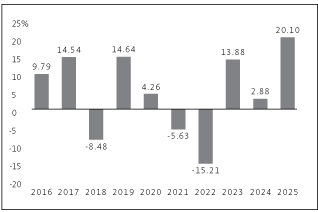
Best Quarter: 12.77% (06/30/2020)
Worst Quarter: -16.65% (03/31/2020)
This table compares the Fund's average annual total returns to those of the Bloomberg Global Aggregate Index (a broad-based securities market index), and two additional indexes with characteristics relevant to the Fund's investment strategy. The Fund's additional indexes are the J.P. Morgan EMBI Global Diversified Index Return and the Fund's blended benchmark that is composed of the J.P. Morgan Emerging Markets Bond Index (EMBI) Global Diversified Index and the J.P. Morgan Government Bond Index-Emerging Markets (GBI-EM) Global Diversified Index weighted 50%/50%.
After-tax returns are calculated using the historical highest individual federal marginal income tax rates and do not reflect the impact of state and local taxes. Your actual after-tax returns will depend on your tax situation and may differ from those shown. After-tax returns shown are not relevant to investors who hold their Fund shares through tax-deferred arrangements, such as 401(k) plans or individual retirement accounts. In some cases, the Fund's return after taxes may exceed the Fund's return before taxes due to an assumed tax benefit from any losses on a sale of Fund shares at the end of the measurement period.
|
Emerging Markets Debt Fund* |
1 Year |
5 Years |
10 Years |
Since Inception (6/26/1997) |
|||||||||||||||
|
Return Before Taxes |
20.10 |
% |
2.40 |
% |
4.47 |
% |
6.62 |
% |
|||||||||||
|
Return After Taxes on Distributions |
16.82 |
% |
0.41 |
% |
2.92 |
% |
4.19 |
% |
|||||||||||
|
Return After Taxes on Distributions and Sale of Fund Shares |
11.77 |
% |
0.91 |
% |
2.77 |
% |
4.23 |
% |
|||||||||||
|
Bloomberg Global Aggregate Index (reflects no deduction for fees, expenses or taxes) |
8.17 |
% |
-2.15 |
% |
1.26 |
% |
3.44 |
%** |
|||||||||||
|
J.P. Morgan EMBI Global Diversified Index Return (reflects no deduction for fees, expenses or taxes) |
14.30 |
% |
1.78 |
% |
4.40 |
% |
7.07 |
% |
|||||||||||
|
The Fund's Blended Benchmark Return (reflects no deduction for fees, expenses or taxes) |
16.79 |
% |
1.48 |
% |
4.19 |
% |
|||||||||||||
* The Fund's Class Y Shares commenced operations on December 31, 2014. For periods prior to December 31, 2014, the performance of the Fund's Class F Shares has been used. Returns for Class Y Shares would have been substantially similar to those of Class F Shares and would have differed only to the extent that the classes do not have the same total annual fund operating expenses.
** Benchmark returns since inception do not include the return for the partial month following inception date of the Fund (6/26/1997 – 6/30/1997). Annualization calculation of the inception to date returns is based on the actual inception date (6/26/1997).
† The Blended Benchmark Return for the "Since Inception" period is not provided because returns for the J.P. Morgan GBI-EM Global Diversified Index Return are not available prior to 2003.