Investment Strategy
Feb. 01, 2026
The Fund’s Investment Strategy
The Fund is actively managed by Alpha Architect, LLC, the Fund’s investment sub-adviser (“Alpha Architect” or the “Sub-Adviser”). Under normal circumstances, the Fund will invest at least 80% of its net assets (plus any borrowings for investment purposes) in U.S.-listed companies that meet the Sub-Adviser’s definition of value (“Value Companies”). The Fund defines Value Companies as companies that, within the universe of the largest 1,500 U.S.-listed stocks by market capitalization, are among the 500 with the lowest enterprise multiple. Enterprise multiple is a value-centric metric: a company’s total enterprise value (TEV) divided by earnings before interest and taxes (EBIT). A company’s TEV is the company’s market capitalization plus its debt minus its cash.
The Sub-Adviser employs a multi-step, quantitative, rules-based methodology to identify a portfolio of approximately 50 to 200 undervalued U.S. equity securities with the potential for capital appreciation. A security is considered to be undervalued when it trades at a price below the price at which the Sub-Adviser believes it would trade if the market reflected all factors relating to the company’s worth.
The Sub-Adviser analyzes an initial universe of liquid stocks that principally trade on a U.S. exchange. Typically, the minimum market capitalization for the smallest-capitalization stocks in the initial universe is above $1 billion.
The Sub-Adviser eliminates from the initial universe illiquid securities, exchange-traded funds (ETFs), and stocks of companies with less than twelve months of available financial data. The resulting universe is composed primarily of highly liquid, small-, mid- and large-cap stocks.
The Sub-Adviser then employs proprietary screens, which evaluate among other things, the firms’ accounting practices, to eliminate firms that are potential “value traps.” That is, these screens eliminate firms with, in the Sub-Adviser’s view, negative characteristics. Those could include situations where firms appear to be experiencing financial distress or have manipulated accounting data. For example, the Sub-Adviser may seek to avoid firms that have large accruals (i.e., their net income greatly exceeds their free cash flow).
Next, the Sub-Adviser employs a value-driven approach to identify the cheapest companies based on a value-centric metric known as the “enterprise multiple.” While enterprise multiples are the focus of the Sub-Adviser’s approach, the Sub-Adviser also incorporates information from other common value metrics, such as book-to-market, cash-flow to price, and earnings to price to identify the cheapest companies. Last, the Sub-Adviser employs an ensemble of quality screens, which consider metrics like current profitability, stability, and recent operational improvements, to select the top 50 to 200 stocks from the cheapest stocks.
The Fund may have significant exposure to one or more of the following sectors: Healthcare, Consumer Discretionary, Industrials, Energy, and Materials.
The Sub-Adviser will reallocate the Fund’s portfolio on a periodic basis, generally each month.
The Fund’s Investment Strategy
The Fund is actively managed by Alpha Architect, LLC, the Fund’s investment sub-adviser (“Alpha Architect” or the “Sub-Adviser”). Under normal circumstances, the Fund will invest at least 80% of its net assets (plus any borrowings for investment purposes) in exchange-listed companies that meet the Sub-Adviser’s definition of value (“Value Companies”). The Fund defines Value Companies as companies that, within the universe of the largest 1,500 exchange-listed stocks by market capitalization that principally trade on securities exchanges in countries included in the MSCI EAFE Index, are among the 500 with the lowest enterprise multiple. Enterprise multiple is a value-centric metric: a company’s total enterprise value (TEV) divided by earnings before interest and taxes (EBIT). A company’s TEV is the company’s market capitalization plus its debt minus its cash.
The Sub-Adviser employs a multi-step, quantitative, rules-based methodology to identify a portfolio of approximately 50 to 200 undervalued international equity securities with the potential for capital appreciation. A security is considered to be undervalued when it trades at a price below the price at which the Sub-Adviser believes it would trade if the market reflected all factors relating to the company’s worth.
The Sub-Adviser analyzes an initial universe of liquid stocks that principally trade on developed non-U.S. markets securities exchanges in countries included in the MSCI EAFE Index. Typically, the minimum market capitalization for the smallest-capitalization stocks in the initial universe is above $1 billion.
The Sub-Adviser eliminates from the initial universe illiquid securities, exchange-traded funds (ETFs), and stocks of companies with less than twelve months of available financial data. The resulting universe is composed primarily of highly liquid, small-, mid- and large-cap stocks.
The Sub-Adviser then employs proprietary screens, which evaluate among other things, the firms’ accounting practices, to eliminate firms that are potential “value traps.” That is, these screens eliminate firms with, in the Sub-Adviser’s view, negative characteristics. Those could include situations where firms appear to be experiencing financial distress or have manipulated accounting data. For example, we may seek to avoid firms that have large accruals (i.e., their net income greatly exceeds their free cash flow).
Next, the Sub-Adviser employs a value-driven approach to identify the cheapest companies based on a value-centric metric known as the “enterprise multiple”. While enterprise multiples are the focus of the Sub-Adviser’s approach, the Sub-Adviser also incorporates information from other common value metrics, such as book-to-market, cash-flow to price, and earnings to price to identify the cheapest companies. Last, the Sub-Adviser employs an ensemble of quality screens, which consider metrics like current profitability, stability, and recent operational improvements, to select the top 50 to 200 stocks from the cheapest stocks.
The Fund may have significant exposure to one or more of the following sectors: Industrials, Materials, Energy and Consumer Discretionary.
The Sub-Adviser will reallocate the Fund’s portfolio on a periodic basis, generally each month.
The Fund’s Investment Strategy
The Fund is actively managed by Alpha Architect, LLC, the Fund’s investment sub-adviser (“Alpha Architect” or the “Sub-Adviser”). Under normal circumstances, the Fund will invest at least 80% of its net assets (plus any borrowings for investment purposes) in U.S.-listed companies that meet the Sub-Adviser’s definition of momentum (“Momentum Companies”). The Fund defines Momentum Companies as companies that, within the universe of the largest 1,500 U.S.-listed stocks by market capitalization, are among the 500 with the highest cumulative total returns over the past 12 months, excluding the most recent month.
The Sub-Adviser employs a multi-step, quantitative, rules-based methodology to identify a portfolio of approximately 50 to 200 equity securities with the highest relative momentum, as described below.
The Sub-Adviser analyzes an initial universe of liquid stocks that principally trade on a U.S. exchange. Typically, the minimum market capitalization for the smallest-capitalization stocks in the initial universe is above $1 billion.
The Sub-Adviser eliminates from the initial universe illiquid securities, exchange-traded funds (ETFs), and stocks of companies with less than twelve months of available financial data. The resulting universe is composed primarily of highly liquid, small-, mid- and large-cap stocks.
The Sub-Adviser then employs proprietary screens to eliminate companies with issues that may negatively impact their momentum. For example, the Sub-Adviser will generally eliminate companies that measure poorly on any of the following variables: (1) past six-month momentum (lower is bad), (2) past nine-month momentum (lower is bad), and (3) beta (higher is bad).
Next, the Sub-Adviser screens the remaining universe of companies to identify the companies with the highest cumulative return for the past 12 months, excluding the most recent month. Last, the Sub-Adviser employs an ensemble of momentum quality screens to identify which of the remaining companies has experienced the most consistent positive returns, as opposed to short-lived success during the 12-month period measured above. The Sub-Adviser then selects the top 50 to 200 momentum stocks.
The Fund may have significant exposure to one or more of the following sectors: Information Technology, Financials, and Industrials.
The Sub-Adviser will reallocate the Fund’s portfolio on a periodic basis, generally each month.
The Fund’s Investment Strategy
The Fund is actively managed by Alpha Architect, LLC, the Fund’s investment sub-adviser (“Alpha Architect” or the “Sub-Adviser”). Under normal circumstances, the Fund will invest at least 80% of its net assets (plus any borrowings for investment purposes) in exchange-listed companies that meet the Sub-Adviser’s definition of momentum (“Momentum Companies”). The Fund defines Momentum Companies as companies that, within the universe of the largest 1,500 exchange-listed stocks by market capitalization that principally trade on securities exchanges in countries included in the MSCI EAFE Index, are among the 500 with the highest cumulative total returns over the past 12 months, excluding the most recent month.
The Sub-Adviser employs a multi-step, quantitative, rules-based methodology to identify a portfolio of approximately 50 to 200 non-U.S. equity securities with the highest relative momentum, as described below.
The Sub-Adviser analyzes an initial universe of liquid stocks that principally trade on developed non-U.S. markets securities exchanges in countries included in the MSCI EAFE Index. Typically, the minimum market capitalization for the smallest-capitalization stocks in the initial universe is above $1 billion.
The Sub-Adviser eliminates from the initial universe illiquid securities, exchange-traded funds (ETFs), and stocks of companies with less than twelve months of available financial data. The resulting universe is composed primarily of highly liquid, small-, mid- and large-cap stocks.
The Sub-Adviser then employs proprietary screens to eliminate companies with issues that may negatively impact their momentum. For example, the Sub-Adviser will generally eliminate companies that measure poorly on any of the following variables: (1) past six-month momentum (lower is bad), (2) past nine-month momentum (lower is bad), and (3) beta (higher is bad).
Next, the Sub-Adviser screens the remaining universe of companies to identify the companies with the highest cumulative return for the past 12 months, excluding the most recent month. Last, the Sub-Adviser employs an ensemble of momentum quality screens to identify which of the remaining companies has experienced the most consistent positive returns, as opposed to short-lived success during the 12-month period measured above. The Sub-Adviser then selects the top 50 to 200 momentum stocks.
The Fund may have significant exposure to one or more of the following sectors: Financials, Industrials, and Information Technology.
The Sub-Adviser will reallocate the Fund’s portfolio on a periodic basis, generally each month.
The Fund is actively managed by Alpha Architect, LLC, the Fund’s investment sub-adviser (“Alpha Architect” or the “Sub-Adviser”). Under normal circumstances, the Fund will invest at least 80% of its net assets (plus any borrowings for investment purposes) in equity securities.
The Fund is a “fund of funds,” meaning that it primarily invests its assets in the shares of other exchange-traded funds (“ETFs”), rather than in securities of individual companies. The Fund’s portfolio is composed primarily of four other ETFs sub-advised by the Sub-Adviser: Alpha Architect U.S. Quantitative Value ETF, Alpha Architect International Quantitative Value ETF, Alpha Architect U.S. Quantitative Momentum ETF, and Alpha Architect
International Quantitative Momentum ETF (each, an “Underlying Alpha Architect ETF”). The Fund invests in value and momentum securities. Alpha Architect U.S. Quantitative Value ETF and Alpha Architect U.S. Quantitative Momentum ETF provide exposure to domestic equity securities, while Alpha Architect International Quantitative Value ETF and Alpha Architect International Quantitative Momentum ETF provide exposure to international equity securities.
The Underlying Alpha Architect ETFs can be grouped into ETFs that use a quantitative momentum investment strategy (Alpha Architect U.S. Quantitative Momentum ETF and Alpha Architect International Quantitative Momentum ETF, referred to as the “Momentum ETFs”) and those that use a quantitative value investment strategy (Alpha Architect U.S. Quantitative Value ETF and the Alpha Architect International Quantitative Value ETF, referred to as the “Value ETFs”). A “momentum” investment style emphasizes investing in securities that recently have had better recent total return performance compared to other securities. In contrast, a “value” investment style emphasizes investing in securities that based on quantitative analysis are considered undervalued compared to other securities.
The Sub-Adviser manages each of the Underlying Alpha Architect ETFs using a multi-step, quantitative, rules-based methodology to identify a portfolio of equity securities with the highest relative momentum (for the Momentum ETFs) or potential for capital appreciation (for the Value ETFs), as described below. Construction of each Momentum and Value ETF’s portfolio begins with a universe of stocks that principally trade on the applicable exchanges (e.g., either U.S. exchanges or exchanges in countries included in the MSCI EAFE Index). Each universe of stocks is then screened to, among other things, include the largest common stocks based on their market capitalization (e.g., above $1 billion). A liquidity screen is then employed to eliminate illiquid securities.
For the Momentum ETFs, the Sub-Adviser then eliminates companies with potential issues, and thereafter screens the remaining companies to identify those with the highest cumulative return for the past 12 months, excluding the last month. Last, the Sub-Adviser employs momentum quality screens to identify which of the remaining companies has experienced the most consistent positive returns during the 12-month period measured above. The Sub-Adviser will reallocate the Momentum ETFs’ portfolios on a periodic basis, generally each month.
For the Value ETFs, the second stage incorporates proprietary models to identify and exclude companies at risk of potential poor financial performance. The third stage employs a value-driven approach to identify the cheapest firms based on a proprietary value-centric metric similar to what is known as the “enterprise multiple,” a firm’s total enterprise value divided by earnings before interest and taxes (EBIT). Last, the Sub-Adviser employs an ensemble of quality screens, which consider metrics like current profitability, stability, and recent operational improvements. The Sub-Adviser will reallocate the Value ETFs’ portfolios on a periodic basis, generally each month.
The Sub-Adviser allocates the Fund’s portfolio across the four Underlying Alpha Architect ETFs using a proprietary model. The Fund will generally allocate more assets to an Underlying Alpha Architect ETF with higher relative momentum and fewer assets to an Underlying Alpha Architect ETF with lower relative momentum.
Reallocations and Cash
The Fund’s portfolio will generally be reallocated quarterly, but the Sub-Adviser can reallocate more frequently, such as up to twice a month.
The Fund’s Investment Strategy
The Fund is an actively managed, diversified fund managed by Alpha Architect, LLC, the Fund’s investment sub-adviser (“Alpha Architect” or the “Sub-Adviser”).
The Fund primarily invests its assets in the shares of registered investment companies, including affiliated and non-affiliated exchange-traded funds (“ETFs”) (the “underlying funds”), that emphasize investments in (i) intermediate-term U.S. Treasury bonds; (ii) real estate; and (iii) commodities (the “Target Asset Classes”). The Fund expects to obtain its exposure to the Target Asset Classes primarily through its investments in underlying funds, but the Fund also may invest directly in equity interests in real estate investment trusts (REITs) and in intermediate-term U.S. Treasury bonds. The Sub-Adviser believes its investments in underlying funds will provide an efficient, low cost means for the Fund to gain exposure to the Target Asset Classes.
The Sub-Adviser has developed an investment model that is used to determine the asset allocations for the Fund, but the Sub-Adviser does retain discretion to modify the model. The Sub-Adviser does not anticipate major deviations from the model driven asset allocation process, but such deviations may occur in response to extreme market conditions. The asset allocation process can only be changed by the Sub-Adviser.
The Sub-Adviser’s model is quantitative and systematic, utilizing absolute momentum and trend-following factors to identify the allocations to the Target Asset Classes and/or cash and cash equivalents. Absolute momentum is reliant upon the continuance of an existing market trend while trend-following investment seeks to invest in assets that are considered in an upward trend. In the most basic terms, the model seeks to determine when a Target Asset Class (e.g., real estate) is perceived to be attractive from an investment perspective given current market conditions.
The Fund’s quantitative process is designed to analyze each Target Asset Class to determine whether it is demonstrating positive or negative price trends. The Sub-Adviser’s quantitative investment model will use various trend signals. The model generally relies on past prices and past return data. The Sub-Adviser may use a variety of lookbacks and formations that are subject to change based on the Sub-Adviser’s research efforts. Two examples of these lookbacks and formations would be a moving average signal and a time-series momentum signal when analyzing each Target Asset Class. These examples are representative of general trend-following techniques and may not be the exclusive signals used. The signals generated by the Sub-Adviser’s quantitative model are used to guide the Fund’s allocation to the Target Asset Classes and/or cash and cash equivalents.
The Sub-Adviser’s target weightings, when all Target Asset Classes have a “buy” signal, for the Fund are 50% exposure to intermediate-term U.S. Treasury bonds, 25% exposure to real estate securities, including REITs, and 25% exposure to commodities. The target weightings are simply investment targets and are subject to change based on the Sub-Adviser’s analysis of current market conditions. For example, if the Sub-Adviser’s analysis indicates a negative trend for any of the Fund’s Target Asset Classes, the Sub-Adviser will reduce or eliminate the Fund’s exposure to such Target Asset Class and invest such reallocated assets into other Target Asset Classes or cash and cash equivalents. The Fund’s investments in cash and cash equivalents, which may represent at times 100% of the Fund’s assets, will consist of money market funds, U.S. Treasury bills, and/or U.S. Treasury bill equivalents (or an underlying fund that focus its investments on these objectives).
The Sub-Adviser is responsible for determining the timing of trading and the actual securities selected for investment. When selecting investments, the Sub-Adviser will compile a list of investments that provide the Fund with the desired Target Asset Class exposure. As it relates to the Fund’s investments in underlying funds, the Sub-Adviser’s analysis may include, but is not limited to, a review of the underlying fund’s cost structure, holdings, investment process, market liquidity, performance, operational and legal issues, diversification, time horizon, and tax-related issues. The Sub-Adviser will generally sell or reduce its exposure to an investment based on the results of the Sub-Adviser’s quantitative model. The Sub-Adviser’s quantitative model is updated at least monthly and the Fund’s asset allocations will be systematically updated based on the results of the model. There are times when the Fund’s strategy may result in active and frequent trading of portfolio instruments to achieve its investment objective.
The Sub-Adviser, through its quantitative investment model, will actively manage the Fund’s portfolio across the different Target Asset Classes with the goal of providing investors with protection against an environment of high inflation or deflation. For example, during a period of perceived high inflation (i.e., a period where the general prices of goods and services are increasing in the economy), the Sub-Adviser will generally increase the Fund’s exposure to commodities through its investments in underlying funds, and at times, to REITs and other real estate
securities. During a period of perceived deflation (i.e., a period where the general prices of goods and services are declining in the economy), the Sub-Adviser will generally increase the Fund’s exposure to intermediate-term U.S. Treasury bonds through either its investments in underlying funds, and at times, to REITs and other real estate securities. The Sub-Adviser believes that actively managing the Fund’s exposure to the Target Asset Classes and cash and cash equivalents can add value over a static allocation to one or more of these asset classes over both periods of high inflation and deflation.
The Fund is an actively managed exchange-traded fund (“ETF”). The Fund will invest, under normal circumstances, in a portfolio of options contracts on securities that are linked to the performance of an index whose value is based on companies with market capitalizations that qualify them as “large cap” companies.
Arin Risk Advisors, LLC (“Arin”) and Alpha Architect, LLC (“Alpha Architect” and collectively with Arin, the “Sub-Advisers”) will serve as the Sub-Advisers for the Fund. Arin considers a company to be a “large cap” company if its market capitalization is at least $10 billion. Arin utilizes one or more combinations of long and short put and call options, such as options on securities that are linked to the performance of the S&P 500 Index (the “Index”) (these options are known as “SPX Options”) in an effort to gain broad market exposure as well as to hedge the Fund’s market exposure and generate income. The Fund may, from time to time, also invest in options on other broad-based market indexes that represent the U.S. large-cap equity market. While the Fund invests in securities whose prices are affected by changes in the value of the Index, the Fund does not typically maintain full long investment exposure to the Index, does not track the Index, and its performance may differ significantly from that of the Index. The Fund may utilize either standard exchange-listed options or FLexible EXchange® Options (“FLEX Options”) or a combination of both.
The Fund’s three primary objectives are: (i) to gain a varying amount of market exposure to the Index; (ii) limit risk relative to a decline in the Index and profit from a market dislocation event; and (iii) generate a series of cash flows. Arin considers a market dislocation event (also known as a tail risk event) when the Index suffers an extreme market decline (generally greater than 25%) within a few months accompanied by a sustained increase in expected Index volatility (generally greater than 50) - see discussion of Protective Options below. Examples of historical market dislocation or tail risk events that have met both of these standards include the Financial Crisis of 2008-09 and the COVID-19 Pandemic of 2020.
In order to gain Index exposure, the Fund will sell SPX Options (or options that offer similar market and volatility exposure, such as a broad-based U.S. equity ETF) or a combination of SPX Options that are expected to allow the Fund to realize gains if the Index remains above certain price levels expressed by the strike prices of the Fund’s SPX Options contracts. Even if the Index price fails to appreciate in value, the Fund may realize gains from the option premiums paid to the Fund when such options expire worthless or when the value of such options decreases over time. These gains are attributable to the decrease in value of the SPX Options sold over time and is typically referred to as “theta”. In cases where the Index falls below certain price levels, the Fund will experience gains and losses that are in line with the movement of the Index. The difference between the Index price and the strike prices of the Fund’s SPX Options determines the extent of the Fund’s market exposure to the Index. If the Index price remains above the strike price, the Fund will have modest Index exposure. If the Index price trades below the strike price, the Fund will have greater Index exposure. In cases where the Index price rises above certain levels, then the Fund will experience gains only up to the amount of option premium initially received. The Fund’s investment exposure to the Index will generally vary between 120% exposure to the Index and -40% (i.e., short exposure to the Index), exclusive of the Protective Options as discussed below. The Fund’s exposure to the Index will depend on the mix of call options and put options in the Fund’s portfolio, and whether such options have been sold or purchased by the Fund.
The Fund’s total performance will be a function of its exposure to the Index over certain periods of time and the income and expenses of the option premiums. The Fund’s assets serve as collateral for options that are bought and sold in an attempt to gain market exposure to the Index. The SPX Options in the Fund’s portfolio each have a trading volume sufficient to preclude the Fund’s trades from influencing prices. The Fund may also use short SPX Options (short SPX Options generate immediate cash inflows in exchange for taking on the obligation of delivering cash at a future date) or long SPX Options (long SPX Options require an initial cash payment in exchange for the right to receive a future cash payment at a future date). The Fund may also utilize call or put spreads to limit the downside risk of the Fund. The Fund will purchase SPX call options or sell SPX put options (including spreads) when Arin believes the value of the Index will increase and will purchase SPX put options or sell SPX call options (including spreads) when Arin believes the value of the Index will decrease.
An option spread combines two or more option contracts as a single trade. The Fund sells one SPX Option and simultaneously buys an offsetting position in another SPX Option. When selling a spread, the maximum gain is the net premium collected and the maximum loss is equal to the difference in the respective strike prices, less the premium collected. The use of spreads may limit the Fund’s exposure to the Index depending upon the rate of change in the Index, Arin’s ability to adjust the position, and the pricing of the SPX Options used to create the spread. There may be instances where the Fund has no long market exposure and may temporarily have short market exposure. Such an instance may arise when the market either rises or falls at a rate in excess of the levels provided by the SPX Option contracts held by the Fund for long market exposure.
The following is an overview of the limitations on the Fund’s use of put and call options:
•When the Fund sells call options, the Fund receives an option premium and will experience a loss if the Index rises above the call option strike price plus the premium collected;
•When the Fund buys call options, the Fund pays a premium and will experience a loss if the Index fails to rise above the call option strike price plus the premium paid;
•When the Fund sells put options, the Fund receives a premium and will experience a loss if the Index falls below the put option strike price less the premium collected; and
•When the Fund buys put options, the Fund pays a premium and will experience a loss if the Index fails to fall below the put option strike price less the premium paid.
The Fund will purchase other SPX Options (“Protective Options”) that should appreciate during a market dislocation event. During other market periods, such as when the Index is increasing in value, the Protective Options will decrease the Fund’s return. When the Index falls below the strike prices of the Protective Options, the Fund will be negatively correlated to the Index. The Protective Options provide the Fund with potential reductions to its Index exposure (see above where Index exposure is typically between 120% exposure to the Index and -40%) and may cause the Fund’s Index exposure to fall below -40%. If the Index were to suddenly fall below the strike prices of the Protective Options, the Fund should experience a gain from the decline in the Index.
The SPX Option exposure from the Protective Options is referred to as the Fund’s “Protection Ratio”. This Protection Ratio represents the number of Protective Options expiring in greater than 40 days with strike prices that are at least five percent (5%) below the current Index value as compared to the number of SPX Options representing the investment of all the Fund’s assets (the Fund’s total net assets divided by the Index value divided by 100 units per contract). A higher Protection Ratio would generally mean the Fund owns relatively more Protective Options as compared to its net assets than when the Fund has a lower Protection Ratio. Purchasing the Protective Options during periods without any market dislocation events will cause the Fund’s return to be lower than it would have been had the Fund purchased fewer or no Protective Options. Arin seeks to keep the Protection Ratio above 10 and as high as possible while attempting to minimize this carrying cost. There may be periods where the high carrying cost of the Protective Options may result in Fund’s Protection Ratio remaining below 10. Furthermore, during a market dislocation event, the Fund expects its Protective Options to increase in value. When the Protective Options increase in value, the Fund may experience a high cost to continue holding all of its Protective Options and Arin may seek to sell some or all of the Protective Options.
Arin will also maintain a collateral portfolio that is designed primarily to serve as margin or collateral for the Fund’s options positions and secondarily to enhance the Fund’s return by generating income (the “Collateral Portfolio”). Under normal circumstances, the Fund will allocate approximately 20% of its capital to gain exposure to the Index, 1% to 10% of the Fund’s assets will be allocated to the Protective Options and the remaining cash will be utilized as part of the Collateral Portfolio. The Collateral Portfolio is comprised of cash or cash equivalents, including United States Treasury Securities, money-market instruments, money-market mutual funds, or option “box spreads” (“Box Spreads”), including ETFs that hold Box Spreads. A Box Spread is a synthetic bond created by combining different options trades that have offsetting spreads (e.g., purchases and sales on the same underlying instrument, such as an index or an ETF, but with different strike prices).
Arin may invest up to 100% of the Collateral Portfolio in the Alpha Architect 1-3 Month Box ETF (the “1-3 Month Box ETF”). The 1-3 Month Box ETF is advised by Empowered Funds, LLC dba EA Advisers (the “Adviser”) and is sub-advised by Arin and Alpha Architect, LLC. The 1-3 Month Box ETF is an actively managed ETF whose investment objective is to provide investment results that, before fees and expenses, equal or exceed the price and yield performance of an investment that tracks the 1-3 month sector of the United States Treasury Bill market. To achieve its principal investment strategy the 1-3 Month Box ETF primarily invests in Box Spreads. The 1-3 Month Box ETF may also utilize an exchange-listed options strategy using long shares of an individual equity security or ETF (in place of the Synthetic Long) together with a Synthetic Short created by purchasing a put option and selling a call option on that equity security or ETF with the same strike and expiration date.
The Fund may engage in active and frequent trading of portfolio securities to achieve its investment objective. The Fund’s portfolio turnover rate is expected to be greater than 100%. A high portfolio turnover rate will increase the Fund’s brokerage commission costs, which will negatively impact the performance of the Fund.
The Fund is an actively managed exchange-traded fund (“ETF”) managed by Alpha Architect, LLC, the Fund’s investment sub-adviser (the “Sub-Adviser”). The Fund’s primary strategy seeks to achieve broad-based exposure to the U.S. equity market through a diverse group of U.S. companies across market sectors, styles (e.g., value or growth), and industry groups or ETFs that provide similar exposure to U.S. companies. Under normal circumstances, at least 80% of the Fund’s net assets (plus the amount of any borrowings for investment purposes) will be invested in the equity securities of U.S. companies. The Sub-Adviser defines U.S. companies as companies whose securities are traded principally in the United States or that have their principal place of business in the United States.
The Fund’s investments in other ETFs may be selected for their ability to represent a broad-based set of companies or companies of a certain market capitalization, a particular sector (e.g., information technology companies), or a subset of an asset class (e.g., small cap value companies), or based on factors such as their risk adjusted return, alpha, style (e.g., growth or value), or other factors that help the Fund achieve broad exposure across U.S. equities. The Fund’s investments in other ETFs may include ETFs that are affiliated (i.e., that have the same investment adviser or sub-adviser).
The Fund seeks to achieve broad exposure to U.S. equity markets, including exposure to both dividend and non-dividend paying U.S. companies directly or in ETFs that invest in dividend-paying stocks. The Fund’s investment universe of stocks typically starts with publicly traded U.S. equity securities, including common and preferred
stocks, that have a market capitalization of $1 billion or greater at the time of purchase, excluding business development companies and special purpose acquisition companies (SPACs). The Sub-Adviser generally applies a weighting process that is designed to favor those companies with higher market capitalizations relative to the other companies in the investment universe. Market capitalization is derived by multiplying the number of outstanding shares by the market price of each share.
Although the Fund seeks investments across a broad array of sectors and companies, from time to time, based on market conditions and portfolio positioning, the Fund’s investment strategy may emphasize exposure to particular sectors, and the Fund may have exposure to large-, mid- and small-capitalization U.S. companies.
As a secondary strategy, the Sub-Adviser may implement a systematic dividend-timing strategy. As part of such strategy, the Sub-Adviser monitors the Fund’s portfolio to identify securities or ETFs expected to pay a dividend in the immediate future and evaluates whether to replace such securities or ETFs prior to their distribution record date. This strategy is informed by the Sub-Adviser’s proprietary research indicating that demand for dividend-paying securities tends to be elevated prior to a dividend distribution (potentially raising prices relative to fundamentals) and depressed following distribution (potentially lowering prices relative to fundamentals). The Fund seeks to take advantage of these imbalances while preserving broad market exposure. The Sub-Adviser intends to use the dividend-timing strategy only to the extent that such strategy does not detract from the Fund’s broad market exposure and after considering the impact of such strategy on transactions costs, tax treatment, and other factors.
The Sub-Adviser may elect not to replace a holding that is scheduled to pay a dividend to maintain the portfolio’s broad exposure, to avoid the costs associated with replacing a holding, or based on other effects that replacing a security would have on the Fund. While the Fund is expected to have a lower yield than it would if the Sub-Adviser did not replace stocks prior to their distribution record date, there is no guarantee that the dividend-timing strategy will be successful in its attempt to minimize the Fund’s taxable income or improve the Fund’s performance.
The Fund may invest in options contracts (puts and calls) to obtain exposure to the broad U.S. equity market or any segment of the U.S. equity market either as a replacement for direct investments in such securities or as a means of obtaining more efficient exposure for the Fund than through equity or ETF investments.
The Sub-Adviser will reconstitute the Fund’s investment universe at least annually (e.g., April of each year) following its reevaluation of the Fund’s investment universe. The Fund’s strategy may result in frequent trading resulting in increased transactional costs.
The Fund is classified as “non-diversified” under the Investment Company Act of 1940, as amended.
The Fund is an actively managed exchange-traded fund (“ETF”) managed by Alpha Architect, LLC, the Fund’s investment sub-adviser (“Alpha Architect” or the “Sub-Adviser”). The Fund invests primarily in a diverse group of equity securities issued by U.S. and non-U.S. companies across market sectors, styles (e.g., value or growth), and industry groups or ETFs that provide similar exposure to such companies. The Fund’s investments may include both developed and emerging market countries. Under normal circumstances, at least 80% of the Fund’s net assets (plus the amount of any borrowings for investment purposes) will be invested in the equity securities of U.S. and non-U.S. companies, including common stocks, depositary receipts evidencing ownership in common stocks, and preferred stocks. The Fund’s investments in depositary receipts may be in the form of American Depositary Receipts (ADRs), Global Depositary Receipts (GDRs), and European Depositary Receipts (EDRs). The Sub-Adviser defines non-U.S. companies as companies headquartered outside of the United States, or whose primary business activities or principal trading markets are located outside of the United States. The Fund’s investments in other ETFs may be selected for their ability to represent companies of a certain market capitalization, a particular sector (e.g., information technology companies), or a subset of an asset class (e.g., small cap value companies), or based on factors such as their risk adjusted return, alpha, style (e.g., growth or value), or other factors that help the Fund achieve broad exposure across U.S. equities. The Fund’s investments in other ETFs may include ETFs that are affiliated (i.e., that have the same investment adviser or sub-adviser).
The Fund seeks to achieve broad diversification to global equity markets, including exposure to both dividend and non-dividend paying companies. The Fund may also invest in ETFs that invest in dividend-paying stocks to support the Fund’s broad exposure to U.S. equities. The Sub-Adviser monitors the Fund’s portfolio to identify stocks or ETFs expected to pay a dividend in the immediate future and evaluates whether to replace such stocks or ETFs prior to their distribution record date as the Sub-Adviser seeks to maintain the Fund’s broad diversification, while taking advantage of proprietary research that suggests that stocks scheduled to pay a dividend should be avoided just prior to the dividend distribution and for at least 30 days after the dividend distribution. The proprietary research further indicates that the demand for dividend-paying stocks prior to the dividend distribution is generally too high (thus driving stock prices above a company’s fundamentals) and the demand for dividend paying stocks after distribution is generally too low (thus driving stock prices below a company’s fundamentals). The Fund seeks to take advantage of this mismatch in supply and demand in the marketplace. While the Sub-Adviser expects to replace certain stocks or ETFs prior to their distribution record date, the Sub-Adviser may elect not to replace a holding that is scheduled to pay a dividend to maintain the portfolio’s diversification, to avoid the costs associated with replacing a holding, or based on other effects that replacing a security would have on the Fund. While the Fund is expected to have a lower yield than it would if the Sub-Adviser did not replace stocks prior to their distribution record date, there is no guarantee that the Sub-Adviser will be successful in its attempt to minimize the Fund’s taxable income.
The Fund’s investment universe typically starts with publicly traded U.S. and non-U.S. companies that have a market capitalization of $1 billion or greater at the time of purchase and satisfy the Sub-Adviser’s liquidity requirements. The Sub-Adviser generally employs a weighting process that is designed to favor those companies with higher market capitalizations relative to the other companies in the investment universe. Market capitalization is derived by multiplying the number of outstanding shares by the market price of each share. Everything is compared on U.S. dollar terms.
As demonstrated by the security selection process and the annual reevaluation process for the Fund’s investment universe, the Fund is structured similarly to a market capitalization weighted index fund. However, the Sub-Adviser will actively manage the Fund’s portfolio to attempt to avoid owning certain dividend-paying stocks or ETFs just prior to the distribution record date and for at least 30 days after the dividend distribution. The Sub-Adviser will generally monitor the Fund’s portfolio holdings at least monthly and will look to replace certain stocks or ETFs expected to pay a dividend in the immediate future. When such replacement trades occur, the additional capital will be reallocated across the Fund’s remaining holdings that are not expected to pay a dividend in the near future, or the Sub-Adviser may replace the portfolio holding with an investment in ETFs that focus their investments in U.S. or non-U.S. companies or through investments in options that provide exposure to such U.S. or non-U.S. companies. In addition, the Sub-Adviser will look to buy back the sold security approximately 30 to 45 days after the dividend distribution. Investors seeking income should not invest in this Fund. This process seeks to outperform the broad global market while having a secondary effect of potentially reducing year-end distributions. To help reduce, or possibly eliminate, the Fund’s year-end distributions, the Fund intends to conduct most of its redemptions through in-kind transactions of securities with unrealized gains. If the Fund is unable to conduct its redemptions in-kind, the Fund may distribute net investment income and/or capital gains to shareholders.
Although the Fund seeks investments across a broad array of sectors and companies, from time to time, based on market conditions and portfolio positioning, the Fund’s investment strategy may emphasize exposure to particular sectors and/or countries or regions. The Sub-Adviser may, at times, overweight or underweight U.S. companies relative to international companies. This tactical allocation is fully discretionary by the Sub-Adviser. With a starting point of companies with a market capitalization of $1 billion or greater, the Fund may have exposure to large-, mid- and small-capitalization U.S. and non-U.S. companies.
The Fund’s global investments may provide exposure to developed and/or emerging markets.
The Sub-Adviser will reconstitute the Fund’s investment universe at least annually (e.g., April of each year) following its reevaluation of the Fund’s investment universe. The Fund’s strategy may result in frequent trading resulting in increased transactional costs. The Fund is classified as “non-diversified” under the Investment Company Act of 1940, as amended.
The Fund is an actively managed exchange-traded fund (“ETF”) that seeks investment results that, before fees and expenses, exceed the total return performance of an investment that tracks the 1-3 year sector of the United States Treasury Bill and Note market, as measured by the Solactive US 1-3 Year Treasury Bond Index. To do so, the principal investment strategy of the Fund will be to utilize a series of long and short exchange-listed options combinations called a box spread (“Box Spread”). In order to accomplish its investment goals, the Fund may utilize either standard exchange-listed options or FLexible EXchange® Options (“FLEX Options”) or a combination of both.
Arin Risk Advisors, LLC (“Arin”) and Alpha Architect, LLC (“Alpha Architect” and collectively with Arin, the “Sub-Advisers”) will serve as the Sub-Advisers for the Fund. Based on their market analysis, the Sub-Advisers will vary the Fund’s average maturity of the Box Spreads between 1 and 3 years. The Sub-Advisers’ management of the Fund’s box spread investments will dictate the success of the Fund’s strategy (i.e., its ability to exceed the total return performance of the 1-3 year sector of the United States Treasury Bill and Note market). A box spread is designed to remove most of the equity and volatility risk through its combination of option contracts. However, box spreads are not free from risk. Specifically, box spreads are exposed to interest rate and liquidity risks. Similar to
bonds, as interest rates rise the value of a bond and box spread will fall and when interest rates fall the value of a bond and box spread will rise.
By way of background, a Box Spread is the combination of a synthetic long position coupled with an offsetting synthetic short position through a combination of options contracts on an equity security or an equity index at the same expiration date. The synthetic long consists of buying a call option and selling a put option on the same security or index where the call option and put option share the same strike and expiration date (a “Synthetic Long”). When purchasing a Box Spread, the Synthetic Long will have a strike price that is less than the strike price for the Synthetic Short. The difference between the strike prices of the Synthetic Long and the Synthetic Short will determine the expiration value (or value at maturity) of the Box Spread. The synthetic short consists of buying a put option and selling a call option on the same security or index with the same expiration date as the synthetic long but using a different strike price (a “Synthetic Short”). When purchasing a Box Spread, the Synthetic Long will have a strike price that is less than the strike price for the Synthetic Short. The difference between the strike prices of the Synthetic Long and the Synthetic Short will determine the expiration value (or value at maturity) of the Box Spread.
An important feature of the Box Spread construction process is the elimination of risk tied to underlying market movements associated with the underlying option’s security or equity index. Once the Box Spread is initiated, its return from the initiation date of such Box Spread through its expiration date will generally not change. The Fund anticipates buying, holding, and/or selling multiple Box Spreads, and consequently, the Fund’s anticipated return from Box Spreads will reflect all of its investment activity, as well as changes in market prices and expected interest rates, among other factors, and will vary over time. A box spread has a fixed payoff at expiration (similar to the par value of a bond), which is equal to the difference between the strike prices of the options involved. The present value of this payoff depends on the prevailing interest rates in the same way that interest rates affect the present value of a bond’s par value. The following diagram depicts the value of the box spread’s payoff at expiration based on no changes in the value of the reference asset. It does not depict the value of the box spread at points in time prior to the expiration of the options.
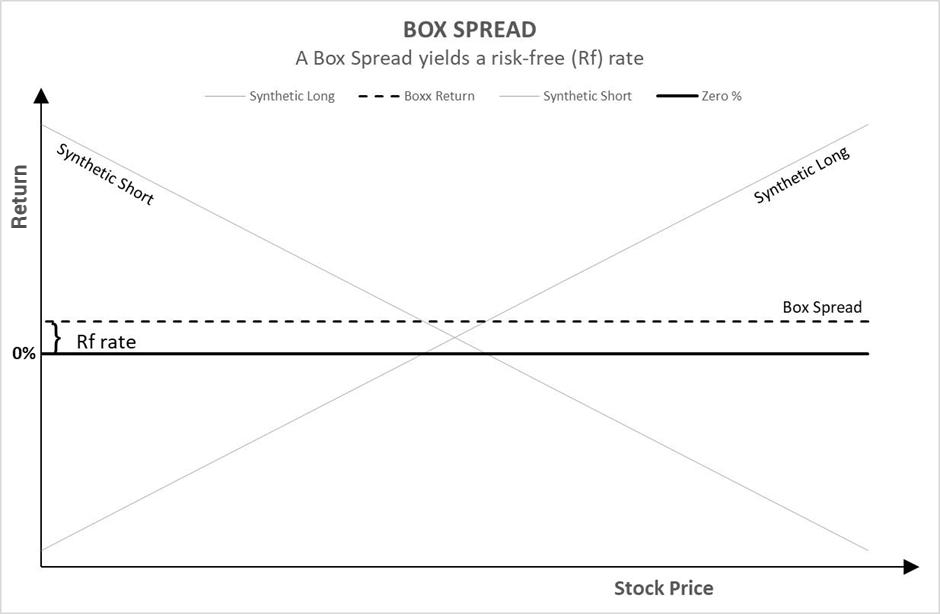
Buying (or selling) a Box Spread is similar to buying (or selling) a zero-coupon bond. A zero-coupon bond does not pay periodic coupons, but the bond trades at a discount to its face value. The maturity value of a zero-coupon bond is comparable to the difference in the strike prices of the Box Spread. The maturity date of a zero-coupon bond is comparable to the expiration date of the options comprising the Box Spread. When constructing a Box Spread, the strike price of the Synthetic Long will be at a lower strike price than the strike price of the Synthetic Short. When buying or selling a Box Spread, the buyer or seller generally expects the price of the Box Spread to be less than the difference in the strike prices of the Box Spread. A buyer or seller of a Box Spread will earn a profit or loss equal to
the difference between the beginning price (price paid to buy or received if sold) and the ending price (expiration value or closing trade price). If the Fund holds the Box Spread until expiration, then its profit or loss will be determined by the difference between the price it paid to buy the Box Spread (or received in the case of selling the Box Spread) and the value of the Box Spread upon expiration.
As an example, a typical Box Spread could include the simultaneous purchase of a call option and sale of a put option (i.e., Synthetic Long) with a strike of $1,000 on the referenced index/asset together with the sale of a call option and purchase of a put option (i.e., Synthetic Short) with a strike of $2,000 on the referenced index/asset where all four of these options share the same expiration date. The expiration or maturity value would be the difference in the strikes or $1,000 in this case. The expected profit earned would equal the difference between the price paid for this Box Spread and its expiration value of $1,000 minus any transaction costs associated with the options trades. The effective yield on each Box Spread is determined by annualizing the profit over the price paid. The Fund will only purchase Box Spreads where the purchase price (after considering all costs to the Fund for entering such trade) is less than the expiration value.
The Fund may, at times, purchase the Alpha Architect 1-3 Month Box ETF (the “1-3 Month Box ETF”) for cash management purposes. The Sub-Advisers believe the 1-3 Month Box ETF may offer the Fund a better return than cash and cash equivalents type investments. The 1-3 Month Box ETF is an affiliated ETF and holds a series of Box Spreads. The 1-3 Month Box ETF may invest in either standard exchange traded-listed options or FLEX Options or a combination of both, to gain exposure to a Box Spread (as described above).
In general, an option contract is an agreement between a buyer and seller that gives the purchaser of the option the right to buy or sell a particular asset at a specified future date at an agreed upon price, commonly known as the “strike price.” In the case of a “call option”, the purchaser has the right to buy the particular asset and the seller of a “call option” has the obligation to deliver the particular asset at the strike price. In the case of a “put option”, the purchaser has the right to sell the particular asset and the seller of a “put option” has the obligation to purchase the particular asset at the strike price. Since the Fund trades listed or exchange-traded options, the counterparty to its option positions is the Options Clearing Corporation.
The Sub-Advisers may invest the Fund’s assets in a series of Box Spreads with various expiration dates. The quantity and expiration dates of the Box Spreads held by the Fund will be based on several factors, including the Fund’s asset size, the effective yield for various Box Spread expiration dates available in the marketplace, and the Sub-Advisers’ view of future interest rates. Based upon historical examples of Box Spreads actually traded in the marketplace, the Sub-Advisers expect that there will be market participants willing to sell Box Spreads to the Fund in sufficient quantities to satisfy the objective of the Fund.
The Fund generally invests its assets in a series of Box Spreads such that the weighted average maturity of the Box Spreads based upon expiration dates is between 1 and 3 years. The Fund may sell Box Spreads with a longer or shorter period to expiration in an effort to gain exposure to the forward rate implied by the execution of longer and shorter dated Box Spreads. The Fund expects to trade some or all of the Box Spreads prior to their respective expiration dates, if the Sub-Advisers believe it is advantageous for the Fund to do so. Upon expiration or sale of any Box Spread, the Sub-Advisers may seek to purchase additional Box Spreads at an effective yield and expiration date that offers favorable risk and reward characteristics under current market conditions. The Fund may also invest in cash, cash equivalents, money market funds, or Treasury bills. The Fund’s strategy is expected to result in high portfolio turnover. The return that the Fund expects to earn from Box Spreads will fluctuate but should remain consistent with the market rate for securities within the 1-3 year sector of the United States Treasury Bill and Note Market.
When purchasing or selling a Box Spread, the Fund will primarily use European-style options. European-style options may not be terminated or assigned in advance of the option’s expiration date. This ensures that the synthetic positions created using the Box Spreads are not cancelled prior to its maturity. Options contracts on ETFs are expected to be the preferred investments for substantially all of the Fund’s holdings. For example, the Fund may purchase or sell Box Spreads that use the SPDR® S&P 500® ETF Trust as the reference asset for the options contracts making up a Box Spread.
The Fund may engage in active and frequent trading of portfolio securities to achieve its investment objective. In order to achieve its objective, the Fund will typically purchase a new Box Spread at the time (or shortly thereafter) any existing Box Spread expires or is sold or when the Sub-Advisers believe purchasing a new Box Spread would offer a favorable investment opportunity. The Fund may also sell or “roll” any Box Spread at any time. When rolling
a Box Spread, the Fund enters into a trade where it simultaneously closes on each component of an existing Box Spread while opening a new Box Spread position. The Fund may also sell Box Spreads that utilize the same or a different reference assets, strike prices, and expiration dates as Box Spreads owned by the Fund. When selling or rolling a Box Spread, the Fund may incur additional transaction costs than if it waited until such Box Spread expired.
Exchange-traded options on certain indexes are currently taxed under section 1256 of the Internal Revenue Code of 1986, as amended (the “Code”). Pursuant to section 1256 of the Code, profit and loss on transactions in non-equity options, are subject to taxation at a rate equal to 60% long-term and 40% short-term capital gain or loss regardless of the Fund’s holding period. Based on the advice of its accountants, the Fund expects that distributions related to such positions, if any, will be characterized by the Fund as capital gains with these preferential terms. The Fund expects that distributions, if any, related to the Fund’s positions that do not qualify for the preferential treatment under section 1256 are expected to be characterized by the Fund as either short-term capital gain or ordinary income.
The Fund is classified as “non-diversified” under the Investment Company Act of 1940, as amended.
The Fund is an actively managed exchange-traded fund (“ETF”) that seeks to generate a total return in excess of the Solactive US 7-10 Year Treasury Bond Index (the “Benchmark”), which is an index designed to track the performance of U.S. 7-10 Year Treasury Bonds.
To accomplish the Fund’s investment objective, the Fund invests in options on either ETFs or indexes which are expected to provide performance that approximates that of the Benchmark. The Fund may use call options or combinations of call and put options (either referred to as “Combos”) on ETFs or indexes such that the combination of these options contracts seeks to outperform the Benchmark. The Fund may invest in either standard exchange traded-listed options or FLexible EXchange® Options (“FLEX Options”) or a combination of both to gain such exposure. In addition, the Fund may invest directly in one or more ETFs that offer exposure to the Benchmark or offer exposure to another index that invests in substantially similar securities as the Benchmark.
As part of this strategy, Arin Risk Advisors, LLC (“Arin”) and Alpha Architect, LLC (“Alpha Architect” and collectively with Arin, the “Sub-Advisers”), will identify any ETFs or indexes that they believe provide exposure to
U.S. 7-10 Year Treasury Bonds (“Representative Investments”). The Sub-Advisers will vary the Fund’s targeted notional exposure (i.e., 80% to 120%) to these Representative Investments through options and Combos on these Representative Investments (exclusive of Box Spreads (defined below)).
The Sub-Advisers have developed proprietary tactical signals that help to inform the Sub-Advisers’ decisions regarding when to and to what extent to adjust the Fund’s targeted notional exposure to the Representative Investments. Examples of these tactical signals would be trend-following methods, such as a moving average rule (i.e., whether prices are above or below their moving average for a period of time), a time-series momentum rule (i.e., how prices have changed over a set period of time), and implied volatility levels relative to empirical volatility levels (i.e., the market’s expectations of future volatility relative to historical volatility). The Sub-Advisers will actively manage the Fund’s notional exposure to the Representative Investments depending, in part, on the results of these tactical signals, as well as market conditions and other factors that the Sub-Advisers may consider relevant from time to time. For example, if price trends are positive, the Sub-Advisers may increase the notional exposure of the Fund to the higher end of the range, while if price trends are negative, the Sub-Advisers may decrease the notional exposure of the Fund to the lower end of the range. The Sub-Advisers will generally manage the Fund’s portfolio to the targeted exposures (i.e., 80% and 120%) but may vary from these targets if the Sub-Advisers believe it is in the best interest of shareholders. By actively managing the Fund’s notional exposure, the Sub-Advisers will attempt to produce returns in excess of the Benchmark.
Under normal circumstances, the Fund will invest at least 80% of its net assets (plus any borrowings for investment purposes) in instruments with direct or indirect exposure to U.S. 7-10 Year Treasury Bonds. For purposes of determining compliance with the Fund’s 80% investment policy, derivatives generally will be valued based on their notional value. The foregoing policy is non-fundamental and may be changed without shareholder approval upon 60 days’ written notice to shareholders.
The Fund is classified as “non-diversified” under the Investment Company Act of 1940, as amended.
Cash Collateral Management
In managing the Fund to attempt to generate a total return above its Benchmark, the Fund may invest its excess cash and assets (“collateral”), if any, in a box spread (“Box Spread”). A Box Spread is a combination of exchange traded-listed options. The Fund may, at times, purchase the Alpha Architect 1-3 Month Box ETF (the “1-3 Month Box ETF”) to obtain this exposure when the Sub-Advisers have determined that doing so would be in the best interests of the shareholders. The 1-3 Month Box ETF is an affiliated ETF and holds a series of Box Spreads. The 1-3 Month Box ETF may invest in either standard exchange traded-listed options or FLEX Options or a combination of both, to gain exposure to a Box Spread (as described below). A box spread is designed to remove most of the equity and volatility risk through its combination of option contracts. However, box spreads are not free from risk. Specifically, box spreads are exposed to interest rate and liquidity risks. Similar to bonds, as interest rates rise the value of a bond and box spread will fall and when interest rates fall the value of a bond and box spread will rise.
By way of background, a Box Spread is the combination of a synthetic long position coupled with an offsetting synthetic short position through a combination of options contracts on an equity security or an equity index at the same expiration date. The synthetic long consists of buying a call option and selling a put option on the same security or index where the call option and put option share the same strike and expiration date (a “Synthetic Long”). When purchasing a Box Spread, the Synthetic Long will have a strike price that is less than the strike price for the Synthetic Short. The difference between the strike prices of the Synthetic Long and the Synthetic Short will determine the expiration value (or value at maturity) of the Box Spread. The synthetic short consists of buying a put option and selling a call option on the same security or index with the same expiration date as the synthetic long but using a different strike price (a “Synthetic Short”). When purchasing a Box Spread, the Synthetic Long will have a strike price that is less than the strike price for the Synthetic Short. The difference between the strike prices of the Synthetic Long and the Synthetic Short will determine the expiration value (or value at maturity) of the Box Spread.
An important feature of the Box Spread construction process is the elimination of risk tied to underlying market movements associated with the underlying option’s security or equity index. Once the Box Spread is initiated, its return from the initiation date of such Box Spread through its expiration date will generally not change. The Fund anticipates buying, holding, and/or selling multiple Box Spreads, and consequently, the Fund’s anticipated return from Box Spreads will reflect all of its investment activity, as well as changes in market prices and expected interest rates, among other factors, and will vary over time. A box spread has a fixed payoff at expiration (similar to the par value of a bond), which is equal to the difference between the strike prices of the options involved. The present
value of this payoff depends on the prevailing interest rates in the same way that interest rates affect the present value of a bond’s par value.
The Fund is an actively managed exchange-traded fund (“ETF”) that seeks to generate a total return in excess of the Solactive US 20+ Year Treasury Bond Index (the “Benchmark”).
To accomplish the Fund’s investment objective, the Fund invests in options on either ETFs or indexes which are expected to provide performance that approximates that of the Benchmark. The Fund may use call options or combinations of call and put options (either referred to as “Combos”) on ETFs or indexes such that the combination of these options contracts seeks to outperform the Benchmark. The Fund may invest in either standard exchange traded-listed options or FLexible EXchange® Options (“FLEX Options”) or a combination of both to gain such exposure. In addition, the Fund may invest directly in one or more ETFs that offer exposure to the Benchmark or offer exposure to another index that invests in substantially similar securities as the Benchmark.
As part of this strategy, Arin Risk Advisors, LLC (“Arin”) and Alpha Architect, LLC (“Alpha Architect” and collectively with Arin, the “Sub-Advisers”), will identify any ETFs or indexes that they believe provide exposure to U.S. 20+Year Treasury Bonds (“Representative Investments”). The Sub-Advisers will vary the Fund’s targeted
notional exposure (i.e., 80% to 120%) to these Representative Investments through options and Combos on these Representative Investments (exclusive of Box Spreads (defined below)).
The Sub-Advisers have developed proprietary tactical signals that help to inform the Sub-Adviser’s decisions regarding when to and to what extent to adjust the Fund’s targeted notional exposure to the Representative Investments. Examples of these tactical signals would be trend-following methods, such as a moving average rule (i.e., whether prices are above or below their moving average for a period of time), a time-series momentum rule (i.e., how prices have changed over a set period of time), and implied volatility levels relative to empirical volatility levels (i.e., the market’s expectations of future volatility relative to historical volatility). The Sub-Advisers will actively manage the Fund’s notional exposure to the Representative Investments depending, in part, on the results of these tactical signals., s well as market conditions and other factors that the Sub-Advisers may consider relevant from time to time For example, if price trends are positive, the Sub-Advisers may increase the notional exposure of the Fund to the higher end of the range, while if price trends are negative, the Sub-Advisers may decrease the notional exposure of the Fund to the lower end of the range. The Sub-Advisers will generally manage the Fund’s portfolio to the targeted exposures (i.e., 80% and 120%) but may vary from these targets if the Sub-Advisers believe it is in the best interest of shareholders. By actively managing the Fund’s notional exposure, the Sub-Advisers will attempt to produce returns in excess of the Benchmark.
Under normal circumstances, the Fund will invest at least 80% of its net assets (plus any borrowings for investment purposes) in instruments with direct or indirect exposure to U.S. 20+ Year Treasury Bonds. For purposes of determining compliance with the Fund’s 80% investment policy, derivatives generally will be valued based on their notional value. The foregoing policy is non-fundamental and may be changed without shareholder approval upon 60 days’ written notice to shareholders.
The Fund is classified as “non-diversified” under the Investment Company Act of 1940, as amended.
Cash Collateral Management
In managing the Fund to attempt to generate a total return above its Benchmark, the Fund may invest its excess cash and assets (“collateral”), if any, in a box spread (“Box Spread”). A Box Spread is a combination of exchange traded-listed options. The Fund may, at times, purchase the Alpha Architect 1-3 Month Box ETF (the “1-3 Month Box ETF”) for cash management purposes. The Sub-Advisers believe the 1-3 Month Box ETF may offer the Fund a better return than cash and cash equivalents type investments. The 1-3 Month Box ETF is an affiliated ETF and holds a series of Box Spreads. The 1-3 Month Box ETF may invest in either standard exchange traded-listed options or FLEX Options or a combination of both, to gain exposure to a Box Spread (as described below). A box spread is designed to remove most of the equity and volatility risk through its combination of option contracts. However, box spreads are not free from risk. Specifically, box spreads are exposed to interest rate and liquidity risks. Similar to bonds, as interest rates rise the value of a bond and box spread will fall and when interest rates fall the value of a bond and box spread will rise.
By way of background, a Box Spread is the combination of a synthetic long position coupled with an offsetting synthetic short position through a combination of options contracts on an equity security or an equity index at the same expiration date. The synthetic long consists of buying a call option and selling a put option on the same security or index where the call option and put option share the same strike and expiration date (a “Synthetic Long”). When purchasing a Box Spread, the Synthetic Long will have a strike price that is less than the strike price for the Synthetic Short. The difference between the strike prices of the Synthetic Long and the Synthetic Short will determine the expiration value (or value at maturity) of the Box Spread. The synthetic short consists of buying a put option and selling a call option on the same security or index with the same expiration date as the synthetic long but using a different strike price (a “Synthetic Short”). When purchasing a Box Spread, the Synthetic Long will have a strike price that is less than the strike price for the Synthetic Short. The difference between the strike prices of the Synthetic Long and the Synthetic Short will determine the expiration value (or value at maturity) of the Box Spread.
An important feature of the Box Spread construction process is the elimination of risk tied to underlying market movements associated with the underlying option’s security or equity index. Once the Box Spread is initiated, its return from the initiation date of such Box Spread through its expiration date will generally not change. The Fund anticipates buying, holding, and/or selling multiple Box Spreads, and consequently, the Fund’s anticipated return from Box Spreads will reflect all of its investment activity, as well as changes in market prices and expected interest rates, among other factors, and will vary over time. A box spread has a fixed payoff at expiration (similar to the par value of a bond), which is equal to the difference between the strike prices of the options involved. The present
value of this payoff depends on the prevailing interest rates in the same way that interest rates affect the present value of a bond’s par value.
The Fund is an actively managed exchange-traded fund (“ETF”) that seeks to generate a total return in excess of the Solactive US Aggregate Bond Index (the “Benchmark”).
To accomplish the Fund’s investment objective, the Fund invests in options on either ETFs or indexes which are expected to provide performance that approximates that of the Benchmark. The Fund may use call options or combinations of call and put options (either referred to as “Combos”) on ETFs or indexes such that the combination of these options contracts seeks to outperform the Benchmark. The Fund may invest in either standard exchange traded-listed options or FLexible EXchange® Options (“FLEX Options”) or a combination of both to gain such
exposure. In addition, the Fund may invest directly in one or more ETFs that offer exposure to the Benchmark or offer exposure to another index that invests in substantially similar securities as the Benchmark.
As part of this strategy, Arin Risk Advisors, LLC (“Arin”) and Alpha Architect, LLC (“Alpha Architect,” collectively with Arin, the “Sub-Advisers”), will identify any ETFs or indexes that they believe provide exposure to the US Aggregate Bond Market (“Representative Investments”). The Sub-Advisers will vary the Fund’s targeted notional exposure (i.e., 80% to 120%) to these Representative Investments through options and Combos on these Representative Investments (exclusive of Box Spreads (defined below)).
The Sub-Advisers have developed proprietary tactical signals that help to inform the Sub-Advisers’ decisions regarding when to and to what extent to adjust the Fund’s targeted notional exposure to the Representative Investments. Examples of these tactical signals would be trend-following methods, such as a moving average rule (i.e., whether prices are above or below their moving average for a period of time), a time-series momentum rule (i.e., how prices have changed over a set period of time), and implied volatility levels relative to empirical volatility levels (i.e., the market’s expectations of future volatility relative to historical volatility). The Sub-Advisers will actively manage the Fund’s notional exposure to the Representative Investments depending, in part, on the results of these tactical signals as well as market conditions and other factors that the Sub-Advisers may consider relevant from time to time. For example, if price trends are positive, the Sub-Advisers may increase the notional exposure of the Fund to the higher end of the range, while if price trends are negative, the Sub-Advisers may decrease the notional exposure of the Fund to the lower end of the range. The Sub-Advisers will generally manage the Fund’s portfolio to the targeted exposures (i.e., 80% and 120%) but may vary from these targets if the Sub-Advisers believe it is in the best interest of shareholders. By actively managing the Fund’s notional exposure, the Sub-Advisers will attempt to produce returns in excess of the Benchmark.
Under normal circumstances, the Fund will invest at least 80% of its net assets (plus any borrowings for investment purposes) in instruments with direct or indirect exposure to the U.S. Aggregate Bond Market. For purposes of determining compliance with the Fund’s 80% investment policy, derivatives generally will be valued based on their notional value. The foregoing policy is non-fundamental and may be changed without shareholder approval upon 60 days’ written notice to shareholders.
The Fund is classified as “non-diversified” under the Investment Company Act of 1940, as amended.
Cash Collateral Management
In managing the Fund to attempt to generate a total return above its Benchmark, the Fund may invest its excess cash and assets (“collateral”), if any, in a box spread (“Box Spread”). A Box Spread is a combination of exchange traded-listed options. The Fund may, at times, purchase the Alpha Architect 1-3 Month Box ETF (the “1-3 Month Box ETF”) for cash management purposes. The Sub-Advisers believe the 1-3 Month Box ETF may offer the Fund a better return than cash and cash equivalents type investments. The 1-3 Month Box ETF is an affiliated ETF and holds a series of Box Spreads. The 1-3 Month Box ETF may invest in either standard exchange traded-listed options or FLEX Options or a combination of both, to gain exposure to a Box Spread (as described below). A box spread is designed to remove most of the equity and volatility risk through its combination of option contracts. However, box spreads are not free from risk. Specifically, box spreads are exposed to interest rate and liquidity risks. Similar to bonds, as interest rates rise the value of a bond and box spread will fall and when interest rates fall the value of a bond and box spread will rise.
By way of background, a Box Spread is the combination of a synthetic long position coupled with an offsetting synthetic short position through a combination of options contracts on an equity security or an equity index at the same expiration date. The synthetic long consists of buying a call option and selling a put option on the same security or index where the call option and put option share the same strike and expiration date (a “Synthetic Long”). When purchasing a Box Spread, the Synthetic Long will have a strike price that is less than the strike price for the Synthetic Short. The difference between the strike prices of the Synthetic Long and the Synthetic Short will determine the expiration value (or value at maturity) of the Box Spread. The synthetic short consists of buying a put option and selling a call option on the same security or index with the same expiration date as the synthetic long but using a different strike price (a “Synthetic Short”). When purchasing a Box Spread, the Synthetic Long will have a strike price that is less than the strike price for the Synthetic Short. The difference between the strike prices of the Synthetic Long and the Synthetic Short will determine the expiration value (or value at maturity) of the Box Spread.
An important feature of the Box Spread construction process is the elimination of risk tied to underlying market movements associated with the underlying option’s security or equity index. The Fund anticipates buying, holding,
and/or selling multiple Box Spreads, and consequently, the Fund’s anticipated return from Box Spreads will reflect all of its investment activity, as well as changes in market prices and expected interest rates, among other factors, and will vary over time. A box spread has a fixed payoff at expiration (similar to the par value of a bond), which is equal to the difference between the strike prices of the options involved. The present value of this payoff depends on the prevailing interest rates in the same way that interest rates affect the present value of a bond’s par value.
The Fund is an actively managed exchange-traded fund (“ETF”) that seeks to generate a total return in excess of the Solactive US Treasury Inflation-Linked Bond Index (the “Benchmark”).
To accomplish the Fund’s investment objective, the Fund invests in options on either ETFs or indexes, which are expected to provide performance that approximates that of the Inflation-Protected Treasury Bond Market. The Fund may use call options or combinations of call and put options (either referred to as “Combos”) on ETFs or indexes such that the combination of these options contracts seeks to outperform the Benchmark. The Fund may invest in either standard exchange traded-listed options or FLexible EXchange® Options (“FLEX Options”) or a combination of both to gain such exposure. In addition, the Fund may invest directly in one or more ETFs that offer exposure to the Benchmark or offer exposure to another index that invests in substantially similar securities as the Benchmark.
As part of this strategy, Arin Risk Advisors, LLC (“Arin”) and Alpha Architect, LLC (“Alpha Architect”, collectively with Arin, the “Sub-Advisers”), will identify any ETFs or indexes that they believe provide exposure to the Inflation-Protected Treasury Bond Market. (“Representative Investments”). The Sub-Advisers will vary the
Fund’s targeted notional exposure (i.e., 80% to 120%) to these Representative Investments through options and Combos on these Representative Investments (exclusive of Box Spreads (defined below)).
The Sub-Advisers have developed proprietary tactical signals that help to inform the Sub-Advisers’ decisions regarding when to and to what extent to adjust the Fund’s targeted notional exposure to the Representative Investments. Examples of these tactical signals would be trend-following methods, such as a moving average rule (i.e., whether prices are above or below their moving average for a period of time), a time-series momentum rule (i.e., how prices have changed over a set period of time), and implied volatility levels relative to empirical volatility levels (i.e., the market’s expectations of future volatility relative to historical volatility). The Sub-Advisers will actively manage the Fund’s notional exposure to the Representative Investments depending, in part, on the results of these tactical signals, as well as market conditions and other factors that the Sub-Advisers may consider relevant from time to time. For example, if price trends are positive, the Sub-Advisers may increase the notional exposure of the Fund to the higher end of the range, while if price trends are negative, the Sub-Advisers may decrease the notional exposure of the Fund to the lower end of the range. The Sub-Advisers will generally manage the Fund’s portfolio to the targeted exposures (i.e., 80% and 120%) but may vary from these targets if the Sub-Advisers believe it is in the best interest of shareholders. By actively managing the Fund’s notional exposure, the Sub-Advisers will attempt to produce returns in excess of the Benchmark.
Under normal circumstances, the Fund will invest at least 80% of its net assets (plus any borrowings for investment purposes) in instruments with direct or indirect exposure to the Inflation-Protected Treasury Bond Market. For purposes of determining compliance with the Fund’s 80% investment policy, derivatives generally will be valued based on their notional value. The foregoing policy is non-fundamental and may be changed without shareholder approval upon 60 days’ written notice to shareholders.
The Fund is classified as “non-diversified” under the Investment Company Act of 1940, as amended.
Cash Collateral Management
In managing the Fund to attempt to generate a total return above its Benchmark, the Fund may invest its excess cash and assets (“collateral”), if any, in a box spread (“Box Spread”). A Box Spread is a combination of exchange traded-listed options. The Fund may, at times, purchase the Alpha Architect 1-3 Month Box ETF (the “1-3 Month Box ETF”) for cash management purposes. The Sub-Advisers believe the 1-3 Month Box ETF may offer the Fund a better return than cash and cash equivalents type investments. The 1-3 Month Box ETF is an affiliated ETF and holds a series of Box Spreads. The 1-3 Month Box ETF may invest in either standard exchange traded-listed options or FLEX Options or a combination of both, to gain exposure to a Box Spread (as described below). A box spread is designed to remove most of the equity and volatility risk through its combination of option contracts. However, box spreads are not free from risk. Specifically, box spreads are exposed to interest rate and liquidity risks. Similar to bonds, as interest rates rise the value of a bond and box spread will fall and when interest rates fall the value of a bond and box spread will rise.
By way of background, a Box Spread is the combination of a synthetic long position coupled with an offsetting synthetic short position through a combination of options contracts on an equity security or an equity index at the same expiration date. The synthetic long consists of buying a call option and selling a put option on the same security or index where the call option and put option share the same strike and expiration date (a “Synthetic Long”). When purchasing a Box Spread, the Synthetic Long will have a strike price that is less than the strike price for the Synthetic Short. The difference between the strike prices of the Synthetic Long and the Synthetic Short will determine the expiration value (or value at maturity) of the Box Spread. The synthetic short consists of buying a put option and selling a call option on the same security or index with the same expiration date as the synthetic long but using a different strike price (a “Synthetic Short”). When purchasing a Box Spread, the Synthetic Long will have a strike price that is less than the strike price for the Synthetic Short. The difference between the strike prices of the Synthetic Long and the Synthetic Short will determine the expiration value (or value at maturity) of the Box Spread.
An important feature of the Box Spread construction process is the elimination of risk tied to underlying market movements associated with the underlying option’s security or equity index. Once the Box Spread is initiated, its return from the initiation date of such Box Spread through its expiration date will generally not change. The Fund anticipates buying, holding, and/or selling multiple Box Spreads, and consequently, the Fund’s anticipated return from Box Spreads will reflect all of its investment activity, as well as changes in market prices and expected interest rates, among other factors, and will vary over time. A box spread has a fixed payoff at expiration (similar to the par value of a bond), which is equal to the difference between the strike prices of the options involved. The present
value of this payoff depends on the prevailing interest rates in the same way that interest rates affect the present value of a bond’s par value.
The Fund is an actively managed exchange-traded fund (“ETF”) that seeks to generate a total return in excess of the Solactive GPR United States REIT ex timber and mortgage Index (the “Benchmark”), which is an index designed to track the performance of U.S REIT market, excluding timber and mortgage REITs.
To accomplish the Fund’s investment objective, the Fund invests in options on either ETFs or indexes which are expected to provide performance that approximates that of the U.S. Equity Real Estate Investment Trust (REIT) Market. The Fund may use call options or combinations of call and put options (either referred to as “Combos”) on ETFs or indexes such that the combination of these options contracts seeks to outperform the Benchmark. The Fund may invest in either standard exchange traded-listed options or FLexible EXchange® Options (“FLEX Options”) or a combination of both to gain such exposure. In addition, the Fund may invest directly in one or more ETFs that offer exposure to the Benchmark or offer exposure to another index that invests in substantially similar securities as the Benchmark.
As part of this strategy, Arin Risk Advisors, LLC (“Arin”) and Alpha Architect, LLC (“Alpha Architect,” collectively with Arin, the “Sub-Advisers”), will identify any ETFs or indexes that they believe provide exposure to the U.S. Equity Real Estate Investment Trust (REIT) Market (“Representative Investments”). The Representative Investments may provide the Fund with exposure to timber and/or mortgage REITs. The Sub-Advisers will vary the Fund’s targeted notional exposure (i.e., 80% to 120%) to these Representative Investments through options and Combos on these Representative Investments (exclusive of Box Spreads (defined below)).
The Sub-Advisers have developed proprietary tactical signals that help to inform the Sub-Advisers’ decisions regarding when to and to what extent to adjust the Fund’s targeted notional exposure to the Representative Investments. Examples of these tactical signals would be trend-following methods, such as a moving average rule (i.e., whether prices are above or below their moving average for a period of time), a time-series momentum rule (i.e., how prices have changed over a set period of time), and implied volatility levels relative to empirical volatility levels (i.e., the market’s expectations of future volatility relative to historical volatility). The Sub-Advisers will actively manage the Fund’s notional exposure to the Representative Investments depending, in part, on the results of these tactical signals, as well as market conditions and other factors that the Sub-Advisers may consider relevant from time to time. For example, if price trends are positive, the Sub-Advisers may increase the notional exposure of the Fund to the higher end of the range, while if price trends are negative, the Sub-Advisers may decrease the notional exposure of the Fund to the lower end of the range. The Sub-Advisers will generally manage the Fund’s portfolio to the targeted exposures (i.e., 80% and 120%) but may vary from these targets if the Sub-Advisers believe it is in the best interest of shareholders. By actively managing the Fund’s notional exposure, the Sub-Advisers will attempt to produce returns in excess of the Benchmark.
Under normal circumstances, the Fund will invest at least 80% of its net assets (plus any borrowings for investment purposes) in instruments with direct or indirect exposure to the U.S. Equity Real Estate Investment Trust (REIT) Market. For purposes of determining compliance with the Fund’s 80% investment policy, derivatives generally will be valued based on their notional value. The foregoing policy is non-fundamental and may be changed without shareholder approval upon 60 days’ written notice to shareholders.
The Fund is classified as “non-diversified” under the Investment Company Act of 1940, as amended.
Cash Collateral Management
In managing the Fund to attempt to generate a total return above its Benchmark, the Fund may invest its excess cash and assets (“collateral”), if any, in a box spread (“Box Spread”). A Box Spread is a combination of exchange traded-listed options. The Fund may, at times, purchase the Alpha Architect 1-3 Month Box ETF (the “1-3 Month Box ETF”) for cash management purposes. The Sub-Advisers believe the 1-3 Month Box ETF may offer the Fund a better return than cash and cash equivalents type investments. The 1-3 Month Box ETF is an affiliated ETF and holds a series of Box Spreads. The 1-3 Month Box ETF may invest in either standard exchange traded-listed options or FLEX Options or a combination of both, to gain exposure to a Box Spread (as described below). A box spread is designed to remove most of the equity and volatility risk through its combination of option contracts. However, box spreads are not free from risk. Specifically, box spreads are exposed to interest rate and liquidity risks. Similar to bonds, as interest rates rise the value of a bond and box spread will fall and when interest rates fall the value of a bond and box spread will rise.
By way of background, a Box Spread is the combination of a synthetic long position coupled with an offsetting synthetic short position through a combination of options contracts on an equity security or an equity index at the same expiration date. The synthetic long consists of buying a call option and selling a put option on the same security or index where the call option and put option share the same strike and expiration date (a “Synthetic Long”). When purchasing a Box Spread, the Synthetic Long will have a strike price that is less than the strike price for the Synthetic Short. The difference between the strike prices of the Synthetic Long and the Synthetic Short will determine the expiration value (or value at maturity) of the Box Spread. The synthetic short consists of buying a put option and selling a call option on the same security or index with the same expiration date as the synthetic long but using a different strike price (a “Synthetic Short”). When purchasing a Box Spread, the Synthetic Long will have a strike price that is less than the strike price for the Synthetic Short. The difference between the strike prices of the Synthetic Long and the Synthetic Short will determine the expiration value (or value at maturity) of the Box Spread.
An important feature of the Box Spread construction process is the elimination of risk tied to underlying market movements associated with the underlying option’s security or equity index. Once the Box Spread is initiated, its return from the initiation date of such Box Spread through its expiration date will generally not change. The Fund
anticipates buying, holding, and/or selling multiple Box Spreads, and consequently, the Fund’s anticipated return from Box Spreads will reflect all of its investment activity, as well as changes in market prices and expected interest rates, among other factors, and will vary over time. A box spread has a fixed payoff at expiration (similar to the par value of a bond), which is equal to the difference between the strike prices of the options involved. The present value of this payoff depends on the prevailing interest rates in the same way that interest rates affect the present value of a bond’s par value.
Alpha Architect 1-3 Month Box ETF (the “Fund”) is an actively managed exchange-traded fund (“ETF”) whose investment objective is to provide investment results that, before fees and expenses, equal or exceed the price and yield performance of an investment that tracks the 1-3 month sector of the United States Treasury Bill market. To do so, the principal investment strategy of the Fund will be to utilize a series of long and short exchange-listed options combinations called a box spread (“Box Spread”). In order to accomplish its investment goals, the Fund may utilize either standard exchange-listed options or FLexible EXchange® Options (“FLEX Options”) or a combination of both.
In general, an option contract is an agreement between a buyer and seller that gives the purchaser of the option the right to buy or sell a particular asset at a specified future date at an agreed upon price, commonly known as the “strike price.” In the case of a “call option”, the purchaser has the right to buy the particular asset and the seller of a “call option” has the obligation to deliver the particular asset at the strike price. In the case of a “put option”, the purchaser has the right to sell the particular asset and the seller of a “put option” has the obligation to purchase the particular asset at the strike price.
By way of background, a Box Spread is the combination of a synthetic long position coupled with an offsetting synthetic short position through a combination of options contracts on an equity security or an equity index at the same expiration date. The synthetic long consists of buying a call option and selling a put option on the same security or index where the call option and put option share the same strike and expiration date (a “Synthetic Long”). When purchasing a Box Spread, the Synthetic Long will have a strike price that is less than the strike price for the Synthetic Short. The difference between the strike prices of the Synthetic Long and the Synthetic Short will determine the expiration value (or value at maturity) of the Box Spread. The synthetic short consists of buying a put option and selling a call option on the same security or index with the same expiration date as the synthetic long but using a different strike price (a “Synthetic Short”). When purchasing a Box Spread, the Synthetic Long will have a strike price that is less than the strike price for the Synthetic Short. The difference between the strike prices of the Synthetic Long and the Synthetic Short will determine the expiration value (or value at maturity) of the Box Spread.
An important feature of the Box Spread construction process is the elimination of risk tied to changes in the value of the Box Spread’s reference asset (typically an equity security or equity index) so long as the Box Spread is held to its expiration date. As displayed in the diagram below, a Box Spread’s return at its expiration date stays constant no matter how low or how high the value of the Box Spread’s reference asset moves. Once the Box Spread is initiated, its return from the initiation date of such Box Spread through its expiration date is fixed, but the value of the Box Spread may increase or decrease during that period due to changes in interest rates (or expectations of such changes) and the supply and demand in short-term credit markets, among other factors. The diagram below only depicts the value of the Box Spread at its expiration date and not at points in time prior to the expiration date.
The Fund anticipates buying, holding, and/or selling multiple Box Spreads, and consequently, the Fund’s anticipated return from Box Spreads will reflect all of its investment activity, as well as changes in market prices and expected interest rates, among other factors, and will vary over time. Because the Fund will generally hold multiple Box Spreads at any time, the Fund has no fixed return amount for any particular period of time, unlike a bond. Additionally, the value of the Fund is affected by factors including those affecting the value of Box Spreads and may increase or decrease over any period of time.
Buying (or selling) a Box Spread is similar to buying (or selling) a zero-coupon bond. A zero-coupon bond does not pay periodic coupons, but the bond trades at a discount to its face value. The maturity value of a zero-coupon bond is comparable to the difference in the strike prices of the Box Spread. The maturity date of a zero-coupon bond is comparable to the expiration date of the options comprising the Box Spread. When constructing a Box Spread, the strike price of the Synthetic Long will be at a lower strike price than the strike price of the Synthetic Short. When buying or selling a Box Spread, the buyer or seller generally expects the price of the Box Spread to be less than the difference in the strike prices of the Box Spread. A buyer or seller of a Box Spread will earn a profit or loss equal to the difference between the beginning price (price paid to buy or received if sold) and the ending price (expiration value or closing trade price). If the Fund holds the Box Spread until expiration, then its profit or loss will be determined by the difference between the price it paid to buy the Box Spread (or received in the case of selling the Box Spread) and the value of the Box Spread upon expiration.
As an example, a typical Box Spread could include the simultaneous purchase of a call option and sale of a put option (i.e., a Synthetic Long) with a strike of $1,000 on the S&P 500 Index (“SPX”) together with the sale of a call option and purchase of a put option (i.e., a Synthetic Short) with a strike of $2,000 on the SPX where all four of these options share the same expiration date. The expiration or maturity value would be the difference in the strikes or $1,000 in this case. The expected profit earned would equal the difference between the price paid for this Box Spread and its expiration value of $1,000 minus any transaction costs associated with the options trades. The effective yield on each Box Spread is determined by annualizing the profit over the price paid. The Fund will only purchase Box Spreads where the purchase price (after considering all costs to the Fund for entering such trade) is less than the expiration value.
Arin Risk Advisors, LLC (“Arin”) may invest the Fund’s assets in a series of Box Spreads with various expiration dates. The quantity and expiration dates of the Box Spreads held by the Fund will be based on several factors, including the Fund’s asset size, the effective yield for various Box Spread expiration dates available in the marketplace, and Arin’s view of future interest rates. Based upon historical examples of Box Spreads actually traded in the marketplace, Arin expects that there will be market participants willing to sell Box Spreads to the Fund in sufficient quantities to satisfy the objective of the Fund.
The Fund generally invests its assets in a series of Box Spreads such that the weighted average maturity of the Box Spreads based upon expiration dates is less than 90 days. The Fund may sell Box Spreads with a longer or shorter period to expiration in an effort to gain exposure to the forward rate implied by the execution of longer and shorter dated Box Spreads. The Fund expects to trade some or all of the Box Spreads prior to their respective expiration dates, if Arin believes it is advantageous for the Fund to do so. Upon expiration or sale of any Box Spread, Arin may seek to purchase additional Box Spreads at an effective yield and expiration date that offers favorable risk and reward characteristics under current market conditions. The Fund may also invest in cash, cash equivalents, money market funds or treasury bills. The Fund’s strategy is expected to result in high portfolio turnover. The return that the Fund expects to earn from Box Spreads will fluctuate but remain consistent with the market rate for similar short-term interest rate sensitive securities as indicated by the Federal Funds Futures market.
When purchasing or selling a Box Spread, the Fund will use European-style options. European style options may not be terminated or assigned in advance of the option’s expiration date and may only be exercised on their expiration date. This ensures that none of the synthetic positions created using the Box Spread will be forcibly closed prior to the Box Spread’s maturity. The Fund expects to use options on broad-based diversified assets such as the SPDR® S&P 500® ETF Trust for substantially all of the Fund’s holdings. The Fund may purchase or sell Box Spreads using exchange-listed option contracts on an ETF other than the SPDR® S&P 500® ETF Trust or on an index or individual equity security when Arin has determined that doing so would provide the Fund with better risk and return or tax characteristics. The Fund may also utilize an exchange-listed options strategy using long shares of an individual equity security or ETF (in place of the Synthetic Long) together with a Synthetic Short created by
purchasing a put option and selling a call option on that equity security or ETF with the same strike and expiration date. This individual equity security or ETF strategy will generally be purchased when such purchase is in the best interest of the Fund because it offers more favorable price or tax characteristics. The Fund’s collateral will typically be utilized to fully pay for the Box Spreads or other similar strategies as described above.
The Fund may engage in active and frequent trading of portfolio securities to achieve its investment objective. In order to achieve its objective, the Fund will typically purchase a new Box Spread at the time (or shortly thereafter) any existing Box Spread expires or is sold or when Arin believes purchasing a new Box Spread would offer a favorable investment opportunity. The Fund may also sell or “roll” any Box Spread at any time. When rolling a Box Spread, the Fund enters into a trade where it simultaneously closes on each component of an existing Box Spread while opening a new Box Spread position. The Fund may also sell Box Spreads that utilize the same or different reference assets, strike prices, and expiration dates as Box Spreads owned by the Fund. When selling or rolling a Box Spread, the Fund may incur additional transaction costs than if it waited until such Box Spread expired.