Manage risk of a loss while providing current income and an opportunity for capital appreciation.
This table describes the fees and expenses that you may pay if you buy, hold, and sell Fund shares. You may pay other fees, such as brokerage commissions and other fees to financial intermediaries, which are not reflected in this table and examples below.
|
(expenses that you pay each year as a percentage of the value of your investment) |
Class F Shares |
||||||
|
Management Fees |
0.40 |
% |
|||||
|
Distribution (12b-1) Fees |
None |
||||||
|
Other Expenses |
0.58 |
% |
|||||
|
Total Annual Fund Operating Expenses |
0.98 |
% |
|||||
This Example is intended to help you compare the cost of investing in the Fund with the cost of investing in other mutual funds. The Example assumes that you invest $10,000 in the Fund for the time periods indicated and then redeem or hold all of your shares at the end of those periods. The Example also assumes that your investment has a 5% return each year and that the Fund's operating expenses remain the same.
|
1 Year |
3 Years |
5 Years |
10 Years |
||||||||||||||||
|
Multi-Asset Capital Stability Fund — Class F Shares |
$ |
100 |
$ |
312 |
$ |
542 |
$ |
1,201 |
|||||||||||
The Fund will pay transaction costs, such as commissions, when it buys and sells securities (or "turns over" its portfolio). A higher portfolio turnover rate may indicate higher transaction costs and may result in higher taxes when Fund shares are held in a taxable account. These costs, which are not reflected in annual Fund operating expenses or in the Example, affect the Fund's performance. During the most recent fiscal year, the Fund's portfolio turnover rate was 260% of the average value of its portfolio.
Under normal circumstances, the Fund will attempt to manage the risk of loss while still seeking to generate some growth by selecting investments from among a broad range of asset classes. Managing the risk of loss does not mean preventing losses, but rather managing the Fund in a manner intended to limit the level of losses that the Fund could incur over any particular period. The Fund's investments are expected to include U.S. debt obligations and investment grade bonds, and, to a lesser extent, riskier asset classes as detailed
below, such as equities and non-investment grade securities (also known as junk bonds). The asset classes used and the Fund's allocations among asset classes will be determined based on SEI Investments Management Corporation's (SIMC) or the sub-adviser's (each, a Sub-Adviser and collectively, the Sub-Advisers) views of fundamental, technical or valuation measures. The Fund's allocations among asset classes may be adjusted over short periods of time. At any point in time, the Fund may be diversified across many asset classes or concentrated in a limited number of asset classes. The Fund may obtain its exposures to the asset classes by investing directly in securities and other investments or indirectly through the use of other pooled investment vehicles and derivative instruments. Due to its investment strategy, the Fund may buy and sell securities and other instruments frequently.
SIMC directly manages a portion of the Fund's assets. With the remaining assets, the Fund uses a multi-manager approach under the general supervision of SIMC, allocating Fund assets among one or more Sub-Advisers using different investment strategies.
The Fund may allocate all or a portion of its assets using a "risk parity" approach that seeks to balance anticipated drawdown risk (peak-to-trough decline in asset value) across all capital market exposures in the Fund. This approach may result in asset classes with lower perceived drawdown risk, e.g. high-quality government bonds, having a greater notional allocation within the Fund's portfolio than they would otherwise receive in a non-risk parity approach. Notional allocation generally refers to the Fund's use of one or more derivative contracts to obtain exposure to a potential gain or loss on the market value of the instruments underlying the Fund's derivative contracts (e.g., a security, basket of securities or index). The market value of such underlying instruments generally exceeds the amount of cash or assets required to establish or maintain the derivative contracts.
The Fund may further adjust asset allocations and capital market exposures based on realized and expected measures of drawdown risk with the goal of managing the Fund's total drawdown risk. This may result in the Fund increasing capital market exposures during periods of perceived falling drawdown risk and decreasing capital market exposures during periods of perceived rising drawdown risk.
The Fund may invest in equity securities, including common stocks, preferred stocks, convertible securities, and warrants, of U.S. and non-U.S. issuers (including emerging markets) of various market capitalizations and industries.
The Fund may invest in fixed income securities that are investment or non-investment grade (also known as junk bonds), U.S.- or foreign-issued (including emerging markets) and corporate- or government-issued. The Fund's fixed income investments may include asset-backed securities, mortgage-backed securities, corporate bonds and debentures, commercial paper, exchange traded notes (ETNs), money market instruments, mortgage dollar rolls, repurchase and reverse repurchase agreements, when issued/delayed delivery securities, zero coupon bonds, obligations of foreign governments and obligations of supranational entities issued or guaranteed by certain banks, as well as entities organized to restructure the outstanding debt of such issuers. The Fund's fixed income investments may also include U.S. Treasury obligations, obligations issued by agencies or instrumentalities of the U.S. Government (including obligations not guaranteed by the U.S. Treasury), such as obligations issued by U.S. Government sponsored entities, Treasury Inflation Protected Securities (TIPS) and other inflation-linked debt securities and obligations of U.S. and foreign commercial banks, such as certificates of deposit and time deposits. The Fund may invest in fixed, variable and floating rate fixed income instruments. The Fund's portfolio and the Fund's investments in particular fixed income securities are not subject to any maturity or duration restrictions.
The Fund may also invest a portion of its assets in bank loans, which are, generally, non-investment grade floating rate instruments, in the form of participations in the loans or assignments of all or a portion of the loans from third parties.
In addition to direct investment in securities and other instruments, the Fund may invest in affiliated and unaffiliated funds, subject to the limitations of the Investment Company Act of 1940, as amended (1940 Act). Such investment may include open-end funds, money market funds, closed-end funds and exchange-traded funds (ETFs) (including leveraged and inverse ETFs). The Fund may also invest in real estate investment trusts (REITs) and securities issued by U.S. and non-U.S. real estate companies.
The Fund may also purchase or sell futures contracts, options, forward contracts and swaps, including single security swaps, to obtain the Fund's desired exposure to an asset class or for return enhancement or hedging purposes. Due to the Fund's structure and level of turnover, derivative instruments may be an efficient method of obtaining exposure to various types of markets. Futures contracts may be used to gain exposure to U.S. and foreign sovereign bond markets. Index futures and securities index swaps may be used to gain exposure to U.S. and foreign equity markets. Interest rate swaps may be used to manage the Fund's yield spread sensitivity. Options may be used to gain exposure to or hedge risks in U.S. and foreign equity and fixed income markets. The Fund may buy credit default swaps in an attempt to manage credit risk where the Fund has credit exposure to an issuer, and the Fund may sell credit default swaps to more efficiently gain credit exposure to a security or basket of securities. Foreign currency forward rate agreements may be used to hedge all or a portion of the currency risk resulting from investments in non-U.S. equity and fixed income securities.
The Fund may invest in U.S. dollar and non-U.S. dollar denominated securities. The Fund may also seek to enhance the Fund's return by actively managing the Fund's foreign currency exposure. In managing the Fund's currency exposure, the Fund may buy and sell currencies (i.e., take long or short positions) using futures contracts, foreign currency forward contracts and options. The Fund may take long and short positions in foreign currencies in excess of the value of the Fund's assets denominated in a particular currency or when the Fund does not own assets denominated in that currency. The Fund may also engage in currency transactions in an attempt to take advantage of certain inefficiencies in the currency exchange market, to increase its exposure to a foreign currency or to shift exposure to foreign currency fluctuations from one currency to another. In managing the Fund's currency exposure from foreign securities, the Fund may buy and sell currencies for hedging or for speculative purposes.
The bar chart and the performance table below provide some indication of the risks of investing in the Class F Shares of the Fund by showing changes in the Fund's performance from year to year for the past ten calendar years and by showing how the Fund's average annual returns for 1, 5 and 10 years, and since the Fund's inception compare with those of a broad measure of market performance. The Fund's past performance (before and after taxes) is not necessarily an indication of how the Fund will perform in the future. For current performance information, please call 1-800-DIAL-SEI.
|
|
Best Quarter: 3.85% (12/31/2023) Worst Quarter: -2.08% (06/30/2022) |
||||||
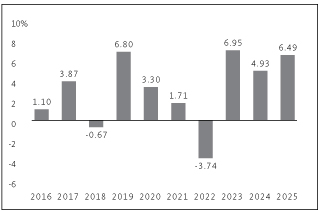
Best Quarter: 3.85% (12/31/2023)
Worst Quarter: -2.08% (06/30/2022)
This table compares the Fund's average annual total returns to those of the Bloomberg U.S. Aggregate Bond Index (a broad-based securities market index), and an additional index with characteristics relevant to the Fund's investment strategy. The Fund's additional index is the Fund's 95/5 blended benchmark that is composed of the Bloomberg 1-3 Year U.S. Government/Credit Index (95%) and the S&P 500 Index (5%). In prior years, the Fund also compared its performance to the Bloomberg 1-3 Year U.S. Government/Credit Index.
After-tax returns are calculated using the historical highest individual federal marginal income tax rates and do not reflect the impact of state and local taxes. Your actual after-tax returns will depend on your tax situation and may differ from those shown. After-tax returns shown are not relevant to investors who hold their Fund shares through tax-deferred arrangements, such as 401(k) plans or individual retirement accounts. In some cases, the Fund's return after taxes may exceed the Fund's return before taxes due to an assumed tax benefit from any losses on a sale of Fund shares at the end of the measurement period.
|
Multi-Asset Capital Stability Fund — Class F |
1 Year |
5 Years |
10 Years |
Since Inception (4/9/2012) |
|||||||||||||||
|
Return Before Taxes |
6.49 |
% |
3.19 |
% |
3.02 |
% |
2.45 |
% |
|||||||||||
|
Return After Taxes on Distributions |
5.77 |
% |
1.82 |
% |
1.96 |
% |
1.58 |
% |
|||||||||||
|
Return After Taxes on Distributions and Sale of Fund Shares |
3.92 |
% |
1.91 |
% |
1.91 |
% |
1.56 |
% |
|||||||||||
|
Bloomberg U.S. Aggregate Bond Index (reflects no deduction for fees, expenses or taxes) |
7.30 |
% |
-0.36 |
% |
2.01 |
% |
2.01 |
% |
|||||||||||
|
The Fund's Blended Benchmark Return (reflects no deduction for fees, expenses or taxes) |
5.97 |
% |
2.61 |
% |
2.75 |
% |
2.38 |
% |
|||||||||||