Note 1
Dec. 31, 2025
Banco Bilbao Vizcaya Argentaria, S.A. (hereinafter “the Bank”, "BBVA" or “BBVA, S.A.”), registered with the Company Register of Vizcaya, is a private-law entity subject to the laws and regulations governing banking entities operating in Spain. It carries out its activity through branches and agencies across the country and abroad.
The Bylaws and other public information are available for inspection at the Bank’s registered address (Plaza San Nicolás 4, Bilbao) as noted on its web site (www.bbva.com). The Bank´s purpose is to carry out all kinds of activities, operations, acts, contracts and services within the banking business or directly or indirectly related to it, which are permitted or not prohibited by the provisions in force and supplementary activities. Its corporate purpose also includes the acquisition, possession, use and disposal of securities, public offering of acquisition and sale of securities, as well as all types of holdings in any entity or company.
In addition to the activities it carries out directly, the Bank heads a group of subsidiaries, joint ventures and associates which perform a wide range of activities and which together with the Bank constitute the Banco Bilbao Vizcaya Argentaria Group (hereinafter the “Group” or the “BBVA Group”). In addition to its own separate financial statements, the Bank is required to prepare Consolidated Financial Statements comprising all consolidated subsidiaries of the Group.
As of December 31, 2025, in addition to the Bank, the BBVA Group had 171 consolidated entities and 38 entities accounted for using the equity method (see Notes 3 and 16 and Appendices I to IV).
The Consolidated Financial Statements of the BBVA Group for the year ended December 31, 2025, were authorized for issue on February 20, 2026.
Basis for the presentation of the Consolidated Financial StatementsThe BBVA Group’s Consolidated Financial Statements are presented in compliance with IFRS-IASB (International Financial Reporting Standards as issued by the International Accounting Standards Board (hereinafter “IASB”)), as well as in accordance with the International Financial Reporting Standards endorsed by the European Union (EU-IFRS) applicable as of December 31, 2025, considering the Bank of Spain Circular 4/2017, as well as its successive amendments, and any other legislation governing financial reporting which was, as of the date of preparation of such consolidated financial statements, applicable, and with the format and mark-up requirements established in the EU Delegated Regulation 2019/815 of the European Commission.
The BBVA Group’s Consolidated Financial Statements for the year ended December 31, 2025 were prepared by the Group’s Directors (through the Board of Directors meeting held on February 9, 2026) by applying the principles of consolidation, accounting policies and valuation criteria described in Note 2, so that they present fairly the Group’s total consolidated equity and financial position as of December 31, 2025, together with the consolidated results of its operations and consolidated cash flows generated during the year ended December 31, 2025.
These Consolidated Financial Statements were prepared on the basis of the accounting records kept by the Bank and each of the other entities in the Group. Moreover, they include the adjustments and reclassifications required to harmonize the accounting policies and valuation criteria used by the Group (see Note 2.2).
All effective accounting standards and valuation criteria with a significant effect on the Consolidated Financial Statements were applied in their preparation.
The amounts reflected in the Consolidated Financial Statements are presented in millions of euros, unless it is more appropriate to use smaller units. Some items that appear without a balance in these Consolidated Financial Statements are due to how the units are expressed. Also, in presenting amounts in millions of euros, the accounting balances have been rounded up or down. It is therefore possible that the totals appearing in some tables are not the exact arithmetical sum of their component figures.
The percentage changes in amounts have been calculated using figures expressed in thousands of euros.
Seasonal nature of income and expenseThe nature of the most significant activities carried out by the BBVA Group’s entities is mainly related to typical activities carried out by financial institutions, and are not significantly affected by seasonal factors within the same year.
Responsibility for the information and for the estimates madeThe information contained in the BBVA Group’s Consolidated Financial Statements is the responsibility of the Group’s Directors.
Estimates were required to be made at times when preparing these Consolidated Financial Statements in order to calculate the recorded or disclosed amount of some assets, liabilities, income, expense and commitments. These estimates relate mainly to the following:
–Loss allowances on certain financial assets (see Notes 7, 13, 14 and 16).
–The assumptions used in the valuation of insurance and reinsurance contracts (see Note 23) to quantify certain provisions (see Note 24) and the actuarial calculation of post-employment benefit liabilities and commitments (see Note 25).
–The useful life and impairment losses of tangible and intangible assets and impairment losses on non-current assets held for sale (see Notes 17, 18, and 21).
–The valuation of goodwill and price allocation of business combinations (see Note 18).
–The fair value of certain unlisted financial assets and liabilities (see Notes 7, 8, 10, 11, 12, 13 and 15).
–The recoverability of deferred tax assets and the estimate of the corporate income tax (see Note 19).
As a general matter, the BBVA Group is working to consider and incorporate into the models used for calculating relevant estimates how climate risk and other climate-related matters may affect the financial statements, cash flows, and the financial performance of the Group. These estimates and judgments are being considered when preparing the financial statements of the BBVA Group and, where relevant, they are mentioned in the corresponding Notes to the Consolidated Financial Statements.
The prevailing geopolitical and economic uncertainties (see Note 7.1) entail a greater complexity in developing reliable estimations and applying judgment. Estimates have been made on the basis of the best available information on the matters analyzed as of December 31, 2025. However, it is possible that events may take place subsequent to such date, which could make it necessary to amend these estimations (upward or downward), which would be carried out prospectively, recognizing the effects of the change in estimation in the Consolidated Financial Statements.
During 2025 there were no significant changes in the estimates made as of December 31, 2024 and 2023, other than those indicated in these Consolidated Financial Statements.
BBVA Group’s Internal Control over Financial ReportingBBVA Group’s consolidated financial statements are prepared under an Internal Control over Financial Reporting (hereinafter "ICFR") model. It provides reasonable assurance with respect to the reliability and the integrity of the consolidated financial statements. It is also aimed to support that the transactions are processed in accordance with the applicable laws and regulations.
The ICFR model is compliant with the control framework established in 2013 by the Committee of Sponsoring Organizations of the Treadway Commission (hereinafter "COSO"). The COSO 2013 framework sets out five components that constitute the basis of the effectiveness and efficiency of the internal control systems:
–The establishment of an appropriate control framework.
–The assessment of the risks that could arise during the preparation of the financial information.
–The design of the necessary controls to mitigate the identified risks.
–The establishment of an appropriate system of information to detect and report system weaknesses.
–The monitoring over the controls to support correct performance and effectiveness over time.
The ICFR model is a dynamic model that continuously evolves over time to reflect the reality of the BBVA Group’s businesses and processes, as well as the risks that may arise and the controls that mitigate them. This control system is subject to a continuous evaluation coordinated by the internal financial control units located in the different entities of BBVA Group.
In order to ensure the necessary independence of the aforementioned internal financial control units, they are integrated within the Regulation & Internal Control area. This area, whose head reports to the Board of Directors through its Committees, defines and coordinates the entire internal control model of the Group, which is structured around three lines of defense with distinct and independent functions.
Lines of Defense | Responsible Areas | Functions | ||||||
First Line of Defense | Executive areas, depending on the type of risk | Executive areas, depending on the type of risk Manage and control the risks (financial and/or non-financial, as applicable) to which the Bank and any companies in its Group are exposed in the performance of their functions, including identification, measurement, monitoring, and reporting. This management and control will be carried out in accordance with the guidelines defined in external regulations and internal rules, and taking into account the challenge carried out by the areas that perform second and third line of defense functions, in their respective areas of responsibility. | ||||||
Second Line of Defense | Global Risk Management (GRM) Regulation & Internal Control (R&IC) | Independently of the first line of defense, it must identify, measure, and monitor and report the Group's risks. Establish (or propose to the corporate bodies for approval) the management and control frameworks for financial and/or non-financial risks by all executive areas of the Bank within their respective areas of competence. Challenge the way executive areas manage and/or control the risks assigned to them throughout their life cycle. Carry out reviews of the management and control of risks within the Group. | ||||||
Third Line of Defense | Internal Audit | Carry out independent reviews on how the other executive areas perform their functions of the first and second lines of defense for the management and/or control of risks in the Group. | ||||||
Specifically, with regard to the process of preparing the Group’s financial statements, the Internal Financial Control (RCS Finance) area coordinates the various control units — first and second lines of defense — under a common and standardized methodology established at the corporate level, in accordance with the following framework:
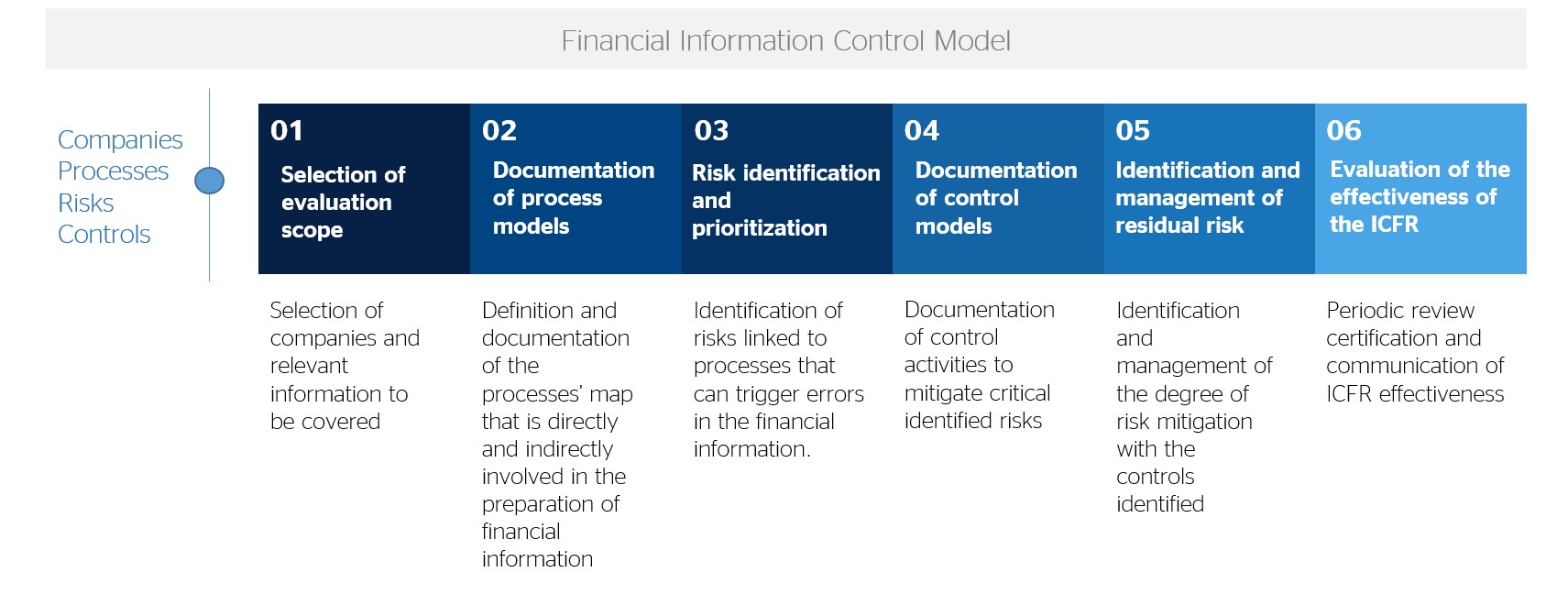
The ICFR model includes both the controls related to the financial information generation processes, as well as those of a broader scope, designed to improve the Group's general control environment (ELC or Entity Level Control). Both types of controls are assessed on a regular basis by the Control areas and by the Group's Internal Audit unit. The result of their evaluation is reported to the Audit Committee of the Bank’s Board of Directors.
The BBVA Group also complies with the requirements of the Sarbanes-Oxley Act ("SOX") for the preparation of the consolidated financial statements, as a company with securities registered with the U.S. Securities and Exchange Commission ("SEC").