Note 7
Dec. 31, 2025
The BBVA Group has processes in place for identifying risks and analyzing scenarios in order to enable the Group to manage risks in a dynamic and proactive way.
The risk identification processes are forward looking to seek the identification of emerging risks and take into account the concerns of both the business areas, which are close to the reality of the different geographical areas, and the corporate areas and senior management.
Risks are identified and measured consistently using the methodologies deemed appropriate in each case. Their measurement includes the design and application of scenario analyses and stress testing and considers the controls to which the risks are subjected.
As part of this process, a forward projection of the Risk Appetite Framework (hereinafter "RAF") variables in stress scenarios is conducted in order to identify possible deviations from the established thresholds. If any such deviations are detected, measures are taken to seek to keep the variables within the target risk profile.
In this context, there are a number of emerging risks that could affect the evolution of the Group’s business, including the below:
Macroeconomic and geopolitical risks
The Group is sensitive to the deterioration of economic conditions and the alteration of the institutional environment of the countries in which it operates, and is exposed to sovereign debt, particularly in Spain, Mexico and Turkey.
The global economy is undergoing significant changes, due in part to the policies of the U.S. administration. Uncertainty surrounding their consequences is exceptionally high, substantially increasing geopolitical, economic, and financial risks.
The increase in U.S. tariffs on imports from its trading partners has triggered financial market volatility, reinforcing global-wide risks. High uncertainty regarding the final level and duration of these tariffs could negatively impact the global economy, worsening the macroeconomic environment. As a result of adopted or announced tariffs, global growth could decelerate significantly.
While fiscal and monetary policies could partially offset the effects of global protectionism, notably in the Eurozone, where significant public spending increases have been announced, the impact of higher U.S. tariffs could be amplified by the adoption of retaliatory measures by other countries, sustained uncertainty, weakened confidence, and financial volatility, among other factors.
Rising tariffs also increase the risk of inflation in the United States and the Eurozone, which could further slow private demand and, at the same time, constrain the Federal Reserve’s and the ECB’s ability to lower rates if warranted by activity.
Beyond import tariffs, tighter controls on migration flows could also affect the labor market in the United States, add to inflationary pressures, and weigh on economic growth. The U.S. administration’s fiscal, monetary, regulatory, industrial, and foreign policies could likewise contribute to financial and macroeconomic volatility. This is compounded by concerns that the Federal Reserve’s independence in decision-making may be weakened by political considerations.
Amid growing uncertainty surrounding U.S. policies and the widening fiscal deficit, the U.S. risk premium could continue to rise, pushing up long-term sovereign yields and further weakening the U.S. dollar. These developments could trigger episodes of volatility, especially given the high public debt levels in both developed and emerging economies. Additionally, the relatively high valuations of AI-related assets constitute an additional source of uncertainty, with potential implications in the financial markets.
The rise of trade protectionism and the growing rivalry between the United States and China could further intensify geopolitical tensions, especially against the backdrop of ongoing conflicts in Ukraine and the Middle East, recent tensions in Latin America and Iran, and the Greenland crisis. In response to these risks and to changes in U.S. foreign policy, the European Union has taken steps to increase military spending, which could support growth but also add upward pressure on inflation and interest rates in the region.
Overall, rising global geopolitical tensions are increasing uncertainty about the global economy and the likelihood of economic and financial disruptions, including a recession.
The Group is exposed to, among others, the following general risks related to the economic and institutional environment in the countries where it operates: a deterioration in economic activity, including potential recession scenarios; inflationary pressures that could lead to a tightening of monetary conditions; stagflation triggered by intense or prolonged supply shocks, including as a result of a protectionist escalation or an increase in oil and gas prices; exchange rate volatility; adverse developments in real estate markets; changes in the institutional environment of the countries where the Group operates, which could lead to sudden and pronounced GDP contractions and/or shifts in regulatory or government policy, including capital controls, dividend restrictions, or the imposition of new taxes or levies; high levels of public debt or external deficits, which could lead to sovereign credit rating downgrades or even defaults or debt restructurings; the impact of the policies adopted by the current U.S. administration, about which significant uncertainty remains; and episodes of financial market volatility, such as those observed recently, that could result in significant losses for the Group.
In Spain, political, regulatory, and economic uncertainty could negatively impact activity. In Mexico, considerable uncertainty persists regarding the impact of the recently approved constitutional reforms, as well as the policies of the U.S. administration and the outcome of the review of the United States-Mexico-Canada free trade agreement (USMCA). In Turkey, despite the gradual improvement in macroeconomic conditions, the situation remains relatively unstable, marked by pressure on the Turkish lira, high inflation, a significant trade deficit, relatively low central bank foreign exchange reserves, and high external financing costs. Recent political and social tensions could also generate renewed bouts of financial volatility and macroeconomic risks. Moreover, uncertainty remains over the impact on Turkey of the geopolitical situation in the Middle East. In South America, ongoing and potential interventionist actions by the United States in some of its countries constitute a significant source of risk. In Argentina, despite the improvement in prospects following significant fiscal, monetary and exchange rate adjustments, the risk of economic and financial turmoil persists. Lastly, in Colombia and Peru, meteorological events, political tensions, and a deterioration of public finances could weigh on economic performance.
Any of these factors may have a significant adverse impact on the Group’s business, financial condition and results of operations.
Regulatory and reputational risks
Financial institutions are exposed to a complex and ever-changing regulatory environment defined by governments and regulators. Regulatory activity in recent years has affected multiple areas, including changes in accounting standards; strict regulation of capital, liquidity and remuneration; bank charges and taxes on financial transactions; regulations affecting mortgages, banking products and consumers and users; recovery and resolution measures; stress tests; prevention of money laundering and terrorist financing; market abuse; conduct in the financial markets; anti-corruption; and requirements as to the periodic publication of information. Governments, regulatory authorities and other institutions continually make proposals to strengthen the resistance of financial institutions to future crises. Further, there is an increasing focus on the climate-related financial risk management capabilities of banks (see section "Environmental, social and governance (“ESG”) risks may adversely impact the Group"). Any change in the Group’s business that is necessary to comply with any particular regulations at any given time, especially in Spain, Mexico or Turkey, could lead to a considerable loss of income, limit the Group’s ability to identify business opportunities, affect the valuation of its assets, force the Group to increase its prices and, therefore, reduce the demand for its products, impose additional costs on the Group or otherwise adversely affect its business, financial condition and results of operations.
The financial sector is under ever closer scrutiny by regulators, governments and society itself. In the course of activities, situations which might cause relevant reputational damage to the Group could arise and might affect the regular course of business.
New business, operational and legal risks
New technologies and forms of customer relationships: Developments in the digital world and in information technologies pose significant challenges for financial institutions, entailing threats (new competitors, disintermediation, etc.) but also opportunities (new framework of relations with customers, greater ability to adapt to their needs, new products and distribution channels, etc.). Digital transformation is a priority for the Group as it aims to lead digital banking of the future as one of its objectives. In this sense, digital transformation is a priority for the Group, which includes among its commitments the development of advanced Next Gen technological capabilities, artificial intelligence, and continuous improvement of the customer experience.
Technological risks and security breaches: The Group is exposed to new threats such as cyber-attacks, theft of internal and customer databases, fraud in payment systems, etc. that require major investments in security from both the technological and human point of view. The Group gives great importance to the active operational and technological risk management and control. Any attack, failure or deficiency in the Group’s systems could, among other things, lead to the misappropriation of funds of the Group’s clients or the Group itself and the unauthorized disclosure, destruction or use of confidential information, as well as prevent the normal operation of the Group and impair its ability to provide services and carry out its internal management. In addition, any attack, failure or deficiency could result in the loss of customers and business opportunities, damage to computers and systems, violation of regulations regarding data protection and/or other regulations, exposure to litigation, fines, sanctions or interventions, loss of confidence in the Group’s security measures, damage to its reputation, reimbursements and compensation, and additional regulatory compliance expenses and could have a significant adverse impact on the Group’ s business, financial condition and results of operations.
Model risk: it is possible that a model used in critical processes presents deficiencies in its design, implementation, use, or interpretation, generating incorrect estimations that affect risk granting, solvency, the financial statements, regulatory compliance, or the Group’s reputation. This risk arises mainly from the use of inadequate assumptions, limitations in data quality or errors in model coding, and is especially relevant in an environment of growing complexity and dependence on models. BBVA is exposed to this risk due to the intensive use of models in essential areas such as credit risk measurement, the calculation of provisions for contingencies, and the valuation of other financial instruments, and the magnitude of this exposure is increased by the volume and diversity of the portfolios, data heterogeneity, and the incorporation of macroeconomic scenarios in certain metrics.
Legal risks: The financial sector faces an environment of increasing regulatory and litigious pressure, and thus, the various Group entities are frequently party to individual or collective judicial proceedings (including class actions) resulting from their activity and operations, as well as arbitration proceedings. The Group is also party to government procedures and investigations, such as those carried out by the antitrust authorities in certain countries which, among other things, have in the past and could in the future result in sanctions, as well as lead to claims by customers and others. In addition, the regulatory framework in the jurisdictions in which the Group operates is evolving towards a supervisory approach more focused on the opening of sanctioning proceedings while some regulators are focusing their attention on consumer protection and behavioral risk.
In Spain and in other jurisdictions where the Group operates, legal and regulatory actions and proceedings against financial institutions, prompted in part by certain judgments in favor of consumers handed down by national and supranational courts (with regards to matters such as credit cards and mortgage loans), have increased significantly in recent years and this trend could continue in the future. Legal and regulatory actions and proceedings faced by other financial institutions in relation to these and other matters, especially if such actions or proceedings result in favorable resolutions for the consumer, could also adversely affect the Group.
There are also claims before the Spanish courts challenging the validity of certain revolving credit card agreements. Rulings in these types of proceedings, whether against the Bank or other financial institutions, could negatively affect the Group.
Additionally, in relation to the ESG area, factors that may affect these new business, operational and legal risks have been identified (see "Environmental, social and governance ("ESG") risks may adversely affect the Group").
All of the above may result in a significant increase in operating and compliance costs or even a reduction of revenues, and it is possible that an adverse outcome in any proceedings (depending on the amount thereof, the penalties imposed or the procedural or management costs for the Group) could damage the Group's reputation, generate a knock-on effect or otherwise adversely affect the Group.
It is difficult to predict the outcome of legal and regulatory actions and proceedings, both those to which the Group is currently exposed and those that may arise in the future, including actions and proceedings relating to former Group subsidiaries or in respect of which the Group may have indemnification obligations. Any of such outcomes could be significantly adverse to the Group. In addition, a decision in any matter, whether against the Group or against another credit entity facing similar claims as those faced by the Group, could give rise to other claims against the Group. In addition, these actions and proceedings attract resources from the Group and may occupy a great deal of attention on part of the Group's management and employees.
As of December 31, 2025 and December 31, 2024, the Group had €805 million and €791 million, respectively, in provisions for the proceedings it is facing (included in the line "Provisions for taxes and other legal contingencies" in the consolidated balance sheet) (see Note 24), of which €583 million and €610 million, respectively, correspond to legal contingencies and €222 million and 181 million, respectively, to tax related matters (see Note 19). However, the uncertainty arising from these proceedings (including those for which no provisions have been made, either because the probability of an unfavorable outcome for the Group is estimated to be remote, or because it is not possible to estimate them or for other reasons) makes it impossible to guarantee that the possible losses arising from the resolution of these proceedings will not exceed, where applicable, the amounts that the Group currently has provisioned and, therefore, could affect the Group's consolidated results in a given period.
As a result of the above, legal and regulatory actions and proceedings currently faced by the Group or to which it may become subject in the future or which may otherwise affect the Group, whether individually or in the aggregate, if resolved in whole or in part adversely to the Group's interests, could have a material adverse effect on the Group’s business, financial condition and results of operations.
Spanish judicial authorities are investigating the activities of Centro Exclusivo de Negocios y Transacciones, S.L. (“Cenyt”). Such investigation includes the provision of services by Cenyt to BBVA. On July 29, 2019, BBVA was named as an investigated party (investigado) in a criminal judicial investigation (Preliminary Proceeding No. 96/2017 – Piece No. 9, Central Investigating Court No. 6 of the National High Court) for alleged facts which could constitute bribery, revelation of secrets and corruption. Certain current and former employees of the Group, as well as former directors and officers, have also been named as investigated parties in connection with this investigation. Since the beginning of the investigation, BBVA has been proactively collaborating with the Spanish judicial authorities, including sharing with the courts information obtained in the internal investigation hired by the entity in 2019 to contribute to the clarification of the facts.
By order of the Criminal Chamber of the National High Court, the pre-trial phase ended on January 29, 2024. On June 20, 2024, the Judge issued an order authorizing the continuation of abbreviated criminal proceedings against the Bank and certain current and former employees of the Bank, as well as against some former directors and officers, for alleged facts which could constitute bribery and revelation of secrets. It is not possible at this time to predict the possible outcomes or implications for the Group of this matter, including any fines, damages or harm to the Group’s reputation caused thereby.
Environmental, social and governance (ESG) risks may adversely impact the Group
ESG factors present risks associated with (i) climate change, including physical risks and transition risks (linked, among others, to changes in regulations, technologies, and market preferences associated with the transition to a less carbon-dependent economy); (ii) other environmental factors, such as biodiversity loss, water stress and other nature-related factors; (iii) social factors, such as human rights, inclusion, diversity and workplace safety; and (iv) corporate governance matters, such as the governance of environmental and social risks.
ESG risks include short, medium and long-term risks that may adversely affect the Group and its customers or counterparties. ESG is an area of significant public debate and focus for governments and regulators, investors, the Group’s customers and counterparties, and other stakeholders, and, as a result, ESG risks are expected to continue to evolve, and may increase, over time.
Among others, ESG risks include the following:
- Physical risks. The activities of the Group or those of its customers or counterparties could be adversely affected by the physical risks (including acute and chronic) arising from climate change or other environmental challenges. For example, extreme weather events and chronic shifts in the climate may damage or destroy properties and other assets of the Group or those of its customers or counterparties, make the insurance against certain risks more expensive or unfeasible, result in increased costs, or otherwise disrupt their respective operations (for example, if supply chains are disrupted as a result), diminishing –in the case of the Group’s customers or counterparties - their repayment capacity and, if applicable, the value of assets granted as collateral to the Group. The Group is also exposed to potential long-term physical risks arising from climate change and other environmental challenges, such as any ensuing deterioration in economic conditions that results in credit-related costs, or potential impacts on the Group’s assets and operations. The Group could also be required to change its business models in response to the foregoing.
- Legal and regulatory risks. The ESG legal and regulatory landscape is increasingly fragmented. While legislatures and regulatory authorities in many jurisdictions continue to impose extensive requirements for financial institutions to integrate ESG considerations into their risk management and reporting frameworks, others are taking a different approach, with regulatory developments moving in the opposite direction, and a reduced emphasis on climate-related risk supervision, adding further complexity and uncertainty to the compliance environment. Legal and regulatory changes related to how banks consider and manage climate and other ESG risks or otherwise affecting banking practices or disclosure of information have resulted, and may continue to result, in higher compliance, operational and credit risks and costs. The Group’s customers and counterparties may be exposed to similar legal and regulatory changes, increasing their own compliance and operational risks and costs. Further, legal and regulatory changes have resulted, and may continue to result, in legal uncertainty and the existence of overlapping or conflicting regulatory or other requirements. They may also give rise to regulatory asymmetries whereby some persons, including the Group and its customers and counterparties, are more heavily regulated than others, placing such persons at a disadvantage. The Group or its customers or counterparties may be unable to meet any new requirements on a timely basis or at all, including new product and service specifications, governance frameworks and practices and disclosure requirements and standards. We expect ESG-related legal and regulatory requirements to continue to evolve in the coming years. In the case of banks in particular, such evolving laws and regulations could include further requirements or restrictions related to lending, investing, capital and liquidity adequacy and operational resilience. The incorporation of ESG risks in the existing prudential framework is still developing and may result in increased risk weighting of certain assets. Moreover, there are significant risks and uncertainties inherent in the development of adequate risk assessment and modeling capabilities with respect to ESG-related matters and the collection and use of customer, third-party and other data, which may result in the Group’s systems or frameworks (or those of its customers and counterparties, where applicable) being inadequate, inaccurate or based on incorrect or insufficient customer, third-party or other data, any of which could adversely affect the Group’s disclosure and financial reporting. Further, increased and/or divergent regulation arising from climate change and other ESG-related challenges could result in increased litigation by different stakeholders (including non-governmental organizations (NGOs)) and regulatory investigations and actions.
- Technological risks. Certain of the Group’s customers and counterparties may be adversely affected by the progressive transition to a low-carbon economy and/or risks and costs associated with new low-carbon technologies. If the Group’s customers and counterparties fail to adapt to the transition to a low-carbon economy, or if the costs of doing so adversely affect their creditworthiness, this could adversely affect the Group’s loan portfolios.
- Market risks. The Group and certain of the Group’s customers and counterparties may be adversely affected by changes in market preferences due to, among other things, increased ESG concern, on the one hand, or an opposing sentiment, on the other. These changes could impact the demand for our products and services, as well as for those of our customers and counterparties, and investor interest in our securities. Further, the funding costs of businesses that are perceived to be more exposed to climate change or to other ESG-related risks could increase. Any of this could result in the reduced creditworthiness of such customers and counterparties, adversely affecting the Group’s relevant loan portfolios. The Group and its customers and counterparties could also be adversely affected by changes in prices resulting from shifts in demand or supply brought by climate change or other ESG-related factors, including prices of energy and raw materials, or by their inability to foresee or hedge any such changes.
- Reputational risks. The perception of climate change and other ESG-related matters as a risk and an appropriate consideration in business and investment decisions, by society, shareholders, customers, governments and other stakeholders (including NGOs), continues to evolve, including in relation to the financial sector’s activities. This may result in increased scrutiny of the Group’s activities, as well as its ESG-related policies, goals, decisions, disclosures or communications. The Group’s reputation and ability to attract or retain customers may be harmed if its response to concerns regarding ESG-related matters is deemed to be insufficient or inappropriate or if a perception is generated among the different stakeholders that the Group’s statements, actions or disclosure do not fairly reflect the underlying sustainability profile of the Group, its products, services, goals and/or policies. At the same time, the Group may refrain from undertaking lending or investing activities or other services that would otherwise have been profitable in order to fulfill its ESG obligations or goals or to avoid reputational harm. Divergent views on ESG policies may also have a negative impact on the Group’s reputation. Increased scrutiny of the Group’s activities, as well as its ESG-related policies, goals, decisions, disclosures and communications, may result in litigation and investigations and supervisory actions (including potential greenwashing or greenhushing claims). The Group has disclosed certain aspirational ESG-related goals and such goals, which are being pursued over the long term, may prove to be considerably more costly or difficult than currently expected, or even impossible, to achieve, including as a result of changes in regulation and policy, the pace of technological change and innovation and the actions of governments and the Group’s customers and competitors. Potential greenwashing claims arising from ESG-related statements, disclosure and/or actions of the Group may also give rise to reputational risks.
Any of these factors may have a material adverse effect on the Group’s business, financial condition and results of operations.
Credit riskCredit risk is the potential loss assumed by the Group as a result of the failure by the Group´s counterparties to meet their contractual obligations.
The general principles governing credit risk management in the BBVA Group are:
–Risks taken should comply with the general risk policy established by the Board of Directors of BBVA.
–Risks taken should be in line with the level of equity and generation of recurring revenue of the BBVA Group prioritizing risk diversification and avoiding relevant concentrations.
–Risks taken should be identified, measured and assessed and there should be management and monitoring procedures, in addition to mitigation and control mechanisms.
–Risks should be managed in a prudent and integrated manner during their life cycle and their treatment should be based on the type of risk. In addition, portfolios should be actively managed on the basis of a common metric (economic capital).
–The main criterion when granting credit risks is the capability of the borrower or obligor to fulfill on a timely basis all financial obligations with its business income or source of income without depending upon guarantors, bondsmen or pledged assets.
–Improve the financial health of our clients, help them in their decision-making and in the daily management of their finances based on personalized advice.
–Help our clients in the transition towards a sustainable future, with a focus on climate change and inclusive and sustainable social development.
Credit risk management in the Group has an integrated structure for all its functions, allowing decisions to be taken objectively and independently throughout the life cycle of the risk.
–At Group level: frameworks for action and standard rules of conduct are defined for handling risk, specifically, the channels, procedures, structure and supervision.
–At the business area level: they are responsible for adapting the Group's criteria to the local realities of each geographical area and for direct management of risk according to the decision-making channel:
a.Retail risks: in general, the decisions are formalized according to the scoring tools, within the general framework for action of each business area, with regard to risks. The changes in weighting and variables of these tools must be validated by the Global Risk Management (hereinafter "GRM") area.
b.Wholesale risks: in general, the decisions are formalized by each business area within its general framework for action with regard to risks, which incorporates the delegation rule and the Group's corporate policies.
The risk function has a decision-making process supported by a structure of committees with a solid governance scheme, which describes their purposes and functioning for a proper performance of their tasks.
In addition, credit risk is affected by climate change risk, mainly through physical and transition risks that may impact the payment capacity of counterparties and the valuation of the collateral used and, therefore, expected credit losses (see "Environmental, social and governance (“ESG”) risks may adversely impact the Group").
Since 2024, the Group has begun incorporating climate risk factors into the process of calculating expected credit losses for loan portfolios through statistical models that consider both potential damage to collateral and the effect on customers' ability to pay due to physical and transition risks in the Group's main geographies. In particular, transition risk has been assessed using an approach that allows capturing its effect on the probability of default (PD) and the impact on customers' provisions in Stage 2 as well as a transfer of exposures from Stage 1 to Stage 2 for corporate portfolios. For physical risk, an approach has been used that would allow estimating the potential deterioration in the value of collateral (real estate assets in corporate and retail portfolios) and its effect on LGD. As of December 31, 2025 and 2024, the impact recorded for these risks was not significant. The Group will continue working to incorporate in these models the information available from time to time.
Measurement of Expected Credit LossIFRS 9 requires determining the Expected Credit Loss (hereinafter "ECL") of a financial instrument in a way that reflects an unbiased estimation removing any conservatism or optimism, including the time value of money and a forward-looking perspective (including the economic forecast), all this based on the information that is available at a certain point in time and that is reasonable and bearable with respect to future economic conditions.
Therefore, the recognition and measurement of ECL is highly complex and involves the use of significant analysis and estimation including formulation and incorporation of forward-looking economic conditions into the ECL model.
The modeling of the ECL calculation is subject to a governance system that is common to the entire Group. Within this common framework, each geographical area makes the necessary adaptations to capture its particularities. The methodology, assumptions and observations used by each geographical area are reviewed annually, and after a validation and approval process, the outcome of this review is incorporated into the ECL calculations.
Risk parameters by homogeneous groups
Expected losses can be estimated both individually and collectively. Regarding the collective estimate, the instruments are distributed in homogeneous groups (segments) that share similar risk characteristics. Following the guidelines established by the Group for the development of models under IFRS 9, each geographical area performs the grouping based on the information available, its representativeness or relevance and compliance with the necessary statistical requirements.
Depending on the portfolio or the parameter being estimated, one risk driver or another will apply and different segments will reflect differences in PDs and LGDs. Thus, in each segment, changes in the level of credit risk will respond to the impact of changing conditions on the common range of credit risk drivers. The effect on the Group’s credit risk in response to changes in forward-looking information will be considered as well. Macroeconomic modeling for each segment is carried out using some of the shared risk characteristics.
These segments share credit risk characteristics such that changes in credit risk in a part of the portfolio are not concealed by the performance of other parts of the portfolio. In that sense, the methodology developed for ECL estimation indicates the risk drivers that have to be taken into account for PD segmentation purposes, depending on whether the estimation is for retail or wholesale portfolios.
As an example of the variables that can be taken into consideration to determine the final models, the following stand out:
–PD – Retail: Contractual residual maturity, credit risk scoring, type of product, days past due, forbearance, time on books, time to maturity, nationality of the debtor, sale channel, original term, indicator of credit card activity, percentage of initial drawn balance in credit cards.
–PD – Wholesale: Credit Risk Rating, type of product, watch-list level, forbearance (client), time to maturity, industry sector, updated balance (y/n), written off, grace period.
–LGD – Retail: credit Risk Scoring, segment, type of product, secured / unsecured, type of collateral, sales channel, nationality, business area, debtor’s commercial segment, forbearance (account) EAD (this risk driver could be correlated with the time on books or the LTV so, before including it, an assessment should be done in order to avoid a double counting effect), time on default of the account (for defaulted exposures), geographical location.
–LGD – Wholesale: credit Risk Rating, geographical location, segment, type of product, secured / Unsecured, type of collateral, business area, forbearance (client), debtor’s commercial segment time on default of the deal (for defaulted exposures).
–CCF – Wholesale/retail: percentage of initial drawn balance, debtor’s commercial segment, days past due, forbearance, credit limit activity, time on books.
In the BBVA Group, the expected losses calculated are based on the internal models developed for all the Group's portfolios, unless clients are subject to individualized estimates.
Low Default Portfolios, which include portfolios with high credit quality such as exposures to other credit institutions, sovereign debt or corporates and small client's portfolios with high exposures such as specialized lending or fixed income, are characterized by a low number of defaults, so the Group's historical bases do not contain sufficiently representative information to build impairment models based on them. However, there are external sources of information that, based on broader observations, are capable of providing the necessary inputs to develop models of expected losses. Therefore, based on the rating assigned to these exposures and taking into account the inputs obtained from these sources, the calculations of expected losses are developed internally, including their projection based on the macroeconomic perspectives.
Individual estimation of Expected Credit Losses
The Group periodically and individually reviews the situation and credit rating of its customers, regardless of their classification, taking into consideration the information deemed necessary to do so. It also has procedures in place within the risk management framework to identify the factors that may lead to increased risk and, consequently, to a greater need for provisions.
The monitoring model established by the Group consists of continuously monitoring the risks to which it is exposed, which guarantees their proper classification in the different categories of IFRS 9. The original analysis of the exposures is reviewed through the procedures for updating the rating tools (rating and scoring), which periodically review the financial situation of clients, influencing the classification by stages of exposures.
Within this credit risk management framework, the Group has procedures that seek to guarantee the review, at least annually, of all its wholesale counterparties through the so-called financial programs, which include the current and proposed positioning of the Group with the customer in terms of credit risk. This review is based on a detailed analysis of the client's up-to-date financial situation, which is complemented by other information available in relation to individual perspectives on business performance, industry trends, macroeconomic prospects or other public data. As a result of this analysis, the preliminary rating of the client is obtained, which, after undergoing the internal procedure, can be revised down if deemed appropriate (e.g., general economic environment or evolution of the sector). These factors in addition to the information that the client can provide are used to review the ratings even before the scheduled financial plan reviews are conducted if circumstances so warrant.
Additionally, the Group has established procedures to identify wholesale customers in the internal Watch List category, which is defined as that risk in which, derived from an individualized credit analysis, an increase in credit risk is observed, either due to economic or financial difficulties or because they have suffered, or are expected to suffer, adverse situations in their environment, without meeting the criteria for classification as impaired risk. Under this procedure, all a customer's Watch List exposures are considered stage 2 regardless of when they originated, if as a result of the analysis the customer is considered to have significantly increased risk.
Finally, the Group has Workout Committees, both local and corporate, which analyze not only the situation and evolution of significant clients in Watch List and impaired situations, but also those significant clients in which, although not on Watch List, may present some stage 2 rated exposure for a quantitative reason (PD comparison from origination). This analysis is carried out in order to decide if, derived from this situation, all the client's exposures should be considered in the Watch List category, which would imply the migration of all the client's operations to stage 2 regardless of the date on which they originated.
With this, the Group undertakes an individualized review of the credit quality of its wholesale counterparties, identifying the situations in which a change in the risk profile of these clients may have occurred and proceeding, where appropriate, to estimate individualized credit losses. Along with this review, the Group individually estimates the expected losses of those clients whose total exposure exceeds certain thresholds, including those that part of their operations may be classified in stage 1 and part in stage 2. In setting thresholds, each geographical area determines the minimum amount of a client's exposure whose expected losses must be estimated individually taking into account the following:
–For clients with exposures in stage 3. The analysis of clients with total risk above this threshold implies analyzing at least 40% of the total risk of the wholesale portfolio in stage 3. Although the calibration of the threshold is done on the wholesale portfolio, clients of other portfolios must be analyzed if they exceed the threshold, staying in stage 3.
–For all other situations. The analysis of clients with total risk above this threshold implies analyzing at least 20% of the total risk of the Watch List wholesale portfolio. Although the threshold calibration is carried out on the exposure classified as Watch List, wholesale clients or clients belonging to other portfolios that have exposures classified in stage 2 and whose total exposure exceeds the mentioned threshold must be analyzed individually, considering both the exposures classified in stage 1 as in stage 2.
Regarding the methodology for the individual estimation of expected losses, it should be mentioned, firstly, that these are measured as the difference between the asset’s carrying amount and the estimated future cash flows discounted at the financial asset’s effective interest rate.
The estimated recoverable amount should correspond to the amount calculated under the following method:
–the present value of estimated future cash flows discounted at the financial asset’s original effective interest rate; and
–the estimation of the recoverable amount of a collateralized exposure reflects the cash flows that may result from the settlement of the collateral, as well as prospective information the analyst may implicitly include in the analysis.
The estimated future cash flows depend on the type of approach applied, which can be:
–Going concern scenario: when the entity has updated and reliable information about the solvency and ability of payment of the holders or guarantors. The operating cash flows of the debtor, or the guarantor, continue and can be used to repay the financial debt to all creditors. In addition, collateral may be exercised to the extent it does not influence operating cash flows. The following aspects should be taken into account:
a.Future operating cash flows should be based on the financial statements of the debtor.
b.When the projections made on these financial statements assume a growth rate, a constant or decreasing growth rate must be used over a maximum growth period of 3 to 5 years, and subsequently constant cash flows.
c.The growth rate should be based on the analysis of the evolution of the debtor's financial statements or on a sound and applicable business restructuring plan, taking into account the resulting changes in the structure of the company (for example, due to divestments or the interruption of unprofitable lines of business).
d.(Re)-investments that are needed to preserve cash flows should be considered, as well as any foreseeable future cash flow changes (e.g. if a patent or a long-term loan expires).
e.When the recoverability of the exposure relies on the realization of the disposal of some assets by the debtor, the selling price should reflect the estimated future cash flows that may result from the sale of the assets less the estimated costs associated with the disposal.
–Gone concern scenario: when the entity does not have updated and reliable information, it should consider that the estimation of loan receivable flows is highly uncertain. Estimation should be carried out through the estimation of recoverable amounts from the effective real guarantees received. It will not be admissible as effective guarantees, those whose effectiveness depends substantially on the creditworthiness of the debtor or economic group in which it takes part. Under a gone concern scenario, the collateral is exercised and the operating cash flows of the debtor cease. This could be the case if:
a.The exposure has been past due for a long period. There is a rebuttable presumption that the allowance should be estimated under a gone concern criterion when arrears are greater than 18 months.
b.Future operating cash flows of the debtor are estimated to be low or negative.
c.Exposure is significantly collateralized, and this collateral is central to cash flow generation.
d.There is a significant degree of uncertainty surrounding the estimation of the future cash flows. This would be the case if the earnings before interest, taxes, depreciation and amortization (EBITDA) of the two previous years had been negative, or if the business plans of the previous years had been flawed (due to material discrepancies in the backtesting).
e.Insufficient information is available to perform a going concern analysis.
Significant increase in credit risk
As indicated in Note 2.2, the criteria for identifying the significant increase in risk are applied consistently throughout the Group, distinguishing between quantitative reasons or by comparison of probabilities of default and qualitative reasons (more than 30 days of default, Watch List consideration or non-impaired refinancing).
To manage credit risk, the Group uses all relevant information that is available and that may affect the credit quality of the exposures. This information may come mainly from the internal processes of admission, analysis and monitoring of operations, from the strategy defined by the Group regarding the price of operations or distribution by geographical areas, products or sectors of activity, from the observance of the macroeconomic environment, from market data such as interest rate curves, or prices of the different financial instruments, or from external sources of credit rating.
This set of information is the basis for determining the rating and scoring (see Note 7.2.4 for more information on rating and scoring systems) corresponding to each of the exposures and which are assigned a probability of default (PD) that, as already mentioned, is subject to an annual review process that assesses its representativeness (backtesting) and is updated with new observations. Furthermore, the projection of these PDs over time has been modeled based on macroeconomic expectations, which allows obtaining the probabilities of default throughout the life of the operations.
Based on this common methodology, and in accordance with the provisions of IFRS 9 and the EBA guidelines on credit risk management practices, each geographical area has established absolute and relative thresholds for identifying whether the expected changes in the probabilities of default have increased significantly compared to the initial moment, adapted to the particularities of each one of them in terms of origination levels, product characteristics, distribution by sectors or portfolios, and macroeconomic situation. To establish the aforementioned thresholds, a series of general principles are considered, such as:
–Uniformity: based on the rating and scoring systems that, in a homogeneous manner, are implemented in the Group's units.
–Stability: the thresholds must be established to identify the significant increase in risk produced in exposures since their initial recognition and not only to identify those situations in which it is already foreseeable that they will reach the level of impairment. For this reason, it is to be expected that of the total exposures there will always be a representative group for which said increased risk is identified.
–Anticipation: the thresholds must consider the identification of the increased risk in advance with respect to the recognition of the exposures as impaired or even before a real default occurs. The calibration of the thresholds should minimize the cases in which the instruments are classified in stage 3 without having previously been recognized as stage 2.
–Indicators or metrics: it is expected that the classification of the exposures in stage 2 will have sufficient permanence to be able to develop an anticipatory management plan with respect to them before, where applicable, they end up migrating to stage 3.
–Symmetry: IFRS 9 provides for a symmetric treatment both to identify the significant increase in risk and to identify that it has disappeared, so the thresholds also work to improve the credit classification of exposures. In this sense, it is expected that the cases in which the exhibitions that improve from stage 3 are directly classified into stage 1 will be minimal.
–The identification of the significant increase in risk from the comparison of the probabilities of default should be the main reason why exposures in stage 2 are recognized.
Specifically, a contract will be transferred to stage 2 when the following two conditions are met by comparing the current PD values and the origination PD values:
(Current PD) / (Origination PD) - 1*100 >Relative Threshold (%) and
Current PD – Origination PD > Absolute threshold (bps)
These absolute and relative variation thresholds are consistently established for each geographical area and for each portfolio, taking into account their particularities and based on the principles described. The thresholds set by each geographical area are included within the annual review process and, generally speaking, are in the range of 130% to 250% for the relative threshold and from 30 to 100 basis points for the absolute threshold. Specifically, in BBVA, S.A.'s wholesale portfolio the relative threshold is from 180% to 200% and the absolute threshold ranges from 30 to 100 basis points; in the retail portfolio the relative threshold is 200% while the absolute threshold ranges between 50 and 100 basis points. For BBVA Mexico, the relative threshold for the wholesale portfolio is between 180% and 200% and the absolute threshold is between 30 basis points and 80 basis points. For the majority of the retail portfolio, the relative threshold is in the range of 170% and 250% and the absolute threshold between 10 and 100 basis points.
The establishment of absolute and relative thresholds, as well as their different levels, comply with the provisions of IFRS 9 when it indicates that a certain change, in absolute terms, in the risk of a default will be more significant for a financial instrument with a lower initial risk of default compared to a financial instrument with higher initial risk of default.
For existing contracts before the implementation of IFRS 9, given the limitations in the information available on them, the thresholds are calibrated based on the PDs obtained from the prudential or economic models for calculating capital.
Risk Parameters Adjusted by Macroeconomic Scenarios
Expected Credit Loss (ECL) must include forward-looking information, in accordance with IFRS 9, which states that the comprehensive credit risk information must incorporate not only historical information but also all relevant credit information, also including forward-looking macroeconomic information. BBVA uses the typical credit risk parameters PD, LGD and EAD in order to calculate the ECL for the credit portfolios.
BBVA methodological approach in order to incorporate the forward-looking information aims to determine the relation between macroeconomic variables and risk parameters following three main steps:
–Step 1: Analysis and transformation of time series data.
–Step 2: For each dependent variable find conditional forecasting models that are economically consistent.
–Step 3: Select the best conditional forecasting model from the set of candidates defined in Step 2, based on their forecasting capacity.
How economic scenarios are reflected in the calculation of ECL
The forward-looking component is added to the calculation of the ECL through the introduction of macroeconomic scenarios as an input. Inputs highly depend on the particular combination of region and portfolio, so inputs are adapted to available data regarding each of them.
Based on economic theory and analysis, the main indicators most directly relevant for explaining and forecasting the selected risk parameters (PD, LGD and EAD) are:
–The net income of families, corporates or public administrations.
–The outstanding payment amounts on the principal and interest on the financial instruments.
–The value of the collateral assets pledged to the loan.
The BBVA Group estimates these parameters using a proxy indicator derived from the set of variables included in the macroeconomic scenarios provided by BBVA Research.
Only a single specific indicator for each of the three categories can be used and only one of the following core macroeconomic indicators should be chosen as first option:
–The real GDP growth for the purpose of conditional forecasting can be seen as the only “factor” required for capturing the influence of all potentially relevant macro-financial scenarios on internal PDs and LGD.
–The most representative short-term interest rate (typically the policy rate or the most liquid sovereign yield or interbank rate) or exchange rates expressed in real terms.
–A comprehensive and representative index of the price of real estate properties expressed in real terms in the case of mortgage loans and a representative and real term index of the price of the relevant commodity for corporate loan portfolios concentrated in exporters or producers of such commodity.
Real GDP growth is given priority over any other indicator not only because it is the most comprehensive indicator of income and economic activity but also because it is the central variable in the generation of macroeconomic scenarios.
Multiple scenario approach
IFRS 9 requires calculating an unbiased probability weighted measurement of ECL by evaluating a range of possible outcomes, including forecasts of future economic conditions.
BBVA Research produces forecasts of the macroeconomic variables under the baseline scenario, which are used in the rest of the related processes of the Group, such as budgeting, ICAAP (Internal Capital Adequacy Assessment Process) and Risk Appetite Framework, stress testing, recovery plan, etc.
Additionally, BBVA Research produces alternative scenarios to the baseline scenario so as to meet the requirements under the IFRS 9 standard.
Alternative macroeconomic scenarios
–For each of the macro-financial variables, BBVA Research produces three scenarios.
–BBVA Research tracks, analyzes and forecasts the economic environment to provide a consistent forward-looking assessment about the most likely scenario and risks that impact BBVA’s footprint. To build economic scenarios, BBVA Research combines official data, econometric techniques and expert judgement.
–Each of these scenarios corresponds to the expected value of a different area of the probabilistic distribution of the possible projections of the economic variables. These areas are not symmetric with respect to the baseline scenario, as the methodology used to generate alternative scenarios explicitly incorporates the asymmetry of macroeconomic risks. In this regard, BBVA selects those quartiles of the distribution that allow for the capture of events that are sufficiently differentiated from the central scenario, while remaining plausible and consistent with the forward-looking forecasting framework, thereby excluding extreme scenarios typically associated with stress-testing exercises.
–The non-linearity overlay is defined as the ratio between the probability-weighted ECL under the alternative scenarios and the baseline scenario, where the scenario’s probability depends on the distance of the alternative scenarios from the base one. This non-linearity overlay ratio is calculated on a differentiated basis by accounting stage and risk segment, with the objective of appropriately reflecting the varying sensitivity of expected credit losses to macroeconomic conditions across portfolios. In addition, floors are applied to this ratio in order to prevent the consideration of negative values, thereby ensuring that the use of multiple scenarios does not artificially reduce expected credit losses relative to those estimated under the baseline scenario.
–BBVA Group establishes equally weighted scenarios, being the probability 34% for the baseline scenario, 33% for the unfavorable alternative scenario and 33% for the favorable alternative scenario.
The approach in the BBVA Group is based on the use of the most likely scenario, which is the baseline scenario, consistent with other internal processes (ICAAP, budgeting, etc.). The impact of the use of multiple scenarios is subsequently incorporated, calculated on the basis of the probability-weighted expected loss determined for each scenario.
On the other hand, the BBVA Group also takes into account the range of possible scenarios when defining its significant increase in credit risk. Thus, the PDs used in the quantitative process to identify the significant increase in credit risk will be those that result from making a weighted average of the PDs calculated under the three scenarios.
Macroeconomic scenarios
The forward-looking information incorporated in the calculation of expected losses is in line with the macroeconomic perspectives published by BBVA Research, which are quarterly updated.
BBVA Research forecasts a maximum of five years for the macroeconomic variables. The following forecasts (positive base and negative scenarios) of the GDP growth, unemployment rate and House Price Index (HPI), for the most relevant countries where they represent a significant factor, provided by BBVA Research, were used for the calculation of the ECL as of December 31, 2025:
POSITIVE SCENARIO OF GDP, UNEMPLOYMENT RATE AND HPI FOR THE MAIN GEOGRAPHICAL AREAS | ||||||||||||||||||||||||||||||||
Spain | Mexico | Turkey | ||||||||||||||||||||||||||||||
Date | GDP | Unemployment | HPI | GDP | Unemployment | HPI | GDP | Unemployment | ||||||||||||||||||||||||
2025 | 2.94 | % | 9.89 | % | 8.26 | % | 0.69 | % | 2.75 | % | 4.81 | % | 3.82 | % | 8.52 | % | ||||||||||||||||
2026 | 3.58 | % | 7.08 | % | 7.91 | % | 2.74 | % | 2.99 | % | 4.37 | % | 7.47 | % | 8.65 | % | ||||||||||||||||
2027 | 5.36 | % | 6.52 | % | 7.34 | % | 3.94 | % | 2.90 | % | 4.17 | % | 9.29 | % | 7.89 | % | ||||||||||||||||
2028 | 6.75 | % | 6.09 | % | 7.34 | % | 3.65 | % | 2.78 | % | 4.47 | % | 5.77 | % | 7.98 | % | ||||||||||||||||
2029 | 7.21 | % | 5.81 | % | 7.28 | % | 3.58 | % | 2.70 | % | 4.65 | % | 5.84 | % | 8.29 | % | ||||||||||||||||
2030 | 6.90 | % | 5.61 | % | 6.44 | % | 3.55 | % | 2.80 | % | 4.63 | % | 5.53 | % | 8.45 | % | ||||||||||||||||
Peru | Argentina | Colombia | ||||||||||||||||||||||||
Date | GDP | Unemployment | GDP | Unemployment | GDP | Unemployment | ||||||||||||||||||||
2025 | 3.35 | % | 5.98 | % | 4.58 | % | 8.17 | % | 2.89 | % | 8.64 | % | ||||||||||||||
2026 | 3.87 | % | 6.06 | % | 4.92 | % | 7.97 | % | 4.41 | % | 8.43 | % | ||||||||||||||
2027 | 4.03 | % | 5.94 | % | 7.41 | % | 6.91 | % | 4.24 | % | 8.24 | % | ||||||||||||||
2028 | 4.15 | % | 5.79 | % | 8.04 | % | 5.77 | % | 4.29 | % | 8.06 | % | ||||||||||||||
2029 | 3.91 | % | 5.69 | % | 8.10 | % | 4.80 | % | 4.38 | % | 8.15 | % | ||||||||||||||
2030 | 3.79 | % | 5.59 | % | 7.94 | % | 3.97 | % | 4.45 | % | 8.16 | % | ||||||||||||||
BASE SCENARIO OF GDP, UNEMPLOYMENT RATE AND HPI FOR THE MAIN GEOGRAPHICAL AREAS | ||||||||||||||||||||||||||||||||
Spain | Mexico | Turkey | ||||||||||||||||||||||||||||||
Date | GDP | Unemployment | HPI | GDP | Unemployment | HPI | GDP | Unemployment | ||||||||||||||||||||||||
2025 | 2.90 | % | 10.58 | % | 8.24 | % | 0.67 | % | 2.75 | % | 4.81 | % | 3.75 | % | 8.53 | % | ||||||||||||||||
2026 | 2.39 | % | 9.95 | % | 6.67 | % | 1.25 | % | 3.08 | % | 4.38 | % | 3.97 | % | 9.23 | % | ||||||||||||||||
2027 | 2.03 | % | 9.60 | % | 3.35 | % | 1.71 | % | 3.13 | % | 4.00 | % | 5.46 | % | 9.35 | % | ||||||||||||||||
2028 | 1.96 | % | 9.30 | % | 1.61 | % | 1.80 | % | 3.06 | % | 3.89 | % | 3.20 | % | 9.75 | % | ||||||||||||||||
2029 | 1.96 | % | 9.05 | % | 1.20 | % | 1.86 | % | 3.01 | % | 3.88 | % | 4.06 | % | 10.00 | % | ||||||||||||||||
2030 | 1.99 | % | 8.80 | % | 1.04 | % | 1.90 | % | 3.12 | % | 3.72 | % | 4.03 | % | 10.00 | % | ||||||||||||||||
Peru | Argentina | Colombia | ||||||||||||||||||||||||
Date | GDP | Unemployment | GDP | Unemployment | GDP | Unemployment | ||||||||||||||||||||
2025 | 3.34 | % | 5.98 | % | 4.47 | % | 8.18 | % | 2.68 | % | 8.64 | % | ||||||||||||||
2026 | 3.09 | % | 6.10 | % | 3.02 | % | 8.10 | % | 2.81 | % | 8.70 | % | ||||||||||||||
2027 | 2.58 | % | 6.07 | % | 3.04 | % | 7.33 | % | 2.76 | % | 8.78 | % | ||||||||||||||
2028 | 2.78 | % | 6.00 | % | 2.99 | % | 6.43 | % | 2.98 | % | 8.76 | % | ||||||||||||||
2029 | 2.67 | % | 5.95 | % | 3.04 | % | 5.60 | % | 3.13 | % | 8.96 | % | ||||||||||||||
2030 | 2.63 | % | 5.90 | % | 2.99 | % | 4.83 | % | 3.22 | % | 9.06 | % | ||||||||||||||
NEGATIVE SCENARIO OF GDP, UNEMPLOYMENT RATE AND HPI FOR THE MAIN GEOGRAPHICAL AREAS | ||||||||||||||||||||||||||||||||
Spain | Mexico | Turkey | ||||||||||||||||||||||||||||||
Date | GDP | Unemployment | HPI | GDP | Unemployment | HPI | GDP | Unemployment | ||||||||||||||||||||||||
2025 | 2.86 | % | 11.26 | % | 8.21 | % | 0.63 | % | 2.75 | % | 4.80 | % | 3.69 | % | 8.53 | % | ||||||||||||||||
2026 | 1.27 | % | 12.81 | % | 5.49 | % | 0.11 | % | 3.15 | % | 4.38 | % | 1.90 | % | 9.55 | % | ||||||||||||||||
2027 | (0.95) | % | 12.65 | % | (0.17) | % | (0.13) | % | 3.31 | % | 3.86 | % | 2.53 | % | 10.33 | % | ||||||||||||||||
2028 | (2.39) | % | 12.49 | % | (3.44) | % | 0.24 | % | 3.30 | % | 3.41 | % | 1.38 | % | 11.01 | % | ||||||||||||||||
2029 | (2.95) | % | 12.28 | % | (4.28) | % | 0.40 | % | 3.28 | % | 3.25 | % | 3.16 | % | 11.14 | % | ||||||||||||||||
2030 | (2.66) | % | 11.98 | % | (3.91) | % | 0.45 | % | 3.39 | % | 2.96 | % | 3.20 | % | 10.97 | % | ||||||||||||||||
Peru | Argentina | Colombia | ||||||||||||||||||||||||
Date | GDP | Unemployment | GDP | Unemployment | GDP | Unemployment | ||||||||||||||||||||
2025 | 3.16 | % | 5.99 | % | 4.29 | % | 8.18 | % | 2.49 | % | 8.65 | % | ||||||||||||||
2026 | 0.98 | % | 6.24 | % | 0.00 | % | 8.32 | % | 0.61 | % | 9.04 | % | ||||||||||||||
2027 | 0.31 | % | 6.35 | % | (2.05) | % | 7.88 | % | 0.50 | % | 9.56 | % | ||||||||||||||
2028 | 0.66 | % | 6.38 | % | (2.27) | % | 7.20 | % | 1.22 | % | 9.76 | % | ||||||||||||||
2029 | 0.67 | % | 6.41 | % | (2.03) | % | 6.48 | % | 1.53 | % | 10.09 | % | ||||||||||||||
2030 | 0.73 | % | 6.42 | % | (1.91) | % | 5.72 | % | 1.67 | % | 10.29 | % | ||||||||||||||
The estimate for the then-following five years of the following rates, used in the measurement of the expected loss as of December 31, 2024, consistent with the latest estimates made public at that date, was:
POSITIVE SCENARIO OF GDP, UNEMPLOYMENT RATE AND HPI FOR THE MAIN GEOGRAPHICAL AREAS | ||||||||||||||||||||||||||||||||
Spain | Mexico | Turkey | ||||||||||||||||||||||||||||||
Date | GDP | Unemployment | HPI | GDP | Unemployment | HPI | GDP | Unemployment | ||||||||||||||||||||||||
2024 | 3.13 | % | 10.97 | % | 3.01 | % | 1.25 | % | 2.75 | % | 4.57 | % | 3.25 | % | 8.79 | % | ||||||||||||||||
2025 | 3.48 | % | 8.78 | % | 5.55 | % | 2.48 | % | 3.04 | % | 4.85 | % | 5.97 | % | 9.89 | % | ||||||||||||||||
2026 | 5.02 | % | 8.17 | % | 6.98 | % | 3.87 | % | 3.03 | % | 4.38 | % | 8.35 | % | 9.27 | % | ||||||||||||||||
2027 | 6.65 | % | 7.64 | % | 7.96 | % | 3.54 | % | 2.89 | % | 4.82 | % | 6.76 | % | 8.80 | % | ||||||||||||||||
2028 | 7.05 | % | 7.21 | % | 7.69 | % | 3.58 | % | 2.77 | % | 5.12 | % | 5.88 | % | 8.81 | % | ||||||||||||||||
2029 | 6.70 | % | 6.96 | % | 6.81 | % | 3.52 | % | 2.73 | % | 5.46 | % | 5.51 | % | 8.96 | % | ||||||||||||||||
Peru | Argentina | Colombia | ||||||||||||||||||||||||
Date | GDP | Unemployment | GDP | Unemployment | GDP | Unemployment | ||||||||||||||||||||
2024 | 3.12 | % | 6.59 | % | (3.66) | % | 10.37 | % | 2.16 | % | 10.20 | % | ||||||||||||||
2025 | 3.45 | % | 6.55 | % | 7.37 | % | 8.67 | % | 4.09 | % | 10.07 | % | ||||||||||||||
2026 | 4.15 | % | 6.44 | % | 8.83 | % | 7.13 | % | 4.68 | % | 9.72 | % | ||||||||||||||
2027 | 4.12 | % | 6.31 | % | 8.54 | % | 5.92 | % | 4.23 | % | 9.11 | % | ||||||||||||||
2028 | 3.70 | % | 6.20 | % | 8.60 | % | 5.05 | % | 4.21 | % | 8.55 | % | ||||||||||||||
2029 | 3.57 | % | 6.12 | % | 8.44 | % | 4.50 | % | 4.22 | % | 7.95 | % | ||||||||||||||
BASE SCENARIO OF GDP, UNEMPLOYMENT RATE AND HPI FOR THE MAIN GEOGRAPHICAL AREAS | ||||||||||||||||||||||||||||||||
Spain | Mexico | Turkey | ||||||||||||||||||||||||||||||
Date | GDP | Unemployment | HPI | GDP | Unemployment | HPI | GDP | Unemployment | ||||||||||||||||||||||||
2024 | 3.09 | % | 11.43 | % | 2.99 | % | 1.24 | % | 2.75 | % | 4.57 | % | 3.18 | % | 8.80 | % | ||||||||||||||||
2025 | 2.29 | % | 10.75 | % | 4.32 | % | 0.99 | % | 3.13 | % | 4.85 | % | 2.48 | % | 10.46 | % | ||||||||||||||||
2026 | 1.69 | % | 10.35 | % | 2.99 | % | 1.64 | % | 3.25 | % | 4.21 | % | 4.52 | % | 10.73 | % | ||||||||||||||||
2027 | 1.86 | % | 9.95 | % | 2.24 | % | 1.70 | % | 3.17 | % | 4.23 | % | 4.18 | % | 10.58 | % | ||||||||||||||||
2028 | 1.80 | % | 9.55 | % | 1.61 | % | 1.87 | % | 3.08 | % | 4.36 | % | 4.11 | % | 10.52 | % | ||||||||||||||||
2029 | 1.80 | % | 9.25 | % | 1.41 | % | 1.87 | % | 3.04 | % | 4.55 | % | 4.01 | % | 10.51 | % | ||||||||||||||||
Peru | Argentina | Colombia | ||||||||||||||||||||||||
Date | GDP | Unemployment | GDP | Unemployment | GDP | Unemployment | ||||||||||||||||||||
2024 | 3.10 | % | 6.59 | % | (3.76) | % | 10.38 | % | 1.96 | % | 10.20 | % | ||||||||||||||
2025 | 2.67 | % | 6.59 | % | 5.48 | % | 8.80 | % | 2.49 | % | 10.34 | % | ||||||||||||||
2026 | 2.70 | % | 6.57 | % | 4.47 | % | 7.55 | % | 3.19 | % | 10.26 | % | ||||||||||||||
2027 | 2.75 | % | 6.52 | % | 3.48 | % | 6.58 | % | 2.92 | % | 9.81 | % | ||||||||||||||
2028 | 2.45 | % | 6.47 | % | 3.54 | % | 5.85 | % | 2.96 | % | 9.36 | % | ||||||||||||||
2029 | 2.41 | % | 6.42 | % | 3.48 | % | 5.35 | % | 2.99 | % | 8.86 | % | ||||||||||||||
NEGATIVE SCENARIO OF GDP, UNEMPLOYMENT RATE AND HPI FOR THE MAIN GEOGRAPHICAL AREAS | ||||||||||||||||||||||||||||||||
Spain | Mexico | Turkey | ||||||||||||||||||||||||||||||
Date | GDP | Unemployment | HPI | GDP | Unemployment | HPI | GDP | Unemployment | ||||||||||||||||||||||||
2024 | 3.05 | % | 11.88 | % | 2.97 | % | 1.20 | % | 2.75 | % | 4.56 | % | 3.13 | % | 8.80 | % | ||||||||||||||||
2025 | 1.18 | % | 12.71 | % | 3.15 | % | (0.16) | % | 3.20 | % | 4.86 | % | 0.41 | % | 10.79 | % | ||||||||||||||||
2026 | (1.30) | % | 12.50 | % | (0.53) | % | (0.20) | % | 3.43 | % | 4.07 | % | 1.59 | % | 11.71 | % | ||||||||||||||||
2027 | (2.50) | % | 12.24 | % | (2.81) | % | 0.14 | % | 3.41 | % | 3.76 | % | 2.37 | % | 11.83 | % | ||||||||||||||||
2028 | (3.11) | % | 11.88 | % | (3.87) | % | 0.40 | % | 3.34 | % | 3.72 | % | 3.21 | % | 11.67 | % | ||||||||||||||||
2029 | (2.86) | % | 11.53 | % | (3.55) | % | 0.42 | % | 3.32 | % | 3.79 | % | 3.18 | % | 11.47 | % | ||||||||||||||||
Peru | Argentina | Colombia | ||||||||||||||||||||||||
Date | GDP | Unemployment | GDP | Unemployment | GDP | Unemployment | ||||||||||||||||||||
2024 | 2.92 | % | 6.60 | % | (3.93) | % | 10.38 | % | 1.77 | % | 10.21 | % | ||||||||||||||
2025 | 0.56 | % | 6.73 | % | 2.46 | % | 9.02 | % | 0.30 | % | 10.68 | % | ||||||||||||||
2026 | 0.43 | % | 6.85 | % | (0.60) | % | 8.10 | % | 0.93 | % | 11.04 | % | ||||||||||||||
2027 | 0.63 | % | 6.90 | % | (1.79) | % | 7.35 | % | 1.16 | % | 10.81 | % | ||||||||||||||
2028 | 0.46 | % | 6.93 | % | (1.53) | % | 6.73 | % | 1.36 | % | 10.49 | % | ||||||||||||||
2029 | 0.51 | % | 6.95 | % | (1.41) | % | 6.25 | % | 1.44 | % | 10.09 | % | ||||||||||||||
Sensitivity to macroeconomic scenarios
A sensitivity exercise has been carried out on the expected losses due to variations in the key hypotheses as they are the ones that introduce the greatest uncertainty in estimating such losses. As a first step, GDP and the House Price Index have been identified as the most relevant variables. These variables have been subjected to shocks of +/- 100 bps in their entire window with impact of the macro models. Independent sensitivities have been assessed, under the assumption of assigning a 100% probability to each determined scenario with these independent shocks.
Variation in expected loss is determined both by re-staging (that is: in worse scenarios due to the recognition of lifetime credit losses for additional operations that are transferred to stage 2 from stage 1 where 12 months of losses are valued: or vice versa in improvement scenarios) as well as variations in the collective risk parameters (PD and LGD) of each financial instrument due to the changes defined in the macroeconomic forecasts of the scenario. The variation in the expected loss for the Group and the main portfolios and geographical areas is shown below:
EXPECTED LOSS VARIATION AS OF DECEMBER 31, 2025 | ||||||||||||||||||||||||||||||||||||||||||||||||||
BBVA Group | Spain | Mexico | Turkey | |||||||||||||||||||||||||||||||||||||||||||||||
GDP | Total Portfolio | Retail | Companies | Debt securities | Total Portfolio | Companies | Retail | Total Portfolio | Companies | Retail | Total Portfolio | Companies | Retail | |||||||||||||||||||||||||||||||||||||
- 100 bps | 161 | 136 | 24 | 1 | 32 | 12 | 20 | 76 | 6 | 70 | 34 | 5 | 28 | |||||||||||||||||||||||||||||||||||||
+100 bps | (168) | (144) | (23) | (1) | (31) | (12) | (19) | (86) | (5) | (81) | (33) | (5) | (27) | |||||||||||||||||||||||||||||||||||||
| Housing price | ||||||||||||||||||||||||||||||||||||||||||||||||||
- 100 bps | 29 | |||||||||||||||||||||||||||||||||||||||||||||||||
+100 bps | (28) | |||||||||||||||||||||||||||||||||||||||||||||||||
EXPECTED LOSS VARIATION AS OF DECEMBER 31, 2024 | ||||||||||||||||||||||||||||||||||||||||||||||||||
BBVA Group | Spain | Mexico | Turkey | |||||||||||||||||||||||||||||||||||||||||||||||
GDP | Total Portfolio | Retail | Companies | Debt securities | Total Portfolio | Companies | Retail | Total Portfolio | Companies | Retail | Total Portfolio | Companies | Retail | |||||||||||||||||||||||||||||||||||||
- 100 bps | 153 | 135 | 17 | 1 | 28 | 8 | 20 | 74 | 2 | 72 | 32 | 5 | 27 | |||||||||||||||||||||||||||||||||||||
+100 bps | (170) | (145) | (20) | (1) | (26) | (8) | (18) | (92) | (3) | (89) | (33) | (9) | (21) | |||||||||||||||||||||||||||||||||||||
| Housing price | ||||||||||||||||||||||||||||||||||||||||||||||||||
- 100 bps | 28 | |||||||||||||||||||||||||||||||||||||||||||||||||
+100 bps | (27) | |||||||||||||||||||||||||||||||||||||||||||||||||
Estimation models and additional adjustments to expected loss measurement
The Group periodically reviews its individual estimates and its models for collective estimates of expected losses, as well as the impact of macroeconomic scenarios considered for such purposes. It should be noted that, although these updates incorporate the best information available at any given time, they may not fully reflect the most recent developments in the economic environment, especially in contexts of high uncertainty and volatility or with respect to very recent events still underway. Furthermore, the Group may supplement such expected losses to incorporate effects that may not be included therein, either because it considers that there are additional risk factors, or because of the need to reflect sectoral particularities or those that may affect a set of operations or borrowers. Those adjustments are made according to a formal internal approval process established for this purpose, including, among others, the relevant committees of the Global Risk Management Committee (hereinafter, "GRMC").
As of December 31, 2025, the Group has not recorded any material adjustment to the models used in the estimation of expected credit losses following the reversal and, to a lesser extent, the use of the €33 million recorded as of December 31, 2024 related to the damage caused by Isolated Depression at High Levels (DANA) - in different Spanish municipalities between October 28 and November 4, 2024. As of December 31, 2023, €227 million were recorded as adjustments in Spain due to the review of the Loss Given Default (LGD) of certain specific transactions considered unlikely to pay mainly related to the mortgage portfolio, and €25 million in adjustments were recorded at a contract level in TurkeyCredit risk exposureBBVA Group’s credit risk exposure by headings in the consolidated balance sheets as of December 31, 2025, 2024 and 2023 is provided below. It does not consider the loss allowances and the availability of collateral or other credit enhancements to enable compliance with payment obligations. The details are broken down by category of financial instruments:
MAXIMUM CREDIT RISK EXPOSURE (MILLIONS OF EUROS) | |||||||||||||||||
Notes | December 2025 | Stage 1 | Stage 2 | Stage 3 | |||||||||||||
| Financial assets held for trading | 90,634 | ||||||||||||||||
Equity instruments | 10 | 9,901 | |||||||||||||||
Debt securities | 10 | 30,846 | |||||||||||||||
Loans and advances | 10 | 49,887 | |||||||||||||||
| Non-trading financial assets mandatorily at fair value through profit or loss | 11,272 | ||||||||||||||||
Equity instruments | 11 | 10,539 | |||||||||||||||
Debt securities | 11 | 192 | |||||||||||||||
Loans and advances | 11 | 541 | |||||||||||||||
| Financial assets designated at fair value through profit or loss | 12 | 1,006 | |||||||||||||||
| Derivatives (trading and hedging) | 49,141 | ||||||||||||||||
| Financial assets at fair value through other comprehensive income | 58,919 | ||||||||||||||||
Equity instruments | 13 | 1,360 | |||||||||||||||
Debt securities | 57,046 | 57,020 | — | 25 | |||||||||||||
Loans and advances | 513 | 24 | 488 | — | |||||||||||||
| Financial assets at amortized cost | 581,271 | 536,123 | 30,765 | 14,383 | |||||||||||||
Debt securities | 73,429 | 73,387 | 5 | 37 | |||||||||||||
Loans and advances to central banks | 10,881 | 10,881 | — | — | |||||||||||||
Loans and advances to credit institutions | 24,263 | 24,230 | 34 | — | |||||||||||||
Loans and advances to customers | 472,697 | 427,625 | 30,727 | 14,346 | |||||||||||||
| Total financial assets risk | 792,242 | ||||||||||||||||
| Total loan commitments and financial guarantees | 312,578 | 303,063 | 8,839 | 676 | |||||||||||||
Loan commitments given | 33 | 227,554 | 220,990 | 6,385 | 179 | ||||||||||||
Financial guarantees given | 33 | 24,865 | 23,988 | 739 | 138 | ||||||||||||
Other commitments given | 33 | 60,159 | 58,084 | 1,715 | 359 | ||||||||||||
| Total maximum credit exposure | 1,104,820 | ||||||||||||||||
MAXIMUM CREDIT RISK EXPOSURE (MILLIONS OF EUROS) | |||||||||||||||||
Notes | December 2024 | Stage 1 | Stage 2 | Stage 3 | |||||||||||||
| Financial assets held for trading | 72,945 | ||||||||||||||||
Equity instruments | 10 | 6,760 | |||||||||||||||
Debt securities | 10 | 27,955 | |||||||||||||||
Loans and advances | 10 | 38,230 | |||||||||||||||
| Non-trading financial assets mandatorily at fair value through profit or loss | 10,546 | ||||||||||||||||
Equity instruments | 11 | 9,782 | |||||||||||||||
Debt securities | 11 | 407 | |||||||||||||||
Loans and advances | 11 | 358 | |||||||||||||||
| Financial assets designated at fair value through profit or loss | 12 | 836 | |||||||||||||||
| Derivatives (trading and hedging) | 53,229 | ||||||||||||||||
| Financial assets at fair value through other comprehensive income | 59,115 | ||||||||||||||||
Equity instruments | 13 | 1,451 | |||||||||||||||
Debt securities | 57,639 | 55,315 | 2,309 | 16 | |||||||||||||
Loans and advances | 13 | 25 | 25 | — | — | ||||||||||||
| Financial assets at amortized cost | 514,086 | 467,910 | 31,930 | 14,246 | |||||||||||||
Debt securities | 59,070 | 58,887 | 149 | 34 | |||||||||||||
Loans and advances to central banks | 8,261 | 8,261 | — | — | |||||||||||||
Loans and advances to credit institutions | 22,668 | 22,658 | 8 | 2 | |||||||||||||
Loans and advances to customers | 424,087 | 378,104 | 31,772 | 14,211 | |||||||||||||
| Total financial assets risk | 710,757 | ||||||||||||||||
| Total loan commitments and financial guarantees | 262,233 | 253,291 | 8,150 | 791 | |||||||||||||
Loan commitments given | 33 | 188,515 | 182,830 | 5,524 | 160 | ||||||||||||
Financial guarantees given | 33 | 22,503 | 21,513 | 798 | 192 | ||||||||||||
Other commitments given | 33 | 51,215 | 48,948 | 1,828 | 439 | ||||||||||||
| Total maximum credit exposure | 972,990 | ||||||||||||||||
MAXIMUM CREDIT RISK EXPOSURE (MILLIONS OF EUROS) | |||||||||||||||||
Notes | December 2023 | Stage 1 | Stage 2 | Stage 3 | |||||||||||||
| Financial assets held for trading | 106,749 | ||||||||||||||||
Equity instruments | 10 | 4,589 | |||||||||||||||
Debt securities | 10 | 28,569 | |||||||||||||||
Loans and advances | 10 | 73,590 | |||||||||||||||
| Non-trading financial assets mandatorily at fair value through profit or loss | 8,737 | ||||||||||||||||
Equity instruments | 11 | 7,963 | |||||||||||||||
Debt securities | 11 | 484 | |||||||||||||||
Loans and advances | 11 | 290 | |||||||||||||||
| Financial assets designated at fair value through profit or loss | 12 | 955 | |||||||||||||||
| Derivatives (trading and hedging) | 48,747 | ||||||||||||||||
| Financial assets at fair value through other comprehensive income | 62,289 | ||||||||||||||||
Equity instruments | 13 | 1,217 | |||||||||||||||
Debt securities | 61,047 | 60,255 | 771 | 21 | |||||||||||||
Loans and advances | 13 | 26 | 26 | — | — | ||||||||||||
| Financial assets at amortized cost | 463,130 | 410,590 | 38,061 | 14,478 | |||||||||||||
Debt securities | 49,544 | 49,403 | 108 | 32 | |||||||||||||
Loans and advances to central banks | 7,176 | 7,176 | — | — | |||||||||||||
Loans and advances to credit institutions | 17,498 | 17,478 | 18 | 2 | |||||||||||||
Loans and advances to customers | 388,912 | 336,533 | 37,935 | 14,444 | |||||||||||||
| Total financial assets risk | 690,606 | ||||||||||||||||
| Total loan commitments and financial guarantees | 214,283 | 204,842 | 8,411 | 1,030 | |||||||||||||
Loan commitments given | 33 | 152,868 | 147,376 | 5,326 | 165 | ||||||||||||
Financial guarantees given | 33 | 18,839 | 17,612 | 998 | 229 | ||||||||||||
Other commitments given | 33 | 42,577 | 39,854 | 2,087 | 636 | ||||||||||||
| Total maximum credit exposure | 904,889 | ||||||||||||||||
The maximum credit exposure presented in the table above is determined by type of financial asset as explained below:
–In the case of financial instruments recognized in the consolidated balance sheets, exposure to credit risk is considered equal to its carrying amount (not including loss allowances) with the only exception of trading and hedging derivatives in which the criterion described below applies.
–The maximum credit risk exposure on financial commitments and guarantees granted is the maximum that the Group would be liable for if these guarantees were called in, or the higher amount pending to be disposed from the customer in the case of commitments.
–The calculation of risk exposure for derivatives is based on the sum of two factors: the derivatives fair value and their potential risk (or "add-on").
As of December 31, 2025, there are no financial assets classified as purchased or originated credit-impaired in the consolidated balance sheets of the BBVA Group.
The breakdown by geographical area and stage of the maximum credit risk exposure, the accumulated allowances recorded and the carrying amount of the loans and advances to customers recorded at amortized cost as of December 31, 2025, 2024 and 2023 is shown below:
DECEMBER 2025 (MILLIONS OF EUROS) | ||||||||||||||||||||||||||||||||||||||||||||
Gross exposure | Accumulated allowances | Carrying amount | ||||||||||||||||||||||||||||||||||||||||||
Total | Stage 1 | Stage 2 | Stage 3 | Total | Stage 1 | Stage 2 | Stage 3 | Total | Stage 1 | Stage 2 | Stage 3 | |||||||||||||||||||||||||||||||||
Spain (1) | 261,536 | 239,762 | 15,141 | 6,633 | (4,699) | (528) | (602) | (3,569) | 256,838 | 239,235 | 14,539 | 3,064 | ||||||||||||||||||||||||||||||||
Mexico | 100,699 | 91,333 | 6,549 | 2,817 | (3,482) | (1,346) | (629) | (1,507) | 97,217 | 89,987 | 5,919 | 1,310 | ||||||||||||||||||||||||||||||||
Turkey (2) | 55,756 | 48,214 | 4,866 | 2,676 | (2,011) | (176) | (356) | (1,478) | 53,745 | 48,038 | 4,510 | 1,198 | ||||||||||||||||||||||||||||||||
South America (3) | 53,331 | 46,988 | 4,140 | 2,203 | (2,095) | (373) | (299) | (1,423) | 51,235 | 46,614 | 3,841 | 780 | ||||||||||||||||||||||||||||||||
Others | 1,375 | 1,327 | 31 | 16 | (9) | (1) | (1) | (7) | 1,366 | 1,326 | 30 | 9 | ||||||||||||||||||||||||||||||||
Total (4) | 472,697 | 427,625 | 30,727 | 14,346 | (12,297) | (2,424) | (1,887) | (7,985) | 460,401 | 425,200 | 28,840 | 6,361 | ||||||||||||||||||||||||||||||||
Of which: individual | (1,304) | (15) | (266) | (1,023) | ||||||||||||||||||||||||||||||||||||||||
Of which: collective | (10,992) | (2,409) | (1,622) | (6,962) | ||||||||||||||||||||||||||||||||||||||||
(2) Turkey includes all countries in which Garanti BBVA operates.
(3) In South America, BBVA Group operates mainly in Argentina, Colombia, Peru and Uruguay.
(4) The amount of the accumulated allowances includes the provisions recorded for credit risk over the remaining expected lifetime of purchased financial instruments. Those provisions were determined at the moment of the Purchase Price Allocation and were originated mainly in the acquisition of Catalunya Banc S.A. (as of December 31, 2025, the remaining balance was €76 million). These valuation adjustments are recognized in the consolidated income statement during the residual life of the relevant instruments or value corrections are made when the losses materialize.
DECEMBER 2024 (MILLIONS OF EUROS) | ||||||||||||||||||||||||||||||||||||||||||||
Gross exposure | Accumulated allowances | Carrying amount | ||||||||||||||||||||||||||||||||||||||||||
Total | Stage 1 | Stage 2 | Stage 3 | Total | Stage 1 | Stage 2 | Stage 3 | Total | Stage 1 | Stage 2 | Stage 3 | |||||||||||||||||||||||||||||||||
Spain (1) | 232,185 | 208,969 | 15,637 | 7,579 | (4,684) | (543) | (631) | (3,510) | 227,501 | 208,426 | 15,006 | 4,069 | ||||||||||||||||||||||||||||||||
Mexico | 91,717 | 83,053 | 6,147 | 2,517 | (3,055) | (1,210) | (542) | (1,303) | 88,662 | 81,843 | 5,605 | 1,214 | ||||||||||||||||||||||||||||||||
Turkey (2) | 50,083 | 42,708 | 5,534 | 1,841 | (1,784) | (243) | (390) | (1,151) | 48,299 | 42,465 | 5,144 | 690 | ||||||||||||||||||||||||||||||||
South America (3) | 48,897 | 42,204 | 4,431 | 2,262 | (2,079) | (393) | (283) | (1,403) | 46,818 | 41,811 | 4,148 | 860 | ||||||||||||||||||||||||||||||||
Others | 1,205 | 1,170 | 23 | 12 | (9) | — | (1) | (7) | 1,197 | 1,170 | 22 | 4 | ||||||||||||||||||||||||||||||||
Total (4) | 424,087 | 378,104 | 31,772 | 14,211 | (11,611) | (2,389) | (1,847) | (7,374) | 412,477 | 375,715 | 29,925 | 6,837 | ||||||||||||||||||||||||||||||||
Of which: individual | (1,532) | (13) | (321) | (1,197) | ||||||||||||||||||||||||||||||||||||||||
Of which: collective | (10,079) | (2,376) | (1,526) | (6,177) | ||||||||||||||||||||||||||||||||||||||||
(1) Spain includes all countries where BBVA, S.A. operates.
(2) Turkey includes all countries in which Garanti BBVA operates.
(3) In South America, BBVA Group operates mainly in Argentina, Colombia, Peru and Uruguay.
(4) The amount of the accumulated allowances includes the provisions recorded for credit risk over the remaining expected lifetime of purchased financial instruments. Those provisions were determined at the moment of the Purchase Price Allocation and were originated mainly in the acquisition of Catalunya Banc S.A. (as of December 31, 2024 the remaining balance was €107 million). These valuation adjustments are recognized in the consolidated income statement during the residual life of the relevant instruments or value corrections are made when the losses materialize.
DECEMBER 2023 (MILLIONS OF EUROS) | ||||||||||||||||||||||||||||||||||||||
Gross exposure | Accumulated allowances | Carrying amount | ||||||||||||||||||||||||||||||||||||
Total | Stage 1 | Stage 2 | Stage 3 | Total | Stage 1 | Stage 2 | Stage 3 | Total | Stage 1 | Stage 2 | Stage 3 | |||||||||||||||||||||||||||
Spain (1) | 214,522 | 183,503 | 22,953 | 8,066 | (4,593) | (503) | (714) | (3,375) | 209,929 | 183,000 | 22,239 | 4,690 | ||||||||||||||||||||||||||
Mexico | 91,086 | 81,619 | 6,995 | 2,472 | (3,049) | (1,097) | (620) | (1,332) | 88,037 | 80,522 | 6,375 | 1,140 | ||||||||||||||||||||||||||
Turkey (2) | 39,058 | 34,105 | 3,234 | 1,719 | (1,641) | (167) | (314) | (1,160) | 37,416 | 33,938 | 2,920 | 559 | ||||||||||||||||||||||||||
South America (3) | 43,151 | 36,237 | 4,738 | 2,176 | (1,976) | (319) | (377) | (1,280) | 41,175 | 35,918 | 4,362 | 896 | ||||||||||||||||||||||||||
Others | 1,094 | 1,069 | 15 | 11 | (10) | — | (1) | (8) | 1,085 | 1,068 | 14 | 2 | ||||||||||||||||||||||||||
Total ⁽⁴⁾ | 388,912 | 336,533 | 37,935 | 14,444 | (11,269) | (2,087) | (2,026) | (7,156) | 377,643 | 334,446 | 35,909 | 7,287 | ||||||||||||||||||||||||||
Of which: individual | (1,665) | (15) | (471) | (1,179) | ||||||||||||||||||||||||||||||||||
Of which: collective | (9,604) | (2,072) | (1,555) | (5,977) | ||||||||||||||||||||||||||||||||||
(2) Turkey includes all countries in which Garanti BBVA operates.
(3) In South America, BBVA Group operates mainly in Argentina, Colombia, Peru and Uruguay.
(4) The amount of the accumulated allowances includes the provisions recorded for credit risk over the remaining expected lifetime of purchased financial instruments. Those provisions were determined at the moment of the Purchase Price Allocation and were originated mainly in the acquisition of Catalunya Banc S.A. (as of December 31, 2023 the remaining balance was €142 million). These valuation adjustments are recognized in the consolidated income statement during the residual life of the operations or are applied to the value corrections when the losses materialize.
The breakdown by counterparty of the maximum credit risk exposure, the accumulated allowances recorded, as well as the carrying amount by stages of loans and advances to customers as of December 31, 2025, 2024 and 2023 is shown below:
DECEMBER 2025 (MILLIONS OF EUROS) | ||||||||||||||||||||||||||||||||||||||||||||
Gross exposure | Accumulated allowances | Net amount | ||||||||||||||||||||||||||||||||||||||||||
Total | Stage 1 | Stage 2 | Stage 3 | Total | Stage 1 | Stage 2 | Stage 3 | Total | Stage 1 | Stage 2 | Stage 3 | |||||||||||||||||||||||||||||||||
General governments | 25,924 | 25,829 | 77 | 18 | (18) | (9) | (2) | (8) | 25,905 | 25,820 | 75 | 10 | ||||||||||||||||||||||||||||||||
Other financial corporations | 23,547 | 23,435 | 101 | 11 | (25) | (16) | (1) | (7) | 23,522 | 23,419 | 100 | 3 | ||||||||||||||||||||||||||||||||
Non-financial corporations | 221,504 | 204,454 | 11,932 | 5,118 | (4,113) | (591) | (561) | (2,961) | 217,390 | 203,862 | 11,371 | 2,157 | ||||||||||||||||||||||||||||||||
Households | 201,723 | 173,907 | 18,617 | 9,199 | (8,140) | (1,808) | (1,324) | (5,008) | 193,583 | 172,100 | 17,293 | 4,190 | ||||||||||||||||||||||||||||||||
| Loans and advances to customers | 472,697 | 427,625 | 30,727 | 14,346 | (12,297) | (2,424) | (1,887) | (7,985) | 460,401 | 425,200 | 28,840 | 6,361 | ||||||||||||||||||||||||||||||||
DECEMBER 2024 (MILLIONS OF EUROS) | ||||||||||||||||||||||||||||||||||||||||||||
Gross exposure | Accumulated allowances | Net amount | ||||||||||||||||||||||||||||||||||||||||||
Total | Stage 1 | Stage 2 | Stage 3 | Total | Stage 1 | Stage 2 | Stage 3 | Total | Stage 1 | Stage 2 | Stage 3 | |||||||||||||||||||||||||||||||||
General governments | 22,133 | 21,982 | 125 | 26 | (23) | (8) | (7) | (8) | 22,111 | 21,974 | 118 | 18 | ||||||||||||||||||||||||||||||||
Other financial corporations | 17,524 | 17,040 | 471 | 12 | (26) | (13) | (5) | (9) | 17,497 | 17,027 | 467 | 4 | ||||||||||||||||||||||||||||||||
Non-financial corporations | 197,521 | 179,727 | 12,780 | 5,014 | (4,134) | (639) | (636) | (2,859) | 193,386 | 179,087 | 12,143 | 2,156 | ||||||||||||||||||||||||||||||||
Households | 186,910 | 159,355 | 18,396 | 9,158 | (7,427) | (1,729) | (1,199) | (4,499) | 179,483 | 157,627 | 17,197 | 4,659 | ||||||||||||||||||||||||||||||||
| Loans and advances to customers | 424,087 | 378,104 | 31,772 | 14,211 | (11,611) | (2,389) | (1,847) | (7,374) | 412,477 | 375,715 | 29,925 | 6,837 | ||||||||||||||||||||||||||||||||
DECEMBER 2023 (MILLIONS OF EUROS) | ||||||||||||||||||||||||||||||||||||||||||||
Gross exposure | Accumulated allowances | Net amount | ||||||||||||||||||||||||||||||||||||||||||
Total | Stage 1 | Stage 2 | Stage 3 | Total | Stage 1 | Stage 2 | Stage 3 | Total | Stage 1 | Stage 2 | Stage 3 | |||||||||||||||||||||||||||||||||
General governments | 23,294 | 23,105 | 164 | 25 | (29) | (9) | (12) | (7) | 23,265 | 23,096 | 152 | 18 | ||||||||||||||||||||||||||||||||
Other financial corporations | 13,271 | 13,072 | 187 | 12 | (20) | (9) | (4) | (7) | 13,251 | 13,062 | 183 | 6 | ||||||||||||||||||||||||||||||||
Non-financial corporations | 175,337 | 154,519 | 15,299 | 5,520 | (4,274) | (517) | (795) | (2,962) | 171,063 | 154,002 | 14,503 | 2,558 | ||||||||||||||||||||||||||||||||
Households | 177,009 | 145,837 | 22,286 | 8,886 | (6,946) | (1,552) | (1,214) | (4,180) | 170,063 | 144,285 | 21,071 | 4,706 | ||||||||||||||||||||||||||||||||
| Loans and advances to customers | 388,912 | 336,533 | 37,935 | 14,444 | (11,269) | (2,087) | (2,026) | (7,156) | 377,643 | 334,446 | 35,909 | 7,287 | ||||||||||||||||||||||||||||||||
The breakdown by type of counterparty and product, net of loss allowances, and the gross carrying amount by type of counterparty as of December 31, 2025, 2024 and 2023 is shown below:
DECEMBER 2025 (MILLIONS OF EUROS) | ||||||||||||||||||||||||||
Central banks | General governments | Credit institutions | Other financial corporations | Non-financial corporations | Households | Total | Gross carrying amount | |||||||||||||||||||
On demand and short notice | — | 9 | — | 24 | 3,424 | 2,735 | 6,192 | 6,479 | ||||||||||||||||||
Credit card debt | — | 1 | — | 4 | 2,585 | 28,061 | 30,651 | 33,113 | ||||||||||||||||||
Commercial debtors | 1,019 | 135 | 1,600 | 31,541 | 131 | 34,426 | 34,723 | |||||||||||||||||||
Finance leases | — | 162 | — | 18 | 10,166 | 263 | 10,610 | 10,862 | ||||||||||||||||||
Reverse repurchase loans | — | 181 | 8,120 | 563 | — | — | 8,864 | 8,865 | ||||||||||||||||||
Other term loans | 10,141 | 23,871 | 10,418 | 17,027 | 168,758 | 162,253 | 392,469 | 401,489 | ||||||||||||||||||
Advances that are not loans | 727 | 665 | 5,704 | 4,286 | 1,530 | 380 | 13,292 | 13,342 | ||||||||||||||||||
| LOANS AND ADVANCES | 10,869 | 25,907 | 24,377 | 23,522 | 218,004 | 193,824 | 496,503 | 508,872 | ||||||||||||||||||
By secured loans | ||||||||||||||||||||||||||
Of which: mortgage loans collateralized by immovable property | 213 | — | 889 | 31,091 | 102,431 | 134,624 | 137,107 | |||||||||||||||||||
Of which: other collateralized loans | — | 6,530 | 8,628 | 624 | 11,963 | 2,970 | 30,715 | 30,955 | ||||||||||||||||||
By purpose of the loan | ||||||||||||||||||||||||||
Of which: credit for consumption | 74,965 | 74,965 | 80,560 | |||||||||||||||||||||||
Of which: lending for house purchase | 103,397 | 103,397 | 104,890 | |||||||||||||||||||||||
By subordination | ||||||||||||||||||||||||||
Of which: project finance loans | 5,579 | 5,579 | 5,663 | |||||||||||||||||||||||
DECEMBER 2024 (MILLIONS OF EUROS) | ||||||||||||||||||||||||||
Central banks | General governments | Credit institutions | Other financial corporations | Non-financial corporations | Households | Total | Gross carrying amount | |||||||||||||||||||
On demand and short notice | — | 8 | — | 59 | 3,140 | 2,099 | 5,307 | 5,521 | ||||||||||||||||||
Credit card debt | — | 1 | — | 3 | 2,268 | 25,449 | 27,721 | 29,669 | ||||||||||||||||||
Commercial debtors | 1,077 | 71 | 1,244 | 29,247 | 125 | 31,764 | 32,023 | |||||||||||||||||||
Finance leases | — | 171 | — | 11 | 9,672 | 270 | 10,125 | 10,364 | ||||||||||||||||||
Reverse repurchase loans | — | 219 | 9,157 | 44 | — | — | 9,420 | 9,422 | ||||||||||||||||||
Other term loans | 7,803 | 20,519 | 7,529 | 11,771 | 148,167 | 151,313 | 347,102 | 356,002 | ||||||||||||||||||
Advances that are not loans | 452 | 117 | 5,960 | 4,365 | 1,084 | 353 | 12,330 | 12,397 | ||||||||||||||||||
| LOANS AND ADVANCES | 8,255 | 22,111 | 22,719 | 17,497 | 193,579 | 179,610 | 443,769 | 455,399 | ||||||||||||||||||
By secured loans | ||||||||||||||||||||||||||
Of which: mortgage loans collateralized by immovable property | 245 | — | 680 | 29,307 | 97,627 | 127,860 | 130,633 | |||||||||||||||||||
Of which: other collateralized loans | — | 6,059 | 9,628 | 530 | 10,996 | 2,648 | 29,861 | 30,129 | ||||||||||||||||||
By purpose of the loan | ||||||||||||||||||||||||||
Of which: credit for consumption | 67,446 | 67,446 | 72,447 | |||||||||||||||||||||||
Of which: lending for house purchase | 98,570 | 98,570 | 100,218 | |||||||||||||||||||||||
By subordination | ||||||||||||||||||||||||||
Of which: project finance loans | 6,669 | 6,669 | 6,901 | |||||||||||||||||||||||
DECEMBER 2023 (MILLIONS OF EUROS) | ||||||||||||||||||||||||||
Central banks | General governments | Credit institutions | Other financial corporations | Non-financial corporations | Households | Total | Gross carrying amount | |||||||||||||||||||
On demand and short notice | — | 6 | — | 73 | 1,933 | 1,028 | 3,040 | 3,175 | ||||||||||||||||||
Credit card debt | — | 1 | — | 2 | 1,927 | 20,959 | 22,890 | 24,454 | ||||||||||||||||||
Commercial debtors | 960 | 76 | 586 | 23,462 | 88 | 25,171 | 25,346 | |||||||||||||||||||
Finance leases | — | 225 | — | 12 | 8,940 | 285 | 9,463 | 9,714 | ||||||||||||||||||
Reverse repurchase loans | 1,345 | — | 5,786 | 92 | — | — | 7,223 | 7,234 | ||||||||||||||||||
Other term loans | 4,878 | 21,662 | 5,329 | 9,300 | 134,024 | 147,491 | 322,683 | 331,813 | ||||||||||||||||||
Advances that are not loans | 927 | 412 | 6,312 | 3,186 | 956 | 324 | 12,116 | 12,164 | ||||||||||||||||||
| LOANS AND ADVANCES | 7,151 | 23,265 | 17,502 | 13,251 | 171,241 | 170,175 | 402,586 | 413,901 | ||||||||||||||||||
By secured loans | ||||||||||||||||||||||||||
Of which: mortgage loans collateralized by immovable property | 271 | — | 526 | 24,829 | 96,772 | 122,397 | 125,328 | |||||||||||||||||||
Of which: other collateralized loans | 1,347 | 6,933 | 4,558 | 465 | 10,938 | 2,430 | 26,671 | 26,963 | ||||||||||||||||||
By purpose of the loan | ||||||||||||||||||||||||||
Of which: credit for consumption | 59,892 | 59,892 | 64,303 | |||||||||||||||||||||||
Of which: lending for house purchase | 97,555 | 97,555 | 99,224 | |||||||||||||||||||||||
By subordination | ||||||||||||||||||||||||||
Of which: project finance loans | 7,181 | 7,181 | 7,743 | |||||||||||||||||||||||
In certain cases, maximum credit risk exposure is reduced by collateral, credit enhancements and other actions which mitigate the Group’s exposure. The BBVA Group applies a credit risk hedging and mitigation policy deriving from a banking approach focused on relationship banking. The existence of guarantees could be a necessary but not sufficient instrument for accepting risks, as the assumption of risks by the Group requires prior evaluation of the debtor’s capacity for repayment, or that the debtor can generate sufficient resources to allow the amortization of the risk incurred under the agreed terms.
The policy of accepting risks is therefore organized into three different levels in the BBVA Group:
–analysis of the financial risk of the transaction, based on the debtor’s capacity for repayment or generation of funds;
–the constitution of guarantees that are adequate, or at any rate generally accepted, for the risk assumed, in any of the generally accepted forms: monetary, secured, personal or hedge guarantees; and
–assessment of the repayment risk (asset liquidity) of the guarantees received.
This is carried out through a prudent risk policy that consists of the analysis of the financial risk, based on the capacity for reimbursement or generation of resources of the borrower, the analysis of the guarantee, assessing, among others, the efficiency, the robustness and the risk, the adequacy of the guarantee with the operation and other aspects such as the location, currency, concentration or the existence of limitations. Additionally, the necessary tasks for the constitution of guarantees must be carried out - in any of the generally accepted forms (collaterals, personal guarantees and financial hedge instruments) - appropriate to the risk assumed.
The procedures for the management and valuation of collateral are set out in the corporate general policies (retail and wholesale), which establish the basic principles for credit risk management, including the management of collaterals assigned in transactions with customers. The criteria for the systematic, standardized and effective treatment of collateral in credit transaction procedures in BBVA Group’s wholesale and retail banking are included in the Specific Collateral Rules.
The methods used to value the collateral are in line with the best market practices and imply the use of appraisal of real estate collateral, the market price in market securities, the trading price of shares in mutual funds, etc. All the collaterals received must be correctly assigned and entered in the corresponding register. They must also have the approval of the Group’s legal units.
The valuation of the collateral is taken into account in the calculation of the expected losses. The Group has developed internal models to estimate the realization value of the collaterals received, the time that elapses until then, the costs for their acquisition, maintenance and subsequent sale, from real observations based on its own experience. This modeling is part of the LGD estimation processes that are applied to the different segments, and is included within the annual review and validation procedures.
The following is a description of the main types of collateral for each financial instrument class:
–Debt instruments held for trading: the guarantees or credit enhancements obtained directly from the issuer or counterparty are implicit in the clauses of the instrument (mainly guarantees of the issuer).
–Derivatives and hedging derivatives: in derivatives, credit risk is minimized through contractual netting agreements, where positive- and negative-value derivatives with the same counterparty are offset for their net balance. There may likewise be other kinds of guarantees and collaterals, depending on counterparty solvency and the nature of the transaction (mainly collaterals).
The summary of the offsetting effect (via netting and collateral) for derivatives and securities operations as of December 31, 2025 is presented in Note 7.4.2.
–Other financial assets designated at fair value through profit or loss and financial assets at fair value through other comprehensive income: the guarantees or credit enhancements obtained directly from the issuer or counterparty are inherent to the structure of the instrument (mainly personal guarantees).
As of December 31, 2025, 2024 and 2023, the BBVA Group had no significant credit risk exposure of impaired financial assets at fair value through other comprehensive income (see Note 7.2.2).
–Financial assets at amortized cost:
a.Loans and advances to credit institutions: these usually have the counterparty’s personal guarantee or pledged securities in the case of reverse repurchase agreements (reverse repos).
b.Loans and advances to customers: most of these loans and advances are backed by personal guarantees extended by the customer. There may also be collateral to secure loans and advances to customers (such as mortgages, cash collaterals, pledged securities and other collateral), or to obtain other credit enhancements (bonds or insurances).
c.Debt securities: the guarantees or credit enhancements obtained directly from the issuer or counterparty are inherent to the structure of the instrument.
–Financial guarantees, other contingent risks and drawable by third parties: these have the counterparty’s personal guarantee or other types of collaterals.
The disclosure of impaired loans and advances at amortized cost covered by collateral (see Note 7.2.5), shown by type of collateral, as of December 31, 2025, 2024 and 2023, is the following:
IMPAIRED LOANS AND ADVANCES AT AMORTIZED COST COVERED BY COLLATERAL (MILLIONS OF EUROS) | ||||||||||||||||||||
Maximum exposure to credit risk | Of which secured by collateral | |||||||||||||||||||
Residential properties | Commercial properties | Cash | Others | Financial | ||||||||||||||||
December 2025 | 14,346 | 2,496 | 495 | 7 | 83 | 907 | ||||||||||||||
December 2024 | 14,213 | 2,889 | 573 | 8 | 91 | 1,153 | ||||||||||||||
December 2023 | 14,446 | 3,167 | 771 | 5 | 91 | 1,226 | ||||||||||||||
The value of guarantees received as of December 31, 2025, 2024 and 2023, is the following:
GUARANTEES RECEIVED (MILLIONS OF EUROS) | |||||||||||
2025 | 2024 | 2023 | |||||||||
| Value of collateral | 151,746 | 144,844 | 136,141 | ||||||||
Of which: guarantees normal risks under special monitoring | 11,626 | 11,318 | 14,274 | ||||||||
Of which: guarantees non-performing risks | 3,081 | 3,562 | 4,035 | ||||||||
| Value of other guarantees | 65,944 | 56,589 | 53,462 | ||||||||
Of which: guarantees normal risks under special monitoring | 3,999 | 4,273 | 4,864 | ||||||||
Of which: guarantees non-performing risks | 907 | 1,153 | 1,226 | ||||||||
| Total value of guarantees received | 217,690 | 201,433 | 189,602 | ||||||||
The maximum credit risk exposure of impaired financial guarantees and other commitments as of December 31, 2025, 2024 and 2023 amounts to €676 million, €791 million and €1,030 million, respectively (see Note 7.2.2).
Credit quality of financial assets that are neither past due nor impairedThe BBVA Group has tools that enable it to rank the credit quality of its transactions and customers based on an assessment and its correspondence with the probability of default (“PD”) scales. To analyze the performance of PD, the Group has a series of tracking tools and historical databases that collect the pertinent internally generated information. These tools can be grouped together into scoring and rating models.
Scoring
Scoring is a decision-making model that contributes to both the arrangement and management of retail loans: consumer loans, mortgages, credit cards for individuals, etc. Scoring is the tool used to decide to originate a loan, what amount should be originated and what strategies can help establish the price, because it is an algorithm that sorts transactions by their credit quality. This algorithm enables the BBVA Group to assign a score to each transaction requested by a customer, on the basis of a series of objective characteristics that have statistically been shown to distinguish between the quality and risk of this type of transactions. The advantage of scoring lies in its simplicity and homogeneity: all that is needed is a series of objective data for each customer, and this data is analyzed automatically using an algorithm.
There are three types of scoring, based on the information used and on its purpose:
–Reactive scoring: measures the risk of a transaction requested by an individual using variables relating to the requested transaction and to the customer’s socio-economic data available at the time of the request. The new transaction is approved or rejected depending on the score.
–Behavioral scoring: scores transactions for a given product in an outstanding risk portfolio of the entity, enabling the credit rating to be tracked and the customer’s needs to be anticipated. It uses transaction and customer variables available internally. Specifically, variables that refer to the behavior of both the product and the customer.
–Proactive scoring: gives a score at customer level using variables related to the individual’s general behavior with the entity, and to his/her payment behavior in all the contracted products. The purpose is to track the customer’s credit quality and it is used to pre-approve new transactions.
Rating
Rating tools, as opposed to scoring tools, focus on the rating of customers: companies, corporations, SMEs, general governments, etc. A rating tool is an instrument that, based on a detailed financial study, helps determine a customer’s ability to meet his/her financial obligations. The final rating is usually a combination of various factors: on one hand, quantitative factors, and on the other hand, qualitative factors. It is a middle road between an individual analysis and a statistical analysis.
The main difference between ratings and scorings is that the latter are used to assess retail products, while ratings use a wholesale banking customer approach. Moreover, scorings only include objective variables, while ratings add qualitative information. And although both are based on statistical studies, adding a business view, rating tools give more weight to the business criterion compared to scoring tools.
For portfolios where the number of defaults is low (sovereign risk, corporates, financial entities, etc.) the internal information is supplemented by “benchmarking” of the external rating agencies (Moody’s, Standard & Poor’s and Fitch). To this end, each year the PDs compiled by the rating agencies at each level of risk rating are compared, and the measurements compiled by the various agencies are mapped against those of the BBVA master rating scale.
The probability of default of transactions or customers is calibrated with a long-term view, since its purpose is to measure the risk quality beyond its time of estimation, seeking to capture information representative of the behavior of the portfolios during a complete economic cycle (a long-term average probability of default). This probability is mapped to the master scale developed by the BBVA Group in order to facilitate a homogeneous classification of its different risk portfolios.
These different levels and their probability of default were calculated by using as a reference the rating scales and default rates provided by the external agencies Standard & Poor’s and Moody’s. These calculations establish the levels of probability of default for the BBVA Group’s Master Rating Scale. Although this scale is common to the entire Group, the calibrations (mapping scores to PD sections/Master Rating Scale levels) are carried out at tool level for each country in which the Group has tools available.
The table below outlines the distribution of the gross carrying amount of loans and advances, contingent risk and commitments, in percentage terms, of the BBVA Group, based on their probability of default within 12 months and internal rating used in the calculation of the expected loss under IFRS 9, and their stages, as of December 31, 2025, 2024 and 2023:
PROBABILITY OF DEFAULT (BASIS POINTS) AND INTERNAL RATING | |||||||||||||||||||||||||||||
2025 | 2024 | 2023 | |||||||||||||||||||||||||||
Subject to 12 month ECL (stage 1) | Subject to lifetime ECL (stage 2) | Subject to 12 month ECL (stage 1) | Subject to lifetime ECL (stage 2) | Subject to 12 month ECL (stage 1) | Subject to lifetime ECL (stage 2) | ||||||||||||||||||||||||
Internal rating | PDs | % | % | % | % | % | % | ||||||||||||||||||||||
AAA | 0 to 2 | 5.2 | — | 3.2 | — | 3.8 | — | ||||||||||||||||||||||
AA+ to AA- | 2 to 5 | 13.8 | — | 9.0 | — | 10.7 | 0.2 | ||||||||||||||||||||||
A+ to A- | 5 to 11 | 19.1 | 0.1 | 17.1 | — | 25.4 | 0.5 | ||||||||||||||||||||||
BBB+ to BBB- | 11 to 39 | 24.6 | 0.5 | 29.7 | 0.6 | 21.7 | 1.3 | ||||||||||||||||||||||
BB+ to BB- | 39 to 194 | 21.2 | 1.4 | 23.5 | 1.7 | 20.6 | 2.1 | ||||||||||||||||||||||
B+ to B- | 194 to 1,061 | 9.5 | 1.7 | 10.2 | 1.6 | 8.7 | 2.2 | ||||||||||||||||||||||
CCC+ to CCC- | 1,061 to 2,121 | 1.1 | 0.7 | 1.2 | 0.5 | 1.0 | 0.6 | ||||||||||||||||||||||
CC+ to C | > 2,121 | 0.5 | 0.6 | 0.7 | 0.9 | 0.5 | 0.8 | ||||||||||||||||||||||
| Total | 95.1 | 4.9 | 94.5 | 5.5 | 92.4 | 7.6 | |||||||||||||||||||||||
The breakdown of loans and advances within financial assets at amortized cost by type of counterparty, including their respective gross carrying amount, impaired amount and accumulated impairment as of December 31, 2025, 2024 and 2023 is as follows:
DECEMBER 2025 (MILLIONS OF EUROS) | |||||||||||
Gross carrying amount | Impaired loans and advances | Accumulated impairment | |||||||||
Central banks | 10,881 | — | (12) | ||||||||
General governments | 25,924 | 18 | (18) | ||||||||
Credit institutions | 24,263 | — | (20) | ||||||||
Other financial corporations | 23,547 | 11 | (25) | ||||||||
Non-financial corporations | 221,504 | 5,118 | (4,113) | ||||||||
Households | 201,723 | 9,199 | (8,140) | ||||||||
| LOANS AND ADVANCES | 507,842 | 14,346 | (12,329) | ||||||||
DECEMBER 2024 (MILLIONS OF EUROS) | |||||||||||
Gross carrying amount | Impaired loans and advances | Accumulated impairment | |||||||||
Central banks | 8,261 | — | (6) | ||||||||
General governments | 22,133 | 26 | (23) | ||||||||
Credit institutions | 22,668 | 2 | (13) | ||||||||
Other financial corporations | 17,524 | 12 | (26) | ||||||||
Non-financial corporations | 197,521 | 5,014 | (4,134) | ||||||||
Households | 186,910 | 9,158 | (7,427) | ||||||||
| LOANS AND ADVANCES | 455,016 | 14,213 | (11,630) | ||||||||
DECEMBER 2023 (MILLIONS OF EUROS) | |||||||||||
Gross carrying amount | Impaired loans and advances | Accumulated impairment | |||||||||
Central banks | 7,176 | — | (25) | ||||||||
General governments | 23,294 | 25 | (29) | ||||||||
Credit institutions | 17,498 | 2 | (21) | ||||||||
Other financial corporations | 13,271 | 12 | (20) | ||||||||
Non-financial corporations | 175,337 | 5,520 | (4,274) | ||||||||
Households | 177,009 | 8,886 | (6,946) | ||||||||
| LOANS AND ADVANCES | 413,585 | 14,446 | (11,316) | ||||||||
The changes during the years 2025, 2024 and 2023 of impaired financial assets and guarantees given are as follows:
CHANGES IN IMPAIRED FINANCIAL ASSETS AND GUARANTEES GIVEN (MILLIONS OF EUROS) | |||||||||||
2025 | 2024 | 2023 | |||||||||
| Balance at the beginning | 14,891 | 15,362 | 14,521 | ||||||||
Additions | 13,143 | 12,255 | 11,066 | ||||||||
Decreases (1) | (6,893) | (7,346) | (5,795) | ||||||||
| Net additions | 6,250 | 4,909 | 5,272 | ||||||||
Amounts written-off | (4,534) | (4,559) | (3,770) | ||||||||
Exchange differences and other | (1,708) | (820) | (660) | ||||||||
| Balance at the end | 14,900 | 14,891 | 15,362 | ||||||||
The changes during the years 2025, 2024 and 2023 in financial assets derecognized from the consolidated balance sheet as their recovery is considered unlikely ("write-offs"), is shown below:
CHANGES IN IMPAIRED FINANCIAL ASSETS WRITTEN-OFF FROM THE BALANCE SHEET (MILLIONS OF EUROS) | ||||||||||||||
Notes | 2025 | 2024 | 2023 | |||||||||||
| Balance at the beginning | 25,343 | 24,787 | 22,595 | |||||||||||
Companies held for sale | — | — | — | |||||||||||
Increase | 3,973 | 3,547 | 3,841 | |||||||||||
Decrease: | (4,199) | (2,801) | (2,035) | |||||||||||
Re-financing or restructuring | (1) | (1) | (1) | |||||||||||
Cash recovery | 47 | (396) | (403) | (369) | ||||||||||
Foreclosed assets | (2) | (1) | (3) | |||||||||||
Sales (1) | (2,831) | (1,719) | (1,201) | |||||||||||
Debt forgiveness | (717) | (669) | (410) | |||||||||||
Time-barred debt and other causes | (251) | (8) | (51) | |||||||||||
Net exchange differences | (138) | (189) | 385 | |||||||||||
| Balance at the end | 24,978 | 25,343 | 24,787 | |||||||||||
(1) Includes principal and interest.
As indicated in Note 2.2.1, although they have been derecognized from the consolidated balance sheet, the BBVA Group continues to attempt to collect on these written-off financial assets, until the rights to receive them are fully extinguished, either because it is a time-barred financial asset, the financial asset is forgiven, or other reason.
Gross carrying amount and loss allowancesMovements, measured over a 12-month period, in gross accounting balances and accumulated loss allowances during 2025, 2024 and 2023 are recorded on the consolidated balance sheet as of December 31, 2025, 2024 and 2023 in order to cover the estimated impairment or reversal of impairment on loans and advances at fair value with changes through other comprehensive income and in loans and advances at amortized cost:
CHANGES IN GROSS CARRYING AMOUNT OF LOANS AND ADVANCES AT FAIR VALUE THROUGH OTHER COMPREHENSIVE INCOME AND AT AMORTIZED COST. YEAR 2025 (MILLIONS OF EUROS) | ||||||||||||||
Stage 1 | Stage 2 | Stage 3 | Total | |||||||||||
| Balance at the beginning | 409,023 | 31,780 | 14,213 | 455,016 | ||||||||||
Transfers of financial assets: | (6,114) | 4,337 | 1,777 | — | ||||||||||
from stage 1 to stage 2 | (11,473) | 11,473 | — | — | ||||||||||
from stage 2 to stage 1 | 6,746 | (6,746) | — | — | ||||||||||
to stage 3 | (2,784) | (1,704) | 4,488 | — | ||||||||||
from stage 3 | 1,397 | 1,314 | (2,711) | — | ||||||||||
Net annual origination of financial assets | 71,144 | (2,835) | 2,025 | 70,335 | ||||||||||
Becoming write-offs | (428) | (104) | (3,634) | (4,165) | ||||||||||
Changes in model / methodology | — | — | — | — | ||||||||||
Foreign exchange | (11,291) | (1,310) | (394) | (12,996) | ||||||||||
Modifications that do not result in derecognition | (23) | 133 | 180 | 290 | ||||||||||
Other | 450 | (754) | 180 | (124) | ||||||||||
| Balance at the end | 462,761 | 31,248 | 14,346 | 508,355 | ||||||||||
CHANGES IN ALLOWANCES OF LOANS AND ADVANCES AT FAIR VALUE THROUGH OTHER COMPREHENSIVE INCOME AND AT AMORTIZED COST. YEAR 2025 (MILLIONS OF EUROS) | ||||||||||||||
Stage 1 | Stage 2 | Stage 3 | Total | |||||||||||
| Balance at the beginning | (2,406) | (1,848) | (7,375) | (11,630) | ||||||||||
Transfers of financial assets: | 157 | (349) | (3,498) | (3,690) | ||||||||||
from stage 1 to stage 2 | 117 | (870) | — | (753) | ||||||||||
from stage 2 to stage 1 | (60) | 320 | — | 260 | ||||||||||
to stage 3 | 109 | 282 | (4,030) | (3,639) | ||||||||||
from stage 3 | (9) | (81) | 532 | 442 | ||||||||||
Net annual origination of allowances | (864) | (254) | (455) | (1,573) | ||||||||||
Becoming write-offs | 413 | 100 | 3,283 | 3,796 | ||||||||||
Changes in model / methodology | — | — | — | — | ||||||||||
Foreign exchange | 86 | 204 | 446 | 737 | ||||||||||
Modifications that do not result in derecognition | 2 | (13) | (515) | (525) | ||||||||||
Other | 158 | 207 | 128 | 493 | ||||||||||
| Balance at the end | (2,455) | (1,953) | (7,985) | (12,394) | ||||||||||
For the year ended December 31, 2025, the impairment charges recognized under the heading “Impairment or reversal of impairment on financial assets not measured at fair value through profit or loss or net gains by modification" amounted to €6,073 million (€5,745 million and €4,428 million for the years ended December 31, 2024 and 2023, respectively) (see Note 47).
CHANGES IN GROSS CARRYING AMOUNT OF LOANS AND ADVANCES AT FAIR VALUE THROUGH OTHER COMPREHENSIVE INCOME AND AT AMORTIZED COST. YEAR 2024 (MILLIONS OF EUROS) | ||||||||||||||
Stage 1 | Stage 2 | Stage 3 | Total | |||||||||||
| Balance at the beginning | 361,186 | 37,953 | 14,446 | 413,585 | ||||||||||
Transfers of financial assets: | (4,032) | 1,625 | 2,407 | — | ||||||||||
from stage 1 to stage 2 | (11,840) | 11,840 | — | — | ||||||||||
from stage 2 to stage 1 | 9,830 | (9,830) | — | — | ||||||||||
to stage 3 | (3,260) | (1,949) | 5,208 | — | ||||||||||
from stage 3 | 1,238 | 1,564 | (2,801) | — | ||||||||||
Net annual origination of financial assets | 64,222 | (6,378) | 1,108 | 58,952 | ||||||||||
Becoming write-offs | (333) | (112) | (3,149) | (3,594) | ||||||||||
Foreign exchange | (13,508) | (1,137) | (557) | (15,203) | ||||||||||
Modifications that do not result in derecognition | 29 | 78 | 36 | 144 | ||||||||||
Other | 1,460 | (250) | (78) | 1,131 | ||||||||||
| Balance at the end | 409,023 | 31,780 | 14,213 | 455,016 | ||||||||||
During 2024, the criteria for identifying significant increases in credit risk were reviewed and updated. As part of this update, certain very short-term portfolio transactions, as well as those meeting the expanded definition of the low credit risk exception (see Note 2.2.1), were exempted from the transfer based on quantitative criteria. These modifications resulted in a significant reduction in the Stage 2 balance at the Group level during the last quarter of 2024, with the impact of these measures primarily concentrated in BBVA, S.A.
CHANGES IN ALLOWANCES OF LOANS AND ADVANCES AT FAIR VALUE THROUGH OTHER COMPREHENSIVE INCOME AND AT AMORTIZED COST. YEAR 2024 (MILLIONS OF EUROS) | ||||||||||||||
Stage 1 | Stage 2 | Stage 3 | Total | |||||||||||
| Balance at the beginning | (2,131) | (2,026) | (7,158) | (11,316) | ||||||||||
Transfers of financial assets: | 105 | (370) | (2,766) | (3,031) | ||||||||||
from stage 1 to stage 2 | 103 | (697) | — | (594) | ||||||||||
from stage 2 to stage 1 | (53) | 327 | — | 275 | ||||||||||
to stage 3 | 93 | 146 | (3,498) | (3,259) | ||||||||||
from stage 3 | (38) | (146) | 732 | 548 | ||||||||||
Net annual origination of allowances | (1,059) | 10 | (1,125) | (2,174) | ||||||||||
Becoming write-offs | 321 | 107 | 2,909 | 3,337 | ||||||||||
Foreign exchange | 325 | 213 | 1,075 | 1,613 | ||||||||||
Modifications that do not result in derecognition | 3 | 35 | (342) | (304) | ||||||||||
Other | 30 | 183 | 33 | 246 | ||||||||||
| Balance at the end | (2,406) | (1,848) | (7,375) | (11,630) | ||||||||||
CHANGES IN GROSS CARRYING AMOUNT OF LOANS AND ADVANCES AT FAIR VALUE THROUGH OTHER COMPREHENSIVE INCOME AND AT AMORTIZED COST. YEAR 2023 (MILLIONS OF EUROS) | ||||||||||||||
Stage 1 | Stage 2 | Stage 3 | Total | |||||||||||
| Balance at the beginning | 341,944 | 33,636 | 13,493 | 389,073 | ||||||||||
Transfers of financial assets: | (11,647) | 10,463 | 1,184 | — | ||||||||||
from stage 1 to stage 2 | (18,172) | 18,172 | — | — | ||||||||||
from stage 2 to stage 1 | 7,639 | (7,639) | — | — | ||||||||||
to stage 3 | (3,203) | (2,297) | 5,500 | — | ||||||||||
from stage 3 | 2,089 | 2,226 | (4,316) | — | ||||||||||
Net annual origination of financial assets | 34,334 | (5,233) | 2,663 | 31,764 | ||||||||||
Becoming write-offs | (186) | (76) | (2,889) | (3,150) | ||||||||||
Foreign exchange | (2,833) | (635) | (369) | (3,838) | ||||||||||
Modifications that do not result in derecognition | (60) | (16) | 476 | 401 | ||||||||||
Other | (365) | (187) | (112) | (665) | ||||||||||
| Balance at the end | 361,186 | 37,953 | 14,446 | 413,585 | ||||||||||
CHANGES IN ALLOWANCES OF LOANS AND ADVANCES AT FAIR VALUE THROUGH OTHER COMPREHENSIVE INCOME AND AT AMORTIZED COST. YEAR 2023 (MILLIONS OF EUROS) | ||||||||||||||
Stage 1 | Stage 2 | Stage 3 | Total | |||||||||||
| Balance at the beginning | (2,065) | (1,942) | (7,284) | (11,291) | ||||||||||
Transfers of financial assets: | 73 | (336) | (2,527) | (2,790) | ||||||||||
from stage 1 to stage 2 | 118 | (681) | — | (563) | ||||||||||
from stage 2 to stage 1 | (113) | 323 | — | 210 | ||||||||||
to stage 3 | 81 | 120 | (2,935) | (2,734) | ||||||||||
from stage 3 | (13) | (97) | 408 | 297 | ||||||||||
Net annual origination of allowances | (466) | (148) | (232) | (846) | ||||||||||
Becoming write-offs | 147 | 71 | 2,853 | 3,071 | ||||||||||
Foreign exchange | (52) | 44 | 169 | 160 | ||||||||||
Modifications that do not result in derecognition | 3 | 49 | (304) | (252) | ||||||||||
Other | 229 | 235 | 167 | 631 | ||||||||||
| Balance at the end | (2,131) | (2,026) | (7,158) | (11,316) | ||||||||||
The loss allowances recorded in the balance sheet to cover the impairment estimated in the debt securities amounted to €94 million, €169 million and €166 million as of December 31, 2025, 2024 and 2023, respectively. The variation is mainly due to changes in credit risk variations, mainly in Garanti BBVA, BBVA, S.A. and BBVA Argentina.
Additionally, the loss allowances recorded in the balance sheet to cover the impairment estimated in the commitments and guarantees given amounted to €725 million, €670 million and €770 million as of December 31, 2025, 2024 and 2023, respectively (see Note 24). The variation is mainly driven by changes due to origination and acquisition in Garanti BBVA.
Refinancing and restructuring transactions Group policies and principles with respect to refinancing and restructuring transactions
Refinancing and restructuring transactions (see definition in the Glossary) are carried out with customers who have requested such a transaction in order to meet their current loan payments if they are expected, or may be expected, to experience financial difficulty in making the payments in the future.
The basic aim of a refinancing and restructuring transaction is to provide the customer with a situation of financial viability over time by adapting repayment of the loan incurred with the Group to the customer’s new situation of fund generation. The use of refinancing and restructuring for other purposes, such as to delay loss recognition, is contrary to BBVA Group policies.
The BBVA Group’s refinancing and restructuring policies are based on the following general principles:
–Refinancing and restructuring is authorized according to the capacity of customers to pay the new installments. This is done by first identifying the origin of the payment difficulties and then carrying out an analysis of the customers’ viability, including an updated analysis of their economic and financial situation and capacity to pay and generate funds. If the customer is a company, the analysis also covers the situation of the industry in which it operates.
–With the aim of increasing the solvency of the transaction, new guarantees and/or guarantors of demonstrable solvency are obtained where possible. An essential part of this process is an analysis of the effectiveness of both the new and original guarantees.
–This analysis is carried out from the overall customer or group perspective.
–Refinancing and restructuring transactions do not in general increase the amount of the customer’s loan, except for the expense inherent to the transaction itself.
–The capacity to refinance and restructure a loan is not delegated to the branches, but decided on by the risk units.
–The decisions made are reviewed from time to time with the aim of evaluating full compliance with refinancing and restructuring policies.
These general principles are adapted in each case according to the conditions and circumstances of each geographical area in which the Group operates, and to the different types of customers involved.
In the case of retail customers (private individuals), the main aim of the BBVA Group’s policy on refinancing and restructuring a loan is to avoid default arising from a customer’s temporary liquidity problems by implementing structural solutions that do not increase the balance of the customer’s loan. The solution required is adapted to each case and the loan repayment is made easier, in accordance with the following principles:
–Analysis of the viability of transactions based on the customer’s willingness and ability to pay, which may be reduced, but should nevertheless be present. Therefore, in all cases the customer shall at least make interest payments, with certain limited exceptions where grace periods are afforded in respect of both principal and interest payments.
–Refinancing and restructuring of transactions is only allowed on those loans in which the BBVA Group originally entered into.
–Customers subject to refinancing and restructuring transactions are excluded from marketing campaigns of any kind.
In the case of non-retail customers (mainly companies, enterprises and corporates), refinancing/restructuring is authorized according to an economic and financial viability plan based on:
–Forecasted future income, margins and cash flows to allow entities to implement cost adjustment measures (industrial restructuring) and a business development plan that can help reduce the level of leverage to sustainable levels (capacity to access the financial markets).
–Where appropriate, the existence of a divestment plan for assets and/or operating segments that can generate cash to assist the deleveraging process.
–The capacity of shareholders to contribute capital and/or guarantees that can support the viability of the plan.
In accordance with the Group’s policy, the conclusion of a loan refinancing and restructuring transaction does not mean the loan is reclassified from "impaired" or "significant increase in credit risk" to normal risk. The reclassification to "significant increase in credit risk" or normal risk categories must be based on the analysis mentioned earlier of the viability, upon completion of the probationary periods described below.
The Group generally maintains the policy of including risks related to refinanced and restructured loans as either:
–"Impaired assets", as although the customer is up to date with payments, they are classified as unlikely to pay when there are significant doubts that the terms of their refinancing may not be met; or
–"Significant increase in credit risk" until the conditions established for their consideration as normal risk are met.
The assets classified as "Impaired assets" should comply with the following conditions in order to be reclassified to "Significant increase in credit risk":
–The customer has to have paid a significant part of the pending exposure.
–At least one year must have elapsed since the later of: i) the time at which the restructuring measures were extended, ii) the time when the exposure was classified as deteriorated, iii) the end of any grace period included in restructuring agreements.
–The customer does not have past due payments and objective criteria, demonstrating the borrower´s ability to pay, have been verified.
The conditions established for assets classified as “Significant increase in credit risk” to be reclassified out of this category are as follows:
–The customer must have paid past-due amounts (principal and interest) since the date of the renegotiation or restructuring of the loan or other objective criteria, demonstrating the borrower´s ability to pay, have been verified; none of its exposures is more than 30 days past due.
–At least two years must have elapsed since completion of the renegotiation or restructuring of the loan or, if later, the date of reclassification from the deteriorated category. Regular payments must have been made during at least half of this probation period. They may be reclassified to normal risk as long as the significant increase in credit risk has been reversed within two years, although they must remain identified as refinanced/restructured until the minimum two-year trial period ends.
–It is unlikely that the customer will have financial difficulties and, therefore, it is expected that the customer will be able to meet its loan payment obligations (principal and interest) in a timely manner.
Renewals and renegotiations are classified as normal risk, provided that there is no significant increase in risk. This classification is applicable initially, and in the event of any deterioration, the criteria established in the existing policy are followed. In this sense, the aforementioned conditions are considered, including, among others, the requirement that the facility is not more than 30 days past due and that it has not been identified as 'unlikely to pay'.
The BBVA Group’s refinancing and restructuring policy provides for the possibility of two modifications in a 24 month period for loans that are not in compliance with the payment schedule.
The internal models used to determine allowances for loan losses consider the restructuring and renegotiation of a loan, as well as re-defaults on such a loan, by assigning a lower internal rating to restructured and renegotiated loans than the average internal rating assigned to non-restructured/renegotiated loans. This downgrade results in an increase in the probability of default (PD) assigned to restructured/renegotiated loans (with the resulting PD being higher than the average PD of the non- renegotiated loans in the same portfolios).
In any case, a restructuring will be considered impaired when the reduction in the present net value of the financial obligation is greater than 1%.
For quantitative information on refinancing and restructuring transactions see Appendix VIII.
Risk concentrationPolicies for preventing excessive risk concentration
In order to prevent the build-up of excessive risk concentrations at the individual, sector, portfolio and geography levels, BBVA Group maintains updated maximum permitted risk concentration indices which are tied to the various observable variables related to concentration risk.
Together with the limits for individual concentration, the Group uses the Herfindahl index to measure the concentration of the Group's portfolio and the banking group's subsidiaries. At the BBVA Group level, the index reached implies a "very low" degree of concentration.
The limit on the Group’s exposure or financial commitment to a specific customer therefore depends on the customer’s credit rating, the nature of the risks involved, and the Group’s presence in a given market, based on the following guidelines:
–The aim is, as much as possible, to reconcile the customer's credit needs (commercial/financial, short-term/long-term, etc.) with the interests of the Group.
–Any legal limits that may exist concerning risk concentration are taken into account (relationship between risks with a customer and the capital of the shareholder´s entity that assumes them), the markets, the macroeconomic situation, etc.
–The aim is to seek inter and intra-sector diversification in coherence with the metrics defined in the RAF for the Group and for the banking group's subsidiaries.
Risk concentrations by geographical area
The breakdown of the main figures in the most significant foreign currencies in the consolidated balance sheets is set forth in Appendix IX.
Sovereign risk concentration
Sovereign risk management
The identification, measurement, control and monitoring of risk associated with sovereign risk transactions is carried out by a centralized unit within the BBVA Group's Risk Area. Its basic functions are preparing reports (called financial programs) on the countries with which it maintains cross-border risks (i.e. risks taken in a foreign currency from outside the country with borrowers in the country, whether public or private) and sovereign risks (i.e. risks with the local Sovereign of the country where the risk-taking unit is located), monitoring those risks, establishing risk limits, assigning ratings to the countries analyzed and, in general, supporting the Group in any information request regarding this type of transaction. The risk policies established in the financial programs are approved by the relevant risk committees.
The country risk unit tracks the evolution of the risks associated with the various countries to which the Group are exposed (including sovereign risk) on an ongoing basis in order to adapt its risk and mitigation policies to any macroeconomic and political changes that may occur. Moreover, it regularly updates its internal ratings and forecasts for these countries. The methodology is based on the assessment of quantitative and qualitative parameters which are in line with those used by certain multilateral organizations (the International Monetary Fund (IMF), the World Bank, etc.) rating agencies and export credit organizations.
For additional information on sovereign risk see Appendix IX.
Policies for Risk related to the developer and Real Estate sector in Spain
Policies and strategies established by the Group to deal with risks related to the developer and real estate sector
BBVA Group has teams specializing in the management of the Real Estate Sector risk, given its economic importance and specific technical component. This specialization is not only in risk teams, but throughout the handling, commercial, problem risks and legal, etc. It also includes the research department of the BBVA Group (BBVA Research), which helps determine the medium/long-term vision needed to manage this portfolio. The policies established to address the risks related to the developer and real estate sector, aim to accomplish, among others, the following objectives: to avoid concentration in terms of customers, products and regions; to estimate the risk profile for the portfolio; and to anticipate possible worsening of the portfolio within a sector is highly cyclical.
Specific policies for analysis and granting of new developer risk transactions
In the analysis of new transactions, the assessment of the commercial operation in terms of the economic and financial viability of the project has been one of the constant. The monitoring of the work, sales prospects and the legal situation of the project are essential aspects for the admission and follow-up of new real estate transactions. With regard the participation of the Risk Acceptance teams, they have a direct link and participate in the committees of areas such as Valuation, Legal, BBVA Research and Recoveries. This guarantees coordination and exchange of information in all the processes.
In this context, and within the current Real Estate cycle, the strategy with clients is subject to an Asset Allocation limit and to an action framework that allows defining a target portfolio, both in volume and in credit quality.
Risk monitoring policies
The base information for analyzing the real estate portfolios is updated monthly. There is a systematic monitoring of developments under close monitoring with the evolution of works and sales.
Policies applied in the management of real estate assets in Spain
The internal Rules on Real Estate Financing, which establish recommendations for financing a new housing development business, are reviewed and updated annually.
The recommendations represent guidelines about how to manage the credit admission activity of BBVA Group entities based on best practices of markets in which this activity is performed. It is expected that a high percentage of the current transactions will be in compliance with the latter.
Risk concentration related to the developer and Real Estate sector in Spain
As of December 31, 2025, there is no risk concentration in the developer and real estate sector, taking into account that its weight in total wholesale risks in Spain was approximately 10%, while compared with the total risks in the portfolio (wholesale and retail), the Real Estate risk assumed was around 4%.
For quantitative information about the risk related to the developer and real estate sector in Spain see Appendix IX.
Structural riskThe structural risks are defined, in general terms, as the possibility of suffering losses in the banking book due to adverse movements in market risk factors.
In the Group, the following types of structural risks are defined, according to their nature: interest rate risk, credit spread risk, exchange rate risk, equity risk, and actuarial risk.
The scope of structural risks in the Group excludes market risks in the trading book that are clearly delimited and separated and are part of the Market Risks category.
The Assets and Liabilities Committee (ALCO) is the main responsible body for the management of structural risks regarding liquidity/ funding, interest rate, credit spread, currency, equity and solvency. Every month, with the participation of the CEO and representatives from the areas of Finance, Risks and Business Areas, this committee monitors the structural risks and is presented with proposals with regard to action plans related with its management for its approval. These management proposals are made by the Finance area with a forward-looking focus, maintaining the alignment with the Risk Appetite Framework, trying to guarantee the recurrence of results and financial stability, as well as to preserve the solvency of the entity. All balance sheet management units have a local ALCO, which is permanently attended by members of the Corporate Center, and there is a corporate ALCO where management strategies are monitored and presented in the Group's subsidiaries.
The GRM area acts as an independent unit, ensuring adequate separation between the management and risk control functions, and is responsible for ensuring that the structural risks in the Group are managed according to the strategy approved by the Board of Directors.
Consequently, GRM deals with the identification, measurement, monitoring and control of those risks and their reporting to the corresponding corporate bodies. Through the GRMC, it performs the function of control and risk assessment and is responsible for developing the strategies, policies, procedures and infrastructure necessary to identify, evaluate, measure and manage the significant risks that the BBVA Group faces. To this end, GRM, through the corporate unit of Structural Risks, proposes a scheme of limits that defines the risk appetite set for each of the relevant structural risk types, both at Group level and by management units, which will be reviewed annually, reporting the situation periodically to the Group's corporate bodies as well as to the GRMC.
Additionally, both the management system and the control and measurement system for structural risks are necessarily adjusted to the Group's internal control model, complying with the evaluation and certification processes that comprise it. In this sense, the tasks and controls necessary for its scope of action have been identified and documented, supporting a regulatory framework which includes specific processes and measures for structural risks, from a broad geographical perspective.
Within the three lines of defense scheme in which BBVA's internal control model is based according to the most advanced standards in terms of internal control, the first line of defense is maintained by the Finance area, which is responsible for managing the structural risk.
As a second line of defense, GRM is in charge of identifying risks, and establishing policies and control models, periodically evaluating their effectiveness.
In the second line of defense, there are also the Internal Risk Control units, which independently review the Structural Risk control, and Internal Financial Control, which carries out a review of the design and effectiveness of the operational controls over structural risk management.
The third line of defense is represented by the Internal Audit area, an independent unit within BBVA Group, which is responsible for reviewing specific controls and processes.
Interest rate risk and credit spread in the banking bookThe structural interest rate risk (hereinafter "IRRBB") is related to the potential impact that variations in market interest rates may have on an entity's earnings, through the impact on net interest income and on the valuation of instruments accounted for at fair value, as well as on the equity. In order to properly measure IRRBB, BBVA Group takes into account all the main sources of this risk: repricing risk, yield curve risk, option risk and basis risk.
Furthermore, the credit spread risk in the banking book ("CSRBB") arises from the potential impact on the entity´s earnings and/or the value of equity of the banking book produced by a variation in the level of market credit spreads that are not explained by default or migration risk or by movements in market interest rates.
IRRBB and CSRBB management is carried out from a double perspective, the economic value of equity and earnings, including the management of net interest income and the monitorization of banking book instruments accounted at fair value with an impact on the income statement and/or on equity. In addition, the banking book instruments recorded based on their market value (fair value) are subject to specific monitoring, due to their impact on risk and on capital, through other comprehensive income or the income statement.
The exposure of a financial entity to adverse interest rates and credit spreads movements is a risk inherent to the development of the banking business, which is also, in turn, an opportunity to create economic value. Therefore, these risks must be effectively managed so that they are limited in accordance with the entity’s equity and in line with the expected economic result.
In BBVA, the purpose of IRRBB risk management is to maintain the recurrent generation of earnings in the event of market interest rate fluctuations, through the contribution to the net interest income and the control of the potential impacts on the mark-to-market of the fair value accounted portfolios, as well as to limit the capital consumption due to structural interest rate risk. Likewise, the spread risk management in the banking book is aimed at limiting the equity impact of market credit spread movements on the valuation of the structural balance sheet, mainly associated with fixed income instruments which are used in balance sheet risk management. The objective is to keep this risk at levels consistent with the equity of the Group, while controlling the effect on earnings through net interest income and the mark-to-market of instruments accounted for at fair value.
These functions fall to the Global Asset & Liability Management (hereinafter "ALM") unit, within the Finance area, which, through ALCO, aims to guarantee the recurrence of results and preserve the solvency of the entity, always adhering to the risk profile defined by the management bodies of the BBVA Group.
IRRBB management is decentralized, and is carried out in each entity included in the structural balance sheet (banking book) of the BBVA Group with the supervision and coordination from the corporate unit of Global ALM, keeping the exposure to interest rates and credit spreads movements aligned with the strategy and the target risk profile of the Group, and in compliance with the regulatory requirements of the EBA guidelines.
Nature of interest rate risk and credit spread risk
Repricing risk arises due to the difference between the repricing or maturity terms of the assets and liabilities, and represents the most frequent interest rate risk faced by financial entities. However, other sources of risk such as changes in the slope and shape of the yield curve, the reference to different indexes and the optionality risk embedded in certain banking transactions, are also taken into account by the risk control system.
BBVA's IRRBB and CSRBB in the banking book management and control process includes a set of metrics and tools that enable the capture of additional sources to properly monitor the risk profile of the Group, backed-up by assumptions that aim to characterize the behavior of the balance sheet items with the maximum accuracy.
The IRRBB and CSRBB measurement is carried out on a monthly basis, and includes probabilistic measures based on simulation methods of interest rate curves and credit spread shocks. The corporate methodology enables to capture additional sources of risk to the interest rate parallel shifts, such as the changes in slope shape and the basis of yield curves. Additionally, sensitivity analysis to multiple parallel shocks of different magnitude are also assessed on a regular basis. The process is run separately for each currency to which the Group is exposed, considering, at a later stage, the diversification effect among currencies and business units.
The risk measurement model is complemented by the assessment of ad hoc scenarios, stress tests and reverse stress. Stress tests incorporate extreme scenarios both in market interest rates and in behavioral assumptions, in addition to the assessment of market scenarios by BBVA Research and the set of prescriptive scenarios defined according to EBA guidelines.
The internal measurement systems and models are subjected to a process of review and continuous improvement in order to keep them aligned with EBA guidelines.
Key assumptions of the model
In order to measure structural interest rate risk, the setting of assumptions on the evolution and behavior of certain balance sheet items is particularly relevant, especially those related to products without an explicit or contractual maturity which characteristics are not established in their contractual terms and must be therefore estimated.
The assumptions that characterize these balance sheet items must be understandable for the areas and bodies involved in risk management and control and remain duly updated, justified and documented. The modeling of these assumptions must be conceptually reasonable and consistent with the evidence based on historical experience, reviewed at least once a year and, if any, the behavior of the customers induced by the business areas. In order to provide the required dynamism to enhance the accuracy of assumptions and reflect specific market or management circumstances, risk models and metrics may incorporate parameters or adjustments based on expert judgment, subject to the internal governance measures established in this regard. Assumptions are regularly subject to a sensitivity analysis to assess and understand the impact of the modelling on the risk metrics.
The approval and update of the IRRBB behavioral models is subject to the corporate governance under the scope of GRM Analytics. Thus, all the models must be duly inventoried and catalogued and comply with the requirements for their development, updating and changes management set out in the internal procedures. They are also subject to the corresponding internal validations and follow-up requirements established based on their relevance, as well as to backtesting procedures against experience to ratify the validity of the assumptions applied.
In view of the heterogeneity of the financial markets, customers and products in the multiple jurisdictions, each one of the entities of the Group is responsible for determining the local behavior assumptions to be applied to the balance sheet items, always under the guidelines and the applicability of the corporate models existing in the Group.
The balance sheet behavioral assumptions stand out those established for the treatment of items without contractual maturity, mainly for demand customer deposits, and those related to the expectations on the exercise of interest rate options, especially relating to loans and deposits subject to prepayment risk (see Glossary).
For the modelling of demand deposits, a segmentation of the accounts in several categories is previously carried out depending on the characteristics of the customer (retail / wholesale) and the product (type of account / transactionality / remuneration), in order to outline the specific behavior of each segment.
In order to establish the remuneration of each segment, the relationship between the evolution of market interest rates and the interest rates of managed accounts is analyzed, with the aim of determining the translation dynamic (percentages and lags) of interest rates variations to the remuneration of the accounts. In this regard, consideration is given to the potential limitations in the repricing of these accounts in scenarios of low or negative rates, with special attention to retail customers, through the establishment of floors in the remuneration.
The behavior assigned to each category of accounts is determined by an analysis of the historical evolution of the balances and the probability of cancellation of the accounts. For this, the volatile part of the balance assigned to a short-term maturity is isolated, thus avoiding fluctuations in the level of risk caused by specific variations in the balances and promoting stability in the management of the balance. Once the stable part is identified, a medium / long-term maturity model is applied through a decay distribution based on the average term of the accounts and the conditional cancellation probabilities throughout the life of the product.
In addition, the behavior modeling incorporates, where appropriate, the relationship between the evolution of the balance of deposits and the levels of market interest rates. Consequently, the effect of rate variations on the stability of the deposits as well as the potential migration between the different types of products (on demand and time deposits) in each interest rate scenario are incorporated.
Equally relevant is the treatment of early cancellation options embedded in credit loans, mortgage portfolios and customer deposits. The evolution of market interest rates may condition, along with other variables, the incentive that customers have to prepay loans or deposits, modifying the future behavior of the balance amounts with respect to the forecasted contractual maturity schedule.
The detailed analysis of the historical information related to prepayment data, both partial and total prepayment, combined with other variables such as interest rates, allows estimating future amortizations and, where appropriate, their behavior linked to the evolution of such variables through the relationship between the incentive of the customer to prepay and the early cancellation speed.
The tables below shows the profile of average structural interest rate risk and credit spread risk of the fixed income portfolio in the banking book classified as "Financial assets at fair value through other comprehensive income" in terms of sensitivities of the main currencies for the BBVA Group in 2025 and 2024:
SENSITIVITY TO INTEREST RATE AND CREDIT SPREAD ANALYSIS. YEAR 2025 | ||||||||||||||||||||
Interest rate risk | Credit spread | |||||||||||||||||||
Impact on net interest income (1) | Impact on economic value (2) | Impact on economic value (2) | ||||||||||||||||||
100 basis point increase | 100 basis point decrease | 100 basis point increase | 100 basis point decrease | 100 basis point increase | ||||||||||||||||
Euro | [0.5% , 1.5%] | [-1.5% , -0.5%] | [-2.5% , -1.5%] | [1.5% , 2.5%] | [-1.5% , -0.5%] | |||||||||||||||
Mexican peso | [0.5% , 1.5%] | [-1.5% , -0.5%] | [-1.5% , -0.5%] | [0.5% , 1.5%] | [-0.5% , 0.5%] | |||||||||||||||
U.S. dollar | [0.5% , 1.5%] | [-1.5% , -0.5%] | [0.5% , 1.5%] | [-1.5% , -0.5%] | [-0.5% , 0.5%] | |||||||||||||||
Turkish lira | [-0.5% , 0.5%] | [-0.5% , 0.5%] | [-0.5% , 0.5%] | [-0.5% , 0.5%] | [-0.5% , 0.5%] | |||||||||||||||
Other | [-0.5% , 0.5%] | [-0.5% , 0.5%] | [-0.5% , 0.5%] | [-0.5% , 0.5%] | [-0.5% , 0.5%] | |||||||||||||||
| BBVA Group | [1.5% , 2.5%] | [-2.5% , -1.5%] | [-4.5% , -3.5%] | [2.5% , 3.5%] | [-1.5% , -0.5%] | |||||||||||||||
(1) Percentage of "12 months" net interest income for the BBVA Group.
(2) Percentage of CET1 December 2025 (Fully Loaded) for BBVA Group.
SENSITIVITY TO INTEREST RATE AND CREDIT SPREAD ANALYSIS. YEAR 2024 | ||||||||||||||||||||
Interest rate risk | Credit spread | |||||||||||||||||||
Impact on net interest income (1) | Impact on economic value (2) | Impact on economic value (2) | ||||||||||||||||||
100 basis point increase | 100 basis point decrease | 100 basis point increase | 100 basis point decrease | 100 basis point increase | ||||||||||||||||
Euro | [0.5% , 1.5%] | [-1.5% , -0.5%] | [-2.5% , -1.5%] | [0.5% , 1.5%] | [-1.5% , -0.5%] | |||||||||||||||
Mexican peso | [0.5% , 1.5%] | [-1.5% , -0.5%] | [-1.5% , -0.5%] | [0.5% , 1.5%] | [-0.5% , 0.5%] | |||||||||||||||
U.S. dollar | [0.5% , 1.5%] | [-1.5% , -0.5%] | [0.5% , 1.5%] | [-1.5% , -0.5%] | [-0.5% , 0.5%] | |||||||||||||||
Turkish lira | [-0.5% , 0.5%] | [-0.5% , 0.5%] | [-0.5% , 0.5%] | [-0.5% , 0.5%] | [-0.5% , 0.5%] | |||||||||||||||
Other | [-0.5% , 0.5%] | [-0.5% , 0.5%] | [-0.5% , 0.5%] | [-0.5% , 0.5%] | [-0.5% , 0.5%] | |||||||||||||||
| BBVA Group | [1.5% , 2.5%] | [-3.5% , -2.5%] | [-3.5% , -2.5%] | [2.5% , 3.5%] | [-1.5% , -0.5%] | |||||||||||||||
(1) Percentage of "12 months" net interest income for the BBVA Group.
(2) Percentage of CET1 December 2024 (Fully Loaded) for BBVA Group.
At an aggregate level, BBVA seeks to maintain a moderate risk profile, in accordance with the established objective within an environment of a cycle shift towards lower interest rates, having positive sensitivity to interest rate hikes in the net interest income.
The year 2025 was influenced by the geopolitical context, notably the increase in U.S. tariffs, as well as developments and expectations regarding inflation and central bank actions. In the United States, there were declines across the entire interest rate curve due to the deceleration signs and greater prospects for interest rate cuts by the Federal Reserve. In contrast, Europe saw a rebound in yields, particularly at the long end of the curve, mainly due to the change of course in Germany's fiscal policy. The peripheral curves are still supported, with spreads against German bonds narrowing over the year. In Mexico, the sovereign curve fell in line with U.S. rates. In Turkey, yield curves were more volatile as a result of both the political situation and inflation trends and expectations. However, it is worth noting the favorable performance of Credit Default Swaps ("CDS") and sovereign bonds denominated in hard currency since March 2025. Lastly, in South America, the curves showed mixed performance, with upturns in some regions, such as Colombia, and downturns in others, such as Peru. Overall, ALCO portfolios performed positively in 2025.
In 2024, the actual and expected evolution of inflation, as well as the response of central banks to it, in addition to geopolitical events, were the focus of the market's attention. In this sense, expectations regarding the number of rate cuts and their speed changed throughout the year, with some episodes of certain volatility.
While the ECB began its cycle of rate cuts in June 2024 and continued at its September 2024, October 2024 and December 2024 meetings, the Federal Reserve cut rates in September 2024 with an initial 50 basis points, followed by an additional 25 basis points at its November 2024 meeting. Over 2024 as a whole, yield curves steepened, generally with falls in the short end and rises in the longer end. Spreads on peripheral curves continued to be well supported and narrowed during 2024. The positivity observed in the American and European curves also carried over to Mexico and much of South America. Turkey, for its part, experienced a rebound in both real and nominal rates during 2024. All in all, the Group's debt security portfolios performed heterogeneously during 2024, with a notable increase in valuations in Spain, while they fell in Turkey.
With respect to 2025, the most relevant aspects of the main geographic areas where the Group operates were the following:
–Spain had a balance sheet characterized by a lending portfolio with a high proportion of variable-rate loans (mortgages and corporate lending) and liabilities composed mainly by customer demand deposits. The ALCO portfolio acted as a management lever and hedge for the balance sheet, mitigating its sensitivity to interest rate fluctuations. The exposure of net interest income to movements in interest rates remained limited. The ECB cut interest rates by a total of 100 basis points throughout the year until its meeting in July 2025, due to the convergence of inflation towards the target, and kept them unchanged in its last meeting in December 2025. Thus, the benchmark interest rate in the euro area stood at 2.15% at the end of December 2025, the rate on the deposit facility at 2.00% and the rate on the marginal lending facility at 2.40%.
–Mexico continued to show a balance between fixed and variable interest rates balances, which resulted in a limited sensitivity to interest rates fluctuations. Among the assets that were most sensitive to interest rate changes, the commercial portfolio stood out, while consumer and mortgage portfolios were mostly at a fixed rate. With regard to customer deposits, the high proportion of non-interest bearing deposits, which are insensitive to interest rate movements, should be highlighted. The ALCO portfolio was invested primarily in fixed-rate sovereign bonds with limited durations. The monetary policy rate stood at 7.0% at the end of December 31, 2025, 300 basis points below the end of 2024.
–In Turkey, the sensitivity of net interest income to rates remained limited in both local and foreign currencies thanks to the low repricing gap between loans and deposits. The Central Bank of the Republic of Turkey has continued its monetary easing process supported by improved inflation, setting the monetary policy rate at 38.0% at the end of December 2025, which represents a decrease of 950 basis points since the end of December of the previous year.
–In South America, the sensitivity of net interest income continued to be limited, since most of the countries in the area had a fixed/variable balance composition between assets and liabilities. In addition, in balance sheets with several currencies, the interest rate risk is managed for each of the currencies, showing a very low level of exposure. Regarding benchmark interest rates, in Argentina, the central bank abandoned the official interest rate as a monetary anchor and began to regulate the monetary base using other tools such as setting reserve requirements or intervening in the foreign exchange market. In Colombia, the reference rate stood at 9.25%, 25 basis points below the end of 2024. In Peru, the official monetary policy rate closed at 4.25%, 75 basis points below the previous year's closing level.
Structural exchange rate risk Structural exchange rate risk is defined as the possibility of impacts on solvency, equity value and results driven by fluctuations in the exchange rates due to exposures in foreign currencies.
Structural exchange rate risk is inherent to the business of international banking groups, such as BBVA, that develop their activities in different geographical areas and currencies. At a consolidated level, structural exchange rate risk arises from the consolidation of holdings in subsidiaries with functional currencies other than the euro. Its management is centralized in order to optimize the joint management of permanent foreign currency exposures, taking diversification into account.
The purpose of structural exchange rate risk management is protecting solvency by limiting volatility of the consolidated CET1 ratio and income to consolidate denominated in a currency other the euro in the Group, as well as to limit the capital requirements under exchange rate fluctuations to which the Group is exposed due to its international diversification. The ALM Global corporate unit, through the ALCO, is responsible for the management of this risk all through an active hedging policy, deliberately taken for each objective, and fully aligned with the management strategy.
At the corporate level, the risk monitoring metrics included in the limits framework are aligned with the Risk Appetite Framework, and are targeted to control the effects on the solvency through the economic capital metric and the fluctuations in the Common Equity Tier I fully loaded (CET1 fully loaded) consolidated ratio, as well as the maximum deviation in the Group's attributable profit. The probabilistic metrics make it possible to estimate the joint impact of exposure to different currencies taking into account the different variability in exchange rates and their correlations. These metrics are supplemented with additional assessment indicators.
The suitability of these risk assessment metrics is reviewed on a regular basis through backtesting exercises. The final element of structural exchange rate risk control is the stress and scenario analysis aimed to assess the vulnerabilities of foreign currency structural exposure not contemplated by the risk metrics and to serve as an additional tool when making management decisions. The scenarios are based both on historical situations simulated by the risk model and on the risk scenarios provided by BBVA Research.
The purpose of the exchange rate risk management of BBVA's long-term investments, which arises mainly from its foreign subsidiaries, is to preserve the capital ratios of the Group and to maintain the stability of the profits. During 2025, the U.S. dollar depreciated significantly against the euro (-11.6%). This depreciation was concentrated in the first half of the year, when the aggressiveness of the U.S. tariff policy generated a climate of distrust towards the dollar. Among emerging market currencies, the Mexican peso stood out with an appreciation (+2.0% against the euro), supported by the perception of Mexico as a relative winner of the trade war. The Turkish lira was heavily penalized in 2025 (-27.2%), reflecting high inflation, which is nevertheless gradually declining. Regarding the performance of South American currencies, the Peruvian sol weakened against the euro (-1.2%), the Colombian peso appreciated (+3.8%), while the Chilean peso depreciated by -2.9%. Finally, the Argentine peso experienced a very significant depreciation (-37.4%), in an environment still marked by macroeconomic adjustments and high financial volatility, despite progress in the economic stabilization process.
BBVA maintains active management policies for its main investments in emerging countries with the objective of achieving, on average, a hedging level of between 40% and 50% of the aggregate attributable profit in non-euro currencies that the Group expects to generate over the next twelve months; and between 50% and 70% of the aggregate excess capital in non-euro currencies within CET1. With respect to this solvency ratio, the sensitivities estimated as of December 31, 2025 to 10% currency depreciations are as follows: Mexican peso (-14 basis points), Turkish lira (-3 basis points) and U.S. dollar (+12 basis points).
For the years 2025, 2024 and 2023, the estimated sensitivities (in absolute terms) of the result attributable to the parent company are shown below, taking into account the coverage, against depreciations and appreciations of 1% of the average rate in the main currencies. To the extent that hedging positions are periodically modulated, the sensitivity estimate attempts to reflect an average (or effective) sensitivity in the year:
SENSITIVITY TO 1% CHANGE (MILLIONS OF EUROS) | |||||||||||
Currency | 2025 | 2024 | 2023 | ||||||||
Mexican peso | 11.4 | 27.8 | 25.8 | ||||||||
Turkish lira | 4.3 | 3.3 | 4.4 | ||||||||
Peruvian sol | 1.7 | 1.4 | 0.9 | ||||||||
Chilean peso | 0.4 | 0.2 | 0.2 | ||||||||
Colombian peso | 0.7 | 0.4 | 1.0 | ||||||||
Argentine peso | 1.3 | 1.8 | 1.3 | ||||||||
U.S. dollar | 3.3 | 0.3 | 0.2 | ||||||||
Equity risk in the banking book refers to the possibility of suffering losses in the value of positions in shares and other equity instruments held in the banking book with long or medium term investment horizons due to fluctuations in the value of equity indexes or shares.
BBVA Group's exposure to structural equity risk arises largely from minority shareholdings held on industrial and financial companies, and in new business (innovation). This exposure is modulated in some portfolios with positions held on derivative instruments on the same underlying assets, in order to adjust the portfolio sensitivity to potential changes in equity prices.
The structural equity risk management is aimed at increasing the income-generating capacity of those shares held by the Group, limiting the capital requirements for equity risk and narrowing the impact on the solvency level through a proactive management of the portfolio using hedges. The function of managing the main structural equity portfolios is a responsibility of the specialized units of the corporate areas of Global ALM, Strategy & M&A and Client Solutions (Banking for Growth Companies). Their activity is subject to the corporate structural equity risk management policy, complying with the defined management principles and Risk Appetite Framework.
The structural equity risk metrics, designed by GRM according to the corporate model, contribute to the effective monitoring of the risk by estimating the sensitivity and the capital necessary to cover the possible unexpected losses due to changes in the value of the shareholdings in the Group's investment portfolio, with a level of confidence that corresponds to the objective rating of the entity, taking into account the liquidity of the positions and the statistical behavior of the assets to be considered.
In order to analyze the risk profile in depth, stress tests and scenario analysis of sensitivity to different simulated scenarios are carried out. They are based on both past crisis situations and forecasts made by BBVA Research. These analyses are carried out regularly to assess the vulnerabilities of structural equity exposure not contemplated by the risk metrics and to serve as an additional tool when making management decisions.
Backtesting is carried out on a regular basis on the risk measurement model used.
For the third consecutive year, global equity markets posted significant gains in 2025, with double-digit increases in both Europe and the United States. Following an optimistic start to the year, supported by a presumed pro-market orientation of the U.S. administration, equity markets experienced a sharp setback in April after the United States announced substantial import tariffs during the so-called “Liberation Day.” Nevertheless, the potential import tariff escalation subsequently subsided, paving the way for a strong equity rally that continued uninterrupted through year-end. In the United States, the communications and technology sectors led the advances, while in Europe the banking sector delivered a strong performance, topping European markets for the second year in a row. From a geographical perspective, the Spanish stock market was among the strongest performers in Europe, also driven by the financial sector, enabling it to surpass its historical peak for the first time since 2007.
Structural equity risk, measured in terms of economic capital, has not experienced any material changes over the past year. The aggregate sensitivity of the BBVA Group’s consolidated equity to a 1% fall in the price of shares of the companies making up the equity portfolio amounted to €-27 million as of December 31, 2025, the same as at December 31, 2024. This estimation takes into account the exposure in shares valued at market prices, or if not applicable, at fair value (excluding the positions in the Treasury Area portfolios) and the net delta-equivalent positions in derivatives on the same underlyings.
7.3.4 Actuarial risk
Actuarial risk comprises the deviations that may arise between the assumptions used to measure the commitments arising from insurance or social security products and the actual experience observed. This risk encompasses underwriting risk, given that insurance liabilities have a probabilistic nature insofar as they depend on the behavior of insured events. Thus, the risk emerges when there are deviations in the estimation of claims, whether in terms of the number or amount of such claims or the timing of their occurrence.
The Group carries out appropriate risk identification, measurement and monitoring, and develops risk policies, including the definition and application of capital-measurement models. Within underwriting risk, biometric risk is also probabilistic, as it depends on deviations from the expected behavior of policyholders’ survival. In order to mitigate biometric risk, the Group monitors the evolution of mortality rates across its main insured portfolios and performs back-testing of economic assumptions used to estimate liability cash flows.
BBVA Group manages actuarial risk through a policy aligned with the applicable regulatory framework, which includes, among others, tasks aimed at assessing assumptions and estimates and verifying the adequacy of technical provisions. Likewise, the assessment of the technical information used to calculate the Minimum Capital Requirement (MCR), the Own Risk and Solvency Assessment (ORSA), the underwriting policy and reinsurance agreements forms part of its responsibilities. The insurance activity is fully integrated into the BBVA Group's risk management framework. From the definition of the risk appetite to the management limits, the governance model, the admission process, the organizational scheme and the development of computer systems/models, everything is designed with a global approach and under consistent and homogeneous criteria, aligned with other financial business of the BBVA Group (see Note 23).
Additionally, for employee pension commitments, actuarial risk is managed through external funds and insurance contracts whose investments are subject to diversified asset and insurance investment policies. These are aligned with the maturities of the commitments and allow, together with the contributions made, the payment of benefits when due and the mitigation of existing risks in the plans (see Note 25).
Market riskMarket risk originates from the possibility of experiencing losses in the value of positions held as a result of movements in market variables that affect the valuation of financial assets and liabilities. Market risk in the Group's trading portfolios stems mainly from the portfolios originated by Global Markets valued at fair value and held for the purpose of trading and generating short-term results. Market risk in the field of banking book is clearly and distinctly addressed and can be broken down into structural risks relating to interest rate and credit spread, exchange rate and equity (see Note 7.3).
Additionally, market risk may be affected by ESG factors due to the effect they may have on the Group, clients and counterparties (see Note 7.1).
Market risk in trading portfolios The main risks in the trading portfolios can be classified as follows:
–Interest rate risk: This arises as a result of exposure to movements in the different interest rate curves involved in trading. Although the typical products that generate sensitivity to the movements in interest rates are money-market products (deposits, interest rate futures, call money swaps, etc.) and traditional interest rate derivatives (swaps and interest rate options such as caps, floors, swaptions, etc.), practically all the financial products are exposed to interest rate movements due to the effect that such movements have on the valuation of the financial discount.
–Equity risk: This arises as a result of movements in share prices. This risk is generated in spot positions in shares or any derivative products whose underlying asset is a share or an equity index. Dividend risk is a sub-risk of equity risk, arising as an input for any equity option. Its variation may affect the valuation of positions and it is therefore a factor that generates risk on the books.
–Exchange rate risk: This is caused by movements in the exchange rates of the different currencies in which a position is held. As in the case of equity risk, this risk is generated in spot currency positions, and in any derivative product whose underlying asset is an exchange rate. In addition, the quanto effect (operations where the underlying asset and the instrument itself are denominated in different currencies) means that in certain transactions in which the underlying asset is not a currency, an exchange rate risk is generated that has to be measured and monitored.
–Credit spread risk: Credit spread is an indicator of an issuer's credit quality. Spread risk occurs due to variations in the levels of spread of both corporate and government issues, and affects positions in bonds and credit derivatives.
–Volatility risk: This occurs as a result of changes in the levels of implied price volatility of the different market instruments on which derivatives are traded. This risk, unlike the others, is exclusively a component of trading in derivatives and is defined as a first-order convexity risk that is generated in all possible underlying assets in which there are products with options that require a volatility input for their valuation.
–Other less relevant risks for the Group include inflation risk, correlation risk and market liquidity risk (see Glossary).
The metrics developed to control and assess market risk in the BBVA Group are aligned with market practices and are implemented consistently across all the local market risk units.
Measurement procedures are established in terms of the possible impact of negative market conditions on the trading portfolio of the Group's Global Markets units, both under ordinary circumstances and in situations of heightened risk factors.
The standard metric used to measure market risk is Value at Risk (hereinafter “VaR”), which indicates the maximum loss that may occur in the portfolios at a given confidence level (99%) and time horizon (one day). This statistic value is widely used in the market and has the advantage of summing up in a single metric the risks inherent to trading activity, taking into account how they are related and providing a prediction of the loss that the trading book could sustain as a result of fluctuations in equity prices, interest rates, foreign exchange rates and credit spreads. Additionally, for certain positions, other risks need to be considered, such as a credit spread, base, volatility or correlation risk (see Glossary).
With respect to the risk measurement models used by the BBVA Group, the Supervisor has authorized the use of the internal market risk model to determine bank capital requirements deriving from risk positions on the BBVA, S.A. and BBVA Mexico trading book, which jointly accounted for around 73%, 66% and 76% of the Group’s trading-book market risk as of December 31, 2025, 2024 and 2023. For the rest of the geographical areas where the Group operates (applicable mainly to the Group´s South America subsidiaries and Garanti BBVA), bank capital for the risk positions in the trading book is calculated using the Standardized Approach defined by the Basel Committee on Banking Supervision (which is referred to herein as the "standard model”).
The current management structure includes the monitoring of market-risk limits, consisting of a scheme of limits based on specific metrics according to market activities, (VaR (Value at Risk), economic capital, as well as stop-loss limits for each of the Group’s business units).
The model used estimates VaR in accordance with the historical simulation methodology, which involves estimating losses and gains that would have taken place in the current portfolio if the changes in market conditions that took place over a specific period of time in the past were repeated. Based on this information, it predicts the maximum expected loss of the current portfolio within a given confidence level. This model has the advantage of reflecting precisely the historical distribution of the market variables and not assuming any specific distribution of probability. The historical period used in this model is two years.
The VaR figures are estimated based on the VaR without smoothing methodology, which awards equal weight to the daily information for the previous two years. This is currently the official methodology for measuring market risks for the purpose of monitoring compliance with risk limits. The VaR stress metric is obtained in an analogous way (99% percentile, with 1-day loss), with a fixed window of 1 year within the established stress period, subject to revision and being specific to each geographical area to represent its stress period.
The use of VaR by historical simulation methodology as a risk metric has many advantages, but also certain limitations, among which it is worth highlighting:
–The estimate of the maximum daily loss of the Global Markets portfolio positions (with a confidence level of 99%) depends on the market movements of the last two years, not picking up the impact of large market events if they have not occurred within that historical window.
–The use of the 99% confidence level does not consider potential losses that can occur beyond this level. To mitigate this limitation, different stress exercises are also performed, as described later.
At the same time, and following the guidelines established by the Spanish and European authorities, BBVA incorporates metrics in addition to VaR with the aim of meeting the Bank of Spain's regulatory requirements with respect to the calculation of bank capital for the trading book. Specifically, the measures incorporated in the Group since December 2011 (stipulated by Basel 2.5) are:
–VaR: In regulatory terms, the VaR charge incorporates the stressed VaR charge, and the sum of the two (VaR and stressed VaR) is calculated. This quantifies the losses associated with the movements of the risk factors inherent to market operations (including interest rate risk, exchange rate risk, equity risk and credit risk, among others). Both VaR and stressed VaR are rescaled by a regulatory multiplier (between three and four) and by the square root of ten to calculate the capital charge.
–Specific Risk - Incremental Risk Capital (“IRC”): Quantification of the risks of default and changes of the credit ratings of the bond and derivative positions and debt funds with daily look-through or significant benchmark (correlation > 90%) in the trading portfolio. The IRC charge is exclusively applied in entities in respect of which the internal market risk model is used (i.e. BBVA, S.A. and BBVA Mexico). The IRC charge is determined based on the associated losses (calculated at 99.9% confidence level over a one-year horizon under the hypothesis of constant risk) due to a rating change and/or default of the issuer with respect to an asset. In addition, the price risk is included in sovereign positions for the specified items.
–Specific Risk: Securitization, correlation portfolios and Investment funds without look-through. Capital charges for securitizations and correlation portfolios are assessed based on the potential losses associated with the occurrence of a credit event in the underlying exposures. They are calculated by the standard model. The scope of the correlations portfolios refers to the First To Default (FTD)-type market operation and/or tranches of market CDOs (Collateralized Debt Obligations) and only for positions with an active market and hedging capacity. Capital charge for Funds include losses associated with volatility and credit risk of the underling positions of the fund. All charges are calculated by the standard model.
Validity tests are performed regularly on the risk measurement models used by the Group. They estimate the maximum loss that could have been incurred in the assessed positions with a certain level of probability (backtesting), as well as measurements of the impact of extreme market events on risk positions (stress testing).
Backtesting is performed at the trading floor level as an additional control measure in order to carry out a more specific monitoring of the validity of the measurement models.
Market risk in 2025
The Group’s market risk related to its trading portfolio remained in 2025 at low levels compared to other risks managed by BBVA, particularly credit risk. This is due to the nature of the business. In 2025, the average VaR was €33 million, below the figure of 2024, with a maximum level in the year reached on April 28, 2025 of €44 million. The evolution in the BBVA Group’s market risk during 2025, measured as VaR with a 99% confidence level and a 1-day horizon (shown in Millions of Euros) is as follows:
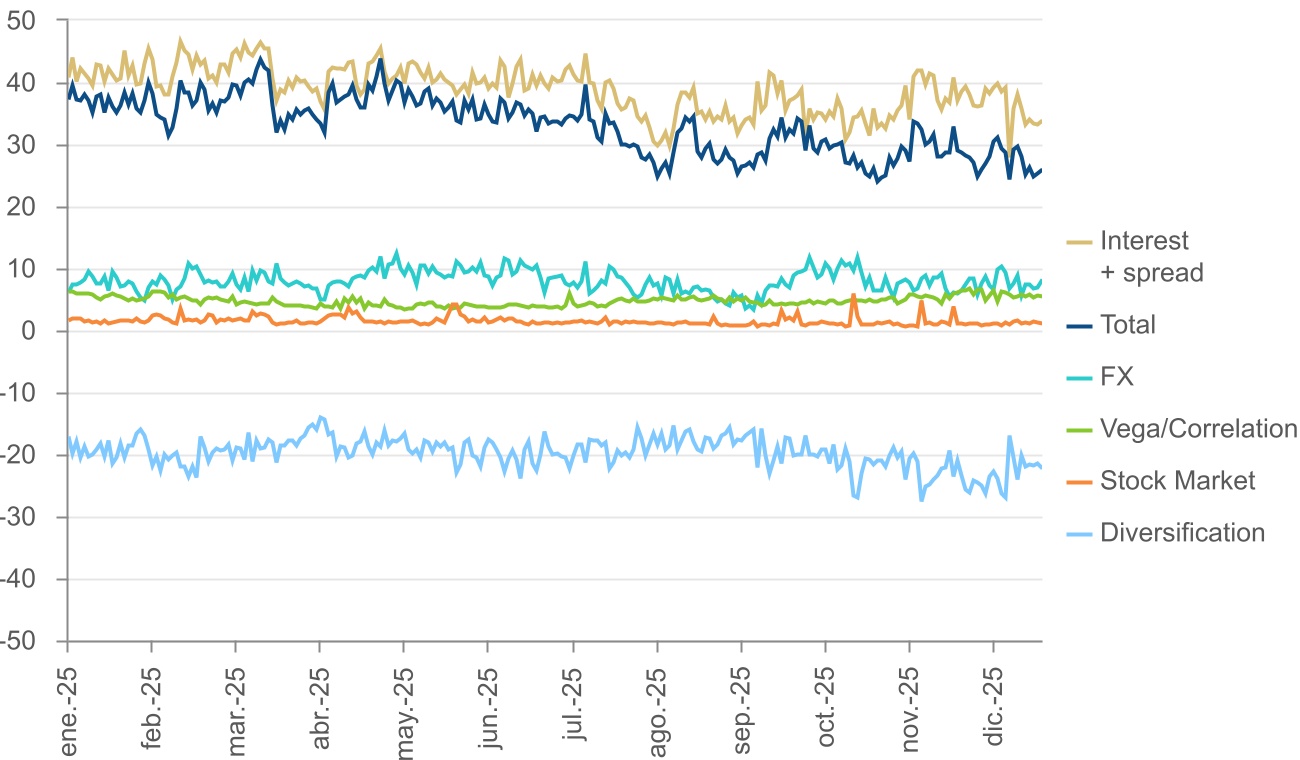
By type of market risk assumed by the Group's trading portfolio, the main risk factor for the Group continued to be that linked to interest rates, with a weight of 69% of the total as of December 31, 2025 (this figure includes the spread risk). The relative weight of this risk decreased by 8 percentage points compared with the close of 2024. Exchange rate risk accounted for 17% of the total risk, which implies an increase of 6 percentage points compared with the close of 2024, while equity risk accounted for 3%, maintaining its weight compared with the close of 2024. The volatility and correlation risk accounted for 11%, which implies an increase of 3 percentage points compared with the close of 2024.
As of December 31, 2025, 2024 and 2023 the VaR was €29 million, €34 million and €36 million, respectively, with the following breakdown:
VaR BY RISK FACTOR (MILLIONS OF EUROS) ⁽¹⁾ | ||||||||||||||||||||
Interest/Spread risk | Currency risk | Stock-market risk | Vega/Correlation risk | Diversification effect ⁽²⁾ | Total | |||||||||||||||
| 2025 | ||||||||||||||||||||
VaR average in the year | 39 | 8 | 1 | 5 | (20) | 33 | ||||||||||||||
VaR max in the year | 45 | 12 | 1 | 4 | (19) | 44 | ||||||||||||||
VaR min in the year | 33 | 6 | 1 | 5 | (21) | 24 | ||||||||||||||
| End of period VaR | 34 | 9 | 1 | 5 | (20) | 29 | ||||||||||||||
| 2024 | ||||||||||||||||||||
VaR average in the year | 41 | 7 | 2 | 6 | (20) | 37 | ||||||||||||||
VaR max in the year | 55 | 10 | 2 | 7 | (23) | 50 | ||||||||||||||
VaR min in the year | 33 | 7 | 2 | 6 | (19) | 28 | ||||||||||||||
| End of period VaR | 37 | 5 | 2 | 4 | (14) | 34 | ||||||||||||||
| 2023 | ||||||||||||||||||||
VaR average in the year | 36 | 8 | 2 | 7 | (22) | 31 | ||||||||||||||
VaR max in the year | 43 | 6 | 17 | 8 | (33) | 42 | ||||||||||||||
VaR min in the year | 23 | 9 | — | 9 | (23) | 19 | ||||||||||||||
| End of period VaR | 41 | 6 | 4 | 8 | (23) | 36 | ||||||||||||||
(1) The maximum and minimum VaR figures show the VaR figures for the day on which said maximum and minimum VaRs occurred in the relevant year, by type of risk.
(2) The diversification effect is the difference between the sum of the average individual risk factors and the total VaR figure that includes the implied correlation between all the variables and scenarios used in the measurement.
Validation of the internal market risk model
The internal market risk model is validated on a regular basis by backtesting in both, BBVA, S.A. and Global Markets Mexico (in BBVA Mexico). The aim of backtesting is to validate the quality and precision of the internal market risk model used by BBVA Group to estimate the maximum daily loss of a portfolio, at a 99% level of confidence and a 250-day time horizon, by comparing the results of those entities and the risk measurements generated by the internal market risk model. These tests showed that the internal market risk model of both, BBVA, S.A. and Global Markets Mexico is adequate and precise.
Two types of backtesting have been carried out in 2025, 2024 and 2023:
–"Hypothetical" backtesting: the daily VaR is compared with the results obtained, not taking into account the intraday results or the changes in the portfolio positions. This validates the appropriateness of the market risk metrics for the end-of-day position.
–"Real" backtesting: the daily VaR is compared with the total results, including intraday transactions, but discounting the possible minimum charges or fees involved. This type of backtesting includes the intraday risk in portfolios.
In addition, each of these two types of backtesting was carried out at a risk factor or business type level, thus making a deeper comparison of the results with respect to risk measurements.
For the years ended December 31, 2025, 2024 and 2023, the backtesting of the internal VaR calculation model was carried out, comparing the daily results obtained to the risk level estimated by the internal VaR calculation model. In that period, there was no negative exception neither in BBVA, S.A nor in BBVA Mexico.
At the end of these years the comparison showed the internal VaR calculation model was working correctly, thus validating the internal VaR calculation model, as has been the case each year since the internal market risk model was approved for the Group.
Stress testing analysis
A number of stress tests are carried out on the BBVA Group's trading portfolios. First, global and local historical scenarios are used that replicate the behavior of an extreme past event, such as the collapse of Lehman Brothers or the Tequilazo crisis. These stress tests are complemented with simulated scenarios, where the aim is to generate scenarios that have a significant impact on the different portfolios, but without being anchored to any specific historical scenario. Finally, for some portfolios or positions, fixed stress tests are also carried out that have a significant impact on the market variables affecting these positions.
Historical scenarios
The historical benchmark stress scenario for the BBVA Group is Lehman Brothers, whose sudden collapse in September 2008 led to a significant impact on the behavior of financial markets at a global level. The following are the most relevant effects of this historical scenario:
–Credit shock: reflected mainly in the increase of credit spreads and downgrades in credit ratings.
–Increased volatility in most of the financial markets giving rise to a great deal of variation in the prices of different assets (currency, equity, debt).
–Liquidity shock in the financial systems, reflected by a major movement in interbank curves, particularly in the shortest sections of the euro and dollar curves.
Simulated scenarios
Unlike the historical scenarios, which are fixed and therefore not suited to the composition of the risk portfolio at all times, the scenario used for the exercises of economic stress is based on resampling methodology. This methodology is based on the use of dynamic scenarios that are recalculated periodically depending on the main risks affecting the trading portfolios. On a data window wide enough to collect different periods of stress (data are taken from January 1, 2008 until the date of the assessment), a simulation is performed by resampling of historic observations, generating a distribution of losses and gains that serve to analyze extreme market events within the selected historical window. The advantage of this methodology is that the period of stress is not predetermined, but depends on the portfolio maintained at each time, and making a large number of simulations (10,000 simulations) allows a greater richness of information for the analysis of expected shortfall than what is available in the scenarios included in the calculation of VaR.
The main features of this approach are: a) the generated simulations respect the correlation structure of the data, b) there is flexibility in the inclusion of new risk factors and c) it allows the introduction of a lot of variability in the simulations (desirable for considering extreme events).
The impact of the stress test under multivariable simulation of the risk factors of the portfolio based on the expected shortfall (expected shortfall calculated at a 97.5% confidence level, 20 days) as of December 31, 2025 is as follows:
IMPACT OF THE STRESS TEST (MILLIONS OF EUROS) | |||||||||||||||||||||||
Europe | Mexico | Peru | Venezuela | Argentina | Colombia | Turkey | |||||||||||||||||
Expected shortfall | (129) | (66) | (17) | — | (39) | (4) | (17) | ||||||||||||||||
Financial assets and liabilities may be netted in certain cases. In particular, they are presented for a net amount on the consolidated balance sheet only when the Group's entities satisfy the provisions of IAS 32, so they have both the legal right to net recognized amounts, and the intention of settling the net amount or of realizing the asset and simultaneously paying the liability.
In addition, the Group has presented as gross amounts assets and liabilities on the consolidated balance sheet for which there are master netting arrangements in place, but for which there is no intention of settling the net amount. The most common types of events that trigger the netting of reciprocal obligations are bankruptcy of the entity, surpassing certain level of indebtedness threshold, failure to pay, restructuring and dissolution of the entity.
In the current market context, derivatives are contracted under different framework contracts being the most widespread the ones developed by the International Swaps and Derivatives Association (“ISDA”) and, for the Spanish market, the Framework Agreement on Financial Transactions (“CMOF”). Almost all portfolio derivative transactions have been concluded under these framework contracts, including in them the netting clauses mentioned in the preceding paragraph as "Master Netting Agreement", greatly reducing the credit exposure on these instruments. Additionally, in contracts signed with counterparties, the collateral agreement annexes called Credit Support Annex (“CSA”) in ISDA and Appendix III of CMOF are included, thereby minimizing exposure to a potential default of the counterparty.
Moreover, many of the transactions involving assets purchased or sold under a repurchase agreement are transacted through clearing houses that articulate mechanisms to reduce counterparty risk, as well as through the signing of various master agreements for bilateral transactions, the most widely used being the Global Master Repurchase Agreement (GMRA), published by the International Capital Market Association (“ICMA”), to which the clauses related to the collateral exchange are usually added within the text of the master agreement itself.
A summary of the effect of offsetting (via netting and collateral) for derivatives and securities operations is presented below as of December 31, 2025, 2024 and 2023:
EFFECT OF OFFSETTING FOR DERIVATIVES AND SECURITIES OPERATION (MILLIONS OF EUROS) | |||||||||||||||||||||||
Gross amounts not offset in the consolidated balance sheets | |||||||||||||||||||||||
Notes | Gross amounts recognized (A) | Gross amounts offset in the consolidated balance sheets (B) | Net amount presented in the consolidated balance sheets (C=A-B) | Financial instruments | Cash collateral received/ pledged | Net amount ⁽¹⁾ | |||||||||||||||||
| December 2025 | |||||||||||||||||||||||
Trading and hedging derivatives | 10 / 15 | 40,930 | 7,809 | 33,122 | 21,478 | 11,075 | 569 | ||||||||||||||||
Reverse repurchase, securities borrowing and similar agreements | 80,537 | 24,459 | 56,078 | 55,949 | — | 129 | |||||||||||||||||
| Total assets | 121,468 | 32,268 | 89,199 | 77,427 | 11,075 | 698 | |||||||||||||||||
Trading and hedging derivatives | 10 / 15 | 40,087 | 7,809 | 32,278 | 21,478 | 8,739 | 2,061 | ||||||||||||||||
Repurchase, securities lending and similar agreements | 103,538 | 24,459 | 79,079 | 78,887 | 192 | — | |||||||||||||||||
| Total liabilities | 143,626 | 32,268 | 111,357 | 100,365 | 8,931 | 2,061 | |||||||||||||||||
| December 2024 | |||||||||||||||||||||||
Trading and hedging derivatives | 10 / 15 | 45,523 | 8,362 | 37,161 | 27,446 | 9,566 | 148 | ||||||||||||||||
Reverse repurchase, securities borrowing and similar agreements | 65,401 | 19,397 | 46,005 | 45,959 | — | 46 | |||||||||||||||||
| Total assets | 110,924 | 27,759 | 83,165 | 73,405 | 9,566 | 194 | |||||||||||||||||
Trading and hedging derivatives | 10 / 15 | 43,924 | 8,362 | 35,562 | 27,446 | 7,658 | 458 | ||||||||||||||||
Repurchase, securities lending and similar agreements | 87,893 | 19,397 | 68,497 | 68,497 | — | — | |||||||||||||||||
| Total liabilities | 131,818 | 27,759 | 104,059 | 95,943 | 7,658 | 458 | |||||||||||||||||
| December 2023 | |||||||||||||||||||||||
Trading and hedging derivatives | 10 / 15 | 44,641 | 8,866 | 35,775 | 25,171 | 9,532 | 1,072 | ||||||||||||||||
Reverse repurchase, securities borrowing and similar agreements | 80,227 | — | 80,227 | 79,980 | — | 248 | |||||||||||||||||
| Total assets | 124,869 | 8,866 | 116,003 | 105,151 | 9,532 | 1,320 | |||||||||||||||||
Trading and hedging derivatives | 10 / 15 | 44,536 | 8,866 | 35,670 | 27,354 | 7,013 | 1,303 | ||||||||||||||||
Repurchase, securities lending and similar agreements | 104,920 | — | 104,920 | 104,920 | — | — | |||||||||||||||||
| Total liabilities | 149,456 | 8,866 | 140,590 | 132,274 | 7,013 | 1,303 | |||||||||||||||||
(1) It corresponds to the aggregation of the net amounts presented in the balance sheet, less the gross amount which is not offset in the balance sheet, corresponding to each Group entity that records a deficit in this regard.
Financial assets and liabilities are offset, and consequently are presented in the consolidated balance sheet at their net value under the relevant captions (i.e., derivatives, repurchase agreements and reverse repurchase agreements), where the Group maintains netting agreements and there is an intention to settle their net amount. Regarding certain repurchase agreements and reverse repurchase agreements, since 2024, the Group fulfils both conditions. Where netting agreements do not exist, the market value of the relevant products is recorded in the balance of the repurchase agreements and reverse repurchase agreements captions.
Liquidity and Funding riskLiquidity and funding risk is defined as the incapacity of a bank in meeting its payment commitments due to lack of funds or that, to face those commitments, should have to make use of funding under burdensome terms.
Liquidity and Funding Strategy and PlanningThe BBVA Group is a multinational financial institution whose business is focused mainly on retail and commercial banking activities. In addition to the retail business model, which forms its core business, the Group engages in corporate and investment banking, through the global CIB division.
Liquidity and Funding Risk Management aims to maintain a solid balance sheet structure which allows a sustainable business model. The Group’s liquidity and funding strategy is based on the following pillars:
–The principle of the funding self-sufficiency of its subsidiaries, meaning that each of the Liquidity Management Units (hereinafter "LMU") must cover its funding needs independently on the markets where it operates. This avoids possible contagion due to a crisis affecting one or more of the Group’s LMU.
–Stable customer deposits as the main source of funding in all the LMU, in accordance with the Group’s business model.
–Diversification of the sources of wholesale funding, in terms of maturity, market, instruments, counterparties and currencies, with recurring access to the markets.
–Compliance with regulatory requirements, ensuring the availability of ample liquidity buffers, of high quality, as well as sufficient instruments as required by regulations with the capacity to absorb losses.
–Compliance with the internal Liquidity Risk and Funding metrics, while adhering to the Risk Appetite level established for each LMU at any time.
Liquidity and Funding Risk Management aims, in the short term, to prevent an entity from having difficulties in meeting its payment commitments in due time and form or that, to meet them, it has to resort to obtaining funds in burdensome conditions that deteriorate the image or reputation of the entity.
In the medium term, its objective is to support the suitability of the Group's financial structure and its evolution, within the framework of the economic situation, the markets and regulatory changes.
This management of structural and liquidity funding is based on the principle of financial self-sufficiency of the entities that comprise it. This approach helps prevent and limit liquidity risk by reducing the Group’s vulnerability during periods of high risk. This decentralized management prevents possible contagion from a crisis affecting only one or a few Group entities, which must act independently to meet their liquidity requirements in the markets where they operate.
Within this strategy, the BBVA Group is organized into eight LMU composed of the parent company and the bank subsidiaries in each geographical area, plus the branches that depend on them.
In addition, the policy for managing liquidity and funding risk is also based on the model’s effectiveness and on the planning and integration of risk management into the budgeting process of each LMU, according to the liquidity and funding risk appetite that it decides to assume in its business.
Liquidity and funding planning is part of the strategic processes for the Group’s budgetary and business planning. This objective is to allow a recurrent growth of the banking business with suitable maturities and costs within the established risk tolerance levels by using a wide range of instruments which allow the diversification of the funding sources and the maintenance of a high volume of available liquid assets.
Governance, monitoring and mitigation measuresThe responsibility for liquidity and funding management in the development of normal business activity lies with the Finance area as a first line of defense in managing the risks inherent to this activity, in accordance with the principles established by the EBA and in line with the most demanding standards, policies, procedures and controls in the framework established by the governing bodies. Finance, through the Balance-Sheet Management area, plans and executes the funding of the structural long-term gap of each LMU and proposes to the ALCO the actions to be taken on this matter, in accordance with the policies established by the Risk Committee in line with the metrics of the Risk Appetite Framework approved by the Board of Directors.
Finance is also responsible for preparing the regulatory reporting of liquidity, coordinating with the responsible areas in each LMU the necessary processes to cover the requirements at corporate and regulatory level, ensuring the integrity of the information provided.
GRM is responsible for ensuring that the liquidity and financing risk in the Group is managed in accordance with the framework established by governing bodies. It also deals with the identification, measurement, monitoring and control of such risks and their communication to the relevant corporate bodies. In order to carry out this task properly, the Risk function in the Group has been configured as a single, global function, independent of the management areas.
Additionally, the Group has, in its second line of defense, an Internal Risk Control unit, which performs an independent review of the control of Liquidity and Funding Risk, and a Financial Internal Control Unit that reviews the design and effectiveness of the controls operations on liquidity management and reporting.
As the third line of defense of the Group's internal control model, Internal Audit is in charge of reviewing specific controls and processes in accordance with a work plan that is drawn up annually.
The Group’s fundamental objectives regarding the liquidity and funding risk are determined through the Liquidity Coverage Ratio (LCR) and through the Loan-to-Stable Customer Deposits (LtSCD) ratio.
The LCR ratio is a regulatory metric that aims to guarantee the resilience of entities in a scenario of liquidity tension within a time horizon of 30 days. Within its Risk Appetite Framework and system of limits and alerts, BBVA has established a required LCR compliance level for the entire Group and for each individual LMU. The internal levels required are aimed at efficiently meeting the regulatory requirement, at a level above 100% as a mitigation measure.
The LtSCD ratio measures the relationship between net lending and stable customer funds. The aim is to preserve a stable funding structure in the medium term for each of the LMU which make up the BBVA Group, taking into account that maintaining an adequate volume of stable customer funds is key to achieving an appropriate liquidity profile. In geographical areas with dual-currency balances, the indicator is also controlled by currency to manage the mismatches that might occur.
Stable customer funds are considered to be the financing obtained and managed from the LMU among their target customers. Those funds are characterized by their low sensitivity to market changes and by their less volatile behavior at aggregated level per operation due to the loyalty of the customer to the entity. The stable resources are calculated by applying to each identified customer segment a haircut determined by the analysis of the stability if the balances by which different aspects are evaluated (concentration, stability, level of loyalty). The main source of stable resources arises from wholesale funding and retail customer funds.
In order to establish the target (maximum) levels of LtSCD in each LMU and provide an optimal funding structure reference in terms of risk appetite, the corporate Structural Risks unit of GRM identifies and assesses the economic and financial variables that condition the funding structures in the different geographical areas.
Additionally, liquidity and funding risk management aims to achieve a proper diversification of the funding structure, avoiding excessive dependence on short-term funding by establishing a maximum level for the short-term funds raised, including both wholesale financing and the least stable proportion of customer funds In relation to long-term financing, the maturity profile does not present significant concentrations, which makes it possible to adapt the schedule of the planned issuance plan to the best financial conditions in the markets. Lastly, concentration risk is monitored at LMU level, with the aim of ensuring a correct diversification of both the counterparty and type of instrument.
One of the fundamental metrics within the general management framework of the liquidity and funding risk is the maintenance of a liquidity buffer consisting of high quality assets free of charges which can be sold or offered as collateral to obtain funding, either under normal market conditions or in stress situations.
The Finance area is responsible for the collateral management and determining the liquidity buffer within the BBVA Group. According to the principle of auto-sufficiency of the Group's subsidiaries, each LMU is responsible for maintaining a buffer of liquid assets which complies with the regulatory requirements applicable under each jurisdiction. In addition, the liquidity buffer of each LMU must be aligned with the liquidity and funding risk tolerance as well as the management limits set and approved for each case.
In this context, the short-term resistance of the liquidity risk profile is promoted, seeking to ensure that each LMU has sufficient collateral to deal with the risk of the closing of wholesale markets. Basic capacity is the internal metric for the management and control of short-term liquidity risk, which is defined as the relationship between the explicit assets available and the maturities of wholesale liabilities and volatile resources, at different time periods up to one year, with special relevance at 30 and 90 days, with the objective of preserving the survival period above 3 months with the available buffer, without considering the balance inflows.
As a fundamental element of the liquidity and financing risk monitoring scheme, stress tests are carried out. They enable to anticipate deviations from the liquidity targets and the limits set in the appetite, and to establish tolerance ranges in the different management areas. They also play a major role in the design of the Liquidity Contingency Plan and the definition of specific measures to be adopted to rectify the risk profile if necessary.
For each scenario, it is checked whether BBVA has a sufficient stock of liquid assets to meet the liquidity commitments/outflows in the different periods analyzed. The analysis considers four scenarios: one central and three crisis-related (systemic crisis; unexpected internal crisis with a considerable rating downgrade and/or affecting the ability to issue in wholesale markets and the perception of business risk by the banking intermediaries and the entity’s clients; and a mixed scenario, as a combination of the two aforementioned scenarios). Each scenario considers the following factors: existing market liquidity, customer behavior and sources of funding, the impact of rating downgrades, market values of liquid assets and collateral, and the interaction between liquidity requirements and the development of BBVA's credit quality.
The stress tests conducted on a regular basis by GRM reveal that BBVA maintains a sufficient buffer of liquid assets to deal with the estimated liquidity outflows in a scenario resulting from the combination of a systemic crisis and an unexpected internal crisis, including in the scenario of a significant downgrade of the Bank’s rating by up to three notches. Together with the results of the stress tests and the risk metrics, the early warning indicators play an important role within the corporate model and the Liquidity Contingency Plan.
Finance is the area responsible for the elaboration, monitoring, execution and update of the liquidity and funding plan and of the market access strategy to assist in and improve the stability and diversification of the wholesale funding sources.
In order to implement and establish management in an anticipated manner, limits are set on an annual basis for the main management metrics that form part of the budgeting process for the liquidity and funding plan. This framework of limits contributes to the planning of the joint future performance of:
–The loan book, considering the types of assets and their degree of liquidity, as well as their validity as collateral in collateralized funding.
–Stable customer funds, based on the application of a methodology for establishing which segments and customer balances are considered to be stable or volatile funds based on the principle of sustainability and recurrence of these funds.
–Projection of the credit gap, in order to require a degree of self-funding that is defined in terms of the difference between the loan-book and stable customer funds.
–Incorporating the planning of securities portfolios into the banking book, which include both fixed-interest and equity securities, and are classified as financial assets at fair value through other comprehensive income and at amortized cost, and additionally on trading portfolios.
–The structural gap projection, as a result of assessing the funding needs generated both from the credit gap and by the securities portfolio in the banking book, together with the rest of on-balance-sheet wholesale funding needs, excluding trading portfolios. This gap therefore needs to be funded with customer funds that are not considered stable or on wholesale markets.
As a result of these funding needs, the BBVA Group plans the target wholesale funding structure according to the tolerance set in each LMU target.
Thus, once the structural gap has been identified and after resorting to wholesale markets, the amount and composition of wholesale structural funding is established in subsequent years, in order to maintain a diversified funding mix and guarantee that there is not a high reliance on short-term funding (short-term wholesale funding plus volatile customer funds).
In practice, the execution of the principles of planning and self-funding at the different LMU results in the Group’s main source of funding being customer deposits, which consist mainly of demand deposits, savings deposits and time deposits.
As sources of funding, customer deposits are complemented by access to the interbank market and the domestic and international capital markets in order to address additional liquidity requirements, implementing domestic and international programs for the issuance of commercial paper and medium and long-term debt.
The process of analysis and assessment of the liquidity and funding situation and of the inherent risks is a process carried out on an ongoing basis in the BBVA Group, with the participation of all the Group areas involved in liquidity and funding risk management. This process is carried out at both local and corporate level. It is incorporated into the decision- making process for liquidity and funding management, with integration between the risk appetite strategy and establishment and the planning process, the funding plan and the limits scheme.
Liquidity and funding performance The BBVA Group maintains a dynamic funding structure with a predominantly retail nature, where customer resources represent the main source of funding.
During 2025, liquidity conditions remained adequate in all the countries where the BBVA Group operates.
The performance of the indicators show that the funding structure remained steady during 2025, 2024 and 2023, in the sense that all LMU held self-funding levels with stable customer resources above the requirements.
LtSCD BY LMU | |||||||||||
2025 | 2024 | 2023 | |||||||||
| Group (average) | 105 | % | 102 | % | 99 | % | |||||
BBVA, S.A. | 105 | % | 101 | % | 100 | % | |||||
BBVA Mexico | 115 | % | 115 | % | 102 | % | |||||
Garanti BBVA | 92 | % | 90 | % | 78 | % | |||||
Other LMU | 103 | % | 99 | % | 104 | % | |||||
With respect to LCR, the Group has maintained a liquidity buffer at both a consolidated and individual level in 2025. As a result, the ratio has remained above 100%, with the consolidated ratio as of December 31, 2025 standing at 143%.
Although this requirement is only established at a Group level, for banks in the Eurozone, the minimum level required was exceeded in all subsidiaries.
It should be noted that the calculation of the Consolidated LCR does not allow the transfer of liquidity between, or with, subsidiaries located outside the Eurozone, so no excess liquidity may be transferred from these entities for the purpose of calculating the consolidated ratio.
If the impact of these highly liquid assets was considered, the LCR would be 169%, or 26 basis points above the required level.
LCR MAIN LMU | |||||||||||
2025 | 2024 | 2023 | |||||||||
| Group | 143 | % | 134 | % | 149 | % | |||||
BBVA, S.A. | 162 | % | 156 | % | 178 | % | |||||
BBVA Mexico | 161 | % | 146 | % | 192 | % | |||||
Garanti BBVA | 159 | % | 141 | % | 212 | % | |||||
One of the key elements in BBVA's Group liquidity and funding management is the targeted maintenance of large high quality liquidity buffers in all business areas where the group operates.
Each entity maintains a liquidity buffer at the individual level for BBVA, S.A. and for each of its subsidiaries, such as BBVA Mexico, Garanti BBVA and the Latin American subsidiaries.
In this respect, the Group has maintained for the last 12 months an average volume of high quality liquid assets (HQLA) amounting to €134,046 million, of which 98% correspond to maximum quality assets (LCR level 1).
The table below shows the liquidity available by instrument as of December 31, 2025, 2024 and 2023 for the most significant entities based on prudential supervisor’s information (Commission Implementing Regulations (EU) 2021/451 of December 17, 2020):
LIQUIDITY AVAILABLE BY INSTRUMENT (MILLIONS OF EUROS) | ||||||||||||||||||||||||||||||||||||||||||||||||||
BBVA, S.A. | BBVA Mexico | Garanti BBVA | Other | |||||||||||||||||||||||||||||||||||||||||||||||
2025 | 2024 | 2023 | 2025 | 2024 | 2023 | 2025 | 2024 | 2023 | 2025 | 2024 | 2023 | |||||||||||||||||||||||||||||||||||||||
Cash and withdrawable central bank reserves | 25,248 | 16,004 | 43,931 | 9,821 | 12,001 | 9,712 | 12,960 | 10,344 | 9,899 | 6,988 | 8,101 | 5,921 | ||||||||||||||||||||||||||||||||||||||
Level 1 tradable assets | 57,595 | 50,199 | 31,606 | 18,785 | 8,783 | 20,345 | 5,553 | 6,402 | 6,117 | 11,343 | 8,749 | 8,429 | ||||||||||||||||||||||||||||||||||||||
Level 2A tradable assets | 623 | 194 | 919 | 182 | 327 | 246 | — | — | — | 32 | — | — | ||||||||||||||||||||||||||||||||||||||
Level 2B tradable assets | 4,424 | 3,762 | 2,916 | 171 | 159 | 132 | — | — | — | 13 | 31 | — | ||||||||||||||||||||||||||||||||||||||
Other tradable assets | 42,405 | 46,537 | 44,324 | 748 | 598 | 469 | 943 | 816 | 398 | 586 | 926 | 753 | ||||||||||||||||||||||||||||||||||||||
Non-tradable assets eligible for central banks | 651 | 11 | — | — | — | — | — | — | — | — | — | — | ||||||||||||||||||||||||||||||||||||||
| Cumulated counterbalancing capacity | 130,946 | 116,706 | 123,696 | 29,707 | 21,869 | 30,903 | 19,456 | 17,562 | 16,414 | 18,962 | 17,806 | 15,102 | ||||||||||||||||||||||||||||||||||||||
The Net Stable Funding Ratio (NSFR), defined as the result between the amount of stable funding available and the amount of stable funding required, requiring banks to maintain a stable financing profile in relation to the composition of their assets and off-balance sheet activities. This ratio should be at least 100% at all times. The NSFR ratio of the BBVA Group, stood at 126% as of December 31, 2025.
The NSFR of BBVA Group and its main LMU as of December 31, 2025, 2024 and 2023, was the following:
NSFR MAIN LMU | |||||||||||
2025 | 2024 | 2023 | |||||||||
| Group | 126 | % | 127 | % | 131 | % | |||||
BBVA, S.A. | 117 | % | 119 | % | 120 | % | |||||
BBVA Mexico | 132 | % | 131 | % | 140 | % | |||||
Garanti BBVA | 144 | % | 149 | % | 178 | % | |||||
Below is a matrix of residual maturities by contractual periods based on supervisory prudential reporting as of December 31, 2025, 2024 and 2023:
DECEMBER 2025. CONTRACTUAL MATURITIES (MILLIONS OF EUROS) | |||||||||||||||||||||||||||||||||||
Demand | Up to 1 month | 1 to 3 months | 3 to 6 months | 6 to 9 months | 9 to 12 months | 1 to 2 years | 2 to 3 years | 3 to 5 years | Over 5 years | Total | |||||||||||||||||||||||||
| ASSETS | |||||||||||||||||||||||||||||||||||
Cash, cash balances at central banks and other demand deposits | 14,413 | 43,789 | — | — | — | — | — | — | — | — | 58,202 | ||||||||||||||||||||||||
Deposits in credit entities | — | 5,953 | 868 | 1,056 | 962 | 1,430 | 670 | 1,186 | 112 | 66 | 12,303 | ||||||||||||||||||||||||
Deposits in other financial institutions | — | 4,505 | 1,626 | 1,315 | 846 | 726 | 2,941 | 2,654 | 2,059 | 2,060 | 18,732 | ||||||||||||||||||||||||
Reverse repo, securities borrowing and margin lending | 2,061 | 51,418 | 9,957 | 4,566 | 1,707 | 2,320 | 7,223 | 1,933 | 669 | 113 | 81,967 | ||||||||||||||||||||||||
Loans and advances | — | 40,574 | 40,625 | 30,638 | 19,096 | 22,144 | 49,496 | 41,730 | 58,930 | 114,633 | 417,866 | ||||||||||||||||||||||||
Securities' portfolio settlement | — | 4,598 | 3,947 | 9,016 | 4,451 | 8,405 | 18,718 | 8,361 | 29,414 | 47,407 | 134,317 | ||||||||||||||||||||||||
DECEMBER 2025. CONTRACTUAL MATURITIES (MILLIONS OF EUROS) | |||||||||||||||||||||||||||||||||||
Demand | Up to 1 month | 1 to 3 months | 3 to 6 months | 6 to 9 months | 9 to 12 months | 1 to 2 years | 2 to 3 years | 3 to 5 years | Over 5 years | Total | |||||||||||||||||||||||||
| LIABILITIES | |||||||||||||||||||||||||||||||||||
Wholesale funding | — | 5,139 | 4,481 | 7,210 | 4,872 | 7,653 | 13,261 | 4,252 | 9,584 | 32,528 | 88,980 | ||||||||||||||||||||||||
Deposits from financial institutions | 3,151 | 4,504 | 1,394 | 775 | 622 | 765 | 936 | 321 | 601 | 550 | 13,619 | ||||||||||||||||||||||||
Deposits from other financial institutions and international agencies | 8,003 | 12,649 | 4,606 | 1,684 | 823 | 1,065 | 1,798 | 302 | 361 | 550 | 31,841 | ||||||||||||||||||||||||
Customer deposits | 345,742 | 67,090 | 25,358 | 13,345 | 5,668 | 6,638 | 2,056 | 1,176 | 1,062 | 465 | 468,600 | ||||||||||||||||||||||||
Security pledge funding | 1,299 | 89,726 | 14,794 | 5,108 | 1,407 | 2,047 | 3,656 | 507 | 288 | 564 | 119,396 | ||||||||||||||||||||||||
Derivatives, net | — | 58 | 103 | 167 | 465 | (87) | 145 | 104 | (79) | (807) | 69 | ||||||||||||||||||||||||
DECEMBER 2024. CONTRACTUAL MATURITIES (MILLIONS OF EUROS) | |||||||||||||||||||||||||||||||||||
Demand | Up to 1 month | 1 to 3 months | 3 to 6 months | 6 to 9 months | 9 to 12 months | 1 to 2 years | 2 to 3 years | 3 to 5 years | Over 5 years | Total | |||||||||||||||||||||||||
| ASSETS | |||||||||||||||||||||||||||||||||||
Cash, cash balances at central banks and other demand deposits | 11,125 | 38,087 | — | — | — | — | — | — | — | — | 49,212 | ||||||||||||||||||||||||
Deposits in credit entities | — | 5,246 | 541 | 1,165 | 647 | 918 | 861 | 351 | 33 | 41 | 9,805 | ||||||||||||||||||||||||
Deposits in other financial institutions | — | 2,677 | 1,642 | 970 | 929 | 1,130 | 1,577 | 1,526 | 1,369 | 681 | 12,502 | ||||||||||||||||||||||||
Reverse repo, securities borrowing and margin lending | — | 34,310 | 10,594 | 5,025 | 1,911 | 3,138 | 5,782 | 3,675 | 3,008 | 122 | 67,565 | ||||||||||||||||||||||||
Loans and advances | — | 34,605 | 38,547 | 29,770 | 16,928 | 19,715 | 44,537 | 34,618 | 51,469 | 105,649 | 375,837 | ||||||||||||||||||||||||
Securities' portfolio settlement | — | 2,861 | 2,741 | 6,084 | 2,531 | 5,922 | 20,625 | 20,053 | 21,972 | 44,850 | 127,640 | ||||||||||||||||||||||||
DECEMBER 2024. CONTRACTUAL MATURITIES (MILLIONS OF EUROS) | |||||||||||||||||||||||||||||||||||
Demand | Up to 1 month | 1 to 3 months | 3 to 6 months | 6 to 9 months | 9 to 12 months | 1 to 2 years | 2 to 3 years | 3 to 5 years | Over 5 years | Total | |||||||||||||||||||||||||
| LIABILITIES | |||||||||||||||||||||||||||||||||||
Wholesale funding | — | 2,484 | 4,816 | 5,536 | 3,347 | 3,685 | 8,517 | 11,386 | 7,530 | 28,306 | 75,608 | ||||||||||||||||||||||||
Deposits from financial institutions | 2,600 | 6,070 | 476 | 644 | 130 | 732 | 558 | 242 | 570 | 743 | 12,765 | ||||||||||||||||||||||||
Deposits from other financial institutions and international agencies | 6,950 | 9,247 | 2,466 | 1,584 | 922 | 503 | 1,256 | 477 | 433 | 742 | 24,581 | ||||||||||||||||||||||||
Customer deposits | 318,252 | 50,789 | 23,758 | 11,580 | 3,888 | 4,329 | 2,055 | 569 | 834 | 787 | 416,841 | ||||||||||||||||||||||||
Security pledge funding | — | 74,614 | 14,093 | 5,452 | 2,355 | 4,157 | 2,223 | 366 | 1,454 | 445 | 105,159 | ||||||||||||||||||||||||
Derivatives, net | — | (388) | (73) | (142) | 70 | 142 | 549 | (122) | 5 | (87) | (46) | ||||||||||||||||||||||||
DECEMBER 2023. CONTRACTUAL MATURITIES (MILLIONS OF EUROS) | |||||||||||||||||||||||||||||||||||
Demand | Up to 1 month | 1 to 3 months | 3 to 6 months | 6 to 9 months | 9 to 12 months | 1 to 2 years | 2 to 3 years | 3 to 5 years | Over 5 years | Total | |||||||||||||||||||||||||
| ASSETS | |||||||||||||||||||||||||||||||||||
Cash, cash balances at central banks and other demand deposits | 10,353 | 61,678 | — | — | — | — | — | — | — | — | 72,031 | ||||||||||||||||||||||||
Deposits in credit entities | — | 4,676 | 393 | 543 | 594 | 602 | 602 | 136 | 24 | 102 | 7,672 | ||||||||||||||||||||||||
Deposits in other financial institutions | — | 1,288 | 1,261 | 1,049 | 385 | 649 | 2,019 | 965 | 974 | 1,291 | 9,882 | ||||||||||||||||||||||||
Reverse repo, securities borrowing and margin lending | — | 42,407 | 21,683 | 6,890 | 3,398 | 2,596 | 3,319 | 3,817 | 2,133 | 139 | 86,382 | ||||||||||||||||||||||||
Loans and advances | — | 28,644 | 30,850 | 28,239 | 16,434 | 19,029 | 41,267 | 32,769 | 45,116 | 104,086 | 346,433 | ||||||||||||||||||||||||
Securities' portfolio settlement | — | 2,167 | 6,011 | 2,633 | 2,578 | 11,950 | 15,266 | 14,016 | 29,245 | 34,558 | 118,424 | ||||||||||||||||||||||||
DECEMBER 2023. CONTRACTUAL MATURITIES (MILLIONS OF EUROS) | |||||||||||||||||||||||||||||||||||
Demand | Up to 1 month | 1 to 3 months | 3 to 6 months | 6 to 9 months | 9 to 12 months | 1 to 2 years | 2 to 3 years | 3 to 5 years | Over 5 years | Total | |||||||||||||||||||||||||
| LIABILITIES | |||||||||||||||||||||||||||||||||||
Wholesale funding | — | 1,187 | 3,889 | 8,518 | 4,935 | 4,225 | 10,296 | 7,990 | 11,175 | 22,424 | 74,639 | ||||||||||||||||||||||||
Deposits from financial institutions | 2,092 | 3,669 | 1,076 | 715 | 119 | 605 | 795 | 46 | 198 | 695 | 10,011 | ||||||||||||||||||||||||
Deposits from other financial institutions and international agencies | 8,507 | 5,526 | 2,806 | 1,036 | 834 | 841 | 1,033 | 618 | 695 | 638 | 22,535 | ||||||||||||||||||||||||
Customer deposits | 304,096 | 44,745 | 16,225 | 11,855 | 3,905 | 5,500 | 1,753 | 1,029 | 758 | 1,092 | 390,959 | ||||||||||||||||||||||||
Security pledge funding | — | 86,908 | 30,028 | 6,107 | 2,274 | 1,821 | 2,630 | 1,111 | 2,060 | 677 | 133,615 | ||||||||||||||||||||||||
Derivatives, net | — | (21) | (30) | 6 | (62) | (267) | 69 | 45 | (135) | (2,616) | (3,009) | ||||||||||||||||||||||||
With regard to the financing structure, the loan portfolio is mostly financed by retail deposits. The “demand” maturity bucket mainly contains the retail customer sight accounts whose behavior historically showed a high level of stability and little concentration. According to a behavior analysis which is done every year in every entity, this type of account is considered to be stable and for liquidity risk purposes receives a better treatment.
The most relevant aspects related to the main geographical areas are the following:
–In Spain, BBVA, S.A. maintained a strong position with a large high-quality liquidity buffer, maintaining at all times the regulatory liquidity metrics well above the set minimums. During 2025, commercial activity showed dynamism in attracting customer deposits, mainly from wholesale clients, supported equally by retail clients and the new digital bank in Germany. Regarding lending activity, there was a significant boost from wholesale business units. Growth in both areas has resulted in a narrowing of the credit gap.
–BBVA Mexico showed an adequate liquidity situation, with a credit gap that improved over the year, mainly due to strong deposit growth in local currency. In addition, the liquidity situation was reinforced by wholesale debt issuances carried out in both Mexican pesos and U.S. dollars.
–In Turkey, Garanti BBVA maintained an adequate liquidity situation in 2025. The lending gap decreased significantly in foreign currencies due to a strong rise in deposits. On the other hand, there was an increase in the credit gap in Turkish lira due to the strong growth in lending, which exceeded that of deposits. Wholesale issuances in foreign currency supported liquidity.
–In South America, the liquidity situation has also remained adequate throughout the region in 2025. In BBVA Argentina, at a constant exchange rate, the credit gap improved in Argentine pesos due to the impulse in time deposits despite strong loan growth. In the U.S. dollar balance sheet, at a constant exchange rate, the growth of loans exceeded fund gathering, thus widening the credit gap in this currency. In BBVA Colombia, the liquidity situation was comfortable, even though the credit gap widened in 2025, with a sustained growth of loans that slightly exceeded the volume of fund gathering. At BBVA Peru, the liquidity situation remained solid, with a credit gap that widened during the year due to the dynamism of lending activity, especially in U.S. dollars.
The main wholesale financing transactions carried out by the BBVA Group during 2025 are listed below:
Issuer | Type of issue | Date of issue | Nominal (millions) | Currency | Coupon | Early redemption | Maturity date | ||||||||||||||||
BBVA, S.A. | AT1 | Jan-25 | 1,000 | USD | 7.750% | Jan-32 | Perpetual | ||||||||||||||||
Tier 2 | Feb-25 | 1,000 | EUR | 4.000% | Feb-32 | Feb-37 | |||||||||||||||||
Senior non-preferred | Jul-25 | 1,000 | EUR | 3.125% | _ | Jul-30 | |||||||||||||||||
Senior non-preferred | Aug-25 | 1,000 | EUR | 3.750% | _ | Aug-35 | |||||||||||||||||
AT1 | Nov-25 | 1,000 | EUR | 5.625% | Nov-32 | Perpetual | |||||||||||||||||
In relation to liability management, on May 10, 2025, BBVA, S.A. redeemed early and in full an issue of senior preferred bonds made in May 2023 for €1 billion; in January 2025, it redeemed early and in full a €1 billion Tier 2 issue made in January 2020 and maturing in 2030; and in March 2025, it redeemed in full a Contingent Convertible Preferred Securities (AT1) issue for USD 1000 billion issued in 2019. On September 14, 2025, BBVA, S.A. redeemed early and in full an issue of senior non-preferred bonds made in September 2022 for USD 1 billion (see Note 22.4).
After the closing date of the 2025 financial year, on January 7, 2026, BBVA, S.A. issued €2 billion in senior non-preferred debt, structured in two tranches: the first, for €750 million, with a coupon fixed set at three-month Euribor plus 55 basis points, and the second, for €1.25 billion, with a fixed coupon of 3.75%. On January 15, 2026, BBVA, S.A. carried out the early redemption of a green AT1 issue made on July 15, 2020, for a combined nominal amount of €1 billion, a decision that was communicated to the market on December 17, 2025 (see Note 22.4).
BBVA Mexico issued in February 2025 USD 1 billion of Tier 2 subordinated debt with a coupon of 7.625%. In addition, a senior debt issue was carried out in March 2025 for 15 billion Mexican pesos (approximately €692 million), and another in September 2025 in two tranches: the first for 14,434 million Mexican pesos (approximately €666 million) and the second for USD 158 million.
Throughout 2025, Garanti BBVA issued a total of USD 3,847 million of short-term senior MTN in order to roll over maturities and generate liquidity. In June 2025, it renewed 100% of a sustainable syndicated loan in two tranches for a total amount of USD 440 million. In July 2025, Garanti BBVA completed the issuance of subordinated bonds for a total amount of USD 500 million. In October 2025, another subordinated bond issue was made for USD 700 million. In November 2025, Garanti BBVA issued Turkey's first biodiversity bond, worth USD 20.22 million. Finally, in December 2025, Garanti BBVA formalized a sustainability focused syndicated loan for a total amount of USD 428 million.
In 2025, through successive placements of debt securities, BBVA Argentina issued a total of 244 billion Argentine pesos and USD 192 million. The euro equivalent of these issues was €306 million.
In April 2025, BBVA Colombia issued a subordinated biodiversity bond, subscribed by the International Finance Corporation (IFC), for an amount of USD 45 million.
In Peru, BBVA issued USD 200 million in the form of a gender social bond aimed at women entrepreneurs, executed in two tranches during the first and the third quarters of 2025, in partnership with IDB Invest, FMO (Dutch Entrepreneurial Development Bank) and COFIDE (Corporación Financiera de Desarrollo, S.A.).
Asset encumbranceAs of December 31, 2025, 2024 and 2023, the encumbered (those provided as collateral for certain liabilities) and unencumbered assets are broken down as follows:
ENCUMBERED AND UNENCUMBERED ASSETS (MILLIONS OF EUROS) | |||||||||||||||||||||||||||||||||||||||||
Encumbered assets | Unencumbered assets | ||||||||||||||||||||||||||||||||||||||||
Book value | Fair value | Book value | Fair value | ||||||||||||||||||||||||||||||||||||||
2025 | 2024 | 2023 | 2025 | 2024 | 2023 | 2025 | 2024 | 2023 | 2025 | 2024 | 2023 | ||||||||||||||||||||||||||||||
| Assets | 69,272 | 68,268 | 78,586 | 790,304 | 704,134 | 696,972 | |||||||||||||||||||||||||||||||||||
Equity instruments | 1,964 | 834 | 592 | 1,968 | 834 | 592 | 19,836 | 17,159 | 13,176 | 19,836 | 17,159 | 13,176 | |||||||||||||||||||||||||||||
Debt securities | 42,016 | 43,404 | 51,458 | 43,910 | 45,639 | 50,818 | 120,408 | 102,333 | 88,976 | 120,408 | 102,333 | 88,976 | |||||||||||||||||||||||||||||
Loans and advances and other assets | 25,291 | 24,030 | 26,535 | 650,060 | 584,641 | 594,821 | |||||||||||||||||||||||||||||||||||
The committed value of "Loans and Advances and other assets" corresponds mainly to loans linked to the issue of covered bonds, territorial bonds or long-term securitized bonds (see Note 22.4) as well as, to a lesser extent, those used as a guarantee to access certain funding transactions with central banks. Debt securities and equity instruments correspond to underlying that are delivered in repos with different types of counterparties, mainly clearing houses or credit institutions, and to a lesser extent central banks. Collateral provided to guarantee derivative transactions is also included as committed assets.
As of December 31, 2025, 2024 and 2023, collateral pledges received mainly due to repurchase agreements and securities lending, and those which could be committed in order to obtain funding are provided below:
COLLATERAL RECEIVED (MILLIONS OF EUROS) | |||||||||||||||||||||||||||||||||||
Fair value of encumbered collateral received or own debt certificates issued | Fair value of collateral received or own debt certificates issued available for encumbrance | Fair value of collateral received or own debt certificates issued not available for encumbrance | |||||||||||||||||||||||||||||||||
2025 | 2024 | 2023 | 2025 | 2024 | 2023 | 2025 | 2024 | 2023 | |||||||||||||||||||||||||||
| Collateral received | 49,726 | 40,877 | 73,836 | 17,783 | 14,917 | 14,825 | 1,634 | 1,151 | 996 | ||||||||||||||||||||||||||
Equity instruments | 190 | 215 | 1,019 | 675 | 162 | 51 | — | — | — | ||||||||||||||||||||||||||
Debt securities | 49,536 | 40,663 | 72,817 | 17,107 | 14,754 | 14,774 | 1,634 | 1,151 | 996 | ||||||||||||||||||||||||||
Loans and advances and other assets | — | — | — | — | — | — | — | — | — | ||||||||||||||||||||||||||
Own debt certificates issued other than own covered bonds or ABSs | — | — | — | 63 | 66 | 74 | — | — | — | ||||||||||||||||||||||||||
The guarantees received in the form of reverse repurchase agreements or security lending transactions are committed by their use in repurchase agreements, as is the case with debt securities.
As of December 31, 2025, 2024 and 2023, financial liabilities issued related to encumbered assets in financial transactions as well as their book value were as follows:
SOURCES OF ENCUMBRANCE (MILLIONS OF EUROS) | |||||||||||||||||||||||
Matching liabilities, contingent liabilities or securities lent | Assets, collateral received and own debt certificates issued other than covered bonds and ABSs encumbered | ||||||||||||||||||||||
2025 | 2024 | 2023 | 2025 | 2024 | 2023 | ||||||||||||||||||
| Book value of financial liabilities | 116,511 | 109,833 | 151,766 | 117,052 | 107,067 | 149,853 | |||||||||||||||||
Derivatives | 17,092 | 17,047 | 15,895 | 15,377 | 14,698 | 13,756 | |||||||||||||||||
Deposits | 92,586 | 84,604 | 126,777 | 94,577 | 81,938 | 126,543 | |||||||||||||||||
Outstanding subordinated debt | 6,833 | 8,182 | 9,094 | 7,097 | 10,431 | 9,554 | |||||||||||||||||
| Other sources | 820 | 1,141 | 1,066 | 1,946 | 2,079 | 2,568 | |||||||||||||||||