| Interest in Securities | | Other Compensation | |
|---|---|---|---|---|
Sponsor | The Sponsor and Spring Valley’s independent directors paid an aggregate of $25,000 to cover certain pre-IPO expenses, in exchange for the issuance of the Spring Valley Founder Shares, or approximately $0.003 per share. In connection with the closing of the Spring Valley IPO, the Sponsor purchased 4,490,555 Spring Valley Private Warrants for an aggregate purchase price of $4,041,500. At the Closing, pursuant to the Sponsor Support Agreement, the Sponsor will forfeit 1,000,000 Spring Valley Founder Shares and, in connection therewith, Spring Valley agreed to issue to the Sponsor an aggregate of 1,000,000 New GF Earnout Shares, and the Sponsor agreed to transfer an aggregate of 1,250,000 Spring Valley Founder Shares to certain investors in General Fusion’s most recent SAFEs. | Spring Valley has agreed to reimburse the Sponsor for any out-of-pocket expenses incurred in connection with activities on Spring Valley’s behalf such as identifying potential target businesses and performing due diligence on suitable business combinations. There is no cap or ceiling on the reimbursement of out-of-pocket expenses incurred by the Sponsor in connection with activities on Spring Valley’s behalf. As of September 30, 2025, Spring Valley has not reimbursed the Sponsor for any out-of-pocket expenses. | ||
Spring Valley Directors and Officers | On March 28, 2025, the Sponsor and Spring Valley’s independent directors paid an aggregate of $25,000, to cover certain of offering and formation costs in exchange for an aggregate of 5,750,000 Spring Valley Founder Shares. On August 15, 2025, Spring Valley effected an approximately 1 to 1.33 share split and upon completion of the share split, each of Spring Valley’s independent directors transferred 13,333 founder shares to the Sponsor for an amount of $43.48. As a result, each of Spring Valley’s independent directors currently holds, 40,000 Spring Valley Founder Shares. | Spring Valley has agreed to reimburse its directors and officers for any out-of-pocket expenses incurred in connection with activities on Spring Valley’s behalf such as identifying potential target businesses and performing due diligence on suitable business combinations. There is no cap or ceiling on the reimbursement of out-of-pocket expenses incurred by its directors and officers in connection with activities on Spring Valley’s behalf. As of September 30, 2025, Spring Valley has not reimbursed its directors and officers for any out-of-pocket expenses. |
SUMMARY OF PROXY STATEMENT/PROSPECTUS
This summary highlights selected information contained in this proxy statement/prospectus and does not contain all of the information that is important to you. You should read carefully this entire proxy statement/prospectus, including the annexes and accompanying financial statements of Spring Valley and General Fusion, to fully understand the proposed Business Combination and the Proposals to be considered at the Spring Valley Shareholders’ Meeting (each as described below). Please see the section entitled “Where You Can Find More Information” elsewhere in this proxy statement/prospectus.
Parties to the Business Combination
Spring Valley
Spring Valley is a blank check company incorporated as a Cayman Islands exempted corporation on March 12, 2025, under the Companies Act. Spring Valley was incorporated for the purpose of effecting a merger, share exchange, asset acquisition, share purchase, reorganization or similar business combination with one or more businesses. The mailing address of Spring Valley’s principal executive office is 2100 McKinney Ave., Suite 1675, Dallas, TX, and its phone number is (929) 529-7125.
Spring Valley’s securities are traded on Nasdaq under the ticker symbols “SVACU,” “SVAC” and “SVACW.”
General Fusion
General Fusion is pioneering an engineering-driven approach to fusion energy designed to deliver safe, scalable, and reliable carbon-free power. General Fusion’s core technology is based on Magnetized Target Fusion (“MTF”), which combines magnetic confinement with rapid mechanical compression to achieve fusion conditions. This approach integrates advanced plasma physics with proven mechanical and materials engineering, within a simplified plant architecture intended to enable efficient system integration. General Fusion has built and is operating a large-scale fusion demonstration machine at commercially relevant scale, known as Lawson Machine 26 (“LM26”), which is designed to validate key elements of its MTF technology and advance a pathway toward commercial fusion power plants capable of providing firm, dispatchable, carbon-free electricity for grid and industrial applications.
The mailing address of General Fusion’s principal executive office is 6020 Russ Baker Way, Richmond, British Columbia V7B 1B4, and its phone number (604) 439-3003.
NewCo
NewCo is a British Columbia limited company that was incorporated on January 19, 2026 to facilitate the Amalgamation. To date, NewCo has not conducted any material activities other than those incident to its formation. NewCo will survive the Amalgamation as the Amalgamated Company upon the Closing.
The Business Combination
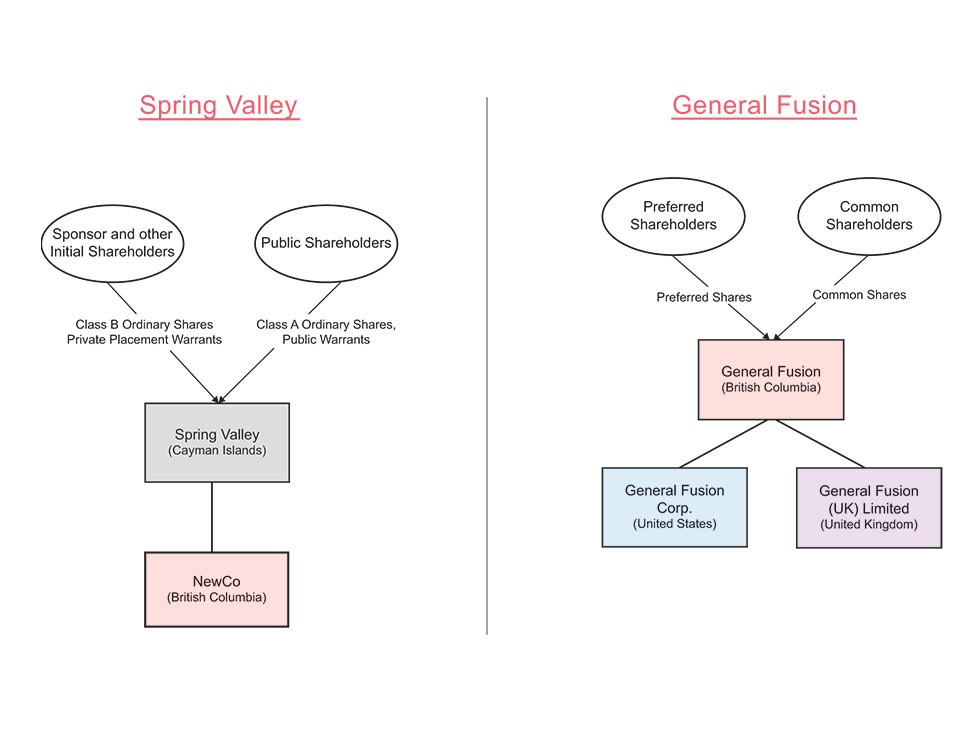
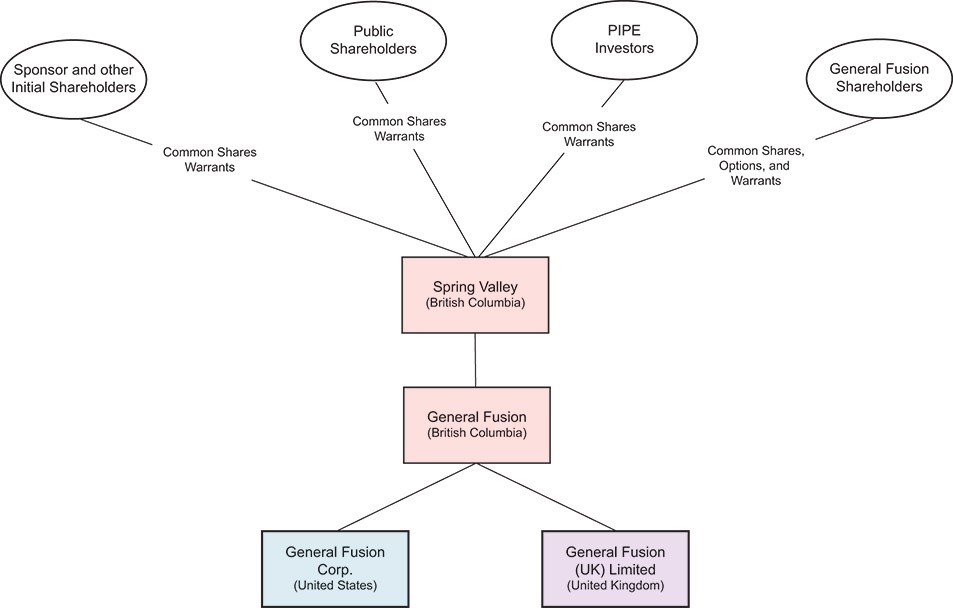
On January 21, 2026, Spring Valley, General Fusion and NewCo, entered into the Business Combination Agreement, pursuant to which, among other things and subject to the terms and conditions contained in the Business Combination Agreement and the Plan of Arrangement, (i) prior to the Amalgamation, Spring Valley shall transfer by way of continuation from the Cayman Islands to the Province of British Columbia in accordance with the Companies Act and continue as a corporation under the Laws of the Province of British Columbia in accordance with the applicable provisions of the BCBCA, and (ii) on the Closing Date, Newco shall amalgamate with and into General Fusion to form one corporate entity, and Newco will survive the Amalgamation.
The following diagram illustrates the organizational structure of Spring Valley, General Fusion and NewCo immediately prior to the Business Combination:
The following diagram illustrates the structure of New General Fusion immediately following the Business Combination.
On the Closing Date, pursuant to the Amalgamation, which will occur under the Arrangement:
| ● | each then issued and outstanding General Fusion Common Share (other than General Fusion Class B Common Shares and General Fusion Shares in respect of which Dissent Rights have been duly exercised) shall be exchanged for (i) that number of New GF Common Shares equal to the Exchange Ratio for New GF Common Shares, and (ii) that number of New GF Class A Earnout Shares, New GF Class B Earnout Shares, and New GF Class C Earnout Shares equal to the applicable Exchange Ratio for New GF Earnout Shares; |
| ● | each then issued and outstanding General Fusion Class B Common Share (other than General Fusion Class B Common Shares in respect of which Dissent Rights have been duly exercised) shall be exchanged for one (1) New GF Common Share; |
| ● | each then issued and outstanding General Fusion Convertible Preferred Share shall be exchanged for one (1) New GF Convertible Preferred Share; |
| ● | each then issued and outstanding General Fusion Warrant (other than General Fusion PIPE Warrants) shall be exchanged for, collectively: (A) a warrant to acquire a number of New GF Common Shares (rounded down to the nearest whole share) equal to (1) the number of General Fusion Shares subject to the applicable General Fusion Warrant multiplied by (2) the Exchange Ratio for New GF Common Shares; (B) a warrant to acquire a number of New GF Class A Earnout Shares (rounded down to the nearest whole share), equal to (1) the number of General Fusion Shares subject to the applicable General Fusion Warrant multiplied by (2) the applicable Exchange Ratio for New GF Earnout Shares; (C) a warrant to acquire a number of New GF Class B Earnout Shares (rounded down to the nearest whole share) equal to (1) the number of General Fusion Shares subject to the applicable General Fusion Warrant multiplied by (2) the applicable Exchange Ratio for New GF Earnout Shares; and (D) a warrant to acquire a number of New GF Class C Earnout Shares (rounded down to the nearest whole share) equal to (1) the number of General Fusion Shares subject to the applicable General Fusion Warrant multiplied by (2) the applicable Exchange Ratio for New GF Earnout Shares (collectively, the “New GF Exchange Warrants”), each at a per share exercise price (rounded up to the nearest cent) equal to (1) in the case of a New GF Exchange Warrant to acquire New GF Common Shares, the quotient of (i) the per share exercise price for the General Fusion Shares subject to the applicable General Fusion Warrant divided by (ii) the Exchange Ratio for New GF Common Shares and (2) in the case of a New GF Exchange Warrant to acquire New GF Earnout shares, $0.01; |
| ● | each then issued and outstanding General Fusion PIPE Warrant shall be exchanged for one (1) New GF PIPE Warrant to acquire one (1) New GF Common Share at a per share exercise price (rounded up to the nearest cent) equal to $12.00, subject to adjustment; and |
| ● | each then issued and outstanding General Fusion Option shall be exchanged for, collectively: (A) an option to acquire a number of New GF Common Shares (rounded down to the nearest whole share) equal to (1) the number of General Fusion Class A Common Share subject to the applicable General Fusion Option multiplied by (2) the Exchange Ratio for New GF Common Shares; (B) an option to acquire a number of New GF Class A Earnout Shares (rounded down to the nearest whole share), equal to (1) the number of General Fusion Class A Common Shares subject to the applicable General Fusion Option multiplied by (2) the applicable Exchange Ratio for New GF Earnout Shares; (C) an option to acquire a number of New GF Class B Earnout Shares (rounded down to the nearest whole share) equal to (1) the number of General Fusion Class A Common Shares subject to the applicable General Fusion Option multiplied by (2) the applicable Exchange Ratio for New GF Earnout Shares; and (D) an option to acquire a number of New GF Class C Earnout Shares (rounded down to the nearest whole share) equal to (1) the number of General Fusion Class A Common Shares subject to the applicable General Fusion Option multiplied by (2) the applicable Exchange Ratio for New GF Earnout Shares (collectively, the “New GF Exchange Options”), each at a per share exercise price (rounded up to the nearest cent) equal to (1) in the case of New GF Exchange Option to acquire New GF Common Shares, the quotient of (i) the per share exercise price for the General Fusion Class A Common Shares subject to the applicable General Fusion Option divided by (ii) the Exchange Ratio for New GF Common Shares, and (2) in the case of a New GF Exchange Option to acquire New GF Earnout Shares, US$0.01, in each case upon and subject to the other terms and conditions set forth in the Business Combination Agreement, the Plan of Arrangement and in accordance with the provisions of applicable law (including Sections 424(a) and Section 409A of the Code). |
Dissent Rights
Any General Fusion Shares that are outstanding immediately prior to the Amalgamation Effective Time and that are held by General Fusion Shareholders who have not voted or instructed any proxyholder to vote in favor of the Arrangement nor consented thereto in writing and who have given a notice of dissent pursuant to Section 242 of the BCBCA and otherwise complied with all of the provisions of Division 2 of Part 8 of the BCBCA with respect to such General Fusion Shares (the “Dissenting Shares”) shall not be exchanged for, and any such General Fusion Shareholder shall have no right to receive, any consideration pursuant to the Arrangement, and any holder of Dissenting Shares shall cease to have any of the rights as a shareholder of General Fusion save for the right to be paid fair value for such holder’s Dissenting Shares in accordance with the Plan of Arrangement. Any General Fusion Shareholder who is ultimately not entitled, for any reason, to be paid fair value for their General Fusion Shares, shall be deemed to have participated in the Arrangement on the same basis as a non-dissenting holder of General Fusion Shares.
Conditions to the Obligations of Each Party
The obligations of each of the parties to the Business Combination to consummate, or cause to be consummated, the Transactions are subject to the satisfaction or waiver of the following conditions:
| ● | The General Fusion Securityholders’ Approval shall have been obtained. |
| ● | Each of the Interim Order and the Final Order shall have been granted. |
| ● | The Spring Valley Shareholders’ Approval shall have been obtained. |
| ● | No Governmental Authority shall have enacted any Law or Governmental Order making the Transactions illegal. |
| ● | All regulatory approvals shall have been obtained, and any applicable waiting periods therefore shall have expired or been terminated. |
| ● | The Spring Valley Common Shares and Spring Valley Warrants shall have been accepted for listing on Nasdaq. |
| ● | The proxy/registration statement shall have become effective under the Securities Act, and no stop order suspending the effectiveness of the proxy/registration statement shall be in effect. |
| ● | The lead PIPE Investor funded the subscription price for such investor’s PIPE Subscription Agreement into an escrow account with release of such funds conditioned only upon evidence that the other conditions for closing of the Business Combination have been satisfied. |
| ● | The BCSC shall have cleared the final Canadian Prospectus. |
Conditions to the Obligations of Spring Valley and NewCo
The obligations of Spring Valley and NewCo to consummate, or cause to be consummated, the Transactions are subject to the satisfaction or waiver of the following conditions:
| ● | Subject to certain limitations and qualifications, each of the representations and warranties of General Fusion contained in the Business Combination Agreement shall be true and correct as of the Amalgamation Effective Time as if made on that date. |
| ● | Each of the covenants of General Fusion to be performed prior to the Amalgamation Effective Time shall have been performed in all material respects. |
| ● | General Fusion shall have delivered to Spring Valley each of the deliverables required by the Business Combination Agreement. |
| ● | Since the date of the Business Combination Agreement, no material adverse effect affecting General Fusion shall have occurred. |
| ● | The General Fusion Preferred Conversion and the General Fusion SAFE Conversion shall have occurred. |
| ● | General Fusion shall have delivered a certificate, dated as of the Closing Date, certifying that certain conditions have been satisfied. |
Conditions to the Obligations of General Fusion
The obligations of General Fusion to consummate, or cause to be consummated, the Transactions are subject to the satisfaction or waiver of the following conditions:
| ● | Subject to certain limitations and qualifications, each of the representations and warranties of Spring Valley contained in the Business Combination Agreement shall be true and correct as of the Amalgamation Effective Time as if made on that date. |
| ● | Each of the covenants of Spring Valley and NewCo to be performed prior to the Amalgamation Effective Time shall have been performed in all material respects. |
| ● | Since the date of the Business Combination Agreement, no material adverse effect affecting Spring Valley shall have occurred. |
| ● | Spring Valley shall have delivered written resignations of each of its officers and directors, effective as of the Amalgamation Effective Time. |
| ● | Spring Valley shall have delivered each of the deliverables required by the Business Combination Agreement. |
| ● | Spring Valley shall have delivered a certificate, dated as of the Closing Date, certifying that certain conditions have been satisfied. |
Termination
The Business Combination Agreement may be terminated and the Transactions abandoned at any time prior to the Closing as follows:
| ● | by mutual written consent of General Fusion and Spring Valley; |
| ● | by either Spring Valley or General Fusion if the Closing shall not have occurred by August 31, 2026 (the “Agreement End Date”); |
| ● | by either Spring Valley or General Fusion if any Governmental Authority shall have enacted any Governmental Order that has the effect of making consummation of the Transactions illegal; |
| ● | by either Spring Valley or General Fusion if the Spring Valley Shareholders’ Approval is not obtained at the Spring Valley Shareholders’ Meeting; |
| ● | by either Spring Valley or General Fusion if the General Fusion Securityholders’ Approval in respect of the Arrangement Resolution shall not have been obtained at the General Fusion Securityholders’ Meeting or any adjournment or postponement thereof in accordance with the Interim Order and applicable Law; |
| ● | by Spring Valley (i) upon any breach of any representation, warranty or covenant of General Fusion such that any condition to closing would not be satisfied at the Closing, subject to a 30-day period to cure and (ii) Spring Valley is not in material breach of its representations, warranties or covenants under the Business Combination Agreement; |
| ● | by General Fusion (i) upon any breach of any representation, warranty or covenant of Spring Valley such that any condition to closing would not be satisfied at the Closing, subject to a 30-day period to cure and (ii) General Fusion is not in material breach of its representations, warranties or covenants under the Business Combination Agreement; or |
| ● | by General Fusion, at any time prior to Spring Valley’s receipt of the Spring Valley Shareholders’ Approval, if Spring Valley or the Spring Valley Board effects an Intervening Event Change in Recommendation. |
In the event of the valid termination of the Business Combination Agreement, the Business Combination Agreement shall forthwith become void and have no effect, without any liability on the part of either party or its respective affiliates, officers, directors, employees, shareholders or other representatives, other than liability of any party for any willful and material breach of the Business Combination Agreement occurring prior to such termination, and other than liability for payment of the expenses set forth below.
Expenses
Each Party shall be responsible for and pay its own expenses incurred in connection with the Business Combination Agreement, including all fees and expenses of its legal counsel, financial advisors, investment bankers, accountants and other advisors; provided, that, if the Closing shall occur, the aforementioned expenses will be borne by Spring Valley upon consummation of the Transactions.
Related Agreements
Sponsor Letter Agreement
Concurrently with the execution and delivery of the Business Combination Agreement, Spring Valley, General Fusion and the Sponsor entered into the Sponsor Letter Agreement pursuant to which, among other things (1) the Sponsor agreed to vote all Spring Valley Class B Shares held by it in favor of the Business Combination Agreement, the Business Combination and related proposals, (2) the Sponsor agreed that, at the Closing, it will forfeit 1,000,000 Founder Shares and, in connection therewith, Spring Valley agreed to issue to the Sponsor an aggregate of 1,000,000 Earnout Shares, (3) the Sponsor agreed to transfer, directly or constructively, an aggregate of 1,250,000 Founder Shares to certain investors in General Fusion’s most recent SAFE financing round, and (4) the parties agreed that if Spring Valley obtains working capital loans from the Sponsor or an affiliate to finance transaction costs related to the Business Combination, up to $1,500,000 of such loans may be converted into warrants to purchase Spring Valley Class A Common Shares for an exercise price of $0.90 per share, at the Sponsor’s option.
Voting and Support Agreement
Concurrently with the execution and delivery of the Business Combination Agreement, Spring Valley, General Fusion and certain of General Fusion’s securityholders entered into the Voting and Support Agreement pursuant to which, among other things, each such securityholder agreed to support and vote in favor of the Plan of Arrangement.
Registration Rights Agreement
Pursuant to the terms of the Business Combination Agreement, contemporaneously with the Closing, New GF, the Sponsor, and certain securityholders of General Fusion will enter into the Registration Rights Agreement, pursuant to which, among other things, (1) New GF will agree to file, as soon as practicable (and in any event within 30 days) following the Closing Date, a registration statement covering the resale of certain New GF Common Shares and other equity securities of New GF held by the Sponsor and such other securityholders parties from time to time, (2) such holders of registrable securities will be granted certain takedown, demand, block trade and piggyback registration rights with respect to their registrable securities, in each case, on the terms and subject to the conditions set forth in the Registration Rights Agreement, and (3) the Original Registration Rights Agreement, dated as of September 3, 2025, between Spring Valley, the Sponsor and certain other parties will be amended, restated and terminated as of the Closing.
Lock-Up Agreements
Also pursuant to the terms of the Business Combination Agreement, at the Closing, certain General Fusion securityholders will enter into Lock-Up Agreements, pursuant to which, among other things, each such securityholder will agree not to sell, for a period of 180 days following the Closing (subject to certain exceptions), the New GF Common Shares held by such securityholder immediately after the effective time of the Business Combination, on the terms and subject to the conditions set forth in the Lock-Up Agreement. In addition, the Sponsor and the other parties to the IPO Letter Agreement will enter into an amendment to such letter agreement to change the lock-up period in such letter agreement to six months after the Closing Date.
PIPE Subscription Agreements
In connection with the transactions contemplated by the Business Combination Agreement, on January 21, 2026, Spring Valley and General Fusion entered into the PIPE Subscription Agreements with certain PIPE Investors. Pursuant to the PIPE Subscription Agreements, the PIPE Investors have agreed, among other things, to purchase an aggregate of 10,556,373 units of General Fusion at a price of $10.20 per unit, each unit comprising (1) one General Fusion Convertible Preferred Share (2) one General Fusion PIPE Warrant exercisable for one New GF Common Share at a price of $12.00 per share, in a private placement to be consummated on the Closing Date, prior to the Amalgamation. Additionally, the lead PIPE investor has funded an additional $0.35 million ($0.10 per share) at the time of commitment in January 2026 in exchange for 3.5 million General Fusion Class B Common Shares as part of their overall lead investment terms. These General Fusion Class B Common Shares are redeemable by the lead PIPE investor regardless of whether the Business Combination closes and will be exchanged for New GF Common Shares on a 1:1 basis.
The PIPE Subscription Agreements include customary representations and warranties from Spring Valley, General Fusion and the PIPE Investors and customary closing conditions. The PIPE Subscription Agreements also include customary covenants and agreements related to transfer restrictions, SEC reports, material non-public information and indemnification. The New GF Common Shares underlying the New GF Convertible Preferred Shares and the General Fusion PIPE Warrants will be “Registrable Securities” under the Registration Rights Agreement.
Dividends: The New GF Convertible Preferred Shares will accrue annual cumulative dividends at the rate of 10% of the Accrued Value, if the dividend is paid in cash (“Cash Dividend”) or by increasing the Accrued Value of such share by 12% (“PIK Dividend”), at the election of New General Fusion. The “Accrued Value” of each share is the sum of the original issue price paid for such share, the PIK Dividend, and to the extent not paid, semi-annual dividend and on a cumulative basis, the Cash Dividend; holders of New GF Convertible Preferred Shares are entitled to participate in any other dividends or distributions that are made by New General Fusion on the New GF Common Shares.
Liquidation Preference: Upon any liquidation or Deemed Liquidation, the holders of New GF Convertible Preferred Shares will be entitled to receive out of the available proceeds, before any distribution is made to holders of New GF Common Shares or any other junior securities, an amount per share equal to the greater of (1) 100% of the Accrued Value or (2) such amount per share as would have been payable had all New GF Convertible Preferred Shares been converted into New GF Common Shares immediately prior to the liquidation event. Thereafter, the holders of New GF Convertible Preferred Shares will be entitled to receive their pro rata share of the remaining available proceeds available for distribution to shareholders, on an as-converted to common shares basis.
Voting: The New GF Convertible Preferred Shares will vote together with the New GF Common Shares as a single class, except (1) as required by law and (2) as noted below under “Protective Provisions.” Each holder of New GF Convertible Preferred Shares shall be entitled to cast the number of votes equal to the number of whole New GF Common Shares into which the New GF Convertible Preferred Shares held by such holder are convertible as of the record date for determining shareholders entitled to vote on such matter.
Protective Provisions: For as long as 20% of the New GF Convertible Preferred Shares issued as of the Closing are held by the PIPE Investors, Spring Valley shall not, without the affirmative vote or action by written consent of holders of a majority of the issued and outstanding New GF Convertible Preferred Shares (the “Requisite Holders”), take any of the following actions: (1) liquidate, dissolve or wind up the affairs of Spring Valley; (2) amend, alter, or repeal any provision of the New GF Closing Articles or any similar document of Spring Valley in a manner adverse to the New GF Convertible Preferred Shares; (3) create or authorize the creation of or issue any other security convertible into or exercisable for any equity security unless such security ranks junior to the New GF Convertible Preferred Shares with respect to its rights, preferences and privileges, or increase the authorized number of New GF Convertible Preferred Shares; (4) purchase or redeem or pay any cash dividend on any share of Spring Valley ranking junior to the New GF Convertible Preferred Shares, other than stock repurchased at cost from former employees and consultants in connection with the cessation of their service or pursuant to the terms of any equity incentive plan of Spring Valley; (5) enter into any transaction with an affiliate that is not on arms’-length terms, other than the issuance of equity or awards to eligible participants under Spring Valley’s incentive plan, equity plan or equity-based compensation plan, or with respect to employment, consulting or award agreements with respect to executive officers of Spring Valley, in each case regardless of whether such person (or such person’s affiliates) would be considered an affiliate of Spring Valley; or (6) incur or guarantee any indebtedness, other than equipment leases or trade payables incurred in the ordinary course of business; provided, however, that the New GF Convertible Preferred Shares shall not be considered indebtedness for purposes of this calculation.
Conversion: Each New GF Convertible Preferred Share will be convertible into New GF Common Shares at any time at the option of the holder of such Convertible Preferred Share at a rate equal to the Accrued Value, divided by the then-applicable conversion price. The conversion price will initially be $12.00 per share, subject to adjustments for stock dividends, splits, combinations and similar events and customary anti-dilution adjustments, including with respect to future issuances or sales of Common Shares at prices less than the then-applicable conversion price. In addition, if on the twenty-first trading day following the date that is six months after the Closing Date, the 20-day volume-weighted average price of the Common Shares is less than the conversion price then in effect, the conversion price will be adjusted to the greater of (1) such volume weighted average price and (ii) $5.00.
Put Rights: Unless prohibited by applicable law governing distributions to shareholders, the New GF Convertible Preferred Shares shall be redeemable at the option of the Requisite Holders commencing any time after the 5th anniversary of the Closing at a price equal to the Accrued Value.
Call Rights: Unless prohibited by applicable law governing distributions to shareholders, the New GF Convertible Preferred Shares shall be redeemable at the option of Spring Valley commencing any time (1) prior to the first anniversary of the Closing at a price equal to the 150% of the Accrued Value, (2) on or after the first anniversary but prior to the second anniversary of the Closing at a price equal to the 140% of the Accrued Value, (3) on or after the second anniversary of the Closing but prior to the third anniversary of the Closing at a price equal to the 130% of the Accrued Value, (4) on or after the third anniversary of the Closing but prior to the fourth anniversary of the Closing at a price equal to the 120% of the Accrued Value, (5) on or after the fourth anniversary of the Closing but prior to the fifth anniversary of the Closing at a price equal to the 110% of the Accrued Value, or (6) on or after the fifth anniversary of the Closing at a price equal to the 100% of the Accrued Value.
General Fusion PIPE Warrants: At the closing of the PIPE Financing, the PIPE Investor will receive the General Fusion PIPE Warrants. The General Fusion PIPE Warrants will be immediately exercisable upon issuance at the Closing and will expire five years from the date of Closing. The General Fusion PIPE Warrants include customary cash and cashless exercise provisions. Each General Fusion PIPE Warrant will be initially exercisable at $12.00 per New GF Common Share, subject to substantially the same anti-dilution and other adjustments as the New GF Convertible Preferred Shares.
Upon completion of the Business Combination, subject to the terms and conditions set forth in the PIPE Subscription Agreement, the securities of General Fusion acquired pursuant to the terms of the PIPE Subscription Agreement will automatically be exchanged into securities of New General Fusion as more fully described elsewhere in this proxy statement/prospectus.
Ownership of New General Fusion after Closing
The issuance of New GF Common Shares in the Business Combination will dilute the Equity Interests of Spring Valley Public Shareholders who do not exercise their redemption rights and may adversely affect prevailing market prices for New GF Common Shares. Spring Valley Public Shareholders who do not exercise their redemption rights may experience dilution to varying degrees in connection with and after the Business Combination, including:
| ● | the issuance of New GF Common Shares as part of the consideration in connection with the consummation of the Business Combination; and |
| ● | the exercise of New GF Public Warrants. |
The issuance of New GF Common Shares in connection with the Business Combination, including through any of the foregoing, could have the following effects for Spring Valley Public Shareholders who elect not to redeem their Spring Valley Public Shares:
| ● | their proportionate ownership interest in General Fusion will decrease; |
| ● | the amount of cash available per share, including for payment of dividends in the future, may decrease; |
| ● | the relative voting strength of each previously outstanding Spring Valley Shares will be diminished; and/or |
| ● | the market price of New GF Common Shares or New GF Public Warrants, as applicable, may decline. |
The following table illustrates varying beneficial ownership levels in Spring Valley, as well as possible sources and extents of dilution for non-redeeming Spring Valley Public Shareholders, assuming no additional redemptions by Spring Valley Public Shareholders and the maximum redemption by Spring Valley Public Shareholders. The calculations are based upon an assumed Exchange Ratio for New GF Common Shares of 0.29.
Assumptions are as follows:
| ● | Assuming no additional redemption scenario: This presentation assumes that no Spring Valley Public Shareholders exercise redemption rights with respect to their Spring Valley Shares in connection with the vote on the Business Combination. |
| ● | Assuming Maximum Redemption scenario: This presentation assumes that the Spring Valley Public Shareholders holding approximately 100% of the Spring Valley Shares exercise redemption rights with respect to their Spring Valley Shares. This scenario assumes that 23,000,000 Spring Valley Shares are redeemed for an aggregate redemption payment of approximately $230,000,000 plus a pro rata portion of interest accrued on the Trust Account (net of taxes payable). |
No Redemption | Maximum Redemption | |||||||||||
% | % | % | % | |||||||||
Excluding | With | Excluding | With | |||||||||
| Shares | | Warrants | | Warrants | | Shares | | Warrants | | Warrants | |
General Fusion Shareholders |
| 40,735,073 |
| 39.3 |
| 31.7 |
| 40,735,073 |
| 50.5 |
| 38.6 |
General Fusion Optionholders (4) |
| 7,618,445 |
| 7.3 |
| 5.9 |
| 7,618,445 |
| 9.4 |
| 7.2 |
General Fusion Warrant Holders |
| 11,646,479 |
| 11.2 |
| 9.1 |
| 11,646,479 |
| 14.4 |
| 11.0 |
Subtotal General Fusion |
| 59,999,997 |
| 57.8 |
| 46.7 |
| 59,999,997 |
| 74.3 |
| 56.8 |
Sponsor(1) |
| 5,296,667 |
| 5.1 |
| 4.1 |
| 5,296,667 |
| 6.6 |
| 5.0 |
Spring Valley Directors(1) |
| 120,000 |
| * |
| * |
| 120,000 |
| * |
| * |
Lead SAFE investors(1) |
| 1,250,000 |
| 1.2 |
| 1.0 |
| 1,250,000 |
| 1.5 |
| 1.2 |
Spring Valley Public Shareholders |
| 23,000,000 |
| 22.2 |
| 17.9 |
| — |
| — |
| — |
PIPE Investor Shares |
| 14,056,373 |
| 13.6 |
| 10.9 |
| 14,056,373 |
| 17.4 |
| 13.3 |
Subtotal before Investor and Spring Valley warrants |
| 103,723,037 |
| 100.0 |
| 80.6 |
| 80,723,037 |
| 100.0 |
| 76.4 |
Spring Valley Public Warrants(2) |
| 7,666,667 |
| |
| 6.0 |
| 7,666,667 |
| |
| 7.3 |
Spring Valley Private Warrants(3) |
| 6,662,778 |
| |
| 5.2 |
| 6,662,778 |
| |
| 6.3 |
General Fusion PIPE Warrants |
| 10,556,373 |
| |
| 8.2 |
| 10,556,373 |
| |
| 10.0 |
Total(5) |
| 128,608,855 |
| |
| 100.0 |
| 105,608,855 |
| |
| 100.0 |
* | less than 1%. |
| (1) | The Sponsor currently holds 7,546,667 Spring Valley Founder Shares, and agreed to that, at the Closing, it will forfeit 1,000,000 Spring Valley Founder Shares and, in connection therewith, Spring Valley agreed to issue to the Sponsor an aggregate of 1,000,000 New GF Earnout Shares, and the Sponsor agreed to transfer an aggregate of 1,250,000 Spring Valley Founder Shares to certain investors in the Company’s most recent SAFEs. |
| (2) | The Spring Valley Public Warrants are exercisable at $11.50 per share. |
| (3) | The Spring Valley Private Warrants are exercisable at $11.50 per share. CCM has agreed to forfeit 383,333 Spring Valley Private Warrants in connection with the closing of the Business Combination. |
| (4) | Includes all outstanding General Fusion Options that are granted and all shares reserved for issuance under the General Fusion Stock Plan. |
| (5) | Excludes 12,500,000 New GF Earnout Shares that may be earned by General Fusion and 1,000,000 New GF Earnout Shares that may be earned by Spring Valley that are dependent on reaching certain earnout milestones. |
Description Of New General Fusion Securities
If the Business Combination is successfully completed, Spring Valley Shareholders and General Fusion Shareholders will become New GF Shareholders, and their rights as New GF Shareholders will be governed by New General Fusion’s organizational documents
adopted at the Closing and the laws of the Province of British Columbia, Canada. Please see the section entitled “Description of New General Fusion Securities Following the Business Combination” elsewhere in this proxy statement/prospectus for additional information.
The Spring Valley Board’s Reasons for Approval of the Business Combination
After careful consideration, the Spring Valley Board unanimously recommends that Spring Valley Shareholders vote “FOR” the approval of the Business Combination Proposal. The Spring Valley Board did not retain an unaffiliated representative to act solely on behalf of the Spring Valley Public Shareholders for negotiating the terms of the Business Combination Agreement on their behalf and/or preparing a report concerning the approval of the Business Combination. For a more complete description of the Spring Valley Board’s reasons for the approval of the Business Combination and the unanimous recommendation of the Spring Valley Board, see the subsection entitled “The Business Combination — The Spring Valley Board’s Reasons for Approval of the Business Combination.”
Satisfaction of 80% Test
It is a requirement under the Spring Valley Articles and Nasdaq listing requirements that the business or assets acquired in an initial business combination have a fair market value equal to at least 80% of the balance of the funds in the Trust Account (excluding the deferred underwriting discounts and commissions and taxes payable on the income earned on the Trust Account) at the time of the execution of a definitive agreement for an initial business combination. In connection with its evaluation and approval of the Business Combination, the Spring Valley Board determined that the fair market value of General Fusion represents at least 80% of the net assets of Spring Valley held in the Trust Account.
Extraordinary and General Meeting of the Spring Valley Shareholders
Date, Time and Place
The Spring Valley Shareholders’ Meeting will be held in person on , 2026 at a.m., Eastern Time, Greenberg Traurig, LLP, located at 1750 Tysons Boulevard, McLean, VA 22102. Spring Valley will provide Spring Valley Shareholders with an opportunity to hear all portions of the Spring Valley Shareholders’ Meeting as conducted by the Spring Valley Board, submit written questions and comments during the Spring Valley Shareholders’ Meeting and vote online during the open poll portion of the Spring Valley Shareholders’ Meeting.
Proposals
At the Spring Valley Shareholders’ Meeting, Spring Valley Shareholders will vote on the following Proposals:
| ● | Proposal No. 1 — The Continuation Proposal to approve, by Special Resolution, the Continuation, including the adoption of the Continuation Articles; |
| ● | Proposal No. 2 — The Business Combination Proposal to approve, by Special Resolution, the Business Combination Agreement and the Business Combination. A copy of the Business Combination Agreement is attached to this proxy statement/prospectus as Annex A; |
| ● | Proposal No. 3(a)-(d) — The Advisory Organizational Documents Proposal to approve, on a non-binding advisory basis, by Ordinary Resolution, the governance provisions contained in the New GF Closing Articles that materially affect Spring Valley Shareholders’ rights, presented separately in accordance with U.S. Securities and Exchange Commission as the Authorized Capital Proposal, the Quorum Proposal and the Advance Notice Proposal and the Other Matters Proposal; |
| ● | Proposal No. 4 — The Nasdaq Proposal to approve, for purposes of complying with applicable listing rules of The Nasdaq Stock Market LLC, the issuance of New GF Common Shares in connection with the Business Combination; |
| ● | Proposal No. 5 — The Incentive Plan Proposal to approve, by Ordinary Resolution, the issuance of New GF Common Shares pursuant to the Incentive Plan. A copy of the Incentive Plan is attached to this proxy statement/prospectus as Annex G; |
| ● | Proposal No. 6 — The Price Adjustment Proposal, to approve, by Ordinary Resolution of the disinterested Spring Valley Shareholders, the Conversion Price Adjustment Provisions of the New GF Convertible Preferred Shares and the Exercise Price Adjustment Provision of the New GF PIPE Warrants, in each case issuable in connection with the PIPE Financing; and |
| ● | Proposal No. 7 — The Adjournment Proposal to approve, by Ordinary Resolution, the adjournment of the Spring Valley Shareholders’ Meeting (i) to a later date or dates, if necessary or appropriate, to permit further solicitation and vote of proxies in the event that there are insufficient votes for, or otherwise in connection with, the approval of the foregoing proposals or (ii) if the board of directors of Spring Valley determines before the Spring Valley Shareholders’ Meeting that it is not necessary or no longer desirable to proceed with the Proposals. If put forth at the Spring Valley Shareholders’ Meeting, the Adjournment Proposal will be the first and only Proposal voted upon and none of the other Proposals will be submitted to the Spring Valley Shareholders for a vote. |
For more information on the Proposals, please see the sections entitled “Proposal No. 1 — The Continuation Proposal,” “Proposal No. 2 — The Business Combination Proposal,” “Proposal No. 3 — The Advisory Organizational Documents Proposals,” “Proposal No. 4 —The Nasdaq Proposal,” “Proposal No. 5 — The Incentive Plan Proposal,” “Proposal No. 6 — The Price Adjustment Proposal,” and “Proposal No. 7 —The Adjournment Proposal.”
Recommendation of the Spring Valley Board of Directors FOR the Proposals
The Spring Valley Board has unanimously determined that each of the Continuation Proposal, the Business Combination Proposal, the Advisory Organizational Documents Proposals, the Nasdaq Proposal, the Incentive Plan Proposal, the Price Adjustment Proposal and the Adjournment Proposal (if put) is in the best interests of Spring Valley and Spring Valley Shareholders and unanimously recommends that Spring Valley Shareholders vote “FOR” each Proposal being submitted to a vote of the Spring Valley Shareholders at the Spring Valley Shareholders’ Meeting. For more information, please see the sections entitled “Proposal No. 1 — The Continuation Proposal,” “Proposal No. 2 — The Business Combination Proposal,” “Proposal No. 3 — The Advisory Organizational Documents Proposals,” “Proposal No. 4 — The Nasdaq Proposal,” “Proposal No. 5 — The Incentive Plan Proposal,” “Proposal No. 6 — The Price Adjustment Proposal,” and “Proposal No. 7 — The Adjournment Proposal.”
When you consider the unanimous recommendation of the Spring Valley Board in favor of approval of these Proposals, you should keep in mind that, aside from their interests as shareholders, Sponsor and certain members of Spring Valley management have interests in the Business Combination that are different from, or in addition to, your interests as a shareholder. The existence of financial and personal interests of one or more of Spring Valley’s directors may result in a conflict of interest on the part of such director(s) between what he, she or they may believe is in the best interests of Spring Valley and Spring Valley Shareholders and what he, she or they may believe is best for himself or themselves in determining to recommend that shareholders vote for the proposals. Please see the subsection entitled “The Business Combination — Interests of Certain Persons in the Business Combination.”
Voting Power; Record Date
Only Spring Valley Shareholders of record at the close of business on , 2026, the record date for the Spring Valley Shareholders’ Meeting, will be entitled to vote at the Spring Valley Shareholders’ Meeting. In respect of the Continuation Proposal, the Business Combination Proposal, the Advisory Organizational Documents Proposals, the Nasdaq Proposal, the Incentive Plan Proposal, the Price Adjustment Proposal and (if put) the Adjournment Proposal, each Spring Valley Shareholder is entitled to one vote for each Spring Valley Ordinary Shares registered in its name as of the close of business on the record date. If a Spring Valley Shareholder’s Spring Valley Ordinary Shares are held in “street name” or are in a margin or similar account, such shareholder should contact its broker, bank or other nominee to ensure that votes related to the shares beneficially owned by such shareholder are properly counted. On the record date, there were 23,000,000 Spring Valley Public Shares outstanding and 7,666,667 Spring Valley Class B Shares outstanding held by Sponsor and Spring Valley’s independent directors.
Quorum and Required Vote for Proposals at the Spring Valley Shareholders’ Meeting
A quorum of Spring Valley Shareholders is necessary to hold a valid meeting. A quorum will be present at the Spring Valley Shareholders’ Meeting if one or more shareholders holding at least a majority of the paid up voting share capital of Spring Valley attend virtually or in person or are represented by proxy at the Spring Valley Shareholders’ Meeting. Abstentions and broker non-votes will count as present for the purposes of establishing a quorum. As of the record date for the Spring Valley Shareholders’ Meeting, 15,333,334 Spring Valley Ordinary Shares would be required to achieve a quorum.
Approval of the Continuation Proposal requires the affirmative vote (in person or by proxy, including by way of the online meeting option) of the holders of not less than two thirds (662/3%) of the outstanding Spring Valley Class B Ordinary Shares entitled to vote and actually cast thereon at the Spring Valley Shareholders’ Meeting. The Business Combination Proposal requires the affirmative vote (in person or by proxy, including by way of the online meeting option) of the holders of not less than two thirds (662/3%) of the outstanding Spring Valley Class A Ordinary Shares and Spring Valley Class B Ordinary Shares entitled to vote and actually cast thereon at the Spring Valley Shareholders’ Meeting, voting as a single class. The Advisory Organizational Documents Proposals, the Nasdaq Proposal, the Incentive Plan Proposal, the Price Adjustment Proposal and (if put) the Adjournment Proposal require the affirmative vote (in person or by proxy, including by way of the online meeting option) of the holders of a simple majority of the outstanding Spring Valley Common Shares entitled to vote and actually cast thereon at the Spring Valley Shareholders’ Meeting, voting as a single class. Accordingly, a Spring Valley Shareholder’s failure to vote by proxy or to vote online at the Spring Valley Shareholders’ Meeting will not, if a valid quorum is established, have any effect on the outcome of any vote on any of the Proposals. Abstentions and broker non-votes, while considered present for the purposes of establishing a quorum, will not count as votes cast at the Spring Valley Shareholders’ Meeting (assuming a quorum is present).
The Closing is conditioned on the approval of the Continuation Proposal and the Business Combination Proposal at the Spring Valley Shareholders’ Meeting. The Advisory Organizational Documents Proposals are non-binding and each of the Advisory Organizational Documents Proposals, the Incentive Plan Proposal, the Nasdaq Proposal and the Adjournment Proposal are not conditioned on the approval of any other Proposal set forth in this proxy statement/prospectus. If put forth at the Spring Valley Shareholders’ Meeting, the Adjournment Proposal will be the first and only proposal voted upon and none of the other Proposals will be submitted to the Spring Valley Shareholders for a vote.
Vote of the Sponsor
Pursuant to the Sponsor Letter Agreement entered into in connection with the Business Combination, each of the Spring Valley Founder Shareholders agreed to vote any Spring Valley Common Shares owned by them in favor of an initial business combination. Pursuant to the Sponsor Letter Agreement, the Spring Valley Founder Shareholders agreed, effective concurrently with the execution and delivery of the Business Combination Agreement, that Sponsor will be prohibited from voting any Spring Valley Class A Shares purchased by Sponsor following Spring Valley’s public announcement of Spring Valley’s intention to engage in the transactions contemplated by the Business Combination Agreement (the “Transactions”) for or against the Transactions. The Sponsor Letter Agreement applies to Spring Valley Founder Shareholders as it relates to the Spring Valley Founder Shares and the requirement to vote all of the Spring Valley Founder Shares in favor of the Business Combination Proposal. As of the record date, the Spring Valley Founder Shareholders own approximately 25% of the Spring Valley Common Shares then outstanding and entitled to vote at the Spring Valley Shareholders’ Meeting. The Spring Valley Founder Shareholders have agreed to waive any redemption rights with respect to Spring Valley Class A Shares purchased in the Spring Valley IPO or in the aftermarket, in connection with the Business Combination. Additionally, pursuant to the Spring Valley Founder Shareholders are not entitled to redemption rights with respect to any Spring Valley Founder Shares held by them in connection with the consummation of the Business Combination or upon Spring Valley’s liquidation. The Spring Valley Founder Shares will be worthless if no Business Combination is effected by Spring Valley by the Spring Valley Deadline Date. However, the Spring Valley Founder Shareholders are entitled to redemption rights upon Spring Valley’s liquidation with respect to any Spring Valley Class A Shares they may own.
Interests of Certain Persons in the Business Combination
In considering the unanimous recommendation of the Spring Valley Board to vote in favor of the Business Combination, Spring Valley Public Shareholders should be aware that, aside from their interests as shareholders, Sponsor and certain members of Spring Valley management have interests in the Business Combination that are different from, or in addition to, those of other Spring Valley Public Shareholders generally. The existence of financial and personal interests of one or more of Spring Valley’s directors may result in a conflict of interest on the part of such director(s) between what he, she or they may believe is in the best interests of Spring Valley and Spring Valley Shareholders and what he, she or they may believe is best for himself or themselves in determining to recommend that shareholders vote for the proposals. Spring Valley’s directors were aware of and considered these interests, among other matters, in evaluating the Business Combination, and in recommending to Spring Valley Shareholders that they approve the Business Combination. Spring Valley Shareholders should take these interests into account in deciding whether to approve the Business Combination. These interests include, among other things:
| ● | Pursuant to the Spring Valley Articles, the Spring Valley Founder Shareholders are not entitled to redemption rights with respect to any Spring Valley Founder Shares and have agreed to waive redemption rights with respect to any Spring Valley Public Shares held by them in connection with the consummation of the initial business combination. Additionally, Spring |
| Valley Founder Shareholders are not entitled to liquidation rights with respect to any Spring Valley Founder Shares held by them if Spring Valley fails to consummate the Business Combination by September 5, 2027, or such later date as approved by Spring Valley Shareholders. If Spring Valley does not complete the Business Combination within such applicable time period, the proceeds of the sale of the Spring Valley Private Warrants held in the Trust Account will be used to fund the liquidation of the Spring Valley Public Shares, and the Spring Valley Private Warrants will expire without the receipt of any value by the holders of such warrants. Since Sponsor and Spring Valley management directly or indirectly own Spring Valley Common Shares and Spring Valley Private Warrants, Spring Valley management may have a conflict of interest in determining whether a particular target business is an appropriate business with which to effectuate an initial business combination. |
| ● | The fact that Sponsor and Spring Valley’s independent directors purchased 7,666,667 Spring Valley Founder Shares for an aggregate of $25,000, and that such securities will have a significantly higher value at the time of the Business Combination, which if the Spring Valley Founder Shares are unrestricted and freely tradable would be valued at approximately $ , based on the last traded price on the Nasdaq of the Spring Valley Class A Shares of $ per share on , 2026, resulting in a theoretical gain of $ (after forfeiture of Spring Valley Founder Shares held by Sponsor pursuant to the Sponsor Letter Agreement); |
| ● | The fact that given the differential in the purchase price that Sponsor and independent directors paid for the Spring Valley Founder Shares as compared to the price of the Spring Valley Units sold in the Spring Valley IPO and the 5,296,667 New GF Common Shares that Sponsor will receive upon conversion of the Spring Valley Founder Shares in connection with the Business Combination, Sponsor and its affiliates may earn a positive rate of return on their investment even if the New GF Common Shares trade below the price initially paid for the Spring Valley Units in the Spring Valley IPO and the Spring Valley Public Shareholders experience a negative rate of return following the completion of the Business Combination; |
| ● | The fact that Sponsor beneficially owns an aggregate of 4,490,555 Spring Valley Private Warrants that would expire worthless if an initial business combination is not consummated, which if unrestricted and freely tradable would be valued at approximately $ , based on the last traded price on Nasdaq of the Spring Valley Public Warrants of $ per warrant on , 2026; |
| ● | The fact that certain members of Spring Valley management collectively own, directly or indirectly, a material interest in Sponsor; |
| ● | Sponsor and Spring Valley management may have a conflict of interest with respect to evaluating a business combination and financing arrangements as Spring Valley may obtain loans from Sponsor or an affiliate of Sponsor or any of Spring Valley management to finance transaction costs in connection with the initial business combination; |
| ● | The Spring Valley Articles provide that Spring Valley renounces any interest or expectancy in, or in being offered an opportunity to participate in, any potential transaction or matter which may be a corporate opportunity for any member of Spring Valley management on the one hand, and Spring Valley, on the other hand, or the participation of which would breach any existing legal obligation, under applicable law or otherwise, of a member of Spring Valley management to any other entity. Spring Valley is not aware of any such corporate opportunities not being offered to Spring Valley and does not believe that waiver of the corporate opportunities doctrine has materially affected Spring Valley’s search for an acquisition target or will materially affect Spring Valley’s ability to complete an initial business combination; |
| ● | If the Trust Account is liquidated, including in the event Spring Valley is unable to complete an initial business combination within the required time period, Sponsor has agreed to indemnify Spring Valley to ensure that the proceeds in the Trust Account are not reduced below $10.00 per Spring Valley Public Share, or such lesser amount per Spring Valley Public Share as is in the Trust Account on the liquidation date, by the claims of (a) any third party (other than Spring Valley’s independent public accountants) for services rendered or products sold to Spring Valley or (b) a prospective target business with which Spring Valley has entered into a letter of intent, confidentiality or other similar agreement or business combination agreement, but only if such a third party or target business has not executed a waiver of all rights to seek access to the Trust Account; |
| ● | The fact that Sponsor will benefit from the completion of an initial business combination and may be incentivized to complete an acquisition of a less favorable target company or on terms less favorable to Spring Valley Shareholders rather than liquidate; |
| ● | The fact that the Sponsor has a right to propose a director nominee for the post-closing Spring Valley board of directors; |
| ● | The fact that Spring Valley will indemnify Sponsor and its affiliates and their respective present and former directors and officers for a period of six years from the Closing, in connection with any claim, action, suit, proceeding or investigation and Sponsor’s ownership of Spring Valley Securities or its control or ability to influence Spring Valley; and |
| ● | The terms and provisions of the Related Agreements as set forth in detail under the subsection entitled “The Business Combination — Related Agreements.” |
Set forth below is a summary of the terms and amount of the compensation received or to be received by the Sponsor, Spring Valley’s directors and officers, and their affiliates in connection with the Business Combination or any related financing transaction, the amount of securities issued or to be issued by Spring Valley to the Sponsor, Spring Valley’s directors and officers, and their affiliates, and the price paid or to be paid for such securities or any related financing transaction.
| Interest in Securities | | Other Compensation | |
Sponsor | The Sponsor and Spring Valley’s independent directors paid an aggregate of $25,000 to cover certain pre-IPO expenses, in exchange for the issuance of the Spring Valley Founder Shares, or approximately $0.003 per share. In connection with the closing of the Spring Valley IPO, the Sponsor purchased 4,490,555 Spring Valley Private Warrants for an aggregate purchase price of $4,041,500. At the Closing, pursuant to the Sponsor Support Agreement, the Sponsor will forfeit 1,000,000 Spring Valley Founder Shares and, in connection therewith, Spring Valley agreed to issue to the Sponsor an aggregate of 1,000,000 New GF Earnout Shares, and the Sponsor agreed to transfer an aggregate of 1,250,000 Spring Valley Founder Shares to certain investors in General Fusion’s most recent SAFEs. | Spring Valley has agreed to reimburse the Sponsor for any out-of-pocket expenses incurred in connection with activities on Spring Valley’s behalf such as identifying potential target businesses and performing due diligence on suitable business combinations. There is no cap or ceiling on the reimbursement of out-of-pocket expenses incurred by the Sponsor in connection with activities on Spring Valley’s behalf. As of September 30, 2025, Spring Valley has not reimbursed the Sponsor for any out-of-pocket expenses. | ||
Spring Valley Directors and Officers | On March 28, 2025, the Sponsor and Spring Valley’s independent directors paid an aggregate of $25,000, to cover certain of offering and formation costs in exchange for an aggregate of 5,750,000 Spring Valley Founder Shares. On August 15, 2025, Spring Valley effected an approximately 1 to 1.33 share split and upon completion of the share split, each of Spring Valley’s independent directors transferred 13,333 founder shares to the Sponsor for an amount of $43.48. As a result, each of Spring Valley’s independent directors currently holds, 40,000 Spring Valley Founder Shares. | Spring Valley has agreed to reimburse its directors and officers for any out-of-pocket expenses incurred in connection with activities on Spring Valley’s behalf such as identifying potential target businesses and performing due diligence on suitable business combinations. There is no cap or ceiling on the reimbursement of out-of-pocket expenses incurred by its directors and officers in connection with activities on Spring Valley’s behalf. As of September 30, 2025, Spring Valley has not reimbursed its directors and officers for any out-of-pocket expenses. |
Redemption Rights
Pursuant to the Spring Valley Articles, a Spring Valley Shareholder may elect to have all or a portion of the New GF Common Shares it receives in exchange for its Spring Valley Public Shares for cash if the Business Combination is consummated. The redemption will take place following the Amalgamation Effective Time and, accordingly, it is New Gf Common Shares that will be redeemed as promptly as practical after the Amalgamation Effective Time. As a Spring Valley Public Shareholder, you will be entitled to exercise your redemption rights if you:
| ● | hold Spring Valley Units, elect to separate your Spring Valley Units into the underlying Spring Valley Public Shares and Spring Valley Public Warrants; |
| ● | prior to 5:00 p.m., Eastern Time on , 2026 (two business days before the Spring Valley Shareholders’ Meeting), tender your shares physically or electronically and submit a request in writing that New General Fusion redeem your New GF Common Shares that you receive in exchange for your Spring Valley Public Shares for cash to Continental Stock Transfer & Trust Company, the Transfer Agent; and |
| ● | deliver your Spring Valley Public Shares through DTC’s DWAC system to the Transfer Agent at least two business days before the Spring Valley Shareholders’ Meeting. Spring Valley Shareholders who hold their shares in street name will have to coordinate with their bank, broker or other nominee to have the shares delivered electronically. If you do not submit a written request and deliver your Spring Valley Public Shares as described above, your shares will not be redeemed. |
Holders of Spring Valley Units must elect to separate the Spring Valley Units into the underlying Spring Valley Public Shares and Spring Valley Public Warrants prior to exercising their redemption rights with respect to the Spring Valley Public Shares. If Spring Valley Public Shareholders hold their Spring Valley Units in an account at a brokerage firm or bank, such Spring Valley Public Shareholders must notify their broker or bank that they elect to separate the Spring Valley Units into the underlying Spring Valley Public Shares and Spring Valley Public Warrants, or if a holder holds Spring Valley Units registered in its own name, the holder must contact Continental Stock Transfer & Trust Company, the Transfer Agent, directly and instruct it to do so. The redemption rights include the requirement that a holder must identify itself to Spring Valley in order to validly exercise its redemption rights. Spring Valley Public Shareholders may elect to exercise their redemption rights with respect to their Spring Valley Public Shares even if they vote “FOR” the Business Combination Proposal. If the Business Combination is not consummated, the Spring Valley Public Shares will be returned to the respective holder, broker or bank. If the Business Combination is consummated, and if a Spring Valley Public Shareholder properly exercises its redemption rights with respect to all or a portion of the Spring Valley Public Shares that it holds and timely delivers its shares to the Transfer Agent, New General Fusion will redeem the related New GF Common Shares for a per share price, payable in cash, equal to the pro rata portion of the Trust Account, including interest earned on the fund held in the Trust Account and not previously released to Spring Valley to fund regulatory withdrawals or to pay its taxes, calculated as of two business days prior to the consummation of the Business Combination. For illustrative purposes, as of , 2026 , this would have amounted to approximately $ per issued and outstanding Spring Valley Public Share. If a Spring Valley Public Shareholder exercises its redemption rights in full, then it will not own Spring Valley Public Shares or New GF Common Shares following the redemption. The redemption will take place following the Amalgamation, and, accordingly, it is New GF Common Shares that will be redeemed as promptly as practical after the Amalgamation Effective Time. Please see the subsection entitled “Extraordinary General Meeting of Spring Valley Shareholders — Redemption Rights” elsewhere in this proxy statement/prospectus for a detailed description of the procedures to be followed if you wish to exercise your redemption rights with respect to your Spring Valley Public Shares.
Appraisal or Dissent Rights
There is no mandatory statutory right of dissent and appraisal in respect of plans of arrangement under the BCBCA unless the terms of the arrangement permit dissent. The Business Combination Agreement does not contemplate any dissent rights or appraisal rights to be available to holders of Spring Valley Class A Shares and Spring Valley Class B Shares in connection with the Business Combination. However, Spring Valley Shareholders are still entitled to exercise the rights of redemption as set out in the section entitled “Extraordinary General Meeting of Spring Valley Shareholders — Redemption Rights” and the Spring Valley Board has determined that the redemption proceeds payable to Spring Valley Shareholders who exercise such redemption rights represents the fair value of those Spring Valley Ordinary Shares.
Regulatory Approvals
The transactions contemplated by the Business Combination Agreement, including the Business Combination, are not presently believed to be subject to any federal or state regulatory requirement or approval, other than: (a) the declaration of effectiveness by the SEC of the registration statement of which this proxy statement/prospectus forms a part, (b) Spring Valley fulfilling all of the listing requirements and conditions of NASDAQ for the listing of the New GF Common Shares and New GF Warrants, (c) those related to the Plan of Arrangement, including the Interim Order and the Final Order, and (d) the BCSC having cleared the final Canadian Prospectus for filing in a manner acceptable to General Fusion and Spring Valley, acting reasonably. For additional information, please see the section entitled “Regulatory Approvals Related to the Business Combination” elsewhere in this proxy statement/prospectus.
Material Tax Considerations
Please see the sections entitled “Material U.S. Federal Income Tax Considerations for U.S. Holders of Spring Valley Securities,” “Material U.S. Federal Income Tax Considerations for U.S. Holders of General Fusion Securities” and “Material Canadian Tax Considerations” elsewhere in this proxy statement/prospectus.
Anticipated Accounting Treatment
The Transactions are expected to be accounted for as a reverse recapitalization in accordance with U.S. GAAP. Under this method of accounting, Spring Valley will be treated as the acquired company and General Fusion will be treated as the acquirer for financial statement reporting purposes.
Spring Valley has been identified as a special purpose acquisition company and does not meet the definition of a business under ASC 805. In accordance with the SEC Financial Reporting Manual, in reverse merger transactions between an operating company and a special purpose acquisition company, where the operating company is determined to be the accounting acquirer, as is the case with the transaction between Spring Valley and General Fusion, the transaction represents a reverse recapitalization. See the subsection entitled “The Business Combination — Anticipated Accounting Treatment of the Business Combination.”
Risk Factor Summary
In evaluating the proposals set forth in this proxy statement/prospectus, you should carefully read this proxy statement/prospectus, including the annexes, and especially consider the factors discussed in the section entitled “Risk Factors.” Some of the risks related to General Fusion’s business and industry and the Business Combination are summarized below.
Risks Related to the Business of General Fusion
| ● | Our business is at a pre-commercial stage of development and has never generated any revenues or profits and there can be no assurance that our fusion technology will ever be commercially viable, or generate revenue or profit in the future. |
| ● | Any setbacks we may experience during our first commercial delivery, if achieved, and other demonstration and commercial missions or failure to obtain final investment decisions could have a material adverse effect on our business, financial condition and results of operation, and could harm our reputation. |
| ● | The market for fusion energy has not been established, is still emerging and may not achieve the potential we expect, may grow more slowly than we expect, or may not generate any revenues at all, if certain assumptions we have made do not materialize. |
| ● | The cost of electricity generated from nuclear fusion sources may not be cost competitive with other electricity generation sources in some markets, which could materially and adversely affect our business. |
| ● | If General Fusion is unable to address challenges around plasma physics, material science, engineering, regulatory framework or public acceptance, we may be unable to successfully commercialize our targeted future CPP. |
| ● | MTF technology systems and other core technologies that are important to our business have not yet been integrated and demonstrated at power plant relevant scales, which implies additional commercialization uncertainty and risk. |
| ● | Our business is subject to risks associated with research and development achievements, engineering, design, manufacturing, construction and operation cost overruns and delays, which may adversely affect our business, revenues, profitability, growth rates and/or market share. |
| ● | Execution of strategic plans and operational initiative to develop, mature and commercialize our MTF Technology, generate revenues and grow may prove to be more costly than we currently anticipate, we may not succeed in generating future revenue in an amount sufficient to offset the costs of these initiatives, and we may not achieve or maintain profitability. |
| ● | We are an early-stage company with a history of financial losses (e.g., negative cash flows), and we expect to incur significant expenses and continuing financial losses until our targeted future CPP becomes commercially viable, which may never occur. |
| ● | We rely on third-party suppliers and, because some raw materials and key components expected to be used in our targeted future CPPs and related services may come from limited or single source suppliers, we are susceptible to supply shortages, long lead times for components, and supply changes, any of which could disrupt our supply chain and could delay technology development, production and/or deliveries of our targeted future CPPs to prospective future customers. |
| ● | Upgrading the LM26 and developing and constructing any future targeted CPPs will involve a significant degree of risk and uncertainty in terms of schedule and cost due to complex project management, reliance on MTF technology development partners and suppliers, and manufacturing process uncertainty for our technology development, as well as power plant components. |
| ● | Liability relating to potential contamination and other environmental conditions and required remediation may impact the value of any properties that we may acquire. |
| ● | If we are not able to successfully recruit and retain experienced and qualified personnel, it could have a material adverse effect on our business. |
| ● | Our prospective future customers may be large corporations with substantial negotiating power, exacting product and service standards, price concessions, and potentially competitive alternative solutions. If we are unable to sell our targeted future CPPs and related services to these prospective future customers, or if the profit margins of our sales are diminished below our expectations, then our future business prospects, financial performance, and results of operations will be adversely affected. |
| ● | General Fusion may have to obtain consents or waivers in connection with the Business Combination under certain agreements, including certain government funding agreements. |
Risks Related to General Fusion’s Capital Resources
| ● | Our business requires substantial investment. |
| ● | We will require additional funding in the future, such funding may be dilutive to our investors and no assurances can be provided as to terms of any such funding or that future funding can be obtained. |
| ● | Our corporate expenditures, including our corporate level outspend, are subject to numerous risks and uncertainties. |
| ● | We may experience a disproportionately higher impact from inflation and rising costs. |
| ● | Our actual operating results may differ significantly from any guidance we may provide. |
| ● | Our financial results may vary significantly from quarter to quarter. |
| ● | Changes in our accounting estimates and assumptions could negatively affect the reporting of our financial position and results of operations. |
Risks Related to Legal and Regulatory Matters
| ● | Failure to comply with laws associated with activities inside or outside of the United States or Canada, could subject us to penalties and other adverse consequences. |
| ● | We are subject to governmental export and import control laws and regulations, as well as laws and regulations relating to foreign ownership and economic sanctions. |
| ● | Changes to trade policy, economic sanctions, tariffs, and import/export regulations may have a material adverse effect on our business, financial performance, and results of operations. |
| ● | We will likely be subject to, and will be required to remain in compliance with, numerous laws and governmental regulations concerning the manufacturing, construction, and servicing of our targeted future CPPs. Prospective future customers may also require that we comply with their own unique requirements relating to these matters, including provision of data and related assurance for environmental, social, and governance related standards or goals. |
| ● | Our business may be adversely affected by the lack of sufficient regulation or changes in the regulation of fusion energy and the broader global energy industry, or by concerns that result in the promulgation or adoption of unanticipated fusion energy regulatory requirements. |
| ● | Existing and future environmental health and safety laws and regulations could result in increased compliance costs, additional business operating costs, increased costs to upgrade the LM26 and/or design, construct and manufacture targeted future CPPs, and other unanticipated business restrictions. |
| ● | Failure to obtain necessary permits and approvals may adversely impact our business. |
| ● | The regulatory framework and licensing process for commercial fusion energy are still under development in key jurisdictions (e.g., the United States, Canada, and the United Kingdom), and, therefore, their exact nature, extent, and process for compliance have not been established, and their expected impact on our business is uncertain, and they may never be approved or enacted. |
| ● | Failure to comply with applicable regulatory requirements regarding radioactive waste materials may result in substantial fines or other restrictions or limitations that could have an adverse effect on our business, prospects, financial condition, and results of operations. |
Risks Related to Technology, Privacy and Intellectual Property
| ● | We may not be able to adequately protect or enforce our intellectual property rights or prevent unauthorized parties from infringing, misappropriating, copying or reverse engineering our proprietary technologies and technical solutions. |
| ● | Third-party claims alleging that we are infringing, misappropriating or otherwise violating another person’s intellectual property rights, whether successful or not, could subject us to costly and time-consuming litigation, require us to enter into expensive intellectual property licenses, or otherwise place limitations on our use of such intellectual property, which could adversely affect our business. |
| ● | We currently enjoy only limited geographical protection with respect to certain issued patents and may not be able to protect our intellectual property rights throughout the world. |
| ● | In addition to patented MTF technology, we rely on our unpatented proprietary MTF technology, trade secrets, processes and know-how, and any failure to protect and enforce such unpatented intellectual property rights may have an adverse effect on our business, financial condition and results of operations. |
| ● | Some of our planned products and services contain open-source software, which may pose specific risks to our proprietary software, or our targeted future CPPs and related services, in a manner that could harm our business. |
| ● | Any material failure, weakness, interruption, cyber event, incident, or breach of security could prevent us from effectively operating our business or result in financial losses and reputational harm. |
| ● | The fusion industry is characterized by unforecastable and rapid technology advancement, which could adversely affect the market adoption of our targeted future CPPs and related services. |
| ● | Continued compliance with federal, state, local and international data privacy and security laws, rules and regulations may require costly capital expenditures, and a failure to comply with new laws, rules and regulations could adversely affect our business. |
Risks Related to Security Ownership
| ● | If we were a PFIC for United States federal income tax purposes, holders of our shares or our warrants could be subject to adverse United States federal income tax consequences. |
| ● | We have never paid cash dividends on our shares and do not anticipate New General Fusion paying dividends in the foreseeable future. |
| ● | The price of New General Fusion’s shares may be subject to wide fluctuations, based on various factors including an inability to achieve milestones set forth by management, quarterly fluctuations in results of operations, financial results which deviate from analysts’ expectations, general economic conditions, legislative changes, changes in business prospects, and other events and factors that are beyond New General Fusion’s control. There can be no assurance that an active and liquid market for New General Fusion’s shares will be maintained or that the price of its shares will not decline. |
| ● | Future sales of shares by existing shareholders could cause New General Fusion’s stock price to decline. |
| ● | New General Fusion may complete additional financings in the future, which may have a dilutive or negative effect on existing shareholders. |
| ● | We anticipate orders for, and revenues from, our targeted future CPPs and related services to be project based, so our financial condition and results of operations are likely to fluctuate on a quarterly and annual basis in future periods, which could cause New General Fusion’s financial results for a particular period to fall below expectations, resulting in a decline in the market price of its shares. |
| ● | The determination that New General Fusion will be an emerging growth company within the meaning of the Securities Act could make New General Fusion’s securities less attractive to investors and may make it more difficult to compare New General Fusion’s performance with other public companies. |
| ● | As a foreign private issuer of securities in the United States, New General Fusion will be permitted to and may adopt certain home country practices in relation to corporate governance matters that differ significantly from the Nasdaq Listing Rules; these practices may afford less protection to shareholders than they would enjoy if New General Fusion complied fully with the Nasdaq Listing Rules. |
| ● | New General Fusion may lose its foreign private issuer status in the future, which could result in significant additional cost and expense. |
| ● | New General Fusion’s securities may be subject to restrictions on resale in Canada. |
| ● | Canadian law contains and New General Fusion’s governance documents will contain certain provisions which limit the ability of shareholders to take certain actions and could delay or discourage takeover attempts that shareholders may consider favorable. |
| ● | New General Fusion’s governance documents will provide that any derivative actions, actions relating to breach of fiduciary duties and other matters relating to its internal affairs will be required to be litigated in the Province of British Columbia, Canada, and will contain an exclusive federal forum provision for certain claims under the Securities Act, which could limit your ability to obtain a favorable judicial forum for disputes with New General Fusion. |
| ● | As a company organized under the laws of the Province of British Columbia, Canada, with some of its directors and officers residing outside of the United States, it may be difficult for investors to enforce civil liabilities against New General Fusion based solely upon the federal securities laws of the United States. |
Risks Related to Being a Public Company
| ● | New General Fusion will incur significant increased expenses and administrative burdens as a public company, compared to our historical expenses in similar areas, which could have an adverse effect on New General Fusion’s business, financial condition and results of operations. |
| ● | Some members of our management have limited experience in operating within a public company environment. |
| ● | If New General Fusion fails to establish and maintain effective internal controls, its ability to produce accurate financial statements and other disclosures on a timely basis could be impaired. |
| ● | New General Fusion’s disclosure controls and procedures may not prevent or detect all errors or acts of fraud. |
| ● | Changes in accounting rules and regulations, or interpretations thereof, could result in unfavorable accounting charges or require New General Fusion to change its compensation policies. |
Risks Related to Spring Valley and the Business Combination
| ● | Spring Valley has not obtained an opinion from an independent investment banking firm, and consequently, there is no assurance from an independent source that the Business Combination consideration is fair to Spring Valley Shareholders from a financial point of view. |
| ● | Following the closing of the Business Combination, New General Fusion may be required to take write-downs or write-offs, restructuring and impairment or other charges that could have a significant negative effect on New General Fusion’s financial condition, results of operations and share price, which could cause you to lose some or all of your investment. |
| ● | If, after Spring Valley distributes the proceeds in the trust account to the public shareholders, Spring Valley files a bankruptcy petition or an involuntary bankruptcy petition is filed against Spring Valley that is not dismissed, a bankruptcy court may seek to recover such proceeds, and Spring Valley and the Spring Valley Board may be exposed to claims of punitive damages. |
| ● | If, before distributing the proceeds in the trust account to the public shareholders, Spring Valley files a bankruptcy petition or an involuntary bankruptcy petition is filed against Spring Valley that is not dismissed, the claims of creditors in such proceeding may have priority over the claims of Spring Valley Shareholders and the per share amount that would otherwise be received by Spring Valley Shareholders in connection with Spring Valley’s liquidation may be reduced. |
| ● | Spring Valley Shareholders may be held liable for claims by third parties against Spring Valley to the extent of distributions received by them upon redemption of their shares. |
| ● | Spring Valley Shareholders will experience immediate dilution as a consequence of the issuance of the New GF Common Shares as consideration in the Business Combination. |
| ● | Spring Valley Warrants and General Fusion Warrants will become exercisable for New GF Common Shares, which, if exercised, would increase the number of shares eligible for future resale in the public market and result in dilution to Spring Valley Shareholders. |
| ● | Nasdaq may not approve the listing of New General Fusion’s securities on its exchange, which could limit investors’ ability to make transactions in New General Fusion’s securities and subject New General Fusion to additional trading restrictions. |
Historical Market Prices and Dividends
Spring Valley
The Spring Valley Units, Spring Valley Class A Shares and Spring Valley Public Warrants are currently trading on Nasdaq under the symbols “SVACU,” “SVAC” and “SVACW,” respectively. Each Spring Valley Unit consists of one Spring Valley Class A Share and one-third of one Spring Valley Public Warrant. The Spring Valley Units commenced trading on September 4, 2025. Commencing September 30, 2025, holders of Spring Valley Units were permitted to elect to separately trade Spring Valley Class A Shares and Spring Valley Public Warrants included in the Spring Valley Units.
The following table sets forth, for the period indicated, the high and low sales prices per Spring Valley Unit, Spring Valley Class A Share and Spring Valley Public Warrant as reported on the Nasdaq for the periods presented:
Spring Valley Class A | Spring Valley Public | |||||||||||||||||
Spring Valley Units | Ordinary Share | Warrants | ||||||||||||||||
(SVACU) | (SVAC) | (SVACW) | ||||||||||||||||
| High | | Low | | High | | Low | | High | | Low | |||||||
2025 | ||||||||||||||||||
Quarter ended December 31, 2025 | $ | 10.87 | $ | 10.12 | $ | 10.89 | $ | 10.07 | $ | 1.05 | $ | 0.61 | ||||||
Quarter ended September 30, 2025 | $ | 10.52 | $ | 10.00 | $ | 10.14 | $ | 10.03 | $ | 1.00 | $ | 0.70 | ||||||
On January 21, 2026, the last trading date before the public announcement of the Business Combination, Spring Valley Units, Spring Valley Class A Shares and Spring Valley Public Warrants closed at $10.30, $10.13 and $0.52, respectively.
Spring Valley has not paid any cash dividends on the Spring Valley Ordinary Shares to date and does not intend to pay cash dividends prior to the completion of the Business Combination.
General Fusion
Historical market price information regarding General Fusion’s share capital is not provided because there is no public market for its equity securities. During the past three years, General Fusion has issued securities that were not registered under the Securities Act. See the subsection entitled “Price Range of Securities—General Fusion” for more information.
The Spring Valley Board has unanimously determined that each of the Continuation Proposal, the Business Combination Proposal, the Advisory Organizational Documents Proposals, the Nasdaq Proposal, the Incentive Plan Proposal, the Price Adjustment Proposal and the Adjournment Proposal (if put) is in the best interests of Spring Valley and Spring Valley Shareholders and unanimously recommends that Spring Valley Shareholders vote “FOR” each Proposal being submitted to a vote of the Spring Valley Shareholders at the Spring Valley Shareholders’ Meeting. For more information, please see the sections entitled “Proposal No. 1 — The Continuation Proposal,” “Proposal No. 2 — The Business Combination Proposal,” “Proposal No. 3 — The Advisory Organizational Documents Proposals,” “Proposal No. 4 —The Nasdaq Proposal,” “Proposal No. 5 — The Incentive Plan Proposal,” “Proposal No. 6 — The Price Adjustment Proposal,” and “Proposal No. 7 — The Adjournment Proposal.”
When you consider the unanimous recommendation of the Spring Valley Board in favor of approval of these Proposals, you should keep in mind that, aside from their interests as shareholders, Sponsor and certain members of Spring Valley management have interests in the Business Combination that are different from, or in addition to, your interests as a shareholder. The existence of financial and personal interests of one or more of Spring Valley’s directors may result in a conflict of interest on the part of such director(s) between what he, she or they may believe is in the best interests of Spring Valley and Spring Valley Shareholders and what he, she or they may believe is best for himself or themselves in determining to recommend that shareholders vote for the proposals. Please see the subsection entitled “The Business Combination — Interests of Certain Persons in the Business Combination.”
No Redemption | Maximum Redemption | |||||||||||
% | % | |||||||||||
Excluding | % | Excluding | % | |||||||||
| Shares | | Warrants | | With Warrants | | Shares | | Warrants | | With Warrants | |
General Fusion Shareholders |
| 40,735,073 |
| 39.3 |
| 31.7 |
| 40,735,073 |
| 50.5 |
| 38.6 |
General Fusion Optionholders (4) |
| 7,618,445 |
| 7.3 |
| 5.9 |
| 7,618,445 |
| 9.4 |
| 7.2 |
General Fusion Warrant Holders |
| 11,646,479 |
| 11.2 |
| 9.1 |
| 11,646,479 |
| 14.4 |
| 11.0 |
Subtotal General Fusion |
| 59,999,997 |
| 57.8 |
| 46.7 |
| 59,999,997 |
| 74.3 |
| 56.8 |
Sponsor(1) |
| 5,296,667 |
| 5.1 |
| 4.1 |
| 5,296,667 |
| 6.6 |
| 5.0 |
Spring Valley Directors(1) |
| 120,000 |
| * |
| * |
| 120,000 |
| * |
| * |
Lead SAFE investors(1) |
| 1,250,000 |
| 1.2 |
| 1.0 |
| 1,250,000 |
| 1.5 |
| 1.2 |
Spring Valley Public Shareholders |
| 23,000,000 |
| 22.2 |
| 17.9 |
| — |
| — |
| — |
PIPE Investor Shares |
| 14,056,373 |
| 13.6 |
| 10.9 |
| 14,056,373 |
| 17.4 |
| 13.3 |
Subtotal before Investor and Spring Valley warrants |
| 103,723,037 |
| 100.0 |
| 80.6 |
| 80,723,037 |
| 100.0 |
| 76.4 |
Spring Valley Public Warrants(2) |
| 7,666,667 |
| |
| 6.0 |
| 7,666,667 |
| |
| 7.3 |
Spring Valley Private Warrants(3) |
| 6,662,778 |
| |
| 5.2 |
| 6,662,778 |
| |
| 6.3 |
General Fusion PIPE Warrants |
| 10,556,373 |
| |
| 8.2 |
| 10,556,373 |
| |
| 10.0 |
Total(5) |
| 128,608,855 |
| |
| 100.0 |
| 105,608,855 |
| |
| 100.0 |
* | less than 1%. |
| (1) | The Sponsor currently holds 7,546,667 Spring Valley Founder Shares, and agreed to that, at the Closing, it will forfeit 1,000,000 Spring Valley Founder Shares and, in connection therewith, Spring Valley agreed to issue to the Sponsor an aggregate of 1,000,000 New GF Earnout Shares, and the Sponsor agreed to transfer an aggregate of 1,250,000 Founder Shares to certain investors in the Company’s most recent SAFEs. |
| (2) | The Spring Valley Public Warrants are exercisable at $11.50 per share. |
| (3) | The Spring Valley Private Warrants are exercisable at $11.50 per share. CCM has agreed to forfeit 383,333 Spring Valley Private Warrants in connection with the closing of the Business Combination. |
| (4) | Includes all outstanding General Fusion Options that are granted and all shares reserved for issuance under the General Fusion Stock Plan. |
| (5) | Excludes 12,500,000 New GF Earnout Shares that may be earned by General Fusion and 1,000,000 New GF Earnout Shares that may be earned by Spring Valley that are dependent on reaching certain earnout milestones. |
When you consider the unanimous recommendation of the Spring Valley Board in favor of approval of these Proposals, you should keep in mind that, aside from their interests as shareholders, Sponsor and certain members of Spring Valley management have interests in the Business Combination that are different from, or in addition to, your interests as a shareholder. The existence of financial and personal interests of one or more of Spring Valley’s directors may result in a conflict of interest on the part of such director(s) between what he, she or they may believe is in the best interests of Spring Valley and Spring Valley Shareholders and what he, she or they may believe is best for himself or themselves in determining to recommend that shareholders vote for the proposals. Please see the subsection entitled “The Business Combination — Interests of Certain Persons in the Business Combination.”
| Interest in Securities | | Other Compensation | |
Sponsor | The Sponsor and Spring Valley’s independent directors paid an aggregate of $25,000 to cover certain pre-IPO expenses, in exchange for the issuance of the Spring Valley Founder Shares, or approximately $0.003 per share. In connection with the closing of the Spring Valley IPO, the Sponsor purchased 4,490,555 Spring Valley Private Warrants for an aggregate purchase price of $4,041,500. At the Closing, pursuant to the Sponsor Support Agreement, the Sponsor will forfeit 1,000,000 Spring Valley Founder Shares and, in connection therewith, Spring Valley agreed to issue to the Sponsor an aggregate of 1,000,000 New GF Earnout Shares, and the Sponsor agreed to transfer an aggregate of 1,250,000 Spring Valley Founder Shares to certain investors in General Fusion’s most recent SAFEs. | Spring Valley has agreed to reimburse the Sponsor for any out-of-pocket expenses incurred in connection with activities on Spring Valley’s behalf such as identifying potential target businesses and performing due diligence on suitable business combinations. There is no cap or ceiling on the reimbursement of out-of-pocket expenses incurred by the Sponsor in connection with activities on Spring Valley’s behalf. As of September 30, 2025, Spring Valley has not reimbursed the Sponsor for any out-of-pocket expenses. | ||
Spring Valley Directors and Officers | On March 28, 2025, the Sponsor and Spring Valley’s independent directors paid an aggregate of $25,000, to cover certain of offering and formation costs in exchange for an aggregate of 5,750,000 Spring Valley Founder Shares. On August 15, 2025, Spring Valley effected an approximately 1 to 1.33 share split and upon completion of the share split, each of Spring Valley’s independent directors transferred 13,333 founder shares to the Sponsor for an amount of $43.48. As a result, each of Spring Valley’s independent directors currently holds, 40,000 Spring Valley Founder Shares. | Spring Valley has agreed to reimburse its directors and officers for any out-of-pocket expenses incurred in connection with activities on Spring Valley’s behalf such as identifying potential target businesses and performing due diligence on suitable business combinations. There is no cap or ceiling on the reimbursement of out-of-pocket expenses incurred by its directors and officers in connection with activities on Spring Valley’s behalf. As of September 30, 2025, Spring Valley has not reimbursed its directors and officers for any out-of-pocket expenses. |
| ● | Under the Spring Valley Articles, holders of Spring Valley Class A Ordinary Shares may elect to have their shares redeemed for cash at the applicable redemption price per share calculated in accordance with the Spring Valley Articles. As of September 30, 2025, this would have amounted to approximately $10.03 per share. If a Spring Valley Public Shareholder exercises his, her or its redemption rights, New General Fusion will redeem the related New GF Common Shares for cash, and such Spring Valley Public Shareholder will no longer own New GF Common Shares and will not participate in New General Fusion’s future growth, if any. Any such redemptions related to the Business Combination will take place following the Amalgamation; accordingly, it is New GF Common Shares that will be redeemed as promptly as practicable after consummation of the Business Combination. Such a holder will be entitled to receive cash for its New GF Common Shares only if he, she or it properly demands redemption and delivers his, her or its shares (either physically or electronically) to the Transfer Agent in accordance with the procedures described herein. For more information regarding these procedures, see the subsection entitled “Extraordinary General Meeting of Spring Valley Shareholders — Redemption Rights.” |
The issuance of New GF Common Shares in the Business Combination will dilute the Equity Interests of Spring Valley Public Shareholders who do not exercise their redemption rights and may adversely affect prevailing market prices for New GF Common Shares. Spring Valley Public Shareholders who do not exercise their redemption rights may experience dilution to varying degrees in connection with and after the Business Combination, including:
| ● | the issuance of New GF Common Shares as part of the consideration in connection with the consummation of the Business Combination; and |
| ● | the exercise of New GF Warrants. |