Risk and capital management
Dec. 31, 2025
Note 29. Risk and capital management
SEK has a risk framework that is well-integrated in SEK’s organization and decision-making structure. The risk framework ensures that SEK can continuously identify, measure, govern, report and exercise control over the material risks that SEK is or may become exposed to.
Risk development 2025
In 2025, the global economic and financial environment continued to be characterized by high uncertainty, driven by deepening trade fragmentation, geopolitical tensions, and diverging macroeconomic policies. Protectionism intensified, primarily in the United States, but also to a lesser extent in China, and parts of the European Union, with increased tariffs, industrial policy measures, and strategic trade restrictions in sectors such as semiconductors, and critical raw materials, complicating global value chains and increasing risks for export-oriented economies. China’s adjustment toward an export-led growth model accelerated amid weak domestic demand and persistent industrial overcapacity, especially in electric vehicles and clean technology, leading to increased global price competition and more trade defense measures in key markets. Geopolitical uncertainty persisted, particularly in the Middle East and along shipping routes in the Red and Black Sea, raising logistics, insurance, and delivery risks and intermittently disrupting global trade flows. At the macroeconomic level, global financial conditions remained relatively tight, as the Federal Reserve and some of the other major central banks maintained restrictive monetary policies longer than expected, limiting liquidity and keeping financing costs elevated. Policy divergence between advanced economies and emerging markets increased currency volatility and refinancing risks. Inflation moderated unevenly, leaving many real interest rates high and dampening investment activity in capital-intensive sectors relevant for Swedish exporters. Financial markets showed resilience, with continued strength in equity markets and compressed credit spreads, but this stability coexisted with elevated risks from geopolitical shocks, sudden policy shifts, and structural imbalances in the global economy.
In 2025, SEK recorded net credit losses of Skr -429 million which was a significant increase from 2024 (2024: Skr -93 million) attributable to increased provisions for expected credit losses in stage 2 and stage 3 related to a limited number of exposures.
At the end of the year, the total capital ratio was 23.1 percent (2024: 22.2 percent), of which the Tier 1 capital ratio and the Common Equity Tier 1 ratio amounted to 23.1 percent (2024: 22.2 percent). The increase in the capital ratio primarily pertained to the implementation of the revised Basel III standards, while increased net lending limited the increase in the capital ratio.
The leverage ratio amounted to 9.5 percent (2024: 9.6 percent) at year-end.
SEK’s largest financial risks are credit risk in the amount of Skr 8.0 billion (2024: Skr 7.7 billion), market risk in the amount of Skr 1.5 billion (2024: Skr 1.0 billion) and operational risk in the amount of Skr 0.4 billion (2024: Skr 0.4 billion), in line with internally assessed capital requirements.
The Swedish National Debt Office has updated the resolution plan in accordance with the MREL regulations. SEK has been assessed as being able to be wound up through normal insolvency proceedings without such a process leading to significant negative effects on financial stability. Furthermore, the Swedish National Debt Office has waived the minimum requirement for own funds and eligible liabilities for SEK.
During 2025, SEK’s liquidity situation has been stable with good capacity for managing short- and long-term liquidity risk. The liquidity coverage ratio (LCR) was 611 percent (2024: 583 percent) at year-end. The net stable funding ratio (NSFR) amounted to 120 percent (2024: 129 percent) at year-end.
Within the scope of operational risks, particularly ICT and information security, the threat level continues to be assessed as high. The heightened geopolitical security situation is characterized by global instability and increasing threats from state-sponsored actors, which place high demands on operational readiness. To address these risks, SEK has taken steps during the year to align its practices with the EU’s Digital Operational Resilience Act (DORA), focusing on operational resilience, incident management, and supply chain security. SEK conducts continuous external monitoring and maintains ongoing security measures and has implemented business intelligence processes to protect its operations and ensure resilience in a changing global environment.
Capital target
SEK’s capital target, which is one of the principal control instruments, is established by the owner at a general meeting of shareholders. The capital target is designed to ensure that SEK has sufficient capital to support its strategy and that regulatory requirements are met, even in the event of deep economic declines. In addition, SEK’s own funds must also cover the volatility that may be expected under normal conditions. The capital target is as follows:
–SEK’s total capital ratio shall amount to between two (2) and seven (7) percentage points over the requirement communicated by the Swedish FSA.
–Moreover, SEK’s Common Equity Tier 1 ratio shall be in total at least four (4) percentage points above the requirement communicated by the Swedish FSA.
During 2025, SEK’s capital target was revised. The upper threshold was raised from 4 to 7 percentage points above the total capital requirement.
As part of the most recent review and evaluation process, as of September 30, 2025, the Swedish FSA informed SEK that SEK should hold additional capital (Pillar 2 guidance) of 1.0 percent of the total risk exposure amount and 0.15 percent of the total exposure measure for the leverage ratio in addition to the capital requirement pursuant to Regulation (EU) No. 575/2013. The risk-based Pillar 2 guidance and the leverage ratio guidance can both only be met with Common Equity Tier 1 capital. Pillar 2 guidance is not a binding requirement.
On December 31, 2025, SEK’s total capital ratio requirements, including Pillar 2 guidance, and CET1 ratio requirements, including Pillar 2 guidance, amounted to 16.1 percent and 11.3 percent, respectively (year-end 2024: 17.3 percent and 12.2 percent respectively). The requirements, including Pillar 2 guidance, should be compared to a total capital ratio and CET1 ratio that amounted to 23.1 percent on December 31, 2025 (year-end 2024: 22.2 percent).
Risk framework
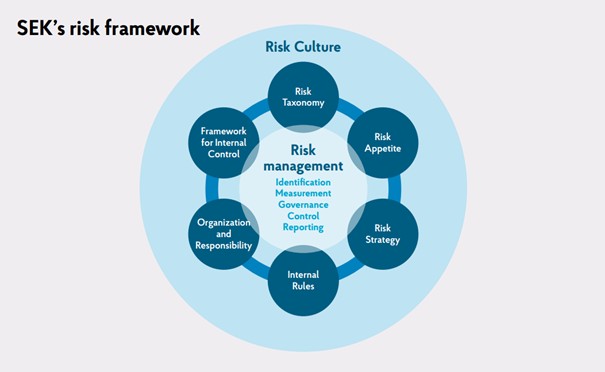
SEK’s risk management is governed by its risk framework which ensures that the Company can continuously identify, measure, manage, report and have control over the significant risks to which SEK is or may become exposed. The risk framework is described in the risk policy, which is adopted each year by the Board. A summary of the risk framework is set out below.
Risk culture
SEK’s risk culture comprises professional values, attitudes and behavior that are significant for how the business manages its risks. An essential aspect of a sound risk culture is the tone from the top. Through the Code of Conduct, the Board has communicated guiding principles for ethical behavior in daily activities and in interactions with external parties. The Board has also established guidelines for how remuneration is to be set, applied and followed up on, and how SEK defines which employees could impact the company’s risk level. In the risk policy, the Board clarifies its expectations of a sound risk culture that is built on knowledge, safety, ownership and transparency and where everyone has responsibility for efficient risk management. Executive management is responsible for implementing the Boards’ expectations in the Company.
Risk taxonomy
SEK maintains a holistic approach to the risks that the Company is or could become exposed to and all material risks are documented in the risk taxonomy. The risk taxonomy is updated at least annually and on a continual basis as new risks are identified.
Risk appetite and risk strategy
SEK’s risk capacity constitutes the outer boundary for SEK’s strategy and risk appetite and is expressed in the form of the capital target. All business activities are kept within the Board’s established risk appetite and limits and are conducted in adherence with SEK’s risk strategy. The risk strategy and risk appetite encompass all of SEK’s material risks in accordance with the risk taxonomy. The risk appetite by risk class is described in detail in the table “Detailed risk statement”.
Risk management process
The Company’s risk management process consists of the following key elements: identification, measurement, governance, reporting and control of those risks to which SEK is or may become exposed.
Identification — At any given time, SEK must be aware of the risks to which it is or may become exposed. Risks are identified in new transactions, in external changes in SEK’s operating environment or internally in, for example, products, processes, systems and through regular risk analyses. Risks are identified in daily operations as well as in formal and recurring processes such as risk and control self-assessments, the incident management process, the New Product Approval Process (NPAP) and the procurement process. The NPAP shall ensure that an adequate risk and impact analysis is carried out, that risks identified in this analysis are adequately managed and that an adequate risk measurement is achieved before the introduction of new or significantly changed products, services, markets, processes or IT-systems in SEK’s operations. The same requirements apply in the event of major changes to SEK’s operations and organization. All identified risks are mapped against the risk taxonomy.
Measurement — Risks are measured quantitatively or assessed qualitatively as frequently as necessary. The measurement methods include forward-looking and backward-looking analyses. Where relevant, the analyses are complemented by expert assessments. Moreover, material risks are subject to regular stress tests using various scenarios.
Governance — SEK actively utilizes risk-reduction capabilities and control the development of risks over time to ensure that the business activities are kept within the established risk appetite and established limits. In addition, SEK also plans to ensure the continuity of business-critical processes and systems in the event of a crisis. Exercises and training regarding the management of situations in a crisis and/or that require crisis and/or continuity planning are performed continuously.
Reporting — SEK’s independent control functions provide regular reports, at least quarterly, to the Board, the Finance and Risk Committee (FRC) and the CEO on the development of the Company’s material risks. The risk reports are designed to provide an accurate and comprehensive understanding of SEK’s risk position.
Control — SEK continuously monitors adherence to capital targets, risk appetite limits and all other applicable limits to ensure that risk exposures are kept at an acceptable level. In addition, the control functions regularly test the effectiveness of internal controls in terms of their design and operational effectiveness. The test outcomes and follow-ups of any action plans are reported to the Board’s Audit Committee (AC).
Internal rules
Policies and instructions derived from SEK’s risk policy address all material risks, including stress and crisis management, and provide for contingency in the event of such occurrences.
Organization and responsibility
SEK’s risk management is based on the three lines principle in the form of clear-cut separation of responsibilities between the business and support functions that own the risks, the control functions that independently identify and monitor the risks, and an internal audit function, which reviews, inter alia, the efficiency and integrity of risk management; see the illustration below. For detailed information on responsibility and organization, refer to the Corporate Governance Report which is available on the Company’s website (and does not form part of this annual report).
Division of responsibility for risk, liquidity and capital management in SEK | ||||||||||||||||||||
First line | ||||||||||||||||||||
• Business and support operations • Day-to-day management of risk, liquidity and capital in compliance with risk strategy, risk policy and risk appetite | • Credit and sustainability analyses • Compliance with international sanctions | • Daily control and follow-up of credit, market and liquidity risk • Reporting to the Board | ||||||||||||||||||
Second line | ||||||||||||||||||||
• Independent control functions: the Risk function and the Compliance function • Monitor and control SEK’s risk management | • Control that all material risks to which SEK is or may become exposed are managed by the relevant functions • Maintain and develop SEK’s risk framework including the internal control framework | • Compliance monitoring • Reporting to the Board | ||||||||||||||||||
Third line | ||||||||||||||||||||
• Independent internal audit • Review and evaluation of the effectiveness and integrity of risk management | • Performance of audit activities in line with the audit plan confirmed by the Board | • Reporting to the Board | ||||||||||||||||||
Framework for internal control
For information on SEK’s framework for internal control, refer to the Corporate Governance Report which is available on the Company’s website (and does not form part of this annual report).
Internal capital and liquidity assessment processes
The internal capital adequacy assessment process is an integral part of SEK’s strategic planning. The purposes of the internal capital adequacy assessment process are to ensure that SEK has sufficient capital to meet both regulatory and internal requirements under both normal and stressed financial conditions and to support SEK’s credit rating. The capital kept by SEK must be sufficient in relation to the risks that SEK has, or may become, exposed to. The internal capital adequacy assessment is based on SEK’s internal assessments of the risks and their development, as well as assessments of risk measurement models, risk governance and risk management. It is integrated into business planning and forms the foundation for SEK’s strategy for maintaining an adequate level of capital. Changes in capital requirements due to new or amended regulations are part of this assessment. Capital adequacy assessments are conducted at least for the forthcoming 3-year period.
To arrive at an adequate capitalization level that also applies under stressed financial conditions, an analysis is conducted of how the capitalization is affected by stress in global financial markets, as well as of other factors that impact SEK’s business model and net risk exposure.
When SEK performs the internal capital adequacy assessment, it applies methods other than those used for the Swedish FSA’s capital requirement. The assessment is based on SEK’s internal calculation of economic capital, which captures all of the specific risks to which SEK’s operations are exposed, even risks over and above those included in the Swedish FSA’s capital requirement.
In addition to the internal capital adequacy assessment, SEK also estimates the total capital requirement as set for SEK by the Swedish FSA in its review and evaluation process. The capital requirement from the Swedish FSA is a minimum requirement for SEK’s own funds. In SEK’s assessment, SEK has own funds that comfortably exceed both the internally estimated need of own funds and the total capital requirement calculated by the Swedish FSA.
In addition to the internal capital adequacy assessment process, an in-depth liquidity analysis is performed. During the planning period, the liquidity requirement and its composition in terms of liquidity requirements for different currencies, among other items, are evaluated to ensure the Company has adequate liquidity to implement the business plan and meet regulatory requirements. In SEK’s assessment, the Company has liquidity that exceeds liquidity needs during the planning period.
For supplementary and expanded information, refer to the separate risk report, “Capital Adequacy and Risk Management (Pillar 3) Report 2025”, which is available on the Company’s website (and does not form part of this annual report).
Detailed risk statement
Risk class | Risk management | Risk profile | Risk appetite | |||||||||||||||||
Credit risk | ||||||||||||||||||||
Credit risk is the risk of losses due to the failure to fulfill a credit (or an arrangement similar to that of a credit). Credit risk includes the risk of default (comprises derivatives), concentration risk and country risk. | The overall strategy is for gross credit risks that arise out of the business strategy to be reduced and transferred to thereafter be contained within risk appetite. The credit portfolio shall maintain a high credit quality. SEK has a significant but natural concentration of risk in relation to the Swedish export industry, individual clients and specific sectors in which Sweden has developed export business. The concentration for counterparties is acceptable, but ongoing efforts are to be made to reduce concentration risks when possible. Credit risks are transferred using risk mitigation solutions such as guarantees and credit risk hedges when justifiable in terms of profitability. To reduce credit risks, credit granting takes place responsibly and is based on adequate knowledge of SEK’s counterparties (including the financial impact of ESG factors) and their owners, and is in compliance with the owner instruction assignment. For derivatives, netting and CSA agreements must be in place to reduce counterparty risk. | SEK’s mission naturally entails certain concentration risks, such as single name concentration. The Company’s extensive use of guarantees results in a high proportion of exposures towards sovereigns. Total net risk is mainly limited to counterparties with high creditworthiness. SEK’s liquidity portfolio is invested in securities with high credit quality and preferably short maturities. | SEK is to ensure a high quality credit portfolio through a robust credit assessment based on a risk-based selection of counterparties, adequate counterparty knowledge, long-term relationships and risk mitigation of risk filled exposures. | |||||||||||||||||
Liquidity risk | ||||||||||||||||||||
| Liquidity risk is the risk that the Company is unable to meet its payment commitments. Liquidity risk consists of financing risk, currency risk, and off-balance sheet-risk. | The overall strategy is to reduce liquidity risks that arise from the business strategy. SEK should strive for a high level of diversification of its financing. SEK’s liquidity investments should primarily consist of high-quality assets and SEK should avoid selling assets prematurely by investing in liquidity investments at an overall level with maturities that are aligned with the expected timing of payments. | SEK is dependent on the capital markets for its funding. In order to manage the effects of potential market disruptions, SEK has ensured that available funds and equity exceed the aggregate volume of all outstanding loans as well as committed, undisbursed CIRR loans for all maturities. In addition, SEK’s strong liquidity position enables the Company to effectively manage periods of stress. | SEK shall maintain good liquidity capacity to manage periods of stress. SEK shall uphold long-term financial stability by ensuring a good maturity matching. | |||||||||||||||||
Risk class | Risk management | Risk profile | Risk appetite | |||||||||||||||||
Market risk | ||||||||||||||||||||
Market risk is defined as the risk of the Company’s results, capital or value being affected in an adverse manner from changes in the financial markets, such as movements in interest rates, foreign exchange rates, basis spreads or credit spreads. Value encompasses both accounting value and economic value. | The overall strategy is to reduce the market risks arising from the business strategy, where SEK shall implement a sound balance between precision and cost of hedging the risks. Imbalances in borrowing versus lending and volatility in future earnings shall be reduced. Assets and liabilities shall, as a general rule be held to maturity. The majority of the interest rate risk in the CIRR system’s lending portfolio shall be hedged. | SEK’s business model entails exposures to market movements, mainly interest rates, credit spreads and exchange rates. | SEK shall strive for low volatility in earnings and own funds due to market movements, low gap risk and low interest rate risk in the CIRR portfolio. | |||||||||||||||||
Operational risk | ||||||||||||||||||||
Operational risk is the risk of losses resulting from inadequate or failed internal processes, people and systems or external events, including, but not limited to, legal risks, model risks and information and communication technology (ICT) risks, but excluding strategic risks and reputational risks, Operational risk includes ICT and security risks, crisis and continuity risks, third-party risks, transaction management risks, reporting risks, legal risks, model risks and risks related to financial crime and conduct. | The overall strategy is to reduce operational risks that arise out of the business strategy. However, the operational risks linked to financial crime and conduct shall be avoided in the first place. Costs to reduce operational risks must be in reasonable proportion to the expected impact of the risk reduction measures Risk reduction takes place primarily through effective and well-documented internal processes for risk management such as risk and control self-assessments, the incident management process, the new product approval process (NPAP) and the procurement process, an efficient control environment, a responsible approach to environmental and climate factors, social factors and governance-related factors throughout the term of the credit and continuous training of all personnel to ensure a comprehensive understanding of the risk framework and responsibility of every employee. | Operational risks are inherent in all of SEK’s operations and can have financial, regulatory and reputational impact. The most significant operational risks are within the ICT and security risk area. The majority of reported incidents are minor events that are resolved promptly within the relevant function. | SEK shall promptly reduce critical and high operational risks and limit operational losses resulting from incidents. | |||||||||||||||||
Risk class | Risk management | Risk profile | Risk appetite | |||||||||||||||||
Business and strategic risk | ||||||||||||||||||||
Business and strategic risk is defined as the risk of an event taking place that impacts the ability of the business to achieve set goals. Business and strategic risk includes business environment risk, public policy assignment risk and risks related to internal governance. | The overall strategy is to reduce business and strategic risk through the strategy process and business plan with a focus on the following three key areas: Business environment, public policy assignment and internal governance. Business environment-related risks are mitigated through the implementation of appropriate measures based on continuous business environment monitoring and close dialogue with customers, investors and owners, as well as through active investor engagement aimed at broadening the investor base and access to borrowing markets. Public-policy-related risks are mitigated through effective management of the CIRR-system, structured co-operation with bank counterparties and within Team Sweden, and a continued focus on broadening the customer base and developing business with existing customers. Risks related to internal governance are mitigated through clearly defined roles and responsibilities, a holistic perspective on investment, profitability and capital management, structured efforts to ensure appropriate strategic competencies, and management of goal conflicts in a manner intended to avoid material adverse impacts on any individual objective. | SEK’s strategic risks primarily stem from changes in the Company’s operating environment, including geopolitical risks, macroeconomic conditions, and other external factors that may have an adverse impact on the Company. Other risks are related to SEK’s public policy assignment and its ability to create a robust internal governance structure that adapts to changing business environments and delivers on the Company’s business goals. | SEK does not have a specific risk appetite for business and strategic risk. | |||||||||||||||||