Feb. 26, 2026
The Fund’s investment objective is to seek total return.
This table describes the fees and expenses that you may pay if you buy, hold and sell shares of the Fund. Fees and expenses of a wholly-owned subsidiary of the Fund organized under the laws of the Cayman Islands (Subsidiary) are included in the table.
The table and Examples below do not reflect any transaction fees that may be charged by financial intermediaries or commissions that a shareholder may be required to pay directly to its financial intermediary when buying or selling Class Y or Class R6 shares. You may qualify for sales charge discounts if you and your family invest, or agree to invest in the future, at least $100,000 in the Invesco Funds. More information about these and other discounts is available from your financial professional and in the section “Shareholder Account Information – Initial Sales Charges (Class A Shares Only)” on page A-3 of the prospectus and the section “Purchase, Redemption and Pricing of Shares-Purchase and Redemption of Shares” on page L-1 of the statement of additional information (SAI).
| Shareholder Fees (fees paid directly from your investment) | ||||||
| Class: | A | C | R | Y | R5 | R6 |
| Maximum Sales Charge (Load) Imposed on Purchases (as a percentage of offering price) | 4.25 % | None | None | None | None | None |
| | ||||||
| Maximum Deferred Sales Charge (Load) (as a percentage of original purchase price or redemption proceeds, whichever is less) | None1 | 1.00 % | None | None | None | None |
| | ||||||
| Annual Fund Operating Expenses (expenses that you pay each year as a percentage of the value of your investment) | ||||||
| Class: | A | C | R | Y | R5 | R6 |
| Management Fees | 0.60 % | 0.60 % | 0.60 % | 0.60 % | 0.60 % | 0.60 % |
| | ||||||
| Distribution and/or Service (12b-1) Fees | 0.24 | 1.00 | 0.50 | None | None | None |
| | ||||||
| Other Expenses | 0.20 | 0.20 | 0.20 | 0.20 | 0.10 | 0.10 |
| | ||||||
| Acquired Fund Fees and Expenses | 0.02 | 0.02 | 0.02 | 0.02 | 0.02 | 0.02 |
| | ||||||
| Total Annual Fund Operating Expenses | 1.06 | 1.82 | 1.32 | 0.82 | 0.72 | 0.72 |
| | ||||||
| Fee Waiver and/or Expense Reimbursement2 | 0.01 | 0.01 | 0.01 | 0.01 | 0.01 | 0.01 |
| | ||||||
| Total Annual Fund Operating Expenses After Fee Waiver and/or Expense Reimbursement | 1.05 | 1.81 | 1.31 | 0.81 | 0.71 | 0.71 |
| | ||||||
| 1 | A contingent deferred sales charge may apply in some cases. See “Shareholder Account Information-Contingent Deferred Sales Charges (CDSCs).” |
| 2 | Invesco Advisers, Inc. (Invesco or the Adviser) has contractually agreed to waive a portion of the Fund’s management fee in an amount equal to the net management fee that Invesco earns on the Fund’s investments in certain affiliated funds, which will have the effect of reducing the Acquired Fund Fees and Expenses. Unless Invesco continues the fee waiver agreement, it will terminate on August 31, 2027. During its term, the fee waiver agreement cannot be terminated or amended to reduce the advisory fee waiver without approval of the Board of Trustees. |
This Example is intended to help you compare the cost of investing in the Fund with the cost of investing in other mutual funds.
The Example assumes that you invest $10,000 in the Fund for the time periods indicated and then redeem all of your shares at the end of those periods. This Example does not include commissions and/or other forms of compensation that investors may pay on transactions in Class Y and Class R6 shares. The Example also assumes that your investment has a 5% return each year and that the Fund’s operating expenses remain equal to the Total Annual Fund Operating Expenses After Fee Waiver and/or Expense Reimbursement in the first year and the Total Annual Fund Operating Expenses thereafter.
Although your actual costs may be higher or lower, based on these assumptions, your costs would be:
| | 1 Year | 3 Years | 5 Years | 10 Years |
| Class A | $528 | $747 | $984 | $1,663 |
| | ||||
| Class C | $284 | $572 | $984 | $1,937 |
| | ||||
| Class R | $133 | $417 | $723 | $1,589 |
| | ||||
| Class Y | $83 | $261 | $454 | $1,013 |
| | ||||
| Class R5 | $73 | $229 | $400 | $894 |
| | ||||
| Class R6 | $73 | $229 | $400 | $894 |
| | ||||
You would pay the following expenses if you did not redeem your shares:
|
|
1 Year
|
3 Years
|
5 Years
|
10 Years
|
|
Class A
|
$528 |
$747 |
$984 |
$1,663 |
|
|
||||
|
Class C
|
$184 |
$572 |
$984 |
$1,937 |
|
|
||||
|
Class R
|
$133 |
$417 |
$723 |
$1,589 |
|
|
||||
|
Class Y
|
$83 |
$261 |
$454 |
$1,013 |
|
|
||||
|
Class R5
|
$73 |
$229 |
$400 |
$894 |
|
|
||||
|
Class R6
|
$73 |
$229 |
$400 |
$894 |
|
|
||||
The Fund pays transaction costs, such as commissions, when it buys and sells securities (or “turns over” its portfolio). A higher portfolio turnover rate may indicate higher transaction costs and may result in higher taxes when Fund shares are held in a taxable account. These costs, which are not reflected in annual fund operating expenses or in the Example, affect the Fund’s performance. During the most recent fiscal year, the Fund’s portfolio turnover rate was 385% of the average value of its portfolio.
The Fund invests mainly in debt securities, including foreign and U.S. government bonds and notes, mortgage-related securities, corporate debt obligations, including lower-grade, high-yield domestic and foreign corporate debt obligations, “structured” notes, participation interests in loans, investments in pooled investment entities (including those that invest in loans), asset-backed securities and “zero coupon” and “stripped” securities.
Under normal market conditions, the Fund invests a substantial portion of its assets in a number of different countries, including the U.S. The Fund is not required to allocate its investments in any set percentages in any particular countries. The Fund’s foreign investments may include debt securities of issuers in both developed and emerging markets. The Fund has no limitations regarding the range of maturities of the debt securities it can buy or the market capitalization of the issuers of those securities.
The Fund can invest in investment grade or lower-grade, high-yield debt securities. “Investment grade” debt securities are rated in one of the top four rating categories by nationally recognized statistical rating organizations such as Moody’s Ratings or S&P Global Ratings (S&P). If two or more nationally recognized statistical rating organizations have assigned different ratings to a security, the investment adviser uses the highest rating assigned. The Fund may also invest in unrated securities, in which case the investment adviser may internally assign ratings to certain of those securities, after assessing their credit quality, in investment-grade or below-investment-grade categories similar to those of nationally recognized statistical rating organizations. There can be no assurance, nor is it intended, that the investment adviser‘s credit analysis is consistent or comparable with the credit analysis process used by a nationally recognized statistical rating organization. Although the Fund normally invests a substantial portion of its assets in lower-grade, high-yield debt securities, it
can buy investment-grade debt securities without limit. The Fund may also invest in certain restricted securities and securities exempt from registration under the Securities Act of 1933 (Securities Act) including securities that are only eligible for resale pursuant to Rule 144A under the Securities Act (referred to as Rule 144A Securities). The Fund may also invest in exchange-traded funds and other investment companies.
The Fund can enter into “forward roll” transactions (also referred to as “mortgage dollar rolls”) with respect to mortgage-related securities. A substantial portion of the Fund’s assets may be subject to forward roll transactions at any given time.
The Fund may also use derivatives for investment purposes or to manage investment risks, including options, futures, forward contracts, swaps and “structured” notes. The Fund actively manages foreign currency exposure to seek to both reduce risk and enhance return. To do so, the Fund may invest in foreign exchange derivatives, including forwards and options that reference foreign currencies, including currencies of developing and emerging market countries.
The portfolio managers analyze the overall investment opportunities and risks across global fixed income markets in which the Fund invests and seek to moderate the special risks of investing in lower-grade, high-yield debt instruments and foreign securities by building a broadly diversified portfolio. The Fund’s diversification strategies are intended to help reduce share price volatility while seeking current income. The portfolio managers currently focus on securities that they believe offer a balance of income and total return, securities whose market prices tend to move in different directions (to seek overall portfolio diversification), and relative values across
global fixed income markets. These factors may vary in particular cases and may change over time. The Fund may sell securities that the portfolio managers believe are no longer favorable with regard to these factors.
The Fund may invest up to 25% of its total assets in a Cayman Islands exempted company that is wholly-owned and controlled by the Fund (the Subsidiary). The Subsidiary invests in Regulation S securities. Regulation S securities are securities of U.S. and non-U.S. issuers that are issued through private offerings without registration with the Securities and Exchange Commission pursuant to Regulation S under the Securities Act. The Fund applies its investment restrictions and compliance policies and procedures, on a look-through basis, to the Subsidiary. Since the Fund may invest a substantial portion of its assets in the Subsidiary, which may hold certain of the investments described in this prospectus, the Fund may be considered to be investing indirectly in those investments through its Subsidiary. Therefore, references in this prospectus to investments by the Fund also may be deemed to include the Fund’s indirect investments through the Subsidiary.
In attempting to meet its investment objective or to manage subscription and redemption requests, the Fund may engage in active and frequent trading of portfolio securities.
The bar chart and performance table provide an indication of the risks of investing in the Fund. The Fund has adopted the performance of the Oppenheimer Global Strategic Income Fund (the predecessor fund) as the result of a reorganization of the predecessor fund into the Fund, which was
consummated after the close of business on May 24, 2019 (the “Reorganization”). Prior to the Reorganization, the Fund had not yet commenced operations. The bar chart shows changes in the performance of the predecessor fund and the Fund from year to year as of December 31. The performance table compares the predecessor fund’s and the Fund’s performance to that of a broad measure of market performance.
The Fund’s (and the predecessor fund’s) past performance (before and after taxes) is not necessarily an indication of how the Fund will perform in the future. Class A, Class C, Class R, Class Y and Class I shares of the predecessor fund were reorganized into Class A, Class C, Class R, Class Y and Class R6 shares, respectively, of the Fund after the close of business on May 24, 2019. Class A, Class C, Class R, Class Y and Class R6 shares’ returns of the Fund will be different from the returns of the predecessor fund as they have different expenses. Performance for Class A shares has been restated to reflect the Fund’s applicable sales charge. Fund performance reflects any applicable fee waivers and expense reimbursements. Performance returns would be lower without applicable-fee waivers and expense reimbursements.
All Fund performance shown assumes the reinvestment of dividends and capital gains and the effect of the Fund’s expenses.
Updated performance information is available on the Fund’s website at www.invesco.com/us.
The bar chart does not reflect sales loads. If it did, the annual total returns shown would be lower.
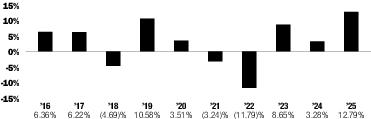
| Class A | Period Ended | Returns |
| Best Quarter | June 30, 2020 | 15.04% |
| Worst Quarter | March 31, 2020 | -17.13% |
| | Inception Date | 1 Year | 5 Years | 10 Years |
| Class A | | | | |
| Return Before Taxes | 10/16/1989 | 7.88 % | 0.67 % | 2.45 % |
| Return After Taxes on Distributions | | 5.54 | -0.69 | 1.02 |
| Return After Taxes on Distributions and Sale of Fund Shares | | 4.62 | -0.10 | 1.24 |
| | ||||
| Class C | 5/26/1995 | 10.98 | 0.77 | 2.27 |
| | ||||
| Class R | 3/1/2001 | 12.51 | 1.24 | 2.64 |
| | ||||
| Class Y | 1/26/1998 | 13.06 | 1.80 | 3.15 |
| | ||||
| Class R5 | 5/24/2019 | 13.19 | 1.87 | 3.14 1 |
| | ||||
| Class R6 | 1/27/2012 | 13.21 | 1.96 | 3.31 |
| | ||||
| Bloomberg Global Aggregate Index (reflects no deduction for fees, expenses or taxes) | | 8.17 | -2.15 | 1.26 |
| | ||||
1
Performance shown on or prior to the inception date is that of the predecessor fund's Class A shares at net asset value and includes the 12b-1 fees applicable to that class. Although invested in the same portfolio of securities, Class R5 shares' returns of the Fund will be different from Class A shares' returns of the predecessor fund as they have different expenses.
After-tax returns are calculated using the historical highest individual federal marginal income tax rates and do not reflect the impact of state and local taxes. Actual after-tax returns depend on an investor's tax situation and may differ from those shown, and after-tax returns shown are not relevant to investors who hold their Fund shares through tax-advantaged arrangements, such as 401(k) plans, 529 college savings plans or individual retirement accounts. After-tax returns are shown for Class A shares only and after-tax returns for other classes will vary.