Feb. 26, 2026
The Fund’s investment objective is to provide current income.
This table describes the fees and expenses that you may pay if you buy, hold and sell shares of the Fund.
The table and Examples below do not reflect any transaction fees that may be charged by financial intermediaries or commissions that a shareholder may be required to pay directly to its financial intermediary when buying or selling Class Y or Class R6 shares. You may qualify for sales charge discounts if you and your family invest, or agree to invest in the future, at least $50,000 in the Invesco Funds. More information about these and other discounts is available from your financial professional and in the section “Shareholder Account Information – Initial Sales Charges (Class A Shares Only)” on page A-3 of the prospectus and the section “Purchase, Redemption and Pricing of Shares – Purchase and Redemption of Shares” on page L-1 of the statement of additional information (SAI).
| Shareholder Fees (fees paid directly from your investment) | ||||||
| Class: | A | C | R | Y | R5 | R6 |
| Maximum Sales Charge (Load) Imposed on Purchases (as a percentage of offering price) | 5.50 % | None | None | None | None | None |
| | ||||||
| Maximum Deferred Sales Charge (Load) (as a percentage of original purchase price or redemption proceeds, whichever is less) | None1 | 1.00 % | None | None | None | None |
| | ||||||
| Annual Fund Operating Expenses (expenses that you pay each year as a percentage of the value of your investment) | ||||||
| Class: | A | C | R | Y | R5 | R6 |
| Management Fees | 0.48 % | 0.48 % | 0.48 % | 0.48 % | 0.48 % | 0.48 % |
| | ||||||
| Distribution and/or Service (12b-1) Fees | 0.23 | 1.00 | 0.50 | None | None | None |
| | ||||||
| Other Expenses | 0.18 | 0.18 | 0.18 | 0.18 | 0.08 | 0.08 |
| | ||||||
| Acquired Fund Fees and Expenses | 0.09 | 0.09 | 0.09 | 0.09 | 0.09 | 0.09 |
| | ||||||
| Total Annual Fund Operating Expenses | 0.98 | 1.75 | 1.25 | 0.75 | 0.65 | 0.65 |
| | ||||||
| Fee Waiver and/or Expense Reimbursement2 | 0.04 | 0.04 | 0.04 | 0.04 | 0.04 | 0.04 |
| | ||||||
| Total Annual Fund Operating Expenses After Fee Waiver and/or Expense Reimbursement | 0.94 | 1.71 | 1.21 | 0.71 | 0.61 | 0.61 |
| | ||||||
| 1 | A contingent deferred sales charge may apply in some cases. See “Shareholder Account Information-Contingent Deferred Sales Charges (CDSCs).” |
| 2 | Invesco Advisers, Inc. (Invesco or the Adviser) has contractually agreed to waive a portion of the Fund’s management fee in an amount equal to the net management fee that Invesco earns on the Fund’s investments in certain affiliated funds, which will have the effect of reducing the Acquired Fund Fees and Expenses. Unless Invesco continues the fee waiver agreement, it will terminate on August 31, 2027. During its term, the fee waiver agreement cannot be terminated or amended to reduce the advisory fee waiver without approval of the Board of Trustees. |
This Example is intended to help you compare the cost of investing in the Fund with the cost of investing in other mutual funds.
The Example assumes that you invest $10,000 in the Fund for the time periods indicated and then redeem all of your shares at the end of those periods. This Example does not include commissions and/or other forms of compensation that investors may pay on transactions in Class Y and Class R6 shares. The Example also assumes that your investment has a 5% return each year and that the Fund’s operating expenses remain equal to the Total Annual Fund Operating Expenses After Fee Waiver and/or Expense Reimbursement in the first year and the Total Annual Fund Operating Expenses thereafter.
Although your actual costs may be higher or lower, based on these assumptions, your costs would be:
| | 1 Year | 3 Years | 5 Years | 10 Years |
| Class A | $641 | $841 | $1,058 | $1,682 |
| | ||||
| Class C | $274 | $547 | $945 | $1,855 |
| | ||||
| Class R | $123 | $393 | $682 | $1,508 |
| | ||||
| Class Y | $73 | $236 | $413 | $927 |
| | ||||
| Class R5 | $62 | $204 | $358 | $807 |
| | ||||
| Class R6 | $62 | $204 | $358 | $807 |
| | ||||
You would pay the following expenses if you did not redeem your shares:
|
|
1 Year
|
3 Years
|
5 Years
|
10 Years
|
|
Class A
|
$641 |
$841 |
$1,058 |
$1,682 |
|
|
||||
|
Class C
|
$174 |
$547 |
$945 |
$1,855 |
|
|
||||
|
Class R
|
$123 |
$393 |
$682 |
$1,508 |
|
|
||||
|
Class Y
|
$73 |
$236 |
$413 |
$927 |
|
|
||||
|
Class R5
|
$62 |
$204 |
$358 |
$807 |
|
|
||||
|
Class R6
|
$62 |
$204 |
$358 |
$807 |
|
|
||||
The Fund pays transaction costs, such as commissions, when it buys and sells securities (or “turns over” its portfolio). A higher portfolio turnover rate may indicate higher transaction costs and may result in higher taxes when Fund shares are held in a taxable account. These costs, which are not reflected in annual fund operating expenses or in the Example, affect the Fund’s performance. During the most recent fiscal year, the Fund’s portfolio turnover rate was 75% of the average value of its portfolio.
The Fund seeks to achieve its investment objective by actively allocating assets across multiple income producing asset classes and strategies. The Adviser’s Global Asset Allocation (GAA) Team employs risk balancing strategies intended to manage interest rate, equity and credit risk to seek to create a balanced risk profile for the Fund. The GAA Team implements the Fund’s investment strategy and tactically adjusts the Fund’s portfolio through direct investments, including derivative and hybrid derivative-type instruments, as well as through affiliated and unaffiliated open-end investment companies, including exchange-traded funds (ETFs), and closed-end investment companies. Invesco Advisers, Inc. (Invesco or the Adviser) expects this strategy to provide protection during periods of economic stress while seeking to meet the Fund’s investment objective.
The Fund invests in high income producing asset classes, as defined below, and government bonds. The high income producing asset classes in which the Fund invests are those that are expected to provide income and which the GAA Team believes will increase in value during periods of economic strength. These asset classes include non-investment grade (high yield or “junk”) debt, emerging markets debt, dividend producing equities, securities of real estate and real estate-related issuers (including mortgage real estate investment trusts (REITs), equity REITs, and equity securities of global companies principally engaged in the real estate industry), preferred equities, master limited partnerships (MLPs) and floating rate debt securities and loans. The Fund may also obtain exposure to the foregoing asset classes through equity-linked notes (ELNs), including through ELNs on ETFs or indices. The Fund may also use ELNs to obtain exposure to other equity securities and broad-based equity market indices. The Fund also invests in government bonds that are expected to provide income and which the GAA Team believes will increase in value during periods of economic stress. The
GAA Team determines how to allocate the portfolio among the different asset classes based on yield, liquidity, risk, correlation and tax treatment.
ELNs are hybrid derivative-type instruments that are specially designed to combine the characteristics of investing in one or more reference securities (such as a single stock, ETF, or an index or basket of securities (underlying securities)) and a related derivative, such as a put or call option (or a combination thereof), in a single note form (typically senior, unsecured debt) issued by financial institutions. The options within the ELNs in which the Fund invests will generally have covered call and/or cash secured put strategies embedded within them. When the Fund purchases an ELN from the issuing counterparty, the Fund is generally entitled to receive a premium generated by options positions within the ELN. Therefore, the ELNs are intended to provide recurring cash flow to the Fund based on the premiums received from selling the options. When the Fund sells call options within an ELN, it receives a premium but limits its opportunity to profit from an increase in the market value of the underlying securities to the exercise price of the call option (plus the premium received).
The Fund’s high yield debt investments consist of debt securities of U.S. and foreign issuers that are determined to be below investment grade quality. These types of securities are commonly known as “junk bonds.” Investment grade securities are: (i) securities rated BBB- or higher by S&P Global Ratings, a division of S&P Global, Inc. (S&P) or Baa3 or higher by Moody’s Ratings (Moody’s) or an equivalent rating by another nationally recognized statistical rating organization (NRSRO), (ii) securities with comparable short-term NRSRO ratings, or (iii) unrated securities determined by the Adviser to be of comparable quality, each at the time of purchase. The Fund invests principally in junk bonds rated B or above by an NRSRO or deemed to be of comparable quality by the Adviser. The Fund may also invest in debt securities of foreign issuers that are determined to be below investment grade quality. The Fund can use derivative instruments, such as credit default swaps and credit default index swaps to manage its exposure to high yield debt investments. The Fund also may invest in Rule 144A private placement securities. There is no requirement with respect to the maturity or duration of high yield debt securities in which the Fund may invest.
The Fund’s emerging markets debt exposure may include investments in U.S. dollar-denominated government bonds, and sovereign, quasi-sovereign, corporate and supranational bonds. Quasi-sovereign debt securities are debt securities either explicitly guaranteed by a foreign government or whose majority investor is a foreign government. Supranational bonds are bonds issued by an international organization designated or supported by two or more governmental entities and designed to promote economic reconstruction, development or international banking institutions. The Fund has no requirement with respect to the maturity or duration of the emerging markets debt securities in which the Fund may invest. The Fund can also invest in credit linked notes and derivative instruments such as credit default index swaps to manage its exposure to emerging markets debt investments.
The Fund’s preferred equity exposure may include investments in fixed rate U.S. dollar-denominated preferred securities that comprise The ICE BofA Core Plus Fixed Rate Preferred Securities Index (Preferred Equity Index). When utilizing an indexing approach, the Fund will generally invest in all of the securities in the Preferred Equity Index in their approximate weightings. However, where it may not be possible or practicable to purchase all of those securities in those same weightings, the Fund may utilize a “sampling” methodology to seek to track the performance of the Preferred Equity Index. The Preferred Equity Index is a market capitalization-weighted index designed to measure the performance of fixed rate U.S. dollar-denominated domestic preferred securities issued in the U.S. domestic market. The Preferred Equity Index includes both traditional and other preferred securities. Unlisted preferred securities are excluded from the Preferred Equity Index, but unlisted senior or subordinated debt-like securities are eligible for inclusion. The Preferred Equity Index may include Rule 144A securities. Securities are selected for the Preferred Equity
Index using a rules-based methodology. Qualifying securities must be rated at least B3 (based on an average of ratings by Moody’s, S&P and Fitch Ratings, Inc. (“Fitch”)) and must have an investment grade country risk profile (based on an average of Moody’s, S&P and Fitch foreign currency long-term sovereign debt ratings). To be included in the Preferred Equity Index, qualifying securities must have a fixed coupon or dividend schedule and must have a minimum amount outstanding of $100 million.
The Fund’s exposure to real estate and real estate-related issuers may include investments in equity securities of global companies principally engaged in the real estate industry, and mortgage REITs and equity REITs. The Fund may also invest in mortgage-backed securities consisting of interests in underlying mortgages with maturities of up to thirty years.
The Fund also can make investments in the securities of MLPs. The MLPs in which the Fund invests are publicly traded partnerships or limited liability companies engaged, among other things, in the transportation, storage, processing, refining, marketing, exploration, production and mining of minerals and natural resources. The Fund may invest in securities of MLPs of all capitalization sizes. The Fund may also invest in exchange-traded notes (ETNs).
The Fund also can make investments in (i) senior secured floating rate loans made by banks and other lending institutions, (ii) senior secured floating rate debt instruments, (iii) unsecured bank loans, and (iv) secured and unsecured notes and bonds. The floating rate loans and floating rate debt securities may be rated below investment grade. Some of the floating rate loans and debt securities in which the Fund may invest will be considered illiquid. The Fund may also invest in floating rate U.S. dollar-denominated preferred securities.
The Fund’s government bond exposure includes investments in debt securities issued, guaranteed or otherwise backed by the U.S. Government or its agencies and instrumentalities. These securities include: (1) U.S. Treasury obligations (including the principal components or the interest components issued by the U.S. Government under the Separate Trading of Registered Interest and Principal Securities program (i.e. STRIPS)); and (2) obligations issued or guaranteed by U.S. Government agencies and instrumentalities and supported by (a) the full faith and credit of the U.S. Treasury, (b) the right of the issuer to borrow from the U.S. Treasury, or (c) the credit of the agency or instrumentality. The Fund also may invest in securities issued by foreign governments. The Fund also may use treasury futures (including U.S. Government and foreign government bond futures) and options on treasury futures (including U.S. Government and foreign government bond futures) to adjust the duration of the portfolio of government bonds.
The Fund may invest in securities or loans of issuers located in foreign countries, all of which may be securities or loans of issuers located in emerging markets countries, i.e., those that are generally in the early stages of their industrial cycles.
The Fund can use derivative instruments for risk management, portfolio management, earning income, managing (increasing or decreasing) target duration, gaining or reducing exposure to a particular asset class or hedging its exposure to non-U.S. currencies. The Fund’s use of derivatives will involve the purchase and sale of treasury futures (including U.S. Government and foreign government bond futures), equity index futures, options on treasury futures, options (including equity options), interest rate swaps, credit default index swaps, credit default swaps, forward foreign currency contracts and other related instruments and techniques. The Fund’s investments in certain derivatives may create leveraged exposure to certain fixed income markets. Leverage occurs when the investments in derivatives create greater economic exposure than the amount invested. Using derivatives often allows the portfolio managers to implement their views more efficiently and to gain more exposure to the asset classes than investing in more traditional assets such as stocks and bonds would allow. The Fund holds long and short positions in derivatives.
The Fund may hold significant levels of cash and cash equivalent instruments, including affiliated money market funds, as margin or collateral
for the Fund’s obligations under derivative transactions, or for cash management purposes.
The Fund’s portfolio managers consider selling a security or other investment, or covering a short position, (1) for risk control purposes, (2) when its income or potential for return deteriorates or (3) when it otherwise no longer meets Invesco’s investment selection criteria.
The bar chart and performance table provide an indication of the risks of investing in the Fund. The bar chart shows changes in the performance of the Fund from year to year as of December 31. The performance table compares the Fund's performance to that of a style-specific benchmark and a broad-based securities market benchmark (in that order). The Fund's past performance (before and after taxes) is not necessarily an indication of its future performance.
Fund performance reflects any applicable fee waivers and expense reimbursements. Performance returns would be lower without applicable fee waivers and expense reimbursements.
All Fund performance shown assumes the reinvestment of dividends and capital gains and the effect of the Fund’s expenses.
Updated performance information is available on the Fund's website at www.invesco.com/us.
The bar chart does not reflect sales loads. If it did, the annual total returns shown would be lower.
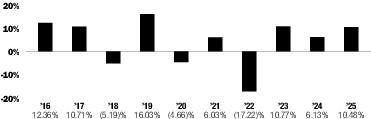
| Class A | Period Ended | Returns |
| Best Quarter | March 31, 2019 | 8.90% |
| Worst Quarter | March 31, 2020 | -20.02% |
| | Inception Date | 1 Year | 5 Years | 10 Years |
| Class A | | | | |
| Return Before Taxes | 12/14/2011 | 4.45 % | 1.50 % | 3.46 % |
| Return After Taxes on Distributions | | 1.92 | -1.02 | 1.09 |
| Return After Taxes on Distributions and Sale of Fund Shares | | 2.57 | 0.03 | 1.62 |
| | ||||
| Class C | 12/14/2011 | 8.77 | 1.89 | 3.42 |
| | ||||
| Class R | 12/14/2011 | 10.32 | 2.38 | 3.79 |
| | ||||
| Class Y | 12/14/2011 | 10.87 | 2.90 | 4.30 |
| | ||||
| Class R5 | 12/14/2011 | 10.98 | 2.94 | 4.31 |
| | ||||
| Class R6 | 9/24/2012 | 10.97 | 3.00 | 4.36 |
| | ||||
| Custom Invesco Multi-Asset Income Index is composed of 60% of the Bloomberg U.S. Aggregate Bond Index (reflects no deduction for fees, expenses or taxes) and 40% of the MSCI World Index (Net) (reflects reinvested dividends net of withholding taxes, but reflects no deduction for fees, expenses or other taxes) | | 12.75 | 4.63 | 6.19 |
| | ||||
| Bloomberg U.S. Aggregate Bond Index (reflects no deduction for fees, expenses or taxes) | | 7.30 | -0.36 | 2.01 |
| | ||||
After-tax returns are calculated using the historical highest individual federal marginal income tax rates and do not reflect the impact of state and local taxes. Actual after-tax returns depend on an investor's tax situation and may differ from those shown, and after-tax returns shown are
not relevant to investors who hold their Fund shares through tax-advantaged arrangements, such as 401(k) plans, 529 college savings plans or individual retirement accounts. After-tax returns are shown for Class A shares only and after-tax returns for other classes will vary.