The fund seeks high current income
The accompanying tables describe the fees and expenses that you may pay if you buy, hold and sell shares of the fund.
You may qualify for sales charge discounts if you and your family invest, or agree to invest in the future, at least $50,000 in Credit Suisse Funds. More information about these and other discounts is available from your financial representative and in this Prospectus on page 64 under the heading "Other Shareholder Information—Classes of Shares and Sales Charges" and on page 69 under the heading "Intermediary-Specific Sales Charge Waiver Policies," and in the fund's Statement of Additional Information ("SAI") on page 81 under the heading "Additional Purchase and Redemption Information." You may pay other fees on purchases and sales of Class I shares of the fund, such as brokerage commissions and other fees to financial intermediaries which are not reflected in the table and examples below.
|
Class A |
Class C |
Class I |
|||||||||||||
|
Maximum sales charge (load) imposed on purchases (as a percentage of offering price) |
4.75 |
% |
None |
None |
|||||||||||
|
Maximum deferred sales charge (load) (as a percentage of the lesser of original purchase price or redemption proceeds, as applicable) |
None1 |
1.00 |
%2 |
None |
|||||||||||
|
Maximum sales charge (load) on reinvested distributions (as a percentage of offering price) |
None |
None |
None |
||||||||||||
|
Class A |
Class C |
Class I |
|||||||||||||
|
Management fee |
0.60 |
% |
0.60 |
% |
0.60 |
% |
|||||||||
|
Distribution and service (12b-1) fee |
0.25 |
1.00 |
None |
||||||||||||
|
Other expenses3 |
0.21 |
0.21 |
0.21 |
||||||||||||
|
Total annual fund operating expenses |
1.06 |
1.81 |
0.81 |
||||||||||||
|
Less: amount of fee limitations/expense reimbursements4 |
0.11 |
0.11 |
0.11 |
||||||||||||
|
Total annual fund operating expenses after fee limitations/expense reimbursements |
0.95 |
1.70 |
0.70 |
||||||||||||
1 Purchases of shares of $1 million or more may be subject to a 0.50% deferred sales charge on redemptions within 12 months of purchase.
2 1.00% during the first year.
3 "Other expenses" include "Acquired fund fees and expenses," which were less than 0.01% of the average net assets of the fund.
4 Credit Suisse Opportunity Funds (the "Trust") and UBS Asset Management (Americas) LLC ("UBS AM (Americas)") have entered into a written contract limiting operating expenses to 0.95% of the fund's average daily net assets for Class A shares, 1.70% of the fund's average daily net assets for Class C shares and 0.70% of the fund's average daily net assets for Class I shares at least through February 28, 2027. This limit excludes certain expenses, including interest charges on fund borrowings, taxes, brokerage commissions, dealer spreads and other transaction charges, expenditures that are capitalized in accordance with generally accepted accounting principles, acquired fund fees and expenses, short sale dividends, and extraordinary expenses (e.g., litigation and indemnification and any other costs and expenses that may be approved by the Board of Trustees). The Trust is authorized to reimburse UBS AM (Americas) for management fees previously waived and/or for expenses previously paid by UBS AM (Americas), provided, however, that any reimbursement must be paid at a date not more than thirty-six months following the applicable month during which such fees were waived or expenses were paid by UBS AM (Americas) and the reimbursement does not cause the applicable class's aggregate expenses, on an annualized basis to exceed either (i) the applicable expense limited in effect at the time such fees were waived or such expenses were paid by UBS AM (Americas) or (ii) the applicable expense limitation in effect at the time of such reimbursement. This contract may not be terminated before February 28, 2027.
This example is intended to help you compare the cost of investing in the fund with the cost of investing in other mutual funds.
Assume you invest $10,000, the fund returns 5% annually, expense ratios remain the same and you close your account at the end of each of the time periods
shown. Although your actual costs may be higher or lower, based on these assumptions, your cost would be:
|
One year |
Three years |
Five years |
Ten years |
||||||||||||||||
| Class A (with or without redemption) |
$ |
567 |
$ |
786 |
$ |
1,022 |
$ |
1,698 |
|||||||||||
| Class C (redemption at end of period) |
273 |
559 |
970 |
2,118 |
|||||||||||||||
| Class C (no redemption) |
173 |
559 |
970 |
2,118 |
|||||||||||||||
| Class I (with or without redemption) |
72 |
248 |
439 |
991 |
|||||||||||||||
The fund pays transaction costs, such as commissions, when it buys and sells securities (or "turns over" its portfolio). A higher portfolio turnover may indicate higher transaction costs and may result in higher taxes when shares are held in a taxable account. These costs, which are not reflected in annual fund operating expenses or in the example, affect the fund's performance. During the most recent fiscal year ended October 31, 2025, the fund's portfolio turnover rate was 51% of the average value of its portfolio.
Under normal market conditions, the fund invests at least 80% of its net assets, plus any borrowings for investment purposes, in high yield, fixed income securities (commonly referred to as "junk bonds"). The high yield, fixed income securities in which the fund will invest for purposes of this 80% policy will consist entirely of senior secured floating rate loans ("Senior Loans") issued by non-investment grade companies. Senior Loans typically are secured by specific collateral of the issuer and hold the most senior position in the issuer's capital structure. The interest rate on Senior Loans is adjusted periodically to a recognized base rate, such as the Secured Overnight Financing Rate ("SOFR"). While these characteristics may reduce interest rate risk and mitigate losses in the event of borrower default, the Senior Loans in which the fund invests have below investment grade credit ratings and thereby are considered speculative because of the significant credit risk of their issuers. The fund may invest up to 30% of its total assets in securities of non-U.S. issuers. The fund seeks to moderate risk by investing in a diversified portfolio of issuers across a variety of industry sectors. Investments are selected for the fund based on an analysis of individual issuers and the general business conditions affecting them. The fund generally will not invest in instruments rated at the time of investment in the lowest rating categories (Ca or below by Moody's Investors Service ("Moody's") and CC or below by S&P Global Ratings, a division of S&P Global Inc. ("S&P")) but may continue to hold securities which are subsequently downgraded.
The accompanying bar chart and table provide an indication of the risks of investing in the fund. The bar chart shows you how performance of the fund's Class A shares has varied from year to year for up to 10 years. The table compares the fund's performance (before and after taxes) over time to that of a broad-based securities market index. The benchmark against which the fund measures its performance is the Morningstar LSTA US Leveraged Loan Index. The after-tax returns are shown for Class A shares only. The after-tax returns of other classes will vary. As with all mutual funds, past performance (before and after taxes) is not a prediction of future performance.
The fund makes updated performance available at the fund's website (https://us-fund.ubs.com/en/home) or by calling Credit Suisse Funds at 877-870-2874.
Sales charges are not reflected in the accompanying bar chart, and if those charges were included, returns would be less than those shown.
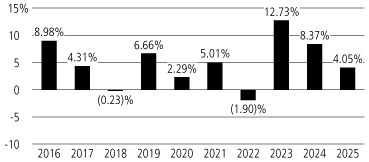
Best quarter: 9.21% (Q2, 2020)
Worst quarter: (13.58)% (Q1, 2020)
Inception date:
|
Period ended 12/31/25: |
One year 2025 |
Five years 2021-2025 |
Ten years 2016-2025 |
||||||||||||
| Class A Return before taxes |
-0.94 |
% |
4.51 |
% |
4.43 |
% |
|||||||||
|
Class A Return after taxes on distributions |
-3.79 |
1.74 |
2.11 |
||||||||||||
|
Class A Return after taxes on distributions and sale of fund shares |
-0.59 |
2.22 |
2.35 |
||||||||||||
| Class C Return before taxes |
2.32 |
4.76 |
4.17 |
||||||||||||
| Class I Return before taxes |
4.31 |
5.83 |
5.20 |
||||||||||||
|
S&P UBS Leveraged Loan Index Total Return (reflects no deduction for fees, expenses or taxes) |
5.94 |
6.37 |
5.78 |
||||||||||||
|
Morningstar LSTA US Leveraged Loan Index (reflects no deduction for fees, expenses or taxes)1 |
5.90 |
6.42 |
5.83 |
||||||||||||
(1) Effective October 1, 2025, the benchmark against which the fund measures its performance changed from the S&P UBS Leveraged Loan Index to the Morningstar LSTA US Leveraged Loan Index. Fund management believes that the new benchmark is more representative of the fund's strategy.
• After-tax returns are calculated using the historical highest individual federal marginal income tax rates and do not reflect the impact of state and local taxes. Actual after-tax returns depend on an investor's tax situation and may differ from those shown, and after-tax returns shown are not relevant to investors who hold their fund shares through tax-deferred arrangements, such as 401(k) plans or individual retirement accounts ("IRA").