General Strategy Description. Due to the unique mechanics of the Fund’s strategy, the return an investor can expect to receive from an investment in the Fund has characteristics that are distinct from many other investment vehicles. It is important that an investor understand these characteristics before making an investment in the Fund. The Fund has adopted a policy pursuant to Rule 35d-1 under the 1940 Act to invest, under normal circumstances, at least 80% of its net assets (plus any borrowings for investment purposes) in investments that provide exposure to the iShares 20+ Year Treasury Bond ETF.
The Fund’s strategy has been specifically designed to produce the “Outcomes” described below based upon the performance of the Underlying ETF over the duration of the Outcome Period. The Fund seeks replicate the performance of the Underlying ETF over the duration of the Outcome Period, subject to the below pre-determined Outcomes. There is no guarantee that the Fund will be successful in its attempt to provide the Outcomes for an Outcome Period.
• Upside Cap. Fund shareholders are subject to the Cap, which represents the maximum percentage return an investor can achieve from an investment in the Fund over the duration of the Outcome Period. For the current Outcome Period, the Fund’s returns are uncapped (i.e., the Fund’s returns are not subject to a Cap), and the Fund will participate in the entirety of the upside returns of the Underlying ETF over the Outcome Period, if any, prior to taking into account any fees or expenses charged to shareholders. When the Fund’s annual Fund management fee of 0.79% of the Fund’s average daily net assets is taken into account for the Outcome Period, the returns shareholders experience will be lowered by approximately 0.20% for the Outcome Period.
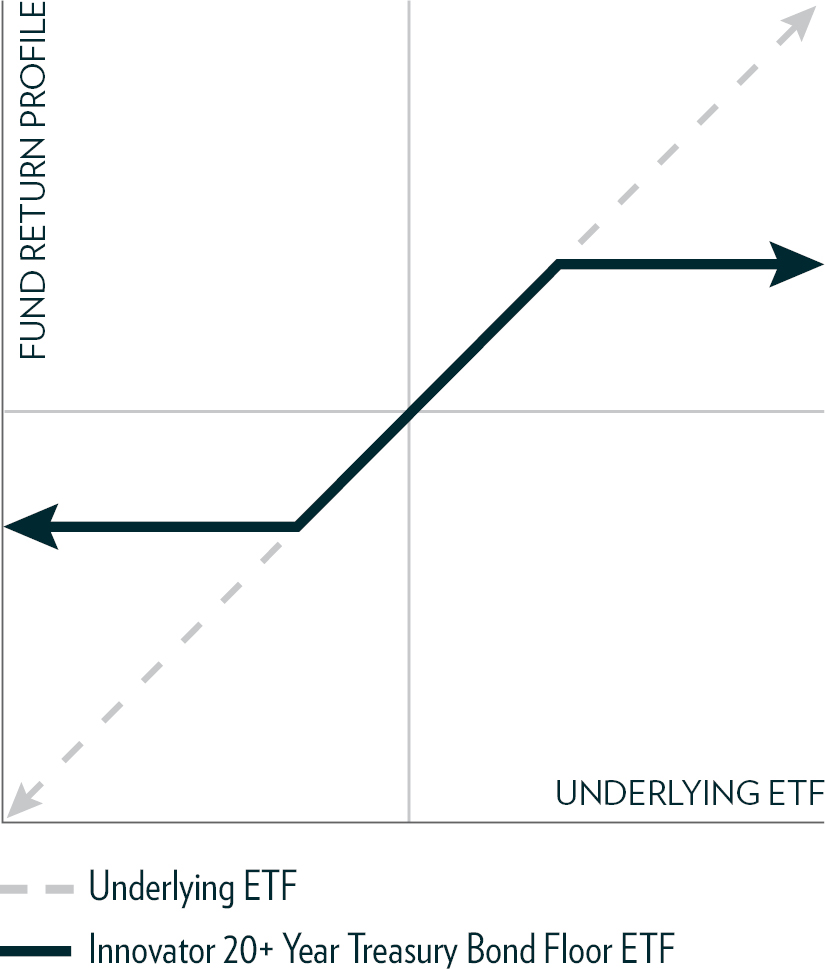
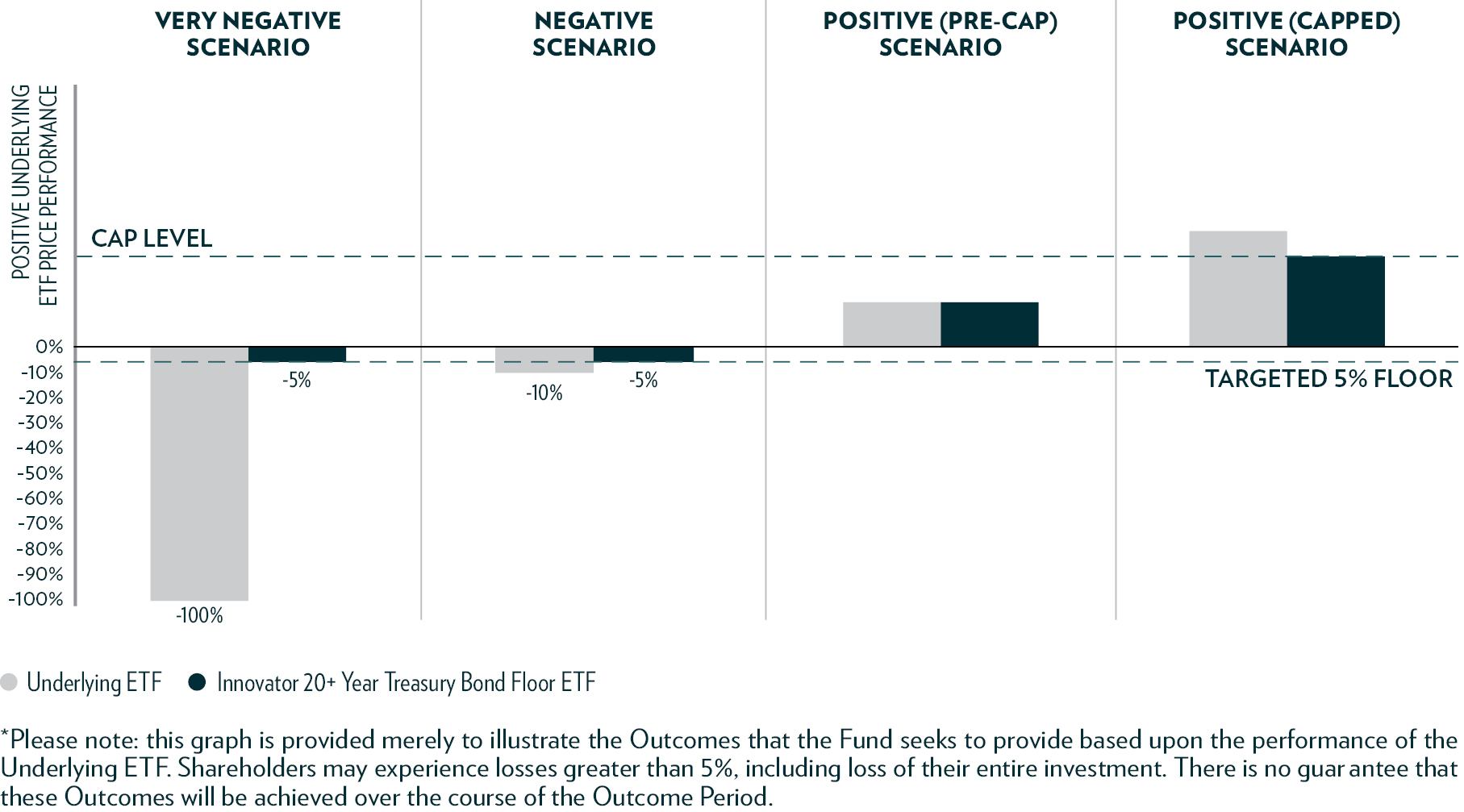
• Floor. The Fund seeks to provide shareholders that hold Shares for the entire Outcome Period with a decrease in value that approximately matches the decrease experienced by the Underlying ETF, with a maximum loss (i.e., the Floor) of 5% during the Outcome Period. The Fund’s shareholders will experience all Underlying ETF losses of less than 5% on a one-to-one basis. When the Fund’s annual management fee of 0.79% of the Fund’s daily net assets is taken into account, the net Floor for the Outcome Period is approximately 5.20%.
To produce the Outcomes, the Fund invests in FLEX Options that reference the Underlying ETF and may also invest in the Underlying ETF (or the components thereof) directly. The Underlying ETF is an ETF that seeks to provide investment results that, before fees expenses, correspond generally to the total return performance of an index composed of U.S. Treasury bonds with remaining maturities greater than twenty years. For additional information regarding the Underlying ETF, see “Additional Information Regarding the Fund’s Principal Investment Strategies.”
The hypothetical graphical illustration provided below is designed to illustrate the Outcomes that the Fund seeks to provide for investors who hold Shares for the entirety of the Outcome Period. The returns that the Fund seeks to provide do not include the costs associated with purchasing Shares and certain expenses incurred by the Fund.
The following table contains hypothetical examples designed to illustrate the Outcomes the Fund seeks to provide over an Outcome Period, based upon the performance of the Underlying ETF from -100% to 100%. The table is provided for illustrative purposes and does not provide every possible performance scenario for Shares over the course of an Outcome Period. The table is not intended to predict or project the performance of the Fund or its holdings. Fund shareholders should not take this information as an assurance of the expected performance of the Underlying ETF or return on Shares. The actual overall performance of the Fund will vary with fluctuations in the value of its assets during the Outcome Period, among other factors. Please refer to the Fund’s website, www.innovatoretfs.com/tfjl, which provides updated information relating to this table on a daily basis throughout the Outcome Period.
|
Underlying ETF Performance |
Fund Performance* |
|
100% |
100% |
|
50% |
50% |
|
20% |
20% |
|
15% |
15% |
|
10% |
10% |
|
5% |
5% |
|
0% |
0% |
|
(5)% |
(5)% |
|
(10)% |
(5)% |
|
(15)% |
(5)% |
|
(20)% |
(5)% |
|
(50)% |
(5)% |
|
(100)% |
(5)% |
* The Fund’s returns listed herein are provided prior to taking into account any fees or expenses charged to shareholders. The Fund’s annual management fee of 0.79% of the Fund’s average daily net assets, any shareholder transaction fees, any acquired fund fees and expenses, and any extraordinary expenses incurred by the Fund will have the effect of reducing the returns listed herein.
The Outcomes may only be realized by investors who continuously hold Shares from the commencement of the Outcome Period until its conclusion. Investors who purchase Shares after the Outcome Period has begun or sell Shares prior to the Outcome Period’s conclusion may experience investment returns that are very different from those that the Fund seeks to provide. In addition, because the Fund is designed to achieve Outcomes that change for each three-month Outcome Period, the Outcomes that are achieved by the Fund for a three-month Outcome Period will be different than the Outcomes achieved by the Fund over multiple Outcome Periods, or on an annualized basis. Similarly, investors holding Shares over multiple Outcome Periods will experience different investment results than holding a fund that has a longer Outcome Period (e.g., one year). Upon conclusion of the Outcome Period, the Fund will receive the cash value of all the FLEX Options it held for the prior Outcome Period. It will then invest in a new series of FLEX Options with an expiration date of approximately three months in the future, and a new Outcome Period will begin. The Outcomes the Fund seeks to provide and discussed herein are provided based on the Fund’s NAV, whereas shareholders purchase or sell Shares on the Exchange at market prices. Any disconnect between the Fund’s NAV and market prices of Shares will result in returns that deviate from the Outcomes the Fund seeks to provide.
The Fund’s investment adviser is Innovator Capital Management, LLC (“Innovator” or the “Adviser”) and the Fund’s investment sub-adviser is Milliman Financial Risk Management LLC (“Milliman” or the “Sub-Adviser”). The Fund is classified as a “non-diversified company” under the Investment Company Act of 1940, as amended (the “1940 Act”).
The Outcome Period. The Outcome Period is an approximately three-month period. The current Outcome Period is from January 1, 2026 through March 31, 2026. The Fund’s sought-after Outcomes are designed to be provided at the conclusion of the Outcome Period, and are based upon the Fund’s NAV at the outset of the Outcome Period. Each FLEX Option’s value is ultimately derived from the performance of the Underlying ETF during that time. Because the terms of the FLEX Options don’t change, the Cap and Floor both relate to the Fund’s NAV on the first day of the Outcome Period. Further, since the Fund’s option contracts are exercisable at the conclusion of the Outcome Period, the Outcomes are only provided at the end of the Outcome Period. Therefore, to achieve the Outcomes sought by the Fund for the Outcome Period, an investor must hold Shares from the commencement of the Outcome Period through its conclusion. There is no guarantee that the Fund will be successful in its attempt to provide the Outcomes.
The Fund’s NAV is based upon the value of its portfolio which consists of FLEX Options, and may also include shares of the Underlying ETF (or the components thereof). Although the value of the Underlying ETF’s share price is a significant component of the value of the Fund’s FLEX Options, the value of the Fund’s FLEX Options (and therefore, the Fund’s NAV) will not increase or decrease at the same rate as the Underlying ETF’s share price on a daily basis. The time remaining until those FLEX Options expire, which is at the conclusion of the Outcome Period, also affects their value. The Sub-Adviser generally anticipates that the Fund’s NAV will increase on days when the Underlying ETF’s share price increases and will decrease on days when the Underlying ETF’s share price decreases, but that the rate of such increase or decrease will be less than that experienced by the Underlying ETF.
For additional information regarding the Outcome Period, including the potential impacts of purchasing and selling intra-Outcome Period, see “Additional Information Regarding the Fund’s Principal Investment Strategies.”
Cap on Potential Upside Returns. Unlike other investment products, the potential upside returns an investor can receive from an investment in the Fund over the Outcome Period is subject to the Cap. The Cap represents the maximum percentage return an investor can achieve from an investment in the Fund over the duration of the Outcome Period. Therefore, even though the Fund’s returns are based upon the performance of the Underlying ETF, if the Underlying ETF experiences returns for the Outcome Period in excess of the Cap, the Fund will not participate in such excess returns. The Cap is determined on the first day of the Outcome Period. For the current Outcome Period, the Fund’s returns are uncapped (i.e., the Fund’s returns are not subject to the Cap), and the Fund will participate in the entirety of the upside returns of the Underlying ETF over the Outcome Period, prior to taking into account any fees or expenses charged to shareholders. When the Fund’s annual Fund management fee of 0.79% of the Fund’s average daily net assets is taken into account for the Outcome Period, the returns shareholders experience will be lowered by approximately 0.20% for the Outcome Period. Such returns will be further reduced by any
shareholder transaction fees, any acquired fund fees and expenses, and any extraordinary expenses incurred by the Fund. Since the Cap is based upon prevailing market conditions at the beginning of an Outcome Period, the Cap will rise or fall from one Outcome Period to the next, and there is no guarantee that the Fund’s returns will be uncapped in any subsequent Outcome Period. For the current Outcome Period, market conditions are such that in order to participate in the returns of the Underlying ETF and the Floor, the Fund does not need to sell a call FEL Option, and accordingly, the Fund’s returns are uncapped. Information regarding the Cap is also set forth on the Fund’s website at www.innovatoretfs.com/tfjl.
Floor. The Fund seeks to provide shareholders who hold Shares for the entire Outcome Period with the Floor, representing the maximum amount of loss experienced by the Underlying ETF (i.e., losses of 5%) that the Fund will participate in. However, there is no guarantee that the Fund will be successful in its attempt to provide the Floor. The Fund will experience all Underlying ETF losses of less than 5% on a one-to-one basis. The effect sought to be created by the Floor is that if the Underlying ETF’s share price has decreased by less than 5%, the Fund will experience the entirety of such losses, however if the Underlying ETF’s share price has decreased by more than 5% over the Outcome Period, the Fund seeks to limit its losses to 5%. A shareholder may lose their entire investment. While the Fund seeks to limit losses to 5% for shareholders who hold Shares for the entire Outcome Period, there is no guarantee it will successfully do so. An investment in the Fund is only appropriate for shareholders willing to bear those losses.
The Floor is provided prior to taking into account annual Fund management fees, transaction fees, any acquired fund fees and expenses, and any extraordinary expenses incurred by the Fund. These fees and any expenses will have the effect of reducing the Floor amount for Fund shareholders for an Outcome Period. When the Fund’s annual management fee equal to 0.79% of the Fund’s daily net assets is taken into account for the Outcome Period, the net Floor for an Outcome Period is approximately 5.20%. Since the Fund’s strategy is designed to produce the Outcomes on the last day of the Outcome Period, it should not be expected that the Floor, including the net effect of the Fund’s annual management fee on the Floor, will be provided at any point prior to the last day of the Outcome Period.
The Fund’s Portfolio. The Fund invests in FLEX Options that reference the Underlying ETF and may also invest directly in shares of the Underlying ETF (or the components thereof). In general, an option contract is an agreement between a buyer and seller that gives the purchaser of the option the right to buy or sell a particular asset at a specified future date at an agreed upon price. FLEX Options are exchange-traded option contracts with uniquely customizable terms.
The Fund seeks to achieve the Outcomes, including the Cap and Floor, by purchasing and selling call FLEX Options and purchasing put FLEX Options to create layers within the Fund’s portfolio. The customizable nature of FLEX Options allows the Sub-Adviser to select the share price of the Underlying ETF at which the option contract may be exercised. This is commonly known as the “strike price.” At the commencement of the Outcome Period, the Sub-Adviser specifically selects the strike price for each FLEX Option such that when the FLEX Options are exercised on the final day of the Outcome Period, the Outcomes may be obtained, depending on the performance of the Underlying ETF’s share price over the duration of the Outcome Period. Each of the FLEX Options purchased and sold throughout the Outcome Period are expected to have the same or similar terms
(i.e., strike price and expiration) as the corresponding FLEX Options purchased and sold on the first day of the Outcome Period. The Fund utilizes European style option contracts, which are exercisable only on the expiration date of the option contract.
For a given Outcome Period, the Fund may invest exclusively in FLEX Options or may purchase the Underlying ETF directly (and/or the components thereof) and FLEX Options to produce the Outcomes. To the extent the Fund invests solely in FLEX Options that reference the Underlying ETF, the Cap and Floor will be provided on a price return basis (i.e., the Outcomes will be provided based on changes in the share price of the Underlying ETF), and the Fund will not receive the benefit of any dividends. For Outcome Periods in which the Fund directly purchases the Underlying ETF, in addition to FLEX Options, to construct the Fund’s portfolio, the Fund will receive dividends from the Underlying ETF, and the Cap and Floor will be provided inclusive of dividends or distributions received (i.e., the price returns of the Underlying ETF plus dividends or distributions received). If the Fund invests in the Underlying ETF directly (or the components thereof), to calculate the Cap and Floor, the Adviser will assume an estimated dividend rate for the Underlying ETF (which is based on the historical dividend rate of the Underlying ETF). To the extent the dividends or distributions received by the Fund differ from this assumed rate, the Cap and Floor may be higher or lower than disclosed herein. If the Fund invests directly in the Underlying ETF, it will bear its proportionate share of the Underlying ETF’s expenses. The Adviser has entered into an agreement to waive its management fee to the extent of the acquired fund fees and expenses incurred in connection with its investment in the Underlying ETF.
Additional information regarding the terms of the FLEX Options, information on the Underlying ETF, and the mechanics of the Fund’s strategy can be found in “Additional Information Regarding the Fund’s Principal Investment Strategies.”
Fund Rebalance. The Fund is a continuous investment vehicle. It does not terminate and distribute its assets at the conclusion of each Outcome Period. On the termination date of an Outcome Period, the Sub-Adviser will invest in a new set of FLEX Options, or a combination of FLEX Options and the Underlying ETF (or components thereof) directly, and another Outcome Period will commence.
Approximately one week prior to the end of each Outcome Period, the Fund will file a prospectus supplement, which will alert existing shareholders that an Outcome Period is approaching its conclusion and disclose the anticipated ranges for the Cap for the next Outcome Period. Following the close of business on the last day of the Outcome Period, the Fund will file a prospectus supplement that discloses the Fund’s final Cap (both gross and net of the unitary management fee) for the next Outcome Period. This information is available on the Fund’s website, www.innovatoretfs.com/tfjl, which also provides information regarding, among other items, the start date and end date of the Outcome Period, the Cap and Floor, the Underlying ETF, the Fund’s portfolio holdings for the Outcome Period, whether the Outcomes are based on the price return of the Underlying ETF or the price return of the Underlying ETF plus dividends or distributions received, and information relating to the potential outcomes of an investment in the Fund on a daily basis. Important information relating to the Fund, including information relating to the Cap, is communicated on the Fund’s website.
General Strategy Description. Due to the unique mechanics of the Fund’s strategy, the return an investor can expect to receive from an investment in the Fund has characteristics that are distinct from many other investment vehicles. It is important that an investor understand these characteristics before making an investment in the Fund. The Fund has adopted a policy pursuant to Rule 35d-1 under the 1940 Act to invest, under normal circumstances, at least 80% of its net assets (plus any borrowings for investment purposes) in investments that provide exposure to the iShares 20+ Year Treasury Bond ETF.
The Fund’s strategy has been specifically designed to produce the “Outcomes” described below based upon the performance of the Underlying ETF over the duration of the Outcome Period. The Fund seeks replicate the performance of the Underlying ETF over the duration of the Outcome Period, subject to the below pre-determined Outcomes. There is no guarantee that the Fund will be successful in its attempt to provide the Outcomes for an Outcome Period.
• Upside Cap. Fund shareholders are subject to the Cap, which represents the maximum percentage return an investor can achieve from an investment in the Fund over the duration of the Outcome Period. The Cap is set on the first day of the Outcome Period and is 48.65% prior to taking into account any fees or expenses charged to shareholders. When the Fund’s annual Fund management fee of 0.79% of the Fund’s average daily net assets is taken into account, the Cap is 47.86%.
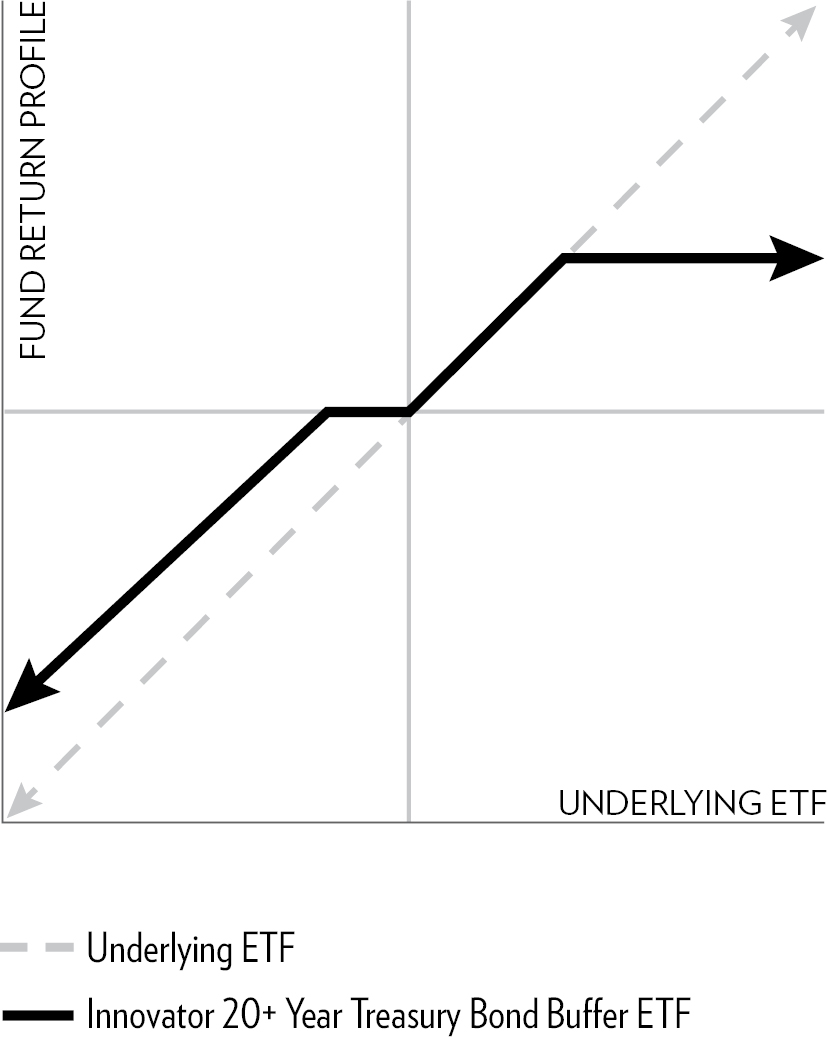
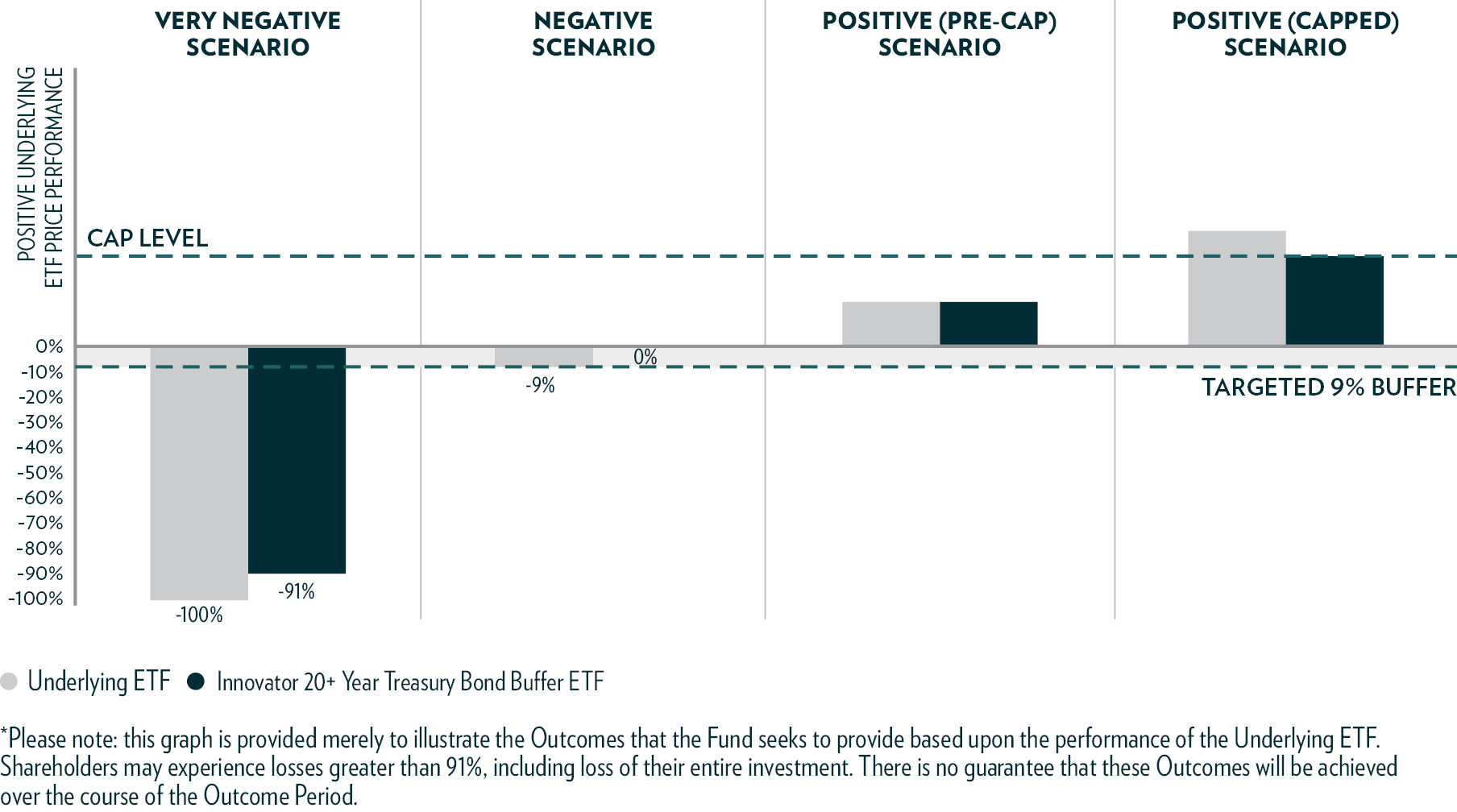
• Buffered Returns. The Fund seeks to provide shareholders that hold Shares for the entire Outcome Period with the Buffer, which seeks to protect against the first 9% of Underlying ETF losses during the Outcome Period. The Fund’s shareholders will bear all Underlying ETF losses exceeding 9% on a one-to-one basis. When the Fund’s annual management fee equal to 0.79% of the Fund’s daily net assets is taken into account, the net Buffer for an Outcome Period is 8.21%.
To produce the Outcomes, the Fund invests in FLEX Options that reference the Underlying ETF and may also invest in the Underlying ETF (or the components thereof) directly. The Underlying ETF is an ETF that seeks to provide investment results that, before fees expenses, correspond generally to the total return performance of an index composed of U.S. Treasury bonds with remaining maturities greater than twenty years. For additional information regarding the Underlying ETF, see “Additional Information Regarding the Fund’s Principal Investment Strategies.”
The two hypothetical graphical illustrations provided below are designed to illustrate the Outcomes that the Fund seeks to provide for investors who hold Shares for the entirety of the Outcome Period. The returns that the Fund seeks to provide do not include the costs associated with purchasing Shares and certain expenses incurred by the Fund.
The following table contains hypothetical examples designed to illustrate the Outcomes the Fund seeks to provide over an Outcome Period, based upon the performance of the Underlying ETF from -100% to 100%. The table is provided for illustrative purposes and does not provide every possible performance scenario for Shares over the course of an Outcome Period. The table is not intended to predict or project the performance of the Fund or its holdings. Fund shareholders should not take this information as an assurance of the expected performance of the Underlying ETF or return on Shares. The actual overall performance of the Fund will vary
with fluctuations in the value of its assets during the Outcome Period, among other factors. Please refer to the Fund’s website, www.innovatoretfs.com/tbjl, which provides updated information relating to this table on a daily basis throughout the Outcome Period.
|
Underlying ETF Performance |
Fund Performance* |
|
100% |
48.65% |
|
50% |
48.65% |
|
20% |
20% |
|
15% |
15% |
|
10% |
10% |
|
5% |
5% |
|
0% |
0% |
|
(5)% |
0% |
|
(10)% |
(1)% |
|
(15)% |
(6)% |
|
(20)% |
(11)% |
|
(50)% |
(41)% |
|
(100)% |
(91)% |
* The Fund’s returns listed herein are provided prior to taking into account any fees or expenses charged to shareholders. The Fund’s annual management fee of 0.79% of the Fund’s average daily net assets, any shareholder transaction fees, any acquired fund fees and expenses, and any extraordinary expenses incurred by the Fund will have the effect of reducing the returns listed herein.
The Outcomes may only be realized by investors who continuously hold Shares from the commencement of the Outcome Period until its conclusion. Investors who purchase Shares after the Outcome Period has begun or sell Shares prior to the Outcome Period’s conclusion may experience investment returns that are very different from those that the Fund seeks to provide. Upon conclusion of the Outcome Period, the Fund will receive the cash value of all the FLEX Options it held for the prior Outcome Period. It will then invest in a new series of FLEX Options with an expiration date of approximately one year in the future, and a new Outcome Period will begin. The Outcomes the Fund seeks to provide and discussed herein are provided based on the Fund’s NAV, whereas shareholders purchase or sell Shares on the Exchange at market prices. Any disconnect between the Fund’s NAV and market prices of Shares will result in returns that deviate from the Outcomes the Fund seeks to provide.
The Fund’s investment adviser is Innovator Capital Management, LLC (“Innovator” or the “Adviser”) and the Fund’s investment sub-adviser is Milliman Financial Risk Management LLC (“Milliman” or the “Sub-Adviser”). The Fund is classified as a “non-diversified company” under the Investment Company Act of 1940, as amended (the “1940 Act”).
The Outcome Period. The Outcome Period is an approximately one-year period from July 1 through June 30 of the following year. The current Outcome Period is from July 1, 2025 through June 30, 2026. The Fund’s sought-after Outcomes are designed to be provided at the conclusion of the Outcome Period, and are based upon the Fund’s NAV at the outset of the Outcome Period. Each FLEX Option’s value is ultimately derived from the performance of the Underlying ETF during
that time. Because the terms of the FLEX Options don’t change, the Cap and Buffer both relate to the Fund’s NAV on the first day of the Outcome Period. Further, since the Fund’s option contracts are exercisable at the conclusion of the Outcome Period, the Outcomes are only provided at the end of the Outcome Period. Therefore, to achieve the Outcomes sought by the Fund for the Outcome Period, an investor must hold Shares from the commencement of the Outcome Period through its conclusion. There is no guarantee that the Fund will be successful in its attempt to provide the Outcomes.
The Fund’s NAV is based upon the value of its portfolio which consists of FLEX Options, and may also include shares of the Underlying ETF (or the components thereof). Although the value of the Underlying ETF’s share price is a significant component of the value of the Fund’s FLEX Options, the value of the Fund’s FLEX Options (and therefore, the Fund’s NAV) will not increase or decrease at the same rate as the Underlying ETF’s share price on a daily basis. The time remaining until those FLEX Options expire, which is at the conclusion of the Outcome Period, also affects their value. The degree of non-correlation between the value of the FLEX Options and the value of the Underlying ETF may be higher than if the FLEX Options utilized by the Fund had a shorter term. The Sub-Adviser generally anticipates that the Fund’s NAV will increase on days when the Underlying ETF’s share price increases and will decrease on days when the Underlying ETF’s share price decreases, but that the rate of such increase or decrease will be less than that experienced by the Underlying ETF.
For additional information regarding the Outcome Period, including the potential impacts of purchasing and selling intra-Outcome Period, see “Additional Information Regarding the Fund’s Principal Investment Strategies.”
Cap on Potential Upside Returns. Unlike other investment products, the potential upside returns an investor can receive from an investment in the Fund over the Outcome Period is subject to the Cap. The Cap represents the maximum percentage return an investor can achieve from an investment in the Fund over the duration of the Outcome Period. Therefore, even though the Fund’s returns are based upon the performance of the Underlying ETF, if the Underlying ETF experiences returns for the Outcome Period in excess of the Cap, the Fund will not participate in such excess returns. The Cap is determined on the first day of the Outcome Period and is 48.65% prior to taking into account any fees or expenses charged to shareholders. When the Fund’s annual Fund management fee of 0.79% of the Fund’s average daily net assets is taken into account, the Cap is 47.86%. The Cap will be further reduced by any shareholder transaction fees, any acquired fund fees and expenses, and any extraordinary expenses incurred by the Fund. The Cap will change from one Outcome Period to the next based upon prevailing market conditions at the beginning of the Outcome Period. The Cap is also set forth on the Fund’s website at www.innovatoretfs.com/tbjl.
Buffer. The Fund seeks to provide shareholders who hold Shares for the entire Outcome Period with a Buffer against the first 9% of Underlying ETF losses for the Outcome Period; however, there is no guarantee that the Fund will be successful in its attempt to provide buffered returns. After the Underlying ETF’s share price has decreased by more than 9%, the Fund will
experience all subsequent losses on a one-to-one basis. The effect sought to be created by the Buffer is that if the Underlying ETF’s share price has decreased in value over the course of the Outcome Period, the Fund seeks to be returned the amount of its principal investment (if the Underlying ETF’s share price decreased in value by 9% or less) or experience a loss that is 9% less than the loss experienced by the Underlying ETF (if the Underlying ETF’s share price decreased in value by more than 9%). A shareholder may lose their entire investment. While the Fund seeks to limit losses to 91% for shareholders who hold Shares for the entire Outcome Period, there is no guarantee it will successfully do so. An investment in the Fund is only appropriate for shareholders willing to bear those losses.
The Buffer is provided prior to taking into account annual Fund management fees, transaction fees, any acquired fund fees and expenses, and any extraordinary expenses incurred by the Fund. These fees and any expenses will have the effect of reducing the Buffer amount for Fund shareholders for an Outcome Period. When the Fund’s annual management fee equal to 0.79% of the Fund’s daily net assets is taken into account, the net Buffer for an Outcome Period is 8.21%. Since the Fund’s strategy is designed to produce the Outcomes on the last day of the Outcome Period, it should not be expected that the Buffer, including the net effect of the Fund’s annual management fee on the Buffer, will be provided at any point prior to the last day of the Outcome Period.
The Fund’s Portfolio. The Fund invests in FLEX Options that reference the Underlying ETF and may also invest directly in shares of the Underlying ETF (or the components thereof). In general, an option contract is an agreement between a buyer and seller that gives the purchaser of the option the right to buy or sell a particular asset at a specified future date at an agreed upon price. FLEX Options are exchange-traded option contracts with uniquely customizable terms.
The Fund seeks to achieve the Outcomes, including the Cap and Buffer, by purchasing and selling call and put FLEX Options to create layers within the Fund’s portfolio. The customizable nature of FLEX Options allows the Sub-Adviser to select the share price of the Underlying ETF at which the option contract may be exercised. This is commonly known as the “strike price.” At the commencement of the Outcome Period, the Sub-Adviser specifically selects the strike price for each FLEX Option such that when the FLEX Options are exercised on the final day of the Outcome Period, the Outcomes may be obtained, depending on the performance of the Underlying ETF’s share price over the duration of the Outcome Period. Each of the FLEX Options purchased and sold throughout the Outcome Period are expected to have the same or similar terms (i.e., strike price and expiration) as the corresponding FLEX Options purchased and sold on the first day of the Outcome Period. The Fund utilizes European style option contracts, which are exercisable only on the expiration date of the option contract.
For a given Outcome Period, the Fund may invest exclusively in FLEX Options or may purchase the Underlying ETF directly (and/or the components thereof) and FLEX Options to produce the Outcomes. To the extent the Fund invests solely in FLEX Options that reference the Underlying ETF, the Cap and Buffer will be provided on a price return basis (i.e., the Outcomes will be provided based on changes in the share price of the Underlying ETF), and the Fund will not receive the benefit of any dividends. For Outcome Periods in which the Fund directly purchases the Underlying ETF, in addition to FLEX Options, to construct the Fund’s portfolio, the Fund will
receive dividends from the Underlying ETF, and the Cap and Buffer will be provided inclusive of dividends or distributions received (i.e., the price returns of the Underlying ETF plus dividends or distributions received). If the Fund invests in the Underlying ETF directly (or the components thereof), to calculate the Cap and Buffer, the Adviser will assume an estimated dividend rate for the Underlying ETF (which is based on the historical dividend rate of the Underlying ETF). To the extent the dividends or distributions received by the Fund differ from this assumed historical rate, the Cap and Buffer may be higher or lower than disclosed herein. If the Fund invests directly in the Underlying ETF, it will bear its proportionate share of the Underlying ETF’s expenses. The Adviser has entered into an agreement to waive its management fee to the extent of the acquired fund fees and expenses incurred in connection with its investment in the Underlying ETF.
Additional information regarding the terms of the FLEX Options, information on the Underlying ETF, and the mechanics of the Fund’s strategy can be found in “Additional Information Regarding the Fund’s Principal Investment Strategies.”
Fund Rebalance. The Fund is a continuous investment vehicle. It does not terminate and distribute its assets at the conclusion of each Outcome Period. On the termination date of an Outcome Period, the Sub-Adviser will invest in a new set of FLEX Options, or a combination of FLEX Options and the Underlying ETF (or components thereof) directly, and another Outcome Period will commence.
Approximately one week prior to the end of each Outcome Period, the Fund will file a prospectus supplement, which will alert existing shareholders that an Outcome Period is approaching its conclusion and disclose the anticipated ranges for the Cap for the next Outcome Period. Following the close of business on the last day of the Outcome Period, the Fund will file a prospectus supplement that discloses the Fund’s final Cap (both gross and net of the unitary management fee) for the next Outcome Period. This information is available on the Fund’s website, www.innovatoretfs.com/tbjl, which also provides information regarding, among other items, the start date and end date of the Outcome Period, the Cap and Buffer, the Underlying ETF, the Fund’s portfolio holdings for the Outcome Period, whether the Outcomes are based on the price return of the Underlying ETF or the price return of the Underlying ETF plus dividends or distributions received, and information relating to the potential outcomes of an investment in the Fund on a daily basis. Important information relating to the Fund, including information relating to the Cap, is communicated on the Fund’s website.
General Strategy Description. The Fund is an actively managed ETF that seeks to provide risk-managed investment exposure to the Underlying ETF. The Fund seeks to achieve its investment objective by investing in exchange-traded options contracts with one-year expirations (specifically, FLexible EXchange® Options (“FLEX Options”)) on the Underlying ETF (the “Options Portfolio”) and may also invest directly in the Underlying ETF (or the components thereof).
As described below, the Fund seeks to participate in the return of the Underlying ETF, subject to an upside return limit and a measure of downside loss protection (a “Buffer”). The Sub-Adviser (defined below) will actively monitor the performance of the Options Portfolio and as described below, rebalance or “step-up” the Options Portfolio prior to its expiration.
• Participation in Underlying ETF Returns. The Fund seeks to participate in the in the returns of the Underlying ETF, subject to an upside return limit and protection against a measure of downside losses of the Underlying ETF.
• Step-Up Strategy. The Fund’s “step-up” investment strategy seeks to help a Fund’s shareholder offset the timing risks inherent in owning an options package for one year. The Options Portfolio is designed to produce investment outcomes only for the duration of its one-year options contracts and not for any different period of time. However, the Sub-Adviser intends to manage the Fund’s investment exposure by periodically terminating its Options Portfolio earlier than its one-year expiration date and immediately resetting its Options Portfolio for a new one-year period (i.e., “step-up” its holdings). Each month, the Sub-Adviser will observe increases and decreases in the Fund from the time the Fund’s FLEX Options holdings were originally entered into and will seek to realize gains experienced by the Fund or Buffer used by the Fund by resetting the Fund’s Options Portfolio. In implementing the step-up strategy, the Sub-Adviser will seek to protect capital or capture portfolio gains experienced by the Fund, depending on its evaluation of market conditions each month. See “Principal Investment Strategies—Step-Up Strategy” below. There is no guarantee the Fund will be successful in implementing this strategy.
The Fund does not pursue a “defined outcome” strategy. Defined outcome strategies seek to produce pre-determined investment outcomes based upon the performance of an underlying security over a specific period of time (e.g., one year). The Fund will not seek to provide a set level of investment outcomes over a stated time period. Unlike other ETFs that utilize a defined outcome investment strategy, the Fund does not seek to provide shareholders with a set Buffer percentage and maximum upside potential over any specified time period. Shareholders will experience investment results that are very different than if the Fund held the Options Portfolio for its contract duration. The successful implementation of the step-up investment strategy is not guaranteed.
In implementing the above, the Fund invests in FLEX Options that reference the Underlying ETF and may also invest in the Underlying ETF (or the components thereof) directly. The Underlying ETF is an ETF that seeks to provide investment results that, before fees expenses, correspond generally to the total return performance of an index that tracks the performance of
large capitalization exchange-traded U.S. equity securities, specifically the S&P 500® Index. For additional information regarding the Underlying ETF, see “Additional Information Regarding the Fund’s Principal Investment Strategies.”
The Fund’s investment adviser is Innovator Capital Management, LLC (“Innovator” or the “Adviser”) and the Fund’s investment sub-adviser is Milliman Financial Risk Management LLC (“Milliman” or the “Sub-Adviser”). The Fund is classified as a “non-diversified company” under the Investment Company Act of 1940, as amended (the “1940 Act”). To the extent the Underlying ETF is considered to be concentrated (i.e., holds 25% or more of its total assets) in the securities of a particular industry or group of industries, the Fund will concentrate to approximately the same extent. As of the date of this prospectus, the Fund has significant exposure to the information technology sector.
Portfolio Return Profile. The Fund’s portfolio seeks to replicate the performance of the Underlying ETF, subject to a maximum return potential and a Buffer. The Options Portfolio is designed to produce investment outcomes only for the duration of its one-year options contracts and not for any different period of time. As described more fully below, the Fund does not seek to achieve the full one-year investment outcomes of the Options Portfolio, as the Sub-Adviser intends to opportunistically reset the Options Portfolio prior to the one-year expiration date of the FLEX Options.
The Sub-Adviser seeks to specifically select the strike price for each FLEX Option contract such that if the FLEX Options were exercised on the expiration date (the final day of the one-year term), the Fund’s NAV would be subject to the maximum gains on the performance of the Underlying ETF’s share price over the duration of the options contract or the benefit from the protection of the Buffer, as follows:
• In the event that the Underlying ETF decreases in value by less than 9% over the duration of the Options Portfolio, the Fund seeks to provide investment return of 0%.
• In the event that the Underlying ETF decreases in value by more than 9% over the duration of the Options Portfolio, the Options Portfolio seeks to provide losses that are 9% less than the losses experienced by the Underlying ETF.
• In the event that the Underlying ETF increases in value over the duration of the Options Portfolio, the Options Portfolio seeks to provide investment returns that match the performance of the Underlying ETF, up to a maximum percentage return the Fund can achieve for the duration of the Options Portfolio, which is dependent on prevailing market conditions at the times the Fund enters into the FLEX Options.
The Fund’s sought-after returns, including the Buffer and maximum gain potential of Underlying ETF performance that the Options Portfolio seeks to provide, are provided prior to taking into account annual Fund management fees, transaction fees and any extraordinary expenses incurred by the Fund. These expenses will have the effect of reducing the Fund’s returns, including the maximum gain potential amount and Buffer amount experienced by shareholders. If the Fund invests in the Underlying ETF directly (or the components thereof), the Adviser will assume an estimated dividend rate for the Underlying ETF (which is based on the historical dividend rate
of the Underlying ETF) to calculate the Buffer and maximum return potential. To the extent the dividends received by the Fund differ from this assumed historical rate, the Buffer and maximum return potential may be higher or lower than disclosed herein. If the Fund invests directly in the Underlying ETF, it will bear its proportionate share of the Underlying ETF’s expenses. The Adviser has entered into an agreement to waive its management fee to the extent of the acquired fund fees and expenses incurred in connection with its investment in the Underlying ETF.
As further described herein, the Fund does not expect that the Options Portfolio will be held until the expiration date of the FLEX Options. Instead, the Sub-Adviser will seek to opportunistically manage the Fund’s investment exposure by periodically terminating its FLEX Options investments earlier than its one-year expiration date and immediately reset the Fund’s Options Portfolio for a new one-year period. Both the maximum gain potential and the sought-after Buffer are measured from the price of the Underlying ETF at the time the FLEX Option contracts are executed and will only be provided on the expiration date. As a result, the degree to which a shareholder may benefit from the Fund’s potential for participating in the return of the Underlying ETF and the Buffer against Underlying ETF losses will depend on the time at which the investor purchases Shares of the Fund and the Sub-Adviser’s determination of when to reset the Options Portfolio. Because the Fund’s investment strategy is not designed to hold the Options Portfolio to its expiration date, shareholders will experience investment results that are very different than if the Fund held the Options Portfolio for its contract duration. Shareholders may realize losses on price decreases of the Underlying ETF of less than the 9% Buffer and may lose their entire investment. These potential losses are possible even if a shareholder remained in the Fund for a one-year period after an Options Portfolio was established, as it is likely that the Options Portfolio will reset during that time.
Further, the Options Portfolio is designed to protect against Underlying ETF losses and provide for a maximum gain potential based upon the price of the Underlying ETF at the time the FLEX Option contracts are into by the Fund. However, the degree to which a shareholder may benefit from the Fund’s Underlying ETF upside potential and Buffer against Underlying ETF losses will depend on the time at which the investor purchases Shares of the Fund. At any given time after Sub-Adviser resets the Options Portfolio there may be limited upside potential or Buffer remaining due to the performance of the Underlying ETF. If the price of the Underlying ETF is near or above the Fund’s maximum return potential, such investor may have little to no upside potential until the Sub-Adviser determines to step-up the Fund’s Options Portfolio and would still remain vulnerable to significant downside risk before the sought-after protection from the Buffer began. Similarly, if the Underlying ETF has decreased in price significantly to equal or exceed the Fund’s anticipated Buffer, the shareholder would also remain vulnerable to significant downside risk and would receive no benefit from the Buffer. A shareholder could lose its entire investment. There is no guarantee that the Sub-Adviser will be successful in its attempt to provide the Buffer.
Step-Up Strategy. The Fund’s “step-up” investment strategy seeks to help a Fund’s shareholder offset the timing risks inherent in owning an options package for one year. The Sub-Adviser will seek to realize gains experienced by the Fund (which are limited to the maximum gain potential) or realize the Buffer used by the Fund by resetting the Fund’s Options Portfolio as often as monthly and therefore resetting the Fund’s maximum upside potential and Buffer. The successful implementation of the step-up investment strategy is not guaranteed.
As a result of the performance of the Underlying ETF during the term of the FLEX Options (the value of which is derived from, in part, the value of the Underlying ETF’s share price), the Fund may have little or no upside available for the remainder of the options contract term (if the Underlying ETF has increased in value) or little or no ability to benefit from the Buffer (if the Underlying ETF has decreased in value). With the step-up investment strategy, the Fund may, at the end of each month, sell the then-current Options Portfolio and immediately enter into new FLEX Options contracts that establish a new one-year expiration date. In doing so, the Fund will reset its exposure to the Underlying ETF and continue to have the potential to increase in a market environment where the value of the Underlying ETF is steadily increasing or derive continued benefit from a Buffer in a market environment where the Underlying ETF is steadily decreasing. The ability to provide downside protection as part of the implementation of the Fund’s step-up investment strategy may not be successful.
The Sub-Adviser will continuously review the performance of the Fund and at each month-end determine whether to step-up the Options Portfolio. The Sub-Adviser will consider the price movements of the Underlying ETF, the changes in the Fund’s NAV, market volatility, time remaining until the expiration of the FLEX Options contracts and strike prices of the replacement FLEX Options contracts when evaluating whether to reset the Options Portfolio. The following chart contains a hypothetical illustration of the Fund’s step-up mechanism. The chart is provided for illustrative purposes only. There is no guarantee that the Fund will be successful in its attempt to step-up the Fund’s Options Portfolio. The chart is not intended to predict or project the performance or operationality of the Fund.
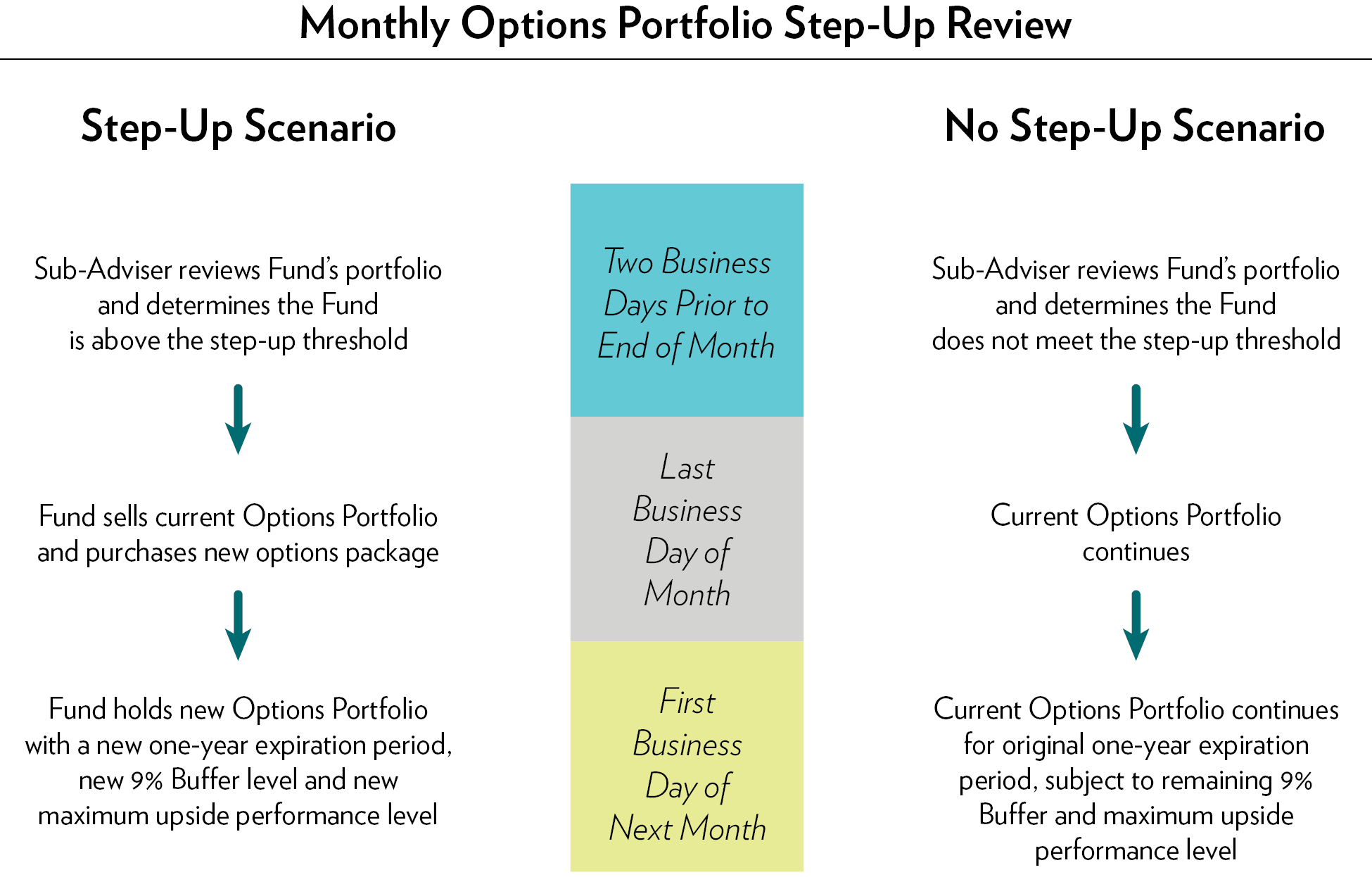
To the extent the Fund’s NAV increases (generally a range from 2% to 6%) or decreases (generally a range from -1% to -5%) from the Fund’s NAV at the time the FLEX Options were originally entered into, the Sub-Adviser will seek to realize any gains experienced by the Fund or Buffer used by the Fund by resetting the Fund’s Options Portfolio and, in doing so, “step-up” the Fund’s upside potential and Buffer. The Sub-Adviser will also purchase and sell FLEX Options over the course of the month that have the same or similar terms (i.e., strike price and expiration date) as the then-current Options Portfolio as necessary to manage any creations or redemptions of “Creation Units” (as defined below).
The Fund’s Portfolio. The Fund invests in FLEX Options that reference the Underlying ETF and may also invest directly in shares of the Underlying ETF (or the components thereof). To the extent the Fund invests solely in FLEX Options, the Fund will seek to participate in the price return of the Underlying ETF (prior to taking into account management fees and other fees). If the Fund invests directly in the Underlying ETF (or the components thereof), the Fund will seek to provide such returns inclusive of dividends (i.e., the price return of the Underlying ETF plus dividends received). In general, an option contract gives the purchaser of the option, in exchange for the premium paid, the right to purchase (for a call option) or sell (for a put option) the underlying asset at a specified price (the “strike price”) on a specified date (the “expiration date”). The Fund utilizes FLEX Options, which are customizable exchange-traded option contracts guaranteed for settlement by the Options Clearing Corporation (the “OCC”). The Fund’s FLEX Options are cash-settled, European style option contracts (i.e., exercisable at the strike price only on the expiration date) with an expiration date approximately one-year in the future from the time of execution.
The Fund’s NAV is based upon the value of its portfolio which consists of FLEX Options, and may also include shares of the Underlying ETF (or the components thereof). Although the value of the Underlying ETF’s share price is a significant component of the value of the Fund’s FLEX Options, the value of the Fund’s FLEX Options (and therefore, the Fund’s NAV) will not increase or decrease at the same rate as the Underlying ETF’s share price on a daily basis. The time remaining until those FLEX Options expire, which is at the conclusion of the Outcome Period, also affects their value. The degree of non-correlation between the value of the FLEX Options and the value of the Underlying ETF may be higher than if the FLEX Options utilized by the Fund had a shorter term. The Sub-Adviser generally anticipates that the Fund’s NAV will increase on days when the Underlying ETF’s share price increases and will decrease on days when the Underlying ETF’s share price decreases, but that the rate of such increase or decrease will be less than that experienced by the Underlying ETF. However, there is no guarantee that the Fund’s NAV will move in the same direction as the price movements of the Underlying ETF and it is not expected for the Fund’s NAV to directly correlate on a day-to-day basis with the returns experienced by the Underlying ETF.
General Strategy Description. Due to the unique mechanics of the Fund’s strategy, the return an investor can expect to receive from an investment in the Fund has characteristics that are distinct from many other investment vehicles. It is important that an investor understand these characteristics before making an investment in the Fund. The Fund has adopted a policy pursuant to Rule 35d-1 under the 1940 Act to invest, under normal circumstances, at least 80% of its net assets (plus any borrowings for investment purposes) in investments that provide exposure to the State Street® SPDR® S&P 500® ETF Trust.
The Fund’s strategy has been specifically designed to produce the “Outcomes” described below based upon the performance of the Underlying ETF over the duration of the Outcome Period. The Fund seeks replicate the performance of the Underlying ETF over the duration of the Outcome Period, subject to the below pre-determined Outcomes. The Fund’s “Defined Wealth Shield” investment strategy seeks to limit downside losses via the operation of the Buffer, while simultaneously generating returns that match the Underlying ETF, up to the Cap. There is no guarantee that the Fund will be successful in its attempt to provide the Outcomes for an Outcome Period.
• Upside Cap. Fund shareholders are subject to the Cap, which represents the maximum percentage return an investor can achieve from an investment in the Fund over the duration of the Outcome Period. The Cap is set on the first day of the Outcome Period and is 2.09% prior to taking into account any fees or expenses charged to shareholders. When the Fund’s annual Fund management fee of 0.69% of the Fund’s average daily net assets is taken into account for the Outcome Period, the Cap is 1.91%.
• Buffered Returns. The Fund seeks to provide shareholders that hold Shares for the entire Outcome Period with the Buffer, which for the current Outcome Period is 20% of Underlying ETF losses during the Outcome Period. The Fund’s shareholders will bear all Underlying ETF losses exceeding the Buffer on a one-to-one basis. When the Fund’s annual management fee equal to 0.69% of the Fund’s daily net assets is taken into account for the Outcome Period, the net Buffer for an Outcome Period is 19.82%. The Buffer is expected to be within a range of 15% to 20% of Underlying ETF losses for each Outcome Period. Although the Fund expects to set a Buffer within a range of 15% to 20%for each Outcome Period, there is no guarantee that the final Buffer set for an Outcome Period will be within this range or that the Fund will provide the Buffer. It is possible that the Buffer will rise or fall from one Outcome Period to the next.
To produce the Outcomes, the Fund invests in FLEX Options that reference the Underlying ETF and may also invest in the Underlying ETF (or the components thereof) directly. The Underlying ETF is an ETF that seeks to provide investment results that, before fees expenses, correspond generally to the total return performance of an index that tracks the performance of large capitalization exchange-traded U.S. equity securities, specifically the S&P 500® Index. For additional information regarding the Underlying ETF, see “Additional Information Regarding the Fund’s Principal Investment Strategies.”
The hypothetical graphical illustration provided below is designed to illustrate the Outcomes that the Fund seeks to provide for investors who hold Shares for the entirety of the Outcome Period. The returns that the Fund seeks to provide do not include the costs associated with purchasing Shares and certain expenses incurred by the Fund.
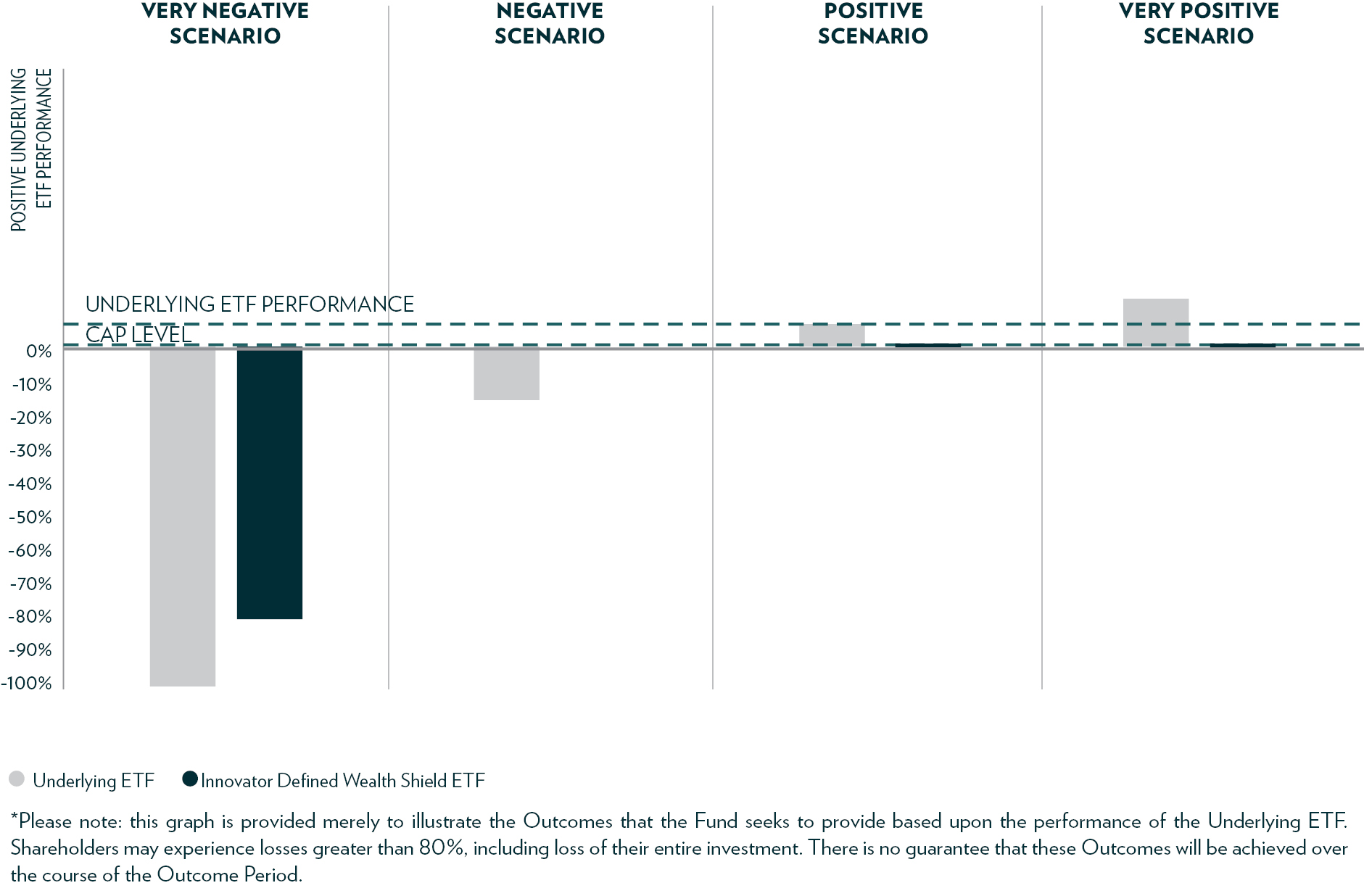
The following table contains hypothetical examples designed to illustrate the Outcomes the Fund seeks to provide over an Outcome Period, based upon the performance of the Underlying ETF from -100% to 100%. The table is provided for illustrative purposes and does not provide every possible performance scenario for Shares over the course of an Outcome Period. The table is not intended to predict or project the performance of the Fund or its holdings. Fund shareholders should not take this information as an assurance of the expected performance of the Underlying ETF or return on Shares. The actual overall performance of the Fund will vary with fluctuations in the value of its assets during the Outcome Period, among other factors. Please refer to the Fund’s website, www.innovatoretfs.com/balt, which provides updated information relating to this table on a daily basis throughout the Outcome Period.
| Underlying ETF Performance | Fund Performance* |
| 100% | 2.09% |
| 50% | 2.09% |
| 20% | 2.09% |
| 15% | 2.09% |
| 10% | 2.09% |
| 5% | 2.09% |
| 0% | 0% |
| (5)% | 0% |
| (10)% | 0% |
| (15)% | 0% |
| (20)% | 0% |
| (50)% | (30)% |
| (100)% | (80)% |
* The Fund’s returns listed herein are provided prior to taking into account any fees or expenses charged to shareholders. The Fund’s annual management fee of 0.69% of the Fund’s average daily net assets, any shareholder transaction fees, any acquired fund fees and expenses, and any extraordinary expenses incurred by the Fund will have the effect of reducing the returns listed herein.
The Outcomes may only be realized by investors who continuously hold Shares from the commencement of the Outcome Period until its conclusion. Investors who purchase Shares after the Outcome Period has begun or sell Shares prior to the Outcome Period’s conclusion may experience investment returns that are very different from those that the Fund seeks to provide. In addition, because the Fund is designed to achieve Outcomes that change for each three-month Outcome Period, the Outcomes that are achieved by the Fund for a three-month Outcome Period will be different than the Outcomes achieved by the Fund over multiple Outcome Periods, or on an annualized basis. Similarly, investors holding Shares over multiple Outcome Periods will experience different investment results than holding a fund that has a longer Outcome Period (e.g., one year). Upon conclusion of the Outcome Period, the Fund will receive the cash value of all the FLEX Options it held for the prior Outcome Period. It will then invest in a new series of FLEX Options with an expiration date of approximately three months in the future, and a new Outcome Period will begin. The Outcomes the Fund seeks to provide and discussed herein are provided based on the Fund’s NAV, whereas shareholders purchase or sell Shares on the Exchange at market prices. Any disconnect between the Fund’s NAV and market prices of Shares will result in returns that deviate from the Outcomes the Fund seeks to provide.
The Fund’s investment adviser is Innovator Capital Management, LLC (“Innovator” or the “Adviser”) and the Fund’s investment sub-adviser is Milliman Financial Risk Management LLC (“Milliman” or the “Sub-Adviser”). The Fund is classified as a “non-diversified company” under the Investment Company Act of 1940, as amended (the “1940 Act”). To the extent the Underlying ETF concentrates (i.e., holds 25% or more of its total assets) in the securities of a particular industry or group of industries, the Fund will concentrate its investments to approximately the same extent. Through its exposure to the Underlying ETF, the Fund has significant exposure to companies in the information technology sector.
The Outcome Period. The Outcome Period is an approximately three-month period. The current Outcome Period is from January 1, 2026 through March 31, 2026. The Fund’s sought-after Outcomes are designed to be provided at the conclusion of the Outcome Period, and are based upon the Fund’s NAV at the outset of the Outcome Period. Each FLEX Option’s value is ultimately derived from the performance of the Underlying ETF during that time. Because the terms of the FLEX Options don’t change, the Cap and Buffer both relate to the Fund’s NAV on the first day of the Outcome Period. Further, since the Fund’s option contracts are exercisable at the conclusion of the Outcome Period, the Outcomes are only provided at the end of the Outcome Period. Therefore, to achieve the Outcomes sought by the Fund for the Outcome Period, an investor must hold Shares from the commencement of the Outcome Period through its conclusion. There is no guarantee that the Fund will be successful in its attempt to provide the Outcomes.
The Fund’s NAV is based upon the value of its portfolio which consists of FLEX Options, and may also include shares of the Underlying ETF (or the components thereof). Although the value of the Underlying ETF’s share price is a significant component of the value of the Fund’s FLEX Options, the value of the Fund’s FLEX Options (and therefore, the Fund’s NAV) will not increase or decrease at the same rate as the Underlying ETF’s share price on a daily basis. The time remaining until those FLEX Options expire, which is at the conclusion of the Outcome Period, also affects their value. The Sub-Adviser generally anticipates that the Fund’s NAV will increase on days when the Underlying ETF’s share price increases and will decrease on days when the Underlying ETF’s share price decreases, but that the rate of such increase or decrease will be less than that experienced by the Underlying ETF.
For additional information regarding the Outcome Period, including the potential impacts of purchasing and selling intra-Outcome Period, see “Additional Information Regarding the Fund’s Principal Investment Strategies.”
Cap on Potential Upside Returns. Unlike other investment products, the potential upside returns an investor can receive from an investment in the Fund over the Outcome Period is subject to the Cap. The Cap represents the maximum percentage return an investor can achieve from an investment in the Fund over the duration of the Outcome Period. Therefore, even though the Fund’s returns are based upon the performance of the Underlying ETF, if the Underlying ETF experiences returns for the Outcome Period in excess of the Cap, the Fund will not participate in such excess returns. The Cap is determined on the first day of the Outcome Period and is 2.09% prior to taking into account any fees or expenses charged to shareholders. When the Fund’s annual Fund management fee of 0.69% of the Fund’s average daily net assets is taken into account for the Outcome Period, the Cap is 1.91%. The Cap will be further reduced by any shareholder transaction fees, any acquired fund fees and expenses, and any extraordinary expenses incurred by the Fund. The Cap will change from one Outcome Period to the next based upon prevailing market conditions at the beginning of the Outcome Period. The Cap is also set forth on the Fund’s website at www.innovatoretfs.com/balt.
Buffer. The Fund seeks to provide shareholders who hold Shares for the entire Outcome Period with a buffer against Underlying ETF losses during the Outcome Period. The amount of the Buffer that the Fund ultimately provides for an Outcome Period is determined based upon the prevailing
market conditions at the beginning of an Outcome Period and is a set percentage established at the commencement of each Outcome Period. The Buffer is expected to be set within a range from 15% to 20% of Underlying ETF losses for each Outcome Period, although there is no guarantee the Buffer will be within that range for a particular Outcome Period and the Buffer may change from one Outcome Period to the next. The Buffer for the current Outcome Period is 20%; however, there is no guarantee that the Fund will be successful in its attempt to provide buffered returns. After the Underlying ETF’s share price has decreased by more than the Buffer, the Fund will experience all subsequent losses on a one-to-one basis. The effect sought to be created by the Buffer is that if the Underlying ETF’s share price has decreased in value over the course of the Outcome Period, the Fund seeks to be returned the amount of its principal investment (if the Underlying ETF’s share price decreased in value an amount equal to the Buffer or less) or experience the losses of the Underlying ETF minus the Buffer (if the Underlying ETF’s share price decreased in value by more than the Buffer). A shareholder may lose their entire investment. While the Fund seeks to limit losses for shareholders who hold Shares for the entire Outcome Period, there is no guarantee it will successfully do so. An investment in the Fund is only appropriate for shareholders willing to bear those losses.
The Buffer is provided prior to taking into account annual Fund management fees, transaction fees, any acquired fund fees and expenses, and any extraordinary expenses incurred by the Fund. These fees and any expenses will have the effect of reducing the Buffer amount for Fund shareholders for an Outcome Period. When the Fund’s annual management fee equal to 0.69% of the Fund’s daily net assets is taken into account for the Outcome Period, the net Buffer for the current Outcome Period is 19.82%. Since the Fund’s strategy is designed to produce the Outcomes on the last day of the Outcome Period, it should not be expected that the Buffer, including the net effect of the Fund’s annual management fee on the Buffer, will be provided at any point prior to the last day of the Outcome Period.
The Fund’s Portfolio. The Fund invests in FLEX Options that reference the Underlying ETF and may also invest directly in shares of the Underlying ETF (or the components thereof). In general, an option contract is an agreement between a buyer and seller that gives the purchaser of the option the right to buy or sell a particular asset at a specified future date at an agreed upon price. FLEX Options are exchange-traded option contracts with uniquely customizable terms.
The Fund seeks to achieve the Outcomes, including the Cap and Buffer, by purchasing and selling call and put FLEX Options to create layers within the Fund’s portfolio. The customizable nature of FLEX Options allows the Sub-Adviser to select the share price of the Underlying ETF at which the option contract may be exercised. This is commonly known as the “strike price.” At the commencement of the Outcome Period, the Sub-Adviser specifically selects the strike price for each FLEX Option such that when the FLEX Options are exercised on the final day of the Outcome Period, the Outcomes may be obtained, depending on the performance of the Underlying ETF’s share price over the duration of the Outcome Period. Each of the FLEX Options purchased and sold throughout the Outcome Period are expected to have the same or similar terms (i.e., strike price and expiration) as the corresponding FLEX Options purchased and sold on the first day of the Outcome Period. The Fund utilizes European style option contracts, which are exercisable only on the expiration date of the option contract.
For a given Outcome Period, the Fund may invest exclusively in FLEX Options or may purchase the Underlying ETF directly (and/or the components thereof) and FLEX Options to produce the Outcomes. To the extent the Fund invests solely in FLEX Options that reference the Underlying ETF, the Cap and Buffer will be provided on a price return basis (i.e., the Outcomes will be provided based on changes in the share price of the Underlying ETF), and the Fund will not receive the benefit of any dividends. For Outcome Periods in which the Fund directly purchases the Underlying ETF, in addition to FLEX Options, to construct the Fund’s portfolio, the Fund will receive dividends from the Underlying ETF, and the Cap and Buffer will be provided inclusive of dividends received (i.e., the price returns of the Underlying ETF plus dividends received). If the Fund invests in the Underlying ETF directly (or the components thereof), to calculate the Cap and Buffer, the Adviser will assume an estimated dividend rate for the Underlying ETF (which is based on the historical dividend rate of the Underlying ETF). To the extent the dividends received by the Fund differ from this assumed rate, the Cap and Buffer may be higher or lower than disclosed herein. If the Fund invests directly in the Underlying ETF, it will bear its proportionate share of the Underlying ETF’s expenses. The Adviser has entered into an agreement to waive its management fee to the extent of the acquired fund fees and expenses incurred in connection with its investment in the Underlying ETF.
Additional information regarding the terms of the FLEX Options, information on the Underlying ETF, and the mechanics of the Fund’s strategy can be found in “Additional Information Regarding the Fund’s Principal Investment Strategies.”
Fund Rebalance. The Fund is a continuous investment vehicle. It does not terminate and distribute its assets at the conclusion of each Outcome Period. On the termination date of an Outcome Period, the Sub-Adviser will invest in a new set of FLEX Options, or a combination of FLEX Options and the Underlying ETF (or components thereof) directly, and another Outcome Period will commence.
Approximately one week prior to the end of each Outcome Period, the Fund will file a prospectus supplement, which will alert existing shareholders that an Outcome Period is approaching its conclusion and disclose the anticipated ranges for the Cap and Buffer for the next Outcome Period. Following the close of business on the last day of the Outcome Period, the Fund will file a prospectus supplement that discloses the Fund’s final Cap and Buffer (both gross and net of the unitary management fee) for the next Outcome Period. This information is available on the Fund’s website, www.innovatoretfs.com/balt, which also provides information regarding, among other items, the start date and end date of the Outcome Period, the Cap and Buffer, the Underlying ETF, the Fund’s portfolio holdings for the Outcome Period, whether the Outcomes are based on the price return of the Underlying ETF or the price return of the Underlying ETF plus dividends received, and information relating to the potential outcomes of an investment in the Fund on a daily basis. Important information relating to the Fund, including information relating to the Cap, is communicated on the Fund’s website.
General Strategy Description. Due to the unique mechanics of the Fund’s strategy, the return an investor can expect to receive from an investment in the Fund has characteristics that are distinct from many other investment vehicles. It is important that an investor understand these characteristics before making an investment in the Fund. The Fund has adopted a policy pursuant to Rule 35d-1 under the 1940 Act to invest, under normal circumstances, at least 80% of its net assets (plus any borrowings for investment purposes) in investments that provide exposure to the iShares MSCI Emerging Markets ETF.
The Fund’s strategy has been specifically designed to produce the “Outcomes” described below based upon the performance of the Underlying ETF over the duration of the Outcome Period. The Fund seeks replicate the performance of the Underlying ETF over the duration of the Outcome Period, subject to the below pre-determined Outcomes. There is no guarantee that the Fund will be successful in its attempt to provide the Outcomes for an Outcome Period.
• Upside Cap. Fund shareholders are subject to the Cap, which represents the maximum percentage return an investor can achieve from an investment in the Fund over the duration of the Outcome Period. The Cap is set on the first day of the Outcome Period and is 3.07% prior to taking into account any fees or expenses charged to shareholders. When the Fund’s annual Fund management fee of 0.89% of the Fund’s average daily net assets is taken into account for the Outcome Period, the Cap is 2.84%.
• Buffered Returns. The Fund seeks to provide shareholders that hold Shares for the entire Outcome Period with the Buffer, which seeks to protect against the first 10% of Underlying ETF losses during the Outcome Period. The Fund’s shareholders will bear all Underlying ETF losses exceeding 10% on a one-to-one basis. When the Fund’s annual management fee equal to 0.89% of the Fund’s daily net assets is taken into account for the Outcome Period, the net Buffer for an Outcome Period is 9.77%.
To produce the Outcomes, the Fund invests in FLEX Options that reference the Underlying ETF and may also invest in the Underlying ETF (or the components thereof) directly. The Underlying ETF seeks to track a quarterly reviewed index, the MSCI Emerging Markets Index, which is designed to represent the performance of mid- and large-capitalization securities in emerging market countries. For additional information regarding the Underlying ETF, see “Additional Information Regarding the Fund’s Principal Investment Strategies.”
The hypothetical graphical illustration provided below is designed to illustrate the Outcomes that the Fund seeks to provide for investors who hold Shares for the entirety of the Outcome Period. The returns that the Fund seeks to provide do not include the costs associated with purchasing Shares and certain expenses incurred by the Fund.
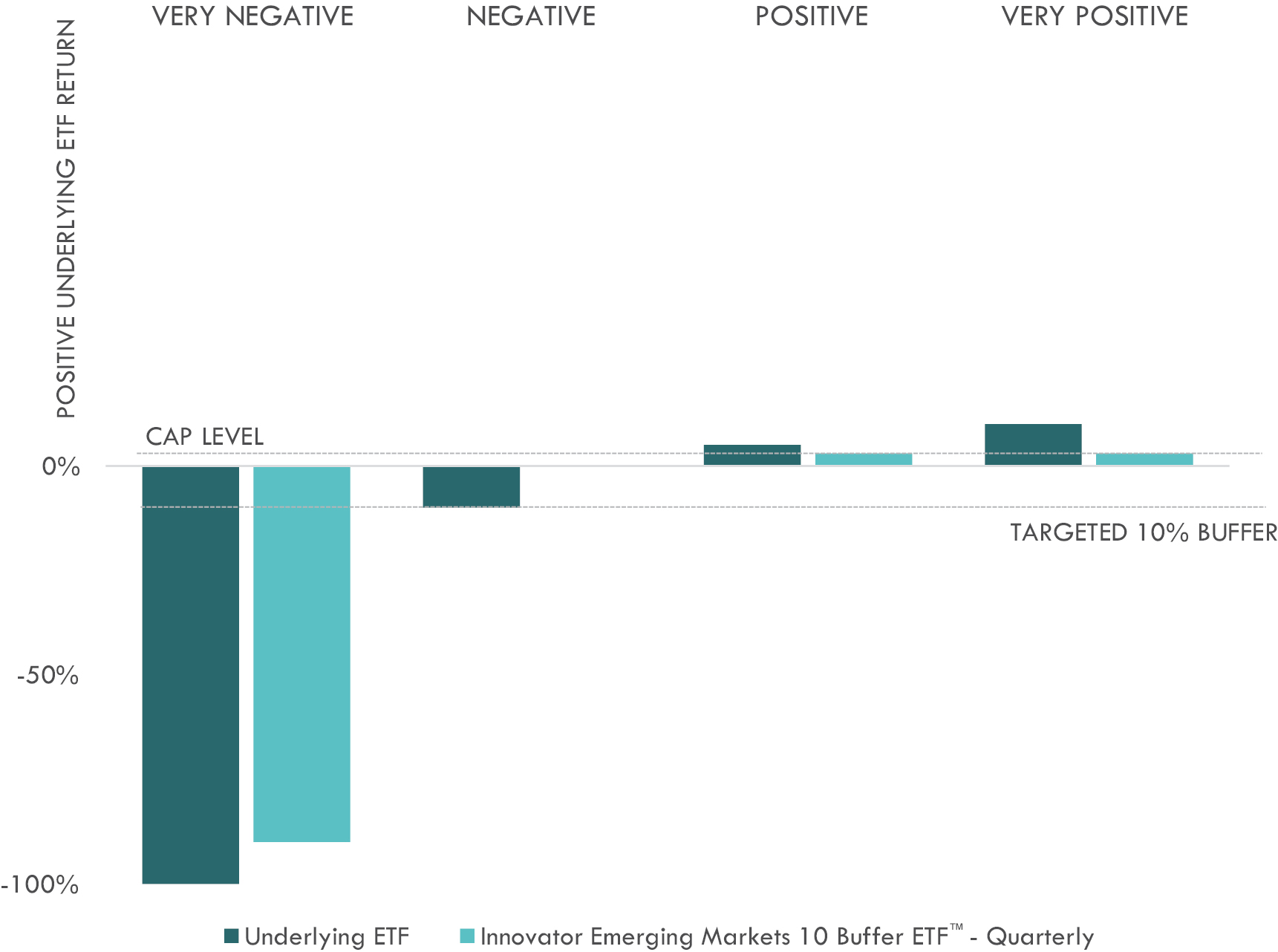
Please note this graph is provided merely to illustrate the Outcomes that the Fund seeks to provide based upon the performance of the Underlying ETF. Shareholders may experience losses greater than 90%, including loss of their entire investment. There is no guarantee that these Outcomes will be achieved over the course of the Outcome Period.
The following table contains hypothetical examples designed to illustrate the Outcomes the Fund seeks to provide over an Outcome Period, based upon the performance of the Underlying ETF from -100% to 100%. The table is provided for illustrative purposes and does not provide every possible performance scenario for Shares over the course of an Outcome Period. The table is not intended to predict or project the performance of the Fund or its holdings. Fund shareholders should not take this information as an assurance of the expected performance of the Underlying ETF or return on Shares. The actual overall performance of the Fund will vary
with fluctuations in the value of its assets during the Outcome Period, among other factors. Please refer to the Fund’s website, www.innovatoretfs.com/ebuf, which provides updated information relating to this table on a daily basis throughout the Outcome Period.
| Underlying ETF Performance | Fund Performance* |
| 100% | 3.07% |
| 50% | 3.07% |
| 20% | 3.07% |
| 15% | 3.07% |
| 10% | 3.07% |
| 5% | 3.07% |
| 0% | 0% |
| (5)% | 0% |
| (10)% | 0% |
| (15)% | (5)% |
| (20)% | (10)% |
| (50)% | (40)% |
| (100)% | (90)% |
* The Fund’s returns listed herein are provided prior to taking into account any fees or expenses charged to shareholders. The Fund’s annual management fee of 0.89% of the Fund’s average daily net assets, any shareholder transaction fees, any acquired fund fees and expenses, and any extraordinary expenses incurred by the Fund will have the effect of reducing the returns listed herein.
The Outcomes may only be realized by investors who continuously hold Shares from the commencement of the Outcome Period until its conclusion. Investors who purchase Shares after the Outcome Period has begun or sell Shares prior to the Outcome Period’s conclusion may experience investment returns that are very different from those that the Fund seeks to provide. In addition, because the Fund is designed to achieve Outcomes that change for each three-month Outcome Period, the Outcomes that are achieved by the Fund for a three-month Outcome Period will be different than the Outcomes achieved by the Fund over multiple Outcome Periods, or on an annualized basis. Similarly, investors holding Shares over multiple Outcome Periods will experience different investment results than holding a fund that has a longer Outcome Period (e.g., one year). Upon conclusion of the Outcome Period, the Fund will receive the cash value of all the FLEX Options it held for the prior Outcome Period. It will then invest in a new series of FLEX Options with an expiration date of approximately three months in the future, and a new Outcome Period will begin. The Outcomes the Fund seeks to provide and discussed herein are provided based on the Fund’s NAV, whereas shareholders purchase or sell Shares on the Exchange at market prices. Any disconnect between the Fund’s NAV and market prices of Shares will result in returns that deviate from the Outcomes the Fund seeks to provide.
The Fund’s investment adviser is Innovator Capital Management, LLC (“Innovator” or the “Adviser”) and the Fund’s investment sub-adviser is Milliman Financial Risk Management LLC (“Milliman” or the “Sub-Adviser”). The Fund is classified as a “non-diversified company” under the Investment Company Act of 1940, as amended (the “1940 Act”). To the extent the Underlying ETF concentrates (i.e., holds 25% or more of its total assets) in the securities of a particular industry or group of industries, the Fund will concentrate its investments to approximately the same extent.
Through its exposure to the Underlying ETF, the Fund has significant exposure to companies based in Asia, which, as of the date of this prospectus, includes companies located in China, as well as companies in the financials and information technology sectors.
The Outcome Period. The Outcome Period is an approximately three-month period. The current Outcome Period is from January 1, 2026 through March 31, 2026. The Fund’s sought-after Outcomes are designed to be provided at the conclusion of the Outcome Period, and are based upon the Fund’s NAV at the outset of the Outcome Period. Each FLEX Option’s value is ultimately derived from the performance of the Underlying ETF during that time. Because the terms of the FLEX Options don’t change, the Cap and Buffer both relate to the Fund’s NAV on the first day of the Outcome Period. Further, since the Fund’s option contracts are exercisable at the conclusion of the Outcome Period, the Outcomes are only provided at the end of the Outcome Period. Therefore, to achieve the Outcomes sought by the Fund for the Outcome Period, an investor must hold Shares from the commencement of the Outcome Period through its conclusion. There is no guarantee that the Fund will be successful in its attempt to provide the Outcomes.
The Fund’s NAV is based upon the value of its portfolio which consists of FLEX Options, and may also include shares of the Underlying ETF (or the components thereof). Although the value of the Underlying ETF’s share price is a significant component of the value of the Fund’s FLEX Options, the value of the Fund’s FLEX Options (and therefore, the Fund’s NAV) will not increase or decrease at the same rate as the Underlying ETF’s share price on a daily basis. The time remaining until those FLEX Options expire, which is at the conclusion of the Outcome Period, also affects their value. Additionally, since the Underlying ETF has the potential to be more volatile than other funds, during the Outcome Period it is possible that the degree of non-correlation between the value of the FLEX Options and the value of the Underlying ETF will be higher than if the FLEX Options utilized a less volatile reference asset. The Sub-Adviser generally anticipates that the Fund’s NAV will increase on days when the Underlying ETF’s share price increases and will decrease on days when the Underlying ETF’s share price decreases, but that the rate of such increase or decrease will be less than that experienced by the Underlying ETF.
For additional information regarding the Outcome Period, including the potential impacts of purchasing and selling intra-Outcome Period, see “Additional Information Regarding the Fund’s Principal Investment Strategies.”
Cap on Potential Upside Returns. Unlike other investment products, the potential upside returns an investor can receive from an investment in the Fund over the Outcome Period is subject to the Cap. The Cap represents the maximum percentage return an investor can achieve from an investment in the Fund over the duration of the Outcome Period. Therefore, even though the Fund’s returns are based upon the performance of the Underlying ETF, if the Underlying ETF experiences returns for the Outcome Period in excess of the Cap, the Fund will not participate in such excess returns. The Cap is determined on the first day of the Outcome Period and is 3.07% prior to taking into account any fees or expenses charged to shareholders. When the Fund’s annual Fund management fee of 0.89% of the Fund’s average daily net assets is taken into account for the Outcome Period, the Cap is 2.84%. The Cap will be further reduced by any shareholder transaction fees, any acquired fund fees and expenses, and any extraordinary expenses
incurred by the Fund. The Cap will change from one Outcome Period to the next based upon prevailing market conditions at the beginning of the Outcome Period. The Cap is also set forth on the Fund’s website at www.innovatoretfs.com/ebuf.
Buffer. The Fund seeks to provide shareholders who hold Shares for the entire Outcome Period with a Buffer against the first 10% of Underlying ETF losses for the Outcome Period; however, there is no guarantee that the Fund will be successful in its attempt to provide buffered returns. After the Underlying ETF’s share price has decreased by more than 10%, the Fund will experience all subsequent losses on a one-to-one basis. The effect sought to be created by the Buffer is that if the Underlying ETF’s share price has decreased in value over the course of the Outcome Period, the Fund seeks to be returned the amount of its principal investment (if the Underlying ETF’s share price decreased in value by 10% or less) or experience a loss that is 10% less than the loss experienced by the Underlying ETF (if the Underlying ETF’s share price decreased in value by more than 10%). A shareholder may lose their entire investment. While the Fund seeks to limit losses to 90% for shareholders who hold Shares for the entire Outcome Period, there is no guarantee it will successfully do so. An investment in the Fund is only appropriate for shareholders willing to bear those losses.
The Buffer is provided prior to taking into account annual Fund management fees, transaction fees, any acquired fund fees and expenses, and any extraordinary expenses incurred by the Fund. These fees and any expenses will have the effect of reducing the Buffer amount for Fund shareholders for an Outcome Period. When the Fund’s annual management fee equal to 0.89% of the Fund’s daily net assets is taken into account for the Outcome Period, the net Buffer for an Outcome Period is 9.77%. Since the Fund’s strategy is designed to produce the Outcomes on the last day of the Outcome Period, it should not be expected that the Buffer, including the net effect of the Fund’s annual management fee on the Buffer, will be provided at any point prior to the last day of the Outcome Period.
The Fund’s Portfolio. The Fund invests in FLEX Options that reference the Underlying ETF and may also invest directly in shares of the Underlying ETF (or the components thereof). In general, an option contract is an agreement between a buyer and seller that gives the purchaser of the option the right to buy or sell a particular asset at a specified future date at an agreed upon price. FLEX Options are exchange-traded option contracts with uniquely customizable terms.
The Fund seeks to achieve the Outcomes, including the Cap and Buffer, by purchasing and selling call and put FLEX Options to create layers within the Fund’s portfolio. The customizable nature of FLEX Options allows the Sub-Adviser to select the share price of the Underlying ETF at which the option contract may be exercised. This is commonly known as the “strike price.” At the commencement of the Outcome Period, the Sub-Adviser specifically selects the strike price for each FLEX Option such that when the FLEX Options are exercised on the final day of the Outcome Period, the Outcomes may be obtained, depending on the performance of the Underlying ETF’s share price over the duration of the Outcome Period. Each of the FLEX Options purchased and sold throughout the Outcome Period are expected to have the same or similar terms (i.e., strike price and expiration) as the corresponding FLEX Options purchased and sold on the first day of the Outcome Period. The Fund utilizes European style option contracts, which are exercisable only on the expiration date of the option contract.
For a given Outcome Period, the Fund may invest exclusively in FLEX Options or may purchase the Underlying ETF directly (and/or the components thereof) and FLEX Options to produce the Outcomes. To the extent the Fund invests solely in FLEX Options that reference the Underlying ETF, the Cap and Buffer will be provided on a price return basis (i.e., the Outcomes will be provided based on changes in the share price of the Underlying ETF), and the Fund will not receive the benefit of any dividends. For Outcome Periods in which the Fund directly purchases the Underlying ETF, in addition to FLEX Options, to construct the Fund’s portfolio, the Fund will receive dividends from the Underlying ETF, and the Cap and Buffer will be provided inclusive of dividends received (i.e., the price returns of the Underlying ETF plus dividends received). If the Fund invests in the Underlying ETF directly (or the components thereof), to calculate the Cap and Buffer, the Adviser will assume an estimated dividend rate for the Underlying ETF (which is based on the historical dividend rate of the Underlying ETF). To the extent the dividends received by the Fund differ from this assumed rate, the Cap and Buffer may be higher or lower than disclosed herein. If the Fund invests directly in the Underlying ETF, it will bear its proportionate share of the Underlying ETF’s expenses. The Adviser has entered into an agreement to waive its management fee to the extent of the acquired fund fees and expenses incurred in connection with its investment in the Underlying ETF.
Additional information regarding the terms of the FLEX Options, information on the Underlying ETF, and the mechanics of the Fund’s strategy can be found in “Additional Information Regarding the Fund’s Principal Investment Strategies.”
Fund Rebalance. The Fund is a continuous investment vehicle. It does not terminate and distribute its assets at the conclusion of each Outcome Period. On the termination date of an Outcome Period, the Sub-Adviser will invest in a new set of FLEX Options, or a combination of FLEX Options and the Underlying ETF (or components thereof) directly, and another Outcome Period will commence.
Approximately one week prior to the end of each Outcome Period, the Fund will file a prospectus supplement, which will alert existing shareholders that an Outcome Period is approaching its conclusion and disclose the anticipated ranges for the Cap for the next Outcome Period. Following the close of business on the last day of the Outcome Period, the Fund will file a prospectus supplement that discloses the Fund’s final Cap (both gross and net of the unitary management fee) for the next Outcome Period. This information is available on the Fund’s website, www.innovatoretfs.com/ebuf, which also provides information regarding, among other items, the start date and end date of the Outcome Period, the Cap and Buffer, the Underlying ETF, the Fund’s portfolio holdings for the Outcome Period, whether the Outcomes are based on the price return of the Underlying ETF or the price return of the Underlying ETF plus dividends received, and information relating to the potential outcomes of an investment in the Fund on a daily basis. Important information relating to the Fund, including information relating to the Cap, is communicated on the Fund’s website.
The Fund is an actively managed ETF that, under normal market circumstances, seeks to provide capital appreciation through exposure to the constituents in the Nasdaq-100® Index (the “Nasdaq-100”) while providing a level of downside or “hedged” protection. The Fund will invest
at least 80% of its net assets (including borrowings for investment purposes) in equity securities and option contracts that provide economic exposure to the Nasdaq-100. As further described below, to achieve its investment objective, the Fund intends to invest in:
(i) a portfolio of common stocks that are representative of the Nasdaq-100 (the “Nasdaq-100 Portfolio”) to seek to provide capital appreciation. See “Nasdaq-100 Portfolio” below for additional information; and
(ii) put and call option contracts (the “Options Portfolio”) with durations of approximately three months from January 1 to March 31, April 1 to June 30, July 1 to September 30 and October 1 to December 31 of each year (each, an “Options Portfolio Period”) that seek to provide a level of hedged downside protection for the Fund from 5% to 15% of Invesco QQQ TrustSM, Series 1 (the “Underlying ETF”) losses over the term of the respective Options Portfolio Period. The Fund will forego upside returns of the Nasdaq-100 Portfolio beyond the level of the strike price of each sold call option on the Underlying ETF over an Option Portfolio Period. See “Options Portfolio Hedged Downside Protection” below for additional information.
The Fund’s investment adviser is Innovator Capital Management, LLC (“Innovator” or the “Adviser”) and the Fund’s investment sub-adviser is Milliman Financial Risk Management LLC (“Milliman” or the “Sub-Adviser”).
The Fund will not concentrate (i.e., invest 25% or more of its net assets) in the securities of issuers in any one industry or group of industries, except that the Fund will concentrate to approximately the same extent as the Nasdaq-100® Index concentrates in the securities of a particular industry or group of industries. As of the date of this prospectus, through the Nasdaq-100 Portfolio and the Fund’s use of FLEX Options on the Options Portfolio, the Fund is concentrated in the information technology sector.
The Fund is classified as a “non-diversified company” under the Investment Company Act of 1940, as amended (the “1940 Act”).
Nasdaq-100 Portfolio Sought-After Capital Appreciation
The Sub-Adviser expects, under normal market circumstances, to invest the Fund’s net assets in the common stock of companies that comprise the Nasdaq-100 through the implementation of a representative sampling strategy that seeks to replicate the performance of the Nasdaq-100. The Nasdaq-100 includes 100 of the largest domestic and international non-financial companies listed on the Nasdaq Stock Market based on market capitalization. The Nasdaq-100 is a modified market capitalization-weighted index with significant exposure to large capitalization companies.
Through the Nasdaq-100 Portfolio, the Fund seeks to have full exposure to the returns of the Nasdaq-100, subject to the Fund’s hedging strategy and corresponding return, which is subject to the upside limitations described below. Through representative sampling, the Nasdaq-100 Portfolio is not expected to include each of the common stocks of the companies that comprise the Nasdaq-100 and the Fund’s position in an individual stock may be overweight or underweight as compared to the Nasdaq-100. However, the Sub-Adviser will seek to replicate the Nasdaq-100
by adjusting the Fund’s investment weightings of the securities in the Nasdaq-100 Portfolio so as to provide the Fund investment returns that are substantially similar to the Nasdaq-100 to invest in a manner that achieves a high degree of correlation with the performance of the Nasdaq-100. The Fund expects that any dividends the Fund receives from its investment in common stocks that comprise the Nasdaq-100 will be distributed to shareholders on a quarterly basis.
Options Portfolio Hedged Downside Protection
Hedging Strategy
The Fund seeks to provide shareholders with the potential for hedged downside protection against significant declines in the Nasdaq-100 Portfolio through an Options Portfolio that references the price return (i.e., the change in the price of a specified asset, excluding any dividends paid) of the Underlying ETF, a unit investment trust that seeks to track the investment results, before fees and expenses, of the Nasdaq-100. While the Sub-Adviser will seek to construct the Options Portfolio contracts on the Underling ETF, which has a substantially similar investment exposure to the Nasdaq-100 Portfolio, any differences between the return of the Nasdaq-100 Portfolio versus that of the Underlying ETF may cause investors to not receive the full benefit of the hedging strategy, which is also not guaranteed. See “Options Portfolio” and “Option Contracts Risk” Below. The Options Portfolio is structured to seek to provide the Fund with hedged downside protection against Underlying ETF losses between 5% and 15% for each Option Portfolio Period. The Fund will bear the first 5% of Underlying ETF losses and all Underlying ETF losses exceeding 15% on a one-to-one basis over an Option Portfolio Period. Such protection may only be realized by investors who continuously hold Shares from the commencement of the approximately three-month Options Portfolio Period until its conclusion. To the extent an investor purchases or sells Shares after the Options Portfolio contracts are entered into or before the expiration of an Option Portfolio Period, such investor may not receive the full sought-after hedging strategy. The sought-after downside hedged protection is not guaranteed and is provided prior to taking into account the Fund’s annual management fee of 0.79%, transaction fees and any extraordinary expenses incurred by the Fund. These fees will have the effect of lowering the sought-after hedged downside protection for investors. The Fund may not be successful in limiting losses for investors through its usage of put option contracts in the Options Portfolio.
The implementation of the sought-after hedged downside protection is paid for through the selling of call option contracts within the Options Portfolio. The Fund will forego upside returns of the Nasdaq-100 Portfolio beyond the level of the strike price of each sold call option on the Underlying ETF over an Option Portfolio Period. In a market environment where the level of the Nasdaq-100 is increasing above the strike prices of the sold call options, the Fund’s performance may be lower when compared to the Nasdaq-100.
The sought-after hedging strategy is provided based on the Fund’s net asset value (“NAV”) on the day the respective put option contracts are entered into; however, the Fund’s shares trade at market prices on the Exchange. To the extent there is a discrepancy between the Fund’s NAV and market price when an investor buys or sells Shares, or when a put option contract within the Options Portfolio expires, it may impact the sought-after hedged downside protection such investor receives.
See “Options Portfolio” and “Intra-Options Portfolio” below for additional information relating to the operation of the Options Portfolio.
Options Portfolio
The Fund, through the Options Portfolio, is designed to provide a level of sought-after hedged downside protection from losses over the duration of an Options Portfolio Period. In general, an option contract is an agreement between a buyer and a seller that gives the purchaser of the option the right to purchase or sell the underlying asset (or deliver cash equal to the value of an underlying index) at a specified price (“strike price”) within a specified time period. A call option contract gives the buyer of the call option contract the right (but not the obligation) to buy, and the seller of the call option contract (i.e., the “writer”) the obligation to sell, a specified amount of an underlying security at a pre-determined price. A put option contract gives the buyer of the put option contract the right (but not the obligation) to sell, and the writer of the put option contract the obligation to buy (if the option is exercised), a specified amount of an underlying security at a pre-determined price. To implement the sought-after hedging strategy, the Fund will purchase and sell put option contracts and sell call option contracts.
The Sub-Adviser will manage the Options Portfolio to produce the sought-after hedging strategy by:
(i) purchasing and selling put option contracts with differing strike prices to produce results that, prior to taking into account any fees or expenses charged to shareholders, provide the sought-after hedged downside protection between 5% and 15% of Underlying ETF losses over an Options Portfolio Period. The Fund creates the hedging strategy by buying a put option on the Underlying ETF at a higher strike price and selling a put option on the Underlying ETF at a relatively lower strike price, which results in the hedged downside protection between 5% and 15% of Underlying ETF losses. The purchased and sold put option contracts are designed to provide the sought-after hedging strategy provided by the Options Portfolio at the expiration of the option contracts; however, such protection is not guaranteed.
(ii) selling call option contracts at the highest strike price possible to cover the premiums needed to offset the purchased put options. Sold call option contracts give the holder, in exchange for a premium, the right, but not the obligation, to purchase the reference asset from the seller at the strike price at a specified date. The sold call option contracts, along with the sold put option contracts described above, entitle the Fund to receive premiums to pay the costs of the purchased put option contracts. The Fund will forego upside returns of the Nasdaq-100 Portfolio beyond the level of the strike price of each sold call option on the Underlying ETF over an Option Portfolio Period.
The Options Portfolio will be comprised of FLEX Options that reference the Underlying ETF. FLEX Options are exchange-traded option contracts with uniquely customizable terms and guaranteed for settlement by the Options Clearing Corporation (the “OCC”). Although guaranteed for settlement by the OCC, FLEX Options are still subject to counterparty risk with the OCC and may be less liquid than more traditional exchange-traded option contracts. The FLEX Options
that comprise the Options Portfolio will have a duration of the Options Portfolio Period. Upon the expiration of an Options Portfolio, the Fund intends to purchase another Options Portfolio that provides the same return profile to the Fund for the next Options Portfolio Period.
While the Fund sells option contracts on the Underlying ETF, the Fund does not directly own shares of the Underlying ETF. As a result, these sold options are “uncovered” because the Fund has no direct position with which to fill the terms of the option contract should the option counterparty wish to exercise their right to the option. For the Fund’s sold put option contracts, the negative downside, if any, of the Fund’s sold put option contracts is covered between 5% and 15% by the Fund’s purchased put option contracts. For the Fund’s sold call option contracts, the Fund has unlimited loss potential that exists from the difference above the strike price to the then-current trading price of the Underlying ETF. However, as described above, the Fund owns a representative sampling of securities of the Nasdaq-100 with substantially the same investment exposure as the sold call options on the Underlying ETF. The Fund’s option contracts are cash settled European style option contracts that expire at each Options Portfolio Period and may only be exercised on the expiration date of the Options Portfolio Period. If a call option is exercised at the end of an Options Portfolio Period, the Fund will sell its holdings from the Nasdaq-100 Portfolio at the then current trading price and use the cash proceeds to make payment on the sold option obligations. As such, the Fund’s loss exposure in the event the Fund’s sold call option is exercised by a counterparty is equal to any negative difference between the Fund’s sale price of the underlying securities in the Nasdaq-100 Portfolio and the Underlying ETF strike price and any transaction costs. The Fund’s ability to use the sale of its holdings from the Nasdaq-100 Portfolio to make payment on the sold option obligations is not guaranteed.
Intra-Options Portfolio
The Fund’s hedging strategy is provided based on the Fund’s NAV at the outset of the Options Portfolio Period on the day the respective FLEX Option contracts are entered into and ends on the day they expire at the end of an Options Portfolio Period. Each FLEX Option’s value is ultimately derived from the performance of the Underlying ETF’s share price during that time. Because the terms of the FLEX Options do not change, the sought-after hedged downside protection relates to the Fund’s NAV on the first day of the Options Portfolio Period. The Fund’s sought-after hedged downside protection (through the Options Portfolio) may only be realized by investors who continuously hold Shares from the commencement of the approximately three-month Options Portfolio Period until its conclusion. Investors who purchase Shares after the Options Portfolio Period has begun or sell Shares prior to the Options Portfolio Period’s conclusion may experience investment returns that are very different from those that the Fund seeks to provide.
The value of the Fund’s FLEX Options is derived from the performance of the underlying reference asset, the Underlying ETF’s share price. However, because a component of an option’s value is the number of days remaining until its expiration, the Fund’s NAV will not directly correlate on a day-to-day basis with the returns experienced by the Underlying ETF until the expiration date of the option contracts. The Fund’s NAV is dependent, in part on the value of the Options Portfolio, which is based principally upon the performance of the Underlying ETF. The value of the option contracts in the Options Portfolio is affected by changes in the value and dividend rates of the securities represented in the Underlying ETF, changes in interest rates, changes in the actual
or perceived volatility of the Underlying ETF and the remaining time to the option contract’s expiration date, as well as trading conditions in the options market. As the price of the Underlying ETF changes and time moves towards the expiration date, the value of the option contracts, and therefore the Fund’s NAV, will change. The Sub-Adviser generally anticipates that the Fund’s NAV, in part, will increase on days when the Underlying ETF’s share price increases and will decrease on days when the Underlying ETF’s share price decreases, but that the rate of such increase or decrease will be less than that experienced by the Underlying ETF.
An investor that holds Shares through multiple Options Portfolio Periods may fail to experience gains comparable to those of the Underlying ETF over time because at the expiration of each Options Portfolio, the Fund will enter into a new Options Portfolio based on the then-current price of the Underlying ETF and any gains experienced by the Underlying ETF above the strike price of the sold call option contract of the prior Options Portfolio will be forfeited. Similarly, an investor that holds Shares through multiple Options Portfolio Periods will be unable to recapture losses from prior Options Portfolio Periods because at the end of each Options Portfolio, a new level of hedged downside protection will be established between 5% and 15% of Underlying ETF losses based on the then-current price of the Underlying ETF and any losses experienced below 15% will be locked-in. Moreover, the quarterly imposition of a new upside limit on future gains may make it difficult to recoup any losses from the prior Options Portfolios such that, over multiple Options Portfolios, the Fund may have losses that exceed those of the Underlying ETF.
General Strategy Description. Due to the unique mechanics of the Fund’s strategy, the return an investor can expect to receive from an investment in the Fund has characteristics that are distinct from many other investment vehicles. It is important that an investor understand these characteristics before making an investment in the Fund. The Fund has adopted a policy pursuant to Rule 35d-1 under the 1940 Act to invest, under normal circumstances, at least 80% of its net assets (plus any borrowings for investment purposes) in investments that provide exposure to the iShares MSCI EAFE ETF.
The Fund’s strategy has been specifically designed to produce the “Outcomes” described below based upon the performance of the Underlying ETF over the duration of the Outcome Period. The Fund seeks replicate the performance of the Underlying ETF over the duration of the Outcome Period, subject to the below pre-determined Outcomes. There is no guarantee that the Fund will be successful in its attempt to provide the Outcomes for an Outcome Period.
• Upside Cap. Fund shareholders are subject to the Cap, which represents the maximum percentage return an investor can achieve from an investment in the Fund over the duration of the Outcome Period. The Cap is set on the first day of the Outcome Period and is 2.49% prior to taking into account any fees or expenses charged to shareholders. When the Fund’s annual Fund management fee of 0.85% of the Fund’s average daily net assets is taken into account for the Outcome Period, the Cap is 2.27%.
• Buffered Returns. The Fund seeks to provide shareholders that hold Shares for the entire Outcome Period with the Buffer, which seeks to protect against the first 10% of Underlying ETF losses during the Outcome Period. The Fund’s shareholders will bear all Underlying ETF losses exceeding 10% on a one-to-one basis. When the Fund’s annual management fee equal to 0.85% of the Fund’s daily net assets is taken into account for the Outcome Period, the net Buffer for an Outcome Period is 9.78%.
To produce the Outcomes, the Fund invests in FLEX Options that reference the Underlying ETF and may also invest in the Underlying ETF (or the components thereof) directly. The Underlying ETF is an ETF that seeks to provide investment results that, before fees expenses, correspond generally to the total return performance of an index that tracks the performance of the largest domestic and international nonfinancial companies listed on The Nasdaq Stock Market, specifically the Nasdaq-100 Index®. For additional information regarding the Underlying ETF, see “Additional Information Regarding the Fund’s Principal Investment Strategies.”
The hypothetical graphical illustration provided below is designed to illustrate the Outcomes that the Fund seeks to provide for investors who hold Shares for the entirety of the Outcome Period. The returns that the Fund seeks to provide do not include the costs associated with purchasing Shares and certain expenses incurred by the Fund.
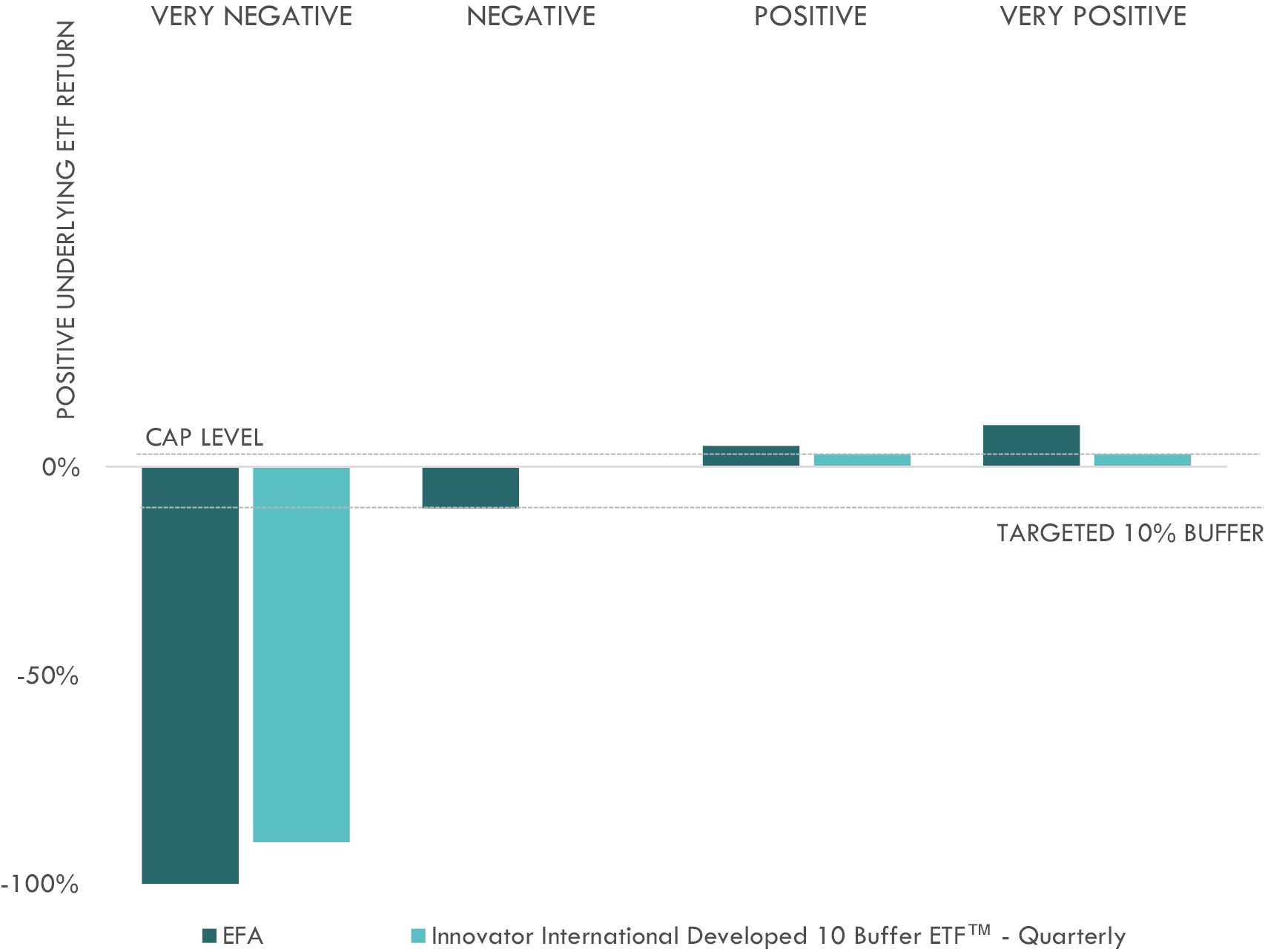
Please note this graph is provided merely to illustrate the Outcomes that the Fund seeks to provide based upon the performance of the Underlying ETF. Shareholders may experience losses greater than 90%, including loss of their entire investment. There is no guarantee that these Outcomes will be achieved over the course of the Outcome Period.
The following table contains hypothetical examples designed to illustrate the Outcomes the Fund seeks to provide over an Outcome Period, based upon the performance of the Underlying ETF from -100% to 100%. The table is provided for illustrative purposes and does not provide every possible performance scenario for Shares over the course of an Outcome Period. The table is not intended to predict or project the performance of the Fund or its holdings. Fund shareholders should not take this information as an assurance of the expected performance of the Underlying ETF or return on Shares. The actual overall performance of the Fund will vary
with fluctuations in the value of its assets during the Outcome Period, among other factors. Please refer to the Fund’s website, www.innovatoretfs.com/ibuf, which provides updated information relating to this table on a daily basis throughout the Outcome Period.
| Underlying ETF Performance | Fund Performance* |
| 100% | 2.49% |
| 50% | 2.49% |
| 20% | 2.49% |
| 15% | 2.49% |
| 10% | 2.49% |
| 5% | 2.49% |
| 0% | 0% |
| (5)% | 0% |
| (10)% | 0% |
| (15)% | (5)% |
| (20)% | (10)% |
| (50)% | (40)% |
| (100)% | (90)% |
* The Fund’s returns listed herein are provided prior to taking into account any fees or expenses charged to shareholders. The Fund’s annual management fee of 0.85% of the Fund’s average daily net assets, any shareholder transaction fees, any acquired fund fees and expenses, and any extraordinary expenses incurred by the Fund will have the effect of reducing the returns listed herein.
The Outcomes may only be realized by investors who continuously hold Shares from the commencement of the Outcome Period until its conclusion. Investors who purchase Shares after the Outcome Period has begun or sell Shares prior to the Outcome Period’s conclusion may experience investment returns that are very different from those that the Fund seeks to provide. In addition, because the Fund is designed to achieve Outcomes that change for each three-month Outcome Period, the Outcomes that are achieved by the Fund for a three-month Outcome Period will be different than the Outcomes achieved by the Fund over multiple Outcome Periods, or on an annualized basis. Similarly, investors holding Shares over multiple Outcome Periods will experience different investment results than holding a fund that has a longer Outcome Period (e.g., one year). Upon conclusion of the Outcome Period, the Fund will receive the cash value of all the FLEX Options it held for the prior Outcome Period. It will then invest in a new series of FLEX Options with an expiration date of approximately three months in the future, and a new Outcome Period will begin. The Outcomes the Fund seeks to provide and discussed herein are provided based on the Fund’s NAV, whereas shareholders purchase or sell Shares on the Exchange at market prices. Any disconnect between the Fund’s NAV and market prices of Shares will result in returns that deviate from the Outcomes the Fund seeks to provide.
The Fund’s investment adviser is Innovator Capital Management, LLC (“Innovator” or the “Adviser”) and the Fund’s investment sub-adviser is Milliman Financial Risk Management LLC (“Milliman” or the “Sub-Adviser”). The Fund is classified as a “non-diversified company” under the Investment Company Act of 1940, as amended (the “1940 Act”). To the extent the Underlying ETF concentrates (i.e., holds 25% or more of its total assets) in the securities of a particular industry or group of industries, the Fund will concentrate its investments to approximately the same extent. Through its exposure to the Underlying ETF, the Fund has significant exposure to
companies based in Europe and Asia, which, as of the date of this prospectus, includes companies located in Japan, as well as consumer goods and services companies, financials sector companies and industrials sector companies.
The Outcome Period. The Outcome Period is an approximately three-month period. The current Outcome Period is from January 1, 2026 through March 31, 2026. The Fund’s sought-after Outcomes are designed to be provided at the conclusion of the Outcome Period, and are based upon the Fund’s NAV at the outset of the Outcome Period. Each FLEX Option’s value is ultimately derived from the performance of the Underlying ETF during that time. Because the terms of the FLEX Options don’t change, the Cap and Buffer both relate to the Fund’s NAV on the first day of the Outcome Period. Further, since the Fund’s option contracts are exercisable at the conclusion of the Outcome Period, the Outcomes are only provided at the end of the Outcome Period. Therefore, to achieve the Outcomes sought by the Fund for the Outcome Period, an investor must hold Shares from the commencement of the Outcome Period through its conclusion. There is no guarantee that the Fund will be successful in its attempt to provide the Outcomes.
The Fund’s NAV is based upon the value of its portfolio which consists of FLEX Options, and may also include shares of the Underlying ETF (or the components thereof). Although the value of the Underlying ETF’s share price is a significant component of the value of the Fund’s FLEX Options, the value of the Fund’s FLEX Options (and therefore, the Fund’s NAV) will not increase or decrease at the same rate as the Underlying ETF’s share price on a daily basis. The time remaining until those FLEX Options expire, which is at the conclusion of the Outcome Period, also affects their value. Additionally, since the Underlying ETF has the potential to be more volatile than other funds, during the Outcome Period it is possible that the degree of non-correlation between the value of the FLEX Options and the value of the Underlying ETF will be higher than if the FLEX Options utilized a less volatile reference asset. The Sub-Adviser generally anticipates that the Fund’s NAV will increase on days when the Underlying ETF’s share price increases and will decrease on days when the Underlying ETF’s share price decreases, but that the rate of such increase or decrease will be less than that experienced by the Underlying ETF.
For additional information regarding the Outcome Period, including the potential impacts of purchasing and selling intra-Outcome Period, see “Additional Information Regarding the Fund’s Principal Investment Strategies.”
Cap on Potential Upside Returns. Unlike other investment products, the potential upside returns an investor can receive from an investment in the Fund over the Outcome Period is subject to the Cap. The Cap represents the maximum percentage return an investor can achieve from an investment in the Fund over the duration of the Outcome Period. Therefore, even though the Fund’s returns are based upon the performance of the Underlying ETF, if the Underlying ETF experiences returns for the Outcome Period in excess of the Cap, the Fund will not participate in such excess returns. The Cap is determined on the first day of the Outcome Period and is 2.49% prior to taking into account any fees or expenses charged to shareholders. When the Fund’s annual Fund management fee of 0.85% of the Fund’s average daily net assets is taken into account for the Outcome Period, the Cap is 2.27%. The Cap will be further reduced by any shareholder transaction fees, any acquired fund fees and expenses, and any extraordinary expenses
incurred by the Fund. The Cap will change from one Outcome Period to the next based upon prevailing market conditions at the beginning of the Outcome Period. The Cap is also set forth on the Fund’s website at www.innovatoretfs.com/ibuf.
Buffer. The Fund seeks to provide shareholders who hold Shares for the entire Outcome Period with a Buffer against the first 10% of Underlying ETF losses for the Outcome Period; however, there is no guarantee that the Fund will be successful in its attempt to provide buffered returns. After the Underlying ETF’s share price has decreased by more than 10%, the Fund will experience all subsequent losses on a one-to-one basis. The effect sought to be created by the Buffer is that if the Underlying ETF’s share price has decreased in value over the course of the Outcome Period, the Fund seeks to be returned the amount of its principal investment (if the Underlying ETF’s share price decreased in value by 10% or less) or experience a loss that is 10% less than the loss experienced by the Underlying ETF (if the Underlying ETF’s share price decreased in value by more than 10%). A shareholder may lose their entire investment. While the Fund seeks to limit losses to 90% for shareholders who hold Shares for the entire Outcome Period, there is no guarantee it will successfully do so. An investment in the Fund is only appropriate for shareholders willing to bear those losses.
The Buffer is provided prior to taking into account annual Fund management fees, transaction fees, any acquired fund fees and expenses, and any extraordinary expenses incurred by the Fund. These fees and any expenses will have the effect of reducing the Buffer amount for Fund shareholders for an Outcome Period. When the Fund’s annual management fee equal to 0.85% of the Fund’s daily net assets is taken into account for the Outcome Period, the net Buffer for an Outcome Period is 9.78%. Since the Fund’s strategy is designed to produce the Outcomes on the last day of the Outcome Period, it should not be expected that the Buffer, including the net effect of the Fund’s annual management fee on the Buffer, will be provided at any point prior to the last day of the Outcome Period.
The Fund’s Portfolio. The Fund invests in FLEX Options that reference the Underlying ETF and may also invest directly in shares of the Underlying ETF (or the components thereof). In general, an option contract is an agreement between a buyer and seller that gives the purchaser of the option the right to buy or sell a particular asset at a specified future date at an agreed upon price. FLEX Options are exchange-traded option contracts with uniquely customizable terms.
The Fund seeks to achieve the Outcomes, including the Cap and Buffer, by purchasing and selling call and put FLEX Options to create layers within the Fund’s portfolio. The customizable nature of FLEX Options allows the Sub-Adviser to select the share price of the Underlying ETF at which the option contract may be exercised. This is commonly known as the “strike price.” At the commencement of the Outcome Period, the Sub-Adviser specifically selects the strike price for each FLEX Option such that when the FLEX Options are exercised on the final day of the Outcome Period, the Outcomes may be obtained, depending on the performance of the Underlying ETF’s share price over the duration of the Outcome Period. Each of the FLEX Options purchased and sold throughout the Outcome Period are expected to have the same or similar terms (i.e., strike price and expiration) as the corresponding FLEX Options purchased and sold on the first day of the Outcome Period. The Fund utilizes European style option contracts, which are exercisable only on the expiration date of the option contract.
For a given Outcome Period, the Fund may invest exclusively in FLEX Options or may purchase the Underlying ETF directly (and/or the components thereof) and FLEX Options to produce the Outcomes. To the extent the Fund invests solely in FLEX Options that reference the Underlying ETF, the Cap and Buffer will be provided on a price return basis (i.e., the Outcomes will be provided based on changes in the share price of the Underlying ETF), and the Fund will not receive the benefit of any dividends. For Outcome Periods in which the Fund directly purchases the Underlying ETF, in addition to FLEX Options, to construct the Fund’s portfolio, the Fund will receive dividends from the Underlying ETF, and the Cap and Buffer will be provided inclusive of dividends received (i.e., the price returns of the Underlying ETF plus dividends received). If the Fund invests in the Underlying ETF directly (or the components thereof), to calculate the Cap and Buffer, the Adviser will assume an estimated dividend rate for the Underlying ETF (which is based on the historical dividend rate of the Underlying ETF). To the extent the dividends received by the Fund differ from this assumed rate, the Cap and Buffer may be higher or lower than disclosed herein. If the Fund invests directly in the Underlying ETF, it will bear its proportionate share of the Underlying ETF’s expenses. The Adviser has entered into an agreement to waive its management fee to the extent of the acquired fund fees and expenses incurred in connection with its investment in the Underlying ETF.
Additional information regarding the terms of the FLEX Options, information on the Underlying ETF, and the mechanics of the Fund’s strategy can be found in “Additional Information Regarding the Fund’s Principal Investment Strategies.”
Fund Rebalance. The Fund is a continuous investment vehicle. It does not terminate and distribute its assets at the conclusion of each Outcome Period. On the termination date of an Outcome Period, the Sub-Adviser will invest in a new set of FLEX Options, or a combination of FLEX Options and the Underlying ETF (or components thereof) directly, and another Outcome Period will commence.
Approximately one week prior to the end of each Outcome Period, the Fund will file a prospectus supplement, which will alert existing shareholders that an Outcome Period is approaching its conclusion and disclose the anticipated ranges for the Cap for the next Outcome Period. Following the close of business on the last day of the Outcome Period, the Fund will file a prospectus supplement that discloses the Fund’s final Cap (both gross and net of the unitary management fee) for the next Outcome Period. This information is available on the Fund’s website, www.innovatoretfs.com/ibuf, which also provides information regarding, among other items, the start date and end date of the Outcome Period, the Cap and Buffer, the Underlying ETF, the Fund’s portfolio holdings for the Outcome Period, whether the Outcomes are based on the price return of the Underlying ETF or the price return of the Underlying ETF plus dividends received, and information relating to the potential outcomes of an investment in the Fund on a daily basis. Important information relating to the Fund, including information relating to the Cap, is communicated on the Fund’s website.
General Strategy Description. Due to the unique mechanics of the Fund’s strategy, the return an investor can expect to receive from an investment in the Fund has characteristics that are distinct from many other investment vehicles. It is important that an investor understand these characteristics before making an investment in the Fund. The Fund has adopted a policy pursuant to Rule 35d-1 under the 1940 Act to invest, under normal circumstances, at least 80% of its net assets (plus any borrowings for investment purposes) in investments that provide exposure to the Invesco QQQ TrustSM, Series 1.
The Fund’s strategy has been specifically designed to produce the “Outcomes” described below based upon the performance of the Underlying ETF over the duration of the Outcome Period. The Fund seeks replicate the performance of the Underlying ETF over the duration of the Outcome Period, subject to the below pre-determined Outcomes. There is no guarantee that the Fund will be successful in its attempt to provide the Outcomes for an Outcome Period.
• Upside Cap. Fund shareholders are subject to the Cap, which represents the maximum percentage return an investor can achieve from an investment in the Fund over the duration of the Outcome Period. The Cap is set on the first day of the Outcome Period and is 3.79% prior to taking into account any fees or expenses charged to shareholders. When the Fund’s annual Fund management fee of 0.79% of the Fund’s average daily net assets is taken into account for the Outcome Period, the Cap is 3.59%.
• Buffered Returns. The Fund seeks to provide shareholders that hold Shares for the entire Outcome Period with the Buffer, which seeks to protect against the first 10% of Underlying ETF losses during the Outcome Period. The Fund’s shareholders will bear all Underlying ETF losses exceeding 10% on a one-to-one basis. When the Fund’s annual management fee equal to 0.79% of the Fund’s daily net assets is taken into account for the Outcome Period, the net Buffer for an Outcome Period is 9.80%.
To produce the Outcomes, the Fund invests in FLEX Options that reference the Underlying ETF and may also invest in the Underlying ETF (or the components thereof) directly. The Underlying ETF is an ETF that seeks to provide investment results that, before fees expenses, correspond generally to the total return performance of an index that tracks the performance of the largest domestic and international nonfinancial companies listed on The Nasdaq Stock Market, specifically the Nasdaq-100 Index®. For additional information regarding the Underlying ETF, see “Additional Information Regarding the Fund’s Principal Investment Strategies.”
The hypothetical graphical illustration provided below is designed to illustrate the Outcomes that the Fund seeks to provide for investors who hold Shares for the entirety of the Outcome Period. The returns that the Fund seeks to provide do not include the costs associated with purchasing Shares and certain expenses incurred by the Fund.
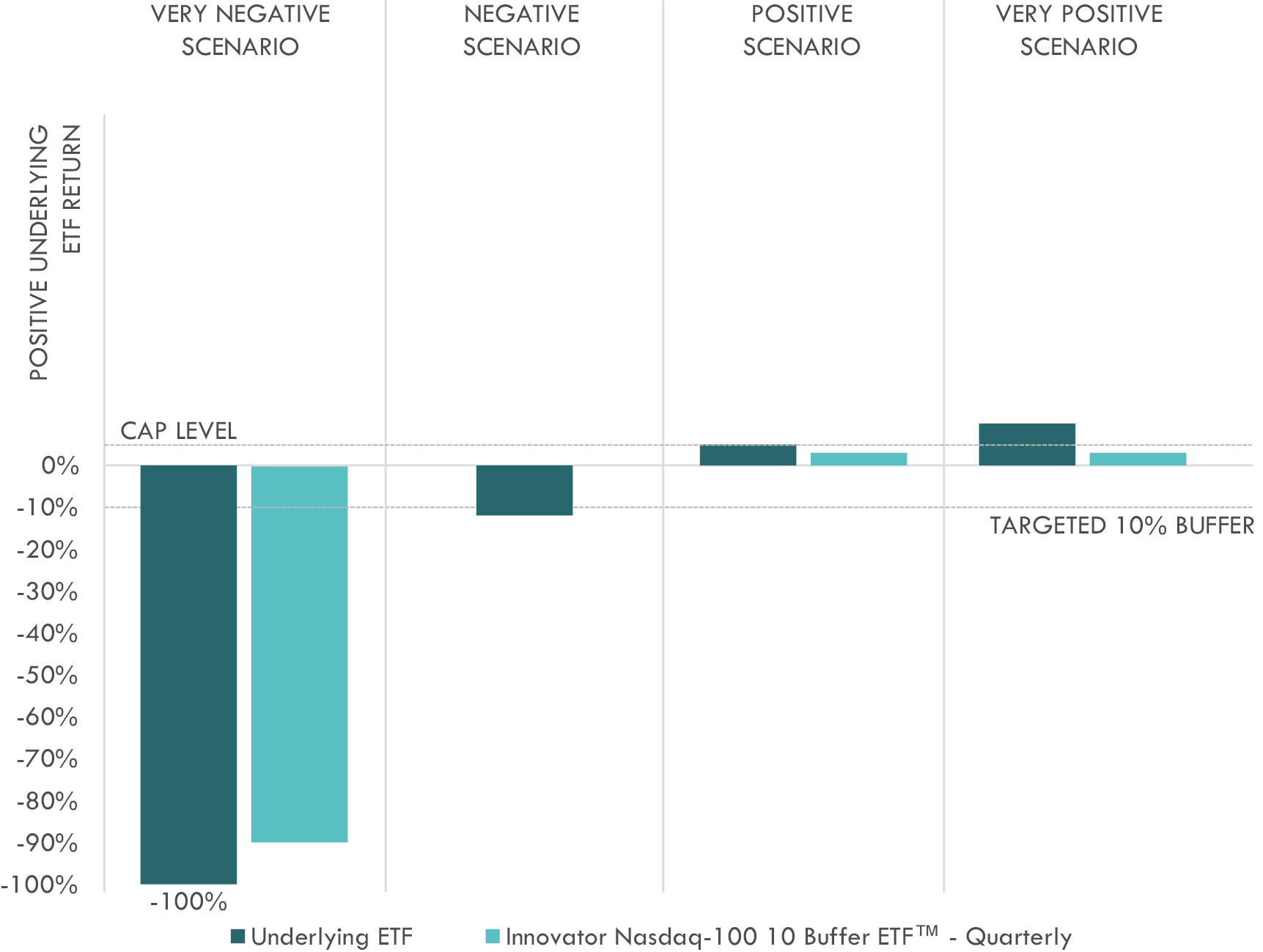
Please note this graph is provided merely to illustrate the Outcomes that the Fund seeks to provide based upon the performance of the Underlying ETF. Shareholders may experience losses greater than 90%, including loss of their entire investment. There is no guarantee that these Outcomes will be achieved over the course of the Outcome Period.
The following table contains hypothetical examples designed to illustrate the Outcomes the Fund seeks to provide over an Outcome Period, based upon the performance of the Underlying ETF from -100% to 100%. The table is provided for illustrative purposes and does not provide every possible performance scenario for Shares over the course of an Outcome Period. The table is not intended to predict or project the performance of the Fund or its holdings. Fund shareholders should not take this information as an assurance of the expected performance of the Underlying ETF or return on Shares. The actual overall performance of the Fund will vary
with fluctuations in the value of its assets during the Outcome Period, among other factors. Please refer to the Fund’s website, www.innovatoretfs.com/qbuf, which provides updated information relating to this table on a daily basis throughout the Outcome Period.
| Underlying ETF Performance | Fund Performance* |
| 100% | 3.79% |
| 50% | 3.79% |
| 20% | 3.79% |
| 15% | 3.79% |
| 10% | 3.79% |
| 5% | 3.79% |
| 0% | 0% |
| (5)% | 0% |
| (10)% | 0% |
| (15)% | (5)% |
| (20)% | (10)% |
| (50)% | (40)% |
| (100)% | (90)% |
* The Fund’s returns listed herein are provided prior to taking into account any fees or expenses charged to shareholders. The Fund’s annual management fee of 0.79% of the Fund’s average daily net assets, any shareholder transaction fees, any acquired fund fees and expenses, and any extraordinary expenses incurred by the Fund will have the effect of reducing the returns listed herein.
The Outcomes may only be realized by investors who continuously hold Shares from the commencement of the Outcome Period until its conclusion. Investors who purchase Shares after the Outcome Period has begun or sell Shares prior to the Outcome Period’s conclusion may experience investment returns that are very different from those that the Fund seeks to provide. In addition, because the Fund is designed to achieve Outcomes that change for each three-month Outcome Period, the Outcomes that are achieved by the Fund for a three-month Outcome Period will be different than the Outcomes achieved by the Fund over multiple Outcome Periods, or on an annualized basis. Similarly, investors holding Shares over multiple Outcome Periods will experience different investment results than holding a fund that has a longer Outcome Period (e.g., one year). Upon conclusion of the Outcome Period, the Fund will receive the cash value of all the FLEX Options it held for the prior Outcome Period. It will then invest in a new series of FLEX Options with an expiration date of approximately three months in the future, and a new Outcome Period will begin. The Outcomes the Fund seeks to provide and discussed herein are provided based on the Fund’s NAV, whereas shareholders purchase or sell Shares on the Exchange at market prices. Any disconnect between the Fund’s NAV and market prices of Shares will result in returns that deviate from the Outcomes the Fund seeks to provide.
The Fund’s investment adviser is Innovator Capital Management, LLC (“Innovator” or the “Adviser”) and the Fund’s investment sub-adviser is Milliman Financial Risk Management LLC (“Milliman” or the “Sub-Adviser”). The Fund is classified as a “non-diversified company” under the Investment Company Act of 1940, as amended (the “1940 Act”). To the extent the Underlying ETF concentrates (i.e., holds 25% or more of its total assets) in the securities of a particular industry
or group of industries, the Fund will concentrate its investments to approximately the same extent. Through its exposure to the Underlying ETF, the Fund has significant exposure to companies in the information technology sector.
The Outcome Period. The Outcome Period is an approximately three-month period. The current Outcome Period is from January 1, 2026 through March 31, 2026. The Fund’s sought-after Outcomes are designed to be provided at the conclusion of the Outcome Period, and are based upon the Fund’s NAV at the outset of the Outcome Period. Each FLEX Option’s value is ultimately derived from the performance of the Underlying ETF during that time. Because the terms of the FLEX Options don’t change, the Cap and Buffer both relate to the Fund’s NAV on the first day of the Outcome Period. Further, since the Fund’s option contracts are exercisable at the conclusion of the Outcome Period, the Outcomes are only provided at the end of the Outcome Period. Therefore, to achieve the Outcomes sought by the Fund for the Outcome Period, an investor must hold Shares from the commencement of the Outcome Period through its conclusion. There is no guarantee that the Fund will be successful in its attempt to provide the Outcomes.
The Fund’s NAV is based upon the value of its portfolio which consists of FLEX Options, and may also include shares of the Underlying ETF (or the components thereof). Although the value of the Underlying ETF’s share price is a significant component of the value of the Fund’s FLEX Options, the value of the Fund’s FLEX Options (and therefore, the Fund’s NAV) will not increase or decrease at the same rate as the Underlying ETF’s share price on a daily basis. The time remaining until those FLEX Options expire, which is at the conclusion of the Outcome Period, also affects their value. Additionally, since the Underlying ETF has the potential to be more volatile than other funds, during the Outcome Period it is possible that the degree of non-correlation between the value of the FLEX Options and the value of the Underlying ETF will be higher than if the FLEX Options utilized a less volatile reference asset. The Sub-Adviser generally anticipates that the Fund’s NAV will increase on days when the Underlying ETF’s share price increases and will decrease on days when the Underlying ETF’s share price decreases, but that the rate of such increase or decrease will be less than that experienced by the Underlying ETF.
For additional information regarding the Outcome Period, including the potential impacts of purchasing and selling intra-Outcome Period, see “Additional Information Regarding the Fund’s Principal Investment Strategies.”
Cap on Potential Upside Returns. Unlike other investment products, the potential upside returns an investor can receive from an investment in the Fund over the Outcome Period is subject to the Cap. The Cap represents the maximum percentage return an investor can achieve from an investment in the Fund over the duration of the Outcome Period. Therefore, even though the Fund’s returns are based upon the performance of the Underlying ETF, if the Underlying ETF experiences returns for the Outcome Period in excess of the Cap, the Fund will not participate in such excess returns. The Cap is determined on the first day of the Outcome Period and is 3.79% prior to taking into account any fees or expenses charged to shareholders. When the Fund’s annual Fund management fee of 0.79% of the Fund’s average daily net assets is taken into account for the Outcome Period, the Cap is 3.59%. The Cap will be further reduced by any
shareholder transaction fees, any acquired fund fees and expenses, and any extraordinary expenses incurred by the Fund. The Cap will change from one Outcome Period to the next based upon prevailing market conditions at the beginning of the Outcome Period. The Cap is also set forth on the Fund’s website at www.innovatoretfs.com/qbuf.
Buffer. The Fund seeks to provide shareholders who hold Shares for the entire Outcome Period with a Buffer against the first 10% of Underlying ETF losses for the Outcome Period; however, there is no guarantee that the Fund will be successful in its attempt to provide buffered returns. After the Underlying ETF’s share price has decreased by more than 10%, the Fund will experience all subsequent losses on a one-to-one basis. The effect sought to be created by the Buffer is that if the Underlying ETF’s share price has decreased in value over the course of the Outcome Period, the Fund seeks to be returned the amount of its principal investment (if the Underlying ETF’s share price decreased in value by 10% or less) or experience a loss that is 10% less than the loss experienced by the Underlying ETF (if the Underlying ETF’s share price decreased in value by more than 10%). A shareholder may lose their entire investment. While the Fund seeks to limit losses to 90% for shareholders who hold Shares for the entire Outcome Period, there is no guarantee it will successfully do so. An investment in the Fund is only appropriate for shareholders willing to bear those losses.
The Buffer is provided prior to taking into account annual Fund management fees, transaction fees, any acquired fund fees and expenses, and any extraordinary expenses incurred by the Fund. These fees and any expenses will have the effect of reducing the Buffer amount for Fund shareholders for an Outcome Period. When the Fund’s annual management fee equal to 0.79% of the Fund’s daily net assets is taken into account for the Outcome Period, the net Buffer for an Outcome Period is 9.80%. Since the Fund’s strategy is designed to produce the Outcomes on the last day of the Outcome Period, it should not be expected that the Buffer, including the net effect of the Fund’s annual management fee on the Buffer, will be provided at any point prior to the last day of the Outcome Period.
The Fund’s Portfolio. The Fund invests in FLEX Options that reference the Underlying ETF and may also invest directly in shares of the Underlying ETF (or the components thereof). In general, an option contract is an agreement between a buyer and seller that gives the purchaser of the option the right to buy or sell a particular asset at a specified future date at an agreed upon price. FLEX Options are exchange-traded option contracts with uniquely customizable terms.
The Fund seeks to achieve the Outcomes, including the Cap and Buffer, by purchasing and selling call and put FLEX Options to create layers within the Fund’s portfolio. The customizable nature of FLEX Options allows the Sub-Adviser to select the share price of the Underlying ETF at which the option contract may be exercised. This is commonly known as the “strike price.” At the commencement of the Outcome Period, the Sub-Adviser specifically selects the strike price for each FLEX Option such that when the FLEX Options are exercised on the final day of the Outcome Period, the Outcomes may be obtained, depending on the performance of the Underlying ETF’s share price over the duration of the Outcome Period. Each of the FLEX Options purchased and sold throughout the Outcome Period are expected to have the same or similar terms (i.e., strike price and expiration) as the corresponding FLEX Options purchased and sold on the first day of the Outcome Period. The Fund utilizes European style option contracts, which are exercisable only on the expiration date of the option contract.
For a given Outcome Period, the Fund may invest exclusively in FLEX Options or may purchase the Underlying ETF directly (and/or the components thereof) and FLEX Options to produce the Outcomes. To the extent the Fund invests solely in FLEX Options that reference the Underlying ETF, the Cap and Buffer will be provided on a price return basis (i.e., the Outcomes will be provided based on changes in the share price of the Underlying ETF), and the Fund will not receive the benefit of any dividends. For Outcome Periods in which the Fund directly purchases the Underlying ETF, in addition to FLEX Options, to construct the Fund’s portfolio, the Fund will receive dividends from the Underlying ETF, and the Cap and Buffer will be provided inclusive of dividends received (i.e., the price returns of the Underlying ETF plus dividends received). If the Fund invests in the Underlying ETF directly (or the components thereof), to calculate the Cap and Buffer, the Adviser will assume an estimated dividend rate for the Underlying ETF (which is based on the historical dividend rate of the Underlying ETF). To the extent the dividends received by the Fund differ from this assumed rate, the Cap and Buffer may be higher or lower than disclosed herein. If the Fund invests directly in the Underlying ETF, it will bear its proportionate share of the Underlying ETF’s expenses. The Adviser has entered into an agreement to waive its management fee to the extent of the acquired fund fees and expenses incurred in connection with its investment in the Underlying ETF.
Additional information regarding the terms of the FLEX Options, information on the Underlying ETF, and the mechanics of the Fund’s strategy can be found in “Additional Information Regarding the Fund’s Principal Investment Strategies.”
Fund Rebalance. The Fund is a continuous investment vehicle. It does not terminate and distribute its assets at the conclusion of each Outcome Period. On the termination date of an Outcome Period, the Sub-Adviser will invest in a new set of FLEX Options, or a combination of FLEX Options and the Underlying ETF (or components thereof) directly, and another Outcome Period will commence.
Approximately one week prior to the end of each Outcome Period, the Fund will file a prospectus supplement, which will alert existing shareholders that an Outcome Period is approaching its conclusion and disclose the anticipated ranges for the Cap for the next Outcome Period. Following the close of business on the last day of the Outcome Period, the Fund will file a prospectus supplement that discloses the Fund’s final Cap (both gross and net of the unitary management fee) for the next Outcome Period. This information is available on the Fund’s website, www.innovatoretfs.com/qbuf, which also provides information regarding, among other items, the start date and end date of the Outcome Period, the Cap and Buffer, the Underlying ETF, the Fund’s portfolio holdings for the Outcome Period, whether the Outcomes are based on the price return of the Underlying ETF or the price return of the Underlying ETF plus dividends received, and information relating to the potential outcomes of an investment in the Fund on a daily basis. Important information relating to the Fund, including information relating to the Cap, is communicated on the Fund’s website.
General Strategy Description. The Fund is an actively managed ETF that seeks to provide risk-managed investment exposure to the Underlying ETF. The Fund seeks to achieve its investment objective by investing in exchange-traded options contracts with one-year expirations (specifically, FLexible EXchange® Options (“FLEX Options”)) on the Underlying ETF (the “Options Portfolio”) and may also invest directly in the Underlying ETF (or the components thereof).
As described below, the Fund seeks to participate in the return of the Underlying ETF, subject to an upside return limit and a measure of downside loss protection (a “Buffer”). The Sub-Adviser (defined below) will actively monitor the performance of the Options Portfolio and as described below, rebalance or “step-up” the Options Portfolio prior to its expiration.
• Participation in Underlying ETF Returns. The Fund seeks to participate in the in the returns of the Underlying ETF, subject to an upside return limit and protection against a measure of downside losses of the Underlying ETF.
• Step-Up Strategy. The Fund’s “step-up” investment strategy seeks to help a Fund’s shareholder offset the timing risks inherent in owning an options package for one year. The Options Portfolio is designed to produce investment outcomes only for the duration of its one-year options contracts and not for any different period of time. However, the Sub-Adviser intends to manage the Fund’s investment exposure by periodically terminating its Options Portfolio earlier than its one-year expiration date and immediately resetting its Options Portfolio for a new one-year period (i.e., “step-up” its holdings). Each month, the Sub-Adviser will observe increases and decreases in the Fund from the time the Fund’s FLEX Options holdings were originally entered into and will seek to realize gains experienced by the Fund or Buffer used by the Fund by resetting the Fund’s Options Portfolio. In implementing the step-up strategy, the Sub-Adviser will seek to protect capital or capture portfolio gains experienced by the Fund, depending on its evaluation of market conditions each month. See “Principal Investment Strategies—Step-Up Strategy” below. There is no guarantee the Fund will be successful in implementing this strategy.
The Fund does not pursue a “defined outcome” strategy. Defined outcome strategies seek to produce pre-determined investment outcomes based upon the performance of an underlying security over a specific period of time (e.g., one year). The Fund will not seek to provide a set level of investment outcomes over a stated time period. Unlike other ETFs that utilize a defined outcome investment strategy, the Fund does not seek to provide shareholders with a set Buffer percentage and maximum upside potential over any specified time period. Shareholders will experience investment results that are very different than if the Fund held the Options Portfolio for its contract duration. The successful implementation of the step-up investment strategy is not guaranteed.
In implementing the above, the Fund invests in FLEX Options that reference the Underlying ETF and may also invest in the Underlying ETF (or the components thereof) directly. The Underlying ETF is an ETF that seeks to provide investment results that, before fees expenses, correspond generally to the total return performance of an index that tracks the performance of
large capitalization exchange-traded U.S. equity securities, specifically the S&P 500® Index. For additional information regarding the Underlying ETF, see “Additional Information Regarding the Fund’s Principal Investment Strategies.”
The Fund’s investment adviser is Innovator Capital Management, LLC (“Innovator” or the “Adviser”) and the Fund’s investment sub-adviser is Milliman Financial Risk Management LLC (“Milliman” or the “Sub-Adviser”). The Fund is classified as a “non-diversified company” under the Investment Company Act of 1940, as amended (the “1940 Act”). To the extent the Underlying ETF is considered to be concentrated (i.e., holds 25% or more of its total assets) in the securities of a particular industry or group of industries, the Fund will concentrate to approximately the same extent. As of the date of this prospectus, the Fund has significant exposure to the information technology sector.
Portfolio Return Profile. The Fund’s portfolio seeks to replicate the performance of the Underlying ETF, subject to a maximum return potential and a Buffer. The Options Portfolio is designed to produce investment outcomes only for the duration of its one-year options contracts and not for any different period of time. As described more fully below, the Fund does not seek to achieve the full one-year investment outcomes of the Options Portfolio, as the Sub-Adviser intends to opportunistically reset the Options Portfolio prior to the one-year expiration date of the FLEX Options. The “power” Buffer denotes the 15% of Underlying ETF losses that the Options Portfolio seeks to protect over the duration of each one-year contract term of the FLEX Options.
The Sub-Adviser seeks to specifically select the strike price for each FLEX Option contract such that if the FLEX Options were exercised on the expiration date (the final day of the one-year term), the Fund’s NAV would be subject to the maximum gains on the performance of the Underlying ETF’s share price over the duration of the options contract or the benefit from the protection of the Buffer, as follows:
• In the event that the Underlying ETF decreases in value by less than 15% over the duration of the Options Portfolio, the Fund seeks to provide investment return of 0%.
• In the event that the Underlying ETF decreases in value by more than 15% over the duration of the Options Portfolio, the Options Portfolio seeks to provide losses that are 15% less than the losses experienced by the Underlying ETF.
• In the event that the Underlying ETF increases in value over the duration of the Options Portfolio, the Options Portfolio seeks to provide investment returns that match the performance of the Underlying ETF, up to a maximum percentage return the Fund can achieve for the duration of the Options Portfolio, which is dependent on prevailing market conditions at the times the Fund enters into the FLEX Options.
The Fund’s sought-after returns, including the Buffer and maximum gain potential of Underlying ETF performance that the Options Portfolio seeks to provide, are provided prior to taking into account annual Fund management fees, transaction fees and any extraordinary expenses incurred by the Fund. These expenses will have the effect of reducing the Fund’s returns, including the maximum gain potential amount and Buffer amount experienced by shareholders. If the Fund invests in the Underlying ETF directly (or the components thereof), the Adviser will assume an
estimated dividend rate for the Underlying ETF (which is based on the historical dividend rate of the Underlying ETF) to calculate the Buffer and maximum return potential. To the extent the dividends received by the Fund differ from this assumed historical rate, the Buffer and maximum return potential may be higher or lower than disclosed herein. If the Fund invests directly in the Underlying ETF, it will bear its proportionate share of the Underlying ETF’s expenses. The Adviser has entered into an agreement to waive its management fee to the extent of the acquired fund fees and expenses incurred in connection with its investment in the Underlying ETF.
As further described herein, the Fund does not expect that the Options Portfolio will be held until the expiration date of the FLEX Options. Instead, the Sub-Adviser will seek to opportunistically manage the Fund’s investment exposure by periodically terminating its FLEX Options investments earlier than its one-year expiration date and immediately reset the Fund’s Options Portfolio for a new one-year period. Both the maximum gain potential and the sought-after Buffer are measured from the price of the Underlying ETF at the time the FLEX Option contracts are executed and will only be provided on the expiration date. As a result, the degree to which a shareholder may benefit from the Fund’s potential for participating in the return of the Underlying ETF and the Buffer against Underlying ETF losses will depend on the time at which the investor purchases Shares of the Fund and the Sub-Adviser’s determination of when to reset the Options Portfolio. Because the Fund’s investment strategy is not designed to hold the Options Portfolio to its expiration date, shareholders will experience investment results that are very different than if the Fund held the Options Portfolio for its contract duration. Shareholders may realize losses on price decreases of the Underlying ETF of less than the 15% Buffer and may lose their entire investment. These potential losses are possible even if a shareholder remained in the Fund for a one-year period after an Options Portfolio was established, as it is likely that the Options Portfolio will reset during that time.
Further, the Options Portfolio is designed to protect against Underlying ETF losses and provide for a maximum gain potential based upon the price of the Underlying ETF at the time the FLEX Option contracts are into by the Fund. However, the degree to which a shareholder may benefit from the Fund’s Underlying ETF upside potential and Buffer against Underlying ETF losses will depend on the time at which the investor purchases Shares of the Fund. At any given time after Sub-Adviser resets the Options Portfolio there may be limited upside potential or Buffer remaining due to the performance of the Underlying ETF. If the price of the Underlying ETF is near or above the Fund’s maximum return potential, such investor may have little to no upside potential until the Sub-Adviser determines to step-up the Fund’s Options Portfolio and would still remain vulnerable to significant downside risk before the sought-after protection from the Buffer began. Similarly, if the Underlying ETF has decreased in price significantly to equal or exceed the Fund’s anticipated Buffer, the shareholder would also remain vulnerable to significant downside risk and would receive no benefit from the Buffer. A shareholder could lose its entire investment. There is no guarantee that the Sub-Adviser will be successful in its attempt to provide the Buffer.
Step-Up Strategy. The Fund’s “step-up” investment strategy seeks to help a Fund’s shareholder offset the timing risks inherent in owning an options package for one year. The Sub-Adviser will seek to realize gains experienced by the Fund (which are limited to the maximum gain potential) or realize the Buffer used by the Fund by resetting the Fund’s Options Portfolio as often as monthly and therefore resetting the Fund’s maximum upside potential and Buffer. The successful implementation of the step-up investment strategy is not guaranteed.
As a result of the performance of the Underlying ETF during the term of the FLEX Options (the value of which is derived from, in part, the value of the Underlying ETF’s share price), the Fund may have little or no upside available for the remainder of the options contract term (if the Underlying ETF has increased in value) or little or no ability to benefit from the Buffer (if the Underlying ETF has decreased in value). With the step-up investment strategy, the Fund may, at the end of each month, sell the then-current Options Portfolio and immediately enter into new FLEX Options contracts that establish a new one-year expiration date. In doing so, the Fund will reset its exposure to the Underlying ETF and continue to have the potential to increase in a market environment where the value of the Underlying ETF is steadily increasing or derive continued benefit from a Buffer in a market environment where the Underlying ETF is steadily decreasing. The ability to provide downside protection as part of the implementation of the Fund’s step-up investment strategy may not be successful.
The Sub-Adviser will continuously review the performance of the Fund and at each month-end determine whether to step-up the Options Portfolio. The Sub-Adviser will consider the price movements of the Underlying ETF, the changes in the Fund’s NAV, market volatility, time remaining until the expiration of the FLEX Options contracts and strike prices of the replacement FLEX Options contracts when evaluating whether to reset the Options Portfolio. The following chart contains a hypothetical illustration of the Fund’s step-up mechanism. The chart is provided for illustrative purposes only. There is no guarantee that the Fund will be successful in its attempt to step-up the Fund’s Options Portfolio. The chart is not intended to predict or project the performance or operationality of the Fund.
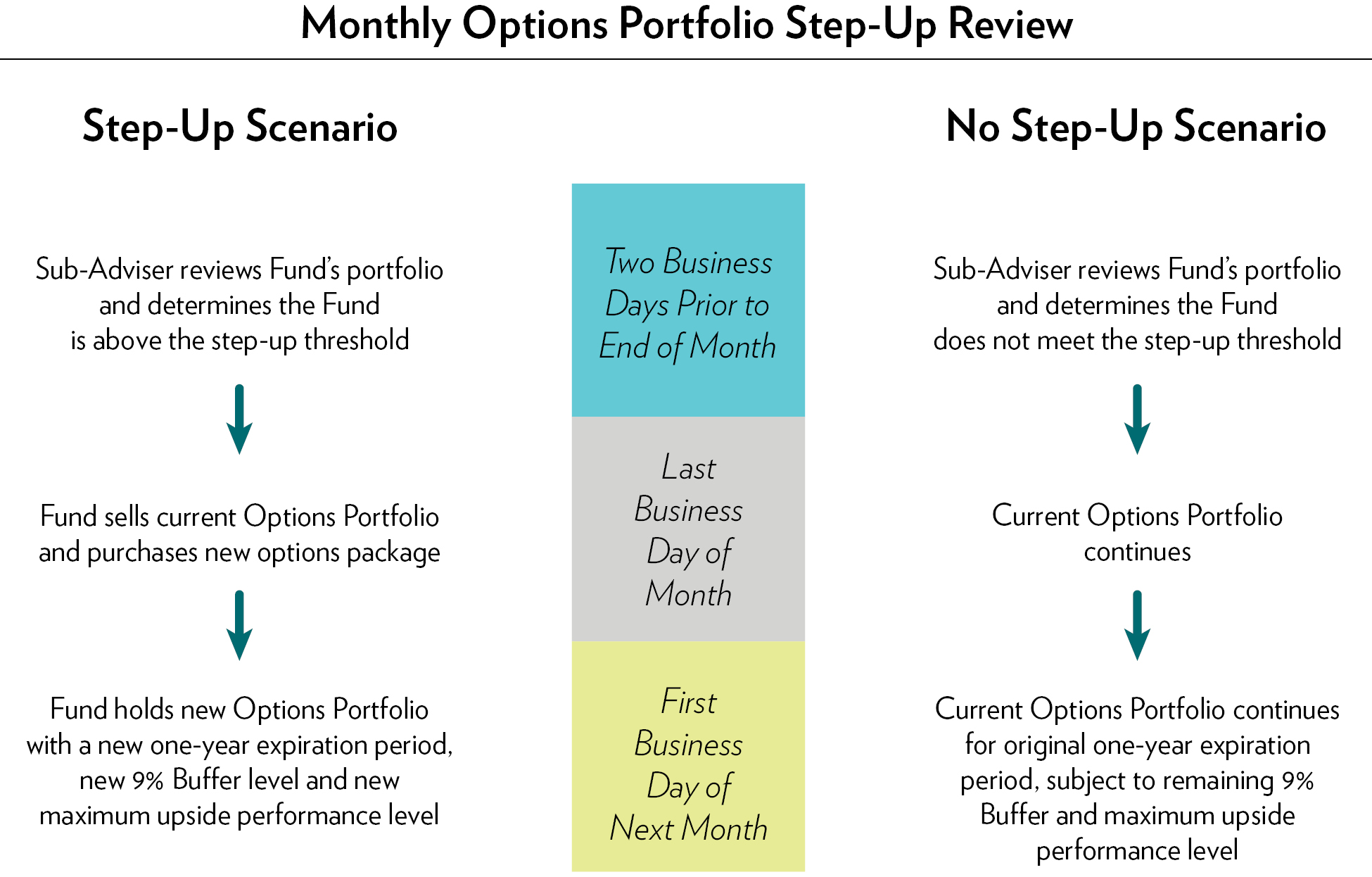
To the extent the Fund’s NAV increases (generally a range from 2% to 6%) or decreases (generally a range from -1% to -5%) from the Fund’s NAV at the time the FLEX Options were originally entered into, the Sub-Adviser will seek to realize any gains experienced by the Fund or Buffer used by the Fund by resetting the Fund’s Options Portfolio and, in doing so, “step-up” the Fund’s upside potential and Buffer. The Sub-Adviser will also purchase and sell FLEX Options over the course of the month that have the same or similar terms (i.e., strike price and expiration date) as the then-current Options Portfolio as necessary to manage any creations or redemptions of “Creation Units” (as defined below).
The Fund’s Portfolio. The Fund invests in FLEX Options that reference the Underlying ETF and may also invest directly in shares of the Underlying ETF (or the components thereof). To the extent the Fund invests solely in FLEX Options, the Fund will seek to participate in the price return of the Underlying ETF (prior to taking into account management fees and other fees). If the Fund invests directly in the Underlying ETF (or the components thereof), the Fund will seek to provide such returns inclusive of dividends (i.e., the price return of the Underlying ETF plus dividends received). In general, an option contract gives the purchaser of the option, in exchange for the premium paid, the right to purchase (for a call option) or sell (for a put option) the underlying asset at a specified price (the “strike price”) on a specified date (the “expiration date”). The Fund utilizes FLEX Options, which are customizable exchange-traded option contracts guaranteed for settlement by the Options Clearing Corporation (the “OCC”). The Fund’s FLEX Options are cash-settled, European style option contracts (i.e., exercisable at the strike price only on the expiration date) with an expiration date approximately one-year in the future from the time of execution.
The Fund’s NAV is based upon the value of its portfolio which consists of FLEX Options, and may also include shares of the Underlying ETF (or the components thereof). Although the value of the Underlying ETF’s share price is a significant component of the value of the Fund’s FLEX Options, the value of the Fund’s FLEX Options (and therefore, the Fund’s NAV) will not increase or decrease at the same rate as the Underlying ETF’s share price on a daily basis. The time remaining until those FLEX Options expire, which is at the conclusion of the Outcome Period, also affects their value. The degree of non-correlation between the value of the FLEX Options and the value of the Underlying ETF may be higher than if the FLEX Options utilized by the Fund had a shorter term. The Sub-Adviser generally anticipates that the Fund’s NAV will increase on days when the Underlying ETF’s share price increases and will decrease on days when the Underlying ETF’s share price decreases, but that the rate of such increase or decrease will be less than that experienced by the Underlying ETF. However, there is no guarantee that the Fund’s NAV will move in the same direction as the price movements of the Underlying ETF and it is not expected for the Fund’s NAV to directly correlate on a day-to-day basis with the returns experienced by the Underlying ETF.
General Strategy Description. The Fund has adopted a policy pursuant to Rule 35d-1 under the 1940 Act to invest, under normal circumstances, at least 80% of its net assets (plus any borrowings for investment purposes) in investments that provide exposure to bitcoin. The Fund expects such investments to consist of options contracts, including FLexible EXchange® Options (“FLEX Options”), that reference the CBOE Bitcoin U.S. ETF Index (the “Bitcoin ETP Index” or the “Bitcoin Reference Asset”)). The Bitcoin ETP Index is comprised of exchange-traded products that hold bitcoin directly (each, a “Bitcoin ETP”). FLEX Options are exchange-traded option contracts with uniquely customizable terms. Although guaranteed for settlement by the Options Clearing Corporation (the “OCC”), FLEX Options are still subject to counterparty risk with the OCC and may be less liquid than more traditional exchange-traded options.
The Bitcoin ETP Index is a modified market capitalization-weighted index designed to reflect the price return performance of a basket of Bitcoin ETPs listed on U.S. Exchanges. Bitcoin ETPs are exchange-traded investment products not registered under the Investment Company Act of 1940, as amended (the “1940 Act”), that seek to reflect the price of bitcoin, before fees and expenses, by purchasing and storing bitcoin in a digital vault and issuing exchange-listed shares that correspond to the price of bitcoin it holds. The Bitcoin ETPs that the Fund may utilize as the Bitcoin ETP Index include: iShares Bitcoin Trust ETF, Grayscale Bitcoin Trust, Fidelity Wise Origin Bitcoin Fund, Bitwise Bitcoin ETF Trust, ARK 21Shares Bitcoin ETF or the VanEck Bitcoin Trust. For the current Outcome Period, the Bitcoin ETP Index is the Bitcoin ETP Index. Additional information regarding the Bitcoin ETP Index is available in “Additional Information Regarding the Fund’s Principal Investment Strategies.”
The Fund is classified as a “non-diversified company” under the 1940 Act. The Fund will not concentrate its investments in securities of issuers in any industry or group of industries as the term “concentrate” is used in the 1940 Act, except that the Fund may invest more than 25% of its total assets in investments that provide exposure to the Bitcoin Price.
Due to the unique mechanics of the Fund’s strategy, the return an investor can expect to receive from an investment in the Fund has characteristics that are distinct from many other investment vehicles. It is important that an investor understand these characteristics before making an investment in the Fund. The Fund does not directly invest in bitcoin.
The Fund provides investment exposure to the price performance of bitcoin (i.e., “spot” bitcoin prices), as represented by the price of the Bitcoin ETP Index (the “Bitcoin Price”) by investing in FLEX Options that reference the Bitcoin ETP Index. The pre-determined outcomes sought by the Fund, which include the Floor and Participation Rate discussed below (the “Outcomes”), are based upon the Bitcoin ETP Index, over an approximately three-month period (the “Outcome Period”). The current Outcome Period is from January 1, 2026 through March 31, 2026. Following the Outcome Period, each successive Outcome Period will begin on the day the prior Outcome Period concludes and will end three months thereafter. In addition to its investments in FLEX Options, the Fund also invests in U.S. Treasury Bills (“U.S. Treasuries”), that in combination with the Fund’s FLEX Options, produce the Fund’s Outcomes for an Outcome Period. See “Principal Investment Strategies—The Fund’s Investments” below for additional information.
Following the Outcome Period, each successive Outcome Period will begin on the day the prior Outcome Period concludes and will end three months thereafter. Upon conclusion of the Outcome Period, the Fund will receive the cash value of its investments held for the prior Outcome Period. It will then invest in a new series of FLEX Options and U.S. Treasuries with an expiration date or maturity date, respectively, in approximately three months and a new Outcome Period will begin. The Outcomes may only be realized by investors who continuously hold Shares from the commencement of the Outcome Period until its conclusion. Investors who purchase Shares after the Outcome Period has begun or sell Shares prior to the Outcome Period’s conclusion may experience investment returns that are very different from those that the Fund seeks to provide. An investor that holds Shares through multiple Outcome Periods may fail to experience gains comparable to those of the Bitcoin Price over time because at the end of the Outcome Period a new Participation Rate will be established and any gains in the Bitcoin Price above the Participation Rate will be forfeited. The Outcomes the Fund seeks to provide and discussed herein are provided based on the Fund’s NAV, whereas shareholders purchase or sell Shares on the Exchange at market prices. Any disconnect between the Fund’s NAV and market prices of Shares will result in returns that deviate from the Outcomes the Fund seeks to provide.
The Fund’s strategy has been specifically designed to produce the Outcomes based upon the Bitcoin Price at the outset of the Outcome Period through its the conclusion, subject to the “Participation Rate” and “Floor” described herein. The Fund seeks to provide shareholders that hold Shares for the entire Outcome Period with a maximum loss experienced by the Bitcoin Price over the course of the Outcome Period of 20% (the “Floor”), before taking into account annual Fund management fees, shareholder transaction fees, brokerage commissions, taxes and any extraordinary expenses incurred by the Fund. The Floor is provided after taking into account interest income received via the U.S. Treasuries. The Fund’s shareholders will bear all Bitcoin Price losses on a one-to-one basis prior to the Floor. There is no guarantee that the Fund will be successful in providing the sought-after Floor. See “Principal Investment Strategies—Floor” herein for additional information regarding the Floor.
If the Bitcoin Price increases over the duration of the Outcome Period, the Fund seeks to provide investors that hold Shares for the entire Outcome Period with 72.00% of the increase in value experienced by the Bitcoin Price over the duration of the Outcome Period (the “Participation Rate”). As a result of the Participation Rate, while the Fund is not capped in the amount of upside performance it can experience, the Fund’s returns will underperform any positive returns in the Bitcoin Price. Since the Fund will not participate in the entirety of the gains experienced by the Bitcoin Price through the operation of the Participation Rate, the Fund will underperform any gains in the Bitcoin Price over the course of the Outcome Period and shareholders will forfeit any gains in the Bitcoin Price that exceed the Participation Rate. Any gains experienced by shareholders will be reduced by the Fund’s management fee for the Outcome Period, and further reduced by any shareholder transaction fees, brokerage commissions, taxes and any extraordinary expenses incurred by the Fund. Unlike other funds that employ a “defined outcome strategy,” the Fund does not limit returns investors may receive through the implementation of capped returns, or a “cap”. Rather, the Fund participates in a percentage of positive returns of the Bitcoin Price and such returns are limited by the Participation Rate. The Participation Rate is dependent upon market conditions at the time the Fund enters into its FLEX
Options for the Outcome Period and is likely to rise or fall from one Outcome Period to the next. Accordingly, it is possible that the Participation Rate in a subsequent Outcome Period could be substantially lower or higher than the current Participation Rate.
As is discussed in further detail below, it is anticipated that during the Outcome Period the Fund’s NAV will not increase or decrease at the same rate as the Bitcoin Price. The Fund’s NAV is based upon the value of its portfolio, which includes the FLEX Options and U.S. Treasuries. Although the value of the Bitcoin Price is a significant component of the value of the Fund’s FLEX Options, the time remaining until those FLEX Options expire also affects their value. The Fund’s investment sub-adviser, Milliman Financial Risk Management LLC (“Milliman” or the “Sub-Adviser”), generally anticipates that the Fund’s NAV will increase on days when the Bitcoin Price increases and will decrease on days when the Bitcoin Price decreases, but that the rate of such increase or decrease will be less than the Bitcoin Price.
The Fund’s investment strategy seeks to provide a limit to the maximum loss of the Bitcoin Price experienced by the Fund over the course of the Outcome Period while simultaneously participating in a percentage of the returns of the Bitcoin Price (discussed in detail below). The two hypothetical graphical illustrations provided below are designed to illustrate the Outcomes that the Fund seeks to provide for investors who hold Shares for the entirety of the Outcome Period. There is no guarantee that the Fund will be successful in its attempt to provide the Outcomes for an Outcome Period. The returns that the Fund seeks to provide do not include the costs associated with purchasing Shares and certain expenses incurred by the Fund. The graphical illustrations below are for illustrative purposes and a potential Participation Rate and the impact on the returns of the Fund in comparison to the returns of the Bitcoin Price. If the Participation Rate is lower or higher than those shown for an Outcome Period, the positive returns experienced by investors, if any, will differ than those presented below. The Participation Rate is likely to change from one Outcome Period to the next and may be significantly higher or lower.
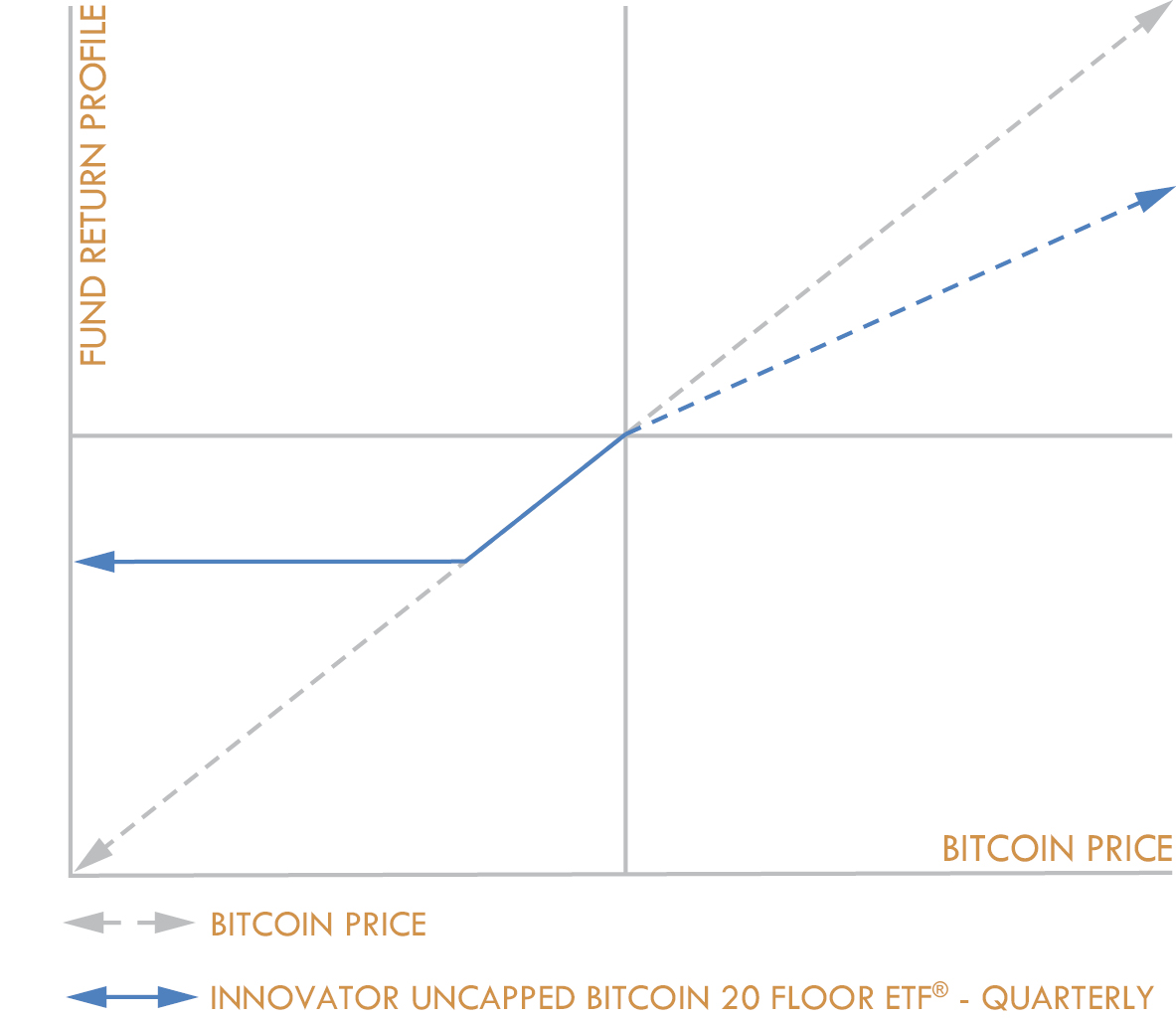
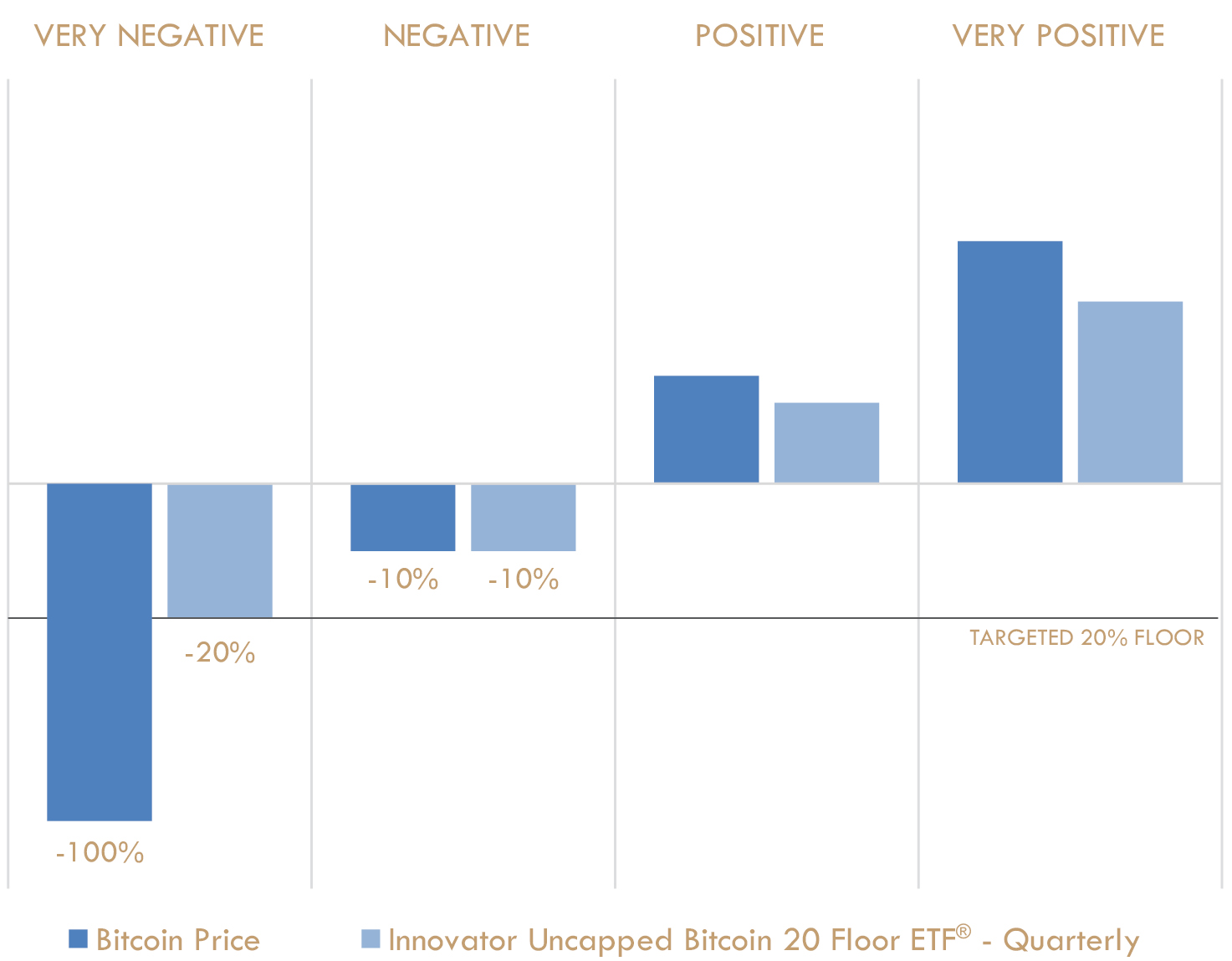
The following table contains hypothetical examples designed to illustrate the Outcomes the Fund seeks to provide over an Outcome Period, based upon the performance of the Bitcoin Price from -100% to 100%. The table is provided for illustrative purposes and does not provide every possible performance scenario for Shares over the course of an Outcome Period. There is no guarantee that the Fund will be successful in its attempt to provide the Outcomes for an Outcome Period. The table is not intended to predict or project the performance of the Bitcoin Price or the Fund. Fund shareholders should not take this information as an assurance of the expected performance of the Bitcoin Price or return on Shares. The actual overall performance
of the Fund will vary with fluctuations in the value of the FLEX Options during the Outcome Period, among other factors. Please refer to the Fund’s website, www.innovatoretfs.com/qbf, which provides updated information relating to this table on a daily basis throughout the Outcome Period.
|
Bitcoin ETP Index Performance |
Fund Performance* |
|
|
100% |
72.00% |
|
|
50% |
36.00% |
|
|
20% |
14.40% |
|
|
15% |
10.80% |
|
|
10% |
7.20% |
|
|
5% |
3.60% |
|
|
0% |
0% |
|
|
(5)% |
(%)% |
|
|
(10)% |
(10)% |
|
|
(15)% |
(15)% |
|
|
(20)% |
(20)% |
|
|
(50)% |
(20)% |
|
|
(100)% |
(20)% |
* The Fund’s returns listed herein are provided prior to taking into account any fees or expenses charged to shareholders. The Fund’s annual management fee of 0.79% of the Fund’s average daily net assets, any shareholder transaction fees, any acquired fund fees and expenses, and any extraordinary expenses incurred by the Fund will have the effect of reducing the returns listed herein.
The Fund’s Investments. The Fund holds a portfolio composed of U.S. Treasuries and FLEX Options that reference the Bitcoin ETP Index. The FLEX Options and U.S. Treasuries are each set to expire or mature, respectively, on the last day of the Outcome Period. A detailed explanation regarding the Fund’s investment portfolio can be found in “Additional Information Regarding the Fund’s Principal Investment Strategies.”
Use of FLEX Options. The Fund purchases and sells call FLEX Options to obtain its exposure to the Bitcoin Price. The customizable nature of the FLEX Options allows the Sub-Adviser to select the share price at which the Bitcoin ETPs will be exercised at the expiration of each option. This is commonly known as the “strike price.” At the commencement of the Outcome Period, the Sub-Adviser specifically selects the strike price for each FLEX Option such that when the FLEX Options are exercised on the final day of the Outcome Period, the Outcomes may be obtained, depending on the performance of the Bitcoin Price over the duration of the Outcome Period. The Fund utilizes European style option contracts, which are exercisable only on the expiration date of the option contract.
To achieve these returns, the Fund will purchase and sell a combination of call option contracts. A call option contract gives the buyer of the call option contract the right (but not the obligation) to buy, and the seller of the call option contract (i.e., the “writer”) the obligation to sell, a specified
amount of an underlying reference asset at a pre-determined price. Each of the FLEX Options purchased and sold throughout the Outcome Period are expected to have the same or similar terms (i.e., strike price and expiration) as the corresponding FLEX Options purchased and sold on the first day of the Outcome Period.
U.S. Treasuries. In combination with the Fund’s FLEX Options, the U.S. Treasuries held by the Fund seek to provide the Floor. U.S. Treasury securities are government debt instruments issued by the United States Department of the Treasury that are backed by the full faith and credit of the United States Government. The U.S. Treasuries held by the Fund will have maturity dates that align with the conclusion of the Outcome Period and the Fund will enter into new U.S. Treasuries positions for each Outcome Period. There is no guarantee that the portion of the Fund’s portfolio consisting of U.S. Treasuries will retain sufficient value to provide the level of sought-after protection provided by the Floor. The value of the U.S. Treasuries may increase (providing a higher protection level and therefore more protection to shareholders) or decrease (providing a lower protection level and therefore less protection to shareholders).
The Outcome Period. The Outcomes sought by the Fund are based upon the Fund’s NAV at the outset of the Outcome Period. The Outcome Period begins on the day the FLEX Options and U.S. Treasuries are entered into and ends approximately three months later on the day the FLEX Options expire and U.S. Treasuries mature. Each FLEX Option’s value is ultimately derived from the performance of the Bitcoin Price during that time. Because the terms of the FLEX Options do not change, the Participation Rate and the Floor both relate to the Fund’s NAV on the first day of the Outcome Period. A shareholder that purchases Shares after the commencement of the Outcome Period will likely have purchased Shares at a different NAV than the NAV on the first day of the Outcome Period (i.e., the NAV upon which the Outcomes are based) and therefore may experience Outcomes that are very different from those sought by the Fund. Since the FLEX Options are exercisable only on the final day of the Outcome Period, a shareholder that sells Shares prior to the end of the Outcome Period may also experience investment outcomes very different from those sought by the Fund. To achieve the Outcomes sought by the Fund for the Outcome Period, an investor must hold Shares at the time that the Fund enters into the FLEX Options and continue to hold those Shares until the day the FLEX Options expire. Additionally, an investor that holds Shares through multiple Outcome Periods may fail to experience gains comparable to the Bitcoin Price over time because at the end of the Outcome Period a new Participation Rate will be established and any Bitcoin Price gains that exceed the Participation Rate will be forfeited. There is no guarantee that the Fund will be successful in its attempt to provide the Outcomes.
The Fund’s assets will be principally composed of FLEX Options, the value of which is derived from the performance of the underlying reference asset, the Bitcoin ETP Index, and U.S. Treasuries. However, because a component of an option’s value is the number of days remaining until its expiration, during the Outcome Period, the Fund’s NAV will not directly correlate on a day-to-day basis with the returns experienced by the Bitcoin Price. The Sub-Adviser generally anticipates that the Fund’s NAV will increase on days when the Bitcoin Price increases and will decrease on days when the Bitcoin Price decreases, but that the rate of such increase or decrease will be less than that experienced by the Underlying ETF. Similarly, the amount of time remaining until the end of the Outcome Period also affects the impact of the Floor on the Fund’s NAV, which may not be in full effect prior to the end of the Outcome Period. The Fund’s strategy is designed to produce
the Outcomes upon the expiration of the FLEX Options and maturity of the U.S. Treasuries on the last day of the Outcome Period and it should not be expected that the Outcomes will be provided at any point prior to that time. Taken together, this means that at the midpoint of the Outcome Period, if the Bitcoin Price has decreased by 20%, the Fund’s NAV can be expected to have decreased in value (because the Floor is not yet in full effect), but by less than 20% (because the Fund’s NAV will not correlate one-to-one with the Bitcoin Price and the Fund’s NAV tends not to participate fully in either Bitcoin Price gains or losses).
An investor that holds Shares through multiple Outcome Periods may fail to experience gains comparable to those of the Bitcoin Price over time because at the end of the Outcome Period a new Participation Rate will be established and any increases in the Bitcoin Price that exceed the Participation Rate will be forfeited. Similarly, an investor that holds Shares through multiple Outcome Periods will be unable to recapture losses from prior Outcome Periods because at the end of each Outcome Period, a new Floor will be established based on the then-current price of the Bitcoin ETP Index and any losses experienced during the prior Outcome Period will be locked-in. Moreover, the annual imposition of a new Participation Rate on future gains may make it difficult to recoup any losses from the prior Outcome Periods such that, over multiple Outcome Periods, the Fund may have losses that exceed those of the Bitcoin ETP Index.
Participation Rate. The potential upside return that an investor can receive from an investment in Shares over the Outcome Period is subject to the Participation Rate. The Participation Rate represents the percentage of Bitcoin Price gains that the Fund experiences over the duration of the Outcome Period. Therefore, even though the Fund’s returns are based upon the performance of the Bitcoin Price, any gains that exceed the Participation Rate will not be experienced by the Fund. The Participation Rate is determined on the first day of the Outcome Period and is 72.00% of gains experienced by the Bitcoin Price over the duration of the Outcome Period. The Fund’s annual management fee, as well as any shareholder transaction fees, brokerage commissions, taxes and any extraordinary expenses incurred by the Fund, will lessen the returns experienced by shareholders. For the purpose of this prospectus, “extraordinary expenses” are non-recurring expenses that may incurred by the Fund outside of the ordinary course of its business, including, without limitation, costs incurred in connection with any claim, litigation, arbitration, mediation, government investigation or similar proceedings, indemnification expenses and expenses in connection with holding and/or soliciting proxies for a meeting of Fund shareholders. The Participation Rate is also set forth on the Fund’s website at www.innovatoretfs.com/qbf.
Unlike other Funds that employ a “defined outcome strategy,” the Fund does not limit returns investors may receive through the implementation of a “cap”. Rather, the Fund participates in a percentage of positive returns of the Bitcoin Price and such returns are only limited by the Participation Rate. The Participation Rate is dependent upon market conditions at the time the Fund enters into its FLEX Options for the Outcome Period and is likely to change for each Outcome Period based upon prevailing market conditions at the beginning of the Outcome Period. The Participation Rate should be considered before investing in the Fund. There is no guarantee that the Fund will successfully achieve its investment objective.
The Participation Rate is a result of the design of the Fund’s principal investment strategy. In order to obtain upside exposure to the returns of the Bitcoin Price and provide the Floor, the Fund purchases U.S Treasuries and enters into a series of FLEX Options. The Fund purchases
an in-the-money call FLEX Option to obtain the upside exposure to the Bitcoin Price, however, also sells an at-the-money call FLEX Option. The sold call FLEX Option will offset a portion of the gains the Fund, the extent of which is dependent upon the size of the sold call FLEX Options’ notional value versus that of the purchased call FLEX Options. Notional value is the total underlying amount of a derivatives trade and measures the economic exposure of a derivatives position. The notional exposure of the Fund’s purchased call FLEX Option will be 100% of the Fund’s portfolio. The notional exposure of the Fund’s sold call FLEX Option is expected to be less than such value, and the difference between the two produces the Participation Rate. The terms of the FLEX Options are determined based upon prevailing market conditions at the time the Fund enters into such FLEX Options, most notably current interest rate levels and volatility in the Bitcoin Price, among other reasons. Dependent upon market conditions at the onset of the Outcome Period when the Fund enters into its FLEX Options, the Participation Rate could be very low. Approximately one week prior to the end of the Outcome Period, additional information about anticipated ranges for the Participation Rate for the next Outcome Period will be available on the Fund’s website, www.innovatoretfs.com/qbf, which also provides information relating to the Outcomes on a daily basis. See “Principal Investment Strategies—Fund Rebalance” below for additional information.
Floor. The Floor is only operative against Bitcoin Price losses exceeding 20% over the duration of the Outcome Period; however, there is no guarantee that the Fund will be successful in its attempt to provide the Floor. The Floor is a function of the Fund’s U.S Treasuries and the strike prices of the Fund’s FLEX Options. If the Bitcoin ETP Index decreases by more than 20%, the FLEX Options will expire worthless and the Fund’s value will be comprised of the U.S. Treasuries, which are set at an amount that equals 80% of the Fund’s assets at the onset of the Outcome Period. The U.S. Treasuries are selected and weighted to specifically provide the 20% Floor by seeking to preserve the Fund’s capital in the event the FLEX Options expire worthless, such that in the event the Bitcoin Price declines by more than 20% (and therefore, the Fund’s FLEX Options expire worthless), the Fund will maintain its investment in the U.S. Treasuries, which will be equal to 80% of the Fund’s value at the commencement of the Outcome Period. The Floor is provided prior to taking into account annual Fund management fees equal to 0.79% of the Fund’s daily net assets, shareholder transaction fees, brokerage commissions, taxes and any extraordinary expenses incurred by the Fund. The Fund’s annual management fee, shareholder transaction fees, brokerage commissions, taxes and any extraordinary expenses incurred by the Fund will have the effect of extending the maximum losses incurred to the Floor for Fund shareholders. When the Fund’s annual management fee equal to 0.79% of the Fund’s daily net assets is taken into account for the Outcome Period, the net Floor for an Outcome Period is 20.20%. The Floor is provided after taking into account interest income received via the U.S. Treasuries, which will be distributed to shareholders periodically. If an investor is considering purchasing Shares during the Outcome Period, and the Fund has already increased in value, then a shareholder may experience losses that exceed 20% prior to gaining the protection offered by the Floor, which is not guaranteed. A shareholder that purchases Shares at the beginning of the Outcome Period may lose their entire investment. While the Fund seeks to limit losses experienced by the Bitcoin Price to 20% for shareholders who hold Shares for the entire Outcome Period, there is no guarantee it will successfully do so. Depending upon market conditions at the time of purchase, a shareholder that purchases Shares after the Outcome Period has begun may also lose their entire investment. An investment in the Fund is only appropriate for shareholders willing to bear those losses.
Bitcoin. Bitcoin is a digital asset that can be transferred among participants on the bitcoin peer-to-peer network (the “Bitcoin Network”) on a peer-to-peer basis via the Internet. Bitcoin can be transferred without the use of a central administrator or clearing agency, unlike other means of electronic payments. Because a central party is not necessary to administer bitcoin transactions or maintain the bitcoin ledger, the term decentralized is often used in descriptions of bitcoin.
Bitcoin is based on the decentralized, open-source protocol of a peer-to-peer electronic network. No single entity owns or operates the Bitcoin Network. Bitcoin is not issued by governments, banks or any other centralized authority. The infrastructure of the Bitcoin Network is collectively maintained on a distributed basis by the network’s participants, consisting of “miners,” who run special software to validate transactions, developers, who maintain and contribute updates to the bitcoin network’s source code, and users, who download and maintain on their individual computer a full or partial copy of the Bitcoin Blockchain (defined below) and related software. Anyone can be a user, developer, or miner. The Bitcoin Network is accessed through software, and software governs the creation, movement, and ownership of bitcoin. The source code for the Bitcoin Network and related software protocol is open-source, and anyone can contribute to its development. The value of bitcoin is in part determined by the supply of, and demand for, bitcoin in the global markets for the trading of bitcoin, market expectations for the adoption of bitcoin as a decentralized store of value, the number of merchants and/or institutions that accept bitcoin as a form of payment, and the volume of peer-to-peer transactions, among other factors.
Bitcoin transaction and ownership records are reflected on the blockchain ledger for bitcoin (the “Bitcoin Blockchain”), which is a digital public record or ledger. Copies of this ledger are stored in a decentralized manner on the computers of each Bitcoin network node (a node is any user who maintains on their computer a full copy of all the bitcoin transaction records, the blockchain, as well as related software). Miners authenticate and bundle bitcoin transactions sequentially into files called “blocks”, which requires performing computational work to solve a cryptographic puzzle set by the Bitcoin Network’s software protocol. Because each solved block contains a reference to the previous block, they form a chronological “chain” back to the first bitcoin transaction. Copies of the Bitcoin Blockchain are stored in a decentralized manner on the computers of each individual Bitcoin Network full node, i.e., any user who chooses to maintain on their computer a full copy of the Bitcoin Blockchain as well as related software. Each bitcoin is associated with a set of unique cryptographic “keys”, in the form of a string of numbers and letters, which allow whoever is in possession of the private key to assign that bitcoin in a transfer that the Bitcoin network will recognize.
The Fund obtains its bitcoin exposure indirectly via FLEX Options. The Bitcoin ETP Index is either one of the Bitcoin ETPs or the Bitcoin ETP Index. Additional information regarding the Bitcoin ETPs and the Bitcoin ETP Index is available in “Additional Information Regarding the Fund’s Principal Investment Strategies.”
Fund Rebalance. The Fund is a continuous investment vehicle. It does not terminate and distribute its assets at the conclusion of each Outcome Period. On the termination date of an Outcome Period, the Sub-Adviser will invest in a new set of FLEX Options and another Outcome Period will commence.
Approximately one week prior to the end of each Outcome Period, the Fund will file a prospectus supplement, which will alert existing shareholders that an Outcome Period is approaching its conclusion and disclose the anticipated ranges for the Participation Rate for the next Outcome Period. Following the close of business on the last day of the Outcome Period, the Fund will file a prospectus supplement that discloses the Fund’s final Participation Rate for the next Outcome Period. This information is available on the Fund’s website, www.innovatoretfs.com/qbf, which also provides information relating to the Outcomes on a daily basis.
The Fund’s website, www.innovatoretfs.com/qbf, provides information relating to the Outcomes on a daily basis. Important information relating to the Fund, including information relating to the Participation Rate, is communicated on the Fund’s website.
General Strategy Description. Due to the unique mechanics of the Fund’s strategy, the return an investor can expect to receive from an investment in the Fund has characteristics that are distinct from many other investment vehicles. It is important that an investor understand these characteristics before making an investment in the Fund. The Fund has adopted a policy pursuant to Rule 35d-1 under the 1940 Act to invest, under normal circumstances, at least 80% of its net assets (plus any borrowings for investment purposes) in investments that provide exposure to the State Street® SPDR® S&P 500® ETF Trust.
The Fund’s strategy has been specifically designed to produce the “Outcomes” described below based upon the performance of the Underlying ETF over the duration of the Outcome Period. The Fund seeks replicate the performance of the Underlying ETF over the duration of the Outcome Period, subject to the below pre-determined Outcomes. There is no guarantee that the Fund will be successful in its attempt to provide the Outcomes for an Outcome Period.
• Upside Cap. Fund shareholders are subject to the Cap, which represents the maximum percentage return an investor can achieve from an investment in the Fund over the duration of the Outcome Period. The Cap is set on the first day of the Outcome Period and is 5.75% prior to taking into account any fees or expenses charged to shareholders. When the Fund’s annual Fund management fee of 0.69% of the Fund’s average daily net assets is taken into account for the Outcome Period, the Cap is 5.57%.
• Buffered Returns. The Fund seeks to provide shareholders that hold Shares for the entire Outcome Period with the Buffer, which seeks to protect against Underlying ETF losses of between 5% and 15% during the Outcome Period. The Fund’s shareholders will bear the first 5% of Underlying ETF and all Underlying ETF losses exceeding 15% on a one-to-one basis. When the Fund’s annual management fee equal to 0.69% of the Fund’s daily net assets is taken into account for the Outcome Period, the net Buffer for an Outcome Period is 4.82% and 14.82%.
To produce the Outcomes, the Fund invests in FLEX Options that reference the Underlying ETF and may also invest in the Underlying ETF (or the components thereof) directly. The Underlying ETF is an ETF that seeks to provide investment results that, before fees expenses, correspond generally to the total return performance of an index that tracks the performance of large capitalization exchange-traded U.S. equity securities, specifically the S&P 500® Index. For additional information regarding the Underlying ETF, see “Additional Information Regarding the Fund’s Principal Investment Strategies.”
The hypothetical graphical illustration provided below is designed to illustrate the Outcomes that the Fund seeks to provide for investors who hold Shares for the entirety of the Outcome Period. The returns that the Fund seeks to provide do not include the costs associated with purchasing Shares and certain expenses incurred by the Fund.
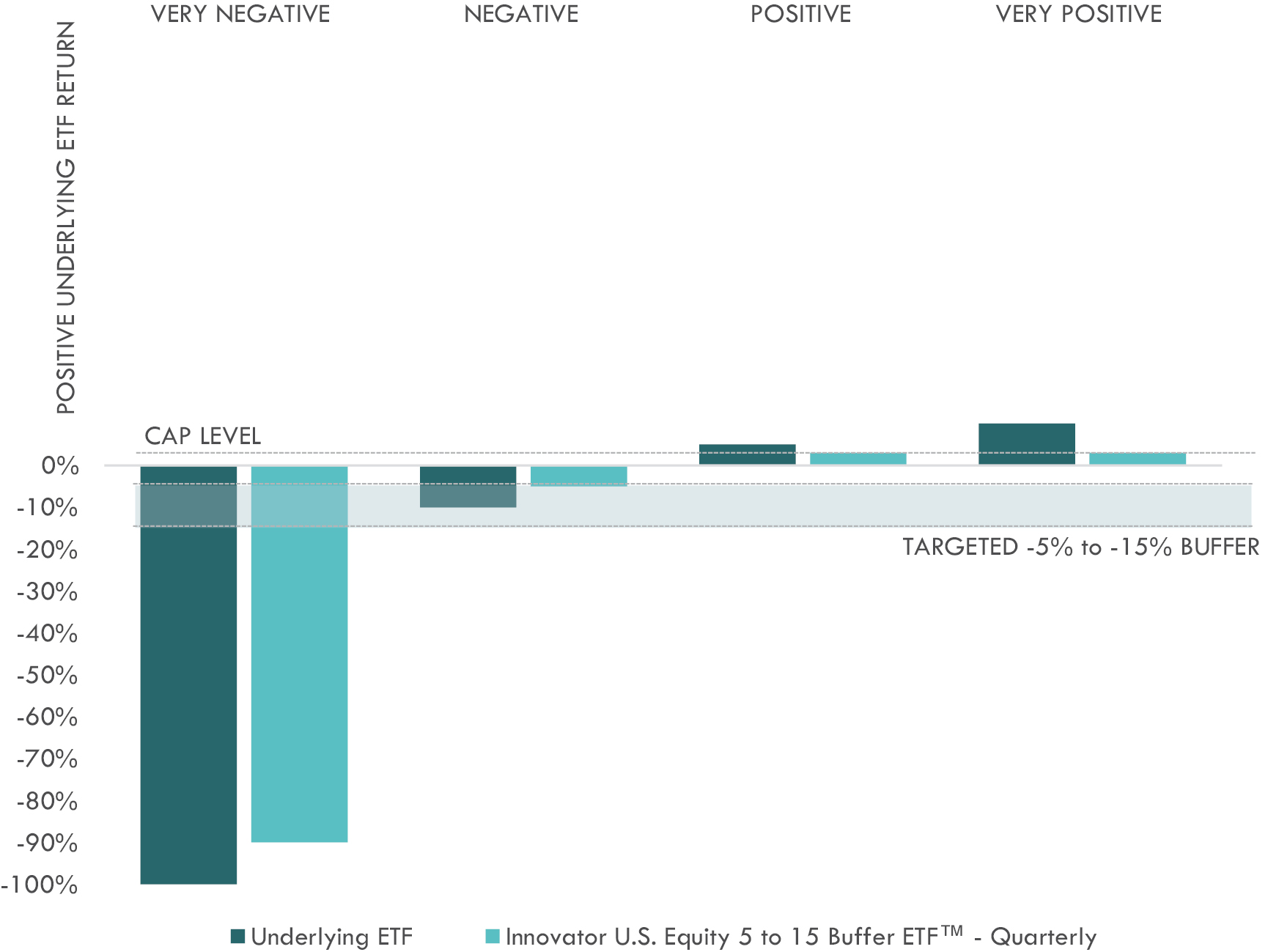
Please note this graph is provided merely to illustrate the Outcomes that the Fund seeks to provide based upon the performance of the Underlying ETF. Shareholders may experience losses greater than 90%, including loss of their entire investment. There is no guarantee that these Outcomes will be achieved over the course of the Outcome Period.
The following table contains hypothetical examples designed to illustrate the Outcomes the Fund seeks to provide over an Outcome Period, based upon the performance of the Underlying ETF from -100% to 100%. The table is provided for illustrative purposes and does not provide every possible performance scenario for Shares over the course of an Outcome Period. The table is not intended to predict or project the performance of the Fund or its holdings. Fund shareholders should not take this information as an assurance of the expected performance of the Underlying ETF or return on Shares. The actual overall performance of the Fund will vary with fluctuations in the value of its assets during the Outcome Period, among other factors. Please refer to the Fund’s website, www.innovatoretfs.com/ealt, which provides updated information relating to this table on a daily basis throughout the Outcome Period.
3
| Underlying ETF Performance | Fund Performance* |
| 100% | 5.75% |
| 50% | 5.75% |
| 20% | 5.75% |
| 15% | 5.75% |
| 10% | 5.75% |
| 5% | 5% |
| 0% | 0% |
| (5)% | (5)% |
| (10)% | (5)% |
| (15)% | (5)% |
| (20)% | (10)% |
| (50)% | (40)% |
| (100)% | (90)% |
* The Fund’s returns listed herein are provided prior to taking into account any fees or expenses charged to shareholders. The Fund’s annual management fee of 0.69% of the Fund’s average daily net assets, any shareholder transaction fees, any acquired fund fees and expenses, and any extraordinary expenses incurred by the Fund will have the effect of reducing the returns listed herein.
The Outcomes may only be realized by investors who continuously hold Shares from the commencement of the Outcome Period until its conclusion. Investors who purchase Shares after the Outcome Period has begun or sell Shares prior to the Outcome Period’s conclusion may experience investment returns that are very different from those that the Fund seeks to provide. In addition, because the Fund is designed to achieve Outcomes that change for each three-month Outcome Period, the Outcomes that are achieved by the Fund for a three-month Outcome Period will be different than the Outcomes achieved by the Fund over multiple Outcome Periods, or on an annualized basis. Similarly, investors holding Shares over multiple Outcome Periods will experience different investment results than holding a fund that has a longer Outcome Period (e.g., one year). Upon conclusion of the Outcome Period, the Fund will receive the cash value of all the FLEX Options it held for the prior Outcome Period. It will then invest in a new series of FLEX Options with an expiration date of approximately three months in the future, and a new Outcome Period will begin. The Outcomes the Fund seeks to provide and discussed herein are provided based on the Fund’s NAV, whereas shareholders purchase or sell Shares on the Exchange at market prices. Any disconnect between the Fund’s NAV and market prices of Shares will result in returns that deviate from the Outcomes the Fund seeks to provide.
The Fund’s investment adviser is Innovator Capital Management, LLC (“Innovator” or the “Adviser”) and the Fund’s investment sub-adviser is Milliman Financial Risk Management LLC (“Milliman” or the “Sub-Adviser”). The Fund is classified as a “non-diversified company” under the Investment Company Act of 1940, as amended (the “1940 Act”). To the extent the Underlying ETF concentrates (i.e., holds 25% or more of its total assets) in the securities of a particular industry or group of industries, the Fund will concentrate its investments to approximately the same extent. Through its exposure to the Underlying ETF, the Fund has significant exposure to companies in the information technology sector.
The Outcome Period. The Outcome Period is an approximately three-month period. The current Outcome Period is from January 1, 2026 through March 31, 2026. The Fund’s sought-after Outcomes are designed to be provided at the conclusion of the Outcome Period, and are based upon the Fund’s NAV at the outset of the Outcome Period. Each FLEX Option’s value is ultimately derived from the performance of the Underlying ETF during that time. Because the terms of the FLEX Options don’t change, the Cap and Buffer both relate to the Fund’s NAV on the first day of the Outcome Period. Further, since the Fund’s option contracts are exercisable at the conclusion of the Outcome Period, the Outcomes are only provided at the end of the Outcome Period. Therefore, to achieve the Outcomes sought by the Fund for the Outcome Period, an investor must hold Shares from the commencement of the Outcome Period through its conclusion. There is no guarantee that the Fund will be successful in its attempt to provide the Outcomes.
The Fund’s NAV is based upon the value of its portfolio which consists of FLEX Options, and may also include shares of the Underlying ETF (or the components thereof). Although the value of the Underlying ETF’s share price is a significant component of the value of the Fund’s FLEX Options, the value of the Fund’s FLEX Options (and therefore, the Fund’s NAV) will not increase or decrease at the same rate as the Underlying ETF’s share price on a daily basis. The time remaining until those FLEX Options expire, which is at the conclusion of the Outcome Period, also affects their value. The degree of non-correlation between the value of the FLEX Options and the value of the Underlying ETF may be higher than if the FLEX Options utilized by the Fund had a shorter term. The Sub-Adviser generally anticipates that the Fund’s NAV will increase on days when the Underlying ETF’s share price increases and will decrease on days when the Underlying ETF’s share price decreases, but that the rate of such increase or decrease will be less than that experienced by the Underlying ETF.
For additional information regarding the Outcome Period, including the potential impacts of purchasing and selling intra-Outcome Period, see “Additional Information Regarding the Fund’s Principal Investment Strategies.”
Cap on Potential Upside Returns. Unlike other investment products, the potential upside returns an investor can receive from an investment in the Fund over the Outcome Period is subject to the Cap. The Cap represents the maximum percentage return an investor can achieve from an investment in the Fund over the duration of the Outcome Period. Therefore, even though the Fund’s returns are based upon the performance of the Underlying ETF, if the Underlying ETF experiences returns for the Outcome Period in excess of the Cap, the Fund will not participate in such excess returns. The Cap is determined on the first day of the Outcome Period and is 5.75% prior to taking into account any fees or expenses charged to shareholders. When the Fund’s annual Fund management fee of 0.69% of the Fund’s average daily net assets is taken into account for the Outcome Period, the Cap is 5.57%. The Cap will be further reduced by any shareholder transaction fees, any acquired fund fees and expenses, and any extraordinary expenses incurred by the Fund. The Cap will change from one Outcome Period to the next based upon prevailing market conditions at the beginning of the Outcome Period. The Cap is also set forth on the Fund’s website at www.innovatoretfs.com/ealt.
Buffer. The Fund seeks to provide shareholders who hold Shares for the entire Outcome Period with a Buffer against Underlying ETF losses of between 5% and 15% during the Outcome Period; however, there is no guarantee that the Fund will be successful in its attempt to provide buffered returns. The Fund will bear the first 5% of Underlying ETF losses and all Underlying ETF losses exceeding 15% on a one-to-one basis. The effect sought to be created by the Buffer is that if the Underlying ETF’s share price has decreased in value over the course of the Outcome Period by 5% or less, the Fund will participate in such losses on a one-to-one basis. If the Underlying ETF has decreased in value more than 5% but less than 15%, the Fund seeks to limit losses at 5%. Finally, if the Underlying ETF has decreased in value by more than 15% over the course of the Outcome Period, the Fund seeks to provide a loss that is 10% less than the loss experienced by the Underlying ETF. While the Fund seeks to limit losses to 90% for shareholders who hold Shares for the entire Outcome Period, there is no guarantee it will successfully do so. An investment in the Fund is only appropriate for shareholders willing to bear those losses.
The Buffer is provided prior to taking into account annual Fund management fees, transaction fees, any acquired fund fees and expenses, and any extraordinary expenses incurred by the Fund. These fees and any expenses will have the effect of reducing the Buffer amount for Fund shareholders for an Outcome Period. When the Fund’s annual management fee equal to 0.69% of the Fund’s daily net assets is taken into account for the Outcome Period, the net Buffer for an Outcome Period is between 4.82% and 14.82%. Since the Fund’s strategy is designed to produce the Outcomes on the last day of the Outcome Period, it should not be expected that the Buffer, including the net effect of the Fund’s annual management fee on the Buffer, will be provided at any point prior to the last day of the Outcome Period.
The Fund’s Portfolio. The Fund invests in FLEX Options that reference the Underlying ETF and may also invest directly in shares of the Underlying ETF (or the components thereof). In general, an option contract is an agreement between a buyer and seller that gives the purchaser of the option the right to buy or sell a particular asset at a specified future date at an agreed upon price. FLEX Options are exchange-traded option contracts with uniquely customizable terms.
The Fund seeks to achieve the Outcomes, including the Cap and Buffer, by purchasing and selling call and put FLEX Options to create layers within the Fund’s portfolio. The customizable nature of FLEX Options allows the Sub-Adviser to select the share price of the Underlying ETF at which the option contract may be exercised. This is commonly known as the “strike price.” At the commencement of the Outcome Period, the Sub-Adviser specifically selects the strike price for each FLEX Option such that when the FLEX Options are exercised on the final day of the Outcome Period, the Outcomes may be obtained, depending on the performance of the Underlying ETF’s share price over the duration of the Outcome Period. Each of the FLEX Options purchased and sold throughout the Outcome Period are expected to have the same or similar terms (i.e., strike price and expiration) as the corresponding FLEX Options purchased and sold on the first day of the Outcome Period. The Fund utilizes European style option contracts, which are exercisable only on the expiration date of the option contract.
For a given Outcome Period, the Fund may invest exclusively in FLEX Options or may purchase the Underlying ETF directly (and/or the components thereof) and FLEX Options to produce the Outcomes. To the extent the Fund invests solely in FLEX Options that reference the Underlying ETF, the Cap and Buffer will be provided on a price return basis (i.e., the Outcomes will be
provided based on changes in the share price of the Underlying ETF), and the Fund will not receive the benefit of any dividends. For Outcome Periods in which the Fund directly purchases the Underlying ETF, in addition to FLEX Options, to construct the Fund’s portfolio, the Fund will receive dividends from the Underlying ETF, and the Cap and Buffer will be provided inclusive of dividends received (i.e., the price returns of the Underlying ETF plus dividends received). If the Fund invests in the Underlying ETF directly (or the components thereof), to calculate the Cap and Buffer, the Adviser will assume an estimated dividend rate for the Underlying ETF (which is based on the historical dividend rate of the Underlying ETF). To the extent the dividends received by the Fund differ from this assumed rate, the Cap and Buffer may be higher or lower than disclosed herein. If the Fund invests directly in the Underlying ETF, it will bear its proportionate share of the Underlying ETF’s expenses. The Adviser has entered into an agreement to waive its management fee to the extent of the acquired fund fees and expenses incurred in connection with its investment in the Underlying ETF.
Additional information regarding the terms of the FLEX Options, information on the Underlying ETF, and the mechanics of the Fund’s strategy can be found in “Additional Information Regarding the Fund’s Principal Investment Strategies.”
Fund Rebalance. The Fund is a continuous investment vehicle. It does not terminate and distribute its assets at the conclusion of each Outcome Period. On the termination date of an Outcome Period, the Sub-Adviser will invest in a new set of FLEX Options, or a combination of FLEX Options and the Underlying ETF (or components thereof) directly, and another Outcome Period will commence.
Approximately one week prior to the end of each Outcome Period, the Fund will file a prospectus supplement, which will alert existing shareholders that an Outcome Period is approaching its conclusion and disclose the anticipated ranges for the Cap for the next Outcome Period. Following the close of business on the last day of the Outcome Period, the Fund will file a prospectus supplement that discloses the Fund’s final Cap (both gross and net of the unitary management fee) for the next Outcome Period. This information is available on the Fund’s website, www.innovatoretfs.com/ealt, which also provides information regarding, among other items, the start date and end date of the Outcome Period, the Cap and Buffer, the Underlying ETF, the Fund’s portfolio holdings for the Outcome Period, whether the Outcomes are based on the price return of the Underlying ETF or the price return of the Underlying ETF plus dividends received, and information relating to the potential outcomes of an investment in the Fund on a daily basis. Important information relating to the Fund, including information relating to the Cap, is communicated on the Fund’s website.
General Strategy Description. Due to the unique mechanics of the Fund’s strategy, the return an investor can expect to receive from an investment in the Fund has characteristics that are distinct from many other investment vehicles. It is important that an investor understand these characteristics before making an investment in the Fund. The Fund has adopted a policy pursuant to Rule 35d-1 under the 1940 Act to invest, under normal circumstances, at least 80% of its net assets (plus any borrowings for investment purposes) in investments that provide exposure to the State Street® SPDR® S&P 500® ETF Trust.
The Fund’s strategy has been specifically designed to produce the “Outcomes” described below based upon the performance of the Underlying ETF over the duration of the Outcome Period. The Fund seeks replicate the performance of the Underlying ETF over the duration of the Outcome Period, subject to the below pre-determined Outcomes. There is no guarantee that the Fund will be successful in its attempt to provide the Outcomes for an Outcome Period.
• Upside Cap. Fund shareholders are subject to the Cap, which represents the maximum percentage return an investor can achieve from an investment in the Fund over the duration of the Outcome Period. The Cap is set on the first day of the Outcome Period and is 3.01% prior to taking into account any fees or expenses charged to shareholders. When the Fund’s annual Fund management fee of 0.69% of the Fund’s average daily net assets is taken into account for the Outcome Period, the Cap is 2.83%.
• Buffered Returns. The Fund seeks to provide shareholders that hold Shares for the entire Outcome Period with the Buffer, which seeks to protect against the first 10% of Underlying ETF losses during the Outcome Period. The Fund’s shareholders will bear all Underlying ETF losses exceeding 10% on a one-to-one basis. When the Fund’s annual management fee equal to 0.69% of the Fund’s daily net assets is taken into account for the Outcome Period, the net Buffer for an Outcome Period is 9.82%.
To produce the Outcomes, the Fund invests in FLEX Options that reference the Underlying ETF and may also invest in the Underlying ETF (or the components thereof) directly. The Underlying ETF is an ETF that seeks to provide investment results that, before fees expenses, correspond generally to the total return performance of an index that tracks the performance of large capitalization exchange-traded U.S. equity securities, specifically the S&P 500® Index. For additional information regarding the Underlying ETF, see “Additional Information Regarding the Fund’s Principal Investment Strategies.”
The hypothetical graphical illustration provided below is designed to illustrate the Outcomes that the Fund seeks to provide for investors who hold Shares for the entirety of the Outcome Period. The returns that the Fund seeks to provide do not include the costs associated with purchasing Shares and certain expenses incurred by the Fund.
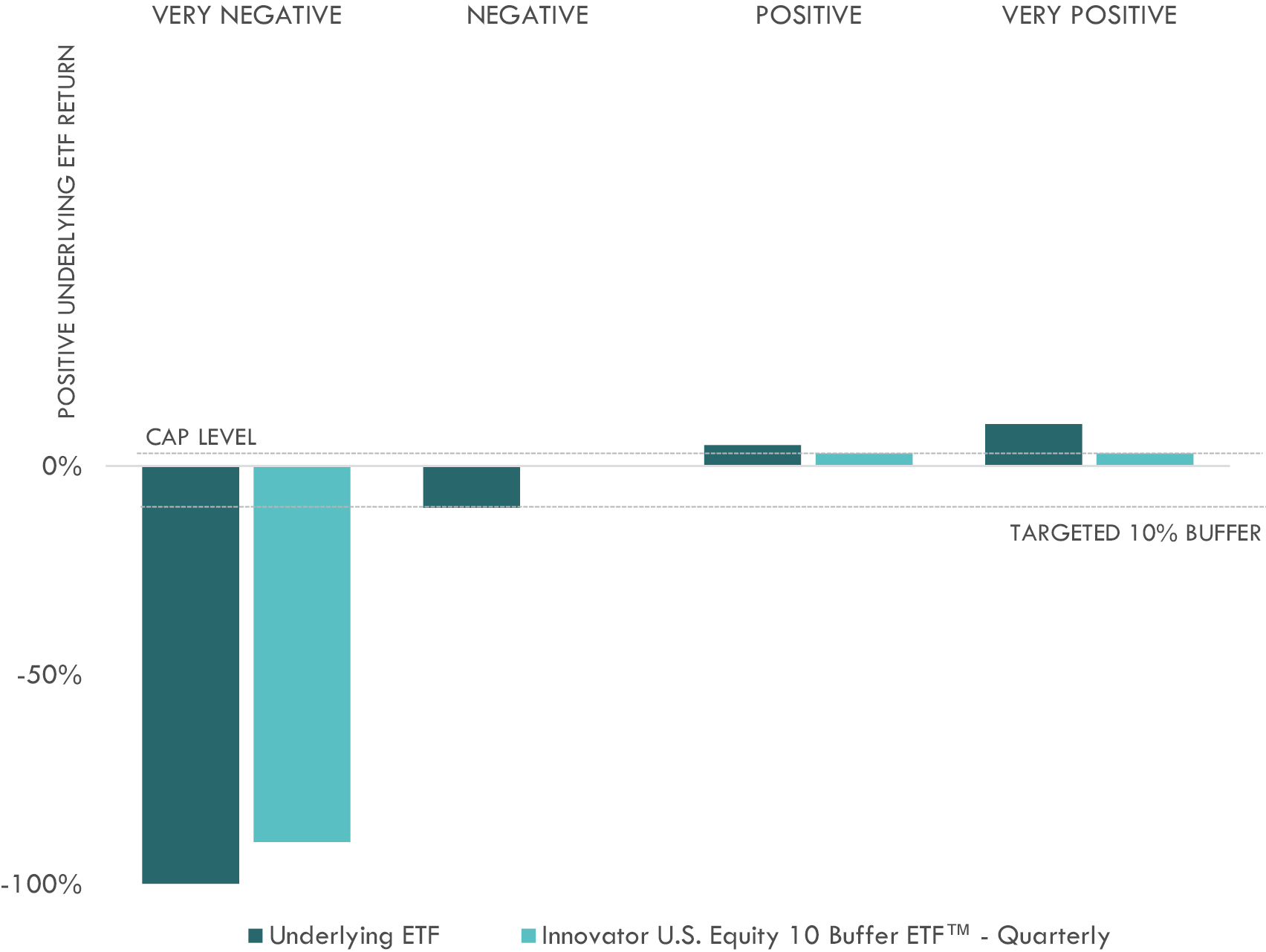
Please note this graph is provided merely to illustrate the Outcomes that the Fund seeks to provide based upon the performance of the Underlying ETF. Shareholders may experience losses greater than 90%, including loss of their entire investment. There is no guarantee that these Outcomes will be achieved over the course of the Outcome Period.
The following table contains hypothetical examples designed to illustrate the Outcomes the Fund seeks to provide over an Outcome Period, based upon the performance of the Underlying ETF from -100% to 100%. The table is provided for illustrative purposes and does not provide every possible performance scenario for Shares over the course of an Outcome Period. The table is not intended to predict or project the performance of the Fund or its holdings. Fund shareholders should not take this information as an assurance of the expected performance of the Underlying ETF or return on Shares. The actual overall performance of the Fund will vary
with fluctuations in the value of its assets during the Outcome Period, among other factors. Please refer to the Fund’s website, www.innovatoretfs.com/zalt, which provides updated information relating to this table on a daily basis throughout the Outcome Period.
| Underlying ETF Performance | Fund Performance* |
| 100% | 3.01% |
| 50% | 3.01% |
| 20% | 3.01% |
| 15% | 3.01% |
| 10% | 3.01% |
| 5% | 3.01% |
| 0% | 0% |
| (5)% | 0% |
| (10)% | 0% |
| (15)% | (5)% |
| (20)% | (10)% |
| (50)% | (40)% |
| (100)% | (90)% |
* The Fund’s returns listed herein are provided prior to taking into account any fees or expenses charged to shareholders. The Fund’s annual management fee of 0.69% of the Fund’s average daily net assets, any shareholder transaction fees, any acquired fund fees and expenses, and any extraordinary expenses incurred by the Fund will have the effect of reducing the returns listed herein.
The Outcomes may only be realized by investors who continuously hold Shares from the commencement of the Outcome Period until its conclusion. Investors who purchase Shares after the Outcome Period has begun or sell Shares prior to the Outcome Period’s conclusion may experience investment returns that are very different from those that the Fund seeks to provide. In addition, because the Fund is designed to achieve Outcomes that change for each three-month Outcome Period, the Outcomes that are achieved by the Fund for a three-month Outcome Period will be different than the Outcomes achieved by the Fund over multiple Outcome Periods, or on an annualized basis. Similarly, investors holding Shares over multiple Outcome Periods will experience different investment results than holding a fund that has a longer Outcome Period (e.g., one year). Upon conclusion of the Outcome Period, the Fund will receive the cash value of all the FLEX Options it held for the prior Outcome Period. It will then invest in a new series of FLEX Options with an expiration date of approximately three months in the future, and a new Outcome Period will begin. The Outcomes the Fund seeks to provide and discussed herein are provided based on the Fund’s NAV, whereas shareholders purchase or sell Shares on the Exchange at market prices. Any disconnect between the Fund’s NAV and market prices of Shares will result in returns that deviate from the Outcomes the Fund seeks to provide.
The Fund’s investment adviser is Innovator Capital Management, LLC (“Innovator” or the “Adviser”) and the Fund’s investment sub-adviser is Milliman Financial Risk Management LLC (“Milliman” or the “Sub-Adviser”). The Fund is classified as a “non-diversified company” under the Investment Company Act of 1940, as amended (the “1940 Act”). To the extent the Underlying ETF concentrates (i.e., holds 25% or more of its total assets) in the securities of a particular industry
or group of industries, the Fund will concentrate its investments to approximately the same extent. Through its exposure to the Underlying ETF, the Fund has significant exposure to companies in the information technology sector.
The Outcome Period. The Outcome Period is an approximately three-month period. The current Outcome Period is from January 1, 2026 through March 31, 2026. The Fund’s sought-after Outcomes are designed to be provided at the conclusion of the Outcome Period, and are based upon the Fund’s NAV at the outset of the Outcome Period. Each FLEX Option’s value is ultimately derived from the performance of the Underlying ETF during that time. Because the terms of the FLEX Options don’t change, the Cap and Buffer both relate to the Fund’s NAV on the first day of the Outcome Period. Further, since the Fund’s option contracts are exercisable at the conclusion of the Outcome Period, the Outcomes are only provided at the end of the Outcome Period. Therefore, to achieve the Outcomes sought by the Fund for the Outcome Period, an investor must hold Shares from the commencement of the Outcome Period through its conclusion. There is no guarantee that the Fund will be successful in its attempt to provide the Outcomes.
The Fund’s NAV is based upon the value of its portfolio which consists of FLEX Options, and may also include shares of the Underlying ETF (or the components thereof). Although the value of the Underlying ETF’s share price is a significant component of the value of the Fund’s FLEX Options, the value of the Fund’s FLEX Options (and therefore, the Fund’s NAV) will not increase or decrease at the same rate as the Underlying ETF’s share price on a daily basis. The time remaining until those FLEX Options expire, which is at the conclusion of the Outcome Period, also affects their value. The Sub-Adviser generally anticipates that the Fund’s NAV will increase on days when the Underlying ETF’s share price increases and will decrease on days when the Underlying ETF’s share price decreases, but that the rate of such increase or decrease will be less than that experienced by the Underlying ETF.
For additional information regarding the Outcome Period, including the potential impacts of purchasing and selling intra-Outcome Period, see “Additional Information Regarding the Fund’s Principal Investment Strategies.”
Cap on Potential Upside Returns. Unlike other investment products, the potential upside returns an investor can receive from an investment in the Fund over the Outcome Period is subject to the Cap. The Cap represents the maximum percentage return an investor can achieve from an investment in the Fund over the duration of the Outcome Period. Therefore, even though the Fund’s returns are based upon the performance of the Underlying ETF, if the Underlying ETF experiences returns for the Outcome Period in excess of the Cap, the Fund will not participate in such excess returns. The Cap is determined on the first day of the Outcome Period and is 3.01% prior to taking into account any fees or expenses charged to shareholders. When the Fund’s annual Fund management fee of 0.69% of the Fund’s average daily net assets is taken into account for the Outcome Period, the Cap is 2.83%. The Cap will be further reduced by any shareholder transaction fees, any acquired fund fees and expenses, and any extraordinary expenses incurred by the Fund. The Cap will change from one Outcome Period to the next based upon prevailing market conditions at the beginning of the Outcome Period. The Cap is also set forth on the Fund’s website at www.innovatoretfs.com/zalt.
Buffer. The Fund seeks to provide shareholders who hold Shares for the entire Outcome Period with a Buffer against the first 10% of Underlying ETF losses for the Outcome Period; however, there is no guarantee that the Fund will be successful in its attempt to provide buffered returns. After the Underlying ETF’s share price has decreased by more than 10%, the Fund will experience all subsequent losses on a one-to-one basis. The effect sought to be created by the Buffer is that if the Underlying ETF’s share price has decreased in value over the course of the Outcome Period, the Fund seeks to be returned the amount of its principal investment (if the Underlying ETF’s share price decreased in value by 10% or less) or experience a loss that is 10% less than the loss experienced by the Underlying ETF (if the Underlying ETF’s share price decreased in value by more than 10%). A shareholder may lose their entire investment. While the Fund seeks to limit losses to 90% for shareholders who hold Shares for the entire Outcome Period, there is no guarantee it will successfully do so. An investment in the Fund is only appropriate for shareholders willing to bear those losses.
The Buffer is provided prior to taking into account annual Fund management fees, transaction fees, any acquired fund fees and expenses, and any extraordinary expenses incurred by the Fund. These fees and any expenses will have the effect of reducing the Buffer amount for Fund shareholders for an Outcome Period. When the Fund’s annual management fee equal to 0.69% of the Fund’s daily net assets is taken into account for the Outcome Period, the net Buffer for an Outcome Period is 9.82%. Since the Fund’s strategy is designed to produce the Outcomes on the last day of the Outcome Period, it should not be expected that the Buffer, including the net effect of the Fund’s annual management fee on the Buffer, will be provided at any point prior to the last day of the Outcome Period.
The Fund’s Portfolio. The Fund invests in FLEX Options that reference the Underlying ETF and may also invest directly in shares of the Underlying ETF (or the components thereof). In general, an option contract is an agreement between a buyer and seller that gives the purchaser of the option the right to buy or sell a particular asset at a specified future date at an agreed upon price. FLEX Options are exchange-traded option contracts with uniquely customizable terms.
The Fund seeks to achieve the Outcomes, including the Cap and Buffer, by purchasing and selling call and put FLEX Options to create layers within the Fund’s portfolio. The customizable nature of FLEX Options allows the Sub-Adviser to select the share price of the Underlying ETF at which the option contract may be exercised. This is commonly known as the “strike price.” At the commencement of the Outcome Period, the Sub-Adviser specifically selects the strike price for each FLEX Option such that when the FLEX Options are exercised on the final day of the Outcome Period, the Outcomes may be obtained, depending on the performance of the Underlying ETF’s share price over the duration of the Outcome Period. Each of the FLEX Options purchased and sold throughout the Outcome Period are expected to have the same or similar terms (i.e., strike price and expiration) as the corresponding FLEX Options purchased and sold on the first day of the Outcome Period. The Fund utilizes European style option contracts, which are exercisable only on the expiration date of the option contract.
For a given Outcome Period, the Fund may invest exclusively in FLEX Options or may purchase the Underlying ETF directly (and/or the components thereof) and FLEX Options to produce the Outcomes. To the extent the Fund invests solely in FLEX Options that reference the Underlying
ETF, the Cap and Buffer will be provided on a price return basis (i.e., the Outcomes will be provided based on changes in the share price of the Underlying ETF), and the Fund will not receive the benefit of any dividends. For Outcome Periods in which the Fund directly purchases the Underlying ETF, in addition to FLEX Options, to construct the Fund’s portfolio, the Fund will receive dividends from the Underlying ETF, and the Cap and Buffer will be provided inclusive of dividends received (i.e., the price returns of the Underlying ETF plus dividends received). If the Fund invests in the Underlying ETF directly (or the components thereof), to calculate the Cap and Buffer, the Adviser will assume an estimated dividend rate for the Underlying ETF (which is based on the historical dividend rate of the Underlying ETF). To the extent the dividends received by the Fund differ from this assumed rate, the Cap and Buffer may be higher or lower than disclosed herein. If the Fund invests directly in the Underlying ETF, it will bear its proportionate share of the Underlying ETF’s expenses. The Adviser has entered into an agreement to waive its management fee to the extent of the acquired fund fees and expenses incurred in connection with its investment in the Underlying ETF.
Additional information regarding the terms of the FLEX Options, information on the Underlying ETF, and the mechanics of the Fund’s strategy can be found in “Additional Information Regarding the Fund’s Principal Investment Strategies.”
Fund Rebalance. The Fund is a continuous investment vehicle. It does not terminate and distribute its assets at the conclusion of each Outcome Period. On the termination date of an Outcome Period, the Sub-Adviser will invest in a new set of FLEX Options, or a combination of FLEX Options and the Underlying ETF (or components thereof) directly, and another Outcome Period will commence.
Approximately one week prior to the end of each Outcome Period, the Fund will file a prospectus supplement, which will alert existing shareholders that an Outcome Period is approaching its conclusion and disclose the anticipated ranges for the Cap for the next Outcome Period. Following the close of business on the last day of the Outcome Period, the Fund will file a prospectus supplement that discloses the Fund’s final Cap (both gross and net of the unitary management fee) for the next Outcome Period. This information is available on the Fund’s website, www.innovatoretfs.com/zalt, which also provides information regarding, among other items, the start date and end date of the Outcome Period, the Cap and Buffer, the Underlying ETF, the Fund’s portfolio holdings for the Outcome Period, whether the Outcomes are based on the price return of the Underlying ETF or the price return of the Underlying ETF plus dividends received, and information relating to the potential outcomes of an investment in the Fund on a daily basis. Important information relating to the Fund, including information relating to the Cap, is communicated on the Fund’s website.
General Strategy Description. Due to the unique mechanics of the Fund’s strategy, the return an investor can expect to receive from an investment in the Fund has characteristics that are distinct from many other investment vehicles. It is important that an investor understand these characteristics before making an investment in the Fund. The Fund has adopted a policy pursuant to Rule 35d-1 under the 1940 Act to invest, under normal circumstances, at least 80% of its net assets (plus any borrowings for investment purposes) in investments that provide exposure to the iShares Russell 2000 ETF.
The Fund’s strategy has been specifically designed to produce the “Outcomes” described below based upon the performance of the Underlying ETF over the duration of the Outcome Period. The Fund seeks replicate the performance of the Underlying ETF over the duration of the Outcome Period, subject to the below pre-determined Outcomes. There is no guarantee that the Fund will be successful in its attempt to provide the Outcomes for an Outcome Period.
• Upside Cap. Fund shareholders are subject to the Cap, which represents the maximum percentage return an investor can achieve from an investment in the Fund over the duration of the Outcome Period. The Cap is set on the first day of the Outcome Period and is 4.02% prior to taking into account any fees or expenses charged to shareholders. When the Fund’s annual Fund management fee of 0.79% of the Fund’s average daily net assets is taken into account for the Outcome Period, the Cap is 3.82%.
• Buffered Returns. The Fund seeks to provide shareholders that hold Shares for the entire Outcome Period with the Buffer, which seeks to protect against the first 10% of Underlying ETF losses during the Outcome Period. The Fund’s shareholders will bear all Underlying ETF losses exceeding 10% on a one-to-one basis. When the Fund’s annual management fee equal to 0.79% of the Fund’s daily net assets is taken into account for the Outcome Period, the net Buffer for an Outcome Period is 9.80%.
To produce the Outcomes, the Fund invests in FLEX Options that reference the Underlying ETF and may also invest in the Underlying ETF (or the components thereof) directly. The Underlying ETF is an ETF that seeks to provide investment results that, before fees expenses, correspond generally to the total return performance of a float-adjusted capitalization-weighted index of equity securities issued by the approximately 2,000 smallest issuers in the Russell 3000 Index. For additional information regarding the Underlying ETF, see “Additional Information Regarding the Fund’s Principal Investment Strategies.”
The hypothetical graphical illustration provided below is designed to illustrate the Outcomes that the Fund seeks to provide for investors who hold Shares for the entirety of the Outcome Period. The returns that the Fund seeks to provide do not include the costs associated with purchasing Shares and certain expenses incurred by the Fund.
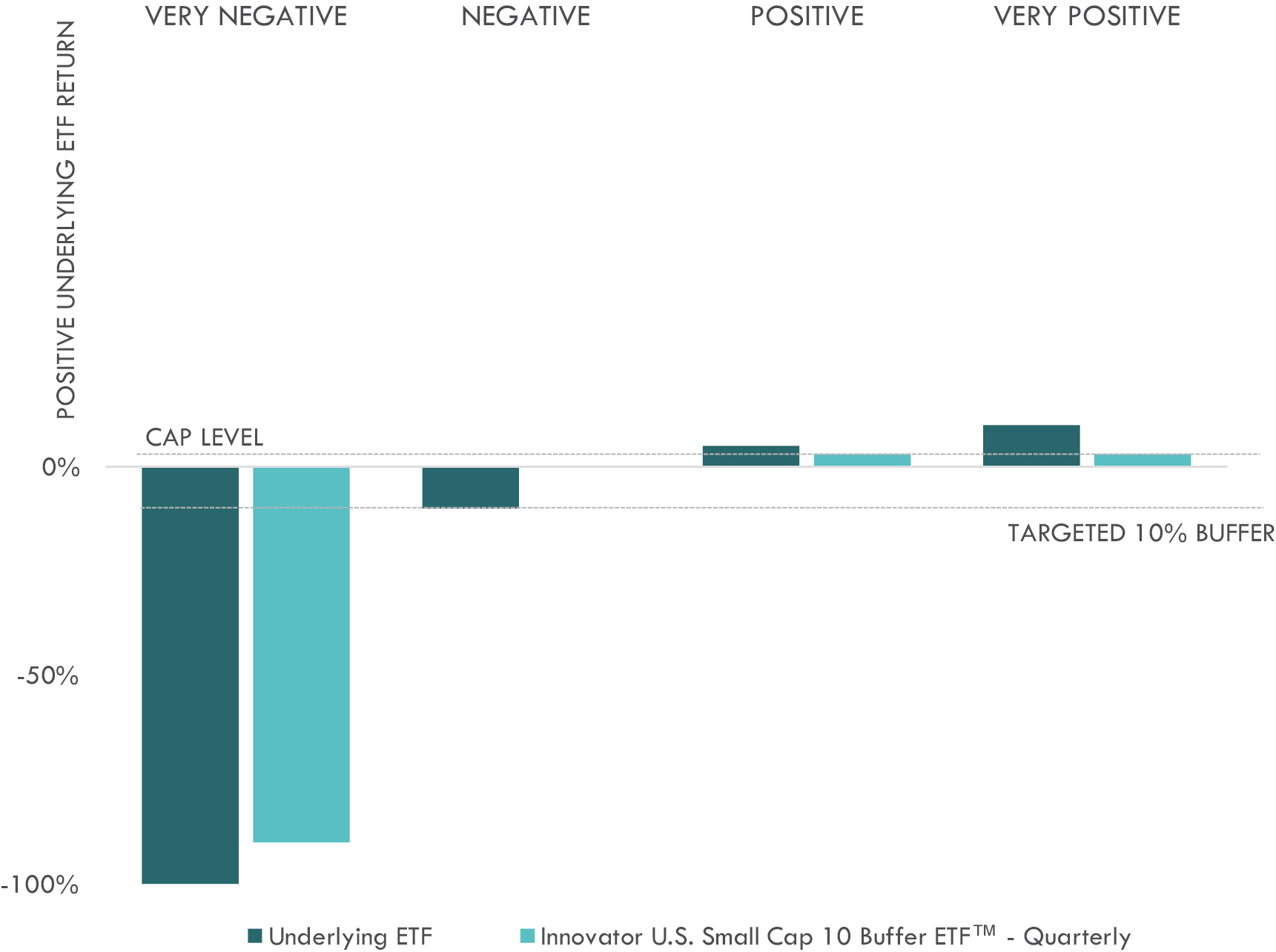
Please note this graph is provided merely to illustrate the Outcomes that the Fund seeks to provide based upon the performance of the Underlying ETF. Shareholders may experience losses greater than 90%, including loss of their entire investment. There is no guarantee that these Outcomes will be achieved over the course of the Outcome Period.
The following table contains hypothetical examples designed to illustrate the Outcomes the Fund seeks to provide over an Outcome Period, based upon the performance of the Underlying ETF from -100% to 100%. The table is provided for illustrative purposes and does not provide every possible performance scenario for Shares over the course of an Outcome Period. The table is not intended to predict or project the performance of the Fund or its holdings. Fund shareholders should not take this information as an assurance of the expected performance of the Underlying ETF or return on Shares. The actual overall performance of the Fund will vary with fluctuations in the value of its assets during the Outcome Period, among other factors. Please refer to the Fund’s website, www.innovatoretfs.com/rbuf, which provides updated information relating to this table on a daily basis throughout the Outcome Period.
| Underlying ETF Performance | Fund Performance* |
| 100% | 4.02% |
| 50% | 4.02% |
| 20% | 4.02% |
| 15% | 4.02% |
| 10% | 4.02% |
| 5% | 4.02% |
| 0% | 0% |
| (5)% | 0% |
| (10)% | 0% |
| (15)% | (5)% |
| (20)% | (10)% |
| (50)% | (40)% |
| (100)% | (90)% |
* The Fund’s returns listed herein are provided prior to taking into account any fees or expenses charged to shareholders. The Fund’s annual management fee of 0.79% of the Fund’s average daily net assets, any shareholder transaction fees, any acquired fund fees and expenses, and any extraordinary expenses incurred by the Fund will have the effect of reducing the returns listed herein.
The Outcomes may only be realized by investors who continuously hold Shares from the commencement of the Outcome Period until its conclusion. Investors who purchase Shares after the Outcome Period has begun or sell Shares prior to the Outcome Period’s conclusion may experience investment returns that are very different from those that the Fund seeks to provide. In addition, because the Fund is designed to achieve Outcomes that change for each three-month Outcome Period, the Outcomes that are achieved by the Fund for a three-month Outcome Period will be different than the Outcomes achieved by the Fund over multiple Outcome Periods, or on an annualized basis. Similarly, investors holding Shares over multiple Outcome Periods will experience different investment results than holding a fund that has a longer Outcome Period (e.g., one year). Upon conclusion of the Outcome Period, the Fund will receive the cash value of all the FLEX Options it held for the prior Outcome Period. It will then invest in a new series of FLEX Options with an expiration date of approximately three months in the future, and a new Outcome Period will begin. The Outcomes the Fund seeks to provide and discussed herein are provided based on the Fund’s NAV, whereas shareholders purchase or sell Shares on the Exchange at market prices. Any disconnect between the Fund’s NAV and market prices of Shares will result in returns that deviate from the Outcomes the Fund seeks to provide.
The Fund’s investment adviser is Innovator Capital Management, LLC (“Innovator” or the “Adviser”) and the Fund’s investment sub-adviser is Milliman Financial Risk Management LLC (“Milliman” or the “Sub-Adviser”). The Fund is classified as a “non-diversified company” under the Investment Company Act of 1940, as amended (the “1940 Act”). To the extent the Underlying ETF concentrates (i.e., holds 25% or more of its total assets) in the securities of a particular industry or group of industries, the Fund will concentrate its investments to approximately the same extent.
The Outcome Period. The Outcome Period is an approximately three-month period. The current Outcome Period is from January 1, 2026 through March 31, 2026. The Fund’s sought-after Outcomes are designed to be provided at the conclusion of the Outcome Period, and are based upon the Fund’s NAV at the outset of the Outcome Period. Each FLEX Option’s value is ultimately
derived from the performance of the Underlying ETF during that time. Because the terms of the FLEX Options don’t change, the Cap and Buffer both relate to the Fund’s NAV on the first day of the Outcome Period. Further, since the Fund’s option contracts are exercisable at the conclusion of the Outcome Period, the Outcomes are only provided at the end of the Outcome Period. Therefore, to achieve the Outcomes sought by the Fund for the Outcome Period, an investor must hold Shares from the commencement of the Outcome Period through its conclusion. There is no guarantee that the Fund will be successful in its attempt to provide the Outcomes.
The Fund’s NAV is based upon the value of its portfolio which consists of FLEX Options, and may also include shares of the Underlying ETF (or the components thereof). Although the value of the Underlying ETF’s share price is a significant component of the value of the Fund’s FLEX Options, the value of the Fund’s FLEX Options (and therefore, the Fund’s NAV) will not increase or decrease at the same rate as the Underlying ETF’s share price on a daily basis. The time remaining until those FLEX Options expire, which is at the conclusion of the Outcome Period, also affects their value. Additionally, since the Underlying ETF has the potential to be more volatile than other funds, during the Outcome Period it is possible that the degree of non-correlation between the value of the FLEX Options and the value of the Underlying ETF will be higher than if the FLEX Options utilized a less volatile reference asset. The Sub-Adviser generally anticipates that the Fund’s NAV will increase on days when the Underlying ETF’s share price increases and will decrease on days when the Underlying ETF’s share price decreases, but that the rate of such increase or decrease will be less than that experienced by the Underlying ETF.
For additional information regarding the Outcome Period, including the potential impacts of purchasing and selling intra-Outcome Period, see “Additional Information Regarding the Fund’s Principal Investment Strategies.”
Cap on Potential Upside Returns. Unlike other investment products, the potential upside returns an investor can receive from an investment in the Fund over the Outcome Period is subject to the Cap. The Cap represents the maximum percentage return an investor can achieve from an investment in the Fund over the duration of the Outcome Period. Therefore, even though the Fund’s returns are based upon the performance of the Underlying ETF, if the Underlying ETF experiences returns for the Outcome Period in excess of the Cap, the Fund will not participate in such excess returns. The Cap is determined on the first day of the Outcome Period and is 4.02% prior to taking into account any fees or expenses charged to shareholders. When the Fund’s annual Fund management fee of 0.79% of the Fund’s average daily net assets is taken into account for the Outcome Period, the Cap is 3.82%. The Cap will be further reduced by any shareholder transaction fees, any acquired fund fees and expenses, and any extraordinary expenses incurred by the Fund. The Cap will change from one Outcome Period to the next based upon prevailing market conditions at the beginning of the Outcome Period. The Cap is also set forth on the Fund’s website at www.innovatoretfs.com/rbuf.
Buffer. The Fund seeks to provide shareholders who hold Shares for the entire Outcome Period with a Buffer against the first 10% of Underlying ETF losses for the Outcome Period; however, there is no guarantee that the Fund will be successful in its attempt to provide buffered returns. After the Underlying ETF’s share price has decreased by more than 10%, the Fund will experience all subsequent losses on a one-to-one basis. The effect sought to be created by the Buffer is that if the Underlying ETF’s share price has decreased in value over the course of the Outcome
Period, the Fund seeks to be returned the amount of its principal investment (if the Underlying ETF’s share price decreased in value by 10% or less) or experience a loss that is 10% less than the loss experienced by the Underlying ETF (if the Underlying ETF’s share price decreased in value by more than 10%). A shareholder may lose their entire investment. While the Fund seeks to limit losses to 90% for shareholders who hold Shares for the entire Outcome Period, there is no guarantee it will successfully do so. An investment in the Fund is only appropriate for shareholders willing to bear those losses.
The Buffer is provided prior to taking into account annual Fund management fees, transaction fees, any acquired fund fees and expenses, and any extraordinary expenses incurred by the Fund. These fees and any expenses will have the effect of reducing the Buffer amount for Fund shareholders for an Outcome Period. When the Fund’s annual management fee equal to 0.79% of the Fund’s daily net assets is taken into account for the Outcome Period, the net Buffer for an Outcome Period is 9.80%. Since the Fund’s strategy is designed to produce the Outcomes on the last day of the Outcome Period, it should not be expected that the Buffer, including the net effect of the Fund’s annual management fee on the Buffer, will be provided at any point prior to the last day of the Outcome Period.
The Fund’s Portfolio. The Fund invests in FLEX Options that reference the Underlying ETF and may also invest directly in shares of the Underlying ETF (or the components thereof). In general, an option contract is an agreement between a buyer and seller that gives the purchaser of the option the right to buy or sell a particular asset at a specified future date at an agreed upon price. FLEX Options are exchange-traded option contracts with uniquely customizable terms.
The Fund seeks to achieve the Outcomes, including the Cap and Buffer, by purchasing and selling call and put FLEX Options to create layers within the Fund’s portfolio. The customizable nature of FLEX Options allows the Sub-Adviser to select the share price of the Underlying ETF at which the option contract may be exercised. This is commonly known as the “strike price.” At the commencement of the Outcome Period, the Sub-Adviser specifically selects the strike price for each FLEX Option such that when the FLEX Options are exercised on the final day of the Outcome Period, the Outcomes may be obtained, depending on the performance of the Underlying ETF’s share price over the duration of the Outcome Period. Each of the FLEX Options purchased and sold throughout the Outcome Period are expected to have the same or similar terms (i.e., strike price and expiration) as the corresponding FLEX Options purchased and sold on the first day of the Outcome Period. The Fund utilizes European style option contracts, which are exercisable only on the expiration date of the option contract.
For a given Outcome Period, the Fund may invest exclusively in FLEX Options or may purchase the Underlying ETF directly (and/or the components thereof) and FLEX Options to produce the Outcomes. To the extent the Fund invests solely in FLEX Options that reference the Underlying ETF, the Cap and Buffer will be provided on a price return basis (i.e., the Outcomes will be provided based on changes in the share price of the Underlying ETF), and the Fund will not receive the benefit of any dividends. For Outcome Periods in which the Fund directly purchases the Underlying ETF, in addition to FLEX Options, to construct the Fund’s portfolio, the Fund will
receive dividends from the Underlying ETF, and the Cap and Buffer will be provided inclusive of dividends received (i.e., the price returns of the Underlying ETF plus dividends received). If the Fund invests in the Underlying ETF directly (or the components thereof), to calculate the Cap and Buffer, the Adviser will assume an estimated dividend rate for the Underlying ETF (which is based on the historical dividend rate of the Underlying ETF). To the extent the dividends received by the Fund differ from this assumed rate, the Cap and Buffer may be higher or lower than disclosed herein. If the Fund invests directly in the Underlying ETF, it will bear its proportionate share of the Underlying ETF’s expenses. The Adviser has entered into an agreement to waive its management fee to the extent of the acquired fund fees and expenses incurred in connection with its investment in the Underlying ETF.
Additional information regarding the terms of the FLEX Options, information on the Underlying ETF, and the mechanics of the Fund’s strategy can be found in “Additional Information Regarding the Fund’s Principal Investment Strategies.”
Fund Rebalance. The Fund is a continuous investment vehicle. It does not terminate and distribute its assets at the conclusion of each Outcome Period. On the termination date of an Outcome Period, the Sub-Adviser will invest in a new set of FLEX Options, or a combination of FLEX Options and the Underlying ETF (or components thereof) directly, and another Outcome Period will commence.
Approximately one week prior to the end of each Outcome Period, the Fund will file a prospectus supplement, which will alert existing shareholders that an Outcome Period is approaching its conclusion and disclose the anticipated ranges for the Cap for the next Outcome Period. Following the close of business on the last day of the Outcome Period, the Fund will file a prospectus supplement that discloses the Fund’s final Cap (both gross and net of the unitary management fee) for the next Outcome Period. This information is available on the Fund’s website, www.innovatoretfs.com/rbuf, which also provides information regarding, among other items, the start date and end date of the Outcome Period, the Cap and Buffer, the Underlying ETF, the Fund’s portfolio holdings for the Outcome Period, whether the Outcomes are based on the price return of the Underlying ETF or the price return of the Underlying ETF plus dividends received, and information relating to the potential outcomes of an investment in the Fund on a daily basis. Important information relating to the Fund, including information relating to the Cap, is communicated on the Fund’s website.