The Fund is an actively managed ETF that seeks to achieve its investment objective by investing, under normal circumstances, at least 80% of its net assets (including borrowings for investment purposes) in the equity securities of companies it considers to be on the frontier of the development of new technologies (“Frontier Tech Companies”). Deepwater Asset Management, LLC (“Deepwater”) and Penserra Capital Management LLC (“Penserra” and, collectively with Deepwater, the “Sub-Advisers”) each serve as an investment sub-adviser to the Fund. Deepwater selects the securities for inclusion in the Fund and Penserra is responsible for implementing the Fund’s investment program by, among other things, trading portfolio securities and performing related services, rebalancing the Fund’s portfolio and providing cash management services. Innovator Capital Management, LLC (“Innovator” or the “Adviser”), serves as the Fund’s investment adviser.
In pursuing the Fund’s investment objective, Deepwater references for investment Frontier Tech Companies included in the Deepwater Frontier Tech Index (the “Reference Index”), a rules-based stock index owned, developed and maintained by Deepwater. The Reference Index identifies Frontier Tech Companies with the following themes:
• Artificial Intelligence. Companies that provide or are developing software services that seek to automate industrial, knowledge work, and consumer processes. These services may directly automate specific processes or provide semi-automated tools as an intermediate step to full automation.
• Autonomous and Electric Vehicles. Companies that provide or are developing hardware and/or software used in the development of self-driving or unmanned aerial vehicles, or other autonomous vehicles that operate on land, air or sea. The category also includes electrification, energy storage, and other companies relevant to the evolution of energy.
• Fintech. Companies involved in creating transformative experiences involving the use of money. This theme may include companies that enable complex commerce transactions, innovative retail experiences, new credit products, and alternative currencies.
• Robotics. Companies that create or are developing robotics and related products and services for industrial, collaborative, agricultural, medical and/or consumer-related automation. This includes companies that provide hardware and software related to enabling perception (vision and sound), which could include sensors, laser arrays, semiconductors, among others.
• Virtual/Augmented Reality. Companies that provide or are developing hardware and/or software for delivering immersive virtual reality experiences or for delivering experiences that enhance the physical world with a digital overlay, including gaming companies.
A company is eligible for inclusion in the Reference Index if it derives 50% of its revenue from one of the identified themes detailed above or if it meets two of the following three criteria: (i) the company currently derives at least 25% of revenue from some combination of the identified
themes; (ii) the company’s revenue related to one or more identified themes grew by more than 25% year-over-year in the most recent calendar year; or (iii) the company’s operating expenditures related to one or more identified themes grew by more than 25% year-over-year in the most recent calendar year. For additional information on the Reference Index, see “Additional Information About the Fund’s Principal Investment Strategies–The Reference Index”.
Deepwater will assess the universe of eligible constituents from the Reference Index for near and long-term prospects relative to its frontier technology development. Portfolio weightings are actively monitored and adjusted in accordance with the portfolio manager’s review of these technology developments, revenue growth potential and expectations to have an outsized influence on the future of technology. The Fund’s portfolio managers may include a security that is not currently a Reference Index constituent if, in the view of the Fund’s portfolio managers, such company has potential of long-term frontier technology revenue growth. The Fund’s portfolio managers expect that the Fund will invest in approximately 30 securities.
The Fund will invest in equity securities, which will include direct investments in U.S. and non-U.S. listed common stocks and depositary receipts, of certain of the components that comprise the Reference Index. The Fund may invest in small, mid or large capitalization issuers operating in developing or emerging markets. The Fund may also purchase equity securities of non-U.S. companies that utilize American Depositary Receipts (“ADRs”) or Global Depositary Receipts (“GDRs”). Additionally, the Fund may invest in certain Chinese companies through a structure known as a variable interest entity (“VIE”), which is designed to provide foreign investors, such as the Fund, with exposure to Chinese companies in sectors in which foreign investment is otherwise not permitted. Under this structure, a Chinese operating company is the VIE and establishes a shell company in a foreign jurisdiction, such as the Cayman Islands, which is then listed on a foreign exchange. The shell company has exposure to the VIE through contractual arrangements rather than any direct equity ownership. For a discussion of risks associated with VIEs, see “Principal Risks” below.
The Fund is classified as a “diversified company” under the Investment Company Act of 1940, as amended (the “1940 Act”). To the extent the Reference Index concentrates (i.e., holds 25% or more of its total assets) in the securities of a particular industry or group of industries, the Fund will concentrate its investments to approximately the same extent. As of the date of this prospectus, the Fund had significant exposure to the information technology sector.
The Fund is an actively managed ETF that seeks to provide investors with income distributions and the potential to limit downside losses, as determined by the performance of common stocks (each a “Reference Asset”) selected from a U.S. equity index, currently the S&P 500® Index (the “U.S. Equity Index”). The Fund seeks to principally invest in a laddered portfolio of over-the-counter (“OTC”) swap agreements, each seeking to replicate the defined return characteristics of an autocallable note on one Reference Asset (each, an “Autocallable Instrument” and collectively, the “Autocallable Instruments”). As described further below, each Autocallable Instrument in which the Fund invests is designed to provide the following investment profile:
• Periodic Income Payments. Potential for periodic income payments at defined times over the duration of an Autocallable Instrument, contingent on the performance of the Reference Assets.
• Potential to Limit Downside Losses. No participation in the losses of a Reference Asset unless the losses of such Reference Asset exceed a pre-determined investment barrier, in which case the Fund will experience the losses of such Reference Asset over the duration the Autocallable Instrument on a one-to-one basis, offset by any income payments received.
The Sub-Adviser (defined below) selects the Reference Assets for the Fund’s Autocallable Instruments by identifying the approximately 20 largest components of the U.S. Equity Index by market capitalization. From that universe of companies, the Sub-Adviser selects approximately 10 companies to be the “Reference Assets,” each with a corresponding Autocallable Instrument. The Sub-Adviser seeks to select the Reference Assets that produce the highest level of Coupon Payments (defined below) to the Fund.
The Fund will have continuous investment exposure to an Autocallable Instrument for each Reference Asset. The Fund will invest in Autocallable Instruments with differing “maturity dates” and “observation dates,” and such instruments will also have different “coupon rates,” “coupon barrier levels” and “maturity barrier levels” (see “Autocallable Instruments Payout Structure” below). Such laddered investing in Autocallable Instruments seeks to mitigate the risks associated with investing in an unfavorable market environment and help offset the timing risks inherent having the same observation dates and/or maturity date (see “Autocallable Instruments Laddering” below).
The Fund has adopted a policy pursuant to Rule 35d-1 under the Investment Company Act of 1940, as amended (the “1940 Act”) to invest, under normal circumstances, at least 80% of its net assets (including borrowings for investment purposes) in financial instruments that seek to generate income and provide exposure to equity securities.
The Fund’s investment adviser is Innovator Capital Management, LLC (“Innovator” or the “Adviser”) and the Fund’s investment sub-adviser is Milliman Financial Risk Management LLC (“Milliman” or the “Sub-Adviser”).
The Fund is classified as a “non-diversified company” under the 1940 Act. The Fund will not concentrate (i.e., hold 25% or more of its total assets) in the securities of a particular industry or group of industries, except that the Fund will concentrate to approximately the same extent as the Reference Assets. As of the date of this prospectus, through the Autocallable Instruments that provide exposure to the Reference Assets, the Fund has significant exposure to the communication services, consumer discretionary and information technology sectors.
Autocallable Instruments Payout Structure
The Autocallable Instruments have unique mechanics and payout structures that impact the potential return the Fund can expect to receive from an investment in such instruments. The Autocallable Instruments seek to replicate the payout structures of autocallable notes. While the investment results of an autocallable note depends on the performance of its reference asset, the payouts, if any, are in the form of coupon payments rather than capital appreciation related to such reference asset. An autocallable note is a debt obligation that is linked to the performance of one or more reference assets that automatically matures (i.e. is “auto-called”) if the reference asset is at or above a defined level (typically its initial level) on predetermined observation dates. In return for being subject to this auto-call contingency, autocallable notes have the potential to provide high coupon payment rates.
Each Autocallable Instrument in which the Fund invests will have the following investment terms:
|
Investment Term |
Investment Function |
|
“Coupon Payment” |
Payment made by the counterparty of the Autocallable Instrument to the Fund, typically expressed as a percentage of the notional exposure of the instrument. Payable on the Coupon Observation Date until maturity. |
|
“Autocallable Level” |
The level of the Reference Asset at which the Autocallable Instrument will be automatically redeemed, if the value of the Reference Asset exceeds such level on a Call Observation Date. Typically, the Autocallable Level will be set at the initial value of the Reference Asset upon the execution of the instrument. |
|
“No-Call Period” |
Period during which an Autocallable Instrument cannot be called, regardless of the performance of the Reference Asset of the Autocallable Instrument (e.g., 6 months). |
|
“Call Observation Date” |
Periodic dates (i.e., quarterly) through the life of the Autocallable Instrument on which the Reference Asset is measured to evaluate the Reference Asset against the Autocallable Level (if outside the No-Call Period). |
|
“Coupon Observation Date” |
Periodic dates (i.e., monthly) through the life of the Autocallable Instrument on which each Market Index is measured to evaluate the worst performing Market Index against the Coupon Barrier Level to determine whether the Coupon Payment is made during a given month. |
|
“Coupon Barrier Level” |
Threshold amount of loss of the Reference Asset which, if exceeded on the Coupon Observation Date, a Coupon Payment will not be made. |
|
“Maturity Date” |
Date on which the Autocallable Instrument expires, and amounts are paid out by the parties. |
|
“Maturity Barrier Level” |
Threshold amount of loss of the Reference Asset which, if exceeded on the Maturity Date, determines the payouts made under the Autocallable Instrument. If the Maturity Barrier Level is not breached, the Fund will retain the full notional value of its investment. If the Maturity Barrier Level is breached, the Fund will experience the percentage of losses experienced by the Reference Asset over the duration of the Autocallable Instrument, net of cumulative Coupon Payments. |
The performance of a Reference Asset for a given Autocallable Instrument is evaluated at one of three categories of measurement dates: (1) the Coupon Observation Dates; (2) the Call Observation Dates; and (3) the Maturity Date. Below is a sample payout structure of an Autocallable Instrument:
|
Evaluation Timing |
Reference Asset |
Payout |
|
Coupon Observation Date Evaluation |
Greater than the Coupon Barrier Level |
The Coupon Payment is made by the counterparty, and the Autocallable Instrument continues in existence. The Fund does not participate in any gains or losses of the Reference Asset. |
|
Less than the Coupon Barrier Level |
The Coupon Payment is not made by the counterparty, but the Autocallable Instrument continues in existence. The Fund does not participate in any losses of the Reference Asset. |
|
|
Call Observation Date Evaluation |
Greater than the Autocallable Level |
The Autocallable Instrument is automatically terminated. The Fund does not participate in any gains of the Reference Asset. |
|
Less than the Autocallable Level |
The Autocallable Instrument continues in existence. The Fund does not participate in any losses of the Reference Asset. |
|
|
Maturity Date Evaluation |
Greater than the Maturity Barrier Level |
The Autocallable Instrument returns the principal amount invested. The Fund experiences no gains or losses of the Reference Asset over the duration of the instrument. The gains experienced by the Fund are the cumulative Coupon Payments received. |
|
Less than the Maturity Barrier Level |
The Autocallable Instrument returns the principal amount invested, minus the entirety of the percentage of losses of the Reference Asset over the duration of the instrument. The losses experienced are equal to the losses of Reference Asset, offset by the cumulative Coupon Payments received. |
The anticipated term of the Autocallable Instruments will be approximately 3-years. The Fund anticipates the Autocallable Instruments will have a 6-month No-Call Period, during which time the Autocallable Instruments will not be called if the Reference Asset is greater than the Autocallable Level and will continue to make Coupon Payments if the Reference Asset is above the Coupon Barrier Level on a Call Observation Date. The Fund seeks to limit downside risk associated with investments in the Reference Asset through the operation of the Maturity Barrier Levels attributed to each Autocallable Instrument.
The Autocallable Instruments utilized by the Fund will be evaluated on a particular Coupon Observation Date, Call Observation Date and/or Maturity Date based on the performance of the Reference Asset of the specific Autocallable Instrument. The Fund anticipates making periodic distributions from the Autocallable Instruments, which will only make Coupon Payments if the Coupon Barrier has not been met or exceeded by the Reference Asset. It is anticipated that the Coupon Barrier Levels for the Autocallable Instruments will be approximately 70% of the Autocallable Level and the Maturity Barrier Levels for the Autocallable Instruments will be approximately 70% of the Autocallable Level. The anticipated Coupon Rate from the Autocallable Instruments will be approximately 11% – 15%.
As Autocallable Instruments are subject to numerous measurement events (e.g., Coupon Observation Date evaluations, Call Observation Date evaluations and Maturity Date evaluations) and performance thresholds (e.g., Autocallable Levels, Coupon Barrier Levels and Maturity Date Levels), its performance can vary greatly. For example, if an Autocallable Instrument had a 1-year maturity, Coupon Observation Dates every month, Call Observation Dates every 3 months and
a Coupon Payment of 10%, the maximum payout the Autocallable Instrument could produce for the Fund would be 120%. However, Autocallable Instruments will not produce a given Coupon Payment if on the Coupon Observation Date the Reference Asset exceeds the Coupon Barrier Level, and are subject to the loss of the entire notional amount of the Fund’s exposure to such instrument, after cumulative Coupon Payments received (if any), if the Reference Asset is less than the Maturity Barrier Level and the Maturity Date Evaluation. For additional information regarding the potential payout profile of a given Autocallable Instrument, see “Additional Information About the Fund’s Principal Investment Strategies” in the Fund’s Prospectus.
Autocallable Instruments Laddering
The Fund will seek to “ladder” its Autocallable Instruments. “Laddering” is an investment technique that utilizes multiple positions with multiple expiration dates, to avoid the risk of reinvesting a large portion of assets in an unfavorable market environment. The Fund will invest in a series of Autocallable Instruments that have 3-year Maturity Dates, monthly Coupon Observation Dates and staggered quarterly Call Observation Dates. Upon the maturity or call of any Autocallable Instrument, the Fund will roll the proceeds from such investment into a new Autocallable Instrument with the same Maturity Date. For example, if the Autocallable Instrument is called in the ninth month, the Fund expects to replace the autocalled investment with a new Autocallable Instrument that has a new 3-year Maturity Date. The Reference Assets for such Autocallable Instrument will be the highest yielding Reference Asset of the 20 common stocks not already held by the Fund. Additionally, the Fund will manage the Fund’s inflows and outflows to keep exposure to the Autocallable Instruments to be approximately in equal weights.
This laddered approach of investing is designed to help offset the timing risks inherent in the investment of Autocallable Instruments with the same Maturity Date or Coupon Observation Date. As a result of the Fund’s laddering, the Fund expects to have continuous exposure to each Reference Asset through Autocallable Instruments that have varying Maturity Dates, Call Observation Dates, Maturity Barrier Levels, Coupon Barrier Levels and Autocallable Levels to mitigate the risk associated with instruments that have the same measurement dates. As a result, the Fund’s returns are likely to be different than the returns the Fund would produce through investing in Autocallable Instruments with identical measurement dates.
Fund Investments
To implement its principal investment strategies, the Fund will invest in Autocallable Instruments that reference the Reference Assets and short-term U.S. Treasury securities (“U.S. T-Bills”) and/or money-market funds. Additional information regarding the U.S. Equity Index and the Reference Assets is available in the “Additional Information About the Fund’s Principal Investment Strategies” section.
A swap agreement is an instrument entered into primarily with major global financial institutions for a specified period ranging from a day to more than one year. In a swap transaction, the Fund and a counterparty will agree to exchange or “swap” payments based on the change in value of the underlying reference assets, as detailed above. The gross returns to be exchanged or “swapped” between the parties is calculated with respect to a “notional amount.” Swap agreements are typically closed out on a net basis. Thus, while the notional amount reflects the Fund’s total investment
exposure under an OTC swap agreement, the net amount is the Fund’s current obligations (or rights) under the swap agreements. This net amount represents the amount to be paid or received under the agreement based on the relative values of the positions held by each party to the swap agreement. The Fund will also invest in U.S. T-Bills and/or money market funds to use as collateral for the Autocallable Instruments. U.S. T-Bills are government debt instruments issued by the United States Department of the Treasury and are backed by the full faith and credit of the United States government. Money market funds are a type of fund that invests in cash, cash equivalents and short-term debt securities, and seeks to generate income while minimizing risk. It is possible for the Fund to lose money by investing in money market funds. Money market funds are subject to management fees and other expenses of those funds, and the Fund will bear proportionately the costs incurred by the money market funds’ operations in addition to the Fund’s management fee. The Fund’s investment in U.S. T-Bills and/or money market funds provides an opportunity for additional income to the Fund.
To provide greater flexibility to manage the Fund’s cash and to invest in income generating assets (beyond U.S. Treasury securities), the Fund may also utilize offsetting sets of option contracts in a strategy commonly referred to as a “Box Spread.” The Fund intends to use FLexible EXchange® option contracts (“FLEX Options”). FLEX Options are customizable exchange-traded option contracts guaranteed for settlement by the Options Clearing Corporation (the “OCC”). A “box spread” options strategy typically involves using a synthetic long position coupled with an offsetting synthetic short position through a combination of call and put option contracts. More specifically, the Fund would create a synthetic long position by (i) buying a call option and (ii) selling a put option, each on the same reference asset and each with the same strike price and expiration date. It would then create the synthetic short position by (i) buying a put option and (ii) selling a call option, each on the same reference asset and each with the same expiration date as the synthetic long but with a different strike price from the synthetic long position. The difference between the strike prices of the synthetic long position and the synthetic short position determines the expiration value (or value at maturity) of the Box Spread. An important feature of the Box Spread construction process is that it seeks to eliminate market risk tied to price movements associated with the underlying options’ reference asset. Once the Box Spread is initiated, its return from the initiation date through expiration will not change due to price movements in the underlying options’ reference assets. The Fund may purchase Box Spreads on various indices or securities based on risk and return considerations. Box Spreads are expected to have return characteristics similar to cash equivalents.
The Fund is an actively-managed ETF that, under normal market circumstances, seeks to provide current income while seeking to provide capital appreciation. The Fund will invest at least 80% of its net assets (including borrowings for investment purposes) in equity securities and financial instruments that give economic exposure to equity securities through a daily put-write options strategy. The Fund’s investment adviser is Innovator Capital Management, LLC (“Innovator” or the “Adviser”) and the Fund’s investment sub-adviser is Milliman Financial Risk Management LLC (“Milliman” or the “Sub-Adviser”). The Fund is classified as a “non-diversified company” under the Investment Company Act of 1940, as amended (the “1940 Act”).
As further described below, the Fund seeks to achieve its investment objective by implementing an investment strategy that invests: (i) a portion of its assets in select equity securities that comprise a broad U.S. large capitalization equity index; (ii) in financial instruments that provide 100% notional exposure to the investment performance of a daily “put-write” options portfolio (the “Options Strategy”); and (iii) in U.S. Treasury bills (“U.S. T-Bills”) and/or money market funds. The Fund’s portfolio is designed to produce the following investment profile:
• Investment Growth Potential:
ο Capital Appreciation. The Fund invests approximately 50% of its net assets in the equity securities of certain companies that are components of the Solactive GBS United States 500 Index (the “U.S. Equity Index”), a broad U.S. large-capitalization equity index (the “Equity Portfolio”). Through the Equity Portfolio, the Fund seeks to provide capital appreciation by experiencing the performance of the U.S. Equity Index to the extent of the Fund’s investment. See “Investment Portfolio—Equity Portfolio” below for additional information.
ο Current Income. The Fund seeks to provide current income through monthly distributions generated primarily from premiums received from the implementation of the Options Strategy. The Options Strategy generates income from sold single-day expiration, approximately “5 delta” out-of-the-money put option contracts that reference the S&P 500® Price Return Index (“SPX”), a broad U.S. large-capitalization index that provides investment results substantially similar to the U.S. Equity Index (the “Daily Put Contracts”). As further described below, a “5 delta” Daily Put Contract is intended to have a low probability (i.e., approximately a 5% chance) of finishing in-the-money, at which point the Fund’s investment in the Daily Put Contract would experience a loss. As described further below, the Daily Put Contracts have expiration dates of the business day that immediately follows the day the Daily Put Contract is entered into. Through the Options Strategy, the Fund intends to sell Daily Put Contracts which have a notional value (i.e., the total underlying amount of a derivatives trade that measures the economic exposure of such position) that covers approximately 100% of the Fund’s net assets. The Fund also expects to receive income generated by its investments in U.S. T-Bills, money market funds and dividends, if any, from its investments in components of the U.S. Equity Index, as detailed below. See “Investment Portfolio—Options Strategy” below for additional information.
• Investment Loss Potential. On a daily basis, the Fund will be subject to the downside performance of the Equity Portfolio and SPX by virtue of the Options Strategy. Through the Equity Portfolio, the Fund has the potential for capital loss by experiencing the daily returns of the U.S. Equity Index to the extent of the Fund’s investment. In addition, the Fund will experience losses from the Daily Put Contracts if the value of SPX falls below the strike price of the Daily Put Contracts written by the Fund. Because the Options Strategy has a notional value equal to 100% of the Fund’s assets, losses of the Options Strategy, combined with losses of the Equity Portfolio, may exceed losses experienced by the U.S. Equity Index and/or SPX. The Fund’s monthly income payments to investors may not be sufficient to offset any such losses on a total return basis. See “Options Strategy” below for additional information.
Investment Portfolio
The Fund is designed to provide monthly distribution payments while providing capital appreciation. The following chart represents the Fund’s portfolio, related investment function of each component, and approximate weightings within the portfolio. The Fund is an actively managed fund, and accordingly, the Sub-Adviser, subject to the supervision of the Adviser, has discretion to select the Fund’s investments and implement the Fund’s investment strategies.
Fund Holdings
|
Portfolio |
Approximate |
Investment Details |
Intended Investment Function |
|
Options Strategy |
Notional exposure of approximately 100% of the Fund’s assets |
The Fund will sell Daily Put Contracts that cover 100% of the Fund’s assets through Daily Put Contracts sold directly by the Fund. In addition to Daily Put Contracts, the Fund may also use equity-linked notes (“ELNs”) or swap agreements to implement the Options Strategy. |
Provides the Fund with recurring monthly income. The Options Strategy generates income in the form of premiums received while subjecting the Fund to potential downside exposure from losses experienced by SPX. The Daily Put Contracts provide income received for selling put options on 100% of the Fund’s net assets. See “Principal Investment Strategies–Options Strategy” and “Additional Information About the Fund’s Principal Investment Strategies” for additional information. |
|
Equity Portfolio |
50% of the Fund’s assets |
The Fund invests in a representative sample of equity securities of companies in the U.S. Equity Index. |
Provides capital appreciation by replicating the returns of the U.S. Equity Index while also providing dividend income, each to the extent of the Fund’s investment weighting. See “Principal Investment Strategies–Equity Portfolio” for additional information. |
|
U.S. T-Bills and/or Money Market Funds |
50% of the Fund’s assets |
The Fund invests in: (1) U.S. T-Bills with maturities of less than one year; and/or (2) money market funds. |
Provides the potential for income and serves as collateral for the Daily Put Contracts. See “Principal Investment Strategies–U.S. Treasury Bills and Money Market Funds” for additional information. |
Options Strategy
The Fund seeks to provide current income through monthly distributions generated primarily from premiums received from implementing a daily “put-write” options portfolio. The Fund seeks to obtain 100% notional exposure to the Fund’s net assets through the implementation of the Options Strategy. In general, an option contract is an agreement between a buyer and seller that gives the purchaser of the option contract the right to buy or sell a particular asset at a specified future date at an agreed upon price. A put option contract gives the buyer of the put option contract the right (but not the obligation) to sell, and the seller of the put option contract (the “writer”) the obligation to buy, a specified amount of an underlying security at a pre-determined price (the “strike price”). If the price of the reference asset finishes above the strike price, the option contract expires worthless and the writer of the put option contract will experience a gain equal to the premium received for selling the option contract. If the price of the reference asset finishes below the strike price, the writer of the put option contract will experience losses equal to the difference between the price of the reference asset at exercise and the strike price, offset to the extent of the premiums received for writing the option contract. The Fund will sell exchange-traded option contracts. Exchange-traded option contracts have standardized terms, such as the type (call or put), the reference asset, the strike price and expiration date. Exchange-traded option contracts are guaranteed for settlement by the Options Clearing Corporation (“OCC”). The Fund sells option contracts that reference an index, and are cash-settled “European” style option contracts. An option is considered to be “European” style when it can be exercised only at expiration (contrasted with “American” style which can be exercised at any time prior to expiration). The Options Strategy utilizes “daily” option contracts (i.e., option contracts with an expiration date of the immediately following business day).
The Fund implements the Options Strategy which utilizes “Daily Put Contracts” — one-day maturity (i.e., options with an expiration date of the close of the next business day), “5 delta” put option contracts that reference SPX on a daily basis in order to provide income by virtue of premiums received. The amount of premiums generated by the Daily Put Contracts will vary based on market conditions. “Delta” is a measurement to calculate the probability that an option contract will finish in-the-money, at which point an investment in the option contract will experience a loss. The Daily Put Contracts are designed to reduce the likelihood such option contracts finish in-the-money, as a 5 delta put option contract is believed to have a 5% chance of finishing in-the-money. While the Options Strategy seeks to minimize the risk associated with the written put option contracts, the Fund’s sold Daily Put Contracts subject the Fund to risk of loss, including the risk that the Fund may lose a significant amount of its assets in a short period of time.
The Fund will experience losses from selling Daily Put Contracts directly if the value of SPX falls below the strike price. The Daily Put Contracts are considered to be uncovered, meaning the Fund does not directly own the securities underlying the option contracts. However, the Fund uses U.S. T-Bills and money market funds as collateral for these purposes and will liquidate assets as necessary to cover any losses incurred by its sold put option contracts.
In addition to the usage of Daily Put Contracts, the Fund may also use ELNs or swap agreements to implement the Options Strategy. The Fund may use ELNs or swap agreements to obtain 100% notional exposure to the Daily Put Contracts. ELNs are hybrid derivative-type instruments that are designed to combine the characteristics of one or more reference securities (e.g., a single stock, a stock index or a basket of stocks) and a related equity derivative. ELNs are structured
as notes that are issued by counterparties, including banks, broker-dealers or their affiliates, and that are designed to offer a return linked to the underlying instruments within the ELN. A swap agreement is an instrument entered into primarily with major global financial institutions for a specified period ranging from a day to more than one year. In a swap transaction, the Fund and a counterparty will agree to exchange or “swap” payments based on the change in value of the underlying reference assets.
Equity Portfolio
The Fund seeks to provide capital appreciation, as well as the potential for income, through the Equity Portfolio. The Fund anticipates investing approximately 50% of its assets in select equity securities of companies that are components of the U.S. Equity Index. As a result, the Fund will not experience the full extent of the investment gains or losses of the U.S. Equity Index, because only a portion of the Fund’s assets (i.e., approximately 50%) are invested in the Equity Portfolio.
The U.S Equity Index seeks to provide the returns of the 500 largest U.S. companies, as measured by market capitalization. The U.S. Equity Index is comprised of the common stock of the largest 500 U.S. companies ranked by total market capitalization (according to the securities’ free float market capitalization) in descending order. The U.S. Equity Index is rebalanced and reconstituted quarterly. The Fund will not invest in each component of the U.S. Equity Index. Rather, the Fund’s investment weightings of the constituents of the U.S. Equity Index in the Equity Portfolio will seek to provide returns that are substantially similar to the U.S. Equity Index. To the extent the Fund’s representative sampling approach fails to replicate the returns of the U.S. Equity Index, the level of noncorrelation with the returns of the U.S. Equity Index could increase and the Fund may further underperform the U.S. Equity Index. For additional information relating to the U.S. Equity Index, see “Additional Information About the Fund’s Principal Investment Strategies.”
The Fund may receive additional income through the Equity Portfolio to the extent any companies in which it invests pay dividends. Any dividend payments received by the Fund will be paid to investors as part of its anticipated monthly distributions.
U.S. Treasury Bills and Money Market Funds
The Fund invests approximately 50% of its assets in: (1) U.S. T-Bills with maturities of less than one-year (the Sub-Adviser generally expects to use U.S. T-Bills with one or three month maturities); and/or (2) money market funds. U.S. Treasury securities are government debt instruments issued by the United States Department of Treasury and are backed by the full faith and credit of the United States government. Money market funds is a type of fund that invests in cash, cash equivalents and short-term debt securities, and seeks to generate income while minimizing risk. It is possible for the Fund to lose money by investing in money market funds. Money market funds are subject to management fees and other expenses of those funds, and the Fund will bear proportionately the costs incurred by the money market funds’ operations in addition to the Fund’s management fee. The Fund’s investment in U.S. T-Bills and/or money market funds provides an opportunity for additional income to the Fund and serves as collateral for the Fund’s sold put option contracts, if any. The Fund’s investments in U.S. T-Bills and/or money market funds may be greater than 50% to the extent the Fund needs additional collateral for its direct selling of put option contracts.
The Fund is an active ETF that seeks to provide excess returns over the S&P Global BMI utilizing a rules-based investment process. The S&P Global BMI is a market capitalization-weighted index providing a broad measure of global equities markets. Gradient Investments, LLC (“Gradient”) and Penserra Capital Management LLC (“Penserra,” and together with Gradient, the “Sub-Advisers”) each serve as investment sub-advisers to the Fund. Penserra is responsible for implementing the Fund’s investment program by, among other things, trading portfolio securities and performing related services, rebalancing the Fund’s portfolio and providing cash management services in accordance with the strategy signals and investment advice provided by Gradient. The Sub-Advisers are not affiliated with the Fund or Innovator Capital Management, LLC (“Innovator” or the “Adviser”), the Fund’s investment adviser.
The Fund is classified as a “non-diversified company” under the Investment Company Act of 1940, as amended (the “1940 Act”).
The Fund seeks to achieve its investment objective by identifying the global equity market segment that is displaying the strongest price momentum metrics, as described below. Pursuant to its investment strategy, the Fund will invest in equity securities, which will include direct investments in U.S. and non-U.S. listed common stocks and depositary receipts. The Fund’s direct investments in non-U.S. listed securities may be denominated in foreign currency. The Fund may also purchase equity securities of non-U.S. companies that utilize American Depositary Receipts (“ADRs”) or Global Depositary Receipts (“GDRs”).
The Fund’s active strategy utilizes a rules-based, two-factor approach to create tactical investment opportunities. First, the Fund defines the investable universe by identifying three broad-based geographic equity markets: (1) U.S. markets; (2) international developed markets; and (3) emerging markets. Second, the Fund identifies the following market subsectors within each of the above geographic equity markets:
• High beta refers to securities that fluctuate to a greater degree when compared to other securities in an equity market;
• Momentum refers to securities that have had stronger recent performance compared to other securities, on the basis that these securities will continue to increase in value;
• Neutral broad market refers to securities of issuers with expansive geographic coverage for market diversification that generally fluctuate consistent with broad market conditions; and
• Low volatility refers to securities that fluctuate to a lesser degree when compared to other securities in an equity market.
“Volatility” is defined as the characteristic of a security to fluctuate in price over a period of time and “beta” is defined as the volatility of a security relative to the total market.
The Fund’s resulting investable universe consists of ten market segments. Nine of the market segments are comprised of equity securities that provide investment exposure to a combination of (1) one of the three geographic equity markets (U.S., international developed or emerging)
and (2) one of the four equity market subsectors (high beta, momentum, neutral broad market or low volatility). Each of these nine global equity market segments are represented by the equity securities that comprise an index (each, a “Market Segment Index”), as identified in the chart below. The tenth segment represents the Fund’s investment in cash or cash equivalents (e.g., short-term U.S. Treasury bills) to the extent that no Market Segment Index is identified for investment, as further described below.
|
U.S. High Beta Index |
International Developed Momentum Index |
Emerging Market Momentum Index |
|
U.S. Neutral Broad Market Index |
International Developed |
Emerging Market Neutral Broad Market Index |
|
U.S. Low Volatility Index |
International Developed Low Volatility Index |
Emerging Market Low Volatility Index |
|
Cash or cash equivalents |
||
For more information on the nine equity market segments, as represented by a Market Segment Index, please see the section entitled “Additional Information About the Fund’s Principal Investment Strategies.”
The investable universe is analyzed based on metrics each month to identify the strongest (and avoid the weakest) geographic equity markets and market subsectors in the global equity markets. On a monthly basis, Gradient uses a top-down price momentum methodology to determine which geographic equity market shows the strongest price momentum trend. Next, Gradient identifies which market subsector has the strongest price momentum trend within the selected geographic equity market to provide an investment instruction (i.e., a “strategy signal”) for which global equity market segment Penserra should invest on behalf of the Fund (if any), as represented by a Market Segment Index. A strong “momentum” view by Gradient indicates a belief that equity securities in the Market Segment Index are more likely than not to sustain movement in a positive direction, rather than change directions. This strategy determination, made by Gradient on behalf of the Fund, will be signaled to Penserra at the end of each month and, if applicable, the Fund’s portfolio will subsequently be adjusted by selling securities and investing in the underlying equity securities of the Market Segment Index that Gradient identifies as having the strongest price momentum trend. In the event that Gradient determines that all nine global equity market segments exhibit a significant and sustained price momentum decline such that none of the Market Segment Indices are expected to provide excess returns over the S&P Global BMI, the Fund will invest in a cash or cash equivalent position until a Market Segment Index with a positive price momentum returns is identified for investment.
Penserra will manage the Fund’s investments in accordance with Gradient’s rules-based investment process. However, Penserra may, at its discretion, invest in a smaller portion of the securities comprising a Market Segment Index that collectively has an investment profile of the index constituents that constitute that of Gradient’s strategy signal. With respect to non-U.S. listed securities in the Market Segment Index selected by Gradient, Penserra expects to invest directly on the foreign exchange unless the applicable Market Segment Index provides for an investment in a depositary receipt. In addition, from time to time, rather than investing directly in the non-U.S. exchange, Penserra expects to invest in the ADRs or GDRs of such foreign securities to manage differences in timing of market closures and may invest in one or more ETFs to obtain exposure to an emerging market.
The Sub-Advisers’ monthly adjustment to the Fund’s investment strategy will cause the Fund to have a higher portfolio turnover rate than other funds. To the extent the Fund invests a significant portion of its assets in a given geographic region or investment sector, the Fund will be exposed to the risks associated with that geographic region or investment sector.
The Fund will normally invest at least 80% of its net assets (including investment borrowings) in securities that comprise the Index. The Fund, using an indexing investment approach, attempts to replicate, before fees and expenses, the performance of the Index. The Fund’s investment sub-adviser, Penserra Capital Management LLC (“Penserra” or the “Sub-Adviser”) seeks a correlation of 0.95 or better (before fees and expenses) between the Fund’s performance and the performance of the Index; a figure of 1.00 would represent perfect correlation.
The Fund is classified as a “diversified company” under the 1940 Act. To the extent the Index concentrates (i.e., holds 25% or more of its total assets) in the securities of a particular industry or group of industries, the Fund will concentrate its investments to the same extent. As of the date of this prospectus, the Fund has significant exposure to the information technology sector.
The IBD® 50 Index is a weekly, rules-based, computer-generated stock index compiled and published by Investor’s Business Daily® (“IBD” or the “Index Provider”) that seeks to identify the current top 50 growth stocks. The equity portion of the Index primarily includes U.S. common stocks, but may, to a lesser extent, include common stocks of non-U.S. companies that utilize American Depositary Receipts (“ADRs”) to trade on U.S. securities exchanges. The equity securities comprising the Index may be issued by small-, mid- and large-capitalization companies located in either developed or emerging markets. The Index is also designed to be responsive to downturns in the equities markets and incorporates a cash equivalents portion in response to certain market signals as described below.
The Index’s initial universe of the approximately 7,000 equity securities that trade on the New York Stock Exchange, The Nasdaq Stock Market, LLC or NYSE American LLC is initially narrowed down by excluding those companies that do not meet certain baseline criteria. These criteria include minimum stock price, minimum trading volume, minimum upward price movement and minimum simple price moving average. IBD then narrows the universe further by screening out securities with price actions IBD views as undesirable. For instance, IBD removes securities with excessive price percentage moves in its 10-week price moving average (6% or more), securities with a high number of positive price movement days over a 14-day period (seven or more), securities with a high number of positive price movement weeks over an 8-week period (six or more) and/or securities with a high number of consecutive positive price movement weeks (three or more). These criteria are explained in detail in “Index Information.”
IBD then evaluates and scores the remaining securities on the below 11 factors. The first five factors comprise the base score for a security using a proprietary weighting of the following proprietary ratings published by IBD: Earnings Per Share Rating; Relative Price Strength Rating; Sales Margin Return on Equity Rating; Accumulation Distribution Rating; and Industry Group Relative Strength Rating. The next six metrics add to or subtract from the base score to derive the final aggregate score, and are: Growth in quarterly earnings per share and next quarter consensus estimates; 3-to-5 year annual earnings per share growth rate and next fiscal year’s consensus estimates; Quarterly sales growth and next quarter consensus estimates; Acceleration in quarterly sales or earnings growth rates; Liquidity measured by share price and 50-day average daily trading volume; and Annual return on equity metrics from the company’s income statement. These factors are also explained in detail in “Index Information.”
Each security is given a score for each factor. Each security’s 11 factor scores are then aggregated to provide a composite score. The 50 securities with the highest score are included in the Index and weighted according to their score. Securities with the ten highest scores are given a weight of 3.5%. Securities with the 11th-20th highest scores are given a weight of 3.0%. Securities with the 21st-30th highest scores are given a weight of 2.0%. Securities with the 31st-40th highest scores are given a weight of 1.0% and securities with the 41st-50th highest scores are given a weight of 0.5%.
The Fund generally invests in all of the securities comprising the Index in proportion to the weightings of the securities in the Index. The Index is rebalanced and reconstituted on the last day of each trading week after the U.S. stock market closes. This weekly rebalancing and reconstituting of the Index will cause the Fund to have a higher portfolio turnover rate than similar funds.
The Fund normally invests at least 80% of its net assets (including borrowings for investment purposes) in the equity securities that comprise the Index. The Fund generally invests in all of the securities comprising the Index in proportion to the weightings of the securities in the Index. The Fund, using an indexing investment approach, attempts to replicate, before fees and expenses, the performance of the Index. The Fund’s investment sub-adviser, Penserra Capital Management LLC (“Penserra” or the “Sub-Adviser”), seeks a correlation of 0.95 or better (before fees and expenses) between the Fund’s performance and the performance of the Index; a figure of 1.00 would represent perfect correlation.
The Fund is classified as a “non-diversified company” under the 1940 Act. To the extent the Index concentrates (i.e., holds 25% or more of its total assets) in the securities of a particular industry or group of industries, the Fund will concentrate its investments to approximately the same extent. As of the date of this prospectus, the Fund has significant exposure to the consumer discretionary, industrials and information technology sectors.
The Index is a rules-based index owned and developed by Investor’s Business Daily® (“IBD” or the “Index Provider”) that seeks to provide opportunistic investment exposure to those stocks with the potential to “break out,” or experience a period of sustained price growth beyond the stock’s recent “resistance level,” with consideration for various market conditions. A stock’s resistance level is the price at which a stock has previously reached, but not exceeded. Determining a stock’s resistance level is part of a technical analysis of the stock and represents the top of its expected price trading range.
The Index’s initial universe consists of the approximately 7,000 equity securities that trade on the New York Stock Exchange, The Nasdaq Stock Market, LLC or NYSE American, LLC. This initial universe is composed of U.S.-listed common stocks and American depositary receipts (“ADRs”) issued by small, mid and large capitalization companies. Such securities may be issued by U.S. and non-U.S. companies, including companies operating in developed and emerging markets. This universe is initially narrowed down by excluding those stocks with a share price below $10 and those stocks without an average daily trading volume of at least 150,000 shares or a minimum average daily dollar volume of $5 million. The Index then determines a “base price” for each remaining stock. When a stock reaches a recent high in price and at least four weeks elapse without that high being surpassed, this price is identified as the base price. This base is used to determine those stocks nearing breakouts and those stocks experiencing breakouts. In making this determination, the Index utilizes an algorithm that analyses the following trends for each stock:
1. The length of time from the start of the base to the current date.
2. The difference in price between the base start and the lowest subsequent price in the base.
3. The percentage difference between the current price and the high at the start of the base.
4. The percentage change in the stock’s price in each of the last three weeks.
Based upon this technical analysis, the Index eliminates all stocks not identified as nearing a breakout or currently breaking out. Then, stocks are further eliminated that do not meet minimum technical and fundamental factors (primarily price performance, earnings growth, and sales growth).
Each of the remaining stocks is chosen for inclusion in the Index and is assigned a ranking score using IBD’s Composite Ranking, based upon the following components: Earnings Per Share Rating, Relative Price Strength Rating, Industry Group Relative Strength Rating, Sales Margins Return on Equity (SMR) Rating, Accumulation Distribution Rating and Percentage Deviation from 52-week Price High. The Index utilizes this ranking score to assign weights, with those stocks with higher rankings receiving larger weights. Securities with ranking scores placing them in approximately the 99-80th percentile of Index constituents have 35% of Index weight equally distributed among them. Securities with ranking scores placing them in approximately the 79-60th percentile of Index constituents have 30% of Index weight equally distributed among them. Securities with ranking scores placing them approximately in the 59-40th percentile of Index constituents have 20% of Index weight equally distributed among them. Securities with ranking scores placing them in approximately the 39-20th percentile of Index constituents have 10% of the Index weight equally distributed among them. The remaining securities have 5% of the Index weight equally distributed among them. Additional information regarding the Index’s weighting methodology is set forth in “Index Information—Index Composition.”
The Index is rebalanced and reconstituted weekly. This weekly rebalancing and reconstituting of the Index will cause the Fund to have a higher portfolio turnover rate than similar funds.
The Fund is an actively managed ETF that seeks to provide investors with income distributions and the potential to limit downside losses, as determined by the performance of reference assets linked to the U.S. equity markets, currently the S&P 500® Index, the Russell 2000 Index and the Nasdaq-100® Index (each, a “Market Index” and collectively, the “Market Indices”). The Fund seeks to principally invest in a laddered portfolio of over-the-counter (“OTC”) swap agreements that seek to replicate the defined return characteristics of autocallable notes (the “Autocallable Instruments”). As described further below, each Autocallable Instrument in which the Fund invests is designed to provide the following investment profile:
• Periodic Income Payments. Potential for periodic income payments at defined times over the duration of an Autocallable Instrument, contingent on the performance of the worst-performing Market Index.
• Potential to Limit Downside Losses. No participation in the losses of any of the Market Indices unless the losses of the worst-performing Market Index exceed a pre-determined investment barrier, in which case the Fund will experience the entirety of the losses of the worst-performing Market Index over the duration the Autocallable Instrument on a one-to-one basis, offset by any income payments received.
The potential returns of each of the Autocallable Instruments in which the Fund will invest are designed to be contingent upon the worst-performing Market Index over the given period. The Fund will have continuous investment exposure to multiple Autocallable Instruments by investing in Autocallable Instruments with differing “maturity dates” and “observation dates,” and such instruments may also have different “coupon rates,” “coupon barrier levels” and “maturity barrier levels” (see “Autocallable Instruments Payout Structure” below). Such laddered investing in Autocallable Instruments seeks to mitigate the risks associated with investing in an unfavorable market environment and help offset the timing risks inherent having the same observation dates and/or maturity date (see “Autocallable Instruments Laddering” below).
The Fund has adopted a policy pursuant to Rule 35d-1 under the Investment Company Act of 1940, as amended (the “1940 Act”) to invest, under normal circumstances, at least 80% of its net assets (including borrowings for investment purposes) in financial instruments that seek to generate income and provide exposure to the Market Indices. The Fund’s investment adviser is Innovator Capital Management, LLC (“Innovator” or the “Adviser”) and the Fund’s investment sub-adviser is Milliman Financial Risk Management LLC (“Milliman” or the “Sub-Adviser”).
The Fund is classified as a “non-diversified company” under the 1940 Act. The Fund will not concentrate (i.e., hold 25% or more of its total assets) in the securities of a particular industry or group of industries, except that the Fund will concentrate to approximately the same extent as the Market Indices concentrate. As of the date of this prospectus, through the Autocallable Instruments that provide exposure to the Market Indices, the Fund has significant exposure to the financials, industrials and information technology sectors.
Autocallable Instruments Payout Structure
The Autocallable Instruments have unique mechanics and payout structures that impact the potential return the Fund can expect to receive from an investment in such instruments. The Autocallable Instruments seek to replicate the payout structures of autocallable notes. While the investment results of an autocallable note depends on the performance of the reference asset(s), the payouts, if any, are in the form of coupon payments rather than capital appreciation related to the reference asset. An autocallable note is a debt obligation that is linked to the performance of one or more reference assets that automatically matures (i.e. is “auto-called”) if the reference asset is at or above a defined level (typically its initial level) on predetermined observation dates. In return for being subject to this auto-call contingency, autocallable notes have the potential to provide high coupon payment rates.
The Autocallable Instruments in which the Fund will invest will have the following investment terms:
|
Investment Term |
Investment Function |
|
“Coupon Payment” |
Payment made by the counterparty of the Autocallable Instrument to the Fund, typically expressed as a percentage of the notional exposure of the instrument. Payable on the Coupon Observation Date until maturity. |
|
“Autocallable Level” |
The level of each Market Index at which the Autocallable Instrument will be automatically redeemed, if the value of the worst performing Market Index exceeds such level on a Call Observation Date. Typically, the Autocallable Level will be set at the initial value of such index upon the execution of the instrument. |
|
“No-Call Period” |
Period during which an Autocallable Instrument cannot be called, regardless of the performance of the Market Indices (e.g., 6 months). |
|
“Call Observation Date” |
Periodic dates (i.e., quarterly) through the life of the Autocallable Instrument on which each Market Index is measured to evaluate the worst performing Market Index against the Autocallable Level (if outside the No-Call Period). |
|
“Coupon Observation Date” |
Periodic dates (i.e., monthly) through the life of the Autocallable Instrument on which each Market Index is measured to evaluate the worst performing Market Index against the Coupon Barrier Level to determine whether the Coupon Payment is made during a given month. |
|
“Coupon Barrier Level” |
Threshold amount of loss of the worst performing Market Index which, if exceeded on the Coupon Observation Date, a Coupon Payment will not be made. |
|
“Maturity Date” |
Date on which the Autocallable Instrument expires, and amounts are paid out by the parties. |
|
“Maturity Barrier Level” |
Threshold amount of loss of the worst performing Market Index which, if exceeded on the Maturity Date, determines the payouts made under the Autocallable Instrument. If the Maturity Barrier Level is not breached, the Fund will retain the full notional value of its investment. If the Maturity Barrier Level is breached, the Fund will experience the percentage of losses experienced by the worst performing Market Index over the duration of the Autocallable Instrument, net of cumulative Coupon Payments. |
The performance of the Market Indices for a given Autocallable Instrument is evaluated at one of three categories of measurement dates: (1) the Coupon Observation Dates; (2) the Call Observation Dates; and (3) the Maturity Date. Below is a sample payout structure of an Autocallable Instrument:
|
Evaluation Timing |
Worst Performing |
Payout |
|
Coupon Observation Date Evaluation |
Greater than the Coupon Barrier Level |
The Coupon Payment is made by the counterparty and the Autocallable Instrument continues in existence. The Fund does not participate in any gains or losses of the worst performing Market Index. |
|
Less than the Coupon Barrier Level |
The Coupon Payment is not made by the counterparty, but the Autocallable Instrument continues in existence. The Fund does not participate in any losses of the worst performing Market Index. |
|
|
Call Observation Date Evaluation |
Greater than the Autocallable Level |
The Autocallable Instrument is terminated. The Fund does not participate in any gains of the worst performing Market Index |
|
Less than the Autocallable Level |
The Autocallable Instrument continues in existence. Fund does not participate in any losses of the worst performing Market Index. |
|
|
Maturity Date Evaluation |
Greater than the Maturity Barrier Level |
The Autocallable Instrument returns the principal amount invested. The Fund experiences no gains or losses of the worst performing Market Index over the duration of the instrument. The gains experienced by the Fund are the cumulative Coupon Payments received. |
|
Less than the Maturity Barrier Level |
The Autocallable Instrument returns the principal amount invested, minus the entirety of the percentage of losses of the worst performing Market Index over the duration of the instrument. The losses experienced are equal to the losses of the worst performing Market Index, offset by the cumulative Coupon Payments received. |
The anticipated term of the Autocallable Instruments will be approximately 2-years, 3-years and 4-years. The Fund anticipates the Autocallable Instruments will have a 6-month No-Call Period, during which time the Autocallable Instrument will not be called if the worst performing Market Index is greater than the Autocallable Level and will continue to make Coupon Payments if the worst performing Market Index is above the Coupon Barrier Level on a Coupon Observation Date. The Fund seeks to limit downside risk associated with investments in the worst performing of the Market Indices through the operation of the Maturity Barrier Levels attributed to each Autocallable Instrument.
The Autocallable Instruments utilized by the Fund will be evaluated on a particular Coupon Observation Date, Call Observation Date and/or Maturity Date based on the worst-performing Market Index. The Fund anticipates making periodic distributions from the Autocallable Instruments, which will only make Coupon Payments if the Coupon Barrier has not been met or exceeded by the worst-performing Market Index. It is anticipated that the Coupon Barrier Levels for the Autocallable Instruments will be approximately 70% of the Autocallable Level and the Maturity Barrier Levels for the Autocallable Instruments will be approximately 70% of the Autocallable Level. The anticipated Coupon Rate from the Autocallable Instruments will be approximately 8% – 11%.
As Autocallable Instruments are subject to numerous measurement events (e.g., Coupon Observation Date evaluations, Call Observation Date evaluations and Maturity Date evaluations) and performance thresholds (e.g., Autocallable Levels, Coupon Barrier Levels and Maturity Date Levels), its performance can vary greatly. For example, if an Autocallable Instrument had a 1-year maturity, Coupon Observation Dates every month, Call Observation Dates every 3 months and a Coupon Payment of 10%, the maximum payout the Autocallable Instrument could produce for the Fund would be 120%. However, Autocallable Instruments will not produce a given Coupon Payment if on the Coupon Observation Date the worst performing Market Index exceeds the Coupon Barrier Level, and are subject to the loss of the entire notional amount of the Fund’s exposure to such instrument, after cumulative Coupon Payments received (if any), if the worst performing index is less than the Maturity Barrier Level and the Maturity Date Evaluation. The most volatile of the Market Indices may have an outsized impact on the performance of the Fund. For additional information regarding the potential payout profile of a given Autocallable Instrument, see “Additional Information About the Fund’s Principal Investment Strategies” in the Fund’s Prospectus.
Autocallable Instruments Laddering
The Fund will seek to “ladder” its Autocallable Instruments. “Laddering” is an investment technique that utilizes multiple positions with multiple expiration dates, to avoid the risk of reinvesting a large portion of assets in an unfavorable market environment. The Fund will invest in a series of Autocallable Instruments that have different Maturity Dates (e.g. two, three and four years) and Call Observation Dates (quarterly frequency, with staggered months). Upon the maturity or call of any Autocallable Instrument, the Fund will roll the proceeds from such investment into a new Autocallable Instrument with the same Maturity Date. For example, if a two-year Autocallable Instrument is called in the ninth month, the Fund expects to replace the autocalled investment with a new Autocallable Instrument that has a new two-year Maturity Date. Additionally, the Fund will manage the Fund’s inflows and outflows to keep exposure to the Autocallable Instruments to be approximately in equal weights.
This laddered approach of investing is designed to help offset the timing risks inherent in the investment of Autocallable Instruments with a single Maturity Date or Call Observation Date. As a result of the Fund’s laddering, the Fund expects to have continuous exposure to multiple Autocallable Instruments that have varying Maturity Dates, Call Observation Dates, Maturity Barrier Levels, Coupon Barrier Levels and Autocallable Levels to mitigate the risk associated with any one such instrument. As a result, the Fund’s returns are likely to be different than the returns the Fund would produce through investing in a single Autocallable Instrument.
Fund Investments
To implement its principal investment strategies, the Fund will invest in Autocallable Instruments that reference the Market Indices and short-term U.S. Treasury securities (“U.S. T-Bills”) and/or money-market funds. The Autocallable Instruments obtain exposure to the Market Indices by referencing one or more ETFs that seek to track the performance of the specific Market Index, specifically the State Street® SPDR® S&P 500® ETF, iShares Russell 2000 ETF and the Invesco QQQ Trust℠, Series 1. Additional information regarding each of the Market Indices is available in the “Additional Information About the Fund’s Principal Investment Strategies” section.
A swap agreement is an instrument entered into primarily with major global financial institutions for a specified period ranging from a day to more than one year. In a swap transaction, the Fund and a counterparty will agree to exchange or “swap” payments based on the change in value of the underlying reference assets, as detailed above. The gross returns to be exchanged or “swapped” between the parties is calculated with respect to a “notional amount.” Swap agreements are typically closed out on a net basis. Thus, while the notional amount reflects the Fund’s total investment exposure under an OTC swap agreement, the net amount is the Fund’s current obligations (or rights) under the swap agreements. This net amount represents the amount to be paid or received under the agreement based on the relative values of the positions held by each party to the swap agreement. The Fund will also invest in U.S. T-Bills and/or money market funds to use as collateral for the Autocallable Instruments. U.S. T-Bills are government debt instruments issued by the United States Department of the Treasury and are backed by the full faith and credit of the United States government. Money market funds are a type of fund that invests in cash, cash equivalents and short-term debt securities, and seeks to generate income while minimizing risk. It is possible for the Fund to lose money by investing in money market funds. Money market funds are subject to management fees and other expenses of those funds, and the Fund will bear proportionately the costs incurred by the money market funds’ operations in addition to the Fund’s management fee. The Fund’s investment in U.S. T-Bills and/or money market funds provides an opportunity for additional income to the Fund.
To provide greater flexibility to manage the Fund’s cash and to invest in income generating assets, the Fund may also utilize offsetting sets of option contracts in a strategy commonly referred to as a “Box Spread.” The Fund intends to use FLexible EXchange® option contracts (“FLEX Options”). FLEX Options are customizable exchange-traded option contracts guaranteed for settlement by the Options Clearing Corporation (the “OCC”). A “box spread” options strategy typically involves using a synthetic long position coupled with an offsetting synthetic short position through a combination of call and put option contracts. More specifically, the Fund would create a synthetic long position by (i) buying a call option and (ii) selling a put option, each on the same reference asset and each with the same strike price and expiration date. It would then create the synthetic short position by (i) buying a put option and (ii) selling a call option, each on the same reference asset and each with the same expiration date as the synthetic long but with a different strike price from the synthetic long position. The difference between the strike prices of the synthetic long position and the synthetic short position determines the expiration value (or value at maturity) of the Box Spread. An important feature of the Box Spread construction process is that it seeks to eliminate market risk tied to price movements associated with the underlying options’ reference asset. Once the Box Spread is initiated, its return from the initiation date through expiration will not change due to price movements in the underlying options’ reference assets. The Fund may purchase Box Spreads on various indices or securities based on risk and return considerations. Box Spreads are expected to have return characteristics similar to cash equivalents.
The Fund will invest at least 80% of its net assets (including investment borrowing) in the ETFs that comprise the Index. The Fund, using an indexing investment approach, seeks investment results that generally correspond, before fees and expenses, to the performance of the Index. The Index provider, MerQube, Inc. (“MerQube” or the “Index Provider”), compiles, maintains and calculates the Index.
The Fund is classified as a “diversified company” under the Investment Company Act of 1940, as amended (the “1940 Act”). To the extent the Index concentrates (i.e., holds 25% or more of its total assets) in the securities of a particular industry or group of industries, the Fund concentrates its investments to approximately the same extent.
Information Regarding the Index. The Index is comprised of twelve Innovator U.S. Equity Buffer ETFs (each, an “Underlying ETF,” and together, the “Underlying ETFs”). The Fund, in accordance with the Index, will be continuously invested in each of the Underlying ETFs and will rebalance semi-annually by purchasing and selling the Underlying ETFs to equally weight the Underlying ETFs. As further described below, each Underlying ETF seeks to provide a defined outcome based upon the performance of an ETF that tracks the return, before fees and expenses, of the S&P 500® Index (the “U.S. Large Cap ETF”) over the course of an approximately one-year time period (each, an “Outcome Period”) that begins on the first day of the month indicated in the Underlying ETF’s name. Each Underlying ETF seeks to provide returns that match the returns of U.S. Large Cap ETF up to a capped amount for an applicable Outcome Period (a “Cap”) and a measure of downside protection from losses experienced by the returns of U.S. Large Cap ETF for such Outcome Period (i.e., a “buffer”). The Cap represents the maximum percentage return an Underlying ETF can achieve for an Outcome Period and each Underlying ETF provides a buffer of 9% of losses.
The Index seeks to provide “laddered” investing in the Underlying ETFs. Laddered investing refers to investments in several similar securities that have different reset dates, with the goal of mitigating timing risks associated with investing in a single investment. The laddered approach of the Index is designed to help offset the timing risks inherent in the purchase of shares of a single Underlying ETF. The Fund, in accordance with the Index, will typically buy an Underlying ETF on days other than the first day of its respective Outcome Period and sell an Underlying ETF on days other than the last day of its respective Outcome Period. However, by owning each of the Underlying ETFs at all times, the Fund will have a diversified exposure to the respective Caps and buffer that are available for each of the Underlying ETFs. An investment in the Fund allows a shareholder to participate in the outcomes of each Underlying ETF without undertaking any additional purchases or sales.
As indicated in the chart below, each month, one Underlying ETF concludes its one-year Outcome Period, and subsequently “rolls” into another one-year Outcome Period, refreshing its buffer level and resetting its Cap for another twelve months. This process repeats monthly, with the Index participating in a rolling set of Caps and buffer.
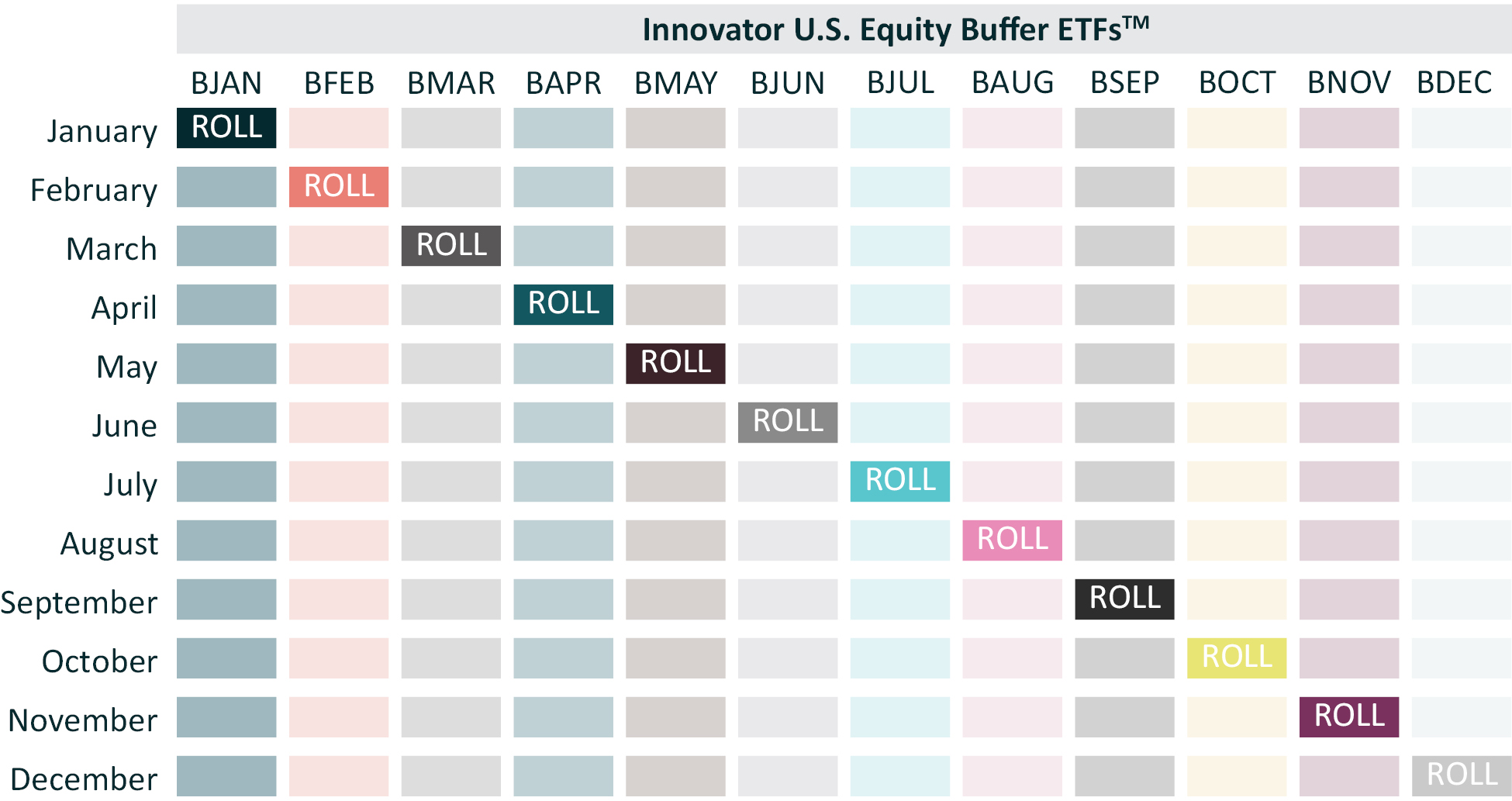
With the laddered investment approach, the Fund will continue to have the potential to increase in a market environment where the value of the U.S. Large Cap ETF is steadily increasing, as it is likely that at least one of the Underlying ETFs will have performance capacity because it will have reset its Cap within the past month. In addition, the Fund will have the potential to derive benefit from a buffer in a market environment where the U.S. Large Cap ETF is steadily decreasing, as is it is likely that at least one of the Underlying ETFs will have a buffer against losses because it will have reset its buffer within the past month.
However, the Fund may not benefit from the Cap or buffer of an Underlying ETF. It is possible that all of the Underlying ETFs will have exceeded its respective Cap or that none of the Underlying ETFs will have a buffer against losses relative to their respective Outcome Periods. Such circumstance may continue until the beginning of the next month, at which point an Underlying ETF resets its buffer protection level and applicable Cap. In addition, for any given time period, the performance available for any single or group of Underlying ETFs may exceed the exposures to Caps that the Fund has in owning all of the Underlying ETFs. Similarly, for any given time period, the potential for a buffer against losses may be greater when owning a single or group of Underlying ETF that has more ability to benefit from a buffer than the buffer available by owning all of the Underlying ETFs. See “Risks – Fund-of-Funds Risk”.
The Index was created on January 25, 2022. On its inception date, the Index was equally allocated to shares of the twelve, monthly Underlying ETFs. The Index is reconstituted and rebalanced on a semi-annual basis. The Index will be scheduled to rebalance and reconstitute its portfolio securities on the third Wednesday of April and October each year. On each semi-annual rebalance date the Index will re-allocate its portfolio to invest in the Underlying ETFs equally, such that each Underlying ETF will constitute 1/12 of the Index portfolio. The Fund will purchase and sell Underlying ETFs in accordance with these scheduled rebalances. The Index’s semi-annual rebalance and reconstitution schedule may cause the Fund to experience a higher rate of portfolio turnover. Frequent turnover of the Fund’s portfolio securities may negatively affect the Fund’s
performance because the Fund may pay higher levels of transaction costs and generate greater tax liabilities for shareholders. The amount of an individual Underlying ETF in the Fund will vary after its semi-annual rebalance date and therefore the percentage of Underlying ETFs held by the Fund may be dependent on its proximity to the Index’s rebalance date.
Information Regarding the Underlying ETFs. The Underlying ETFs each utilize a defined outcome investing strategy. Defined outcome strategies seek to produce pre-determined investment outcomes based upon the performance of an underlying security or index. The Fund is a “fund-of-funds” and does not itself pursue a defined outcome strategy. The shares of the twelve ETFs comprising the Index are set forth below:
1. Innovator U.S. Equity Buffer ETF™ – January (BJAN)
2. Innovator U.S. Equity Buffer ETF™ – February (BFEB)
3. Innovator U.S. Equity Buffer ETF™ – March (BMAR)
4. Innovator U.S. Equity Buffer ETF™ – April (BAPR)
5. Innovator U.S. Equity Buffer ETF™ – May (BMAY)
6. Innovator U.S. Equity Buffer ETF™ – June (BJUN)
7. Innovator U.S. Equity Buffer ETF™ – July (BJUL)
8. Innovator U.S. Equity Buffer ETF™ – August (BAUG)
9. Innovator U.S. Equity Buffer ETF™ – September (BSEP)
10. Innovator U.S. Equity Buffer ETF™ – October (BOCT)
11. Innovator U.S. Equity Buffer ETF™ – November (BNOV)
12. Innovator U.S. Equity Buffer ETF™ – December (BDEC)
Each Underlying ETF invests in FLexible EXchange® Options (“FLEX Options”) that reference the U.S. Large Cap ETF, and may also invest directly in the U.S. Large Cap ETF or the components thereof. Each Underlying ETF that comprises the Index seeks to provide outcomes with a specified Cap and buffer based upon the returns of U.S. Large Cap ETF, but only for the duration of an entire Outcome Period. The respective Outcome Period for each Fund begins on the first day of the month indicated in the Underlying ETF’s name when the fund enters into its FLEX Option positions and ends on the market’s closure on the last day of the month immediately preceding the month indicated its name when those FLEX Options expire. For each Underlying ETF, the applicable Outcome Period has an upside return Cap that represents the maximum percentage return a Fund shareholder can achieve from an investment in the Underlying ETF for the Outcome Period and a buffer of 9% of losses. Each Underlying ETF’s Cap may vary. Each Cap is dependent on prevailing market conditions, especially then current interest rates and market volatility, at the times each Underlying ETF enters into its FLEX Options contracts.
The outcomes each Underlying ETF seeks to provide may only be realized by holding shares of the Underlying ETF on the first day of its Outcome Period and continuing to hold them on the last day of its Outcome Period. Purchasing or selling shares of an Underlying ETF after an Outcome Period
has begun may result in investment returns that are very different from those that the Underlying ETF seeks to provide for an entire Outcome Period. At any given point during an Outcome Period, an Underlying ETF may have more or less upside available to its respective Cap or more or less ability to benefit from its buffer when compared to the beginning of its Outcome Period. As a result of the performance of an Underlying ETF during its Outcome Period, once an Outcome Period has begun an investor that purchases shares of a single Underlying ETF may have little or no upside available to them for the remainder of the Outcome Period (because the Underlying ETF’s share price has increased to a level near its Cap) or little or no ability to benefit from a buffer (because the Underlying ETF’s share price has decreased in value by more than the downside protection).
The section entitled “Additional Information About the Fund’s Principal Investment Strategies” contains additional information relating to the Underlying ETFs and graphics designed to illustrate the outcomes sought by the Underlying ETFs based upon the hypothetical performance of the U.S. Large Cap ETF.
Innovator Capital Management, LLC, the investment adviser to the Fund and the Underlying ETFs (“Innovator” or the “Adviser”), maintains a webpage for the Fund and each Underlying ETF that provides current information relating to the Underlying ETF’s sought-after outcomes, including the performance of the U.S. Large Cap ETF since the beginning of the Outcome Period, the Underlying ETF’s net asset value (“NAV”), the amount of investment gains possible until the Underlying ETF reaches the Cap, and the amount of buffer remaining. The address for each Underlying ETF’s webpage is set forth in the section entitled “Additional Information About the Fund’s Principal Investment Strategies.” These webpages will not only allow Fund shareholders and/or a prospective Fund shareholder to find current information about each Underlying ETF’s progress through its Outcome Period, but it also provides links to each Underlying ETF’s prospectus and statement of additional information, which describe the principal investment strategies and principal risks of each Underlying ETF in much greater detail. Fund Shareholders and prospective Fund shareholders are encouraged to visit one or more of these webpages and read the prospectus and statement of additional information of the Underlying ETFs in connection with making investment decisions regarding either an Underlying ETF or the Fund.
The Fund will invest at least 80% of its net assets (including investment borrowing) in the ETFs that comprise the Index. The Fund, using an indexing investment approach, seeks investment results that generally correspond, before fees and expenses, to the performance of the Index. The Index provider, FTSE Russell (“FTSE Russell” or the “Index Provider”), compiles, maintains and calculates the Index.
The Fund is classified as a “diversified company” under the Investment Company Act of 1940, as amended (the “1940 Act”). To the extent the Index concentrates (i.e., holds 25% or more of its total assets) in the securities of a particular industry or group of industries, the Fund concentrates its investments to approximately the same extent.
Information Regarding the Index. The Index is comprised of twelve Innovator U.S. Equity Power Buffer ETFs (each, an “Underlying ETF,” and together, the “Underlying ETFs”). The Fund, in accordance with the Index, will be continuously invested in each of the Underlying ETFs and will rebalance semi-annually by purchasing and selling the Underlying ETFs to equally weight the Underlying ETFs. As further described below, each Underlying ETF seeks to provide a defined outcome based upon the performance of an ETF that tracks the return, before fees and expenses, of the S&P 500® Index (the “U.S. Large Cap ETF”) over the course of an approximately one-year time period (each, an “Outcome Period”) that begins on the first day of the month indicated in the Underlying ETF’s name. Each Underlying ETF seeks to provide returns that match the returns of U.S. Large Cap ETF up to a capped amount for an applicable Outcome Period (a “Cap”) and a measure of downside protection from losses experienced by the returns of U.S. Large Cap ETF for such Outcome Period (i.e., a “buffer”). The Cap represents the maximum percentage return an Underlying ETF can achieve for an Outcome Period and each Underlying ETF provides a buffer of 15% of losses.
The Index seeks to provide “laddered” investing in the Underlying ETFs. Laddered investing refers to investments in several similar securities that have different reset dates, with the goal of mitigating timing risks associated with investing in a single investment. The laddered approach of the Index is designed to help offset the timing risks inherent in the purchase of shares of a single Underlying ETF. The Fund, in accordance with the Index, will typically buy an Underlying ETF on days other than the first day of its respective Outcome Period and sell an Underlying ETF on days other than the last day of its respective Outcome Period. However, by owning each of the Underlying ETFs at all times, the Fund will have a diversified exposure to the respective Caps and buffer that are available for each of the Underlying ETFs. An investment in the Fund allows a shareholder to participate in the outcomes of each Underlying ETF without undertaking any additional purchases or sales.
As indicated in the chart below, each month, one Underlying ETF concludes its one-year Outcome Period, and subsequently “rolls” into another one-year Outcome Period, refreshing its buffer level and resetting its Cap for another twelve months. This process repeats monthly, with the Index participating in a rolling set of Caps and buffer.
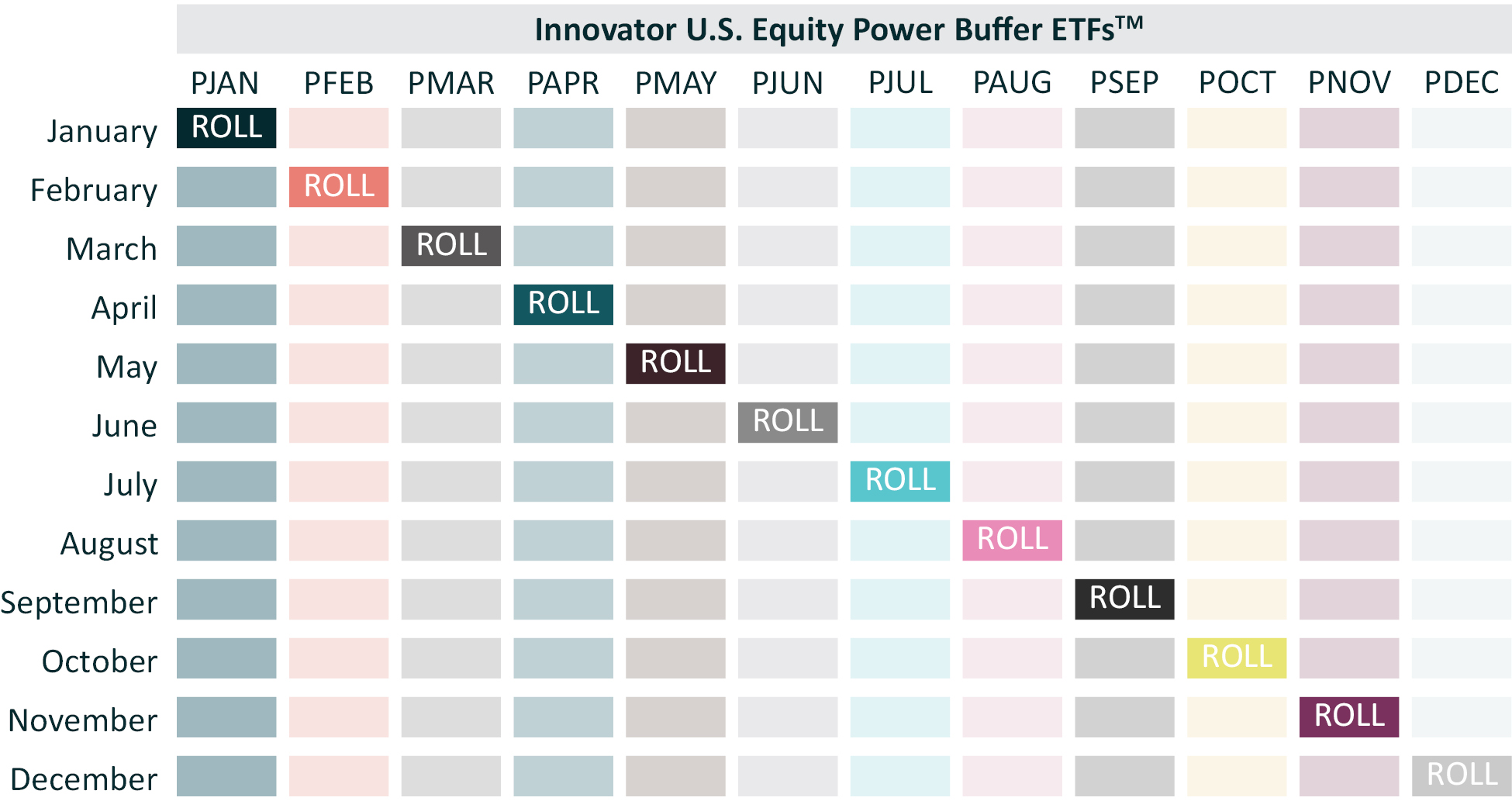
With the laddered investment approach, the Fund will continue to have the potential to increase in a market environment where the value of the U.S. Large Cap ETF is steadily increasing, as it is likely that at least one of the Underlying ETFs will have performance capacity because it will have reset its Cap within the past month. In addition, the Fund will have the potential to derive benefit from a buffer in a market environment where the U.S. Large Cap ETF is steadily decreasing, as is it is likely that at least one of the Underlying ETFs will have a buffer against losses because it will have reset its buffer within the past month.
However, the Fund may not benefit from the Cap or buffer of an Underlying ETF. It is possible that all of the Underlying ETFs will have exceeded its respective Cap or that none of the Underlying ETFs will have a buffer against losses relative to their respective Outcome Periods. Such circumstance may continue until the beginning of the next month, at which point an Underlying ETF resets its buffer protection level and applicable Cap. In addition, for any given time period, the performance available for any single or group of Underlying ETFs may exceed the exposures to Caps that the Fund has in owning all of the Underlying ETFs. Similarly, for any given time period, the potential for a buffer against losses may be greater when owning a single or group of Underlying ETF that has more ability to benefit from a buffer than the buffer available by owning all of the Underlying ETFs. See “Risks – Fund-of-Funds Risk”.
The Index was created on July 15, 2020. On its inception date, the Index was equally allocated to shares of the twelve, monthly Underlying ETFs. The Index is reconstituted and rebalanced on a semi-annual basis. The Index will be scheduled to rebalance and reconstitute its portfolio
securities on the third Wednesday of April and October each year. On each semi-annual rebalance date the Index will re-allocate its portfolio to invest in the Underlying ETFs equally, such that each Underlying ETF will constitute 1/12 of the Index portfolio. The Fund will purchase and sell Underlying ETFs in accordance with these scheduled rebalances. The Index’s semi-annual rebalance and reconstitution schedule may cause the Fund to experience a higher rate of portfolio turnover. Frequent turnover of the Fund’s portfolio securities may negatively affect the Fund’s performance because the Fund may pay higher levels of transaction costs and generate greater tax liabilities for shareholders. The amount of an individual Underlying ETF in the Fund will vary after its semi-annual rebalance date and therefore the percentage of Underlying ETFs held by the Fund may be dependent on its proximity to the Index’s rebalance date.
Information Regarding the Underlying ETFs. The Underlying ETFs each utilize a defined outcome investing strategy. Defined outcome strategies seek to produce pre-determined investment outcomes based upon the performance of an underlying security or index. The Fund is a “fund-of-funds” and does not itself pursue a defined outcome strategy. The shares of the twelve ETFs comprising the Index are set forth below:
1. Innovator U.S. Equity Power Buffer ETF™ – January (PJAN)
2. Innovator U.S. Equity Power Buffer ETF™ – February (PFEB)
3. Innovator U.S. Equity Power Buffer ETF™ – March (PMAR)
4. Innovator U.S. Equity Power Buffer ETF™ – April (PAPR)
5. Innovator U.S. Equity Power Buffer ETF™ – May (PMAY)
6. Innovator U.S. Equity Power Buffer ETF™ – June (PJUN)
7. Innovator U.S. Equity Power Buffer ETF™ – July (PJUL)
8. Innovator U.S. Equity Power Buffer ETF™ – August (PAUG)
9. Innovator U.S. Equity Power Buffer ETF™ – September (PSEP)
10. Innovator U.S. Equity Power Buffer ETF™ – October (POCT)
11. Innovator U.S. Equity Power Buffer ETF™ – November (PNOV)
12. Innovator U.S. Equity Power Buffer ETF™ – December (PDEC)
Each Underlying ETF invests in FLexible EXchange® Options (“FLEX Options”) that reference the U.S. Large Cap ETF, and may also invest directly in the U.S. Large Cap ETF or the components thereof. Each Underlying ETF that comprises the Index seeks to provide outcomes with a specified Cap and buffer based upon the returns of U.S. Large Cap ETF, but only for the duration of an entire Outcome Period. The respective Outcome Period for each Fund begins on the first day of the month indicated in the Underlying ETF’s name when the fund enters into its FLEX Option positions and ends on the market’s closure on the last day of the month immediately preceding the month indicated its name when those FLEX Options expire. For each Underlying ETF, the applicable Outcome Period has an upside return Cap that represents the maximum percentage return a Fund shareholder can achieve from an investment in the Underlying ETF for the Outcome
Period and a buffer of 15% of losses. Each Underlying ETF’s Cap may vary. Each Cap is dependent on prevailing market conditions, especially then current interest rates and market volatility, at the times each Underlying ETF enters into its FLEX Options contracts.
The outcomes each Underlying ETF seeks to provide may only be realized by holding shares of the Underlying ETF on the first day of its Outcome Period and continuing to hold them on the last day of its Outcome Period. Purchasing or selling shares of an Underlying ETF after an Outcome Period has begun may result in investment returns that are very different from those that the Underlying ETF seeks to provide for an entire Outcome Period. At any given point during an Outcome Period, an Underlying ETF may have more or less upside available to its respective Cap or more or less ability to benefit from its buffer when compared to the beginning of its Outcome Period. As a result of the performance of an Underlying ETF during its Outcome Period, once an Outcome Period has begun an investor that purchases shares of a single Underlying ETF may have little or no upside available to them for the remainder of the Outcome Period (because the Underlying ETF’s share price has increased to a level near its Cap) or little or no ability to benefit from a buffer (because the Underlying ETF’s share price has decreased in value by more than the downside protection).
The section entitled “Additional Information About the Fund’s Principal Investment Strategies” contains additional information relating to the Underlying ETFs and graphics designed to illustrate the outcomes sought by the Underlying ETFs based upon the hypothetical performance of the U.S. Large Cap ETF.
Innovator Capital Management, LLC, the investment adviser to the Fund and the Underlying ETFs (“Innovator” or the “Adviser”), maintains a webpage for the Fund and each Underlying ETF that provides current information relating to the Underlying ETF’s sought-after outcomes, including the performance of the U.S. Large Cap ETF since the beginning of the Outcome Period, the Underlying ETF’s net asset value (“NAV”), the amount of investment gains possible until the Underlying ETF reaches the Cap, and the amount of buffer remaining. The address for each Underlying ETF’s webpage is set forth in the section entitled “Additional Information About the Fund’s Principal Investment Strategies.” These webpages will not only allow Fund shareholders and/or a prospective Fund shareholder to find current information about each Underlying ETF’s progress through its Outcome Period, but it also provides links to each Underlying ETF’s prospectus and statement of additional information, which describe the principal investment strategies and principal risks of each Underlying ETF in much greater detail. Fund Shareholders and prospective Fund shareholders are encouraged to visit one or more of these webpages and read the prospectus and statement of additional information of the Underlying ETFs in connection with making investment decisions regarding either an Underlying ETF or the Fund.
The Fund normally invests at least 90% of its total assets in the securities that comprise the Index. The Fund, using an indexing investment approach, attempts to replicate, before fees and expenses, the performance of the Index. The Fund’s investment sub-adviser, Penserra Capital Management LLC (“Penserra” or the “Sub-Adviser”) seeks a correlation of 0.95 or better (before fees and expenses) between the Fund’s performance and the performance of the Index; a figure of 1.00 would represent perfect correlation. S&P Opco LLC (a subsidiary of S&P Dow Jones Indices, LLC) (“S&P” or the “Index Provider”) compiles, maintains and calculates the Index.
The Fund is classified as a “diversified company” under the Investment Company Act of 1940, as amended (the “1940 Act”). To the extent the Index concentrates (i.e., holds 25% or more of its total assets) in the securities of a particular industry or group of industries, the Fund will concentrate its investments to approximately the same extent. As of the date of this prospectus, the Fund is concentrated in the financials sector.
The Index is composed of all preferred stocks that are constituents of the S&P U.S. Investment Grade Preferred Stock Index (the “Base Index”). To be eligible for inclusion in the Base Index, a security must be considered “investment grade,” which are securities with a credit rating minimum of BBB-/Baa3/BBB- issued by S&P Global Ratings (“S&P Global”), Moody’s Investors Service, Inc. (“Moody’s”), and Fitch Ratings, Inc. (“Fitch”) respectively. The Index Provider performs the following eligibility screens for quality with respect to credit ratings:
• for an issue rated by all of S&P, Moody’s and Fitch, the lowest of the three ratings is used as the issue’s credit rating;
• when there are two ratings, the lower of the two ratings must be considered investment grade; and
• when there is only one rating, that rating must be designated in the investment grade category by the applicable rating agency.
While the Index is required to be comprised of securities that are investment grade at the time of investment, the ratings of the securities eligible for inclusion in the Index may be in the lowest tier investment grade rating, which provides for an indication of a higher risk of default than securities that maintain a higher investment grade rating. See “Credit Ratings Risk” for further information on the risks associated with credit ratings.
In addition to the credit rating minimum, to be eligible for inclusion in the Index, a preferred security must exhibit minimum liquidity quality characteristics as determined by the Index Provider. With respect to liquidity, a preferred security eligible for inclusion in the Index, a security must be:
• listed on a qualifying U.S. securities exchange;
• have a total market capitalization of greater than or equal to $100 million and have traded more than 250,000 shares per month over each of the prior six months; and
• maintain a market capitalization of $75 million and have traded more than 125,000 shares per month over each of the prior six months in order to remain eligible in the Index.
Preferred stocks for which the Index Provider cannot determine an indicated dividend yield are not eligible for inclusion. Once eligible securities have been selected for inclusion in the Index, the Index seeks to mitigate issuer concentration risk by assigning an equal weight to each issuer represented by the selected securities; however, the mitigation of issuer concentration risk is not guaranteed. That weight is then equally distributed among component securities of the issuer that are eligible for the Index. The Index is rebalanced quarterly.
In connection with the Index’s methodology to invest in preferred securities, the Index, and therefore the Fund, currently has exposure to preferred securities issued by real estate investment trusts (“REITs’). REITs are financial vehicles that pool investors’ capital to invest primarily in income-producing real estate or real estate-related loans or interests. The Index does not limit the types of REITs eligible for inclusion in the Index, which are generally categorized as “Mortgage REITs,” which invest the majority of their assets in real estate mortgages and derive their income primarily from interest payments, “Equity REITs”, which invest the majority of their assets directly in real property and derive their income primarily from rents, royalties and lease payments, and “Hybrid REITs,” which combine the characteristics of both Mortgage REITs and Equity REITs. As of the date of this prospectus, the Fund has exposure to preferred securities issued by Equity REITs.