Risk Management
Dec. 31, 2025
Introduction and general description
Banco Santander Chile, in its position of leadership in the local banking industry, has placed risk management at the center of its activity to ensure that the entire organisation acts responsibly in the new social context, economic changes, customer demands and the business environment, always aligned with the strong corporate culture and the legal regulations in force. The risk management and control model is underpinned by a set of common principles, a risk culture embedded throughout the Bank, a strong governance structure, and advanced risk management processes and tools.
Banco Santander’s risk management and control principles are mandatory, must always be applied, and comprise the regulatory requirements and best market practices. They are:
1.A strong risk culture (Risk Pro) that all employees follow covers all risks and promotes socially responsible management, contributing to the Bank’s long-term sustainability.
2.All employees are responsible for risk management and must know and understand the risks generated by their daily activities, avoiding taking risks whose impact is unknown or exceeds the limits of the Bank’s risk appetite.
3.Involvement of senior management, by ensuring the consistent risk management and control through their conduct, actions and communications. In addition, promoting a risk culture, evaluating implementation degree and monitoring that the profile remains within the levels defined in the Bank’s risk appetite.
4.Independence of risk management and control functions.
5.Proactive and comprehensive risk management and control approach across all businesses and risk types.
6.Adequate and comprehensive information management enables risks to be identified, assessed, managed and communicated appropriately to the correct levels.
These Santander principles, together with several interrelated tools and processes that are part of its strategic planning, such as the risk appetite statement, risk profile assessment, scenario analysis and risk reporting structure, as well as the annual budget processes, form a holistic control structure for the entire Bank.
Governance structure
Banco Santander’s corporate governance is structured in three levels, each of which is accompanied by support committees:
-Board of Directors, which represents the highest governing body.
-Senior Management, headed by the Chief Executive Officer.
-Shareholders’ Meeting
The Board of Directors comprises 11 directors, with nine acting in the capacity of full directors and two alternate directors and six of them are independent directors. The mail role is to participate in the organisation’s strategic planning and to ensure that the commitments proposed in the short, medium and long term are fulfilled in a timely manner.
Risk committee structure
Banco Santander-Chile has five committees supporting the Board, appointed and modified by them as deemed necessary. The various committees respond and report their activity to the Board systematically, through meetings and based on subrogation schemes, bylaws, formal minutes and follow-up instances. The Bank’s Board support committees are responsible for decision-making on priority issues, including economic, environmental and social issues.
A.Directors and Audit Committee
The main responsibility is to support the Board of Directors in the continuous improvement of internal control, review of the external auditors’ work, the Internal Audit Department and the supervision of the financial statements elaboration, in order to provide adequate information for shareholders, investors and general public. The Committee also monitored Chilean regulatory standards updated and propose external auditors to the Board of Directors, which are subsequently approved at the shareholders meeting.
NOTE 37 - RISK MANAGEMENT, continued
B.Integral Risk Committee
The Integral Risk Committee is responsible for advising the Board of Directors in defining the risk appetite, risk framework as well as supervising the correct identification, measurement and control of all risks the Bank faces. Also, supervises the risk measurement and control systems.
C.ALCO and Market Committee
The main functions of the ALCO (Asset and liabilities committee) are to monitor and control the structural risks of the balance, such as limits of exposure to inflation, interest rate risk, capital and liquidity funding levels. Also, review the behavior of relevant local and international markets and local monetary policies.
D.Designation Committee
This committee constantly reviews and applies the policies and designation processes of those positions defined as “key positions” in particular, as well as the review of these with respect to the other members of the organization in general.
E.Remuneration Committee
This committee constantly reviews the regulatory documentation concerning the evaluation and remuneration of positions defined as ‘key positions’ and other persons in the organisation in general.
The Risk and Internal Audit functions have the appropriate separation and independence level and direct access to the Board and its committees. The Board delegates the identification, measurement and control of the various risks faced by the Bank to the Risk Division, which is led by the Chief Risk Officer (CRO), and reports directly to the CEO. The Chief Risk Officer (CRO) is responsible for monitoring all risks and reviewing and advising the business lines on managing these risks. This division is responsible for credit, market, non-financial, compliance, and reputational risks. The Director of Internal Audit reports directly to the Chairman of the Board of Directors to ensure independence from Senior Management and thus be an effective third line of defence in risk management and internal control.
Risk management
Banco Santander Chile has a solid risk culture known as Risk Pro, which defines how risks are understood and managed daily based on the principle that all employees are responsible for risk management. Therefore, their classification is fundamental for effective management and control. All identified risks are to be linked to their according risk category to organise their management, control and related information. Banco Santander Chile’s risk classification enables effective risk management, control and communication. Its corporate risk framework includes the following:
•Market risk: rises from holding financial instruments whose value may be affected by fluctuations in market conditions, generally including the following types of risk:
-Foreign exchange risk: this arises as a consequence of exchange rate fluctuations among currencies.
-Interest rate risk: this arises as a consequence of fluctuations in market interest rates.
-Price risk: this arises as a consequence of changes in market prices, either due to factors specific to the instrument itself or due to factors that affect all the instruments negotiated in the market.
-Inflation risk: this arises as a consequence of changes in Chile’s inflation rate, whose effect would be mainly applicable to financial instruments denominated in UFs.
•Credit risk: this is the risk that one of the parties to a financial instrument fails to meet its contractual obligations for reasons of insolvency or inability of the individuals or legal entities in question to continue as a going concern, causing a financial loss to the other party.
•Liquidity risk: is the possibility that an entity may be unable to meet its payment commitments, or that in order to meet them, it may have to raise funds with onerous terms or risk damage to its image and reputation.
•Operational risk: the risk of loss due to inadequate or failed internal processes, people or systems or external events, and have legal, regulatory and reputational effect.
•Capital risk: this is the risk that the Bank may have an insufficient amount and/or quality of capital to meet the minimum regulatory requirement to operate as a bank, respond to market expectations regarding its creditworthiness, and support its business growth and any strategic possibilities that might arise, in accordance with its strategic plan.
NOTE 37 - RISK MANAGEMENT, continued
Risk governance
The Bank has a robust risk governance structure that pursues effective control of the risk profile, following the appetite defined by the Board and based on the distribution of roles among the three lines of defence and a strong committee structure, which is reinforced by the Risk Pro culture that applies throughout the organisation.
First line
Business and all other functions that create risk are the first line of defence. These functions must ensure that the risks they generate are aligned with the approved risk appetite and the corresponding limits. Any unit that originates risk has primary responsibility for managing that risk.
Second line
The Risk and Compliance and Conduct functions. Their role is to independently monitor and challenge the risk management activities carried out by the first line of defence. These functions ensure risk management in accordance with the appetite defined by the Board of Directors and promote a solid risk culture throughout the organization
Third line
The Internal Audit function periodically evaluates that policies, methodologies and procedures are adequate and are effectively implemented in the management and control of all risks.
Risk governance assessment
Risk governance also has several internal and external assessment processes to verify that the governance and approach are adequate. The FMC shall permanently maintain banks’ management and solvency rating.
Banco Santander Chile is classified under Category 1 as it was graded as Level A in both solvency and management.
MARKET RISK
Market risk arises as a consequence of the market activity, through financial instruments whose value can be affected by changes in market conditions and reflected in financial assets/liabilities and financial risk factors. The risk can be diminished by means of hedging through other products (assets/liabilities or derivative instruments) or terminating the open transaction/position. The objective of market risk management is to manage and control market risk exposure within acceptable parameters.
There are four major risk factors that affect the market prices: type of interest, type of exchange, price, and inflation. In addition and for certain positions, it is necessary to consider other risks as well, such as spread risk, base risk, commodity risk, volatility or correlation risk.
Market risk management
The Market Risk Department is responsible for measurement and control of market risks that are overseen by the Risk Division. Market Committee and the Assets and Liabilities Committee are responsible for the approval of limits. The main market risks are also reviewed in the CIR.
The Finance Division, through the Financial Management Department, is responsible for managing the Bank’s balance sheet, supervised and controlled by the Assets and Liabilities Committee and the Risk Division. Among its functions is the elaboration of detailed policies and their application, as well as the following:
i.Optimization of the liabilities’ cost, searching the most efficient financing strategies, including bonds’ issuance and bank credit lines.
ii.Management of short and long-term liquidity regulatory limits.
iii.Inflation risk management.
iv.Rate risk management in local and foreign currency.
NOTE 37 - RISK MANAGEMENT, continued
The Bank’s internal management to measure market risk is mainly based on analyzing the three following portfolios:
•trading portfolio
•local financial management portfolio
•foreign financial management portfolio
The Treasury Department is responsible for managing the Bank’s trading portfolios and keeping them within the loss limits, calculated and estimated by the Market Risk Management. The trading portfolio (measured at fair value through profit and loss) is comprised of investments valued at fair market value and free of any restriction on their immediate sale, which are often bought and sold by the Bank with the intention of selling them in the short term to benefit from short–term price fluctuations. The trading portfolio also includes the Bank’s exposure to foreign currency. The financial management portfolios include all the financial investments not considered to be part of trading portfolio.
The main functions in connection with trading portfolio include the following:
i.applies the “Value at Risk” (VaR) techniques to measure interest rate risk,
ii.adjust the trading portfolios to market and measure the daily income and loss from commercial activities,
iii.compare the real VaR with the established limits,
iv.establish procedures to prevent losses in excess of predetermined limits, and
v.furnishes information on the trading activities to the ALCO, other members of the Bank’s management, and the Global Risk Department of Banco Santander Spain.
The main functions in connection with financial management portfolios include the following:
i.performs sensitivity simulations (as explained below) to measure interest rate risk for activities denominated in local currency and the potential losses forecasted by these simulations.
ii.provide daily reports thereon to the ALCO, other members of the Bank’s management, and the Global Risk Department of Banco Santander Spain.
Market risk – management of trading portfolio
The Bank applies VaR methodologies to measure the market risk of its trading portfolio. The Bank has a consolidated commercial position comprised of fixed–income investments and foreign currency trading. This portfolio is comprised mostly of Central Bank of Chile bonds, mortgage bonds, locally issued, low–risk corporate bonds and foreign currencies, mainly U.S. dollars. At the end of each year, the trading portfolio included no stock portfolio investments.
For the Bank, the VaR estimate is made under the historical simulation methodology, which consists of observing the behavior of the profits and losses that would have occurred in the current portfolio if the market conditions for a given historical period had been in force, in order to infer the maximum loss on the basis of that information, with a given degree of confidence. The methodology has the advantage of precisely reflecting the historical distribution of the market variables and not requiring any assumptions regarding the distribution of specific probabilities. All the VaR measures are intended to determine the distribution function for a change in the value of a given portfolio, and once that distribution is known, to calculate the percentile related to the necessary degree of confidence, which will be equal to the value at risk by virtue of those parameters. As calculated by the Bank, the VaR is an estimate of the maximum expected loss of market value for a given portfolio over a 1–day horizon, with a 99.00% confidence level. It is the maximum 1–day loss that the Bank could expect to experience in a given portfolio, with a 99.00% confidence level. In other words, it is the loss that the Bank would expect to experience only 1.0% of the time. The VaR provides a single estimate of market risk which is not comparable from one market risk to another. Returns are calculated through the use of a 2–year time window or at least 520 data points obtained since the last reference date for calculation of the VaR going backward in time.
We do not calculate three separate VaRs. We calculate a single VaR for the entire trading portfolio, which in addition is segregated by risk type. The VaR software performs a historical simulation and calculates a Profit and Loss Statement (P&L) for 520 data points (days) for each risk factor (fixed income, foreign currency and variable income.) The P&L of each risk factor is added together and a consolidated VaR is calculated with 520 points or days of data. At the same time a VaR is calculated for each risk factor based on the individual P&L calculated for each individual risk factor. Furthermore, a weighted VaR is calculated in the manner described above, but which gives a greater weighting to the 30 most recent data points. The larger of the two VaRs is the one that is reported. In 2025, 2024 and 2023, we used the same VaR model and there has been no change in methodology or assumptions for subsequent periods.
NOTE 37 - RISK MANAGEMENT, continued
The Bank uses the VaR estimates to provide a warning when the statistically estimated incurred losses in its trading portfolio would exceed prudent levels, and hence, there are certain predetermined limits.
Limitations of the VaR model
When applying a calculation methodology, no assumptions are made regarding the probability distribution of the changes in the risk factors; the historically observed changes are used for the risk factors on which each position in the portfolio will be valued.
It is necessary to define a valuation function fj(xi) for each instrument, preferably the same one used to calculate the market value and income of the daily position, This valuation function will be applied in each scenario to generate simulated prices for all the instruments in each scenario.
In addition, the VaR methodology should be interpreted taking into consideration the following limitations:
•Changes in market rates and prices may not be independent and identically distributed random variables and may not have a normal distribution. In particular, the assumption of normal distribution may underestimate the probability of extreme market movements;
•The historical data used by the Bank may not provide the best estimate of the joint distribution of changes in the risk factors in the future, and any modification of the data may be inadequate. In particular, the use of historical data may fail to capture the risk of potential extreme and adverse market fluctuations, regardless of the time period used;
•A 1-day time horizon may not fully capture the market risk positions which cannot be liquidated or covered in a single day, It would not be possible to liquidate or cover all the positions in a single day;
•The VaR is calculated at the close of business, but trading positions may change substantially in the course of the trading day;
•The use of a 99% level of confidence does not take account of, or make any statement about, the losses that could occur outside of that degree of confidence; and
•A model such as the VaR does not capture all the complex effects of the risk factors over the value of the positions or portfolios, and accordingly, it could underestimate potential losses,
We perform back-testing daily and generally find that trading losses exceed our VaR estimate approximately one out of every 100 trading days. At the same time, we set a limit to the maximum VaR that we are willing to accept over our trading portfolio. In both 2025 and 2024, the Bank has remained within the maximum limit established for the VaR, even in those circumstances in which actual VaR exceed the estimated VaR.
High, low and average levels for each component for 2025 and 2024 were as follows:
| VaR | 2025 USD millions | 2024 USD millions | ||||||||||||
| Consolidated | ||||||||||||||
| High | 2.87 | 4.06 | ||||||||||||
| Low | 1.05 | 1.47 | ||||||||||||
| Average | 1.67 | 2.40 | ||||||||||||
| Fixed-income investments | ||||||||||||||
| High | 2.83 | 3.33 | ||||||||||||
| Low | 0.96 | 1.41 | ||||||||||||
| Average | 1.36 | 2.23 | ||||||||||||
| Variable-income investments | ||||||||||||||
| High | - | - | ||||||||||||
| Low | - | - | ||||||||||||
| Average | - | - | ||||||||||||
| Foreign currency investments | ||||||||||||||
| High | 2.62 | 3.93 | ||||||||||||
| Low | 0.16 | 0.18 | ||||||||||||
| Average | 1.04 | 1.55 | ||||||||||||
NOTE 37 - RISK MANAGEMENT, continued
Market risk - local and foreign financial management
The Bank’s financial management portfolio includes most of the Bank’s non-trading assets and liabilities, including the credit/loan portfolio. For these portfolios, investment and financing decisions are strongly influenced by the Bank’s commercial strategies.
The Bank uses a sensitivity analysis to measure the market risk of local and foreign currencies (not included in the trading portfolio). The Bank performs a simulation of scenarios, which will be calculated as the difference between the present value of the flows in the chosen scenario (a curve with a parallel movement of 100 bps in all its segments) and their value in the base scenario (current market). All the inflation–indexed local currency (UF) positions are adjusted by a sensitivity factor of 0.57, which represents a 57-basis, point change in the rate curve for the real rates and a 100-basis point change for the nominal rates. The same scenario is performed for the net foreign currency positions and the interest rates in U.S. dollars. The Bank has also established limits in regard to the maximum loss which these interest rate movements could impose on the capital and net financial income budgeted for the year.
For the consolidated limit, we add the foreign currency limit to the domestic currency limit and multiple by 2 the sum of the multiplication of them together both for net financial loss limit as well as for the capital and reserves loss limit, using the following formula:
Consolidated limit = square root of a2 + b2 + 2ab
a: domestic currency limit
b: foreign currency limit
Since we assume the correlation is 0; 2ab = 0, 2ab = 0
Limitations of the sensitivity models
The most important assumption is using an exchange rate of 100 bp based on yield curve (57 bp for real rates). The Bank uses a 100 bp exchange since sudden changes of this magnitude are considered realistic. Santander Spain Global Risk Department has also established comparable limits by country, to be able to compare, monitor and consolidate market risk by country in a realistic and orderly way. In addition, the sensitivity simulation methodology should be interpreted taking into consideration the following limitations:
•The simulation of scenarios assumes that the volumes remain consistent in the Bank’s Consolidated Statements of Financial Position and are always renewed at maturity, thereby omitting the fact that certain credit risk and prepayment considerations may affect the maturity of certain positions.
•This model assumes an identical change along the entire length of the yield curve and does not take into account the different movements for different maturities.
•The model does not take into account the sensitivity of volumes which results from interest rate changes.
•The limits to losses of budgeted financial income are calculated based on the financial income foreseen for the year, which may not be actually earned, meaning that the real percentage of financial income at risk may be higher than the expected one.
Market risk – Financial management portfolio – December 31, 2025 and 2024
| 2025 | 2024 | |||||||||||||||||||||||||
| Effect on financial income | Effect on capital | Effect on financial income | Effect on capital | |||||||||||||||||||||||
| Financial management portfolio – local currency (MCh$) | ||||||||||||||||||||||||||
| Loss limit | 175,196 | 370,271 | 138,957 | 373,566 | ||||||||||||||||||||||
| High | 9,968 | 186,784 | 49,174 | 170,622 | ||||||||||||||||||||||
| Low | 11,605 | 96,459 | 482 | 87,335 | ||||||||||||||||||||||
| Average | 703 | 131,800 | 20,482 | 136,617 | ||||||||||||||||||||||
| Financial management portfolio – foreign currency (USD millions) | ||||||||||||||||||||||||||
| Loss limit | 40,531 | 180,138 | 178,937 | 198,819 | ||||||||||||||||||||||
| High | 9,586 | 68,145 | 13,104 | 61,137 | ||||||||||||||||||||||
| Low | — | — | 442 | 47,615 | ||||||||||||||||||||||
| Average | 1,099 | 20,534 | 5,169 | 53,651 | ||||||||||||||||||||||
| Financial management portfolio – consolidated (in MCh$) | ||||||||||||||||||||||||||
| Loss limit | 175,196 | 370,271 | 138,957 | 373,566 | ||||||||||||||||||||||
| High | 27,182 | 348,027 | 46,970 | 357,867 | ||||||||||||||||||||||
| Low | 4,600 | 237,954 | — | 279,293 | ||||||||||||||||||||||
| Average | 13,044 | 273,792 | 19,678 | 311,333 | ||||||||||||||||||||||
Inflation risk
The Bank has readjustable assets and liabilities according to the variation of the Unidad de Fomento (UF). In general, the Bank has more assets than liabilities in UF and, therefore, moderate increases in inflation have a positive effect on income from readjustments, while a fall in the value of the UF negatively affects the Bank’s margin. The Assets and Liabilities Committee establishes a set of limits on the difference between UF-denominated assets and liabilities that cannot exceed 30% of the Bank’s interest-bearing assets. This mismatch is managed on a daily basis by Financial Management and the limits are calculated and monitored by the Market Risk Division.
Market Risk Position and measurement
Market Risk Exposure is measured and controlled through the difference between the balances of assets and liabilities in foreign currency (net position) and the cash flows payable (liabilities) and cash receivable (asset) in the Trading and Banking Books, for a specific term or time band.
Foreign currency positions and term mismatches are exposed to adjustment factors, sensitivity and rate changes.
The Exposure to Market Risks on a Standardized Base Policy was presented and approved by the Bank’s Board of Directors.
Market Risk Exposure is determined based on the following risks:
•Interest rate risk
•Currency Risk
•Indexation Risk
•Currency Options Risk
The following table illustrates the exposure to market risk. The maximum exposure to long-term interest rate risk is 35% of the regulatory capital and is approved by the Board of Directors. The maximum exposure to short-term interest rate risk is 55% of net interest income and readjustments plus interest rate sensitive commissions:
NOTE 37 - RISK MANAGEMENT, continued
| As of december 31, | ||||||||||||||
| 2025 | 2024 | |||||||||||||
| MCh$ | MCh$ | |||||||||||||
| Market risk – trading protfolio | ||||||||||||||
| Exposure to rate risk | 565,138 | 459,161 | ||||||||||||
| Exposure to currency risk | 4,484 | 13,931 | ||||||||||||
| Interest rate option risk | - | - | ||||||||||||
| Currency option risk | 1,896 | 4,284 | ||||||||||||
| Total exposure of trading portfolio | 571,518 | 477,376 | ||||||||||||
10% of RWA | 714,397 | 596,720 | ||||||||||||
| Subtotal | 1,285,915 | 1,074,096 | ||||||||||||
| Limit = Regulatory capital | 7,047,322 | 6,961,316 | ||||||||||||
| Available margin | 5,761,407 | 5,887,220 | ||||||||||||
| Market risk – short-term financial management portfolio | ||||||||||||||
| Short Term Exposure to Interest Rate Risk | 101,913 | 95,219 | ||||||||||||
| Exposure to Inflation Risk | 153,766 | 149,306 | ||||||||||||
| Short-term exposure of financial management portfolio | 255,679 | 244,525 | ||||||||||||
Limit = 35% net (net income from interest and readjustments + interest rates sensitive commissions) | 1,008,348 | 909,152 | ||||||||||||
| Available margin | 752,669 | 664,627 | ||||||||||||
| Market risk – long-term financial management portfolio | ||||||||||||||
| Long Term Exposure to Interest Rate Risk | 728,870 | 697,405 | ||||||||||||
Limit = 35% Regulatory capital | 2,466,563 | 2,436,461 | ||||||||||||
| Available margin | 1,737,693 | 1,739,056 | ||||||||||||
CREDIT RISK
Credit risk is the risk that one of the parties to a financial instrument fails to meet its contractual obligations for reasons of insolvency or inability of the individuals or legal entities in question to continue as a going concern, causing a financial loss to the other party. The Bank consolidates all elements and components of credit risk exposure to manage credit risk (i.e., individual delinquency risk, inherent risk of a business line or segment, and/or geographical risk).
Credit Risk Management
The Bank has established a combined credit approval committees, which includes member from Board of Directors, Risk Division and commercial areas, who overally verify quantitative and qualitative parameters of each client.
The Board of Directors has delegated the responsibility for credit risk management to the Integral Risk Committee, as well as to the Bank’s risk departments, whose roles are summarised below:
•Formulate credit policies by consulting with the business units, meeting requirements of guarantees, credit evaluation, risk rating and submitting reports, documentation and legal procedures in compliance with the regulatory, legal and internal requirements of the Bank.
•Establish the structure to approve and renew credit requests. The Bank structures credit risks by assigning limits to the concentration of credit risk in terms of individual debtor, debtor group, industry segment and country.
•Limit concentrations of exposure to customers or counterparties in geographic areas or industries (for accounts receivable or loans), and by issuer, credit rating and liquidity.
•Approval levels are assigned to the corresponding officials of the business unit (commercial, consumer, SMEs) to be exercised by that level of management. In addition, those limits are continually revised. Risk evaluation team at the branch level interact on a regular basis with customers; however, for larger credit requests, the risk team from the head office and the Executive Risk Committee works directly with customers to assess credit risks and prepare risk requests.
NOTE 37 - RISK MANAGEMENT, continued
•Develop and maintain the Bank’s credit risk classifications for the purpose of classifying risks according to the degree of exposure to financial loss that is exhibited by the respective financial instruments, with the aim of focusing risk management specifically on the associated risks.
•Revise and evaluate credit risk. Management’s risk divisions are largely independent of the Bank’s commercial division and evaluate all credit risks in excess of the specified limits prior to loan approvals for customers or prior to the acquisition of specific investments. Credit renewal and reviews are subject to similar processes.
Credit Approval: Loans approved on an individual basis
In preparing a credit proposal for a corporate client whose loans are approved on an individual basis, Santander-Chile’s personnel verify such parameters as debt servicing capacity (typically including projected cash flows), the company’s financial history and projections for the economic sector in which it operates. The Risk Division is closely involved in this process and prepares the credit application for the client. All proposals contain an analysis of the client, a rating and a recommendation. Credit limits are determined not on the basis of outstanding balances of individual clients, but on the direct and indirect credit risk of entire financial groups. For example, a corporation will be evaluated together with its subsidiaries and affiliates.
Credit Approval: Loans approved on a group basis
The majority of loans to individuals and small and mid-sized companies are approved by the Standardized Risk Area through an automated credit scoring system. This system is decentralized, automated and based on multiple parameters, including demographic and information regarding credit behavior from external sources and the FMC.
Credit approval: Investment on debt instruments
The Bank considers the probability of default of issuers or counterparties using internal and external information such as independent risk evaluators of the Bank. In addition, the Bank applied a strong governance and conservative policy which ensures that the issuers of investments and counterparties in derivative instrument transactions are of the highest quality.
Credit approval: Contingent loans
The Bank operates with contingent loans that entail exposure to credit risk such as: personal guarantees, letters of credit, performance guarantees, credit lines and credit commitments. Personal guarantees represent an irrevocable payment obligation. When a guaranteed client does not fulfill its obligations to third parties, the Bank will pay, then these operations represent the same exposure to credit risk as a common loan.
Letters of credit are commitments documented by the Bank on behalf of the client that are guaranteed by the shipped goods to which they relate and, therefore, have less risk than direct indebtedness. The Bank guarantee corresponds to contingent commitments that become effective only if the client does not comply with the performance of engaged works.
Loans commitments to grant loans, the Bank is exposed to losses that arise from unused balances. The Bank monitors the maturity of credit lines because generally long-term commitments have a higher credit risk than short-term commitments.
Impairment assessment
a.Definition of default and cure
The Bank considers a financial instrument defaulted and therefore Stage 3 for ECL calculations when the past-due amounts of an exposure exceed materiality thresholds for 90 or more consecutive days.
As a part of a qualitative assessment of whether a customer is in default, the Bank also considers a variety of instances that may indicate unlikeliness to pay. Such events include:
•Restructured operations over 90 days.
•Pulling effect (defined as the entire outstanding amount on any loan which has an instalment 90 days or more past due)
•Operations with claimed’s amounts or its reimbursement has been judicially required by the entity
•The debtor (or any legal entity within the debtor’s group) filing for bankruptcy application/protection
•A material decreases in the underlying collateral value where the recovery of the loan is expected from the sale of the collateral
•Internal rating of the borrower indicating default or near default
•The borrower requesting emergency funding from the Bank
•The borrower having past due liabilities to public creditors or employees
NOTE 37 - RISK MANAGEMENT, continued
•A material decreases in the borrower’s turnover or the loss of a major customer
•A covenant breach not waived by the Bank
•Debtor’s listed debt or equity has been suspended at the primary exchange because of rumors or facts about financial difficulties
Operations that not meet the conditions of Default must stay in probation period for 92 days, after that will be cured.
b.Internal rating and PD estimation
The Bank’s Credit Risk Department operates its internal rating models. The models incorporate both qualitative and quantitative information and, in addition to information specific to the borrower utilize supplemental external information that could affect the borrower’s behavior. The internal credit grades are assigned based on the internal scoring policy, PDs are then adjusted for IFRS 9 ECL calculations to incorporate forward looking information and the IFRS 9 Stage classification of the exposure.
The following table shows quality assets and its related provision, based on our internal scoring policy as of December 31, 2025 and 2024:
| December 31, 2025 | |||||||||||||||||||||||||||||||||||||||||||||||||||||||||||
| Corporate loans | |||||||||||||||||||||||||||||||||||||||||||||||||||||||||||
Corporate Portfolio | Stage 1 | Stage 2 | Stage 3 | Total Corporate | Percentage | Stage 1 | Stage 2 | Stage 3 | Total ECL Allowance (*) | Percentage | |||||||||||||||||||||||||||||||||||||||||||||||||
| MCh$ | MCh$ | MCh$ | MCh$ | % | MCh$ | MCh$ | MCh$ | MCh$ | % | ||||||||||||||||||||||||||||||||||||||||||||||||||
| A1 | 3,332 | - | - | 3,332 | 0.01 | % | 6 | - | - | 6 | 0.00 | % | |||||||||||||||||||||||||||||||||||||||||||||||
| A2 | 577,975 | - | - | 577,975 | 1.41 | % | 239 | - | - | 239 | 0.02 | % | |||||||||||||||||||||||||||||||||||||||||||||||
| A3 | 1,949,161 | 73,336 | - | 2,022,497 | 4.94 | % | 1,066 | 218 | - | 1,284 | 0.11 | % | |||||||||||||||||||||||||||||||||||||||||||||||
| A4 | 2,678,213 | 3,461 | - | 2,681,674 | 6.55 | % | 3,259 | 8 | - | 3,267 | 0.27 | % | |||||||||||||||||||||||||||||||||||||||||||||||
| A5 | 2,585,516 | 19,059 | 781 | 2,605,356 | 6.36 | % | 6,279 | 182 | 195 | 6,656 | 0.54 | % | |||||||||||||||||||||||||||||||||||||||||||||||
| A6 | 1,876,579 | 47,882 | 116 | 1,924,577 | 4.70 | % | 7,551 | 1,012 | 30 | 8,593 | 0.70 | % | |||||||||||||||||||||||||||||||||||||||||||||||
| B1 | 686,259 | 251,666 | 25,860 | 963,785 | 2.35 | % | 4,365 | 29,509 | 329 | 34,203 | 2.80 | % | |||||||||||||||||||||||||||||||||||||||||||||||
| B2 | 19,372 | 116,585 | - | 135,957 | 0.33 | % | 82 | 4,641 | - | 4,723 | 0.39 | % | |||||||||||||||||||||||||||||||||||||||||||||||
| B3 | - | 116,290 | 4,546 | 120,836 | 0.30 | % | - | 4,902 | 1,009 | 5,911 | 0.48 | % | |||||||||||||||||||||||||||||||||||||||||||||||
| B4 | - | 117,497 | 37,504 | 155,001 | 0.38 | % | - | 5,805 | 8,888 | 14,693 | 1.20 | % | |||||||||||||||||||||||||||||||||||||||||||||||
| C1 | - | 21,611 | 144,083 | 165,694 | 0.40 | % | - | 2,107 | 49,177 | 51,284 | 4.20 | % | |||||||||||||||||||||||||||||||||||||||||||||||
| C2 | - | 10,899 | 113,621 | 124,520 | 0.30 | % | - | 502 | 28,721 | 29,223 | 2.39 | % | |||||||||||||||||||||||||||||||||||||||||||||||
| C3 | - | 3,480 | 87,595 | 91,075 | 0.22 | % | - | 288 | 31,343 | 31,631 | 2.59 | % | |||||||||||||||||||||||||||||||||||||||||||||||
| C4 | - | 1,909 | 133,586 | 135,495 | 0.33 | % | - | 185 | 58,016 | 58,201 | 4.76 | % | |||||||||||||||||||||||||||||||||||||||||||||||
| C5 | - | 452 | 76,435 | 76,887 | 0.19 | % | - | 65 | 48,380 | 48,445 | 3.96 | % | |||||||||||||||||||||||||||||||||||||||||||||||
| C6 | - | 1,011 | 120,987 | 121,998 | 0.30 | % | - | 70 | 83,096 | 83,166 | 6.80 | % | |||||||||||||||||||||||||||||||||||||||||||||||
| Subtotal | 10,376,407 | 785,138 | 745,114 | 11,906,659 | 29.09 | % | 22,847 | 49,494 | 309,184 | 381,525 | 31.21 | % | |||||||||||||||||||||||||||||||||||||||||||||||
| Other loans | |||||||||||||||||||||||||||||||||||||||||||||||||||||||||||
| Stage 1 | Stage 2 | Stage 3 | Total Other loans | Percentage | Stage 1 | Stage 2 | Stage 3 | Total ECL Allowance | Percentage | ||||||||||||||||||||||||||||||||||||||||||||||||||
| MCh$ | MCh$ | MCh$ | MCh$ | % | MCh$ | MCh$ | MCh$ | MCh$ | % | ||||||||||||||||||||||||||||||||||||||||||||||||||
| Other Commercial | 4,461,656 | 546,770 | 516,928 | 5,525,354 | 13.50 | % | 37,946 | 33,702 | 187,235 | 258,883 | 21.18 | % | |||||||||||||||||||||||||||||||||||||||||||||||
| Mortgage | 14,470,420 | 1,954,826 | 1,018,317 | 17,443,563 | 42.62 | % | 16,512 | 63,795 | 169,146 | 249,453 | 20.41 | % | |||||||||||||||||||||||||||||||||||||||||||||||
| Consumer | 4,826,724 | 895,561 | 335,019 | 6,057,304 | 14.80 | % | 59,130 | 89,561 | 183,906 | 332,597 | 27.21 | % | |||||||||||||||||||||||||||||||||||||||||||||||
| Subtotal | 23,758,800 | 3,397,157 | 1,870,264 | 29,026,221 | 70.91 | % | 113,588 | 187,058 | 540,287 | 840,933 | 68.79 | % | |||||||||||||||||||||||||||||||||||||||||||||||
| Total | 34,135,207 | 4,182,295 | 2,615,378 | 40,932,880 | 100.00 | % | 136,435 | 236,552 | 849,471 | 1,222,458 | 100.00 | % | |||||||||||||||||||||||||||||||||||||||||||||||
(*)Include MCh$151,682 of ECL allowance calculated on an Individual basis.
NOTE 37 - RISK MANAGEMENT, continued
| December 31, 2024 | |||||||||||||||||||||||||||||||||||||||||||||||||||||||||||
| Corporate loans | |||||||||||||||||||||||||||||||||||||||||||||||||||||||||||
Corporate Portfolio | Stage 1 | Stage 2 | Stage 3 | Total Corporate | Percentage | Stage 1 | Stage 2 | Stage 3 | Total ECL Allowance (*) | Percentage | |||||||||||||||||||||||||||||||||||||||||||||||||
| MCh$ | MCh$ | MCh$ | MCh$ | % | MCh$ | MCh$ | MCh$ | MCh$ | % | ||||||||||||||||||||||||||||||||||||||||||||||||||
| A1 | 29,920 | - | - | 29,920 | 0.07 | % | 1 | - | - | 1 | 0.00 | % | |||||||||||||||||||||||||||||||||||||||||||||||
| A2 | 656,322 | - | - | 656,322 | 1.59 | % | 314 | - | - | 314 | 0.03 | % | |||||||||||||||||||||||||||||||||||||||||||||||
| A3 | 2,264,646 | 53,680 | - | 2,318,326 | 5.61 | % | 1,901 | 307 | - | 2,208 | 0.19 | % | |||||||||||||||||||||||||||||||||||||||||||||||
| A4 | 2,487,497 | 36,047 | - | 2,523,544 | 6.11 | % | 3,567 | 268 | - | 3,835 | 0.32 | % | |||||||||||||||||||||||||||||||||||||||||||||||
| A5 | 2,749,203 | 41,239 | 777 | 2,791,219 | 6.75 | % | 6,645 | 1,046 | 63 | 7,754 | 0.65 | % | |||||||||||||||||||||||||||||||||||||||||||||||
| A6 | 2,121,986 | 90,538 | 158 | 2,212,682 | 5.35 | % | 9,236 | 2,849 | 41 | 12,126 | 1.02 | % | |||||||||||||||||||||||||||||||||||||||||||||||
| B1 | 613,063 | 192,023 | - | 805,086 | 1.95 | % | 4,458 | 9,526 | - | 13,984 | 1.17 | % | |||||||||||||||||||||||||||||||||||||||||||||||
| B2 | 19,332 | 134,107 | - | 153,439 | 0.37 | % | 143 | 7,416 | - | 7,559 | 0.63 | % | |||||||||||||||||||||||||||||||||||||||||||||||
| B3 | - | 136,901 | 2,500 | 139,401 | 0.34 | % | - | 7,545 | 696 | 8,241 | 0.69 | % | |||||||||||||||||||||||||||||||||||||||||||||||
| B4 | - | 65,613 | 33,129 | 98,742 | 0.24 | % | - | 3,598 | 7,725 | 11,323 | 0.95 | % | |||||||||||||||||||||||||||||||||||||||||||||||
| C1 | - | 29,632 | 185,235 | 214,867 | 0.52 | % | - | 2,771 | 60,382 | 63,153 | 5.30 | % | |||||||||||||||||||||||||||||||||||||||||||||||
| C2 | - | 23,450 | 112,479 | 135,929 | 0.33 | % | - | 1,052 | 27,208 | 28,260 | 2.37 | % | |||||||||||||||||||||||||||||||||||||||||||||||
| C3 | - | 1,785 | 66,545 | 68,330 | 0.17 | % | - | 237 | 28,343 | 28,580 | 2.40 | % | |||||||||||||||||||||||||||||||||||||||||||||||
| C4 | - | 1,600 | 132,213 | 133,813 | 0.32 | % | - | 105 | 59,724 | 59,829 | 5.02 | % | |||||||||||||||||||||||||||||||||||||||||||||||
| C5 | - | 1,710 | 97,139 | 98,849 | 0.24 | % | - | 302 | 67,170 | 67,472 | 5.66 | % | |||||||||||||||||||||||||||||||||||||||||||||||
| C6 | - | 4,139 | 129,079 | 133,218 | 0.32 | % | - | 300 | 105,471 | 105,771 | 8.87 | % | |||||||||||||||||||||||||||||||||||||||||||||||
| Subtotal | 10,941,969 | 812,464 | 759,254 | 12,513,687 | 30.28 | % | 26,265 | 37,322 | 356,823 | 420,410 | 35.25 | % | |||||||||||||||||||||||||||||||||||||||||||||||
| Other loans | |||||||||||||||||||||||||||||||||||||||||||||||||||||||||||
| Stage 1 | Stage 2 | Stage 3 | Total other loans | Percentage | Stage 1 | Stage 2 | Stage 3 | Total ECL Allowance | Percentage | ||||||||||||||||||||||||||||||||||||||||||||||||||
| MCh$ | MCh$ | MCh$ | MCh$ | % | MCh$ | MCh$ | MCh$ | MCh$ | % | ||||||||||||||||||||||||||||||||||||||||||||||||||
| Other Commercial | 4,321,411 | 527,752 | 489,587 | 5,338,750 | 12.92 | % | 47,042 | 34,834 | 183,118 | 264,994 | 22.22 | % | |||||||||||||||||||||||||||||||||||||||||||||||
| Mortgage | 14,762,656 | 1,944,932 | 852,181 | 17,559,769 | 42.49 | % | 10,347 | 60,330 | 155,693 | 226,370 | 18.98 | % | |||||||||||||||||||||||||||||||||||||||||||||||
| Consumer | 4,928,084 | 679,756 | 303,798 | 5,911,638 | 14.31 | % | 58,679 | 87,609 | 134,628 | 280,916 | 23.55 | % | |||||||||||||||||||||||||||||||||||||||||||||||
| Subtotal | 24,012,151 | 3,152,440 | 1,645,566 | 28,810,157 | 69.72 | % | 116,068 | 182,773 | 473,439 | 772,280 | 64.75 | % | |||||||||||||||||||||||||||||||||||||||||||||||
| Total | 34,954,120 | 3,964,904 | 2,404,820 | 41,323,844 | 100.00 | % | 142,333 | 220,095 | 830,262 | 1,192,690 | 100.00 | % | |||||||||||||||||||||||||||||||||||||||||||||||
(*)Include MCh$165,935 of ECL allowance calculated on an Individual basis.
NOTE 37 - RISK MANAGEMENT, continued
In relation to the credit quality of the investment portfolio, local regulations establish that banks are able to hold only local and foreign fixed–income securities except in certain cases. Additionally, Banco Santander-Chile has internal policies to ensure that only securities approved by the Market Risk department, which are stated in the documents “APS” – Products and underlying Approval, are acquired. The Credit Risk Department sets the exposure limits to those approved APS’s. The APS is updated on daily basis. As of December 31, 2025, 99% our total investment portfolio corresponds to securities issued by the Chilean Central Bank, Chilean Treasury and US Treasury notes.
c.Exposure at default
The exposure at default (EAD) represents the gross carrying amount of the financial instruments subject to the impairment calculation, addressing both the client’s ability to increase its exposure while approaching default and potential early repayments too.
To calculate the EAD for a Stage 1 loan, the Bank assesses the possible default events within 12 months for the calculation of the 12mECL. However, if a Stage 1 loan that is expected to default in the 12 months from the balance sheet date and is also expected to cure and subsequently default again, then all linked default events are taken into account. For Stage 2, Stage 3 the exposure at default is considered for events over the lifetime of the instruments.
d.Loss given default
The credit risk assessment is based on a standardized LGD assessment framework that results in a certain LGD rate. These LGD rates take into account the expected EAD in comparison to the amount expected to be recovered or realized from any collateral held.
The Bank segments its retail lending products into smaller homogeneous portfolios, based on key characteristics that are relevant to the estimation of future cash flows. The applied data is based on historically collected loss data and involves a wider set of transaction characteristics (i.e., product type, wider range of collateral types) as well as borrower characteristics.
Further recent data and forward-looking economic scenarios are used in order to determine the IFRS 9 LGD rate for each group of financial instruments. Under IFRS 9, LGD rates are estimated for the Stage 1, Stage 2, Stage 3 IFRS 9 segment's of each asset class. The inputs for these LGD rates are estimated and, where possible, calibrated through back testing against recent recoveries. These are repeated for each economic scenario as appropriate.
e.Significant increase in credit risk (SICR)
The Bank continuously monitors all assets subject to ECLs. In order to determine whether an instrument or a portfolio of instruments is subject to 12-month ECL or Lifetime ECL, the Bank assesses whether there has been a significant increase in credit risk since initial recognition.
The Bank also applies a secondary qualitative method for triggering a significant increase in credit risk for an asset, such as moving a customer/facility to the watch list (Special vigilance). The Bank may also consider that events explained in letter a) above are a significant increase in credit risk as opposed to a default. Regardless of the change in credit grades, if contractual payments are more than 30 days past due, the credit risk is deemed to have increased significantly since initial recognition.
When estimating ECLs on groups of similar assets, the Bank applies the same principles for assessing whether there has been a significant increase in credit risk since initial recognition.
Quantitative criteria for SICR Stage 2:
The quantitative criteria are used to identify where an exposure has increased in credit risk and it is applied based on whether an increase in the lifetime PD since the recognition date exceeds the threshold set in absolute terms. The following formula is used to determine such threshold:
Threshold = Lifetime PD (at reporting date) – Lifetime PD (at origination)
NOTE 37 - RISK MANAGEMENT, continued
Since November 2024 until this date, the Bank has applied the following Significant Increase in Credit Risk (SICR) thresholds. This resulted in an decrease in the ECL allowance amounting to MCh$353 in December 2024. Below:
| Other commercial | Corporate loans | |||||||||||||||||||||||||||||||||||||
| Mortgages | Other loans | Revolving (Credit cards) | SME | SME | Middle market | Corporate and Investment Banking | ||||||||||||||||||||||||||||||||
| 17.61 | % | 30.53 | % | 12.28 | % | 30.53 | % | 14.20 | % | 15.41 | % | Santander Group criteria | ||||||||||||||||||||||||||
Since December 2023 to November 2024, the Bank applied the following threshold of significant increase in credit risk (SICR), In December 2023 the Bank accounted an impact of MCh$ 863 a decrease of ECL allowance
| Other commercial | Corporate loans | |||||||||||||||||||||||||||||||||||||
| Mortgages | Other loans | Revolving (Credit cards) | SME | SME | Middle market | Corporate and Investment Banking | ||||||||||||||||||||||||||||||||
| 28.19 | % | 49.32 | % | 16.91 | % | 49.32 | % | 18.50 | % | 16.36 | % | |||||||||||||||||||||||||||
There is also a relative threshold of 100% of all portfolios with the exception of the Corporate and Investment Banking Portfolio.
Qualitative criteria for SICR Stage 2:
The qualitative criteria are based on the existence of evidence that leads to an automatic classification of financial instruments in stage 2, mainly 30 days overdue and restructured. Thresholds of SICR are calibrated based on the average ECL of exposures that exceed materiality threshold for 30 days or more consecutive days or with a level of credit risk considered to be “significant”.
| Other commercial | Corporate loans | |||||||||||||||||||||||||||||||||||||
| Mortgages | Other loans | Revolving (Credit cards) | SME | SME | Middle market | Corporate and Investment Banking | ||||||||||||||||||||||||||||||||
| Irregular portfolio > 30 days | Irregular portfolio > 30 days | Irregular portfolio > 30 days | Irregular portfolio > 30 days | Irregular portfolio > 30 days | Irregular portfolio > 30 days | Irregular portfolio > 30 days | ||||||||||||||||||||||||||||||||
| Restructured marked for monitoring | Restructured marked for monitoring | Restructured marked for monitoring | Restructured marked for monitoring | Restructured marked for monitoring | Restructured marked for monitoring | Restructured marked for monitoring | ||||||||||||||||||||||||||||||||
| Clients considered to be substandard or in incompliance (pre-legal action) | Clients considered to be substandard or in incompliance (pre-legal action) | Clients considered to be substandard or in incompliance (pre-legal action) | ||||||||||||||||||||||||||||||||||||
These thresholds are defined by the Model Committee and the Integral Risk Committee and are evaluated annually with updates made depending on impacts and definitions of the risk models associated to each portfolio.
f.Expected credit losses measurement
Expected credit losses are a probability-weighted estimate of credit losses over the expected life of the financial instrument. A cash shortfall is the difference between the cash flows that are due to an entity in accordance with the contract and the cash flows that the entity expects to receive. Because expected credit losses consider the amount and timing of payments, a credit loss arises even if the entity expects to be paid in full but later than when contractually due.
ECL allowance calculated on an individual basis
For financial assets, a credit loss is the present value of the difference between: the contractual cash flows that are due under the contract; and the cash flows that the Bank expects to receive. For undrawn loan commitments, a credit loss is the present value of the difference between: the contractual cash flows that are due if the holder of the loan commitment draws down the loan; and the cash flows that the Bank expects to receive if the loan is drawn down.
NOTE 37 - RISK MANAGEMENT, continued
For financial assets that are credit-impaired at the reporting date, and in accordance with our internal procedures, the Bank calculates allowance for expected credit losses under the “Discounted Cash Flow Methodology” when the financial asset is classified in stage 3, with a PD equal to 100% and is individually significant. In this instance, the Bank measures the expected credit losses as the difference between the asset’s gross carrying amount and the present value of estimated future cash flows discounted at the financial asset’s original effective interest rate. Any adjustment is recognised in profit or loss as an impairment gain or loss.
The allowances determined under a “Discounted Cash Flow Methodology” must take into account the financial information of the debtor, including available business strategies, as well as collateral associated with that debtor. The recovery analysis includes the following scenarios:
-Recovery of a possible sale of collateral.
-Recovery on the basis of common commercial activities (commercial plan).
The following table shows the allowance and assets before allowance of the loans that meet the conditions:
| 2025 | 2024 | |||||||||||||
| MCh$ | MCh$ | |||||||||||||
| Loans and account receivable | 429,995 | 382,737 | ||||||||||||
| Allowance for ECL – discounted cash flow methodology | 151,682 | 165,935 | ||||||||||||
As of December 31, 2024, the expected credit losses related to corporate commercial loans includes MCh$151,682 measured from cash flow discounted methodology (MCh$165,935 in 2023).
ECL allowance calculated on a collective basis
Commercial loans (except for those described within the “ECL allowance calculated on an Individual basis” description aforementioned), mortgage loans and consumer loans are grouped and assessed on a collective basis by using a credit loss allowance model. The estimation of the collective basis expected credit loss allowance considers qualitative and quantitative information that may affect changes in credit risk and the development of significant assumptions related to the probabilities of default and loss given default, related to forward looking information, multi-factor analysis such as type of portfolio or transaction and macroeconomic factors.
| 2025 | 2024 | |||||||||||||
| MCh$ | MCh$ | |||||||||||||
| Loans and account receivable (commercial, mortgage and consumer loans) | 40,502,885 | 40,941,107 | ||||||||||||
| Allowance for ECL – collective basis | 1,070,776 | 1,026,755 | ||||||||||||
As of December 31, 2025, the Bank maintains overlays for an amount of MCh$119,776. These overlays are intended to cover certain defaulted exposures within the mortgage and other commercial loan portfolios, as well as to cover the future expected impact of the recalibration of Macro economical forward-looking information postponed to the first quarter of 2026, which explains the increase in the closing balance for 2025 related to closing 2024 balance.
g.Corporate and other commercial loans
In order to meet the objective of recognising lifetime expected credit losses for significant increases in credit risk since initial recognition, it is necessary to group or sub-group financial instruments, even if evidence of such significant increases in credit risk at the individual instrument level is not yet available.
Considering to the aforementioned, the Bank evaluates on corporate basis, commercial loans for which prepares individual credit proposals, where it verifies debt servicing capacity (projected cash flow), client’s financial history, evidence of impairment and projections for economic sector. All proposals include an analysis of the client, a rating and a recommendation. For corporations, the evaluation includes subsidiaries and affiliates. Other commercial loans are grouped into other homogeneous portfolios (smaller commercial, mortgages and consumer loans), based on a combination of instrument type, credit risk ratings, collateral type, date of initial recognition, remaining term to maturity, industry and others.
During 2025, and as part of the normal review process, the Bank has made minor adjustments to the internal rating models, in order to improve its ability to adequately detect the risk profile of the clients individually evaluated.
NOTE 37 - RISK MANAGEMENT, continued
h.Modified loans
When a loan measured at amortised cost has been renegotiated or modified but not derecognised, the Bank assesses whether the transaction should be treated as a modified asset or derecognition. If the transaction does not result in derecognition the Bank must recognise the resulting gains or losses as the difference between the carrying amount of the original loans and modified contractual cash flows discounted using the EIR before modification.
If the modification results in derecognition, then the modified asset is a new asset. The following table shows modification that results in deregonition and therefore and new operations:
| As of December 31, 2025 | As of December 31, 2024 | |||||||||||||||||||||||||||||||||||||||||||||||||
| Stage 1 | Stage 2 | Stage 3 | Total | Stage 1 | Stage 2 | Stage 3 | Total | |||||||||||||||||||||||||||||||||||||||||||
| MCh$ | MCh$ | MCh$ | MCh$ | MCh$ | MCh$ | MCh$ | MCh$ | |||||||||||||||||||||||||||||||||||||||||||
| Gross carrying amount | 34,135,207 | 4,182,295 | 2,615,378 | 40,932,880 | 34,954,120 | 3,964,904 | 2,404,820 | 41,323,844 | ||||||||||||||||||||||||||||||||||||||||||
| Modified loans | - | 863,495 | 1,266,773 | 2,130,268 | - | 814,092 | 1,236,176 | 2,050,268 | ||||||||||||||||||||||||||||||||||||||||||
| % | - | 20.65 | % | 48.44 | % | 5.20 | % | - | 20.53 | % | 51.40 | % | 4.96 | % | ||||||||||||||||||||||||||||||||||||
| ECL allowance | 136,435 | 236,552 | 849,471 | 1,222,458 | 142,333 | 220,095 | 830,262 | 1,192,690 | ||||||||||||||||||||||||||||||||||||||||||
| Modified loans | 55,768 | 399,527 | 455,295 | 52,474 | 403,125 | 455,599 | ||||||||||||||||||||||||||||||||||||||||||||
| % | - | 23.58 | % | 47.03 | % | 37.24 | % | - | 23.84 | % | 48.55 | % | 38.20 | % | ||||||||||||||||||||||||||||||||||||
i.Macro economical forward-looking information and scenarios
In November 2025 the Bank decided to defer the update of the macroeconomic scenarios to first quarter of 2026.
The annual growth forecasts for the most relevant macroeconomic variables for each of our scenarios mainly used during 2025 are the same used in 2023, and are as follows:
| Average estimates 2025 | |||||||||||||||||||||||||||||||||||
| Unfavorable scenario 2 | Unfavorable scenario 1 | Base scenario | Favorable scenario 1 | Favorable scenario 2 | |||||||||||||||||||||||||||||||
| Chilean Central Bank interest rates | 0.85 | % | 2.32 | % | 4.25 | % | 6.18 | % | 7.65 | % | |||||||||||||||||||||||||
| Unemployment rate | 10.03 | % | 8.89 | % | 7.40 | % | 5.91 | % | 4.77 | % | |||||||||||||||||||||||||
| Housing Price growth | (1.02) | % | 0.62% | 2.78 | % | 4.94 | % | 6.59 | % | ||||||||||||||||||||||||||
| GDP growth | (0.80) | % | 1.10 | % | 3.58 | % | 6.06 | % | 7.97 | % | |||||||||||||||||||||||||
| Consumer Price Index | 1.07 | % | 0.67 | % | 3.00 | % | 5.33 | % | 7.07 | % | |||||||||||||||||||||||||
The highest probability of occurrence is associated to the base scenario, while the extreme scenarios have a lower probability than the more moderate scenarios.
The methodology used for the generation of the local scenarios is based on the corporate methodology and is applied to the loan portfolio with the exception of loans from the Corporate and Investment Banking segment which uses global scenarios as defined by the Santander Group.The probabilities for the scenarios must total 100% and be symmetrical.
NOTE 37 - RISK MANAGEMENT, continued
| Local scenario | Global scenario | |||||||||||||||||||
| Probability weighting | Probability weighting | |||||||||||||||||||
| Favorable scenario 2 | 10 | % | Favorable scenario 1 | 30 | % | |||||||||||||||
| Favorable scenario 1 | 15 | % | Base scenario | 40 | % | |||||||||||||||
| Base scenario | 50 | % | Unfavorable scenario 1 | 30 | % | |||||||||||||||
| Unfavorable scenario 1 | 15 | % | ||||||||||||||||||
| Unfavorable scenario 2 | 10 | % | ||||||||||||||||||
The ECL allowance sensibility to future macro-economic conditions is as follows:
| As of December 31, | |||||||||||
| 2025 | 2024 | ||||||||||
| MCh$ | MCh$ | ||||||||||
| Reported ECL allowance | 1,227,121 | 1,193,854 | |||||||||
| Gross carrying amount | 41,229,129 | 41,399,911 | |||||||||
| Reported ECL Coverage | 2.81 | % | 2.81 | % | |||||||
| ECL amount by scenarios | |||||||||||
| Favorable scenarios 2 | 1,051,890 | 1,013,732 | |||||||||
| Favorable scenarios 1 | 1,120,297 | 1,082,296 | |||||||||
| Base scenarios | 1,198,135 | 1,158,397 | |||||||||
| Unfavorable scenarios 1 | 1,273,300 | 1,234,421 | |||||||||
| Unfavorable scenarios 2 | 1,326,143 | 1,284,831 | |||||||||
| Coverage ratio by scenarios | |||||||||||
| Favorable scenarios 2 | 2.55 | % | 2.45 | % | |||||||
| Favorable scenarios 1 | 2.72 | % | 2.61 | % | |||||||
| Base scenarios | 2.91 | % | 2.80 | % | |||||||
| Unfavorable scenarios 1 | 3.09 | % | 2.98 | % | |||||||
| Unfavorable scenarios 2 | 3.22 | % | 3.10 | % | |||||||
NOTE 37 - RISK MANAGEMENT, continued
j.Analysis of risk concentration
The following table shows the risk concentration by industry, and by stage before ECL allowance of loans and account receivable from customers and Interbak loans at amortised cost:
| As of December 31, | ||||||||||||||||||||||||||||||||||||||||||||||||||
| 2025 | 2024 | |||||||||||||||||||||||||||||||||||||||||||||||||
| Stage 1 | Stage 2 | Stage 3 | Total | Stage 1 | Stage 2 | Stage 3 | Total | |||||||||||||||||||||||||||||||||||||||||||
| MCh$ | MCh$ | MCh$ | MCh$ | MCh$ | MCh$ | MCh$ | MCh$ | |||||||||||||||||||||||||||||||||||||||||||
| Commercial loans | ||||||||||||||||||||||||||||||||||||||||||||||||||
| Agriculture and livestock | 358,537 | 70,576 | 94,027 | 523,140 | 427,626 | 67,010 | 81,628 | 576,264 | ||||||||||||||||||||||||||||||||||||||||||
| Fruit cultivation | 331,919 | 76,389 | 104,899 | 513,207 | 404,013 | 93,737 | 114,766 | 612,516 | ||||||||||||||||||||||||||||||||||||||||||
| Forest | 136,605 | 7,148 | 17,126 | 160,879 | 122,759 | 10,480 | 19,542 | 152,781 | ||||||||||||||||||||||||||||||||||||||||||
| Fishing | 272,913 | 8,969 | 4,581 | 286,463 | 389,857 | 3,876 | 6,904 | 400,637 | ||||||||||||||||||||||||||||||||||||||||||
| Mining | 319,481 | 65,775 | 5,545 | 390,801 | 454,735 | 5,817 | 6,595 | 467,147 | ||||||||||||||||||||||||||||||||||||||||||
| Oil and natural gas | 13,225 | 415 | 161 | 13,801 | 11,040 | 277 | 208 | 11,525 | ||||||||||||||||||||||||||||||||||||||||||
| Manufacturing Industry: | ||||||||||||||||||||||||||||||||||||||||||||||||||
| Food, beverages and tobacco | 347,644 | 21,119 | 32,048 | 400,811 | 296,297 | 25,383 | 19,684 | 341,364 | ||||||||||||||||||||||||||||||||||||||||||
| Textile, leather and footwear | 76,213 | 5,585 | 8,678 | 90,476 | 64,297 | 6,236 | 9,262 | 79,795 | ||||||||||||||||||||||||||||||||||||||||||
| Wood and furniture | 73,543 | 4,780 | 6,675 | 84,998 | 83,304 | 1,827 | 6,656 | 91,787 | ||||||||||||||||||||||||||||||||||||||||||
| Cellulose, paper and printing | 66,348 | 6,968 | 1,892 | 75,208 | 51,886 | 7,925 | 4,773 | 64,584 | ||||||||||||||||||||||||||||||||||||||||||
| Chemicals and petroleum derivatives | 131,102 | 6,371 | 1,320 | 138,793 | 129,701 | 1,415 | 1,223 | 132,339 | ||||||||||||||||||||||||||||||||||||||||||
| Metallic, non-metallic, machinery, or other | 338,009 | 11,108 | 26,229 | 375,346 | 365,864 | 13,202 | 17,924 | 396,990 | ||||||||||||||||||||||||||||||||||||||||||
| Other manufacturing industries | 226,135 | 11,914 | 16,273 | 254,322 | 214,957 | 11,143 | 21,523 | 247,623 | ||||||||||||||||||||||||||||||||||||||||||
| Electricity, gas, and wáter | 637,721 | 74,225 | 9,455 | 721,401 | 747,969 | 52,240 | 5,025 | 805,234 | ||||||||||||||||||||||||||||||||||||||||||
| Home building | 226,117 | 10,979 | 20,681 | 257,777 | 206,906 | 12,840 | 28,582 | 248,328 | ||||||||||||||||||||||||||||||||||||||||||
| Non-residential construction | 450,972 | 20,605 | 19,000 | 490,577 | 512,234 | 20,843 | 29,644 | 562,721 | ||||||||||||||||||||||||||||||||||||||||||
| Wholesale trade | 1,561,889 | 87,346 | 165,367 | 1,814,602 | 1,560,877 | 104,488 | 171,345 | 1,836,710 | ||||||||||||||||||||||||||||||||||||||||||
| Retail trade, restaurants and hotels | 1,577,715 | 80,327 | 117,151 | 1,775,193 | 1,367,697 | 79,765 | 105,453 | 1,552,915 | ||||||||||||||||||||||||||||||||||||||||||
| Transport and storage | 604,323 | 40,365 | 46,915 | 691,603 | 693,354 | 50,741 | 55,381 | 799,476 | ||||||||||||||||||||||||||||||||||||||||||
| Telecommunications | 620,408 | 15,648 | 5,687 | 641,743 | 504,811 | 17,183 | 10,265 | 532,259 | ||||||||||||||||||||||||||||||||||||||||||
| Financial services | 574,615 | 867 | 1,220 | 576,702 | 610,158 | 33,019 | 1,135 | 644,312 | ||||||||||||||||||||||||||||||||||||||||||
| Real estate services | 1,996,005 | 191,364 | 175,763 | 2,363,132 | 2,010,898 | 205,007 | 153,315 | 2,369,220 | ||||||||||||||||||||||||||||||||||||||||||
| Social services and other community services | 3,896,624 | 513,065 | 381,349 | 4,791,038 | 4,032,140 | 515,762 | 378,008 | 4,925,910 | ||||||||||||||||||||||||||||||||||||||||||
| Subtotal | 14,838,063 | 1,331,908 | 1,262,042 | 17,432,013 | 15,263,380 | 1,340,216 | 1,248,841 | 17,852,437 | ||||||||||||||||||||||||||||||||||||||||||
| Mortgage loans | 14,470,420 | 1,954,826 | 1,018,317 | 17,443,563 | 14,762,656 | 1,944,932 | 852,181 | 17,559,769 | ||||||||||||||||||||||||||||||||||||||||||
| Consumer loans | 4,826,724 | 895,561 | 335,019 | 6,057,304 | 4,928,084 | 679,756 | 303,798 | 5,911,638 | ||||||||||||||||||||||||||||||||||||||||||
| Total | 34,135,207 | 4,182,295 | 2,615,378 | 40,932,880 | 34,954,120 | 3,964,904 | 2,404,820 | 41,323,844 | ||||||||||||||||||||||||||||||||||||||||||
NOTE 37 - RISK MANAGEMENT, continued
The following table shows past due information related to loans and account receivable from customers and Interbak loans at amortised cost, and related ECL allowance:
| As of December 31, 2025 | ||||||||||||||||||||||||||||||||||||||||||||||||||
| Gross carrying amount | ECL allowance | |||||||||||||||||||||||||||||||||||||||||||||||||
| Stage 1 | Stage 2 | Stage 3 | TOTAL | Stage 1 | Stage 2 | Stage 3 | TOTAL | |||||||||||||||||||||||||||||||||||||||||||
| MCh$ | MCh$ | MCh$ | MCh$ | MCh$ | MCh$ | MCh$ | MCh$ | |||||||||||||||||||||||||||||||||||||||||||
| Interbank loans | ||||||||||||||||||||||||||||||||||||||||||||||||||
| Current | 68,178 | - | - | 68,178 | 2 | - | - | 2 | ||||||||||||||||||||||||||||||||||||||||||
| Commercial loans | ||||||||||||||||||||||||||||||||||||||||||||||||||
| Current | 14,723,323 | 1,088,790 | 420,078 | 16,232,191 | 56,528 | 53,191 | 113,255 | 222,974 | ||||||||||||||||||||||||||||||||||||||||||
| 1-29 days past due | 37,475 | 81,350 | 52,447 | 171,272 | 3,578 | 12,023 | 18,953 | 34,554 | ||||||||||||||||||||||||||||||||||||||||||
| 30-89 days past due | 8,269 | 147,143 | 180,852 | 336,264 | 657 | 17,255 | 52,634 | 70,546 | ||||||||||||||||||||||||||||||||||||||||||
| Over 90 days past due | 818 | 14,625 | 608,665 | 624,108 | 28 | 727 | 311,577 | 312,332 | ||||||||||||||||||||||||||||||||||||||||||
| Mortgage loans | ||||||||||||||||||||||||||||||||||||||||||||||||||
| Current | 14,445,323 | 1,417,326 | 268,815 | 16,131,464 | 16,050 | 39,633 | 28,908 | 84,591 | ||||||||||||||||||||||||||||||||||||||||||
| 1-29 days past due | 67 | 30,270 | 10,448 | 40,785 | 1 | 2,153 | 1,861 | 4,015 | ||||||||||||||||||||||||||||||||||||||||||
| 30-89 days past due | 24,146 | 446,171 | 270,570 | 740,887 | 442 | 19,199 | 35,607 | 55,248 | ||||||||||||||||||||||||||||||||||||||||||
| Over 90 days past due | 884 | 61,059 | 468,484 | 530,427 | 19 | 2,810 | 102,770 | 105,599 | ||||||||||||||||||||||||||||||||||||||||||
| Consumer loans | ||||||||||||||||||||||||||||||||||||||||||||||||||
| Current | 4,805,715 | 672,909 | 77,826 | 5,556,450 | 55,573 | 35,781 | 41,859 | 133,213 | ||||||||||||||||||||||||||||||||||||||||||
| 1-29 days past due | 15,719 | 119,890 | 31,447 | 167,056 | 2,783 | 22,313 | 16,269 | 41,365 | ||||||||||||||||||||||||||||||||||||||||||
| 30-89 days past due | 2,856 | 95,575 | 82,068 | 180,499 | 596 | 30,346 | 42,380 | 73,322 | ||||||||||||||||||||||||||||||||||||||||||
| Over 90 days past due | 2,434 | 7,187 | 143,678 | 153,299 | 178 | 1,121 | 83,398 | 84,697 | ||||||||||||||||||||||||||||||||||||||||||
| Total | 34,135,207 | 4,182,295 | 2,615,378 | 40,932,880 | 136,435 | 236,552 | 849,471 | 1,222,458 | ||||||||||||||||||||||||||||||||||||||||||
| As of December 31, 2024 | ||||||||||||||||||||||||||||||||||||||||||||||||||
| Gross carrying amount | ECL allowance | |||||||||||||||||||||||||||||||||||||||||||||||||
| Stage 1 | Stage 2 | Stage 3 | TOTAL | Stage 1 | Stage 2 | Stage 3 | TOTAL | |||||||||||||||||||||||||||||||||||||||||||
| MCh$ | MCh$ | MCh$ | MCh$ | MCh$ | MCh$ | MCh$ | MCh$ | |||||||||||||||||||||||||||||||||||||||||||
| Interbank loans | ||||||||||||||||||||||||||||||||||||||||||||||||||
| Current | 31,283 | 31,283 | 1 | 1 | ||||||||||||||||||||||||||||||||||||||||||||||
| Commercial loans | ||||||||||||||||||||||||||||||||||||||||||||||||||
| Current | 15,183,222 | 1,150,507 | 363,076 | 16,696,805 | 68,684 | 51,797 | 114,622 | 235,103 | ||||||||||||||||||||||||||||||||||||||||||
| 1-29 days past due | 45,590 | 124,071 | 89,139 | 258,800 | 4,449 | 12,171 | 26,294 | 42,914 | ||||||||||||||||||||||||||||||||||||||||||
| 31-89 days past due | 3,285 | 65,549 | 97,072 | 165,906 | 173 | 8,166 | 27,564 | 35,903 | ||||||||||||||||||||||||||||||||||||||||||
| Over 90 days past due | - | 89 | 699,554 | 699,643 | - | 22 | 371,461 | 371,483 | ||||||||||||||||||||||||||||||||||||||||||
| Mortgage loans | ||||||||||||||||||||||||||||||||||||||||||||||||||
| Current | 14,746,681 | 1,385,985 | 234,901 | 16,367,567 | 7,403 | 30,391 | 28,974 | 66,768 | ||||||||||||||||||||||||||||||||||||||||||
| 1-29 days past due | 12,809 | 362,378 | 85,437 | 460,624 | 2,358 | 13,182 | 13,452 | 28,992 | ||||||||||||||||||||||||||||||||||||||||||
| 31-89 days past due | 3,166 | 196,569 | 140,323 | 340,058 | 586 | 16,757 | 22,938 | 40,281 | ||||||||||||||||||||||||||||||||||||||||||
| Over 90 days past due | - | - | 391,520 | 391,520 | - | - | 90,329 | 90,329 | ||||||||||||||||||||||||||||||||||||||||||
| Consumer loans | ||||||||||||||||||||||||||||||||||||||||||||||||||
| Current | 4,903,711 | 455,722 | 69,745 | 5,429,178 | 52,683 | 34,770 | 29,390 | 116,843 | ||||||||||||||||||||||||||||||||||||||||||
| 1-29 days past due | 21,323 | 135,203 | 29,654 | 186,180 | 5,638 | 27,780 | 12,065 | 45,483 | ||||||||||||||||||||||||||||||||||||||||||
| 31-89 days past due | 3,050 | 88,115 | 81,657 | 172,822 | 358 | 24,865 | 35,037 | 60,260 | ||||||||||||||||||||||||||||||||||||||||||
| Over 90 days past due | - | 716 | 122,742 | 123,458 | - | 194 | 58,136 | 58,330 | ||||||||||||||||||||||||||||||||||||||||||
| Total | 34,954,120 | 3,964,904 | 2,404,820 | 41,323,844 | 142,333 | 220,095 | 830,262 | 1,192,690 | ||||||||||||||||||||||||||||||||||||||||||
NOTE 37 - RISK MANAGEMENT, continued
k.Collateral and other credit enhancement
Banco Santander controls the credit risk using collateral in its operations. Each business unit is responsible for credit risk management and formalizes the use of collateral in its lending policies. Guidelines are in place covering the acceptability and valuation of each type of collateral.
Banco Santander uses guarantees in order to increase their resilience in the subject to credit risk operation. The guarantees can be used fiduciary, real, legal structures with power mitigation and compensation agreements. The Bank periodically reviews its policy guarantees by technical parameters, normative and also its historical basis, to determine whether the guarantee is legally valid and enforceable.
Credit limits are continually monitored and changed in customer behavior function. Thus, the potential loss values represent a fraction of the amount available.
Collateral refers to the assets pledged by the customer or a third party to secure the performance of an obligation. The main type of collateral obtained are the following:
•For securities lending and reverse repurchase transactions, cash or securities
•For corporate and small business lending, charges over real estate properties, inventory and trade receivables and, in special circumstances, government guarantees
•For retail lending, mortgages over residential properties
The following table show the maximum exposure to credit risk by class of financial asset, associated collateral and the net exposure to credit risk:
| As of December 31, | ||||||||||||||||||||||||||||||||||||||||||||||||||
| 2025 | 2024 | |||||||||||||||||||||||||||||||||||||||||||||||||
| Maximum exposure to credit risk | Collateral | Net exposure | Associated ECL | Maximum exposure to credit risk | Collateral | Net exposure | Associated ECL | |||||||||||||||||||||||||||||||||||||||||||
| MCh$ | MCh$ | MCh$ | MCh$ | MCh$ | MCh$ | MCh$ | MCh$ | |||||||||||||||||||||||||||||||||||||||||||
| Interbank loans | 68,178 | 39,128 | 29,050 | 2 | 31,283 | 11 | 31,272 | 1 | ||||||||||||||||||||||||||||||||||||||||||
| Commercial loans | 17,363,835 | 10,172,100 | 7,191,735 | 640,406 | 17,821,154 | 10,014,312 | 7,806,842 | 685,403 | ||||||||||||||||||||||||||||||||||||||||||
| Mortgage loans | 17,443,563 | 17,167,022 | 276,541 | 249,453 | 17,559,769 | 17,367,966 | 191,803 | 226,370 | ||||||||||||||||||||||||||||||||||||||||||
| Consumer Loans | 6,057,304 | 534,442 | 5,522,862 | 332,597 | 5,911,638 | 558,906 | 5,352,732 | 280,916 | ||||||||||||||||||||||||||||||||||||||||||
| Contingent loans exposure | 2,941,345 | 340,783 | 2,600,562 | 32,126 | 2,850,495 | 467,467 | 2,383,028 | 18,389 | ||||||||||||||||||||||||||||||||||||||||||
| Total | 43,874,225 | 28,253,475 | 15,620,750 | 1,254,584 | 44,174,339 | 28,408,662 | 15,765,677 | 1,211,079 | ||||||||||||||||||||||||||||||||||||||||||
One very important example of financial collateral is the collateral agreement. Collateral agreements comprise a set of highly liquid instruments with a certain economic value that are deposited or transferred by a counterparty in favor of another party in order to guarantee or reduce any counterparty credit risk that might arise from the portfolios of derivative transactions between the parties in which there is exposure to risk.
Collateral agreements vary in nature but, whichever the specific form of collateralization may be, the ultimate aim, as with the netting technique, is to reduce counterparty risk.
Transactions subject to a collateral agreement are assessed periodically (normally on a daily basis). The agreed-upon parameters defined in the agreement are applied to the net balance arising from these assessments, from which the collateral amount (normally cash or securities) payable to or receivable from the counterparty is obtained.
For real estate collateral periodic re-appraisal processes are in place, based on the actual market values for the different types of real estate, which meet all the requirements established by the regulator.
Specifically, mortgage loans are secured by a real property mortgage, and threshold mitigate counterparty credit risk of derivative instruments.
For the ECL allowance calculated on an Individual basis, the collaterals at fair value, are use for mitigating the loan amount and obtain the exposure. While for ECL allowance calculated on a collective basis LTV is used (defined as the Loan amount divided by value of collateral).
NOTE 37 - RISK MANAGEMENT, continued
Personal guarantees and credit derivatives
Personal guarantees are guarantees that make a third party liable for another party’s obligations to the Bank. Only guarantees provided by third parties that meet the minimum requirements established by the supervisor can be recognised for capital calculation purposes.
Credit derivatives are financial instruments whose main purpose is to hedge credit risk by buying protection from a third party, whereby the Bank transfers the risk of the issuer of the underlying instrument. Credit derivatives are OTC instruments, i.e. they are not traded in organized markets.
Credit derivative hedges, mainly credit default swaps, are entered into with leading financial institutions. According to the Bank’s policy when an asset (real state) is repossessed are transferred to assets held for sale at their fair value less cost to sell as non-financial assets at the repossession date (assets received in lieu of payments).
Assets Received in Lieu of Payment
Assets received or awarded in lieu of payment of loans and accounts receivable from clients are recognised at their fair value (as determined by an independent appraisal). The excess of the outstanding loan balance over the fair value is charged to net income for the period, under “Provision for loan losses”. Any excess of the fair value over the outstanding loan balance, less costs to sell of the collateral, is returned to the client. These assets are subsequently adjusted to their net realizable value less cost to sale (assuming a forced sale).
As of December 31, 2025, assets received or awarded in lieu of payment amounted to Ch$42,463 million (gross amount: Ch$42,489 million; allowance: Ch$26 million). As of December 31, 2024, assets received or awarded in lieu of payment amounted to Ch$35,622 million (gross amount: Ch$36,804 million; allowance: Ch$1,182 million).
l.Maximum exposure to credit risk
Financial assets and off-balance sheet commitments
For financial assets recognised in the Consolidated Statements of Financial Position, maximum credit risk exposure equals their carrying value. Below is the distribution by financial asset and off-balance sheet commitments of the Bank’s maximum exposure to credit risk as of December 31, 2025 and 2024, without deduction of collateral, security interests or credit improvements received:
| As of December 31, | ||||||||||||||||||||
| 2025 | 2024 | |||||||||||||||||||
| Note | MCh$ | MCh$ | ||||||||||||||||||
| Deposits in banks | 4 | 1,975,644 | 2,695,560 | |||||||||||||||||
| Cash items in process of collection | 4 | 1,185,633 | 572,552 | |||||||||||||||||
| Financial assets for trading at FVTPL | 5 | |||||||||||||||||||
| Financial derivative contracts | 10,879,777 | 12,309,770 | ||||||||||||||||||
| Financial assets held for trading | 714,628 | 329,327 | ||||||||||||||||||
| Financial assets at FVOCI | 6 | |||||||||||||||||||
| Debt financial instruments | 3,598,366 | 2,687,485 | ||||||||||||||||||
| Other financial instruments | 291,586 | 74,903 | ||||||||||||||||||
| Financial derivative contracts for hedge accounting | 7 | 261,192 | 843,628 | |||||||||||||||||
| Financial assets at amortised cost | 8 | |||||||||||||||||||
| Rights under repurchase agreements | 427,983 | 153,087 | ||||||||||||||||||
| Debt financial instruments | 5,525,242 | 5,176,005 | ||||||||||||||||||
| Interbank loans | 68,176 | 31,282 | ||||||||||||||||||
| Loans and account receivable at amortised cost / | 39,642,246 | 40,099,872 | ||||||||||||||||||
| Off-balance commitments: | ||||||||||||||||||||
| Letters of credit issued | 249,140 | 308,407 | ||||||||||||||||||
| Foreign letters of credit confirmed | 1,871,802 | 2,208,507 | ||||||||||||||||||
| Performance guarantees | 10,584,496 | 10,352,459 | ||||||||||||||||||
| Available credit lines | 556,196 | 365,932 | ||||||||||||||||||
| Personal guarantees | 235 | 406 | ||||||||||||||||||
| Other irrevocable credit commitments | 246,564 | 194,801 | ||||||||||||||||||
| Total | 78,078,906 | 78,403,983 | ||||||||||||||||||
NOTE 37 - RISK MANAGEMENT, continued
Foreign derivative contracts
As of December 31, 2025, the Bank’s foreign exposure -including counterparty risk in the derivative instruments’ portfolio- was USD 1.72 billion or 3% of its total exposure. In the table below, exposure to derivative instruments is calculated by using the equivalent credit risk; which equals the replacement carrying amount plus the maximum potential value, considering the cash collateral that minimizes exposure.
Below, our foreign exposure for those countries classified above 1 and represents our majority of exposure to categories other than 1. As of December 31, 2025, considering fair value of derivative instruments.
| Country | Classification | Derivative instruments (market adjusted) | Deposits | Loans | Financial Investments | Total Exposure | ||||||||||||||||||||||||||||||||
| USD millions | ||||||||||||||||||||||||||||||||||||||
| Hong Kong | 2 | - | 4.73 | - | - | 4.73 | ||||||||||||||||||||||||||||||||
| México | 3 | 1.68 | 0.94 | - | - | 2.62 | ||||||||||||||||||||||||||||||||
| China | 2 | - | - | 44.65 | - | 44.65 | ||||||||||||||||||||||||||||||||
| Italia | 2 | - | 0.93 | - | - | 0.93 | ||||||||||||||||||||||||||||||||
| Panama | 3 | 0.03 | - | - | - | 0.03 | ||||||||||||||||||||||||||||||||
| Peru | 3 | 0.01 | - | - | - | 0.01 | ||||||||||||||||||||||||||||||||
| Indonesia | 2 | - | - | 0.27 | - | 0.27 | ||||||||||||||||||||||||||||||||
| OMAN | 4 | - | - | 0.45 | - | 0.45 | ||||||||||||||||||||||||||||||||
| Total | 1.72 | 6.60 | 45.37 | - | 53.69 | |||||||||||||||||||||||||||||||||
*Includes BSCH SA New York and Santander Investment Securities
Our exposure to Banco Santander Spain is as follows:
| Counterpart | Country | Classification | Derivative instruments (market adjusted) | Deposits | Loans | Financial Investments | Total Exposure | ||||||||||||||||||||||||||||||||||
| Banco Santander España | Spain | 1 | 239 | 2 | - | - | 241 | ||||||||||||||||||||||||||||||||||
The total amount of the exposure to derivative instruments must be compensated daily with collateral and, therefore, there is no credit exposure.
As of December 31, 2025, we had no applicable sovereign exposure, no unfunded exposure, no credit default protection and no current developments.
Security interests and credit improvements
The maximum exposure to credit risk is reduced in some cases by security interests, credit improvements, and other actions which mitigate the Bank’s exposure. Based on the foregoing, the creation of security interests are a necessary but not a sufficient condition for granting a loan; accordingly, the Bank’s acceptance of risks requires the verification of other variables and parameters, such as the ability to pay or generate funds in order to mitigate the risk being taken on.
The procedures used for the valuation of security interests utilize the prevailing market practices, which provide for the use of appraisals for mortgage securities, market prices for stock securities, fair value of the participating interest for investment funds, etc. All security interests received must be instrumented properly and registered on the relevant register, as well as have the approval of legal divisions of the Bank.
The risk management model includes assessing the existence of adequate and sufficient guarantees that allow recovering the credit when the debtor’s circumstances prevent them from fulfilling their obligations.
NOTE 37 - RISK MANAGEMENT, continued
The Bank has classification tools that allow it to group the credit quality of transactions or customers. Additionally, the Bank has historical databases that keep this internally generated information to study how this probability varies. Classification tools vary according to the analyzed customer (commercial, consumer, SMEs, etc.).
Below is the detail of security interests, collateral, or credit improvements provided to the Bank as of December 31, 2025 and 2024:
| As of December 31, | ||||||||||||||
| 2025 | 2024 | |||||||||||||
| MCh$ | MCh$ | |||||||||||||
| Non-impaired financial assets | ||||||||||||||
| Properties/mortgages | 25,754,814 | 27,463,548 | ||||||||||||
| Investments and others | 14,682,932 | 11,083,172 | ||||||||||||
| Impaired financial assets | ||||||||||||||
| Properties/ mortgages | 3,358,646 | 3,162,938 | ||||||||||||
| Investments and others | 358,671 | 354,348 | ||||||||||||
| Total | 44,155,063 | 42,064,006 | ||||||||||||
Credit risk mitigation techniques
The Bank applies various methods of reducing credit risk, depending on the type of customer and product. As we shall see, some of these methods are specific to a particular type of transaction (i.e., real estate guarantees) while others apply to groups of transactions (i.e., netting and collateral arrangements).
m.PD scaling
The PD scaling applies for the Corporate loans (SME and Middle Market portfolio), which consists of replicating the PD escalation used today in the CIB portfolio, for the SME and Middle Market portfolio in Stage 1 and Stage 2.
PD scaling allows the annual PD of the last period to be weighted by the residual real months, that is, if:
a.If the operation has a residual term of 2 years and is in stage 1, there is no change.
b. If the operation has a residual term of 2.5 years and is in stage 2, there will be a benefit for the last period. (6/12)
c. If the operation has a residual term of 1 month, regardless of the stage, there will be a benefit (1/12)
LIQUIDITY RISK
Liquidity risk is the risk of incurring losses resulting from the inability to meet payment obligations in a timely manner.
Liquidity risk management
The Bank’s approach to liquidity management is to ensure-- whenever possible--to have enough liquidity on hand to fulfill its obligations at maturity, in both normal and stressed conditions, without entering into unacceptable debts or risking the Bank’s reputation.
The Financial Management area manages liquidity risk using a portfolio of liquid assets to ensure that the Bank always maintains enough liquidity to cover short-term fluctuations and long-term financing, complying with internal regulatory liquidity requirements. The Financial Management area is informed by all units of the Bank about the liquidity profile of their financial assets and liabilities, as well as the composition of any other projected cash flows arising from future businesses. Based on this information, Financial Management area maintains a portfolio of short-term liquid assets, composed mainly of liquid investments, loans and advances to other banks, to ensure that the Bank has sufficient liquidity. The liquidity required by the business units are covered by short-term transfers from Financial Management to cover short-term fluctuations and long-term financing to cover structural liquidity needs.
The Board establishes limits on a minimum portion of available funds close to maturity to fulfill payments and on a minimum level of interbank operations and other loan facilities that should be available to cover transfers at unexpected demand levels. This is constantly reviewed by the Assets and liabilities Committee, who has to monitor the strategies for liquidity risk management. Additionally, the Bank must comply with the regulation limits established by the FMC for maturity mismatches.
NOTE 37 - RISK MANAGEMENT, continued
The limit establishment is as dynamic process that address the level of acceptable risk appetite defined by the Bank and its entities. The limit system allows knowing at all times the level of exposure of each entity liquidity risks. In addition, the Bank includes alert indicators by concentration of: counterparties, type of products and terms, with the objective of diversifying the sources of financing and its maturity structure.
The Bank monitors liquidity position on a daily basis, determining the future inflows and outflows. Also, at the month-end, stress tests are performed, considering different scenarios in normal market conditions and fluctuation market conditions (stress).
The Bank has a structure of internal liquidity limits that must be met at all times by Financial Management and Treasury. The Market Risk Management calculates and control the consumption of internal limits as well as verifies their compliance and communicates the status to senior management and the Board of Directors.
At the beginning of the year, the limits are proposed by the Market Risk Management, approved in the ALCO Committee and ratified at the highest level.
The liquidity limits and early warning indicators and management measures defined internally can be grouped as follows:
–Limits associated with concentration and mismatches of cash flows and liquidity of the Bank’s operations.
–Liquidity Management Tools, which is a Structural liquidity or Financing Chart, whose objective is to determine the Bank’s structural liquidity position and allow active management, is an essential mechanism to ensure permanently the assets’s financing in optimal conditions.
–Early warning indicators associated with risks concentration and used as detection and anticipation tool of potential liquidity stress situations and, if necessary, the activation of the Liquidity Contingency Plan
The Market Risk Management establishes and updates the Liquidity Management Policy (PAL). The review and update is performed once a year. However, at any time it could be updated upon request, if any of the areas involved by the PAL have identified a required modification. The PAL is approved by the Board of Directors.
The Market Risk Management provides all necessary tools for the statistical analysis required by local liquidity regulations. The validity of the models are reviewed once a year. The conclusions must be approved by the Board of Directors.
In normal liquidity periods, the Financial Management Department applies the policies and perform the actions required to comply with internal and regulatory limits. If a situation is identified, even at low level, the Liquidity Crisis Committee applies the necessary actions to face potential liquidity deficits or restrictions, and contingency plans to control emergency situations, along with reporting situations to senior management and the respective committees.
Measurement and control of liquidity risk
1.Term mismatches subject to regulatory limits
The Regulatory Liquidity Ratio measures the mismatches of the inflows and outflows in relation to regulatory capital. In accordance with current regulations, the 30-day mismatch cannot exceed once the regulatory capital of the Bank, both for national and foreign currency, and the 90-day mismatch cannot exceed it twice.
2.Monitoring indicators and liquidity ratio subject to regulatory limits
An important component for liquidity risk management is High Quality Liquid Assets (ALAC). These are balance sheet assets, mainly financial investments that are not pledged as collateral, with low credit risk, and with a deep secondary market.
These assets are divided into three levels in accordance with Basel III standards, with Level 1 assets being the most liquid and Level 3 assets being the least liquid. Level 1 assets are bonds from Chilean Goverment entities, Central Bank bonds and United States Treasury bonds.
NOTE 37 - RISK MANAGEMENT, continued
| As of December 31, | ||||||||||||||
| ALAC | 2025 | 2024 | ||||||||||||
| MCh$ | MCh$ | |||||||||||||
| Level 1: cash and cash equivalent | 1,904,994 | 2,416,812 | ||||||||||||
| Level 2: fixed income | 6,227,856 | 7,241,318 | ||||||||||||
| Level 2: fixed income | 3,163 | 4,517 | ||||||||||||
| Total | 8,136,013 | 9,662,647 | ||||||||||||
3.Liquidity Coverage Ratio (LCR)
The Liquidity Coverage Ratio (LCR) is a measurement of liquid assets over 30-day net outflows. It is used by banks globally, as part of the Basel III standards. The requirements were gradually implemented, reaching 100% in 2024.
The objective of the LCR is to promote the short-term resistance of Banks’ liquidity risk profile. The LCR ensures that organizations have an adequate pool of unencumbered, High-Quality Liquid Assets, which can be readily and immediately converted to cash in private markets, in order to meet short-term liquidity needs.
| As of December 31, | ||||||||||||||
| Liquidity Coverage Ratio | 2025 | 2024 | ||||||||||||
| % | % | |||||||||||||
| LCR | 188 | 191 | ||||||||||||
Banco Santander Chile’s RCL indicator is above the minimum required. This reflects the conservative liquidity policies imposed by the Board of Directors, through the Assets and Liabilities Committee
4.Net Stable Funding Ratio (NSFR)
The indicator is required by Basel III and provides a sustainable maturity structure for assets and liabilities, thus the banks maintain a stable funding profile in relation to their activities.
The Central Bank and the FMC established a minimum NSFR level of 60% for 2022, increasing to 100% by 2026.
| As of December 31, | ||||||||||||||
| Net Stable Funding Ratio | 2025 | 2024 | ||||||||||||
| % | % | |||||||||||||
| NSFR | 115 | 106 | ||||||||||||
5.Information on the liquidity situation according to the requirements of the BCCH
i.Term mismatches
On March 8, 2022, the BCCh published Rules on the Management and measurement of the liquidity position of banking companies that modernize the liquidity regulation, aligning regulatory requirements of the CMF under Basel III implementation process.
In accordance with the provision of the BCCh, the liquidity position is measured and controlled through the difference between the cash outflows, related to liabilities and expense accounts, and cash inflows, which are related to asset and income accounts, for a certain term or time band, which is refered as term mismatch.
The liquidity policy on an Adjusted Base was presented and approved by the Board of Banco Santander Chile. Term mismatches are calculated severally for local currency and foreign currency.
NOTE 37 - RISK MANAGEMENT, continued
Term mismatches will be made on the following time bands:
-First time band: up to 7 days, inclusive
-Second time band: from 8 days to 15 days, inclusive
-Third time band: from 16 days to 30 days, inclusive
-Fourth time band: from 31 days to 90 days, inclusive
| As of December 31, 2025 | ||||||||||||||||||||||||||||||||||||||
| Individual | Consolidated | |||||||||||||||||||||||||||||||||||||
| Up to 7 days | Up to 15 days | Up to 30 days | Up to 7 days | Up to 15 days | Up to 30 days | |||||||||||||||||||||||||||||||||
| MCh$ | MCh$ | MCh$ | MCh$ | MCh$ | MCh$ | |||||||||||||||||||||||||||||||||
| Cash flow receivable (assets) and income | 2,933,007 | 1,478,146 | 1,323,245 | 2,931,749 | 1,478,146 | 1,323,245 | ||||||||||||||||||||||||||||||||
| Cash flow payable (liabilities) and expenses | 2,595,355 | 1,585,737 | 1,997,139 | 2,577,161 | 1,585,737 | 1,997,139 | ||||||||||||||||||||||||||||||||
| Mismatch | 337,652 | (107,591) | (673,894) | 354,588 | (107,591) | (673,894) | ||||||||||||||||||||||||||||||||
| Mismatch affected by limits | (443,833) | (426,897) | ||||||||||||||||||||||||||||||||||||
| Limits: | ||||||||||||||||||||||||||||||||||||||
| 1 time capital | 4,719,697 | 4,839,639 | ||||||||||||||||||||||||||||||||||||
| Margin available | 4,275,864 | 4,412,742 | ||||||||||||||||||||||||||||||||||||
| % used | 9 | % | 9 | % | ||||||||||||||||||||||||||||||||||
| As of December 31, 2024 | ||||||||||||||||||||||||||||||||||||||
| Individual | Consolidated | |||||||||||||||||||||||||||||||||||||
| Up to 7 days | Up to 15 days | Up to 30 days | Up to 7 days | Up to 15 days | Up to 30 days | |||||||||||||||||||||||||||||||||
| MCh$ | MCh$ | MCh$ | MCh$ | MCh$ | MCh$ | |||||||||||||||||||||||||||||||||
| Cash flow receivable (assets) and income | 2,471,457 | 1,642,561 | 1,834,873 | 2,468,737 | 1,642,561 | 1,834,873 | ||||||||||||||||||||||||||||||||
| Cash flow payable (liabilities) and expenses | 2,127,447 | 2,481,618 | 2,058,265 | 2,111,033 | 2,481,618 | 2,058,265 | ||||||||||||||||||||||||||||||||
| Mismatch | 344,010 | (839,057) | (223,392) | 357,704 | (839,057) | (223,392) | ||||||||||||||||||||||||||||||||
| Mismatch affected by limits | (718,439) | (704,745) | ||||||||||||||||||||||||||||||||||||
| Limits: | ||||||||||||||||||||||||||||||||||||||
| 1 time capital | 4,292,440 | 4,396,833 | ||||||||||||||||||||||||||||||||||||
| Margin available | 3,574,001 | 3,692,088 | ||||||||||||||||||||||||||||||||||||
| % used | 17 | % | 16 | % | ||||||||||||||||||||||||||||||||||
ii.Composition of financing sources
The main sources of financing with third parties are the following:
| As of December 31, | ||||||||||||||
| Main sources of financing | 2025 | 2024 | ||||||||||||
| MCh$ | MCh$ | |||||||||||||
| Deposits and other demand obligations | 14,075,590 | 14,260,609 | ||||||||||||
| Time deposits | 16,493,783 | 17,098,625 | ||||||||||||
| Bank obligations | 3,434,237 | 4,337,947 | ||||||||||||
| Debt instruments issued and regulatory capital | 9,647,593 | 10,043,972 | ||||||||||||
| Total | 43,651,203 | 45,741,153 | ||||||||||||
The BCCh has authority to require banks to maintain reserves of up to 40% on average for demand deposits and up to 20% for time deposits to implement monetary measures. Also, if the aggregate amount of demand deposits exceeds 2.5 times the amount of a bank’s regulatory capital, it must maintain a 100% “technical reserve” in Central Bank bonds and notes.
NOTE 37 - RISK MANAGEMENT, continued
As of December 31, 2025 and 2024, the Central Bank has required to the Bank to maintain a technical reserve of $0 million for both periods.
The volume and composition of liquid assets are presented above. The liquidity coverage ratio is presented above.
6.Maturity of financial assets and liabilities
The maturity of financial assets and liabilities, and other commercial commitments is disclosed in Note 23.
The inherent liquidity management of derivatives and non-derivatives financial liabilities, employ different levers that allow to keep limited liquidity risk according to the Bank’s defined profile and using the available liquidity efficiently. For this reason, the Bank hold a high level of liquid assets along with a daily monitoring of the short-term expected income and expenses level, avoiding a high concentrations of maturities. Moreover, a solid diversified financing matrix is maintained both among the different types of products and types of clients.
Operational risk
The Bank defines operational risk as the risk of losses arising from defects or failures in its internal processes, people, systems or external events, thus covering risk categories such as operational incidents, cloud computing, cybersecurity, business continuity, outsourcing of strategic and non-strategic services.
Operational risk is inherent to all products, activities, processes and systems and is generated in all business and support areas. For this reason, all employees are responsible for managing and controlling the operational risks generated in their sphere of action. The Bank’s goal in terms of operational risk management and control is focused on identifying, evaluating and mitigating sources of risk, regardless of whether they have materialized or not. The analysis of operational risk exposure contributes to the establishment of risk management priorities.
Operational risk management
The operational risk model regulates the necessary elements for adequate management and control of operational risk, aligned with advanced regulatory standards and best management practices, and includes the following phases:
–strategy and planning.
–identification, assessment and monitoring of risks and internal controls.
–implementation and monitoring of mitigation measures.
–availability of information, adequate reports and escalation of relevant issues.
The main operational risk tools used are:
▪Internal events database. Record of operational risk events with financial impact (all losses are recorded, regardless of their amount) or non-financial (such as regulatory impact on customers and/or services). This information:
–allows root cause analysis.
–increases awareness of risks.
–allows escalation of relevant operational risk events to the senior management of the Risk division with maximum immediacy
–facilitates regulatory reporting.
▪Self-assessment of operational risks and controls. Qualitative process that evaluates the main operational risks associated with each function, the situation of the control environment and its assignment to the different functions within the Bank, through the criteria and experience of a group of experts from each function.
The objective is to identify and assess material operational risks that could prevent business or support units from achieving their objectives. Once the risks and the internal controls that mitigate them have been evaluated, mitigation measures are identified in the event that the risk levels are above the tolerable level.
NOTE 37 - RISK MANAGEMENT, continued
This process integrates specific operational risk reviews that allow a cross-sectional identification of risks, especially technological risks, fraud, supplier risk and factors that could lead to other operational risks, as well as specific regulatory non-compliance.
▪External events database. Quantitative and qualitative information on external operational risk events. The database allows a detailed and structured analysis of the relevant events that have occurred in the sector, the comparison of the loss profile, and the adequate preparation of the self-assessment exercises and scenario analysis.
▪Analysis of operational risk scenarios. Its objective is to identify events with a very low probability of occurrence that could generate significant losses for the Bank, as well as to establish adequate mitigation measures, through the evaluation and expert opinion of the business lines and risk managers
▪Recommendations from internal audit, external audit and regulators. They provide relevant independent information on inherent and residual risk and identify areas for improvement in controls and processes.
▪A statement establishing that the Bank has the commitment to control and limit non-financial risk events that lead or may lead to financial losses; fraud events, operational and technological incidents; legal and regulatory violations; conduct problems or damage to reputation. Although a certain volume of losses is expected, unexpected high severity losses as a result of control failure are not acceptable.
▪Capital model: a model that includes the Bank’s risk profile, based mainly on information collected in the internal loss database, external data and scenarios. The main application of the model is to determine the economic capital for operational risk and the estimate of expected and stressed losses, which are used in the operational risk appetite.
▪Other specific instruments that make it possible additionally analyze and manage operational risk, including the evaluation of new products and services, the management of business continuity plans, the review and update of the perimeter and review processes of the quality of the operational risk programme.
The Bank’s operational risk management and reporting system supports operational risk management programmes and tools with a focus on governance, risk, and compliance. It provides information for management and reporting, and contributes to improving decision-making in operational risk management, consolidating information, simplifying the process and avoiding duplication.
Operational continuity plan
The digital transformation is revolutionizing the way banks operate, presenting new business opportunities, but at the same time a wide range of emerging risks, such as technological risks, cyber risks and an increasing dependence on suppliers, which increases exposure to events that may affect the provision of services to our customers.
The Bank is highly committed to guaranteeing a robust control environment in accordance with the best industry standards, which allows us to reinforce our operational resistance against potential disruption events and thus ensure the adequate provision of services to our clients and stability of the system.
A main pillars is a business continuity management system aimed to guaranteeing the continuity of business processes in the event of a disaster or serious incident. This process identifies potential impacts that threaten the entity and its supplies, and provides the correct protocols and governance that ensure effective response capability. Its main objectives are:
-Protect the integrity of people in a contingency situation.
-Guarantee that the main functions are performed and minimize the impact over clients’services in case of contingency.
-Satisfy the Bank’s obligations with its employees, clients, shareholders and other interest groups.
-Comply with regulatory obligations and requirements.
-Minimize the potential economic losses for the entity and its impact on the business.
-Protect the brand image, credibility and trust in the entity.
-Reduce the operational effects by providing effective procedures, priorities and strategy for the recovery and restoration of business operations after a contingency.
-Contribute to stabilizing the financial system.
NOTE 37 - RISK MANAGEMENT, continued
The pandemic challenged the frameworks and strategies of the business continuity plans and, although some of the protocols had to be adapted, this crisis showed that the Bank has a robust business continuity management system.
Relevant mitigation measures
The Bank, through internal operational risk management tools and other external sources of information, implements and monitors mitigation measures related to the main sources of risk.
The transformation and digitalization of the business entail new risks and threats, such as the increase in payment fraud and origination fraud (credits). To mitigate these risks, we have improved control mechanisms and designed new products.
The use of reinforced authentication processes in the customer registration process and reinforcement of anti-fraud alerts in origination are increasingly widespread resources to mitigate the risk of fraud.
In the case of cards, the use of chip cards and numeric code in shops and ATMs has become widespread, two-step authentication with one-time passwords (dynamic verification passwords), security reinforcement in ATMs by incorporating physical protection and anti-skimming elements, as well as improvements in the logical security of the devices.
In the case of office banking (online services), verification of online banking transactions with a second security factor of one-time passwords, application of specific protection measures for mobile banking, such as the identification and registration of customer devices, monitoring of the security of the e-banking platform to avoid attacks on the systems, among others.
Cybersecurity
It is expected that cybersecurity threats will increase and the financial sector will be one of the main targets. This, together with the greater dependence on digital systems, makes cybersecurity one of the main non-financial risks of the business. For this reason, our objective is to make the Bank a cyber-resilient organization that can resist, detect and respond quickly to cyber-attacks, with constant evolution and improvement of its defences.
Outsourcing of services
Continuing with our digitization strategy, the Bank’s objetive is offer the best solutions and products on the market to our clients. This means an increase in the services provided by third parties and the intensive use of new technologies such as cloud services. Due to the increase in cyber risks and regulatory requirements, we have updated and strengthened the supplier management framework, the internal control framework and the risk culture to ensure that the risks associated with contracting third parties are adequately assessed and managed.
The Bank has identified those suppliers that could present a higher level of exposure for our operations and for the services provided to our clients and has reinforced monitoring of these suppliers to ensure that:
•They present an adequate control environment, depending on the level of risk of the service they provide.
•There are business continuity plans that guarantee service delivery in case of disruption events.
•They have controls aimed to guaranteeing the protection of sensitive information processed during the provision of the service.
•Contracts and agreements with third parties include the necessary clauses to protect the interests of the Bank and our customers, while providing coverage for current legal obligations.
•There are exit strategies, which include service reversion or migration plans, in the case of services with a strong impact on business continuity and high substitution complexity.
Insurance
In order to respond to the operational risk and other risks generated in the Bank's own operations, material damage insurance, general civil liability, fraud, expenses derived from cybersecurity breaches, third-party claims against executives, among others, have been contracted.
NOTE 37 - RISK MANAGEMENT, continued
Exposure to net loss, gross loss and recovery of gross loss due to operational risk event
| As of December 31, | ||||||||||||||
| 2025 | 2024 | |||||||||||||
| MCh$ | MCh$ | |||||||||||||
| Expenses for the gross loss period due to operational risk events | ||||||||||||||
| Internal fraud | 1,115 | 3,153 | ||||||||||||
| External fraud | 41,496 | 33,786 | ||||||||||||
| Labor Practices and Business Safety | 4,381 | 7,129 | ||||||||||||
| Clients, products and business practices | 572 | 809 | ||||||||||||
| Damage to physical assets | 296 | 347 | ||||||||||||
| Business interruption and system failures | 280 | 290 | ||||||||||||
| Process execution, delivery and management | 7,125 | 6,505 | ||||||||||||
| Subtotal | 55,265 | 52,019 | ||||||||||||
| Recoveries of expenses in the period due to operational risk events | ||||||||||||||
| Internal fraud | (657) | (1,720) | ||||||||||||
| External fraud | (7,025) | (27,586) | ||||||||||||
| Labor Practices and Business Safety | (922) | (2,160) | ||||||||||||
| Clients, products and business practices | (481) | (250) | ||||||||||||
| Damage to physical assets | (1) | (2) | ||||||||||||
| Business interruption and system failures | (6) | (112) | ||||||||||||
| Process execution, delivery and management | (5,003) | (1,555) | ||||||||||||
| Subtotal | (14,095) | (33,385) | ||||||||||||
| Net loss from operational risk events | 41,170 | 18,634 | ||||||||||||
CAPITAL RISK
General Information
The Bank provides information on the objectives, policies, and processes for managing capital and regulatory capital, respectively, in accordance with paragraphs 134–136 of IAS 1.
Capital Description
The Conceptual Framework establishes a concept of Financial Capital and one of Physical Capital. In this regard, the Bank applies the concept of Financial Capital, which translates into the consideration of invested money or invested purchasing power; capital is synonymous with the entity’s net assets or equity.
Since December 2021, the definition of regulatory capital was changed, and now is defined as follows:
-Paid-in capital of the Bank for subscribed and paid-in ordinary shares;
-Premium paid for instruments included in this capital component;
-Reserves, whether from retained earnings or not, for depreciation of perpetual bonds and for the expiration of perpetual bonds;
-Items of “other accumulated comprehensive income”;
-Retained earnings from prior periods, profit (loss) for the period, net of provisions for minimum dividends, revaluation of perpetual bonds, and payment of interest and/or dividends on issued regulatory capital financial instruments;
-Non-controlling interest in accordance with local banking regulations.
NOTE 37 - RISK MANAGEMENT, continued
Objectives
The Bank’s main objectives in Capital Management include:
-Meeting internal capital and capital adequacy goals;
-Complying with regulatory requirements;
-Aligning the Bank’s strategic plan with the capital expectations of external stakeholders (rating agencies, shareholders and investors, clients, supervisors, etc.);
-Supporting business growth and any strategic opportunities that may arise.
Policies
The Bank has ALCO, which is responsible for the supervision, authorization, policy establishment, and assessment of all aspects related to capital and solvency. The Board of Directors has delegated to ALCO the knowledge and evaluation of capital levels and profitability in accordance with the Bank's strategy. The CIR monitors and is responsible for setting the limits for primary and secondary metrics based on risk appetite.
In addition to the above, the Bank has developed the necessary policies to contribute to the management and fulfillment of capital management strategies and objectives, including:
-Capital Adequacy Policy;
-Capital Planning Policy;
-Policy for Managing Capital Deterioration Situations;
-Capital Monitoring Policy;
-Dividend Policy and Basel III Implementation.
Capital Management Processes
Capital is managed in accordance with the risk environment, Chile’s economic performance, and the economic cycle. The relevant Committee may adjust our current capital policies to address changes in the aforementioned risk environment.
Capital management is based on a Capital Framework that aims to ensure that the level of capital, structure and composition are adequate at any time considering the Bank's risk profile and under different scenarios, guaranteeing compliance with both the minimum regulatory requirements and the risk appetite and the Recovery Plan, and are in line with stakeholder's interest and support the growth strategy defined by the Bank.
The capital model defines the functional and governance aspects of capital planning, budget execution and monitoring, capital adequacy analysis, capital measurement, and capital reporting and disclosure. This model covers the main capital management activities:
1.Establishing the Bank's solvency and capital contribution targets, aligned with minimum regulatory requirements and internal policies, to ensure a robust capital base consistent with the Bank's risk profile and efficient capital utilization to maximize shareholder value.
2.Developing a capital plan to meet these targets, consistent with the strategic plan.
3.Assessing capital adequacy to ensure the capital plan is consistent with the Bank's risk profile and risk appetite (including stress scenarios).
4.Developing the capital budget as part of the Bank's budgeting process.
5.Monitoring and controlling budget execution and developing corrective action plans to address any budget deviations.
6.Calculating capital metrics.
7.Preparing internal capital reports, as well as reports for supervisory authorities and the market.
NOTE 37 - RISK MANAGEMENT, continued
Compliance with Capital Management Objectives
The Bank continuously assesses its risk-return ratios through its core capital, net worth, economic capital, and return on equity. Regarding capital adequacy, the Bank conducts its internal process based on the local banking regulations, effective since December 1, 2021 (Basel III). Economic capital is the capital required to cover all the risks of business activity at a given solvency level.
The monitoring and tracking of metrics and their limits is performed by ALCO, which also evaluates Capital level and the risk appetite on monthly basis, in addition to controlling the solvency indicator "Effective Equity / Risk Weighted Assets" which is controlled at Fully Loaded levels since December 1, 2025, considering the capital requirements at 100% of the required level.
Quantitative Data on Capital Management
The Bank primarily manages its capital by increasing its effective equity through the accumulation of profits, which allows it to have a minimum regulatory capital to risk-weighted assets ratio of 16.89%, which is 426.00 higher than the required requirement.
External Requirements
Minimum Required Capital
According to the new General Banking Law (updated through Law N°21,130), a bank must maintain a minimum of UF 800,000 (approximately Ch$31,782 million or US$35 million as of December 31, 2025) in paid-in capital and reserves, calculated in accordance with FMC regulations.
Capital Regulatory Framework and Updates
According to the new General Banking Law, he minimum capital requirements have increased in both quantity and quality. Total regulatory capital remains at 8% of risk-weighted assets, but includes credit, market and operational risk. The minimum Tier 1 capital increased from 4.5% to 6% of risk-weighted assets, of which up to 1.5% may be Additional Tier 1 (AT1), either in the form of preferred shares or perpetual bonds, which may be convertible into shares. Tier 2 capital is now set at 2% of risk-weighted assets.
Additional capital demands have been incorporated through a capital conservation buffer of 2.5% of risk-weighted assets. Furthermore, the Central Bank of Chile, in accordance with local banking regulator (FMC), may establish an additional countercyclical buffer of up to 2.5% of risk-weighted assets. Both buffers must be composed of core capital.
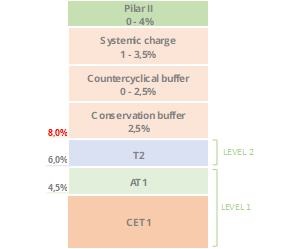
In addition, the FMC, with the favorable agreement of the Board of the Central Bank of Chile (BCCh), has the authority to establish new regulatory methodologies for calculating risk-weighted assets related to: Credit risk, Market risk, and Operational risk. This authority also extends to: conditions for the issuance of hybrid AT1 instruments, capital charges for systemically important banks, prudential deductions to regulatory capital, and additional measures, including increased capital, for banks with deficiencies in the Supervisory Review and Evaluation Process (Pillar II).
NOTE 37 - RISK MANAGEMENT, continued
Pillar II aims to ensure that banks maintain a capital level appropriate to their risk profile and encourages the development and use of effective risk monitoring and management processes. for this reason, banks are responsible for developing an Internal Capital Adequacy Assessment Process (ICAAP), while supervisors must examine banks' internal strategies and assessments and intervene early when they are not satisfied with the outcome of this process, Thus, supervisors may required additional capital, above the minimum regulatory, especially to ensure resilience in adverse credit cycles.
At first, the Banks submitted a simplified report with the conclusions of the self-assessment process, only considering credit risk (2021). For 2022 Pillar I risks was added, and since 2023 the full report was required. On April 11, 2025, an additional capital requirements under Pillar II of 0.25% was imposed, which must did comply of 50% by June 2025.
The banks must maintain a regulatory capital of at least 8% of risk-weighted assets, net of credit losses, and a paid-in capital and reserves ("core capital") of at least 3% of total assets, also net of credit losses, as composed as follows:
•The bank’s paid-in capital and reserves, excluding capital attributable to subsidiaries and foreign branches, or core capital;
•Perpetual bonds and preferred shares referred, placed by the bank at placement price, up to one-third of its core capital;
•Subordinated bonds, valued placement price, decreasing by 20.0% for each year during the period beginning six years before maturity, for an amount of up to 50.0% of their core capital; and
•Voluntary provisions for credit losses, up to 1.25% of credit risk-weighted assets.
On April 1, 2025, the annual classification of systemically important banks and established requirement was announced. thus maintaining for another year the requirement of an additional basic capital charge of 1.5% for the bank.
On April 14, 2025, and additional Pillar II capital requirement of 0.25 percent was announced, applicable in 50% no later than June 30, 2025.
On November 19, 2024, the Chilean Central Bank Council, resolved to maintain the Countercyclical Capital Buffer (CCyB) at 0.5% of risk-weighted assets, which had been activated on May 24, 2023, as a precautionary measure against external financial uncertainty. The instruction remains unchanged as of December 2025.
Compliance with external requirements
Regulatory capital and core capital are calculated based on the local Consolidated Financial Statements. As a result of the merger between two predecessor institutions with a significant market share in the Chilean financial market, our current minimum regulatory requirement consists of a minimum regulatory capital-to-risk-weighted assets ratio of 12.63%, As of the reporting date, the Bank maintains a regulatory capital-to-risk-weighted assets ratio of del 16.89%.
Period-to-period changes
Schedule of changes to minimum capital requirements:
| As of December 31, | |||||||||||
| Capital requirements | 2025 | 2024 | |||||||||
| MCh$ | MCh$ | ||||||||||
| Pillar II charge | 0.13 | % | — | % | |||||||
| Systemic Charge | 1.50 | % | 1.13 | % | |||||||
| Counter-cyclical Capital buffer | 0.50 | % | 0.50 | % | |||||||
| Capital Conservation buffer | 2.50 | % | 2.50 | % | |||||||
| Tier T2 | 2.00 | % | 2.00 | % | |||||||
| AT1 | 1.50 | % | 1.50 | % | |||||||
| CET1 | 4.50 | % | 4.50 | % | |||||||
| Total | 12.63 | % | 12.13 | % | |||||||
As of December 1, 2025, the regulatory adjustments and exclusions increased from 65% to 100% deduction according to transitional provisions, thus ending the gradual implementation process of Basel III.
NOTE 37 - RISK MANAGEMENT, continued
Additional regulation
Pillar III promotes market discipline and financial transparency through the disclosure of meaningful and timely information, allowing information users to understand the risk profile of local banking institutions along with their capital structure, thereby reducing information asymmetries.
On July 8, 2025, as a result of the supervisory process known as Pillar II of Basel III, additional regulatory capital requirements for banking entities was improved, with the aim of facilitating the supervisory process and clarifying some aspects of the capital assessment process. The adjustments will be incorporated partially, with the first application starting with the reports submitted in December 2025 and ending with the IAPE review to be delivered in April 2027.
Total assets, risk-weighted assets, and components of effective equity
| Total assets, risk-weighted assets and components of effective equity according to Basel III | Consolidated global 31-12-2025 MCh$ | Consolidated global 31-12-2024 MCh$ | |||||||||||||||||||||
| 1 | Total assets according to the statement of financial position | 68,094,956 | 68,458,932 | ||||||||||||||||||||
| 2 | Investment in subsidiaries that are not consolidated | - | |||||||||||||||||||||
| 3 | Assets discounted from regulatory capital, other than item 2 | 11,233,907 | 13,243,643 | ||||||||||||||||||||
| 4 | Credit equivalents | 4,639,857 | 3,402,423 | ||||||||||||||||||||
| 5 | Contingent credits | 2,804,045 | 2,836,980 | ||||||||||||||||||||
| 6 | Assets generated by the intermediation of financial instruments | 83,086 | 18,622 | ||||||||||||||||||||
| 7 | = (1-2-3+4+5-6) Total assets for regulatory purposes | 64,221,865 | 61,436,070 | ||||||||||||||||||||
| 8.a | Assets weighted for credit risk, estimated according to the standard methodology (RAW) | 29,551,588 | 29,921,944 | ||||||||||||||||||||
| 8.b | Assets weighted for credit risk, estimated according to internal methodologies (AWCR) | - | - | ||||||||||||||||||||
| 9 | Market Risk Weighted Assets (MRWA) | 7,143,966 | 5,967,201 | ||||||||||||||||||||
| 10 | Operational Risk Weighted Assets (OPWA) | 5,019,913 | 4,923,679 | ||||||||||||||||||||
| 11.a | = (8.a/8.b+9+10) Risk Weighted Assets (RWA) | 41,715,467 | 40,812,824 | ||||||||||||||||||||
| 11.b | = (8.a/8.b+9+10) Risk-weighted assets, after applying the output floor (RWA) | 41,715,467 | 40,812,824 | ||||||||||||||||||||
| 12 | Shareholders equity | 4,719,697 | 4,292,440 | ||||||||||||||||||||
| 13 | Non-controlling interest | 119,942 | 104,394 | ||||||||||||||||||||
| 14 | Goodwill | - | - | ||||||||||||||||||||
| 15 | Excess minority investment | - | - | ||||||||||||||||||||
| 16 | = (12+13-14-15) Common Equity Equivalent Tier 1 Capital (CET1) | 4,839,639 | 4,396,834 | ||||||||||||||||||||
| 17 | Additional deductions to common equity tier 1, other than item 2 | 237,716 | 128,425 | ||||||||||||||||||||
| 18 | = (16-17-2) Common Equity Tier 1 (CET1) | 4,601,923 | 4,268,409 | ||||||||||||||||||||
| 19 | Voluntary (additional) provisions charged as additional capital tier 1 (AT1) | - | - | ||||||||||||||||||||
| 20 | Subordinated bonds imputed as additional capital level 1 (AT1) | - | - | ||||||||||||||||||||
| 21 | Preferred shares attributed to additional capital tier 1 (AT1) | - | - | ||||||||||||||||||||
| 22 | Perpetual bonds attributed to additional capital level 1 (AT1) | 629,468 | 693,382 | ||||||||||||||||||||
| 23 | Discounts applied to AT1 | - | - | ||||||||||||||||||||
| 24 | = (19+20+21+22-23) Additional Tier 1 Capital (AT1) | 629,468 | 693,382 | ||||||||||||||||||||
| 25 | = (18+24) Equity Tier 1 | 5,231,391 | 4,961,791 | ||||||||||||||||||||
| 26 | Voluntary (additional) provisions allocated as Tier 2 (T2) capital | 179,098 | 293,000 | ||||||||||||||||||||
| 27 | Subordinated bonds imputed as Tier 2 capital (T2) | 1,636,832 | 1,706,525 | ||||||||||||||||||||
| 28 | = (26+27) Capital nivel 2 equivalente (T2) | 1,815,930 | 1,999,525 | ||||||||||||||||||||
| 29 | Discounts applied to T2 | - | - | ||||||||||||||||||||
| 30 | = (28-29) Tier 2 Capital (T2) | 1,815,930 | 1,999,525 | ||||||||||||||||||||
| 31 | = (25+30) Effective equity | 7,047,321 | 6,961,316 | ||||||||||||||||||||
| 32 | Additional basic capital required for the constitution of the conservation buffer | 1,042,887 | 1,020,321 | ||||||||||||||||||||
| 33 | Additional basic capital required to set up the countercyclical buffer | 208,577 | 204,064 | ||||||||||||||||||||
| 34 | Additional core capital required for banks rated as systemic | 625,732 | 459,144 | ||||||||||||||||||||
| 35 | Additional capital required for the evaluation of the adequacy of effective capital (Pillar 2) | 52,144 | - | ||||||||||||||||||||
NOTE 37 - RISK MANAGEMENT, continued
Solvency indicators and regulatory compliance indicators according to Basel III
| Solvency indicators and regulatory compliance indicators according to Basel III | Consolidated global 31-12-2025 % | Consolidated global 31-12-2024 % | ||||||||||||||||||
| 1 | Leverage indicator (T1_I18/T1_I7) | 7.17 | % | 6.95 | % | |||||||||||||||
| 1.a | Leverage indicator that the bank must meet, considering the minimum requirements | 3.00 | % | 3.00 | % | |||||||||||||||
| 2 | Core Capital indicator (T1_I18/T1_I11,b) | 11.03 | % | 10.46 | % | |||||||||||||||
| 2.a | Core Capital indicator that the bank must meet, considering the minimum requirements | 6.08 | % | 5.63 | % | |||||||||||||||
| 2.b | Capital buffer shortfall | |||||||||||||||||||
| 3 | Tier 1 capital indicator (T1_I25/T1_I11,b) | 12.54 | % | 12.16 | % | |||||||||||||||
| 3.a | Tier 1 capital indicator that the bank must meet, considering the minimum requirements | 7.60 | % | 7.13 | % | |||||||||||||||
| 4 | Effective equity indicators (T1_I31/T1_I11,b) | 16.89 | % | 17.06 | % | |||||||||||||||
| 4.a | Effective equity indicator that the bank must meet, considering the minimum requirements | 9.63 | % | 9.13 | % | |||||||||||||||
| 4.b | Effective equity indicator that the bank must meet, considering the charge for article 35 bis, if applicable | 0.00 | % | 0.00 | % | |||||||||||||||
| 4.c | Effective equity indicator that the bank must meet, considering the minimum requirements, conservation buffer and anti-cyclical buffer | 12.63 | % | 12.13 | % | |||||||||||||||
| 5 | Credit rating | A | A | |||||||||||||||||
| Regulatory compliance indicators for solvency | ||||||||||||||||||||
| 6 | Voluntary (additional) provisions allocated to Tier 2 capital (T2) in relation to APRCs (T1_I26/ (T1_I8,a or I8,b) | 0.61 | % | 0.98 | % | |||||||||||||||
| 7 | Subordinated bonds allocated to Tier 2 (T2) capital in relation to Tier 2 capital | 35.57 | % | 39.98 | % | |||||||||||||||
| 8 | Additional Tier 1 capital (AT1) in relation to basic capital (T1_I24/T1_I18) | 13.68 | % | 16.24 | % | |||||||||||||||
| 9 | Voluntary provisions (additional) and subordinated bonds that are charged to additional capital level 1 (AT1) in relation to the RWAs (T1_I19+T1_I20 / T1_I11,b) | 0.00 | % | 0.00 | % | |||||||||||||||