The Fund’s goal is to seek total return (consisting of current income that is exempt from regular federal and New York income tax and capital appreciation).
This table describes the fees and expenses that you may pay if you buy, hold and sell shares of the Fund. You may pay other fees, such as brokerage commissions and other fees to financial intermediaries, which are not reflected in the table or example below.
| Management Fees | 0.44 | % | |
| Other Expenses | 0.30 | % | |
| Total Annual Fund Operating Expenses | 0.74 | % | |
| Less Fee Waiver(1) | (0.17 | )% | |
| Total Annual Fund Operating Expenses After Fee Waiver(1) | 0.57 | % |
| (1) | The Adviser has contractually committed through October 31, 2028 to waive its advisory fees to the extent necessary to maintain the net operating expense ratio of the Fund, excluding Fund transaction costs, investment interest expense, dividend expenses associated with securities sold short and Acquired Fund Fees and Expenses (if any), at 0.57%. This commitment may not be changed or terminated at any time before October 31, 2028 without the approval of the Board of Directors. |
This Example is intended to help you compare the cost of investing in the Fund with the cost of investing in other mutual funds. The Example assumes that you invest $10,000 in the Fund for the time periods indicated below and then redeem all of your shares at the end of these periods. The Example also assumes that your investment has a 5% return each year and that the Fund’s operating expenses remain the same (taking into account the contractual fee waiver for the current duration of the arrangement only). Although your actual costs may be higher or lower, based on these assumptions your costs would be:
| 1 Year | 3 Years | 5 Years | 10 Years | |||
| $58 | $201 | $377 | $885 |
The Fund pays transaction costs, such as commissions, when it buys and sells securities (or “turns over” its portfolio). A higher portfolio turnover rate may indicate higher transactions costs and may result in higher taxes when Fund shares are held in a taxable account. These costs, which are not reflected in Annual Fund Operating Expenses or in the Example, affect the Fund’s performance. During the fiscal year ended October 31, 2025, the Fund’s portfolio turnover rate was 19% of the average value of its portfolio.
The Fund invests primarily in a non-diversified portfolio of investment-grade municipal securities, which include tax-free debt securities issued by the State of New York, its political subdivisions and taxing authorities, with a goal of seeking total return consisting of current income that is exempt from regular federal and New York income tax and capital appreciation. The Fund invests, as a fundamental policy, at least 80% of its net assets plus investment borrowings, under normal circumstances, in investments the income from which is exempt from federal income tax and New York income tax, but not necessarily the federal alternative minimum tax. The Fund may also engage in futures and options transactions, both to seek to increase return and/or to seek to hedge, or protect, its exposure to, for example, interest rate movements. In addition, the Fund may invest in exchange-traded funds (“ETFs”), U.S. Treasury securities, securities subject to the federal alternative minimum tax, taxable municipal bonds, and inflation-protected securities such as Treasury Inflation-Protected Securities (“TIPS”) and similar bonds issued by governments outside of the United States. Fixed income securities held by the Fund may be of any maturity.
The bar chart and the performance table shown below provide some indication of the risks of investing in the Fund by showing changes in its performance from year to year and by comparing the Fund’s performance to the ICE BofA U.S. Municipal Securities Index and the ICE BofA 3-7 Year AAA-AA Municipal Securities Index. The ICE BofA U.S. Municipal Securities Index serves as the Fund’s regulatorily-required broad-based securities market index and provides a broad measure of market performance. The ICE BofA 3-7 Year AAA-AA Municipal Securities Index is the Fund’s additional index and is generally more representative of the Fund’s investment universe than the regulatory index. For additional information about the indexes, please see the section entitled “Index Descriptions.”
Past performance (before and after taxes) does not necessarily predict future performance. Fund performance shown below reflects fees, waivers and/or expense reimbursements during such period and reinvestment of distributions, if any. Without waivers/reimbursements, performance would have been lower.
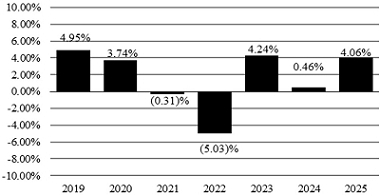
During the periods shown in the bar chart, the highest return for a quarter was 5.53% (quarter ended 12/31/2023) and the lowest return for a quarter was (4.76)% (quarter ended 3/31/2022).
| Average Annual
Total Returns (for the periods ended 12/31/2025) | 1 Year | 5 Years | Since Commencement of Operations (12/4/2018) | |||
| Fund Return Before Taxes | 4.06% | 0.62% | 1.75% | |||
| Fund Return After Taxes on Distributions | 3.89% | 0.47% | 1.58% | |||
| Fund Return After Taxes on Distributions and Sale of Shares | 3.21% | 0.75% | 1.61% | |||
| ICE BofA U.S. Municipal Securities Index (reflects no deduction for fees, expenses, or income and withholding taxes)* | 3.92% | 0.81% | 2.54% | |||
| ICE BofA 3-7 Year AAA-AA Municipal Securities Index (reflects no deduction for fees, expenses, or income and withholding taxes) | 4.90% | 0.84% | 2.01% |
| * | As a result of new regulatory requirements, the Fund’s regulatory or primary index previously changed from the ICE BofA 3-7 Year AAA-AA Municipal Securities Index to the ICE BofA U.S. Municipal Securities Index. |
After-tax returns are calculated using the historical highest individual federal marginal income tax rate, and do not reflect the impact of state and local taxes. Actual after-tax returns depend on the investor’s tax situation and may differ from those shown. After-tax returns shown are not relevant to shareholders who hold Fund shares through tax-deferred arrangements such as 401(k) plans or Individual Retirement Accounts. The Fund Return After Taxes on Distributions and Sale of Shares may be higher than other return figures when a capital loss occurs upon the redemption of Fund shares.