Exhibit 99.1

ISOENERGY LTD.
ANNUAL INFORMATION FORM
FOR THE YEAR ENDED DECEMBER 31, 2025
February 26, 2026
217 Queen Street West, Suite 401
Toronto, Ontario M5V 0R2
www.isoenergy.ca
Exhibit 99.1
ISOENERGY LTD.
ANNUAL INFORMATION FORM
FOR THE YEAR ENDED DECEMBER 31, 2025
February 26, 2026
217 Queen Street West, Suite 401
Toronto, Ontario M5V 0R2
www.isoenergy.ca
TABLE OF CONTENTS
CAUTIONARY STATEMENT | 1 |
GLOSSARY OF TERMS AND UNITS | 2 |
CURRENCY PRESENTATION | 4 |
CORPORATE STRUCTURE | 4 |
GENERAL DEVELOPMENT OF THE BUSINESS | 6 |
DESCRIPTION OF THE BUSINESS | 11 |
RISK FACTORS | 14 |
MATERIAL PROPERTIES | 29 |
DIVIDENDS | 61 |
DESCRIPTION OF CAPITAL STRUCTURE | 61 |
MARKET FOR SECURITIES | 63 |
PRIOR SALES | 64 |
ESCROWED SECURITIES & SECURITIES SUBJECT TO CONTRACTUAL RESTRICTIONS ON TRANSFER | 64 |
DIRECTORS AND OFFICERS | 64 |
AUDIT COMMITTEE | 69 |
LEGAL PROCEEDINGS AND REGULATORY ACTIONS | 70 |
INTEREST OF MANAGEMENT AND OTHERS IN MATERIAL TRANSACTIONS | 71 |
REGISTRAR AND TRANSFER AGENT | 71 |
MATERIAL CONTRACTS | 71 |
INTERESTS OF EXPERTS | 71 |
ADDITIONAL INFORMATION | 72 |
Schedule “A” AUDIT COMMITTEE CHARTER | A-1 |
CAUTIONARY STATEMENT
Forward-Looking Information
This annual information form (“AIF”) contains “forward-looking information” and “forward-looking statements” within the meaning of applicable Canadian securities legislation and US securities laws (collectively, “forward-looking information”). Forward-looking information includes, but is not limited to, information with respect to: the Company’s future prospects and outlook; the Company’s (as defined herein) planned exploration and development activities and the anticipated success of ongoing and future exploration and development activities; capital expenditures and proposed work programs at the Tony M Mine (as defined herein) and the Larocque East Property (as defined herein); the Tony M Resource Estimate (as defined herein); the Hurricane Resource Estimate (as defined herein); the Company’s results of operations, performance and business developments; the ability of the Company to achieve commercial production at any of its mineral properties; contingent payments that the Company may be required to make in the future including potential issuances of Common Shares (as defined herein) in connection therewith; compliance with environmental protection requirements and the implementation of policies and other measures to ensure compliance with social and environmental mandates; the future price of uranium; regulation of the nuclear energy industry; government regulation of mining operations and environmental risks. Forward-looking information is characterized by words such as “plan”, “expect”, “budget”, “target”, “schedule”, “estimate”, “forecast”, “project”, “intend”, “believe”, “anticipate” and other similar words or statements that certain events or conditions “may”, “could”, “would”, “might”, or “will” occur or be achieved. Forward-looking information is based on the opinions, assumptions and estimates of management considered reasonable at the date the statements are made, and are inherently subject to a variety of risks and uncertainties and other known and unknown factors that could cause the actual results, performance or achievements of the Company to be materially different from any future results, performance or achievements expressed or implied by the forward-looking information. Such factors include: the Company having no history of mineral production; negative operating cash flow and dependence on third-party financing; the price of uranium; public acceptance of nuclear energy and alternate sources of energy; regulatory factors and international trade restrictions; additional financing; uranium competing with other viable energy sources; mineral tenure risks; risks related to acquisitions and integration; challenges and conflicts that may arise in joint venture arrangements the Company has entered into; exploration, development and operating risks; permitting risks; risks related to the economics of developing mineral properties; imprecision of Mineral Reserve and Resource Estimates; pending assay results; risks related to the development of new mines and the restart of existing mines; risks related to Indigenous matters; risks related to mining activities in Saskatchewan; risks related to non-governmental organizations; risks related to community relations; risks related to activist shareholders and proxy solicitation firms; health, safety and environmental risks and hazards; foreign operations and political risks; risks related to the market price of securities; risks related to Virginia State Moratorium on conventional uranium mining; risks related to the Queensland Moratorium on uranium mining; risks related to dilution; risks related to the various option agreements that the Company has entered into; risks related to there being a limited number of potential customers for the Company’s products; risks related to global conflict; risks related to significant shareholders; conflicts of interest; the availability and costs of infrastructure, energy and other commodities; insurance and uninsured risks; competition risks; risks associated with tax matters; risks related to foreign mining tax regimes; risks relating to potential litigation; nature and climatic conditions; information systems and cyber security risks; risks related to global financial conditions; dependence of the Company on key management personnel and outside parties; potential impacts of infectious diseases; asset values may be subject to impairment; risks related to disclosure and internal controls as well as those risk factors discussed or referred to herein and in the Company’s annual management’s discussion and analysis (“MD&A”) as at and for the years ended December 31, 2025 and 2024 available under the Company’s SEDAR+ profile at www.sedarplus.ca or on EDGAR at www.sec.gov.
Although the Company has attempted to identify important factors that could cause actual actions, events or results to differ materially from those described in forward-looking information, there may be other factors that cause actions, events or results not to be as anticipated, estimated or intended. There can be no assurance that forward-looking information will prove to be accurate, as actual results and future events could differ materially from those anticipated in such information. The Company undertakes no obligation
1
to update forward-looking information if circumstances or management’s estimates, assumptions or opinions should change, except as required by applicable law. The reader is cautioned not to place undue reliance on forward-looking information. The forward-looking information contained herein is presented for the purpose of assisting investors in understanding the Company’s expected financial and operational performance and results as at and for the periods ended on the dates presented in the Company’s plans and objectives and may not be appropriate for other purposes.
Differences in United States and Canadian Reporting Practices
This AIF has been prepared in accordance with the requirements of the securities laws in effect in Canada, which differ in certain material respects from the disclosure requirements promulgated by the Securities and Exchange Commission (the “SEC”). For example, the terms “mineral reserve”, “proven mineral reserve”, “probable mineral reserve”, “mineral resource”, “measured mineral resource”, “indicated mineral resource” and “inferred mineral resource” are Canadian mining terms as defined in accordance with National Instrument 43-101 – Standards of Disclosure for Mineral Projects (“NI 43-101”) and the Canadian Institute of Mining, Metallurgy and Petroleum (the “CIM”) – CIM Definition Standards on Mineral Resources and Mineral Reserves, adopted by the CIM Council, as amended. These definitions differ from the definitions in the disclosure requirements promulgated by the SEC. Accordingly, information contained in this AIF may not be comparable to similar information made public by United States companies reporting pursuant to SEC disclosure requirements.
GLOSSARY OF TERMS AND UNITS
The following is a glossary of some of the technical terms used in this AIF.
Term | Definition |
|---|---|
ANT | Ambient noise tomography. |
CaCO3 | Calcium Carbonate. |
CPS | Counts per second. |
DC | Direct Current. |
drift | A horizontal underground opening that follows along the length of a vein or rock formation as opposed to a crosscut which crosses the rock formation. |
ft | Foot. |
geotechnical | Using geology and geological engineering. |
GT | Grade times thickness product. |
ha | Hectare. |
Km | Kilometre. |
lb | Pound. |
m | Metre. |
mineralization | The concentration of metals and their chemical compounds within a body of rock. |
muck | Ore or rock that has been broken by blasting. |
ppm | Parts per million. |
Ppm U-t | Parts per million uranium total values. |
2
Term | Definition |
|---|---|
Reserve or Mineral Reserve | The Canadian Institute of Mining, Metallurgy and Petroleum defines a “mineral reserve” as the economically mineable part of a measured or indicated mineral resource demonstrated by at least a comprehensive study of the viability of a mineral project that has advanced to a stage where the mining method, in the case of underground mining, or the pit configuration, in the case of an open pit, has been established, and where an effective method of mineral processing has been determined. This study must include a financial analysis based on reasonable assumptions of technical, engineering, operating, and economic factors and evaluation of other relevant factors which are sufficient for a person qualified under such instrument, acting reasonably, to determine if all or part of the mineral resource may be classified as a mineral reserve. This study must include adequate information on mining, processing, metallurgical, economic and other relevant factors that demonstrate, at the time of reporting, that economic extraction can be justified. A mineral reserve includes diluting materials and allowances for losses that may occur when the material is mined. |
Resource or Mineral Resource | The Canadian Institute of Mining, Metallurgy and Petroleum defines a “mineral resource” as a concentration or occurrence of natural, solid, inorganic or fossilized organic material in or on the Earth’s crust in such form and quantity and of such a grade or quality that it has reasonable prospects for eventual economic extraction. The location, quantity, grade, geological characteristics and continuity of a mineral resource are known, estimated or interpreted from specific geological evidence and knowledge. Mineral resources are sub-divided, in order of increasing geological confidence, into inferred, indicated and measured categories. An inferred mineral resource has a lower level of confidence than that applied to an indicated mineral resource. An indicated mineral resource has a higher level of confidence than an inferred mineral resource but has a lower level of confidence than a measured mineral resource. (1) Inferred Mineral Resource. An “inferred mineral resource” is that part of a mineral resource for which quantity and grade or quality can be estimated on the basis of geological evidence and limited sampling and reasonably assumed, but not verified, geological and grade continuity. The estimate is based on limited information and sampling gathered through appropriate techniques from locations such as outcrops, trenches, pits, workings and drill holes. (2) Indicated Mineral Resource. An “indicated mineral resource” is that part of a mineral resource for which quantity, grade or quality, densities, shape and physical characteristics can be estimated with a level of confidence sufficient to allow the appropriate application of technical and economic parameters, to support mine planning and evaluation of the economic viability of the deposit. The estimate is based on detailed and reliable exploration and testing information gathered through appropriate techniques from locations such as outcrops, trenches, pits, workings and drill holes that are spaced closely enough for geological and grade continuity to be reasonably assumed. (3) Measured Mineral Resource. A “measured mineral resource” is that part of a mineral resource for which quantity, grade or quality, densities, shape, physical characteristics are so well established that they can be estimated with confidence sufficient to allow the appropriate application of technical and economic parameters, to support production planning and evaluation of the economic viability of the deposit. The estimate is based on detailed and reliable exploration, sampling and testing information gathered through appropriate techniques from locations such as outcrops, trenches, pits, workings and drill holes that are spaced closely enough to confirm both geological and grade continuity. As used herein, “Resources” or “Mineral Resources” do not include reserves. |
royalty | An amount of money paid at regular intervals, or based on production, by the lessee or operator of an exploration or mining property to the current or former owner of the mineral interests. Generally based on a certain amount per tonne or a percentage of the total production or profits. |
U3O8 | Triuranium octoxide. |
V2O5 | Vanadium Oxide. |
3
CURRENCY PRESENTATION
This AIF contains references to Canadian dollars, United States dollars and Australian dollars. Unless otherwise indicated, all dollar amounts referenced are expressed in Canadian dollars. References to “$” or “C$” are to Canadian dollars, references to “US$” are to United States dollars and references to “A$” are to Australian dollars.
The closing, high, low and average exchange rates for one United States dollar in terms of Canadian dollars for each of the three years ended December 31, 2025, December 31, 2024, and December 31, 2023, based on the indicative rate of exchange for 2025, 2024 and 2023, as reported by the Bank of Canada, were as follows:
Note:
| (1) | Calculated as an average of the applicable daily rates for each period. |
On February 25, 2026, the closing rate of exchange as reported by the Bank of Canada was US$1.00 = C$1.3685 or C$1.00 = US$0.7307.
CORPORATE STRUCTURE
IsoEnergy Ltd. (“IsoEnergy” or the “Company”) was formed by way of an amalgamation completed on October 12, 2016 between a company also called “IsoEnergy Ltd.” (“Old IsoEnergy”) and 1089338 B.C. Ltd. (then a wholly owned subsidiary of NexGen Energy Ltd. (“NexGen”)), pursuant to section 269 of the Business Corporations Act (British Columbia) (the “BCBCA”).
Old IsoEnergy was incorporated on February 2, 2016 under the BCBCA as a wholly-owned subsidiary of NexGen to acquire certain exploration assets of NexGen. NexGen is a Canadian based uranium exploration company focused on the advancement of its Rook 1 Project in the Athabasca Basin, Saskatchewan. As of the date hereof, NexGen holds approximately 30.0% of the outstanding common shares of IsoEnergy (“Common Shares”).
On December 5, 2023, the Company completed the CUR Arrangement (as defined herein) pursuant to which IsoEnergy acquired all of the issued and outstanding CUR Shares (as defined herein) not already owned by IsoEnergy pursuant to a plan of arrangement under the Business Corporations Act (Ontario) (the “OBCA”). As a result of the CUR Arrangement, Consolidated Uranium (as defined herein) became a wholly-owned subsidiary of IsoEnergy.
Effective June 20, 2024, the Company filed articles of continuance to continue from the Province of British Columbia into the Province of Ontario. Shareholders of the Company (“IsoEnergy Shareholders”) approved the continuance at the Company’s annual general and special meeting of shareholders held on May 22, 2024 (the “2024 AGM”).
Effective March 20, 2025, the Company filed articles of amendment to effect the consolidation (the “Consolidation”) of the issued and outstanding Common Shares on the basis of one post-Consolidation Common Share for every four pre-Consolidation Common Shares. The Consolidation was approved at the
4
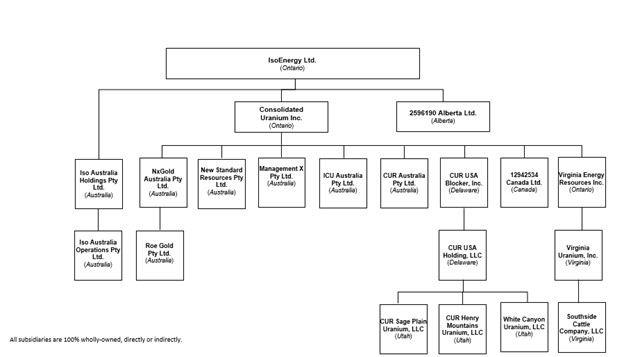
special meeting of shareholders of the Company held on December 3, 2024.The corporate chart that follows sets forth the Company’s subsidiaries (collectively, the “Subsidiaries”) as of the date of this AIF, together with the governing law of each of the Subsidiaries and the percentage of voting securities beneficially owned, controlled or directed, directly or indirectly, by the Company.
The Common Shares are listed and posted for trading on the Toronto Stock Exchange (the “TSX”) under the symbol “ISO” and are also listed on the NYSE American LLC (the “NYSE American”) under the symbol “ISOU”. Prior to July 8, 2024, the Common Shares were listed and posted for trading on the TSX Venture Exchange (“TSXV”). On July 8, 2024, the Common Shares commenced trading on the TSX and were voluntarily delisted from the TSXV prior to commencement of trading on the TSX. Prior to May 5, 2025, the Common Shares were listed on the OTCQX Venture Market (the “OTCQX”). The Common Shares commenced trading on the NYSE American on May 5, 2025.
The Company’s head office and registered and records office is located at 217 Queen Street West, Unit 401 Toronto, Ontario M5V 0R2.
As used in this AIF, unless the context otherwise requires, reference to “IsoEnergy” or the “Company” means IsoEnergy Ltd. and the Subsidiaries.
5
GENERAL DEVELOPMENT OF THE BUSINESS
Overview of the Business
IsoEnergy is a globally diversified uranium company with near-term production, development and exploration projects in top-tier jurisdictions, anchored by the world’s highest grade indicated uranium resource located in Canada’s Athabasca Basin and fully-permitted, conventional uranium mines in the U.S. ready for restart. The principal business activity of IsoEnergy has been, and continues to be, the acquisition, exploration and evaluation of uranium mineral properties.
The Company has acquired uranium projects in Canada, the United States and Australia, many with significant past expenditures and attractive characteristics for development.
The Company’s portfolio includes, among others: (i) the Larocque East property, located in Saskatchewan, Canada (the “Larocque East Property”); (ii) the Hawk property, located in Saskatchewan, Canada; (iii) the East Rim project, located in Saskatchewan, Canada; (iv) the Tony M mine, located in Utah, USA (the “Tony M Mine”); (v) the Daneros mine, located in Utah, USA; (vi) the RIM mine, located in Utah, USA; (vii) the Sage plain property located in Utah, USA; (viii) the Coles Hill project located in Virginia, USA; (ix) the Matoush project located in Quebec, Canada; (x) the Dieter Lake project located in Quebec, Canada; (xi) the Milo Uranium, Copper, Gold, Rare Earth project located in Australia; (xii) the Ben Lomond uranium project located in Australia; (xiii) the Queensland projects, located in Australia; and (xiv) the Yarranna uranium project, located in Australia. In addition, through a joint venture with Purepoint Uranium Group Inc. (“Purepoint”), the Company owns a 50% interest in three uranium projects spanning over 98,000 hectares in the eastern Athabasca Basin, located in Saskatchewan, Canada.
As of the date hereof, the Company’s material properties are the Larocque East Property and the Tony M Mine, each of which is the subject of a technical report prepared in accordance with NI 43-101. The NI 43-101 technical report in respect of the Larocque East Property is entitled “Technical Report on the Larocque East Project, Northern Saskatchewan, Canada”, as amended, dated August 4, 2022, with an effective date of July 8, 2022 (the “Larocque East Technical Report”), authored by Mr. Mark B. Mathisen, C.P.G. of SLR Consulting (Canada) Ltd. (“SLR”). The NI 43-101 technical report in respect of the Tony M Mine is entitled “Technical Report on the Tony M Mine, Utah, USA, Report for NI 43-101” dated December 8, 2022 with an effective date of September 9, 2022 (the “Tony M Technical Report”), authored by Mark B. Mathisen, C.P.G. of SLR. The Larocque East Technical Report and the Tony M Technical Report are available under the Company’s profile on SEDAR+ at www.sedarplus.ca.
For further information about IsoEnergy, refer to its filings with the Canadian Securities Authorities which may be obtained through the Company’s SEDAR+ profile at www.sedarplus.ca or its filings with the SEC which may be obtained on EDGAR at www.sec.gov.
Recent Developments
2026 Bought Deal Financing and Concurrent Private Placement
On January 27, 2026, the Company closed a bought deal financing, pursuant to which the Company sold 3,833,410 Common Shares at a price of $15.00 per Common Share for gross proceeds of $57,501,150, which included the full exercise of the over‑allotment option by the underwriters. Concurrently, the Company also closed a non-brokered private placement pursuant to which the Company issued 1,666,667 Common Shares at a price of $15.00 per Common Share to NexGen for gross proceeds of $25,000,005.
6
Base Shelf Prospectus
On January 13, 2026, the Company filed a final base shelf prospectus in Canada (the “2026 Base Shelf Prospectus”) and a registration statement in the United States, which provided for the offering of up to $250,000,000 in aggregate of Common Shares, warrants, units, debt securities, and/or subscription receipts of the Company in Canada and the U.S. for a period of 25 months following the date of the 2026 Base Shelf Prospectus. Offerings under the 2024 Base Shelf Prospectus (as defined herein) and sales under the ATM Program (as defined herein) can no longer be made.
Three Year History
Proposed Acquisition of Toro Energy Limited
On October 12, 2025, the Company entered into a scheme implementation deed (the “SID”) with Toro Energy Ltd. (“Toro”) pursuant to which, among other things, the Company agreed to acquire all of the issued and outstanding ordinary shares of Toro (the “Toro Shares”) by way of a scheme of arrangement under Australia’s Corporations Act 2001 (Cth) (the “Scheme”). Under the terms of the SID, shareholders of Toro will receive 0.036 of a Common Share for each Toro Share held on the Scheme record date. Following the completion of the Scheme, the Common Shares will continue to trade on the TSX and NYSE American and the Toro Shares will be delisted from the Australian Stock Exchange (the “ASX”). Completion of the Scheme is subject to various conditions, including, but not limited to, the approval of Toro shareholders, court approval, and certain regulatory approvals, including approval of the ASX and TSX and authorization of the NYSE American.
Conversion of 2020 Debentures
On August 1, 2025, Queen’s Road Capital Investment Ltd. (“QRC”) exercised its conversion right for the remaining US$3,000,000 principal amount of the 2020 Debentures (as defined herein), resulting in the issuance of 1,195,250 Common Shares to QRC, including 115,491 Common Shares to satisfy the exchange rate fee. On January 27, 2025, QRC converted an initial US$3,000,000 principal amount of the 2020 Debentures, resulting in the issuance of 1,221,818 Common Shares to QRC. The Company originally issued US$6,000,000 principal amount of unsecured convertible debentures (the “2020 Debentures”) on August 18, 2020. No further 2020 Debentures are outstanding.
Sustainability Report
On July 15, 2025, the Company released its inaugural sustainability report for the year ended December 31, 2024 (the “Sustainability Report”). The Sustainability Report highlights the Company’s progress in advancing its global uranium portfolio with a focus on environmental stewardship, Indigenous partnerships, and responsible governance, and marks a milestone in the Company’s evolution. The full Sustainability Report is available on the Company’s website at www.isoenergy.ca.
2025 Bought Deal Financing
On June 24, 2025, the Company closed a bought deal financing (the “June Offering”), pursuant to which the Company sold 5,121,500 Common Shares at a price of $10.00 per Common Share for gross proceeds of $51,215,000, which included the partial exercise of the over‑allotment option by the underwriters.
Establishment of ATM Program
On May 30, 2025, the Company entered into an equity distribution agreement (the “Distribution Agreement”) with Virtu Canada Corp. (the “Canadian Agent”) and Virtu Americas LLC (together with the Canadian Agent, the “Agents”), pursuant to which the Company was authorized to distribute up to $75,000,000 (or its equivalent in other currencies) of Common Shares from time to time through the Agents (the “ATM Program”). The Equity Distribution Agreement was terminated in connection with the filing of the 2026 Base Shelf Prospectus.
7
Share Consolidation and listing on NYSE American
On May 5, 2025, the Common Shares commenced trading on the NYSE American under the symbol “ISOU”. The Common Shares remain listed on the TSX under the symbol “ISO”.
On March 19, 2025, IsoEnergy announced that the board of directors of the Company (the “IsoEnergy Board”) approved the Consolidation on the basis of one post-Consolidation Common Share for every four pre-Consolidation Common Shares. The Consolidation became effective on March 20, 2025, with the post-Consolidation Common Shares commencing trading on the TSX at market open on March 24, 2025. The Consolidation was implemented in connection with the Company’s application to list its Common Shares on the NYSE American.
2025 Flow-Through Financing and 2025 Concurrent Private Placement
On February 28, 2025, the Company closed a bought deal financing (the “February Offering”), pursuant to which the Company sold 5,335,300 pre-Consolidation federal flow-through Common Shares (“Premium FT Shares”) that qualify as “flow-through shares” (within the meaning of subsection 66(15) of the Income Tax Act (Canada) (the “Tax Act”)) and were sold on a flow-through basis at an offer price of $3.75 per Premium FT Share, for aggregate gross proceeds of $20,007,375, which includes the full exercise of the over-allotment option by the underwriters. Concurrently, the Company also closed a non-brokered private placement (the “February Concurrent Private Placement”) pursuant to which the Company issued 2,500,000 pre-Consolidation Common Shares (which for greater certainty will not qualify as “flow-through shares”) at a price of $2.50 per Common Share to NexGen for gross proceeds of $6,250,000.
Sale of Mountain Lake
On February 14, 2025, the Company completed the sale to Future Fuels Inc. (“Future Fuels”) of all of its rights, title and interest in and to the Mountain Lake property (“Mountain Lake”) located in Nunavut in consideration for: (i) 12,500,000 common shares of Future Fuels (“Future Fuels Shares”) that were issued to IsoEnergy on closing; (ii) 2,500,000 Future Fuels Shares that were issued to IsoEnergy in October 2025, which was the earliest date practicable that ensured that such issuance did not result in IsoEnergy owning or controlling more than 19.9% of the outstanding Future Fuels Shares on a partially-diluted basis; and (iii) the grant by Future Fuels to IsoEnergy of (a) a 2% net smelter returns (“NSR”) royalty, payable on all production from Mountain Lake, of which 1% will be eligible for repurchase by Future Fuels for $1,000,000, and (b) a 1% NSR royalty, payable on all uranium production from Future Fuels properties in Nunavut other than Mountain Lake.
Termination of Anfield Energy Arrangement and Bridge Loan
On January 14, 2025, the Company announced that Anfield Energy Inc. (“Anfield”) had provided it with notice of termination of the previously announced Anfield Arrangement (as defined herein). On October 1, 2024, IsoEnergy and Anfield entered into an arrangement agreement pursuant to which, among other things, IsoEnergy agreed to acquire all of the issued and outstanding common shares of Anfield by way of a court-approved plan of arrangement (the “Anfield Arrangement”). In connection with the Anfield Arrangement, IsoEnergy provided a bridge loan (“Bridge Loan”) to Anfield in the form of a promissory note of approximately $6,000,000 and an indemnity for up to US$3,000,000 in principal (the “Indemnity”) with respect to certain of Anfield’s property obligations. In connection with the termination of the Anfield Arrangement, the Bridge Loan was repaid, including accrued interest at 15% per annum and the Indemnity was released in full.
8
Purepoint Joint Venture and Investment
On December 18, 2024, the Company entered into a joint venture agreement with Purepoint to form a joint venture for the exploration and development of a portfolio of uranium properties in Canada’s Athabasca Basin (the “Joint Venture”). Both IsoEnergy and Purepoint contributed assets from their respective portfolios to the Joint Venture, which consists of ten projects (later re-grouped and re-named into three projects: Dorado, Aurora, and the Celeste Block) covering more than 98,000 hectares in the east side of the Athabasca Basin and will leverage their respective expertise to capitalize on the significant potential of these properties. While IsoEnergy and Purepoint initially held participation interests of 60% and 40% in the Joint Venture, respectively, on January 15, 2025, IsoEnergy exercised its option to transfer 10% of its initial participation interest to Purepoint in exchange for 4,000,000 common shares of Purepoint (“Purepoint Shares”), such that each of IsoEnergy and Purepoint now hold a 50% interest in the Joint Venture. IsoEnergy holds a further option to purchase an additional 1% interest from Purepoint for $2,000,0000, which would give IsoEnergy a 51% participation interest and Purepoint a 49% participation interest in the Joint Venture. This option expires on the earlier of February 28, 2026, or 60 days after a material uranium discovery. The ownership interests of each company are subject to standard dilution, with any participation interest that is reduced to 10% or less being automatically exchanged for a 2% NSR royalty on the Joint Venture properties. The Company accounts for the Joint Venture as a joint operation in accordance with its accounting policies.
In connection with the formation of the Joint Venture, the Company subscribed for 3,333,334 units of Purepoint for $1,000,000, with each unit comprised of one Purepoint Share and one warrant of Purepoint. Each warrant is exercisable to acquire one Purepoint Shares at a price of $0.40 per share until November 22, 2027.
Pursuant to an investor rights agreement with Purepoint, IsoEnergy has the right to participate in any future equity financing of Purepoint to maintain its pro rata interest in Purepoint for so long as it owns at least 10% of the outstanding Purepoint Shares on partially-diluted basis.
2024 Base Shelf Prospectus
On September 5, 2024, the Company filed a final base shelf prospectus (the “2024 Base Shelf Prospectus”), which provided for the offering of up to $200,000,000 in aggregate of Common Shares, warrants, units, debt securities and/or subscription receipts of the Company for a period of 25 months following the date of the 2024 Base Shelf Prospectus.
Sale of Argentinian Assets
On July 22, 2024, IsoEnergy completed the sale to Jaguar Uranium Corp. (“Jaguar”) of 100% of the issued and outstanding shares of its wholly-owned subsidiary, which held a 100% interest in the Laguna Salada project located in Chubut and the Huemul project located in Mendoza, Argentina. As consideration for the transaction, the Company received (i) 2,000,000 common shares of Jaguar (“Jaguar Shares”) at a deemed price of US$5.00 per share, (ii) a 2% NSR royalty payable on all production from the Laguna Salada project, which is subject to a the right of Jaguar to buy back 1% of the royalty for a period of seven years at a price of US$2.5,000,000; and (iii) a 1% NSR royalty payable on all production from a portion of the Huemul project. The Company is also entitled to receive additional Jaguar Shares in the event a public listring of the Jaguar Shares is not completed within 12 months from the date of closing the transaction and if the listing price of the Jaguar Shares is less than US$5.00 per Jaguar Share. The Jaguar Shares are subject to a contractual resale restriction of six months following the date of the listing.
Pursuant to an investor rights agreement with Jaguar, IsoEnergy has the right to participate in any future equity financing of Jaguar to maintain its pro rata interest in Jaguar and the right to nominate one member to the Jaguar boar of directors for so long as it owns at least 5% of the outstanding Jaguar Shares on partially-diluted basis.
9
Acquisition of Bulyea River Project
On June 27, 2024, IsoEnergy acquired all of the outstanding shares of 2596190 Alberta Ltd., a wholly-owned subsidiary of Critical Path Minerals Corp., which holds a 100% interest in the ~13,000 hectare Bulyea River project located on the northern edge of the Athabasca Basin. Upfront consideration was comprised of $150,000 in cash and the grant by the Company of a 2% NSR royalty on future production from the Bulyea River project. The consideration also included deferred payments, including anniversary payments of $200,000, $300,000, and $350,000 due on or before the first, second, and third anniversaries of closing as well as $1,000,000 payable within 30 days after a published technical report confirming a mineral resource estimate at the Bulyea River project, each of which is payable in cash or Common Shares at the election of the Company. The agreement includes a provision for the return of the Bulyea River project to the vendor if the Company does not make the deferred payments as described above.
Collaboration Agreement
In April 2024, the Company entered into a collaboration agreement (the “Collaboration Agreement”) with the Ya’thi Néné Lands and Resources Office, working on behalf of The Athabasca Denesuliné First Nations of Hatchet Lake First Nation, Black Lake First Nation and Fond du Lac First Nation and Athabasca municipalities of Stony Rapids, Wollaston Lake, Uranium City, and Camsell Portage. The Collaboration Agreement establishes a structured framework of engagement, enabling the consistent exchange of information, while facilitating collaboration in pivotal areas such as permitting processes, environmental safeguarding, and monitoring protocols to ensure the Athabasca communities are involved in, and aligned with, the work undertaken near their communities. It also underscores the equitable distribution of benefits to support community development initiatives, enhancing the overall socio-economic landscape.
2024 Flow-Through Financing
On February 9, 2024, IsoEnergy completed a “bought deal” brokered private placement pursuant to which the Company sold 3,680,000 pre-Consolidation federal flow-through Common Shares (the “2024 PFT Shares”) at a price of $6.25 per 2024 PFT Share for aggregate gross proceeds of C$23,000,000 (the “2024 Flow-Through Financing”). Each 2024 PFT Share qualifies as a “flow-through share” within the meaning of the Tax Act.
Consolidated Uranium Arrangement
On December 5, 2023, the Company completed the acquisition of all of the issued and outstanding shares (the “CUR Shares”) of Consolidated Uranium Inc. (“CUR” or “Consolidated Uranium”) pursuant to a plan of arrangement (the “CUR Arrangement”) under the OBCA. Pursuant to the CUR Arrangement, IsoEnergy acquired all of the issued and outstanding CUR Shares not already held by IsoEnergy, and Consolidated Uranium shareholders (“CUR Shareholders”) other than IsoEnergy, received 0.500 of a pre-Consolidation Common Share in exchange for each CUR Share held immediately prior to closing of the CUR Arrangement.
On October 19, 2023, in connection with the CUR Arrangement, the Company completed a private placement of 8,134,500 subscription receipts (the “Subscription Receipts”) at an issue price of $4.50 per Subscription Receipt for gross proceeds of $36,605,250. On December 5, 2023, in connection with completion of the CUR Arrangement, each Subscription Receipt was automatically converted into one pre-Consolidation Common Share.
In connection with closing of the CUR Arrangement, effective as of December 5, 2023, Philip Williams and Mark Raguz were appointed to the IsoEnergy Board, replacing Tim Gabruch and Trevor Thiele who both resigned as directors. Richard Patricio assumed the role of Chair and Leigh Curyer assumed the role of Vice Chair of the IsoEnergy Board. In addition, the senior management team of the Company was reconstituted to include Philip Williams as Chief Executive Officer, Tim Gabruch as President, Graham du Preez as Chief Financial Officer, Martin Tunney as Chief Operating Officer, Darryl Clark as Executive Vice
10
President, Exploration and Development, Dan Brisbin as Vice President, Exploration, and Jason Atkinson as Vice President, Corporate Development.
Premier American Uranium Spin-Out
On November 27, 2023, Consolidated Uranium completed the spin-out of its then majority-controlled subsidiary, Premier American Uranium Inc. (“PUR”), by way of a plan of arrangement under the OBCA (the “PUR Arrangement”). Pursuant to the PUR Arrangement, among other things, Consolidated Uranium, transferred ownership of certain wholly-owned subsidiaries which held eight United States Department of Energy leases located in Colorado (the “DOE Leases”) and patented claims located in Montrose County, Colorado in exchange for 7,753,572 common shares of PUR, 3,876,786 of which were distributed to CUR Shareholders on a pro rata basis pursuant to the provisions of the PUR Arrangement.
Virginia Energy Arrangement
On January 24, 2023, Consolidated Uranium completed the acquisition of all of the issued and outstanding shares (the “Virginia Energy Shares”) of Virginia Energy Resources Inc. (“Virginia Energy”) pursuant to a plan of arrangement under the BCBCA (the “Virginia Energy Arrangement”). Pursuant to the Virginia Energy Arrangement, Consolidated Uranium acquired 100% of the issued and outstanding Virginia Energy Shares not already held by Consolidated Uranium, and Virginia Energy shareholders other than Consolidated Uranium, received 0.26 of a CUR Share in exchange for each Virginia Energy Share held immediately prior to closing of the Virginia Energy Arrangement.
On December 6, 2022, in connection with the Virginia Energy Arrangement, Consolidated Uranium completed a private placement with Virginia Energy, pursuant to which CUR purchased, on a non-brokered private placement basis, 2,000,000 Virginia Energy Shares at a price of $0.50 per Virginia Share for aggregate consideration of C$1,000,000.
Other Corporate Developments
On December 1, 2025, Misty Urbatsch was appointed as Vice President, Strategy and Commercial of the Company.
Tim Gabruch resigned from his position as President of the Company effective August 31, 2024 and Dr. Darryl Clark resigned from his position as Executive Vice President, Exploration & Development of the Company effective October 31, 2024, both to pursue other opportunities. Dr. Dan Brisbin assumed accountability for the Company’s exploration activities globally.
DESCRIPTION OF THE BUSINESS
The principal business activity of IsoEnergy has been, and continues to be, the acquisition, exploration and evaluation of uranium mineral properties. The Company has acquired uranium projects in Canada, the United States and Australia, many with significant past expenditures and attractive characteristics for development.
The Company’s portfolio includes equity holdings of publicly traded and privately held companies whose principal businesses include the acquisition, exploration, and development of uranium mineral properties. The Company’s equity holdings include investments in NexGen, PUR, Atha Energy Corp. (“Atha Energy”), Future Fuels, and Jaguar, amongst others.
11
Principal Markets, Distribution Methods and Products
The Company is in the mineral exploration and development business, with a primary focus on uranium. The Company’s operations are currently in the exploration and development stage and it does not have any marketable products at this time. In addition, the Company does not know when, or if, certain of its properties will reach the development stage, and if so, what the estimated costs would be to reach commercial production. The Company’s ability to reach commercial production is dependent on several factors. See “Risk Factors” below.
Uranium Uses and Production Process
The predominant use for uranium is as a fuel for nuclear power plants. Through nuclear fission process, significant amounts of energy are released, creating heat to generate steam to spin a turbine. This is the basis of power generation in the nuclear power industry.
Specialized Skill and Knowledge
The Company’s business requires specialized skills and knowledge, including but not limited to areas of geology, mining, engineering, mechanical, electrical, repair, mineral exploration and development, business negotiations, accounting and management. To date, the Company has been able to locate and retain personnel with the requisite skills and to meet its current needs as an exploration and development stage company in the current labour market. See “Risk Factors” below.
Competitive Conditions
The uranium exploration and mining business is competitive in all phases of exploration, development and production and competition in the mineral exploration and production industry can be significant at times; however, the uranium industry is small compared to other commodity or energy industries. Uranium demand is international in scope, but supply is characterized by a relatively small number of companies operating in only a few countries. Primary uranium production is concentrated amongst a limited number of producers and is also geographically concentrated in certain specific areas.
In addition, nuclear energy competes with other sources of energy, including oil, natural gas, coal, hydroelectricity and other forms of renewable energy. These other energy sources are to some extent interchangeable with nuclear energy, particularly over the longer term. Sustained lower prices of oil, natural gas, coal and hydroelectricity, as well as the possibility of developing other low-cost sources for energy, may result in lower demand for uranium. Furthermore, growth of the uranium and nuclear power industry will depend upon continued and increased acceptance of nuclear technology as a means of generating clean, base-load electricity.
The Company competes with a number of other companies that have resources significantly in excess of those of the Company, in the search for and the acquisition of attractive properties, qualified service providers, labour, equipment and suppliers. The ability of the Company to acquire uranium properties in the future will depend on its ability to develop its present properties and on its ability to select and acquire suitable properties or prospects for exploration and development in the future. There can be no assurance that additional capital or other types of financing will be available if needed or that, if available, the terms of such financing will be favourable to the Company. Factors beyond the control of the Company may affect the marketability of uranium ultimately mined or discovered by the Company. See “Risk Factors” below.
Components
The Company uses, or may use, critical components such as water, electrical power, explosives, diesel and propane in its business, all of which are readily available.
12
Business Cycle & Seasonality
The mining business is subject to commodity price cycles. The marketability of minerals and mineral concentrates is also affected by worldwide economic cycles, which could have a significant impact on the operations of the Company, including resulting in the Company determining to cease work on, or dropping its interest in, some or all of its properties. In addition to commodity price cycles and recessionary periods, exploration activity may also be affected by seasonal and irregular weather conditions in some of the areas where the Company operates.
The Company’s business is not cyclical or seasonal.
Economic Dependence
The Company’s business is not substantially dependent on any single commercial contract or group of contracts either from suppliers or contractors.
Changes to Contracts
It is not expected that the Company’s business will be materially affected in the current financial year by the renegotiation or termination of any contracts or sub-contracts.
Environmental Protection
The Company’s exploration and development activities are subject to various levels of federal, provincial, state and local laws and regulations relating to the protection of the environment. To the best of management’s knowledge, the Company’s activities in 2025 were, and continue to be, in compliance in all material respects with such environmental regulations applicable to its development and exploration activities. The Company is also committed to complying with all relevant industry standards, legislation and regulations in the countries where it carries on business.
Due to the stage of the Company’s activities, environmental protection requirements have had a minimal impact on the Company’s capital expenditures and competitive position. If needed, the Company will make and will continue to make expenditures to ensure compliance with applicable laws and regulations. New environmental laws and regulations, amendments to existing laws and regulations, or more stringent implementations of existing laws and regulations could have a material adverse effect on the Company by potentially increasing capital and/or operating costs. See “Risk Factors” below.
Employees
As at December 31, 2025, the Company had 24 employees and 17 contractors and at the date of this AIF, the Company had 24 employees and 18 contractors.
Foreign Operations
In addition to its mineral projects in Canada, the Company has mines and mineral projects located in the United States and Australia. Any changes in regulations or shifts in political attitudes in these jurisdictions, or other jurisdictions in which the Company has projects from time to time, are beyond the control of the Company and may adversely affect its business. In addition, future developments and operations may be affected in varying degrees by such factors as government regulations (or changes thereto) with respect to the restrictions on production, export controls, income taxes, expropriation of property, repatriation of profits, environmental legislation, land use, water use, land claims of local people, mine safety and receipt of necessary permits. The effect of these factors cannot be accurately predicted. See “Risk Factors” below.
13
Social and Environmental Policies
The Company is committed to carrying out all of its activities in an ethical manner that prioritizes health and safety, recognizes the concerns of Indigenous peoples, communities and local stakeholders, and preserves the natural environment. The Company ensures that all employees are trained and instructed in their assigned tasks and that safety procedures are followed at all times. The importance of ethical behavior and preservation of the natural environment is stressed to all employees and/or contractors, and all are charged with monitoring operations to ensure they are being carried out in an environmentally friendly manner. The Company ensures that it will work with and consult local communities, Indigenous peoples and stakeholders, recognizing this practice as a benefit to all.
RISK FACTORS
The operations of the Company are speculative due to the high-risk nature of its business which is the exploration and development of mineral properties. The following risk factors could materially affect the Company’s financial condition and/or future operating results and could cause actual events to differ materially from those described in forward-looking information relating to the Company. The risks and uncertainties described below are not the only risks and uncertainties that the Company faces. Additional risks and uncertainties, including those that the Company does not know about now or that it currently deems immaterial, may also adversely affect the Company’s business.
No History of Mineral Production
There is no assurance that commercial quantities of uranium will be discovered at any of the Company’s properties nor is there any assurance that the Company’s exploration programs will yield positive results. Even if commercial quantities of uranium are discovered, there can be no assurance that any property of the Company will ever be brought to a stage where uranium resources can be profitably produced. Factors which may limit the ability of the Company to produce uranium resources from its properties include, but are not limited to, the market price of uranium, availability of additional capital and financing and the nature of any mineral deposits.
Negative Operating Cash Flow and Dependence on Third-Party Financing
Given that the Company’s properties have yet to enter commercial production and generate cash flow, the Company had negative operating cash flow for the year ended December 31, 2025. The Company has no history of earnings or a return on investment, and there is no assurance that any of its properties or any business that the Company may acquire or undertake will generate earnings, operate profitably or provide a return on investment in the future. As a result, the Company is dependent on third-party financing to continue exploration and pursue potential development activities on the Company’s properties. Accordingly, the amount and timing of capital expenditures and the Company’s ability to conduct further exploration and development activities at its properties depends on the Company’s cash reserves and access to third-party financing. Failure to obtain such additional financing could result in delay or indefinite postponement of further exploration and development of the Company’s properties, including the Larocque East Property and the Tony M Mine, or require the Company to sell one or more of its properties.
Furthermore, additional financing may not be available when needed, or if available, the terms of such financing might not be favourable to the Company and might involve substantial dilution to existing IsoEnergy Shareholders. The Company’s access to third-party financing depends on a number of factors, including the price of uranium, the results of ongoing exploration and development, any economic or other analysis performed with respect to the Company’s properties, a significant event disrupting the Company’s business or the uranium industry generally, or other factors may make it difficult or impossible to obtain financing through debt, equity, or other means on favourable terms, or at all. Failure to raise capital when needed would have a material adverse effect on the Company’s business, financial condition, prospects and outlook.
14
Price of Uranium
The Company’s profitability and long-term viability depend, in large part, upon the market price of uranium. The price of uranium has historically experienced, and may experience in the future, volatility and significant price movements over short periods of time. Market price fluctuations of uranium could adversely affect the profitability of the Company’s operations and lead to impairments and write downs of mineral properties. Historically, the fluctuations in these prices have been, and are expected to continue to be, affected by numerous factors beyond the Company’s control, including but not limited to, demand for nuclear power; political and economic conditions in uranium producing and consuming countries; public and political response to a nuclear accident; improvements in nuclear reactor efficiencies; reprocessing of used reactor fuel and the re-enrichment of depleted uranium tails; sales of excess inventories by governments and industry participants; and production levels and production costs in key uranium producing countries.
A decrease in the market price of uranium could adversely affect the price of the Common Shares and the Company’s ability to finance the exploration and development of its properties, which would have a material adverse effect on the Company’s future results of operations, cash flows and financial position. In addition, declining uranium prices can impact operations by requiring a reassessment of the feasibility of a particular project. Even if a project is ultimately determined to be economically viable, the need to conduct such a reassessment may cause substantial delays and/or may interrupt operations until the reassessment can be completed, which may have a material adverse effect on the Company’s exploration and development prospects, cash flows and financial position. Depending on the price of uranium and other minerals, any cash flow from future mining operations may not be sufficient and the Company could be forced to discontinue production, if any, and may lose its interest in, or may be forced to sell, some of its properties (or an interest therein). Future production, if any, from the mining properties of the Company is dependent upon the prices of uranium and other minerals being adequate to make these properties economic.
Public Acceptance of Nuclear Energy and Alternate Sources of Energy
Maintaining the demand for uranium at current levels and achieving any growth in demand in the future will depend on society’s acceptance of nuclear technology as a means of generating electricity. Because of unique political, technological, and environmental factors affecting the nuclear industry, including reinvigorated public attention following the 2011 accident at Fukushima in Japan, the industry is subject to public opinion risks that could impact the demand for nuclear power and the future prospects for nuclear power generation, which could have a material adverse effect on the Company’s earnings, cash flows, financial condition, results of operations or prospects.
In addition, the Company may be impacted by changes in regulation and public perception of the safety of nuclear power plants, which could adversely affect the construction of new plants, the demand for uranium and the future prospects for nuclear generation. These events could have a material adverse effect on the Company’s earnings, cash flows, financial condition, results of operations or prospects. A major shift in the power generation industry towards non-nuclear power or non-uranium-based sources of nuclear energy, whether due to lower cost of power generation associated with such sources, government policy decisions, or otherwise, could also have a material adverse effect on the Company’s earnings, cash flows, financial condition, results of operations or prospects.
Regulatory Factors and International Trade Restrictions
The international uranium industry, including the supply of uranium concentrates, is relatively small, highly competitive and heavily regulated. Worldwide demand for uranium is directly tied to the demand for electricity produced by the nuclear power industry, which is also subject to extensive government regulation and policies. The development of mines and related facilities is contingent upon governmental approvals that are complex and time consuming to obtain and which, depending upon the location of the project, involve multiple governmental agencies. The duration and success of such approvals are subject to many variables outside of the Company’s control. Any significant delays in obtaining or renewing such permits or licences in the future could have a material adverse effect on the Company.
15
In addition, the international marketing and trade of uranium is subject to potential changes in governmental policies, regulatory requirements and international trade restrictions (including trade agreements, customs, duties and taxes), which are beyond the control of the Company. Changes in regulatory requirements, customs, duties or taxes may affect the supply of uranium to the United States and Europe, which are currently the largest consumption markets for uranium in the world, as well as the future of supply to developing markets, such as China and India.
The supply of uranium is, to some extent, impeded by a number of international trade agreements and policies. These and any similar future agreements, governmental legislation, policies or trade restrictions are beyond the Company’s control and may affect the supply of uranium available in the United States, Europe and Asia, the world’s largest markets for uranium. If the Company achieves commercial production but is unable to supply uranium to important markets in the United States or Europe, its business, financial condition and results of operations may be materially adversely affected. In addition, there can be no assurance that governments will not enact legislation or take other actions that restricts who can buy or supply uranium, which may have a material adverse effect on the price of uranium and the Company’s financial condition and results of operations.
In particular, pursuant to an executive order, the United States has enacted significant new import tariffs on certain trade and transactions with Canada and other trading partners. Canada has enacted retaliatory import tariffs on certain trade and transactions from the United States. There is significant uncertainty surrounding further changes in governmental policy, particularly with respect to such trade policies, treaties and tariffs. These developments, and any similar further changes in governmental policy, may have a material adverse effect on global economic conditions and financial markets. The full economic impact of any such changes in governmental policy on the Company remains uncertain and is dependent on the severity and duration of the tariffs and any other measures imposed which, if prolonged, could increase costs and decrease demand for any minerals that may be extracted by the Company.
Additional Financing
The continued development of the Company may require additional financing. There is no guarantee that the Company will be able to achieve its business objectives without additional financing. The Company intends to fund its business objectives by way of additional offerings of equity and/or debt financing as well as through anticipated positive cash flow from operations in the future. The failure to raise or procure such additional funds or the failure to achieve positive cash flow could result in the delay or indefinite postponement of current business objectives. There can be no assurance that additional capital or other types of financing will be available if needed or that, if available, will be on terms acceptable to the Company. If additional funds are raised by offering equity securities, existing shareholders could suffer significant dilution, and any new equity securities issued could have rights, preferences and privileges superior to those of holders of Common Shares. In addition, any debt financings may increase the Company’s debt levels above industry standards. Any debt financing secured in the future could involve restrictive covenants relating to capital raising activities and other financial and operational matters, which may make it more difficult for the Company to obtain additional capital and to pursue business opportunities, including potential acquisitions or the disposition of assets. Debt financings may also contain provisions which, if breached, may entitle lenders or their agents to accelerate repayment of loans and/or realize upon security over the assets of the Company, and there is no assurance that the Company would be able to repay such loans in such an event or prevent the enforcement of security granted pursuant to such debt financing. The Company will require additional financing to fund its operations until positive cash flow is achieved.
Competition with Other Viable Energy Sources
Nuclear energy competes with other sources of energy, including oil, natural gas, coal and hydroelectricity. Sustained lower prices of oil, natural gas, coal and hydroelectricity may result in lower demand for uranium concentrates and uranium conversion services, which in turn may result in lower market prices for uranium, which would materially and adversely affect the Company’s business, financial condition and results of operations. In addition, technical advancements in renewable and other alternate forms of energy, such as
16
wind and solar power, could make these forms of energy more commercially viable and ultimately put additional pressure on the demand for uranium concentrates.
Mineral Tenure
The acquisition and maintenance of title to mineral properties is a very detailed and time-consuming process. While the Company has diligently reviewed and is satisfied with the title to the Company’s projects, and, to the best of its knowledge, such title is in good standing, there is no guarantee that title to the projects will not be challenged or impugned. The validity of mining or exploitation claims, which constitute most of the Company’s property holdings, can be uncertain, and may be contested. Title insurance is generally not available for mineral properties and the Company’s ability to ensure that it has obtained secure mine tenure may be severely constrained. Third parties may have valid claims underlying portions of the Company’s interests, including prior unregistered liens, agreements, royalty transfers or claims or other encumbrances and title may be affected by, among other things, undetected defects. Other parties may dispute the title to a property, or the property may be subject to prior unregistered agreements and transfers or land claims by Indigenous people. The title may also be affected by undetected encumbrances or defects or governmental actions.
The Company may not be able to register rights and interests it acquires against title to applicable mineral properties. An inability to register such rights and interests may limit or severely restrict the Company’s ability to enforce such acquired rights and interests against third parties or may render certain agreements entered into by the Company invalid, unenforceable, uneconomic, unsatisfied or ambiguous, the effect of which may cause financial results yielded to differ materially from those anticipated. Although the Company believes it has taken reasonable measures to ensure proper title to the properties in which it has an interest, there is no guarantee that such title will not be challenged or impaired. Any challenges, disputes, or termination of any one or more of the Company’s mining, exploration or other concessions, property holdings or titles could have a material adverse effect on the Company’s financial condition or results of operations.
In certain of the countries in which the Company operates or may operate in the future, the Company can initially only obtain rights to conduct exploration activities on certain prescribed areas, but obtaining the rights to proceed with development, mining and production on such areas or to use them for other related purposes, such as waste storage or water management, is subject to further application, conditions or licences, the granting of which are often at the discretion of the governments. In some instances, the Company’s rights are restricted to fixed periods of time with limited renewal rights. Delays in the process for applying for such rights or renewals or expansions, or the nature of conditions imposed by government, could have a material adverse effect on the Company’s business, including its existing developments and mines, and the Company’s financial condition and results of operations.
Acquisitions and Integration
As part of the Company’s business strategy, the Company examines opportunities to acquire additional mining assets and businesses. Any acquisition that the Company may choose to complete may be of a significant size, may change the scale of the Company’s business and operations, and may expose the Company to new geographic, political, operating, financial and geological risks. The Company’s success in its acquisition activities depends on its ability to identify suitable acquisition candidates, negotiate acceptable terms for any such acquisition, and integrate the acquired operations successfully with those of the Company. Any acquisitions would be accompanied by risks. For example, there may be a significant change in commodity prices after the Company has committed to complete the transaction and established the purchase price or exchange ratio; a material ore body may prove to be below expectations; the Company may have difficulty integrating and assimilating the operations and personnel of any acquired companies, realizing anticipated synergies and maximizing the financial and strategic position of the combined enterprise, and maintaining uniform standards, policies and controls across the organization; the integration of the acquired business or assets may disrupt the Company’s ongoing business and its relationships with employees, customers, suppliers and contractors; and the acquired business or assets may have unknown liabilities which may be significant. In the event that the Company chooses to raise debt
17
capital to finance any such acquisition, the Company’s leverage will be increased. If the Company chooses to use equity as consideration for such acquisition, existing IsoEnergy Shareholders may suffer dilution. Alternatively, the Company may choose to finance any such acquisition with its existing resources. There can be no assurance that the Company would be successful in overcoming these risks or any other problems encountered in connection with such acquisitions.
Challenges and conflicts may arise in Joint Venture Arrangements
The Company holds a 50% interest in the Joint Venture properties through its Joint Venture with Purepoint and may enter into other joint venture or partnership arrangements in the future. Accordingly, the Company’s activities may be subject to the risks normally associated with the conduct of non-wholly owned projects or joint arrangements, which depend on the nature of the interests held and may include (but are not limited to): disagreement or conflict with the joint venture partner on how to explore, develop and ultimately operate projects efficiently; the inability of a partner to meet its obligations; a partner having economic or business interests or goals that are, or become, inconsistent with the Company’s business interests or goals; bankruptcy of a partner; disputes or disagreement arising between the Company and its partner regarding strategic decisions, resource allocation and milestones, among others; litigation regarding joint project/joint venture matters; or breach, default or incompliance of a partner in respect of the agreement with the Company. The existence or occurrence of one or more of the foregoing circumstances and events could have a material adverse impact on the Company’s results of operations and financial position.
Exploration, Development and Operating Risks
Mining operations are inherently dangerous and generally involve a high degree of risk. The Company’s operations are subject to all of the hazards and risks normally encountered in the exploration and development of minerals, including, without limitation, unusual and unexpected geologic formations, seismic activity, rock bursts, cave-ins, flooding and other conditions involved in the drilling and removal of material any of which could result in damage to, or destruction of, mines, personal injury or loss of life and damage to property, and environmental damage, all of which may result in possible legal liability.
Mining operations are also subject to hazards such as fire, rock falls, geomechanical issues, equipment failure, and other hazards which may cause environmental pollution and consequent liability. The occurrence of any of these events could result in a prolonged interruption of the Company’s exploration and development activities that would have a material adverse effect on its business and prospects. Further, the Company may be subject to liability or sustain losses in relation to certain risks and hazards against which it cannot insure or for which it may elect not to insure. The occurrence of operational risks and/or a shortfall or lack of insurance coverage could have a material adverse impact on the Company’s future cash flows, earnings, results of operations and financial condition.
Permitting
The Company’s operations are subject to receiving and maintaining permits from appropriate governmental authorities. There is no assurance that delays will not occur in connection with obtaining and renewing all necessary permits for the Company’s existing operations, additional permits for any possible future changes to operations, or additional permits associated with new legislation. There can be no assurance that the Company will continue to hold all permits necessary to develop any particular property. Failure to comply with applicable laws, regulations and permitting requirements may result in enforcement actions thereunder, including orders issued by regulatory or judicial authorities causing activities to cease or be curtailed, and may include corrective measures requiring capital expenditures or remedial actions. Amendments to current laws, regulations and permitting requirements, or more stringent application of existing laws, may have a material adverse impact on the Company, resulting in increased capital expenditures and other costs or abandonment or delays in development of properties. Any of these factors could have a material adverse effect on the Company’s results of operations and financial position.
18
Economics of Developing Mineral Properties
Mineral exploration and development is speculative and involves a high degree of risk. While the discovery of a mineral deposit may result in substantial rewards, few properties which are explored are commercially mineable and ultimately developed into producing mines.
The Company has not defined current mineral reserves at the Larocque East Property, the Tony M Mine or any of its other properties and there can be no assurance that any of the properties under exploration contain commercial quantities of any minerals. Even if commercial quantities of minerals are identified, there can be no assurance that the Company will be able to exploit the resources or, if the Company is able to exploit them, that it will do so on a profitable basis.
Should any mineral reserves exist, substantial expenditures will be required to confirm mineral reserves which are sufficient to commercially mine and to obtain the required environmental approvals and permitting required to commence commercial operations. The decision as to whether a property contains a commercial mineral deposit and should be brought into production will depend upon the results of exploration programs and/or feasibility studies, and the recommendations of duly qualified engineers and/or geologists, all of which involves significant expense. This decision will involve consideration and evaluation of several significant factors including, but not limited to: (i) costs of bringing a property into production, including exploration and development work, preparation of production feasibility studies and construction of production facilities; (ii) availability and costs of financing; (iii) ongoing costs of production; (iv) uranium prices, which are historically cyclical; (v) environmental compliance regulations and restraints (including potential environmental liabilities associated with historical exploration activities); and (vi) political climate and/or governmental regulation and control. Development projects are also subject to the successful completion of engineering studies, issuance of necessary governmental permits, and availability of adequate financing. Development projects have no operating history upon which to base estimates of future cash flow.
The ability to sell and profit from the sale of any eventual mineral production from the Tony M Mine, the Larocque East Property or any other project of the Company will be subject to the prevailing conditions in the minerals marketplace at the time of sale. The global minerals marketplace is subject to global economic activity and changing attitudes of consumers and other end-users’ demand for mineral products. Many of these factors are beyond the control of a mining company and therefore represent a market risk which could impact the long-term viability of the Company and its operations.
Imprecision of Mineral Reserve and Resource Estimates
Mineral resource and reserve figures are estimates, and no assurances can be given that the estimated levels of uranium will be produced. Such estimates are expressions of judgment based on knowledge, mining experience, analysis of drilling results and industry practices. Valid estimates made at a given time may significantly change when new information becomes available. While the Company believes that its mineral resource estimates are well established and reflect management’s best estimates, by their nature, mineral resource estimates are imprecise and depend, to a certain extent, upon geological assumptions based on limited data, and statistical inferences which may ultimately prove unreliable. Should the Company encounter mineralization or formations different from those predicted by past sampling and drilling, resource estimates may have to be adjusted.
Mineral resources that are not mineral reserves do not have demonstrated economic viability. Further, due to the uncertainty which may be attached to inferred mineral resources, there is no assurance that inferred mineral resources will be upgraded to measured or indicated mineral resources as a result of continued exploration.
19
Pending Assay Results
Due to the nature of uranium and immediate visibility of radioactive content, in the interest of good disclosure practices it is the Company’s practice to measure the radioactivity of all drill core as soon as practicable and announce the results thereof by news release. The Company’s threshold for the disclosure of radioactive intervals is a minimum core length of 0.5m averaging 350 CPS or greater measured with an RS-125 handheld gamma-ray spectrometer. Additionally, the radioactive source must be confirmed as uraniferous and possess attributes consistent with unconformity-related deposits, the Company’s exploration target. After core has been appropriately handled and logged, samples are dispatched for testing. Assay results historically are generally received between 30 and 120 days after receipt of samples by the laboratory. The total count gamma readings using the scintillometer may not be directly or uniformly related to uranium grades of the sample measured and are only a preliminary indication of the presence of radioactive minerals. Core interval measurements and true thicknesses are not determined until assay results are received. There can be no assurance that assay results, once received, will confirm the previously announced scintillometer readings.
Development of New Mines and Restart of Existing Mines
The development of new mines or the restart of existing mines by the Company is subject to a number of factors including the availability and performance of engineering and construction contractors, mining contractors, suppliers and consultants, the receipt of required governmental approvals and permits in connection with the construction or restart of mining facilities, the conduct of mining operations (including environmental permits), and the successful completion and operation of ore passes, among other operational elements. Any delay in the performance of any one or more of the contractors, suppliers, consultants or other persons on which the Company is dependent in connection with its construction or restart activities, a delay in or failure to receive the required governmental approvals and permits in a timely manner or on reasonable terms, or a delay in or failure in connection with the completion and successful operation of the operational elements of new or restarted mines could delay or prevent the construction and start-up or restart of mines as planned. There can be no assurance that current or future construction and start-up or restart plans implemented by the Company will be successful, that the Company will be able to obtain sufficient funds to finance construction and start-up or restart activities, that personnel and equipment will be available in a timely manner or on reasonable terms to successfully complete construction projects, that the Company will be able to obtain all necessary governmental approvals and permits or that the construction, start-up, restart and ongoing operating costs associated with the development of new mines or the restart of existing mines will not be significantly higher than anticipated by the Company. Any of the foregoing factors could adversely impact the operations and financial condition of the Company.
Indigenous Matters
Effectively advancing exploration and mining operations within and outside of Canada is often dependent on addressing risk associated with the rights and interests of Indigenous peoples, and the Company is committed to working collaboratively with Indigenous peoples in respect of its projects, including for the purposes of effectively identifying and managing risk. However, the Company does not control many of the factors that give rise to risk, including government conduct, internal pressures and ambitions within Indigenous communities, as well as changing political and legal frameworks for addressing the rights and interests of Indigenous peoples and engaging with Indigenous peoples. In this context, no assurances can be given that material adverse consequences will not arise, including but not limited to: delays in receiving governmental approvals or rejections thereof, the imposition of onerous conditions, blockades or occupation of properties, legal challenges to the granting of governmental approvals, claims in tort alleging harm to rights, or the loss of the Company’s rights to lands and minerals, including in the context of a finding of Aboriginal title.
20
Mining Activities in Saskatchewan
IsoEnergy’s properties are located within areas subject to First Nation treaty rights and asserted Aboriginal rights and title of the Métis, including an outstanding land claim that encompasses a large portion of northern Saskatchewan. The legal requirements associated with Aboriginal and treaty rights in Canada, including Aboriginal title and land claims, are complex and constantly evolving. The decision of the Supreme Court of Canada in Tsilhqot’in Nation v. British Columbia (2014 SCC 44) found that an extensive area within North-Central British Columbia had been established as Aboriginal title. In 2025, the Supreme Court of British Columbia found that hundreds of acres in southern Richmond, British Columbia had been established to be Aboriginal title lands, and that Land Title Act’s provision enshrining the indefeasibility of title did not apply to protect private interests from findings of Aboriginal title (the decision has been appealed).
The federal government has also taken steps to incorporate the United Nations Declaration on the Rights of Indigenous Peoples (“UNDRIP”) within the positive law of Canada through the United Nations Declaration on the Rights of Indigenous Peoples Act. A ruling by the Federal Court, now under appeal, in Kebaowek First Nation v. Canadian Nuclear Laboratories, 2025 FC 319 concluded that the adoption of UNDRIP had altered existing legal principles, including by imposing a requirement to seek Indigenous consent in the context of nuclear waste storage within an Indigenous peoples’ traditional territory.
Developing and maintaining strong relationships with First Nations and Métis people is a matter of paramount importance to the Company. However, there can be no assurance that Aboriginal and treaty rights claims and related consultation issues, including outstanding land claims, will not arise on or impact the Company’s mineral properties or the ability of the Company to operate within its properties. These legal requirements and the risk of Indigenous peoples’ opposition may increase the operating costs and affect the Company’s ability to carry on its business.
Non-Governmental Organizations
Certain non-governmental organizations (“NGOs”) that oppose globalization and resource development are often vocal critics of the mining industry and its practices, including the use of hazardous substances in mining activities. Adverse publicity generated by such NGOs or other parties generally related to extractive industries or specifically to the Company’s operations, could have an adverse effect on the Company’s reputation, impact the Company’s relationship with the communities in which it operates and ultimately have a material adverse effect on the Company’s business, financial condition and results of operations.
Community Relations and Reputational Risk
The Company’s relationships with the communities in which it operates, and other stakeholders are critical to ensure the future success of its exploration and development of its projects. There is an increasing level of public concern relating to the perceived effect of mining activities on the environment and on communities impacted by such activities. Publicity adverse to the Company, its operations or extractive industries generally, could have an adverse effect on the Company and may impact relationships with the communities in which the Company operates and other stakeholders. While the Company is committed to operating in a socially responsible manner, there can be no assurance that its efforts in this respect will mitigate this potential risk.
The increased usage of social media and other web-based tools used to generate, publish and discuss user-generated content and to connect with other users has made it increasingly easier for individuals and groups to communicate and share opinions and views in regard to the Company and its activities, whether true or not. While the Company strives to uphold and maintain a positive image and reputation, it does not ultimately have control over how it is perceived by others. Damage to the Company’s reputation can be the result of the perceived or actual occurrence of any number of events, including allegations of improper conduct, environmental non-compliance or damage, failure to meet the Company’s objectives, and measures implemented to handle interactions with community groups. Any of these events could lead to
21
negative publicity for the Corporation, including on social media and web-based media platforms, regardless of the truth of the underlying event. Reputation loss may lead to increased challenges in developing and maintaining community relations, advancing its projects and decreased investor confidence, all of which may have a material adverse impact on the operations and financial condition of the Company.
Activist shareholders and Proxy Solicitation Firms
In recent years, publicly-traded companies have been increasingly subject to demands from activist shareholders and proxy solicitation firms advocating for changes to corporate governance practices, such as executive compensation practices, environmental, social, and governance issues, board composition, or for certain corporate actions or reorganizations. There can be no assurances that activist shareholders and proxy solicitation firms will not publicly advocate for the Company to make certain environmental, social, or governance changes or engage in certain corporate actions. Responding to challenges from activist shareholders, such as proxy contests, media campaigns or other activities and similar activities from proxy solicitation firms, could be costly and time consuming and could have an adverse effect on the Company’s reputation and divert the attention and resources of the Company’s management and the IsoEnergy Board, which could have an adverse effect on the Company’s business and results of operations. Even if the Company does undertake such environmental, social, or governance changes or corporate actions, activist shareholders and proxy solicitation firms may continue to promote or attempt to effect further changes. Activist shareholders may attempt to acquire control of the Company to implement such changes. If shareholder activists with differing objectives are elected to the IsoEnergy Board, this could adversely affect the Company’s business and future operations. Additionally, shareholder activism could create uncertainty about the Company’s future strategic direction, resulting in loss of future business opportunities, which could adversely affect the Company’s business, future operations, profitability, and the Company’s ability to attract and retain qualified personnel.
Health, Safety and Environmental Risks and Hazards
Mining, like many other extractive natural resource industries, is subject to potential risks and liabilities due to accidents that could result in serious injury or death and/or material damage to the environment and Company assets. The impact of such accidents could cause an interruption to operations, lead to a loss of licences, affect the reputation of the Company and its ability to obtain further licences, damage community relations and reduce the perceived appeal of the Company as an employer. The Company strives to manage all such risks in compliance with local and international standards and has or expects to implement various health and safety measures designed to mitigate such risks. Any such occupational health and personal safety issues may adversely affect the business of the Company and its future operations.
All phases of the Company’s operations are also subject to environmental and safety regulations in the jurisdictions in which it operates. Environmental legislation is evolving in a manner that will require stricter standards and enforcement, increased fines and penalties for non-compliance, more stringent environmental assessments of proposed projects and a heightened degree of responsibility for companies and their officers, directors and employees. There is no assurance that the Company has been or will at all times be in full compliance with all environmental laws and regulations or hold, and be in full compliance with, all required environmental, health and safety permits. In addition, no assurances can be given that new rules and regulations will not be enacted or that existing rules and regulations will not be applied in a manner which could have an adverse effect on the Company’s financial position and operations. The potential costs and delays associated with compliance with such laws, regulations and permits could prevent the Company from proceeding with the development of a project and any non-compliance therewith may adversely affect the Company’s business and prospects. Environmental hazards may also exist on the properties on which the Company holds interests that are unknown to the Company at present and that have been caused by previous or existing owners or operators of the properties.
Government environmental approvals and permits are currently, or may in the future be, required in connection with the Company’s operations. To the extent such approvals are required and not obtained, the Company may be curtailed or prohibited from proceeding with planned exploration or development of
22
mineral properties. Failure to comply with applicable laws, regulations and permitting requirements may result in enforcement actions, including orders issued by regulatory or judicial authorities causing operations to cease or be curtailed, and may include corrective measures requiring capital expenditures, installation of additional equipment, or remedial actions. The costs associated with such instances and liabilities could be significant. Amendments to current laws, regulations and permits governing operations and activities of mining companies, or more stringent implementation thereof, could have a material adverse impact on the Company and cause increases in capital expenditures or require abandonment or delays in the development and exploration of its mining properties. The Company may be required to compensate those suffering loss or damage by reason of the mining activities and may have civil or criminal fines or penalties imposed for violations of applicable laws or regulations. The Company may also be held financially responsible for remediation of contamination at current or former sites, or at third party sites. The Company could also be held responsible for exposure to hazardous substances.
In the context of environmental permits, the Company must comply with standards, laws and regulations that may entail costs and delays depending on the nature of the activity to be permitted and how stringently the regulations are implemented by the regulatory authority. The Company may incur costs associated with reclamation activities, which may materially exceed the provisions established by the Company for the activities. In addition, possible additional future regulatory requirements may require additional reclamation requirements creating uncertainties related to future reclamation costs. Should the Company be unable to post required financial assurance related to an environmental remediation obligation, the Company might be prohibited from starting planned operations or required to suspend existing operations or enter into interim compliance measures pending completion of the required remedy, which could have a material adverse effect. Furthermore, changes to the amount of financial assurance that the Company is required to post, as well as the nature of the collateral to be provided, could significantly increase the Company’s costs, making the development of new mines less economically feasible.
Foreign Operations and Political Risk
The Company has interests in mineral properties in Canada, the United States and Australia and may acquire interests in other jurisdictions, exposing it to the socioeconomic conditions as well as the laws governing the mining industry in those countries. Inherent risks with conducting foreign operations include, but are not limited to: high rates of inflation; military repression; war or civil war; social and labour unrest; organized crime; hostage taking; terrorism; violent crime; extreme fluctuations in currency exchange rates; expropriation and nationalization; renegotiation or nullification of existing concessions, licences, permits and contracts; illegal mining; changes in taxation policies including carbon taxes; restrictions on foreign exchange and repatriation; and changing political norms, currency controls and governmental regulations that favour or require the Company to award contracts in, employ citizens of, or purchase supplies from, a particular jurisdiction. These risks may limit or disrupt the Company’s exploration and development activities restrict the movement of funds, cause the Company to have to expend more funds than previously expected or required, or result in the deprivation of contract rights or the taking of property by nationalization or expropriation without fair compensation, and may materially adversely affect the Company’s financial position or results of operations.
Market Price of Securities
The Common Shares are listed on the TSX and on the NYSE American. Securities markets have had a high level of price and volume volatility, and the market price of securities of many resource companies, particularly those considered exploration or development stage companies, have experienced wide fluctuations in price that have not necessarily been related to the operating performance, underlying asset values or prospects of such companies.
The trading price of the Common Shares may increase or decrease in response to a number of events and factors, not related to the Company’s performance, and are, therefore, not within the Company’s control, including but not limited to, the market in which the Common Shares are traded, the strength of the economy generally, the price of uranium, the availability and attractiveness of alternative investments and the breadth
23
of the public market for the Common Shares. The effect of these factors and others on the market price of the Common Shares in the future cannot be predicted.
Virginia State Moratorium on Conventional Uranium Mining
The Coles Hill Project is located in the State of Virginia, a jurisdiction where there has been a moratorium on conventional uranium mining on private land since 1982 (Title 45.2, Chapter 21 of the Code of Virginia). The Virginia Code of 1950 was amended in 1982 to provide that no application for uranium mining shall be accepted by any agency of the Commonwealth of Virginia until a program for permitting the mining of uranium is established by statute.
Before mining development activities at the Coles Hill Project can proceed, the Virginia General Assembly must enact legislation authorizing and establishing a permitting program. If legislation were eventually passed to, in effect lift the moratorium on uranium mining, it would then be necessary for the Virginia Department of Mines Minerals and Energy, which regulates mining in the State of Virginia, to adopt the permitting regulations.
Given the many approvals that the Company would have to obtain in order to commence mining at the Coles Hill Project, there can be no assurances as to when or even if the Company will be able to commence mining operations.
Queensland Moratorium on Uranium Mining
As a country, Australia is the fourth largest producer of uranium globally, due to the Northern Territory and South Australia having established uranium mines. However, the grant of Mining Leases is a responsibility of State Governments in Australia and most of the Company’s Australian projects are located in Queensland. When the Queensland Labor government was formed in 2014, the party re-instated the policy that it would not grant a Mining Lease for the purpose of mining uranium in Queensland, nor would it permit the treatment or processing of uranium within the State. To date, the Liberal National Party of Queensland, which was elected in October 2024, has not altered that policy nor publicly stated their position on a potential revision of the existing policy and there can be no assurances as to when or even if they will do so, which could materially impact the ability of the Company to advance its projects in Queensland.
Dilution
The Company may have further capital requirements and exploration expenditures as it proceeds to expand exploration activities at its mineral projects, develop any such projects or take advantage of opportunities for acquisitions, joint ventures or other business opportunities that may be presented to it. The Company may sell additional Common Shares or other securities in the future to finance its operations or may issue additional Common Shares or other securities as consideration for future acquisitions. The Company cannot predict the size or nature of future sales or issuances of securities or the effect, if any, that such future sales and issuances may have on the market price of the Common Shares. Sales or issuances of substantial numbers of Common Shares, or the perception that such sales or issuances could occur, may adversely affect the future market price of the Common Shares and dilute each IsoEnergy Shareholder’s equity position in the Company.
Limited Number of Potential Customers
A small number of electric utilities worldwide buy uranium for nuclear power plants. In addition, there is no public market for the sale of physical uranium. The uranium futures market on the New York Mercantile Exchange does not provide for physical delivery of uranium, only cash on settlement, and the trading forum by certain buyers does not offer a formal market but rather facilitates the introduction of buyers to sellers. If the Company ultimately achieves commercial production at any of its properties, it may not be able to sell any physical uranium at a desired price level for some time. The pool of potential purchasers and sellers is limited, and each transaction may require the negotiation of specific provisions. Accordingly, a purchase or
24
sale cycle may take several weeks to complete. The inability to sell any produced uranium on a timely basis in sufficient quantities could have a material adverse effect on the financial condition of the Company.
Global Conflict
Ongoing global conflict, including without limitation in Ukraine and the Middle East, can and has led to sanctions being levied against certain countries by the international community and may result in additional sanctions or other international action, any of which may have a destabilizing effect on commodity prices, supply chain and global economies more broadly. Volatility in commodity prices and supply chain disruptions may adversely affect the Company’s business and financial condition. The extent and duration of such conflicts and related international actions cannot be accurately predicted and the effects of such conflict may magnify the impact of other risks identified in this AIF, including those relating to commodity price volatility and global financial conditions. Because of the highly uncertain and dynamic nature of these events, it is not currently possible to accurately estimate the impact of such conflicts on the Company’s business.
Significant Shareholder
As of the date of this AIF, NexGen holds approximately 30.0% of the issued and outstanding Common Shares on a non-diluted basis. As a result of the number of Common Shares held by NexGen, NexGen may be in a position to affect the governance and operations of the Company, including matters requiring shareholder approval, such as the election of directors, change of control transactions and the determination of other significant corporate actions. There can also be no assurance that the interests of NexGen will align with the interests of the Company or the other IsoEnergy Shareholders, particularly in light of the other financial interests of NexGen, and NexGen will have the ability to influence certain actions that may not reflect the intent of the Company or align with the interests of the Company or the other IsoEnergy Shareholders.
Conflicts of Interest
Certain of the directors and officers of the Company also serve as directors and/or officers of other companies involved in natural resource exploration and development and, consequently, there exists the possibility for such directors and officers to be in a position of conflict. The Company expects that any decision made by any of such directors and officers involving the Company will be made in accordance with their duties and obligations to deal fairly and in good faith with a view to the best interests of the Company and its shareholders, but there can be no assurance in this regard. In addition, each of the Company’s directors is required to declare and refrain from voting on any matter in which such directors may have a conflict of interest or which are governed by the procedures set forth in the OBCA and any other applicable law. In the event that the Company’s directors and officers are subject to conflicts of interest, there may be a material adverse effect on its business.
Availability and Costs of Infrastructure, Energy and Other Commodities
Mining, processing, development and exploration activities depend, to one degree or another, on adequate infrastructure. Reliable roads, bridges, power sources and water supply are important determinants that affect capital and operating costs. Unusual or infrequent weather phenomena, sabotage, government or other interference in the maintenance or provision of such infrastructure could adversely affect the Company’s operations, financial condition and results of operations.
The profitability of the Company’s operations will be dependent upon the cost and availability of commodities which are consumed or otherwise used in connection with the Company’s operations and projects, including, but not limited to, diesel, fuel, natural gas, electricity, steel and concrete. Commodity prices fluctuate widely and are affected by numerous factors beyond the control of the Company. If there is a significant and sustained increase in the cost of certain commodities, the Company may decide that it is not economically feasible to continue all of the Company’s development activities.
25
Further, the Company relies on certain key third-party suppliers and/or contractors for services, equipment, raw materials used in, and the provision of services necessary for, the development and construction of its assets. There can be no guarantee that services, equipment or raw materials will be available to the Company on commercially reasonable terms or at all.
Insurance and Uninsured Risks
Exploration, development and production operations on mineral properties involve numerous risks, including unexpected or unusual geological operating conditions, rock bursts, cave‐ins, fires, floods, earthquakes and other environmental occurrences, as well as political and social instability. It is not always possible to obtain insurance against all such risks and the Company may decide not to insure against certain risks because of high premiums or other reasons. Should such liabilities arise, they could reduce or eliminate any future profitability and result in increasing costs and a decline in the value of the Common Shares. The lack of, or insufficiency of, insurance coverage could adversely affect the Company’s future cash flow and overall profitability.
Competition
The mining industry is intensely competitive in all of its phases and the Company competes with many companies possessing greater financial and technical resources than itself. Competition in the uranium mining industry is primarily for mineral rich properties that can be developed and produced economically; the technical expertise to find, develop, and operate such properties; the labour to operate the properties; and the capital for the purpose of funding such properties. The Company expects to selectively seek strategic acquisitions in the future, however, there can be no assurance that suitable acquisition opportunities will be identified on acceptable terms. As a result, there can be no assurance that the Company will acquire any interest in additional uranium properties. If the Company is not able to acquire these interests, it could have a material and adverse effect on its future earnings, cash flows, financial condition or results of operations. Even if the Company does acquire these interests or rights, the resulting business arrangements may ultimately prove not to be beneficial.
Tax Matters
The Company’s taxes are affected by several factors, some of which are outside of its control, including the application and interpretation of the relevant tax laws and treaties. The introduction of new tax laws, regulations or rules, or changes to, or differing interpretation of, or application of, existing tax laws, regulations or rules in Canada, the United States or Australia, could result in an increase in taxes, or other governmental charges, duties or impositions, an unreasonable delay in the refund of certain taxes owing to the Company or the application of unfavourable currency controls or on the repatriation of profits. No assurance can be given that new tax or foreign exchange laws, rules or regulations will not be enacted or that existing laws, rules or regulations will not be changed, interpreted or applied in a manner that could have a material adverse effect on the Company. In addition, if the Company’s filing position, application of tax incentives or similar “holidays” or benefits were to be challenged for any reason, this could have a material adverse effect on the Company’s business, results of operations and financial condition.
The Company is subject to routine tax audits by various tax authorities. Tax audits may result in additional tax, interest payments and penalties which would negatively affect the Company’s financial condition and operating results. New laws and regulations or changes in tax rules and regulations or the interpretation of tax laws by the courts or the tax authorities may also have a substantial negative impact on the Company’s business. There is no assurance that the Company’s current financial condition will not be materially adversely affected in the future due to such changes.
Foreign Mining Tax Regimes
Mining tax regimes in foreign jurisdictions are subject to differing interpretations and are subject to constant change. The Company’s interpretation of taxation law as applied to its transactions and activities may not
26
coincide with that of the tax authorities. As a result, transactions may be challenged by tax authorities and the Company’s operations may be assessed, which could result in significant additional taxes, penalties and interest. In addition, proposed changes to mining tax regimes in foreign jurisdictions could result in significant additional taxes payable by the Company, which would have a negative impact on the financial results of the Company.
Litigation
All industries, including the mining industry, are subject to legal claims, with and without merit. The Company may become involved in legal disputes in the future. Defence and settlement costs of legal claims can be substantial, even with respect to claims that have no merit. As of the date hereof, no material claims have been brought against the Company, nor has the Company received an indication that any material claims are forthcoming. However, due to the inherent uncertainty of the litigation process, should a material claim be brought against the Company, there can be no assurance that the resolution of any particular legal proceeding will not have a material adverse effect on the Company’s financial position and results of operations.
Nature and Climatic Conditions
The Company and the mining industry are facing continued geotechnical challenges, which could adversely impact the Company. Unanticipated adverse geotechnical and hydrological conditions, such as landslides, droughts, pit wall failures and rock fragility may occur in the future and such events may not be detected in advance. Geotechnical instabilities and adverse climatic conditions can be difficult to predict and are often affected by risks and hazards outside of the Company’s control, such as severe weather, wildfires and considerable rainfall, which may lead to periodic floods, mudslides, wall instability and seismic activity, which may result in slippage of material. Such conditions could result in limited access to mine sites, suspensions or reductions in operations, government investigations, increased monitoring costs, remediation costs, loss of ore and other impacts which could cause the Company’s projects to be less profitable than currently anticipated and could result in a material adverse effect on the Company’s results of operations and financial position.
Information Systems and Cyber Security
The Company’s information systems, and those of its third-party service providers and vendors, are vulnerable to an increasing threat of continually evolving cybersecurity risks. These risks may take the form of malware, computer viruses, security breaches, cyber threats, extortion, employee error, malfeasance, system errors or other types of risks, and may occur from inside or outside of the Company. Cybersecurity risk is increasingly difficult to identify and quantify and cannot be fully mitigated because of the rapidly evolving nature of the threats, targets, and consequences. Additionally, unauthorized parties may attempt to gain access to these systems or the Company’s information through fraud or other means of deception. The Company’s operations depend, in part, on how well the Company and those entities with which it does business, protect networks, equipment, information technology systems and software against damage from a number of threats. The failure of information systems or a component of information systems could, depending on the nature of any such failure, adversely impact the Company’s reputation and results of operations.
Although to date, the Company has not experienced any material losses relating to cyber attacks or information security breaches, there can be no assurance that it will not incur such losses in the future. The Company’s risk and exposure to these matters cannot be fully mitigated because of, among other things, the evolving nature of these threats. As a result, cyber security and the continued development and enhancement of controls, processes and practices designed to protect systems, computers, software, data and networks from attack, damage or unauthorized access remain a priority. As cyber threats continue to evolve, the Company may be required to expend additional resources to continue to modify or enhance protective measures or to investigate and remediate any security vulnerabilities.
27
Global Financial Conditions
Global financial conditions continue to be characterized as volatile. In recent years, global markets have been adversely impacted by various credit crises and significant fluctuations in fuel and energy costs and metals prices, the COVID-19 pandemic, ongoing hostilities in Ukraine and the Middle East, related sanctions, and threats of tariffs and other trade restrictions. Many industries, including the mining industry, have been impacted by these market conditions. Global financial conditions remain subject to sudden and rapid destabilizations in response to future events, as government authorities may have limited resources to respond to future crises. A continued or worsened slowdown in the financial markets or other economic conditions, including but not limited to consumer spending, employment rates, business conditions, inflation, fuel and energy costs, consumer debt levels, lack of available credit, the state of the financial markets, interest rates and tax rates, may adversely affect the Company’s growth and prospects. Future crises may be precipitated by any number of causes, including natural disasters, geopolitical instability, changes to energy prices or sovereign defaults. If increased levels of volatility continue or in the event of a rapid destabilization of global economic conditions, it may result in a material adverse effect on commodity prices, demand for metals, including uranium, availability of credit, investor confidence, and general financial market liquidity, all of which may adversely affect the Company’s business and the market price of the Common Shares.
Dependence on Key Management Personnel
The Company relies on the specialized skills of management and consultants in the areas of mineral exploration, geology and business negotiations and management. The Company’s ability to manage its operating, development, exploration and financing activities will depend in large part on the efforts of these individuals and as the Company’s business grows, it will require additional personnel. The Company faces intense competition for qualified personnel, and there can be no assurance that the Company will be able to attract and retain such personnel. The loss of the services of one or more key employees or the failure to attract and retain new personnel could have a material adverse effect on the Company’s ability to manage and expand the Company’s business. The Company does not currently maintain key-man life insurance on any of its key employees.
Dependence on Outside Parties
The Company has relied upon consultants, engineers, contractors and other parties and intends to rely on these parties for exploration, development, construction and operating expertise and any future production. Substantial expenditures are required to construct mines, to establish mineral resources and mineral reserves through drilling, to carry out environmental and social impact assessments, to develop metallurgical processes to extract metal and, in the case of new properties, to develop the exploration and plant infrastructure at any particular site. Deficient or negligent work or work not completed in a timely manner could have a material adverse effect on the Company.
Infectious Diseases
Global markets and various industries have been adversely impacted by emerging infectious diseases and/or the threat of outbreaks of viruses, other contagions or epidemic diseases, as most recently seen during the COVID-19 pandemic. The outbreak of such diseases and the resultant response to combat it could result in the implementation by numerous governments of non‐routine measures such as quarantines, travel restrictions and business closures designed to contain the spread of the outbreak. These measures could negatively impact the global economy and lead to volatile market conditions and commodity prices. The economic viability of the Company’s long‐term business plan is impacted by its ability to obtain financing, and global economic conditions impact the general availability of financing through public and private debt and equity markers, as well as through other avenues.
Significant outbreaks could result in operational and supply chain delays and disruption as a result of governmental regulation and preventative measures being implemented worldwide. The Company could
28
also be required to close, curtail or otherwise limit its operating activities as a result of the implementation of any such governmental regulation or preventative measures in the jurisdictions in which the Company operates, or as a result of sustained outbreaks at its project site or facilities. Any such closures or curtailments could have an adverse impact on the business of the Company.
Asset Values may be subject to Impairment
At each reporting period, the Company undertakes a detailed evaluation of its portfolio of exploration projects and other assets. The recoverability of the Company’s carrying values of these properties may be affected by a number of factors including, but not limited to, the price of uranium, decreases in mineral resources, adverse changes in the economic or technical feasibility of a project or mine, the residual prospectivity of exploration properties and the fair values associated with proposed transactions. Any impairment estimates, which are based on applicable key assumptions and sensitivity analysis, are based on management’s best knowledge of the amounts, events or actions at such time, and the actual future outcomes may differ from any estimates that are provided by the Company. Any future impairment charges on the Company’s mineral projects may have an adverse effect on the Company’s results of operations and consequently the market price of the Company’s securities.
Disclosure and Internal Controls
Internal control over financial reporting is a process designed to provide reasonable assurance regarding the reliability of financial reporting and the preparation of financial statements for external purposes in accordance with International Financial Reporting Standards (“IFRS”). Disclosure controls and procedures are designed to ensure that the information required to be disclosed by the Company in reports filed with securities regulatory agencies is recorded, processed, summarized and reported on a timely basis and is accumulated and communicated. A control system, no matter how well designed and operated, can provide only reasonable, not absolute, assurance with respect to the reliability of financial reporting and financial statement preparation. The Company’s failure to satisfy the requirements of applicable Canadian securities laws on an ongoing, timely basis could result in the loss of investor confidence in the reliability of its financial statements, which in turn could harm its business and negatively impact the trading price of the Common Shares. In addition, any failure to implement required new or improved controls, or difficulties encountered in their implementation, could harm the Company’s operating results or cause it to fail to meet its reporting obligations.
MATERIAL PROPERTIES
The Company’s material properties are the Larocque East Property and the Tony M Mine, each of which is the subject of a technical report prepared in accordance with NI 43-101.
The Tony M Mine
Unless otherwise stated, the scientific and technical information included in the below summary has been derived, in part, from, and in some instances are extracts from, the Tony M Technical Report with an effective date of September 9, 2022 and prepared by Mark B. Mathisen, C.P.G. of SLR who is a “qualified person” pursuant to NI 43-101 (“Qualified Person” or “QP”). All defined terms used in the following summary have the meanings ascribed to them in the Tony M Technical Report. The below summary is subject to all the assumptions, qualifications and procedures set out in the Tony M Technical Report. The Tony M Technical Report was prepared in accordance with NI 43-101. For full technical details of the report, reference should be made to the complete text of the Tony M Technical Report, which has been filed with the applicable regulatory authorities and is available under the Company’s SEDAR+ profile at www.sedarplus.ca. The summary set forth below is qualified in its entirety by reference to the full text of the Tony M Technical Report. The author of the Tony M Technical Report has reviewed and approved the scientific and technical disclosure contained in this AIF related to the Tony M Mine, other than the disclosure regarding the updates on the recommended work program and details of the 2023 drill program and the
29
reopening of underground workings in 2024 under the heading “The Tony M Mine – Exploration, Development and Production” below. See “Interest of Experts” below.
Project Description, Location and Access
The Tony M Mine is located in eastern Garfield County, Utah, USA, 17 miles north of the Bullfrog Basin Marina on the northwestern side of Lake Powell and approximately 40 air miles south of the town of Hanksville, Utah, three miles west of Utah State Highway 276 and approximately five miles north of Ticaboo, Utah. The property is located in a remote area of southeastern Utah, and the infrastructure is limited. Road access to the property is via paved highways, State Highway 95, which connects the regional towns of Blanding and Hanksville, and State Highway 276, that connects Highway 95 with Ticaboo and the Bullfrog Marina, Utah. An unimproved gravel road, maintained by Garfield County, extends west from Highway 276, passes by the portal of the Tony M Mine, and extends northerly across the property, the northern end of which is intersected by another county road. A network of unimproved, unpaved exploration roads provide access over the property except in areas of rugged terrain. The Bullfrog Basin Marina airstrip is located approximately 15 miles south of the property.
The Tony M Mine consists of the underground mining project hosting the Tony M and Southwest deposits (the “Deposits”), as well as the surface facilities and underground mine workings for the currently inactive mine. The approximate geographical center of the target areas of interest is located at latitude 37°47’0.96’N and longitude 110°42’52.87’W. All surface data coordinates are State Plane 1983 Utah South FIPS 4303 (US feet) system.
The Tony M Mine consists of one Utah Trust Lands (SITLA) state Mineral Lease (the “Utah State Lease”) and 91 unpatented Federal lode mining claims. The claims and Utah State Mineral Lease comprise one contiguous property. The Utah State Mineral Lease includes 638.54 acres, and the 91 unpatented lode mining claims cover an area of approximately 1,544 acres. The surface rights covering the mining claims are owned by the U.S. government and administered by the U.S. Bureau of Land Management (“BLM”), while the surface estate over the Utah State Lease is owned by the State of Utah and managed by the Trust Lands Administration. Consolidated Uranium acquired a 100% interest in the Tony M Mine upon the completion on October 27, 2021 of the acquisition of a portfolio of conventional uranium projects located in Utah and Colorado, including i) the Tony M Mine; (ii) the Daneros Mine; (iii) the RIM Mine; and (iv) the Sage Plain Property, pursuant to the asset purchase agreement dated July 14, 2021 (the “Energy Fuels Transaction”) among Consolidated Uranium and certain wholly-owned subsidiaries of Energy Fuels Inc. (“Energy Fuels”).
Surface access to the Tony M Mine is granted via a surface owner agreement originally entered into between Jim Butt and Denison Mines (USA) Corporation. The agreement is for a period of 25 years, from March 14, 2008, and provides access across the Ticaboo 1, Ticaboo 5 and Ticaboo 6 claims. Jim Butt’s interest in the surface agreement was transferred to UCOLO Exploration Corp (“UCOLO”), and Denison Mines (USA) Corporation’s interest in the surface agreement was transferred to Energy Fuels Resources (USA) Inc., which interest was subsequently transferred to CUR Henry Mountains Uranium, LLC (“CUR Henry Mountains”), a subsidiary of Consolidated Uranium, upon closing of the Energy Fuels Transaction. Other areas of the Tony M Mine are accessible via gravel roads and two-track trails partially maintained by Garfield County and the BLM crossing public lands.
All property holdings have been reported to be in good standing up to August 31, 2026. The claim holding costs (annual maintenance fees to the BLM) for all of the unpatented lode mining claims that comprise a large part of the Tony M Mine for 2025-2026 will be US$200 per mining claim.
The Utah State Lease carries an annual rental cost of US$640, plus an escalating annual advance minimum royalty based on the uranium spot price. For 2025, the annual advance minimum royalty totalled US$7,680. The Utah State Lease was renewed in 2025 for a 10-year term which expires on March 31, 2035. The Company renegotiated the royalty on the Utah State Lease and reduced the royalty on future uranium production from 8% to 3% of gross value less certain deductions. The advanced minimum royalty was meaningfully reduced.
30
Seventeen of the mining claims (TIC-17B thru TIC-33B, inclusive) that comprise a portion of the Tony M Mine project lands, are owned by CUR Henry Mountains, and are subject to an annual minimum advance royalty payment, based upon the average uranium spot price for the previous 12 months. The uranium production royalty burden is 4% of the yellowcake gross value, less taxes and certain other deductions. Advance minimum royalties paid are creditable against future production royalty obligations. The vanadium production royalty burden is 2% gross value less certain deductions. For 2025, the annual minimum advance royalty totaled US$250,708. The remaining 74 mining claims are not burdened with any production royalties.
The author of the Tony M Technical Report is not aware of any environmental liabilities on the property nor is it aware of any other significant factors and risks that may affect access, title, or the right or ability to perform the proposed work program on the property.
The Tony M Mine was originally permitted and developed by Plateau Resources Ltd. (“Plateau”) in conjunction with the nearby Shootaring Mill. The Tony M Mine was reclaimed in 2004 but was then purchased by Denison Mines Corp. (“Denison”) and re-permitted in 2007 for Phase 1 Operations in which mining access would be through the existing mine portals. Major permits for the operation included an approved Plan of Operations and Finding of No Significant Impact from the BLM, a Large Mine permit with the Utah Division of Oil, Gas and Mining, and an approved ground water discharge permit with the Utah Division of Water Quality. A reclamation bond of US$708,517 is in place. In addition, there is a bond of US$42,545 in place for the confirmation drilling work that was completed by Consolidated Uranium in May and June 2022 at the Tony M Mine, which will be returned once reclamation of drill sites is completed. An additional bond of US$305,287.50 was posted on June 21, 2023 for the 2023 program that was completed by Consolidated Uranium, and for further clarity this additional bond is not included in the Tony M Technical Report.
The Tony M Mine was re-opened by Denison in late 2007 and was re-commissioned and put into production. The Tony M Mine was later closed and placed on care and maintenance in November 2008. The property has been on care and maintenance since 2008.
History
During World War I, vanadium was mined from several small deposits outcropping in Salt Wash exposures on the eastern and southern flanks of the Henry Mountains. In the 1940s and 1950s, interest increased for both vanadium and uranium, and numerous small mines were developed on mineralized exposures of Salt Wash sandstones along the southeastern and eastern flanks of the Henry Mountains intrusive complex.
In the late 1960s, Gulf Minerals acquired a significant land position southwest of the Henry Mountains Complex and drilled approximately 70 holes with little apparent success. In 1970 and 1971, Rioamex Corporation conducted a 40-hole drilling program in an east-west zone extending across the southern portion of the Bullfrog property and the northern portion of the former Tony M property. Some of these holes intercepted significant uranium mineralization.
The history of exploration and development of the Tony M Mine evolved from the mid-1970s until early 2005. The Tony M Mine was explored and subsequently developed as an operating underground mine by Plateau, a subsidiary of Consumers Power Company of Michigan (“Consumers”). Surface drilling using conventional (open hole) tricone drilling methods, together with radiometric gamma logging, were the primary exploration tools used to identify and delineate uranium mineralization on the Tony M Mine.
Plateau commenced exploration east of Shootaring Canyon in 1974 and drilled the first holes west of the canyon on the Tony M Mine in early 1977. Following the discovery of the Tony M deposit in 1977, Plateau developed the Tony M Mine from September 1977 to May 1984, at which time mining activities were suspended. By January 31, 1983, over 18 miles of underground workings were developed at the Tony M Mine.
31
Under Plateau, the Shootaring Canyon Uranium Processing Facility (“Ticaboo Mill”) was constructed approximately four miles south of the Tony M Mine portals. Operational testing commenced at the Ticaboo Mill on April 13, 1982, with the mill declared ready for operation on June 1, 1982.
Following extensive underground development, the Tony M Mine was put on care and maintenance in mid-1984 as a result of the cancellation of Consumers’ nuclear power plants located in Midland, Michigan. Plateau’s Tony M Mine uranium production had been committed to the Midland plant. The underground workings were allowed to flood after mining activities were suspended in 1984.
Ownership of the Tony M Mine was transferred from Plateau to Nuclear Fuels Services, Inc. (“NFS”) in mid-1990. During its tenure, NFS conducted annual assessment work including drilling and logging of approximately 39 rotary holes. U.S. Energy Corporation acquired ownership of the Tony M Mine in 1994, subsequently abandoning it in the late 1990s. During this period, U.S. Energy Corporation also conducted a program to close the Tony M Mine and reclaim disturbed surface areas. The buildings and structures were removed, and the terrain was reclaimed and revegetated.
In February 2005, the State of Utah offered the Utah State Mineral Lease for auction. Both the portal of the Tony M Mine and the southern portion of the Tony M deposit are located on this State section. International Uranium Corporation (“IUC”) was the successful bidder, and the State of Utah leased Section 16 to IUC.
In December 2006, IUC combined its operations with those of Denison. In February 2007, Denison acquired the former Plateau Tony M Mine, bringing it under common ownership with the Bullfrog property and renaming the properties the Henry Mountain Complex.
Neither Denison nor IUC carried out any physical work on the Tony M Mine until the end of 2005, when certain activities including underground reconnaissance and permitting were initiated. Following underground rehabilitation and construction of new surface facilities in 2006, Denison received the necessary operational permits for the reopening of the mine and they commenced production activities in September 2007.
When Denison operated the Tony M Mine from 2007 to 2008, several surface facilities were constructed, including a power generation station, compressor station, fuel storage facilities, maintenance building, offices, and dry facilities. An evaporation pond which was originally constructed when the Tony M Mine was in operation in the 1980s, and which was used for storage and evaporation of mine water, was reconstructed by Denison to allow for dewatering of the Tony M Mine. Denison placed the Tony M Mine on temporary closure status at the end of November 2008 and dewatering activities ceased.
In June 2012, Energy Fuels acquired 100% of the Henry Mountains Complex through the acquisition of Denison and its affiliates’ U.S. Mining Division. Energy Fuels carried out no work on the Tony M Mine following this acquisition.
On July 14, 2021, Consolidated Uranium entered into the Energy Fuels Agreement pursuant to which it agreed to acquire, among other things, the Tony M Mine. Consolidated Uranium acquired a 100% interest in the Tony M Mine following the completion of the Energy Fuels Transaction on October 27, 2021.
Geological Setting, Mineralization and Deposit Types
Regional Geology
The Deposits occur within three stratigraphic zones of the lower Salt Wash Member of the Morrison Formation, located within the Colorado Plateau. The geology of the Colorado Plateau is dominated by a thick sequence of upper Paleozoic to Cenozoic continental and marine sedimentary rocks. The dominant characteristic of the geologic history of the Colorado Plateau has been its comparative structural stability since the close of Precambrian time. During much of the Paleozoic and Mesozoic eras, the Colorado Plateau was a stable shelf without major geosynclinal areas of sedimentary rock deposition, except during the Pennsylvanian period when several thousand feet of black shales and evaporates accumulated in the Paradox Basin of southwestern Colorado and adjacent Utah.
32
The Morrison Formation, host to the uranium-vanadium deposits in the Henry Mountains Basin, is a complex fluvial deposit of Late Jurassic age that occupies an area of approximately 600,000 square miles, covering parts of 13 western states and small portions of three Canadian provinces, far to the north and east of the boundary of the Colorado Plateau.
The Salt Wash Member of the Morrison Formation, which is the principal host to the sandstone-hosted uranium deposits of the Henry Mountains Basin, has been subdivided into three facies. While uranium-vanadium deposits are present in each of the three facies, the majority of mineralization has been mined from the interbedded sandstone and mudstone facies. In outcrop, the Salt Wash Member is exposed as one or more massive, ledge-forming sandstones, generally interbedded with laterally persistent siltstones or mudstones. The lower Salt Wash is approximately 150 ft thick in the project area, thinning and becoming less sandy northward from the project area. Sandstones comprise approximately 80% of the sequence, with the remainder comprised of siltstones and mudstones. Significant uranium mineralization occurs only in this lower unit.
Local and Property Geology
The Tony M Mine is situated in the southeastern flank of the Henry Mountains Basin, a subprovince of the Colorado Plateau physiographic province. The Henry Mountains Basin is an elongate north-south trending doubly plunging syncline in the form of a closed basin, flanked by the Monument Uplift to the southeast, Circle Cliffs Uplift to the southwest, and the San Rafael Swell to the north. The property is located south of Mt. Hilliers and northwest of Mount Ellsworth and Mt. Holmes. Exposed rocks in the project area are Jurassic and Cretaceous in age. Host rocks for the Deposits are Upper Jurassic sandstones of the Salt Wash Member of the Morrison Formation. In addition, a minor portion of the Tony M deposit uranium mineralization occurs in the uppermost section of the underlying Tidwell Member.
Exposed rocks in the Tony M Mine area are Jurassic and Cretaceous in age, and include the economically significant Morrison Formation, which is the host for the important uranium and vanadium deposits. The Tony M Mine is located south of Mt. Hillers and northwest of Mt. Ellsworth and Mt. Holmes.
In the Henry Mountains region, the Morrison Formation is a complex fluvial deposit of Late Jurassic age, and is comprised of three distinct Members: in ascending order, the Tidwell member, the Salt Wash Member, and the Brushy Basin Member. The basal Tidwell and the overlying Salt Wash are dominantly sequences of fluvial clastic sediments, with interbedded intervals of lacustrine sediments, which are more common in the Tidwell member than the Salt Wash Member. Conformably overlying the Salt Wash is the Brushy Basin Member, which is a visually distinctive unit that is comprised almost entirely of “overbank” facies and lacustrine sediments.
The more resistant sandstones of the Salt Wash Member represent the greatest amount of outcrop exposures of the Morrison Formation, and it is exposed as one or more massive, ledge-forming sandstones, generally interbedded with laterally persistent siltstones or mudstones. The lower Salt Wash is approximately 150 ft thick in the project area, thinning and becoming less sandy northward from the project area. Sandstones comprise 80% of the unit, with the remainder comprised of siltstones and mudstones. Significant uranium mineralization occurs only in sandstones of the lower unit. The uranium deposits of the Henry Mountains-Henry Basin area occur as generally tabular bodies in sandstones.
Mineralization
Uranium mineralization on the Tony M Mine is hosted by favourable sandstone horizons in the lowermost portion of the Salt Wash Member, where detrital organic debris is present. Mineralization primarily consists of coffinite, with minor uraninite, which usually occurs in close association with vanadium mineralization. Mineralization occurs as intergranular disseminations, as well as coatings and/or cement on and between sand grains and organic debris. Vanadium occurs as montroseite (hydrous vanadium oxide) and vanadium chlorite in primary mineralized zones located below the water table (i.e., the northernmost portion of the Tony M Mine deposit).
33
The deposits occur within an arcuate zone over a north-south length of approximately 15,000 ft and a width ranging from 1,000 ft to 3,000 ft. Mineralization occurs in a series of three individual stratiform layers included within a 30 ft to 62 ft thick sandstone interval. Mineralization in the Tony M deposit occurs within three stratigraphic zones of the lower Salt Wash Member of the Morrison Formation, with a minor mineralized zone in the underlying Tidwell Member included in the lower zone. The deposits occur in the lowermost 35 ft to 62 ft of the Salt Wash Member sandstone. Mineralization within the UL horizon is offset to the east as compared to mineralization in the LL horizon.
Mineralization comprising the mineralized interval of the deposits has an average thickness of three feet to six feet, depending on assumptions regarding GT cut-off and dilution. Inspection of geophysical logs indicated that the thickness of uranium mineralization in individual drill holes only occasionally exceeds 12 ft.
At the Tony M Mine, the main mineralized horizons appear as laterally discontinuous, horizontal bands of dark material separated vertically by lighter zones lacking uranium but enriched in vanadium. On a small scale (inches to feet), the dark material often exhibits lithologic control, following cross-bed laminae or closely associated with, though not concentrated directly within, pockets of detrital organic debris.
The uranium-vanadium mineralization of the Henry Mountains Basin area is similar to the mineralization observed elsewhere in other parts of the Colorado Plateau. It occurs as intragranular disseminations within the fluvial sand facies of the Salt Wash Member, and forms coatings on sand grains and coatings and impregnations of associated organic masses. A significant portion of the uranium occurs in a very fine-grained phase whose mineralogy is best defined with the aid of an electron microscope.
Deposit Types
The deposits are classified as sandstone hosted uranium deposits. Sandstone-type uranium deposits typically occur in fine to coarse grained sediments deposited in a continental fluvial environment. The uranium may be derived from a weathered rock containing anomalously high concentrations of uranium, leached from the sandstone itself or an adjacent stratigraphic unit. It is then transported in oxygenated water until it is precipitated from solution under reducing conditions at an oxidation-reduction interface. The reducing conditions may be caused by such reducing agents in the sandstone as carbonaceous material, sulphides, hydrocarbons, hydrogen sulphide, or brines.
There are three major types of sandstone hosted uranium deposits: tabular vanadium-uranium Salt Wash types of the Colorado Plateau, uraniferous humate deposits of the Grants Mineral Belt, New Mexico area, and the roll-front type deposits of South Texas and Wyoming. The differences between the Salt Wash deposits and other sandstone type uranium deposits are significant. Some of the distinctive differences are as follows: (a) the deposits are dominantly vanadium, with accessory uranium; (b) one of the mineralized phases is a vanadium-bearing clay mineral; (c) the deposits are commonly associated with detrital plant trash, but not redistributed humic material; and (d) the deposits are entirely within reduced sandstone, without adjacent tongues of oxidized sandstone.
Sandstone-type uranium deposits typically occur in fine to coarse grained sediments deposited in a continental fluvial environment. The uranium is either derived from a weathered rock containing anomalously high concentrations of uranium or leached from the sandstone itself or an adjacent stratigraphic unit. It is then transported in oxygenated water until it is precipitated from solution under reducing conditions at an oxidation-reduction front. The reducing conditions may be caused by such reducing agents in the sandstone as carbonaceous material, sulphides, hydrocarbons, hydrogen sulphide, or brines.
34
Exploration
Rotary and diamond core drilling on the property are the principal methods of exploration and delineation for uranium. As part of the Consolidated Uranium 2022 confirmation drilling program, vanadium assays were collected from the core from eight drill holes. Results from the eight holes appear to indicate an inverse relationship between vanadium to the uranium oxide grade, where the higher-grade vanadium is generally associated with the lower grade uranium mineralization. SLR found the 2022 V2O5/U3O8 ratio ranges from an average of 1:1 to greater than 17:1 in places and results are comparable with historic reported ratios.
A power relationship was observed between the uranium grade (%U3O8) and the vanadium to uranium ratio (V2O5:U3O8). The results of applying the equation indicate that there is potential for reporting vanadium resources in the future. The small sample size of the 2022 drilling vanadium values prevents construction of a reliable and accurate vanadium block model or resource estimate until more data is collected to improve confidence and understanding of the vanadium distribution on the property.
For an overview of the historical exploration programs completed by companies other than Consolidated Uranium, see “The Tony M Mine – History” above. See “The Tony M Mine – Exploration, Development and Production” below for details of IsoEnergy’s current exploration activities.
Drilling
Previous Owners
In February 1977, drilling commenced in what was to become the Tony M Mine. Subsequently, Plateau reportedly drilled more than 2,000 rotary drill holes totalling approximately 1,000,000 feet, with over 1,200 holes drilled on the Tony M Mine.
Most of the drilling completed on the Southwest deposit, and adjacent properties to the north were conducted by rotary drilling using a tricone bit with a nominal diameter of 5.1 inches. The Southwest deposit is delineated by drilling on approximately 100 ft centers. In some areas, the rugged terrain made access difficult, resulting in an irregular drill pattern.
The mineralization on the property is approximately horizontal, and all of the drilling was vertical. Deviation surveys were conducted on most drill holes in the Southwest deposit, providing an indication of how far the holes have drifted from vertical. The vertical holes provide a reliable estimate of the thickness of the Deposits.
Records indicate that a total of 32 core holes were drilled in the Southwest deposit while 25 core holes were drilled in the vicinity of the Tony M deposit. Drilling on the former Tony M Mine includes 24 core holes completed by Plateau and one core hole completed by NFS/BP Exploration Inc. Of the 25 holes, only 11 are located within the mineralized area comprising the Tony M deposit. The core holes provided samples of the mineralized zone for chemical and amenability testing, as well as flow sheet design for the Ticaboo Mill. SLR was not provided access to historic drill core for the Tony M deposit.
Energy Fuels, Denison and IUC carried out no additional surface drilling or exploration on the Tony M Mine since the last historical Mineral Resource estimate was completed in 2012.
2022 Drill Program
Consolidated Uranium drilled eight combined rotary and diamond drill holes at the Tony M Mine during May and June 2022, with the objective to confirm the previously reported results of historical drill holes completed by Plateau in the mid-to late 1970s. All of the Consolidated Uranium drill holes were situated in areas of uranium mineralization within the Tony M portion of the property in Section 16, Township 35 South, Range 11 East. The drilling and associated surface work (site preparation and access trails to drill sites) was covered by an existing permit issued by the State of Utah Division of Oil, Gas and Mining.
35
The Consolidated Uranium drill holes were designed to confirm the stratigraphic position of uranium mineralization, the relative thicknesses of mineralized intervals, and the range of uranium grades that were encountered in the historical drill holes. Each of the eight Consolidated Uranium drill holes was located within approximately 20 feet of the pre-existing drill holes. The holes ranged from 200 to 375 feet in depth and included 2,555 feet of “conventional” open hole rotary drilling and 439 feet of core. As was the practice with the historical drilling, all of the 2022 drill holes were vertical in orientation (-90o) and no deviation data was collected.
The eight holes drilled by Consolidated Uranium in 2022 were collared in the “upper rim” of the Salt Wash. The holes were drilled with a tri-cone rotary method to the top of the “lower rim” of the Salt Wash, approximately 400 feet from surface. The dry cuttings returned were collected in 5-foot intervals and logged for lithology by Consolidated Uranium personnel.
When the core point was reached, a traditional 3-in split barrel coring technique was employed to core the entire lower rim of the Salt Wash. The core was drilled in 20ft runs which were moved from the splits to PQ size core boxes by hand. The core was measured and marked by Consolidated Uranium personnel and logged for lithology, geotechnical properties, and mineralization. The core boxes were stored in a locked warehouse on the Tony M Mine. No assays were collected from drill hole CUR-TM1 due to poor core recovery. No other additional exploration work has occurred on the property since Consolidated Uranium acquired the Tony M Mine in 2021.
As of the effective date of the Tony M Technical Report, Consolidated Uranium and its predecessor companies had completed approximately 2,000 rotary holes and 57 core drill holes over the Tony M Mine, of which 947,610 ft of drilling in 1,678 holes was used in the Tony M Resource Estimate.
The author of the Tony M Technical Report is not aware of any drilling, sampling or recovery factors that could materially impact the accuracy and reliability of the results.
Sampling, Analysis and Data Verification
Sampling Method
The primary assay data used in estimating Mineral Resources for the Tony M Mine is downhole radiometric logs.
Exploration drilling for uranium is unique in that core does not need to be recovered from a hole to determine the metal content. Due to the radioactive nature of uranium, probes that measure the decay products or “daughters” can be measured with a downhole gamma probe; this process is referred to as gamma logging. While gamma probes do not measure the direct uranium content, the data collected can be used along with probe calibration data to determine an equivalent U3O8 grade in percent (%e U3O8). Calculated equivalent U3O8 grades are very reliable for uranium Mineral Resource estimation provided the values have been adjusted using a correction (±) factor for any disequilibrium that may occur in the area.
The disequilibrium correction factor is established by correlating the count rate obtained from the probe against chemical assay results and adjusting the probe count rates accordingly into equivalent % U3O8 grades.
Century Wireline Services of Tulsa, Oklahoma (“Century Wireline”), a highly experienced borehole geophysical contractor logged all of the 2022 drill holes. The Tony M borehole geophysical logs collected natural gamma-ray, conductivity, and resistivity values continuously for each drill hole using a surface-recoding logging unit, and all data were plotted (analog) on log charts and entered into a digital database. Equivalent uranium grades (%e U3O8) were calculated from the gamma-ray data by Century Wireline’s logging unit. The geophysical logging methodologies utilized by Century Wireline in the 2022 drilling program are consistent with those employed by previous operators of the Tony M Mine, and these methodologies are considered to be “industry standard” techniques for evaluation of sandstone-hosted uranium deposits.
36
Previous Owners
Southwest Deposit
The original downhole gamma logging of surface holes was completed for the Southwest deposit by Century Geophysical Corp. (“Century”) and Professional Logging Services, Inc. (“PLS”) under contract to Exxon Minerals Company (“Exxon”). Standard logging suites included radiometric gamma, resistivity, and self-potential measurements, supplemented by neutron-neutron surveys for dry holes. Deviation surveys were conducted for most of the holes. The natural gamma, self-potential, and resistance were recorded on magnetic tape and then processed by computer to graphically reproducible form. The data was transferred from the tape to computer for use in resource estimation.
Assays of samples from core drilling were collected by company geologists and submitted to various commercial laboratories for analysis. Exxon used Core Labs, of Albuquerque, New Mexico, for at least some of this analytical work. Results of these analyses were compared to e U3O8 values from gamma logs to evaluate radiometric equilibrium, logging tool performance, and validity of gamma logging.
Atlas Minerals Corporation (“Atlas”) prepared composite samples from Southwest deposit core recovered by Exxon for metallurgical testing. Testing completed included leach amenability studies, settling, and filtration tests.
Tony M Deposit
For the Tony M deposit, the same suite of logging surveys and procedures as employed by Exxon and Atlas was conducted on a majority of the holes. Most of the holes were logged by Century under contract to Plateau. Plateau also used PLS to log a small portion of the holes drilled in the mid-1980s. Deviation surveys were conducted for many of the holes. Neutron-neutron logging was conducted in some holes in this area providing information on rock characteristics. Assays of samples from core drilling were collected by company geologists and submitted for analysis to Skyline Labs, Hazen Research Inc., and Minerals Assay Laboratory, in addition to other commercial laboratories.
The initial logging by Century was completed using analog equipment. In 1978, Century’s CompuLog digital system replaced the analog equipment. At the time, Plateau conducted a series of comparative tests logging selected core holes with both types of equipment. The CompuLog results were found to be consistently 10% to 20% less than equivalent analog logs, however, the results were found to agree more closely with the results of chemical analyses of core from the logged holes.
Plateau contracted Hazen for metallurgical and analytical testing of samples from the Tony M deposit. This information was used to design the processing circuit for the Ticaboo Mill, which was constructed approximately four miles south of the portal of the Tony M Mine.
Confirmation assays of chemical % U3O8 were completed on drill core samples for comparison and calibration with %e U3O8 values from gamma logging. Plateau conducted a systematic program of analysis at independent commercial laboratories to confirm the reliability of results from its own analytical laboratory. For 2,354 analyses of radiometric and chemical uranium performed by the Plateau laboratory, 1,118 check analyses were performed on samples at independent commercial laboratories.
No drilling, logging, or core sampling was conducted by Energy Fuels or Denison and its predecessor IUC on the Tony M Mine.
The author of the Tony M Technical Report is of the opinion that historical work on the Tony M Mine was conducted using industry practice that was standard at the time.
37
Sample Preparation and Analysis (Core Sampling)
Consolidated Uranium
The entire sequence of the lower sandstone unit of the Salt Wash was cored, and the top of the cored interval was determined by data on the depths of this geologic unit as identified from lithologic and geophysical logs of the targeted historical drill holes. Drill hole cuttings samples were collected at five-foot intervals from the collars to the “core point” of the 2022 drill holes, and lithologic descriptions were made of all cuttings samples. The entire lower sandstone unit of the Salt Wash was then drilled using a three-inch split barrel core barrel, and core was collected after each 20-ft core run (length of the core barrel). Core recovery was very good.
All core was measured by Consolidated Uranium geologic staff and logged for lithologies, alteration, geotechnical characteristics and visual evidence of uranium and mineralization. Core was cut, preserving one-half of each core cylinder for future reference, and the remaining one-half sampled for submission to American Assay Laboratories (“AAL”) of Reno, Nevada, for analytical determinations of uranium and vanadium grades. Remaining core was placed in PQ diameter plastic boxes and stored in a locked warehouse at the Tony M Mine.
Previous Owners
The following is a description of the method used for preparing the composites. Each of the composites consisted of 0.5 ft drill core intervals combined in such a manner as to give a composite head analysis exceeding 0.2 % U3O8. Only one half of the full core was available for composite preparation. The Southwest composite samples contained 104 core intervals. When possible, the composites were prepared using equal weights from each interval, however, since the sample weights were small (e.g., approximately 50 g) for some of the intervals, the overall total weight of the composites was limited. Each minus 10 mesh interval was blended on a rolling mat prior to splitting out the appropriate weight for the composite.
The composites were stored in cylindrical containers and then placed on a set of rolls for at least eight hours to achieve complete blending of the intervals. The blended samples were placed on a rolling mat and flattened with a spatula. A head sample, along with 500 g test samples, was split out by random cuts of the primary samples. The head samples were pulverized to minus 100 mesh for chemical analysis.
Every interval was analyzed for U3O8, V2O5, and CaCO3. The initial U3O8 analyses were performed fluorometrically, with samples greater than 0.02 % U3O8 being rerun volumetrically. The Atlas fluorometric laboratory also performed the initial V2O5 analyses and the Atlas ore lots laboratory repeated V2O5 assays on samples that assayed greater than 0.2 % V2O5. Most CaCO3 analyses were run only once in the Atlas ore lots laboratory.
Composite samples were analyzed volumetrically for both U3O8 and V2O5.
Procedures followed by Exxon, Atlas, and Plateau, together with contractors Century and PLS, were well documented and at the time followed best practices and standards of companies participating in uranium exploration and development. Onsite collection of the downhole gamma data and onsite data conversion limit the possibility of sample contamination or tampering.
Radiometric Equilibrium Uranium
Disequilibrium in uranium deposits is the difference between equivalent (e U3O8) grades and assayed U3O8 grades. Disequilibrium can be either positive, where the assayed grade is greater than the equivalent grades, or negative, where the assayed grade is less than the equivalent grade. A uranium deposit is in equilibrium when the daughter products of uranium decay accurately represent the uranium present. Equilibrium occurs after the uranium is deposited and has not been added to or removed by fluids after approximately one million years. Disequilibrium is determined during drilling when a piece of core is taken and measured by two different methods, by a counting method (closed-can) and by chemical assay. If a
38
positive or negative disequilibrium is determined, a disequilibrium factor can be applied to e U3O8 grades to account for this issue.
The author of the Tony M Technical Report conducted a disequilibrium analysis based on core collected by Consolidated Uranium during the 2022 drilling program. Of the total 195 chemical assays collected, 93 having corresponding probe grade values greater than 0.0%e U3O8 were used in the analysis. Results of the analysis indicated that:
· | the state of disequilibrium varies from location to location within the Tony M deposit; and |
· | except for drill hole CUR-TM-06 near the western edge of Mine Block E, the calculated %e U3O8 probe grades may be slightly underestimated, between 3.0% and 6.0%, and the current Tony M Resource Estimate is therefore slightly conservative. |
The author of the Tony M Technical Report is of the opinion that the gamma logging estimates of equivalent uranium grade (%e U3O8) for the Tony M Mine are slightly conservative and underestimate the average U3O8 grade by up to 3%, with some portions of the Tony M deposit underestimated by as much as 6%. The relative difference between chemical and probe assays is not considered material, no correction (disequilibrium ratio of 1:1) to the radiometric data is required, and the data is suitable for resource estimation. It should be noted that, in these types of uranium deposits, equilibrium can change in different parts of the deposit. The author of the Tony M Technical Report recommends that additional chemical assays be collected in future drilling conducted on the Tony M Mine.
Southwest Deposit
Exxon conducted analyses of samples from core drilling between 1978 to 1980 in the Southwest deposit, using results from Core Labs. Exxon found that the radioactive disequilibrium of potentially economic grade intercepts in cores, measured as the ratio of chemical U3O8 to log radiometric equivalent (e U3O8), varied from 0.80 to 1.35 and averaged 1.06, close to the equilibrium value of 1.0.
Tony M Deposit
Plateau conducted an extensive investigation of the state of chemical disequilibrium of uranium in the Tony M deposit. Plateau became aware of this issue during initial development of the Tony M Mine, as the uranium mineralization first encountered in developing the southern portion of the Tony M deposit is located above the water table. The mineralization is oxidized, and the state of disequilibrium is both quite variable and locally unfavourable, with much of the muck mined being low grade.
The most comprehensive analysis of disequilibrium of uranium in the Tony M deposit was completed using the results from 2,354 composite samples collected from buggies coming from the Tony M Mine over the period 1980 to 1982. Based on sampling records, the analytical results were divided according to various areas of origin in the Tony M Mine. This provided the basis to estimate the relative state of disequilibrium for uranium in different areas of the Tony M deposit. The analyses of closed can uranium and chemical uranium were performed at the Plateau laboratory at the Ticaboo Mill. Many independent check analyses were sent to commercial laboratories as a quality assurance practice.
Based on the analysis, the following was concluded: (a) the state of disequilibrium varies from location to location within the Tony M deposit; (b) with the exception of one small area in the southern portion of the Tony M deposit, the equilibrium factor is positive; (c) low grade material with less than 0.06% U3O8 is depleted in uranium; and (d) higher grade material containing more than 0.06% U3O8 is enriched uranium. It was also concluded that the overall weighted equilibrium factor of chemical to radiometric uranium grade (at a GT cut-off of 0.28 t%) for the Tony M deposit was approximately 1.06. The disequilibrium factor for the Tony M deposit is similar to the factor of 1.06 determined by Exxon for the Southwest deposit.
In the opinion of the author of the Tony M Technical Report, the historical sample preparation, analysis, and security procedures at the property were adequate for use in the estimation of Mineral Resources during this time period. The author also opines that, based on the information available, the original gamma
39
log data and subsequent conversion to %e U3O8 values are reliable but slightly conservative estimates of the uranium U3O8 grade. Furthermore, there is no evidence that radiometric disequilibrium would be expected to negatively affect the historical uranium resource estimates of the Deposits. The author is also of the opinion that the disequilibrium should be taken into consideration when mining is conducted in the Tony M Mine in areas above the static water table.
Security
The boxed core was transported by a Consolidated Uranium geologist by truck from the drilling rig to the Tony M machine shop where it was stored and logged. The shop was locked during the night and when no Consolidated Uranium personnel were on site. The samples were then transported by personnel from BDS Trucking of Naturita, Colorado, to AAL in Reno, Nevada in a closed truck on July 17, 2022. AAL is an independent laboratory with ISO/IEC 17025: 2020 accreditation and Nevada Division of Environmental Protection (NDEP): 2021 approved for the relevant procedures.
Quality Assurance and Quality Control
A strict quality control/quality assurance (“QA/QC”) program was utilized for sample assaying:
· | a certified blank (unmineralized silica) sample was inserted as the first sample for each drill hole, after each interval that contained anomalous levels of uranium (as determined from the gamma-ray log data), and randomly at the rate of one sample per every 20 samples. |
· | certified reference materials (standards) were acquired from OREAS North America for three different uranium grade ranges (499 ppm U3O8, 1012 ppm U3O8, and 2175 ppm U3O8), and standards were inserted into the sample stream at the rate of one standard for every ten samples. |
· | duplicate core samples were inserted at the rate of one duplicate per every ten samples. |
· | the overall percentage of QA/QC control samples was approximately 18% of the total sample submission to AAL. |
QA/QC samples including duplicates, blanks, certified reference materials (“CRMs” or standards) and sample tags with the sample number are placed in the sample bags before they were sealed and shipped to AAL.
Results of the regular submission of CRMs are used to identify problems with specific sample batches and biases associated with the primary assay laboratory. A total of 57 CRMs were inserted in the 2022 sampling analysis, representing an insertion ratio of 4.98% considering all the samples. SLR received the CRM results, prepared control charts and analyzed temporal and grade trends. The results are within the upper and lower confidence limits and show no trends or drift with time, thus indicating good and consistent laboratory precision and accuracy.
Duplicate samples help to monitor preparation and assay precision and grade variability as a function of sample homogeneity and laboratory error. A total of 37 pairs of field duplicates were analyzed out of a total of 195 drill samples (19.0%) from the 2022 drill program. These show that 92% of the duplicates are within ±20% of the original, with three outliers.
The author of the Tony M Technical Report is of the opinion that the QA/QC protocols set in place by Consolidated Uranium met current industry standards and are appropriate for supporting the use of the %e U3O8 values in the database for use in a Mineral Resource estimation, and that the sample security, analytical procedures, and QA/QC procedures used by Consolidated Uranium meet industry best practices and are adequate to estimate Mineral Resources.
In the author’s opinion, the historical and most recent radiometric logging, analysis, and security procedures at the Tony M Mine are adequate for use in the estimation of the Mineral Resources. The author also opines that, based on the information available, the original gamma log data and subsequent conversion to %e
40
U3O8 values are reliable. Furthermore, there is no evidence that radiometric disequilibrium would be expected to negatively affect the uranium resource estimates.
Data Verification
As part of the Tony M Technical Report, all of the historical data associated with the Tony M Mine was compiled, organized, and entered into a new database by Consolidated Uranium geologists and audited by the author of the Tony M Technical Report for completeness and validity. The data was in the form of collar location, downhole survey, downhole radiometric data, drill hole maps, drill hole logs, chemical assays, drill logs, and reports. This includes data from previous owners Plateau, NFS, and Denison prior to 2022.
Certification of database integrity was accomplished by both visual and statistical inspections comparing geology, assay values, and survey locations cross-referenced to historical paper logs. Any discrepancies identified were corrected by the Consolidated Uranium geologists referring to hard copy assay information or removed from use in the Mineral Resource estimation.
Drilling on the Tony M Mine is the principal method of exploration and delineation of uranium mineralization. Drilling can generally be conducted year-round on the Tony M Mine. The author of the Tony M Technical Report, visited the Tony M Mine on July 7, 2021, accompanied by Ted Wilton (PG, CPG, MAIG) (Consulting Geologist) of Consolidated Uranium. Discussions were held with the Consolidated Uranium technical team and found them to have a strong understanding of the mineralization types and their processing characteristics, and how the analytical results are tied to the results.
Consolidated Uranium supplied the author of the Tony M Technical Report with a series of Microsoft Excel spreadsheets, which included records for collar location, downhole survey, lithology, assay, and radiometric probing from 1,678 drill holes totalling 947,610 feet of drilling, containing 195 chemical assays and 100,926 equivalent U3O8 values covering the Tony M Mine area. Individual CSV files were imported into Leapfrog software, where the author conducted audits of Consolidated Uranium records and a series of verification tests on the drillhole database to assure that the grade, thickness, elevation, and location of uranium mineralization used in preparing the Tony M Resource Estimate aligned with information contained in the previous 2012 resource estimate. Tests included a search for unique, missing, and overlapping intervals, a total depth comparison, duplicate holes, property boundary limits, and verifying the reliability of the %e U3O8 grade conversion as determined by downhole gamma logging.
No significant errors were identified, and the drilling database is suitable for Mineral Resource estimation. In addition, the author reviewed all eight of the 2022 drill holes across the deposit and corresponding laboratory assay certificates and found no discrepancies in the data.
Seven of the eight drill holes drilled by Consolidated Uranium in 2022 encountered uranium mineralization in the “lower rim” of the Salt Wash. The 2022 downhole radiometric results correlated well to the twin holes, in terms of matching lithologic boundaries, however, differences in grade values showed larger variations. The author considers this an acceptable response given the erratic nature of uranium mineralization in this type of low-grade uranium sandstone deposit. The author determined that the results were within a reasonable range to verify the presence and grade of the uranium oxide mineralization on the Tony M Mine property and the use of all the historic values as accurate and true for resource estimation.
The author of the Tony M Technical Report is of the opinion that database verification procedures for the Tony M Mine comply with industry standards and best practices and are adequate for the purposes of Mineral Resource estimation updates.
41
Mineral Processing and Metallurgical Testing
While the Company does not necessarily believe the studies that were completed in 2025 qualify as Mineral Processing or Metallurgical studies, the Company completed ore sorting and High-Pressure Slurry Ablation (“HPSA”) testing programs in an effort to potentially reduce haulage and operating costs at the Tony M Mine.
For the ore sorting study, the Company engaged Steinert Group to test sensor-based ore sorting on mineralized material from the Tony M Mine. This study utilized technology that uses a combination of 3D, color, induction, and x-ray sensors to identify and separate target material, which was able to recover over 90% of the material into roughly 50% of the original mass. For the HPSA testing, the Company tested mineralized material from Tony M at Disa Technologies using their patented HPSA process. This process used high-pressure slurry streams to separate uranium coatings from sand grains and demonstrated the potential to recover more than 90% of the uranium into roughly 25% of the original mass.
Mineral Resource Estimate
Mineral Resources have been classified in accordance with Canadian Institute of Mining, Metallurgy and Petroleum (CIM) Definition Standards for Mineral Resources and Mineral Reserves dated May 10, 2014 (CIM, 2014) definitions which are incorporated by reference in NI 43-101.
Mineral Resources estimated by the author of the Tony M Technical Report used all drill results available as of June 5, 2022. Mineralization occurs in a series of three individual stratiform layers included within a 30-ft to 62-ft-thick sandstone interval. Mineralization in the Tony M deposit occurs within three stratigraphic zones of the lower Salt Wash Member of the Morrison Formation, with a minor mineralized zone in the underlying Tidwell Member included in the lower zone, which is excluded from the Tony M Resource Estimate.
The Tony M Resource Estimate was completed using a conventional block modeling approach. The general workflow performed by SLR included the construction of a geological or stratigraphic model representing the lower Salt Wash stratigraphic (LL, ML, and UL) sequence in Seequent’s Leapfrog Geo (Leapfrog Geo) from drill hole logging and sampling data, which was used to define discrete domains and surfaces representing the upper contact of each horizon. The geologic model was then used to constrain resource estimation. The Tony M Resource Estimate used regularized block models, the inverse distance squared (ID2) methodology, and length-weighted, 1.0 ft, uncapped composites to estimate the uranium (e U3O8) in a three-search pass approach, using hard boundaries between subunits, ellipsoidal search ranges, and search ellipse orientation informed by geology. Average density values were assigned by lithological unit.
Estimates were validated using standard industry techniques including statistical comparisons with composite samples and parallel nearest neighbor (NN) estimates, swath plots, and visual reviews in cross-section and plan. A visual review comparing blocks to drill holes was completed after the block modeling work was performed to ensure general lithologic and analytical conformance and was peer reviewed prior to finalization.
42
The resource estimate for the Tony M Mine effective as of September 9, 2022 (the “Tony M Resource Estimate”), is presented as follows:
Classification of Mineral Resources | Tonnage | Grade | Contained Metal | Recovery |
|---|---|---|---|---|
(000 tons) | (% eU3O8) | (000 lb eU3O8) | (%) | |
Total Indicated Mineral Resources | 1,185 | 0.28 | 6,606 | 96 |
Total Inferred Mineral Resources | 404 | 0.27 | 2,218 | 96 |
Notes:
1. | CIM (2014) Definition Standards were followed for all Mineral Resource categories. |
2. | Uranium Mineral Resources are estimated at a cut-off grade of 0.14% U3O8. |
3. | The cut-off grade is calculated using a metal price of US$65/lb U3O8. |
4. | No minimum mining width was used in determining Mineral Resources. |
5. | Mineral Resources are based on a tonnage factor of 15 ft3/ton (Bulk density 0.0667 ton/ft3 or 2.14 t/m3). |
6. | Mineral Resources are not Mineral Reserves and do not have demonstrated economic viability. |
7. | Past production (1979–2008) has been removed from the Mineral Resource estimate. |
8. | Totals may not add due to rounding. |
9. | Mineral Resources are 100% attributable to the Company and are in situ. |
The following table presents the sensitivity of the Mineral Resource model to various equivalent uranium cut-off grades (% eU3O8) excluding depletion of 690,000 st mined between the years 1979-1984 and 2007-2008:
Price | Cut-Off Grade | Tonnage | Grade | Contained Metal |
$90 | 0.10 | 2,888,587 | 0.21 | 12,062,986 |
$80 | 0.11 | 2,519,200 | 0.22 | 11,113,608 |
$75 | 0.12 | 2,257,440 | 0.23 | 10,512,286 |
$70 | 0.13 | 2,030,453 | 0.24 | 9,945,428 |
$65 | 0.14 | 1,837,227 | 0.26 | 9,424,124 |
$60 | 0.15 | 1,666,026 | 0.27 | 8,927,515 |
$55 | 0.16 | 1,511,520 | 0.28 | 8,448,869 |
$50 | 0.18 | 1,266,933 | 0.30 | 7,618,672 |
$45 | 0.20 | 1,067,734 | 0.32 | 6,862,769 |
$40 | 0.23 | 818,560 | 0.35 | 5,793,319 |
$35 | 0.26 | 631,574 | 0.39 | 4,879,926 |
$30 | 0.30 | 458,773 | 0.43 | 3,917,980 |
$25 | 0.36 | 292,534 | 0.48 | 2,830,711 |
In the opinion of the author of the Tony M Technical Report, the assumptions, parameters, and methodology used for the Tony M Resource Estimate are appropriate for the style of mineralization. The author is of the opinion that, with consideration of the recommendations it sets out in the Tony M Technical Report, any issues relating to all relevant technical and economic factors likely to influence the prospect of economic extraction can be resolved with further work.
The author of the Tony M Technical Report is of the opinion that the classification of Mineral Resources is reasonable and appropriate for disclosure. The author of the Tony M Technical Report is not aware of any environmental, permitting, legal, title, taxation, socio-economic, marketing, political, or other relevant factors that could materially affect the Tony M Resource Estimate. While the estimate of Mineral Resources is based on the author of the Tony M Technical Report’s judgment that there are reasonable prospects for eventual economic extraction, no assurance can be given that Mineral Resources will eventually be converted to Mineral Reserves.
43
Mineral Reserve Estimate
There is no current Mineral Reserve estimate reported for the Tony M Mine.
Exploration, Development and Production
The author of the Tony M Technical Report recommended a two-phase program in respect of the advancement of the Tony M Mine, with a total budget of US$2,616,000. Phase 2 is dependant upon results from Phase 1 but can be started in parallel.
Phase 1 – Exploration Drilling – Vanadium Sampling
The author of the Tony M Technical Report recommended the following:
· | collect additional chemical assays in future drilling conducted on the Tony M Mine in order to evaluate any disequilibrium; |
· | continue to investigate the presence of vanadium oxide and its relationship to uranium mineralization in a two-pronged approach: |
o | a surface drill campaign of approximately 75 drill holes would be required to better understand and model the vanadium values across the Tony M Mine; and |
o | complete additional infill/delineation drilling in areas of little to no drilling along projected mineralized trends to increase the Resource and upgrade Inferred Resources to Indicated; and |
· | as an alternative to conducting a large number of surface holes, the Tony M Mine has a large footprint of development workings and drifts (over 15 miles of drifts and headings) that would provide many areas to conduct rib sampling with a portable XRF for vanadium and uranium values. The portals are currently closed and unventilated, but rib scanning would provide more data quicker and cheaper than surface drilling. The use of XRF scanning would minimize the number of surface holes required. |
The author the Tony M Technical Report estimated the cost of the phase 1 work to be approximately US$2,316,000 which includes:
(a) | Drilling (US$1,900,000) |
Update: Consolidated Uranium carried out a drilling program at the Tony M Mine during 2023, totaling approximately 16,240 feet in 21 drill holes, as further detailed below. The Tony M Technical Report suggested it might be possible to develop a vanadium resource at the Tony M Mine. After reviewing the results of the initial holes completed at the Tony M Mine in 2023, which were targeted at vanadium, it became apparent that at current vanadium prices the vanadium grades encountered would not support an economic resource, as further detailed below. The Company may reconsider vanadium focused exploration at Tony M in the future, but the Company expects to retain its current focus on uranium exploration.
(b) | Permitting (US$25,000) |
Update: Consolidated Uranium completed the permitting activities for drilling and exploration as recommended.
(c) | Mine rehabilitation work (US$100,000) |
Update: The Company completed the recommended rehabilitation work in 2024 as further detailed below.
44
(d) | Rehabilitation equipment and supplies (US$45,000) |
Update: The Company acquired equipment and supplies required for the rehabilitation work in 2024.
(e) | Sampling equipment and assay work (US$50,000) |
Update: The Company completed the recommended sampling and assay work in 2024.
(f) | Geotechnical work (US$50,000) |
Update: The required geotechnical work was completed in 2024 by Call & Nicholas.
(g) | Other (US$146,000) |
As detailed below, the Company updated the ventilation plan and completed electrical testing.
To date, the Company has spent approximately US$1,900,000 of the proposed budget of US$2,300,000 under the Phase 1 program recommended in the Tony M Technical Report. The Company’s intention is to continue pursue further exploration to further expand and define the mineral resource.
As detailed above, the majority of the Phase 1 work has been completed, other than the drilling and related sampling program in connection with the potential development of a vanadium resource. The Company instead completed ore sorting and HPSA testing programs in an effort to reduce haulage costs to the White Mesa Mill owned by Energy Fuels and improve recoveries. This work is expected be useful for the preliminary economic assessment (“PEA”) recommended for Phase 2.
Phase 2 – Preliminary Economic Assessment and Updated Mineral Resource Estimate
The author of the Tony M Technical Report also recommended that a PEA be completed. The author estimates the cost will be approximately US$300,000 for the PEA.
2023 Work Program
Consolidated Uranium carried out a combined rotary and core drilling program at the Tony M Mine project during 2023, totaling approximately 16,240 feet in 21 drill holes. This drilling program, which was part of a proposed 59-hole drilling program recommended by SLR in the Tony M Technical Report, was designed to increase the density of drilling in certain areas of the Tony M project to upgrade certain inferred mineral resources to the indicated mineral resource category, and collect information on the occurrence of vanadium mineralization that is associated with uranium mineralization at the Tony M Mine. In particular, the 2023 drill hole locations were selected to evaluate a possible relationship of low-grade uranium mineralization with higher-grade vanadium mineralization.
Each of the 21 drill holes completed during the 2023 drilling program was logged by Century Geophysical Corporation, an independent geophysical contractor, with a continuous recording down-hole geophysical logging tool to collect gamma-ray, self-potential and resistivity data through the entirety of each drill hole. Equivalent uranium grades were calculated from the gamma-ray log responses in mineralized zones encountered in the drill holes. Lithologic descriptions were prepared from cuttings samples and from the core recovered from the drill holes. The core was split and sampled by Consolidated Uranium personnel and scanned with an Olympus portable XRF unit to detect the possible presence of vanadium mineralization. The samples were submitted to AAL, an ISO-17025 Accredited independent commercial laboratory, for chemical determination of uranium and vanadium grades encountered in the drill holes.
While the 2023 drill results did not demonstrate that there is an inverse relationship between low-grade uranium mineralization and high-grade vanadium, the 2023 drill holes did highlight the presence of high- grade vanadium in the Tony M uranium deposit. The drilling results further indicated a continuation of high-grade uranium mineralization in various parts of the Tony M Mine than was previously intersected by several
45
of the historical drill holes. Overall, the results obtained from the 2023 drilling program are consistent with the results obtained from the historical drill holes that were drilled primarily by Plateau Resources, which discovered and first developed the Tony M Mine in the 1970s. The data obtained from this most recent drilling program is being utilized to refine the locations of additional drill holes for exploration purposes and to guide additional geotechnical studies at the Tony M Mine.
The following is a summary of the results from the 2023 drill program.
Hole ID | From (ft) | To (ft) | Thickness | Grade% U3O8 | Grade % V2O5 |
|---|---|---|---|---|---|
TM-010 | 0 | 0 | 0 | unmineralized | weak |
TM-011 | 756.5 | 757 | 0.5 | weak | weak |
TM-012 | 0 | 0 | 0 | unmineralized | weak |
TM-013 | 769.5 | 770 | 0.5 | weak | weak |
TM-014 | 739 | 741 | 2 | 0.19 | 0.14 |
TM-015 | 741 | 743 | 2 | 0.04 | 0.036 |
TM-016 | 0 | 0 | 0 | weak | weak |
TM-017 | 732 | 734 | 2 | 0.21 | 0.833 |
and | 752 | 753 | 1 | 0.14 | <0.01 |
TM-018 | 735 | 741 | 6 | 0.51 | 0.98 |
TM-019 | 0 | 0 | 0 | unmineralized | weak |
TM-020 | 740 | 744 | 4 | 0.40 | 1.023 |
and | 757 | 759 | 2 | 0.27 | weak |
TM-021 | 0 | 0 | 0 | unmineralized | weak |
TM-022 | 0 | 0 | 0 | unmineralized | weak |
TM-023 | 755 | 757 | 2 | unmineralized | weak |
TM-024 | 748 | 750 | 2 | 1.39 | 1.035 |
and | 751 | 754 | 3 | 0.51 | 0.379 |
TM-025 | 741 | 746 | 5 | 0.40 | 0.147 |
TM-026 | 0 | 0 | 0 | weak | weak |
TM-027 | 0 | 0 | 0 | weak | weak |
TM-028 | 0 | 0 | 0 | weak | weak |
TM-029 | 0 | 0 | 0 | unmineralized | weak |
TM-030 | 0 | 0 | 0 | unmineralized | weak |
2024 Work Program
The Company successfully reopened the main decline to the Tony M Mine on July 26, 2024 with initial observations of underground conditions indicating that the main decline and underground equipment shops are in good condition. The Company carried out several initiatives as part of its comprehensive work program at the Tony M Mine in 2024. Main initiatives include carrying out the rehabilitation of the underground, which included scaling, installation of ground support and ventilation systems and engaging with international mining consultants to complete work on the design and implementation of the ventilation plans and ground control plans. Surveys to map the orebody from the underground and surface have been completed. Work also included the preparation of regulatory documents, including updated health and safety plans, ground support plans, ventilation plans and mine rescue plans, along with other relevant materials. The Company also secured and installed new equipment on site.
46
Three lines of two-dimensional (2D) geophysical surveys were carried out as orientation surveys over the known mineralization at the Tony M Mine. The surveys included electromagnetic (“EM”), Induced Polarization (“IP”), and seismic lines. Multiple anomalies were identified in the surveys as possible mineral pathfinders in the district. To better understand the character of the anomalies, three surface holes were drilled into the survey area. The purpose was to gather petrophysical samples to better calibrate the surface surveys and improve the use of surface geophysics in under explored areas. Uranium mineralization was encountered in all three holes as expected by the current resource model.
2025 Work Program
The Company completed ore sorting and HPSA testing programs to evaluate material processing and reduce haulage and operating costs, as well as an evaporation study with the aim to reduce capital costs and increase evaporation rates at the existing evaporation pond infrastructure at the Tony M Mine. For the ore sorting study, the Company engaged Steinert Group to test sensor-based ore sorting on mineralized material from the Tony M Mine.
This study utilized technology that uses a combination of 3D, color, induction, and x-ray sensors to identify and separate target material, which was able to recover over 90% of the material into roughly 50% of the original mass. For the HPSA testing, the Company tested mineralized material from the Tony M Mine with Disa Technologies, Inc., using their patented HPSA process. This process used high-pressure slurry streams to separate uranium coatings from sand grains and demonstrated the potential to recover more than 90% of the uranium into roughly 25% of the original mass.
For the evaporation study, the Company worked with RWI Enhanced Evaporation to evaluate the use of landshark evaporators on the Tony M Mine evaporation pond. Preliminary results suggest that enhanced evaporation could eliminate the need for constructing additional pond capacity, reducing future dewatering timelines and associated costs for the later stages of mining.
The Company commenced a bulk sample program in late 2025, which is to involve the extraction of up to 2,000 tons of mineralized material over a 12-14 week period. The bulk sample program is being executed using contract mining services provided by GenX Mining Contractors, LLC and the mineralized material will be transported to and processed at the White Mesa Mill in Utah, which is operated by Energy Fuels.
Current and Planned Work Program
The Company’s planned work program at the Tony M Mine in 2026 includes completing the bulk sample program. The Company intends to use the results of the bulk sample program, as well as the completed work programs from prior years, to continue to support its strategy to de-risk the Tony M Mine and improve the economic framework for a potential future production decision. The results of these work programs are intended to provide inputs for a PEA, which will likely begin in 2026 and would include a mine plan, production rates, expected operational costs and capital requirements.
The Larocque East Property
Unless otherwise stated, the scientific and technical information included in the below summary has been derived, in part, from, and in some instances are extracts from, the Larocque East Technical Report with an effective date of August 4, 2022 and prepared by Mark B. Mathisen, C.P.G. of SLR who is a Qualified Person. All defined terms used in the following summary have the meanings ascribed to them in the Larocque East Technical Report. The below summary is subject to all the assumptions, qualifications and procedures set out in the Larocque East Technical Report. The Larocque East Technical Report was prepared in accordance with NI 43-101. For full technical details of the report, reference should be made to the complete text of the Larocque East Technical Report, which has been filed with the applicable regulatory authorities and is available under the Company’s SEDAR+ profile at www.sedarplus.ca. The summary set forth below is qualified in its entirety by reference to the full text of the Larocque East Technical Report. The author of the Larocque East Technical Report has reviewed and approved the scientific and technical disclosure contained in this AIF related to the Larocque East Property, other than the disclosure regarding the updates on the recommended work program and details of the exploration and development plan that IsoEnergy is planning and currently under the heading “The Larocque East Property – Exploration, Development and Production” below. See “Interest of Experts” below.
47
Property Description, Location and Access
The Larocque East Property, which includes the Hurricane Zone discovered in 2018, is located 40 km northwest of Orano Canada Inc.’s McClean Lake uranium mine and mill in the Athabasca Basin. The Larocque East Property covers a 15 km long northeast extension of the Larocque Lake conductor system, a trend of graphitic metasedimentary basement rocks associated with significant uranium mineralization in several occurrences to the southwest of the property. The Larocque East Property is informally divided into the Main and Western Blocks, with the Main Block generally comprising the claims covering the Larocque Lake Trend and eastern Kernaghan Trend and the Western Block comprising claims covering the Bell Lake Trend and western Kernaghan Trend.
The geographic coordinates for the approximate centre of the Larocque East Property are latitude 58° 32’ 17” N and longitude 104° 35’ 20” W. All surface data coordinates are NAD83 UTM Zone 13. Currently, the material asset associated with the Larocque East Property is the Hurricane Zone.
The Larocque East Property consists of 38 contiguous claims, totaling 19,533.9 ha. All dispositions are subject to the Crown Minerals Act (Saskatchewan), and the Mineral Dispositions Regulations (Saskatchewan), which grant to the owner of a claim the right to explore for minerals. Mineral dispositions were either acquired from Cameco Corporation (“Cameco”), staked by IsoEnergy in 2019, 2020, 2022 and 2023, or purchased from Eagle Plains Resources Ltd. in 2021.
The Larocque East Property is located near the eastern margin of the Athabasca Basin of Northern Saskatchewan. Access trails located at km 40.2 and km 62.4 on the four-season Athabasca Seasonal Road provide winter access to the Main and Western blocks of the Larocque East Property, respectively. The access trail at km 40.2 extends northeast to the Hurricane Zone and is accessible by truck and heavy equipment only during frozen winter conditions as several lakes, streams, and muskegs must be crossed.
Outside of winter, access to the Larocque East Property is by float plane via several small lakes within or proximal to the property, or by helicopter. Points North Landing, a privately-owned airstrip and service centre, is located 38 km south of the Larocque East Property. Points North Landing is serviced by regular commercial flights from Saskatoon. La Ronge, a supply centre for northern Saskatchewan, is 460 km by road to the south of Points North Landing.
Claims MC00013747 and MC00013560, distal to the Hurricane Zone, are subject to a 2% NSR royalty, which can be reduced to 1% with a payment of $1,000,000 to the royalty holder.
History
The Larocque East Property was originally staked in 1976 by Urangesellschaft Canada Ltd. in partnership with the Saskatchewan Mining Development Corporation. Most of the claims in the Larocque East Property area were allowed to lapse in 1989 due to a failure to intersect significant uranium mineralization in the prior years.
In the early 1990s Cameco re-staked the Larocque East Property area, renaming it the Kernaghan Lake project.
On May 3, 2018, IsoEnergy announced that it had entered into an agreement with Cameco to acquire a 100% interest in six mineral claims constituting the 3,200 ha Larocque East uranium exploration property. IsoEnergy subsequently expanded Larocque East Property area to 19,698.8 ha through staking and additional acquisitions.
48
Geological Setting, Mineralization and Deposit Types
The Larocque East Property area lies near the northeastern edge of the Athabasca Basin, a Meso- to Paleoproterozoic clastic basin containing a relatively undeformed sequence of unmetamorphosed clastic rocks, predominantly sandstones, known as the Athabasca Group. These clastic rocks in the eastern half of the Athabasca Basin lie unconformably on the highly deformed and metamorphosed rocks of the Hearne Craton of the Western Churchill Province of the Canadian Shield.
The Hurricane Zone and other exploration targets on the Larocque East Property belong to the unconformity associated class of uranium deposits. The Athabasca Basin hosts deposits of unconformity associated uranium mineralization defined as pods, veins, and semi-massive replacements, consisting primarily of uraninite close to basal unconformities, particularly those between relatively undisturbed Proterozoic conglomeratic sandstone basins and metamorphosed basement rocks.
In the Athabasca Basin, unconformity associated uranium mineralization is observed at or near the unconformity between the Athabasca sandstones and the older Paleoproterozoic metasedimentary rocks. The metasedimentary rocks are usually graphitic, or there are graphitic rocks nearby. Mineralization is always associated with basement-reactivated brittle faults, which are often rooted in graphitic rocks.
The most significant zone of uranium mineralization intersected to date is the Hurricane Zone, which was discovered in July 2018. Mineralization intersected at the Hurricane Zone occurs as a mix of fracture hosted and disseminated pitchblende in the basal sandstone grading toward matrix replacement and massive pitchblende at the unconformity and is associated with intense hydrothermal and illitic clay alteration. Uraninite is the primary uranium mineral with minor clay altered uraninite. Approximately 33% of uraninite is observed being greater than 90% liberated, irrespective of grain size. Uraninite is associated mainly with complex minerals (45%) followed by clay minerals (14%), arsenic minerals (3.6%), and iron-oxides (1.9%). Quartz and calcite are weakly associated with uraninite.
Exploration
The Main Block of the Larocque East Property covers 15 km of conductor trends on the highly prospective Larocque trend in which the Hurricane deposit is situated. The Main Block of the Larocque East Property contains 3.5 km of the Kernaghan trend which is known to be associated with significant unconformity topography on a neighbouring project.
The Western Block contains approximately 14 km of the Bell Lake trend, a package of conductive basement rocks where historical drilling has intersected weak mineralization. Existing drilling along this trend within the Larocque East Property is mainly a series of single hole fences at one km to 1.7 km spacing, some of which failed to intersect conductive basement rock. Initial work should include relogging of historical core and geological modelling, followed by DC resistivity surveying to supplement historical EM coverage and prioritize strike segments for drill testing.
The northern portion of the Western Block contains an additional 11 km of the Kernaghan trend which is untested. Evaluation of the Kernaghan trend within the Larocque East Property will require geophysical surveying to upgrade historical conductors for drill testing.
Drilling
Diamond drilling is the principal method of exploration and delineation of uranium mineralization on Larocque East Property, after initial targeting using geophysical surveys. Drilling can generally be conducted year-round.
The easternmost portion of the Larocque Lake trend remains underexplored and warrants further drilling to follow-up the 2021 DC resistivity survey results.
As of the effective date of the Larocque East Technical Report, IsoEnergy and its predecessor companies have completed 74,264 m of drilling in 188 holes over the Larocque East Property.
49
Fifteen drilling campaigns have been carried out by IsoEnergy at the Larocque East Property between 2018 and 2025, with the sixteenth in progress at the date of this AIF. While most drill holes were completed in the vicinity of the Hurricane Zone, significant exploration drilling has also been completed to the east. As of December 31, 2025, IsoEnergy has completed 243 holes totalling 95,955 m, of which 232 holes reached target depth. A total of 5,200 m of diamond drilling are planned in the winter 2026 program during which both resource expansion targets at Hurricane and greenfield targets up to 3 km east of the Hurricane deposit will be tested.
Drill core was transported from all drill sites to the Larocque East camp located at UTM NAD83 Zone 13 544,430 mE / 6,496,040 mN via pick-up trucks in the winter and by skidder or helicopter in the summer. Core was logged, photographed, sampled, and stored at the Larocque East camp core logging facility. Core is stored in cross piles (upper sandstone) and core racks (basal sandstone and basement).
Sample Preparation, Analyses and Security
Sample Collection Methods
IsoEnergy geologists and geological technicians complete or supervise the on-site collection of several types of samples from drill cores.
All drill core is systematically logged to record its geological and geotechnical attributes by IsoEnergy geologists and geological technicians. All drill core is systematically photographed and scanned for radioactivity with a handheld Radiation Solutions RS-125 spectrometer. IsoEnergy geologists mark sample intervals and sample types to be collected based on geological features in the core and on radioactivity measured with the RS-125 in counts per second (CPS). Geologists and geological technicians complete the on-site collection of several types of samples from drill cores.
Composite geochemistry samples consist of roughly one-centimetre-long chips of core collected every 1.5 m to geochemically characterize unmineralized sections of sandstone and basement. Composite sample lengths are between five and ten m (typically 3 to 7 chips per sample). A change to this procedure was made in 2024. For 5 m above and 2 m below the unconformity composite sample intervals are 0.5 m long.
Split-core “spot” (i.e., representative) samples are collected through zones of significant but unmineralized alteration and/or structure. Spot sample length varies depending on the width of the feature of interest but are generally 0.3 to 1.5 m in length; features of interest greater than 1.5 m are sampled with multiple samples. Half-metre shoulder samples are collected on the flanks of spot sample intervals.
Split-core mineralization (“MINZ”) samples are collected through zones of elevated radioactivity exceeding 350 CPS measured via RS-125 handheld spectrometer. MINZ samples are generally 0.5 m in length. One half of the core is collected for geochemical analysis while the remaining half is returned to the core box for storage on site. Intervals covered by MINZ samples are contiguous with and do not overlap intervals covered by composite samples. Density (“DENS”) samples are the only other type of sample collected from intervals covered by MINZ samples.
Split core density samples are collected from mineralized and unmineralized intervals. Within mineralized zones, density samples consist of a 0.1 m length of the half-core left after a MINZ sample is collected. Outside of mineralized zones density samples are commonly 0.1m long half-core samples with the other half returned to the box. Density samples are not routinely collected in exploration holes testing targets away from the Hurricane deposit on the Larocque East Project.
Systematic short-wave infrared (“SWIR”) reflectance (“REFL”) samples are collected from approximately the middle of each composite sample for analysis of clays, micas, and a suite of other generally hydrous minerals which have exploration significance. Spot reflectance samples are collected where warranted (i.e., fracture coatings). Reflectance samples are not collected through mineralized zones.
For lithogeochemistry samples, sample tags with the sample number are placed in the sample bags before they are sealed and packed in plastic pails or steel drums for shipment to the Saskatchewan Research
50
Council (“SRC”) in Saskatoon, Saskatchewan. A second set of sample tags with the depth interval and sample number are stapled in the core box at the end of each sample interval. A third set of sample tags with the drill hole number, sample depth interval, and sample number is retained in the sample book for archiving. SWIR reflectance samples are tagged in a similar fashion as lithogeochemistry samples.
Up to winter 2024, geologists entered all sample data into IsoEnergy’s proprietary drill hole database during core logging. Since the summer 2024 drilling program, logging and sampling data is being captured in MXDeposit, a commercially available software licensed from Seequent, and historic data has been migrated to MXDeposit.
Sample Shipment and Security
Drill core was delivered from the drill to IsoEnergy’s core handling facilities at the Geiger Property in 2018 and the Larocque Lake camp thereafter. Individual core samples were collected at the core facilities by manual splitting. They were tagged, bagged, and then packaged in five-gallon plastic buckets or steel IP-2 drums for shipment to SRC Geoanalytical labs in Saskatoon. Shipment to the laboratory was completed by IsoEnergy’s expeditor, Little Rock Enterprises of La Ronge, Saskatchewan.
Assaying and Analytical Procedures
Composite and spot samples were shipped to SRC Geoanalytical Laboratories in Saskatoon for sample preparation and analysis. SRC is an independent laboratory with ISO/IEC 17025: 2005 accreditation for the relevant procedures.
The samples were then dried, crushed, and pulverized as part of the ICPMS Exploration Package (codes ICPMS1 and ICPMS2) plus boron (code Boron). Samples were analyzed for uranium content, a variety of pathfinder elements, rare earth elements, and whole rock constituents with the ICPMS Exploration Package (plus boron). The Exploration Package consists of three analyses using a combination of inductively coupled plasma - mass spectrometry, inductively coupled plasma-optical emission spectrometry (“ICP-OES”), and partial or total acid digestion of one aliquot of representative sample pulp per analysis. Total digestion is performed via a combination of hydrofluoric, nitric, and perchloric acids while partial digestion is completed via nitric and hydrochloric acids. In-house quality control performed by SRC consists of multiple instrumental and analytic checks using an in-house standard ASR316. Instrumental check protocols consist of two calibration blanks and two calibration standards. Analytical protocols require one blank, two QA/QC standards, and one replicate sample analysis.
Samples yielding over 400 ppm U-t from LE18-01A or with radioactivity over 350 CPS measured by RS-125 (all subsequent drill holes) were also shipped to SRC. Sample preparation procedures are the same as for the ICPMS Exploration Package, samples were analyzed by ICP-OES only (Code ICP1) and for U3O8 using hydrochloric and nitric acid digestion followed by ICP-OES finish, capable of detecting U3O8 weight percent as low as 0.001%. Selected high uranium samples were also analyzed for gold, and in some instances, platinum and palladium, by fire assay using aqua regia digestion with ICP-OES finish. Analytical protocols utilized replicate sample analysis; however, no in-house standards were used for these small batches. Boron analysis has a lower detection limit of two ppm and is completed via ICP-OES after the aliquot is fused in a mixture of sodium superoxide (NaO2) and NaCO3. SRC in-house quality control for boron analysis consists of a blank, QC standards and one replicate with each batch of samples.
Density samples collected for bulk density measurements were also sent to SRC. Samples were first weighed as received and then submerged in deionized (“DI”) water and re-weighed. The samples were then dried until a constant weight was obtained. The sample was then coated with an impermeable layer of wax and weighed again while submersed in DI water. Weights were entered into a database and the bulk density of each sample was calculated. Water temperature at the time of weighing was also recorded and used in the bulk density calculation.
51
Quality Assurance and Quality Control (QA/QC)
Quality Assurance in uranium exploration benefits from the use of down-hole gamma probes and hand-held scintillometers/spectrometers, as discrepancies between radioactivity levels and geochemistry can be readily identified.
IsoEnergy implemented its QA/QC program in 2019. CRMs are used to determine laboratory accuracy in the analysis of mineralized and unmineralized samples. Duplicate samples are used to determine analytical precision and repeatability. Blank samples are used to test for cross contamination during preparation and analysis stages. For each mineralized drill hole at least one blank, one CRM, and one duplicate sample is inserted in the MINZ sample series. For unmineralized samples such as composite and spot samples, field insertions are made at the rate of 1% for blanks, 2% for duplicates and 1% CRMs.
No QA/QC samples are inserted for reflectance samples as analyses are semi-quantitative only.
In addition to IsoEnergy’s QA/QC program, SRC conducted an independent QA/QC program, and its laboratory repeats, non-radioactive laboratory standards, and radioactive lab standards were monitored and tracked by IsoEnergy staff.
Borehole Radiometric Probing Method
All successfully completed 2025 drillholes were radiometrically logged using a calibrated downhole Mount Sopris 2PGA-1000 probe, which collects a reading every 10 centimetres along the length of the drillhole. The 2PGA probe was sourced from Alpha Nuclear and was calibrated for the summer 2024 program by IsoEnergy geologists at Saskatchewan Research Council facility in Saskatoon in May 2024. The total count gamma readings using the 2PGA-1000 probe may not be directly or uniformly related to uranium grades of the interval measured and are only a preliminary indication of the presence of radioactive minerals.
Data Verification Procedures
The data verification steps of the Qualified Person included site visits during which SLR personnel visited drill hole locations, reviewed drill rig relocation and setup procedures, as well as core handling, logging, sampling, and storage procedures. The SLR QP examined core from several drill holes and compared observations with assay results and descriptive log records made by IsoEnergy geologists. During the drill core review, the SLR QP visually verified the occurrences of uranium mineralization and depth to the unconformity and basement contacts and verified radioactivity levels with an RS-125 hand-held spectrometer. The unconformity contact, scintillometer readings, rock quality designation measurements, and sample tags were observed marked on the wood strip above the drill core.
As part of the data verification procedure, drill data was spot checked and audited by the SLR QP for completeness and validity using standard database validation tests. In addition, the SLR QP reviewed the QA/QC methods and results, verified assay certificates against the database assay table, and completed one site visit including drill core review. No limitations were placed on SLR’s data verification process.
Mineral Processing and Metallurgical Testing
In October 2020, IsoEnergy contracted the SRC to complete a preliminary testing program on a composited uranium ore samples from the Hurricane Zone.
The objectives of the tests were to determine the preliminary leaching process, leach residue settling, raffinate composition, and purity of yellow cake. The tests included mineralogy analysis using quantitative evaluation of minerals by scanning electron microscopy, preliminary leaching tests, leach residue settling tests, solvent extraction tests, and a yellow cake precipitation test.
The prepared composite sample contained 9.81% U3O8 and significant other metals including Fe, Al, Si, Mo, As, Ni, Pb, Co, Cu, V, and Zn, most of which were higher than those in the typical uranium ore. Leaching tests showed that over 98.5% uranium can be extracted in 10 to 12 hours depending on leaching conditions, except for the test of coarse grinding at P100 = 500 μm, in which only 97.5% uranium was extracted.
52
The majority of Mo was extracted along with the extraction of uranium. Other impurities are typical for uranium raffinate, except for Ni and As, which were high in the raffinate due to their high content in the feed.
The analysis of the yellow cake sample showed that high purity yellow cake product can be produced through ammonium sulfate SX stripping and ammonium hydroxide uranium precipitation.
Mineral Resource Estimate
Mineral Resources have been classified in accordance with CIM Definition Standards dated May 10, 2014. The table below summarizes the initial resource estimate for the Hurricane uranium deposit (the “Hurricane Resource Estimate”) based on a US $65/lb U3O8 price at an equivalent uranium cut-off grade of 1.00% U3O8 envisaging underground mining methods. Indicated Mineral Resources total 63.8 thousand t at an average grade of 34.5% U3O8 for a total of 48.61 Mlb U3O8. Inferred Mineral Resources total 54.3 thousand t at an average grade of 2.2% U3O8 for a total of 2.66 Mlb U3O8. Estimated block model grades are based on density weighted chemical assays only. The Hurricane Resource Estimate is based on 52 drillholes totaling 20,387 m.
The cut-off date of the Mineral Resource database is March 22, 2022, which represents the date in which all assays were received from IsoEnergy’s Winter 2022 drill program.
The Hurricane Resource Estimate, effective as of July 8, 2022, is presented as follows:
Category | Zone | Tonnage | Metal Grade | Contained Metal |
Indicated | Medium-Grade Domain (5.0% U3O8) | 25.6 | 8.4 | 4.72 |
| High-Grade Domain | 38.2 | 52.1 | 43.89 |
Indicated Total | | 63.8 | 34.5 | 48.61 |
Inferred | Low-Grade Domain | 50.3 | 1.5 | 1.66 |
| Medium-Grade Domain (5.0% U3O8) | 4.0 | 11.2 | 1.00 |
Inferred Total | | 54.3 | 2.2 | 2.66 |
Notes:
1. | CIM (2014) definitions were followed for all Mineral Resource categories. |
2. | Mineral Resources are estimated at uranium cut-off grade of 1.00% U3O8. |
3. | Tonnes are based on bulk density weighting. |
4. | Mineral Resources are estimated using a long-term uranium price of US$65/lb U3O8. |
5. | Minimum grade width of one metre was applied to the resource domain wireframes. |
6. | Bulk density was interpolated using values derived from regression curve based on U3O8 assay values |
7. | Numbers may not add due to rounding. |
Mineral Resources were estimated by SLR, an independent consulting company experienced in completing uranium Mineral Resource estimates in the Athabasca Basin and worldwide.
53
The following table shows the block model sensitivity to cut-off grade:
Resource | Cut-off Grade | Tonnage | Grade | Contained Metal |
Indicated | 0.05 | 63.8 | 34.54 | 48.61 |
0.25 | 63.8 | 34.54 | 48.61 | |
0.50 | 63.8 | 34.54 | 48.61 | |
0.75 | 63.8 | 34.54 | 48.61 | |
1.00 | 63.8 | 34.54 | 48.61 | |
2.00 | 63.8 | 34.58 | 48.61 | |
3.00 | 63.4 | 34.78 | 48.58 | |
5.00 | 60.1 | 36.54 | 48.29 | |
10.00 | 44.1 | 46.95 | 45.65 | |
Inferred | 0.05 | 288.2 | 0.73 | 4.67 |
0.25 | 199.6 | 0.99 | 4.37 | |
0.50 | 124.5 | 1.37 | 3.77 | |
0.75 | 82.3 | 1.76 | 3.20 | |
1.00 | 54.3 | 2.23 | 2.66 | |
2.00 | 11.5 | 5.57 | 1.42 | |
3.00 | 5.1 | 9.62 | 1.08 | |
5.00 | 4.0 | 11.21 | 1.00 | |
10.00 | 2.0 | 13.42 | 0.61 |
Wireframe models of mineralized zones were used to constrain the block model grade interpolation process. The models represent grade envelopes using the geological interpretation described above as guidance. The wireframes consisted of low-grade, medium-grade, and high-grade domains at nominal cut-off grades of 0.05%, 5.0%, and 25.0% U3O8, respectively. Sample intervals with assay results less than the nominated cut-off grades were included within the mineralized wireframes if the core length was less than two metres or allowed for modelling of grade continuity. Hard domain boundaries were employed to prevent assay results from one domain influencing the remaining domains.
Statistical evaluation of samples from each domain was completed separately to determine the treatment of high-grade assays. No capping was applied to the high-grade domain; assays were capped at 5.0% U3O8 and 20.0% U3O8 within the low and medium-grade domains, respectively. High grade x density threshold value of 250 (approximately equivalent to 55% U3O8) spatial restrictions equal to half the parent search ellipse dimensions were utilized within the high-grade domain.
The uranium grade was used to estimate the density of each sample using polynomial formula developed by SLR from the results of 115 samples analyzed for bulk density and uranium grade. Densities were then interpolated into the block model to convert mineralized volumes to tonnage and were also used to weight the uranium grades interpolated into each block.
Blocks were classified as Indicated or Inferred based on drill hole spacing, confidence in the geological interpretation, and apparent continuity of mineralization. All the blocks within the high-grade domains and blocks within the medium-grade domain with apparent grade continuity from two or more holes were classified as Indicated. For the low-grade domain, blocks that did not meet the criteria of grade x thickness greater or equal to 1.0%m were removed from the Mineral Resource reporting. The block model was validated using swath plots of composite grades versus inverse distance cubed, ordinary kriging, and nearest neighbour grades in the X, Y, and Z dimensions, volumetric comparison of blocks versus wireframes, visual inspection of block versus composite grades on plan, vertical, and long section, and statistical comparison of block grades and assay composite grades.
54
The author of the Larocque East Technical Report is of the opinion that the classification of Mineral Resources is reasonable and appropriate for disclosure. The author is not aware of any environmental, permitting, legal, title, taxation, socio-economic, marketing, political, or other relevant factors that could materially affect the Hurricane Resource Estimate.
The author of the Larocque East Technical Report is of the opinion that, with consideration of the recommendations se out in the Larocque East Technical Report, any issues relating to all relevant technical and economic factors likely to influence the prospect of economic extraction can be resolved with further work.
Mineral Reserve Estimate
There is no current Mineral Reserve estimate reported for the Larocque East Property.
Interpretations and Conclusions
The author of the Larocque East Technical Report offered the following interpretations and conclusions on the Larocque East Property:
· | There has been considerable exploration conducted on Larocque East Property, particularly the Hurricane Zone, including seven drilling campaigns completed by IsoEnergy between 2018 and 2022. While most drill holes were completed in the vicinity of the Hurricane Zone, significant exploration drilling has also been completed to the east of the Hurricane Zone. As of April 1, 2022, IsoEnergy has completed 138 holes totalling 57,932 m. |
· | Drilling results confirm that the Hurricane Zone is a significant new discovery of unconformity associated uranium mineralization in the Athabasca Basin. |
· | Exploration, drilling, core logging, and quality assurance/quality control (QA/QC) procedures were reasonable and consistent with industry standard practices. |
· | Drill hole databases for the Hurricane Zone were appropriate and acceptable for Mineral Resource estimation. |
· | Indicated Mineral Resources for the Hurricane Zone are highly insensitive to cut-off grade due to the high grade and compact nature of the deposit. |
Exploration, Development and Production
The author of the Larocque East Technical Report recommended a two work programs in respect of the advancement of the Larocque East Property, based on a proposed budget of $4,493,000. The two categories of work are independent of each other. The following also includes details of the work completed by the Company to date pursuant to the recommended work program.
The first category, exploration of the Larocque East Property, is comprised of the following:
· | Conduct further drilling on the easternmost portion of the Larocque Lake trend, which remains underexplored, to follow up the 2021 DC resistivity survey results. This work is expected to require two to six drill holes; |
o | Update: Additional exploration drilling was completed along the Larocque corridor east of the Hurricane deposit between 2022 and 2025 This work is ongoing in the winter of 2026. ANT seismic surveys were completed from the Hurricane deposit to the eastern property boundary in 2023 and 2024 and this geophysical information was used extensively in drill hole targeting in those two years. |
55
· | Conduct geophysical testing on the eastern Kernaghan trend to upgrade historical conductors for drill testing. Complete a drilling program including two to 10 drill holes to test the Kernaghan trend at reconnaissance spacing; |
o | Update: Reinterpretation of historical geophysical work was completed. Subsequently, two drill holes were completed in the summer of 2022 for 622 m and a further six drill holes were completed in the winter of 2023 for 1,909 m. One hole was completed in the summer of 2023 for 272 m. No significant assay results were returned and the residual prospectivity is considered low with no more work planned. |
· | Conduct an exploration program on the Western Block, including the western Kernaghan and Bell Lake trends. Include, as part of the exploration program, relogging the historical core and updating the geological modelling, followed by DC resistivity surveying to supplement historical EM survey coverage and prioritize strike segments for drill testing; and |
o | Update: 26.8 line-km of stepwise-loop transient EM survey were completed on western Kernaghan trend. Subsequent to a prospectivity review conducted in May of 2023, this target was downgraded. A review of this trend is planned for 2026. |
· | Complete a drilling program including at least 12 holes to test the western Kernaghan and Bell Lake trends at reconnaissance spacing. |
o | Update: Historical drill core from the Bell Lake area has been reviewed. Subsequent to a portfolio wide prospectivity review, the residual prospectivity of both the western Kernaghan and Bell Lake trends have been downgraded. Further review of these two trends is planned for 2026. |
The second category, advancement of the Hurricane Zone, is comprised of the following:
· | Complete a Scoping Study for the Hurricane Zone; |
o | Update: Internal studies were completed in 2023 and 2024 to further characterise both the hydrological and geotechnical aspects of the Hurricane Zone which will enable further internal studies into the suitability of potential mining methods and processing routes. |
· | Complete additional infill/delineation work to upgrade a portion of the MG Domain of the Inferred Resources to Indicated. SLR expects the program to comprise five to eight drill holes totalling approximately 2,500 m; |
o | Update: This proposed work program has been delayed as the Company is focused on identifying additional resources within 1 to 9 km to the east of the Hurricane Zone that may impact the location of the economic centre of the potential ore bodies on the Larocque East Property. |
· | Revisit the hydrogeological and geotechnical recommendations outlined in the SRK 2021 test program (SRK 2021); and |
o | Update: This work is ongoing. |
· | Continue to revise and improve the Larocque East data collection and QA/QC program through the continued collection of bulk density measurements across lithology types, the incorporation of a very high-grade CRM, and the investigation of poor field duplicate sample performance, which could result in process improvements and may require additional coarse and pulp duplicate sample collection. |
o | Update: this work is ongoing. |
56
The following table includes the estimated exploration budget for the two categories of work contained in the Larocque East Technical Report:
Category | Item | Budget |
|---|---|---|
(C$) | ||
Larocque East Exploration | Drill testing of Larocque Lake Trend | 619,000 |
Drill testing of eastern Kernaghan Trend | 385,000 | |
Geophysical surveys over western Kernaghan and Bell Lake Trends | 750,000 | |
Relogging Bell Lake Trend drilling | 30,000 | |
Drill testing of western Kernaghan and Bell Lake Trends | 1,539,000 | |
| Larocque East Exploration Subtotal | 3,323,000 |
Hurricane Zone | Scoping Study | 400,000 |
Infill and Delineation drilling | 770,000 | |
Hurricane Zone Subtotal | 1,170,000 | |
Total | | 4,493,000 |
Drill testing of the eastern Kernaghan trend was completed in 2022 and 2023 and no further work is currently recommended. The western Kernaghan and Bell Lake trends were downgraded following a limited ground EM survey on the former in 2023 and examination of historic core on the latter, but these conclusions will be revisited. In 2023 and 2024, the exploration focus was again on the main Larocque trend, utilizing diamond drilling and an innovative seismic exploration technique to test for uranium deposits along strike of the Hurricane deposit. This work was ongoing in 2025 and highly prospective targets remain, both close to the Hurricane deposit and as far as 9 kilometres east at the eastern property boundary. The recommended Hurricane infill drilling and scoping study have been deferred while the focus remains on exploration along the prospective Larocque trend.
Recent and Planned Exploration
Following encouraging results from completion of innovative ANT surveys over the Hurricane deposit and an area up to 2 km east of it in 2023, exploration for additional uranium mineralization zones along the Larocque trend, in part guided by the ANT results, resumed in 2024 and continued in 2025.
Early in the 2024 winter program, a single line of stepwise moving loop time domain ground EM was completed at Larocque East to aid in drill targeting in Target Area A (Figure 1). Two conductors that correspond to the historic conductor trends were confirmed and a third conductor within the ANT Area A anomaly was identified north of the other two conductors. Subsequent drilling demonstrated the source of this third, northern response to be graphitic-pyritic pelitic gneiss and faults typical of those that underlie the Hurricane deposit and thus expanded the drill proven width of the prospective Hurricane corridor to 300 m. The EM survey also established a new conductive response that corresponds to an ANT low velocity zone approximately 450 m south of the main Hurricane trend (Figure 1).
3,364 m of drilling in holes LE24-157 to LE24-158 at Area A targeted a velocity low highlighted by an ANT survey completed in summer 2023 (Figure 1). In summary, the exploration drilling successfully intersected alteration and significant late brittle structures both in the sandstone and the basement. Graphitic brittle faults, structurally disrupted and desilicified sandstone, unconformity topography changes, and clay and hydrothermal hematite alteration intersected in the winter drill holes are all features observed at the Hurricane deposit. This new extension to the prospective corridor that hosts the Hurricane deposit was drill-defined over an 800 m strike length and is open to the east. The winter 2024 results significantly upgraded Target Area A at Larocque East and further drilling was completed in summer 2024.
57
Summer drilling in 2024 at Larocque East focused on target areas defined by the 2023 and 2024 ANT surveys to follow up on the locations identified in the ANT survey targets (Figure 2). In summary, first pass drilling in Areas D and E returned elevated radioactivity associated with significant alternation, enhancing the prospectivity of the Larocque East Project’s eastern extent. Drilling in Hurricane East returned elevated radioactivity, indicating potential for resource expansion. In total, 13,015 m of drilling was completed in 30 diamond drill holes with initial results being highly encouraging, with strong hydrothermal alteration and elevated uranium geochemistry, which are key indicators associated with uranium mineralization.
15,597 m of drilling in 39 diamond drill holes were completed across winter and summer 2025 and focused on the prospective Larocque trend (Figure 3). Drilling intersected strongly elevated radioactivity along the eastern extensions of the Hurricane Zone’s Main and South trends, as well as at Area D (Figure 3), highlighting the potential for additional uranium zones near the deposit and along the 9 Kms of the Larocque trend.
This was highlighted by four holes in Area D (LE25-202, 204, 206 and 209) which were completed along the Larocque trend in the winter drilling in 2025 and had the best radioactivity intercept to date outside of the Hurricane deposit area and confirms regional potential. Drill hole LE25-202 (Figure 3), completed 2.8 km east of the Hurricane deposit intersected the best mineralized intersection on the project outside of the Hurricane deposit area. The intersection returned 1.05% U3O8 over 0.5 m approximately 20 m down hole from the unconformity at 270.3 m in a broader interval that returned 0.583% U3O8 over 1.5 m.
See the Company’s press releases dated April 23, 2025 entitled “IsoEnergy Intersects Strongly Elevated Radioactivity in Multiple Holes Immediately Along Strike of Hurricane and In Step-Out Target Area D, 2.8km East”, dated June 12, 2025 entitled “IsoEnergy Commences Athabasca Basin Summer 2025 Exploration Program”, and dated December 3, 2025 entitled “IsoEnergy Provides 2025 Athabasca Basin Exploration Update and Prepares to Launch Winter Exploration Programs Including Drilling at Larocque East” for additional information regarding the results of the 2025 winter exploration program and 2025 summer exploration program.
A new geophysical model generated from joint inversion of ground loop domain EM and DC resistivity data collected during historic EM and resistivity surveys, has highlighted a previously underexplored conductive structure 800 m north of the main Hurricane conductor (Figure 4). This 2,500 m trend (named Target K) had been inadequately tested by two historic drill holes. It was tested by two diamond drill holes in the summer program (Figure 3).
58
Figure 1 – Location of Larocque East Project winter 2024 drilling at Target Area A, an ANT low velocity anomaly (red oval outline) within the Hurricane conductor corridor between 1,300 and 2,100 m east-northeast of the Hurricane unconformity uranium deposit.
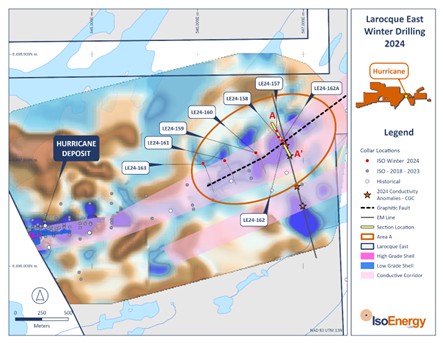
Figure 2 – Map of the Larocque trend showing Hurricane, drill hole unconformity intercept locations, electromagnetic conductor traces, ANT seismic velocity anomalies, and winter and summer 2024 drill hole locations. Cross sections referred to on Figure 2, and partial radiometric and geochemical results are provided in the November 6, 2024 press release entitled “IsoEnergy Summer Drilling Intersects Multiple Areas of Radioactivity Highlighting the Prospectivity of the Larocque Trend”.
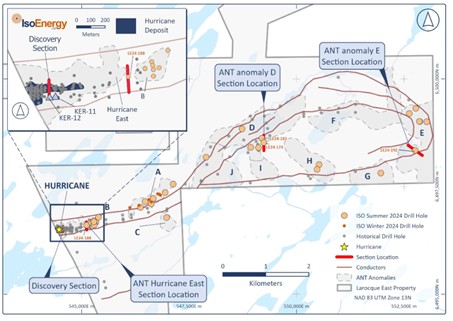
59
Figure 3 – Map of the Larocque trend showing Hurricane, drill hole unconformity intercept locations, electromagnetic conductor traces, ANT seismic velocity anomalies, winter and summer 2025 drill hole locations, and winter 2026 drill program target areas. Radiometric and geochemical results for drill holes with mineralized intersections (at least 350 cps with an RS125 spectrometer averaged over a 0.5 m drill core interval)are provided in the December 3, 2025 press release entitled “IsoEnergy Provides 2025 Athabasca Basin Exploration Update and Prepares to Launch Winter Exploration Programs Including Drilling at Larocque East”.
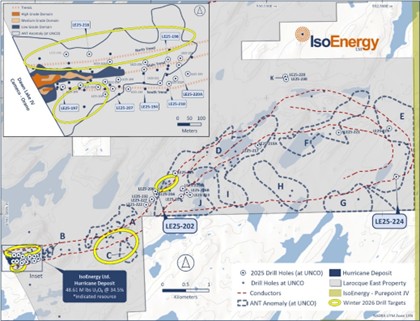
Figure 4 – Joint resistivity – electromagnetic inversion model of the Larocque East project generated in 2025 that highlighted a previously untested 2,500m long northern conductivity trend that was tested by two holes in summer 2025 (Figure 3).
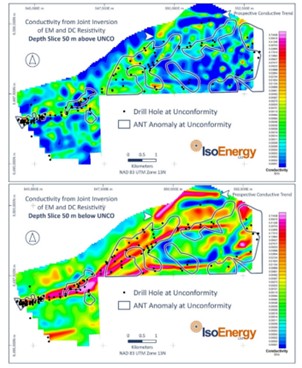
60
Drilling has commenced for the 2026 winter exploration program with the focus on testing resource expansion targets near the Hurricane deposit along the Hurricane North trend and South trend, as well as greenfield targets. The North and South trends are situated within a low seismic velocity anomaly identified by ANT, which is interpreted to map the prospective alteration zone that hosts the Hurricane deposit. Uranium mineralization was intersected on both trends in 2025 drill holes (Figure 3). Additional drill holes at greenfield targets will test targets up to 3 Kms to the east of the Hurricane deposit to follow up on hole LE25-202 (Figure 3).
DIVIDENDS
There are no restrictions in the Company’s articles or notice of articles or pursuant to any agreement or understanding which could prevent the Company from paying dividends. The Company has never declared or paid any dividends on any class of securities. The Company currently intends to retain future earnings, if any, to fund the development and growth of its business, and does not intend to pay any cash dividends on the Common Shares for the foreseeable future. Any decision to pay dividends on the Common Shares in the future will be made by the IsoEnergy Board on the basis of earnings, financial requirements and other conditions existing at the time.
DESCRIPTION OF CAPITAL STRUCTURE
Authorized Capital
The Company is authorized to issue an unlimited number of Common Shares of which there were 60,556,167 Common Shares issued and outstanding as of February 25, 2026.
Common Shares
The holders of Common Shares are entitled to receive notice of any meetings of shareholders of the Company, to attend and to cast one vote per Common Share at all such meetings, except meetings at which only holders of another class or series of shares are entitled to vote separately as such class or series. Holders of Common Shares are entitled to receive on a pro rata basis such dividends, if any, as and when declared by the IsoEnergy Board at its discretion from funds legally available therefor. In the event of any liquidation, dissolution or winding up of the Company or other distribution of the assets of the Company among holders of Common Shares for the purposes of winding-up its affairs, the holders of Common Shares will be entitled, subject to the rights of the holders of any other class or series of shares ranking senior to the Common Shares, to receive on a pro rata basis the remaining property or assets of IsoEnergy available for distribution, after the payment of debts and other liabilities. The Common Shares do not carry any cumulative voting, pre-emptive, subscription, redemption, retraction or conversion rights, nor do they contain any sinking or purchase fund provisions.
Compensation Securities
At the 2024 AGM, IsoEnergy Shareholders approved a new Omnibus Long Term Incentive Plan (the “LTIP”), which provides for a variety of equity-based awards that may be granted to certain participants, including performance share units (“PSUs”), restricted share units (“RSUs”) and stock options (“Options” and together with the PSUs and RSUs, “Awards”).
IsoEnergy also has a legacy stock option plan (the “Legacy Option Plan”) which permitted the IsoEnergy Board to grant Options. The Options previously issued under the Legacy Option Plan continue to be governed by the Legacy Option Plan; however, since the adoption of the LTIP, Options are no longer issuable pursuant to the Legacy Option Plan and are only issuable pursuant to the LTIP.
In connection with the CUR Arrangement, all outstanding stock options of Consolidated Uranium held immediately prior to closing of the CUR Arrangement were exchanged for replacement options to acquire Common Shares (“Replacement Options”) in accordance with the CUR Arrangement. The Replacement Options are also governed by the Legacy Option Plan.
61
As of February 25, 2026, the following Awards are issued and outstanding:
· | Options (including Replacement Options) to purchase an aggregate of up to 2,562,518 Common Shares are issued and outstanding and governed by the Legacy Option Plan; |
· | Options to purchase an aggregate of up to 2,473,873 Common Shares are issued and outstanding and governed by the LTIP; and |
· | RSUs for the issuance of an aggregate of up to 145,833 Common Shares are issued and outstanding and governed by the LTIP. |
Debentures
On December 6, 2022, the Company issued US$4,000,000 principal amount of unsecured convertible debentures to QRC (the “2022 Debentures”). The 2022 Debentures carry coupon interest at 10% per annum, of which 7.5% is payable in cash and 2.5% payable in Common Shares, over a five-year term. The principal amount of the 2022 Debentures (converted into Canadian dollars) is convertible into Common Shares at QRC’s option at a conversion price of $17.32 per share (the “Conversion Price”), up to a maximum of 366,070 Common Shares. As of February 25, 2026, IsoEnergy has US$4,000,000 in principal of the 2022 Debentures outstanding.
General terms of the 2022 Debentures
Coupon interest is payable semi-annually on June 30 and December 31, and Common Shares issued as partial payment of coupon interest are, subject to TSX approval, issuable at a price equal to the 20-day volume-weighted average trading price (“VWAP”) of the Common Shares on the TSX on the 20 days prior to the date such coupon interest is due.
On the conversion of any portion of the principal amount of the 2022 Debentures, if the number of Common Shares to be issued on such conversion, taking into account all Common Shares issued in respect of all prior conversions of such 2022 Debentures, would result in the Common Shares to be issued exceeding the maximum conversion amount for such 2022 Debentures, on conversion Queen’s Road shall be entitled to receive a payment (an “Exchange Rate Fee”) equal to the number of Common Shares that are not issued as a result of exceeding the maximum Common Shares, multiplied by the 20-day VWAP. IsoEnergy can elect to pay any such Exchange Rate Fee in cash or, subject to TSX approval, in Common Shares.
IsoEnergy is entitled, on or after the third anniversary of the date of issuance of such 2022 Debentures, at any time the 20-day VWAP of the Common Shares listed on the TSX exceeds 130% of the applicable Conversion Price, to redeem such 2022 Debentures at par plus accrued and unpaid coupon interest.
Upon completion of a change of control (which also requires in the case of the holders’ right to redeem the 2022 Debentures, a change in the Chief Executive Officer of IsoEnergy), the holders of the 2022 Debentures or IsoEnergy may require IsoEnergy to purchase or the holders to redeem, as the case may be, any outstanding 2022 Debentures in cash at: (i) on or prior to December 6, 2025, 130% of the principal amount; and (ii) at any time thereafter, 115% of the principal amount, in each case plus accrued but unpaid coupon interest, if any. In addition, upon the public announcement of a change of control that is supported by the IsoEnergy Board, IsoEnergy may require the holders of the 2022 Debentures to convert the 2022 Debentures into Common Shares at the conversion price provided the consideration payable upon the change of control exceeds the conversion price and is payable in cash.
62
MARKET FOR SECURITIES
Trading Price and Volume
The Common Shares are listed and posted for trading on the TSX under the symbol “ISO” and are also listed on the NYSE American under the symbol “ISOU”. Prior to July 8, 2024, the Common Shares were listed and posted for trading on the TSXV. On July 8, 2024, the Common Shares commenced trading on the TSX and were voluntarily delisted from the TSXV prior to commencement of trading on the TSX. Prior to May 5, 2025, the Common Shares were listed on the OTCQX. The Common Shares commenced trading on the NYSE American on May 5, 2025. The following tables set forth information relating to the monthly trading of the Common Shares on the TSX, the OTCQX and the NYSE American, as applicable, for the year ended December 31, 2025.
TSX: | | |||
| Period | High ($) | Low ($) | Volume |
| January 2025(1) | 3.320 | 2.660 | 8,351,532 |
| February 2025(1) | 2.930 | 2.130 | 6,837,309 |
| March 2025 | 10.990 | 7.600 | 3,445,941 |
| April 2025 | 9.480 | 6.790 | 1,911,189 |
| May 2025 | 11.000 | 8.230 | 1,728,362 |
| June 2025 | 11.360 | 9.395 | 2,829,729 |
| July 2025 | 10.540 | 8.770 | 3,261,991 |
| August 2025 | 11.455 | 8.240 | 2,769,300 |
| September 2025 | 14.500 | 10.730 | 4,192,996 |
| October 2025 | 15.820 | 11.630 | 4,425,625 |
| November 2025 | 14.500 | 10.190 | 2,435,782 |
| December 2025 | 13.750 | 10.760 | 3,532,425 |
OTCQX: | | | | |
| Period | High (US$) | Low (US$) | Volume |
| January 2025(1) | 2.310 | 1.810 | 1,230,000 |
| February 2025(1) | 2.020 | 1.490 | 1,600,000 |
| March 2025 | 7.640 | 5.240 | 498,323 |
| April 2025 | 6.650 | 4.520 | 441,687 |
| May 1-5, 2025 | 6.700 | 5.720 | 106,167 |
NYSE American: | | | | |
| Period | High (US$) | Low (US$) | Volume |
| May 5-31, 2025 | 8.000 | 5.720 | 668,835 |
| June 2025 | 8.641 | 6.780 | 824,657 |
| July 2025 | 7.700 | 6.350 | 974,298 |
| August 2025 | 8.310 | 5.940 | 1,482,338 |
| September 2025 | 10.497 | 7.788 | 1,516,088 |
| October 2025 | 11.500 | 8.300 | 2,757,607 |
| November 2025 | 10.360 | 7.190 | 1,244,159 |
| December 2025 | 9.950 | 7.800 | 1,203,532 |
Note:
(1) | The trading prices and volumes are reflected on a pre-Consolidation basis. |
63
PRIOR SALES
The following table sets forth information in respect of issuances of securities that are convertible or exchangeable into Common Shares during the financial year ended December 31, 2025.
Date of Issuance | Issue/Exercise Price | Number and Type of Securities | Reason for Issuance | |
|---|---|---|---|---|
January 2, 2025 | 11.72(1) | 516,375 Options(1) | Grant of Options | |
August 11, 2025 | 9.78 | 741,875 Options | Grant of Options | |
December 22, 2025 | 11.83 | 87,500 RSUs | Grant of RSUs | |
Note:
(1) | The number of securities and price per security have been adjusted to reflect the Consolidation. |
ESCROWED SECURITIES & SECURITIES SUBJECT TO
CONTRACTUAL RESTRICTIONS ON TRANSFER
To the Company’s knowledge, as at December 31, 2025, no securities of the Company were held in escrow or are subject to contractual restrictions on transfer.
DIRECTORS AND OFFICERS
The following table sets forth the name, province or state and country of residence, the position held with the Company and period during which each director and the executive officer of the Company has served as a director and/or executive officer, the principal occupation, and the number and percentage of Common Shares beneficially owned by each director and executive officer of the Company as of the date hereof. The statement as to the Common Shares beneficially owned, controlled or directed, directly or indirectly, by the directors and executive officers hereinafter named is in each instance based upon information furnished by the person concerned and is as at the date hereof. All directors of the Company hold office until the next annual meeting of shareholders of the Company or until their successors are elected or appointed.
Name and Residence | Position with the Company | Principal Occupation During | Number and |
|---|---|---|---|
Philip Williams Ontario, Canada | Chief Executive Officer and Director since December 5, 2023 | CEO of Consolidated Uranium | 212,201(4) |
Richard Patricio Ontario, Canada | Director since April 1, 2016; Chair since December 5, 2023 | President and Chief Executive Officer of Mega Uranium Ltd. | 1,147,722(5)(6) (1.90%) |
Leigh Curyer South Australia, Australia | Director since February 2, 2016; Vice-Chair since December 5, 2023 | President and Chief Executive Officer of NexGen | 49,625(7) (0.08%) |
Christopher McFadden(2)(3) Victoria, Australia | Director since April 1, 2016 | Corporate Director | 62,250(8) (0.10%) |
Peter Netupsky(2)(3) Ontario, Canada | Director since November 1, 2022 | Vice President, Corporate Development of Agnico Eagle Mines Limited | 11,250(9) (0.02%) |
64
Name and Residence | Position with the Company | Principal Occupation During | Number and |
|---|---|---|---|
Mark Raguz(2)(3) Ontario, Canada | Director since December 5, 2023 | Vice President, Corporate Development, Royalties at Altius Minerals Corporation | 39,924(10) (0.07%) |
Graham du Preez Saskatchewan, Canada | Chief Financial Officer | Chief Financial Officer of IsoEnergy | 5,781(11) (0.01%) |
Martin Tunney Ontario, Canada | Chief Operating Officer | President and Chief Operating Officer of Consolidated Uranium | 14,716(12) (0.02%) |
Dan Brisbin Saskatchewan, Canada | Vice President, Exploration | Exploration Manager of IsoEnergy | 2,187(13) (0.00%) |
Jason Atkinson Ontario, Canada | Vice President, Corporate Development | Vice President, Corporate Development of Latitude Uranium Inc. | 5,865(14) (0.01%) |
Misty Urbatsch Saskatchewan, Canada | Vice President, Strategy and Commercial | Chief Executive Officer of Core Nickel Corporation; Senior Analyst, Marketing at Cameco | Nil(15) (- %) |
Notes:
(1) | Percentages calculated on a non-diluted basis, based on 60,556,167 Common Shares outstanding as at February 25, 2026. |
(2) | Member of the Audit Committee. |
(3) | Member of the Compensation and Governance Committee. |
(4) | Mr. Williams also holds options to purchase 666,753 Common Shares and 41,667 RSUs. |
(5) | Includes 1,033,735 Common Shares held by Mega Uranium Ltd., of which Mr. Patricio is the President and Chief Executive Officer. |
(6) | Mr. Patricio also holds options to purchase 552,040 Common Shares. |
(7) | Mr. Curyer also holds options to purchase 529,562 Common Shares. |
(8) | Mr. McFadden also holds options to purchase 351,250 Common Shares. |
(9) | Mr. Netupsky holds options to purchase 250,000 Common Shares. |
(10) | Mr. Raguz also holds options to purchase 212,142 Common Shares. |
(11) | Mr. du Preez also holds options to purchase 413,750 Common Shares and 31,250 RSUs. |
(12) | Mr. Tunney also holds options to purchase 393,987 Common Shares and 31,250 RSUs. |
(13) | Dr. Brisbin also holds options to purchase 173,750 Common Shares and 20,833 RSUs. |
(14) | Mr. Atkinson also holds options to purchase 176,140 Common Shares and 20,833 RSUs. |
(15) | Ms. Urbatsch also holds options to purchase 50,000 Common Shares. |
As at the date hereof, the directors and executive officers of the Company, as a group, beneficially owned, directly or indirectly, or exercised control over, a total of 1,551,521 Common Shares representing approximately 2.56% of the issued and outstanding Common Shares on a non-diluted basis.
The principal occupations, businesses or employments of each of the Company’s directors and the senior executive officers within the past five years are disclosed in the brief biographies set out below.
Philip Williams – Chief Executive Officer and Director. Mr. Williams is the Chief Executive Officer and a director of IsoEnergy, a role he has held since December 2023 following the completion of the CUR Arrangement. He brings over two decades of experience spanning mining operations, corporate development, equity research, fund management and investment banking, with a significant focus on the uranium sector throughout his career. Prior to IsoEnergy, Mr. Williams served as CEO and Chair of the Board of Consolidated Uranium from March 2020 until its acquisition by IsoEnergy. In 2017, Mr. Williams co-founded Uranium Royalty Corp. (“URC”), where he served as President, CEO and a director until late 2019. Earlier in his career, Mr. Williams was a Managing Director at Dundee Capital Markets where he completed equity financings and advised on merger and acquisition transactions with a focus on uranium. He previously served as Vice President, Business Development at Pinetree Capital Ltd. (“Pinetree”), a
65
natural resource focused investment fund, where he was responsible for the fund’s uranium investments and served on the boards of several investee companies. Mr. Williams began his career in the uranium sector as a research analyst at Westwind Partners, where he launched coverage on the sector in 2007. He currently serves on the board of directors of Atha Energy and Mogotes Metals Inc. Mr. Williams holds a bachelor’s degree in commerce.
Richard Patricio – Director (Chair). Mr. Patricio is the President and Chief Executive Officer of Mega Uranium Ltd., having previously been its Executive Vice President from 2005 to 2015. Until April 2016, Mr. Patricio was also the Chief Executive Officer of Pinetree, a TSX-listed investment company specializing in early-stage resource investments. Mr. Patricio joined Pinetree in November 2005 as Vice President, Corporate and Legal Affairs. Prior to that, Mr. Patricio practiced law at a top-tier Toronto-based law firm before moving in-house with a TSX-listed issuer. Mr. Patricio has built a number of mining companies with global operations and holds (and has held) senior officer and director positions in several companies listed on stock exchanges in Toronto, Australia, London and New York. He currently serves as President and CEO of Generic Gold Corp. and on the board of NexGen, Toro Energy, Borealis Mining Company Limited and IsoEnergy, all in his capacity as CEO of Mega Uranium Ltd. Mr. Patricio received his law degree from Osgoode Hall Law School and was called to the Ontario bar in 2000.
Leigh Curyer – Director (Vice-Chair). Mr. Curyer has more than 20 years’ experience in the resources and corporate sector. Mr. Curyer founded NexGen in 2011 and currently serves as its President and Chief Executive Officer. From 2008 to 2011, Mr. Curyer was Head of Corporate Development for Accord Nuclear Resources Management, assessing uranium projects worldwide for First Reserve Corporation, a global energy-focused private equity and infrastructure investment firm. Mr. Curyer was the Chief Financial Officer and head of corporate development of Southern Cross Resources Inc. (now Uranium One Inc.) from 2002 to 2006. Mr. Curyer’s uranium project assessment experience has been focused on assets located in Canada, Australia, USA, Africa, Central Asia and Europe, including operating mines, advanced development projects and exploration prospects. Mr. Curyer has a Bachelor of Arts in Accountancy from the University of South Australia and is a member of Chartered Accountants Australia and New Zealand.
Christopher McFadden – Director. Mr. McFadden is a lawyer with more than 25 years of experience in exploration and mining. Previously, Mr. McFadden was a director of Engenco Limited, and before that was the Managing Director of Resolution Minerals Ltd., and before that the President and Chief Executive Officer of NxGold Ltd., and before that the Manager, Business Development at Newcrest Mining Limited, and before that the Head of Commercial, Strategy and Corporate Development for Tigers Realm Coal Limited, which is listed on the ASX. Additionally, Mr. McFadden was General Manager, Business Development of Tigers Realm Minerals Pty Ltd. Prior to commencing with the Tigers Realm Group in 2010, Mr. McFadden was a Commercial General Manager with Rio Tinto’s exploration division with responsibility for gaining entry into new projects through negotiation with government or joint venture partners, or through acquisition. Mr. McFadden currently serves as Chair of the Board of NexGen. Mr. McFadden has extensive international experience in managing large and complex transactions and has a broad knowledge of all aspects of project evaluation and negotiation in challenging and varied environments. Mr. McFadden holds a combined law/commerce degree from Melbourne University and an MBA from Monash University.
Peter Netupsky – Director. Mr. Netupsky has 20 years of experience in accounting, finance, strategy, capital markets and banking. He currently serves as the Vice President of Corporate Development for Agnico Eagle Mines Limited (“Agnico Eagle”). Prior to joining Agnico Eagle, Mr. Netupsky held progressively senior roles in investment banking with TD Securities focused on M&A and financings in the global resources sector. Mr. Netupsky began his professional career as a staff accountant with Ernst & Young. Mr. Netupsky is a Chartered Professional Accountant (CPA, CA) and CFA® Charterholder and has obtained the ICD.D designation from the Institute of Corporate Directors. Mr. Netupsky was commissioned as an officer in the Canadian Armed Forces (Reserve). Mr. Netupsky holds a Bachelor of Commerce (Honours) degree (Queen’s University). Mr. Netupsky previously served as an independent director of UEX Corporation prior to its acquisition.
Mark Raguz – Director. Mr. Raguz has more than 15 years of experience in the investment banking, capital markets and corporate sectors. Mr. Raguz currently acts as Vice President, Corporate Development at Altius Minerals Corporation (“Altius”), a TSX listed diversified mining royalty company. Prior to joining
66
Altius, Mr. Raguz acted as Vice President, Investment Banking at several leading full-service boutique investment dealers focused on M&A and financings primarily in the uranium, base and battery metals and bulk materials subsectors of the global mining industry. Prior to that, Mr. Raguz was a buy-side analyst at a natural resource focused venture capital fund. Mr. Raguz has served as a director of various TSXV, TSX and NYSE American listed companies, including CUR, prior to the Arrangement, where he was Chair of the Compensation Committee. Mr. Raguz holds a Bachelor of Applied Science (BASc) in Mineral Engineering from the University of Toronto and obtained an ICD.D designation from the Institute of Corporate Directors in 2023.
Graham du Preez – Chief Financial Officer. Mr. du Preez has more than a decade of experience as Chief Financial Officer with several public mining companies in a variety of commodities and at various stages along the mining cycle. Most recently, Mr. du Preez served as Chief Financial Officer at Harte Gold Corp. Prior to that, Mr. du Preez spent several years working in the uranium industry, with Uranium One, Inc., including as Chief Financial Officer. Mr. du Preez has gained significant experience contributing to a wide range of functional areas. This has included closing various financings, identifying, and participating in mergers and acquisitions, interacting with regulators, investors, and analysts, undertaking strategic planning, managing public filings, developing, and managing operating budgets, and overseeing large finance teams with broad responsibilities including accounting, payroll, tax, treasury, insurance, and external reporting.
Martin Tunney – Chief Operating Officer. Mr. Tunney brings a wealth of mining experience having been in the industry for over 20 years. As a professional mining engineer, Mr. Tunney has worked for several majors including Inco Limited and Newmont Corporation, and in senior management roles with NewCastle Gold Ltd. (formerly Castle Mountain Mining Company Ltd.) and Solstice Gold Corp. Mr. Tunney worked across multiple provinces and territories in Canada, as well as the Southwestern United States where he successfully permitted projects for exploration and development and was instrumental in moving projects into production. Mr. Tunney also spent several years in capital markets with both an international investment bank and a Canadian bank owned dealer in their global mining team working on transactions of all types and sizes. Mr. Tunney joined Consolidated Uranium in December 2021, where he acted as President and Chief Operating Officer until completion of the CUR Arrangement. He holds both a B.A. from Bishop’s University and a B.A.Sc. (Mining Engineering) from the University of Toronto. Mr. Tunney also serves on the board of directors of PUR and Green Shift Commodities Ltd.
Dan Brisbin – Vice President, Exploration. Dr. Dan Brisbin is an economic geologist with 45 years of experience who specializes in project and target generation, project execution, and in leading and developing exploration teams. Dr. Brisbin’s experience includes project to management level roles with Falconbridge Limited, Cameco Corporation, Alamos Gold Inc., and IsoEnergy and spans exploration, mine and research geology in uranium, gold, base metal, and platinum group element exploration in both mature mining camps and remote greenfield settings. He has worked extensively in world class deposits and districts including the Timmins gold camp, Athabasca Basin uranium district and the Kidd Creek volcanogenic massive sulphide copper-zinc deposit. Dr. Brisbin obtained his Honours B.Sc. in Geological Sciences, M.Sc. in Mineral Exploration and Ph.D. in Geological Sciences from Queen’s University. He is a registered Professional Geoscientist in Saskatchewan, Manitoba and Ontario; a Fellow of the Society of Economic Geologists and the Geological Association of Canada, and a Member of the Prospectors and Developers Association of Canada.
Jason Atkinson – Vice President, Corporate Development. Mr. Atkinson is a seasoned finance professional with over a decade of experience, specializing in investment banking and corporate development within the metals and mining sector. Most recently he was the Vice President of Corporate Development for Latitude Uranium Inc. which was acquired by Atha Energy in 2024 and the Director of Corporate Development of Consolidated Uranium, which was acquired by IsoEnergy Ltd. in 2023. Previously, he was the Vice President of Corporate development of Mindset Pharma Inc. which was
67
acquired by Otsuka Pharmaceutical Co., Ltd. in 2023 and Vice President of Corporate development of URC. He holds an M.B.A. from the Degroote School of Business and is a CFA Charterholder.
Misty Urbatsch – Vice President, Strategy and Commercial. Ms. Urbatsch has nearly two decades of experience in the mining industry, with expertise spanning exploration, corporate development and uranium markets. She began her career with Cameco Australia Pty Ltd., contributing to uranium exploration programs in Australia. She subsequently joined Cameco, where she was employed from 2012 to 2023. From 2012 to 2020, she held technical roles in uranium exploration in Canada. From 2020 to 2023, she was part of Cameco’s marketing group, contributing to uranium market intelligence, trading activities and uranium sales. Following her tenure at Cameco, Ms. Urbatsch served as Vice President, Corporate Development at CanAlaska Uranium Ltd., where she led the spin-out of Core Nickel Corporation (“Core Nickel”). She subsequently served as Chief Executive Officer of Core Nickel following its public listing.
Corporate Cease Trade Orders, Bankruptcies, Penalties or Sanctions
No director or executive officer of the Company, is, as at the date hereof, or has been, within the 10 years before the date hereof, a director, chief executive officer or chief financial officer of any company that:
(a) | was subject to a cease trade or similar order, or an order that denied the relevant company access to any exemption under securities legislation, that was in effect for a period of more than 30 consecutive days and that was issued while the director or executive officer was acting in the capacity as director, chief executive officer or chief financial officer; or |
(b) | was subject to a cease trade or similar order, or an order that denied the relevant company access to any exemption under securities legislation, that was in effect for a period of more than 30 consecutive days, that was issued after the director or executive officer ceased to be a director, chief executive officer or chief financial officer and which resulted from an event that occurred while that person was acting in the capacity as a director, chief executive officer or chief financial officer. |
Other than as disclosed below, no director or executive officer of the Company, or a shareholder holding a sufficient number of securities of the Company to affect materially the control of the Company:
(a) | is, as at the date hereof, or has been within the 10 years before the date hereof, a director or executive officer of any company that, while that person was acting in that capacity, or within a year of that person ceasing to act in that capacity, became bankrupt, made a proposal under any legislation relating to bankruptcy or insolvency or was subject to or instituted any proceedings, arrangement or compromise with creditors or had a receiver, receiver manager or trustee appointed to hold its assets; or |
(b) | has, within the 10 years before the date hereof, become bankrupt, made a proposal under any legislation relating to bankruptcy or insolvency, or become subject to or instituted any proceedings, arrangement or compromise with creditors, or had a receiver, receiver manager or trustee appointed to hold the assets of the director, executive officer or shareholder. |
Graham du Preez was the Chief Financial Officer of Harte Gold Corp. (“Harte Gold”) that sought and obtained an initial order under the Companies’ Creditors Arrangement Act (the “CCAA”) on December 7, 2021. On February 28, 2022, Harte Gold announced that its previously announced sale and investment solicitation process (the “Transaction”) was completed with a subsidiary of Silver Lake Resources Limited (“Silver Lake”).
Following completion of the Transaction, Harte Gold became a wholly-owned subsidiary of Silver Lake and emerged from the CCAA proceedings. All of the directors and executive officers of Harte Gold resigned effective upon closing of the Transaction.
68
No director or executive officer of the Company, or a shareholder holding a sufficient number of securities of the Company to affect materially the control of the Company has been subject to:
(a) | any penalties or sanctions imposed by a court relating to securities legislation or by a securities regulatory authority or has entered into a settlement agreement with a securities regulatory authority; or |
(b) | any other penalties or sanctions imposed by a court or regulatory body that would likely be considered important to a reasonable investor in making an investment decision. |
Conflicts of Interest
To the best of the Company’s knowledge, and other than as disclosed herein, there are no known existing or potential conflicts of interest between the Company and any directors or officers of the Company, except that certain of the directors and officers serve as directors and officers of other public or private companies and therefore it is possible that a conflict may arise between their duties as a director or officer of the Company and their duties as a director or officer of such other companies. See “Risk Factors” above.
The directors and officers of the Company are required by law to act honestly and in good faith with a view to the best interests of the Company and to disclose any interests that they may have in any project or opportunity of the Company. If a conflict of interest arises at a meeting of the IsoEnergy Board, any director in a conflict is required to disclose his interest and abstain from voting on such matter in accordance with the BCBCA.
AUDIT COMMITTEE
In accordance with applicable Canadian securities legislation and, in particular, National Instrument 52-110 – Audit Committees (“NI 52-110”), information with respect to the Company’s Audit Committee is contained below.
Audit Committee Charter
The Audit Committee has adopted a written charter setting out its purpose, which is to assist the IsoEnergy Board fulfill its oversight responsibilities relating to accounting and financial reporting process and internal controls. The Audit Committee has the responsibility of, among other things: recommending IsoEnergy’s independent auditor to the IsoEnergy Board, determining the extent of involvement of the independent auditor in reviewing unaudited quarterly financial results, evaluating the qualifications, performance and independence of the independent auditor; reviewing and recommending approval of the IsoEnergy Board’s annual and quarterly financial results and management’s discussion and analysis; and overseeing the establishment of “whistle-blower” and related procedures. A copy of the Audit Committee Charter is attached hereto as Schedule “A”.
Composition of the Audit Committee
The current members of the Audit Committee are: Messrs. Peter Netupsky (Chair), Chris McFadden, and Mark Raguz, each of whom is considered “independent” and “financially literate” in accordance with NI 52-110.
Relevant Education and Experience
See “Directors and Officers” above for a general description of the education and experience of each Audit Committee member that is relevant to the performance of his responsibilities as an Audit Committee member.
69
Audit Committee Oversight
At no time since the commencement of the Company’s most recently completed financial year have any recommendations by the Audit Committee respecting the appointment and/or compensation of the Company’s external auditors not been adopted by the IsoEnergy Board.
Reliance on Certain Exemptions
At no time since the commencement of the Company’s most recently completed financial year has the Company relied on the exemption in Section 2.4 of NI 52-110 (De Minimis Non-audit Services), Section 3.2 of NI-51-110 (Initial Public Offerings), Section 3.4 of NI 52-110 (Events Outside Control of Member), Section 3.5 of NI 52-110 (Death, Disability or Resignation of Audit Committee Member) or an exemption from NI 52- 110, in whole or in part, granted under Part 8 (Exemptions) of NI 52-110.
Pre-Approval Policies and Procedures
Pursuant to the terms of the Audit Committee Charter, the Audit Committee shall pre-approve all non-audit services to be provided to IsoEnergy by the external auditor.
Code of Ethics
The IsoEnergy Board has the responsibility of setting the Code of Ethics for the Company. The Code of Ethics applies to all employees of the Company, including its CEO and CFO. The Code of Ethics is available on the Company’s website at www.isoenergy.ca.
External Auditor Service Fees
The following table sets out, by category, the fees billed by KPMG (as defined herein) for the financial years ended December 31, 2025 and 2024.
Year Ended | Audit Fees (1) | Audit Related | Tax Fees (3) | All Other Fees | TOTAL |
December 31, 2025 | $532,452 | Nil | Nil | Nil | $532,452 |
December 31, 2024 | $297,419 | Nil | Nil | Nil | $297,419 |
Notes:
(1) | “Audit Fees” include fees necessary to perform the annual audit of the Company’s financial statements. Audit Fees include fees for review of tax provisions and for accounting consultations on matters reflected in the financial statements. Audit Fees also include audit or other attest services required by legislation or regulation, such as comfort letters, consents, reviews of securities filings and statutory audits. |
(2) | “Audit-Related Fees” include the fees for assurance and related services by the Company’s external auditor that are reasonably related to the performance of the audit or review of the Company’s financial statements and are not reported under “Audit Fees” above. |
(3) | “Tax Fees” include the fees for professional services rendered to the Company’s external auditor for tax compliance, tax advice and tax planning. |
(4) | “All Other Fees” include the fees billed for products and services provided by the Company’s external auditor, other than “Audit Fees”, “Audit-Related Fees” and “Tax Fees” above. |
LEGAL PROCEEDINGS AND REGULATORY ACTIONS
To the best of the Company’s knowledge, the Company is not and was not, during the financial year ended December 31, 2025, a party to any legal proceedings, nor is any of its property, nor was any of its property during the financial year ended December 31, 2025, the subject of any legal proceedings. As at the date hereof, no such legal proceedings are known to be contemplated.
70
There have been no penalties or sanctions imposed against the Company by a court relating to securities legislation or by any securities regulatory authority during the financial year ended December 31, 2025, or any other penalties or sanctions imposed by a court or regulatory body against the Company that would likely be considered important to a reasonable investor making an investment decision, and the Company has not entered into any settlement agreements with a court relating to securities legislation or with a securities regulatory authority during the financial year ended December 31, 2025.
INTEREST OF MANAGEMENT AND OTHERS IN MATERIAL TRANSACTIONS
Other than as disclosed herein, none of the directors or executive officers of the Company, nor any person or company that beneficially owns, controls, or directs, directly or indirectly, more than 10% of any class or series of outstanding voting securities of the Company, nor any associate or affiliate of the foregoing persons, has or has had any material interest, direct or indirect, in any transaction within the three most recently completed financial years or during the current financial year that has materially affected or is reasonably expected to materially affect the Company.
REGISTRAR AND TRANSFER AGENT
The transfer agent and registrar for the Common Shares is Computershare Investor Services Inc., at its principal offices in Vancouver, British Columbia and Toronto, Ontario.
MATERIAL CONTRACTS
Except for contracts entered into by the Company in the ordinary course of business, no contracts entered into by the Company during the year ended December 31, 2025 or prior thereto which remain in effect, can reasonably be regarded as presently material to the Company.
INTERESTS OF EXPERTS
The following are the Qualified Persons involved in preparing the NI 43-101 technical reports or who certified a statement, report or valuation from which certain scientific and technical information relating to the Company’s material mineral projects contained in this AIF has been derived, and in some instances extracted from.
Mark B. Mathisen, C.P.G. of SLR is a Qualified Person and has been responsible for preparing the Tony M Technical Report and has reviewed and approved the technical information related to the Tony M Mine contained in this AIF, other than the disclosure regarding the updates on the recommended work program and details of the work programs completed in 2023, 2024 and 2025 and the proposed 2026 work program on the Tony M Mine included under the heading “The Tony M Mine – Exploration, Development and Production”.
Dean T. Wilton, PG, CPG, MAIG, a consultant of IsoEnergy, is as a Qualified Person and has reviewed and approved the information regarding the updates on the recommended work program and details of the work programs completed in 2023, 2024 and 2025 and the proposed 2026 work program on the Tony M Mine included under the heading “The Tony M Mine – Exploration, Development and Production”.
Mark B. Mathisen, C.P.G. of SLR is a Qualified Person and has been responsible for preparing the Larocque East Technical Report and has reviewed and approved the technical information related to the Larocque East Property contained in this AIF, other than the disclosure regarding the updates on the recommended work program and details of the work programs completed during 2023, 2024 and 2025 and the exploration and development plan that IsoEnergy is planning and currently executing on the Larocque East Property included under the heading “The Larocque East Property – Exploration, Development and Production”.
71
Dr. Dan Brisbin, P.Geo., Ph.D., IsoEnergy’s Vice President, Exploration, is as a Qualified Person and has reviewed and approved the information regarding the updates on the recommended work program and details of the work programs completed during 2023, 2024 and 2025 and the exploration and development plan that IsoEnergy is planning and currently executing on the Larocque East Property included under the heading “The Larocque East Property – Exploration, Development and Production”.
The auditors of the Company are KPMG LLP, Chartered Professional Accountants (“KPMG”), 11th Floor at 777 Dunsmuir St., Vancouver, British Columbia, V7Y 1K3, Canada. KPMG has confirmed that they are independent with respect to the Company within the meaning of the relevant rules and related interpretations prescribed by the relevant professional bodies in Canada, and any applicable legislation or regulation, and that they are independent accountants with respect to the Company under all relevant U.S. professional and regulatory standards.
To the knowledge of the Company, the aforementioned firms or persons held either less than 1% or no securities of the Company or of any associate or affiliate of the Company when they rendered services, prepared the reports or the mineral reserve estimates or the Mineral Resource estimates referred to, as applicable, or following the rendering of services or preparation of such reports or data, as applicable, and either did not receive any or received less than 1% direct or indirect interest in any securities of the Company or of any associate or affiliate of the Company in connection with the rendering of such services or preparation of such reports or data.
ADDITIONAL INFORMATION
Additional information relating to the Company may be found under the Company’s SEDAR+ profile at www.sedarplus.ca, on EDGAR at www.sec.gov, or on the Company’s website at www.isoenergy.ca.
Additional information, including directors’ and officers’ remuneration and indebtedness, principal holders of the Company’s securities and securities authorized for issuance under equity compensation plans is contained in the management information circular dated May 9, 2025 filed in connection with the annual and special meeting of shareholders held on June 25, 2025.
Additional financial information is provided in the Company’s annual financial statements and MD&A for the financial year ended December 31, 2025, each of which is available under the Company’s SEDAR+ profile at www.sedarplus.ca and on EDGAR at www.sec.gov.
72
Schedule “A”
AUDIT COMMITTEE CHARTER
ISOENERGY LTD.
(the “Company”)
AUDIT COMMITTEE CHARTER
I. | ROLE AND OBJECTIVES |
The Audit Committee is a committee of the Board of Directors (the “Board”) of IsoEnergy Ltd. (the “Corporation”) to which the Board has delegated certain oversight responsibilities relating to the Corporation’s financial statements, external auditors, risk management, compliance with legal and regulatory requirements and management information technology. In this Audit Committee Charter (this “Charter”), the Corporation and all entities controlled by the Corporation are collectively referred to as “IsoEnergy”.
The objectives of the Audit Committee are to maintain oversight of:
(a) | the Corporation’s accounting and financial reporting processes; |
(b) | the audits of the Corporation’s financial statements; |
(c) | the integrity of the Corporation’s financial statements, the reporting process and its internal control over financial reporting; |
(d) | the reports, qualifications, independence and performance of the Corporation’s external auditor; |
(e) | the performance of the Corporation’s internal audit function; |
(f) | the Corporation’s risk identification, assessment and management program; |
(g) | the Corporation’s compliance with applicable legal and regulatory requirements; |
(h) | the Corporation’s management of information technology related to financial reporting and financial controls; and |
(i) | the maintenance of open channels of communication among management of the Corporation, the external auditors and the Board. |
II. | MEMBERSHIP AND POLICIES |
The Board, in consultation with the Compensation and Governance Committee, will appoint or reappoint members and the Chair of the Audit Committee on an annual basis. Each member shall serve until his or her successor is appointed unless the member resigns, is removed or ceases to be a director. The Board of Directors may fill a vacancy that occurs in the Committee at any time.
The Audit Committee must be composed of not less than three (3) members of the Board, each of whom must be independent pursuant to the rules and regulations of all applicable stock exchanges and securities laws and regulations.
No member of the Audit Committee may have participated in the preparation of the financial statements of the Corporation or any of its then-current subsidiaries at any time during the immediately prior three years.
Each member of the Audit Committee must be financially literate, as determined by the Board, and be able to read and understand fundamental financial statements, including the Corporation’s balance sheet,
A-1
income statement, and cash flow statement. Additionally, at least one member of the Audit Committee must have accounting or related financial management expertise, as determined by the Board.
No member of the Audit Committee may serve simultaneously on the audit committee of more than two other public companies without prior approval of the Board.
The Audit Committee may at any time retain outside financial, legal or other advisors as it determines necessary to carry out its duties, at the expense of the Corporation. The Corporation shall provide for appropriate funding, as determined by the Audit Committee in its capacity as a committee of the Board, for payment of: (i) compensation to the external auditor for the purpose of preparing or issuing an audit report or performing other audit, review or attestation services for the Corporation, (ii) compensation to any advisors employed by the Audit Committee, and (iii) ordinary administrative expenses of the Audit Committee that are necessary or appropriate in carrying out its duties.
In discharging its duties under this Charter, the Audit Committee may investigate any matter brought to its attention and will have access to all books, records, facilities and personnel, may conduct meetings or interview any officer or employee, the Corporation’s legal counsel, external auditors and consultants, and may invite any such persons to attend any part of any meeting of the Audit Committee.
The Audit Committee has neither the duty nor the responsibility to conduct audit, accounting or legal reviews, or to ensure that the Corporation’s financial statements are complete, accurate and in accordance with International Financial Reporting Standards (“IFRS”) as issued by the International Accounting Standards Board (“IASB”); rather, management is responsible for the financial reporting process, internal review process, and the preparation of the Corporation’s financial statements in accordance with IFRS, and the Corporation’s external auditor is responsible for auditing those financial statements.
III. | SUBCOMMITTEES |
The Audit Committee may, in its discretion, delegate any of its responsibilities that it is permitted by law to delegate, to the Chair or a subcommittee of the Audit Committee.
IV. | FUNCTIONS |
A. | Financial Statements, the Reporting Process and Internal Controls over Financial Reporting |
The Audit Committee will meet with management and the external auditor to review and discuss annual and quarterly financial statements, management’s discussion and analyses (“MD&A”), any earnings press releases, other financial disclosures and earnings guidance provided to analysts and rating agencies, and determine whether to recommend the approval of such documents to the Board and will produce the Audit Committee report required to accompany the annual financial statements.
(a) | In connection with these procedures, the Audit Committee will, as applicable and without limitation review and discuss with management and the external auditor: |
i. | the information to be included in the Corporation’s financial statements and other financial disclosures which require approval by the Board including the Corporation’s annual and quarterly financial statements, notes thereto, MD&A and any earnings press releases or earnings guidance provided to analysis and rating agencies, paying particular attention to any use of “pro forma”, “adjusted” and “non-GAAP” information, and ensuring that adequate procedures are in place for the review of the Corporation’s public disclosure of financial information extracted or derived from the financial statements; |
ii. | any significant financial reporting issues, including major issues regarding accounting principles and financial statement presentations, identified during the reporting period; |
iii. | any change in accounting policies, or selection or application of accounting principles, and their impact on the Corporation’s financial results and disclosure; |
A-2
iv. | all significant estimates and judgments, significant risks and uncertainties made in connection with the preparation of the Corporation’s financial statements that may have a material impact to the financial statements; |
v. | any significant deficiencies or material weaknesses identified by management or the external auditor, compensating or mitigating controls and the final assessment and impact of such deficiencies or material weaknesses on disclosure; |
vi. | any major issues as to the adequacy of the internal controls and any special audit steps adopted in light of material internal control deficiencies; |
vii. | significant adjustments identified by management or the external auditor and the assessment of associated internal control deficiencies, as applicable; |
viii. | any unresolved issues between management and the external auditor that could materially impact the financial statements and other financial disclosures; |
ix. | any material correspondence with regulators, government agencies, any employee or whistleblower complaints and other reports of non-compliance which raise issues regarding the Corporation’s financial statements or accounting policies and significant changes in regulations which may have a material impact on the Corporation’s financial statements; |
x. | the effect of regulatory and accounting initiatives, as well as any off-balance sheet structures; |
xi. | significant matters of concern respecting audits and financial reporting processes, including any illegal acts, that have been identified in the course of the preparation or audit of the Corporation’s financial statements; and |
xii. | any analyses prepared by management and/or the external auditor setting forth significant financial reporting issues and judgments made in connection with the preparation of financial statements including analyses of the effects of IFRS on the financial statements. |
(b) | In connection with the annual audit of the Corporation’s financial statements, the Audit Committee will review with the external auditor: |
i. | prior to commencement of the annual audit, plans, scope, staffing, engagement terms and proposed fees; |
ii. | reports or opinions to be rendered in connection with the audit including the external auditor’s review or audit findings report including alternative treatment of significant financial information within IFRS that have been discussed with management and the associated impact on disclosure; and |
iii. | the adequacy of internal controls, any audit problems or difficulties, including: |
(a) | any restrictions on the scope of the external auditor’s activities or on access to requested information; |
(b) | any significant disagreements with management, and management’s response (including discussion among management, the external auditor and, as necessary, internal and external legal counsel); |
(c) | any litigation, claim or contingency, including tax assessments and claims, that could have a material impact on the financial position of the Corporation; and |
(d) | the impact on current or potential future disclosures. |
A-3
In connection with its review of the annual audited financial statements and quarterly financial statements, the Audit Committee will also review any significant concerns raised during the Chief Executive Officer (“CEO”) and Chief Financial Officer (“CFO”) certifications with respect to the financial statements and IsoEnergy’s disclosure controls and internal controls. In particular, the Audit Committee will review with the CEO, CFO and external auditor: (i) all significant deficiencies, material weaknesses or significant changes in the design or operation of IsoEnergy’s internal control over financial reporting that could adversely affect the Corporation’s ability to record, process, summarize and report financial information required to be disclosed by the Corporation in the reports that it files or submits under applicable securities laws, within the required time periods; and (ii) any fraud, whether or not material, that involves management of IsoEnergy or other employees who have a significant role in IsoEnergy’s internal control over financial reporting. In addition, the Audit Committee will review with the CEO and CFO, IsoEnergy’s disclosure controls and procedures and at least annually will review management’s conclusions about the efficacy of disclosure controls and procedures, including any significant deficiencies, material weaknesses or material non-compliance with disclosure controls and procedures.
The Audit Committee will also maintain a Whistleblower Policy, including procedures for the:
(a) | receipt, retention and treatment of complaints received regarding accounting, internal accounting controls or auditing matters; and |
(b) | confidential, anonymous submissions of concerns regarding questionable accounting or auditing matters. |
B.The External Auditor
The Audit Committee, in its capacity as a committee of the Board, is directly responsible for overseeing the relationship, reports, qualifications, independence and performance of the external auditor and audit services by other registered public accounting firms engaged by the Corporation. The Audit Committee has responsibility to take, or recommend that the Board take, appropriate action to oversee the independence of the external auditor. The Audit Committee shall have the authority and responsibility to recommend the appointment and the revocation of the appointment of the external auditors engaged for the purpose of preparing or issuing an audit report or performing other audit, review or attest services, and to fix their remuneration.
The external auditor will report directly to the Audit Committee. The Audit Committee’s appointment of the external auditor is subject to annual approval by the shareholders.
With respect to the external auditor, the Audit Committee is responsible for:
(a) | the appointment, termination, compensation, retention and oversight of the work of the external auditor engaged by the Corporation for the purpose of preparing or issuing an audit report or performing other audit, review or attest services for the Corporation, including the review and approval of the terms of the external auditor’s annual engagement letter and the proposed fees; |
(b) | resolution of disagreements or disputes between management and the external auditor regarding financial reporting for audit, review or attestation services; |
(c) | pre-approval of all audit services and legally permissible non-audit services to be provided by the external auditors considering the potential impact of such services on the independence of external auditors and, subject to any de minimis exemption available under applicable laws. Such approval of non-audit services can be given either specifically or pursuant to pre-approval policies and procedures adopted by the Audit Committee including the delegation of this ability to one or more members of the Audit Committee to the extent permitted by applicable law, provided that any pre-approvals granted pursuant to any such delegation may not delegate Audit Committee responsibilities to management of the Corporation, and must be reported to the full Audit Committee at the first scheduled meeting of the Audit Committee following such pre-approval; and |
A-4
(d) | review of the external auditor on a regular basis to assess: independence, objectivity and professional skepticism; the quality of the engagement team, including quality of services and sufficiency of resources provided by the external auditor; and quality of communications and interactions with the external auditor, including assessment of written input from the external auditor. |
C.Risk Management
The Audit Committee, in its capacity as a committee of the Board, is directly responsible for overseeing the risk identification, assessment and management program of the Corporation by discussing guidelines and policies to govern the process by which risk is identified, assessed and managed. At least annually, in conjunction with senior management, internal counsel and, as necessary, external counsel and the Corporation’s external auditors, the Audit Committee will review the following:
(a) | the Corporation’s method of reviewing significant risks inherent in IsoEnergy’s business, assets, facilities, and strategic directions, including the Corporation’s risk management and evaluation process; |
(b) | discuss guidelines and policies with respect to risk assessment and risk management, including the Corporation’s major financial risk exposures and the steps management has taken to monitor and control such exposures. The Audit Committee is not required to be the sole body responsible for risk assessment and management, but, as stated above, the committee must discuss guidelines and policies to govern the process by which risk assessment and management is undertaken. |
(c) | the major financial risk exposures and steps management has taken to monitor and manage such exposures; |
(d) | the Corporation’s annual insurance report including its risk retention philosophy and resulting uninsured exposure, if any, including corporate liability protection programs for directors and officers; |
(e) | the Corporation’s loss prevention policies, risk management programs, disaster response and recovery programs in the context of operational considerations; and |
(f) | other risk management matters from time to time as the Audit Committee may consider appropriate or the Board may specifically direct. |
D.Internal Audit Review
(a) | Ensure the reporting lines between the Audit Committee and the internal auditors are clearly understood and utilized; and |
(b) | Review and discuss any reports by management regarding the effectiveness of, or any deficiencies in, the design or operation of internal controls and any fraud, whether or not material, that involves management or other employees who have a significant role in the Company’s internal controls. |
E.Additional Duties and Responsibilities
The Audit Committee will also:
(a) | report regularly to the Board on its discussions and actions, including any significant issues or concerns that arise at its meetings and discussion of the responsibilities, budget and staffing of the listed company’s internal audit function, and shall make recommendations to the Board as appropriate; |
(b) | meet separately, and periodically, with management, internal auditors, the external auditor and, as is appropriate, internal and external legal counsel and independent advisors in respect of issues not elsewhere listed concerning any other audit, finance or risk matter; |
A-5
(c) | review the appointment of the CFO and any other key financial executives who are involved in the financial reporting process; |
(d) | review the Corporation’s information technology practices as they relate to financial reporting; |
(e) | annually review Directors’ and Officers’ Liability Insurance Coverage; |
(f) | from time to time, discuss staffing levels and competencies of the finance team with the external auditor; |
(g) | review incidents, alleged or otherwise, as reported by whistleblowers, management, the external auditor, internal or external counsel or otherwise, of fraud, illegal acts or conflicts of interest and establish procedures for receipt, treatment and retention of records of incident investigations; |
(h) | facilitate information sharing with other committees of the Board as required to address matters of mutual interest or concern in respect of the Corporation’s financial reporting; |
(i) | assist Board oversight in respect of issues not elsewhere listed concerning the integrity of the Corporation’s financial statements, the Corporation’s compliance with legal and regulatory requirements, the independent auditor’s qualifications and independence, the performance of the external auditors, and the performance of the internal audit function; |
(j) | have the authority and responsibility to recommend the appointment and the revocation of the appointment of registered public accounting firms (in addition to the external auditors) engaged for the purpose of preparing or issuing an audit report or performing other audit, review or attest services, and to fix their remuneration. |
In addition, the Audit Committee will perform such other functions as are assigned by law and on the instructions of the Board.
V. | MEETINGS |
The Audit Committee will meet quarterly, or more frequently at the discretion of the members of the Audit Committee, as circumstances require.
Notice of each meeting of the Audit Committee will be given to each member and, if applicable, to the external auditors. The notice will:
(a) | be in writing (which may be communicated by fax or email); |
(b) | be accompanied by an agenda that states the nature of the business to be transacted at the meeting in reasonable detail; |
(c) | include copies of documentation to be considered at the meeting and reasonably sufficient time to review documentation; and |
(d) | be given at least 48 hours preceding the time stipulated for the meeting, unless notice is waived by the Audit Committee members. |
A quorum for a meeting of the Audit Committee is a majority of the members present in person, by video conference, webcast or telephone. The Audit Committee may also act by unanimous written consent of its members.
If the Chair is not present at a meeting of the Audit Committee, a Chair will be selected from among the members present. The Chair will not have a second or deciding vote in the event of an equality of votes.
At each meeting, the Audit Committee will meet “in-camera”, without management or external auditors present, and will periodically, and at least annually, meet in separate sessions with the lead partner of the
A-6
external auditor and periodically with the internal auditor (or persons responsible for the internal audit function).
The Audit Committee may invite others to attend any part of any meeting of the Audit Committee as it deems appropriate. This includes other directors, members of management, any employee, the Corporation’s internal or external legal counsel, external auditors, advisors and consultants.
Minutes will be kept of all meetings of the Audit Committee. The minutes will include copies of all resolutions passed at each meeting, will be maintained with the Corporation’s records, and will be available for review by members of the Audit Committee, the Board, and the external auditor. The Audit Committee may choose any person, who need not be a member to act as secretary at any meeting of the Audit Committee.
VI. | OTHER MATTERS |
A.Review of Charter
The Audit Committee shall review and reassess the adequacy of this Charter at least periodically, as it deems appropriate, and propose recommended changes to the Compensation and Governance Committee.
B.Reporting
The Audit Committee shall report to the Board activities and recommendations of each Audit Committee meeting and review with the Board any issues that arise with respect to the quality or integrity of the Corporation’s financial statements, the Corporation’s compliance with legal or regulatory requirements, the performance and independence of the Corporation’s external auditors, management information technology with respect to financial reporting matters, risk management and communication between the parties identified above.
C.Evaluation
The Audit Committee’s performance shall be evaluated periodically as deemed necessary by the Compensation and Governance Committee and the Board as part of the Board assessment process established by the Compensation and Governance Committee and the Board.
This Charter was last approved by the Board of Directors on May 28, 2024.
A-7