Risk Report - Risk Performance
Dec. 31, 2025
Deutsche Bank defines its credit exposure by taking into account all transactions where losses might occur due to the
fact that counterparties may not fulfill their contractual payment obligations as defined under ‘Credit Risk Framework’.
Maximum Exposure to Credit Risk
The maximum exposure to credit risk table shows the direct exposure before consideration of associated collateral held
and other credit enhancements (netting and hedges) that do not qualify for offset in the financial statements for the
periods specified. The netting credit enhancement component includes the effects of legally enforceable netting
agreements as well as the offset of negative mark-to-markets from derivatives against pledged cash collateral. The
collateral credit enhancement component mainly includes real estate, collateral in the form of cash as well as securities-
related collateral. In relation to collateral, the Group applies internally determined haircuts and additionally cap all
collateral values at the level of the respective collateralized exposure
Maximum Exposure to Credit Risk
Dec 31, 2025 | ||||||||||||
Credit Enhancements | ||||||||||||
in € m. | Maximum exposure to credit risk1 | Subject to impairment | Netting | Collateral | Guarantees and Credit derivatives2 | Total credit enhancements | ||||||
Financial assets at amortized cost3 | ||||||||||||
Cash and central bank balances | 164,664 | 164,664 | — | — | ||||||||
Interbank balances (w/o central banks) | 6,963 | 6,963 | — | — | ||||||||
Central bank funds sold and securities purchased under resale agreements | 37,509 | 37,509 | — | 37,376 | 37,376 | |||||||
Securities borrowed | 6 | 6 | — | 6 | 6 | |||||||
Loans | 484,270 | 484,270 | — | 256,542 | 49,168 | 305,710 | ||||||
Other assets subject to credit risk4,5 | 109,015 | 103,271 | 25,790 | 1,107 | 258 | 27,154 | ||||||
Total financial assets at amortized cost3 | 802,426 | 796,683 | 25,790 | 295,031 | 49,426 | 370,247 | ||||||
Financial assets at fair value through profit or loss6 | ||||||||||||
Trading assets | 142,273 | — | 1,525 | 895 | 2,419 | |||||||
Positive market values from derivative financial instruments | 241,654 | 180,780 | 45,704 | 10 | 226,494 | |||||||
Non-trading financial assets mandatory at fair value through profit or loss | 123,517 | 1,774 | 111,207 | 495 | 113,476 | |||||||
Of which: | ||||||||||||
Securities purchased under resale agreement | 95,802 | 1,774 | 94,028 | — | 95,802 | |||||||
Securities borrowed | 16,513 | — | 16,271 | 16,271 | ||||||||
Loans | 3,370 | 840 | 495 | 1,335 | ||||||||
Financial assets designated at fair value through profit or loss | — | — | — | |||||||||
Total financial assets at fair value through profit or loss | 507,444 | — | 182,554 | 158,436 | 1,399 | 342,389 | ||||||
Financial assets at fair value through OCI | 43,644 | 43,644 | 1,342 | 1,232 | 2,574 | |||||||
Of which: | ||||||||||||
Securities purchased under resale agreement | 1,128 | 1,128 | — | 90 | 90 | |||||||
Securities borrowed | — | — | — | |||||||||
Loans | 4,432 | 4,432 | 20 | 1,232 | 1,252 | |||||||
Total financial assets at fair value through OCI | 43,644 | 43,644 | — | 1,342 | 1,232 | 2,574 | ||||||
Financial guarantees and other credit related contingent liabilities7 | 79,092 | 79,092 | 4,619 | 9,928 | 14,547 | |||||||
Revocable and irrevocable lending commitments and other credit related commitments7 | 274,305 | 272,072 | 24,219 | 7,348 | 31,567 | |||||||
Total off-balance sheet | 353,397 | 351,164 | — | 28,838 | 17,276 | 46,114 | ||||||
Maximum exposure to credit risk | 1,706,911 | 1,191,490 | 208,344 | 483,647 | 69,333 | 761,323 | ||||||
1 Does not include credit derivative notional sold (€ 620 billion ) and credit derivative notional bought protection
2 Bought Credit protection is reflected with the notional of the underlying
3 All amounts at gross value before deductions of allowance for credit losses
4 All amounts at amortized cost (gross) except for qualifying hedge derivatives, which are reflected at Fair value through P&L
5 Includes Asset Held for Sale regardless of accounting classification
6 Excludes equities, other equity interests and commodities
7 Figures are reflected at notional amounts
Dec 31, 2024 | ||||||||||||
Credit Enhancements | ||||||||||||
in € m. | Maximum exposure to credit risk1 | Subject to impairment | Netting | Collateral | Guarantees and Credit derivatives2 | Total credit enhancements | ||||||
Financial assets at amortized cost3 | ||||||||||||
Cash and central bank balances | 147,511 | 147,511 | — | — | − | — | ||||||
Interbank balances (w/o central banks) | 6,169 | 6,169 | — | — | — | — | ||||||
Central bank funds sold and securities purchased under resale agreements | 40,802 | 40,802 | — | 40,580 | − | 40,580 | ||||||
Securities borrowed | 44 | 44 | — | 32 | − | 32 | ||||||
Loans | 489,579 | 489,579 | — | 264,252 | 44,211 | 308,463 | ||||||
Other assets subject to credit risk4,5 | 81,985 | 76,702 | 24,750 | 1,668 | 270 | 26,687 | ||||||
Total financial assets at amortized cost3 | 766,091 | 760,807 | 24,750 | 306,532 | 44,481 | 375,763 | ||||||
Financial assets at fair value through profit or loss6 | ||||||||||||
Trading assets | 134,118 | − | — | 1,207 | 612 | 1,819 | ||||||
Positive market values from derivative financial instruments | 291,800 | − | 229,605 | 45,613 | 115 | 275,333 | ||||||
Non-trading financial assets mandatory at fair value through profit or loss | 113,433 | − | 1,638 | 103,339 | 292 | 105,269 | ||||||
Of which: | ||||||||||||
Securities purchased under resale agreement | 88,736 | − | 1,638 | 87,091 | — | 88,729 | ||||||
Securities borrowed | 15,913 | − | — | 15,671 | — | 15,671 | ||||||
Loans | 1,954 | − | − | 485 | 272 | 757 | ||||||
Financial assets designated at fair value through profit or loss | — | − | — | — | — | — | ||||||
Total financial assets at fair value through profit or loss | 539,350 | — | 231,243 | 150,159 | 1,019 | 382,421 | ||||||
Financial assets at fair value through OCI | 42,090 | 42,090 | — | 4,077 | 1,168 | 5,244 | ||||||
Of which: | — | — | ||||||||||
Securities purchased under resale agreement | 2,786 | 2,786 | — | 2,455 | — | 2,455 | ||||||
Securities borrowed | — | — | − | — | — | — | ||||||
Loans | 5,068 | 5,068 | − | 454 | 1,168 | 1,621 | ||||||
Total financial assets at fair value through OCI | 42,090 | 42,090 | — | 4,077 | 1,168 | 5,244 | ||||||
Financial guarantees and other credit related contingent liabilities7 | 73,468 | 73,467 | − | 4,410 | 9,227 | 13,637 | ||||||
Revocable and irrevocable lending commitments and other credit related commitments7 | 269,699 | 268,373 | − | 21,737 | 8,227 | 29,964 | ||||||
Total off-balance sheet | 343,167 | 341,840 | — | 26,147 | 17,455 | 43,602 | ||||||
Maximum exposure to credit risk | 1,690,698 | 1,144,738 | 255,993 | 486,915 | 64,122 | 807,029 | ||||||
1 Does not include credit derivative notional sold (€ 597.9 billion ) and credit derivative notional bought protection
2 Bought Credit protection is reflected with the notional of the underlying
3 All amounts at gross value before deductions of allowance for credit losses
4 All amounts at amortized cost (gross) except for qualifying hedge derivatives, which are reflected at Fair value through P&L
5 Includes Asset Held for Sale regardless of accounting classification
6 Excludes equities, other equity interests and commodities
7 Figures are reflected at notional amounts
The overall increase in maximum exposure to credit risk for December 31, 2025 was €16.2 billion mainly driven by
increases of € 27.0 billion in other assets subject to credit risk, € 17.2 billion in cash and central bank balances,
€ 10.2 billion in off-balance sheet exposure, € 8.2 billion in trading assets, and€ 7.1 billion in securities purchased under
resale agreement at fair value through profit or loss. These increases were partly offset by a decrease in positive market
values from derivative financial instruments by € 50.1 billion.
Trading assets as of December 31, 2025, included traded bonds of € 126.6 billion (€ 120.0 billion as of December 31,
2024) of which over 82% were investment-grade (over 82% as of December 31, 2024).
Credit Enhancements are split into three categories: netting, collateral and guarantees/credit derivatives. Haircuts,
parameter setting for regular margin calls as well as expert judgments for collateral valuation are employed to prevent
market developments from leading to a build-up of uncollateralized exposures. All categories are monitored and
reviewed regularly. Overall credit enhancements received are diversified and of adequate quality being largely cash,
highly rated government bonds and third-party guarantees mostly from well rated banks and insurance companies.
These financial institutions are domiciled mainly in European countries and the United States. Furthermore, the bank has
collateral pools of highly liquid assets and mortgages (principally consisting of residential properties mainly in Germany)
for the homogeneous retail portfolio.
Main Credit Exposure Categories
The tables in this section show details about several of Deutsche Bank’s main credit exposure categories, namely Loans,
Revocable and Irrevocable Lending Commitments, Contingent Liabilities, Over-The-Counter (“OTC”) Derivatives, Debt
Securities and Repo and repo-style transactions:
–“Loans” are gross loans as reported on the bank´s balance sheet at amortized cost, loans at fair value through profit
and loss and loans at fair value through other comprehensive income before deduction of allowance for credit losses;
this includes “Traded loans” that are bought and held for the purpose of selling them in the near term, or the material
risks of which have all been hedged or sold; from a regulatory perspective the latter category principally covers
trading book positions
–“Revocable and irrevocable lending commitments” consist of the undrawn portion of revocable and irrevocable
lending-related commitments
–“Contingent liabilities” consist of financial and performance guarantees, standby letters of credit and other similar
arrangements (mainly indemnity agreements)
–“OTC derivatives” are the bank’s credit exposures from over-the-counter derivative transactions that the Group has
entered into, after netting and cash collateral received; on the bank’s balance sheet, these are included in financial
assets at fair value through profit or loss or, for derivatives qualifying for hedge accounting, in other assets, in either
case only applying cash collateral received and netting eligible under IFRS
–“Debt securities” include debentures, bonds, deposits, notes or commercial paper, which are issued for a fixed term
and redeemable by the issuer, as reported on the bank´s balance sheet within accounting categories at amortized cost
and at fair value through other comprehensive income before deduction of allowance for credit losses, it also includes
category at fair value through profit and loss; this includes “Traded bonds”, which are bonds, deposits, notes or
commercial paper that are bought and held for the purpose of selling them in the near term; from a regulatory
perspective the latter category principally covers trading book positions
–“Repo and repo-style transactions” consist of reverse repurchase transactions, as well as securities or commodities
borrowing transactions, only applying collateral received and netting eligible under IFRS.
Although considered in the monitoring of maximum credit exposures, the following are not included in the details of the
Group’s main credit exposure: brokerage and securities related receivables, cash and central bank balances, interbank
balances (without central banks), assets held for sale, accrued interest receivables, traditional securitization positions.
Unless stated otherwise, the tables below reflect credit exposure before the consideration of collateral and risk
mitigation or structural enhancements, except for OTC derivatives wherein they are post credit enhancements.
Main Credit Exposure Categories by Business DivisionsDec 31, 2025 | ||||||||||||||
Loans | Off-balance sheet | OTC derivatives | ||||||||||||
in € m. | at amortized cost1 | trading - at fair value through P&L | Designated / mandatory at fair value through P&L | at fair value through OCI2 | Revocable and irrevocable lending commitments3 | Contingent liabilities | at fair value through P&L4 | |||||||
Corporate Bank | 119,570 | 21 | 685 | 4,116 | 169,251 | 73,258 | 29 | |||||||
Investment Bank | 115,325 | 12,803 | 2,685 | 316 | 67,846 | 2,824 | 22,141 | |||||||
Private Bank | 246,594 | 6 | — | — | 36,961 | 2,945 | 497 | |||||||
Asset Management | 3 | — | — | — | 124 | 10 | — | |||||||
Corporate & Other | 2,778 | 13 | — | — | 123 | 56 | 1,669 | |||||||
Total | 484,270 | 12,842 | 3,370 | 4,432 | 274,305 | 79,092 | 24,336 | |||||||
Dec 31, 2025 | ||||||||||||||
Debt Securities | Repo and repo-style transactions7 | Total | ||||||||||||
in € m. | at amortized cost5 | at fair value through P&L | at fair value through OCI6 | at amortized cost | at fair value through P&L | at fair value through OCI | ||||||||
Corporate Bank | 50 | 11 | — | 10,078 | — | — | 377,069 | |||||||
Investment Bank | 5,170 | 130,177 | 3,173 | 27,436 | 112,314 | — | 502,208 | |||||||
Private Bank | 373 | — | — | — | — | — | 287,376 | |||||||
Asset Management | — | 5,050 | 62 | — | — | — | 5,249 | |||||||
Corporate & Other | 34,692 | 336 | 34,849 | — | — | 1,128 | 75,645 | |||||||
Total | 40,285 | 135,575 | 38,084 | 37,514 | 112,315 | 1,128 | 1,247,548 | |||||||
1 Includes stage 3 and stage 3 POCI loans at amortized cost amounting to € 15.3 billion as of December 31, 2025
2 Includes stage 3 and stage 3 POCI loans at fair value through OCI amounting to € 16.9 million as of December 31, 2025
3 Includes stage 3 and stage 3 POCI off-balance sheet exposure amounting to € 2.7 billion as of December 31, 2025
4 Includes the effect of netting agreements and cash collateral received where applicable. Excludes derivatives qualifying for hedge accounting
5 Includes stage 3 and stage 3 POCI debt securities at amortized cost amounting to € 25.3 million as of December 31, 2025
6 Includes stage 3 and stage 3 POCI debt securities at fair value through OCI amounting to € 130.2 million as of December 31, 2025
7 Before reflection of collateral and limited to securities purchased under resale agreements and securities borrowed
Dec 31, 2024 | ||||||||||||||
Loans | Off-balance sheet | OTC derivatives | ||||||||||||
in € m. | at amortized cost1 | trading - at fair value through P&L | Designated / mandatory at fair value through P&L | at fair value through OCI2 | Revocable and irrevocable lending commitments3 | Contingent liabilities | at fair value through P&L4 | |||||||
Corporate Bank | 116,674 | 212 | 508 | 4,110 | 170,667 | 67,067 | 47 | |||||||
Investment Bank | 110,077 | 11,068 | 1,443 | 958 | 61,692 | 3,268 | 24,031 | |||||||
Private Bank | 257,476 | 6 | — | — | 37,110 | 2,815 | 391 | |||||||
Asset Management | 1 | — | — | — | 130 | 9 | — | |||||||
Corporate & Other | 5,352 | 93 | 3 | — | 100 | 309 | 2,431 | |||||||
Total | 489,579 | 11,380 | 1,954 | 5,068 | 269,699 | 73,468 | 26,900 | |||||||
Dec 31, 2024 | ||||||||||||||
Debt Securities | Repo and repo-style transactions7 | Total | ||||||||||||
in € m. | at amortized cost5 | at fair value through P&L | at fair value through OCI6 | at fair value through P&L | at fair value through OCI | |||||||||
Corporate Bank | 266 | 14 | — | 9,033 | — | — | 368,598 | |||||||
Investment Bank | 5,369 | 122,813 | 1,268 | 31,813 | 104,248 | — | 478,047 | |||||||
Private Bank | 409 | 1 | 1 | — | — | — | 298,209 | |||||||
Asset Management | — | 4,526 | 82 | — | — | — | 4,748 | |||||||
Corporate & Other | 15,612 | 390 | 32,885 | — | 401 | 2,786 | 60,362 | |||||||
Total | 21,655 | 127,744 | 34,236 | 40,846 | 104,649 | 2,786 | 1,209,964 | |||||||
1 Includes stage 3 and stage 3 POCI loans at amortized cost amounting to € 15.6 billion as of December 31, 2024
2 Includes stage 3 and stage 3 POCI loans at fair value through OCI amounting to € 60.7 million as of December 31, 2024
3 Includes stage 3 and stage 3 POCI off-balance sheet exposure amounting to € 2.2 billion as of December 31, 2024
4 Includes the effect of netting agreements and cash collateral received where applicable. Excludes derivatives qualifying for hedge accounting
5 Includes stage 3 and stage 3 POCI debt securities at amortized cost amounting to € 41.6 million as of December 31, 2024
6 Includes stage 3 and stage 3 POCI debt securities at fair value through OCI amounting to € 25.6 million as of December 31, 2024
7 Before reflection of collateral and limited to securities purchased under resale agreements and securities borrowed
Deutsche Bank’s total main credit exposure increased by € 37.0 billion year-on-year with € 24.2 billion in Investment
Bank mainly driven by debt securities and higher repo and repo style holding due to increased firm trading activities and
client flows, as well as growth in loans and € 8.5 billion in the Corporate Bank mainly driven by growth in off balance
sheet exposure due to new and refinanced deals. Exposure increases have been observed across all the products
included in main credit exposures by business divisions, except for Private Bank, where a decrease of €10.8 billion was
observed.
Main Credit Exposure Categories by Industry Sectors
The below tables give an overview of the bank’s credit exposure by industry based on the NACE code of the
counterparty. NACE (Nomenclature des Activités Économiques dans la Communauté Européenne) is a standard
European industry classification system and does not have to be congruent with an internal risk based view applied
elsewhere in this report.
Dec 31, 2025 | ||||||||||||||
Loans | Off-balance sheet | OTC derivatives | ||||||||||||
in € m. | at amortized cost1 | trading - at fair value through P&L | Designated / mandatory at fair value through P&L | at fair value through OCI2 | Revocable and irrevocable lending commitments3 | Contingent liabilities | at fair value through P&L4 | |||||||
Agriculture, forestry and fishing | 346 | 2 | — | — | 262 | 13 | — | |||||||
Mining and quarrying | 1,964 | 1,629 | 41 | — | 4,533 | 1,410 | 853 | |||||||
Manufacturing | 26,496 | 747 | 195 | 814 | 53,985 | 13,742 | 789 | |||||||
Electricity, gas, steam and air conditioning supply | 4,787 | 256 | 5 | 82 | 8,956 | 4,009 | 207 | |||||||
Water supply, sewerage, waste management and remediation activities | 675 | 39 | — | 4 | 1,042 | 405 | 141 | |||||||
Construction | 4,628 | 451 | 179 | 55 | 4,764 | 3,732 | 74 | |||||||
Wholesale and retail trade, repair of motor vehicles and motorcycles | 21,094 | 375 | 178 | 699 | 17,358 | 6,106 | 239 | |||||||
Transport and storage | 4,580 | 36 | 2 | 98 | 5,784 | 1,524 | 184 | |||||||
Accommodation and food service activities | 3,560 | 81 | 33 | — | 1,393 | 150 | 4 | |||||||
Information and communication | 8,920 | 1,172 | 22 | 396 | 13,486 | 2,863 | 351 | |||||||
Financial and insurance activities⁸ | 129,848 | 5,441 | 1,354 | 1,845 | 97,880 | 38,349 | 19,636 | |||||||
Real estate activities⁹ | 45,505 | 1,445 | 147 | 56 | 7,566 | 321 | 185 | |||||||
Professional, scientific and technical activities | 9,873 | 269 | 118 | 238 | 12,733 | 4,125 | 42 | |||||||
Administrative and support service activities | 6,820 | 128 | 161 | 62 | 5,163 | 907 | 226 | |||||||
Public administration and defense, compulsory social security | 7,758 | 384 | 10 | — | 8,755 | 148 | 358 | |||||||
Education | 249 | 76 | — | — | 153 | 14 | 33 | |||||||
Human health services and social work activities | 3,808 | 91 | — | 8 | 1,784 | 93 | 17 | |||||||
Arts, entertainment and recreation | 851 | 17 | — | 13 | 1,255 | 96 | 18 | |||||||
Other service activities | 8,731 | 191 | 923 | 62 | 3,043 | 833 | 713 | |||||||
Activities of households as employers, undifferentiated goods- and services-producing activities of households for own use | 193,777 | — | — | — | 24,412 | 249 | 265 | |||||||
Activities of extraterritorial organizations and bodies | 4 | 12 | — | — | 1 | 4 | 1 | |||||||
Total | 484,270 | 12,842 | 3,370 | 4,432 | 274,305 | 79,092 | 24,336 | |||||||
Dec 31, 2025 | ||||||||||||||
Debt Securities | Repo and repo-style transactions7 | Total | ||||||||||||
in € m. | at amortized cost5 | at fair value through P&L | at fair value through OCI6 | at amortized cost | at fair value through P&L | at fair value through OCI | ||||||||
Agriculture, forestry and fishing | — | 16 | — | — | — | — | 640 | |||||||
Mining and quarrying | — | 595 | — | — | — | — | 11,025 | |||||||
Manufacturing | — | 1,362 | 57 | 52 | 37 | — | 98,274 | |||||||
Electricity, gas, steam and air conditioning supply | 49 | 766 | 94 | — | — | — | 19,210 | |||||||
Water supply, sewerage, waste management and remediation activities | — | 71 | 11 | — | — | — | 2,386 | |||||||
Construction | 360 | 377 | 260 | — | — | — | 14,881 | |||||||
Wholesale and retail trade, repair of motor vehicles and motorcycles | 118 | 446 | 6 | — | — | — | 46,620 | |||||||
Transport and storage | 243 | 408 | 25 | — | — | — | 12,883 | |||||||
Accommodation and food service activities | — | 88 | 2 | — | — | — | 5,311 | |||||||
Information and communication | 7 | 1,930 | — | — | 3 | — | 29,151 | |||||||
Financial and insurance activities⁸ | 6,916 | 35,177 | 3,810 | 37,362 | 111,332 | 1,128 | 490,078 | |||||||
Real estate activities⁹ | 81 | 1,314 | 215 | 101 | 2 | — | 56,939 | |||||||
Professional, scientific and technical activities | — | 556 | 119 | — | 7 | — | 28,079 | |||||||
Administrative and support service activities | — | 422 | 8 | — | 23 | — | 13,920 | |||||||
Public administration and defense, compulsory social security | 24,233 | 82,712 | 32,171 | — | 631 | — | 157,158 | |||||||
Education | — | 207 | 82 | — | — | — | 814 | |||||||
Human health services and social work activities | 108 | 206 | 86 | — | — | — | 6,201 | |||||||
Arts, entertainment and recreation | — | 46 | 10 | — | — | — | 2,305 | |||||||
Other service activities | 153 | 4,106 | 16 | — | 279 | — | 19,050 | |||||||
Activities of households as employers, undifferentiated goods- and services-producing activities of households for own use | — | — | — | — | — | — | 218,703 | |||||||
Activities of extraterritorial organizations and bodies | 8,017 | 4,770 | 1,112 | — | — | — | 13,920 | |||||||
Total | 40,285 | 135,575 | 38,084 | 37,514 | 112,315 | 1,128 | 1,247,548 | |||||||
1 Includes stage 3 and stage 3 POCI loans at amortized cost amounting to € 15.3 billion as of December 31, 2025
2 Includes stage 3 and stage 3 POCI loans at fair value through OCI amounting to € 16.9 million as of December 31, 2025
3 Includes stage 3 and stage 3 POCI off-balance sheet exposure amounting to € 2.7 billion as of December 31, 2025
4 Includes the effect of netting agreements and cash collateral received where applicable. Excludes derivatives qualifying for hedge accounting
5 Includes stage 3 and stage 3 POCI debt securities at amortized cost amounting to € 25.3 million as of December 31, 2025
6 Includes stage 3 and stage 3 POCI debt securities at fair value through OCI amounting to € 130.2 million as of December 31, 2025
7 Before reflection of collateral and limited to securities purchased under resale agreements and securities borrowed
8 Includes exposure to Corporates including Holding Companies of € 108 billion, Asset-Backed Securities of € 47 billion, Banks of € 91 billion, Insurance of € 21 billion,
Financial Intermediaries of € 13 billion and Public Sector of € 16 billion , all based on internal client classification
9 Non-recourse Commercial Real Estate portfolio based on Deutsche Bank’s definition is € 31 billion
Dec 31, 2024 | ||||||||||||||
Loans | Off-balance sheet | OTC derivatives | ||||||||||||
in € m. | at amortized cost1 | trading - at fair value through P&L | Designated / mandatory at fair value through P&L | at fair value through OCI2 | Revocable and irrevocable lending commitments3 | Contingent liabilities | at fair value through P&L4 | |||||||
Agriculture, forestry and fishing | 336 | — | — | — | 239 | 24 | 1 | |||||||
Mining and quarrying | 1,885 | 2,392 | 66 | — | 5,934 | 1,275 | 145 | |||||||
Manufacturing | 26,634 | 525 | 5 | 1,195 | 56,933 | 14,331 | 1,205 | |||||||
Electricity, gas, steam and air conditioning supply | 4,346 | 632 | — | 38 | 8,870 | 4,489 | 150 | |||||||
Water supply, sewerage, waste management and remediation activities | 595 | — | — | 3 | 1,013 | 264 | 50 | |||||||
Construction | 4,330 | 244 | — | 30 | 3,039 | 3,244 | 13 | |||||||
Wholesale and retail trade, repair of motor vehicles and motorcycles | 21,405 | 165 | 103 | 809 | 18,290 | 6,339 | 180 | |||||||
Transport and storage | 4,766 | 416 | 63 | 103 | 5,373 | 1,201 | 164 | |||||||
Accommodation and food service activities | 2,665 | 64 | — | 19 | 1,314 | 150 | 2 | |||||||
Information and communication | 8,930 | 757 | 16 | 237 | 16,501 | 3,014 | 384 | |||||||
Financial and insurance activities⁸ | 126,640 | 3,944 | 1,177 | 1,589 | 95,492 | 34,889 | 22,093 | |||||||
Real estate activities⁹ | 49,859 | 1,005 | 136 | 535 | 7,868 | 399 | 326 | |||||||
Professional, scientific and technical activities | 6,276 | 133 | — | 214 | 5,754 | 2,129 | 161 | |||||||
Administrative and support service activities | 8,921 | 319 | 95 | 161 | 5,025 | 493 | 138 | |||||||
Public administration and defense, compulsory social security | 5,740 | 458 | 14 | 24 | 7,438 | 120 | 286 | |||||||
Education | 295 | 17 | — | — | 99 | 55 | 55 | |||||||
Human health services and social work activities | 4,130 | 29 | — | 12 | 1,850 | 91 | 46 | |||||||
Arts, entertainment and recreation | 820 | 4 | — | 15 | 1,166 | 83 | 17 | |||||||
Other service activities | 6,719 | 260 | 280 | 81 | 7,013 | 628 | 1,305 | |||||||
Activities of households as employers, undifferentiated goods- and services-producing activities of households for own use | 204,282 | — | — | — | 20,488 | 246 | 174 | |||||||
Activities of extraterritorial organizations and bodies | 5 | 17 | — | — | 1 | 3 | 4 | |||||||
Total | 489,579 | 11,380 | 1,954 | 5,068 | 269,699 | 73,468 | 26,900 | |||||||
Dec 31, 2024 | ||||||||||||||
Debt Securities | Repo and repo-style transactions7 | Total | ||||||||||||
in € m. | at amortized cost5 | at fair value through P&L | at fair value through OCI6 | at amortized cost | at fair value through P&L | at fair value through OCI | ||||||||
Agriculture, forestry and fishing | — | 2 | — | — | — | — | 602 | |||||||
Mining and quarrying | 41 | 553 | 2 | — | — | — | 12,293 | |||||||
Manufacturing | 23 | 1,389 | 50 | 43 | 42 | — | 102,375 | |||||||
Electricity, gas, steam and air conditioning supply | 71 | 915 | 28 | — | — | — | 19,541 | |||||||
Water supply, sewerage, waste management and remediation activities | — | 143 | 1 | — | — | — | 2,070 | |||||||
Construction | 264 | 344 | 285 | — | — | — | 11,793 | |||||||
Wholesale and retail trade, repair of motor vehicles and motorcycles | — | 612 | 3 | — | — | — | 47,904 | |||||||
Transport and storage | 159 | 461 | 3 | — | — | — | 12,710 | |||||||
Accommodation and food service activities | 5 | 90 | 1 | — | — | — | 4,311 | |||||||
Information and communication | 31 | 1,048 | — | — | — | — | 30,918 | |||||||
Financial and insurance activities⁸ | 5,379 | 29,863 | 5,671 | 40,437 | 104,150 | 2,786 | 474,109 | |||||||
Real estate activities⁹ | 198 | 1,277 | 181 | 324 | 7 | — | 62,114 | |||||||
Professional, scientific and technical activities | 48 | 256 | 105 | — | — | — | 15,075 | |||||||
Administrative and support service activities | 19 | 471 | 4 | — | 16 | — | 15,661 | |||||||
Public administration and defense, compulsory social security | 14,160 | 83,873 | 27,354 | — | 110 | — | 139,577 | |||||||
Education | — | 262 | 14 | — | — | — | 797 | |||||||
Human health services and social work activities | 103 | 289 | — | — | 1 | — | 6,550 | |||||||
Arts, entertainment and recreation | — | 19 | — | — | — | — | 2,124 | |||||||
Other service activities | 450 | 3,514 | 13 | 42 | 207 | — | 20,514 | |||||||
Activities of households as employers, undifferentiated goods- and services-producing activities of households for own use | — | — | — | — | — | — | 225,190 | |||||||
Activities of extraterritorial organizations and bodies | 704 | 2,362 | 522 | — | 117 | — | 3,735 | |||||||
Total | 21,655 | 127,744 | 34,236 | 40,846 | 104,649 | 2,786 | 1,209,964 | |||||||
1 Includes stage 3 and stage 3 POCI loans at amortized cost amounting to € 15.6 billion as of December 31, 2024
2 Includes stage 3 and stage 3 POCI loans at fair value through OCI amounting to €60.7 million as of December 31, 2024
3 Includes stage 3 and stage 3 POCI off-balance sheet exposure amounting to € 2.2 billion as of December 31, 2024
4 Includes the effect of netting agreements and cash collateral received where applicable. Excludes derivatives qualifying for hedge accounting
5 Includes stage 3 and stage 3 POCI debt securities at amortized cost amounting to € 41.6 million as of December 31, 2024
6 Includes stage 3 and stage 3 POCI debt securities at fair value through OCI amounting to € 25.6 million as of December 31, 2024
7 Before reflection of collateral and limited to securities purchased under resale agreements and securities borrowed
8 Includes exposure to Corporates including Holding Companies of € 108 billion, Asset-Backed Securities of € 49 billion, Banks of € 66 billion, Insurance of € 9 billion,
Financial Intermediaries of € 15 billion and Public Sector of € 17 billion, all based on internal client classification
9 Non-recourse Commercial Real Estate portfolio based on Deutsche Bank’s definition is € 36 billion
All credit exposures are subject to the same credit underwriting requirements stipulated in the bank’s “Principles for
Managing Credit Risk”, including various controls according to single name, country, industry and product/asset class-
specific concentration.
Material transactions, such as loans underwritten with the intention to sell down or distribute part of the risk to third
parties, are subject to review and approval by senior credit risk management professionals and (depending upon size) an
underwriting committee and/or the Management Board. High emphasis is placed on structuring and pricing such
transactions so that de-risking can be achieved in a timely manner and – where Deutsche Bank takes market price risk –
to mitigate such market risk.
The Group’s credit exposure to the ten largest counterparties accounted for 11% of the bank’s aggregated total credit
exposure in these categories as of December 31, 2025, compared with 11% as of December 31, 2024. The top ten
counterparty exposures were well-rated counterparties or otherwise related to structured trades which show high levels
of risk mitigation.
The Group’s amortized cost loan exposure within above categories is mostly with borrowers of good credit quality.
Moreover, with the focus on the Corporate Bank and Investment Bank, loan exposure is subject to further risk mitigation
through the bank’s e.g., Strategic Corporate Lending unit.
Deutsche Bank’s household loan exposure is principally associated with Private Bank portfolios.
The bank’s amortized cost loan exposure of € 45.5 billion to Real Estate activities as reported above is based on NACE
code classification and comprises of recourse and non-recourse financing, across various parts of the group and client
segment. This includes € 18.8 billion of loans which is based on Deutsche Bank’s definition of non-recourse CRE loans.
For more information on non-recourse CRE loans, see section “Focus areas”.
The Group’s commercial real estate loans, primarily originated in the U.S. and Europe, are generally secured by first
mortgages on the underlying real estate property. Deutsche Bank originates fixed and floating rate loans and selectively
acquires (generally at substantial discount) sub-/non-performing loans sold by financial institutions. The underwriting
process is stringent and the exposure is managed under separate portfolio limits. Credit underwriting policy guidelines
provide that LTV ratios of generally less than 80% are adhered to loan origination. Additionally, given the significance of
the underlying collateral, independent external appraisals are commissioned for all secured loans by a valuation team
(part of the independent Credit Risk Management function) which is also responsible for reviewing and challenging the
reported real estate values regularly. Deutsche Bank originates loans for distribution in the banking market or via
securitization. In this context Deutsche Bank frequently retains a portion of the syndicated loans while securitized
positions may be entirely sold (except where regulation requires retention of economic risk). Mezzanine or other junior
tranches of debt are retained only in exceptional cases. The bank also participates in conservatively underwritten
unsecured lines of credit to well-capitalized real estate investment trusts and other real estate operating companies.
Commercial real estate property valuations and rental incomes can be significantly impacted by macro-economic
conditions and idiosyncratic events affecting the underlying properties. Accordingly, the portfolio is categorized as
higher risk and hence subject to the aforementioned tight restrictions on concentration.
Deutsche Bank’s exposure to Financial and Insurance Activities is € 490.1 billion as of December 31, 2025 which also
includes exposures to Asset Backed Securities, Banks, Insurance, Financial intermediaries, Public Sector as well as to
Corporates including Holding Companies. Exposures are managed using bespoke risk management frameworks, trade-
by-trade approvals and relevant risk appetite metrics. Total loans across all applicable measurement categories
amounted to € 138.5 billion, total repo and repo style transactions across all applicable measurement categories
amounted to € 149.8 billion and off-balance sheet activities amounted to € 136.2 billion as of December 31, 2025 and
were principally associated with Investment Bank and Corporate Bank portfolios, which were majorly held in North
America and Europe.
Main credit exposure categories by geographical region
Dec 31, 2025 | ||||||||||||||
Loans | Off-balance sheet | OTC derivatives | ||||||||||||
in € m. | at amortized cost1 | trading - at fair value through P&L | Designated / mandatory at fair value through P&L | at fair value through OCI2 | Revocable and irrevo- cable lending commitments3 | Contingent liabilities | at fair value through P&L4 | |||||||
Europe | 328,619 | 4,376 | 2,100 | 1,861 | 148,112 | 42,864 | 14,026 | |||||||
Of which: | ||||||||||||||
Germany | 213,628 | 460 | 935 | 538 | 73,322 | 16,477 | 3,631 | |||||||
United Kingdom | 13,579 | 954 | 331 | 146 | 11,164 | 4,861 | 4,274 | |||||||
France | 4,476 | 253 | 99 | 30 | 8,402 | 2,398 | 688 | |||||||
Luxembourg | 18,397 | 839 | 316 | 163 | 9,740 | 466 | 2,033 | |||||||
Italy | 23,710 | 124 | 34 | 172 | 4,263 | 5,299 | 148 | |||||||
Netherlands | 8,969 | 262 | 25 | 394 | 8,150 | 2,458 | 1,093 | |||||||
Spain | 15,592 | 56 | 47 | 109 | 3,827 | 4,788 | 151 | |||||||
Ireland | 6,447 | 448 | 308 | 31 | 5,704 | 335 | 525 | |||||||
Switzerland | 5,858 | 38 | 103 | 8,896 | 3,018 | 104 | ||||||||
Poland | 3,082 | 11 | 1,987 | 227 | 29 | |||||||||
Belgium | 1,914 | 81 | 61 | 1,584 | 519 | 148 | ||||||||
Russian Federation⁸ | 12 | — | ||||||||||||
Ukraine⁸ | 206 | 1339 | 363 | 8 | ||||||||||
Other Europe⁸ | 12,749 | 727 | 5 | 102 | 10,710 | 2,009 | 1,202 | |||||||
North America | 105,390 | 4,474 | 910 | 1,507 | 105,259 | 18,588 | 4,730 | |||||||
Of which: | ||||||||||||||
U.S. | 91,357 | 4,252 | 547 | 1,357 | 97,229 | 16,755 | 3,158 | |||||||
Cayman Islands | 6,155 | 128 | 322 | 77 | 2,762 | 1,025 | 1,032 | |||||||
Canada | 2,478 | 94 | 53 | 3,378 | 195 | 138 | ||||||||
Other North America | 5,400 | — | 41 | 21 | 1,889 | 613 | 402 | |||||||
Asia/Pacific | 39,770 | 1,669 | 344 | 963 | 17,504 | 16,093 | 4,511 | |||||||
Of which: | ||||||||||||||
Japan | 1,719 | 102 | 27 | 544 | 524 | 688 | 469 | |||||||
Australia | 3,543 | 264 | 2 | 46 | 3,177 | 1,691 | 408 | |||||||
India | 9,473 | 98 | 8 | 1,525 | 3,584 | 142 | ||||||||
China | 3,495 | 3 | 1 | 21 | 757 | 1,699 | 231 | |||||||
Singapore | 4,142 | 88 | 3 | 98 | 2,086 | 1,260 | 287 | |||||||
Hong Kong | 2,338 | 17 | 59 | 34 | 3,158 | 723 | 309 | |||||||
Other Asia/Pacific | 15,059 | 1,097 | 251 | 211 | 6,278 | 6,449 | 2,665 | |||||||
Other geographical areas | 10,491 | 2,322 | 16 | 101 | 3,430 | 1,548 | 1,068 | |||||||
Total | 484,270 | 12,842 | 3,370 | 4,432 | 274,305 | 79,092 | 24,336 | |||||||
Dec 31, 2025 | ||||||||||||||
Debt Securities | Repo and repo-style transactions7 | Total | ||||||||||||
in € m. | at amortized cost5 | at fair value through P&L | at fair value through OCI6 | at amortized cost | at fair value through P&L | at fair value through OCI | ||||||||
Europe | 28,302 | 65,420 | 18,907 | 21,965 | 30,276 | — | 706,827 | |||||||
Of which: | ||||||||||||||
Germany | 426 | 7,002 | 4,075 | 1,470 | 286 | — | 322,250 | |||||||
United Kingdom | 1,824 | 13,446 | 2,729 | 11,736 | 14,924 | — | 79,968 | |||||||
France | 7,857 | 10,793 | 4,063 | 3,592 | 4,069 | — | 46,720 | |||||||
Luxembourg | 149 | 3,076 | 15 | 4,013 | — | 39,207 | ||||||||
Italy | 6,030 | 8,845 | 961 | 3,380 | 805 | — | 53,771 | |||||||
Netherlands | 50 | 2,220 | 41 | 169 | 32 | — | 23,863 | |||||||
Spain | 1,490 | 3,763 | 588 | 1,123 | 27 | — | 31,561 | |||||||
Ireland | 922 | 1,930 | 21 | 7 | 987 | — | 17,666 | |||||||
Switzerland | 1,319 | 4 | 247 | — | 19,586 | |||||||||
Poland | 555 | 3,511 | 191 | — | 9,594 | |||||||||
Belgium | 5,572 | 5,208 | 2,022 | — | — | 17,109 | ||||||||
Russian Federation⁸ | — | 1 | — | 13 | ||||||||||
Ukraine⁸ | 172 | 17 | — | 899 | ||||||||||
Other Europe⁸ | 3,983 | 7,090 | 861 | 487 | 4,696 | — | 44,621 | |||||||
North America | 6,103 | 35,201 | 12,318 | 11,001 | 68,842 | — | 374,324 | |||||||
Of which: | ||||||||||||||
U.S. | 5,730 | 32,907 | 12,132 | 7,554 | 49,668 | — | 322,645 | |||||||
Cayman Islands | 373 | 185 | 3,200 | 15,011 | — | 30,269 | ||||||||
Canada | — | 1,977 | 187 | 86 | 4,161 | — | 12,747 | |||||||
Other North America | 132 | 161 | 1 | — | 8,662 | |||||||||
Asia/Pacific | 4,792 | 27,901 | 6,380 | 3,653 | 12,717 | — | 136,297 | |||||||
Of which: | ||||||||||||||
Japan | 5 | 2,666 | 2,028 | 157 | 7,179 | 16,108 | ||||||||
Australia | 3,145 | 2,507 | 294 | 1,315 | 16,393 | |||||||||
India | 569 | 6,750 | 55 | 16 | 22,220 | |||||||||
China | 118 | 2,289 | 249 | 90 | 240 | 9,192 | ||||||||
Singapore | 9 | 1,041 | 528 | — | 979 | 10,519 | ||||||||
Hong Kong | 13 | 410 | 567 | — | 662 | 8,289 | ||||||||
Other Asia/Pacific | 933 | 12,238 | 2,660 | 3,407 | 2,327 | 53,576 | ||||||||
Other geographical areas | 1,089 | 7,053 | 478 | 896 | 480 | 1,128 | 30,099 | |||||||
Total | 40,285 | 135,575 | 38,084 | 37,514 | 112,315 | 1,128 | 1,247,548 | |||||||
1 Includes stage 3 and stage 3 POCI loans at amortized cost amounting to € 15.3 billion as of December 31, 2025
2 Includes stage 3 and stage 3 POCI loans at fair value through OCI amounting to € 16.9 million as of December 31, 2025
3 Includes stage 3 and stage 3 POCI off-balance sheet exposure amounting to € 2.7 billion as of December 31, 2025
4 Includes the effect of netting agreements and cash collateral received where applicable. Excludes derivatives qualifying for hedge accounting
5 Includes stage 3 and stage 3 POCI debt securities at amortized cost amounting to € 25.3 million as of December 31, 2025
6 Includes stage 3 and stage 3 POCI debt securities at fair value through OCI amounting to € 130.2 million as of December 31, 2025
7 Before reflection of collateral and limited to securities purchased under resale agreements and securities borrowed
8 Thematic addition on back of the ongoing border conflict between the Russian Federation and Ukraine
9 Ukraine trading loan exposure driven by financing, materially guaranteed by supranational development bank. Net exposure considering broader risk mitigation structure
is de minimis
Dec 31, 2024 | ||||||||||||||
Loans | Off-balance sheet | OTC derivatives | ||||||||||||
in € m. | at amortized cost1 | trading - at fair value through P&L | Designated / mandatory at fair value through P&L | at fair value through OCI2 | Revocable and irrevo- cable lending commitments3 | Contingent liabilities | at fair value through P&L4 | |||||||
Europe | 331,232 | 3,420 | 702 | 1,843 | 146,860 | 42,033 | 15,611 | |||||||
Of which: | ||||||||||||||
Germany | 220,959 | 304 | 353 | 512 | 72,341 | 15,761 | 4,393 | |||||||
United Kingdom | 11,044 | 365 | 23 | 163 | 12,589 | 4,418 | 3,594 | |||||||
France | 4,319 | 69 | 39 | 33 | 6,967 | 2,111 | 746 | |||||||
Luxembourg | 17,119 | 944 | 14 | 131 | 8,737 | 546 | 1,780 | |||||||
Italy | 23,190 | 229 | 24 | 69 | 4,424 | 5,302 | 266 | |||||||
Netherlands | 9,593 | 265 | 4 | 332 | 9,452 | 2,964 | 1,460 | |||||||
Spain | 15,580 | 109 | 40 | 123 | 3,833 | 4,633 | 169 | |||||||
Ireland | 6,483 | 271 | 195 | 61 | 5,057 | 295 | 568 | |||||||
Switzerland | 6,050 | 19 | — | 196 | 8,562 | 2,548 | 434 | |||||||
Poland | 2,890 | — | — | 15 | 2,358 | 181 | 5 | |||||||
Belgium | 1,991 | 33 | — | 80 | 1,685 | 1,582 | 181 | |||||||
Russian Federation⁸ | 102 | — | — | 12 | 1 | 21 | — | |||||||
Ukraine⁸ | 98 | 1729 | — | — | — | 5 | — | |||||||
Other Europe⁸ | 11,813 | 639 | 10 | 116 | 10,855 | 1,665 | 2,016 | |||||||
North America | 108,465 | 3,262 | 931 | 2,324 | 110,332 | 14,856 | 5,890 | |||||||
Of which: | ||||||||||||||
U.S. | 95,186 | 2,986 | 507 | 2,095 | 102,989 | 13,462 | 4,923 | |||||||
Cayman Islands | 5,969 | 151 | 319 | 87 | 2,770 | 660 | 515 | |||||||
Canada | 1,491 | 121 | 33 | 118 | 2,584 | 223 | 202 | |||||||
Other North America | 5,819 | 4 | 72 | 24 | 1,989 | 511 | 250 | |||||||
Asia/Pacific | 40,066 | 1,433 | 309 | 611 | 9,941 | 15,232 | 5,156 | |||||||
Of which: | ||||||||||||||
Japan | 1,744 | 151 | 42 | 77 | 532 | 645 | 598 | |||||||
Australia | 3,404 | 238 | — | 9 | 2,918 | 1,371 | 512 | |||||||
India | 9,001 | 24 | 25 | — | 1,405 | 3,789 | 104 | |||||||
China | 4,245 | 4 | 95 | 24 | 443 | 1,852 | 755 | |||||||
Singapore | 5,146 | 95 | 17 | 129 | 1,136 | 2,128 | 291 | |||||||
Hong Kong | 3,062 | 90 | — | 87 | 723 | 366 | 229 | |||||||
Other Asia/Pacific | 13,466 | 831 | 130 | 285 | 2,783 | 5,082 | 2,666 | |||||||
Other geographical areas | 9,816 | 3,265 | 11 | 289 | 2,567 | 1,348 | 244 | |||||||
Total | 489,579 | 11,380 | 1,954 | 5,068 | 269,699 | 73,468 | 26,900 | |||||||
Dec 31, 2024 | ||||||||||||||
Debt Securities | Repo and repo-style transactions7 | Total | ||||||||||||
in € m. | at amortized cost5 | at fair value through P&L | at fair value through OCI6 | at amortized cost | at fair value through P&L | at fair value through OCI | ||||||||
Europe | 10,425 | 57,024 | 15,388 | 27,957 | 34,516 | 283 | 687,293 | |||||||
Of which: | ||||||||||||||
Germany | 321 | 7,899 | 1,887 | 2,033 | 855 | — | 327,619 | |||||||
United Kingdom | 503 | 12,141 | 1,983 | 12,407 | 14,163 | — | 73,393 | |||||||
France | 1,511 | 7,855 | 3,888 | 4,077 | 8,058 | — | 39,672 | |||||||
Luxembourg | — | 2,699 | 472 | 127 | 3,615 | — | 36,184 | |||||||
Italy | 4,914 | 8,038 | 985 | 4,144 | 1,425 | — | 53,011 | |||||||
Netherlands | 87 | 2,014 | 33 | — | 71 | — | 26,276 | |||||||
Spain | 1,489 | 4,096 | 359 | 1,388 | 33 | — | 31,853 | |||||||
Ireland | 1,326 | 1,695 | 8 | 29 | 1,065 | — | 17,053 | |||||||
Switzerland | — | 1,657 | 1 | 2,658 | 280 | — | 22,404 | |||||||
Poland | — | 262 | 3,554 | — | 84 | — | 9,349 | |||||||
Belgium | — | 4,197 | 1,572 | — | 5 | — | 11,325 | |||||||
Russian Federation⁸ | — | 3 | — | — | — | — | 138 | |||||||
Ukraine⁸ | — | 165 | 13 | — | — | — | 454 | |||||||
Other Europe⁸ | 273 | 4,304 | 634 | 1,094 | 4,861 | 283 | 38,562 | |||||||
North America | 7,227 | 34,972 | 12,695 | 8,205 | 52,388 | — | 361,546 | |||||||
Of which: | ||||||||||||||
U.S. | 6,854 | 33,637 | 12,499 | 4,991 | 39,389 | — | 319,517 | |||||||
Cayman Islands | 373 | 370 | — | 3,032 | 9,388 | — | 23,634 | |||||||
Canada | — | 872 | 195 | — | 3,575 | — | 9,415 | |||||||
Other North America | — | 93 | — | 182 | 36 | — | 8,979 | |||||||
Asia/Pacific | 3,844 | 28,246 | 5,995 | 3,839 | 17,524 | 1,006 | 133,202 | |||||||
Of which: | ||||||||||||||
Japan | 6 | 2,985 | 964 | 178 | 8,815 | — | 16,736 | |||||||
Australia | 2,526 | 2,374 | 311 | 212 | 2,720 | — | 16,596 | |||||||
India | 658 | 6,630 | 75 | — | — | 681 | 22,391 | |||||||
China | — | 4,400 | 274 | — | 952 | — | 13,042 | |||||||
Singapore | 61 | 946 | 738 | — | 711 | — | 11,397 | |||||||
Hong Kong | 9 | 559 | 553 | — | 329 | — | 6,007 | |||||||
Other Asia/Pacific | 584 | 10,353 | 3,081 | 3,449 | 3,997 | 326 | 47,032 | |||||||
Other geographical areas | 160 | 7,501 | 158 | 845 | 222 | 1,497 | 27,923 | |||||||
Total | 21,655 | 127,744 | 34,236 | 40,846 | 104,649 | 2,786 | 1,209,964 | |||||||
1 Includes stage 3 and stage 3 POCI loans at amortized cost amounting to € 15.6 billion as of December 31, 2024
2 Includes stage 3 and stage 3 POCI loans at fair value through OCI amounting to € 60.7 million as of December 31, 2024
3 Includes stage 3 and stage 3 POCI off-balance sheet exposure amounting to € 2.2 billion as of December 31, 2024
4 Includes the effect of netting agreements and cash collateral received where applicable. Excludes derivatives qualifying for hedge accounting
5 Includes stage 3 and stage 3 POCI debt securities at amortized cost amounting to € 41.6 million as of December 31, 2024
6 Includes stage 3 and stage 3 POCI debt securities at fair value through OCI amounting to € 25.6 million as of December 31, 2024
7 Before reflection of collateral and limited to securities purchased under resale agreements and securities borrowed
8 Thematic addition on back of the ongoing border conflict between the Russian Federation and Ukraine
9 Ukraine trading loan exposure driven by financing, materially guaranteed by supranational development bank. Net exposure considering broader risk mitigation structure
is de minimis
The tables above provide an overview of Deutsche Bank’s credit exposure by geographical region, allocated based on the
counterparty’s country of domicile. The domicile view might differ from any internal risk based view applied elsewhere in
this report.
The Group’s largest concentration of credit risk within loans from a regional perspective is in its home market Germany,
with a significant share in households, which includes the majority of the mortgage lending and home loan business.
Within OTC derivatives, tradable assets as well as repo and repo-style transactions, the largest concentrations from a
regional perspective were in Europe and North America.
As mentioned in the Key risk themes section, Deutsche Bank has identified commercial real estate and climate risk as
focus areas of the Group in 2025.
Commercial Real Estate
Commercial Real Estate (CRE) markets continue to face headwinds due to the impacts of higher interest rates, reduced
market liquidity attached to tightened lending conditions, and structural changes in the office sector. The market stress
has been more pronounced in the U.S. where property price indices show a more substantial decline of CRE asset values
from recent peaks, compared to Europe and APAC. Especially within the office segment, the market weakness is most
evident in the U.S., reflected in subdued leasing activity and higher vacancy rates compared to Europe. Recent market
data indicate stabilization in some markets.
In the current environment, the main risk for the portfolio is related to refinancing and extension of maturing loans which
is negatively affected by the impact of higher interest rates on collateral values and debt service. CRE loans often have a
significant portion of principal payable at maturity. Under current market conditions, borrowers may have difficulty
obtaining a new loan to repay the maturing debt or to meet conditions that allow extension of loans. This risk is further
amplified for loans in the office segment due to increased uncertainty about letting prospects for office properties.
Deutsche Bank is closely monitoring the CRE portfolio for development of such risks.
The Group continues to proactively work with borrowers to address upcoming maturities to establish terms for loan
amendments and extensions, which in many cases, are classified as forbearance triggering Stage 2 classification under
IFRS 9 but are not always deemed modifications under IFRS (please see modification of financial assets and financial
liabilities section). However, in certain cases, no agreement can be reached on loan extensions or loan amendments and
the borrower’s inability to restructure or refinance leads to a default. This has resulted in higher Stage 3 ECL’s in 2024
and 2025. Overall, uncertainty remains with respect to future defaults and the timing of a full recovery in the CRE
markets.
The CRE portfolio consists of lending arrangements originated across various parts of the bank and client segments. The
CRE portfolio under the Group’s CRE definition includes exposures reported under the Main Credit Exposure Categories
by Industry Sectors for Real Estate Activities NACE and exposures reported under other NACE classifications including
Financial and Insurance Activities.
Within the CRE portfolio, the Group differentiates between recourse and non-recourse financing. Recourse CRE
financings typically have a lower inherent risk profile based on recourse to creditworthy entities or individuals, in addition
to mortgage collateral. Recourse CRE exposures range from secured recourse lending for business or commercial
properties to property companies, Wealth Management clients, as well as other private and corporate clients.
Non-recourse financings rely on sources of repayment that are typically limited to the cash flows generated by the
financed property and the ability to refinance such loans may be constrained by the underlying property value and
income stream generated by such property at the time of refinancing.
The entire CRE loan portfolio is subject to periodic stress testing under Deutsche Bank’s Group Wide Stress Test
Framework. In addition, Deutsche Bank uses bespoke portfolio stress testing for certain sub-segments of the CRE loan
portfolio to obtain a more comprehensive view of potential downside risks. For the year ending December 31, 2025Group
performed a bespoke portfolio stress test on a subset of the non-recourse financing portfolio deemed higher risk based
on its heightened sensitivity to current CRE market stress factors, including higher interest rates, declining collateral
values and elevated refinancing risk due to loan structures with a high proportion of their outstanding principal balance
payable at maturity.
As of December 31, 2025, the non-recourse portfolio subject to bespoke portfolio stress testing, also referred to as the
higher risk CRE portfolio or the stress-tested CRE portfolio, amounted to € 24.3 billion of the € 30.6 billion non-recourse
CRE portfolio, excluding sub-portfolios with less impacted risk drivers, which benefit from strong underlying demand
fundamentals. The reduction in the non-recourse CRE portfolio and stress-tested CRE portfolio since December 31,
2024 was € 5.9 billion and € 5.0 billion, respectively, mainly driven by loan repayments , loan sales and FX impact partially
offset by new loan originations. Allowance for credit losses as per December 31, 2025 amounted to € 1.1 billion for the
non-recourse and € 903 million for the stress-tested CRE portfolios (December 31, 2024 € 795 million and € 653 million
respectively).
The following table shows the stress-tested CRE portfolio by IFRS 9 stages, region, property type and average weighted loan to
value (LTV) as well as provision for credit losses recorded for the year ended December 31, 2025, and December 31, 2024,
respectively.
Stress-tested CRE portfolio
Dec 31, 2025 | Dec 31, 2024 | |||
in € m. | Gross Carrying Amount1 | Gross Carrying Amount1 | ||
Exposure by stages | ||||
Stage 1 | 14,402 | 18,756 | ||
Stage 2 | 6,277 | 7,713 | ||
Stage 3 | 3,609 | 2,836 | ||
Total | 24,288 | 29,305 | ||
thereof: | ||||
Forborne exposure | 5,133 | 5,389 | ||
thereof: | ||||
North America | 51% | 54% | ||
Western Europe (including Germany) | 44%2 | 39% | ||
Asia/Pacific | 5% | 7% | ||
thereof: offices | 35% | 42% | ||
North America | 18% | 24% | ||
Western Europe (including Germany) | 16%3 | 17% | ||
Asia/Pacific | 1% | 2% | ||
thereof: residential | 15% | 12% | ||
thereof: hospitality | 15% | 10% | ||
thereof: retail | 11% | 10% | ||
Weighted average LTV, in % | ||||
Investment Bank | 65% | 66% | ||
Corporate Bank | 58% | 56% | ||
Other Business | 70% | 71% | ||
2025 | 2024 | |||
Allowance for Credit Losses4 | 903 | 653 | ||
Provision for Credit Losses4 | 712 | 492 | ||
thereof: North America | 613 | 400 | ||
1 Loans at amortized cost
2 Germany accounts for approximately 9% of the total stress-tested CRE portfolio
3 Office loans in Germany account for 14% of total office loans in the stress-tested CRE portfolio
4Allowance for Credit Losses and Provision for Credit Losses do not include country risk provisions
The average LTV in the U.S. office loan segment increased from 81% as of December 31, 2024 to 88% as of December 31,
2025, in part due to repayments of some larger exposures. LTV calculations are based on latest externally appraised
values which are additionally subject to regular interim internal adjustments. While the Group is updating CRE collateral
values where applicable, such values and their underlying assumptions are subject to a higher degree of fluctuation and
uncertainty in the current environment of heightened market volatility and reduced market liquidity.
Stage classification and provisioning levels are primarily based on the Group’s assessment of a borrower’s ability to
generate recurring cash flows, its ability to obtain refinancing at the loan’s maturity, and an assessment of the financed
property’s collateral value. Deutsche Bank actively monitors these factors for potential signs of deterioration to ensure
timely adjustment of the borrower’s loan classifications. When a loan is deemed to be impaired, the Group calculates
required credit loss provisions using multiple potential scenarios for loan resolution, weighted by their expected
probabilities and taking into account information available at that point. Such assessments are inherently subjective with
respect to scenario weightings and subject to various assumptions, including future cash flows generated by a property
and potential property liquidation proceeds. These assumptions are subject to uncertainties which are exacerbated in the
current volatile market environment such that deviating developments to initial assumptions could have a material
future impact on calculated provisions. Additional uncertainty exists within the office sector due to the uncertain long-
term impact of remote working arrangements on demand for office space. The Group remains highly selective around
new business, focusing on more attractive property types such as multi-family in particular sub-markets.
While central banks have started to cut short-term interest rates, the Group expects current CRE market conditions to
continue, in the near-term particularly in the office sector which could result in further deterioration of asset quality and
elevated credit loss provisions.
Since the onset of the CRE market deterioration, the Group aims to assess the downside risk of additional credit losses in
its higher risk non-recourse portfolio through a temporary bespoke stress testing focused on examining property values
movements as basis of to identify potential losses on a portfolio basis. Stressed values are derived by applying an
observed peak-to-trough market index decline (a commercial property value market index) to the appraised values
reduced by an additional haircut, differentiated by property type and region. Implying a liquidation scenario, the stress
analysis assumes a loss to occur on a loan when the stressed property value is less than the outstanding loan balance, i.e.,
the stress LTV beyond 100%.
Based on the stress test assumptions, utilizing the stress-tested CRE portfolio and most current risk data as of
December 31, 2025, as a starting point, macro-economic stress could result in a severe stress scenario of
approximately € 1.2 billion of credit losses, over multiple years based on the respective maturity profile. The allowance
recorded against the stress tested portfolio was € 0.9 billion as of December 31, 2025.
The bespoke stress test has numerous limitations, including but not restricted to lack of differentiation based on
individual asset performance, specific location or asset desirability, all of which could have a material impact on potential
stress losses. Furthermore, calculated stress losses are sensitive to potential further deterioration of peak-to-trough
index values and assumptions about incremental haircuts and incremental stress loss can therefore change in future.
Changes in underlying assumptions could lead to a wider range of stress results and hence the Group's bespoke stress
approach should be viewed as one of multiple possible scenarios. While the stress test aims to assess potential losses in
an adverse scenario, Deutsche Bank believes that based on currently available information, the ECL estimate related to
the Group’s CRE portfolio is within a reasonable range and thus represents the bank’s best estimate, considering the
advanced stage of the current down cycle which is pointing towards stabilization as real estate values have adjusted to
the shocks from higher interest rates and remote working trends.
Climate Risk
Background and definitions
Climate transition and physical risks present growing risks to the bank’s sectoral and regional portfolios.
Transition risks, defined as the risks arising from the policy, technology and behavioral changes needed to decarbonize
the global economy, are expected to lead to a progressive shift away from fossil fuel-based technologies in favor of
renewable energy sources. This will generate increased risks for companies with carbon intensive business models who
are unable to execute on credible transition plans. Deutsche Bank is exposed to transition risks via its lending to, and
other business activities with, carbon intensive clients and physical assets.
Physical risks, defined as the potential for physical damage and associated financial and non-financial losses due to rising
temperatures, are increasing in frequency and intensity. Deutsche Bank is exposed to physical risks via its lending to, and
other business activities with, clients and physical assets in regions which are vulnerable to acute events (e.g., wildfires,
hurricanes) and chronic events (e.g., rising sea levels).
Risk identification, assessment and management.
A comprehensive climate materiality assessment is performed on an annual basis which assesses potential impacts
across a range of scenarios and timeframes. The assessment utilizes a range of quantitative estimation approaches
including emissions and emission intensity estimates, physical risk loss estimates across a range of different temperature
scenarios and client transition and physical risk scorecards. The materiality assessment is based on internal ratings
migration for corporate lending exposures and the impact on collateral value for real estate exposures. The quantitative
assessment is supplemented by qualitative views from internal subject matter experts. The bank also conducts annual
stress testing of climate and physical risks across a range of scenarios and timeframes.
The results of these assessments are utilized to quantify potential downside risks and to identify clients in higher risk
portfolios which are subject to enhanced due diligence as part of the bank’s credit approval process. Risk assessments
are integrated into the internal credit rating process and are considered as potential triggers for inclusion in the
Watchlist. Dedicated requirements for insurance arrangements are in place for real estate lending. To manage climate
transition risks, net zero targets have been established for key carbon intensive sectors with dedicated governance in
place to review transactions with a significant impact on target metrics. A detailed presentation and discussion of the
bank’s net zero targets is provided in the Bank’s updated Transition Plan published in August 2025.
Forward-looking impact analysis
Based on the 2025 materiality assessment and climate stress test results the Group concludes that potential credit risk
impacts are well-contained in both the short (1-2yr) and medium term (3-5yr) under current policy assumptions, and also
in a scenario where all stated pledges by governments are enforced. The former scenario is considered most likely to
occur in the short-to-medium term, that latter scenario is considered less likely to materialize in the current geopolitical
environment.
The 2025 materiality assessment concludes that long-term risks are potentially material across all scenarios but with a
high degree of uncertainty over the results reflecting the very long time frame, up to 25 years, and based on several
conservative assumptions including a static balance sheet.
Risks to the portfolio would be significantly higher in a disorderly net zero scenario where following a prolonged period of
inaction governments introduced punitive climate taxes and other policies with a very short implementation period.
Deutsche Bank considers this scenario to be extremely unlikely to materialize in the short to medium term and thus the
risk is reflected in Deutsche Bank´s Economic Capital calculation rather than ECL.
Both the materiality assessment and bespoke climate stress test have several limitations including but not limited to high
levels of uncertainty on policy developments over the medium-to-long term, difficulty with precisely forecasting the
location and severity of physical risk events and assumptions around the adaptive capabilities of the bank´s clients.
Utilization of multiple scenarios is designed to mitigate these uncertainties.
Based on these estimates Deutsche Bank believes that ECL estimates for higher transition and physical risk exposures are
within reasonable ranges and require no additional corrective measure.
A sensitivity analysis has been undertaken as part of the climate stress test that is based on reasonable ranges of
potential variation for carbon prices and energy prices. The stressed ECL impacts at a one-year horizon were found to be
from a single digit number for a current policies scenario to a low 2-digit figure for a Delayed Transition scenario. These
estimations are aligned with the outputs of the materiality assessment.
Conclusion
To ensure that Deutsche Bank’s expected credit losses (ECL) model was taking into account the uncertainties in the
macroeconomic environment throughout 2025, the Group reviewed emerging risks to assess its potential downside and
to manage the bank’s credit strategy and risk appetite on an ongoing basis. Overall, Deutsche Bank believes the actions
taken as a result of these reviews were designated to ensure the bank was adequately provisioned for its expected credit
losses as of December 31, 2025.
The following tables provide an overview of the exposure amount and allowance for credit losses by financial asset class
broken down into stages as per IFRS 9 requirements.
Overview of financial assets subject to impairment
Dec 31, 2025 | Dec 31, 2024 | |||||||||||||||||||
in € m. | Stage 1 | Stage 2 | Stage 3 | Stage 3 POCI | Total | Stage 1 | Stage 2 | Stage 3 | Stage 3 POCI | Total | ||||||||||
Amortized cost¹ | ||||||||||||||||||||
Gross carrying amount | 727,810 | 53,383 | 14,874 | 615 | 796,683 | 681,147 | 63,836 | 15,214 | 609 | 760,807 | ||||||||||
Allowance for credit losses² | 421 | 888 | 4,600 | 247 | 6,156 | 438 | 736 | 4,412 | 213 | 5,799 | ||||||||||
of which Loans | ||||||||||||||||||||
Gross carrying amount | 416,848 | 52,092 | 14,720 | 610 | 484,270 | 417,456 | 56,540 | 14,974 | 609 | 489,579 | ||||||||||
Allowance for credit losses² | 409 | 881 | 4,513 | 247 | 6,049 | 411 | 718 | 4,326 | 213 | 5,668 | ||||||||||
Fair value through OCI | ||||||||||||||||||||
Fair value | 43,030 | 466 | 147 | — | 43,644 | 36,828 | 5,176 | 86 | — | 42,090 | ||||||||||
Allowance for credit losses | 12 | 22 | 14 | — | 48 | 12 | 16 | 10 | — | 38 | ||||||||||
Off-balance sheet | ||||||||||||||||||||
Notional amount | 321,740 | 26,678 | 2,724 | 21 | 351,164 | 313,625 | 25,983 | 2,225 | 7 | 341,840 | ||||||||||
Allowance for credit losses³ | 98 | 96 | 196 | 2 | 393 | 106 | 82 | 173 | — | 361 | ||||||||||
1 Financial assets at amortized cost consist of: loans at amortized cost, cash and central bank balances, interbank balances (w/o central banks), central bank funds sold and
securities purchased under resale agreements, securities borrowed and certain subcategories of other assets
2 Allowance for credit losses do not include allowance for country risk amounting to € 7 million as of December 31, 2025 and € 14 million as of December 31, 2024
3 Allowance for credit losses do not include allowance for country risk amounting to € 12 million as of December 31, 2025 and € 2 million as of December 31, 2024
Financial assets at amortized cost
The following tables provide an overview of development of financial assets at amortized cost and related allowance for
credit losses in each of the relevant reporting periods broken down into stages as per IFRS 9 requirements.
Development of exposures in the current reporting period
Dec 31, 2025 | ||||||||||
Gross carrying amount | ||||||||||
in € m. | Stage 1 | Stage 2 | Stage 3 | Stage 3 POCI | Total | |||||
Balance, beginning of year | 681,147 | 63,836 | 15,214 | 609 | 760,807 | |||||
Movements in financial assets including new business and credit extensions | 94,185 | 1,095 | 1,549 | 170 | 96,999 | |||||
Transfers due to changes in creditworthiness | 4,569 | (6,011) | 1,442 | — | — | |||||
Changes due to modifications that did not result in derecognition | — | 3 | (34) | — | (31) | |||||
Changes in models | N/M | |||||||||
Financial assets that have been derecognized during the period | (25,550) | (3,197) | (2,697) | (167) | (31,611) | |||||
Recovery of written off amounts | — | — | 164 | — | 164 | |||||
Foreign exchange and other changes | (26,540) | (2,344) | (764) | 3 | (29,645) | |||||
Balance, end of reporting period | 727,810 | 53,383 | 14,874 | 615 | 796,683 | |||||
N/M – Not meaningful
Financial assets at amortized cost subject to impairment increased primarily in Stage 1 in 2025:
Stage 1 exposures increased by € 46 billion or 7%, primarily due to an increase in cash and central bank balances and
securities purchased as a part of Bank’s asset purchase program initiative to expand portfolio of European government
bonds.
Stage 2 exposures went down by € 10 billion or 16% mainly due to stage upgrade from Stage 2 to stage 1 for a single
large client in Asia Pacific and a decrease in Private Bank.
Stage 3 exposures decreased by € 0.3 billion or 2% in 2025, primarily due to decrease in Private Bank. This decrease has
been partially offset by an increase in CRE Portfolio within Investment Bank.
Development of exposures in the previous reporting period
Dec 31, 2024 | ||||||||||
Gross carrying amount | ||||||||||
in € m. | Stage 1 | Stage 2 | Stage 3 | Stage 3 POCI | Total | |||||
Balance, beginning of year | 692,091 | 55,704 | 12,799 | 806 | 761,400 | |||||
Movements in financial assets including new business and credit extensions | 73,483 | 934 | 2,151 | (33) | 76,536 | |||||
Transfers due to changes in creditworthiness | (11,473) | 9,079 | 2,394 | N/M | — | |||||
Changes due to modifications that did not result in derecognition | — | 9 | (55) | — | (46) | |||||
Changes in models | N/M | N/M | N/M | N/M | N/M | |||||
Financial assets that have been derecognized during the period | (86,710) | (2,906) | (2,598) | (180) | (92,394) | |||||
Recovery of written off amounts | — | — | 157 | — | 157 | |||||
Foreign exchange and other changes | 13,756 | 1,016 | 367 | 16 | 15,154 | |||||
Balance, end of reporting period | 681,147 | 63,836 | 15,214 | 609 | 760,807 | |||||
N/M – Not meaningful
Financial assets at amortized cost subject to impairment slightly decreased by € 1 billion in 2024, driven by stage 1:Stage
1 exposures decreased by € 11 billion or 2%, primarily due to a reduction in cash and central bank balances partly offset
by an increase in securities purchased under resale agreements.
Stage 2 exposures went up by € 8 billion or 15% mainly due to a large single client in Corporate & Other and an increase
in Private Bank mainly driven by residual temporary impacts following the Postbank integration.
Stage 3 exposures increased by € 2 billion or 16% in 2024, mainly driven by new defaults in Private Bank and Corporate &
Other. The latter were related to the CRE portfolio.
Development of allowance for credit losses in the current reporting period
Dec 31, 2025 | ||||||||||
Allowance for Credit Losses² | ||||||||||
in € m. | Stage 1 | Stage 2 | Stage 3 | Stage 3 POCI⁴ | Total | |||||
Balance, beginning of year | 438 | 736 | 4,412 | 213 | 5,799 | |||||
Movements in financial assets including new business and credit extensions | (90) | 178 | 1,663 | 9 | 1,760 | |||||
Transfers due to changes in creditworthiness | 119 | (85) | (35) | — | ||||||
Changes due to modifications that did not result in derecognition | ||||||||||
Changes in models5 | (63) | 91 | (155) | — | (127) | |||||
Financial assets that have been derecognized during the period³ | — | — | (1,002) | — | (1,002) | |||||
Recovery of written off amounts | — | — | 164 | — | 164 | |||||
Foreign exchange and other changes | 18 | (33) | (447) | 25 | (437) | |||||
Balance, end of reporting period | 421 | 888 | 4,600 | 247 | 6,156 | |||||
Provision for Credit Losses excluding country risk¹ | (34) | 185 | 1,473 | 9 | 1,633 | |||||
N/M – Not meaningful
1 Movements in financial assets including new business, transfers due to changes in creditworthiness and changes in models add up to Provision for Credit Losses excluding country risk
2 Allowance for credit losses does not include allowance for country risk amounting to € 7 million as of December 31, 2025
3 This position represents charge offs of allowance for credit losses
4 The total amount of undiscounted expected credit losses at initial recognition on financial assets that are purchased or originated credit-impaired initially recognized
during the reporting period was € 74 million in 2025 and € — million in 2024
5 Changes in models primarily reflect LGD model update and changes to the SICR model
Allowance for credit losses for financial assets at amortized cost subject to impairment went up by € 358 million or 6% in
2025, largely driven by Stage 3:
Stage 1 allowances decreased by € 16 million or 4% mainly driven by Private Bank due to exposure reduction which has
been partially offset by increases in Corporate Bank and Investment Bank.
Stage 2 allowances increased by € 152 million or 21% largely due to Private Bank and Investment Bank.
Stage 3 allowances went up by € 222 million or 5% in 2025, driven by additional charges in the CRE portfolio within
Investment Bank and an increase in Personal Banking within Private Bank.
The Group’s Stage 3 coverage ratio (defined as allowance for credit losses in Stage 3 (excluding POCI) as a percentage of
financial assets at amortized cost in Stage 3 (excluding POCI)) amounted to 31% in the current fiscal year, compared to
29% in the prior year.
Development of allowance for credit losses in the previous reporting period
Dec 31, 2024 | ||||||||||
Allowance for Credit Losses² | ||||||||||
in € m. | Stage 1 | Stage 2 | Stage 3 | Stage 3 POCI⁴ | Total | |||||
Balance, beginning of year | 447 | 680 | 3,960 | 198 | 5,285 | |||||
Movements in financial assets including new business and credit extensions | (150) | 194 | 1,814 | 3 | 1,861 | |||||
Transfers due to changes in creditworthiness | 128 | (128) | — | N/M | — | |||||
Changes due to modifications that did not result in derecognition | N/M | N/M | N/M | N/M | N/M | |||||
Changes in models | (2) | (7) | — | — | (9) | |||||
Financial assets that have been derecognized during the period³ | — | — | (1,229) | — | (1,229) | |||||
Recovery of written off amounts | — | — | 157 | — | 157 | |||||
Foreign exchange and other changes | 15 | (3) | (290) | 11 | (267) | |||||
Balance, end of reporting period | 438 | 736 | 4,412 | 213 | 5,799 | |||||
Provision for Credit Losses excluding country risk¹ | (24) | 59 | 1,814 | 3 | 1,852 | |||||
N/M – Not meaningful
1 Movements in financial assets including new business, transfers due to changes in creditworthiness and changes in models add up to Provision for Credit Losses excluding
country risk
2 Allowance for credit losses does not include allowance for country risk amounting to € 14 million as of December 31, 2024
3 This position represents charge offs of allowance for credit losses
4 The total amount of undiscounted expected credit losses at initial recognition on financial assets that are purchased or originated credit-impaired initially recognized
during the reporting period was € — million in 2024 and € — million in 2023
Allowance for credit losses for financial assets at amortized cost subject to impairment went up by € 513 million or 10%
in 2024, driven by stage 3:
Stage 1 allowances decreased by € 9 million or 2% mainly driven by Private Bank due to exposure reduction and almost
offset by increases in Corporate Bank and Investment Bank.
Stage 2 allowances increased by € 56 million or 8% largely due to Private Bank and Corporate Bank.
Stage 3 allowances went up by € 466 million or 11% in 2024, driven by additional charges in the CRE portfolio and in
Corporate Bank as well as new defaults in Private Bank. The latter were offset to a large extent by non-performing loans
sales.
The Group’s stage 3 coverage ratio (defined as allowance for credit losses in stage 3 (excluding POCI) as a percentage of
financial assets at amortized cost in stage 3 (excluding POCI)) amounted to 29% in the current fiscal year, compared to
31% in the prior year.
Financial assets at amortized cost by business division
Dec 31, 2025 | ||||||||||||||||||||
Gross Carrying Amount¹ | Allowance for Credit Losses | |||||||||||||||||||
in € m. | Stage 1 | Stage 2 | Stage 3 | Stage 3 POCI | Total | Stage 1 | Stage 2 | Stage 3 | Stage 3 POCI | Total | ||||||||||
Corporate Bank | 121,313 | 13,065 | 2,700 | 16 | 137,094 | 61 | 109 | 1,027 | (2) | 1,196 | ||||||||||
Investment Bank | 185,796 | 10,843 | 4,418 | 561 | 201,618 | 168 | 252 | 794 | 238 | 1,453 | ||||||||||
Private Bank | 215,857 | 28,216 | 7,161 | 39 | 251,272 | 187 | 507 | 2,678 | 10 | 3,382 | ||||||||||
Asset Management | 1,374 | 3 | — | — | 1,377 | — | — | — | — | — | ||||||||||
Corporate & Other | 203,470 | 1,256 | 596 | — | 205,322 | 5 | 20 | 101 | — | 126 | ||||||||||
Total | 727,810 | 53,383 | 14,874 | 615 | 796,683 | 421 | 888 | 4,600 | 247 | 6,156 | ||||||||||
1 Gross Carrying Amount numbers per business division are reported after a reallocation of cash balances from business divisions to Corporate & Other
Dec 31, 2024 | ||||||||||||||||||||
Gross Carrying Amount¹ | Allowance for Credit Losses | |||||||||||||||||||
in € m. | Stage 1 | Stage 2 | Stage 3 | Stage 3 POCI | Total | Stage 1 | Stage 2 | Stage 3 | Stage 3 POCI | Total | ||||||||||
Corporate Bank | 115,541 | 12,770 | 3,015 | — | 131,326 | 86 | 121 | 1,006 | — | 1,212 | ||||||||||
Investment Bank | 179,230 | 12,380 | 3,462 | 609 | 195,682 | 138 | 112 | 714 | 213 | 1,176 | ||||||||||
Private Bank | 224,098 | 30,564 | 7,864 | — | 262,526 | 205 | 489 | 2,583 | — | 3,277 | ||||||||||
Asset Management | 1,213 | 11 | — | — | 1,224 | — | — | — | — | — | ||||||||||
Corporate & Other | 161,066 | 8,111 | 873 | — | 170,050 | 9 | 14 | 110 | — | 133 | ||||||||||
Total | 681,147 | 63,836 | 15,214 | 609 | 760,807 | 438 | 736 | 4,412 | 213 | 5,799 | ||||||||||
1 Gross Carrying Amount numbers per business division are reported after a reallocation of cash balances from business divisions to Corporate & Other
Financial assets at amortized cost by industry sector
The below table provides an overview of the Group’s asset quality by industry and is based on the NACE code of the
counterparty. NACE (Nomenclature des Activités Économiques dans la Communauté Européenne) is a standard
European industry classification system.
Dec 31, 2025 | ||||||||||||||||||||
Gross Carrying Amount | Allowance for Credit Losses | |||||||||||||||||||
in € m. | Stage 1 | Stage 2 | Stage 3 | Stage 3 POCI | Total | Stage 1 | Stage 2 | Stage 3 | Stage 3 POCI | Total | ||||||||||
Agriculture, forestry and fishing | 323 | 55 | 11 | 1 | 390 | — | 1 | 5 | — | 7 | ||||||||||
Mining and quarrying | 1,661 | 274 | 29 | — | 1,964 | 2 | 4 | 13 | — | 19 | ||||||||||
Manufacturing | 21,660 | 3,849 | 1,252 | 21 | 26,782 | 24 | 42 | 540 | 5 | 610 | ||||||||||
Electricity, gas, steam and air conditioning supply | 4,103 | 598 | 155 | — | 4,856 | 4 | 4 | 73 | — | 81 | ||||||||||
Water supply, sewerage, waste management and remediation activities | 537 | 129 | 9 | — | 675 | 1 | 1 | 5 | — | 6 | ||||||||||
Construction | 4,064 | 683 | 208 | 52 | 5,008 | 5 | 11 | 70 | 30 | 116 | ||||||||||
Wholesale and retail trade, repair of motor vehicles and motorcycles | 18,514 | 2,375 | 981 | 21 | 21,891 | 17 | 30 | 457 | — | 504 | ||||||||||
Transport and storage | 4,621 | 392 | 274 | 22 | 5,309 | 4 | 5 | 78 | — | 86 | ||||||||||
Accommodation and food service activities | 2,489 | 1,008 | 61 | 1 | 3,559 | 4 | 10 | 27 | — | 41 | ||||||||||
Information and communication | 8,102 | 712 | 494 | — | 9,308 | 10 | 10 | 99 | — | 120 | ||||||||||
Financial and insurance activities | 373,938 | 8,435 | 1,879 | 142 | 384,394 | 93 | 110 | 523 | 59 | 785 | ||||||||||
Real estate activities | 32,736 | 8,998 | 3,868 | 143 | 45,745 | 45 | 176 | 542 | 80 | 843 | ||||||||||
Professional, scientific and technical activities | 8,970 | 1,043 | 255 | 4 | 10,272 | 8 | 19 | 109 | 1 | 137 | ||||||||||
Administrative and support service activities | 6,157 | 998 | 136 | 7 | 7,298 | 6 | 10 | 44 | 3 | 62 | ||||||||||
Public administration and defense, compulsory social security | 38,099 | 837 | 505 | — | 39,442 | 3 | 2 | 23 | — | 28 | ||||||||||
Education | 169 | 74 | 8 | — | 251 | — | 1 | 2 | — | 3 | ||||||||||
Human health services and social work activities | 3,195 | 588 | 133 | 1 | 3,917 | 4 | 10 | 23 | — | 37 | ||||||||||
Arts, entertainment and recreation | 714 | 104 | 36 | — | 854 | 1 | 3 | 6 | — | 10 | ||||||||||
Other service activities | 19,290 | 1,358 | 374 | 160 | 21,182 | 12 | 8 | 155 | 57 | 233 | ||||||||||
Activities of households as employers, undifferentiated goods- and services-producing activities of households for own use | 170,423 | 20,868 | 4,207 | 39 | 195,538 | 178 | 432 | 1,804 | 12 | 2,426 | ||||||||||
Activities of extraterritorial organizations and bodies | 8,045 | 4 | — | — | 8,048 | — | — | — | — | — | ||||||||||
Total | 727,810 | 53,383 | 14,874 | 615 | 796,683 | 421 | 888 | 4,600 | 247 | 6,156 | ||||||||||
Dec 31, 2024 | ||||||||||||||||||||
Gross Carrying Amount | Allowance for Credit Losses | |||||||||||||||||||
in € m. | Stage 1 | Stage 2 | Stage 3 | Stage 3 POCI | Total | Stage 1 | Stage 2 | Stage 3 | Stage 3 POCI | Total | ||||||||||
Agriculture, forestry and fishing | 360 | 55 | 12 | — | 427 | — | 1 | 5 | — | 6 | ||||||||||
Mining and quarrying | 1,687 | 234 | 4 | — | 1,926 | 3 | 5 | 3 | — | 11 | ||||||||||
Manufacturing | 21,327 | 4,382 | 1,303 | 32 | 27,044 | 23 | 39 | 534 | 2 | 597 | ||||||||||
Electricity, gas, steam and air conditioning supply | 3,898 | 407 | 210 | — | 4,515 | 6 | 8 | 77 | — | 92 | ||||||||||
Water supply, sewerage, waste management and remediation activities | 527 | 63 | 5 | — | 595 | 1 | 1 | 3 | — | 4 | ||||||||||
Construction | 3,643 | 713 | 207 | 45 | 4,609 | 5 | 8 | 81 | 13 | 106 | ||||||||||
Wholesale and retail trade, repair of motor vehicles and motorcycles | 18,487 | 2,453 | 709 | 23 | 21,672 | 16 | 26 | 334 | 3 | 378 | ||||||||||
Transport and storage | 4,145 | 829 | 259 | 24 | 5,257 | 4 | 4 | 45 | — | 53 | ||||||||||
Accommodation and food service activities | 2,224 | 386 | 63 | — | 2,673 | 3 | 5 | 25 | — | 32 | ||||||||||
Information and communication | 8,220 | 977 | 212 | — | 9,409 | 11 | 14 | 55 | — | 79 | ||||||||||
Financial and insurance activities | 344,869 | 15,962 | 2,213 | 133 | 363,176 | 130 | 110 | 580 | 50 | 870 | ||||||||||
Real estate activities | 35,812 | 10,860 | 3,604 | 173 | 50,448 | 18 | 48 | 512 | 88 | 666 | ||||||||||
Professional, scientific and technical activities | 5,279 | 861 | 223 | 1 | 6,364 | 4 | 10 | 89 | 1 | 104 | ||||||||||
Administrative and support service activities | 7,864 | 1,265 | 117 | 24 | 9,269 | 8 | 6 | 39 | 8 | 61 | ||||||||||
Public administration and defense, compulsory social security | 23,217 | 1,018 | 641 | — | 24,876 | 10 | 3 | 31 | — | 44 | ||||||||||
Education | 251 | 38 | 7 | — | 295 | — | — | 2 | — | 3 | ||||||||||
Human health services and social work activities | 3,695 | 453 | 115 | — | 4,264 | 4 | 10 | 15 | — | 29 | ||||||||||
Arts, entertainment and recreation | 716 | 95 | 11 | — | 822 | — | 1 | 4 | — | 6 | ||||||||||
Other service activities | 16,190 | 810 | 419 | 113 | 17,532 | 13 | 6 | 144 | 30 | 193 | ||||||||||
Activities of households as employers, undifferentiated goods- and services- producing activities of households for own use | 178,025 | 21,971 | 4,879 | 42 | 204,917 | 180 | 431 | 1,835 | 18 | 2,464 | ||||||||||
Activities of extraterritorial organizations and bodies | 711 | 5 | — | — | 716 | — | — | — | — | — | ||||||||||
Total | 681,147 | 63,836 | 15,214 | 609 | 760,807 | 438 | 736 | 4,412 | 213 | 5,799 | ||||||||||
Financial assets at amortized cost by region
Dec 31, 2025 | ||||||||||||||||||||
Gross Carrying Amount | Allowance for Credit Losses | |||||||||||||||||||
in € m. | Stage 1 | Stage 2 | Stage 3 | Stage 3 POCI | Total | Stage 1 | Stage 2 | Stage 3 | Stage 3 POCI | Total | ||||||||||
Germany | 272,360 | 23,872 | 4,908 | 16 | 301,156 | 160 | 426 | 2,324 | (7) | 2,903 | ||||||||||
Western Europe (excluding Germany) | 177,613 | 13,040 | 3,152 | 351 | 194,157 | 122 | 247 | 1,103 | 192 | 1,664 | ||||||||||
Eastern Europe | 11,864 | 934 | 97 | — | 12,895 | 2 | 6 | 43 | — | 51 | ||||||||||
North America | 177,465 | 10,859 | 5,303 | 71 | 193,697 | 89 | 180 | 792 | 15 | 1,077 | ||||||||||
Central and South America | 5,351 | 597 | 73 | — | 6,020 | 3 | 4 | 2 | — | 9 | ||||||||||
Asia/Pacific | 68,050 | 2,767 | 708 | 73 | 71,599 | 34 | 17 | 199 | 1 | 252 | ||||||||||
Africa | 4,911 | 1,066 | 483 | — | 6,460 | 4 | 3 | 26 | — | 34 | ||||||||||
Other | 10,196 | 247 | 152 | 104 | 10,699 | 7 | 4 | 111 | 45 | 167 | ||||||||||
Total | 727,810 | 53,383 | 14,874 | 615 | 796,683 | 421 | 888 | 4,600 | 247 | 6,156 | ||||||||||
Dec 31, 2024 | ||||||||||||||||||||
Gross Carrying Amount | Allowance for Credit Losses | |||||||||||||||||||
in € m. | Stage 1 | Stage 2 | Stage 3 | Stage 3 POCI | Total | Stage 1 | Stage 2 | Stage 3 | Stage 3 POCI | Total | ||||||||||
Germany | 256,977 | 24,236 | 4,579 | — | 285,792 | 205 | 447 | 2,181 | (2) | 2,831 | ||||||||||
Western Europe (excluding Germany) | 158,729 | 13,601 | 3,525 | 321 | 176,177 | 117 | 186 | 1,114 | 154 | 1,572 | ||||||||||
Eastern Europe | 8,996 | 804 | 205 | — | 10,004 | 4 | 12 | 38 | — | 54 | ||||||||||
North America | 178,548 | 15,549 | 4,888 | 62 | 199,047 | 51 | 70 | 619 | 11 | 752 | ||||||||||
Central and South America | 5,445 | 459 | 73 | — | 5,978 | 4 | 2 | 19 | — | 25 | ||||||||||
Asia/Pacific | 61,195 | 8,423 | 979 | 114 | 70,711 | 41 | 15 | 281 | (3) | 333 | ||||||||||
Africa | 4,159 | 530 | 604 | — | 5,293 | 10 | 3 | 33 | — | 46 | ||||||||||
Other | 7,098 | 234 | 361 | 113 | 7,806 | 6 | 2 | 127 | 52 | 186 | ||||||||||
Total | 681,147 | 63,836 | 15,214 | 609 | 760,807 | 438 | 736 | 4,412 | 213 | 5,799 | ||||||||||
Financial assets at amortized cost by rating class
Dec 31, 2025 | ||||||||||||||||||||
Gross Carrying Amount | Allowance for Credit Losses | |||||||||||||||||||
in € m. | Stage 1 | Stage 2 | Stage 3 | Stage 3 POCI | Total | Stage 1 | Stage 2 | Stage 3 | Stage 3 POCI | Total | ||||||||||
iAAA–iAA | 267,161 | 653 | — | — | 267,813 | 2 | 1 | — | — | 3 | ||||||||||
iA | 118,048 | 828 | — | 10 | 118,886 | 10 | 3 | — | — | 12 | ||||||||||
iBBB | 179,141 | 4,125 | — | — | 183,266 | 60 | 10 | — | — | 70 | ||||||||||
iBB | 143,684 | 18,896 | — | 1 | 162,582 | 246 | 208 | — | — | 454 | ||||||||||
iB | 19,776 | 21,945 | — | — | 41,721 | 100 | 378 | — | — | 478 | ||||||||||
iCCC and below | — | 6,937 | 14,874 | 604 | 22,415 | 3 | 289 | 4,600 | 247 | 5,138 | ||||||||||
Total | 727,810 | 53,383 | 14,874 | 615 | 796,683 | 421 | 888 | 4,600 | 247 | 6,156 | ||||||||||
Dec 31, 2024 | ||||||||||||||||||||
Gross Carrying Amount | Allowance for Credit Losses | |||||||||||||||||||
in € m. | Stage 1 | Stage 2 | Stage 3 | Stage 3 POCI | Total | Stage 1 | Stage 2 | Stage 3 | Stage 3 POCI | Total | ||||||||||
iAAA–iAA | 226,138 | 7,186 | — | — | 233,324 | 2 | — | — | — | 2 | ||||||||||
iA | 110,279 | 2,061 | — | 10 | 112,351 | 10 | 1 | — | — | 11 | ||||||||||
iBBB | 179,697 | 7,150 | — | — | 186,847 | 54 | 12 | — | — | 66 | ||||||||||
iBB | 140,755 | 20,146 | — | — | 160,901 | 246 | 111 | — | — | 358 | ||||||||||
iB | 23,090 | 21,692 | — | — | 44,782 | 115 | 351 | — | — | 466 | ||||||||||
iCCC and below | 1,188 | 5,601 | 15,214 | 599 | 22,603 | 11 | 260 | 4,412 | 213 | 4,896 | ||||||||||
Total | 681,147 | 63,836 | 15,214 | 609 | 760,807 | 438 | 736 | 4,412 | 213 | 5,799 | ||||||||||
The Group’s existing commitments to lend additional funds to debtors with stage 3 financial assets at amortized cost
amounted to € 903 million as of December 31, 2025 and € 710 million as of December 31, 2024.
Collateral held against financial assets at amortized cost in stage 3
Dec 31, 2025 | Dec 31, 2024 | |||||||||||
in € m. | Gross Carrying Amount | Collateral | Guarantees | Gross Carrying Amount | Collateral | Guarantees | ||||||
Financial Assets at Amortized Cost (Stage 3)1 | 14,874 | 6,294 | 1,066 | 15,214 | 6,242 | 1,368 | ||||||
1 Stage 3 excluding POCI assets
In 2025, collateral and guarantees held against financial assets at amortized cost in Stage 3 decreased by € 0.3 billion, or
3% mainly driven by Private Bank.
Due to full collateralization the Group did not recognize an allowance for credit losses against financial assets at
amortized cost in Stage 3 for € 1.8 billion in 2025 and € 1.6 billion in 2024.
Modified assets at amortized cost
A financial asset is considered modified when its contractual cash flows are renegotiated or otherwise modified.
Renegotiation or modification may or may not lead to derecognition of the old and recognition of the new financial
instrument. This section covers modified financial assets that have not been derecognized.
Under IFRS 9, when the terms of a financial asset are renegotiated or modified and the modification does not result in
derecognition, a gain or loss is recognized in the income statement as the difference between the original contractual
cash flows and the modified cash flows discounted at the original effective interest rate (EIR). For modified financial
assets the determination of whether the asset’s credit risk has increased significantly reflects the comparison of:
–The remaining lifetime probability of default (PD) at the reporting date based on the modified terms; with
–The remaining lifetime PD estimated based on data at initial recognition and based on the original contractual terms.
The following table provides the overview of modified financial assets at amortized cost broken down into IFRS 9 stages.
Modified Assets at Amortized CostDec 31, 2025 | Dec 31, 2024 | |||||||||||||||||||
in € m. | Stage 1 | Stage 2 | Stage 3 | Stage 3 POCI | Total | Stage 1 | Stage 2 | Stage 3 | Stage 3 POCI | Total | ||||||||||
Amortized cost carrying amount prior to modification | 56 | 243 | 268 | — | 567 | — | 726 | 132 | — | 858 | ||||||||||
Net modification gain/losses recognized | — | 3 | (34) | — | (31) | — | 9 | (55) | — | (46) | ||||||||||
In 2025, the bank has observed a decrease of € 291 million in modified assets at amortized cost due to client related
modifications, driven by Investment Bank and Private Bank.
In 2025, the Group has not observed any amounts of modified assets that have been upgraded to Stage 1. The bank has
not observed any subsequent re-deterioration of those assets into Stages 2 and 3.
In 2024, the Group has not observed any amounts of modified assets that have been upgraded to Stage 1. The bank has
not observed any subsequent re-deterioration of those assets into Stages 2 and 3.
Financial assets at fair value through other comprehensive income
The fair value of financial assets at fair value through other comprehensive income (FVOCI) subject to impairment under
IFRS 9 was € 44 billion at December 31, 2025, compared to € 42 billion at December 31, 2024. Allowance for credit
losses against these assets remained at very low levels (€ 48 million as of December 31, 2025 and € 38 million as of
December 31, 2024). Due to immateriality no further breakdown is provided for financial assets at FVOCI.
Off-balance sheet lending commitments and guarantee business
The following tables provide an overview of the nominal amount and credit loss allowance for the Group’s off-balance
sheet financial asset class broken down into stages as per IFRS 9 requirements.
Development of nominal amount in the current reporting period
Dec 31, 2025 | ||||||||||
Nominal Amount | ||||||||||
in € m. | Stage 1 | Stage 2 | Stage 3 | Stage 3 POCI | Total | |||||
Balance, beginning of year | 313,625 | 25,983 | 2,225 | 7 | 341,840 | |||||
Movements including new business | 28,461 | 322 | 374 | 14 | 29,171 | |||||
Transfers due to changes in creditworthiness | (1,997) | 1,719 | 278 | N/M | — | |||||
Changes in models | N/M | N/M | N/M | N/M | — | |||||
Foreign exchange and other changes | (18,349) | (1,346) | (152) | — | (19,847) | |||||
Balance, end of reporting period | 321,740 | 26,678 | 2,724 | 21 | 351,164 | |||||
of which: Financial guarantees | 66,797 | 11,855 | 441 | — | 79,092 | |||||
N/M – Not meaningful
Development of nominal amount in the previous reporting period
Dec 31, 2024 | ||||||||||
Nominal Amount | ||||||||||
in € m. | Stage 1 | Stage 2 | Stage 3 | Stage 3 POCI | Total | |||||
Balance, beginning of year | 292,747 | 23,778 | 2,282 | 8 | 318,814 | |||||
Movements including new business | 14,542 | (662) | (25) | — | 13,855 | |||||
Transfers due to changes in creditworthiness | (2,108) | 2,215 | (107) | N/M | — | |||||
Changes in models | N/M | N/M | N/M | N/M | N/M | |||||
Foreign exchange and other changes | 8,444 | 652 | 76 | — | 9,171 | |||||
Balance, end of reporting period | 313,625 | 25,983 | 2,225 | 7 | 341,840 | |||||
of which: Financial guarantees | 61,279 | 11,752 | 436 | — | 73,467 | |||||
N/M – Not meaningful
Development of allowance for credit losses in the current reporting period
Dec 31, 2025 | ||||||||||
Allowance for Credit Losses2 | ||||||||||
in € m. | Stage 1 | Stage 2 | Stage 3 | Stage 3 POCI | Total | |||||
Balance, beginning of year | 106 | 82 | 173 | — | 361 | |||||
Movements including new business | (12) | 25 | 38 | 2 | 53 | |||||
Transfers due to changes in creditworthiness | 4 | (2) | (2) | N/M | — | |||||
Changes in models | — | — | — | — | — | |||||
Foreign exchange and other changes | — | (8) | (13) | — | (21) | |||||
Balance, end of reporting period | 98 | 96 | 196 | 2 | 393 | |||||
of which: Financial guarantees | 55 | 47 | 81 | — | 184 | |||||
Provision for Credit Losses excluding country risk1 | (8) | 23 | 36 | 2 | 53 | |||||
N/M – Not meaningful
1 The above table breaks down the impact on provision for credit losses from movements in financial assets including new business, transfers due to changes in
creditworthiness and changes in models
2 Allowance for credit losses does not include allowance for country risk amounting to € 12 million as of December 31, 2025
Development of allowance for credit losses in the previous reporting period
Dec 31, 2024 | ||||||||||
Allowance for Credit Losses2 | ||||||||||
in € m. | Stage 1 | Stage 2 | Stage 3 | Stage 3 POCI | Total | |||||
Balance, beginning of year | 117 | 88 | 187 | — | 393 | |||||
Movements including new business | (22) | 3 | (19) | — | (38) | |||||
Transfers due to changes in creditworthiness | 10 | (9) | — | N/M | — | |||||
Changes in models | — | — | — | — | — | |||||
Foreign exchange and other changes | 1 | (1) | 5 | — | 6 | |||||
Balance, end of reporting period | 106 | 82 | 173 | — | 361 | |||||
of which: Financial guarantees | 67 | 49 | 99 | — | 214 | |||||
Provision for Credit Losses excluding country risk1 | (13) | (6) | (20) | — | (38) | |||||
N/M – Not meaningful
1 The above table breaks down the impact on provision for credit losses from movements in financial assets including new business, transfers due to changes in
creditworthiness and changes in models
2 Allowance for credit losses does not include allowance for country risk amounting to € 2 million as of December 31, 2024
Legal claims
Assets subject to enforcement activity consist of assets, which have been fully or partially written off and the Group still
continues to pursue recovery of the asset. Such enforcement activity comprises for example cases where the bank
continues to devote resources (e.g., Legal Department/CRM workout unit) towards recovery, either via legal channels or
third party recovery agents. Enforcement activity also applies to cases where the Bank maintains outstanding and
unsettled legal claims. This is irrespective of whether amounts are expected to be recovered and the recovery timeframe.
It may be common practice in certain jurisdictions for recovery cases to span several years.
Amounts outstanding on financial assets that were written off during the reporting period and are still subject to
enforcement activity amounted to € 277 million and € 222 million in 2025 and 2024 respectively, mainly in Investment
Bank.
For economic or legal reasons the bank might enter into a forbearance agreement with a borrower who faces or will face
financial difficulties in order to ease the contractual obligation for a limited period of time. A case-by-case approach is
applied for corporate clients considering each transaction and client-specific facts and circumstances. For consumer
loans the bank offers forbearances for a limited period of time, in which the total or partial outstanding or future
installments are deferred to a later point of time. However, the amount not paid including accrued interest during this
period must be re-compensated at a later point of time. Repayment options include distribution over residual tenor, a
one-off payment or a tenor extension. Forbearances are restricted and depending on the economic situation of the
client, the Group’s risk management strategies and the local legislation. In case a forbearance agreement is entered into,
an impairment measurement is conducted as described below, an impairment charge is taken if necessary and the loan is
subsequently recorded as impaired.
In the Group’s management and reporting of forborne assets at amortized costs, the bank follows the EBA definition for
forbearances and non-performing loans (Implementing Technical Standards (ITS) on Supervisory reporting on
forbearance and non-performing exposures under article 99(4) of Regulation (EU) No 575/2013). Once the conditions
mentioned in the ITS are met, the Group reports the loan as being forborne; removes the asset from the bank’s
forbearance reporting, once the discontinuance criteria in the ITS are met (i.e., the contract is considered as performing, a
minimum two year probation period has passed, regular payments of more than an insignificant aggregate amount of
principal or interest have been made during at least half of the probation period, and none of the exposures to the debtor
is more than 30 days past-due at the end of the probation period).
Forborne financial assets at amortized cost
Dec 31, 2025 | Dec 31, 2024 | |||||||||||||||||||||||
Performing | Non-performing | Total | Performing | Non-performing | Total | |||||||||||||||||||
in € m. | Stage 1 | Stage 2 | Stage 1 | Stage 2 | Stage 3 | Stage 1 | Stage 2 | Stage 1 | Stage 2 | Stage 3 | ||||||||||||||
German | — | 1,975 | — | 14 | 1,235 | 3,224 | 174 | 2,248 | — | 4 | 1,056 | 3,481 | ||||||||||||
Non- German | 72 | 5,418 | — | 6 | 5,415 | 10,911 | 93 | 7,049 | — | 16 | 4,687 | 11,845 | ||||||||||||
Total | 72 | 7,392 | — | 20 | 6,650 | 14,135 | 267 | 9,297 | — | 20 | 5,742 | 15,326 | ||||||||||||
Development of forborne financial assets at amortized cost
in € m. | Dec 31, 2025 | Dec 31, 2024 | ||
Balance beginning of period | 15,326 | 12,464 | ||
Classified as forborne during the year | 6,767 | 8,572 | ||
Transferred to non-forborne during the year (including repayments) | (6,836) | (6,020) | ||
Charge-offs | (122) | (211) | ||
Exchange rate and other movements | (1,001) | 521 | ||
Balance end of period | 14,135 | 15,326 |
Forborne assets at amortized cost decreased by € 1.2 billion, or 8% in 2025, largely driven by decrease in real estate
exposures within Investment Bank and Wealth Management and Personal Banking within Private Bank.
Forborne assets at amortized cost increased by € 2.9 billion, or 23% in 2024. largely driven by real estate exposures
across various divisions.
The Group obtains collateral on the balance sheet only in certain cases by either taking possession of collateral held as
security or by calling upon other credit enhancements. Collateral obtained is made available for sale in an orderly fashion
or through public auctions, with the proceeds used to repay or reduce outstanding indebtedness. Generally, the bank
does not occupy obtained properties for its business use.
Collateral Obtained during the reporting period
in € m. | 2025 | 2024 | ||
Commercial real estate | 47 | 251 | ||
Residential real estate1 | 1 | 3 | ||
Other | — | — | ||
Total collateral obtained during the reporting period | 49 | 254 |
1 Carrying amount of foreclosed residential real estate properties amounted to € 19 million as of December 31, 2025 and €17 million as of December 31, 2024
Total collateral obtained of € 49 million during 2025 as well as € 254 million during 2024 primarily relate to a small
number of foreclosed commercial real estate properties in the US.
The collateral obtained, as shown in the table above, excludes collateral recorded as a result of consolidating
securitization trusts under IFRS 10. In 2025, the Group obtained € 47 million of collateral related to these trusts.
Total | Diversification effect | Interest rate risk | Credit spread risk | Equity price risk | Foreign exchange risk² | Commodity price risk | ||||||||||||||||||||||
in € m. | 2025 | 2024 | 2025 | 2024 | 2025 | 2024 | 2025 | 2024 | 2025 | 2024 | 2025 | 2024 | 2025 | 2024 | ||||||||||||||
Average | 28.3 | 31.4 | (33.5) | (41.2) | 16.0 | 26.9 | 24.5 | 22.9 | 10.2 | 10.2 | 9.7 | 11.6 | 1.4 | 1.0 | ||||||||||||||
Maximum | 45.5 | 60.6 | (10.5) | (27.2) | 34.0 | 55.1 | 31.9 | 35.5 | 17.0 | 15.6 | 21.3 | 19.0 | 2.8 | 1.8 | ||||||||||||||
Minimum | 20.0 | 19.0 | (50.1) | (56.2) | 8.3 | 13.4 | 18.9 | 17.6 | 4.7 | 6.2 | 5.2 | 6.3 | 0.8 | 0.3 | ||||||||||||||
Period-end | 24.8 | 24.9 | (26.1) | (48.3) | 10.5 | 31.3 | 26.6 | 19.5 | 6.3 | 10.8 | 5.5 | 10.1 | 2.0 | 1.5 | ||||||||||||||
1Figures for 2025 as of December 31, 2025. Figures for 2024 as of December 31, 2024
2Includes value-at-risk from gold and other precious metal positions
the spot value at the reporting dates, and their preceding 12-week average calculation.
Average, Maximum and Minimum Incremental Risk Charge of Trading Units (with a 99.9% confidence level and one-year capital
horizon)1,2
Total | Credit Trading | Global Rates | Emerging Markets | Other | ||||||||||||||||
in € m. | 2025 | 2024 | 2025 | 2024 | 2025 | 2024 | 2025 | 2024 | 2025 | 2024 | ||||||||||
Average | 549.28 | 604.89 | 128.76 | 191.83 | 212.62 | 210.10 | 288.11 | 205.90 | (80.22) | (2.94) | ||||||||||
Maximum | 842.52 | 755.51 | 201.19 | 247.31 | 374.53 | 375.68 | 630.50 | 350.06 | (25.17) | 49.49 | ||||||||||
Minimum | 414.86 | 501.46 | 44.87 | 95.30 | 128.59 | 125.39 | 196.64 | 142.91 | (174.20) | (54.16) | ||||||||||
Period-end | 452.05 | 501.46 | 166.07 | 176.50 | 159.98 | 125.39 | 218.90 | 229.50 | (92.89) | (29.93) | ||||||||||
1Amounts show the bands within which the values fluctuated during the 12-weeks preceding December 31, 2025 and December 31, 2024, respectively
3All liquidity horizons are set to 12 months
The following table shows the Non-trading Market Risk economic capital usage by risk type:
Economic Capital Usage by risk type.
Economic capital usage | ||||
in € m. | Dec 31, 2025 | Dec 31, 2024 | ||
Interest rate risk | 1,308 | 2,770 | ||
Credit spread risk | 772 | 184 | ||
Equity and Investment risk | 1,272 | 1,172 | ||
Foreign exchange risk | 4,461 | 1,665 | ||
Pension risk | 331 | 944 | ||
Guaranteed funds risk | 103 | 100 | ||
Total non-trading market risk portfolios | 8,247 | 6,835 | ||
The economic capital figures take into account diversification benefits between the different risk types.
Economic capital usage for Non-trading Market Risk totaled € 8.2 billion as of December 31, 2025, which is € 1.4 billion
above the economic capital usage at year-end 2024. The increase is mainly driven by the model changes described in
section “Market Risk Management”. In particular, Economic Capital usage for FX risk increased due to the adoption of a
more conservative liquidity horizon scaling in the revised modeling approach. This was partly offset by lower Economic
Capital usage for interest rate risk, following the move from a Monte Carlo to historical simulation based methodology in
the core market risk Economic Capital model.
–Interest rate risk: economic capital usage for interest rate risk in the banking book, including gap risk, basis risk and
option risk, such as the risk of a change in client behavior embedded in modelled non-maturity deposits or
prepayment risk; in total the economic capital usage for December 31, 2025 was € 1.3 billion, compared to
€ 2.8 billion for December 31, 2024
–Credit spread risk: economic capital usage for portfolios in the banking book subject to credit spread risk; economic
capital usage was € 772 million as of December 31, 2025, versus € 184 million as of December 31, 2024
–Equity and Investment risk: economic capital usage for equity risk from a structural short position in the bank’s own
share price arising from the Group’s equity compensation plans, and from the non-consolidated investment holdings,
such as strategic investments and alternative assets the economic capital usage was € 1.3 billion as of December 31,
2025, compared to € 1.2 billion as of December 31, 2024
–Foreign exchange risk: foreign exchange risk predominantly arises from the Group’s structural position taken to
protect the sensitivity of the bank’s capital ratio against changes in the exchange rates. The economic capital usage
was € 4.5 billion as of December 31, 2025, versus € 1.7 billion as of December 31, 2024
–Pension risk: this risk arises from the Group’s defined benefit obligations, including interest rate risk and inflation risk,
credit spread risk, equity risk and longevity risk. The economic capital usage was € 0.3 billion as of December 31, 2025,
compared to € 0.9 billion as of December 31, 2024
–Guaranteed funds risk: risk arising from guaranteed fund products offered by the asset management division providing
a partial or full guarantee on the clients’ investment. The risk materializes if the value of the underlying investment
fund on guarantee date is lower than the guaranteed amount. The economic capital usage was € 103 million as of
December 31, 2025, versus € 100 million as of December 31, 2024.
Non-trading Market Risk Exposures
Funding Markets and Capital Markets Issuance
Multiple macro topics emerged during 2025 and weighed on markets, including U.S. tariff announcement in April,
political instability in France, continued inflationary pressures and geopolitical tensions in the Middle East. Despite
creating a dent, those events were not material enough to outweigh risk-on mood. Against this backdrop, the Bank
navigated well through the markets and successfully concluded its issuance activity at € 18.7 billion, including € 3 billion
pre-funding for 2026 requirements in line with the bank´s 2025 target range of 15 – 20 billion euros.
In contrast to market fears, credit markets showed a constructive performance despite the multiple disruptions with
broader indices trading tighter vs. year end 2024. Deutsche Bank continued its strong idiosyncratic performance in 2025.
On average, in 2025, the bank’s senior debt traded 8 bps,wider, and its capital securities traded 14 bps wider, than peers
(Societe Generale, Barclays, BNP, UBS), versus 10 bps wider and 17 bps narrower, respectively, in 2024.
The total issuance volume of € 18.7 billion is split as follows: € 2.5 billion in capital issuances, € 11.0 billion of senior non-
preferred funding, The total issuance volume of € 18.7 billion is split as follows: € 2.5 billion in capital issuances, € 11.0
billion of senior non-preferred funding, € 4.8 billion in senior preferred and € 0.4 billion in covered bonds. From a
currency perspective, the total issuance volume is divided as follows: euros (€ 9.8 billion), U.S. dollars (€ 7.1 billion),
Japanese Yen (€ 0.5 billion), Pound Sterling (€ 0.6 billion) and other currencies aggregated (€ 0.7 billion). The Group’s
investor base for 2025 issuances was as follows: asset managers and pension funds (63.3%), banks (10.6%), retail
customers (3.2%), insurance companies (5.2%), other institutional investors (11.3%), Governments and agencies (4.4%) and
Other (1.7%). The geographical distribution was split between Germany (15.0%), rest of Europe (44.0%), U.S. (29.0%), Asia/
Pacific (8.0%) and Other (4.0%). The average spread of issuance over 3-months-Euribor/RFR (Risk Free Rate) was 95bp for
the full year. The average tenor was 4.8 years. The Group issued the following volumes over each quarter: first quarter: €
6.0 billion, second quarter: € 4.7 billion , third quarter: € 4.4 billion and fourth quarter: € 3.6 billion.
Deutsche Bank’s issuance plan for 2026 is € 10-15 billion. Focus will be on senior non-preferred bonds. Senior preferred
issuances will be primarily in non-benchmark format. The Group also plans to raise a portion of this funding in U.S. dollar
and may enter into cross currency swaps to manage any residual requirements. The Bank has total capital markets
maturities, excluding legally exercisable calls, of approximately € 14.0 billion. Furthermore, the Bank issued structured
notes with a volume of around € 7.7 billion euros net in 2025 and plans to issue ~€ 7.3 billion in 2026. This activity is
conducted by the FIC division and not part of the Treasury issuance plan.
In 2025, total external funding increased by € 56.3 billion from € 1,024.8 billion at December 31, 2024, to
€ 1,081.1 billion at December 31, 2025. Funding has increased by € 16.8 billion in the Corporate Bank and by € 8.9 billion
in the Private Bank. Within both segments, growth was most pronounced in sight deposits. The unsecured Wholesale
Funding portfolio increased by € 4.6 billion, supported by newly issued Commercial Paper. Secured funding and shorts
have increased by € 16.1 billion, driven by growth in repurchase operations. The Capital Markets and Equity position
slightly increased by € 0.3 billion. While Equity increased by € 0.3 billion, Capital Markets increased by € 0.1 billion.
Underlying growth in structured notes issued by FIC was offset by a reduction in Treasury issued debt. Additional growth
in the Other Customers bucket of € 9.4 billion was mainly driven by an increase in long-term debt due to growth from
ETF structures.
Composition of External Funding Sources
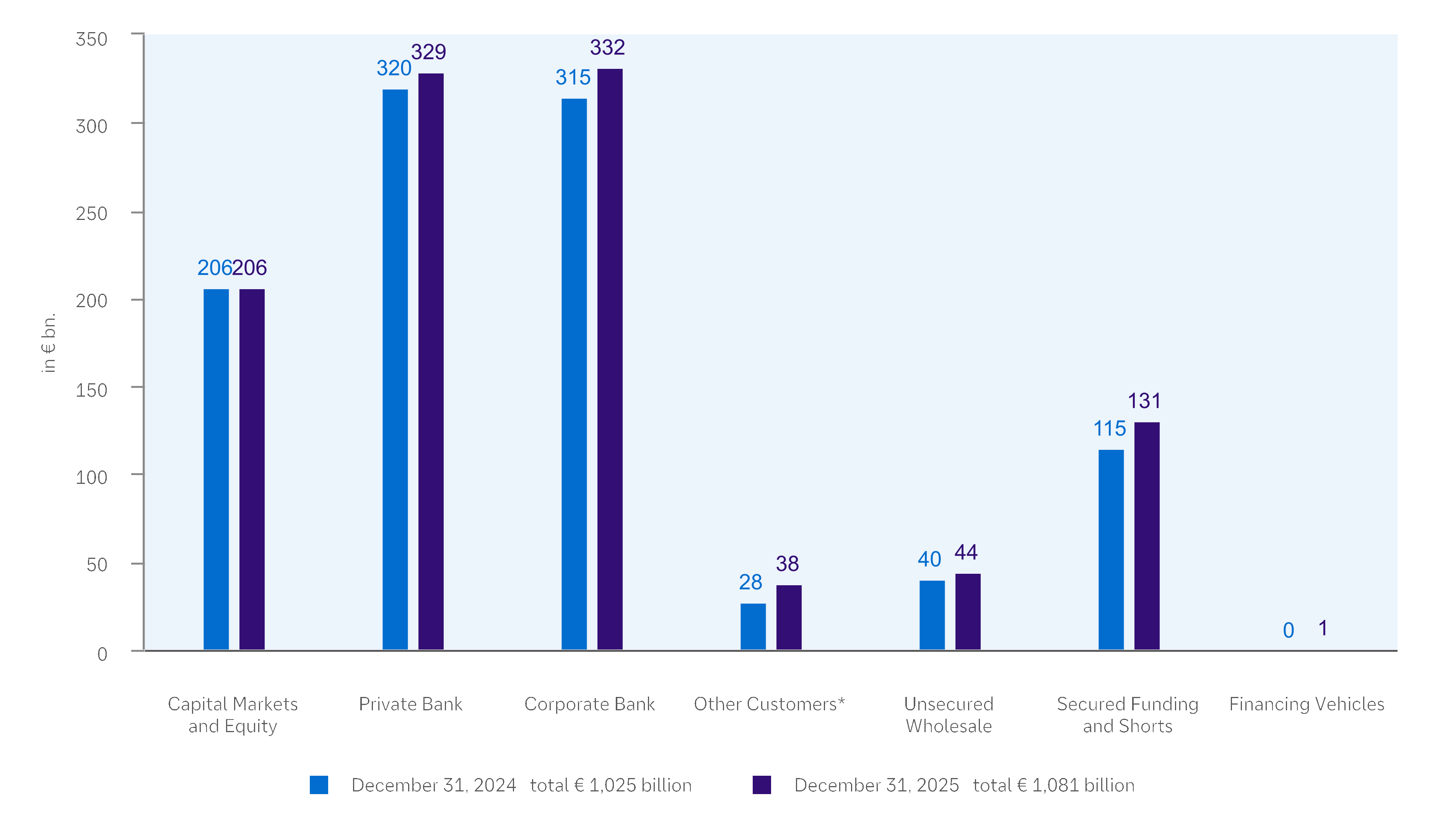
* Other Customers includes fiduciary deposits, X-markets notes and margin/Prime Brokerage cash balances (shown on a net basis)
Reference: Reconciliation to total balance sheet of € 1,435.1 billion (€1,391.0 billion): Derivatives & settlement balances € 277.7 billion (€ 288.8 billion), add-back for
netting effect for margin/Prime Brokerage cash balances (shown on a net basis) € 46.6 billion (€ 42.2 billion), other non-funding liabilities € 34.5 billion (€ 35.3 billion for
December 31, 2025, and December 31, 2024, respectively