Financial risks
Dec. 31, 2025
4 Financial risks
4.1 General
Insurance risks are described in note
29.4 Underwriting risk
for risk exposures arising from contracts within the scope of IFRS 17. Financial risks typically include, but are not limited to, credit risk, market risk and liquidity risk.
As an insurance group, Aegon is exposed to various risks, primarily from financial market fluctuations (for example, foreign currency, interest rate, credit, and equity risks) that impact investment values and product liabilities. Additional risks include insurance-related factors such as changes in mortality, morbidity, bond credit spreads, and liquidity premiums, detailed in note
29 Insurance contracts
. Risk is managed locally where business occurs, guided by Group-level principles and policies. Aegon’s integrated approach to risk management involves similar measurement of risk and scope of risk coverage to enable aggregation of the Group’s risk position.
To manage financial market risks, products are priced using a market-consistent framework, and asset liability management (ALM) programs seek to ensure prudent long-term investment to policyholder. ALM techniques across the Group vary in complexity, from cash-flow matching (for traditional fixed annuities) to duration matching (for the Universal Life range of products) to derivative-based semi-static and dynamic hedges (to match variable annuities and indexed universal life).
To manage risk exposure, Aegon has both group-wide and specific local risk policies to handle the unique situation of local businesses. For ALM specifically, the Enterprise Risk Management (ERM) framework includes several risk policies that govern ALM strategies, such as the Investment and Counterparty Risk Policy (ICRP). The ICRP governs the management of investment risks associated with credit, equity, property, alternative asset classes, interest rate and currency risk in addition to option markets, implied volatility risk, interest rate options and swaptions. As well as product-level ALM programs, subsidiary businesses are required by the ICRP to maintain overarching entity-level ALM strategies that guide and set limits for the aggregated product-level programs. Significant or complex ALM strategies are approved at group level, and all programs are subject to Group Risk oversight.
Together with the ICRP, other ERM policies govern concentration risk, liquidity risk, the use of derivatives and securities lending and repos. Aegon’s extensive use of derivatives can lead to significant collateral calls depending on market conditions. Liquidity is managed at the legal entity, with central coordination by Aegon Ltd. Aegon US may use external market solutions to match projected liquidity requirements with funding.
Next to guidance, the Group level policies also provide limits to Aegon’s exposure to major risks such as equity, interest rates, credit, and currency. The limits in these policies in aggregate remain within Aegon’s overall tolerance for risk and the Group’s financial resources. Operating within this policy framework, Aegon employs risk management programs including ALM processes and models and hedging programs (which are largely conducted via the use of financial derivative instruments). These risk management programs are in place in each country unit and are not only used to manage risk in each unit but are also part of the Aegon’s overall risk strategy.
Aegon’s Derivative Use Policy establishes the requirements for the control, authorization, execution and monitoring requirements of derivatives. It also stipulates the necessary mitigation of credit risk through derivatives management tools. For derivatives, counterparty credit risk is typically mitigated through collateral posting under credit support annexes or central clearing houses.
As part of its risk management programs, Aegon takes inventory of its current risk position across risk categories and measures the sensitivity of net result and shareholders’ equity under both deterministic and stochastic scenarios. Models, scenarios, and assumptions are regularly reviewed and updated as needed.
Aegon’s sensitivity analyses are presented throughout this section to show the estimated impact of various scenarios on CSM, net result, and shareholders’ equity. It also shows how the tested shock could affect management’s key accounting estimates and judgments under Aegon’s policies. Management action is taken into account to the extent that it is part of Aegon’s regular policies and procedures, such as established hedging programs. However, incidental management actions that would require changes to policies and procedures are not considered.
Market-consistent assumptions underlying the measurement of
non-listed
assets and liabilities are adjusted to reflect the shock tested. The shock may also affect the measurement of assets and liabilities based on assumptions that are not observable in the market. For example, a shock in interest rates may lead to increased expected credit losses on debt investments. Although management’s short-term assumptions may change if a risk factor is reasonably likely to change, long-term assumptions will generally not be revised unless there is evidence that the change is permanent. The sensitivities do not reflect what the net result would have been if risk variables had differed, as they are based on exposures on the reporting date, not actual events during the year. Nor are they intended to predict Aegon’s future shareholders’ equity or earnings, as the analysis excludes future new business and does not consider all potential management responses to financial environment changes, such as investment portfolio reallocations or changes to premiums and crediting rates. Furthermore, the results of the analyses cannot be extrapolated or interpolated to wider variations, as effects do not tend to be linear.
Concentration risk for financial risks is measured and managed at the following levels:
● |
Concentration by risk type: Risk exposures are measured by risk type as part of Aegon’s internal economic framework. A risk tolerance framework is in place which sets risk limits per risk type to target the desired risk balance and promote diversification across risk types. |
● |
Concentration per counterparty: Risk exposure is measured and risk limits are in place per counterparty as part of the Counterparty Name Limit Policy; and |
● |
Concentration per sector, geography, and asset class: Aegon’s investment strategy is translated into investment mandates for its internal and external asset managers. Through these investment mandates, limits on sector, geography, and asset class are set. Compliance monitoring of the investment mandates is carried out by the insurance operating companies. |
As part of business planning, the resilience of Aegon’s business strategy is tested in several extreme event scenarios. In the Adverse Financial scenario, financial markets are stressed without assuming diversification across different market factors. Within the projection certain management actions may be implemented when management deems this necessary.
Aegon’s significant financial risks and related financial information are explained in note
4.2 Credit
risk note
4.3 Market
risk and in note
4.4 Liquidity risk
.
4.2 Credit risk
Credit risk is the risk of financial loss to Aegon if a counterparty to a reinsurance contract or financial instrument fails to meet its contractual obligations, the risk of economic loss due to the deterioration in the financial condition of counterparties, either through fair value losses on traded securities or through defaults on traded securities, loans and mortgages.
Aegon has policies and procedures to manage credit, concentration, and counterparty risks across all material businesses with credit exposure, including bonds, loans, cash and equivalents, collateralized assets, reinsurance assets, and fair value assets. The Group uses risk gradings aligned with major credit rating agencies and applies internal gradings for specific portfolios, such as residential mortgages, to assess the probability of default.
Credit grades are calibrated so that default risk increases exponentially with each higher risk grade. For example, the difference in Probability of Default (PD) between the AAA and A rating grades is lower than between the BBB and B rating grades.
4.2.1 Aegon’s maximum exposure to credit risk
As premiums and deposits are received, Aegon invests these funds to meet future policyholder obligations. For assets backing insurance liabilities under the general model and the premium allocation approach, as well as other “free” assets, Aegon typically bears the investment risk, including principal and interest.
Aegon is exposed to credit risk on its fixed-income portfolio (debt securities, mortgages, private placements), derivatives, and reinsurance contracts. Some issuers have defaulted due to bankruptcy, liquidity issues, economic or real estate downturns, operational failure, or fraud. During financial downturns, Aegon can incur defaults or other value declines, which could materially impact Aegon’s business and financial results and condition adversely.
over-the-counter
The estimates of best estimate liability for (re)insurance contract assets represent Aegon’s maximum exposure to credit risk from these assets. Please see the cash flow information in note
29 Insurance contracts.
The following table contains an analysis of Aegon’s maximum credit risk exposure from financial assets. Please see note
39 Commitments and contingencies
and
40 Transfers of financial assets
for further information on capital commitments and contingencies and on collateral given, which may expose the Group to credit risk.
| Letters | Surplus | |||||||||||||||||||||||||||||||||||
| Maximum | of | Master | collateral | |||||||||||||||||||||||||||||||||
| exposure | credit / | Real | netting | (or over- | ||||||||||||||||||||||||||||||||
| to credit | guaran- | estate | agree- | Total | collaterali- | Net | ||||||||||||||||||||||||||||||
| risk | Cash | Securities | tees | property | ments | collateral | zation) | exposure | ||||||||||||||||||||||||||||
| Debt securities | 56,202 | - | - | 53 | - | - | 53 | - | 56,149 | |||||||||||||||||||||||||||
| Money market and other short-term investments | 5,964 | - | 289 | - | - | - | 289 | 22 | 5,696 | |||||||||||||||||||||||||||
| Loans | 9,787 | 112 | - | 23 | 21,460 | - | 21,594 | 11,808 | 1 | |||||||||||||||||||||||||||
| Unconsolidated investment funds | 190,671 | - | - | - | - | - | - | - | 190,671 | |||||||||||||||||||||||||||
| Deposits with financial institutes | 1,727 | - | - | - | - | - | - | - | 1,727 | |||||||||||||||||||||||||||
| Other investments | 4,749 | - | - | - | - | - | - | - | 4,749 | |||||||||||||||||||||||||||
| Derivative assets | 485 | 124 | 513 | - | - | 213 | 850 | 406 | 42 | |||||||||||||||||||||||||||
| Reinsurance assets | 17,153 | - | 15,363 | 731 | - | - | 16,093 | - | 1,060 | |||||||||||||||||||||||||||
On December 31, 2025 |
286,739 |
236 |
16,165 |
807 |
21,460 |
213 |
38,880 |
12,236 |
260,095 |
|||||||||||||||||||||||||||
| Debt securities | 60,890 | - | - | 61 | - | - | 61 | - | 60,829 | |||||||||||||||||||||||||||
| Money market and other short-term investments | 6,071 | - | 324 | - | - | - | 324 | 20 | 5,767 | |||||||||||||||||||||||||||
| Loans | 10,798 | 51 | - | 20 | 23,694 | - | 23,766 | 12,982 | 14 | |||||||||||||||||||||||||||
| Unconsolidated investment funds | 192,775 | - | - | - | - | - | - | - | 192,775 | |||||||||||||||||||||||||||
| Deposits with financial institutes | 2,063 | - | - | - | - | - | - | - | 2,063 | |||||||||||||||||||||||||||
| Other investments | 5,207 | - | - | - | - | - | - | - | 5,207 | |||||||||||||||||||||||||||
| Derivative assets | 771 | 220 | 713 | - | - | 171 | 1,104 | 461 | 128 | |||||||||||||||||||||||||||
| Reinsurance assets | 16,021 | - | 14,141 | 732 | - | - | 14,872 | - | 1,149 | |||||||||||||||||||||||||||
On December 31, 2024 |
294,597 |
271 |
15,177 |
813 |
23,694 |
171 |
40,127 |
13,462 |
267,932 |
|||||||||||||||||||||||||||
Debt securities
Several bonds in Aegon’s Americas’ portfolio are guaranteed by monoline insurance companies. This is shown in the table above in the column Letters of credit / guarantees.
Money market and short-term investments
The collateral reported for money market and short-term investments relates to
tri-party
repurchase agreements (repos). Within tri-party
repos, Aegon invests under short-term reverse repurchase agreements and the counterparty posts collateral to a third-party custodian. The collateral posted is typically high-quality, short-term securities and is only accessible for or available to Aegon in the event the counterparty defaults. Loans
Real estate collateral for mortgages includes both residential and commercial properties. For commercial mortgage loans in Aegon Americas, collateral is measured at fair value. At least annually, the fair value of each individual property pledged as collateral is estimated. At loan origination, an external appraisal is used to estimate the property’s value. In subsequent years, internal valuations are conducted using professionally accepted methods by accredited personnel. International valuation standards are used, which consider key assumptions such as replacement cost, income-generating potential, and recent sales of comparable properties. Valuations are primarily supported by market evidence.
Cash collateral for mortgage loans includes the savings that have been received to redeem the underlying mortgage loans at redemption date. These savings are part of the credit side of the statement of financial position but reduce the credit risk for the mortgage loan as a whole.
Financial assets designated at fair value through profit or loss
A significant portion of instruments have been designated as FVPL. On December 31, 2025, the maximum exposure to credit risk of these financial assets was their carrying amount of EUR 2,048 million (December 2024: EUR 2,337 million). The credit risk of these financial assets has not been hedged by the use of derivatives. The following table presents changes in fair value attributable to changes in credit risk, recognized for these investments:
2025 |
2024 | |||||||||||||||||||||||
| Loans | Debt securities | Total | Loans | Debt securities | Total | |||||||||||||||||||
| Change in fair value during the year | 1 | 7 | 8 | 3 | 16 | 19 | ||||||||||||||||||
| Cumulative change in fair value | - | 45 | 45 | - | 59 | 59 | ||||||||||||||||||
The change in fair value attributable to changes in credit risk is determined as the total amount of the change in fair value that is not attributable to changes in the observable benchmark interest rate or in other market rates. This method reasonably approximates credit risk impact, as fixed income valuations are primarily influenced by interest rates and credit spreads. Thus, isolating
non-credit
factors allows for an estimate of credit-related fair value changes. Derivatives
The master netting agreements column in the table pertains to derivative liability positions that are used in Aegon’s credit risk management. The offset in the master netting agreements column includes balances for which there is a legally enforceable right of offset, but no intention to settle them on a net basis under normal circumstances. As a result, there is a net exposure for credit risk management purposes. However, as there is no intention to settle these balances on a net basis, they do not qualify for net presentation for accounting purposes.
Reinsurance assets
The collateral for the reinsurance assets includes assets held in trust by the reinsurer for Aegon’s benefit. Trust assets can be accessed to pay policyholder benefits if reinsurers fail to perform under their contracts. Further information on the related reinsurance transactions is included in note
29 Insurance contracts
.
Collateral and other credit enhancements
Aegon employs a range of policies and practices to mitigate credit risk and the most common of these is accepting collateral for funds advanced. The Group has internal policies on the acceptability of specific classes of collateral or credit risk mitigation.
Collateral and other credit enhancements obtained
On December 31, 2025, the Group held no collateral that was obtained during the year (EUR 0 in 2024) by taking possession of collateral held as security against receivables. The Group’s policy is to pursue the timely realization of the collateral in an orderly manner. Aegon does not generally use
non-cash
collateral for its own operations. 4.2.2 Credit risk management
Aegon manages credit risk by counterparty, sector, and asset class, including cash. Credit risk in derivative contracts is typically mitigated through credit support agreements and ISDA master netting agreements across most of Aegon’s legal entities, enabling offsetting of exposures. Main counterparties are investment banks, generally rated “A” or higher. These agreements define collateral thresholds, with most collateralized transactions involving interest rate, equity, currency, and credit swaps. Collateral, mainly in USD and EUR cash, must meet high-quality standards. No derivative counterparty defaults occurred in the past three years. Credit risk under master netting agreements is offset only when liabilities are settled after asset realization. Eligible derivative transactions are traded via Central Clearing Houses as required by EMIR and the Dodd- Frank Act. Credit risk in these transactions is mitigated through the posting of initial and variation margins.
Aegon may also mitigate credit risk in reinsurance contracts by including downgrade clauses that allow the recapture of business, retaining ownership of assets required to support liabilities ceded, or requiring the reinsurer to hold assets in trust. For the resulting net credit risk exposure, Aegon employs deterministic and stochastic credit risk modeling in order to assess the Group’s credit risk profile, associated earnings, and capital implications due to various credit loss scenarios.
Aegon operates a Credit Name Limit Policy (CNLP) under which limits are placed on the aggregate exposure that it has to any one counterparty. Limits are placed on the exposure at both the group level and the individual country units. If an exposure exceeds the stated limit, it must be reduced to the limit for the country unit and rating category as soon as possible. Exceptions to these limits may be made only with explicit approval from Aegon’s Group Risk and Capital Committee (GRCC). The policy is reviewed regularly.
To hedge inflation risk in products offered to policyholders, Aegon invests in instruments linked to inflation, significantly reducing net exposure.
4.2.3 Credit rating
Since Aegon changed its policies in 2025, Group limits are denominated in US Dollar instead of Euro. Aegon group level long- term counterparty exposure limits are as follows:
Group limits per credit rating |
2025 USD million |
2024 EUR million | ||||||
AAA |
750 | 900 | ||||||
AA |
750 | 900 | ||||||
A |
575 | 675 | ||||||
BBB |
375 | 450 | ||||||
BB |
225 | 250 | ||||||
B |
110 | 125 | ||||||
CCC or lower |
45 | 50 | ||||||
The ratings distribution of Aegon’s general account portfolios – excluding reinsurance assets – is shown in the following table, categorized by rating and split by assets measured at fair value and amortized cost. Aegon applies a composite rating based on external ratings from S&P, Moody’s, Fitch, and the National Association of Insurance Commissioners (NAIC for U.S. assets), along with internal ratings. The lower of the external and internal ratings is used.
| Americas | United Kingdom | International | Asset Management |
2025 Total 1 |
||||||||||||||||||||||||||||||||||||||||
Financial assets |
Amortized cost |
Fair value |
Amortized cost |
Fair value |
Amortized cost |
Fair value |
Amortized cost |
Fair value |
Amortized cost |
Fair value |
Carrying value |
|||||||||||||||||||||||||||||||||
AAA |
847 | 5,625 | - | 30 | - | 40 | - | 127 | 847 | 5,822 | 6,669 | |||||||||||||||||||||||||||||||||
AA |
4,023 | 7,916 | - | 416 | - | 130 | - | - | 4,023 | 8,462 | 12,485 | |||||||||||||||||||||||||||||||||
A |
4,319 | 18,580 | - | 217 | 1 | 694 | 24 | - | 4,355 | 19,491 | 23,846 | |||||||||||||||||||||||||||||||||
BBB |
423 | 18,406 | - | 4 | - | 346 | 3 | - | 426 | 18,756 | 19,182 | |||||||||||||||||||||||||||||||||
BB |
- | 984 | - | 1 | - | 22 | 1 | - | 1 | 1,007 | 1,007 | |||||||||||||||||||||||||||||||||
B |
93 | 262 | - | 7 | - | 8 | - | - | 93 | 277 | 370 | |||||||||||||||||||||||||||||||||
CCC or lower |
- | 569 | - | - | - | 1 | 8 | - | 8 | 570 | 577 | |||||||||||||||||||||||||||||||||
Assets not rated |
- | 4,349 | - | 744 | - | 24 | - | 68 | - | 5,189 | 5,189 | |||||||||||||||||||||||||||||||||
Total |
9,704 |
56,690 |
- |
1,420 |
1 |
1,266 |
36 |
194 |
9,752 |
59,574 |
69,326 |
|||||||||||||||||||||||||||||||||
| ECL on financial assets | (33 | ) | (340 | ) | - | - | - | (7 | ) | - | - | (33 | ) | (347 | ) | (380 | ) | |||||||||||||||||||||||||||
On December 31, 2025 |
9,671 |
56,690 |
- |
1,420 |
1 |
1,266 |
36 |
194 |
9,719 |
59,574 |
69,293 |
|||||||||||||||||||||||||||||||||
| 2024 Total 1 |
||||||||||||||||||||||||||||||||||||||||||||
AAA |
1,013 | 5,265 | - | 25 | - | 37 | - | 73 | 1,013 | 5,400 | 6,412 | |||||||||||||||||||||||||||||||||
AA |
4,421 | 9,114 | - | 525 | - | 167 | - | - | 4,421 | 9,805 | 14,226 | |||||||||||||||||||||||||||||||||
A |
4,546 | 19,771 | - | 220 | 1 | 684 | 24 | - | 4,571 | 20,674 | 25,245 | |||||||||||||||||||||||||||||||||
BBB |
654 | 20,895 | - | 59 | - | 451 | 3 | - | 668 | 21,405 | 22,073 | |||||||||||||||||||||||||||||||||
BB |
4 | 1,162 | - | 1 | - | 42 | 1 | - | 4 | 1,205 | 1,209 | |||||||||||||||||||||||||||||||||
B |
78 | 487 | - | - | - | 5 | - | - | 78 | 492 | 570 | |||||||||||||||||||||||||||||||||
| CCC or lower | - | 720 | - | - | - | 6 | 8 | - | 8 | 726 | 733 | |||||||||||||||||||||||||||||||||
| Assets not rated | - | 4,844 | - | 740 | - | 4 | - | 54 | - | 5,668 | 5,668 | |||||||||||||||||||||||||||||||||
Total |
10,715 |
62,258 |
- |
1,569 |
1 |
1,395 |
36 |
126 |
10,763 |
65,375 |
76,138 |
|||||||||||||||||||||||||||||||||
| ECL on financial assets | (118 | ) | (327 | ) | - | - | - | (14 | ) | - | - | (118 | ) | (341 | ) | (459 | ) | |||||||||||||||||||||||||||
On December 31, 2024 |
10,597 |
62,258 |
- |
1,569 |
1 |
1,395 |
36 |
126 |
10,645 |
65,375 |
76,020 |
|||||||||||||||||||||||||||||||||
1 |
Includes investments of Holding and other activities. |
The following table shows the credit quality of the reinsurance contracts:
Carrying value |
2025 |
2024 | ||||||
AAA |
- | - | ||||||
AA |
1,008 | 1,087 | ||||||
A |
14,832 | 14,041 | ||||||
Below A |
208 | 3 | ||||||
Not rated |
910 | 587 | ||||||
On December 31 |
16,958 |
15,719 |
||||||
4.2.4 Credit risk concentration
The following tables present specific credit risk concentration information for general account financial assets.
Debt securities and money market investments |
Americas | United Kingdom |
International | Asset Management |
2025 Total 1 |
Of which past due and/or impaired |
||||||||||||||||||
Residential mortgage-backed securities (RMBSs) |
827 | - | - | - | 827 | (16 | ) | |||||||||||||||||
Commercial mortgage-backed securities (CMBSs) |
2,419 | 26 | 34 | - | 2,479 | (40 | ) | |||||||||||||||||
| Asset-backed securities (ABSs) | 616 | - | 1 | - | 617 | (1 | ) | |||||||||||||||||
ABSs – Other |
5,820 | 43 | 26 | 102 | 5,991 | (29 | ) | |||||||||||||||||
Financial - Banking |
3,261 | 165 | 190 | - | 3,616 | (15 | ) | |||||||||||||||||
Financial - Other |
9,831 | 54 | 158 | 100 | 10,144 | (53 | ) | |||||||||||||||||
Capital goods and other industry |
3,273 | 18 | 76 | - | 3,366 | (41 | ) | |||||||||||||||||
Communications & Technology |
3,879 | 11 | 77 | - | 3,967 | (44 | ) | |||||||||||||||||
Consumer cyclical |
3,354 | 9 | 100 | - | 3,463 | (35 | ) | |||||||||||||||||
Consumer non-cyclical |
5,062 | 38 | 116 | - | 5,216 | (33 | ) | |||||||||||||||||
Energy |
2,325 | 10 | 41 | - | 2,376 | (12 | ) | |||||||||||||||||
Transportation |
1,658 | 4 | 20 | - | 1,682 | (6 | ) | |||||||||||||||||
Utility |
3,902 | 2 | 37 | - | 3,941 | (10 | ) | |||||||||||||||||
Government bonds |
5,762 | 302 | 293 | 17 | 6,374 | (13 | ) | |||||||||||||||||
On December 31, 2025 |
51,990 |
682 |
1,169 |
220 |
54,060 |
(347 |
) | |||||||||||||||||
| 2024 Total 1 |
||||||||||||||||||||||||
Residential mortgage-backed securities (RMBSs) |
684 | - | - | - | 684 | (19 | ) | |||||||||||||||||
Commercial mortgage-backed securities (CMBSs) |
2,469 | 65 | 47 | - | 2,582 | (22 | ) | |||||||||||||||||
| Asset-backed securities (ABSs) | 582 | - | 3 | - | 585 | - | ||||||||||||||||||
ABSs – Other |
4,761 | 54 | 49 | 88 | 4,952 | (16 | ) | |||||||||||||||||
Financial - Banking |
3,751 | 172 | 178 | - | 4,101 | (19 | ) | |||||||||||||||||
Financial - Other |
10,464 | 24 | 224 | 46 | 10,758 | (57 | ) | |||||||||||||||||
Capital goods and other industry |
3,639 | 24 | 79 | - | 3,742 | (31 | ) | |||||||||||||||||
Communications & Technology |
4,642 | 4 | 112 | - | 4,758 | (58 | ) | |||||||||||||||||
Consumer cyclical |
3,641 | 25 | 91 | - | 3,757 | (39 | ) | |||||||||||||||||
Consumer non-cyclical |
5,987 | 49 | 116 | - | 6,151 | (31 | ) | |||||||||||||||||
Energy |
2,766 | 27 | 51 | - | 2,844 | (13 | ) | |||||||||||||||||
Transportation |
1,786 | - | 29 | - | 1,816 | (6 | ) | |||||||||||||||||
Utility |
4,763 | 16 | 54 | - | 4,833 | (12 | ) | |||||||||||||||||
Government bonds |
6,926 | 370 | 286 | 18 | 7,601 | (18 | ) | |||||||||||||||||
On December 31, 2024 |
56,861 |
830 |
1,320 |
152 |
59,162 |
(341 |
) | |||||||||||||||||
1 |
Includes investments of Holding and other activities. |
Government bonds per country of risk |
Americas | United Kingdom |
International | Asset Management |
2025 Total 1 |
Americas | United Kingdom |
International | Asset Management |
2024 Total 1 |
||||||||||||||||||||||||||||||
United States |
5,017 | 2 | 64 | - | 5,084 | 6,095 | - | 69 | - | 6,164 | ||||||||||||||||||||||||||||||
Netherlands |
- | - | 2 | - | 2 | - | - | 2 | - | 2 | ||||||||||||||||||||||||||||||
United Kingdom |
- | 257 | - | 17 | 275 | - | 316 | - | 18 | 334 | ||||||||||||||||||||||||||||||
Austria |
- | - | 9 | - | 9 | - | - | 10 | - | 10 | ||||||||||||||||||||||||||||||
Belgium |
- | - | 3 | - | 3 | - | - | 4 | - | 4 | ||||||||||||||||||||||||||||||
France |
- | 18 | 8 | - | 25 | - | 28 | 8 | - | 36 | ||||||||||||||||||||||||||||||
Hungary |
19 | - | 2 | - | 21 | 21 | - | 4 | - | 25 | ||||||||||||||||||||||||||||||
Indonesia |
63 | - | - | - | 63 | 69 | - | - | - | 69 | ||||||||||||||||||||||||||||||
Luxembourg |
- | 5 | 1 | - | 6 | - | 5 | 1 | - | 7 | ||||||||||||||||||||||||||||||
Spain |
- | - | 188 | - | 188 | - | - | 161 | - | 161 | ||||||||||||||||||||||||||||||
Rest of Europe |
76 | - | 8 | - | 84 | 82 | - | 12 | - | 93 | ||||||||||||||||||||||||||||||
Rest of world |
586 | 19 | 7 | - | 612 | 660 | 20 | 16 | - | 695 | ||||||||||||||||||||||||||||||
On December 31 |
5,762 |
302 |
293 |
17 |
6,374 |
6,926 |
370 |
286 |
18 |
7,601 |
||||||||||||||||||||||||||||||
1 |
Includes investments of Holding and other activities. |
Credit rating * |
Government Bonds |
Corporate bonds |
RMBSs CMBSs ABSs |
Other | 2025 Total 1 |
Government Bonds |
Corporate bonds |
RMBSs CMBSs ABSs |
Other | 2024 Total 1 | ||||||||||||||||||||||||||||||
AAA |
160 | 536 | 3,407 | 1,708 | 5,811 | 169 | 434 | 2,888 | 1,892 | 5,383 | ||||||||||||||||||||||||||||||
AA |
4,754 | 2,413 | 1,200 | - | 8,367 | 5,857 | 2,686 | 1,202 | - | 9,745 | ||||||||||||||||||||||||||||||
A |
777 | 14,804 | 3,573 | - | 19,154 | 823 | 16,127 | 3,169 | - | 20,119 | ||||||||||||||||||||||||||||||
BBB |
402 | 17,264 | 1,059 | - | 18,725 | 417 | 20,099 | 847 | - | 21,363 | ||||||||||||||||||||||||||||||
BB |
247 | 672 | 83 | - | 1,002 | 265 | 834 | 99 | - | 1,198 | ||||||||||||||||||||||||||||||
B |
19 | 171 | 154 | - | 345 | 53 | 398 | 94 | - | 545 | ||||||||||||||||||||||||||||||
CCC or lower |
15 | 103 | 439 | - | 557 | 18 | 205 | 503 | - | 726 | ||||||||||||||||||||||||||||||
Assets not rated |
- | - | - | 94 | 94 | - | - | - | 83 | 83 | ||||||||||||||||||||||||||||||
On December 31 |
6,374 |
35,963 |
9,914 |
1,802 |
54,054 |
7,601 |
40,783 |
8,802 |
1,976 |
59,162 |
||||||||||||||||||||||||||||||
1 |
Includes investments of Holding and other activities. |
| * | CNLP Ratings are used and are the lower of the Barclay’s Rating, and the Internal Rating with the Barclay’s rating being a blended rating of S&P, Fitch, and Moody’s. |
Mortgage loans |
Americas | International | 2025 Total |
Of which past due and / or impaired |
Americas | International | 2024 Total |
Of which past due and/or impaired |
||||||||||||||||||||||||
Agricultural |
40 | - | 40 | (1 | ) | 47 | - | 47 | - | |||||||||||||||||||||||
Apartment |
4,954 | - | 4,954 | (5 | ) | 5,618 | - | 5,618 | (8 | ) | ||||||||||||||||||||||
Industrial |
455 | - | 455 | - | 474 | - | 474 | - | ||||||||||||||||||||||||
Office |
1,105 | - | 1,105 | (27 | ) | 1,270 | - | 1,270 | (109 | ) | ||||||||||||||||||||||
Retail |
1,257 | - | 1,257 | - | 1,384 | - | 1,384 | (1 | ) | |||||||||||||||||||||||
Other commercial |
1,942 | 1 | 1,943 | - | 1,885 | 1 | 1,886 | - | ||||||||||||||||||||||||
On December 31 |
9,753 |
1 |
9,754 |
(33 |
) |
10,679 |
1 |
10,680 |
(118 |
) | ||||||||||||||||||||||
4.2.5 Unconsolidated structured entities
Aegon’s investments in unconsolidated structured entities – such as RMBSs, CMBSs, ABSs, and investment funds – are reported under “Investments” on the statement of financial position. These interests are basic interests. Aegon holds no related loans, derivatives, guarantees, or other interests relating to these investments.
For RMBSs, CMBSs, and ABSs, Aegon’s maximum exposure to loss equals the carrying amount, as shown in the credit risk concentration table for debt securities and money market investments. To manage credit risk, Aegon primarily invests in senior notes of these instruments. The portfolios are broadly diversified by issuer, resulting in only
non-controlling
interests in individual unconsolidated structured entities. Additionally, Aegon does not originate these investments. As the collateral manager of collateralized loan obligations (CLOs) issued in Europe, to the extent that it acts as an originator-manager, Aegon is subject to risk retention requirements to hold investments in the CLOs it manages. Such risk retention is often in the form of participation in the subordinated tranches of the structure, which concentrate credit risk on the underlying assets of the CLO. Aegon’s maximum exposure to credit risk is the carrying amount of these investments, which was EUR 190,671 million on December 31, 2025 (2024: EUR 192,775 million).
Except for commitments, such as future purchases in investment funds, as disclosed in note
39 Commitments and contingencies
, Aegon did not provide, nor is it required to provide financial or other support to unconsolidated structured entities. Aegon also has no intention to offer such support to entities in which it currently holds or previously held an interest.
For RMBSs, CMBSs, and ABSs in which Aegon has an interest at the reporting date, the following table presents the total income received from those interests. The Investments column reflects the carrying values recognized in the statement of financial position of Aegon’s interests in RMBSs, CMBSs, and ABSs.
2025 |
2024 | |||||||||||||||||||||||||||||||
| Interest income |
Gains/(losses) on sale |
Total Income |
Investments | Interest income |
Gains/(losses) on sale |
Total Income |
Investments | |||||||||||||||||||||||||
RMBSs |
57 | 7 | 64 | 827 | 58 | (13 | ) | 45 | 684 | |||||||||||||||||||||||
CMBSs |
115 | 87 | 202 | 2,479 | 97 | 98 | 194 | 2,582 | ||||||||||||||||||||||||
ABSs |
33 | - | 33 | 617 | 38 | 12 | 50 | 585 | ||||||||||||||||||||||||
ABSs - Other |
296 | 114 | 410 | 5,991 | 206 | 58 | 264 | 4,952 | ||||||||||||||||||||||||
Total |
501 |
208 |
708 |
9,914 |
399 |
155 |
554 |
8,802 |
||||||||||||||||||||||||
4.2.6 Expected credit losses
Measurement
Credit risk losses are inherent to fixed-income securities. The level of this risk and the compensation for bearing it are related. A key management measure to avoid excessive credit risk is to diversify and limit exposure to individual issuers.
Aegon measures credit risk in line with the IFRS 9 approach for Expected Credit Loss (ECL). ECL is calculated as the product of the projected probability of default (PD), the loss given default (LGD), and the exposure at default (EAD), discounted at an appropriate rate. ECL is then determined as the probability-weighted, discounted credit loss across multiple scenarios (for example, base, positive, adverse).
a) Recognition of expected credit losses
Aegon uses the “three-stage” model for impairment as outlined in IFRS 9, based on relative changes in credit quality since initial recognition. The table below shows the characteristics of the three stages.
Stage 1 Impaired |
Stage 2 Under-performing |
Stage 3 Non-performing |
Purchased or Originated Credit Impaired (POCI) | |||||
ECL |
12-month ECL |
Lifetime ECL |
Lifetime ECL |
Lifetime ECL | ||||
Provision Trigger |
n.a. |
Quantitative and Qualitative Triggers |
Qualitative Triggers |
Qualitative Triggers | ||||
Days Past Due (“DPD”) Backstop |
Up to date and early arrears (< 30 DPD) |
> 30 DPD (rebuttable presumption) |
> 90 DPD (rebuttable presumption) |
n.a. | ||||
Interest Income |
Interest calculated on gross carrying amount |
Interest calculated on gross carrying amount |
Interest calculated on net carrying amount |
Interest calculated on net carrying amount using a credit-adjusted effective interest rate | ||||
Following the staging of financial instruments, Aegon incorporates multiple, forward looking macro- scenarios to drive the ECL provision. Forward-looking inputs used to measure ECLs must align with those used to assess significant increases in credit risk.
The Group uses different models to calculate ECL across asset classes. The following sections outline the Group’s key judgments and assumptions for each model.
For bonds and private placements, the Group uses a global correlation model that links credit quality movements across asset classes to macroeconomic trends. This model determines conditional PD and LGD under specific macroeconomic scenarios. Unconditional PD and LGD curves are developed using distinct methods for sovereign debt, corporate bonds, and private placements.
For commercial mortgage loans and mortgage-backed securities, parameters are estimated using commercial mortgage metrics. These build on corporate bond PD and LGD estimates, adjusted for factors like debt service coverage and value ratios.
loan-to-
Asset-backed securities are modeled separately, with instruments pooled by collateral type, and credit-loss parameters estimated collectively. For collateralized debt (loan) obligations (CDOs and CLOs), different models are applied depending on the region of the exposure.
The following tables contain an analysis of Aegon’s credit risk exposure for debt instruments and loans for which an ECL allowance is recognized. All asset categories not presented here are determined to have
non-material
credit risk or to be of a short-term nature (cash and cash equivalents, other receivables). The gross carrying amount of financial assets below also represents Aegon’s maximum exposure to credit risk on these assets. Financial assets measured at FVOCI - with recycling |
Stage 1 | Stage 2 | Stage 3 | Purchased credit impaired |
2025 Total |
Stage 1 | Stage 2 | Stage 3 | Purchased credit impaired |
2024 Total |
||||||||||||||||||||||||||||||
AAA |
3,843 | - | - | - | 3,843 | 3,295 | - | - | - | 3,295 | ||||||||||||||||||||||||||||||
AA |
7,787 | - | 1 | - | 7,788 | 9,100 | - | 1 | - | 9,101 | ||||||||||||||||||||||||||||||
A |
18,394 | - | 9 | - | 18,403 | 19,443 | - | - | - | 19,443 | ||||||||||||||||||||||||||||||
BBB |
18,050 | 84 | - | 1 | 18,135 | 20,724 | 7 | - | 1 | 20,732 | ||||||||||||||||||||||||||||||
BB |
810 | 124 | - | - | 934 | 949 | 157 | - | - | 1,106 | ||||||||||||||||||||||||||||||
B |
150 | 95 | - | - | 245 | 361 | 95 | - | - | 456 | ||||||||||||||||||||||||||||||
CCC and lower |
48 | 55 | 221 | 74 | 398 | 85 | 79 | 289 | 91 | 544 | ||||||||||||||||||||||||||||||
Net carrying amount |
49,082 |
358 |
232 |
75 |
49,747 |
53,957 |
337 |
291 |
92 |
54,677 |
||||||||||||||||||||||||||||||
Expected credit loss |
(189 | ) | (27 | ) | (130 | ) | (1 | ) | (347 | ) | (187 | ) | (42 | ) | (108 | ) | (4 | ) | (341 | ) | ||||||||||||||||||||
Loans at amortized cost |
Stage 1 | Stage 2 | Stage 3 | Purchased credit impaired |
2025 Total |
Stage 1 | Stage 2 | Stage 3 | Purchased credit impaired |
2024 Total |
||||||||||||||||||||||||||||||
Internal grade 1 |
847 | - | - | - | 847 | 977 | 35 | - | - | 1,013 | ||||||||||||||||||||||||||||||
Internal grade 2 |
4,023 | - | - | - | 4,023 | 4,410 | 11 | - | - | 4,421 | ||||||||||||||||||||||||||||||
Internal grade 3 |
4,304 | 15 | - | - | 4,319 | 4,539 | - | 7 | - | 4,546 | ||||||||||||||||||||||||||||||
Internal grade 4 |
413 | 7 | 3 | - | 423 | 644 | 10 | - | - | 654 | ||||||||||||||||||||||||||||||
Internal grade 5 |
- | 93 | - | - | 93 | 4 | 78 | - | - | 81 | ||||||||||||||||||||||||||||||
Internal grade 6 |
- | - | - | - | - | - | - | - | - | - | ||||||||||||||||||||||||||||||
Internal grade 7 or lower |
- | - | - | - | - | - | - | - | - | - | ||||||||||||||||||||||||||||||
Gross carrying amount |
9,587 |
115 |
3 |
- |
9,705 |
10,573 |
135 |
7 |
- |
10,716 |
||||||||||||||||||||||||||||||
Expected credit loss |
(11 | ) | (21 | ) | (1 | ) | - | (33 | ) | (38 | ) | (75 | ) | (5 | ) | - | (118 | ) | ||||||||||||||||||||||
Net carrying amount |
9,575 |
94 |
2 |
- |
9,672 |
10,535 |
60 |
2 |
- |
10,598 |
||||||||||||||||||||||||||||||
b) Significant increase in credit risk (SICR)
Aegon considers a financial instrument to have experienced an SICR when one or more of the following quantitative, qualitative, or backstop criteria have been met:
Asset class |
Quantitative criteria |
Qualitative criteria |
Backstop criteria | |||
Commercial mortgages |
Relative change in Forward-in-Time Probability of Default |
None |
60 days past due backstop | |||
Private loans |
Relative changes in rating |
Watchlist approach |
No other backstop applied | |||
Debt securities |
Relative changes in rating |
Watchlist approach |
No other backstop applied | |||
Structured finance |
Relative changes in rating |
Watchlist approach |
30 days past due backstop | |||
Deposits with financial institutions |
Relative changes in rating |
Watchlist approach |
No other backstop applied | |||
Loan commitments |
Defined as for the respective loans to which the commitment relates | |||||
Financial guarantees |
Defined as for the respective exposures to which the financial guarantee relates | |||||
Quantitative criteria
The quantitative factor(s) should indicate whether the credit risk of an instrument has increased significantly since initial recognition. When making this assessment, Aegon shall use the change in the risk of a default occurring over the expected life of the financial instrument. Aegon uses a mix of relative and absolute thresholds. The relative threshold measures the increase in credit risk relative to origination. The absolute threshold defines a stage for each rating and is primarily used when the rating at origination is unavailable or when an instrument is already in default. The relative PD thresholds can be converted into rating-based thresholds using Moody’s standard rating to PD mappings. The difference between the PD at origination and the PD corresponding to the threshold determines the number of notches that the rating must drop by. For example, for a
one-
year-old
instrument with a one-year
remaining maturity this gives the following result: 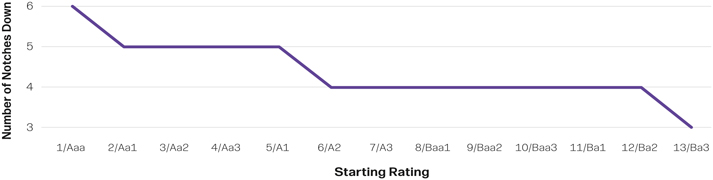
Aegon groups PD values into ranges, shown in the table below. Each range includes minimum and maximum PDs for financial and corporate assets with maturities from 1 to 10 years. As Aegon US best represents the Group, PD data for the Americas is presented.
2025 |
2024 | |||||||||||||||
PD range |
Minimum | Maximum | Minimum | Maximum | ||||||||||||
AAA |
0.0001 | 0.0018 | 0.0001 | 0.0021 | ||||||||||||
AA |
0.0002 | 0.0031 | 0.0002 | 0.0034 | ||||||||||||
A |
0.0006 | 0.0050 | 0.0006 | 0.0052 | ||||||||||||
BBB |
0.0016 | 0.0079 | 0.0017 | 0.0079 | ||||||||||||
BB |
0.0048 | 0.0133 | 0.0048 | 0.0131 | ||||||||||||
B |
0.0117 | 0.0320 | 0.0120 | 0.0307 | ||||||||||||
CCC or lower |
0.0209 | 1.0000 | 0.0196 | 1.0000 | ||||||||||||
Qualitative criteria
For debt securities, private loans, structured finance securities and deposits with financial institutions the watchlist approach is applied as an additional qualitative criterion. Instruments on the watchlist are closely monitored. Assets are added to the watchlist if their fair value either drops to 80% and below the (amortized) cost price and stays there for six months; or the fair value falls by 20% over 3 months; or the fair value falls to 60% and below the (amortized) cost price. For debt securities and private loans, this assessment is performed at the counterparty level and on a periodic basis. The Group periodically reviews the criteria used to identify SICR for appropriateness. For loan commitments and financial guarantees, Aegon defines default consistently with the related loan or financial instrument, considering the same risk factors.
Backstop
A backstop is applied to exposures deemed to have experienced an SICR when the borrower is more than 30 days past due on contractual payments in structured finance and 60 days in commercial mortgage loans. No backstop is applied to the other asset classes.
Low credit risk exemption for debt instruments
Aegon has used the low credit risk exemption for debt instruments. Debt instruments that have a credit rating of “investment grade” (rating “BBB” or higher) are considered to have low credit risk. External and internal credit ratings are used, respectively, to assess whether an SICR has occurred for these assets.
c) Definition of default or credit-impaired assets
Aegon assesses a financial instrument to be in default or credit-impaired using the following criteria:
Asset class |
Quantitative criteria | Qualitative criteria | ||
Commercial mortgages |
90 days past due backstop | Foreclosure Sale at material credit-related economic loss | ||
Debt securities and private loans |
5 days past due backstop | Rating falling to “D” (external or internal) Breach of significant covenants without reasonably supportable waiver obtained Distressed restructuring taking place Bankruptcy or an equivalent of an injunction for the obligor was filed Obligor was classified as default internally | ||
Deposits with financial institution |
5 days past due backstop | Rating falling to “D” (external or internal) Breach of significant covenants without reasonably supportable waiver obtained Distressed restructuring taking place Bankruptcy or an equivalent of an injunction for the obligor was filed Obligor was classified as default internally | ||
Structured securities |
90 days past due backstop | Rating falling to “D” (external or internal) Loss coverage ratio (Ratio of credit-related losses to the par value of a debt security) is below 1 | ||
Receivables |
90 days past due backstop | |||
Loan commitments |
Defined as for the respective loans to which the commitment relates | |||
Financial guarantee contracts |
Defined as for the respective exposures to which the financial guarantee relates | |||
In addition to the criteria in the table above, Aegon identifies other indicators of unlikelihood of payment, such as a lack of future ability to generate cash flows, concerns about sources of recurring income, increased overall leverage of the borrower, material fraud, or the death of a client.
All the criteria above have been applied to Aegon’s financial instruments and align with the definition of default used for internal credit risk management purposes. This definition is consistently used in modeling PD and EAD throughout Aegon’s expected loss calculations.
An instrument is considered “cured” when it no longer meets any default criteria for six consecutive months and the obligor is assessed as likely to pay. This
six-month
period assesses the likelihood that a financial instrument will return to default status after cure, using different cure definitions. d) Measuring ECL – inputs, assumptions and estimation techniques
Aegon uses a set of variables describing the state of the macroeconomy as input to the calculation of the probability of default and prepayment.
Subject to using a maximum of a
12-month
PD for financial assets for which credit risk has not significantly increased, the Group measures ECL considering the risk of default over the maximum contractual period (including any borrower’s extension options) over which Aegon is exposed to credit risk, even if the Group considers a longer period. The lifetime PD for a financial instrument is calculated by summing the probabilities of all future developments that end up in the ECL. All possible future developments are enumerated, and a probability is estimated for each using statistical modeling techniques. The possibility of full prepayment is included among all possible future developments. There have been no significant changes in estimation techniques or significant assumptions made during the reporting period.
e) Forward-looking information incorporated in the ECL models
The assessment of SICR and the calculation of ECL both incorporate forward-looking information.
The impact of economic variables on ECL and lifetime PD varies by financial instrument, with expert judgment applied throughout the process. Forecasts for these variables (the “base economic scenario”) reflect Aegon’s best estimate for the next five years. Beyond that, a mean reversion approach is used, assuming variables return to long-term averages (for example, unemployment rates or GDP growth) over three years. A statistical regression analysis has been performed to assess how historical changes in macroeconomic variables have influenced default and prepayment rates.
Starting from the base scenario, three macroeconomic scenarios – positive, neutral, and negative – are generated by applying shocks to macroeconomic variables, reflecting their historical correlations. These shocks correspond to the average deviation from the long-term mean observed in the best/worst 10% of historical quarters. ECL is calculated for each scenario, weighted accordingly, and then summed up. This multi-scenario approach ensures the ECL reflects a balanced estimate, not just the most likely scenario. The Group considers these forecasts to represent its best estimate of the possible outcomes.
Economic variable assumptions
The most significant
period-end
assumptions used for the ECL estimate are set out below. The scenarios “base,” “upside,” and “downside” were used for all portfolios. Economic variable assumptions on December 31, 2025 |
2026 | 2027 | 2028 | 2029 | Units | |||||||||||||||
Interest rates |
Base | 4.29 | 4.32 | 4.33 | 4.30 | Interest Rates: 10-Year Treasury Constant Maturities, (% p.a., NSA 1 ) | ||||||||||||||
Interest rates |
Upside | 4.39 | 4.41 | 4.33 | 4.30 | Interest Rates: 10-Year Treasury Constant Maturities, (% p.a., NSA 1 ) | ||||||||||||||
Interest rates |
Downside | 3.05 | 3.76 | 4.02 | 4.16 | Interest Rates: 10-Year Treasury Constant Maturities, (% p.a., NSA 1 ) | ||||||||||||||
Unemployment rate |
Base | 4.78 | 4.59 | 4.29 | 4.05 | (%, SA) | ||||||||||||||
Unemployment rate |
Upside | 3.83 | 3.94 | 3.66 | 3.47 | (%, SA) | ||||||||||||||
Unemployment rate |
Downside | 8.34 | 7.60 | 6.16 | 4.94 | (%, SA) | ||||||||||||||
House Price Index |
Base | 429.08 | 438.87 | 455.20 | 471.22 | Existing Single-Family Home Price: Median, (Ths. USD, SA) | ||||||||||||||
House Price Index |
Upside | 450.23 | 472.07 | 494.28 | 513.52 | Existing Single-Family Home Price: Median, (Ths. USD, SA) | ||||||||||||||
House Price Index |
Downside | 362.72 | 383.66 | 404.10 | 420.99 | Existing Single-Family Home Price: Median, (Ths. USD, SA) | ||||||||||||||
Domestic GDP |
Base | 24,484.94 | 24,932.78 | 25,485.10 | 26,129.71 | Bil. Ch. 2012 USD, SAAR 2 | ||||||||||||||
Domestic GDP |
Upside | 24,887.20 | 25,401.41 | 26,012.56 | 26,724.26 | Bil. Ch. 2012 USD, SAAR 2 | ||||||||||||||
Domestic GDP |
Downside | 23,372.80 | 23,689.06 | 24,425.29 | 25,270.54 | Bil. Ch. 2012 USD, SAAR 2 | ||||||||||||||
Equity |
Base | 6,363.30 | 6,460.73 | 6,953.76 | 7,485.28 | Standard & Poor’s (S&P); Moody’s Analytics Forecasted | ||||||||||||||
Equity |
Upside | 6,831.53 | 6,904.30 | 7,343.79 | 7,756.76 | Standard & Poor’s (S&P); Moody’s Analytics Forecasted | ||||||||||||||
Equity |
Downside | 4,423.87 | 4,764.13 | 5,780.16 | 6,786.08 | Standard & Poor’s (S&P); Moody’s Analytics Forecasted | ||||||||||||||
Economic variable assumptions on December 31, 2024 |
2025 | 2026 | 2027 | 2028 | Units | |||||||||||||||
Interest rates |
Base | 4.33 | 4.26 | 4.24 | 4.18 | Interest Rates: 10-Year TreasuryConstant Maturities, (% p.a., NSA 1 ) | ||||||||||||||
Interest rates |
Upside | 4.43 | 4.35 | 4.24 | 4.18 | Interest Rates: 10-Year TreasuryConstant Maturities, (% p.a., NSA 1 ) | ||||||||||||||
Interest rates |
Downside | 3.17 | 3.74 | 3.94 | 4.04 | Interest Rates: 10-Year TreasuryConstant Maturities, (% p.a., NSA 1 ) | ||||||||||||||
Unemployment rate |
Base | 4.08 | 4.09 | 4.05 | 4.01 | (%, SA) | ||||||||||||||
Unemployment rate |
Upside | 3.13 | 3.44 | 3.42 | 3.42 | (%, SA) | ||||||||||||||
Unemployment rate |
Downside | 8.23 | 7.46 | 6.18 | 5.00 | (%, SA) | ||||||||||||||
House Price Index |
Base | 419.04 | 424.10 | 434.08 | 448.91 | Existing Single-Family Home Price: Median, (Ths. USD, SA) | ||||||||||||||
House Price Index |
Upside | 439.72 | 456.26 | 471.39 | 489.21 | Existing Single-Family Home Price: Median, (Ths. USD, SA) | ||||||||||||||
House Price Index |
Downside | 354.16 | 369.92 | 385.26 | 401.39 | Existing Single-Family Home Price: Median, (Ths. USD, SA) | ||||||||||||||
Domestic GDP |
Base | 23,973.45 | 24,343.12 | 24,819.66 | 25,356.09 | Bil. Ch. 2012 USD, SAAR 2 | ||||||||||||||
Domestic GDP |
Upside | 24,319.86 | 24,807.47 | 25,341.29 | 25,943.15 | Bil. Ch. 2012 USD, SAAR 2 | ||||||||||||||
Domestic GDP |
Downside | 22,959.57 | 23,369.09 | 24,147.35 | 24,980.66 | Bil. Ch. 2012 USD, SAAR 2 | ||||||||||||||
Equity |
Base | 5,912.89 | 5,814.62 | 6,098.72 | 6,483.85 | Standard & Poor’s (S&P); Moody’s Analytics Forecasted | ||||||||||||||
Equity |
Upside | 6,264.59 | 6,132.21 | 6,356.19 | 6,630.75 | Standard & Poor’s (S&P); Moody’s Analytics Forecasted | ||||||||||||||
Equity |
Downside | 3,867.82 | 4,095.95 | 4,899.05 | 5,712.91 | Standard & Poor’s (S&P); Moody’s Analytics Forecasted | ||||||||||||||
1 |
NSA: National Security Agency. |
2 |
SAAR: Seasonally adjusted annual rate. |
The weightings assigned to each economic scenario were as follows:
Weightings |
Base | Upside | Downside | |||||||||
| On December 31, 2025 |
40 | 30 | 30 | |||||||||
| On December 31, 2024 |
40 | 30 | 30 | |||||||||
Other forward-looking factors, such as regulatory, legislative, or political changes, have been considered but are not deemed material and did not adjust ECL. This process is reviewed quarterly for continued appropriateness.
f)
Write-off
policy The Group writes off financial assets, in whole or in part, when it has exhausted all practical recovery efforts and no reasonable expectation of recovery remains. Indicators include (i) ceasing enforcement activity; and (ii) where Aegon’s recovery method is foreclosing on collateral, and the value of the collateral is not expected to fully recover.
Assets may still be subject to enforcement when written off. The contractual amounts written off in 2025 were not material. The Group continues to pursue full legal recovery, even for (partially)
written-off
assets. g) Modification of financial assets
The Group may modify loan terms through commercial renegotiations or for distressed loans to maximize recovery. Such restructuring activities include extended payment terms and penalty interest arrangements. Policies are based on management’s judgment of indicators suggesting continued payment and are reviewed continuously.
The risk of default of such assets after modification is assessed at the reporting date and compared with the risk under the original terms at initial recognition, when the modification is not substantial and so does not result in derecognition of the original asset. The Group monitors the subsequent performance of modified assets. Aegon may determine that the credit risk has significantly improved after restructuring, so that the assets are moved from Stage 3 or Stage 2 (Lifetime ECL) to Stage 1
(12-month
ECL) (see note 4.2.6 Expected credit losses
(a) for details of the Group ECL staging classification). This applies only to assets that have performed in accordance with the new terms for three consecutive months or more. The gross carrying amount of such assets held on December 31, 2025, was EUR 0 million (2024: EUR 0 million).
ECL developments in the reporting period
Aegon regularly monitors industry sectors and individual debt securities for sources of changes in the ECL allowance. These sources may include one or more of the following:
● |
Transfers between Stages 1, 2, and 3 due to financial instruments experiencing significant increases (or decreases) of credit risk or becoming credit-impaired in the period, and the consequent “step up” (or “step down”) between 12-month and lifetime ECL; |
● |
Additional allowances for new financial instruments recognized during the period, as well as releases for financial instruments derecognized in the period; |
● |
Impact on the measurement of ECL due to changes in PDs, EADs and LGDs in the period, arising from regular refreshing of inputs to models; |
● |
Impacts on the measurement of ECL due to changes made to models and assumptions; |
● |
Discount unwind within ECL due to the passage of time, as ECL is measured on a present value basis; |
● |
Foreign exchange retranslations for assets denominated in foreign currencies and other movements; and |
● |
Financial assets derecognized during the period and write-offs of allowances related to assets that were written off during the period. |
For asset-backed securities, cash flow trends and collateral levels are also monitored. Furthermore, quality ratings of investment portfolios are based on a composite of the main rating agencies (S&P, Moody’s, and Fitch) and Aegon’s internal rating of the counterparty.
The following table on debt securities explains the changes in the loss allowance between the beginning and the end of the annual period due to these factors:
ECL staging |
||||||||||||||||||||
| Debt securities |
Stage 1 | Stage 2 | Stage 3 | POCI | Total | |||||||||||||||
| Loss allowance on January 1, 2025 |
(187 |
) |
(41 |
) |
(108 |
) |
(4 |
) |
(341 |
) | ||||||||||
| Transfers: |
||||||||||||||||||||
| - Transfer from Stage 1 to Stage 2 |
2 | (2 | ) | - | - | - | ||||||||||||||
| - Transfer from Stage 2 to Stage 1 |
(1 | ) | 1 | - | - | - | ||||||||||||||
| - Transfer from Stage 2 to Stage 3 |
- | 4 | (4 | ) | - | - | ||||||||||||||
| - Transfer from Stage 3 to Stage 2 |
- | (1 | ) | 1 | - | - | ||||||||||||||
| - Transfer from Stage 3 to Stage 1 |
(9 | ) | - | 9 | - | - | ||||||||||||||
| Impact of stage transfers on year-end ECL |
9 | (10 | ) | (51 | ) | - | (52 | ) | ||||||||||||
| Financial assets derecognized during the period | 30 | 15 | 28 | - | 73 | |||||||||||||||
| New financial assets originated or purchased | (29 | ) | - | (14 | ) | - | (43 | ) | ||||||||||||
| Change in models |
(26 | ) | 3 | (5 | ) | 3 | (24 | ) | ||||||||||||
| Net exchange differences |
23 | 5 | 14 | - | 42 | |||||||||||||||
| Loss allowance on December 31, 2025 |
(188 |
) |
(27 |
) |
(130 |
) |
(1 |
) |
(347 |
) | ||||||||||
| Loss allowance on January 1, 2024 |
(147 |
) |
(25 |
) |
(64 |
) |
(2 |
) |
(238 |
) | ||||||||||
| Transfers: |
||||||||||||||||||||
| - Transfer from Stage 1 to Stage 2 |
4 | (4 | ) | - | - | - | ||||||||||||||
| - Transfer from Stage 1 to Stage 3 |
1 | - | (1 | ) | - | - | ||||||||||||||
| - Transfer from Stage 2 to Stage 1 |
(5 | ) | 5 | - | - | - | ||||||||||||||
| - Transfer from Stage 2 to Stage 3 |
- | 12 | (12 | ) | - | - | ||||||||||||||
| - Transfer from Stage 3 to Stage 2 |
- | (4 | ) | 4 | - | - | ||||||||||||||
| Impact of stage transfers on year-end ECL |
2 | (7 | ) | (50 | ) | - | (54 | ) | ||||||||||||
| Financial assets derecognized during the period |
18 | 3 | 35 | - | 56 | |||||||||||||||
| New financial assets originated or purchased |
(38 | ) | (2 | ) | (2 | ) | - | (42 | ) | |||||||||||
| Change in models |
(12 | ) | (16 | ) | (14 | ) | (2 | ) | (45 | ) | ||||||||||
| Net exchange differences |
(11 | ) | (2 | ) | (6 | ) | - | (20 | ) | |||||||||||
| Loss allowance on December 31, 2024 |
(187 |
) |
(41 |
) |
(108 |
) |
(4 |
) |
(341 |
) | ||||||||||
The ECL allowance for debt securities measured at FVOCI of EUR 347 million (2024: EUR 341 million) does not reduce the carrying amount of these investments (which are measured at fair value) but gives rise to an equal and opposite gain in OCI.
Expected credit losses on loans decreased by EUR 85 million to EUR 33 million during 2025 (2024: EUR 118 million). The decrease in expected credit losses was primarily driven by a mortgage loan in Aegon US and, to a lesser extent, by the stage transfer of an office facing occupancy and valuation challenges.
Based on the above, the following is a reconciliation of the loss allowance movements with an impact on the income statement with the net impairment charge presented in the income statement. Other represents impairment charges on asset types that are not individually material.
2025 |
2024 | |||||||
| Loans measured at amortized cost |
57 | (88 | ) | |||||
| Debt securities measured at FVOCI |
(120 | ) | (140 | ) | ||||
| Other |
(6 | ) | (9 | ) | ||||
| Net impairment charge in profit or loss |
(69 |
) |
(237 |
) | ||||
The following tables further explain changes in the gross carrying amount/market value of the financial assets and their significance to the changes in the loss allowance for the same portfolio as discussed above:
ECL staging |
||||||||||||||||||||
| Debt securities |
Stage 1 | Stage 2 | Stage 3 | POCI | Total | |||||||||||||||
| Gross carrying amount on January 1, 2025 |
51,529 |
335 |
291 |
92 |
52,247 |
|||||||||||||||
| Transfers: |
||||||||||||||||||||
| - Transfer from Stage 1 to Stage 2 |
(269 | ) | 269 | - | - | - | ||||||||||||||
| - Transfer from Stage 1 to Stage 3 |
(12 | ) | - | 12 | - | - | ||||||||||||||
| - Transfer from Stage 2 to Stage 3 |
- | (36 | ) | 36 | - | - | ||||||||||||||
| - Transfer from Stage 3 to Stage 2 |
- | 1 | (1 | ) | - | - | ||||||||||||||
| - Transfer from Stage 2 to Stage 1 |
24 | (24 | ) | - | - | - | ||||||||||||||
| - Transfer from Stage 3 to Stage 1 |
12 | - | (12 | ) | - | - | ||||||||||||||
| Derecognized assets (excl. write-offs) | (8,729 | ) | (146 | ) | (75 | ) | (13 | ) | (8,963 | ) | ||||||||||
| New financial assets originated or purchased | 8,632 | 4 | 27 | - | 8,663 | |||||||||||||||
| Unrealized gains/losses through equity | 1,528 | 18 | (46 | ) | (12 | ) | 1,488 | |||||||||||||
| Amortizations through income statement | 115 | 1 | 27 | 19 | 162 | |||||||||||||||
| Net exchange differences | (6,035 | ) | (42 | ) | (33 | ) | (11 | ) | (6,120 | ) | ||||||||||
| Other movements | 7 | (23 | ) | 14 | - | (2 | ) | |||||||||||||
| Transfer to/from other headings |
(21 | ) | - | (7 | ) | - | (28 | ) | ||||||||||||
| Gross carrying amount on December 31, 2025 |
46,782 |
358 |
232 |
75 |
47,446 |
|||||||||||||||
| Expected credit losses |
(188 | ) | (27 | ) | (130 | ) | (1 | ) | (347 | ) | ||||||||||
| Gross carrying amount on January 1, 2024 |
46,461 |
357 |
325 |
100 |
47,242 |
|||||||||||||||
| Transfers: |
||||||||||||||||||||
| - Transfer from Stage 1 to Stage 2 |
(200 | ) | 200 | - | - | - | ||||||||||||||
| - Transfer from Stage 1 to Stage 3 |
(10 | ) | - | 10 | - | - | ||||||||||||||
| - Transfer from Stage 2 to Stage 3 |
- | (48 | ) | 48 | - | - | ||||||||||||||
| - Transfer from Stage 3 to Stage 2 |
- | 7 | (7 | ) | - | - | ||||||||||||||
| - Transfer from Stage 2 to Stage 1 |
150 | (150 | ) | - | - | - | ||||||||||||||
| - Transfer from Stage 3 to Stage 1 |
2 | - | (2 | ) | - | - | ||||||||||||||
| Derecognized assets (excl. write-offs) | (5,201 | ) | (69 | ) | (102 | ) | (21 | ) | (5,394 | ) | ||||||||||
| New financial assets originated or purchased |
8,421 | 21 | (9 | ) | - | 8,434 | ||||||||||||||
| Unrealized gains/losses through equity |
(1,294 | ) | (7 | ) | (17 | ) | (10 | ) | (1,329 | ) | ||||||||||
| Amortizations through income statement |
94 | 1 | 27 | 17 | 138 | |||||||||||||||
| Movements related to fair value hedges |
(2 | ) | - | - | - | (2 | ) | |||||||||||||
| Net exchange differences |
3,154 | 22 | 19 | 6 | 3,201 | |||||||||||||||
| Other movements |
(1 | ) | - | (1 | ) | - | (2 | ) | ||||||||||||
| Transfer to/from other headings |
(45 | ) | 2 | - | - | (43 | ) | |||||||||||||
| Gross carrying amount on December 31, 2024 |
51,529 |
335 |
291 |
92 |
52,247 |
|||||||||||||||
| Expected credit losses |
(187 | ) | (41 | ) | (108 | ) | (4 | ) | (341 | ) | ||||||||||
The total amount of undiscounted ECL at initial recognition for purchased or originated credit-impaired financial assets recognized during the period was EUR 1 million (2024: EUR 4 million).
ECL staging |
||||||||||||||||
Loans |
Stage 1 | Stage 2 | Stage 3 | Total | ||||||||||||
Gross carrying amount on January 1, 2025 |
10,574 |
135 |
7 |
10,716 |
||||||||||||
Transfers: |
||||||||||||||||
- Transfer from Stage 1 to Stage 2 |
(22 | ) | 22 | - | - | |||||||||||
- Transfer from Stage 2 to Stage 3 |
- | (3 | ) | 3 | - | |||||||||||
- Transfer from Stage 2 to Stage 1 |
2 | (2 | ) | - | - | |||||||||||
| Derecognized assets (excl. write-offs) | (654 | ) | (45 | ) | (8 | ) | (707 | ) | ||||||||
| New financial assets originated or purchased | 934 | 23 | - | 957 | ||||||||||||
| Realized gains and losses through income statement | 5 | 1 | 2 | 7 | ||||||||||||
| Net exchange differences | (1,251 | ) | (16 | ) | (1 | ) | (1,268 | ) | ||||||||
| Gross carrying amount on December 31, 2025 | 9,588 | 115 | 3 | 9,705 | ||||||||||||
Expected credit losses |
(11 | ) | (21 | ) | (1 | ) | (33 | ) | ||||||||
Net carrying amount on December 31, 2025 |
9,576 |
94 |
2 |
9,672 |
||||||||||||
Gross carrying amount on January 1, 2024 |
10,147 |
35 |
- |
10,182 |
||||||||||||
Transfers: |
||||||||||||||||
- Transfer from Stage 1 to Stage 2 |
(162 | ) | 162 | - | - | |||||||||||
- Transfer from Stage 1 to Stage 3 |
(7 | ) | - | 7 | - | |||||||||||
- Transfer from Stage 2 to Stage 1 |
75 | (75 | ) | - | - | |||||||||||
| Derecognized assets (excl. write-offs) | (633 | ) | (69 | ) | - | (702 | ) | |||||||||
| New financial assets originated or purchased | 483 | 76 | - | 559 | ||||||||||||
| Realized gains and losses through income statement | 3 | 1 | - | 4 | ||||||||||||
| Net exchange differences | 667 | 7 | - | 674 | ||||||||||||
| Other movements | (1 | ) | (1 | ) | - | (1 | ) | |||||||||
| Gross carrying amount on December 31, 2024 | 10,574 | 135 | 7 | 10,716 | ||||||||||||
Expected credit losses |
(38 | ) | (75 | ) | (5 | ) | (118 | ) | ||||||||
Net carrying amount on December 31, 2024 |
10,536 |
60 |
2 |
10,598 |
||||||||||||
The total amount of purchased or originated credit-impaired financial assets recognized during the period was EUR 0 million (2024: EUR 0 million).
Sensitivity on ECL to future-economic conditions
Management performs a sensitivity analysis on the ECL recognized on material classes of its assets. As ECL is not material at the end of 2025 and 2024, the sensitivity of ECL is assessed as not material for 2025 and 2024.
4.3 Market risk
Market risk is the risk that changes in market prices (for example, foreign exchange rates, interest rates) will affect the fulfillment cash flows of insurance and reinsurance contracts, as well as the fair value or future cash flows of financial instruments. The objective of market risk management is to control exposures within acceptable parameters while optimizing the return on risk. Aegon’s management of market risk comprises equity price risk, interest rate risk, and currency risk.
4.3.1 Equity market risk and other investments risk
Fluctuations in equity, real estate and capital markets have affected Aegon’s profitability, capital position, and sales of equity- related products in the past and may continue to do so. Exposure exists on both assets and liabilities. On the asset side, Aegon is exposed through direct equity investments, bearing most of the return volatility and performance risk. On the liability side, exposure arises from insurance and investment contracts where policyholder funds are invested in equities, such as variable annuities, unit-linked products, and mutual funds. While most risk is with policyholders, lower returns can reduce Aegon’s asset management fees. Some products also carry minimum return or accumulation guarantees.
Transamerica’s dynamic hedge program covers variable annuities with guaranteed minimum death benefits (GMDB), guaranteed minimum income benefits (GMIB), and guaranteed minimum withdrawal benefits (GMWB). This program hedges equity and interest rate risks across the entire variable annuity portfolio, stabilizing cash flows and reducing market sensitivity on an economic basis. As of the middle of August 2025, Transamerica expanded its dynamic hedge program for Variable Annuities to further reduce its equity market exposure. The expansion now includes first order equity market exposure of 25% of the Variable Annuities base contracts held by Transamerica Life Insurance Company, Transamerica’s largest insurance carrier. This reduces the economic equity market sensitivity of the portfolio and further solidifies the
run-off
of the Variable Annuities portfolio. Transamerica also hedges equity risk arising from indexed universal life (IUL) and registered indexed linked annuity (RILA) product lines. Equity, real estate and non- fixed income exposure |
Americas | United Kingdom |
International | Asset Management |
2025 Total |
Americas | United Kingdom |
International | Asset Management |
2024 Total |
||||||||||||||||||||||||||||||
Equity funds |
131 | - | - | 9 | 140 | 145 | - | - | 9 | 154 | ||||||||||||||||||||||||||||||
Common shares |
70 | 16 | 6 | - | 92 | 95 | 14 | 5 | - | 114 | ||||||||||||||||||||||||||||||
Preferred shares |
10 | - | - | - | 10 | 16 | - | - | - | 16 | ||||||||||||||||||||||||||||||
Investments in real estate |
24 | - | 19 | - | 42 | 40 | - | 17 | - | 57 | ||||||||||||||||||||||||||||||
Hedge funds |
4 | - | - | - | 4 | 7 | - | - | - | 7 | ||||||||||||||||||||||||||||||
Other alternative investments |
2,468 | - | 2 | - | 2,470 | 2,682 | - | - | - | 2,682 | ||||||||||||||||||||||||||||||
Other financial assets 1 |
1,542 | 714 | 49 | 1 | 2,306 | 1,800 | 716 | 33 | 2 | 2,551 | ||||||||||||||||||||||||||||||
On December 31 |
4,249 |
731 |
75 |
10 |
5,065 |
4,785 |
730 |
56 |
10 |
5,582 |
||||||||||||||||||||||||||||||
1 |
Majority of Other financial assets contains Real estate Limited Partnership for Aegon US and Aegon enhanced fund for Aegon UK. |
Market risk concentrations – shares |
Americas | United Kingdom |
International | Asset Management |
2025 Total |
Americas | United Kingdom |
International | Asset Management |
2024 Total |
||||||||||||||||||||||||||||||
Communication |
1 | - | - | - | 1 | 2 | - | - | - | 2 | ||||||||||||||||||||||||||||||
Consumer |
7 | - | - | - | 7 | 2 | - | - | - | 2 | ||||||||||||||||||||||||||||||
Financials |
16 | - | 6 | - | 22 | 23 | - | 5 | - | 28 | ||||||||||||||||||||||||||||||
Funds |
125 | 16 | 27 | - | 169 | 140 | 14 | - | - | 154 | ||||||||||||||||||||||||||||||
Industries |
12 | - | - | - | 12 | 6 | - | - | - | 6 | ||||||||||||||||||||||||||||||
Other |
50 | - | 4 | 9 | 63 | 83 | - | 33 | 9 | 125 | ||||||||||||||||||||||||||||||
On December 31 |
211 |
16 |
37 |
9 |
273 |
256 |
14 |
39 |
9 |
317 |
||||||||||||||||||||||||||||||
The table below sets forth the closing levels of certain major indices at the end of the last five years.
2025 |
2024 | 2023 | 2022 | 2021 | ||||||||||||||||
S&P 500 |
6,846 | 5,882 | 4,770 | 3,840 | 4,766 | |||||||||||||||
Nasdaq |
25,250 | 21,012 | 15,011 | 10,466 | 15,645 | |||||||||||||||
FTSE 100 |
9,931 | 8,173 | 7,733 | 7,452 | 7,385 | |||||||||||||||
AEX |
951 | 879 | 787 | 689 | 798 | |||||||||||||||
An analysis of Aegon’s sensitivity to a 10% and 25% increase or decrease in equity prices at the reporting date, assuming that all other variables remain constant, is presented below.
2025 |
2024 | |||||||||||||||||||||||
Estimated approximate effects on: |
CSM | Net result | Equity | CSM | Net result | Equity | ||||||||||||||||||
10% increase in equity price |
||||||||||||||||||||||||
Financial instruments |
- | 18 | 21 | - | (8 | ) | (6 | ) | ||||||||||||||||
Insurance and reinsurance assets |
- | 127 | 122 | - | (28 | ) | (30 | ) | ||||||||||||||||
Insurance and reinsurance liabilities |
298 | (45 | ) | (47 | ) | 363 | 154 | 160 | ||||||||||||||||
10% decrease in equity price |
||||||||||||||||||||||||
Financial instruments |
- | (16 | ) | (19 | ) | - | 8 | 1 | ||||||||||||||||
Insurance and reinsurance assets |
- | (176 | ) | (169 | ) | - | 7 | 7 | ||||||||||||||||
Insurance and reinsurance liabilities |
(299 | ) | 96 | 91 | (331 | ) | (169 | ) | (178 | ) | ||||||||||||||
25% increase in equity price |
||||||||||||||||||||||||
Financial instruments |
- | 41 | 50 | - | (24 | ) | (15 | ) | ||||||||||||||||
Insurance and reinsurance assets |
- | 277 | 267 | - | (95 | ) | (99 | ) | ||||||||||||||||
Insurance and reinsurance liabilities |
748 | (70 | ) | (78 | ) | 916 | 398 | 413 | ||||||||||||||||
25% decrease in equity price |
||||||||||||||||||||||||
Financial instruments |
- | (31 | ) | (39 | ) | - | 24 | 9 | ||||||||||||||||
Insurance and reinsurance assets |
- | (165 | ) | (159 | ) | - | 326 | 340 | ||||||||||||||||
Insurance and reinsurance liabilities |
(764 | ) | (80 | ) | (84 | ) | (847 | ) | (770 | ) | (807 | ) | ||||||||||||
Over 2025, the decreased CSM sensitivities resulted from the Variable Annuity base fee hedge implementation in 2025, which modifies the portfolio’s economic exposure and reduces sensitivity to market movements. The decrease of net equity sensitivities and directional changes in the sensitivities of (re)insurance assets and liabilities are due to growth in the Registered Index-Linked Annuity (RILA) product combined with Transamerica’s other strategic product, Indexed Universal Life (IUL). Sensitivities of these products have opposite sensitivities compared to the Variable Annuity (VA) products. More offsetting synergy was observed over 2025 as RILA/IUL continued to grow to offset VA resulting in sensitivity decrease.
4.3.2 Interest rate risk
Aegon bears interest rate risk with many of its products. When cash flows are highly predictable, investing in assets that closely match the cash flow profile of the liabilities can offset this risk. For some Aegon country units, local capital markets are not well developed, which prevents the complete matching of assets and liabilities. For some products, cash flows are less predictable due to policyholder actions that can be affected by interest rate levels.
In periods of rapidly increasing interest rates, policy loans, surrenders and withdrawals may increase. Premiums in flexible premium policies may decrease as policyholders seek investments with higher perceived returns. This activity may require Aegon to make cash payments by selling invested assets at a time when asset prices are adversely affected by rising market interest rates, resulting in realized investment losses. These cash payments to policyholders reduce total invested assets and the net result.
During periods of sustained low interest rates, Aegon may be unable to preserve margins due to minimum interest rate guarantees and minimum guaranteed crediting rates on policies. Also, investment returns may be lower because interest income on new fixed-income investments is likely to have declined with market interest rates. Mortgage loans and redeemable bonds in the investment portfolio are more likely to be repaid as borrowers seek to borrow at lower interest rates and Aegon may be required to reinvest the proceeds in securities bearing lower interest rates. Accordingly, the net result declines as a result of a decrease in the spread between returns on the investment portfolio and the interest rates either credited to policyholders or assumed in reserves.
Aegon actively manages interest rate risk, taking into account policyholder behavior and management actions. It uses advanced measurement techniques, derivatives, and other tools, as outlined in its Investment & Counterparty Risk policy, to limit exposure. Derivative use is governed by Aegon’s Derivative Use Policy, detailed in note 20 Derivatives.
The following table shows interest rates at the end of each of the past five years.
2025 |
2024 | 2023 | 2022 | 2021 | ||||||||||||||||
3-month Term SOFR |
3.65% | 4.31% | 5.33% | 4.59% | 0.91% | |||||||||||||||
3-month EURIBOR |
2.03% | 2.71% | 3.91% | 2.13% | -0.57% | |||||||||||||||
10-year US Treasury |
4.17% | 4.57% | 3.86% | 3.83% | 1.78% | |||||||||||||||
An analysis of Aegon’s sensitivity to a 100 basis points parallel increase or decrease in market interest rates at the reporting date, assuming that all other variables remain constant, is presented below:
2025 |
2024 | |||||||||||||||||||||||
Estimated approximate effects on: |
CSM | Net result | Equity | CSM | Net result | Equity | ||||||||||||||||||
100 bps increase - Yield curve |
||||||||||||||||||||||||
Financial instruments |
- | (11 | ) | (662 | ) | - | (12 | ) | (729 | ) | ||||||||||||||
Insurance and reinsurance assets |
(1 | ) | (553 | ) | (2,835 | ) | - | (717 | ) | (3,596 | ) | |||||||||||||
Insurance and reinsurance liabilities |
87 | 656 | 3,047 | 49 | 742 | 4,009 | ||||||||||||||||||
100 bps decrease - Yield curve |
||||||||||||||||||||||||
Financial instruments |
- | 14 | 780 | - | 15 | 859 | ||||||||||||||||||
Insurance and reinsurance assets |
- | 695 | 3,257 | - | 957 | 4,255 | ||||||||||||||||||
Insurance and reinsurance liabilities |
(91 | ) | (872 | ) | (3,874 | ) | (50 | ) | (989 | ) | (5,113 | ) | ||||||||||||
Over 2025, CSM sensitivity increased primarily due to updates to Variable Annuity assumptions in 2025. Net result sensitivities increased driven by registered index-linked annuities (RILA) due to increased exposure from new business growth. Additionally, Shareholders’ equity sensitivity increased mainly because of higher Indexed unit linked (IUL) sensitivity within U.S. Protection Solutions Life line
of
business, which reduced liability sensitivity, and increased asset sensitivity driven by new business growth. The exposures across our products vary, and we have several asymmetric exposures, which are mainly explained by certain US products.
Stable Value Solutions (SVS) and parts of Universal Life feature stable surrender values and crediting rates. When interest rates rise, lapses become more attractive to customers, leading to losses due to market movements. Additionally, IFRS 9 accounting rules create asymmetry, as they require negative SVS liabilities to be floored at zero in the event of falling interest rates.
Other longer-duration products, such as Long-Term Care and Unit-Linked policies with
non-lapse
or secondary guarantees, exhibit natural convexity, meaning they are more sensitive to falling interest rates, which negatively impact valuations, than to rising rates. This is due to expected premium inflows over 10–20 years, while claims continue for many years thereafter. The combination of these asymmetric exposures with more balanced ones across other products results in overall adverse sensitivities to both rising and falling interest rates. 4.3.3 Currency exchange rate risk
As an international group, Aegon faces foreign currency translation risk, primarily when policies are denominated in currencies other than the issuer’s functional currency. Currency risk in investment portfolios backing insurance and investment liabilities is managed through asset-liability matching principles. Assets allocated to equity are kept in local currencies to meet regulatory and self-imposed capital requirements. Therefore, fluctuations in the exchange rate affect shareholders’ equity through the translation of subsidiaries’ balances into euros, Aegon’s presentation currency.
Aegon holds the remainder of its capital base (perpetual capital securities, subordinated and senior debt) in various currencies aligned with the book value of its country units, thereby mitigating currency effects on shareholders’ equity and leverage ratios. However, income from the main
non-euro
units is not hedged, so earnings may fluctuate due to currency translation. With major operations in the Americas and the United Kingdom, Aegon’s primary exposures are to USD and GBP, which can significantly affect net results and shareholders’ equity. Aegon’s Investment & Counterparty Risk Policy sets currency risk exposure limits at both the Group and regional levels. Direct currency speculation or program trading by country units is not allowed unless explicitly approved by the Group Risk and Capital Committee and the CEO. Assets should be held in, or hedged back to, the functional currency of the business. Where this is not possible or practical, remaining currency exposure should be well-documented, and limits are placed on the total exposure at both the Group and country units’ level.
Information on Aegon’s historical net result and shareholders’ equity in functional currency are shown in the table below:
2025 |
2024 | 2023 | ||||||||||
Net result |
||||||||||||
Americas (in USD) |
423 | 198 | (266 | ) | ||||||||
United Kingdom (in GBP) |
24 | 56 | 26 | |||||||||
Equity in functional currency |
||||||||||||
Americas (in USD) |
5,599 | 3,838 | 3,690 | |||||||||
United Kingdom (in GBP) |
1,087 | 1,198 | 1,256 | |||||||||
The summary of quantitative information about Aegon’s exposure to currency risk arising from insurance and reinsurance contracts and financial instruments is as follows:
2025 |
2024 | |||||||||||||||||||||||||||||||||||||||
| EUR | GBP | USD | Other | Total | EUR | GBP | USD | Other | Total | |||||||||||||||||||||||||||||||
Financial instruments - assets |
722 | 1,437 | 66,487 | 689 | 69,335 | 729 | 1,588 | 72,942 | 819 | 76,078 | ||||||||||||||||||||||||||||||
Financial instruments - liabilities |
2,774 | 58,644 | 41,641 | - | 103,059 | 2,823 | 51,034 | 44,925 | - | 98,783 | ||||||||||||||||||||||||||||||
| Insurance and reinsurance contract - assets | 8 | 1 | 17,110 | 52 | 17,171 | 7 | 3 | 16,090 | 46 | 16,147 | ||||||||||||||||||||||||||||||
| Insurance and reinsurance contract - liabilities | 712 | 65,978 | 126,161 | 4,693 | 197,544 | 720 | 66,675 | 137,867 | 5,730 | 210,993 | ||||||||||||||||||||||||||||||
Aegon Group companies’ foreign currency exposure from monetary assets and liabilities denominated in foreign currencies (that is, other than the entity’s functional currency), is not material.
Sensitivity analysis of net result and shareholders’ equity to translation risk
The sensitivity analysis in the following table shows an estimate of the translation effect of movements in the exchange rates of functional currencies of foreign subsidiaries against the euro presentation currency of the Group’s financial statements on net income and shareholders’ equity.
Estimated translation effect of movement in exchange rates 1 |
Net income | Equity | ||||||
2025 |
||||||||
Increase by 15% of USD exchange rate |
63 | 889 | ||||||
Increase by 15% of GBP exchange rate |
4 | 226 | ||||||
Increase by 15% of non-euro exchange rate |
90 | 1,259 | ||||||
Decrease by 15% of USD exchange rate |
(50 | ) | (656 | ) | ||||
Decrease by 15% of GBP exchange rate |
(3 | ) | (167 | ) | ||||
Decrease by 15% of non-euro exchange rate |
(66 | ) | (931 | ) | ||||
2024 |
||||||||
Increase by 15% of USD exchange rate |
43 | 734 | ||||||
Increase by 15% of GBP exchange rate |
8 | 264 | ||||||
Increase by 15% of non-euro exchange rate |
72 | 1,126 | ||||||
Decrease by 15% of USD exchange rate |
(31 | ) | (543 | ) | ||||
Decrease by 15% of GBP exchange rate |
(6 | ) | (195 | ) | ||||
Decrease by 15% of non-euro exchange rate |
(53 | ) | (832 | ) | ||||
1 |
The effect of currency exchange movements is reflected as a one-time shift up or down in the value of the non-euro currencies relative to the euro on December 31. |
4.4 Liquidity risk
Liquidity risk is inherent in Aegon’s business, as each asset and liability has distinct liquidity characteristics. Some liabilities are surrenderable, while some assets - such as private placements, mortgage loans, real estate, and limited partnerships - are less liquid. If Aegon needs substantial cash beyond normal requirements and available credit facilities, it may struggle to sell these assets in the short term or at attractive prices. Liquidity risk is also affected by the use of collateralized derivatives to mitigate other risks.
Aegon’s Liquidity Risk Policy requires country units to maintain sufficient levels of highly liquid assets to meet cash demands by policyholders and account holders over two years. Potential cash demands are assessed under stress scenarios including rising interest rates, multiple downgrades of the Group’s credit rating, and spikes in disintermediation (or lapses). At the same time, the liquidity of
non-cash
and non-government
assets is assumed to be severely impaired. All legal entities and the Group must maintain sufficient liquidity to meet obligations under these extreme scenarios. Aegon held EUR 13,976 million of investments in cash, money market products, and government bonds that are readily saleable or redeemable on demand (2024: EUR 16,291 million, excluding the investments of the disposal group). The Group expects to meet its obligations, even during a stressed liquidity event, from operating cash flows, the proceeds of maturing assets, and these highly liquid assets. Further, the Group has access to
back-up
credit facilities, as disclosed in note 31 Borrowings
, amounting to EUR 1,351 million which were unused at the end of the reporting period (2024: EUR 1,544 million).
The maturity analysis on the next page shows the remaining contractual maturities of each category of financial liabilities (including coupon interest). When the counterparty has a choice of when an amount is paid, the liability is included on the basis of the earliest date on which it can be required to be paid. Financial liabilities that can be required to be paid on demand without any delay are reported in the category “On demand.” If a notice period is specified, it has been assumed that notice is given immediately, and the repayment has been presented for the earliest date after the end of the notice period. When the amount payable is not fixed, the amount reported is determined by reference to the conditions existing at the reporting date. For example, when the amount payable varies with changes in an index, the disclosed amount may be based on the index level as of the reporting date.
To manage liquidity risk arising from financial liabilities, Aegon holds liquid assets, including cash and cash equivalents and investment-grade securities for which there is an active, liquid market. These assets can be readily sold to meet liquidity requirements. For this reason, Aegon believes that it is not necessary to disclose a maturity analysis in respect of these assets to enable users to evaluate the nature and extent of liquidity risk.
Aegon’s liquidity management is based on expected claims and benefit payments rather than on the contractual maturities. The projected cash flows in the table below (Maturity analysis – insurance and reinsurance contracts) reflect management’s best estimates of gross benefits and expenses, partially offset by expected premiums, fees, and charges from
in-force
business. These estimates are based on assumptions from Aegon’s historical experience and on recent trends. Actual payments may differ if experience varies from these assumptions. The projections are presented on an undiscounted,
pre-tax,
and pre-
reinsurance basis. Maturity analysis - insurance and reinsurance contracts
The following tables provide a maturity analysis of Aegon’s insurance and reinsurance contracts, which reflects the dates on which the cash flows are expected to occur. The undiscounted net cash flows below represent the undiscounted best estimate liability for the relevant periods.
Undiscounted best estimate liability |
< 1 yr | 1 < 2 yrs | 2 < 3 yrs | 3 < 4 yrs | 4 < 5 yrs | > 5 yrs | Total | |||||||||||||||||||||
2025 |
||||||||||||||||||||||||||||
Insurance contracts: |
||||||||||||||||||||||||||||
| - Direct participation contracts | 10,502 | 9,904 | 9,237 | 8,684 | 8,567 | 132,619 | 179,513 | |||||||||||||||||||||
| - Without direct participation contracts | 2,455 | 2,288 | 2,330 | 2,438 | 2,531 | 160,468 | 172,510 | |||||||||||||||||||||
Investment contracts with DPF: |
||||||||||||||||||||||||||||
| - Direct participation contracts | 2,136 | 2,028 | 1,859 | 1,660 | 1,614 | 21,208 | 30,505 | |||||||||||||||||||||
Reinsurance contracts liability |
10 | 11 | 11 | 12 | 12 | 306 | 362 | |||||||||||||||||||||
Total |
15,103 |
14,230 |
13,437 |
12,794 |
12,725 |
314,602 |
382,890 |
|||||||||||||||||||||
2024 |
||||||||||||||||||||||||||||
Insurance contracts: |
||||||||||||||||||||||||||||
| - Direct participation contracts | 10,086 | 9,874 | 9,554 | 8,886 | 8,689 | 156,595 | 203,683 | |||||||||||||||||||||
| - Without direct participation contracts | 3,238 | 2,962 | 2,777 | 2,782 | 2,849 | 170,682 | 185,290 | |||||||||||||||||||||
Investment contracts with DPF: |
||||||||||||||||||||||||||||
| - Direct participation contracts | 1,880 | 1,964 | 1,911 | 1,688 | 1,681 | 23,816 | 32,940 | |||||||||||||||||||||
Reinsurance contracts liability |
20 | 21 | 20 | 20 | 20 | 827 | 928 | |||||||||||||||||||||
Total |
15,224 |
14,821 |
14,261 |
13,376 |
13,239 |
351,920 |
422,841 |
|||||||||||||||||||||
Expected release of risk adjustment |
< 1 yr | 1 < 2 yrs | 2 < 3 yrs | 3 < 4 yrs | 4 < 5 yrs | > 5 yrs | Total | |||||||||||||||||||||
2025 |
||||||||||||||||||||||||||||
Insurance contracts: |
||||||||||||||||||||||||||||
| - Direct participation contracts | 35 | 31 | 27 | 27 | 26 | 328 | 474 | |||||||||||||||||||||
| - Without direct participation contracts | 41 | 37 | 38 | 40 | 41 | 2,464 | 2,660 | |||||||||||||||||||||
Investment contracts with DPF: |
||||||||||||||||||||||||||||
| - Direct participation contracts | 10 | 9 | 7 | 7 | 7 | 57 | 97 | |||||||||||||||||||||
Reinsurance contracts liability |
(2 | ) | (2 | ) | (2 | ) | (2 | ) | (2 | ) | (22 | ) | (30 | ) | ||||||||||||||
Total |
84 |
76 |
70 |
72 |
72 |
2,827 |
3,201 |
|||||||||||||||||||||
2024 |
||||||||||||||||||||||||||||
Insurance contracts: |
||||||||||||||||||||||||||||
| - Direct participation contracts | 31 | 30 | 27 | 27 | 26 | 395 | 535 | |||||||||||||||||||||
| - Without direct participation contracts | 53 | 48 | 45 | 44 | 45 | 2,525 | 2,760 | |||||||||||||||||||||
Investment contracts with DPF: |
||||||||||||||||||||||||||||
| - Direct participation contracts | 10 | 9 | 7 | 8 | 8 | 71 | 112 | |||||||||||||||||||||
Reinsurance contracts liability |
(15 | ) | (13 | ) | (12 | ) | (11 | ) | (11 | ) | (299 | ) | (361 | ) | ||||||||||||||
Total |
79 |
74 |
67 |
68 |
68 |
2,691 |
3,047 |
|||||||||||||||||||||
For liquidity risk arising from contracts within the scope of IFRS 17, Aegon shows in below table the amounts that are payable on demand, disclosing the relationship between such amounts and the carrying amount of the related portfolios of contracts.
2025 |
2024 | |||||||||||||||
Liabilities arising from (re)insurance contracts |
|
Amount payable on demand |
|
Carrying amount |
|
|
Amount payable on demand |
|
Carrying amount |
| ||||||
Insurance contracts: |
||||||||||||||||
- Direct participation contracts |
122,098 | 128,354 | 129,566 | 136,033 | ||||||||||||
- Without direct participation contracts |
37,919 | 47,269 | 40,782 | 50,767 | ||||||||||||
Reinsurance contracts held, in a liability position |
1 | 2 | - | - | ||||||||||||
On December 31 |
160,018 |
175,624 |
170,348 |
186,801 |
||||||||||||
Most Aegon insurance products and investment contracts with discretionary participation features include investment- related or investment-return services, under which policyholders may surrender or early terminate their contracts to receive their current account value, net of contractual penalties, after a specified notional period. The current account value reflects the fair value of underlying investments. Main product types where such demand features exist are permanent life insurance products and annuities issued in the Americas, and unit-linked contracts issued in Europe.
Maturity analysis – financial instruments
The following tables present the Group’s maturity analysis for its financial instruments, based on the undiscounted contractual net cash inflows and outflows on derivative instruments that settle on a gross and net basis. Also, the gross undiscounted inflows and outflows on
non-derivatives.
Derivatives - Undiscounted contractual cash flows 1 |
On demand | < 1 yr | 1 < 2 yrs | 2 < 3 yrs | 3 < 4 yrs | 4 < 5 yrs | > 5 yrs | Total | ||||||||||||||||||||||||
2025 |
||||||||||||||||||||||||||||||||
Gross settled |
||||||||||||||||||||||||||||||||
| Cash inflows | - | 893 | 192 | 141 | 175 | 128 | 1,867 | 3,395 | ||||||||||||||||||||||||
| Cash outflows | - | (839 | ) | (176 | ) | (126 | ) | (182 | ) | (116 | ) | (1,742 | ) | (3,180 | ) | |||||||||||||||||
Net settled |
||||||||||||||||||||||||||||||||
| Cash inflows | - | 449 | 308 | 299 | 235 | 241 | 4,348 | 5,881 | ||||||||||||||||||||||||
| Cash outflows | - | (436 | ) | (280 | ) | (237 | ) | (221 | ) | (223 | ) | (7,828 | ) | (9,224 | ) | |||||||||||||||||
2024 |
||||||||||||||||||||||||||||||||
Gross settled |
||||||||||||||||||||||||||||||||
| Cash inflows | - | 1,301 | 182 | 218 | 153 | 196 | 2,603 | 4,653 | ||||||||||||||||||||||||
| Cash outflows | - | (1,241 | ) | (135 | ) | (191 | ) | (134 | ) | (194 | ) | (2,450 | ) | (4,345 | ) | |||||||||||||||||
Net settled |
||||||||||||||||||||||||||||||||
| Cash inflows | - | 582 | 425 | 380 | 323 | 286 | 6,587 | 8,583 | ||||||||||||||||||||||||
| Cash outflows | - | (475 | ) | (360 | ) | (323 | ) | (259 | ) | (246 | ) | (11,644 | ) | (13,308 | ) | |||||||||||||||||
1 |
Derivatives include all financial derivatives regardless of whether they have a positive or a negative value. It does not include bifurcated embedded derivatives. These are presented together with the host contract. For interest rate derivatives only, cash flows related to the pay leg are taken into account for determining the gross undiscounted cash flows. |
Non-derivatives -Undiscounted gross contractual cash flows |
On demand | < 1 yr | 1 < 2 yrs | 2 < 3 yrs | 3 < 4 yrs | 4 < 5 yrs | > 5 yrs | Total | ||||||||||||||||||||||||
2025 |
||||||||||||||||||||||||||||||||
| Trust pass-through securities | - | 83 | 3 | 3 | 3 | 3 | 61 | 156 | ||||||||||||||||||||||||
| Subordinated loans | - | 78 | 78 | 59 | 40 | 40 | 2,234 | 2,529 | ||||||||||||||||||||||||
| Borrowings | - | 94 | 713 | 48 | 48 | 48 | 1,004 | 1,956 | ||||||||||||||||||||||||
| Investment contracts | 38,487 | 58,621 | 104 | 21 | 3 | 12 | 41 | 97,290 | ||||||||||||||||||||||||
| Lease liabilities | - | 31 | 28 | 26 | 22 | 17 | 96 | 219 | ||||||||||||||||||||||||
| Other financial liabilities | 2,877 | 1,099 | 36 | 4 | - | - | - | 4,016 | ||||||||||||||||||||||||
2024 |
||||||||||||||||||||||||||||||||
| Trust pass-through securities | - | 10 | 94 | 3 | 3 | 3 | 72 | 187 | ||||||||||||||||||||||||
| Subordinated loans | - | 88 | 88 | 88 | 67 | 46 | 2,577 | 2,954 | ||||||||||||||||||||||||
| Borrowings | - | 1,155 | 588 | 805 | 51 | 51 | 1,112 | 3,762 | ||||||||||||||||||||||||
| Investment contracts | 39,959 | 50,922 | 9 | 118 | 24 | 4 | 60 | 91,095 | ||||||||||||||||||||||||
| Lease liabilities | - | 37 | 30 | 27 | 25 | 21 | 123 | 261 | ||||||||||||||||||||||||
| Other financial liabilities | 3,419 | 856 | 27 | - | 4 | - | - | 4,307 | ||||||||||||||||||||||||
For maturity information on other obligations, please see note
39 Commitments and contingencies.