Investment Strategy
Nov. 30, 2025
The Fund is an actively-managed exchange-traded fund (“ETF”). The Fund invests, under normal circumstances, at least 80% of its net assets in fixed-income securities rated Ba1 or lower by Moody’s Ratings (“Moody’s”), or BB+ or lower by S&P Global Ratings (“S&P”) or Fitch Ratings (“Fitch”), or the equivalent by any nationally recognized statistical rating organization (“NRSRO”) (commonly known as “junk bonds”); unrated securities considered by the Adviser to be of comparable quality; and related derivatives.
The Fund may invest in fixed-income securities with a range of maturities from short- to long-term. The Fund may also invest in equity securities.
In selecting securities for purchase or sale by the Fund, the Adviser attempts to take advantage of inefficiencies that it believes exist in the global debt markets. These inefficiencies arise from investor behavior, market complexity, and the investment limitations to which investors are subject. The Adviser combines quantitative analysis with fundamental credit and economic research in seeking to exploit these inefficiencies.
The Fund invests most often in securities of U.S. issuers, but may also purchase fixed-income securities of foreign issuers, including securities denominated in foreign currencies and securities of emerging market issuers. The Adviser may or may not hedge any foreign currency exposure through the use of currency-related derivatives.
The Fund expects to use derivatives, such as options, futures contracts, forwards and swaps, to a significant extent, subject to the limits of applicable law. Derivatives may provide a more efficient and economical exposure to market segments than direct investments, and may also be a more efficient way to alter the Fund’s exposure. The Fund may, for example, use credit default and interest rate swaps to gain exposure to the fixed-income markets or particular fixed-income securities and, as noted above, may use currency-related derivatives. The Adviser may use derivatives to effectively leverage the Fund by creating aggregate market exposure substantially in excess of the Fund’s net assets.
The Fund is an actively-managed exchange-traded fund (“ETF”). The Fund will pursue its objective by investing, under normal circumstances, primarily in a mix of U.S. Government and investment grade corporate fixed-income securities. Under normal circumstances, the Fund will maintain a dollar-weighted average duration of less than one year, although it may invest in securities of any duration or maturity. The Fund may invest in mortgage-backed and other asset-backed securities, certificates of deposit and commercial paper. The Fund expects to invest a portion of its assets in AB Government Money Market Portfolio (the “Money Market Portfolio”), a series of AB Fixed-Income Shares, Inc. that is managed by the Adviser, to gain exposure to fixed-income securities with shorter durations relative to the Fund’s average duration. The Fund may invest in securities of foreign issuers, which will typically be denominated in U.S. Dollars, and may include securities of both government and corporate issuers. The Fund expects to engage in active and frequent trading of its portfolio securities.
The Adviser selects securities for purchase or sale based on the Adviser’s view of market conditions and investment opportunities, and on the Adviser’s assessment of the securities’ risks and return characteristics as well as the securities’ impact on the overall risks and return characteristics of the Fund. In making this assessment, the Adviser takes into account various factors, including primary and secondary market liquidity, the credit quality and sensitivity to interest rates of the securities under consideration, and of the Fund’s other holdings.
Although not part of its principal investment strategies, the Fund may invest in derivatives.
The Fund is not a money market fund and does not seek to maintain a stable net asset value of $1.00 per share.
The Fund is an actively-managed exchange-traded fund (“ETF”). The Fund pursues its objective by investing, under normal circumstances, at least 80% of its net assets, including any borrowings for investment purposes, in investment grade fixed-income securities of corporate issuers. Corporate issuers may include corporate or other business entities in which a sovereign or governmental agency or entity may have, indirectly or directly, an interest, including a majority or greater ownership interest. The Fund invests primarily in U.S. Dollar-denominated corporate debt securities issued by U.S. and foreign companies. These investments may include, in each case, developed and emerging market debt securities. The Fund may invest in debt securities of any maturity or duration.
The Adviser employs a systematic investment process using a dynamic multifactor approach. This approach, which is implemented by the Adviser through its proprietary research, investment and trading models and algorithms, considers a number of factors in seeking to generate alpha through a bottom-up security selection process. The factors that the Adviser considers in this regard fall into six broad proprietary categories—value, momentum, size, quality, carry, and volatility—with each category containing multiple factors. In making investment assessments, the Adviser considers a total factor score for each security and constructs a portfolio of securities taking into account other portfolio constraints and risks. This process also takes into account a security’s credit quality and sensitivity to interest rates.
The Fund may invest up to 10% of its net assets in debt securities rated below investment grade (“junk bonds”).
The Fund expects to use derivatives, such as options, futures contracts, forwards and swaps. Derivatives may provide a more efficient and economical exposure to market segments than direct investments, and may also be a more efficient way to alter the Fund’s exposure. The Fund may, for example, use interest rate futures contracts or swaps to manage the Fund’s average duration. The Adviser may use derivatives to effectively leverage the Fund by creating aggregate market exposure significantly in excess of the Fund’s net assets.
The Fund is an actively-managed exchange-traded fund (“ETF”). The Fund pursues its objective by investing, under normal circumstances, at least 80% of its net assets, including any borrowings for investment purposes, in fixed-income securities. The Fund may invest in a broad range of debt securities, including corporate bonds and debt and mortgage- and other asset-backed securities issued by U.S. Government-sponsored entities and federal agencies and instrumentalities that are not backed by the full faith and credit of the U.S. Government. The Fund expects to invest in readily marketable fixed-income securities with a range of maturities from short- to long-term with relatively attractive yields that do not involve undue risk of loss of capital. The Fund may invest up to 15% of its net assets in debt securities rated below investment grade (“junk bonds”). The Fund may invest in debt securities of any maturity or duration. The Fund may use leverage for investment purposes.
The Fund may invest without limit in U.S. Dollar-denominated foreign fixed-income securities. These investments may include, in each case, developed and emerging market debt securities.
The Adviser employs a systematic investment process using a dynamic multifactor approach. This approach, which is implemented by the Adviser through its proprietary research, investment and trading models and algorithms, considers a number of factors in seeking to generate alpha through a bottom-up security selection process. The factors that the Adviser considers in this regard fall into six broad proprietary categories—value, momentum, size, quality, carry, and volatility—with each category containing multiple factors. In making investment assessments, the Adviser considers a total factor score for each security and constructs a portfolio of securities taking into account other portfolio constraints and risks. This process also takes into account a security’s credit quality and sensitivity to interest rates.
The Fund may invest in mortgage-related and other asset-backed securities, loan participations and assignments, inflation-indexed securities, variable, floating, and inverse floating-rate instruments and preferred stock, and may use other investment techniques. The Fund may, among other things, enter into transactions such as reverse repurchase agreements and dollar rolls. The Fund may invest in derivatives, such as options, futures contracts, forwards, or swaps. Derivatives may provide more efficient and economical exposure to fixed-income securities markets than direct investments. The Fund may use derivatives to hedge against specific risks, to increase income or gain, or to increase market exposure in excess of the Fund’s net assets.
The Fund is an actively-managed exchange-traded fund (“ETF”). The Fund pursues its objective by investing, under normal circumstances, at least 80% of its net assets, including any borrowings for investment purposes, in income-producing securities. The Fund also normally invests at least 65% of its total assets in investment grade debt securities of various types. Under normal circumstances, the Fund will typically maintain a dollar-weighted average duration of less than three years, although it may invest in securities of any duration or maturity.
The Fund may invest in non-government fixed-income securities, including corporate debt securities, non-government mortgage-backed and other asset-backed securities, certificates of deposit and commercial paper. The Fund also invests in securities of U.S. and foreign governments and their agencies and instrumentalities (including mortgage-backed securities), derivatives related to such securities, and repurchase agreements relating to U.S. Government securities. The Fund may invest up to 35% of its net assets in below investment grade securities (commonly known as “junk bonds”). The Fund’s investments in foreign securities may include both government and corporate securities, and securities of emerging market countries or of issuers in emerging markets.
The Adviser selects securities for purchase or sale based on its assessment of the securities’ risks and return characteristics as well as the securities’ impact on the overall risks and return characteristics of the Fund. In making this assessment, the Adviser takes into account various factors, including the credit quality and sensitivity to interest rates of the securities under consideration and of the Fund’s other holdings.
The Fund may utilize derivatives, such as options, futures contracts, forwards and swaps. The Fund may, for example, use interest rate futures contracts and swaps to establish exposure to the fixed-income markets or particular fixed-income securities. Derivatives may provide a more efficient and economical exposure to market segments than direct investments, and may also be a more efficient way to alter the Fund’s exposure. The Fund may also enter into transactions such as reverse repurchase agreements that are similar to borrowings for investment purposes. The Fund’s use of derivatives and these borrowing transactions may create aggregate exposure that is substantially in excess of its net assets, effectively leveraging the Fund.
The Adviser may hedge the foreign currency exposure resulting from the Fund’s security positions, and may take long or short positions in currencies, through the use of currency-related derivatives.
The Fund is an actively-managed exchange-traded fund (“ETF”). Under normal market conditions, the Fund invests at least 80% of its net assets, including any borrowings for investment purposes, in debt securities that are rated below investment grade (commonly known as “junk bonds”), unrated securities considered by the Adviser to be of comparable quality, and related derivatives. Under normal circumstances, the Fund will maintain a dollar-weighted average duration of less than four years, although it may invest in individual fixed-income securities with durations in excess of four years and of any maturity.
The Fund may also invest in investment grade fixed-income securities, high-yield securities of governments and government-related issuers, loan participations and assignments and, to a lesser extent, equity securities, and derivatives related to these instruments. The Fund will not invest more than 10% of its net assets in securities rated at or below Caa1 by Moody’s Ratings (“Moody’s”), CCC+ by S&P Global Ratings (“S&P”) or CCC by Fitch Ratings (“Fitch”), or the equivalent by any nationally recognized statistical rating organization (“NRSRO”), at the time of purchase. (For the purpose of this 10% limit, the Fund will rely on the highest rating from any NRSRO, and the notional amount of derivatives related to these instruments will be counted.)
The Fund invests on a global basis, including securities of issuers in both developed and emerging market countries. The Fund may invest in securities denominated in foreign currencies, although it expects to use hedging instruments frequently to attempt to limit the currency exposure resulting from such investments.
In selecting securities for purchase or sale by the Fund, the Adviser attempts to take advantage of inefficiencies that it believes exist in the global fixed-income markets. These inefficiencies arise from investor behavior, market complexity, and the investment limitations to which investors are subject. The Adviser combines its quantitative forecasts with fundamental economic and credit research in seeking to exploit these inefficiencies.
The Adviser employs strategies to manage the Fund’s volatility relative to the global high-yield market. Such strategies may include shortening the duration of the Fund, adding higher rated investments, investing in various fixed-income sectors with relatively low correlation among them, and using hedging strategies that seek to provide protection from substantial market downturns. The Adviser utilizes different combinations of the above strategies at different points in time, taking into consideration, among other factors, the shape of the credit curve, the relative effect on yield associated with changes in credit quality, and the cost of hedging strategies.
The Fund expects to use derivatives, such as options, futures contracts, forwards and swaps, to a significant extent, subject to the limits of applicable law. Derivatives may provide more efficient and economical exposure to market segments than direct investments, and may also be a quicker and more efficient way to alter the Fund’s exposure. For example, the Fund may use credit default and interest rate swaps to gain exposure to the fixed-income markets. In determining when and to what extent to enter into derivative transactions, the Adviser considers factors such as the risks and returns of these investments relative to direct investments and the costs of such transactions. Derivatives such as options and forwards may also be used for hedging purposes, including to hedge against interest rate, credit market and currency fluctuations.
The Fund is an actively-managed exchange-traded fund (“ETF”). The Fund, under normal circumstances, invests at least 80% of its net assets, including any borrowings for investment purposes, in fixed-income securities. The Fund seeks to maintain an average portfolio quality minimum of A, based on ratings given to the Fund’s securities by any nationally recognized statistical rating organization (“NRSRO”) (or, if unrated, determined by the Adviser, to be of comparable quality). Many types of securities may be purchased by the Fund, including corporate bonds, notes, U.S. Government and agency securities, asset-backed securities, mortgage-related securities, bank loan debt, preferred stock and inflation-protected securities, as well as others. The Fund may also invest up to 25% of its total assets in fixed-income, non-U.S. Dollar denominated foreign securities, and may invest without limit in fixed-income, U.S. Dollar denominated foreign securities, in each case in developed or emerging-market countries.
The Fund may use derivatives, such as options, futures contracts, forward contracts and swaps.
The Fund may invest up to 25% of its total assets in fixed-income securities rated below investment grade (BB or below) by NRSROs (commonly known as “junk bonds”). No more than 5% of the Fund’s total assets may be invested in fixed-income securities rated CCC by NRSROs.
In managing the Fund, the Adviser may use interest rate forecasting to estimate an appropriate level of interest rate risk at a given time. The Adviser may moderately shorten the average duration of the Fund when it expects interest rates to rise and moderately lengthen average duration when it anticipates that interest rates will fall.
The Fund seeks to maintain an effective duration of 75% to 125% of the benchmark duration under normal market conditions. Duration is a measure that relates the expected price volatility of a security to changes in interest rates. The duration of a debt security is the weighted average term to maturity, expressed in years, of the present value of all future cash flows, including coupon payments and principal repayments.
The Adviser selects securities for purchase or sale based on its assessment of the securities’ risk and return characteristics as well as the securities’ impact on the overall risk and return characteristics of the Fund. In making this assessment, the Adviser takes into account various factors including the credit quality and sensitivity to interest rates of the securities under consideration and of the Fund’s other holdings.
The Fund may enter into foreign currency transactions on a spot (i.e., cash) basis or through the use of derivatives transactions, such as forward currency exchange contracts, currency futures and options thereon, and options on currencies. An appropriate hedge of currency exposure resulting from the Fund’s securities positions may not be available or cost effective, or the Adviser may determine not to hedge the positions, possibly even under market conditions where doing so could benefit the Fund.
The Fund is an actively-managed exchange-traded fund (“ETF”). The Fund pursues its objective by investing principally in a national portfolio of both municipal and taxable fixed-income securities. The Fund invests, under normal circumstances, at least 80% of its total assets in municipal securities that pay interest that is exempt from federal income tax. These securities may pay interest that is subject to the federal alternative minimum tax for certain taxpayers. The income earned and distributed to shareholders on non-municipal securities would not be exempt from federal income tax. The Fund may invest in fixed-income securities rated below investment grade (commonly known as “junk bonds”), although such securities are not expected to be the Fund’s primary focus. The Fund may invest in securities issued or guaranteed by Puerto Rico or its agencies or instrumentalities.
The Adviser selects securities for the Fund based on a variety of factors, including credit quality, maturity, diversification benefits, and the relative expected after-tax returns of taxable and municipal securities (considering federal tax rates and without regard to
state and local income taxes). Consistent with the Fund’s objective to provide a moderate rate of after-tax return, an investor in the Fund may incur a tax liability that will generally be greater than the same investor would have in a fund investing exclusively in municipal securities, and that will be higher if the investor is in a higher tax bracket. In addition, the tax implications of the Fund’s trading activity, such as realizing taxable gains, are considered in making purchase and sale decisions for the Fund. Consistent with the Fund’s investment objective, the Fund could continue to hold a security even if the interest on that security changes from being tax-exempt to taxable. Under normal circumstances, the Fund will maintain a dollar-weighted average duration of less than three years, although it may invest in securities of any duration or maturity.
The Fund may also invest in forward commitments, and variable and floating-rate municipal securities.
The Fund may use derivatives, primarily swaps, but also options, futures contracts and forwards, to achieve its investment strategies. For example, the Fund may enter into interest rate swaps relating to municipal and taxable fixed-income securities or credit default swaps relating to securities indices. Derivatives may provide more efficient and economical exposure to fixed-income securities markets than direct investments.
The Fund may invest more than 25% of its total assets in securities or obligations that are related in such a way that business or political developments or changes affecting one such security could also affect the others (for example, securities with interest that is paid from projects of a similar type).
The Fund is an actively-managed exchange-traded fund (“ETF”). The Fund pursues its objective by investing principally in a national portfolio of both municipal and taxable fixed-income securities. The Fund invests, under normal circumstances, at least 80% of its net assets, including any borrowings for investment purposes, in municipal securities that pay interest that is exempt from federal income tax. These securities may pay interest that is subject to the federal alternative minimum tax for certain taxpayers. The Fund may invest in fixed-income securities rated below investment grade (commonly known as “junk bonds”), although such securities are not expected to be the Fund’s primary focus. The Fund may invest in securities issued or guaranteed by Puerto Rico or its agencies or instrumentalities.
The Adviser selects securities for the Fund based on a variety of factors, including credit quality, maturity, diversification benefits, and the relative expected after-tax returns of taxable and municipal securities (considering federal tax rates and without regard to state and local income taxes). The Adviser also considers the tax implications of the Fund’s trading activity, such as realizing taxable gains, in making investment decisions for the Fund. The Fund seeks to maintain an effective duration of four to seven years under normal market conditions, although it may invest in fixed-income securities of any duration or maturity.
The Fund may also invest in forward commitments and variable and floating-rate municipal securities.
The Fund may use derivatives, primarily swaps, but also options, futures contracts and forwards, to achieve its investment strategies. For example, the Fund may enter into interest rate swaps relating to municipal and taxable fixed-income securities or credit default swaps relating to securities indices. Derivatives may provide more efficient and economical exposure to fixed-income securities markets than direct investments. The Fund may use derivatives to hedge against specific risks, to increase income or gain, or to increase market exposure in excess of the Fund’s net assets.
The Fund may invest more than 25% of its total assets in securities or obligations that are related in such a way that business or political developments or changes affecting one such security could also affect the others (for example, securities with interest that is paid from projects of a similar type).
The Fund is an actively-managed exchange-traded fund (“ETF”). The Fund pursues its objective by investing principally in a national portfolio of both municipal and taxable fixed-income securities. The Fund invests, under normal circumstances, at least 80% of its net assets, including any borrowings for investment purposes, in municipal securities that pay interest that is exempt from federal income tax. These securities may pay interest that is subject to the federal alternative minimum tax for certain taxpayers. The Fund may invest in fixed-income securities rated below investment grade (commonly known as “junk bonds”), although such securities are not expected to be the Fund’s primary focus. The Fund may invest in securities issued or guaranteed by Puerto Rico or its agencies or instrumentalities.
The Adviser selects securities for the Fund based on a variety of factors, including credit quality, maturity, diversification benefits, and the relative expected after-tax returns of taxable and municipal securities (considering federal tax rates and without regard to state and local income taxes). The Adviser also considers the tax implications of the Fund’s trading activity, such as realizing taxable gains, in making investment decisions for the Fund. The Fund seeks to maintain an effective duration of seven to fourteen years under normal market conditions, although it may invest in fixed-income securities of any duration or maturity.
The Fund may also invest in forward commitments and variable and floating-rate municipal securities.
The Fund may use derivatives, primarily swaps, but also options, futures contracts and forwards, to achieve its investment strategies. For example, the Fund may enter into interest rate swaps relating to municipal and taxable fixed-income securities or credit default swaps relating to securities indices. Derivatives may provide more efficient and economical exposure to fixed-income securities markets than direct investments. The Fund may use derivatives to hedge against specific risks, to increase income or gain, or to increase market exposure in excess of the Fund’s net assets.
The Fund may invest more than 25% of its total assets in securities or obligations that are related in such a way that business or political developments or changes affecting one such security could also affect the others (for example, securities with interest that is paid from projects of a similar type).
The Fund is an actively-managed exchange-traded fund (“ETF”). As a matter of fundamental policy, the Fund, under normal circumstances, invests at least 80% of its net assets in municipal securities. In addition, as a matter of fundamental policy, the Fund, under normal circumstances, invests at least 80% of its net assets in a portfolio of municipal securities issued by the State of California or its political subdivisions, or otherwise exempt from California state income tax. For purposes of these policies, net assets include any borrowings for investment purposes.
The municipal securities in which the Fund may invest are issued to raise money for a variety of public or private purposes, including general financing for state and local governments, the District of Columbia or possessions and territories of the United States, or financing for specific projects or public facilities. The interest paid on these securities is generally exempt from federal and California state personal income tax, although in certain instances, it may be includable in income subject to alternative minimum tax.
The Fund invests at least 80% of its total assets in municipal securities rated A or better by any nationally recognized statistical rating organization (“NRSRO”) (or, if unrated, determined by the Adviser), to be of comparable quality) and comparably rated municipal notes. For purposes of the foregoing 80% policy, ratings with pluses and minuses shall be deemed to fall within the overall letter to which the rating relates. The Fund may invest up to 20% of its total assets in below investment grade fixed-income securities (commonly known as “junk bonds”).
The Fund may invest, without limit, in revenue bonds, which generally do not have the pledge of the credit of the issuer. The Fund may invest, without limit, in securities or obligations that are related in such a way that business or political developments or changes affecting one such security could also affect the others (for example, securities with interest that is paid from projects of a similar type).
The Fund may also invest up to 20% of its net assets in fixed-income securities of U.S. issuers that are not municipal securities if, in the Adviser’s opinion, these securities will enhance the after-tax return for California investors.
The Fund may use derivatives, such as options, futures contracts, forward contracts and swaps.
In managing the Fund, the Adviser may use interest rate forecasting to estimate an appropriate level of interest rate risk at a given time.
The Fund seeks to maintain an effective duration of three and one-half years to seven years under normal market conditions. Duration is a measure that relates the expected price volatility of a security to changes in interest rates. The duration of a debt security is the weighted average term to maturity, expressed in years, of the present value of all future cash flows, including coupon payments and principal repayments.
Within the range described above, the Adviser may moderately shorten the average duration of the Fund when it expects interest rates to rise and moderately lengthen average duration when it anticipates that interest rates will fall.
The Adviser selects securities for purchase or sale based on its assessment of the securities’ risk and return characteristics as well as the securities’ impact on the overall risk and return characteristics of the Fund. In making this assessment, the Adviser takes into account various factors including the credit quality and sensitivity to interest rates of the securities under consideration and of the Fund’s other holdings.
The Fund is non-diversified under the Investment Company Act of 1940, as amended, which means it may invest a greater portion of its assets in fewer issuers than would otherwise be the case.
The Fund is an actively-managed exchange-traded fund (“ETF”). As a matter of fundamental policy, the Fund, under normal circumstances, invests at least 80% of its net assets in municipal securities. In addition, as a matter of fundamental policy, the Fund, under normal circumstances, invests at least 80% of its net assets in a portfolio of municipal securities issued by the State of New York or its political subdivisions, or otherwise exempt from New York state income tax. For purposes of this policy, net assets include any borrowings for investment purposes.
The municipal securities in which the Fund may invest are issued to raise money for a variety of public or private purposes, including general financing for state and local governments, the District of Columbia or possessions and territories of the United States, or financing for specific projects or public facilities. The interest paid on these securities is generally exempt from federal and New York state and local personal income tax, although in certain instances, it may be includable in income subject to alternative minimum tax.
The Fund invests at least 80% of its total assets in municipal securities rated A or better by any nationally recognized statistical rating organization (“NRSRO”) (or, if unrated, determined by the Adviser, to be of comparable quality) and comparably rated municipal notes. For purposes of the foregoing 80% policy, ratings with pluses and minuses shall be deemed to fall within the overall letter to which the rating relates. The Fund may invest up to 20% of its total assets in below investment grade fixed-income securities (commonly known as “junk bonds”).
The Fund may invest, without limit, in revenue bonds, which generally do not have the pledge of the credit of the issuer. The Fund may invest, without limit, in securities or obligations that are related in such a way that business or political developments or changes affecting one such security could also affect the others (for example, securities with interest that is paid from projects of a similar type).
The Fund may also invest up to 20% of its net assets in fixed-income securities of U.S. issuers that are not municipal securities if, in the Adviser’s opinion, these securities will enhance the after-tax return for New York investors.
The Fund may also use derivatives, such as options, futures contracts, forward contracts and swaps.
In managing the Portfolio, the Adviser may use interest rate forecasting to estimate an appropriate level of interest rate risk at a given time.
The Fund seeks to maintain an effective duration of three and one-half years to seven years under normal market conditions. Duration is a measure that relates the expected price volatility of a security to changes in interest rates. The duration of a debt security is the weighted average term to maturity, expressed in years, of the present value of all future cash flows, including coupon payments and principal repayments.
Within the range described above, the Adviser may moderately shorten the average duration of the Fund when it expects interest rates to rise and moderately lengthen average duration when it anticipates that interest rates will fall.
The Adviser selects securities for purchase or sale based on its assessment of the securities’ risk and return characteristics as well as the securities’ impact on the overall risk and return characteristics of the Fund. In making this assessment, the Adviser takes into account various factors including the credit quality and sensitivity to interest rates of the securities under consideration and of the Fund’s other holdings.
The Fund is non-diversified under the Investment Company Act of 1940, as amended, which means it may invest a greater portion of assets in fewer issuers than would otherwise be the case.
The Fund is an actively-managed exchange-traded fund (“ETF”). The Adviser seeks to achieve the Fund’s investment objective by investing, under normal circumstances, in a global portfolio of equity securities. The Fund invests in companies of all market capitalizations, and invests globally in companies located in various developed and emerging market countries.
In pursuing the Fund’s investment objective, the Adviser will invest the Fund’s assets in the securities of companies that it considers to offer good prospects for attractive returns relative to general equity markets. The Adviser seeks to invest in “disruptive” innovation leaders, which are companies that are at the forefront of global innovation through the use of technology to change the status quo in the markets for their products or services, to develop new products, to enhance existing products or to develop or improve creative solutions that increase demand for their products. The Fund may invest in companies in any sector or industry, although the Adviser’s focus on innovation leaders may result in substantial investment in companies operating in one or more industries within the information technology sector.
The Adviser’s research process combines top-down evaluation of innovative growth trends with fundamental bottom-up analysis that seeks to identify companies that are true innovators in their field and offer durable growth prospects. The factors that the Adviser considers as part of its fundamental analysis include, among others, a company’s current profitability, projected future profitability, growth prospects, competitive position, pricing power, technological advantage, and strength of management.
Currency fluctuations can have a dramatic impact on equity returns, significantly adding to returns in some years and greatly diminishing them in others. The Fund will not typically hedge its currency exposure.
The Fund is non-diversified under the Investment Company Act of 1940, as amended, which means it may invest a greater portion of its assets in fewer issuers than would otherwise be the case.
The Fund is an actively-managed exchange-traded fund (“ETF”). The Adviser seeks to achieve the Fund’s investment objective by investing, under normal circumstances, at least 80% of its net assets in the equity securities of U.S. companies. A company is considered to be a U.S. company if: (i) the company is domiciled or organized in the U.S.; (ii) the company has securities that are traded principally in the U.S.; or (iii) the company conducts a substantial part of its economic activities in the U.S. The Fund may also invest to a lesser degree in the equity securities of non-U.S. companies. The Fund primarily invests in dividend-paying equity securities.
The Fund invests in companies that are determined to be attractive by the Adviser with an emphasis on income generation.
The Adviser employs a systematic approach to identify attractive companies that pay dividends and have the potential for long-term capital generation. Using this approach, the Adviser systematically analyzes thousands of companies across styles and sectors to identify factors that are complementary to the payment of high dividends with the goal of consistently delivering returns and income. Factors that the Adviser considers in this regard include quantitative metrics such as dividend yield, balance sheet quality, price
momentum, among others. While its emphasis is on investing in companies that currently pay a dividend, the Adviser may also invest in non-dividend paying companies. The Fund primarily invests in mid- and large-capitalization companies, which are currently defined for the Fund as companies that have market capitalizations of $2 billion or more. The Fund may use derivatives, such as options, futures contracts, forwards, and swaps, for hedging (reducing risks), efficient portfolio management and other investment purposes.
The Fund is non-diversified under the Investment Company Act of 1940, as amended, which means it may invest a greater portion of its assets in fewer issuers than would otherwise be the case.
The Fund is an actively-managed exchange-traded fund (“ETF”). The Adviser seeks to achieve the Fund’s investment objective by investing, under normal circumstances, at least 80% of its net assets in the equity securities of large-capitalization U.S. companies. For these purposes, “large-capitalization companies” are those that, at the time of investment, have market capitalizations within the range of market capitalizations of companies appearing in the S&P 500 Index. While the market capitalizations of companies in the S&P 500 Index ranged from approximately $5.6 billion to $4.5 trillion as of December 31, 2025, the Fund normally will invest in equity securities of companies with market capitalizations of at least $5 billion at the time of purchase. A company is considered to be a U.S. company if: (i) the company is domiciled or organized in the U.S.; (ii) the company has securities that are traded principally in the U.S.; or (iii) the company conducts a substantial part of its economic activities in the U.S. The Fund may also invest to a lesser degree in the equity securities of non-U.S. companies and of small- and mid- capitalization companies.
The Adviser utilizes both fundamental and quantitative research to determine the securities in which the Fund invests and to manage risk. In applying its quantitative analysis, the Adviser considers a number of metrics that, in its opinion, have historically provided
some indication of favorable future returns, including metrics relating to valuation, quality, investor behavior and corporate behavior. In assessing corporate behavior, the Adviser focuses on a company’s capital allocation decisions, including share repurchases, net equity issuances and balance sheet management.
The Fund is non-diversified under the Investment Company Act of 1940, as amended, which means it may invest a greater portion of its assets in fewer issuers than would otherwise be the case.
The Fund is an actively-managed exchange-traded fund (“ETF”). The Adviser seeks to achieve the Fund’s investment objective by investing, under normal circumstances, at least 80% of its net assets in the equity securities of U.S. companies. A company is considered to be a U.S. company if: (i) the company is domiciled or organized in the U.S.; (ii) the company has securities that are traded principally in the U.S.; or (iii) the company conducts a substantial part of its economic activities in the U.S. The Fund may also invest to a lesser degree in the equity securities of non-U.S. companies.
The Fund invests in companies that are determined by the Adviser to offer favorable long-term sustainable profitability, price stability, and attractive valuations. The Adviser employs an integrated approach that combines both fundamental and quantitative research to identify attractive investment opportunities. Factors that the Adviser considers in this regard include: a company’s record and projections of profitability, accuracy and availability of information with respect to the company, success and experience of
management, competitive advantage, low stock price volatility, and liquidity of the company’s securities. The Adviser compares these results to the characteristics of the general stock markets to determine the relative attractiveness of each company at a given time. The Adviser weighs economic, political and market factors in making investment decisions. The Adviser seeks to manage the Fund so that it is subject to less share price volatility than other funds investing in U.S. equity securities, although there can be no guarantee that the Adviser will be successful in this regard.
The Fund primarily invests in mid- and large-capitalization companies, which are currently defined for the Fund as companies that have market capitalizations of $2 billion or more.
The Fund is non-diversified under the Investment Company Act of 1940, as amended, which means it may invest a greater portion of its assets in fewer issuers than would otherwise be the case.
The Fund is an actively-managed exchange-traded fund (“ETF”). The Adviser seeks to achieve the Fund’s investment objective by investing, under normal circumstances, at least 80% of its net assets, including any borrowings for investment purposes, in equity securities of non-U.S. companies, and in companies in at least three countries other than the United States.
The Fund invests in companies that are determined by the Adviser to offer favorable long-term sustainable profitability, price stability, and attractive valuations. The Adviser employs an integrated approach that combines both fundamental and quantitative research to identify attractive investment opportunities. Factors that the Adviser considers in this regard include: a company’s record and projections of profitability, accuracy and availability of information with respect to the company, success and experience of management, competitive advantage, low stock price volatility, and liquidity of the company’s securities. The Adviser compares these results to the characteristics of the general stock markets to determine the relative attractiveness of each company at a given time. The Adviser weighs economic, political and market factors in making investment decisions. The Adviser seeks to manage the Fund so that it is subject to less share price volatility than many other international mutual funds, although there can be no guarantee that the Adviser will be successful in this regard.
The Fund primarily invests in mid- and large-capitalization companies, which are currently defined for the Fund as companies that have market capitalizations of $1.5 billion or more. The Fund’s holdings of non-U.S. companies will generally include some companies located in emerging markets.
Fluctuations in currency exchange rates can have a dramatic impact on the returns of equity securities. The Adviser may adjust the foreign currency exposure resulting from the Fund’s security positions through the use of currency-related derivatives, primarily in an effort to minimize the currency risk to which the Fund is subject. However, the Adviser is not required to use such derivatives.
The Fund is an actively-managed exchange-traded fund (“ETF”). The Adviser seeks to achieve the Fund’s investment objective by investing, under normal circumstances, primarily in equity securities of non-U.S. companies, and in companies in at least three countries other than the United States.
In pursuing the Fund’s investment objective, the Adviser employs a bottom-up research-driven approach to construct a portfolio of highly profitable companies with strong management teams and durable competitive strengths. The Adviser focuses on companies that it believes exhibit compelling structural growth and quality characteristics and aims to hold them for the long-term to harness the compounding effect of consistent high cash flows and earnings. Valuation is also emphasized to ensure sustained potential for growth over an extended period. The Fund may invest in securities of companies of any market capitalization or industry.
The Adviser’s research focuses on analyzing companies based on three primary characteristics: structural growth, quality and valuation. In evaluating companies’ structural growth prospects, the Adviser considers strength of business model, innovation potential, and exposure to secular market growth drivers. In assessing quality, the Adviser analyzes balance sheet strength, long-term competitive position and the presence of barriers to entry to defend pricing power over the long term. The Adviser applies its valuation criteria by evaluating each security’s estimated long-term potential value in comparison to its current market value.
The Fund may invest in emerging markets companies, and at times emerging market companies may make up a significant portion of the Fund.
Currency fluctuations can have a dramatic impact on equity returns, significantly adding to returns in some years and greatly diminishing them in others. While the Adviser may hedge the foreign currency exposure resulting from the Fund’s security positions through the use of currency-related derivatives, it is not required to do so.
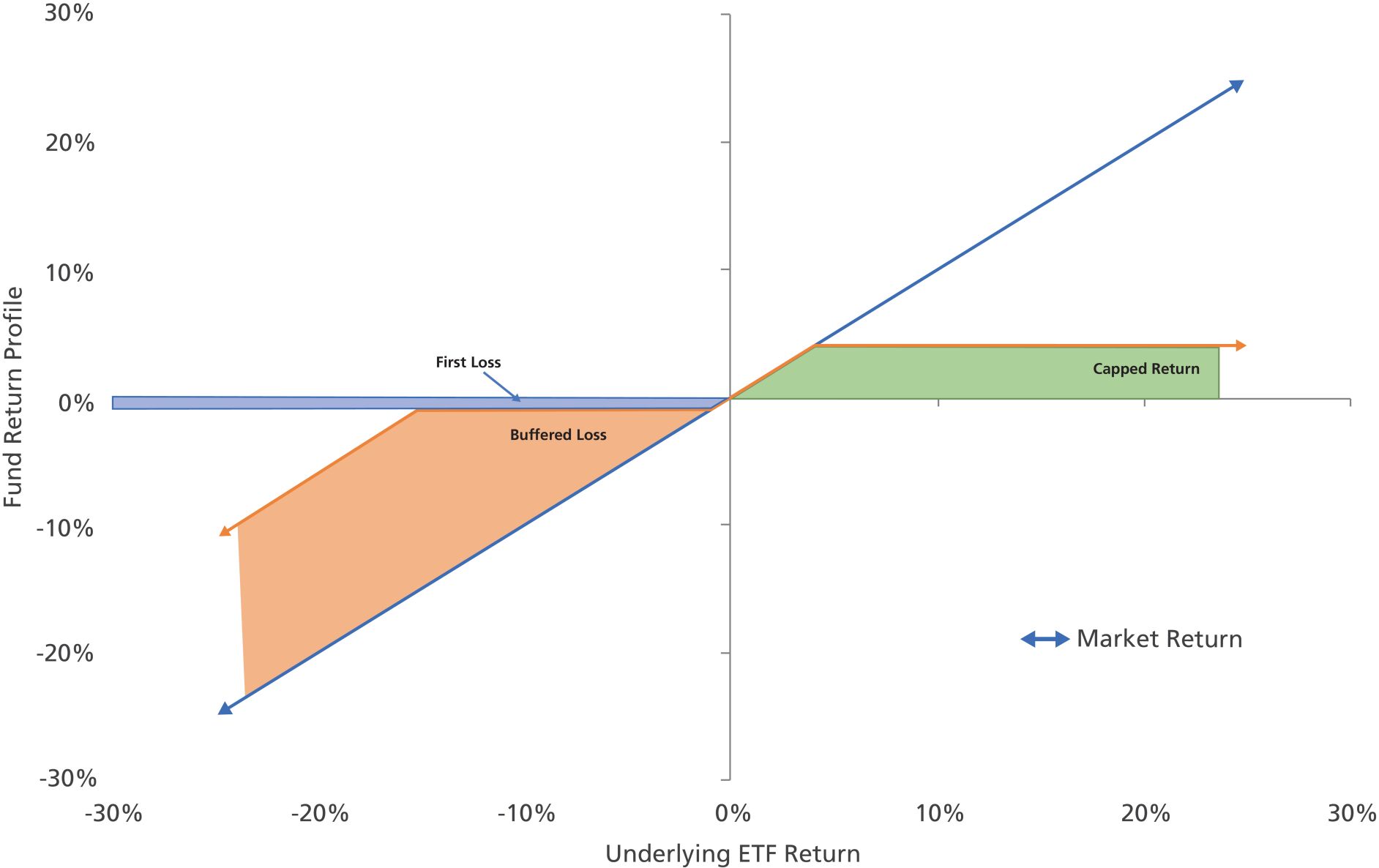
The Fund is an actively-managed exchange-traded fund (“ETF”). The Fund seeks to achieve its investment objective by investing, under normal conditions, substantially all of its assets in a combination of exchange-traded options contracts on an underlying ETF (“Underlying ETF”). The Underlying ETF (initially expected to be the SPDR® S&P 500® ETF Trust) is an ETF that seeks to track the investment results of the S&P 500 Index (the “Underlying ETF’s Index”), which measures the performance of the large-capitalization sector of the U.S. equity market, as determined by S&P Dow Jones Indices LLC. The Fund uses an options strategy that seeks to produce investment outcomes based on the performance of the Underlying ETF, subject to an approximate upside limit typically between 2 and 4% (“Hedge Period Cap”), while also seeking to provide protection against Underlying ETF share
price declines of up to a 15% limit (“Hedge Period Buffer”), over a designated period (typically 90 days, but may be up to 120 days, after portfolio rebalance) (each, a “Hedge Period”). Periodically, the Fund may bear a “first loss” of 1% when doing so permits the Fund to maintain a higher Hedge Period Cap, as explained below. The Adviser seeks to monitor the performance of this Options Portfolio (as defined below) and may rebalance the portfolio (by liquidating all or a portion of the Options Portfolio) at any time to protect capital or lock-in some portfolio gains of the Fund (“Upside Ratchet”), depending on its evaluation of market conditions. If there is an Upside Ratchet, the Hedge Period may be shorter. The Fund does not pursue a “defined outcome” strategy. Defined outcome strategies seek to produce pre-determined investment outcomes based upon the performance of an underlying security or index. The Fund is actively-managed and the Hedge Period Buffer may not protect the Fund against losses. Each Hedge Period is measured from the time of the Fund’s investment in the Options Portfolio, not from the time that an investor purchases shares of the Fund. At the time of purchasing Fund shares, an investor may be unable to determine the Fund’s position relative to the Hedge Period Cap and Hedge Period Buffer.
The Underlying ETF’s Index covers approximately 80% of the market capitalization of all publicly-traded U.S. equity securities. The securities in the Underlying ETF’s Index are weighted based on the float-adjusted market value of their outstanding shares. The Underlying ETF’s Index consists of securities from a broad range of industries. The components of the Underlying ETF’s Index are likely to change over time.
The Fund may also invest in equity securities of large capitalization companies or instruments with similar economic characteristics, S&P 500 Index options, shares of AB Government Money Market Portfolio, U.S. Government securities and cash and money market securities. For these purposes, “large capitalization companies” are those that, at the time of investment, have market capitalizations within the range of market capitalizations of companies appearing in the S&P 500 Index.
Investments. The Fund typically utilizes customized call and put equity or index exchange-traded options contracts that reference the Underlying ETF, referred to as FLexible EXchange Options (“FLEX Options”), as well as other listed options that reference the price performance of the Underlying ETF, the Underlying ETF’s Index, or ETFs that replicate the Underlying ETF’s Index. FLEX Options provide investors with the ability to customize key option contract terms such as strike price, style and expiration date. The Fund intends to transact in four options: long put options, short put options, short call options and long call options (the “Options Portfolio”)—for the purposes of implementing the strategy and establishing the Hedge Period Cap and Hedge Period Buffer.
| Options Portfolio | ||
| Investment Type | Strategy Purpose | |
| Purchase Call (FLEX Option) | Obtain Economic Exposure to Shares of Underlying ETF | |
| Purchase Put (FLEX Option) | Establish Hedge Period Buffer | |
| Write Put (FLEX Option) | Establish End of Hedge Period Buffer | |
| Write Call (FLEX Option) | Establish Hedge Period Cap | |
Hedge Period Cap and Hedge Period Buffer. The Hedge Period Cap is established by selling a call option that will limit the Fund’s ability to realize any increase in the value of the shares of the Underlying ETF above the strike price. The Fund estimates that the Hedge Period Cap will range from between 2% and 4%. For each Hedge Period, the Hedge Period Cap is based on the strike price of the short call options for that Hedge Period. The strike price for the option is expected to change for each Hedge Period, depending on prevailing market conditions, resulting in a different Hedge Period Cap for each Hedge Period.
The Hedge Period Buffer is established by using a combination of options that operates to provide downside protection against a portion of the Underlying ETF’s share price decline for the applicable Hedge Period. The Fund may assume a loss attributable to the first 1% decline in the Underlying ETF’s share price at the time of establishing the Options Portfolio, and then the Hedge Period Buffer protects the Fund against further losses attributable to such share price declines, up to a 15% limit. If prevailing market conditions allow, the Fund will have less than a first loss of 1%. The Hedge Period Buffer does not protect the Fund against losses attributable to Underlying ETF share price declines exceeding 15%.
The Hedge Period Cap and the Hedge Period Buffer are determined without regard to any fees or expenses charged to the Fund, which will have the effect of reducing the Hedge Period Cap or the Hedge Period Buffer for a Hedge Period.
The Fund seeks to generate returns that match those attributable to the secondary market share price of the Underlying ETF, up to the Hedge Period Cap, while limiting downside losses attributable to the Underlying ETF share price declines. The hypothetical
graphical illustration provided below is designed to illustrate the outcomes that the Fund seeks to provide for investors who hold shares for the entirety of a Hedge Period. There is no guarantee that the Fund will be successful in its attempt to provide the outcomes for any Hedge Period.
Hedge Period
The Fund’s options strategy is designed to be implemented over Hedge Periods.
| • |
Options Portfolio Upside Ratchet. Once the Options Portfolio is established for a Hedge Period, the Adviser analyzes whether to engage in the Upside Ratchet of the Options Portfolio based on the Adviser’s assessment of the maximum potential remaining upside return of the portfolio. As a result of the performance of the FLEX Options during the Hedge Period to date, the Fund may have little or no upside available for the remainder of that Hedge Period because the Underlying ETF’s share price has increased in value substantially above the Hedge Period Cap. In these circumstances, the Adviser may, before expiration of the option term, unwind the then-current Options Portfolio and enter into new FLEX Options that establish a new Hedge Period, which would expire on the last business day of the next closest month-end period beyond three months. By engaging in the Upside Ratchet of the Options Portfolio, the Fund retains the potential to capture further increases in value when the market price of the Underlying ETF is increasing. This rebalancing may be implemented over several days, during which the Fund may have a blended portfolio consisting of old options and new options.
|
| • |
Hedge Period Transitions. If there is no Upside Ratchet of the Options Portfolio as the Fund approaches the end of a Hedge Period, the Adviser intends to rebalance the Options Portfolio for a new Hedge Period. This rebalancing may be implemented over several days, during which the Fund may have a blended portfolio consisting of expiring options and new options. At the end of each Hedge Period transition, the Fund expects to hold only new options as a result of this rebalancing.
|
Additional Information about the Fund’s Investment Strategy
In lieu of purchasing a call to obtain economic exposure to the Underlying ETF (as indicated in the chart above), the Fund may seek to gain equivalent economic exposure by engaging in the following. The Fund may purchase a longer maturity near-zero strike call; purchase shares of the Underlying ETF; purchase shares of one or more other ETFs that replicate the Underlying ETF’s Index; purchase a combination of equity securities that in the aggregate seek to track the secondary market share price return of the Underlying ETF (excluding dividends); or invest in money market funds and/or other cash equivalents and purchase and sell a combination of call and put options that seek to replicate exposure to the Underlying ETF.
The Fund is non-diversified under the Investment Company Act of 1940, as amended (the “1940 Act”), which means it may invest a greater portion of its assets in fewer issuers than would otherwise be the case.
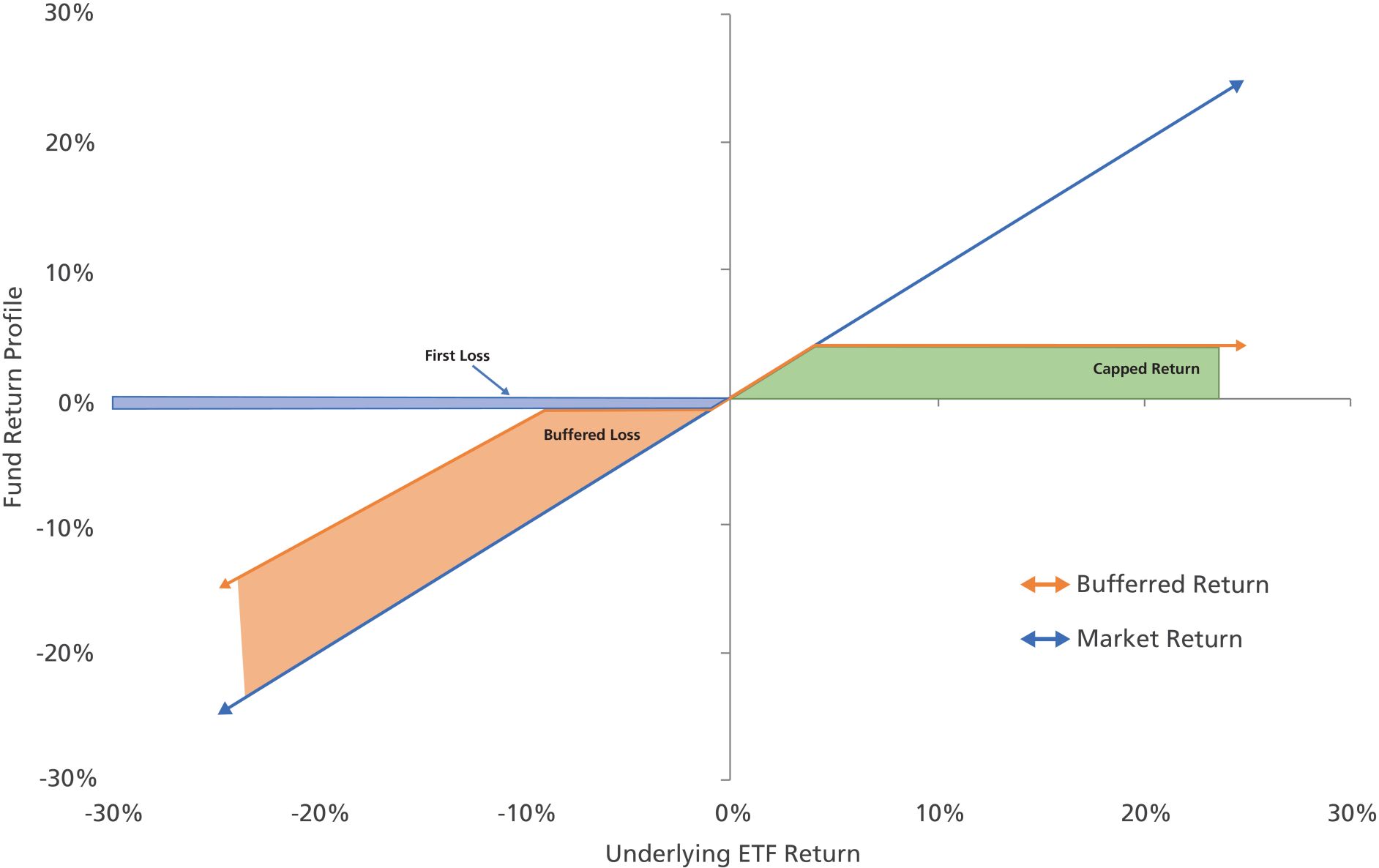
The Fund is an actively-managed exchange-traded fund (“ETF”). The Fund seeks to achieve its investment objective by investing, under normal conditions, substantially all of its assets in a combination of exchange-traded options contracts on an underlying ETF (“Underlying ETF”). The Underlying ETF (initially expected to be the iShares MSCI EAFE ETF) is an ETF that seeks to track the investment results of the MSCI EAFE Index (the “Underlying ETF’s Index”), designed to measure the equity market performance of developed markets outside of the U.S. and Canada, including countries in Europe, Australasia and the Far East, as determined by MSCI, Inc. The Fund uses an options strategy that seeks to produce investment outcomes based on the performance of the Underlying ETF, subject to an approximate upside limit typically between 4% and 5% (“Hedge Period Cap”), while also seeking to provide protection against Underlying ETF share price declines of up to a 10% limit (“Hedge Period Buffer”), over a designated period (typically 90 days, but may be up to 120 days, after portfolio rebalance) (each, a “Hedge Period”). Periodically, the Fund may bear a “first loss” of 2% when doing so permits the Fund to maintain a higher Hedge Period Cap, as explained below. The Adviser seeks to monitor the performance of this Options Portfolio (as defined below) and may rebalance the portfolio (by liquidating all or a portion of the Options Portfolio) at any time to protect capital or lock-in some portfolio gains of the Fund
(“Upside Ratchet”), depending on its evaluation of market conditions. If there is an Upside Ratchet, the Hedge Period may be shorter. The Fund does not pursue a “defined outcome” strategy. Defined outcome strategies seek to produce pre-determined investment outcomes based upon the performance of an underlying security or index. The Fund is actively-managed and the Hedge Period Buffer may not protect the Fund against losses. Each Hedge Period is measured from the time of the Fund’s investment in the Options Portfolio, not from the time that an investor purchases shares of the Fund. At the time of purchasing Fund shares, an investor may be unable to determine the Fund’s position relative to the Hedge Period Cap and Hedge Period Buffer.
The Underlying ETF’s Index covers approximately 85% of the free float-adjusted market capitalization in each country included in the index. The Underlying ETF’s Index is a widely used benchmark for international equity portfolios, as it seeks to capture the return from equity securities of large- and mid-capitalization companies across developed market countries. The Underlying ETF’s Index consists of securities from a broad range of industries. The components of the Underlying ETF’s Index are likely to change over time.
The Fund may also invest in equity securities of large- and mid-capitalization companies or instruments with similar economic characteristics, MSCI EAFE Index options, shares of AB Government Money Market Portfolio, U.S. Government securities and cash and money market securities. For these purposes, “large capitalization companies” are those that, at the time of investment, have market capitalizations within the range of market capitalizations of companies appearing in the MSCI EAFE Index.
Investments. The Fund typically utilizes customized call and put equity or index exchange-traded options contracts that reference the Underlying ETF, referred to as FLexible EXchange Options (“FLEX Options”), as well as other listed options that reference the price performance of the Underlying ETF, the Underlying ETF’s Index, or ETFs that replicate the Underlying ETF’s Index. FLEX Options provide investors with the ability to customize key option contract terms such as strike price, style and expiration date. The Fund intends to transact in four options: long put options, short put options, short call options and long call options (the “Options Portfolio”)—for the purposes of implementing the strategy and establishing the Hedge Period Cap and Hedge Period Buffer.
| Options Portfolio | ||
| Investment Type | Strategy Purpose | |
| Purchase Call (FLEX Option) | Obtain Economic Exposure to Shares of Underlying ETF | |
| Purchase Put (FLEX Option) | Establish Hedge Period Buffer | |
| Write Put (FLEX Option) | Establish End of Hedge Period Buffer | |
| Write Call (FLEX Option) | Establish Hedge Period Cap | |
Hedge Period Cap and Hedge Period Buffer. The Hedge Period Cap is established by selling a call option that will limit the Fund’s ability to realize any increase in the value of the shares of the Underlying ETF above the strike price. The Fund estimates that the Hedge Period Cap will range from between 4% and 5%. For each Hedge Period, the Hedge Period Cap is based on the strike price of the short call options for that Hedge Period. The strike price for the option is expected to change for each Hedge Period, depending on prevailing market conditions, resulting in a different Hedge Period Cap for each Hedge Period.
The Hedge Period Buffer is established by using a combination of options that operates to provide downside protection against a portion of the Underlying ETF’s share price decline for the applicable Hedge Period. The Fund may assume a loss attributable to the first 2% decline in the Underlying ETF’s share price at the time of establishing the Options Portfolio, and then the Hedge Period Buffer protects the Fund against further losses attributable to such share price declines, up to a 10% limit. If prevailing market conditions allow, the Fund will have less than a first loss of 2%. The Hedge Period Buffer does not protect the Fund against losses attributable to Underlying ETF share price declines exceeding 10%.
The Hedge Period Cap and the Hedge Period Buffer are determined without regard to any fees or expenses charged to the Fund, which will have the effect of reducing the Hedge Period Cap or the Hedge Period Buffer for a Hedge Period.
The Fund seeks to generate returns that match those attributable to the secondary market share price of the Underlying ETF, up to the Hedge Period Cap, while limiting downside losses attributable to the Underlying ETF share price declines. The hypothetical
graphical illustration provided below is designed to illustrate the outcomes that the Fund seeks to provide for investors who hold shares for the entirety of a Hedge Period. There is no guarantee that the Fund will be successful in its attempt to provide the outcomes for any Hedge Period.
Hedge Period
The Fund’s options strategy is designed to be implemented over Hedge Periods.
| • |
Options Portfolio Upside Ratchet. Once the Options Portfolio is established for a Hedge Period, the Adviser analyzes whether to engage in the Upside Ratchet of the Options Portfolio based on the Adviser’s assessment of the maximum potential remaining upside return of the portfolio. As a result of the performance of the FLEX Options during the Hedge Period to date, the Fund may have little or no upside available for the remainder of that Hedge Period because the Underlying ETF’s share price has increased in value substantially above the Hedge Period Cap. In these circumstances, the Adviser may, before expiration of the option term, unwind the then-current Options Portfolio and enter into new FLEX Options that establish a new Hedge Period, which would expire on the last business day of the next closest month-end period beyond three months. By engaging in the Upside Ratchet of the Options Portfolio, the Fund retains the potential to capture further increases in value when the market price of the Underlying ETF is increasing. This rebalancing may be implemented over several days, during which the Fund may have a blended portfolio consisting of old options and new options.
|
| • |
Hedge Period Transitions. If there is no Upside Ratchet of the Options Portfolio as the Fund approaches the end of a Hedge Period, the Adviser intends to rebalance the Options Portfolio for a new Hedge Period. This rebalancing may be implemented over several days, during which the Fund may have a blended portfolio consisting of expiring options and new options. At the end of each Hedge Period transition, the Fund expects to hold only new options as a result of this rebalancing.
|
Additional Information about the Fund’s Investment Strategy
In lieu of purchasing a call to obtain economic exposure to the Underlying ETF (as indicated in the chart above), the Fund may seek to gain equivalent economic exposure by engaging in the following. The Fund may purchase a longer maturity near-zero strike call; purchase shares of the Underlying ETF; purchase shares of one or more other ETFs that replicate the Underlying ETF’s Index; purchase a combination of equity securities that in the aggregate seek to track the share price return of the Underlying ETF (excluding dividends); or invest in money market funds and/or other cash equivalents and purchase and sell a combination of call and put options that seek to replicate exposure to the Underlying ETF.
The Fund is non-diversified under the Investment Company Act of 1940, as amended (the “1940 Act”), which means it may invest a greater portion of its assets in fewer issuers than would otherwise be the case.
The Fund is an actively-managed exchange-traded fund (“ETF”). The Fund seeks to achieve its investment objective by investing, under normal conditions, substantially all of its assets in a combination of exchange-traded options contracts on an underlying ETF (“Underlying ETF”). The Underlying ETF (initially expected to be the SPDR® S&P 500® ETF Trust) is an ETF that seeks to track the investment results of the S&P 500 Index (the “Underlying ETF’s Index”), which measures the performance of the large-capitalization sector of the U.S. equity market, as determined by S&P Dow Jones Indices LLC. The Fund uses an options strategy that seeks to produce investment outcomes based on the performance of the Underlying ETF, subject to an approximate upside limit typically between 4% and 5% (“Hedge Period Cap”), while also seeking to provide protection against Underlying ETF share price declines of up to a 10% limit (“Hedge Period Buffer”), over a designated period (typically 90 days, but may be up to 120 days, after portfolio rebalance) (each, a “Hedge Period”). Periodically, the Fund may bear a “first loss” of 2% when doing so permits the Fund to maintain a higher Hedge Period Cap, as explained below. The Adviser seeks to monitor the performance of this Options Portfolio (as defined below) and may rebalance the portfolio (by liquidating all or a portion of the Options Portfolio) at any time to protect capital or lock-in some portfolio gains of the Fund (“Upside Ratchet”), depending on its evaluation of market conditions. If
there is an Upside Ratchet, the Hedge Period may be shorter. The Fund does not pursue a “defined outcome” strategy. Defined outcome strategies seek to produce pre-determined investment outcomes based upon the performance of an underlying security or index. The Fund is actively-managed and the Hedge Period Buffer may not protect the Fund against losses. Each Hedge Period is measured from the time of the Fund’s investment in the Options Portfolio, not from the time that an investor purchases shares of the Fund. At the time of purchasing Fund shares, an investor may be unable to determine the Fund’s position relative to the Hedge Period Cap and Hedge Period Buffer.
The Underlying ETF’s Index covers approximately 80% of the market capitalization of all publicly-traded U.S. equity securities. The securities in the Underlying ETF’s Index are weighted based on the float-adjusted market value of their outstanding shares. The Underlying ETF’s Index consists of securities from a broad range of industries. The components of the Underlying ETF’s Index are likely to change over time.
The Fund may also invest in equity securities of large capitalization companies or instruments with similar economic characteristics, S&P 500 Index options, shares of AB Government Money Market Portfolio, U.S. Government securities and cash and money market securities. For these purposes, “large capitalization companies” are those that, at the time of investment, have market capitalizations within the range of market capitalizations of companies appearing in the S&P 500 Index.
Investments. The Fund typically utilizes customized call and put equity or index exchange-traded options contracts that reference the Underlying ETF, referred to as FLexible EXchange Options (“FLEX Options”), as well as other listed options that reference the price performance of the Underlying ETF, the Underlying ETF’s Index, or ETFs that replicate the Underlying ETF’s Index. FLEX Options provide investors with the ability to customize key option contract terms such as strike price, style and expiration date. The Fund intends to transact in four options: long put options, short put options, short call options and long call options (the “Options Portfolio”)—for the purposes of implementing the strategy and establishing the Hedge Period Cap and Hedge Period Buffer.
| Options Portfolio | ||
| Investment Type | Strategy Purpose | |
| Purchase Call (FLEX Option) | Obtain Economic Exposure to Shares of Underlying ETF | |
| Purchase Put (FLEX Option) | Establish Hedge Period Buffer | |
| Write Put (FLEX Option) | Establish End of Hedge Period Buffer | |
| Write Call (FLEX Option) | Establish Hedge Period Cap | |
Hedge Period Cap and Hedge Period Buffer. The Hedge Period Cap is established by selling a call option that will limit the Fund’s ability to realize any increase in the value of the shares of the Underlying ETF above the strike price. The Fund estimates that the Hedge Period Cap will range from between 4% and 5%. For each Hedge Period, the Hedge Period Cap is based on the strike price of the short call options for that Hedge Period. The strike price for the option is expected to change for each Hedge Period, depending on prevailing market conditions, resulting in a different Hedge Period Cap for each Hedge Period.
The Hedge Period Buffer is established by using a combination of options that operates to provide downside protection against a portion of the Underlying ETF’s share price decline for the applicable Hedge Period. The Fund may assume a loss attributable to the first 2% decline in the Underlying ETF’s share price at the time of establishing the Options Portfolio, and then the Hedge Period Buffer protects the Fund against further losses attributable to such share price declines, up to a 10% limit. If prevailing market conditions allow, the Fund will have less than a first loss of 2%. The Hedge Period Buffer does not protect the Fund against losses attributable to Underlying ETF share price declines exceeding 10%.
The Hedge Period Cap and the Hedge Period Buffer are determined without regard to any fees or expenses charged to the Fund, which will have the effect of reducing the Hedge Period Cap or the Hedge Period Buffer for a Hedge Period.
The Fund seeks to generate returns that match those attributable to the secondary market share price of the Underlying ETF, up to the Hedge Period Cap, while limiting downside losses attributable to the Underlying ETF share price declines. The hypothetical
graphical illustration provided below is designed to illustrate the outcomes that the Fund seeks to provide for investors who hold shares for the entirety of a Hedge Period. There is no guarantee that the Fund will be successful in its attempt to provide the outcomes for any Hedge Period.
Hedge Period
The Fund’s options strategy is designed to be implemented over Hedge Periods.
| • |
Options Portfolio Upside Ratchet. Once the Options Portfolio is established for a Hedge Period, the Adviser analyzes whether to engage in the Upside Ratchet of the Options Portfolio based on the Adviser’s assessment of the maximum potential remaining upside return of the portfolio. As a result of the performance of the FLEX Options during the Hedge Period to date, the Fund may have little or no upside available for the remainder of that Hedge Period because the Underlying ETF’s share price has increased in value substantially above the Hedge Period Cap. In these circumstances, the Adviser may, before expiration of the option term, unwind the then-current Options Portfolio and enter into new FLEX Options that establish a new Hedge Period, which would expire on the last business day of the next closest month-end period beyond three months. By engaging in the Upside Ratchet of the Options Portfolio, the Fund retains the potential to capture further increases in value when the market price of the Underlying ETF is increasing. This rebalancing may be implemented over several days, during which the Fund may have a blended portfolio consisting of old options and new options.
|
| • |
Hedge Period Transitions. If there is no Upside Ratchet of the Options Portfolio as the Fund approaches the end of a Hedge Period, the Adviser intends to rebalance the Options Portfolio for a new Hedge Period. This rebalancing may be implemented over several days, during which the Fund may have a blended portfolio consisting of expiring options and new options. At the end of each Hedge Period transition, the Fund expects to hold only new options as a result of this rebalancing.
|
Additional Information about the Fund’s Investment Strategy
In lieu of purchasing a call to obtain economic exposure to the Underlying ETF (as indicated in the chart above), the Fund may seek to gain equivalent economic exposure by engaging in the following. The Fund may purchase a longer maturity near-zero strike call; purchase shares of the Underlying ETF; purchase shares of one or more other ETFs that replicate the Underlying ETF’s Index; purchase a combination of equity securities that in the aggregate seek to track the secondary market share price return of the Underlying ETF (excluding dividends); or invest in money market funds and/or other cash equivalents and purchase and sell a combination of call and put options that seek to replicate exposure to the Underlying ETF.
The Fund is non-diversified under the Investment Company Act of 1940, as amended (the “1940 Act”), which means it may invest a greater portion of its assets in fewer issuers than would otherwise be the case.