N-4
Apr. 30, 2026
USD ($)
yr
contract
Dec. 31, 2025
Dec. 31, 2024
Dec. 31, 2023
Dec. 31, 2022
Dec. 31, 2021
Dec. 31, 2020
Dec. 31, 2019
Dec. 31, 2018
Dec. 31, 2017
Dec. 31, 2016
FEES, EXPENSES | Location in Prospectus | |||||||||||||||||||
Are There Charges or Adjustments for Early Withdrawals? | Yes. If you surrender your Contract or make a partial Withdrawal from the Contract greater than the Free Withdrawal amount during the first six Contract Years, you will be assessed a Withdrawal Charge of up to 8% of the Contract Value withdrawn less the Free Withdrawal amount. For example, if you make a withdrawal of $100,000 in the first Contract Year, you could pay a withdrawal charge of up to $8,000. This loss will be greater if there is a negative adjustment to the Interim Value, taxes, or tax penalties. If you make a Withdrawal from your Contract, including a partial Withdrawal, Surrender, payment of a Death Benefit annuitization, or exercise a Performance Lock, your Contract Value may be subject to an Equity Adjustment. The portion of amounts withdrawn from any Index-Linked Segment Option that are subject to a Withdrawal Charge during the first six Contract Years will also be subject to an Interest Adjustment except on Segment Start Dates, Segment End Dates, and when your money is allocated to the Holding Account. In extreme situations you could lose up to 100% of your Segment Value due to a negative Interest Adjustment on money allocated to an Index-Linked Segment Option. For example, if you allocate $100,000 to a 2-year Index-Linked Segment Option and during the first six Contract Years withdraw the entire amount before the 2-year Segment Term Period has elapsed, you could lose up to $100,000 due to a negative Interest Adjustment. This loss will be greater (but never more than 100% of your investment) if you also pay a Withdrawal Charge, taxes or tax penalties. In extreme circumstances you could also lose up to 100% of your Segment Value due to a negative Equity Adjustment on money allocated to an Index-Linked Segment Option. For example, if you allocate $100,000 to a 2-year Index-Linked Segment Option and during the first six Contract Years withdraw the entire amount before the 2-year Segment Term Period has elapsed, you could lose up to 100,000 due to a negative Equity Adjustment. This loss will be greater (but never more than 100% of your investment) if you also pay a Withdrawal Charge, taxes or tax penalties. | Fee Table Charges and Adjustments – Withdrawal Charges Charges and Adjustments – Interest Adjustment Charges and Adjustments –Equity Adjustment Appendix B - Segment Interim Value Examples Appendix C - Performance Lock Examples | ||||||||||||||||||
Are There Transaction Charges? | No. The Contract does not impose any front-end load or charge on transfers between Segment Options. | N/A | ||||||||||||||||||
Are There Ongoing Fees and Expenses? | Yes. There is an implicit ongoing fee on the Index-Linked Segment Options to the extent that your participation in index gains is limited by the Cap Rate, Trigger Rate, or a Performance Lock that may be exercised for each Point-to-Point, Trigger, Dual Trigger, Dual Direction, and Performance Blend Segment Option. This means that your returns may be lower than index gains. In return for accepting this limit on index gains, you will receive some protection from index losses. | Fee Table | ||||||||||||||||||
RISKS | Location in Prospectus | |||||||||||||||||||
Is There a Risk of Loss from Poor Performance? | Yes. You could lose money by investing in the Contract. Currently, each Index-Linked Segment Option offered has a Buffer Rate of 10%, 20% or 30%. This means you could lose up to 90% of the amount you invest in an Index-Linked Segment Option with a 10% Buffer Rate due to poor investment performance, up to 80% with a 20% Buffer Rate, and up to 70% with a 30% Buffer Rate. The Buffer Rate will always be at least 10%. | Principal Risks of Investing in the Contract - Risk of Loss | ||||||||||||||||||
Is this a Short-Term Investment? | No. The Contract is not a short-term investment and is not appropriate for an investor who needs ready access to cash because the Contract is designed to provide for the accumulation of retirement savings and income on a long-term basis. As such, you should not use the Contract as a short-term investment. Withdrawals may be subject to a Withdrawal Charge, federal and state income taxes and tax penalties. Withdrawals from an Index-Linked Segment Option before the Segment End Date may also be subject to a negative Equity Adjustment and Withdrawals taken from any Segment Option during the first six Contract Years may be subject to a negative Interest Adjustment. | Principal Risks of Investing in the Contract - Liquidity Risk | ||||||||||||||||||
Any amounts withdrawn will also reduce your future growth potential from positive index performance because any subsequent positive Segment Credits will be lower due to the reduction in the Contract Value. The reduction in Contract Value may be significant, and may be greater than the amount withdrawn. Any amounts withdrawn could also result in significant reductions to your Death Benefit and other benefits available under the Contract. If you want to transfer the Segment Value to one or more Segment Options, you must notify us at least two Business Days prior to the next Segment End Date, and the Segment Value will be re-allocated following the Segment End Date according to your instructions. If you do not request a transfer of Segment Value on the Segment End Date, your Segment Value will remain in the same Segment Option(s), if available, subject to new Cap Rates, Participation Rates, Downside Participation Rates, Trigger Rates, and Annual Interest Rates. If you exercise a Performance Lock and do not instruct us otherwise, transfers between Segment Options at the next Segment End Date will be governed by the default re-allocation rules. Please see the “Performance Lock” section for more information. | ||||||||||||||||||||
What Are the Risks Associated with the Investment Options? | An investment in the Contract is subject to the risk of poor investment performance. Investment performance will vary depending on the performance of the Reference Index for the Index-Linked Segment Options under the Contract. Each Segment Option, including the Fixed Segment Option, will have its own unique risks. You should review the Segment Options before making an investment decision. For investments in a Point-to-Point, Dual Direction, and Performance Blend Segment Option, the Cap Rate will limit positive index performance (e.g., limited upside). For example, if an Index-Linked Segment Option has a Cap Rate of 8% and the Index Change is 12%, the Segment Credit on the Segment End Date would be 8%. For investments in a Trigger Segment Option, the Trigger Rate will also limit positive index performance (e.g., limited upside). For example, if a Trigger Segment Option has a Trigger Rate of 7% and the Index Change is 12%, the Segment Credit on the Segment End Date would be 7%. For investments in a Dual Trigger Segment Option, the Trigger Rate will also limit positive index performance (e.g., limited upside). For example, if a Dual Trigger Segment Option has a Trigger Rate of 6% and the Index Change is 12%, the Segment Credit on the Segment End Date would be 6%. | Principal Risks of Investing in the Contract | ||||||||||||||||||
In addition, if you exercise the Performance Lock provision on an Index-Linked Segment Option, you will not participate in any positive index performance that occurs following the application of the Performance Lock. As a result, you may earn less than the index gain. For investments in a Point-to-Point, Dual Direction, and Performance Blend Segment Option, we also apply a Participation Rate after the application of the Cap Rate, when calculating Segment Credits. For example, if an Index-Linked Segment Option is uncapped and has a Participation Rate of 125%, and the Index Change is 12%, the Segment Credit on the Segment End Date would be 15%. For investments in a Dual Direction Segment Option, we also apply a Downside Participation Rate to negative index performance that is fully offset by the Buffer Rate. For example, if a Dual Direction Segment Option has a Buffer Rate of 10% and a Downside Participation Rate of 120%, and the Index Change is -5%, the Segment Credit on the Segment End Date would be 6%. For investments in an Index-Linked Segment Option, the Buffer Rate will limit negative returns (e.g., limited protection in the case of market decline). For example, if the Index-Linked Segment Option has a Buffer Rate of 10% and the Index Change is −25%, we will absorb the first 10% of negative index performance, and the Segment Credit will be -15% (the remaining amount of the negative index performance) on the Segment End Date. Each Reference Index is a price return index, not a total return index, and therefore does not reflect dividends paid on the securities composing the Reference Index. This will reduce the Index Change and will cause the Reference Index to underperform a direct investment in the securities composing the Reference Index. | ||||||||||||||||||||
What Are the Risks Related to the Insurance Company? | An investment in the Contract is subject to risks related to the Company. Any payment obligations under the Contract, including the Index-Linked Segment Options and the Fixed Option, guarantees and benefits, are subject to the Company’s claims-paying ability. You may obtain more information about the Company’s financial strength by contacting us at (888) 266-8489. | Principal Risks of Investing in the Contract - Our Financial Strength and Claims Paying Ability | ||||||||||||||||||
RESTRICTIONS | ||||||||||||||||||||
Are There Restrictions on the Investment Options? | Yes. You cannot transfer out of an Index-Linked Segment Option to another Segment Option prior to the Segment End Date. If you do not want to remain in an Index-Linked Segment Option until the Segment End Date, your only options are to exercise a Performance Lock, make a Withdrawal out of an Index-Linked Segment Option, or surrender the Contract. The amount you would receive would be based on the Interim Value. For Withdrawals and surrenders, Withdrawal Charges may also apply. We will notify you of the applicable Cap Rate, Participation Rate, Downside Participation Rate, and Trigger Rate for the new Segment Term Period for each Index-Linked Segment Option at least 15 days prior to the Segment End Date of the prior Segment Term Period. You may elect a Segment Option with a six-year Segment Term Period only during the first Contract Year. The Performance Blend Segment Option and Dual Direction Segment Option are available only with a six-year Segment Term Period. Six-year Segment Options are not available for renewal. Two-year Segment Options are not available for renewal after the first six Contract Years. Segment Options available beyond the Withdrawal Charge Period will be limited to one-year Segment Term Periods. If you do not request a transfer or withdraw the Segment Value, Segment Options with six-year and two-year Segment Term Periods ending on or after the last day of the Withdrawal Charge Period will follow the default re-allocation rules noted in Appendix A. If the publication of a Reference Index is discontinued or the calculation of the Index is substantially changed, we have the right to substitute an alternative index prior to the Segment End Date. If we substitute an index for an existing Index-Linked Segment Option during a Segment Term Period, we will not change the applicable Buffer Rate, Cap Rate, Participation Rate, Downside Participation Rate, or Trigger Rate. We will attempt to choose a new index that has a similar objective and risk profile to the existing Reference Index. The availability of Segment Options and/or Reference Indices may vary by financial intermediary. Please see “Appendix D - Financial Intermediary Variation Chart” for details. | The Insurance Company and Investment Options - The Segment Options Principal Risks of Investing in the Contract -Discontinuation or Substitution of an Index Appendix D - Financial Intermediary Variation Chart | ||||||||||||||||||
Are There Any Restrictions on Contract Benefits? | Yes. •There are restrictions and limitations relating to benefits offered under the Contract (Death Benefit, Free Withdrawals, Required Minimum Distributions, Performance Lock, Confinement Waiver, Terminal Illness Waiver). •Except as otherwise provided in the prospectus, the Confinement Waiver, Terminal Illness Waiver, and Guaranteed Minimum Death Benefit may not be terminated by the Company. Please see the “Confinement Waiver”, “Terminal Illness Waiver”, and “Death Benefit” sections for information about actions that can cause these benefits to terminate. •Withdrawals will reduce the Death Benefit, perhaps by more than the amount withdrawn. The availability of contract benefits may vary by financial intermediary. Please see “Appendix D - Financial Intermediary Variation Chart” for details. | Benefits Available Under the Contract Appendix D - Financial Intermediary Variation Chart | ||||||||||||||||||
| TAXES | ||||||||||||||||||||
What are the Contract’s Tax Implications? | You should consult with a tax professional to determine the tax implications of an investment in, and payments received under, the Contract. Withdrawals will be subject to ordinary income tax and may be subject to tax penalties. Generally, you are not taxed until you make a Withdrawal from the Contract. There is no additional tax benefit to the investor if the Contract is purchased as a Qualified Contract. | Taxes | ||||||||||||||||||
CONFLICTS OF INTEREST | Location in Prospectus | |||||||||||||||||||
How are Financial Professionals Compensated? | Some Financial Professionals may receive compensation for selling the Contract to you, both in the form of commissions and in the form of production incentives as explained in the “Distribution” section. Financial professionals may also receive additional compensation for enhanced marketing opportunities and other services (commonly referred to as “marketing allowances”). This conflict of interest may influence the financial professional to recommend this Contract over another investment. | Other Information - Distribution | ||||||||||||||||||
Should I Exchange My Contract? | Some financial professionals may have a financial incentive to offer a new contract in place of the one you already own. You should only exchange your Contract if you determine, after comparing the features, fees, and risks of both contracts, that it is preferable to purchase the new contract rather than continue to own your existing Contract. | Other Information - Distribution | ||||||||||||||||||
Yes. If you surrender your Contract or make a partial Withdrawal from the Contract greater than the Free Withdrawal amount during the first six Contract Years, you will be assessed a Withdrawal Charge of up to 8% of the Contract Value withdrawn less the Free Withdrawal amount. For example, if you make a withdrawal of $100,000 in the first Contract Year, you could pay a withdrawal charge of up to $8,000. This loss will be greater if there is a negative adjustment to the Interim Value, taxes, or tax penalties.
If you make a Withdrawal from your Contract, including a partial Withdrawal, Surrender, payment of a Death Benefit annuitization, or exercise a Performance Lock, your Contract Value may be subject to an Equity Adjustment. The portion of amounts withdrawn from any Index-Linked Segment Option that are subject to a Withdrawal Charge during the first six Contract Years will also be subject to an Interest Adjustment except on Segment Start Dates, Segment End Dates, and when your money is allocated to the Holding Account.
In extreme situations you could lose up to 100% of your Segment Value due to a negative Interest Adjustment on money allocated to an Index-Linked Segment Option. For example, if you allocate $100,000 to a 2-year Index-Linked Segment Option and during the first six Contract Years withdraw the entire amount before the 2-year Segment Term Period has elapsed, you could lose up to $100,000 due to a negative Interest Adjustment. This loss will be greater (but never more than 100% of your investment) if you also pay a Withdrawal Charge, taxes or tax penalties.
In extreme circumstances you could also lose up to 100% of your Segment Value due to a negative Equity Adjustment on money allocated to an Index-Linked Segment Option. For example, if you allocate $100,000 to a 2-year Index-Linked Segment Option and during the first six Contract Years withdraw the entire amount before the 2-year Segment Term Period has elapsed, you could lose up to 100,000 due to a negative Equity Adjustment. This loss will be greater (but never more than 100% of your investment) if you also pay a Withdrawal Charge, taxes or tax penalties.
No. The Contract does not impose any front-end load or charge on transfers between Segment Options.
If you make a Withdrawal from your Contract, including a partial Withdrawal, Surrender, payment of a Death Benefit annuitization, or exercise a Performance Lock, your Contract Value may be subject to an Equity Adjustment.
Yes. There is an implicit ongoing fee on the Index-Linked Segment Options to the extent that your participation in index gains is limited by the Cap Rate, Trigger Rate, or a Performance Lock that may be exercised for each Point-to-Point, Trigger, Dual Trigger, Dual Direction, and Performance Blend Segment Option. This means that your returns may be lower than index gains. In return for accepting this limit on index gains, you will receive some protection from index losses.
FEES, EXPENSES | Location in Prospectus | |||||||||||||||||||
Are There Charges or Adjustments for Early Withdrawals? | Yes. If you surrender your Contract or make a partial Withdrawal from the Contract greater than the Free Withdrawal amount during the first six Contract Years, you will be assessed a Withdrawal Charge of up to 8% of the Contract Value withdrawn less the Free Withdrawal amount. For example, if you make a withdrawal of $100,000 in the first Contract Year, you could pay a withdrawal charge of up to $8,000. This loss will be greater if there is a negative adjustment to the Interim Value, taxes, or tax penalties. If you make a Withdrawal from your Contract, including a partial Withdrawal, Surrender, payment of a Death Benefit annuitization, or exercise a Performance Lock, your Contract Value may be subject to an Equity Adjustment. The portion of amounts withdrawn from any Index-Linked Segment Option that are subject to a Withdrawal Charge during the first six Contract Years will also be subject to an Interest Adjustment except on Segment Start Dates, Segment End Dates, and when your money is allocated to the Holding Account. In extreme situations you could lose up to 100% of your Segment Value due to a negative Interest Adjustment on money allocated to an Index-Linked Segment Option. For example, if you allocate $100,000 to a 2-year Index-Linked Segment Option and during the first six Contract Years withdraw the entire amount before the 2-year Segment Term Period has elapsed, you could lose up to $100,000 due to a negative Interest Adjustment. This loss will be greater (but never more than 100% of your investment) if you also pay a Withdrawal Charge, taxes or tax penalties. In extreme circumstances you could also lose up to 100% of your Segment Value due to a negative Equity Adjustment on money allocated to an Index-Linked Segment Option. For example, if you allocate $100,000 to a 2-year Index-Linked Segment Option and during the first six Contract Years withdraw the entire amount before the 2-year Segment Term Period has elapsed, you could lose up to 100,000 due to a negative Equity Adjustment. This loss will be greater (but never more than 100% of your investment) if you also pay a Withdrawal Charge, taxes or tax penalties. | Fee Table Charges and Adjustments – Withdrawal Charges Charges and Adjustments – Interest Adjustment Charges and Adjustments –Equity Adjustment Appendix B - Segment Interim Value Examples Appendix C - Performance Lock Examples | ||||||||||||||||||
Are There Transaction Charges? | No. The Contract does not impose any front-end load or charge on transfers between Segment Options. | N/A | ||||||||||||||||||
Are There Ongoing Fees and Expenses? | Yes. There is an implicit ongoing fee on the Index-Linked Segment Options to the extent that your participation in index gains is limited by the Cap Rate, Trigger Rate, or a Performance Lock that may be exercised for each Point-to-Point, Trigger, Dual Trigger, Dual Direction, and Performance Blend Segment Option. This means that your returns may be lower than index gains. In return for accepting this limit on index gains, you will receive some protection from index losses. | Fee Table | ||||||||||||||||||
RISKS | Location in Prospectus | |||||||||||||||||||
Is There a Risk of Loss from Poor Performance? | Yes. You could lose money by investing in the Contract. Currently, each Index-Linked Segment Option offered has a Buffer Rate of 10%, 20% or 30%. This means you could lose up to 90% of the amount you invest in an Index-Linked Segment Option with a 10% Buffer Rate due to poor investment performance, up to 80% with a 20% Buffer Rate, and up to 70% with a 30% Buffer Rate. The Buffer Rate will always be at least 10%. | Principal Risks of Investing in the Contract - Risk of Loss | ||||||||||||||||||
Is this a Short-Term Investment? | No. The Contract is not a short-term investment and is not appropriate for an investor who needs ready access to cash because the Contract is designed to provide for the accumulation of retirement savings and income on a long-term basis. As such, you should not use the Contract as a short-term investment. Withdrawals may be subject to a Withdrawal Charge, federal and state income taxes and tax penalties. Withdrawals from an Index-Linked Segment Option before the Segment End Date may also be subject to a negative Equity Adjustment and Withdrawals taken from any Segment Option during the first six Contract Years may be subject to a negative Interest Adjustment. | Principal Risks of Investing in the Contract - Liquidity Risk | ||||||||||||||||||
Any amounts withdrawn will also reduce your future growth potential from positive index performance because any subsequent positive Segment Credits will be lower due to the reduction in the Contract Value. The reduction in Contract Value may be significant, and may be greater than the amount withdrawn. Any amounts withdrawn could also result in significant reductions to your Death Benefit and other benefits available under the Contract. If you want to transfer the Segment Value to one or more Segment Options, you must notify us at least two Business Days prior to the next Segment End Date, and the Segment Value will be re-allocated following the Segment End Date according to your instructions. If you do not request a transfer of Segment Value on the Segment End Date, your Segment Value will remain in the same Segment Option(s), if available, subject to new Cap Rates, Participation Rates, Downside Participation Rates, Trigger Rates, and Annual Interest Rates. If you exercise a Performance Lock and do not instruct us otherwise, transfers between Segment Options at the next Segment End Date will be governed by the default re-allocation rules. Please see the “Performance Lock” section for more information. | ||||||||||||||||||||
What Are the Risks Associated with the Investment Options? | An investment in the Contract is subject to the risk of poor investment performance. Investment performance will vary depending on the performance of the Reference Index for the Index-Linked Segment Options under the Contract. Each Segment Option, including the Fixed Segment Option, will have its own unique risks. You should review the Segment Options before making an investment decision. For investments in a Point-to-Point, Dual Direction, and Performance Blend Segment Option, the Cap Rate will limit positive index performance (e.g., limited upside). For example, if an Index-Linked Segment Option has a Cap Rate of 8% and the Index Change is 12%, the Segment Credit on the Segment End Date would be 8%. For investments in a Trigger Segment Option, the Trigger Rate will also limit positive index performance (e.g., limited upside). For example, if a Trigger Segment Option has a Trigger Rate of 7% and the Index Change is 12%, the Segment Credit on the Segment End Date would be 7%. For investments in a Dual Trigger Segment Option, the Trigger Rate will also limit positive index performance (e.g., limited upside). For example, if a Dual Trigger Segment Option has a Trigger Rate of 6% and the Index Change is 12%, the Segment Credit on the Segment End Date would be 6%. | Principal Risks of Investing in the Contract | ||||||||||||||||||
In addition, if you exercise the Performance Lock provision on an Index-Linked Segment Option, you will not participate in any positive index performance that occurs following the application of the Performance Lock. As a result, you may earn less than the index gain. For investments in a Point-to-Point, Dual Direction, and Performance Blend Segment Option, we also apply a Participation Rate after the application of the Cap Rate, when calculating Segment Credits. For example, if an Index-Linked Segment Option is uncapped and has a Participation Rate of 125%, and the Index Change is 12%, the Segment Credit on the Segment End Date would be 15%. For investments in a Dual Direction Segment Option, we also apply a Downside Participation Rate to negative index performance that is fully offset by the Buffer Rate. For example, if a Dual Direction Segment Option has a Buffer Rate of 10% and a Downside Participation Rate of 120%, and the Index Change is -5%, the Segment Credit on the Segment End Date would be 6%. For investments in an Index-Linked Segment Option, the Buffer Rate will limit negative returns (e.g., limited protection in the case of market decline). For example, if the Index-Linked Segment Option has a Buffer Rate of 10% and the Index Change is −25%, we will absorb the first 10% of negative index performance, and the Segment Credit will be -15% (the remaining amount of the negative index performance) on the Segment End Date. Each Reference Index is a price return index, not a total return index, and therefore does not reflect dividends paid on the securities composing the Reference Index. This will reduce the Index Change and will cause the Reference Index to underperform a direct investment in the securities composing the Reference Index. | ||||||||||||||||||||
What Are the Risks Related to the Insurance Company? | An investment in the Contract is subject to risks related to the Company. Any payment obligations under the Contract, including the Index-Linked Segment Options and the Fixed Option, guarantees and benefits, are subject to the Company’s claims-paying ability. You may obtain more information about the Company’s financial strength by contacting us at (888) 266-8489. | Principal Risks of Investing in the Contract - Our Financial Strength and Claims Paying Ability | ||||||||||||||||||
RESTRICTIONS | ||||||||||||||||||||
Are There Restrictions on the Investment Options? | Yes. You cannot transfer out of an Index-Linked Segment Option to another Segment Option prior to the Segment End Date. If you do not want to remain in an Index-Linked Segment Option until the Segment End Date, your only options are to exercise a Performance Lock, make a Withdrawal out of an Index-Linked Segment Option, or surrender the Contract. The amount you would receive would be based on the Interim Value. For Withdrawals and surrenders, Withdrawal Charges may also apply. We will notify you of the applicable Cap Rate, Participation Rate, Downside Participation Rate, and Trigger Rate for the new Segment Term Period for each Index-Linked Segment Option at least 15 days prior to the Segment End Date of the prior Segment Term Period. You may elect a Segment Option with a six-year Segment Term Period only during the first Contract Year. The Performance Blend Segment Option and Dual Direction Segment Option are available only with a six-year Segment Term Period. Six-year Segment Options are not available for renewal. Two-year Segment Options are not available for renewal after the first six Contract Years. Segment Options available beyond the Withdrawal Charge Period will be limited to one-year Segment Term Periods. If you do not request a transfer or withdraw the Segment Value, Segment Options with six-year and two-year Segment Term Periods ending on or after the last day of the Withdrawal Charge Period will follow the default re-allocation rules noted in Appendix A. If the publication of a Reference Index is discontinued or the calculation of the Index is substantially changed, we have the right to substitute an alternative index prior to the Segment End Date. If we substitute an index for an existing Index-Linked Segment Option during a Segment Term Period, we will not change the applicable Buffer Rate, Cap Rate, Participation Rate, Downside Participation Rate, or Trigger Rate. We will attempt to choose a new index that has a similar objective and risk profile to the existing Reference Index. The availability of Segment Options and/or Reference Indices may vary by financial intermediary. Please see “Appendix D - Financial Intermediary Variation Chart” for details. | The Insurance Company and Investment Options - The Segment Options Principal Risks of Investing in the Contract -Discontinuation or Substitution of an Index Appendix D - Financial Intermediary Variation Chart | ||||||||||||||||||
Are There Any Restrictions on Contract Benefits? | Yes. •There are restrictions and limitations relating to benefits offered under the Contract (Death Benefit, Free Withdrawals, Required Minimum Distributions, Performance Lock, Confinement Waiver, Terminal Illness Waiver). •Except as otherwise provided in the prospectus, the Confinement Waiver, Terminal Illness Waiver, and Guaranteed Minimum Death Benefit may not be terminated by the Company. Please see the “Confinement Waiver”, “Terminal Illness Waiver”, and “Death Benefit” sections for information about actions that can cause these benefits to terminate. •Withdrawals will reduce the Death Benefit, perhaps by more than the amount withdrawn. The availability of contract benefits may vary by financial intermediary. Please see “Appendix D - Financial Intermediary Variation Chart” for details. | Benefits Available Under the Contract Appendix D - Financial Intermediary Variation Chart | ||||||||||||||||||
| TAXES | ||||||||||||||||||||
What are the Contract’s Tax Implications? | You should consult with a tax professional to determine the tax implications of an investment in, and payments received under, the Contract. Withdrawals will be subject to ordinary income tax and may be subject to tax penalties. Generally, you are not taxed until you make a Withdrawal from the Contract. There is no additional tax benefit to the investor if the Contract is purchased as a Qualified Contract. | Taxes | ||||||||||||||||||
CONFLICTS OF INTEREST | Location in Prospectus | |||||||||||||||||||
How are Financial Professionals Compensated? | Some Financial Professionals may receive compensation for selling the Contract to you, both in the form of commissions and in the form of production incentives as explained in the “Distribution” section. Financial professionals may also receive additional compensation for enhanced marketing opportunities and other services (commonly referred to as “marketing allowances”). This conflict of interest may influence the financial professional to recommend this Contract over another investment. | Other Information - Distribution | ||||||||||||||||||
Should I Exchange My Contract? | Some financial professionals may have a financial incentive to offer a new contract in place of the one you already own. You should only exchange your Contract if you determine, after comparing the features, fees, and risks of both contracts, that it is preferable to purchase the new contract rather than continue to own your existing Contract. | Other Information - Distribution | ||||||||||||||||||
Yes. You cannot transfer out of an Index-Linked Segment Option to another Segment Option prior to the Segment End Date. If you do not want to remain in an Index-Linked Segment Option until the Segment End Date, your only options are to exercise a Performance Lock, make a Withdrawal out of an Index-Linked Segment Option, or surrender the Contract. The amount you would receive would be based on the Interim Value. For Withdrawals and surrenders, Withdrawal Charges may also apply.
We will notify you of the applicable Cap Rate, Participation Rate, Downside Participation Rate, and Trigger Rate for the new Segment Term Period for each Index-Linked Segment Option at least 15 days prior to the Segment End Date of the prior Segment Term Period. You may elect a Segment Option with a six-year Segment Term Period only during the first Contract Year. The Performance Blend Segment Option and Dual Direction Segment Option are available only with a six-year Segment Term Period. Six-year Segment Options are not available for renewal. Two-year Segment Options are not available for renewal after the first six Contract Years. Segment Options available beyond the Withdrawal Charge Period will be limited to one-year Segment Term Periods. If you do not request a transfer or withdraw the Segment Value, Segment Options with six-year and two-year Segment Term Periods ending on or after the last day of the Withdrawal Charge Period will follow the default re-allocation rules noted in Appendix A.
If the publication of a Reference Index is discontinued or the calculation of the Index is substantially changed, we have the right to substitute an alternative index prior to the Segment End Date. If we substitute an index for an existing Index-Linked Segment Option during a Segment Term Period, we will not change the applicable Buffer Rate, Cap Rate, Participation Rate, Downside Participation Rate, or Trigger Rate. We will attempt to choose a new index that has a similar objective and risk profile to the existing Reference Index.
The availability of Segment Options and/or Reference Indices may vary by financial intermediary. Please see “Appendix D - Financial Intermediary Variation Chart” for details.
Yes.
•There are restrictions and limitations relating to benefits offered under the Contract (Death Benefit, Free Withdrawals, Required Minimum Distributions, Performance Lock, Confinement Waiver, Terminal Illness Waiver).
•Except as otherwise provided in the prospectus, the Confinement Waiver, Terminal Illness Waiver, and Guaranteed Minimum Death Benefit may not be terminated by the Company. Please see the “Confinement Waiver”, “Terminal Illness Waiver”, and “Death Benefit” sections for information about actions that can cause these benefits to terminate.
•Withdrawals will reduce the Death Benefit, perhaps by more than the amount withdrawn.
The availability of contract benefits may vary by financial intermediary. Please see “Appendix D - Financial Intermediary Variation Chart” for details.
You should consult with a tax professional to determine the tax implications of an investment in, and payments received under, the Contract. Withdrawals will be subject to ordinary income tax and may be subject to tax penalties. Generally, you are not taxed until you make a Withdrawal from the Contract. There is no additional tax benefit to the investor if the Contract is purchased as a Qualified Contract.
Some Financial Professionals may receive compensation for selling the Contract to you, both in the form of commissions and in the form of production incentives as explained in the “Distribution” section. Financial professionals may also receive additional compensation for enhanced marketing opportunities and other services (commonly referred to as “marketing allowances”). This conflict of interest may influence the financial professional to recommend this Contract over another investment.
Some financial professionals may have a financial incentive to offer a new contract in place of the one you already own. You should only exchange your Contract if you determine, after comparing the features, fees, and risks of both contracts, that it is preferable to purchase the new contract rather than continue to own your existing Contract.
The following tables describe the fees, expenses, and adjustments that you will pay when buying, owning, and surrendering or making Withdrawals from a Segment Option or from the Contract. Please refer to your Contract Schedule for information about the specific fees you will pay each year based on the options you have elected.
The first table describes fees and expenses that you will pay at the time that you buy the Contract, surrender or make Withdrawals from a Segment Option or from the Contract, or transfer Contract Value between Segment Options.
Transaction Expenses | |||||
Sales Load Imposed on Purchases (as a percentage of purchase payments) | None | ||||
Withdrawal Charge (as a percentage of the amount withdrawn)1,2 | 8% | ||||
Transfer Fee | None | ||||
1The Withdrawal Charge percentage is deducted upon a withdrawal of amounts in excess of the 10% Free Withdrawal amount. For a complete description of charges, please see Charges and Adjustments – Withdrawal Charges in the prospectus.
2The amount of the Withdrawal Charge decreases over time, measured from the date the Purchase Payment is credited to the Contract. The Withdrawal Charge percentages are shown below.
| Contract Years Since Purchase Payment | 1 | 2 | 3 | 4 | 5 | 6 | 7+ | ||||||||||||||||
| Withdrawal Charge (%) | 8% | 8% | 7% | 6% | 5% | 4% | 0% | ||||||||||||||||
The next table describes the adjustments, in addition to any transaction fees, that apply if all or a portion of the Contract Value is removed from a Segment Option or from the Contract before the expiration of a specified period.
| Adjustments | |||||
Maximum Potential Loss Due to Equity Adjustment (as a percentage of Contract Value on the Segment Start Date)1 | 100% | ||||
Maximum Potential Loss Due to Interest Adjustment (as a percentage of Contract Value withdrawn from an Index-Linked Segment Option)2 | 100% | ||||
1Contract transactions subject to an Equity Adjustment are a partial Withdrawal, a Required Minimum Distribution, a surrender of your Contract, payment of a Death Benefit, a Performance Lock, or the application of Interim Value to a Settlement Option from an Index-Linked Segment Option on any date before the Segment Term End Date. See Charges and Adjustments – Interest Adjustment and Equity Adjustment for more information.
2 Withdrawals from your contract (including both partial Withdrawals and a surrender of your contract) that are subject to a Withdrawal Charge will also be subject to an Interest Adjustment except on Segment Start Dates, Segment End Dates, and when your money is allocated to the Holding Account. The Fixed Segment Option is subject to Standard Nonforfeiture Law NYSIL § 4223 for Individual Deferred Annuities, and a negative Interest Adjustment will not cause the amount payable upon Withdrawal from the Fixed Segment Option to be less than the minimum nonforfeiture amount required by the state of New York. See Charges and Adjustments – Interest Adjustment and Equity Adjustment for more information.
The next table describes the fees that you will pay each year during the time that you own the Contract.
| Annual Contract Expenses | |||||
| Administrative Expenses | None | ||||
Base Contract Expenses (as a percentage of average account value or Contract Value) | None | ||||
| Optional Benefit Expenses (as a percentage of benefit base or other (e.g., average account value) | None | ||||
In addition to the fees described above, we may limit the amount you can earn on the Index-Linked Segment Options. This means your Segment Credits may be lower than the positive Index Change. In return for accepting this limit on index gains, you will receive some protection from index losses.
Transaction Expenses | |||||
Sales Load Imposed on Purchases (as a percentage of purchase payments) | None | ||||
Withdrawal Charge (as a percentage of the amount withdrawn)1,2 | 8% | ||||
Transfer Fee | None | ||||
1The Withdrawal Charge percentage is deducted upon a withdrawal of amounts in excess of the 10% Free Withdrawal amount. For a complete description of charges, please see Charges and Adjustments – Withdrawal Charges in the prospectus.
2The amount of the Withdrawal Charge decreases over time, measured from the date the Purchase Payment is credited to the Contract. The Withdrawal Charge percentages are shown below.
| Contract Years Since Purchase Payment | 1 | 2 | 3 | 4 | 5 | 6 | 7+ | ||||||||||||||||
| Withdrawal Charge (%) | 8% | 8% | 7% | 6% | 5% | 4% | 0% | ||||||||||||||||
1Contract transactions subject to an Equity Adjustment are a partial Withdrawal, a Required Minimum Distribution, a surrender of your Contract, payment of a Death Benefit, a Performance Lock, or the application of Interim Value to a Settlement Option from an Index-Linked Segment Option on any date before the Segment Term End Date. See Charges and Adjustments – Interest Adjustment and Equity Adjustment for more information.
2 Withdrawals from your contract (including both partial Withdrawals and a surrender of your contract) that are subject to a Withdrawal Charge will also be subject to an Interest Adjustment except on Segment Start Dates, Segment End Dates, and when your money is allocated to the Holding Account. The Fixed Segment Option is subject to Standard Nonforfeiture Law NYSIL § 4223 for Individual Deferred Annuities, and a negative Interest Adjustment will not cause the amount payable upon Withdrawal from the Fixed Segment Option to be less than the minimum nonforfeiture amount required by the state of New York. See Charges and Adjustments – Interest Adjustment and Equity Adjustment for more information.
| Adjustments | |||||
Maximum Potential Loss Due to Equity Adjustment (as a percentage of Contract Value on the Segment Start Date)1 | 100% | ||||
Maximum Potential Loss Due to Interest Adjustment (as a percentage of Contract Value withdrawn from an Index-Linked Segment Option)2 | 100% | ||||
1Contract transactions subject to an Equity Adjustment are a partial Withdrawal, a Required Minimum Distribution, a surrender of your Contract, payment of a Death Benefit, a Performance Lock, or the application of Interim Value to a Settlement Option from an Index-Linked Segment Option on any date before the Segment Term End Date. See Charges and Adjustments – Interest Adjustment and Equity Adjustment for more information.
2 Withdrawals from your contract (including both partial Withdrawals and a surrender of your contract) that are subject to a Withdrawal Charge will also be subject to an Interest Adjustment except on Segment Start Dates, Segment End Dates, and when your money is allocated to the Holding Account. The Fixed Segment Option is subject to Standard Nonforfeiture Law NYSIL § 4223 for Individual Deferred Annuities, and a negative Interest Adjustment will not cause the amount payable upon Withdrawal from the Fixed Segment Option to be less than the minimum nonforfeiture amount required by the state of New York. See Charges and Adjustments – Interest Adjustment and Equity Adjustment for more information.
| Annual Contract Expenses | |||||
| Administrative Expenses | None | ||||
Base Contract Expenses (as a percentage of average account value or Contract Value) | None | ||||
| Optional Benefit Expenses (as a percentage of benefit base or other (e.g., average account value) | None | ||||
In addition to the fees described above, we may limit the amount you can earn on the Index-Linked Segment Options. This means your Segment Credits may be lower than the positive Index Change. In return for accepting this limit on index gains, you will receive some protection from index losses.
12. Principal Risks of Investing in the Contract
Your Contract has various risks associated with it. We list these risk factors below, as well as other important information you should know before purchasing a Contract.
Risk of Loss
Amounts allocated to Index-Linked Segment Options will fluctuate in value based on the performance of the Reference Index. You may lose money, including your principal and previously credited Segment Credits. Such losses may be substantial, depending on the performance of the Reference Index and the Index-Linked Segment Options to which you allocate your Purchase Payment. Due to negative index performance, Segment Credits on Index-Linked Segment Options may be negative after application of the Buffer Rate, and you bear the portion of the loss that exceeds the Buffer Rate.
Potential for Significant Loss on Index-Linked Segment Options
If there is a steep decline in the Reference Index, the risk of loss due to negative Segment Credits could be significant on an Index-Linked Segment Option. Theoretically, for a Segment Option with a 10% Buffer Rate, the negative Segment Credit percentage may be as low as -90%, which could lead to a substantial loss of principal and previously credited Segment Credits. Currently, each Index-Linked Segment Option offered has a Buffer Rate of 10%, 20% or 30%. This means you could lose up to 90% of the amount you invest in an Index-Linked Segment Option with a 10% Buffer Rate due to poor investment performance, up to 80% with a 20% Buffer Rate, and up to 70% with a 30% Buffer Rate. The Buffer Rate will always be at least 10%. Even with a 10% Buffer, any applicable Withdrawal Charges, Interest Adjustments, and Equity Adjustments could also result in a loss of principal greater than 90%. Such losses of principal and previously credited Segment Credits may be significant. It is possible to lose your entire investment. Please see “The Insurance Company and Investment Options” section for further details.
The risk of loss on the Performance Blend Segment Option may differ from other Point-to-Point Segment Options based on a single Reference Index because the Segment Credit applied on the Performance Blend Segment Option is based on the ranked and weighted performance of three indices, which may have different returns.
Index Performance Used to Calculate Segment Credits is Based Only on the Segment Start Date and Segment End Date
The Index Change or Aggregate Index Change used in the determination of Segment Credits for Index-Linked Segment Options using the Point-to-Point Crediting Method, Performance Blend Crediting Method, Trigger Crediting Method, Dual Trigger Crediting Method, or Dual Direction Crediting Method reflects only the difference in the value of the Reference Index on the Segment Start Date and the Segment End Date. Therefore, the Segment Credit will be different than and could be significantly lower than the performance of the Reference Index at intermediate points during or through most of the Segment Term Period.
Withdrawal Increases Risk of Loss
The risk of loss becomes greater if you take a Withdrawal or surrender the Contract. The Interest Adjustment, which applies during the first six Contract Years, will be negative if interest rates have risen since your Contract Date. The Interest Adjustment will only be applied to the portion of a surrender or Withdrawal that is subject to a Withdrawal Charge except on Segment Start Dates, Segment End Dates, and when your money is allocated to the Holding Account. The Equity Adjustment, which applies to Withdrawals and surrenders from Index-Linked Segment Options before the Segment End Date, may be negative even when the value of the Reference Index has increased or has declined less than the Buffer Rate. If the applicable Interest Adjustment and Equity Adjustment together are negative at the time of a Withdrawal, the reduction in the Contract Value as a result of the Withdrawal will be greater than the net proceeds you receive. If you request a specific amount as the net proceeds of a Withdrawal, we will determine the proportionate reduction in the Contract Value needed to achieve this result. This will also reduce your future growth potential because any subsequent positive Segment Credits will be lower due to the reduction in the Contract Value. During the first six Contract Years, the Withdrawal Charge will further reduce proceeds payable on a Withdrawal greater than the Free Withdrawal amount or on a surrender of the Contract.
Liquidity Risk
We designed the Contract to be a long-term investment, which you can use to help build and provide income for retirement. As such, it is not suitable as a short-term investment vehicle. You may withdraw up to 10% of your Contract Value annually without incurring a Withdrawal Charge; however, this amount may still be subject to an Interest Adjustment and Equity Adjustment. An Interest Adjustment will apply if you take a Withdrawal on which a Withdrawal Charge applies at any time during the first six Contract Years, except on Segment Start Dates, Segment End Dates, and when your money is allocated to the Holding Account. An Equity Adjustment will apply if you take a Withdrawal from an Index-Linked Segment Option on any date other than a Segment End Date.
Segment Credits for Index-Linked Segment Options are credited to the Segment Value on the Segment End Date. The method we use to calculate Interim Value on Withdrawals taken from an Index-Linked Segment Option on any day other than a Segment End Date may result in an amount that is less than the amount you would receive if you waited until the Segment End Date to withdraw funds. Even if the performance of the Reference Index has been positive during the Segment Term Period, or losses are within the Buffer Rate for an Index-Linked Segment Option, the Interim Value adjustment may be negative until the Segment End Date.
Changes to Cap Rates, Participation Rates, Downside Participation Rates, Buffer Rates, Trigger Rates, and Annual Interest Rates
The Buffer Rate on available Index-Linked Segment Options is stated in your Contract Schedule and will not change after the Contract Date. Cap Rates, Participation Rates, Downside Participation Rates, Trigger Rates, and Annual Interest Rates may vary from one Segment Term Period to another. The Cap Rate or Trigger Rate may limit your participation in any increases in the underlying Reference Index associated with a Segment Option and could cause your returns to be lower than if you had invested in a mutual fund or exchange-traded fund designed to track the performance of the applicable Reference Index.
We declare a Cap Rate for each new Segment Term Period for Point-to-Point, Dual Direction, and Performance Blend Segment Options. The Cap Rate for a new Segment Term Period may be higher, lower, or equal to the Cap Rate for the current Segment Term Period. If it is lower, it will reduce the amount of positive Segment Credit you may receive. You risk the possibility that the Cap Rate declared for a new Segment Term Period will be lower than you would find acceptable. The Cap Rate will always be at least 4% on any Segment Option we establish under the Contract. Specifically, we guarantee that the minimum Cap Rate for each Index-Linked Segment Option will never be less than 4% for a 1-year Segment Term Period and 20% Buffer Rate, 5% for a 1-year Segment Term Period and 10% Buffer Rate, 8% for a 2-year Segment Term Period and 20% Buffer Rate, and 10% for a 2-year Segment Term Period and 10% Buffer Rate. Segment Options with six-year Segment Term Periods are not renewable.
We declare a Participation Rate for each new Segment Term Period for for Point-to-Point, Dual Direction, and Performance Blend Segment Options. The Participation Rate for a new Segment Term Period may be higher, lower, or equal to the Participation Rate for the current Segment Term Period. If it is lower, it will reduce the amount of positive Segment Credit you may receive. You risk the possibility that the Participation Rate declared for a new Segment Term Period will be lower than you would find acceptable. The Participation Rate will always be at least 100% on any Segment Option we establish under the Contract.
We declare a Downside Participation Rate for each new Segment Term Period for Dual Direction Segment Options, subject to a minimum Downside Participation Rate of 100%. The Downside Participation Rate for a new Segment Term Period may be higher, lower, or equal to the Downside Participation Rate for the current Segment Term Period. If it is lower, it will reduce the amount of positive Segment Credit you may receive. You risk the possibility that the Downside Participation Rate declared for a new Segment Term Period will be lower than you would find acceptable. The Downside Participation Rate will always be at least 100% on any Segment Option we establish under the Contract.
We declare a Trigger Rate for each new Segment Term Period for Trigger Segment Options and Dual Trigger Segment Options. The Trigger Rate for a new Segment Term Period may be higher, lower, or equal to the Trigger Rate for the current Segment Term Period. If it is lower, it will reduce the amount of positive Segment Credit you may receive. You risk the possibility that the Trigger Rate declared for a new Segment Term Period will be lower than you would find acceptable.The Trigger Rate will always be at least 5% on any Segment Option we establish under the Contract. Specifically, we guarantee that Trigger Rates will never be less than 5% for 1-year Segment Options with a 10% Buffer Rate, 18% for 6-year Segment Options with a 30% Buffer Rate, 24% for 6-year Segment Options with a 20% Buffer Rate, and 30% for 6-year Segment Options with a 10% Buffer Rate. Segment Options with six-year Segment Term Periods are not renewable.
We declare an Annual Interest Rate for each new Segment Term Period for the Fixed Segment Option, subject to a minimum Annual Interest Rate of 1.00%. The Annual Interest Rate for a new Segment Term Period may be higher, lower, or equal to the Annual Interest Rate for the current Segment Term Period. If it is lower, it will reduce the amount of Segment Credit you will receive. You risk the possibility that the Annual Interest Rate declared for a new Segment Term Period will be lower than you would find acceptable.
Risks Associated with Performance Lock
If a Performance Lock is exercised:
•You will no longer participate in the performance of the Reference Index, whether positive or negative, for the remainder of the Segment Term Period for the locked Index-Linked Segment Option.
•You will not receive a Segment Credit for the locked Index-Linked Segment Option at the end of its current Segment Term Period. Instead, the Performance Lock Value for that Segment Option will be transferred on the Performance Lock Date to the one-year Fixed Segment Option and earn daily interest for the remainder of the current one-year Fixed Segment Term Period. The Annual Interest Rate for the Fixed Segment Option may be as low as 1.00%.
•It is irrevocable for the remainder of the Segment Term Period.
•We will lock-in the next calculated Performance Lock Value after we receive your request in Good Order. As this value is calculated at the end of the Business Day, this means you won't be able to determine your Performance Lock Value in advance. Therefore, your Performance Lock Value may be higher or lower than it was at the point in time you requested a Performance Lock.
•We will not provide advice or notify you regarding whether you should exercise a Performance Lock or the optimal time for doing so. We will also not warn you if you exercise a Performance Lock at a sub-optimal time. We are not responsible for any losses related to your decision whether or not to exercise a Performance Lock.
•There may not be an optimal time to exercise a Performance Lock during a Segment Term Period. It may be better for you if you do not exercise a Performance Lock. It is impossible to know with certainty whether or not a Performance Lock should be exercised.
•If a Performance Lock is exercised when your Performance Lock Value has declined from the amount invested in the Segment Option on the Segment Start Date, you will lock in any loss and may receive less than the full protection of the Buffer Rate. It is possible that you would have realized less of a loss or no loss if the Performance Lock had occurred at a later time, or if the Segment Option was not locked. Because the Performance Lock Value is based on the Equity Adjustment, the Performance Lock Value may be less than the Segment Value on the Segment Start Date even when the value of the Reference Index has increased or has declined by less than the Buffer Rate. Under extreme circumstances, you could lose up to 100% of your investment from a negative Equity Adjustment on money allocated to an Index-Linked Segment Option.
•Withdrawals from the one-year Fixed Segment Option do not receive an Equity Adjustment. Thus, any Withdrawals taken from the Fixed Segment Option after the exercise of a Performance Lock will also not receive an Equity Adjustment (though any applicable Interest Adjustment and Withdrawal Charges will still apply). Therefore, net proceeds from Withdrawals may be lower than they would have been if the Performance Lock had not been exercised and Withdrawals had been taken from an Index-Linked Segment Option.
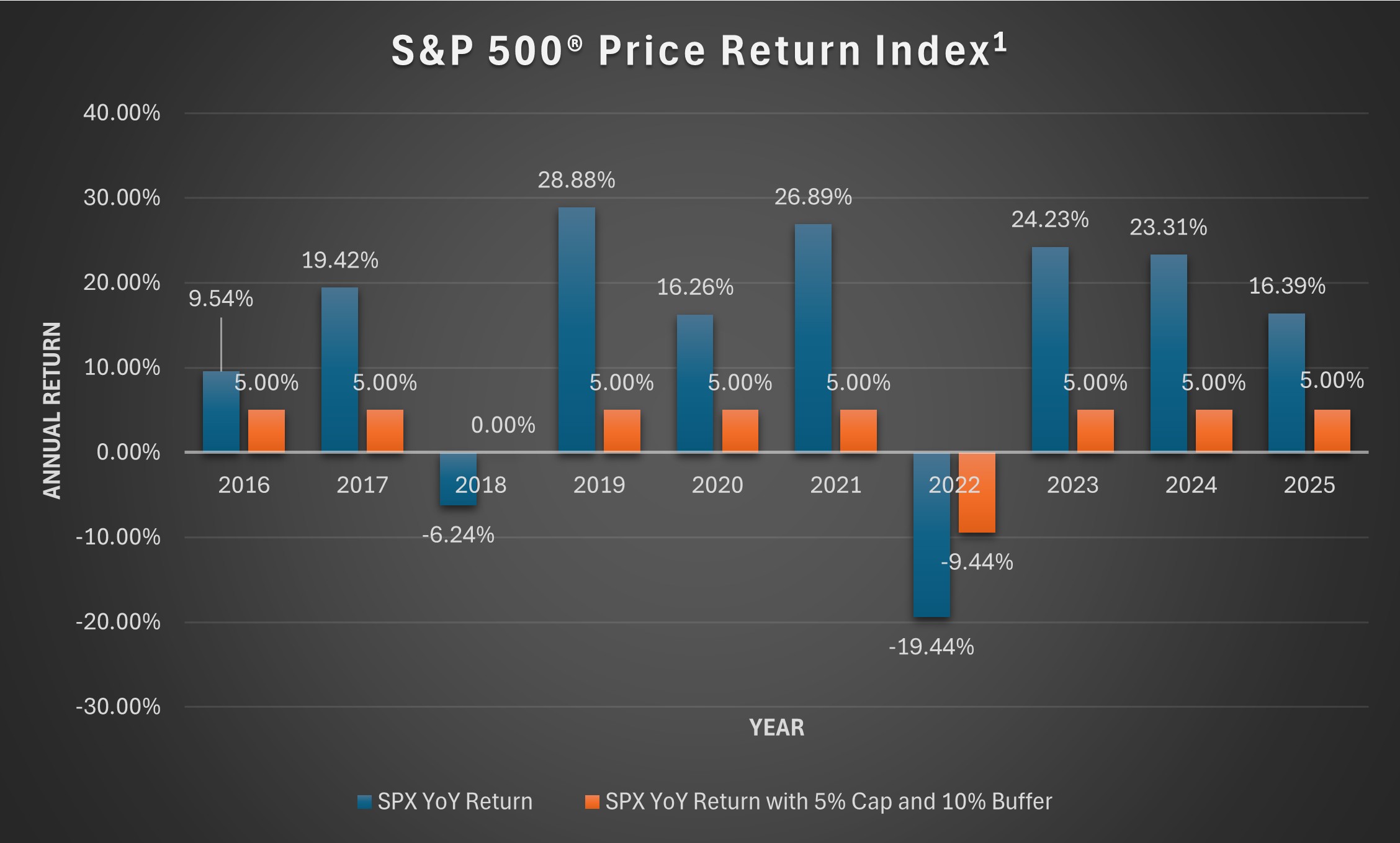
S&P 500® Price Return Index
The S&P 500® Index is comprised of equity securities issued by large-capitalization U.S. companies. In general, large-capitalization companies may be unable to respond quickly to new competitive challenges and may not be able to attain the high growth rate of successful smaller companies, especially during periods of economic expansion. See the “The Insurance Company and Investment Options” section for more information.
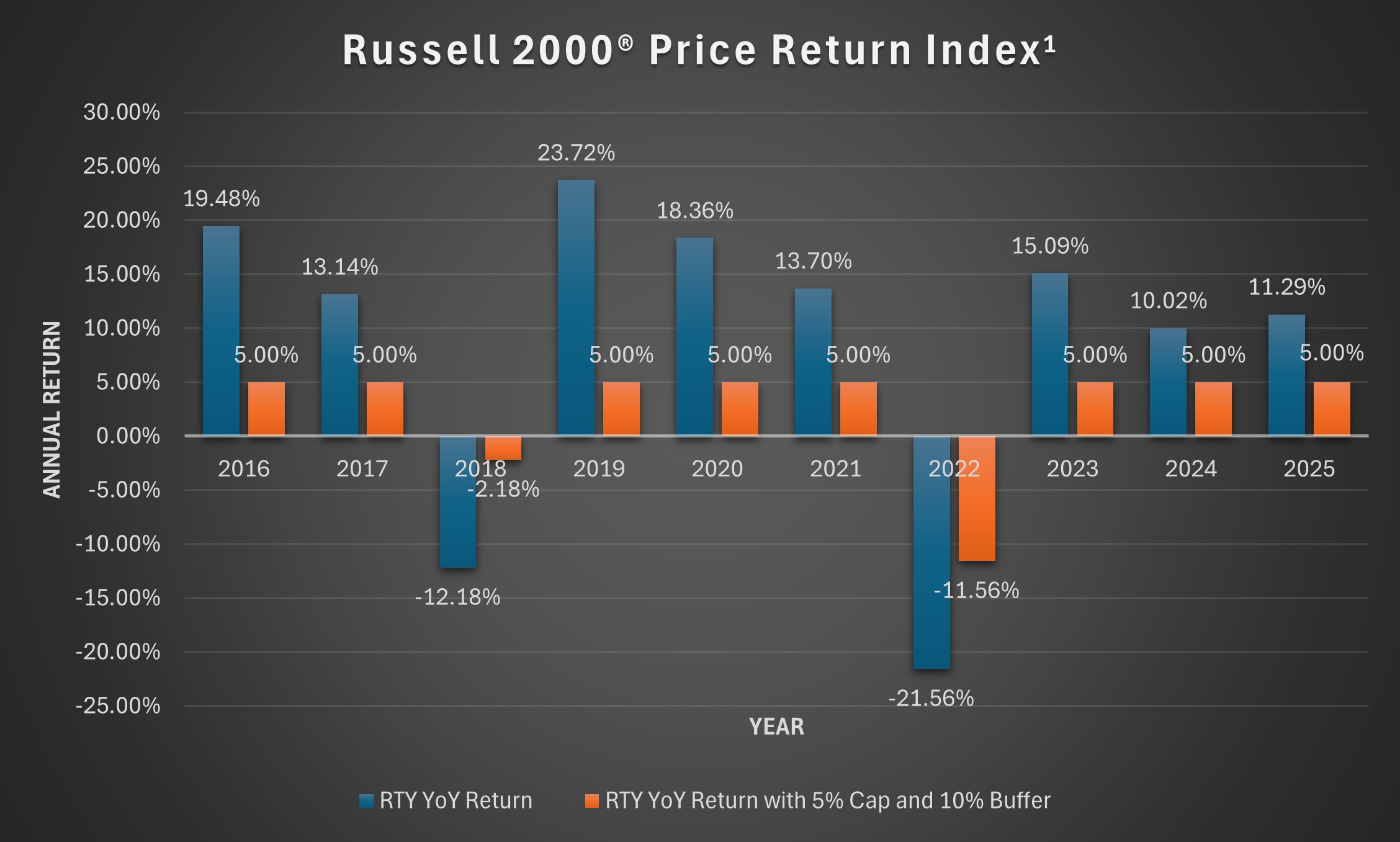
Russell 2000® Price Return Index
The Russell 2000® Index is comprised of equity securities of small-capitalization U.S. companies. In general, the securities of small-capitalization companies may be more volatile and may involve more risk than the securities of larger companies. See the “The Insurance Company and Investment Options” section for more information.
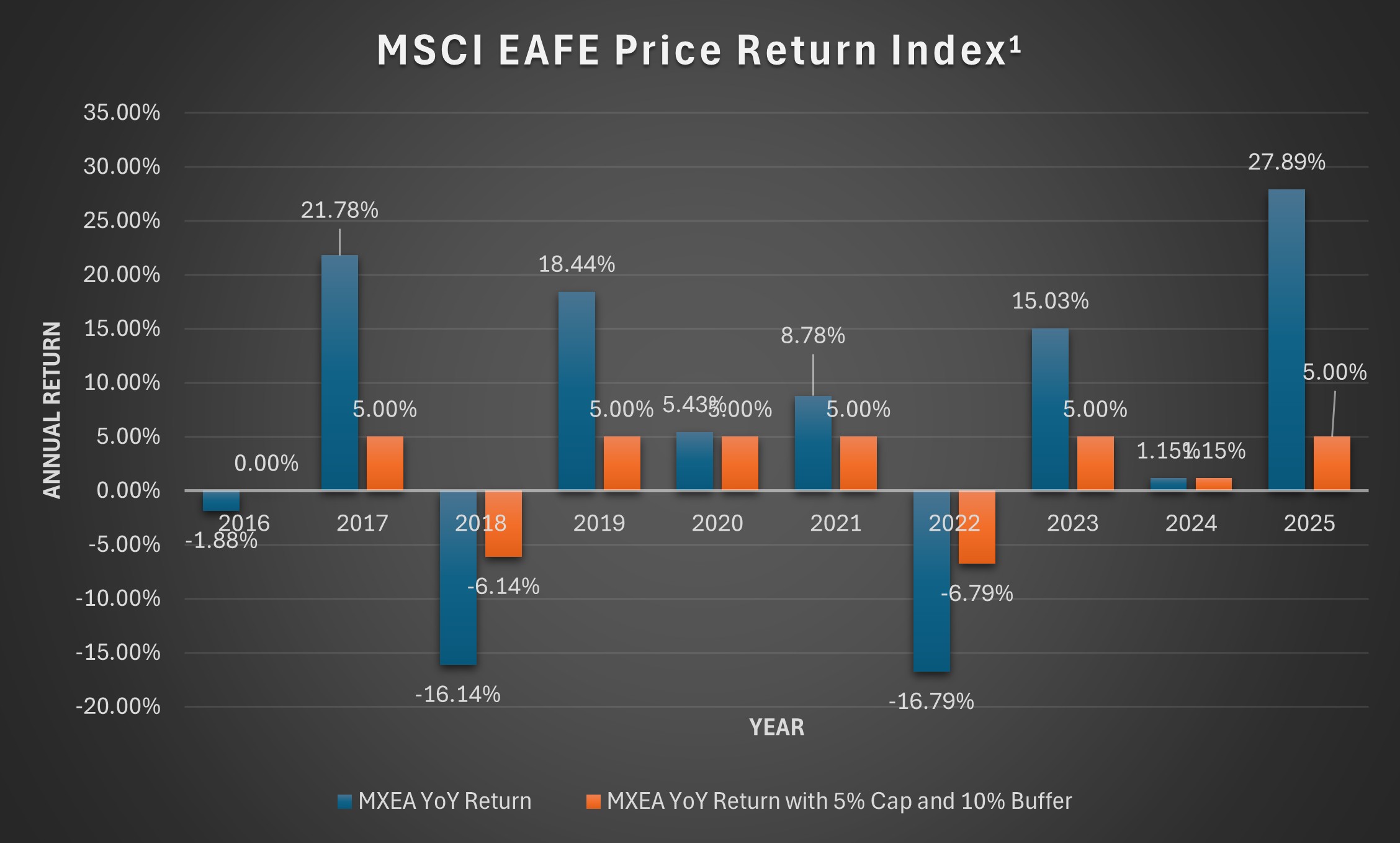
MSCI EAFE Price Return Index
The MSCI EAFE Index is an equity index that captures large and mid-cap representation across developed markets around the world. The securities comprising the MSCI EAFE Price Return Index are subject to the risks related to investments in foreign markets (e.g. increased price volatility; changing currency exchange rates; and greater political, regulatory, and economic uncertainty). In general, foreign markets may be less liquid, more volatile, and subject to less government supervision than domestic markets. See the “The Insurance Company and Investment Options” section for more information.
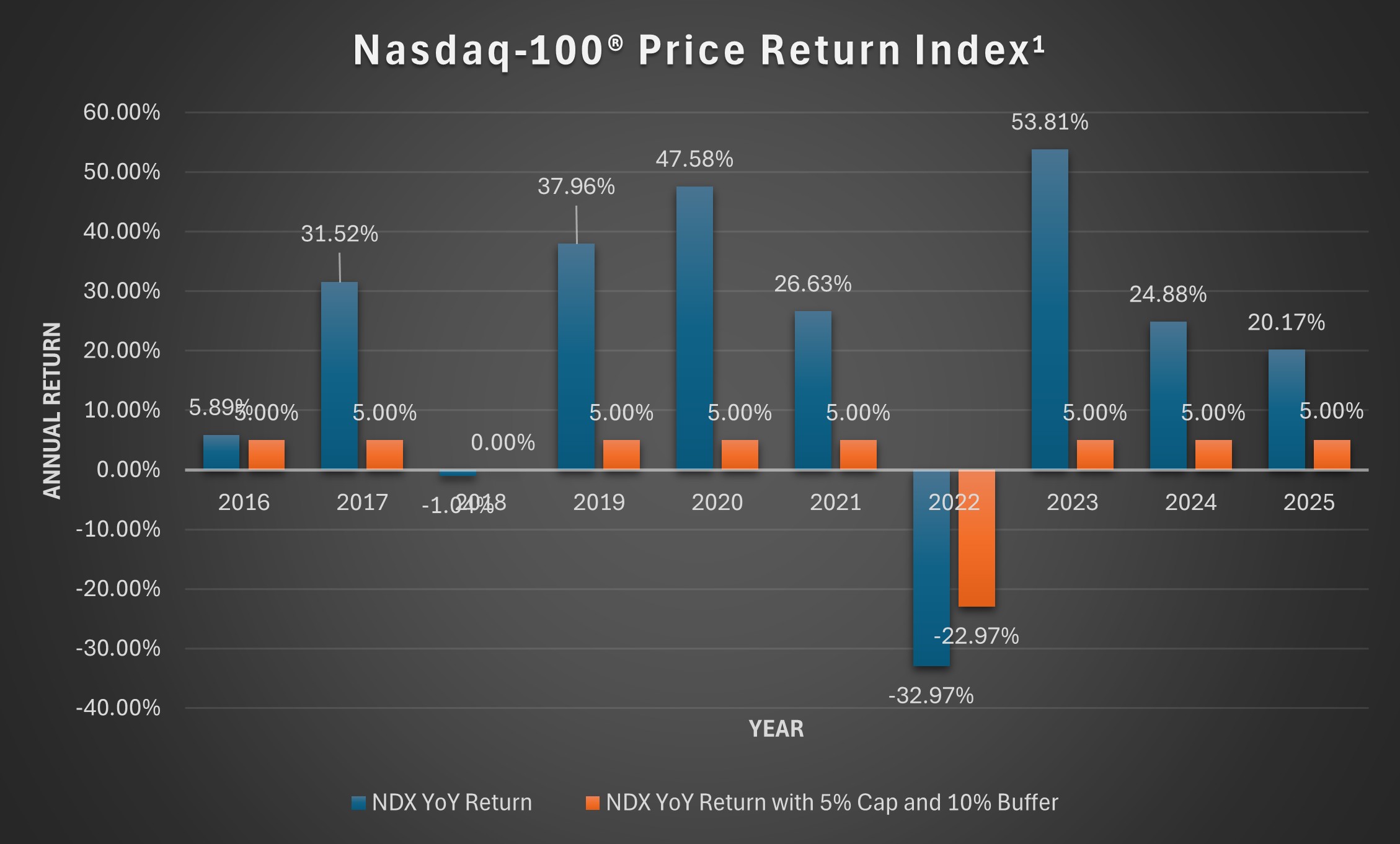
Nasdaq-100® Price Return Index
The Nasdaq-100® Index is comprised of equity securities of the largest U.S. and non-U.S. companies listed on The Nasdaq Stock Market, including companies across all major industry groups except the financial industry. To the extent that the Nasdaq-100® Index is comprised of securities issued by companies in a particular sector, that company’s securities may not perform as well as companies in other sectors or the market as a whole. For example, large-capitalization companies may be unable to respond quickly to new competitive challenges, and may not be able to attain the high growth rate of successful smaller companies. Also, any component securities issued by non-U.S. companies (including related depository receipts) are subject to the risks related to investments in foreign markets (e.g., increased price volatility; changing currency exchange rates; and greater political, regulatory, and economic uncertainty). See “The Insurance Company and Investment Options” section for more information.
Elimination of Segment Options After the Withdrawal Charge Period
Segment Options beyond the Withdrawal Charge Period will be limited to one-year Segment Term Periods. Segment Options with a two-year Segment Term Period expiring on or after the last day of the Withdrawal Charge Period will automatically transfer the Segment Value to the Segment Option’s one-year counterpart, if available, at the end of the Segment Term Period, unless you instruct otherwise. If a one-year counterpart is not available, we will allocate the Segment Value to the Fixed Segment Option, unless you instruct otherwise. Segment Options with a six-year Segment Term Period are available only during the first Contract Year. If you do not request a Transfer of the Segment Value of an expiring Segment Option with a six-year Segment Term Period, exercise a Performance Lock, or withdraw the Segment Value, we will allocate the Segment Value to its one-year counterpart, if available unless you instruct otherwise. If a one-year counterpart is not available for an expiring Segment Option, we will allocate the Segment Value to the Fixed Segment Option, unless you instruct otherwise.
Our Financial Strength and Claims-Paying Ability
As an insurance company, we are required by state law to hold a specified amount of reserves in order to meet all contractual obligations of our General Account to Owners. We monitor our reserves so that we hold sufficient amounts to meet actual or expected Contract or claims payments. It is important to note, however, that there is no guarantee that we will always be able to meet our claims paying obligations and that there are risks to purchasing any insurance product. We encourage both existing and future Owners to read and understand our financial statements, prepared in accordance with accounting practices prescribed and permitted by the New York Department of Financial Services, which are included in the Statement of Additional Information.
No Company other than Athene Annuity & Life Assurance Company of New York has any legal responsibility to pay amounts owed under the Contracts. You should look to the financial strength of the Company for its claims paying ability to pay amounts owed under the Contract.
The General Account holds all our assets other than the assets of our Separate Accounts. The General Account assets support the guarantees under the Contracts as well as our other general obligations. Assets in the General Account are not segregated for the benefit of any particular Contract or obligation. General Account assets are also available to the insurer’s general creditors and the conduct of its routine business activities, such as payment of salaries, rent and ordinary business expenses.
Reliance on Rule 12h-7
The Company relies on the exemption provided by Rule 12h-7 under the Securities Exchange Act of 1934
from the requirement to file reports pursuant to Section 15(d) of that Act.
Regulatory Protection
The Company is not an investment company and is not registered as an investment company under the Investment Company Act of 1940. The protections provided to investors by that Act are not applicable to the Contract.
No Ownership of Underlying Securities
Purchasing the Contract is not equivalent to purchasing shares in a mutual fund that invests in securities comprising the indices, nor is it equivalent to directly investing in such securities. Hence, you will not be investing in the Reference Index, in any stock included in the Reference Index, in a mutual fund or exchange-traded fund that tracks the Reference Index, or any underlying securities.
The Separate Account
The Separate Account, in which we hold reserves for Index-Linked Segment Options we provide under the Contract, is established under New York law. We will maintain assets in the Separate Account with an aggregate value at least equal to the reserves and other contract liabilities of the Separate Account. Owners do not participate in the performance of assets held in the Separate Account and do not have any claim on such assets. The obligations under this contract are independent of the investment performance of the Separate Account and are obligations of the Company. The Separate Account is not registered under the Investment Company Act of 1940.
We own the assets of the Separate Account, as well as any favorable investment performance on those assets. We are obligated to pay all money we owe under the Contract. If the assets in the Separate Account are insufficient to pay when due amounts guaranteed under the Contracts, the General Account may fund shortfalls in the Separate Account or guarantee the performance of such obligations by making such payments. Any excess in assets in the Separate Account over the amount which qualifies to be applied against the reserves and other liabilities under the Contract may be transferred to the General Account.
General Account assets support guarantees under the Contract as well as our other general obligations. General Account assets are not segregated for the benefit of any particular Contract or obligation. We guarantee all benefits relating to your value in the Contract, regardless of whether assets supporting it are held in the Separate Account or our General Account. You should look to the financial strength of the Company for its claims-paying ability to pay amounts owed under the contract.
Cybersecurity and Business Continuity Risk
Because our business is highly dependent upon the effective operation of our computer systems and those of our business partners, our business is vulnerable to disruptions from utility outages and susceptible to operational and information security risks resulting from information systems failure (e.g. hardware and software malfunctions) and cyberattacks. These risks include, among other things, the theft, misuse, corruption and destruction of data maintained online or digitally, interference with or denial of service on our website, attacks on websites and other operational disruption and unauthorized release of confidential customer information. Such systems failures and cyberattacks affecting us, the indices, the underlying funds, intermediaries and other affiliated or third-party service providers may adversely affect us and your Contract Value. For instance, systems failures and cyberattacks may
interfere with our processing of Contract transactions, including the processing of Transfer Requests, impact our ability to calculate Segment Values or Segment Interim Values, cause the release and possible destruction of confidential customer or business information, impede order processing, subject us and/or our service providers and intermediaries to regulatory fines, litigation, and financial losses and/or cause reputational damage. Cybersecurity risks may also impact the underlying securities in which the indices invest, which may cause the indices in your Contract to lose value. We may not be able to anticipate, detect, repel or implement effective preventative measures against all such threats, particularly because the techniques used are constantly evolving and increasingly sophisticated.
All of these risks are also applicable where the Company relies on third-party suppliers to provide products and services to the Company’s customers. While the Company requires critical third party suppliers to implement and maintain effective cybersecurity and data protection measures, we cannot guarantee that third parties and infrastructure in our supply chain have not been compromised or that they do not contain exploitable defects that could result in a disruption to our information technology systems or third party information technology systems that support the Company's insurance products. Our ability to monitor these third parties’ information securities practices is limited, and these third party suppliers may not have adequate information security measures in place. In addition, if one of the Company’s third party suppliers suffers a security breach, which has happened in the past, the Company's ability to respond may be limited because we do not have direct access to the third party’s supplier’s systems, logs and other information related to the security breach.
Other disruptive events, including but not limited to natural disasters and public health crises may adversely affect our ability to conduct business, including if our employees or employees of service providers are unable to perform their responsibilities as a result of such event. Cybersecurity breaches and other disruptions to our business can interfere with our processing Contract transactions, such as the processing of transfers between Segment Options on the Segment End Date, impact our ability to calculate the various components of Contract Value, cause the release of confidential information, or other operational issues.
Company Related Risk Factors
Risks Relating to Business Operations
The Company’s financial condition, results of operations, liquidity and cash flows depend on the accuracy of our management’s assumptions and estimates, and we could experience significant gains or losses if these assumptions and estimates differ significantly from actual results.
The Company makes and relies on certain assumptions and estimates regarding many matters related to its business, including valuations, interest rates, investment returns, expenses and operating costs, tax assets and liabilities, tax rates, business mix, surrender activity, mortality and contingent liabilities. The Company also uses these assumptions and estimates to make decisions crucial to its business operations, including establishing pricing, target returns and expense structures for its products and pension group annuity transactions; determining the amount of reserves it is required to hold for its policy liabilities; determining the price it will pay to acquire or reinsure business; determining the hedging strategies we employ to manage risks to its business and operations; and determining the amount of regulatory and rating agency capital it must hold to support its business. The factors influencing these assumptions and estimates cannot be calculated or predicted with certainty, and if these assumptions and estimates differ significantly from actual outcomes and results, the Company’s financial condition, result of operations, liquidity and cash flows may be materially and adversely affected. Certain of the assumptions relevant to the Company's business are discussed in greater detail below.
•Insurance Products and Liabilities. Pricing of the Company’s annuity and other insurance products, whether issued by the Company or acquired through reinsurance or acquisitions, is based upon assumptions about persistency, mortality and the rates at which optional benefits are elected. A factor which may affect persistency for some of the Company's products is the value of guaranteed minimum benefits. An increase in the value of guaranteed minimum benefits could result in the Company's policies remaining in force longer than we have estimated, which could adversely affect the Company's results of operations. This could be caused by extended periods of poor equity market
performance and/or low interest rates, developments affecting customer perception and other factors outside the Company's control. Alternatively, the Company's persistency estimates could be negatively affected during periods of rising equity markets or interest rates or by other factors outside the Company's control, which could result in fewer policies remaining in force than estimated. Therefore, the Company's results will vary based on deviations from expected policyholder behavior.
If emerging or actual experience deviates from the Company’s assumptions, such deviations could have a significant effect on the Company's business, financial condition, results of operations, liquidity and cash flows. For example, a significant portion of the Company’s in-force and newly issued products contain riders that offer guaranteed lifetime income or death benefits. These riders expose the Company to mortality, longevity and policyholder behavior risks. If actual utilization of certain rider benefits is adverse when compared to the Company’s estimates used in setting its reserves for future policy benefits, these reserves may prove to be inadequate and the Company may be required to increase such reserves. More generally, deviations from the Company's pricing expectations could result in the Company earning less of a spread between the investment income earned on the Company's assets and the interest credited to such products and other costs incurred in servicing the products, or may require the Company to make more payments under certain products than it had projected.
•Determination of Fair Value. The Company holds securities, derivative instruments and other assets and liabilities that must be, or at the Company's election are, measured at fair value. Fair value represents the anticipated amount that would be received upon the sale of an asset or paid to transfer a liability in an orderly transaction. The determination of fair value involves the use of various assumptions and estimates, and considerable judgment may be required to estimate fair value. Accordingly, estimates of fair value are not necessarily indicative of the amounts that could be realized in a current or future market exchange. As such, changes in, or deviations from, the assumptions used in such valuations can significantly affect the Company’s financial condition and results of operations. During periods of market disruption, including periods of rapidly changing credit spreads or illiquidity, if trading becomes less frequent or market data becomes less observable, it will likely be difficult to value certain of the Company’s investments. Further, rapidly changing credit and equity market conditions could materially impact the valuation of investments as reported within the Company's financial statements, and the period-to-period changes in value could vary significantly. Even if the Company’s assumptions and valuations are accurate at the time that they are made, the market value of the Company’s investments could subsequently decline, which could materially and adversely impact the financial condition, results of operations or cash flows.
•Hedging Strategies. The Company uses, and may in the future use, derivatives and reinsurance contracts to hedge risks related to current or future changes in the fair value of its assets and liabilities; current or future changes in cash flows; changes in interest rates, equity markets and credit spreads; the occurrence of credit defaults; foreign currency fluctuations; and changes in mortality and longevity. The Company uses equity derivatives to hedge the liabilities associated with its indexed annuities. The Company’s hedging strategies rely on assumptions and projections regarding the Company’s assets and liabilities, as well as general market factors and the creditworthiness of the Company’s counterparties, any or all of which may prove to be incorrect or inadequate. Additionally, the derivatives market has become the subject of comprehensive regulation, which may impact the availability and cost of derivatives that we use. Accordingly, the Company’s ability to hedge and its hedging activities may be adversely impacted or not have the desired impact. The Company may also incur significant losses on hedging transactions.
•Financial Statements. The preparation of the consolidated financial statements of the Company requires management to make various estimates and assumptions that affect the amounts reported therein. These significant estimates and assumptions include, but are not limited to, the fair value of investments; impairment of investments and allowances for expected credit losses; derivatives valuation, including embedded derivatives; future policy benefit reserves; market risk benefit assets and liabilities; consolidation of VIEs; and income taxes. The estimates and assumptions
required for these calculations involve judgment and by nature are imprecise and subject to changes and revisions over time. Accordingly, the Company’s financial condition and results of operations may be adversely affected if actual results differ from the estimates we use or if assumptions are materially revised.
The Company relies significantly on third parties for various services, and the Company may be held responsible for obligations that arise from the acts or omissions of third parties under the third parties’ respective agreements with the Company if the third parties are deemed to have acted on the Company’s behalf.
The Company relies significantly on third parties to provide various services that are important to the Company’s business, including investment, distribution and administrative services. As such, the Company’s business may be affected by the performance of those parties. Additionally, the Company’s operations are dependent on various technologies, some of which are provided or maintained by certain key outsourcing partners and other parties.
Many of the Company’s products and services are sold through third-party intermediaries. In particular, the Company is reliant on such intermediaries to describe and explain these products and services to potential customers, and although the Company takes precautions to avoid this result, such intermediaries may be deemed to have acted on its behalf. If that occurs, the intentional or unintentional misrepresentation of the Company’s products and services in advertising materials or other external communications, or inappropriate activities by an intermediary or personnel employed by an intermediary could result in liability for the Company and have an adverse effect on its reputation and business prospects, as well as lead to potential regulatory actions or litigation involving or against the Company. In addition, the Company relies on third-party administrators (“TPAs”) to administer a portion of its annuity contracts, as well as its legacy life insurance business. Some of the Company’s reinsurers also use TPAs to administer business which the Company reinsures to them. To the extent any of these TPAs do not administer such business appropriately, the Company may experience customer complaints, regulatory intervention and other adverse impacts, which could affect its future growth and profitability. If any of these TPAs or their employees are found to have made material misrepresentations to the Company’s policyholders, violated applicable insurance, privacy or other laws and regulations or otherwise engaged in misconduct, the Company could be held liable for their actions and be subject to regulatory scrutiny, which could adversely affect the Company’s reputation, business prospects, financial condition, results of operations, and cash flows.
Additionally, past or future misconduct by the Company’s agents that distribute the Company's products or by employees of the Company's vendors could result in violations of law by the Company, regulatory sanctions and/or serious reputational or financial harm and the precautions the Company takes to prevent and detect this activity may not be effective in all cases. Although the Company employs controls and procedures designed to monitor associates’ business decisions and to prevent the Company from taking excessive or inappropriate risks, associates may take such risks regardless of such controls and procedures.
Risk Relating to Market and Credit Risk
The Company is dependent on a reinsurance arrangement with AAIA.
The Company has entered into a coinsurance funds withheld agreement (“FWH Agreement”) with Athene Annuity and Life Company (“AAIA”). Pursuant to the FWH Agreement, the Company cedes to AAIA a 90% quota share of certain portions of its retail annuity business. The Company does not expect to cede to AAIA or any other affiliate any liabilities arising out of the Contract. Under the FWH Agreement, the Company transfers the reserves to AAIA and is required to establish a funds withheld account at the inception of the reinsurance relationship with assets equal to the gross statutory reserves corresponding to the ceded business (the “Reserves”). Payments on the liabilities ceded by the Company are made from the applicable funds withheld account when due. To the extent that the assets maintained in the funds withheld account are less than the corresponding Reserves, AAIA is required to transfer assets to the Company to be deposited into the applicable funds withheld account upon settlement. Should AAIA fail to make any such transfer, the Company’s ability to make payments on a ceded liability could be adversely affected. Due to the FWH Agreement, the amount of capital and surplus that the Company is required to
maintain is less than what would be required if the insurance liabilities were not ceded to AAIA. Therefore, the Company may have fewer assets available to make payments under its insurance liabilities in the event of a default by AAIA., The Company remains primarily liable for the policies ceded to AAIA and may have fewer assets available to make payments under its insurance liabilities in the event of a default by AAIA. AAIA, on the one hand, and the Company, on the other hand, may agree to modify or terminate the FWH Agreement without the consent of policyholders, and such modification or termination may be detrimental to the interests of such policyholders and the Company’s ability to satisfy its financial obligations may be adversely affected.
Risks Relating to Liquidity and Regulatory Capital
As a financial services company, the Company is exposed to liquidity risk, which is the risk that the Company is unable to meet near-term obligations as they come due.
Liquidity risk is a manifestation of events that are driven by other risk types (e.g. market, policyholder behavior, operational). A liquidity shortfall may arise in the event of insufficient funding sources or an immediate and significant need for cash or collateral. In addition, it is possible that expected liquidity sources, such as the Company's credit facilities, may be unavailable or inadequate to satisfy the liquidity demands described below. In particular, adverse economic and geopolitical conditions, including the armed conflicts between Russia and Ukraine, and in the Middle East, inflationary pressures and corresponding actions taken by the US Federal Reserve, plateauing or slowing economic growth, evolving global tariff or trade policies, and sanctions imposed on Russia by the US and other countries, continue to contribute to volatility in the financial markets. These developments may restrict the liquidity sources available to the Company and may also increase the Company's liquidity needs. The Company primarily has liquidity exposure through its collateral market exposure, asset liability mismatch, dependence on the financial markets for funding and funding commitments. If a material liquidity demand is triggered and the Company is unable to satisfy the demand with the sources of liquidity readily available to us, it may have a material adverse impact on the Company's business, financial condition, results of operations, liquidity and cash flows.
General Risk Factors
The Company may be the target or subject of, and may be required to defend against or respond to, litigation, regulatory investigations, enforcement actions or reputational harm.
The Company operates in an industry in which various practices are subject to potential litigation, including class actions, and regulatory scrutiny. The Company, like other financial services companies, is involved in litigation and arbitration in the ordinary course of business and may be the subject of regulatory proceedings (including investigations and enforcement actions). Plaintiffs may seek large or indeterminate amounts of damages in litigation and regulators may seek large fines in enforcement actions. Given the large or indeterminate amounts sometimes sought, and the inherent unpredictability of litigation and enforcement actions, it is possible that an unfavorable resolution of one or more matters could have a material and adverse effect on the Company’s business, financial condition, results of operations and cash flows. Even if we ultimately prevail in any litigation or receive positive results from investigations, the Company could incur material legal costs or its reputation could be materially adversely affected.
For a list of Index-Linked Segment Options and Fixed Segment Options that are currently available, please see Appendix A: Investment Options Available Under the Contract.
Fundamentals of the Point-to-Point Crediting Method
The Point-to-Point Crediting Method is used on Point-to-Point Segment Options. A Segment Option using the Point-to-Point Crediting Method captures performance of the Reference Index from the Segment Start Date to the Segment End Date by measuring the percentage change in the value of the Reference Index between those dates (subject to the applicable Cap Rate and Participation Rate). The value of the Reference Index at intermediate points during the Segment Term Period is not reflected in the determination of Segment Credits. The Cap Rate and Participation Rate are established at the beginning of the Segment Term Period and do not change for the length of the Segment Term Period. For Segment Term Periods greater than one year, the Cap Rate and Participation Rate apply to the entire multi-year Segment Term Period, not to each year during the Segment Term Period.
An Index-Linked Segment Option using the Point-to-Point Crediting Method will have the following crediting factors that determine the Segment Credit:
•Cap Rate - Maximum positive Index Change we will use in the calculation of the Segment Credit;
•Participation Rate - Percentage multiplied by a positive Index Change, subject to the Cap Rate, to calculate the Segment Credit;
•Segment Term Period - Period of time over which the change in the Reference Index is calculated;
•Buffer Rate - Maximum negative Index Change the Company will absorb before applying a negative Segment Credit to your Segment Value. A negative Segment Credit will apply for any negative Index Change in excess of the Buffer Rate; and
•Index Price - Closing price of the Reference Index on a Segment Start Date and Segment End Date, used to calculate the Index Change.
The Buffer Rate establishes the amount of negative index performance that we will absorb before we apply a negative Segment Credit to the Segment Value on a Segment End Date. For the Point-to-Point Crediting Method, a negative Segment Credit will apply for any negative Index Change in excess of the Buffer Rate. Theoretically, for a Segment Option with a 10% Buffer Rate, the negative Index Change that is used to calculate the Segment Credit percentage may be as high as 90%, which could lead to substantial loss of principal and previously credited Segment Credits. Any applicable Withdrawal Charges, Interest Adjustments, and Equity Adjustments could also result in a loss of principal greater than 90%. Please see the below examples for a demonstration of the mechanics of the Point-to-Point Crediting Method.
The following grid describes how the Cap Rate, Participation Rate, and Buffer Rate will impact the Segment Credit for this particular Crediting Method, depending on index performance:
| Index Change | Segment Credit percentage (payoff profile) | ||||
Index Change over the Segment Term Period is greater than or equal to the Cap Rate | Cap Rate multiplied by the Participation Rate | ||||
Index Change over the Segment Term Period is less than the Cap Rate but greater than zero | Index Change multiplied by the Participation Rate | ||||
Index Change over the Segment Term Period is less than zero by an amount that is less than the Buffer Rate(1) | Zero | ||||
Index Change over the Segment Term Period is less than zero by an amount that is more than the Buffer Rate(1) | Index Change plus Buffer Rate | ||||
(1) Buffer Rate is expressed as an Absolute (Positive) Amount
The following examples illustrate how we calculate and credit interest under the Point-to-Point Crediting Method assuming hypothetical index returns and hypothetical limits on index gains and losses. The examples assume no Withdrawals.
Example 2
For the four scenarios below, assume the following:
•Cap Rate = 15%
•Participation Rate = 105%
•Segment Term Period = 1-Year
•Buffer Rate = 10%
| Scenario | Index Price on Segment Start Date | Index Price on Segment End Date | Index Change | Segment Credit percentage | ||||||||||
| 1 | 2,000 | 2,500 | 25% | 15.75% (= 15% x 105%) | ||||||||||
| 2 | 2,000 | 2,100 | 5% | 5.25% (= 5% x 105%) | ||||||||||
| 3 | 2,000 | 1,900 | -5% | 0% | ||||||||||
| 4 | 2,000 | 1,500 | -25% | -15% (= -25% + 10%) | ||||||||||
Example 3
For the four scenarios below, assume the following:
•Cap Rate = 100%
•Participation Rate = 120%
•Segment Term Period = 6-Year
•Buffer Rate = 20%
| Scenario | Index Price on Segment Start Date | Index Price on Segment End Date | Index Change | Segment Credit percentage | ||||||||||
| 1 | 2,000 | 4,500 | 125% | 120% (= 100% x 120%) | ||||||||||
| 2 | 2,000 | 2,100 | 5% | 5% (= 5% x 100%) | ||||||||||
| 3 | 2,000 | 1,900 | -5% | 0% | ||||||||||
| 4 | 2,000 | 1,500 | -25% | -5% (= -25% + 20%) | ||||||||||
Fundamentals of the Performance Blend Crediting Method
The Performance Blend Crediting Method is used on Performance Blend Segment Options (only available with a six-year Segment Term Period). A Segment Option using the Performance Blend Crediting Method is determined based on Aggregate Index Change, as measured from the Segment Start Date to the Segment End Date, and the applicable Cap Rate, Participation Rate, and Buffer Rate. This Crediting Method calculates an Aggregate Index Change using three underlying indices, rather than an Index Change based on a single underlying index.
Performance Blend Segment Options use a weighted average return of the S&P 500®, Russell 2000®, and MSCI EAFE indices. The return is calculated based on the relative performance of the underlying indices, with 50% of the Segment Credit being based on the index with the best performance (i.e. the largest positive or least negative Index Change) on the Segment End Date, 30% of the Segment Credit being based on the index with the next best performance (i.e. next best positive or negative Index Change) on the Segment End Date and 20% of the Segment Credit being based on the index with worst performance (i.e. the largest negative Index Change on the Segment End Date, or, if no index had a negative Index Change, the index with the smallest positive Index Change) on the Segment End Date. The value of the Reference Index at intermediate points during the Segment Term Period is not reflected in the determination of Segment Credits. The Cap Rate and Participation Rate are established at the beginning of the Segment Term Period and do not change for the length of the Segment Term Period. The Cap Rate and Participation Rate apply to the entire multi-year Segment Term Period, not to each year during the Segment Term Period.
An Index-Linked Segment Option using the Performance Blend Crediting Method will have the following crediting factors that determine the Segment Credit:
•Cap Rate - Maximum positive Aggregate Index Change we will use in the calculation of the Segment Credit;
•Participation Rate - Percentage multiplied by a positive Aggregate Index Change, subject to the Cap Rate, to calculate the Segment Credit;
•Index Allocation Percentages - The percentages used to calculate the portion of Index Change from each index that will be used in the Aggregate Index Change;
•Segment Term Period - Period of time over which the change in the Reference Index is calculated;
•Buffer Rate - Maximum negative Aggregate Index Change the Company will absorb before applying a negative Segment Credit to your Segment Value. A negative Segment Credit will apply for any Aggregate Index Change in excess of the Buffer Rate; and
•Index Price - Closing price of the Reference Index on a Segment Start Date and Segment End Date, used to calculate the Aggregate Index Change.
The Buffer Rate establishes the amount of negative aggregate index performance that we will absorb before we apply a negative Segment Credit to the Segment Value on a Segment End Date. For the Performance Blend Crediting Method, a negative Segment Credit will apply for any negative Aggregate Index Change in excess of the Buffer Rate. Theoretically, for a Segment Option with a 10% Buffer Rate, the negative Aggregate Index Change that is used to calculate the Segment Credit percentage may be as high as 90%, which could lead to substantial loss of principal and previously credited Segment Credits. Any applicable Withdrawal Charges, Interest Adjustments, and Equity Adjustments could also result in a loss of principal greater than 90%. Please see the below examples for a demonstration of the mechanics of the Performance Blend Crediting Method.
The following grid describes how the Cap Rate, Participation Rate, and Buffer Rate will impact the Segment Credit for this particular Crediting Method, depending on aggregate index performance of the three underlying indices:
| Index Change | Segment Credit percentage (payoff profile) | ||||
Aggregate Index Change over the Segment Term Period is greater than or equal to the Cap Rate | Cap Rate multiplied by the Participation Rate | ||||
Aggregate Index Change over the Segment Term Period is less than the Cap Rate but greater than zero | Aggregate Index Change multiplied by the Participation Rate | ||||
Aggregate Index Change over the Segment Term Period is less than zero by an amount that is less than the Buffer Rate(1) | Zero | ||||
Aggregate Index Change over the Segment Term Period is less than zero by an amount that is more than the Buffer Rate(1) | Aggregate Index Change plus Buffer Rate | ||||
(1) Buffer Rate is expressed as an Absolute (Positive) Amount
The following example illustrates how we calculate and credit interest under the Performance Blend Crediting Method assuming hypothetical index returns and hypothetical limits on index gains and losses. The example assumes no Withdrawals.
Example 4
For the four Performance Blend Segment Option scenarios below, assume the following:
•Cap Rate = 60%
•Participation Rate = 130%
•Index Allocation Percentage 1 = 50%
•Index Allocation Percentage 2 = 30%
•Index Allocation Percentage 3 = 20%
•Segment Term Period = 6-Year
•Buffer Rate = 10%
| Index X | Index Y | Index Z | | |||||||||||||||||||||||
| Scenario | Index Price on Segment Start Date | Index Price on Segment End Date | Index Price on Segment Start Date | Index Price on Segment End Date | Index Price on Segment Start Date | Index Price on Segment End Date | Aggregate Index Change | Segment Credit percentage | ||||||||||||||||||
| 1 | 70 | 105 | 1,500 | 2,475 | 2,000 | 3,500 | 67%(1) | 78% (=60% x 130%)(2) | ||||||||||||||||||
| 2 | 70 | 77 | 1,500 | 1,575 | 2,000 | 1,850 | 5% | 6.5% (= 5% x 130%) | ||||||||||||||||||
| 3 | 70 | 65.8 | 1,500 | 1,372.5 | 2,000 | 1,940 | -5% | 0% | ||||||||||||||||||
| 4 | 70 | 58.8 | 1,500 | 1,050 | 2,000 | 1,600 | -20% | -10% (= -20% + 10%) | ||||||||||||||||||
(1)Index X had an individual Index Change of (105/70)-1 = 50%, Index Y had an individual Index Change of (2475/1500)-1 = 65%, and Index Z had an individual Index Change of (3500/2000)-1 = 75%. Therefore, Index Z was the best performing index and uses Index Allocation Percentage 1. Index Y was the second best performing index and uses Index Allocation Percentage 2. Index X was the third best performing index and uses Index Allocation Percentage 3. The Aggregate Index Change is equal to (75% x 50%) + (65% x 30%) + (50% x 20%) = 67%
(2)Because the Aggregate Index Change is positive and above the Cap Rate, the Segment Credit percentage is equal to the Cap Rate times the Participation Rate
Fundamentals of the Trigger Crediting Method
The Trigger Crediting Method is used on all Trigger Segment Options. A Segment Option using the Trigger Crediting Method credits the Trigger Rate if the percentage change in the value of the Reference Index from the Segment Start Date to the Segment End Date is greater than or equal to zero. The value of the Reference Index at intermediate points during the Segment Term Period is not reflected in the determination of Segment Credits. The Trigger Rate is established at the beginning of the Segment Term Period and does not change for the length of the Segment Term Period. For Segment Term Periods greater than one year, the Trigger Rate applies to the entire multi-year Segment Term Period, not to each year during the Segment Term Period.
An Index-Linked Segment Option using the Trigger Crediting Method will have the following crediting factors that determine the Segment Credit:
•Trigger Rate - The positive rate used in the calculation of the Segment Credit if the Index Change is greater than or equal to zero;
•Segment Term Period - Period of time over which the change in the Reference Index is calculated;
•Buffer Rate - Maximum negative Index Change the Company will absorb before applying a negative Segment Credit to your Segment Value. A negative Segment Credit will apply for any negative Index Change not fully offset by the Buffer Rate; and
•Index Price - Closing price of the Reference Index on a Segment Start Date and Segment End Date, used to calculate the Index Change.
The Buffer Rate establishes the amount of negative index performance that we will absorb before we apply a negative Segment Credit to the Segment Value on a Segment End Date. For the Trigger Crediting Method, a negative Segment Credit will apply for any negative Index Change not fully offset by the Buffer Rate. Theoretically, for a Segment Option with a 10% Buffer Rate, the negative Index Change that is used to calculate the Segment Credit percentage may be as high as 90%, which could lead to substantial loss of principal and previously credited Segment Credits. Any applicable Withdrawal Charges, Interest Adjustments, and Equity Adjustments could also result in a loss of principal greater than 90%. Please see the below examples for a demonstration of the mechanics of the Trigger Crediting Method.
The following grid describes how the Trigger Rate and Buffer Rate will impact the Segment Credit for the Trigger Segment Option for this particular Crediting Method, depending on index performance:
| Index Change | Segment Credit percentage (payoff profile) | ||||
Index Change over the Segment Term Period is greater than or equal to zero | Trigger Rate | ||||
Index Change over the Segment Term Period is less than zero by an amount that is less than the Buffer Rate(1) | Zero | ||||
Index Change over the Segment Term Period is less than zero by an amount that is more than the Buffer Rate(1) | Index Change plus Buffer Rate | ||||
(1) Buffer Rate is expressed as an Absolute (Positive) Amount
The following example illustrates how we calculate and credit interest under the Trigger Crediting Method assuming hypothetical index returns and hypothetical limits on index gains and losses. The example assumes no Withdrawals.
Example 8
For the four scenarios below, assume the following:
•Trigger Rate = 11%
•Segment Term Period = 1-Year
•Buffer Rate = 10%
| Scenario | Index Price on Segment Start Date | Index Price on Segment End Date | Index Change | Segment Credit percentage | ||||||||||
| 1 | 2,000 | 2,500 | 25% | 11% | ||||||||||
| 2 | 2,000 | 2,100 | 5% | 11% | ||||||||||
| 3 | 2,000 | 1,900 | -5% | 0% | ||||||||||
| 4 | 2,000 | 1,500 | -25% | -15% (= -25% + 10%) | ||||||||||
Fundamentals of the Dual Trigger Crediting Method
The Dual Trigger Crediting Method is used on all Dual Trigger Segment Options. A Segment Option using the Dual Trigger Crediting Method credits the Trigger Rate if the percentage change in the value of the Reference Index from the Segment Start Date to the Segment End Date is positive, zero, or negative but fully offset by the Buffer Rate. The value of the Reference Index at intermediate points during the Segment Term Period is not reflected in the determination of Segment Credits. The Trigger Rate is established at the beginning of the Segment Term Period and does not change for the length of the Segment Term Period. For Segment Term Periods greater than one year, the Trigger Rate applies to the entire multi-year Segment Term Period, not to each year during the Segment Term Period.
An Index-Linked Segment Option using the Dual Trigger Crediting Method will have the following crediting factors that determine the Segment Credit:
•Trigger Rate - The positive rate used in the calculation of the Segment Credit if the Index Change is greater than or equal to zero or negative but fully offset by the Buffer Rate;
•Segment Term Period - Period of time over which the change in the Reference Index is calculated;
•Buffer Rate - Maximum negative Index Change the Company will absorb before applying a negative Segment Credit to your Segment Value. A negative Segment Credit will apply for any negative Index Change not fully offset by the Buffer Rate; and
•Index Price - Closing price of the Reference Index on a Segment Start Date and Segment End Date, used to calculate the Index Change.
The Buffer Rate establishes the amount of negative index performance that we will absorb before we apply a negative Segment Credit to the Segment Value on a Segment End Date. For the Dual Trigger Crediting Method, a negative Segment Credit will apply for any negative Index Change not fully offset by the Buffer Rate. Theoretically, for a Segment Option with a 10% Buffer Rate, the negative Index Change that is used to calculate the Segment Credit percentage may be as high as 90%, which could lead to substantial loss of principal and previously credited Segment Credits. Any applicable Withdrawal Charges, Interest Adjustments, and Equity Adjustments could also result in a loss of principal greater than 90%. Please see the below examples for a demonstration of the mechanics of the Dual Trigger Crediting Method.
The following grid describes how the Trigger Rate and Buffer Rate will impact the Segment Credit for the Dual Trigger Segment Option for this particular Crediting Method, depending on index performance:
| Index Change | Segment Credit percentage (payoff profile) | ||||
Index Change over the Segment Term Period is greater than or equal to zero | Trigger Rate | ||||
Index Change over the Segment Term Period is less than zero by an amount that is less than the Buffer Rate(1) | Trigger Rate | ||||
Index Change over the Segment Term Period is less than zero by an amount that is more than the Buffer Rate(1) | Index Change plus Buffer Rate | ||||
(1) Buffer Rate is expressed as an Absolute (Positive) Amount
The following examples illustrate how we calculate and credit interest under the Dual Trigger Crediting Method assuming hypothetical index returns and hypothetical limits on index gains and losses. The examples assume no Withdrawals.
Example 9
For the four scenarios below, assume the following:
•Trigger Rate = 11%
•Segment Term Period = 1-Year
•Buffer Rate = 10%
| Scenario | Index Price on Segment Start Date | Index Price on Segment End Date | Index Change | Segment Credit percentage | ||||||||||
| 1 | 2,000 | 2,500 | 25% | 11% | ||||||||||
| 2 | 2,000 | 2,100 | 5% | 11% | ||||||||||
| 3 | 2,000 | 1,900 | -5% | 11% | ||||||||||
| 4 | 2,000 | 1,500 | -25% | -15% (= -25% + 10%) | ||||||||||
Example 10
For the four scenarios below, assume the following:
•Trigger Rate = 50%
•Segment Term Period = 6-Year
•Buffer Rate = 10%
| Scenario | Index Price on Segment Start Date | Index Price on Segment End Date | Index Change | Segment Credit percentage | ||||||||||
| 1 | 2,000 | 3,500 | 75% | 50% | ||||||||||
| 2 | 2,000 | 2,100 | 5% | 50% | ||||||||||
| 3 | 2,000 | 1,900 | -5% | 50% | ||||||||||
| 4 | 2,000 | 1,500 | -25% | -15% (= -25% + 10%) | ||||||||||
Fundamentals of the Dual Direction Crediting Method
The Dual Direction Crediting Method is used on Dual Direction Segment Options (only available with a six-year Segment Term Period). A Segment Option using the Dual Direction Crediting Method captures performance of the Reference Index from the Segment Start Date to the Segment End Date by measuring the percentage change in the value of the Reference Index between those dates (subject to the applicable Cap Rate, Participation Rate, and Downside Participation Rate). This Crediting Method provides for positive Segment Credits even when performance is negative but fully offset by the Buffer Rate. The value of the Reference Index at intermediate points during the Segment Term Period is not reflected in the determination of Segment Credits. The Cap Rate, Participation Rate, and Downside Participation Rate are established at the beginning of the Segment Term Period and do not change for the length of the Segment Term Period. For Segment Term Periods greater than one year, the Cap Rate, Participation Rate, and Downside Participation Rate apply to the entire multi-year Segment Term Period, not to each year during the Segment Term Period.
An Index-Linked Segment Option using the Dual Direction Crediting Method will have the following crediting factors that determine the Segment Credit:
•Cap Rate - Maximum positive Index Change we will use in the calculation of the Segment Credit;
•Participation Rate - Percentage multiplied by a positive Index Change, subject to the Cap Rate, to calculate the Segment Credit;
•Downside Participation Rate - Percentage multiplied by the absolute value of the Index Change, if the Index Change is negative but fully offset by the Buffer Rate, to calculate the Segment Credit;
•Segment Term Period - Period of time over which the change in the Reference Index is calculated;
•Buffer Rate - Maximum negative Index Change the Company will absorb before applying a negative Segment Credit to your Segment Value. A negative Segment Credit will apply for any negative Index Change not fully offset by the Buffer Rate; and
•Index Price - Closing price of the Reference Index on a Segment Start Date and Segment End Date, used to calculate the Index Change.
The Buffer Rate establishes the amount of negative index performance that we will absorb before we apply a negative Segment Credit to the Segment Value on a Segment End Date. For the Dual Direction Crediting Method, a negative Segment Credit will apply for any negative Index Change not fully offset by the Buffer Rate. Theoretically, for a Segment Option with a 10% Buffer Rate, the negative Index Change that is used to calculate the Segment Credit percentage may be as high as 90%, which could lead to substantial loss of principal and previously credited Segment Credits. Any applicable Withdrawal Charges, Interest Adjustments, and Equity Adjustments could also result in a loss of principal greater than 90%. Please see the below examples for a demonstration of the mechanics of the Dual Direction Crediting Method.
The following grid describes how the Cap Rate, Participation Rate, Downside Participation Rate, and Buffer Rate will impact the Segment Credit for this particular Crediting Method, depending on index performance:
| Index Change | Segment Credit percentage (payoff profile) | ||||
Index Change over the Segment Term Period is greater than or equal to the Cap Rate | Cap Rate multiplied by the Participation Rate | ||||
Index Change over the Segment Term Period is less than the Cap Rate but greater than zero | Index Change multiplied by the Participation Rate | ||||
Index Change over the Segment Term Period is less than zero by an amount that is less than the Buffer Rate(1) | Absolute value of the Index Change multiplied by the Downside Participation Rate | ||||
Index Change over the Segment Term Period is less than zero by an amount that is more than the Buffer Rate(1) | Index Change plus Buffer Rate | ||||
(1) Buffer Rate is expressed as an Absolute (Positive) Amount
The following example illustrates how we calculate and credit interest under the Dual Direction Crediting Method assuming hypothetical index returns and hypothetical limits on index gains and losses. The example assumes no Withdrawals.
Example 11
For the four scenarios below, assume the following:
•Cap Rate = 125%
•Participation Rate = 105%
•Downside Participation Rate = Participation Rate
•Segment Term Period = 6-Year
•Buffer Rate = 20%
| Scenario | Index Price on Segment Start Date | Index Price on Segment End Date | Index Change | Segment Credit percentage | ||||||||||
| 1 | 2,000 | 4,600 | 130% | 131.25% (= 125% x 105%) | ||||||||||
| 2 | 2,000 | 2,100 | 5% | 5.25% (= 5% x 105%) | ||||||||||
| 3 | 2,000 | 1,900 | -5% | 5.25% (=|-5| x 105%) | ||||||||||
| 4 | 2,000 | 1,500 | -25% | -5% (= -25% + 20%) | ||||||||||
Segment Term Period
The Segment Term Period for each Segment Option will be shown on the Contract Schedule. Segment Term Periods are one, two, or six years. Segment Options with six-year Segment Term Periods are not renewable. Upon expiration of each Segment Option with one and two-year Segment Term Periods, a new Segment Term Period will begin. Segment Options beyond the Withdrawal Charge Period will be limited to one-year Segment Term Periods. Please see the “Setting Your Segment Start Date and Segment End Date” section for further details.
You may elect a Segment Option with a six-year Segment Term Period only during the first Contract Year. The Performance Blend Segment Option and Dual Direction Segment Option are available only with a six-year Segment Term Period. Six-year Segment Options are not available for renewal. Two-year Segment Options are not available for renewal after the first six Contract Years.
The bar charts shown below provide each Index’s annual returns for the last 10 calendar years (or for the life of the Index if less than 10 years), as well as the Index returns after applying a hypothetical 5% Cap Rate and a hypothetical -10% Buffer Rate. These charts illustrate the variability of the returns from year to year and show how hypothetical limits on Index gains and losses may affect these returns. Past performance is not necessarily an indication of future performance.
The performance below is NOT the performance of any Indexed-Linked Segment Option. Your performance under the Contract will differ, perhaps significantly. The performance below may reflect a different return calculation, time period, and limit on Index gains and losses than the Index-Linked Options, and does not reflect Contract fees and charges, including Withdrawal Charges and any negative Interim Value adjustments, which reduce performance.
•Any Reference Index is discontinued, or
•There is a substantial change in the calculation of the Reference Index, resulting in significantly different values and performance.
1.There is a sufficiently large market in exchange traded and/or over-the-counter options, futures, and similar derivative instruments based on the index to allow the Company to hedge Segment Credits;
2.The index is recognized as a broad-based index for the relevant market; and
3.The publisher of the index allows the Company to use the index in the Contract and other materials for a reasonable fee.
1.For all Index-Linked Segment Options, we will determine the Index Change for the Segment Term Period by: (i) multiplying together one plus the percentage change in the Index Price of the original Reference Index from the Segment Start Date until the date of the substitution and one plus the percentage change in the Index Price of the substituted Reference Index from the date of the substitution until the Segment End Date, (ii) subtracting one from the result , and then (ii) applying any applicable Cap Rate, Participation Rate, Downside Participation Rate, Trigger Rate, and Buffer Rate that were established on the Segment Start Date to that sum. The substituted Index will be incorporated in the Performance Blend Segment Option, if applicable.
2.For all Index-Linked Segment Options, the resulting Segment Credit will be added to your Segment Value on the scheduled Segment End Date.
Segment Options with a six-year Segment Term Period are not renewable. If you do not request a transfer of the Segment Value of an expiring Segment Option with a six-year Segment Term Period, exercise a Performance Lock, or withdraw the Segment Value, we will allocate the Segment Value to its one-year counterpart, if available. Segment Options beyond the Withdrawal Charge Period will be limited to one-year Segment Term Periods. Segment Options with a two-year Segment Term Period expiring on or after the last day of the Withdrawal Charge Period will automatically transfer their Segment Value to their one-year counterpart, if available, at the end of the Segment Term Period, unless you instruct otherwise. For example, if you were allocated to the 2-year Point-to-Point Segment Option with a Buffer Rate of 10% and MSCI EAFE as the Reference Index at the end of the Withdrawal Charge Period, your Segment Value would be automatically transferred on the Segment End Date to the 1-year Point-to-Point Segment Option with a Buffer Rate of 10% and MSCI EAFE as the Reference Index, unless you instruct otherwise. If a one-year counterpart is not available, we will allocate the Segment Value to the Fixed Segment Option, unless you instruct otherwise.
Contract Features
Performance Lock
The Performance Lock feature allows you to capture the Performance Lock Value of an Index-Linked Segment Option during the Segment Term Period. You may exercise a Performance Lock for any Index-Linked Segment Option to which you have currently allocated funds. Once exercised, a Performance Lock is irrevocable for that Index-Linked Segment Term Period, and the Performance Lock Value for that Segment Option will be
transferred to the Fixed Segment Option, where it will accrue interest daily for the remainder of the Fixed Segment Term Period. When you request a Performance Lock, we calculate the Performance Lock Value at the end of the Business Day we receive your request in Good Order. Consequently, you will not be able to determine the Performance Lock Value in advance, and the amount you capture may be more or less than the amount you expected. If a Performance Lock is exercised when your Performance Lock Value has declined from the amount invested in the Segment Option on the Segment Start Date, you will lock in any loss and may receive less than the full protection of the Buffer Rate. It is possible that you would have realized less of a loss or no loss if the Performance Lock had occurred at a later time, or if the Segment Option was not locked. Because the Performance Lock Value is based on the Equity Adjustment, the Performance Lock Value may be less than the Segment Value on the Segment Start Date even when the value of the Reference Index has increased or has declined by less than the Buffer Rate. Under extreme circumstances, you could lose up to 100% of your investment from a negative Equity Adjustment on money allocated to an Index-Linked Segment Option.
Fundamentals of the Fixed Crediting Method
The Fixed Crediting Method is used on the Fixed Segment Option. This Crediting Method guarantees the rate of interest that will be credited to the Segment Value daily within each Segment Term Period. The Annual Interest Rate is applied in a compounding fashion, based on a 365-day year. The Segment Credit to the Fixed Segment Option cannot be negative. The Fixed Segment Option will have the following Crediting Factors that determine the Segment Credit:
•Segment Term Period - Period of time over which the declared Annual Interest Rate is applicable; and
•Annual Interest Rate - Annualized rate of interest that will be credited daily to the Fixed Segment Option.
Because the Fixed Segment Option does not have risk of poor investment performance and provides minimum values after the application of the Interest Adjustment that comply with Standard Nonforfeiture Law NYSIL § 4223 for Individual Deferred Annuities, it is not registered under the Securities Act of 1933 or the Investment Company Act of 1940. Disclosures describing the Fixed Segment Option are subject to certain generally applicable provisions of the Federal securities laws regarding the accuracy and completeness of disclosure.
If amounts are withdrawn from the Fixed Segment Option during the first six years of the Contract, we will apply an Interest Adjustment to any portion of a Withdrawal that is subject to a Withdrawal Charge. This may result in a significant reduction to the net proceeds you receive from the Withdrawal. Withdrawal Charges, taxes, and tax penalties may also apply.
The following example illustrates how we calculate and credit interest under the Fixed Crediting Method assuming a hypothetical Annual Interest Rate. The example assumes no Withdrawals.
Example 12
Assume the Annual Interest Rate for a 1-year Segment Term Period is 2%.
•The Segment Value on the Segment Start Date = $100,000; and
•The Segment Value halfway through the Segment Term Period = $100,000 x (1 + 0.02) ^ 0.5 = $100,995.05.
•The Segment Value at the end of the Segment Term Period = $100,000 x (1 + 0.02) ^1 = $102,000.00.
For a list of Index-Linked Segment Options and Fixed Segment Options that are currently available, please see Appendix A: Investment Options Available Under the Contract.
If amounts are withdrawn from the Fixed Segment Option during the first six years of the Contract, we will apply an Interest Adjustment to any portion of a Withdrawal that is subject to a Withdrawal Charge. This may result in a significant reduction to the net proceeds you receive from the Withdrawal. Withdrawal Charges, taxes, and tax penalties may also apply.
Interim Value Calculation
Any Withdrawal (a partial Withdrawal, a Required Minimum Distribution, a surrender of your Contract, or payment of a Death Benefit, or the application of Interim Value to a Settlement Option) will also be subject to an Interim Value calculation comprised of two components: an Interest Adjustment and an Equity Adjustment, each of which may increase or decrease your Withdrawal proceeds. An Interest Adjustment will apply if you take a
Withdrawal on which a Withdrawal Charge applies at any time during the first six Contract Years, except on Segment Start Dates, Segment End Dates, and when your money is allocated to the Holding Account. An Equity Adjustment will apply if you take a Withdrawal from an Index-Linked Segment Option on any date other than a Segment End Date. See the “Segment Interim Value” section for additional information about how Interim Values are calculated. Even if Segment Credits are positive, the deduction of fees and charges, including Withdrawal Charges, and any applicable Equity Adjustments or Interest Adjustments, may reduce your Cash Surrender Value below your Purchase Payment and previously credited Segment Credits, or below the protection provided by the Buffer Rate. The maximum potential loss due to Equity Adjustment and Interest Adjustment (as a percentage of Contract Value withdrawn from an Index-Linked Segment Option) is 100%.
We will calculate your Interim Value at the end of each Business Day and will publish the value on our customer portal (www.athene.com/MyAthene-login) on the following Business Day. We reserve the right to not publish the Interim Value for any reason we choose. You may also determine the Interim Value as of the previous Business Day by calling our Administrative Office. As the Interim Value is calculated at the end of the Business Day and values fluctuate daily, this means you won't be able to determine the Interim Value for the day in advance of any transactions you request that are impacted by it. Therefore, any portion of the Interim Value you capture may be higher or lower than it was at the point in time you requested your transaction.
Segment Interim Value
The Interim Value calculation consists of two parts: an Interest Adjustment and an Equity Adjustment, which are calculated separately for each Segment Option to which you allocate Contract Value. An Interest Adjustment will apply if you take a Withdrawal on which a Withdrawal Charge applies from the Fixed Segment Option or an Index-Linked Segment Option at any time during the first six Contract Years except on Segment Start Dates, Segment End Dates, and when your money is allocated to the Holding Account. An Equity Adjustment will apply if you take a Withdrawal from an Index-Linked Segment Option on any date other than a Segment End Date. The Segment Interim Value is equal to the Segment Value adjusted for any applicable Interest Adjustment and Equity Adjustment.
The purpose of the Interim Value calculation is to approximate changes in the market value of debt securities and derivative instruments supporting your Contract, which we sell to fund the Withdrawal. The Interest Adjustment, which may be positive or negative, is designed to approximate changes in the value of debt instruments based on changes in market interest rates and credit spreads. The Equity Adjustment, which also may be positive or negative, is designed to approximate the changes in the value of derivative instruments that hedge market risks associated with our contractual obligation to apply Segment Credits to Index-Linked Segment Options on the Segment End Date. The Withdrawal proceeds you receive will reflect positive or negative adjustments assessed by way of any applicable Interest Adjustment and Equity Adjustment as well as the deduction of any applicable Withdrawal Charge.
On any day, the Segment Interim Value for an Index-Linked Segment Option is equal to A + B + C, where:
A.is the Segment Value on this date;
B.is any applicable Interest Adjustment on this date; and
C.is any applicable Equity Adjustment on this date.
The Equity Adjustment is equal to zero on any Segment End Date.
On any day, the Segment Interim Value for the Fixed Segment Option is equal to A + B, where:
A.is the Segment Value on this date; and
B.is any applicable Interest Adjustment on this date.
For examples of how we calculate the Segment Interim Value, please see Appendix B (“Segment Interim Value Examples).
Interest Adjustment
The Company invests in fixed income assets to support the value of the Segment Options. Upon any Withdrawal, including annuitization, death, partial Withdrawal, or surrender, the Company must sell a portion of these assets. The Interest Adjustment is a positive or negative adjustment that approximates the change in value of the fixed income assets that are sold to fund any distribution from the Contract. It is applied consistently across all Segment Options available in the Contract and does not relate specifically to any particular fixed income assets supporting the Contract. The Interest Adjustment applies only during the first six Contract Years and is equal to zero after the expiration of the Withdrawal Charge Period. The Interest Adjustment will only be applied to the portion of a surrender or Withdrawal that is subject to a Withdrawal Charge, except on Segment Start Dates, Segment End Dates, and when your money is allocated to the Holding Account, and will be calculated as a separate adjustment that is in addition to any applicable Withdrawal Charge.
On any day, the total Interest Adjustment for any Segment Option equals (A x B) where:
A.is the portion of the Segment Value that is subject to a Withdrawal Charge on this date, immediately prior to any Withdrawal; and
B.is the Interest Adjustment Factor.
The Interest Adjustment Factor for any Index-Linked Segment Option equals (RN/12 -1) x (1 - C), where:
N is the number of complete months remaining before the Segment Term Period expires;
R is equal to (1 + A) / (1 + B), where:
A.is the Beginning Interest Adjustment index value; and
B.is the Closing Interest Adjustment index value; and
C is equal to D x (1 - E), where:
D. is the value of certain derivative instruments on the Segment Start Date for the
applicable Index-Linked Segment Option; and
E. is the number of days elapsed from the Segment Start Date to the day we calculate the
Segment Interim Value, divided by the number of days in the Segment Term Period.
The Interest Adjustment Factor for the Fixed Segment Option equals the greater of (RN/12 -1) and [-(10% - C)], where:
N is the number of complete months remaining before the Segment Term Period expires; and
R is equal to (1 + A) / (1 + B), where:
A.is the Beginning Interest Adjustment index value; and
B.is the Closing Interest Adjustment index value.
C. is equal to the applicable Withdrawal Charge rate for that Contract Year.
The Interest Adjustment index is the 7 Year Point on the A Rated US Bloomberg Fair Value Curve, a bond index published by Bloomberg. The Beginning Interest Adjustment index value is equal to the closing yield of the Interest Adjustment index on the Segment Start Date. The Closing Interest Adjustment index value is equal to the closing yield of the Interest Adjustment index on the day we calculate the Segment Interim Value.
If the closing yield of the Interest Adjustment index on the day the Interest Adjustment is calculated is greater than the closing yield of the index on the Segment Start Date, the Interest Adjustment will be negative and will decrease the Segment Interim Value. If the closing yield of the Interest Adjustment index on the day the Interest Adjustment is calculated is less than the than the closing yield of this index on the Segment Start Date, the Interest Adjustment will be positive and will increase the Segment Interim Value.
You may obtain the daily yield of the Interest Adjustment index by contacting us at our Administrative Office. If a closing yield of the Interest Adjustment index is not available on any day for which a closing yield is needed, then the closing yield as of the first preceding Business Day for which a closing yield is available will be used.
If the Interest Adjustment index is discontinued, we are unable for any reason to utilize it, or the calculation of these values are substantially changed, we may substitute another method of determining the values that will be used in the above calculation and will inform you of such change at your last known address on file with us. Any substitute index will be submitted for prior approval to the New York Department of Financial Services.
Equity Adjustment
The Equity Adjustment is a positive or negative adjustment designed to approximate the change in market value of the derivative instruments that hedge risks associated with our obligation to apply Segment Credits to Index-Linked Segment Options. While the performance of the Reference Index factors into the calculation of the Equity Adjustment, the Equity Adjustment does not equal the performance of the Reference Index. The Equity Adjustment may be negative even when the value of the Reference Index has increased or has declined less than the Buffer Rate for an Index-Linked Segment Option. It does not relate to any particular derivative instrument(s) supporting the Contract. The Equity Adjustment Factor represents the difference in the value of the hypothetical derivatives on a given date before the Segment End Date and on the Segment Start Date, adjusted for the number of days elapsed in the Segment Term Period.
The adjustment accounts for the applicable Cap Rate, Participation Rate, Downside Participation Rate, Trigger Rate, Buffer Rate, and the Index Allocation Percentage for the Performance Blend Segment Option. Segment Options by using the Black-Scholes pricing model to track the value of a hypothetical set of derivatives on days other than a Segment End Date. The inputs used in the Black-Scholes method are consistent with market prices, and include relevant adjustments that reflect the estimated cost of entering the hypothetical derivative positions on the Segment Start Date and exiting the hypothetical derivative positions before the Segment End Date. These adjustments are often referred to as a “bid/offer spread,” and they will reduce the Segment Interim Value to reflect the transaction costs associated with trading derivative instruments.
On any Segment End Date, the Equity Adjustment will be equal to zero and will not result in any adjustment to a Withdrawal. You may avoid an Equity Adjustment by taking Withdrawals on a Segment End Date.
The total Equity Adjustment for any Index-Linked Segment Option equals (A x B) where:
A.is the Segment Value on this date, immediately prior to any Withdrawal; and
B.is the Equity Adjustment Factor applicable to that Segment Option.
The following hypothetical derivatives are utilized in the calculation of the Equity Adjustment Factor for Point-to-Point Segment Options:
•At-the-money call (ATM Call): This is an option to buy a position in the Reference Index on the next Segment End Date at a strike price equal to the price of the index on the Segment Start Date;
•Out-of-the-money call (OTM Call): This is an option to buy a position in the Reference Index on the next Segment End Date at a strike price equal to the price of the index on the Segment Start Date x (1 + Cap Rate); and
•Out-of-the-money put (OTM Put): This is an option to sell a position in the Reference Index on the next Segment End Date at a strike price equal to the price of the index on the Segment Start Date x (1 - Buffer Rate).
The following hypothetical derivatives are utilized in the calculation of the Equity Adjustment Factor for the Trigger Segment Options:
•At-the-money binary call (ATM Binary Call): This is a binary call option with a strike price set to the price of the index on the Segment Start Date, and that required the buyer to receive a specified, fixed payout (equal to the Trigger Rate) on the next Segment End Date, provided that the value of the Reference Index at the end of the term is greater than or equal to the strike price; and
•Out-of-the-money put (OTM Put): This is an option to sell a position in the Reference Index on the next Segment End Date at a strike price equal to the price of the index on the Segment Start Date x (1 - Buffer Rate).
The following hypothetical derivatives are utilized in the calculation of the Equity Adjustment Factor for the Dual Trigger Segment Options:
•In-the-money binary call (ITM Binary Call): This is a binary call option with a strike price set to the price of the index on the Segment Start Date x (1 – Buffer Rate), and that required the buyer to receive a specified, fixed payout (equal to the Trigger Rate) on the next Segment End Date, provided that the value of the Reference Index at the end of the term is greater than or equal to the strike price; and
•Out-of-the-money put (OTM Put): This is an option to sell a position in the Reference Index on the next Segment End Date at a strike price equal to the price of the index on the most recent Segment Start Date x (1 - Buffer Rate).
The following hypothetical derivatives are utilized in the calculation of the Equity Adjustment Factor for the Dual Direction Segment Options:
•At-the-money call (ATM Call): This is an option to buy a position in the Index on the next Segment End Date at a strike price equal to the price of the Index on the Segment Start Date;
•Out-of-the-money call (OTM Call): This is an option to buy a position in the Index on the next Segment End Date at a strike price equal to the price of the Index on the Segment Start Date x (1 + Cap Rate);
•At-the-money put (ATM Put): This is an option to sell a position in the Index on the next Segment End Date at a strike price equal to the price of the Index on the Segment Start Date;
•Out-of-the-money put (OTM Put): This is an option to sell a position in the Reference Index on the next Segment End Date at a strike price equal to the price of the index on the most recent Segment Start Date x (1 - Buffer Rate). Note: Dual Direction Segments use two of these options; and
•Out-the-money binary put (OTM Binary Put): This is a binary put option with a strike price set to the price of the index on the Segment Start Date x (1 – Buffer Rate), and that required the seller to pay a specified, fixed payout (equal to the absolute value of the Buffer Rate) on the next Segment End Date, provided that the value of the Reference Index at the end of the term is less than the strike price.
For Index-Linked Segment Options using the Point-to-Point and Performance Blend Crediting Methods, the value of the derivative instruments is equal to (ATM Call - OTM Call) x Participation Rate - OTM Put. For Trigger Segment Options, the value of the derivative instruments is equal to (Trigger Rate x ATM Binary Call) – OTM Put. For Dual Trigger Segment Options, the value of the derivative instruments is equal to (Trigger Rate x ITM Binary Call) – OTM Put. For Dual Direction Segment Options, the value of the derivative instruments is equal to (ATM Call – OTM Call) x Participation Rate + (ATM Put – OTM Put – (Buffer Rate x OTM Binary Put)) x Downside Participation Rate – OTM Put.
For Point-to-Point Segment Options, Performance Blend Segment Options, and Dual Direction Segment Options, the hypothetical call options (ATM Call and OTM Call) are intended to value the potential for increases in the Reference Index up to the applicable Cap Rate. As shown in the formulas above, the resulting difference is multiplied by the applicable Participation Rate. For Trigger Segment Options and Dual Trigger Segment Options, the hypothetical call options (ATM Binary Call and ITM Binary Call) are intended to value the potential for changes in the Reference Index that are greater than or equal to a threshold specified by the Segment Option. For all Index-Linked Segment Options, except Dual Direction Segment Options, the hypothetical out-of-the-money put option
(OTM Put) is intended to value the potential for decreases in the Reference Index in excess of the applicable Buffer Rate. For Dual Direction Segment Options, the ATM Put and one of the OTM Put options are intended to value the potential for decreases in the Reference Index fully offset by the applicable Buffer Rate. As shown in the formulas above, the resulting difference is multiplied by the applicable Downside Participation Rate. For Dual Direction Segment Options, the other OTM Put and the OTM Binary Put are intended to value the potential for decreases in the Reference Index not fully offset by the applicable Buffer Rate. As shown in the formulas above, the OTM Binary Put is multiplied by the applicable Downside Participation Rate prior to the OTM Put being subtracted.
For any Index-Linked Segment Option, the Equity Adjustment Factor is equal to A - B x (1 - Y), where:
A is the value of the derivative instruments on the day we calculate the Segment Interim Value;
B is the value of the derivative instruments on the Segment Start Date; and
Y is the number of days elapsed from the Segment Start Date to the day we calculate the Segment Interim Value, divided by the number of the days in the Segment Term Period.
The Performance Blend Segment Option requires additional steps to determine the Equity Adjustment Factor:
•For A and B defined above, the value of the derivative instruments for each of the underlying indices is calculated independently using the Black-Scholes Method.
•Weights are assigned based on the relative value of the derivative instruments across the underlying indices to produce an aggregate derivative instrument value for the Performance Blend Segment Option.
•50% weight is assigned to the index with the highest value of derivative instruments on the date in question;
•30% weight is assigned to the index with the second highest value of derivative instruments on the date in question; and
•20% weight is assigned to the index with the lowest value of derivative instruments on the date in question.
For an example of how we calculate the Equity Adjustment Factor for Point-to-Point Segment Options, Trigger Segment Options, Dual Trigger Segment Options, Dual Direction Segment Options, and the Performance Blend Segment Option, please see Appendix B (“Segment Interim Value Examples”).
The following Black-Scholes Method inputs are used in the calculation of the Equity Adjustment:
•Volatility - This input varies with the amount of time remaining in the Segment Term Period and the ratio of the strike price to the current price (referred to as the moneyness of the option) at the time of the calculation.
To derive a volatility input for each hypothetical option, we use daily quotes of implied volatility that we receive from independent third-parties. Implied volatility quotes are obtained for two at-the-money options with the closest maturity before and after the Segment End Date of your Segment Option, as well as for the two options with the same maturity as your Segment Option and with the closest moneyness value above and below the moneyness of each hypothetical option.
We calculate the implied volatility input of each hypothetical option as follows:
1.Calculate the implied volatility of an option with the same moneyness as each hypothetical option, but with the closest maturity before the Segment End Date by linearly interpolating between:
a.An option with the closest maturity before the Segment End Date, but with the closest moneyness above the moneyness of each hypothetical option; and
b.An option with the closest maturity before the Segment End Date, but with the closest moneyness below the moneyness of each hypothetical option.
2.Calculate the implied volatility of an option with the same moneyness as each hypothetical option, but with the closest maturity after the Segment End Date by linearly interpolating between
a.An option with the closest maturity after the Segment End Date, but with the closest moneyness above the moneyness of each hypothetical option; and
b.An option with the closest maturity after the Segment End Date, but with the closest moneyness below the moneyness of each hypothetical option.
3.Calculate the implied volatility input for each hypothetical option by linearly interpolating between (1) and (2) above.
•Index Dividend Yield - On a daily basis we will receive the average annual dividend yield across the Reference Index for each Segment Option, as provided by an independent third-party.
•Swap Rate - We use key derivative swap rates provided by an independent third-party. Swap rates are obtained for maturities adjacent to the actual time remaining in the Segment Term Period at the time of the calculation. We use linear interpolation to derive the exact remaining duration rate needed as the input.
The Company uses market data from third-party sources to calculate the value of the derivative instruments. If we are delayed in receiving this data and cannot calculate the current value of the derivative instruments as of that day, we will use the prior Business Day's value.
9. Benefits Available Under the Contract
Benefits Summary
The following table summarizes information about the benefits available under the Contract. The availability of contract benefits may vary by financial intermediary. Please see “Appendix D - Financial Intermediary Variation Chart” for details.
| Standard Benefits | |||||||||||
| Name of Benefit | Purpose | Maximum Fee | Brief Description of Restrictions/Limitations | ||||||||
Free Withdrawal | Provides for an amount that may be withdrawn each Contract Year without incurring Withdrawal Charges | None | Only available during the Accumulation Phase. •Withdrawals of Free Withdrawal amount may reflect an Equity Adjustment and/or an Interest Adjustment, which may be less than your initial investment, and taxes and tax penalties. •Withdrawals will reduce your Contract Value and the potential for positive Segment Credits that you may receive. The reduction in Contract Value may be significant, and may be greater than the amount withdrawn. Any amounts withdrawn could also result in significant reductions to your Death Benefit and other benefits available under the Contract. •Unused Free Withdrawal amounts not available in future years. | ||||||||
| Required Minimum Distribution | Provides for any Withdrawal considered an Required Minimum Distribution under Section 401(a)(9) to not be subject to Withdrawal Charges | None | •Withdrawals may reflect an Equity Adjustment and/or an Interest Adjustment, which may be less than your initial investment, and taxes and tax penalties. •Required Minimum Distributions will reduce your Contract Value and the potential for positive Segment Credits that you may receive. The reduction in Contract Value may be significant, and may be greater than the amount withdrawn. Any amounts withdrawn could also result in significant reductions to your Death Benefit and other benefits available under the Contract. •Required Minimum Distributions will incur a Withdrawal Charge if you previously took a Withdrawal in the same year to satisfy the required minimum distribution requirement under your Contract. | ||||||||
| Performance Lock | Allows you to capture the Performance Lock Value during the Segment Term Period of an Index-Linked Segment Option prior to the Segment End Date. | None | •We will not provide advice on whether you should exercise the Performance Lock. •You will not know the Performance Lock Value at the time you request the Performance Lock, and the Performance Lock Value could be lower than you expect. •A Performance Lock must be exercised at least two Business Days before the Segment End Date and for the entire Segment Value. •Once exercised for a particular Index-Linked Segment Option, a Lock is irrevocable for the Segment Term Period. •The locked Index-Linked Segment Option will not receive Segment Credit on the Segment End Date; the Performance Lock Value will be transferred to the1-year Fixed Segment Option for the remainder of the Segment Term Period. •The Performance Lock value may be less than the Segment Value on the Segment Start Date even when the value of the Reference Index has increased or has declined by less than the Buffer Rate. In extreme circumstances, you could lose 100% of your investment. | ||||||||
| Death Benefit | During the Withdrawal Charge Period, upon death provides a Death Benefit payment equal to the greater of Interim Value or Purchase Payments (less less net proceeds from Withdrawals). After the Withdrawal Charge Period, upon death provides a Death Benefit payment equal to Interim Value | None | •Only available during the Accumulation Phase. •Calculation of Interim Value is subject to any applicable Equity Adjustment. •Purchase Payment component is reduced by any net proceeds from prior Withdrawals. | ||||||||
| Confinement Waiver | Waiver of Withdrawal Charges in the event of a confinement to a Qualified Care Facility | None | •Automatically included in Contract at issue. •Only available during the Accumulation Phase. •Only available after the first Contract Anniversary. •Owner must be confined to a Qualified Care Facility as defined by the benefit for at least 60 days. Confinement must occur at least one year after the Contract Date. •Confinement must be recommended by a Physician as defined in the Confinement Waiver section. •Withdrawals under the benefit may be subject to any applicable Equity Adjustment, taxes and tax penalties. An Interest Adjustment will not apply. | ||||||||
| Terminal Illness Waiver | Waiver of Withdrawal Charges in the event the Owner (or Annuitant if the Owner is not a natural person) is diagnosed with a Terminal Illness | None | •Automatically included in Contract at issue. •Only available during the Accumulation Phase. •Only available after the first Contract Anniversary. •Owner must be diagnosed with a Terminal Illness by a Physician as defined in the Terminal Illness Waiver section. •Initial diagnosis must occur at least one year after Contract Date. •Withdrawal under benefit may be subject to Equity Adjustment, taxes and tax penalties. An Interest Adjustment will not apply. | ||||||||
Free Withdrawals
A Free Withdrawal is a Withdrawal amount on which no Withdrawal Charge or Interest Adjustment applies. However, an Equity Adjustment will still apply.
Free Withdrawals are available beginning on the Initial Segment Start Date. The Free Withdrawal amount available in any Segment Year is equal to 10% of the Contract Value as of the previous Segment Anniversary. Any unused portion of the Free Withdrawal amount for a Segment Year cannot be carried over to the following Segment Year. If the amount of a partial Withdrawal in any Segment Year exceeds the Free Withdrawal amount for that Segment Year, the excess Withdrawal will be subject to any applicable Withdrawal Charge and Interest Adjustment.
The Example below shows the effect of the Free Withdrawal amount on the remaining Segment Value and the proceeds paid to the Owner. This Example assumes a gross Withdrawal of $10,000 (the maximum Free Withdrawal amount) is requested.
Example 13 - Effect of a Free Withdrawal on the Net Withdrawal | ||||||||
| Equity Adjustment Factor | -16.89% | |||||||
| Interest Adjustment Factor | 2.77% | |||||||
Contract Value on the previous Segment Anniversary | $ | 100,000.00 | ||||||
| Immediately Before Withdrawal | ||||||||
| Segment Value | $ | 100,000.00 | ||||||
| Total Equity Adjustment | $ | (16,890.00) | 1 | |||||
| Total Interest Adjustment | $ | 2,493.00 | 2 | |||||
| Segment Interim Value | $ | 85,603.00 | ||||||
| Withdrawal | ||||||||
| Withdrawal Amount | $ | 10,000.00 | ||||||
| Equity Adjustment attributable to the Withdrawal | $ | (1,689.00) | 3 | |||||
| Interest Adjustment attributable to the Withdrawal | $ | — | 4 | |||||
| Withdrawal Charge | $ | — | ||||||
| Net Withdrawal Amount paid to Owner | $ | 8,311.00 | ||||||
| Immediately After Withdrawal | ||||||||
| Resulting Segment Value | $ | 90,000.00 | ||||||
(1) Total Equity Adjustment = 100,000 x -16.89% = (16,890.00)
(2) Total Interest Adjustment = [100,000 - 10,000] x 2.77% = 2,493.00
(3) Equity Adjustment attributable to Withdrawal = 10,000 x -16.89% = (1,689.00)
(4) Interest Adjustment attributable to Withdrawal = [10,000 - 10,000] x 2.77% = 0.00
Required Minimum Distribution
If your Contract is subject to minimum distribution requirements under Internal Revenue Code Section 401(a)(9), any Withdrawal of a minimum distribution required under Section 401(a)(9) with respect to the Contract (a “Required Minimum Distribution”), as calculated by us, will not be subject to Withdrawal Charges or an Interest Adjustment. Any Withdrawal made to satisfy required minimum distribution requirements will count towards your Free Withdrawal Amount and will be subject to an Equity Adjustment. Because all Required Minimum Distribution Withdrawals are subject to an Equity Adjustment, you may wish to take distributions from other assets to satisfy the Required Minimum Distribution associated with this Contract.
Required Minimum Distributions will incur a Withdrawal Charge and Interest Adjustment if you previously took a Withdrawal in the same Segment Year to satisfy the required minimum distribution requirement under your Contract. In this circumstance, you must wait until the next Segment Anniversary to take your Required Minimum Distribution without incurring a Withdrawal Charge or Interest Adjustment.
Required Minimum Distributions can be withdrawn anytime during a Segment Term Period, including from Index-Linked Segment Options, and, when applicable, will be required on an ongoing basis. Required Minimum Distributions will reduce your Contract Value and the potential for positive Segment
Credits that you may receive. The reduction in Contract Value may be significant, and may be greater than the amount withdrawn. Any amounts withdrawn could also result in significant reductions to your Death Benefit and other benefits available under the Contract. While Withdrawal Charges may not apply, Required Minimum Distributions could still result in negative Interim Value adjustments, taxes, and tax penalties, as applicable. Under extreme circumstances, you could lose up to 100% of your investment from a negative Interest Adjustment on money allocated to an Index-Linked Segment Option. Under extreme circumstances, you could lose up to 100% of your investment from a negative Equity Adjustment on money allocated to an Index-Linked Segment Option. Therefore, this Contract may not be an appropriate investment for taking these distributions. Please consult a Financial Professional regarding the appropriateness of taking these types of withdrawals from your contract.
The Example below shows the effect of the Required Minimum Distribution on the Net Withdrawal amount. This Example assumes an annual Required Minimum Distribution of $12,000 is requested.
Example 14 - Effect of a Required Minimum Distribution on the Net Withdrawal | ||||||||
| Equity Adjustment Factor | -16.89% | |||||||
| Interest Adjustment Factor | 2.77% | |||||||
Contract Value on the previous Segment Anniversary | $ | 100,000.00 | ||||||
| Immediately Before Withdrawal | ||||||||
| Segment Value | $ | 100,000.00 | ||||||
| Total Equity Adjustment | $ | (16,890.00) | 1 | |||||
| Total Interest Adjustment | $ | 2,437.60 | 2 | |||||
| Segment Interim Value | $ | 85,547.60 | ||||||
| Withdrawal | ||||||||
Required Minimum Distribution | $ | 12,000.00 | ||||||
Free Withdrawal Amount | $ | 10,000.00 | ||||||
| Equity Adjustment attributable to the Withdrawal | $ | (2,026.80) | 3 | |||||
| Interest Adjustment attributable to the Withdrawal | $ | — | 4 | |||||
| Withdrawal Charge | $ | — | ||||||
| Net Withdrawal Amount paid to Owner | $ | 9,973.20 | ||||||
| Immediately After Withdrawal | ||||||||
Remaining Free Withdrawal | $ | — | ||||||
| Resulting Segment Value | $ | 88,000.00 | ||||||
(1) Total Equity Adjustment = 100,000 x -16.89% = (16,890.00)
(2) Total Interest Adjustment = [100,000 - 12,000] x 2.77% = 2,437.60
(3) Equity Adjustment attributable to Withdrawal = 12,000 x -16.89% = (2,026.80)
(4) Interest Adjustment attributable to Withdrawal = [12,000 - Max(12,000 , 10,000)] x 2.77% = 0.00
Performance Lock
The Performance Lock feature allows you to capture the Performance Lock Value of an Index-Linked Segment Option during the Segment Term Period. A Performance Lock may be exercised for any of the Index-Linked Segment Options to which funds are currently allocated.
You may exercise a Performance Lock for an Index-Linked Segment Option at any time during the Segment Term Period up to two Business Days prior to the end of the Segment Term Period. Only one Performance Lock may be exercised per Segment Term Period for each Index-Linked Segment Option. However, you may exercise a Performance Lock at different times for each Index-Linked Segment Option so long as you do so up to two Business Days prior to the end of the Segment Term Period for that Segment Option. A Performance Lock may
not be applied retroactively and can only be exercised for the entire Segment Value. Partial Performance Locks of the Segment Value are not permitted.
Once you exercise a Performance Lock for a given Index-Linked Segment Option, it is irrevocable for that Segment Term Period. At the end of that Segment Term Period, you may choose to exercise a Performance Lock during the next Segment Term Period if funds are again allocated to an Index-Linked Segment Option.
When you exercise a Performance Lock, we will use the Performance Lock Value calculated at the end of the Business Day we receive your request in Good Order. As this value is calculated at the end of the Business Day, this means you won't be able to determine your Performance Lock Value in advance. Therefore, the Performance Lock Value you capture may be higher or lower than it was at the point in time you requested a Performance Lock. Performance Lock requests will be permitted up to two Business Days prior to a Segment End Date. If we receive a request in Good Order on a non-Business Day or after close of a Business Day, the request will be deemed to be received on the next Business Day. For requests submitted in writing, we do not consider the request to be received until it arrives at our Administrative Office.
Once a Performance Lock is exercised, the locked Index-Linked Segment Option will not receive a Segment Credit on the Segment End Date. Instead, the Performance Lock Value for that Segment Option will be transferred on the Performance Lock Date to the one-year Fixed Segment Option, where it will accrue interest daily for the remainder of the one-year Fixed Segment Term Period. This means that the Segment Term Period for any Index-Linked Segment Option for which you exercise a Performance Lock will conclude at the end of the current one-year Fixed Segment Term Period, even if the original Segment End Date was later. Additionally, if you exercise a Performance Lock on a Segment Anniversary for a two-year or six-year Segment Option, your funds will remain in the Fixed Segment Option for a full year before being available for re-allocation. Following the transfer, the terms of the Fixed Segment Option (Segment Start Date, Segment End Date, and Annual Interest Rate) will match the existing terms for the current one-year Fixed Segment Term Period.
At the end of the one-year Fixed Segment Term Period, the Fixed Segment Value will automatically be re-allocated proportionately to each Index-Linked Segment Option for which you exercised a Performance Lock, unless you instruct otherwise. Subject to availability, a new Segment Term Period will begin at that time. Please note that six-year Segment Options are only available in the first Contract Year, and two-year Segment Options are only available during the first six Contract Years. The proportional mechanism is intended to re-allocate the Fixed Segment Value based on the relative amounts that were transferred to the Fixed Segment Option through the exercise of Performance Locks. If you would like different allocations for the next Segment Term Period, you may request to do so per the terms of the “Transfers Between Segment Options by Request” section. The proportional re-allocation is based on the following formula:
A x (B / (C + D)), where:
A.is the one-year Fixed Segment Option Segment Value on the Segment End Date;
B.is the Performance Lock Value for a given Index-Linked Segment Option on its Performance Lock Date;
C.is the existing one-year Fixed Segment Option Segment Value on the first Performance Lock Date during the current Segment Term Period (before the transfer of the Performance Lock Value); and
D.is the sum of the Performance Lock Values for each Index-Linked Segment Option that exercised a Performance Lock during the current Segment Term Period.
At the next Segment End Date (for the one-year Fixed Segment Option) following a Performance Lock, the resulting amount from this formula will be transferred to the same Index-Linked Segment Option for which the Performance Lock was exercised if the same Index-Linked Segment Option is available. If a Performance Lock was exercised for a two-year or six-year Segment Option that is no longer available, the resulting amount from this formula will be transferred to that Segment Option’s one-year counterpart. If a one-year counterpart is not available, the resulting amount from this formula will remain in the Fixed Segment Option unless you instruct otherwise. Additionally, unless you instruct otherwise, the resulting amount from A x (C / (C + D)) will remain in the Fixed
Segment Option, which represents the funds that were originally in the Fixed Segment Option before funds from other Segment Options were transferred via Performance Lock. It is important to note that six-year Segment Options are only available in the first Contract Year. Exercising a Performance Lock on a six-year Segment Option means you will not have the ability to re-allocate to a six-year Segment Option. For examples of the transfer and re-allocation mechanics when a Performance Lock is exercised, please see Appendix C (“Performance Lock Examples”).
A Performance Lock can help eliminate uncertainty regarding future Reference Index performance and potentially limit the impact of a negative Segment Credit you would otherwise receive. It also allows you transfer the Segment Value out of an Index-Linked Segment Option before the Segment End Date. The disadvantage of exercising a Performance Lock is that the Reference Index could increase between the Performance Lock Date and the Segment End Date, and you will not participate in that increase. In addition, if you exercise a Performance Lock, you may receive less than the full protection of the Buffer compared to what you would have received if you waited for us to apply the Segment Credit on the Segment End Date. If a Performance Lock is exercised when your Performance Lock Value has declined from the amount invested in the Segment Option on the Segment Start Date, you will lock in any loss and may receive less than the full protection of the Buffer Rate. It is possible that you would have realized less of a loss or no loss if the Performance Lock had occurred at a later time, or if the Segment Option was not locked. Because the Performance Lock Value is based on the Equity Adjustment, the Performance Lock Value may be less than the Segment Value on the Segment Start Date even when the value of the Reference Index has increased or has declined by less than the Buffer Rate. Under extreme circumstances, you could lose up to 100% of your investment from a negative Equity Adjustment on money allocated to an Index-Linked Segment Option.
We will not provide advice or notify you regarding whether you should exercise a Performance Lock or the optimal time for doing so. We will also not warn you if you exercise a Performance Lock at a sub-optimal time. We are not responsible for any losses related to your decision whether or not to exercise a Performance Lock.
Death Benefit
If any Owner (or, if the Owner is a non-natural person, any Annuitant) dies prior to the Annuity Date, we will pay the Death Benefit to the Beneficiary. During the Withdrawal Charge Period, the Death Benefit is the greater of:
1.The Purchase Payment less net proceeds from prior Withdrawals; and
2.The Interim Value on the date of death. An Interest Adjustment will not be applied to the Interim Value used in the determination of the (See the “Charges and Adjustments” section for more information).
Net proceeds from prior Withdrawals are equal to the Contract Value withdrawn after the application of Withdrawal Charges, Interest Adjustments, and Equity Adjustments. Withdrawal Charges and Interest Adjustments will not be applied in determining the Death Benefit payable to your Beneficiary.
After the Withdrawal Charge Period, the Death Benefit will be the Interim Value on the date of death (See the “Charges and Adjustments” section for information on determining the Interim Value). If the Owner is a natural person and the Owner is changed or an additional Owner is added (or if the Owner is a non-natural person and the Annuitant is changed or an additional Annuitant is added), except through the continuation of the Contract as a surviving spouse as described below, the Death Benefit will be the Interim Value (excluding any Interest Adjustment) on the date of death.
We will pay the Death Benefit within five (5) years of the death of the Owner. If the Contract is a Non-Qualified Contract, and if the Beneficiary is a natural person, such Beneficiary may elect for the Death Benefit to be distributed over the life of the Beneficiary, or over a period not extending beyond the life expectancy of the Beneficiary, provided the election is made in accordance with Internal Revenue Code section 72.
Upon the death of any Joint Owner, where the surviving spouse is the surviving Joint Owner, the surviving Joint Owner will become the Beneficiary to whom the Death Benefit will be paid, and any other Beneficiary designation on record at the time of the death will be treated as a contingent Beneficiary.
If the Beneficiary is the deceased Owner’s surviving spouse, the surviving spouse may elect to continue the Contract as the sole Owner in lieu of receiving the Death Benefit. The Death Benefit payable upon the death of a spouse who has continued the Contract will be based on the greater of the Purchase Payment less net proceeds from prior Withdrawals and the Interim Value on the continuing spouse’s date of death during the remainder of the Withdrawal Charge Period and will be based on the Interim Value on the continuing spouse’s date of death thereafter. This provision relating to the surviving spouse can only apply once, it cannot apply a second time if the surviving spouse elects to continue the Contract, remarries, and then dies.
All elections must be made by submitting the appropriate paperwork to us in Good Order.
If the Annuitant is not an Owner and dies prior to the Annuity Date, you may designate a new Annuitant, subject to our underwriting rules then in effect. If no designation is made within 30 days of death of the Annuitant, the younger of you or any Joint Owner will become the Annuitant.
If the Owner is a non-natural person, then the death of the Annuitant will be treated as the death of the Owner and a new Annuitant may not be designated.
Before we will pay the Death Benefit, we must receive proof of death at our Administrative Office in a form and manner satisfactory to us, which includes:
•Copy of death certificate while the Contract was in effect;
•Our claim form properly completed from each Beneficiary, as applicable; and
•Any other documents required by law.
Some examples of how the Death Benefit works are noted below.
Example 15 - Death Benefit Calculation During Withdrawal Charge Period | ||||||||
Purchase Payment | $ | 150,000.00 | ||||||
Prior Withdrawals | $ | 50,000.00 | ||||||
Contract Value | $ | 125,000.00 | ||||||
Equity Adjustment attributable to the Death Benefit | $ | (30,000.00) | ||||||
Interim Value Used to Determine Death Benefit | $ | 95,000.00 | 1 | |||||
Death Benefit | $ | 100,000.00 | 2 | |||||
(1) Interim Value = 125,000 - 30,000 = 95,000
(2) Death Benefit = Max(150,000-50,000 , 95,000) = 100,000
Example 16 - Death Benefit Calculation After Withdrawal Charge Period | ||||||||
| Purchase Payment | $ | 150,000.00 | ||||||
| Prior Withdrawals | $ | 50,000.00 | ||||||
| Contract Value | $ | 125,000.00 | ||||||
| Equity Adjustment attributable to the Death Benefit | $ | (30,000.00) | ||||||
Interim Value Used to Determine Death Benefit | $ | 95,000.00 | 1 | |||||
| Death Benefit | $ | 95,000.00 | ||||||
(1) Interim Value = 125,000-30,000 = 95,000
Confinement Waiver
During the Accumulation Phase, after the first Contract Year and before the Death Benefit becomes payable under the Contract, we will waive the Withdrawal Charge on a requested Withdrawal (including a partial Withdrawal or full surrender) if the following requirements are met:
•any Owner (or, if the Owner is a non-natural person, any Annuitant), is confined to a Qualified Care Facility;
•confinement continues for at least sixty (60) consecutive days;
•confinement begins at least one year after the Contract Date;
•confinement is recommended in writing by a Physician who does not have an ownership interest in, and is not a W-2 employee of, the Qualified Care Facility, unless such an independent Physician cannot reasonably be accessed by the Owner or Annuitant (as applicable); and
•we receive the Withdrawal request and the Physician’s recommendation no later than ninety (90) days following the date the confinement has ceased.
An Interest Adjustment will not apply, but any applicable Equity Adjustment will still apply.
A “Qualified Care Facility” means a Convalescent Care Facility, Hospice Facility or Hospital as described below:
•Convalescent Care Facility means an institution which: (i) is licensed by the State as a convalescent nursing facility, a qualified nursing facility, a convalescent hospital, a convalescent unit of a Hospital, an intermediate care facility, or a custodial care facility; and (ii) is primarily engaged in providing, in addition to room and board accommodations, continuous nursing service by or under the supervision of a Physician or a licensed registered nurse (R.N.); and (iii) maintains a daily record of each patient which is available for our review; and (iv) administers a planned program of observation and treatment by a Physician which is in accordance with existing standards of medical practice for the confinement.
•Convalescent Care Facility does not include any facility, or any part of a facility, used primarily for: rest care, training or education of the Owner, or the treatment of alcoholism or chemical dependency. Examples of such excluded facilities include (but are not limited to): spas, retreats, and alcohol and drug rehabilitation clinics.
•Hospice Facility means an institution which provides a formal program of care for terminally ill patients whose life expectancy is less than 6 months, provided on an inpatient basis and directed by a Physician. It must be licensed, certified or registered in accordance with State law.
•Hospital means an institution which: (i) is licensed as a hospital and operated pursuant to law; and (ii) is primarily engaged in providing or operating (either on its premises or in facilities available to the hospital on a prearranged contractual basis and under the supervision of a staff of one or more duly licensed Physicians) diagnostic and surgery facilities for the medical care and treatment of injured and sick persons on an inpatient basis for which a charge is made; and (iii) provides 24-hour nursing service by or under the supervision of a licensed registered nurse (R.N.).
•Hospital does not include any facility, or any part of a facility, used primarily for: rest care, training or education, or the treatment of alcoholism or chemical dependency. Examples of such excluded facilities include (but are not limited to): spas, retreats, and alcohol and drug rehabilitation clinics.
Physician for purposes of this provision means a doctor of medicine or osteopathy legally authorized to practice medicine by the State in which he/she performs such function. The Physician cannot be you, an Annuitant, a Beneficiary, or a member of your, an Annuitant’s, a Beneficiary’s immediate family, including a husband, wife, domestic partner, civil union partner, child, sibling, parent, grandparent, grandchild, cousin, aunt, uncle, niece, nephew and any of their Spouses, domestic partners or civil union partners. State for purposes of this provision means each state of the United States of America, as well as the District of Columbia, the Commonwealth of Puerto Rico, the Virgin Islands, Guam, and American Samoa.
The Confinement Waiver terminates upon the change or addition of an Owner (or if the Owner is a non-natural person and the Annuitant is changed or an additional Annuitant is added), except through continuation of the Contract as a surviving spouse.
The Example below shows the effect of the Confinement Waiver on the Withdrawal. This Example assumes a Withdrawal of $12,000 is requested.
Example 17 - Effect of the Confinement Waiver on the Withdrawal | ||||||||
Contract Value on the previous Segment Anniversary | $ | 100,000.00 | ||||||
Current Contract Value | $ | 125,000.00 | ||||||
Free Withdrawal Amount | $ | 10,000.00 | 1 | |||||
| Equity Adjustment attributable to the Withdrawal | $ | (750.00) | ||||||
| Requested Withdrawal | $ | 12,000.00 | ||||||
Withdrawal Without Confinement Waiver | ||||||||
| Interest Adjustment attributable to the Withdrawal | $ | 125.00 | ||||||
Withdrawal Charge Percentage | 7 | % | ||||||
| Withdrawal Charge | $ | 140.00 | 2 | |||||
| Net Withdrawal Amount paid to Owner | $ | 11,235.00 | 3 | |||||
Withdrawal With Confinement Waiver | ||||||||
| Net Withdrawal Amount paid to Owner | $ | 11,250.00 | 4 | |||||
| Immediately After Withdrawal | ||||||||
Resulting Contract Value | $ | 113,000.00 | 5 | |||||
(1) Free Withdrawal Amount = 100,000 x 10% = 10,000
(2) Withdrawal Charge = (12,000 - 10,000) x 7% = 140
(3) Net Withdrawal = 12,000 - 750 + 125 - 140 = 11,235
(4) Net Withdrawal = 12,000 - 750 = 11,250
(5) Resulting Contract Value = 125,000 - 12,000 = 113,000
Terminal Illness Waiver
During the Accumulation Phase, after the first Contract Year and before the Death Benefit becomes payable, we will waive the Withdrawal Charge on a requested Withdrawal (including a partial Withdrawal or full surrender) if the following requirements are met:
•any Owner (or, if the Owner is a non-natural person, any Annuitant), is diagnosed with a Terminal Illness;
•the initial diagnosis occurs at least one year after the Contract Date; and
•the Withdrawal request is accompanied by a certification of Terminal Illness prepared by a Physician who has examined the ill Owner and is qualified to provide the certification.
An Interest Adjustment will not apply, but any applicable Equity Adjustment will still apply.
Terminal Illness means an illness that is expected to cause death within twelve (12) months.
Physician for purposes of this provision means a doctor of medicine or osteopathy legally authorized to practice medicine by the State in which he/she performs such function. The Physician cannot be you, an Annuitant, a Beneficiary, or a member of your, an Annuitant’s, a Beneficiary’s immediate family, including a husband, wife, domestic partner, civil union partner, child, sibling, parent, grandparent, grandchild, cousin, aunt, uncle, niece, nephew and any of their Spouses, domestic partners or civil union partners. State for purposes of this provision
means each state of the United States of America, as well as the District of Columbia, the Commonwealth of Puerto Rico, the Virgin Islands, Guam and American Samoa.
The Terminal Illness waiver terminates upon the change or addition of an Owner (or if the Owner is a non-natural person and the Annuitant is changed or an additional Annuitant is added), except through continuation of the Contract as a surviving spouse.
The Example below shows the effect of the Terminal Illness Waiver on the Withdrawal. This Example assumes a Withdrawal of $12,000 is requested.
Example 18 - Effect of the Terminal Illness Waiver on the Withdrawal | ||||||||
Contract Value on the previous Segment Anniversary | $ | 100,000.00 | ||||||
| Current Contract Value | $ | 125,000.00 | ||||||
| Free Withdrawal Amount | $ | 10,000.00 | 1 | |||||
| Equity Adjustment attributable to the Withdrawal | $ | (750.00) | ||||||
| Requested Withdrawal | $ | 12,000.00 | ||||||
Withdrawal Without Terminal Illness Waiver | ||||||||
| Interest Adjustment attributable to the Withdrawal | $ | 125.00 | ||||||
| Withdrawal Charge Percentage | 7 | % | ||||||
| Withdrawal Charge | $ | 140.00 | 2 | |||||
| Net Withdrawal Amount paid to Owner | $ | 11,235.00 | 3 | |||||
Withdrawal With Terminal Illness Waiver | ||||||||
| Net Withdrawal Amount paid to Owner | $ | 11,250.00 | 4 | |||||
| Immediately After Withdrawal | ||||||||
| Resulting Contract Value | $ | 113,000.00 | 5 | |||||
(1) Free Withdrawal Amount = 100,000 x 10% = 10,000
(2) Withdrawal Charge = (12,000 - 10,000) x 7% = 140
(3) Net Withdrawal = 12,000 - 750 + 125 - 140 = 11,235
(4) Net Withdrawal = 12,000 - 750 = 11,250
(5) Resulting Contract Value = 125,000 - 12,000 = 113,000
Appendix A - Investment Options Available Under the Contract
Index-Linked Segment Options
The following is a list of Index-Linked Segment Options currently available under the Contract. When choosing among offered Segment Options, consider which term lengths, limits on index gains, and limits on index losses may be appropriate for you based on your risk tolerance, liquidity needs, investment horizon, and financial goals. The availability of Segment Options may vary by financial intermediary. Please see “Appendix D - Financial Intermediary Variation Chart” for details.
We may change the features of the Index-Linked Segment Options (including the Index, the current Cap Rate, the current Participation Rate, the current Downside Participation Rate, and the current Trigger Rate), offer new Index-Linked Segment Options and terminate existing Index-Linked Segment Options. We will provide you with written notice before making any changes other than changes to current Cap Rates, Trigger Rates, Participation Rates, and Downside Participation Rate. Information about current Cap Rates, Trigger Rates, Participation Rates, and Downside Participation Rates are available at http://www.athene.com/nyamplify2-rates.
Note: Amounts withdrawn from an Index-Linked Segment Option before the Segment End Date will be subject to an Equity Adjustment; amounts withdrawn from any Segment Option during the first six Contract Years that is subject to a Withdrawal Charge will also be subject to an Interest Adjustment, except on Segment Start Dates, Segment End Dates, and when your money is allocated to the Holding Account. These adjustments may result in a significant reduction of your Contract Value that could exceed any protection from Index loss that would be in place if you waited until the end of the Segment Term Period. Withdrawals will reduce your Contract Value and the potential for positive Segment Credits that you may receive. The reduction in Contract Value may be significant, and may be greater than the amount withdrawn. Any amounts withdrawn could also result in significant reductions to your Death Benefit and other benefits available under the Contract.
See “Index-Linked Segment Options” of the prospectus for a description of the Index-Linked Segment Option features and “Charges and Adjustments” of the prospectus for more information about the Equity Adjustment and the Interest Adjustment.
Index1 | Type of Index | Segment Term Period | Index Crediting Methodology | Current Limit on Index Loss (if held until end of Segment Term Period) | Minimum Limit on Index Gain (for the life of the Index-Linked Segment Option) | ||||||||||||
S&P 500® (SPX) | Market Index | 1-Year | Point-to-Point | 20% Buffer Rate | 4% Cap Rate | ||||||||||||
100% Participation Rate | |||||||||||||||||
S&P 500® (SPX) | Market Index | 1-Year | Point-to-Point | 10% Buffer Rate | 5% Cap Rate | ||||||||||||
100% Participation Rate | |||||||||||||||||
Nasdaq-100® (NDX) | Market Index | 1-Year | Point-to-Point | 10% Buffer Rate | 5% Cap Rate | ||||||||||||
100% Participation Rate | |||||||||||||||||
Russell 2000® (RTY) | Market Index | 1-Year | Point-to-Point | 10% Buffer Rate | 5% Cap Rate | ||||||||||||
100% Participation Rate | |||||||||||||||||
| MSCI EAFE (MXEA) | Market Index | 1-Year | Point-to-Point | 10% Buffer Rate | 5% Cap Rate | ||||||||||||
100% Participation Rate | |||||||||||||||||
S&P 500® (SPX) | Market Index | 1-Year | Trigger | 10% Buffer Rate | 5% Trigger Rate | ||||||||||||
S&P 500® (SPX) | Market Index | 1-Year | Dual Trigger | 10% Buffer Rate | 5% Trigger Rate | ||||||||||||
S&P 500® (SPX) | Market Index | 2-Year | Point-to-Point | 20% Buffer Rate | 8% Cap Rate | ||||||||||||
100% Participation Rate | |||||||||||||||||
S&P 500® (SPX) | Market Index | 2-Year | Point-to-Point | 10% Buffer Rate | 10% Cap Rate | ||||||||||||
100% Participation Rate | |||||||||||||||||
Nasdaq-100® (NDX) | Market Index | 2-Year | Point-to-Point | 10% Buffer Rate | 10% Cap Rate | ||||||||||||
100% Participation Rate | |||||||||||||||||
Russell 2000® Index | Market Index | 2-Year | Point-to-Point | 10% Buffer Rate | 10% Cap Rate | ||||||||||||
100% Participation Rate | |||||||||||||||||
| MSCI EAFE (MXEA) | Market Index | 2-Year | Point-to-Point | 10% Buffer Rate | 10% Cap Rate | ||||||||||||
100% Participation Rate | |||||||||||||||||
S&P 500® (SPX) | Market Index | 6-Year | Point-to-Point | 30% Buffer Rate | 18% Cap Rate | ||||||||||||
100% Participation Rate | |||||||||||||||||
S&P 500® (SPX) | Market Index | 6-Year | Point-to-Point | 20% Buffer Rate | 24% Cap Rate | ||||||||||||
100% Participation Rate | |||||||||||||||||
S&P 500® (SPX) | Market Index | 6-Year | Point-to-Point | 10% Buffer Rate | 30% Cap Rate | ||||||||||||
100% Participation Rate | |||||||||||||||||
Nasdaq-100® (NDX) | Market Index | 6-Year | Point-to-Point | 10% Buffer Rate | 30% Cap Rate | ||||||||||||
100% Participation Rate | |||||||||||||||||
S&P 500® (SPX), Russell 2000® (RTY), MSCI EAFE (MXEA) | Blended Market Index | 6-Year | Performance Blend | 10% Buffer Rate | 30% Cap Rate | ||||||||||||
100% Participation Rate | |||||||||||||||||
S&P 500® (SPX) | Market Index | 6-Year | Dual Direction | 20% Buffer Rate | 24% Cap Rate | ||||||||||||
100% Participation Rate | |||||||||||||||||
S&P 500® (SPX) | Market Index | 6-Year | Dual Trigger | 30% Buffer Rate | 18% Trigger Rate | ||||||||||||
S&P 500® (SPX) | Market Index | 6-Year | Dual Trigger | 20% Buffer Rate | 24% Trigger Rate | ||||||||||||
S&P 500® (SPX) | Market Index | 6-Year | Dual Trigger | 10% Buffer Rate | 30% Trigger Rate | ||||||||||||
(1) Each Index is a price return index and therefore does not reflect dividends paid on the securities composing the Index. This will reduce the Index Change and may cause the Index to underperform a direct investment in the securities composing the Index.
You may elect a Segment Option with a six-year Segment Term Period only during the first Contract Year. The Performance Blend Segment Option and Dual Direction Segment Option are available only with a six-year Segment Term Period. Six-year Segment Options are not available for renewal. Two-year Segment Options are not available for renewal after the first six Contract Years.
The Cap Rate will always be at least 4% on any Segment Option we establish under the Contract. The Participation Rate and Downside Participation Rate will always be at least 100% on any Segment Option we establish under the Contract. The Trigger Rate will always be at least 5% on any Segment Option we establish under the Contract. We reserve the right to offer Index-Linked Segment Options with different types of limits on Index gains.
The Buffer Rate on each Index-Linked Segment Option is guaranteed not to change for the life of the Contract. Each Index-Linked Segment Option offered has a Buffer Rate of 10%, 20% or 30%. This means you could lose up to 90% of the amount you invest in an Index-Linked Segment Option with a 10% Buffer Rate due to poor investment performance, up to 80% with a 20% Buffer Rate, and up to 70% with a 30% Buffer Rate. The Buffer Rate will always be at least 10%.
We guarantee that the minimum Cap Rate will be at least 4% for new Segment Options with a 1-year Segment Term Period and 20% Buffer Rate, 5% for new Segment Options with a 1-year Segment Term Period and 10% Buffer Rate, 8% for new Segment Options with a 2-year Segment Term Period and 20% Buffer Rate, 10% for new Segment Options with a 2-year Segment Term Period and 10% Buffer Rate, 18% for new Segment Options with a 6-year Segment Term Period and 30% Buffer Rate, 24% for new Segment Options with a 6-year Segment Term Period and 20% Buffer Rate, and 30% for new Segment Options with a 6-year Segment Term Period and 10% Buffer Rate (6-year Segment Options are not renewable), respectively, and that the minimum Participation Rate and minimum Downside Participation Rate will be at least 100%. We guarantee the minimum Trigger Rate will be at least 5% for new Segment Options with 1-year Segment Term Period and a 10% Buffer Rate, 18% for new Segment Options with a 6-year Segment Term Period and a 30% Buffer Rate, 24% for new Segment Options with a 6-year Segment Term Period and a 20% Buffer Rate, and 30% for new Segment Options with a 6-year Segment Term Period and a 10% Buffer Rate (6-year Segment Options are not renewable). We reserve the right to offer Index-Linked Segment Options with different types of limits on Index gains.
Fixed Segment Option
The following is the Fixed Segment Option currently available under the Contract. We may change the features of the Fixed Segment Option listed below, offer a new Fixed Segment Option and terminate existing Fixed Segment Option. We will provide you with written notice before doing so. At least one Fixed Segment Option will always be available.
If amounts are withdrawn from the Fixed Segment Option during the first six years of the Contract, we will apply an Interest Adjustment to any portion of a Withdrawal that is subject to a Withdrawal Charge. This may result in a significant reduction to the net proceeds you receive from the Withdrawal. Withdrawal Charges, taxes, and tax penalties may also apply.
See “Fundamentals of the Fixed Crediting Method” section of the prospectus for a description of the Fixed Segment Option features.
| Name | Segment Term Period | Minimum Annual Interest Rate | ||||||
| Fixed Segment Option | 1-Year | 1.00% | ||||||
Default Re-allocation Rules
The below table shows, for each Segment Option, the default Segment Option to which funds will be re-allocated to after the Withdrawal Charge Period.
Initial Segment Option | Default Re-Allocation after Withdrawal Charge Period | ||||
1-Yr Point-to-Point Buffer (SPX) - 20% Buffer | 1-Yr Point-to-Point Buffer (SPX) - 20% Buffer | ||||
| 1-Yr Point-to-Point Buffer (SPX) -10% Buffer | 1-Yr Point-to-Point Buffer (SPX) -10% Buffer | ||||
| 1-Yr Point-to-Point Buffer (NDX) | 1-Yr Point-to-Point Buffer (NDX) | ||||
| 1-Yr Point-to-Point Buffer (RTY) | 1-Yr Point-to-Point Buffer (RTY) | ||||
| 1-Yr Trigger Buffer (SPX) | 1-Yr Trigger Buffer (SPX) | ||||
| 1-Yr Dual Trigger Buffer (SPX) - 10% Buffer | 1-Yr Dual Trigger Buffer (SPX) - 10% Buffer | ||||
| 1-Yr Point-to-Point Buffer (MXEA) | 1-Yr Point-to-Point Buffer (MXEA) | ||||
| 2-Yr Point-to-Point Buffer (SPX) - 20% Buffer | 1-Yr Point-to-Point Buffer (SPX) - 20% Buffer | ||||
| 2-Yr Point-to-Point Buffer (SPX) - 10% Buffer | 1-Yr Point-to-Point Buffer (SPX) - 10% Buffer | ||||
| 2-Yr Point-to-Point Buffer (NDX) | 1-Yr Point-to-Point Buffer (NDX) | ||||
| 2-Yr Point-to-Point Buffer (RTY) | 1-Yr Point-to-Point Buffer (RTY) | ||||
| 2-Yr Point-to-Point Buffer (MXEA) | 1-Yr Point-to-Point Buffer (MXEA) | ||||
| 6-Yr Point-to-Point Buffer (SPX) - 30% Buffer | 1-Yr Point-to-Point Buffer (SPX) - 20% Buffer | ||||
6-Yr Dual Trigger Buffer (SPX) - 30% Buffer | 1-Yr Dual Trigger Buffer (SPX) - 10% Buffer | ||||
| 6-Yr Point-to-Point Buffer (SPX) - 20% Buffer | 1-Yr Point-to-Point Buffer (SPX) - 20% Buffer | ||||
6-Yr Dual Direction Buffer (SPX) - 20% Buffer | Fixed | ||||
6-Yr Dual Trigger Buffer (SPX) - 20% Buffer | 1-Yr Dual Trigger Buffer (SPX) - 10% Buffer | ||||
| 6-Yr Point-to-Point Buffer (SPX) - 10% Buffer | 1-Yr Point-to-Point Buffer (SPX) - 10% Buffer | ||||
6-Yr Dual Trigger Buffer (SPX) - 10% Buffer | 1-Yr Dual Trigger Buffer (SPX) - 10% Buffer | ||||
| 6-Yr Point-to-Point Buffer (NDX) | 1-Yr Point-to-Point Buffer (NDX) | ||||
6-Yr Buffer Multi-Index (SPX, RTY, MXEA)1 | Fixed | ||||
The following is a list of Index-Linked Segment Options currently available under the Contract. When choosing among offered Segment Options, consider which term lengths, limits on index gains, and limits on index losses may be appropriate for you based on your risk tolerance, liquidity needs, investment horizon, and financial goals. The availability of Segment Options may vary by financial intermediary. Please see “Appendix D - Financial Intermediary Variation Chart” for details.
We may change the features of the Index-Linked Segment Options (including the Index, the current Cap Rate, the current Participation Rate, the current Downside Participation Rate, and the current Trigger Rate), offer new Index-Linked Segment Options and terminate existing Index-Linked Segment Options. We will provide you with written notice before making any changes other than changes to current Cap Rates, Trigger Rates, Participation Rates, and Downside Participation Rate. Information about current Cap Rates, Trigger Rates, Participation Rates, and Downside Participation Rates are available at http://www.athene.com/nyamplify2-rates.
Note: Amounts withdrawn from an Index-Linked Segment Option before the Segment End Date will be subject to an Equity Adjustment; amounts withdrawn from any Segment Option during the first six Contract Years that is subject to a Withdrawal Charge will also be subject to an Interest Adjustment, except on Segment Start Dates, Segment End Dates, and when your money is allocated to the Holding Account. These adjustments may result in a significant reduction of your Contract Value that could exceed any protection from Index loss that would be in place if you waited until the end of the Segment Term Period. Withdrawals will reduce your Contract Value and the potential for positive Segment Credits that you may receive. The reduction in Contract Value may be significant, and may be greater than the amount withdrawn. Any amounts withdrawn could also result in significant reductions to your Death Benefit and other benefits available under the Contract.
Index1 | Type of Index | Segment Term Period | Index Crediting Methodology | Current Limit on Index Loss (if held until end of Segment Term Period) | Minimum Limit on Index Gain (for the life of the Index-Linked Segment Option) | ||||||||||||
S&P 500® (SPX) | Market Index | 1-Year | Point-to-Point | 20% Buffer Rate | 4% Cap Rate | ||||||||||||
100% Participation Rate | |||||||||||||||||
S&P 500® (SPX) | Market Index | 1-Year | Point-to-Point | 10% Buffer Rate | 5% Cap Rate | ||||||||||||
100% Participation Rate | |||||||||||||||||
Nasdaq-100® (NDX) | Market Index | 1-Year | Point-to-Point | 10% Buffer Rate | 5% Cap Rate | ||||||||||||
100% Participation Rate | |||||||||||||||||
Russell 2000® (RTY) | Market Index | 1-Year | Point-to-Point | 10% Buffer Rate | 5% Cap Rate | ||||||||||||
100% Participation Rate | |||||||||||||||||
| MSCI EAFE (MXEA) | Market Index | 1-Year | Point-to-Point | 10% Buffer Rate | 5% Cap Rate | ||||||||||||
100% Participation Rate | |||||||||||||||||
S&P 500® (SPX) | Market Index | 1-Year | Trigger | 10% Buffer Rate | 5% Trigger Rate | ||||||||||||
S&P 500® (SPX) | Market Index | 1-Year | Dual Trigger | 10% Buffer Rate | 5% Trigger Rate | ||||||||||||
S&P 500® (SPX) | Market Index | 2-Year | Point-to-Point | 20% Buffer Rate | 8% Cap Rate | ||||||||||||
100% Participation Rate | |||||||||||||||||
S&P 500® (SPX) | Market Index | 2-Year | Point-to-Point | 10% Buffer Rate | 10% Cap Rate | ||||||||||||
100% Participation Rate | |||||||||||||||||
Nasdaq-100® (NDX) | Market Index | 2-Year | Point-to-Point | 10% Buffer Rate | 10% Cap Rate | ||||||||||||
100% Participation Rate | |||||||||||||||||
Russell 2000® Index | Market Index | 2-Year | Point-to-Point | 10% Buffer Rate | 10% Cap Rate | ||||||||||||
100% Participation Rate | |||||||||||||||||
| MSCI EAFE (MXEA) | Market Index | 2-Year | Point-to-Point | 10% Buffer Rate | 10% Cap Rate | ||||||||||||
100% Participation Rate | |||||||||||||||||
S&P 500® (SPX) | Market Index | 6-Year | Point-to-Point | 30% Buffer Rate | 18% Cap Rate | ||||||||||||
100% Participation Rate | |||||||||||||||||
S&P 500® (SPX) | Market Index | 6-Year | Point-to-Point | 20% Buffer Rate | 24% Cap Rate | ||||||||||||
100% Participation Rate | |||||||||||||||||
S&P 500® (SPX) | Market Index | 6-Year | Point-to-Point | 10% Buffer Rate | 30% Cap Rate | ||||||||||||
100% Participation Rate | |||||||||||||||||
Nasdaq-100® (NDX) | Market Index | 6-Year | Point-to-Point | 10% Buffer Rate | 30% Cap Rate | ||||||||||||
100% Participation Rate | |||||||||||||||||
S&P 500® (SPX), Russell 2000® (RTY), MSCI EAFE (MXEA) | Blended Market Index | 6-Year | Performance Blend | 10% Buffer Rate | 30% Cap Rate | ||||||||||||
100% Participation Rate | |||||||||||||||||
S&P 500® (SPX) | Market Index | 6-Year | Dual Direction | 20% Buffer Rate | 24% Cap Rate | ||||||||||||
100% Participation Rate | |||||||||||||||||
S&P 500® (SPX) | Market Index | 6-Year | Dual Trigger | 30% Buffer Rate | 18% Trigger Rate | ||||||||||||
S&P 500® (SPX) | Market Index | 6-Year | Dual Trigger | 20% Buffer Rate | 24% Trigger Rate | ||||||||||||
S&P 500® (SPX) | Market Index | 6-Year | Dual Trigger | 10% Buffer Rate | 30% Trigger Rate | ||||||||||||
The following is the Fixed Segment Option currently available under the Contract. We may change the features of the Fixed Segment Option listed below, offer a new Fixed Segment Option and terminate existing Fixed Segment Option. We will provide you with written notice before doing so. At least one Fixed Segment Option will always be available.
If amounts are withdrawn from the Fixed Segment Option during the first six years of the Contract, we will apply an Interest Adjustment to any portion of a Withdrawal that is subject to a Withdrawal Charge. This may result in a significant reduction to the net proceeds you receive from the Withdrawal. Withdrawal Charges, taxes, and tax penalties may also apply.
| Name | Segment Term Period | Minimum Annual Interest Rate | ||||||
| Fixed Segment Option | 1-Year | 1.00% | ||||||
| Name of the Contract | Number of Contracts outstanding | Total value attributable to the Index-Linked Option and/or Fixed Option subject to a Contract Adjustment | Number of Contracts sold during the prior calendar year | Gross premiums received during the prior calendar year | Amount of Contract value redeemed during the prior calendar year | Combination Contract (Yes/No) | ||||||||||||||
Athene Amplify® 2.0 NF | 96 | $23,460,444 | 96 | $23,549,379 | $104,581 | No | ||||||||||||||
During the Withdrawal Charge Period, upon death provides a Death Benefit payment equal to the greater of Interim Value or Purchase Payments (less less net proceeds from Withdrawals).
After the Withdrawal Charge Period, upon death provides a Death Benefit payment equal to Interim Value
•Only available during the Accumulation Phase.
•Calculation of Interim Value is subject to any applicable Equity Adjustment.
•Purchase Payment component is reduced by any net proceeds from prior Withdrawals.
Death Benefit
If any Owner (or, if the Owner is a non-natural person, any Annuitant) dies prior to the Annuity Date, we will pay the Death Benefit to the Beneficiary. During the Withdrawal Charge Period, the Death Benefit is the greater of:
1.The Purchase Payment less net proceeds from prior Withdrawals; and
2.The Interim Value on the date of death. An Interest Adjustment will not be applied to the Interim Value used in the determination of the (See the “Charges and Adjustments” section for more information).
Net proceeds from prior Withdrawals are equal to the Contract Value withdrawn after the application of Withdrawal Charges, Interest Adjustments, and Equity Adjustments. Withdrawal Charges and Interest Adjustments will not be applied in determining the Death Benefit payable to your Beneficiary.
After the Withdrawal Charge Period, the Death Benefit will be the Interim Value on the date of death (See the “Charges and Adjustments” section for information on determining the Interim Value). If the Owner is a natural person and the Owner is changed or an additional Owner is added (or if the Owner is a non-natural person and the Annuitant is changed or an additional Annuitant is added), except through the continuation of the Contract as a surviving spouse as described below, the Death Benefit will be the Interim Value (excluding any Interest Adjustment) on the date of death.
We will pay the Death Benefit within five (5) years of the death of the Owner. If the Contract is a Non-Qualified Contract, and if the Beneficiary is a natural person, such Beneficiary may elect for the Death Benefit to be distributed over the life of the Beneficiary, or over a period not extending beyond the life expectancy of the Beneficiary, provided the election is made in accordance with Internal Revenue Code section 72.
Upon the death of any Joint Owner, where the surviving spouse is the surviving Joint Owner, the surviving Joint Owner will become the Beneficiary to whom the Death Benefit will be paid, and any other Beneficiary designation on record at the time of the death will be treated as a contingent Beneficiary.
If the Beneficiary is the deceased Owner’s surviving spouse, the surviving spouse may elect to continue the Contract as the sole Owner in lieu of receiving the Death Benefit. The Death Benefit payable upon the death of a spouse who has continued the Contract will be based on the greater of the Purchase Payment less net proceeds from prior Withdrawals and the Interim Value on the continuing spouse’s date of death during the remainder of the Withdrawal Charge Period and will be based on the Interim Value on the continuing spouse’s date of death thereafter. This provision relating to the surviving spouse can only apply once, it cannot apply a second time if the surviving spouse elects to continue the Contract, remarries, and then dies.
All elections must be made by submitting the appropriate paperwork to us in Good Order.
If the Annuitant is not an Owner and dies prior to the Annuity Date, you may designate a new Annuitant, subject to our underwriting rules then in effect. If no designation is made within 30 days of death of the Annuitant, the younger of you or any Joint Owner will become the Annuitant.
If the Owner is a non-natural person, then the death of the Annuitant will be treated as the death of the Owner and a new Annuitant may not be designated.
Before we will pay the Death Benefit, we must receive proof of death at our Administrative Office in a form and manner satisfactory to us, which includes:
•Copy of death certificate while the Contract was in effect;
•Our claim form properly completed from each Beneficiary, as applicable; and
•Any other documents required by law.
Example 15 - Death Benefit Calculation During Withdrawal Charge Period | ||||||||
Purchase Payment | $ | 150,000.00 | ||||||
Prior Withdrawals | $ | 50,000.00 | ||||||
Contract Value | $ | 125,000.00 | ||||||
Equity Adjustment attributable to the Death Benefit | $ | (30,000.00) | ||||||
Interim Value Used to Determine Death Benefit | $ | 95,000.00 | 1 | |||||
Death Benefit | $ | 100,000.00 | 2 | |||||
(1) Interim Value = 125,000 - 30,000 = 95,000
(2) Death Benefit = Max(150,000-50,000 , 95,000) = 100,000
Example 16 - Death Benefit Calculation After Withdrawal Charge Period | ||||||||
| Purchase Payment | $ | 150,000.00 | ||||||
| Prior Withdrawals | $ | 50,000.00 | ||||||
| Contract Value | $ | 125,000.00 | ||||||
| Equity Adjustment attributable to the Death Benefit | $ | (30,000.00) | ||||||
Interim Value Used to Determine Death Benefit | $ | 95,000.00 | 1 | |||||
| Death Benefit | $ | 95,000.00 | ||||||
(1) Interim Value = 125,000-30,000 = 95,000
Free Withdrawal
Only available during the Accumulation Phase.
•Withdrawals of Free Withdrawal amount may reflect an Equity Adjustment and/or an Interest Adjustment, which may be less than your initial investment, and taxes and tax penalties.
•Withdrawals will reduce your Contract Value and the potential for positive Segment Credits that you may receive. The reduction in Contract Value may be significant, and may be greater than the amount withdrawn. Any amounts withdrawn could also result in significant reductions to your Death Benefit and other benefits available under the Contract.
•Unused Free Withdrawal amounts not available in future years.
Free Withdrawal
Free Withdrawals
A Free Withdrawal is a Withdrawal amount on which no Withdrawal Charge or Interest Adjustment applies. However, an Equity Adjustment will still apply.
Free Withdrawals are available beginning on the Initial Segment Start Date. The Free Withdrawal amount available in any Segment Year is equal to 10% of the Contract Value as of the previous Segment Anniversary. Any unused portion of the Free Withdrawal amount for a Segment Year cannot be carried over to the following Segment Year. If the amount of a partial Withdrawal in any Segment Year exceeds the Free Withdrawal amount for that Segment Year, the excess Withdrawal will be subject to any applicable Withdrawal Charge and Interest Adjustment.
The Example below shows the effect of the Free Withdrawal amount on the remaining Segment Value and the proceeds paid to the Owner. This Example assumes a gross Withdrawal of $10,000 (the maximum Free Withdrawal amount) is requested.
Example 13 - Effect of a Free Withdrawal on the Net Withdrawal | ||||||||
| Equity Adjustment Factor | -16.89% | |||||||
| Interest Adjustment Factor | 2.77% | |||||||
Contract Value on the previous Segment Anniversary | $ | 100,000.00 | ||||||
| Immediately Before Withdrawal | ||||||||
| Segment Value | $ | 100,000.00 | ||||||
| Total Equity Adjustment | $ | (16,890.00) | 1 | |||||
| Total Interest Adjustment | $ | 2,493.00 | 2 | |||||
| Segment Interim Value | $ | 85,603.00 | ||||||
| Withdrawal | ||||||||
| Withdrawal Amount | $ | 10,000.00 | ||||||
| Equity Adjustment attributable to the Withdrawal | $ | (1,689.00) | 3 | |||||
| Interest Adjustment attributable to the Withdrawal | $ | — | 4 | |||||
| Withdrawal Charge | $ | — | ||||||
| Net Withdrawal Amount paid to Owner | $ | 8,311.00 | ||||||
| Immediately After Withdrawal | ||||||||
| Resulting Segment Value | $ | 90,000.00 | ||||||
(1) Total Equity Adjustment = 100,000 x -16.89% = (16,890.00)
(2) Total Interest Adjustment = [100,000 - 10,000] x 2.77% = 2,493.00
(3) Equity Adjustment attributable to Withdrawal = 10,000 x -16.89% = (1,689.00)
(4) Interest Adjustment attributable to Withdrawal = [10,000 - 10,000] x 2.77% = 0.00
•Withdrawals may reflect an Equity Adjustment and/or an Interest Adjustment, which may be less than your initial investment, and taxes and tax penalties.
•Required Minimum Distributions will reduce your Contract Value and the potential for positive Segment Credits that you may receive. The reduction in Contract Value may be significant, and may be greater than the amount withdrawn. Any amounts withdrawn could also result in significant reductions to your Death Benefit and other benefits available under the Contract.
•Required Minimum Distributions will incur a Withdrawal Charge if you previously took a Withdrawal in the same year to satisfy the required minimum distribution requirement under your Contract.
Required Minimum Distribution
If your Contract is subject to minimum distribution requirements under Internal Revenue Code Section 401(a)(9), any Withdrawal of a minimum distribution required under Section 401(a)(9) with respect to the Contract (a “Required Minimum Distribution”), as calculated by us, will not be subject to Withdrawal Charges or an Interest Adjustment. Any Withdrawal made to satisfy required minimum distribution requirements will count towards your Free Withdrawal Amount and will be subject to an Equity Adjustment. Because all Required Minimum Distribution Withdrawals are subject to an Equity Adjustment, you may wish to take distributions from other assets to satisfy the Required Minimum Distribution associated with this Contract.
Required Minimum Distributions will incur a Withdrawal Charge and Interest Adjustment if you previously took a Withdrawal in the same Segment Year to satisfy the required minimum distribution requirement under your Contract. In this circumstance, you must wait until the next Segment Anniversary to take your Required Minimum Distribution without incurring a Withdrawal Charge or Interest Adjustment.
Required Minimum Distributions can be withdrawn anytime during a Segment Term Period, including from Index-Linked Segment Options, and, when applicable, will be required on an ongoing basis. Required Minimum Distributions will reduce your Contract Value and the potential for positive Segment
Credits that you may receive. The reduction in Contract Value may be significant, and may be greater than the amount withdrawn. Any amounts withdrawn could also result in significant reductions to your Death Benefit and other benefits available under the Contract. While Withdrawal Charges may not apply, Required Minimum Distributions could still result in negative Interim Value adjustments, taxes, and tax penalties, as applicable. Under extreme circumstances, you could lose up to 100% of your investment from a negative Interest Adjustment on money allocated to an Index-Linked Segment Option. Under extreme circumstances, you could lose up to 100% of your investment from a negative Equity Adjustment on money allocated to an Index-Linked Segment Option. Therefore, this Contract may not be an appropriate investment for taking these distributions. Please consult a Financial Professional regarding the appropriateness of taking these types of withdrawals from your contract.
The Example below shows the effect of the Required Minimum Distribution on the Net Withdrawal amount. This Example assumes an annual Required Minimum Distribution of $12,000 is requested.
Example 14 - Effect of a Required Minimum Distribution on the Net Withdrawal | ||||||||
| Equity Adjustment Factor | -16.89% | |||||||
| Interest Adjustment Factor | 2.77% | |||||||
Contract Value on the previous Segment Anniversary | $ | 100,000.00 | ||||||
| Immediately Before Withdrawal | ||||||||
| Segment Value | $ | 100,000.00 | ||||||
| Total Equity Adjustment | $ | (16,890.00) | 1 | |||||
| Total Interest Adjustment | $ | 2,437.60 | 2 | |||||
| Segment Interim Value | $ | 85,547.60 | ||||||
| Withdrawal | ||||||||
Required Minimum Distribution | $ | 12,000.00 | ||||||
Free Withdrawal Amount | $ | 10,000.00 | ||||||
| Equity Adjustment attributable to the Withdrawal | $ | (2,026.80) | 3 | |||||
| Interest Adjustment attributable to the Withdrawal | $ | — | 4 | |||||
| Withdrawal Charge | $ | — | ||||||
| Net Withdrawal Amount paid to Owner | $ | 9,973.20 | ||||||
| Immediately After Withdrawal | ||||||||
Remaining Free Withdrawal | $ | — | ||||||
| Resulting Segment Value | $ | 88,000.00 | ||||||
(1) Total Equity Adjustment = 100,000 x -16.89% = (16,890.00)
(2) Total Interest Adjustment = [100,000 - 12,000] x 2.77% = 2,437.60
(3) Equity Adjustment attributable to Withdrawal = 12,000 x -16.89% = (2,026.80)
(4) Interest Adjustment attributable to Withdrawal = [12,000 - Max(12,000 , 10,000)] x 2.77% = 0.00
Allows you to capture the Performance Lock Value during the Segment Term Period of an Index-Linked Segment Option prior to the Segment End Date.
•We will not provide advice on whether you should exercise the Performance Lock.
•You will not know the Performance Lock Value at the time you request the Performance Lock, and the Performance Lock Value could be lower than you expect.
•A Performance Lock must be exercised at least two Business Days before the Segment End Date and for the entire Segment Value.
•Once exercised for a particular Index-Linked Segment Option, a Lock is irrevocable for the Segment Term Period.
•The locked Index-Linked Segment Option will not receive Segment Credit on the Segment End Date; the Performance Lock Value will be transferred to the1-year Fixed Segment Option for the remainder of the Segment Term Period.
•The Performance Lock value may be less than the Segment Value on the Segment Start Date even when the value of the Reference Index has increased or has declined by less than the Buffer Rate. In extreme circumstances, you could lose 100% of your investment.
Performance Lock
The Performance Lock feature allows you to capture the Performance Lock Value of an Index-Linked Segment Option during the Segment Term Period. A Performance Lock may be exercised for any of the Index-Linked Segment Options to which funds are currently allocated.
You may exercise a Performance Lock for an Index-Linked Segment Option at any time during the Segment Term Period up to two Business Days prior to the end of the Segment Term Period. Only one Performance Lock may be exercised per Segment Term Period for each Index-Linked Segment Option. However, you may exercise a Performance Lock at different times for each Index-Linked Segment Option so long as you do so up to two Business Days prior to the end of the Segment Term Period for that Segment Option. A Performance Lock may
not be applied retroactively and can only be exercised for the entire Segment Value. Partial Performance Locks of the Segment Value are not permitted.
Once you exercise a Performance Lock for a given Index-Linked Segment Option, it is irrevocable for that Segment Term Period. At the end of that Segment Term Period, you may choose to exercise a Performance Lock during the next Segment Term Period if funds are again allocated to an Index-Linked Segment Option.
When you exercise a Performance Lock, we will use the Performance Lock Value calculated at the end of the Business Day we receive your request in Good Order. As this value is calculated at the end of the Business Day, this means you won't be able to determine your Performance Lock Value in advance. Therefore, the Performance Lock Value you capture may be higher or lower than it was at the point in time you requested a Performance Lock. Performance Lock requests will be permitted up to two Business Days prior to a Segment End Date. If we receive a request in Good Order on a non-Business Day or after close of a Business Day, the request will be deemed to be received on the next Business Day. For requests submitted in writing, we do not consider the request to be received until it arrives at our Administrative Office.
A Performance Lock can help eliminate uncertainty regarding future Reference Index performance and potentially limit the impact of a negative Segment Credit you would otherwise receive. It also allows you transfer the Segment Value out of an Index-Linked Segment Option before the Segment End Date. The disadvantage of exercising a Performance Lock is that the Reference Index could increase between the Performance Lock Date and the Segment End Date, and you will not participate in that increase. In addition, if you exercise a Performance Lock, you may receive less than the full protection of the Buffer compared to what you would have received if you waited for us to apply the Segment Credit on the Segment End Date. If a Performance Lock is exercised when your Performance Lock Value has declined from the amount invested in the Segment Option on the Segment Start Date, you will lock in any loss and may receive less than the full protection of the Buffer Rate. It is possible that you would have realized less of a loss or no loss if the Performance Lock had occurred at a later time, or if the Segment Option was not locked. Because the Performance Lock Value is based on the Equity Adjustment, the Performance Lock Value may be less than the Segment Value on the Segment Start Date even when the value of the Reference Index has increased or has declined by less than the Buffer Rate. Under extreme circumstances, you could lose up to 100% of your investment from a negative Equity Adjustment on money allocated to an Index-Linked Segment Option.
We will not provide advice or notify you regarding whether you should exercise a Performance Lock or the optimal time for doing so. We will also not warn you if you exercise a Performance Lock at a sub-optimal time. We are not responsible for any losses related to your decision whether or not to exercise a Performance Lock.
Once a Performance Lock is exercised, the locked Index-Linked Segment Option will not receive a Segment Credit on the Segment End Date. Instead, the Performance Lock Value for that Segment Option will be transferred on the Performance Lock Date to the one-year Fixed Segment Option, where it will accrue interest daily for the remainder of the one-year Fixed Segment Term Period. This means that the Segment Term Period for any Index-Linked Segment Option for which you exercise a Performance Lock will conclude at the end of the current one-year Fixed Segment Term Period, even if the original Segment End Date was later. Additionally, if you exercise a Performance Lock on a Segment Anniversary for a two-year or six-year Segment Option, your funds will remain in the Fixed Segment Option for a full year before being available for re-allocation. Following the transfer, the terms of the Fixed Segment Option (Segment Start Date, Segment End Date, and Annual Interest Rate) will match the existing terms for the current one-year Fixed Segment Term Period.
At the end of the one-year Fixed Segment Term Period, the Fixed Segment Value will automatically be re-allocated proportionately to each Index-Linked Segment Option for which you exercised a Performance Lock, unless you instruct otherwise. Subject to availability, a new Segment Term Period will begin at that time. Please note that six-year Segment Options are only available in the first Contract Year, and two-year Segment Options are only available during the first six Contract Years. The proportional mechanism is intended to re-allocate the Fixed Segment Value based on the relative amounts that were transferred to the Fixed Segment Option through the exercise of Performance Locks. If you would like different allocations for the next Segment Term Period, you may request to do so per the terms of the “Transfers Between Segment Options by Request” section. The proportional re-allocation is based on the following formula:
A x (B / (C + D)), where:
A.is the one-year Fixed Segment Option Segment Value on the Segment End Date;
B.is the Performance Lock Value for a given Index-Linked Segment Option on its Performance Lock Date;
C.is the existing one-year Fixed Segment Option Segment Value on the first Performance Lock Date during the current Segment Term Period (before the transfer of the Performance Lock Value); and
D.is the sum of the Performance Lock Values for each Index-Linked Segment Option that exercised a Performance Lock during the current Segment Term Period.
At the next Segment End Date (for the one-year Fixed Segment Option) following a Performance Lock, the resulting amount from this formula will be transferred to the same Index-Linked Segment Option for which the Performance Lock was exercised if the same Index-Linked Segment Option is available. If a Performance Lock was exercised for a two-year or six-year Segment Option that is no longer available, the resulting amount from this formula will be transferred to that Segment Option’s one-year counterpart. If a one-year counterpart is not available, the resulting amount from this formula will remain in the Fixed Segment Option unless you instruct otherwise. Additionally, unless you instruct otherwise, the resulting amount from A x (C / (C + D)) will remain in the Fixed
Segment Option, which represents the funds that were originally in the Fixed Segment Option before funds from other Segment Options were transferred via Performance Lock. It is important to note that six-year Segment Options are only available in the first Contract Year. Exercising a Performance Lock on a six-year Segment Option means you will not have the ability to re-allocate to a six-year Segment Option. For examples of the transfer and re-allocation mechanics when a Performance Lock is exercised, please see Appendix C (“Performance Lock Examples”).
Waiver of Withdrawal Charges in the event of a confinement to a Qualified Care Facility
•Automatically included in Contract at issue.
•Only available during the Accumulation Phase.
•Only available after the first Contract Anniversary.
•Owner must be confined to a Qualified Care Facility as defined by the benefit for at least 60 days. Confinement must occur at least one year after the Contract Date.
•Confinement must be recommended by a Physician as defined in the Confinement Waiver section.
•Withdrawals under the benefit may be subject to any applicable Equity Adjustment, taxes and tax penalties. An Interest Adjustment will not apply.
Confinement Waiver
During the Accumulation Phase, after the first Contract Year and before the Death Benefit becomes payable under the Contract, we will waive the Withdrawal Charge on a requested Withdrawal (including a partial Withdrawal or full surrender) if the following requirements are met:
•any Owner (or, if the Owner is a non-natural person, any Annuitant), is confined to a Qualified Care Facility;
•confinement continues for at least sixty (60) consecutive days;
•confinement begins at least one year after the Contract Date;
•confinement is recommended in writing by a Physician who does not have an ownership interest in, and is not a W-2 employee of, the Qualified Care Facility, unless such an independent Physician cannot reasonably be accessed by the Owner or Annuitant (as applicable); and
•we receive the Withdrawal request and the Physician’s recommendation no later than ninety (90) days following the date the confinement has ceased.
An Interest Adjustment will not apply, but any applicable Equity Adjustment will still apply.
A “Qualified Care Facility” means a Convalescent Care Facility, Hospice Facility or Hospital as described below:
•Convalescent Care Facility means an institution which: (i) is licensed by the State as a convalescent nursing facility, a qualified nursing facility, a convalescent hospital, a convalescent unit of a Hospital, an intermediate care facility, or a custodial care facility; and (ii) is primarily engaged in providing, in addition to room and board accommodations, continuous nursing service by or under the supervision of a Physician or a licensed registered nurse (R.N.); and (iii) maintains a daily record of each patient which is available for our review; and (iv) administers a planned program of observation and treatment by a Physician which is in accordance with existing standards of medical practice for the confinement.
•Convalescent Care Facility does not include any facility, or any part of a facility, used primarily for: rest care, training or education of the Owner, or the treatment of alcoholism or chemical dependency. Examples of such excluded facilities include (but are not limited to): spas, retreats, and alcohol and drug rehabilitation clinics.
•Hospice Facility means an institution which provides a formal program of care for terminally ill patients whose life expectancy is less than 6 months, provided on an inpatient basis and directed by a Physician. It must be licensed, certified or registered in accordance with State law.
•Hospital means an institution which: (i) is licensed as a hospital and operated pursuant to law; and (ii) is primarily engaged in providing or operating (either on its premises or in facilities available to the hospital on a prearranged contractual basis and under the supervision of a staff of one or more duly licensed Physicians) diagnostic and surgery facilities for the medical care and treatment of injured and sick persons on an inpatient basis for which a charge is made; and (iii) provides 24-hour nursing service by or under the supervision of a licensed registered nurse (R.N.).
•Hospital does not include any facility, or any part of a facility, used primarily for: rest care, training or education, or the treatment of alcoholism or chemical dependency. Examples of such excluded facilities include (but are not limited to): spas, retreats, and alcohol and drug rehabilitation clinics.
Physician for purposes of this provision means a doctor of medicine or osteopathy legally authorized to practice medicine by the State in which he/she performs such function. The Physician cannot be you, an Annuitant, a Beneficiary, or a member of your, an Annuitant’s, a Beneficiary’s immediate family, including a husband, wife, domestic partner, civil union partner, child, sibling, parent, grandparent, grandchild, cousin, aunt, uncle, niece, nephew and any of their Spouses, domestic partners or civil union partners. State for purposes of this provision means each state of the United States of America, as well as the District of Columbia, the Commonwealth of Puerto Rico, the Virgin Islands, Guam, and American Samoa.
The Confinement Waiver terminates upon the change or addition of an Owner (or if the Owner is a non-natural person and the Annuitant is changed or an additional Annuitant is added), except through continuation of the Contract as a surviving spouse.
The Example below shows the effect of the Confinement Waiver on the Withdrawal. This Example assumes a Withdrawal of $12,000 is requested.
Example 17 - Effect of the Confinement Waiver on the Withdrawal | ||||||||
Contract Value on the previous Segment Anniversary | $ | 100,000.00 | ||||||
Current Contract Value | $ | 125,000.00 | ||||||
Free Withdrawal Amount | $ | 10,000.00 | 1 | |||||
| Equity Adjustment attributable to the Withdrawal | $ | (750.00) | ||||||
| Requested Withdrawal | $ | 12,000.00 | ||||||
Withdrawal Without Confinement Waiver | ||||||||
| Interest Adjustment attributable to the Withdrawal | $ | 125.00 | ||||||
Withdrawal Charge Percentage | 7 | % | ||||||
| Withdrawal Charge | $ | 140.00 | 2 | |||||
| Net Withdrawal Amount paid to Owner | $ | 11,235.00 | 3 | |||||
Withdrawal With Confinement Waiver | ||||||||
| Net Withdrawal Amount paid to Owner | $ | 11,250.00 | 4 | |||||
| Immediately After Withdrawal | ||||||||
Resulting Contract Value | $ | 113,000.00 | 5 | |||||
(1) Free Withdrawal Amount = 100,000 x 10% = 10,000
(2) Withdrawal Charge = (12,000 - 10,000) x 7% = 140
(3) Net Withdrawal = 12,000 - 750 + 125 - 140 = 11,235
(4) Net Withdrawal = 12,000 - 750 = 11,250
(5) Resulting Contract Value = 125,000 - 12,000 = 113,000
•Automatically included in Contract at issue.
•Only available during the Accumulation Phase.
•Only available after the first Contract Anniversary.
•Owner must be diagnosed with a Terminal Illness by a Physician as defined in the Terminal Illness Waiver section.
•Initial diagnosis must occur at least one year after Contract Date.
•Withdrawal under benefit may be subject to Equity Adjustment, taxes and tax penalties. An Interest Adjustment will not apply.
Terminal Illness Waiver
During the Accumulation Phase, after the first Contract Year and before the Death Benefit becomes payable, we will waive the Withdrawal Charge on a requested Withdrawal (including a partial Withdrawal or full surrender) if the following requirements are met:
•any Owner (or, if the Owner is a non-natural person, any Annuitant), is diagnosed with a Terminal Illness;
•the initial diagnosis occurs at least one year after the Contract Date; and
•the Withdrawal request is accompanied by a certification of Terminal Illness prepared by a Physician who has examined the ill Owner and is qualified to provide the certification.
An Interest Adjustment will not apply, but any applicable Equity Adjustment will still apply.
Terminal Illness means an illness that is expected to cause death within twelve (12) months.
Physician for purposes of this provision means a doctor of medicine or osteopathy legally authorized to practice medicine by the State in which he/she performs such function. The Physician cannot be you, an Annuitant, a Beneficiary, or a member of your, an Annuitant’s, a Beneficiary’s immediate family, including a husband, wife, domestic partner, civil union partner, child, sibling, parent, grandparent, grandchild, cousin, aunt, uncle, niece, nephew and any of their Spouses, domestic partners or civil union partners. State for purposes of this provision
means each state of the United States of America, as well as the District of Columbia, the Commonwealth of Puerto Rico, the Virgin Islands, Guam and American Samoa.
The Terminal Illness waiver terminates upon the change or addition of an Owner (or if the Owner is a non-natural person and the Annuitant is changed or an additional Annuitant is added), except through continuation of the Contract as a surviving spouse.
The Example below shows the effect of the Terminal Illness Waiver on the Withdrawal. This Example assumes a Withdrawal of $12,000 is requested.
Example 18 - Effect of the Terminal Illness Waiver on the Withdrawal | ||||||||
Contract Value on the previous Segment Anniversary | $ | 100,000.00 | ||||||
| Current Contract Value | $ | 125,000.00 | ||||||
| Free Withdrawal Amount | $ | 10,000.00 | 1 | |||||
| Equity Adjustment attributable to the Withdrawal | $ | (750.00) | ||||||
| Requested Withdrawal | $ | 12,000.00 | ||||||
Withdrawal Without Terminal Illness Waiver | ||||||||
| Interest Adjustment attributable to the Withdrawal | $ | 125.00 | ||||||
| Withdrawal Charge Percentage | 7 | % | ||||||
| Withdrawal Charge | $ | 140.00 | 2 | |||||
| Net Withdrawal Amount paid to Owner | $ | 11,235.00 | 3 | |||||
Withdrawal With Terminal Illness Waiver | ||||||||
| Net Withdrawal Amount paid to Owner | $ | 11,250.00 | 4 | |||||
| Immediately After Withdrawal | ||||||||
| Resulting Contract Value | $ | 113,000.00 | 5 | |||||
(1) Free Withdrawal Amount = 100,000 x 10% = 10,000
(2) Withdrawal Charge = (12,000 - 10,000) x 7% = 140
(3) Net Withdrawal = 12,000 - 750 + 125 - 140 = 11,235
(4) Net Withdrawal = 12,000 - 750 = 11,250
(5) Resulting Contract Value = 125,000 - 12,000 = 113,000
On any day, the total Interest Adjustment for any Segment Option equals (A x B) where:
A.is the portion of the Segment Value that is subject to a Withdrawal Charge on this date, immediately prior to any Withdrawal; and
B.is the Interest Adjustment Factor.
The Interest Adjustment Factor for any Index-Linked Segment Option equals (RN/12 -1) x (1 - C), where:
N is the number of complete months remaining before the Segment Term Period expires;
R is equal to (1 + A) / (1 + B), where:
A.is the Beginning Interest Adjustment index value; and
B.is the Closing Interest Adjustment index value; and
C is equal to D x (1 - E), where:
D. is the value of certain derivative instruments on the Segment Start Date for the
applicable Index-Linked Segment Option; and
E. is the number of days elapsed from the Segment Start Date to the day we calculate the
Segment Interim Value, divided by the number of days in the Segment Term Period.
The Interest Adjustment Factor for the Fixed Segment Option equals the greater of (RN/12 -1) and [-(10% - C)], where:
N is the number of complete months remaining before the Segment Term Period expires; and
R is equal to (1 + A) / (1 + B), where:
A.is the Beginning Interest Adjustment index value; and
B.is the Closing Interest Adjustment index value.
C. is equal to the applicable Withdrawal Charge rate for that Contract Year.
The Interest Adjustment index is the 7 Year Point on the A Rated US Bloomberg Fair Value Curve, a bond index published by Bloomberg. The Beginning Interest Adjustment index value is equal to the closing yield of the Interest Adjustment index on the Segment Start Date. The Closing Interest Adjustment index value is equal to the closing yield of the Interest Adjustment index on the day we calculate the Segment Interim Value.
If the closing yield of the Interest Adjustment index on the day the Interest Adjustment is calculated is greater than the closing yield of the index on the Segment Start Date, the Interest Adjustment will be negative and will decrease the Segment Interim Value. If the closing yield of the Interest Adjustment index on the day the Interest Adjustment is calculated is less than the than the closing yield of this index on the Segment Start Date, the Interest Adjustment will be positive and will increase the Segment Interim Value.
You may obtain the daily yield of the Interest Adjustment index by contacting us at our Administrative Office. If a closing yield of the Interest Adjustment index is not available on any day for which a closing yield is needed, then the closing yield as of the first preceding Business Day for which a closing yield is available will be used.
If the Interest Adjustment index is discontinued, we are unable for any reason to utilize it, or the calculation of these values are substantially changed, we may substitute another method of determining the values that will be used in the above calculation and will inform you of such change at your last known address on file with us. Any substitute index will be submitted for prior approval to the New York Department of Financial Services.
The total Equity Adjustment for any Index-Linked Segment Option equals (A x B) where:
A.is the Segment Value on this date, immediately prior to any Withdrawal; and
B.is the Equity Adjustment Factor applicable to that Segment Option.
The following hypothetical derivatives are utilized in the calculation of the Equity Adjustment Factor for Point-to-Point Segment Options:
•At-the-money call (ATM Call): This is an option to buy a position in the Reference Index on the next Segment End Date at a strike price equal to the price of the index on the Segment Start Date;
•Out-of-the-money call (OTM Call): This is an option to buy a position in the Reference Index on the next Segment End Date at a strike price equal to the price of the index on the Segment Start Date x (1 + Cap Rate); and
•Out-of-the-money put (OTM Put): This is an option to sell a position in the Reference Index on the next Segment End Date at a strike price equal to the price of the index on the Segment Start Date x (1 - Buffer Rate).
The following hypothetical derivatives are utilized in the calculation of the Equity Adjustment Factor for the Trigger Segment Options:
•At-the-money binary call (ATM Binary Call): This is a binary call option with a strike price set to the price of the index on the Segment Start Date, and that required the buyer to receive a specified, fixed payout (equal to the Trigger Rate) on the next Segment End Date, provided that the value of the Reference Index at the end of the term is greater than or equal to the strike price; and
•Out-of-the-money put (OTM Put): This is an option to sell a position in the Reference Index on the next Segment End Date at a strike price equal to the price of the index on the Segment Start Date x (1 - Buffer Rate).
The following hypothetical derivatives are utilized in the calculation of the Equity Adjustment Factor for the Dual Trigger Segment Options:
•In-the-money binary call (ITM Binary Call): This is a binary call option with a strike price set to the price of the index on the Segment Start Date x (1 – Buffer Rate), and that required the buyer to receive a specified, fixed payout (equal to the Trigger Rate) on the next Segment End Date, provided that the value of the Reference Index at the end of the term is greater than or equal to the strike price; and
•Out-of-the-money put (OTM Put): This is an option to sell a position in the Reference Index on the next Segment End Date at a strike price equal to the price of the index on the most recent Segment Start Date x (1 - Buffer Rate).
The following hypothetical derivatives are utilized in the calculation of the Equity Adjustment Factor for the Dual Direction Segment Options:
•At-the-money call (ATM Call): This is an option to buy a position in the Index on the next Segment End Date at a strike price equal to the price of the Index on the Segment Start Date;
•Out-of-the-money call (OTM Call): This is an option to buy a position in the Index on the next Segment End Date at a strike price equal to the price of the Index on the Segment Start Date x (1 + Cap Rate);
•At-the-money put (ATM Put): This is an option to sell a position in the Index on the next Segment End Date at a strike price equal to the price of the Index on the Segment Start Date;
•Out-of-the-money put (OTM Put): This is an option to sell a position in the Reference Index on the next Segment End Date at a strike price equal to the price of the index on the most recent Segment Start Date x (1 - Buffer Rate). Note: Dual Direction Segments use two of these options; and
•Out-the-money binary put (OTM Binary Put): This is a binary put option with a strike price set to the price of the index on the Segment Start Date x (1 – Buffer Rate), and that required the seller to pay a specified, fixed payout (equal to the absolute value of the Buffer Rate) on the next Segment End Date, provided that the value of the Reference Index at the end of the term is less than the strike price.
For Index-Linked Segment Options using the Point-to-Point and Performance Blend Crediting Methods, the value of the derivative instruments is equal to (ATM Call - OTM Call) x Participation Rate - OTM Put. For Trigger Segment Options, the value of the derivative instruments is equal to (Trigger Rate x ATM Binary Call) – OTM Put. For Dual Trigger Segment Options, the value of the derivative instruments is equal to (Trigger Rate x ITM Binary Call) – OTM Put. For Dual Direction Segment Options, the value of the derivative instruments is equal to (ATM Call – OTM Call) x Participation Rate + (ATM Put – OTM Put – (Buffer Rate x OTM Binary Put)) x Downside Participation Rate – OTM Put.
For Point-to-Point Segment Options, Performance Blend Segment Options, and Dual Direction Segment Options, the hypothetical call options (ATM Call and OTM Call) are intended to value the potential for increases in the Reference Index up to the applicable Cap Rate. As shown in the formulas above, the resulting difference is multiplied by the applicable Participation Rate. For Trigger Segment Options and Dual Trigger Segment Options, the hypothetical call options (ATM Binary Call and ITM Binary Call) are intended to value the potential for changes in the Reference Index that are greater than or equal to a threshold specified by the Segment Option. For all Index-Linked Segment Options, except Dual Direction Segment Options, the hypothetical out-of-the-money put option
(OTM Put) is intended to value the potential for decreases in the Reference Index in excess of the applicable Buffer Rate. For Dual Direction Segment Options, the ATM Put and one of the OTM Put options are intended to value the potential for decreases in the Reference Index fully offset by the applicable Buffer Rate. As shown in the formulas above, the resulting difference is multiplied by the applicable Downside Participation Rate. For Dual Direction Segment Options, the other OTM Put and the OTM Binary Put are intended to value the potential for decreases in the Reference Index not fully offset by the applicable Buffer Rate. As shown in the formulas above, the OTM Binary Put is multiplied by the applicable Downside Participation Rate prior to the OTM Put being subtracted.
For any Index-Linked Segment Option, the Equity Adjustment Factor is equal to A - B x (1 - Y), where:
A is the value of the derivative instruments on the day we calculate the Segment Interim Value;
B is the value of the derivative instruments on the Segment Start Date; and
Y is the number of days elapsed from the Segment Start Date to the day we calculate the Segment Interim Value, divided by the number of the days in the Segment Term Period.
The Performance Blend Segment Option requires additional steps to determine the Equity Adjustment Factor:
•For A and B defined above, the value of the derivative instruments for each of the underlying indices is calculated independently using the Black-Scholes Method.
•Weights are assigned based on the relative value of the derivative instruments across the underlying indices to produce an aggregate derivative instrument value for the Performance Blend Segment Option.
•50% weight is assigned to the index with the highest value of derivative instruments on the date in question;
•30% weight is assigned to the index with the second highest value of derivative instruments on the date in question; and
•20% weight is assigned to the index with the lowest value of derivative instruments on the date in question.
For an example of how we calculate the Equity Adjustment Factor for Point-to-Point Segment Options, Trigger Segment Options, Dual Trigger Segment Options, Dual Direction Segment Options, and the Performance Blend Segment Option, please see Appendix B (“Segment Interim Value Examples”).
The following Black-Scholes Method inputs are used in the calculation of the Equity Adjustment:
•Volatility - This input varies with the amount of time remaining in the Segment Term Period and the ratio of the strike price to the current price (referred to as the moneyness of the option) at the time of the calculation.
To derive a volatility input for each hypothetical option, we use daily quotes of implied volatility that we receive from independent third-parties. Implied volatility quotes are obtained for two at-the-money options with the closest maturity before and after the Segment End Date of your Segment Option, as well as for the two options with the same maturity as your Segment Option and with the closest moneyness value above and below the moneyness of each hypothetical option.
We calculate the implied volatility input of each hypothetical option as follows:
1.Calculate the implied volatility of an option with the same moneyness as each hypothetical option, but with the closest maturity before the Segment End Date by linearly interpolating between:
a.An option with the closest maturity before the Segment End Date, but with the closest moneyness above the moneyness of each hypothetical option; and
b.An option with the closest maturity before the Segment End Date, but with the closest moneyness below the moneyness of each hypothetical option.
2.Calculate the implied volatility of an option with the same moneyness as each hypothetical option, but with the closest maturity after the Segment End Date by linearly interpolating between
a.An option with the closest maturity after the Segment End Date, but with the closest moneyness above the moneyness of each hypothetical option; and
b.An option with the closest maturity after the Segment End Date, but with the closest moneyness below the moneyness of each hypothetical option.
3.Calculate the implied volatility input for each hypothetical option by linearly interpolating between (1) and (2) above.
•Index Dividend Yield - On a daily basis we will receive the average annual dividend yield across the Reference Index for each Segment Option, as provided by an independent third-party.
•Swap Rate - We use key derivative swap rates provided by an independent third-party. Swap rates are obtained for maturities adjacent to the actual time remaining in the Segment Term Period at the time of the calculation. We use linear interpolation to derive the exact remaining duration rate needed as the input.
•Free Withdrawal amounts;
•Death Benefit proceeds;
•Partial Withdrawals taken as Required Minimum Distributions under the Internal Revenue Code (see the “Required Minimum Distribution” section);
•Withdrawals taken after the sixth Contract Year;
•A qualifying Withdrawal under the Confinement Waiver (see the “Confinement Waiver” section);
•A qualifying Withdrawal under the Terminal Illness Waiver (see the “Terminal Illness Waiver” section);
•The application of the Interim Value to a Settlement Option; or
•Payments during the Annuity Phase.
On any day, the Segment Interim Value for an Index-Linked Segment Option is equal to A + B + C, where:
A.is the Segment Value on this date;
B.is any applicable Interest Adjustment on this date; and
C.is any applicable Equity Adjustment on this date.
The Equity Adjustment is equal to zero on any Segment End Date.
On any day, the Segment Interim Value for the Fixed Segment Option is equal to A + B, where:
A.is the Segment Value on this date; and
B.is any applicable Interest Adjustment on this date.
For examples of how we calculate the Segment Interim Value, please see Appendix B (“Segment Interim Value Examples).
Fundamentals of the Point-to-Point Crediting Method
The Point-to-Point Crediting Method is used on Point-to-Point Segment Options. A Segment Option using the Point-to-Point Crediting Method captures performance of the Reference Index from the Segment Start Date to the Segment End Date by measuring the percentage change in the value of the Reference Index between those dates (subject to the applicable Cap Rate and Participation Rate). The value of the Reference Index at intermediate points during the Segment Term Period is not reflected in the determination of Segment Credits. The Cap Rate and Participation Rate are established at the beginning of the Segment Term Period and do not change for the length of the Segment Term Period. For Segment Term Periods greater than one year, the Cap Rate and Participation Rate apply to the entire multi-year Segment Term Period, not to each year during the Segment Term Period.
An Index-Linked Segment Option using the Point-to-Point Crediting Method will have the following crediting factors that determine the Segment Credit:
•Cap Rate - Maximum positive Index Change we will use in the calculation of the Segment Credit;
•Participation Rate - Percentage multiplied by a positive Index Change, subject to the Cap Rate, to calculate the Segment Credit;
•Segment Term Period - Period of time over which the change in the Reference Index is calculated;
•Buffer Rate - Maximum negative Index Change the Company will absorb before applying a negative Segment Credit to your Segment Value. A negative Segment Credit will apply for any negative Index Change in excess of the Buffer Rate; and
•Index Price - Closing price of the Reference Index on a Segment Start Date and Segment End Date, used to calculate the Index Change.
The Buffer Rate establishes the amount of negative index performance that we will absorb before we apply a negative Segment Credit to the Segment Value on a Segment End Date. For the Point-to-Point Crediting Method, a negative Segment Credit will apply for any negative Index Change in excess of the Buffer Rate. Theoretically, for a Segment Option with a 10% Buffer Rate, the negative Index Change that is used to calculate the Segment Credit percentage may be as high as 90%, which could lead to substantial loss of principal and previously credited Segment Credits. Any applicable Withdrawal Charges, Interest Adjustments, and Equity Adjustments could also result in a loss of principal greater than 90%. Please see the below examples for a demonstration of the mechanics of the Point-to-Point Crediting Method.
The following grid describes how the Cap Rate, Participation Rate, and Buffer Rate will impact the Segment Credit for this particular Crediting Method, depending on index performance:
| Index Change | Segment Credit percentage (payoff profile) | ||||
Index Change over the Segment Term Period is greater than or equal to the Cap Rate | Cap Rate multiplied by the Participation Rate | ||||
Index Change over the Segment Term Period is less than the Cap Rate but greater than zero | Index Change multiplied by the Participation Rate | ||||
Index Change over the Segment Term Period is less than zero by an amount that is less than the Buffer Rate(1) | Zero | ||||
Index Change over the Segment Term Period is less than zero by an amount that is more than the Buffer Rate(1) | Index Change plus Buffer Rate | ||||
(1) Buffer Rate is expressed as an Absolute (Positive) Amount
Example 2
For the four scenarios below, assume the following:
•Cap Rate = 15%
•Participation Rate = 105%
•Segment Term Period = 1-Year
•Buffer Rate = 10%
| Scenario | Index Price on Segment Start Date | Index Price on Segment End Date | Index Change | Segment Credit percentage | ||||||||||
| 1 | 2,000 | 2,500 | 25% | 15.75% (= 15% x 105%) | ||||||||||
| 2 | 2,000 | 2,100 | 5% | 5.25% (= 5% x 105%) | ||||||||||
| 3 | 2,000 | 1,900 | -5% | 0% | ||||||||||
| 4 | 2,000 | 1,500 | -25% | -15% (= -25% + 10%) | ||||||||||
Example 3
For the four scenarios below, assume the following:
•Cap Rate = 100%
•Participation Rate = 120%
•Segment Term Period = 6-Year
•Buffer Rate = 20%
| Scenario | Index Price on Segment Start Date | Index Price on Segment End Date | Index Change | Segment Credit percentage | ||||||||||
| 1 | 2,000 | 4,500 | 125% | 120% (= 100% x 120%) | ||||||||||
| 2 | 2,000 | 2,100 | 5% | 5% (= 5% x 100%) | ||||||||||
| 3 | 2,000 | 1,900 | -5% | 0% | ||||||||||
| 4 | 2,000 | 1,500 | -25% | -5% (= -25% + 20%) | ||||||||||
The following examples illustrate how we calculate and credit interest under the Point-to-Point Crediting Method assuming hypothetical index returns and hypothetical limits on index gains and losses. The examples assume no Withdrawals.
Fundamentals of the Performance Blend Crediting Method
The Performance Blend Crediting Method is used on Performance Blend Segment Options (only available with a six-year Segment Term Period). A Segment Option using the Performance Blend Crediting Method is determined based on Aggregate Index Change, as measured from the Segment Start Date to the Segment End Date, and the applicable Cap Rate, Participation Rate, and Buffer Rate. This Crediting Method calculates an Aggregate Index Change using three underlying indices, rather than an Index Change based on a single underlying index.
Performance Blend Segment Options use a weighted average return of the S&P 500®, Russell 2000®, and MSCI EAFE indices. The return is calculated based on the relative performance of the underlying indices, with 50% of the Segment Credit being based on the index with the best performance (i.e. the largest positive or least negative Index Change) on the Segment End Date, 30% of the Segment Credit being based on the index with the next best performance (i.e. next best positive or negative Index Change) on the Segment End Date and 20% of the Segment Credit being based on the index with worst performance (i.e. the largest negative Index Change on the Segment End Date, or, if no index had a negative Index Change, the index with the smallest positive Index Change) on the Segment End Date. The value of the Reference Index at intermediate points during the Segment Term Period is not reflected in the determination of Segment Credits. The Cap Rate and Participation Rate are established at the beginning of the Segment Term Period and do not change for the length of the Segment Term Period. The Cap Rate and Participation Rate apply to the entire multi-year Segment Term Period, not to each year during the Segment Term Period.
An Index-Linked Segment Option using the Performance Blend Crediting Method will have the following crediting factors that determine the Segment Credit:
•Cap Rate - Maximum positive Aggregate Index Change we will use in the calculation of the Segment Credit;
•Participation Rate - Percentage multiplied by a positive Aggregate Index Change, subject to the Cap Rate, to calculate the Segment Credit;
•Index Allocation Percentages - The percentages used to calculate the portion of Index Change from each index that will be used in the Aggregate Index Change;
•Segment Term Period - Period of time over which the change in the Reference Index is calculated;
•Buffer Rate - Maximum negative Aggregate Index Change the Company will absorb before applying a negative Segment Credit to your Segment Value. A negative Segment Credit will apply for any Aggregate Index Change in excess of the Buffer Rate; and
•Index Price - Closing price of the Reference Index on a Segment Start Date and Segment End Date, used to calculate the Aggregate Index Change.
The Buffer Rate establishes the amount of negative aggregate index performance that we will absorb before we apply a negative Segment Credit to the Segment Value on a Segment End Date. For the Performance Blend Crediting Method, a negative Segment Credit will apply for any negative Aggregate Index Change in excess of the Buffer Rate. Theoretically, for a Segment Option with a 10% Buffer Rate, the negative Aggregate Index Change that is used to calculate the Segment Credit percentage may be as high as 90%, which could lead to substantial loss of principal and previously credited Segment Credits. Any applicable Withdrawal Charges, Interest Adjustments, and Equity Adjustments could also result in a loss of principal greater than 90%. Please see the below examples for a demonstration of the mechanics of the Performance Blend Crediting Method.
The following grid describes how the Cap Rate, Participation Rate, and Buffer Rate will impact the Segment Credit for this particular Crediting Method, depending on aggregate index performance of the three underlying indices:
| Index Change | Segment Credit percentage (payoff profile) | ||||
Aggregate Index Change over the Segment Term Period is greater than or equal to the Cap Rate | Cap Rate multiplied by the Participation Rate | ||||
Aggregate Index Change over the Segment Term Period is less than the Cap Rate but greater than zero | Aggregate Index Change multiplied by the Participation Rate | ||||
Aggregate Index Change over the Segment Term Period is less than zero by an amount that is less than the Buffer Rate(1) | Zero | ||||
Aggregate Index Change over the Segment Term Period is less than zero by an amount that is more than the Buffer Rate(1) | Aggregate Index Change plus Buffer Rate | ||||
(1) Buffer Rate is expressed as an Absolute (Positive) Amount
Example 4
For the four Performance Blend Segment Option scenarios below, assume the following:
•Cap Rate = 60%
•Participation Rate = 130%
•Index Allocation Percentage 1 = 50%
•Index Allocation Percentage 2 = 30%
•Index Allocation Percentage 3 = 20%
•Segment Term Period = 6-Year
•Buffer Rate = 10%
| Index X | Index Y | Index Z | | |||||||||||||||||||||||
| Scenario | Index Price on Segment Start Date | Index Price on Segment End Date | Index Price on Segment Start Date | Index Price on Segment End Date | Index Price on Segment Start Date | Index Price on Segment End Date | Aggregate Index Change | Segment Credit percentage | ||||||||||||||||||
| 1 | 70 | 105 | 1,500 | 2,475 | 2,000 | 3,500 | 67%(1) | 78% (=60% x 130%)(2) | ||||||||||||||||||
| 2 | 70 | 77 | 1,500 | 1,575 | 2,000 | 1,850 | 5% | 6.5% (= 5% x 130%) | ||||||||||||||||||
| 3 | 70 | 65.8 | 1,500 | 1,372.5 | 2,000 | 1,940 | -5% | 0% | ||||||||||||||||||
| 4 | 70 | 58.8 | 1,500 | 1,050 | 2,000 | 1,600 | -20% | -10% (= -20% + 10%) | ||||||||||||||||||
(1)Index X had an individual Index Change of (105/70)-1 = 50%, Index Y had an individual Index Change of (2475/1500)-1 = 65%, and Index Z had an individual Index Change of (3500/2000)-1 = 75%. Therefore, Index Z was the best performing index and uses Index Allocation Percentage 1. Index Y was the second best performing index and uses Index Allocation Percentage 2. Index X was the third best performing index and uses Index Allocation Percentage 3. The Aggregate Index Change is equal to (75% x 50%) + (65% x 30%) + (50% x 20%) = 67%
(2)Because the Aggregate Index Change is positive and above the Cap Rate, the Segment Credit percentage is equal to the Cap Rate times the Participation Rate
The following example illustrates how we calculate and credit interest under the Performance Blend Crediting Method assuming hypothetical index returns and hypothetical limits on index gains and losses. The example assumes no Withdrawals.
Fundamentals of the Dual Direction Crediting Method
The Dual Direction Crediting Method is used on Dual Direction Segment Options (only available with a six-year Segment Term Period). A Segment Option using the Dual Direction Crediting Method captures performance of the Reference Index from the Segment Start Date to the Segment End Date by measuring the percentage change in the value of the Reference Index between those dates (subject to the applicable Cap Rate, Participation Rate, and Downside Participation Rate). This Crediting Method provides for positive Segment Credits even when performance is negative but fully offset by the Buffer Rate. The value of the Reference Index at intermediate points during the Segment Term Period is not reflected in the determination of Segment Credits. The Cap Rate, Participation Rate, and Downside Participation Rate are established at the beginning of the Segment Term Period and do not change for the length of the Segment Term Period. For Segment Term Periods greater than one year, the Cap Rate, Participation Rate, and Downside Participation Rate apply to the entire multi-year Segment Term Period, not to each year during the Segment Term Period.
An Index-Linked Segment Option using the Dual Direction Crediting Method will have the following crediting factors that determine the Segment Credit:
•Cap Rate - Maximum positive Index Change we will use in the calculation of the Segment Credit;
•Participation Rate - Percentage multiplied by a positive Index Change, subject to the Cap Rate, to calculate the Segment Credit;
•Downside Participation Rate - Percentage multiplied by the absolute value of the Index Change, if the Index Change is negative but fully offset by the Buffer Rate, to calculate the Segment Credit;
•Segment Term Period - Period of time over which the change in the Reference Index is calculated;
•Buffer Rate - Maximum negative Index Change the Company will absorb before applying a negative Segment Credit to your Segment Value. A negative Segment Credit will apply for any negative Index Change not fully offset by the Buffer Rate; and
•Index Price - Closing price of the Reference Index on a Segment Start Date and Segment End Date, used to calculate the Index Change.
The Buffer Rate establishes the amount of negative index performance that we will absorb before we apply a negative Segment Credit to the Segment Value on a Segment End Date. For the Dual Direction Crediting Method, a negative Segment Credit will apply for any negative Index Change not fully offset by the Buffer Rate. Theoretically, for a Segment Option with a 10% Buffer Rate, the negative Index Change that is used to calculate the Segment Credit percentage may be as high as 90%, which could lead to substantial loss of principal and previously credited Segment Credits. Any applicable Withdrawal Charges, Interest Adjustments, and Equity Adjustments could also result in a loss of principal greater than 90%. Please see the below examples for a demonstration of the mechanics of the Dual Direction Crediting Method.
The following grid describes how the Cap Rate, Participation Rate, Downside Participation Rate, and Buffer Rate will impact the Segment Credit for this particular Crediting Method, depending on index performance:
| Index Change | Segment Credit percentage (payoff profile) | ||||
Index Change over the Segment Term Period is greater than or equal to the Cap Rate | Cap Rate multiplied by the Participation Rate | ||||
Index Change over the Segment Term Period is less than the Cap Rate but greater than zero | Index Change multiplied by the Participation Rate | ||||
Index Change over the Segment Term Period is less than zero by an amount that is less than the Buffer Rate(1) | Absolute value of the Index Change multiplied by the Downside Participation Rate | ||||
Index Change over the Segment Term Period is less than zero by an amount that is more than the Buffer Rate(1) | Index Change plus Buffer Rate | ||||
(1) Buffer Rate is expressed as an Absolute (Positive) Amount
Example 11
For the four scenarios below, assume the following:
•Cap Rate = 125%
•Participation Rate = 105%
•Downside Participation Rate = Participation Rate
•Segment Term Period = 6-Year
•Buffer Rate = 20%
| Scenario | Index Price on Segment Start Date | Index Price on Segment End Date | Index Change | Segment Credit percentage | ||||||||||
| 1 | 2,000 | 4,600 | 130% | 131.25% (= 125% x 105%) | ||||||||||
| 2 | 2,000 | 2,100 | 5% | 5.25% (= 5% x 105%) | ||||||||||
| 3 | 2,000 | 1,900 | -5% | 5.25% (=|-5| x 105%) | ||||||||||
| 4 | 2,000 | 1,500 | -25% | -5% (= -25% + 20%) | ||||||||||
The following example illustrates how we calculate and credit interest under the Dual Direction Crediting Method assuming hypothetical index returns and hypothetical limits on index gains and losses. The example assumes no Withdrawals.
Fundamentals of the Trigger Crediting Method
The Trigger Crediting Method is used on all Trigger Segment Options. A Segment Option using the Trigger Crediting Method credits the Trigger Rate if the percentage change in the value of the Reference Index from the Segment Start Date to the Segment End Date is greater than or equal to zero. The value of the Reference Index at intermediate points during the Segment Term Period is not reflected in the determination of Segment Credits. The Trigger Rate is established at the beginning of the Segment Term Period and does not change for the length of the Segment Term Period. For Segment Term Periods greater than one year, the Trigger Rate applies to the entire multi-year Segment Term Period, not to each year during the Segment Term Period.
An Index-Linked Segment Option using the Trigger Crediting Method will have the following crediting factors that determine the Segment Credit:
•Trigger Rate - The positive rate used in the calculation of the Segment Credit if the Index Change is greater than or equal to zero;
•Segment Term Period - Period of time over which the change in the Reference Index is calculated;
•Buffer Rate - Maximum negative Index Change the Company will absorb before applying a negative Segment Credit to your Segment Value. A negative Segment Credit will apply for any negative Index Change not fully offset by the Buffer Rate; and
•Index Price - Closing price of the Reference Index on a Segment Start Date and Segment End Date, used to calculate the Index Change.
The Buffer Rate establishes the amount of negative index performance that we will absorb before we apply a negative Segment Credit to the Segment Value on a Segment End Date. For the Trigger Crediting Method, a negative Segment Credit will apply for any negative Index Change not fully offset by the Buffer Rate. Theoretically, for a Segment Option with a 10% Buffer Rate, the negative Index Change that is used to calculate the Segment Credit percentage may be as high as 90%, which could lead to substantial loss of principal and previously credited Segment Credits. Any applicable Withdrawal Charges, Interest Adjustments, and Equity Adjustments could also result in a loss of principal greater than 90%. Please see the below examples for a demonstration of the mechanics of the Trigger Crediting Method.
The following grid describes how the Trigger Rate and Buffer Rate will impact the Segment Credit for the Trigger Segment Option for this particular Crediting Method, depending on index performance:
| Index Change | Segment Credit percentage (payoff profile) | ||||
Index Change over the Segment Term Period is greater than or equal to zero | Trigger Rate | ||||
Index Change over the Segment Term Period is less than zero by an amount that is less than the Buffer Rate(1) | Zero | ||||
Index Change over the Segment Term Period is less than zero by an amount that is more than the Buffer Rate(1) | Index Change plus Buffer Rate | ||||
(1) Buffer Rate is expressed as an Absolute (Positive) Amount
Example 8
For the four scenarios below, assume the following:
•Trigger Rate = 11%
•Segment Term Period = 1-Year
•Buffer Rate = 10%
| Scenario | Index Price on Segment Start Date | Index Price on Segment End Date | Index Change | Segment Credit percentage | ||||||||||
| 1 | 2,000 | 2,500 | 25% | 11% | ||||||||||
| 2 | 2,000 | 2,100 | 5% | 11% | ||||||||||
| 3 | 2,000 | 1,900 | -5% | 0% | ||||||||||
| 4 | 2,000 | 1,500 | -25% | -15% (= -25% + 10%) | ||||||||||
The following example illustrates how we calculate and credit interest under the Trigger Crediting Method assuming hypothetical index returns and hypothetical limits on index gains and losses. The example assumes no Withdrawals.
Fundamentals of the Dual Trigger Crediting Method
The Dual Trigger Crediting Method is used on all Dual Trigger Segment Options. A Segment Option using the Dual Trigger Crediting Method credits the Trigger Rate if the percentage change in the value of the Reference Index from the Segment Start Date to the Segment End Date is positive, zero, or negative but fully offset by the Buffer Rate. The value of the Reference Index at intermediate points during the Segment Term Period is not reflected in the determination of Segment Credits. The Trigger Rate is established at the beginning of the Segment Term Period and does not change for the length of the Segment Term Period. For Segment Term Periods greater than one year, the Trigger Rate applies to the entire multi-year Segment Term Period, not to each year during the Segment Term Period.
An Index-Linked Segment Option using the Dual Trigger Crediting Method will have the following crediting factors that determine the Segment Credit:
•Trigger Rate - The positive rate used in the calculation of the Segment Credit if the Index Change is greater than or equal to zero or negative but fully offset by the Buffer Rate;
•Segment Term Period - Period of time over which the change in the Reference Index is calculated;
•Buffer Rate - Maximum negative Index Change the Company will absorb before applying a negative Segment Credit to your Segment Value. A negative Segment Credit will apply for any negative Index Change not fully offset by the Buffer Rate; and
•Index Price - Closing price of the Reference Index on a Segment Start Date and Segment End Date, used to calculate the Index Change.
The Buffer Rate establishes the amount of negative index performance that we will absorb before we apply a negative Segment Credit to the Segment Value on a Segment End Date. For the Dual Trigger Crediting Method, a negative Segment Credit will apply for any negative Index Change not fully offset by the Buffer Rate. Theoretically, for a Segment Option with a 10% Buffer Rate, the negative Index Change that is used to calculate the Segment Credit percentage may be as high as 90%, which could lead to substantial loss of principal and previously credited Segment Credits. Any applicable Withdrawal Charges, Interest Adjustments, and Equity Adjustments could also result in a loss of principal greater than 90%. Please see the below examples for a demonstration of the mechanics of the Dual Trigger Crediting Method.
The following grid describes how the Trigger Rate and Buffer Rate will impact the Segment Credit for the Dual Trigger Segment Option for this particular Crediting Method, depending on index performance:
| Index Change | Segment Credit percentage (payoff profile) | ||||
Index Change over the Segment Term Period is greater than or equal to zero | Trigger Rate | ||||
Index Change over the Segment Term Period is less than zero by an amount that is less than the Buffer Rate(1) | Trigger Rate | ||||
Index Change over the Segment Term Period is less than zero by an amount that is more than the Buffer Rate(1) | Index Change plus Buffer Rate | ||||
(1) Buffer Rate is expressed as an Absolute (Positive) Amount
Example 9
For the four scenarios below, assume the following:
•Trigger Rate = 11%
•Segment Term Period = 1-Year
•Buffer Rate = 10%
| Scenario | Index Price on Segment Start Date | Index Price on Segment End Date | Index Change | Segment Credit percentage | ||||||||||
| 1 | 2,000 | 2,500 | 25% | 11% | ||||||||||
| 2 | 2,000 | 2,100 | 5% | 11% | ||||||||||
| 3 | 2,000 | 1,900 | -5% | 11% | ||||||||||
| 4 | 2,000 | 1,500 | -25% | -15% (= -25% + 10%) | ||||||||||
Example 10
For the four scenarios below, assume the following:
•Trigger Rate = 50%
•Segment Term Period = 6-Year
•Buffer Rate = 10%
| Scenario | Index Price on Segment Start Date | Index Price on Segment End Date | Index Change | Segment Credit percentage | ||||||||||
| 1 | 2,000 | 3,500 | 75% | 50% | ||||||||||
| 2 | 2,000 | 2,100 | 5% | 50% | ||||||||||
| 3 | 2,000 | 1,900 | -5% | 50% | ||||||||||
| 4 | 2,000 | 1,500 | -25% | -15% (= -25% + 10%) | ||||||||||
The following examples illustrate how we calculate and credit interest under the Dual Trigger Crediting Method assuming hypothetical index returns and hypothetical limits on index gains and losses. The examples assume no Withdrawals.
Yes. You could lose money by investing in the Contract. Currently, each Index-Linked Segment Option offered has a Buffer Rate of 10%, 20% or 30%. This means you could lose up to 90% of the amount you invest in an Index-Linked Segment Option with a 10% Buffer Rate due to poor investment performance, up to 80% with a 20% Buffer Rate, and up to 70% with a 30% Buffer Rate. The Buffer Rate will always be at least 10%.
Risk of Loss
Amounts allocated to Index-Linked Segment Options will fluctuate in value based on the performance of the Reference Index. You may lose money, including your principal and previously credited Segment Credits. Such losses may be substantial, depending on the performance of the Reference Index and the Index-Linked Segment Options to which you allocate your Purchase Payment. Due to negative index performance, Segment Credits on Index-Linked Segment Options may be negative after application of the Buffer Rate, and you bear the portion of the loss that exceeds the Buffer Rate.
Potential for Significant Loss on Index-Linked Segment Options
If there is a steep decline in the Reference Index, the risk of loss due to negative Segment Credits could be significant on an Index-Linked Segment Option. Theoretically, for a Segment Option with a 10% Buffer Rate, the negative Segment Credit percentage may be as low as -90%, which could lead to a substantial loss of principal and previously credited Segment Credits. Currently, each Index-Linked Segment Option offered has a Buffer Rate of 10%, 20% or 30%. This means you could lose up to 90% of the amount you invest in an Index-Linked Segment Option with a 10% Buffer Rate due to poor investment performance, up to 80% with a 20% Buffer Rate, and up to 70% with a 30% Buffer Rate. The Buffer Rate will always be at least 10%. Even with a 10% Buffer, any applicable Withdrawal Charges, Interest Adjustments, and Equity Adjustments could also result in a loss of principal greater than 90%. Such losses of principal and previously credited Segment Credits may be significant. It is possible to lose your entire investment. Please see “The Insurance Company and Investment Options” section for further details.
The risk of loss on the Performance Blend Segment Option may differ from other Point-to-Point Segment Options based on a single Reference Index because the Segment Credit applied on the Performance Blend Segment Option is based on the ranked and weighted performance of three indices, which may have different returns.
Index Performance Used to Calculate Segment Credits is Based Only on the Segment Start Date and Segment End Date
The Index Change or Aggregate Index Change used in the determination of Segment Credits for Index-Linked Segment Options using the Point-to-Point Crediting Method, Performance Blend Crediting Method, Trigger Crediting Method, Dual Trigger Crediting Method, or Dual Direction Crediting Method reflects only the difference in the value of the Reference Index on the Segment Start Date and the Segment End Date. Therefore, the Segment Credit will be different than and could be significantly lower than the performance of the Reference Index at intermediate points during or through most of the Segment Term Period.
Withdrawal Increases Risk of Loss
The risk of loss becomes greater if you take a Withdrawal or surrender the Contract. The Interest Adjustment, which applies during the first six Contract Years, will be negative if interest rates have risen since your Contract Date. The Interest Adjustment will only be applied to the portion of a surrender or Withdrawal that is subject to a Withdrawal Charge except on Segment Start Dates, Segment End Dates, and when your money is allocated to the Holding Account. The Equity Adjustment, which applies to Withdrawals and surrenders from Index-Linked Segment Options before the Segment End Date, may be negative even when the value of the Reference Index has increased or has declined less than the Buffer Rate. If the applicable Interest Adjustment and Equity Adjustment together are negative at the time of a Withdrawal, the reduction in the Contract Value as a result of the Withdrawal will be greater than the net proceeds you receive. If you request a specific amount as the net proceeds of a Withdrawal, we will determine the proportionate reduction in the Contract Value needed to achieve this result. This will also reduce your future growth potential because any subsequent positive Segment Credits will be lower due to the reduction in the Contract Value. During the first six Contract Years, the Withdrawal Charge will further reduce proceeds payable on a Withdrawal greater than the Free Withdrawal amount or on a surrender of the Contract.
No. The Contract is not a short-term investment and is not appropriate for an investor who needs ready access to cash because the Contract is designed to provide for the accumulation of retirement savings and income on a long-term basis. As such, you should not use the Contract as a short-term investment. Withdrawals may be subject to a Withdrawal Charge, federal and state income taxes and tax penalties. Withdrawals from an Index-Linked Segment Option before the Segment End Date may also be subject to a negative Equity Adjustment and Withdrawals taken from any Segment Option during the first six Contract Years may be subject to a negative Interest Adjustment.
Any amounts withdrawn will also reduce your future growth potential from positive index performance because any subsequent positive Segment Credits will be lower due to the reduction in the Contract Value. The reduction in Contract Value may be significant, and may be greater than the amount withdrawn. Any amounts withdrawn could also result in significant reductions to your Death Benefit and other benefits available under the Contract. If you want to transfer the Segment Value to one or more Segment Options, you must notify us at least two Business Days prior to the next Segment End Date, and the Segment Value will be re-allocated following the Segment End Date according to your instructions. If you do not request a transfer of Segment Value on the Segment End Date, your Segment Value will remain in the same Segment Option(s), if available, subject to new Cap Rates, Participation Rates, Downside Participation Rates, Trigger Rates, and Annual Interest Rates. If you exercise a Performance Lock and do not instruct us otherwise, transfers between Segment Options at the next Segment End Date will be governed by the default re-allocation rules. Please see the “Performance Lock” section for more information.
An investment in the Contract is subject to the risk of poor investment performance. Investment performance will vary depending on the performance of the Reference Index for the Index-Linked Segment Options under the Contract. Each Segment Option, including the Fixed Segment Option, will have its own unique risks. You should review the Segment Options before making an investment decision.
For investments in a Point-to-Point, Dual Direction, and Performance Blend Segment Option, the Cap Rate will limit positive index performance (e.g., limited upside). For example, if an Index-Linked Segment Option has a Cap Rate of 8% and the Index Change is 12%, the Segment Credit on the Segment End Date would be 8%.
For investments in a Trigger Segment Option, the Trigger Rate will also limit positive index performance (e.g., limited upside). For example, if a Trigger Segment Option has a Trigger Rate of 7% and the Index Change is 12%, the Segment Credit on the Segment End Date would be 7%.
For investments in a Dual Trigger Segment Option, the Trigger Rate will also limit positive index performance (e.g., limited upside). For example, if a Dual Trigger Segment Option has a Trigger Rate of 6% and the Index Change is 12%, the Segment Credit on the Segment End Date would be 6%.
In addition, if you exercise the Performance Lock provision on an Index-Linked Segment Option, you will not participate in any positive index performance that occurs following the application of the Performance Lock.
As a result, you may earn less than the index gain.
For investments in a Point-to-Point, Dual Direction, and Performance Blend Segment Option, we also apply a Participation Rate after the application of the Cap Rate, when calculating Segment Credits. For example, if an Index-Linked Segment Option is uncapped and has a Participation Rate of 125%, and the Index Change is 12%, the Segment Credit on the Segment End Date would be 15%.
For investments in a Dual Direction Segment Option, we also apply a Downside Participation Rate to negative index performance that is fully offset by the Buffer Rate. For example, if a Dual Direction Segment Option has a Buffer Rate of 10% and a Downside Participation Rate of 120%, and the Index Change is -5%, the Segment Credit on the Segment End Date would be 6%.
For investments in an Index-Linked Segment Option, the Buffer Rate will limit negative returns (e.g., limited protection in the case of market decline). For example, if the Index-Linked Segment Option has a Buffer Rate of 10% and the Index Change is −25%, we will absorb the first 10% of negative index performance, and the Segment Credit will be -15% (the remaining amount of the negative index performance) on the Segment End Date.
Each Reference Index is a price return index, not a total return index, and therefore does not reflect dividends paid on the securities composing the Reference Index. This will reduce the Index Change and will cause the Reference Index to underperform a direct investment in the securities composing the Reference Index.
Liquidity Risk
We designed the Contract to be a long-term investment, which you can use to help build and provide income for retirement. As such, it is not suitable as a short-term investment vehicle. You may withdraw up to 10% of your Contract Value annually without incurring a Withdrawal Charge; however, this amount may still be subject to an Interest Adjustment and Equity Adjustment. An Interest Adjustment will apply if you take a Withdrawal on which a Withdrawal Charge applies at any time during the first six Contract Years, except on Segment Start Dates, Segment End Dates, and when your money is allocated to the Holding Account. An Equity Adjustment will apply if you take a Withdrawal from an Index-Linked Segment Option on any date other than a Segment End Date.
Segment Credits for Index-Linked Segment Options are credited to the Segment Value on the Segment End Date. The method we use to calculate Interim Value on Withdrawals taken from an Index-Linked Segment Option on any day other than a Segment End Date may result in an amount that is less than the amount you would receive if you waited until the Segment End Date to withdraw funds. Even if the performance of the Reference Index has been positive during the Segment Term Period, or losses are within the Buffer Rate for an Index-Linked Segment Option, the Interim Value adjustment may be negative until the Segment End Date.
Changes to Cap Rates, Participation Rates, Downside Participation Rates, Buffer Rates, Trigger Rates, and Annual Interest Rates
The Buffer Rate on available Index-Linked Segment Options is stated in your Contract Schedule and will not change after the Contract Date. Cap Rates, Participation Rates, Downside Participation Rates, Trigger Rates, and Annual Interest Rates may vary from one Segment Term Period to another. The Cap Rate or Trigger Rate may limit your participation in any increases in the underlying Reference Index associated with a Segment Option and could cause your returns to be lower than if you had invested in a mutual fund or exchange-traded fund designed to track the performance of the applicable Reference Index.
We declare a Cap Rate for each new Segment Term Period for Point-to-Point, Dual Direction, and Performance Blend Segment Options. The Cap Rate for a new Segment Term Period may be higher, lower, or equal to the Cap Rate for the current Segment Term Period. If it is lower, it will reduce the amount of positive Segment Credit you may receive. You risk the possibility that the Cap Rate declared for a new Segment Term Period will be lower than you would find acceptable. The Cap Rate will always be at least 4% on any Segment Option we establish under the Contract. Specifically, we guarantee that the minimum Cap Rate for each Index-Linked Segment Option will never be less than 4% for a 1-year Segment Term Period and 20% Buffer Rate, 5% for a 1-year Segment Term Period and 10% Buffer Rate, 8% for a 2-year Segment Term Period and 20% Buffer Rate, and 10% for a 2-year Segment Term Period and 10% Buffer Rate. Segment Options with six-year Segment Term Periods are not renewable.
We declare a Participation Rate for each new Segment Term Period for for Point-to-Point, Dual Direction, and Performance Blend Segment Options. The Participation Rate for a new Segment Term Period may be higher, lower, or equal to the Participation Rate for the current Segment Term Period. If it is lower, it will reduce the amount of positive Segment Credit you may receive. You risk the possibility that the Participation Rate declared for a new Segment Term Period will be lower than you would find acceptable. The Participation Rate will always be at least 100% on any Segment Option we establish under the Contract.
We declare a Downside Participation Rate for each new Segment Term Period for Dual Direction Segment Options, subject to a minimum Downside Participation Rate of 100%. The Downside Participation Rate for a new Segment Term Period may be higher, lower, or equal to the Downside Participation Rate for the current Segment Term Period. If it is lower, it will reduce the amount of positive Segment Credit you may receive. You risk the possibility that the Downside Participation Rate declared for a new Segment Term Period will be lower than you would find acceptable. The Downside Participation Rate will always be at least 100% on any Segment Option we establish under the Contract.
We declare a Trigger Rate for each new Segment Term Period for Trigger Segment Options and Dual Trigger Segment Options. The Trigger Rate for a new Segment Term Period may be higher, lower, or equal to the Trigger Rate for the current Segment Term Period. If it is lower, it will reduce the amount of positive Segment Credit you may receive. You risk the possibility that the Trigger Rate declared for a new Segment Term Period will be lower than you would find acceptable.The Trigger Rate will always be at least 5% on any Segment Option we establish under the Contract. Specifically, we guarantee that Trigger Rates will never be less than 5% for 1-year Segment Options with a 10% Buffer Rate, 18% for 6-year Segment Options with a 30% Buffer Rate, 24% for 6-year Segment Options with a 20% Buffer Rate, and 30% for 6-year Segment Options with a 10% Buffer Rate. Segment Options with six-year Segment Term Periods are not renewable.
We declare an Annual Interest Rate for each new Segment Term Period for the Fixed Segment Option, subject to a minimum Annual Interest Rate of 1.00%. The Annual Interest Rate for a new Segment Term Period may be higher, lower, or equal to the Annual Interest Rate for the current Segment Term Period. If it is lower, it will reduce the amount of Segment Credit you will receive. You risk the possibility that the Annual Interest Rate declared for a new Segment Term Period will be lower than you would find acceptable.
Risks Associated with Performance Lock
If a Performance Lock is exercised:
•You will no longer participate in the performance of the Reference Index, whether positive or negative, for the remainder of the Segment Term Period for the locked Index-Linked Segment Option.
•You will not receive a Segment Credit for the locked Index-Linked Segment Option at the end of its current Segment Term Period. Instead, the Performance Lock Value for that Segment Option will be transferred on the Performance Lock Date to the one-year Fixed Segment Option and earn daily interest for the remainder of the current one-year Fixed Segment Term Period. The Annual Interest Rate for the Fixed Segment Option may be as low as 1.00%.
•It is irrevocable for the remainder of the Segment Term Period.
•We will lock-in the next calculated Performance Lock Value after we receive your request in Good Order. As this value is calculated at the end of the Business Day, this means you won't be able to determine your Performance Lock Value in advance. Therefore, your Performance Lock Value may be higher or lower than it was at the point in time you requested a Performance Lock.
•We will not provide advice or notify you regarding whether you should exercise a Performance Lock or the optimal time for doing so. We will also not warn you if you exercise a Performance Lock at a sub-optimal time. We are not responsible for any losses related to your decision whether or not to exercise a Performance Lock.
•There may not be an optimal time to exercise a Performance Lock during a Segment Term Period. It may be better for you if you do not exercise a Performance Lock. It is impossible to know with certainty whether or not a Performance Lock should be exercised.
•If a Performance Lock is exercised when your Performance Lock Value has declined from the amount invested in the Segment Option on the Segment Start Date, you will lock in any loss and may receive less than the full protection of the Buffer Rate. It is possible that you would have realized less of a loss or no loss if the Performance Lock had occurred at a later time, or if the Segment Option was not locked. Because the Performance Lock Value is based on the Equity Adjustment, the Performance Lock Value may be less than the Segment Value on the Segment Start Date even when the value of the Reference Index has increased or has declined by less than the Buffer Rate. Under extreme circumstances, you could lose up to 100% of your investment from a negative Equity Adjustment on money allocated to an Index-Linked Segment Option.
•Withdrawals from the one-year Fixed Segment Option do not receive an Equity Adjustment. Thus, any Withdrawals taken from the Fixed Segment Option after the exercise of a Performance Lock will also not receive an Equity Adjustment (though any applicable Interest Adjustment and Withdrawal Charges will still apply). Therefore, net proceeds from Withdrawals may be lower than they would have been if the Performance Lock had not been exercised and Withdrawals had been taken from an Index-Linked Segment Option.
S&P 500® Price Return Index
The S&P 500® Index is comprised of equity securities issued by large-capitalization U.S. companies. In general, large-capitalization companies may be unable to respond quickly to new competitive challenges and may not be able to attain the high growth rate of successful smaller companies, especially during periods of economic expansion. See the “The Insurance Company and Investment Options” section for more information.
Russell 2000® Price Return Index
The Russell 2000® Index is comprised of equity securities of small-capitalization U.S. companies. In general, the securities of small-capitalization companies may be more volatile and may involve more risk than the securities of larger companies. See the “The Insurance Company and Investment Options” section for more information.
MSCI EAFE Price Return Index
The MSCI EAFE Index is an equity index that captures large and mid-cap representation across developed markets around the world. The securities comprising the MSCI EAFE Price Return Index are subject to the risks related to investments in foreign markets (e.g. increased price volatility; changing currency exchange rates; and greater political, regulatory, and economic uncertainty). In general, foreign markets may be less liquid, more volatile, and subject to less government supervision than domestic markets. See the “The Insurance Company and Investment Options” section for more information.
Nasdaq-100® Price Return Index
The Nasdaq-100® Index is comprised of equity securities of the largest U.S. and non-U.S. companies listed on The Nasdaq Stock Market, including companies across all major industry groups except the financial industry. To the extent that the Nasdaq-100® Index is comprised of securities issued by companies in a particular sector, that company’s securities may not perform as well as companies in other sectors or the market as a whole. For example, large-capitalization companies may be unable to respond quickly to new competitive challenges, and may not be able to attain the high growth rate of successful smaller companies. Also, any component securities issued by non-U.S. companies (including related depository receipts) are subject to the risks related to investments in foreign markets (e.g., increased price volatility; changing currency exchange rates; and greater political, regulatory, and economic uncertainty). See “The Insurance Company and Investment Options” section for more information.
The Nasdaq-100® Index is comprised of equity securities of the largest U.S. and non-U.S. companies listed on The Nasdaq Stock Market, including companies across all major industry groups except the financial industry. To the extent that the Nasdaq-100® Index is comprised of securities issued by companies in a particular sector, that company’s securities may not perform as well as companies in other sectors or the market as a whole. For example, large-capitalization companies may be unable to respond quickly to new competitive challenges, and may not be able to attain the high growth rate of successful smaller companies. Also, any component securities issued by non-U.S. companies (including related depository receipts) are subject to the risks related to investments in foreign markets (e.g., increased price volatility; changing currency exchange rates; and greater political, regulatory, and economic uncertainty). See “The Insurance Company and Investment Options” section for more information.
Elimination of Segment Options After the Withdrawal Charge Period
Segment Options beyond the Withdrawal Charge Period will be limited to one-year Segment Term Periods. Segment Options with a two-year Segment Term Period expiring on or after the last day of the Withdrawal Charge Period will automatically transfer the Segment Value to the Segment Option’s one-year counterpart, if available, at the end of the Segment Term Period, unless you instruct otherwise. If a one-year counterpart is not available, we will allocate the Segment Value to the Fixed Segment Option, unless you instruct otherwise. Segment Options with a six-year Segment Term Period are available only during the first Contract Year. If you do not request a Transfer of the Segment Value of an expiring Segment Option with a six-year Segment Term Period, exercise a Performance Lock, or withdraw the Segment Value, we will allocate the Segment Value to its one-year counterpart, if available unless you instruct otherwise. If a one-year counterpart is not available for an expiring Segment Option, we will allocate the Segment Value to the Fixed Segment Option, unless you instruct otherwise.
Our Financial Strength and Claims-Paying Ability
As an insurance company, we are required by state law to hold a specified amount of reserves in order to meet all contractual obligations of our General Account to Owners. We monitor our reserves so that we hold sufficient amounts to meet actual or expected Contract or claims payments. It is important to note, however, that there is no guarantee that we will always be able to meet our claims paying obligations and that there are risks to purchasing any insurance product. We encourage both existing and future Owners to read and understand our financial statements, prepared in accordance with accounting practices prescribed and permitted by the New York Department of Financial Services, which are included in the Statement of Additional Information.
No Company other than Athene Annuity & Life Assurance Company of New York has any legal responsibility to pay amounts owed under the Contracts. You should look to the financial strength of the Company for its claims paying ability to pay amounts owed under the Contract.
The General Account holds all our assets other than the assets of our Separate Accounts. The General Account assets support the guarantees under the Contracts as well as our other general obligations. Assets in the General Account are not segregated for the benefit of any particular Contract or obligation. General Account assets are also available to the insurer’s general creditors and the conduct of its routine business activities, such as payment of salaries, rent and ordinary business expenses.
Reliance on Rule 12h-7
The Company relies on the exemption provided by Rule 12h-7 under the Securities Exchange Act of 1934
from the requirement to file reports pursuant to Section 15(d) of that Act.
Regulatory Protection
The Company is not an investment company and is not registered as an investment company under the Investment Company Act of 1940. The protections provided to investors by that Act are not applicable to the Contract.
No Ownership of Underlying Securities
Purchasing the Contract is not equivalent to purchasing shares in a mutual fund that invests in securities comprising the indices, nor is it equivalent to directly investing in such securities. Hence, you will not be investing in the Reference Index, in any stock included in the Reference Index, in a mutual fund or exchange-traded fund that tracks the Reference Index, or any underlying securities.
The Separate Account
The Separate Account, in which we hold reserves for Index-Linked Segment Options we provide under the Contract, is established under New York law. We will maintain assets in the Separate Account with an aggregate value at least equal to the reserves and other contract liabilities of the Separate Account. Owners do not participate in the performance of assets held in the Separate Account and do not have any claim on such assets. The obligations under this contract are independent of the investment performance of the Separate Account and are obligations of the Company. The Separate Account is not registered under the Investment Company Act of 1940.
We own the assets of the Separate Account, as well as any favorable investment performance on those assets. We are obligated to pay all money we owe under the Contract. If the assets in the Separate Account are insufficient to pay when due amounts guaranteed under the Contracts, the General Account may fund shortfalls in the Separate Account or guarantee the performance of such obligations by making such payments. Any excess in assets in the Separate Account over the amount which qualifies to be applied against the reserves and other liabilities under the Contract may be transferred to the General Account.
General Account assets support guarantees under the Contract as well as our other general obligations. General Account assets are not segregated for the benefit of any particular Contract or obligation. We guarantee all benefits relating to your value in the Contract, regardless of whether assets supporting it are held in the Separate Account or our General Account. You should look to the financial strength of the Company for its claims-paying ability to pay amounts owed under the contract.
Cybersecurity and Business Continuity Risk
Because our business is highly dependent upon the effective operation of our computer systems and those of our business partners, our business is vulnerable to disruptions from utility outages and susceptible to operational and information security risks resulting from information systems failure (e.g. hardware and software malfunctions) and cyberattacks. These risks include, among other things, the theft, misuse, corruption and destruction of data maintained online or digitally, interference with or denial of service on our website, attacks on websites and other operational disruption and unauthorized release of confidential customer information. Such systems failures and cyberattacks affecting us, the indices, the underlying funds, intermediaries and other affiliated or third-party service providers may adversely affect us and your Contract Value. For instance, systems failures and cyberattacks may
interfere with our processing of Contract transactions, including the processing of Transfer Requests, impact our ability to calculate Segment Values or Segment Interim Values, cause the release and possible destruction of confidential customer or business information, impede order processing, subject us and/or our service providers and intermediaries to regulatory fines, litigation, and financial losses and/or cause reputational damage. Cybersecurity risks may also impact the underlying securities in which the indices invest, which may cause the indices in your Contract to lose value. We may not be able to anticipate, detect, repel or implement effective preventative measures against all such threats, particularly because the techniques used are constantly evolving and increasingly sophisticated.
All of these risks are also applicable where the Company relies on third-party suppliers to provide products and services to the Company’s customers. While the Company requires critical third party suppliers to implement and maintain effective cybersecurity and data protection measures, we cannot guarantee that third parties and infrastructure in our supply chain have not been compromised or that they do not contain exploitable defects that could result in a disruption to our information technology systems or third party information technology systems that support the Company's insurance products. Our ability to monitor these third parties’ information securities practices is limited, and these third party suppliers may not have adequate information security measures in place. In addition, if one of the Company’s third party suppliers suffers a security breach, which has happened in the past, the Company's ability to respond may be limited because we do not have direct access to the third party’s supplier’s systems, logs and other information related to the security breach.
Other disruptive events, including but not limited to natural disasters and public health crises may adversely affect our ability to conduct business, including if our employees or employees of service providers are unable to perform their responsibilities as a result of such event. Cybersecurity breaches and other disruptions to our business can interfere with our processing Contract transactions, such as the processing of transfers between Segment Options on the Segment End Date, impact our ability to calculate the various components of Contract Value, cause the release of confidential information, or other operational issues.
The Company’s financial condition, results of operations, liquidity and cash flows depend on the accuracy of our management’s assumptions and estimates, and we could experience significant gains or losses if these assumptions and estimates differ significantly from actual results.
The Company makes and relies on certain assumptions and estimates regarding many matters related to its business, including valuations, interest rates, investment returns, expenses and operating costs, tax assets and liabilities, tax rates, business mix, surrender activity, mortality and contingent liabilities. The Company also uses these assumptions and estimates to make decisions crucial to its business operations, including establishing pricing, target returns and expense structures for its products and pension group annuity transactions; determining the amount of reserves it is required to hold for its policy liabilities; determining the price it will pay to acquire or reinsure business; determining the hedging strategies we employ to manage risks to its business and operations; and determining the amount of regulatory and rating agency capital it must hold to support its business. The factors influencing these assumptions and estimates cannot be calculated or predicted with certainty, and if these assumptions and estimates differ significantly from actual outcomes and results, the Company’s financial condition, result of operations, liquidity and cash flows may be materially and adversely affected. Certain of the assumptions relevant to the Company's business are discussed in greater detail below.
•Insurance Products and Liabilities. Pricing of the Company’s annuity and other insurance products, whether issued by the Company or acquired through reinsurance or acquisitions, is based upon assumptions about persistency, mortality and the rates at which optional benefits are elected. A factor which may affect persistency for some of the Company's products is the value of guaranteed minimum benefits. An increase in the value of guaranteed minimum benefits could result in the Company's policies remaining in force longer than we have estimated, which could adversely affect the Company's results of operations. This could be caused by extended periods of poor equity market
performance and/or low interest rates, developments affecting customer perception and other factors outside the Company's control. Alternatively, the Company's persistency estimates could be negatively affected during periods of rising equity markets or interest rates or by other factors outside the Company's control, which could result in fewer policies remaining in force than estimated. Therefore, the Company's results will vary based on deviations from expected policyholder behavior.
If emerging or actual experience deviates from the Company’s assumptions, such deviations could have a significant effect on the Company's business, financial condition, results of operations, liquidity and cash flows. For example, a significant portion of the Company’s in-force and newly issued products contain riders that offer guaranteed lifetime income or death benefits. These riders expose the Company to mortality, longevity and policyholder behavior risks. If actual utilization of certain rider benefits is adverse when compared to the Company’s estimates used in setting its reserves for future policy benefits, these reserves may prove to be inadequate and the Company may be required to increase such reserves. More generally, deviations from the Company's pricing expectations could result in the Company earning less of a spread between the investment income earned on the Company's assets and the interest credited to such products and other costs incurred in servicing the products, or may require the Company to make more payments under certain products than it had projected.
•Determination of Fair Value. The Company holds securities, derivative instruments and other assets and liabilities that must be, or at the Company's election are, measured at fair value. Fair value represents the anticipated amount that would be received upon the sale of an asset or paid to transfer a liability in an orderly transaction. The determination of fair value involves the use of various assumptions and estimates, and considerable judgment may be required to estimate fair value. Accordingly, estimates of fair value are not necessarily indicative of the amounts that could be realized in a current or future market exchange. As such, changes in, or deviations from, the assumptions used in such valuations can significantly affect the Company’s financial condition and results of operations. During periods of market disruption, including periods of rapidly changing credit spreads or illiquidity, if trading becomes less frequent or market data becomes less observable, it will likely be difficult to value certain of the Company’s investments. Further, rapidly changing credit and equity market conditions could materially impact the valuation of investments as reported within the Company's financial statements, and the period-to-period changes in value could vary significantly. Even if the Company’s assumptions and valuations are accurate at the time that they are made, the market value of the Company’s investments could subsequently decline, which could materially and adversely impact the financial condition, results of operations or cash flows.
•Hedging Strategies. The Company uses, and may in the future use, derivatives and reinsurance contracts to hedge risks related to current or future changes in the fair value of its assets and liabilities; current or future changes in cash flows; changes in interest rates, equity markets and credit spreads; the occurrence of credit defaults; foreign currency fluctuations; and changes in mortality and longevity. The Company uses equity derivatives to hedge the liabilities associated with its indexed annuities. The Company’s hedging strategies rely on assumptions and projections regarding the Company’s assets and liabilities, as well as general market factors and the creditworthiness of the Company’s counterparties, any or all of which may prove to be incorrect or inadequate. Additionally, the derivatives market has become the subject of comprehensive regulation, which may impact the availability and cost of derivatives that we use. Accordingly, the Company’s ability to hedge and its hedging activities may be adversely impacted or not have the desired impact. The Company may also incur significant losses on hedging transactions.
•Financial Statements. The preparation of the consolidated financial statements of the Company requires management to make various estimates and assumptions that affect the amounts reported therein. These significant estimates and assumptions include, but are not limited to, the fair value of investments; impairment of investments and allowances for expected credit losses; derivatives valuation, including embedded derivatives; future policy benefit reserves; market risk benefit assets and liabilities; consolidation of VIEs; and income taxes. The estimates and assumptions
required for these calculations involve judgment and by nature are imprecise and subject to changes and revisions over time. Accordingly, the Company’s financial condition and results of operations may be adversely affected if actual results differ from the estimates we use or if assumptions are materially revised.
The Company relies significantly on third parties for various services, and the Company may be held responsible for obligations that arise from the acts or omissions of third parties under the third parties’ respective agreements with the Company if the third parties are deemed to have acted on the Company’s behalf.
The Company relies significantly on third parties to provide various services that are important to the Company’s business, including investment, distribution and administrative services. As such, the Company’s business may be affected by the performance of those parties. Additionally, the Company’s operations are dependent on various technologies, some of which are provided or maintained by certain key outsourcing partners and other parties.
Many of the Company’s products and services are sold through third-party intermediaries. In particular, the Company is reliant on such intermediaries to describe and explain these products and services to potential customers, and although the Company takes precautions to avoid this result, such intermediaries may be deemed to have acted on its behalf. If that occurs, the intentional or unintentional misrepresentation of the Company’s products and services in advertising materials or other external communications, or inappropriate activities by an intermediary or personnel employed by an intermediary could result in liability for the Company and have an adverse effect on its reputation and business prospects, as well as lead to potential regulatory actions or litigation involving or against the Company. In addition, the Company relies on third-party administrators (“TPAs”) to administer a portion of its annuity contracts, as well as its legacy life insurance business. Some of the Company’s reinsurers also use TPAs to administer business which the Company reinsures to them. To the extent any of these TPAs do not administer such business appropriately, the Company may experience customer complaints, regulatory intervention and other adverse impacts, which could affect its future growth and profitability. If any of these TPAs or their employees are found to have made material misrepresentations to the Company’s policyholders, violated applicable insurance, privacy or other laws and regulations or otherwise engaged in misconduct, the Company could be held liable for their actions and be subject to regulatory scrutiny, which could adversely affect the Company’s reputation, business prospects, financial condition, results of operations, and cash flows.
Additionally, past or future misconduct by the Company’s agents that distribute the Company's products or by employees of the Company's vendors could result in violations of law by the Company, regulatory sanctions and/or serious reputational or financial harm and the precautions the Company takes to prevent and detect this activity may not be effective in all cases. Although the Company employs controls and procedures designed to monitor associates’ business decisions and to prevent the Company from taking excessive or inappropriate risks, associates may take such risks regardless of such controls and procedures.
The Company is dependent on a reinsurance arrangement with AAIA.
The Company has entered into a coinsurance funds withheld agreement (“FWH Agreement”) with Athene Annuity and Life Company (“AAIA”). Pursuant to the FWH Agreement, the Company cedes to AAIA a 90% quota share of certain portions of its retail annuity business. The Company does not expect to cede to AAIA or any other affiliate any liabilities arising out of the Contract. Under the FWH Agreement, the Company transfers the reserves to AAIA and is required to establish a funds withheld account at the inception of the reinsurance relationship with assets equal to the gross statutory reserves corresponding to the ceded business (the “Reserves”). Payments on the liabilities ceded by the Company are made from the applicable funds withheld account when due. To the extent that the assets maintained in the funds withheld account are less than the corresponding Reserves, AAIA is required to transfer assets to the Company to be deposited into the applicable funds withheld account upon settlement. Should AAIA fail to make any such transfer, the Company’s ability to make payments on a ceded liability could be adversely affected. Due to the FWH Agreement, the amount of capital and surplus that the Company is required to
maintain is less than what would be required if the insurance liabilities were not ceded to AAIA. Therefore, the Company may have fewer assets available to make payments under its insurance liabilities in the event of a default by AAIA., The Company remains primarily liable for the policies ceded to AAIA and may have fewer assets available to make payments under its insurance liabilities in the event of a default by AAIA. AAIA, on the one hand, and the Company, on the other hand, may agree to modify or terminate the FWH Agreement without the consent of policyholders, and such modification or termination may be detrimental to the interests of such policyholders and the Company’s ability to satisfy its financial obligations may be adversely affected.
As a financial services company, the Company is exposed to liquidity risk, which is the risk that the Company is unable to meet near-term obligations as they come due.
Liquidity risk is a manifestation of events that are driven by other risk types (e.g. market, policyholder behavior, operational). A liquidity shortfall may arise in the event of insufficient funding sources or an immediate and significant need for cash or collateral. In addition, it is possible that expected liquidity sources, such as the Company's credit facilities, may be unavailable or inadequate to satisfy the liquidity demands described below. In particular, adverse economic and geopolitical conditions, including the armed conflicts between Russia and Ukraine, and in the Middle East, inflationary pressures and corresponding actions taken by the US Federal Reserve, plateauing or slowing economic growth, evolving global tariff or trade policies, and sanctions imposed on Russia by the US and other countries, continue to contribute to volatility in the financial markets. These developments may restrict the liquidity sources available to the Company and may also increase the Company's liquidity needs. The Company primarily has liquidity exposure through its collateral market exposure, asset liability mismatch, dependence on the financial markets for funding and funding commitments. If a material liquidity demand is triggered and the Company is unable to satisfy the demand with the sources of liquidity readily available to us, it may have a material adverse impact on the Company's business, financial condition, results of operations, liquidity and cash flows.
The Company may be the target or subject of, and may be required to defend against or respond to, litigation, regulatory investigations, enforcement actions or reputational harm.
The Company operates in an industry in which various practices are subject to potential litigation, including class actions, and regulatory scrutiny. The Company, like other financial services companies, is involved in litigation and arbitration in the ordinary course of business and may be the subject of regulatory proceedings (including investigations and enforcement actions). Plaintiffs may seek large or indeterminate amounts of damages in litigation and regulators may seek large fines in enforcement actions. Given the large or indeterminate amounts sometimes sought, and the inherent unpredictability of litigation and enforcement actions, it is possible that an unfavorable resolution of one or more matters could have a material and adverse effect on the Company’s business, financial condition, results of operations and cash flows. Even if we ultimately prevail in any litigation or receive positive results from investigations, the Company could incur material legal costs or its reputation could be materially adversely affected.
When choosing among offered Segment Options, consider which term lengths, limits on index gains, and limits on index losses may be appropriate for you based on your risk tolerance, liquidity needs, investment horizon, and financial goals. Consider that an Index-Linked Segment Option with a higher Buffer Rate will tend to have a lower Cap Rate, Participation Rate, Downside Participation Rate, or Trigger Rate, as applicable, compared to a Segment Option with a lower Buffer Rate for the same Reference Index and Segment Term Period. This is because of the additional downside protection offered by the higher Buffer Rate.
•Changes in derivative, equity, and/or fixed income instrument valuations;
•Increases in hedging costs that have an impact on the Company’s ability to offer the Contract;
•Derivative market changes that impact availability and structure of derivative instruments used to hedge market risk associated with the reference indices;
•Negative fixed income instrument default experience realized by the Company;
•Changes in Company and/or Contract cost structure due to regulatory or other business management concerns; and
•Unanticipated experience that varies from our actuarial assumptions.
We manage the market risk associated with our obligation to provide Segment Credits for Index-Linked Segment Options in part by trading call and put options and other derivative instruments on the available indices. The costs of the call and put options and other derivative instruments vary based on market conditions, and we may adjust future Cap Rates, Participation Rates, Downside Participation Rates, and Trigger Rates based on these changes. You bear the risk that we may reduce the Cap Rate, Participation Rates, Downside Participation Rates, and Trigger Rates for future Segment Term Periods, which will reduce the amount of positive Segment Credit that you may receive. We determine the applicable Cap Rates, Participation Rates, Downside Participation Rates, and Trigger Rates for each Segment Option at our sole discretion. Rates offered on Segment Option renewals may be different from those offered to new investors.
instruct us otherwise, in most circumstances your Segment Value will be re-allocated to the same Segment Option that was locked for the next Segment Term Period. Please see the “Performance Lock” section for additional details. All else equal, a higher Buffer Rate leads to a lower Cap Rate.
When choosing among offered Segment Options, consider which term lengths, limits on index gains, and limits on index losses may be appropriate for you based on your risk tolerance, liquidity needs, investment horizon, and financial goals. Consider that an Index-Linked Segment Option with a higher Buffer Rate will tend to have a lower Cap Rate, Participation Rate, Downside Participation Rate, or Trigger Rate, as applicable, compared to a Segment Option with a lower Buffer Rate for the same Reference Index and Segment Term Period. This is because of the additional downside protection offered by the higher Buffer Rate.
•Changes in derivative, equity, and/or fixed income instrument valuations;
•Increases in hedging costs that have an impact on the Company’s ability to offer the Contract;
•Derivative market changes that impact availability and structure of derivative instruments used to hedge market risk associated with the reference indices;
•Negative fixed income instrument default experience realized by the Company;
•Changes in Company and/or Contract cost structure due to regulatory or other business management concerns; and
•Unanticipated experience that varies from our actuarial assumptions.
We manage the market risk associated with our obligation to provide Segment Credits for Index-Linked Segment Options in part by trading call and put options and other derivative instruments on the available indices. The costs of the call and put options and other derivative instruments vary based on market conditions, and we may adjust future Cap Rates, Participation Rates, Downside Participation Rates, and Trigger Rates based on these changes. You bear the risk that we may reduce the Cap Rate, Participation Rates, Downside Participation Rates, and Trigger Rates for future Segment Term Periods, which will reduce the amount of positive Segment Credit that you may receive. We determine the applicable Cap Rates, Participation Rates, Downside Participation Rates, and Trigger Rates for each Segment Option at our sole discretion. Rates offered on Segment Option renewals may be different from those offered to new investors.
At least fifteen calendar days before each Segment End Date, we will Notify you of the Downside Participation Rate for each available Dual Direction Segment Option for the new Segment Term Period. The Downside Participation Rate for a new Segment Term Period may be higher, lower or equal to the Downside Participation Rate for the current Segment Term Period, but will not be less than the minimum Downside Participation Rate of 100%. If the new Downside Participation Rate is lower than your current Downside Participation Rate, it will reduce your opportunity to receive a positive Segment Credit. You risk the possibility that the Downside Participation Rate declared for a new Segment Term Period will be lower than you would find acceptable. You will have the choice of continuing in the Segment Option with the new Downside Participation Rate or transferring your Segment Value to another available Segment Option. If the new Downside Participation Rate is less than you find acceptable, you must give us Notice of your requested Transfer no later than two Business Days prior to your Segment Start Date. You may also request a Withdrawal of the Segment Value, subject to any applicable Interest Adjustment, Equity Adjustment and Withdrawal Charge (please see Access to Your Money in the “Contract Features” section for information on requesting a Withdrawal). If you do not exercise a Performance Lock, do not provide us a Transfer request, or withdraw the Segment Value, you will stay in your current Segment Option, subject to the new Downside Participation Rate, for the next Segment Term Period. If you exercise a Performance Lock and do not instruct us otherwise, in most circumstances your Segment Value will be re-allocated to the same Segment Option that was locked for the next Segment Term Period. Please see the “Performance Lock” section for additional details.
When choosing among offered Segment Options, consider which term lengths, limits on index gains, and limits on index losses may be appropriate for you based on your risk tolerance, liquidity needs, investment horizon, and financial goals. Consider that an Index-Linked Segment Option with a higher Buffer Rate will tend to have a lower Cap Rate, Participation Rate, Downside Participation Rate, or Trigger Rate, as applicable, compared to a Segment Option with a lower Buffer Rate for the same Reference Index and Segment Term Period. This is because of the additional downside protection offered by the higher Buffer Rate.