Code of Ethics for JPMAM
Last Revision Date: April 26, 2023
Last Review Date: August 29, 2025
Effective Date: August 29, 2025
TABLE OF CONTENTS
|
1.
|
Summary
|
3
|
|
2.
|
Amendments to Previous Version Distributed April 26, 2023
|
4
|
|
3.
|
Scope
|
4
|
|
4.
|
Reporting Requirements
|
4
|
|
|
4.1 Holdings Reports
|
4
|
|
|
4.2 Transaction Reports
|
5
|
|
|
4.3 Exceptions from Transaction Reporting Requirements
|
5
|
|
5.
|
Personal Trading Requirements
|
6
|
|
|
5.1 Approved Broker Requirement
|
6
|
|
|
5.2 Blackout Provisions
|
6
|
|
|
5.3 Minimum Investment Holding Period and Market Timing Prohibition
|
6
|
|
|
5.4 Trade Reversals and Disciplinary Action
|
7
|
|
6.
|
Books and Records to be maintained by Investment Advisers
|
7
|
|
7.
|
Privacy
|
7
|
|
8.
|
Anti-Corruption
|
8
|
|
9.
|
Conflicts of Interest
|
8
|
|
|
9.1 Trading in Securities of Clients
|
8
|
|
|
9.2 Trading in Securities of Suppliers
|
8
|
|
|
9.3 Gifts & Entertainment
|
8
|
|
|
9.4 Political Contributions and Activities
|
10
|
|
|
9.5 Charitable Contributions
|
10
|
|
|
9.6 Outside Interests
|
10
|
|
10.
|
Training
|
11
|
|
11.
|
Escalation Guidelines
|
11
|
|
|
11.1 Violation Prior to Material Violation
|
11
|
|
|
11.2 Material Violations
|
12
|
|
12.
|
Defined Terms
|
12
|

2
|
1.
|
Summary
|
This Code of Ethics for JPMorgan Asset Management (“JPMAM”) (the “Code”) has been adopted by the registered investment advisers of JPMAM in
accordance with Rule 204A-1 under the Investment Advisers Act of 1940 (the “Advisers Act”). Rule 204A-1 requires an investment adviser registered under Section 203 of the Advisers Act to establish, maintain and enforce a written Code of Ethics.
This Code establishes our standards for ethical conduct which are premised on fundamental principles of openness, integrity, honesty and trust.
In addition to the Code, J.P. Morgan Chase & Co. (“JPMC”) has a firmwide Code of Conduct that applies to all employees globally, including all JPMAM employees. In the event that a difference exists between any of the standards identified in the
JPMC Code of Conduct and the Code, the more restrictive provision shall apply.
JPMAM hereby adopts the message from Jamie Dimon that was included in the JPMC Code of Conduct as it embodies JPMAM’s ethical standards:
JPMorgan Chase is deeply committed to being straightforward, accountable and honest in all of
our business dealings at all times.
The Code of Conduct represents our shared obligation to operate with the highest level of
integrity and ethical conduct. We do the right thing — even when it’s not easy. We have zero tolerance for unethical behavior, and we abide by the letter and spirit of the laws and regulations everywhere we do business. Personal accountability and
ownership are priorities at our firm.
Our Code of Conduct and firm policies are designed to encourage honest business relationships, enabling us to
continually build on our proud heritage. That is why it’s important to speak up when you see something that doesn’t seem right.
We all must do our part to preserve the values that have made JPMorgan Chase the respected company it is today. If you see or
suspect illegal or unethical conduct, report it immediately.
Remember, your actions matter.
Additionally, it is the duty of all Supervised Persons to act in the best interests of their clients, place the interests of JPMAM Clients before their own
personal interests at all times and to avoid any actual or potential conflicts of interest. Supervised Persons are the officers, directors (or other persons occupying a similar status or performing similar functions or employees of JPMAM) or any
other person who provides investment advice on JPMAM’s behalf and is subject to JPMAM’s supervision or control.
Supervised Persons must comply with applicable Federal Securities Laws1 and promptly report any known or suspected violations of
the Code promptly to the Compliance Department or Code of Conduct Reporting Hotline, which shall report any such violation promptly to the Chief Compliance Officer (“CCO”) of the applicable legal entity, or through the various reporting channels as
provided in the “How to Report a Violation” page of the Code of Conduct Intranet site. Your reporting obligations do not prevent you from reporting to the government or regulators conduct that you believe to be in violation of law and it does not
require you to notify JPMAM prior to reporting to the government or regulators. JPMAM
____________________________
1 And/or any other applicable non-US securities laws governing their jurisdiction.
3
strictly prohibits intimidation or retaliation against anyone who makes a good faith report about a known or suspected violation of the Code or
any law or regulation.
Compliance with the Code, and other applicable policies and procedures, is a condition of employment. The rules, procedures, reporting and
recordkeeping requirements set forth in the Code are hereby adopted and certified as reasonably necessary to prevent Supervised Persons from violating the provisions of the Code and applicable Federal Securities Laws.
The Compliance Department provides a link to this Code and any amendments to all Supervised Persons in their Access Persons Report and requires
their attestation of compliance with this Code at least annually. These records are maintained by the Compliance Department as part of its Books and Records as required by the Advisers Act.
Annually, the CCO of each registered investment adviser must review that the Code adequately reflects the adviser's fiduciary obligations and
those of its Supervised Persons.
|
2.
|
Amendments to Previous Version Distributed June 5, 2024
|
No material updates made.
|
3.
|
Scope
|
This Code applies to all Supervised Persons of JPMAM.
|
4.
|
Reporting Requirements
|
|
4.1.
|
Holdings Reports
|
Access Persons must submit holdings reports to the Compliance Department documenting current securities holdings:
|
a)
|
Content of Holdings Reports
|
Each holdings report must contain, at a minimum:
|
1)
|
Account Details
|
The name of any broker, dealer or bank with which the Access Person maintains a Covered Account in which any Reportable Securities are held
for the Access Person’s direct or indirect benefit as well as all pertinent Covered Account details (e.g., account title, account number.).
|
2)
|
Account Statements
|
The title and type of security, and as applicable the exchange ticker symbol or CUSIP number, number of shares, and principal amount of each
Reportable Security in which the Access Person has any direct or indirect beneficial ownership.
|
3)
|
Submission Date
|
The date the Access Person submits the report to the Compliance Department.
|
b)
|
Submission of Holdings Reports
|
Access Persons must submit both an Initial and Annual holdings report:
4
|
1)
|
Initial Report
|
Must be submitted no later than 10 days after the person becomes an Access Person and the information must be current as of a date no more
than 45 days prior to the date the person becomes an Access Person.
|
2)
|
Annual Report
|
Must be submitted at least once each 12-month period. Thereafter on or before January 30, and the information must be current as of a date no
more than 45 days prior to the date the report was submitted, unless notified by Compliance that this is no longer required due to electronic position reporting received from Approved Brokers.
|
4.2.
|
Transaction Reports
|
Access Persons must submit to the Compliance Department securities transactions reports on a quarterly basis, in the form designated by
the Compliance Department. Securities transaction reports must meet the following requirements:
|
a)
|
Content of Transaction Reports
|
Each transaction report must contain, at a minimum, the following information about each transaction involving a Reportable Security in which
the Access Person had, or as a result of the transaction acquired, any direct or indirect beneficial ownership:
|
1)
|
The date of the transaction, the title, and as applicable the exchange ticker symbol or CUSIP number, interest rate and maturity date, number of shares, and principal amount of each Reportable
Security involved;
|
|
2)
|
The nature of the transaction (i.e., purchase, sale or any other type of acquisition or disposition);
|
|
3)
|
The price of the security at which the transaction was effected;
|
|
4)
|
The name of the broker, dealer or bank with or through which the transaction was effected; and
|
|
5)
|
The date the Access Person submits the report to the Compliance Department.
|
|
b)
|
Timing of Transaction Reports
|
Each Access Person must submit a transaction report no later than 30 days after the end of each calendar quarter, which must cover, at a
minimum, all transactions during the quarter.
|
4.3
|
Exceptions from Transaction Reporting Requirements
|
An Access Person need not submit:
|
a)
|
Any report with respect to securities held in accounts over which the Access Person had no direct or indirect influence or control;
|
|
b)
|
A transaction report with respect to transactions effected pursuant to an Automatic Investment Plan;
|
5
|
c)
|
Transaction Reports are not required for accounts maintained at Approved or Preferred Brokers or for accounts which are approved for statement tracking
|
|
d)
|
Any report with respect to transactions in Reportable Funds.
|
|
5.
|
Personal Trading Requirements
|
Supervised Persons must obtain approval from the Compliance Department before directly or indirectly acquiring Beneficial Ownership in any Reportable Security, including initial public offerings and limited offerings. Given the potential access to Proprietary and Client information that Supervised Persons may have, JPMAM and its Supervised
Persons must avoid even the appearance of impropriety with respect to personal trading, which must be oriented toward investment rather than short-term or speculative trading. JPMAM's policies are designed to help prevent and detect violations of
securities laws and industry conduct standards and to minimize actual or perceived conflicts of interest that could arise due to personal investing activities.
JPMC Transactions: Preclearance is no longer required for JPMC Securities (common stock, bonds, restricted stock units and employee stock
options), except for Window List personnel, who are employees that are in possession, or have the potential to come into possession through the nature of their job duties, with material non-public information (MNPI) on JPMC.
|
5.1
|
Approved Broker Requirement
|
All self-directed Associated Accounts must be maintained with a JPMC Approved Broker.
|
5.2
|
Blackout Provisions
|
The personal trading and investment activities of Supervised Persons are subject to particular scrutiny due to the fiduciary nature of the
business. Specifically, JPMAM must avoid even the appearance that its Supervised Persons conduct personal transactions in a manner that conflicts with the firm’s investment activities on behalf of Clients. Accordingly,
certain Supervised Persons are restricted from conducting personal investment transactions during certain periods (called “Blackout Periods”), and may be instructed to reverse previously completed personal investment transactions. Additionally, the
Compliance Department may restrict the personal trading activity of any Supervised Person if it is determined that such activity has the appearance of a conflict of interest.
These Blackout Periods apply varying levels of restrictions appropriate for different categories of Supervised Persons based upon their level
of access to non-public Client or Proprietary information.
|
5.3
|
Minimum Investment Holding Period and Market Timing Prohibition
|
Supervised Persons are subject to a minimum holding period, generally 60 days, for all transactions in Reportable Securities. For Reportable Funds, only named Portfolio Managers of such funds are subject to a minimum holding period.
Supervised Persons are not permitted to conduct transactions for the purpose of market timing in any Reportable Security or Reportable Fund.
Market timing is defined as an investment strategy using frequent purchases, redemptions, and/or exchanges in an attempt to profit from short-term market movements.
6
|
5.4
|
Trade Reversals and Disciplinary Action
|
Transactions by Supervised Persons are subject to reversal due to a conflict (or appearance of a conflict) with the firm’s fiduciary
responsibility or a violation of the firm policy. Such a reversal may be required even for a pre-cleared transaction that results in an inadvertent conflict or a breach of blackout period requirements.
Disciplinary actions resulting from a violation of the Code will be administered in accordance with related JPMAM guidelines governing
disciplinary action and escalation. All violations and disciplinary actions will be reported promptly by the Compliance Department to the employee’s group head and senior management. Violations will be reported quarterly to the affected Fund’s Board
of Directors.
Violations by Supervised Persons of the Code, the JPMC Code of Conduct or any laws or regulations that relate to JPMAM’s operation of its
business or any failure to cooperate with an internal investigation may result in disciplinary action, up to and including immediate dismissal, including termination of regulatory licensing where applicable.
|
6.
|
Books and Records to be maintained by Investment Advisers
|
The Compliance Department is responsible for maintaining books and records, including:
|
a)
|
A copy of this Code and any other code of ethics adopted by JPMAM pursuant to Rule 204A-1 that is in effect or has been in effect at any time within the past five years;
|
|
b)
|
A record of any violation of the Code, and any Compliance action taken as a result of that violation;
|
|
c)
|
A record of all written acknowledgments of the violation for each person who is currently, or was within the past five years a Supervised Person of JPMAM;
|
|
d)
|
A record of each report made by Access Persons required under the Reporting Requirements;
|
|
e)
|
A record of the names of persons who are currently, or were within the past five years Access Persons;
|
|
f)
|
A record of any decision, and the reasons supporting the decision, to approve the acquisition or sale of securities by Supervised Persons under section 5. Pre-approval records of certain
investments will be maintained for at least five years after the end of the fiscal year in which the approval is granted; and
|
|
g)
|
Any other such record as may be required under the Code.
|
|
7.
|
Privacy
|
Supervised Persons have a responsibility to protect the confidentiality of information related to Clients. This responsibility may be imposed
by law, may arise out of agreements with Clients, or may be based on policies or practices adopted by the firm. Certain jurisdictions have regulations relating specifically to the privacy of individuals and/or business and institutional customers.
Various business units and geographic areas within JPMC have internal policies regarding customer privacy.
The restriction on disclosing confidential information is not intended to prevent Supervised Persons from reporting to the government or a regulator any conduct
Supervised Persons believe to be in violation of the law, or from responding truthfully to questions or requests from the government, a regulator or in a court of law.
7
|
8.
|
Anti-Corruption
|
It is the policy of JPMC to comply with the anti-corruption laws that apply to the firm’s operations (and investments where the firm is
deemed to have control), which laws include the United States Foreign Corrupt Practices Act (“FCPA”), the United Kingdom Bribery Act of 2010 (“UKBA”), as well as anti-corruption laws and regulations of other countries in which the firm conducts
business. We must never compromise our reputation by engaging in, or appearing to engage in, bribery or any form of corruption. Bribery and corruption are crimes with potentially severe penalties to JPMC and its employees and directors. The firm has
zero tolerance for such activity.
|
9.
|
Conflicts of Interest
|
The following is a summary of commonly identified employee conflicts of interest:
|
9.1
|
Trading in Securities of Clients
|
Supervised Persons shall not transact in any securities of a Client with which the Supervised Person has or recently had significant
dealings or responsibility on behalf of JPMAM if such investment could be perceived as effected based on confidential information, including MNPI.
|
9.2
|
Trading in Securities of Suppliers
|
Supervised Persons in possession of information regarding, or directly involved in negotiating, a contract material to a supplier of JPMAM
may not invest in the securities of such supplier. If you own the securities of a company with which we are dealing and you are asked to represent JPMorgan Chase in such dealings you must:
|
a)
|
Disclose this fact to your department head and the Compliance Department; and
|
|
b)
|
Obtain prior approval from the Compliance Department before selling such securities.
|
|
9.3
|
Gifts & Business Hospitality
|
Supervised Persons must avoid circumstances that may cause, or create the appearance of, a conflict of interest between JPMAM and its
clients or other business/commercial contacts. Supervised Persons may not give or receive anything of value, directly or indirectly, to influence improper action or obtain an improper advantage. Furthermore, the giving and receiving of gifts,
including business hospitality, to or from persons who do or seek to do business with JPMAM have the potential to create actual conflicts or the appearance of conflicts, and may negatively impact JPMAM.
Gifts and business hospitality can take many forms, including but not limited to: goods or services for which employees are not required to pay the retail or
usual and customary cost; meals or refreshments; tickets to entertainment or sporting events; the use of a residence, vacation home or other accommodation; travel expenses; or charitable contributions or organization sponsorships. In addition to
gifts and business hospitality, JPMAM Supervised Persons may not make, direct or solicit any other person to make, any political contribution or provide anything else of value to anyone for the purpose of influencing or inducing the awarding or
retention of investment advisory services business.
8
Anything of Value “AOV” provided to U.S. (federal, state and local) and non-U.S.) government officials must be pre-cleared by Global
Anti-Corruption Compliance to ensure that they comply with jurisdictional restrictions.
Gifts
Supervised Persons are only permitted to give gifts valued up to 100 USD, in the individual and the aggregate, to a client or business counterparty on
occasions when gifts are customary, such as life events and major holidays. AM employees must pre-clear giving any gifts to a client or business counterparty that exceeds 100 USD. In addition, All gifts provided to U.S. federal, state and local
government officials must be pre-cleared by Global Anti-Corruption Compliance to ensure that they comply with jurisdictional restrictions.
When giving gifts to clients or business counterparties, AM employees are strongly encouraged to give items with a JPMorgan Chase logo or books from the
JPMorgan Chase Reading list whenever appropriate. Gifting books from the JPMorgan Chase Reading List are limited to one book per campaign. Repetitive gifting to a client or business counterparty of Firm logo items in a calendar year is prohibited.
Business Hospitality
Business hospitality includes business-related activities at which a host and guest are both present (e.g., meals, refreshments, golf games, sporting events,
or other leisure and entertainment). Business hospitality is considered a prohibited gift unless both the employee and business contact are present and the employee’s participation is related to his or her position and duties within JPMAM. Spouses,
family members and personal acquaintances should not participate in business hospitality activities unless such participation is customary under the circumstances.
Supervised Persons may act as a host for business hospitality to clients and prospects if such hospitality is: (1) business related; (2) is not prohibited by law; and (3) in an
amount that is reasonable and customary. Frequent and/or lavish business hospitality is prohibited.
Supervised Persons are limited to accepting 250 USD in meals and business hospitality from a client or counterparty per calendar year, with limited
exceptions. Once the 250 USD limit is reached, employees are required to pay for their own expenses. In addition, Supervised Persons are prohibited from
accepting invitations to ticketed events; limited exceptions may be granted with pre-approval from senior management and LOB Compliance.
Supervised Persons must receive written pre-clearance from Compliance before providing any other type of Business Hospitality to an ERISA Fiduciary or Union
Official. aside from meals that conform to the AWM Expense Procedure (e.g., golf, sporting events, cultural or social events, concerts, leisure activities, etc.)
Supervised Persons are required to log all business hospitality subject to reporting into Reliance’s Gift and Entertainment Module for approval or iComply in
the case of Government Officials. Violations are subject to the Global Anti-Corruption
9
Compliance Violation Framework or Market Conduct Violation Framework, as required.
Supervised Persons’ travel and lodging expenses must be paid by JPMAM. Exceptions may be provided in very limited circumstances and require written
pre-clearance from both an AMOC / AMCOC member and LOB Compliance.
Sponsorships and Events
Both the sponsorship of distributor events and JPMAM hosting educational events for financial advisors who sell our funds are subject to internal policy.
Sponsorships and events may require review by LOB Compliance and regional governance committees or designees.
Sponsorships and events at (i) the request of or (ii) for the benefit of a federal, state and local government officials require
pre-clearance from Global Anti-Corruption Compliance.
|
9.4
|
Political Contributions and Activities
|
In accordance with Advisers Act Rule 206(4)-5, AM-Affiliated Persons are prohibited from making political contributions for the purpose of obtaining or
retaining advisory contracts with government entities.
To ensure compliance with this federal pay-to-play rule and various state and local laws, AM-Affiliated Persons must receive pre-clearance before they or any
members of their household make or solicit political contributions or engage in political activities in connection with any election in the United States or the Republic of Colombia. Contributions to JPMC Political Action Committees are excluded from
pre-clearance and reporting requirements. New hires and internal transfers must also disclose their history of making and soliciting political contributions.
An employee cannot be reimbursed or otherwise compensated by JPMC for any political contribution. JPMC policies prohibit contributions of corporate funds to
candidates, political party committees and political action committees. Supervised Persons are strictly prohibited from using JPMC resources to conduct personal political activities.
Violations of these requirements are subject to the Global Anti-Corruption Violation Framework.
|
9.5
|
Charitable Contributions
|
Charitable contributions made on behalf of JPMC must adhere to the requirements of the Charitable Donations Standard – Firmwide and the AWM
Expense Procedures and be precleared with Compliance.
|
9.6
|
Outside Interests
|
A Supervised Person’s outside interests must not reflect adversely on the firm or give rise to a real or apparent conflict of interest
with the Supervised Person’s duties to the firm or its Clients. Supervised Persons must be aware of potential conflicts of interest
10
and be aware that they may be asked to discontinue any outside interest if a potential conflict arises. Supervised
Persons may not, directly or indirectly:
|
a)
|
Accept a business opportunity from someone doing business or seeking to do business with JPMAM that is made available to the Supervised Person because of the individual’s position with the firm;
|
|
b)
|
Take for oneself a business opportunity belonging to the firm;
|
|
c)
|
Engage in a business opportunity that competes with any of the firm’s businesses.
|
More specific guidelines are set forth under the JPMC Code of Conduct, Outside Interest Policy – Firmwide, and Procedures for preclearance of
Outside Interests are available on the Firmwide Policy & Standard Portal. Employees are reminded of their responsibility to obtain preclearance of their Outside Interests. If any material change in relevant circumstances occurs, Supervised
Persons must seek clearance for a previously approved activity. A material change may arise from a change in your job or association with JPMAM or in your role with respect to that activity or organization.
JPMAM employees are required to be continually alert to any real or apparent conflicts of interest with respect to investment management activities and
promptly disclose any such conflicts to their manager and Compliance. Employees must also notify Compliance when any approved outside interest terminates.
Regardless of whether an activity is specifically addressed under JPMAM policies or the JPMC Code of Conduct, Supervised Persons should
disclose any personal interest or personal relationship that might present a conflict of interest or harm the reputation of the firm. Personal conflicts of interest can be disclosed through the access persons reporting process.
|
10.
|
Training
|
Compliance provides in-person and/or online training to Supervised Persons on an ongoing basis. Compliance determines the training topics
that will be covered during training sessions based on the work responsibilities of Supervised Persons, applicable regulatory requirements and risk assessments. Compliance may, from time to time, distribute Compliance Bulletins reinforcing or
clarifying prior guidance, communicating new regulatory developments or the adoption or amendment of policies, procedures or controls.
|
11.
|
Escalation Guidelines
|
JPMC's Compliance Violation Framework is an internal Compliance document and is used to notify Group Heads, Managers and/or Human Resources
(HR) of employee violations of Compliance Policies along with the assigned severity of the applicable violations.
|
11.1
|
Personal Account Dealing and Access Persons
Violations Violation Prior to Material Violation
|
While the Group Head is notified of all violations, he/she is required to have a meeting with the employee when the Supervised Persons’ next
violation would be considered material, in order to stress the importance of the requirement and inform the employee about the ramifications for not following the policy. The employee is also required to acknowledge, in writing (form to be provided
by Compliance) that
11
he/she is aware of the ramifications for noncompliance and that he/she will be compliant going forward. The written acknowledgement is signed
by both the employee and Group Head, and returned to Compliance for record keeping.
|
11.2
|
Material Violations
|
All material violations require the Group Head (MD level) and Compliance to have a meeting with the employee and document in writing that the employee
acknowledges the material nature of the violation and that he/she will be compliant going forward. The written acknowledgement, signed by the employee and Group Head, will be stored in Compliance’s Violations records. Additionally, HR is notified of
all material violations and follows their established guidelines for disciplining the employee and recording such events in the employee's personnel file.
There will be a mandated suspension of personal trading privileges for six months for all material violations of the personal trading or Access Persons
requirements.
Compliance and the Group Head may allow transactions for hardship reasons, but require documentation for pre-clearance.
An employee’s receipt of a material violation is considered when determining the employee’s annual compensation and eligibility for promotion.
|
12.
|
Defined Terms
|
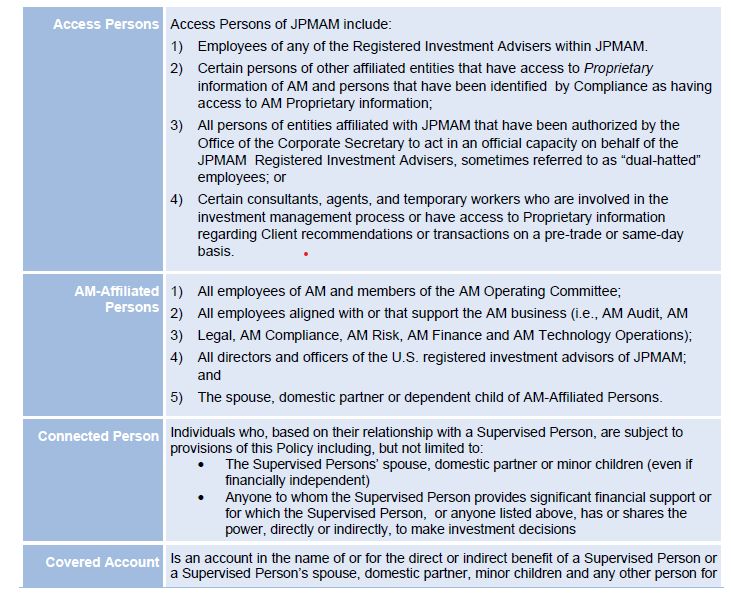
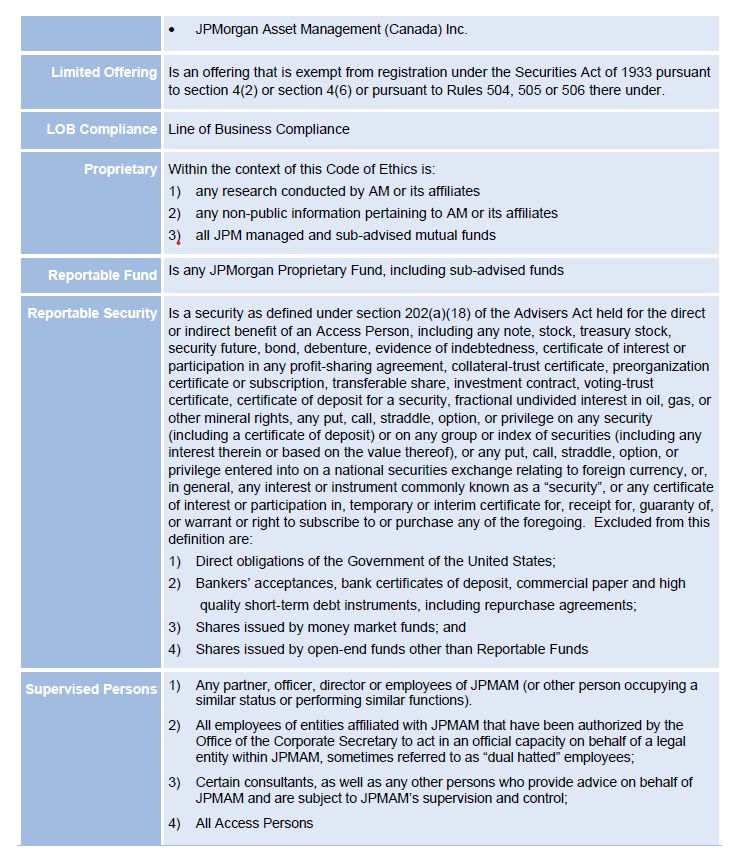
12
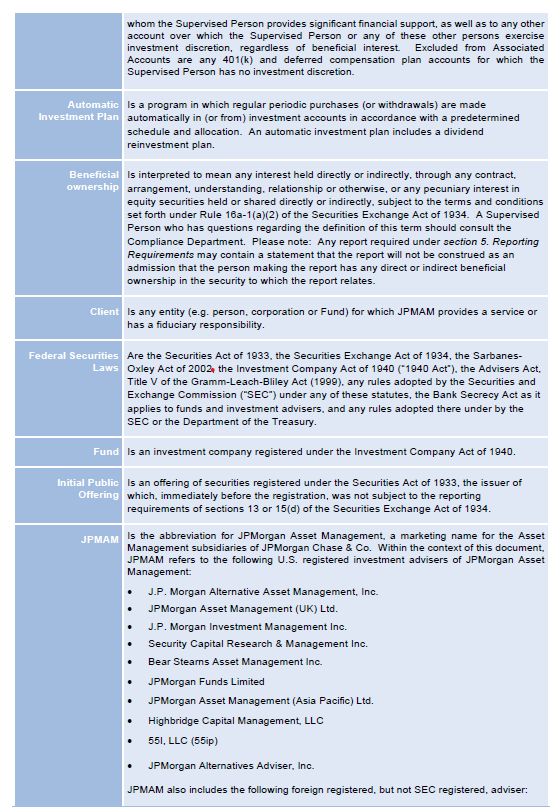
13