We limit the negative Index Return used in calculating Index Credit through a Buffer or Floor downside protection feature. The level of protection against negative Index Returns is based on the applicable Buffer Percentage or Floor Percentage.
We will always offer an Indexed Strategy with a 0% Floor Percentage. We may offer Indexed Strategies in the future that do not limit Index losses.
Each Indexed Strategy has an upside crediting method. We limit the amount you can earn on an Indexed Strategy through the applicable upside crediting method.
The upside crediting methods for the standard (i.e., non-Dual Directional) Indexed Strategies provide for positive Index Credit only if the Index Return at the end of the Strategy Term is positive. The upside crediting methods for the Dual Directional Indexed Strategies (other than Dual Directional Yield) provide for positive Index Credit if the Index Return at the end of the Strategy Term is positive, zero, or to a limited extent, negative.
Dual Directional Yield strategies, unlike other Indexed Strategies, provide for potential Index gains through a quarterly Performance Credit, which may be positive or zero (never negative). A Performance Credit Rate will apply on each Quarterly Anniversary during the six-year Strategy Term, including the Strategy Term end date, based on the Index performance and the Performance Yield upside crediting method. The amount credited to your Contract from a positive Performance Credit, if any, is immediately and automatically allocated to the Performance Credit Account. See "Contract Features — Performance Credit Account" below. An Index Credit will still be applied on the Strategy Term End Date, but will be either zero or negative (never positive).
You could lose a significant amount of money due to a negative MVA or a negative Strategy Interim Value adjustment.
|
|
FEES, EXPENSES, AND ADJUSTMENTS |
Location in Prospectus |
|||||||||
|
Are There Charges or Adjustments for Early Withdrawals? |
Yes. Withdrawal Charges. If you take a withdrawal or annuitize during the first six Contract Years, you may be assessed a Withdrawal Charge of up to 8% for a B-share Contract or up to 2% for an I-share Contract, as a percentage of the amount withdrawn or annuitized. For example, if you invest $100,000 in the Contract and make an early withdrawal, you could pay a Withdrawal Charge of up to $8,000 for a B-share Contract or up to $2,000 for an I-share Contract. This loss will be greater if there are also negative MVAs, negative Strategy Interim Value adjustments, taxes or tax penalties. Market Value Adjustment. If you take a withdrawal or annuitize during the first six Contract Years, We may apply an MVA, which may be negative. In extreme circumstances, you could lose up to 100% of the amount withdrawn or annuitized from an Indexed Strategy due to a negative MVA. For example, if you withdraw $100,000 from an Indexed Strategy, you could lose up to $100,000 of the withdrawal proceeds. An MVA may apply to a withdrawal or annuitization during the Withdrawal Charge Period, including the last day of a Strategy Term. Losses due to a negative MVA will be greater if there are also Withdrawal Charges, negative Strategy Interim Value adjustments, taxes or tax penalties. Strategy Interim Value Adjustment. If all or a portion of Contract Value is removed from an Indexed Strategy before the expiration of a Strategy Term, We will apply a Strategy Interim Value adjustment, which may be negative. In extreme circumstances, you could lose up to 100% of your investment in an Indexed Strategy due to a negative Strategy Interim Value adjustment. For example, if you allocate $100,000 to an Indexed Strategy with a 3-year Strategy Term and take a withdrawal before the 3 years have ended, you could lose your entire $100,000 investment. The types of transactions that may result in a Strategy Interim Value adjustment include partial withdrawals (including, e.g., withdrawals to pay advisory fees, systematic withdrawals and Required Minimum Distributions), full surrender, cancellation, annuitization, Death Benefit payments, Performance Lock and deductions for Rider Charges. Losses due to a negative Strategy Interim Value adjustment will be greater if there are also Withdrawal Charges, negative MVAs, taxes or tax penalties. |
Fee Table Contract Charges and Adjustments |
|||||||||
|
Are There Transaction Charges? |
No. Other than Withdrawal Charges, MVAs and Strategy Interim Value adjustments, there are no transaction charges under the Contract. |
Fee Table Contract Charges and Adjustments |
|||||||||
|
FEES, EXPENSES, AND ADJUSTMENTS |
Location in Prospectus |
||||||||||||||||||||||
|
Are There Ongoing Fees and Expenses? |
Yes. Under the Indexed Strategies, there is an implicit ongoing fee to the extent that your participation in Index gains is limited by Our use of an Index Cap, Index Trigger, Participation Rate, Tier Participation Rate, Dual Directional Cap, Dual Directional Trigger, Dual Directional Trigger and Cap, or Performance Yield. This means that your returns may be lower than the Index's returns. In return for accepting a limit on Index gains, you will receive some protection from Index losses. This implicit ongoing fee is not reflected in the tables below. The table below describes the fees and expenses that you may pay each year, depending on if you choose the optional benefit. Please refer to your Contract specifications page for information about the specific fees you will pay each year based on the options you have elected. These ongoing fees and expenses do not reflect any advisory fees paid to financial professionals from Contract Value or other assets of the Owner; if such charges were reflected, ongoing fees and expenses would be higher. |
Fee Table Contract Charges and Adjustments |
|||||||||||||||||||||
|
Annual Fee |
Minimum |
Maximum |
|||||||||||||||||||||
|
Optional benefit available for an additional charge (for a single optional benefit, if elected) |
0.00% |
0.50%(1) |
|||||||||||||||||||||
|
(1) As a percentage of the Optional Death Benefit Value for the Return of Premium Death Benefit. The charge shown applies to Issue Ages 71+. For Issue Ages up to 70, the charge is 0.20%. The charge is assessed on the Valuation Day prior to each Contract Anniversary. Each time the charge is deducted from an Indexed Strategy, a Strategy Interim Value adjustment and a proportional reduction to the Indexed Strategy Base will apply. When deducted from an Aggregate Floor Indexed Strategy, the charge will proportionally reduce the Aggregate Floor. Negative Strategy Interim Value adjustments and proportional reductions could be greater than the dollar amount of the charge, perhaps significantly greater. Because your Contract is customizable, the choices you make affect how much you will pay. To help you understand the cost of owning your Contract, the following table shows the lowest and highest cost you could pay each year, based on current charges. This estimate assumes that you do not take withdrawals from the Contract, which could add Withdrawal Charges, negative MVAs and negative Strategy Interim Value adjustments that substantially increase costs. |
|||||||||||||||||||||||
|
Lowest Annual Cost: $0 Assumes: • Investment of $100,000 • 5% annual appreciation • Least expensive Contract class • No optional benefit • No sales charges • No advisory fees • No transfers or withdrawals |
Highest Annual Cost: $500 Assumes: • Investment of $100,000 • 5% annual appreciation • Most expensive Contract class and the optional benefit • 0% Strategy Interim Value adjustments for Rider Charge deductions • No sales charges • No advisory fees • No transfers or withdrawals |
||||||||||||||||||||||
Are There Charges or Adjustments for Early Withdrawals?
Yes.Withdrawal Charges. If you take a withdrawal or annuitize during the first six Contract Years, you may be assessed a Withdrawal Charge of up to 8% for a B-share Contract or up to 2% for an I-share Contract, as a percentage of the amount withdrawn or annuitized. For example, if you invest $100,000 in the Contract and make an early withdrawal, you could pay a Withdrawal Charge of up to $8,000 for a B-share Contract or up to $2,000 for an I-share Contract. This loss will be greater if there are also negative MVAs, negative Strategy Interim Value adjustments, taxes or tax penalties.
Market Value Adjustment. If you take a withdrawal or annuitize during the first six Contract Years, We may apply an MVA, which may be negative. In extreme circumstances, you could lose up to 100% of the amount withdrawn or annuitized from an Indexed Strategy due to a negative MVA. For example, if you withdraw $100,000 from an Indexed Strategy, you could lose up to $100,000 of the withdrawal proceeds. An MVA may apply to a withdrawal or annuitization during the Withdrawal Charge Period, including the last day of a Strategy Term. Losses due to a negative MVA will be greater if there are also Withdrawal Charges, negative Strategy Interim Value adjustments, taxes or tax penalties.
Strategy Interim Value Adjustment. If all or a portion of Contract Value is removed from an Indexed Strategy before the expiration of a Strategy Term, We will apply a Strategy Interim Value adjustment, which may be negative. In extreme circumstances, you could lose up to 100% of your investment in an Indexed Strategy due to a negative Strategy Interim Value adjustment. For example, if you allocate $100,000 to an Indexed Strategy with a 3-year Strategy Term and take a withdrawal before the 3 years have ended, you could lose your entire $100,000 investment. The types of transactions that may result in a Strategy Interim Value adjustment include partial withdrawals (including, e.g., withdrawals to pay advisory fees, systematic withdrawals and Required Minimum Distributions), full surrender, cancellation, annuitization, Death Benefit payments, Performance Lock and deductions for Rider Charges. Losses due to a negative Strategy Interim Value adjustment will be greater if there are also Withdrawal Charges, negative MVAs, taxes or tax penalties. Fee Table
Contract Charges and Adjustments
Are There Transaction Charges?
No.Other than Withdrawal Charges, MVAs and Strategy Interim Value adjustments, there are no transaction charges under the Contract. Fee Table
Contract Charges and Adjustments
Under the Indexed Strategies, there is an implicit ongoing fee to the extent that your participation in Index gains is limited by Our use of an Index Cap, Index Trigger, Participation Rate, Tier Participation Rate, Dual Directional Cap, Dual Directional Trigger, Dual Directional Trigger and Cap, or Performance Yield. This means that your returns may be lower than the Index's returns. In return for accepting a limit on Index gains, you will receive some protection from Index losses. This implicit ongoing fee is not reflected in the tables below.The table below describes the fees and expenses that you may pay each year, depending on if you choose the optional benefit. Please refer to your Contract specifications page for information about the specific fees you will pay each year based on the options you have elected. These ongoing fees and expenses do not reflect any advisory fees paid to financial professionals from Contract Value or other assets of the Owner; if such charges were reflected, ongoing fees and expenses would be higher. Fee Table
Contract Charges and Adjustments
Annual Fee
Minimum
Maximum
Optional benefit available for an additional charge (for a single optional benefit, if elected)
0.00% 0.50%(1) (1) As a percentage of the Optional Death Benefit Value for the Return of Premium Death Benefit. The charge shown applies to Issue Ages 71+. For Issue Ages up to 70, the charge is 0.20%. The charge is assessed on the Valuation Day prior to each Contract Anniversary. Each time the charge is deducted from an Indexed Strategy, a Strategy Interim Value adjustment and a proportional reduction to the Indexed Strategy Base will apply. When deducted from an Aggregate Floor Indexed Strategy, the charge will proportionally reduce the Aggregate Floor.
Negative Strategy Interim Value adjustments and proportional reductions could be greater than the dollar amount of the charge, perhaps significantly greater.
Because your Contract is customizable, the choices you make affect how much you will pay. To help you understand the cost of owning your Contract, the following table shows the lowest and highest cost you could pay each year, based on current charges. This estimate assumes that you do not take withdrawals from the Contract, which could add Withdrawal Charges, negative MVAs and negative Strategy Interim Value adjustments that substantially increase costs. Lowest Annual Cost: $0
Assumes:
• Investment of $100,000
• 5% annual appreciation
• Least expensive Contract class
• No optional benefit
• No sales charges
• No advisory fees
• No transfers or withdrawals Highest Annual Cost: $500
Assumes:
• Investment of $100,000
• 5% annual appreciation
• Most expensive Contract class and the optional benefit
• 0% Strategy Interim Value adjustments for Rider Charge deductions
• No sales charges
• No advisory fees
• No transfers or withdrawals
Assumes:
• Investment of $100,000
• 5% annual appreciation
• Least expensive Contract class
• No optional benefit
• No sales charges
• No advisory fees
• No transfers or withdrawals Highest Annual Cost: $500
Assumes:
• Investment of $100,000
• 5% annual appreciation
• Most expensive Contract class and the optional benefit
• 0% Strategy Interim Value adjustments for Rider Charge deductions
• No sales charges
• No advisory fees
• No transfers or withdrawals
|
RISKS |
Location in Prospectus |
||||||||||
|
Is There a Risk of Loss from Poor Performance? |
Yes. • You can lose money by investing in the Contract. • For amounts allocated to an Indexed Strategy with a Buffer, if there is negative Index performance, you risk any Index losses that exceed the Buffer Percentage. The maximum amount of loss at the end of a Strategy Term that you could experience from negative Index performance after taking into account the current Buffer Percentages provided under the Contract ranges from 75% to 95%. • For amounts allocated to an Indexed Strategy with a Floor, if there is negative Index performance, you risk any Index losses up to the Floor Percentage. The maximum amount of loss at the end of a Strategy Term that you could experience from negative Index performance after taking into account the current Floor Percentages provided under the Contract is 0% (for the Indexed Strategy with a 0% Floor Percentage) or 20% (for the Indexed Strategy with an Aggregate Floor). • The limits on Index loss offered under the Contract may change from one Strategy Term to the next; however, We will always offer an Indexed Strategy with a 0% Floor Percentage. • In the future, We may not offer any Indexed Strategies with Buffer or Aggregate Floor, and We do not guarantee a minimum Buffer Percentage or Floor Percentage for any new Indexed Strategies that We may offer in the future. We may offer Indexed Strategies in the future that do not limit Index losses, which would mean risk of loss of the entire amount invested. |
Principal Risks of Investing in the Contract |
|||||||||
|
Is This a Short-Term Investment? |
No. • The Contract is not a short-term investment and is not appropriate for an investor who needs ready access to cash. • The benefits of tax deferral and long-term income are generally more beneficial to investors with a long investment time horizon. • Withdrawals may result in Withdrawal Charges, negative MVAs, taxes and tax penalties. Also, withdrawing or otherwise removing amounts from an Indexed Strategy before the end of a Strategy Term may result in negative Strategy Interim Value adjustments and loss of positive Index performance. Withdrawals may significantly reduce the Death Benefit. • In addition to a Strategy Interim Value adjustment, which may be negative, withdrawals from an Indexed Strategy before the end of a Strategy Term will result in proportional reductions to your Indexed Strategy Base. The proportional reduction could be greater than the amount withdrawn. Reductions to your Indexed Strategy Base will result in lower Strategy Interim Values for the remainder of the Strategy Term and less positive Index Credit (if any) at the end of the Strategy Term. • At the end of a Strategy Term, Contract Value in the matured strategy will be reallocated, withdrawn or annuitized according to your instructions. In the absence of instructions, Contract Value in the matured strategy will be reinvested in the same strategy for a new Strategy Term. If the same strategy is not available, Contract Value in the matured strategy will be automatically reallocated to the One-Year Fixed Strategy. You will receive at least 30 days' advance notice prior to the maturity of a Strategy Term. |
Principal Risks of Investing in the Contract |
|||||||||
• Each investment option (including the One-Year Fixed Strategy) has its own unique risks. You should review the available investment options before making an investment decision.
For the Indexed Strategies:
• The upside crediting methods — either Index Cap, Index Trigger, Participation Rate, Tier Participation Rate, Dual Directional Cap, Dual Directional Trigger, Dual Directional Trigger and Cap, or Performance Yield — limit the amount you can earn on an Indexed Strategy (i.e., limited upside). This may result in you earning less than the Index Return.
For example:
o Index Cap or Dual Directional Cap: If the Index Return is 10% and the Index Cap is 6%, We will apply a 6% Index Credit at the end of the Strategy Term.
o Index Trigger or Dual Directional Trigger: If the Index Return is 10% and the Index Trigger Rate is 3%, We will apply a 3% Index Credit at the end of the Strategy Term.
o Participation Rate: If the Index Return is 10% and the Participation Rate is 80%, We will apply an 8% Index Credit (10% x 80% = 8%) at the end of the Strategy Term.
o Tier Participation Rate: Assuming a Tier One Participation Rate of 80%, a Tier Two Participation Rate of 100% and a Tier Level of 10%:◼ If the Index Return is 10% (which does not exceed the Tier Level), the Index Credit at the end of the Strategy Term will equal the sum of (a) 10% multiplied by the 80% Tier One Participation Rate (10% x 80% = 8%) and (b) 0% multiplied by the 100% Tier Two Participation Rate (0% x 100% = 0%), which equals 8% (8% + 0% = 8%).
◼ If the Index Return is 15% (which does exceed the Tier Level), the Index Credit at the end of the Strategy Term will equal the sum of (a) 10% multiplied by the 80% Tier One Participation Rate (10% x 80% = 8%) and (b) 5% multiplied by the 100% Tier Two Participation Rate (5% x 100% = 5%), which equals 13% (8% + 5% = 13%).
o Dual Directional Trigger and Cap: Assuming a Trigger Level threshold of 10%, an Index Trigger Rate of 3% and an Index Cap of 15%.◼ If the Index Return is 6% (which does not exceed the Trigger Level threshold), We will apply a 3% Index Credit at the end of the Strategy Term.
◼ If the Index Return is 20% (which does exceed the Trigger Level threshold), We will apply a 15% Index Credit at the end of the Strategy Term.
o Performance Yield: Assuming the Index Return is 10% and the Performance Yield is 8%, on the Strategy Term end date:◼ The Performance Credit Rate for that Quarterly Anniversary will equal 2% (8% / 4 = 2%), which will be in addition to any other Performance Credits from prior Quarterly Anniversaries during the Strategy Term.
◼ The Index Credit will be 0%.
Principal Risks of Investing in the Contract
• The Buffer Percentage or Floor Percentage, as applicable, may limit negative Index Credits (i.e., limited protection in the case of market decline).o Buffer Percentage: You bear the risk of loss for any negative Index Return in excess of the Buffer Percentage. For example, if the Buffer Percentage is 10% and the Index Return is -25%, We will apply a -15% Index Credit (the amount of negative Index Return that exceeds the Buffer Percentage) at the end of the Strategy Term. If the Index Return is instead -5% (which does not exceed the Buffer Percentage), We will apply a 0% Index Credit.
o Floor Percentage: You bear the risk of loss for any negative Index Return up to the Floor Percentage. For example, if the Floor Percentage is -10% and the Index Return is -25%, We will apply a -10% Index Credit (the amount of negative Index Return up to the Floor Percentage) at the end of the Strategy Term. If the Index Return is instead -5% (which is higher than the Floor Percentage), We will apply a -5% Index Credit.
• While the 0% Floor Indexed Strategy provides complete protection from a negative Index Return, like any other Indexed Strategy, there may be losses due to Withdrawal Charges, negative MVAs, negative Strategy Interim Value adjustments, taxes and tax penalties.
• While Dual Directional strategies provide for potential gain in the event of negative Index performance, they do not provide protection from any negative Index Return in excess of the applicable Buffer Percentage.
• Each Index is a "price return index," not a "total return index," and therefore does not reflect dividends paid on the securities composing the Index. This will reduce the Index performance and may cause the Index to underperform a direct investment in the securities composing the Index.
What are the Risks Related to the Insurance Company?
An investment in the Contract is subject to the risks related to Us, Forethought Life Insurance Company. Any obligations (including under the One-Year Fixed Strategy and the Indexed Strategies), guarantees or benefits of the Contract are subject to Our claims-paying ability. More information about Forethought Life Insurance Company, including Our financial strength ratings, is available upon request by calling 833-275-4248 or visiting www.globalatlantic.com.
Principal Risks of Investing in the Contract
• The upside crediting methods — either Index Cap, Index Trigger, Participation Rate, Tier Participation Rate, Dual Directional Cap, Dual Directional Trigger, Dual Directional Trigger and Cap, or Performance Yield — limit the amount you can earn on an Indexed Strategy (i.e., limited upside). This may result in you earning less than the Index Return.
o Index Cap or Dual Directional Cap: If the Index Return is 10% and the Index Cap is 6%, We will apply a 6% Index Credit at the end of the Strategy Term.
o Index Trigger or Dual Directional Trigger: If the Index Return is 10% and the Index Trigger Rate is 3%, We will apply a 3% Index Credit at the end of the Strategy Term.
o Participation Rate: If the Index Return is 10% and the Participation Rate is 80%, We will apply an 8% Index Credit (10% x 80% = 8%) at the end of the Strategy Term.
o Tier Participation Rate: Assuming a Tier One Participation Rate of 80%, a Tier Two Participation Rate of 100% and a Tier Level of 10%:◼ If the Index Return is 10% (which does not exceed the Tier Level), the Index Credit at the end of the Strategy Term will equal the sum of (a) 10% multiplied by the 80% Tier One Participation Rate (10% x 80% = 8%) and (b) 0% multiplied by the 100% Tier Two Participation Rate (0% x 100% = 0%), which equals 8% (8% + 0% = 8%).
◼ If the Index Return is 15% (which does exceed the Tier Level), the Index Credit at the end of the Strategy Term will equal the sum of (a) 10% multiplied by the 80% Tier One Participation Rate (10% x 80% = 8%) and (b) 5% multiplied by the 100% Tier Two Participation Rate (5% x 100% = 5%), which equals 13% (8% + 5% = 13%).
o Dual Directional Trigger and Cap: Assuming a Trigger Level threshold of 10%, an Index Trigger Rate of 3% and an Index Cap of 15%.
◼ If the Index Return is 6% (which does not exceed the Trigger Level threshold), We will apply a 3% Index Credit at the end of the Strategy Term.
◼ If the Index Return is 20% (which does exceed the Trigger Level threshold), We will apply a 15% Index Credit at the end of the Strategy Term.
o Performance Yield: Assuming the Index Return is 10% and the Performance Yield is 8%, on the Strategy Term end date:
◼ The Performance Credit Rate for that Quarterly Anniversary will equal 2% (8% / 4 = 2%), which will be in addition to any other Performance Credits from prior Quarterly Anniversaries during the Strategy Term.
◼ The Index Credit will be 0%.
Are There Restrictions on the Investment Options?
Yes.• There are restrictions that limit the Indexed Strategies you may choose.
o An allocation to a three-year or six-year Indexed Strategy is not permitted if the Strategy Term would begin during the Withdrawal Charge Period and extend beyond the end of the Withdrawal Charge Period.
o An allocation to a three-year or six-year Indexed Strategy is not permitted if the Strategy Term would extend beyond the Contract Maturity Date.
o If Contract Value is already allocated to a three-year or six-year Indexed Strategy, you may not allocate additional Contract Value to that same Indexed Strategy until the ongoing Strategy Term ends.
o For the Dual Directional Yield strategies, Contract Value may be allocated to either the 10% or the 20% Buffer strategy, but not both. One-Year Fixed Strategy
Performance Credit Account
Indexed Strategies
Reallocation Period
Appendix A: Investment Options Available under the Contract
Appendix J: Financial Intermediary Variations• There are significant restrictions on transfers of Contract Value.
o You may transfer Contract Value from the One-Year Fixed Strategy or an Indexed Strategy only on the Strategy Term end date.
o You may transfer Contract Value from the Performance Credit Account to the One-Year Fixed Strategy or the Indexed Strategies only on a Contract Anniversary. Partial reallocations from the Performance Credit Account are not permitted.
• We reserve the right to add and remove Indexed Strategies, and change the features of the Indexed Strategies, from one Strategy Term to the next, including the Index and the current limits on Index gains, subject to applicable guarantees.
• We guarantee that the One-Year Fixed Strategy and the S&P 500® one year standard Index Cap with 0% Floor Indexed Strategy will be available. We do not guarantee the availability of any other strategies.
• An Indexed Strategy's limit on Index losses for a single Strategy Term will not change, either during a Strategy Term or for future Strategy Terms (except that for the Indexed Strategy with Aggregate Floor, after the initial rate, the Floor Percentage will change from one consecutive Strategy Term to the next).
• We reserve the right to replace the Index for any Indexed Strategy during a Strategy Term.
• The Performance Credit Account is used exclusively in connection with Dual Directional Yield strategies. You cannot instruct Us to allocate Contract Value directly to the Performance Credit Account.
• The Contract is a single Premium Payment product. Additional Premium Payments will not be accepted.
• There are restrictions and limitations relating to benefits offered under the Contract (e.g., Death Benefit, Performance Lock).
• Except as otherwise provided, Contract benefits may not be modified or terminated by the Company.
• Partial withdrawals may significantly reduce the Death Benefit, including the standard Death Benefit or the optional Return of Premium Death Benefit, if elected. A full withdrawal will terminate the Contract and all of its benefits, including the Death Benefit.
• If the optional Return of Premium Death Benefit has been elected, withdrawals (other than advisory fee withdrawals through the systematic withdrawal program) will proportionately reduce the benefit. The reduction may be significantly greater than the value withdrawn.
• Advisory fee withdrawals outside of the systematic withdrawal program, unlike program withdrawals, may be subject to Withdrawal Charges and negative MVAs, and will result in proportional reductions to the optional Return of Premium Death Benefit if elected. In addition, same as program withdrawals, negative Strategy Interim Value adjustments and tax consequences may apply. Indexed Strategies — Performance Lock
Access to Your Money During the Accumulation Period — Systematic Withdrawals to Pay Advisory Fees
Benefits Available Under the Contract
Death Benefit
• If you purchase the Contract through a tax-qualified plan or individual retirement account (IRA), there is no additional tax benefit from the Contract.
• Withdrawals will be subject to ordinary income tax. You also may have to pay a 10% penalty tax if you take a withdrawal before age 59 1/2.
Federal Tax Considerations
Your investment professional may receive compensation for selling this Contract to you in the form of commissions, additional payments and non-cash compensation. We may share the revenue We earn on this Contract with your investment professional's firm. This conflict of interest may influence your investment professional to recommend this Contract over another investment for which the investment professional is not compensated or compensated less.
Other Information — How Contracts are Sold
Some investment professionals may have a financial incentive to offer you a new contract in place of the one you already own. You should exchange a contract you already own only if you determine, after comparing the features, fees and risks of both contracts, and any fees or penalties to terminate the existing contract, that it is better for you to purchase the new contract rather than continue to own your existing contract.
Other Information — How Contracts are Sold
FEE TABLE
The following tables describe the fees, expenses and adjustments that you will pay when buying, owning and surrendering or making withdrawals from an investment option or from the Contract. They do not reflect any advisory fees paid to financial professionals from Contract Value or other assets of the Owner; if such fees were reflected, fees and expenses would be higher. Please refer to your Contract specifications page for information about the specific fees you will pay each year based on the options you have elected.
The first table describes the fees and expenses that you will pay at the time that you buy the Contract, surrender or make withdrawals from an investment option or from the Contract, or transfer Contract Value between investment options. State premium taxes may also be deducted.
Transaction Expenses
|
B-Share |
I-Share |
||||||||||
|
Sales Load Imposed on Purchases |
None |
None |
|||||||||
|
Withdrawal Charge(1), (2) (as a percentage of the amount withdrawn or annuitized) |
8 |
% |
2 |
% |
|||||||
|
Transfer Fee |
None |
None |
|||||||||
(1) Withdrawal Charges are assessed according to the following schedule:
|
Withdrawal Charge Percentage |
|||||||||||
|
Contract Year |
B-Share |
I-Share |
|||||||||
|
1 |
8 |
% |
2 |
% |
|||||||
|
2 |
8 |
% |
2 |
% |
|||||||
|
3 |
7 |
% |
2 |
% |
|||||||
|
4 |
6 |
% |
2 |
% |
|||||||
|
5 |
5 |
% |
2 |
% |
|||||||
|
6 |
4 |
% |
2 |
% |
|||||||
| 7+ |
0 |
% |
0 |
% |
|||||||
(2) Withdrawal Charges (and MVAs) do not apply to withdrawals of the Free Withdrawal Amount; advisory fee withdrawals through the systematic withdrawal program; or withdrawals under the Bailout Waiver, Nursing Care Waiver or Terminal Illness Waiver. Negative Strategy Interim Value adjustments, taxes and tax penalties may apply.
The next table describes the adjustments, in addition to any transaction expenses, that apply if all or a portion of the Contract Value is removed from an investment option or from the Contract before the expiration of a specified period.
Adjustments
|
Market Value Adjustment Maximum Potential Loss(1) |
100% |
||||||
|
Strategy Interim Value Adjustment Maximum Potential Loss(3) |
100% |
||||||
(1) Cumulative withdrawals (partial or full) that exceed the Free Withdrawal Amount for any Contract Year during the Withdrawal Charge Period may be subject to an MVA. An MVA will apply to the Contract Value that exceeds your Free Withdrawal Amount if you annuitize your Contract during the Withdrawal Charge Period. An MVA may apply on any day during the Withdrawal Charge Period, including the last day of a Strategy Term. MVAs (and Withdrawal Charges) do not apply to withdrawals of the Free Withdrawal Amount; advisory fee withdrawals through the systematic withdrawal program; or withdrawals under the Bailout Waiver, Nursing Care Waiver or Terminal Illness Waiver.
(2) The One-Year Fixed Strategy (not the Indexed Strategies) is subject to the Standard Nonforfeiture Law for Individual Deferred Annuities. A negative MVA will not cause the amount payable upon withdrawal, or the amount annuitized, from the One-Year Fixed Strategy to be less than the minimum non-forfeiture amount required by state law.
(3) We will apply a Strategy Interim Value adjustment if amounts are withdrawn or otherwise removed from an Indexed Strategy before the end of a Strategy Term. The types of transactions that may result in a Strategy Interim Value adjustment include partial withdrawals (including, e.g., withdrawals to pay advisory fees, systematic withdrawals and Required Minimum Distributions), full surrender, cancellation, annuitization, Death Benefit payments, Performance Lock and deductions for Rider Charges.
The next table describes the fees and expenses that you will pay each year during the time that you own the Contract. If you choose to purchase the optional benefit, you will pay additional charges, as shown below.
Annual Contract Expenses
|
Optional Benefit Expenses |
|||||||
|
Return of Premium Death Benefit(1) (as a percentage of the Optional Death Benefit Value) |
0.20% for Issue Ages up to 70 0.50% for Issue Ages 71+ |
||||||
(1) The Rider Charge is assessed on the Valuation Day prior to each Contract Anniversary during the Accumulation Period. Each time the Rider Charge is deducted from an Indexed Strategy, a Strategy Interim Value adjustment and a proportional reduction to the Indexed Strategy Base will apply. Also, if deducted from an Aggregate Floor Indexed Strategy, there will be a proportional reduction to the Aggregate Floor. These negative adjustments and proportional reductions could be greater than the dollar amount of the Rider Charge, perhaps significantly greater.
In addition to the fees described above, We limit the amount you can earn on the Indexed Strategies. This means your returns may be lower than the Index's returns. In return for accepting a limit on Index gains, you will receive some protection from Index losses in accordance with the Indexed Strategy chosen.
Transaction Expenses
|
B-Share |
I-Share |
||||||||||
|
Sales Load Imposed on Purchases |
None |
None |
|||||||||
|
Withdrawal Charge(1), (2) (as a percentage of the amount withdrawn or annuitized) |
8 |
% |
2 |
% |
|||||||
|
Transfer Fee |
None |
None |
|||||||||
(1) Withdrawal Charges are assessed according to the following schedule:
|
Withdrawal Charge Percentage |
|||||||||||
|
Contract Year |
B-Share |
I-Share |
|||||||||
|
1 |
8 |
% |
2 |
% |
|||||||
|
2 |
8 |
% |
2 |
% |
|||||||
|
3 |
7 |
% |
2 |
% |
|||||||
|
4 |
6 |
% |
2 |
% |
|||||||
|
5 |
5 |
% |
2 |
% |
|||||||
|
6 |
4 |
% |
2 |
% |
|||||||
| 7+ |
0 |
% |
0 |
% |
|||||||
(2) Withdrawal Charges (and MVAs) do not apply to withdrawals of the Free Withdrawal Amount; advisory fee withdrawals through the systematic withdrawal program; or withdrawals under the Bailout Waiver, Nursing Care Waiver or Terminal Illness Waiver. Negative Strategy Interim Value adjustments, taxes and tax penalties may apply.
The next table describes the adjustments, in addition to any transaction expenses, that apply if all or a portion of the Contract Value is removed from an investment option or from the Contract before the expiration of a specified period.
Adjustments
|
Market Value Adjustment Maximum Potential Loss(1) |
100% |
||||||
|
Strategy Interim Value Adjustment Maximum Potential Loss(3) |
100% |
||||||
(1) Cumulative withdrawals (partial or full) that exceed the Free Withdrawal Amount for any Contract Year during the Withdrawal Charge Period may be subject to an MVA. An MVA will apply to the Contract Value that exceeds your Free Withdrawal Amount if you annuitize your Contract during the Withdrawal Charge Period. An MVA may apply on any day during the Withdrawal Charge Period, including the last day of a Strategy Term. MVAs (and Withdrawal Charges) do not apply to withdrawals of the Free Withdrawal Amount; advisory fee withdrawals through the systematic withdrawal program; or withdrawals under the Bailout Waiver, Nursing Care Waiver or Terminal Illness Waiver.
(2) The One-Year Fixed Strategy (not the Indexed Strategies) is subject to the Standard Nonforfeiture Law for Individual Deferred Annuities. A negative MVA will not cause the amount payable upon withdrawal, or the amount annuitized, from the One-Year Fixed Strategy to be less than the minimum non-forfeiture amount required by state law.
(3) We will apply a Strategy Interim Value adjustment if amounts are withdrawn or otherwise removed from an Indexed Strategy before the end of a Strategy Term. The types of transactions that may result in a Strategy Interim Value adjustment include partial withdrawals (including, e.g., withdrawals to pay advisory fees, systematic withdrawals and Required Minimum Distributions), full surrender, cancellation, annuitization, Death Benefit payments, Performance Lock and deductions for Rider Charges.
Annual Contract Expenses
|
Optional Benefit Expenses |
|||||||
|
Return of Premium Death Benefit(1) (as a percentage of the Optional Death Benefit Value) |
0.20% for Issue Ages up to 70 0.50% for Issue Ages 71+ |
||||||
(1) The Rider Charge is assessed on the Valuation Day prior to each Contract Anniversary during the Accumulation Period. Each time the Rider Charge is deducted from an Indexed Strategy, a Strategy Interim Value adjustment and a proportional reduction to the Indexed Strategy Base will apply. Also, if deducted from an Aggregate Floor Indexed Strategy, there will be a proportional reduction to the Aggregate Floor. These negative adjustments and proportional reductions could be greater than the dollar amount of the Rider Charge, perhaps significantly greater.
In addition to the fees described above, We limit the amount you can earn on the Indexed Strategies. This means your returns may be lower than the Index's returns. In return for accepting a limit on Index gains, you will receive some protection from Index losses in accordance with the Indexed Strategy chosen.
PRINCIPAL RISKS OF INVESTING IN THE CONTRACT
If you purchase a Contract, you will be subject to certain risks. You should carefully consider the following risk factors, in addition to the matters set forth elsewhere in this prospectus, prior to purchasing the Contract.
RISK OF LOSS
You can lose money by investing in this Contract, including your principal investment and earnings over the life of the Contract. The value of your Contract is not guaranteed by the U.S. government or any federal government agency, insured by the FDIC, or guaranteed by any bank.
RISK OF LOSS DURING RIGHT TO EXAMINE PERIOD
If you return the Contract during the Right to Examine Period, We will process your refund within two Valuation Days from the Valuation Day We receive your properly completed request to cancel in Good Order and pay you your Contract Value. Unless otherwise required by state law, you bear the risk of any decline in your Contract Value during the Right to Examine Period. To the extent that Contract Value is allocated to an Indexed Strategy, the amount refunded will reflect a Strategy Interim Value adjustment, which may be negative and result in significant loss. See "General Liquidity Risk" below.
GENERAL LIQUIDITY RISK
The Contract is unsuitable as a short-term savings vehicle. It is not designed to be a short-term investment and may not be appropriate for an investor who needs ready access to cash. Withdrawals under the Contract are subject to significant risks and may result in significant loss. You should consult with your financial professional before taking any withdrawals under the Contract. If you take withdrawals (including withdrawals to pay advisory fees) from your Contract during the Withdrawal Charge Period, Withdrawal Charges and MVAs (which can be positive or negative) may apply. In addition, amounts withdrawn from this Contract may also be subject to ordinary federal and state income taxes, as well as a 10% additional federal tax if taken before age 59 1/2. Further, if the optional Return of Premium Death Benefit is elected, and the Contract is surrendered or the rider is terminated before the Contract Anniversary in a given year, you will be charged a prorated Rider Charge. In addition, We will apply an MVA upon annuitization in excess of the Free Withdrawal Amount during the Withdrawal Charge Period. If you plan on annuitizing or taking withdrawals that will be subject to Withdrawal Charges, MVAs and/or additional federal taxes, this Contract may not be appropriate for you.
The application of a negative MVA may result in significant loss. In extreme circumstances, it is possible to lose 100% of the amount withdrawn or annuitized from an Indexed Strategy due to a negative MVA.
For amounts allocated to an Indexed Strategy, on any day other than the first and last day of the Strategy Term, your Strategy Contract Value for that Indexed Strategy equals the Strategy Interim Value. We will apply the Strategy Interim Value if amounts are withdrawn or otherwise removed from an Indexed Strategy before the end of a Strategy Term, which may result in significant loss. The types of transactions to which We may apply Strategy Interim Value include partial withdrawals (including withdrawals to pay advisory fees, systematic withdrawals and Required Minimum Distributions under the Contract), full surrender of your Contract, cancellation, annuitization, Death Benefit payments, Performance Lock, and deductions for Rider Charges. Strategy Interim Value could reflect loss, even when the Index is performing positively. This is because gain or loss associated with Strategy Interim Value (i.e., the Strategy Interim Value adjustment) is not calculated the same way as Index Credits or Performance Credits. It is calculated based on Our valuation of the derivative and fixed income instruments, respectively, that We hold to support the Indexed Strategy. Strategy Interim Value does not directly reflect the actual performance of the applicable Index and is not subject to the Buffer Percentage or Floor Percentage. The Strategy Interim Value may reflect lower gains, if the Index is performing positively, or higher losses, if the Index is performing negatively, than would apply at the end of the Strategy Term (or, for Dual Directional Yield, lower gains than would apply on a Quarterly Anniversary or higher losses than would apply at the end of the Strategy Term). A Strategy Interim Value adjustment is generally expected to be less than the term-to-date Index performance on any Valuation Day.
The application of Strategy Interim Value could result in significant loss. In extreme circumstances, it is possible to lose 100% of your investment in an Indexed Strategy due to a negative Strategy Interim Value adjustment (i.e., a complete loss of your principal and any prior earnings).
Partial withdrawals and Rider Charge deductions based on Strategy Interim Value also negatively impact your future Strategy Contract Values due to immediate proportional reductions to your Indexed Strategy Base. As a result of these transactions, your Strategy Interim Values for the remainder of the Strategy Term will be lower. In addition, any positive Index Credit or Performance Credit that you later receive during the Strategy Term will be lower. Relatedly, such transactions also have a negative impact on the Performance Lock feature. After performing a partial withdrawal (or other transaction) based on Strategy Interim Value, the Strategy Interim Values that you are able to lock-in with the Performance Lock feature will be lower than the Strategy Interim Values that would have otherwise been possible. These negative impacts occur because a withdrawal or Rider Charge deduction based on Strategy Interim Value proportionally reduces the Indexed Strategy Base upon which Strategy Interim Values, Index Credits, and Performance Credits are calculated. The reduction could be significantly greater than the amount withdrawn or Rider Charge deducted from the Indexed Strategy. The resulting negative impacts to the value of your Contract may be significant, and such negative impacts are in addition to any losses from Withdrawal Charges, MVAs, Strategy Interim Value adjustments, Rider Charges, and taxes and tax penalties. Once your Indexed Strategy Base is reduced, there is no way under the Contract to increase your Indexed Strategy Base during the remainder of the Strategy Term. This is because you cannot reallocate Contract Value into a Strategy Term after the Starting Index Date or make any additional Premium Payments.
You will not know the applicable Strategy Interim Value when you submit an interim withdrawal request, or seek to perform any other transaction based on Strategy Interim Value, as Strategy Interim Value is calculated daily, and any such request will be priced and processed based on a Strategy Interim Value calculated subsequent to Our receipt of the request, as described in this prospectus.
More information about Strategy Interim Value calculation is provided under "Contract Charges and Adjustments — Strategy Interim Value Adjustment" in this prospectus and "Calculation of Strategy Interim Value" in the Statement of Additional Information.
If you elect the optional Return of Premium Death Benefit, Strategy Interim Value will always be applied when deducting Rider Charges from an Indexed Strategy, as Rider Charges are assessed on the Valuation Day prior to each Contract Anniversary. The application of Strategy Interim Value for Rider Charges, and the related proportional reductions to your Indexed Strategy Base, as described above, could significantly reduce the value of your Contract and could result in significant loss.
All partial withdrawals reduce the standard Death Benefit, which is equal to Contract Value. If the optional Return of Premium Death Benefit has been elected, the Death Benefit will equal the greater of the Return of Premium Base or Contract Value. In general, partial withdrawals proportionally reduce the Return of Premium Base and, in turn, could reduce the optional Return of Premium Death Benefit by significantly more than the amount of the withdrawal. Systematic withdrawals to pay advisory fees will not reduce the Return of Premium Base, but will reduce the Contract Value. All other partial withdrawals, including Required Minimum Distributions and other systematic withdrawals under the Contract, will proportionally reduce the Return of Premium Base and also reduce the Contract Value.
We may defer payments made under this Contract for up to six months if the insurance regulatory authority of the state in which We issued the Contract approves such deferral.
REALLOCATION RISK
Your ability to reallocate Contract Value among the strategies is subject to significant restrictions, limiting your ability to react to changes in market conditions or your financial goals or needs. You should consider whether the inability to reallocate Contract Value at will is appropriate for you based on your personal circumstances. If you do not reallocate Contract Value from a strategy upon a reallocation opportunity, and you do not wish to remain invested in that particular strategy until the next reallocation opportunity, your only option will be to surrender or annuitize the Contract, which may cause you to incur Withdrawal Charges, MVAs, Strategy Interim Value adjustments, and/or negative tax consequences, as applicable.
Reallocating Contract Value from an Indexed Strategy or the One-Year Fixed Strategy
At the end of the Strategy Term, you may reallocate Contract Value from an Indexed Strategy or the One-Year Fixed Strategy to one or more of the strategies that are available for investment. You can reallocate only at the end of the Strategy Term. We must receive your reallocation request at least two Valuation Days prior to the end of the Strategy Term. If We do not receive a timely reallocation request in Good Order, no reallocation will occur and your current allocation will remain in place for the next Strategy Term. This will occur even if the Index and/or the rate(s) associated with the Indexed Strategy's upside crediting method have changed since you last selected the Indexed Strategy, in which case the Indexed Strategy may no longer be appropriate for your investment goals. However, if We do not receive a timely reallocation request in Good Order and reallocation in your current strategy(ies) is not permitted, Contract Value in the non-permitted strategy(ies) will be automatically reallocated to the One-Year Fixed Strategy. For the One-Year Fixed Strategy, you risk the possibility that We will declare an interest rate at the guaranteed minimum interest rate (0.50% during the Withdrawal Charge Period and 0.10% after the Withdrawal Charge Period).
Reallocating Contract Value from the Performance Credit Account
On a Contract Anniversary, you may reallocate Contract Value from the Performance Credit Account to one or more of the strategies that are available for investment. You can reallocate only on a Contract Anniversary. We must receive your reallocation request at least two Valuation Days prior to the Contract Anniversary. When requesting a reallocation from the Performance Credit Account, you must reallocate the entire Performance Credit Account Value. Partial reallocations are not permitted. If We do not receive a timely reallocation request in Good Order, your Performance Credit Account Value will remain in the Performance Credit Account, and your next reallocation opportunity will be the next Contract Anniversary. You risk the possibility that We will declare an interest rate for the next Contract Year at the guaranteed minimum interest rate (0.50% during the Withdrawal Charge Period and 0.10% after the Withdrawal Charge Period).
WITHDRAWALS TO PAY ADVISORY FEE RISK (applicable to the I-share Contract only)
If you purchase an I-share Contract and elect to pay advisory fees from your Contract Value, your advisory fee withdrawals may be subject to significant risk. You should consider the following:
• The Contract is not appropriate for investors who intend to take advisory fee withdrawals outside of the systematic withdrawal program. Advisory fee withdrawals taken outside of the systematic withdrawal program may be subject to Withdrawal Charges and MVAs, which could result in significant loss. Any losses due to Withdrawal Charges and MVAs will be in addition to losses resulting from Strategy Interim Value, proportional reductions, and taxes and tax penalties. In addition, if you elected the optional Return of Premium Death Benefit, advisory fee withdrawals taken outside of the systematic withdrawal program will proportionally reduce the Return of Premium Base, which could reduce the Death Benefit by significantly more than the amount withdrawn.
• The Contract is not appropriate for investors who intend to take advisory fee withdrawals from an Indexed Strategy prior to the end of a Strategy Term. Strategy Interim Value will apply to interim advisory fee withdrawals, and will result in in proportional reductions to your Indexed Strategy Base, which could result in significant loss. Strategy Interim Value and proportional reductions will apply to interim advisory fee withdrawals whether or not such withdrawals are taken through the systematic withdrawal program.
We will not report any such partial withdrawal as a taxable distribution for federal income tax purposes if such partial withdrawal is taken under a systematic withdrawal program that is established specifically for the deduction of advisory fees under the Contract; however, federal and/or state tax authorities could determine that such advisory fees should be treated as taxable withdrawals. Advisory fee
withdrawals that reduce the Contract Value below the minimum Contract Value may result in a termination of the Contract and We will pay you the Surrender Value. See sections on "Systematic Withdrawals to Pay Advisory Fees" and "Strategy Interim Value Adjustment" below.
INDEX RISK
The value of your investment in an Indexed Strategy will depend in part on the performance of the applicable Index. The performance of the Index is based on changes in the values of the securities or other instruments that comprise or define the Index, which are subject to a variety of investment risks, many of which are complicated and interrelated. These risks may affect capital markets generally, specific market segments, or specific issuers. The performance of the Index may fluctuate, sometimes rapidly and unpredictably. Negative Index performance may cause you to realize investment losses, and those losses could be significant. The historical performance of the Index or an Indexed Strategy does not guarantee future results. It is impossible to predict whether the Index will perform positively or negatively over the course of a Strategy Term. In addition, We measure the performance on a point-to-point basis, which means that We compare the value of the Index at the start and end of the term. There is a risk that the Index performance may be negative or flat even if the Index performed positively for certain time periods between those two specific points in time.
If you invest in an Indexed Strategy, you will not be invested in the Index or in the securities tracked by the Index. However, you will be indirectly exposed to the investment risks associated with the Index. Because each Index is comprised or defined by a collection of equity securities, each Index is exposed to market risk, equity risk and issuer risk.
• Market risk is the risk that market fluctuations may cause the value of a security to fluctuate, sometimes rapidly and unpredictably.
• Equity risk is the risk that equity securities may fluctuate in value, sometimes rapidly and unpredictably. The values of equity securities can be influenced by a number of factors, such as changes in (or perceived changes in) general capital markets, specific market segments, or specific issuers.
• Issuer risk is the risk that the value of an issuer's securities may decline for reasons directly related to the issuer, as opposed to the market generally.
Each Index is a "price return index," not a "total return index," and therefore does not reflect dividends paid on the securities composing the Index. This will reduce the Index performance and may cause the Index to underperform a direct investment in the securities composing the Index.
For additional information about each Index, see "Indexed Strategies — The Indices" and Appendix J in this prospectus. Requests for more information about an Index should be directed to Us at Our Annuity Service Center or to your financial professional.
S&P 500® (may also be referred to as the "S&P 500® Price Return Index")
This Index is comprised of equity securities issued by large-capitalization U.S. companies, and is therefore subject to large-cap risk in addition to market risk, equity risk and issuer risk. In general, large-capitalization companies may be unable to respond quickly to new competitive challenges, and may not be able to attain the high growth rate of successful smaller companies.
Nasdaq-100® Index (may also be referred to as the "Nasdaq-100® Price Return Index")
This Index is comprised of equity securities issued by large-capitalization U.S. and non-U.S. companies, excluding financial companies. This Index is subject to the following investment risks in addition to market risk, equity risk and issuer risk:
• Large-Cap Risk. In general, large-capitalization companies may be unable to respond quickly to new competitive challenges, and may not be able to attain the high growth rate of successful smaller companies.
• Sector Risk. To the extent the Index is comprised of securities issued by companies in a particular sector, those securities may not perform as well as the securities of companies in other sectors or the market as a whole.
• Non-U.S. Securities Risk. The value of foreign securities may fall due to adverse political, social and economic developments abroad and due to decreases in foreign currency values relative to the U.S. dollar. Also, foreign securities are sometimes less liquid and more difficult to sell and to value than securities of U.S. issuers.
INDEX CAP RISK
If you allocate some or all of your Contract Value to an Index Cap, Dual Directional Cap or Dual Directional Trigger and Cap Indexed Strategy, your earnings may be limited by the Index Cap. The positive Index Credit resulting from a positive Index Return, if any, that may be credited to your Contract for a given Strategy Term will be subject to the Index Cap. The Index Cap does not guarantee a certain amount of Index Credit. The Index Credit for an Indexed Strategy may be less than the positive return of the Index. This is because any positive return of the Index is subject to a maximum in the form of the Index Cap. The B-share and I-share Index Caps may vary and the only guarantee is that they both will satisfy guaranteed minimums. It is important to note that an Index Cap applies for the entire Strategy Term, even when the term is longer than one year. For example, if you invest in a six-year Strategy Term with an Index Cap, regardless of how the Index performs over the course of that six-year period, the Index Cap will not be adjusted.
We benefit from the Index Cap because it limits the amount of positive Index Credit that We may have to credit for any Strategy Term. We set the Index Caps at Our discretion, and We may lower the Index Cap for the same Indexed Strategy in the future. You risk the possibility, subject to the minimum guaranteed Index Cap, that the Index Caps declared for a new Strategy Term may limit your Indexed Strategy returns.
See "Risk that We May Change Rates for the Indexed Strategies' Upside Crediting Methods" for information about guaranteed minimum Index Caps. See also "Risk that We May Add, Remove or Replace an Index or Indexed Strategy" for risks related to the future availability of Index Cap strategies under the Contract.
INDEX TRIGGER RISK
If you allocate some or all of your Contract Value to an Index Trigger, Dual Directional Trigger or Dual Directional Trigger and Cap Indexed Strategy, your earnings may be limited by the Index Trigger. Any positive Index Credit calculated using the Index Trigger Rate will equal the Index Trigger Rate, even if the Index Return was higher than the Index Trigger Rate. The Index Trigger does not guarantee that you will receive a positive Index Credit. The B-share and I-share Index Trigger Rates may vary and the only guarantee is that they both will satisfy guaranteed minimums. It is important to note that an Index Trigger Rate applies for the entire Strategy Term, even when the term is longer than one year. For example, if you invest in a three-year Strategy Term with an Index Trigger, regardless of how the Index performs over the course of that three-year period, the Index Trigger Rate will not be adjusted.
We benefit from the Index Trigger because it limits the amount of positive Index Credit that We may have to credit for any Strategy Term. We set the Index Trigger Rates at Our discretion, and We may lower the Index Trigger Rate for the same Indexed Strategy in the future. You risk the possibility, subject to the minimum guaranteed Index Trigger Rate, that the Index Trigger Rates declared for a new Strategy Term may limit your Indexed Strategy returns.
See "Risk that We May Change Rates for the Indexed Strategies' Upside Crediting Methods" for information about guaranteed minimum Index Trigger Rates. See also "Risk that We May Add, Remove or Replace an Index or Indexed Strategy" for risks related to the future availability of Index Trigger strategies under the Contract.
PARTICIPATION RATE, TIER PARTICIPATION RATE AND TIER LEVEL RISK
If you allocate all or some of your Contract Value to an Indexed Strategy with a Participation Rate or a Tier Participation Rate, the Participation Rate, or Tier Participation Rates and Tier Level, as applicable, may limit your participation in positive Index Return. We declare a new Participation Rate or new Tier Participation Rates and new Tier Level, as applicable, for each new Strategy Term at Our discretion. The Participation Rate, Tier Participation Rates or Tier Level for a new Strategy Term may be higher, lower or the same as the previous Strategy Term. A lower Participation Rate or Tier Participation Rates, or higher Tier Level, will reduce the amount of positive Index Return that is reflected in the Index Credit. You risk the possibility, subject to the minimum guaranteed Participation Rates and the maximum guaranteed Tier Level, that the Participation Rate or Tier Participation Rates and Tier Level, as applicable, declared for a new Strategy Term may limit your Indexed Strategy returns, and that the Tier One and Tier Two Participation Rates may be equal. The B-share and I-share Tier Participation Rates and Tier Level may vary and the only guarantee is that they both will satisfy applicable guarantees. It is important to note that the Participation Rate, Tier Participation Rate and Tier Level apply for the entire Strategy Term, even when the term is longer than one year. For example, if you invest in a six-year Strategy Term with a Participation Rate or a Tier Participation Rate and Tier Level, regardless of how the Index performs over the course of that six-year period, the Participation Rate, Tier Participation Rate and Tier Level will not be adjusted.
See "Risk that We May Change Rates for the Indexed Strategies' Upside Crediting Methods" for information about guaranteed minimum Participation Rates and Tier Participation Rates (and guaranteed maximum Tier Levels). See also "Risk that We May Add, Remove or Replace an Index or Indexed Strategy" for risks related to the future availability of Participation Rate and Tier Participation Rate strategies under the Contract.
DUAL DIRECTIONAL CAP, DUAL DIRECTIONAL TRIGGER, DUAL DIRECTIONAL TRIGGER AND CAP RISK
Although Dual Directional Cap, Dual Directional Trigger, and Dual Directional Trigger and Cap strategies may provide for positive Index Credit upon a limited amount of negative Index performance, the strategies are subject to risk of loss. The Buffer feature under these strategies provides only limited protection from negative Index Return. Your losses could be significant. See "Buffer Percentage, Floor Percentage, and Aggregate Floor Percentage Risk" below. Likewise, there is no guarantee that you will realize any investment gain under a Dual Directional strategy. Any positive Index Credit due to a positive or zero Index Return may be limited by the Index Cap or Index Trigger component of these upside crediting methods, as applicable. See "Index Cap Risk" and "Index Trigger Risk" above. In addition, for Dual Directional Cap strategies, a positive Index Credit from a negative Index Return will never be greater than the negative threshold established by the Trigger Level (Trigger Level minus 1). For Dual Directional Trigger and Dual Directional Trigger and Cap strategies, a positive Index Credit from a negative Index Return will equal the Index Trigger Rate.
See "Risk that We May Change Rates for the Indexed Strategies' Upside Crediting Methods" for information about guaranteed minimum Index Caps and Index Trigger Rates for Dual Directional Cap, Dual Directional Trigger, and Dual Directional Trigger and Cap strategies, as applicable. See also "Risk that We May Add, Remove or Replace an Index or Indexed Strategy" for risks related to the future availability of Dual Directional Cap, Dual Directional Trigger, and Dual Directional Trigger and Cap strategies under the Contract.
DUAL DIRECTIONAL YIELD RISK
For Dual Directional Yield strategies, on each Quarterly Anniversary during the six-year Strategy Term, including the Strategy Term end date, a Performance Credit will be applied. The Performance Credit may be positive or zero. Although Dual Directional Yield strategies may provide for positive Performance Credit upon a limited amount of negative Index performance, the strategies are subject to risk of loss. The Buffer feature under these strategies provides only limited protection from negative Index Return. Your losses could be significant. See "Buffer Percentage, Floor Percentage, and Aggregate Floor Percentage Risk" below. Likewise, there is no guarantee that you will receive any positive Performance Credits. The application of a positive or zero Performance Credit is based on Index performance since the beginning of the Strategy Term, not since the last Quarterly Anniversary. As such, negative Index performance during any single quarter or over multiple quarters could significantly decrease the likelihood of receiving a positive Performance Credit on any subsequent Quarterly Anniversary.
Dual Directional Yield offers upside potential only through quarterly Performance Credits. An Index Credit will be applied on the Strategy Term end date, but the Index Credit will be either zero or negative. The Index Credit will never be positive.
If you allocate some or all of your Contract Value to a Dual Directional Yield strategy, your earnings may be limited by the Performance Yield. A positive Performance Credit Rate, if any, will equal 1/4th of the Performance Yield. Therefore, a positive Performance Credit Rate may be less than the Index return. It is important to note that the Performance Yield is an annualized amount that applies each year during the entire Strategy Term. Regardless of how the Index performs over the course of the Strategy Term, the Performance Yield will not be adjusted.
We benefit from the Performance Yield because it limits the amount of positive Performance Credits that We may have to credit for any Strategy Term. We set the Performance Yield at Our discretion, and We may lower the Performance Yield for the same Dual Directional Yield strategy in the future. You risk the possibility, subject to the minimum guaranteed Performance Yield, that the Performance Yield declared for a new Strategy Term may limit your Indexed Strategy returns. The B-share and I-share Performance Yields may vary and the only guarantee is that they both will satisfy guaranteed minimums.
The amount credited to your Contract from a positive Performance Credit, if any, is immediately and automatically allocated to the Performance Credit Account. The amount credited will not increase your Strategy Contract Value or your Indexed Strategy Base for the Dual Directional Yield strategy from which the Performance Credit originated. Amounts in the Performance Credit Account do not participate in Index performance (positive or negative). The Performance Credit Account credits daily fixed interest based on rates that are set and guaranteed by the Company until the next Contract Anniversary. The effective annual interest rate will never be lower than the guaranteed minimum interest rate (0.50% during the Withdrawal Charge Period and 0.10% after the Withdrawal Charge Period). You risk the possibility that We will declare an interest rate for the Performance Credit Account at the guaranteed minimum interest rate.
See "Risk that We May Change Rates for the Indexed Strategies' Upside Crediting Methods" for information about the guaranteed minimum Performance Yield for Dual Directional Yield strategies. See also "Risk that We May Add, Remove or Replace an Index or Indexed Strategy" for risks related to the future availability of Dual Directional Yield strategies.
BUFFER PERCENTAGE, FLOOR PERCENTAGE, AND AGGREGATE FLOOR PERCENTAGE RISK
If you allocate all or some of your Contract Value to an Indexed Strategy, negative Index performance may cause the Index Credit to be negative even after the application of the Buffer Percentage, Floor Percentage or the Aggregate Floor Percentage, as applicable. This would reduce your Strategy Contract Value. Any portion of your Contract Value allocated to an Indexed Strategy will benefit from the protection afforded under either the Buffer Percentage, Floor Percentage or Aggregate Floor Percentage only for that Strategy Term. You assume the risk that you may incur a loss and that the amount of the loss may be significant, except for an Indexed Strategy with a 0% Floor Percentage where there is no investment risk of loss to you.
More specifically, at the end of a Strategy Term, you could lose up to 95% of your Contract Value in an Indexed Strategy with a 5% Buffer Percentage, up to 90% in an Indexed Strategy with a 10% Buffer Percentage, up to 85% in an Indexed Strategy with a 15% Buffer Percentage, up to 80% in an Indexed Strategy with a 20% Buffer Percentage, up to 75% in an Indexed Strategy with a 25% Buffer Percentage, or up to 20% in an Indexed Strategy with Aggregate Floor. You cannot lose Contract Value due to negative Index performance under an Indexed Strategy with a 0% Floor Percentage.
An Indexed Strategy with a 0% Floor Percentage will always be available under the Contract. We do not guarantee the availability of any other Indexed Strategies. From one Strategy Term to the next, We may not offer any Indexed Strategies with Buffer or Aggregate Floor and We do not guarantee a minimum Buffer Percentage or Floor Percentage for any new Indexed Strategies that We may offer in the future. We may offer Indexed Strategies in the future that do not limit Index losses, which would mean risk of loss of the entire amount invested.
You also risk the possibility that sustained negative Index Returns may result in zero or negative Index Credit being credited to your Strategy Contract Value over multiple Strategy Terms. If an Indexed Strategy is credited with negative Index Credit for multiple Strategy Terms, your total loss may exceed the stated limit of the Buffer Percentage, Floor Percentage or Aggregate Floor Percentage for a single Strategy Term. It is important to note that a Buffer applies for the entire Strategy Term, even when the term is longer than one year. For
example, if you invest in a six-year Strategy Term with a Buffer, regardless of how the Index performs over the course of that six-year period, the Buffer will not be adjusted.
The Buffer Percentage or Floor Percentage associated with an available Indexed Strategy's Buffer or Floor, respectively, will not change from one Strategy Term to the next. For the Aggregate Floor Indexed Strategy, the initial Aggregate Floor Percentage cannot be changed for the life of the Indexed Strategy, but after the initial rate, the Aggregate Floor Percentage will change from one consecutive Strategy Term to the next. The Aggregate Floor Percentage is determined at the start of each Strategy Term. The Aggregate Floor Percentage can be as low as -20%.
If you allocate all or some of your Contract Value to an Indexed Strategy with an Aggregate Floor, you will be subject to certain additional risks. At least ten days prior to the start of each Strategy Term, We will set and make available the range of applicable Index Caps. The range of Index Caps vary based on the new Aggregate Floor Percentage. However, the new Aggregate Floor Percentage will not be calculated until the end of the current Strategy Term because it is based on the recalculated Aggregate Floor. The Aggregate Floor cannot be recalculated until the Index Credit is calculated for the preceding Strategy Term. This means that your precise Index Cap (within the range), will not be known during the Reallocation Period.
While your Aggregate Floor can increase due to positive Index performance from one consecutive Strategy Term to the next, such increases are limited to the greater of your Aggregate Floor for the prior Strategy Term or 80% of your Aggregate Floor Indexed Strategy Contract Value as of the end of the prior Strategy Term.
A withdrawal will proportionally reduce your Aggregate Floor for that Strategy Term. The reduction could be more than the dollar amount of your withdrawal.
In addition, the Indexed Strategy will have a reset feature that provides the option to reset the level of Aggregate Floor Percentage to the initial Aggregate Floor Percentage during each subsequent, consecutive Strategy Term. This feature must also be elected during the Reallocation Period. Alternatively, the recalculated Aggregate Floor Percentage will apply. Exercising the reset feature does not guarantee better or worse performance than not exercising the reset feature. Negative Index performance may result in lower renewal Index Caps which would limit your upside potential in later years. While the reset feature could provide an opportunity to decrease downside exposure, it could also limit upside potential for the next Strategy Term. On the other hand, the reset feature could provide an opportunity to increase downside exposure, which would increase upside potential for the next Strategy Term.
It is important to note that because the Index Credit is not known until the end of the Strategy Term, your Aggregate Floor for the next Strategy Term will not be known at the time you must elect the reset. Your new Aggregate Floor, based on the reset, may be higher or lower than you expected. This means that you could reset your Aggregate Floor Percentage and end up locking in a lower Aggregate Floor (and the potential for greater losses) than if you had not reset. If you make a reset request during the Reallocation Period, you may elect to cancel such request prior to the end of the Reallocation Period.
PERFORMANCE LOCK RISK
You should consider the following risks related to the Performance Lock feature:
• If you lock-in a negative Strategy Interim Value adjustment, you will be locking-in a loss, which could be significant. It is possible that you would have realized less of a loss or no loss if you exercised the Performance Lock feature at a later time or not at all.
• You will no longer participate in the Index's performance, whether positive or negative, for the remainder of the Strategy Term.
• You will not be credited with any Index Credit for that Indexed Strategy at the end of the Strategy Term, or any Performance Credit under a Dual Directional Yield strategy for the remainder of the Strategy Term.
• Exercising the Performance Lock for an Indexed Strategy is irrevocable for the Strategy Term.
• You will not know the locked-in Strategy Interim Value in advance, regardless of how Performance Lock is exercised.
o If you submit a request to exercise Performance Lock manually, We use the Strategy Interim Value calculated at the end of the second Valuation Day after We receive your request. As a result, the locked-in Strategy Interim Value may be higher or lower than it was at the point you requested the Performance Lock.
o If an automatic Performance Lock target is reached, We use the Strategy Interim Value calculated at the end of the second Valuation Day following the target being reached, so the locked-in Strategy Interim Value could be lower or higher than the automatic Performance Lock target you set.
• You will not receive an Index Credit at the end of the Strategy Term, regardless of whether the Index Credit would have been positive, negative, or equal to zero. Additionally, for the Dual Directional Yield strategies, you will not receive any additional Performance Credits.
• For Dual Directional strategies, although negative Index performance can result in positive Index Credit or Performance Credit based on the applicable Indexed Strategy Parameters, if Performance Lock is exercised at a time when your Strategy Interim Value has declined, you are locking in any loss. You will not receive any positive credits for locking-in a loss.
• We will not provide advice or notify you regarding whether you should exercise the Performance Lock feature or the optimal time for doing so, aside from notifying you if your pre-established target has been reached under the performance notification feature. We will not warn you if you exercise the Performance Lock feature at a sub-optimal time. We are not responsible for any losses or foregone gains related to your decision whether or not to exercise the Performance Lock feature.
• There may not be an optimal time to exercise the Performance Lock feature during a Strategy Term. It may be better for you if you do not exercise the Performance Lock feature during a Strategy Term. It is impossible to know with certainty whether or not the Performance Lock feature should be exercised.
See the section titled "Performance Lock" for additional information regarding the Performance Lock feature.
RISK THAT WE MAY ADD, REMOVE OR REPLACE AN INDEX OR INDEXED STRATEGY
We may add, remove or replace an Index or Indexed Strategy, and any particular Indexed Strategy or Index may not be available during the entire time that you own your Contract. We will not replace any Index or Indexed Strategy until We obtain any regulatory approvals needed. We may replace the Index if it is discontinued, or if there is a substantial change in the calculation of the Index, or if hedging instruments become difficult to acquire or the cost of hedging becomes excessive. If We replace an Index, the performance of the new Index may differ from the original Index. This may negatively affect the Index Credit or Performance Credit that you earn during that Strategy Term or the Strategy Interim Value that you can lock-in under the Performance Lock feature.
We may replace an Index at any time during a Strategy Term without your approval, and you will not be permitted to reallocate your Strategy Contract Value until the end of a Strategy Term. The new Index and the replaced Index may not be similar with respect to their component securities or other instruments, although We will attempt to select a new Index that is similar to the old Index. If We replace an Index during a Strategy Term, We will calculate the Index Return using the old Index up until the replacement date. After the replacement date, We will calculate the Index Return using the new Index, using the value for new Index on the replacement date and the value of the new Index at the end of the Strategy Term. See the Index Replacement Example under "The Indices — Index Replacement" section of this prospectus. If you do not want to remain in an Indexed Strategy or exercise the Performance Lock at the time or after We replace the Index, your only option will be to surrender or annuitize your Contract, which if performed during a Strategy Term, will be based on Strategy Interim Value and may be subject to Withdrawal Charges and/or MVAs if made within the Withdrawal Charge Period and may have negative tax consequences. At the end of the Strategy Term, you may reallocate your Strategy Contract Value to another available Indexed Strategy or to the One-Year Fixed Strategy without charge.
We reserve the right to discontinue offering any Indexed Strategy for newly issued or outstanding Contracts at the end of a Strategy Term, except as provided below. If We discontinue offering an Indexed Strategy, you must reallocate your Strategy Contract Value to a currently available Indexed Strategy or the One-Year Fixed Strategy at the start of the next Strategy Term. If you do not provide instructions in Good Order for reallocating the Strategy Contract Value, We will reallocate the Strategy Contract Value to the One-Year Fixed Strategy. This could significantly reduce returns, as the One-Year Fixed Strategy could pay as little as the guaranteed minimum interest rate (0.50% during the Withdrawal Charge Period and 0.10% after the Withdrawal Charge Period).
For future Strategy Terms, We guarantee that the One-Year Fixed Strategy and the S&P 500® one year standard Index Cap with 0% Floor Indexed Strategy will be available. The S&P 500® one year standard Index Cap with 0% Floor Indexed Strategy is subject to Our right of Index replacement. If you are not comfortable with the possibility that those could be the only strategies available to you in the future, you should not buy this Contract, as We do not guarantee the availability of any other strategies. As such, from one Strategy Term to the next, We may not offer any Indexed Strategies with Buffer, Aggregate Floor, Index Trigger, Participation Rate, Tier Participation Rate, Dual Directional Cap, Dual Directional Trigger, Dual Directional Trigger and Cap, or Performance Yield. The strategies that We guarantee to make available generally have limited potential for investment gain. Assuming the guaranteed minimum interest rate (0.50% during the Withdrawal Charge Period and 0.10% thereafter) or the guaranteed minimum Index Cap (1.00% during the Withdrawal Charge Period and 0.50% thereafter), as applicable for those strategies, your potential return for a Strategy Term could be no greater than 0.10%.
If We add or remove an Indexed Strategy, the changes will not be effective for your Contract until the start of the next Strategy Term. Before purchasing a Contract, you should evaluate whether Our ability to make the changes described above, and the scope of your ability to react to such changes, are appropriate based on your investment goals.
RISK THAT CERTAIN STRATEGIES MAY BE UNAVAILABLE TO YOU
There are restrictions on the strategies that you may choose for investment. An allocation to a three-year or six-year Indexed Strategy is not permitted if the Strategy Term would begin during the Withdrawal Charge Period and extend beyond the end of the Withdrawal
Charge Period. An allocation to a three-year or six-year Indexed Strategy is not permitted if the Strategy Term would extend beyond the Contract Maturity Date. If Contract Value is already allocated to a three-year or six-year Indexed Strategy, you may not allocate additional Contract Value to that same Indexed Strategy until the ongoing Strategy Term ends. For the Dual Directional Yield strategies, Contract Value may be allocated to either the 10% or the 20% Buffer strategy, but not both. You cannot instruct Us to allocate Contract Value directly to the Performance Credit Account. Some Indexed Strategies may not be available through your firm.
RISK THAT WE MAY CHANGE RATES FOR THE INDEXED STRATEGIES' UPSIDE CREDITING METHODS
The rates for the Indexed Strategies' upside crediting methods will change from one Strategy Term to the next. We declare the rates for the Indexed Strategies' upside crediting methods in advance of each Strategy Term, subject to the guaranteed minimums specified below. For the currently available Indexed Strategies, as applicable:
• The guaranteed minimum Index Cap for strategies with standard Index Cap, Dual Directional Cap and Dual Directional Trigger and Cap is 1.00% and 0.50% during and after the Withdrawal Charge Period, respectively;
• The guaranteed minimum Index Trigger Rate for strategies with standard Index Trigger, Dual Directional Trigger and Dual Directional Trigger and Cap is 1.00% and 0.50% during and after the Withdrawal Charge Period, respectively;
• The guaranteed minimum Participation Rate and Tier Participation Rate is 10% (and the guaranteed maximum Tier Level for Tier Participation Rate is 30%); and
• The guaranteed minimum Performance Yield for Dual Directional Yield strategies is 1.00% and 0.50% during and after the Withdrawal Charge Period, respectively.
• In general, if We were to declare an upside crediting method rate equal to the applicable guaranteed minimum, the potential for investment gain would be minimal.
If We offer new Indexed Strategies with the same upside crediting methods in the future, the same guarantees specified above will apply.
The rates for the initial Strategy Term will be shown in your Contract for strategies to which you have allocated premium. For future Strategy Terms, We set the rate(s) for the available Indexed Strategies' upside crediting methods and provide notice to you at least ten days prior to the beginning of a new Strategy Term. You do not have the right to reject the rates declared for the next Strategy Term. If you do not like the rate declared for the Indexed Strategy in which you are currently invested, you may instruct Us to reallocate your Strategy Contract Value to another available Indexed Strategy or to the One-Year Fixed Strategy without charge during the Reallocation Period. If you do not want to invest in any investment option under the Contract, your only option will be to surrender or annuitize your Contract, which may cause you to incur a Withdrawal Charge, a negative MVA, a negative Strategy Interim Value adjustment and/or negative tax consequences, all of which may result in significant loss.
SINGLE PREMIUM PAYMENT RISK
This Contract is a single Premium Payment product. After the Premium Payment is made, no additional Premium Payments will be accepted. You will be unable to increase the value of your Contract, including the Death Benefit, with additional premiums.
OUR FINANCIAL STRENGTH AND CLAIMS-PAYING ABILITY
Our obligations under the Contract are supported by Our General Account, which includes the assets in the Separate Account, which is subject to the claims of Our creditors. As such, your Contract Value and the guarantees under the Contract, including any Index Credits, Performance Credits, interest, Death Benefit, and Annuity Payments, are subject to Our financial strength and claims-paying ability. There is a risk that We may default on those guarantees. You may obtain information on Our financial condition by reviewing Our financial statements included in this prospectus.
CYBERSECURITY AND BUSINESS CONTINUITY RISK
Our business is highly dependent upon the secure and effective operation of our computer systems and those of our business partners and third-party service providers. Systems failures and cybersecurity incidents may adversely affect us or our third-party service providers, as well as you and your Contract. Cybersecurity incidents could severely interfere with our ability to administer the Contract, including our ability to process transactions, calculate Contract Values and safeguard your personal information. The techniques used to attack systems and networks change frequently and are becoming more sophisticated, including through the use of artificial intelligence (AI) and AI-powered tools. In addition to cybersecurity risks, we are exposed to the risk that natural and man-made disasters may significantly disrupt our business operations and our ability to administer the Contract. There can be no assurance that we or our service providers will be able to successfully detect or avoid negative impacts associated with systems failures, cybersecurity incidents, or natural and man-made disasters.
The rates for the Indexed Strategies' upside crediting methods will change from one Strategy Term to the next. We declare the rates for the Indexed Strategies' upside crediting methods in advance of each Strategy Term, subject to the guaranteed minimums specified below. For the currently available Indexed Strategies, as applicable:
• The guaranteed minimum Index Cap for strategies with standard Index Cap, Dual Directional Cap and Dual Directional Trigger and Cap is 1.00% and 0.50% during and after the Withdrawal Charge Period, respectively;
• The guaranteed minimum Index Trigger Rate for strategies with standard Index Trigger, Dual Directional Trigger and Dual Directional Trigger and Cap is 1.00% and 0.50% during and after the Withdrawal Charge Period, respectively;
• The guaranteed minimum Participation Rate and Tier Participation Rate is 10% (and the guaranteed maximum Tier Level for Tier Participation Rate is 30%); and
• The guaranteed minimum Performance Yield for Dual Directional Yield strategies is 1.00% and 0.50% during and after the Withdrawal Charge Period, respectively.
• In general, if We were to declare an upside crediting method rate equal to the applicable guaranteed minimum, the potential for investment gain would be minimal.
REALLOCATION RISK
Your ability to reallocate Contract Value among the strategies is subject to significant restrictions, limiting your ability to react to changes in market conditions or your financial goals or needs. You should consider whether the inability to reallocate Contract Value at will is appropriate for you based on your personal circumstances. If you do not reallocate Contract Value from a strategy upon a reallocation opportunity, and you do not wish to remain invested in that particular strategy until the next reallocation opportunity, your only option will be to surrender or annuitize the Contract, which may cause you to incur Withdrawal Charges, MVAs, Strategy Interim Value adjustments, and/or negative tax consequences, as applicable.
Reallocating Contract Value from an Indexed Strategy or the One-Year Fixed Strategy
At the end of the Strategy Term, you may reallocate Contract Value from an Indexed Strategy or the One-Year Fixed Strategy to one or more of the strategies that are available for investment. You can reallocate only at the end of the Strategy Term. We must receive your reallocation request at least two Valuation Days prior to the end of the Strategy Term. If We do not receive a timely reallocation request in Good Order, no reallocation will occur and your current allocation will remain in place for the next Strategy Term. This will occur even if the Index and/or the rate(s) associated with the Indexed Strategy's upside crediting method have changed since you last selected the Indexed Strategy, in which case the Indexed Strategy may no longer be appropriate for your investment goals. However, if We do not receive a timely reallocation request in Good Order and reallocation in your current strategy(ies) is not permitted, Contract Value in the non-permitted strategy(ies) will be automatically reallocated to the One-Year Fixed Strategy. For the One-Year Fixed Strategy, you risk the possibility that We will declare an interest rate at the guaranteed minimum interest rate (0.50% during the Withdrawal Charge Period and 0.10% after the Withdrawal Charge Period).
Reallocating Contract Value from the Performance Credit Account
On a Contract Anniversary, you may reallocate Contract Value from the Performance Credit Account to one or more of the strategies that are available for investment. You can reallocate only on a Contract Anniversary. We must receive your reallocation request at least two Valuation Days prior to the Contract Anniversary. When requesting a reallocation from the Performance Credit Account, you must reallocate the entire Performance Credit Account Value. Partial reallocations are not permitted. If We do not receive a timely reallocation request in Good Order, your Performance Credit Account Value will remain in the Performance Credit Account, and your next reallocation opportunity will be the next Contract Anniversary. You risk the possibility that We will declare an interest rate for the next Contract Year at the guaranteed minimum interest rate (0.50% during the Withdrawal Charge Period and 0.10% after the Withdrawal Charge Period).
INDEX RISK
The value of your investment in an Indexed Strategy will depend in part on the performance of the applicable Index. The performance of the Index is based on changes in the values of the securities or other instruments that comprise or define the Index, which are subject to a variety of investment risks, many of which are complicated and interrelated. These risks may affect capital markets generally, specific market segments, or specific issuers. The performance of the Index may fluctuate, sometimes rapidly and unpredictably. Negative Index performance may cause you to realize investment losses, and those losses could be significant. The historical performance of the Index or an Indexed Strategy does not guarantee future results. It is impossible to predict whether the Index will perform positively or negatively over the course of a Strategy Term. In addition, We measure the performance on a point-to-point basis, which means that We compare the value of the Index at the start and end of the term. There is a risk that the Index performance may be negative or flat even if the Index performed positively for certain time periods between those two specific points in time.
If you invest in an Indexed Strategy, you will not be invested in the Index or in the securities tracked by the Index. However, you will be indirectly exposed to the investment risks associated with the Index. Because each Index is comprised or defined by a collection of equity securities, each Index is exposed to market risk, equity risk and issuer risk.
• Market risk is the risk that market fluctuations may cause the value of a security to fluctuate, sometimes rapidly and unpredictably.
• Equity risk is the risk that equity securities may fluctuate in value, sometimes rapidly and unpredictably. The values of equity securities can be influenced by a number of factors, such as changes in (or perceived changes in) general capital markets, specific market segments, or specific issuers.
• Issuer risk is the risk that the value of an issuer's securities may decline for reasons directly related to the issuer, as opposed to the market generally.
Each Index is a "price return index," not a "total return index," and therefore does not reflect dividends paid on the securities composing the Index. This will reduce the Index performance and may cause the Index to underperform a direct investment in the securities composing the Index.
For additional information about each Index, see "Indexed Strategies — The Indices" and Appendix J in this prospectus. Requests for more information about an Index should be directed to Us at Our Annuity Service Center or to your financial professional.
S&P 500® (may also be referred to as the "S&P 500® Price Return Index")
This Index is comprised of equity securities issued by large-capitalization U.S. companies, and is therefore subject to large-cap risk in addition to market risk, equity risk and issuer risk. In general, large-capitalization companies may be unable to respond quickly to new competitive challenges, and may not be able to attain the high growth rate of successful smaller companies.
Nasdaq-100® Index (may also be referred to as the "Nasdaq-100® Price Return Index")
This Index is comprised of equity securities issued by large-capitalization U.S. and non-U.S. companies, excluding financial companies. This Index is subject to the following investment risks in addition to market risk, equity risk and issuer risk:
• Large-Cap Risk. In general, large-capitalization companies may be unable to respond quickly to new competitive challenges, and may not be able to attain the high growth rate of successful smaller companies.
• Sector Risk. To the extent the Index is comprised of securities issued by companies in a particular sector, those securities may not perform as well as the securities of companies in other sectors or the market as a whole.
• Non-U.S. Securities Risk. The value of foreign securities may fall due to adverse political, social and economic developments abroad and due to decreases in foreign currency values relative to the U.S. dollar. Also, foreign securities are sometimes less liquid and more difficult to sell and to value than securities of U.S. issuers.
INDEXED STRATEGIES
GENERAL
For each Indexed Strategy, We will apply an Index Credit (i.e., positive, negative or zero interest) at the end of a Strategy Term to amounts allocated to the Indexed Strategy based, in part, on the performance of the Index. An investment in an Indexed Strategy is not an investment in the Index or in any Index fund. You could lose a significant amount of money if the Index declines in value. You could also lose a significant amount of money due to a Strategy Interim Value adjustment if amounts are removed from an Indexed Strategy prior to the end of a Strategy Term.
Information regarding the features of each currently offered Indexed Strategy, including (i) its name, (ii) a brief statement describing the assets that the Index seeks to track, (iii) its Strategy Term, (iv) its Index crediting methodology, (v) its current limit on Index loss, and (vi) its minimum limit on Index gain, is available in "Appendix A: Investment Options Available under the Contract."
Each Indexed Strategy includes the following elements:
• A Strategy Term;
• An Index;
• An upside crediting method, either Index Cap, Index Trigger, Participation Rate, Tier Participation Rate, Dual Directional Cap, Dual Directional Trigger, Dual Directional Trigger and Cap, or Performance Yield, with associated rate(s) that are declared by Us for a Strategy Term, subject to guaranteed limits; and
• A downside protection feature, either Buffer, Floor, or Aggregate Floor.
The availability of the Indexed Strategies described in this prospectus may vary depending on the selling firm through which your Contract was purchased. See "Appendix J — Financial Intermediary Variations" for more information.
It is important to note that Indexed Strategy Parameters for an Indexed Strategy apply for the entire Strategy Term, even when the term is longer than one year. For example, if you invest in a six-year Strategy Term with an Index Cap and a Buffer, regardless of how the Index performs over the course of that six-year period, the Index Cap and the Buffer will not be adjusted.
For the Indexed Strategies that We are currently offering, the rates for their upside crediting methods will change from one Strategy Term to the next. The rate(s) for a given Strategy Term may be higher or lower than the rate(s) for previous or future Strategy Terms, subject to the applicable guarantees below. The rates for the initial Strategy Term will be shown in your Contract for strategies to which you have allocated premium. We declare the rates for the available Indexed Strategies' upside crediting methods and provide notice to you at least ten days prior to the beginning of a new Strategy Term.
• The guaranteed minimum Index Cap for strategies with standard Index Cap, Dual Directional Cap and Dual Directional Trigger and Cap is 1.00% and 0.50% during and after the Withdrawal Charge Period, respectively;
• The guaranteed minimum Index Trigger Rate for strategies with standard Index Trigger, Dual Directional Trigger and Dual Directional Trigger and Cap is 1.00% and 0.50% during and after the Withdrawal Charge Period, respectively;
• The guaranteed minimum Participation Rate and Tier Participation Rate is 10% (and the guaranteed maximum Tier Level for Tier Participation Rate is 30%); and
• The guaranteed minimum Performance Yield for Dual Directional Yield strategies is 1.00% and 0.50% during and after the Withdrawal Charge Period, respectively.
In general, if We were to declare an upside crediting method rate equal to the applicable guaranteed minimum, the potential for investment gain would be minimal.
Website for Current Upside Crediting Method Rates: For the Indexed Strategies that are available for investment, the Index Caps, Index Trigger Rates, Participation Rates, Tier Participation Rates and Tier Levels, and Performance Yields, as applicable, that We are currently offering for new Strategy Terms are available at the following website address: www.FSG2Prospectus.com. The Index Caps, Index Trigger Rates, Participation Rates, Tier Participation Rates and Tier Levels, and Performance Yields posted on that website are incorporated by reference into this prospectus.
The upside crediting method rate(s) for the same Indexed Strategy may vary for B-share and I-share class Contracts. The upside crediting method rate(s) for the same Indexed Strategy may also vary based on state, financial intermediary, Premium Payment amount, and potentially other distinguishing factors on a non-discriminatory basis. The only guarantee is that the declared rates will always satisfy applicable guarantees.
If We offer new Indexed Strategies with the same upside crediting methods in the future, the same guarantees specified above will apply. After purchasing the Contract, upon considering the upside rates that We offer for a future Strategy Term, if you decide to surrender the Contract rather than invest in an available strategy, there may be negative consequences such as Withdrawal Charges, negative Strategy Interim Value adjustments, negative MVAs, and taxes and tax penalties.
The rate associated with an available Indexed Strategy's Buffer or Floor (as well as the Trigger Level or Performance Trigger for a Dual Directional Indexed Strategy) cannot be changed for the life of the Indexed Strategy. For the Aggregate Floor Indexed Strategy, the initial Aggregate Floor Percentage cannot be changed for the life of the Indexed Strategy, but after the initial rate, the Aggregate Floor Percentage will change from one consecutive Strategy Term to the next. The Aggregate Floor Percentage is determined at the start of each Strategy Term.
We reserve the right to add, remove or replace any Indexed Strategy in the future, subject to necessary regulatory approvals and amendment of this prospectus. As such, the Indexed Strategies (and the associated Indices, upside crediting methods and downside protection features) that We offer under the Contract can change from one Strategy Term to the next. We can add new Indexed Strategies (with the same or different Indices, upside crediting methods and downside protection features) or cease to offer existing Indexed Strategies.
For future Strategy Terms, We guarantee that the One-Year Fixed Strategy and the S&P 500® one year standard Index Cap with 0% Floor Indexed Strategy will be available. If you are not comfortable with the possibility that those could be the only strategies available to you in the future, you should not buy this Contract, as We do not guarantee the availability of any other strategies. As such, from one Strategy Term to the next, We may not offer any Indexed Strategies with Buffer, Aggregate Floor, Index Trigger, Participation Rate, Tier Participation Rate, Dual Directional Cap, Dual Directional Trigger, Dual Directional Trigger and Cap, or Performance Yield. The Indexed Strategy that We guarantee to make available is subject to Our right of Index replacement.
We do not guarantee a minimum Buffer Percentage or Floor Percentage for any new Indexed Strategies that We may offer in the future. We may offer Indexed Strategies in the future that do not limit Index losses.
The strategies that We guarantee to make available generally have limited potential for investment gain. Assuming the guaranteed minimum interest rate (0.50% during the Withdrawal Charge Period and 0.10% thereafter) or the guaranteed minimum Index Cap (1.00% during the Withdrawal Charge Period and 0.50% thereafter), as applicable for those strategies, your potential return for a Strategy Term could be no greater than 0.10%.
If We discontinue offering an Indexed Strategy, you must reallocate your Strategy Contract Value to a currently available strategy at the start of the next Strategy Term. If you do not provide instructions in Good Order for reallocating the Strategy Contract Value, We will reallocate the Strategy Contract Value to the One-Year Fixed Strategy. This could significantly reduce returns, as the One-Year Fixed Strategy could pay as little as the guaranteed minimum interest rate.
RESTRICTIONS ON INDEXED STRATEGY SELECTION
There are restrictions on the Indexed Strategies you may select for investment:
• An allocation to a three-year or six-year Indexed Strategy is not permitted if the Strategy Term would begin during the Withdrawal Charge Period and extend beyond the end of the Withdrawal Charge Period.
• An allocation to a three-year or six-year Indexed Strategy is not permitted if the Strategy Term would extend beyond the Contract Maturity Date.
• If Contract Value is already allocated to a three-year or six-year Indexed Strategy, you may not allocate additional Contract Value to that same Indexed Strategy until the ongoing Strategy Term ends.
• For the Dual Directional Yield strategies, Contract Value may be allocated to either the 10% or the 20% Buffer strategy, but not both.
STRATEGY TERM
Each available Indexed Strategy has a Strategy Term of 1 year, 3 years or 6 years. The initial Strategy Term begins on your Issue Date. Each subsequent Strategy Term begins at the end of the prior Strategy Term.
Before selecting an Indexed Strategy for investment, you should consider in consultation with your financial professional which Strategy Term lengths may be appropriate for you based on your liquidity needs, investment time horizon and financial goals. Investing in Indexed Strategies with shorter Strategy Terms will provide more opportunities for Index Credits, transferring Contract Value and withdrawing amounts without a Strategy Interim Value adjustment. However, assuming the same Index and protection from Index losses, Indexed Strategies with shorter Strategy Terms generally tend to have less potential for Index gains. Conversely, investing in Indexed Strategies with longer Strategy Terms will provide fewer opportunities for Index Credits, transferring Contract Value and withdrawing amounts without a Strategy Interim Value adjustment; however, assuming the same Index and protection from Index losses, Index Strategies with longer Strategy Terms generally tend to have more potential for Index gains.
Amounts must remain in an Indexed Strategy until the end of its Strategy Term to be credited with Index Credit and to avoid a possible negative Strategy Interim Value adjustment, in addition to potential Withdrawal Charges, negative MVAs and tax consequences. The types of transactions that may result in a Strategy Interim Value adjustment include partial withdrawals (including, e.g., withdrawals to pay advisory fees, systematic withdrawals and Required Minimum Distributions), full surrender, cancellation, annuitization, Death Benefit payments, Performance Lock and deductions for Rider Charges. See "Contract Charges and Adjustments — Strategy Interim Value Adjustment" for additional information.
THE INDICES
The Contract currently offers Indexed Strategies that are linked to the below Indices. Each Index is a "price return index," not a "total return index," and therefore does not reflect dividends paid on the securities composing the Index. This will reduce the Index performance and may cause the Index to underperform a direct investment in the securities composing the Index.
S&P 500®
The S&P 500® Price Return Index was established by Standard & Poor's. The S&P 500® Price Return Index includes 500 leading companies in leading industries of the U.S. economy, capturing 80% coverage of U.S. equities. The S&P 500® Price Return Index does not include dividends declared by any of the companies included in the Index.
Nasdaq-100 Index®
The Nasdaq-100 Price Return Index® includes 100 of the largest domestic and international non-financial companies listed on the Nasdaq Stock Market. The Index includes equities of companies across major industry groups including computer hardware and software, telecommunications, and retail/wholesale trade and biotechnology. It does not contain securities of financial companies including investment companies.
Historical Index Performance
The bar charts shown below provide each Index's annual returns for the last 10 calendar years (or for the life of the Index if less than 10 years), as well as the Index returns after applying a hypothetical 5% cap and a hypothetical -10% buffer. The charts illustrate the variability of the returns from year to year and show how hypothetical limits on Index gains and losses may affect these returns. Past performance is not necessarily an indication of future performance.
The performance below is NOT the performance of any Indexed Strategy. Your performance under the Contract will differ, perhaps significantly. The performance below may reflect a different return calculation, time period, and limit on Index gains and losses than the Indexed Strategies, and does not reflect Contract fees and charges, including Withdrawal Charges, negative MVAs, or negative Strategy Interim Value adjustments, which reduce performance.
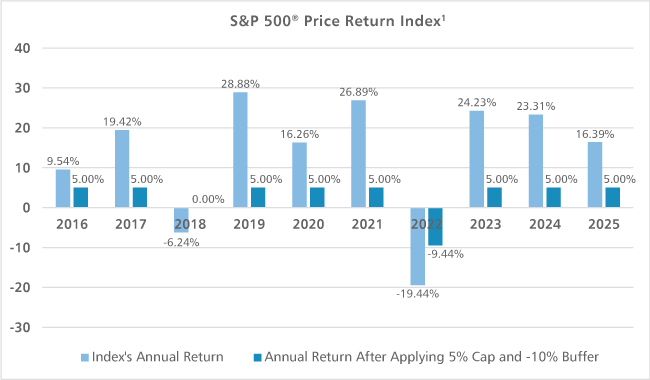
(1) This Index is a "price return index," not a "total return index," and therefore does not reflect the dividends paid on the securities composing the Index, which will reduce Index performance and may cause the Index to underperform a direct investment in the securities composing the Index.
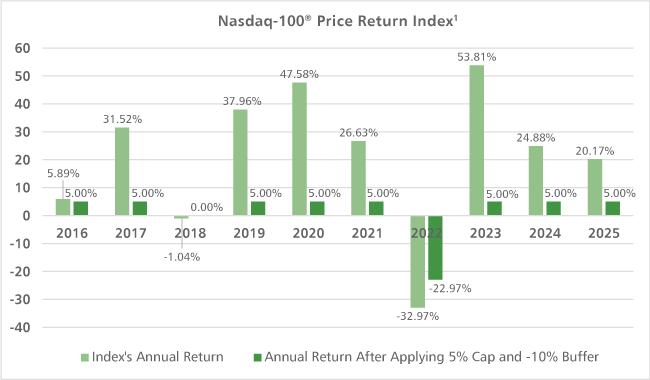
(1) This Index is a "price return index," not a "total return index," and therefore does not reflect the dividends paid on the securities composing the Index, which will reduce Index performance and may cause the Index to underperform a direct investment in the securities composing the Index.
Index Replacement
We may replace the Index if it is discontinued, or if there is a substantial change in the calculation of the Index, or if hedging instruments become difficult to acquire or the cost of hedging becomes excessive. We may do so at the end of a Strategy Term or during a Strategy Term. We will notify you at least 30 days before We replace an Index, or if not possible, as soon as reasonably practical.
If We replace an Index, We will attempt to select a new Index that is similar to the old Index. In making this evaluation, We will look at factors such as asset class, Index composition, strategy or methodology inherent to the Index and Index liquidity. If such an Index cannot be found, We would choose a domestic or international broad-based equity securities index as the substitute Index.
If We replace an Index during a Strategy Term, We will calculate the Index Return using the old Index up until the replacement date. After the replacement date, We will calculate the Index Return using the new Index, using the value for the new Index on the replacement date and the value of the Index at the end of the Strategy Term. We would apply a similar methodology when calculating the Performance Credit Rate on Quarterly Anniversaries under Dual Directional Yield strategies.
Index Replacement Example. This example is intended to show how We would calculate the Index Return during a Strategy Term in which an Index was replaced.
|
Index Return from the Starting Index Date until the replacement date for old Index |
|||||||
|
Old Index Value on the Starting Index Date |
100 |
||||||
|
Old Index Value on the replacement date |
103 |
||||||
|
Index Return for old Index on replacement date |
(103 / 100) – 1 = 3% | ||||||
This 3% Index Return on the replacement date is then used to calculate the Index Return
|
Index Return from the replacement date until the Ending Index Date for the new Index |
|||||||
|
New Index Value on the replacement date |
100 |
||||||
|
New Index Value on the Ending Index Date |
105 |
||||||
|
Index Return for new Index on replacement date |
(105 / 100) – 1 = 5% | ||||||
The Index Return calculation for that Strategy Term is then based on the change of both the old and new Index. The Index Return in this Strategy Term would be 8.15% [(1 + 3%) * (1 + 5%)].
Additional information about the Index, including disclaimers, may be found in Appendix K. The investment risks associated with the Indices are discussed under the section titled "Principal Risks of Investing in the Contract — Index Risk." Requests for more information about an Index should be directed to Us at Our Annuity Service Center or to your financial professional.
We reserve the right to add, remove or replace any Indexed Strategy in the future, subject to necessary regulatory approvals and amendment of this prospectus. As such, the Indexed Strategies (and the associated Indices, upside crediting methods and downside protection features) that We offer under the Contract can change from one Strategy Term to the next. We can add new Indexed Strategies (with the same or different Indices, upside crediting methods and downside protection features) or cease to offer existing Indexed Strategies.
Information regarding the features of each currently offered Indexed Strategy, including (i) its name, (ii) a brief statement describing the assets that the Index seeks to track, (iii) its Strategy Term, (iv) its Index crediting methodology, (v) its current limit on Index loss, and (vi) its minimum limit on Index gain, is available in "Appendix A: Investment Options Available under the Contract."
Each Indexed Strategy includes the following elements:
• A Strategy Term;
• An Index;
• An upside crediting method, either Index Cap, Index Trigger, Participation Rate, Tier Participation Rate, Dual Directional Cap, Dual Directional Trigger, Dual Directional Trigger and Cap, or Performance Yield, with associated rate(s) that are declared by Us for a Strategy Term, subject to guaranteed limits; and
• A downside protection feature, either Buffer, Floor, or Aggregate Floor.
INDEX CREDIT
Each Indexed Strategy takes into account the following elements to calculate the Index Credit:
• The Index Return;
• The length of the Strategy Term;
• The applicable upside crediting method and associated rate(s); and
• The applicable downside protection feature and associated rate.
For each Indexed Strategy to which you allocate Contract Value, at the end of the Strategy Term, We will apply an Index Credit to your Indexed Strategy Base (unless the Performance Lock feature was exercised during the Strategy Term).
• If the Index Credit is positive, the dollar amount of the investment gain from the Index Return can be calculated as the Indexed Strategy Base multiplied by the Index Credit.
• If the Index Credit is negative, the dollar amount of the investment loss from the Index Return can be calculated as the Indexed Strategy Base multiplied by the Index Credit.
• If the Index Credit is equal to zero, there will be no investment gain or loss due to the Index Return.
Please note:
• For Index Cap, Index Trigger, Participation Rate, Tier Participation Rate, and Dual Directional Cap strategies, the Index Credit at the end of the Strategy Term will be either positive, negative, or equal to zero.
• For Dual Directional Trigger and Dual Directional Trigger and Cap strategies, the Index Credit at the end of the Strategy Term will be either positive or negative. It will never be zero, as explained further below.
• For Dual Directional Yield strategies, the Index Credit at the end of the Strategy Term will be either negative or zero. It will never be positive, as Dual Directional Yield offers upside potential only through quarterly Performance Credits. See "Dual Directional Yield" below.
We will apply the Index Credit to the Indexed Strategy Base at the end of the Strategy Term. The Strategy Contract Value will also be increased or decreased by the amount of the credit.
If you allocate Contract Value to multiple Indexed Strategies for a Strategy Term, separate Index Credits will be applied to all the Indexed Strategies in which you are invested at the end of the Strategy Term. Even if you receive positive Index Credit for one or more Indexed Strategies for a Strategy Term, your overall gain will be reduced by any negative Index Credit you receive for any other Indexed Strategy, and such negative Index Credit may cause you to incur an overall loss during the Strategy Term.
Limits on Index Losses
We may limit the negative Index Return used in calculating the Index Credit applied to an Indexed Strategy at the end of a Strategy Term through the use of a Buffer, Floor, or Aggregate Floor downside protection feature.
The following table describes how Index Credits are calculated when a Buffer Percentage or Floor Percentage applies.
|
Downside Protection Feature |
Limit on Index Losses |
||||||
|
Buffer |
Establishes the maximum amount of negative Index Return that will not be reflected in a negative Index Credit for a given Strategy Term. For example, if the Buffer Percentage is 10% and the Index Return is -25%, We will apply a -15% Index Credit (the amount of negative Index Return that exceeds the Buffer Percentage) at the end of the Strategy Term. If the Index Return is instead -5%, We will apply a 0% Index Credit (i.e., no loss) because the negative Index Return did not exceed the Buffer Percentage. |
||||||
|
Floor / Aggregate Floor |
Establishes the lowest negative Index Credit that may be applied for a given Strategy Term. For example, if the Floor Percentage is -10% and the Index Return is -25%, We will apply a -10% Index Credit (the amount of negative Index Return up to the Floor Percentage). If the Index Return is instead -5% (which is higher than the Floor Percentage), We will apply a -5% Index Credit. If the Floor Percentage is 0%, there is no risk of loss due to a negative Index Return. The Index Credit will never be lower than 0%. Nonetheless, like any other Indexed Strategy, there may be losses due to Withdrawal Charges, negative MVAs, negative Strategy Interim Value adjustments, and taxes and tax penalties. |
||||||
It is important to understand the limits and risks of the downside protection features described in the table above, including the following:
• The Buffer Percentage provides only limited protection from negative Index Returns. It does not provide absolute protection against negative Index Credit, and you may lose money. Additionally, Rider Charges, Withdrawal Charges, advisory fees, negative MVAs, negative Strategy Interim Value adjustments, and taxes, if applicable, will further reduce your Contract Value and are not subject to the Buffer Percentage.
• The Floor Percentage (other than a 0% Floor Percentage) provides only limited protection from negative Index Returns. It does not provide absolute protection against negative Index Credit, and you may lose money. Additionally, Rider Charges, Withdrawal Charges, advisory fees, negative MVAs, negative Strategy Interim Value adjustments, and taxes, if applicable, will further reduce your Contract Value and are not subject to the Floor Percentage.
The Contract currently offers Indexed Strategies with Buffer Percentages of 5%, 10%, 15%, 20%, or 25% or a Floor Percentage of 0%. For these Indexed Strategies, the Buffer Percentage or Floor Percentage cannot be changed for the life of the Indexed Strategy.
The Contract also currently offers an Indexed Strategy with Aggregate Floor. For the Aggregate Floor Indexed Strategy, after the initial Floor Percentage, the Floor Percentage will change from one consecutive Strategy Term to the next. The Floor Percentage will change for subsequent consecutive Strategy Terms depending on your Index Credits, how you manage your Strategy Value, and whether you elect a reset, but We guarantee that the Floor Percentage will never be less than -20% for subsequent consecutive Strategy Terms. See "Aggregate Floor" for additional information.
The limits on Index loss offered under the Contract may change from one Strategy Term to the next; however, We will always offer an Indexed Strategy with a 0% Floor Percentage. In the future, We may not offer any Indexed Strategies with Buffer or Aggregate Floor, and We do not guarantee a minimum Buffer Percentage or Floor Percentage for any new Indexed Strategies that We may offer in the future. See "Indexed Strategies — General" above for additional information.
We set the Buffer Percentages and Floor Percentages at Our sole discretion. We consider various factors in declaring Buffer Percentages and Floor Percentages, including Our hedging costs and techniques, administrative expenses, regulatory and tax requirements, market conditions, and competitive factors. For the Aggregate Floor Indexed Strategy, for so long as you remain invested in the Indexed Strategy for consecutive Strategy Terms, the Floor Percentage applicable to future Strategy Terms is subject to the terms and conditions described under "Aggregate Floor."
Before selecting an Indexed Strategy for investment, you should consider in consultation with your financial professional which downside protection feature and level of protection may be appropriate for you. You and your financial professional may want to discuss and consider your risk tolerance, investment time horizon, and financial goals. Generally, assuming the same Index and Strategy Term length, an Indexed Strategy that provides more protection from Index losses will generally tend to have less potential for Index gains. Conversely, assuming the same Index and Strategy Term length, an Indexed Strategy that provides less protection from Index losses will generally tend to have more potential for Index gains.
The limits on Index loss offered under the Contract may change from one Strategy Term to the next; however, We will always offer an Indexed Strategy with a 0% Floor Percentage. In the future, We may not offer any Indexed Strategies with Buffer or Aggregate Floor, and We do not guarantee a minimum Buffer Percentage or Floor Percentage for any new Indexed Strategies that We may offer in the future. See "Indexed Strategies — General" above for additional information.
Before selecting an Indexed Strategy for investment, you should consider in consultation with your financial professional which downside protection feature and level of protection may be appropriate for you. You and your financial professional may want to discuss and consider your risk tolerance, investment time horizon, and financial goals. Generally, assuming the same Index and Strategy Term length, an Indexed Strategy that provides more protection from Index losses will generally tend to have less potential for Index gains. Conversely, assuming the same Index and Strategy Term length, an Indexed Strategy that provides less protection from Index losses will generally tend to have more potential for Index gains.
Limits on Index Gains
We limit the amount of positive Index Credits that are applied to an Indexed Strategy at the end of a Strategy Term through the use of the applicable upside crediting method, either Index Cap, Index Trigger, Participation Rate, Tier Participation Rate, Dual Directional Cap, Dual Directional Trigger, Dual Directional Trigger and Cap, or Performance Yield.
Before selecting an Indexed Strategy for investment, you should consider in consultation with your financial professional whether an Indexed Strategy's limit on Index gains may be appropriate for you. You and your financial professional may want to discuss and consider your risk tolerance, investment time horizon and financial goals. Generally, assuming the same Index and Strategy Term length, an Indexed Strategy that provides less potential for Index gains will tend to have more protection from Index losses. Conversely, assuming the same Index and Strategy Term length, an Indexed Strategy that provides more potential for Index gains will generally tend to have less protection from Index losses.
This Contract is not appropriate for investors who plan to take withdrawals beyond the Free Withdrawal Amount or surrender the Contract during the first six Contract Years due to the imposition of Withdrawal Charges and the MVA, or for investors who intend to take partial withdrawals (including Free Withdrawal Amounts, systematic withdrawals, Required Minimum Distributions, or withdrawals to pay advisory fees) or surrender the Contract during a Strategy Term due to the imposition of Strategy Interim Value adjustments. The application of the Strategy Interim Value to partial withdrawals during the Strategy Term and the proportional reduction in your Indexed Strategy Base, together with any Withdrawal Charges and the MVA, could significantly reduce the value of the Contract. In addition, amounts withdrawn could be subject to federal and state income taxes, as well as a 10% federal additional tax if taken before age 59 1/2.
The Contract also is not appropriate for investors who plan to take withdrawals to pay advisory fees other than through the systematic withdrawal program. Advisory fee withdrawals outside of the systematic withdrawal program may be subject to Withdrawal Charges and negative MVAs, and will result in proportional reductions to the optional Return of Premium Death Benefit if elected. In addition, whether or not advisory fee withdrawals are taken through the systematic withdrawal program, the Contract is not appropriate for investors who plan to take such withdrawals from an Indexed Strategy before the end of a Strategy Term, as the application of Strategy Interim Value and proportional reductions to your Indexed Strategy Base could result in significant loss.
You may access your Contract Value during the Accumulation Period:
• by taking partial withdrawals, which include:
• One time withdrawals;
• Withdrawals from Contract Value to pay an advisory fee up to a maximum of 1.5% of the Contract Value;
• Systematic withdrawals; and
• Required Minimum Distributions.
• by surrendering your Contract (i.e. taking a full withdrawal)
Index Credit
On the Strategy Term end date, in addition to a positive or zero Performance Credit as described above, We also apply the Index Credit. The Index Credit will either be negative or zero (never positive). Index Credit will be calculated as follows:
• If the Index Return is positive or zero, the Index Credit will be equal to zero.
• If the Index Return is negative, We apply the Buffer Percentage. The Index Credit will either be negative or zero depending on the Index Return and the applicable Buffer Percentage.
In light of the Indexed Strategy Parameters for Dual Directional Yield strategies that We are currently offering, if you receive a positive Performance Credit on the Strategy Term end date, the Index Credit will be zero. If you receive a zero Performance Credit on the Strategy Term end date, the Index Credit will be negative and will depend on the Index Return and the applicable Buffer Percentage.
The bar charts shown below provide each Index's annual returns for the last 10 calendar years (or for the life of the Index if less than 10 years), as well as the Index returns after applying a hypothetical 5% cap and a hypothetical -10% buffer. The charts illustrate the variability of the returns from year to year and show how hypothetical limits on Index gains and losses may affect these returns. Past performance is not necessarily an indication of future performance.
The performance below is NOT the performance of any Indexed Strategy. Your performance under the Contract will differ, perhaps significantly. The performance below may reflect a different return calculation, time period, and limit on Index gains and losses than the Indexed Strategies, and does not reflect Contract fees and charges, including Withdrawal Charges, negative MVAs, or negative Strategy Interim Value adjustments, which reduce performance.
Examples
The following examples illustrate how We calculate and apply Index Credit for Dual Directional Yield Indexed Strategies, assuming hypothetical Index Returns and hypothetical limits on Index gains and losses. The examples assume no withdrawals.
The first three examples below illustrate how We calculate the Performance Credit on a Quarterly Anniversary prior to the Strategy Term end date:
Example 1 — Positive Index performance, positive Performance Credit: Assume that you allocated $100,000 to a Dual Directional Yield strategy for a Strategy Term with a Performance Yield of 8% and a Performance Trigger of 90%. Also assume that on a Quarterly Anniversary prior to the Strategy Term end date, the Index Value as of the Index Observation Date is 1,050 and the Index Value as of the Starting Index Date is 1,000. In this case, We calculate the Index Percentage Base to be 105% (1050 / 1000). Because the Index Percentage Base (105%) is greater than or equal to the Performance Trigger (90%), the Performance Credit Rate equals 2% (8% / 4). The Performance Credit is calculated as $2,000 ($100,000 x 2%). This amount of $2,000 is immediately and automatically allocated to the Performance Credit Account.
Example 2 — Negative Index performance, positive Performance Credit: Assume that you allocated $100,000 to a Dual Directional Yield strategy for a Strategy Term with a Performance Yield of 8% and a Performance Trigger of 90%. Also assume that on a Quarterly Anniversary prior to the Strategy Term end date, the Index Value as of the Index Observation Date is 910 and the Index Value as of the Starting Index Date is 1,000. In this case, We calculate the Index Percentage Base to be 91% (910 / 1000). Because the Index Percentage Base (91%) is greater than or equal to the Performance Trigger (90%), the Performance Credit Rate equals 2% (8% / 4). The Performance Credit is calculated as $2,000 ($100,000 x 2%). This amount of $2,000 is immediately and automatically allocated to the Performance Credit Account.
Example 3 — Negative Index performance, zero Performance Credit: Assume that you allocated $100,000 to a Dual Directional Yield strategy for a Strategy Term with a Performance Yield of 8% and a Performance Trigger of 90%. Also assume that on a Quarterly Anniversary prior to the Strategy Term end date, the Index Value as of the Index Observation Date is 850 and the Index Value as of the Starting Index Date is 1,000. In this case, We calculate the Index Percentage Base to be 85% (850 / 1000). Because the Index Percentage Base (85%) is lower than the Performance Trigger (90%), the Performance Credit Rate equals 0%. The Performance Credit is calculated as $0 ($100,000 * 0%). There is no gain or loss credited to your Contract.
Provided below are examples of how We calculate the Performance Credit and Index Credit on a Strategy Term end date:
Example 4 — Positive Index performance, positive Performance Credit, zero Index Credit: Assume that you allocated $100,000 to a Dual Directional Yield strategy for a Strategy Term with a Performance Yield of 8%, a Performance Trigger of 90% and a Buffer Percentage of 10%. On the Strategy Term end date:
We would calculate the Performance Credit. Assume that the Index Value as of the Index Observation Date is 1,100 and the Index Value as of the Starting Index Date is 1,000. In this case, We calculate the Index Percentage Base to be 110% (110 / 1000). Because the Index Percentage Base (110%) is greater than or equal to the Performance Trigger (90%), the Performance Credit Rate equals 2% (8% / 4). The Performance Credit is calculated as $2,000 ($100,000 x 2%). This amount of $2,000 is immediately and automatically allocated to the Performance Credit Account.
We would also calculate the Index Credit. Consistent with the assumptions above, the Index Value on the Ending Index Date is 1,100 and the Index Value on the Starting Index Date is 1,000, resulting in an Index Return of 10%. Because the Index Return is positive or equal to zero, the Index Credit would be 0%.
Example 5 — Negative Index performance, positive Performance Credit, zero Index Credit: Assume that you allocated $100,000 to a Dual Directional Yield strategy for a Strategy Term with a Performance Yield of 8%, a Performance Trigger of 90% and a Buffer Percentage of 10%. On the Strategy Term end date:
We would calculate the Performance Credit. Assume that the Index Value as of the Index Observation Date is 950 and the Index Value as of the Starting Index Date is 1,000. In this case, We calculate the Index Percentage Base to be 95% (950 / 1000). Because the Index
Percentage Base (95%) is greater than or equal to the Performance Trigger (90%), the Performance Credit Rate equals 2% (8% / 4). The Performance Credit is calculated as $2,000 ($100,000 x 2%). This amount of $2,000 is immediately and automatically allocated to the Performance Credit Account.
We would also calculate the Index Credit. Consistent with the assumptions above, the Index Value on the Ending Index Date is 950 and the Index Value on the Starting Index Date is 1,000, resulting in an Index Return of -5%. Because the Index Return is negative but does not exceed the Buffer Percentage (10%), the Index Credit would be 0%.
Example 6 — Negative Index performance, zero Performance Credit, negative Index Credit: Assume that you allocated $100,000 to a Dual Directional Yield strategy for a Strategy Term with a Performance Yield of 8%, a Performance Trigger of 90% and a Buffer Percentage of 10%. On the Strategy Term end date:
We would calculate the Performance Credit. Assume that the Index Value as of the Index Observation Date is 800 and the Index Value as of the Starting Index Date is 1,000. In this case, We calculate the Index Percentage Base to be 80% (800 / 1000). Because the Index Percentage Base (80%) is lower than the Performance Trigger (90%), the Performance Credit Rate is 0%. The Performance Credit is calculated as $0 ($100,000 * 0%).
We would also calculate the Index Credit. Consistent with the assumptions above, the Index Value on the Ending Index Date is 800 and the Index Value on the Starting Index Date is 1,000, resulting in an Index Return of -20%. Because the Index Return is negative and exceeds the Buffer Percentage (10%), the Index Credit would be -10%.
The Performance Yield does not guarantee a certain amount of positive Performance Credit. The Performance Yield may limit the amount of positive Performance Credit that We may be obligated to pay for any Strategy Term. We set the Performance Yield at Our discretion, subject to the guaranteed limits set forth in your Contract and this prospectus. You risk the possibility that We will not set Performance Yield higher than the minimum guaranteed rate.
The Buffer Percentage provides only limited protection from downside risk. It does not provide absolute protection against negative Index Credit, and you may lose money. Additionally, Rider Charges, Withdrawal Charges, advisory fees, negative MVAs, negative Strategy Interim Value adjustments, and taxes, if applicable, will further reduce your Contract Value and are not subject to the Buffer Percentage.
The following examples illustrate how We calculate and apply Index Credit for Dual Directional Yield Indexed Strategies, assuming hypothetical Index Returns and hypothetical limits on Index gains and losses. The examples assume no withdrawals.
The first three examples below illustrate how We calculate the Performance Credit on a Quarterly Anniversary prior to the Strategy Term end date:
Index Replacement
We may replace the Index if it is discontinued, or if there is a substantial change in the calculation of the Index, or if hedging instruments become difficult to acquire or the cost of hedging becomes excessive. We may do so at the end of a Strategy Term or during a Strategy Term. We will notify you at least 30 days before We replace an Index, or if not possible, as soon as reasonably practical.
If We replace an Index, We will attempt to select a new Index that is similar to the old Index. In making this evaluation, We will look at factors such as asset class, Index composition, strategy or methodology inherent to the Index and Index liquidity. If such an Index cannot be found, We would choose a domestic or international broad-based equity securities index as the substitute Index.
If We replace an Index during a Strategy Term, We will calculate the Index Return using the old Index up until the replacement date. After the replacement date, We will calculate the Index Return using the new Index, using the value for the new Index on the replacement date and the value of the Index at the end of the Strategy Term. We would apply a similar methodology when calculating the Performance Credit Rate on Quarterly Anniversaries under Dual Directional Yield strategies.
Index Replacement Example. This example is intended to show how We would calculate the Index Return during a Strategy Term in which an Index was replaced.
|
Index Return from the Starting Index Date until the replacement date for old Index |
|||||||
|
Old Index Value on the Starting Index Date |
100 |
||||||
|
Old Index Value on the replacement date |
103 |
||||||
|
Index Return for old Index on replacement date |
(103 / 100) – 1 = 3% | ||||||
This 3% Index Return on the replacement date is then used to calculate the Index Return
|
Index Return from the replacement date until the Ending Index Date for the new Index |
|||||||
|
New Index Value on the replacement date |
100 |
||||||
|
New Index Value on the Ending Index Date |
105 |
||||||
|
Index Return for new Index on replacement date |
(105 / 100) – 1 = 5% | ||||||
The Index Return calculation for that Strategy Term is then based on the change of both the old and new Index. The Index Return in this Strategy Term would be 8.15% [(1 + 3%) * (1 + 5%)].
Additional information about the Index, including disclaimers, may be found in Appendix K. The investment risks associated with the Indices are discussed under the section titled "Principal Risks of Investing in the Contract — Index Risk." Requests for more information about an Index should be directed to Us at Our Annuity Service Center or to your financial professional.
If We replace an Index, We will attempt to select a new Index that is similar to the old Index. In making this evaluation, We will look at factors such as asset class, Index composition, strategy or methodology inherent to the Index and Index liquidity. If such an Index cannot be found, We would choose a domestic or international broad-based equity securities index as the substitute Index.
If We replace an Index during a Strategy Term, We will calculate the Index Return using the old Index up until the replacement date. After the replacement date, We will calculate the Index Return using the new Index, using the value for the new Index on the replacement date and the value of the Index at the end of the Strategy Term. We would apply a similar methodology when calculating the Performance Credit Rate on Quarterly Anniversaries under Dual Directional Yield strategies.
• To reallocate Contract Value from the Performance Credit Account, you may submit your request for a period of 30 days prior to the Contract Anniversary, and We must receive your request at least two Valuation Days prior to the Contract Anniversary. Your reallocation request will be processed on the Contract Anniversary. When requesting a reallocation from the Performance Credit Account, you must reallocate the entire Performance Credit Account Value. Partial reallocations are not permitted.
• You may submit a reallocation request by any method allowable by Us. Although We use reasonable procedures to prevent unauthorized account access, We cannot assure you that telephone or Internet activity will be completely secure or free of delays or malfunctions. If you choose to make reallocations by telephone or Internet, you must be willing to assume the risk of loss that may occur despite Our reasonable efforts to verify identity. We are not responsible for the negligence or wrongful acts of third parties.
When reallocating Contract Value, you may reallocate such Contract Value to one or more of the available Indexed Strategies and/or the One-Year Fixed Strategy. You cannot reallocate Contract Value to the Performance Credit Account. In addition, there are restrictions on your choice of Indexed Strategies, as follows:
• An allocation to a three-year or six-year Indexed Strategy is not permitted if the Strategy Term would begin during the Withdrawal Charge Period and extend beyond the end of the Withdrawal Charge Period. For example, if you initially allocated your Premium Payment to the S&P 500® three year with Index Cap and 10% Buffer Indexed Strategy, at the third Contract Anniversary, you may reallocate to another three-year Indexed Strategy, to a one-year Indexed Strategy or to the One-Year Fixed Strategy, but you may not reallocate to a six-year Indexed Strategy as the new Strategy Term would begin during the Withdrawal Charge Period and extend for three years beyond the Withdrawal Charge Period. Therefore, six-year Indexed Strategies may be elected at issue or after the Withdrawal Charge Period ends. Three-year Indexed Strategies may be elected up to and including the third Contract Anniversary or after the Withdrawal Charge Period ends.
• An allocation to a three-year or six-year Indexed Strategy is not permitted if the Strategy Term would extend beyond the Contract Maturity Date.
• If Contract Value is already allocated to a three-year or six-year Indexed Strategy, you may not allocate additional Contract Value to that same Indexed Strategy until the ongoing Strategy Term ends. For example, if you initially allocated 50% of your Premium Payment to the S&P 500® three year with Participation Rate and 10% Buffer Indexed Strategy and 50% to the One-Year Fixed Strategy, at the first Contract Anniversary, you may not allocate additional funds to the S&P 500® three year with Participation Rate and 10% Buffer Indexed Strategy as you are currently allocated to that Indexed Strategy. At the third Contract Anniversary, when that Strategy Term ends, you may then reallocate Contract Value into a new S&P 500® three-year with Participation Rate and 10% Buffer Indexed Strategy, if you choose.
• For the Dual Directional Yield strategies, Contract Value may be allocated to either the 10% or the 20% Buffer strategy, but not both.
• The amount of Contract Value allocated to a strategy at the beginning of a Strategy Term must be at least $2,500 or 10% of the Contract Value, whichever is greater. If any reallocation you request would reduce a Strategy Contract Value to less than the greater of $2,500 or 10% of the Contract Value, We will not process your reallocation.
You will receive a reallocation notice 30 days prior to the end of a Strategy Term with information about where to obtain information about available Indexed Strategies and applicable rates. At least ten days prior to the start of each Strategy Term, We will make available
the applicable Index Cap, Participation Rate, Index Trigger Rate, Performance Yields, or Tier Level and Tier Participation Rates.• For Contract Value in the Performance Credit Account, no reallocation will occur and your Performance Credit Account Value will remain in the Performance Credit Account, and the interest rate that We declared for the next Contract Year will apply. The Performance Credit Account could pay as little as the guaranteed minimum interest rate.
ONE-YEAR FIXED STRATEGY
Information regarding the features of the One-Year Fixed Strategy, including (i) its name, (ii) its Strategy Term, and (iii) its minimum guaranteed interest rate, is available in "Appendix A: Investment Options Available Under the Contract."
The One-Year Fixed Strategy credits compound interest based on rates that are set and guaranteed by the Company. Any portion of your Contract Value allocated to the One-Year Fixed Strategy for a Strategy Term will be credited with the interest rate established for that Strategy Term. This rate will apply for the entire Strategy Term, which is one year in length. The interest rate for the One-Year Fixed Strategy for your initial Strategy Term will be set forth in your Contract. At the conclusion of the Strategy Term, We will declare the interest rate at least ten days prior to the end of the Strategy Term for the next Strategy Term.
The effective annual interest rate for any Strategy Term will never be lower than the guaranteed minimum interest rate set forth in your Contract. This rate will not be less than 0.50% during the Withdrawal Charge Period and no less than 0.10% after the Withdrawal Charge Period and is guaranteed to be a rate not less than the minimum interest rate allowed by state law. The effective annual interest rate represents the rate of daily compounded interest over a 12-month period. You risk the possibility that We will declare an interest rate for the One-Year Fixed Strategy at the guaranteed minimum interest rate.
An MVA may apply to amounts withdrawn or annuitized from the One-Year Fixed Strategy. However, the One-Year Fixed Strategy is subject to the Standard Nonforfeiture Law for Individual Deferred Annuities. As such, a negative MVA will never cause the amount payable upon withdrawal, or the amount annuitized, from the One-Year Fixed Strategy to be less than the minimum non-forfeiture amount required by state law. Strategy Interim Value adjustments do not apply to the One-Year Fixed Strategy. See "Contract Charges and Adjustments" for additional information.
We guarantee that the One-Year Fixed Strategy will be available during the Accumulation Period for the life of the Contract. We may make other fixed interest investment options available under the Contract in the future. Any other fixed interest investment options that We make available may not be available for subsequent Strategy Terms.
At the end of a Strategy Term for the One-Year Fixed Strategy, Contract Value in the One-Year Fixed Strategy will be reallocated, withdrawn or annuitized according to your instructions. In the absence of instructions, Contract Value in the One-Year Fixed Strategy will be reinvested in the One-Year Fixed Strategy for a new Strategy Term. The annual interest rate for a new Strategy Term will be declared prior to the new Strategy Term. You will receive advance notice and instructions on how to obtain the declared rate. See "Reallocation Period" for additional information.
• To reallocate Contract Value from an Indexed Strategy or the One-Year Fixed Strategy, you may submit your request for a period of 30 days prior to the Strategy Term end date, and We must receive your request at least two Valuation Days prior to the Strategy Term end date. Your reallocation request will be processed at the end of the Strategy Term.
• For Contract Value in an Indexed Strategy or the One-Year Fixed Strategy, no reallocation will occur and your current allocation will remain in place for the next Strategy Term, except as otherwise provided herein. For an Indexed Strategy, if We have discontinued offering that Indexed Strategy, or if your current allocation is not permissible for a new Strategy Term, We will reallocate the Strategy Contract Value to the One-Year Fixed Strategy. This could significantly reduce returns, as the One-Year Fixed Strategy could pay as little as the guaranteed minimum interest rate.
Information regarding the features of the One-Year Fixed Strategy, including (i) its name, (ii) its Strategy Term, and (iii) its minimum guaranteed interest rate, is available in "Appendix A: Investment Options Available Under the Contract."
BAILOUT WAIVER
The bailout waiver provides option to surrender or take a partial withdrawal from your Contract without Withdrawal Charges and a MVA, if the upside Crediting Rate for an Indexed Strategy for that Strategy Term is set less favorable than the bailout rate for that strategy.
If, after the first Contract Year and during the Withdrawal Charge Period, an Indexed Strategy provides for an upside Crediting Rate for a Strategy Term that is less than the bailout rate for that strategy, then no Withdrawal Charges and MVA, if otherwise applicable, will apply to any withdrawals during that Contract Year. The bailout rate for each eligible strategy is in your Contract. Partial withdrawals and full surrenders in connection with a bailout waiver are based on the Strategy Interim Value. Any Contract Value allocated to the Indexed Strategy will be based on the Strategy Interim Value. The Strategy Interim Value may reflect lower gains, if the Index is performing positively, or higher losses, if the Index is performing negatively, than would apply at the end of the Strategy Term (or, for Dual Directional Yield, lower gains than would apply on a Quarterly Anniversary, or higher losses than would apply at the end of the Strategy Term).
If the upside Crediting Rate for an Indexed Strategy is greater than or equal to the bailout rate, it is not eligible for the bailout waiver. Six-year Indexed Strategies do not have a bailout waiver because Withdrawal Charges and MVAs do not apply after the sixth Contract Year, and after the first Contract Year, you cannot allocate Contract Value to a six-year Indexed Strategy until the Withdrawal Charge Period has expired.
You do not have to allocate your Contract Value to the Indexed Strategy that is eligible for the bailout waiver in order for you to exercise the bailout waiver and surrender your Contract. The waiver will apply automatically to any withdrawal or surrender request that occurs during a Contract Year in which the bailout provision is triggered for any Indexed Strategy. Withdrawal Charges and any applicable MVA as stated in the Contract will apply if there are no Indexed Strategies that are eligible for the bailout waiver for that Contract Year.
NURSING HOME WAIVER
If you are confined to an Approved Nursing Facility, Withdrawal Charges and MVA will be waived for a partial withdrawal or full surrender if you or the joint Owner, or Annuitant in the case of a non-natural Owner, are confined for at least 90 calendar days to an Approved Nursing Facility which: (i) provides skilled nursing care under the supervision of a physician; and (ii) has 24 hour a day nursing services by or under the supervision of a registered nurse; and (iii) keeps a daily medical record of each patient.
For this waiver to apply, you must:
• have owned the Contract continuously since it was issued,
• provide written proof of your eligibility satisfactory to us, and
• request a partial withdrawal or the full surrender within ninety-one calendar days after the last day that you are an eligible patient in a recognized facility or nursing home.
This waiver is not available if the Owner or the joint Owner is in a facility or nursing home when you purchase the Contract. We will waive any Withdrawal Charges and MVA for a partial withdrawal or full surrender of your Contract while you are in an Approved Nursing Facility. This waiver can be used any time after the first 90 days in an Approved Nursing Facility up until 91 days after exiting such a facility. This waiver may not be available in all states. Please refer to Appendix B for all state variations.
TERMINAL ILLNESS WAIVER
After the first Contract Year, if you have been diagnosed with a terminal illness, any Withdrawal Charges and MVA will be waived for a partial withdrawal or full surrender of your Contract if you or the joint Owner, or Annuitant in the case of a non-natural Owner, were diagnosed by a qualifying Physician with a life expectancy of 12 months or less.
For this waiver to apply, you must:
• provide written proof of your terminal illness satisfactory to Us (We reserve the right to require a secondary medical opinion by a qualifying Physician of Our choosing in which We will pay for such secondary medical opinion), and
• request a partial withdrawal or the full surrender of your Contract.
This waiver will terminate upon a change of any beneficial Owner. This waiver may not be available in all states. Please refer to Appendix B for all state variations.
A Physician means a medical doctor who is licensed by the state in which he/she practices medicine and is not a member of the Owner's family.
BENEFITS AVAILABLE UNDER THE CONTRACT
The following table summarizes information about the benefits available under the Contract.
The availability of Contract benefits may vary depending on the selling firm through which your Contract was purchased. See Appendix J — Financial Intermediary Variations.
|
Name of Benefit |
Purpose |
Standard or Optional |
Maximum Fee |
Brief Description of Restrictions / Limitations |
|||||||||||||||
|
Standard Death Benefit |
Provides for a Death Benefit equal to Contract Value upon death during the Accumulation Period. |
Standard |
None |
• Only available during the Accumulation Period. • Negative Strategy Interim Value adjustments could significantly reduce the benefit. • All partial withdrawals could significantly reduce the benefit by reducing Contract Value. • Terminates upon annuitization. |
|||||||||||||||
|
Return of Premium Death Benefit |
Provides a Death Benefit equal to the greater of Contract Value and the Return of Premium Base upon death during the Accumulation Period. |
Optional |
0.20% for Issue Ages up to 70 0.50% for Issue Ages 71+ (as a percentage of the Optional Death Benefit Value) |
• Only available during the Accumulation Period. • Negative Strategy Interim Value adjustments could significantly reduce the benefit. • Each time the charge is deducted from an Indexed Strategy, a Strategy Interim Value adjustment and a proportional reduction to the Indexed Strategy Base will apply. • All partial withdrawals could significantly reduce the benefit by reducing Contract Value. • All partial withdrawals result in proportional reductions to Return of Premium Base, except advisory fee withdrawals through the systematic withdrawal program. • Maximum Death Benefit equal to Contract Value plus $1 million. |
|||||||||||||||
|
Name of Benefit |
Purpose |
Standard or Optional |
Maximum Fee |
Brief Description of Restrictions / Limitations |
|||||||||||||||
|
Free Withdrawal Amount (FWA) |
Amounts that may be withdrawn each Contract Year during the Withdrawal Charge Period without incurring a Withdrawal Charge or MVA. |
Standard |
None |
• Annual FWA limit for Indexed Strategies and the One-Year Fixed Strategy. • No annual FWA limit for Performance Credit Account. • Unused FWA not available in future Contract Years. • Negative Strategy Interim Value adjustments, taxes and tax penalties may apply. • Interim withdrawals from an Indexed Strategy will proportionally reduce Indexed Strategy Base. |
|||||||||||||||
|
Performance Lock |
If exercised for an Indexed Strategy, the Strategy Interim Value (which otherwise fluctuates each Valuation Day) is "locked in." After the Performance Lock Date, your Strategy Contract Value will accumulate at a fixed rate equivalent to the One-Year Fixed Strategy for the remainder of the Strategy Term. |
Standard |
None |
• Exercise is irrevocable. • We will not provide advice or warning to you. • You will not know the Strategy Interim Value in advance. • Locking-in a negative Strategy Interim Value adjustment will result in loss, which could be significant. • Buffer Percentage or Floor Percentage will not apply. • You will not participate in Index performance for the remainder of the Strategy Term. • You will not receive any Index Credit on the Strategy Term end date. • You will not receive any Performance Credits for the remainder of the Strategy Term. • For multi-year Strategy Terms, upon exercise, the Strategy Contract Value is automatically transferred to the One-Year Fixed Strategy, and the Strategy Term will end on the next Contract Anniversary. • Withdrawals and Rider Charges will reduce Strategy Contract Value after lock-in. • Cannot be exercised during the last four Valuation Days during the Strategy Term. • Cannot be exercised for only a portion of Strategy Interim Value. |
|||||||||||||||
|
Systematic Withdrawals for Advisory Fees |
Allows for regular advisory fee withdrawals without incurring a Withdrawal Charge or MVA, and without proportionately reducing the optional Return of Premium Death Benefit if elected. |
Standard |
None |
• Contract not appropriate for you if intending to take advisory fee withdrawals outside of the program. • Only available with I-Share Contracts. • Maximum of 1.5% of Contract Value per Contract Year. • Minimum withdrawal amount of $100. • Frequency may be monthly, quarterly, semi-annually, or annually. • Taken proportionally from the One-Year Fixed Strategy and Indexed Strategies until exhausted, then from the Performance Credit Account. • Negative Strategy Interim Value adjustments, taxes and tax penalties may apply. • Interim withdrawals from an Indexed Strategy will proportionally reduce Indexed Strategy Base. |
|||||||||||||||
|
Name of Benefit |
Purpose |
Standard or Optional |
Maximum Fee |
Brief Description of Restrictions / Limitations |
|||||||||||||||
|
Bailout Waiver |
Withdrawal Charge and MVA waiver for withdrawals if the rate for an Indexed Strategy's upside crediting method is set below the bailout rate. |
Standard |
None |
• Not applicable to six-year Strategy Terms. • Not limited to withdrawals from the Indexed Strategy that triggered the waiver. • Waiver automatically applied to withdrawals during Contract Year. • Negative Strategy Interim Value adjustments, taxes and tax penalties may apply. • Interim withdrawals from an Indexed Strategy will proportionally reduce Indexed Strategy Base. |
|||||||||||||||
|
Nursing Care Waiver |
Withdrawal Charge and MVA waiver for withdrawals upon becoming confined to an approved nursing facility |
Standard |
None |
• Waiver subject to eligibility criteria. • Waiver must be requested. • May not be available in all states. • Negative Strategy Interim Value adjustments, taxes and tax penalties may apply. • Interim withdrawals from an Indexed Strategy will proportionally reduce Indexed Strategy Base. |
|||||||||||||||
|
Terminal Illness Waiver |
Withdrawal Charge and MVA waiver for withdrawals upon being diagnosed with a terminal illness. |
Standard |
None |
• Waiver subject to eligibility criteria. • Waiver must be requested. • May not be available in all states. • Negative Strategy Interim Value adjustments, taxes and tax penalties may apply. • Interim withdrawals from an Indexed Strategy will proportionally reduce Indexed Strategy Base. |
|||||||||||||||
DEATH BENEFIT
STANDARD DEATH BENEFIT
If the Owner, joint Owner or, in the case of a non-natural Owner, the Annuitant dies during the Accumulation Period, We will pay a standard Death Benefit equal to your Contract Value as of two Valuation Days from the Valuation Day on which We receive Due Proof of Death and in Good Order payment instructions from at least one of the Beneficiaries and all information We need to process the claim. If the joint Owner is living, the Death Benefit is payable to the surviving joint Owner. If there is no surviving joint Owner, the Death Benefit is payable to the designated Beneficiary(ies). If there are no designated Beneficiary or the Beneficiary predeceased the Owner, the Death Benefit is payable to the Owner's Estate.
Contract Value will remain allocated to the One-Year Fixed Strategy, Performance Credit Account and the Indexed Strategies until We receive Due Proof of Death and in Good Order payment instructions from the Beneficiaries. This means that the Death Benefit amount will continue to fluctuate with the performance of the Indexed Strategies. Eligible recipients of the Death Benefit should notify Us of an Owner's death and provide Us Due Proof of Death as promptly as possible to limit the risk of a decline in the Death Benefit.
OPTIONAL RETURN OF PREMIUM DEATH BENEFIT
We currently offer an optional Return of Premium Death Benefit for an additional charge, which is available for election on the Issue Date or following spousal continuation, subject to the election rules then in place. The amount payable under this optional Return of Premium Death Benefit before the Annuity Commencement Date is the greater of the Contract Value and the Return of Premium Base. In no event may the payment of an optional Death Benefit exceed the standard Death Benefit plus $1 million.
The initial Return of Premium Base is equal to the Premium Payment, if elected at issue, or the Contract Value, if elected after Issue (on spousal continuation). The Return of Premium Base will be proportionally reduced for any Gross Withdrawals, except any advisory fee withdrawal taken through the systematic withdrawal program.
For example, assume upon death of the Owner the Contract Value has decreased to $77,000 from the original premium of $100,000. Assuming no withdrawals were taken, upon Due Proof of Death the Beneficiary will receive the greater of the Contract Value or the Premium Payments upon lump sum request, in this example the Premium Payment of $100,000.
If the optional Return of Premium Death Benefit has been elected, in general, partial withdrawals proportionally reduce the Return of Premium Base and, in turn, could reduce the Death Benefit by significantly more than the amount of the withdrawal. Systematic withdrawals to pay advisory fees will not reduce the Return of Premium Base, but will reduce the Contract
Value. All other partial withdrawals, including Required Minimum Distributions and other systematic withdrawals under the Contract, will proportionally reduce the Return of Premium Base and also reduce the Contract Value.
If you elect the Return of Premium Death Benefit, We will assess an annual Rider Charge on the Valuation Day prior to each Contract Anniversary. If the Contract is surrendered or the rider is terminated before the annual Rider Charge is normally assessed in a given Contract Year, a prorated Rider Charge will be assessed upon the surrender or termination, as applicable. The Rider Charge will not be assessed on partial withdrawals, the payment of a Death Benefit or annuitization.
The annual Rider Charge is equal to the Rider Charge percentage multiplied by the Optional Death Benefit Value. The Optional Death Benefit Value is equal to the Return of Premium Base.
We will deduct the Rider Charge from the One-Year Fixed Strategy, the Indexed Strategies, and the Performance Credit Account in the same proportion as your Contract Value is allocated among them. Rider Charges deducted from the One-Year Fixed Strategy or the Performance Credit Account will reduce your Contract Value allocated to the One-Year Fixed Strategy or the Performance Credit Account, respectively, by the dollar amount of the Rider Charge. Likewise, if you exercised Performance Lock for an Indexed Strategy, Rider Charges deducted from the Strategy Contract Value will reduce the Strategy Contract Value by the dollar amount of the Rider Charge.
Rider Charges deducted from an Indexed Strategy (assuming no exercise of Performance Lock) will be deducted from the Strategy Interim Value as of the Valuation Day prior to a given Contract Anniversary (or the Valuation Day on which a prorated Rider Charge is assessed). The Rider Charge will reduce the Strategy Interim Value by the dollar amount of the Rider Charge; however, the charge will also result in an immediate proportional reduction to the Indexed Strategy Base. The reduction to the Indexed Strategy Base could be significantly more than the Rider Charge deducted. As a result of the reduction in your Indexed Strategy Base, any subsequent positive Performance Credit or Index Credit during the Strategy Term will be lower than it otherwise would have been, as any positive rate of return will be applied to a lower Indexed Strategy Base. The negative impacts to the value of your Contract may be significant, and such negative impacts are in addition to any losses from Withdrawal Charges, MVAs, Strategy Interim Value adjustments, Rider Charges, and taxes and tax penalties. The application of a Strategy Interim Value adjustment for a Rider Charge deduction may result in significant loss. In extreme circumstances, it is possible to lose 100% of your investment in an Indexed Strategy due to the application of a Strategy Interim Value adjustment.
The optional Return of Premium Death Benefit terminates upon change of ownership or assignment of the Contract, commencement of payments under an annuity option, and termination of your Contract.
See Appendix H for a description of how the Return of Premium Death Benefit is calculated.
Death of Annuitant. Prior to the Annuity Commencement Date, upon the death of the Annuitant the Owner becomes the Annuitant. The Owner may designate a new Annuitant. If this Contract is owned by a non-natural person (e.g., a corporation or a trust), the death of the Annuitant will be treated as the death of an Owner for purposes of the Death Benefit.
TO WHOM THE DEATH BENEFIT IS PAID
Upon the death of a natural Owner during the Accumulation Period, the Death Benefit is payable to the following:
• The surviving joint Owner; or if none,
• Surviving primary Beneficiaries; or if none, then
• Surviving contingent Beneficiaries
For a Contract owned by a non-natural Owner, upon the death of the Annuitant during the Accumulation Period, the Death Benefit is payable to the following:
• Surviving primary Beneficiaries; or if none, then
• Surviving contingent Beneficiaries; or if none, then
• The non-natural Owner.
If a person entitled to receive the Death Benefit dies before the Death Benefit is distributed, We will pay the Death Benefit to that person's named Beneficiary or, if none, to that person's estate.
PAYMENT OPTIONS
We will determine the value of the Death Benefit as of two Valuation Days from the Valuation Day on which We receive Due Proof of Death and in Good Order payment instructions from at least one of the Beneficiaries and all information We need to process the claim. The Death Benefit is not subject to the Withdrawal Charge or the MVA.
Death Benefit payments, if made from an Indexed Strategy before the end of a Strategy Term, are based on the Strategy Interim Value. The application of a Strategy Interim Value adjustment could result in significant loss. In extreme circumstances, it is possible to lose 100% of your investment in an Indexed Strategy due to the application of a negative Strategy Interim Value adjustment (i.e., a complete loss of your principal and any prior earnings).
Under a non-qualified Contract, if the Owner (or Annuitant in the case of a non-natural Owner) dies before the Annuity Commencement Date, the Death Benefit will be paid in a lump sum and the entire interest must be distributed within five years of the Owner's death (or Annuitant's death in the case of a non-natural Owner); If the Beneficiary is an individual, they can elect to receive a series of payments or Annuity Payments under an annuity option over the Beneficiary's remaining life or over a period not extending beyond the Beneficiary's life expectancy provided such payments begin within one year of death. Qualified Contracts are subject to special after-death distribution rules. See the "Federal Tax Considerations" section for more information. A Beneficiary that takes the Death Benefit in a series of payments may make transfers among the One-Year Fixed Strategy and the Indexed Strategy. Amounts that remain allocated to an Indexed Strategy may decrease in value. A surviving spouse who is a sole Beneficiary may continue the Contract maintaining its characteristics. See "Spousal Continuation." We will make any adjustment to the Death Benefit prior to the continuation. If the Death Benefit is payable to the Owner's estate, We will make a lump sum payment.
SPOUSAL CONTINUATION
In limited circumstances, when the Owner dies, if the spouse of the deceased Owner is entitled to receive a Death Benefit, the spouse may have the option to continue the Contract instead. Under federal tax law, the spouse's option to continue the Contract is contingent upon whether the deceased Owner and the spouse were legally married under applicable state law.
|
Name of Benefit |
Purpose |
Standard or Optional |
Maximum Fee |
Brief Description of Restrictions / Limitations |
|||||||||||||||
|
Standard Death Benefit |
Provides for a Death Benefit equal to Contract Value upon death during the Accumulation Period. |
Standard |
None |
• Only available during the Accumulation Period. • Negative Strategy Interim Value adjustments could significantly reduce the benefit. • All partial withdrawals could significantly reduce the benefit by reducing Contract Value. • Terminates upon annuitization. |
|||||||||||||||
|
Return of Premium Death Benefit |
Provides a Death Benefit equal to the greater of Contract Value and the Return of Premium Base upon death during the Accumulation Period. |
Optional |
0.20% for Issue Ages up to 70 0.50% for Issue Ages 71+ (as a percentage of the Optional Death Benefit Value) |
• Only available during the Accumulation Period. • Negative Strategy Interim Value adjustments could significantly reduce the benefit. • Each time the charge is deducted from an Indexed Strategy, a Strategy Interim Value adjustment and a proportional reduction to the Indexed Strategy Base will apply. • All partial withdrawals could significantly reduce the benefit by reducing Contract Value. • All partial withdrawals result in proportional reductions to Return of Premium Base, except advisory fee withdrawals through the systematic withdrawal program. • Maximum Death Benefit equal to Contract Value plus $1 million. |
|||||||||||||||
|
Name of Benefit |
Purpose |
Standard or Optional |
Maximum Fee |
Brief Description of Restrictions / Limitations |
|||||||||||||||
|
Free Withdrawal Amount (FWA) |
Amounts that may be withdrawn each Contract Year during the Withdrawal Charge Period without incurring a Withdrawal Charge or MVA. |
Standard |
None |
• Annual FWA limit for Indexed Strategies and the One-Year Fixed Strategy. • No annual FWA limit for Performance Credit Account. • Unused FWA not available in future Contract Years. • Negative Strategy Interim Value adjustments, taxes and tax penalties may apply. • Interim withdrawals from an Indexed Strategy will proportionally reduce Indexed Strategy Base. |
|||||||||||||||
|
Performance Lock |
If exercised for an Indexed Strategy, the Strategy Interim Value (which otherwise fluctuates each Valuation Day) is "locked in." After the Performance Lock Date, your Strategy Contract Value will accumulate at a fixed rate equivalent to the One-Year Fixed Strategy for the remainder of the Strategy Term. |
Standard |
None |
• Exercise is irrevocable. • We will not provide advice or warning to you. • You will not know the Strategy Interim Value in advance. • Locking-in a negative Strategy Interim Value adjustment will result in loss, which could be significant. • Buffer Percentage or Floor Percentage will not apply. • You will not participate in Index performance for the remainder of the Strategy Term. • You will not receive any Index Credit on the Strategy Term end date. • You will not receive any Performance Credits for the remainder of the Strategy Term. • For multi-year Strategy Terms, upon exercise, the Strategy Contract Value is automatically transferred to the One-Year Fixed Strategy, and the Strategy Term will end on the next Contract Anniversary. • Withdrawals and Rider Charges will reduce Strategy Contract Value after lock-in. • Cannot be exercised during the last four Valuation Days during the Strategy Term. • Cannot be exercised for only a portion of Strategy Interim Value. |
|||||||||||||||
|
Systematic Withdrawals for Advisory Fees |
Allows for regular advisory fee withdrawals without incurring a Withdrawal Charge or MVA, and without proportionately reducing the optional Return of Premium Death Benefit if elected. |
Standard |
None |
• Contract not appropriate for you if intending to take advisory fee withdrawals outside of the program. • Only available with I-Share Contracts. • Maximum of 1.5% of Contract Value per Contract Year. • Minimum withdrawal amount of $100. • Frequency may be monthly, quarterly, semi-annually, or annually. • Taken proportionally from the One-Year Fixed Strategy and Indexed Strategies until exhausted, then from the Performance Credit Account. • Negative Strategy Interim Value adjustments, taxes and tax penalties may apply. • Interim withdrawals from an Indexed Strategy will proportionally reduce Indexed Strategy Base. |
|||||||||||||||
|
Name of Benefit |
Purpose |
Standard or Optional |
Maximum Fee |
Brief Description of Restrictions / Limitations |
|||||||||||||||
|
Bailout Waiver |
Withdrawal Charge and MVA waiver for withdrawals if the rate for an Indexed Strategy's upside crediting method is set below the bailout rate. |
Standard |
None |
• Not applicable to six-year Strategy Terms. • Not limited to withdrawals from the Indexed Strategy that triggered the waiver. • Waiver automatically applied to withdrawals during Contract Year. • Negative Strategy Interim Value adjustments, taxes and tax penalties may apply. • Interim withdrawals from an Indexed Strategy will proportionally reduce Indexed Strategy Base. |
|||||||||||||||
|
Nursing Care Waiver |
Withdrawal Charge and MVA waiver for withdrawals upon becoming confined to an approved nursing facility |
Standard |
None |
• Waiver subject to eligibility criteria. • Waiver must be requested. • May not be available in all states. • Negative Strategy Interim Value adjustments, taxes and tax penalties may apply. • Interim withdrawals from an Indexed Strategy will proportionally reduce Indexed Strategy Base. |
|||||||||||||||
|
Terminal Illness Waiver |
Withdrawal Charge and MVA waiver for withdrawals upon being diagnosed with a terminal illness. |
Standard |
None |
• Waiver subject to eligibility criteria. • Waiver must be requested. • May not be available in all states. • Negative Strategy Interim Value adjustments, taxes and tax penalties may apply. • Interim withdrawals from an Indexed Strategy will proportionally reduce Indexed Strategy Base. |
|||||||||||||||
PAYMENT OPTIONS
We will determine the value of the Death Benefit as of two Valuation Days from the Valuation Day on which We receive Due Proof of Death and in Good Order payment instructions from at least one of the Beneficiaries and all information We need to process the claim. The Death Benefit is not subject to the Withdrawal Charge or the MVA.
Death Benefit payments, if made from an Indexed Strategy before the end of a Strategy Term, are based on the Strategy Interim Value. The application of a Strategy Interim Value adjustment could result in significant loss. In extreme circumstances, it is possible to lose 100% of your investment in an Indexed Strategy due to the application of a negative Strategy Interim Value adjustment (i.e., a complete loss of your principal and any prior earnings).
Under a non-qualified Contract, if the Owner (or Annuitant in the case of a non-natural Owner) dies before the Annuity Commencement Date, the Death Benefit will be paid in a lump sum and the entire interest must be distributed within five years of the Owner's death (or Annuitant's death in the case of a non-natural Owner); If the Beneficiary is an individual, they can elect to receive a series of payments or Annuity Payments under an annuity option over the Beneficiary's remaining life or over a period not extending beyond the Beneficiary's life expectancy provided such payments begin within one year of death. Qualified Contracts are subject to special after-death distribution rules. See the "Federal Tax Considerations" section for more information. A Beneficiary that takes the Death Benefit in a series of payments may make transfers among the One-Year Fixed Strategy and the Indexed Strategy. Amounts that remain allocated to an Indexed Strategy may decrease in value. A surviving spouse who is a sole Beneficiary may continue the Contract maintaining its characteristics. See "Spousal Continuation." We will make any adjustment to the Death Benefit prior to the continuation. If the Death Benefit is payable to the Owner's estate, We will make a lump sum payment.
APPENDIX A: INVESTMENT OPTIONS AVAILABLE UNDER THE CONTRACT
Indexed Strategies
The following is a list of Indexed Strategies currently available under the Contract. We may change the features of the Indexed Strategies listed below (including the Index and the current limits on Index gains), offer new Indexed Strategies, and terminate existing Indexed Strategies. We will provide you with written notice before making any changes other than changes to current limits on Index gains. Information about current limits on Index gains is available at www.FSG2Prospectus.com.
Note: If amounts are removed from an Indexed Strategy before the end of its Strategy Term, We will apply a Strategy Interim Value adjustment. This may result in a significant reduction in your Strategy Contract Value that could exceed any protection from Index loss that would be in place if you waited until the end of the Strategy Term. In addition, if amounts are withdrawn or annuitized from an Indexed Strategy (even on a Strategy Term end date), We may apply an MVA. This may result in a significant reduction in your withdrawal proceeds or the amount annuitized.
See the section titled "Indexed Strategies" for a description of the Indexed Strategies' features. See the section titled "Contract Charges and Adjustments" for more information about Strategy Interim Value adjustments and MVAs.
The availability of investment options may vary depending on the selling firm through which your Contract was purchased. See Appendix J — Financial Intermediary Variations.
|
Index |
Type of Index |
Strategy Term |
Index Crediting Methodology |
Current Limit on Index Loss (if held until end of Strategy Term) |
Minimum Limit on Index Gain (for life of the Indexed Strategy) |
||||||||||||||||||
|
S&P 500® Price Return Index(1) |
U.S. Large-Cap Equities |
One Year |
Standard Cap |
Floor: 0% |
Index Cap: 1.00% during WCP 0.50% after WCP |
||||||||||||||||||
|
S&P 500® Price Return Index(1) |
U.S. Large-Cap Equities |
One Year |
Standard Cap |
Buffer: 10% |
Index Cap: 1.00% during WCP 0.50% after WCP |
||||||||||||||||||
|
Nasdaq-100® Price Return Index(1) |
Large-Cap Equities |
One Year |
Standard Cap |
Buffer: 10% |
Index Cap: 1.00% during WCP 0.50% after WCP |
||||||||||||||||||
|
S&P 500® Price Return Index(1) |
U.S. Large-Cap Equities |
One Year |
Standard Cap |
Buffer: 15% |
Index Cap: 1.00% during WCP 0.50% after WCP |
||||||||||||||||||
|
Nasdaq-100® Price Return Index(1) |
Large-Cap Equities |
One Year |
Standard Cap |
Buffer: 15% |
Index Cap: 1.00% during WCP 0.50% after WCP |
||||||||||||||||||
|
S&P 500® Price Return Index(1) |
U.S. Large-Cap Equities |
One Year |
Standard Cap |
Buffer: 20% |
Index Cap: 1.00% during WCP 0.50% after WCP |
||||||||||||||||||
|
Nasdaq-100® Price Return Index(1) |
Large-Cap Equities |
One Year |
Standard Cap |
Buffer: 20% |
Index Cap: 1.00% during WCP 0.50% after WCP |
||||||||||||||||||
|
S&P 500® Price Return Index(1) |
U.S. Large-Cap Equities |
One Year |
Standard Cap |
Aggregate Floor: -10% Initial Rate |
Index Cap: 1.00% during WCP 0.50% after WCP |
||||||||||||||||||
|
S&P 500® Price Return Index(1) |
U.S. Large-Cap Equities |
One Year |
Standard Participation |
Buffer: 10% |
Participation Rate: 10% |
||||||||||||||||||
|
Nasdaq-100® Price Return Index(1) |
Large-Cap Equities |
Year |
Standard Participation |
Buffer: 10% |
Participation Rate: 10% |
||||||||||||||||||
|
Index |
Type of Index |
Strategy Term |
Index Crediting Methodology |
Current Limit on Index Loss (if held until end of Strategy Term) |
Minimum Limit on Index Gain (for life of the Indexed Strategy) |
||||||||||||||||||
|
S&P 500® Price Return Index(1) |
U.S. Large-Cap Equities |
One Year |
Standard Index Trigger |
Buffer: 10% |
Index Trigger: 1.00% during WCP 0.50% after WCP |
||||||||||||||||||
|
Nasdaq-100® Price Return Index(1) |
Large-Cap Equities |
One Year |
Standard Index Trigger |
Buffer: 10% |
Index Trigger: 1.00% during WCP 0.50% after WCP |
||||||||||||||||||
|
S&P 500® Price Return Index(1) |
U.S. Large-Cap Equities |
One Year |
Standard Index Trigger |
Buffer: 15% |
Index Trigger: 1.00% during WCP 0.50% after WCP |
||||||||||||||||||
|
Nasdaq-100® Price Return Index(1) |
Large-Cap Equities |
One Year |
Standard Index Trigger |
Buffer: 15% |
Index Trigger: 1.00% during WCP 0.50% after WCP |
||||||||||||||||||
|
S&P 500® Price Return Index(1) |
U.S. Large-Cap Equities |
One Year |
Standard Index Trigger |
Buffer: 20% |
Index Trigger: 1.00% during WCP 0.50% after WCP |
||||||||||||||||||
|
Nasdaq-100® Price Return Index(1) |
Large-Cap Equities |
One Year |
Standard Index Trigger |
Buffer: 20% |
Index Trigger: 1.00% during WCP 0.50% after WCP |
||||||||||||||||||
|
S&P 500® Price Return Index(1) |
U.S. Large-Cap Equities |
Three Years |
Standard Cap |
Buffer: 10% |
Index Cap: 1.00% during WCP 0.50% after WCP |
||||||||||||||||||
|
S&P 500® Price Return Index(1) |
U.S. Large-Cap Equities |
Three Years |
Standard Cap |
Buffer: 15% |
Index Cap: 1.00% during WCP 0.50% after WCP |
||||||||||||||||||
|
S&P 500® Price Return Index(1) |
U.S. Large-Cap Equities |
Three Years |
Standard Cap |
Buffer: 20% |
Index Cap: 1.00% during WCP 0.50% after WCP |
||||||||||||||||||
|
S&P 500® Price Return Index(1) |
U.S. Large-Cap Equities |
Three Years |
Standard Participation |
Buffer: 10% |
Participation Rate: 10% |
||||||||||||||||||
|
S&P 500® Price Return Index(1) |
U.S. Large-Cap Equities |
Three Years |
Standard Participation |
Buffer: 15% |
Participation Rate: 10% |
||||||||||||||||||
|
S&P 500® Price Return Index(1) |
U.S. Large-Cap Equities |
Three Years |
Standard Participation |
Buffer: 20% |
Participation Rate: 10% |
||||||||||||||||||
|
S&P 500® Price Return Index(1) |
U.S. Large-Cap Equities |
Three Years |
Standard Index Trigger |
Buffer: 10% |
Index Trigger: 1.00% during WCP 0.50% after WCP |
||||||||||||||||||
|
S&P 500® Price Return Index(1) |
U.S. Large-Cap Equities |
Three Years |
Standard Index Trigger |
Buffer: 15% |
Index Trigger: 1.00% during WCP 0.50% after WCP |
||||||||||||||||||
|
S&P 500® Price Return Index(1) |
U.S. Large-Cap Equities |
Years |
Standard Index Trigger |
Buffer: 20% |
Index Trigger: 1.00% during WCP 0.50% after WCP |
||||||||||||||||||
|
Index |
Type of Index |
Strategy Term |
Index Crediting Methodology |
Current Limit on Index Loss (if held until end of Strategy Term) |
Minimum Limit on Index Gain (for life of the Indexed Strategy) |
||||||||||||||||||
|
S&P 500® Price Return Index(1) |
U.S. Large-Cap Equities |
Six Years |
Standard Cap |
Buffer: 15% |
Index Cap: 1.00% during WCP 0.50% after WCP |
||||||||||||||||||
|
S&P 500® Price Return Index(1) |
U.S. Large-Cap Equities |
Six Years |
Standard Cap |
Buffer: 20% |
Index Cap: 1.00% during WCP 0.50% after WCP |
||||||||||||||||||
|
S&P 500® Price Return Index(1) |
U.S. Large-Cap Equities |
Six Years |
Standard Cap |
Buffer: 25% |
Index Cap: 1.00% during WCP 0.50% after WCP |
||||||||||||||||||
|
S&P 500® Price Return Index(1) |
U.S. Large-Cap Equities |
Six Years |
Standard Participation |
Buffer: 15% |
Participation Rate: 10% |
||||||||||||||||||
|
S&P 500® Price Return Index(1) |
U.S. Large-Cap Equities |
Six Years |
Standard Participation |
Buffer: 20% |
Participation Rate: 10% |
||||||||||||||||||
|
S&P 500® Price Return Index(1) |
U.S. Large-Cap Equities |
Six Years |
Standard Participation |
Buffer: 25% |
Participation Rate: 10% |
||||||||||||||||||
|
S&P 500® Price Return Index(1) |
U.S. Large-Cap Equities |
Six Years |
Standard Tiered Participation |
Buffer: 5% |
Tier Participation Rate: 10% (Tier Level: Max 30%) |
||||||||||||||||||
|
S&P 500® Price Return Index(1) |
U.S. Large-Cap Equities |
Six Years |
Standard Tiered Participation |
Buffer: 10% |
Tier Participation Rate: 10% (Tier Level: Max 30%) |
||||||||||||||||||
|
S&P 500® Price Return Index(1) |
U.S. Large-Cap Equities |
One Year |
Dual Directional Cap (Trigger Level 90%) |
Buffer: 10% |
Index Cap: 1.00% during WCP 0.50% after WCP |
||||||||||||||||||
|
Nasdaq-100® Price Return Index(1) |
Large-Cap Equities |
One Year |
Dual Directional Cap (Trigger Level 90%) |
Buffer: 10% |
Index Cap: 1.00% during WCP 0.50% after WCP |
||||||||||||||||||
|
S&P 500® Price Return Index(1) |
U.S. Large-Cap Equities |
One Year |
Dual Directional Cap (Trigger Level 85%) |
Buffer: 15% |
Index Cap: 1.00% during WCP 0.50% after WCP |
||||||||||||||||||
|
Nasdaq-100® Price Return Index(1) |
Large-Cap Equities |
One Year |
Dual Directional Cap (Trigger Level 85%) |
Buffer: 15% |
Index Cap: 1.00% during WCP 0.50% after WCP |
||||||||||||||||||
|
S&P 500® Price Return Index(1) |
U.S. Large-Cap Equities |
One Year |
Dual Directional Cap (Trigger Level 80%) |
Buffer: 20% |
Index Cap: 1.00% during WCP 0.50% after WCP |
||||||||||||||||||
|
Nasdaq-100® Price Return Index(1) |
Large-Cap Equities |
Year |
Dual Directional Cap (Trigger Level 80%) |
Buffer: 20% |
Index Cap: 1.00% during WCP 0.50% after WCP |
||||||||||||||||||
|
Index |
Type of Index |
Strategy Term |
Index Crediting Methodology |
Current Limit on Index Loss (if held until end of Strategy Term) |
Minimum Limit on Index Gain (for life of the Indexed Strategy) |
||||||||||||||||||
|
S&P 500® Price Return Index(1) |
U.S. Large-Cap Equities |
One Year |
Dual Directional Trigger (Trigger Level: 90%) |
Buffer: 10% |
Index Trigger: 1.00% during WCP 0.50% after WCP |
||||||||||||||||||
|
Nasdaq-100® Price Return Index(1) |
Large-Cap Equities |
One Year |
Dual Directional Trigger (Trigger Level: 90%) |
Buffer: 10% |
Index Trigger: 1.00% during WCP 0.50% after WCP |
||||||||||||||||||
|
S&P 500® Price Return Index(1) |
U.S. Large-Cap Equities |
One Year |
Dual Directional Trigger (Trigger Level: 80%) |
Buffer: 20% |
Index Trigger: 1.00% during WCP 0.50% after WCP |
||||||||||||||||||
|
Nasdaq-100® Price Return Index(1) |
Large-Cap Equities |
One Year |
Dual Directional Trigger (Trigger Level: 80%) |
Buffer: 20% |
Index Trigger: 1.00% during WCP 0.50% after WCP |
||||||||||||||||||
|
S&P 500® Price Return Index(1) |
U.S. Large-Cap Equities |
Six Years |
Dual Directional Cap (Trigger Level 85%) |
Buffer: 15% |
Index Cap: 1.00% during WCP 0.50% after WCP |
||||||||||||||||||
|
S&P 500® Price Return Index(1) |
U.S. Large-Cap Equities |
Six Years |
Dual Directional Cap (Trigger Level 80%) |
Buffer: 20% |
Index Cap: 1.00% during WCP 0.50% after WCP |
||||||||||||||||||
|
S&P 500® Price Return Index(1) |
U.S. Large-Cap Equities |
Six Years |
Dual Directional Cap (Trigger Level 75%) |
Buffer: 25% |
Index Cap: 1.00% during WCP 0.50% after WCP |
||||||||||||||||||
|
S&P 500® Price Return Index(1) |
U.S. Large-Cap Equities |
Six Years |
Dual Directional Trigger and Cap (Trigger Level 85%) |
Buffer: 15% |
Index Trigger and Index Cap: 1.00% during WCP 0.50% after WCP |
||||||||||||||||||
|
S&P 500® Price Return Index(1) |
U.S. Large-Cap Equities |
Six Years |
Dual Directional Trigger and Cap (Trigger Level 80%) |
Buffer: 20% |
Index Trigger and Index Cap: 1.00% during WCP 0.50% after WCP |
||||||||||||||||||
|
S&P 500® Price Return Index(1) |
U.S. Large-Cap Equities |
Six Years |
Dual Directional Trigger and Cap (Trigger Level 75%) |
Buffer: 25% |
Index Trigger and Index Cap: 1.00% during WCP 0.50% after WCP |
||||||||||||||||||
|
S&P 500® Price Return Index(1) |
U.S. Large-Cap Equities |
Six Years |
Dual Directional Yield (Performance Trigger: 90%) |
Buffer: 10% |
Performance Yield: 1.00% during WCP 0.50% after WCP |
||||||||||||||||||
|
S&P 500® Price Return Index(1) |
U.S. Large-Cap Equities |
Years |
Dual Directional Yield (Performance Trigger: 80%) |
Buffer: 20% |
Performance Yield: 1.00% during WCP 0.50% after WCP |
||||||||||||||||||
(1) This Index is a "price return index," not a "total return index," and therefore does not reflect dividends paid on the securities composing the Index. This will reduce the Index performance and may cause the Index to underperform a direct investment in the securities composing the Index.
We will always offer an Indexed Strategy with a 0% Floor Percentage. We do not guarantee a minimum Buffer Percentage or Floor Percentage for any new Indexed Strategies that We may offer in the future. We may offer Indexed Strategies in the future that do not limit Index losses.
We guarantee that the One-Year Fixed Strategy (see below) and the S&P 500® one year standard Index Cap with 0% Floor Indexed Strategy will be available. We do not guarantee the availability of any other strategies. From one Strategy Term to the next, We may not offer any Indexed Strategies with Buffer, Aggregate Floor, Index Trigger, Participation Rate, Tier Participation Rate, Dual Directional Cap, Dual Directional Trigger, Dual Directional Trigger and Cap, or Performance Yield. The Indexed Strategy that We guarantee to make available is subject to Our right of Index replacement.
If We offer a new Indexed Strategy with one of the upside crediting methods currently offered under the Contract:
• The guaranteed minimum Index Cap for an Indexed Strategy with standard Index Cap, Dual Directional Cap, or Dual Directional Trigger and Cap will be 1.00% and 0.50% during and after the Withdrawal Charge Period, respectively.
• The guaranteed minimum Index Trigger Rate for an Indexed Strategy with standard Index Trigger, Dual Directional Trigger, or Dual Directional Trigger and Cap will be 1.00% and 0.50% during and after the Withdrawal Charge Period, respectively.
• The guaranteed minimum Participation Rate or Tier Participation Rate will be 10% for an Indexed Strategy with Participation Rate or Tier Participation Rate. The guaranteed maximum Tier Level for an Indexed Strategy with Tier Participation Rate will be 30%.
• The guaranteed minimum Performance Yield for a Dual Directional Yield Indexed Strategy will be 1.00% and 0.50% during and after the Withdrawal Charge Period, respectively.
One-Year Fixed Strategy
The following is the One-Year Fixed Strategy currently available under the Contract. We may change the features of the One-Year Fixed Strategy, offer new fixed interest investment options, and terminate other fixed interest investment options that We may offer in the future. We will provide you with written notice before doing so.
Note: If amounts are withdrawn or annuitized from the One-Year Fixed Strategy, We may apply an MVA. Any such MVA will be subject to the Standard Nonforfeiture Law for Individual Deferred Annuities, which means the amount payable or annuitized will never be less than the minimum non-forfeiture amount under state law.
See the section titled "One-Year Fixed Strategy" for a description of the One-Year Fixed Strategy's features. See the section titled "Contract Charges and Adjustments — Market Value Adjustment" for more information about MVAs.
|
Name |
Strategy Term |
Minimum Guaranteed Interest Rate |
|||||||||
|
One-Year Fixed Strategy |
Year |
0.50% during WCP 0.10% after WCP |
|||||||||
The following is a list of Indexed Strategies currently available under the Contract. We may change the features of the Indexed Strategies listed below (including the Index and the current limits on Index gains), offer new Indexed Strategies, and terminate existing Indexed Strategies. We will provide you with written notice before making any changes other than changes to current limits on Index gains. Information about current limits on Index gains is available at www.FSG2Prospectus.com.
Note: If amounts are removed from an Indexed Strategy before the end of its Strategy Term, We will apply a Strategy Interim Value adjustment. This may result in a significant reduction in your Strategy Contract Value that could exceed any protection from Index loss that would be in place if you waited until the end of the Strategy Term. In addition, if amounts are withdrawn or annuitized from an Indexed Strategy (even on a Strategy Term end date), We may apply an MVA. This may result in a significant reduction in your withdrawal proceeds or the amount annuitized.
See the section titled "Indexed Strategies" for a description of the Indexed Strategies' features. See the section titled "Contract Charges and Adjustments" for more information about Strategy Interim Value adjustments and MVAs.
The availability of investment options may vary depending on the selling firm through which your Contract was purchased. See Appendix J — Financial Intermediary Variations.
|
Index |
Type of Index |
Strategy Term |
Index Crediting Methodology |
Current Limit on Index Loss (if held until end of Strategy Term) |
Minimum Limit on Index Gain (for life of the Indexed Strategy) |
||||||||||||||||||
|
S&P 500® Price Return Index(1) |
U.S. Large-Cap Equities |
One Year |
Standard Cap |
Floor: 0% |
Index Cap: 1.00% during WCP 0.50% after WCP |
||||||||||||||||||
|
S&P 500® Price Return Index(1) |
U.S. Large-Cap Equities |
One Year |
Standard Cap |
Buffer: 10% |
Index Cap: 1.00% during WCP 0.50% after WCP |
||||||||||||||||||
|
Nasdaq-100® Price Return Index(1) |
Large-Cap Equities |
One Year |
Standard Cap |
Buffer: 10% |
Index Cap: 1.00% during WCP 0.50% after WCP |
||||||||||||||||||
|
S&P 500® Price Return Index(1) |
U.S. Large-Cap Equities |
One Year |
Standard Cap |
Buffer: 15% |
Index Cap: 1.00% during WCP 0.50% after WCP |
||||||||||||||||||
|
Nasdaq-100® Price Return Index(1) |
Large-Cap Equities |
One Year |
Standard Cap |
Buffer: 15% |
Index Cap: 1.00% during WCP 0.50% after WCP |
||||||||||||||||||
|
S&P 500® Price Return Index(1) |
U.S. Large-Cap Equities |
One Year |
Standard Cap |
Buffer: 20% |
Index Cap: 1.00% during WCP 0.50% after WCP |
||||||||||||||||||
|
Nasdaq-100® Price Return Index(1) |
Large-Cap Equities |
One Year |
Standard Cap |
Buffer: 20% |
Index Cap: 1.00% during WCP 0.50% after WCP |
||||||||||||||||||
|
S&P 500® Price Return Index(1) |
U.S. Large-Cap Equities |
One Year |
Standard Cap |
Aggregate Floor: -10% Initial Rate |
Index Cap: 1.00% during WCP 0.50% after WCP |
||||||||||||||||||
|
S&P 500® Price Return Index(1) |
U.S. Large-Cap Equities |
One Year |
Standard Participation |
Buffer: 10% |
Participation Rate: 10% |
||||||||||||||||||
|
Nasdaq-100® Price Return Index(1) |
Large-Cap Equities |
Year |
Standard Participation |
Buffer: 10% |
Participation Rate: 10% |
||||||||||||||||||
|
Index |
Type of Index |
Strategy Term |
Index Crediting Methodology |
Current Limit on Index Loss (if held until end of Strategy Term) |
Minimum Limit on Index Gain (for life of the Indexed Strategy) |
||||||||||||||||||
|
S&P 500® Price Return Index(1) |
U.S. Large-Cap Equities |
One Year |
Standard Index Trigger |
Buffer: 10% |
Index Trigger: 1.00% during WCP 0.50% after WCP |
||||||||||||||||||
|
Nasdaq-100® Price Return Index(1) |
Large-Cap Equities |
One Year |
Standard Index Trigger |
Buffer: 10% |
Index Trigger: 1.00% during WCP 0.50% after WCP |
||||||||||||||||||
|
S&P 500® Price Return Index(1) |
U.S. Large-Cap Equities |
One Year |
Standard Index Trigger |
Buffer: 15% |
Index Trigger: 1.00% during WCP 0.50% after WCP |
||||||||||||||||||
|
Nasdaq-100® Price Return Index(1) |
Large-Cap Equities |
One Year |
Standard Index Trigger |
Buffer: 15% |
Index Trigger: 1.00% during WCP 0.50% after WCP |
||||||||||||||||||
|
S&P 500® Price Return Index(1) |
U.S. Large-Cap Equities |
One Year |
Standard Index Trigger |
Buffer: 20% |
Index Trigger: 1.00% during WCP 0.50% after WCP |
||||||||||||||||||
|
Nasdaq-100® Price Return Index(1) |
Large-Cap Equities |
One Year |
Standard Index Trigger |
Buffer: 20% |
Index Trigger: 1.00% during WCP 0.50% after WCP |
||||||||||||||||||
|
S&P 500® Price Return Index(1) |
U.S. Large-Cap Equities |
Three Years |
Standard Cap |
Buffer: 10% |
Index Cap: 1.00% during WCP 0.50% after WCP |
||||||||||||||||||
|
S&P 500® Price Return Index(1) |
U.S. Large-Cap Equities |
Three Years |
Standard Cap |
Buffer: 15% |
Index Cap: 1.00% during WCP 0.50% after WCP |
||||||||||||||||||
|
S&P 500® Price Return Index(1) |
U.S. Large-Cap Equities |
Three Years |
Standard Cap |
Buffer: 20% |
Index Cap: 1.00% during WCP 0.50% after WCP |
||||||||||||||||||
|
S&P 500® Price Return Index(1) |
U.S. Large-Cap Equities |
Three Years |
Standard Participation |
Buffer: 10% |
Participation Rate: 10% |
||||||||||||||||||
|
S&P 500® Price Return Index(1) |
U.S. Large-Cap Equities |
Three Years |
Standard Participation |
Buffer: 15% |
Participation Rate: 10% |
||||||||||||||||||
|
S&P 500® Price Return Index(1) |
U.S. Large-Cap Equities |
Three Years |
Standard Participation |
Buffer: 20% |
Participation Rate: 10% |
||||||||||||||||||
|
S&P 500® Price Return Index(1) |
U.S. Large-Cap Equities |
Three Years |
Standard Index Trigger |
Buffer: 10% |
Index Trigger: 1.00% during WCP 0.50% after WCP |
||||||||||||||||||
|
S&P 500® Price Return Index(1) |
U.S. Large-Cap Equities |
Three Years |
Standard Index Trigger |
Buffer: 15% |
Index Trigger: 1.00% during WCP 0.50% after WCP |
||||||||||||||||||
|
S&P 500® Price Return Index(1) |
U.S. Large-Cap Equities |
Years |
Standard Index Trigger |
Buffer: 20% |
Index Trigger: 1.00% during WCP 0.50% after WCP |
||||||||||||||||||
|
Index |
Type of Index |
Strategy Term |
Index Crediting Methodology |
Current Limit on Index Loss (if held until end of Strategy Term) |
Minimum Limit on Index Gain (for life of the Indexed Strategy) |
||||||||||||||||||
|
S&P 500® Price Return Index(1) |
U.S. Large-Cap Equities |
Six Years |
Standard Cap |
Buffer: 15% |
Index Cap: 1.00% during WCP 0.50% after WCP |
||||||||||||||||||
|
S&P 500® Price Return Index(1) |
U.S. Large-Cap Equities |
Six Years |
Standard Cap |
Buffer: 20% |
Index Cap: 1.00% during WCP 0.50% after WCP |
||||||||||||||||||
|
S&P 500® Price Return Index(1) |
U.S. Large-Cap Equities |
Six Years |
Standard Cap |
Buffer: 25% |
Index Cap: 1.00% during WCP 0.50% after WCP |
||||||||||||||||||
|
S&P 500® Price Return Index(1) |
U.S. Large-Cap Equities |
Six Years |
Standard Participation |
Buffer: 15% |
Participation Rate: 10% |
||||||||||||||||||
|
S&P 500® Price Return Index(1) |
U.S. Large-Cap Equities |
Six Years |
Standard Participation |
Buffer: 20% |
Participation Rate: 10% |
||||||||||||||||||
|
S&P 500® Price Return Index(1) |
U.S. Large-Cap Equities |
Six Years |
Standard Participation |
Buffer: 25% |
Participation Rate: 10% |
||||||||||||||||||
|
S&P 500® Price Return Index(1) |
U.S. Large-Cap Equities |
Six Years |
Standard Tiered Participation |
Buffer: 5% |
Tier Participation Rate: 10% (Tier Level: Max 30%) |
||||||||||||||||||
|
S&P 500® Price Return Index(1) |
U.S. Large-Cap Equities |
Six Years |
Standard Tiered Participation |
Buffer: 10% |
Tier Participation Rate: 10% (Tier Level: Max 30%) |
||||||||||||||||||
|
S&P 500® Price Return Index(1) |
U.S. Large-Cap Equities |
One Year |
Dual Directional Cap (Trigger Level 90%) |
Buffer: 10% |
Index Cap: 1.00% during WCP 0.50% after WCP |
||||||||||||||||||
|
Nasdaq-100® Price Return Index(1) |
Large-Cap Equities |
One Year |
Dual Directional Cap (Trigger Level 90%) |
Buffer: 10% |
Index Cap: 1.00% during WCP 0.50% after WCP |
||||||||||||||||||
|
S&P 500® Price Return Index(1) |
U.S. Large-Cap Equities |
One Year |
Dual Directional Cap (Trigger Level 85%) |
Buffer: 15% |
Index Cap: 1.00% during WCP 0.50% after WCP |
||||||||||||||||||
|
Nasdaq-100® Price Return Index(1) |
Large-Cap Equities |
One Year |
Dual Directional Cap (Trigger Level 85%) |
Buffer: 15% |
Index Cap: 1.00% during WCP 0.50% after WCP |
||||||||||||||||||
|
S&P 500® Price Return Index(1) |
U.S. Large-Cap Equities |
One Year |
Dual Directional Cap (Trigger Level 80%) |
Buffer: 20% |
Index Cap: 1.00% during WCP 0.50% after WCP |
||||||||||||||||||
|
Nasdaq-100® Price Return Index(1) |
Large-Cap Equities |
Year |
Dual Directional Cap (Trigger Level 80%) |
Buffer: 20% |
Index Cap: 1.00% during WCP 0.50% after WCP |
||||||||||||||||||
|
Index |
Type of Index |
Strategy Term |
Index Crediting Methodology |
Current Limit on Index Loss (if held until end of Strategy Term) |
Minimum Limit on Index Gain (for life of the Indexed Strategy) |
||||||||||||||||||
|
S&P 500® Price Return Index(1) |
U.S. Large-Cap Equities |
One Year |
Dual Directional Trigger (Trigger Level: 90%) |
Buffer: 10% |
Index Trigger: 1.00% during WCP 0.50% after WCP |
||||||||||||||||||
|
Nasdaq-100® Price Return Index(1) |
Large-Cap Equities |
One Year |
Dual Directional Trigger (Trigger Level: 90%) |
Buffer: 10% |
Index Trigger: 1.00% during WCP 0.50% after WCP |
||||||||||||||||||
|
S&P 500® Price Return Index(1) |
U.S. Large-Cap Equities |
One Year |
Dual Directional Trigger (Trigger Level: 80%) |
Buffer: 20% |
Index Trigger: 1.00% during WCP 0.50% after WCP |
||||||||||||||||||
|
Nasdaq-100® Price Return Index(1) |
Large-Cap Equities |
One Year |
Dual Directional Trigger (Trigger Level: 80%) |
Buffer: 20% |
Index Trigger: 1.00% during WCP 0.50% after WCP |
||||||||||||||||||
|
S&P 500® Price Return Index(1) |
U.S. Large-Cap Equities |
Six Years |
Dual Directional Cap (Trigger Level 85%) |
Buffer: 15% |
Index Cap: 1.00% during WCP 0.50% after WCP |
||||||||||||||||||
|
S&P 500® Price Return Index(1) |
U.S. Large-Cap Equities |
Six Years |
Dual Directional Cap (Trigger Level 80%) |
Buffer: 20% |
Index Cap: 1.00% during WCP 0.50% after WCP |
||||||||||||||||||
|
S&P 500® Price Return Index(1) |
U.S. Large-Cap Equities |
Six Years |
Dual Directional Cap (Trigger Level 75%) |
Buffer: 25% |
Index Cap: 1.00% during WCP 0.50% after WCP |
||||||||||||||||||
|
S&P 500® Price Return Index(1) |
U.S. Large-Cap Equities |
Six Years |
Dual Directional Trigger and Cap (Trigger Level 85%) |
Buffer: 15% |
Index Trigger and Index Cap: 1.00% during WCP 0.50% after WCP |
||||||||||||||||||
|
S&P 500® Price Return Index(1) |
U.S. Large-Cap Equities |
Six Years |
Dual Directional Trigger and Cap (Trigger Level 80%) |
Buffer: 20% |
Index Trigger and Index Cap: 1.00% during WCP 0.50% after WCP |
||||||||||||||||||
|
S&P 500® Price Return Index(1) |
U.S. Large-Cap Equities |
Six Years |
Dual Directional Trigger and Cap (Trigger Level 75%) |
Buffer: 25% |
Index Trigger and Index Cap: 1.00% during WCP 0.50% after WCP |
||||||||||||||||||
|
S&P 500® Price Return Index(1) |
U.S. Large-Cap Equities |
Six Years |
Dual Directional Yield (Performance Trigger: 90%) |
Buffer: 10% |
Performance Yield: 1.00% during WCP 0.50% after WCP |
||||||||||||||||||
|
S&P 500® Price Return Index(1) |
U.S. Large-Cap Equities |
Years |
Dual Directional Yield (Performance Trigger: 80%) |
Buffer: 20% |
Performance Yield: 1.00% during WCP 0.50% after WCP |
||||||||||||||||||
(1) This Index is a "price return index," not a "total return index," and therefore does not reflect dividends paid on the securities composing the Index. This will reduce the Index performance and may cause the Index to underperform a direct investment in the securities composing the Index.
We will always offer an Indexed Strategy with a 0% Floor Percentage. We do not guarantee a minimum Buffer Percentage or Floor Percentage for any new Indexed Strategies that We may offer in the future. We may offer Indexed Strategies in the future that do not limit Index losses.
We guarantee that the One-Year Fixed Strategy (see below) and the S&P 500® one year standard Index Cap with 0% Floor Indexed Strategy will be available. We do not guarantee the availability of any other strategies. From one Strategy Term to the next, We may not offer any Indexed Strategies with Buffer, Aggregate Floor, Index Trigger, Participation Rate, Tier Participation Rate, Dual Directional Cap, Dual Directional Trigger, Dual Directional Trigger and Cap, or Performance Yield. The Indexed Strategy that We guarantee to make available is subject to Our right of Index replacement.
The following is the One-Year Fixed Strategy currently available under the Contract. We may change the features of the One-Year Fixed Strategy, offer new fixed interest investment options, and terminate other fixed interest investment options that We may offer in the future. We will provide you with written notice before doing so.
Note: If amounts are withdrawn or annuitized from the One-Year Fixed Strategy, We may apply an MVA. Any such MVA will be subject to the Standard Nonforfeiture Law for Individual Deferred Annuities, which means the amount payable or annuitized will never be less than the minimum non-forfeiture amount under state law.
See the section titled "One-Year Fixed Strategy" for a description of the One-Year Fixed Strategy's features. See the section titled "Contract Charges and Adjustments — Market Value Adjustment" for more information about MVAs.
|
Name |
Strategy Term |
Minimum Guaranteed Interest Rate |
|||||||||
|
One-Year Fixed Strategy |
Year |
0.50% during WCP 0.10% after WCP |
|||||||||
| Name of Contract | Number of Contracts Outstanding | Total Value Attributable to the Indexed-Linked Option and/or Fixed Option Subject to a Contract Adjustment | Number of Contracts Sold During the Prior Calendar Year | Gross Premiums Received During the Prior Calendar Year | Amount of Contract Value Redeemed During the Prior Calendar Year | Combination Contract (Yes/No) | ||||||||||||||||
| ForeStructured Growth II (B Share) | 5866 | $ | 1,437,872,200.00 | 5693 | $ | 1,292,287,549.00 | $ | 9,975,287.00 | No | |||||||||||||
| ForeStructured Growth II Advisory Contract (I Share) | 9 | $ | 2,637,932.00 | 9 | $ | 2,470,563.00 | $ | 0 | No | |||||||||||||
• Negative Strategy Interim Value adjustments could significantly reduce the benefit.
• All partial withdrawals could significantly reduce the benefit by reducing Contract Value.
• Terminates upon annuitization.
STANDARD DEATH BENEFIT
If the Owner, joint Owner or, in the case of a non-natural Owner, the Annuitant dies during the Accumulation Period, We will pay a standard Death Benefit equal to your Contract Value as of two Valuation Days from the Valuation Day on which We receive Due Proof of Death and in Good Order payment instructions from at least one of the Beneficiaries and all information We need to process the claim. If the joint Owner is living, the Death Benefit is payable to the surviving joint Owner. If there is no surviving joint Owner, the Death Benefit is payable to the designated Beneficiary(ies). If there are no designated Beneficiary or the Beneficiary predeceased the Owner, the Death Benefit is payable to the Owner's Estate.
Contract Value will remain allocated to the One-Year Fixed Strategy, Performance Credit Account and the Indexed Strategies until We receive Due Proof of Death and in Good Order payment instructions from the Beneficiaries. This means that the Death Benefit amount will continue to fluctuate with the performance of the Indexed Strategies. Eligible recipients of the Death Benefit should notify Us of an Owner's death and provide Us Due Proof of Death as promptly as possible to limit the risk of a decline in the Death Benefit.
• Not limited to withdrawals from the Indexed Strategy that triggered the waiver.
• Waiver automatically applied to withdrawals during Contract Year.
• Negative Strategy Interim Value adjustments, taxes and tax penalties may apply.
• Interim withdrawals from an Indexed Strategy will proportionally reduce Indexed Strategy Base.
• No annual FWA limit for Performance Credit Account.
• Unused FWA not available in future Contract Years.
• Negative Strategy Interim Value adjustments, taxes and tax penalties may apply.
• Interim withdrawals from an Indexed Strategy will proportionally reduce Indexed Strategy Base.
• Waiver must be requested.
• May not be available in all states.
• Negative Strategy Interim Value adjustments, taxes and tax penalties may apply.
• Interim withdrawals from an Indexed Strategy will proportionally reduce Indexed Strategy Base.
• We will not provide advice or warning to you.
• You will not know the Strategy Interim Value in advance.
• Locking-in a negative Strategy Interim Value adjustment will result in loss, which could be significant.
• Buffer Percentage or Floor Percentage will not apply.
• You will not participate in Index performance for the remainder of the Strategy Term.
• You will not receive any Index Credit on the Strategy Term end date.
• You will not receive any Performance Credits for the remainder of the Strategy Term.
• For multi-year Strategy Terms, upon exercise, the Strategy Contract Value is automatically transferred to the One-Year Fixed Strategy, and the Strategy Term will end on the next Contract Anniversary.
• Withdrawals and Rider Charges will reduce Strategy Contract Value after lock-in.
• Cannot be exercised during the last four Valuation Days during the Strategy Term.
• Cannot be exercised for only a portion of Strategy Interim Value.
• Negative Strategy Interim Value adjustments could significantly reduce the benefit.
• Each time the charge is deducted from an Indexed Strategy, a Strategy Interim Value adjustment and a proportional reduction to the Indexed Strategy Base will apply.
• All partial withdrawals could significantly reduce the benefit by reducing Contract Value.
• All partial withdrawals result in proportional reductions to Return of Premium Base, except advisory fee withdrawals through the systematic withdrawal program.
• Maximum Death Benefit equal to Contract Value plus $1 million.
OPTIONAL RETURN OF PREMIUM DEATH BENEFIT
We currently offer an optional Return of Premium Death Benefit for an additional charge, which is available for election on the Issue Date or following spousal continuation, subject to the election rules then in place. The amount payable under this optional Return of Premium Death Benefit before the Annuity Commencement Date is the greater of the Contract Value and the Return of Premium Base. In no event may the payment of an optional Death Benefit exceed the standard Death Benefit plus $1 million.
The initial Return of Premium Base is equal to the Premium Payment, if elected at issue, or the Contract Value, if elected after Issue (on spousal continuation). The Return of Premium Base will be proportionally reduced for any Gross Withdrawals, except any advisory fee withdrawal taken through the systematic withdrawal program.
For example, assume upon death of the Owner the Contract Value has decreased to $77,000 from the original premium of $100,000. Assuming no withdrawals were taken, upon Due Proof of Death the Beneficiary will receive the greater of the Contract Value or the Premium Payments upon lump sum request, in this example the Premium Payment of $100,000.
If the optional Return of Premium Death Benefit has been elected, in general, partial withdrawals proportionally reduce the Return of Premium Base and, in turn, could reduce the Death Benefit by significantly more than the amount of the withdrawal. Systematic withdrawals to pay advisory fees will not reduce the Return of Premium Base, but will reduce the Contract
Value. All other partial withdrawals, including Required Minimum Distributions and other systematic withdrawals under the Contract, will proportionally reduce the Return of Premium Base and also reduce the Contract Value.
If you elect the Return of Premium Death Benefit, We will assess an annual Rider Charge on the Valuation Day prior to each Contract Anniversary. If the Contract is surrendered or the rider is terminated before the annual Rider Charge is normally assessed in a given Contract Year, a prorated Rider Charge will be assessed upon the surrender or termination, as applicable. The Rider Charge will not be assessed on partial withdrawals, the payment of a Death Benefit or annuitization.
The annual Rider Charge is equal to the Rider Charge percentage multiplied by the Optional Death Benefit Value. The Optional Death Benefit Value is equal to the Return of Premium Base.
We will deduct the Rider Charge from the One-Year Fixed Strategy, the Indexed Strategies, and the Performance Credit Account in the same proportion as your Contract Value is allocated among them. Rider Charges deducted from the One-Year Fixed Strategy or the Performance Credit Account will reduce your Contract Value allocated to the One-Year Fixed Strategy or the Performance Credit Account, respectively, by the dollar amount of the Rider Charge. Likewise, if you exercised Performance Lock for an Indexed Strategy, Rider Charges deducted from the Strategy Contract Value will reduce the Strategy Contract Value by the dollar amount of the Rider Charge.
Rider Charges deducted from an Indexed Strategy (assuming no exercise of Performance Lock) will be deducted from the Strategy Interim Value as of the Valuation Day prior to a given Contract Anniversary (or the Valuation Day on which a prorated Rider Charge is assessed). The Rider Charge will reduce the Strategy Interim Value by the dollar amount of the Rider Charge; however, the charge will also result in an immediate proportional reduction to the Indexed Strategy Base. The reduction to the Indexed Strategy Base could be significantly more than the Rider Charge deducted. As a result of the reduction in your Indexed Strategy Base, any subsequent positive Performance Credit or Index Credit during the Strategy Term will be lower than it otherwise would have been, as any positive rate of return will be applied to a lower Indexed Strategy Base. The negative impacts to the value of your Contract may be significant, and such negative impacts are in addition to any losses from Withdrawal Charges, MVAs, Strategy Interim Value adjustments, Rider Charges, and taxes and tax penalties. The application of a Strategy Interim Value adjustment for a Rider Charge deduction may result in significant loss. In extreme circumstances, it is possible to lose 100% of your investment in an Indexed Strategy due to the application of a Strategy Interim Value adjustment.
The optional Return of Premium Death Benefit terminates upon change of ownership or assignment of the Contract, commencement of payments under an annuity option, and termination of your Contract.
See Appendix H for a description of how the Return of Premium Death Benefit is calculated.
Death of Annuitant. Prior to the Annuity Commencement Date, upon the death of the Annuitant the Owner becomes the Annuitant. The Owner may designate a new Annuitant. If this Contract is owned by a non-natural person (e.g., a corporation or a trust), the death of the Annuitant will be treated as the death of an Owner for purposes of the Death Benefit.
TO WHOM THE DEATH BENEFIT IS PAID
Upon the death of a natural Owner during the Accumulation Period, the Death Benefit is payable to the following:
• The surviving joint Owner; or if none,
• Surviving primary Beneficiaries; or if none, then
• Surviving contingent Beneficiaries
For a Contract owned by a non-natural Owner, upon the death of the Annuitant during the Accumulation Period, the Death Benefit is payable to the following:
• Surviving primary Beneficiaries; or if none, then
• Surviving contingent Beneficiaries; or if none, then
• The non-natural Owner.
If a person entitled to receive the Death Benefit dies before the Death Benefit is distributed, We will pay the Death Benefit to that person's named Beneficiary or, if none, to that person's estate.
PAYMENT OPTIONS
We will determine the value of the Death Benefit as of two Valuation Days from the Valuation Day on which We receive Due Proof of Death and in Good Order payment instructions from at least one of the Beneficiaries and all information We need to process the claim. The Death Benefit is not subject to the Withdrawal Charge or the MVA.
Death Benefit payments, if made from an Indexed Strategy before the end of a Strategy Term, are based on the Strategy Interim Value. The application of a Strategy Interim Value adjustment could result in significant loss. In extreme circumstances, it is possible to lose 100% of your investment in an Indexed Strategy due to the application of a negative Strategy Interim Value adjustment (i.e., a complete loss of your principal and any prior earnings).
Under a non-qualified Contract, if the Owner (or Annuitant in the case of a non-natural Owner) dies before the Annuity Commencement Date, the Death Benefit will be paid in a lump sum and the entire interest must be distributed within five years of the Owner's death (or Annuitant's death in the case of a non-natural Owner); If the Beneficiary is an individual, they can elect to receive a series of payments or Annuity Payments under an annuity option over the Beneficiary's remaining life or over a period not extending beyond the Beneficiary's life expectancy provided such payments begin within one year of death. Qualified Contracts are subject to special after-death distribution rules. See the "Federal Tax Considerations" section for more information. A Beneficiary that takes the Death Benefit in a series of payments may make transfers among the One-Year Fixed Strategy and the Indexed Strategy. Amounts that remain allocated to an Indexed Strategy may decrease in value. A surviving spouse who is a sole Beneficiary may continue the Contract maintaining its characteristics. See "Spousal Continuation." We will make any adjustment to the Death Benefit prior to the continuation. If the Death Benefit is payable to the Owner's estate, We will make a lump sum payment.
SPOUSAL CONTINUATION
In limited circumstances, when the Owner dies, if the spouse of the deceased Owner is entitled to receive a Death Benefit, the spouse may have the option to continue the Contract instead. Under federal tax law, the spouse's option to continue the Contract is contingent upon whether the deceased Owner and the spouse were legally married under applicable state law.
• Only available with I-Share Contracts.
• Maximum of 1.5% of Contract Value per Contract Year.
• Minimum withdrawal amount of $100.
• Frequency may be monthly, quarterly, semi-annually, or annually.
• Taken proportionally from the One-Year Fixed Strategy and Indexed Strategies until exhausted, then from the Performance Credit Account.
• Negative Strategy Interim Value adjustments, taxes and tax penalties may apply.
• Interim withdrawals from an Indexed Strategy will proportionally reduce Indexed Strategy Base.
• Waiver must be requested.
• May not be available in all states.
• Negative Strategy Interim Value adjustments, taxes and tax penalties may apply.
• Interim withdrawals from an Indexed Strategy will proportionally reduce Indexed Strategy Base.
Market Value Adjustments. Cumulative withdrawals (partial or full) that exceed the Free Withdrawal Amount for any Contract Year during the Withdrawal Charge Period may be subject to an MVA. An MVA will apply to the Contract Value that exceeds your Free Withdrawal Amount if you annuitize your Contract during the Withdrawal Charge Period. An MVA may apply on any day during the Withdrawal Charge Period, including the last day of a Strategy Term.
The One-Year Fixed Strategy (not the Indexed Strategies) is subject to the Standard Nonforfeiture Law for Individual Deferred Annuities. A negative MVA will never cause the amount payable upon withdrawal, or the amount annuitized, from the One-Year Fixed Strategy to be less than the minimum non-forfeiture amount required by state law.
MARKET VALUE ADJUSTMENT
Cumulative withdrawals (partial or full) that exceed the Free Withdrawal Amount for any Contract Year during the Withdrawal Charge Period may be subject to an MVA. An MVA will apply to the Contract Value that exceeds your Free Withdrawal Amount if you annuitize your Contract during the Withdrawal Charge Period. An MVA may apply on any day during the Withdrawal Charge Period, including the last day of a Strategy Term.
A negative MVA could result in significant loss. In extreme circumstances, it is possible to lose 100% of the amount withdrawn or annuitized from an Indexed Strategy due to a negative MVA.
An MVA may be positive, negative or zero. A positive MVA will increase your withdrawal proceeds or the amount annuitized. Conversely, a negative MVA will decrease your withdrawal proceeds or the amount annuitized.
An MVA will be applied to Contract Value deducted in excess of the Free Withdrawal Amount from (i) the One-Year Fixed Strategy and (ii) any Indexed Strategy to the extent that the amount deducted from the Indexed Strategy is attributable to the Fixed Income Asset Proxy (as opposed to the Derivative Asset Proxy). See "Calculation of Strategy Interim Value" in the Statement of Additional Information for explanation of the Derivative Asset Proxy and the Fixed Income Asset Proxy. The amount deducted from an Indexed Strategy that exceeds the Free Withdrawal Amount will be attributed to the Fixed Income Asset Proxy in the same proportion that the Fixed Income Asset Proxy bears to the Strategy Contract Value immediately before the deduction, subject to capping the Free Withdrawal Amount attributed to the Fixed Income Asset Proxy at the total Free Withdrawal Amount attributed to that Indexed Strategy.
The One-Year Fixed Strategy (not the Indexed Strategies) is subject to the Standard Nonforfeiture Law for Individual Deferred Annuities. Accordingly, a negative MVA will never cause the amount payable upon withdrawal, or the amount annuitized, from the One-Year Fixed Strategy to be less than the minimum non-forfeiture amount required by state law. Minimum non-forfeiture refers to the minimum value that must be available upon full surrender. It will therefore prevent a negative MVA from decreasing Surrender Value attributable to the One-Year Fixed Strategy below the minimum non-forfeiture amount, although it may also limit a positive MVA. For example, assuming the entire Contract Value is allocated to the One-Year Fixed Strategy, if the Surrender Value following the Withdrawal Charge, but prior to the MVA, is $95,000, and the minimum non-forfeiture amount is $87,500, the MVA is guaranteed to be no greater than the difference, $7,500, positive or negative (such that the Surrender Value would be no less than $87,500, or no more than $102,500). In general, the initial minimum non-forfeiture amount will equal 87.5% (as a percentage of Premium Payment allocated to the One-Year Fixed Strategy), accumulated daily at the applicable non-forfeiture rate (a positive percentage no lower than the minimum rate permitted by state law), less taxes and withdrawals, including advisory fee withdrawals.
MVAs do not apply to amounts payable as a Death Benefit. MVAs do not apply to amounts withdrawn or annuitized from the Performance Credit Account. For the circumstances under which an MVA may be waived, see "Bailout Waiver," "Nursing Home Waiver," and "Terminal Illness Waiver" later in this section, as well as "Access to Your Money During the Accumulation Period — Systematic Withdrawals to Pay Advisory Fees" above.
The MVA is designed to approximate the change in value of fixed income instruments We hold in support of Our payment obligations under the Contract. In this regard, MVAs are not provided in consideration for any specific Contract features. MVAs shift risk from Us to Owners, protecting Us from losses on the fixed income instruments We hold when amounts are withdrawn or annuitized sooner than We anticipated (i.e., during the Withdrawal Charge Period).
MVAs are calculated using a formula. In general, if interest rates increase between the Issue Date and the date of withdrawal or annuitization, the MVA will decrease the amount you receive or annuitize. Conversely, if interest rates decline during this period, the MVA will generally increase the amount you receive or annuitize. MVA percentages are subject to limitations that may cap an MVA, positive or negative. The MVA percentage factor and the number of days remaining in the Withdrawal Charge Period will also impact the MVA. See "Calculation of Market Value Adjustment" in the Statement of Additional Information for more information about how MVAs are calculated, including examples.
Any MVA that would be applicable to a withdrawal or annuitization is not reflected in the Contract Value, Strategy Contract Value or Strategy Interim Value, but is reflected in the Surrender Value. For a withdrawal or annuitization to which an MVA applies, the MVA will be applied after any applicable Withdrawal Charges, Strategy Interim Value adjustment or Rider Charge.
You may contact Us at 833-ASK GA 4U (833-275-4248) to obtain information about the current value of an MVA. However, MVAs fluctuate daily. The current value quoted to you may differ from the actual value calculated at the time of adjustment.
MVAs are calculated using a formula. In general, if interest rates increase between the Issue Date and the date of withdrawal or annuitization, the MVA will decrease the amount you receive or annuitize. Conversely, if interest rates decline during this period, the MVA will generally increase the amount you receive or annuitize. MVA percentages are subject to limitations that may cap an MVA, positive or negative. The MVA percentage factor and the number of days remaining in the Withdrawal Charge Period will also impact the MVA. See "Calculation of Market Value Adjustment" in the Statement of Additional Information for more information about how MVAs are calculated, including examples.
An MVA may be positive, negative or zero. A positive MVA will increase your withdrawal proceeds or the amount annuitized. Conversely, a negative MVA will decrease your withdrawal proceeds or the amount annuitized.
Any MVA that would be applicable to a withdrawal or annuitization is not reflected in the Contract Value, Strategy Contract Value or Strategy Interim Value, but is reflected in the Surrender Value. For a withdrawal or annuitization to which an MVA applies, the MVA will be applied after any applicable Withdrawal Charges, Strategy Interim Value adjustment or Rider Charge.
The MVA is designed to approximate the change in value of fixed income instruments We hold in support of Our payment obligations under the Contract. In this regard, MVAs are not provided in consideration for any specific Contract features. MVAs shift risk from Us to Owners, protecting Us from losses on the fixed income instruments We hold when amounts are withdrawn or annuitized sooner than We anticipated (i.e., during the Withdrawal Charge Period).
Strategy Interim Value Adjustments. We will apply a Strategy Interim Value adjustment if amounts are withdrawn or otherwise removed from an Indexed Strategy before the end of a Strategy Term. The types of transactions that may result in a Strategy Interim Value adjustment include partial withdrawals (including, e.g., withdrawals to pay advisory fees, systematic withdrawals and Required Minimum Distributions), full surrender, cancellation, annuitization, Death Benefit payments, Performance Lock and deductions for Rider Charges.
STRATEGY INTERIM VALUE ADJUSTMENT
We will apply the Strategy Interim Value if amounts are withdrawn or otherwise removed from an Indexed Strategy before the end of the Strategy Term. In this prospectus, We refer to the gain or loss reflected in a Strategy Interim Value as the "Strategy Interim Value adjustment." The types of transactions to which We may apply Strategy Interim Value include partial withdrawals (including withdrawals to pay advisory fees, systematic withdrawals and Required Minimum Distributions under the Contract), full surrender of your Contract, cancellation, annuitization, Death Benefit payments, Performance Lock, and deductions for Rider Charges.
A Strategy Interim Value adjustment could result in significant loss. In extreme circumstances, it is possible to lose 100% of your investment in an Indexed Strategy due to the application of a negative Strategy Interim Value adjustment (i.e., a complete loss of your principal and any prior earnings if amounts are withdrawn or otherwise removed from an Indexed Strategy prior to the end of a Strategy Term).
A Strategy Interim Value adjustment may be positive, negative or zero. A Strategy Interim Value adjustment will not impact your Contract unless a transaction is performed based on Strategy Interim Value, as described above. Strategy Interim Value (and Strategy Interim Value adjustments) do not apply to the One-Year Fixed Strategy or the Performance Credit Account. There are no circumstances under which a Strategy Interim Value adjustment will be waived.
The purpose of Strategy Interim Value is to provide an interim valuation for an Indexed Strategy prior to the end of its Strategy Term, such that transactions involving the withdrawal or removal of amounts from an Indexed Strategy before the end of a Strategy Term can be performed. Because these transactions involve the removal of amounts from an Indexed Strategy sooner than We generally anticipate, in order to support these transactions, We have to liquidate or otherwise adjust Our management of the derivative and fixed income assets that We hold in support of Indexed Strategy guarantees. Our methodology for calculating Strategy Interim Value is intended to shift from Us to you market risks and costs associated with Our management of those derivative and fixed income assets.
We calculate Strategy Interim Value adjustments using a formula. Several factors may cause a positive or negative adjustment based on Our formula, such as the time remaining in a Strategy Term, the applicable Indexed Strategy Parameters, market conditions (e.g., interest rates and volatility); and the market values of the hypothetical derivative and fixed income instruments that We use to manage Our obligations. See "Calculation of Strategy Interim Value" in the Statement of Additional Information for more information about how Strategy Interim Value adjustments are calculated, including examples.
Strategy Interim Value could reflect loss, even when the Index is performing positively. This is because gain or loss associated with Strategy Interim Value (i.e., the Strategy Interim Value adjustment) is not calculated the same way as Index Credits or Performance Credits. It is calculated based on Our valuation of the derivative and fixed income instruments, respectively, that We hold to support the Indexed Strategy, as noted above. Strategy Interim Value does not directly reflect the actual performance of the applicable Index and is not subject to the Buffer Percentage or Floor Percentage. The Strategy Interim Value may reflect lower gains, if the Index is performing positively, and higher losses, if the Index is performing negatively, than would apply at the end of the Strategy Term (or, for Dual Directional Yield, lower gains than would apply on a Quarterly Anniversary, or higher losses than would apply at the end of the Strategy Term).
A Strategy Interim Value adjustment is generally expected to be less than the term-to-date Index performance on any Valuation Day. Also, because time remaining in a Strategy Term is one factor (among several other factors) in the calculation of a Strategy Interim Value adjustment, a negative Strategy Interim Value adjustment may be more severe earlier in a Strategy Term than it would be later in the Strategy Term. However, time remaining in a Strategy Term is only one factor used to calculate Strategy Interim Value adjustments. A Strategy Interim Value adjustment may be negative and may result in significant loss at any point before the end of a Strategy Term, even late in a Strategy Term. Strategy Interim Value adjustments are reflected in the Contract Value, Strategy Contract Value, Strategy Interim Value, and Surrender Value. A Strategy Interim Value adjustment will apply before any applicable Withdrawal Charges, MVAs, or Rider Charges.
You may contact Us at 833-ASK GA 4U (833-275-4248) to obtain information about the current value of a Strategy Interim Value adjustment. However, Strategy Interim Value adjustments fluctuate daily. The current value quoted to you may differ from the actual value calculated at the time of adjustment.
In addition to a Strategy Interim Value adjustment, partial withdrawals and Rider Charge deductions based on Strategy Interim Value negatively impact your future Strategy Contract Values due to immediate proportional reductions to your Indexed Strategy Base. As a result of these transactions, your Strategy Interim Values for the remainder of the Strategy Term will be lower. In addition, any positive Index Credit or Performance Credit that you later receive during the Strategy Term will be lower. These negative impacts occur because a withdrawal or Rider Charge deduction based on Strategy Interim Value proportionally reduces the Indexed Strategy Base upon which Strategy Interim Values, Index Credits, and Performance Credits are calculated. The reduction could be significantly greater than the amount withdrawn or Rider Charge deducted from the Indexed Strategy. The resulting negative impacts to the value of your Contract may be significant, and such negative impacts are in addition to any losses from Withdrawal Charges, MVAs, Strategy Interim Value adjustments, Rider Charges, and taxes and tax penalties. See "Indexed Strategies — Strategy Contract Value" for additional information.
A Strategy Interim Value adjustment is generally expected to be less than the term-to-date Index performance on any Valuation Day. Also, because time remaining in a Strategy Term is one factor (among several other factors) in the calculation of a Strategy Interim Value adjustment, a negative Strategy Interim Value adjustment may be more severe earlier in a Strategy Term than it would be later in the Strategy Term. However, time remaining in a Strategy Term is only one factor used to calculate Strategy Interim Value adjustments. A Strategy Interim Value adjustment may be negative and may result in significant loss at any point before the end of a Strategy Term, even late in a Strategy Term. Strategy Interim Value adjustments are reflected in the Contract Value, Strategy Contract Value, Strategy Interim Value, and Surrender Value. A Strategy Interim Value adjustment will apply before any applicable Withdrawal Charges, MVAs, or Rider Charges.
We calculate Strategy Interim Value adjustments using a formula. Several factors may cause a positive or negative adjustment based on Our formula, such as the time remaining in a Strategy Term, the applicable Indexed Strategy Parameters, market conditions (e.g., interest rates and volatility); and the market values of the hypothetical derivative and fixed income instruments that We use to manage Our obligations. See "Calculation of Strategy Interim Value" in the Statement of Additional Information for more information about how Strategy Interim Value adjustments are calculated, including examples.
A Strategy Interim Value adjustment may be positive, negative or zero. A Strategy Interim Value adjustment will not impact your Contract unless a transaction is performed based on Strategy Interim Value, as described above. Strategy Interim Value (and Strategy Interim Value adjustments) do not apply to the One-Year Fixed Strategy or the Performance Credit Account. There are no circumstances under which a Strategy Interim Value adjustment will be waived.
The purpose of Strategy Interim Value is to provide an interim valuation for an Indexed Strategy prior to the end of its Strategy Term, such that transactions involving the withdrawal or removal of amounts from an Indexed Strategy before the end of a Strategy Term can be performed. Because these transactions involve the removal of amounts from an Indexed Strategy sooner than We generally anticipate, in order to support these transactions, We have to liquidate or otherwise adjust Our management of the derivative and fixed income assets that We hold in support of Indexed Strategy guarantees. Our methodology for calculating Strategy Interim Value is intended to shift from Us to you market risks and costs associated with Our management of those derivative and fixed income assets.
• You can lose money by investing in the Contract.
• For amounts allocated to an Indexed Strategy with a Buffer, if there is negative Index performance, you risk any Index losses that exceed the Buffer Percentage. The maximum amount of loss at the end of a Strategy Term that you could experience from negative Index performance after taking into account the current Buffer Percentages provided under the Contract ranges from 75% to 95%.
• For amounts allocated to an Indexed Strategy with a Floor, if there is negative Index performance, you risk any Index losses up to the Floor Percentage. The maximum amount of loss at the end of a Strategy Term that you could experience from negative Index performance after taking into account the current Floor Percentages provided under the Contract is 0% (for the Indexed Strategy with a 0% Floor Percentage) or 20% (for the Indexed Strategy with an Aggregate Floor).
• The limits on Index loss offered under the Contract may change from one Strategy Term to the next; however, We will always offer an Indexed Strategy with a 0% Floor Percentage.
• In the future, We may not offer any Indexed Strategies with Buffer or Aggregate Floor, and We do not guarantee a minimum Buffer Percentage or Floor Percentage for any new Indexed Strategies that We may offer in the future. We may offer Indexed Strategies in the future that do not limit Index losses, which would mean risk of loss of the entire amount invested.
Principal Risks of Investing in the Contract
RISK OF LOSS
You can lose money by investing in this Contract, including your principal investment and earnings over the life of the Contract. The value of your Contract is not guaranteed by the U.S. government or any federal government agency, insured by the FDIC, or guaranteed by any bank.
• The Contract is not a short-term investment and is not appropriate for an investor who needs ready access to cash.
• The benefits of tax deferral and long-term income are generally more beneficial to investors with a long investment time horizon.
• Withdrawals may result in Withdrawal Charges, negative MVAs, taxes and tax penalties. Also, withdrawing or otherwise removing amounts from an Indexed Strategy before the end of a Strategy Term may result in negative Strategy Interim Value adjustments and loss of positive Index performance. Withdrawals may significantly reduce the Death Benefit.
• In addition to a Strategy Interim Value adjustment, which may be negative, withdrawals from an Indexed Strategy before the end of a Strategy Term will result in proportional reductions to your Indexed Strategy Base. The proportional reduction could be greater than the amount withdrawn. Reductions to your Indexed Strategy Base will result in lower Strategy Interim Values for the remainder of the Strategy Term and less positive Index Credit (if any) at the end of the Strategy Term.
• At the end of a Strategy Term, Contract Value in the matured strategy will be reallocated, withdrawn or annuitized according to your instructions. In the absence of instructions, Contract Value in the matured strategy will be reinvested in the same strategy for a new Strategy Term. If the same strategy is not available, Contract Value in the matured strategy will be automatically reallocated to the One-Year Fixed Strategy. You will receive at least 30 days' advance notice prior to the maturity of a Strategy Term.
Principal Risks of Investing in the Contract
• Each investment option (including the One-Year Fixed Strategy) has its own unique risks. You should review the available investment options before making an investment decision.
For the Indexed Strategies:
• The upside crediting methods — either Index Cap, Index Trigger, Participation Rate, Tier Participation Rate, Dual Directional Cap, Dual Directional Trigger, Dual Directional Trigger and Cap, or Performance Yield — limit the amount you can earn on an Indexed Strategy (i.e., limited upside). This may result in you earning less than the Index Return.
For example:
o Index Cap or Dual Directional Cap: If the Index Return is 10% and the Index Cap is 6%, We will apply a 6% Index Credit at the end of the Strategy Term.
o Index Trigger or Dual Directional Trigger: If the Index Return is 10% and the Index Trigger Rate is 3%, We will apply a 3% Index Credit at the end of the Strategy Term.
o Participation Rate: If the Index Return is 10% and the Participation Rate is 80%, We will apply an 8% Index Credit (10% x 80% = 8%) at the end of the Strategy Term.
o Tier Participation Rate: Assuming a Tier One Participation Rate of 80%, a Tier Two Participation Rate of 100% and a Tier Level of 10%:
◼ If the Index Return is 10% (which does not exceed the Tier Level), the Index Credit at the end of the Strategy Term will equal the sum of (a) 10% multiplied by the 80% Tier One Participation Rate (10% x 80% = 8%) and (b) 0% multiplied by the 100% Tier Two Participation Rate (0% x 100% = 0%), which equals 8% (8% + 0% = 8%).
◼ If the Index Return is 15% (which does exceed the Tier Level), the Index Credit at the end of the Strategy Term will equal the sum of (a) 10% multiplied by the 80% Tier One Participation Rate (10% x 80% = 8%) and (b) 5% multiplied by the 100% Tier Two Participation Rate (5% x 100% = 5%), which equals 13% (8% + 5% = 13%).
o Dual Directional Trigger and Cap: Assuming a Trigger Level threshold of 10%, an Index Trigger Rate of 3% and an Index Cap of 15%.
◼ If the Index Return is 6% (which does not exceed the Trigger Level threshold), We will apply a 3% Index Credit at the end of the Strategy Term.
◼ If the Index Return is 20% (which does exceed the Trigger Level threshold), We will apply a 15% Index Credit at the end of the Strategy Term.
o Performance Yield: Assuming the Index Return is 10% and the Performance Yield is 8%, on the Strategy Term end date:
◼ The Performance Credit Rate for that Quarterly Anniversary will equal 2% (8% / 4 = 2%), which will be in addition to any other Performance Credits from prior Quarterly Anniversaries during the Strategy Term.
◼ The Index Credit will be 0%.
Principal Risks of Investing in the Contract
• The Buffer Percentage or Floor Percentage, as applicable, may limit negative Index Credits (i.e., limited protection in the case of market decline).o Buffer Percentage: You bear the risk of loss for any negative Index Return in excess of the Buffer Percentage. For example, if the Buffer Percentage is 10% and the Index Return is -25%, We will apply a -15% Index Credit (the amount of negative Index Return that exceeds the Buffer Percentage) at the end of the Strategy Term. If the Index Return is instead -5% (which does not exceed the Buffer Percentage), We will apply a 0% Index Credit.
o Floor Percentage: You bear the risk of loss for any negative Index Return up to the Floor Percentage. For example, if the Floor Percentage is -10% and the Index Return is -25%, We will apply a -10% Index Credit (the amount of negative Index Return up to the Floor Percentage) at the end of the Strategy Term. If the Index Return is instead -5% (which is higher than the Floor Percentage), We will apply a -5% Index Credit.
• While the 0% Floor Indexed Strategy provides complete protection from a negative Index Return, like any other Indexed Strategy, there may be losses due to Withdrawal Charges, negative MVAs, negative Strategy Interim Value adjustments, taxes and tax penalties.
• While Dual Directional strategies provide for potential gain in the event of negative Index performance, they do not provide protection from any negative Index Return in excess of the applicable Buffer Percentage.
• Each Index is a "price return index," not a "total return index," and therefore does not reflect dividends paid on the securities composing the Index. This will reduce the Index performance and may cause the Index to underperform a direct investment in the securities composing the Index.
What are the Risks Related to the Insurance Company?
An investment in the Contract is subject to the risks related to Us, Forethought Life Insurance Company. Any obligations (including under the One-Year Fixed Strategy and the Indexed Strategies), guarantees or benefits of the Contract are subject to Our claims-paying ability. More information about Forethought Life Insurance Company, including Our financial strength ratings, is available upon request by calling 833-275-4248 or visiting www.globalatlantic.com.
Principal Risks of Investing in the Contract
BUFFER PERCENTAGE, FLOOR PERCENTAGE, AND AGGREGATE FLOOR PERCENTAGE RISK
If you allocate all or some of your Contract Value to an Indexed Strategy, negative Index performance may cause the Index Credit to be negative even after the application of the Buffer Percentage, Floor Percentage or the Aggregate Floor Percentage, as applicable. This would reduce your Strategy Contract Value. Any portion of your Contract Value allocated to an Indexed Strategy will benefit from the protection afforded under either the Buffer Percentage, Floor Percentage or Aggregate Floor Percentage only for that Strategy Term. You assume the risk that you may incur a loss and that the amount of the loss may be significant, except for an Indexed Strategy with a 0% Floor Percentage where there is no investment risk of loss to you.
More specifically, at the end of a Strategy Term, you could lose up to 95% of your Contract Value in an Indexed Strategy with a 5% Buffer Percentage, up to 90% in an Indexed Strategy with a 10% Buffer Percentage, up to 85% in an Indexed Strategy with a 15% Buffer Percentage, up to 80% in an Indexed Strategy with a 20% Buffer Percentage, up to 75% in an Indexed Strategy with a 25% Buffer Percentage, or up to 20% in an Indexed Strategy with Aggregate Floor. You cannot lose Contract Value due to negative Index performance under an Indexed Strategy with a 0% Floor Percentage.
An Indexed Strategy with a 0% Floor Percentage will always be available under the Contract. We do not guarantee the availability of any other Indexed Strategies. From one Strategy Term to the next, We may not offer any Indexed Strategies with Buffer or Aggregate Floor and We do not guarantee a minimum Buffer Percentage or Floor Percentage for any new Indexed Strategies that We may offer in the future. We may offer Indexed Strategies in the future that do not limit Index losses, which would mean risk of loss of the entire amount invested.
You also risk the possibility that sustained negative Index Returns may result in zero or negative Index Credit being credited to your Strategy Contract Value over multiple Strategy Terms. If an Indexed Strategy is credited with negative Index Credit for multiple Strategy Terms, your total loss may exceed the stated limit of the Buffer Percentage, Floor Percentage or Aggregate Floor Percentage for a single Strategy Term. It is important to note that a Buffer applies for the entire Strategy Term, even when the term is longer than one year. For
example, if you invest in a six-year Strategy Term with a Buffer, regardless of how the Index performs over the course of that six-year period, the Buffer will not be adjusted.
The Buffer Percentage or Floor Percentage associated with an available Indexed Strategy's Buffer or Floor, respectively, will not change from one Strategy Term to the next. For the Aggregate Floor Indexed Strategy, the initial Aggregate Floor Percentage cannot be changed for the life of the Indexed Strategy, but after the initial rate, the Aggregate Floor Percentage will change from one consecutive Strategy Term to the next. The Aggregate Floor Percentage is determined at the start of each Strategy Term. The Aggregate Floor Percentage can be as low as -20%.
If you allocate all or some of your Contract Value to an Indexed Strategy with an Aggregate Floor, you will be subject to certain additional risks. At least ten days prior to the start of each Strategy Term, We will set and make available the range of applicable Index Caps. The range of Index Caps vary based on the new Aggregate Floor Percentage. However, the new Aggregate Floor Percentage will not be calculated until the end of the current Strategy Term because it is based on the recalculated Aggregate Floor. The Aggregate Floor cannot be recalculated until the Index Credit is calculated for the preceding Strategy Term. This means that your precise Index Cap (within the range), will not be known during the Reallocation Period.
While your Aggregate Floor can increase due to positive Index performance from one consecutive Strategy Term to the next, such increases are limited to the greater of your Aggregate Floor for the prior Strategy Term or 80% of your Aggregate Floor Indexed Strategy Contract Value as of the end of the prior Strategy Term.
A withdrawal will proportionally reduce your Aggregate Floor for that Strategy Term. The reduction could be more than the dollar amount of your withdrawal.
In addition, the Indexed Strategy will have a reset feature that provides the option to reset the level of Aggregate Floor Percentage to the initial Aggregate Floor Percentage during each subsequent, consecutive Strategy Term. This feature must also be elected during the Reallocation Period. Alternatively, the recalculated Aggregate Floor Percentage will apply. Exercising the reset feature does not guarantee better or worse performance than not exercising the reset feature. Negative Index performance may result in lower renewal Index Caps which would limit your upside potential in later years. While the reset feature could provide an opportunity to decrease downside exposure, it could also limit upside potential for the next Strategy Term. On the other hand, the reset feature could provide an opportunity to increase downside exposure, which would increase upside potential for the next Strategy Term.
It is important to note that because the Index Credit is not known until the end of the Strategy Term, your Aggregate Floor for the next Strategy Term will not be known at the time you must elect the reset. Your new Aggregate Floor, based on the reset, may be higher or lower than you expected. This means that you could reset your Aggregate Floor Percentage and end up locking in a lower Aggregate Floor (and the potential for greater losses) than if you had not reset. If you make a reset request during the Reallocation Period, you may elect to cancel such request prior to the end of the Reallocation Period.
CYBERSECURITY AND BUSINESS CONTINUITY RISK
Our business is highly dependent upon the secure and effective operation of our computer systems and those of our business partners and third-party service providers. Systems failures and cybersecurity incidents may adversely affect us or our third-party service providers, as well as you and your Contract. Cybersecurity incidents could severely interfere with our ability to administer the Contract, including our ability to process transactions, calculate Contract Values and safeguard your personal information. The techniques used to attack systems and networks change frequently and are becoming more sophisticated, including through the use of artificial intelligence (AI) and AI-powered tools. In addition to cybersecurity risks, we are exposed to the risk that natural and man-made disasters may significantly disrupt our business operations and our ability to administer the Contract. There can be no assurance that we or our service providers will be able to successfully detect or avoid negative impacts associated with systems failures, cybersecurity incidents, or natural and man-made disasters.
DUAL DIRECTIONAL CAP, DUAL DIRECTIONAL TRIGGER, DUAL DIRECTIONAL TRIGGER AND CAP RISK
Although Dual Directional Cap, Dual Directional Trigger, and Dual Directional Trigger and Cap strategies may provide for positive Index Credit upon a limited amount of negative Index performance, the strategies are subject to risk of loss. The Buffer feature under these strategies provides only limited protection from negative Index Return. Your losses could be significant. See "Buffer Percentage, Floor Percentage, and Aggregate Floor Percentage Risk" below. Likewise, there is no guarantee that you will realize any investment gain under a Dual Directional strategy. Any positive Index Credit due to a positive or zero Index Return may be limited by the Index Cap or Index Trigger component of these upside crediting methods, as applicable. See "Index Cap Risk" and "Index Trigger Risk" above. In addition, for Dual Directional Cap strategies, a positive Index Credit from a negative Index Return will never be greater than the negative threshold established by the Trigger Level (Trigger Level minus 1). For Dual Directional Trigger and Dual Directional Trigger and Cap strategies, a positive Index Credit from a negative Index Return will equal the Index Trigger Rate.
See "Risk that We May Change Rates for the Indexed Strategies' Upside Crediting Methods" for information about guaranteed minimum Index Caps and Index Trigger Rates for Dual Directional Cap, Dual Directional Trigger, and Dual Directional Trigger and Cap strategies, as applicable. See also "Risk that We May Add, Remove or Replace an Index or Indexed Strategy" for risks related to the future availability of Dual Directional Cap, Dual Directional Trigger, and Dual Directional Trigger and Cap strategies under the Contract.
GENERAL LIQUIDITY RISK
The Contract is unsuitable as a short-term savings vehicle. It is not designed to be a short-term investment and may not be appropriate for an investor who needs ready access to cash. Withdrawals under the Contract are subject to significant risks and may result in significant loss. You should consult with your financial professional before taking any withdrawals under the Contract. If you take withdrawals (including withdrawals to pay advisory fees) from your Contract during the Withdrawal Charge Period, Withdrawal Charges and MVAs (which can be positive or negative) may apply. In addition, amounts withdrawn from this Contract may also be subject to ordinary federal and state income taxes, as well as a 10% additional federal tax if taken before age 59 1/2. Further, if the optional Return of Premium Death Benefit is elected, and the Contract is surrendered or the rider is terminated before the Contract Anniversary in a given year, you will be charged a prorated Rider Charge. In addition, We will apply an MVA upon annuitization in excess of the Free Withdrawal Amount during the Withdrawal Charge Period. If you plan on annuitizing or taking withdrawals that will be subject to Withdrawal Charges, MVAs and/or additional federal taxes, this Contract may not be appropriate for you.
The application of a negative MVA may result in significant loss. In extreme circumstances, it is possible to lose 100% of the amount withdrawn or annuitized from an Indexed Strategy due to a negative MVA.
For amounts allocated to an Indexed Strategy, on any day other than the first and last day of the Strategy Term, your Strategy Contract Value for that Indexed Strategy equals the Strategy Interim Value. We will apply the Strategy Interim Value if amounts are withdrawn or otherwise removed from an Indexed Strategy before the end of a Strategy Term, which may result in significant loss. The types of transactions to which We may apply Strategy Interim Value include partial withdrawals (including withdrawals to pay advisory fees, systematic withdrawals and Required Minimum Distributions under the Contract), full surrender of your Contract, cancellation, annuitization, Death Benefit payments, Performance Lock, and deductions for Rider Charges. Strategy Interim Value could reflect loss, even when the Index is performing positively. This is because gain or loss associated with Strategy Interim Value (i.e., the Strategy Interim Value adjustment) is not calculated the same way as Index Credits or Performance Credits. It is calculated based on Our valuation of the derivative and fixed income instruments, respectively, that We hold to support the Indexed Strategy. Strategy Interim Value does not directly reflect the actual performance of the applicable Index and is not subject to the Buffer Percentage or Floor Percentage. The Strategy Interim Value may reflect lower gains, if the Index is performing positively, or higher losses, if the Index is performing negatively, than would apply at the end of the Strategy Term (or, for Dual Directional Yield, lower gains than would apply on a Quarterly Anniversary or higher losses than would apply at the end of the Strategy Term). A Strategy Interim Value adjustment is generally expected to be less than the term-to-date Index performance on any Valuation Day.
The application of Strategy Interim Value could result in significant loss. In extreme circumstances, it is possible to lose 100% of your investment in an Indexed Strategy due to a negative Strategy Interim Value adjustment (i.e., a complete loss of your principal and any prior earnings).
Partial withdrawals and Rider Charge deductions based on Strategy Interim Value also negatively impact your future Strategy Contract Values due to immediate proportional reductions to your Indexed Strategy Base. As a result of these transactions, your Strategy Interim Values for the remainder of the Strategy Term will be lower. In addition, any positive Index Credit or Performance Credit that you later receive during the Strategy Term will be lower. Relatedly, such transactions also have a negative impact on the Performance Lock feature. After performing a partial withdrawal (or other transaction) based on Strategy Interim Value, the Strategy Interim Values that you are able to lock-in with the Performance Lock feature will be lower than the Strategy Interim Values that would have otherwise been possible. These negative impacts occur because a withdrawal or Rider Charge deduction based on Strategy Interim Value proportionally reduces the Indexed Strategy Base upon which Strategy Interim Values, Index Credits, and Performance Credits are calculated. The reduction could be significantly greater than the amount withdrawn or Rider Charge deducted from the Indexed Strategy. The resulting negative impacts to the value of your Contract may be significant, and such negative impacts are in addition to any losses from Withdrawal Charges, MVAs, Strategy Interim Value adjustments, Rider Charges, and taxes and tax penalties. Once your Indexed Strategy Base is reduced, there is no way under the Contract to increase your Indexed Strategy Base during the remainder of the Strategy Term. This is because you cannot reallocate Contract Value into a Strategy Term after the Starting Index Date or make any additional Premium Payments.
You will not know the applicable Strategy Interim Value when you submit an interim withdrawal request, or seek to perform any other transaction based on Strategy Interim Value, as Strategy Interim Value is calculated daily, and any such request will be priced and processed based on a Strategy Interim Value calculated subsequent to Our receipt of the request, as described in this prospectus.
More information about Strategy Interim Value calculation is provided under "Contract Charges and Adjustments — Strategy Interim Value Adjustment" in this prospectus and "Calculation of Strategy Interim Value" in the Statement of Additional Information.
If you elect the optional Return of Premium Death Benefit, Strategy Interim Value will always be applied when deducting Rider Charges from an Indexed Strategy, as Rider Charges are assessed on the Valuation Day prior to each Contract Anniversary. The application of Strategy Interim Value for Rider Charges, and the related proportional reductions to your Indexed Strategy Base, as described above, could significantly reduce the value of your Contract and could result in significant loss.
All partial withdrawals reduce the standard Death Benefit, which is equal to Contract Value. If the optional Return of Premium Death Benefit has been elected, the Death Benefit will equal the greater of the Return of Premium Base or Contract Value. In general, partial withdrawals proportionally reduce the Return of Premium Base and, in turn, could reduce the optional Return of Premium Death Benefit by significantly more than the amount of the withdrawal. Systematic withdrawals to pay advisory fees will not reduce the Return of Premium Base, but will reduce the Contract Value. All other partial withdrawals, including Required Minimum Distributions and other systematic withdrawals under the Contract, will proportionally reduce the Return of Premium Base and also reduce the Contract Value.
We may defer payments made under this Contract for up to six months if the insurance regulatory authority of the state in which We issued the Contract approves such deferral.
INDEX CAP RISK
If you allocate some or all of your Contract Value to an Index Cap, Dual Directional Cap or Dual Directional Trigger and Cap Indexed Strategy, your earnings may be limited by the Index Cap. The positive Index Credit resulting from a positive Index Return, if any, that may be credited to your Contract for a given Strategy Term will be subject to the Index Cap. The Index Cap does not guarantee a certain amount of Index Credit. The Index Credit for an Indexed Strategy may be less than the positive return of the Index. This is because any positive return of the Index is subject to a maximum in the form of the Index Cap. The B-share and I-share Index Caps may vary and the only guarantee is that they both will satisfy guaranteed minimums. It is important to note that an Index Cap applies for the entire Strategy Term, even when the term is longer than one year. For example, if you invest in a six-year Strategy Term with an Index Cap, regardless of how the Index performs over the course of that six-year period, the Index Cap will not be adjusted.
We benefit from the Index Cap because it limits the amount of positive Index Credit that We may have to credit for any Strategy Term. We set the Index Caps at Our discretion, and We may lower the Index Cap for the same Indexed Strategy in the future. You risk the possibility, subject to the minimum guaranteed Index Cap, that the Index Caps declared for a new Strategy Term may limit your Indexed Strategy returns.
See "Risk that We May Change Rates for the Indexed Strategies' Upside Crediting Methods" for information about guaranteed minimum Index Caps. See also "Risk that We May Add, Remove or Replace an Index or Indexed Strategy" for risks related to the future availability of Index Cap strategies under the Contract.
INDEX TRIGGER RISK
If you allocate some or all of your Contract Value to an Index Trigger, Dual Directional Trigger or Dual Directional Trigger and Cap Indexed Strategy, your earnings may be limited by the Index Trigger. Any positive Index Credit calculated using the Index Trigger Rate will equal the Index Trigger Rate, even if the Index Return was higher than the Index Trigger Rate. The Index Trigger does not guarantee that you will receive a positive Index Credit. The B-share and I-share Index Trigger Rates may vary and the only guarantee is that they both will satisfy guaranteed minimums. It is important to note that an Index Trigger Rate applies for the entire Strategy Term, even when the term is longer than one year. For example, if you invest in a three-year Strategy Term with an Index Trigger, regardless of how the Index performs over the course of that three-year period, the Index Trigger Rate will not be adjusted.
We benefit from the Index Trigger because it limits the amount of positive Index Credit that We may have to credit for any Strategy Term. We set the Index Trigger Rates at Our discretion, and We may lower the Index Trigger Rate for the same Indexed Strategy in the future. You risk the possibility, subject to the minimum guaranteed Index Trigger Rate, that the Index Trigger Rates declared for a new Strategy Term may limit your Indexed Strategy returns.
See "Risk that We May Change Rates for the Indexed Strategies' Upside Crediting Methods" for information about guaranteed minimum Index Trigger Rates. See also "Risk that We May Add, Remove or Replace an Index or Indexed Strategy" for risks related to the future availability of Index Trigger strategies under the Contract.
DUAL DIRECTIONAL YIELD RISK
For Dual Directional Yield strategies, on each Quarterly Anniversary during the six-year Strategy Term, including the Strategy Term end date, a Performance Credit will be applied. The Performance Credit may be positive or zero. Although Dual Directional Yield strategies may provide for positive Performance Credit upon a limited amount of negative Index performance, the strategies are subject to risk of loss. The Buffer feature under these strategies provides only limited protection from negative Index Return. Your losses could be significant. See "Buffer Percentage, Floor Percentage, and Aggregate Floor Percentage Risk" below. Likewise, there is no guarantee that you will receive any positive Performance Credits. The application of a positive or zero Performance Credit is based on Index performance since the beginning of the Strategy Term, not since the last Quarterly Anniversary. As such, negative Index performance during any single quarter or over multiple quarters could significantly decrease the likelihood of receiving a positive Performance Credit on any subsequent Quarterly Anniversary.
Dual Directional Yield offers upside potential only through quarterly Performance Credits. An Index Credit will be applied on the Strategy Term end date, but the Index Credit will be either zero or negative. The Index Credit will never be positive.
If you allocate some or all of your Contract Value to a Dual Directional Yield strategy, your earnings may be limited by the Performance Yield. A positive Performance Credit Rate, if any, will equal 1/4th of the Performance Yield. Therefore, a positive Performance Credit Rate may be less than the Index return. It is important to note that the Performance Yield is an annualized amount that applies each year during the entire Strategy Term. Regardless of how the Index performs over the course of the Strategy Term, the Performance Yield will not be adjusted.
We benefit from the Performance Yield because it limits the amount of positive Performance Credits that We may have to credit for any Strategy Term. We set the Performance Yield at Our discretion, and We may lower the Performance Yield for the same Dual Directional Yield strategy in the future. You risk the possibility, subject to the minimum guaranteed Performance Yield, that the Performance Yield declared for a new Strategy Term may limit your Indexed Strategy returns. The B-share and I-share Performance Yields may vary and the only guarantee is that they both will satisfy guaranteed minimums.
The amount credited to your Contract from a positive Performance Credit, if any, is immediately and automatically allocated to the Performance Credit Account. The amount credited will not increase your Strategy Contract Value or your Indexed Strategy Base for the Dual Directional Yield strategy from which the Performance Credit originated. Amounts in the Performance Credit Account do not participate in Index performance (positive or negative). The Performance Credit Account credits daily fixed interest based on rates that are set and guaranteed by the Company until the next Contract Anniversary. The effective annual interest rate will never be lower than the guaranteed minimum interest rate (0.50% during the Withdrawal Charge Period and 0.10% after the Withdrawal Charge Period). You risk the possibility that We will declare an interest rate for the Performance Credit Account at the guaranteed minimum interest rate.
See "Risk that We May Change Rates for the Indexed Strategies' Upside Crediting Methods" for information about the guaranteed minimum Performance Yield for Dual Directional Yield strategies. See also "Risk that We May Add, Remove or Replace an Index or Indexed Strategy" for risks related to the future availability of Dual Directional Yield strategies.
OUR FINANCIAL STRENGTH AND CLAIMS-PAYING ABILITY
Our obligations under the Contract are supported by Our General Account, which includes the assets in the Separate Account, which is subject to the claims of Our creditors. As such, your Contract Value and the guarantees under the Contract, including any Index Credits, Performance Credits, interest, Death Benefit, and Annuity Payments, are subject to Our financial strength and claims-paying ability. There is a risk that We may default on those guarantees. You may obtain information on Our financial condition by reviewing Our financial statements included in this prospectus.
PARTICIPATION RATE, TIER PARTICIPATION RATE AND TIER LEVEL RISK
If you allocate all or some of your Contract Value to an Indexed Strategy with a Participation Rate or a Tier Participation Rate, the Participation Rate, or Tier Participation Rates and Tier Level, as applicable, may limit your participation in positive Index Return. We declare a new Participation Rate or new Tier Participation Rates and new Tier Level, as applicable, for each new Strategy Term at Our discretion. The Participation Rate, Tier Participation Rates or Tier Level for a new Strategy Term may be higher, lower or the same as the previous Strategy Term. A lower Participation Rate or Tier Participation Rates, or higher Tier Level, will reduce the amount of positive Index Return that is reflected in the Index Credit. You risk the possibility, subject to the minimum guaranteed Participation Rates and the maximum guaranteed Tier Level, that the Participation Rate or Tier Participation Rates and Tier Level, as applicable, declared for a new Strategy Term may limit your Indexed Strategy returns, and that the Tier One and Tier Two Participation Rates may be equal. The B-share and I-share Tier Participation Rates and Tier Level may vary and the only guarantee is that they both will satisfy applicable guarantees. It is important to note that the Participation Rate, Tier Participation Rate and Tier Level apply for the entire Strategy Term, even when the term is longer than one year. For example, if you invest in a six-year Strategy Term with a Participation Rate or a Tier Participation Rate and Tier Level, regardless of how the Index performs over the course of that six-year period, the Participation Rate, Tier Participation Rate and Tier Level will not be adjusted.
See "Risk that We May Change Rates for the Indexed Strategies' Upside Crediting Methods" for information about guaranteed minimum Participation Rates and Tier Participation Rates (and guaranteed maximum Tier Levels). See also "Risk that We May Add, Remove or Replace an Index or Indexed Strategy" for risks related to the future availability of Participation Rate and Tier Participation Rate strategies under the Contract.
PERFORMANCE LOCK RISK
You should consider the following risks related to the Performance Lock feature:
• If you lock-in a negative Strategy Interim Value adjustment, you will be locking-in a loss, which could be significant. It is possible that you would have realized less of a loss or no loss if you exercised the Performance Lock feature at a later time or not at all.
• You will no longer participate in the Index's performance, whether positive or negative, for the remainder of the Strategy Term.
• You will not be credited with any Index Credit for that Indexed Strategy at the end of the Strategy Term, or any Performance Credit under a Dual Directional Yield strategy for the remainder of the Strategy Term.
• Exercising the Performance Lock for an Indexed Strategy is irrevocable for the Strategy Term.
• You will not know the locked-in Strategy Interim Value in advance, regardless of how Performance Lock is exercised.
o If you submit a request to exercise Performance Lock manually, We use the Strategy Interim Value calculated at the end of the second Valuation Day after We receive your request. As a result, the locked-in Strategy Interim Value may be higher or lower than it was at the point you requested the Performance Lock.
o If an automatic Performance Lock target is reached, We use the Strategy Interim Value calculated at the end of the second Valuation Day following the target being reached, so the locked-in Strategy Interim Value could be lower or higher than the automatic Performance Lock target you set.
• You will not receive an Index Credit at the end of the Strategy Term, regardless of whether the Index Credit would have been positive, negative, or equal to zero. Additionally, for the Dual Directional Yield strategies, you will not receive any additional Performance Credits.
• For Dual Directional strategies, although negative Index performance can result in positive Index Credit or Performance Credit based on the applicable Indexed Strategy Parameters, if Performance Lock is exercised at a time when your Strategy Interim Value has declined, you are locking in any loss. You will not receive any positive credits for locking-in a loss.
• We will not provide advice or notify you regarding whether you should exercise the Performance Lock feature or the optimal time for doing so, aside from notifying you if your pre-established target has been reached under the performance notification feature. We will not warn you if you exercise the Performance Lock feature at a sub-optimal time. We are not responsible for any losses or foregone gains related to your decision whether or not to exercise the Performance Lock feature.
• There may not be an optimal time to exercise the Performance Lock feature during a Strategy Term. It may be better for you if you do not exercise the Performance Lock feature during a Strategy Term. It is impossible to know with certainty whether or not the Performance Lock feature should be exercised.
See the section titled "Performance Lock" for additional information regarding the Performance Lock feature.
RISK OF LOSS DURING RIGHT TO EXAMINE PERIOD
If you return the Contract during the Right to Examine Period, We will process your refund within two Valuation Days from the Valuation Day We receive your properly completed request to cancel in Good Order and pay you your Contract Value. Unless otherwise required by state law, you bear the risk of any decline in your Contract Value during the Right to Examine Period. To the extent that Contract Value is allocated to an Indexed Strategy, the amount refunded will reflect a Strategy Interim Value adjustment, which may be negative and result in significant loss. See "General Liquidity Risk" below.
RISK THAT CERTAIN STRATEGIES MAY BE UNAVAILABLE TO YOU
There are restrictions on the strategies that you may choose for investment. An allocation to a three-year or six-year Indexed Strategy is not permitted if the Strategy Term would begin during the Withdrawal Charge Period and extend beyond the end of the Withdrawal
Charge Period. An allocation to a three-year or six-year Indexed Strategy is not permitted if the Strategy Term would extend beyond the Contract Maturity Date. If Contract Value is already allocated to a three-year or six-year Indexed Strategy, you may not allocate additional Contract Value to that same Indexed Strategy until the ongoing Strategy Term ends. For the Dual Directional Yield strategies, Contract Value may be allocated to either the 10% or the 20% Buffer strategy, but not both. You cannot instruct Us to allocate Contract Value directly to the Performance Credit Account. Some Indexed Strategies may not be available through your firm.
RISK THAT WE MAY ADD, REMOVE OR REPLACE AN INDEX OR INDEXED STRATEGY
We may add, remove or replace an Index or Indexed Strategy, and any particular Indexed Strategy or Index may not be available during the entire time that you own your Contract. We will not replace any Index or Indexed Strategy until We obtain any regulatory approvals needed. We may replace the Index if it is discontinued, or if there is a substantial change in the calculation of the Index, or if hedging instruments become difficult to acquire or the cost of hedging becomes excessive. If We replace an Index, the performance of the new Index may differ from the original Index. This may negatively affect the Index Credit or Performance Credit that you earn during that Strategy Term or the Strategy Interim Value that you can lock-in under the Performance Lock feature.
We may replace an Index at any time during a Strategy Term without your approval, and you will not be permitted to reallocate your Strategy Contract Value until the end of a Strategy Term. The new Index and the replaced Index may not be similar with respect to their component securities or other instruments, although We will attempt to select a new Index that is similar to the old Index. If We replace an Index during a Strategy Term, We will calculate the Index Return using the old Index up until the replacement date. After the replacement date, We will calculate the Index Return using the new Index, using the value for new Index on the replacement date and the value of the new Index at the end of the Strategy Term. See the Index Replacement Example under "The Indices — Index Replacement" section of this prospectus. If you do not want to remain in an Indexed Strategy or exercise the Performance Lock at the time or after We replace the Index, your only option will be to surrender or annuitize your Contract, which if performed during a Strategy Term, will be based on Strategy Interim Value and may be subject to Withdrawal Charges and/or MVAs if made within the Withdrawal Charge Period and may have negative tax consequences. At the end of the Strategy Term, you may reallocate your Strategy Contract Value to another available Indexed Strategy or to the One-Year Fixed Strategy without charge.
We reserve the right to discontinue offering any Indexed Strategy for newly issued or outstanding Contracts at the end of a Strategy Term, except as provided below. If We discontinue offering an Indexed Strategy, you must reallocate your Strategy Contract Value to a currently available Indexed Strategy or the One-Year Fixed Strategy at the start of the next Strategy Term. If you do not provide instructions in Good Order for reallocating the Strategy Contract Value, We will reallocate the Strategy Contract Value to the One-Year Fixed Strategy. This could significantly reduce returns, as the One-Year Fixed Strategy could pay as little as the guaranteed minimum interest rate (0.50% during the Withdrawal Charge Period and 0.10% after the Withdrawal Charge Period).
For future Strategy Terms, We guarantee that the One-Year Fixed Strategy and the S&P 500® one year standard Index Cap with 0% Floor Indexed Strategy will be available. The S&P 500® one year standard Index Cap with 0% Floor Indexed Strategy is subject to Our right of Index replacement. If you are not comfortable with the possibility that those could be the only strategies available to you in the future, you should not buy this Contract, as We do not guarantee the availability of any other strategies. As such, from one Strategy Term to the next, We may not offer any Indexed Strategies with Buffer, Aggregate Floor, Index Trigger, Participation Rate, Tier Participation Rate, Dual Directional Cap, Dual Directional Trigger, Dual Directional Trigger and Cap, or Performance Yield. The strategies that We guarantee to make available generally have limited potential for investment gain. Assuming the guaranteed minimum interest rate (0.50% during the Withdrawal Charge Period and 0.10% thereafter) or the guaranteed minimum Index Cap (1.00% during the Withdrawal Charge Period and 0.50% thereafter), as applicable for those strategies, your potential return for a Strategy Term could be no greater than 0.10%.
If We add or remove an Indexed Strategy, the changes will not be effective for your Contract until the start of the next Strategy Term. Before purchasing a Contract, you should evaluate whether Our ability to make the changes described above, and the scope of your ability to react to such changes, are appropriate based on your investment goals.
RISK THAT WE MAY CHANGE RATES FOR THE INDEXED STRATEGIES' UPSIDE CREDITING METHODS
The rates for the Indexed Strategies' upside crediting methods will change from one Strategy Term to the next. We declare the rates for the Indexed Strategies' upside crediting methods in advance of each Strategy Term, subject to the guaranteed minimums specified below. For the currently available Indexed Strategies, as applicable:
• The guaranteed minimum Index Cap for strategies with standard Index Cap, Dual Directional Cap and Dual Directional Trigger and Cap is 1.00% and 0.50% during and after the Withdrawal Charge Period, respectively;
• The guaranteed minimum Index Trigger Rate for strategies with standard Index Trigger, Dual Directional Trigger and Dual Directional Trigger and Cap is 1.00% and 0.50% during and after the Withdrawal Charge Period, respectively;
• The guaranteed minimum Participation Rate and Tier Participation Rate is 10% (and the guaranteed maximum Tier Level for Tier Participation Rate is 30%); and
• The guaranteed minimum Performance Yield for Dual Directional Yield strategies is 1.00% and 0.50% during and after the Withdrawal Charge Period, respectively.
• In general, if We were to declare an upside crediting method rate equal to the applicable guaranteed minimum, the potential for investment gain would be minimal.
If We offer new Indexed Strategies with the same upside crediting methods in the future, the same guarantees specified above will apply.
The rates for the initial Strategy Term will be shown in your Contract for strategies to which you have allocated premium. For future Strategy Terms, We set the rate(s) for the available Indexed Strategies' upside crediting methods and provide notice to you at least ten days prior to the beginning of a new Strategy Term. You do not have the right to reject the rates declared for the next Strategy Term. If you do not like the rate declared for the Indexed Strategy in which you are currently invested, you may instruct Us to reallocate your Strategy Contract Value to another available Indexed Strategy or to the One-Year Fixed Strategy without charge during the Reallocation Period. If you do not want to invest in any investment option under the Contract, your only option will be to surrender or annuitize your Contract, which may cause you to incur a Withdrawal Charge, a negative MVA, a negative Strategy Interim Value adjustment and/or negative tax consequences, all of which may result in significant loss.
SINGLE PREMIUM PAYMENT RISK
This Contract is a single Premium Payment product. After the Premium Payment is made, no additional Premium Payments will be accepted. You will be unable to increase the value of your Contract, including the Death Benefit, with additional premiums.
WITHDRAWALS TO PAY ADVISORY FEE RISK (applicable to the I-share Contract only)
If you purchase an I-share Contract and elect to pay advisory fees from your Contract Value, your advisory fee withdrawals may be subject to significant risk. You should consider the following:
• The Contract is not appropriate for investors who intend to take advisory fee withdrawals outside of the systematic withdrawal program. Advisory fee withdrawals taken outside of the systematic withdrawal program may be subject to Withdrawal Charges and MVAs, which could result in significant loss. Any losses due to Withdrawal Charges and MVAs will be in addition to losses resulting from Strategy Interim Value, proportional reductions, and taxes and tax penalties. In addition, if you elected the optional Return of Premium Death Benefit, advisory fee withdrawals taken outside of the systematic withdrawal program will proportionally reduce the Return of Premium Base, which could reduce the Death Benefit by significantly more than the amount withdrawn.
• The Contract is not appropriate for investors who intend to take advisory fee withdrawals from an Indexed Strategy prior to the end of a Strategy Term. Strategy Interim Value will apply to interim advisory fee withdrawals, and will result in in proportional reductions to your Indexed Strategy Base, which could result in significant loss. Strategy Interim Value and proportional reductions will apply to interim advisory fee withdrawals whether or not such withdrawals are taken through the systematic withdrawal program.
We will not report any such partial withdrawal as a taxable distribution for federal income tax purposes if such partial withdrawal is taken under a systematic withdrawal program that is established specifically for the deduction of advisory fees under the Contract; however, federal and/or state tax authorities could determine that such advisory fees should be treated as taxable withdrawals. Advisory fee
withdrawals that reduce the Contract Value below the minimum Contract Value may result in a termination of the Contract and We will pay you the Surrender Value. See sections on "Systematic Withdrawals to Pay Advisory Fees" and "Strategy Interim Value Adjustment" below.
Buffer Percentage Example 1: Assume that you allocated Contract Value to a standard (non-Dual Directional) Indexed Strategy that includes a Buffer Percentage of 10%, and, on the Ending Index Date, the Index Return is -5%. In this case, to calculate the Index Credit, We would compare the Buffer Percentage of 10% to the Index Return of -5%. Because the negative Index Return (-5%) does not exceed the Buffer Percentage of 10%, the Index Credit would equal 0%. In this example, the Buffer Percentage provided complete downside protection by preventing you from receiving negative Index Credit.
Buffer Percentage Example 2: Assume that you allocated Contract Value to a standard (non-Dual Directional) Indexed Strategy that includes a Buffer Percentage of 10%, and, on the Ending Index Date the Index Return is -15%. In this case, to calculate the Index Credit, We would compare the Buffer Percentage of 10% to the Index Return of -15%. Because the negative Index Return (-15%) exceeds the Buffer Percentage of 10%, an Index Credit of -5% would be applied to the Indexed Strategy Base. In this example, the Buffer Percentage provided partial downside protection because it limited your loss from -15% to -5%, but it did not provide complete downside protection.
If the Floor Percentage is 0%, there is no risk of loss due to a negative Index Return. The Index Credit will never be lower than 0%. Nonetheless, like any other Indexed Strategy, there may be losses due to Withdrawal Charges, negative MVAs, negative Strategy Interim Value adjustments, and taxes and tax penalties.
Floor Percentage Example 1: Assume that you allocated Contract Value to an Indexed Strategy that includes a Floor Percentage of -10% and, at the end of the Strategy Term, the Index Return is -5%. In this case, to calculate the Index Credit, We would compare the Floor Percentage of -10% to the Index Return of -5%. Because the Floor Percentage (-10%) is less than the Index Return (-5%), We would apply an Index Credit equal to -5% to the Indexed Strategy Base. In this example, the Floor Percentage did not provide any downside protection.
Floor Percentage Example 2: Assume that you allocated Contract Value to an Indexed Strategy that includes a Floor Percentage of -10% and, at the end of the Strategy Term, the Index Return is -15%. In this case, to calculate the Index Credit, We would compare the Floor Percentage of -10% to the Index Return of -15%. Because the Floor Percentage limits the amount of negative Index performance to -10%, an Index Credit equal to -10% would be applied to the Indexed Strategy Base. In this example, the Floor Percentage provided partial downside protection by limiting your loss to -10%.
Floor Percentage Example 3: Assume that you allocated Contract Value to an Indexed Strategy that includes a Floor Percentage of 0% and, at the end of the Strategy Term, the Index Return is -15%. Because a 0% Floor Percentage provides complete protection from a negative Index Return, an Index Credit equal to 0% would be applied to the Indexed Strategy Base.
Participation Rate Example: Assume that you allocated Contract Value to a Participation Rate strategy for a Strategy Term with a Participation Rate of 20%, and at the end of the Strategy Term, the Index Return is 10%. In this case, to calculate the Index Credit, We would multiply the Index Return of 10% by the 20% Participation Rate, which results in an Index Credit of 2%.
AGGREGATE FLOOR
The Aggregate Floor Indexed Strategy is an Indexed Strategy with a one year Strategy Term that, if you elect to remain invested on a year-over-year basis, provides a downside protection guarantee that spans multiple one year consecutive Strategy Terms. For this reason, this strategy may appeal to a Contract Owner who is concerned about cumulative negative Index performance over the course of multiple Strategy Terms but still wants upside exposure.
• The annual growth potential is the one year Index Return up to the Index Caps.
• The annual downside protection guarantee is equal to the Aggregate Floor, which is the dollar amount of your investment that is protected from negative Index performance during each one year Strategy Term.
The initial Aggregate Floor is equal to 90% of the Aggregate Floor Indexed Strategy's investment allocation. For as long as you remain invested in the Aggregate Floor Indexed Strategy, your Aggregate Floor (adjusted for any resets, withdrawals, optional Rider Charges and/or transfers in subsequent consecutive Strategy Terms) will never decrease due to negative market performance from one Strategy Term to the next. This means that you will never lose more than 10% of your initial allocation (or any subsequent allocations) to the Aggregate Floor Indexed Strategy due to negative Index performance.
The initial Aggregate Floor Percentage is always -10%. The Aggregate Floor Percentage may change for subsequent consecutive Strategy Terms depending on the Index Credit from the prior Strategy Term, but We guarantee that We will never set the percentage lower than -20% for subsequent consecutive Strategy Terms. Please note, however, that We do not guarantee that the Aggregate Floor Indexed Strategy will always be available for future Strategy Terms. If you are invested in the Aggregate Floor Indexed Strategy, and We make that Indexed Strategy unavailable for future investment, you will not be permitted to invest in the Aggregate Floor Indexed Strategy for a subsequent consecutive Strategy Term. See "Reallocation Period" for additional information about reallocating your Contract Value at the end of a Strategy Term, including when a matured Indexed Strategy is no longer available for future investment.
At the start of each consecutive Aggregate Floor Indexed Strategy Term, We recalculate the Aggregate Floor, Aggregate Floor Percentage and Index Caps, as follows and discussed in more detail below.
This section contains numerous examples illustrating how We calculate and apply Index Credit for Aggregate Floor Indexed Strategies, assuming hypothetical Index Returns and hypothetical limits on Index gains and losses. Unless otherwise stated, the examples assume no withdrawals.
Calculating the Aggregate Floor
We recalculate the new Aggregate Floor based on the prior Strategy Term's Index Credit, as well as any withdrawals, optional Rider Charges and/or transfers in or out of the Indexed Strategy. The new Aggregate Floor will equal the greater of the prior Strategy Term's Aggregate Floor or 80% of the Strategy Contract Value (as adjusted for any positive or negative Index Credit).
In general, based on the prior Strategy Term's Index Credit, the Aggregate Floor will stay the same or increase at the start of each new consecutive Aggregate Floor Indexed Strategy. The Aggregate Floor Percentage will also change, based on the new Aggregate Floor, to reflect the largest percentage by which your Strategy Contract Value can decrease at the end of the Strategy Term. We discuss this further below in greater detail.
For each scenario below, assume $100,000 initial allocation at the start of Contract Year 1; an initial Aggregate Floor of $90,000; and no withdrawals, optional Rider Charges and/or transfers in or out of the Indexed Strategy:
• If the Index Credit is 0%, the Aggregate Floor will not change at the start of the next consecutive Strategy Term. For example, assume you have an Index Credit of 0% (or $0) in Contract Year 1, the Aggregate Floor will not change at the start of the next consecutive Strategy Term. This is because the new Aggregate Floor equals the greater of the prior Strategy Term's Aggregate Floor ($90,000) or 80% of your Strategy Contract Value (80% of $100,000 = $80,000).
• If the Index Credit is negative, the Aggregate Floor will not change at the start of the next consecutive Strategy Term. For example, assume you have a negative Index Credit in Contract Year 1 of 6% (or $6,000), which reduces your Strategy Contract Value to $94,000. Your Aggregate Floor will not change at the start of the next consecutive Strategy Term. This is because the new Aggregate Floor equals the greater of the prior Strategy Term's Aggregate Floor ($90,000) or 80% of your Strategy Contract Value (80% of $94,000 = $75,200). The Aggregate Floor Percentage for Contract Year 2 is -4.26% ($90,000 Aggregate Floor / $94,000 Strategy Contract Value – 1).
In Contract Year 2, assume the Index performance is again negative, and you have a potential negative Index Credit of 5% (or $4,700) prior to the application of the Aggregate Floor Percentage of -4.26%. The Index Credit in Contract Year 2 is limited to -4.26% (or $4000). We protected you from loss that would reduce your Strategy Contract Value below $90,000 because you have a $90,000 Aggregate Floor. This means We will only reduce your Strategy Contract Value by -4.26% (or $ 4,000) to $90,000 instead of by -5% (or $4,700) to $89,300. Your Aggregate Floor will not change at the start of the next consecutive Strategy Term. This is because the new Aggregate Floor equals the greater of the prior Strategy Term's Aggregate Floor ($90,000) or 80% of your Strategy Contract Value (80% of $90,000 = $72,000).
• If the Index Credit is positive, the Aggregate Floor will increase or stay the same at the start of the next consecutive Strategy Term. For example, assume you have a positive Index Credit in Contract Year 1 of 4% (or $4,000), increasing your Strategy Contract Value to $104,000. Your Aggregate Floor will not change at the start of the next consecutive Strategy Term. This is because the new Aggregate Floor equals the greater of the prior Strategy Term's Aggregate Floor ($90,000) or 80% of your Strategy Contract Value (80% of $104,000 = $83,200).
In Contract Year 2, assume the Index performance is again positive, and you have a positive Index Credit of 10% ($10,400), increasing your Contract Strategy Value to $114,400. Your Aggregate Floor will increase at the start of the next consecutive Strategy Term to $91,520. This is because the new Aggregate Floor equals the greater of the prior Strategy Term's Aggregate Floor ($90,000) or 80% of your Strategy Contract Value (80% of $114,400 = $91,520). In this example, starting in Contract Year 3 and for each subsequent consecutive Aggregate Floor Indexed Strategy Term, your Aggregate Floor will never be less than $91,520 due to negative market performance.
At the start of each subsequent Strategy Term the Aggregate Floor amount may increase such that We will never allow you to lose more than 20% in any given Strategy Term. The Aggregate Floor amount may also increase or decrease upon the election of the reset feature, which is discussed below in this section. Upon any reset of the Aggregate Floor Percentage, the Aggregate Floor will be reset to equal 90% of your Strategy Contract Value.
We will decrease your Aggregate Floor upon withdrawals, the deduction of optional Rider Charges and/or transfers out of the Indexed Strategy on a proportional basis. We will increase your Aggregate Floor upon any transfer into the Indexed Strategy. We discuss such decreases and increases below in this section, as well as provide examples.
Calculating the Aggregate Floor Percentage
Next, We determine a new Aggregate Floor Percentage at the start of each consecutive Aggregate Floor Indexed Strategy Term. The Aggregate Floor Percentage is the maximum annual percentage of your investment allocation to the Indexed Strategy that you can lose due to negative Index performance.
We determine the Aggregate Floor Percentage, as follows: [(Aggregate Floor / Strategy Contract Value) – 1]. In general, as your Strategy Contract Value increases, your Aggregate Floor Percentage will decrease (ex.: -10% to -20%); as your Strategy Contract Value decreases, your Aggregate Floor Percentage will increase (ex.: -10% to 0%).
As the Aggregate Floor and the Strategy Contract Value changes, the Aggregate Floor Percentage also changes to reflect the largest percentage that your Strategy Contract Value can decrease, based on the new Aggregate Floor, at the end of the Strategy Term. We guarantee that this percentage will never be lower than -20%.
As discussed below in this section, you have the option to elect to reset the Aggregate Floor Percentage to -10% for any subsequent consecutive Strategy Term during the Reallocation Period for the next Strategy Term.
Setting Index Caps
We set renewal Index Caps based on the new Aggregate Floor Percentage for the next consecutive Strategy Term. We set the Index Caps at least ten days prior to the start of any Indexed Strategy Term.
• Aggregate Floor Percentages with less investment risk for the next consecutive Strategy Term will result in lower Index Caps for that Strategy Term. This means that the Index Caps renewal rates will decrease as your Aggregate Floor Percentage increases.
• Aggregate Floor Percentages with greater investment risk for the next consecutive Strategy Term will result in higher Index Caps for the next Strategy Term. This means that the Index Caps renewal rates will increase as your Aggregate Floor Percentage decreases.
You should fully understand the operation of the Aggregate Floor Indexed Strategy before electing it as an investment or exercising its reset feature.
Examples
In the following example, We show how the Aggregate Floor, Aggregate Floor Percentage and the Index Caps work over the course of several Contract Years under varying market conditions. We provide the hypothetical renewal Index Caps table and additional examples in Appendix D.
Contract Year 1
Strategy Contract Value = $100,000
Aggregate Floor = $90,000
Aggregate Floor Percentage = -10%
Index Caps = 10%
• If the Index performance in the 1st Contract Year is 15%, the Strategy Contract Value grows to $110,000 (up to the Index Caps of 10%), the Aggregate Floor remains at $90,000 (since 80% of $110,000 is $88,000, which is less than the current Aggregate Floor of $90,000) and the Aggregate Floor Percentage would be -18.1% [($90,000 / $110,000) – 1] for the next Contract Year.
Contract Year 2
Strategy Contract Value = $110,000
Aggregate Floor = $90,000
Aggregate Floor Percentage = -18.1%
Index Caps = 16.50%
• If the Index performance in the 2nd Contract Year is 10%, the Strategy Contract Value grows to $121,000 (as the 10% Index performance is less than the Index Caps of 16.50%), the Aggregate Floor would increase to $96,800 (since 80% of $121,000 is $96,800, which is greater than the current Aggregate Floor of $90,000) and the Aggregate Floor Percentage would be -20% [($96,800 / $121,000) – 1] for the next Contract Year.
Contract Year 3
Strategy Contract Value = $121,000
Aggregate Floor = $96,800
Aggregate Floor Percentage = -20%
Index Caps = 22%
• If the Index performance in the 3rd Contract Year is -25%, the Strategy Contract Value would decrease to the Aggregate Floor of $96,800 (although the Index performance was -25%, the maximum that could be lost in the Contract Year is -20%), the Aggregate Floor would remain at $96,800 (since 80% of $96,800 = $77,440, which is less than the Aggregate Floor of $96,800) and the Aggregate Floor Percentage would be 0% [($96,800 / $96,800) – 1] for the next Contract Year.
Contract Year 4
Strategy Contract Value = $96,800
Aggregate Floor = $96,800
Aggregate Floor Percentage = 0%
Index Caps = 2.50%
• If the Index performance in the 4th Contract Year is -5%, the Strategy Contract Value would not decrease any further because the Aggregate Floor is $96,800 (although the Index performance was -5%, the maximum that could be lost in the Contract Year is -0%), the Aggregate Floor would remain at $96,800 (since 80% of $96,800 = $77,440, which is less than the Aggregate Floor of $96,800) and the Aggregate Floor Percentage would be 0% [($96,800 / $96,800) – 1] for the next Contract Year.
We provide additional information about each of these features below in this section.
How Your Aggregate Floor Can Decrease
Your Aggregate Floor is guaranteed never to decrease due to negative market performance. Since your initial Aggregate Floor is equal to 90% of your initial investment allocation to the Aggregate Floor Indexed Strategy, this means your Aggregate Floor will never decrease below 90% of your initial investment (based on negative Index performance).
Transfers and withdrawals from the Aggregate Floor Indexed Strategy will decrease the Aggregate Floor on a proportional basis, which may be greater than the dollar amount of the transfer or withdrawal. The deduction of optional Rider Charges will also proportionally decrease your Aggregate Floor in the same manner as transfer and withdrawals. See the following example:
Example — Transfer from Aggregate Floor Indexed Strategy:
End of Contract Year 1:
Aggregate Floor = $90.000
Strategy Contract Value = $105,000
A transfer of $50,000 is requested during the Reallocation Period from the Aggregate Floor Indexed Strategy into another Indexed Strategy for Contract Year 2.
Beginning of Contract Year 2:
Aggregate Floor = $47,150
Strategy Contract Value = $55,000
• The Aggregate Floor is determined by first calculating the Aggregate Floor prior to the transfer, which is $90,000 (greater of $90,000 and $84,000, which is 80% of the $105,000 Strategy Contract Value)
• Next, the Aggregate Floor is decreased by taking the transfer out of the Strategy ($50,000) and multiplying that amount by the greater of the following:
• 1 plus the maximum Floor Percentage of -20%, or -0.20, which is 80%
• 1 plus the (Aggregate Floor at the end of the prior Strategy Term divided by the Strategy Contract Value at the end of the prior Strategy Term minus one), which is 1 + (-14.3% or -0.143), which is 85.7%
• The Contract Year 2 Aggregate Floor is $47,143, which is the Aggregate Floor calculated prior to the transfer ($90,000) less the amount of the Aggregate Floor attributed to the transfer from the Aggregate Floor Strategy ($42,857, which is 85.7% of $50,000) into the new Strategy.
• Your Aggregate Floor Percentage for Contract Year 2 would be -14.3% [(Aggregate Floor of $47,143 / Strategy Contract Value of $55,000) – 1]
Example — Withdrawal from Aggregate Floor Indexed Strategy:
End of Contract Year 1:
Aggregate Floor = $90.000
Strategy Contract Value = $105,000
During Contract Year 2, a withdrawal of $50,000 is taken. Assuming no change to the Strategy Contract Value, the Aggregate Floor is reduced proportionally by the factor of one minus the withdrawal divided by the Strategy Contract Value (1 – $50,000 / $105,000), which is equal to 0.52381. The Aggregate Floor following the withdrawal would be $47,143.
Please see Appendix D for more details and examples on the calculations.
Your Aggregate Floor can also decrease if you select a "reset," as discussed below in this section.
How Your Aggregate Floor Can Increase
As discussed above, the Aggregate Floor amount may increase due to positive Index performance from one Strategy Term to the next while Strategy Contract Value remains allocated to the Aggregate Floor Indexed Strategy. At the start of each subsequent Strategy Term, the Aggregate Floor amount may increase such that you will never lose in excess of 20% in any given Strategy Term. This increase may occur following positive Index performance. If applicable, the increase is automatic.
The Aggregate Floor will also increase if you transfer additional Strategy Contract Value into the Indexed Strategy at the start of a new Strategy Term. The initial Aggregate Floor Percentage for transfers will always equal -10%. Upon transfer into the Aggregate Floor Indexed Strategy, the Strategy Contract Value will be increased by the amount of the transfer and the Aggregate Floor will be increased by 90% of the transfer. Following the transfer, the Aggregate Floor Percentage for the next Strategy Term will be calculated using the increased Aggregate Floor.
If there is a combination of renewal allocations and transfers into the Indexed Strategy, the Aggregate Floor will be a blend of the renewal allocations and transfer allocation. For example, assume your Aggregate Floor is $90,000 and your Strategy Contract Value is $105,000 at the start of the next Strategy Term prior to a $50,000 transfer into the Aggregate Floor Strategy. For the allocation renewing from the prior Strategy Term, the Aggregate Floor carried forward to the next Strategy Term remains $90,000 because 80% of the Strategy Contract Value did not exceed the prior Aggregate Floor. Following the transfer, your Aggregate Floor will increase by $45,000 (90% of $50,000 transfer) to a total of $135,000 Aggregate Floor. Example continued, for the next Strategy Term, your Aggregate Floor Percentage would be -12.9% (Aggregate Floor of $135,000 / Strategy Contract Value of $155,000 – 1). Please see Appendix D for more details and examples on the calculations.
Your Aggregate Floor can also increase if you select a "reset," as discussed below in this section.
The Aggregate Floor is set before the beginning of each Strategy Term. It is equal to Max [A,B] + C – D, where:
A is one plus the minimum Floor Percentage (-20%) under the Aggregate Floor Indexed Strategy x the Strategy Contract Value at the end of the prior Strategy Term;
B is the Aggregate Floor at the end of the prior Strategy Term;
C is Contract Value transferred into the Aggregate Floor Indexed Strategy since the end of the prior Strategy Term; multiplied by one plus the initial Aggregate Floor Percentage and
D is Contract Value transferred out of the Aggregate Floor Indexed Strategy since the end of the prior Strategy Term multiplied by [one plus the maximum of the minimum Floor Percentage and the (Aggregate Floor at the end of the prior Strategy Term divided by the Strategy Contract Value at the end of the prior Strategy Term minus one)]
Contract Value must remain allocated to the Indexed Strategy over multiple Strategy Terms to benefit from an increase in the Aggregate Floor. Contract Value that is transferred out of the Indexed Strategy loses any additional protection provided by the Aggregate Floor.
How Your Aggregate Floor Percentage Increases and Decreases
The initial Aggregate Floor Percentage will always be equal to -10%. As discussed above, at the start of each new one year consecutive subsequent Aggregate Floor Indexed Strategy Term, the Aggregate Floor Percentage and the corresponding Index Caps may change based on the prior year's (negative or positive) Index performance. First, We calculate your new Aggregate Floor. Then We calculate the Aggregate Floor Percentage. The Aggregate Floor Percentage can vary from -20% to 0%. As the Aggregate Floor and the Strategy Contract Value changes, the Aggregate Floor Percentage also changes to reflect the largest percentage that your Strategy Contract Value can decrease, based on the new Aggregate Floor, at the end of the Strategy Term. Your Aggregate Floor Percentage will then determine the Index Caps for that Strategy Term. Index Caps for each Aggregate Floor Percentage upon renewal will be available 10 days prior to the end of the Strategy Term, as discussed in more detail below in this section.
In general, following positive performance in a prior Contract Year, your Aggregate Floor Percentage will decrease for the next Contract Year (this means your potential loss will be larger) and the Index Caps renewal rates will increase (this means your potential gain will be higher). Alternatively, if you have negative performance in the prior Contract Year, your Aggregate Floor Percentage in the subsequent Contract Year will be higher (this means your potential loss will be smaller), and your Index Caps will be lower (this means you will have a lower potential gain.) In all cases, however, the new Aggregate Floor Percentage will never permit losses that would allow the Strategy Contract Value to decrease below the Aggregate Floor.
The Aggregate Floor Percentage is set at the beginning of each Strategy Term, the result will range between 0 and -20%. It is equal to A divided by (B + C – D) minus one, where
A is the Aggregate Floor as calculated above
B is the Strategy Contract Value at the end of the prior Strategy Term
C is Contract Value transferred into the Aggregate Floor Indexed Strategy since the end of the prior Strategy Term, and
D is Contract Value transferred out of the Aggregate Floor Indexed Strategy since the end of the prior Strategy Term.
Aggregate Floor Percentage Example: Assume that you allocated $100,000 in Contract Value entirely to the Aggregate Floor Indexed Strategy. The Aggregate Floor Percentage is -10% and, at the end of the Strategy Term, the Index Return is -6%. In this case, to calculate
the Index Credit, We would compare the Aggregate Floor Percentage of -10% to the Index Return of -6%. Because the Aggregate Floor Percentage (-10%) is less than the Index Return (-6%), We would apply an Index Credit equal to -6% to the Indexed Strategy Base, resulting in $94,000 in ending Contract Value. In this Strategy Term, the Aggregate Floor Percentage did not provide any downside protection.
Assume funds remain in the same Aggregate Floor Indexed Strategy. The Aggregate Floor Percentage for Contract Year 2 is -4.3%, which is derived by taking the Aggregate Floor divided by the beginning Contract Value minus 1 ($90,000 / $94,000 – 1). At the end of the second Strategy Term, the Index Return is -6%. In this case, to calculate the Index Credit, We would compare the Aggregate Floor Percentage of -4.3% to the Index Return of -6%. Because the Aggregate Floor Percentage (-4.3%) is greater than the Index Return (-6%), We would apply an Index Credit equal to -4.3% to the Indexed Strategy Base, resulting in $90,000 in ending Contract Value. In this Strategy Term, the Aggregate Floor Percentage did provide downside protection.
| Year |
Beginning Contract Value |
Indexed Strategy Base |
Aggregate Floor |
Aggregate Floor Percentage |
Index Return |
End Contract Value |
|||||||||||||||||||||
| 1 |
100,000 |
100,000 |
90,000 |
-10.0 |
% |
-6 |
% |
94,000 |
|||||||||||||||||||
| 2 |
94,000 |
94,000 |
90,000 |
-4.3 |
% |
-6 |
% |
90,000 |
|||||||||||||||||||
See Appendix D for examples illustrating the operation of the Aggregate Floor over multiple Strategy Terms.
Aggregate Floor Percentage Resets
You also have the option to elect to reset the Aggregate Floor Percentage during the Reallocation Period to -10%, which will impact your Aggregate Floor going forward and will impact your Index Caps for the next consecutive Strategy Term.
The reset feature provides the option to reset the level of Aggregate Floor Percentage to the initial Aggregate Floor Percentage during each Strategy Term. You must elect this feature during the Reallocation Period. If you do not elect to reset the Aggregate Floor Percentage, We will automatically recalculate the Aggregate Floor Percentage at the start of each new Strategy Term. Please see "Principal Risks of Investing in the Contract — Buffer Percentage, Floor Percentage, and Aggregate Floor Percentage Risk" — for further discussion of any risks and benefits of exercising the reset feature.
The Aggregate Floor will increase or decrease upon the election of the reset feature. At the time the reset feature is elected, the Aggregate Floor will be reset equal to 90% of your Strategy Contract Value. Resetting the Aggregate Floor Percentage enables a Contract Owner to accept more or less risk at the start of the next Strategy Term. See Examples 1 and 2 below for a reset to decrease downside exposure and a reset to increase downside exposure. If a reset of the Aggregate Floor is elected and the Aggregate Floor Percentage was greater than -10%, then the Aggregate Floor protection of 90% of the initial allocation (and any subsequent allocations up to the reset) would no longer apply following the reset.
Example 1 — Aggregate Floor Reset to decrease downside exposure:
When Strategy Contract Value has increased and the Aggregate Floor Percentage is less than -10%, resetting will increase the Aggregate Floor and lock in a higher Floor, which will result in potentially lower Index Caps. This might be appropriate for a Contract Owner who wants to protect gains prospectively.
|
Aggregate Floor Percentage |
-20 |
% |
|||||||||
|
Strategy Contract Value |
$ |
125,000 |
|||||||||
|
Aggregate Floor |
$ |
100,000 |
|||||||||
|
Elect to Reset Aggregate Floor Percentage |
|||||||||||
|
Aggregate Floor Percentage |
-10 |
% |
|||||||||
|
Strategy Contract Value |
$ |
125,000 |
|||||||||
|
Aggregate Floor |
$ |
112,500 |
90% of $125,000 Strategy Contract Value |
||||||||
This reset of the Aggregate Floor Percentage will limit upside potential for the next Strategy Term (Lower Index Caps for greater downside protection).
Example 2 — Aggregate Floor Reset to increase downside exposure:
When Strategy Contract Value has decreased and the Aggregate Floor Percentage is greater than -10%, resetting will decrease the Aggregate Floor and lock in a lower Floor which will result in potentially higher Index Caps. This might be appropriate for a Contract
Owner who is willing to take greater downside potential in order to capture more positive performance in the Index through increased Index Caps.
|
Aggregate Floor Percentage |
0 |
% |
|||||||||
|
Strategy Contract Value |
$ |
90,000 |
|||||||||
|
Aggregate Floor |
$ |
90,000 |
|||||||||
|
Elect to Reset Aggregate Floor Percentage |
|||||||||||
|
Aggregate Floor Percentage |
-10 |
% |
|||||||||
|
Strategy Contract Value |
$ |
90,000 |
|||||||||
|
Aggregate Floor |
$ |
81,000 |
90% of $90,000 Strategy Contract Value |
||||||||
This reset of the Aggregate Floor Percentage will increase upside potential for the next Strategy Term (Higher Index Caps for less downside protection).
It is important to note that because the Index Credit is not known until the end of the Strategy Term, your Aggregate Floor for the next Strategy Term will not be known at the time you must elect the reset. Your new Aggregate Floor, based on the reset, may be higher or lower than you expected. This means that you could reset your Aggregate Floor Percentage and end up locking in a lower Aggregate Floor (and the potential for greater losses) than if you had not reset. If you make a reset request during the Reallocation Period, you may elect to cancel such request prior to the end of the Reallocation Period.
Please see Appendix D for additional reset examples.
Communicating Aggregate Floor Percentage and Index Caps for Consecutive Subsequent Strategy Terms
At least ten days prior to the start of each Strategy Term, We will set all applicable Index Caps for the next Strategy Term for the Aggregate Floor Indexed Strategy. Each Index Caps will correspond to a specified range of Aggregate Floor Percentages, as follows:
Hypothetical Renewal Index Caps for example with given Aggregate Floor Percentages:
|
Sample Aggregate Floor Percentage |
Sample Cap |
||||||
|
0% to greater than -3% |
2.50 |
% |
|||||
| -3% to greater than -7% |
4.50 |
% |
|||||
| -7% to greater than -10% |
7.50 |
% |
|||||
| -10% to greater than -13% |
10.00 |
% |
|||||
| -13% to greater than -17% |
12.50 |
% |
|||||
| -17% to greater than -20% |
16.50 |
% |
|||||
| -20% |
22.00 |
% |
|||||
These are not set Aggregate Floor Percentages or Index Caps. This table is strictly an example of how We will communicate the renewal Aggregate Floor Percentages and Index Caps. These Aggregate Floor Percentages and Caps are not affiliated with any actual Aggregate Indexed Floor Strategy.
It is important to note that your Aggregate Floor Percentage for the next Strategy Term is not determined until the end of your current Strategy Term. This is because it is based on the new Aggregate Floor. The new Aggregate Floor is not calculated until the Index Credit is calculated and applied from the preceding Strategy Term. This means that while each Contract Owner will know the range of new possible Index Caps and Aggregate Floor Percentages prior to the start of the new Strategy Term, the precise applicable Index Cap and Aggregate Floor Percentage will not be known until the start of the Strategy Term. Please reference Appendix D for further examples of the operations of the renewal Index Caps and Aggregate Floor Percentages.
As outlined immediately above, We set new Index Caps at least 10 days before the start of every new Aggregate Floor Indexed Strategy Term by publishing a finite table of Index Caps based on a range of Aggregate Floor Percentages. If you are not satisfied with the Index Caps We set prior to the start of the Strategy Term, either before or after the next Strategy Term begins, you have several options, as follows:
• Based on that table of Index Caps, a Contract Owner can choose to transfer Strategy Contract Value out of the Aggregate Floor Indexed Strategy during the Reallocation Period and the transfer will be effective for the next Strategy Term.
• Based on that table of Index Caps, a Contract Owner can elect to reset the Aggregate Floor Percentage to -10% during the Reallocation Period (which will correspond to the published set Index Caps for the -10% Aggregate Floor Percentage).
• Based on the table of Index Caps, We will determine if any of the set Index Caps trigger the bailout feature. If a Contract Owner does not want the pre-published Index Caps, based on the Aggregate Floor Percentage calculated at the start of the Strategy Term, if the bailout feature applies, the Contract Owner can make a partial withdrawal or full surrender without any MVA or Withdrawal Charges, if applicable. Any partial withdrawals will be taken proportionately across all Indexed Strategies.
• After the Strategy Term begins, you can always elect the Performance Lock and receive a fixed credited rate until the end of the Strategy Term. For any Strategy Contract Value allocated to the Aggregate Floor Indexed Strategy at issue or on any future Contract Anniversary, the initial Aggregate Floor will be based on the dollar amount allocated to the Indexed Strategy at that time The Aggregate Floor Indexed Strategy is available for a single Strategy Term, but the downside protection guarantee for the Aggregate Floor Indexed Strategy will not span multiple one year Strategy Terms if not invested in consecutive one year Strategy Terms.
See Appendix D for more detailed examples.
Aggregate Floor Percentage provides only limited protection from downside risk. It does not provide absolute protection against negative Index Credit, and you may lose money. Additionally, Rider Charges, Withdrawal Charges, advisory fees, negative MVAs, negative Strategy Interim Value adjustments, and taxes, if applicable, will further reduce your Contract Value and are not subject to the Aggregate Floor Percentage.
Dual Directional Cap with Buffer Example 3 (Negative Index Return, Applying the Upside Crediting Method): Assume that you allocated Contract Value to a Dual Directional Cap strategy for a Strategy Term with a Trigger Level of 90%. Also assume that at the end of the Strategy Term, the Index Return is -3%. Because the Index Return (-3%) is negative but greater than or equal to the Trigger Level threshold for negative Index Returns of -10% (90% – 1), the Index Credit would equal 3% (the inverse of -3%).
Dual Directional Cap with Buffer Example 4 (Negative Index Return, Applying the Buffer Percentage): Assume that you allocated Contract Value to a Dual Directional Cap strategy for a Strategy Term with a Trigger Level of 90% and a Buffer Percentage of 10%. Also assume that at the end of the Strategy Term, the Index Return is -15%. Because the Index Return (-15%) exceeds the Trigger Level threshold for negative Index Returns of -10% (90% – 1), the inverse of the Index Return would not apply. Instead, the Buffer Percentage would apply. The Index Credit would be negative, equal to the Index Return in excess of the Buffer Percentage, which would be -5% (-15% + 10%).
Dual Directional Cap with Buffer Example 1 (Positive Index Return, Applying the Upside Crediting Method): Assume that you allocated Contract Value to a Dual Directional Cap strategy for a Strategy Term with an Index Cap of 30%. Also assume that at the end of the Strategy Term, the Index Return is 35%. Because the Index Return (35%) is positive and greater than the Index Cap (30%), the Index Credit would equal the Index Cap of 30%.
Dual Directional Cap with Buffer Example 2: (Positive Index Return, Applying the Upside Crediting Method): Assume that you allocated Contract Value to a Dual Directional Cap strategy for a Strategy Term with an Index Cap of 30%. Also assume that at the end of the Strategy Term, the Index Return is 5%. Because the Index Return (5%) is positive and less than the Index Cap (30%), the Index Credit would equal the Index Return of 5%.
Dual Directional Trigger and Cap with Buffer Example 4 (Negative Index Return, Applying the Upside Crediting Method): Assume that you allocated Contract Value to a Dual Directional Trigger and Cap strategy for a Strategy Term with an Index Trigger Rate of 15% and a Trigger Level of 85%. Also assume that at the end of the Strategy Term, the Index Return is -10%. Because the Index Return (-10%) is negative but greater than or equal to the Trigger Level threshold for negative Index Returns of -15% (85% – 1), the Index Trigger would apply. The Index Credit would equal the Index Trigger Rate of 15%.
Dual Directional Trigger and Cap with Buffer Example 5 (Negative Index Return, Applying the Buffer Percentage): Assume that you allocated Contract Value to a Dual Directional Trigger and Cap strategy for a Strategy Term with a Trigger Level of 85% and a Buffer Percentage of 15%. Also assume that at the end of the Strategy Term, the Index Return is -20%. Because the Index Return (-20%) exceeds the Trigger Level threshold for negative Index Returns of -15% (85% – 1), the Index Trigger will not apply. Instead, the Buffer Percentage would apply. The Index Credit would be negative, equal to the Index Return in excess of the Buffer Percentage, which would be -5% (-20% + 15%).
Dual Directional Trigger and Cap with Buffer Example 1 (Positive Index Return, Applying the Upside Crediting Method): Assume that you allocated Contract Value to a Dual Directional Trigger and Cap strategy for a Strategy Term with an Index Cap of 60%. Also assume that at the end of the Strategy Term, the Index Return is 65%. Because the Index Return (65%) is positive and greater than the Index Cap (60%), Index Credit would equal the Index Cap of 60%.
Dual Directional Trigger and Cap with Buffer Example 2 (Positive Index Return, Applying the Upside Crediting Method): Assume that you allocated Contract Value to a Dual Directional Trigger and Cap strategy for a Strategy Term with an Index Cap of 60%, an Index Trigger Rate of 15% and a Trigger Level of 85%. Also assume that at the end of the Strategy Term, the Index Return is 17%. Because the Index Return (17%) is positive, lower than the Index Cap (60%) and greater than the Trigger Level threshold for positive Index Returns of 15% (1 – 85%), the Index Credit would equal the Index Return of 17%.
Dual Directional Trigger and Cap with Buffer Example 3 (Positive Index Return, Applying the Upside Crediting Method): Assume that you allocated Contract Value to a Dual Directional Trigger and Cap strategy for a Strategy Term with an Index Trigger Rate of 15% and a Trigger Level of 85%. Also assume that at the end of the Strategy Term, the Index Return is 7%. Because the Index Return (7%) is positive and lower than or equal to the Trigger Level threshold for positive Index Returns of 15% (1 – 85%), the Index Trigger would apply. The Index Credit would equal the Index Trigger Rate of 15%.
Dual Directional Trigger with Buffer Example 3 (Negative Index Return, Applying the Upside Crediting Method): Assume that you allocated Contract Value to a Dual Directional Trigger strategy for a Strategy Term with an Index Trigger Rate of 5% and a Trigger Level of 90%. Also assume that at the end of the Strategy Term, the Index Return is -10%. Because the Index Return (-10%) is greater than or equal to the Trigger Level threshold for negative Index Returns of -10% (90% – 1), the Index Trigger would apply. The Index Credit would equal the Index Trigger Rate of 5%.
Dual Directional Trigger with Buffer Example 4 (Negative Index Return, Applying the Buffer Percentage): Assume that you allocated Contract Value to a Dual Directional Trigger strategy for a Strategy Term with a Trigger Level of 90% and a Buffer Percentage of 10%. Also assume that at the end of the Strategy Term, the Index Return is -15%. Because the Index Return (-15%) exceeds the Trigger Level threshold for negative Index Returns of -10% (90% – 1), the Index Trigger would not apply. Instead, the Buffer Percentage would apply. The Index Credit would be negative, equal to the Index Return in excess of the Buffer Percentage, which would be -5% (-15% + 10%).
Dual Directional Trigger with Buffer Example 1 (Positive Index Return, Applying the Upside Crediting Method): Assume that you allocated Contract Value to a Dual Directional Trigger strategy for a Strategy Term with an Index Trigger Rate of 5%. Also assume that at the end of the Strategy Term, the Index Return is 12%. Because the Index Return is positive, the Index Trigger would apply. The Index Credit would equal the Index Trigger Rate of 5%.
Dual Directional Trigger with Buffer Example 2 (Positive Index Return, Applying the Upside Crediting Method): Assume that you allocated Contract Value to a Dual Directional Trigger strategy for a Strategy Term with an Index Trigger Rate of 5%. Also assume that at the end of the Strategy Term, the Index Return is 3%. Because the Index Return is positive, the Index Trigger would apply. The Index Credit would equal the Index Trigger Rate of 5%.
Index Cap Example 1: Assume that you allocated Contract Value to an Index Cap strategy for a Strategy Term with an Index Cap of 8%. Also assume that at the end of the Strategy Term, the Index Return is 5%. In this case, to calculate the Index Credit, We would compare the Index Return of 5% to the Index Cap of 8%. Because the Index Return (5%) is less than the Index Cap (8%), the Index Credit would equal 5%.
Index Cap Example 2: Assume that you allocated Contract Value to an Index Cap strategy for a Strategy Term with an Index Cap of 8%. Also assume that at the end of the Strategy Term, the Index Return is 15%. In this case, to calculate the Index Credit, We would compare the Index Cap of 8% to the Index Return of 15%. Because the Index Return (15%) is higher than the Index Cap (8%), the Index Credit would equal 8%.
Index Trigger Example 1: Assume that you allocated Contract Value to an Index Trigger strategy for a Strategy Term with an Index Trigger Rate of 5%. Also assume that at the end of the Strategy Term, the Index Return is 10%. Because the Index Return (10%) is positive, the Index Trigger would apply. The Index Credit would equal the Index Trigger Rate of 5%.
Index Trigger Example 2: Assume that you allocated Contract Value to an Index Trigger strategy for a Strategy Term with an Index Trigger Rate of 5%. Also assume that at the end of the Strategy Term, the Index Return is 0%. Because the Index Return is zero, the Index Trigger would apply. The Index Credit would equal the Index Trigger Rate of 5%.
• Performance Yield. A Performance Credit is applied on each Quarterly Anniversary during the six-year Strategy Term, including the Strategy Term end date. On a Quarterly Anniversary, if the Index performance since the beginning of the Strategy Term through the preceding Valuation Day is positive, zero, or to a limited extent, negative (i.e., not in excess of the negative threshold established by the Performance Trigger), the Performance Credit Rate will be positive and equal to 1/4th of the Performance Yield. However, if the Index performance since the beginning of the Strategy Term is negative and exceeds the Performance Trigger threshold, the Performance Credit Rate will be 0%.
For example, assume the Performance Yield is 8% and the Performance Trigger is 90% and that the Index performance since the beginning of the Strategy Term is either positive, zero, or no lower than -10%. In either case, We will apply a 2% Performance Credit Rate on that Quarterly Anniversary (8% / 4 = 2%). If the Index performance is lower than -10%, We will apply a 0% Performance Credit Rate.
o If the Index Return is 10% (which does not exceed the Tier Level), the Index Credit is the sum of (a) 10% multiplied by the 80% Tier One Participation Rate (10% x 80% = 8%) and (b) 0% multiplied by the 100% Tier Two Participation Rate (0% x 100% = 0%). As a result, We will apply an 8% Index Credit (8% + 0% = 8%).
o If the Index Return is 15% (which does exceed the Tier Level), the Index Credit is the sum of (a) 10% multiplied by the 80% Tier One Participation Rate (10% x 80% = 8%) and (b) 5% multiplied by the 100% Tier Two Participation Rate (5% x 100% = 5%). As a result, We will apply a 13% Index Credit (8% + 5% = 13%).
• If the Index Return is 10% (which does not exceed the Tier Level), the Index Credit is the sum of (a) 10% multiplied by the 80% Tier One Participation Rate (10% x 80% = 8%) and (b) 0% multiplied by the 100% Tier Two Participation Rate (0% x 100% = 0%). As a result, We will apply an 8% Index Credit (8% + 0% = 8%).
• If the Index Return is 15% (which does exceed the Tier Level), the Index Credit is the sum of (a) 10% multiplied by the 80% Tier One Participation Rate (10% x 80% = 8%) and (b) 5% multiplied by the 100% Tier Two Participation Rate (5% x 100% = 5%). As a result, We will apply a 13% Index Credit (8% + 5% = 13%).
Tier Level and Tier Participation Rates Example 1: Assume that you allocated Contract Value to an Indexed Strategy for a Strategy Term that includes a Tier One Participation Rate of 100%, a Tier Two Participation Rate of 140%, and a Tier Level of 20%, and at the end of the six-year Strategy Term, the Index Return is 10%. In this case, where the Index Return is less than the Tier Level, to calculate the Index Credit, We would multiply the Index Return of 10% by the 100% Tier One Participation Rate, which results in an Index Credit of 10%. The Tier Two Participation Rate would not apply.
Tier Level and Tier Participation Rates Example 2: Assume that you allocated Contract Value to an Indexed Strategy for a Strategy Term that includes a Tier One Participation Rate of 100%, a Tier Two Participation Rate of 140%, and a Tier Level of 20%, and at the end of the six-year Strategy Term, the Index Return is 25%. In this case, where the Index Return is above the Tier Level, the Index Credit would be 100% (Tier One Participation Rate) of the first 20% (Tier Level) increase, plus 140% (Tier Two Participation Rate) of the remaining 5% (Index Return minus Tier Level) increase, which equals an Index Credit of 27%.
Nasdaq-100 Index®
The Nasdaq-100 Price Return Index® includes 100 of the largest domestic and international non-financial companies listed on the Nasdaq Stock Market. The Index includes equities of companies across major industry groups including computer hardware and software, telecommunications, and retail/wholesale trade and biotechnology. It does not contain securities of financial companies including investment companies.
Equities
Equities
Equities
Equities
Equities
Equities
Equities
Equities
Equities
Equities
Equities
Equities
S&P 500®
The S&P 500® Price Return Index was established by Standard & Poor's. The S&P 500® Price Return Index includes 500 leading companies in leading industries of the U.S. economy, capturing 80% coverage of U.S. equities. The S&P 500® Price Return Index does not include dividends declared by any of the companies included in the Index.
Equities
Equities
Equities
Equities
Equities
Equities
Equities
Equities
Equities
Equities
Equities
Equities
Equities
Equities
Equities
Equities
Equities
Equities
Equities
Equities
Equities
Equities
Equities
Equities
Equities
Equities
Equities
Equities
Equities
Equities
Equities
Equities
Equities
Equities
Equities
Equities
Equities
Equities
Equities
| [1] | (1) As a percentage of the Optional Death Benefit Value for the Return of Premium Death Benefit. The charge shown applies to Issue Ages 71+. For Issue Ages up to 70, the charge is 0.20%. The charge is assessed on the Valuation Day prior to each Contract Anniversary. Each time the charge is deducted from an Indexed Strategy, a Strategy Interim Value adjustment and a proportional reduction to the Indexed Strategy Base will apply. When deducted from an Aggregate Floor Indexed Strategy, the charge will proportionally reduce the Aggregate Floor. |
| [2] | The Rider Charge is assessed on the Valuation Day prior to each Contract Anniversary during the Accumulation Period. Each time the Rider Charge is deducted from an Indexed Strategy, a Strategy Interim Value adjustment and a proportional reduction to the Indexed Strategy Base will apply. Also, if deducted from an Aggregate Floor Indexed Strategy, there will be a proportional reduction to the Aggregate Floor. These negative adjustments and proportional reductions could be greater than the dollar amount of the Rider Charge, perhaps significantly greater. |
| [3] | Cumulative withdrawals (partial or full) that exceed the Free Withdrawal Amount for any Contract Year during the Withdrawal Charge Period may be subject to an MVA. An MVA will apply to the Contract Value that exceeds your Free Withdrawal Amount if you annuitize your Contract during the Withdrawal Charge Period. An MVA may apply on any day during the Withdrawal Charge Period, including the last day of a Strategy Term. MVAs (and Withdrawal Charges) do not apply to withdrawals of the Free Withdrawal Amount; advisory fee withdrawals through the systematic withdrawal program; or withdrawals under the Bailout Waiver, Nursing Care Waiver or Terminal Illness Waiver. |
| [4] | The One-Year Fixed Strategy (not the Indexed Strategies) is subject to the Standard Nonforfeiture Law for Individual Deferred Annuities. A negative MVA will not cause the amount payable upon withdrawal, or the amount annuitized, from the One-Year Fixed Strategy to be less than the minimum non-forfeiture amount required by state law. |
| [5] | We will apply a Strategy Interim Value adjustment if amounts are withdrawn or otherwise removed from an Indexed Strategy before the end of a Strategy Term. The types of transactions that may result in a Strategy Interim Value adjustment include partial withdrawals (including, e.g., withdrawals to pay advisory fees, systematic withdrawals and Required Minimum Distributions), full surrender, cancellation, annuitization, Death Benefit payments, Performance Lock and deductions for Rider Charges. |
| [6] | This Index is a "price return index," not a "total return index," and therefore does not reflect dividends paid on the securities composing the Index. This will reduce the Index performance and may cause the Index to underperform a direct investment in the securities composing the Index. |
| [7] | Withdrawal Charges (and MVAs) do not apply to withdrawals of the Free Withdrawal Amount; advisory fee withdrawals through the systematic withdrawal program; or withdrawals under the Bailout Waiver, Nursing Care Waiver or Terminal Illness Waiver. Negative Strategy Interim Value adjustments, taxes and tax penalties may apply. |
| [8] | Withdrawal Charges are assessed according to the following schedule: |