Units | |
| UNITHOLDER TRANSACTION EXPENSES | |
| Sales Load (as a percentage of offering price)(1) | —% |
| ANNUAL EXPENSES(2) | (2) |
| (as a percentage of average net assets attributable to Units) | |
| Management Fee | 0.50% |
| Interest payments on borrowed funds(3) | 1.14% |
| Other expenses(4) | 0.59% |
| Acquired Fund Fees and Expenses(5) | 0.40% |
| Total annual fund expenses | 2.63% |
The following example demonstrates the projected dollar amount of total expenses that would be incurred over various periods with respect to a hypothetical investment in Units. In calculating the following expense amounts, the Fund has assumed its direct and indirect annual operating expenses would remain at the percentage levels set forth in the table above.
| 1 Year | 3 Years | 5 Years | 10 Years | |||||
| An investor would pay the following expenses on a $1,000 investment, assuming a 5.0% annual return: | $27.00 | $82.00 | $140.00 | $296.00 |
INVESTMENT OBJECTIVE, OPPORTUNITIES AND STRATEGIES
Investment Objectives
The Fund’s investment objective is to generate current income and long-term capital appreciation. There can be no assurance that the Fund will achieve its investment objective.
The Fund’s investment objective may be changed without Unitholder approval.
Investment Opportunities and Strategies
The Fund’s investments are expected to include (i) first lien senior secured debt and unitranche debt (including last out portions of such loans), (ii) second lien senior secured debt and unsecured debt, including mezzanine debt, (iii) preferred equity, (iv) primary or secondary investments in private funds managed by third party asset managers, and (v) equity co-investments associated with any of the foregoing, in each case, across a broad spectrum of strategies and/or asset classes, including in private companies, real estate and real assets.
The Fund expects to utilize multiple partners to originate investments. The Adviser believes that this approach provides the Fund with a wide range of potential investments and exposure across asset classes and with respect to sectors, strategies, industries, geographies, and investment structures. This allows the Adviser the ability to dynamically allocate new investments based on a number of potential factors, including relative value considerations.
The Fund’s investments may include the following:
| ● | Private Credit Investments. “Private Credit” is “Private Capital” that is lent to companies through a loan or other form of debt. “Private Capital” is the broad term for funding provided to companies that is not sourced from the public markets (such as proceeds raised from the sale of listed equities and publicly traded bonds), nor sourced from traditional financial institutions (such as banks). Private Credit Investments may include the following types of investments: |
| ● | First lien senior secured debt. First lien senior secured debt may provide for a variable or fixed interest rate, generally contain prepayment penalties and is secured by a first priority security interest in all existing and future assets of the borrower. The Fund’s first lien senior secured debt may take many forms, including revolving lines of credit, term loans and acquisition lines of credit. |
| ● | Unitranche debt. Unitranche debt may provide for a variable or fixed interest rate, generally contain prepayment penalties and are generally secured by a first priority security interest in all existing and future assets of the borrower. Unitranche loans typically provide a borrower with all of its capital except for common equity, often with higher interest rates than those associated with traditional first lien loans. The Fund’s unitranche loans may take many forms, including revolving lines of credit, term loans and acquisition lines of credit. |
| ● | Second lien senior secured debt. Second lien senior secured debt may provide for a variable or fixed interest rate, generally contain prepayment penalties and are secured by a second priority security interest in all existing and future assets of the borrower. |
| ● | Mezzanine debt. Mezzanine debt may take the form of a second priority lien on the assets of a portfolio company and have interest-only payments in the early years with cash or payment-in-kind interest (“PIK”) payments with amortization of principal deferred to the later years. The Fund may invest in debt securities that, by their terms, convert into equity or additional debt securities or defer payments of interest for the first few years after the Fund’s investment. |
| ● | Unsecured debt. Unsecured debt generally provides for a fixed interest rate. The Fund may make unsecured investments on a stand-alone basis, or in connection with a senior secured loan, a junior secured loan or a “one-stop” financing. |
| ● | Specialty Finance. The Fund’s portfolio may include investments in the specialty finance sector, including consumer loans, small business lending, royalties and other similar investments. |
| ● | Equity Investments. The Fund’s investment in a portfolio company could be or may include an equity interest, such as common stock or preferred stock, or equity-linked interest, such as a warrant or profit participation right. The Fund may make direct and indirect equity investments with or without a concurrent investment in a more senior part of the capital structure of the issuer. The Fund expects its equity investments will typically not be control-oriented investments and the Fund may structure such equity investments to include provisions protecting its rights as a minority-interest holder. |
| ● | Private Fund Investments. The Fund may make investments in private investment funds that employ a variety of strategies, including through secondary market purchases of existing private fund interests, and in the equity and debt securities of private companies typically alongside private funds. |
| ● | Real Estate. The Fund may invest in privately originated senior secured and subordinated and/or hybrid loans collateralized by real estate. Real estate loans can include transitional loans, core loans, bridge loans, non-qualified mortgage loans, SFR loans, residential NPLs, and mortgage servicing rights. The Fund may invest in construction, value-add or turnaround loans where performance is predicated on any of construction completion, property improvement, or future increases in occupancy, among other developments. The Fund may also invest in the equity of companies in the real estate sector or in private funds focused on making investments directly in real estate or other companies in the real estate sector. |
| ● | Real Assets. The Fund may invest in privately originated, typically subordinated and/or hybrid loans (i.e., holding company loans subordinated to operating company debt, mezzanine loans, leases) collateralized by infrastructure, energy companies and projects, transportation and equipment assets, metals and mining companies and projects, agriculture or other real assets. The Fund may also invest in the equity of companies in such industries or private funds focused on such assets or industries. |
Leverage
As a registered closed-end fund, the Fund is not permitted under the 1940 Act to issue “senior securities” (as such term is defined in Section 18(g) of the 1940 Act), which generally consist of borrowings under credit facilities or preferred units issued by the Fund, if, immediately after such issuance, the Fund would have asset coverage (as defined in the 1940 Act) of less than (i) 300% with respect to indebtedness or (ii) 200% with respect to preferred units. This means that, at the time a “senior security” is issued, the ratio of the value of the Fund’s total assets, less all liabilities and indebtedness not represented by “senior securities,” as compared to the aggregate amount of the Fund’s “senior securities” equals at least 300% or 200%, as the case may be, immediately after such issuance. In addition, while any senior securities remain outstanding, the Fund generally must make provisions to prohibit any distribution to Unitholders or the repurchase of such securities or Units unless the Fund meets the applicable asset coverage ratio at the time of the distribution or repurchase.
In connection with potential borrowings, the Fund’s lenders may require the Fund to pledge assets, Capital Commitments of Unitholders and/or the proceeds of drawdowns. Unitholders may be required to acknowledge their obligation to pay their share of such indebtedness up to the amount of their unfunded Capital Commitments or to acknowledge the right of such lender to call on such Unitholders to fund their Capital Commitments and may be limited in their ability to use their Units as collateral for other indebtedness or in their ability to Transfer their Units. In addition, Unitholders will be required to cooperate with the Fund and provide financial information and other documentation reasonably and customarily required to obtain any such credit facility or other financing arrangement.
Additionally, the lenders may ask the Fund to comply with positive or negative covenants that could have an effect on the Fund’s operations.
Illiquid and Restricted Securities
The Fund invests in instruments that, at the time of investment, are illiquid. The Fund may also invest, without limit, in securities that are unregistered (but are eligible for purchase and sale by certain qualified institutional buyers) or are held by control persons of the issuer and securities that are subject to contractual restrictions on their resale.
Cash and Short-Term Investments
The Fund may invest its cash balances in money market instruments, U.S. government securities, commercial paper, certificates of deposit, repurchase agreements and other high-quality debt instruments maturing in one year or less, among other instruments. In addition, and in response to adverse market, economic or political conditions, the Fund may invest in high-quality fixed income securities and money market funds or may hold significant positions in cash or cash equivalents for defensive purposes.
Overview of Investment Process
The Adviser seeks to leverage its broad, global institutional alternatives platform to uncover an extensive array of credit opportunities and gain market and transaction insights through its network of industry relationships, including asset managers, origination platforms and financial intermediaries, among other parties. The Adviser’s investment process typically involves the analysis of investment specific information during the due diligence process along with insights gained from proprietary private transaction databases.
The Adviser’s due diligence process follows a team-based approach and includes several layers of review. The Adviser’s due diligence may examine some or all of the following deal attributes, along with other factors:
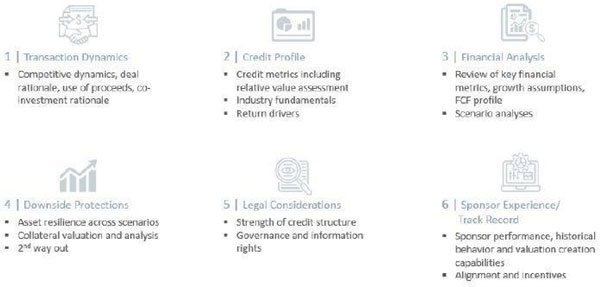
TYPES OF INVESTMENTS AND RELATED RISKS
Investors should carefully consider the risk factors described below, before deciding on whether to make an investment in the Fund. The risks set out below are not the only risks the Fund faces. Additional risks and uncertainties not currently known to the Fund or that the Fund currently deems to be immaterial also may materially adversely affect the Fund’s business, financial condition and/or operating results. If any of the following events occur, the Fund’s business, financial condition and results of operations could be materially adversely affected. In such case, the Net Asset Value of the Fund’s Units could decline, and investors may lose all or part of their investment.
General Risks
General Economic Conditions and Recent Events
Difficult global credit market conditions have adversely affected the market values of equity, fixed-income, hard assets, and other securities and these circumstances may continue or even deteriorate further. The short- and longer-term impact of these events is uncertain, but could have a material effect on general economic conditions, consumer and business confidence and market liquidity. Investments made by the Fund are expected to be sensitive to the performance of the overall economy. A negative impact on economic fundamentals and consumer and business confidence would likely increase market volatility and reduce liquidity, both of which could have a material adverse effect on the performance of the Fund and these or similar events may affect the ability of the Fund to execute its strategy. The risk of loss from pricing distortions is compounded by the fact that in disrupted markets many positions become illiquid, making it difficult or impossible to close out positions against which the markets are moving. The financing available to the Fund from its banks, dealers and other counterparties is typically reduced during market disruptions. Market disruptions caused by unexpected political, military, pandemics and terrorist events may from cause dramatic losses for the Fund, and such events can result in otherwise historically low-risk strategies performing with unprecedented volatility and risk.
No Operating History
The Fund is a new company with no operating history. Investors must rely on the Adviser to implement the Fund’s investment policies, to evaluate all of the Fund’s investment opportunities and to structure the terms of the Fund’s investments rather than evaluating the Fund’s investments in advance. Because investors are not able to thoroughly evaluate the Fund’s investments in advance of acquiring Units, the offering of Units may entail more risk than other types of offerings. This additional risk may hinder investors’ ability to achieve their own personal investment objectives related to portfolio diversification, risk-adjusted investment returns and other objectives. Additionally, the results of any other businesses or companies that have or have had an investment objective which is similar to, or different from, the Fund’s investment objectives are not indicative of the results that the Fund may achieve. The Fund expects to have a different investment portfolio from other businesses or companies. Accordingly, the Fund’s results may differ from and are independent of the results obtained by such businesses or companies. Moreover, past performance is no assurance of future returns.
The Fund is subject to all of the business risks and uncertainties associated with any new business, including the risk that the Fund will not achieve its investment objectives and that the value of investors’ investments could decline substantially or that investors’ investments could become worthless. The Adviser anticipates that it could take some time to invest substantially all of the capital expected to be raised due to market conditions generally and the time necessary to identify, evaluate, structure, negotiate and close suitable investments. In order to comply with the RIC diversification requirements during the startup period, the Fund may invest proceeds in temporary investments, such as cash, cash equivalents, U.S. government securities and other high-quality debt investments that mature in one year or less from the time of investment, which may earn yields substantially lower than the interest, dividend or other income that the Fund seeks to receive in respect of suitable portfolio investments. The Fund may not be able to pay any significant distributions during this period, and any such distributions may be substantially lower than the distributions expected to be paid when the Fund’s portfolio is fully invested.
Units Not Listed; No Market for Units
The Fund has been organized as a closed-end management investment company. Closed-end funds differ from open-end management investment companies (commonly known as mutual funds) because investors in a closed-end fund do not have the right to redeem their equity investments on a daily basis. Unlike most closed-end funds, which typically list their shares on a securities exchange, the Fund does not currently intend to list the Units for trading on any securities exchange, and the Fund does not expect any secondary market to develop for the Units in the foreseeable future. Therefore, an investment in the Fund, unlike an investment in a typical closed-end fund, is not a liquid investment.
Competition for Investment Opportunities
The Fund competes for investments with other closed-end funds and investment funds, as well as traditional financial services companies such as commercial banks and other sources of funding. Moreover, alternative investment vehicles, such as hedge funds, have begun to invest in areas in which they have not traditionally invested. As a result of these new entrants, competition for investment opportunities may intensify. Many of the Fund’s competitors are substantially larger and may have considerably greater financial, technical and marketing resources than the Fund. For example, some competitors may have a lower cost of capital and access to funding sources that are not available to the Fund. In addition, some of the Fund’s competitors may have higher risk tolerances or different risk assessments than the Fund has. These characteristics could allow the Fund’s competitors to consider a wider variety of investments, establish more relationships and pay more competitive prices for investments than the Fund is able to do. The Fund may lose investment opportunities if it does not match its competitors’ pricing. If the Fund is forced to match its competitors’ pricing, it may not be able to achieve acceptable returns on its investments or may bear substantial risk of capital loss. A significant increase in the number and/or the size of the Fund’s competitors could force it to accept less attractive investment terms. Furthermore, many of the Fund’s competitors have greater experience operating under, or are not subject to, the regulatory restrictions that the 1940 Act imposes on it as a closed-end fund.
Substantial Repurchases
Substantial requests for the Fund to repurchase Units as a result of tender offers could require the Fund to liquidate certain of its investments more rapidly than otherwise desirable in order to raise cash to fund the repurchases and achieve a market position appropriately reflecting a smaller asset base. This could have a material adverse effect on the value of the Units.
Non-Diversified Status
The Fund is a “non-diversified” investment company for purposes of the 1940 Act, which means that it is not subject to percentage limitations under the 1940 Act on the percentage of its assets that may be invested in the securities of any one issuer. The Fund’s Net Asset Value may therefore be subject to greater volatility than that of an investment company that is subject to such diversification requirements.
Temporary Investments
For defensive purposes, during periods in which the Fund determines that economic, market or political conditions are unfavorable to investors and a defensive strategy would benefit the Fund, the Fund may temporarily deviate from its investment strategies and objective. During such periods, the Fund may invest all or a portion of its assets in U.S. government securities, including bills, notes and bonds differing as to maturity and rates of interest that are either issued or guaranteed by the Treasury or by U.S. government agencies or instrumentalities; non-U.S. government securities which have received the highest investment grade credit rating, certificates of deposit issued against funds deposited in a bank or a savings and loan association; commercial paper; bankers’ acceptances; bank time deposits; shares of money market funds; credit-linked notes or repurchase agreements with respect to any of the foregoing. In addition, the Fund may also make these types of investments to comply with regulatory or contractual requirements, including with respect to leverage restrictions, or to keep cash fully invested pending the investment of assets. It is impossible to predict when, or for how long, the Fund will use these strategies. There can be no assurance that such
strategies will be successful. The Fund is not required to adopt defensive positions or hedge its investments and may choose not to do so even in periods of extreme market volatility and economic uncertainty.
Liquidity and Valuation
The Fund expects to invest in securities which are subject to legal or other restrictions on transfer or for which no liquid market exists. The sale of restricted and illiquid securities often requires more time and results in higher brokerage charges or dealer discounts and other selling expenses than does the sale of securities eligible for trading on national securities exchanges or in the over-the counter (“OTC”) markets. Restricted securities may sell at a price lower than similar securities that are not subject to restrictions on resale. Because the markets for such securities are still evolving, liquidity in these securities is limited and liquidity with respect to lower-rated securities and unrated subordinated securities may be even more limited. The Fund may be unable to liquidate all or a portion of its position in such securities. In addition, the market prices, if any, for such securities tend to be more volatile and the Fund may not be able to realize what it perceives to be their fair value in the event of a sale. The high yield securities markets have suffered periods of extreme illiquidity for certain types of instruments in the past. For these reasons, among others, calculating the fair market value of the Fund’s holdings may be difficult. If market quotations for the Fund’s investments are not readily available, the Adviser may seek to value the Fund’s investments by testing possible sales prices for such investments with at least one potential investor or, if there are market makers, by obtaining quotations and may sell investments through such pricing mechanism. Should no quotes be available for a particular investment, the Fund will determine the fair market value of such investment in good faith. Illiquid securities are subject to wide spreads. Fair valuation is not exact, and prices can vary significantly from one period to the next.
Use of Leverage: Risk of Borrowing by the Fund
The Fund expects to employ leverage to achieve its investment objectives and may consider other potential uses in the future. The Fund’s willingness to use leverage, and the extent to which leverage is used at any time, will depend on many factors, including an Adviser’s assessment of the yield curve environment, interest rate trends, market conditions and other factors.
The Fund may incur permanent, Fund-level leverage, such as bridge, asset-backed facilities, term loan debt, subscription facilities, financing transactions from prime brokers or custodians, short-sales and/or related to the Fund’s hedging activities. The Fund may leverage its investments through borrowings. Although the Fund has the option to borrow, there are significant risks that may be assumed in connection with such borrowings. Unitholders should consider the various risks of financial leverage, including, without limitation, the matters described below. There is no assurance that a leveraging strategy would be successful. Financial leverage involves risks and special considerations for Unitholders including: (i) the likelihood of greater volatility of NAV of the shares than a comparable portfolio without leverage; (ii) the risk that fluctuations in interest rates on borrowings and short-term debt that the Fund must pay will reduce the return to the Unitholders; (iii) the effect of financial leverage in a market experiencing rising interest rates, which would likely cause a greater decline in the NAV of the shares than if the Fund were not leveraged; and (iv) the potential for an increase in operating costs, which may reduce the Fund’s total return.
In the event that the Fund would be required to sell assets at a loss, including in order to redeem or pay off any borrowing, such a sale would reduce the Fund’s NAV and may make it difficult for the NAV to recover. The Fund nevertheless may continue to use financial leverage if the Adviser expects that the benefits to the Unitholders of maintaining the leveraged position likely would outweigh a resulting reduction in the current return.
Certain types of borrowings by the Fund would result in the Fund being subject to covenants in credit agreements relating to asset coverage and Fund composition requirements that are more stringent than those currently imposed on the Fund by the 1940 Act. In addition, borrowings by the Fund may be made on a secured basis. The Custodian will then either segregate the assets securing the Fund’s borrowings for the benefit of the Fund’s lenders or arrangements will be made with a suitable sub-custodian. If the assets used to secure a borrowing decrease in value, the Fund may be required to pledge additional collateral to the lender in the form of cash or securities to avoid liquidation of those assets. In the event of a default, the lenders will have the right, through the Custodian, to redeem the Fund’s investments without consideration of whether doing so would be in the best interests of the Fund’s Unitholders. The rights of any lenders to the Fund to receive payments of interest on and repayments of principal of borrowings will be senior to the rights of the Fund’s Unitholders, and the terms of the Fund’s borrowings may contain provisions that
limit certain activities of the Fund and could result in precluding the purchase of instruments that the Fund would otherwise purchase.
The use of financial leverage involves financial risk and would increase the exposure of the Fund’s investment returns to adverse economic factors such as rising interest rates, downturns in the economy or deterioration in the condition of the investments. There would be a risk that operating cash flow available to the Fund would be insufficient to meet required payments and a risk that it would not be possible to refinance existing indebtedness or that the terms of such refinancing would not be as favorable as the terms of existing indebtedness. Borrowings by the Fund may be secured by any or all of the assets of the Fund, with the consequences that the Fund may lose more than its equity stake in any one investment, and may lose all of its capital.
With respect to any asset-backed facility entered into by the Fund (or subsidiary thereof), a decrease in the fair value of the Fund’s investments would increase the effective amount of leverage and could result in the possibility of a violation of certain financial covenants pursuant to which the Fund must repay the borrowed funds to the lender. Liquidation of the Fund’s investments at an inopportune time in order to satisfy such financial covenants could adversely impact the performance of the Fund and could, if the value of its investments had declined significantly, cause the Fund to lose all or a substantial amount of its capital. In the event of a sudden, precipitous drop in the value of the Fund’s assets, the Fund might not be able to dispose of assets quickly enough to pay off its debt resulting in a foreclosure or other total loss of some or all of the pledged assets. Fund-level debt facilities typically include other covenants such as covenants against the Fund incurring or being in default under other recourse debt, including certain Fund guarantees of asset level debt, which, if triggered could cause adverse consequences to the Fund if it is unable to cure or otherwise mitigate such breach.
No Assurance of Investment Return
The Adviser’s task of identifying and evaluating investment opportunities, managing such investments, and realizing a significant return for investors is difficult. Many organizations operated by persons of competence and integrity have been unable to make, manage, and realize a profit on such investments successfully. The Adviser believes that its investment strategy and investment approach moderate this risk through a careful selection of securities and other financial instruments. However, there is no assurance that the Fund will be able to invest its capital on attractive terms or generate returns for its investors. Investors in the Fund could experience losses on their investment. Past performance of investment entities associated with the Adviser and its affiliates is not necessarily indicative of future results. There can be no assurance that the Fund will achieve its investment objectives or that performance objectives of the Fund will be achieved.
Reporting Requirements
Unitholders who beneficially own Units that constitute more than 5% or 10% of the Fund’s Units are subject to certain requirements under the Securities Exchange Act of 1934, as amended, and the rules promulgated thereunder. These include requirements to file certain reports with the SEC. The Fund has no obligation to file such reports on behalf of such Unitholders or to notify Unitholders that such reports are required to be made. Unitholders who may be subject to such requirements should consult with their legal advisers.
Business and Structure Related Risks
Availability of Suitable Investments
While the Adviser believes that many attractive investments of the types in which the Fund expects to invest are currently available, there can be no assurance that such investments will continue to be available or that available investments will continue to meet the Fund’s investment criteria. Furthermore, the Fund may be unable to find a sufficient number of attractive investment opportunities to meet its investment objectives. Past performance is not necessarily indicative of future performance.
Uncertain Tax Treatment
The Fund may invest in certain securities, such as certain convertible and high yield securities, for which the federal income tax treatment may not be clear or may be subject to re-characterization by the IRS. It could be more difficult for the Fund to comply with the federal income tax requirements applicable to regulated investment companies if the tax characterization of the Fund’s investments is not clear or if the tax treatment of the income from such investments were successfully challenged by the IRS.
Cybersecurity
With the use of technologies such as the Internet and the dependence on computer systems to perform necessary business functions, investment vehicles such as the Fund and its service providers may be prone to operational and information security risks resulting from cyber-attacks. In general, cyber-attacks result from deliberate attacks, but unintentional events may have effects similar to those caused by cyber-attacks. Cyber-attacks include, among other behaviors, stealing or corrupting data maintained online or digitally, denial-of-service attacks on websites, the unauthorized release of confidential information and causing operational disruption. Successful cyberattacks against, or security breakdowns of, the Fund, the Adviser, the Fund’s custodian and/or other third-party service providers may adversely impact the Fund or the Unitholders. For instance, cyber-attacks may interfere with the processing of Unitholder transactions, impact the Fund’s ability to value its assets, cause the release of private Unitholder information or confidential information of the Fund, impede trading, cause reputational damage, and subject the Fund to regulatory fines, penalties or financial losses, reimbursement or other compensation costs, and/or additional compliance costs. The Fund may also incur substantial costs for cybersecurity risk management in order to prevent any cyber incidents in the future. The Fund and the Unitholders could be negatively impacted as a result. While the Fund or the Fund’s service providers have established business continuity plans and systems designed to prevent such cyber-attacks, there are inherent limitations in such plans and systems including the possibility that certain risks have not been identified. Similar types of cybersecurity risks are also present for issuers of securities or other instruments in which the Fund invests, which could result in material adverse consequences for such issuers and may cause the Fund’s investment therein to lose value.
Artificial Intelligence and Machine Learning Developments.
Recent technological advances in artificial intelligence and machine learning technologies (collectively, “AI Technologies”), as well as the rapid growth and widespread use thereof, have the potential to pose risks to the Adviser, the Fund and the Fund’s portfolio companies. AI Technologies have the potential to result in significant and disruptive changes in companies, sectors or industries, including those in which the Fund invests, and any such changes could render the Adviser’s underwriting models obsolete or create new and unpredictable operational, legal and/or regulatory risks. To the extent competitors of the Adviser, the Fund and the Fund’s portfolio companies make more efficient or extensive use of AI Technologies, there is a possibility that such competitors will gain a competitive advantage. Many jurisdictions have passed or are considering laws and regulations concerning AI Technologies, which could adversely affect the Adviser, the Fund, the Fund’s portfolio companies and their respective operations. Additionally, the Adviser, the Fund and the Fund’s portfolio companies could be further exposed to the risks of AI Technologies if third-party service providers or any counterparties, whether or not known to the Adviser, use AI Technologies in their business activities. The Adviser will not be able to control the use of AI Technologies in third-party products or services, including those provided by the Adviser’s and its affiliates’ service providers. Additionally, the Adviser and its personnel reserve the right to use AI Technologies in connection with the Adviser’s business activities, including to support the Adviser’s due diligence and investment activities. AI Technologies are highly reliant on the accuracy, adequacy, completeness and objectivity of their underlying data, and any inaccuracies, deficiencies or biases in this data could lead to errors affecting the Adviser’s decision-making and investment processes. AI Technologies and their applications, including in the financial sector, continue to develop rapidly, and it is impossible to predict the future risks that have the potential to arise from such developments. Any of the foregoing factors could have a material and adverse effect on the Adviser, the Fund and the Fund’s portfolio companies.
Distribution Payment and Frequency Not Guaranteed
The Fund expects to pay distributions monthly out of assets legally available for distribution, at the sole discretion of the Board. Nevertheless, the Fund cannot assure Unitholders that the Fund will achieve investment results that will
allow the Fund to make a specified level of cash distributions or year-to-year increases in cash distributions. The Fund’s ability to pay distributions may be adversely affected by the impact of the risks described in this Offering Memorandum. All distributions will depend on the Fund’s earnings, its net investment income, its financial condition, and such other factors as the Board may deem relevant.
In the event that the Fund encounters delays in locating suitable investment opportunities, the Fund may return all or a substantial portion of the proceeds from the offering of Units in anticipation of future cash flow, which may constitute a return of your capital and will lower your tax basis in your Units. A return of capital generally is a return of your investment rather than a return of earnings or gains derived from the Fund’s investment activities and will be made after deduction of the fees and expenses payable in connection with the proceeds from the offering of Units, including any fees payable to the Adviser. A return of capital to Unitholders is a return of a portion of their original investment in the Fund, thereby reducing the tax basis of their investment. As a result of such reduction in tax basis, Unitholders may be subject to tax in connection with the sale of Units, even if such Units are sold for less than the Unitholder’s original investment.
Failure to Qualify as a RIC or Satisfy Distribution, Income and Asset Requirements
To qualify for and maintain RIC qualification under the Code, the Fund must meet the following annual distribution, source-of-income and asset-diversification requirements.
| ● | The annual distribution requirement for a RIC will be satisfied if the Fund distributes to Unitholders on an annual basis at least 90% of the Fund’s net ordinary income and realized net short-term capital gains in excess of realized net long-term capital losses, if any, and at least 90% of the Fund’s net income from tax-exempt obligations, if any. |
| ● | The source-of-income requirement will be satisfied if the Fund obtains at least 90% of its gross income for each year from dividends, interest, gains from the sale of stock or securities or similar passive sources. If the source-of-income requirement is not met, the Fund may fail to qualify for RIC tax treatment and be subject to corporate-level income tax. |
| ● | The asset diversification requirement will be satisfied if the Fund meets certain asset diversification requirements at the end of each quarter of the Fund’s tax year. To satisfy this requirement, (i) at least 50% of the value of the Fund’s assets must consist of cash, cash equivalents, U.S. government securities, securities of other RICs and other securities if such other securities of any one issuer do not represent more than 5% of the value of the Fund’s assets or more than 10% of the outstanding voting securities of such issuer, and (ii) no more than 25% of the value of the Fund’s assets can be invested in the securities, other than U.S. government securities or securities of other RICs, of one issuer, of two or more issuers that are controlled, as determined under the Code and its applicable regulations, by the Fund and that are engaged in the same or similar or related trades or businesses or of certain “qualified publicly traded partnerships.” Failure to meet these requirements may result in the Fund having to dispose of certain investments quickly in order to prevent the loss of its qualification as a RIC. Because most of the Fund’s investments will be in private companies, and therefore will be relatively illiquid, any such dispositions could be made at disadvantageous prices and could result in substantial losses. |
If the Fund fails to maintain its RIC status for any reason and is subject to corporate income tax, the resulting corporate taxes could substantially reduce the Fund’s net assets, the amount of income available for distribution and the amount of the Fund’s distributions. No assurance can be given that the Fund will be able to meet the complex and varied tests required to qualify as a RIC or to avoid corporate level income tax. In addition, because the relevant laws may change, compliance with one or more of the RIC requirements may be impossible or impractical.
Difficulty Paying our Required Distributions Under Applicable Tax rules if we Recognize Income Before or Without Receiving Cash Representing Such Income
For U.S. federal income tax purposes, the Fund generally is required to include in income certain amounts that it has not yet received in cash, such as OID or certain income accruals on contingent payment debt instruments, which may
occur if the Fund receives warrants in connection with the origination of a loan or possibly in other circumstances. Such OID is generally required to be included in income before the Fund receives any corresponding cash payments. In addition, the Fund’s loans typically contain PIK interest provisions. Any PIK interest, computed at the contractual rate specified in each loan agreement, is generally required to be added to the principal balance of the loan and recorded as interest income. The Fund also may be required to include in income certain other amounts that it does not receive, and may never receive, in cash. To avoid the imposition of corporate-level tax, this non-cash source of income may need to be distributed to the unitholders in cash or, in the event that the Fund determines to do so, in units, even though the Fund may have not yet collected and may never collect the cash relating to such income.
Since, in certain cases, the Fund may recognize income before or without receiving cash representing such income, it may have difficulty meeting the Annual Distribution Requirement necessary to be relieved of corporate-level U.S. federal taxes on income and gains distributed to the unitholders. Accordingly, the Fund may have to sell or otherwise dispose of some of its investments at times and/or at prices it would not consider advantageous, raise additional capital or forgo new investment opportunities for this purpose. If the Fund is not able to obtain cash from other sources, the Fund may fail to satisfy the Annual Distribution Requirement and thus become subject to corporate-level U.S. federal income tax.
Legislative or Other Actions Relating to Taxes Could Have a Negative Effect on the Fund
The rules dealing with U.S. federal income taxation are constantly under review by persons involved in the legislative process and IRS and the U.S. Treasury Department. The Fund cannot predict with certainty how any changes in the tax laws might affect it, the unitholders, or its investments. New legislation and any U.S. Treasury regulations, administrative interpretations or court decisions interpreting such legislation could significantly and negatively affect the Fund’s ability to qualify for tax treatment as a RIC or the U.S. federal income tax consequences to it and the unitholders of such qualification, or could have other adverse consequences. Unitholders are urged to consult with their tax adviser regarding tax legislative, regulatory, or administrative developments and proposals and their potential effect on an investment in the units.
For additional discussion regarding the tax implications of a RIC, see “Tax Aspects.”
Risks Associated with the Fund and the Adviser
Senior Management Personnel of the Adviser
Since the Fund has no employees, it depends on the investment expertise, skill and network of business contacts of the Adviser. The Adviser evaluates, negotiates, structures, executes, monitors and services the Fund’s investments. The Fund’s future success depends to a significant extent on the continued service of the Adviser and its senior management. The departure of any members of the Adviser’s senior management could have a material adverse effect on the Fund’s ability to achieve its investment objectives.
The Fund’s ability to achieve its investment objectives depends on the Adviser’s ability to identify, analyze, invest in, finance and monitor companies that meet the Fund’s investment criteria. The Adviser’s capability in managing the investment process, providing competent, attentive and efficient services to the Fund, and facilitating access to financing on acceptable terms depend on the employment of investment professionals in an adequate number and of adequate sophistication to match the corresponding flow of transactions. To achieve the Fund’s investment objectives, the Adviser may need to hire, train, supervise and manage new investment professionals to participate in the Fund’s investment selection and monitoring process. The Adviser may not be able to find investment professionals in a timely manner or at all. Failure to support the Fund’s investment process could have a material adverse effect on the Fund’s business, financial condition and results of operations.
In addition, the Investment Advisory Agreement has a termination provision that allow the parties to terminate the agreement without penalty. The Investment Advisory Agreement may be terminated at any time, without penalty, by the Adviser upon 60 days’ notice to the Fund. If the Investment Advisory Agreement is terminated, it may adversely affect the quality of the Fund’s investment opportunities. In addition, in the event the Investment Advisory Agreement is terminated, it may be difficult for the Fund to replace the Adviser.
Key Personnel
The Adviser depends on the diligence, skill, and network of business contacts of its professionals. The Adviser also depends, to a significant extent, on deal flow generated by these investment professionals in the course of its investment and portfolio management activities. The Fund’s success depends on the continued service of such personnel. The investment professionals associated with the Adviser are actively involved in other investment activities not concerning the Fund and will not be able to devote all of their time to the Fund’s business and affairs. The departure of any of the senior managers of the Adviser, or a significant number of the investment professionals or partners of the Adviser’s affiliates, could have a material adverse effect on the Fund’s ability to achieve its investment objective. Individuals not currently associated with the Adviser may become associated with the Fund and the performance of the Fund may also depend on the experience and expertise of such individuals. In addition, there is no assurance that the Adviser will remain the Fund’s investment adviser or that the Adviser will continue to have access to the investment professionals and partners of its affiliates and the information and deal flow generated by the investment professionals of its affiliates.
Systems and Operations
The Fund depends on the Adviser to develop and implement appropriate systems for the Fund’s activities. The Fund relies heavily and on a daily basis on financial, accounting and other data processing systems to execute, clear and settle transactions across numerous and diverse markets and to evaluate certain securities, to monitor its portfolio and capital, and to generate risk management and other reports that are critical to oversight of the Fund’s activities. Certain of the Fund’s and the Adviser’s activities will be dependent upon systems operated by third parties, including prime brokers, the Administrator, market counterparties and other service providers, and the Adviser may not be in a position to verify the risks or reliability of such third-party systems. Failures in the systems employed by the Adviser, prime brokers, the Administrator, counterparties, exchanges and similar clearance and settlement facilities and other parties could result in mistakes made in the confirmation or settlement of transactions, or in transactions not being properly booked, evaluated or accounted for. Disruptions in the Fund’s operations may cause the Fund to suffer, among other things, financial loss, the disruption of its business, liability to third parties, regulatory intervention or reputational damage. Any of the foregoing failures or disruptions could have a material adverse effect on the Fund.
Fundamental Analysis
Investment decisions will be based on fundamental analysis. Data on which fundamental analysis relies may be inaccurate or may be generally available to other market participants. Fundamental market information is subject to interpretation. To the extent that the Adviser misinterprets the meaning of certain data, the Fund may incur losses.
Investment and Due Diligence Process
Before making investments, the Adviser will conduct due diligence that it deems reasonable and appropriate based on the facts and circumstances applicable to each investment. When conducting due diligence, the Adviser may be required to evaluate important and complex business, financial, tax, accounting and legal issues. When conducting due diligence and making an assessment regarding an investment, the Adviser will rely on the resources reasonably available to it, which in some circumstances whether or not known to the Adviser at the time, may not be sufficient, accurate, complete or reliable. Due diligence may not reveal or highlight matters that could have a material adverse effect on the value of an investment.
Co-Investment Exemptive Relief
The Adviser and/or its affiliates and portfolio managers may determine that an investment is appropriate both for the Fund and for one or more other funds or accounts. In such event, depending on the availability of such investment and other appropriate factors, the Adviser may determine that the Fund should invest on a side-by-side basis with one or more other funds. The Fund may make all such investments subject to compliance with applicable laws and regulations and interpretations thereof by the SEC and its staff.
The Fund and the Adviser have received exemptive relief from the provisions of Sections 17(d) of the 1940 Act to co-invest in certain privately negotiated investment transactions with current or future registered closed-end funds, business development companies, private funds or separate accounts that are advised by the Adviser and any investment adviser controlling, controlled by or under common control with the Adviser (collectively, the Fund’s “co-investment affiliates”) subject to the satisfaction of certain conditions.
Investment Performance of the Fund and Other Investment Vehicles May Vary Significantly
The Adviser has established, and expects to continue to establish, additional companies, partnerships or other entities, pooled investment vehicles for multiple investors, funds, separate accounts, and other entities that may have, in whole or in part, investment objectives and strategies that may be similar to or overlap with those of the Fund (collectively, “Other Investment Vehicles”). The Fund may at times compete with the Other Investment Vehicles for certain investments and the returns of each of the Other Investment Vehicles will likely differ materially from the returns of the Fund.
The results of the investment activities of the Fund may differ significantly from the results achieved by the Adviser for its own benefit and from the results achieved by Other Investment Vehicles based on the investment strategies employed by such investors.
Subject to applicable law, including the 1940 Act, Other Investment Vehicles may invest alongside the Fund. In allocating any investment opportunities, the Adviser will take into account numerous factors, including factors specific only to such Other Investment Vehicles, in its discretion. Any such investments made alongside the Fund may or may not be in proportion to the relevant commitments of the investing parties. Certain co-investments may be made only if the Fund and the Adviser receive an exemptive order from the SEC permitting such investment. See “Co-Investment Exemptive Relief.”
Inadequate Return
No assurance can be given that the returns on the Fund’s investments will be commensurate with the risk of investment in the Units.
Portfolio Turnover
The Fund’s annual portfolio turnover rate may vary greatly from year to year, as well as within a given year. However, portfolio turnover rate is not considered a limiting factor in the execution of investment decisions for the Fund. High portfolio turnover may result in the realization of net short-term capital gains by the Fund which, when distributed to the Fund and, ultimately, Unitholders, will be taxable as ordinary income. In addition, a higher portfolio turnover rate results in correspondingly greater brokerage commissions and other transactional and custodial expenses that are borne by the Fund.
The Fund’s Investments, Investment Activities and Related Risks
Direct Lending
The Fund expects that it may invest a portion of its assets in directly originated senior secured loans, including unitranche loans, of performing middle market companies (“Senior Capital Debt Securities”). A performing middle market company is one that the Adviser believes is generating sufficient cash flow to meet its ongoing debt service obligations, is in compliance with its material credit agreements, and is not in material financial distress at the time of investment.
The value of such loans is volatile and may fluctuate due to a variety of factors that are inherently difficult to predict and are outside the control of the Adviser, including prevailing credit spreads, general economic conditions, financial market conditions, domestic or international economic or political events, developments or trends in any particular industry, changes in interest rates, or the financial condition of the obligors of the Fund’s assets. In particular, the market for senior secure loans to middle market companies has experienced periods of volatility in the supply and
demand for such loans, resulting in volatility in, among other things, spreads, interest rate floors, purchase price discounts, leverage, covenants, structure, and other terms. Because the loans are privately syndicated and loan agreements are privately negotiated and customized, loans are not purchased or sold as easily as publicly traded securities. In addition, historically the trading volume in the loan market, especially in the middle market, has been small relative to the high-yield debt securities market.
The obligors of the Senior Capital Debt Securities are expected to primarily be privately owned middle market businesses. There is generally no publicly available information about these businesses. Some obligors may not meet net income, cash flow and other coverage tests typically imposed by lenders. Numerous factors may affect an obligor’s ability to repay its related obligations, including the failure to meet its business plan, a downturn in its industry or continuing negative economic conditions. A deterioration in an obligor’s financial condition and prospects may be accompanied by deterioration in the collateral securing the Fund’s assets or the recuring revenue of the obligor. Such deterioration might impair the ability of such obligor to obtain refinancing or force it to seek to have the Fund’s asset restructured.
Senior Capital Debt Securities are generally considered speculative in nature and may end up in default for a variety of reasons. A defaulted asset may become subject to either substantial workout negotiations or a restructuring, which may entail, among other things, a substantial reduction in the interest rate, a substantial write-down of principal, and a substantial change in the terms, conditions and covenants with respect to such defaulted asset. In addition, such negotiations or restructuring may be quite extensive, protracted and costly over time, and therefore may result in substantial uncertainty with respect to the ultimate recovery on such defaulted asset. The liquidity of a defaulted asset will be limited, and to the extent that a defaulted asset is sold, it is highly unlikely that the proceeds from such sale will be equal to the amount of unpaid principal and interest thereon.
There can be no assurance as to the levels of defaults or the amount or timing of recoveries that may be experienced with respect to the Fund’s assets. Any increase in default levels or decrease in recovery rates, or delays in receipt of recoveries, could adversely affect distributions, if any, to the Fund.
There can be no assurance that the Adviser will correctly evaluate the nature and magnitude of the various factors that could negatively affect the value or performance of Senior Capital Debt Securities. These risks could be exacerbated to the extent that the portfolio is concentrated in one or more particular types of assets.
Concentration
The Fund could make a limited number of investments. One risk of having a limited number of investments is that the aggregate returns realized by investors may be substantially adversely affected by the unfavorable performance of even a single investment. The Adviser expects to generally use an opportunistic approach to investing, which may result in the Fund’s investments being concentrated in a particular issuer, industry, security, structure or geographic region and its investments will become more susceptible to fluctuations in value resulting from adverse economic and/or business conditions with respect thereto. These risks may be further pronounced in cases where an investment is secured by a relatively small or less diverse pool of underlying assets. Certain geographic regions and/or industries may be more adversely affected from economic pressures when compared to other geographic regions and/or industries.
Following its initial investment in a given portfolio company, the Fund may have the opportunity to increase its investment in such portfolio company. There is no assurance that the Fund will make follow-on investments or that the Fund will have sufficient funds to make all or any such investments. Any decision by the Fund not to make follow-on investments or its inability to make such investments may have a substantial negative effect on a portfolio company in need of such an investment, may result in a lost opportunity for the Fund to increase its participation in a successful portfolio company, may result in the Fund’s investment in the relevant portfolio company becoming diluted and in circumstances where the follow-on investment is offered at a discount to market value, may result in a loss of value for the Fund.
Direct Origination
A significant portion of the Fund’s investments may be directly originated by the Fund. The results of the Fund’s operations depend on several factors, including the availability of opportunities for the origination or acquisition of target investments, the level and volatility of interest rates, the availability of adequate short and long-term financing, conditions in the financial markets and economic conditions. Further, the Fund’s inability to raise capital and the risk of portfolio company defaults may materially and adversely affect the Fund’s investment originations, business, liquidity, financial condition, results of operations and its ability to make distributions to its Unitholders. In addition, competition for originations of and investments in the Fund’s target investments may lead to the price of such assets increasing or the decrease of interest income from loans originated by the Fund, which may further limit its ability to generate desired returns. Also, as a result of this competition, desirable investments in the Fund’s target investments may be limited in the future, and the Fund may not be able to take advantage of attractive investment opportunities, as the Fund can provide no assurance that the Adviser will be able to identify and make investments that are consistent with its investment objectives.
Syndication
The Fund may originate certain of its investments with the expectation of later syndicating a portion of such investment to third parties. Prior to such syndication, or if such syndication is not successful, the Fund’s exposure to the originated investment may exceed the exposure that the Adviser intended to have over the long-term or would have had had it purchased such investment in the secondary market rather than originating it.
Loans
Loan interests generally are subject to restrictions on transfer, and the Fund may be unable to sell loan interests at a time when it may otherwise be desirable to do so or may be able to sell them only at prices that are less than what the Fund regards as their fair market value. Accordingly, loan interests may at times be illiquid. Loan interests may be difficult to value and may have extended settlement periods, which expose the Fund to the risk that the receipt of principal and interest payments may be delayed until the loan interest settles.
Interests in secured loans have the benefit of collateral and, typically, of restrictive covenants limiting the ability of the borrower to further encumber its assets. There is a risk that the value of any collateral securing a loan in which the Fund has an interest may decline and that the collateral may not be sufficient to cover the amount owed on the loan. In most loan agreements there is no formal requirement to pledge additional collateral. In the event the borrower defaults, the access to the collateral may be limited or delayed by bankruptcy or other insolvency laws. In addition, if a secured loan is foreclosed, the Fund would likely bear the costs and liabilities associated with owning and disposing of the collateral. The collateral may be difficult to sell and the Fund would bear the risk that the collateral may decline in value.
The Fund may acquire a loan interest by obtaining an assignment of all or a portion of the interests in a particular loan that are held by an original lender or a prior assignee. As an assignee, the Fund normally will succeed to all rights and obligations of its assignor with respect to the portion of the loan that is being assigned. However, the rights and obligations acquired by the purchaser of a loan assignment may differ from, and be more limited than, those held by the original lenders or the assignor.
In general, the secondary trading market for loans is not well developed. No active trading market may exist for certain senior secured loans. Illiquidity and adverse market conditions may mean that the Fund may not be able to sell loans quickly or at a fair price. To the extent that a secondary market does exist for certain loans, the market for them may be subject to irregular trading activity, wide bid/ask spreads and extended trade settlement periods.
Use of Collateral
Collateral for private credit investments may include a wide range of assets, including, but not limited to, assets and/or net income of companies, real estate, revenue streams, equity interests, fund interests, royalties of various types, rights to litigation proceeds, trade receivables, and derivative exposure to loans. To the extent the Adviser originates loans
based partly upon the adequacy of the borrower’s collateral, an incorrect valuation of such collateral may result in unforeseen losses. The inherent uncertainty of the value of collateral may result in values that differ significantly from the values that can ultimately be obtained for such collateral. Even if collateral is initially valued correctly, changes in market conditions, regulations or other circumstances, or changes directly related to such collateral, may materially adversely affect the value thereof. In addition, there can be no assurance that such collateral could be readily liquidated. In the event of bankruptcy of a borrower, the Fund could experience delays or limitations with respect to its ability to realize the benefits of the collateral securing an investment.
Under certain circumstances, collateral securing an investment may be released without the consent of the lender. Moreover, the lender’s security interest (with respect to investments in secured debt) may be unperfected for a variety of reasons, including the failure to make required filings by lenders and, as a result, the Fund may not have priority over other creditors as anticipated. First priority lien investments made by the lender may, in certain cases, provide a first priority lien over some, but not all, of the assets of the relevant borrower. The Fund may also invest in second-lien debt, high-yield securities, marketable and non-marketable common and preferred equity securities and other unsecured instruments each of which involves a higher degree of risk than senior first-lien secured debt, including the re-use and subsequent loss of collateral by the borrower. Furthermore, the Fund’s right to payment and its security interest, if any, may be subordinated to the payment rights and security interests of senior lenders (with respect to some or all of the assets of an issuer in which the Fund invests). Certain of these investments may have an interest-only payment schedule, with the principal amount remaining outstanding and at risk until the maturity of the investment. In such cases, the ability of the issuer to repay the principal in respect of the Fund’s investment may be dependent upon a liquidity event or the long-term success of the company, the occurrence of which is uncertain.
The terms of any derivative hedging arrangements entered into by the Fund may provide that related collateral given to, or received by, the Fund may be pledged, lent, re-hypothecated or otherwise re-used by the collateral taker for its own purposes. If collateral received by the Fund is reinvested or otherwise re-used, the Fund is exposed to the risk of loss on that investment. Should such a loss occur, the value of the collateral will be reduced and the Fund will have less protection if the counterparty defaults. Similarly, if the counterparty reinvests or otherwise re-uses collateral received from the Fund and suffers a loss as a result, it may not be in a position to return that collateral to the Fund should the relevant transaction complete, be unwound or otherwise terminate and the Fund is exposed to the risk of loss of the amount of collateral provided to the counterparty.
Secured Debt
Secured debt holds the most senior position in the capital structure of a borrower. Secured debt in most circumstances is fully collateralized by assets of the borrower. Thus, it is generally repaid before unsecured bank loans, corporate bonds, subordinated debt, trade creditors, and preferred or common stockholders. However, there is a risk that the collateral securing the Fund’s loans may decrease in value over time, may be difficult to sell in a timely manner, may be difficult to appraise, and may fluctuate in value based upon the success of the business and market conditions, including as a result of the inability of the borrower to raise additional capital. Also, substantial increases in interest rates may cause an increase in loan defaults as borrowers may lack resources to meet higher debt service requirements. In some circumstances, the Fund’s security interest could be subordinated to claims of other creditors. In addition, any deterioration in a borrower’s financial condition and prospects, including any inability on its part to raise additional capital, may result in the deterioration in the value of the related collateral. Consequently, the fact that debt is secured does not guarantee that the Fund will receive principal and interest payments according to the investment terms or at all, or that the Fund will be able to collect on the investment should the Fund be forced to enforce its remedies. Moreover, the security for the Fund’s investments in secured debt may not be recognized for a variety of reasons, including the failure to make required filings by lenders, trustees or other responsible parties and, as a result, the Fund may not have priority over other creditors as anticipated.
Secured debt usually includes restrictive covenants, which must be maintained by the borrower. The Fund may have an obligation with respect to certain senior secured term loan investments to make additional loans, including delayed draw term loans and revolving facilities, upon demand by the borrower. Such instruments, unlike certain bonds, usually do not have call protection. This means that such interests, while having a stated term, may be prepaid, often without penalty. The rate of such prepayments may be affected by, among other things, general business and economic conditions, as well as the financial status of the borrower. Prepayment would cause the actual duration of a senior loan to be shorter than its stated maturity.
Secured debt typically will be secured by pledges of collateral from the borrower in the form of tangible and intangible assets. In some instances, the Fund may invest in secured debt that is secured only by stock of the borrower or its subsidiaries or affiliates. The value of the collateral may decline below the principal amount of the senior secured term loans subsequent to an investment by the Fund.
Small and Middle-Market Companies
The Fund may invest in small or middle market companies. Investment in private and small or middle-market companies involves a number of significant risks. Generally, little public information exists about these companies, and the Fund will rely on the ability of the Adviser’s investment professionals to obtain adequate information to evaluate the potential returns from investing in these companies. If they are unable to uncover all material information about these companies, they may not make a fully informed investment decision, and the Fund may lose money on its investments. In addition, small and middle-market companies are frequently owned or controlled by private equity funds and such funds and their managers may have differently aligned incentives regarding their own investment objectives that may be inconsistent with the objectives of the debt holders of such small and middle-market companies. In addition, such funds and their managers may be in a state of distress or have a poor record and may be undergoing restructuring or changes in management. There can be no assurances that such restructuring or changes will be successful.
Small and middle-market companies may also have limited financial resources and may be unable to meet their obligations under their loans and debt securities that the Fund holds, which may be accompanied by a deterioration in the value of any collateral and a reduction in the likelihood of the Fund realizing any guarantees it may have obtained in connection with its investment.
In addition, such companies typically have shorter operating histories, narrower product lines and smaller market shares than larger businesses, which tend to render them more vulnerable to competitors’ actions and market conditions, as well as general economic downturns. Additionally, small and middle-market companies are more likely to depend on the management talents and efforts of a small group of persons. Therefore, the death, disability, resignation or termination of one or more of these persons could have a material adverse impact on one or more of the portfolio companies in which the Fund invests. Small and middle-market companies also may be parties to litigation and may be engaged in rapidly changing businesses with products subject to a substantial risk of becoming obsolete.
Lower Credit Quality Loans
There are no restrictions on the credit quality of the loans that may be held in the Fund’s portfolio. Loans arranged or purchased by the Fund may be deemed to have substantial vulnerability to default in payment of interest and/or principal. Certain of the loans which the Fund may acquire have large uncertainties or major risk exposures to adverse conditions, and may be considered to be predominantly speculative. Generally, such loans offer a higher return potential than higher quality loans, but involve greater volatility of price and greater risk of loss of income and principal. The market values of certain of these loans also tend to be more sensitive to changes in economic conditions than better quality loans.
High Yield, Low-Rated or Unrated Securities
The Fund may invest in high yield fixed-income securities. Debt securities (including bonds) and preferred stock in which the Fund invests may or may not be rated by credit rating agencies. If they are rated, their ratings may range from the very highest to the very lowest. Securities rated below investment grade normally provide a yield that is significantly higher than that of investment grade securities, but are quite speculative for reasons enumerated below. The lower-rated categories include debt securities that are in default and debt securities of insolvent issuers. The rating that a credit rating agency assigns to a security does not reflect an assessment of the volatility of the security’s market value or the liquidity of an investment in the security. The values of lower-rated securities (including unrated securities of comparable quality) fluctuate more than those of higher-rated securities because investors generally believe that there are greater risks associated with them. In addition, the lower rating reflects a greater possibility that the financial condition of the issuer, or adverse changes in general economic conditions, or both, or an unanticipated rise in interest rates, may impair the ability of the issuer to make payments of principal and income. The inability (or perceived inability) of issuers to make timely payment of interest and principal would likely make the values of the securities
more volatile and could limit the purchaser’s ability to sell the securities at prices approximating the values it had placed on the securities. In general, the market for lower-rated or unrated securities is smaller and less active than that for higher-rated securities, which can adversely affect the ability to sell these securities at favorable prices. In addition, the market prices of lower-rated securities are likely to be more volatile because: (i) an economic downturn or increased interest rates may have a more significant effect on the yield, price and potential for default; (ii) past legislation has limited (and future legislation may further limit) investment by certain institutions in lower-rated securities or the tax deductibility of the interest by the issuer, which may adversely affect the value of the securities; and (iii) it may be difficult to obtain information about financially or operationally troubled issuers. The Fund will not necessarily dispose of a security when its rating is reduced below its rating at the time of purchase.
Non-Performing Loans
The Fund may invest in non-performing and sub-performing loans that often involve workout negotiations, restructuring and the possibility of foreclosure. These processes are often lengthy and expensive. In addition, the Fund’s investments may include securities and debt obligations of financially distressed issuers, including companies involved in bankruptcy or other reorganization and liquidation proceedings. As a result, the Fund’s investments may be subject to additional bankruptcy related risks and returns on such investments may not be realized for a considerable period of time.
Unsecured Loans
The Fund may make unsecured loans to borrowers, meaning that such loans will not benefit from any interest in collateral of such borrowers. Liens on such a borrower’s collateral, if any, will secure the borrower’s obligations under its outstanding secured debt and may secure certain future debt that is permitted to be incurred by the borrower under its secured loan agreements. The holders of obligations secured by such liens will generally control the liquidation of, and be entitled to receive proceeds from, any realization of such collateral to repay their obligations in full before the Fund. In addition, the value of such collateral in the event of liquidation will depend on market and economic conditions, the availability of buyers and other factors. There can be no assurance that the proceeds, if any, from sales of such collateral would be sufficient to satisfy the Fund’s unsecured loan obligations after payment in full of all secured loan obligations. If such proceeds were not sufficient to repay the outstanding secured loan obligations, then the Fund’s unsecured claims generally would rank equally with the unpaid portion of such secured creditors’ claims against the borrower’s remaining assets, if any.
Limited Amortization Requirements
The Fund may invest in loans that have limited mandatory amortization requirements. While these loans may obligate an issuer to repay the loan out of asset sale proceeds or with annual excess cash flow, repayment requirements may be subject to substantial limitations that would allow an issuer to retain such asset sale proceeds or cash flow, thereby extending the expected weighted average life of the investment. In addition, a low level of amortization of any debt over the life of the investment may increase the risk that the issuer will not be able to repay or refinance the loans held by the Fund when it matures.
Consumer Loans
The Fund may invest in or be exposed to consumer loans, including credit card receivables, automobile loans, student loans, peer-to-peer loans or other loans. These loans are subject to risks of prepayment, delinquency and default similar to those present in mortgage loans. The ability of a borrower to repay any such loan is dependent on a number of factors, including the income and assets of the borrower. The Fund may invest in consumer loans that have been made to borrowers of varying creditworthiness, and it may invest in consumer loans that have been extended pursuant to varying underwriting guidelines, to no underwriting guidelines at all, or to fraudulent origination practices. Consumer loans may be backed by collateral (as in automobile loans) or they may be unsecured, exposing the Fund to default risk as an unsecured creditor of an individual borrower.
Congress, regulators such as the CFPB and the individual states may further regulate the consumer credit industry in ways that make it more difficult for servicers of such loans to collect payments on such loans, resulting in reduced collections. Such laws and regulations may, among other things, regulate interest rates and other charges, require
certain disclosures, regulate the use of consumer credit information and regulate debt collection practices. Violation of certain provisions of these laws and regulations may limit a servicer’s ability to collect all or part of the principal of, or interest on, such loans, entitle the borrower to a refund of amounts previously paid by it, or subject the servicer to damages and sanctions. Changes to federal or state bankruptcy or debtor relief laws may also impede collection efforts or alter timing and amount of collections. If an obligor sought protection under federal or state bankruptcy or debtor relief laws, a court could reduce or discharge completely the obligor’s obligations to repay amounts due on its loan.
Risks specific to different categories of consumer loans may affect the Fund’s return on such investments. In the case of credit card loans, for example, various and unpredictable social, economic and geographic factors may affect the payment patterns and rates of default by borrowers, including consumer confidence and attitudes toward debt, rates of inflation and unemployment and prevailing interest rates. Rates of prepayment and default on student loans will similarly vary based on a number of factors, but will also be affected by contractual terms present in such loans, including the extension of grace periods, deferment periods and, under some circumstances, forbearance periods. The Adviser cannot predict how these and other factors may affect the Fund’s investments in consumer loans.
Small Business Lending
The Fund may make loans to small businesses and newly-formed “startup” companies. Lending to small businesses and startups presents unique risks. Small businesses and startups generally have limited borrowing and operating histories, making it more difficult to assess their creditworthiness. In addition, small businesses and startups may have fewer assets available to use as collateral, leaving the Fund with little recourse in the event of default on the loan.
Investments in Intellectual Property and Licenses
The Fund may invest in intangible assets, such as intellectual property and licenses, and royalties associated therewith. In many cases, the perceived value of such investments is dependent upon protecting proprietary rights with respect to one or more products (“Portfolio Products”). In many cases, a party’s ability to pay the required royalty (such party, a “Royalty Obligor”), or the Fund’s ability to realize a positive increase in the value of an investment with respect to a Portfolio Product, depends on obtaining and maintaining patent and trade secret protection of Portfolio Products, their use and the methods used to manufacture them, as well as successfully defending those intellectual property rights against third-party challenges. The degree of future protection to be afforded to Portfolio Products is uncertain because legal means afford only limited protection and may not adequately protect the rights of the entities with an interest in the Portfolio Product (an “Interested Party”) or permit them to gain or keep their competitive advantage. It is difficult and costly to protect the proprietary rights associated with Portfolio Products, and their protection cannot be ensured. There can be no assurance that any issued patents underlying Portfolio Products will provide sufficient protection to allow Interested Parties to conduct their business in the ordinary course. Interested Parties may incur substantial costs as a result of result of litigation or other proceedings relating to patent and other intellectual property rights related to Portfolio Products and they may be unable to protect their rights to, or commercialize, the applicable Portfolio Products. Moreover, there can be no assurance that Interested Parties will remain free from intellectual property infringement claims by third parties. If a third-party claims that an Interested Party is using inventions covered by the third-party’s intellectual property rights, that third-party may go to court to stop the Interested Party from engaging in its business in the ordinary course, which would likely adversely impact the value of the Fund’s related Portfolio Investment. Intellectual property infringement lawsuits are costly, would likely affect the results of operations of the Interested Party and divert the attention of their management.
In addition, certain of the Fund’s investments may relate to Portfolio Products which are still in development or have not otherwise received the required regulatory approvals (if any). A failure to gain such required regulatory approval would materially and adversely affect those Portfolio Investments. Regulatory approval processes may be extensive, time consuming and uncertain and may prevent Interested Parties from obtaining approvals for the commercialization of some Portfolio Products.
Event-Driven Special Situations
The Fund’s strategies may involve investments in “event-driven” special situations such as recapitalizations, spinoffs, corporate and financial restructurings, litigation or other catalyst-orientated situations. The companies may also be out
of favor, financially leveraged or troubled, or potentially troubled, and may be or have recently been involved in major strategic actions. These characteristics of these companies can cause their securities to be particularly risky investments, although they also may offer the potential for high returns. These companies’ securities may be considered speculative, and the ability of the companies to pay their debts on schedule could be affected by adverse interest rate movements, changes in the general economic climate, economic factors affecting a particular industry or specific developments within the companies. The Adviser believes these types of investments often have downside risk relative to their current valuations. The Fund could, however, be incorrect in its assessment of the downside risk associated with an investment, thus resulting in a significant loss. Such investments are often difficult to analyze. Although the Fund intends to utilize appropriate risk management strategies, such strategies cannot fully insulate the Fund from the risks inherent in its planned activities. Moreover, in certain situations, the Fund may be unable to, or may choose not to, implement risk management strategies because of the costs involved or other relevant circumstances.
Nature of Investments
The Fund will invest in loans, debt obligations, securities and assets that are inefficiently priced as a result of business, financial, market or legal uncertainties. There is typically no market for certain types of securities the Fund intends to purchase.
The level of analytical sophistication, both financial and legal, necessary for successful returns on such investments is unusually high. There can be no assurance that the Adviser will evaluate correctly the nature and magnitude of the various factors that could affect the value of the Fund’s investments. In particular, the Fund will purchase securities and other obligations of companies that are experiencing significant financial or business distress, including companies involved in bankruptcy or other reorganization and liquidation proceedings. Many of these securities typically remain unpaid unless and until the company reorganizes and/or emerges from bankruptcy proceedings. In addition, it frequently may be difficult to obtain information as to the conditions of these securities. The market prices of these securities are also subject to abrupt and erratic market movements and above average price volatility, and the spread between the bid and asked prices of such securities may be greater than normally expected. Although such investments may result in significant returns to the Fund, they involve a substantial degree of risk and may not show any return for a considerable period of time, if at all. Sourcing, diligence, structuring and governance of private distressed investments require consideration of factors that are often not present in standard private equity investing or investments in the senior and secured debt of financially sound companies. If the Adviser’s evaluation of the anticipated outcome of an investment situation should prove incorrect, the Fund could experience losses. There is no assurance that the Fund will correctly evaluate the value of the assets collateralizing the Fund’s investments or the prospects for a successful reorganization or similar action in respect of any company. In any reorganization or liquidation proceeding relating to a company in which the Fund invests, the Fund may lose its entire investment, may be required to accept cash or securities with a value less than the Fund’s original investment and/or may be required to accept payment over an extended period of time.
Debt investments and loans are subject to credit and interest rate risks. “Credit risk” refers to the likelihood that an issuer will default in the payment of principal and/or interest on an instrument and that an investor may not receive any or all of its principal or interest. Financial strength and solvency of an issuer are the primary factors influencing credit risk. In addition, lack or inadequacy of collateral or credit enhancement for a loan or debt instrument may affect its credit risk. Credit risk may change over the life of an instrument, and debt obligations, which are rated by rating agencies, are often reviewed and may be subject to downgrade. “Interest rate risk” refers to the risks associated with market changes in interest rates. Interest rate changes may affect the value of a debt instrument indirectly (especially in the case of fixed rate debt securities) and directly (especially in the case of debt instruments whose rates are adjustable). In general, rising interest rates will negatively impact the price of a fixed rate debt instrument and falling interest rates will have a positive effect on price. Adjustable-rate instruments also react to interest rate changes in a similar manner although generally to a lesser degree (depending, however, on the characteristics of the reset terms, including the index chosen, frequency of reset and reset caps or floors, among other factors). Interest rate sensitivity is generally more pronounced and less predictable in instruments with uncertain payment or prepayment schedules. In addition, interest rate increases generally will increase the interest carrying costs to the Fund of borrowed securities and leveraged investments.
Lack of Liquidity
The Fund’s investment portfolio will, to a significant extent, consist of investments in private companies. The Fund may take large positions in portfolio companies relative to the trading volume or overall market capitalization of such companies. Such positions may at times prove more difficult to sell in a timely or efficient manner and could thus impair the Fund’s ability to realize portfolio gains fully or at all or limit losses. Moreover, there may be no readily available market for the Fund’s investments. Adverse market conditions may further limit or delay opportunities for liquidity.
Competitive Marketplace
A portion of the Fund’s assets may be invested in companies in highly competitive markets dominated by firms with substantially greater financial and possibly better technical resources than the portfolio companies in which the Fund invests. Portfolio companies in which the Fund invests may operate in business sectors that face technological changes and/or face competition from other firms or organizations.
Portfolio Company Management Risks
With respect to management at the portfolio company level, many portfolio companies rely on the services of a limited number of key individuals, the loss of any one or more of whom could significantly adversely affect the portfolio company’s performance. Management of each portfolio company will have day-to-day responsibility with respect to the business of such portfolio company. The Fund may therefore have limited ability to protect its positions in such portfolio companies because it is not expected to have an in influence the decision-making or implementation process.
Non-U.S. Investments
The Fund’s investment strategy contemplates potential investments in companies outside of the U.S. Investing in companies outside of the U.S. may expose the Fund to additional risks not typically associated with investing in U.S. companies. These risks include changes in exchange control regulations, political and social instability, expropriation, imposition of foreign taxes (potentially at confiscatory levels), less liquid markets, less available information than is generally the case in the U.S., higher transaction costs, less government supervision of exchanges, brokers and issuers, less developed bankruptcy laws, difficulty in enforcing contractual obligations, lack of uniform accounting and auditing standards and greater price volatility.
The investments of the Fund that are denominated in a foreign currency will be subject to the risk that the value of a particular currency will change in relation to one or more other currencies. Among the factors that may affect currency values are trade balances, the level of short-term interest rates, differences in relative values of similar assets in different currencies, long-term opportunities for investment and capital appreciation and political developments. The Fund may employ hedging techniques to minimize these risks, but it cannot be assured that such strategies will be effective or without risk to the Fund.
Investments in Issuers in Regulated Industries
Certain industries, such as the communications and technology industries, are heavily regulated. The Fund may make investments in portfolio companies operating in industries that are subject to greater amounts of regulation than other industries generally. These more highly regulated industries may include energy and power, gaming and healthcare. Investments in portfolio companies that are subject to greater amounts of governmental regulation pose additional risks relative to investments in other companies generally. Changes in applicable laws or regulations, or in the interpretations of these laws and regulations, could result in increased compliance costs or the need for additional capital expenditures. If a portfolio company fails to comply with these requirements, it could also be subject to civil or criminal liability and the imposition of fines. A portfolio company also could be materially and adversely affected as a result of statutory or regulatory changes or judicial or administrative interpretations of existing laws and regulations that impose more comprehensive or stringent requirements on such issuer. Governments have considerable discretion in implementing regulations that could impact an issuer’s business and governments may be influenced by political considerations and may make decisions that adversely affect an issuer’s business. Additionally, certain
portfolio companies may have a unionized workforce or employees who are covered by a collective bargaining agreement, which could subject any such portfolio company’s activities and labor relations matters to complex laws and regulations relating thereto. Moreover, a portfolio company’s operations and profitability could suffer if it experiences labor relations problems. Upon the expiration of any such portfolio company’s collective bargaining agreements, it may be unable to negotiate new collective bargaining agreements on terms favorable to it, and its business operations at one or more of its facilities may be interrupted as a result of labor disputes or difficulties and delays in the process of renegotiating its collective bargaining agreements. A work stoppage at one or more of any such portfolio company’s facilities could have a material adverse effect on its business, results of operations and financial condition. Any such problems additionally may bring scrutiny and attention to the Fund itself, which could adversely affect the Fund’s ability to implement its investment objectives.
Sophisticated Parties Non-Reliance Letters
The Fund may enter into transactions involving securities, loans, participations, assignments or other investments in which it may be deemed to be in possession of material, non-public information. In connection with these transactions, the Fund may furnish letter agreements to counterparties and/or intermediaries and counterparties generally stating that the parties to a particular transaction are entering into such transaction notwithstanding a possible information disparity and its potential effect on the value of the assets involved in such transaction. Sophisticated parties non-reliance letters are intended to limit liability for fraud under U.S. federal securities laws, state securities laws and the common law, but the jurisprudence related to such letters continues to evolve and there can be no assurance that the Fund’s use of such letters in the course of its trading activities will avoid civil or other liability.
Nature of Bankruptcy Proceedings
The Fund may invest in the securities and obligations of distressed and bankrupt issuers, including debt obligations that are in covenant or payment default. Such investments generally are considered speculative. The repayment of defaulted obligations is subject to significant uncertainties. Defaulted obligations might be repaid, if at all, only after lengthy workout or bankruptcy proceedings, during which the issuer might not make any interest or other payments and the amount of any recovery may be affected by the relative security of the Fund’s investment in the capital structure of the issuer. Certain debt securities in which the Fund invests could be subject to U.S. federal, state or non-U.S. bankruptcy laws or fraudulent transfer or conveyance laws, if such securities were issued with the intent of hindering, delaying or defrauding creditors or, in certain circumstances, if the issuer receives less than reasonably equivalent value or fair consideration in return for issuing such securities. In addition, under certain circumstances, payments to the Fund may be reclaimed if any such payment or distribution is later determined to have been a fraudulent conveyance or a preferential payment. If the Fund or the Adviser are found to have interfered with the affairs of a company in which the Fund holds a debt investment, to the detriment of other creditors or investors of such company, the Fund may be held liable for damages to injured parties or a bankruptcy court. Moreover, such debt may be disallowed or subordinated to the claims of other creditors or treated as equity.
There are a number of significant risks arising out of investments in companies involved in bankruptcy proceedings. First, many events in a bankruptcy are the product of contested matters and adversary proceedings that are beyond the control of the creditors. Second, a bankruptcy filing may have adverse and permanent effects on a company. For instance, the company may lose its market position and key employees or otherwise become incapable of emerging from bankruptcy and restoring itself as a viable entity. Further, if the bankruptcy proceeding is converted to a liquidation, the liquidation value of the company may not equal the liquidation value that was believed to exist at the time of the investment. Third, the duration of a bankruptcy proceeding is difficult to predict. A creditor’s return on investments can be adversely affected by delays while a plan of reorganization is being negotiated, approved by the creditors and confirmed by the bankruptcy court, and until such time as such plan ultimately becomes effective.
Other Lending Risks
The value of investments in loans may be detrimentally affected to the extent a borrower defaults on its obligations, there is insufficient collateral and/or there are extensive legal and other costs incurred in collecting on a defaulted loan. The Adviser may attempt to minimize this risk by maintaining low loan-to-liquidation values with each loan and the collateral underlying the loan. However, there can be no assurance that the value assigned by the Adviser to collateral underlying a loan of the Fund can be realized upon liquidation, nor can there be any assurance that collateral
will retain its value. In addition, some of the Fund’s loans will be supported, in whole or in part, by personal guarantees made by management of the borrower or a relative, or guarantees made by a corporation affiliated with the borrower. The amount realizable with respect to a loan may be detrimentally affected if a guarantor fails to meet its obligations under the guarantee. Moreover, the value of collateral supporting loans may fluctuate. In addition, active lending/origination by the Fund may subject it to additional regulation, as well as possible adverse tax consequences to investors therein. There is no assurance that the Adviser will seek to adopt appropriate procedures to minimize such risk. Finally, there may be a monetary, as well as a time cost involved in collecting on defaulted loans and, if applicable, taking possession of and subsequently liquidating various types of collateral.
Investments in Special Situations
The Fund may provide financing to companies involved in (or the target of) acquisition attempts or tender offers or companies involved in work-outs, liquidations, spin-offs, reorganizations, bankruptcies, and similar transactions. In any investment transaction involving any such type of business enterprise, there exists the risk that the transaction in which such business enterprise is involved either will be unsuccessful, will take considerable time or will result in a distribution of cash or a new security the value of which will be less than the purchase price paid by the Fund of the security or other financial instrument in respect of which such distribution is received. Similarly, if such an anticipated transaction does not in fact occur, the Fund may lose all or a material portion of its investment. All of these events could have a material adverse effect on the value of the investments.
Rediscount Loans
Rediscount loans may present risks similar to those of the other types of loans in which the Fund may invest and, in fact, such risks may be of greater significance in the case of rediscount loans. A rediscount loan is a secured financing provided by a private credit lender, backed by a pool of existing financial assets such as consumer loans, SME loans, or other receivables. The lender advances capital against the collateral pool, with repayment primarily supported by the cash flows of the underlying assets and credit protection provided through advance rates and structural safeguards. Moreover, investing in rediscount loans may entail a variety of unique risks. Among other risks, rediscount loans may be subject to prepayment risk, credit risk, liquidity risk, market risk, structural risk, legal risk and interest rate risk. In addition, the performance of a rediscount loan will be affected by a variety of factors, including its priority in the capital structure of the obligor thereof, the availability of any credit enhancement, the level and timing of payments and recoveries on the underlying receivables, loans or other assets that are being collateralized, remoteness of those assets from the originator or transferor, the adequacy of and ability to realize upon any related collateral and the capability of the servicer of the relevant assets.
Credit Ratings
Credit ratings of debt obligations or obligor(s) represent the rating agencies’ opinions or estimates regarding their credit quality and are not a guarantee of quality. In addition, rating agencies attempt to evaluate the safety of principal and interest payments and do not evaluate the risks of fluctuations in market value. Therefore, such credit ratings may not fully reflect the true risks of an investment. Also, rating agencies may fail to make timely changes to their credit ratings in response to subsequent events and an obligor’s current financial condition may be better or worse than a rating indicates.
Distressed and Defaulted Credits
The Fund may invest in securities of issuers in weak financial condition or default, experiencing poor operating results, having substantial capital needs or negative net worth, facing special competitive or product obsolescence problems, or involved in bankruptcy or reorganization proceedings. Investments of this type may involve substantial financial and business risks that can result in substantial or at times even total losses. Among the risks inherent in investments in troubled entities is the fact that it frequently may be difficult to obtain information as to the true condition of such issuers. Such investments also may be adversely affected by laws relating to, among other things, fraudulent transfers and other voidable transfers or payments, lender liability, and a tribunal’s power to disallow, reduce, subordinate, or disenfranchise particular claims. The market prices of such securities are also subject to abrupt and erratic market movements and above-average price volatility, and the spread between the bid and asked prices of such securities may be greater than those prevailing in other securities markets. It may take a number of years for the market price of such
securities to reflect their intrinsic value. In liquidation (both in and out of bankruptcy) and other forms of corporate reorganization, there exists the risk that the reorganization either will be unsuccessful (due to, for example, failure to obtain requisite approvals), will be delayed (e.g., until various liabilities, actual or contingent, have been satisfied) or will result in a distribution of cash or a new security the value of which will be less than the purchase price to the Fund of the security.
Participations and Assignments
The Fund may acquire a significant amount of loan interests indirectly through participations and directly through assignments. These obligations are subject to unique risks, including: (i) the possible invalidation of an investment transaction as a fraudulent conveyance under relevant creditors’ rights laws; (ii) so-called lender-liability claims by the issuer or creditors of the obligations; (iii) environmental liabilities that may arise with respect to collateral securing the obligations; and (iv) limitations on the ability of the Fund to directly enforce its rights with respect to participations. In analyzing each bank loan or participation, the Adviser compares the relative significance of the risks against the expected benefits of the investment. Successful claims by third parties arising from these and other risks will be borne by the Fund.
In a participation the original lender/party granting the participation maintains ownership over the loan and the participant only has a contractual right against the grantor (no privity of contract with the borrower). This exposes loan participants to two separate credit risks: the risk of the underlying borrower’s failure to repay the loan, and the risk of the participation grantor’s insolvency. If a participation grantor were to experience insolvency, the Fund, by owning a participation interest, may be treated as a general unsecured creditor of the selling institution and may not benefit from any set off between the selling institution and the borrower. In addition, the Fund may purchase a participation interest from a selling institution that does not itself retain any portion of the applicable loan and, therefore, may have limited interest in monitoring the terms of the loan agreement and the continuing creditworthiness of the borrower. When the Fund holds a participation interest in a loan it will not have the right to vote under the applicable loan agreement with respect to every matter that arises thereunder, and it is expected that each selling institution will reserve the right to administer the loan sold by it as it sees fit and to amend the documentation evidencing such loan in all respects. Selling institutions voting in connection with such matters may have interests different from those of the Fund and may fail to consider the interests of the Fund in connection with their votes.
The purchaser of an assignment of an interest in a loan typically succeeds to all the rights and obligations of the assigning selling institution and becomes a lender under the loan agreement with respect to that loan. As a purchaser of an assignment, the Fund generally will have the same voting rights as other lenders under the applicable loan agreement, including the right to vote to waive enforcement of breaches of covenants or to enforce compliance by the borrower with the terms of the loan agreement and the right to set off claims against the borrower and to have recourse to collateral supporting the loan. Assignments are, however, arranged through private negotiations between assignees and assignors and in certain cases the rights and obligations acquired by the purchaser of an assignment may differ from, and be more limited than, those held by the assigning selling institution.
Assignments and participations are sold strictly without recourse to the selling institutions and the selling institutions will generally make no representations or warranties about the underlying loan, the borrowers, the documentation of the loans or any collateral securing the loans. In addition, the Fund will be bound by provisions of the underlying loan agreements, if any, that require the preservation of the confidentiality of information provided by the borrower. Because of certain factors including confidentiality provisions, the unique and customized nature of the loan agreement and the private syndication of the loan, loans are not purchased or sold as easily as are publicly traded securities.
Prepayment
Loans are generally prepayable in whole or in part at any time at the option of the obligor at par plus accrued and unpaid interest thereon, and occasionally plus a prepayment premium. Prepayments on loans may be caused by a variety of factors which are often difficult to predict. Consequently, there exists a risk that loans purchased at a price greater than par may experience a capital loss as a result of such a prepayment. When credit market conditions become more attractive to obligors, the rate of prepayment of the Fund’s assets would be expected to increase as obligors refinance to take advantage of such improved conditions, which may negatively impact the Fund.
Maturity
A significant portion of the Fund’s assets will consist of loans for which most or all of the principal is due at maturity. The ability of the obligor(s) under such loan to make such a large payment upon maturity typically depends upon its ability to refinance the loan prior to maturity. The ability of an obligor to consummate a refinancing will be affected by many factors, including the availability of financing at acceptable rates to such obligor, the financial condition of such obligor, the marketability of the collateral (if any) securing such loan, the operating history of the obligor and related businesses, tax laws and prevailing general economic conditions. Additionally, middle market obligors generally have more limited access to capital and higher funding costs, may be in a weaker financial position, may need more capital to expand or compete, and may be unable to obtain financing from public capital markets or from more traditional sources, such as commercial banks. Consequently, such obligor may not have the ability to repay the loan at maturity and, unless it is able to refinance such loan, it could default in payment at maturity, which could result in losses to the Fund.
Significant numbers of obligors are expected to need to refinance their debt over the next few years, and significant numbers of collateralized loan obligation transactions (historically an important source of funding for loans) have reached or are close to reaching the end of their reinvestment periods or the final maturities of their own debt. As a result, there could be significant pressure on the ability of obligors to refinance their debt over the next few years unless a significant volume of new collateralized loan obligation transactions or other sources of funding develop. If such sources of funding do not develop, significant defaults in the Fund’s assets could occur, and there could be downward pressure on the prices and markets for debt instruments, including assets held by the Fund.
PIPEs
The Fund may make private investments in public companies whose stocks are quoted on stock exchanges or which trade in the OTC securities market, a type of investment commonly referred to as a “PIPE” transaction. PIPE transactions will generally result in the Fund acquiring either restricted stock or an instrument convertible into restricted stock. As with investments in other types of restricted securities, such an investment may be illiquid. The Fund’s ability to dispose of securities acquired in PIPE transactions may depend upon the registration of such securities for resale. Any number of factors may prevent or delay a proposed registration. Even if the Fund is able to have securities acquired in a PIPE transaction registered or sell such securities through an exempt transaction, the Fund may not be able to sell all the securities on short notice, and the sale of the securities could lower the market price of the securities.
DIP Loans
The Fund may invest in debtor-in-possession (“DIP”) loans. DIP loans involve a fundamental credit risk based on the borrower’s ability to make principal and interest payments and the inherent risks in the bankruptcy process. DIP loans are subject to a court approval process in which parties-in-interest may be heard but there can be no assurance that the Fund would be successful in obtaining favorable results. If the calculations of the Adviser as to the outcome or timing of a reorganization are inaccurate, a company that has filed for bankruptcy may not be able to make payments on a DIP loan on time or at all. In addition, DIP loans may be privately negotiated transactions, each of which has individualized terms. These positions may be illiquid and difficult to value. DIP loans may be subject to price volatility due to various factors including, but not limited to, changes in interest rates, market perception of the creditworthiness of the borrower and general market liquidity.
Mezzanine Debt
The Fund may invest in mezzanine debt. Investments in mezzanine debt securities of highly leveraged companies involve a high degree of risk. Highly leveraged companies are inherently more sensitive to adverse business or financial developments or economic factors, including declines in company revenues, increases in company expenses, rising interest rates, downturns in the economy, increasing competition, and deteriorating industry conditions. In addition, mezzanine debt securities typically are subordinated to substantial amounts of senior debt, all or a significant portion of which may be secured, which means that distributions to mezzanine holders are available only after satisfaction of claims of senior creditors. While the mezzanine investments may benefit from the same or similar financial and other covenants as those enjoyed by the indebtedness ranking ahead of such investments and may benefit
from cross-default provisions and security over the assets of the issuer, some or all of such terms may not be part of particular investments.
Second Lien Loans
The Fund may invest in loans that are secured by a second lien on assets. Second lien loans have been a developed market for a relatively short period of time, and there is limited historical data on the performance of second lien loans in adverse economic circumstances. In addition, second lien loan products are subject to intercreditor arrangements with the holders of first lien indebtedness, pursuant to which the second lien holders have waived many of the rights of a secured creditor, and some rights of unsecured creditors, which may limit their ability to amend its loan documents, assign its loans, accept prepayments, exercise its remedies (through “standstill periods”) and control decisions made in bankruptcy proceedings relating to borrowers, which can materially affect recoveries.
Subordinated Securities
The Fund may invest in mortgage-backed securities (“MBS”) and other securities that are subordinate to one or more senior classes. Generally, such subordinated securities bear the first risk of loss on the mortgages or other collateral underlying such securities. As a result, changes in the value of the performance of subordinated securities are expected to be greater than the change in the value or payment performance of the underlying mortgages or other collateral. In the event of a default, proceeds from any realization on the underlying mortgages or other collateral will first be allocated to the senior classes of securities in accordance with the priority of payments prior to any allocation to the subordinated securities held by the Fund.
Covenant-Lite Loans
The Fund may invest in “covenant-lite” loans. Certain financial institutions may define “covenant-lite” loans differently, but such obligations generally contain fewer financial maintenance covenants (or no maintenance covenants at all), including terms that allow the lender to monitor the financial performance of the borrower and declare a default if certain criteria are breached. In addition, covenant-lite loans may have specific tranches that contain fewer or no restrictive covenants. While these loans may still contain other collateral protections, a covenant-lite loan may carry more risk than a covenant-heavy loan made by the same borrower as it does not require the borrower to provide affirmation that certain specific financial tests have been satisfied on a routine basis as is required under a covenant-heavy loan agreement. The Fund may experience relatively greater realized or unrealized losses or delays in enforcing its rights on its holdings of certain covenant-lite loans than its holdings of loans with the usual covenants.
Asset-Backed Securities
The Fund’s portfolio may include asset-backed securities. Asset-backed securities often involve risks that are different from or more acute than risks associated with other types of debt instruments. For instance, asset-backed securities may be particularly sensitive to changes in prevailing interest rates. In addition, the underlying assets are subject to prepayments that shorten the securities’ weighted average maturity and may lower their return. Asset-backed securities are also subject to risks associated with their structure and the nature of the assets underlying the security and the servicing of those assets. Payment of interest and repayment of principal on asset-backed securities is largely dependent upon the cash flows generated by the assets backing the securities and, in certain cases, supported by letters of credit, surety bonds or other credit enhancements. The values of asset-backed securities may be substantially dependent on the servicing of the underlying asset pools. Furthermore, debtors may be entitled to the protection of a number of state and federal consumer credit laws with respect to the assets underlying these securities, which may give the debtor the right to avoid or reduce payment. In addition, due to their often complicated structures, various asset-backed securities may be difficult to value and may constitute illiquid investments. If many borrowers on the underlying loans default, losses could exceed the credit enhancement level and result in losses to investors in asset-backed securities.
An investment in subordinated (residual) classes of asset-backed securities is typically considered to be an illiquid and highly speculative investment, as losses on the underlying assets are first absorbed by the subordinated classes. The
risks associated with an investment in such subordinated classes of asset-backed securities include credit risk, regulatory risk pertaining to the Fund’s ability to collect on such securities and liquidity risk.
CMBS
The Fund’s portfolio may include commercial mortgage-backed securities (“CMBS”), which are securities backed by obligations (including certificates of participation in obligations) that are principally secured by interests in real property having a commercial use, such as regional malls, other retail space, office buildings, industrial or warehouse properties, hotels, nursing homes and senior living centers. CMBS are issued in public and private transactions by a variety of public and private issuers using a variety of structures, including senior and subordinated classes. CMBS generally lack standardized terms, tend to have shorter maturities than residential mortgage-backed securities (“RMBS”) and may provide for the repayment of all or substantially all of the principal only at maturity. All of these factors increase the risk involved with real estate investments. Commercial properties tend to be unique and are more difficult to value than single-family residential properties. Commercial lending is generally viewed as exposing a lender to a greater risk of loss than residential one-to-four family lending since it typically involves larger loans to a single borrower than residential one-to-four family lending.
Commercial mortgage lenders typically look to the debt service coverage ratio of a mortgage secured by income-producing property as an important measure of the risk of default on a mortgage. Commercial property values and net operating income are subject to volatility, and net operating income may be sufficient or insufficient to cover debt service on the related mortgage at any given time. The repayment of mortgages secured by income-producing properties is typically dependent upon the successful operation of the related real estate project as well as upon the liquidation value of the underlying real estate. The value of real estate is also subject to a number of laws and regulations, such as regulations and laws regarding environmental clean-up and limitations on remedies imposed by bankruptcy laws and state laws regarding foreclosures and rights of redemption.
Most CMBS are effectively non-recourse obligations of the borrower, meaning that there is no recourse against the borrower’s assets other than the collateral. If borrowers are not able or willing to refinance or dispose of encumbered property to pay the principal and interest owed on such mortgages, payments on the subordinated classes of the related MBS are likely to be adversely affected. The ultimate extent of the loss, if any, to the subordinated classes of MBS may only be determined after a negotiated discounted settlement, restructuring or sale of the mortgage note, or the foreclosure (or deed-in-lieu of foreclosure) of the mortgage encumbering the property and subsequent liquidation of the property. Foreclosure can be costly and delayed by litigation and/or bankruptcy. Factors such as the property’s location, the legal status of title to the property, its physical condition and financial performance, environmental risks, and governmental disclosure requirements with respect to the condition of the property may make a third-party unwilling to purchase the property at a foreclosure sale or to pay a price sufficient to satisfy the obligations with respect to the related MBS. Revenues from the assets underlying such MBS may be retained by the borrower and the return on investment may be used to make payments to others, maintain insurance coverage, pay taxes or pay maintenance costs. Such diverted revenue is generally not recoverable without a court-appointed receiver to control collateral cash flow.
A CMBS may pay fixed or floating rates of interest. A fixed-rate CMBS, like all fixed income securities, generally declines in value as rates rise. Moreover, although generally the value of fixed income securities increases during periods of falling interest rates, the inverse relationship may not be as marked in the case of CMBS due to the increased likelihood of prepayments during periods of increasing interest rates. This effect is mitigated to some degree for CMBS providing for a period during which no prepayments may be made.
Certain CMBS lack regular amortization of principal, resulting in a single “balloon” payment due at maturity. If the underlying mortgage borrower experiences business problems, or other factors limit refinancing alternatives, such balloon payment mortgages are likely to experience payment delays or even default.
RMBS
RMBS are, generally, securities that represent interest in a pools of residential mortgage loans secured by one to four family residential mortgage loans. Investments in RMBS are subject to the risks of defaults, foreclosure timeline extension, fraud, home price depreciation and unfavorable modification of loan principal amount, interest rate and
amortization of principal accompanying the underlying residential mortgage loans. In the event of defaults on the residential mortgage loans that underlie investments in RMBS and the exhaustion of any underlying or any additional credit support, the Fund may not realize its anticipated return on its investments and the Fund may incur a loss on these investments.
Real Estate Investment Generally
All real estate investments are subject to some degree of risk. For example, real estate investments are relatively illiquid and, therefore, will tend to limit the Fund’s ability to vary the Fund’s portfolio promptly in response to changes in economic or other conditions. No assurances can be given that the fair market value of any real estate investments held by the Fund will not decrease in the future (including during the Fund’s anticipated hold period for such investments) or that the Fund will recognize full value for any investment that the Fund is required to sell for liquidity reasons. In addition, the ability of the Fund to realize anticipated debt service payments and debt repayments will depend, among other factors, on the financial reliability of borrowers, the location and attractiveness of the properties in which it invests, the supply of comparable space in the areas in which its properties are located and general economic conditions. Other risks include changes in zoning, building, environmental and other governmental laws, changes in operating expenses, changes in real estate tax rates, changes in interest rates, changes in the availability of property relative to demand, changes in costs and terms of mortgage funds, energy prices, changes in the relative popularity of properties, changes in the number of buyers and sellers of properties, the ongoing need for capital improvements, cash-flow risks, construction risks, as well as natural catastrophes, acts of war, terrorism, civil unrest, a pandemic, uninsurable losses and other factors beyond the control of the Adviser.
Real Assets Sector
Investments in, and funds that invest in, real assets-related credit securities have greater exposure to adverse economic, regulatory, political, legal, and other changes affecting the issuers of such securities. Real assets-related investments are subject to a variety of risks, not all of which can be foreseen or quantified, including: (i) the burdens of ownership of real assets; (ii) local, national and international political and economic conditions; (iii) the supply and demand for services from and access to real assets; (iv) the financial condition of users and suppliers of real assets; (v) changes in interest rates and the availability of funds that may render the purchase, sale or refinancing of real assets difficult or impracticable; (vi) changes in regulations, planning laws and other governmental rules; (vii) changes in fiscal and monetary policies; (viii) under-insured or uninsurable losses, such as force majeure acts and terrorist events; (ix) reduced investment in real assets; (x) operating risks, including equipment failure causing outages and structural, maintenance, impairment, spills and safety problems; and (xi) other factors that are beyond the reasonable control of the Fund.
Additionally, real assets-related investments may be subject to regulation by various governmental authorities and may also be affected by governmental regulation of rates charged to consumers, service interruption and/or legal challenges due to environmental, operational or other mishaps and the imposition of special tariffs and changes in tax laws, regulatory policies and accounting standards. Violators may be subject to administrative, civil and criminal penalties, including civil fines and injunctions. Stricter laws, regulations or enforcement policies could be enacted in the future, which would likely increase compliance costs and may adversely affect the financial performance of the real assets underlying certain of the Fund’s investments. There is also the risk that corruption may negatively affect publicly-funded real assets, resulting in delays and cost overruns as well as cause negative publicity, which may adversely affect the value of the Fund’s investments. Furthermore, certain of the Fund’s real assets investments may encounter opponents who seek to utilize the courts, media campaigns and political activism to attempt to stop, or impede the real assets underlying such investments as much as possible. Significant delays could result in a material increase in the cost of developing such real assets. Such delays could also result in such investments failing to generate the expected return on investment or realizing a financial loss, either of which would adversely affect the results of operations and financial performance of the Fund’s investments in real assets.
Many of the foregoing factors could cause fluctuations in usage, expenses, and revenues, causing the value of investments to decline and a material adverse effect on the Fund’s performance.
Originators and Servicers of Mortgage-Related Securities May Experience Financial Difficulties
Pools of asset-backed securities and MBS acquired by the Fund may be affected by originators and servicers of mortgage-related securities experiencing serious financial difficulties and, in some cases, entering bankruptcy proceedings. These difficulties have resulted in part from: (i) declining markets for mortgage-related securities held on their balance sheets, (ii) increasing claims for repurchases of mortgage-related securities previously sold under provisions that require repurchase in the event of early payment defaults or for breaches of representations regarding quality, (iii) increasing costs of servicing a delinquent portfolio without a corresponding increase in servicing compensation, (iv) declining value of any residual interests retained by sellers of mortgages in the securitization market and (v) declining real estate values, which reduces the number of borrowers seeking or able to refinance their mortgages and results in a decrease in overall originations.
The terms of certain asset-backed securities and MBS may also provide that the servicer is required to make advances in respect of delinquent mortgages. However, servicers experiencing financial difficulties may not be able to perform these obligations. Even if a servicer were able to advance amounts in respect of delinquent mortgages, its obligations to make such advances may be limited to the extent that it does not expect to recover such advances due to the deteriorating credit of the delinquent mortgages. In addition, a servicer’s obligations to make such advances may be limited to the amount of its servicing fee.
Any regulatory oversight, proposed legislation and/or governmental intervention designed to protect consumers may have an adverse impact on originators and servicers. These factors, among others, may have the overall effect of increasing costs and expenses of originators and servicers, while at the same time decreasing servicing cash flow and loan origination revenues. Such financial difficulties may have a negative effect on the ability of servicers to pursue collection on mortgages that are experiencing increased delinquencies and defaults and to maximize recoveries on sale of underlying properties following foreclosure.
Investors will be entitled to remove and replace the existing servicer under certain circumstances, including a failure to perform its servicing obligations, a bankruptcy of the servicer, and in some cases, if certain loss and/or delinquency triggers are exceeded. While non-agency MBS transactions typically enlist a reputable “backup servicer,” there is no guarantee that a suitable servicer could be found to assume the obligations of the existing servicer. The transition of servicing responsibilities to a replacement servicer could have an adverse effect on performance of servicing functions during or following a transition period and result in an increase in delinquencies and losses and a decrease in recoveries.
Transfers of MBS by the originator or seller will be characterized in the applicable sale agreement as a sale transaction. Nevertheless, in the event of a bankruptcy of the originator or seller, the trustee in bankruptcy could attempt to re-characterize the sale of the MBS as a borrowing secured by a pledge of the MBS. If such attempt were successful, the trustee in bankruptcy could prevent the trustee for the MBS from exercising any of the rights of the owner of the MBS and also could elect to liquidate the MBS. Investors may suffer a loss to the extent that the proceeds of the liquidation of the MBS would not be sufficient to pay amounts owed in respect of their investments. If this occurs, investors would lose the right to future payments of interest and may fail to recover their initial investment. Regardless of whether a trustee elects to foreclose on the underlying pool, delays in payments on their investments and possible reductions in the amount of these payments could occur.
The Fund may purchase a portion of MBS consisting of RMBS that were originated or are serviced (or both) by mortgage companies that are currently in bankruptcy proceedings or subject to regulatory enforcement actions which have restricted the ability of such mortgage companies or its affiliates to originate mortgage-related securities and/or affect their ability to service or subservice such securities. Servicers who have sought bankruptcy protection may, due to the application of applicable bankruptcy laws, no longer be required to make service advances.
Litigation Finance
The Fund may invest in litigation finance-related investments. Some litigation finance investments pertain to litigation in which a settlement agreement or some form of agreement in principle between the parties exists. However, in some circumstances, these settlements, whether finalized or under a memorandum of understanding, require court approval or procedural steps beyond the Adviser’s or the Fund’s control. Where a loan is secured by litigation proceeds, or
where the recipient of financing is not obligated to make any payment unless and until litigation proceeds are actually received by the litigant or their counsel, the Fund could suffer a complete loss of the capital invested if the matter fails to be resolved in the recipient’s favor. Other risks the Fund may face in connection with these financing activities include, without limitation: (i) losses from terminated or rejected settlements; (ii) predictive evaluations of the strength of cases, claims or settlements may turn out to be inaccurate; (iii) losses as a result of inability to collect, or timing uncertainty relating to collection on, judgments or awards; (iv) lack of control over decisions of lawyers acting pursuant to their professional duties in connection with formulating and implementing litigation strategies or otherwise; (v) expenses and uncertainties involving reliance on outside counsel and experts; (vi) changes in law, regulations or professional standards on such financing activities; (vii) poor case selection and case outcomes; (viii) timing or delays inherent to litigation; (ix) changes in counsel; (x) costs of litigation; (xi) inability of a defendant to pay a judgement or settlement; (xii) general competition and industry-related risks; (xiii) conflicts of interest; and (xiv) issues associated with the treatment of these types of investments for tax purposes.
Royalty Securitizations
Companies holding rights to intellectual property may create bankruptcy remote special purpose entities whose underlying assets are royalty license agreements and intellectual property rights related to a product, including pharmaceutical royalties that are secured by rights related to one or more drugs. The Fund may invest in royalty streams related to various industries. Royalty securities may include bonds, loans and equity issued by the special purpose entity.
In a typical structure in the pharmaceutical industry, a small pharmaceutical company that develops a compound may license the commercial opportunity to a large-cap pharmaceutical company in exchange for payments upon completion of certain milestones (for example, Food and Drug Administration (FDA) approval) and a percentage of future product sales. Upon securing the right to receive royalties on product sales, the small pharmaceutical company finances a loan or bond secured by the royalty stream, which is typically non-recourse to either of the pharmaceutical companies.
In addition, a company (the sponsor) may create a wholly owned subsidiary (the issuer) that issues the royalty securities. The sponsor sells, assigns and contributes to the issuer rights under one or more license agreements, including the right to receive royalties and certain other payments from sales of the pharmaceutical or other products. The sponsor also pledges the equity ownership interests in the issuer to the trustee under the indenture related to the notes. In return, the sponsor receives the proceeds of the securities from the issuer. The issuer of the securities grants a security interest in its assets to the trustee and is responsible for the debt service on the notes. An interest reserve account may be established to provide a source for payments should there be a cash flow shortfall for one or more periods. Many structures include a 100% cash flow sweep, which means that the principal is paid down by all cash flows received. Although the notes may have a legal maturity date of up to five to sixteen years from issuance, the expected weighted average maturity of the notes may be significantly shorter because of expected required principal repayments if funds are available.
If the issuer of the loan or bond defaults, any recourse will be limited to the issuer (which is formed for the limited purpose of purchasing and holding the license agreement or related intellectual property) and the collateral. The pharmaceutical or other company sponsoring the special purpose entity will generally not have the obligation to contribute additional equity to the issuer. If the sponsor of the issuer were to become a debtor in a bankruptcy case, a creditor, debtor in possession or trustee could request that the bankruptcy court substantively consolidate the issuer of the royalty security with the sponsor and/or recharacterize the transaction pursuant to which the royalty stream was transferred to the issuer and/or take other actions challenging the transaction. To the extent that these efforts are successful, these actions may adversely impact the securities and the Fund.
Regulatory Risks Related to Real Estate and Real Assets
The Fund’s real estate and real asset investments may be subject to various laws and regulations, including building codes, laws and regulations pertaining to fire safety and handicapped areas, and other laws and regulations that may be enacted by federal, state and local governments. The regulations applicable to the Fund’s investments vary from location to location. There is a risk that the Fund could be required to incur significant costs and expenses that may be necessary or appropriate to comply with any changes in any applicable laws or regulations. Non-compliance with existing or future laws or regulations applicable to an investment could result in substantial capital expenditures to
bring the relevant investment into compliance, as well as the imposition of fines or an award of damages to private litigants, which generally are required to be borne by the Fund (and may materially adversely affect the Fund and an investor).
The underlying collateral of the Fund’s investments may also be subject to numerous statutes, rules and regulations relating to environmental protection, under which the Fund, in the event it has foreclosed on a mortgage, may be liable for non-compliance with applicable environmental and health and safety requirements and for the costs of investigation, monitoring, removal or remediation of hazardous materials. The Fund may be exposed to substantial risk of loss from environmental claims arising in respect of such underlying collateral in the event of foreclosure.
Bankruptcy Claims
The Fund may invest in bankruptcy claims which are amounts owed to creditors of companies in financial difficulty. Bankruptcy claims are illiquid and generally do not pay interest and there can be no guarantee that the debtor will ever be able to satisfy the obligation on the bankruptcy claim. Because bankruptcy claims are frequently unsecured, holders of such claims may have a lower priority in terms of payment than certain other creditors in a bankruptcy proceeding. In addition, under certain circumstances, payments and distributions may be reclaimed if any such payment is later determined to have been a fraudulent conveyance or a preferential payment.
Equitable Subordination
A number of judicial decisions in the United States have upheld the right of borrowers to pursue lending institutions and others on the basis of various evolving legal theories (collectively termed “lender liability”). Generally, lender liability is founded upon the premise that a lender has violated a duty (whether implied or contractual) of good faith and fair dealing owed to the borrower or has assumed a degree of control over the borrower that creates a fiduciary duty owed to the borrower or its other creditors or shareholders. Because of the nature of certain of the Fund’s investments, the Fund could be subject to allegations of lender liability.
Under common law principles in the United States that in some cases form the basis for lender liability claims, if a lender (a) intentionally takes an action that results in the undercapitalization of a borrower or issuer to the detriment of other creditors of such borrower or issuer, (b) engages in other inequitable conduct to the detriment of such other creditors, (c) engages in fraud with respect to, or makes misrepresentations to, such other creditors or (d) uses its influence as a stockholder to dominate or control a borrower or issuer to the detriment of other creditors of such borrower or issuer, a court may elect to subordinate the claim of the offending lender or bondholder to the claims of the disadvantaged creditor or creditors (a remedy called “equitable subordination”). The Fund does not intend to engage in conduct that would form the basis for a successful cause of action based upon the equitable subordination doctrine; however, because of the nature of the debt obligations, the Fund may be subject to claims from creditors of an obligor that debt obligations of such obligor which are held by the Fund should be equitably subordinated.
Participation on Creditors’ Committees
The Fund may participate on committees formed by creditors to negotiate the management of financially troubled companies that may or may not be in bankruptcy, or may seek to negotiate directly with debtors with respect to restructuring issues. If the Fund joins a creditors’ committee, the participants of the committee would be interested in obtaining an outcome that is in their respective individual best interests and there can be no assurance of obtaining results most favorable to the Fund in such proceedings. By participating on such committees, the Fund may be deemed to have duties to other creditors represented by the committees, which might thereby expose the Fund to liability to such other creditors who disagree with the actions of the Fund, as the case may be.
Fraud and Misconduct
Of paramount concern in lending is the possibility of material misrepresentation or omission on the part of the borrower. Such inaccuracy or incompleteness may adversely affect the valuation of the collateral underlying the loans or may adversely affect the ability of the Fund to perfect or effectuate a lien on the collateral securing the loan. The Fund generally relies upon the accuracy and completeness of representations made by borrowers, but cannot guarantee
such accuracy or completeness. Under certain circumstances, payments to the Fund may be reclaimed if any such payment or distribution is later determined to have been a fraudulent conveyance or a preferential payment. Instances of fraud and other deceptive practices committed by senior management of certain companies in which the Fund invests may undermine an Adviser’s due diligence efforts with respect to such companies, and if such fraud is discovered, negatively affect the valuation of the Fund’s investments. In addition, when discovered, financial fraud may contribute to overall market volatility, which can negatively impact the Fund’s investment program. Misconduct by personnel of the Adviser or by third party service providers could cause significant losses to the Fund. Employee misconduct may include binding the Fund to transactions that exceed authorized limits or present unacceptable risks and unauthorized trading activities or concealing unsuccessful trading activities (which, in either case, may result in unknown and unmanaged risks or losses). Losses could also result from actions by third party service providers, including, without limitation, failing to recognize trades and misappropriating assets. In addition, employees and third party service providers may improperly use or disclose confidential information, which could result in litigation or serious financial harm, including limiting the Fund’s business prospects or future marketing activities. No assurances can be given that the due diligence performed by the Adviser will identify or prevent any such misconduct.
Equity Securities
Equity securities in which the Fund may invest include common stocks, preferred stocks, convertible securities and warrants. Common stocks and preferred stocks represent shares of ownership in a corporation or other entity. Preferred stocks usually have specific dividends and rank after bonds and before common stock in claims on assets of the corporation should it be dissolved. Increases and decreases in earnings are usually reflected in a corporation’s stock price. Convertible securities are debt or preferred equity securities convertible into common stock. Usually, convertible securities pay dividends or interest at rates higher than common stock, but lower than other securities. Convertible securities usually participate to some extent in the appreciation or depreciation of the underlying stock into which they are convertible.
Preferred securities, which are a form of hybrid security (i.e., a security with both debt and equity characteristics), may pay fixed or adjustable rates of return. Preferred securities are subject to issuer-specific and market risks applicable generally to equity securities, however, unlike common stocks, participation in the growth of an issuer may be limited. Distributions on preferred securities are generally payable at the discretion of the issuer’s board and after the company makes required payments to holders of its bonds and other debt securities. For this reason, the value of preferred securities will usually react more strongly than bonds and other debt securities to actual or perceived changes in the company’s financial condition or prospects. Preferred securities of smaller companies may be more vulnerable to adverse developments than preferred securities of larger companies. Preferred securities may be less liquid than common stocks. Preferred securities may include provisions that permit the issuer, at its discretion, to defer or omit distributions for a stated period without any adverse consequences to the issuer. Preferred shareholders may have certain rights if distributions are not paid but generally have no legal recourse against the issuer and may suffer a loss of value if distributions are not paid. Generally, preferred shareholders have no voting rights with respect to the issuer unless distributions to preferred shareholders have not been paid for a stated period, at which time the preferred shareholders may elect a number of directors to the issuer’s board. Generally, once all the distributions have been paid to preferred shareholders, the preferred shareholders no longer have voting rights.
Warrants are options to buy a stated number of shares of common stock at a specified price anytime during the life of the warrants. Warrants and rights do not carry with them the right to dividends or voting rights with respect to the securities that they entitle their holder to purchase, and they do not represent any rights in the assets of the issuer. As a result, warrants and rights may be considered more speculative than certain other types of investments. In addition, the value of a warrant or right does not necessarily change with the value of the underlying securities. The Fund could lose the value of a warrant or right if the right to subscribe to additional shares is not exercised prior to the warrant’s or right’s expiration date. The market for warrants and rights may be very limited and there may at times not be a liquid secondary market for warrants and rights.
Private Investment Funds
The Fund may invest in private investment funds that are not registered as investment companies. As a result, the Fund as an investor in these funds will not have the benefit of certain protections afforded to investors in registered investment companies. The Fund may not have the same amount of information about the identity, value, or
performance of the private investment funds’ investments as such private investment funds’ managers. Investments in private investment funds generally will be illiquid and generally will not have withdrawal rights and will not be able to be transferred without the consent of the fund. The Fund may be unable to liquidate its investment in a private investment fund when desired (and may incur losses as a result), or may be required to sell such investment regardless of whether it desires to do so. Upon a private equity fund’s liquidation, the Fund may receive securities that are illiquid or difficult to value. The fees paid by private investment funds to their advisers and general partners or managing members often are higher than those paid by registered funds and generally include a percentage of gains. The Fund will bear its proportionate share of the management fees and other expenses that are charged by a private investment fund in addition to the management fees and other expenses paid by the Fund.
Reliance on Management of Private Investment Funds
The Fund may invest in private investment funds, which are generally managed by independent managers. The Fund will not have any role in the day-to-day management of such private investment funds. Moreover, the Fund will typically not have the opportunity to evaluate the specific investments made by any private investment fund even if the Fund is represented on the advisory committee or similar investor body of such fund. Accordingly, the returns of the Fund will primarily depend on the efforts and performance results obtained by the independent managers and other investment personnel of these private investment funds and could be substantially adversely affected by the unfavorable performance of, or an inability to retain, such independent managers. Moreover, the historical performance of the independent managers is not a guarantee or prediction of the future performance of a private investment fund. Co-Investments will be made through special purpose vehicles. Typically, an independent manager will make decisions for the special purpose vehicle.
Control Investments
Although the Fund intends to focus on non-control investments, the Fund may make control investments. The exercise of control over a company imposes additional risks of liability for environmental damage, product defect, failure to supervise management, violation of governmental regulations and other types of liability, in which the limited liability characteristic of business operations may be ignored. The exercise of control over a portfolio investment could expose the assets of the Fund to claims by the portfolio companies underlying such investments, its security holders and its creditors. While the Adviser intends to manage the Fund to minimize exposure to these risks, the possibility of successful claims cannot be precluded.
The Fund may also be exposed to risk in connection with the disposition of these investments. When disposing of these investments, the Fund may be required to make representations and warranties about the business and financial affairs of the investments typical of those made in connection with the sale of any business, or may be responsible for the contents of disclosure documents under applicable securities law. The Fund may also be required to indemnify the purchasers of such investment or underwriters to the extent that any such representations and warranties or disclosure documents turn out to be incorrect, inaccurate or misleading. These arrangements may result in contingent liabilities, which will be borne by the Fund and such liabilities may exceed the value of the Fund’s investments.
In addition, the Fund may not be able to dispose of these investments when it desires to do so. Some of these investments may be subject to legal or contractual restrictions on resale by the Fund. In some instances, the disposition of these investments may require lengthy negotiations.
Minority Positions
The Fund may hold minority positions in issuers. Accordingly, the Fund may not be able to exercise control over such issuers. In addition, in certain situations, including where the issuer is in bankruptcy or undergoing a reorganization, minority investors may be subject to the decisions taken by majority investors and the outcome of the Fund’s investment may depend on such majority-controlled decisions, which decisions may not be consistent with the Fund’s objectives.
Payment-in-kind (“PIK”) Interest
A portion of the Fund’s income may be non-cash income, such as contractual PIK interest, which represents interest added to the debt balance and due at the end of the instrument’s term, in the case of loans, or issued as additional notes in the case of bonds. Instruments bearing PIK interest typically carry higher interest rates as a result of their payment deferral and increased credit risk. There is a risk that PIK interest may become uncollectable if the borrower defaults.
Reinvestment Risk
Income from the Fund’s portfolio will decline if and when the Fund invests the proceeds from matured, traded or called debt obligations at market interest rates that are below the portfolio’s current earnings rate. For instance, during periods of declining interest rates, an issuer of debt obligations may exercise an option to redeem securities prior to maturity, forcing the Fund to invest in lower-yielding securities. A decline in income received by the Fund from its investments is likely to have a negative effect on dividend levels, Net Asset Value and/or overall return of the Units.
Commitment Strategy
The Fund may maintain a sizeable cash position in anticipation of funding capital calls. The overall impact on performance due to holding a portion of the investment portfolio in cash or cash equivalents could be negative.
If the Fund defaults on its unfunded commitments or fails to satisfy capital calls in a timely manner then, generally, it will be subject to significant penalties, including the complete forfeiture of the Fund’s investment. Any failure by the Fund to make timely capital contributions in respect of its unfunded commitments may (i) impair the ability of the Fund to pursue its investment program, (ii) force the Fund to borrow, (iii) cause the Fund, and, indirectly, the Unitholders, to be subject to penalties, or (iv) otherwise impair the value of the Fund’s investments.
Follow-On Investments
Following an initial investment, the Fund may make additional investments as “follow-on” investments, in order to: (i) increase or maintain in whole or in part the Fund’s equity ownership percentage; (ii) exercise warrants, options or convertible securities that were acquired in the original or subsequent financing; or (iii) attempt to preserve or enhance the value of the Fund’s investment. The Fund may elect not to make follow-on investments or otherwise lack sufficient funds to make those investments.
The Fund has the discretion to make any follow-on investments, subject to the availability of capital resources. The failure to make follow-on investments may, in some circumstances, jeopardize the continued viability of an investment and the Fund’s initial investment, or may result in a missed opportunity for the Fund to increase its participation in a successful operation. Even if the Fund has sufficient capital to make a desired follow-on investment, it may elect not to make a follow-on investment because it may not want to increase its concentration of risk, because it prefers other opportunities or because it is inhibited by compliance with 1940 Act requirements, or compliance with the requirements for maintenance of its RIC status.
Risks Relating to Accounting, Auditing, Financial Reporting, etc.
The legal, regulatory, disclosure, accounting, auditing and reporting standards in certain of the countries in which the Fund’s investments may be made may be less stringent and may not provide the same degree of protection or information to investors as would generally apply in the United States. The accounting, auditing and financial reporting standards and practices applicable to foreign companies may be less rigorous, and there may be significant differences between financial statements prepared in accordance with those accounting standards as compared to financial statements prepared in accordance with international accounting standards. Consequently, the quality of certain foreign audits may be unreliable, which may require enhanced procedures, and the Fund may not be provided with the same level of protection or information as would generally apply in developed countries, potentially exposing the Fund to significant losses. Although the Fund will be using U.S. GAAP, the assets, liabilities, profits and losses appearing in published financial statements of the Fund’s investments may not reflect their financial position or operating results as they would be reflected under U.S. GAAP. Accordingly, the Net Asset Value of the Fund
published may not accurately reflect a realistic value for any or all such investments. In addition, privately held companies may not have third-party debt ratings or audited financial statements. As a result, the Fund must rely on the ability of the Adviser to obtain adequate information through due diligence to evaluate the creditworthiness and potential returns from investing in a privately held company. These companies and their financial information will generally not be subject to the Sarbanes-Oxley Act of 2002 (the “Sarbanes-Oxley Act”) and other rules and regulations that govern public companies. If the Fund is unable to uncover all material information about these companies, it may not make a fully informed investment decision, and the Fund may lose money on Fund’s investments. Finally, certain Fund investments may be in portfolio companies that do not maintain internal management accounts or adopt financial budgeting, internal audit or internal control procedures to standards normally expected of companies in the United States. Accordingly, information supplied to the Fund may be incomplete, inaccurate and/or significantly delayed. The Fund may therefore be unable to take or influence timely actions necessary to rectify management deficiencies in such Portfolio Companies, which may ultimately have an adverse impact on the Net Asset Value of the Fund.
Derivative Instruments
Some or all of the Underlying Managers (subject to applicable law) may use options, swaps, futures contracts, forward agreements and other derivatives contracts. Transactions in derivative instruments present risks arising from the use of leverage (which increases the magnitude of losses), volatility, the possibility of default by a counterparty, and illiquidity. Use of derivative instruments for hedging or speculative purposes by the Underlying Managers could present significant risks, including the risk of losses in excess of the amounts invested. The use of derivatives is also subject to operational and legal risks. Operational risks generally refer to risks related to potential operational issues, including documentation issues, settlement issues, system failures, inadequate controls, and human error. Legal risks generally refer to risks of loss resulting from insufficient documentation, insufficient capacity or authority of a counterparty, or legality or enforceability of a contract.
Hedging
The Fund may seek to hedge against interest rate and currency exchange rate fluctuations and credit risk by using structured financial instruments such as futures, options, swaps and forward contracts, subject to the requirements of the 1940 Act. Use of structured financial instruments for hedging purposes may present significant risks, including the risk of loss of the amounts invested. Defaults by the other party to a hedging transaction can result in losses in the hedging transaction. Hedging activities also involve the risk of an imperfect correlation between the hedging instrument and the asset being hedged, which could result in losses both on the hedging transaction and on the instrument being hedged. Use of hedging activities may not prevent significant losses and could increase losses. Further, hedging transactions may reduce cash available to pay distributions to Unitholders.
Economic, Political and Legal Risks
The Fund’s investments will include investments in a number of countries, including less developed countries, exposing investors to a range of potential economic, political and legal risks, which could have an adverse effect on the Fund. These may include declines in economic growth, inflation, deflation, currency revaluation, nationalization, expropriation, confiscatory taxation, governmental restrictions, adverse regulation, social or political instability, negative diplomatic developments, military conflicts, the spread of infectious diseases (including epidemics and pandemics) or other public health issues and terrorist attacks.
For instance, military conflict between Russia and Ukraine and the Israel-Hamas war could result in geopolitical instability and adversely affect the global economy or specific markets. Strategic competition between the US and China and resulting tensions have also contributed to uncertainty in the geopolitical and regulatory landscapes. Similarly, other events, including natural disasters, climate-related events, pandemics or health crises may arise from time to time and be accompanied by governmental actions that may increase international tension. Any such events and responses, including regulatory developments, may cause significant volatility and declines in the global markets, disproportionate impacts to certain industries or sectors, disruptions to commerce (including to economic activity, travel and supply chains), loss of life and property damage, and may adversely affect the global economy or capital markets, as well as Fund’s investments.
Prospective investors should note that the capital markets in countries where Fund investments are made may be significantly less developed than those in the United States. Certain investments may be subject to extensive regulation by national governments and/or political subdivisions thereof, which could prevent the Fund or the Portfolio Funds from making investments they otherwise would make or cause them to incur substantial additional costs or delays that they otherwise would not suffer. Such countries may have different regulatory standards with respect to insider trading rules, restrictions on market manipulation, shareholder proxy requirements and/or disclosure of information. In addition, the laws of various countries governing business organizations, bankruptcy and insolvency may make legal action difficult and provide little, if any, legal protection for investors, including the Fund and the Portfolio Funds. In addition, accounting and auditing standards in many markets are different, and sometimes significantly different from those applicable in the United States or Europe. There may be significant differences between financial statements prepared in accordance with those accounting standards as compared to financial statements prepared in accordance with U.S. GAAP. Any such laws or regulations may change unpredictably based on political, economic, social and/or market developments.
Changes in U.S. federal policy, including tax policies, and at regulatory agencies occur over time through policy and personnel changes, which may lead to changes involving the level of oversight and focus on the financial services industry or the tax rates paid by corporate entities. The nature, timing and economic effects of potential changes to the current legal and regulatory framework affecting financial institutions remain highly uncertain. None of the Adviser, the Fund or their respective affiliates can predict the ultimate impact of the foregoing on the Fund, its business and investments, or the private equity industry generally, and any prolonged uncertainty could also have an adverse impact on the Fund and its investment objectives. Future changes enacted by the U.S. administration may adversely affect the Fund’s operating environment and therefore the Fund’s business, operating costs, financial condition and results of operations. Further, an extended federal government shutdown resulting from failing to pass budget appropriations, adopt continuing funding resolutions or raise the debt ceiling, and other budgetary decisions limiting or delaying deferral government spending, may negatively impact U.S. or global economic conditions, including corporate and consumer spending, and liquidity of capital markets. There can be no assurance that any changes in laws, regulations or governmental policy will not have an adverse impact on the Fund and its investments, including the ability of the Fund to execute its investment objectives and to receive attractive returns.
In addition, any changes in U.S. social, political, regulatory and economic conditions or in laws and policies governing the financial services industry, foreign trade, manufacturing, outsourcing, development and investment in the territories and countries or types of investments in which the Fund is permitted to invest, and any negative sentiments towards the United States as a result of such changes, could adversely affect the performance of the Fund’s investments. Moreover, media (including social media) has the potential to influence public sentiment and escalate tensions both within the U.S. and in international relations, which could cause social unrest and could negatively impact stock markets and economics around the globe and the Fund’s investments.
The outcome of any future changes in the control of the U.S. federal legislative and executive branches during the Fund’s term could result in potential changes in laws and regulations affecting the private equity industry. The likelihood of occurrence and the effect of any such change is highly uncertain and could have an adverse impact on the Fund and the Fund’s investments.
Tariffs
Existing or new tariffs imposed on foreign goods imported by the United States or on U.S. goods imported by foreign countries could subject us to additional risks. Among other effects, tariffs may increase the cost of production for certain of our portfolio companies or reduce demand for their products, which could affect their results of operations. We cannot predict whether, or to what extent, any tariff or other trade protections may affect us or our portfolio companies.
Highly Volatile Markets
The prices of the Fund’s investments, including, without limitation, all derivative instruments (including option prices), government bonds and commodities contracts, can be highly volatile. Price movements of forward and other derivative contracts in which the Fund’s assets may be invested are influenced by, among other things: interest rates; changing supply and demand relationships; trade, fiscal, monetary and exchange control programs and policies of
governments; and national and international political and economic events and policies. In addition, governments from time to time intervene, directly and by regulation, in certain markets, particularly those in government bonds, currencies, financial instruments and options. Such intervention often is intended directly to influence prices and may, together with other factors, cause all of such markets to move rapidly in the same direction because of, among other things, interest rate fluctuations. The Fund is also subject to the risk of the failure of any exchanges on which its positions trade or of their clearinghouses.
Changes to Benchmark Rates.
To the extent that the Fund’s investments, borrowing facilities, hedging activities, or other assets or structures are tied to interest rates based on benchmark or reference rates, including the Secured Overnight Financing Rate (SOFR) or other rates (each, a “Benchmark Rate”), the Fund may be subject to certain material risks, including the risk that a Benchmark Rate is terminated, ceases to be published or otherwise ceases to be broadly used by the market. Any transition to a new Benchmark Rate includes the potential to increase volatility or illiquidity in markets; cause delays in or reductions to financing options for the Fund and its issuers; increase the cost of borrowing; reduce the value of certain instruments or the effectiveness of certain hedges; cause uncertainty under applicable legal documentation; or otherwise impose costs and administrative burdens relating to factors that include document amendments and changes in systems.
Closed-End Fund Risk
The Fund may invest in closed-end funds. Closed-end funds are subject to various risks, including management’s ability to meet the closed-end fund’s investment objective and to manage the closed-end fund’s portfolio during periods of market turmoil and as investors’ perceptions regarding closed-end funds or their underlying investments change.
Units of closed-end funds frequently trade at a discount from their net asset value in the secondary market. This risk is separate and distinct from the risk that the net asset value of closed-end funds shares may decrease. The amount of such discount from net asset value is subject to change from time to time in response to various factors.
Certain closed-end funds may employ the use of leverage in their portfolios through the issuance of preferred stock. While leverage often serves to increase the yield of a closed-end fund, this leverage also subjects the closed-end fund to increased risks, including the likelihood of increased volatility and the possibility that the closed-end fund’s common share income will fall if the dividend rate on the preferred shares or the interest rate on any borrowings rises. In addition, closed-end funds are subject to their own annual fees and expenses, including a management fee. Such fees reduce the potential benefits associated with owning a closed-end fund and are in addition to the Fund’s expenses.
Hedge Funds
The Fund may invest in private investment funds, or “hedge funds,” which pursue alternative investment strategies. Hedge funds often engage in speculative investment practices such as leverage, short-selling, arbitrage, hedging, derivatives, and other strategies that may increase investment loss. Hedge funds can be highly illiquid, are not required to provide periodic pricing or valuation information to investors, and often charge high fees that can erode performance. Additionally, they may involve complex tax structures and delays in distributing tax information. A unitholder will also bear fees and expenses charged by the underlying hedge funds in addition to the Fund’s direct fees and expenses, thereby increasing indirect costs and potentially reducing returns to unitholders. There can be no assurance that the investment objective of a hedge fund will be achieved. A hedge fund may change its investment objective or policies without the Fund’s approval, which could force the Fund to withdraw its investment from such fund at a time that is unfavorable. In addition, one hedge fund may buy the same securities that another investment fund sells. Therefore, the Fund would indirectly bear the costs of these trades without accomplishing any investment purpose. Moreover, certain hedge fund managers charge performance-based fees that may create an incentive to invest hedge fund assets in investments that are riskier or more speculative than the investments the managers would have selected in the absence of a performance fee. Because of the speculative nature of a hedge fund’s investments and trading strategies, the Fund may suffer a significant or complete loss of its invested capital in one or more hedge funds.
Other Investments and Related Risks
Counterparty
Some of the markets in which the Fund may effect transactions are OTC or “interdealer” markets. The participants in such markets are typically not subject to credit evaluation and regulatory oversight as are members of “exchange-based” markets. This exposes the Fund to the risk that a counterparty will not settle a transaction in accordance with its terms and conditions because of a dispute over the terms of the contract (whether or not bona fide) or because of a credit or liquidity problem, thus causing the Fund to suffer a loss. Such “counterparty risk” is accentuated for contracts with longer maturities where events may intervene to prevent settlement, or where the Fund has concentrated its transactions with a single or small group of counterparties. The Fund is not restricted from dealing with any particular counterparty or from concentrating any or all of its transactions with one counterparty. Moreover, the Fund’s internal credit function, which evaluates the creditworthiness of its counterparties, may prove insufficient. The lack of a complete and “foolproof” evaluation of the financial capabilities of the Fund’s counterparties and the absence of a regulated market to facilitate settlement may increase the potential for losses by the Fund. In addition, the Fund is expected to use counterparties located in various jurisdictions outside the United States. Such local counterparties are subject to various laws and regulations in various jurisdictions that are designed to protect their customers in the event of their insolvency. However, the practical effect of these laws and their application to the Fund’s assets are subject to substantial limitations and uncertainties. Because of the large number of entities and jurisdictions that may be involved and the range of possible factual scenarios involving the insolvency of a counterparty, it is impossible to generalize about the effect of their insolvency on the Fund and its assets. Investors should assume that the insolvency of any counterparty would result in a loss to the Fund, which could be material.
The Fund is also subject to the risk of failure of any of the exchanges on which its positions trade or of their clearinghouses. Because securities owned by the Fund that are held by broker-dealers are generally not held in the Fund’s name, the bankruptcy of any such broker-dealer could have a greater adverse impact on the Fund than if such securities were registered in the Fund’s name.
Purchases of Secondary Investments Based on Available Information
The overall performance of the Fund’s secondary investments in private investment funds will depend in large part on the acquisition price paid for such secondary investments, which may be negotiated based on incomplete or imperfect information.
Secondary Investments - Admission as a Partner
Admission as a partner or member to a private investment fund typically requires the approval of such private investment fund’s general partner or managing member. There can be no assurances that admission would be granted in connection with a secondary investment. In such situation, the Fund would have (i) a non-voting economic interest in the private investment fund; (ii) limited, if any, access to private investment fund information; and (iii) limited, if any, ability to enforce the Fund’s rights as an investor.
Short Selling
The Fund’s investment program may include short selling. Short selling involves selling securities which may or may not be owned by the seller and borrowing the same securities for delivery to the purchaser, with an obligation to return the borrowed securities to the lender at a later date. Short selling allows the seller to profit from declines in market prices to the extent such decline exceeds the transaction costs and the costs of borrowing the securities and may be an important aspect of certain of the investment strategies of the Fund. The extent to which the Fund engages in short sales will depend upon its investment strategy and perception of market direction. A short sale creates the risk of a theoretically unlimited loss, in that the price of the underlying security could theoretically increase without limit, thus increasing the cost to the Fund of buying those securities to cover the short position. There can be no assurance that the securities necessary to cover a short position will be available for purchase at the time the Fund desires to close out such short position. Purchasing securities to close out the short position can itself cause the price of the securities to rise further, thereby exacerbating the loss. In addition, reporting requirements and limitations on the short selling
of securities could interfere with the ability of the Fund to execute certain aspects of its investment strategies, including its ability to hedge certain exposures and execute transactions to implement its risk management guidelines, and any such limitations may adversely affect the performance of the Fund.
Arbitrage or Fundamental
Employing arbitrage and alternative strategies involves the risk that anticipated opportunities may not play out as planned, resulting in potentially reduced returns or losses to the Fund as it unwinds failed trades. With respect to the merger arbitrage strategy, the merger deal may terminate prior to closing, thereby imposing losses to the Fund.
Options
The Fund may purchase and sell (“write”) options on equities on national and international securities exchanges and in the domestic and international OTC market. The seller (“writer”) of a put option which is covered (e.g., the writer has a short position in the underlying security) assumes the risk of an increase in the market price of the underlying security above the sales price (in establishing the short position) of the underlying security, plus the premium received and gives up the opportunity for gain on the underlying security below the exercise price of the option. The seller of an uncovered put option assumes the risk of a decline in the market price of the underlying security below the exercise price of the option. The buyer of a put option assumes the risk of losing its entire investment in the put option. If the buyer of the put holds the underlying security, the loss on the put will be offset in whole or in part by any gain on the underlying security.
The writer of a call option which is covered (e.g., the writer holds the underlying security) assumes the risk of a decline in the market price of the underlying security below the value of the underlying security less the premium received and gives up the opportunity for gain on the underlying security above the exercise price of the option. The seller of an uncovered call option assumes the risk of a theoretically unlimited increase in the market price of the underlying security above the exercise price of the option. The buyer of a call option assumes the risk of losing its entire investment in the call option. If the buyer of the call sells short the underlying security, the loss on the call will be offset, in whole or in part, by any gain on the short sale of the underlying security. Options may be cash settled, settled by physical delivery or by entering into a closing purchase or closing sale transaction. In entering into a closing purchase transaction, the Fund may be subject to the risk of loss to the extent that the premium paid for entering into such closing purchase transaction exceeds the premium received when the option was written.
Stock Index and Market Options
The Fund may also purchase and sell call and put options on stock indices and ETFs listed on national securities exchanges or traded in the OTC market for the purpose of realizing its investment objectives or for the purpose of hedging its portfolio. A stock index or ETF fluctuates with changes in the market values of the stocks included in the index or ETF. The effectiveness of purchasing or writing stock index or ETF options for hedging purposes will depend upon the extent to which price movements in the Fund’s portfolio correlate with price movements of the stock indices or ETFs selected. Because the value of an index or ETF option depends upon movements in the level of the index or ETF rather than the price of a particular stock, whether the Fund will realize gains or losses from the purchase or writing of options on indices or ETFs depends upon movements in the level of stock prices in the stock market generally or, in the case of certain indices or ETFs, in an industry or market segment, rather than movements in the price of particular stocks. Accordingly, successful use by the Fund of options on stock indices or ETFs will be subject to the ability of the Adviser to correctly predict movements in the direction of the stock market generally or of particular industries or market segments. This requires different skills and techniques than predicting changes in the price of individual stocks.
Credit Derivative Transactions
As part of its investment strategy, the Fund may enter into credit derivative transactions. Credit derivatives are transactions between two parties which are designed to isolate and transfer the credit risk associated with a third-party (the “reference entity”). Credit derivative transactions in their most common form consist of credit default swap transactions under which one party (the “credit protection buyer”) agrees to make one or more fixed payments in
exchange for the other party’s (the “credit protection seller”) obligation to assume the risk of loss if an agreed-upon “credit event” occurs with respect to the reference entity. Credit events are specified in the contract and are intended to identify the occurrence of a significant deterioration in the creditworthiness of the reference entity (mainly a default on a material portion of its outstanding obligations, a bankruptcy or a restructuring of its debt). Upon the occurrence of a credit event, credit default swaps may be cash settled (either directly or by way of an auction) or physically settled. If the transaction is cash settled, the amount payable by the credit protection seller following a credit event will usually be determined by reference to the difference between the nominal value of a specified obligation of the reference entity and its market value after the occurrence of the credit event (which sometimes may be established in an industry-wide auction process). If the transaction is physically settled, the credit protection buyer will deliver an obligation of the reference entity that is either specified in the contract or the general characteristics are described therein to the credit protection seller in return for the payment of its nominal value. Credit derivatives may be used to create an exposure to the underlying asset or reference entity, to reduce existing exposure or to create a profit through trading differences in their buying and selling prices. There are a number of uncertainties in the tax laws relating to credit default swaps. There can be no assurance that the characterization adopted by the Fund with respect to a particular credit default swap will be respected by the IRS or a court, and any recharacterization by the IRS, if successful, could adversely affect the Unitholders’ investments in the Fund.
Credit derivative transactions are an established feature of the financial markets and both the number of participants and range of products available have significantly increased over the years. Credit derivative transactions dependent upon credit events are priced incorporating many variables including the pricing and volatility of the common stock of the reference entity, potential loss upon default by the reference entity on any of its obligations, and the shape of the U.S. Treasury Market curve, among other factors. As such, there are many factors upon which market participants may have divergent views. Additionally, credit derivatives may require the posting of collateral. A bankruptcy of the collateral holder may result in losses to the extent posted collateral exceeds the obligations of the pledging party under the credit derivative transaction.
Transactions in certain derivatives are subject to trading and clearing on a U.S. national exchange and clearinghouse and to regulatory oversight, while other derivatives are subject to risks of trading in the OTC markets or on non-U.S. exchanges. Certain credit index derivatives are currently required to be traded on a Swap Execution Facility (“SEF”) and cleared through a registered clearinghouse. For swaps that are cleared through a clearinghouse, the Fund will face the clearinghouse as legal counterparty and will be subject to clearinghouse performance and credit risk. Clearinghouse collateral requirements may differ from and be greater than the collateral terms negotiated with derivatives counterparties in the OTC market, and U.S. regulators have discretion to set collateral requirements for trades that are not cleared through a clearinghouse. OTC derivative dealers will be required to post margin to the clearinghouse through which they clear their customers’ trades instead of using such margin in their operations, as they historically were allowed to do. This will further increase the dealers’ costs, which costs are expected to be passed through to other market participants in the form of higher fees and less favorable dealer marks. In addition, the Fund’s assets are also subject to the risk of the failure of any of the exchanges on which its positions trade or of its clearinghouses or counterparties.
Swap Agreements
The Adviser may enter into swap agreements on behalf of the Fund. Swap agreements can be individually negotiated and structured to include exposure to a variety of different types of investments or market factors. Depending on their structure, swap agreements may increase or decrease the Fund’s exposure to long-term or short-term interest rates, foreign currency values, mortgage securities, corporate borrowing rates, or other factors such as security prices, baskets of securities, or inflation rates. Swap agreements can take many different forms and are known by a variety of names. The Fund is not limited to any particular form of swap agreement if the Adviser determines that other forms are consistent with the Fund’s investment objectives and policies.
Swap agreements will tend to shift the Fund’s investment exposure from one type of investment to another. For example, if the Fund agrees to exchange payments in dollars for payments in foreign currency, the swap agreement would tend to decrease the Fund’s exposure to U.S. interest rates and increase its exposure to foreign currency and interest rates. Depending on how they are used, swap agreements may increase or decrease the overall volatility of the Fund’s portfolio. The most significant factor in the performance of swap agreements is the change in the specific interest rate, currency, individual equity values or other factors that determine the amounts of payments due to and
from the Fund. If a swap agreement calls for payments by the Fund, then the Fund must be prepared to make such payments when due. In addition, if the counterparty’s creditworthiness declined, the value of a swap agreement would be likely to decline, potentially resulting in losses by the Fund.
Total Return Swaps
A total return swap is a contract in which one party agrees to make periodic payments to another party based on the change in market value of the assets underlying the contract, which may include a specified security, basket of securities, or securities indices during the specified period, in return for periodic payments based on a fixed or variable interest rate or the total return from other underlying assets. Total return swap agreements may be used to obtain exposure to a security or market without owning or taking physical custody of such security or investing directly in such market. Total return swap agreements may effectively add leverage to a fund’s portfolio because, in addition to its total net assets, the fund would be subject to investment exposure on the notional amount of the swap. The primary risks associated with total return swaps are credit risk (if the counterparty fails to meet its obligations) and market risk (if there is no liquid market for the agreement or unfavorable changes occur to the underlying asset).
Clearing Houses, Counterparties and Exchange Insolvency
The liquidity of a secondary market in derivatives is subject to the risk of trading halts, suspensions, exchange or clearing house equipment failures, government intervention, insolvency of a brokerage firm or other disruptions of normal trading activity, including prime brokers refusing to clear or settle any trade.
Currency Risk
Assets of the Fund may be denominated in a currency other than U.S. dollars and changes in the exchange rate between the U.S. dollar and the currency of the asset may lead to a depreciation of the value of the assets as expressed in its U.S. dollar. It may not be possible or practical to hedge against such exchange rate risk. However, the Portfolio Manager may, but is not obliged to, mitigate any such risk by using financial instruments. The Fund may enter into currency exchange transactions either on a spot basis or by buying currency exchange forward contracts. Neither spot transactions nor currency exchange forward contracts eliminate fluctuations in the prices of securities or in foreign exchange rates or prevent loss if the prices of these securities should decline. Performance of the Fund may be strongly influenced by movements in foreign exchange rates because currency positions held by the Fund may not correspond with the securities positions held.
The Fund may enter into currency exchange transactions and/or use techniques and instruments to seek to protect against fluctuation in the relative value of its portfolio positions as a result of changes in currency exchange rates or interest rates between the trade and settlement dates of specific securities transactions or anticipated securities transactions. Although these transactions are intended to minimize the risk of loss due to a decline in the value of hedged currency, they also limit any potential gain that might be realised should the value of the hedged currency increase. The precise matching of the relevant contract amounts and the value of the securities involved will not generally be possible because the future value of such securities will change as a consequence of market movements in the value of such securities between the date when the relevant contract is entered into and the date when it matures. The successful execution of a hedging strategy which matches exactly the profile of the investments of the Fund cannot be assured. It may not be possible to hedge against generally anticipated exchange or interest rate fluctuations at a price sufficient to protect the assets from the anticipated decline in value of the portfolio positions as a result of such fluctuations.
Hedging Transactions
The distressed market in which the Fund may invest is subject to fluctuations and the market value of any particular investment may be subject to substantial variation. The entire market, or particular securities traded on a market, may decline even if earnings or other factors improve since the prices of debt securities and equity securities are subject to numerous economic, political, procedural and other factors that have little or no correlation to the performance of a particular company. The Fund may utilize a variety of financial instruments, such as derivatives, exchange-traded funds, options, shorting securities, interest rate swaps, caps and floors, futures and forward contracts, both for
investment purposes and for risk management purposes. When used for hedging purposes, an imperfect or variable degree of correlation between price movements of the derivative instrument and the underlying investment sought to be hedged may prevent the Fund from achieving the intended hedging effect or expose the Fund to risk of loss. While the Fund may enter into hedging transactions to seek to reduce risk, such transactions may result in a poorer overall performance for the Fund than if it has not engaged in any such hedging transaction. The Adviser may determine not to hedge a position and may not identify appropriate risks to hedge. Moreover, it should be noted that the Fund’s portfolios will always be exposed to certain risks that cannot be hedged. In connection with a hedging transaction, the Fund may be required to allocate funds or provide a credit line to be used as collateral for the margin capital of the hedge. Such a requirement would tie up a portion of the Fund’s capital that could otherwise have been available for investment or for use in segregation in respect of certain derivative transactions engaged in by the Fund. This could cause the Fund to be less invested in its core investment strategy than it would have been absent such hedging transaction, and could possibly result in an adverse effect on the overall returns of the Fund.
Trade Claims
The Fund may purchase trade claims against companies, including companies in bankruptcy or reorganization proceedings. For example, trade claims include claims of suppliers for goods delivered and not paid, claims for unpaid services rendered, claims for contract rejection damages and claims related to litigation. Trade claims may be purchased directly from the creditor or through brokers. An investment in trade claims is very speculative and carries a high degree of risk. Trade claims are illiquid instruments that generally do not pay interest and there can be no guarantee that the debtor will ever be able to satisfy the obligation on the trade claim. Additionally, there can be restrictions on the purchase, sale, and/or transferability of trade claims during all or part of a bankruptcy proceeding. The markets for trade claims are not regulated by U.S. federal securities laws or the SEC.
Trade claims can represent an attractive investment opportunity because these claims typically are priced at a discount to comparable public securities. This discount is a reflection of a less liquid market, a smaller universe of potential buyers and the risks peculiar to trade claim investing. In addition, because they are not negotiable instruments, trade claims are typically less liquid than negotiable instruments. Given these factors, trade claims often trade at a discount to other pari passu instruments.
Trade claims are typically unsecured and may be subordinated to other unsecured obligations of a debtor, and generally are subject to defenses of the debtor with respect to the underlying transaction giving rise to the trade claim. It is not unusual for trade claims to be priced at a discount to public securities that have an equal or lower priority claim. Trade claims are subject to risks not generally associated with securitized securities and instruments due to the idiosyncratic nature of the claims purchased. These risks include the risk that the debtor may contest the allowance of the claim due to disputes the debtor has with the original claimant or the inequitable conduct of the original claimant, or due to administrative errors in connection with the transfer of the claim. Recovery on allowed trade claims may also be impaired if the anticipated dividend payable on unsecured claims in the bankruptcy is not realized or if the timing of the bankruptcy distribution is delayed. Trade claims are also subject to the risk that if the Fund does receive payment, it may be in an amount less than what the Fund paid for or otherwise expects to receive in respect of the claim.
Other Derivatives
The Fund may take advantage of opportunities in the area of swaps, options on various underlying instruments and certain other customized derivative instruments. In addition, the Fund may take advantage of opportunities with respect to certain other derivative instruments which are not presently contemplated for use by the Fund or which are currently not available. Derivative instruments contain much greater leverage than do non-margined purchases of the underlying instrument in as much as only a very small portion of the value of the underlying instrument is required to be deposited as collateral in order to effect such investments. If the counterparty to such a swap defaults, the Fund would lose any collateral deposits made with the counterparty in addition to the net amount of payments that it is contractually entitled to receive under the swap. Many derivatives instruments are traded on a principal to principal basis, in which performance with respect to such instruments is the responsibility of only the parties to the contract, and not of any exchange or clearinghouse. As a result, many of the protections afforded to participants on organized exchanges and in a regulated environment are not available in connection with these transactions and the Fund will be subject to counterparty risk relating to the inability or refusal of a counterparty to perform such derivatives contracts. If the counterparty’s creditworthiness declines, the value of a swap agreement would be likely to decline, potentially
resulting in losses to the Fund. Other risks may include market risk, liquidity risk, legal risk and operations risk. Special risks may apply to instruments which are invested in by the Fund in the future which cannot be determined at this time or until such instruments are developed or invested in by the Fund. For example, such derivative instruments are expected to be highly illiquid and it is possible that the Fund will not be able to terminate such derivative instruments prior to their expiration date or that the penalties associated with such a termination might impact the Fund’s performance in a material adverse manner. If the Fund seeks to participate through the use of such derivative instruments, the Fund will not acquire any voting interests or other shareholder rights that would be acquired with a direct investment in the underlying securities or financial instruments. Accordingly, the Fund will not participate in matters submitted to a vote of the shareholders. In addition, the Fund may not receive all of the information and reports to shareholders that the Fund would receive with a direct investment. Further, the Fund will pay the counterparty to any such derivative instrument structuring fees and ongoing transaction fees, which will reduce the investment performance of the Fund. Finally, certain aspects of the appropriate U.S. federal income tax treatment of such derivative instruments are uncertain and, the Fund’s U.S. federal income tax treatment of such instruments may prove to be not supported. Recent financial reform legislation may require the Fund to comply with margin requirements and with certain clearing and trade-execution requirements in connection with its derivative activities, although the full application of those provisions is uncertain at this time. The financial reform legislation may also require the counterparties to the Fund’s derivative instruments to spin off some of their derivatives activities to a separate entity, which may not be as creditworthy as the Fund’s current counterparty. The new legislation and any new regulations could significantly increase the cost of derivative contracts (including through requirements to post collateral which could adversely affect the Fund’s available liquidity), materially alter the terms of derivative contracts, reduce the availability or desirability of derivatives, reduce the ability to monetize or restructure existing derivative contracts, and increase the Fund’s exposure to less creditworthy counterparties. In particular, the Dodd-Frank Act amendments to the Advisers Act require a large proportion of transactions in the derivatives markets to be conducted on a SEF. The impact of the SEFs on transaction liquidity and pricing cannot be determined at this time. Currently, the clearing mandate applies to certain interest rate and credit index swaps, as discussed above (see “Credit Derivative Transactions”). Swaps that are not cleared through registered clearinghouses are potentially subject to regulations including increased mandatory margin requirements without the benefit of protections afforded to participants in cleared swaps (e.g., centralized counterparty, guaranteed funds and customer asset segregation). Price movements of futures and options contracts and payments pursuant to swap agreements are influenced by, among other things, interest rates, changing supply and demand relationships, trade, fiscal, monetary and exchange control programs and policies of governments, and national and international political and economic events and policies. The value of futures, options and swap agreements also depends upon the price of the commodities underlying them. Therefore, many of the risks applicable to trading the underlying asset are also applicable to derivatives trading.
In late October 2020, the SEC adopted Rule 18f-4 related to the use of derivatives and certain other transactions by registered investment companies that will, at the time of the compliance date, rescind and withdraw the guidance of the SEC and the SEC staff regarding asset segregation and coverage. Under Rule 18f-4, the Fund will need to trade derivatives and other transactions that potentially create senior securities (except reverse repurchase agreements) subject to a value-at-risk (“VaR”) leverage limit, certain other testing and derivatives risk management program requirements and requirements related to board reporting. These new requirements will apply unless the Fund qualifies as a “limited derivatives user,” as defined in Rule 18f-4. The Fund intends to conduct its operations so as to qualify as a limited derivatives user. Reverse repurchase agreements will continue to be subject to the current asset coverage requirements, and a fund trading reverse repurchase agreements will need to aggregate the amount of indebtedness associated with the reverse repurchase agreements or similar financing transactions with the aggregate amount of any other senior securities representing indebtedness when calculating the fund’s asset coverage ratio (unless the fund determines to treat such agreements and transactions as derivatives for all purposes under the rule). Reverse repurchase agreements will not be included in the calculation of whether the Fund is a limited derivatives user (unless the Fund determines to treat such agreements and transactions as derivatives for all purposes under the rule), but if the Fund is subject to the VaR testing, reverse repurchase agreements and similar financing transactions will be included for purposes of such testing. The SEC also provided guidance in connection with the rule regarding the use of securities lending collateral that may limit the Fund’s securities lending activities. These requirements may limit the Fund’s ability to use derivatives and reverse repurchase agreements and similar financing transactions as part of the Fund’s investment strategies. These requirements may increase the cost of the Fund’s investments and cost of doing business, which could adversely affect investors.
Tax Risk
Risks Relating to the Fund’s RIC Status
The Fund intends to elect to be treated as a RIC under the Code and intends each year to qualify and be eligible to be treated as such, so that it generally will not be subject to U.S. federal income tax on its net ordinary income or net short-term or long-term capital gains, that are distributed (or deemed distributed, as described below) to Unitholders. In order to qualify for such treatment, the Fund must meet certain asset diversification tests and at least 90% of its gross income for such year must consist of certain types of qualifying income. The Fund’s qualification and taxation as a RIC depends upon the Fund’s ability to satisfy on a continuing basis, through actual, annual operating results, distribution, income and asset, and other requirements imposed under the Code. However, no assurance can be given that the Fund will be able to meet the complex and varied tests required to qualify as a RIC or to avoid corporate level tax. In addition, because the relevant laws may change, compliance with one or more of the RIC requirements may be impossible or impracticable.
If for any taxable year the Fund were to fail to meet the income or diversification test described above, the Fund could in some cases cure such failure, including by paying a fund-level tax and, in the case of a diversification test failure, disposing of certain assets.
If, in any year, the Fund were to fail to qualify for treatment as a RIC under the Code, and were ineligible to or did not otherwise cure such failure, the Fund would be subject to tax on its taxable income at regular corporate rates and, when such income is distributed, Unitholders would be subject to a further tax to the extent of the Fund’s current or accumulated earnings and profits.
RIC-Related Risks of Investments Generating Non-Cash Taxable Income
Certain of the Fund’s investments will require the Fund to recognize taxable income in a tax year in excess of the cash generated on those investments during that year. For example, the Fund expects to invest in loans and other debt instruments that will be treated as having “market discount” and/or original issue discount (“OID”) (such as debt instruments with PIK interest or, in certain cases, increasing interest rates or issued with equity or warrants) for U.S. federal income tax purposes. The Fund may also have to include in its taxable income other amounts that it has not yet received in cash but has been allocated to it as a result of its investments in entities treated as partnerships for U.S. federal income tax purposes. In addition, certain investments in corporate stock require inclusion in income of amounts of deemed dividends even if no cash distribution is made. As a result the Fund may be required to recognize income in respect of these investments before, or without receiving, cash representing such income, and therefore the Fund may have difficulty satisfying the annual distribution requirements applicable to RICs and avoiding Fund-level U.S. federal income and/or excise taxes. Accordingly, the Fund may be required to make a distribution to the Fund’s Unitholders in order to satisfy the Annual Distribution Requirement, even though it will not have received the corresponding cash amount. Accordingly, the Fund may be required to sell assets, including at potentially disadvantageous times or prices, raise additional debt or equity capital, make taxable distributions of Units or debt securities, or reduce new investments, to obtain the cash needed to make these income distributions. If the Fund liquidates assets to raise cash, the Fund may realize additional gain or loss on such liquidations. In the event the Fund realizes additional net capital gains from such liquidation transactions, Unitholders, may receive larger capital gain distributions than it or they would in the absence of such transactions.
Sustainability Risks
A “Sustainability Risk” is an environmental, social or governance event or condition that, if it occurs, could cause an actual or a potential negative impact on the value of an investment made by the Fund.
The following types of Sustainability Risks are likely to impact the return of the Fund:
| ● | Environmental risks include, but are not limited to, the ability of borrowers to mitigate and adapt to climate change, the potential for higher carbon prices, exposure to increasing water scarcity and |
| potential for higher water prices, waste management challenges, and impact on global and local ecosystems. |
| ● | Social risks include, but are not limited to, product safety, supply chain management and labor standards, health and safety and human rights, employee welfare, data & privacy concerns and increasing technological regulation. |
| ● | Governance risks include, but are not limited to, board composition and effectiveness, management incentives, management quality and stakeholder alignment. |
Limits of Risk Disclosure
The above discussions relate to the various principal risks associated with the Fund, the Fund’s investments and Units and are not intended to be a complete enumeration or explanation of the risks involved in an investment in the Fund. Prospective investors should read this entire Offering Memorandum, the Statement of Additional Information, LLC Agreement and should consult with their own advisers before deciding whether to invest in the Fund. In addition, as the Fund’s investment program or market conditions change or develop over time, an investment in the Fund may be subject to risk factors not currently contemplated or described in this Offering Memorandum.
In view of the risks noted above, the Fund should be considered a speculative investment and prospective investors should invest in the Fund only if they can sustain a complete loss of their investment.
No guarantee or representation is made that the investment program of the Fund will be successful, that the various Portfolio Funds or Fund Investments selected will produce positive returns, or that the Fund will achieve its investment objective.
| Amount
Authorized |
Amount
Held by the Fund for its Own Account |
Amount Outstanding | |||
| Units | Unlimited | None | 3,934,953.451 |
General Economic Conditions and Recent Events
Difficult global credit market conditions have adversely affected the market values of equity, fixed-income, hard assets, and other securities and these circumstances may continue or even deteriorate further. The short- and longer-term impact of these events is uncertain, but could have a material effect on general economic conditions, consumer and business confidence and market liquidity. Investments made by the Fund are expected to be sensitive to the performance of the overall economy. A negative impact on economic fundamentals and consumer and business confidence would likely increase market volatility and reduce liquidity, both of which could have a material adverse effect on the performance of the Fund and these or similar events may affect the ability of the Fund to execute its strategy. The risk of loss from pricing distortions is compounded by the fact that in disrupted markets many positions become illiquid, making it difficult or impossible to close out positions against which the markets are moving. The financing available to the Fund from its banks, dealers and other counterparties is typically reduced during market disruptions. Market disruptions caused by unexpected political, military, pandemics and terrorist events may from cause dramatic losses for the Fund, and such events can result in otherwise historically low-risk strategies performing with unprecedented volatility and risk.
No Operating History
The Fund is a new company with no operating history. Investors must rely on the Adviser to implement the Fund’s investment policies, to evaluate all of the Fund’s investment opportunities and to structure the terms of the Fund’s investments rather than evaluating the Fund’s investments in advance. Because investors are not able to thoroughly evaluate the Fund’s investments in advance of acquiring Units, the offering of Units may entail more risk than other types of offerings. This additional risk may hinder investors’ ability to achieve their own personal investment objectives related to portfolio diversification, risk-adjusted investment returns and other objectives. Additionally, the results of any other businesses or companies that have or have had an investment objective which is similar to, or different from, the Fund’s investment objectives are not indicative of the results that the Fund may achieve. The Fund expects to have a different investment portfolio from other businesses or companies. Accordingly, the Fund’s results may differ from and are independent of the results obtained by such businesses or companies. Moreover, past performance is no assurance of future returns.
The Fund is subject to all of the business risks and uncertainties associated with any new business, including the risk that the Fund will not achieve its investment objectives and that the value of investors’ investments could decline substantially or that investors’ investments could become worthless. The Adviser anticipates that it could take some time to invest substantially all of the capital expected to be raised due to market conditions generally and the time necessary to identify, evaluate, structure, negotiate and close suitable investments. In order to comply with the RIC diversification requirements during the startup period, the Fund may invest proceeds in temporary investments, such as cash, cash equivalents, U.S. government securities and other high-quality debt investments that mature in one year or less from the time of investment, which may earn yields substantially lower than the interest, dividend or other income that the Fund seeks to receive in respect of suitable portfolio investments. The Fund may not be able to pay any significant distributions during this period, and any such distributions may be substantially lower than the distributions expected to be paid when the Fund’s portfolio is fully invested.
Units Not Listed; No Market for Units
The Fund has been organized as a closed-end management investment company. Closed-end funds differ from open-end management investment companies (commonly known as mutual funds) because investors in a closed-end fund do not have the right to redeem their equity investments on a daily basis. Unlike most closed-end funds, which typically list their shares on a securities exchange, the Fund does not currently intend to list the Units for trading on any securities exchange, and the Fund does not expect any secondary market to develop for the Units in the foreseeable future. Therefore, an investment in the Fund, unlike an investment in a typical closed-end fund, is not a liquid investment.
Competition for Investment Opportunities
The Fund competes for investments with other closed-end funds and investment funds, as well as traditional financial services companies such as commercial banks and other sources of funding. Moreover, alternative investment vehicles, such as hedge funds, have begun to invest in areas in which they have not traditionally invested. As a result of these new entrants, competition for investment opportunities may intensify. Many of the Fund’s competitors are substantially larger and may have considerably greater financial, technical and marketing resources than the Fund. For example, some competitors may have a lower cost of capital and access to funding sources that are not available to the Fund. In addition, some of the Fund’s competitors may have higher risk tolerances or different risk assessments than the Fund has. These characteristics could allow the Fund’s competitors to consider a wider variety of investments, establish more relationships and pay more competitive prices for investments than the Fund is able to do. The Fund may lose investment opportunities if it does not match its competitors’ pricing. If the Fund is forced to match its competitors’ pricing, it may not be able to achieve acceptable returns on its investments or may bear substantial risk of capital loss. A significant increase in the number and/or the size of the Fund’s competitors could force it to accept less attractive investment terms. Furthermore, many of the Fund’s competitors have greater experience operating under, or are not subject to, the regulatory restrictions that the 1940 Act imposes on it as a closed-end fund.
Substantial Repurchases
Substantial requests for the Fund to repurchase Units as a result of tender offers could require the Fund to liquidate certain of its investments more rapidly than otherwise desirable in order to raise cash to fund the repurchases and achieve a market position appropriately reflecting a smaller asset base. This could have a material adverse effect on the value of the Units.
Non-Diversified Status
The Fund is a “non-diversified” investment company for purposes of the 1940 Act, which means that it is not subject to percentage limitations under the 1940 Act on the percentage of its assets that may be invested in the securities of any one issuer. The Fund’s Net Asset Value may therefore be subject to greater volatility than that of an investment company that is subject to such diversification requirements.
Temporary Investments
For defensive purposes, during periods in which the Fund determines that economic, market or political conditions are unfavorable to investors and a defensive strategy would benefit the Fund, the Fund may temporarily deviate from its investment strategies and objective. During such periods, the Fund may invest all or a portion of its assets in U.S. government securities, including bills, notes and bonds differing as to maturity and rates of interest that are either issued or guaranteed by the Treasury or by U.S. government agencies or instrumentalities; non-U.S. government securities which have received the highest investment grade credit rating, certificates of deposit issued against funds deposited in a bank or a savings and loan association; commercial paper; bankers’ acceptances; bank time deposits; shares of money market funds; credit-linked notes or repurchase agreements with respect to any of the foregoing. In addition, the Fund may also make these types of investments to comply with regulatory or contractual requirements, including with respect to leverage restrictions, or to keep cash fully invested pending the investment of assets. It is impossible to predict when, or for how long, the Fund will use these strategies. There can be no assurance that such
strategies will be successful. The Fund is not required to adopt defensive positions or hedge its investments and may choose not to do so even in periods of extreme market volatility and economic uncertainty.
Liquidity and Valuation
The Fund expects to invest in securities which are subject to legal or other restrictions on transfer or for which no liquid market exists. The sale of restricted and illiquid securities often requires more time and results in higher brokerage charges or dealer discounts and other selling expenses than does the sale of securities eligible for trading on national securities exchanges or in the over-the counter (“OTC”) markets. Restricted securities may sell at a price lower than similar securities that are not subject to restrictions on resale. Because the markets for such securities are still evolving, liquidity in these securities is limited and liquidity with respect to lower-rated securities and unrated subordinated securities may be even more limited. The Fund may be unable to liquidate all or a portion of its position in such securities. In addition, the market prices, if any, for such securities tend to be more volatile and the Fund may not be able to realize what it perceives to be their fair value in the event of a sale. The high yield securities markets have suffered periods of extreme illiquidity for certain types of instruments in the past. For these reasons, among others, calculating the fair market value of the Fund’s holdings may be difficult. If market quotations for the Fund’s investments are not readily available, the Adviser may seek to value the Fund’s investments by testing possible sales prices for such investments with at least one potential investor or, if there are market makers, by obtaining quotations and may sell investments through such pricing mechanism. Should no quotes be available for a particular investment, the Fund will determine the fair market value of such investment in good faith. Illiquid securities are subject to wide spreads. Fair valuation is not exact, and prices can vary significantly from one period to the next.
Use of Leverage: Risk of Borrowing by the Fund
The Fund expects to employ leverage to achieve its investment objectives and may consider other potential uses in the future. The Fund’s willingness to use leverage, and the extent to which leverage is used at any time, will depend on many factors, including an Adviser’s assessment of the yield curve environment, interest rate trends, market conditions and other factors.
The Fund may incur permanent, Fund-level leverage, such as bridge, asset-backed facilities, term loan debt, subscription facilities, financing transactions from prime brokers or custodians, short-sales and/or related to the Fund’s hedging activities. The Fund may leverage its investments through borrowings. Although the Fund has the option to borrow, there are significant risks that may be assumed in connection with such borrowings. Unitholders should consider the various risks of financial leverage, including, without limitation, the matters described below. There is no assurance that a leveraging strategy would be successful. Financial leverage involves risks and special considerations for Unitholders including: (i) the likelihood of greater volatility of NAV of the shares than a comparable portfolio without leverage; (ii) the risk that fluctuations in interest rates on borrowings and short-term debt that the Fund must pay will reduce the return to the Unitholders; (iii) the effect of financial leverage in a market experiencing rising interest rates, which would likely cause a greater decline in the NAV of the shares than if the Fund were not leveraged; and (iv) the potential for an increase in operating costs, which may reduce the Fund’s total return.
In the event that the Fund would be required to sell assets at a loss, including in order to redeem or pay off any borrowing, such a sale would reduce the Fund’s NAV and may make it difficult for the NAV to recover. The Fund nevertheless may continue to use financial leverage if the Adviser expects that the benefits to the Unitholders of maintaining the leveraged position likely would outweigh a resulting reduction in the current return.
Certain types of borrowings by the Fund would result in the Fund being subject to covenants in credit agreements relating to asset coverage and Fund composition requirements that are more stringent than those currently imposed on the Fund by the 1940 Act. In addition, borrowings by the Fund may be made on a secured basis. The Custodian will then either segregate the assets securing the Fund’s borrowings for the benefit of the Fund’s lenders or arrangements will be made with a suitable sub-custodian. If the assets used to secure a borrowing decrease in value, the Fund may be required to pledge additional collateral to the lender in the form of cash or securities to avoid liquidation of those assets. In the event of a default, the lenders will have the right, through the Custodian, to redeem the Fund’s investments without consideration of whether doing so would be in the best interests of the Fund’s Unitholders. The rights of any lenders to the Fund to receive payments of interest on and repayments of principal of borrowings will be senior to the rights of the Fund’s Unitholders, and the terms of the Fund’s borrowings may contain provisions that
limit certain activities of the Fund and could result in precluding the purchase of instruments that the Fund would otherwise purchase.
The use of financial leverage involves financial risk and would increase the exposure of the Fund’s investment returns to adverse economic factors such as rising interest rates, downturns in the economy or deterioration in the condition of the investments. There would be a risk that operating cash flow available to the Fund would be insufficient to meet required payments and a risk that it would not be possible to refinance existing indebtedness or that the terms of such refinancing would not be as favorable as the terms of existing indebtedness. Borrowings by the Fund may be secured by any or all of the assets of the Fund, with the consequences that the Fund may lose more than its equity stake in any one investment, and may lose all of its capital.
With respect to any asset-backed facility entered into by the Fund (or subsidiary thereof), a decrease in the fair value of the Fund’s investments would increase the effective amount of leverage and could result in the possibility of a violation of certain financial covenants pursuant to which the Fund must repay the borrowed funds to the lender. Liquidation of the Fund’s investments at an inopportune time in order to satisfy such financial covenants could adversely impact the performance of the Fund and could, if the value of its investments had declined significantly, cause the Fund to lose all or a substantial amount of its capital. In the event of a sudden, precipitous drop in the value of the Fund’s assets, the Fund might not be able to dispose of assets quickly enough to pay off its debt resulting in a foreclosure or other total loss of some or all of the pledged assets. Fund-level debt facilities typically include other covenants such as covenants against the Fund incurring or being in default under other recourse debt, including certain Fund guarantees of asset level debt, which, if triggered could cause adverse consequences to the Fund if it is unable to cure or otherwise mitigate such breach.
No Assurance of Investment Return
The Adviser’s task of identifying and evaluating investment opportunities, managing such investments, and realizing a significant return for investors is difficult. Many organizations operated by persons of competence and integrity have been unable to make, manage, and realize a profit on such investments successfully. The Adviser believes that its investment strategy and investment approach moderate this risk through a careful selection of securities and other financial instruments. However, there is no assurance that the Fund will be able to invest its capital on attractive terms or generate returns for its investors. Investors in the Fund could experience losses on their investment. Past performance of investment entities associated with the Adviser and its affiliates is not necessarily indicative of future results. There can be no assurance that the Fund will achieve its investment objectives or that performance objectives of the Fund will be achieved.
Reporting Requirements
Unitholders who beneficially own Units that constitute more than 5% or 10% of the Fund’s Units are subject to certain requirements under the Securities Exchange Act of 1934, as amended, and the rules promulgated thereunder. These include requirements to file certain reports with the SEC. The Fund has no obligation to file such reports on behalf of such Unitholders or to notify Unitholders that such reports are required to be made. Unitholders who may be subject to such requirements should consult with their legal advisers.
Availability of Suitable Investments
While the Adviser believes that many attractive investments of the types in which the Fund expects to invest are currently available, there can be no assurance that such investments will continue to be available or that available investments will continue to meet the Fund’s investment criteria. Furthermore, the Fund may be unable to find a sufficient number of attractive investment opportunities to meet its investment objectives. Past performance is not necessarily indicative of future performance.
Uncertain Tax Treatment
The Fund may invest in certain securities, such as certain convertible and high yield securities, for which the federal income tax treatment may not be clear or may be subject to re-characterization by the IRS. It could be more difficult for the Fund to comply with the federal income tax requirements applicable to regulated investment companies if the tax characterization of the Fund’s investments is not clear or if the tax treatment of the income from such investments were successfully challenged by the IRS.
Cybersecurity
With the use of technologies such as the Internet and the dependence on computer systems to perform necessary business functions, investment vehicles such as the Fund and its service providers may be prone to operational and information security risks resulting from cyber-attacks. In general, cyber-attacks result from deliberate attacks, but unintentional events may have effects similar to those caused by cyber-attacks. Cyber-attacks include, among other behaviors, stealing or corrupting data maintained online or digitally, denial-of-service attacks on websites, the unauthorized release of confidential information and causing operational disruption. Successful cyberattacks against, or security breakdowns of, the Fund, the Adviser, the Fund’s custodian and/or other third-party service providers may adversely impact the Fund or the Unitholders. For instance, cyber-attacks may interfere with the processing of Unitholder transactions, impact the Fund’s ability to value its assets, cause the release of private Unitholder information or confidential information of the Fund, impede trading, cause reputational damage, and subject the Fund to regulatory fines, penalties or financial losses, reimbursement or other compensation costs, and/or additional compliance costs. The Fund may also incur substantial costs for cybersecurity risk management in order to prevent any cyber incidents in the future. The Fund and the Unitholders could be negatively impacted as a result. While the Fund or the Fund’s service providers have established business continuity plans and systems designed to prevent such cyber-attacks, there are inherent limitations in such plans and systems including the possibility that certain risks have not been identified. Similar types of cybersecurity risks are also present for issuers of securities or other instruments in which the Fund invests, which could result in material adverse consequences for such issuers and may cause the Fund’s investment therein to lose value.
Artificial Intelligence and Machine Learning Developments.
Recent technological advances in artificial intelligence and machine learning technologies (collectively, “AI Technologies”), as well as the rapid growth and widespread use thereof, have the potential to pose risks to the Adviser, the Fund and the Fund’s portfolio companies. AI Technologies have the potential to result in significant and disruptive changes in companies, sectors or industries, including those in which the Fund invests, and any such changes could render the Adviser’s underwriting models obsolete or create new and unpredictable operational, legal and/or regulatory risks. To the extent competitors of the Adviser, the Fund and the Fund’s portfolio companies make more efficient or extensive use of AI Technologies, there is a possibility that such competitors will gain a competitive advantage. Many jurisdictions have passed or are considering laws and regulations concerning AI Technologies, which could adversely affect the Adviser, the Fund, the Fund’s portfolio companies and their respective operations. Additionally, the Adviser, the Fund and the Fund’s portfolio companies could be further exposed to the risks of AI Technologies if third-party service providers or any counterparties, whether or not known to the Adviser, use AI Technologies in their business activities. The Adviser will not be able to control the use of AI Technologies in third-party products or services, including those provided by the Adviser’s and its affiliates’ service providers. Additionally, the Adviser and its personnel reserve the right to use AI Technologies in connection with the Adviser’s business activities, including to support the Adviser’s due diligence and investment activities. AI Technologies are highly reliant on the accuracy, adequacy, completeness and objectivity of their underlying data, and any inaccuracies, deficiencies or biases in this data could lead to errors affecting the Adviser’s decision-making and investment processes. AI Technologies and their applications, including in the financial sector, continue to develop rapidly, and it is impossible to predict the future risks that have the potential to arise from such developments. Any of the foregoing factors could have a material and adverse effect on the Adviser, the Fund and the Fund’s portfolio companies.
Distribution Payment and Frequency Not Guaranteed
The Fund expects to pay distributions monthly out of assets legally available for distribution, at the sole discretion of the Board. Nevertheless, the Fund cannot assure Unitholders that the Fund will achieve investment results that will
allow the Fund to make a specified level of cash distributions or year-to-year increases in cash distributions. The Fund’s ability to pay distributions may be adversely affected by the impact of the risks described in this Offering Memorandum. All distributions will depend on the Fund’s earnings, its net investment income, its financial condition, and such other factors as the Board may deem relevant.
In the event that the Fund encounters delays in locating suitable investment opportunities, the Fund may return all or a substantial portion of the proceeds from the offering of Units in anticipation of future cash flow, which may constitute a return of your capital and will lower your tax basis in your Units. A return of capital generally is a return of your investment rather than a return of earnings or gains derived from the Fund’s investment activities and will be made after deduction of the fees and expenses payable in connection with the proceeds from the offering of Units, including any fees payable to the Adviser. A return of capital to Unitholders is a return of a portion of their original investment in the Fund, thereby reducing the tax basis of their investment. As a result of such reduction in tax basis, Unitholders may be subject to tax in connection with the sale of Units, even if such Units are sold for less than the Unitholder’s original investment.
Failure to Qualify as a RIC or Satisfy Distribution, Income and Asset Requirements
To qualify for and maintain RIC qualification under the Code, the Fund must meet the following annual distribution, source-of-income and asset-diversification requirements.
| ● | The annual distribution requirement for a RIC will be satisfied if the Fund distributes to Unitholders on an annual basis at least 90% of the Fund’s net ordinary income and realized net short-term capital gains in excess of realized net long-term capital losses, if any, and at least 90% of the Fund’s net income from tax-exempt obligations, if any. |
| ● | The source-of-income requirement will be satisfied if the Fund obtains at least 90% of its gross income for each year from dividends, interest, gains from the sale of stock or securities or similar passive sources. If the source-of-income requirement is not met, the Fund may fail to qualify for RIC tax treatment and be subject to corporate-level income tax. |
| ● | The asset diversification requirement will be satisfied if the Fund meets certain asset diversification requirements at the end of each quarter of the Fund’s tax year. To satisfy this requirement, (i) at least 50% of the value of the Fund’s assets must consist of cash, cash equivalents, U.S. government securities, securities of other RICs and other securities if such other securities of any one issuer do not represent more than 5% of the value of the Fund’s assets or more than 10% of the outstanding voting securities of such issuer, and (ii) no more than 25% of the value of the Fund’s assets can be invested in the securities, other than U.S. government securities or securities of other RICs, of one issuer, of two or more issuers that are controlled, as determined under the Code and its applicable regulations, by the Fund and that are engaged in the same or similar or related trades or businesses or of certain “qualified publicly traded partnerships.” Failure to meet these requirements may result in the Fund having to dispose of certain investments quickly in order to prevent the loss of its qualification as a RIC. Because most of the Fund’s investments will be in private companies, and therefore will be relatively illiquid, any such dispositions could be made at disadvantageous prices and could result in substantial losses. |
If the Fund fails to maintain its RIC status for any reason and is subject to corporate income tax, the resulting corporate taxes could substantially reduce the Fund’s net assets, the amount of income available for distribution and the amount of the Fund’s distributions. No assurance can be given that the Fund will be able to meet the complex and varied tests required to qualify as a RIC or to avoid corporate level income tax. In addition, because the relevant laws may change, compliance with one or more of the RIC requirements may be impossible or impractical.
Difficulty Paying our Required Distributions Under Applicable Tax rules if we Recognize Income Before or Without Receiving Cash Representing Such Income
For U.S. federal income tax purposes, the Fund generally is required to include in income certain amounts that it has not yet received in cash, such as OID or certain income accruals on contingent payment debt instruments, which may
occur if the Fund receives warrants in connection with the origination of a loan or possibly in other circumstances. Such OID is generally required to be included in income before the Fund receives any corresponding cash payments. In addition, the Fund’s loans typically contain PIK interest provisions. Any PIK interest, computed at the contractual rate specified in each loan agreement, is generally required to be added to the principal balance of the loan and recorded as interest income. The Fund also may be required to include in income certain other amounts that it does not receive, and may never receive, in cash. To avoid the imposition of corporate-level tax, this non-cash source of income may need to be distributed to the unitholders in cash or, in the event that the Fund determines to do so, in units, even though the Fund may have not yet collected and may never collect the cash relating to such income.
Since, in certain cases, the Fund may recognize income before or without receiving cash representing such income, it may have difficulty meeting the Annual Distribution Requirement necessary to be relieved of corporate-level U.S. federal taxes on income and gains distributed to the unitholders. Accordingly, the Fund may have to sell or otherwise dispose of some of its investments at times and/or at prices it would not consider advantageous, raise additional capital or forgo new investment opportunities for this purpose. If the Fund is not able to obtain cash from other sources, the Fund may fail to satisfy the Annual Distribution Requirement and thus become subject to corporate-level U.S. federal income tax.
Legislative or Other Actions Relating to Taxes Could Have a Negative Effect on the Fund
The rules dealing with U.S. federal income taxation are constantly under review by persons involved in the legislative process and IRS and the U.S. Treasury Department. The Fund cannot predict with certainty how any changes in the tax laws might affect it, the unitholders, or its investments. New legislation and any U.S. Treasury regulations, administrative interpretations or court decisions interpreting such legislation could significantly and negatively affect the Fund’s ability to qualify for tax treatment as a RIC or the U.S. federal income tax consequences to it and the unitholders of such qualification, or could have other adverse consequences. Unitholders are urged to consult with their tax adviser regarding tax legislative, regulatory, or administrative developments and proposals and their potential effect on an investment in the units.
For additional discussion regarding the tax implications of a RIC, see “Tax Aspects.”
Senior Management Personnel of the Adviser
Since the Fund has no employees, it depends on the investment expertise, skill and network of business contacts of the Adviser. The Adviser evaluates, negotiates, structures, executes, monitors and services the Fund’s investments. The Fund’s future success depends to a significant extent on the continued service of the Adviser and its senior management. The departure of any members of the Adviser’s senior management could have a material adverse effect on the Fund’s ability to achieve its investment objectives.
The Fund’s ability to achieve its investment objectives depends on the Adviser’s ability to identify, analyze, invest in, finance and monitor companies that meet the Fund’s investment criteria. The Adviser’s capability in managing the investment process, providing competent, attentive and efficient services to the Fund, and facilitating access to financing on acceptable terms depend on the employment of investment professionals in an adequate number and of adequate sophistication to match the corresponding flow of transactions. To achieve the Fund’s investment objectives, the Adviser may need to hire, train, supervise and manage new investment professionals to participate in the Fund’s investment selection and monitoring process. The Adviser may not be able to find investment professionals in a timely manner or at all. Failure to support the Fund’s investment process could have a material adverse effect on the Fund’s business, financial condition and results of operations.
In addition, the Investment Advisory Agreement has a termination provision that allow the parties to terminate the agreement without penalty. The Investment Advisory Agreement may be terminated at any time, without penalty, by the Adviser upon 60 days’ notice to the Fund. If the Investment Advisory Agreement is terminated, it may adversely affect the quality of the Fund’s investment opportunities. In addition, in the event the Investment Advisory Agreement is terminated, it may be difficult for the Fund to replace the Adviser.
Key Personnel
The Adviser depends on the diligence, skill, and network of business contacts of its professionals. The Adviser also depends, to a significant extent, on deal flow generated by these investment professionals in the course of its investment and portfolio management activities. The Fund’s success depends on the continued service of such personnel. The investment professionals associated with the Adviser are actively involved in other investment activities not concerning the Fund and will not be able to devote all of their time to the Fund’s business and affairs. The departure of any of the senior managers of the Adviser, or a significant number of the investment professionals or partners of the Adviser’s affiliates, could have a material adverse effect on the Fund’s ability to achieve its investment objective. Individuals not currently associated with the Adviser may become associated with the Fund and the performance of the Fund may also depend on the experience and expertise of such individuals. In addition, there is no assurance that the Adviser will remain the Fund’s investment adviser or that the Adviser will continue to have access to the investment professionals and partners of its affiliates and the information and deal flow generated by the investment professionals of its affiliates.
Systems and Operations
The Fund depends on the Adviser to develop and implement appropriate systems for the Fund’s activities. The Fund relies heavily and on a daily basis on financial, accounting and other data processing systems to execute, clear and settle transactions across numerous and diverse markets and to evaluate certain securities, to monitor its portfolio and capital, and to generate risk management and other reports that are critical to oversight of the Fund’s activities. Certain of the Fund’s and the Adviser’s activities will be dependent upon systems operated by third parties, including prime brokers, the Administrator, market counterparties and other service providers, and the Adviser may not be in a position to verify the risks or reliability of such third-party systems. Failures in the systems employed by the Adviser, prime brokers, the Administrator, counterparties, exchanges and similar clearance and settlement facilities and other parties could result in mistakes made in the confirmation or settlement of transactions, or in transactions not being properly booked, evaluated or accounted for. Disruptions in the Fund’s operations may cause the Fund to suffer, among other things, financial loss, the disruption of its business, liability to third parties, regulatory intervention or reputational damage. Any of the foregoing failures or disruptions could have a material adverse effect on the Fund.
Fundamental Analysis
Investment decisions will be based on fundamental analysis. Data on which fundamental analysis relies may be inaccurate or may be generally available to other market participants. Fundamental market information is subject to interpretation. To the extent that the Adviser misinterprets the meaning of certain data, the Fund may incur losses.
Investment and Due Diligence Process
Before making investments, the Adviser will conduct due diligence that it deems reasonable and appropriate based on the facts and circumstances applicable to each investment. When conducting due diligence, the Adviser may be required to evaluate important and complex business, financial, tax, accounting and legal issues. When conducting due diligence and making an assessment regarding an investment, the Adviser will rely on the resources reasonably available to it, which in some circumstances whether or not known to the Adviser at the time, may not be sufficient, accurate, complete or reliable. Due diligence may not reveal or highlight matters that could have a material adverse effect on the value of an investment.
Co-Investment Exemptive Relief
The Adviser and/or its affiliates and portfolio managers may determine that an investment is appropriate both for the Fund and for one or more other funds or accounts. In such event, depending on the availability of such investment and other appropriate factors, the Adviser may determine that the Fund should invest on a side-by-side basis with one or more other funds. The Fund may make all such investments subject to compliance with applicable laws and regulations and interpretations thereof by the SEC and its staff.
The Fund and the Adviser have received exemptive relief from the provisions of Sections 17(d) of the 1940 Act to co-invest in certain privately negotiated investment transactions with current or future registered closed-end funds, business development companies, private funds or separate accounts that are advised by the Adviser and any investment adviser controlling, controlled by or under common control with the Adviser (collectively, the Fund’s “co-investment affiliates”) subject to the satisfaction of certain conditions.
Investment Performance of the Fund and Other Investment Vehicles May Vary Significantly
The Adviser has established, and expects to continue to establish, additional companies, partnerships or other entities, pooled investment vehicles for multiple investors, funds, separate accounts, and other entities that may have, in whole or in part, investment objectives and strategies that may be similar to or overlap with those of the Fund (collectively, “Other Investment Vehicles”). The Fund may at times compete with the Other Investment Vehicles for certain investments and the returns of each of the Other Investment Vehicles will likely differ materially from the returns of the Fund.
The results of the investment activities of the Fund may differ significantly from the results achieved by the Adviser for its own benefit and from the results achieved by Other Investment Vehicles based on the investment strategies employed by such investors.
Subject to applicable law, including the 1940 Act, Other Investment Vehicles may invest alongside the Fund. In allocating any investment opportunities, the Adviser will take into account numerous factors, including factors specific only to such Other Investment Vehicles, in its discretion. Any such investments made alongside the Fund may or may not be in proportion to the relevant commitments of the investing parties. Certain co-investments may be made only if the Fund and the Adviser receive an exemptive order from the SEC permitting such investment. See “Co-Investment Exemptive Relief.”
Inadequate Return
No assurance can be given that the returns on the Fund’s investments will be commensurate with the risk of investment in the Units.
Portfolio Turnover
The Fund’s annual portfolio turnover rate may vary greatly from year to year, as well as within a given year. However, portfolio turnover rate is not considered a limiting factor in the execution of investment decisions for the Fund. High portfolio turnover may result in the realization of net short-term capital gains by the Fund which, when distributed to the Fund and, ultimately, Unitholders, will be taxable as ordinary income. In addition, a higher portfolio turnover rate results in correspondingly greater brokerage commissions and other transactional and custodial expenses that are borne by the Fund.
Direct Lending
The Fund expects that it may invest a portion of its assets in directly originated senior secured loans, including unitranche loans, of performing middle market companies (“Senior Capital Debt Securities”). A performing middle market company is one that the Adviser believes is generating sufficient cash flow to meet its ongoing debt service obligations, is in compliance with its material credit agreements, and is not in material financial distress at the time of investment.
The value of such loans is volatile and may fluctuate due to a variety of factors that are inherently difficult to predict and are outside the control of the Adviser, including prevailing credit spreads, general economic conditions, financial market conditions, domestic or international economic or political events, developments or trends in any particular industry, changes in interest rates, or the financial condition of the obligors of the Fund’s assets. In particular, the market for senior secure loans to middle market companies has experienced periods of volatility in the supply and
demand for such loans, resulting in volatility in, among other things, spreads, interest rate floors, purchase price discounts, leverage, covenants, structure, and other terms. Because the loans are privately syndicated and loan agreements are privately negotiated and customized, loans are not purchased or sold as easily as publicly traded securities. In addition, historically the trading volume in the loan market, especially in the middle market, has been small relative to the high-yield debt securities market.
The obligors of the Senior Capital Debt Securities are expected to primarily be privately owned middle market businesses. There is generally no publicly available information about these businesses. Some obligors may not meet net income, cash flow and other coverage tests typically imposed by lenders. Numerous factors may affect an obligor’s ability to repay its related obligations, including the failure to meet its business plan, a downturn in its industry or continuing negative economic conditions. A deterioration in an obligor’s financial condition and prospects may be accompanied by deterioration in the collateral securing the Fund’s assets or the recuring revenue of the obligor. Such deterioration might impair the ability of such obligor to obtain refinancing or force it to seek to have the Fund’s asset restructured.
Senior Capital Debt Securities are generally considered speculative in nature and may end up in default for a variety of reasons. A defaulted asset may become subject to either substantial workout negotiations or a restructuring, which may entail, among other things, a substantial reduction in the interest rate, a substantial write-down of principal, and a substantial change in the terms, conditions and covenants with respect to such defaulted asset. In addition, such negotiations or restructuring may be quite extensive, protracted and costly over time, and therefore may result in substantial uncertainty with respect to the ultimate recovery on such defaulted asset. The liquidity of a defaulted asset will be limited, and to the extent that a defaulted asset is sold, it is highly unlikely that the proceeds from such sale will be equal to the amount of unpaid principal and interest thereon.
There can be no assurance as to the levels of defaults or the amount or timing of recoveries that may be experienced with respect to the Fund’s assets. Any increase in default levels or decrease in recovery rates, or delays in receipt of recoveries, could adversely affect distributions, if any, to the Fund.
There can be no assurance that the Adviser will correctly evaluate the nature and magnitude of the various factors that could negatively affect the value or performance of Senior Capital Debt Securities. These risks could be exacerbated to the extent that the portfolio is concentrated in one or more particular types of assets.
Concentration
The Fund could make a limited number of investments. One risk of having a limited number of investments is that the aggregate returns realized by investors may be substantially adversely affected by the unfavorable performance of even a single investment. The Adviser expects to generally use an opportunistic approach to investing, which may result in the Fund’s investments being concentrated in a particular issuer, industry, security, structure or geographic region and its investments will become more susceptible to fluctuations in value resulting from adverse economic and/or business conditions with respect thereto. These risks may be further pronounced in cases where an investment is secured by a relatively small or less diverse pool of underlying assets. Certain geographic regions and/or industries may be more adversely affected from economic pressures when compared to other geographic regions and/or industries.
Following its initial investment in a given portfolio company, the Fund may have the opportunity to increase its investment in such portfolio company. There is no assurance that the Fund will make follow-on investments or that the Fund will have sufficient funds to make all or any such investments. Any decision by the Fund not to make follow-on investments or its inability to make such investments may have a substantial negative effect on a portfolio company in need of such an investment, may result in a lost opportunity for the Fund to increase its participation in a successful portfolio company, may result in the Fund’s investment in the relevant portfolio company becoming diluted and in circumstances where the follow-on investment is offered at a discount to market value, may result in a loss of value for the Fund.
Direct Origination
A significant portion of the Fund’s investments may be directly originated by the Fund. The results of the Fund’s operations depend on several factors, including the availability of opportunities for the origination or acquisition of target investments, the level and volatility of interest rates, the availability of adequate short and long-term financing, conditions in the financial markets and economic conditions. Further, the Fund’s inability to raise capital and the risk of portfolio company defaults may materially and adversely affect the Fund’s investment originations, business, liquidity, financial condition, results of operations and its ability to make distributions to its Unitholders. In addition, competition for originations of and investments in the Fund’s target investments may lead to the price of such assets increasing or the decrease of interest income from loans originated by the Fund, which may further limit its ability to generate desired returns. Also, as a result of this competition, desirable investments in the Fund’s target investments may be limited in the future, and the Fund may not be able to take advantage of attractive investment opportunities, as the Fund can provide no assurance that the Adviser will be able to identify and make investments that are consistent with its investment objectives.
Syndication
The Fund may originate certain of its investments with the expectation of later syndicating a portion of such investment to third parties. Prior to such syndication, or if such syndication is not successful, the Fund’s exposure to the originated investment may exceed the exposure that the Adviser intended to have over the long-term or would have had had it purchased such investment in the secondary market rather than originating it.
Loans
Loan interests generally are subject to restrictions on transfer, and the Fund may be unable to sell loan interests at a time when it may otherwise be desirable to do so or may be able to sell them only at prices that are less than what the Fund regards as their fair market value. Accordingly, loan interests may at times be illiquid. Loan interests may be difficult to value and may have extended settlement periods, which expose the Fund to the risk that the receipt of principal and interest payments may be delayed until the loan interest settles.
Interests in secured loans have the benefit of collateral and, typically, of restrictive covenants limiting the ability of the borrower to further encumber its assets. There is a risk that the value of any collateral securing a loan in which the Fund has an interest may decline and that the collateral may not be sufficient to cover the amount owed on the loan. In most loan agreements there is no formal requirement to pledge additional collateral. In the event the borrower defaults, the access to the collateral may be limited or delayed by bankruptcy or other insolvency laws. In addition, if a secured loan is foreclosed, the Fund would likely bear the costs and liabilities associated with owning and disposing of the collateral. The collateral may be difficult to sell and the Fund would bear the risk that the collateral may decline in value.
The Fund may acquire a loan interest by obtaining an assignment of all or a portion of the interests in a particular loan that are held by an original lender or a prior assignee. As an assignee, the Fund normally will succeed to all rights and obligations of its assignor with respect to the portion of the loan that is being assigned. However, the rights and obligations acquired by the purchaser of a loan assignment may differ from, and be more limited than, those held by the original lenders or the assignor.
In general, the secondary trading market for loans is not well developed. No active trading market may exist for certain senior secured loans. Illiquidity and adverse market conditions may mean that the Fund may not be able to sell loans quickly or at a fair price. To the extent that a secondary market does exist for certain loans, the market for them may be subject to irregular trading activity, wide bid/ask spreads and extended trade settlement periods.
Use of Collateral
Collateral for private credit investments may include a wide range of assets, including, but not limited to, assets and/or net income of companies, real estate, revenue streams, equity interests, fund interests, royalties of various types, rights to litigation proceeds, trade receivables, and derivative exposure to loans. To the extent the Adviser originates loans
based partly upon the adequacy of the borrower’s collateral, an incorrect valuation of such collateral may result in unforeseen losses. The inherent uncertainty of the value of collateral may result in values that differ significantly from the values that can ultimately be obtained for such collateral. Even if collateral is initially valued correctly, changes in market conditions, regulations or other circumstances, or changes directly related to such collateral, may materially adversely affect the value thereof. In addition, there can be no assurance that such collateral could be readily liquidated. In the event of bankruptcy of a borrower, the Fund could experience delays or limitations with respect to its ability to realize the benefits of the collateral securing an investment.
Under certain circumstances, collateral securing an investment may be released without the consent of the lender. Moreover, the lender’s security interest (with respect to investments in secured debt) may be unperfected for a variety of reasons, including the failure to make required filings by lenders and, as a result, the Fund may not have priority over other creditors as anticipated. First priority lien investments made by the lender may, in certain cases, provide a first priority lien over some, but not all, of the assets of the relevant borrower. The Fund may also invest in second-lien debt, high-yield securities, marketable and non-marketable common and preferred equity securities and other unsecured instruments each of which involves a higher degree of risk than senior first-lien secured debt, including the re-use and subsequent loss of collateral by the borrower. Furthermore, the Fund’s right to payment and its security interest, if any, may be subordinated to the payment rights and security interests of senior lenders (with respect to some or all of the assets of an issuer in which the Fund invests). Certain of these investments may have an interest-only payment schedule, with the principal amount remaining outstanding and at risk until the maturity of the investment. In such cases, the ability of the issuer to repay the principal in respect of the Fund’s investment may be dependent upon a liquidity event or the long-term success of the company, the occurrence of which is uncertain.
The terms of any derivative hedging arrangements entered into by the Fund may provide that related collateral given to, or received by, the Fund may be pledged, lent, re-hypothecated or otherwise re-used by the collateral taker for its own purposes. If collateral received by the Fund is reinvested or otherwise re-used, the Fund is exposed to the risk of loss on that investment. Should such a loss occur, the value of the collateral will be reduced and the Fund will have less protection if the counterparty defaults. Similarly, if the counterparty reinvests or otherwise re-uses collateral received from the Fund and suffers a loss as a result, it may not be in a position to return that collateral to the Fund should the relevant transaction complete, be unwound or otherwise terminate and the Fund is exposed to the risk of loss of the amount of collateral provided to the counterparty.
Secured Debt
Secured debt holds the most senior position in the capital structure of a borrower. Secured debt in most circumstances is fully collateralized by assets of the borrower. Thus, it is generally repaid before unsecured bank loans, corporate bonds, subordinated debt, trade creditors, and preferred or common stockholders. However, there is a risk that the collateral securing the Fund’s loans may decrease in value over time, may be difficult to sell in a timely manner, may be difficult to appraise, and may fluctuate in value based upon the success of the business and market conditions, including as a result of the inability of the borrower to raise additional capital. Also, substantial increases in interest rates may cause an increase in loan defaults as borrowers may lack resources to meet higher debt service requirements. In some circumstances, the Fund’s security interest could be subordinated to claims of other creditors. In addition, any deterioration in a borrower’s financial condition and prospects, including any inability on its part to raise additional capital, may result in the deterioration in the value of the related collateral. Consequently, the fact that debt is secured does not guarantee that the Fund will receive principal and interest payments according to the investment terms or at all, or that the Fund will be able to collect on the investment should the Fund be forced to enforce its remedies. Moreover, the security for the Fund’s investments in secured debt may not be recognized for a variety of reasons, including the failure to make required filings by lenders, trustees or other responsible parties and, as a result, the Fund may not have priority over other creditors as anticipated.
Secured debt usually includes restrictive covenants, which must be maintained by the borrower. The Fund may have an obligation with respect to certain senior secured term loan investments to make additional loans, including delayed draw term loans and revolving facilities, upon demand by the borrower. Such instruments, unlike certain bonds, usually do not have call protection. This means that such interests, while having a stated term, may be prepaid, often without penalty. The rate of such prepayments may be affected by, among other things, general business and economic conditions, as well as the financial status of the borrower. Prepayment would cause the actual duration of a senior loan to be shorter than its stated maturity.
Secured debt typically will be secured by pledges of collateral from the borrower in the form of tangible and intangible assets. In some instances, the Fund may invest in secured debt that is secured only by stock of the borrower or its subsidiaries or affiliates. The value of the collateral may decline below the principal amount of the senior secured term loans subsequent to an investment by the Fund.
Small and Middle-Market Companies
The Fund may invest in small or middle market companies. Investment in private and small or middle-market companies involves a number of significant risks. Generally, little public information exists about these companies, and the Fund will rely on the ability of the Adviser’s investment professionals to obtain adequate information to evaluate the potential returns from investing in these companies. If they are unable to uncover all material information about these companies, they may not make a fully informed investment decision, and the Fund may lose money on its investments. In addition, small and middle-market companies are frequently owned or controlled by private equity funds and such funds and their managers may have differently aligned incentives regarding their own investment objectives that may be inconsistent with the objectives of the debt holders of such small and middle-market companies. In addition, such funds and their managers may be in a state of distress or have a poor record and may be undergoing restructuring or changes in management. There can be no assurances that such restructuring or changes will be successful.
Small and middle-market companies may also have limited financial resources and may be unable to meet their obligations under their loans and debt securities that the Fund holds, which may be accompanied by a deterioration in the value of any collateral and a reduction in the likelihood of the Fund realizing any guarantees it may have obtained in connection with its investment.
In addition, such companies typically have shorter operating histories, narrower product lines and smaller market shares than larger businesses, which tend to render them more vulnerable to competitors’ actions and market conditions, as well as general economic downturns. Additionally, small and middle-market companies are more likely to depend on the management talents and efforts of a small group of persons. Therefore, the death, disability, resignation or termination of one or more of these persons could have a material adverse impact on one or more of the portfolio companies in which the Fund invests. Small and middle-market companies also may be parties to litigation and may be engaged in rapidly changing businesses with products subject to a substantial risk of becoming obsolete.
Lower Credit Quality Loans
There are no restrictions on the credit quality of the loans that may be held in the Fund’s portfolio. Loans arranged or purchased by the Fund may be deemed to have substantial vulnerability to default in payment of interest and/or principal. Certain of the loans which the Fund may acquire have large uncertainties or major risk exposures to adverse conditions, and may be considered to be predominantly speculative. Generally, such loans offer a higher return potential than higher quality loans, but involve greater volatility of price and greater risk of loss of income and principal. The market values of certain of these loans also tend to be more sensitive to changes in economic conditions than better quality loans.
High Yield, Low-Rated or Unrated Securities
The Fund may invest in high yield fixed-income securities. Debt securities (including bonds) and preferred stock in which the Fund invests may or may not be rated by credit rating agencies. If they are rated, their ratings may range from the very highest to the very lowest. Securities rated below investment grade normally provide a yield that is significantly higher than that of investment grade securities, but are quite speculative for reasons enumerated below. The lower-rated categories include debt securities that are in default and debt securities of insolvent issuers. The rating that a credit rating agency assigns to a security does not reflect an assessment of the volatility of the security’s market value or the liquidity of an investment in the security. The values of lower-rated securities (including unrated securities of comparable quality) fluctuate more than those of higher-rated securities because investors generally believe that there are greater risks associated with them. In addition, the lower rating reflects a greater possibility that the financial condition of the issuer, or adverse changes in general economic conditions, or both, or an unanticipated rise in interest rates, may impair the ability of the issuer to make payments of principal and income. The inability (or perceived inability) of issuers to make timely payment of interest and principal would likely make the values of the securities
more volatile and could limit the purchaser’s ability to sell the securities at prices approximating the values it had placed on the securities. In general, the market for lower-rated or unrated securities is smaller and less active than that for higher-rated securities, which can adversely affect the ability to sell these securities at favorable prices. In addition, the market prices of lower-rated securities are likely to be more volatile because: (i) an economic downturn or increased interest rates may have a more significant effect on the yield, price and potential for default; (ii) past legislation has limited (and future legislation may further limit) investment by certain institutions in lower-rated securities or the tax deductibility of the interest by the issuer, which may adversely affect the value of the securities; and (iii) it may be difficult to obtain information about financially or operationally troubled issuers. The Fund will not necessarily dispose of a security when its rating is reduced below its rating at the time of purchase.
Non-Performing Loans
The Fund may invest in non-performing and sub-performing loans that often involve workout negotiations, restructuring and the possibility of foreclosure. These processes are often lengthy and expensive. In addition, the Fund’s investments may include securities and debt obligations of financially distressed issuers, including companies involved in bankruptcy or other reorganization and liquidation proceedings. As a result, the Fund’s investments may be subject to additional bankruptcy related risks and returns on such investments may not be realized for a considerable period of time.
Unsecured Loans
The Fund may make unsecured loans to borrowers, meaning that such loans will not benefit from any interest in collateral of such borrowers. Liens on such a borrower’s collateral, if any, will secure the borrower’s obligations under its outstanding secured debt and may secure certain future debt that is permitted to be incurred by the borrower under its secured loan agreements. The holders of obligations secured by such liens will generally control the liquidation of, and be entitled to receive proceeds from, any realization of such collateral to repay their obligations in full before the Fund. In addition, the value of such collateral in the event of liquidation will depend on market and economic conditions, the availability of buyers and other factors. There can be no assurance that the proceeds, if any, from sales of such collateral would be sufficient to satisfy the Fund’s unsecured loan obligations after payment in full of all secured loan obligations. If such proceeds were not sufficient to repay the outstanding secured loan obligations, then the Fund’s unsecured claims generally would rank equally with the unpaid portion of such secured creditors’ claims against the borrower’s remaining assets, if any.
Limited Amortization Requirements
The Fund may invest in loans that have limited mandatory amortization requirements. While these loans may obligate an issuer to repay the loan out of asset sale proceeds or with annual excess cash flow, repayment requirements may be subject to substantial limitations that would allow an issuer to retain such asset sale proceeds or cash flow, thereby extending the expected weighted average life of the investment. In addition, a low level of amortization of any debt over the life of the investment may increase the risk that the issuer will not be able to repay or refinance the loans held by the Fund when it matures.
Consumer Loans
The Fund may invest in or be exposed to consumer loans, including credit card receivables, automobile loans, student loans, peer-to-peer loans or other loans. These loans are subject to risks of prepayment, delinquency and default similar to those present in mortgage loans. The ability of a borrower to repay any such loan is dependent on a number of factors, including the income and assets of the borrower. The Fund may invest in consumer loans that have been made to borrowers of varying creditworthiness, and it may invest in consumer loans that have been extended pursuant to varying underwriting guidelines, to no underwriting guidelines at all, or to fraudulent origination practices. Consumer loans may be backed by collateral (as in automobile loans) or they may be unsecured, exposing the Fund to default risk as an unsecured creditor of an individual borrower.
Congress, regulators such as the CFPB and the individual states may further regulate the consumer credit industry in ways that make it more difficult for servicers of such loans to collect payments on such loans, resulting in reduced collections. Such laws and regulations may, among other things, regulate interest rates and other charges, require
certain disclosures, regulate the use of consumer credit information and regulate debt collection practices. Violation of certain provisions of these laws and regulations may limit a servicer’s ability to collect all or part of the principal of, or interest on, such loans, entitle the borrower to a refund of amounts previously paid by it, or subject the servicer to damages and sanctions. Changes to federal or state bankruptcy or debtor relief laws may also impede collection efforts or alter timing and amount of collections. If an obligor sought protection under federal or state bankruptcy or debtor relief laws, a court could reduce or discharge completely the obligor’s obligations to repay amounts due on its loan.
Risks specific to different categories of consumer loans may affect the Fund’s return on such investments. In the case of credit card loans, for example, various and unpredictable social, economic and geographic factors may affect the payment patterns and rates of default by borrowers, including consumer confidence and attitudes toward debt, rates of inflation and unemployment and prevailing interest rates. Rates of prepayment and default on student loans will similarly vary based on a number of factors, but will also be affected by contractual terms present in such loans, including the extension of grace periods, deferment periods and, under some circumstances, forbearance periods. The Adviser cannot predict how these and other factors may affect the Fund’s investments in consumer loans.
Small Business Lending
The Fund may make loans to small businesses and newly-formed “startup” companies. Lending to small businesses and startups presents unique risks. Small businesses and startups generally have limited borrowing and operating histories, making it more difficult to assess their creditworthiness. In addition, small businesses and startups may have fewer assets available to use as collateral, leaving the Fund with little recourse in the event of default on the loan.
Investments in Intellectual Property and Licenses
The Fund may invest in intangible assets, such as intellectual property and licenses, and royalties associated therewith. In many cases, the perceived value of such investments is dependent upon protecting proprietary rights with respect to one or more products (“Portfolio Products”). In many cases, a party’s ability to pay the required royalty (such party, a “Royalty Obligor”), or the Fund’s ability to realize a positive increase in the value of an investment with respect to a Portfolio Product, depends on obtaining and maintaining patent and trade secret protection of Portfolio Products, their use and the methods used to manufacture them, as well as successfully defending those intellectual property rights against third-party challenges. The degree of future protection to be afforded to Portfolio Products is uncertain because legal means afford only limited protection and may not adequately protect the rights of the entities with an interest in the Portfolio Product (an “Interested Party”) or permit them to gain or keep their competitive advantage. It is difficult and costly to protect the proprietary rights associated with Portfolio Products, and their protection cannot be ensured. There can be no assurance that any issued patents underlying Portfolio Products will provide sufficient protection to allow Interested Parties to conduct their business in the ordinary course. Interested Parties may incur substantial costs as a result of result of litigation or other proceedings relating to patent and other intellectual property rights related to Portfolio Products and they may be unable to protect their rights to, or commercialize, the applicable Portfolio Products. Moreover, there can be no assurance that Interested Parties will remain free from intellectual property infringement claims by third parties. If a third-party claims that an Interested Party is using inventions covered by the third-party’s intellectual property rights, that third-party may go to court to stop the Interested Party from engaging in its business in the ordinary course, which would likely adversely impact the value of the Fund’s related Portfolio Investment. Intellectual property infringement lawsuits are costly, would likely affect the results of operations of the Interested Party and divert the attention of their management.
In addition, certain of the Fund’s investments may relate to Portfolio Products which are still in development or have not otherwise received the required regulatory approvals (if any). A failure to gain such required regulatory approval would materially and adversely affect those Portfolio Investments. Regulatory approval processes may be extensive, time consuming and uncertain and may prevent Interested Parties from obtaining approvals for the commercialization of some Portfolio Products.
Event-Driven Special Situations
The Fund’s strategies may involve investments in “event-driven” special situations such as recapitalizations, spinoffs, corporate and financial restructurings, litigation or other catalyst-orientated situations. The companies may also be out
of favor, financially leveraged or troubled, or potentially troubled, and may be or have recently been involved in major strategic actions. These characteristics of these companies can cause their securities to be particularly risky investments, although they also may offer the potential for high returns. These companies’ securities may be considered speculative, and the ability of the companies to pay their debts on schedule could be affected by adverse interest rate movements, changes in the general economic climate, economic factors affecting a particular industry or specific developments within the companies. The Adviser believes these types of investments often have downside risk relative to their current valuations. The Fund could, however, be incorrect in its assessment of the downside risk associated with an investment, thus resulting in a significant loss. Such investments are often difficult to analyze. Although the Fund intends to utilize appropriate risk management strategies, such strategies cannot fully insulate the Fund from the risks inherent in its planned activities. Moreover, in certain situations, the Fund may be unable to, or may choose not to, implement risk management strategies because of the costs involved or other relevant circumstances.
Nature of Investments
The Fund will invest in loans, debt obligations, securities and assets that are inefficiently priced as a result of business, financial, market or legal uncertainties. There is typically no market for certain types of securities the Fund intends to purchase.
The level of analytical sophistication, both financial and legal, necessary for successful returns on such investments is unusually high. There can be no assurance that the Adviser will evaluate correctly the nature and magnitude of the various factors that could affect the value of the Fund’s investments. In particular, the Fund will purchase securities and other obligations of companies that are experiencing significant financial or business distress, including companies involved in bankruptcy or other reorganization and liquidation proceedings. Many of these securities typically remain unpaid unless and until the company reorganizes and/or emerges from bankruptcy proceedings. In addition, it frequently may be difficult to obtain information as to the conditions of these securities. The market prices of these securities are also subject to abrupt and erratic market movements and above average price volatility, and the spread between the bid and asked prices of such securities may be greater than normally expected. Although such investments may result in significant returns to the Fund, they involve a substantial degree of risk and may not show any return for a considerable period of time, if at all. Sourcing, diligence, structuring and governance of private distressed investments require consideration of factors that are often not present in standard private equity investing or investments in the senior and secured debt of financially sound companies. If the Adviser’s evaluation of the anticipated outcome of an investment situation should prove incorrect, the Fund could experience losses. There is no assurance that the Fund will correctly evaluate the value of the assets collateralizing the Fund’s investments or the prospects for a successful reorganization or similar action in respect of any company. In any reorganization or liquidation proceeding relating to a company in which the Fund invests, the Fund may lose its entire investment, may be required to accept cash or securities with a value less than the Fund’s original investment and/or may be required to accept payment over an extended period of time.
Debt investments and loans are subject to credit and interest rate risks. “Credit risk” refers to the likelihood that an issuer will default in the payment of principal and/or interest on an instrument and that an investor may not receive any or all of its principal or interest. Financial strength and solvency of an issuer are the primary factors influencing credit risk. In addition, lack or inadequacy of collateral or credit enhancement for a loan or debt instrument may affect its credit risk. Credit risk may change over the life of an instrument, and debt obligations, which are rated by rating agencies, are often reviewed and may be subject to downgrade. “Interest rate risk” refers to the risks associated with market changes in interest rates. Interest rate changes may affect the value of a debt instrument indirectly (especially in the case of fixed rate debt securities) and directly (especially in the case of debt instruments whose rates are adjustable). In general, rising interest rates will negatively impact the price of a fixed rate debt instrument and falling interest rates will have a positive effect on price. Adjustable-rate instruments also react to interest rate changes in a similar manner although generally to a lesser degree (depending, however, on the characteristics of the reset terms, including the index chosen, frequency of reset and reset caps or floors, among other factors). Interest rate sensitivity is generally more pronounced and less predictable in instruments with uncertain payment or prepayment schedules. In addition, interest rate increases generally will increase the interest carrying costs to the Fund of borrowed securities and leveraged investments.
Lack of Liquidity
The Fund’s investment portfolio will, to a significant extent, consist of investments in private companies. The Fund may take large positions in portfolio companies relative to the trading volume or overall market capitalization of such companies. Such positions may at times prove more difficult to sell in a timely or efficient manner and could thus impair the Fund’s ability to realize portfolio gains fully or at all or limit losses. Moreover, there may be no readily available market for the Fund’s investments. Adverse market conditions may further limit or delay opportunities for liquidity.
Competitive Marketplace
A portion of the Fund’s assets may be invested in companies in highly competitive markets dominated by firms with substantially greater financial and possibly better technical resources than the portfolio companies in which the Fund invests. Portfolio companies in which the Fund invests may operate in business sectors that face technological changes and/or face competition from other firms or organizations.
Portfolio Company Management Risks
With respect to management at the portfolio company level, many portfolio companies rely on the services of a limited number of key individuals, the loss of any one or more of whom could significantly adversely affect the portfolio company’s performance. Management of each portfolio company will have day-to-day responsibility with respect to the business of such portfolio company. The Fund may therefore have limited ability to protect its positions in such portfolio companies because it is not expected to have an in influence the decision-making or implementation process.
Non-U.S. Investments
The Fund’s investment strategy contemplates potential investments in companies outside of the U.S. Investing in companies outside of the U.S. may expose the Fund to additional risks not typically associated with investing in U.S. companies. These risks include changes in exchange control regulations, political and social instability, expropriation, imposition of foreign taxes (potentially at confiscatory levels), less liquid markets, less available information than is generally the case in the U.S., higher transaction costs, less government supervision of exchanges, brokers and issuers, less developed bankruptcy laws, difficulty in enforcing contractual obligations, lack of uniform accounting and auditing standards and greater price volatility.
The investments of the Fund that are denominated in a foreign currency will be subject to the risk that the value of a particular currency will change in relation to one or more other currencies. Among the factors that may affect currency values are trade balances, the level of short-term interest rates, differences in relative values of similar assets in different currencies, long-term opportunities for investment and capital appreciation and political developments. The Fund may employ hedging techniques to minimize these risks, but it cannot be assured that such strategies will be effective or without risk to the Fund.
Investments in Issuers in Regulated Industries
Certain industries, such as the communications and technology industries, are heavily regulated. The Fund may make investments in portfolio companies operating in industries that are subject to greater amounts of regulation than other industries generally. These more highly regulated industries may include energy and power, gaming and healthcare. Investments in portfolio companies that are subject to greater amounts of governmental regulation pose additional risks relative to investments in other companies generally. Changes in applicable laws or regulations, or in the interpretations of these laws and regulations, could result in increased compliance costs or the need for additional capital expenditures. If a portfolio company fails to comply with these requirements, it could also be subject to civil or criminal liability and the imposition of fines. A portfolio company also could be materially and adversely affected as a result of statutory or regulatory changes or judicial or administrative interpretations of existing laws and regulations that impose more comprehensive or stringent requirements on such issuer. Governments have considerable discretion in implementing regulations that could impact an issuer’s business and governments may be influenced by political considerations and may make decisions that adversely affect an issuer’s business. Additionally, certain
portfolio companies may have a unionized workforce or employees who are covered by a collective bargaining agreement, which could subject any such portfolio company’s activities and labor relations matters to complex laws and regulations relating thereto. Moreover, a portfolio company’s operations and profitability could suffer if it experiences labor relations problems. Upon the expiration of any such portfolio company’s collective bargaining agreements, it may be unable to negotiate new collective bargaining agreements on terms favorable to it, and its business operations at one or more of its facilities may be interrupted as a result of labor disputes or difficulties and delays in the process of renegotiating its collective bargaining agreements. A work stoppage at one or more of any such portfolio company’s facilities could have a material adverse effect on its business, results of operations and financial condition. Any such problems additionally may bring scrutiny and attention to the Fund itself, which could adversely affect the Fund’s ability to implement its investment objectives.
Sophisticated Parties Non-Reliance Letters
The Fund may enter into transactions involving securities, loans, participations, assignments or other investments in which it may be deemed to be in possession of material, non-public information. In connection with these transactions, the Fund may furnish letter agreements to counterparties and/or intermediaries and counterparties generally stating that the parties to a particular transaction are entering into such transaction notwithstanding a possible information disparity and its potential effect on the value of the assets involved in such transaction. Sophisticated parties non-reliance letters are intended to limit liability for fraud under U.S. federal securities laws, state securities laws and the common law, but the jurisprudence related to such letters continues to evolve and there can be no assurance that the Fund’s use of such letters in the course of its trading activities will avoid civil or other liability.
Nature of Bankruptcy Proceedings
The Fund may invest in the securities and obligations of distressed and bankrupt issuers, including debt obligations that are in covenant or payment default. Such investments generally are considered speculative. The repayment of defaulted obligations is subject to significant uncertainties. Defaulted obligations might be repaid, if at all, only after lengthy workout or bankruptcy proceedings, during which the issuer might not make any interest or other payments and the amount of any recovery may be affected by the relative security of the Fund’s investment in the capital structure of the issuer. Certain debt securities in which the Fund invests could be subject to U.S. federal, state or non-U.S. bankruptcy laws or fraudulent transfer or conveyance laws, if such securities were issued with the intent of hindering, delaying or defrauding creditors or, in certain circumstances, if the issuer receives less than reasonably equivalent value or fair consideration in return for issuing such securities. In addition, under certain circumstances, payments to the Fund may be reclaimed if any such payment or distribution is later determined to have been a fraudulent conveyance or a preferential payment. If the Fund or the Adviser are found to have interfered with the affairs of a company in which the Fund holds a debt investment, to the detriment of other creditors or investors of such company, the Fund may be held liable for damages to injured parties or a bankruptcy court. Moreover, such debt may be disallowed or subordinated to the claims of other creditors or treated as equity.
There are a number of significant risks arising out of investments in companies involved in bankruptcy proceedings. First, many events in a bankruptcy are the product of contested matters and adversary proceedings that are beyond the control of the creditors. Second, a bankruptcy filing may have adverse and permanent effects on a company. For instance, the company may lose its market position and key employees or otherwise become incapable of emerging from bankruptcy and restoring itself as a viable entity. Further, if the bankruptcy proceeding is converted to a liquidation, the liquidation value of the company may not equal the liquidation value that was believed to exist at the time of the investment. Third, the duration of a bankruptcy proceeding is difficult to predict. A creditor’s return on investments can be adversely affected by delays while a plan of reorganization is being negotiated, approved by the creditors and confirmed by the bankruptcy court, and until such time as such plan ultimately becomes effective.
Other Lending Risks
The value of investments in loans may be detrimentally affected to the extent a borrower defaults on its obligations, there is insufficient collateral and/or there are extensive legal and other costs incurred in collecting on a defaulted loan. The Adviser may attempt to minimize this risk by maintaining low loan-to-liquidation values with each loan and the collateral underlying the loan. However, there can be no assurance that the value assigned by the Adviser to collateral underlying a loan of the Fund can be realized upon liquidation, nor can there be any assurance that collateral
will retain its value. In addition, some of the Fund’s loans will be supported, in whole or in part, by personal guarantees made by management of the borrower or a relative, or guarantees made by a corporation affiliated with the borrower. The amount realizable with respect to a loan may be detrimentally affected if a guarantor fails to meet its obligations under the guarantee. Moreover, the value of collateral supporting loans may fluctuate. In addition, active lending/origination by the Fund may subject it to additional regulation, as well as possible adverse tax consequences to investors therein. There is no assurance that the Adviser will seek to adopt appropriate procedures to minimize such risk. Finally, there may be a monetary, as well as a time cost involved in collecting on defaulted loans and, if applicable, taking possession of and subsequently liquidating various types of collateral.
Investments in Special Situations
The Fund may provide financing to companies involved in (or the target of) acquisition attempts or tender offers or companies involved in work-outs, liquidations, spin-offs, reorganizations, bankruptcies, and similar transactions. In any investment transaction involving any such type of business enterprise, there exists the risk that the transaction in which such business enterprise is involved either will be unsuccessful, will take considerable time or will result in a distribution of cash or a new security the value of which will be less than the purchase price paid by the Fund of the security or other financial instrument in respect of which such distribution is received. Similarly, if such an anticipated transaction does not in fact occur, the Fund may lose all or a material portion of its investment. All of these events could have a material adverse effect on the value of the investments.
Rediscount Loans
Rediscount loans may present risks similar to those of the other types of loans in which the Fund may invest and, in fact, such risks may be of greater significance in the case of rediscount loans. A rediscount loan is a secured financing provided by a private credit lender, backed by a pool of existing financial assets such as consumer loans, SME loans, or other receivables. The lender advances capital against the collateral pool, with repayment primarily supported by the cash flows of the underlying assets and credit protection provided through advance rates and structural safeguards. Moreover, investing in rediscount loans may entail a variety of unique risks. Among other risks, rediscount loans may be subject to prepayment risk, credit risk, liquidity risk, market risk, structural risk, legal risk and interest rate risk. In addition, the performance of a rediscount loan will be affected by a variety of factors, including its priority in the capital structure of the obligor thereof, the availability of any credit enhancement, the level and timing of payments and recoveries on the underlying receivables, loans or other assets that are being collateralized, remoteness of those assets from the originator or transferor, the adequacy of and ability to realize upon any related collateral and the capability of the servicer of the relevant assets.
Credit Ratings
Credit ratings of debt obligations or obligor(s) represent the rating agencies’ opinions or estimates regarding their credit quality and are not a guarantee of quality. In addition, rating agencies attempt to evaluate the safety of principal and interest payments and do not evaluate the risks of fluctuations in market value. Therefore, such credit ratings may not fully reflect the true risks of an investment. Also, rating agencies may fail to make timely changes to their credit ratings in response to subsequent events and an obligor’s current financial condition may be better or worse than a rating indicates.
Distressed and Defaulted Credits
The Fund may invest in securities of issuers in weak financial condition or default, experiencing poor operating results, having substantial capital needs or negative net worth, facing special competitive or product obsolescence problems, or involved in bankruptcy or reorganization proceedings. Investments of this type may involve substantial financial and business risks that can result in substantial or at times even total losses. Among the risks inherent in investments in troubled entities is the fact that it frequently may be difficult to obtain information as to the true condition of such issuers. Such investments also may be adversely affected by laws relating to, among other things, fraudulent transfers and other voidable transfers or payments, lender liability, and a tribunal’s power to disallow, reduce, subordinate, or disenfranchise particular claims. The market prices of such securities are also subject to abrupt and erratic market movements and above-average price volatility, and the spread between the bid and asked prices of such securities may be greater than those prevailing in other securities markets. It may take a number of years for the market price of such
securities to reflect their intrinsic value. In liquidation (both in and out of bankruptcy) and other forms of corporate reorganization, there exists the risk that the reorganization either will be unsuccessful (due to, for example, failure to obtain requisite approvals), will be delayed (e.g., until various liabilities, actual or contingent, have been satisfied) or will result in a distribution of cash or a new security the value of which will be less than the purchase price to the Fund of the security.
Participations and Assignments
The Fund may acquire a significant amount of loan interests indirectly through participations and directly through assignments. These obligations are subject to unique risks, including: (i) the possible invalidation of an investment transaction as a fraudulent conveyance under relevant creditors’ rights laws; (ii) so-called lender-liability claims by the issuer or creditors of the obligations; (iii) environmental liabilities that may arise with respect to collateral securing the obligations; and (iv) limitations on the ability of the Fund to directly enforce its rights with respect to participations. In analyzing each bank loan or participation, the Adviser compares the relative significance of the risks against the expected benefits of the investment. Successful claims by third parties arising from these and other risks will be borne by the Fund.
In a participation the original lender/party granting the participation maintains ownership over the loan and the participant only has a contractual right against the grantor (no privity of contract with the borrower). This exposes loan participants to two separate credit risks: the risk of the underlying borrower’s failure to repay the loan, and the risk of the participation grantor’s insolvency. If a participation grantor were to experience insolvency, the Fund, by owning a participation interest, may be treated as a general unsecured creditor of the selling institution and may not benefit from any set off between the selling institution and the borrower. In addition, the Fund may purchase a participation interest from a selling institution that does not itself retain any portion of the applicable loan and, therefore, may have limited interest in monitoring the terms of the loan agreement and the continuing creditworthiness of the borrower. When the Fund holds a participation interest in a loan it will not have the right to vote under the applicable loan agreement with respect to every matter that arises thereunder, and it is expected that each selling institution will reserve the right to administer the loan sold by it as it sees fit and to amend the documentation evidencing such loan in all respects. Selling institutions voting in connection with such matters may have interests different from those of the Fund and may fail to consider the interests of the Fund in connection with their votes.
The purchaser of an assignment of an interest in a loan typically succeeds to all the rights and obligations of the assigning selling institution and becomes a lender under the loan agreement with respect to that loan. As a purchaser of an assignment, the Fund generally will have the same voting rights as other lenders under the applicable loan agreement, including the right to vote to waive enforcement of breaches of covenants or to enforce compliance by the borrower with the terms of the loan agreement and the right to set off claims against the borrower and to have recourse to collateral supporting the loan. Assignments are, however, arranged through private negotiations between assignees and assignors and in certain cases the rights and obligations acquired by the purchaser of an assignment may differ from, and be more limited than, those held by the assigning selling institution.
Assignments and participations are sold strictly without recourse to the selling institutions and the selling institutions will generally make no representations or warranties about the underlying loan, the borrowers, the documentation of the loans or any collateral securing the loans. In addition, the Fund will be bound by provisions of the underlying loan agreements, if any, that require the preservation of the confidentiality of information provided by the borrower. Because of certain factors including confidentiality provisions, the unique and customized nature of the loan agreement and the private syndication of the loan, loans are not purchased or sold as easily as are publicly traded securities.
Prepayment
Loans are generally prepayable in whole or in part at any time at the option of the obligor at par plus accrued and unpaid interest thereon, and occasionally plus a prepayment premium. Prepayments on loans may be caused by a variety of factors which are often difficult to predict. Consequently, there exists a risk that loans purchased at a price greater than par may experience a capital loss as a result of such a prepayment. When credit market conditions become more attractive to obligors, the rate of prepayment of the Fund’s assets would be expected to increase as obligors refinance to take advantage of such improved conditions, which may negatively impact the Fund.
Maturity
A significant portion of the Fund’s assets will consist of loans for which most or all of the principal is due at maturity. The ability of the obligor(s) under such loan to make such a large payment upon maturity typically depends upon its ability to refinance the loan prior to maturity. The ability of an obligor to consummate a refinancing will be affected by many factors, including the availability of financing at acceptable rates to such obligor, the financial condition of such obligor, the marketability of the collateral (if any) securing such loan, the operating history of the obligor and related businesses, tax laws and prevailing general economic conditions. Additionally, middle market obligors generally have more limited access to capital and higher funding costs, may be in a weaker financial position, may need more capital to expand or compete, and may be unable to obtain financing from public capital markets or from more traditional sources, such as commercial banks. Consequently, such obligor may not have the ability to repay the loan at maturity and, unless it is able to refinance such loan, it could default in payment at maturity, which could result in losses to the Fund.
Significant numbers of obligors are expected to need to refinance their debt over the next few years, and significant numbers of collateralized loan obligation transactions (historically an important source of funding for loans) have reached or are close to reaching the end of their reinvestment periods or the final maturities of their own debt. As a result, there could be significant pressure on the ability of obligors to refinance their debt over the next few years unless a significant volume of new collateralized loan obligation transactions or other sources of funding develop. If such sources of funding do not develop, significant defaults in the Fund’s assets could occur, and there could be downward pressure on the prices and markets for debt instruments, including assets held by the Fund.
PIPEs
The Fund may make private investments in public companies whose stocks are quoted on stock exchanges or which trade in the OTC securities market, a type of investment commonly referred to as a “PIPE” transaction. PIPE transactions will generally result in the Fund acquiring either restricted stock or an instrument convertible into restricted stock. As with investments in other types of restricted securities, such an investment may be illiquid. The Fund’s ability to dispose of securities acquired in PIPE transactions may depend upon the registration of such securities for resale. Any number of factors may prevent or delay a proposed registration. Even if the Fund is able to have securities acquired in a PIPE transaction registered or sell such securities through an exempt transaction, the Fund may not be able to sell all the securities on short notice, and the sale of the securities could lower the market price of the securities.
DIP Loans
The Fund may invest in debtor-in-possession (“DIP”) loans. DIP loans involve a fundamental credit risk based on the borrower’s ability to make principal and interest payments and the inherent risks in the bankruptcy process. DIP loans are subject to a court approval process in which parties-in-interest may be heard but there can be no assurance that the Fund would be successful in obtaining favorable results. If the calculations of the Adviser as to the outcome or timing of a reorganization are inaccurate, a company that has filed for bankruptcy may not be able to make payments on a DIP loan on time or at all. In addition, DIP loans may be privately negotiated transactions, each of which has individualized terms. These positions may be illiquid and difficult to value. DIP loans may be subject to price volatility due to various factors including, but not limited to, changes in interest rates, market perception of the creditworthiness of the borrower and general market liquidity.
Mezzanine Debt
The Fund may invest in mezzanine debt. Investments in mezzanine debt securities of highly leveraged companies involve a high degree of risk. Highly leveraged companies are inherently more sensitive to adverse business or financial developments or economic factors, including declines in company revenues, increases in company expenses, rising interest rates, downturns in the economy, increasing competition, and deteriorating industry conditions. In addition, mezzanine debt securities typically are subordinated to substantial amounts of senior debt, all or a significant portion of which may be secured, which means that distributions to mezzanine holders are available only after satisfaction of claims of senior creditors. While the mezzanine investments may benefit from the same or similar financial and other covenants as those enjoyed by the indebtedness ranking ahead of such investments and may benefit
from cross-default provisions and security over the assets of the issuer, some or all of such terms may not be part of particular investments.
Second Lien Loans
The Fund may invest in loans that are secured by a second lien on assets. Second lien loans have been a developed market for a relatively short period of time, and there is limited historical data on the performance of second lien loans in adverse economic circumstances. In addition, second lien loan products are subject to intercreditor arrangements with the holders of first lien indebtedness, pursuant to which the second lien holders have waived many of the rights of a secured creditor, and some rights of unsecured creditors, which may limit their ability to amend its loan documents, assign its loans, accept prepayments, exercise its remedies (through “standstill periods”) and control decisions made in bankruptcy proceedings relating to borrowers, which can materially affect recoveries.
Subordinated Securities
The Fund may invest in mortgage-backed securities (“MBS”) and other securities that are subordinate to one or more senior classes. Generally, such subordinated securities bear the first risk of loss on the mortgages or other collateral underlying such securities. As a result, changes in the value of the performance of subordinated securities are expected to be greater than the change in the value or payment performance of the underlying mortgages or other collateral. In the event of a default, proceeds from any realization on the underlying mortgages or other collateral will first be allocated to the senior classes of securities in accordance with the priority of payments prior to any allocation to the subordinated securities held by the Fund.
Covenant-Lite Loans
The Fund may invest in “covenant-lite” loans. Certain financial institutions may define “covenant-lite” loans differently, but such obligations generally contain fewer financial maintenance covenants (or no maintenance covenants at all), including terms that allow the lender to monitor the financial performance of the borrower and declare a default if certain criteria are breached. In addition, covenant-lite loans may have specific tranches that contain fewer or no restrictive covenants. While these loans may still contain other collateral protections, a covenant-lite loan may carry more risk than a covenant-heavy loan made by the same borrower as it does not require the borrower to provide affirmation that certain specific financial tests have been satisfied on a routine basis as is required under a covenant-heavy loan agreement. The Fund may experience relatively greater realized or unrealized losses or delays in enforcing its rights on its holdings of certain covenant-lite loans than its holdings of loans with the usual covenants.
Asset-Backed Securities
The Fund’s portfolio may include asset-backed securities. Asset-backed securities often involve risks that are different from or more acute than risks associated with other types of debt instruments. For instance, asset-backed securities may be particularly sensitive to changes in prevailing interest rates. In addition, the underlying assets are subject to prepayments that shorten the securities’ weighted average maturity and may lower their return. Asset-backed securities are also subject to risks associated with their structure and the nature of the assets underlying the security and the servicing of those assets. Payment of interest and repayment of principal on asset-backed securities is largely dependent upon the cash flows generated by the assets backing the securities and, in certain cases, supported by letters of credit, surety bonds or other credit enhancements. The values of asset-backed securities may be substantially dependent on the servicing of the underlying asset pools. Furthermore, debtors may be entitled to the protection of a number of state and federal consumer credit laws with respect to the assets underlying these securities, which may give the debtor the right to avoid or reduce payment. In addition, due to their often complicated structures, various asset-backed securities may be difficult to value and may constitute illiquid investments. If many borrowers on the underlying loans default, losses could exceed the credit enhancement level and result in losses to investors in asset-backed securities.
An investment in subordinated (residual) classes of asset-backed securities is typically considered to be an illiquid and highly speculative investment, as losses on the underlying assets are first absorbed by the subordinated classes. The
risks associated with an investment in such subordinated classes of asset-backed securities include credit risk, regulatory risk pertaining to the Fund’s ability to collect on such securities and liquidity risk.
CMBS
The Fund’s portfolio may include commercial mortgage-backed securities (“CMBS”), which are securities backed by obligations (including certificates of participation in obligations) that are principally secured by interests in real property having a commercial use, such as regional malls, other retail space, office buildings, industrial or warehouse properties, hotels, nursing homes and senior living centers. CMBS are issued in public and private transactions by a variety of public and private issuers using a variety of structures, including senior and subordinated classes. CMBS generally lack standardized terms, tend to have shorter maturities than residential mortgage-backed securities (“RMBS”) and may provide for the repayment of all or substantially all of the principal only at maturity. All of these factors increase the risk involved with real estate investments. Commercial properties tend to be unique and are more difficult to value than single-family residential properties. Commercial lending is generally viewed as exposing a lender to a greater risk of loss than residential one-to-four family lending since it typically involves larger loans to a single borrower than residential one-to-four family lending.
Commercial mortgage lenders typically look to the debt service coverage ratio of a mortgage secured by income-producing property as an important measure of the risk of default on a mortgage. Commercial property values and net operating income are subject to volatility, and net operating income may be sufficient or insufficient to cover debt service on the related mortgage at any given time. The repayment of mortgages secured by income-producing properties is typically dependent upon the successful operation of the related real estate project as well as upon the liquidation value of the underlying real estate. The value of real estate is also subject to a number of laws and regulations, such as regulations and laws regarding environmental clean-up and limitations on remedies imposed by bankruptcy laws and state laws regarding foreclosures and rights of redemption.
Most CMBS are effectively non-recourse obligations of the borrower, meaning that there is no recourse against the borrower’s assets other than the collateral. If borrowers are not able or willing to refinance or dispose of encumbered property to pay the principal and interest owed on such mortgages, payments on the subordinated classes of the related MBS are likely to be adversely affected. The ultimate extent of the loss, if any, to the subordinated classes of MBS may only be determined after a negotiated discounted settlement, restructuring or sale of the mortgage note, or the foreclosure (or deed-in-lieu of foreclosure) of the mortgage encumbering the property and subsequent liquidation of the property. Foreclosure can be costly and delayed by litigation and/or bankruptcy. Factors such as the property’s location, the legal status of title to the property, its physical condition and financial performance, environmental risks, and governmental disclosure requirements with respect to the condition of the property may make a third-party unwilling to purchase the property at a foreclosure sale or to pay a price sufficient to satisfy the obligations with respect to the related MBS. Revenues from the assets underlying such MBS may be retained by the borrower and the return on investment may be used to make payments to others, maintain insurance coverage, pay taxes or pay maintenance costs. Such diverted revenue is generally not recoverable without a court-appointed receiver to control collateral cash flow.
A CMBS may pay fixed or floating rates of interest. A fixed-rate CMBS, like all fixed income securities, generally declines in value as rates rise. Moreover, although generally the value of fixed income securities increases during periods of falling interest rates, the inverse relationship may not be as marked in the case of CMBS due to the increased likelihood of prepayments during periods of increasing interest rates. This effect is mitigated to some degree for CMBS providing for a period during which no prepayments may be made.
Certain CMBS lack regular amortization of principal, resulting in a single “balloon” payment due at maturity. If the underlying mortgage borrower experiences business problems, or other factors limit refinancing alternatives, such balloon payment mortgages are likely to experience payment delays or even default.
RMBS
RMBS are, generally, securities that represent interest in a pools of residential mortgage loans secured by one to four family residential mortgage loans. Investments in RMBS are subject to the risks of defaults, foreclosure timeline extension, fraud, home price depreciation and unfavorable modification of loan principal amount, interest rate and
amortization of principal accompanying the underlying residential mortgage loans. In the event of defaults on the residential mortgage loans that underlie investments in RMBS and the exhaustion of any underlying or any additional credit support, the Fund may not realize its anticipated return on its investments and the Fund may incur a loss on these investments.
Real Estate Investment Generally
All real estate investments are subject to some degree of risk. For example, real estate investments are relatively illiquid and, therefore, will tend to limit the Fund’s ability to vary the Fund’s portfolio promptly in response to changes in economic or other conditions. No assurances can be given that the fair market value of any real estate investments held by the Fund will not decrease in the future (including during the Fund’s anticipated hold period for such investments) or that the Fund will recognize full value for any investment that the Fund is required to sell for liquidity reasons. In addition, the ability of the Fund to realize anticipated debt service payments and debt repayments will depend, among other factors, on the financial reliability of borrowers, the location and attractiveness of the properties in which it invests, the supply of comparable space in the areas in which its properties are located and general economic conditions. Other risks include changes in zoning, building, environmental and other governmental laws, changes in operating expenses, changes in real estate tax rates, changes in interest rates, changes in the availability of property relative to demand, changes in costs and terms of mortgage funds, energy prices, changes in the relative popularity of properties, changes in the number of buyers and sellers of properties, the ongoing need for capital improvements, cash-flow risks, construction risks, as well as natural catastrophes, acts of war, terrorism, civil unrest, a pandemic, uninsurable losses and other factors beyond the control of the Adviser.
Real Assets Sector
Investments in, and funds that invest in, real assets-related credit securities have greater exposure to adverse economic, regulatory, political, legal, and other changes affecting the issuers of such securities. Real assets-related investments are subject to a variety of risks, not all of which can be foreseen or quantified, including: (i) the burdens of ownership of real assets; (ii) local, national and international political and economic conditions; (iii) the supply and demand for services from and access to real assets; (iv) the financial condition of users and suppliers of real assets; (v) changes in interest rates and the availability of funds that may render the purchase, sale or refinancing of real assets difficult or impracticable; (vi) changes in regulations, planning laws and other governmental rules; (vii) changes in fiscal and monetary policies; (viii) under-insured or uninsurable losses, such as force majeure acts and terrorist events; (ix) reduced investment in real assets; (x) operating risks, including equipment failure causing outages and structural, maintenance, impairment, spills and safety problems; and (xi) other factors that are beyond the reasonable control of the Fund.
Additionally, real assets-related investments may be subject to regulation by various governmental authorities and may also be affected by governmental regulation of rates charged to consumers, service interruption and/or legal challenges due to environmental, operational or other mishaps and the imposition of special tariffs and changes in tax laws, regulatory policies and accounting standards. Violators may be subject to administrative, civil and criminal penalties, including civil fines and injunctions. Stricter laws, regulations or enforcement policies could be enacted in the future, which would likely increase compliance costs and may adversely affect the financial performance of the real assets underlying certain of the Fund’s investments. There is also the risk that corruption may negatively affect publicly-funded real assets, resulting in delays and cost overruns as well as cause negative publicity, which may adversely affect the value of the Fund’s investments. Furthermore, certain of the Fund’s real assets investments may encounter opponents who seek to utilize the courts, media campaigns and political activism to attempt to stop, or impede the real assets underlying such investments as much as possible. Significant delays could result in a material increase in the cost of developing such real assets. Such delays could also result in such investments failing to generate the expected return on investment or realizing a financial loss, either of which would adversely affect the results of operations and financial performance of the Fund’s investments in real assets.
Many of the foregoing factors could cause fluctuations in usage, expenses, and revenues, causing the value of investments to decline and a material adverse effect on the Fund’s performance.
Originators and Servicers of Mortgage-Related Securities May Experience Financial Difficulties
Pools of asset-backed securities and MBS acquired by the Fund may be affected by originators and servicers of mortgage-related securities experiencing serious financial difficulties and, in some cases, entering bankruptcy proceedings. These difficulties have resulted in part from: (i) declining markets for mortgage-related securities held on their balance sheets, (ii) increasing claims for repurchases of mortgage-related securities previously sold under provisions that require repurchase in the event of early payment defaults or for breaches of representations regarding quality, (iii) increasing costs of servicing a delinquent portfolio without a corresponding increase in servicing compensation, (iv) declining value of any residual interests retained by sellers of mortgages in the securitization market and (v) declining real estate values, which reduces the number of borrowers seeking or able to refinance their mortgages and results in a decrease in overall originations.
The terms of certain asset-backed securities and MBS may also provide that the servicer is required to make advances in respect of delinquent mortgages. However, servicers experiencing financial difficulties may not be able to perform these obligations. Even if a servicer were able to advance amounts in respect of delinquent mortgages, its obligations to make such advances may be limited to the extent that it does not expect to recover such advances due to the deteriorating credit of the delinquent mortgages. In addition, a servicer’s obligations to make such advances may be limited to the amount of its servicing fee.
Any regulatory oversight, proposed legislation and/or governmental intervention designed to protect consumers may have an adverse impact on originators and servicers. These factors, among others, may have the overall effect of increasing costs and expenses of originators and servicers, while at the same time decreasing servicing cash flow and loan origination revenues. Such financial difficulties may have a negative effect on the ability of servicers to pursue collection on mortgages that are experiencing increased delinquencies and defaults and to maximize recoveries on sale of underlying properties following foreclosure.
Investors will be entitled to remove and replace the existing servicer under certain circumstances, including a failure to perform its servicing obligations, a bankruptcy of the servicer, and in some cases, if certain loss and/or delinquency triggers are exceeded. While non-agency MBS transactions typically enlist a reputable “backup servicer,” there is no guarantee that a suitable servicer could be found to assume the obligations of the existing servicer. The transition of servicing responsibilities to a replacement servicer could have an adverse effect on performance of servicing functions during or following a transition period and result in an increase in delinquencies and losses and a decrease in recoveries.
Transfers of MBS by the originator or seller will be characterized in the applicable sale agreement as a sale transaction. Nevertheless, in the event of a bankruptcy of the originator or seller, the trustee in bankruptcy could attempt to re-characterize the sale of the MBS as a borrowing secured by a pledge of the MBS. If such attempt were successful, the trustee in bankruptcy could prevent the trustee for the MBS from exercising any of the rights of the owner of the MBS and also could elect to liquidate the MBS. Investors may suffer a loss to the extent that the proceeds of the liquidation of the MBS would not be sufficient to pay amounts owed in respect of their investments. If this occurs, investors would lose the right to future payments of interest and may fail to recover their initial investment. Regardless of whether a trustee elects to foreclose on the underlying pool, delays in payments on their investments and possible reductions in the amount of these payments could occur.
The Fund may purchase a portion of MBS consisting of RMBS that were originated or are serviced (or both) by mortgage companies that are currently in bankruptcy proceedings or subject to regulatory enforcement actions which have restricted the ability of such mortgage companies or its affiliates to originate mortgage-related securities and/or affect their ability to service or subservice such securities. Servicers who have sought bankruptcy protection may, due to the application of applicable bankruptcy laws, no longer be required to make service advances.
Litigation Finance
The Fund may invest in litigation finance-related investments. Some litigation finance investments pertain to litigation in which a settlement agreement or some form of agreement in principle between the parties exists. However, in some circumstances, these settlements, whether finalized or under a memorandum of understanding, require court approval or procedural steps beyond the Adviser’s or the Fund’s control. Where a loan is secured by litigation proceeds, or
where the recipient of financing is not obligated to make any payment unless and until litigation proceeds are actually received by the litigant or their counsel, the Fund could suffer a complete loss of the capital invested if the matter fails to be resolved in the recipient’s favor. Other risks the Fund may face in connection with these financing activities include, without limitation: (i) losses from terminated or rejected settlements; (ii) predictive evaluations of the strength of cases, claims or settlements may turn out to be inaccurate; (iii) losses as a result of inability to collect, or timing uncertainty relating to collection on, judgments or awards; (iv) lack of control over decisions of lawyers acting pursuant to their professional duties in connection with formulating and implementing litigation strategies or otherwise; (v) expenses and uncertainties involving reliance on outside counsel and experts; (vi) changes in law, regulations or professional standards on such financing activities; (vii) poor case selection and case outcomes; (viii) timing or delays inherent to litigation; (ix) changes in counsel; (x) costs of litigation; (xi) inability of a defendant to pay a judgement or settlement; (xii) general competition and industry-related risks; (xiii) conflicts of interest; and (xiv) issues associated with the treatment of these types of investments for tax purposes.
Royalty Securitizations
Companies holding rights to intellectual property may create bankruptcy remote special purpose entities whose underlying assets are royalty license agreements and intellectual property rights related to a product, including pharmaceutical royalties that are secured by rights related to one or more drugs. The Fund may invest in royalty streams related to various industries. Royalty securities may include bonds, loans and equity issued by the special purpose entity.
In a typical structure in the pharmaceutical industry, a small pharmaceutical company that develops a compound may license the commercial opportunity to a large-cap pharmaceutical company in exchange for payments upon completion of certain milestones (for example, Food and Drug Administration (FDA) approval) and a percentage of future product sales. Upon securing the right to receive royalties on product sales, the small pharmaceutical company finances a loan or bond secured by the royalty stream, which is typically non-recourse to either of the pharmaceutical companies.
In addition, a company (the sponsor) may create a wholly owned subsidiary (the issuer) that issues the royalty securities. The sponsor sells, assigns and contributes to the issuer rights under one or more license agreements, including the right to receive royalties and certain other payments from sales of the pharmaceutical or other products. The sponsor also pledges the equity ownership interests in the issuer to the trustee under the indenture related to the notes. In return, the sponsor receives the proceeds of the securities from the issuer. The issuer of the securities grants a security interest in its assets to the trustee and is responsible for the debt service on the notes. An interest reserve account may be established to provide a source for payments should there be a cash flow shortfall for one or more periods. Many structures include a 100% cash flow sweep, which means that the principal is paid down by all cash flows received. Although the notes may have a legal maturity date of up to five to sixteen years from issuance, the expected weighted average maturity of the notes may be significantly shorter because of expected required principal repayments if funds are available.
If the issuer of the loan or bond defaults, any recourse will be limited to the issuer (which is formed for the limited purpose of purchasing and holding the license agreement or related intellectual property) and the collateral. The pharmaceutical or other company sponsoring the special purpose entity will generally not have the obligation to contribute additional equity to the issuer. If the sponsor of the issuer were to become a debtor in a bankruptcy case, a creditor, debtor in possession or trustee could request that the bankruptcy court substantively consolidate the issuer of the royalty security with the sponsor and/or recharacterize the transaction pursuant to which the royalty stream was transferred to the issuer and/or take other actions challenging the transaction. To the extent that these efforts are successful, these actions may adversely impact the securities and the Fund.
Regulatory Risks Related to Real Estate and Real Assets
The Fund’s real estate and real asset investments may be subject to various laws and regulations, including building codes, laws and regulations pertaining to fire safety and handicapped areas, and other laws and regulations that may be enacted by federal, state and local governments. The regulations applicable to the Fund’s investments vary from location to location. There is a risk that the Fund could be required to incur significant costs and expenses that may be necessary or appropriate to comply with any changes in any applicable laws or regulations. Non-compliance with existing or future laws or regulations applicable to an investment could result in substantial capital expenditures to
bring the relevant investment into compliance, as well as the imposition of fines or an award of damages to private litigants, which generally are required to be borne by the Fund (and may materially adversely affect the Fund and an investor).
The underlying collateral of the Fund’s investments may also be subject to numerous statutes, rules and regulations relating to environmental protection, under which the Fund, in the event it has foreclosed on a mortgage, may be liable for non-compliance with applicable environmental and health and safety requirements and for the costs of investigation, monitoring, removal or remediation of hazardous materials. The Fund may be exposed to substantial risk of loss from environmental claims arising in respect of such underlying collateral in the event of foreclosure.
Bankruptcy Claims
The Fund may invest in bankruptcy claims which are amounts owed to creditors of companies in financial difficulty. Bankruptcy claims are illiquid and generally do not pay interest and there can be no guarantee that the debtor will ever be able to satisfy the obligation on the bankruptcy claim. Because bankruptcy claims are frequently unsecured, holders of such claims may have a lower priority in terms of payment than certain other creditors in a bankruptcy proceeding. In addition, under certain circumstances, payments and distributions may be reclaimed if any such payment is later determined to have been a fraudulent conveyance or a preferential payment.
Equitable Subordination
A number of judicial decisions in the United States have upheld the right of borrowers to pursue lending institutions and others on the basis of various evolving legal theories (collectively termed “lender liability”). Generally, lender liability is founded upon the premise that a lender has violated a duty (whether implied or contractual) of good faith and fair dealing owed to the borrower or has assumed a degree of control over the borrower that creates a fiduciary duty owed to the borrower or its other creditors or shareholders. Because of the nature of certain of the Fund’s investments, the Fund could be subject to allegations of lender liability.
Under common law principles in the United States that in some cases form the basis for lender liability claims, if a lender (a) intentionally takes an action that results in the undercapitalization of a borrower or issuer to the detriment of other creditors of such borrower or issuer, (b) engages in other inequitable conduct to the detriment of such other creditors, (c) engages in fraud with respect to, or makes misrepresentations to, such other creditors or (d) uses its influence as a stockholder to dominate or control a borrower or issuer to the detriment of other creditors of such borrower or issuer, a court may elect to subordinate the claim of the offending lender or bondholder to the claims of the disadvantaged creditor or creditors (a remedy called “equitable subordination”). The Fund does not intend to engage in conduct that would form the basis for a successful cause of action based upon the equitable subordination doctrine; however, because of the nature of the debt obligations, the Fund may be subject to claims from creditors of an obligor that debt obligations of such obligor which are held by the Fund should be equitably subordinated.
Participation on Creditors’ Committees
The Fund may participate on committees formed by creditors to negotiate the management of financially troubled companies that may or may not be in bankruptcy, or may seek to negotiate directly with debtors with respect to restructuring issues. If the Fund joins a creditors’ committee, the participants of the committee would be interested in obtaining an outcome that is in their respective individual best interests and there can be no assurance of obtaining results most favorable to the Fund in such proceedings. By participating on such committees, the Fund may be deemed to have duties to other creditors represented by the committees, which might thereby expose the Fund to liability to such other creditors who disagree with the actions of the Fund, as the case may be.
Fraud and Misconduct
Of paramount concern in lending is the possibility of material misrepresentation or omission on the part of the borrower. Such inaccuracy or incompleteness may adversely affect the valuation of the collateral underlying the loans or may adversely affect the ability of the Fund to perfect or effectuate a lien on the collateral securing the loan. The Fund generally relies upon the accuracy and completeness of representations made by borrowers, but cannot guarantee
such accuracy or completeness. Under certain circumstances, payments to the Fund may be reclaimed if any such payment or distribution is later determined to have been a fraudulent conveyance or a preferential payment. Instances of fraud and other deceptive practices committed by senior management of certain companies in which the Fund invests may undermine an Adviser’s due diligence efforts with respect to such companies, and if such fraud is discovered, negatively affect the valuation of the Fund’s investments. In addition, when discovered, financial fraud may contribute to overall market volatility, which can negatively impact the Fund’s investment program. Misconduct by personnel of the Adviser or by third party service providers could cause significant losses to the Fund. Employee misconduct may include binding the Fund to transactions that exceed authorized limits or present unacceptable risks and unauthorized trading activities or concealing unsuccessful trading activities (which, in either case, may result in unknown and unmanaged risks or losses). Losses could also result from actions by third party service providers, including, without limitation, failing to recognize trades and misappropriating assets. In addition, employees and third party service providers may improperly use or disclose confidential information, which could result in litigation or serious financial harm, including limiting the Fund’s business prospects or future marketing activities. No assurances can be given that the due diligence performed by the Adviser will identify or prevent any such misconduct.
Equity Securities
Equity securities in which the Fund may invest include common stocks, preferred stocks, convertible securities and warrants. Common stocks and preferred stocks represent shares of ownership in a corporation or other entity. Preferred stocks usually have specific dividends and rank after bonds and before common stock in claims on assets of the corporation should it be dissolved. Increases and decreases in earnings are usually reflected in a corporation’s stock price. Convertible securities are debt or preferred equity securities convertible into common stock. Usually, convertible securities pay dividends or interest at rates higher than common stock, but lower than other securities. Convertible securities usually participate to some extent in the appreciation or depreciation of the underlying stock into which they are convertible.
Preferred securities, which are a form of hybrid security (i.e., a security with both debt and equity characteristics), may pay fixed or adjustable rates of return. Preferred securities are subject to issuer-specific and market risks applicable generally to equity securities, however, unlike common stocks, participation in the growth of an issuer may be limited. Distributions on preferred securities are generally payable at the discretion of the issuer’s board and after the company makes required payments to holders of its bonds and other debt securities. For this reason, the value of preferred securities will usually react more strongly than bonds and other debt securities to actual or perceived changes in the company’s financial condition or prospects. Preferred securities of smaller companies may be more vulnerable to adverse developments than preferred securities of larger companies. Preferred securities may be less liquid than common stocks. Preferred securities may include provisions that permit the issuer, at its discretion, to defer or omit distributions for a stated period without any adverse consequences to the issuer. Preferred shareholders may have certain rights if distributions are not paid but generally have no legal recourse against the issuer and may suffer a loss of value if distributions are not paid. Generally, preferred shareholders have no voting rights with respect to the issuer unless distributions to preferred shareholders have not been paid for a stated period, at which time the preferred shareholders may elect a number of directors to the issuer’s board. Generally, once all the distributions have been paid to preferred shareholders, the preferred shareholders no longer have voting rights.
Warrants are options to buy a stated number of shares of common stock at a specified price anytime during the life of the warrants. Warrants and rights do not carry with them the right to dividends or voting rights with respect to the securities that they entitle their holder to purchase, and they do not represent any rights in the assets of the issuer. As a result, warrants and rights may be considered more speculative than certain other types of investments. In addition, the value of a warrant or right does not necessarily change with the value of the underlying securities. The Fund could lose the value of a warrant or right if the right to subscribe to additional shares is not exercised prior to the warrant’s or right’s expiration date. The market for warrants and rights may be very limited and there may at times not be a liquid secondary market for warrants and rights.
Private Investment Funds
The Fund may invest in private investment funds that are not registered as investment companies. As a result, the Fund as an investor in these funds will not have the benefit of certain protections afforded to investors in registered investment companies. The Fund may not have the same amount of information about the identity, value, or
performance of the private investment funds’ investments as such private investment funds’ managers. Investments in private investment funds generally will be illiquid and generally will not have withdrawal rights and will not be able to be transferred without the consent of the fund. The Fund may be unable to liquidate its investment in a private investment fund when desired (and may incur losses as a result), or may be required to sell such investment regardless of whether it desires to do so. Upon a private equity fund’s liquidation, the Fund may receive securities that are illiquid or difficult to value. The fees paid by private investment funds to their advisers and general partners or managing members often are higher than those paid by registered funds and generally include a percentage of gains. The Fund will bear its proportionate share of the management fees and other expenses that are charged by a private investment fund in addition to the management fees and other expenses paid by the Fund.
Reliance on Management of Private Investment Funds
The Fund may invest in private investment funds, which are generally managed by independent managers. The Fund will not have any role in the day-to-day management of such private investment funds. Moreover, the Fund will typically not have the opportunity to evaluate the specific investments made by any private investment fund even if the Fund is represented on the advisory committee or similar investor body of such fund. Accordingly, the returns of the Fund will primarily depend on the efforts and performance results obtained by the independent managers and other investment personnel of these private investment funds and could be substantially adversely affected by the unfavorable performance of, or an inability to retain, such independent managers. Moreover, the historical performance of the independent managers is not a guarantee or prediction of the future performance of a private investment fund. Co-Investments will be made through special purpose vehicles. Typically, an independent manager will make decisions for the special purpose vehicle.
Control Investments
Although the Fund intends to focus on non-control investments, the Fund may make control investments. The exercise of control over a company imposes additional risks of liability for environmental damage, product defect, failure to supervise management, violation of governmental regulations and other types of liability, in which the limited liability characteristic of business operations may be ignored. The exercise of control over a portfolio investment could expose the assets of the Fund to claims by the portfolio companies underlying such investments, its security holders and its creditors. While the Adviser intends to manage the Fund to minimize exposure to these risks, the possibility of successful claims cannot be precluded.
The Fund may also be exposed to risk in connection with the disposition of these investments. When disposing of these investments, the Fund may be required to make representations and warranties about the business and financial affairs of the investments typical of those made in connection with the sale of any business, or may be responsible for the contents of disclosure documents under applicable securities law. The Fund may also be required to indemnify the purchasers of such investment or underwriters to the extent that any such representations and warranties or disclosure documents turn out to be incorrect, inaccurate or misleading. These arrangements may result in contingent liabilities, which will be borne by the Fund and such liabilities may exceed the value of the Fund’s investments.
In addition, the Fund may not be able to dispose of these investments when it desires to do so. Some of these investments may be subject to legal or contractual restrictions on resale by the Fund. In some instances, the disposition of these investments may require lengthy negotiations.
Minority Positions
The Fund may hold minority positions in issuers. Accordingly, the Fund may not be able to exercise control over such issuers. In addition, in certain situations, including where the issuer is in bankruptcy or undergoing a reorganization, minority investors may be subject to the decisions taken by majority investors and the outcome of the Fund’s investment may depend on such majority-controlled decisions, which decisions may not be consistent with the Fund’s objectives.
Payment-in-kind (“PIK”) Interest
A portion of the Fund’s income may be non-cash income, such as contractual PIK interest, which represents interest added to the debt balance and due at the end of the instrument’s term, in the case of loans, or issued as additional notes in the case of bonds. Instruments bearing PIK interest typically carry higher interest rates as a result of their payment deferral and increased credit risk. There is a risk that PIK interest may become uncollectable if the borrower defaults.
Reinvestment Risk
Income from the Fund’s portfolio will decline if and when the Fund invests the proceeds from matured, traded or called debt obligations at market interest rates that are below the portfolio’s current earnings rate. For instance, during periods of declining interest rates, an issuer of debt obligations may exercise an option to redeem securities prior to maturity, forcing the Fund to invest in lower-yielding securities. A decline in income received by the Fund from its investments is likely to have a negative effect on dividend levels, Net Asset Value and/or overall return of the Units.
Commitment Strategy
The Fund may maintain a sizeable cash position in anticipation of funding capital calls. The overall impact on performance due to holding a portion of the investment portfolio in cash or cash equivalents could be negative.
If the Fund defaults on its unfunded commitments or fails to satisfy capital calls in a timely manner then, generally, it will be subject to significant penalties, including the complete forfeiture of the Fund’s investment. Any failure by the Fund to make timely capital contributions in respect of its unfunded commitments may (i) impair the ability of the Fund to pursue its investment program, (ii) force the Fund to borrow, (iii) cause the Fund, and, indirectly, the Unitholders, to be subject to penalties, or (iv) otherwise impair the value of the Fund’s investments.
Follow-On Investments
Following an initial investment, the Fund may make additional investments as “follow-on” investments, in order to: (i) increase or maintain in whole or in part the Fund’s equity ownership percentage; (ii) exercise warrants, options or convertible securities that were acquired in the original or subsequent financing; or (iii) attempt to preserve or enhance the value of the Fund’s investment. The Fund may elect not to make follow-on investments or otherwise lack sufficient funds to make those investments.
The Fund has the discretion to make any follow-on investments, subject to the availability of capital resources. The failure to make follow-on investments may, in some circumstances, jeopardize the continued viability of an investment and the Fund’s initial investment, or may result in a missed opportunity for the Fund to increase its participation in a successful operation. Even if the Fund has sufficient capital to make a desired follow-on investment, it may elect not to make a follow-on investment because it may not want to increase its concentration of risk, because it prefers other opportunities or because it is inhibited by compliance with 1940 Act requirements, or compliance with the requirements for maintenance of its RIC status.
Risks Relating to Accounting, Auditing, Financial Reporting, etc.
The legal, regulatory, disclosure, accounting, auditing and reporting standards in certain of the countries in which the Fund’s investments may be made may be less stringent and may not provide the same degree of protection or information to investors as would generally apply in the United States. The accounting, auditing and financial reporting standards and practices applicable to foreign companies may be less rigorous, and there may be significant differences between financial statements prepared in accordance with those accounting standards as compared to financial statements prepared in accordance with international accounting standards. Consequently, the quality of certain foreign audits may be unreliable, which may require enhanced procedures, and the Fund may not be provided with the same level of protection or information as would generally apply in developed countries, potentially exposing the Fund to significant losses. Although the Fund will be using U.S. GAAP, the assets, liabilities, profits and losses appearing in published financial statements of the Fund’s investments may not reflect their financial position or operating results as they would be reflected under U.S. GAAP. Accordingly, the Net Asset Value of the Fund
published may not accurately reflect a realistic value for any or all such investments. In addition, privately held companies may not have third-party debt ratings or audited financial statements. As a result, the Fund must rely on the ability of the Adviser to obtain adequate information through due diligence to evaluate the creditworthiness and potential returns from investing in a privately held company. These companies and their financial information will generally not be subject to the Sarbanes-Oxley Act of 2002 (the “Sarbanes-Oxley Act”) and other rules and regulations that govern public companies. If the Fund is unable to uncover all material information about these companies, it may not make a fully informed investment decision, and the Fund may lose money on Fund’s investments. Finally, certain Fund investments may be in portfolio companies that do not maintain internal management accounts or adopt financial budgeting, internal audit or internal control procedures to standards normally expected of companies in the United States. Accordingly, information supplied to the Fund may be incomplete, inaccurate and/or significantly delayed. The Fund may therefore be unable to take or influence timely actions necessary to rectify management deficiencies in such Portfolio Companies, which may ultimately have an adverse impact on the Net Asset Value of the Fund.
Derivative Instruments
Some or all of the Underlying Managers (subject to applicable law) may use options, swaps, futures contracts, forward agreements and other derivatives contracts. Transactions in derivative instruments present risks arising from the use of leverage (which increases the magnitude of losses), volatility, the possibility of default by a counterparty, and illiquidity. Use of derivative instruments for hedging or speculative purposes by the Underlying Managers could present significant risks, including the risk of losses in excess of the amounts invested. The use of derivatives is also subject to operational and legal risks. Operational risks generally refer to risks related to potential operational issues, including documentation issues, settlement issues, system failures, inadequate controls, and human error. Legal risks generally refer to risks of loss resulting from insufficient documentation, insufficient capacity or authority of a counterparty, or legality or enforceability of a contract.
Hedging
The Fund may seek to hedge against interest rate and currency exchange rate fluctuations and credit risk by using structured financial instruments such as futures, options, swaps and forward contracts, subject to the requirements of the 1940 Act. Use of structured financial instruments for hedging purposes may present significant risks, including the risk of loss of the amounts invested. Defaults by the other party to a hedging transaction can result in losses in the hedging transaction. Hedging activities also involve the risk of an imperfect correlation between the hedging instrument and the asset being hedged, which could result in losses both on the hedging transaction and on the instrument being hedged. Use of hedging activities may not prevent significant losses and could increase losses. Further, hedging transactions may reduce cash available to pay distributions to Unitholders.
Economic, Political and Legal Risks
The Fund’s investments will include investments in a number of countries, including less developed countries, exposing investors to a range of potential economic, political and legal risks, which could have an adverse effect on the Fund. These may include declines in economic growth, inflation, deflation, currency revaluation, nationalization, expropriation, confiscatory taxation, governmental restrictions, adverse regulation, social or political instability, negative diplomatic developments, military conflicts, the spread of infectious diseases (including epidemics and pandemics) or other public health issues and terrorist attacks.
For instance, military conflict between Russia and Ukraine and the Israel-Hamas war could result in geopolitical instability and adversely affect the global economy or specific markets. Strategic competition between the US and China and resulting tensions have also contributed to uncertainty in the geopolitical and regulatory landscapes. Similarly, other events, including natural disasters, climate-related events, pandemics or health crises may arise from time to time and be accompanied by governmental actions that may increase international tension. Any such events and responses, including regulatory developments, may cause significant volatility and declines in the global markets, disproportionate impacts to certain industries or sectors, disruptions to commerce (including to economic activity, travel and supply chains), loss of life and property damage, and may adversely affect the global economy or capital markets, as well as Fund’s investments.
Prospective investors should note that the capital markets in countries where Fund investments are made may be significantly less developed than those in the United States. Certain investments may be subject to extensive regulation by national governments and/or political subdivisions thereof, which could prevent the Fund or the Portfolio Funds from making investments they otherwise would make or cause them to incur substantial additional costs or delays that they otherwise would not suffer. Such countries may have different regulatory standards with respect to insider trading rules, restrictions on market manipulation, shareholder proxy requirements and/or disclosure of information. In addition, the laws of various countries governing business organizations, bankruptcy and insolvency may make legal action difficult and provide little, if any, legal protection for investors, including the Fund and the Portfolio Funds. In addition, accounting and auditing standards in many markets are different, and sometimes significantly different from those applicable in the United States or Europe. There may be significant differences between financial statements prepared in accordance with those accounting standards as compared to financial statements prepared in accordance with U.S. GAAP. Any such laws or regulations may change unpredictably based on political, economic, social and/or market developments.
Changes in U.S. federal policy, including tax policies, and at regulatory agencies occur over time through policy and personnel changes, which may lead to changes involving the level of oversight and focus on the financial services industry or the tax rates paid by corporate entities. The nature, timing and economic effects of potential changes to the current legal and regulatory framework affecting financial institutions remain highly uncertain. None of the Adviser, the Fund or their respective affiliates can predict the ultimate impact of the foregoing on the Fund, its business and investments, or the private equity industry generally, and any prolonged uncertainty could also have an adverse impact on the Fund and its investment objectives. Future changes enacted by the U.S. administration may adversely affect the Fund’s operating environment and therefore the Fund’s business, operating costs, financial condition and results of operations. Further, an extended federal government shutdown resulting from failing to pass budget appropriations, adopt continuing funding resolutions or raise the debt ceiling, and other budgetary decisions limiting or delaying deferral government spending, may negatively impact U.S. or global economic conditions, including corporate and consumer spending, and liquidity of capital markets. There can be no assurance that any changes in laws, regulations or governmental policy will not have an adverse impact on the Fund and its investments, including the ability of the Fund to execute its investment objectives and to receive attractive returns.
In addition, any changes in U.S. social, political, regulatory and economic conditions or in laws and policies governing the financial services industry, foreign trade, manufacturing, outsourcing, development and investment in the territories and countries or types of investments in which the Fund is permitted to invest, and any negative sentiments towards the United States as a result of such changes, could adversely affect the performance of the Fund’s investments. Moreover, media (including social media) has the potential to influence public sentiment and escalate tensions both within the U.S. and in international relations, which could cause social unrest and could negatively impact stock markets and economics around the globe and the Fund’s investments.
The outcome of any future changes in the control of the U.S. federal legislative and executive branches during the Fund’s term could result in potential changes in laws and regulations affecting the private equity industry. The likelihood of occurrence and the effect of any such change is highly uncertain and could have an adverse impact on the Fund and the Fund’s investments.
Tariffs
Existing or new tariffs imposed on foreign goods imported by the United States or on U.S. goods imported by foreign countries could subject us to additional risks. Among other effects, tariffs may increase the cost of production for certain of our portfolio companies or reduce demand for their products, which could affect their results of operations. We cannot predict whether, or to what extent, any tariff or other trade protections may affect us or our portfolio companies.
Highly Volatile Markets
The prices of the Fund’s investments, including, without limitation, all derivative instruments (including option prices), government bonds and commodities contracts, can be highly volatile. Price movements of forward and other derivative contracts in which the Fund’s assets may be invested are influenced by, among other things: interest rates; changing supply and demand relationships; trade, fiscal, monetary and exchange control programs and policies of
governments; and national and international political and economic events and policies. In addition, governments from time to time intervene, directly and by regulation, in certain markets, particularly those in government bonds, currencies, financial instruments and options. Such intervention often is intended directly to influence prices and may, together with other factors, cause all of such markets to move rapidly in the same direction because of, among other things, interest rate fluctuations. The Fund is also subject to the risk of the failure of any exchanges on which its positions trade or of their clearinghouses.
Changes to Benchmark Rates.
To the extent that the Fund’s investments, borrowing facilities, hedging activities, or other assets or structures are tied to interest rates based on benchmark or reference rates, including the Secured Overnight Financing Rate (SOFR) or other rates (each, a “Benchmark Rate”), the Fund may be subject to certain material risks, including the risk that a Benchmark Rate is terminated, ceases to be published or otherwise ceases to be broadly used by the market. Any transition to a new Benchmark Rate includes the potential to increase volatility or illiquidity in markets; cause delays in or reductions to financing options for the Fund and its issuers; increase the cost of borrowing; reduce the value of certain instruments or the effectiveness of certain hedges; cause uncertainty under applicable legal documentation; or otherwise impose costs and administrative burdens relating to factors that include document amendments and changes in systems.
Closed-End Fund Risk
The Fund may invest in closed-end funds. Closed-end funds are subject to various risks, including management’s ability to meet the closed-end fund’s investment objective and to manage the closed-end fund’s portfolio during periods of market turmoil and as investors’ perceptions regarding closed-end funds or their underlying investments change.
Units of closed-end funds frequently trade at a discount from their net asset value in the secondary market. This risk is separate and distinct from the risk that the net asset value of closed-end funds shares may decrease. The amount of such discount from net asset value is subject to change from time to time in response to various factors.
Certain closed-end funds may employ the use of leverage in their portfolios through the issuance of preferred stock. While leverage often serves to increase the yield of a closed-end fund, this leverage also subjects the closed-end fund to increased risks, including the likelihood of increased volatility and the possibility that the closed-end fund’s common share income will fall if the dividend rate on the preferred shares or the interest rate on any borrowings rises. In addition, closed-end funds are subject to their own annual fees and expenses, including a management fee. Such fees reduce the potential benefits associated with owning a closed-end fund and are in addition to the Fund’s expenses.
Hedge Funds
The Fund may invest in private investment funds, or “hedge funds,” which pursue alternative investment strategies. Hedge funds often engage in speculative investment practices such as leverage, short-selling, arbitrage, hedging, derivatives, and other strategies that may increase investment loss. Hedge funds can be highly illiquid, are not required to provide periodic pricing or valuation information to investors, and often charge high fees that can erode performance. Additionally, they may involve complex tax structures and delays in distributing tax information. A unitholder will also bear fees and expenses charged by the underlying hedge funds in addition to the Fund’s direct fees and expenses, thereby increasing indirect costs and potentially reducing returns to unitholders. There can be no assurance that the investment objective of a hedge fund will be achieved. A hedge fund may change its investment objective or policies without the Fund’s approval, which could force the Fund to withdraw its investment from such fund at a time that is unfavorable. In addition, one hedge fund may buy the same securities that another investment fund sells. Therefore, the Fund would indirectly bear the costs of these trades without accomplishing any investment purpose. Moreover, certain hedge fund managers charge performance-based fees that may create an incentive to invest hedge fund assets in investments that are riskier or more speculative than the investments the managers would have selected in the absence of a performance fee. Because of the speculative nature of a hedge fund’s investments and trading strategies, the Fund may suffer a significant or complete loss of its invested capital in one or more hedge funds.
Counterparty
Some of the markets in which the Fund may effect transactions are OTC or “interdealer” markets. The participants in such markets are typically not subject to credit evaluation and regulatory oversight as are members of “exchange-based” markets. This exposes the Fund to the risk that a counterparty will not settle a transaction in accordance with its terms and conditions because of a dispute over the terms of the contract (whether or not bona fide) or because of a credit or liquidity problem, thus causing the Fund to suffer a loss. Such “counterparty risk” is accentuated for contracts with longer maturities where events may intervene to prevent settlement, or where the Fund has concentrated its transactions with a single or small group of counterparties. The Fund is not restricted from dealing with any particular counterparty or from concentrating any or all of its transactions with one counterparty. Moreover, the Fund’s internal credit function, which evaluates the creditworthiness of its counterparties, may prove insufficient. The lack of a complete and “foolproof” evaluation of the financial capabilities of the Fund’s counterparties and the absence of a regulated market to facilitate settlement may increase the potential for losses by the Fund. In addition, the Fund is expected to use counterparties located in various jurisdictions outside the United States. Such local counterparties are subject to various laws and regulations in various jurisdictions that are designed to protect their customers in the event of their insolvency. However, the practical effect of these laws and their application to the Fund’s assets are subject to substantial limitations and uncertainties. Because of the large number of entities and jurisdictions that may be involved and the range of possible factual scenarios involving the insolvency of a counterparty, it is impossible to generalize about the effect of their insolvency on the Fund and its assets. Investors should assume that the insolvency of any counterparty would result in a loss to the Fund, which could be material.
The Fund is also subject to the risk of failure of any of the exchanges on which its positions trade or of their clearinghouses. Because securities owned by the Fund that are held by broker-dealers are generally not held in the Fund’s name, the bankruptcy of any such broker-dealer could have a greater adverse impact on the Fund than if such securities were registered in the Fund’s name.
Purchases of Secondary Investments Based on Available Information
The overall performance of the Fund’s secondary investments in private investment funds will depend in large part on the acquisition price paid for such secondary investments, which may be negotiated based on incomplete or imperfect information.
Secondary Investments - Admission as a Partner
Admission as a partner or member to a private investment fund typically requires the approval of such private investment fund’s general partner or managing member. There can be no assurances that admission would be granted in connection with a secondary investment. In such situation, the Fund would have (i) a non-voting economic interest in the private investment fund; (ii) limited, if any, access to private investment fund information; and (iii) limited, if any, ability to enforce the Fund’s rights as an investor.
Short Selling
The Fund’s investment program may include short selling. Short selling involves selling securities which may or may not be owned by the seller and borrowing the same securities for delivery to the purchaser, with an obligation to return the borrowed securities to the lender at a later date. Short selling allows the seller to profit from declines in market prices to the extent such decline exceeds the transaction costs and the costs of borrowing the securities and may be an important aspect of certain of the investment strategies of the Fund. The extent to which the Fund engages in short sales will depend upon its investment strategy and perception of market direction. A short sale creates the risk of a theoretically unlimited loss, in that the price of the underlying security could theoretically increase without limit, thus increasing the cost to the Fund of buying those securities to cover the short position. There can be no assurance that the securities necessary to cover a short position will be available for purchase at the time the Fund desires to close out such short position. Purchasing securities to close out the short position can itself cause the price of the securities to rise further, thereby exacerbating the loss. In addition, reporting requirements and limitations on the short selling
of securities could interfere with the ability of the Fund to execute certain aspects of its investment strategies, including its ability to hedge certain exposures and execute transactions to implement its risk management guidelines, and any such limitations may adversely affect the performance of the Fund.
Arbitrage or Fundamental
Employing arbitrage and alternative strategies involves the risk that anticipated opportunities may not play out as planned, resulting in potentially reduced returns or losses to the Fund as it unwinds failed trades. With respect to the merger arbitrage strategy, the merger deal may terminate prior to closing, thereby imposing losses to the Fund.
Options
The Fund may purchase and sell (“write”) options on equities on national and international securities exchanges and in the domestic and international OTC market. The seller (“writer”) of a put option which is covered (e.g., the writer has a short position in the underlying security) assumes the risk of an increase in the market price of the underlying security above the sales price (in establishing the short position) of the underlying security, plus the premium received and gives up the opportunity for gain on the underlying security below the exercise price of the option. The seller of an uncovered put option assumes the risk of a decline in the market price of the underlying security below the exercise price of the option. The buyer of a put option assumes the risk of losing its entire investment in the put option. If the buyer of the put holds the underlying security, the loss on the put will be offset in whole or in part by any gain on the underlying security.
The writer of a call option which is covered (e.g., the writer holds the underlying security) assumes the risk of a decline in the market price of the underlying security below the value of the underlying security less the premium received and gives up the opportunity for gain on the underlying security above the exercise price of the option. The seller of an uncovered call option assumes the risk of a theoretically unlimited increase in the market price of the underlying security above the exercise price of the option. The buyer of a call option assumes the risk of losing its entire investment in the call option. If the buyer of the call sells short the underlying security, the loss on the call will be offset, in whole or in part, by any gain on the short sale of the underlying security. Options may be cash settled, settled by physical delivery or by entering into a closing purchase or closing sale transaction. In entering into a closing purchase transaction, the Fund may be subject to the risk of loss to the extent that the premium paid for entering into such closing purchase transaction exceeds the premium received when the option was written.
Stock Index and Market Options
The Fund may also purchase and sell call and put options on stock indices and ETFs listed on national securities exchanges or traded in the OTC market for the purpose of realizing its investment objectives or for the purpose of hedging its portfolio. A stock index or ETF fluctuates with changes in the market values of the stocks included in the index or ETF. The effectiveness of purchasing or writing stock index or ETF options for hedging purposes will depend upon the extent to which price movements in the Fund’s portfolio correlate with price movements of the stock indices or ETFs selected. Because the value of an index or ETF option depends upon movements in the level of the index or ETF rather than the price of a particular stock, whether the Fund will realize gains or losses from the purchase or writing of options on indices or ETFs depends upon movements in the level of stock prices in the stock market generally or, in the case of certain indices or ETFs, in an industry or market segment, rather than movements in the price of particular stocks. Accordingly, successful use by the Fund of options on stock indices or ETFs will be subject to the ability of the Adviser to correctly predict movements in the direction of the stock market generally or of particular industries or market segments. This requires different skills and techniques than predicting changes in the price of individual stocks.
Credit Derivative Transactions
As part of its investment strategy, the Fund may enter into credit derivative transactions. Credit derivatives are transactions between two parties which are designed to isolate and transfer the credit risk associated with a third-party (the “reference entity”). Credit derivative transactions in their most common form consist of credit default swap transactions under which one party (the “credit protection buyer”) agrees to make one or more fixed payments in
exchange for the other party’s (the “credit protection seller”) obligation to assume the risk of loss if an agreed-upon “credit event” occurs with respect to the reference entity. Credit events are specified in the contract and are intended to identify the occurrence of a significant deterioration in the creditworthiness of the reference entity (mainly a default on a material portion of its outstanding obligations, a bankruptcy or a restructuring of its debt). Upon the occurrence of a credit event, credit default swaps may be cash settled (either directly or by way of an auction) or physically settled. If the transaction is cash settled, the amount payable by the credit protection seller following a credit event will usually be determined by reference to the difference between the nominal value of a specified obligation of the reference entity and its market value after the occurrence of the credit event (which sometimes may be established in an industry-wide auction process). If the transaction is physically settled, the credit protection buyer will deliver an obligation of the reference entity that is either specified in the contract or the general characteristics are described therein to the credit protection seller in return for the payment of its nominal value. Credit derivatives may be used to create an exposure to the underlying asset or reference entity, to reduce existing exposure or to create a profit through trading differences in their buying and selling prices. There are a number of uncertainties in the tax laws relating to credit default swaps. There can be no assurance that the characterization adopted by the Fund with respect to a particular credit default swap will be respected by the IRS or a court, and any recharacterization by the IRS, if successful, could adversely affect the Unitholders’ investments in the Fund.
Credit derivative transactions are an established feature of the financial markets and both the number of participants and range of products available have significantly increased over the years. Credit derivative transactions dependent upon credit events are priced incorporating many variables including the pricing and volatility of the common stock of the reference entity, potential loss upon default by the reference entity on any of its obligations, and the shape of the U.S. Treasury Market curve, among other factors. As such, there are many factors upon which market participants may have divergent views. Additionally, credit derivatives may require the posting of collateral. A bankruptcy of the collateral holder may result in losses to the extent posted collateral exceeds the obligations of the pledging party under the credit derivative transaction.
Transactions in certain derivatives are subject to trading and clearing on a U.S. national exchange and clearinghouse and to regulatory oversight, while other derivatives are subject to risks of trading in the OTC markets or on non-U.S. exchanges. Certain credit index derivatives are currently required to be traded on a Swap Execution Facility (“SEF”) and cleared through a registered clearinghouse. For swaps that are cleared through a clearinghouse, the Fund will face the clearinghouse as legal counterparty and will be subject to clearinghouse performance and credit risk. Clearinghouse collateral requirements may differ from and be greater than the collateral terms negotiated with derivatives counterparties in the OTC market, and U.S. regulators have discretion to set collateral requirements for trades that are not cleared through a clearinghouse. OTC derivative dealers will be required to post margin to the clearinghouse through which they clear their customers’ trades instead of using such margin in their operations, as they historically were allowed to do. This will further increase the dealers’ costs, which costs are expected to be passed through to other market participants in the form of higher fees and less favorable dealer marks. In addition, the Fund’s assets are also subject to the risk of the failure of any of the exchanges on which its positions trade or of its clearinghouses or counterparties.
Swap Agreements
The Adviser may enter into swap agreements on behalf of the Fund. Swap agreements can be individually negotiated and structured to include exposure to a variety of different types of investments or market factors. Depending on their structure, swap agreements may increase or decrease the Fund’s exposure to long-term or short-term interest rates, foreign currency values, mortgage securities, corporate borrowing rates, or other factors such as security prices, baskets of securities, or inflation rates. Swap agreements can take many different forms and are known by a variety of names. The Fund is not limited to any particular form of swap agreement if the Adviser determines that other forms are consistent with the Fund’s investment objectives and policies.
Swap agreements will tend to shift the Fund’s investment exposure from one type of investment to another. For example, if the Fund agrees to exchange payments in dollars for payments in foreign currency, the swap agreement would tend to decrease the Fund’s exposure to U.S. interest rates and increase its exposure to foreign currency and interest rates. Depending on how they are used, swap agreements may increase or decrease the overall volatility of the Fund’s portfolio. The most significant factor in the performance of swap agreements is the change in the specific interest rate, currency, individual equity values or other factors that determine the amounts of payments due to and
from the Fund. If a swap agreement calls for payments by the Fund, then the Fund must be prepared to make such payments when due. In addition, if the counterparty’s creditworthiness declined, the value of a swap agreement would be likely to decline, potentially resulting in losses by the Fund.
Total Return Swaps
A total return swap is a contract in which one party agrees to make periodic payments to another party based on the change in market value of the assets underlying the contract, which may include a specified security, basket of securities, or securities indices during the specified period, in return for periodic payments based on a fixed or variable interest rate or the total return from other underlying assets. Total return swap agreements may be used to obtain exposure to a security or market without owning or taking physical custody of such security or investing directly in such market. Total return swap agreements may effectively add leverage to a fund’s portfolio because, in addition to its total net assets, the fund would be subject to investment exposure on the notional amount of the swap. The primary risks associated with total return swaps are credit risk (if the counterparty fails to meet its obligations) and market risk (if there is no liquid market for the agreement or unfavorable changes occur to the underlying asset).
Clearing Houses, Counterparties and Exchange Insolvency
The liquidity of a secondary market in derivatives is subject to the risk of trading halts, suspensions, exchange or clearing house equipment failures, government intervention, insolvency of a brokerage firm or other disruptions of normal trading activity, including prime brokers refusing to clear or settle any trade.
Currency Risk
Assets of the Fund may be denominated in a currency other than U.S. dollars and changes in the exchange rate between the U.S. dollar and the currency of the asset may lead to a depreciation of the value of the assets as expressed in its U.S. dollar. It may not be possible or practical to hedge against such exchange rate risk. However, the Portfolio Manager may, but is not obliged to, mitigate any such risk by using financial instruments. The Fund may enter into currency exchange transactions either on a spot basis or by buying currency exchange forward contracts. Neither spot transactions nor currency exchange forward contracts eliminate fluctuations in the prices of securities or in foreign exchange rates or prevent loss if the prices of these securities should decline. Performance of the Fund may be strongly influenced by movements in foreign exchange rates because currency positions held by the Fund may not correspond with the securities positions held.
The Fund may enter into currency exchange transactions and/or use techniques and instruments to seek to protect against fluctuation in the relative value of its portfolio positions as a result of changes in currency exchange rates or interest rates between the trade and settlement dates of specific securities transactions or anticipated securities transactions. Although these transactions are intended to minimize the risk of loss due to a decline in the value of hedged currency, they also limit any potential gain that might be realised should the value of the hedged currency increase. The precise matching of the relevant contract amounts and the value of the securities involved will not generally be possible because the future value of such securities will change as a consequence of market movements in the value of such securities between the date when the relevant contract is entered into and the date when it matures. The successful execution of a hedging strategy which matches exactly the profile of the investments of the Fund cannot be assured. It may not be possible to hedge against generally anticipated exchange or interest rate fluctuations at a price sufficient to protect the assets from the anticipated decline in value of the portfolio positions as a result of such fluctuations.
Hedging Transactions
The distressed market in which the Fund may invest is subject to fluctuations and the market value of any particular investment may be subject to substantial variation. The entire market, or particular securities traded on a market, may decline even if earnings or other factors improve since the prices of debt securities and equity securities are subject to numerous economic, political, procedural and other factors that have little or no correlation to the performance of a particular company. The Fund may utilize a variety of financial instruments, such as derivatives, exchange-traded funds, options, shorting securities, interest rate swaps, caps and floors, futures and forward contracts, both for
investment purposes and for risk management purposes. When used for hedging purposes, an imperfect or variable degree of correlation between price movements of the derivative instrument and the underlying investment sought to be hedged may prevent the Fund from achieving the intended hedging effect or expose the Fund to risk of loss. While the Fund may enter into hedging transactions to seek to reduce risk, such transactions may result in a poorer overall performance for the Fund than if it has not engaged in any such hedging transaction. The Adviser may determine not to hedge a position and may not identify appropriate risks to hedge. Moreover, it should be noted that the Fund’s portfolios will always be exposed to certain risks that cannot be hedged. In connection with a hedging transaction, the Fund may be required to allocate funds or provide a credit line to be used as collateral for the margin capital of the hedge. Such a requirement would tie up a portion of the Fund’s capital that could otherwise have been available for investment or for use in segregation in respect of certain derivative transactions engaged in by the Fund. This could cause the Fund to be less invested in its core investment strategy than it would have been absent such hedging transaction, and could possibly result in an adverse effect on the overall returns of the Fund.
Trade Claims
The Fund may purchase trade claims against companies, including companies in bankruptcy or reorganization proceedings. For example, trade claims include claims of suppliers for goods delivered and not paid, claims for unpaid services rendered, claims for contract rejection damages and claims related to litigation. Trade claims may be purchased directly from the creditor or through brokers. An investment in trade claims is very speculative and carries a high degree of risk. Trade claims are illiquid instruments that generally do not pay interest and there can be no guarantee that the debtor will ever be able to satisfy the obligation on the trade claim. Additionally, there can be restrictions on the purchase, sale, and/or transferability of trade claims during all or part of a bankruptcy proceeding. The markets for trade claims are not regulated by U.S. federal securities laws or the SEC.
Trade claims can represent an attractive investment opportunity because these claims typically are priced at a discount to comparable public securities. This discount is a reflection of a less liquid market, a smaller universe of potential buyers and the risks peculiar to trade claim investing. In addition, because they are not negotiable instruments, trade claims are typically less liquid than negotiable instruments. Given these factors, trade claims often trade at a discount to other pari passu instruments.
Trade claims are typically unsecured and may be subordinated to other unsecured obligations of a debtor, and generally are subject to defenses of the debtor with respect to the underlying transaction giving rise to the trade claim. It is not unusual for trade claims to be priced at a discount to public securities that have an equal or lower priority claim. Trade claims are subject to risks not generally associated with securitized securities and instruments due to the idiosyncratic nature of the claims purchased. These risks include the risk that the debtor may contest the allowance of the claim due to disputes the debtor has with the original claimant or the inequitable conduct of the original claimant, or due to administrative errors in connection with the transfer of the claim. Recovery on allowed trade claims may also be impaired if the anticipated dividend payable on unsecured claims in the bankruptcy is not realized or if the timing of the bankruptcy distribution is delayed. Trade claims are also subject to the risk that if the Fund does receive payment, it may be in an amount less than what the Fund paid for or otherwise expects to receive in respect of the claim.
Other Derivatives
The Fund may take advantage of opportunities in the area of swaps, options on various underlying instruments and certain other customized derivative instruments. In addition, the Fund may take advantage of opportunities with respect to certain other derivative instruments which are not presently contemplated for use by the Fund or which are currently not available. Derivative instruments contain much greater leverage than do non-margined purchases of the underlying instrument in as much as only a very small portion of the value of the underlying instrument is required to be deposited as collateral in order to effect such investments. If the counterparty to such a swap defaults, the Fund would lose any collateral deposits made with the counterparty in addition to the net amount of payments that it is contractually entitled to receive under the swap. Many derivatives instruments are traded on a principal to principal basis, in which performance with respect to such instruments is the responsibility of only the parties to the contract, and not of any exchange or clearinghouse. As a result, many of the protections afforded to participants on organized exchanges and in a regulated environment are not available in connection with these transactions and the Fund will be subject to counterparty risk relating to the inability or refusal of a counterparty to perform such derivatives contracts. If the counterparty’s creditworthiness declines, the value of a swap agreement would be likely to decline, potentially
resulting in losses to the Fund. Other risks may include market risk, liquidity risk, legal risk and operations risk. Special risks may apply to instruments which are invested in by the Fund in the future which cannot be determined at this time or until such instruments are developed or invested in by the Fund. For example, such derivative instruments are expected to be highly illiquid and it is possible that the Fund will not be able to terminate such derivative instruments prior to their expiration date or that the penalties associated with such a termination might impact the Fund’s performance in a material adverse manner. If the Fund seeks to participate through the use of such derivative instruments, the Fund will not acquire any voting interests or other shareholder rights that would be acquired with a direct investment in the underlying securities or financial instruments. Accordingly, the Fund will not participate in matters submitted to a vote of the shareholders. In addition, the Fund may not receive all of the information and reports to shareholders that the Fund would receive with a direct investment. Further, the Fund will pay the counterparty to any such derivative instrument structuring fees and ongoing transaction fees, which will reduce the investment performance of the Fund. Finally, certain aspects of the appropriate U.S. federal income tax treatment of such derivative instruments are uncertain and, the Fund’s U.S. federal income tax treatment of such instruments may prove to be not supported. Recent financial reform legislation may require the Fund to comply with margin requirements and with certain clearing and trade-execution requirements in connection with its derivative activities, although the full application of those provisions is uncertain at this time. The financial reform legislation may also require the counterparties to the Fund’s derivative instruments to spin off some of their derivatives activities to a separate entity, which may not be as creditworthy as the Fund’s current counterparty. The new legislation and any new regulations could significantly increase the cost of derivative contracts (including through requirements to post collateral which could adversely affect the Fund’s available liquidity), materially alter the terms of derivative contracts, reduce the availability or desirability of derivatives, reduce the ability to monetize or restructure existing derivative contracts, and increase the Fund’s exposure to less creditworthy counterparties. In particular, the Dodd-Frank Act amendments to the Advisers Act require a large proportion of transactions in the derivatives markets to be conducted on a SEF. The impact of the SEFs on transaction liquidity and pricing cannot be determined at this time. Currently, the clearing mandate applies to certain interest rate and credit index swaps, as discussed above (see “Credit Derivative Transactions”). Swaps that are not cleared through registered clearinghouses are potentially subject to regulations including increased mandatory margin requirements without the benefit of protections afforded to participants in cleared swaps (e.g., centralized counterparty, guaranteed funds and customer asset segregation). Price movements of futures and options contracts and payments pursuant to swap agreements are influenced by, among other things, interest rates, changing supply and demand relationships, trade, fiscal, monetary and exchange control programs and policies of governments, and national and international political and economic events and policies. The value of futures, options and swap agreements also depends upon the price of the commodities underlying them. Therefore, many of the risks applicable to trading the underlying asset are also applicable to derivatives trading.
In late October 2020, the SEC adopted Rule 18f-4 related to the use of derivatives and certain other transactions by registered investment companies that will, at the time of the compliance date, rescind and withdraw the guidance of the SEC and the SEC staff regarding asset segregation and coverage. Under Rule 18f-4, the Fund will need to trade derivatives and other transactions that potentially create senior securities (except reverse repurchase agreements) subject to a value-at-risk (“VaR”) leverage limit, certain other testing and derivatives risk management program requirements and requirements related to board reporting. These new requirements will apply unless the Fund qualifies as a “limited derivatives user,” as defined in Rule 18f-4. The Fund intends to conduct its operations so as to qualify as a limited derivatives user. Reverse repurchase agreements will continue to be subject to the current asset coverage requirements, and a fund trading reverse repurchase agreements will need to aggregate the amount of indebtedness associated with the reverse repurchase agreements or similar financing transactions with the aggregate amount of any other senior securities representing indebtedness when calculating the fund’s asset coverage ratio (unless the fund determines to treat such agreements and transactions as derivatives for all purposes under the rule). Reverse repurchase agreements will not be included in the calculation of whether the Fund is a limited derivatives user (unless the Fund determines to treat such agreements and transactions as derivatives for all purposes under the rule), but if the Fund is subject to the VaR testing, reverse repurchase agreements and similar financing transactions will be included for purposes of such testing. The SEC also provided guidance in connection with the rule regarding the use of securities lending collateral that may limit the Fund’s securities lending activities. These requirements may limit the Fund’s ability to use derivatives and reverse repurchase agreements and similar financing transactions as part of the Fund’s investment strategies. These requirements may increase the cost of the Fund’s investments and cost of doing business, which could adversely affect investors.
Risks Relating to the Fund’s RIC Status
The Fund intends to elect to be treated as a RIC under the Code and intends each year to qualify and be eligible to be treated as such, so that it generally will not be subject to U.S. federal income tax on its net ordinary income or net short-term or long-term capital gains, that are distributed (or deemed distributed, as described below) to Unitholders. In order to qualify for such treatment, the Fund must meet certain asset diversification tests and at least 90% of its gross income for such year must consist of certain types of qualifying income. The Fund’s qualification and taxation as a RIC depends upon the Fund’s ability to satisfy on a continuing basis, through actual, annual operating results, distribution, income and asset, and other requirements imposed under the Code. However, no assurance can be given that the Fund will be able to meet the complex and varied tests required to qualify as a RIC or to avoid corporate level tax. In addition, because the relevant laws may change, compliance with one or more of the RIC requirements may be impossible or impracticable.
If for any taxable year the Fund were to fail to meet the income or diversification test described above, the Fund could in some cases cure such failure, including by paying a fund-level tax and, in the case of a diversification test failure, disposing of certain assets.
If, in any year, the Fund were to fail to qualify for treatment as a RIC under the Code, and were ineligible to or did not otherwise cure such failure, the Fund would be subject to tax on its taxable income at regular corporate rates and, when such income is distributed, Unitholders would be subject to a further tax to the extent of the Fund’s current or accumulated earnings and profits.
RIC-Related Risks of Investments Generating Non-Cash Taxable Income
Certain of the Fund’s investments will require the Fund to recognize taxable income in a tax year in excess of the cash generated on those investments during that year. For example, the Fund expects to invest in loans and other debt instruments that will be treated as having “market discount” and/or original issue discount (“OID”) (such as debt instruments with PIK interest or, in certain cases, increasing interest rates or issued with equity or warrants) for U.S. federal income tax purposes. The Fund may also have to include in its taxable income other amounts that it has not yet received in cash but has been allocated to it as a result of its investments in entities treated as partnerships for U.S. federal income tax purposes. In addition, certain investments in corporate stock require inclusion in income of amounts of deemed dividends even if no cash distribution is made. As a result the Fund may be required to recognize income in respect of these investments before, or without receiving, cash representing such income, and therefore the Fund may have difficulty satisfying the annual distribution requirements applicable to RICs and avoiding Fund-level U.S. federal income and/or excise taxes. Accordingly, the Fund may be required to make a distribution to the Fund’s Unitholders in order to satisfy the Annual Distribution Requirement, even though it will not have received the corresponding cash amount. Accordingly, the Fund may be required to sell assets, including at potentially disadvantageous times or prices, raise additional debt or equity capital, make taxable distributions of Units or debt securities, or reduce new investments, to obtain the cash needed to make these income distributions. If the Fund liquidates assets to raise cash, the Fund may realize additional gain or loss on such liquidations. In the event the Fund realizes additional net capital gains from such liquidation transactions, Unitholders, may receive larger capital gain distributions than it or they would in the absence of such transactions.
Sustainability Risks
A “Sustainability Risk” is an environmental, social or governance event or condition that, if it occurs, could cause an actual or a potential negative impact on the value of an investment made by the Fund.
The following types of Sustainability Risks are likely to impact the return of the Fund:
| ● | Environmental risks include, but are not limited to, the ability of borrowers to mitigate and adapt to climate change, the potential for higher carbon prices, exposure to increasing water scarcity and |
| potential for higher water prices, waste management challenges, and impact on global and local ecosystems. |
| ● | Social risks include, but are not limited to, product safety, supply chain management and labor standards, health and safety and human rights, employee welfare, data & privacy concerns and increasing technological regulation. |
| ● | Governance risks include, but are not limited to, board composition and effectiveness, management incentives, management quality and stakeholder alignment. |
Limits of Risk Disclosure
The above discussions relate to the various principal risks associated with the Fund, the Fund’s investments and Units and are not intended to be a complete enumeration or explanation of the risks involved in an investment in the Fund. Prospective investors should read this entire Offering Memorandum, the Statement of Additional Information, LLC Agreement and should consult with their own advisers before deciding whether to invest in the Fund. In addition, as the Fund’s investment program or market conditions change or develop over time, an investment in the Fund may be subject to risk factors not currently contemplated or described in this Offering Memorandum.
In view of the risks noted above, the Fund should be considered a speculative investment and prospective investors should invest in the Fund only if they can sustain a complete loss of their investment.
No guarantee or representation is made that the investment program of the Fund will be successful, that the various Portfolio Funds or Fund Investments selected will produce positive returns, or that the Fund will achieve its investment objective.
| [1] | Investors purchasing Units are not charged a sales load. |
| [2] | Assuming estimated net assets for the Fund of $200 million plus leverage of $50 million at the end of the Fund’s first twelve months of operations. |
| [3] | Estimated for the current fiscal year. |
| [4] | These expenses represent estimated interest payments the Fund expects to incur in connection with its expected credit facility during the current fiscal year. See “Investment Objective, Opportunities and Strategies—Leverage.” The amount shown in the table above is based on the assumption that the Fund borrows money for investment purposes in an amount approximately between 20% and 30% of its net assets. |
| [5] | Other expenses are based on estimated amounts for the current fiscal year and include accounting, custody, transfer agency, legal, valuation agent, pricing vendor and auditing fees of the Fund, organizational and offering costs, and fees payable to the Independent Directors. |