N-4
May 01, 2026
USD ($)
yr
Dec. 31, 2025
Dec. 31, 2024
Dec. 31, 2023
Dec. 31, 2022
Dec. 31, 2021
Dec. 31, 2020
Dec. 31, 2019
Dec. 31, 2018
Dec. 31, 2017
Dec. 31, 2016
You could lose as much as 60% (for
Segments with a -40% Segment Buffer) to 90% (for Segments with a -10% Segment Buffer) to nearly 100% (for Annual Lock Segments with a -10% Segment Buffer) of your principal and previously credited interest due to negative index performance at Segment maturity, depending on the Segment Buffer applicable to the Segment in which you invest.
The cumulative loss over the life of the contract could be much greater.
There is a risk of a substantial loss of your principal and previously credited interest if the index declines because you agree to absorb all losses to the extent they exceed the applicable Segment
Buffer
-15%
(the amount that exceeds the Segment Buffer) on the Segment Maturity Date (or Annual Lock Anniversary) assuming there are no fees or charges assessed, meaning your Segment Investment will decrease by 15%.
FEES, EXPENSES AND ADJUSTMENTS | ||
Are There Charges or Adjustments for Early Withdrawals? |
Yes. Withdrawal Charges Each series of the contract provides for different withdrawal charge periods and percentages. Series B 6 years following your last contribution, you will be assessed a withdrawal charge of up to 7% of contributions withdrawn. For example, if you make a withdrawal in the first year, you could pay a withdrawal charge of up to $7,000 on a $100,000 investment. This loss will be greater if there is a negative Segment Interim Value adjustment for amounts withdrawn from the Segment of the SIO, and/or if you have to pay taxes or tax penalties.Series ADV Segment Interim Value There is a Segment Interim Value adjustment for amounts removed from a Segment of the SIO before Segment maturity and because the end-of-term downside protection provided by a Segment Buffer does not apply to the Segment Interim Value, it is theoretically possible that you could lose up to 100% of your investment and previously credited interest in certain extreme scenarios. For example, if you allocate $100,000 to a 3-year Segment and later withdraw the entire amount before the 3 years have ended, you could lose up to $100,000 of your investment. This loss may be greater if you also have to pay a withdrawal charge under a Series B contract, and/or if you have to pay taxes or tax penalties. Prior to the Segment Maturity Date, the following transactions trigger the Segment Interim Value: (1) the receipt of an in good order death claim by your beneficiary; (2) a withdrawal (including an automatic or systematic withdrawal, a required minimum distribution, a withdrawal under the GLWB rider, and/or optional death benefit fee, a withdrawal to pay advisory fees under a Series ADV contract and a free withdrawal under a Series B contract); (3) a transfer; (4) if you surrender or annuitize your contract; or (5) if you cancel your contract and return it to us for a refund within your state’s “free look” period. For additional information about charges and adjustments for surrenders and early withdrawals see “Withdrawal charge” and “Adjustments with respect to early distributions from Segments” in “Charges, Expenses, and Adjustments” in the Prospectus. | |
Are There Transaction Charges? |
Yes. For additional information about transaction charges see “Charges that the Company deducts” in “Charges, Expenses, and Adjustments” in the Prospectus. | |
Are There Ongoing Fees and Expenses? |
Yes. The table below describes the fees and expenses that you may pay each year There is an implicit ongoing fee associated with Segments because the amount you can earn on a Segment is limited by us by the Segment’s Performance Cap Rate. The Performance Cap Rate may cause your returns under the Segment to be lower than the Index’s returns. In return for accepting this limit on Index gains, you receive some protection from Index losses through the Segment Buffer. The implicit ongoing fee from the Performance Cap Rate is not reflected in the tables below. |
Annual Fee |
Minimum |
Maximum | ||
Portfolio Company fees and expenses (1) |
0.67% |
0.67% | ||
Optional benefits available for an additional charge (for a single optional benefit, if elected) (2) |
0.35% |
2.50% | ||
(1) Expressed as an annual percentage of daily net assets in the Portfolio. This range is for the year ended December 31, 2025 and could change from year to year. (2) Expressed as an annual percentage of the applicable benefit base. You must elect the GLWB in order to purchase this contract; however, you can drop the GLWB after the sixth contract anniversary. |
11
Because your contract is customizable, the choices you make affect how much you will pay. To help you understand the cost of owning your contract, the following table shows the lowest and highest cost you could pay each year which could add withdrawal charges and negative Segment Interim Value adjustments that substantially increase costs. | ||
Lowest Annual Cost $650 |
Highest Annual Cost $2,243 | |
| Assumes: • Investment of $100,000 • 5% annual appreciation • Least expensive combination of contract classes, Portfolio fees and expenses • No optional benefits • No sales charges or advisory fees • No additional contributions, transfers or withdrawals • No contract adjustments |
Assumes: • Investment of $100,000 • 5% annual appreciation • Most expensive combination of contract classes and optional benefits (Highest Anniversary Death Benefit and GLWB) and Portfolio fees and expenses • No sales charges or advisory fees • No additional contributions, transfers or withdrawals • No contract adjustments | |
| For additional information about ongoing fees and expenses see “Fee Table” in the Prospectus. | ||
Yes.
Withdrawal Charges
Each series of the contract provides for different withdrawal charge periods and percentages.
Series B
6
years following your last contribution, you will be assessed a withdrawal charge of up to 7% of contributions withdrawn. For example, if you make a withdrawal in the first year, you could pay a withdrawal charge of up to $7,000 on a $100,000 investment. This loss will be greater if there is a negative Segment Interim Value adjustment for amounts withdrawn from the Segment of the SIO, and/or if you have to pay taxes or tax penalties.Series ADV
Segment Interim Value
There is a Segment Interim Value adjustment for amounts removed from a Segment of the SIO before Segment maturity and because the end-of-term downside protection provided by a Segment Buffer does not apply to the Segment Interim Value, it is theoretically possible that you could lose up to 100% of your investment and previously credited interest in certain extreme scenarios. For example, if you allocate $100,000 to a 3-year Segment and later withdraw the entire amount before the 3 years have ended, you could lose up to $100,000 of your investment. This loss may be greater if you also have to pay a withdrawal charge under a Series B contract, and/or if you have to pay taxes or tax penalties. Prior to the Segment Maturity Date, the following transactions trigger the Segment Interim Value: (1) the receipt of an in good order death claim by your beneficiary; (2) a withdrawal (including an automatic or systematic withdrawal, a required minimum distribution, a withdrawal under the GLWB rider, and/or optional death benefit fee, a withdrawal to pay advisory fees under a Series ADV contract and a free withdrawal under a Series B contract); (3) a transfer; (4) if you surrender or annuitize your contract; or (5) if you cancel your contract and return it to us for a refund within your state’s “free look” period.
For additional information about charges and adjustments for surrenders and early withdrawals see “Withdrawal charge” and “Adjustments with respect to early distributions from Segments” in “Charges, Expenses, and Adjustments” in the Prospectus.
Yes.
For additional information about transaction charges see “Charges that the Company deducts” in “Charges, Expenses, and Adjustments” in the Prospectus.
Are There Ongoing Fees and Expenses? |
Yes. The table below describes the fees and expenses that you may pay each year There is an implicit ongoing fee associated with Segments because the amount you can earn on a Segment is limited by us by the Segment’s Performance Cap Rate. The Performance Cap Rate may cause your returns under the Segment to be lower than the Index’s returns. In return for accepting this limit on Index gains, you receive some protection from Index losses through the Segment Buffer. The implicit ongoing fee from the Performance Cap Rate is not reflected in the tables below. |
Annual Fee |
Minimum |
Maximum | ||
Portfolio Company fees and expenses (1) |
0.67% |
0.67% | ||
Optional benefits available for an additional charge (for a single optional benefit, if elected) (2) |
0.35% |
2.50% | ||
(1) Expressed as an annual percentage of daily net assets in the Portfolio. This range is for the year ended December 31, 2025 and could change from year to year. (2) Expressed as an annual percentage of the applicable benefit base. You must elect the GLWB in order to purchase this contract; however, you can drop the GLWB after the sixth contract anniversary. |
Expressed as an annual percentage of daily net assets in the Portfolio. This range is for the year ended December 31, 2025 and could change from year to year.
Because your contract is customizable, the choices you make affect how much you will pay. To help you understand the cost of owning your contract, the following table shows the lowest and highest cost you could pay each year which could add withdrawal charges and negative Segment Interim Value adjustments that substantially increase costs. | ||
Lowest Annual Cost $650 |
Highest Annual Cost $2,243 | |
| Assumes: • Investment of $100,000 • 5% annual appreciation • Least expensive combination of contract classes, Portfolio fees and expenses • No optional benefits • No sales charges or advisory fees • No additional contributions, transfers or withdrawals • No contract adjustments |
Assumes: • Investment of $100,000 • 5% annual appreciation • Most expensive combination of contract classes and optional benefits (Highest Anniversary Death Benefit and GLWB) and Portfolio fees and expenses • No sales charges or advisory fees • No additional contributions, transfers or withdrawals • No contract adjustments | |
| For additional information about ongoing fees and expenses see “Fee Table” in the Prospectus. | ||
Assumes:
•
Investment of $100,000
•
5% annual appreciation
•
Least expensive combination of contract classes, Portfolio fees and expenses
•
No optional benefits
•
No sales charges or advisory fees
•
No additional contributions, transfers or withdrawals
•
No contract adjustments
Assumes:
•
Investment of $100,000
•
5% annual appreciation
•
Most expensive combination of contract classes and optional benefits (Highest Anniversary Death Benefit and GLWB) and Portfolio fees and expenses
•
No sales charges or advisory fees
•
No additional contributions, transfers or withdrawals
•
No contract adjustments
RISKS | ||
Is There a Risk of Loss from Poor Performance? |
Yes. The return on the Segments of the SIO may be negative and there is a risk of substantial loss of your principal and previously credited interest due to negative index performance because you agree to absorb all losses to the extent they exceed the Segment Buffer. You could lose as much as 60% (for Segments with a -40% Segment Buffer) to 90% (for Segments with a -10% Segment Buffer) to nearly 100% (for Annual Lock Segments with a -10% Segment Buffer) of your principal and previously credited interest due to negative index performance on the Segment Maturity Date. We may change the Indices and/or Segment Options in the future, but we will always offer a Segment Option with a Segment Buffer that protects the first 10% of loss. In the future we may offer other Segment Options that do not provide any downside protection which would mean there is a risk of loss of the entire amount invested. For additional information about the risk of loss see “Principal risks of investing in the contract” in the Prospectus. | |
Is this a Short-Term Investment? |
No. On the Segment Maturity Date, the value of your maturing Segments will be reallocated according to your instructions on file, assuming that all participation requirements for those allocations are met, and those instructions may include allocations to different Segment Types or to the next available Segment of the same Segment Type. If you have not provided us with maturity instructions for a maturing Segment, then by default the Segment Maturity Value will be transferred to the same Segment Type as the maturing Segment. However, if the next Segment to be created in the Segment Type would have a Segment Maturity Date that is later than your contract maturity date or if that Segment Type has been terminated, we will instead transfer your Segment Maturity Value to the EQ/Money Market variable investment option. For additional information about the investment profile of the contract see “Fee Table” in the Prospectus. | |
What Are the Risks Associated with the Investment Options? |
An investment in the contract is subject to the risk of poor investment performance and can vary depending on the performance of the variable investment options (e.g., the Portfolios) and the SIO (e.g., the reference Indices). Each investment option available under the contract has its own unique risks. You should review the Portfolios and the Segments of the SIO available under the contract before making an investment decision. | |
The Performance Cap Rate of a Segment may limit your participation in positive returns on the Segment Maturity Date. For example, if the Index return is 12% and the Performance Cap Rate is 4%, we will credit 4% in interest on the Segment Maturity Date assuming there are no fees or charges assessed, meaning your Segment Investment will increase by 4%. The Performance Cap Rate may cause your returns under the Segment to be lower than the Index’s returns. The Segment Buffer of a Segment provides some protection against negative returns on the Segment Maturity Date. The Segment Buffer is the maximum amount of negative interest we will assume and we will credit any negative interest in excess of the Segment Buffer which means you bear all loss that exceeds the Segment Buffer. For example, if the Index return is -25% and the Segment Buffer is -10%, we will credit -15% (the amount that exceeds the Segment Buffer) on the Segment Maturity Date assuming there are no fees or charges assessed, meaning your Segment Investment will decrease by 15%. All of the Indices we currently offer are “price return” indices, not “total return” indices, and therefore the performance of any Index does not reflect dividends paid on the securities included in the Index. This reduces the Index return, and the Index will underperform a direct investment in the securities composing the Index. For additional information about the risks associated with investment options see ”Structured Investment Option”, “Variable investment options” and “Portfolios of the Trust” in “Purchasing the contract”, as well as, “Principal risks of investing in the contract” and Appendix “Investment Options available under the contract” in the Prospectus. | ||
What Are the Risks Related to the Insurance Company? |
An investment in the contract is subject to the risks related to the Company. The Company is solely responsible to the contract owner for the contract’s account value. The general obligations, including the SIO, the GLWB, and the death benefits, under the contract are supported by our general account and are subject to our claims-paying ability. An owner should look solely to our financial strength for our claims-paying ability. More information about the Company, including our financial strength ratings, may be obtained at https://equitable.com/about-us/financial-strength-ratings. For additional information about insurance company risks see “About the general account” in “More information” in the Prospectus. |
Yes.
We reserve the right to offer any or all Segments more or less frequently or to stop offering any or all of them or to suspend offering any or all of them temporarily for some or all contracts. If we stop offering these options, you will be limited to investing in the EQ/Money Market variable investment option, which is not tied to the performance of an index.
We may offer new Segment Types in the future, and we may change the features of a Segment Type between Segments, including the Index, the Segment Buffer, and the Performance Cap Rate (subject to the minimum rates disclosed herein).
We have the right to substitute an alternative Index prior to the Segment Maturity Date if the publication of one or more Indices is discontinued, or if we no longer have a license agreement with the publishers of the Index, or at our sole discretion we determine that our use of such Indices should be discontinued because hedging instruments become difficult to acquire or the cost of hedging becomes excessive, or if the calculation of one or more of the Indices is substantially changed. In addition, we reserve the right to use any or all reasonable methods to end any outstanding Segments that use such Indices. We also have the right to add additional Indices under the contract at any time.
We can refuse to accept any application or contribution from you at any time, including after you purchase the contract. No subsequent contributions are allowed once a withdrawal is made under the contract, including an automatic or systematic withdrawal, a required minimum distribution, a withdrawal under the GLWB rider, or a withdrawal to pay advisory fees under a Series ADV contract. See “Paying Advisory Fees using Account Value” in “Accessing your money” and “Fee-based expenses” in “Charges,
If you elect to pay the advisory fee from your account value, then these deductions will, among other things, reduce the account value, could reduce the GLWB and death benefit, and may be subject to federal and state income taxes and a 10% federal penalty tax.
Expenses, and Adjustments” for more information about advisory fees and expenses under fee based programs. We reserve the right to discontinue the acceptance of, and/or place additional limitations on, contributions into certain investment options, including any of the Segments comprising the Structured Investment Option. If we exercise this right, your ability to invest in your contract, increase your account value and, consequently, increase your death benefit and GLWB, will be limited.
Currently, we do not charge for transfers among investment options under the contract. However, we reserve the right to charge for any transfers among the variable investment option in excess of 12 per contract year. We will provide you with advance notice if we decide to assess the transfer charge, which will never exceed $35 per transfer.
The availability of investment options may vary depending on the financial intermediary through which the contract is sold. See Appendix “Intermediaryspecific variations”.
Yes.
You must elect the GLWB in order to purchase this contract. You can drop the GLWB after the sixth contract anniversary.
If you have a guaranteed benefit, additional contributions may be limited once you reach a certain age (80 for Return of Premium and 75 for Highest Anniversary Value) or once you start withdrawals (GLWB).
Withdrawals may affect the availability of the benefit by reducing the benefit by an amount greater than the value withdrawn and may terminate the benefit.
The availability of contract benefits may vary depending on the financial intermediary through which the contract is sold. See Appendix “Intermediaryspecific variations”.
For additional information about the optional benefits see “How you can purchase and contribute to your contract” in “Purchasing the contract” and “Benefits available under the contract” in the Prospectus.
You should consult with a tax professional to determine the tax implications of an investment in, and payments received under, the contract. There is no additional tax benefit to you if the contract is purchased through a tax-qualified plan or individual retirement account (IRA). Withdrawals will be subject to ordinary income tax and may be subject to tax penalties. Generally, you are not taxed until you make a withdrawal from the contract.
For additional information about tax implications see “Tax information” in the Prospectus.
Some financial professionals may receive compensation for selling the contract to you, both in the form of commissions or in the form of contribution-based compensation. Financial professionals may also receive additional compensation for enhanced marketing opportunities and other services (commonly referred to as “marketing allowances”). This conflict of interest may influence the financial professional to recommend this contract over another investment.
For additional information about compensation to financial professionals see “Distribution of the contracts” in “More information” in the Prospectus.
Some financial professionals may have a financial incentive to offer a new contract in place of the one you already own. You should only exchange your contract if you determine, after comparing the features, fees, and risks of both contracts, as well as any fees or penalties to terminate your existing contract, that it is preferable to purchase the new contract rather than continue to own your existing contract.
For additional information about exchanges see “Charge for third-party transfer or exchange” in “Charges, Expenses, and Adjustments ” in the Prospectus.
Fee Table
The following tables describe the fees, expenses, and adjustments that you will pay when buying, owning, surrendering or making withdrawals from an investment option or from the contract.
Please refer to your contract specifications page for information about the specific fees you will pay each year based on the options you have elected.
The fees and expenses do not reflect any advisory fees paid to a financial intermediary from the contract or other assets of the owner and if such charges were reflected such fees and expenses would be higher.
The first table describes fees and expenses that you will pay at the time that you buy the contract, surrender the contract or if you make certain withdrawals from an investment option or from the contract, transfer account value between investment options, or request special services. Charges designed to approximate certain taxes that may be imposed on us, such as premium taxes in your state, may also apply.
Transaction Expenses | ||||||||
Series B |
Series ADV | |||
| Sales Load Imposed on Purchases (as a percentage of purchase payments) | None |
None | ||
| Withdrawal Charge (as a percentage of contributions withdrawn) | 7 %(1) |
None | ||
| Transfer Fee (2) |
$ 35 |
$35 | ||
| Third Party Transfer or Exchange Fee (3) |
$125 |
$125 | ||
| Special Service Charges (4) |
$90 | $90 |
(1) |
The charge percentage we use is determined by the number of years since receipt of the contribution to which the charge relates if you make a withdrawal, surrender your contract to receive its cash value, or, if offered, surrender your contract to apply your cash value to a non-life contingent annuity payment option. |
Charge as a % of contribution for each year following contribution |
||||||||||||||
1 |
2 |
3 |
4 |
5 |
6 |
7+ | ||||||||
| 7% | 7% | 6% | 5% | 4% | 3% | 0% | ||||||||
| (2) | Currently, we do not charge for transfers among investment options under the contract. However, we reserve the right to charge for transfers among the variable investment option in excess of 12 transfers per contract year. We will charge no more than $35 for each transfer at the time each transfer is processed. See “Transfer charge” under “Charges that the Company deducts” in “Charges, Expenses, and Adjustments”. |
| (3) | Currently, we do not charge for third party transfers or exchanges. However, we reserve the right to discontinue this waiver at any time, with or without notice. The maximum third party transfer or exchange fee is $125. The current charge (which, as described above is waived) is $65. These charges may increase over time to cover our administrative costs. We may discontinue these services at any time. |
| (4) | Special service charges include (1) express mail charge; (2) wire transfer charge; (3) duplicate contract charge; and (4) check preparation charge. The current maximum charge for each service is $90. These charges may increase over time to cover our administrative costs. We may discontinue these services at any time. Currently, we do not charge for the duplicate contract charge or the check preparation charge. However, we reserve the right to discontinue this waiver at any time, with or without notice. |
The next table describes the adjustments, in addition to any transaction expenses, that apply if all or a portion of the account value is removed from an investment option or from the contract before the expiration of a specified period.
Adjustments | ||||
Series B |
Series ADV | |||
SIO Segment Maximum Potential Loss Due to Segment Interim Value adjustment (as a percentage of account value invested in the Segment on the Segment Start Date) (1) |
100% (2) |
100% (2) | ||
| (1) | Applies to withdrawals (including automatic or systematic withdrawals, required minimum distributions, withdrawals under the GLWB, and withdrawals to pay advisory fees under a Series ADV contract), surrenders, death benefits, annuitization, contract cancellation, and transfers prior to the Segment Maturity Date. The actual amount of the Segment Interim Value calculation is determined by a formula that depends on, among other things, the Segment Buffer and how the Index has performed since the Segment Start Date. The maximum loss would occur if there is a total distribution for a Segment at a time when the Index price has declined to zero. If you surrender, annuitize, cancel your variable annuity contract, die, or make a withdrawal from a Segment before the Segment Maturity Date or Annual Lock Anniversary, the Segment Buffer will not necessarily apply to the extent it would on the Segment Maturity Date, and any upside performance will be limited to a percentage lower than the Performance Cap Rate. See “Structured Investment Option” for more information. |
| (2) | Because the end-of-term downside protection provided by a Segment Buffer does not apply to the Segment Interim Value, it is theoretically possible that you could lose up to 100% of your investment and previously credited interest in certain extreme scenarios. |
The next table describes the fees and expenses that you will pay
each year
during the time that you own the contract (not including Portfolio fees and expenses). If you choose to purchase an optional benefit, you will pay additional charges, as shown below.
Annual Contract Expenses |
Series B |
Series ADV | |||
| Guaranteed Benefits: | ||||
Guaranteed Lifetime Withdrawal Benefit (as a percentage of the benefit base) (1)(2) |
2.50% | 2.50% | ||
Optional Highest Anniversary Value Death Benefit (as a percentage of the benefit base) (1) |
0.35% | 0.35% | ||
Return of Premium Death Benefit |
No additional charge |
No additional charge | ||
| (1) | If the contract is surrendered, annuitized, or a death benefit is paid, or (in the case of the GLWB charge) if the GLWB is dropped, on any date other than the contract date anniversary, we will deduct a pro rata portion of the charge. |
| (2) | The current GLWB charge may be less than shown above and is reflected on the Rate Sheet Supplement. The minimum GLWB charge is 1.00%. Once a contract is issued, the GLWB charge percentage will not change. The GLWB charge may vary by income option (level or accelerated) and life basis (single or joint). The GLWB is a non-optional benefit that can be dropped after the sixth contract anniversary. |
In addition to the fees described above, we limit the amount you can earn on the Segments. This means your returns may be lower than the Index’s returns. In return for accepting this limit on Index gains, you will receive some protection from Index losses.
The next item shows the minimum and maximum total operating expenses charged by the underlying Portfolios that you may pay periodically during the time that you own the contract. Expenses shown may change over time and may be higher or lower in the future. A complete list of Portfolios available under the contract, including their annual expenses, may be found at the back of this document. See Appendix “Investment Options available under the contract.”
Annual Portfolio Expenses |
||||
Minimum |
Maximum | |||
Annual Portfolio Expenses prior to Expense Limitation Arrangement (expenses that are deducted from Portfolio assets including management fees, 12b-1 fees, service fees, and other expenses) (*) |
0.67 % |
0.67 % |
(*) |
“Annual Portfolio Expenses” are based, in part, on estimated amounts of such expenses. These expenses listed are for the year ended December 31, 2025. Pursuant to a contract, Equitable Investment Management Group, LLC has agreed to make payments or waive its management, administrative and other fees to limit the expenses of certain affiliated Portfolios through April 30, 2027 (“Expense Limitation Arrangement”) (unless the Trust’s Board of Trustees consents to an earlier revision or termination of this agreement). The Expense Limitation Arrangement may be terminated by Equitable Investment Management Group, LLC at any time after April 30, 2027. The Expense Limitation Arrangement does not apply to unaffiliated Portfolios. |
Example
These Examples are intended to help you compare the cost of investing in the variable investment option with the cost of investing in other annuity contracts that offer variable investment options. These costs include transaction expenses, annual contract expenses, and annual Portfolio expenses.
These Examples assume all account value is allocated to the variable investment option. The Examples do not reflect the Segment Interim Value adjustment for the Segments of the SIO. Your costs could differ from those shown below if you invest in the Segments.
These Examples do not reflect any advisory fees paid to a financial intermediary from the contract or other assets of the owner and if such charges were reflected the costs would be higher.
These Examples assume that you invest $100,000 in the variable investment option for the time periods indicated. The Examples also assume that your investment has a 5% return each year and assume the most expensive combination of annual Portfolio expenses and benefits available for an additional charge (the Highest Anniversary Value Death Benefit and GLWB).
Although your actual costs may be higher or lower, based on these assumptions, your cost would be:
If you surrender your contract or annuitize (under a non-life option) at the end of the applicable time period |
If you do not surrender your contract |
|||||||||||||||||||||||||||||||
1 year |
3 years |
5 years |
10 years |
1 year |
3 years |
5 years |
10 years |
|||||||||||||||||||||||||
SeriesB |
$ |
9,633 |
$ |
14,087 |
$ |
17,803 |
$ |
29,319 |
$ |
2,633 |
$ |
8,087 |
$ |
13,803 |
$ |
29,319 |
||||||||||||||||
ADV |
$ |
2,633 |
$ |
8,087 |
$ |
13,803 |
$ |
29,319 |
$ |
2,633 |
$ |
8,087 |
$ |
13,803 |
$ |
29,319 |
||||||||||||||||
Transaction Expenses | ||||||||
Series B |
Series ADV | |||
| Sales Load Imposed on Purchases (as a percentage of purchase payments) | None |
None | ||
| Withdrawal Charge (as a percentage of contributions withdrawn) | 7 %(1) |
None | ||
| Transfer Fee (2) |
$ 35 |
$35 | ||
| Third Party Transfer or Exchange Fee (3) |
$125 |
$125 | ||
| Special Service Charges (4) |
$90 | $90 |
(1) |
The charge percentage we use is determined by the number of years since receipt of the contribution to which the charge relates if you make a withdrawal, surrender your contract to receive its cash value, or, if offered, surrender your contract to apply your cash value to a non-life contingent annuity payment option. |
Charge as a % of contribution for each year following contribution |
||||||||||||||
1 |
2 |
3 |
4 |
5 |
6 |
7+ | ||||||||
| 7% | 7% | 6% | 5% | 4% | 3% | 0% | ||||||||
| (2) | Currently, we do not charge for transfers among investment options under the contract. However, we reserve the right to charge for transfers among the variable investment option in excess of 12 transfers per contract year. We will charge no more than $35 for each transfer at the time each transfer is processed. See “Transfer charge” under “Charges that the Company deducts” in “Charges, Expenses, and Adjustments”. |
| (3) | Currently, we do not charge for third party transfers or exchanges. However, we reserve the right to discontinue this waiver at any time, with or without notice. The maximum third party transfer or exchange fee is $125. The current charge (which, as described above is waived) is $65. These charges may increase over time to cover our administrative costs. We may discontinue these services at any time. |
| (4) | Special service charges include (1) express mail charge; (2) wire transfer charge; (3) duplicate contract charge; and (4) check preparation charge. The current maximum charge for each service is $90. These charges may increase over time to cover our administrative costs. We may discontinue these services at any time. Currently, we do not charge for the duplicate contract charge or the check preparation charge. However, we reserve the right to discontinue this waiver at any time, with or without notice. |
(1) |
The charge percentage we use is determined by the number of years since receipt of the contribution to which the charge relates if you make a withdrawal, surrender your contract to receive its cash value, or, if offered, surrender your contract to apply your cash value to a non-life contingent annuity payment option. |
Charge as a % of contribution for each year following contribution |
||||||||||||||
1 |
2 |
3 |
4 |
5 |
6 |
7+ | ||||||||
| 7% | 7% | 6% | 5% | 4% | 3% | 0% | ||||||||
The next table describes the adjustments, in addition to any transaction expenses, that apply if all or a portion of the account value is removed from an investment option or from the contract before the expiration of a specified period.
Adjustments | ||||
Series B |
Series ADV | |||
SIO Segment Maximum Potential Loss Due to Segment Interim Value adjustment (as a percentage of account value invested in the Segment on the Segment Start Date) (1) |
100% (2) |
100% (2) | ||
| (1) | Applies to withdrawals (including automatic or systematic withdrawals, required minimum distributions, withdrawals under the GLWB, and withdrawals to pay advisory fees under a Series ADV contract), surrenders, death benefits, annuitization, contract cancellation, and transfers prior to the Segment Maturity Date. The actual amount of the Segment Interim Value calculation is determined by a formula that depends on, among other things, the Segment Buffer and how the Index has performed since the Segment Start Date. The maximum loss would occur if there is a total distribution for a Segment at a time when the Index price has declined to zero. If you surrender, annuitize, cancel your variable annuity contract, die, or make a withdrawal from a Segment before the Segment Maturity Date or Annual Lock Anniversary, the Segment Buffer will not necessarily apply to the extent it would on the Segment Maturity Date, and any upside performance will be limited to a percentage lower than the Performance Cap Rate. See “Structured Investment Option” for more information. |
| (2) | Because the end-of-term downside protection provided by a Segment Buffer does not apply to the Segment Interim Value, it is theoretically possible that you could lose up to 100% of your investment and previously credited interest in certain extreme scenarios. |
The next table describes the fees and expenses that you will pay
each year
during the time that you own the contract (not including Portfolio fees and expenses). If you choose to purchase an optional benefit, you will pay additional charges, as shown below.
Annual Contract Expenses |
Series B |
Series ADV | |||
| Guaranteed Benefits: | ||||
Guaranteed Lifetime Withdrawal Benefit (as a percentage of the benefit base) (1)(2) |
2.50% | 2.50% | ||
Optional Highest Anniversary Value Death Benefit (as a percentage of the benefit base) (1) |
0.35% | 0.35% | ||
Return of Premium Death Benefit |
No additional charge |
No additional charge | ||
| (1) | If the contract is surrendered, annuitized, or a death benefit is paid, or (in the case of the GLWB charge) if the GLWB is dropped, on any date other than the contract date anniversary, we will deduct a pro rata portion of the charge. |
| (2) | The current GLWB charge may be less than shown above and is reflected on the Rate Sheet Supplement. The minimum GLWB charge is 1.00%. Once a contract is issued, the GLWB charge percentage will not change. The GLWB charge may vary by income option (level or accelerated) and life basis (single or joint). The GLWB is a non-optional benefit that can be dropped after the sixth contract anniversary. |
Expressed as an annual percentage of the applicable benefit base. You must elect the GLWB in order to purchase this contract; however, you can drop the GLWB after the sixth contract anniversary.
Example
These Examples are intended to help you compare the cost of investing in the variable investment option with the cost of investing in other annuity contracts that offer variable investment options. These costs include transaction expenses, annual contract expenses, and annual Portfolio expenses.
These Examples assume all account value is allocated to the variable investment option. The Examples do not reflect the Segment Interim Value adjustment for the Segments of the SIO. Your costs could differ from those shown below if you invest in the Segments.
These Examples do not reflect any advisory fees paid to a financial intermediary from the contract or other assets of the owner and if such charges were reflected the costs would be higher.
These Examples assume that you invest $100,000 in the variable investment option for the time periods indicated. The Examples also assume that your investment has a 5% return each year and assume the most expensive combination of annual Portfolio expenses and benefits available for an additional charge (the Highest Anniversary Value Death Benefit and GLWB).
Although your actual costs may be higher or lower, based on these assumptions, your cost would be:
If you surrender your contract or annuitize (under a non-life option) at the end of the applicable time period |
If you do not surrender your contract |
|||||||||||||||||||||||||||||||
1 year |
3 years |
5 years |
10 years |
1 year |
3 years |
5 years |
10 years |
|||||||||||||||||||||||||
SeriesB |
$ |
9,633 |
$ |
14,087 |
$ |
17,803 |
$ |
29,319 |
$ |
2,633 |
$ |
8,087 |
$ |
13,803 |
$ |
29,319 |
||||||||||||||||
ADV |
$ |
2,633 |
$ |
8,087 |
$ |
13,803 |
$ |
29,319 |
$ |
2,633 |
$ |
8,087 |
$ |
13,803 |
$ |
29,319 |
||||||||||||||||
3.
Principal risks of investing in the contract This section discusses certain risks associated with purchasing a contract. The level of risk you bear and your potential investment performance will differ depending on the investments you choose.
Variable Investment Option
| • | The value of your variable investment option will fluctuate and you could lose some or all of your account value. |
| • | Since there is only one variable investment option, you do not have any other options beyond the Segments for investing your account value. |
Structured Investment Option
An investor is not invested in the Index or in the securities tracked by the Index.
Limiting Negative Returns (Segment Risk of Loss)
• |
There is a risk of a substantial loss of your principal and previously credited interest despite limits on negative index returns because you agree to absorb all losses from the portion of any negative Index Performance Rate that exceeds the Segment Buffer on the Segment Maturity Date or Annual Lock Anniversary. The highest level of protection provided by a single Segment Investment Option is the -40% Segment Buffer (only available on certain Segments) and the lowest level of protection is the -10% Segment Buffer. You could lose as much as 60% (for Segments with a -40% Segment Buffer) to 90% (for Segments with a -10% Segment Buffer) of your principal and previously credited interest due to negative index performance on the Segment Maturity Date. We may change the Indices and/or Segment Options in the future, but we will always offer a Segment Option with a Segment Buffer that protects the first 10% of loss. In the future, we may offer other Segment Options that do not provide any downside protection which would mean there is a risk of loss of the entire amount invested. |
| — | For example, the -10% Segment Buffer protects your Segment Investment against the first 10% of loss. If the Index Performance Rate declines by more than the Segment Buffer, you will lose an amount equal to 1% of your Segment Investment for every 1% that the Index Performance Rate declines below the Segment Buffer. This means that you could lose up to 60% of your principal and previously credited interest with a -40% Segment Buffer, up to 80% of your principal and previously credited interest with a -20% Segment Buffer, up to 85% of your principal and previously credited interest with a -15% Segment Buffer and up to 90% of your principal and previously credited interest |
| with a -10% Segment Buffer. Each time you roll over your Segment Maturity Value into a new Segment you are subject to the same risk of loss as described above. |
| — | For Annual Lock Segments . The -10% Segment Buffer protects against the first 10% of loss each Annual Lock Period. If the Index Performance Rate declines by more than the Segment Buffer during an Annual Lock Period, you will lose an amount equal to 1% of your Segment Investment (if the decline occurs during the first Annual Lock Period and of your Annual Lock Anniversary Starting Amount thereafter) for every 1% that the Index Performance Rate declines below the Segment Buffer. This means that during an Annual Lock Period you could lose up to 90% of your Segment Investment (if the decline occurs during the first Annual Lock Period and of your Annual Lock Anniversary Starting Amount thereafter) with the -10% Segment Buffer. The cumulative result means that you could lose nearly 100% of your principal and previously credited interest in an Annual Lock Segment that lost 90% each Annual Lock Period. Each time you roll over your Segment Maturity Value into a new Annual Lock Segment you are subject to the same risk of loss as described above. |
Limiting Positive Returns (Performance Cap Rates)
| • | The Performance Cap Rate is a rate of return from the Segment Start Date to the Segment Maturity Date or from the Segment Start Date to the first Annual Lock Anniversary (and thereafter from each Annual Lock Anniversary to the next), and not an annual rate of return, even if the Segment Duration is longer than one year. |
| • | Your Segment Rate of Return for any Segment with a positive Index Performance Rate is limited by its Performance Cap Rate, if applicable, which could cause your Segment Rate of Return to be lower than it would otherwise be if you invested in a mutual fund designed to track the performance of the applicable Index. For Annual Lock Segments, your Annual Lock Yearly Rate of Return for any Segment is limited by its Performance Cap Rate, which could cause your Annual Lock Yearly Rate of Return and Segment Rate of Return to be lower than it would otherwise be if you invested in a mutual fund designed to track the performance of the applicable Index. |
| • | The Performance Cap Rate, if applicable, may limit your participation in any increases in the underlying Index associated with a Segment. |
| • | Each contract series may have different Performance Cap Rates. |
| • | The Performance Cap Rate for the same Segment may vary between owners but will not be less than the minimum Performance Cap Rate. |
| • | If you elect a Cap Rate Hold, the Performance Cap Rates applicable to your Segments may be lower or higher than the Performance Cap Rates otherwise applicable for the same Segments on that Segment Start Date. This means you would receive lower Performance Cap Rates for your Segments than an owner investing in those same Segments who did not elect a Cap Rate Hold. See “Structured Investment Option — Segment Performance Cap Rate Hold” in “Purchasing the contract” for more information. |
| • | Other Segments will generally have lower Performance Cap Rates than Standard Segments with the same Index, Segment Duration and Segment Buffer. |
| • | For Enhanced Upside Segments, the impact from the Enhanced Upside Rate on the Segment Rate of Return may be limited by the Performance Cap Rate. This means you will receive the Performance Cap Rate instead of the fully enhanced Index Performance Rate as your Segment Rate of Return if the Index Performance Rate equals or exceeds the Performance Cap Rate. |
| • | Segment Types with greater protection tend to have lower Performance Cap Rates than other similar Segment Types that use the same Index and duration but provide less protection. |
| • | Enhanced Upside Segments with a greater Enhanced Upside Rate tend to have lower Performance Cap Rates than Enhanced Upside Segments with a lower Enhanced Upside Rates. |
| • | For Loss Limiter Segments, Segment Investment Protection applies on the Segment Maturity Date. |
| • | For Loss Limiter Segments, while the Segment Investment Protection limits losses due to Index performance to -5% or -10%, you could lose more than that due to withdrawal charges, the Segment Interim Value calculation, other contract fees and charges, and taxes. |
Risks Related to Withdrawals (Segment Interim Value)
• |
There is a risk of loss of principal and previously credited interest in (1) taking a withdrawal (including a systematic withdrawal, automatic withdrawal, required minimum distribution, GLWB withdrawal, and/or optional death benefit fee); (2) transferring account value to a different investment option; (3) deducting account value to pay fees, including advisory fees; (4) surrendering or annuitizing your contract; (5) payment of a death claim; and (6) canceling your contract and return it to us for a refund within your state’s “free look” period prior to a Segment Maturity Date due to charges and Segment Interim Value adjustments imposed on those distributions, and this may occur even if index performance has been positive. |
| • | The method we use in calculating your Segment Interim Value may result in an amount lower than your Segment Investment, even if the corresponding Index has experienced positive investment performance since the Segment |
Start Date. Also, this amount may be less than the amount you would receive had you held the investment until the Segment Maturity Date. Because the end-of-term downside protection provided by a Segment Buffer does not apply to the Segment Interim Value, it is theoretically possible that you could lose up to 100% of your investment and previously credited interest in certain extreme scenarios. This loss will be greater if you also have to pay a withdrawal charge under a Series B contract, or if you have to pay taxes or tax penalties. See “Withdrawals and surrenders” below. |
| — | If you take a withdrawal, including required minimum distributions, and there is insufficient value in the variable investment option, the Segment Type Holding Accounts and the dollar cap averaging account, we will withdraw amounts from any active Segments in your contract. Amounts withdrawn from active Segments will be valued using the formula for calculating the Segment Interim Value and will reduce your Segment Investment. |
| — | If you die, annuitize, cancel or surrender your contract before the Segment Maturity Date, we will pay the Segment Interim Value. |
| — | Any calculation of the Segment Interim Value will generally be affected by changes in both the volatility and level of the relevant Index, as well as interest rates. The calculation of the Segment Interim Value is linked to various factors, including the value of hypothetical fixed instruments and derivatives as described in “Adjustments with respect to early distributions from Segments” in “Charges, Expenses, and Adjustments” in this Prospectus. The Segment Interim Value will generally be negatively affected by increases in the expected volatility of index prices, interest rate increases, and by poor market performance. Prior to the Segment Maturity Date, for all contracts using a Performance Cap Rate limiting factor, you will not receive the full potential of the Performance Cap since the participation in upside performance for early withdrawals is pro-rated based on the period those amounts were invested in a Segment or Annual Lock Period. Generally, you will not receive the full protection of the Segment Buffer prior to the Segment Maturity Date because the Segment Interim Value only reflects a portion of the downside protection expected to be provided on the Segment Maturity Date or Annual Lock Anniversary. As a Segment moves closer to the Segment Maturity Date or Annual Lock Anniversary, the Segment Interim Value would generally reflect higher realized gains of the Index performance or, in the case of negative performance, increased downside Segment Buffer protection. All other factors being equal, the Segment Interim Value would generally be lower the earlier a withdrawal or surrender is made during a Segment or Annual Lock Period. This means you participate to a lesser extent in upside performance and downside protection the earlier you take a withdrawal. |
| — | The Company’s decision to use investment rates, which are generally higher than swap rates, to calculate the Fair Value of Hypothetical Fixed Instruments component of the Segment Interim Value will result in a lower value for that component relative to using swap rates to calculate that component and, all other things being equal, will result in a lower recalculated Segment Investment if a partial withdrawal is taken from a Segment or a lower withdrawal amount if a full withdrawal is taken from a Segment. |
Risks Related to Segments, Segment Returns, and Segment Type Holding Accounts
| • | We may, in our sole discretion, not offer certain Segments on one or more Segment Start Dates. |
• |
We may not offer new Segments of any Segment Type, so certain Segments may not be available for you to transfer your Segment Maturity Value into and you would be limited to investing in the EQ/Money Market. |
| • | On the Segment Maturity Date, the value of your maturing Segments will be reallocated according to your instructions on file, assuming that all participation requirements for those allocations are met. If you have not provided us with maturity instructions for a maturing Segment, then by default the Segment Maturity Value will be transferred to the same Segment Type as the maturing Segment. Our current Performance Cap Rates will apply to the new Segment, which may be lower than the Performance Cap Rate of the maturing Segment. If you decide to remove the amounts that were transferred to the new Segment before the new Segment’s Segment Maturity Date (which may be 1 or 3 years later), the transaction will trigger the Segment Interim Value and may be subject to withdrawal charges, taxes and tax penalties. |
| • | If the next Segment to be created in the Segment Type would have a Segment Maturity Date that is later than your contract maturity date or if that Segment Type has been terminated, we will instead transfer your Segment Maturity Value to the EQ/Money Market variable investment option. The amounts transferred to the EQ/Money Market variable investment option may earn a return that is less than the return that could be earned in a different investment option. |
| • | The amounts held in a Segment Type Holding Account may earn a return that is less than the return you might have earned if those amounts were held in another investment option. |
| • | Because of the way Segment Rate of Return is calculated for Step Up Segments, when the Index Performance Rate is near zero, a very small difference in the Index of Performance Rate on the Segment Maturity Date can result in a very different Segment Rate of Return. For example, if the Performance Cap Rate is 8.00% and the Index Performance Rate is 0.00% on the Segment Maturity Date, the Segment Rate of Return would be 8.00%. However, if the Index Performance Rate had instead been -0.01% on the Segment Maturity Date the Segment Rate of Return would be 0.00%. |
| • | Because of the way Segment Rate of Return is calculated for Dual Direction Segments: |
| — | When the Index Performance Rate is near the Segment Buffer, a very small difference in the Index Performance Rate on the Segment Maturity Date can result in a very different Segment Rate of Return. For example, for a Dual Direction Segment with a -15% Segment Buffer, if the Index Performance Rate is -15.00% on the Segment Maturity Date the Segment Rate of Return is 15.00%, the absolute value of the negative performance, whereas, if the Index Performance Rate is -15.01% on the Segment Maturity Date the Segment Rate of Return is -0.01%. |
| — | The Segment Rate of Return may be greater for negative Index Performance Rates than for the corresponding positive Index Performance Rates. For example, for a Dual Direction Segment with a -15% Segment Buffer, which credits the absolute value to the Segment Buffer, and a Performance Cap Rate of 10%, if the Index Performance Rate is -14% on the Segment Maturity Date the Segment Rate of Return is 14% whereas, if the Index Performance Rate is 14% on the Segment Maturity Date the Segment Rate of Return is 10%. |
| • | Your Segment Maturity Value is subject to application of the Performance Cap Rate for positive and flat Index Performance Rates and the Segment Buffer for negative Index Performance Rates. For all Segments except Annual Lock Segments, your Segment Maturity Value is not affected by the price of the Index on any date between the Segment Start Date and the Segment Maturity Date. For Annual Lock Segments, your Annual Lock Anniversary Ending Amount is not affected by the price of the Index on any date between the Segment Start Date and the first Annual Lock Anniversary (and thereafter from each Annual Lock Anniversary to the next). |
| • | In the highly unlikely event we were forced to stop offering new Segments, contract owners would be limited to transferring or contributing to the other investment options. You could choose to surrender your contract, but you may be subject to withdrawal charges, taxes, and tax penalties, and if you purchase another retirement vehicle, it may have different features, fees, and risks than your annuity contract. If you are buying the annuity contract for the Structured Investment Option, you should speak to your financial adviser as to whether this product is suitable for you. |
Risks Related to Indices
| • | The Segments track the performance of an Index. By investing in the Structured Investment Option, you are not actually invested in an Index or any underlying securities tracked by the Index. However, the Segments are indirectly exposed to the investment risks associated with the Indices they track. Because the Indices are composed of other securities, they are subject to market risk and issuer risk. |
| • | As an investor in the Segment, you will not have voting rights or rights to receive cash dividends or other distributions or other rights that holders of the shares of the funds or holders of securities comprising the indices would have. |
| • | Price return indices only consider price changes and do not account for dividends or other distributions paid out by the underlying securities, which can significantly contribute to long-term returns. |
| • | Market Risk. Values of securities composing an Index can fluctuate, and sometimes wildly fluctuate, in response to changes in the financial condition of a company as well as general market, economic or political conditions. All of the Indices are exposed to market risk. |
| • | Large Cap Risk . In general, it is more difficult for large-capitalization companies to change their strategies quickly in response to changes in their industries. Large-capitalization companies are typically more well-established and have lower growth rates than small-capitalization companies. The S&P 500 Price Return Index and the NASDAQ-100 Price Return Index are comprised of large-cap companies. |
| • | Small Cap Risk. Compared to large-capitalization companies, small-capitalization companies may be less stable and more susceptible to adverse developments. They may also be more volatile and less liquid than more established large-capitalization companies. The Russell 2000® Price Return Index is comprised of small-cap companies. |
| • | Foreign Securities Risk. Foreign securities and Indices with exposure to non-U.S. companies and securities, especially in emerging and frontier markets, involve risks not associated with U.S. securities and U.S. companies. The MSCI EAFE Price Return Index, the MSCI Emerging Markets Price Return Index, the NASDAQ-100 Price Return Index, and the EURO STOXX 50® Price Return Index have exposure to foreign securities. |
| — | Foreign markets may be less liquid, more volatile and subject to less government supervision than domestic markets. Differences between U.S. and foreign legal, political and economic systems, regulatory regimes and market practices also may impact security values. There are greater risks involved with investments linked to emerging market countries and/or their securities markets. Investments in these countries and/or markets may present market, credit, currency, liquidity, legal, political, technical and other risks different from, or greater than, the risks of investing in developed countries. For this purpose, China may be viewed as an emerging market and there may also be significant risks related to investments in China. |
| — | Indices with exposure to non-U.S. companies and securities, especially in emerging and frontier markets, also include the following risks: the potential for errors in Index data, Index computation, and/or Index construction if information on non-U.S. companies is unreliable or outdated, or if less information about the non-U.S. companies is publicly available due to differences in regulatory, accounting, auditing, and |
| financial recordkeeping standards; the potential significance of such errors on the Index’s performance; limitations on the Company’s ability to oversee the Index provider’s due diligence process over Index data prior to its use in Index computation, construction, and/or rebalancing; and the rights and remedies associated with investments that track an Index comprised of foreign securities may be different from investments that track an Index of domestic securities. The MSCI Emerging Markets Price Return Index is exposed to emerging markets. |
| • | Past performance of an Index is not an indication of its future performance. |
| • | We have the right to substitute an alternative index prior to Segment Maturity if the publication of one or more Indices is discontinued, or if we no longer have a license agreement with the publishers of the Index, or at our sole discretion we determine that our use of such Indices should be discontinued because hedging instruments become difficult to acquire or the cost of hedging becomes excessive, or if the calculation of one or more of the Indices is substantially changed. The alternative index may not be desirable to you. If we substitute an index for an existing Segment, we would not change the Segment Buffer or Performance Cap Rate. We would attempt to choose a substitute index that has a similar investment objective and risk profile to the replaced Index. The alternative index would be used to calculate performance from the Segment Start Date to the Segment Maturity Date. In addition, we reserve the right to use any or all reasonable methods to end any outstanding Segments that use such Indices. If a similar index cannot be found, we will end the affected Segments prematurely by applying the Segment Performance Cap Rate and Segment Buffer to the actual gains or losses on the original Index as of the date of termination which could result in a loss or less gain than if the Segment had continued to the Segment Maturity Date. |
• |
If the value for the underlying Index of a Segment is not published by the Index because of an emergency close of the NYSE on the Segment Maturity Date, we will not be able to calculate the Segment Maturity Value, and we will keep your account value in the Segment. Once the underlying Index publishes this value and we have calculated the Segment Maturity Value, we will allocate your Segment Maturity Value in accordance with your instructions. There is no way for us to predict how long it may take the underlying Index to publish the value. There is a risk that waiting for the value could result in a loss or less gain than if the Segment had ended on the original Segment Maturity Date. |
Withdrawals and Surrenders
| • | Withdrawals and surrenders for Series B contracts may be subject to withdrawal charges. |
| • | Withdrawals will reduce your account value and death benefit and the amount of the reduction in the death benefit may be greater than the dollar amount of the withdrawal. |
| • | If you take a withdrawal or surrender from a Segment prior to Segment maturity you may receive less than the amount invested and less than the amount you would receive had you held the investment until Segment maturity. See “Segment Interim Value” above. |
| • | If your account value falls below the applicable minimum account size as a result of a withdrawal, the contract will terminate. |
| • | Owners should consider when to take the first withdrawal under the contract, since doing so will prohibit the owner from making any further contributions under the contract, and will also terminate all Deferral Incentives and income rate increases in connection with Annual Resets under the GLWB rider, which could significantly limit increases in the values under the GLWB as well as increases in the contract’s account value and death benefit. |
| • | If you take a withdrawal or surrender your Series B contract, any applicable withdrawal charge is calculated as a percentage of contributions, not account value. It is possible that the percentage of account value withdrawn could exceed the applicable withdrawal charge percentage. For example, assume you make a onetime contribution of $1,000 at contract issue. If your account value is $800 in contract year 3 and you surrender your contract, a withdrawal charge percentage of 5% is applied. The withdrawal charge would be $50 (5% of the $1,000 contribution). This is a 6.25% reduction of your account value, which results in a cash value of $750 paid to you. |
| • | We may apply fees if you access your account value during the accumulation period or surrender your contract. For example, in addition to possible tax consequences, you may incur fees for accessing your account value such as a withdrawal charge, transfer fee, third party transfer or exchange fee and/or a charge for any optional benefits. |
| • | Withdrawals may be subject to income taxes and tax penalties. The minimum partial withdrawal amount is $300. Withdrawals will reduce your account value and optional benefit bases and the amount of the reduction may be greater than the dollar amount of the withdrawal. Excess Withdrawals may terminate or significantly reduce the value of your optional benefits. Certain withdrawals may also terminate your contract. Once you take a withdrawal, you cannot make additional contributions to the contract. |
| • | No subsequent contributions are allowed once a withdrawal is made under the contract, including an automatic or systematic withdrawal, a required minimum distribution, a withdrawal under the GLWB rider, or a withdrawal to pay advisory fees under a Series ADV contract. |
Series ADV Contracts
| • | Series ADV contracts are only available through advisors who charge an advisory fee for their services, and this fee is in addition to contract fees and |
expenses. If you elect to pay the advisory fee from your account value (using either the Advisory Fee Service or by taking withdrawals), then these deductions will reduce the account value and could reduce the death benefit, will not receive index interest, and could reduce the Segment Investment by more than the amount of the deductions, and, over time, could result in a significant loss of principal and previously credited interest. NOTE: If you do not elect the Advisory Fee Service, withdrawals to pay advisory fees also: (1) will stop you from making further contributions under the contract and from receiving Deferral Incentives and income rate increases under the GLWB rider, which could significantly limit increases in your account value, death benefit, and GLWB rider values; (2) could significantly reduce or even eliminate the GLWB and terminate the contract; and (3) will be subject to federal and state income taxes and a 10% federal penalty tax. You should consider using a source other than the account value under the contract to pay advisory fees, if possible, to avoid these potential consequences, but if you do use your account value, you should elect the Advisory Fee Service. |
Guaranteed Minimum Death Benefit
| • | If you elect the Highest Anniversary Value Death Benefit, then the Return of Premium Death Benefit will not be included in your contract. |
| • | Please note that withdrawals under the contract, including automatic or systematic withdrawals, required minimum distributions, withdrawals under the GLWB rider, and withdrawals to pay advisory fees under a Series ADV contract, could reduce the Return of Premium and Highest Anniversary Value death benefits by substantially more than the amount of the withdrawal. |
| • | If you elect the Highest Anniversary Value Death Benefit, then you cannot make contributions to the contract once the oldest measuring life reaches age 76 (or the first contract date anniversary if later). |
| • | You cannot terminate the Highest Anniversary Value Death Benefit once you elect it. This means that you cannot avoid paying the charge for the Highest Anniversary Value Death Benefit even if you no longer want or need the protection offered by the Highest Anniversary Value Death Benefit. This also means you cannot avoid paying the charge when the account value is higher than your Highest Anniversary Value benefit base. |
Change of Owner/Divorce
| • | If the owner of the contract is changed, all guaranteed benefits terminate. |
| • | If you purchase the contract and subsequently divorce: |
| — | If a portion of the account value is withdrawn due to divorce, the withdrawal will be treated like any other withdrawal and, accordingly, (1) the value of the |
| guaranteed minimum death benefits will be reduced and the reduction may be more than the amount withdrawn and (2) the value of the GLWB may be reduced and the reduction may be more than the amount withdrawn. |
| — | If the owner is changed on a single life contract all guaranteed benefits will terminate. |
| — | Joint measuring lives will not change unless one ex-spouse is awarded sole ownership of the contract and all necessary documentation is provided to change the ownership of the contract to that ex-spouse before either one of the original measuring lives dies which may result in the beneficiary (or beneficiaries) not receiving the death benefit. |
Guaranteed Lifetime Withdrawal Benefit
| • | The GLWB provides a guarantee that may never come into effect (i.e., withdrawals under the rider are taken from the owner’s own account value, and the chance of outliving account value and receiving lifetime payments from the Company may be minimal). |
| • | The contract may be unsuitable if the owner is interested in maximizing long-term accumulation rather than taking regular annual withdrawals, intends to take excess withdrawals or withdrawals prior to age 59 1 ⁄2 ; or intends to take required minimum distributions that could cause excess withdrawals under the GLWB. |
| • | The contract may not be appropriate for some investors who intend to take advisory fee deductions under a Series ADV contract given the restrictions on making subsequent contributions and inability to receive Deferral Incentive and income rate increases in connection with Annual Resets, which could significantly limit increases in the values under the GLWB rider as well as increases in the contract’s account value and death benefit. If you take withdrawals to pay advisory fees that exceed the GAIA they will significantly reduce or eliminate the value of the GLWB and may terminate the contract. |
| • | Excess withdrawals may significantly reduce or eliminate the GLWB, and could terminate the contract. |
| • | All withdrawals, including those taken under the GLWB rider, will reduce the account value, remaining annual withdrawal limit, and death benefit, and could be subject to taxes and tax penalties. Guaranteed benefits may be reduced by more than the amount of the withdrawal. |
| • | Amounts withdrawn prior to Segment maturity will not be credited with any index interest at Segment maturity, and the remaining Segment Investment may be reduced by more than the amount of the withdrawal. |
| • | Because the end-of-term downside protection provided by a Segment Buffer does not apply to the Segment Interim Value, it is theoretically possible that you could lose up to 100% of your investment and previously credited interest in certain extreme scenarios by taking withdrawals under the GLWB rider. |
| • | The maximum number of Deferral Incentives possible is 20. If you (or the older joint life, if applicable) are age 79 or older when you purchase your contract, you will not be able to receive the maximum number of Deferral Incentives. |
| • | Annual Resets are possible until age 85. If you elect the joint option and there is a 14-year or greater age gap between the joint lives, you may not be able to receive all potential Annual Resets to age 85. |
| • | The deduction of the GLWB charge, Highest Anniversary Value Death Benefit charge and any other charge will reduce the account value and make it less likely your guaranteed benefit base(s) will reset and, in the case of the GLWB, less likely that the applicable income rate will increase. |
| • | The GLWB will terminate at annuitization. If you annuitize before the maturity date (age 98), your annuity payments may be less than the GAIA. |
| • | If you elect Accelerated Income, the income rate used to calculate your income payments if your account value is reduced to zero by other than an excess withdrawal will be significantly lower than the income rate used immediately before your account value was reduced to zero. |
See the “Guaranteed Lifetime Withdrawal Benefit” for more information.
Contract Changes Risk
• |
We reserve the right to stop accepting any application or contribution from you at any time, including after you purchase the contract. We reserve the right to discontinue the acceptance of, and/or place additional limitations on, contributions into certain investment options, including any of the Segments of the SIO. If we exercise this right, your ability to invest in your contract, increase your account value and, consequently, increase your death benefit and GLWB, will be limited, particularly because we only offer one variable investment option which is a money market. |
• |
We may, at any time, exercise our rights to limit or terminate your contributions, allocations and transfers to any of the investment options and to limit the number of investment options which you may select. Such rights include, among others, removing or substituting the Portfolios and transferring account value from any investment option to another investment option. |
• |
We reserve the right to offer any or all Segments more or less frequently or to stop offering any of them (except we will always offer a Segment Option with a Segment Buffer that protects the first 10% of loss) or to suspend offering any or all of them temporarily for some or all contracts. If we stop offering these options, you will be limited to investing in only one Segment Option and the EQ/Money Market variable investment option, which is not tied to the performance of an index. |
| • | We may offer new Segment Types in the future, and we may change the features of a Segment Type between Segments, including the Index, the Segment Buffer, and the Performance Cap Rate (subject to the minimum rates disclosed herein). |
Insurance Company Risk
No company other than us has any legal responsibility to pay amounts that we owe under the contract including amounts allocated to the structured investment option. The general obligations and any guaranteed benefits under the contract are supported by our general account and are subject to our claims-paying ability. You should look solely to our financial strength for our claims-paying ability.
Possible adverse tax consequences
The tax considerations associated with the contract vary and can be complicated. The applicable tax rules can differ, depending on the type of contract, whether NQ, traditional IRA, Roth IRA or QP. The tax consequences discussed in this Prospectus are general in nature and describe only federal income tax law (not state, local, foreign or other federal tax laws). Moreover, the tax aspects that apply to a particular person’s contract may vary depending on the facts applicable to that person. Tax rules may change without notice. We cannot predict whether, when, or how these rules could change. Any change could affect contracts purchased before the change. Congress may also consider further proposals to comprehensively reform or overhaul the United States tax and retirement systems, which if enacted, could affect the tax benefits of a contract. We cannot predict what, if any, legislation will actually be proposed or enacted. Before making contributions to your contract or taking other action related to your contract, you should consult with a tax professional to determine the tax implications of an investment in, and payments received under, the contract.
Withdrawals are generally subject to income tax and may be subject to tax penalties if taken before age 59
1
⁄2
. Not a short-term investment
The contract is not a short-term investment and is not appropriate for an investor who needs ready access to cash because the contract is designed to provide for the accumulation of retirement savings and income on a long-term basis. As such, you should not use the contract as a short-term investment or savings vehicle and you should consider whether investing in the contract is consistent with the purpose for which the investment is being considered.
Risk of loss
All investments have risks to some degree and it is possible that you could lose money by investing in the contract. An investment in the contract is not a deposit with a bank and is not insured or guaranteed by the Federal Deposit Insurance Corporation or any other government agency.
Availability by Financial Intermediary
Some financial intermediaries (e.g., selling broker-dealer firms) may not offer and/or may limit the offering of certain investment options, contract benefits, and other contract features based on issue age or other criteria established by the selling broker-dealer. For example, your financial professional may not recommend a particular investment option or contract benefit to you that is described in this Prospectus. Before you purchase the contract, you should discuss with your financial professional any limitations, restrictions, or other variations related to the investment options, contract benefits or other contract features available to you through your financial professional. If a particular feature that interests you is not recommended through your broker-dealer, you may want to contact us to explore its availability. See Appendix “Intermediary-specific variations”.
Business disruption, cybersecurity, and artificial intelligence (“AI”) technologies risks
We rely heavily on technology, including interconnected computer systems and data storage networks and digital communications, to conduct our business. Because our business is highly dependent upon the effective operation of our computer systems and those of our service providers and other business partners, our business is vulnerable to disruptions from utility outages, and susceptible to operational and information security risks resulting from information systems failure (e.g., hardware and software malfunctions), and cyber attacks. Cyber attacks may be systemic (e.g., affecting the internet, cloud services, or other infrastructure) or targeted (e.g., failures in or breach of our systems or those of third parties on whom we rely, including ransomware and malware attacks). Cybersecurity risks include, among other things, the loss, theft, misuse, corruption and destruction of data maintained online or digitally, interference with or denial of service, attacks on our websites (or the websites of third parties on whom we rely), other operational disruption and unauthorized release, use or abuse of confidential customer information. The risk of cyber attacks may be higher during periods of geopolitical turmoil. Due to the increasing sophistication of cyber attacks, a cybersecurity breach could occur and persist for an extended period of time without detection. Systems failures and cyberattacks, as well as, any other catastrophic event, including natural and manmade disasters, public health emergencies, pandemic diseases, terrorist attacks, floods or severe storms affecting us, any third-party administrator, the underlying funds, intermediaries and other affiliated or third-party service providers may adversely affect us, our business operations and your account value and interfere with our ability to process contract transactions and calculate account values. Systems failures and cyberattacks may also interfere with our processing of contract transactions, including the processing of orders from our website or with the underlying funds, impact our ability to calculate account values and unit values and/or the underlying funds to be unable to calculate share values, cause the release or possible destruction of confidential customer and/or business information, impede order processing or cause other operational issues, subject us and/or
our service providers and intermediaries to regulatory fines, litigation and financial losses and/or cause reputational damage. Cybersecurity risks may also impact the issuers of securities in which the underlying funds invest, which may cause the underlying funds to lose value. The preventative actions we take to reduce the frequency and severity of cybersecurity incidents and protect our computer systems may be insufficient to prevent a cybersecurity breach from impacting our operations of your contract value. There can be no assurance that we or the underlying funds or our service providers and intermediaries will be able to avoid cybersecurity breaches affecting your contract.
The development and deployment of AI tools and technologies, including generative AI, and its use and anticipated use by us or by third parties on whom we rely, may increase our existing operational risks or create new operational risks that we are not currently anticipating. AI and generative AI may be misused by us or by third parties upon which we rely, and that risk is increased by the relative newness of the technology, the speed at which it is being adopted, and the uncertain and evolving policy and regulatory landscape governing its use. Such misuse could expose us to legal or regulatory risk. Because the generative AI technology is so new, many of the potential risks of generative AI are currently unknowable.
In addition, we are also exposed to risks related to natural and man-made disasters, including, but not limited to the occurrence of any storms, fires, floods, earthquakes, public health crises, malicious acts, and terrorist acts or any other event, which could adversely affect our ability to conduct business. A natural or man-made disaster, including a pandemic such as COVID-19, could result in our workforce, and/or employees of service providers and/or third-party administrators, being compromised and unable or unwilling to fully perform their responsibilities, which could likewise result in interruptions in our service. This could interfere with our processing of contract transactions, including processing orders from owners and orders with the underlying funds, impact our ability to calculate contract value, or have other adverse impacts on our operations. These events may also negatively affect our service providers and intermediaries, the underlying funds and issuers of securities in which the underlying funds invest, which may cause the funds underlying your contract to lose value. There can be no assurance that we or the underlying funds or our service providers and intermediaries will be able to avoid negative impacts associated with natural and man-made disasters.
Structured Investment Option
The SIO provides you with the opportunity to earn interest, which may be positive or negative, that we will credit based, in part, on the performance of a specified securities Index or exchanged-traded fund from the Segment Start Date to the Segment Maturity Date or from the Segment Start Date to the first Annual Lock Anniversary (and thereafter from one Annual Lock Anniversary to the next) for Annual Lock Segments. Please be aware that the possibility of a negative return could result in a significant loss of principal and previously credited interest if the Index declines in value. You generally have the opportunity to invest in any of the Segment Types currently offered, subject to the requirements, limitations and procedures disclosed in this section. You participate in the performance of an Index by investing in the corresponding Segment. Investments in Segments are not investments in the Indices themselves or in any underlying mutual funds; Segments are not “index funds.”
Segment Types
Information regarding the features of each of the currently available Segment Types, including the Index name and type, the Segment Duration, the Segment Rate of Return calculation method, the current Segment Buffer, and the minimum Performance Cap Rate for the life of the Segment Type, is available in an appendix to the Prospectus. See Appendix “Investment Options available under the contract.” We may not always offer every Segment Type on every Segment Start Date. There may also be very unusual circumstances where we are not able to offer any Segment Type on a particular Segment Start Date. Each investment in a Segment Type that starts on a particular Segment Start Date is referred to as a Segment. Each Segment Type has a corresponding Segment Type Holding Account.
We reserve the right to offer any or all Segment Types more or less frequently or to stop offering any of them or to suspend offering any or all of them temporarily for some or all contracts. Please see “Suspension, termination and changes to Segment Types” later in this section. All Segment Types may not be available in all states. We may also add Segment Types in the future.
The maximum current number of active Segments, fund holding accounts and/or Segment Types with an allocation on file that may be active in your contract at any time is 84.
Segment Start Date
Each Segment will have a Segment Start Date. New Segments generally start every Thursday. However, the Segment Start Date may sometimes be a different day under certain circumstances. Please see “Setting the Segment Maturity Date and Segment Start Date” below. Also, we may offer Segments more or less frequently and on different days for some or all contracts.
Segment Type Holding Accounts
Any contribution or transfer designated for a Segment Type on any day other than a Segment Start Date will be allocated to the corresponding Segment Type Holding Account until the Segment Start Date. Any contribution or transfer designated for a Segment Type on a Segment Start Date will not be allocated to the corresponding Segment Type Holding Account but instead will be directly invested in that Segment assuming all participation requirements are met. The Segment Type Holding Accounts are part of the EQ/Money Market variable investment option. The Segment Type Holding Accounts have the same rate of return as the EQ/Money Market variable investment option.
You can transfer amounts from a Segment Type Holding Account to any investment option at any time up to the close of business on the Segment Start Date.
Segment Participation Requirements
Provided that all participation requirements are met, all amounts allocated to a Segment Type that are in the associated Segment Type Holding Account as of the close of business on the Segment Start Date, plus any earnings on those amounts, as well as, all amounts transferred and subsequent contributions allocated to a Segment Type on the Segment Start Date will be transferred into the new Segment on the Segment Start Date.
The participation requirements are as follows: (1) Segment is available and (2) Segment Maturity Date Requirement is met. If these requirements are met, your account value in the Segment Type Holding Account will be transferred into a new Segment along with any amount allocated to that Segment Type on the Segment Start Date. This amount is your initial Segment Investment.
(1) Segment is available.
The Segment must actually be created on the Segment Start Date as scheduled. We may suspend or terminate any Segment Type, at our sole discretion, at any time. If we terminate a Segment Type, no new Segments of that Segment Type will be created, and the
amount that would have been transferred to the Segment will be transferred to the EQ/Money Market variable investment option instead. If we suspend a Segment Type, no new Segments of that Segment Type will be created until the suspension ends, and the amount that would have been transferred to the Segment will remain in or be transferred into the Segment Type Holding Account.
(2) Segment Maturity Date Requirement is met.
The Segment Maturity Date must occur on or before the contract maturity date. If the Segment Maturity Date is after the contract maturity date, your account value in the Segment Type Holding Account will be transferred to the EQ/Money Market variable investment option.
Segment Duration
We currently offer Segment Types with a duration of 1 or 3 years. Amounts removed from a Segment prior to the Segment Maturity Date (i) will not receive the full potential of the Performance Cap since the participation in upside performance for early withdrawals is
pro-rated
based on the period those amounts were invested in a Segment or Annual Lock Period for all contracts using a Performance Cap Rate limiting factor; (ii) will not receive the full protection of the Segment Buffer because the Segment Interim Value only reflects a portion of the downside protection expected to be provided on the Segment Maturity Date or Annual Lock Anniversary; and (iii) could reduce the Segment Investment (which we use to calculate the Segment Maturity Value on the Segment Maturity Date as described in “Segment Maturity Value”) by more than the amount withdrawn due to the Segment Interim Value. Amounts must remain in the Segment for the full Segment Duration to be credited with full interest, to receive the full protection of the Segment Buffer, and to avoid a possible negative Segment Interim Value adjustment in addition to potential withdrawal charges, taxes and tax penalties.
See “Segment Interim Value” below and “Adjustments with respect to early distributions from Segments” in “Charges, Expenses, and Adjustments” for more information. For Annual Lock Segments, the Annual Lock Periods run from the Segment Start Date to the first Annual Lock Anniversary (and thereafter from one Annual Lock Anniversary to the next). The Performance Cap Rate and Segment Buffer are applicable to each Annual Lock Period.
Before selecting a Segment for investment, you should consider whether you are likely to make a withdrawal or transfer from the Segment or surrender or annuitize your contract prior to the end of the 1 or 3 year Segment Duration. You should also consider whether you want your returns to be linked to the applicable Index for the Segment Duration and whether the Segment Buffer and Performance Cap Rate are consistent with your investment goals and risk tolerance for the 1 or 3 year period.
Segment Maturity Date
Your Segment Maturity Date is the Segment Transaction Date on which a Segment ends. You will receive advance notice of maturing Segments in which you are currently invested in your quarterly statement. You will generally also
receive a second advance notice of maturing Segments in which you are currently invested. The additional notice is available by mail or electronically and is generally provided at least 30 days before a Segment Maturity Date. You can instruct us to stop delivering this second notice to you at any time. We reserve the right to discontinue this second notice at any time.
Setting the Segment Maturity Date and Segment Start Date
There will generally be four or more Segment Transaction Dates each month that the contract is outstanding. The Segment Maturity Date for Segments maturing and the Segment Start Date for new corresponding Segments will occur on the same Segment Transaction Date.
If a Segment Transaction Date falls on a holiday, the Segment Transaction Date will generally be the preceding business day.
Segment Maturity Instructions.
You may specify maturity instructions that tell us how to allocate the Segment Maturity Value among the investment options and you can change these instructions at any time. You may tell us either to follow your instructions on file for new contributions, to withdraw all or part of your Segment Maturity Value, or to transfer your Segment Maturity Value to the next available Segment of the same or different Segment Type, provided the participation requirements are met. While you may specify or change your maturity instructions for maturing Segments at any time until the close of business on the Segment Maturity Date, we recommend submitting new or revised instructions at least five business days prior to the Segment Maturity Date.
As stated above, you may elect to have maturing Segments invested according to your instructions on file, and those instructions may include allocations to different Segment Types, or you may elect to transfer your Segment Maturity Value to the next available Segment of the same Segment Type in which you are currently invested. If you take either of these steps, then the designated portion of your Segment Maturity Value will be transferred to the corresponding Segment, as of the close of business on the Segment Maturity Date, assuming that all participation requirements are met.
If you have not provided us with maturity instructions for a maturing Segment, then by default the Segment Maturity Value will be transferred to the same Segment Type as the maturing Segment except that if the next Segment to be created in the Segment Type would not meet the Segment Maturity Date Requirement or that Segment Type has been terminated, we will instead transfer your Segment Maturity Value to the EQ/Money Market variable investment option.
Segment Maturity Value
We calculate your Segment Maturity Value on the Segment Maturity Date using your Segment Investment and the Segment Rate of Return. See “Segment Rate of Return,” “Performance Cap Rate,” and “Segment Buffer” below for more information.
Your Segment Maturity Value for all Segments is calculated as follows:
We multiply your Segment Investment by your Segment Rate of Return to get your Segment Return Amount. Your Segment Maturity Value is equal to your Segment Investment plus your Segment Return Amount. Your Segment Return Amount may be negative, in which case your Segment Maturity Value will be less than your Segment Investment. Please note that the Segment Investment and resulting Segment Return Amount will have been reduced by the Guaranteed Lifetime Withdrawal Benefit charge and the Highest Anniversary Value Death Benefit charge if those charges were deducted on any contract date anniversary during the Segment.
The values used in the calculation are based on the value of the Index on the Segment Start Date and they are compared to the values on the Segment Maturity Date or relevant Annual Lock Period. Any fluctuations in the value of the Index between the Segment Start Date and Segment Maturity Date or between the Segment Start Date and the first Annual Lock Anniversary (and between each successive Annual Lock Anniversary thereafter) is ignored in calculating the Segment Rate of Return. See Appendix “Segment Maturity Value Calculation Examples” for examples calculating the Segment Rate of Return, Segment Return Amount and Segment Maturity Value.
Segment Interim Value
The total amount earned on an investment in a Segment of the SIO is only applied at Segment maturity. If any amount leaves a Segment on any date prior to the Segment Maturity Date, we calculate the Segment Interim Value of the Segment as described in “Charges, Expenses, and Adjustments.” Prior to the Segment Maturity Date, the following transactions trigger the Segment Interim Value calculation: (1) the receipt of an in good order death claim by your beneficiary; (2) a withdrawal (including an automatic or systematic withdrawal, a required minimum distribution, a withdrawal under the GLWB rider, and/or optional death benefit fee, a withdrawal to pay advisory fees under a Series ADV contract and a free withdrawal under a Series B contract); (3) a transfer; (4) if you surrender or annuitize your contract; or (5) if you cancel your contract and return it to us for a refund within your state’s “free look” period.
If you make one of these transactions, the Segment Interim Value could ultimately result in a significant loss of principal and previously credited interest.
Segment Rate of Return
The Segment Rate of Return is calculated using the Segment Buffer or Performance Cap Rate as described below for each Segment Type. See Appendix: “Segment Maturity Value Calculation Examples” for numerical examples of each calculation method.
Standard Segments.
For Standard Segments, the Segment Rate of Return is equal to the Index Performance Rate (the percentage change in the value of the related Index from
the Segment Start Date to the Segment Maturity Date), subject to the Performance Cap Rate and Segment Buffer, as follows:
If the Index Performance: |
Your Segment Rate of Return will be: | |
| exceeds the Performance Cap Rate | equal to the Performance Cap Rate | |
| is positive but less than or equal to the Performance Cap Rate | equal to the Index Performance Rate | |
| is flat or negative by a percentage equal to or less than the Segment Buffer | equal to 0% | |
| is negative by a percentage greater than the Segment Buffer | negative, equal to the extent of the percentage exceeding the Segment Buffer |
Please see Appendix “Investment Options available under the contract” for a list of the current Standard Segment Types.
Standard Segment example
: For the S&P 500 Price Return Index/1 year/-10%
Segment Type, a Segment could be established as S&P 500 Price Return Index/1 year/-10%
with a 12% Performance Cap Rate. This means that you will participate in the performance of the S&P 500 Price Return Index for one year starting from the Segment Start Date. The following examples assume no withdrawals. If the Index performs positively during this period, your Segment Rate of Return could be as much as 12% for that Segment Duration. If the Index performs negatively during this period, at maturity you will be protected from the first 10% of the Index’s decline. If the Index performance is between -10%
and 0%, your Segment Maturity Value on the Segment Maturity Date will be equal to your Segment Investment. See Appendix “Segment Maturity Value Calculation Examples” for examples showing the Segment Maturity Value calculation. Standard Segment Types with greater protection tend to have lower Performance Cap Rates than other Standard Segment Types that use the same Index and duration but provide less protection.
Annual Lock Segments.
For Annual Lock Segments, the Segment Rate of Return is equal to the cumulative result of each successive Annual Lock Yearly Rate of Return. The Annual Lock Yearly Rate of Return is equal to the Index Performance Rate (the percentage change in the value of the related Index from the Segment Start Date to the first Annual Lock Anniversary and thereafter from one Annual Lock Anniversary to the next), subject to the Performance Cap Rate and Segment Buffer, as follows:
If the Index Performance Rate for the Annual Lock Period: |
Your Annual Lock Yearly Rate of Return for that Annual Lock Period will be: | |
| exceeds the Performance Cap Rate | equal to the Performance Cap Rate | |
| is positive but less than or equal to the Performance Cap Rate | equal to the Index Performance Rate | |
| is flat or negative by a percentage equal to or less than the Segment Buffer | equal to 0% | |
| is negative by a percentage greater than the Segment Buffer | negative, equal to the extent of the percentage exceeding the Segment Buffer |
We first multiply your Segment Investment by your Annual Lock Yearly Rate of Return for the first year (first Annual Lock Period) to get your Annual Lock Yearly Return Amount for that year (Annual Lock Period). Your Annual Lock Anniversary Ending Amount for the first Annual Lock Period is equal to your Segment Investment plus your Annual Lock Yearly Return Amount for that Annual Lock Period. Your Annual Lock Yearly Return Amount for that period may be negative, in which case your Annual Lock Anniversary Ending Amount for that period will be less than your Segment Investment. The Annual Lock Anniversary Ending Amount on the first Annual Lock Anniversary is the Annual Lock Anniversary Starting Amount for the second year (second Annual Lock Period) that we multiply by the Annual Lock Yearly Rate of Return for that Annual Lock Period and so on for the remaining Annual Lock Periods until the Segment Maturity Date (third Annual Lock Anniversary).
Please note: (i) the Annual Lock Anniversary Starting Amount (and each subsequent Annual Lock Anniversary Starting and Ending Amount) is adjusted for any withdrawals (including any withdrawal charge and guaranteed benefit charges) from the Segment and (ii) the Annual Lock Anniversary Starting and Ending Amounts are used solely to calculate the Segment Maturity Value for Annual Lock Segments, are not credited to the contract, are not the Segment Interim Value, and cannot be received upon surrender or withdrawal. See “Segment Maturity Value” for examples calculating the Segment Rate of Return, Segment Return Amount and Segment Maturity Value.
Please see Appendix “Investment Options available under the contract” for a list of the current Annual Lock Segment Types.
Annual Lock Segment example
: For the S&P 500 Price Return Index Annual Lock/3 year annual lock/-10%
Segment Type, a Segment could be established as S&P 500 Price Return Index Annual Lock/3 year annual lock/-10%
with a 10% Performance Cap Rate. This means that you will participate in the performance of the S&P 500 Price Return Index for three one-year
periods starting from the Segment Start Date. The following examples assume no withdrawals. If the Index performs positively during an Annual Lock Period, your Rate of Return could be as much as 10% for that Annual Lock Period. If the Index performs negatively during an Annual Lock Period, at that Annual Lock Anniversary you will be protected from the first 10% of the Index’s decline. If the Index performance is between -10%
and 0% for that Annual Lock Period, your Annual Lock Anniversary Ending Amount on that Annual Lock Anniversary will be equal to the Annual Lock Anniversary Starting Amount (or Segment Investment for the first Annual Lock Period). See Appendix “Segment Maturity Value Calculation Examples” for examples showing the Segment Maturity Value calculation. Step Up Segments.
For Step Up Segments, the Segment Rate of Return is equal to the Performance Cap Rate if the Index Performance Rate (the percentage change in the value of the related Index from the Segment Start Date to the Segment Maturity Date) is greater than or equal to zero or
the Index Performance Rate if the Index Performance Rate is negative, subject to the Segment Buffer, as follows:
If the Index Performance Rate: |
Your Segment Rate of Return will be: | |
| is greater than or equal to zero | equal to the Performance Cap Rate | |
| is negative by a percentage equal to or less than the Segment Buffer | equal to 0% | |
| is negative by a percentage greater than the Segment Buffer | negative, equal to the extent of the percentage exceeding the Segment Buffer |
Please note:
Because of the way Segment Rate of Return is calculated for Step Up Segments, when the Index Performance Rate is near zero, a very small difference in the Index of Performance Rate on the Segment Maturity Date can result in a very different Segment Rate of Return. For example, if the Performance Cap Rate is 8.00% and the Index Performance Rate is 0.00% on the Segment Maturity Date, the Segment Rate of Return would be 8.00% whereas, if the Index Performance Rate is -0.01%
on the Segment Maturity Date the Segment Rate of Return is 0.00%. Please see Appendix “Investment Options available under the contract” for a list of the current Step Up Segment Types.
Step Up Segment example:
For the S&P 500 Price Return Index Step Up/1 year/-10%
Segment Type, a Segment could be established as S&P 500 Price Return Index Step Up/1 year/-10%
with a 9% Performance Cap Rate. This means that you will participate in the performance of the S&P 500 Price Return Index for one year starting from the Segment Start Date. The following examples assume no withdrawals. If the Index performs positively or equal to zero during this period, your Segment Rate of Return would be 9% for that Segment Duration. If the Index performs negatively during this period, at maturity you will be protected from the first 10% of the Index’s decline. If the Index performance is between -10%
and 0%, your Segment Maturity Value on the Segment Maturity Date will be equal to your Segment Investment. See Appendix “Segment Maturity Value Calculation Examples” for examples showing the Segment Maturity Value calculation. Step Up Segments will generally have lower Performance Cap Rates than Standard Segments with the same Index, Segment Duration and Segment Buffer. This is because the Segment Rate of Return for Step Up Segments is equal to the Performance Cap Rate for certain lower returns.
Enhanced Upside Segments.
For Enhanced Upside Segments, the Segment Rate of Return is equal to the Index Performance Rate increased by the applicable Enhanced Upside Rate subject to the Performance Cap Rate if the Index Performance Rate is positive or the Index Performance Rate subject to the Segment Buffer if the Index Performance Rate is zero or negative, as follows:
If the Index Performance Rate: |
Your Segment Rate of Return will be: | |
| is positive | equal to LESSER of (1) The Index Performance Rate multiplied by the applicable Enhanced Upside Rate or (2) The Performance Cap Rate |
If the Index Performance Rate: |
Your Segment Rate of Return will be: | |
| is between zero and the Segment Buffer (or equal to either) | equal to zero | |
| is negative by a percentage greater than the Segment Buffer | negative, equal to the extent of the percentage exceeding the Segment Buffer |
Please see Appendix “Investment Options available under the contract” for a list of the current Enhanced Upside Segment Types.
We previously offered Enhanced Upside Segment Types that referenced the Russell 2000 Price Return Index, the MSCI EAFE Price Return Index, and the
®
NASDAQ-100
Price Return Index. Absent instructions to the contrary, the Segment Maturity Value in a maturing Segment of one of these terminated Segment Types will be transferred to the EQ/Money Market variable investment option. If you have given us maturity instructions and/or allocation instructions for contributions or other purposes (for example, dollar cap averaging) directing us to invest in the terminated Segment Types, you should provide new instructions. Enhanced Upside Segment example:
For the S&P 500 Price Return Index/Enhanced Upside 110%/3 year/-10%
Enhanced Upside Rate Segment Type, a Segment could be established as S&P 500 Price Return Index Enhanced Upside 110%/3 year/-10%
Enhanced Upside Rate with a 30% Performance Cap Rate. This means that you will participate in the performance of the S&P 500 Price Return Index for three years starting from the Segment Start Date. The following examples assume no withdrawals. If the Index performs positively during this period, your Index Performance Rate will be increased by an Enhanced Upside rate of 110% subject to the Performance Cap Rate and your Segment Rate of Return could be as much as 30% for that Segment Duration. If the Index Performance Rate is flat (0%), the Enhanced Upside Rate will not apply and the Segment Rate of Return will be 0%. If the Index performs negatively during this period, the Enhanced Upside Rate will not apply and at maturity you will be protected from the first 10% of the Index’s decline. If the Index performance is between -10%
and 0% (or equal to either), your Segment Maturity Value on the Segment Maturity Date will be equal to your Segment Investment. If the Index Performance Rate is more negative than the Segment Buffer, the Segment Rate of Return will be negative to the extent of the percentage exceeding the Segment Buffer. See Appendix “Segment Maturity Value Calculation Examples” for examples showing the Segment Maturity Value calculation. Enhanced Upside Segments will generally have lower Performance Cap Rates than Standard Segments with the same Index, Segment Duration and Segment Buffer. This is because the Index Performance Rate may be increased by an Enhanced Upside Rate for certain positive Index returns.
Dual Direction Segments.
For Dual Direction Segments, the Segment Rate of Return is equal to the Index Performance Rate subject to the Performance Cap Rate for positive and flat Index Performance Rates and the absolute value of negative Index Performance Rates unless the Index
Performance Rate is less than the Segment Buffer in which case it is equal to the Index Performance Rate subject to the Segment Buffer, as follows:
If the Index Performance Rate: |
Your Segment Rate of Return will be: | |
| is greater than the Performance Cap Rate | equal to the Performance Cap Rate | |
| is between the Performance Cap Rate and Segment Buffer (or equal to either)* | equal to absolute value of the Index Performance Rate | |
| is negative by a percentage greater than the Segment Buffer | negative, equal to the extent of the percentage exceeding the Segment Buffer |
| * | If the Index Performance Rate is zero, the Segment Rate of Return is zero. |
Please note:
| • | Because of the way the Segment Rate of Return is calculated for Dual Direction Segments, when the Index Performance Rate is near the Segment Buffer, a very small difference in the Index Performance Rate on the Segment Maturity Date can result in a very different Segment Rate of Return. For example, for a Dual Direction Segment with a -15% Segment Buffer, if the Index Performance Rate is -15.00% on the Segment Maturity Date the Segment Rate of Return is 15.00% whereas, if the Index Performance Rate is -15.01% on the Segment Maturity Date the Segment Rate of Return is -0.01%. |
| • | Because of the way the Segment Rate of Return is calculated for Dual Direction Segments, in certain situations the Segment Rate of Return may be greater for negative Index Performance Rates than for the corresponding positive Index Performance Rates. For example, for a Dual Direction Segment with a Performance Cap Rate of 10% and a -15% Segment Buffer, if the Index Performance Rate is -14% on the Segment Maturity Date the Segment Rate of Return is 14% whereas, if the Index Performance Rate is 14% on the Segment Maturity Date the Segment Rate of Return is 10%. |
Please see Appendix “Investment Options available under the contract” for a list of the current Dual Direction Segment Types.
Dual Direction Segment example:
For the S&P 500 Price Return Index/3 year Dual Direction/-10%
Segment Type, a Segment could be established as S&P 500 Price Return Index Dual Direction/3 year/-10%
with a 30% Performance Cap Rate. This means that you will participate in the performance of the S&P 500 Price Return Index for three years starting from the Segment Start Date. The following examples assume no withdrawals. If the Index performs positively during this period, your Segment Rate of Return could be as much as 30% for that Segment Duration. If the Index performs negatively but not more negatively than the Segment Buffer during this period, at maturity your Segment Rate of Return will be equal to the absolute value of the Index’s negative performance. This means that if the Index performs negatively down to and including -10%,
your Segment Rate of Return will be positive up to and including 10%. If the Index performs more negatively than the Segment Buffer, your Segment Rate of Return will be negative equal to the percentage loss in the Index which exceeds the Segment Buffer. If the Index is flat (0% return), your Segment Rate of Return will be zero.
Please note:
The absolute value of a number is simply that number without regard to it being positive or negative (e.g., without regard to its mathematical sign). For example, the absolute value of -3
is 3. Therefore, for purposes of the Segment Rate of Return calculation, the absolute value of the Index Performance Rate is simply the Index Performance Rate without regard to its mathematical sign (e.g., the absolute value of a -3%
Index Performance Rate is 3%). See Appendix “Segment Maturity Value Calculation Examples” for examples showing the Segment Maturity Value calculation. Dual Direction Segments will generally have lower Performance Cap Rates than Standard Segments with the same Index, Segment Duration and Segment Buffer. This is because the Segment Rate of Return for Dual Direction Segments is equal to the absolute value of the Index Performance Rate for certain negative returns. Please note that the Performance Cap Rate and Segment Rate of Return for Dual Direction Segments are cumulative rates of return over the
3-year
period from the Segment Start Date to the Segment Maturity Date. They are NOT annual rates, even if the Segment Duration is longer than one year. Dual Step Up Segments.
For Dual Step Up Segments, the Segment Rate of Return is equal to the Performance Cap Rate unless the Index Performance Rate is less than the Segment Buffer in which case it is equal to the Index Performance Rate subject to the Segment Buffer, as follows:
If the Index Performance Rate: |
Your Segment Rate of Return will be: | |
| is greater than or equal to the Segment Buffer | equal to the Performance Cap Rate | |
| is negative by a percentage greater than the Segment Buffer | negative, equal to the extent of the percentage exceeding the Segment Buffer |
Please note:
Because of the way Segment Rate of Return is calculated for Dual Step Up Segments, when the Index Performance Rate is near the Segment Buffer, a very small difference in the Index Performance Rate on the Segment Maturity Date can result in a very different Segment Rate of Return. For example, if the Performance Cap Rate is 10.00%, the Segment Buffer is -10%
and the Index Performance Rate is -10.00%
on the Segment Maturity Date, the Segment Rate of Return would be 10.00% whereas, if the Index Performance Rate is -10.01%
on the Segment Maturity Date the Segment Rate of Return is -0.01%.
Please see Appendix “Investment Options available under the contract” for a list of the current Dual Step Up Segment Types.
Dual Step Up Segment example:
For the S&P 500 Price Return Index/Dual Step Up/1 year/-10%
Segment Type, a Segment could be established as S&P 500 Price Return Index Dual Step Up/1 year/-10%
with a 10% Performance Cap Rate. This means that you will participate in the performance of the S&P 500 Price Return Index for one year starting from the Segment Start Date. The following examples assume no withdrawals. If the Index performs equal to or better than the Segment Buffer, your Segment Rate of Return will be 10% for that Segment Duration. This means if the Index performs negatively down to and including
-10%,
then your Segment Rate of Return will be 10%. If the Index performs more negatively than the Segment Buffer, your Segment Rate of Return will be negative equal to the percentage loss in the Index which exceeds the Segment Buffer. See Appendix “Segment Maturity Value Calculation Examples” for examples showing the Segment Maturity Value calculation. Dual Step Up Segments will generally have lower Performance Cap Rates than Standard Segments with the same Index, Segment Duration and Segment Buffer.
This is because the Segment Rate of Return for Dual Step Up Segments is equal to the Performance Cap Rate for certain lower and negative returns. Please note that the Performance Cap Rate and Segment Rate of Return for Dual Step Up Segments are cumulative rates of return from the Segment Start Date to the Segment Maturity Date. They are NOT annual rates. Loss Limiter Segments.
For Loss Limiter Segments, the Segment Rate of Return is equal to the greater of (a) Index Performance Rate, subject to the Performance Cap Rate and Segment Buffer and (b) the Segment Investment Protection Level minus 1, as follows:
where (a) is equal to:
If the Index Performance Rate: |
Your Segment Rate of Return will be: | |
| exceeds the Performance Cap Rate | equal to the Performance Cap Rate | |
| is positive but less than or equal to the Performance Cap Rate | equal to the Index Performance Rate | |
| is flat or negative by a percentage equal to or less than the Segment Buffer | equal to 0% | |
| is negative by a percentage greater than the Segment Buffer | negative, equal to the extent of the percentage exceeding the Segment Buffer |
and (b) is equal to:
| • | The Segment Investment Protection Level – 1. |
This means each Loss Limiter Segment is protected from negative Index performance in two coordinated ways on the Segment Maturity Date:
First |
the Segment Buffer absorbs the first 10% of any Index loss and then |
Second |
the Segment Investment Protection limits your loss beyond the Segment Buffer to -5% or -10% (for Loss Limiter 95 3-year Segments or Loss Limiter 90 1-year Segments, respectively), thereby protecting 95% or 90% (for Loss Limiter 95 3-year Segments or Loss Limiter 90 1-year Segments, respectively) of the Segment Investment on the Segment Maturity Date. |
Accordingly, if the Index Performance Rate is more negative than the Segment Buffer (which absorbs the first 10% of the loss), the Segment Investment Protection guarantees your Segment Rate of Return on the Segment Maturity Date will never be less than:
| • | -5% for 3-year Loss Limiter 95 Segments (since the Segment Investment Protection Level of 95% - 1 = 5%) or |
| • | -10% for 1-year Loss Limiter 90 Segments (since the Segment Investment Protection Level of 90% - 1 = 10%) |
even if the Index Performance Rate is more negative than
-15%
or -20%,
respectively. Segment Investment Protection does not apply to amounts withdrawn from or transferred out of a Segment, or to free looks death claims, annuitization, or surrenders before the Segment Maturity Date.
We will not offer new
3-year
Loss Limiter Segments with a Segment Investment Protection Level of less than 95% or new 1-year
Loss Limiter Segments with a Segment Investment Protection Level of less than 90%. Please see Appendix “Investment Options available under the contract” for a list of the current Loss Limiter Segment Types.
Loss Limiter Segment example:
For the S&P 500 Price Return Index/Loss Limiter 90/1 year/-10% Segment Type, a Segment could be established as S&P 500 Price Return Index Loss Limiter 90/1 year/-10% with a 9% Performance Cap Rate and 90% Segment Investment Protection. This means that you will participate in the performance of the S&P 500 Price Return Index for 1 year starting from the Segment Start Date. The following examples assume no withdrawals. If the Index performs equal to or better than the Segment Buffer, your Segment Rate of Return could be as much as 9% for that Segment Duration. If the Index performs more negatively than the Segment Buffer, your Segment Rate of Return will be negative but no more than the Segment Investment Protection Level minus 1, in this example, -10%. See Appendix “Segment Maturity Value Calculation Examples” for examples showing the Segment Maturity Value calculation. Loss Limiter Segments will generally have lower Performance Cap Rates than Standard Segments with the same Index, Segment Duration and Segment Buffer.
This is because the Segment Rate of Return for Loss Limiter Segments limits the loss for negative returns to the Segment Investment Protection Level minus 1. Please note that the Performance Cap Rate and Segment Rate of Return for Loss Limiter Segments are cumulative rates of return from the Segment Start Date to the Segment Maturity Date. They are NOT annual rates, even if the Segment Duration is longer than one year. On a Segment Maturity Date, the highest level of protection is the -40% Segment Buffer and lowest level of protection is the
-10%
Segment Buffer. The Indices are described in more detail below, under the heading “Indices.”
Performance Cap Rate
The Performance Cap Rate is generally the highest Segment Rate of Return that can be credited on a Segment Maturity Date (or Annual Lock Yearly Rate of Return that can be credited on an Annual Lock Anniversary) for positive Index Performance Rates. The Performance Cap Rate may limit your participation in any increases in the underlying Index associated with a Segment. For example, if the Index return is 12% and the Performance Cap Rate is 4%, we will credit 4% in interest on the Segment Maturity Date assuming there are no fees or charges assessed, meaning your Segment Investment will increase by 4%.
Our minimum Performance Cap Rate for 3 year Segments is 6% (2% for 1 year
Segments). Our minimum Performance Cap Rate for Annual Lock Segments is 2%
. We guarantee that for the life of your contract we will not open a Segment with a Performance Cap Rate below the applicable minimum rate. In some cases, we may decide not to declare a Performance Cap Rate for a Segment, in which case there is no maximum Segment Rate of Return for that Segment. When this happens, the Segment is referred to as uncapped. The current Performance Cap Rates for each Segment Type, including the applicable Performance Cap Rates for Segments selected on your application, are announced at least one week before the Segment Start Date and are incorporated into this Prospectus by reference from www.equitable.com/scsincome-rates-prospectus. The Performance Cap Rate for each Segment, including each Annual Lock Segment, will not change throughout the Segment Duration. The Performance Cap Rate for the same Segment may vary between owners but will never be less than the applicable minimum Performance Cap Rate. Since Performance Cap Rates are announced online at least one week before the Segment Start Date, you should consider any differences in the Performance Cap Rates when deciding which contract series to purchase.
Please note that the Performance Cap Rate and Segment Rate of Return are cumulative rates of return from the Segment Start Date to the Segment Maturity Date, or from the Segment Start Date to the first Annual Lock Anniversary and thereafter from each Annual Lock Anniversary to the next for Annual Lock Segments, NOT annual rates, even if the Segment Duration is longer than one year.
The Performance Cap Rate is set at our sole discretion. In determining the current Performance Cap Rate for a Segment Type, we consider, among other factors, the Segment Rate of Return calculation method, the cost of hedging instruments, the rates offered by our competitors, the rates of other Segments, and the current market environment. In general, the Performance Cap Rates will be lower for Segment Types that offer greater protection from negative returns or additional enhancements to positive returns.
Before selecting a Segment for investment, you should consider whether the current Performance Cap Rate is acceptable to you in return for the protection from negative returns or enhancements to positive returns that may be applied at the end of the Segment Duration for that Segment Type.
Segment Performance Cap Rate Hold
On the application, you can elect to temporarily “hold” the Performance Cap Rates in effect on the business day we receive your application at our administrative processing office. This hold applies to all amounts invested in Segments on or before the Segment Start Date that is on or immediately following 30 days after the application received date (this expiration date is called the “Rate Hold Expiration Date” in the contract). A Cap Rate Hold does not guarantee you will receive higher Performance Cap Rates than other owners investing in the same Segments. Electing a Cap Rate Hold may even result in you receiving lower Performance Cap Rates than other owners investing in the same Segments. Once elected, you cannot cancel a Cap Rate Hold.
Segment Buffer
The SIO provides some protection against negative returns on the Segment Maturity Date through the use of a Segment Buffer. The extent of the downside protection provided by the Segment Buffer varies by Segment, ranging from the first 10% to 40% of loss.
There is a risk of a substantial loss of your principal and previously credited interest because you agree to absorb all losses to the extent they exceed the applicable Segment Buffer on the Segment Maturity Date.
For example, if the Index return is -25% and the Segment Buffer is -10%, we will credit -15% (the amount that exceeds the Segment Buffer) in interest on the Segment Maturity Date assuming there are no fees or charges assessed, meaning your Segment Investment will decrease by 15%. The Segment Buffer for each Segment, including each Annual Lock Segment, will not change throughout the Segment Duration. See Appendix: “Investment Options available under the contract” for the current Segment Buffer for each Segment Type.
We will always offer a Segment Option with a Segment Buffer that protects the first 10% of loss.
In the future, we may offer other Segment Options that do not provide any downside protection which would mean there is a risk of loss of the entire amount invested.
The Segment Buffer is set at our sole discretion. In determining the current Segment Buffer for a Segment Type, we consider, among other factors, the Segment Rate of Return calculation method, the cost of hedging instruments, the range of Performance Cap Rates that may be offered with the Segment Buffer, protection levels offered by our competitors, and the current market environment. Before selecting a Segment for investment, you should consider whether the Segment Buffer is consistent with your risk tolerance and investment goals for the Segment Duration of the Segment Type.
On a Segment Maturity Date, the highest level of protection provided by a Segment Buffer is the -40%
Segment Buffer and the lowest level of protection provided by a Segment Buffer is the -10% Segment Buffer.
Indices
Each Segment Type references an Index that determines the performance of its associated Segments. We currently offer Segment Types based on the performance of securities indices. Throughout this Prospectus, we refer to these indices using the term “Index” or, collectively, “Indices.” Not all Indices may be available under your contract. Please see Appendix “State contract availability and/or variations of certain features and benefits” in this Prospectus.
Securities Indices.
The following securities Indices are currently available:
S&P 500 Price Return Index.
The S&P 500 Price Return Index was established by Standard & Poor’s. The S&P 500 Price Return Index includes 500 leading companies in leading industries of the U.S. economy, capturing 75% coverage of U.S. equities. The S&P 500 Price Return Index does not include dividends declared by any of the companies included in this Index, which will reduce Index performance. Additional information about the Index may be found in Appendix “Index Publishers”. If you would like to request additional information about the Index, contact the customer service group or your financial professional. Russell 2000
The Russell 2000®
Price Return Index.®
®
small-cap
segment of the U.S. equity universe. The Russell 2000®
®
®
MSCI EAFE Price Return Index
. The MSCI EAFE Price Return Index was established by MSCI. The MSCI EAFE Price Return Index is a free float-adjusted market capitalization index that is designed to measure the equity market performance of developed markets, excluding the US and Canada. As of the date of this Prospectus the MSCI EAFE Price Return Index consisted of the following 22 developed market country indices: Australia, Austria, Belgium, Denmark, Finland, France, Germany, Greece, Hong Kong, Ireland, Israel, Italy, Japan, the Netherlands, New Zealand, Norway, Portugal, Singapore, Spain, Sweden, Switzerland, and the United Kingdom. The MSCI EAFE Price Return Index does not include dividends declared by any of the companies included in this Index, which will reduce Index performance. Additional information about the Index may be found in Appendix “Index Publishers”. If you would like to request additional information about the Index, contact the customer service group or your financial professional.
MSCI Emerging Markets Price Return Index
. The MSCI Emerging Markets Price Return Index was established by MSCI. The MSCI Emerging Markets Price Return Index is a free float-adjusted market capitalization index that is designed to measure equity market performance of emerging markets. As of the date of this Prospectus, the MSCI Emerging Markets Price Return Index consists of the following 21 emerging market country indices: Brazil, Chile, China, Colombia, Czech Republic, Egypt, Hungary, India, Indonesia, Korea, Malaysia, Mexico, Morocco, Peru, Philippines, Poland, Russia, South Africa, Taiwan, Thailand, and Turkey. The MSCI Emerging Markets Price Return Index does not include dividends declared by any of the companies included in this Index, which will reduce Index performance. Additional information about the Index may be found in Appendix “Index Publishers”. If you would like to request additional information about the Index, contact the customer service group or your financial professional. NASDAQ-100 Price Return Index
. The NASDAQ-100 Price Return Index includes securities of 100 of the largest domestic and international non-financial companies listed on The NASDAQ Stock Market based on market capitalization. The Index reflects companies across major industry groups including computer hardware and software, telecommunications, retail/wholesale trade and biotechnology. It does not contain securities of financial companies including investment companies. The NASDAQ-100 Price Return Index does not include dividends declared by any of the companies included in this Index, which will reduce Index performance. Additional information about the Index may be found in Appendix “Index Publishers”. If you would like to request additional information about the Index, contact the customer service group or your financial professional. EURO STOXX 50
®
EUR Price Return Index
(SX5E)
. The EURO STOXX 50®
®
The bar charts shown below provide each Index’s annual returns for the last 10 calendar years (or for the life of the Index if less than 10 years), as well as the Index returns after applying a hypothetical 5% Performance Cap Rate and a hypothetical -10% Segment Buffer. The chart illustrates the variability of the returns from year to year and shows how hypothetical limits on Index gains and losses may affect these returns. Past performance is not necessarily an indication of future performance.
The performance below is NOT the performance of any Segment of the SIO. Your performance under the contract will differ, perhaps significantly. The performance below may reflect a different return calculation, time period, and limit on Index gains and losses than the Segments of the SIO, and does not reflect contract fees and charges, including withdrawal charges and negative Segment Interim Value adjustments, which reduce performance. The performance does not reflect any advisory fees paid to a financial intermediary from the contract or other assets of the owner and if such charges were reflected such performance would be lower.
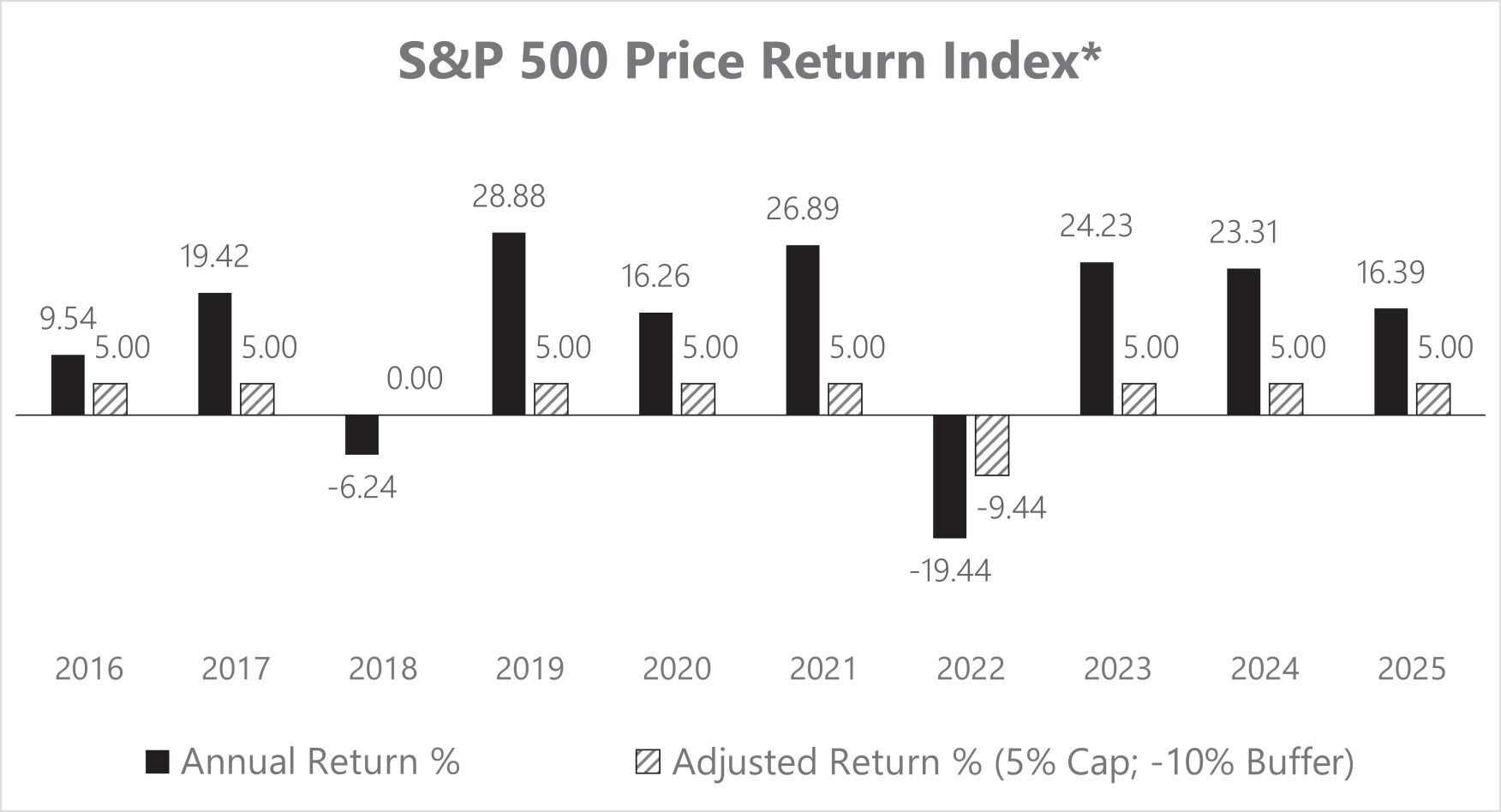
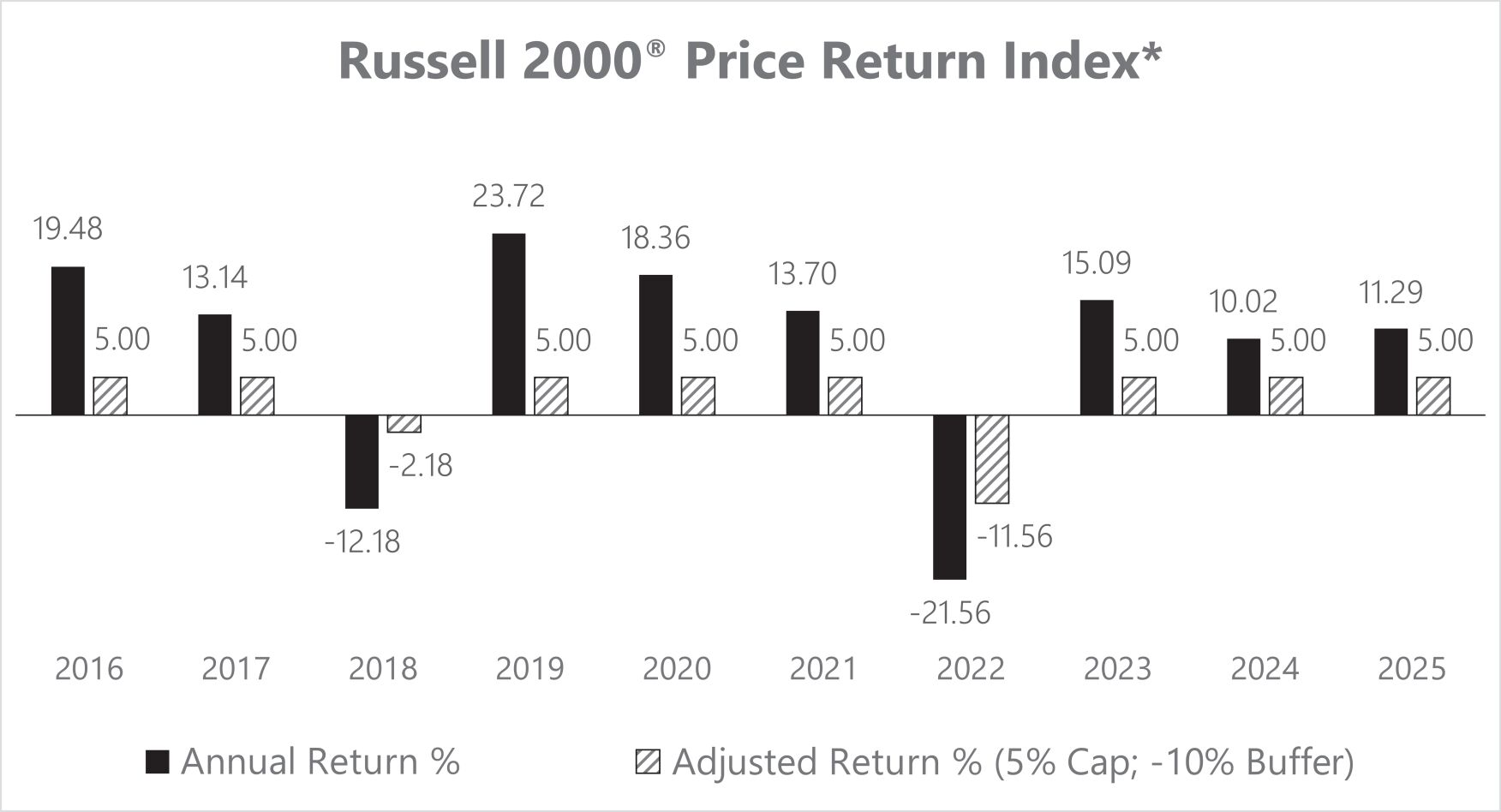
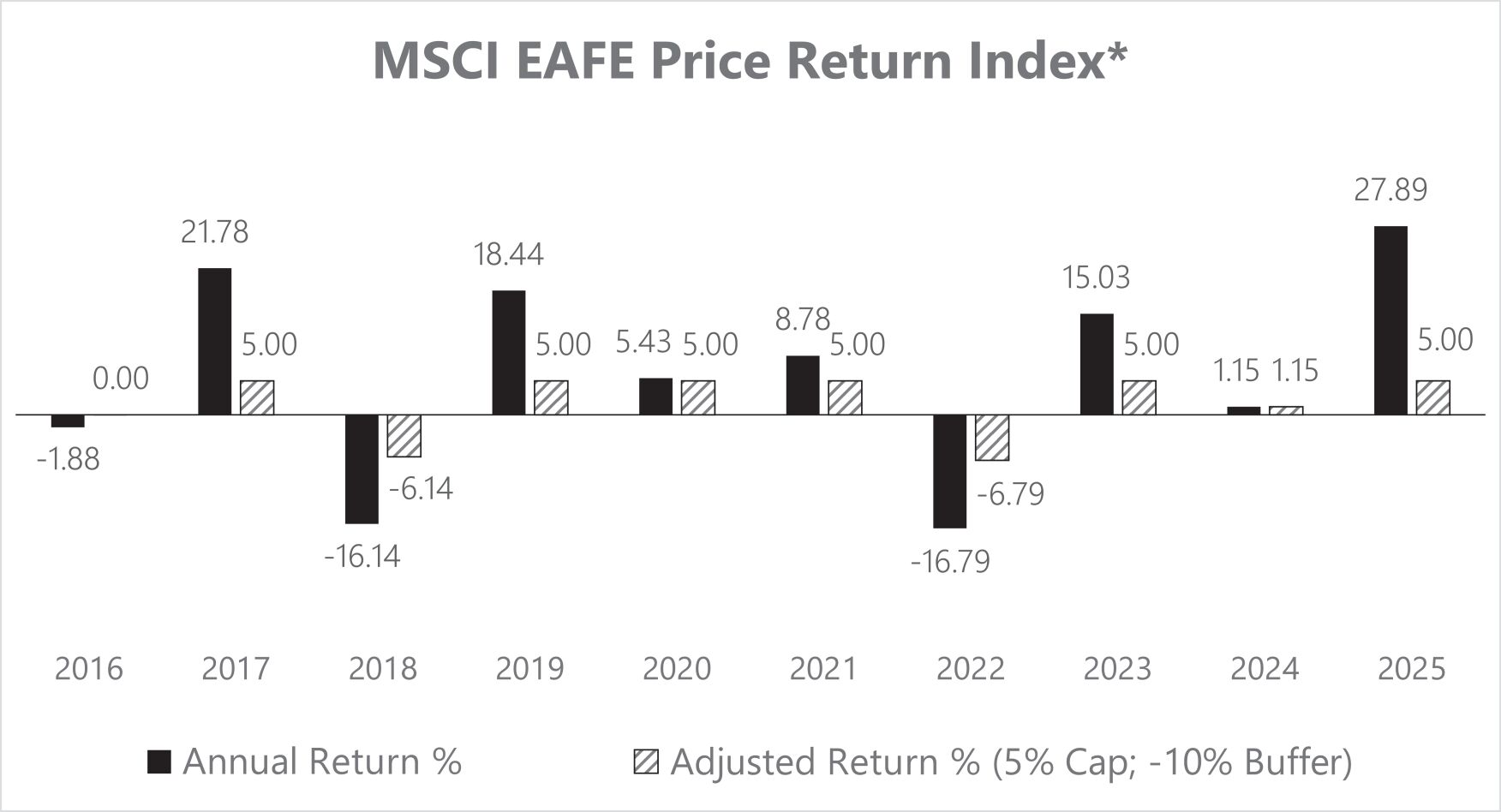
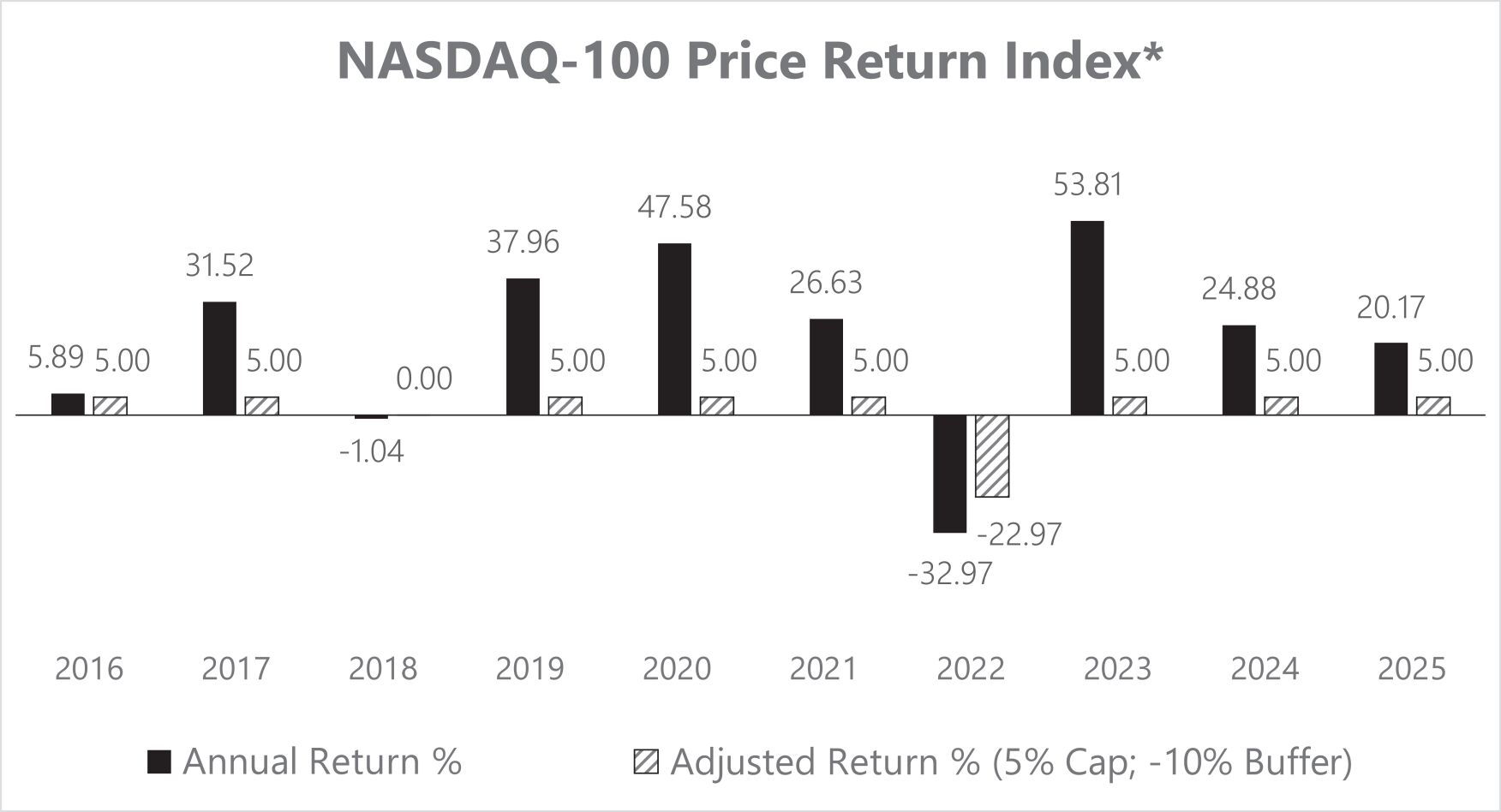
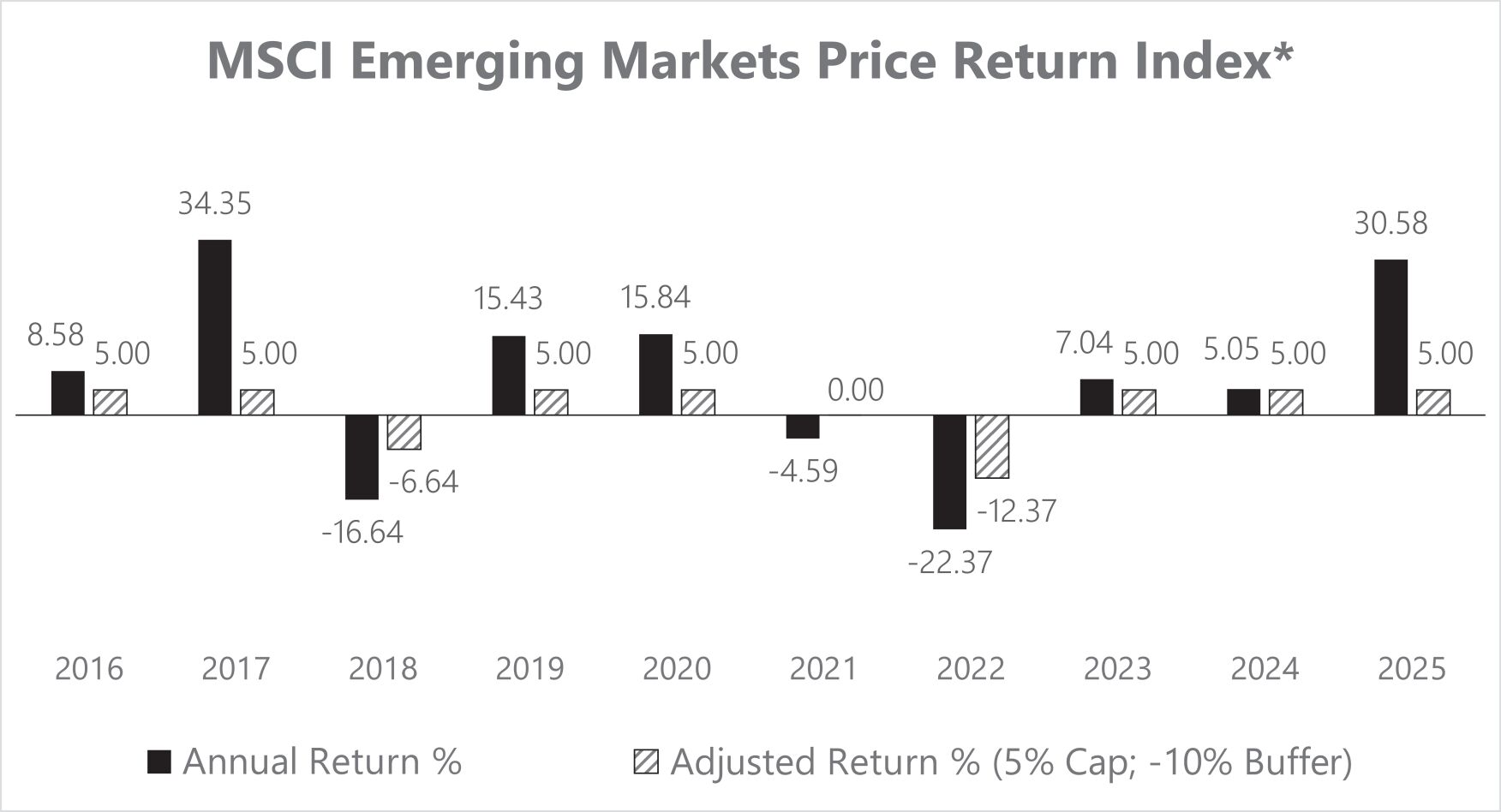
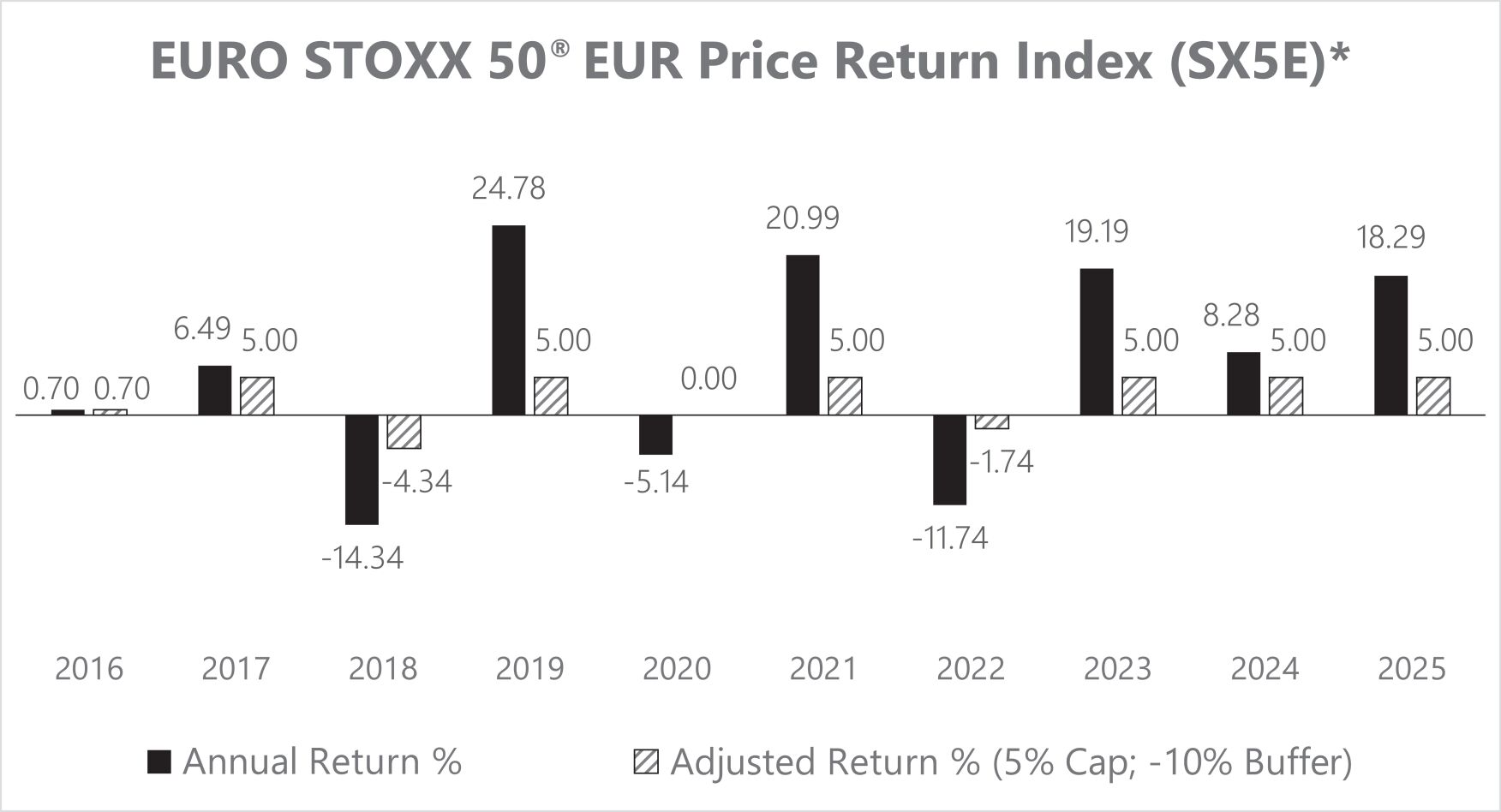
| * | The Index is a “price return” index, not a “total return” index, and therefore the performance of the Index does not reflect dividends declared by any of the companies included in the Index, reducing the Index return. As a result, the Index will underperform a direct investment in the securities composing the Index. |
Effect of an emergency close.
Segments are scheduled to mature and new Segments start on Segment Transaction Dates. It is possible that an Index could be affected by an emergency close on a Segment Transaction Date, thereby affecting the Index’s ability to publish a price and our ability to mature and start Segments based on the affected Index. Emergency closes can have two consequences.
| 1. | If the NYSE experiences an emergency close and Indices cannot publish prices, we will delay the maturity and start of all Segments for all Indices. |
2. |
If the NYSE is open and any Index not on the NYSE experiences an emergency close and cannot publish a price or an Index on the NYSE does not publish a price, we will use the most recent closing price for that Index. |
If the conditions that cause an emergency close of the NYSE persist, we will use reasonable efforts to calculate the Segment Maturity Value of any affected Segments. If the affected Index cannot be priced within eight days, we will contact a calculating agency, normally a bank we have a contractual relations hip with, which will determine a price to reflect a reasonable estimate of the Index level.
Suspension, Termination and Changes to Segment Types and Indices
We may decide at any time until the close of business on each Segment Start Date whether to offer any or all of the Segment Types described in this Prospectus on a Segment Start Date for a particular Segment. We may suspend a Segment Type for a week, month or a period of several months, or we may terminate a Segment Type entirely.
If a Segment Type is suspended, your account value will remain in the Segment Type Holding Account until a Segment of that Segment Type is offered or you transfer out of
the Segment Type Holding Account. We will provide you with written confirmation when money is not transferred from a Segment Type Holding Account into a Segment due to the suspension of a Segment Type.
If a Segment Type is terminated, your account value in the corresponding Segment Type Holding Account will be transferred into the EQ/Money Market variable investment option on the day that would have been the Segment Start Date.
We have the right to substitute an alternative index prior to Segment maturity if the publication of one or more Indices is discontinued, or if we no longer have a license agreement with the publishers of the Index, or at our sole discretion we determine that our use of such Indices should be discontinued because hedging instruments become difficult to acquire or the cost of hedging becomes excessive, or if the calculation of one or more of the Indices is substantially changed. We would attempt to choose a substitute index that has a similar investment objective and risk profile to the replaced index. For example, if the Russell 2000
®
Index were not available, we might use the NASDAQ Composite Index. We also have the right to add additional Indices under the contract at any time. We would provide notice about the use of additional Indices before they are available for use with a Segment or alternative Indices, as soon as practicable, after the Index is no longer being used. If an alternative index is used, its performance could impact the Index Performance Rate, Segment Rate of Return, Segment Maturity Value, Annual Lock Yearly Rate of Return, Annual Lock Anniversary Starting and Ending Amounts and Segment Interim Value because it would be used to calculate performance from the Segment Start Date to the Segment Maturity Date. An alternative index would not change the Segment Buffer or Performance Cap Rate for an existing Segment.
In addition, we reserve the right to use any or all reasonable methods to end any outstanding Segments that use such Indices. If a similar index cannot be found, we will end the affected Segments prematurely by applying the Segment Performance Cap Rate and Segment Buffer to the actual gains or losses on the original Index as of the date of termination.
We reserve the right to offer any or all Segment Types more or less frequently than we have been or to stop offering any or all of them or to suspend offering any or all of them temporarily for some or all contracts.
If we stop offering or suspend certain Segment Types, each existing Segment of those Segment Types will remain invested until its respective Segment Maturity Date. In the highly unlikely event we were forced to stop offering new Segments, contract owners would be limited to transferring or contributing to the EQ/Money Market variable investment option. Such action would not change or limit any other rights or benefits under the contract. You could also choose to surrender your contract but you could be subject to the Segment Interim Value calculation, withdrawal charges, taxes and tax penalties, and if you purchase another retirement vehicle it may have different features, fees and risks than this contract. If you are buying this contract for the SIO you should speak to your financial advisor as to whether this product is right for you. Segment Types
Information regarding the features of each of the currently available Segment Types, including the Index name and type, the Segment Duration, the Segment Rate of Return calculation method, the current Segment Buffer, and the minimum Performance Cap Rate for the life of the Segment Type, is available in an appendix to the Prospectus. See Appendix “Investment Options available under the contract.” We may not always offer every Segment Type on every Segment Start Date. There may also be very unusual circumstances where we are not able to offer any Segment Type on a particular Segment Start Date. Each investment in a Segment Type that starts on a particular Segment Start Date is referred to as a Segment. Each Segment Type has a corresponding Segment Type Holding Account.
There is a risk of a substantial loss of your principal and previously credited interest because you agree to absorb all losses to the extent they exceed the applicable Segment Buffer on the Segment Maturity Date.
The performance below is NOT the performance of any Segment of the SIO. Your performance under the contract will differ, perhaps significantly. The performance below may reflect a different return calculation, time period, and limit on Index gains and losses than the Segments of the SIO, and does not reflect contract fees and charges, including withdrawal charges and negative Segment Interim Value adjustments, which reduce performance. The performance does not reflect any advisory fees paid to a financial intermediary from the contract or other assets of the owner and if such charges were reflected such performance would be lower.
| * | The Index is a “price return” index, not a “total return” index, and therefore the performance of the Index does not reflect dividends declared by any of the companies included in the Index, reducing the Index return. As a result, the Index will underperform a direct investment in the securities composing the Index. |
7.
Charges, expenses, and adjustments Charges that the Company deducts
We do not deduct any benefit charges each day from the net assets of the variable investment option (including the Segment Type Holding Account and dollar cap averaging account).
We deduct the following charges from your account value. When we deduct these charges from your variable investment option, we reduce the number of units credited to your contract:
| • | For Series B contracts, at the time you make certain withdrawals or surrender your contract, or your contract is terminated — a withdrawal charge. |
| • | At the time annuity payments are to begin — charges designed to approximate certain taxes that may be imposed on us, such as premium taxes in your state. An annuity administrative fee may also apply. |
| • | At the time you request a transfer among the variable investment option in excess of 12 transfers among the investment options in a contract year — a transfer charge (currently, there is no transfer charge). |
More information about these charges appears below. We will not increase these charges for the life of your contract, except as noted. We may reduce certain charges under group or sponsored arrangements. See “Group or sponsored arrangements” below.
To help with your retirement planning, we may offer other annuities with different charges, benefits and features. Please contact your financial professional for more information.
Charges under the contracts
Transfer charge
If in the future we offer additional variable investment options, we reserve the right to charge for any transfers among variable investment options in excess of 12 per contract year. We will provide you with advance notice if we decide to assess the transfer charge, which will never exceed $35 per transfer. The transfer charge is designed to compensate the company with respect to administering the transaction. The charge is also designed to deter disruptive transfer activity. The transfer charge (if applicable), will be assessed at the time that the transfer is processed. Each time you request a transfer from one variable investment option to another, we will assess the transfer charge (if applicable). Separate requests submitted on the same day will each be treated as a separate transfer. Any transfer charge will be deducted from the variable investment options from which the transfer is made. We will not count transfers from Segment Type Holding Accounts into Segments on a Segment Start Date, or the allocation of Segment Maturity Value on a
Segment Maturity Date in calculating the number of transfers subject to this charge. We will also not charge for transfers made in connection with our DCA Program. We also reserve the right to charge for any transfers out of a Segment before the Segment Maturity Date in excess of 12 per contract year.
Any such transfer charge will be deducted from the Segment Interim Value of the Segment from which the transfer is made, and the Segment Investment will be reduced on a pro rata basis by the same proportion that the Segment Interim Value is reduced on the date of the deduction by the amount of the charge.
Any such transfer charge will be deducted from Segment Interim Value of the Segment from which the transfer is made and the Segment Investment will be reduced on a pro rata basis by the same proportion that the Segment Interim Value was reduced on the date of the deduction by the amount of the charge.
Guaranteed Benefit Charges
Amounts deducted to pay a guaranteed benefit charge are deducted from the account value. We deduct the charge from the variable investment option (excluding the Segment Type Holding Accounts and dollar cap averaging account). If those amounts are insufficient, we will deduct all or a portion of the charge pro rata from the Segment Type Holding Accounts. If the amounts in the Segment Type Holding Accounts are still insufficient, we will deduct all or a portion of the charge from the dollar cap averaging account. If the amount in the dollar cap averaging account is still insufficient, we deduct all or a portion of the charge from the Segments on a pro rata basis. If such a charge is deducted from a Segment on a date other than the Segment Maturity Date, the Segment Investment will be reduced on a pro rata basis by the same proportion that the Segment Interim Value is reduced on the date of the deduction by the amount of the charge deducted. If such a charge is to be deducted from a Segment on its Segment Maturity Date, the Segment Return Amount will be applied to the Segment and then the charge will be deducted from the resulting Segment Maturity Value. No guaranteed benefit charge percentage will change during the life of your contract. If deducted from one or more Segments, such ongoing deductions and Segment Interim Value adjustments may reduce the guaranteed benefit by more than the amount of the withdrawal, and, over time, could result in a significant loss of principal and previously credited interest.
A pro rata portion of each applicable guaranteed benefit charge will be deducted from the variable investment option, Segment Type Holding Accounts, dollar cap averaging account, or Segments, as applicable, if the contract is surrendered, annuitized, or a death benefit is paid or, for the GLWB charge, if the GLWB is dropped on any date other than a contract date anniversary. The Company does not deduct a
pro rata portion of a guaranteed benefit charge upon partial withdrawal or transfer. Once a contract is issued, the guaranteed benefit charge percentage will not change.
Return of Premium Death Benefit.
There is no additional charge for this death benefit.
Highest Anniversary Value Death Benefit.
If you elect the Highest Anniversary Value Death Benefit, we deduct a charge annually from your account value on each contract date anniversary for providing the death benefit guarantee. The charge is equal to 0.35% of the Highest Anniversary Value benefit base. This charge percentage will not change during the life of your contract. If any portion of this charge is deducted from one or more Segments the Segment Interim Value adjustment will apply and, over time, could result in a significant loss of principal and previously credited interest.
Guaranteed Lifetime Withdrawal Benefit.
The GLWB is automatically issued with your contract and we deduct a charge annually from your account value on each contract date anniversary the benefit is in effect for providing the withdrawal guarantee. The maximum charge is 2.50% of the GLWB benefit base. The charge may vary depending on whether you choose level income or accelerated income and single life or joint life. The charge applicable to your contract will be specified on the applicable Rate Sheet Supplement and will generally be between 1.00% and 2.50% of the GLWB benefit base. This charge percentage will not change during the life of your contract. If any portion of this charge is deducted from one or more Segments the Segment Interim Value adjustment will apply and, over time, could result in a significant loss of principal and previously credited interest.
Fee-based expenses (Series ADV contracts only)
The fees and expenses of a fee-based program are separate from and in addition to the fees and expenses of the contract. Please consult with your program sponsor for more details about your fee-based program. You should consider maintaining sufficient assets outside of this contract in order to pay advisory or custodial account expenses. See “Paying Advisory Fees Using Account Value” in “Withdrawing your account value” in “Accessing your money” for more information.
Special services charges
We deduct a charge for providing the special services described below. These charges compensate us for the expense of processing each special service. For certain services, we will deduct from your account value any withdrawal charge that applies and the charge for the special service. Please note that we may discontinue some or all of these services without notice.
Wire transfer charge.
We charge $90 for outgoing wire transfers. Unless you specify otherwise, this charge will be deducted from the amount you request.
Express mail charge.
We charge $35 for sending you a check by express mail delivery. This charge will be deducted from the amount you request.
Duplicate contract charge.
We charge $35 for providing a copy of your contract. The charge for this service can be paid
(i) using a credit card acceptable to us, (ii) by sending a check to our processing office, or (iii) by any other means we make available to you.
Check preparation charge.
The standard form of payment for all withdrawals is direct deposit. If direct deposit instructions are not provided, payment will be made by check. Currently, we do not charge for check preparation, however, we reserve the right to impose a charge, which would be deducted from the amount you request following imposition of such a charge. We reserve the right to charge a maximum of $85.
Charge for third-party transfer or exchange
Currently, we are waiving the $65 charge for each third-party transfer or exchange; this waiver may be discontinued at any time, with or without notice. Absent this waiver, we deduct a charge from the amount you request for direct rollovers or direct transfers of amounts from your contract to a third party, such as in the case of a trustee-to-trustee transfer for an IRA contract, or if you request that your contract be exchanged for a contract issued by another insurance company. We reserve the right to increase this charge to a maximum of $125.
Withdrawal charge (Series B contracts only)
A withdrawal charge may apply in four circumstances: (1) you make one or more withdrawals during a contract year; (2) you surrender your contract to receive its cash value; (3) you annuitize under a non-life contingent annuity payout option; or (4) we terminate your contract. The amount of the charge will depend on whether the 10% free withdrawal amount applies, and the availability of one or more exceptions.
The withdrawal charge equals a percentage of the contributions withdrawn. The percentage that applies depends on how long each contribution has been invested in the contract. We determine the withdrawal charge separately for each contribution according to the following table:
Charge as a % of contribution for each year following contribution |
||||||||||||||||||||||||||
1 |
2 |
3 |
4 |
5 |
6 |
7+ |
||||||||||||||||||||
| 7% | 7% | 6% | 5% | 4% | 3% | 0% | ||||||||||||||||||||
For purposes of calculating the withdrawal charge, we treat the year in which we receive a contribution as “year 1.” For withdrawal charge purposes, withdrawals of the free withdrawal amount and earnings are not considered withdrawals of contributions. We also treat contributions that have been invested the longest as being withdrawn first (FIFO basis). However, federal income tax rules treat earnings under most NQ contracts as withdrawn first. See “Tax information” later in this Prospectus.
During the first six contract years, for withdrawal charge purposes we will consider the 10% free amount withdrawn first until exhausted (which will reduce earnings but not contributions), then contributions until exhausted (on a FIFO basis). After the sixth contract year, for withdrawal charge purposes we will consider the 10% free amount withdrawn first until exhausted (which will reduce earnings but not contributions), then contributions not subject to withdrawal
charges until exhausted (on a FIFO basis), then earnings until exhausted, and then contributions subject to withdrawal charges (on a FIFO basis).
In order to give you the exact dollar amount of the withdrawal you request, we deduct the amount of the withdrawal and the amount of the withdrawal charge from your account value. Any amount deducted to pay withdrawal charges is also subject to that same withdrawal charge percentage.
We deduct the withdrawal amount and the withdrawal charge from the variable investment option (excluding the Segment Type Holding Accounts and dollar cap averaging account). If those amounts are insufficient, we will deduct all or a portion of the required amounts pro rata from the Segment Type Holding Accounts. If the amounts in the Segment Type Holding Accounts are still insufficient, we will deduct all or a portion of the required amounts from the dollar cap averaging account. If the amount in the dollar cap averaging account is still insufficient, we deduct all or a portion of the required amounts from the Segments on a pro rata basis. If you specify that your withdrawal be taken from specific investment options, the amount of the withdrawal charge will first be taken from the investment options you specify. If there is insufficient value in those options to pay the withdrawal charge after your withdrawal is deducted, then the remainder of the withdrawal charge is deducted as described above.
Withdrawals from a Segment or a Segment Type Holding Account are subject to the same withdrawal charge calculations as a withdrawal from any other investment option. Any withdrawal from a Segment will reduce the Segment Interim Value. A withdrawal from a Segment Type Holding Account reduces the amount that will be transferred to a Segment. For more information, see “Structured Investment Option” in “Purchasing the contract,” earlier in this Prospectus.
The withdrawal charge does not apply in the circumstances described below.
10% free withdrawal amount.
For Series B contracts, each contract year you can withdraw up to 10% of your account value without paying a withdrawal charge (often referred to as the “10% free withdrawal amount” or “free withdrawal amount”). No withdrawal charge applies to Series ADV contracts. The 10% free withdrawal amount is determined using your account value at the beginning of the contract year. In the first contract year amounts received within 90 days of the contract date are included for purposes of calculating the free withdrawal amount. If the GLWB is in effect, the 10% free withdrawal amount is increased to equal the GAIA, if greater. When a contract is surrendered, the free withdrawal amount is not taken into account when calculating the amount of the withdrawal charge.
Assume you made an initial contribution of $100,000 to a
3-year
Segment and a subsequent contribution of $40,000 in contract year 2 to another 3-year Segment. At the beginning of the seventh contract year, if your account value is $200,000 and your GAIA is $9,000, you could withdraw up to $160,000 free of withdrawal charges on that day ($20,000 from the 10% free withdrawal amount plus $100,000 from contributions which are no longer subject to withdrawal charges plus $40,000 of earnings). Assume you withdraw the entire Segment Maturity Value of the first Segment (which had subsequently rolled over into second 3-year Segment) when it matures (assume that is $150,000 and your contract’s account value on that day is $200,500) you would not pay a withdrawal charge since no contributions subject to withdrawal charges are deemed withdrawn (the $150,000 withdrawn for withdrawal charge purposes is deemed comprised of $20,000 from the 10% free withdrawal amount plus $100,000 from contributions which are no longer subject to withdrawal charges plus $30,000 of earnings). However, also note, this would be an excess withdrawal.
Death.
The withdrawal charge does not apply if the owner dies and a death benefit is payable to the beneficiary.
Disability, terminal illness, or confinement to nursing home.
The withdrawal charge also does not apply if:
| (i) | An owner (or older joint life, if applicable) has qualified to receive Social Security disability benefits as certified by the Social Security Administration; or |
| (ii) | We receive proof satisfactory to us (including certification by a licensed physician) that an owner’s (or older joint owner’s, if applicable) life expectancy is six months or less; or |
| (iii) | An owner (or older joint life, if applicable) has been confined to a nursing home for more than 90 days (or such other period, as required in your state) as verified by a licensed physician. A nursing home for this purpose means one that is (a) approved by Medicare as a provider of skilled nursing care service, or (b) licensed as a skilled nursing home by the state or territory in which it is located (it must be within the United States, Puerto Rico, or U.S. Virgin Islands) and meets all of the following: |
| — | its main function is to provide skilled, intermediate, or custodial nursing care; |
| — | it provides continuous room and board to three or more persons; |
| — | it is supervised by a registered nurse or licensed practical nurse; |
| — | it keeps daily medical records of each patient; |
| — | it controls and records all medications dispensed; and |
| — | its primary service is other than to provide housing for residents. |
We reserve the right to impose a withdrawal charge, in accordance with your contract and applicable state law, if the conditions described in (i), (ii) or (iii) above existed at the time a contribution was remitted or if the condition began within 12 months of the period following remittance. Some states may not permit us to waive the withdrawal charge in the above circumstances, or may limit the circumstances for which the withdrawal charge may be waived. Your financial professional can provide more information or you may contact our processing office.
Charges for state premium and other applicable taxes
We deduct a charge designed to approximate certain taxes that may be imposed on us, such as premium taxes in your state. Generally, we deduct the charge from the amount applied to provide an annuity pay out option. The current tax charge that might be imposed varies by jurisdiction and ranges from 0% to 3.5%.
Adjustments
Adjustments with respect to early distributions from Segments
We calculate the Segment Interim Value when any amount leaves a Segment whether a partial withdrawal or a full contract surrender, or upon death or cancellation or annuitization of the contract, from a Segment prior to the Segment Maturity Date. Prior to the Segment Maturity Date, the following transactions trigger the Segment Interim Value calculation: (1) the receipt of an in good order death claim by your beneficiary; (2) a withdrawal (including an automatic or systematic withdrawal, a required minimum distribution, a withdrawal under the GLWB rider, a withdrawal to pay advisory fees under a Series ADV contract and a free withdrawal under a Series B contract); (3) a transfer; (4) if you surrender or annuitize your contract; or (5) if you cancel your contract and return it to us for a refund within your state’s “free look” period.
If you make one of these transactions, because the end-of-term downside protection provided by a Segment Buffer does not apply to the Segment Interim Value, it is theoretically possible that you could lose up to 100% of your investment and previously credited interest in certain extreme scenarios.
The Segment Interim Value is calculated based on a formula that provides a treatment for an early distribution that is designed to be consistent with how distributions at the end of a Segment are treated. The formula is designed to measure the fair value of your Segment Investment on the particular interim date, and is based on the downside protection provided by the Segment Buffer, the limit on participation in investment gain provided by the Performance Cap Rate, and an adjustment for the effect of a withdrawal prior to the Segment Maturity Date. You should note that even if a corresponding Index has experienced positive growth, the calculation of your Segment Interim Value may result in an amount lower than your Segment Investment.
The Segment Interim Value will generally be negatively affected by increases in the expected volatility of index prices, interest rate increases, and by poor market performance. All other factors being equal, the Segment Interim Value would be lower the earlier a withdrawal or surrender is made during a Segment. Also, for all contracts using a Performance Cap Rate limiting factor, participation in upside performance for early withdrawals is pro-rated based on the period those amounts were invested in a Segment. This means you participate to a lesser extent in upside performance the earlier you take a withdrawal.
Withdrawals from a Segment prior to your Segment Maturity Date reduce the Segment Investment on a pro rata basis by the same proportion that the Segment Interim Value is
reduced on the date of the withdrawal. We use the Segment Investment to determine your Segment Maturity Value.
Please note that if a Guaranteed Lifetime Withdrawal Benefit charge and/or Highest Anniversary Death Benefit charge is deducted from a Segment, the charge will be deducted from the Segment Interim Value.
The formula we use, in part, derives the fair value of hypothetical investments in fixed instruments and derivatives. These values provide us with protection from the risk that we will have to pay out account value related to a Segment prior to the Segment Maturity Date. The formula also includes an adjustment relating to the Cap Calculation Factor. This is a positive adjustment of the percentage of the estimated expenses corresponding to the portion of the Segment Duration that has not elapsed. Additional information about Segment Interim Values, including the actual calculation formula and examples illustrating the operation of the Segment Interim Value adjustment, is located in the SAI.
You can obtain the current Segment Interim Values for the Segments in which you are invested by calling 1-877-899-3743. The Segment Interim Value of a Segment can fluctuate daily, and the current value quoted to you may differ from the actual Segment Interim Value calculated at the time you make a transaction that triggers the Segment Interim Value calculation.
Charges that the Trust deducts
The Trust deducts charges for the following types of fees and expenses:
| • | Management fees. |
| • | 12b-1 fees. |
| • | Operating expenses, such as trustees’ fees, independent auditors’ fees, legal counsel fees, administrative service fees, custodian fees, and liability insurance. |
| • | Investment-related expenses, such as brokerage commissions. |
These charges are reflected in the daily share price of the portfolio. Since shares of the Trust are purchased at their net asset value, these fees and expenses are, in effect, passed on to the variable investment option and are reflected in its unit values. For more information about these charges, please refer to the prospectus for the Trust.
Group or sponsored arrangements
For certain group or sponsored arrangements, we may reduce the withdrawal charge or change the minimum contribution requirements. We also may change the minimum death benefit or offer variable investment options that invest in shares of a Trust that are not subject to the
12b-1
fee. Group arrangements include those in which a trustee or an employer, for example, purchases contracts covering a group of individuals on a group basis. Group arrangements are not available for traditional IRA and Roth IRA contracts. Sponsored arrangements include those in which an employer allows us to sell contracts to its employees or retirees on an individual basis. Our costs for sales and administration generally vary with the size and stability of the group or sponsoring organization, among other factors. We take all these factors into account when reducing charges. To qualify for reduced charges, a group or sponsored arrangement must meet certain requirements, such as requirements for size and number of years in existence. Group or sponsored arrangements that have been set up solely to buy contracts or that have been in existence less than six months will not qualify for reduced charges.
We will make these and any similar reductions according to our rules in effect when we approve a contract for issue. We may change these rules from time to time. Any variation will reflect differences in costs or services and will not be unfairly discriminatory.
Group or sponsored arrangements may be governed by federal income tax rules, the Employee Retirement Income Security Act of 1974, or both. We make no representations with regard to the impact of these and other applicable laws on such programs. We recommend that employers, trustees, and others purchasing or making contracts available for purchase under such programs seek the advice of their own legal and benefits advisers.
Other distribution arrangements
We may reduce or eliminate charges when sales are made in a manner that results in savings of sales and administrative expenses, such as sales through persons who are compensated by clients for recommending investments and who receive no commission or reduced commissions in connection with the sale of the contracts. We will not permit a reduction or elimination of charges where it will be unfairly discriminatory.
2.
Benefits Available Under the Contract Summary of Benefits
The following tables summarize important information about the benefits available under the contract.
Death Benefits
These death benefits are available during the accumulation phase:
Name of Benefit |
Purpose |
Standard/ Optional |
Annual Fee |
Brief Description of Restrictions/Limitations | ||||||
Max |
Current | |||||||||
Return of Premium Death Benefit |
Guarantees beneficiaries will receive a benefit at least equal to your contributions less adjusted withdrawals. |
Standard |
No Additional Charge |
• Available only at contract purchase • Available only to contract holder age 80 or younger • Withdrawals, including the withdrawal of advisory fees, could significantly reduce or terminate the benefit • Generally no additional contributions are permitted under the contract once you reach age 80 | ||||||
Highest Anniversary Value Death Benefit |
Locks in highest adjusted anniversary account value as minimum death benefit. |
Optional |
0.35% (1) |
• Available only at contract purchase • Withdrawals, including the withdrawal of advisory fees, could significantly reduce or terminate benefit • Generally no additional contributions are permitted under the contract once you reach age 75 • If elected, you will not get the Return of Premium Death Benefit • The availability of contract benefits may vary depending on the financial intermediary through which the contract is sold. See Appendix “Intermediary-specific variations” | ||||||
| (1) | Expressed as a percentage of the benefit base. |
Living Benefit
This living benefit is available during the accumulation phase:
Name of Benefit |
Purpose |
Standard/ Optional |
Annual Fee |
Brief Description of Restrictions/ Limitations | ||||||||
Max |
Current | |||||||||||
| Guaranteed lifetime withdrawal benefit (GLWB) | Guarantees a minimum withdrawal value. | Standard (1) |
2.50% (2) |
Specified on Rate Sheet Supplement (3) |
• Available only at contract purchase • Available only to contract holder age 80 or younger • Withdrawals, including the withdrawal of advisory fees could significantly reduce or terminate the benefit • Generally no additional contributions are permitted once you take a withdrawal • Withdrawals under GLWB are withdrawals of the owners own money and the chance of outliving the account value and receiving lifetime payments from the Company may be minimal | |||||||
| (1) | You must elect the GLWB in order to purchase this contract; however, you can drop the GLWB after the sixth contract anniversary. |
| (2) | Expressed as a percentage of the benefit base. |
| (3) | The current GLWB charge may be less than the maximum fee and is reflected on the applicable Rate Sheet Supplement. |
Other Benefits
These other benefits are available during the accumulation phase:
Name of Benefit |
Purpose |
Standard/ Optional |
Annual Fee |
Brief Description of Restrictions/Limitations | ||||||
Max |
Current | |||||||||
Averaging |
Transfer account value to selected segment type holding accounts on a regular basis to potentially reduce the impact of market volatility. |
Optional |
No Charge |
• $25,000 minimum to begin program • The availability of contract benefits may vary depending on the financial intermediary through which the contract is sold. See Appendix “Intermediary-specific variations” | ||||||
There are no restrictions on which investment options you can invest in for the GLWB or death benefits. The Segments and variable investment option may be conservative in nature and you may receive a higher rate of return from other investment options. If you are seeking more aggressive investment options the allowable investments may not be appropriate for you.
Death Benefits
The contract offers two guaranteed minimum death benefits. The account value portion of the death benefit is equal to the account value as of the date we receive satisfactory proof of the owner’s death, any required instructions for the method of payment, and all information and forms necessary to effect payment. The guaranteed minimum portion of the death benefit is discussed below. Please note that all withdrawals under the contract, including automatic or systematic withdrawals, required minimum distributions, withdrawals under the GLWB rider, and withdrawals to pay advisory fees under a Series ADV contract, could reduce the Return of Premium and Highest Anniversary Value death benefits by substantially more than the amount of the withdrawal.
Amounts withdrawn from any Segment before the Segment Maturity Date to pay the death benefit will reflect the Segment Interim Value calculation. For more information, see “Adjustments with respect to early distributions from Segments” in “Charges, Expenses, and Adjustments” in this Prospectus.
Guaranteed Minimum Death Benefits
At issue, you may elect the Highest Anniversary Value Death Benefit for an additional charge (the charge for this benefit is 0.35%) or receive the Return of Premium Death Benefit at no additional charge with your contract. If you elect the Highest Anniversary Value Death Benefit, the Return of Premium Death Benefit will not be included with your contract.
Return of Premium Death Benefit
. The Return of Premium Death Benefit is equal to the greater of your account value on the date we receive all necessary paperwork to pay the death claim and the Return of Premium benefit base on the date of death of the owner (or surviving joint life, if applicable) adjusted for any subsequent withdrawals. There is no charge for this benefit. The Return of Premium benefit base is not an account value or cash value. The Return of Premium benefit base is equal to (i) your initial contribution and any subsequent contributions, less (ii) a deduction that reflects any adjusted withdrawals (including any withdrawal charges). The amount of this deduction is determined by calculating the percentage of your current account value that is being withdrawn and reducing your current Return of Premium benefit base by the same percentage. See “How Withdrawals Affect your Guaranteed Benefits” for examples of pro rata reductions of benefit bases.
If you have a Series ADV contract, please note that withdrawals to pay advisory fees reduce your Return of Premium benefit base on a pro rata basis, which means it could reduce the benefit base significantly and by substantially more than the actual amount of the deduction. For example, assume your starting account value and benefit base is $100,000 and that you decide to withdraw your advisory fee of 1.50%
annual rate at the end of each quarter. Assuming you invest in
1-year
Segments with a Segment Rate of Return of 5% each year (net of all other fees and charges), if you withdraw the advisory fees from your Series ADV contract, by the end of one year you will withdraw $1,544 to pay your adviser, but your account value will be $103,425 and the Return of Premium benefit base will be $98,500. Had you chosen not to take advisory fees from your contract, your account value at the end of the year and, therefore, your death benefit at that time, would have been $105,000. Over ten years, assuming a constant net Segment Rate of Return of 5% for each successive 1-year
Segment, the total amount of advisory fees deducted would be $18,047, but the account value would be lower by $22,848 and the Return of Premium benefit base would be lower by $14,027 at $85,973. Please note, withdrawals to pay advisory fees may reduce your Return of Premium benefit base significantly and by substantially more than the amount withdrawn. You should consider whether it is in your best interest to take withdrawals from your contract to pay advisory fees or pay them from another source. If you have a Series ADV contract, please discuss deducting advisory fees from your contract with your financial professional before making an election.
Please note: This benefit terminates upon annuitization.
Highest Anniversary Value Death Benefit.
You can elect the Highest Anniversary Value Death Benefit for an additional charge. The Highest Anniversary Value Death Benefit is equal to the greater of your account value on the date we receive all necessary paperwork to pay the death claim and the Highest Anniversary Value benefit base on the date of death of the owner (or surviving joint life, if applicable) adjusted for any subsequent withdrawals. The Highest Anniversary Value benefit base is not an account value or cash value. The calculation of your Highest Anniversary Value benefit base will depend on whether you have taken a withdrawal.
If you have not taken a withdrawal, the Highest Anniversary Value benefit base is equal to the greater of (i) your initial contribution and any subsequent contributions or (ii) the highest account value on any contract date anniversary up to the contract date anniversary on or immediately following the owner’s (or younger joint life’s, if applicable) 85th birthday.
If you take a withdrawal, the Highest Anniversary Value benefit base will be reduced on a dollar-for-dollar basis by withdrawals up to the GAIA, and on a pro rata basis by the amount of any Excess Withdrawals (including any applicable withdrawal charges). Special rules apply if you enroll in our automatic RMD service. If you take a withdrawal and no longer have the GLWB, the Highest Anniversary Value benefit base will be reduced on a pro rata basis (including any applicable withdrawal charges). Reduction on a pro rata basis means that we calculate the percentage of your account value that is being withdrawn and we reduce your Highest Anniversary Value benefit base by the same percentage. See “How Withdrawals Affect your Guaranteed Benefits” for examples of pro rata reductions of benefit bases.
If you have a Series ADV contract, please note that withdrawals to pay advisory fees could reduce your Highest
Anniversary Value benefit base on a pro rata basis. For example, assume your starting account value and benefit base is $100,000 and that you decide to withdraw your advisory fee of 1.50% annual rate at the end of each quarter. Assuming you invest in
1-year
Segments with a Segment Rate of Return of 5% each year (net of all other fees and charges), if you withdraw the advisory fees from your Series ADV contract, by the end of one year you will withdraw $1,544 to pay your adviser, but your account value will be $103,425 and the Highest Anniversary Value benefit base will be $103,425. Had you chosen not to take advisory fees from your contract, your account value at the end of the year and, therefore, your death benefit at that time, would have been $105,000. Over ten years, assuming a constant net Segment Rate of Return of 5% for each successive 1-year
Segment, the total amount of advisory fees deducted would be $18,047, but the account value would be lower by $22,848 and the Highest Anniversary Value benefit base would be lower by $22,848 at $140,041. Please note, withdrawals to pay advisory fees may reduce your Highest Anniversary Value benefit base significantly and by substantially more than the amount withdrawn. You should consider whether it is in your best interest to take withdrawals from your contract to pay advisory fees or pay them from another source. At any time after a withdrawal, the Highest Anniversary Value benefit base is equal to the greater of (i) the Highest Anniversary Value benefit base immediately following the most recent withdrawal or (ii) the highest account value on any contract date anniversary after the withdrawal up to the contract date anniversary on or immediately following the owner’s (or younger joint life’s, if applicable) 85th birthday.
If the Highest Anniversary Value Death Benefit is elected, then subsequent contributions are not permitted once the oldest measuring life reaches age 76 (or the first contract date anniversary if later).
A pro rata portion of the Highest Anniversary Value death benefit charge will be deducted if the death benefit is paid on any date other than a contract date anniversary.
If you have a Series ADV contract, please discuss deducting advisory fees from your contract with your financial professional before making an election.
Please note: This benefit terminates upon annuitization.
Payment of Death Benefits
Your beneficiary and payment of benefit
You designate your beneficiary when you apply for your contract. You may change your beneficiary at any time while you are alive and the contract is in force. The change will be effective as of the date the written request is executed, whether or not you are living on the date the change is received in our processing office. We are not responsible for any beneficiary change request that we do not receive. We will send you a written confirmation when we receive your request.
Under joint contracts, the surviving owner is considered the beneficiary, and will take the place of any other beneficiary. Under a contract with a non-natural owner that has joint annuitants, the surviving annuitant is considered the beneficiary, and will take the place of any other beneficiary.
In a QP contract, the beneficiary must be the plan trust. Where an IRA contract is owned in a custodial individual retirement account, the custodian must be the beneficiary.
In general, if the annuitant dies, the owner will become the annuitant, and the death benefit is not payable.
Equitable Access Account
If the beneficiary is a natural person (i.e., not an entity such as a corporation or a trust) and so elects, death benefit proceeds can be paid through the “Equitable Access Account,” which is a draft account that works in certain respects like an interest-bearing checking account. In that case, we will send the beneficiary a draftbook, and the beneficiary will have immediate access to the proceeds by writing a draft for all or part of the amount of the death benefit proceeds. The Company will retain the funds until a draft is presented for payment. Interest on the Equitable Access Account is earned from the date we establish the account until the account is closed by your beneficiary or by us if the account balance falls below the minimum balance requirement, which is currently $1,000. The Equitable Access Account is part of the Company’s general account and is subject to the claims of our creditors. We will receive any investment earnings during the period such amounts remain in the general account. The Equitable Access Account is not a bank account or a checking account and it is not insured by the FDIC. Funds held by insurance companies in the general account are guaranteed by the respective state guaranty association.
Effect of the owner’s death
In general, if the owner dies while the contract is in force, the contract terminates and the applicable death benefit is paid. For joint life contracts, the death benefit is payable upon the death of the second to die of the owner and successor owner.
There are various circumstances, however, in which the contract can be continued by a successor owner or under a beneficiary continuation option (“BCO”). For contracts with spouses who are joint lives, the surviving spouse will automatically be able to continue the contract under the “spousal continuation” feature or under our beneficiary continuation option, as discussed below.
If you are the sole owner, your surviving spouse beneficiary may have the option to:
| • | take the death benefit proceeds in a lump sum; |
| • | continue the contract as a successor owner under “spousal continuation” (if your spouse is the sole primary beneficiary) or under our beneficiary continuation option, as discussed below; or |
| • | roll the death benefit proceeds over into another contract. |
If your surviving spouse rolls over the death benefit proceeds into a contract issued by us, the death proceeds will remain invested in this contract until your spouse’s new contract is issued. The amount of the death benefit will be calculated to equal the greater of the account value (as of the date your spouse’s new contract is issued) and the applicable guaranteed minimum death benefit (as of the date of your death). This means that the death benefit proceeds could vary up or down, based on investment performance, until your spouse’s new contract is issued.
For NQ contracts, if the surviving joint life is not the surviving spouse, or, for single owner contracts, if the beneficiary is not the surviving spouse, federal income tax rules generally require payments of amounts under the contract to be made within five years of an owner’s death (the “5-year rule”). In certain cases, an individual beneficiary or non-spousal surviving joint life may opt to receive payments over his/her life (or over a period not in excess of his/her life expectancy) if payments commence within one year of the owner’s death. Any such election must be made in accordance with our rules at the time of death.
Non-spousal Contract Continuation
Any amount payable under the contract must be fully paid to the surviving joint life within five years, unless one of the exceptions described here applies. The surviving joint life may instead elect to take an installment payout or an annuity payout option we may offer at the time under the contract, provided payments begin within one year of the deceased joint life’s death. If an annuity or installment payout is elected, the contract terminates and a supplemental contract is issued.
A surviving non-spousal joint life can elect to (1) take a lump sum payment; (2) take an installment payout or an annuity payout option we may offer at the time under the contract within one year; (3) continue the contract for up to five years; or (4) continue the contract under the beneficiary continuation option discussed below.
If the contract continues, the guaranteed minimum death benefit and charge and the GLWB and charge will then be discontinued. Withdrawal charges, if applicable under your Series B contract, will no longer apply, and no additional contributions will be permitted.
Spousal Continuation
For joint life NQ contracts, when the first spouse dies no death benefit is paid, and the contract continues as follows:
| • | The guaranteed benefits continue. |
| • | If the deceased spouse was the annuitant, the surviving spouse becomes the annuitant. If the deceased spouse was a joint annuitant, the contract will become a single annuitant contract. |
| • | The withdrawal charge schedule, if applicable, remains in effect. |
If you are the contract owner and your spouse is the sole primary beneficiary, your spouse may elect to continue the contract as successor owner upon your death. Spousal beneficiaries (who are not a joint life) must be 98 or younger at the time of continuation in order to continue the contract under spousal continuation. The determination of spousal status is made under applicable state law. However, in the event of a conflict between federal and state law, we follow federal rules.
Upon your death, the spouse beneficiary (under a single owner contract), may also elect to receive the death benefit or continue the contract under our beneficiary continuation option.
In general, withdrawal charges will no longer apply to contributions made before your death. Withdrawal charges if applicable will apply if subsequent contributions are made.
Beneficiary Continuation Option
This feature permits a designated individual, on the contract owner’s death, to maintain a contract with the deceased contract owner’s name on it and receive distributions under the contract, instead of receiving the amount payable under the contract in a single sum. We make this option available to beneficiaries under traditional IRA, Roth IRA and NQ contracts, subject to state availability. For traditional and Roth IRAs, depending on the beneficiary, this option may be restricted for deaths after December 31, 2019, due to the changes made by the Setting Every Community Up for Retirement Enhancement Act (“SECURE Act”) enacted at the end of 2019. Please speak with your financial professional or see Appendix “State contract availability and/or variations of certain features and benefits” for further information.
Where an IRA contract is owned in a custodial individual retirement account, the custodian may reinvest the death benefit in an individual retirement annuity contract, using the account beneficiary as the annuitant. Depending on the beneficiary, this option may be restricted for deaths after December 31, 2019, due to the changes made by the SECURE Act. Please speak with your financial professional for further information.
Beneficiary continuation option for traditional IRA and Roth IRA contracts only.
The beneficiary continuation option must be elected by September 30th of the year following the calendar year of your death and before any other inconsistent election is made. Beneficiaries who do not make a timely election will not be eligible for this option.
For deaths after December 31, 2019, only specified individuals who are “eligible designated beneficiaries” or “EDBs” may stretch post-death payments over the beneficiary’s life expectancy. See “required minimum distributions after your death” later in this Prospectus under “Tax Information.” Individual beneficiaries who do not have EDB status (including beneficiaries named by the original beneficiary to receive any remaining interest after the death of the original beneficiary) must take out any remaining interest in the IRA or plan within 10 years of the applicable death.
Under the beneficiary continuation option for IRA and Roth IRA contracts:
| • | The contract continues with your name on it for the benefit of your beneficiary. |
| • | The beneficiary replaces the deceased owner as annuitant. |
| • | This feature is only available if the beneficiary is an individual. Certain trusts with only individual beneficiaries will be treated as individuals for this purpose. |
| • | If there is more than one beneficiary, each beneficiary’s share will be separately accounted for. It will be distributed over the beneficiary’s own life expectancy, if payments over life expectancy are chosen by an EDB. |
| • | An EDB who chooses to receive annual payments over his life expectancy should consult his tax adviser about selecting Segments that provide sufficient liquidity to satisfy the payout requirements under this option. |
| • | The minimum amount that is required in order to elect the beneficiary continuation option is $5,000 for each beneficiary. |
| • | The beneficiary may choose at any time to withdraw all or a portion of the account value and no withdrawal charges, if any, will apply. |
| • | Any partial withdrawal must be at least $300. |
| • | Your beneficiary will have the right to name a beneficiary to receive any remaining interest in the contract. |
| • | The GLWB and any guaranteed minimum death benefit will no longer be in effect. |
| • | Upon the death of your beneficiary, the following distribution rules will apply to the subsequent beneficiary named by your beneficiary: (1) if your beneficiary is an EDB, the subsequent beneficiary must withdraw any remaining amount within ten years of your beneficiary’s death; or (2) if your beneficiary is not an EDB, the subsequent beneficiary must withdraw any remaining amount within 10 years of your death. The option elected will be processed when we receive satisfactory proof of death, any required instructions for the method of payment and any required information and forms necessary to effect payment. |
| • | For beneficiaries who are required to take the entire interest within 10 years, we offer our post-death automatic RMD option to help the beneficiary meet the RMD requirements if the deceased owner died on or after the Required Beginning Date. We calculate post-death RMD payments using the beneficiary’s life expectancy determined in accordance with IRS tables. Instead of electing our post-death automatic RMD option, your beneficiary may choose to calculate the required amount themselves and request partial withdrawals. Regardless of whether your beneficiary elects this option, any remaining amounts will be distributed to your beneficiary by the end of the 10th calendar year following the year of your death. It is the beneficiary’s responsibility to ensure compliance with the post-death RMD rules under federal tax law. |
Beneficiary continuation option for NQ contracts only.
This feature may only be elected when the NQ contract owner dies before the annuity maturity date, whether or not the owner and the annuitant are the same person. For purposes of this discussion, “beneficiary” refers to the successor owner who elects this feature. This feature must be elected within 9 months following the date of your death and before any other inconsistent election is made. Beneficiaries who do not make a timely election will not be eligible for this option.
Generally, payments will be made once a year to the beneficiary over the beneficiary’s life expectancy, determined on a term certain basis and in the year payments start. These payments must begin no later than one year after the date of your death and are referred to as “scheduled payments.” The beneficiary may choose the
“5-year
rule” instead of scheduled payments over life expectancy. If the beneficiary chooses the 5-year
rule, there will be no scheduled payments. Under the 5-year
rule, the beneficiary may take withdrawals as desired, but the entire account value must be fully withdrawn by the fifth anniversary of your death. Under the beneficiary continuation option for NQ contracts:
| • | This feature is only available if the beneficiary is an individual. It is not available for any entity such as a trust, even if all of the beneficiaries of the trust are individuals. |
| • | The beneficiary automatically replaces the existing annuitant. |
| • | The contract continues with your name on it for the benefit of your beneficiary. |
| • | If there is more than one beneficiary, each beneficiary’s share will be separately accounted for. It will be distributed over the respective beneficiary’s own life expectancy, if scheduled payments are chosen. |
| • | The minimum amount that is required in order to elect the beneficiary continuation option is $5,000 for each beneficiary. |
| • | No additional contributions will be permitted. |
| • | If the beneficiary chooses the “5-year rule,” withdrawals may be made at any time. If the beneficiary instead chooses scheduled payments, the beneficiary may also take withdrawals, in addition to scheduled payments, at any time. |
| • | Any partial withdrawals must be at least $300. |
| • | Your beneficiary will have the right to name a beneficiary to receive any remaining interest in the contract on the beneficiary’s death. |
| • | The GLWB and any guaranteed minimum death benefit will no longer be in effect. |
| • | Upon the death of your beneficiary, the beneficiary he or she has named has the option to either continue taking scheduled payments based on the remaining life expectancy of the deceased beneficiary (if scheduled payments were chosen) or to receive any remaining interest in the contract in a lump sum. We will pay any remaining interest in the contract in a lump sum if your beneficiary elects the 5-year rule. The option elected will be processed when we receive satisfactory proof of death, any required instructions for the method of payment and any required information and forms necessary to effect payment. |
If the amount payable under the contract is a death benefit:
| • | No withdrawal charges will apply to withdrawals of the death benefit by the beneficiary. |
If the amount payable under the contract is the cash value:
| • | The contract’s withdrawal charge schedule will continue to be applied to any withdrawal or surrender other than scheduled payments; the contract’s free withdrawal amount will continue to apply to withdrawals but does not apply to surrenders. |
| • | We do not impose a withdrawal charge on scheduled payments except if, when added to any withdrawals previously taken in the same contract year, including for this purpose a contract surrender, the total amount of withdrawals and scheduled payments exceed the free withdrawal amount. See the “Withdrawal charges” in “Charges, Expenses, and Adjustments ” earlier in this Prospectus. |
A beneficiary should speak to his or her tax professional about which continuation option is appropriate for him or her. Factors to consider include, but are not limited to, the beneficiary’s age, need for immediate income and a desire to continue the contract.
Living Benefits
Guaranteed Lifetime Withdrawal Benefit
For an additional charge (the maximum charge for this benefit is 2.50% and the current charge is specified on the applicable Rate Sheet Supplement), the Guaranteed Lifetime Withdrawal Benefit (“GLWB”) guarantees that you can take income up to a maximum amount per year (the “guaranteed annual income amount” or “GAIA”)
first as withdrawals from your account value
and, only if necessary, as payments from us. The chance of outliving your account value and receiving lifetime payments from us may be minimal. The benefit is automatically included in your contract. Overview
Under the GLWB, an owner can withdraw a specified amount of his or her account value each year (the “
guaranteed annual income amount
” or “GAIA
”). If the account value is depleted and the owner has not withdrawn more than the GAIA each year, then the owner will receive income payments from the Company for life (single life) or over the lives of both the owner and successor owner (joint life). The GAIA is calculated as a percentage (the
income rate
) of the GLWB benefit base
. If an owner elects the Level Income option
, then the income rate does not change if the account value is depleted under the rider. If an owner elects the Accelerated Income option
, then the income rate will decrease to a post-depletion income rate
if the account value has depleted. Under either option, the income rate may increase to a subsequent income rate
if there is an Annual Reset
and no withdrawals have been taken under the contract. The GLWB benefit base will initially equal the initial contribution. The GLWB benefit base will increase: (a) when subsequent contributions are made; (b) each year to equal the current account value (the
Annual
Reset
), if higher than the current GLWB benefit base; and (c) each year by a Deferral Incentive amount
until the earliest of the 20th contract date anniversary, contract maturity, or the date the first withdrawal is taken from the contract. The GLWB benefit base will decrease if a withdrawal that exceeds the GAIA - an
excess withdrawal
- is taken, perhaps by substantially more than the amount of the withdrawal. If the account value is depleted due to an excess withdrawal, the contract will terminate and no further benefits will be paid.
An owner should consider when to take the first withdrawal under the rider, since doing so will prohibit the owner from making any further contributions under the contract, and will also terminate all Deferral Incentives and income rate increases in connection with Annual Resets, which could significantly limit increases in the values under the GLWB as well as increases in the contract’s account value and death benefit.
The income rates, Deferral Incentive rate, and GLWB current charge are specified in the Rate Sheet Supplement.
You should not purchase this contract if:
| • | You plan to take withdrawals in excess of your GAIA because those withdrawals may significantly reduce or eliminate the value of the benefit and may terminate the contract (see ‘‘Effect of Excess Withdrawals’’). |
| • | You are not interested in taking withdrawals prior to the contract’s maturity date. |
| • | You are using the contract to fund a Rollover TSA or QP contract where withdrawal restrictions will apply. |
| • | You plan to use it for withdrawals other than substantially equal payments prior to age 59 1/2, as the taxable amount of the withdrawal will be includible in income and subject to an additional 10% federal income tax penalty. |
Please also note:
| • | The contract may not be appropriate for investors who intend to take advisory fee deductions under a Series ADV contract (other than through the Advisory Fee Service) given such deductions are treated as withdrawals and thus result in restrictions on making subsequent contributions and inability to receive Deferral Incentives and income rate increases in connection with Annual Resets. If you take withdrawals to pay advisory fees that exceed the GAIA they will significantly reduce or eliminate the value of the GLWB and may terminate the contract. |
| • | All withdrawals under the contract will reduce the account value, remaining GAIA, and death benefit, could be subject to federal and state income taxes and a possible 10% federal penalty tax, will count toward the free withdrawal amount for Series B contracts, will not be credited with any index interest at Segment maturity, could reduce guaranteed benefits by more than the amount of the withdrawal, and because the end-of-term downside protection provided by a Segment Buffer does not apply to the Segment Interim Value, it is theoretically possible that you could lose up to 100% of your investment and previously credited interest in certain extreme scenarios. Please see “Risk Factors” for more information. |
| • | Owners intending to take required minimum distributions must elect the contract’s automatic RMD service to avoid such distributions from being treated as Excess Withdrawals if their RMD exceeds the GAIA. This applies to IRAs, TSA and QP contracts. See ‘‘Lifetime required minimum distribution withdrawals’’. Please consult your tax adviser. |
You can drop the GLWB after the sixth contract date anniversary. You cannot, however, change the life basis (e.g., single life or joint life) after the contract is issued.
See “Appendix: Guaranteed Lifetime Withdrawal Benefit Example” to see a hypothetical illustration of how the GLWB works.
Income Options
When you purchase the contract it includes the GLWB and, accordingly, you must elect either “level income” or
“accelerated income”. The two income options provide different income rates and structures. The initial income rates, the subsequent income rates used if there is an Annual Reset before the first withdrawal and the post depletion income rate used after your account value goes to zero by other than an excess withdrawal (accelerated income option only), are specified in the Rate Sheet Supplement. You cannot change your income option once your contract is issued.
The initial income rate applicable under each income option is based on the owner’s age at contract issue. If, on any contract date anniversary your GLWB benefit base resets pursuant to an Annual Reset
and
you have not yet taken a withdrawal from the contract, the applicable income rate may increase based on your attained age at the time of the reset. For joint life contracts, the initial income rate and any subsequent income rate is based on the age of the younger joint life. Once you take a withdrawal from the contract, the applicable income rate(s) will not increase. Level Income
. The level income option provides you with a lifetime income rate (also referred to as the “guaranteed lifetime rate” in some documents). Under the level option, the applicable income rate does not change if your account value falls to zero by other than an excess withdrawal. You may want to select this income option if you do not want your income rate and GAIA to decrease if your account value goes to zero by other than an excess withdrawal, even though the likelihood of this happening may be relatively small, and you do not care that while you are withdrawing your account value the income rate and GAIA will be lower than the income rate and GAIA under the Accelerated Income option.
Accelerated Income
. The accelerated income option provides you with two income rates: a higher income rate (also referred to as the “accelerated income rate” in some documents) that is used when your account value is greater than zero (e.g., pre depletion) and a lower income rate (also referred to as the “accelerated income guaranteed lifetime rate” in some documents) that is used if your account value falls to zero by other than an excess withdrawal (e.g., post depletion). You may want to select this income option if you prefer higher income rates and therefore a higher GAIA while you are withdrawing your account value and do not care that your income rate and GAIA will decrease, perhaps significantly, if your account value goes to zero by other than an excess withdrawal.
GLWB Benefit Base
The GLWB benefit base (also referred to as the “Income Base” in some documents) is used to calculate your guaranteed annual income amount. At issue, your GLWB benefit base is equal to your initial contribution. Thereafter, the GLWB benefit base will increase or decrease, as follows:
| • | Your GLWB benefit base will increase by the dollar amount of any subsequent contributions as of the date of the contribution. |
| • | Your GLWB benefit base may increase on certain contract date anniversaries, as described below under “Annual Reset” and “Deferral Incentive”. |
| • | Your GLWB benefit base will decrease any time an excess withdrawal occurs as of the date of the excess withdrawal. The amount of the decrease may be greater than the dollar amount withdrawn in excess of the GAIA. See ‘‘Effect of Excess Withdrawals’’. |
Your GLWB benefit base is not an account value or cash value. The GLWB benefit base is used to determine the GLWB charge. Accordingly, the higher the GLWB benefit base, the higher the amount of the GLWB charge.
Annual Reset
. Your GLWB benefit base is eligible to reset on each contract date anniversary until you (or the younger joint life, if applicable) attain age 86. On any such contract date anniversary, we will compare your account value to your current GLWB benefit base and, if your account value is greater, we will reset your GLWB benefit base to equal your account value. Once you (or the younger joint life, if applicable) are 86, the GLWB benefit base will no longer reset. If your GLWB benefit base increases because of an Annual Reset before you take a withdrawal (including automatic withdrawals, required minimum distributions, withdrawals under the GLWB rider, and withdrawals to pay advisory fees under a Series ADV contract), your applicable income rate(s) may increase based on your age (or the younger joint life’s age, if applicable) on that contract date anniversary.
Once you take your first withdrawal from the contract, the applicable income rate(s) will no longer increase. This applies to all withdrawals, including an automatic or systematic withdrawal, a required minimum distribution, a withdrawal under the GLWB rider, and a withdrawal to pay advisory fees under a Series ADV contract.
Deferral Incentive
. We will add a Deferral Incentive to your GLWB benefit base on each contract date anniversary during the Deferral Incentive period. The Deferral Incentive period ends upon the earlier of: (i) the first withdrawal from the contract, (ii) immediately after the 20th contract date anniversary or (iii) on the contract maturity date.
The Deferral Incentive for the first contract year is equal to all contributions received in the first 90 days after the contract is issued multiplied by the Deferral Incentive rate (which is specified on the Rate Sheet Supplement), plus a pro rata portion of the Deferral Incentive for each contribution received after the first 90 days. The proration is calculated by dividing the number of days remaining in the contract year (which starts with the day the contribution is received) by the total number of days in that contract year. For example, if the initial contribution was $50,000 and subsequent contributions of $10,000 each were received on the 45th day and 220th day of the first contract year and the Deferral Incentive rate was 5%, and assuming no withdrawals occurred, the Deferral Incentive for that first contract year would be $3,200 (((($50,000+$10,000)*5%)+(($10,000)*5%)*(146/365)) = $3,000+$200). The Deferral Incentive for all subsequent years is equal to the total contributions on the first day of the contract year multiplied by the Deferral Incentive rate, plus a pro rata portion of the Deferral Incentive for each contribution received during that contract year. For example, assuming no
more contributions and no withdrawals, the Deferral Incentive for the second contract year would be $3,500 ($70,000*5%).
Once you take your first withdrawal from the contract, no more Deferral Incentives will be applied. This applies to all withdrawals, including an automatic withdrawal, a required minimum distribution, a withdrawal under the GLWB rider, and a withdrawal to pay advisory fees under a Series ADV contract.
Reset Boost
. If an Annual Reset and Deferral Incentive are both applicable on the same contract date anniversary, the Deferral Incentive for that year will be added to the GLWB benefit base after the Annual Reset is applied. When the GLWB benefit base increases because of both an Annual Reset and Deferral Incentive, this is referred to as a “Reset Boost”.
Guaranteed Annual Income Amount
The GAIA is a percentage of the GLWB benefit base. The initial GAIA is equal to applicable income rate multiplied by the GLWB benefit base on the contract issue date. We will recalculate the GAIA on the date of any subsequent contribution and on each contract date anniversary. If you take an excess withdrawal that does not reduce your account value to zero, your remaining GAIA will be zero for the remainder of that contract year. Your GAIA for the next contract year will be recalculated on the next contract date anniversary.
Your GAIA is not cumulative. If you withdraw less than the GAIA in any contract year, you may not add the remainder to your GAIA in any subsequent year.
There are various methods to withdraw the GAIA. See “Accessing Your Money” for more information. You can withdraw your GAIA from Segments on the Segment Maturity Date and avoid the Segment Interim Value calculation and losing any interest credited at Segment maturity on amounts withdrawn. For more information, see Appendix “Adjustments with respect to early distributions from Segments” in “Charges, Expenses, and Adjustments” in this Prospectus. A withdrawal from a Segment prior to the Segment Maturity Date could reduce your Segment Investment by more than the amount of the withdrawal, and, over time, could result in a significant loss of principal and previously credited interest. The decrease in the Segment Investment following the withdrawal will likely be greater the earlier the withdrawal is taken during the Segment Duration.
Annual income (e.g., the GAIA) is first taken as withdrawals from your account value and, if necessary, as payments from us.
If you
elect the accelerated income option and your account value is reduced to zero by other than an excess withdrawal, the annual income payment (e.g., GAIA) from us will be significantly less than the GAIA for the contract year during which your account value was reduced to zero.
The withdrawal charge, if applicable under your Series B contract, is waived for withdrawals up to the GAIA, but all withdrawals are counted toward your free withdrawal amount. See ‘‘Withdrawal Charge’’ in ‘‘Charges, Expenses, and Adjustments’’.
Subsequent contributions
Subsequent contributions are not permitted after the first withdrawal (including automatic withdrawals, required minimum distributions, withdrawals under the GLWB rider, and withdrawals to pay advisory fees under a Series ADV contract) is taken.
Effect of Excess Withdrawals
An excess withdrawal occurs when the aggregate withdrawals during a contract year exceed the GAIA for that contract year. Once a withdrawal causes cumulative withdrawals during that contract year to exceed the GAIA, the portion of that withdrawal that exceeds the GAIA and each subsequent withdrawal during that contract year are considered excess withdrawals.
An excess withdrawal can cause a significant reduction in your GLWB benefit base and your GAIA in subsequent contract years. If you take an excess withdrawal, we will reduce your GLWB benefit base by a pro rata amount, which we calculate as follows:
| • | the dollar amount of the withdrawal that is in excess of the GAIA; divided by |
| • | the account value after the deduction of any portion of the withdrawal that was not in excess of the GAIA; multiplied by |
| • | the GLWB benefit base immediately before the withdrawal. |
For example, assume you elected the level option and your GLWB benefit base is $100,000 and your account value is $80,000 when you decide to begin taking withdrawals. Assume your applicable income rate is 5% so your GAIA is equal to $5,000 (5.0% of $100,000). You take an initial withdrawal of $8,000. Your GLWB benefit base pro rata adjustment is equal to $4,000 ($3,000/$75,000*$100,000). After the excess withdrawal your recalculated GLWB benefit base is $96,000 ($100,000 - $4,000). In addition, your GAIA in the following contract year is reduced to $4,800 (5.0% of $96,000).
Withdrawal charges, if applicable under your Series B contract, are applied to the amount of the withdrawal. See “Withdrawal Charge” in “Charges, Expenses, and Adjustments”.
You should not purchase the contract if you plan to take withdrawals in excess of your GAIA as such withdrawals may significantly reduce or eliminate the value of the benefit. If your account value is less than your GLWB benefit base (due to negative market performance, for example), an excess withdrawal will reduce your GLWB benefit base by more than the dollar amount of the excess withdrawal. An excess withdrawal that reduces your account value to zero terminates the contract, including all benefits, without value. See “Effect of Your Account Value Falling to Zero”.
In general, if you purchase the contract as a traditional IRA, QP or TSA and participate in our automatic RMD service, an automatic withdrawal under that program will not cause an excess withdrawal, even if it exceeds your GAIA. For more information, see ‘‘Lifetime Required Minimum Distribution Withdrawals’’.
Annuitizing Your Contract
The GLWB will terminate at annuitization. If you annuitize before the maturity date (age 98), your annuity payments may be less than the GAIA. You should discuss with your financial professional whether choosing an annuity payout over the GAIA is appropriate for you.
If you have not dropped the GLWB and your contract is annuitized at maturity, you will be eligible to receive lifetime payments at least equal to the GAIA.
See “Your Annuity Payout Options” in Accessing Your Money.
Effect of Your Account Value Falling to Zero
If your account value falls to zero due to an excess withdrawal, we will treat that as a surrender request and terminate your contract and you will receive no further payments or benefits. We will deduct a pro rata potion of any guaranteed benefit charges, as well as, any other charges, including any withdrawal charges under a Series B contract, at this time from the proceeds of your request.
If your account value falls to zero by other than an excess withdrawal (e.g., by a non-excess withdrawal or a charge), you will receive a supplementary life annuity contract setting forth your continuing benefits. If you elected the accelerated income option, your income rate will be reduced to the applicable rate and the GAIA will be based on that reduced rate. The owner of the contract will be the owner and annuitant of the supplementary contract. The successor owner, if applicable, will be the joint annuitant under the supplementary contract. If the owner is non-natural, the annuitant and joint annuitant, if applicable, will be the same as under the contract. Under the supplementary contract:
| • | No subsequent contributions will be permitted. |
| • | If you were taking withdrawals through the ‘‘maximum payment plan,’’ we will continue the scheduled withdrawal payments on the same basis. See “Maximum Payment Plan” under Automatic Payment Plans in the Accessing Your Money section of the Prospectus for more information. |
| • | If you were taking withdrawals through the ‘‘customized payment plan’’ or in unscheduled partial withdrawals, we will pay the balance of the GAIA for that contract year in a lump sum. Payment of the GAIA will begin on the next contract date anniversary. See “Customized Payment Plan” under Automatic Payment Plans in the Accessing Your Money section of the Prospectus for more information. |
| • | Payments will continue at the pre-depletion frequency or annually if automatic payments were not being made. |
| • | All death benefits will terminate. |
| • | All charges will no longer apply. |
| • | If at the time of your death the GAIA was being paid to you as a supplementary life annuity contract, your beneficiary may not elect the beneficiary continuation option. |
We may also offer you a Guaranteed Benefit Lump Sum Payment for you to choose instead of a supplementary life annuity contract. See Lump Sum Payment Option below.
Other important considerations
| • | This benefit is not appropriate if you do not intend to take withdrawals prior to annuitization. |
| • | Amounts withdrawn in excess of your GAIA may be subject to a withdrawal charge, if applicable under your Series B contract. In addition, all withdrawals count toward your free withdrawal amount for that contract year. Excess withdrawals can significantly reduce or completely eliminate the value of the benefit and any guaranteed minimum death benefit(s). |
| • | Withdrawals are not considered annuity payments for tax purposes, and may be subject to an additional 10% federal income tax penalty if they are taken before age 59 1/2. |
| • | All withdrawals reduce your account value and death benefit. |
| • | The benefit terminates if the contract is continued under the beneficiary continuation option or under the spousal continuation feature if the spouse is not the successor owner. |
| • | If you transfer ownership of the contract, you terminate the benefit except in certain situations involving a non-natural owner. |
| • | For IRA, QP and TSA contracts, if you have to take a required minimum distribution (‘‘RMD’’) and it is your first withdrawal under the contract, the RMD will be considered your ‘‘first withdrawal’’ for all purposes. |
| • | Under a joint life contract, lifetime withdrawals are guaranteed for the life of both the owner and successor owner (or annuitant and joint annuitant for contracts with a nonnatural owner). For joint life contracts, a successor owner may be named at contract issue only. The successor owner must be the owner’s spouse. A joint life can be dropped from the contract but the applicable income rate, as well as, any future income rate increase, will still be based on the age of the former joint life, if younger. Joint life is not permitted for QP contracts. |
| • | If you elect GLWB on a joint life basis and subsequently get divorced, your divorce will not automatically terminate the contract. For both joint life and single life contracts, it is possible that the terms of your divorce decree could significantly reduce or completely eliminate the value of this benefit. Any withdrawal made for the purpose of creating another contract for your ex-spouse will reduce the benefit base(s) as described in ‘‘How Withdrawals Affect Your Guaranteed Benefits”, even if pursuant to a divorce decree. |
| • | Before you name a beneficiary and if you are considering whether your successor owner/joint annuitant or beneficiary is treated as your spouse, please be advised that civil union partners and domestic partners are not |
treated as spouses for federal purposes; in the event of a conflict between state and federal tax law we follow federal tax law in the determination of spousal status. |
| • | If you annuitize before to the maturity date, the annuity payout may be less than the GAIA. |
| • | This benefit terminates upon annuitization. |
This contract permits ongoing withdrawals from the index options prior to the end of the term. These ongoing deductions could have adverse effects of values under the contract and if an investor intends to elect such ongoing withdrawals, they should consult with their financial professional about the appropriateness of the contract for them.
Lump Sum Payment Option.
The Guaranteed Benefit Lump Sum Payment option is currently available if your GLWB is in force when your account value falls to zero by other than an excess withdrawal. If your account value falls to zero, as described above, we will send you a letter which will describe the options available to you, including the Guaranteed Benefit Lump Sum Payment option to make your election. In addition, the letter will include the following information:
| 1. | The Guaranteed Benefit Lump Sum offer is optional. |
| 2. | If no action is taken, you will receive the stream of payments as promised under your contract. |
| 3. | The amount and frequency of the stream of payments based on the GLWB income option elected and applicable income rate. |
| 4. | The amount you would receive if you elect the Guaranteed Benefit Lump Sum offer. |
| 5. | That the amount of the Guaranteed Benefit Lump Sum offer is less than the actuarial present value of the stream of payments. |
| 6. | A description of the factors you should consider before accepting the Guaranteed Benefit Lump Sum offer. |
| 7. | The reason we are making the Guaranteed Benefit Lump Sum offer. |
You will have no less than 30 days from the day your account value falls to zero to elect an option. If you elect the Guaranteed Benefit Lump Sum Payment option, you will receive the lump sum amount in a single payment. If you elect the Guaranteed Benefit Lump Sum Payment, your contract and optional benefits will terminate, including any guaranteed minimum death benefit. If you do not make an election, we will issue you a supplementary life annuity contract.
We will determine the Guaranteed Benefit Lump Sum Payment amount as of the day your account value fell to zero. The amount of a Guaranteed Benefit Lump Sum Payment will vary based on the factors described below.
We first determine the contract reserves attributable to your contract using standard actuarial calculations, which is a conservative measurement of present value. In general, the contract reserve is the present value of expected future benefit payments. In determining your contract reserve, we take into account the following factors:
| • | The owner/annuitant’s life expectancy (based on gender and age). |
| • | The current GAIA, in the form of a life annuity. |
| • | The interest rate at the time your account value fell to zero. |
The Guaranteed Benefit Lump Sum Payment is calculated based on a percentage of the contract reserve based on certain factors including, but not limited to, the current interest rate environment. We will use the percentage that is in effect at the time of your election. The percentage will range from 50% to 90% of the contract reserve. If your account value falls to zero, as described above, we will notify you of the current percentage when we send you the letter describing the options available to you. Your payment will be reduced, as applicable, by any withdrawals made under a customized payment plan or maximum payment plan after your account value fell to zero. For information on how the Guaranteed Benefit Lump Sum Payment option works under certain hypothetical circumstances, please see Appendix “Guaranteed Benefit Lump Sum Payment Option Hypothetical Illustration”.
In the event your account falls to zero, as described above, you should evaluate this payment option carefully.
If you elect the Guaranteed Benefit Lump Sum Payment option, you would no longer have the opportunity to receive guaranteed payments from us.
When you purchased your contract you made a determination that the lifetime income stream available was important to you based on your personal circumstances. When considering this payment option, you should consider whether you still need the benefits of an ongoing lifetime income stream, given your personal and financial circumstances. In addition, you should consider the following factors:
| • | Whether, given your state of health, you believe you are likely to live to enjoy the future income benefits provided by the GLWB. |
| • | Whether a lump sum payment (which may be up to 50% less than the actuarial present value of the future stream of payments) is more important to you than a future stream of payments. See Appendix “Guaranteed Benefit Lump Sum Payment Option Hypothetical Illustration”. |
| • | Whether there are differences in tax consequences for taking a lump sum as opposed to receiving annuity payments. |
In considering the factors above, and any other factors you believe are relevant, you may wish to consult with your financial professional or other advisor.
We believe that offering this payment option could be mutually beneficial to both us and to contract owners whose financial circumstances may have changed since they purchased the contract. If you elect the Guaranteed Benefit Lump Sum Payment option, you will immediately receive a lump sum payment rather than a stream of future payments over your lifetime. We would gain a financial benefit because we anticipate that providing a lump sum payment to you will
be less costly to us than paying you periodic cash payments during your lifetime. The lump sum payment option may not be beneficial for everyone.
If you elect the Guaranteed Benefit Lump Sum Payment option it will be treated as a surrender of the contract and may be taxable and subject to tax penalties. For information on tax consequences, please see “Tax information”.
This payment option may not be available in all states. We may, in the future, suspend or terminate this payment option, or offer this payment option on more or less favorable terms.
How Withdrawals Affect your Guaranteed Benefits
All withdrawals (including automatic or systematic withdrawals, required minimum distributions, GLWB withdrawals, and withdrawals to pay advisory fees under a Series ADV contract) reduce your Return of Premium benefit base pro rata. Advisory Fee Payments will reduce the Return of Premium benefit base on a dollar-for-dollar basis.
If you elect the Highest Anniversary Value Death Benefit and you take a withdrawal (including automatic or systematic withdrawals, required minimum distributions, GLWB withdrawals, and withdrawals to pay advisory fees under a Series ADV contract) from your account, your Highest Anniversary Value benefit base will be reduced on a dollar-for-dollar basis by withdrawals up to the GAIA, and on a pro rata basis by the amount of any excess withdrawal amount (including any applicable withdrawal charges). If you drop the GLWB, any subsequent withdrawals will reduce your Highest Anniversary Value benefit base on a pro rata basis (including any applicable withdrawal charges). Advisory Fee Payments will reduce the Highest Anniversary Value benefit base on a dollar-for-dollar basis.
For the GLWB, withdrawals affect your GLWB benefit base, as follows:
| • | Withdrawals up to your GAIA will not reduce your GLWB benefit base. |
| • | The portion of a withdrawal in excess of the GAIA (e.g., excess withdrawal) will reduce the GLWB benefit base on a pro rata basis. This means that once a withdrawal is taken that causes the sum of the withdrawals to exceed the GAIA in a contract year, that portion of the withdrawal that exceeds the GAIA and any subsequent withdrawals in that contract year will reduce the GLWB benefit base on a pro rata basis. |
For purposes of calculating the adjustment to your guaranteed benefit bases, the amount of the withdrawal will include the amount of any applicable withdrawal charge.
As discussed in this section, certain withdrawals reduce your guaranteed benefit bases on a pro rata basis. Reduction on a pro rata basis means that we calculate the percentage of your current account value that is being withdrawn and we reduce your current guaranteed benefit bases by the same percentage. For example, if your account value is $30,000 and you withdraw $12,000, you have withdrawn 40% of your account value. If your guaranteed benefit base was $40,000 before the withdrawal, it would be reduced by $16,000 (40% of $40,000) and your new guaranteed benefit base after the withdrawal would be $24,000 ($40,000 – $16,000).
If you take a withdrawal that reduces your guaranteed benefit base on a pro rata basis and your account value is less than your guaranteed benefit base, the amount of the guaranteed benefit base reduction will exceed the amount of the withdrawal. However, if your account value is greater than your guaranteed benefit base, a pro rata withdrawal will result in a reduction of your guaranteed benefit base that will be less than the amount of the withdrawal. For example, if your account value is $30,000 and you withdraw $12,000, you have withdrawn 40% of your account value. If your guaranteed benefit base was $20,000 before the withdrawal, it would be reduced by $8,000 (40% of $20,000) and your new guaranteed benefit base after the withdrawal would be $12,000 ($20,000 – $8,000).
For information on how RMD payments affect your guaranteed benefits, including the special rules that apply if you enroll in our RMD withdrawal service, see “Lifetime required minimum distribution withdrawals”.
This contract permits ongoing withdrawals from the index options prior to the end of the term. These ongoing deductions could have adverse effects of values under the contract and if an investor intends to elect such ongoing withdrawals, they should consult with their financial professional about the appropriateness of the contract for them.
Dropping your Guaranteed Benefits
You can drop the GLWB after the sixth contract date anniversary. Please note that if the GLWB is dropped on any date other than a contract date anniversary, we will deduct a pro rata portion of the charge for that year.
You cannot drop the Highest Anniversary Value Death Benefit.
Guaranteed Benefit Offers
From time to time, we may offer you some form of payment or incentive in return for terminating or modifying certain guaranteed benefits. When we make an offer, we may vary the offer amount, up or down, among the same group of contract owners based on certain criteria such as account value, the difference between account value and any applicable benefit base, investment allocations and the amount and type of withdrawals taken. For example, for guaranteed benefits that have benefit bases that can be reduced on either a pro rata or dollar-for-dollar basis, depending on the amount of withdrawals taken, we may consider whether you have taken any withdrawal that has caused a pro rata reduction in your benefit base, as opposed to a dollar-for-dollar reduction. Also, we may increase or decrease offer amounts from offer to offer. In other words, we may make an offer to a group of contract owners based on an offer amount and, in the future, make another offer based on a higher or lower offer amount to the remaining contract owners in the same group. If you accept an offer that requires you to terminate a guaranteed benefit, we will no longer charge you for it, and you will not be eligible for any future offers related to that type of guaranteed benefit, even if such future offer would have included a greater offer amount or different payment or incentive.
Dollar Cap Averaging Program
Our Dollar Cap Averaging Program (“DCA Program”) is an administrative service designed to systematically invest in any of the available Segments over a period of either three or six months. The DCA Program invests in the dollar cap averaging account, which is part of the EQ/Money Market variable investment option. The dollar cap averaging account has the same rate of return as the EQ/Money market variable investment option. The DCA Program allows you to gradually allocate amounts to available Segments by periodically transferring approximately the same dollar amount to your selected Segments. Regular allocations to the Segments will allow you to invest in the Segments at different Performance Cap Rates. This plan of investing, however, does not guarantee that you will earn a profit or be protected against losses. We may, at any time, exercise our right to terminate transfers to any of the Segments, limit the number of Segments which you may elect or discontinue offering the DCA Program.
Under the DCA Program:
| • | The minimum initial contribution required to establish a DCA Program is $25,000. |
| • | Subsequent contributions do not extend the time period of the DCA Program. Subsequent contributions will increase the amount of each periodic transfer into the designated Segment(s) for the remainder of the DCA Program. |
| • | The DCA Program can be funded from both new contributions to your contract and transfers from the investment options, including the EQ/Money Market variable investment option. |
| • | If you elect to invest in the DCA Program at contract issue, 100% of your initial contribution must be allocated to the DCA Program. In other words, your initial contribution cannot be split between your DCA Program and any other investment option available under the contract. |
| • | If your allocation instructions for the DCA Program do not match your instructions on file on the day the DCA Program is established, then your allocation instructions on file will be changed to match the DCA Program instructions. If you change your allocation instructions on file, the instructions for your DCA Program will change to match your new allocation instructions. |
| • | We offer time periods of 3 and 6 months. We may also offer other time periods. You may only have one time period in effect at any time and once you select a time period, you may not change it. |
| • | Currently, your account value will be transferred from the DCA Program into your designated Segment(s) on a monthly basis (using the first Segment Start Date after establishing your DCA Program as the starting point for the monthly transfers). Each subsequent Dollar Cap Averaging transfer will occur on the Segment Start Date on or immediately following the monthiversary of the initial Dollar Cap Averaging transfer. We may offer the DCA |
Program in the future with transfers on a different basis. You can learn more about the DCA Program by contacting your financial professional or our processing office. |
| • | If a Segment Type is suspended, any amount in the dollar cap averaging account destined for that Segment will be transferred to the Segment Type Holding Account. It will remain there until the next Segment Start Date on which the Segment is not suspended. If one of the Segment Types is terminated or discontinued, the value allocated to the terminated Segment Type will be moved to the EQ/Money Market variable investment option and the DCA Program will continue. |
If there are multiple Segments being transferred into as part of the DCA Program and on the first Segment Start Date one of the Segment Types is suspended, the Suspended Segment Type will transfer on the next Segment Start Date and all subsequent transfers will generally occur on the same Thursday of the month established by the non-suspended transfers.
| • | You may cancel your participation in the DCA Program at any time by notifying us in writing. If you terminate your DCA Program, we will transfer any amount remaining in the dollar cap averaging account to the investment options according to your allocation instructions. |
| • | You cannot elect the DCA Program at issue if you also elect a Cap Rate Hold nor can you start a DCA Program while a Cap Rate Hold is in effect. |
Summary of Benefits
The following tables summarize important information about the benefits available under the contract.
Death Benefits
These death benefits are available during the accumulation phase:
Name of Benefit |
Purpose |
Standard/ Optional |
Annual Fee |
Brief Description of Restrictions/Limitations | ||||||
Max |
Current | |||||||||
Return of Premium Death Benefit |
Guarantees beneficiaries will receive a benefit at least equal to your contributions less adjusted withdrawals. |
Standard |
No Additional Charge |
• Available only at contract purchase • Available only to contract holder age 80 or younger • Withdrawals, including the withdrawal of advisory fees, could significantly reduce or terminate the benefit • Generally no additional contributions are permitted under the contract once you reach age 80 | ||||||
Highest Anniversary Value Death Benefit |
Locks in highest adjusted anniversary account value as minimum death benefit. |
Optional |
0.35% (1) |
• Available only at contract purchase • Withdrawals, including the withdrawal of advisory fees, could significantly reduce or terminate benefit • Generally no additional contributions are permitted under the contract once you reach age 75 • If elected, you will not get the Return of Premium Death Benefit • The availability of contract benefits may vary depending on the financial intermediary through which the contract is sold. See Appendix “Intermediary-specific variations” | ||||||
| (1) | Expressed as a percentage of the benefit base. |
Living Benefit
This living benefit is available during the accumulation phase:
Name of Benefit |
Purpose |
Standard/ Optional |
Annual Fee |
Brief Description of Restrictions/ Limitations | ||||||||
Max |
Current | |||||||||||
| Guaranteed lifetime withdrawal benefit (GLWB) | Guarantees a minimum withdrawal value. | Standard (1) |
2.50% (2) |
Specified on Rate Sheet Supplement (3) |
• Available only at contract purchase • Available only to contract holder age 80 or younger • Withdrawals, including the withdrawal of advisory fees could significantly reduce or terminate the benefit • Generally no additional contributions are permitted once you take a withdrawal • Withdrawals under GLWB are withdrawals of the owners own money and the chance of outliving the account value and receiving lifetime payments from the Company may be minimal | |||||||
| (1) | You must elect the GLWB in order to purchase this contract; however, you can drop the GLWB after the sixth contract anniversary. |
| (2) | Expressed as a percentage of the benefit base. |
| (3) | The current GLWB charge may be less than the maximum fee and is reflected on the applicable Rate Sheet Supplement. |
Other Benefits
These other benefits are available during the accumulation phase:
Name of Benefit |
Purpose |
Standard/ Optional |
Annual Fee |
Brief Description of Restrictions/Limitations | ||||||
Max |
Current | |||||||||
Averaging |
Transfer account value to selected segment type holding accounts on a regular basis to potentially reduce the impact of market volatility. |
Optional |
No Charge |
• $25,000 minimum to begin program • The availability of contract benefits may vary depending on the financial intermediary through which the contract is sold. See Appendix “Intermediary-specific variations” | ||||||
Expressed as an annual percentage of the applicable benefit base. You must elect the GLWB in order to purchase this contract; however, you can drop the GLWB after the sixth contract anniversary.
Appendix: Investment Options available under the contract
Variable Options
The following is a list of Portfolio Companies available under the contract. More information about the Portfolio Companies is available in the prospectuses for the Portfolio Companies, which may be amended from time to time and can be found online at www.equitable.com/ICSR#EQH162749. You can request this information at no cost by calling 1-877-522-5035 or by sending an email request to EquitableFunds@dfinsolutions.com.
The current expenses and performance information below reflects fee and expenses of the Portfolios, but do not reflect the other fees and expenses that your Contract may charge. Expenses would be higher and performance would be lower if these other charges were included. Each Portfolio’s past performance is not necessarily an indication of future performance.
TYPE |
Portfolio Company - Investment Adviser; Sub-Adviser(s), as applicable |
Average Annual Total Returns (as of 12/31/2025) |
||||||||||||||
Current Expenses |
1 year |
5 year |
10 year |
|||||||||||||
Cash/Cash Equivalent |
EQ/Money Market* — Equitable Investment Management Group, LLC (“EIMG”);Dreyfus, a division of Mellon Investments Corporation |
0.67% |
3.66% |
2.79% |
1.73% |
|||||||||||
| * | The Portfolio operates as a “government money market fund.” The Portfolio will invest at least 99.5% of its total assets in U.S. government securities, cash, and/or repurchase agreements that are fully collateralized by U.S. government securities or cash. |
The availability of investment options may vary depending on the financial intermediary through which the contract is sold. See Appendix “Intermediaryspecific variations”.
TYPE |
Portfolio Company - Investment Adviser; Sub-Adviser(s), as applicable |
Average Annual Total Returns (as of 12/31/2025) |
||||||||||||||
Current Expenses |
1 year |
5 year |
10 year |
|||||||||||||
Cash/Cash Equivalent |
EQ/Money Market* — Equitable Investment Management Group, LLC (“EIMG”);Dreyfus, a division of Mellon Investments Corporation |
0.67% |
3.66% |
2.79% |
1.73% |
|||||||||||
| * | The Portfolio operates as a “government money market fund.” The Portfolio will invest at least 99.5% of its total assets in U.S. government securities, cash, and/or repurchase agreements that are fully collateralized by U.S. government securities or cash. |
Index-Linked Options
The following is a list of Segments of the SIO currently available under the contract. We may change the features of the Segments listed below (including the Index and the current limits on Index gains and losses), offer new Segments, and terminate existing Segments. We will provide you with written notice before making any changes other than changes to current limits on Index gains. Information about current limits on index gains is available at www.equitable.com/scsincome-rates-prospectus. See “Structured Investment Option” in “Purchasing the contract” for additional information about the Indices, the Segment Rate of Return calculation methods, and the operation of the Segment Buffer and Performance Cap Rate.
Note: If amounts are removed from a Segment before the Segment Maturity Date, we will apply a Segment Interim Value adjustment. This may result in a significant reduction in your account value that could exceed any protection from Index loss that would be in place if you held the option until the Segment Maturity Date. See “Adjustments with respect to early distributions from Segments” in “Charges, Expenses, and Adjustments” for more information about Segment Interim Value.
Index |
Type of Index |
Segment Duration |
Segment Rate of Return Calculation Method |
Current Limit on Index Loss if held until Segment Maturity Date (Segment Buffer) |
Minimum Limit on Index Gain for the life of the Segment (Performance Cap Rate) | |||||
S&P 500 Price Return Index* |
Market Index | 3 year 1 year |
Standard | -10%; -15%; -20%; -40% -10%; -15%; -20%; -40% |
6% 2% | |||||
Russell 2000 ® |
Market Index | 3 year 1 year |
Standard | -10%; -15%; -20%; -40% -10%; -15%; -20%; -40% |
6% 2% | |||||
MSCI EAFE Price Return Index* |
Market Index | 3 year 1 year |
Standard | -10%; -15%; -20%; -40% -10%; -15%; -20%; -40% |
6% 2% | |||||
NASDAQ-100 Price Return Index* |
Market Index | 3 year 1 year |
Standard | -10%; -15%; -20%; -40% -10%; -15%; -20%; -40% |
6% 2% | |||||
MSCI Emerging Markets Price Return Index* |
Market Index | 1 year | Standard | -10%; -15% |
2% | |||||
EURO STOXX 50 ® |
Market Index | 1 year | Standard | -10%; -15% |
2% | |||||
S&P 500 Price Return Index* |
Market Index | 3 year | Annual Lock | -10% | 2% | |||||
Russell 2000 ® |
Market Index | 3 year | Annual Lock | -10% | 2% |
Index |
Type of Index |
Segment Duration |
Segment Rate of Return Calculation Method |
Current Limit on Index Loss if held until Segment Maturity Date (Segment Buffer) |
Minimum Limit on Index Gain for the life of the Segment (Performance Cap Rate) | |||||
MSCI EAFE Price Return Index* |
Market Index | 3 year | Annual Lock | -10% | 2% | |||||
NASDAQ-100 Price Return Index* |
Market Index | 3 year | Annual Lock | -10% | 2% | |||||
S&P 500 Price Return Index* |
Market Index | 3 year 1 year |
Step Up | -10% -10%; -15% |
6% 2% | |||||
Russell 2000 ® |
Market Index | 1 year | Step Up | -10%; -15% |
2% | |||||
MSCI EAFE Price Return Index* |
Market Index | 1 year | Step Up | -10%; -15% |
2% | |||||
NASDAQ-100 Price Return Index* |
Market Index | 1 year | Step Up | -10%; -15% |
2% | |||||
S&P 500 Price Return Index* |
Market Index | 3 year 3 1 year 4 |
Enhanced Upside | -10%; -15% -10% |
6% 2% | |||||
S&P 500 Price Return Index* |
Market Index | 3 year 1 year |
Dual Direction | -10%; -15%; -20% -10%; -15% |
6% 2% | |||||
Russell 2000 ® |
Market Index | 3 year 1 year |
Dual Direction | -10%; -15%; -20% -10%; -15% |
6% 2% | |||||
MSCI EAFE Price Return Index* |
Market Index | 3 year 1 year |
Dual Direction | -10%; -15%; -20% -10%; -15% |
6% 2% | |||||
NASDAQ-100 Price Return Index* |
Market Index | 3 year 1 year |
Dual Direction | -10%; -15%; -20% -10%; -15% |
6% 2% | |||||
S&P 500 Price Return Index* |
Market Index | 1 year | Dual Step Up | -10%; -15% |
2% | |||||
Russell 2000 ® |
Market Index | 1 year | Dual Step Up | -10%; -15% |
2% | |||||
MSCI EAFE Price Return Index* |
Market Index | 1 year | Dual Step Up | -10%; -15% |
2% | |||||
NASDAQ-100 Price Return Index* |
Market Index | 1 year | Dual Step Up | -10%; -15% |
2% | |||||
S&P 500 Price Return Index* |
Market Index | 3 year 1 1 year 2 |
Loss Limiter | -10% -10% |
6% 2% |
| * | The Index is a “price return” index, not a “total return” index, and therefore the performance of the Index does not reflect dividends declared by any of the companies included in the Index, reducing the Index return. As a result, the Index will underperform a direct investment in the securities composing the Index. |
1 |
Segment Investment Protection Level of 95%. |
2 |
Segment Investment Protection Level of 90%. |
3 |
Enhanced Upside Rates of 110% and 125% (the Performance Cap Rate is lower if you choose the 125% Enhanced Upside Rate). |
4 |
Enhanced Upside Rate 125%. |
We may change the Indices and/or Segment Options, but we will always offer a Segment Option with a Segment Buffer that protects the first 10% of loss. In the future, we may offer other Segment Options that do not provide any downside protection which would mean there is a risk of loss of the entire amount invested. Our minimum Performance Cap Rate for 3 year Segments is 6% (2% for 1 year Segments). Our minimum Performance Cap Rate for Annual Lock Segments is 2%. We will not open a Segment with a Performance Cap Rate below the applicable minimum rate.
The availability of investment options may vary depending on the financial intermediary through which the contract is sold. See Appendix “Intermediaryspecific variations”.
The following is a list of Segments of the SIO currently available under the contract. We may change the features of the Segments listed below (including the Index and the current limits on Index gains and losses), offer new Segments, and terminate existing Segments. We will provide you with written notice before making any changes other than changes to current limits on Index gains. Information about current limits on index gains is available at www.equitable.com/scsincome-rates-prospectus. See “Structured Investment Option” in “Purchasing the contract” for additional information about the Indices, the Segment Rate of Return calculation methods, and the operation of the Segment Buffer and Performance Cap Rate.
Note: If amounts are removed from a Segment before the Segment Maturity Date, we will apply a Segment Interim Value adjustment. This may result in a significant reduction in your account value that could exceed any protection from Index loss that would be in place if you held the option until the Segment Maturity Date. See “Adjustments with respect to early distributions from Segments” in “Charges, Expenses, and Adjustments” for more information about Segment Interim Value.
Index |
Type of Index |
Segment Duration |
Segment Rate of Return Calculation Method |
Current Limit on Index Loss if held until Segment Maturity Date (Segment Buffer) |
Minimum Limit on Index Gain for the life of the Segment (Performance Cap Rate) | |||||
S&P 500 Price Return Index* |
Market Index | 3 year 1 year |
Standard | -10%; -15%; -20%; -40% -10%; -15%; -20%; -40% |
6% 2% | |||||
Russell 2000 ® |
Market Index | 3 year 1 year |
Standard | -10%; -15%; -20%; -40% -10%; -15%; -20%; -40% |
6% 2% | |||||
MSCI EAFE Price Return Index* |
Market Index | 3 year 1 year |
Standard | -10%; -15%; -20%; -40% -10%; -15%; -20%; -40% |
6% 2% | |||||
NASDAQ-100 Price Return Index* |
Market Index | 3 year 1 year |
Standard | -10%; -15%; -20%; -40% -10%; -15%; -20%; -40% |
6% 2% | |||||
MSCI Emerging Markets Price Return Index* |
Market Index | 1 year | Standard | -10%; -15% |
2% | |||||
EURO STOXX 50 ® |
Market Index | 1 year | Standard | -10%; -15% |
2% | |||||
S&P 500 Price Return Index* |
Market Index | 3 year | Annual Lock | -10% | 2% | |||||
Russell 2000 ® |
Market Index | 3 year | Annual Lock | -10% | 2% |
Index |
Type of Index |
Segment Duration |
Segment Rate of Return Calculation Method |
Current Limit on Index Loss if held until Segment Maturity Date (Segment Buffer) |
Minimum Limit on Index Gain for the life of the Segment (Performance Cap Rate) | |||||
MSCI EAFE Price Return Index* |
Market Index | 3 year | Annual Lock | -10% | 2% | |||||
NASDAQ-100 Price Return Index* |
Market Index | 3 year | Annual Lock | -10% | 2% | |||||
S&P 500 Price Return Index* |
Market Index | 3 year 1 year |
Step Up | -10% -10%; -15% |
6% 2% | |||||
Russell 2000 ® |
Market Index | 1 year | Step Up | -10%; -15% |
2% | |||||
MSCI EAFE Price Return Index* |
Market Index | 1 year | Step Up | -10%; -15% |
2% | |||||
NASDAQ-100 Price Return Index* |
Market Index | 1 year | Step Up | -10%; -15% |
2% | |||||
S&P 500 Price Return Index* |
Market Index | 3 year 3 1 year 4 |
Enhanced Upside | -10%; -15% -10% |
6% 2% | |||||
S&P 500 Price Return Index* |
Market Index | 3 year 1 year |
Dual Direction | -10%; -15%; -20% -10%; -15% |
6% 2% | |||||
Russell 2000 ® |
Market Index | 3 year 1 year |
Dual Direction | -10%; -15%; -20% -10%; -15% |
6% 2% | |||||
MSCI EAFE Price Return Index* |
Market Index | 3 year 1 year |
Dual Direction | -10%; -15%; -20% -10%; -15% |
6% 2% | |||||
NASDAQ-100 Price Return Index* |
Market Index | 3 year 1 year |
Dual Direction | -10%; -15%; -20% -10%; -15% |
6% 2% | |||||
S&P 500 Price Return Index* |
Market Index | 1 year | Dual Step Up | -10%; -15% |
2% | |||||
Russell 2000 ® |
Market Index | 1 year | Dual Step Up | -10%; -15% |
2% | |||||
MSCI EAFE Price Return Index* |
Market Index | 1 year | Dual Step Up | -10%; -15% |
2% | |||||
NASDAQ-100 Price Return Index* |
Market Index | 1 year | Dual Step Up | -10%; -15% |
2% | |||||
S&P 500 Price Return Index* |
Market Index | 3 year 1 1 year 2 |
Loss Limiter | -10% -10% |
6% 2% |
| * | The Index is a “price return” index, not a “total return” index, and therefore the performance of the Index does not reflect dividends declared by any of the companies included in the Index, reducing the Index return. As a result, the Index will underperform a direct investment in the securities composing the Index. |
1 |
Segment Investment Protection Level of 95%. |
2 |
Segment Investment Protection Level of 90%. |
3 |
Enhanced Upside Rates of 110% and 125% (the Performance Cap Rate is lower if you choose the 125% Enhanced Upside Rate). |
4 |
Enhanced Upside Rate 125%. |
| (a) | For any Contract with Index-Linked Options and/or Fixed Options subject to a Contract Adjustment offered through this registration statement, provide the information required by the following table as of December 31 of the prior calendar year. |
Name of the Contract |
Number of Contracts Outstanding |
Total value attributable to the Index- Linked Option and/or Fixed Option subject to a Contract Adjustment |
Number of Contracts sold during the prior calendar year |
Gross premiums received during the prior calendar year |
Amount of Contract value redeemed during the prior calendar year |
Combination Contract (Yes/No) | ||||||
Structured Capital Strategies ® Income |
1,833 | 587,197,117 | 75 | 34,450,463 | 31,582,327 | Yes |
•
Available only at contract purchase
•
Available only to contract holder age 80 or younger
•
Withdrawals, including the withdrawal of advisory fees, could significantly reduce or terminate the benefit
•
Generally no additional contributions are permitted under the contract once you reach age 80
•
Available only at contract purchase
•
Withdrawals, including the withdrawal of advisory fees, could significantly reduce or terminate benefit
•
Generally no additional contributions are permitted under the contract once you reach age 75
•
If elected, you will not get the Return of Premium Death Benefit
•
The availability of contract benefits may vary depending on the financial intermediary through which the contract is sold. See Appendix “Intermediary-specific variations”
•
Available only at contract purchase
•
Available only to contract holder age 80 or younger
•
Withdrawals, including the withdrawal of advisory fees could significantly reduce or terminate the benefit
•
Generally no additional contributions are permitted once you take a withdrawal
•
Withdrawals under GLWB are withdrawals of the owners own money and the chance of outliving the account value and receiving lifetime payments from the Company may be minimal
•
$25,000 minimum to begin program
•
The availability of contract benefits may vary depending on the financial intermediary through which the contract is sold. See Appendix “Intermediary-specific variations”
Yes.
The return on the Segments of the SIO may be negative and there is a risk of substantial loss of your principal and previously credited interest due to negative index performance because you agree to absorb all losses to the extent they exceed the Segment Buffer.
You could lose as much as 60% (for Segments with a -40% Segment Buffer) to 90% (for Segments with a -10% Segment Buffer) to nearly 100% (for Annual Lock Segments with a -10% Segment Buffer) of your principal and previously credited interest due to negative index performance on the Segment Maturity Date. We may change the Indices and/or Segment Options in the future, but we will always offer a Segment Option with a Segment Buffer that protects the first 10% of loss. In the future we may offer other Segment Options that do not provide any downside protection which would mean there is a risk of loss of the entire amount invested.
For additional information about the risk of loss see “Principal risks of investing in the contract” in the Prospectus.
Risk of loss
All investments have risks to some degree and it is possible that you could lose money by investing in the contract. An investment in the contract is not a deposit with a bank and is not insured or guaranteed by the Federal Deposit Insurance Corporation or any other government agency.
No.
On the Segment Maturity Date, the value of your maturing Segments will be reallocated according to your instructions on file, assuming that all participation requirements for those allocations are met, and those instructions may include allocations to different Segment Types or to the next available Segment of the same Segment Type. If you have not provided us with maturity instructions for a maturing Segment, then by default the Segment Maturity Value will be transferred to the same Segment Type as the maturing Segment. However, if the next Segment to be created in the Segment Type would have a Segment Maturity Date that is later than your contract maturity date or if that Segment Type has been terminated, we will instead transfer your Segment Maturity Value to the EQ/Money Market variable investment option.
For additional information about the investment profile of the contract see “Fee Table” in the Prospectus.
Not a short-term investment
The contract is not a short-term investment and is not appropriate for an investor who needs ready access to cash because the contract is designed to provide for the accumulation of retirement savings and income on a long-term basis. As such, you should not use the contract as a short-term investment or savings vehicle and you should consider whether investing in the contract is consistent with the purpose for which the investment is being considered.
The Performance Cap Rate of a Segment may limit your participation in positive returns on the Segment Maturity Date. For example, if the Index return is 12% and the Performance Cap Rate is 4%, we will credit 4% in interest on the Segment Maturity Date assuming there are no fees or charges assessed, meaning your Segment Investment will increase by 4%.
The Performance Cap Rate may cause your returns under the Segment to be lower than the Index’s returns.
The Segment Buffer of a Segment provides some protection against negative returns on the Segment Maturity Date. The Segment Buffer is the maximum amount of negative interest we will assume and we will credit any negative interest in excess of the Segment Buffer which means you bear all loss that exceeds the Segment Buffer. For example, if the Index return is -25% and the Segment Buffer is -10%, we will credit -15% (the amount that exceeds the Segment Buffer) on the Segment Maturity Date assuming there are no fees or charges assessed, meaning your Segment Investment will decrease by 15%.
All of the Indices we currently offer are “price return” indices, not “total return” indices, and therefore the performance of any Index does not reflect dividends paid on the securities included in the Index. This reduces the Index return, and the Index will underperform a direct investment in the securities composing the Index.
For additional information about the risks associated with investment options see ”Structured Investment Option”, “Variable investment options” and “Portfolios of the Trust” in “Purchasing the contract”, as well as, “Principal risks of investing in the contract” and Appendix “Investment Options available under the contract” in the Prospectus.
An investment in the contract is subject to the risks related to the Company. The Company is solely responsible to the contract owner for the contract’s account value. The general obligations, including the SIO, the GLWB, and the death benefits, under the contract are supported by our general account and are subject to our claims-paying ability. An owner should look solely to our financial strength for our claims-paying ability. More information about the Company, including our financial strength ratings, may be obtained at https://equitable.com/about-us/financial-strength-ratings.
For additional information about insurance company risks see “About the general account” in “More information” in the Prospectus.
Insurance Company Risk
No company other than us has any legal responsibility to pay amounts that we owe under the contract including amounts allocated to the structured investment option. The general obligations and any guaranteed benefits under the contract are supported by our general account and are subject to our claims-paying ability. You should look solely to our financial strength for our claims-paying ability.
Contract Changes Risk
• |
We reserve the right to stop accepting any application or contribution from you at any time, including after you purchase the contract. We reserve the right to discontinue the acceptance of, and/or place additional limitations on, contributions into certain investment options, including any of the Segments of the SIO. If we exercise this right, your ability to invest in your contract, increase your account value and, consequently, increase your death benefit and GLWB, will be limited, particularly because we only offer one variable investment option which is a money market. |
• |
We may, at any time, exercise our rights to limit or terminate your contributions, allocations and transfers to any of the investment options and to limit the number of investment options which you may select. Such rights include, among others, removing or substituting the Portfolios and transferring account value from any investment option to another investment option. |
• |
We reserve the right to offer any or all Segments more or less frequently or to stop offering any of them (except we will always offer a Segment Option with a Segment Buffer that protects the first 10% of loss) or to suspend offering any or all of them temporarily for some or all contracts. If we stop offering these options, you will be limited to investing in only one Segment Option and the EQ/Money Market variable investment option, which is not tied to the performance of an index. |
| • | We may offer new Segment Types in the future, and we may change the features of a Segment Type between Segments, including the Index, the Segment Buffer, and the Performance Cap Rate (subject to the minimum rates disclosed herein). |
Variable Investment Option
| • | The value of your variable investment option will fluctuate and you could lose some or all of your account value. |
| • | Since there is only one variable investment option, you do not have any other options beyond the Segments for investing your account value. |
Structured Investment Option
An investor is not invested in the Index or in the securities tracked by the Index.
Limiting Negative Returns (Segment Risk of Loss)
• |
There is a risk of a substantial loss of your principal and previously credited interest despite limits on negative index returns because you agree to absorb all losses from the portion of any negative Index Performance Rate that exceeds the Segment Buffer on the Segment Maturity Date or Annual Lock Anniversary. The highest level of protection provided by a single Segment Investment Option is the -40% Segment Buffer (only available on certain Segments) and the lowest level of protection is the -10% Segment Buffer. You could lose as much as 60% (for Segments with a -40% Segment Buffer) to 90% (for Segments with a -10% Segment Buffer) of your principal and previously credited interest due to negative index performance on the Segment Maturity Date. We may change the Indices and/or Segment Options in the future, but we will always offer a Segment Option with a Segment Buffer that protects the first 10% of loss. In the future, we may offer other Segment Options that do not provide any downside protection which would mean there is a risk of loss of the entire amount invested. |
| — | For example, the -10% Segment Buffer protects your Segment Investment against the first 10% of loss. If the Index Performance Rate declines by more than the Segment Buffer, you will lose an amount equal to 1% of your Segment Investment for every 1% that the Index Performance Rate declines below the Segment Buffer. This means that you could lose up to 60% of your principal and previously credited interest with a -40% Segment Buffer, up to 80% of your principal and previously credited interest with a -20% Segment Buffer, up to 85% of your principal and previously credited interest with a -15% Segment Buffer and up to 90% of your principal and previously credited interest |
| with a -10% Segment Buffer. Each time you roll over your Segment Maturity Value into a new Segment you are subject to the same risk of loss as described above. |
| — | For Annual Lock Segments . The -10% Segment Buffer protects against the first 10% of loss each Annual Lock Period. If the Index Performance Rate declines by more than the Segment Buffer during an Annual Lock Period, you will lose an amount equal to 1% of your Segment Investment (if the decline occurs during the first Annual Lock Period and of your Annual Lock Anniversary Starting Amount thereafter) for every 1% that the Index Performance Rate declines below the Segment Buffer. This means that during an Annual Lock Period you could lose up to 90% of your Segment Investment (if the decline occurs during the first Annual Lock Period and of your Annual Lock Anniversary Starting Amount thereafter) with the -10% Segment Buffer. The cumulative result means that you could lose nearly 100% of your principal and previously credited interest in an Annual Lock Segment that lost 90% each Annual Lock Period. Each time you roll over your Segment Maturity Value into a new Annual Lock Segment you are subject to the same risk of loss as described above. |
Limiting Positive Returns (Performance Cap Rates)
| • | The Performance Cap Rate is a rate of return from the Segment Start Date to the Segment Maturity Date or from the Segment Start Date to the first Annual Lock Anniversary (and thereafter from each Annual Lock Anniversary to the next), and not an annual rate of return, even if the Segment Duration is longer than one year. |
| • | Your Segment Rate of Return for any Segment with a positive Index Performance Rate is limited by its Performance Cap Rate, if applicable, which could cause your Segment Rate of Return to be lower than it would otherwise be if you invested in a mutual fund designed to track the performance of the applicable Index. For Annual Lock Segments, your Annual Lock Yearly Rate of Return for any Segment is limited by its Performance Cap Rate, which could cause your Annual Lock Yearly Rate of Return and Segment Rate of Return to be lower than it would otherwise be if you invested in a mutual fund designed to track the performance of the applicable Index. |
| • | The Performance Cap Rate, if applicable, may limit your participation in any increases in the underlying Index associated with a Segment. |
| • | Each contract series may have different Performance Cap Rates. |
| • | The Performance Cap Rate for the same Segment may vary between owners but will not be less than the minimum Performance Cap Rate. |
| • | If you elect a Cap Rate Hold, the Performance Cap Rates applicable to your Segments may be lower or higher than the Performance Cap Rates otherwise applicable for the same Segments on that Segment Start Date. This means you would receive lower Performance Cap Rates for your Segments than an owner investing in those same Segments who did not elect a Cap Rate Hold. See “Structured Investment Option — Segment Performance Cap Rate Hold” in “Purchasing the contract” for more information. |
| • | Other Segments will generally have lower Performance Cap Rates than Standard Segments with the same Index, Segment Duration and Segment Buffer. |
| • | For Enhanced Upside Segments, the impact from the Enhanced Upside Rate on the Segment Rate of Return may be limited by the Performance Cap Rate. This means you will receive the Performance Cap Rate instead of the fully enhanced Index Performance Rate as your Segment Rate of Return if the Index Performance Rate equals or exceeds the Performance Cap Rate. |
| • | Segment Types with greater protection tend to have lower Performance Cap Rates than other similar Segment Types that use the same Index and duration but provide less protection. |
| • | Enhanced Upside Segments with a greater Enhanced Upside Rate tend to have lower Performance Cap Rates than Enhanced Upside Segments with a lower Enhanced Upside Rates. |
| • | For Loss Limiter Segments, Segment Investment Protection applies on the Segment Maturity Date. |
| • | For Loss Limiter Segments, while the Segment Investment Protection limits losses due to Index performance to -5% or -10%, you could lose more than that due to withdrawal charges, the Segment Interim Value calculation, other contract fees and charges, and taxes. |
Risks Related to Withdrawals (Segment Interim Value)
• |
There is a risk of loss of principal and previously credited interest in (1) taking a withdrawal (including a systematic withdrawal, automatic withdrawal, required minimum distribution, GLWB withdrawal, and/or optional death benefit fee); (2) transferring account value to a different investment option; (3) deducting account value to pay fees, including advisory fees; (4) surrendering or annuitizing your contract; (5) payment of a death claim; and (6) canceling your contract and return it to us for a refund within your state’s “free look” period prior to a Segment Maturity Date due to charges and Segment Interim Value adjustments imposed on those distributions, and this may occur even if index performance has been positive. |
| • | The method we use in calculating your Segment Interim Value may result in an amount lower than your Segment Investment, even if the corresponding Index has experienced positive investment performance since the Segment |
Start Date. Also, this amount may be less than the amount you would receive had you held the investment until the Segment Maturity Date. Because the end-of-term downside protection provided by a Segment Buffer does not apply to the Segment Interim Value, it is theoretically possible that you could lose up to 100% of your investment and previously credited interest in certain extreme scenarios. This loss will be greater if you also have to pay a withdrawal charge under a Series B contract, or if you have to pay taxes or tax penalties. See “Withdrawals and surrenders” below. |
| — | If you take a withdrawal, including required minimum distributions, and there is insufficient value in the variable investment option, the Segment Type Holding Accounts and the dollar cap averaging account, we will withdraw amounts from any active Segments in your contract. Amounts withdrawn from active Segments will be valued using the formula for calculating the Segment Interim Value and will reduce your Segment Investment. |
| — | If you die, annuitize, cancel or surrender your contract before the Segment Maturity Date, we will pay the Segment Interim Value. |
| — | Any calculation of the Segment Interim Value will generally be affected by changes in both the volatility and level of the relevant Index, as well as interest rates. The calculation of the Segment Interim Value is linked to various factors, including the value of hypothetical fixed instruments and derivatives as described in “Adjustments with respect to early distributions from Segments” in “Charges, Expenses, and Adjustments” in this Prospectus. The Segment Interim Value will generally be negatively affected by increases in the expected volatility of index prices, interest rate increases, and by poor market performance. Prior to the Segment Maturity Date, for all contracts using a Performance Cap Rate limiting factor, you will not receive the full potential of the Performance Cap since the participation in upside performance for early withdrawals is pro-rated based on the period those amounts were invested in a Segment or Annual Lock Period. Generally, you will not receive the full protection of the Segment Buffer prior to the Segment Maturity Date because the Segment Interim Value only reflects a portion of the downside protection expected to be provided on the Segment Maturity Date or Annual Lock Anniversary. As a Segment moves closer to the Segment Maturity Date or Annual Lock Anniversary, the Segment Interim Value would generally reflect higher realized gains of the Index performance or, in the case of negative performance, increased downside Segment Buffer protection. All other factors being equal, the Segment Interim Value would generally be lower the earlier a withdrawal or surrender is made during a Segment or Annual Lock Period. This means you participate to a lesser extent in upside performance and downside protection the earlier you take a withdrawal. |
| — | The Company’s decision to use investment rates, which are generally higher than swap rates, to calculate the Fair Value of Hypothetical Fixed Instruments component of the Segment Interim Value will result in a lower value for that component relative to using swap rates to calculate that component and, all other things being equal, will result in a lower recalculated Segment Investment if a partial withdrawal is taken from a Segment or a lower withdrawal amount if a full withdrawal is taken from a Segment. |
Risks Related to Segments, Segment Returns, and Segment Type Holding Accounts
| • | We may, in our sole discretion, not offer certain Segments on one or more Segment Start Dates. |
• |
We may not offer new Segments of any Segment Type, so certain Segments may not be available for you to transfer your Segment Maturity Value into and you would be limited to investing in the EQ/Money Market. |
| • | On the Segment Maturity Date, the value of your maturing Segments will be reallocated according to your instructions on file, assuming that all participation requirements for those allocations are met. If you have not provided us with maturity instructions for a maturing Segment, then by default the Segment Maturity Value will be transferred to the same Segment Type as the maturing Segment. Our current Performance Cap Rates will apply to the new Segment, which may be lower than the Performance Cap Rate of the maturing Segment. If you decide to remove the amounts that were transferred to the new Segment before the new Segment’s Segment Maturity Date (which may be 1 or 3 years later), the transaction will trigger the Segment Interim Value and may be subject to withdrawal charges, taxes and tax penalties. |
| • | If the next Segment to be created in the Segment Type would have a Segment Maturity Date that is later than your contract maturity date or if that Segment Type has been terminated, we will instead transfer your Segment Maturity Value to the EQ/Money Market variable investment option. The amounts transferred to the EQ/Money Market variable investment option may earn a return that is less than the return that could be earned in a different investment option. |
| • | The amounts held in a Segment Type Holding Account may earn a return that is less than the return you might have earned if those amounts were held in another investment option. |
| • | Because of the way Segment Rate of Return is calculated for Step Up Segments, when the Index Performance Rate is near zero, a very small difference in the Index of Performance Rate on the Segment Maturity Date can result in a very different Segment Rate of Return. For example, if the Performance Cap Rate is 8.00% and the Index Performance Rate is 0.00% on the Segment Maturity Date, the Segment Rate of Return would be 8.00%. However, if the Index Performance Rate had instead been -0.01% on the Segment Maturity Date the Segment Rate of Return would be 0.00%. |
| • | Because of the way Segment Rate of Return is calculated for Dual Direction Segments: |
| — | When the Index Performance Rate is near the Segment Buffer, a very small difference in the Index Performance Rate on the Segment Maturity Date can result in a very different Segment Rate of Return. For example, for a Dual Direction Segment with a -15% Segment Buffer, if the Index Performance Rate is -15.00% on the Segment Maturity Date the Segment Rate of Return is 15.00%, the absolute value of the negative performance, whereas, if the Index Performance Rate is -15.01% on the Segment Maturity Date the Segment Rate of Return is -0.01%. |
| — | The Segment Rate of Return may be greater for negative Index Performance Rates than for the corresponding positive Index Performance Rates. For example, for a Dual Direction Segment with a -15% Segment Buffer, which credits the absolute value to the Segment Buffer, and a Performance Cap Rate of 10%, if the Index Performance Rate is -14% on the Segment Maturity Date the Segment Rate of Return is 14% whereas, if the Index Performance Rate is 14% on the Segment Maturity Date the Segment Rate of Return is 10%. |
| • | Your Segment Maturity Value is subject to application of the Performance Cap Rate for positive and flat Index Performance Rates and the Segment Buffer for negative Index Performance Rates. For all Segments except Annual Lock Segments, your Segment Maturity Value is not affected by the price of the Index on any date between the Segment Start Date and the Segment Maturity Date. For Annual Lock Segments, your Annual Lock Anniversary Ending Amount is not affected by the price of the Index on any date between the Segment Start Date and the first Annual Lock Anniversary (and thereafter from each Annual Lock Anniversary to the next). |
| • | In the highly unlikely event we were forced to stop offering new Segments, contract owners would be limited to transferring or contributing to the other investment options. You could choose to surrender your contract, but you may be subject to withdrawal charges, taxes, and tax penalties, and if you purchase another retirement vehicle, it may have different features, fees, and risks than your annuity contract. If you are buying the annuity contract for the Structured Investment Option, you should speak to your financial adviser as to whether this product is suitable for you. |
Risks Related to Indices
| • | The Segments track the performance of an Index. By investing in the Structured Investment Option, you are not actually invested in an Index or any underlying securities tracked by the Index. However, the Segments are indirectly exposed to the investment risks associated with the Indices they track. Because the Indices are composed of other securities, they are subject to market risk and issuer risk. |
| • | As an investor in the Segment, you will not have voting rights or rights to receive cash dividends or other distributions or other rights that holders of the shares of the funds or holders of securities comprising the indices would have. |
| • | Price return indices only consider price changes and do not account for dividends or other distributions paid out by the underlying securities, which can significantly contribute to long-term returns. |
| • | Market Risk. Values of securities composing an Index can fluctuate, and sometimes wildly fluctuate, in response to changes in the financial condition of a company as well as general market, economic or political conditions. All of the Indices are exposed to market risk. |
| • | Large Cap Risk . In general, it is more difficult for large-capitalization companies to change their strategies quickly in response to changes in their industries. Large-capitalization companies are typically more well-established and have lower growth rates than small-capitalization companies. The S&P 500 Price Return Index and the NASDAQ-100 Price Return Index are comprised of large-cap companies. |
| • | Small Cap Risk. Compared to large-capitalization companies, small-capitalization companies may be less stable and more susceptible to adverse developments. They may also be more volatile and less liquid than more established large-capitalization companies. The Russell 2000® Price Return Index is comprised of small-cap companies. |
| • | Foreign Securities Risk. Foreign securities and Indices with exposure to non-U.S. companies and securities, especially in emerging and frontier markets, involve risks not associated with U.S. securities and U.S. companies. The MSCI EAFE Price Return Index, the MSCI Emerging Markets Price Return Index, the NASDAQ-100 Price Return Index, and the EURO STOXX 50® Price Return Index have exposure to foreign securities. |
| — | Foreign markets may be less liquid, more volatile and subject to less government supervision than domestic markets. Differences between U.S. and foreign legal, political and economic systems, regulatory regimes and market practices also may impact security values. There are greater risks involved with investments linked to emerging market countries and/or their securities markets. Investments in these countries and/or markets may present market, credit, currency, liquidity, legal, political, technical and other risks different from, or greater than, the risks of investing in developed countries. For this purpose, China may be viewed as an emerging market and there may also be significant risks related to investments in China. |
| — | Indices with exposure to non-U.S. companies and securities, especially in emerging and frontier markets, also include the following risks: the potential for errors in Index data, Index computation, and/or Index construction if information on non-U.S. companies is unreliable or outdated, or if less information about the non-U.S. companies is publicly available due to differences in regulatory, accounting, auditing, and |
| financial recordkeeping standards; the potential significance of such errors on the Index’s performance; limitations on the Company’s ability to oversee the Index provider’s due diligence process over Index data prior to its use in Index computation, construction, and/or rebalancing; and the rights and remedies associated with investments that track an Index comprised of foreign securities may be different from investments that track an Index of domestic securities. The MSCI Emerging Markets Price Return Index is exposed to emerging markets. |
| • | Past performance of an Index is not an indication of its future performance. |
| • | We have the right to substitute an alternative index prior to Segment Maturity if the publication of one or more Indices is discontinued, or if we no longer have a license agreement with the publishers of the Index, or at our sole discretion we determine that our use of such Indices should be discontinued because hedging instruments become difficult to acquire or the cost of hedging becomes excessive, or if the calculation of one or more of the Indices is substantially changed. The alternative index may not be desirable to you. If we substitute an index for an existing Segment, we would not change the Segment Buffer or Performance Cap Rate. We would attempt to choose a substitute index that has a similar investment objective and risk profile to the replaced Index. The alternative index would be used to calculate performance from the Segment Start Date to the Segment Maturity Date. In addition, we reserve the right to use any or all reasonable methods to end any outstanding Segments that use such Indices. If a similar index cannot be found, we will end the affected Segments prematurely by applying the Segment Performance Cap Rate and Segment Buffer to the actual gains or losses on the original Index as of the date of termination which could result in a loss or less gain than if the Segment had continued to the Segment Maturity Date. |
• |
If the value for the underlying Index of a Segment is not published by the Index because of an emergency close of the NYSE on the Segment Maturity Date, we will not be able to calculate the Segment Maturity Value, and we will keep your account value in the Segment. Once the underlying Index publishes this value and we have calculated the Segment Maturity Value, we will allocate your Segment Maturity Value in accordance with your instructions. There is no way for us to predict how long it may take the underlying Index to publish the value. There is a risk that waiting for the value could result in a loss or less gain than if the Segment had ended on the original Segment Maturity Date. |
Withdrawals and Surrenders
| • | Withdrawals and surrenders for Series B contracts may be subject to withdrawal charges. |
| • | Withdrawals will reduce your account value and death benefit and the amount of the reduction in the death benefit may be greater than the dollar amount of the withdrawal. |
| • | If you take a withdrawal or surrender from a Segment prior to Segment maturity you may receive less than the amount invested and less than the amount you would receive had you held the investment until Segment maturity. See “Segment Interim Value” above. |
| • | If your account value falls below the applicable minimum account size as a result of a withdrawal, the contract will terminate. |
| • | Owners should consider when to take the first withdrawal under the contract, since doing so will prohibit the owner from making any further contributions under the contract, and will also terminate all Deferral Incentives and income rate increases in connection with Annual Resets under the GLWB rider, which could significantly limit increases in the values under the GLWB as well as increases in the contract’s account value and death benefit. |
| • | If you take a withdrawal or surrender your Series B contract, any applicable withdrawal charge is calculated as a percentage of contributions, not account value. It is possible that the percentage of account value withdrawn could exceed the applicable withdrawal charge percentage. For example, assume you make a onetime contribution of $1,000 at contract issue. If your account value is $800 in contract year 3 and you surrender your contract, a withdrawal charge percentage of 5% is applied. The withdrawal charge would be $50 (5% of the $1,000 contribution). This is a 6.25% reduction of your account value, which results in a cash value of $750 paid to you. |
| • | We may apply fees if you access your account value during the accumulation period or surrender your contract. For example, in addition to possible tax consequences, you may incur fees for accessing your account value such as a withdrawal charge, transfer fee, third party transfer or exchange fee and/or a charge for any optional benefits. |
| • | Withdrawals may be subject to income taxes and tax penalties. The minimum partial withdrawal amount is $300. Withdrawals will reduce your account value and optional benefit bases and the amount of the reduction may be greater than the dollar amount of the withdrawal. Excess Withdrawals may terminate or significantly reduce the value of your optional benefits. Certain withdrawals may also terminate your contract. Once you take a withdrawal, you cannot make additional contributions to the contract. |
| • | No subsequent contributions are allowed once a withdrawal is made under the contract, including an automatic or systematic withdrawal, a required minimum distribution, a withdrawal under the GLWB rider, or a withdrawal to pay advisory fees under a Series ADV contract. |
Series ADV Contracts
| • | Series ADV contracts are only available through advisors who charge an advisory fee for their services, and this fee is in addition to contract fees and |
expenses. If you elect to pay the advisory fee from your account value (using either the Advisory Fee Service or by taking withdrawals), then these deductions will reduce the account value and could reduce the death benefit, will not receive index interest, and could reduce the Segment Investment by more than the amount of the deductions, and, over time, could result in a significant loss of principal and previously credited interest. NOTE: If you do not elect the Advisory Fee Service, withdrawals to pay advisory fees also: (1) will stop you from making further contributions under the contract and from receiving Deferral Incentives and income rate increases under the GLWB rider, which could significantly limit increases in your account value, death benefit, and GLWB rider values; (2) could significantly reduce or even eliminate the GLWB and terminate the contract; and (3) will be subject to federal and state income taxes and a 10% federal penalty tax. You should consider using a source other than the account value under the contract to pay advisory fees, if possible, to avoid these potential consequences, but if you do use your account value, you should elect the Advisory Fee Service. |
Guaranteed Minimum Death Benefit
| • | If you elect the Highest Anniversary Value Death Benefit, then the Return of Premium Death Benefit will not be included in your contract. |
| • | Please note that withdrawals under the contract, including automatic or systematic withdrawals, required minimum distributions, withdrawals under the GLWB rider, and withdrawals to pay advisory fees under a Series ADV contract, could reduce the Return of Premium and Highest Anniversary Value death benefits by substantially more than the amount of the withdrawal. |
| • | If you elect the Highest Anniversary Value Death Benefit, then you cannot make contributions to the contract once the oldest measuring life reaches age 76 (or the first contract date anniversary if later). |
| • | You cannot terminate the Highest Anniversary Value Death Benefit once you elect it. This means that you cannot avoid paying the charge for the Highest Anniversary Value Death Benefit even if you no longer want or need the protection offered by the Highest Anniversary Value Death Benefit. This also means you cannot avoid paying the charge when the account value is higher than your Highest Anniversary Value benefit base. |
Change of Owner/Divorce
| • | If the owner of the contract is changed, all guaranteed benefits terminate. |
| • | If you purchase the contract and subsequently divorce: |
| — | If a portion of the account value is withdrawn due to divorce, the withdrawal will be treated like any other withdrawal and, accordingly, (1) the value of the |
| guaranteed minimum death benefits will be reduced and the reduction may be more than the amount withdrawn and (2) the value of the GLWB may be reduced and the reduction may be more than the amount withdrawn. |
| — | If the owner is changed on a single life contract all guaranteed benefits will terminate. |
| — | Joint measuring lives will not change unless one ex-spouse is awarded sole ownership of the contract and all necessary documentation is provided to change the ownership of the contract to that ex-spouse before either one of the original measuring lives dies which may result in the beneficiary (or beneficiaries) not receiving the death benefit. |
Guaranteed Lifetime Withdrawal Benefit
| • | The GLWB provides a guarantee that may never come into effect (i.e., withdrawals under the rider are taken from the owner’s own account value, and the chance of outliving account value and receiving lifetime payments from the Company may be minimal). |
| • | The contract may be unsuitable if the owner is interested in maximizing long-term accumulation rather than taking regular annual withdrawals, intends to take excess withdrawals or withdrawals prior to age 59 1 ⁄2 ; or intends to take required minimum distributions that could cause excess withdrawals under the GLWB. |
| • | The contract may not be appropriate for some investors who intend to take advisory fee deductions under a Series ADV contract given the restrictions on making subsequent contributions and inability to receive Deferral Incentive and income rate increases in connection with Annual Resets, which could significantly limit increases in the values under the GLWB rider as well as increases in the contract’s account value and death benefit. If you take withdrawals to pay advisory fees that exceed the GAIA they will significantly reduce or eliminate the value of the GLWB and may terminate the contract. |
| • | Excess withdrawals may significantly reduce or eliminate the GLWB, and could terminate the contract. |
| • | All withdrawals, including those taken under the GLWB rider, will reduce the account value, remaining annual withdrawal limit, and death benefit, and could be subject to taxes and tax penalties. Guaranteed benefits may be reduced by more than the amount of the withdrawal. |
| • | Amounts withdrawn prior to Segment maturity will not be credited with any index interest at Segment maturity, and the remaining Segment Investment may be reduced by more than the amount of the withdrawal. |
| • | Because the end-of-term downside protection provided by a Segment Buffer does not apply to the Segment Interim Value, it is theoretically possible that you could lose up to 100% of your investment and previously credited interest in certain extreme scenarios by taking withdrawals under the GLWB rider. |
| • | The maximum number of Deferral Incentives possible is 20. If you (or the older joint life, if applicable) are age 79 or older when you purchase your contract, you will not be able to receive the maximum number of Deferral Incentives. |
| • | Annual Resets are possible until age 85. If you elect the joint option and there is a 14-year or greater age gap between the joint lives, you may not be able to receive all potential Annual Resets to age 85. |
| • | The deduction of the GLWB charge, Highest Anniversary Value Death Benefit charge and any other charge will reduce the account value and make it less likely your guaranteed benefit base(s) will reset and, in the case of the GLWB, less likely that the applicable income rate will increase. |
| • | The GLWB will terminate at annuitization. If you annuitize before the maturity date (age 98), your annuity payments may be less than the GAIA. |
| • | If you elect Accelerated Income, the income rate used to calculate your income payments if your account value is reduced to zero by other than an excess withdrawal will be significantly lower than the income rate used immediately before your account value was reduced to zero. |
See the “Guaranteed Lifetime Withdrawal Benefit” for more information.
Availability by Financial Intermediary
Some financial intermediaries (e.g., selling broker-dealer firms) may not offer and/or may limit the offering of certain investment options, contract benefits, and other contract features based on issue age or other criteria established by the selling broker-dealer. For example, your financial professional may not recommend a particular investment option or contract benefit to you that is described in this Prospectus. Before you purchase the contract, you should discuss with your financial professional any limitations, restrictions, or other variations related to the investment options, contract benefits or other contract features available to you through your financial professional. If a particular feature that interests you is not recommended through your broker-dealer, you may want to contact us to explore its availability. See Appendix “Intermediary-specific variations”.
Business disruption, cybersecurity, and artificial intelligence (“AI”) technologies risks
We rely heavily on technology, including interconnected computer systems and data storage networks and digital communications, to conduct our business. Because our business is highly dependent upon the effective operation of our computer systems and those of our service providers and other business partners, our business is vulnerable to disruptions from utility outages, and susceptible to operational and information security risks resulting from information systems failure (e.g., hardware and software malfunctions), and cyber attacks. Cyber attacks may be systemic (e.g., affecting the internet, cloud services, or other infrastructure) or targeted (e.g., failures in or breach of our systems or those of third parties on whom we rely, including ransomware and malware attacks). Cybersecurity risks include, among other things, the loss, theft, misuse, corruption and destruction of data maintained online or digitally, interference with or denial of service, attacks on our websites (or the websites of third parties on whom we rely), other operational disruption and unauthorized release, use or abuse of confidential customer information. The risk of cyber attacks may be higher during periods of geopolitical turmoil. Due to the increasing sophistication of cyber attacks, a cybersecurity breach could occur and persist for an extended period of time without detection. Systems failures and cyberattacks, as well as, any other catastrophic event, including natural and manmade disasters, public health emergencies, pandemic diseases, terrorist attacks, floods or severe storms affecting us, any third-party administrator, the underlying funds, intermediaries and other affiliated or third-party service providers may adversely affect us, our business operations and your account value and interfere with our ability to process contract transactions and calculate account values. Systems failures and cyberattacks may also interfere with our processing of contract transactions, including the processing of orders from our website or with the underlying funds, impact our ability to calculate account values and unit values and/or the underlying funds to be unable to calculate share values, cause the release or possible destruction of confidential customer and/or business information, impede order processing or cause other operational issues, subject us and/or
our service providers and intermediaries to regulatory fines, litigation and financial losses and/or cause reputational damage. Cybersecurity risks may also impact the issuers of securities in which the underlying funds invest, which may cause the underlying funds to lose value. The preventative actions we take to reduce the frequency and severity of cybersecurity incidents and protect our computer systems may be insufficient to prevent a cybersecurity breach from impacting our operations of your contract value. There can be no assurance that we or the underlying funds or our service providers and intermediaries will be able to avoid cybersecurity breaches affecting your contract.
The development and deployment of AI tools and technologies, including generative AI, and its use and anticipated use by us or by third parties on whom we rely, may increase our existing operational risks or create new operational risks that we are not currently anticipating. AI and generative AI may be misused by us or by third parties upon which we rely, and that risk is increased by the relative newness of the technology, the speed at which it is being adopted, and the uncertain and evolving policy and regulatory landscape governing its use. Such misuse could expose us to legal or regulatory risk. Because the generative AI technology is so new, many of the potential risks of generative AI are currently unknowable.
In addition, we are also exposed to risks related to natural and man-made disasters, including, but not limited to the occurrence of any storms, fires, floods, earthquakes, public health crises, malicious acts, and terrorist acts or any other event, which could adversely affect our ability to conduct business. A natural or man-made disaster, including a pandemic such as COVID-19, could result in our workforce, and/or employees of service providers and/or third-party administrators, being compromised and unable or unwilling to fully perform their responsibilities, which could likewise result in interruptions in our service. This could interfere with our processing of contract transactions, including processing orders from owners and orders with the underlying funds, impact our ability to calculate contract value, or have other adverse impacts on our operations. These events may also negatively affect our service providers and intermediaries, the underlying funds and issuers of securities in which the underlying funds invest, which may cause the funds underlying your contract to lose value. There can be no assurance that we or the underlying funds or our service providers and intermediaries will be able to avoid negative impacts associated with natural and man-made disasters.
Possible adverse tax consequences
The tax considerations associated with the contract vary and can be complicated. The applicable tax rules can differ, depending on the type of contract, whether NQ, traditional IRA, Roth IRA or QP. The tax consequences discussed in this Prospectus are general in nature and describe only federal income tax law (not state, local, foreign or other federal tax laws). Moreover, the tax aspects that apply to a particular person’s contract may vary depending on the facts applicable to that person. Tax rules may change without notice. We cannot predict whether, when, or how these rules could change. Any change could affect contracts purchased before the change. Congress may also consider further proposals to comprehensively reform or overhaul the United States tax and retirement systems, which if enacted, could affect the tax benefits of a contract. We cannot predict what, if any, legislation will actually be proposed or enacted. Before making contributions to your contract or taking other action related to your contract, you should consult with a tax professional to determine the tax implications of an investment in, and payments received under, the contract.
Withdrawals are generally subject to income tax and may be subject to tax penalties if taken before age 59
1
⁄2
.
S&P 500 Price Return Index.
The S&P 500 Price Return Index was established by Standard & Poor’s. The S&P 500 Price Return Index includes 500 leading companies in leading industries of the U.S. economy, capturing 75% coverage of U.S. equities. The S&P 500 Price Return Index does not include dividends declared by any of the companies included in this Index, which will reduce Index performance. Additional information about the Index may be found in Appendix “Index Publishers”. If you would like to request additional information about the Index, contact the customer service group or your financial professional.
Russell 2000
The Russell 2000®
Price Return Index.®
®
small-cap
segment of the U.S. equity universe. The Russell 2000®
®
®
MSCI EAFE Price Return Index
. The MSCI EAFE Price Return Index was established by MSCI. The MSCI EAFE Price Return Index is a free float-adjusted market capitalization index that is designed to measure the equity market performance of developed markets, excluding the US and Canada. As of the date of this Prospectus the MSCI EAFE Price Return Index consisted of the following 22 developed market country indices: Australia, Austria, Belgium, Denmark, Finland, France, Germany, Greece, Hong Kong, Ireland, Israel, Italy, Japan, the Netherlands, New Zealand, Norway, Portugal, Singapore, Spain, Sweden, Switzerland, and the United Kingdom. The MSCI EAFE Price Return Index does not include dividends declared by any of the companies included in this Index, which will reduce Index performance. Additional information about the Index may be found inAppendix “Index Publishers”. If you would like to request additional information about the Index, contact the customer service group or your financial professional.
NASDAQ-100 Price Return Index
. The NASDAQ-100 Price Return Index includes securities of 100 of the largest domestic and international non-financial companies listed on The NASDAQ Stock Market based on market capitalization. The Index reflects companies across major industry groups including computer hardware and software, telecommunications, retail/wholesale trade and biotechnology. It does not contain securities of financial companies including investment companies. The NASDAQ-100 Price Return Index does not include dividends declared by any of the companies included in this Index, which will reduce Index performance. Additional information about the Index may be found in Appendix “Index Publishers”. If you would like to request additional information about the Index, contact the customer service group or your financial professional.
MSCI Emerging Markets Price Return Index
. The MSCI Emerging Markets Price Return Index was established by MSCI. The MSCI Emerging Markets Price Return Index is a free float-adjusted market capitalization index that is designed to measure equity market performance of emerging markets. As of the date of this Prospectus, the MSCI Emerging Markets Price Return Index consists of the following 21 emerging market country indices: Brazil, Chile, China, Colombia, Czech Republic, Egypt, Hungary, India, Indonesia, Korea, Malaysia, Mexico, Morocco, Peru, Philippines, Poland, Russia, South Africa, Taiwan, Thailand, and Turkey. The MSCI Emerging Markets Price Return Index does not include dividends declared by any of the companies included in this Index, which will reduce Index performance. Additional information about the Index may be found in Appendix “Index Publishers”. If you would like to request additional information about the Index, contact the customer service group or your financial professional.
EURO STOXX 50
®
EUR Price Return Index
(SX5E)
. The EURO STOXX 50®
®
| [1] | Expressed as an annual percentage of the applicable benefit base. You must elect the GLWB in order to purchase this contract; however, you can drop the GLWB after the sixth contract anniversary. |
| [2] | Expressed as an annual percentage of daily net assets in the Portfolio. This range is for the year ended December 31, 2025 and could change from year to year. |
| [3] | “Annual Portfolio Expenses” are based, in part, on estimated amounts of such expenses. These expenses listed are for the year ended December 31, 2025. Pursuant to a contract, Equitable Investment Management Group, LLC has agreed to make payments or waive its management, administrative and other fees to limit the expenses of certain affiliated Portfolios through April 30, 2027 (“Expense Limitation Arrangement”) (unless the Trust’s Board of Trustees consents to an earlier revision or termination of this agreement). The Expense Limitation Arrangement may be terminated by Equitable Investment Management Group, LLC at any time after April 30, 2027. The Expense Limitation Arrangement does not apply to unaffiliated Portfolios. |
| [4] | The Index is a “price return” index, not a “total return” index, and therefore the performance of the Index does not reflect dividends declared by any of the companies included in the Index, reducing the Index return. As a result, the Index will underperform a direct investment in the securities composing the Index. |
| [5] | You must elect the GLWB in order to purchase this contract; however, you can drop the GLWB after the sixth contract anniversary. |
| [6] | Expressed as a percentage of the benefit base. |
| [7] | Enhanced Upside Rate 125%. |
| [8] | Enhanced Upside Rates of 110% and 125% (the Performance Cap Rate is lower if you choose the 125% Enhanced Upside Rate). |
| [9] | Segment Investment Protection Level of 90%. |
| [10] | Segment Investment Protection Level of 95%. |
| [11] | The charge percentage we use is determined by the number of years since receipt of the contribution to which the charge relates if you make a withdrawal, surrender your contract to receive its cash value, or, if offered, surrender your contract to apply your cash value to a non-life contingent annuity payment option. |
| [12] | Applies to withdrawals (including automatic or systematic withdrawals, required minimum distributions, withdrawals under the GLWB, and withdrawals to pay advisory fees under a Series ADV contract), surrenders, death benefits, annuitization, contract cancellation, and transfers prior to the Segment Maturity Date. The actual amount of the Segment Interim Value calculation is determined by a formula that depends on, among other things, the Segment Buffer and how the Index has performed since the Segment Start Date. The maximum loss would occur if there is a total distribution for a Segment at a time when the Index price has declined to zero. If you surrender, annuitize, cancel your variable annuity contract, die, or make a withdrawal from a Segment before the Segment Maturity Date or Annual Lock Anniversary, the Segment Buffer will not necessarily apply to the extent it would on the Segment Maturity Date, and any upside performance will be limited to a percentage lower than the Performance Cap Rate. See “Structured Investment Option” for more information. |
| [13] | Because the end-of-term downside protection provided by a Segment Buffer does not apply to the Segment Interim Value, it is theoretically possible that you could lose up to 100% of your investment and previously credited interest in certain extreme scenarios. |
| [14] | If the contract is surrendered, annuitized, or a death benefit is paid, or (in the case of the GLWB charge) if the GLWB is dropped, on any date other than the contract date anniversary, we will deduct a pro rata portion of the charge. |
| [15] | The current GLWB charge may be less than shown above and is reflected on the Rate Sheet Supplement. The minimum GLWB charge is 1.00%. Once a contract is issued, the GLWB charge percentage will not change. The GLWB charge may vary by income option (level or accelerated) and life basis (single or joint). The GLWB is a non-optional benefit that can be dropped after the sixth contract anniversary. |
| [16] | Currently, we do not charge for third party transfers or exchanges. However, we reserve the right to discontinue this waiver at any time, with or without notice. The maximum third party transfer or exchange fee is $125. The current charge (which, as described above is waived) is $65. These charges may increase over time to cover our administrative costs. We may discontinue these services at any time. |
| [17] | Special service charges include (1) express mail charge; (2) wire transfer charge; (3) duplicate contract charge; and (4) check preparation charge. The current maximum charge for each service is $90. These charges may increase over time to cover our administrative costs. We may discontinue these services at any time. Currently, we do not charge for the duplicate contract charge or the check preparation charge. However, we reserve the right to discontinue this waiver at any time, with or without notice. |