FEES AND EXPENSES | LOCATION IN PROSPECTUS | |
Charges for Early Withdrawals | If you fully surrender your Policy within the first 20 years of Policy issue or any Basic Life Coverage Layer added to the Policy (each Basic Life Coverage Layer will have its own 20-year period from the date it went into effect) you will be assessed a Surrender Charge of up to a maximum of 4.82% ($48.20) per $1,000 of Face Amount. This charge will vary based on the individual characteristics of each Insured and other options chosen. For example, if you fully surrender your Policy within the first 20 years of Policy issue, you could pay a Surrender Charge up to $4,820 on a $100,000 of Face Amount. | Fee Tables Surrendering Your Policy |
Transaction Charges | In addition to Surrender Charges, you may also be charged for other transactions. These other charges may include charges for each premium paid, withdrawal charges for partial withdrawals, transfer fees for transfers among the Investment Options, and fees for Illustration requests, face amount increase fee, and fees with the exercise of certain riders. | Fee Tables Deductions From Your Premiums Making Withdrawals |
FEES AND EXPENSES | LOCATION IN PROSPECTUS | |||
Ongoing Fees and Expenses (annual charges) | In addition to Surrender Charges and transaction charges, an investment in the Policy is subject to certain ongoing fees and expenses, including fees and expenses covering the cost of insurance under the Policy, administrative charges, asset charges, Coverage charges, interest on any Policy loans, and the cost of optional benefits available under the Policy. Certain fees and expenses are set based on characteristics of each Insured (e.g. age, sex, and rating classification). Please review the Policy Specifications page of your Policy for rates applicable to your Policy. You will also bear expenses associated with the Funds you choose under the Policy, as shown in the following table: | Fee Tables Monthly Deductions Appendix: Funds Available Under the Policy | ||
ANNUAL FEE | MINIMUM | MAXIMUM | ||
Variable Investment Options (Fund fees and expenses) | 0.09%1 | 1.10%1 | ||
1 As a percentage of Fund net assets.
If you fully surrender your Policy within the first 20 years of Policy issue or any Basic Life Coverage Layer added to the Policy (each Basic Life Coverage Layer will have its own 20-year period from the date it went into effect) you will be assessed a Surrender Charge of up to a maximum of 4.82% ($48.20) per $1,000 of Face Amount. This charge will vary based on the individual characteristics of each Insured and other options chosen.
For example, if you fully surrender your Policy within the first 20 years of Policy issue, you could pay a Surrender Charge up to $4,820 on a $100,000 of Face Amount.
Fee Tables
Surrendering Your Policy
Fee Tables
Deductions From Your Premiums
Making Withdrawals
In addition to Surrender Charges and transaction charges, an investment in the Policy is subject to certain ongoing fees and expenses, including fees and expenses covering the cost of insurance under the Policy, administrative charges, asset charges, Coverage charges, interest on any Policy loans, and the cost of optional benefits available under the Policy. Certain fees and expenses are set based on characteristics of each Insured (e.g. age, sex, and rating classification). Please review the Policy Specifications page of your Policy for rates applicable to your Policy.
You will also bear expenses associated with the Funds you choose under the Policy, as shown in the following table:
Fee Tables
Monthly Deductions
Appendix: Funds Available Under the Policy
ANNUAL FEE MINIMUMMAXIMUM Variable Investment Options (Fund fees and expenses)0.09%11.10%11 As a percentage of Fund net assets.
RISKS | LOCATION IN PROSPECTUS | |
Risk of Loss | You can lose money by investing in the Policy, including loss of principal and previous earnings. | Principal Risks of Investing in the Policy |
Not a Short-Term Investment | This Policy is not a short-term investment and is not appropriate for an investor who needs ready access to cash. The Policy is designed to provide a Death Benefit. This Policy may not be the right kind of policy if you plan to withdraw money or surrender your Policy for short-term needs. Withdrawals are not allowed in the first Policy Year. Surrender Charges apply for up to 20 years for each Basic Life Coverage Layer added to the Policy and any withdrawals may be subject to income tax and tax penalties. If there is a reduction in the Face Amount of a Basic Life Coverage Layer, including decreases due to withdrawals if applicable, the Surrender Charge for the effected Basic Life Coverage Layer will not change. | Principal Risks of Investing in the Policy |
Risks Associated with Investment Option | An investment in this Policy is subject to the risk of poor investment performance and can vary depending on the performance of the Investment Options available under the Policy (e.g. Funds). Each Investment Option (including the Fixed Account) will have its own unique risks. The Fixed Option is not registered with the SEC. You should review, working with your life insurance producer, the Investment Options before making an investment decision. | Principal Risks of Investing in the Policy Investment Options - Fixed Option Appendix: Funds Available Under the Policy |
Insurance Company Risks | Investment in the Policy is subject to the risks related to us, and any obligations (including the Fixed Account), guarantees, or benefits are subject to our claims-paying ability. If we experience financial distress, we may not be able to meet our obligations to you. More information about us, including our financial strength ratings, is available upon request by calling us at (800) 347-7787 or visiting our website at www.PacificLife.com. | Principal Risks of Investing in the Policy About Pacific Life |
Policy Lapse | Your Policy remains In Force as long as you have sufficient Net Accumulated Value to cover your Policy’s Monthly Deductions of Policy charges. Insufficient premium payments, poor investment performance, withdrawals, unpaid loans or loan interest and fees associated with the exercise of certain riders may cause your Policy to lapse – which means no Death Benefit or other benefits will be paid. The Policy may be eligible for the Up To Age 90 No-Lapse Guarantee Rider (“No-Lapse Guarantee Rider”) that may help prevent the Policy from Lapsing. See OTHER BENEFITS AVAILABLE UNDER THE POLICY - Up To Age 90 No-Lapse Guarantee Rider - section in this prospectus. If the Policy lapses, you have three years from the end of the Grace Period to apply for reinstatement. There is no guarantee that reinstatement will be approved and there are costs associated with reinstating a lapsed Policy. If the Policy is reinstated, the same Risk Classes in use at the time of lapse will apply to the reinstated Policy. | Principal Risks of Investing in the Policy Lapsing and Reinstatement |
Not all Investment Options may be available to you.
Transfers between Investment Options are generally limited to 25 each calendar year. Any transfers to or from the Fixed Account will be counted towards the 25 allowed each calendar year unless part of a transfer program (for example, the first year transfer service). Transfers to or from a Variable Investment Option cannot be made before the seventh calendar day following the last transfer to or from the same Variable Investment Option. Additional Fund transfer restrictions apply. There is a $25 fee per transfer in excess of 12 transfers per Policy Year. We do not currently impose this charge
Under the Fixed Account, there are amount and/or percentage limits on how much may be transferred out of the Fixed Account. These limits are significantly more restrictive than those that apply to transfers out of the Variable Investment Options. It may take several Policy Years to transfer your Accumulated Value out of the Fixed Account to the Variable Investment Options. Additional Fixed Account transfer restrictions apply. Currently, we are not imposing the amount and/or percentage limits on the Fixed Account.
Certain Funds may stop accepting additional investments into their Fund or may liquidate a Fund. In addition, if a Fund determines that excessive trading has occurred, they may limit your ability to continue to invest in their Fund for a certain period of time.
We reserve the right to remove, close to new investment, or substitute Funds as Investment Options. We reserve the right to add, remove, or change Fixed Options and Variable Investment Options.
Certain Investment Options described in this Prospectus may not be available depending on the broker-dealer through which the Policy is sold.
Transferring Among Investment Options and Market-Timing Restrictions
Transfer Services
Loans
Appendix: Funds Available Under the Policy
Appendix: Financial Intermediary Variations
We offer several optional benefits in the form of a rider to the Policy. These riders can only be selected at Policy issue, may have an additional charge and could be subject to conditions to exercise or underwriting. Your selection of certain optional Riders may result in restrictions on some Policy benefits. Not all riders are available in every state. We may stop offering an optional benefit at any time for new Policy purchases.
Certain Policy features and benefits described in this Prospectus may vary or may not be available depending on the broker-dealer through which your Policy was sold.
Optional Riders and Benefits
Appendix: Financial Intermediary Variations
Some financial professionals may have a financial incentive to offer you a new policy in place of the one you already own.
You should only exchange your policy if you determine, after comparing the features, fees, and risks of both policies, that it is preferable for you to purchase the new policy rather than continue to own the existing policy.
Policy Exchanges
Distribution Arrangements
FEE TABLES
The following tables describe the fees and expenses that you will pay when buying, owning, and surrendering or making withdrawals from the Policy. Please refer to your Policy Specifications page for information about the specific fees you will pay each year based on the options you have elected.
The first table describes the fees and expenses that you will pay at the time you buy the Policy, surrender or make withdrawals from the Policy, or transfer Accumulated Value between Investment Options.
TRANSACTION FEES | ||
CHARGE | WHEN CHARGE IS DEDUCTED | AMOUNT DEDUCTED |
Maximum Sales Charge Imposed on Premiums (Load) | ||
Basic premium load | Upon receipt of premium1 | 6.90% of basic premium |
General Account surplus premium load | Upon receipt of premium allocated to the General Account (Fixed Account) that exceeds the Premium Band amount1 | 20.00% of General Account surplus premium4 |
Internal premium load | Upon receipt of a replacement or conversion of a policy you have with us1 | 6.90% of internal premium |
Maximum Surrender Charge2 | Upon full surrender of the Policy if any Basic Coverage Layer has been in effect for less than 20 years. 1 | $48.20 per $1,000 of Basic Face Amount |
Withdrawal charge3 | Upon partial withdrawal of Accumulated Value | $25 per withdrawal |
Excess Transfer Charge3 | Upon transfer of Accumulated Value between Investment Options | $25 per transfer in excess of 12 per Policy Year |
Evidence of Insurability3 | Upon a request to increase the Basic Face Amount | $100 for each Insured |
Illustration request3 | Upon request of Policy Illustration in excess of 1 per year | $25 per request |
Terminal Illness Rider – Last Survivor Processing Charge3 | Upon approval of specific request | $100 per request |
Policy Split Option Rider (Admin Fee) 3 | Upon effective date of the exchange | $200 per request |
1 If an internal transfer occurs between two variable universal life policies you have with us in connection with a transfer or exchange offer by Pacific Life or Pacific Select Distributors, LLC (our distributor), including pursuant to a conversion or split option rider, the amount transferred will not incur any Premium Load (which includes basic, General Account surplus, and internal premium loads). Premium loads will apply (basic and General Account surplus) on the new Policy for additional premium added at issue or after the initial premium paid. In addition, the internal transfer will not incur a Surrender Charge on any amount transferred from the old policy to purchase the new policy. Any Surrender Charge applicable to the new policy will continue to apply under the terms of the new policy.
2 The Surrender Charge is based on the Age and Risk Class of the Insureds, the Face Amount of the effected Coverage Layer(s), as well as the Death Benefit Option you choose. If there is a reduction in the Face Amount of a Basic Coverage Layer, including decreases due to withdrawals, the surrender charge for the effected Basic Coverage Layer will not change. The Surrender Charge reduces to $0 after 20 years from the effective date of each Coverage Layer. The Surrender Charge shown in the table may not be typical of the Surrender Charge you will pay. Ask your life insurance producer and see the WITHDRAWALS, SURRENDERS AND LOANS section in this prospectus for information on this charge. The Surrender Charge for your Policy will be stated in the Policy Specifications.
3 We currently do not impose this charge and we reserve the right to do so in the future.
4 Currently, a General Account surplus premium load will only be imposed for premiums paid (excluding internal premiums) that exceed the Premium Band amount during the first Policy year.
The next table describes the fees and expenses that you will pay periodically during the time you own the Policy, not including Fund fees and expenses.
PERIODIC CHARGES OTHER THAN FUND OPERATING EXPENSES | ||
CHARGE | WHEN CHARGE IS DEDUCTED | AMOUNT DEDUCTED |
Base Policy Charges: | ||
Cost of Insurance1,2 | ||
Minimum and Maximum guaranteed charge | Monthly Payment Date | $0.01–$83.34 per $1,000 of Net Amount At Risk |
Charge for a representative Insured | Maximum guaranteed charge during Policy Year 1 is $0.01 per $1,000 of Net Amount At Risk for a male standard non-smoker who is Age 56 at Policy issue and for a female standard non-smoker who is Age 53 at Policy issue3 | |
Minimum and Maximum current charge | $0.01–$83.34 per $1,000 of Net Amount At Risk | |
Charge for a representative Insured | Current charge during Policy Year 1 is $0.01 per $1,000 of Net Amount At Risk for a male standard non-smoker or standard non tobacco who is Age 56 at Policy issue and for a female standard non-smoker who is Age 53 at Policy issue3 | |
Administrative charge1 | ||
Maximum guaranteed and current charge | Monthly Payment Date | $15.00 |
Asset charge1 | ||
Maximum guaranteed charge Current charge | Monthly Payment Date | Maximum guaranteed charge is 0.60% annually (0.05% monthly) of unloaned Accumulated Value. Current charge is 0.36% annually (0.03% monthly) of unloaned Accumulated Value. |
Coverage charge1,4 | ||
Minimum and Maximum guaranteed charge | Monthly Payment Date, beginning on effective date of each Basic Life Coverage Layer | $21.00 per Policy plus $0.07- $6.52 per $1,000 of Basic Life Coverage Layer |
Charge for a representative Insured | Maximum guaranteed charge during Policy Year 1 is $21.00 per Policy plus $0.37 per $1,000 of Basic Life Coverage Layer for a male standard non-smoker or standard non tobacco who is Age 56 at Policy issue and for a female standard non-smoker or standard non tobacco who is Age 53 at Policy issue3 | |
Minimum and Maximum current charges | $21.00 per Policy plus $0.00-$6.52 per $1,000 of Basic Life Coverage Layer | |
Charge for a representative Insured | Current charge during Policy Year 1 is $21.00 per Policy plus $0.37 per $1,000 of Basic Life Coverage Layer for a male standard non-smoker or standard non tobacco who is Age 56 at Policy issue and for a female standard non-smoker or standard non tobacco who is Age 53 at Policy issue3 | |
Optional Benefit Charges6: | ||
Loan interest charge | ||
Maximum guaranteed and current charge | Policy Anniversary | 2.25% of Policy’s Loan Account balance annually5 |
Estate Preservation Rider | ||
Minimum and maximum guaranteed charge Charge for a representative Insured | Monthly Payment Date | $0.01-$83.35 per $1,000 of Face Amount Maximum guaranteed charge is $0.02 per $1,000 of Coverage Layer at end of Policy Year 1 for a male standard non-smoker or standard non tobacco who is Age 56 at Policy issue and for a female standard non-smoker or standard non tobacco who is Age 53 at Policy issue3 |
Minimum and maximum current charge | $0.01-$83.35 per $1,000 of Face Amount | |
PERIODIC CHARGES OTHER THAN FUND OPERATING EXPENSES | ||
CHARGE | WHEN CHARGE IS DEDUCTED | AMOUNT DEDUCTED |
Charge for a representative Insured | Current charge is $0.02 per $1,000 of Coverage Layer at end of Policy Year 1 for a male standard non-smoker or standard non tobacco who is Age 56 at Policy issue and for a female standard non-smoker or standard non tobacco who is Age 53 at Policy issue3 | |
1 This charge is not deducted on and after your Policy’s Monthly Deduction End Date.
2 Cost of insurance rates apply uniformly to all members of the same Class and vary based on Age, sex, and Risk Class of the Insureds. The cost of insurance charges shown in the table may not be typical of the charges you will pay. Your Policy Specifications will indicate the guaranteed cost of insurance charge applicable to your Policy, and more detailed information concerning your cost of insurance charges is available on request from your life insurance producer or us. Also, before you purchase the Policy, you may request personalized Illustrations. Cost of insurance rates for your Policy will be stated in the Policy Specifications and calculated using the Net Amount At Risk.
3 Charges shown for the representative Insured may not be typical of the charges you will pay.
4 The Coverage charge rate is based on the Age, sex, and Risk Class of the Insureds on the Policy Date or date Rider is effective. Each Coverage Layer will have a corresponding Coverage charge related to the amount of the increase, based on the Age and Risk Class of the Insureds at the time of the increase. A decrease in Face Amount will not decrease the applicable Coverage charge for any Coverage Layer. Ask your life insurance producer for information regarding this charge for your Policy. The Coverage charge for your Policy will be stated in the Policy Specifications. The Coverage charge on a current basis only applies for the first 10 years of each Coverage Layer. For more information on how the Coverage Charge is calculated after the first 10 years of the coverage layer, please see the YOUR POLICY’S ACCUMULATED VALUE section and Coverage Charge subsection.
5 In addition to the loan interest charge, the Loan Account Value that is used to secure Policy Debt will be credited interest at a minimum of 2.00% to help offset the Loan interest charge of 2.25%. Loan interest on the Loan Account and Policy Debt accrues daily and any Loan interest that has accrued is due on each Policy Anniversary. Any unpaid Loan interest on each Policy Anniversary will be added to the Loan Account. On each Policy Anniversary, we transfer the excess of the Policy Debt over Loan Account Value from the Investment Options (as an Account Deduction) to the Loan Account. If the Loan Account Value is greater than Policy Debt, then such excess is transferred from the Loan Account to the Variable Options or the Fixed Account on a proportionate basis according to your most recent Allocation Instructions.
6 Riders are described under the OPTIONAL RIDERS AND BENEFITS section of this prospectus. Estate Preservation Rider charges are based on the Age and Risk Class of the persons Insured under the Rider on the effective date of the Rider Ask your life insurance producer for information on optional Rider charges for your Policy. The charges for any optional benefit Riders you add to your Policy will be stated in the Policy Specifications.
7 A decrease in Face Amount will not decrease its Coverage charge because the Coverage charge is based on the Coverage Layer at issue and the charge is used to recover the expense of issuing the insurance coverage.
The next item shows the minimum and maximum total operating expenses charged by the Fund that you pay periodically during the time that you own the Policy. A complete list of Funds available under the Policy, including their annual expenses, may be found at the back of this document in the APPENDIX: FUNDS AVAILABLE UNDER THE POLICY.
Annual Fund Expenses
Minimum | Maximum | |||
Expenses that are deducted from Fund assets, including management fees, distribution and/or service (12b-1) fees, and other expenses. | 0.09% | 1.10% |
TRANSACTION FEES | ||
CHARGE | WHEN CHARGE IS DEDUCTED | AMOUNT DEDUCTED |
Maximum Sales Charge Imposed on Premiums (Load) | ||
Basic premium load | Upon receipt of premium1 | 6.90% of basic premium |
General Account surplus premium load | Upon receipt of premium allocated to the General Account (Fixed Account) that exceeds the Premium Band amount1 | 20.00% of General Account surplus premium4 |
Internal premium load | Upon receipt of a replacement or conversion of a policy you have with us1 | 6.90% of internal premium |
Maximum Surrender Charge2 | Upon full surrender of the Policy if any Basic Coverage Layer has been in effect for less than 20 years. 1 | $48.20 per $1,000 of Basic Face Amount |
Withdrawal charge3 | Upon partial withdrawal of Accumulated Value | $25 per withdrawal |
Excess Transfer Charge3 | Upon transfer of Accumulated Value between Investment Options | $25 per transfer in excess of 12 per Policy Year |
Evidence of Insurability3 | Upon a request to increase the Basic Face Amount | $100 for each Insured |
Illustration request3 | Upon request of Policy Illustration in excess of 1 per year | $25 per request |
Terminal Illness Rider – Last Survivor Processing Charge3 | Upon approval of specific request | $100 per request |
Policy Split Option Rider (Admin Fee) 3 | Upon effective date of the exchange | $200 per request |
1 If an internal transfer occurs between two variable universal life policies you have with us in connection with a transfer or exchange offer by Pacific Life or Pacific Select Distributors, LLC (our distributor), including pursuant to a conversion or split option rider, the amount transferred will not incur any Premium Load (which includes basic, General Account surplus, and internal premium loads). Premium loads will apply (basic and General Account surplus) on the new Policy for additional premium added at issue or after the initial premium paid. In addition, the internal transfer will not incur a Surrender Charge on any amount transferred from the old policy to purchase the new policy. Any Surrender Charge applicable to the new policy will continue to apply under the terms of the new policy.
2 The Surrender Charge is based on the Age and Risk Class of the Insureds, the Face Amount of the effected Coverage Layer(s), as well as the Death Benefit Option you choose. If there is a reduction in the Face Amount of a Basic Coverage Layer, including decreases due to withdrawals, the surrender charge for the effected Basic Coverage Layer will not change. The Surrender Charge reduces to $0 after 20 years from the effective date of each Coverage Layer. The Surrender Charge shown in the table may not be typical of the Surrender Charge you will pay. Ask your life insurance producer and see the WITHDRAWALS, SURRENDERS AND LOANS section in this prospectus for information on this charge. The Surrender Charge for your Policy will be stated in the Policy Specifications.
3 We currently do not impose this charge and we reserve the right to do so in the future.
4 Currently, a General Account surplus premium load will only be imposed for premiums paid (excluding internal premiums) that exceed the Premium Band amount during the first Policy year.
PERIODIC CHARGES OTHER THAN FUND OPERATING EXPENSES | ||
CHARGE | WHEN CHARGE IS DEDUCTED | AMOUNT DEDUCTED |
Base Policy Charges: | ||
Cost of Insurance1,2 | ||
Minimum and Maximum guaranteed charge | Monthly Payment Date | $0.01–$83.34 per $1,000 of Net Amount At Risk |
Charge for a representative Insured | Maximum guaranteed charge during Policy Year 1 is $0.01 per $1,000 of Net Amount At Risk for a male standard non-smoker who is Age 56 at Policy issue and for a female standard non-smoker who is Age 53 at Policy issue3 | |
Minimum and Maximum current charge | $0.01–$83.34 per $1,000 of Net Amount At Risk | |
Charge for a representative Insured | Current charge during Policy Year 1 is $0.01 per $1,000 of Net Amount At Risk for a male standard non-smoker or standard non tobacco who is Age 56 at Policy issue and for a female standard non-smoker who is Age 53 at Policy issue3 | |
Administrative charge1 | ||
Maximum guaranteed and current charge | Monthly Payment Date | $15.00 |
Asset charge1 | ||
Maximum guaranteed charge Current charge | Monthly Payment Date | Maximum guaranteed charge is 0.60% annually (0.05% monthly) of unloaned Accumulated Value. Current charge is 0.36% annually (0.03% monthly) of unloaned Accumulated Value. |
Coverage charge1,4 | ||
Minimum and Maximum guaranteed charge | Monthly Payment Date, beginning on effective date of each Basic Life Coverage Layer | $21.00 per Policy plus $0.07- $6.52 per $1,000 of Basic Life Coverage Layer |
Charge for a representative Insured | Maximum guaranteed charge during Policy Year 1 is $21.00 per Policy plus $0.37 per $1,000 of Basic Life Coverage Layer for a male standard non-smoker or standard non tobacco who is Age 56 at Policy issue and for a female standard non-smoker or standard non tobacco who is Age 53 at Policy issue3 | |
Minimum and Maximum current charges | $21.00 per Policy plus $0.00-$6.52 per $1,000 of Basic Life Coverage Layer | |
Charge for a representative Insured | Current charge during Policy Year 1 is $21.00 per Policy plus $0.37 per $1,000 of Basic Life Coverage Layer for a male standard non-smoker or standard non tobacco who is Age 56 at Policy issue and for a female standard non-smoker or standard non tobacco who is Age 53 at Policy issue3 | |
Optional Benefit Charges6: | ||
Loan interest charge | ||
Maximum guaranteed and current charge | Policy Anniversary | 2.25% of Policy’s Loan Account balance annually5 |
Estate Preservation Rider | ||
Minimum and maximum guaranteed charge Charge for a representative Insured | Monthly Payment Date | $0.01-$83.35 per $1,000 of Face Amount Maximum guaranteed charge is $0.02 per $1,000 of Coverage Layer at end of Policy Year 1 for a male standard non-smoker or standard non tobacco who is Age 56 at Policy issue and for a female standard non-smoker or standard non tobacco who is Age 53 at Policy issue3 |
Minimum and maximum current charge | $0.01-$83.35 per $1,000 of Face Amount | |
PERIODIC CHARGES OTHER THAN FUND OPERATING EXPENSES | ||
CHARGE | WHEN CHARGE IS DEDUCTED | AMOUNT DEDUCTED |
Charge for a representative Insured | Current charge is $0.02 per $1,000 of Coverage Layer at end of Policy Year 1 for a male standard non-smoker or standard non tobacco who is Age 56 at Policy issue and for a female standard non-smoker or standard non tobacco who is Age 53 at Policy issue3 | |
1 This charge is not deducted on and after your Policy’s Monthly Deduction End Date.
2 Cost of insurance rates apply uniformly to all members of the same Class and vary based on Age, sex, and Risk Class of the Insureds. The cost of insurance charges shown in the table may not be typical of the charges you will pay. Your Policy Specifications will indicate the guaranteed cost of insurance charge applicable to your Policy, and more detailed information concerning your cost of insurance charges is available on request from your life insurance producer or us. Also, before you purchase the Policy, you may request personalized Illustrations. Cost of insurance rates for your Policy will be stated in the Policy Specifications and calculated using the Net Amount At Risk.
3 Charges shown for the representative Insured may not be typical of the charges you will pay.
4 The Coverage charge rate is based on the Age, sex, and Risk Class of the Insureds on the Policy Date or date Rider is effective. Each Coverage Layer will have a corresponding Coverage charge related to the amount of the increase, based on the Age and Risk Class of the Insureds at the time of the increase. A decrease in Face Amount will not decrease the applicable Coverage charge for any Coverage Layer. Ask your life insurance producer for information regarding this charge for your Policy. The Coverage charge for your Policy will be stated in the Policy Specifications. The Coverage charge on a current basis only applies for the first 10 years of each Coverage Layer. For more information on how the Coverage Charge is calculated after the first 10 years of the coverage layer, please see the YOUR POLICY’S ACCUMULATED VALUE section and Coverage Charge subsection.
5 In addition to the loan interest charge, the Loan Account Value that is used to secure Policy Debt will be credited interest at a minimum of 2.00% to help offset the Loan interest charge of 2.25%. Loan interest on the Loan Account and Policy Debt accrues daily and any Loan interest that has accrued is due on each Policy Anniversary. Any unpaid Loan interest on each Policy Anniversary will be added to the Loan Account. On each Policy Anniversary, we transfer the excess of the Policy Debt over Loan Account Value from the Investment Options (as an Account Deduction) to the Loan Account. If the Loan Account Value is greater than Policy Debt, then such excess is transferred from the Loan Account to the Variable Options or the Fixed Account on a proportionate basis according to your most recent Allocation Instructions.
6 Riders are described under the OPTIONAL RIDERS AND BENEFITS section of this prospectus. Estate Preservation Rider charges are based on the Age and Risk Class of the persons Insured under the Rider on the effective date of the Rider Ask your life insurance producer for information on optional Rider charges for your Policy. The charges for any optional benefit Riders you add to your Policy will be stated in the Policy Specifications.
7 A decrease in Face Amount will not decrease its Coverage charge because the Coverage charge is based on the Coverage Layer at issue and the charge is used to recover the expense of issuing the insurance coverage.
Annual Fund Expenses
Minimum | Maximum | |||
Expenses that are deducted from Fund assets, including management fees, distribution and/or service (12b-1) fees, and other expenses. | 0.09% | 1.10% |
PRINCIPAL RISKS OF INVESTING IN THE POLICY
Risk of Loss
You can lose money by investing in this Policy, including loss of principal and any prior earnings. The Policy is not a deposit or obligation of, or guaranteed or endorsed by any bank. It is not federally insured by the Federal Deposit Insurance Corporation (FDIC), the Federal Reserve Board, or any other government agency.
Unsuitable as Short-Term Savings Vehicle (Surrender and Withdrawal Risk)
This Policy is not a short-term investment and is not appropriate for an investor who needs ready access to cash. The Policy is designed to provide a death benefit for family members or others. The Policy may be inappropriate for you if you do not have the financial ability to keep it in force for a substantial period of time.
This Policy may not be the right kind of policy if you plan to withdraw money or surrender your Policy for short-term needs. A surrender will terminate the Policy and all of its benefits. Withdrawals cannot be taken until after the first year of the Policy and may be subject to withdrawal charges. A withdrawal will reduce your Accumulated Value and may significantly reduce the value of the Death Benefit or benefit riders under the Policy, potentially by more than the amount withdrawn. Withdrawals may also significantly increase the risk of lapse.
Surrender Charges reduce the Cash Surrender Value of your Policy. If there is a reduction in the Face Amount of a Basic Life Coverage Layer, including decreases due to withdrawals if applicable, the Surrender Charge and the Coverage charge for the effected Basic Life Coverage Layer will not change.
Please discuss your insurance needs and financial objectives with your financial professional. Together you can decide if the Policy is right for you. We are a variable life insurance policy provider. We are not a fiduciary and therefore do not give advice or make recommendations regarding insurance or investment products.
Policy Lapse
Your Policy remains In Force as long as you have sufficient Net Accumulated Value to cover your Policy’s Monthly Deductions of Policy charges. Insufficient premium payments, fees and expenses, poor investment performance, withdrawals, unpaid loans or loan interest, and fees associated with the exercise of certain riders may cause your Policy to lapse – which means no Death Benefit or other benefits will be paid. There are costs associated with reinstating a lapsed Policy. There is no guarantee that your Policy will not lapse even if you pay your planned periodic premium. You should consider a periodic review of your coverage with your financial professional.
Before your Policy lapses, there is a Grace Period. The Grace Period gives you 61 days to pay enough additional premium to keep your Policy In Force and to prevent your Policy from lapsing. The 61-day period begins on the date we send notice that your Policy’s Accumulated Value less any Policy Debt is not enough to pay the total monthly charge.
The Policy may be eligible for the No-Lapse Guarantee Rider that may help prevent the Policy from Lapsing. See the Short-Term No-Lapse Guarantee Rider in the OTHER BENEFITS AVAILABLE UNDER THE POLICY section in this prospectus.
If the Policy lapses, you have three years from the end of the Grace Period to apply for reinstatement. There is no guarantee that reinstatement will be approved and there are costs associated with reinstating a lapsed Policy. If the Policy is reinstated, the same Risk Classes in use at the time of lapse will apply to the reinstated Policy.
Limitations on Access to Accumulated Value through Withdrawals
Withdrawals under the Policy are available starting on the first Policy Anniversary. Each withdrawal must be at least $200. We will not accept a withdrawal request if the withdrawal will cause the Policy to become a Modified Endowment Contract (MEC), unless you have told us In Writing that you desire to have your Policy become a MEC. See the Tax Implications section below for additional information on MECs.
Risks Associated with Variable Investment Options
You should consider the Policy’s Investment Options as well as its costs. Your investment is subject to the risk of poor investment performance and can vary depending on the performance of the Variable Investment Options you have chosen. Each Variable Investment Option will have its own unique risks. The value of each Variable Investment Option will fluctuate with the value of the investments it holds, and returns are not guaranteed. You can lose money by investing in the Policy, including loss of principal and prior earnings. You bear the risk of any Variable Investment Options you choose. You should read each Fund prospectus carefully before investing. You can obtain a Fund prospectus by contacting your financial professional or by visiting https://www.pacificlife.com/home/products/life-insurance/variable-universal-life-insurance/prospectuses-and-other-reports.html. No assurance can be given that a Fund will achieve its investment objectives.
Risks Associated with Policy Loans
When you borrow money from your Policy, we use your Policy’s Accumulated Value as security. You pay interest on the amount you borrow which is due on your Policy Anniversary. The Accumulated Value set aside to secure your loan is transferred to a Loan Account which earns interest daily. Taking out a loan, whether or not you repay it, will affect the growth of your Policy’s Accumulated Value since the amount used to secure the loan will not participate in the investment experience of the Investment Options, will not be available to pay any Policy charges, may increase the risk of the Policy lapsing, and could reduce the amount of the Death Benefit.
Risks Associated with Fixed Account
Under the Fixed Account, there are amount and/or percentage limits on how much may be transferred out of the Fixed Account. These limits are significantly more restrictive than those that apply to transfers out of the Variable Investment Options and it may take several Policy Years to transfer your Accumulated Value out of the Fixed Account to Variable Investment Options. Such restrictions on transfers out of the Fixed Account may prevent you from reallocating your Accumulated Value at the times and in the amounts that you desire and may result in lower investment performance than if you allocated to Variable Investment Options. See the YOUR INVESTMENT OPTIONS – Transferring Among Investment Options and Market-timing Restrictions section in this prospectus. Currently, we are not imposing the amount and/or percentage limits on the Fixed Account.
Insurance Company Risks
Investment in the Policy is subject to the risks related to us, and any obligations (including under the Fixed Account), guarantees, or benefits are backed by our claims paying ability and financial strength. You must look to our strength with regard to such guarantees.
Tax Implications
We believe the Policy meets the statutory definition of life insurance for federal income tax purposes. We do not know whether the current treatment of life insurance policies under current federal income tax, estate, or gift tax laws will continue. We also do not know if the current interpretations of the laws by the IRS or the courts will remain the same. Also, future legislation may adversely change the tax treatment of life insurance policies.
Death benefits from a life insurance policy may generally be excluded from income under the Tax Code. Also, you generally are not subject to taxation on any increase in the Accumulated Value until it is withdrawn. You may be subject to income tax if you take withdrawals or surrender your Policy, or if your Policy lapses and you have not repaid any outstanding Policy Debt. If your Policy becomes a MEC, distributions you receive beginning on the date the Policy becomes a MEC may be subject to tax and a 10% penalty.
Cybersecurity and Business Continuity Risks
Our business relies heavily on the effective operation of our computer systems and networks, as well as those of our business partners and service providers. Consequently, we are potentially susceptible to operational and information security risks associated with the technologies, processes and procedures designed to protect networks, systems, computers, programs and information from cyber-attacks, operational failure, AI misuse, damage or unauthorized access. These risks include but are not limited to, theft, loss, misuse, corruption and destruction of information maintained online or digitally, denial of service on websites and other operational failures, and unauthorized disclosure of confidential, proprietary and customer information. Cyber-attacks affecting us, any third-party administrator, the underlying Funds, intermediaries, and other affiliated or third-party service providers may adversely affect us and your Policy Accumulated Value. For instance, cyber-attacks or operational incidents may interfere with Contract transaction processing, including the processing of orders from our website or with the underlying Funds; impact our ability to calculate Accumulated Unit Values, Subaccount Unit Values or an underlying Fund to calculate a net asset value; cause the disclosure and possible destruction of confidential, proprietary and customer information; impede order processing; subject us and/or our service providers and intermediaries to regulatory fines, litigation, loss of business, financial losses and reputational damage. Cybersecurity risks may also impact the issuers of securities in which the underlying Funds invest, which may cause the Funds underlying your Policy to lose value. The digitalization, increased information availability, use of new and constantly evolving technologies, the increased sophistication and severity of cyber campaigns, and the heightened geopolitical risk and tension, continue to pose new and significant cybersecurity and operational risks and threats. While measures and controls have been adopted and are periodically reviewed and updated to mitigate cybersecurity and operational risks, there can be no guarantee or assurance that we, the underlying Funds, or our service providers will not suffer losses affecting your Policy due to cyber-attacks, operational incidents, misuse of AI, or information security breaches in the future.
We are also exposed to risks related to natural and man-made disasters or other events, including (but not limited to) earthquakes, fires, floods, storms, epidemics and pandemics (such as COVID-19), geopolitical tensions, armed conflicts, wars, terrorist acts, civil unrest, malicious acts and/or other events that could adversely affect our ability to conduct business. The risks from such events are common to all insurers. To mitigate such risks, we have business continuity plans in place that include remote workforces, remote system and telecommunication accessibility, and other plans to ensure availability of critical resources and business continuity during an event. Such events can also have an adverse impact on financial markets, U.S. and global economies, service providers, and Fund performance for the funds available through your Policy. There can be no assurance that we, the Funds, or our service providers will avoid such adverse impacts due to such events and some events may be beyond control and cannot be fully mitigated or foreseen.
DEATH BENEFITS
The Death Benefit
We will pay Death Benefit Proceeds to your Beneficiary after the Survivor dies while the Policy is still In Force. Your Beneficiary generally will not have to pay federal income tax on the portion of any Death Benefit Proceeds that are payable as a lump sum at death. Some Riders and settlement options may affect how the Death Benefit Proceeds are paid, see the OPTIONAL RIDERS AND BENEFITS section in this prospectus for more details.
Your Policy’s Death Benefit depends on three choices you must make:
● The Total Face Amount
● The Death Benefit Option
● Death Benefit Qualification Test
The Policy’s Death Benefit is the higher of:
● The Death Benefit calculated under the Death Benefit Option in effect; or
● The Minimum Death Benefit which is calculated based on the Death Benefit Qualification Test selected. Please see the DEATH BENEFIT QUALIFICATION TEST section in the prospectus for more details.
Certain Riders may impact the Policy’s Death Benefit, see the OPTIONAL RIDERS AND BENEFITS section in this prospectus for more details.
Withdrawals and Policy Loans may impact the Policy’s Death Benefit, see the WITHDRAWALS, SURRENDERS AND LOANS section in this prospectus for more details.
The Total Face Amount
The Total Face Amount of your Policy is used to determine the Death Benefit as well as certain Policy charges, including the cost of insurance, Coverage charge and surrender charges. Your Policy’s initial amount of insurance Coverage, which you select in your application, is its initial Basic Face Amount. The Policy’s Total Face Amount is the sum of the Basic Face Amounts of all Coverage Layers. The Coverage Layers you select in your application are effective on the Policy Date. You will find your Policy’s Total Face Amount, which includes any increases or decreases, in the Policy Specifications in your Policy.
If you request an increase in Face Amount, a new Coverage Layer will be created, with its own Coverage Layer Date and Policy charges. A decrease in Face Amount will not decrease the associated Coverage charge.
Changing the Face Amount
You can increase or decrease your Policy’s Face Amount as long as we approve it.
● You can change the Face Amount as long as either Insured is alive.
● You must send us your Written Request while your Policy is In Force.
● Unless you request otherwise, the change will become effective on the first Monthly Payment Date on or after we receive and approve your request.
● Both Insureds or, if only one person is still living, the Survivor must also agree to the change in Face Amount, if you are not an Insured.
● Changing the Total Face Amount can affect the Net Amount At Risk, which affects the cost of insurance charge. An increase in the Face Amount may increase the cost of insurance charge, while a decrease may decrease the charge.
● If your Policy’s Death Benefit is equal to the Minimum Death Benefit, and the Net Amount At Risk is more than three times the Death Benefit on the Policy Date, we may reduce the Death Benefit by requiring you to make a withdrawal from your Policy. If we require you to make a withdrawal, the withdrawal may be taxable. Please turn to the WITHDRAWALS, SURRENDERS AND LOANS section in this prospectus for information about making withdrawals.
We will refuse your request to make the Basic Face Amount less than $100,000.
Requesting an Increase in Face Amount
You may request an increase in the Face Amount under the Policy. Each requested increase once approved will create a new Coverage Layer.
Here are some additional things you should know about requesting an increase in the Face Amount under the Policy:
● Both Insureds must be at least 18 and no older than 90 at the time of the increase.
● You must give us satisfactory evidence of insurability for both Insureds. There is a $100 fee per request to evaluate insurability. The $100 fee is currently waived.
● Each increase you make to the Total Face Amount must be a minimum of $100,000.
● Each increase in Face Amount may have an associated cost of insurance rate, Coverage charge and may have a Surrender Charge. Any cost or charge changes will take effect on the Monthly Payment Date the Face Amount increase is applied to the Policy.
● We reserve the right to limit Face Amount increases to one per Policy Year and/or change the minimum increase amount, which will be applied uniformly to all members of the same Class.
Other Increases in Face Amount
The Policy’s Face Amount may increase under the Policy when you request a change in Death Benefit Option. In this case, we will increase the Face Amount of the most recently issued Coverage Layer.
Requesting a Decrease in Total Face Amount
You may request a decrease in the Policy’s Total Face Amount. A decrease in the Total Face Amount is subject to the following limits:
● We do not allow decreases during the first Policy Year
● You may only request one decrease per Policy Year
● The Policy’s Face Amount must be at least $100,000 following a decrease. We can refuse your request if the change in Face Amount would mean that your Policy no longer qualifies as Life Insurance under the Code
● Unless you have told us otherwise In Writing, any request for a decrease will not take effect if the Policy would be classified as a Modified Endowment Contract under the Code.
Decreasing the Total Face Amount may affect your Policy’s tax status. To ensure your Policy continues to qualify as life insurance, we might be required:
● To return part of your premium payments to you if you have chosen the Guideline Premium Test, or
● To make distributions from the Accumulated Value, which may be taxable. For more information, please see the VARIABLE LIFE INSURANCE AND YOUR TAXES section in this prospectus.
We can refuse your request if the amount of any distributions would exceed the Net Cash Surrender Value under the Policy.
Processing of Decreases
Decreasing the Total Face Amount, whether as a result of your request or as a result of a withdrawal or change in Death Benefit Option, will reduce the Face Amount of the Coverage Layers.
We will apply any decrease in the Face Amount to eligible Coverage Layers to the most recent eligible increases you made to the Face Amount first and then to the initial Face Amount.
If you elected an accelerated death benefit rider, any accelerated Death Benefit payments made under a rider will decrease the Total Face Amount. You can find specific information about this decrease in the applicable rider description which can be found in the OPTIONAL RIDERS AND BENEFITS section in this prospectus.
Death Benefit Options
The Policy offers three Death Benefit Options, Options A, B, and C. The Death Benefit Option you choose will generally depend on which is more important to you: the amount of the Death Benefit, Cost of Insurance Charges or the Accumulated Value of your Policy.
Death Benefit Option A provides a Death Benefit equal to the Total Face Amount of the Policy. Additional premiums and Investment Option performance do not change the Total Face Amount, except in limited circumstances to ensure that the Policy qualifies as life insurance under the Code. However, additional premiums and positive Investment Option performance will increase the Accumulated Value and decrease the Net Amount At Risk which may, in turn, reduce Cost of Insurance charges. Withdrawals may reduce the Total Face Amount depending on the timing, withdrawal amount and withdrawal frequency during a Policy year.
Death Benefit Option B provides a Death Benefit equal to the Total Face Amount of the Policy plus the Accumulated Value. Additional premiums and positive Investment Option performance will increase the Death Benefit. However, since the Death Benefit under this option is based, in part, on the Accumulated Value, Policy charges and negative Investment Option performance may decrease the Death Benefit. Cost of Insurance charges are generally higher than Death Benefit Option A. Withdrawals do not reduce the Total Face Amount, but they do reduce the Accumulated Value which will in turn reduce the Death Benefit.
Death Benefit Option C provides a death benefit equal to the Total Face Amount of the Policy plus the total premiums paid, minus any withdrawal or distributions that reduce the Accumulated Value. The more premiums you pay and the less you withdraw, the larger the
Death Benefit, subject to the Option C Death Benefit Limit. However, while taking withdrawals does not reduce the Total Face Amount, it does increase the sum of the withdrawals, which has the effect of reducing the Death Benefit. Cost of Insurance charges are generally higher than Death Benefit Option A.
Below is a chart that compares each Death Benefit Option based on features you may want to consider.
Feature | Death Benefit Option A | Death Benefit Option B | Death Benefit Option C |
Death Benefit | Equal to Total Face Amount | Equal to Total Face Amount plus Accumulated Value | Equal to Total Face Amount plus total premiums paid less any withdrawals or distributions that impact your Accumulated Value subject to the Option C Death Benefit Limit. |
Cost of Insurance | Generally, higher Accumulated Values will decrease the Net Amount At Risk. This may in turn reduce Cost of Insurance charges. Cost of Insurance charges are generally lower than Death Benefit Option B and C. | Generally, higher Accumulated Values will have no impact on the Net Amount At Risk. Cost of Insurance charges are generally higher than Death Benefit Option A. | Generally, higher Accumulated Values will decrease the Net Amount At Risk, but premium payments will increase your Net Amount At Risk. Cost of Insurance charges are generally higher than Death Benefit Option A. |
Accumulated Value | The Accumulated Value has no impact on your Death Benefit except to ensure that the Policy qualifies as life insurance under the Code (see the Minimum Death Benefit in the Death Benefits – Death Benefit Qualification Test section in this prospectus). However, your Cost of Insurance Charges are generally lower than Death Benefit Option B and C. Lower Cost of Insurance charges can lead to higher Accumulated Values. | The higher your Accumulated Value, the higher the Death Benefit. However, your Cost of Insurance Charges are generally higher than Death Benefit Option A and higher Cost of Insurance Charges can lead to lower Accumulated Values. | The Accumulated Value has no impact on your Death Benefit except to ensure that the Policy qualifies as life insurance under the Code (see the Minimum Death Benefit in the Death Benefits – Death Benefit Qualification Test section in this prospectus). However, your Cost of Insurance Charges are generally higher than Death Benefit Option A and higher Cost of Insurance Charges can lead to lower Accumulated Values. |
Impact of Withdrawals | May reduce Total Face Amount and if it does, there will be a reduction in the Death Benefit. | Does not reduce Total Face Amount. But it does reduce the Accumulated Value which will in turn reduce the Death Benefit. | Does not reduce Total Face Amount. But it does increase the total sum of withdrawals, which will reduce the Death Benefit. |
All three Death Benefit Options in the table above and their features may be impacted by the Minimum Death Benefit. See the Death Benefits – Death Benefit Qualification Test section in this prospectus.
Here are some things you need to know about the Death Benefit:
● You choose your Death Benefit Option and Death Benefit Qualification Test on your Policy application.
● If you do not choose a Death Benefit Option, we will assume you have chosen Option A.
● The Death Benefit will never be lower than the Total Face Amount of your Policy if you have chosen Option A or B.
● You may change your Death Benefit Option subject to certain limits.
The Death Benefit Options are:
Option A – the Total Face Amount of your Policy. | Option B – the Total Face Amount of your Policy plus its Accumulated Value. | Option C – the Total Face Amount of your Policy plus the total premiums you have paid minus any withdrawals or distributions that reduce your Accumulated Value. | ||
|
|
| ||
The Death Benefit is designed to remain level. | The Death Benefit changes as your Policy’s Accumulated Value changes. The better your Investment Options perform, the larger the Death Benefit will be, but will never be lower than Death Benefit Option A. | The more premiums you pay and the less you withdraw, the larger the Death Benefit will be. |
The graphs are intended to show how the Death Benefit Options work and are not predictive of investment performance in your Policy. The Death Benefit Option selected by an investor impacts the dollar value of the Death Benefit, the charges paid, and the resulting Accumulated Value.
Limits on Option C
The following limits apply to Option C:
● Option C must be elected at Policy issue.
● To elect Option C, the Insureds must be Age 80 or younger at the time the Policy is issued.
● The Death Benefit calculated under Option C will be limited to the Option C Death Benefit Limit shown in your Policy Specifications.
● Once the Policy is issued, the Option C Death Benefit Limit will not change, even if you increase or decrease the Face Amount of your Policy. However if you change your Death Benefit Option from Option C to Option A or Option B, the Option C Death Benefit Limit will no longer apply to the Policy.
● We will not approve any increase in Face Amount to the Policy that would cause the Death Benefit to exceed the Option C Death Benefit Limit.
Changing Your Death Benefit Option
You can change your Death Benefit Option while your Policy is In Force, subject to the following:
● You must send us your Written Request.
● You can change from one Death Benefit Option to another (e,g. from Option A to Option B) and a change can only occur once in a Policy Year.
● You cannot change from Death Benefit Option A or B to Option C.
● The change will become effective on the first Monthly Payment Date after we receive your request. If we receive your request on a Monthly Payment Date, we will process it that day.
● We will not let you change the Death Benefit Option if doing so means that, after the change, there are no Basic Life Coverage Layers equal to or greater than $100,000.
● Changing the Death Benefit Option can also affect the monthly cost of insurance charge since this charge varies with the Net Amount At Risk.
● The new Death Benefit Option will be used in all future calculations.
We will not change your Death Benefit Option if it means your Policy will be treated as a Modified Endowment Contract, unless you have told us In Writing that this would be acceptable to you. Modified Endowment Contracts are discussed in the VARIABLE LIFE INSURANCE AND YOUR TAXES section in this prospectus.
Changing your Death Benefit Option will increase or decrease your Total Face Amount under the Policy. The Total Face Amount of your Policy will change by the amount needed to make the Death Benefit under the new Death Benefit Option equal the Death Benefit under the old Death Benefit Option just before the change.
If the change is an increase in the Total Face Amount, we will process the increase as described in the DEATH BENEFITS – Changing the Face Amount – Other Increases in Face Amount section in this prospectus. If the change is a decrease in the Total Face Amount, we will process the decrease as described in the DEATH BENEFITS – Changing the Face Amount – Processing of Decreases section in this prospectus.
Death Benefit Qualification Test
In order for your Policy to be qualified as Life Insurance under the Code, it must qualify under one of two Tests, the Cash Value Accumulation Test (CVAT) or the Guideline Premium Test (GPT).
You choose one of these Death Benefit Qualification Tests on your application. If no Death Benefit Qualification Test is chosen, we will confirm the desired Death Benefit Qualification Test selection with your life insurance producer. Your Death Benefit Qualification Test determines the following:
● Premium limitations
● Amount of Minimum Death Benefit
Each test determines what the Minimum Death Benefit should be in relation to your Policy’s Accumulated Value. The Death Benefit determined under either test will be at least equal to the amount required for the Policy to qualify as life insurance under the Tax Code. Once the policy is issued, the Death Benefit Qualification Test cannot be changed without our written consent. You may wish to consult your financial professional about which Death Benefit Qualification Test to choose before making a selection.
Comparing the Death Benefit Qualification Tests
The table below shows a general comparison of how features of your Policy may be affected by your choice of Death Benefit Qualification Test. When choosing between the tests, you should consider:
Cash Value | Guideline Premium Test | |
Premium payments1 | Allows flexibility to pay more premium | Premium payments are limited under the Tax Code |
Death Benefit | Generally higher than Guideline Premium Test | Generally lower than CVAT |
Face Amount decreases | Will not require return of premium or distribution of Accumulated Value | May require return of premium or distribution of Accumulated Value to continue Policy as life insurance |
Cost of Insurance Charges | Generally higher than Guideline Premium Test | Generally lower than CVAT |
1 If you want to pay a premium that increases the Net Amount At Risk, you will need to provide us with satisfactory Evidence of Insurability before we can increase the Death Benefit. In this event, your cost of insurance charges will also increase. Cost of insurance charges are based, among other things, upon your Policy’s Net Amount At Risk. See the YOUR POLICY’S ACCUMULATED VALUE section in this prospectus for more information on how cost of insurance charges are calculated.
Examples of Death Benefit Calculations
The tables below compare the Death Benefits provided by the Policy’s available Death Benefit Options. The examples are intended only to show differences in Death Benefits and Net Amounts at Risk. Accumulated Value assumptions may not be realistic.
These examples show that each Death Benefit Option provides a different level of protection. Keep in mind that generally, cost of insurance charges, which affect your Policy’s Accumulated Value, increase over time. The cost of insurance is charged at a rate based on the Net Amount At Risk. As the Net Amount At Risk increases, your cost of insurance increases. Accumulated Value also varies depending on the performance of the Investment Options in your Policy.
The example below assumes the following:
● The Insureds are a male non-smoker Age 56 and a female non-smoker Age 53 at the time the Policy was issued and where the Survivor passes away at the beginning of the sixth Policy Year
● Face Amount is $100,000
● Accumulated Value at the date of death is $25,000
● Total premium paid into the Policy is $30,000
● The Minimum Death Benefit under the Guideline Premium Test is $34,500 (assuming a Guideline Minimum Death Benefit Percentage of 138% of the Accumulated Value)
● The Minimum Death Benefit under the Cash Value Accumulation Test is $46,500 (assuming 186% of the Accumulated Value).
If
you select the Guideline | |||||||
Death | How
it’s | Death Benefit | Minimum | Net
Amount At Risk | |||
Option A | Total Face Amount | $100,000 | $34,500 | $74,917.12 | |||
Option B | Total Face Amount plus Accumulated Value | $125,000 | $34,500 | $99,896.40 | |||
Option C | Total Face Amount plus premiums less distributions | $130,000 | $34,500 | $104,892.25 | |||
If you select the Cash Value | |||||||
Death | How
it’s | Death Benefit | Minimum | Net
Amount At Risk | |||
Option A | Total Face Amount | $100,000 | $46,500 | $74,917.12 | |||
Option B | Total Face Amount plus Accumulated Value | $125,000 | $46,500 | $99,896.40 | |||
Option C | Total Face Amount plus premiums less distributions | $130,000 | $46,500 | $104,892.25 | |||
If the Death Benefit equals the Minimum Death Benefit, any increase in Accumulated Value will cause an automatic increase in the Death Benefit.
Here’s the same example, but with an Accumulated Value of $75,000. Because Accumulated Value has increased, the Minimum Death Benefit is now:
● $103,500 for the Guideline Premium Test
● $139,500 for the Cash Value Accumulation Test.
If
you select the Guideline | |||||||
Death | How
it’s | Death Benefit | Minimum | Net
Amount At Risk | |||
Option A | Total Face Amount | $100,000 | $103,500 | $28,414.22 | |||
Option B | Total Face Amount plus Accumulated Value | $175,000 | $103,500 | $99,854.96 | |||
Option C | Total Face Amount plus premiums less distributions | $130,000 | $103,500 | $54,892.25 | |||
If you select the Cash Value | |||||||
Death | How
it’s | Death Benefit | Minimum | Net
Amount At Risk | |||
Option A | Total Face Amount | $100,000 | $139,500 | $64,384.38 | |||
Option B | Total Face Amount plus Accumulated Value | $175,000 | $139,500 | $99,854.96 | |||
Option C | Total Face Amount plus premiums less distributions | $130,000 | $139,500 | $64,384.38 | |||
When We Pay the Death Benefit
We calculate the amount of the Death Benefit Proceeds effective the end of the day the Survivor dies. If the Survivor dies on a day that is not a Business Day, any portion of the Death Benefit Proceeds attributed to the Variable Accumulated Value is determined as of the next Business Day.
We will pay the Death Benefit Proceeds after receiving proof that both Insureds died while the Policy was In Force, along with payment instructions. If both Insureds die at the same time, or if it is not clear who dies first, we will assume the older Insured died
first. Your Beneficiary can choose to receive the Death Benefit Proceeds in a lump sum or we may make other options available in addition to the single check option.
Death Benefit Proceeds equal the total of the Death Benefits provided by your Policy and any Riders you have added, minus any Policy Debt, minus any overdue Monthly Deductions.
If required by state law, we will pay interest on the Death Benefit Proceeds from the date of the Survivor’s death to the date the claim is paid at a rate not less than the rate payable for funds left on deposit that is in effect on the date of death. See the APPENDIX: STATE LAW VARIATIONS – TIMING OF PAYMENTS, FORMS AND REQUESTS section in this prospectus.
It is important that we have a current address, social security number, telephone number and email address for each designated Beneficiary so that we can pay Death Benefit Proceeds promptly. If we cannot pay the Death Benefit Proceeds to the designated Beneficiary within the dormancy period defined by a state's Unclaimed Property laws or regulations, we will be required to pay the Death Benefit Proceeds to the applicable state. Once the Death Benefit Proceeds are paid to a state, any subsequent claim by a designated Beneficiary must be made with the applicable state. For more information, check with the state to whom the Death Benefit Proceeds were paid.
Changing the Face Amount
You can increase or decrease your Policy’s Face Amount as long as we approve it.
● You can change the Face Amount as long as either Insured is alive.
● You must send us your Written Request while your Policy is In Force.
● Unless you request otherwise, the change will become effective on the first Monthly Payment Date on or after we receive and approve your request.
● Both Insureds or, if only one person is still living, the Survivor must also agree to the change in Face Amount, if you are not an Insured.
● Changing the Total Face Amount can affect the Net Amount At Risk, which affects the cost of insurance charge. An increase in the Face Amount may increase the cost of insurance charge, while a decrease may decrease the charge.
● If your Policy’s Death Benefit is equal to the Minimum Death Benefit, and the Net Amount At Risk is more than three times the Death Benefit on the Policy Date, we may reduce the Death Benefit by requiring you to make a withdrawal from your Policy. If we require you to make a withdrawal, the withdrawal may be taxable. Please turn to the WITHDRAWALS, SURRENDERS AND LOANS section in this prospectus for information about making withdrawals.
We will refuse your request to make the Basic Face Amount less than $100,000.
Requesting an Increase in Face Amount
You may request an increase in the Face Amount under the Policy. Each requested increase once approved will create a new Coverage Layer.
Here are some additional things you should know about requesting an increase in the Face Amount under the Policy:
● Both Insureds must be at least 18 and no older than 90 at the time of the increase.
● You must give us satisfactory evidence of insurability for both Insureds. There is a $100 fee per request to evaluate insurability. The $100 fee is currently waived.
● Each increase you make to the Total Face Amount must be a minimum of $100,000.
● Each increase in Face Amount may have an associated cost of insurance rate, Coverage charge and may have a Surrender Charge. Any cost or charge changes will take effect on the Monthly Payment Date the Face Amount increase is applied to the Policy.
● We reserve the right to limit Face Amount increases to one per Policy Year and/or change the minimum increase amount, which will be applied uniformly to all members of the same Class.
Other Increases in Face Amount
The Policy’s Face Amount may increase under the Policy when you request a change in Death Benefit Option. In this case, we will increase the Face Amount of the most recently issued Coverage Layer.
Requesting a Decrease in Total Face Amount
You may request a decrease in the Policy’s Total Face Amount. A decrease in the Total Face Amount is subject to the following limits:
● We do not allow decreases during the first Policy Year
● You may only request one decrease per Policy Year
● The Policy’s Face Amount must be at least $100,000 following a decrease. We can refuse your request if the change in Face Amount would mean that your Policy no longer qualifies as Life Insurance under the Code
● Unless you have told us otherwise In Writing, any request for a decrease will not take effect if the Policy would be classified as a Modified Endowment Contract under the Code.
Decreasing the Total Face Amount may affect your Policy’s tax status. To ensure your Policy continues to qualify as life insurance, we might be required:
● To return part of your premium payments to you if you have chosen the Guideline Premium Test, or
● To make distributions from the Accumulated Value, which may be taxable. For more information, please see the VARIABLE LIFE INSURANCE AND YOUR TAXES section in this prospectus.
We can refuse your request if the amount of any distributions would exceed the Net Cash Surrender Value under the Policy.
Processing of Decreases
Decreasing the Total Face Amount, whether as a result of your request or as a result of a withdrawal or change in Death Benefit Option, will reduce the Face Amount of the Coverage Layers.
We will apply any decrease in the Face Amount to eligible Coverage Layers to the most recent eligible increases you made to the Face Amount first and then to the initial Face Amount.
If you elected an accelerated death benefit rider, any accelerated Death Benefit payments made under a rider will decrease the Total Face Amount. You can find specific information about this decrease in the applicable rider description which can be found in the OPTIONAL RIDERS AND BENEFITS section in this prospectus.
The Total Face Amount
The Total Face Amount of your Policy is used to determine the Death Benefit as well as certain Policy charges, including the cost of insurance, Coverage charge and surrender charges. Your Policy’s initial amount of insurance Coverage, which you select in your application, is its initial Basic Face Amount. The Policy’s Total Face Amount is the sum of the Basic Face Amounts of all Coverage Layers. The Coverage Layers you select in your application are effective on the Policy Date. You will find your Policy’s Total Face Amount, which includes any increases or decreases, in the Policy Specifications in your Policy.
If you request an increase in Face Amount, a new Coverage Layer will be created, with its own Coverage Layer Date and Policy charges. A decrease in Face Amount will not decrease the associated Coverage charge.
OTHER BENEFITS AVAILABLE UNDER THE POLICY
In addition to the standard Death Benefits associated with your Policy, other standard and/or optional benefits may also be available to you. The following table summarizes information about those benefits. Information about the fees associated with each benefit included in the table may be found in the FEE TABLE section.
Name of Benefit | Purpose | Is Benefit Standard or Optional? | Brief Description of Restriction/Limitations |
Dollar Cost Averaging | Allows you to make scheduled transfers between Variable Investment Options. | Standard | ● Each transfer must be for $50 or more. ● Transfers can be scheduled monthly, quarterly, semi-annually or annually. ● The Variable Investment Option must have at least $5,000 to start. ● May not use this service and the Portfolio Rebalancing, First Year Transfer, or Fixed Option Interest Sweep at the same time. ● There is no assurance that dollar cost averaging will be a successful strategy. |
First Year Transfer | Allows you to make monthly transfers from the Fixed Account to the Variable Investment Options during the Policy’s first year. | Standard | ● Must enroll when you apply for the Policy. ● May not use this service and the Dollar Cost Averaging, Portfolio Rebalancing, or Fixed Option Interest Sweep at the same time. |
Fixed Option Interest Sweep | Allows you to make scheduled transfers of the accumulated earnings from the Fixed Account to the Variable Investment Options. | Standard | ● Each transfer must be at least $50. If the earnings are not $50 at the time of transfer, the transfer will be held until the next scheduled transfer date when the interest earnings are at least $50. ● May not use this service and the Dollar Cost Averaging, Portfolio Rebalancing, or First Year Transfer at the same time. |
Loans | Allow you to borrow money from your Policy at any time after the Free Look Transfer Date to gain access to the Accumulated Value in the Policy. | Standard | ● The maximum amount available to borrow will be less than 100% of your Accumulated Value and the minimum amount is $200. ● You pay interest on the amount you borrow which is due on your Policy Anniversary. ● The Accumulated Value set aside to secure your loan is transferred to a Loan Account which earns interest daily. ● Taking out a loan, whether or not you repay it, will affect the growth of your Policy’s Accumulated Value since the amount used to secure the loan will not participate in the investment experience of the Investment Options, will not be available to any Policy charges, may increase the risk of the Policy lapsing and could reduce the amount of the Death Benefit. ● Loans may have tax consequences. |
Portfolio Rebalancing | Allows you to make automatic transfers among the Variable Investment Options according to your Allocation Instructions. | Standard | ● Transfers can be scheduled monthly, quarterly, semi-annually, or annually. ● If you make transfers out of the Variable Investment Options you selected under the service, the service will end. You will have to wait 30 days before you can re-enroll with new Allocation Instructions. ● May not use this service and the Dollar Cost Averaging, First Year Transfer, or Fixed Option Interest Sweep at the same time. |
Conversion Rider | Allows you to convert eligible coverages into a new Policy. | Standard | ● Automatically added at Policy issue. ● If the Policy’s Face Amount has been increased and that resulted in insurance coverage with Risk Classes that differ from the Policy’s original insurance coverage, the new Policy will be issued with the Risk Class of the most recent insurance coverage added. ● If exercised, a new Policy will be issued and any insurance coverage under this Policy will terminate. |
Enhanced Policy Split Option Rider | Allows the Policy to be split into two individual policies. | Standard, if eligible | ● Automatically added at Policy issue if eligible. ● The Rider may not be exercised after a certain number of Policy Years depending on the ages of the Insured. ● The Rider may only be exercised upon the occurrence of certain federal estate tax law changes. ● Satisfactory evidence of insurability is required if the Policy is not equally split or if an increase in coverage is requested for the new Policies. ● Other requirements and conditions are required to exercise the rider. |
Policy Split Option Rider | Allows this Policy to be split into two individual policies. | Standard, if eligible | ● Automatically added at Policy issue if eligible. ● Satisfactory evidence of insurability is required. ● One-time additional cost at exercise. ● Exchanges are limited to permanent life insurance policies only. |
Premier Living Benefits Rider 2 | Provides access to a portion of the Policy Death Benefit proceeds if the eligible Insured has been certified as a chronically ill individual or a terminally ill individual. | Standard, if eligible | ● Automatically added at Policy issue if eligible. ● Satisfactory Evidence of Insurability is required. ● Cannot be issued with the Terminal Illness Rider – Last Survivor if this rider names more than one eligible Insured. ● No additional cost, but upon any benefit payments, the Policy death benefit and other values will be reduced. When benefits are paid, the Policy Death Benefit will be reduced by an amount greater than the benefit payment. Other Policy values will be reduced pro rata. ● Subject to the eligibility and other conditions described in the Rider such as certification of having a chronic or terminal illness, making a Written Request for benefits, and not exceeding the maximum amount of the Death Benefit that may be utilized for chronic or terminal illness benefits. ● Chronic illness benefits may be requested once every 12-month period. ● Once the Rider is exercised, we will not allow any requested increases in benefits under the Policy or any Riders. |
Terminal Illness Rider – Last Survivor | Provides access to a portion of the Policy Death Benefit proceeds if the Survivor has been certified as a terminally ill individual. | Standard, if not eligible for Premier Living Benefits Rider 2 | ● Available at Policy issue. ● Not available for policies issued with the Premier Living Benefits Rider 2, unless one Insured did not qualify for the Premier Living Benefits Rider 2. ● Issued when the Premier Living Benefits Rider 2 is not issued. ● You may opt out of the Rider at any time. ● Benefits are only available for the Survivor. ● Subject to the eligibility and other conditions described in the Rider such as certification of having a terminal illness, making a Written Request for benefits, and not exceeding the maximum amount of the Death Benefit that may be utilized for terminal illness benefits. ● Terminal illness must be certified by a licensed physician (not the insured, owner, beneficiary, or immediate family member). ● There is no additional cost for this Rider. If any benefits are paid under the Rider, some Policy values will be reduced pro rata including the Total Face Amount, Accumulated Value, loan amounts and (in most cases) Cost of Insurance Charges. The Death Benefit will be reduced by an amount greater than the benefit payment. Any systematic distribution program will also be discontinued. |
Estate Preservation Rider | Provides a death benefit equal to the Rider Face Amount in the event both Insureds die during the first 4 Policy Years. | Optional | ● Must be elected at Policy issue. ● Additional cost applies. ● Available for Insureds Age 18 through 75 and meet other requirements. ● If the Policy lapses and is later reinstated, this Rider will not be reinstated. |
Up
To Age 90 No-Lapse Guarantee Rider | Protects the Policy from lapsing for a specified guaranteed period of time due to poor Policy performance. | Standard, if eligible | ● Automatically issued on your Policy if Insureds are Age 79 and younger and Death Benefit Option A or B is chosen at Policy Issue. ● Subject to the above, the guarantee period is based on the ages of the Insureds when the policy is issued and ends on the Policy anniversary when the youngest Insured reaches attained age 90. ● The range a guarantee period may last is 11 years (if the youngest Insured is Age 79) to 72 years (if the youngest Insured is Age 18). Your guarantee period is shown in your Policy specifications. ● Benefit will be provided if a certain amount of premium is paid each Policy month. ● The no-lapse guarantee is in effect as long as the No-Lapse Credit less Policy Debt is equal to or greater than zero. The No-Lapse Credit depends on a number of factors and is affected by Policy loans, premiums, and withdrawals. ● Benefit will terminate if any rider added to the Policy after issue has charges. |
OPTIONAL RIDERS AND BENEFITS
There are riders that provide extra benefits, some standard, some optional, and some at additional cost. Not all riders are available in every state. Ask your financial professional for more information about the riders available with the Policy, or about other kinds of life insurance policies offered.
Certain restrictions may apply and are described in the rider or benefit. We will add any ongoing rider charges to the monthly charge we deduct from your Policy’s Accumulated Value. Some rider charges apply upon exercise of the benefit or benefit-related requests. See the FEE TABLES section in this prospectus for information about rider charges.
There are various Riders available under this Policy and some provide similar benefits. See the table in the OTHER BENEFITS AVAILABLE UNDER THE POLICY section above. The following provides brief information about the policy conversion Riders available under this Policy since there are more than one of the same type.
Policy Conversion Riders
This Policy offers three Policy conversion riders. These Riders are the Conversion Rider, Enhanced Policy Split Option Rider, and the Policy Split Option Rider.
Conversion Rider. This Rider allows you to convert any Eligible Coverage under this Policy into a new Policy during the conversion Policy Year, as shown in the Policy Specifications. If this Rider is exercised, we will not require evidence of insurability for the conversion unless you elect riders on the new policy, which may require that you provide evidence of insurability as needed for those riders.
Enhanced Policy Split Option Rider. This Rider allows this Policy to be split into two individual policies if an exchange event occurs which is based on any changes to federal estate tax law. If this Policy is split equally between the two new policies, then no evidence of insurability will be required. If the split is unequal or if there is a request to increase coverage for either of the new policies, evidence of insurability will be required.
Policy Split Option Rider. This Rider allows this Policy to be split into two individual policies but evidence of insurability on each Insured is required.
Complete information about each Rider is below.
Accelerated Death Benefit Riders
This Policy currently offers two accelerated Death Benefit Riders. The Riders are the Premier Living Benefits Rider 2 and the Terminal Illness Rider – Last Survivor.
Premier Living Benefits Rider 2. This Rider provides protection from the financial impacts of becoming chronically ill or terminally ill by providing acceleration of a portion of the Death Benefit. Benefit payments for a chronic illness can be made monthly or as an annual payment. Benefit payments for a terminal illness will be paid in one lump sum. This Rider is not available for a Policy issued with the Terminal Illness Rider- Last Survivor if this Rider names more than one eligible Insured.
Terminal Illness Rider – Last Survivor. This Rider provides protection from the financial impacts of becoming terminally ill by providing acceleration of a portion of the Death Benefit. This Rider does not provide benefits for someone who is chronically ill. The benefit payments will be paid in one lump sum. This Rider is not available if your Policy was issued with the Premier Living Benefits Rider 2 that names more than one eligible Insured.
Complete information about each Rider is below.
Conversion Rider
Allows you to convert any Eligible Coverages into a new Policy at any time during the conversion Policy Year, as shown in the Policy Specifications. This Rider is automatically added to the Policy. Some life insurance producers may have a financial incentive to offer you a new policy in place of the one you already own. You should only convert your policy if you determine, after comparing the features, fees (including surrender charges and premium loads), and risks of both policies, that it is preferable for you to purchase a new policy rather than own the existing policy. Call (800) 347-7787 if you have any questions about this Rider. There is no additional fee for this Rider.
Rider Term:
Eligible Coverage - is Coverage under this Policy that qualifies for conversion, as shown in the Policy Specifications.
How the Rider Works:
You may request to have your new policy issued on any other permanent life insurance policy that we make available for conversions at the time of your conversion request. We will issue your new policy at the same or similar Risk Class as this Policy and the Face Amount of the new policy will be equal to the current amount of Eligible Coverage for this Policy, subject to any minimum requirements for the new policy. However, if you have increased your Policy’s Face Amount, resulting in your Policy having one or more Coverage Layers with Risk Classes that differ from the Risk Class for the Policy’s original Face Amount, the new policy will be issued at the same or similar Risk Class of the Policy’s most recent Coverage Layer.
If you exercise this rider, we will not require any evidence of insurability for the conversion. However, if you elect riders on the new policy, you may have to provide evidence of insurability as needed for those riders. Working with your life insurance producer, please read the new policy prospectus for complete information prior to requesting a conversion.
If you exercise this rider, we will issue the new policy you selected and Coverage under this Policy will terminate. Surrender charges are waived on any amount of Accumulated Value less Policy Debt transferred from this Policy to purchase the new policy. If the new policy is a variable universal life policy, the value transferred to the new policy will not be subject to any premium load. Premium loads will apply on the new policy for additional premium added at issue or after the initial premium paid from this Policy’s Accumulated Value less Policy Debt. Any surrender charges applicable to the new policy will continue to apply under the terms of the new policy.
Rider Termination
The Rider will terminate on the earliest of:
● Your Written Request,
● The death of one Insured, or
● The date the Policy is no longer In Force.
Example
This example assumes that, during Policy Year 8, the Owner elects to convert this Policy and purchase another variable universal life policy issued by us. The existing Policy has a Face Amount of $500,000, premium payments subject to a surrender charge, an Accumulated Value of $150,000, and a $20,000 loan outstanding (Policy Debt). The new policy has a premium load and offers the same or similar Risk Class as the existing Policy.
When the transfer occurs, the new policy will be issued with a Face Amount of $500,000, and the Accumulated Value less Policy Debt ($130,000; ($150,000 less $20,000)) will be transferred to the new policy. We will waive the surrender charge that would be incurred on the amount transferred from the old policy. The new policy will not assess a premium load on the amount transferred ($130,000) from the old policy and the new policy will also be issued without the owner providing evidence of insurability. Once the new policy is issued, the old policy will terminate and no longer provide any insurance coverage.
Enhanced Policy Split Option Rider
Allows the Policy to be split into two individual policies, without evidence of insurability if the Policy is equally split. Any unequal split of the Policy or any request to increase the coverage for either of the new policies will require evidence of insurability. See the VARIABLE LIFE INSURANCE AND YOUR TAXES - Optional Policy Benefits and Riders – Policy Exchanges section in this prospectus for additional information on the tax treatment of this Rider. Call (800) 347-7787 if you have any questions about this Rider. There is no additional fee for this Rider.
Rider Terms:
Exchange Date – The date the original policy terminates, which will be the next monthly payment date after we receive your Written Request and everything is in good order. The new policies will take effect on the Exchange Date.
Exchange Event – Is when either of the following federal estate tax law changes become effective by law:
● Section 2056 of the Internal Revenue Code (“IRC”) as amended, or its successor, is nullified or amended to eliminate or reduce the Insureds’ federal estate tax marital deduction; or
● Section 2001 of the IRC as amended, or its successor, is amended to reduce the maximum estate tax rate to no more than half the maximum rate in effect on the issue date of the policy.
Last Exchange Policy Year – The last Policy year during which you can request to exchange the Policy for two new single life policies. This Rider provides no benefit after this year or after it is terminated. The Last Exchange Policy Year is equal to:
● Policy Year 3 if one of the Insureds’ issue age is from 70 to 79 and the other Insureds’ issue age is 79 or less, or
● Policy Year 5 if both Insureds’ issue ages are under 70.
How the Rider Works
This Rider will be included automatically with all policies where the older Insured is issue Age 79 or less, and where neither Insured has a substandard Risk Class or is uninsurable. There is no charge for this Rider.
You may request an exercise of this Rider beginning on the date of a qualifying Exchange Event that occurs before the end of the Last Exchange Policy Year.
You will have 365 days following such an Exchange Event to request the Exercise of this Rider.
The following requirements and conditions must be met to exercise this Rider:
● At least one of the Exchange Events occurs,
● Both Policy Insureds are living,
● The Policy cannot be in a grace period,
● The Insureds under the Policy cannot have a substandard Risk Class,
● If Policy Debt exceeds the Accumulated Value, you must repay the amount of the Policy Debt in excess of the Accumulated Value, and
● You must make the request to exercise this Rider in writing.
A federal estate tax law change could result in an increase in the federal estate tax liability at the first death of the two Insureds under the Policy.
New Policy Conditions
The exchange may be made to any single life policy of permanent life insurance that we make available, subject to the below conditions.
● Each of the Policy Insureds will be the insured of one of the two new single life policies.
● The owner(s) of the two new single life policies is required to be the same as the owner(s) of this Policy.
● The new policy on each Insured will be based on that Insured’s age as of the Exchange Date.
● We will waive the surrender charge on any amount of Accumulated Value less Policy Debt transferred from this Policy to purchase the new policies. The value transferred to the new policies will not be subject to any premium load. Premium loads will apply on the new policies for additional premium added at issue or after the initial premium paid from this Policy’s Accumulated Value less Policy Debt. Any surrender charges applicable to the new policies will continue to apply under the terms of the new policies.
● The face amount of each new policy will be an amount up to one-half of the Policy’s Face Amount in excess of the Policy Debt on the Exchange Date, subject to any minimum requirement for the new policy. At the time of exchange, if the face amount on either of the new single life policies is less than the minimum allowed face amount for that product, we will issue that policy with the minimum allowable face amount for that product. Any request to increase the amount of face amount for either new policy or for an unequal split of the Policy’s Face Amount less Policy Debt will require evidence of insurability satisfactory to us. After the split occurs, any increase in the face amount by request or to meet the minimum allowable face amount for the new policy, may require additional premium payments.
● The Accumulated Value of the Policy will be equally split between the two new single life policies.
● Any existing Policy Debt must be paid off prior to the exchange. If there is sufficient Accumulated Value to cover the Policy Debt, the Accumulated Value will be reduced by the Policy Debt and the remaining Accumulated Value will be equally split between the two new single life policies. If the Policy Debt exceeds the Accumulated Value, the amount of the Policy Debt in excess of the Accumulated Value must be repaid prior to the policy exchange.
● Any premiums and charges for the new policies will be based on our rates in effect on the Exchange Date for the new policies.
● The Death Benefit Option of each new policy will be the same as the current Death Benefit Option on this Policy.
Rider Termination
This Rider is effective on the Policy Date unless otherwise stated. It will terminate on the earlier of:
● Your Written Request,
● The date of the first death of one of the Insureds,
● On lapse or termination of the Policy,
● Upon exercise of this Rider, or
● The end of the Last Exchange Policy Year.
If an Exchange Event occurs prior to or during the Last Exchange Policy Year, then you may provide us Written Request of an exchange no more than 365 days after the Exchange Event. We will process such request as if the Rider had not terminated even if we do not receive your Written Request until after the end of the Last Exchange Policy Year.
Reinstatement
If the Policy lapses and is later reinstated, this Rider will also be reinstated as long as this Rider was in effect on the date the Policy ceased to be In Force and is reinstated prior to or before the end of the Last Exchange Policy Year.
Example
This example assumes that the Insureds were under age 70 when the Policy was issued. During Policy Year 4 an Exchange Event occurred and the Joint Owners elect to split this Policy and purchase two new variable universal life policies issued by us. The Joint Owners elect that the current Policy be split 50% to each new policy so no evidence of insurability on each Insured is required. The existing Policy has a Face Amount of $500,000 and Accumulated Value of $160,000. The new policies have a premium load and offer the same or similar Risk Class as the existing Policy.
When the transfer occurs, the new policies will have a Face Amount of $250,000 ($500,000 x 50% = $250,000), and an Accumulated Value of $80,000 ($160,000 x 50% = $80,000). We will waive the surrender charge on any amount of Accumulated Value less Policy Debt transferred from this Policy to purchase the new policies. The new policies will not assess a premium load on the amount transferred to each policy from the old policy. Once the new policies are issued, the old policy will terminate and no longer provide any insurance coverage.
Policy Split Option Rider
Allows the Policy to be split into two new individual policies subject to satisfactory evidence of insurability on each Insured. The exchange may be made to any single life policy of permanent life insurance that we regularly issue at the time of exchange, subject to
our approval. A $200 administrative fee will be deducted from the original Policy’s Accumulated Value on the effective date of the exchange. Although not anticipated, we reserve the right to charge for any state or federal taxes incurred upon exercise of this Rider. See the VARIABLE LIFE INSURANCE AND YOUR TAXES - Optional Policy Benefits and Riders – Policy Exchanges section in this prospectus for additional information on the tax treatment of this Rider. This Rider is automatically added to the Policy. Some life insurance producers may have a financial incentive to offer you a new policy in place of the one you already own. You should only convert your policy if you determine, after comparing the features, fees (including surrender charges and premium loads), and risks of both policies, that it is preferable for you to purchase a new policy rather than own the existing policy. Call (800) 347-7787 if you have any questions about this Rider. There is no additional fee for this Rider.
Rider Terms:
Exchange Conditions – To exercise this option, you must:
● Ask for the exchange in writing on a form that we will provide to you;
● Return the form and the original Policy to us; and
● Provide satisfactory evidence of insurability on each Insured.
Exchange Date - The date all of the Exchange Conditions are met, the date this Policy terminates, and the policy date for the two new policies.
New Policy Considerations
● The new policy on each Insured will be based on that Insured’s age as of the Exchange Date.
● If the new policies are variable universal life policies, we will waive the surrender charge on any amount of Accumulated Value less Policy Debt transferred from this Policy to purchase the new policies. The value transferred to the new policies will not be subject to any premium load. Premium loads will apply on the new policies for additional premium added at issue or after the initial premium paid from this Policy’s Accumulated Value less Policy Debt. Any surrender charges applicable to the new policies will continue to apply.
● The Face Amount of each new policy may be for any amount you choose, provided that the sum of the Face Amounts of the new policies do not exceed the Policy’s Face Amount including any Face Amount provided by a term insurance rider.
● You must provide us with your written consent if the Face Amounts of the new policies are not equal.
● The Policy’s Accumulated Value, Policy Debt and Cash Surrender Value are split in proportion to the Face Amount for each of the new policies.
Rider Termination
The Rider will terminate on the earliest of:
● Your Written Request to end this Rider,
● The date of the first death of the two Insureds,
● On lapse or termination of the Policy, or
● Upon exercise of this Rider.
Example
This example assumes that, during Policy Year 10, the Owner elects to split this Policy and purchase two new variable universal life policies issued by us. Satisfactory evidence of insurability on each Insured was submitted. The existing Policy has a Face Amount of $500,000 and Accumulated Value of $160,000. The new policy has a premium load and offers the same or similar Risk Class as the existing Policy. The Insureds elected that the current Policy be split 50% to each new policy.
When the transfer occurs, the new policies will have a Face Amount of $250,000 ($500,000 x 50% = $250,000), and an Accumulated Value of $80,000 ($160,000 x 50% = $80,000). If the new policies are variable universal life policies, we will waive the surrender charge on any amount of Accumulated Value less Policy Debt transferred from this Policy to purchase the new policies. The new policies will not assess a premium load on the amount transferred to each policy from the old policy. Once the new policy is issued, the old policy will terminate and no longer provide any insurance coverage.
Premier Living Benefits Rider 2
(This Rider is called “Accelerated Death Benefit Rider for Chronic Illness and Terminal Illness” in your Policy.)
This Rider is only available at Policy issue. This Rider is not available for Policies issued with the Terminal Illness Rider – Last Survivor if this Rider names more than one eligible Insured.
The Premier Living Benefits Rider is a chronic illness and terminal illness Rider that provides protection from the financial impacts of becoming chronically ill or terminally ill by providing acceleration of a portion of the Death Benefit.
There is no additional cost for the rider. However, if you choose to exercise the Rider, at the time we pay any Benefit payment, we will reduce your Policy’s Death Benefit by an amount greater than the Benefit payment itself, as described in the Rider. Other Policy values, including but not limited to Surrender Charge, Accumulated Value, Policy Debt and Total Face Amount will be reduced pro rata.
There is no separate premium requirement for this Rider. However, this Rider does not eliminate the need to pay premiums to keep the Policy In Force. Even when receiving payment benefits under this Rider, the Owner must continue to pay any necessary premiums to avoid policy lapse.
You may opt out of the Rider at any time after the Policy is issued. There is no charge for opting out of the Rider.
Rider Terms
Accelerated Death Benefit – the adjusted Death Benefit or portion of Death Benefit that is paid to a Chronically or Terminally Ill Individual.
Activities of Daily Living – generally include the following self-care functions:
● Bathing oneself
● Continence
● Dressing oneself
● Feeding oneself
● Getting oneself to and from the toilet
● Transferring oneself into or out of a bed, chair or wheelchair.
The Rider attached to your Policy contains more detailed information about these self-care functions.
Benefit Payment – the periodic or lump sum payment of the Accelerated Death Benefit proceeds.
Benefit Payment Date – the date or dates that a Benefit Payment is paid. Benefits will be paid when we confirm that the Insured has met the required conditions. See the Eligibility Conditions subsection below.
Certification of Illness – is either of the following:
● A written certification from a Licensed Health Care Practitioner that the Insured is a Chronically Ill Individual who meets the conditions of this Rider. Each certification is valid for a 12-month period and must state that the Chronic Illness is expected to be permanent; or
● A written certification from a Licensed Physician that the Insured is a Terminally Ill Individual who meets the conditions of this Rider. The certification must include the clinical, radiological or laboratory evidence of the condition that supports the certification.
We reserve the right to obtain an additional opinion of the Insured’s conditions at our expense. If this opinion differs from that of the Insured’s Licensed Health Care Practitioner or Licensed Physician, eligibility for Benefits will be determined by a third party Licensed Health Care Practitioner or Licensed Physician who is mutually acceptable to you and to us.
Chronic Illness - a medical condition where the Chronically Ill Individual has received a certification of illness that states:
● They are unable to perform at least two Activities of Daily Living without hands-on or stand-by assistance from another individual due to a loss of functional capacity and such condition is expected to be permanent; or
● They require continual supervision by another person for protection from threats to the Insured’s health or safety due to severe cognitive impairment (deficiency in short or long-term memory, orientation as to person, place, and time, deductive or abstract reasoning, or judgment as it related to safety awareness and that such condition is expected to be permanent.
Chronically Ill Individual – an Insured who has been certified as having a Chronic Illness.
Immediate Family Member – includes the spouse, parents, brothers, sisters, and children by blood, adoption, or marriage of the Owner and the Insured, and of the spouse of the Owner and Insured.
Initial Eligible Amount – the lesser of the Maximum Lifetime Chronic Illness Benefit or the Death Benefit, when the first Benefit Payment under this Rider is made.
Insured – is an eligible Insured named in the Policy Specifications.
Licensed Health Care Practitioner – a physician, registered professional nurse, licensed social worker or other individual whom the United States Secretary of the Treasury may prescribe by regulation, and resides in the United States. A Licensed Health Care Practitioner may not be the Insured, the Owner, or an Immediate Family. The Licensed Health Care Practitioner must be independent of us, meaning he or she may not be our employee or be compensated in a manner that is linked to the outcome of the certification.
Licensed Physician – a physician who is licensed and residing in the United States and the physician is not the Owner, the Insured, or an Immediate Family Member. The Licensed Physician must be independent of us, meaning he or she may not be our employee or be compensated in a manner that is linked to the outcome of the certification.
Maximum Lifetime Chronic Illness Benefit – the maximum amount of Death Benefit that you can accelerate as a Chronic Illness Benefit during the Insured’s lifetime, as shown in your Policy Specifications. The Chronic Illness Benefit will not exceed the actual Death Benefit at the time this Rider is exercised.
Per Diem Limitation – used in the calculation of the Chronic Illness Benefit. Either annual or monthly Benefit Payments may be elected and they are determined as follows:
● Annual Per Diem Limitation – the Per Diem Limitation as declared by the Internal Revenue Service on each Benefit Payment Date multiplied by the Maximum Per Diem Limit Percentage, then multiplied by 365.
● Monthly Per Diem Limitation – the Per Diem Limitation as declared by the Internal Revenue Service on each Benefit Payment Date multiplied by the Maximum Per Diem Limit Percentage, then multiplied by 30.
Survivor – means the Insured remaining alive after the first death of the two eligible Insureds named in the Policy Specifications for this rider, when more than one eligible Insured is named.
Terminal Illness – a medical condition where the Terminally Ill Individual has been certified to have a life expectancy that is reasonably expected to be 12-months or less from the Benefit Date.
Terminally Ill Individual – an Insured who has been certified as having a Terminal Illness.
Eligibility Conditions – Chronic Illness or Terminal Illness
Eligibility Conditions – To receive an Accelerated Death Benefit, all the following conditions must be satisfied:
● The Policy Owner must provide a written Request for Benefits. If we need additional information, within 15 days of our receipt of the written Request for Benefits, a Benefit Form will be provided to the Insured. You must submit written proof that the Insured is either a Chronically Ill or Terminally Ill Individual.
● The Insured must provide Certification of Illness that they are either a Chronically Ill Individual or a Terminally Ill Individual, whichever applies.
● The Owner must provide us with the written consent of the assignee of record named under the Policy, if any, or the irrevocable Beneficiary named under the Policy, if any.
● There is no legal requirement that the benefit be used to meet the claims of creditors, whether in bankruptcy or otherwise, and there shall be no government agency that requires the benefit to apply for, obtain, or keep a government benefit or entitlement.
● The Chronic or Terminal Illness shall not be the result of attempted suicide, or intentionally self-inflicted injury.
Request for Benefits – A Written Request for benefits may be for either one of the following:
● Chronic Illness Benefits – may be made at any time after the date the Insured develops a Chronic Illness as defined in this Rider. Only one request for Chronic Illness Benefits may be submitted during any 12-month period and each request must include a new Certification of Illness. Requests should also include the desired dollar amount and your election of annual or monthly benefit proceeds.
● Terminal Illness Benefits - may be made at any time after the date the Insured develops a Terminal Illness as defined in this Rider. A request should include the desired dollar amount which is paid in one lump sum.
Accelerated Death Benefit Payments and Values – Chronic Illness Benefit
The Chronic Illness Benefit is the Accelerated Death Benefit payable when the Insured is a Chronically Ill Individual who has met the Eligibility Conditions subsection referenced above.
Chronic Illness Benefit Proceeds - the amount of Chronic Illness Benefits that is payable on each Benefit Payment Date.
The Chronic Illness Benefit Proceeds are equal to a – (b x c) – (d x c), where:
a = The Chronic Illness Benefit;
b = The Policy Debt prior to the payment of the Chronic Illness Benefit;
c = The Chronic Illness Acceleration Percentage; and
d = The sum of any Monthly Deductions that are due and unpaid prior to the payment of the Chronic Illness Benefit, if the Policy is in the Grace Period.
The Chronic Illness Acceleration Percentage is equal to (a ÷ b), where:
a = The Chronic Illness Benefit; and
b = The Chronic Illness Reduction Factor multiplied by the Death Benefit on the Benefit Payment Date.
The Chronic Illness Reduction Factor is equal to (c + d) ÷ e, where:
c = 100% of the Cash Surrender Value immediately prior to the benefit payment;
d = The Chronic Illness Risk Factor (which varies based on the Insured’s attained Age, sec and Risk Class, the Accelerated Death Benefit Interest Rate, and a mortality table for disabled lives declared by us) times the result of the Death Benefit less the greater of zero or the Accumulated Value immediately prior to the benefit payment; and
e = The Death Benefit.
Election of Proceeds - The Chronic Illness Benefit Proceeds may be paid in one annual payment or in 12-monthly payments. Proceeds will be paid as an annual benefit unless you elect to receive monthly payments.
Annual Benefit Proceeds – Under this option, you may elect to receive one annual payment that will not exceed the Maximum Annual Chronic Illness Benefit Amount. A new Certification of Illness is required before each election date, which is the start of a new 12-month period. The following stipulations apply:
● The amount of Chronic Illness Benefits requested may not be less than the Minimum Annual Chronic Illness Benefit Amount shown in the Policy Specifications; and
● The amount of Chronic Illness Benefits paid will never be greater than the Maximum Annual Chronic Illness Benefit Amount.
Monthly Benefit Proceeds – Under this option, you may elect to receive proceeds in 12-monthly payments that will result in payment of the Chronic Illness Benefit Proceeds over a 12-month election period or until you cancel your request. The amount of Monthly Benefit Proceeds may vary from month to month, but will not exceed the Maximum Monthly Chronic Illness Benefit Amount (shown in the Policy Specifications) on each Benefit Payment Date. A new Certification of Illness is required before each election date, which is the start of each new 12-month period however a new Request for Benefits will not be required. The following stipulations apply:
● The amount of the Chronic Illness Benefits requested may not be less than the Minimum Monthly Chronic Illness Benefit Amount shown in the Policy Specifications;
● The Chronic Illness Benefit will never be greater than the Maximum Monthly Chronic Illness Benefit Amount on that Benefit Payment Date; and
● You may not change the dollar amount of the Chronic Illness Benefits you requested.
You may cancel an election of Monthly Benefit Proceeds at any time during the 12-month period that the Monthly Benefit Proceeds are being paid. However, a new Request for Chronic Illness Benefits may not be made until 12-months after the date the prior Request for Benefits was processed. Upon canceling your election, you will not receive any remaining monthly payments due and unpaid for the current 12-month election period.
Proceeds (annual or monthly) will be paid to you (or your designee) or your estate while the Insured is still living, subject to any required acknowledgment of concurrence for payout. Upon the death of the Owner we will pay the benefit, provided the benefit is requested prior to the Owner’s death, to his or her estate. Any payment of proceeds that is made in good faith by us is deemed irrevocable. Accelerated Death Benefits are paid as described in this Rider.
The Total Accelerated Chronic Illness Benefit is equal to the amount that the Death Benefit has been reduced as a result of paying an Accelerated Death Benefit under this Rider. The Total Accelerated Chronic Illness Benefit is equal to zero at the date of issue of this Rider.
Example:
Assumptions
● Accumulated Value is $150,000
● Chronic Illness Benefit is $65,000
● Death Benefit is $600,000
● Surrender Charge is $50,000
● Cash Surrender Value is $100,000
● Chronic Illness Factor is 48.57734%
● Policy Debt is $20,000
The Reduction Factor is (c + d) ÷ e; where
C (Cash Surrender Value) = $100,000;
d (Chronic Illness Risk Factor multiplied by result of the Death Benefit minus the Accumulated Value) = .4857734 x ($600,000 - $150,000);
e (Death Benefit) = $600,000
The Reduction Factor is 0.5309967 = [$100,000 + 0.4857734 x ($600,000 - $150,000)] ÷ $600,000.
The Acceleration Percentage is 20.40188% = $65,000 ÷ (0.5309967 x $600,000)
The Chronic Illness Benefit Proceeds is $60,919.62 = $65,000 - ($20,000 x 0.2040188)
The Chronic Illness Benefit Proceeds, assuming no Policy Debt, is $65,000 = $65,000 - ($0 x 0.2040188)
After exercise, the Death Benefit is reduced by an amount equal to the Death Benefit times acceleration percentage.
Death Benefit Reduction = $600,000 x 20.40188% = $122,411
The Death Benefit is reduced by an amount greater than the benefit payment.
End of Example
Accelerated Death Benefit Payment and Values – Terminal Illness Benefit
Terminal Illness Benefit Proceeds – Terminal Illness Benefit Proceeds is the amount of Terminal Illness Benefit that is payable on the Benefit Payment Date. Terminal Illness Benefit Proceeds will be paid in one lump sum and are at least equal to the Acceleration Percentage multiplied by the difference between the current Cash Surrender Value and any outstanding Policy Debt. More details about the calculation are in the Policy Specifications. We will pay the Terminal Illness Benefit Proceeds only once per Policy.
The Terminal Illness Acceleration Percentage is equal to (a ÷ b), where:
a = The Terminal Illness Benefit; and
b = The Terminal Illness Eligible Coverage on the Benefit Payment Date.
The Terminal Illness Benefit is the Accelerated Death Benefit payable when the Insured is a Terminally Ill Individual who has met the Eligibility Conditions subsection referenced above.
The Accelerated Death Benefit Interest Rate will not exceed the greater of:
● The current yield on the 90-day Treasury Bill; or
The maximum fixed annual rate of 8% in arrears or a variable rate determined in accordance with the National Association of Insurance Commissioners Policy Loan Interest Rate Model.
The Terminal Illness Reduction Factor is equal to (a) x (b) where:
a = 1; and
b = 1 plus the Accelerated Death Benefit Interest Rate.
The Terminal Illness Eligible Coverage is the portion of the Policy Death Benefit that will qualify for determining the Terminal Illness Benefit under this Rider. The Terminal Illness Eligible Coverage is listed in the Policy Specifications. The Terminal Illness Eligible Coverage does not include:
● Any insurance under the Policy on the life of someone other than the eligible Insured(s); or
● Any rider, on the Insured(s), that is not explicitly listed as being Terminal Illness Eligible Coverage.
Example:
Assumptions:
● Eligible Coverage is $150,000
● Terminal Illness Benefit is $65,000
● Accelerated Death Benefit Interest Rate is 8%
● Surrender Charge is $50,000
● Cash Surrender Value is $100,000
● Policy Debt is $20,000
● Processing Charge is $0
The Acceleration Percentage is 43.33% = ($65,000 ÷ $150,000)
The Terminal Illness Reduction Factor is 0.92592593 = 1 ÷ (1 + 0.08)
The Terminal Illness Benefit Proceeds is $54,728.40 = [($150,000 - $100,000) x 0.92592593 + $100,000] x 0.4333 - ($20,000 x 0.4333) – 0
The Terminal Illness Benefit Proceeds, assuming no Policy Debt, is $63,395.06 = [($150,000 - $100,000) x 0.92592593 + $100,000] x 0.4333 – ($0 x 0.4333) – 0
After exercise, the Death Benefit is reduced by an amount equal to the Death Benefit times the acceleration percentage.
Death Benefit Reduction = $150,000 x 43.33% = $65,000.
The Terminal Illness Benefit Proceeds is $54,728.40.
The Death Benefit is reduced by an amount greater than the benefit payment.
End of Example
Request for Benefits
Processing the Request for Benefits – Depending on whether a Chronic Illness Benefit or a Terminal Illness Benefit is requested, we will do one of the following on each Benefit Payment Date.
Upon request for Chronic Illness Benefits, we will:
● Calculate the Chronic Illness Benefit Proceeds;
● Verify that the Policy is not in the Grace Period. If it is, the Chronic Illness Benefit will be reduced by the amount needed to pay any portion of the Monthly Deduction due;
● Limit the Chronic Illness Benefit Proceeds to the Maximum Annual Chronic Illness Benefit Amount or Maximum Monthly Chronic Illness Benefit Amount, each shown in the Policy Specifications, as applicable; and
● Reduce Policy and Rider values as described herein.
Upon request for Terminal Illness Benefits, we will:
● Calculate the Terminal Illness Benefit Proceeds;
● Limit the Terminal Illness Benefit as shown in Terminal Illness Benefit Limitation shown in the Policy Specifications;
● Reduce Policy and Rider values as described herein; and
● Terminate any Chronic Illness Benefits.
Accelerated Death Benefits are payable immediately beginning on the Benefit Date. If payment of Accelerated Death Benefit proceeds is delayed thirty-one (31) calendar days after the Benefit Date, we will pay Death Benefit Proceeds Additional Interest as described in the Death Benefit Proceeds section of the Policy. Such additional interest rate will be applied to the Accelerated Death Benefit proceeds beginning on the 31st calendar day referenced above, to each Benefit Payment Date.
Rider Effects on Your Policy
When you exercise the Rider and we pay Benefit Proceeds, the following values will be reduced by an amount equal to the value below multiplied by the applicable Chronic or Terminal Illness Acceleration Percentage. On each Benefit Payment Date, the following values will be reduced:
● The Total Face Amount;
● The Accumulated Value;
● The Surrender Charge for each Coverage Layer;
● Any Policy Debt;
When you exercise the Rider, we will send you a statement demonstrating the effect of exercising the Rider on the Policy’s Accumulated Value, Death Benefit, Premium, Cost of Insurance Charges and Policy Loans.
Other Rider Effects on the Policy
After we make the initial Benefit Payment under the Rider:
● You can change your Death Benefit Option, but only to Death Benefit Option A;
● We will not allow any requested increases in benefits under the Policy or any Riders;
● Policy loan availability will continue according to Policy terms; and
● We may discontinue any Systematic Distribution Program in effect.
Premier Living Benefits Rider 2 Effects on Other Riders
Generally, optional rider benefits under the Policy will remain In Force subject to their terms and conditions, unless otherwise stated. We will calculate charges for optional riders in accordance with the terms of each applicable rider. The charges may be affected by the reduction in benefits and policy values. In addition:
● If your Policy has the No-Lapse Guarantee Rider, the no-lapse premium and any no-lapse credit will be reduced on the date of each Benefit Payment by an amount equal to the applicable no-lapse guarantee premium or no-lapse credit prior to the payment of Benefit Proceeds, multiplied by the Acceleration Percentage.
Accelerated Death Benefits may affect your eligibility for, or amount of, other benefits provided by federal, state or local government. Payments of Accelerated Death Benefits provided by the Rider are intended to qualify as Death Benefits under section 101(g) of the Tax Code. You should consult with your personal tax advisor before requesting any accelerated Death Benefit payments.
Payment of an Accelerated Death Benefit under this rider will reduce the Policy’s Death Benefit and other values under the Policy. In most circumstances, the cost of insurance charges will also be reduced. In addition, premium limitations and Death Benefits required in order for the Policy to qualify as a life insurance policy or avoid being classified as a Modified Endowment Contract under the Tax Code will also be affected. See the VARIABLE LIFE INSURANCE AND YOUR TAXES- Modified Endowment Contracts and HOW PREMIUMS WORK-Limits on the Premium Payments You Can Make sections in this prospectus for more information on the relation of the Policy’s Death Benefit to premium payments and Modified Endowment Contract status.
Rider Termination
The Rider is effective on the Policy Date unless otherwise stated. It will terminate on the earlier of:
● Your Written Request;
● Acceleration of any part of the Policy’s Death Benefit because of an Insured(s) terminal illness while the Insured is still living;
● The date Rider benefits equal to the total Death Benefit have been accelerated;
● When the Rider or the Policy terminate; or
● When you notify us of the Insured’s death.
If your Policy lapses and is reinstated, you may reinstate the Rider.
Terminal Illness Rider-Last Survivor
(This Rider is called “Accelerated Death Benefit Rider for Terminal Illness-Last Survivor” in your Policy.)
This Rider is only available at Policy issue. This Rider is not available if your Policy was issued with the Premier Living Benefit Rider 2 that names more than one eligible Insured.
The Terminal Illness Rider-Last Survivor provides protection from the financial impacts of having a medical condition that is reasonably expected to result in a Survivor life expectancy of 12 months or less by providing acceleration of a portion of the Death Benefit.
There is no additional cost for the rider. However, if you choose to exercise the Rider, at the time we pay the Rider Benefit, we will reduce your Policy’s Death Benefit by an amount greater than the Benefit payment itself, as described in the Rider. Other Policy values, including but not limited to, Surrender Charge, Accumulated Value, Policy Debt and Total Face Amount will be reduced pro rata.
You may opt out of the Rider at any time after the Policy is issued. There is no charge for opting out of the Rider.
Rider Terms
Eligible Coverage – the portion of the Policy Face Amount that will qualify for determining the Terminal Illness Benefit under the Terminal Illness Rider-Last Survivor. Your Policy’s Eligible Coverage is listed in the Policy Specifications under the Terminal Illness Rider-Last Survivor. It does not include any insurance on the life of anyone other than the Insureds and any other rider on the Insureds.
Licensed Physician – a physician licensed and residing in the United States. The Licensed Physician cannot be you or an immediate family member.
Terminally Ill Individual – Survivor who has been certified by a Licensed Physician in writing as having a medical condition that is reasonably expected to result in a life expectancy of 12 months or less from the date of the Written Request.
Survivor - the Insured remaining alive after the first death of the two Insureds named in the Policy.
Eligibility Conditions
To receive the Rider Benefits, you must satisfy the following conditions:
● You must submit a Written Request while the Policy is In Force; we will provide you with a claim form within 15 days of your Written Request. Your completed claim form must contain proof that the Survivor is a Terminally Ill Individual;
● Any assignee or any irrevocable Beneficiary under the Policy must provide written consent;
● The Terminally Ill Individual’s illness must not be the result of attempted suicide or intentionally self-inflicted injury;
● If your Policy is a last survivor policy, it will only be eligible for a Terminal Illness Benefit after the death of the first Insured and only if the Survivor is a Terminally Ill Individual.
The Terminal Illness Benefit will be payable when we receive written certification from a Licensed Physician that the Survivor is a Terminally Ill Individual and meets the conditions described in the Rider. We reserve the right to obtain an additional opinion of the Survivor’s conditions at our expense. If this opinion differs from that of the Survivor’s Licensed Physician, eligibility for benefits will be determined by a third Licensed Physician who is mutually acceptable to you and to us.
The Terminal Illness Benefit will not be payable if the law requires the Benefit to meet creditor claims or a government agency requires the benefit for application or maintenance of a government benefit or entitlement.
The Rider at Exercise
You may submit your Written Request for benefits under the Rider, including the amount of Terminal Illness Benefit requested, when the Survivor qualifies as a Terminally Ill Individual and meets the eligibility conditions.
When we make the benefit payment we will:
● Limit the Terminal Illness Benefit to the lesser of 75% of the Eligible Coverage or $250,000;
● Calculate the Terminal Illness Benefit Proceeds, as described below; and
● Reduce Policy and Rider values.
Calculating the Benefit Under the Rider
The Terminal Illness Benefit Proceeds is the amount payable under the Rider. It is a one-time payment equal to the Terminal Illness Benefit multiplied by (a) and reduced by (b) and (c) where:
(a) The Terminal Illness Reduction Factor;
(b) Policy Debt multiplied by the Acceleration Percentage, as described below; and
(c) A processing charge, guaranteed not to exceed $100.
If the Survivor dies within 30 days of payment of the Terminal Illness Benefit Proceeds, we will refund the amounts defined in (a) and (c) above.
The Terminal Illness Reduction Factor is equal to (a) ÷ (b) where:
(a) Equals 1; and
(b) Equals 1 plus the Accelerated Death Benefit Interest Rate.
The Accelerated Death Benefit Interest Rate will not exceed the greater of:
● The current yield on the 90-day Treasury Bill; or
● The maximum fixed annual rate of 8% in arrears or a variable rate determined in accordance with the National Association of Insurance Commissioners Policy Loan Interest Rate Model.
Example
Assumptions:
● Eligible Coverage is $150,000
● Terminal Illness Benefit is $65,000
● Accelerated Death Benefit Interest Rate is 8%
● Surrender Charge is $50,000
● Cash Surrender Value is $100,000
● Policy Debt is $20,000
● Processing Charge is $100
The Acceleration Percentage is 43.333% = $65,000 ÷ $150,000
The Terminal Illness Reduction Factor is 0.92592593 = 1 ÷ (1 + 0.08)
The Terminal Illness Benefit Proceeds is $54,628.40 = [($150,000 - $100,000) x 0.92592593 + $100,000] x 0.4333 - ($20,000 x 0.4333) - $100
The Terminal Illness Benefit Proceeds, assuming no Policy Debt, is $63,295.06 = [($150,000 - $100,000) x 0.92592593 + $100,000] - ($0 x 0.75) - $100
After exercise, the Death Benefit is reduced by an amount equal to the Death Benefit times the Acceleration Percentage
Death Benefit Reduction = $150,000 x 43.33% = $65,000
The Terminal Illness Benefit Proceeds is $54,628.40
The Death Benefit is reduced by an amount greater than the benefit payment.
End of Example
We pay the Terminal Illness Benefit as a lump sum. It is guaranteed never to be less than $500 or 25% of your Policy’s Face Amount. We will pay the Terminal Illness Proceeds once per Policy.
If you send us Written Notice that the Survivor has died before we have paid the Terminal Illness Benefit, we will not make the payment. However, if we pay the Terminal Illness Benefit before we receive Written Notice of the Survivor’s death, the payment will be effective and we will reduce the Death Benefit Proceeds payable under the Policy.
We pay the benefits to you (or your designee) or to your estate while the Survivor is still living, unless the Policy has been otherwise assigned.
When you exercise the Rider, we will send you a statement demonstrating the effect of exercising the Rider on the Policy’s Accumulated Value, Death Benefit, Premium, Cost of Insurance Charges and Policy Loans.
At the time of each benefit payment, we will:
● Calculate the amount payable upon request under this Rider (the “Terminal Illness Benefit Proceeds”);
● Reduce the Policy and Rider values as described in the Rider; and
● Send you an endorsement to the Policy, which will include a statement of the effect of the benefit payment on the Policy’s Accumulated Value, Death Benefit, Premium, Cost of Insurance Charges and Policy Loans.
If you request another transaction on the same day as a Terminal Illness Benefit is paid, we will process the Terminal Illness Benefit Proceeds after we have processed the other requested transactions.
Your Policy After Exercising the Rider
When you exercise the Rider and we make a benefit payment, Policy values will be reduced by an amount equal to the value below multiplied by the Acceleration Percentage:
● The Total Face Amount; and
● The Accumulated Value.
The Acceleration Percentage equals (a ÷ b) where:
a = The Terminal Illness Benefit; and
b = The Eligible Coverage on the date of each Benefit payment.
Example
Assumptions:
● Eligible Coverage is $150,000
● Terminal Illness Benefit is $65,000
● Accelerated Death Benefit Interest Rate is 8%
● Surrender Charge is $50,000
● Cash Surrender Value is $100,000
● Policy Debt is $20,000
● Processing Charge is $100
The Acceleration Percentage is 43.333% = $65,000 ÷ $150,000
The Terminal Illness Reduction Factor is 0.92592593 = 1 ÷ (1 + 0.08)
The Terminal Illness Benefit Proceeds is $54,628.40 = [($150,000 - $100,000) x 0.92592593 + $100,000] x 0.4333 - ($20,000 x 0.4333) - $100
The Terminal Illness Benefit Proceeds, assuming no Policy Debt, is $63,295.06 = [($150,000 - $100,000) x 0.92592593 + $100,000] - ($0 x 0.75) - $100
After exercise, the Death Benefit is reduced by an amount equal to the Death Benefit times the acceleration percentage
Death Benefit Reduction = $150,000 x 43.33% = $65,000
The Terminal Illness Benefit Proceeds is $54,628.40
The Death Benefit is reduced by an amount greater than the benefit payment.
End of Example
Your Policy’s Total Face Amount will be reduced by an amount equal to the Acceleration Percentage multiplied by the Total Face Amount prior to the benefit payment. The Face Amount of each Coverage Layer of the Policy or any term insurance Rider on the Survivor will be reduced according to the terms of the Policy and Rider.
The Policy’s Death Benefit and Accumulated Value will continue to be calculated in accordance with the terms of the Policy.
The Policy’s Investment Options values are reduced on the date of each benefit payment by an amount equal to the Acceleration Percentage multiplied by the Investment Option values prior to the benefit payment. The reduction to the values in each of the Investment Options will be treated as an Account Deduction.
We will reduce your Policy Debt, Loan Account and Loan Account Value on the date of a benefit payment by an amount equal to their respective values prior to the benefit payment multiplied by the Acceleration Percentage.
Your Policy’s Cost of Insurance charges will be calculated according to the terms of the Policy, but will be based on the reduced Policy values following the benefit payment.
Your Policy’s Cash Surrender Value and Net Cash Surrender Value following the benefit payment will be calculated according to the terms of the Policy.
The Riders After Exercising the Terminal Illness Rider-Last Survivor
Generally, optional rider benefits under the Policy will remain In Force subject to their terms and conditions, unless otherwise stated. We will calculate charges for optional riders in accordance with the terms of each applicable rider. The charges may be affected by the reduction in benefits and policy values. In addition:
● If your Policy has the No-Lapse Guarantee Rider, the no-lapse premium and no-lapse credit will each be reduced on the date of each benefit payment.
Terminal Illness Benefit Accelerated Death Benefits may affect your eligibility for, or amount of, other benefits provided by federal, state or local government. Payments of Accelerated Death Benefits provided by the Rider are intended to qualify as Death Benefits under section 101(g) of the Tax Code.
You should consult with your personal tax advisor before requesting any accelerated Death Benefit payments.
Rider Termination
The Rider is effective on the Policy Date unless otherwise stated. It will terminate on the earlier of:
● Your Written Request;
● The date the Benefit under the Rider are paid;
● When the Policy terminates; or
● When you notify us of Survivor’s death.
If your Policy lapses and is reinstated, you may reinstate the Rider.
Payment of an Accelerated Death Benefit under this rider will reduce the Policy’s Death Benefit and other values under the Policy. In most circumstances, the cost of insurance charges will also be reduced. In addition, premium limitations and Death Benefits required in order for the Policy to qualify as a life insurance policy or avoid being classified as a Modified Endowment Contract under the Tax Code will also be affected.
Estate Preservation Rider
This Rider provides a Death Benefit equal to the Rider Face Amount in the event that both Insureds under the Policy die during the first four Policy years. This Rider is available on any Policy where both Insureds are at least Age 18 and no older than 75 and where neither Insured has a substandard Risk Class or is uninsurable. Certain Policies issued with a rated Risk Class may also be eligible. Ask us or your life insurance producer for more information regarding Rider eligibility. There is a monthly charge for this Rider that will be shown on your Policy Specifications and added to the Monthly Deduction under the Policy until the Rider terminates. Currently, the charge range is $0.01-$83.35 per $1,000 of Face Amount. This Rider must be elected at Policy Issue.
If both Insureds die during the first four Policy Years, there is an additional death benefit paid equal to the Rider Face Amount. The Rider Face Amount is separate from the Total Face Amount of the Policy, but is based on the Face Amount of the Basic Life Coverage. The Rider Face Amount for this Rider is shown in the Policy Specifications and cannot be increased.
This Rider death benefit is not guaranteed to offset any estate or other tax liability. The Rider Face Amount does not contribute to the Total Face Amount of the Policy. The Rider Face Amount does not comprise a Basic Coverage Layer under the Policy. This Rider cannot be renewed after the end of Policy Year four.
Rider Termination
This Rider will terminate on the earliest of
● Your Written Request;
● On lapse or termination of the Policy;
● Upon the end of Policy Year four; or
● Upon the Survivor’s death.
Rider Reinstatement
If the Policy lapses and is later reinstated, this Rider will not be reinstated.
Example
A Policy is issued to Insureds who are both age 55, with a Face Amount of $250,000. The Policy also included $20,000 of Rider Face Amount under this Rider. The Rider Face Amount cannot be increased after issue. In Policy Year 2, one Insured dies within the first four Policy Years but the Survivor is still alive. Since the Survivor is still alive, no payout occurs under the Rider. In Policy Year 3, the Survivor dies. Since both Insureds died within the first four Policy Years, an additional death benefit payment equal to the Rider Face Amount will be made. If the Survivor died after the first four Policy Years, no additional death benefit would have been paid under this Rider.
Up To Age 90 No-Lapse Guarantee Rider (“No Lapse Guarantee Rider ”)
This Rider provides for the continuation of death benefit coverage for a specified guarantee period, if certain minimum premiums under the Rider are paid, even if the Policy’s Net Accumulated Value is less than the Monthly Deduction due on a Monthly Payment Date. There is no additional fee for this Rider.
Rider Eligibility
The Rider is available at Policy issue for Insureds Age 79 and younger and if you choose Death Benefit Option A or B when applying for your Policy. This Rider is automatically added to the Policy if eligibility conditions are met.
Rider Terms
No-Lapse Guarantee Period – the time during which we guarantee the Death Benefit will remain In Force as long as the guarantee under this Rider is in effect. This period is shown in the Policy Specifications. This period begins on the Policy Date and will not re-start if insurance Coverage is added or increased. The guarantee period is based on the ages of the Insureds when the Policy is issued and the range of the guarantee period may last 11 years (if the youngest Insured is Age 79) to 72 years (if the youngest Insured is Age 18). This period ends when the youngest Insured reaches attained age 90.
No-Lapse Guarantee Premium – is an annual amount used during the No-Lapse Guarantee Period to determine the No-Lapse Credit (defined in the How the Rider Works section below). The No-Lapse Credit is used to determine if the guarantee under this Rider is in effect. The No-Lapse Guarantee Premium in effect as of the Policy Date is shown in the Policy Specifications and is expressed as an annual amount. The No-Lapse Guarantee Premium is calculated such that it covers sufficient future Monthly Deductions under the Policy. The No-Lapse Guarantee Premium may change. Any increase in Face Amount, scheduled or not, or addition or increase in insurance Coverage will cause an increase in the No-Lapse Guarantee Premium. A decrease in Face Amount or in other insurance Coverage will not cause a decrease in the No-Lapse Guarantee Premium. If the No-Lapse Guarantee Premium changes as a result of such a change, we will inform you of the amount of the changed No-Lapse Guarantee Premium.
How the Rider Works
This Rider guarantees that the Policy will continue in effect through the end of the No-Lapse Guarantee Period as long as the No-Lapse Credit less Policy Debt is equal to or greater than zero. The length of the No-Lapse Guarantee period is shown in the Policy Specifications.
The No-Lapse Credit is used to determine if the guarantee under this Rider is in effect. It is calculated at the beginning of each Policy month during the No-Lapse Guarantee Period. The No-Lapse Credit as of the Policy Date, which is also the first Monthly Payment Date, is equal to the premium paid less one-twelfth of the No-Lapse Guarantee Premium. On any other Monthly Payment Date, the No-Lapse Credit is equal to:
● The No-Lapse Credit as of the prior Monthly Payment Date multiplied by (i), where:
– i = no greater than 1.00270926 if the No-Lapse Credit is negative; otherwise,
– i = 1.00000;
● Plus premiums received since the prior Monthly Payment Date;
● Less withdrawals taken since the prior Monthly Payment Date; and
● Less one-twelfth of the then current No-Lapse Guarantee Premium.
Example:
Assumptions
● No Lapse Premium is $838.61
● No Lapse Credit on the prior Monthly Payment Date is $1,000
● Withdrawal Amount taken since prior Monthly Payment Date is $500
● Premium Payment made on the current Monthly Payment Date is $100
Since the No Lapse Credit is positive,
the No Lapse Credit is $530.12 ($1,000 * (1.00000) + $100 - $500 - $838.61/12).
For the guarantee under this Rider to be in effect, the No-Lapse Credit less Policy Debt must be equal to or greater than zero.
If the No-Lapse Credit less Policy Debt is less than zero, the guarantee under this Rider is not in effect. The guarantee under this Rider may be brought back into effect by paying additional premium equal to the amount of premium necessary after deduction of the premium load so that the No-Lapse Credit less Policy Debt is equal to or greater than zero (the “Catch-Up” premium). If your Policy is in the grace period, you may pay the lesser of the Catch-Up premium (if this Rider is in effect) or the amount due to move the Policy out of the grace period. See the YOUR ACCUMULATED VALUE – Lapsing and Reinstatement section in this prospectus for more information on the Policy grace period.
If the guarantee under this Rider is in effect, the Policy and any attached optional benefits that are currently In Force, will remain In Force, will not enter the grace period and will not lapse during the specified guarantee period. Instead, the Policy will continue under the guarantee provided by this Rider and it will stay In Force as long as the No-Lapse Credit less Policy Debt is equal to or greater than zero.
Accumulated Value Deficit – When the Policy is continued under the No-Lapse Guarantee, the Net Accumulated Value can be less than or equal to zero. If the Policy does not have sufficient Net Accumulated Value from which Monthly Deductions can be collected, then any uncollected Monthly Deductions, or portions thereof, are accumulated without interest as an Accumulated Value Deficit. Any Premium or Loan Repayment that is received while the Net Accumulated Value is less than or equal to zero and the No-Lapse
53
Guarantee is in effect, will be applied as described in the Policy. Beginning on the next Monthly Payment Date following the receipt of the Premium or Loan Repayment and until eliminated, the Accumulated Value Deficit will first be reduced and then Monthly Deductions will be processed according to the terms of the Policy.
Example:
Assumptions:
● Policy is within No-Lapse Guarantee Period
● Accumulated Value of $11,000 before monthly deductions
● Policy Debt of $9,500
● Policyholder has paid a premium at the beginning of each Policy month at least equal to one twelfth of the No-Lapse Guarantee Premium
● Upcoming Monthly deduction = $2,000
Result:
● Policy Net Accumulated Value after monthly deductions will fall below $0 to -$500 ($11,000 - $9,500 - $2,000).
● Policy does not enter the Grace Period since policyholder has paid sufficient premium to meet the minimum No-Lapse Guarantee premium requirement.
Effect on Other Riders
If the Policy is continued under the guarantee provided by this Rider, any attached Riders will continue or end according to their respective terms.
Rider Termination
This Rider will end on the earliest of:
● If you add any Rider that has separate charges after the Policy Date;
● The date when the No-Lapse Credit less Policy Debt is less than or equal to zero and the Net Accumulated Value is less than the Monthly Deduction due on the Monthly Payment Date, unless a Catch-Up premium is made; or
● At the end of the Guarantee Period.
Rider Reinstatement
This Rider may not be reinstated if it was terminated before the date the Policy ceased to be In Force. Otherwise, this Rider will reinstate on the date the Policy is reinstated. Upon Reinstatement, any Catch-Up Amount and any Accumulated Value Deficit, without interest, will be restored. Any Catch-Up Amount existing at the time of Policy lapse must be paid upon Reinstatement for the No-Lapse Guarantee to be in effect.
Things to Keep in Mind
Other Variable Life Insurance Policies
We offer other variable life insurance policies which provide insurance protection on the life of an Insured. We also offer riders on other variable life insurance policies that provide additional insurance protection on an Insured. Many life insurance policies and riders have some flexibility in structuring the amount of insurance protection, the amount that is payable upon death, and premium payments in targeting cash values based on your particular needs.
This Policy
If you add a Rider or Riders to your Policy, and if we apply maximum guaranteed charges, you may increase your risk of lapse even if all planned premiums are paid. Adding a Rider or Riders may also affect the amount of premium you can pay on your Policy and still have it qualify as life insurance.
Accelerated death benefit payments received for a chronic illness may be taxable in certain situations, such as when benefit payments are made from multiple policies or when benefit amounts exceed certain IRS limitations (referred to as “per diem” limitations). Pacific Life cannot determine the taxability of benefit payments. Tax treatment of long-term care benefits is complex, and will depend on the amount of benefits taken, the amount of qualified expenses incurred and possibly other factors. Receipt of accelerated death benefits may affect eligibility for public assistance programs such as Medicaid. Consult your qualified and independent legal and tax advisors about the tax implications of these benefits.
We also offer the ability to have increases in Coverage. A requested increase in Coverage can provide for a larger increase, but would be subject to full underwriting and could result in a different Risk Class than that originally underwritten. Policy charges will vary based on the amount and timing of increases, and on whether the increase was scheduled or requested.
Ultimately, individual needs and objectives vary, and they may change through time. It is important that you consider your goals and options carefully. You should discuss your insurance needs and financial objectives with your life insurance producer before purchasing any life insurance product or purchasing additional insurance benefits. You should also consider a periodic review of your Coverage with your life insurance producer.
Name of Benefit | Purpose | Is Benefit Standard or Optional? | Brief Description of Restriction/Limitations |
Dollar Cost Averaging | Allows you to make scheduled transfers between Variable Investment Options. | Standard | ● Each transfer must be for $50 or more. ● Transfers can be scheduled monthly, quarterly, semi-annually or annually. ● The Variable Investment Option must have at least $5,000 to start. ● May not use this service and the Portfolio Rebalancing, First Year Transfer, or Fixed Option Interest Sweep at the same time. ● There is no assurance that dollar cost averaging will be a successful strategy. |
First Year Transfer | Allows you to make monthly transfers from the Fixed Account to the Variable Investment Options during the Policy’s first year. | Standard | ● Must enroll when you apply for the Policy. ● May not use this service and the Dollar Cost Averaging, Portfolio Rebalancing, or Fixed Option Interest Sweep at the same time. |
Fixed Option Interest Sweep | Allows you to make scheduled transfers of the accumulated earnings from the Fixed Account to the Variable Investment Options. | Standard | ● Each transfer must be at least $50. If the earnings are not $50 at the time of transfer, the transfer will be held until the next scheduled transfer date when the interest earnings are at least $50. ● May not use this service and the Dollar Cost Averaging, Portfolio Rebalancing, or First Year Transfer at the same time. |
Loans | Allow you to borrow money from your Policy at any time after the Free Look Transfer Date to gain access to the Accumulated Value in the Policy. | Standard | ● The maximum amount available to borrow will be less than 100% of your Accumulated Value and the minimum amount is $200. ● You pay interest on the amount you borrow which is due on your Policy Anniversary. ● The Accumulated Value set aside to secure your loan is transferred to a Loan Account which earns interest daily. ● Taking out a loan, whether or not you repay it, will affect the growth of your Policy’s Accumulated Value since the amount used to secure the loan will not participate in the investment experience of the Investment Options, will not be available to any Policy charges, may increase the risk of the Policy lapsing and could reduce the amount of the Death Benefit. ● Loans may have tax consequences. |
Portfolio Rebalancing | Allows you to make automatic transfers among the Variable Investment Options according to your Allocation Instructions. | Standard | ● Transfers can be scheduled monthly, quarterly, semi-annually, or annually. ● If you make transfers out of the Variable Investment Options you selected under the service, the service will end. You will have to wait 30 days before you can re-enroll with new Allocation Instructions. ● May not use this service and the Dollar Cost Averaging, First Year Transfer, or Fixed Option Interest Sweep at the same time. |
Conversion Rider | Allows you to convert eligible coverages into a new Policy. | Standard | ● Automatically added at Policy issue. ● If the Policy’s Face Amount has been increased and that resulted in insurance coverage with Risk Classes that differ from the Policy’s original insurance coverage, the new Policy will be issued with the Risk Class of the most recent insurance coverage added. ● If exercised, a new Policy will be issued and any insurance coverage under this Policy will terminate. |
Enhanced Policy Split Option Rider | Allows the Policy to be split into two individual policies. | Standard, if eligible | ● Automatically added at Policy issue if eligible. ● The Rider may not be exercised after a certain number of Policy Years depending on the ages of the Insured. ● The Rider may only be exercised upon the occurrence of certain federal estate tax law changes. ● Satisfactory evidence of insurability is required if the Policy is not equally split or if an increase in coverage is requested for the new Policies. ● Other requirements and conditions are required to exercise the rider. |
Policy Split Option Rider | Allows this Policy to be split into two individual policies. | Standard, if eligible | ● Automatically added at Policy issue if eligible. ● Satisfactory evidence of insurability is required. ● One-time additional cost at exercise. ● Exchanges are limited to permanent life insurance policies only. |
Premier Living Benefits Rider 2 | Provides access to a portion of the Policy Death Benefit proceeds if the eligible Insured has been certified as a chronically ill individual or a terminally ill individual. | Standard, if eligible | ● Automatically added at Policy issue if eligible. ● Satisfactory Evidence of Insurability is required. ● Cannot be issued with the Terminal Illness Rider – Last Survivor if this rider names more than one eligible Insured. ● No additional cost, but upon any benefit payments, the Policy death benefit and other values will be reduced. When benefits are paid, the Policy Death Benefit will be reduced by an amount greater than the benefit payment. Other Policy values will be reduced pro rata. ● Subject to the eligibility and other conditions described in the Rider such as certification of having a chronic or terminal illness, making a Written Request for benefits, and not exceeding the maximum amount of the Death Benefit that may be utilized for chronic or terminal illness benefits. ● Chronic illness benefits may be requested once every 12-month period. ● Once the Rider is exercised, we will not allow any requested increases in benefits under the Policy or any Riders. |
Terminal Illness Rider – Last Survivor | Provides access to a portion of the Policy Death Benefit proceeds if the Survivor has been certified as a terminally ill individual. | Standard, if not eligible for Premier Living Benefits Rider 2 | ● Available at Policy issue. ● Not available for policies issued with the Premier Living Benefits Rider 2, unless one Insured did not qualify for the Premier Living Benefits Rider 2. ● Issued when the Premier Living Benefits Rider 2 is not issued. ● You may opt out of the Rider at any time. ● Benefits are only available for the Survivor. ● Subject to the eligibility and other conditions described in the Rider such as certification of having a terminal illness, making a Written Request for benefits, and not exceeding the maximum amount of the Death Benefit that may be utilized for terminal illness benefits. ● Terminal illness must be certified by a licensed physician (not the insured, owner, beneficiary, or immediate family member). ● There is no additional cost for this Rider. If any benefits are paid under the Rider, some Policy values will be reduced pro rata including the Total Face Amount, Accumulated Value, loan amounts and (in most cases) Cost of Insurance Charges. The Death Benefit will be reduced by an amount greater than the benefit payment. Any systematic distribution program will also be discontinued. |
Estate Preservation Rider | Provides a death benefit equal to the Rider Face Amount in the event both Insureds die during the first 4 Policy Years. | Optional | ● Must be elected at Policy issue. ● Additional cost applies. ● Available for Insureds Age 18 through 75 and meet other requirements. ● If the Policy lapses and is later reinstated, this Rider will not be reinstated. |
Up
To Age 90 No-Lapse Guarantee Rider | Protects the Policy from lapsing for a specified guaranteed period of time due to poor Policy performance. | Standard, if eligible | ● Automatically issued on your Policy if Insureds are Age 79 and younger and Death Benefit Option A or B is chosen at Policy Issue. ● Subject to the above, the guarantee period is based on the ages of the Insureds when the policy is issued and ends on the Policy anniversary when the youngest Insured reaches attained age 90. ● The range a guarantee period may last is 11 years (if the youngest Insured is Age 79) to 72 years (if the youngest Insured is Age 18). Your guarantee period is shown in your Policy specifications. ● Benefit will be provided if a certain amount of premium is paid each Policy month. ● The no-lapse guarantee is in effect as long as the No-Lapse Credit less Policy Debt is equal to or greater than zero. The No-Lapse Credit depends on a number of factors and is affected by Policy loans, premiums, and withdrawals. ● Benefit will terminate if any rider added to the Policy after issue has charges. |
Examples of Death Benefit Calculations
The tables below compare the Death Benefits provided by the Policy’s available Death Benefit Options. The examples are intended only to show differences in Death Benefits and Net Amounts at Risk. Accumulated Value assumptions may not be realistic.
These examples show that each Death Benefit Option provides a different level of protection. Keep in mind that generally, cost of insurance charges, which affect your Policy’s Accumulated Value, increase over time. The cost of insurance is charged at a rate based on the Net Amount At Risk. As the Net Amount At Risk increases, your cost of insurance increases. Accumulated Value also varies depending on the performance of the Investment Options in your Policy.
The example below assumes the following:
● The Insureds are a male non-smoker Age 56 and a female non-smoker Age 53 at the time the Policy was issued and where the Survivor passes away at the beginning of the sixth Policy Year
● Face Amount is $100,000
● Accumulated Value at the date of death is $25,000
● Total premium paid into the Policy is $30,000
● The Minimum Death Benefit under the Guideline Premium Test is $34,500 (assuming a Guideline Minimum Death Benefit Percentage of 138% of the Accumulated Value)
● The Minimum Death Benefit under the Cash Value Accumulation Test is $46,500 (assuming 186% of the Accumulated Value).
If
you select the Guideline | |||||||
Death | How
it’s | Death Benefit | Minimum | Net
Amount At Risk | |||
Option A | Total Face Amount | $100,000 | $34,500 | $74,917.12 | |||
Option B | Total Face Amount plus Accumulated Value | $125,000 | $34,500 | $99,896.40 | |||
Option C | Total Face Amount plus premiums less distributions | $130,000 | $34,500 | $104,892.25 | |||
If you select the Cash Value | |||||||
Death | How
it’s | Death Benefit | Minimum | Net
Amount At Risk | |||
Option A | Total Face Amount | $100,000 | $46,500 | $74,917.12 | |||
Option B | Total Face Amount plus Accumulated Value | $125,000 | $46,500 | $99,896.40 | |||
Option C | Total Face Amount plus premiums less distributions | $130,000 | $46,500 | $104,892.25 | |||
If the Death Benefit equals the Minimum Death Benefit, any increase in Accumulated Value will cause an automatic increase in the Death Benefit.
Here’s the same example, but with an Accumulated Value of $75,000. Because Accumulated Value has increased, the Minimum Death Benefit is now:
● $103,500 for the Guideline Premium Test
● $139,500 for the Cash Value Accumulation Test.
If
you select the Guideline | |||||||
Death | How
it’s | Death Benefit | Minimum | Net
Amount At Risk | |||
Option A | Total Face Amount | $100,000 | $103,500 | $28,414.22 | |||
Option B | Total Face Amount plus Accumulated Value | $175,000 | $103,500 | $99,854.96 | |||
Option C | Total Face Amount plus premiums less distributions | $130,000 | $103,500 | $54,892.25 | |||
If you select the Cash Value | |||||||
Death | How
it’s | Death Benefit | Minimum | Net
Amount At Risk | |||
Option A | Total Face Amount | $100,000 | $139,500 | $64,384.38 | |||
Option B | Total Face Amount plus Accumulated Value | $175,000 | $139,500 | $99,854.96 | |||
Option C | Total Face Amount plus premiums less distributions | $130,000 | $139,500 | $64,384.38 | |||
APPENDIX: FUNDS AVAILABLE UNDER THE POLICY
The following is a list of Funds available under the Policy. More information about the Funds is available in the prospectuses for the Funds, which may be amended from time to time and can be found online at https://pacificlife.onlineprospectus.net/PacificLife/Products/index.html.You can also request this information at no cost by calling (800) 347-7787 or by sending an email request to PolicyService@PacificLife.com. Certain Investment Options may not be available depending on the broker-dealer through which the Policy is sold. See APPENDIX: FINANCIAL INTERMEDIARY VARIATIONS in this Prospectus for more information.
The current expenses and performance information below reflects fees and expenses of the Funds, but do not reflect the other fees and expenses that your Policy may charge. Expenses would be higher and performance would be lower if these other charges were included. Each Fund’s past performance is not necessarily an indication of future performance.
Investment Objective | Fund; Advisor (Subadvisor) | Current | Average
Annual Total Returns | ||
1 Year | 5 Year | 10 Year | |||
Seeks to achieve long-term capital appreciation. | Dimensional VA International Small Portfolio Institutional Class (formerly DFA VA International Small Portfolio); Dimensional Fund Advisors, LP | 0.39% | 46.16% | 10.59% | 10.67% |
Achieve a stable real return in excess of the rate of inflation with a minimum of risk. | Dimensional VA Short-Term Fixed Portfolio Institutional Class (formerly DFA VA Short-Term Fixed Portfolio); Dimensional Fund Advisors, LP | 0.12% | 4.23% | 2.77% | 2.01% |
Seeks to provide investment results that correspond to the aggregate price and interest performance of the debt securities in the Bloomberg Barclays U.S. Aggregate Bond Index. | Fidelity® VIP Bond Index Portfolio Initial Class; Fidelity Management & Research Company LLC | 0.14% | 6.98% | -0.57% | N/A |
Seeks as high a level of current income as is consistent with preservation of capital and liquidity. | Fidelity® VIP Government Money Market Portfolio Service Class; Fidelity Management & Research Company LLC | 0.35% | 4.03% | 3.02% | 1.95% |
Seeks to provide investment results that correspond to the total return of foreign developed and emerging stock markets. | Fidelity® VIP International Index Portfolio Initial Class; Fidelity Management & Research Company LLC | 0.16% | 33.15% | 8.02% | N/A |
Seeks to provide investment results that correspond to the total return of a broad range of U.S. stocks. | Fidelity® VIP Total Market Index Initial Class; Fidelity Management & Research Company LLC | 0.11% | 17.11% | 13.14% | N/A |
Investment Objective | Fund; Advisor (Subadvisor) | Current | Average
Annual Total Returns | ||
1 Year | 5 Year | 10 Year | |||
Seeks long-term growth of capital by investing predominantly in securities of companies selected in accordance with the Fund’s sustainable investing criteria. | Neuberger Berman AMT Quality Equity Portfolio Class I; Neuberger Berman Investment Advisers LLC | 0.87% | 13.74% | 12.83% | 12.94% |
Seeks capital appreciation. | Pacific Select Fund Bond Plus Portfolio Class P; Pacific Life Fund Advisors, LLC | 0.46%1 | 7.38% | N/A | N/A |
Seeks investment results that correspond to the total return of common stocks that are publicly traded in the U.S. | Pacific Select Fund Equity Index Portfolio Class P; Pacific Life Fund Advisors LLC (BlackRock Investment Management, LLC) | 0.09% | 17.79% | 14.35% | 14.72% |
Seeks a high level of current income. | Pacific Select Fund Floating Rate Income Portfolio Class P; Pacific Life Fund Advisors LLC (Aristotle Pacific Capital LLC) | 0.74% | 6.52% | 6.32% | 5.37% |
Seeks to provide capital appreciation. | Pacific Select Fund Hedged Equity Portfolio Class P; Pacific Life Fund Advisors LLC (JPMorgan Investment Management, Inc.) | 0.66% | 7.33% | N/A | N/A |
Seeks to maximize total return consistent with prudent investment management. | Pacific Select Fund Inflation Managed Portfolio Class P; Pacific Life Fund Advisors LLC (Pacific Investment Management Company LLC) | 1.10% | 8.21% | 1.51% | 3.46% |
Seeks capital appreciation. | Pacific Select Fund International Equity Plus Bond Alpha Portfolio Class P; Pacific Life Fund Advisors, LLC | 0.47%1 | 32.79% | N/A | N/A |
Seeks capital appreciation. | Pacific Select Fund Large-Cap Plus Bond Alpha Portfolio Class P; Pacific Life Fund Advisors, LLC | 0.46%1 | 18.54% | N/A | N/A |
Investment Objective | Fund; Advisor (Subadvisor) | Current | Average
Annual Total Returns | ||
1 Year | 5 Year | 10 Year | |||
Seeks capital appreciation. | Pacific Select Fund Mid-Cap Plus Bond Alpha Portfolio Class P (formerly called Pacific Select Fund Mid-Cap Equity Portfolio Class P); Pacific Life Fund Advisors LLC (Fidelity Diversifying Solutions LLC) | 0.46%1 | 9.26% | 7.06% | 11.27% |
Seeks high, long-term growth of capital. | Pacific Select Fund Pacific Dynamix – Aggressive Growth Portfolio Class P; Pacific Life Fund Advisors LLC | 0.39%1 | 19.18% | 18.75% | N/A |
Seeks current income and moderate growth of capital. | Pacific Select Fund Pacific Dynamix – Conservative Growth Portfolio Class P; Pacific Life Fund Advisors LLC | 0.39%1 | 12.15% | 4.55% | N/A |
Seeks moderately high, long-term growth of capital with low, current income. | Pacific Select Fund Pacific Dynamix – Growth Portfolio Class P; Pacific Life Fund Advisors LLC | 0.39%1 | 16.73% | 8.35% | N/A |
Seeks long-term growth of capital and low to moderate income. | Pacific Select Fund Pacific Dynamix – Moderate Growth Portfolio Class P; Pacific Life Fund Advisors LLC | 0.39%1 | 14.17% | 6.72% | N/A |
Seeks capital appreciation. | Pacific Select Fund QQQ Plus Bond Alpha Portfolio Class P; Pacific Life Fund Advisors, LLC (Fidelity Diversifying Solutions LLC) | 0.46%1 | 20.67% | N/A | N/A |
Seeks investment results that correspond to the total return of an index of small-capitalization companies. | Pacific Select Fund Small-Cap Index Portfolio Class P; Pacific Life Fund Advisors LLC (BlackRock Investment Management, LLC) | 0.37% | 12.44% | 5.71% | 9.21% |
Seeks capital appreciation. | Pacific Select Fund Small-Cap Plus Bond Alpha Portfolio Class P; Pacific Life Fund Advisors, LLC | 0.50%1 | 12.72% | N/A | N/A |
Investment Objective | Fund; Advisor (Subadvisor) | Current | Average
Annual Total Returns | ||
1 Year | 5 Year | 10 Year | |||
Seeks to track the performance of a benchmark index that measures the investment return of the global, investment-grade, fixed income market. | Vanguard VIF Global Bond Index Portfolio; The Vanguard Group, Inc. | 0.13% | 5.69% | -0.41% | N/A |
Seeks to provide a high level of current income. | Vanguard VIF High Yield Bond Portfolio; Wellington Management Company LLP | 0.24% | 9.18% | 4.05% | 5.62% |
Seeks to track the performance of a benchmark index that measures the investment return of mid-capitalization stocks. | Vanguard VIF Mid-Cap Index Portfolio; The Vanguard Group, Inc. | 0.17% | 11.54% | 8.46% | 10.77% |
Seeks to provide a high level of income and moderate long-term capital appreciation by tracking the performance of a benchmark index that measures the performance of publicly traded equity REITs and other real estate-related investments. | Vanguard VIF Real Estate Index Portfolio; The Vanguard Group, Inc. | 0.26% | 3.11% | 4.51% | 5.08% |
1To help limit Fund expenses, Fund advisers have contractually agreed to reduce investment advisory fees or otherwise reimburse certain of their Funds which reflect temporary fee reductions. There can be no assurance that Fund expense waivers or reimbursements will be extended beyond their current terms as outlined in each Fund prospectus, and they may not cover certain expenses such as extraordinary expenses. See each Fund prospectus for complete information regarding these arrangements.
The following is a list of Funds available under the Policy. More information about the Funds is available in the prospectuses for the Funds, which may be amended from time to time and can be found online at https://pacificlife.onlineprospectus.net/PacificLife/Products/index.html.You can also request this information at no cost by calling (800) 347-7787 or by sending an email request to PolicyService@PacificLife.com. Certain Investment Options may not be available depending on the broker-dealer through which the Policy is sold. See APPENDIX: FINANCIAL INTERMEDIARY VARIATIONS in this Prospectus for more information.
The current expenses and performance information below reflects fees and expenses of the Funds, but do not reflect the other fees and expenses that your Policy may charge. Expenses would be higher and performance would be lower if these other charges were included. Each Fund’s past performance is not necessarily an indication of future performance.
Investment Objective | Fund; Advisor (Subadvisor) | Current | Average
Annual Total Returns | ||
1 Year | 5 Year | 10 Year | |||
Seeks to achieve long-term capital appreciation. | Dimensional VA International Small Portfolio Institutional Class (formerly DFA VA International Small Portfolio); Dimensional Fund Advisors, LP | 0.39% | 46.16% | 10.59% | 10.67% |
Achieve a stable real return in excess of the rate of inflation with a minimum of risk. | Dimensional VA Short-Term Fixed Portfolio Institutional Class (formerly DFA VA Short-Term Fixed Portfolio); Dimensional Fund Advisors, LP | 0.12% | 4.23% | 2.77% | 2.01% |
Seeks to provide investment results that correspond to the aggregate price and interest performance of the debt securities in the Bloomberg Barclays U.S. Aggregate Bond Index. | Fidelity® VIP Bond Index Portfolio Initial Class; Fidelity Management & Research Company LLC | 0.14% | 6.98% | -0.57% | N/A |
Seeks as high a level of current income as is consistent with preservation of capital and liquidity. | Fidelity® VIP Government Money Market Portfolio Service Class; Fidelity Management & Research Company LLC | 0.35% | 4.03% | 3.02% | 1.95% |
Seeks to provide investment results that correspond to the total return of foreign developed and emerging stock markets. | Fidelity® VIP International Index Portfolio Initial Class; Fidelity Management & Research Company LLC | 0.16% | 33.15% | 8.02% | N/A |
Seeks to provide investment results that correspond to the total return of a broad range of U.S. stocks. | Fidelity® VIP Total Market Index Initial Class; Fidelity Management & Research Company LLC | 0.11% | 17.11% | 13.14% | N/A |
Investment Objective | Fund; Advisor (Subadvisor) | Current | Average
Annual Total Returns | ||
1 Year | 5 Year | 10 Year | |||
Seeks long-term growth of capital by investing predominantly in securities of companies selected in accordance with the Fund’s sustainable investing criteria. | Neuberger Berman AMT Quality Equity Portfolio Class I; Neuberger Berman Investment Advisers LLC | 0.87% | 13.74% | 12.83% | 12.94% |
Seeks capital appreciation. | Pacific Select Fund Bond Plus Portfolio Class P; Pacific Life Fund Advisors, LLC | 0.46%1 | 7.38% | N/A | N/A |
Seeks investment results that correspond to the total return of common stocks that are publicly traded in the U.S. | Pacific Select Fund Equity Index Portfolio Class P; Pacific Life Fund Advisors LLC (BlackRock Investment Management, LLC) | 0.09% | 17.79% | 14.35% | 14.72% |
Seeks a high level of current income. | Pacific Select Fund Floating Rate Income Portfolio Class P; Pacific Life Fund Advisors LLC (Aristotle Pacific Capital LLC) | 0.74% | 6.52% | 6.32% | 5.37% |
Seeks to provide capital appreciation. | Pacific Select Fund Hedged Equity Portfolio Class P; Pacific Life Fund Advisors LLC (JPMorgan Investment Management, Inc.) | 0.66% | 7.33% | N/A | N/A |
Seeks to maximize total return consistent with prudent investment management. | Pacific Select Fund Inflation Managed Portfolio Class P; Pacific Life Fund Advisors LLC (Pacific Investment Management Company LLC) | 1.10% | 8.21% | 1.51% | 3.46% |
Seeks capital appreciation. | Pacific Select Fund International Equity Plus Bond Alpha Portfolio Class P; Pacific Life Fund Advisors, LLC | 0.47%1 | 32.79% | N/A | N/A |
Seeks capital appreciation. | Pacific Select Fund Large-Cap Plus Bond Alpha Portfolio Class P; Pacific Life Fund Advisors, LLC | 0.46%1 | 18.54% | N/A | N/A |
Investment Objective | Fund; Advisor (Subadvisor) | Current | Average
Annual Total Returns | ||
1 Year | 5 Year | 10 Year | |||
Seeks capital appreciation. | Pacific Select Fund Mid-Cap Plus Bond Alpha Portfolio Class P (formerly called Pacific Select Fund Mid-Cap Equity Portfolio Class P); Pacific Life Fund Advisors LLC (Fidelity Diversifying Solutions LLC) | 0.46%1 | 9.26% | 7.06% | 11.27% |
Seeks high, long-term growth of capital. | Pacific Select Fund Pacific Dynamix – Aggressive Growth Portfolio Class P; Pacific Life Fund Advisors LLC | 0.39%1 | 19.18% | 18.75% | N/A |
Seeks current income and moderate growth of capital. | Pacific Select Fund Pacific Dynamix – Conservative Growth Portfolio Class P; Pacific Life Fund Advisors LLC | 0.39%1 | 12.15% | 4.55% | N/A |
Seeks moderately high, long-term growth of capital with low, current income. | Pacific Select Fund Pacific Dynamix – Growth Portfolio Class P; Pacific Life Fund Advisors LLC | 0.39%1 | 16.73% | 8.35% | N/A |
Seeks long-term growth of capital and low to moderate income. | Pacific Select Fund Pacific Dynamix – Moderate Growth Portfolio Class P; Pacific Life Fund Advisors LLC | 0.39%1 | 14.17% | 6.72% | N/A |
Seeks capital appreciation. | Pacific Select Fund QQQ Plus Bond Alpha Portfolio Class P; Pacific Life Fund Advisors, LLC (Fidelity Diversifying Solutions LLC) | 0.46%1 | 20.67% | N/A | N/A |
Seeks investment results that correspond to the total return of an index of small-capitalization companies. | Pacific Select Fund Small-Cap Index Portfolio Class P; Pacific Life Fund Advisors LLC (BlackRock Investment Management, LLC) | 0.37% | 12.44% | 5.71% | 9.21% |
Seeks capital appreciation. | Pacific Select Fund Small-Cap Plus Bond Alpha Portfolio Class P; Pacific Life Fund Advisors, LLC | 0.50%1 | 12.72% | N/A | N/A |
Investment Objective | Fund; Advisor (Subadvisor) | Current | Average
Annual Total Returns | ||
1 Year | 5 Year | 10 Year | |||
Seeks to track the performance of a benchmark index that measures the investment return of the global, investment-grade, fixed income market. | Vanguard VIF Global Bond Index Portfolio; The Vanguard Group, Inc. | 0.13% | 5.69% | -0.41% | N/A |
Seeks to provide a high level of current income. | Vanguard VIF High Yield Bond Portfolio; Wellington Management Company LLP | 0.24% | 9.18% | 4.05% | 5.62% |
Seeks to track the performance of a benchmark index that measures the investment return of mid-capitalization stocks. | Vanguard VIF Mid-Cap Index Portfolio; The Vanguard Group, Inc. | 0.17% | 11.54% | 8.46% | 10.77% |
Seeks to provide a high level of income and moderate long-term capital appreciation by tracking the performance of a benchmark index that measures the performance of publicly traded equity REITs and other real estate-related investments. | Vanguard VIF Real Estate Index Portfolio; The Vanguard Group, Inc. | 0.26% | 3.11% | 4.51% | 5.08% |
1To help limit Fund expenses, Fund advisers have contractually agreed to reduce investment advisory fees or otherwise reimburse certain of their Funds which reflect temporary fee reductions. There can be no assurance that Fund expense waivers or reimbursements will be extended beyond their current terms as outlined in each Fund prospectus, and they may not cover certain expenses such as extraordinary expenses. See each Fund prospectus for complete information regarding these arrangements.
Cybersecurity and Business Continuity Risks
Our business relies heavily on the effective operation of our computer systems and networks, as well as those of our business partners and service providers. Consequently, we are potentially susceptible to operational and information security risks associated with the technologies, processes and procedures designed to protect networks, systems, computers, programs and information from cyber-attacks, operational failure, AI misuse, damage or unauthorized access. These risks include but are not limited to, theft, loss, misuse, corruption and destruction of information maintained online or digitally, denial of service on websites and other operational failures, and unauthorized disclosure of confidential, proprietary and customer information. Cyber-attacks affecting us, any third-party administrator, the underlying Funds, intermediaries, and other affiliated or third-party service providers may adversely affect us and your Policy Accumulated Value. For instance, cyber-attacks or operational incidents may interfere with Contract transaction processing, including the processing of orders from our website or with the underlying Funds; impact our ability to calculate Accumulated Unit Values, Subaccount Unit Values or an underlying Fund to calculate a net asset value; cause the disclosure and possible destruction of confidential, proprietary and customer information; impede order processing; subject us and/or our service providers and intermediaries to regulatory fines, litigation, loss of business, financial losses and reputational damage. Cybersecurity risks may also impact the issuers of securities in which the underlying Funds invest, which may cause the Funds underlying your Policy to lose value. The digitalization, increased information availability, use of new and constantly evolving technologies, the increased sophistication and severity of cyber campaigns, and the heightened geopolitical risk and tension, continue to pose new and significant cybersecurity and operational risks and threats. While measures and controls have been adopted and are periodically reviewed and updated to mitigate cybersecurity and operational risks, there can be no guarantee or assurance that we, the underlying Funds, or our service providers will not suffer losses affecting your Policy due to cyber-attacks, operational incidents, misuse of AI, or information security breaches in the future.
We are also exposed to risks related to natural and man-made disasters or other events, including (but not limited to) earthquakes, fires, floods, storms, epidemics and pandemics (such as COVID-19), geopolitical tensions, armed conflicts, wars, terrorist acts, civil unrest, malicious acts and/or other events that could adversely affect our ability to conduct business. The risks from such events are common to all insurers. To mitigate such risks, we have business continuity plans in place that include remote workforces, remote system and telecommunication accessibility, and other plans to ensure availability of critical resources and business continuity during an event. Such events can also have an adverse impact on financial markets, U.S. and global economies, service providers, and Fund performance for the funds available through your Policy. There can be no assurance that we, the Funds, or our service providers will avoid such adverse impacts due to such events and some events may be beyond control and cannot be fully mitigated or foreseen.
Limitations on Access to Accumulated Value through Withdrawals
Withdrawals under the Policy are available starting on the first Policy Anniversary. Each withdrawal must be at least $200. We will not accept a withdrawal request if the withdrawal will cause the Policy to become a Modified Endowment Contract (MEC), unless you have told us In Writing that you desire to have your Policy become a MEC. See the Tax Implications section below for additional information on MECs.
Policy Lapse
Your Policy remains In Force as long as you have sufficient Net Accumulated Value to cover your Policy’s Monthly Deductions of Policy charges. Insufficient premium payments, fees and expenses, poor investment performance, withdrawals, unpaid loans or loan interest, and fees associated with the exercise of certain riders may cause your Policy to lapse – which means no Death Benefit or other benefits will be paid. There are costs associated with reinstating a lapsed Policy. There is no guarantee that your Policy will not lapse even if you pay your planned periodic premium. You should consider a periodic review of your coverage with your financial professional.
Before your Policy lapses, there is a Grace Period. The Grace Period gives you 61 days to pay enough additional premium to keep your Policy In Force and to prevent your Policy from lapsing. The 61-day period begins on the date we send notice that your Policy’s Accumulated Value less any Policy Debt is not enough to pay the total monthly charge.
The Policy may be eligible for the No-Lapse Guarantee Rider that may help prevent the Policy from Lapsing. See the Short-Term No-Lapse Guarantee Rider in the OTHER BENEFITS AVAILABLE UNDER THE POLICY section in this prospectus.
If the Policy lapses, you have three years from the end of the Grace Period to apply for reinstatement. There is no guarantee that reinstatement will be approved and there are costs associated with reinstating a lapsed Policy. If the Policy is reinstated, the same Risk Classes in use at the time of lapse will apply to the reinstated Policy.
Your Policy remains In Force as long as you have sufficient Net Accumulated Value to cover your Policy’s Monthly Deductions of Policy charges. Insufficient premium payments, poor investment performance, withdrawals, unpaid loans or loan interest and fees associated with the exercise of certain riders may cause your Policy to lapse – which means no Death Benefit or other benefits will be paid. The Policy may be eligible for the Up To Age 90 No-Lapse Guarantee Rider (“No-Lapse Guarantee Rider”) that may help prevent the Policy from Lapsing. See OTHER BENEFITS AVAILABLE UNDER THE POLICY - Up To Age 90 No-Lapse Guarantee Rider - section in this prospectus.
If the Policy lapses, you have three years from the end of the Grace Period to apply for reinstatement. There is no guarantee that reinstatement will be approved and there are costs associated with reinstating a lapsed Policy. If the Policy is reinstated, the same Risk Classes in use at the time of lapse will apply to the reinstated Policy.
Principal Risks of Investing in the Policy
Lapsing and Reinstatement
Risks Associated with Fixed Account
Under the Fixed Account, there are amount and/or percentage limits on how much may be transferred out of the Fixed Account. These limits are significantly more restrictive than those that apply to transfers out of the Variable Investment Options and it may take several Policy Years to transfer your Accumulated Value out of the Fixed Account to Variable Investment Options. Such restrictions on transfers out of the Fixed Account may prevent you from reallocating your Accumulated Value at the times and in the amounts that you desire and may result in lower investment performance than if you allocated to Variable Investment Options. See the YOUR INVESTMENT OPTIONS – Transferring Among Investment Options and Market-timing Restrictions section in this prospectus. Currently, we are not imposing the amount and/or percentage limits on the Fixed Account.
Risks Associated with Policy Loans
When you borrow money from your Policy, we use your Policy’s Accumulated Value as security. You pay interest on the amount you borrow which is due on your Policy Anniversary. The Accumulated Value set aside to secure your loan is transferred to a Loan Account which earns interest daily. Taking out a loan, whether or not you repay it, will affect the growth of your Policy’s Accumulated Value since the amount used to secure the loan will not participate in the investment experience of the Investment Options, will not be available to pay any Policy charges, may increase the risk of the Policy lapsing, and could reduce the amount of the Death Benefit.
Tax Implications
We believe the Policy meets the statutory definition of life insurance for federal income tax purposes. We do not know whether the current treatment of life insurance policies under current federal income tax, estate, or gift tax laws will continue. We also do not know if the current interpretations of the laws by the IRS or the courts will remain the same. Also, future legislation may adversely change the tax treatment of life insurance policies.
Death benefits from a life insurance policy may generally be excluded from income under the Tax Code. Also, you generally are not subject to taxation on any increase in the Accumulated Value until it is withdrawn. You may be subject to income tax if you take withdrawals or surrender your Policy, or if your Policy lapses and you have not repaid any outstanding Policy Debt. If your Policy becomes a MEC, distributions you receive beginning on the date the Policy becomes a MEC may be subject to tax and a 10% penalty.
Risk of Loss
You can lose money by investing in this Policy, including loss of principal and any prior earnings. The Policy is not a deposit or obligation of, or guaranteed or endorsed by any bank. It is not federally insured by the Federal Deposit Insurance Corporation (FDIC), the Federal Reserve Board, or any other government agency.
This Policy is not a short-term investment and is not appropriate for an investor who needs ready access to cash. The Policy is designed to provide a Death Benefit. This Policy may not be the right kind of policy if you plan to withdraw money or surrender your Policy for short-term needs. Withdrawals are not allowed in the first Policy Year.
Surrender Charges apply for up to 20 years for each Basic Life Coverage Layer added to the Policy and any withdrawals may be subject to income tax and tax penalties. If there is a reduction in the Face Amount of a Basic Life Coverage Layer, including decreases due to withdrawals if applicable, the Surrender Charge for the effected Basic Life Coverage Layer will not change.
Principal Risks of Investing in the PolicyUnsuitable as Short-Term Savings Vehicle (Surrender and Withdrawal Risk)
This Policy is not a short-term investment and is not appropriate for an investor who needs ready access to cash. The Policy is designed to provide a death benefit for family members or others. The Policy may be inappropriate for you if you do not have the financial ability to keep it in force for a substantial period of time.
This Policy may not be the right kind of policy if you plan to withdraw money or surrender your Policy for short-term needs. A surrender will terminate the Policy and all of its benefits. Withdrawals cannot be taken until after the first year of the Policy and may be subject to withdrawal charges. A withdrawal will reduce your Accumulated Value and may significantly reduce the value of the Death Benefit or benefit riders under the Policy, potentially by more than the amount withdrawn. Withdrawals may also significantly increase the risk of lapse.
Surrender Charges reduce the Cash Surrender Value of your Policy. If there is a reduction in the Face Amount of a Basic Life Coverage Layer, including decreases due to withdrawals if applicable, the Surrender Charge and the Coverage charge for the effected Basic Life Coverage Layer will not change.
Please discuss your insurance needs and financial objectives with your financial professional. Together you can decide if the Policy is right for you. We are a variable life insurance policy provider. We are not a fiduciary and therefore do not give advice or make recommendations regarding insurance or investment products.
An investment in this Policy is subject to the risk of poor investment performance and can vary depending on the performance of the Investment Options available under the Policy (e.g. Funds).
Each Investment Option (including the Fixed Account) will have its own unique risks. The Fixed Option is not registered with the SEC.
You should review, working with your life insurance producer, the Investment Options before making an investment decision.
Principal Risks of Investing in the Policy
Investment Options - Fixed Option
Appendix: Funds Available Under the Policy
Risks Associated with Variable Investment Options
You should consider the Policy’s Investment Options as well as its costs. Your investment is subject to the risk of poor investment performance and can vary depending on the performance of the Variable Investment Options you have chosen. Each Variable Investment Option will have its own unique risks. The value of each Variable Investment Option will fluctuate with the value of the investments it holds, and returns are not guaranteed. You can lose money by investing in the Policy, including loss of principal and prior earnings. You bear the risk of any Variable Investment Options you choose. You should read each Fund prospectus carefully before investing. You can obtain a Fund prospectus by contacting your financial professional or by visiting https://www.pacificlife.com/home/products/life-insurance/variable-universal-life-insurance/prospectuses-and-other-reports.html. No assurance can be given that a Fund will achieve its investment objectives.
Principal Risks of Investing in the Policy
About Pacific Life
Insurance Company Risks
Investment in the Policy is subject to the risks related to us, and any obligations (including under the Fixed Account), guarantees, or benefits are backed by our claims paying ability and financial strength. You must look to our strength with regard to such guarantees.
● Automatically added at Policy issue.
● If the Policy’s Face Amount has been increased and that resulted in insurance coverage with Risk Classes that differ from the Policy’s original insurance coverage, the new Policy will be issued with the Risk Class of the most recent insurance coverage added.
● If exercised, a new Policy will be issued and any insurance coverage under this Policy will terminate.
Conversion Rider. This Rider allows you to convert any Eligible Coverage under this Policy into a new Policy during the conversion Policy Year, as shown in the Policy Specifications. If this Rider is exercised, we will not require evidence of insurability for the conversion unless you elect riders on the new policy, which may require that you provide evidence of insurability as needed for those riders.
Conversion Rider
Allows you to convert any Eligible Coverages into a new Policy at any time during the conversion Policy Year, as shown in the Policy Specifications. This Rider is automatically added to the Policy. Some life insurance producers may have a financial incentive to offer you a new policy in place of the one you already own. You should only convert your policy if you determine, after comparing the features, fees (including surrender charges and premium loads), and risks of both policies, that it is preferable for you to purchase a new policy rather than own the existing policy. Call (800) 347-7787 if you have any questions about this Rider. There is no additional fee for this Rider.
Rider Term:
Eligible Coverage - is Coverage under this Policy that qualifies for conversion, as shown in the Policy Specifications.
How the Rider Works:
You may request to have your new policy issued on any other permanent life insurance policy that we make available for conversions at the time of your conversion request. We will issue your new policy at the same or similar Risk Class as this Policy and the Face Amount of the new policy will be equal to the current amount of Eligible Coverage for this Policy, subject to any minimum requirements for the new policy. However, if you have increased your Policy’s Face Amount, resulting in your Policy having one or more Coverage Layers with Risk Classes that differ from the Risk Class for the Policy’s original Face Amount, the new policy will be issued at the same or similar Risk Class of the Policy’s most recent Coverage Layer.
If you exercise this rider, we will not require any evidence of insurability for the conversion. However, if you elect riders on the new policy, you may have to provide evidence of insurability as needed for those riders. Working with your life insurance producer, please read the new policy prospectus for complete information prior to requesting a conversion.
If you exercise this rider, we will issue the new policy you selected and Coverage under this Policy will terminate. Surrender charges are waived on any amount of Accumulated Value less Policy Debt transferred from this Policy to purchase the new policy. If the new policy is a variable universal life policy, the value transferred to the new policy will not be subject to any premium load. Premium loads will apply on the new policy for additional premium added at issue or after the initial premium paid from this Policy’s Accumulated Value less Policy Debt. Any surrender charges applicable to the new policy will continue to apply under the terms of the new policy.
Rider Termination
The Rider will terminate on the earliest of:
● Your Written Request,
● The death of one Insured, or
● The date the Policy is no longer In Force.
Example
This example assumes that, during Policy Year 8, the Owner elects to convert this Policy and purchase another variable universal life policy issued by us. The existing Policy has a Face Amount of $500,000, premium payments subject to a surrender charge, an Accumulated Value of $150,000, and a $20,000 loan outstanding (Policy Debt). The new policy has a premium load and offers the same or similar Risk Class as the existing Policy.
When the transfer occurs, the new policy will be issued with a Face Amount of $500,000, and the Accumulated Value less Policy Debt ($130,000; ($150,000 less $20,000)) will be transferred to the new policy. We will waive the surrender charge that would be incurred on the amount transferred from the old policy. The new policy will not assess a premium load on the amount transferred ($130,000) from the old policy and the new policy will also be issued without the owner providing evidence of insurability. Once the new policy is issued, the old policy will terminate and no longer provide any insurance coverage.
● Each transfer must be for $50 or more.
● Transfers can be scheduled monthly, quarterly, semi-annually or annually.
● The Variable Investment Option must have at least $5,000 to start.
● May not use this service and the Portfolio Rebalancing, First Year Transfer, or Fixed Option Interest Sweep at the same time.
● Automatically added at Policy issue if eligible.
● The Rider may not be exercised after a certain number of Policy Years depending on the ages of the Insured.
● The Rider may only be exercised upon the occurrence of certain federal estate tax law changes.
● Satisfactory evidence of insurability is required if the Policy is not equally split or if an increase in coverage is requested for the new Policies.
● Other requirements and conditions are required to exercise the rider.
Enhanced Policy Split Option Rider. This Rider allows this Policy to be split into two individual policies if an exchange event occurs which is based on any changes to federal estate tax law. If this Policy is split equally between the two new policies, then no evidence of insurability will be required. If the split is unequal or if there is a request to increase coverage for either of the new policies, evidence of insurability will be required.
Enhanced Policy Split Option Rider
Allows the Policy to be split into two individual policies, without evidence of insurability if the Policy is equally split. Any unequal split of the Policy or any request to increase the coverage for either of the new policies will require evidence of insurability. See the VARIABLE LIFE INSURANCE AND YOUR TAXES - Optional Policy Benefits and Riders – Policy Exchanges section in this prospectus for additional information on the tax treatment of this Rider. Call (800) 347-7787 if you have any questions about this Rider. There is no additional fee for this Rider.
Rider Terms:
Exchange Date – The date the original policy terminates, which will be the next monthly payment date after we receive your Written Request and everything is in good order. The new policies will take effect on the Exchange Date.
Exchange Event – Is when either of the following federal estate tax law changes become effective by law:
● Section 2056 of the Internal Revenue Code (“IRC”) as amended, or its successor, is nullified or amended to eliminate or reduce the Insureds’ federal estate tax marital deduction; or
● Section 2001 of the IRC as amended, or its successor, is amended to reduce the maximum estate tax rate to no more than half the maximum rate in effect on the issue date of the policy.
Last Exchange Policy Year – The last Policy year during which you can request to exchange the Policy for two new single life policies. This Rider provides no benefit after this year or after it is terminated. The Last Exchange Policy Year is equal to:
● Policy Year 3 if one of the Insureds’ issue age is from 70 to 79 and the other Insureds’ issue age is 79 or less, or
● Policy Year 5 if both Insureds’ issue ages are under 70.
How the Rider Works
This Rider will be included automatically with all policies where the older Insured is issue Age 79 or less, and where neither Insured has a substandard Risk Class or is uninsurable. There is no charge for this Rider.
You may request an exercise of this Rider beginning on the date of a qualifying Exchange Event that occurs before the end of the Last Exchange Policy Year.
You will have 365 days following such an Exchange Event to request the Exercise of this Rider.
The following requirements and conditions must be met to exercise this Rider:
● At least one of the Exchange Events occurs,
● Both Policy Insureds are living,
● The Policy cannot be in a grace period,
● The Insureds under the Policy cannot have a substandard Risk Class,
● If Policy Debt exceeds the Accumulated Value, you must repay the amount of the Policy Debt in excess of the Accumulated Value, and
● You must make the request to exercise this Rider in writing.
A federal estate tax law change could result in an increase in the federal estate tax liability at the first death of the two Insureds under the Policy.
New Policy Conditions
The exchange may be made to any single life policy of permanent life insurance that we make available, subject to the below conditions.
● Each of the Policy Insureds will be the insured of one of the two new single life policies.
● The owner(s) of the two new single life policies is required to be the same as the owner(s) of this Policy.
● The new policy on each Insured will be based on that Insured’s age as of the Exchange Date.
● We will waive the surrender charge on any amount of Accumulated Value less Policy Debt transferred from this Policy to purchase the new policies. The value transferred to the new policies will not be subject to any premium load. Premium loads will apply on the new policies for additional premium added at issue or after the initial premium paid from this Policy’s Accumulated Value less Policy Debt. Any surrender charges applicable to the new policies will continue to apply under the terms of the new policies.
● The face amount of each new policy will be an amount up to one-half of the Policy’s Face Amount in excess of the Policy Debt on the Exchange Date, subject to any minimum requirement for the new policy. At the time of exchange, if the face amount on either of the new single life policies is less than the minimum allowed face amount for that product, we will issue that policy with the minimum allowable face amount for that product. Any request to increase the amount of face amount for either new policy or for an unequal split of the Policy’s Face Amount less Policy Debt will require evidence of insurability satisfactory to us. After the split occurs, any increase in the face amount by request or to meet the minimum allowable face amount for the new policy, may require additional premium payments.
● The Accumulated Value of the Policy will be equally split between the two new single life policies.
● Any existing Policy Debt must be paid off prior to the exchange. If there is sufficient Accumulated Value to cover the Policy Debt, the Accumulated Value will be reduced by the Policy Debt and the remaining Accumulated Value will be equally split between the two new single life policies. If the Policy Debt exceeds the Accumulated Value, the amount of the Policy Debt in excess of the Accumulated Value must be repaid prior to the policy exchange.
● Any premiums and charges for the new policies will be based on our rates in effect on the Exchange Date for the new policies.
● The Death Benefit Option of each new policy will be the same as the current Death Benefit Option on this Policy.
Rider Termination
This Rider is effective on the Policy Date unless otherwise stated. It will terminate on the earlier of:
● Your Written Request,
● The date of the first death of one of the Insureds,
● On lapse or termination of the Policy,
● Upon exercise of this Rider, or
● The end of the Last Exchange Policy Year.
If an Exchange Event occurs prior to or during the Last Exchange Policy Year, then you may provide us Written Request of an exchange no more than 365 days after the Exchange Event. We will process such request as if the Rider had not terminated even if we do not receive your Written Request until after the end of the Last Exchange Policy Year.
Reinstatement
If the Policy lapses and is later reinstated, this Rider will also be reinstated as long as this Rider was in effect on the date the Policy ceased to be In Force and is reinstated prior to or before the end of the Last Exchange Policy Year.
Example
This example assumes that the Insureds were under age 70 when the Policy was issued. During Policy Year 4 an Exchange Event occurred and the Joint Owners elect to split this Policy and purchase two new variable universal life policies issued by us. The Joint Owners elect that the current Policy be split 50% to each new policy so no evidence of insurability on each Insured is required. The existing Policy has a Face Amount of $500,000 and Accumulated Value of $160,000. The new policies have a premium load and offer the same or similar Risk Class as the existing Policy.
When the transfer occurs, the new policies will have a Face Amount of $250,000 ($500,000 x 50% = $250,000), and an Accumulated Value of $80,000 ($160,000 x 50% = $80,000). We will waive the surrender charge on any amount of Accumulated Value less Policy Debt transferred from this Policy to purchase the new policies. The new policies will not assess a premium load on the amount transferred to each policy from the old policy. Once the new policies are issued, the old policy will terminate and no longer provide any insurance coverage.
● Must be elected at Policy issue.
● Additional cost applies.
● Available for Insureds Age 18 through 75 and meet other requirements.
● If the Policy lapses and is later reinstated, this Rider will not be reinstated.
Estate Preservation Rider
This Rider provides a Death Benefit equal to the Rider Face Amount in the event that both Insureds under the Policy die during the first four Policy years. This Rider is available on any Policy where both Insureds are at least Age 18 and no older than 75 and where neither Insured has a substandard Risk Class or is uninsurable. Certain Policies issued with a rated Risk Class may also be eligible. Ask us or your life insurance producer for more information regarding Rider eligibility. There is a monthly charge for this Rider that will be shown on your Policy Specifications and added to the Monthly Deduction under the Policy until the Rider terminates. Currently, the charge range is $0.01-$83.35 per $1,000 of Face Amount. This Rider must be elected at Policy Issue.
If both Insureds die during the first four Policy Years, there is an additional death benefit paid equal to the Rider Face Amount. The Rider Face Amount is separate from the Total Face Amount of the Policy, but is based on the Face Amount of the Basic Life Coverage. The Rider Face Amount for this Rider is shown in the Policy Specifications and cannot be increased.
This Rider death benefit is not guaranteed to offset any estate or other tax liability. The Rider Face Amount does not contribute to the Total Face Amount of the Policy. The Rider Face Amount does not comprise a Basic Coverage Layer under the Policy. This Rider cannot be renewed after the end of Policy Year four.
Rider Termination
This Rider will terminate on the earliest of
● Your Written Request;
● On lapse or termination of the Policy;
● Upon the end of Policy Year four; or
● Upon the Survivor’s death.
Rider Reinstatement
If the Policy lapses and is later reinstated, this Rider will not be reinstated.
Example
A Policy is issued to Insureds who are both age 55, with a Face Amount of $250,000. The Policy also included $20,000 of Rider Face Amount under this Rider. The Rider Face Amount cannot be increased after issue. In Policy Year 2, one Insured dies within the first four Policy Years but the Survivor is still alive. Since the Survivor is still alive, no payout occurs under the Rider. In Policy Year 3, the Survivor dies. Since both Insureds died within the first four Policy Years, an additional death benefit payment equal to the Rider Face Amount will be made. If the Survivor died after the first four Policy Years, no additional death benefit would have been paid under this Rider.
● Must enroll when you apply for the Policy.
● May not use this service and the Dollar Cost Averaging, Portfolio Rebalancing, or Fixed Option Interest Sweep at the same time.
● Each transfer must be at least $50. If the earnings are not $50 at the time of transfer, the transfer will be held until the next scheduled transfer date when the interest earnings are at least $50.
● May not use this service and the Dollar Cost Averaging, Portfolio Rebalancing, or First Year Transfer at the same time.
● The maximum amount available to borrow will be less than 100% of your Accumulated Value and the minimum amount is $200.
● You pay interest on the amount you borrow which is due on your Policy Anniversary.
● The Accumulated Value set aside to secure your loan is transferred to a Loan Account which earns interest daily.
● Taking out a loan, whether or not you repay it, will affect the growth of your Policy’s Accumulated Value since the amount used to secure the loan will not participate in the investment experience of the Investment Options, will not be available to any Policy charges, may increase the risk of the Policy lapsing and could reduce the amount of the Death Benefit.
● Loans may have tax consequences.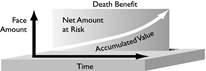 The Death Benefit is designed to remain level.
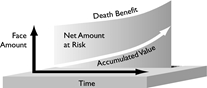 The
Death Benefit changes as your Policy’s Accumulated Value changes. The better your Investment Options
perform, the larger the Death Benefit will be, but will never be lower than Death Benefit Option A.
The
Death Benefit changes as your Policy’s Accumulated Value changes. The better your Investment Options
perform, the larger the Death Benefit will be, but will never be lower than Death Benefit Option A.
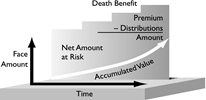 The
more premiums you pay and the less you withdraw, the larger the Death Benefit will be.
The
more premiums you pay and the less you withdraw, the larger the Death Benefit will be.
Limits on Option C
The following limits apply to Option C:
● Option C must be elected at Policy issue.
● To elect Option C, the Insureds must be Age 80 or younger at the time the Policy is issued.
● The Death Benefit calculated under Option C will be limited to the Option C Death Benefit Limit shown in your Policy Specifications.
● Once the Policy is issued, the Option C Death Benefit Limit will not change, even if you increase or decrease the Face Amount of your Policy. However if you change your Death Benefit Option from Option C to Option A or Option B, the Option C Death Benefit Limit will no longer apply to the Policy.
● We will not approve any increase in Face Amount to the Policy that would cause the Death Benefit to exceed the Option C Death Benefit Limit.
● Automatically added at Policy issue if eligible.
● Satisfactory evidence of insurability is required.
● One-time additional cost at exercise.
● Exchanges are limited to permanent life insurance policies only.
Policy Split Option Rider. This Rider allows this Policy to be split into two individual policies but evidence of insurability on each Insured is required.
Policy Split Option Rider
Allows the Policy to be split into two new individual policies subject to satisfactory evidence of insurability on each Insured. The exchange may be made to any single life policy of permanent life insurance that we regularly issue at the time of exchange, subject to
our approval. A $200 administrative fee will be deducted from the original Policy’s Accumulated Value on the effective date of the exchange. Although not anticipated, we reserve the right to charge for any state or federal taxes incurred upon exercise of this Rider. See the VARIABLE LIFE INSURANCE AND YOUR TAXES - Optional Policy Benefits and Riders – Policy Exchanges section in this prospectus for additional information on the tax treatment of this Rider. This Rider is automatically added to the Policy. Some life insurance producers may have a financial incentive to offer you a new policy in place of the one you already own. You should only convert your policy if you determine, after comparing the features, fees (including surrender charges and premium loads), and risks of both policies, that it is preferable for you to purchase a new policy rather than own the existing policy. Call (800) 347-7787 if you have any questions about this Rider. There is no additional fee for this Rider.
Rider Terms:
Exchange Conditions – To exercise this option, you must:
● Ask for the exchange in writing on a form that we will provide to you;
● Return the form and the original Policy to us; and
● Provide satisfactory evidence of insurability on each Insured.
Exchange Date - The date all of the Exchange Conditions are met, the date this Policy terminates, and the policy date for the two new policies.
New Policy Considerations
● The new policy on each Insured will be based on that Insured’s age as of the Exchange Date.
● If the new policies are variable universal life policies, we will waive the surrender charge on any amount of Accumulated Value less Policy Debt transferred from this Policy to purchase the new policies. The value transferred to the new policies will not be subject to any premium load. Premium loads will apply on the new policies for additional premium added at issue or after the initial premium paid from this Policy’s Accumulated Value less Policy Debt. Any surrender charges applicable to the new policies will continue to apply.
● The Face Amount of each new policy may be for any amount you choose, provided that the sum of the Face Amounts of the new policies do not exceed the Policy’s Face Amount including any Face Amount provided by a term insurance rider.
● You must provide us with your written consent if the Face Amounts of the new policies are not equal.
● The Policy’s Accumulated Value, Policy Debt and Cash Surrender Value are split in proportion to the Face Amount for each of the new policies.
Rider Termination
The Rider will terminate on the earliest of:
● Your Written Request to end this Rider,
● The date of the first death of the two Insureds,
● On lapse or termination of the Policy, or
● Upon exercise of this Rider.
Example
This example assumes that, during Policy Year 10, the Owner elects to split this Policy and purchase two new variable universal life policies issued by us. Satisfactory evidence of insurability on each Insured was submitted. The existing Policy has a Face Amount of $500,000 and Accumulated Value of $160,000. The new policy has a premium load and offers the same or similar Risk Class as the existing Policy. The Insureds elected that the current Policy be split 50% to each new policy.
When the transfer occurs, the new policies will have a Face Amount of $250,000 ($500,000 x 50% = $250,000), and an Accumulated Value of $80,000 ($160,000 x 50% = $80,000). If the new policies are variable universal life policies, we will waive the surrender charge on any amount of Accumulated Value less Policy Debt transferred from this Policy to purchase the new policies. The new policies will not assess a premium load on the amount transferred to each policy from the old policy. Once the new policy is issued, the old policy will terminate and no longer provide any insurance coverage.
● Transfers can be scheduled monthly, quarterly, semi-annually, or annually.
● If you make transfers out of the Variable Investment Options you selected under the service, the service will end. You will have to wait 30 days before you can re-enroll with new Allocation Instructions.
● May not use this service and the Dollar Cost Averaging, First Year Transfer, or Fixed Option Interest Sweep at the same time.
● Automatically added at Policy issue if eligible.
● Satisfactory Evidence of Insurability is required.
● Cannot be issued with the Terminal Illness Rider – Last Survivor if this rider names more than one eligible Insured.
● No additional cost, but upon any benefit payments, the Policy death benefit and other values will be reduced. When benefits are paid, the Policy Death Benefit will be reduced by an amount greater than the benefit payment. Other Policy values will be reduced pro rata.
● Subject to the eligibility and other conditions described in the Rider such as certification of having a chronic or terminal illness, making a Written Request for benefits, and not exceeding the maximum amount of the Death Benefit that may be utilized for chronic or terminal illness benefits.
● Chronic illness benefits may be requested once every 12-month period.
● Once the Rider is exercised, we will not allow any requested increases in benefits under the Policy or any Riders.
Premier Living Benefits Rider 2
(This Rider is called “Accelerated Death Benefit Rider for Chronic Illness and Terminal Illness” in your Policy.)
This Rider is only available at Policy issue. This Rider is not available for Policies issued with the Terminal Illness Rider – Last Survivor if this Rider names more than one eligible Insured.
The Premier Living Benefits Rider is a chronic illness and terminal illness Rider that provides protection from the financial impacts of becoming chronically ill or terminally ill by providing acceleration of a portion of the Death Benefit.
There is no additional cost for the rider. However, if you choose to exercise the Rider, at the time we pay any Benefit payment, we will reduce your Policy’s Death Benefit by an amount greater than the Benefit payment itself, as described in the Rider. Other Policy values, including but not limited to Surrender Charge, Accumulated Value, Policy Debt and Total Face Amount will be reduced pro rata.
There is no separate premium requirement for this Rider. However, this Rider does not eliminate the need to pay premiums to keep the Policy In Force. Even when receiving payment benefits under this Rider, the Owner must continue to pay any necessary premiums to avoid policy lapse.
You may opt out of the Rider at any time after the Policy is issued. There is no charge for opting out of the Rider.
Rider Terms
Accelerated Death Benefit – the adjusted Death Benefit or portion of Death Benefit that is paid to a Chronically or Terminally Ill Individual.
Activities of Daily Living – generally include the following self-care functions:
● Bathing oneself
● Continence
● Dressing oneself
● Feeding oneself
● Getting oneself to and from the toilet
● Transferring oneself into or out of a bed, chair or wheelchair.
The Rider attached to your Policy contains more detailed information about these self-care functions.
Benefit Payment – the periodic or lump sum payment of the Accelerated Death Benefit proceeds.
Benefit Payment Date – the date or dates that a Benefit Payment is paid. Benefits will be paid when we confirm that the Insured has met the required conditions. See the Eligibility Conditions subsection below.
Certification of Illness – is either of the following:
● A written certification from a Licensed Health Care Practitioner that the Insured is a Chronically Ill Individual who meets the conditions of this Rider. Each certification is valid for a 12-month period and must state that the Chronic Illness is expected to be permanent; or
● A written certification from a Licensed Physician that the Insured is a Terminally Ill Individual who meets the conditions of this Rider. The certification must include the clinical, radiological or laboratory evidence of the condition that supports the certification.
We reserve the right to obtain an additional opinion of the Insured’s conditions at our expense. If this opinion differs from that of the Insured’s Licensed Health Care Practitioner or Licensed Physician, eligibility for Benefits will be determined by a third party Licensed Health Care Practitioner or Licensed Physician who is mutually acceptable to you and to us.
Chronic Illness - a medical condition where the Chronically Ill Individual has received a certification of illness that states:
● They are unable to perform at least two Activities of Daily Living without hands-on or stand-by assistance from another individual due to a loss of functional capacity and such condition is expected to be permanent; or
● They require continual supervision by another person for protection from threats to the Insured’s health or safety due to severe cognitive impairment (deficiency in short or long-term memory, orientation as to person, place, and time, deductive or abstract reasoning, or judgment as it related to safety awareness and that such condition is expected to be permanent.
Chronically Ill Individual – an Insured who has been certified as having a Chronic Illness.
Immediate Family Member – includes the spouse, parents, brothers, sisters, and children by blood, adoption, or marriage of the Owner and the Insured, and of the spouse of the Owner and Insured.
Initial Eligible Amount – the lesser of the Maximum Lifetime Chronic Illness Benefit or the Death Benefit, when the first Benefit Payment under this Rider is made.
Insured – is an eligible Insured named in the Policy Specifications.
Licensed Health Care Practitioner – a physician, registered professional nurse, licensed social worker or other individual whom the United States Secretary of the Treasury may prescribe by regulation, and resides in the United States. A Licensed Health Care Practitioner may not be the Insured, the Owner, or an Immediate Family. The Licensed Health Care Practitioner must be independent of us, meaning he or she may not be our employee or be compensated in a manner that is linked to the outcome of the certification.
Licensed Physician – a physician who is licensed and residing in the United States and the physician is not the Owner, the Insured, or an Immediate Family Member. The Licensed Physician must be independent of us, meaning he or she may not be our employee or be compensated in a manner that is linked to the outcome of the certification.
Maximum Lifetime Chronic Illness Benefit – the maximum amount of Death Benefit that you can accelerate as a Chronic Illness Benefit during the Insured’s lifetime, as shown in your Policy Specifications. The Chronic Illness Benefit will not exceed the actual Death Benefit at the time this Rider is exercised.
Per Diem Limitation – used in the calculation of the Chronic Illness Benefit. Either annual or monthly Benefit Payments may be elected and they are determined as follows:
● Annual Per Diem Limitation – the Per Diem Limitation as declared by the Internal Revenue Service on each Benefit Payment Date multiplied by the Maximum Per Diem Limit Percentage, then multiplied by 365.
● Monthly Per Diem Limitation – the Per Diem Limitation as declared by the Internal Revenue Service on each Benefit Payment Date multiplied by the Maximum Per Diem Limit Percentage, then multiplied by 30.
Survivor – means the Insured remaining alive after the first death of the two eligible Insureds named in the Policy Specifications for this rider, when more than one eligible Insured is named.
Terminal Illness – a medical condition where the Terminally Ill Individual has been certified to have a life expectancy that is reasonably expected to be 12-months or less from the Benefit Date.
Terminally Ill Individual – an Insured who has been certified as having a Terminal Illness.
Eligibility Conditions – Chronic Illness or Terminal Illness
Eligibility Conditions – To receive an Accelerated Death Benefit, all the following conditions must be satisfied:
● The Policy Owner must provide a written Request for Benefits. If we need additional information, within 15 days of our receipt of the written Request for Benefits, a Benefit Form will be provided to the Insured. You must submit written proof that the Insured is either a Chronically Ill or Terminally Ill Individual.
● The Insured must provide Certification of Illness that they are either a Chronically Ill Individual or a Terminally Ill Individual, whichever applies.
● The Owner must provide us with the written consent of the assignee of record named under the Policy, if any, or the irrevocable Beneficiary named under the Policy, if any.
● There is no legal requirement that the benefit be used to meet the claims of creditors, whether in bankruptcy or otherwise, and there shall be no government agency that requires the benefit to apply for, obtain, or keep a government benefit or entitlement.
● The Chronic or Terminal Illness shall not be the result of attempted suicide, or intentionally self-inflicted injury.
Request for Benefits – A Written Request for benefits may be for either one of the following:
● Chronic Illness Benefits – may be made at any time after the date the Insured develops a Chronic Illness as defined in this Rider. Only one request for Chronic Illness Benefits may be submitted during any 12-month period and each request must include a new Certification of Illness. Requests should also include the desired dollar amount and your election of annual or monthly benefit proceeds.
● Terminal Illness Benefits - may be made at any time after the date the Insured develops a Terminal Illness as defined in this Rider. A request should include the desired dollar amount which is paid in one lump sum.
Accelerated Death Benefit Payments and Values – Chronic Illness Benefit
The Chronic Illness Benefit is the Accelerated Death Benefit payable when the Insured is a Chronically Ill Individual who has met the Eligibility Conditions subsection referenced above.
Chronic Illness Benefit Proceeds - the amount of Chronic Illness Benefits that is payable on each Benefit Payment Date.
The Chronic Illness Benefit Proceeds are equal to a – (b x c) – (d x c), where:
a = The Chronic Illness Benefit;
b = The Policy Debt prior to the payment of the Chronic Illness Benefit;
c = The Chronic Illness Acceleration Percentage; and
d = The sum of any Monthly Deductions that are due and unpaid prior to the payment of the Chronic Illness Benefit, if the Policy is in the Grace Period.
The Chronic Illness Acceleration Percentage is equal to (a ÷ b), where:
a = The Chronic Illness Benefit; and
b = The Chronic Illness Reduction Factor multiplied by the Death Benefit on the Benefit Payment Date.
The Chronic Illness Reduction Factor is equal to (c + d) ÷ e, where:
c = 100% of the Cash Surrender Value immediately prior to the benefit payment;
d = The Chronic Illness Risk Factor (which varies based on the Insured’s attained Age, sec and Risk Class, the Accelerated Death Benefit Interest Rate, and a mortality table for disabled lives declared by us) times the result of the Death Benefit less the greater of zero or the Accumulated Value immediately prior to the benefit payment; and
e = The Death Benefit.
Election of Proceeds - The Chronic Illness Benefit Proceeds may be paid in one annual payment or in 12-monthly payments. Proceeds will be paid as an annual benefit unless you elect to receive monthly payments.
Annual Benefit Proceeds – Under this option, you may elect to receive one annual payment that will not exceed the Maximum Annual Chronic Illness Benefit Amount. A new Certification of Illness is required before each election date, which is the start of a new 12-month period. The following stipulations apply:
● The amount of Chronic Illness Benefits requested may not be less than the Minimum Annual Chronic Illness Benefit Amount shown in the Policy Specifications; and
● The amount of Chronic Illness Benefits paid will never be greater than the Maximum Annual Chronic Illness Benefit Amount.
Monthly Benefit Proceeds – Under this option, you may elect to receive proceeds in 12-monthly payments that will result in payment of the Chronic Illness Benefit Proceeds over a 12-month election period or until you cancel your request. The amount of Monthly Benefit Proceeds may vary from month to month, but will not exceed the Maximum Monthly Chronic Illness Benefit Amount (shown in the Policy Specifications) on each Benefit Payment Date. A new Certification of Illness is required before each election date, which is the start of each new 12-month period however a new Request for Benefits will not be required. The following stipulations apply:
● The amount of the Chronic Illness Benefits requested may not be less than the Minimum Monthly Chronic Illness Benefit Amount shown in the Policy Specifications;
● The Chronic Illness Benefit will never be greater than the Maximum Monthly Chronic Illness Benefit Amount on that Benefit Payment Date; and
● You may not change the dollar amount of the Chronic Illness Benefits you requested.
You may cancel an election of Monthly Benefit Proceeds at any time during the 12-month period that the Monthly Benefit Proceeds are being paid. However, a new Request for Chronic Illness Benefits may not be made until 12-months after the date the prior Request for Benefits was processed. Upon canceling your election, you will not receive any remaining monthly payments due and unpaid for the current 12-month election period.
Proceeds (annual or monthly) will be paid to you (or your designee) or your estate while the Insured is still living, subject to any required acknowledgment of concurrence for payout. Upon the death of the Owner we will pay the benefit, provided the benefit is requested prior to the Owner’s death, to his or her estate. Any payment of proceeds that is made in good faith by us is deemed irrevocable. Accelerated Death Benefits are paid as described in this Rider.
The Total Accelerated Chronic Illness Benefit is equal to the amount that the Death Benefit has been reduced as a result of paying an Accelerated Death Benefit under this Rider. The Total Accelerated Chronic Illness Benefit is equal to zero at the date of issue of this Rider.
Example:
Assumptions
● Accumulated Value is $150,000
● Chronic Illness Benefit is $65,000
● Death Benefit is $600,000
● Surrender Charge is $50,000
● Cash Surrender Value is $100,000
● Chronic Illness Factor is 48.57734%
● Policy Debt is $20,000
The Reduction Factor is (c + d) ÷ e; where
C (Cash Surrender Value) = $100,000;
d (Chronic Illness Risk Factor multiplied by result of the Death Benefit minus the Accumulated Value) = .4857734 x ($600,000 - $150,000);
e (Death Benefit) = $600,000
The Reduction Factor is 0.5309967 = [$100,000 + 0.4857734 x ($600,000 - $150,000)] ÷ $600,000.
The Acceleration Percentage is 20.40188% = $65,000 ÷ (0.5309967 x $600,000)
The Chronic Illness Benefit Proceeds is $60,919.62 = $65,000 - ($20,000 x 0.2040188)
The Chronic Illness Benefit Proceeds, assuming no Policy Debt, is $65,000 = $65,000 - ($0 x 0.2040188)
After exercise, the Death Benefit is reduced by an amount equal to the Death Benefit times acceleration percentage.
Death Benefit Reduction = $600,000 x 20.40188% = $122,411
The Death Benefit is reduced by an amount greater than the benefit payment.
End of Example
Accelerated Death Benefit Payment and Values – Terminal Illness Benefit
Terminal Illness Benefit Proceeds – Terminal Illness Benefit Proceeds is the amount of Terminal Illness Benefit that is payable on the Benefit Payment Date. Terminal Illness Benefit Proceeds will be paid in one lump sum and are at least equal to the Acceleration Percentage multiplied by the difference between the current Cash Surrender Value and any outstanding Policy Debt. More details about the calculation are in the Policy Specifications. We will pay the Terminal Illness Benefit Proceeds only once per Policy.
The Terminal Illness Acceleration Percentage is equal to (a ÷ b), where:
a = The Terminal Illness Benefit; and
b = The Terminal Illness Eligible Coverage on the Benefit Payment Date.
The Terminal Illness Benefit is the Accelerated Death Benefit payable when the Insured is a Terminally Ill Individual who has met the Eligibility Conditions subsection referenced above.
The Accelerated Death Benefit Interest Rate will not exceed the greater of:
● The current yield on the 90-day Treasury Bill; or
The maximum fixed annual rate of 8% in arrears or a variable rate determined in accordance with the National Association of Insurance Commissioners Policy Loan Interest Rate Model.
The Terminal Illness Reduction Factor is equal to (a) x (b) where:
a = 1; and
b = 1 plus the Accelerated Death Benefit Interest Rate.
The Terminal Illness Eligible Coverage is the portion of the Policy Death Benefit that will qualify for determining the Terminal Illness Benefit under this Rider. The Terminal Illness Eligible Coverage is listed in the Policy Specifications. The Terminal Illness Eligible Coverage does not include:
● Any insurance under the Policy on the life of someone other than the eligible Insured(s); or
● Any rider, on the Insured(s), that is not explicitly listed as being Terminal Illness Eligible Coverage.
Example:
Assumptions:
● Eligible Coverage is $150,000
● Terminal Illness Benefit is $65,000
● Accelerated Death Benefit Interest Rate is 8%
● Surrender Charge is $50,000
● Cash Surrender Value is $100,000
● Policy Debt is $20,000
● Processing Charge is $0
The Acceleration Percentage is 43.33% = ($65,000 ÷ $150,000)
The Terminal Illness Reduction Factor is 0.92592593 = 1 ÷ (1 + 0.08)
The Terminal Illness Benefit Proceeds is $54,728.40 = [($150,000 - $100,000) x 0.92592593 + $100,000] x 0.4333 - ($20,000 x 0.4333) – 0
The Terminal Illness Benefit Proceeds, assuming no Policy Debt, is $63,395.06 = [($150,000 - $100,000) x 0.92592593 + $100,000] x 0.4333 – ($0 x 0.4333) – 0
After exercise, the Death Benefit is reduced by an amount equal to the Death Benefit times the acceleration percentage.
Death Benefit Reduction = $150,000 x 43.33% = $65,000.
The Terminal Illness Benefit Proceeds is $54,728.40.
The Death Benefit is reduced by an amount greater than the benefit payment.
End of Example
Request for Benefits
Processing the Request for Benefits – Depending on whether a Chronic Illness Benefit or a Terminal Illness Benefit is requested, we will do one of the following on each Benefit Payment Date.
Upon request for Chronic Illness Benefits, we will:
● Calculate the Chronic Illness Benefit Proceeds;
● Verify that the Policy is not in the Grace Period. If it is, the Chronic Illness Benefit will be reduced by the amount needed to pay any portion of the Monthly Deduction due;
● Limit the Chronic Illness Benefit Proceeds to the Maximum Annual Chronic Illness Benefit Amount or Maximum Monthly Chronic Illness Benefit Amount, each shown in the Policy Specifications, as applicable; and
● Reduce Policy and Rider values as described herein.
Upon request for Terminal Illness Benefits, we will:
● Calculate the Terminal Illness Benefit Proceeds;
● Limit the Terminal Illness Benefit as shown in Terminal Illness Benefit Limitation shown in the Policy Specifications;
● Reduce Policy and Rider values as described herein; and
● Terminate any Chronic Illness Benefits.
Accelerated Death Benefits are payable immediately beginning on the Benefit Date. If payment of Accelerated Death Benefit proceeds is delayed thirty-one (31) calendar days after the Benefit Date, we will pay Death Benefit Proceeds Additional Interest as described in the Death Benefit Proceeds section of the Policy. Such additional interest rate will be applied to the Accelerated Death Benefit proceeds beginning on the 31st calendar day referenced above, to each Benefit Payment Date.
Rider Effects on Your Policy
When you exercise the Rider and we pay Benefit Proceeds, the following values will be reduced by an amount equal to the value below multiplied by the applicable Chronic or Terminal Illness Acceleration Percentage. On each Benefit Payment Date, the following values will be reduced:
● The Total Face Amount;
● The Accumulated Value;
● The Surrender Charge for each Coverage Layer;
● Any Policy Debt;
When you exercise the Rider, we will send you a statement demonstrating the effect of exercising the Rider on the Policy’s Accumulated Value, Death Benefit, Premium, Cost of Insurance Charges and Policy Loans.
Other Rider Effects on the Policy
After we make the initial Benefit Payment under the Rider:
● You can change your Death Benefit Option, but only to Death Benefit Option A;
● We will not allow any requested increases in benefits under the Policy or any Riders;
● Policy loan availability will continue according to Policy terms; and
● We may discontinue any Systematic Distribution Program in effect.
Premier Living Benefits Rider 2 Effects on Other Riders
Generally, optional rider benefits under the Policy will remain In Force subject to their terms and conditions, unless otherwise stated. We will calculate charges for optional riders in accordance with the terms of each applicable rider. The charges may be affected by the reduction in benefits and policy values. In addition:
● If your Policy has the No-Lapse Guarantee Rider, the no-lapse premium and any no-lapse credit will be reduced on the date of each Benefit Payment by an amount equal to the applicable no-lapse guarantee premium or no-lapse credit prior to the payment of Benefit Proceeds, multiplied by the Acceleration Percentage.
Accelerated Death Benefits may affect your eligibility for, or amount of, other benefits provided by federal, state or local government. Payments of Accelerated Death Benefits provided by the Rider are intended to qualify as Death Benefits under section 101(g) of the Tax Code. You should consult with your personal tax advisor before requesting any accelerated Death Benefit payments.
Payment of an Accelerated Death Benefit under this rider will reduce the Policy’s Death Benefit and other values under the Policy. In most circumstances, the cost of insurance charges will also be reduced. In addition, premium limitations and Death Benefits required in order for the Policy to qualify as a life insurance policy or avoid being classified as a Modified Endowment Contract under the Tax Code will also be affected. See the VARIABLE LIFE INSURANCE AND YOUR TAXES- Modified Endowment Contracts and HOW PREMIUMS WORK-Limits on the Premium Payments You Can Make sections in this prospectus for more information on the relation of the Policy’s Death Benefit to premium payments and Modified Endowment Contract status.
Rider Termination
The Rider is effective on the Policy Date unless otherwise stated. It will terminate on the earlier of:
● Your Written Request;
● Acceleration of any part of the Policy’s Death Benefit because of an Insured(s) terminal illness while the Insured is still living;
● The date Rider benefits equal to the total Death Benefit have been accelerated;
● When the Rider or the Policy terminate; or
● When you notify us of the Insured’s death.
If your Policy lapses and is reinstated, you may reinstate the Rider.
● Available at Policy issue.
● Not available for policies issued with the Premier Living Benefits Rider 2, unless one Insured did not qualify for the Premier Living Benefits Rider 2.
● Issued when the Premier Living Benefits Rider 2 is not issued.
● You may opt out of the Rider at any time.
● Benefits are only available for the Survivor.
● Subject to the eligibility and other conditions described in the Rider such as certification of having a terminal illness, making a Written Request for benefits, and not exceeding the maximum amount of the Death Benefit that may be utilized for terminal illness benefits.
● Terminal illness must be certified by a licensed physician (not the insured, owner, beneficiary, or immediate family member).
● There is no additional cost for this Rider. If any benefits are paid under the Rider, some Policy values will be reduced pro rata including the Total Face Amount, Accumulated Value, loan amounts and (in most cases) Cost of Insurance Charges. The Death Benefit will be reduced by an amount greater than the benefit payment. Any systematic distribution program will also be discontinued.
Terminal Illness Rider-Last Survivor
(This Rider is called “Accelerated Death Benefit Rider for Terminal Illness-Last Survivor” in your Policy.)
This Rider is only available at Policy issue. This Rider is not available if your Policy was issued with the Premier Living Benefit Rider 2 that names more than one eligible Insured.
The Terminal Illness Rider-Last Survivor provides protection from the financial impacts of having a medical condition that is reasonably expected to result in a Survivor life expectancy of 12 months or less by providing acceleration of a portion of the Death Benefit.
There is no additional cost for the rider. However, if you choose to exercise the Rider, at the time we pay the Rider Benefit, we will reduce your Policy’s Death Benefit by an amount greater than the Benefit payment itself, as described in the Rider. Other Policy values, including but not limited to, Surrender Charge, Accumulated Value, Policy Debt and Total Face Amount will be reduced pro rata.
You may opt out of the Rider at any time after the Policy is issued. There is no charge for opting out of the Rider.
Rider Terms
Eligible Coverage – the portion of the Policy Face Amount that will qualify for determining the Terminal Illness Benefit under the Terminal Illness Rider-Last Survivor. Your Policy’s Eligible Coverage is listed in the Policy Specifications under the Terminal Illness Rider-Last Survivor. It does not include any insurance on the life of anyone other than the Insureds and any other rider on the Insureds.
Licensed Physician – a physician licensed and residing in the United States. The Licensed Physician cannot be you or an immediate family member.
Terminally Ill Individual – Survivor who has been certified by a Licensed Physician in writing as having a medical condition that is reasonably expected to result in a life expectancy of 12 months or less from the date of the Written Request.
Survivor - the Insured remaining alive after the first death of the two Insureds named in the Policy.
Eligibility Conditions
To receive the Rider Benefits, you must satisfy the following conditions:
● You must submit a Written Request while the Policy is In Force; we will provide you with a claim form within 15 days of your Written Request. Your completed claim form must contain proof that the Survivor is a Terminally Ill Individual;
● Any assignee or any irrevocable Beneficiary under the Policy must provide written consent;
● The Terminally Ill Individual’s illness must not be the result of attempted suicide or intentionally self-inflicted injury;
● If your Policy is a last survivor policy, it will only be eligible for a Terminal Illness Benefit after the death of the first Insured and only if the Survivor is a Terminally Ill Individual.
The Terminal Illness Benefit will be payable when we receive written certification from a Licensed Physician that the Survivor is a Terminally Ill Individual and meets the conditions described in the Rider. We reserve the right to obtain an additional opinion of the Survivor’s conditions at our expense. If this opinion differs from that of the Survivor’s Licensed Physician, eligibility for benefits will be determined by a third Licensed Physician who is mutually acceptable to you and to us.
The Terminal Illness Benefit will not be payable if the law requires the Benefit to meet creditor claims or a government agency requires the benefit for application or maintenance of a government benefit or entitlement.
The Rider at Exercise
You may submit your Written Request for benefits under the Rider, including the amount of Terminal Illness Benefit requested, when the Survivor qualifies as a Terminally Ill Individual and meets the eligibility conditions.
When we make the benefit payment we will:
● Limit the Terminal Illness Benefit to the lesser of 75% of the Eligible Coverage or $250,000;
● Calculate the Terminal Illness Benefit Proceeds, as described below; and
● Reduce Policy and Rider values.
Calculating the Benefit Under the Rider
The Terminal Illness Benefit Proceeds is the amount payable under the Rider. It is a one-time payment equal to the Terminal Illness Benefit multiplied by (a) and reduced by (b) and (c) where:
(a) The Terminal Illness Reduction Factor;
(b) Policy Debt multiplied by the Acceleration Percentage, as described below; and
(c) A processing charge, guaranteed not to exceed $100.
If the Survivor dies within 30 days of payment of the Terminal Illness Benefit Proceeds, we will refund the amounts defined in (a) and (c) above.
The Terminal Illness Reduction Factor is equal to (a) ÷ (b) where:
(a) Equals 1; and
(b) Equals 1 plus the Accelerated Death Benefit Interest Rate.
The Accelerated Death Benefit Interest Rate will not exceed the greater of:
● The current yield on the 90-day Treasury Bill; or
● The maximum fixed annual rate of 8% in arrears or a variable rate determined in accordance with the National Association of Insurance Commissioners Policy Loan Interest Rate Model.
Example
Assumptions:
● Eligible Coverage is $150,000
● Terminal Illness Benefit is $65,000
● Accelerated Death Benefit Interest Rate is 8%
● Surrender Charge is $50,000
● Cash Surrender Value is $100,000
● Policy Debt is $20,000
● Processing Charge is $100
The Acceleration Percentage is 43.333% = $65,000 ÷ $150,000
The Terminal Illness Reduction Factor is 0.92592593 = 1 ÷ (1 + 0.08)
The Terminal Illness Benefit Proceeds is $54,628.40 = [($150,000 - $100,000) x 0.92592593 + $100,000] x 0.4333 - ($20,000 x 0.4333) - $100
The Terminal Illness Benefit Proceeds, assuming no Policy Debt, is $63,295.06 = [($150,000 - $100,000) x 0.92592593 + $100,000] - ($0 x 0.75) - $100
After exercise, the Death Benefit is reduced by an amount equal to the Death Benefit times the Acceleration Percentage
Death Benefit Reduction = $150,000 x 43.33% = $65,000
The Terminal Illness Benefit Proceeds is $54,628.40
The Death Benefit is reduced by an amount greater than the benefit payment.
End of Example
We pay the Terminal Illness Benefit as a lump sum. It is guaranteed never to be less than $500 or 25% of your Policy’s Face Amount. We will pay the Terminal Illness Proceeds once per Policy.
If you send us Written Notice that the Survivor has died before we have paid the Terminal Illness Benefit, we will not make the payment. However, if we pay the Terminal Illness Benefit before we receive Written Notice of the Survivor’s death, the payment will be effective and we will reduce the Death Benefit Proceeds payable under the Policy.
We pay the benefits to you (or your designee) or to your estate while the Survivor is still living, unless the Policy has been otherwise assigned.
When you exercise the Rider, we will send you a statement demonstrating the effect of exercising the Rider on the Policy’s Accumulated Value, Death Benefit, Premium, Cost of Insurance Charges and Policy Loans.
At the time of each benefit payment, we will:
● Calculate the amount payable upon request under this Rider (the “Terminal Illness Benefit Proceeds”);
● Reduce the Policy and Rider values as described in the Rider; and
● Send you an endorsement to the Policy, which will include a statement of the effect of the benefit payment on the Policy’s Accumulated Value, Death Benefit, Premium, Cost of Insurance Charges and Policy Loans.
If you request another transaction on the same day as a Terminal Illness Benefit is paid, we will process the Terminal Illness Benefit Proceeds after we have processed the other requested transactions.
Your Policy After Exercising the Rider
When you exercise the Rider and we make a benefit payment, Policy values will be reduced by an amount equal to the value below multiplied by the Acceleration Percentage:
● The Total Face Amount; and
● The Accumulated Value.
The Acceleration Percentage equals (a ÷ b) where:
a = The Terminal Illness Benefit; and
b = The Eligible Coverage on the date of each Benefit payment.
Example
Assumptions:
● Eligible Coverage is $150,000
● Terminal Illness Benefit is $65,000
● Accelerated Death Benefit Interest Rate is 8%
● Surrender Charge is $50,000
● Cash Surrender Value is $100,000
● Policy Debt is $20,000
● Processing Charge is $100
The Acceleration Percentage is 43.333% = $65,000 ÷ $150,000
The Terminal Illness Reduction Factor is 0.92592593 = 1 ÷ (1 + 0.08)
The Terminal Illness Benefit Proceeds is $54,628.40 = [($150,000 - $100,000) x 0.92592593 + $100,000] x 0.4333 - ($20,000 x 0.4333) - $100
The Terminal Illness Benefit Proceeds, assuming no Policy Debt, is $63,295.06 = [($150,000 - $100,000) x 0.92592593 + $100,000] - ($0 x 0.75) - $100
After exercise, the Death Benefit is reduced by an amount equal to the Death Benefit times the acceleration percentage
Death Benefit Reduction = $150,000 x 43.33% = $65,000
The Terminal Illness Benefit Proceeds is $54,628.40
The Death Benefit is reduced by an amount greater than the benefit payment.
End of Example
Your Policy’s Total Face Amount will be reduced by an amount equal to the Acceleration Percentage multiplied by the Total Face Amount prior to the benefit payment. The Face Amount of each Coverage Layer of the Policy or any term insurance Rider on the Survivor will be reduced according to the terms of the Policy and Rider.
The Policy’s Death Benefit and Accumulated Value will continue to be calculated in accordance with the terms of the Policy.
The Policy’s Investment Options values are reduced on the date of each benefit payment by an amount equal to the Acceleration Percentage multiplied by the Investment Option values prior to the benefit payment. The reduction to the values in each of the Investment Options will be treated as an Account Deduction.
We will reduce your Policy Debt, Loan Account and Loan Account Value on the date of a benefit payment by an amount equal to their respective values prior to the benefit payment multiplied by the Acceleration Percentage.
Your Policy’s Cost of Insurance charges will be calculated according to the terms of the Policy, but will be based on the reduced Policy values following the benefit payment.
Your Policy’s Cash Surrender Value and Net Cash Surrender Value following the benefit payment will be calculated according to the terms of the Policy.
The Riders After Exercising the Terminal Illness Rider-Last Survivor
Generally, optional rider benefits under the Policy will remain In Force subject to their terms and conditions, unless otherwise stated. We will calculate charges for optional riders in accordance with the terms of each applicable rider. The charges may be affected by the reduction in benefits and policy values. In addition:
● If your Policy has the No-Lapse Guarantee Rider, the no-lapse premium and no-lapse credit will each be reduced on the date of each benefit payment.
Terminal Illness Benefit Accelerated Death Benefits may affect your eligibility for, or amount of, other benefits provided by federal, state or local government. Payments of Accelerated Death Benefits provided by the Rider are intended to qualify as Death Benefits under section 101(g) of the Tax Code.
You should consult with your personal tax advisor before requesting any accelerated Death Benefit payments.
Rider Termination
The Rider is effective on the Policy Date unless otherwise stated. It will terminate on the earlier of:
● Your Written Request;
● The date the Benefit under the Rider are paid;
● When the Policy terminates; or
● When you notify us of Survivor’s death.
If your Policy lapses and is reinstated, you may reinstate the Rider.
Payment of an Accelerated Death Benefit under this rider will reduce the Policy’s Death Benefit and other values under the Policy. In most circumstances, the cost of insurance charges will also be reduced. In addition, premium limitations and Death Benefits required in order for the Policy to qualify as a life insurance policy or avoid being classified as a Modified Endowment Contract under the Tax Code will also be affected.
(“No-Lapse Guarantee Rider”)
● Automatically issued on your Policy if Insureds are Age 79 and younger and Death Benefit Option A or B is chosen at Policy Issue.
● Subject to the above, the guarantee period is based on the ages of the Insureds when the policy is issued and ends on the Policy anniversary when the youngest Insured reaches attained age 90.
● The range a guarantee period may last is 11 years (if the youngest Insured is Age 79) to 72 years (if the youngest Insured is Age 18). Your guarantee period is shown in your Policy specifications.
● Benefit will be provided if a certain amount of premium is paid each Policy month.
● The no-lapse guarantee is in effect as long as the No-Lapse Credit less Policy Debt is equal to or greater than zero. The No-Lapse Credit depends on a number of factors and is affected by Policy loans, premiums, and withdrawals.
● Benefit will terminate if any rider added to the Policy after issue has charges.
(“No-Lapse Guarantee Rider”)
Up To Age 90 No-Lapse Guarantee Rider (“No Lapse Guarantee Rider ”)
This Rider provides for the continuation of death benefit coverage for a specified guarantee period, if certain minimum premiums under the Rider are paid, even if the Policy’s Net Accumulated Value is less than the Monthly Deduction due on a Monthly Payment Date. There is no additional fee for this Rider.
Rider Eligibility
The Rider is available at Policy issue for Insureds Age 79 and younger and if you choose Death Benefit Option A or B when applying for your Policy. This Rider is automatically added to the Policy if eligibility conditions are met.
Rider Terms
No-Lapse Guarantee Period – the time during which we guarantee the Death Benefit will remain In Force as long as the guarantee under this Rider is in effect. This period is shown in the Policy Specifications. This period begins on the Policy Date and will not re-start if insurance Coverage is added or increased. The guarantee period is based on the ages of the Insureds when the Policy is issued and the range of the guarantee period may last 11 years (if the youngest Insured is Age 79) to 72 years (if the youngest Insured is Age 18). This period ends when the youngest Insured reaches attained age 90.
No-Lapse Guarantee Premium – is an annual amount used during the No-Lapse Guarantee Period to determine the No-Lapse Credit (defined in the How the Rider Works section below). The No-Lapse Credit is used to determine if the guarantee under this Rider is in effect. The No-Lapse Guarantee Premium in effect as of the Policy Date is shown in the Policy Specifications and is expressed as an annual amount. The No-Lapse Guarantee Premium is calculated such that it covers sufficient future Monthly Deductions under the Policy. The No-Lapse Guarantee Premium may change. Any increase in Face Amount, scheduled or not, or addition or increase in insurance Coverage will cause an increase in the No-Lapse Guarantee Premium. A decrease in Face Amount or in other insurance Coverage will not cause a decrease in the No-Lapse Guarantee Premium. If the No-Lapse Guarantee Premium changes as a result of such a change, we will inform you of the amount of the changed No-Lapse Guarantee Premium.
How the Rider Works
This Rider guarantees that the Policy will continue in effect through the end of the No-Lapse Guarantee Period as long as the No-Lapse Credit less Policy Debt is equal to or greater than zero. The length of the No-Lapse Guarantee period is shown in the Policy Specifications.
The No-Lapse Credit is used to determine if the guarantee under this Rider is in effect. It is calculated at the beginning of each Policy month during the No-Lapse Guarantee Period. The No-Lapse Credit as of the Policy Date, which is also the first Monthly Payment Date, is equal to the premium paid less one-twelfth of the No-Lapse Guarantee Premium. On any other Monthly Payment Date, the No-Lapse Credit is equal to:
● The No-Lapse Credit as of the prior Monthly Payment Date multiplied by (i), where:
– i = no greater than 1.00270926 if the No-Lapse Credit is negative; otherwise,
– i = 1.00000;
● Plus premiums received since the prior Monthly Payment Date;
● Less withdrawals taken since the prior Monthly Payment Date; and
● Less one-twelfth of the then current No-Lapse Guarantee Premium.
Example:
Assumptions
● No Lapse Premium is $838.61
● No Lapse Credit on the prior Monthly Payment Date is $1,000
● Withdrawal Amount taken since prior Monthly Payment Date is $500
● Premium Payment made on the current Monthly Payment Date is $100
Since the No Lapse Credit is positive,
the No Lapse Credit is $530.12 ($1,000 * (1.00000) + $100 - $500 - $838.61/12).
For the guarantee under this Rider to be in effect, the No-Lapse Credit less Policy Debt must be equal to or greater than zero.
If the No-Lapse Credit less Policy Debt is less than zero, the guarantee under this Rider is not in effect. The guarantee under this Rider may be brought back into effect by paying additional premium equal to the amount of premium necessary after deduction of the premium load so that the No-Lapse Credit less Policy Debt is equal to or greater than zero (the “Catch-Up” premium). If your Policy is in the grace period, you may pay the lesser of the Catch-Up premium (if this Rider is in effect) or the amount due to move the Policy out of the grace period. See the YOUR ACCUMULATED VALUE – Lapsing and Reinstatement section in this prospectus for more information on the Policy grace period.
If the guarantee under this Rider is in effect, the Policy and any attached optional benefits that are currently In Force, will remain In Force, will not enter the grace period and will not lapse during the specified guarantee period. Instead, the Policy will continue under the guarantee provided by this Rider and it will stay In Force as long as the No-Lapse Credit less Policy Debt is equal to or greater than zero.
Accumulated Value Deficit – When the Policy is continued under the No-Lapse Guarantee, the Net Accumulated Value can be less than or equal to zero. If the Policy does not have sufficient Net Accumulated Value from which Monthly Deductions can be collected, then any uncollected Monthly Deductions, or portions thereof, are accumulated without interest as an Accumulated Value Deficit. Any Premium or Loan Repayment that is received while the Net Accumulated Value is less than or equal to zero and the No-Lapse
53
Guarantee is in effect, will be applied as described in the Policy. Beginning on the next Monthly Payment Date following the receipt of the Premium or Loan Repayment and until eliminated, the Accumulated Value Deficit will first be reduced and then Monthly Deductions will be processed according to the terms of the Policy.
Example:
Assumptions:
● Policy is within No-Lapse Guarantee Period
● Accumulated Value of $11,000 before monthly deductions
● Policy Debt of $9,500
● Policyholder has paid a premium at the beginning of each Policy month at least equal to one twelfth of the No-Lapse Guarantee Premium
● Upcoming Monthly deduction = $2,000
Result:
● Policy Net Accumulated Value after monthly deductions will fall below $0 to -$500 ($11,000 - $9,500 - $2,000).
● Policy does not enter the Grace Period since policyholder has paid sufficient premium to meet the minimum No-Lapse Guarantee premium requirement.
Effect on Other Riders
If the Policy is continued under the guarantee provided by this Rider, any attached Riders will continue or end according to their respective terms.
Rider Termination
This Rider will end on the earliest of:
● If you add any Rider that has separate charges after the Policy Date;
● The date when the No-Lapse Credit less Policy Debt is less than or equal to zero and the Net Accumulated Value is less than the Monthly Deduction due on the Monthly Payment Date, unless a Catch-Up premium is made; or
● At the end of the Guarantee Period.
Rider Reinstatement
This Rider may not be reinstated if it was terminated before the date the Policy ceased to be In Force. Otherwise, this Rider will reinstate on the date the Policy is reinstated. Upon Reinstatement, any Catch-Up Amount and any Accumulated Value Deficit, without interest, will be restored. Any Catch-Up Amount existing at the time of Policy lapse must be paid upon Reinstatement for the No-Lapse Guarantee to be in effect.
| [1] | As a percentage of Fund net assets. |
| [2] | The Surrender Charge is based on the Age and Risk Class of the Insureds, the Face Amount of the effected Coverage Layer(s), as well as the Death Benefit Option you choose. If there is a reduction in the Face Amount of a Basic Coverage Layer, including decreases due to withdrawals, the surrender charge for the effected Basic Coverage Layer will not change. The Surrender Charge reduces to $0 after 20 years from the effective date of each Coverage Layer. The Surrender Charge shown in the table may not be typical of the Surrender Charge you will pay. Ask your life insurance producer and see the WITHDRAWALS, SURRENDERS AND LOANS section in this prospectus for information on this charge. The Surrender Charge for your Policy will be stated in the Policy Specifications. |
| [3] | If an internal transfer occurs between two variable universal life policies you have with us in connection with a transfer or exchange offer by Pacific Life or Pacific Select Distributors, LLC (our distributor), including pursuant to a conversion or split option rider, the amount transferred will not incur any Premium Load (which includes basic, General Account surplus, and internal premium loads). Premium loads will apply (basic and General Account surplus) on the new Policy for additional premium added at issue or after the initial premium paid. In addition, the internal transfer will not incur a Surrender Charge on any amount transferred from the old policy to purchase the new policy. Any Surrender Charge applicable to the new policy will continue to apply under the terms of the new policy. |
| [4] | We currently do not impose this charge and we reserve the right to do so in the future. |
| [5] | Cost of insurance rates apply uniformly to all members of the same Class and vary based on Age, sex, and Risk Class of the Insureds. The cost of insurance charges shown in the table may not be typical of the charges you will pay. Your Policy Specifications will indicate the guaranteed cost of insurance charge applicable to your Policy, and more detailed information concerning your cost of insurance charges is available on request from your life insurance producer or us. Also, before you purchase the Policy, you may request personalized Illustrations. Cost of insurance rates for your Policy will be stated in the Policy Specifications and calculated using the Net Amount At Risk. |
| [6] | This charge is not deducted on and after your Policy’s Monthly Deduction End Date. |
| [7] | Charges shown for the representative Insured may not be typical of the charges you will pay. |
| [8] | To help limit Fund expenses, Fund advisers have contractually agreed to reduce investment advisory fees or otherwise reimburse certain of their Funds which reflect temporary fee reductions. There can be no assurance that Fund expense waivers or reimbursements will be extended beyond their current terms as outlined in each Fund prospectus, and they may not cover certain expenses such as extraordinary expenses. See each Fund prospectus for complete information regarding these arrangements. |
| [9] | The Coverage charge rate is based on the Age, sex, and Risk Class of the Insureds on the Policy Date or date Rider is effective. Each Coverage Layer will have a corresponding Coverage charge related to the amount of the increase, based on the Age and Risk Class of the Insureds at the time of the increase. A decrease in Face Amount will not decrease the applicable Coverage charge for any Coverage Layer. Ask your life insurance producer for information regarding this charge for your Policy. The Coverage charge for your Policy will be stated in the Policy Specifications. The Coverage charge on a current basis only applies for the first 10 years of each Coverage Layer. For more information on how the Coverage Charge is calculated after the first 10 years of the coverage layer, please see the YOUR POLICY’S ACCUMULATED VALUE section and Coverage Charge subsection. |
| [10] | Riders are described under the OPTIONAL RIDERS AND BENEFITS section of this prospectus. Estate Preservation Rider charges are based on the Age and Risk Class of the persons Insured under the Rider on the effective date of the Rider Ask your life insurance producer for information on optional Rider charges for your Policy. The charges for any optional benefit Riders you add to your Policy will be stated in the Policy Specifications. |
| [11] | Currently, a General Account surplus premium load will only be imposed for premiums paid (excluding internal premiums) that exceed the Premium Band amount during the first Policy year. |
| [12] | In addition to the loan interest charge, the Loan Account Value that is used to secure Policy Debt will be credited interest at a minimum of 2.00% to help offset the Loan interest charge of 2.25%. Loan interest on the Loan Account and Policy Debt accrues daily and any Loan interest that has accrued is due on each Policy Anniversary. Any unpaid Loan interest on each Policy Anniversary will be added to the Loan Account. On each Policy Anniversary, we transfer the excess of the Policy Debt over Loan Account Value from the Investment Options (as an Account Deduction) to the Loan Account. If the Loan Account Value is greater than Policy Debt, then such excess is transferred from the Loan Account to the Variable Options or the Fixed Account on a proportionate basis according to your most recent Allocation Instructions. |