The Portfolio seeks to provide capital appreciation and income while seeking to manage volatility.
This table describes the fees and expenses that you may pay if you buy, hold and sell shares of the Portfolio. The table and the example do not include any fees or sales charges imposed by your variable annuity contract. If they were included, your costs would be higher. Please refer to your variable annuity prospectus for information on the separate account fees and expenses associated with your contract.
|
Shareholder Fees (fees paid directly from your investment) |
Class II Shares |
||||||
| Maximum Sales Charge (Load) Imposed on Purchases (as a percentage of offering price) |
None |
||||||
| Maximum Deferred Sales Charge (Load) (as a percentage of redemption proceeds) |
None |
||||||
|
Maximum Sales Charge (Load) Imposed on Reinvested Dividends and Other Distributions |
None |
||||||
| Redemption Fee (as a percentage of amount redeemed) |
None |
||||||
|
Annual Portfolio Operating Expenses (expenses that you pay each year as a percentage of the value of your investment) |
|||||||
|
Management Fees |
0.85 |
% |
|||||
|
Distribution and Service (12b-1) Fees |
0.25 |
% |
|||||
|
Other Expenses |
0.16 |
% |
|||||
|
Acquired Fund Fees and Expenses(1) |
0.02 |
% |
|||||
|
Total Annual Portfolio Operating Expenses |
1.28 |
% |
|||||
|
Fee Waiver and/or Reimbursement(2) |
(0.07 |
)% |
|||||
|
Total Annual Portfolio Operating Expenses After Fee Waiver and/or Reimbursement |
1.21 |
% |
|||||
(1) Acquired Fund Fees and Expenses are the indirect cost of investing in other investment companies, the costs of which will not be included in the Portfolio's financial statements. The operating expenses in this fee table will not correlate to the expense ratio in the Portfolio's financial highlights because the financial statements include only the direct operating expenses incurred by the Portfolio.
(2) The Portfolio's investment adviser, Global Atlantic Investment Advisors, LLC, (the "Adviser"), has contractually agreed to waive its fees and to reimburse expenses, at least until May 1, 2027, to ensure that total annual portfolio operating expenses after fee waiver and/or reimbursement (exclusive of any front-end or contingent deferred loads, brokerage fees and commissions, Acquired Fund Fees and Expenses, borrowing costs (such as interest and dividend expense on securities sold short), taxes and extraordinary expenses, such as litigation) will not exceed 1.19% of average daily net assets attributable to the Portfolio's shares. The expense reimbursement is subject to possible recoupment from the Portfolio in future years on a rolling three year basis (within the three years after the fees have been waived or reimbursed) if such recoupment, after giving effect to the recoupment amount, can be achieved within the lesser of the expense limits listed above and any expense limits applicable at the time of recoupment. The agreement may be terminated only by the Portfolio's Board of Trustees, on 60 days' written notice to the Adviser.
This Example is intended to help you compare the cost of investing in the Portfolio with the cost of investing in other mutual funds.
The Example assumes that you invest $10,000 in the Portfolio for the time periods indicated and then redeem all of your shares at the end of those periods. You would pay the same expenses if you did not redeem your shares. However, each variable annuity contract and separate account involves fees and expenses that are not included in the Example. If these fees and expenses were included in the Example, your overall expenses would be higher. The Example also
assumes that your investment has a 5% return each year and that the Portfolio's operating expenses remain the same (except that the Example reflects any applicable contractual fee waivers/expense reimbursement arrangements for only the first year). Although your actual costs may be higher or lower, based upon these assumptions your costs would be:
| 1 Year |
3 Years |
5 Years |
10 Years |
||||||||||||
| $ |
123 |
$ |
399 |
$ |
696 |
$ |
1,539 |
||||||||
| 1 Year |
3 Years |
5 Years |
10 Years |
||||||||||||
| $ |
123 |
$ |
399 |
$ |
696 |
$ |
1,539 |
||||||||
The Portfolio pays transaction costs, such as commissions, when it buys and sells securities or instruments (or "turns over" its portfolio). These costs, which are not reflected in annual portfolio operating expenses or in the Example, affect the Portfolio's performance. A higher portfolio turnover rate may indicate higher transaction costs. During the most recent fiscal year ended December 31, 2025, the Portfolio's portfolio turnover rate was 20% of the average value of its portfolio (72% including dollar roll transactions).
The Adviser allocates a portion of the Portfolio to a capital appreciation and income component (the "Capital Appreciation and Income Component") managed by Franklin Advisers, Inc. ("Franklin Advisers" or a "Sub-Adviser") and a portion to a managed risk component (the "Managed Risk Component"). The Capital Appreciation and Income Component is further sub-divided into equity and fixed-income sleeves, both of which are managed by Franklin Advisers. Milliman Financial Risk Management, LLC ("Milliman" or a "Sub-Adviser") manages the Managed Risk Component pursuant to a strategy that seeks to manage portfolio volatility and provide downside risk management.
The Adviser seeks to achieve the Portfolio's investment objective by allocating, under normal circumstances, at least 80% of the Portfolio's net assets, plus any borrowings for investment purposes, to the Capital Appreciation and Income Component and up to 20% of the Portfolio's net assets to the Managed Risk Component. The Adviser expects to further allocate approximately 75% of the Portfolio's Capital Appreciation and Income Component to the equity sleeve and approximately 25% to the fixed-income sleeve. The Adviser may modify the target allocations from time to time.
Franklin Advisers manages the equity sleeve of the Portfolio pursuant to a rising dividends strategy which seeks to invest in equity securities, primarily common stock, that have paid consistently rising dividends. Companies that have paid consistently rising dividends include those companies that currently pay dividends on their common stock and have maintained or increased their dividend rate during the last four consecutive years.
Under normal market conditions, pursuant to the rising dividends strategy, the equity sleeve will seek to invest at least 65% of its net assets in securities of companies that have:
• consistently increased dividends in at least 8 out of the last 10 years and have not decreased dividends during that time;
• increased dividends substantially (at least 100%) over the last 10 years;
• reinvested earnings, paying out less than 65% of current earnings in dividends (except for utility companies); and
• either long-term debt that is no more than 50% of total capitalization (except for utility companies) or senior debt that has been rated investment grade by at least one of the major bond rating organizations.
For the rising dividends strategy, Franklin Advisers typically seeks to invest the rest of the equity sleeve's net assets in equity securities of companies that pay dividends but do not meet all of the above criteria. Through its equity sleeve, the Portfolio may invest in companies of any size, across the entire market spectrum including smaller and midsize companies. Although Franklin Advisers will generally seek to invest the Portfolio's equity sleeve across all sectors, from time to time, based on economic conditions, the sleeve may have significant positions in particular sectors. Franklin Advisers may invest up to 25% of the equity sleeve's net assets in foreign securities (which may include the purchase of depositary receipts) and 5% of its net assets in exchange traded funds (ETFs). The equity sleeve may enter into repurchase agreements.
In its investing following the rising dividends strategy, Franklin Advisers takes a research driven, fundamental, "bottom-up" approach that focuses primarily on individual securities. Franklin Advisers looks for companies for the rising dividends strategy that it believes are fundamentally sound and attempts to acquire them at attractive prices. The equity sleeve does not necessarily focus on companies whose securities pay a high dividend rate but rather on companies that consistently increase their dividends. For the equity sleeve, Franklin Advisers employs a bottom-up stock selection process that makes investments without regard to the securities normally comprising the benchmark that the equity sleeve of the Portfolio uses for performance comparison purposes.
In its management of the fixed-income sleeve, Franklin Advisers invests predominantly in investment grade securities and investments or in unrated securities and investments Franklin Advisers believes are of comparable quality. Securities rated in the top four ratings categories by one or more independent rating organizations such as S&P Global Ratings ("S&P®") (rated BBB or better) or Moody's Investors Service ("Moody's") (rated Baa or higher) are considered investment grade. Securities rated BB or lower by S&P® or Ba or lower by Moody's are considered to be below investment grade. Derivatives with reference securities that are investment grade are considered to be investment grade. The fixed-income sleeve of the Portfolio may invest up to 20% of its total assets in non-investment grade debt securities, including up to 5% in securities rated lower than B by S&P® or Moody's, which may include defaulted securities, or in unrated securities and investments Franklin Advisers believes are of comparable quality. (In calculating the above non-investment grade debt limitations, the Portfolio combines its non-investment grade debt securities with the net long and short exposure to non-investment grade debt securities from derivative instruments.)
The fixed-income sleeve of the Portfolio may invest up to 25% of its total assets in foreign securities, including up to 20% of its total assets in non-U.S. dollar denominated securities and up to 10% of its total assets in emerging market securities.
The fixed-income sleeve of the Portfolio may invest in many different securities issued or guaranteed by the U.S. government or by non-U.S. governments or their respective agencies or instrumentalities, including mortgage-backed securities, including collateralized mortgage obligations (CMOs), and inflation-indexed securities issued by the U.S. Treasury.
Mortgage-backed securities represent an interest in a pool of mortgage loans made by banks and other financial institutions to finance purchases of homes, commercial buildings and other real estate. The individual mortgage loans are packaged or "pooled" together for sale to investors. As the underlying mortgage loans are paid off, investors receive principal and interest payments. These securities may be fixed-rate or adjustable-rate mortgage-backed securities. The fixed-income sleeve of the Portfolio may also invest a small portion of its assets directly in mortgage loans. Some of the mortgage-backed securities in which the fixed-income sleeve of the Portfolio invests are issued or guaranteed by the U.S. government, its agencies or instrumentalities or by U.S. government-sponsored entities ("GSEs"), while others are issued by private entities and not guaranteed.
Mortgage-backed securities issued by GSEs, such as Fannie Mae and Freddie Mac, include credit risk transfer securities. Credit risk transfer securities are structured without any government guarantee or underlying collateral, such that (i) interest is paid directly by the GSE and (ii) principal is paid in accordance with the principal payments and default performance of a certain specified pool of residential mortgage loans acquired by the GSE. The Portfolio may also invest in privately issued credit risk transfer securities.
The fixed-income sleeve of the Portfolio may purchase or sell mortgage-backed and other asset-backed securities on a delayed delivery or forward commitment basis through the "to-be-announced" ("TBA") market. With TBA transactions, the particular securities to be delivered must meet specified terms and standards. Asset-backed securities are securities backed by loans, leases, and other receivables.
The fixed-income sleeve of the Portfolio also may invest in corporate loans made to, or issued by, borrowers that are U.S. companies, foreign borrowers and U.S. subsidiaries of foreign borrowers, which typically have floating interest rates. Floating interest rates vary with and are periodically adjusted to a generally recognized base interest rate such as a reference rate (e.g., the Secured Overnight Financing Rate) or the Prime Rate. The fixed-income sleeve also may invest in mortgage dollar rolls and in fixed-rate mortgage securities, including non-agency CMOs, issued by a private entity.
The fixed-income sleeve of the Portfolio regularly enters into interest rate, credit and currency-related transactions involving certain derivative instruments, including currency and cross-currency forwards, currency options, currency and currency index futures contracts, interest rate/bond futures contracts and options on such contracts, options on ETFs, and swaps agreements, which may include interest rate, inflation index, fixed-income total return, currency and credit
default swaps, futures contracts on credit default swaps on indices (also known as credit index futures), and options on interest rate and credit default swaps. The fixed-income sleeve of the Portfolio may also invest in collateralized debt obligations. The use of these derivative transactions may allow the fixed-income sleeve of the Portfolio to obtain net long or short exposures to select currencies, interest rates, countries, duration or credit risks. For example, the Portfolio may sell 10-year U.S. treasury futures to hedge its duration exposure in the United States. These derivatives may be used to enhance Portfolio returns, increase liquidity, gain exposure to certain instruments or markets in a more efficient or less expensive way and/or hedge risks associated with its other portfolio investments. The results of such transactions may also represent, from time to time, a significant component of the investment returns of the fixed-income sleeve.
In the Managed Risk Component, the Adviser seeks to manage return volatility by employing Milliman to execute a managed risk strategy, which consists of using hedge instruments to reduce the downside risk of the Portfolio's securities. Milliman may use hedge instruments to accomplish this goal, which may include: equity futures contracts, treasury futures contracts, currency futures contracts, and other hedge instruments judged by Milliman to be necessary to achieve the goals of the managed risk strategy. Milliman may also buy or sell hedge instruments based on one or more market indices in an attempt to maintain the Portfolio's volatility at the targeted level in an environment in which Milliman expects market volatility to decrease or increase, respectively. Milliman selects individual hedge instruments that it believes will have prices that are highly correlated to the Portfolio's positions. Milliman adjusts hedge instruments to manage overall net Portfolio risk exposure, in an attempt to stabilize the volatility of the Portfolio around a predetermined target level and reduce the potential for portfolio losses during periods of significant and sustained market decline. Milliman seeks to monitor and forecast volatility in the markets using a proprietary model, and adjust the Portfolio's hedge instruments accordingly. In addition, Milliman will monitor liquidity levels of relevant hedge instruments and transparency provided by exchanges or counterparties in hedging transactions. Milliman adjusts futures positions to manage overall net Portfolio risk exposure. Milliman may, during periods of rising security prices, implement strategies to preserve gains on the Portfolio's positions. Milliman may, during periods of falling security prices, implement additional strategies to reduce losses in adverse market conditions. In these situations, Milliman's activity could significantly reduce the Portfolio's net economic exposure to equity securities. Following market declines, a downside rebalancing strategy will be used to decrease the amount of hedge instruments used to hedge the Portfolio. Milliman also adjusts hedge instruments to realign individual hedges when the Adviser rebalances the Portfolio's asset allocation profile.
Depending on market conditions, scenarios may occur where the Portfolio has no positions in any hedge instruments.
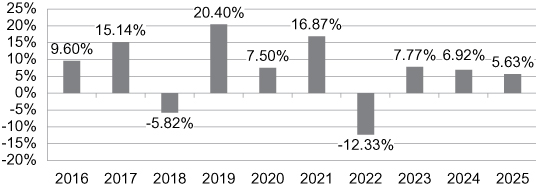
The bar chart and performance table below show the variability of the Portfolio's returns, which is some indication of the risks of investing in the Portfolio. The bar chart shows performance of the Portfolio's Class II shares for each full calendar year since the Portfolio's inception and the table shows how the average annual total returns of the Portfolio's Class II shares compared with the returns of two indexes. The S&P 500 Managed Risk Index – Moderate serves as the Portfolio's performance index because the Adviser believes it is more representative of the Portfolio's investment strategy. The S&P 500® Index serves as the Portfolio's regulatory index and provides a broad measure of market performance. The performance in the bar chart and the table does not include the effect of variable contract charges. If variable contract charges had been included, performance would have been lower. You should be aware that the Portfolio's past performance may not be an indication of how the Portfolio will perform in the future.
Prior to July 5, 2017, the fixed-income sleeve of the Capital Appreciation and Income Component of the Portfolio was managed by the Adviser without the use of a sub-adviser. The performance prior to that date is attributable to the Adviser's asset allocation decisions. The sub-adviser to the equity sleeve of the Capital Appreciation and Income Component of the Portfolio changed effective March 1, 2018 due to an organizational restructuring whereby all of the investment personnel responsible for the management of the equity sleeve transitioned from Franklin Advisory Services, LLC to Franklin Advisers.
|
Highest Quarter |
1st Quarter 2019 |
9.37% |
|||||||||
|
Lowest Quarter |
1st Quarter 2020 |
-11.38% |
|||||||||
|
One Year |
Five Years |
Ten Years |
|||||||||||||
|
Class II shares return before taxes |
5.63 |
% |
4.50 |
% |
6.72 |
% |
|||||||||
|
S&P 500 Managed Risk Index – Moderate (reflects no deduction for fees, expenses or taxes) |
7.47 |
% |
8.36 |
% |
8.78 |
% |
|||||||||
|
S&P 500® Index (reflects no deduction for fees, expenses or taxes) |
17.88 |
% |
14.42 |
% |
14.82 |
% |
|||||||||