Apr. 29, 2026
The Fund’s investment objective is to seek capital growth and income through investments in equity securities, including common stocks, preferred stocks and securities convertible into common and preferred stocks.
This table describes the fees and expenses that are incurred, directly or indirectly, when a variable product owner buys, holds, or redeems interest in an insurance company separate account that invests in the Series I shares or Series II shares of the Fund but does not represent the effect of any fees or other expenses assessed in connection with your variable product, and if it did, expenses would be higher.
| Shareholder Fees (fees paid directly from your investment) | ||
| | Series I shares | Series II shares |
| Maximum Sales Charge (Load) Imposed on Purchases (as a percentage of offering price) | None | None |
| | ||
| Maximum Deferred Sales Charge (Load) (as a percentage of original purchase price or redemption proceeds, whichever is less) | None | None |
| | ||
| Annual Fund Operating Expenses (expenses that you pay each year as a percentage of the value of your investment) | ||
| | Series I shares | Series II shares |
| Management Fees | 0.57 % | 0.57 % |
| | ||
| Distribution and/or Service (12b-1) Fees | None | 0.25 |
| | ||
| Other Expenses | 0.18 | 0.18 |
| | ||
| Total Annual Fund Operating Expenses | 0.75 | 1.00 |
| | ||
This Example is intended to help you compare the cost of investing in the Fund with the cost of investing in other mutual funds.
This Example does not represent the effect of any fees or expenses assessed in connection with your variable product, and if it did, expenses would be higher.
The Example assumes that you invest $10,000 in the Fund for the time periods indicated and then redeem all of your shares at the end of those periods. The Example also assumes that your investment has a 5% return each year and that the Fund’s operating expenses remain the same.
Although your actual costs may be higher or lower, based on these assumptions, your costs would be:
|
|
1 Year
|
3 Years
|
5 Years
|
10 Years
|
|
Series I shares
|
$77 |
$240 |
$417 |
$930 |
|
|
||||
|
Series II shares
|
$102 |
$318 |
$552 |
$1,225 |
|
|
||||
|
|
1 Year
|
3 Years
|
5 Years
|
10 Years
|
|
Series I shares
|
$77 |
$240 |
$417 |
$930 |
|
|
||||
|
Series II shares
|
$102 |
$318 |
$552 |
$1,225 |
|
|
||||
The Fund pays transaction costs, such as commissions, when it buys and sells securities (or “turns over” its portfolio). A higher portfolio turnover rate may indicate higher transaction costs. These costs, which are not reflected in annual fund operating expenses or in the Example, affect the Fund’s performance. During the most recent fiscal year, the Fund’s portfolio turnover rate was 20% of the average value of its portfolio.
The Fund invests, under normal circumstances, at least 80% of its net assets (plus any borrowings for investment purposes) in common stocks and in derivatives and other instruments that have economic characteristics similar to such securities.
The Fund may invest in securities of issuers of any market capitalization and at times might increase its emphasis on securities of issuers in a particular capitalization range. Under normal market conditions, it is currently expected that the Fund will invest a substantial percentage of its assets in large-capitalization issuers.
The Fund may invest up to 10% of its net assets in real estate investment trusts (REITs).
The Fund may invest up to 25% of its net assets in securities of foreign issuers, which may include securities of issuers located in emerging markets countries, i.e., those that are generally in the early stages of their industrial cycles, and depositary receipts.
The Fund can invest in derivative instruments, including forward foreign currency contracts and futures contracts. The Fund can use forward foreign currency contracts to seek to hedge against adverse movements in the foreign currencies in which portfolio securities are denominated. The Fund can use futures contracts, including index futures, to seek exposure to certain asset classes and to seek to hedge against adverse movements in the foreign currencies in which portfolio securities are denominated.
In selecting securities for investment, the portfolio managers focus primarily on a security’s potential for capital growth and income. The portfolio managers emphasize a value style of investing, seeking well-established, undervalued companies that have identifiable factors that might lead to improved valuations.
The portfolio managers will consider selling a security if it meets one or more of the following criteria: (1) the target price of the investment has been realized and the portfolio managers no longer consider the company undervalued, (2) a better value opportunity is identified, or (3) research shows that the company is experiencing deteriorating fundamentals beyond the portfolio managers’ tolerable level and the trend is likely to be a long-term issue.
The bar chart and performance table provide an indication of the risks of investing in the Fund. The bar chart shows changes in the performance of the Series I shares of the Fund from year to year as of December 31. The performance table compares the Fund's performance to that of a style-specific benchmark and a broad-based securities market benchmark (in that order). The bar chart and performance table below do not reflect charges assessed in connection with your variable product; if they did, the performance shown would be lower. The Fund's past performance is not necessarily an indication of its future performance.
Fund performance reflects any applicable fee waivers and expense reimbursements. Performance returns would be lower without applicable fee waivers and expense reimbursements.
All Fund performance shown assumes the reinvestment of dividends and capital gains and the effect of the Fund's expenses.
The Series I shares and Series II shares invest in the same portfolio of securities and will have substantially similar performance, except to the extent that the expenses borne by each share class differ. Series II shares have higher expenses (and therefore lower performance) resulting from its Rule 12b-1 plan, which provides for a maximum fee equal to an annual rate of 0.25% (expressed as a percentage of average daily net assets of the Fund).
Updated performance information is available on the Fund’s website at www.invesco.com/us.
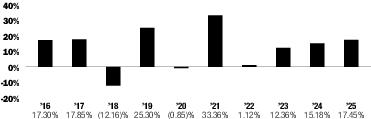
| Series I | Period Ended | Returns |
| Best Quarter | December 31, 2020 | 22.23% |
| Worst Quarter | March 31, 2020 | -32.40% |
| | Inception Date | 1 Year | 5 Years | 10 Years |
| Series I | 4/30/1999 | 17.45 % | 15.43 % | 11.95 % |
| | ||||
| Series II | 9/18/2000 | 17.14 | 15.14 | 11.67 |
| | ||||
| Russell 1000® Value Index (reflects no deduction for fees, expenses or taxes) | | 15.91 | 11.33 | 10.53 |
| | ||||
| S&P 500® Index (reflects no deduction for fees,expenses or taxes) | | 17.88 | 14.42 | 14.82 |
| | ||||