The Fund is an actively managed exchange-traded fund (“ETF”) that seeks to achieve its investment objective by investing substantially all of its assets in options on the S&P 500 Price Index. The Fund’s investment adviser, TrueMark Investments, LLC (the “Adviser”), employs a “buffer protect” options strategy that uses such options to seek to achieve exposure to the performance of the S&P 500 Price Index (before fees and expenses) while mitigating the first 8% to 12% decline (before fees and expenses) in the performance of the S&P 500 Price Index (the “Buffer”) over a 12-month period beginning on a specified day each January (each, a “Roll Date”). The period from one Roll Date to the next Roll Date is referred to as the “Investment Period,” and the first day of the Investment Period is referred to as the “Initial Investment Day.”
The Fund purchases call options and sell (write) put options on the S&P 500 Price Index or an ETF that seeks to track the performance of the S&P 500 Price Index (each, a “S&P 500 Price Index ETF”) on each Initial Investment Day with an expiration on the next Roll Date. An option gives the purchaser of the option the right to purchase (for a call option) or sell (for a put option) the reference asset (or deliver cash equal to the value of the reference asset) at a specified price (“strike price”). In the event the reference asset declines in value, the value of a put option generally will increase and the value of a call option generally will decrease and may become worthless. In the event the reference asset appreciates in value, the value of a put option generally will decrease and become worthless and the value of a call option generally will increase.
On each Initial Investment Day, the Fund will sell (write) put options on the S&P 500 Price Index or an ETF that tracks the S&P 500 Price Index with a strike price within a range of approximately 8% to 12% lower than the current value of the S&P 500 Price Index or a S&P 500 Price Index ETF. As the seller of these options, the Fund receives a premium from the buyer of the options, which the Fund invests in at-the-money call options on the S&P 500 Price Index or a S&P 500 Price Index ETF (i.e., call options having a strike price roughly equal to the current value of the S&P 500 Price Index or a S&P 500 Price Index ETF). The relative price of the put options sold (written) by the Fund to the price of the call options purchased by the Fund will determine the Fund’s exposure to the performance of the S&P 500 Price Index during the Investment Period. Due to the cost of the options used by the Fund, the correlation of the Fund’s performance to that of the S&P 500 Price Index is expected to be less than if the Fund invested directly in the constituents of the S&P 500 Price Index (i.e., without using options), and could be substantially less. This means that if the S&P 500 Price Index experiences gains for an Investment Period, the Fund may not realize gains to the same extent.
The Fund’s strategy also seeks to protect investors from a decline of up to 8% to 12% in the performance of the S&P 500 Price Index from one Roll Date to the next Roll Date. When the Adviser sells puts on the S&P 500 Price Index to create the buffer range, the proceeds are used to purchase calls at the money. However, not all puts generate the same premium relative to the downside exposure of the Fund. The Adviser seeks to deliver a buffer of 10% from the reference price of the S&P 500 Price Index on the first trading day of the month. However, the market could fluctuate on or after the buffer is set and this range allows for market condition volatility. The Fund is not designed to protect against declines of more than 8% to 12% in the performance of the S&P 500 Price Index, and there can be no guarantee that the Fund will be successful in implementing the buffer protect options strategy to protect against the first 8% to 12% decline. Additionally, even if the Fund mitigates a decline in the performance of the S&P 500 Price Index from one Roll Date to the next Roll Date, the Fund’s returns during the Investment Period (prior to the next Roll Date) may not reflect the buffer protect options strategy.
The Fund invests in either standardized exchange-listed options or in exchange-traded FLexible EXchange Options (“FLEX Options”). FLEX Options are customized exchange-traded option contracts available through the Chicago Board Option Exchange (“Cboe”) that are guaranteed for settlement by The Options Clearing Corporation (“OCC”). FLEX Options provide investors with the ability to customize exercise prices, exercise styles, and expiration dates, while achieving price discovery in competitive, transparent, auction markets and avoiding the counterparty exposure of over-the-counter (“OTC”) options positions. The Fund invests in European-style FLEX Options (i.e., they can only be exercised at the expiration date of the option) based on the performance of the S&P 500 Price Index or a S&P 500 Price Index ETF and which have an expiration date that is the last day of the Investment Period only. In general, the Fund invests, to the greatest extent possible, in FLEX Options, as these options provide the best combination of OCC guarantees, price discovery, customization, and European-style settlement that is ideal for the Fund. However, the Fund may use listed options to provide an additional source of desired market exposure when the Adviser believes doing so will be beneficial to the Fund. The Fund also invests in U.S. Treasury bonds or money market funds that invest in U.S. Treasury bonds.
The Fund is designed to provide the outcomes below (before fees and expenses) during each individual Investment Period. The outcomes would be lower if the fees and expenses were included.
| Change in the Returns of the S&P 500 Price Index | Expected Change in the Returns of the Fund |
| Declines between -8% and -12% (or more) | Declines 8% to 12% percentage points less than the S&P 500 Price Index (e.g., if the S&P 500 Price Index returns -35%, the Fund is designed to return -23% to -27%) |
| Declines between 0% and -8% | No change |
| Appreciates | The Fund’s returns will appreciate to a similar extent as the S&P 500 Price Index |
The charts below illustrate the hypothetical returns that the Fund seeks to provide in certain illustrative scenarios for a shareholder that purchases Shares on the Initial Investment Day and holds such Shares for the entire Investment Period. These charts do not take into account payment by the Fund of Total Annual Fund Operating Expenses and assume a buffer of 10%. There is no guarantee that the Fund will be successful in providing these investment outcomes for any Investment Period.
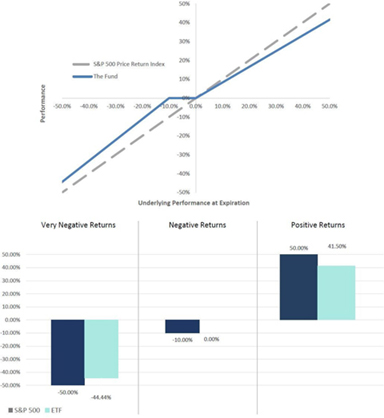
The Fund includes a mix of purchased and written (sold) put and call options structured to seek to achieve the results described above. The Fund seeks to achieve the results described above for investments made on the Initial Investment Day and held until the last day of the Investment Period. Investments made on any day other than the Initial Investment Day may differ significantly, positively or negatively, from the results described above. The Fund’s website, www.true-shares.com, contains information about the Fund’s holdings, and the performance of the S&P 500 Price Index as of the Initial Investment Day and the prior business day to assist an investor in understanding the range of results such investor can expect for investments made at times other than on the Initial Investment Day.
Additionally, the Fund’s website provides information relating to the returns of the Fund, including the Fund’s Buffer and its position relative to the performance of the S&P 500 Price Index on a daily basis.
The Fund’s operations are continuous. It will not terminate and distribute its assets at the conclusion of an Investment Period. On each Roll Date, another Investment Period will commence and the Fund will invest in a new set of options.
The Fund is an actively managed exchange-traded fund (“ETF”) that seeks to achieve its investment objective by investing substantially all of its assets in options on the S&P 500 Price Index. The Fund’s investment adviser, TrueMark Investments, LLC (the “Adviser”), employs a “buffer protect” options strategy that uses such options to seek to achieve exposure to the performance of the S&P 500 Price Index (before fees and expenses) while mitigating the first 8% to 12% decline (before fees and expenses) in the performance of the S&P 500 Price Index (the “Buffer”) over a 12-month period beginning on a specified day each February (each, a “Roll Date”). The period from one Roll Date to the next Roll Date is referred to as the “Investment Period,” and the first day of the Investment Period is referred to as the “Initial Investment Day.”
The Fund purchases call options and sell (write) put options on the S&P 500 Price Index or an ETF that seeks to track the performance of the S&P 500 Price Index (each, a “S&P 500 Price Index ETF”) on each Initial Investment Day with an expiration on the next Roll Date. An option gives the purchaser of the option the right to purchase (for a call option) or sell (for a put option) the reference asset (or deliver cash equal to the value of the reference asset) at a specified price (“strike price”). In the event the reference asset declines in value, the value of a put option generally will increase and the value of a call option generally will decrease and may become worthless. In the event the reference asset appreciates in value, the value of a put option generally will decrease and become worthless and the value of a call option generally will increase.
On each Initial Investment Day, the Fund will sell (write) put options on the S&P 500 Price Index or an ETF that tracks the S&P 500 Price Index with a strike price within a range of approximately 8% to 12% lower than the current value of the S&P 500 Price Index or a S&P 500 Price Index ETF. As the seller of these options, the Fund receives a premium from the buyer of the options, which the Fund invests in at-the-money call options on the S&P 500 Price Index or a S&P 500 Price Index ETF (i.e., call options having a strike price roughly equal to the current value of the S&P 500 Price Index or a S&P 500 Price Index ETF). The relative price of the put options sold (written) by the Fund to the price of the call options purchased by the Fund will determine the Fund’s exposure to the performance of the S&P 500 Price Index during the Investment Period. Due to the cost of the options used by the Fund, the correlation of the Fund’s performance to that of the S&P 500 Price Index is expected to be less than if the Fund invested directly in the constituents of the S&P 500 Price Index (i.e., without using options), and could be substantially less. This means that if the S&P 500 Price Index experiences gains for an Investment Period, the Fund may not realize gains to the same extent.
The Fund’s strategy also seeks to protect investors from a decline of up to 8% to 12% in the performance of the S&P 500 Price Index from one Roll Date to the next Roll Date. When the Adviser sells puts on the S&P 500 Price Index to create the buffer range, the proceeds are used to purchase calls at the money. However, not all puts generate the same premium relative to the downside exposure of the Fund. The Adviser seeks to deliver a buffer of 10% from the reference price of the S&P 500 Price Index on the first trading day of the month. However, the market could fluctuate on or after the buffer is set and this range allows for market condition volatility. The Fund is not designed to protect against declines of more than 8% to 12% in the performance of the S&P 500 Price Index, and there can be no guarantee that the Fund will be successful in implementing the buffer protect options strategy to protect against the first 8% to 12% decline. Additionally, even if the Fund mitigates a decline in the performance of the S&P 500 Price Index from one Roll Date to the next Roll Date, the Fund’s returns during the Investment Period (prior to the next Roll Date) may not reflect the buffer protect options strategy.
The Fund invests in either standardized exchange-listed options or in exchange-traded FLexible EXchange Options (“FLEX Options”). FLEX Options are customized exchange-traded option contracts available through the Chicago Board Option Exchange (“Cboe”) that are guaranteed for settlement by The Options Clearing Corporation (“OCC”). FLEX Options provide investors with the ability to customize exercise prices, exercise styles, and expiration dates, while achieving price discovery in competitive, transparent, auction markets and avoiding the counterparty exposure of over-the-counter (“OTC”) options positions. The Fund invests in European-style FLEX Options (i.e., they can only be exercised at the expiration date of the option) based on the performance of the S&P 500 Price Index or a S&P 500 Price Index ETF and which have an expiration date that is the last day of the Investment Period only. In general, the Fund invests, to the greatest extent possible, in FLEX Options, as these options provide the best combination of OCC guarantees, price discovery, customization, and European-style settlement that is ideal for the Fund. However, the Fund may use listed options to provide an additional source of desired market exposure when the Adviser believes doing so will be beneficial to the Fund. The Fund also to invests in U.S. Treasury bonds or money market funds that invest in U.S. Treasury bonds.
The Fund is designed to provide the outcomes below (before fees and expenses) during each individual Investment Period. The outcomes would be lower if the fees and expenses were included.
| Change in the Returns of the S&P 500 Price Index | Expected Change in the Returns of the Fund |
| Declines between -8% and -12% (or more) | Declines 8% to 12% percentage points less than the S&P 500 Price Index (e.g., if the S&P 500 Price Index returns -35%, the Fund is designed to return -23% to -27%) |
| Declines between 0% and -8% | No change |
| Appreciates | The Fund’s returns will appreciate to a similar extent as the S&P 500 Price Index |
The charts below illustrate the hypothetical returns that the Fund seeks to provide in certain illustrative scenarios for a shareholder that purchases Shares on the Initial Investment Day and holds such Shares for the entire Investment Period. These charts do not take into account payment by the Fund of Total Annual Fund Operating Expenses and assume a buffer of 10%. There is no guarantee that the Fund will be successful in providing these investment outcomes for any Investment Period.
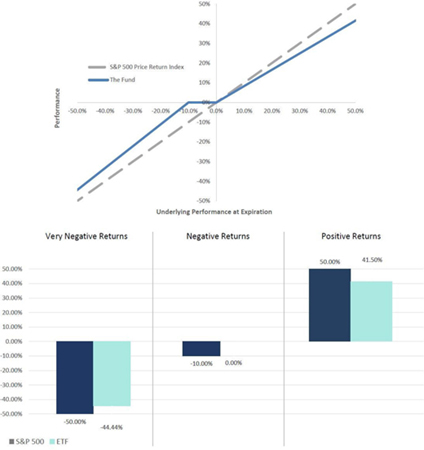
The Fund includes a mix of purchased and written (sold) put and call options structured to seek to achieve the results described above. The Fund seeks to achieve the results described above for investments made on the Initial Investment Day and held until the last day of the Investment Period. Investments made on any day other than the Initial Investment Day may differ significantly, positively or negatively, from the results described above. The Fund’s website, www.true-shares.com, contains information about the Fund’s holdings, and the performance of the S&P 500 Price Index as of the Initial Investment Day and the prior business day to assist an investor in understanding the range of results such investor can expect for investments made at times other than on the Initial Investment Day. Additionally, the Fund’s website provides information relating to the returns of the Fund, including the Fund’s Buffer and its position relative to the performance of the S&P 500 Price Index on a daily basis.
The Fund’s operations are continuous. It will not terminate and distribute its assets at the conclusion of an Investment Period. On each Roll Date, another Investment Period will commence and the Fund will invest in a new set of options.
The Fund is an actively managed exchange-traded fund (“ETF”) that seeks to achieve its investment objective by investing substantially all of its assets in options on the S&P 500 Price Index. The Fund’s investment adviser, TrueMark Investments, LLC (the “Adviser”), employs a “buffer protect” options strategy that uses such options to seek to achieve exposure to the performance of the S&P 500 Price Index (before fees and expenses) while mitigating the first 8% to 12% decline (before fees and expenses) in the performance of the S&P 500 Price Index (the “Buffer”) over a 12-month period beginning on a specified day each March (each, a “Roll Date”). The period from one Roll Date to the next Roll Date is referred to as the “Investment Period,” and the first day of the Investment Period is referred to as the “Initial Investment Day.”
The Fund purchases call options and sell (write) put options on the S&P 500 Price Index or an ETF that seeks to track the performance of the S&P 500 Price Index (each, a “S&P 500 Price Index ETF”) on each Initial Investment Day with an expiration on the next Roll Date. An option gives the purchaser of the option the right to purchase (for a call option) or sell (for a put option) the reference asset (or deliver cash equal to the value of the reference asset) at a specified price (“strike price”). In the event the reference asset declines in value, the value of a put option generally will increase and the value of a call option generally will decrease and may become worthless. In the event the reference asset appreciates in value, the value of a put option generally will decrease and become worthless and the value of a call option generally will increase.
On each Initial Investment Day, the Fund will sell (write) put options on the S&P 500 Price Index or an ETF that tracks the S&P 500 Price Index with a strike price within a range of approximately 8% to 12% lower than the current value of the S&P 500 Price Index or a S&P 500 Price Index ETF. As the seller of these options, the Fund receives a premium from the buyer of the options, which the Fund invests in at-the-money call options on the S&P 500 Price Index or a S&P 500 Price Index ETF (i.e., call options having a strike price roughly equal to the current value of the S&P 500 Price Index or a S&P 500 Price Index ETF). The relative price of the put options sold (written) by the Fund to the price of the call options purchased by the Fund will determine the Fund’s exposure to the performance of the S&P 500 Price Index during the Investment Period. Due to the cost of the options used by the Fund and fees and expenses of investing in an S&P 500 Price Index ETF, the correlation of the Fund’s performance to that of the S&P 500 Price Index is expected to be less than if the Fund invested directly in the constituents of the S&P 500 Price Index (i.e., without using options or investing indirectly through an ETF), and could be substantially less. This means that if the S&P 500 Price Index experiences gains for an Investment Period, the Fund may not realize gains to the same extent.
The Fund’s strategy also seeks to protect Investors from a decline of up to 8% to 12% in the performance of the S&P 500 Price Index from one Roll Date to the next Roll Date. When the Adviser sells puts on the S&P 500 Price Index to create the buffer range, the proceeds are used to purchase calls at the money. However, not all puts generate the same premium relative to the downside exposure of the Fund. The Adviser seeks to deliver a buffer of 10% from the reference price of the S&P 500 Price Index on the first trading day of the month. However, the market could fluctuate on or after the buffer is set and this range allows for market condition volatility. The Fund is not designed to protect against declines of more than 8% to 12% in the performance of the S&P 500 Price Index, and there can be no guarantee that the Fund will be successful in implementing the buffer protect options strategy to protect against the first 8% to 12% decline. Additionally, even if the Fund mitigates a decline in the performance of the S&P 500 Price Index from one Roll Date to the next Roll Date, the Fund’s returns during the Investment Period (prior to the next Roll Date) may not reflect the buffer protect options strategy.
The Fund invests in either standardized exchange-listed options or in exchange-traded Flexible Exchange Options (“FLEX Options”). FLEX Options are customized exchange-traded option contracts available through the Chicago Board Option Exchange (“Cboe”) that are guaranteed for settlement by The Options Clearing Corporation (“OCC”). FLEX Options provide investors with the ability to customize exercise prices, exercise styles, and expiration dates, while achieving price discovery in competitive, transparent, auction markets and avoiding the counterparty exposure of over-the-counter (“OTC”) options positions. The Fund will invest in European-style FLEX Options (i.e., they can only be exercised at the expiration date of the option) based on the performance of the S&P 500 Price Index or a S&P 500 Price Index ETF and which have an expiration date that is the last day of the Investment Period only. In general, the Fund to invests, to the greatest extent possible, in FLEX Options, as these options provide the best combination of OCC guarantees, price discovery, customization, and European-style settlement that is ideal for the Fund. However, the Fund may use listed options to provide an additional source of desired market exposure when the Adviser believes doing so will be beneficial to the Fund. The Fund also invests in U.S. Treasury bonds or money market funds that invest in U.S. Treasury bonds.
The Fund is designed to provide the outcomes below (before fees and expenses) during each individual Investment Period. The outcomes would be lower if the fees and expenses were included.
| Change in the Returns of the S&P 500 Price Index | Expected Change in the Returns of the Fund |
| Declines between -8% and -12% (or more) | Declines 8% to 12% percentage points less than the S&P 500 Price Index (e.g., if the S&P 500 Price Index returns -35%, the Fund is designed to return -23% to -27%) |
| Declines between 0% and -8% | No change |
| Appreciates | The Fund’s returns will appreciate to a similar extent as the S&P 500 Price Index |
The charts below illustrate the hypothetical returns that the Fund seeks to provide in certain illustrative scenarios for a shareholder that purchases Shares on the Initial Investment Day and holds such Shares for the entire Investment Period. These charts do not take into account payment by the Fund of Total Annual Fund Operating Expenses and assume a buffer of 10%. There is no guarantee that the Fund will be successful in providing these investment outcomes for any Investment Period.
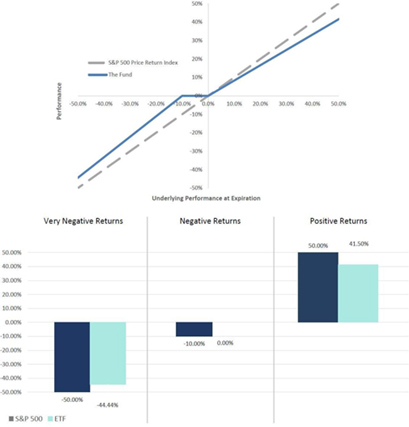
The Fund includes a mix of purchased and written (sold) put and call options structured to seek to achieve the results described above. The Fund seeks to achieve the results described above for investments made on the Initial Investment Day and held until the last day of the Investment Period. Investments made on any day other than the Initial Investment Day may differ significantly, positively or negatively, from the results described above. The Fund’s website, www.true-shares.com, contains information about the Fund’s holdings, and the performance of the S&P 500 Price Index as of the Initial Investment Day and the prior business day to assist an investor in understanding the range of results such investor can expect for investments made at times other than on the Initial Investment Day.
Additionally, the Fund’s website provides information relating to the returns of the Fund, including the Fund’s Buffer and its position relative to the performance of the S&P 500 Price Index on a daily basis.
The Fund’s operations are continuous. It will not terminate and distribute its assets at the conclusion of an Investment Period. On each Roll Date, another Investment Period will commence and the Fund will invest in a new set of options.
The Fund is an actively managed exchange-traded fund (“ETF”) that seeks to achieve its investment objective by investing substantially all of its assets in options on the S&P 500 Price Index. The Fund’s investment adviser, TrueMark Investments, LLC (the “Adviser”), employs a “buffer protect” options strategy that uses such options to seek to achieve exposure to the performance of the S&P 500 Price Index (before fees and expenses) while mitigating the first 8% to 12% decline (before fees and expenses) in the performance of the S&P 500 Price Index (the “Buffer”) over a 12-month period beginning on a specified day each April (each, a “Roll Date”). The period from one Roll Date to the next Roll Date is referred to as the “Investment Period,” and the first day of the Investment Period is referred to as the “Initial Investment Day.”
The Fund purchases call options and sell (write) put options on the S&P 500 Price Index or an ETF that seeks to track the performance of the S&P 500 Price Index (each, a “S&P 500 Price Index ETF”) on each Initial Investment Day with an expiration on the next Roll Date. An option gives the purchaser of the option the right to purchase (for a call option) or sell (for a put option) the reference asset (or deliver cash equal to the value of the reference asset) at a specified price (“strike price”). In the event the reference asset declines in value, the value of a put option generally will increase and the value of a call option generally will decrease and may become worthless. In the event the reference asset appreciates in value, the value of a put option generally will decrease and become worthless and the value of a call option generally will increase.
On each Initial Investment Day, the Fund will sell (write) put options on the S&P 500 Price Index or an ETF that tracks the S&P 500 Price Index with a strike price within a range of approximately 8% to 12% lower than the current value of the S&P 500 Price Index or a S&P 500 Price Index ETF. As the seller of these options, the Fund receives a premium from the buyer of the options, which the Fund invests in at-the-money call options on the S&P 500 Price Index or a S&P 500 Price Index ETF (i.e., call options having a strike price roughly equal to the current value of the S&P 500 Price Index or a S&P 500 Price Index ETF). The relative price of the put options sold (written) by the Fund to the price of the call options purchased by the Fund will determine the Fund’s exposure to the performance of the S&P 500 Price Index during the Investment Period. Due to the cost of the options used by the Fund, the correlation of the Fund’s performance to that of the S&P 500 Price Index is expected to be less than if the Fund invested directly in the constituents of the S&P 500 Price Index (i.e., without using options), and could be substantially less. This means that if the S&P 500 Price Index experiences gains for an Investment Period, the Fund may not realize gains to the same extent.
The Fund’s strategy also seeks to protect investors from a decline of up to 8% to 12% in the performance of the S&P 500 Price Index from one Roll Date to the next Roll Date. When the Adviser sells puts on the S&P 500 Price Index to create the buffer range, the proceeds are used to purchase calls at the money. However, not all puts generate the same premium relative to the downside exposure of the Fund. The Adviser seeks to deliver a buffer of 10% from the reference price of the S&P 500 Price Index on the first trading day of the month. However, the market could fluctuate on or after the buffer is set and this range allows for market condition volatility. The Fund is not designed to protect against declines of more than 8% to 12% in the performance of the S&P 500 Price Index, and there can be no guarantee that the Fund will be successful in implementing the buffer protect options strategy to protect against the first 8% to 12% decline. Additionally, even if the Fund mitigates a decline in the performance of the S&P 500 Price Index from one Roll Date to the next Roll Date, the Fund’s returns during the Investment Period (prior to the next Roll Date) may not reflect the buffer protect options strategy.
The Fund invests in either standardized exchange-listed options or in exchange-traded FLexible EXchange Options (“FLEX Options”). FLEX Options are customized exchange-traded option contracts available through the Chicago Board Option Exchange (“Cboe”) that are guaranteed for settlement by The Options Clearing Corporation (“OCC”). FLEX Options provide investors with the ability to customize exercise prices, exercise styles, and expiration dates, while achieving price discovery in competitive, transparent, auction markets and avoiding the counterparty exposure of over-the-counter (“OTC”) options positions. The Fund invests in European-style FLEX Options (i.e., they can only be exercised at the expiration date of the option) based on the performance of the S&P 500 Price Index or a S&P 500 Price Index ETF and which have an expiration date that is the last day of the Investment Period only. In general, the Fund to invests, to the greatest extent possible, in FLEX Options, as these options provide the best combination of OCC guarantees, price discovery, customization, and European-style settlement that is ideal for the Fund. However, the Fund may use listed options to provide an additional source of desired market exposure when the Adviser believes doing so will be beneficial to the Fund. The Fund also invests in U.S. Treasury bonds or money market funds that invest in U.S. Treasury bonds.
The Fund is designed to provide the outcomes below (before fees and expenses) during each individual Investment Period. The outcomes would be lower if the fees and expenses were included.
| Change in the Returns of the S&P 500 Price Index | Expected Change in the Returns of the Fund |
| Declines between -8% and -12% (or more) | Declines 8% to 12% percentage points less than the S&P 500 Price Index (e.g., if the S&P 500 Price Index returns -35%, the Fund is designed to return -23% to -27%) |
| Declines between 0% and -8% | No change |
| Appreciates | The Fund’s returns will appreciate to a similar extent as the S&P 500 Price Index |
The charts below illustrate the hypothetical returns that the Fund seeks to provide in certain illustrative scenarios for a shareholder that purchases Shares on the Initial Investment Day and holds such Shares for the entire Investment Period. These charts do not take into account payment by the Fund of Total Annual Fund Operating Expenses and assume a buffer of 10%. There is no guarantee that the Fund will be successful in providing these investment outcomes for any Investment Period.
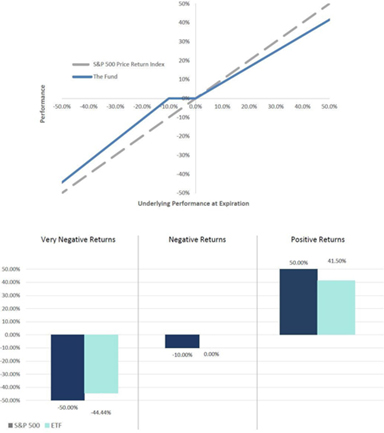
The Fund includes a mix of purchased and written (sold) put and call options structured to seek to achieve the results described above. The Fund seeks to achieve the results described above for investments made on the Initial Investment Day and held until the last day of the Investment Period. Investments made on any day other than the Initial Investment Day may differ significantly, positively or negatively, from the results described above. The Fund’s website, www.true-shares.com, contains information about the Fund’s holdings, and the performance of the S&P 500 Price Index as of the Initial Investment Day and the prior business day to assist an investor in understanding the range of results such investor can expect for investments made at times other than on the Initial Investment Day.
Additionally, the Fund’s website provides information relating to the returns of the Fund, including the Fund’s Buffer and its position relative to the performance of the S&P 500 Price Index on a daily basis.
The Fund’s operations are continuous. It will not terminate and distribute its assets at the conclusion of an Investment Period. On each Roll Date, another Investment Period will commence and the Fund will invest in a new set of options.
The Fund is an actively managed exchange-traded fund (“ETF”) that seeks to achieve its investment objective by investing substantially all of its assets in options on the S&P 500 Price Index. The Fund’s investment adviser, TrueMark Investments, LLC (the “Adviser”), employs a “buffer protect” options strategy that uses such options to seek to achieve exposure to the performance of the S&P 500 Price Index (before fees and expenses) while mitigating the first 8% to 12% decline (before fees and expenses) in the performance of the S&P 500 Price Index (the “Buffer”) over a 12-month period beginning on a specified day each May (each, a “Roll Date”). The period from one Roll Date to the next Roll Date is referred to as the “Investment Period,” and the first day of the Investment Period is referred to as the “Initial Investment Day.”
The Fund purchases call options and sell (write) put options on the S&P 500 Price Index or an ETF that seeks to track the performance of the S&P 500 Price Index (each, a “S&P 500 Price Index ETF”) on each Initial Investment Day with an expiration on the next Roll Date. An option gives the purchaser of the option the right to purchase (for a call option) or sell (for a put option) the reference asset (or deliver cash equal to the value of the reference asset) at a specified price (“strike price”). In the event the reference asset declines in value, the value of a put option generally will increase and the value of a call option generally will decrease and may become worthless. In the event the reference asset appreciates in value, the value of a put option generally will decrease and become worthless and the value of a call option generally will increase.
On each Initial Investment Day, the Fund will sell (write) put options on the S&P 500 Price Index or an ETF that tracks the S&P 500 Price Index with a strike price within a range of approximately 8% to 12% lower than the current value of the S&P 500 Price Index or a S&P 500 Price Index ETF. As the seller of these options, the Fund receives a premium from the buyer of the options, which the Fund invests in at-the-money call options on the S&P 500 Price Index or a S&P 500 Price Index ETF (i.e., call options having a strike price roughly equal to the current value of the S&P 500 Price Index or a S&P 500 Price Index ETF). The relative price of the put options sold (written) by the Fund to the price of the call options purchased by the Fund will determine the Fund’s exposure to the performance of the S&P 500 Price Index during the Investment Period. Due to the cost of the options used by the Fund, the correlation of the Fund’s performance to that of the S&P 500 Price Index is expected to be less than if the Fund invested directly in the constituents of the S&P 500 Price Index (i.e., without using options), and could be substantially less. This means that if the S&P 500 Price Index experiences gains for an Investment Period, the Fund may not realize gains to the same extent.
The Fund’s strategy also seeks to protect Investors from a decline of up to 8% to 12% in the performance of the S&P 500 Price Index from one Roll Date to the next Roll Date. When the Adviser sells puts on the S&P 500 Price Index to create the buffer range, the proceeds are used to purchase calls at the money. However, not all puts generate the same premium relative to the downside exposure of the Fund. The Adviser seeks to deliver a buffer of 10% from the reference price of the S&P 500 Price Index on the first trading day of the month. However, the market could fluctuate on or after the buffer is set and this range allows for market condition volatility. The Fund is not designed to protect against declines of more than 8% to 12% in the performance of the S&P 500 Price Index, and there can be no guarantee that the Fund will be successful in implementing the buffer protect options strategy to protect against the first 8% to 12% decline. Additionally, even if the Fund mitigates a decline in the performance of the S&P 500 Price Index from one Roll Date to the next Roll Date, the Fund’s returns during the Investment Period (prior to the next Roll Date) may not reflect the buffer protect options strategy.
The Fund invests in either standardized exchange-listed options or in exchange-traded Flexible Exchange Options (“FLEX Options”). FLEX Options are customized exchange-traded option contracts available through the Chicago Board Option Exchange (“Cboe”) that are guaranteed for settlement by The Options Clearing Corporation (“OCC”). FLEX Options provide investors with the ability to customize exercise prices, exercise styles, and expiration dates, while achieving price discovery in competitive, transparent, auction markets and avoiding the counterparty exposure of over-the-counter (“OTC”) options positions. The Fund invests in European-style FLEX Options (i.e., they can only be exercised at the expiration date of the option) based on the performance of the S&P 500 Price Index or a S&P 500 Price Index ETF and which have an expiration date that is the last day of the Investment Period only. In general, the Fund to invests, to the greatest extent possible, in FLEX Options, as these options provide the best combination of OCC guarantees, price discovery, customization, and European-style settlement that is ideal for the Fund. However, the Fund may use listed options to provide an additional source of desired market exposure when the Adviser believes doing so will be beneficial to the Fund. The Fund also to invests in U.S. Treasury bonds or money market funds that invest in U.S. Treasury bonds.
The Fund is designed to provide the outcomes below (before fees and expenses) during each individual Investment Period. The outcomes would be lower if the fees and expenses were included.
| Change in the Returns of the S&P 500 Price Index | Expected Change in the Returns of the Fund |
| Declines between -8% and -12% (or more) | Declines 8% to 12% percentage points less than the S&P 500 Price Index (e.g., if the S&P 500 Price Index returns -35%, the Fund is designed to return -23% to -27%) |
| Declines between 0% and -8% | No change |
| Appreciates | The Fund’s returns will appreciate to a similar extent as the S&P 500 Price Index |
The charts below illustrate the hypothetical returns that the Fund seeks to provide in certain illustrative scenarios for a shareholder that purchases Shares on the Initial Investment Day and holds such Shares for the entire Investment Period. These charts do not take into account payment by the Fund of Total Annual Fund Operating Expenses and assume a buffer of 10%. There is no guarantee that the Fund will be successful in providing these investment outcomes for any Investment Period.
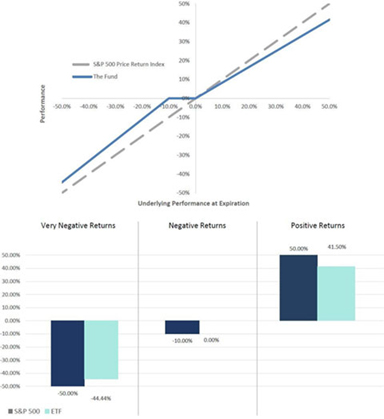
The Fund includes a mix of purchased and written (sold) put and call options structured to seek to achieve the results described above. The seeks to achieve the results described above for investments made on the Initial Investment Day and held until the last day of the Investment Period. Investments made on any day other than the Initial Investment Day may differ significantly, positively or negatively, from the results described above. The Fund’s website, www.true-shares.com, contains information about the Fund’s holdings, and the performance of the S&P 500 Price Index as of the Initial Investment Day and the prior business day to assist an investor in understanding the range of results such investor can expect for investments made at times other than on the Initial Investment Day.
Additionally, the Fund’s website provides information relating to the returns of the Fund, including the Fund’s Buffer and its position relative to the performance of the S&P 500 Price Index on a daily basis.
The Fund’s operations are continuous. It will not terminate and distribute its assets at the conclusion of an Investment Period. On each Roll Date, another Investment Period will commence and the Fund will invest in a new set of options.
The Fund is an actively managed exchange-traded fund (“ETF”) that seeks to achieve its investment objective by investing substantially all of its assets in options on the S&P 500 Price Index. The Fund’s investment adviser, TrueMark Investments, LLC (the “Adviser”), employs a “buffer protect” options strategy that uses such options to seek to achieve exposure to the performance of the S&P 500 Price Index (before fees and expenses) while mitigating the first 8% to 12% decline (before fees and expenses) in the performance of the S&P 500 Price Index (the “Buffer”) over a 12-month period beginning on a specified day each June (each, a “Roll Date”). The period from one Roll Date to the next Roll Date is referred to as the “Investment Period,” and the first day of the Investment Period is referred to as the “Initial Investment Day.”
The Fund purchases call options and sell (write) put options on the S&P 500 Price Index or an ETF that seeks to track the performance of the S&P 500 Price Index (each, a “S&P 500 Price Index ETF”) on each Initial Investment Day with an expiration on the next Roll Date. An option gives the purchaser of the option the right to purchase (for a call option) or sell (for a put option) the reference asset (or deliver cash equal to the value of the reference asset) at a specified price (“strike price”). In the event the reference asset declines in value, the value of a put option generally will increase and the value of a call option generally will decrease and may become worthless. In the event the reference asset appreciates in value, the value of a put option generally will decrease and become worthless and the value of a call option generally will increase.
On each Initial Investment Day, the Fund will sell (write) put options on the S&P 500 Price Index or an ETF that tracks the S&P 500 Price Index with a strike price within a range of approximately 8% to 12% lower than the current value of the S&P 500 Price Index or a S&P 500 Price Index ETF. As the seller of these options, the Fund receives a premium from the buyer of the options, which the Fund invests in at-the-money call options on the S&P 500 Price Index or a S&P 500 Price Index ETF (i.e., call options having a strike price roughly equal to the current value of the S&P 500 Price Index or a S&P 500 Price Index ETF). The relative price of the put options sold (written) by the Fund to the price of the call options purchased by the Fund will determine the Fund’s exposure to the performance of the S&P 500 Price Index during the Investment Period. Due to the cost of the options used by the Fund, the correlation of the Fund’s performance to that of the S&P 500 Price Index is expected to be less than if the Fund invested directly in the constituents of the S&P 500 Price Index (i.e., without using options), and could be substantially less. This means that if the S&P 500 Price Index experiences gains for an Investment Period, the Fund may not realize gains to the same extent.
The Fund’s strategy also seeks to protect investors from a decline of up to 8% to 12% in the performance of the S&P 500 Price Index from one Roll Date to the next Roll Date. When the Adviser sells puts on the S&P 500 Price Index to create the buffer range, the proceeds are used to purchase calls at the money. However, not all puts generate the same premium relative to the downside exposure of the Fund. The Adviser seeks to deliver a buffer of 10% from the reference price of the S&P 500 Price Index on the first trading day of the month. However, the market could fluctuate on or after the buffer is set and this range allows for market condition volatility. The Fund is not designed to protect against declines of more than 8% to 12% in the performance of the S&P 500 Price Index, and there can be no guarantee that the Fund will be successful in implementing the buffer protect options strategy to protect against the first 8% to 12% decline. Additionally, even if the Fund mitigates a decline in the performance of the S&P 500 Price Index from one Roll Date to the next Roll Date, the Fund’s returns during the Investment Period (prior to the next Roll Date) may not reflect the buffer protect options strategy.
The Fund invests in either standardized exchange-listed options or in exchange-traded FLexible EXchange Options (“FLEX Options”). FLEX Options are customized exchange-traded option contracts available through the Chicago Board Option Exchange (“Cboe”) that are guaranteed for settlement by The Options Clearing Corporation (“OCC”). FLEX Options provide investors with the ability to customize exercise prices, exercise styles, and expiration dates, while achieving price discovery in competitive, transparent, auction markets and avoiding the counterparty exposure of over-the-counter (“OTC”) options positions. The Fund invests in European-style FLEX Options (i.e., they can only be exercised at the expiration date of the option) based on the performance of the S&P 500 Price Index or a S&P 500 Price Index ETF and which have an expiration date that is the last day of the Investment Period only. In general, the Fund invests, to the greatest extent possible, in FLEX Options, as these options provide the best combination of OCC guarantees, price discovery, customization, and European-style settlement that is ideal for the Fund. However, the Fund may use listed options to provide an additional source of desired market exposure when the Adviser believes doing so will be beneficial to the Fund. The Fund also invests in U.S. Treasury bonds or money market funds that invest in U.S. Treasury bonds.
The Fund is designed to provide the outcomes below (before fees and expenses) during each individual Investment Period. The outcomes would be lower if the fees and expenses were included.
| Change in the Returns of the S&P 500 Price Index | Expected Change in the Returns of the Fund |
| Declines between -8% and -12% (or more) | Declines 8% to 12% percentage points less than the S&P 500 Price Index (e.g., if the S&P 500 Price Index returns -35%, the Fund is designed to return -23% to -27%) |
| Declines between 0% and -8% | No change |
| Appreciates | The Fund’s returns will appreciate to a similar extent as the S&P 500 Price Index |
The charts below illustrate the hypothetical returns that the Fund seeks to provide in certain illustrative scenarios for a shareholder that purchases Shares on the Initial Investment Day and holds such Shares for the entire Investment Period. These charts do not take into account payment by the Fund of Total Annual Fund Operating Expenses and assume a buffer of 10%. There is no guarantee that the Fund will be successful in providing these investment outcomes for any Investment Period.
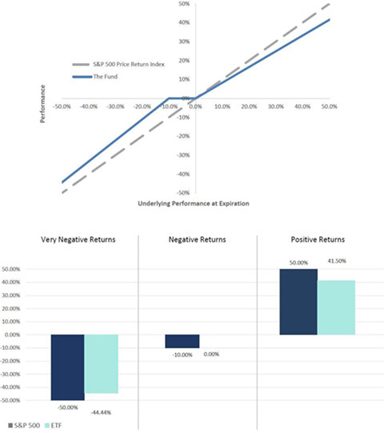
The Fund includes a mix of purchased and written (sold) put and call options structured to seek to achieve the results described above. The Fund seeks to achieve the results described above for investments made on the Initial Investment Day and held until the last day of the Investment Period. Investments made on any day other than the Initial Investment Day may differ significantly, positively or negatively, from the results described above. The Fund’s website, www.true-shares.com, contains information about the Fund’s holdings, and the performance of the S&P 500 Price Index as of the Initial Investment Day and the prior business day to assist an investor in understanding the range of results such investor can expect for investments made at times other than on the Initial Investment Day.
Additionally, the Fund’s website provides information relating to the returns of the Fund, including the Fund’s Buffer and its position relative to the performance of the S&P 500 Price Index on a daily basis.
The Fund’s operations are continuous. It will not terminate and distribute its assets at the conclusion of an Investment Period. On each Roll Date, another Investment Period will commence and the Fund will invest in a new set of options.
The Fund is an actively managed exchange-traded fund (“ETF”) that seeks to achieve its investment objective by investing substantially all of its assets in options on the S&P 500 Price Index. The Fund’s investment adviser, TrueMark Investments, LLC (the “Adviser”), employs a “buffer protect” options strategy that uses such options to seek to achieve exposure to the performance of the S&P 500 Price Index (before fees and expenses) while mitigating the first 8% to 12% decline (before fees and expenses) in the performance of the S&P 500 Price Index (the “Buffer”) over a 12-month period beginning on a specified day each July (each, a “Roll Date”). The period from one Roll Date to the next Roll Date is referred to as the “Investment Period,” and the first day of the Investment Period is referred to as the “Initial Investment Day.”
The Fund purchases call options and sell (write) put options on the S&P 500 Price Index or an ETF that seeks to track the performance of the S&P 500 Price Index (each, a “S&P 500 Price Index ETF”) on each Initial Investment Day with an expiration on the next Roll Date. An option gives the purchaser of the option the right to purchase (for a call option) or sell (for a put option) the reference asset (or deliver cash equal to the value of the reference asset) at a specified price (“strike price”). In the event the reference asset declines in value, the value of a put option generally will increase and the value of a call option generally will decrease and may become worthless. In the event the reference asset appreciates in value, the value of a put option generally will decrease and become worthless and the value of a call option generally will increase.
On each Initial Investment Day, the Fund will sell (write) put options on the S&P 500 Price Index or an ETF that tracks the S&P 500 Price Index with a strike price within a range of approximately 8% to 12% lower than the current value of the S&P 500 Price Index or a S&P 500 Price Index ETF. As the seller of these options, the Fund receives a premium from the buyer of the options, which the Fund invests in at-the-money call options on the S&P 500 Price Index or a S&P 500 Price Index ETF (i.e., call options having a strike price roughly equal to the current value of the S&P 500 Price Index or a S&P 500 Price Index ETF). The relative price of the put options sold (written) by the Fund to the price of the call options purchased by the Fund will determine the Fund’s exposure to the performance of the S&P 500 Price Index during the Investment Period. Due to the cost of the options used by the Fund, the correlation of the Fund’s performance to that of the S&P 500 Price Index is expected to be less than if the Fund invested directly in the constituents of the S&P 500 Price Index (i.e., without using options), and could be substantially less. This means that if the S&P 500 Price Index experiences gains for an Investment Period, the Fund may not realize gains to the same extent.
The Fund’s strategy also seeks to protect investors from a decline of up to 8% to 12% in the performance of the S&P 500 Price Index from one Roll Date to the next Roll Date. When the Adviser sells puts on the S&P 500 Price Index to create the buffer range, the proceeds are used to purchase calls at the money. However, not all puts generate the same premium relative to the downside exposure of the Fund. The Adviser seeks to deliver a buffer of 10% from the reference price of the S&P 500 Price Index on the first trading day of the month. However, the market could fluctuate on or after the buffer is set and this range allows for market condition volatility. The Fund is not designed to protect against declines of more than 8% to 12% in the performance of the S&P 500 Price Index, and there can be no guarantee that the Fund will be successful in implementing the buffer protect options strategy to protect against the first 8% to 12% decline. Additionally, even if the Fund mitigates a decline in the performance of the S&P 500 Price Index from one Roll Date to the next Roll Date, the Fund’s returns during the Investment Period (prior to the next Roll Date) may not reflect the buffer protect options strategy.
The Fund invests in either standardized exchange-listed options or in exchange-traded FLexible EXchange Options (“FLEX Options”). FLEX Options are customized exchange-traded option contracts available through the Chicago Board Option Exchange (“Cboe”) that are guaranteed for settlement by The Options Clearing Corporation (“OCC”). FLEX Options provide investors with the ability to customize exercise prices, exercise styles, and expiration dates, while achieving price discovery in competitive, transparent, auction markets and avoiding the counterparty exposure of over-the-counter (“OTC”) options positions. The Fund invests in European-style FLEX Options (i.e., they can only be exercised at the expiration date of the option) based on the performance of the S&P 500 Price Index or a S&P 500 Price Index ETF and which have an expiration date that is the last day of the Investment Period only. In general, the Fund invests, to the greatest extent possible, in FLEX Options, as these options provide the best combination of OCC guarantees, price discovery, customization, and European-style settlement that is ideal for the Fund. However, the Fund may use listed options to provide an additional source of desired market exposure when the Adviser believes doing so will be beneficial to the Fund. The Fund also to invests in U.S. Treasury bonds or money market funds that invest in U.S. Treasury bonds.
The Fund is designed to provide the outcomes below (before fees and expenses) during each individual Investment Period. The outcomes would be lower if the fees and expenses were included.
| Change in the Returns of the S&P 500 Price Index | Expected Change in the Returns of the Fund |
| Declines between -8% and -12% (or more) | Declines 8% to 12% percentage points less than the S&P 500 Price Index (e.g., if the S&P 500 Price Index returns -35%, the Fund is designed to return -23% to -27%) |
| Declines between 0% and -8% | No change |
| Appreciates | The Fund’s returns will appreciate to a similar extent as the S&P 500 Price Index |
The charts below illustrate the hypothetical returns that the Fund seeks to provide in certain illustrative scenarios for a shareholder that purchases Shares on the Initial Investment Day and holds such Shares for the entire Investment Period. These charts do not take into account payment by the Fund of Total Annual Fund Operating Expenses and assume a buffer of 10%. There is no guarantee that the Fund will be successful in providing these investment outcomes for any Investment Period.
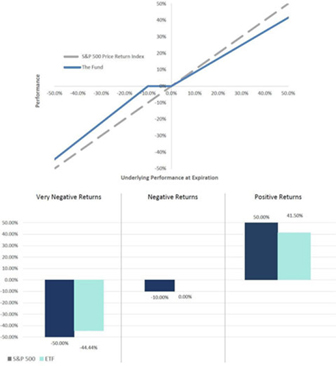
The Fund includes a mix of purchased and written (sold) put and call options structured to seek to achieve the results described above. The Fund seeks to achieve the results described above for investments made on the Initial Investment Day and held until the last day of the Investment Period. Investments made on any day other than the Initial Investment Day may differ significantly, positively or negatively, from the results described above. The Fund’s website, www.true-shares.com, contains information about the Fund’s holdings, and the performance of the S&P 500 Price Index as of the Initial Investment Day and the prior business day to assist an investor in understanding the range of results such investor can expect for investments made at times other than on the Initial Investment Day.
Additionally, the Fund’s website provides information relating to the returns of the Fund, including the Fund’s Buffer and its position relative to the performance of the S&P 500 Price Index on a daily basis.
The Fund’s operations are continuous. It will not terminate and distribute its assets at the conclusion of an Investment Period. On each Roll Date, another Investment Period will commence and the Fund will invest in a new set of options.
The Fund is an actively managed exchange-traded fund (“ETF”) that seeks to achieve its investment objective by investing substantially all of its assets in options on the S&P 500 Price Index. The Fund’s investment adviser, TrueMark Investments, LLC (the “Adviser”), employs a “buffer protect” options strategy that uses such options to seek to achieve exposure to the performance of the S&P 500 Price Index (before fees and expenses) while mitigating the first 8% to 12% decline (before fees and expenses) in the performance of the S&P 500 Price Index (the “Buffer”) over a 12-month period beginning on a specified day each August (each, a “Roll Date”). The period from one Roll Date to the next Roll Date is referred to as the “Investment Period,” and the first day of the Investment Period is referred to as the “Initial Investment Day.”
The Fund purchases call options and sell (write) put options on the S&P 500 Price Index or an ETF that seeks to track the performance of the S&P 500 Price Index (each, a “S&P 500 Price Index ETF”) on each Initial Investment Day with an expiration on the next Roll Date. An option gives the purchaser of the option the right to purchase (for a call option) or sell (for a put option) the reference asset (or deliver cash equal to the value of the reference asset) at a specified price (“strike price”). In the event the reference asset declines in value, the value of a put option generally will increase and the value of a call option generally will decrease and may become worthless. In the event the reference asset appreciates in value, the value of a put option generally will decrease and become worthless and the value of a call option generally will increase.
On each Initial Investment Day, the Fund will sell (write) put options on the S&P 500 Price Index or an ETF that tracks the S&P 500 Price Index with a strike price within a range of approximately 8% to 12% lower than the current value of the S&P 500 Price Index or a S&P 500 Price Index ETF. As the seller of these options, the Fund receives a premium from the buyer of the options, which the Fund invests in at-the-money call options on the S&P 500 Price Index or a S&P 500 Price Index ETF (i.e., call options having a strike price roughly equal to the current value of the S&P 500 Price Index or a S&P 500 Price Index ETF). The relative price of the put options sold (written) by the Fund to the price of the call options purchased by the Fund will determine the Fund’s exposure to the performance of the S&P 500 Price Index during the Investment Period. Due to the cost of the options used by the Fund, the correlation of the Fund’s performance to that of the S&P 500 Price Index is expected to be less than if the Fund invested directly in the constituents of the S&P 500 Price Index (i.e., without using options), and could be substantially less. This means that if the S&P 500 Price Index experiences gains for an Investment Period, the Fund may not realize gains to the same extent.
The Fund’s strategy also seeks to protect Investors from a decline of up to 8% to 12% in the performance of the S&P 500 Price Index from one Roll Date to the next Roll Date. When the Adviser sells puts on the S&P 500 Price Index to create the buffer range, the proceeds are used to purchase calls at the money. However, not all puts generate the same premium relative to the downside exposure of the Fund. The Adviser will seek to deliver a buffer of 10% from the reference price of the S&P 500 Price Index on the first trading day of the month. However, the market could fluctuate on or after the buffer is set and this range allows for market condition volatility. The Fund is not designed to protect against declines of more than 8% to 12% in the performance of the S&P 500 Price Index, and there can be no guarantee that the Fund will be successful in implementing the buffer protect options strategy to protect against the first 8% to 12% decline. Additionally, even if the Fund mitigates a decline in the performance of the S&P 500 Price Index from one Roll Date to the next Roll Date, the Fund’s returns during the Investment Period (prior to the next Roll Date) may not reflect the buffer protect options strategy.
The Fund invests in either standardized exchange-listed options or in exchange-traded FLexible EXchange Options (“FLEX Options”). FLEX Options are customized exchange-traded option contracts available through the Chicago Board Option Exchange (“Cboe”) that are guaranteed for settlement by The Options Clearing Corporation (“OCC”). FLEX Options provide investors with the ability to customize exercise prices, exercise styles, and expiration dates, while achieving price discovery in competitive, transparent, auction markets and avoiding the counterparty exposure of over-the-counter (“OTC”) options positions. The Fund invests in European-style FLEX Options (i.e., they can only be exercised at the expiration date of the option) based on the performance of the S&P 500 Price Index or a S&P 500 Price Index ETF and which have an expiration date that is the last day of the Investment Period only. In general, the Fund to invests, to the greatest extent possible, in FLEX Options, as these options provide the best combination of OCC guarantees, price discovery, customization, and European-style settlement that is ideal for the Fund. However, the Fund may use listed options to provide an additional source of desired market exposure when the Adviser believes doing so will be beneficial to the Fund. The Fund also invests in U.S. Treasury bonds or money market funds that invest in U.S. Treasury bonds.
The Fund is designed to provide the outcomes below (before fees and expenses) during each individual Investment Period. The outcomes would be lower if the fees and expenses were included.
| Change in the Returns of the S&P 500 Price Index | Expected Change in the Returns of the Fund |
| Declines between -8% and -12% (or more) | Declines 8% to 12% percentage points less than the S&P 500 Price Index (e.g., if the S&P 500 Price Index returns -35%, the Fund is designed to return -23% to -27%) |
| Declines between 0% and -8% | No change |
| Appreciates | The Fund’s returns will appreciate to a similar extent as the S&P 500 Price Index |
The charts below illustrate the hypothetical returns that the Fund seeks to provide in certain illustrative scenarios for a shareholder that purchases Shares on the Initial Investment Day and holds such Shares for the entire Investment Period. These charts do not take into account payment by the Fund of Total Annual Fund Operating Expenses and assume a buffer of 10%. There is no guarantee that the Fund will be successful in providing these investment outcomes for any Investment Period.
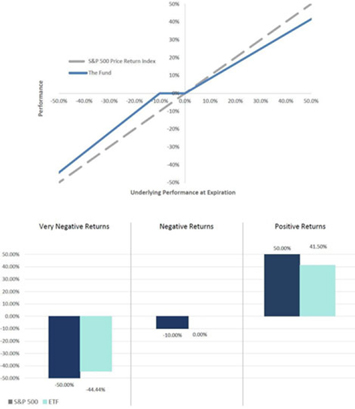
The Fund includes a mix of purchased and written (sold) put and call options structured to seek to achieve the results described above. The Fund seeks to achieve the results described above for investments made on the Initial Investment Day and held until the last day of the Investment Period. Investments made on any day other than the Initial Investment Day may differ significantly, positively or negatively, from the results described above. The Fund’s website, www.true-shares.com, contains information about the Fund’s holdings, and the performance of the S&P 500 Price Index as of the Initial Investment Day and the prior business day to assist an investor in understanding the range of results such investor can expect for investments made at times other than on the Initial Investment Day.
Additionally, the Fund’s website provides information relating to the returns of the Fund, including the Fund’s Buffer and its position relative to the performance of the S&P 500 Price Index on a daily basis.
The Fund’s operations are continuous. It will not terminate and distribute its assets at the conclusion of an Investment Period. On each Roll Date, another Investment Period will commence and the Fund will invest in a new set of options.
The Fund is an actively managed exchange-traded fund (“ETF”) that seeks to achieve its investment objective by investing substantially all of its assets in options on the S&P 500 Price Index. The Fund’s investment adviser, TrueMark Investments, LLC (the “Adviser”), employs a “buffer protect” options strategy that uses such options to seek to achieve exposure to the performance of the S&P 500 Price Index (before fees and expenses) while mitigating the first 8% to 12% decline (before fees and expenses) in the performance of the S&P 500 Price Index (the “Buffer”) over a 12-month period beginning on a specified day each September (each, a “Roll Date”). The period from one Roll Date to the next Roll Date is referred to as the “Investment Period,” and the first day of the Investment Period is referred to as the “Initial Investment Day.”
The Fund purchases call options and sell (write) put options on the S&P 500 Price Index or an ETF that seeks to track the performance of the S&P 500 Price Index (each, a “S&P 500 Price Index ETF”) on each Initial Investment Day with an expiration on the next Roll Date. An option gives the purchaser of the option the right to purchase (for a call option) or sell (for a put option) the reference asset (or deliver cash equal to the value of the reference asset) at a specified price (“strike price”). In the event the reference asset declines in value, the value of a put option generally will increase and the value of a call option generally will decrease and may become worthless. In the event the reference asset appreciates in value, the value of a put option generally will decrease and become worthless and the value of a call option generally will increase.
On each Initial Investment Day, the Fund will sell (write) put options on the S&P 500 Price Index or an ETF that tracks the S&P 500 Price Index with a strike price within a range of approximately 8% to 12% lower than the current value of the S&P 500 Price Index or a S&P 500 Price Index ETF. As the seller of these options, the Fund receives a premium from the buyer of the options, which the Fund invests in at-the-money call options on the S&P 500 Price Index or a S&P 500 Price Index ETF (i.e., call options having a strike price roughly equal to the current value of the S&P 500 Price Index or a S&P 500 Price Index ETF). The relative price of the put options sold (written) by the Fund to the price of the call options purchased by the Fund will determine the Fund’s exposure to the performance of the S&P 500 Price Index during the Investment Period. Due to the cost of the options used by the Fund, the correlation of the Fund’s performance to that of the S&P 500 Price Index is expected to be less than if the Fund invested directly in the constituents of the S&P 500 Price Index (i.e., without using options), and could be substantially less. This means that if the S&P 500 Price Index experiences gains for an Investment Period, the Fund may not realize gains to the same extent.
The Fund’s strategy also seeks to protect investors from a decline of up to 8% to 12% in the performance of the S&P 500 Price Index from one Roll Date to the next Roll Date. When the Adviser sells puts on the S&P 500 Price Index to create the buffer range, the proceeds are used to purchase calls at the money. However, not all puts generate the same premium relative to the downside exposure of the Fund. The Adviser seeks to deliver a buffer of 10% from the reference price of the S&P 500 Price Index on the first trading day of the month. However, the market could fluctuate on or after the buffer is set and this range allows for market condition volatility. The Fund is not designed to protect against declines of more than 8% to 12% in the performance of the S&P 500 Price Index, and there can be no guarantee that the Fund will be successful in implementing the buffer protect options strategy to protect against the first 8% to 12% decline. Additionally, even if the Fund mitigates a decline in the performance of the S&P 500 Price Index from one Roll Date to the next Roll Date, the Fund’s returns during the Investment Period (prior to the next Roll Date) may not reflect the buffer protect options strategy.
The Fund invests in either standardized exchange-listed options or in exchange-traded FLexible EXchange Options (“FLEX Options”). FLEX Options are customized exchange-traded option contracts available through the Chicago Board Option Exchange (“Cboe”) that are guaranteed for settlement by The Options Clearing Corporation (“OCC”). FLEX Options provide investors with the ability to customize exercise prices, exercise styles, and expiration dates, while achieving price discovery in competitive, transparent, auction markets and avoiding the counterparty exposure of over-the-counter (“OTC”) options positions. The Fund invests in European-style FLEX Options (i.e., they can only be exercised at the expiration date of the option) based on the performance of the S&P 500 Price Index or a S&P 500 Price Index ETF and which have an expiration date that is the last day of the Investment Period only. In general, the Fund invests, to the greatest extent possible, in FLEX Options, as these options provide the best combination of OCC guarantees, price discovery, customization, and European-style settlement that is ideal for the Fund. However, the Fund may use listed options to provide an additional source of desired market exposure when the Adviser believes doing so will be beneficial to the Fund. The Fund also invests in U.S. Treasury bonds or money market funds that invest in U.S. Treasury bonds.
The Fund is designed to provide the outcomes below (before fees and expenses) during each individual Investment Period. The outcomes would be lower if the fees and expenses were included.
| Change in the Returns of the S&P 500 Price Index | Expected Change in the Returns of the Fund |
| Declines between -8% and -12% (or more) | Declines 8% to 12% percentage points less than the S&P 500 Price Index (e.g., if the S&P 500 Price Index returns -35%, the Fund is designed to return -23% to -27%) |
| Declines between 0% and -8% | No change |
| Appreciates | The Fund’s returns will appreciate to a similar extent as the S&P 500 Price Index |
The charts below illustrate the hypothetical returns that the Fund seeks to provide in certain illustrative scenarios for a shareholder that purchases Shares on the Initial Investment Day and holds such Shares for the entire Investment Period. These charts do not take into account payment by the Fund of Total Annual Fund Operating Expenses and assume a buffer of 10%. There is no guarantee that the Fund will be successful in providing these investment outcomes for any Investment Period.
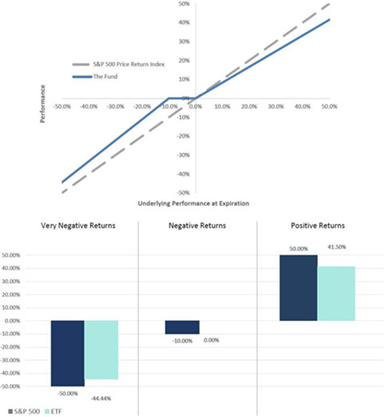
The Fund includes a mix of purchased and written (sold) put and call options structured to seek to achieve the results described above. The Fund seeks to achieve the results described above for investments made on the Initial Investment Day and held until the last day of the Investment Period. Investments made on any day other than the Initial Investment Day may differ significantly, positively or negatively, from the results described above. The Fund’s website, www.true-shares.com, contains information about the Fund’s holdings, and the performance of the S&P 500 Price Index as of the Initial Investment Day and the prior business day to assist an investor in understanding the range of results such investor can expect for investments made at times other than on the Initial Investment Day.
Additionally, the Fund’s website provides information relating to the returns of the Fund, including the Fund’s Buffer and its position relative to the performance of the S&P 500 Price Index on a daily basis.
The Fund’s operations are continuous. It will not terminate and distribute its assets at the conclusion of an Investment Period. On each Roll Date, another Investment Period will commence and the Fund will invest in a new set of options.
The Fund is an actively managed exchange-traded fund (“ETF”) that seeks to achieve its investment objective by investing substantially all of its assets in options on the S&P 500 Price Index. The Fund’s investment adviser, TrueMark Investments, LLC (the “Adviser”), employs a “buffer protect” options strategy that uses such options to seek to achieve exposure to the performance of the S&P 500 Price Index (before fees and expenses) while mitigating the first 8% to 12% decline (before fees and expenses) in the performance of the S&P 500 Price Index (the “Buffer”) over a 12-month period beginning on a specified day each October (each, a “Roll Date”). The period from one Roll Date to the next Roll Date is referred to as the “Investment Period,” and the first day of the Investment Period is referred to as the “Initial Investment Day.”
The Fund purchases call options and sell (write) put options on the S&P 500 Price Index or an ETF that seeks to track the performance of the S&P 500 Price Index (each, a “S&P 500 Price Index ETF”) on each Initial Investment Day with an expiration on the next Roll Date. An option gives the purchaser of the option the right to purchase (for a call option) or sell (for a put option) the reference asset (or deliver cash equal to the value of the reference asset) at a specified price (“strike price”). In the event the reference asset declines in value, the value of a put option generally will increase and the value of a call option generally will decrease and may become worthless. In the event the reference asset appreciates in value, the value of a put option generally will decrease and become worthless and the value of a call option generally will increase.
On each Initial Investment Day, the Fund will sell (write) put options on the S&P 500 Price Index or an ETF that tracks the S&P 500 Price Index with a strike price within a range of approximately 8% to 12% lower than the current value of the S&P 500 Price Index or a S&P 500 Price Index ETF. As the seller of these options, the Fund receives a premium from the buyer of the options, which the Fund invests in at-the-money call options on the S&P 500 Price Index or a S&P 500 Price Index ETF (i.e., call options having a strike price roughly equal to the current value of the S&P 500 Price Index or a S&P 500 Price Index ETF). The relative price of the put options sold (written) by the Fund to the price of the call options purchased by the Fund will determine the Fund’s exposure to the performance of the S&P 500 Price Index during the Investment Period. Due to the cost of the options used by the Fund, the correlation of the Fund’s performance to that of the S&P 500 Price Index is expected to be less than if the Fund invested directly in the constituents of the S&P 500 Price Index (i.e., without using options), and could be substantially less. This means that if the S&P 500 Price Index experiences gains for an Investment Period, the Fund may not realize gains to the same extent.
The Fund’s strategy also seeks to protect investors from a decline of up to 8% to 12% in the performance of the S&P 500 Price Index from one Roll Date to the next Roll Date. When the Adviser sells puts on the S&P 500 Price Index to create the buffer range, the proceeds are used to purchase calls at the money. However, not all puts generate the same premium relative to the downside exposure of the Fund. The Adviser seeks to deliver a buffer of 10% from the reference price of the S&P 500 Price Index on the first trading day of the month. However, the market could fluctuate on or after the buffer is set and this range allows for market condition volatility. The Fund is not designed to protect against declines of more than 8% to 12% in the performance of the S&P 500 Price Index, and there can be no guarantee that the Fund will be successful in implementing the buffer protect options strategy to protect against the first 8% to 12% decline. Additionally, even if the Fund mitigates a decline in the performance of the S&P 500 Price Index from one Roll Date to the next Roll Date, the Fund’s returns during the Investment Period (prior to the next Roll Date) may not reflect the buffer protect options strategy.
The Fund invests in either standardized exchange-listed options or in exchange-traded FLexible EXchange Options (“FLEX Options”). FLEX Options are customized exchange-traded option contracts available through the Chicago Board Option Exchange (“Cboe”) that are guaranteed for settlement by The Options Clearing Corporation (“OCC”). FLEX Options provide investors with the ability to customize exercise prices, exercise styles, and expiration dates, while achieving price discovery in competitive, transparent, auction markets and avoiding the counterparty exposure of over-the-counter (“OTC”) options positions. The Fund invests in European-style FLEX Options (i.e., they can only be exercised at the expiration date of the option) based on the performance of the S&P 500 Price Index or a S&P 500 Price Index ETF and which have an expiration date that is the last day of the Investment Period only. In general, the Fund invests, to the greatest extent possible, in FLEX Options, as these options provide the best combination of OCC guarantees, price discovery, customization, and European-style settlement that is ideal for the Fund. However, the Fund may use listed options to provide an additional source of desired market exposure when the Adviser believes doing so will be beneficial to the Fund. The Fund also to invests in U.S. Treasury bonds or money market funds that invest in U.S. Treasury bonds.
The Fund is designed to provide the outcomes below (before fees and expenses) during each individual Investment Period. The outcomes would be lower if the fees and expenses were included.
| Change in the Returns of the S&P 500 Price Index | Expected Change in the Returns of the Fund |
| Declines between -8% and -12% (or more) | Declines 8% to 12% percentage points less than the S&P 500 Price Index (e.g., if the S&P 500 Price Index returns -35%, the Fund is designed to return -23% to -27%) |
| Declines between 0% and -8% | No change |
| Appreciates | The Fund’s returns will appreciate to a similar extent as the S&P 500 Price Index |
The charts below illustrate the hypothetical returns that the Fund seeks to provide in certain illustrative scenarios for a shareholder that purchases Shares on the Initial Investment Day and holds such Shares for the entire Investment Period. These charts do not take into account payment by the Fund of Total Annual Fund Operating Expenses and assume a buffer of 10%. There is no guarantee that the Fund will be successful in providing these investment outcomes for any Investment Period.
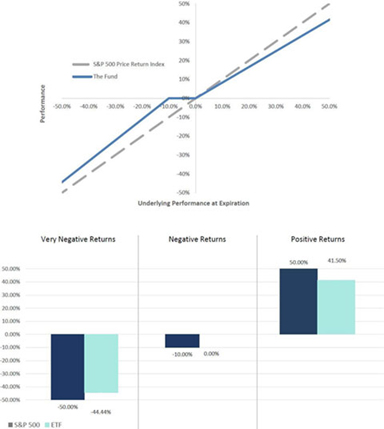
The Fund includes a mix of purchased and written (sold) put and call options structured to seek to achieve the results described above. The Fund seeks to achieve the results described above for investments made on the Initial Investment Day and held until the last day of the Investment Period. Investments made on any day other than the Initial Investment Day may differ significantly, positively or negatively, from the results described above. The Fund’s website, www.true-shares.com, contains information about the Fund’s holdings, and the performance of the S&P 500 Price Index as of the Initial Investment Day and the prior business day to assist an investor in understanding the range of results such investor can expect for investments made at times other than on the Initial Investment Day.
Additionally, the Fund’s website provides information relating to the returns of the Fund, including the Fund’s Buffer and its position relative to the performance of the S&P 500 Price Index on a daily basis.
The Fund’s operations are continuous. It will not terminate and distribute its assets at the conclusion of an Investment Period. On each Roll Date, another Investment Period will commence and the Fund will invest in a new set of options.
The Fund is an actively managed exchange-traded fund (“ETF”) that seeks to achieve its investment objective by investing substantially all of its assets in options on the S&P 500 Price Index. The Fund’s investment adviser, TrueMark Investments, LLC (the “Adviser”), employs a “buffer protect” options strategy that uses such options to seek to achieve exposure to the performance of the S&P 500 Price Index (before fees and expenses) while mitigating the first 8% to 12% decline (before fees and expenses) in the performance of the S&P 500 Price Index (the “Buffer”) over a 12-month period beginning on a specified day each November (each, a “Roll Date”). The period from one Roll Date to the next Roll Date is referred to as the “Investment Period,” and the first day of the Investment Period is referred to as the “Initial Investment Day.”
The Fund purchases call options and sell (write) put options on the S&P 500 Price Index or an ETF that seeks to track the performance of the S&P 500 Price Index (each, a “S&P 500 Price Index ETF”) on each Initial Investment Day with an expiration on the next Roll Date. An option gives the purchaser of the option the right to purchase (for a call option) or sell (for a put option) the reference asset (or deliver cash equal to the value of the reference asset) at a specified price (“strike price”). In the event the reference asset declines in value, the value of a put option generally will increase and the value of a call option generally will decrease and may become worthless. In the event the reference asset appreciates in value, the value of a put option generally will decrease and become worthless and the value of a call option generally will increase.
On each Initial Investment Day, the Fund will sell (write) put options on the S&P 500 Price Index or an ETF that tracks the S&P 500 Price Index with a strike price within a range of approximately 8% to 12% lower than the current value of the S&P 500 Price Index or a S&P 500 Price Index ETF. As the seller of these options, the Fund receives a premium from the buyer of the options, which the Fund invests in at-the-money call options on the S&P 500 Price Index or a S&P 500 Price Index ETF (i.e., call options having a strike price roughly equal to the current value of the S&P 500 Price Index or a S&P 500 Price Index ETF). The relative price of the put options sold (written) by the Fund to the price of the call options purchased by the Fund will determine the Fund’s exposure to the performance of the S&P 500 Price Index during the Investment Period. Due to the cost of the options used by the Fund, the correlation of the Fund’s performance to that of the S&P 500 Price Index is expected to be less than if the Fund invested directly in the constituents of the S&P 500 Price Index (i.e., without using options), and could be substantially less. This means that if the S&P 500 Price Index experiences gains for an Investment Period, the Fund may not realize gains to the same extent.
The Fund’s strategy also seeks to protect investors from a decline of up to 8% to 12% in the performance of the S&P 500 Price Index from one Roll Date to the next Roll Date. When the Adviser sells puts on the S&P 500 Price Index to create the buffer range, the proceeds are used to purchase calls at the money. However, not all puts generate the same premium relative to the downside exposure of the Fund. The Adviser seeks to deliver a buffer of 10% from the reference price of the S&P 500 Price Index on the first trading day of the month. However, the market could fluctuate on or after the buffer is set and this range allows for market condition volatility. The Fund is not designed to protect against declines of more than 8% to 12% in the performance of the S&P 500 Price Index, and there can be no guarantee that the Fund will be successful in implementing the buffer protect options strategy to protect against the first 8% to 12% decline. Additionally, even if the Fund mitigates a decline in the performance of the S&P 500 Price Index from one Roll Date to the next Roll Date, the Fund’s returns during the Investment Period (prior to the next Roll Date) may not reflect the buffer protect options strategy.
The Fund invests in either standardized exchange-listed options or in exchange-traded FLexible EXchange Options (“FLEX Options”). FLEX Options are customized exchange-traded option contracts available through the Chicago Board Option Exchange (“Cboe”) that are guaranteed for settlement by The Options Clearing Corporation (“OCC”). FLEX Options provide investors with the ability to customize exercise prices, exercise styles, and expiration dates, while achieving price discovery in competitive, transparent, auction markets and avoiding the counterparty exposure of over-the-counter (“OTC”) options positions. The Fund invests in European-style FLEX Options (i.e., they can only be exercised at the expiration date of the option) based on the performance of the S&P 500 Price Index or a S&P 500 Price Index ETF and which have an expiration date that is the last day of the Investment Period only. In general, the Fund invests, to the greatest extent possible, in FLEX Options, as these options provide the best combination of OCC guarantees, price discovery, customization, and European-style settlement that is ideal for the Fund. However, the Fund may use listed options to provide an additional source of desired market exposure when the Adviser believes doing so will be beneficial to the Fund. The Fund also invests in U.S. Treasury bonds or money market funds that invest in U.S. Treasury bonds.
The Fund is designed to provide the outcomes below (before fees and expenses) during each individual Investment Period. The outcomes would be lower if the fees and expenses were included.
| Change in the Returns of the S&P 500 Price Index | Expected Change in the Returns of the Fund |
| Declines between -8% and -12% (or more) | Declines 8% to 12% percentage points less than the S&P 500 Price Index (e.g., if the S&P 500 Price Index returns -35%, the Fund is designed to return -23% to -27%) |
| Declines between 0% and -8% | No change |
| Appreciates | The Fund’s returns will appreciate to a similar extent as the S&P 500 Price Index |
The charts below illustrate the hypothetical returns that the Fund seeks to provide in certain illustrative scenarios for a shareholder that purchases Shares on the Initial Investment Day and holds such Shares for the entire Investment Period. These charts do not take into account payment by the Fund of Total Annual Fund Operating Expenses and assume a buffer of 10%. There is no guarantee that the Fund will be successful in providing these investment outcomes for any Investment Period.
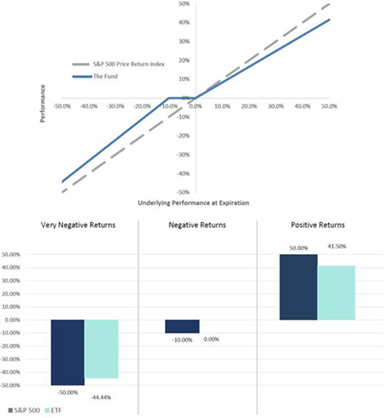
The Fund includes a mix of purchased and written (sold) put and call options structured to seek to achieve the results described above. The Fund seeks to achieve the results described above for investments made on the Initial Investment Day and held until the last day of the Investment Period. Investments made on any day other than the Initial Investment Day may differ significantly, positively or negatively, from the results described above. The Fund’s website, www.true-shares.com, contains information about the Fund’s holdings, and the performance of the S&P 500 Price Index as of the Initial Investment Day and the prior business day to assist an investor in understanding the range of results such investor can expect for investments made at times other than on the Initial Investment Day.
Additionally, the Fund’s website provides information relating to the returns of the Fund, including the Fund’s Buffer and its position relative to the performance of the S&P 500 Price Index on a daily basis.
The Fund’s operations are continuous. It will not terminate and distribute its assets at the conclusion of an Investment Period. On each Roll Date, another Investment Period will commence and the Fund will invest in a new set of options.
The Fund is an actively managed exchange-traded fund (“ETF”) that seeks to achieve its investment objective by investing substantially all of its assets in options on the S&P 500 Price Index. The Fund’s investment adviser, TrueMark Investments, LLC (“TrueMark” or the “Adviser”), will employ a “buffer protect” options strategy that uses such options to seek to achieve exposure to the performance of the S&P 500 Price Index (before fees and expenses) while mitigating the first 8% to 12% decline (before fees and expenses) in the performance of the S&P 500 Price Index (the “Buffer”) over a 12-month period beginning on a specified day each December (each, a “Roll Date”). The period from one Roll Date to the next Roll Date is referred to as the “Investment Period,” and the first day of the Investment Period is referred to as the “Initial Investment Day.”
The Fund purchases call options and sell (write) put options on the S&P 500 Price Index or an ETF that seeks to track the performance of the S&P 500 Price Index (each, a “S&P 500 Price Index ETF”) on each Initial Investment Day with an expiration on the next Roll Date. An option gives the purchaser of the option the right to purchase (for a call option) or sell (for a put option) the reference asset (or deliver cash equal to the value of the reference asset) at a specified price (“strike price”). In the event the reference asset declines in value, the value of a put option generally will increase and the value of a call option generally will decrease and may become worthless. In the event the reference asset appreciates in value, the value of a put option generally will decrease and become worthless and the value of a call option generally will increase.
On each Initial Investment Day, the Fund will sell (write) put options on the S&P 500 Price Index or an ETF that tracks the S&P 500 Price Index with a strike price within a range of approximately 8% to 12% lower than the current value of the S&P 500 Price Index or a S&P 500 Price Index ETF. As the seller of these options, the Fund receives a premium from the buyer of the options, which the Fund invests in at-the-money call options on the S&P 500 Price Index or a S&P 500 Price Index ETF (i.e., call options having a strike price roughly equal to the current value of the S&P 500 Price Index or a S&P 500 Price Index ETF). The relative price of the put options sold (written) by the Fund to the price of the call options purchased by the Fund will determine the Fund’s exposure to the performance of the S&P 500 Price Index during the Investment Period. Due to the cost of the options used by the Fund, the correlation of the Fund’s performance to that of the S&P 500 Price Index is expected to be less than if the Fund invested directly in the constituents of the S&P 500 Price Index (i.e., without using options), and could be substantially less. This means that if the S&P 500 Price Index experiences gains for an Investment Period, the Fund may not realize gains to the same extent.
The Fund’s strategy also seeks to protect investors from a decline of up to 8% to 12% in the performance of the S&P 500 Price Index from one Roll Date to the next Roll Date. When the Adviser sells puts on the S&P 500 Price Index to create the buffer range, the proceeds are used to purchase calls at the money. However, not all puts generate the same premium relative to the downside exposure of the Fund. The Adviser seeks to deliver a buffer of 10% from the reference price of the S&P 500 Price Index on the first trading day of the month. However, the market could fluctuate on or after the buffer is set and this range allows for market condition volatility. The Fund is not designed to protect against declines of more than 8% to 12% in the performance of the S&P 500 Price Index, and there can be no guarantee that the Fund will be successful in implementing the buffer protect options strategy to protect against the first 8% to 12% decline. Additionally, even if the Fund mitigates a decline in the performance of the S&P 500 Price Index from one Roll Date to the next Roll Date, the Fund’s returns during the Investment Period (prior to the next Roll Date) may not reflect the buffer protect options strategy.
The Fund invests in either standardized exchange-listed options or in exchange-traded FLexible EXchange Options (“FLEX Options”). FLEX Options are customized exchange-traded option contracts available through the Chicago Board Option Exchange (“Cboe”) that are guaranteed for settlement by The Options Clearing Corporation (“OCC”). FLEX Options provide investors with the ability to customize exercise prices, exercise styles, and expiration dates, while achieving price discovery in competitive, transparent, auction markets and avoiding the counterparty exposure of over-the-counter (“OTC”) options positions. The Fund invests in European-style FLEX Options (i.e., they can only be exercised at the expiration date of the option) based on the performance of the S&P 500 Price Index or a S&P 500 Price Index ETF and which have an expiration date that is the last day of the Investment Period only. In general, the Fund invests, to the greatest extent possible, in FLEX Options, as these options provide the best combination of OCC guarantees, price discovery, customization, and European-style settlement that is ideal for the Fund. However, the Fund may use listed options to provide an additional source of desired market exposure when the Adviser believes doing so will be beneficial to the Fund. The Fund also invests in U.S. Treasury bonds or money market funds that invest in U.S. Treasury bonds.
The Fund is designed to provide the outcomes below (before fees and expenses) during each individual Investment Period. The outcomes would be lower if the fees and expenses were included
| Change in the Returns of the S&P 500 Price Index | Expected Change in the Returns of the Fund |
| Declines between -8% and -12% (or more) | Declines 8% to 12% percentage points less than the S&P 500 Price Index (e.g., if the S&P 500 Price Index returns -35%, the Fund is designed to return -23% to -27%) |
| Declines between 0% and -8% | No change |
| Appreciates | The Fund’s returns will appreciate to a similar extent as the S&P 500 Price Index |
The charts below illustrate the hypothetical returns that the Fund seeks to provide in certain illustrative scenarios for a shareholder that purchases Shares on the Initial Investment Day and holds such Shares for the entire Investment Period. These charts do not take into account payment by the Fund of Total Annual Fund Operating Expenses and assume a buffer of 10%. There is no guarantee that the Fund will be successful in providing these investment outcomes for any Investment Period.
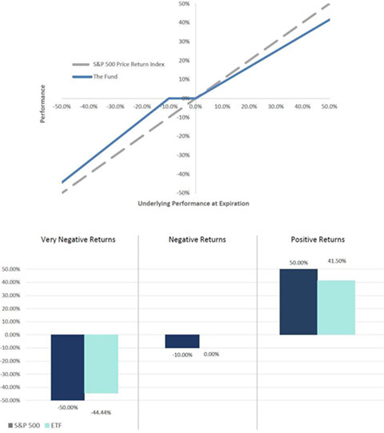
The Fund includes a mix of purchased and written (sold) put and call options structured to seek to achieve the results described above. The Fund seeks to achieve the results described above for investments made on the Initial Investment Day and held until the last day of the Investment Period. Investments made on any day other than the Initial Investment Day may differ significantly, positively or negatively, from the results described above. The Fund’s website, www.true-shares.com, contains information about the Fund’s holdings, and the performance of the S&P 500 Price Index as of the Initial Investment Day and the prior business day to assist an investor in understanding the range of results such investor can expect for investments made at times other than on the Initial Investment Day.
Additionally, the Fund’s website provides information relating to the returns of the Fund, including the Fund’s Buffer and its position relative to the performance of the S&P 500 Price Index on a daily basis.
The Fund’s operations are continuous. It will not terminate and distribute its assets at the conclusion of an Investment Period. On each Roll Date, another Investment Period will commence and the Fund will invest in a new set of options.
The Fund is an actively-managed exchange-traded fund (“ETF”) that pursues its investment objective by investing, under normal circumstances, at least 80% of its net assets (plus any borrowings made for investment purposes) in the common stock of technology, artificial intelligence and deep learning companies. The Fund generally considers a company to be a technology, artificial intelligence and/or deep learning company if it derives 50% or more of its revenues or profits from the development, advancement and/or use of technology, including artificial intelligence-and/or deep learning-related technologies, or if it has committed 50% or more of its research and development-dedicated capital to the development, advancement and/or use of such technology, each measured at the time of investment. In addition, Black Hill Capital Partners, LLC, the Fund’s sub-adviser (“Black Hill” or the “Sub-Adviser”), selects companies that have a competitive advantage with respect to the development and utilization of artificial intelligence, machine learning, or other deep learning technologies. “Artificial intelligence,” or “AI”, refers to the development or use by a business of computer systems that perform tasks previously requiring human intelligence, such as decision-making or audio or visual identification or perception. “Machine learning” refers to technologies that enable a computer to “learn” from data it has processed to incorporate different assumptions or past experience into future computations or analyses. “Deep learning” refers to a more advanced level of “learning” and involves minimal human interference at the beginning of the learning process.
The Sub-Adviser selects companies for the Fund’s portfolio by assessing whether the company’s business is a secular growth business, a cyclical growth business, or a newly public company and then evaluates the value and growth prospects for each company using the following criteria.
| ● | Secular Growth Companies - Companies that do not closely track a seasonal or cyclical trend. In selecting such companies for the Fund’s portfolio, the Sub-Adviser seeks companies that it believes are in the best position to succeed in what is a very competitive technology space. Research on these companies is also continuously augmented with information from additional sources such as Wall Street sell-side investment banks (e.g., Merrill Lynch, Morgan Stanley, etc.) and other proprietary information sources from many parts of the technology sector. The Sub-Adviser has established buy-and-hold positions in these companies and does not expect significant turnover of these companies within the portfolio. The Sub-Adviser expects to let these investments grow over time from positive trends in their sector, market positioning and superior products. The Fund generally invests in secular growth companies to a greater extent than in cyclical growth or newly public companies. |
| ● | Cyclical Growth Companies - Companies that are known for following the cycles of an economy through expansion, peak, recession, and recovery. Most cyclical stocks belong to companies that sell non-essential items consumers can afford to buy more of during a booming economy. These stocks are also from companies that consumers choose to spend less with or cut back on during a recession. In selecting such companies for the Fund’s portfolio, the Sub-Adviser utilizes fundamental analysis, with an emphasis on revenue growth, margins, and select balance sheet items which it believes are more consistent indicators of cyclical bottoms. The Fund seeks to sell its cyclical growth holdings when their margins peak in the economic cycle. |
| ● | Newly Public Companies - Companies that have recently gone through an initial public offering (“IPO”) and are now publicly traded on a stock exchange. In selecting such companies for the Fund’s portfolio, the Sub-Adviser follows developments in the private market to seek to identify companies that will fit the Fund’s investment profile at the time of their IPO. When a new company that fits the Fund’s investment profile enters the market via an IPO, the Sub-Adviser will generally seek to build the Fund’s position in that company over the course of a four to six month period following the IPO. |
The Fund’s portfolio is primarily composed of common stock of U.S. companies, although the portfolio may include common stock of non-U.S. companies from time to time. The Fund’s portfolio is typically comprised of the 20 to 30 most attractive securities based on the Sub-Adviser’s analysis.
The Sub-Adviser keeps a significant portion of the Fund’s portfolio in cash (up to 20%) during periods when the Sub-Adviser believes it is merited. These cash positions are utilized to purchase securities when the Sub-Adviser identifies an event-based investment opportunity in a secular growth company that has driven down share prices but will not, in the Sub-Adviser’s opinion, impact the secular nature of the company. The cash positions also may be used in the event of a bear market or an instance in which the Sub-Adviser believes that the market is experiencing a valuation correction (i.e., a move that is not reflected in overall economic data).
After initial purchase, company weightings typically fluctuate with the market. The Sub-Adviser manages inflows and outflows (i.e., fluctuations in Fund assets from creations and redemptions of Fund shares) by referencing existing stock weights coupled with its view of a company’s forward rate of return potential.
While many portfolio holdings have a larger capitalization, the Fund may also invest in small and medium capitalized companies, as TrueMark Investments, LLC (the “Adviser”), the Fund’s investment adviser, believes these relatively smaller companies may provide above average capital appreciation and dividend yield.
The Fund is non-diversified and may invest a greater percentage of its assets in a particular issuer than a diversified fund.
The Fund concentrates (i.e., invests at least 25% of its assets) investments in one or more industries in the Information Technology Sector. While the Fund’s exposure to the industries within the Information Technology Sector may vary over time, as of March 31, 2026, the Fund’s holdings were concentrated within the Software Industry. For purposes of this policy, each sector and industry is defined by the Global Industry Classification Standard, a widely recognized industry classification methodology developed by MSCI, Inc. and S&P Dow Jones Indices.
The Fund is an actively-managed exchange-traded fund (“ETF”) that seeks to achieve its investment objective by purchasing 25-35 stocks of companies that pay dividends and expect to grow the dividends over time and are trading at attractive valuations at the time of the investment. The Fund’s investment adviser, TrueMark Investments, LLC (the “Adviser”), and sub-adviser, Opal Capital LLC (the “Sub-Adviser”), will seek to invest in such companies that are established businesses with high cash flow, stable revenue streams, and more disciplined capital reinvestment programs which may, in turn, experience lower volatility relative to the overall equity market.
The Adviser and Sub-Adviser focus on companies whose stock is listed on a U.S. exchange with market capitalizations greater than $8 billion, but may include companies with market capitalizations of less than $8 billion if their dividend yields are above the market average. The Adviser and Sub-Adviser select companies for the Fund that, in the Sub-Adviser’s determination, provide the best combination of dividend yield with potential for dividend growth and are currently under-valued in the market. Under normal circumstances, at least 80% of the Fund’s net assets, plus borrowings for investment purposes, is invested in dividend paying equity securities, including common stocks and American Depositary Receipts (“ADRs”).
The Sub-Adviser makes its initial identification of potential portfolio securities based on its assessment of a company’s ability and commitment to sustain and grow its dividends. The Sub-Adviser identifies such companies by utilizing a combination of quantitative and qualitative indicators of the company’s financial position, growth opportunities, historical payouts, and management commentary, as well as the competitive landscape.
The Sub-Adviser then reviews the current market valuation of these companies which the Sub-Adviser believes are under-valued. The Sub-Adviser first identifies “high quality companies,” which are generally defined as companies with a sustainable competitive advantage, offering stable and growing free cash flows, and quality management teams that have the capital discipline to distribute dividends to shareholders. The Sub-Adviser then selects companies whose stock is trading at a valuation that it believes offers an opportunity to generate above average returns over time. The Sub-Adviser utilizes a variety of metrics (e.g., price compared to earnings ratio, market capitalization compared to book value, free cash flow yield, etc.) in the valuation process and seeks to identify companies that are attractively priced both in absolute terms and relative to their peers with a preference of companies with higher free cash flow.
The Fund is an actively managed exchange-traded fund (“ETF”) that invests primarily in equity securities of domestic and foreign companies that primarily own or operate assets used in the development, generation, production, transmission, storage and sale of alternative and renewable energy such as solar power, wind power, biofuels, hydropower, nuclear or geothermal power (collectively, “Renewable Energy Infrastructure Companies”). The Renewable Energy Infrastructure Companies in which the Fund invest mays range from small- to large-capitalization companies. The Fund also invests in American Depository Receipts (“ADRs”) and Global Depository Receipts (“GDRs”) of Renewable Energy Infrastructure Companies. Under normal market conditions, the Fund invests at least 80% of its net assets, plus borrowings for investment purposes, in Renewable Energy Infrastructure Companies.
Eagle Global Advisors, LLC (the “Sub-Adviser”), the Fund’s investment sub-adviser, selects investments for the Fund’s portfolio from a universe of Renewable Energy Infrastructure Companies by utilizing a fundamentally-driven investment process which includes the analysis of global macro-economic and geo-political factors, fundamental company analysis, internal valuation methods, and the projected rate of return from the investment given its expected level of risk.
The Sub-Adviser may sell a security when it no longer meets the criteria for inclusion in the Fund’s investment universe, when the security has not met or exceeded its projected rate of return or when a more attractive investment becomes available.
The Fund is non-diversified and therefore may invest a larger percentage of its assets in the securities of a single issuer or smaller number of issuers than diversified funds. The Fund concentrates (i.e., hold more than 25% of its total assets) in the securities of companies in the Utilities Industry Group within the Utilities Sector, as classified by the Global Industry Classification Standard.
Under normal market conditions, the Fund invests at least 40% of its assets in the securities of issuers that are tied economically to a number of countries throughout the world.
As of March 31, 2026, the Fund had significant investment exposure to Renewable Energy Infrastructure Companies, the securities of which are issued and listed in Europe.
The Fund is an actively-managed exchange-traded fund (“ETF”) that seeks to achieve its investment objective by investing in equity securities, including common stock of mid-cap and large-cap companies, tied to the economy of the U.S. RiverNorth Capital Management, LLC (the “Sub-Adviser”), the Fund’s sub-adviser, considers a company to be tied to the U.S. economy if: 1) the company is organized under the laws of the U.S.; 2) the shares of the company are traded principally in the U.S.; and 3) the company generates at least 90% of its revenue from its activities in the U.S. In addition, to be eligible for inclusion in the Fund’s portfolio, a company must have, at the time of purchase, a market capitalization over $5 billion.
The portfolio is constructed at the discretion of the Sub-Adviser. In constructing the Fund’s portfolio, the Sub-Adviser considers a variety of factors, including its overall market sector and industry weighting, and no one factor is expected to be determinative of investment decisions. Weightings of positions and sectors and industries may be adjusted at any time at the discretion of the Sub-Adviser.
Folds of Honor
The Sub-Adviser donates a majority of its sub-advisory fee or 100% of the profit derived from its management of the Fund, whichever is greater, to the Folds of Honor Foundation, a charity focused on providing scholarships to families of veterans. Folds of Honor is a 501(c)(3) non-profit organization, rated “4-star” by Charity Navigator and platinum by GuideStar, that provides educational scholarships to the families of military men and women who have fallen or been disabled while on active duty in the United States armed forces. Since 2007, a cumulative average ratio of 91% of every dollar raised by Folds of Honor has been contributed to its scholarship program, which has awarded approximately 73,000 in educational scholarships.
Impact Investing
The Fund provides an alternative approach to charity and seeks to deliver true impact investing. While “Impact Investing” can mean many things, the application of the term here is about delivering real dollars to a charity that directly supports education for the children and families of U.S. service members who were disabled or killed in action. The Fund delivers real world benefits to those in need now.
The Fund is actively managed using a strategy designed around the unique characteristics of “Pre-Combination” (defined below) SPAC securities. Under normal market conditions, the Fund seeks to achieve its investment objective by investing primarily in units made up of common stock, warrants and rights of U.S.-listed special purpose acquisition companies (“SPACs”). A warrant is a derivative that gives the holder the right, but not the obligation, to buy or sell a security at a certain price prior to the expiration of the warrant. A right is a privilege granted to existing holders of a company’s stock to receive additional shares of common stock before it is offered to the public.
A SPAC is a “blank check” company with no commercial operations that is designed to raise capital via an initial public offering (“IPO”) for the purpose of engaging in a merger, acquisition, reorganization, or similar business combination (a “Combination”) with one or more operating companies. Sponsors of SPACs typically pay the SPAC’s offering costs and underwriting fees and contribute all or a portion of its working capital in exchange for participation in the common stock and derivatives (such as warrants and rights) of the SPAC. A SPAC IPO typically involves the sale of units consisting of one share of common stock and a warrant or right (or portion of a warrant or right) to purchase common stock at a fixed price upon or after the consummation of a Combination. The capital raised in the IPO is typically placed into a trust. The proceeds of the IPO may be used only to consummate a Combination and for other limited purposes such as paying taxes owed by the SPAC. “Pre-Combination” SPACs (also referred to herein as “Pre-Merger” SPACs) are SPACs that are either seeking a target for a Combination or have not yet completed a Combination with an identified target. Pre-Combination SPACs often have predetermined time frames within which to consummate a Combination (typically two years) or the SPAC will seek to extend the time frame or liquidate.
RiverNorth Capital Management, LLC (the “Sub-Adviser”), the Fund’s investment sub-adviser, is responsible for the day-to-day management of the Fund, subject to the oversight of TrueMark Investments, LLC (the “Adviser”), the Fund’s investment adviser. The investment universe for the Fund is all Pre-Combination SPACs and their rights and warrants. Such SPACs may be formed, operated and listed in the U.S. or outside of the U.S. The Sub-Adviser applies quantitative and qualitative analyses, including fundamental and technical analyses, to assess the relative risk/reward potential of the SPACs, in the investment universe and select those SPACs with the greatest risk/reward potential for investment by the Fund. The Sub-Adviser also evaluates the sponsors of the SPACs as they are crucial to the success of a SPAC acquisition. SPAC sponsors are evaluated based on the team’s strategy, experience, deal flow, and demonstrated track record in building enterprise value, which is a measure of the value of an operating business determined by calculating the company’s market cap plus total debt minus cash and cash equivalents. If management has any history of growing operating businesses, the Sub-Adviser takes into account their history. Additionally, the Sub-Adviser evaluates a SPAC’s market value relative to the value of the Fund’s share of the SPAC to realize additional value for shareholders.
Weightings in the Fund are determined by the Sub-Adviser based on its evaluation of the opportunities in the market. The Fund participates in IPOs of SPACs, secondary market transactions, private placement in public equities and investments in vehicles formed by SPAC sponsors to hold founder shares, which are private rights and other interests issued by a SPAC.
In seeking to achieve the Fund’s investment objective, the Sub-Adviser monitors the Fund’s portfolio and adjust positions based on changes in expectations of the investments or the availability of better alternatives. The Fund generally will not hold a SPAC’s common stock past the date on which it no longer has the ability to redeem the stock for its share of the underlying collateral held in trust. Instead, prior to the completion of a Combination, the Sub-Adviser sells the SPAC’s shares if they are trading at a premium relative to the trust collateral or tender out of the shares using the Fund’s redemption rights. Warrants acquired during the SPAC lifecycle may be held by the Fund for as long as the Sub-Adviser believes they offer appropriate value for the Fund and its shareholders, even after a Combination has been completed.
In addition, to the extent permitted by the Investment Company Act of 1940 (the “1940 Act”), the Fund may use swaps to seek to leverage the returns of the Fund’s portfolio. The use of leverage could magnify the Fund’s gains or losses.
Under normal circumstances, at least 80% of the Fund’s net assets, plus borrowings for investment purposes, are invested in Pre-Merger SPACs (along with the warrants or rights issued in connection with the IPOs of SPACs). The SPACs in which the Fund invests are generally small or mid-capitalization companies.