| Shareholder Transaction Expenses (fee paid directly from your investment) |
Class A Shares |
Advisor Class Shares |
||||||
| Maximum Sales Load Imposed on Purchases(1) | 2.00 | % | None | |||||
| Maximum Contingent Deferred Sales Charge(2) | None | None | ||||||
| (1) | Advisor Class Shares do not impose a front-end sales load. Investors purchasing Class A Shares may be charged a sales load of up to 2.00% of the investment amount. The table assumes the maximum sales load is charged. The Distributor may, in its discretion, waive all or a portion of the sales load for certain investors. See “Plan of Distribution.” |
| (2) | With respect to purchases of $250,000 or more only, investors will pay a contingent deferred sales charge of 1.00% for Class A Shares repurchased within 12 months of purchase. |
| Estimated Annual Operating Expenses (as a percentage of net assets attributable to Shares) |
Class A Shares |
Advisor Class Shares |
||||
| Management Fee(3) | 1.25 | % | 1.25 | % | ||
| Incentive Fee(4) | 1.02 | % | 1.02 | % | ||
| Interest Payments on Borrowed Funds and Securities Sold Short(5) | 2.73 | % | 2.73 | % | ||
| Other Expenses(6) | 1.55 | % | 1.55 | % | ||
| Distribution Fee(7) | 0.50 | % | None | |||
| Total Annual Expenses | 7.05 | % | 6.55 | % | ||
| Fee Waiver and/or Expense Reimbursement(8) | (0.55 | )% | (0.55 | )% | ||
| Total Annual Expenses (After Fee Waiver and/or Expense Reimbursement) | 6.50 | % | 6.00 | % |
| (3) | The Management Fee is calculated and payable monthly in arrears at an annual rate of 1.25% on the average daily value of the Fund’s net assets. |
| (4) | The Fund anticipates that it may have interest income that could result in the payment of an Incentive Fee to the Adviser during certain periods. However, the Incentive Fee is based on the Fund’s performance and will not be paid unless the Fund achieves certain performance targets. The Fund expects the Incentive Fee the Fund pays to increase to the extent the Fund earns greater interest income through its investments in portfolio companies. The Incentive Fee is calculated and payable quarterly in arrears based upon the Fund’s “pre-incentive fee net investment income” for the immediately preceding quarter, and is subject to a hurdle rate, expressed as a rate of return on the Fund’s adjusted capital, equal to 1.50% per quarter, or an annualized hurdle rate of 6.00%, subject to a “catch-up” feature. For purposes of computing the Fund’s pre-incentive fee net investment income, the calculation methodology will look through total return swaps as if the Fund owned the referenced assets directly. See “Management and Incentive Fees” for a full explanation of how the Incentive Fee is calculated. |
| (5) | These expenses represent estimated interest payments the Fund expects to incur in connection with its expected credit facility and short sales during the current fiscal year. See “Investment Objective, Opportunities and Strategies—Leverage.” The amount shown in the table above is based on the assumption that the Fund borrows money for investment purposes in an amount equal to 48% of its net assets. This analysis assumes an annual interest rate on borrowings of 5.69%. |
| (6) | Other expenses represent estimated amounts for the current fiscal year and include accounting, legal and auditing fees of the Fund, organizational and offering costs, as well as the reimbursement of the compensation of administrative personnel and fees payable to the Independent Trustees. |
| (7) | Class A Shares are subject to an ongoing distribution and shareholder servicing fee of 0.50% per annum, payable monthly, of the average daily net assets attributable to Class A Shares. Payment of the distribution and shareholder servicing fee is governed by the Fund’s Distribution and Services Plan, which has been adopted by the Fund in compliance with Rule 12b-1 under the 1940 Act. Advisor Class Shares are not subject to a distribution and shareholder servicing fee. See “Plan of Distribution.” |
| (8) | The Adviser and the Fund have entered into the Expense Limitation Agreement. Under the Expense Limitation Agreement, the Adviser has agreed to reimburse the Fund’s Operating Expenses in excess of the Expense Limitation. See “Fund Expenses—Expense Limitation Agreement” for additional information. |
Example:
The following example demonstrates the projected dollar amount of total expenses that would be incurred over various periods with respect to a hypothetical investment in Shares. In calculating the following expense amounts, the Fund has assumed its direct and indirect annual operating expenses would remain at the percentage levels set forth in the table above and do not include any expense support from the Adviser.
An investor would pay the following expenses on a $1,000 investment, assuming a 5.0% annual return:
| Share Class | 1 Year | 3 Years | 5 Years | 10 Years | ||||||||||||
| Advisor Class | $ | 50 | $ | 160 | $ | 269 | $ | 536 | ||||||||
| Class A | $ | 74 | $ | 190 | $ | 304 | $ | 579 | ||||||||
The example and the expenses in the tables above should not be considered a representation of the Fund’s future expenses, and actual expenses may be greater or less than those shown. While the example assumes a 5.0% annual return, as required by the SEC, the Fund’s performance will vary and may result in a return greater or less than 5.0%. A greater rate of return than that used in the example would increase the effect of the Incentive Fee. For a more complete description of the various fees and expenses borne directly and indirectly by the Fund, see “Fund Expenses” and “Investment Advisory Agreement—Advisory Fee.”
The following table illustrates the aggregate fees and expenses that the Fund expects to incur and that Shareholders can expect to bear directly or indirectly. The Fund's actual expenses may vary from the estimated expenses shown in the table below.
| As of December 31, 2025 |
As of December 31, 2024 |
As of December 31, 2023 |
As of December 31, 2022(a) |
|||||||||||
| Credit Facility Total Amount Outstanding (000’s) | $ | 55,500 | $ | 50,500 | $ | 11,000 | N/A | |||||||
| Asset Coverage Per $1,000 of Credit Facility Outstanding(b) | $ | 3,182 | $ | 3,619 | $ | 6,009 | N/A | |||||||
Senior Securities
The following table sets forth information about the Fund’s outstanding senior securities as of the end of each fiscal year presented. The information for the fiscal years ended December 31, 2025 and 2024 is derived from the Fund’s Annual Report for the fiscal year ended December 31, 2025. The report of Ernst & Young LLP relating to the remaining years covered by the senior securities table is incorporated by reference to an exhibit to an earlier post-effective amendment to this registration statement.
| As of December 31, 2025 |
As of December 31, 2024 |
As of December 31, 2023 |
As of December 31, 2022(a) |
|||||||||||
| Credit Facility Total Amount Outstanding (000’s) | $ | 55,500 | $ | 50,500 | $ | 11,000 | N/A | |||||||
| Asset Coverage Per $1,000 of Credit Facility Outstanding(b) | $ | 3,182 | $ | 3,619 | $ | 6,009 | N/A | |||||||
| (a) | The Fund did not have a Credit Facility during this period. |
| (b) | Calculated by subtracting the Fund’s consolidated total liabilities (excluding the indebtedness represented by the Credit Facility) from the Fund’s total assets and dividing by the total amount outstanding on the Credit Facility. The Asset Coverage ratio is then multiplied by $1,000 to determine the “Asset Coverage Per $1,000 of Credit Facility Outstanding.” |
Investment OBJECTIVE, Opportunities and StrategIES
Investment Objective
The Fund’s investment objective is to generate attractive risk-adjusted returns with consistent current income.
Investment Opportunities and Strategies
The Fund seeks to achieve its investment objective by investing in private credit investments in middle market companies in the United States. The investment portfolio primarily consists of private credit investments, which include privately offered secured debt (including senior secured, unitranche and second-lien debt) and unsecured debt (including senior unsecured and subordinated debt) across directly originated corporate loans, broadly syndicated corporate loans and high yield corporate bonds. Under normal circumstances, private credit investments will represent at least 80% of the Fund’s Managed Assets. Our 80% policy with respect to investments is not fundamental and may be changed by our Board without shareholder approval. Shareholders will be provided with sixty (60) days’ notice in the manner prescribed by the SEC before we make any changes to this policy. We define middle market companies as those with annual revenues up to $1 billion. The Fund is non-diversified under the 1940 Act, meaning it may invest a greater percentage of its assets in a single or limited number of issuers than a diversified fund.
In seeking this objective, the Fund will target a differentiated investment strategy composed of five key components:
| ● | sourcing of primarily private debt opportunities through Benefit Street Partners’ extensive proprietary networks and close relationships; |
| ● | prioritization of non-competitive, “strategic capital” opportunities; |
| ● | focusing on delivering superior risk-adjusted returns by investing primarily in middle market senior secured investments; |
| ● | maintaining fund-level downside protection through world-class risk management and multi-dimensional diversification; and |
| ● | ability to take advantage of opportunities Benefit Street Partners believes are mispriced. |
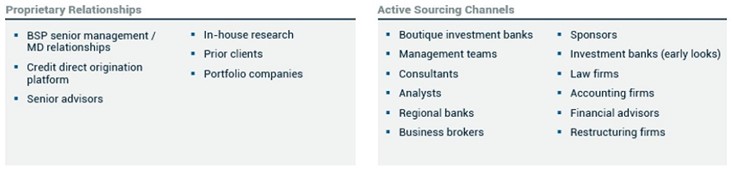
Sourcing of primarily private debt opportunities. At the heart of the Fund’s investment strategy is its approach to sourcing attractive direct lending opportunities by capitalizing on BSP’s extensive networks as well as its proprietary relationships and insights. This differentiated transaction-sourcing framework comprises hundreds of close, long-standing personal relationships that have been forged over the course of several decades and hundreds of transactions. Messrs. Faulstich, Mahajan, Zimmerman, Jang, and Leong have collectively been involved in thousands of credit transactions over the course of their careers as senior bankers at preeminent institutions at the center of the global credit markets. Primarily through hands-on, personal involvement in these investments and transactions, the Benefit Street Partners team has developed and maintained a broad and diversified network of contacts throughout the deal transaction ecosystem. This network is a rich source of proprietary ideas and deal generation, often yielding a “first look” at attractive direct lending opportunities.
Benefit Street Partners’ Network for Ideas, Investments, and Insights
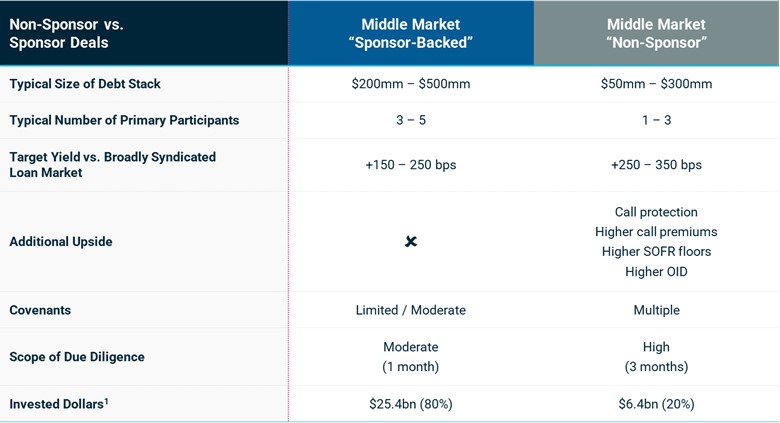
Prioritize non-competitive, “strategic capital” opportunities. The Fund will seek to prioritize “strategic capital” opportunities where Benefit Street Partners is uniquely positioned as a debt provider by virtue of its industry insights, capital markets expertise or other differentiating attribute. BSP participates in both sponsor and non-sponsored transactions and has historically followed a balanced approach to allocating into sponsor and non-sponsor deals. BSP incorporates a component of non-sponsor transactions into its managed portfolios because they are typically less competitive, and therefore often result in better yield and terms per unit of risk than sponsored loans. Having said that, non-sponsor deals have tended to be more episodic in nature than sponsor deals. As such, the Fund also expects to invest in sponsor loans. Ultimately, BSP evaluates the risk-reward profile of every investment on a case-by-case basis and its primary aim is to participate in transactions where BSP has influence over terms, covenants, and governance of these investments. In BSP’s experience, investment opportunities where BSP is viewed as provider of “strategic capital,” as opposed to just capital, have generally been more attractive from a risk-reward perspective. The following table illustrates the difference between middle market sponsor loans and middle market sponsor-backed loans.
Investment-level risk/return profile optimization. Every potential investment must have attractive risk reward profile to be considered. As mentioned above, we prioritize situations which are less competitive and where we are viewed as “strategic capital” providers. This means that we prioritize a combination of non-sponsored investment opportunities, which by their nature are less competitive, as well as non-competitive sponsored investment opportunities. Most importantly, every investment is evaluated individually with regard to its risk/reward profile. Our aim is to invest in opportunities where we are paid higher yields per unit of risk than what is contemplated in the broader market. Additionally, even though our investments are made from the bottom up, we aim to produce a broad portfolio of assets, which together are reflective of the types of risk we think are appropriate in any given environment. The Fund intends to target investments where attractive returns and upside potential are accompanied by solid, reliable and measurable downside protection. In addition to downside protection inherent contractually in all debt structures, the Fund plans to employ a wide range of investment-specific mechanisms to provide further downside protection in many of its investments.
Fund-level downside protection through world-class risk management and multi-dimensional diversification. Transcending all components of the Fund’s investment strategy is the overarching goal of downside protection at the fund-level through experienced portfolio management. BSP seeks to accomplish this objective through disciplined application of risk management best practices across the portfolio combined with a broad-based investment approach at the fund-level across several discrete dimensions. BSP’s risk management practices are grounded in an established investment process consisting of systematic underwriting, rigorous due diligence, third-party reports and investment committee approval accompanied by a proprietary and dynamic post-investment monitoring system for regularly updating issuer data. See “—Investment Process.”
In addition, the Fund will not employ significant leverage to achieve its target returns. The Fund expects to use modest leverage, not to exceed the 300% asset coverage ratio, i.e., for every $1.00 of debt issued, the Fund must have $3.00 of total assets immediately after issuance.
Ability to take advantage of opportunities Benefit Street Partners believes are mispriced. As a complement to its traditional middle market investments, BSP preserves the flexibility to invest opportunistically, including in opportunities it believes are mispriced. Throughout BSP’s history, its private debt funds have been opportunistic in identifying the best risk-adjusted returns determined by market-driven factors. BSP and its affiliates have successfully invested in private debt across a credit cycle.
Market Opportunity
The Fund aims to target investments presented by the large, persistent, and compelling market opportunity that has been created by a structural supply/demand imbalance for private credit, predominantly in North America. This imbalance is driven by substantial long-term changes in the debt capital markets following the credit crisis. BSP believes that the Fund’s target market segment represents a large opportunity set for the Fund, particularly for well-positioned managers that possess a scaled platform, deep credit markets experience, knowledge, and proprietary sourcing networks.
Large, persistent, and compelling market opportunity. The fundamental premise underpinning the Fund’s investment thesis is that there is a compelling near- and medium-term opportunity to provide capital to middle market companies on attractive terms.4 This opportunity is a function of the size and growth rate of the middle market segment of the U.S. economy as well as a substantial, persistent, and structurally driven supply/demand imbalance for middle market debt capital across North America.
Sizeable and growing segment of the economy. Middle market companies represent a significant segment of the U.S. economy. According to the National Center for the Middle Market, there are nearly “200,000 U.S. middle market businesses that represent one-third of private sector GDP, employing approximately 48 million people. These businesses outperformed through the financial crisis (2007–2010 period) by adding 2.2 million jobs across major industry sectors and U.S. geographies, demonstrating their importance to the overall health of the U.S. economy. They are private and public, family owned, and sole proprietorships, geographically diverse, and span almost all industries. The health of these businesses and their respective outlook serve as a solid indicator for the greater U.S. economy as a whole.” Additionally, each of these middle market businesses typically generates annual revenue between $10 million and $1 billion.5
4 Potential investors should note that definitions of “middle market” used throughout this discussion and third-party classifications of “middle market” differ from BSP’s definition of “middle market” for purposes of the Fund.
5 “2H 2025 Middle Market Indicator Overview”. National Center for the Middle Market. 2025
Moreover, in our experience, middle market companies can have significant and recurring capital requirements and therefore, often require regular and reliable access to capital to build their businesses and compete effectively. Annual issuance of middle market loans has averaged over $162 billion since 2013 with 2020 issuance at $100 billion, 2021 issuance over $180 billion, 2022 issuance at $170 billion, 2023 issuance at $120 billion, and 2024 issuance at $160 billion. Through the 4th quarter of 2025, total middle market loan issuance amounts to $47 billion.6
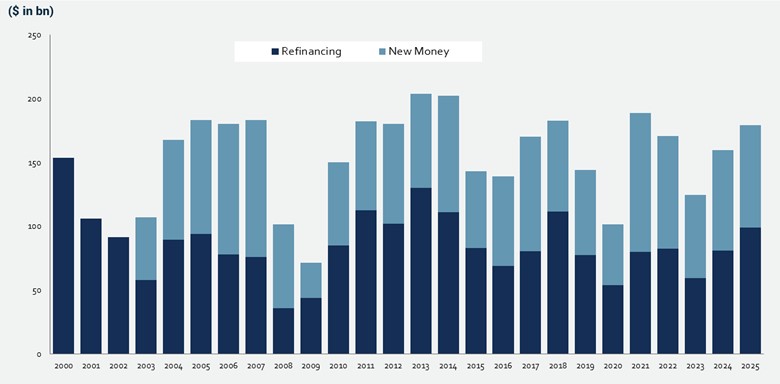
Middle Market Loan Issuance
Source: Refinitiv: “Middle Market 4Q 2025 Review,” December 2025. “Middle market” is defined as issuers with loan size and revenue of less than or equal to $500 million.
Reduced supply of debt capital for middle market companies. The global financial crisis and its long-term aftereffects have reduced the amount of debt capital available to middle market companies from bank lenders. The tables below summarize the banks’ retrenchment as providers of debt capital to the middle market. Private lenders have moved in to fill this gap with the ability to write increasingly larger check sizes, fundamentally reallocating capital typically deployed in the syndicated market. Borrowers are inclined to choose private lenders over conventional syndication because of the ability of private lenders to provide sure and expedient capital during times of uncertainty or volatility in the public markets.7
6 “LSEG Middle Market 4Q25 Review”. December 2025.
7 Source: Bloomberg “Billion Dollar Deals See Private Credit Step Out of the Shadows” July 2020.
Since the global financial crisis, the landscape has shifted as banks have pulled back their lending efforts to meet capital requirements imposed by Basel III and other regulations. Alternative lenders have stepped in to fill this void by providing loans directly to companies without the use of a bank as an intermediary. The private debt market offers borrowers significant advantages relative to the syndicated market as described below:
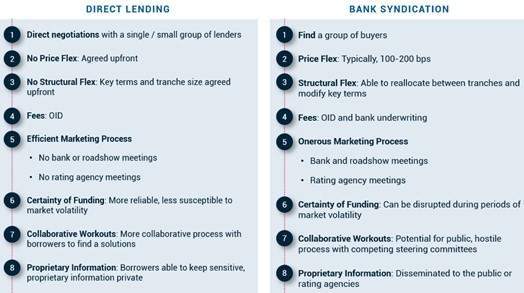
Note: Views expressed are those of BSP. Such statements cannot be independently verified and are subject to change.
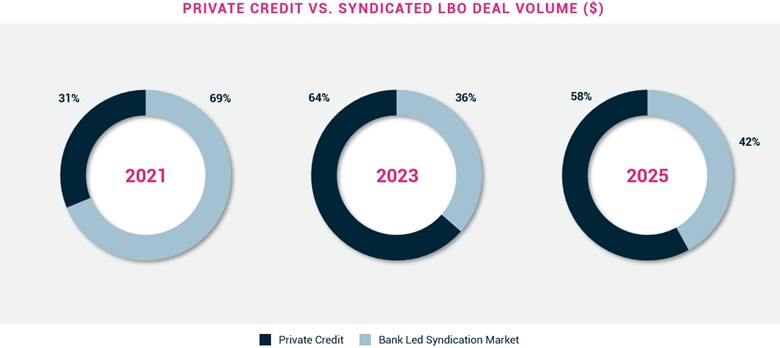
Source: Pitchbook; S&P LCD. As of December 31, 2025.
Consistent demand for debt capital by middle market companies. In contrast to the supply-side dynamic characterized by the diminished presence of traditional debt capital providers, Benefit Street Partners believes that demand for private debt capital will continue through the Fund’s investment period. Benefit Street Partners believes a range of dynamics drive this demand, including both cyclical factors such as leveraged buyout and other sponsor-related activity and non-cyclical factors such as impending maturities of existing debt and the need for growth capital.
Upcoming U.S. Maturity Walls
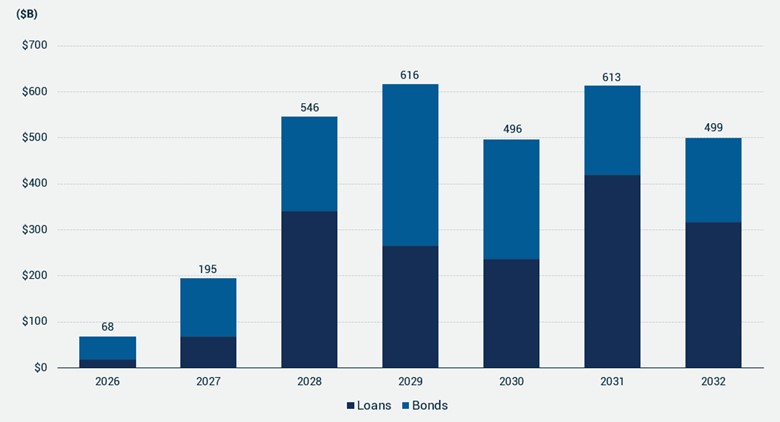
Source: JP Morgan U.S. High Yield and Leveraged Loan Strategy, S&P HIS Markit. As of November 2025.
Portfolio Composition
The Fund’s portfolio consists primarily of some combination of the following types of investments:
Directly Originated Corporate Loans. The Fund may invest in first lien senior secured loans (including “unitranche” loans, which are loans that combine both senior and mezzanine debt, generally in a first lien position), second lien senior secured loans and mezzanine debt, which in some cases includes an equity component, of U.S. middle-market companies, where the Adviser believes the supply of primary capital is limited and the investment opportunities are most attractive. These investments are typically made to companies with annual revenues up to $1 billion.
Broadly Syndicated Corporate Loans. Syndicated Loans generally hold the most senior position in the capital structure of a Borrower, are typically secured with specific collateral and have a claim on the assets and/or stock of the Borrower that is senior to that held by unsecured creditors, subordinated debt holders and holders of equity of the Borrower. Typically, in order to borrow money pursuant to a Syndicated Loan, a Borrower will, for the term of the Syndicated Loan, pledge collateral (subject to typical exceptions), including but not limited to (i) working capital assets, such as accounts receivable and inventory; (ii) tangible fixed assets, such as real property, buildings and equipment; (iii) intangible assets, such as trademarks and patent rights; and (iv) security interests in shares of stock of subsidiaries or affiliates. In the case of Syndicated Loans made to non-public companies, the company’s Shareholders or owners may provide collateral in the form of secured guarantees and/or security interests in assets that they own. In many instances, a Syndicated Loan may be secured only by stock in the Borrower or its subsidiaries. Collateral may consist of assets that may not be readily liquidated, and there is no assurance that the liquidation of such assets would satisfy fully a Borrower’s obligations under a Syndicated Loan.
Syndicated Loans typically have rates of interest that are determined daily, monthly, quarterly or semi-annually by reference to a base lending rate, plus a premium or credit spread. As a result, as short-term interest rates increase, interest payable to the Fund from its investments in Syndicated Loans should increase, and as short-term interest rates decrease, interest payable to the Fund from its investments in Syndicated Loans should decrease. These base lending rates are primarily SOFR and secondarily the prime rate offered by one or more major U.S. banks and the certificate of deposit rate or other base lending rates used by commercial lenders. The Fund may utilize total return swaps and/or various other derivatives to a lesser extent, for the purposes of gaining exposure to Syndicated Loans. Derivatives used by the Fund will be counted toward the Fund’s policy of investing at least 80% of its assets in private credit instruments. As a result, the market value of derivatives that provides the Fund with indirect exposure to private credit instruments will be counted toward the Fund’s 80% policy.
High Yield Corporate Bonds. An issuer of High Yield Corporate Bonds typically pays the investor a fixed rate of interest and must repay the amount borrowed on or before maturity. The investment return of High Yield Corporate Bonds reflects interest on the security and changes in the market value of the security. The market value of a High Yield Corporate Bond generally rises and falls inversely with interest rates. The value of intermediate- and longer-term High Yield Corporate Bonds normally fluctuates more in response to changes in interest rates than that of shorter-term High Yield Corporate Bonds. The market value of a High Yield Corporate Bond also may be affected by investors’ perceptions of the creditworthiness of the issuer, the issuer’s performance and perceptions of the issuer in the market place. There is a risk that the issuers of High Yield Corporate Bonds may not be able to meet their obligations on interest or principal payments at the time called for by an instrument. The Fund may utilize various types of derivatives, including swaps, for the purpose of gaining exposure to High Yield Corporate Bonds.
Structured Credit. The Fund may invest in asset-backed opportunities across broad sectors such as corporate credit or real estate. The Fund will target investment opportunities that are directly originated (i.e., the Fund sources the deal as opposed to being part of a larger syndicate of lenders) and privately negotiated whereby the Fund seeks to establish both the price and terms of such opportunities. These investments may include (1) financings secured by pools of real estate assets; (2) debt and equity investments in U.S.-dollar-denominated collateralized loan obligations (“CLOs”) that are primarily backed by corporate leveraged loans issued to primarily U.S. obligors; and (iii) investments in collateralized debt obligations (“CDOs”) and other securitized products. The investments in the “equity” of structured credit products (including CLOs and CDOs) refers to the junior-most or residual debt tranche of such structured credit products (i.e., the tranche whose rights to payment are not senior to any other tranche, which does not typically receive a credit rating and is typically not secured (and is also typically referred to as subordinated notes, income notes, preferred shares or preferred securities, or, more generally, as “equity”)).
Other Investment Strategies. The Fund may also invest in securities, notes, bills, debentures, bank loans, convertible and preferred securities, government and municipal obligations and other credit instruments with similar economic characteristics. In addition, from time to time, the Fund may invest in or hold common shares and other equity securities incidental to the purchase or ownership of a Syndicated Loan or High Yield Corporate Bond or in connection with a reorganization of a borrower. The Fund may engage in short sales. The Fund may also use total return swaps and other derivatives to gain investment exposure to credit instruments, provide downside protection, dampen volatility and for financing purposes. Derivatives may allow the Fund to increase or decrease the level of risk to which the Fund is exposed more quickly and efficiently than transactions in other types of instruments. The Fund may invest in securities of other investment companies to the extent that these investments are consistent with the Fund’s investment objective, strategies and policies and permissible under the 1940 Act. The Fund may also invest in securities of private funds that rely on exceptions from the definition of investment company under Section 3(c) of the 1940 Act, structured finance vehicles or other entities not traditionally considered pooled investment vehicles, and companies that rely on the exceptions from the definition of investment company under Section 3(c)(5)(A) or (B) of the 1940 Act. The Fund may invest in portfolio affiliates of the Fund within the meaning of, and in reliance on, Rules 17a-6 and 17d-1(d)(5) under the 1940 Act. The Fund may invest in other investment companies to gain broad market or sector exposure, including during periods when it has large amounts of uninvested cash or when the Adviser believes that share prices of other investment companies offer attractive values. In general, under the 1940 Act, an investment company may not (i) own more than 3% of the outstanding voting securities of any one registered investment company, (ii) invest more than 5% of its total assets in the securities of any single registered investment company or (iii) invest more than 10% of its total assets in securities of other registered investment companies (the “3-5-10% Limitations”). The Fund may rely on certain exemptions to exceed the 3-5-10% Limitations when investing in another registered investment company (including money market funds) or business development company. To the extent that the Fund invests in another investment company, because other investment companies pay advisory, administrative and service fees that are borne indirectly by investors, such as the Fund, there may be duplication of investment management and other fees. To a limited extent, the Fund may also invest in special situations investments, structured credit, and commercial real estate loans. Although the Fund does not specifically target covenant-lite loans, the Fund may also invest in covenant lite loans if market conditions result in loans having fewer covenants.
Other Characteristics
Below Investment Grade Credit Instruments. Most of the credit instruments in which the Fund may invest will be rated below investment grade (also known as “junk bonds”). Securities rated below investment grade are those that, at the time of investment, are rated Ba1 or lower by Moody’s, BB+ or lower by S&P or Fitch or, if unrated, are determined by the Adviser to be of comparable quality. Below investment grade securities often are regarded as having predominately speculative characteristics with respect to an issuer’s capacity to pay interest and repay principal. In addition, lower quality debt securities tend to be more sensitive to general economic conditions. Although many of the Fund’s investments may consist of securities rated below investment grade, the Fund reserves the right to invest in credit instruments of any credit quality, maturity and duration.
Illiquid and Restricted Securities. The Fund may invest in instruments that, at the time of investment, are illiquid (generally, those securities that cannot be disposed of within seven days in the ordinary course of business at approximately the value at which the Fund has valued the securities). Although the Fund may invest in such instruments without limitation, pursuant to the requirements of the 1940 Act, the Board has adopted, and the Fund follows, procedures designed to ensure that the Fund maintains sufficient liquidity to meet its periodic repurchase obligations as an interval fund. The Fund may also invest, without limit, in securities that are unregistered (but are eligible for purchase and sale by certain qualified institutional buyers) or are held by control persons of the issuer and securities that are subject to contractual restrictions on their resale.
Senior Secured Loans. Senior secured loans are situated at the top of the capital structure. Because these loans generally have priority in payment, they carry the least risk among all investments in a firm.
Second Lien Secured Loans. Second lien secured loans are immediately junior to senior secured loans and have substantially the same maturities, collateral and covenant structures as senior secured loans. Second lien secured loans, however, are granted a second priority security interest in the assets of the borrower, which means that any realization of collateral will generally be applied to pay senior secured loans in full before second lien secured loans are paid and the value of the collateral may not be sufficient to repay in full both senior secured loans and second lien secured loans. In return for this junior ranking, second lien secured loans generally offer higher returns compared to senior secured debt. These higher returns come in the form of higher interest and in some cases the potential for equity participation through warrants, though to a lesser extent than with subordinated loans.
Senior Secured Bonds. Senior secured bonds are generally secured by collateral on a senior, pari passu or junior basis with other debt instruments in an issuer’s capital structure and have similar maturities and covenant structures as senior secured loans.
Subordinated Debt. In addition to senior secured loans, second lien secured loans and senior secured bonds, we may invest a portion of our assets in subordinated debt. Subordinated debt usually ranks junior in priority of payment to senior debt and are often unsecured, but are situated above preferred equity and common equity in the capital structure. In return for their junior status compared to senior debt, subordinated debt investments typically offer higher returns through both higher interest rates and possible equity ownership in the form of warrants, enabling the lender to participate in the capital appreciation of the borrower. These warrants typically require only a nominal cost to exercise.
Other Investments. The Fund may invest its cash balances in money market instruments, U.S. government securities, commercial paper, certificates of deposit, repurchase agreements and other high-quality debt instruments maturing in one year or less, among other instruments. In addition, and in response to adverse market, economic or political conditions, the Fund may invest in high-quality fixed income securities, money market instruments and money market funds or may hold significant positions in cash or cash equivalents for defensive purposes.
Investment Process
BSP utilizes the same systematic process across its private credit platform when analyzing and managing investments and takes a hands-on approach in order to preserve and create value. The Fund’s expected investment process with respect to private credit transactions consists of several distinct phases as summarized in the following exhibit.
Expected Investment Process for Private Credit Transactions
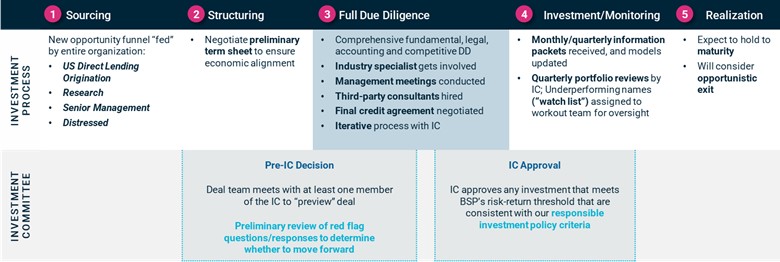
Sourcing. Our credit team’s investment process typically begins with sourcing private debt opportunities through our extensive proprietary networks and other relationships. Investment ideas deemed worthy of exploration are then channeled into a rigorous vetting process. Investment ideas are initially screened according to strict internal credit and pricing criteria. Ideas that pass this initial screen are then discussed among the broader BSP credit team. Only investment ideas that gain preliminary approval proceed to further evaluation.
Structuring. Investment ideas that receive favorable feedback result in a preliminary discussion with the proposed issuer under a non-disclosure agreement to confirm the issuer’s interest in the contemplated transaction prior to expending resources for full due diligence. During this phase, BSP focuses on creating a tailored financing solution for the company. Once created, the proposed solution is presented to the company so the company can consider whether the proposed structure makes sense. If both sides agree that the proposed financing solution is appropriate, a term sheet is generated, circulated and executed.
Investment Committee Preview. Upon execution of a term sheet, the deal team presents the terms and structure of the proposed investment to at least one member of the investment committee, for a full vetting. Taking into account the information presented, the investment committee member will then either decline the opportunity or approve that the proposed investment proceed to full due diligence.
Full Due Diligence. Following the investment committee preview and approval, the deal team proceeds to full due diligence of the prospective investment and issuer. This phase of the investment process comprises all aspects of credit-oriented due diligence including fundamental financial and business analysis, comprehensive accounting and legal reviews and an overview of industry trends and business valuation. BSP’s fundamental analysis involves close scrutiny of financial statements to reveal key drivers of revenues, expenses and cash flow. BSP also typically conducts extensive management team interviews to uncover incremental insights into these drivers as well as other potential issues that could affect the company’s performance and its ability to service its debt obligations. To ensure completeness of its due diligence process, BSP supplements in-house resources as necessary with leading third-party specialists including accountants, appraisers, consultants and attorneys.
Final Investment Committee. Upon completion of full due diligence, the deal team formally presents the investment opportunity to the investment committee for approval. In addition to considering the proposed investment on its standalone merits, the investment committee considers the overall fit of the proposed investment within the portfolio. At least three of the four members of the investment committee must approve the transaction in order for the investment to go in the portfolio.
Investment and Monitoring. Completed investments are closely monitored and, more formally, at the Fund’s regular portfolio review meeting. We conduct regular meetings with management and stay in close contact with the issuer to ensure a steady stream of information (including compliance with loan covenants) and to get an early read on potential issues. Additionally, BSP conducts quarterly portfolio review meetings where it discusses and evaluates the entirety of the investments in its portfolio. In the event that actual or potential underperformance is identified, the investment will be discussed and evaluated accordingly, and BSP may seek proactive protective measures including amendments, forbearance, waivers and retention of outside consultants.
Realization. The Fund’s core strategy is to source and structure debt investments that will deliver strong returns when held to maturity or refinanced prior to maturity. However, we will consider, on a selective and opportunistic basis, exiting an investment earlier if we believe the accessible exit value has exceeded intrinsic value.
Expected Investment Process for High Yield Investments
Screening. Our high yield investment process normally begins with a general screening of opportunities from primary and secondary channels. The primary opportunities derive from various capital markets relationships across the street and secondary opportunities through BSP’s proprietary monitoring tools, using data from publicly available sources such as Bloomberg. Our sector-focused research analysts provide the high yield portfolio managers with another lens into liquid credit markets and offer a high level investment outlook for secondary trading opportunities. Investment ideas are initially screened according to strict internal credit and pricing criteria. Ideas that pass this initial screen are then discussed among the broader BSP credit team.
Diligence. Following the initial screening of potential opportunities, the industry analysts provide in-depth fundamental credit research, which consists of a business review, analysis of the borrower/creditor, and a relative value assessment. BSP’s fundamental analysis involves close scrutiny of financial statements to reveal key drivers of revenues, expenses and cash flow. Once completed, full diligence is presented to the portfolio managers for ultimate investment decision.
Approval. At this stage, the portfolio managers either approve or deny potential investments based on the information provided in the due diligence reporting. If the credit is deemed to be financially sound and offer sufficient relative value with projected upside, the portfolio managers will approve the investment and add the name to our existing high yield portfolio.
Portfolio Construction & Positioning. Upon granting formal approval, the investment is added to an existing portfolio of high yield assets. The team has implemented proprietary models to help guide portfolio managers and senior management in daily review of the portfolio. Furthermore, portfolio managers have weekly meetings with senior management and BSP traders to assess the market opportunity, current portfolio positioning, asset allocation, and underlying performance. The team has established risk guardrails, maintains active sell discipline, and utilizes advanced analytics to dynamically track the performance of the portfolio.
Monitoring & Risk Management. The BSP accounting, finance, and operations teams conduct a daily review of the portfolio and produce nightly performance and risk management figures to the portfolio managers. On a go-forward basis, the sector analysts will re-underwrite the underlying investments in the portfolio at least quarterly. In addition to individual credit reviews, BSP compliance takes a comprehensive look at pre and post trading activity within the portfolio to ensure all regulatory requirements are met and maintained.
Risk Factors
Investing in our Shares involves a high degree of risk. Before making an investment in the Fund, you should carefully consider the following risk factors. The risks and uncertainties set forth below are not the only risks and uncertainties that we face. Additional risks and uncertainties not presently known to us or that we currently deem to be immaterial may also impair our business operations. If any of the following risks were to occur, our business or financial condition could be materially adversely affected. In such case, the NAV of our Shares could decline, and you may lose all or part of your investment.
Risks Related to the Current Environment
Global economic, political and market conditions, including uncertainty about the financial stability of the United States, could have a significant adverse effect on our business, financial condition and results of operations.
Concerns over the United States’ debt ceiling and budget-deficit have driven downgrades by rating agencies to the U.S. government’s credit rating. Downgrades by rating agencies to the U.S. government’s credit rating or concerns about its credit and deficit levels in general could cause interest rates and borrowing costs to rise, which may negatively impact both the perception of credit risk associated with our debt portfolio and our ability to access the debt markets on favorable terms. In addition, a decreased U.S. government credit rating, any default by the U.S. government on its obligations, or any prolonged U.S. government shutdown, could create broader financial turmoil and uncertainty, which may weigh heavily on our financial performance and the value of our common stock. U.S. debt ceiling and budget deficit concerns have increased the possibility of additional credit-rating downgrades and economic slowdowns or a recession in the United States.
Deterioration in the economic conditions in the Eurozone and other regions or countries globally and the resulting instability in global financial markets may pose a risk to our business. Financial markets have been affected at times by a number of global macroeconomic events, including the following: large sovereign debts and fiscal deficits of several countries in Europe and in emerging markets jurisdictions, levels of non-performing loans on the balance sheets of European banks, instability in the Chinese capital markets and global health crises. Global market and economic disruptions have affected, and may in the future affect, the U.S. capital markets, which could adversely affect our business, financial condition or results of operations. We cannot assure you that market disruptions in Europe and other regions or countries, including the increased cost of funding for certain governments and financial institutions, will not impact the global economy, and we cannot assure you that assistance packages will be available, or if available, be sufficient to stabilize countries and markets in Europe or elsewhere affected by a financial crisis. To the extent uncertainty regarding any economic recovery in Europe or elsewhere negatively impacts consumer confidence and consumer credit factors, our business, financial condition and results of operations could be significantly and adversely affected. Moreover, there is a risk of both sector-specific and broad-based corrections and/or downturns in the equity and credit markets. Any of the foregoing could have a significant impact on the markets in which we operate and could have a material adverse impact on our business prospects and financial condition.
Various social and political circumstances in the U.S. and around the world that are outside our control may also contribute to increased market volatility and economic uncertainties or deterioration in the U.S. and worldwide. Such events, including trade tensions between the United States and China, other uncertainties regarding actual and potential shifts in U.S. and foreign trade, economic and other policies with other countries, the ongoing war between Russia and Ukraine and conflicts in the Middle East and Central and South America and health epidemics and pandemics, could adversely affect our business, financial condition or results of operations. Additionally, the current U.S. political environment is volatile and has increased uncertainty regarding future political, legislative, regulatory or administrative changes that may impact the Adviser, the Fund or its investors or the Fund’s investments. Any such changes could impact the laws and regulations applicable to the Adviser, the Fund or the Fund’s investments. Significant uncertainty remains in the market regarding the consequences of the current U.S. political environment, and the range and potential implications of possible political, regulatory, economic and market outcomes are difficult to predict. Uncertainty regarding the consequences of the current U.S. political environment may have an adverse effect or may cause volatility in the U.S. or global economies and currency and financial markets in the short or long term, as well as the values of the Fund’s investments and the Fund’s ability to execute its investment strategy or the financial prospects of its investments. While certain of such changes could beneficially impact the Fund or certain investments, other changes could adversely impact the Adviser, the Fund or its investors or the Fund’s investments.
The capital markets are currently in a period of disruption and economic uncertainty. Such market conditions have adversely affected debt and equity capital markets, which have had, and may continue to have, a negative impact on our business and operations.
The U.S. capital markets have experienced extreme disruption. Such disruptions have been evidenced by volatility in global stock markets as a result of, among other things, inflation and fears of a global recession. Despite actions of the U.S. federal government and foreign governments, these events have contributed to worsening general economic conditions that are materially and adversely impacting broader financial and credit markets and reducing the availability of debt and equity capital for the market as a whole.
Significant changes in the capital markets, such as the disruption in economic activity caused by changes in interest rates, have limited, and could continue to limit, our investment originations, limit our ability to grow and have a material negative impact on our and our portfolio companies’ operating results and the fair values of our debt and equity investments. Additionally, the disruption in economic activity caused by changes in interest rates and a potential global recession has had, and may continue to have, a negative effect on the potential for liquidity events involving our investments. The illiquidity of our investments may make it difficult for us to sell such investments to access capital, if required. As a result, we could realize significantly less than the value at which we have recorded our investments if we were required to sell them to increase our liquidity. An inability on our part to raise incremental capital, and any required sale of all or a portion of our investments as a result, could have a material adverse effect on our business, financial condition or results of operations.
Significant changes or volatility in the capital markets may negatively affect the valuations of our investments. While most of our investments are not publicly traded, applicable accounting standards require us to assume as part of our valuation process that our investments are sold in a principal market to market participants (even if we plan to hold an investment to maturity). Our valuations, and particularly valuations of private investments and private companies, are inherently uncertain, fluctuate over short periods of time and are often based on estimates, comparisons and qualitative evaluations of private information that may not reflect the full impact of the current economic environment. Any public health emergency, including an outbreak of existing or new epidemic diseases, or the threat thereof, and the resulting financial and economic market uncertainty could have a significant adverse impact on us and the fair value of our investments and our portfolio companies.
Further, current market conditions may make it difficult to raise equity capital, extend the maturity of or refinance our existing indebtedness or obtain new indebtedness with similar terms. Any failure to do so could have a material adverse effect on our business. The debt capital available to us in the future, if available at all, may bear a higher interest rate and may be available only on terms and conditions less favorable than those of our existing debt. Such debt may need to be incurred in a rising interest rate environment. If we are unable to raise new debt or refinance our existing debt, then our equity investors will not benefit from the potential for increased returns on equity resulting from leverage, and we may be unable to make new commitments or to fund existing commitments to our portfolio companies. Any inability to extend the maturity of or refinance our existing debt or obtain new debt could have a material adverse effect on our business, financial condition or results of operations.
Future disruptions or instability in capital markets could negatively impact the Fund’s ability to raise capital, and have a material adverse effect on the Fund’s business, financial condition and results of operations.
From time to time, the global capital markets may experience periods of disruption and instability, which could materially and adversely impact the broader financial and credit markets and reduce the availability to us of debt and equity capital. For example, between 2008 and 2009, instability in the global capital markets resulted in disruptions in liquidity in the debt capital markets, significant write-offs in the financial services sector, the repricing of credit risk in the broadly syndicated credit market and the failure of major domestic and international financial institutions. In particular, the financial services sector was negatively impacted by significant write-offs as the value of the assets held by financial firms declined, impairing their capital positions and abilities to lend and invest. We believe that such value declines were exacerbated by widespread forced liquidations as leveraged holders of financial assets, faced with declining prices, were compelled to sell to meet margin requirements and maintain compliance with applicable capital standards. Such forced liquidations also impaired or eliminated many investors and investment vehicles, leading to a decline in the supply of capital for investment and depressed pricing levels for many assets. These events significantly diminished overall confidence in the debt and equity markets, engendered unprecedented declines in the values of certain assets, caused extreme economic uncertainty and significantly reduced the availability of debt and equity capital for the market as a whole and financial services firms in particular. While market conditions have experienced relative stability in recent years, there have been continuing periods of volatility and there can be no assurance that adverse market conditions will not repeat themselves in the future.
Future volatility and dislocation in the capital markets could create a challenging environment in which to raise or access capital. For example, the re-appearance of market conditions similar to those experienced from 2008 through 2009 for any substantial length of time could make it difficult to extend the maturity of or refinance our existing indebtedness or obtain new indebtedness with similar terms. Significant changes or volatility in the capital markets may also have a negative effect on the valuations of our investments. While most of our investments are not publicly traded, applicable accounting standards require us to assume as part of our valuation process that our investments are sold in a principal market to market participants (even if we plan on holding an investment through its maturity) and impairments of the market values or fair market values of our investments, even if unrealized, must be reflected in our consolidated financial statements for the applicable period, which could result in significant reductions to our NAV for the period. Thus, the illiquidity of our investments may make it difficult for us to sell such investments to access capital if required, and as a result, we could realize significantly less than the value at which we have recorded our investments if we were required to sell them for liquidity purposes.
We are subject to risks associated with changes in interest rates, including the current interest rate environment.
General interest rate fluctuations may have a substantial negative impact on our investments and our investment returns and, accordingly, may have a material adverse effect on our investment objective and our net investment income. Because we currently incur indebtedness to fund our investments, a portion of our income depends upon the difference between the interest rate at which we borrow funds and the interest rate at which we invest these funds. To the extent our investments have fixed interest rates or have interest rate floors that are higher than the floor on, or interest rates that “reset” less frequently than, any credit facilities we have entered or may enter into, increases in interest rates can lead to interest rate compression and have a material adverse effect on our net investment income. In addition to increasing the cost of borrowed funds, which may materially reduce our net investment income, rising interest rates may also adversely affect our ability to obtain additional debt financing on terms as favorable as under our current debt financings, or at all.
In a rising interest rate environment, there is a risk that the portfolio companies in which we hold floating rate securities will be unable to pay escalating interest amounts, which could result in a default under their loan documents with us. Rising interests rates could also cause portfolio companies to shift cash from other productive uses to the payment of interest, which may have a material adverse effect on their business and operations and could, over time, lead to increased defaults on our investments in such portfolio companies. In addition, increasing payment obligations under floating rate loans may cause borrowers to refinance or otherwise repay our loans earlier than they otherwise would, requiring us to incur management time and expense to re-deploy such proceeds, including on terms that may not be as favorable as our existing loans. Further, rising interest rates may increase pressure on us to provide fixed rate loans to our portfolio companies, which could adversely affect our net investment income, as increases in our cost of borrowed funds would not be accompanied by increased interest income from such fixed-rate investments.
We may hedge against interest rate fluctuations by using hedging instruments such as caps, swaps, futures, options and forward contracts, subject to applicable legal requirements, including all necessary registrations (or exemptions from registration) with the Commodity Futures Trading Commission. These activities may limit our ability to benefit from lower interest rates with respect to the hedged portfolio. Adverse developments resulting from changes in interest rates or hedging transactions or any adverse developments from our use of hedging instruments could have a material adverse effect on our business, financial condition and results of operations. In addition, we may be unable to enter into appropriate hedging transactions when desired and any hedging transactions we enter into may not be effective.
As a rise in the general level of interest rates can be expected to lead to higher interest rates applicable to our debt investments, an increase in interest rates would make it easier for us to meet or exceed the hurdle rate applicable to the incentive fee and may result in a substantial increase in the amount of incentive fees payable to the Adviser with respect to Pre-Incentive Fee Net Investment Income.
Ongoing armed conflicts, such as between Russia and Ukraine and Israel and Hamas, including recent escalations of the conflict in the Middle East and Southwest Asia, and continued and escalating political unrest in various other countries around the globe may have a material adverse impact on us and our portfolio companies.
United States and global markets are experiencing volatility and disruption following the geopolitical instability resulting from the ongoing Russia-Ukraine conflict, recent escalation of conflict in the Middle East and Southwest Asia and continued political and social unrest in various countries, such as Venezuela and Mexico, which have led, are currently leading, and for an unknown period of time will continue to lead to disruptions in local, regional, national, and global markets and economies affected thereby. Most recently, on February 28, 2026, the United States and Israel launched a major assault on Iran with the stated aim of toppling the regime in Tehran, triggering regional Iranian retaliation across the Gulf, including attacks against targets in Qatar, the United Arab Emirates (UAE), Kuwait, Bahrain and Saudi Arabia. An escalation in this or other global conflicts may have a material adverse impact on the Fund, its portfolio companies and the market generally, including as a result of intense regional and global military and/or economic retaliation, major maritime disruptions in the Strait of Hormuz, and large-scale cyber warfare.
Consider, for example, responses to the ongoing Russia-Ukraine conflict – the North Atlantic Treaty Organization (“NATO”) deployed additional military forces to eastern Europe, and the United States, the United Kingdom, the European Union and other countries announced various sanctions and restrictive actions against Russia, Belarus and related individuals and entities, including the removal of certain financial institutions from the Society for Worldwide Interbank Financial Telecommunication (SWIFT) payment system. Certain countries, including the United States, have provided and may continue to provide military aid or other assistance to Ukraine and to Israel, or have undertaken or will undertake military strikes in Southwest Asia, increasing geopolitical tensions among a number of nations. The invasion of Ukraine by Russia and the escalation of conflict in the Middle East and Southwest Asia and the resulting measures that have been taken, and could be taken in the future, by NATO, the United States, the United Kingdom, the European Union, Israel and its neighboring states and other countries have created global security concerns that could have a lasting impact on regional and global economies. Although the length and impact of the ongoing conflicts are highly unpredictable, they could lead to market disruptions, including significant volatility in commodity prices, credit and capital markets, as well as supply chain interruptions and increased cyber-attacks against U.S. companies. Additionally, any resulting sanctions could adversely affect the global economy and financial markets and lead to instability and lack of liquidity in capital markets.
Any of the above mentioned factors, or any other negative impact on the global economy, capital markets or other geopolitical conditions resulting from the Russian invasion of Ukraine, the escalation of conflict in the Middle East and Southwest Asia and subsequent sanctions or related actions, may lead to increased volume and price volatility. The extent and duration of the ongoing conflicts, resulting sanctions and any related market disruptions are impossible to predict, but could be substantial, particularly if current or new sanctions continue for an extended period of time or if geopolitical tensions result in expanded military operations on a global scale. Any such disruptions may also have the effect of heightening many of the other risks described in this section. If these disruptions or other matters of global concern continue for an extensive period of time, to the extent that we, our portfolio companies, third party service providers, investors, or related customer bases have material operations or assets in such conflict zones, they may be materially adversely affected.
Risks Related to Our Business and Structure
The amount of any distributions we pay is uncertain. Our distributions to our Shareholders may exceed our earnings. Therefore, portions of the distributions that we pay may represent a return of capital to you which will lower your tax basis in your shares and reduce the amount of funds we have for investment in targeted assets. A return of capital is a return of your initial investment in the Fund rather than earnings or gains derived from our investment activities. We may not be able to pay you distributions, and our distributions may not grow over time.
The Fund cannot assure investors that the Fund will achieve investment results that allows the Fund to make a specified level of cash distributions or year-to-year increases in cash distributions. The Fund may fund its cash distributions to Shareholders from any sources of funds available to it, including offering proceeds, borrowings, net investment income from operations, capital gains proceeds from the sale of assets, non-capital gains proceeds from the sale of assets, dividends or other distributions paid to the Fund on account of investments in portfolio companies and fee and expense reimbursement waivers from the Adviser, if any. The Fund’s ability to pay distributions, if any, might be adversely affected by, among other things, the impact of one or more of the risk factors described in this prospectus. All distributions will be paid at the discretion of the Board and may depend on the Fund’s earnings, the Fund’s net investment income, the Fund’s financial condition, maintenance of the Fund and the Fund’s RIC status, compliance with applicable regulations and such other factors as the Board may deem relevant from time to time.
In the event that the Fund encounters delays in locating suitable investment opportunities, the Fund may pay all or a substantial portion of its distributions from borrowings or sources other than net investment income in anticipation of future cash flows, which may constitute a return of capital to Shareholders. Distributions funded by a return of capital can reduce the amount of capital available to the Fund for investment, potentially impacting the Fund’s ability to achieve its investment objectives. Further, a return of capital generally is a return of a Shareholder’s investment, rather than a return of earnings or gains derived from the Fund’s investment activities, and generally results in a reduction of the Shareholder’s tax basis in the Shares. To the extent that the Fund pays distributions that constitute a return of capital for U.S. federal income tax purposes, a Shareholder’s tax basis in his or her Shares will be lowered. Resulting from such reduction in tax basis, Shareholders may be subject to tax in connection with the sale of Shares, even if such Shares are sold at a loss relative to the Shareholder’s original investment.
An investment in the Fund’s Shares is subject to investment and market risk.
An investment in the Fund’s Shares is subject to investment risk, including the possible loss of the entire principal amount invested. An investment in the Fund’s Shares represents an indirect investment in the portfolio of floating and fixed rate instruments, other securities and derivative investments owned by the Fund, and the value of these investments may fluctuate, sometimes rapidly and unpredictably. At any point in time an investment in the Fund’s Shares may be worth less than the original amount invested, even after taking into account distributions paid by the Fund and the ability of Shareholders to reinvest dividends. The Fund also uses leverage, which magnifies the Fund’s investment, market and certain other risks.
Price declines in the large corporate leveraged loan market may adversely affect the fair value of debt securities we hold, reducing the Fund’s NAV through increased net unrealized depreciation.
Prior to the onset of the global financial crisis, CLOs, a type of leveraged investment vehicle holding corporate loans, hedge funds and other highly leveraged investment vehicles, comprised a substantial portion of the market for purchasing and holding senior secured and second lien secured loans. As the secondary market pricing of the loans underlying these portfolios deteriorated during the fourth quarter of 2008, it is our understanding that many investors, as a result of their generally high degrees of leverage, were forced to raise cash by selling their interests in performing loans in order to satisfy margin requirements or the equivalent of margin requirements imposed by their lenders. This resulted in a forced deleveraging cycle of price declines, compulsory sales, and further price declines, with widespread redemption requests and other constraints resulting from the credit crisis generating further selling pressure. While prices have appreciated measurably in recent years, conditions in the large corporate leveraged loan market may experience similar disruptions or distortions in the future, which may cause pricing levels to decline similarly or be volatile. As a result, we may suffer unrealized depreciation and could incur realized losses in connection with the sale of debt securities we hold, which could have a material adverse impact on our business, financial condition and results of operations.
Our ability to achieve the Fund’s investment objective depends on our Adviser’s and its affiliates’ ability to manage and support our investment process. If our Adviser were to lose any members of its senior management team, our ability to achieve our investment objective could be significantly harmed.
We are externally managed and depend upon the investment expertise, diligence, skill and network of business contacts of our Adviser. We also depend, to a significant extent, on our Adviser’s access to the investment professionals and the information and deal flow generated by such investment professionals in the course of its investment and portfolio management activities. Our Adviser evaluates, negotiates, structures, closes, monitors and services our investments. Our success depends to a significant extent on the continued service and coordination of our Adviser, including its key professionals. The departure of a significant number of our Adviser’s or its affiliates’ key professionals could have a materially adverse effect on our ability to achieve our investment objective. Additionally, changes in ownership or management practices, the occurrence of adverse events affecting our Adviser or its affiliates or other companies advised by our Adviser and its affiliates could create adverse publicity and adversely affect us and our relationship with investment banks, business brokers, loan syndication and trading desks and other investment counterparties. In addition, we can offer no assurance that our Adviser will remain our investment adviser or that we will continue to have access to our Adviser’s or its affiliates’ investment professionals or their information and deal flow.
Because the Fund’s business model depends to a significant extent upon relationships with investment banks, business brokers, loan syndication and trading desks, and commercial banks, the inability of our Adviser to maintain or develop these relationships, or the failure of these relationships to generate investment opportunities, could adversely affect our business.
The services provided by our Adviser depend on its relationship with private equity firms, investment banks, business brokers, loan syndication and trading desks, and commercial banks, and we rely to a significant extent upon these relationships for potential investment opportunities. If our Adviser fails to maintain its existing relationships or develop new relationships with other sponsors or sources of investment opportunities, we will not be able to grow our investment portfolio. In addition, individuals with whom our Adviser’s professionals have relationships are not obligated to provide us with investment opportunities, and, therefore, there is no assurance that such relationships will generate investment opportunities for us.
We may face increasing competition for investment opportunities, which could delay deployment of our capital, reduce returns and result in losses.
The Fund competes for investments with other closed-end funds and investment funds (including private equity firms and mezzanine funds), as well as traditional financial services companies such as commercial banks and other sources of funding. Moreover, alternative investment vehicles, such as hedge funds, also make investments in middle market private U.S. companies. As a result of these new entrants, competition for investment opportunities in private U.S. companies may intensify. Many of the Fund’s competitors are substantially larger and may have considerably greater financial, technical and marketing resources than the Fund. For example, some competitors may have a lower cost of capital and access to funding sources that are not available to the Fund. In addition, some of the Fund’s competitors may have higher risk tolerances or different risk assessments, which allow them to consider a wider variety of investments, establish more relationships and offer better pricing and more flexible structuring than we are able to do. The Fund may lose investment opportunities if it does not match its competitors’ pricing. If the Fund is forced to match its competitors’ pricing, terms and structure, it may not be able to achieve acceptable returns on its investments or may bear substantial risk of capital loss. We believe a significant part of our competitive advantage stems from the fact that the market for investments in private U.S. companies is underserved by traditional commercial banks and other financial sources. A significant increase in the number and/or the size of the Fund’s competitors could force it to accept less attractive investment terms. Furthermore, many of the Fund’s competitors have greater experience operating under, or are not subject to, the regulatory restrictions that the 1940 Act imposes on us as a closed-end fund.
A significant portion of the Fund’s investment portfolio is recorded at fair value as determined in good faith by our Adviser and, as a result, there is and will be uncertainty as to the value of our portfolio investments.
Under the 1940 Act, we are required to carry our portfolio investments at market value or, if there are no readily available market quotations, at fair value, as determined by our Adviser, as valuation designee, subject to oversight by the Board. However, the majority of our investments are not publicly traded or actively traded on a secondary market. As a result, we value these securities daily at fair value as determined in good faith as required by the 1940 Act, but generally based on the most recent quarterly fair valuation determination by the Adviser taking into account various factors and third-party valuation inputs, as relevant. Between quarterly valuations the Adviser will, based on then-available information, consider whether there has been a material change to such investments as to affect their fair value.
The determination of fair value, and thus the amount of unrealized losses we may incur in any year, is to a degree subjective, and our Adviser has a conflict of interest in making this determination. Our Adviser may utilize the services of one or more independent third-party valuation firms to aid it in determining the fair value of any securities. The types of factors that may be considered in determining the fair value of our investments include the nature and realizable value of any collateral, the portfolio company’s ability to make payments on indebtedness and its earnings, the markets in which the portfolio company does business, comparison to publicly traded companies, discounted cash flow, current market interest rates and other relevant factors. Because such valuations, and particularly valuations of private securities and private companies, are inherently uncertain, the valuations may fluctuate significantly over short periods of time due to changes in current market conditions. The determinations of fair value by our Adviser may differ materially from the values that would have been used if an active market and market quotations existed for these investments. Our NAV could be adversely affected if the determinations regarding the fair value of our investments were materially higher than the values that we ultimately realize upon the disposal of such investments. See “Determination of Net Asset Value.”
We may experience fluctuations in the Fund’s quarterly results.
We may experience fluctuations in our quarterly operating results due to a number of factors, including our ability or inability to make investments in companies that meet our investment criteria, variations in the interest rates on the debt securities we acquire, the level of our expenses, variations in and the timing of the recognition of realized and unrealized gains or losses, the degree to which we encounter competition in our markets and general economic conditions. As a result of these factors, results for any previous period should not be relied upon as being indicative of performance in future periods.
We depend upon information systems, and systems failures could significantly disrupt the Fund’s business, which may, in turn, negatively affect the value of the Fund’s Shares and our ability to pay distributions.
We depend upon the communications and information systems of the Adviser and its affiliates as well as certain other third-party service providers. We, and our third-party service providers, are susceptible to operational and information security risks. While our third-party service providers have procedures in place with respect to information security, their technologies may become the target of cyber-attacks or information security breaches that could result in the unauthorized gathering, monitoring, release, misuse, loss or destruction of our and/or our Shareholders’ confidential and other information, or otherwise disrupt our operations or those of our third-party service providers. Disruptions or failures in the physical infrastructure or operating systems that our third-party service providers, cyber-attacks or security breaches of the networks, systems or devices that our third-party service providers use to service our operations, or disruption or failures in the movement of information between service providers could disrupt and impact the service providers’ and our operations, potentially resulting in financial losses, the inability of our Shareholders to transact business and of us to process transactions, inability to calculate our NAV, misstated or unreliable financial data, violations of applicable privacy and other laws, regulatory fines, penalties, litigation costs, increased insurance premiums, reputational damage, reimbursement or other compensation costs, and/or additional compliance costs. Our third-party service providers’ policies and procedures with respect to information security have been established to seek to identify and mitigate the types of risk to which we and our third-party service providers are subject. As with any risk management system, there are inherent limitations to these policies and procedures as there may exist, or develop in the future, risks that have not been anticipated or identified. There can be no assurance that we or our third-party service providers will not suffer losses relating to information security breaches (including cyber-attacks) or other disruptions to information systems in the future.
Our business could suffer in the event our Adviser or any other party that provides us with services essential to our operations experiences system failures or cyber-incidents or a deficiency in cybersecurity.
Despite system redundancy, the implementation of security measures and the existence of a disaster recovery plan for the internal information technology systems of our Adviser and other parties that provide us with services essential to our operations, these systems are vulnerable to damage from any number of sources, including computer viruses, unauthorized access, energy blackouts, natural disasters, terrorism, war and telecommunication failures. Any system failure or accident that causes interruptions in our operations could result in a material disruption to our business.
A cyber-incident is considered to be any adverse event that threatens the confidentiality, integrity or availability of information resources. More specifically, a cyber-incident is an intentional attack or an unintentional event that can result in third parties gaining unauthorized access to systems to disrupt operations, corrupt data, or steal confidential information. As reliance on technology in our industry has increased, so have the risks posed to the systems of our Adviser and other parties that provide us with services essential to our operations, both internal and those that have been outsourced. In addition, the risk of a cyber-incident, including by computer hackers, foreign governments and cyber terrorists, has generally increased as the number, intensity and sophistication of attempted attacks and intrusions from around the world have increased. Even the most well protected information, networks, systems and facilities remain potentially vulnerable because the techniques used in such attempted attacks and intrusions evolve and generally are not recognized until launched against a target. In some cases such attacks and intrusions are designed not to be detected and, in fact, may not be detected.
The remediation costs and lost revenues experienced by a victim of a cyber-incident may be significant and significant resources may be required to repair system damage, protect against the threat of future security breaches or to alleviate problems caused by any breaches, including reputational harm, loss of revenues and litigation. In addition, a security breach or other significant disruption involving the information technology networks and related systems of our Adviser or any other party that provides us with services essential to our operations could:
| ● | result in misstated financial reports, violations of loan covenants, missed reporting deadlines; |
| ● | affect our ability to properly monitor our compliance with the rules and regulations regarding our qualification as a RIC; |
| ● | result in the unauthorized access to, and destruction, loss, theft, misappropriation or release of, proprietary, confidential, sensitive or otherwise valuable information, which others could use to compete against us or for disruptive, destructive or otherwise harmful purposes and outcomes; |
| ● | result in liability to us for claims by Shareholders and third-parties; |
| ● | require significant management attention and resources to remedy any damages that result; or |
| ● | adversely impact our reputation among investors. |
Although our Adviser and other parties that provide us with services essential to our operations intend to continue to implement industry-standard security measures, there can be no assurance that those measures will be sufficient, and any material adverse effect experienced by our Adviser and other parties that provide us with services essential to our operations could, in turn, have an adverse impact on us.
We could potentially be involved in litigation arising out of the Fund’s operations in the normal course of business.
We may, from time to time, be involved in litigation arising out of our operations in the normal course of business or otherwise. Furthermore, third parties may try to seek to impose liability on us in connection with the activities of our portfolio companies. While the outcome of any current legal proceedings cannot at this time be predicted with certainty, we do not expect any current matters will materially affect our financial condition or results of operations; however, there can be no assurance whether any pending legal proceedings will have a material adverse effect on our financial condition or results of operations in any future reporting period.
We may rely upon projections, forecasts or estimates developed by the Adviser and its affiliates or a company in which we are invested concerning the company’s future performance and cash flow.
Projections, forecasts and estimates are forward-looking statements and are based upon certain assumptions. Actual events are difficult to predict and beyond the Fund’s control. Actual events may differ from those assumed. Some important factors which could cause actual results to differ materially from those in any forward-looking statements include changes in interest rates; loan pricing; leverage levels; loan structures; credit agreement terms; prepayment rates; timing of acquiring additional assets for the Fund; exchange rates or default or recovery rates or timing; mismatches between the timing of accrual and receipt of proceeds from the Fund’s assets; domestic and foreign business, market, financial or legal conditions; differences in the actual allocation of the Fund’s investments among asset groups from that described herein; the degree to which the Fund’s investments are hedged and the effectiveness of such hedges, among others. Accordingly, there can be no assurance that estimated returns or projections can be realized or that actual returns or results will not be materially lower than those estimated therein.
None of the Fund, the Adviser, their respective affiliates or any other person has any obligation to update or otherwise revise any projections, forecasts or estimates, including any revisions to reflect changes in economic conditions or other circumstances arising after the date of such projections, forecasts or estimates or to reflect the occurrence of unanticipated events, even if the underlying assumptions do not come to fruition.
We may be more susceptible than a diversified fund to being adversely affected by any single corporate, economic, political or regulatory occurrence.
We are classified as “non-diversified” under the 1940 Act. As a result, we can invest a greater portion of our assets in obligations of a single issuer than a “diversified” fund. We may therefore be more susceptible than a diversified fund to being adversely affected by any single corporate, economic, political or regulatory occurrence.
There are significant potential conflicts of interest that could impact the Fund’s investment returns.
We pay a Management Fee to our Adviser and reimburse our Adviser for certain expenses it incurs on our behalf. In addition, investors in our Shares invest on a gross basis and receive distributions on a net basis after expenses, resulting in a lower rate of return than one might achieve through direct investments. See “Conflicts of Interest” for additional information.
The time and resources that individuals and the executive officers of the Adviser devote to us may be diverted and we may face additional competition due to the fact that neither our Adviser nor its affiliates are prohibited from raising money for or managing another entity that makes the same types of investments that we target.
Affiliates and executive officers of the Adviser currently manage other investment entities and are not prohibited from raising money for and managing future investment entities that make the same types of investments as those we target. As a result, the time and resources that the executive officers and individuals employed by the Adviser and its affiliates devote to us may be diverted, and during times of intense activity in other areas of business, they may devote less time and resources to our business than is necessary or appropriate.
The Incentive Fee may induce the Adviser to make certain investments, including speculative investments.
The Investment Advisory Agreement entitles the Adviser an Incentive Fee payable by the Fund that relates to its net investment income may be computed and paid on income that may include interest that has been accrued but not yet received. If a portfolio company defaults on a loan that is structured to provide accrued interest, it is possible that accrued interest previously included in the calculation of the Incentive Fee will become uncollectible, which could adversely affect our financial condition, business, and results of operations. The Adviser is not under any obligation to reimburse the Fund for any part of the Incentive Fee the Adviser received that was based on accrued income that the Fund never received as a result of a default by an entity on the obligation that resulted in the accrual of such income, and such circumstances would result in the Fund’s paying an Incentive Fee on income it never received.
The Incentive Fee payable by the Fund to the Adviser may create an incentive for the Adviser to make investments on the Fund’s behalf that are risky or more speculative than would be the case in the absence of such compensation arrangement. The way in which the Incentive Fee payable to the Adviser is determined may encourage the Adviser to use leverage to increase the return on the Fund’s investments. In addition, the fact that the Management Fee is payable based upon the Fund’s average daily net assets, which would include any borrowings for investment purposes, may encourage the Adviser to use leverage to make additional investments. Under certain circumstances, the use of leverage may increase the likelihood of default, which would disfavor shareholders. Such a practice could result in the Fund’s investing in more speculative securities than would otherwise be in its best interests, which could result in higher investment losses, particularly during cyclical economic downturns.
Our ability to enter into transactions with our affiliates is restricted.
The 1940 Act generally prohibits closed-end funds from entering into negotiated co-investments with affiliates absent an order from the SEC. Unless otherwise provided in the allocation policy, if an investment opportunity is appropriate for both us and other investment funds, the investment opportunity requires more than the price to be negotiated and cannot be effected pursuant to the terms of our exemptive order granted by the SEC, the investment opportunity will be made available to the other investment fund or us on an alternating basis based on the date of closing of each such investment opportunity and each fund’s available capital. As a result, the Adviser and/or its affiliates may face conflicts in allocating investment opportunities between us and such other entities. Although the Adviser and its affiliates will endeavor to allocate investment opportunities in a fair and equitable manner and consistent with applicable allocation procedures, it is possible that, in the future, we may not be given the opportunity to participate in investments made by investment funds managed by the Adviser or its affiliates.
We rely on exemptive relief from the SEC that permits us greater flexibility to enter into negotiated co-investment transactions alongside other accounts sponsored or managed by the Adviser or its affiliates (“Affiliated Funds”), subject to compliance with certain conditions. Under the terms of this exemptive relief, a “required majority” (as defined in Section 57(o) of the 1940 Act) of our eligible trustees has approved the policies and procedures of the Fund that are reasonably designed to ensure compliance with the terms of the exemptive order and has reviewed the allocation policy and other co-investment policies of the Adviser. The exemptive order is subject to certain terms and conditions so there can be no assurance that the Fund will be permitted to invest in aggregated transactions alongside certain of the Affiliated Funds other than in the circumstances currently permitted by regulatory guidance and the exemptive order. For example, in certain instances, the Fund’s ability to participate in such negotiated co-investment transactions alongside Affiliated Funds will require a “required majority” (as defined in Section 57(o) of the 1940 Act) of our eligible trustees to make certain conclusions in connection with a co-investment transaction, including that (1) the terms of the proposed transaction are reasonable and fair to us and our shareholders and do not involve overreaching in respect of us or our shareholders on the part of any person concerned and (2) the transaction is consistent with the interests of our shareholders and is consistent with our investment strategies and policies.
The share repurchase program may harm the Fund’s investment performance and the Fund may not be able to repurchase all the Shares a Shareholder tenders.
The Fund is an “interval fund” and, to provide limited liquidity to Shareholders, makes quarterly offers to repurchase between 5% and 25% of its outstanding Shares at NAV, pursuant to Rule 23c-3 under the 1940 Act. Under normal market conditions, the Fund currently intends to repurchase 5% of its outstanding shares at NAV on a quarterly basis. The Fund believes that these repurchase offers are generally beneficial to the Fund’s Shareholders, and generally are funded from available cash or sales of portfolio securities. However, the repurchase of Shares by the Fund decreases the assets of the Fund and, therefore, may have the effect of increasing the Fund’s expense ratio. Repurchase offers and the need to fund repurchase obligations may also affect the ability of the Fund to be fully invested or force the Fund to maintain a higher percentage of its assets in liquid investments, which may harm the Fund’s investment performance. Moreover, diminution in the size of the Fund through repurchases may result in untimely sales of portfolio securities, and may limit the ability of the Fund to participate in new investment opportunities. If the Fund uses leverage, repurchases of Shares may compound the adverse effects of leverage in a declining market. In addition, if the Fund borrows money to finance repurchases, interest on that borrowing will negatively affect Shareholders who do not tender their Shares by increasing Fund expenses and reducing any net investment income. Certain Shareholders may from time to time own or control a significant percentage of the Fund’s Shares. Repurchase requests by these Shareholders of these Shares of the Fund may cause repurchases to be oversubscribed, with the result that Shareholders may only be able to have a portion of their Shares repurchased in connection with any repurchase offer. If a repurchase offer is oversubscribed and the Fund determines not to repurchase additional Shares beyond the repurchase offer amount, or if Shareholders tender an amount of Shares greater than that which the Fund is entitled to purchase, the Fund will repurchase the Shares tendered on a pro rata basis, and Shareholders will have to wait until the next repurchase offer to make another repurchase request. Shareholders will be subject to the risk of NAV fluctuations during that period. Thus, there is also a risk that some Shareholders, in anticipation of proration, may tender more Shares than they wish to have repurchased in a particular quarter, thereby increasing the likelihood that proration will occur. Further, the Fund has in the past received, and may in the future receive, repurchase requests that exceed the limits under its share repurchase program, and the Fund has in the past repurchased less than the full amount of Shares requested, resulting in the repurchase of Shares on a pro rata basis. For example, each of the Fund’s quarterly repurchase offers since March 2025 were oversubscribed and the Fund fulfilled repurchase requests on a pro rata basis, in accordance with the limitations specified in its share repurchase program and applicable law. In each such case, the Fund accepted repurchase requests from each Shareholder up to the limitations in the Fund’s share repurchase program. Additionally, the NAV per Shares tendered in a repurchase offer may fluctuate between the date a Shareholder submits a repurchase request and the Repurchase Request Deadline, and to the extent there is any delay between the Repurchase Request Deadline and the Repurchase Pricing Date. The NAV on the Repurchase Request Deadline or the Repurchase Pricing Date may be higher or lower than on the date a Shareholder submits a repurchase request. See “Share Repurchase Program.”
The Fund, the Adviser, the Distributor and their respective affiliates are subject to regulatory oversight risk.
The Fund’s business and the businesses of the Adviser, the Distributor and their respective affiliates are subject to extensive regulation, including periodic examinations, inquiries and investigations, which may result in enforcement and other proceedings, by governmental agencies and self-regulatory organizations in the jurisdictions in which the Fund, the Adviser, the Distributor and their respective affiliates operate around the world, including by the SEC and various other U.S. federal, state and local agencies. These authorities have regulatory powers dealing with many aspects of financial services, including the authority to grant, and in specific circumstances to cancel, permissions to carry on particular activities.
In addition, if previously enacted laws are amended or if new legislative or regulatory reforms are adopted, this could have further impact on the Fund’s industry. Changes in administration have led to, and may continue to lead to, leadership changes at a number of U.S. federal regulatory agencies with oversight over the U.S. financial services industry. Such changes would pose uncertainty with respect to such agencies’ ongoing policy priorities and could lead to increased regulatory enforcement activity in the financial services industry. Any changes or reforms may impose additional costs on the Fund’s current or future investments, require the attention of senior management or result in other limitations on the Fund’s business or investments. The Fund is unable to predict at this time the likelihood or effect of any such changes or reforms.
We are subject to risks associated with technological or other innovations and industry disruptions.
Recent trends in the market generally, including technological developments in artificial intelligence, have disrupted the industry with technological or other innovations. In this period of rapid technological and commercial innovation, new businesses and approaches may be created that could affect the Fund and/or its portfolio companies or alter the market practices that help frame its strategy. Any of these new approaches could damage the Fund’s investments, significantly disrupt the market in which it operates and subject it to increased competition, which could materially and adversely affect its business, financial condition and results of investments. Moreover, given the pace of innovation in recent years, the impact on a particular investment may not have been foreseeable at the time the Fund made the investment. Furthermore, the Fund could base investment decisions on views about the direction or degree of innovation that prove inaccurate and lead to losses.
Risks Related to Our Investments
Our investments in portfolio companies may be risky, and we could lose all or part of the Fund’s investment.
Under normal circumstances, private credit investments will represent at least 80% of the Fund’s Managed Assets. We invest primarily in first and second lien senior secured loans and mezzanine debt issued by middle market companies.
First and Second Lien Senior Secured Loans. When we make senior secured loans, we will generally take a security interest in the available assets of these portfolio companies, including the equity interests of their subsidiaries. We expect this security interest to help mitigate the risk that we will not be repaid. However, there is a risk that the collateral securing our loans may decrease in value over time or lose its entire value, may be difficult to sell in a timely manner, may be difficult to appraise and may fluctuate in value based upon the success of the business and market conditions, including as a result of the inability of the portfolio company to raise additional capital. Also, in some circumstances, our lien could be subordinated to claims of other creditors. In addition, deterioration in a portfolio company’s financial condition and prospects, including its inability to raise additional capital, may be accompanied by deterioration in the value of the collateral for the loan. Finally, applicable bankruptcy laws may adversely impact the timing and methods used by us to liquidate collateral securing our loans, which could adversely affect the collectability of such loans. Similarly, investments in “last out” pieces of unitranche loans will be similar to second lien loans in that such investments will be junior in priority to the “first out” piece of the same unitranche loan with respect to payment of principal, interest and other amounts. Consequently, the fact that a loan is secured does not guarantee that we will receive principal and interest payments according to the loan’s terms, or at all, or that we will be able to collect on the loan should we be forced to enforce our remedies.
Mezzanine Debt. Our mezzanine debt investments will generally be subordinated to senior loans and will generally be unsecured. This may result in a heightened level of risk and volatility or a loss of principal which could lead to the loss of our entire investment.
These investments may involve additional risks that could adversely affect our investment returns. To the extent interest payments associated with such debt are deferred, including in order to pay amounts owed under senior loans, such debt may be subject to greater fluctuations in valuations, and such debt could subject us and Shareholders to non-cash income. Since we will not receive any principal repayments prior to the maturity of some of our mezzanine debt investments, such investments will be of greater risk than amortizing loans.
Payment-in-Kind (“PIK”) Interest Risk. The Fund may hold investments that result in PIK interest. PIK interest creates the risk that incentive fees will be paid to the Adviser based on non-cash accruals that ultimately may not be realized, while the Adviser will be under no obligation to reimburse the Fund for these fees. PIK interest has the effect of generating investment income at a compounding rate, thereby further increasing the incentive fees payable to the Adviser. Similarly, all things being equal, the deferral associated with PIK interest also increases the loan-to-value ratio at a compounding rate. The market prices of PIK securities generally are more volatile than the market prices of interest-bearing securities and are likely to respond to a greater degree to changes in interest rates than interest-bearing securities having similar maturities and credit quality. Because PIK interest results in an increase in the size of the PIK securities held, the Fund’s exposure to potential losses increases when a security pays PIK interest.
More generally, investing in private companies involves a number of significant risks, including that they: (i) may have limited financial resources and may be unable to meet their obligations under their debt securities that we hold, which may be accompanied by a deterioration in the value of any collateral and a reduction in the likelihood of us realizing any guarantees we may have obtained in connection with our investment; (ii) have shorter operating histories, narrower product lines and smaller market shares than larger businesses, which tend to render them more vulnerable to competitors’ actions and changing market conditions, as well as general economic downturns; (iii) are more likely to depend on the management talents and efforts of a small group of persons so the death, disability, resignation or termination of one or more of these persons could have a material adverse impact on our portfolio company and, in turn, on us; and (iv) generally have less predictable operating results, may from time to time be parties to litigation, may be engaged in rapidly changing businesses with products subject to a substantial risk of obsolescence, and may require substantial additional capital to support their operations, finance expansion or maintain their competitive position. In addition, our executive officers and trustees and employees of our Adviser may, in the ordinary course of business, be named as defendants in litigation arising from our investments in the portfolio companies and may have difficulty accessing the capital markets to meet future capital needs, which may limit their ability to grow or to repay their outstanding indebtedness upon maturity.
To the extent that the Fund invests in original issue discount (“OID”) or PIK instruments and the accretion of OID or PIK interest income constitutes a portion of the Fund’s income, the Fund will be exposed to risks associated with the requirement to include such non-cash income in taxable and accounting income prior to receipt of cash, including the following:
| ● | the higher interest rates on PIK instruments reflect the payment deferral and increased credit risk associated with these instruments, and PIK instruments generally represent a significantly higher credit risk than coupon loans; |
| ● | OID and PIK instruments may have unreliable valuations because the accruals require judgments about collectability of the deferred payments and the value of any associated collateral; |
| ● | an election to defer PIK interest payments by adding them to the principal on such instruments increases the Fund’s future investment income which increases the Fund’s net assets and, as such, increases the Adviser’s future management and incentive fees; |
| ● | market prices of PIK instruments and other zero coupon instruments are affected to a greater extent by interest rate changes, and may be more volatile than instruments that pay interest periodically in cash. While PIK instruments are usually less volatile than zero coupon debt instruments, PIK instruments are generally more volatile than cash pay securities; |
| ● | the deferral of PIK interest on an instrument increases the loan-to-value ratio, which is a measure of the riskiness of a loan, with respect to such instrument; |
| ● | even if the conditions for income accrual under U.S. generally accepted accounting principles are satisfied, a borrower could still default when actual payment is due upon the maturity of such loan; |
| ● | the required recognition of OID or PIK interest for U.S. federal income tax purposes may have a negative impact on liquidity, as it represents a non-cash component of the Fund’s investment company taxable income that may require cash distributions to Shareholders in order to maintain the Fund’s ability to be subject to tax as a RIC; and |
| ● | OID may create a risk of non-refundable cash payments to the Fund based on non-cash accruals that may never be realized. |
Covenant Lite Loans Risk. To a lesser extent, the Fund may invest in, or obtain exposure to, obligations that may be “covenant lite,” which means such obligations lack certain financial maintenance covenants. While these loans may still contain other collateral protections, a covenant lite loan may carry more risk than a covenant-heavy loan made by the same borrower, as it does not require the borrower to provide affirmation that certain specific financial tests have been satisfied on a routine basis as is required under a covenant-heavy loan agreement. Should a loan we hold begin to deteriorate in quality, our ability to negotiate with the borrower may be delayed under a covenant-lite loan compared to a loan with full maintenance covenants. This may in turn delay the Fund’s ability to seek to recover its investment.
The Fund will generally focus on debt investments in U.S.-based middle market companies, which involve certain risks.
The Adviser may determine whether companies are U.S.-based or qualify as “middle market” in its sole discretion. In addition, the Fund is not restricted in its ability to invest in companies of any size or in any geographical location, and may from time to time or over time invest any amount in companies of any size or in any geographical location. In addition, the Fund may from time to time invest in other assets, which may include investments in loans to other type of corporate borrowers, portfolios of loans, leases, or other assets, consumer loans and receivables, contract receivables, structured finance arrangements, asset-backed securities, real estate investment trusts, partnership interests, royalty interests, insurance policies, trust certificates, control positions, or other types of financial instruments or other assets the Adviser believes are attractive opportunities for the Fund. Certain investments may require that the Fund participate in joint ventures, trustee arrangements, or consortia formed for the purpose of such investment which involve delegating control or certain decision-making or the possibility of disagreements between partners, beneficial owners or consortium members which may impact the Fund’s ability to realize its investment. In addition, investments in which the Fund invests that are secured by real property, equipment, or other assets may result in the Fund holding such assets directly as a result of a default of such borrowers, requiring the Fund to hold, manage and dispose of such assets directly. The consideration of these investment opportunities and management and disposition of such assets may require specialized expertise not held by the Adviser and may involve different or additional regulatory requirements or risks and as such represent additional risk to the Fund and its investors. There is no guarantee that any such investments will ultimately be realized as anticipated by the Adviser, or at the value or on the time frame in which the Adviser anticipates.
Loan origination involves a number of particular risks that may not exist in the case of secondary debt purchases.
The Fund seeks to invest in directly originated loans. When originating loans, the Adviser will generally have to rely more on its own resources and assessments to conduct due diligence of the borrower, which may be different or more limited than the diligence conducted for a broadly syndicated transaction involving an underwriter. Originators of loans may be entitled to certain rights and fees not available to secondary purchasers of loans. Loan origination may involve additional regulatory risks and expenses, given the requirement to hold a license for certain types of lending in some jurisdictions, which may be applicable to the Fund, the Adviser or their affiliates. Loan origination may involve additional regulatory risks given the requirement to hold a license for certain types of lending in some jurisdictions or additional disclosure requirements. In certain circumstances, originators of a loan may be subject to risks as an originator if the Fund has sold a participation to other persons.
Our portfolio companies may incur debt that ranks equally with, or senior to, the Fund’s investments in such companies.
The investment portfolio will primarily consist of private credit investments, which include privately offered secured debt (including senior secured, unitranche and second-lien debt) and unsecured debt (including senior unsecured and subordinated debt) across directly originated corporate loans, broadly syndicated corporate loans and high yield corporate bonds. Our portfolio companies may have, or may be permitted to incur, other debt that ranks equally with, or senior to, the debt in which we invest. By their terms, such debt instruments may entitle the holders to receive payment of interest or principal on or before the dates on which we are entitled to receive payments with respect to the debt instruments in which we invest. Also, in the event of insolvency, liquidation, dissolution, reorganization or bankruptcy of a portfolio company, holders of debt instruments ranking senior to our investment in that portfolio company would typically be entitled to receive payment in full before we receive any distribution. After repaying such senior creditors, such portfolio company may not have any remaining assets to use for repaying its obligation to us. In the case of debt ranking equally with debt instruments in which we invest, we would have to share on an equal basis any distributions with other creditors holding such debt in the event of an insolvency, liquidation, dissolution, reorganization or bankruptcy of the relevant portfolio company.
The Fund may invest in highly leveraged portfolio companies.
Some of the portfolio companies in which the Fund invests may be highly leveraged, which may have adverse consequences to these companies and to the Fund as an investor. These companies may be subject to restrictive financial and operating covenants and the leverage may impair these companies’ ability to finance their future operations and capital needs. As a result, these companies’ flexibility to respond to changing business and economic conditions and to take advantage of business opportunities may be limited. Further, a leveraged company’s income and net assets will tend to increase or decrease at a greater rate than if borrowed money were not used. Additionally, depending on the level in the capital structure in which the Fund acquires investments, the Fund may be subject to a greater risk of loss than if it acquires securities higher in a capital structure.
There may be circumstances where the Fund’s debt investments could be subordinated to claims of other creditors or we could be subject to lender liability claims.
Even though we intend to generally structure our directly-originated investments as senior loans, if one of our portfolio companies were to go bankrupt, depending on the facts and circumstances, including the extent to which we actually provided managerial assistance to that portfolio company, a bankruptcy court might recharacterize our debt investment and subordinate all or a portion of our claim to that of other creditors. In situations where a bankruptcy carries a high degree of political significance, our legal rights may be subordinated to other creditors. We may also be subject to lender liability claims for actions taken by us with respect to a borrower’s business or instances where we exercise control over the borrower. A number of judicial decisions in the United States have upheld the right of borrowers to sue lending institutions on the basis of various evolving legal theories. Generally, lender liability is founded upon the premise that an institutional lender has violated a duty (whether implied or contractual) of good faith and fair dealing owed to the borrower or has assumed a degree of control over the borrower resulting in the creation of a fiduciary duty owed to the borrower or its other creditors or shareholders. Because of the nature of certain of the Fund’s investments, the Fund could be subject to allegations of lender liability.
Second priority liens on collateral securing the Fund’s loans may be subject to control by senior creditors with first priority liens. If there is a default, the value of the collateral may not be sufficient to repay in full both the first priority creditors and us.
A portion of our loans are secured on a second priority basis by the same collateral securing senior secured debt of such companies. The first priority liens on the collateral secure the portfolio company’s obligations under any outstanding senior debt and may secure certain other future debt that may be permitted to be incurred by us under the agreements governing the loans. The holders of obligations secured by the first priority liens on the collateral will generally control the liquidation of and be entitled to receive proceeds from any realization of the collateral to repay their obligations in full before we receive anything. In addition, the value of the collateral in the event of liquidation will depend on market and economic conditions, the availability of buyers and other factors.
There can be no assurance that the proceeds, if any, from the sale or sales of all of the collateral would be sufficient to satisfy the loan obligations secured by the second priority liens after payment in full of all obligations secured by the first priority liens on the collateral. If such proceeds are not sufficient to repay amounts outstanding under the loan obligations secured by the second priority liens, then we, to the extent not repaid from the proceeds of the sale of the collateral, will only have an unsecured claim against our remaining assets, if any.
The rights we may have with respect to the collateral securing the loans we make to our portfolio companies with more senior debt outstanding may also be limited pursuant to the terms of one or more intercreditor agreements that we enter into with the holders of senior debt. Under such an intercreditor agreement, at any time that obligations that have the benefit of the first priority liens are outstanding, any of the following actions that may be taken in respect of the collateral will be at the direction of the holders of the obligations secured by the first priority liens: (i) the ability to cause the commencement of enforcement proceedings against the collateral; (ii) the ability to control the conduct of such proceedings; (iii) the approval of amendments to collateral documents; (iv) releases of liens on the collateral; and (v) waivers of past defaults under collateral documents. We may not have the ability to control or direct such actions, even if our rights are adversely affected.
The Fund may invest in unsecured loans, which are not secured by collateral.
In the event of default on an unsecured loan, the first priority lien holder has first claim to the underlying collateral of the loan. It is possible that no collateral value would remain for an unsecured holder and therefore result in a loss of investment to the Fund. Because unsecured loans are lower in priority of payment to secured loans, they are subject to the additional risk that the cash flow of the borrower may be insufficient to meet scheduled payments after giving effect to the secured obligations of the borrower. Unsecured loans generally have greater price volatility than secured loans and may be less liquid.
The Fund may invest in high yield debt, a substantial portion of which may be rated below investment grade by one or more nationally recognized statistical rating organizations or which may be unrated but of comparable credit quality to obligations rated below investment grade, and have greater credit and liquidity risk than more highly rated debt obligations.
High yield debt is generally unsecured and may be subordinate to other obligations of the obligor. The lower rating of high yield debt reflects a greater possibility that adverse changes in the financial condition of the obligor or in general economic conditions (including, for example, a substantial period of rising interest rates or declining earnings) or both may impair the ability of the obligor to make payment of principal and interest. Many issuers of high yield debt are highly leveraged, and their relatively high debt-to-equity ratios create increased risks that their operations might not generate sufficient cash flow to service their debt obligations. In addition, many issuers of high yield debt may be in poor financial condition, experiencing poor operating results, having substantial capital needs or negative net worth or be facing special competitive or product obsolescence problems, and may include companies involved in bankruptcy or other reorganizations or liquidation proceedings. Certain of these securities may not be publicly traded, and, therefore, it may be difficult to obtain information as to the true condition of the issuers. Overall declines in the below investment-grade bond and other markets may adversely affect such issuers by inhibiting their ability to refinance their debt at maturity. High yield debt is often less liquid than higher rated securities.
High yield debt is often issued in connection with leveraged acquisitions or recapitalizations in which the issuers incur a substantially higher amount of indebtedness than the level at which they had previously operated. High yield debt has historically experienced greater default rates than has been the case for investment-grade securities. The Fund may also invest in equity securities issued by entities with unrated or below investment-grade debt.
High yield debt may also be in the form of zero-coupon or deferred interest bonds, which are bonds which are issued at a significant discount from face value. The original discount approximates the total amount of interest the bonds will accrue and compounds over the period until maturity or the first interest accrual date at a rate of interest reflecting the market rate of the security at the time of issuance. While zero-coupon bonds do not require the periodic payment of interest, deferred interest bonds generally provide for a period of delay before the regular payment of interest begins. Such investments experience greater volatility in market value due to changes in the interest rates than bonds that provide for regular payments of interest.
We generally will not control the Fund’s portfolio companies.
We generally will not control our portfolio companies, even though we may have board representation or board observation rights, and our debt agreements may contain certain restrictive covenants. As a result, we are subject to the risk that a portfolio company in which we invest may make business decisions with which we disagree and the management of such company, as representatives of the holders of their common equity, may take risks or otherwise act in ways that do not serve our interests as debt investors. Due to the lack of liquidity for our investments in non-traded companies, we may not be able to dispose of our interests in our portfolio companies as readily as we would like or at an appropriate valuation. As a result, a portfolio company may make decisions that could decrease the value of our portfolio holdings.
We may lose money on our investments in equity securities.
We expect to make selected equity investments, such as direct equity investments, including controlling investments, warrants or other equity securities. In addition, when we invest in first and second lien senior loans or mezzanine debt, we may acquire warrants to purchase equity securities. Our goal is ultimately to dispose of these equity interests and realize gains upon our disposition of such interests. However, the equity interests we receive may not appreciate in value and, in fact, may decline in value. Accordingly, we may not be able to realize gains from our equity interests, and any gains that we do realize on the disposition of any equity interests may not be sufficient to offset any other losses we experience. We also may be unable to realize any value if a portfolio company does not have a liquidity event, such as a sale of the business, recapitalization or public offering, which would allow us to sell the underlying equity interests. We intend to seek puts or similar rights to give us the right to sell our equity securities back to the portfolio company issuer. We may be unable to exercise these put rights for the consideration provided in our investment documents if the issuer is in financial distress.
Inflation and supply chain risk could adversely impact our portfolio companies and our results of our operations.
Globally, inflation and rapid fluctuations in inflation rates have in the past had negative effects on economies and financial markets, particularly in emerging economies, and may do so in the future. For example, if a portfolio company is unable to increase its revenue in times of higher inflation, its profitability may be adversely affected. Portfolio companies may have revenues linked to some extent to inflation, including, without limitation, by government regulations and contractual arrangement. As inflation rises, a portfolio company may earn more revenue but may incur higher expenses. As inflation declines, a portfolio company may not be able to reduce expenses commensurate with any resulting reduction in revenue. Furthermore, wages and prices of inputs increase during periods of inflation, which can negatively impact returns on investments. In an attempt to stabilize inflation, countries may impose wage and price controls or otherwise intervene in the economy. Governmental efforts to curb inflation often have negative effects on the level of economic activity. Recent and potential future U.S. tariff policies may contribute to inflationary pressures by increasing the cost of imported goods and materials, which could in turn prompt further economic intervention. There can be no assurance that inflation will not become a serious problem in the future and have an adverse impact on the Fund’s returns.
We may experience consequences resulting from the general risks associated with derivatives.
Although the Fund does not expect investments in derivatives to represent a significant component of its portfolio initially, the Fund may use derivatives including, in particular, swaps (including, total return swaps), synthetic collateralized loan obligations, reverse repurchase agreements and other similar transactions, in seeking to achieve its investment objective or for other reasons, such as cash management, financing activities or to hedge its positions. Accordingly, derivatives may be used in limited instances as a form of leverage or to seek to enhance returns, including speculation on changes in credit spreads, interest rates or other characteristics of the market, individual securities or groups of securities. If the Fund invests in a derivative for speculative purposes, which the Fund does not initially intend to do, the Fund will be fully exposed to the risks of loss of that derivative, which may sometimes be greater than the derivative’s cost. The use of derivatives may involve substantial leverage. The use of derivatives may subject the Fund to the following risks, including but not limited to:
| ● | Credit risk—the risk that the counterparty in a derivative transaction will be unable to honor its financial obligation to the Fund, or the risk that the reference entity in a credit default swap or similar derivative will not be able to honor its financial obligations. Certain participants in the derivatives market, including larger financial institutions, have recently experienced significant financial hardship and deteriorating credit conditions. If the Fund’s counterparty to a derivative transaction experiences a loss of capital, or is perceived to lack adequate capital or access to capital, it may experience margin calls or other regulatory requirements to increase equity. Under such circumstances, the risk that a counterparty will be unable to honor its obligations may increase substantially. If a counterparty becomes bankrupt or otherwise fails to perform its obligations under a derivative contract, the Fund may experience significant delays in obtaining any recovery under the derivative contract in bankruptcy or other reorganization proceeding. The Fund may obtain only a limited recovery or may obtain no recovery in such circumstances. |
| ● | Currency risk—the risk that changes in the exchange rate between two currencies will adversely affect the value (in U.S. dollar terms) of an investment. |
| ● | Leverage risk—the risk associated with certain types of derivative strategies that relatively small market movements may result in large changes in the value of an investment. Certain investments or trading strategies that involve leverage can result in losses that greatly exceed the amount originally invested. |
| ● | Liquidity risk—the risk that certain securities may be difficult or impossible to sell at the time that the seller would like or at the price that the seller believes the security is currently worth. This risk is heightened to the extent the Fund engages in OTC derivative transactions. |
| ● | Correlation risk—the risk that changes in the value of a derivative will not match the changes in the value of the portfolio holdings that are being hedged or of the particular market, security or loan to which the Fund seeks exposure. |
| ● | Index risk—if the derivative is linked to the performance of an index, it will be subject to the risks associated with changes in that index. If the index changes, the Fund could receive lower interest payments or experience a reduction in the value of the derivative to below what the Fund paid. Certain indexed securities, including inverse securities (which move in an opposite direction to the index), may create leverage, to the extent that they increase or decrease in value at a rate that is a multiple of the changes in the applicable index. |
| ● | Regulatory risk—various legislative and regulatory initiatives may impact the availability, liquidity and cost of derivatives, including potentially limiting or restricting the ability of the Fund to use certain derivatives or certain counterparties as a part of its investment strategy, increasing the costs of using these instruments or making these instruments less effective. |
| ● | Counterparty risk- if a counterparty fails to meet its contractual obligations, goes bankrupt, or otherwise experiences a business interruption, the Fund could miss investment opportunities or otherwise hold investments it would prefer to sell, resulting in losses for the Fund. |
Special situation investments involve a high degree of business and financial risk that can result in substantial losses, which risks generally are greater than risks of investing in public companies that may be at a later stage of development.
We may invest in companies undergoing work-outs, liquidations, reorganizations, bankruptcies, insolvencies or other fundamental changes or similar transactions. In any investment opportunity involving any such type of special situation, there exists the risk that the contemplated transaction either will be unsuccessful, will take considerable time or will result in a distribution of cash or new securities the value of which will be less than the purchase price to the Fund of the securities or other financial instruments in respect of which such distribution is received. Similarly, if an anticipated transaction does not in fact occur, we may be required to sell our investment at a loss. The consummation of such transactions can be prevented or delayed by a variety of factors, including but not limited to (i) intervention of a regulatory agency; (ii) market conditions resulting in material changes in securities prices; (iii) compliance with any applicable bankruptcy, insolvency or securities laws; and (iv) the inability to obtain adequate financing. Because there is substantial uncertainty concerning the outcome of transactions involving financially troubled companies in which we intend to invest, there is a potential risk of loss by us of our entire investment in such companies.
Economic recessions or downturns could impair the Fund’s portfolio companies and harm the Fund’s operating results.
Many of the portfolio companies in which we may invest may be susceptible to economic slowdowns or recessions and may be unable to repay our debt investments during these periods. Therefore, our non-performing assets are likely to increase, and the value of our portfolio is likely to decrease during these periods. Adverse economic conditions may also decrease the value of any collateral securing our senior secured or second lien secured loans. A prolonged recession may further decrease the value of such collateral and result in losses of value in our portfolio and a decrease in our revenues, net income, assets and net worth. Unfavorable economic conditions also could increase our funding costs, limit our access to the capital markets or result in a decision by lenders not to extend credit to us on terms we deem acceptable. These events could prevent us from increasing investments and harm our operating results.
In addition, while we believe that these conditions also afford attractive opportunities to make investments, future financial market uncertainty could lead to further financial market disruptions and could further adversely impact our ability to obtain financing and the value of our investments.
Defaults by the Fund’s portfolio companies will harm the Fund’s operating results.
A portfolio company’s failure to satisfy financial or operating covenants imposed by us or other lenders could lead to defaults and, potentially, termination of its loans and foreclosure on its secured assets, which could trigger cross-defaults under other agreements and jeopardize a portfolio company’s ability to meet its obligations under the debt or equity securities that we hold. We may incur expenses to the extent necessary to seek recovery upon default or to negotiate new terms, which may include the waiver of certain financial covenants, with a defaulting portfolio company.
An investment strategy focused primarily on privately-held companies presents certain challenges, including the lack of available information about these companies.
We intend to invest in corporate debt of middle market companies, including privately-held companies. Investments in these companies pose significantly greater risks than investments in public companies. First, these companies have reduced access to the capital markets, resulting in diminished capital resources and ability to withstand financial distress. Second, the depth and breadth of experience of management in these companies tends to be less than that at public companies, which makes such companies more likely to depend on the management talents and efforts of a smaller group of persons and/or persons. Therefore, the decisions made by such management teams and/or the death, disability, resignation or termination of one or more of these persons could have a material adverse impact on the Fund’s investments and, in turn, on the Fund. Third, the investments themselves tend to be less liquid. As such, we may have difficulty exiting an investment promptly or at a desired price prior to maturity or outside of a normal amortization schedule. Fourth, these companies frequently have shorter operating histories, narrower product lines and smaller market shares than larger businesses, which tends to render them more vulnerable to competitors’ actions and changing market conditions, as well as general economic downturns. Fifth, these companies generally have less predictable operating results, may from time to time be parties to litigation, may be engaged in rapidly changing businesses with products subject to a substantial risk of obsolescence and may require substantial additional capital to support their operations, finance expansion or maintain their competitive position. Sixth, little public information generally exists about these companies. Seventh, these companies may not have third-party debt ratings or audited financial statements. We must therefore rely on the ability of our Adviser to obtain adequate information through due diligence to evaluate the creditworthiness and potential returns from investing in these companies. The Adviser typically assesses an investment in a portfolio company based on the Adviser’s estimate of the portfolio company’s earnings and enterprise value, among other things, and these estimates may be based on limited information and may otherwise be inaccurate, causing the Adviser to make different investment decisions than it may have made with more complete information. These companies and their financial information are not subject to the Sarbanes-Oxley Act and other rules that govern public companies. If we are unable to uncover all material information about these companies, we may not make a fully informed investment decision, and we may lose money on our investments. As a result, the relative lack of liquidity and the potential diminished capital resources of our target portfolio companies may affect our investment returns.
The Fund may invest a portion of its investments in loans originated by banks and other financial institutions which pose certain risks.
The loans in which the Fund invests may include term loans and revolving loans, may pay interest at a fixed or floating rate and may be senior or subordinated. Purchasers of bank loans are predominantly commercial banks, investment funds and investment banks. As secondary market trading volumes for bank loans increase, new bank loans are frequently adopting standardized documentation to facilitate loan trading which should improve market liquidity. There can be no assurance, however, that future levels of supply and demand in bank loan trading will provide an adequate degree of liquidity, that current levels of liquidity will persist and that the market will not experience periods of significant illiquidity in the future. In addition, the Fund may make investments in stressed or distressed bank loans which are often less liquid than performing bank loans.
The Fund may acquire interests in bank loans either directly (by way of sale or assignment) or indirectly (by way of participation). The purchaser of an assignment typically succeeds to all the rights and obligations of the assigning institution and becomes a lender under the credit agreement with respect to the debt obligation; however, its rights can be more restricted than those of the assigning institution. Participation interests in a portion of a debt obligation typically result in a contractual relationship only with the institution participating out the interest, not with the borrower. In purchasing participations, the Fund generally will have no right to enforce compliance by the borrower with the terms of the loan agreement, nor any rights of set-off against the borrower, and the Fund may not directly benefit from the collateral supporting the debt obligation in which it has purchased the participation. As a result, the Fund will assume the credit risk of both the borrower and the institution selling the participation. The settlement process for the purchase of bank loans can take several days and, in certain instances, several weeks longer than a bond trade. The longer a trade is outstanding between the counterparties, the higher the possible risk of additional operational and settlement issues and the potential for the Fund’s counterparty to fail to perform.
The disposition of the Fund’s investments may result in contingent liabilities.
A significant portion of our investments involve private securities. In connection with the disposition of an investment in private securities, we may be required to make representations about the business and financial affairs of the portfolio company typical of those made in connection with the sale of a business. We may also be required to indemnify the purchasers of such investment to the extent that any such representations turn out to be inaccurate or with respect to potential liabilities. These arrangements may result in contingent liabilities that ultimately result in funding obligations that we must satisfy through our return of payments previously paid to us.
The lack of liquidity in the Fund’s investments may adversely affect the Fund’s business.
We invest in companies whose securities are typically not publicly traded, and whose securities will be subject to legal and other restrictions on resale or will otherwise be less liquid than publicly traded securities. The illiquidity of these investments may make it difficult for us to sell these investments when desired. In addition, if we are required to liquidate all or a portion of our portfolio quickly, we may realize significantly less than the value at which we had previously recorded these investments. As a result, we do not expect to achieve liquidity in our investments in the near-term. We expect that our investments will generally be subject to contractual or legal restrictions on resale or are otherwise illiquid because there is usually no established trading market for such investments. The illiquidity of most of our investments may make it difficult for us to dispose of them at a favorable price, and, as a result, we may suffer losses. With respect to our investments in investment funds that calculate a NAV per share, there can be no assurance that we will be able to sell such investments at a price equal to its NAV per share and we may ultimately sell such investments at discount to its NAV per share. Further, the Adviser is unable to predict with confidence what the exit strategy will ultimately be for any given position, or that one will definitely be available. Exit strategies which appear to be viable when an investment is initiated may be precluded by the time the investment is ready to be realized due to economic, legal, political or other factors.
Prepayments of the Fund’s debt investments by our portfolio companies could adversely impact our results of operations and reduce our return on equity.
We are subject to the risk that the investments we make in our portfolio companies may be repaid prior to maturity. When this occurs, we will generally reinvest these proceeds in temporary investments, pending their future investment in new portfolio companies. These temporary investments will typically have substantially lower yields than the debt being prepaid, and we could experience significant delays in reinvesting these amounts. Alternative future investments in new portfolio companies may also be at lower yields than the debt that was repaid and will, in any case, require additional Adviser time. As a result, our results of operations could be materially adversely affected if one or more of our portfolio companies elect to prepay amounts owed to us. Additionally, prepayments, net of prepayment fees, could negatively impact our return on equity.
We may not have the funds or ability to make additional investments in the Fund’s portfolio companies, which may have a negative impact on a portfolio company and us.
We may not have the funds or ability to make additional investments in our portfolio companies. After our initial investment in a portfolio company, we may be called upon from time to time to provide additional funds to such company or have the opportunity to increase our investment through the exercise of a warrant to purchase common stock. There is no assurance that we will make, or will have sufficient funds to make, follow-on investments. Any decisions not to make a follow-on investment or any inability on our part to make such an investment may have a negative impact on a portfolio company in need of such an investment, may result in a missed opportunity for us to increase our participation in a successful operation or may reduce the expected return on the investment.
The Fund may invest in CDOs and CLOs, which subjects us to various risks, in addition to the typical risks associated with fixed-income securities and asset-backed securities.
The Fund may invest in CLOs and CDOs. CLOs and CDOs are created by the grouping of certain private loans and other lender assets/collateral into pools. A sponsoring organization establishes a special purpose vehicle to hold the assets/collateral and issue securities. Interests in these pools are sold as individual securities. Payments of principal and interest are passed through to investors and are typically supported by some form of credit enhancement, such as a letter of credit, surety bond, limited guaranty or senior/subordination. Payments from the asset pools may be divided into several different tranches of debt securities, offering investors various maturity and credit risk characteristics. Some tranches are entitled to receive regular installments of principal and interest, other tranches are entitled to receive regular installments of interest, with principal payable at maturity or upon specified call dates, and other tranches are only entitled to receive payments of principal and accrued interest at maturity or upon specified call dates. Different tranches of securities will bear different interest rates, which may be fixed or floating.
Investors in CLOs and CDOs bear the credit risk of the assets/collateral. Tranches are categorized as senior, mezzanine, and subordinated/equity, according to their degree of credit risk. If there are defaults or the CDO’s collateral otherwise underperforms, scheduled payments to senior tranches take precedence over those of mezzanine tranches, and scheduled payments to mezzanine tranches take precedence over those to subordinated/equity tranches. Senior and mezzanine tranches are typically rated, with the former receiving S&P Global Ratings of A to AAA and the latter receiving ratings of B to BBB. The ratings reflect both the credit quality of underlying collateral as well as how much protection a given tranche is afforded by tranches that are subordinate to it.
Because the loans held in the pool often may be prepaid without penalty or premium, CLOs and CDOs can be subject to higher prepayment risks than most other types of debt instruments. Prepayments may result in a capital loss to the Fund to the extent that the prepaid securities purchased at a market discount from their stated principal amount will have accelerated the recognition of interest income by the Fund, which would be taxed as ordinary income when distributed to the Shareholders. The credit characteristics of CLOs and CDOs also differ in a number of respects from those of traditional debt securities. The credit quality of most CLOs and CDOs depends primarily upon the credit quality of the assets/collateral underlying such securities, how well the entity issuing the securities is insulated from the credit risk of the originator or any other affiliated entities, and the amount and quality of any credit enhancement to such securities.
CLOs and CDOs are typically privately offered and sold, and thus, are not registered under the securities laws, which means less information about the security may be available as compared to publicly offered securities and only certain institutions may buy and sell them. As a result, investments in CLOs and CDOs may be characterized by the Fund as illiquid securities. An active dealer market may exist for CLOs and CDOs that can be resold in Rule 144A transactions, but there can be no assurance that such a market will exist or will be active enough for the Fund to sell such securities.
In addition to the typical risks associated with fixed-income securities and ABS, CLOs and CDOs carry other risks including, but not limited to: (i) the possibility that distributions from collateral securities will not be adequate to make interest or other payments; (ii) the risk that the collateral may default, decline in value or quality, or be downgraded by a rating agency; (iii) the Fund may invest in tranches of CLOs and CDOs that are subordinate to other tranches, diminishing the likelihood of payment; (iv) the structure and complexity of the transaction and the legal documents could lead to disputes with the issuer or unexpected investment results; (v) risk of forced “fire sale” liquidation due to technical defaults such as coverage test failures; and (vi) the manager of the CLO or CDO may perform poorly.
Holders of structured finance securities bear risks of the underlying assets and are subject to counterparty risk.
The CLOs and other CDOs in which the Fund may invest are structured finance securities. Holders of structured finance securities bear risks of the underlying assets and are subject to counterparty risk.
The Fund may have the right to receive payments only from the structured finance security and generally does not have direct rights against the issuer or the entity that sold the assets to be securitized. While certain structured finance securities enable the investor to acquire interests in a pool of securities without the brokerage and other expenses associated with directly holding the same securities, investors in structured finance securities generally pay their share of the structured finance security’s administrative and other expenses. Although it is difficult to predict whether the prices of assets underlying structured finance securities will rise or fall, these prices (and, therefore, the prices of structured finance securities) will be influenced by the same types of political and economic events that affect issuers of securities and capital markets generally. If the issuer of a structured finance security uses shorter-term financing to purchase longer-term securities, the issuer may be forced to sell its securities at below-market prices if it experiences difficulty in obtaining short-term financing, which may adversely affect the value of the structured finance securities owned by the Fund.
Certain structured finance securities may be thinly traded or have a limited trading market. CLOs, CDOs and credit-linked notes are typically privately offered and sold. As a result, investments in structured finance securities may be characterized by the Fund as illiquid securities. In addition to the general risks associated with fixed-income securities, structured finance securities carry additional risks, including, but not limited to: (i) the possibility that distributions from collateral securities will not be adequate to make interest or other payments; (ii) the quality of the collateral may decline in value or default; (iii) the possibility that the investments in structured finance securities are subordinate to other classes or tranches thereof; and (iv) the complex structure of the security may not be fully understood at the time of investment and may produce disputes with the issuer or unexpected investment results.
We may invest in asset-backed securities which subjects us to various risks.
The Fund may invest in asset-backed securities (“ABS”), which are securities backed primarily by the cash flows of a discrete pool of fixed or revolving receivables or other financial assets that by their terms convert into cash within a finite time period. These could include assets such as unsecured consumer or other receivables, credit card receivables, auto loans, consumer loans, trade receivables, equipment leases, and other assets that produce streams of payments. Asset backed exposures are generally not insured or guaranteed by the related sponsor or any other entity and therefore, if the assets or sources of funds available to the issuer are insufficient to pay those outstanding liabilities, the Fund will incur losses. In addition, asset-backed exposures entail prepayment risk that may vary depending on the type of asset but is generally less than the prepayment risk associated with mortgage-backed securities. Asset-backed investments present certain risks that are not presented by mortgage-backed securities. Primarily, these securities may provide the Fund with a less effective security interest in the related collateral than do mortgage-backed securities. Therefore, there is the possibility that recoveries on the underlying collateral may not, in some cases, be available to support payments on these investments. Additionally, there is the risk in certain states that it may be difficult to perfect the liens securing the collateral backing certain ABS. Further, certain ABS are based on loans that are unsecured, which means that there is no collateral to seize if the underlying borrower defaults.
The investment characteristics of ABS differ from traditional debt securities. Among the major differences are that interest and principal payments are made more frequently, usually monthly, and that the principal can generally be prepaid at any time because the underlying loans or other assets generally can be prepaid at any time.
The collateral supporting ABS is generally of shorter maturity than certain other types of loans and is less likely to experience substantial prepayments. ABS are often backed by pools of any variety of assets, including, for example, leases, financial obligations (including equipment finance, floorplan finance, fund finance, lease finance, litigation finance, intellectual property finance, insurance premium finance, project finance, supply chain finance, and trade and shipping finance), agricultural assets, auto leases and loans, datacenter assets or leases, debt consolidation loans, fleet leases, home loans, aircraft leases, railcar leases, small business loans, timeshare receivables, franchise rights, student loans and consumer loans, which may represent the obligations of a number of different parties and use credit enhancement techniques such as letters of credit, guarantees or preference rights. The market value of an ABS is affected by changes in the market’s perception of the asset backing the ABS and the creditworthiness of the servicer for the loan pool, the originator of the loans or the financial institution providing any credit enhancement, as well as by the expiration or removal of any credit enhancement.
The value of ABS, like that of traditional fixed income securities, typically increases when interest rates fall and decreases when interest rates rise. The price paid by the Fund for such securities, the yield the Fund expects to receive from such securities and the average life of such securities are based on a number of unpredictable factors, including the anticipated rate of prepayment of the underlying assets, and are therefore subject to the risk that the asset-backed security will lose value. ABS are also subject to the general risks associated with investing in physical assets such as real estate; that is, they could lose value if the value of the underlying asset declines.
Holders of ABS bear various other risks, including credit risks, liquidity risks, interest rate risks, market risks, operations risks, structural risks and legal risks.
Credit risk arises from (i) losses due to defaults by obligors under the underlying collateral and (ii) the issuing vehicle’s or servicer’s failure to perform their respective obligations under the transaction documents governing the ABS. These two risks can be related, as, for example, in the case of a servicer that does not provide adequate credit-review scrutiny to the underlying collateral, leading to a higher incidence of defaults.
Market risk arises from the cash flow characteristics of the ABS, which for most ABS tend to be predictable. The greatest variability in cash flows comes from credit performance, including the presence of wind-down or acceleration features designed to protect the investor in the event that credit losses in the portfolio rise well above expected levels.
Interest rate risk arises for the issuer from (x) the pricing terms on the underlying collateral, (y) the terms of the interest rate paid to holders of the ABS and (z) the need to mark to market the excess servicing or spread account proceeds carried on the issuing vehicle’s balance sheet. For the holder of the security, interest rate risk depends on the expected life of the ABS, which can depend on prepayments on the underlying assets or the occurrence of wind-down or termination events. If the servicer becomes subject to financial difficulty or otherwise ceases to be able to carry out its functions, it could be difficult to find other acceptable substitute servicers and cash flow disruptions or losses can occur, particularly with underlying collateral comprised of non-standard receivables or receivables originated by private retailers who collect many of the payments at their stores.
Structural and legal risks include the possibility that, in a bankruptcy or similar proceeding involving the originator or the servicer (often the same entity or affiliates), a court having jurisdiction over the proceeding could determine that, because of the degree to which cash flows on the assets of the issuing vehicle potentially have been commingled with cash flows on the originator’s other assets (or similar reasons), (a) the assets of the issuing vehicle could be treated as never having been truly sold by the originator to the issuing vehicle and could be substantively consolidated with those of the originator, or (b) the transfer of such assets to the issuer could be voided as a fraudulent transfer. The time and expense related to a challenge of such a determination also could result in losses and/or delayed cash flows.
In addition, investments in subordinated ABS involve greater credit risk of default than the senior classes of the issue or series. Default risks can be further pronounced in the case of ABS secured by, or evidencing an interest in, a relatively small or less diverse pool of underlying loans. Certain subordinated securities in an ABS issue generally absorb all losses from default before any other class of securities in such issue is at risk, particularly if such securities have been issued with little or no credit enhancement equity. Such securities, therefore, possess some of the attributes typically associated with equity investments.
Another risk associated with ABS is that the collateral that secures an ABS, such as credit card receivables, could be unsecured. In the case of credit card receivables, debtors are additionally entitled to the protection of a number of state and federal consumer loan laws, many of which give such debtors the right to set off certain amounts owed on the credit cards, thereby reducing the balance due. For ABS that are backed by automobile receivables, such ABS pose a risk because most issuers of such ABS permit the servicers to retain possession of the underlying obligations. Because of the large number of vehicles involved in a typical issuance and technical requirements under state laws, the trustee for the holders of the ABS potentially will not have a proper security interest in all of the obligations backing such ABS. Therefore, there is a possibility that recoveries on repossessed collateral will not, in some cases, be available to support payments on these securities. As the foregoing shows, an underlying risk of investing in ABS is the dependence on debtors to timely pay their consumer loans.
In the case of ABS structured using special purpose securitization vehicles, securitized assets are typically actively managed by an investment manager, which may be the Adviser or its affiliates, and as a result, such assets will be traded, subject to rating agency and other constraints, by such investment manager. The aggregate return on these equity securities will depend in part upon the ability of each such investment manager to actively manage the related portfolio of assets.
The Fund’s investment strategies with respect to certain types of investments may be based, in part, upon the premise that certain investments (either held directly or through an asset backed security) that are otherwise performing may from time to time be available for purchase by the Fund at “undervalued” prices. Purchasing interests at what may appear to be “undervalued” or “discounted” levels is no guarantee that these investments will generate attractive risk-adjusted returns to the Fund or will not be subject to further reductions in value. No assurance can be given that investments can be acquired at favorable prices or that the market for such interests will continue to improve since this depends, in part, upon events and factors outside the control of the Adviser.
Our investments may subject us to a number of risks related to the aviation industry.
We may acquire assets related to the aviation industry. Investments in securitizations and other financial instruments backed by aircraft and aircraft equipment are subject to a number of risks relating to the aviation industry including reduced leasing of aircraft and related equipment by commercial airlines and the commercial aviation industry generally, reduction in demand for any one aircraft or type of aircraft, the maintenance and operating history of the specific aircraft or components that back such securities, maintenance or performance issues with the model and type of aircraft that back such securities, and regulatory risk relating to the aviation industry. Adverse developments with respect to any of the foregoing may adversely affect the value of securities collateralized or otherwise backed by aircraft or aircraft equipment. In addition, the bankruptcy of the lessors or lessees of the aircraft or aircraft equipment that back such securities may complicate financial recoveries in connection with such securities and therefore have a negative impact on their value. Market events such as economic declines and recessions, geopolitical conflicts and the occurrence or threat of pandemics, terrorism or war may also have an adverse effect on the aviation industry generally and securities related to the same, especially when such market events cause declines in travel, increases in costs or future uncertainty for airlines, aircraft or the commercial aviation industry generally. For example, as a result of the COVID-19 pandemic, air travel substantially declined, and many airlines became dependent, at least in part, on government aid. There can be no assurance that future events will not have a negative impact on the aviation industry or securities collateralized or otherwise backed by aircraft or aircraft equipment.
We may be subject to consumer and auto loan risk.
We may invest in consumer loans (or ABS backed by consumer loans), including debt consolidation loans, home improvement loans, personal loans, residential real estate investments, credit cards, and automobile loans. The performance of such investments are affected by, among other things, general economic conditions. Changes in economic conditions have adversely affected the performance and market value of such investments. Consumer loans are susceptible to prepayment risks and default risks. Unsecured consumer loans are not secured by any collateral of the borrowers. The repayment of unsecured consumer loans is dependent upon the ability and willingness of the borrowers to repay. Other consumer loans, like automobile loans, may be secured by collateral, but the value of that collateral is not guaranteed. Automobile loans are not typically insured or guaranteed by any other person or entity. Increases in unemployment, decreases in home values or the values of other consumer assets or lack of availability of credit may lead to increased default rates and may also be accompanied by decreased consumer demand for automobiles and declining values of automobiles securing outstanding automobile loan contracts, which weakens collateral coverage and increases the amount of a loss in the event of default. Significant increases in the inventory of used automobiles during periods of economic recession or otherwise may also depress the prices at which repossessed automobiles may be sold or delay the timing of these sales. The occurrence of any of any of the foregoing risks could, among other things, adversely affect the consumer loans (or the ABS backed by consumer loans) in which the Fund may invest.
We may engage in equipment leasing, which may expose us to considerable risk.
In cases of a non-performing lessee, there are considerable costs associated with terminating leases and retrieving hard assets that can disrupt and reduce cash flow. These risks may be exacerbated in the case of lessee bankruptcy. Further, it may be difficult to re-lease or sell retrieved equipment, depending on market conditions, especially if such equipment is outdated or has been misused. Financing leases in which the lessee pays the value of the leased equipment over the lease term and has the option to purchase the equipment for no or nominal consideration can be considered commercial loans and present additional compliance risks for us.
In a loan against equipment transaction, also known as a sale leaseback, equipment is sold on paper by the seller and leased back. The seller obtains working capital and keeps the equipment on the seller’s property. As with equipment leasing, there are considerable costs associated with terminating such loans and retrieving hard assets in the event that a borrower fails to make timely payments on the loan. Further, the value of the subject equipment will decline over time as a result of use by the borrower, reducing the value of the collateral backing the loan and increasing the risk that we will lose money in the event of borrower default.
At times, on a limited basis, a portion of the Fund’s assets may be invested in cryptocurrencies and other digital assets which subjects us to various risks.
At times, on a limited basis, a portion of the Fund’s assets may be invested in cryptocurrencies and other digital assets and instruments that are based on the blockchain, distributed ledger or similar technologies (collectively, “cryptocurrency”). Investments in cryptocurrency assets are subject to many specialized risks and considerations, including risks relating to (i) technology, (ii) security, (iii) regulation, (iv) user/market acceptance, (v) volatility, (vi) timing, and (vii) custody to the extent such assets are custodied with a State-chartered trust company.
While cryptocurrencies and their networks have been and are experiencing rapid technological development, such development may not continue at its current rapid pace. There can be no assurance that all material vulnerabilities in the technology associated with a particular cryptocurrency and its associated networks will be identified and addressed prior to the Fund’s investment in such cryptocurrency. Cryptocurrency exchanges continue to be especially susceptible to service interruptions or permanent cessation of operations due to many reasons, including fraud, technical glitches, hackers, malware or governmental regulation or other intervention. In particular, a breach of the security procedures used by the Fund or its third-party custodians, if any, could result in an uninsured loss of the entirety of the Fund’s investment in a cryptocurrency. Any failure of technologies associated with cryptocurrencies or their networks could have a material adverse effect on the Fund’s investments in cryptocurrencies, if any.
On September 30, 2025, the SEC staff issued a no-action letter pursuant to which the staff would not recommend enforcement action to the SEC under Section 17(f) of the 1940 Act if a registered investment company treats a “State Trust Company” (as defined in the no-action letter) as a “bank” (and therefore an eligible custodian of a registered investment company’s assets) with respect to the placement and maintenance of “Crypto Assets” and “Related Cash and/or Cash Equivalents” (each as defined in the no-action letter). Coinbase Custody is a State Trust Company. State Trust Companies are regulated by the states, not the federal government. Many states do not yet have fully robust cryptocurrency and digital asset supervisory frameworks and the extent of regulation and oversight of such companies varies by state. In addition, regulations applicable to custody arrangements by State Trust Companies with respect to cryptocurrencies are new and evolving, creating additional risks with respect to such arrangements. Cryptocurrencies are not federally insured. Cryptocurrencies also may create verification and recordkeeping challenges for the Fund and Coinbase Custody. The Fund may be negatively affected in the event that Coinbase Custody fails to perform its obligations as custodian of the Fund’s cryptocurrencies. The Adviser mitigates the risks associated with having a State Trust Company serve as custodian with respect to the Fund’s cryptocurrencies through regular monitoring of the Fund’s assets and reconciliations of trading transactions.
Cryptocurrency is not legal tender in the United States, and federal, state or foreign governments may restrict the use and exchange of cryptocurrency at any time. Cryptocurrency has attracted the attention of U.S. regulatory agencies, and future regulation is likely. Various jurisdictions have or may, in the near future, adopt laws, regulations or directives that affect cryptocurrency assets and parties that come into contact with such assets. Such laws, regulations or directives may negatively impact the Fund in a variety of ways, including increasing the compliance burden of the Fund and its related parties or diminishing the value of the Fund’s investments in cryptocurrency assets, if any, imposing additional burdens with respect to the custodial arrangements for such assets, or increase the tax rate on cryptocurrency assets. To the extent that new regulations are imposed, or regulatory authorities find ways to apply existing regulations to cryptocurrency in unanticipated ways, the Fund’s investments in cryptocurrency assets, if any, may be materially adversely affected.
In their short history, cryptocurrency valuations have experienced extreme price volatility that may continue in the future. Historical price increases in cryptocurrencies provide no assurance of future results. The value of cryptocurrency also will be affected by the worldwide acceptance or rejection of cryptocurrency. In particular, problems with the supply of cryptocurrency, security flaws (or perceived security flaws), difficulties with converting cryptocurrency to fiat currencies, and concerns that cryptocurrencies may disproportionately facilitate criminal activities may negatively affect the acceptance, growth and development of cryptocurrency. The Fund may be adversely affected to the extent that it seeks to dispose of any of its investments into an illiquid or volatile market and the Fund may find itself unable to dispose of investments at prices that the Adviser believes reflect the fair value of such investments.
Risks Related to Leverage
When we use leverage, the potential for loss on amounts invested in us will be magnified and may increase the risk of investing in us. Leverage may also adversely affect the return on our assets, reduce cash available for distribution to Shareholders and result in losses.
The use of borrowings, also known as leverage, increases the volatility of investments by magnifying the potential for loss on invested equity capital. If the Fund uses leverage to partially finance its investments, through borrowing from banks and other lenders, investors will experience increased risks of investing in the Shares. Furthermore, the Fund may add leverage to its portfolio through the issuance of preferred shares. Currently, the Fund has no intention to issue preferred shares. The use of leverage involves increased risk, including increased variability of the Fund’s net income, distributions and NAV in relation to market changes. If the value of our assets decreases, leverage would cause NAV to decline more sharply than it otherwise would have had we not leveraged. Similarly, any decrease in our income would cause net income to decline more sharply than it would have had we not used leverage. Such a decline could negatively affect our ability to make distributions to Shareholders. In addition, Shareholders will bear the burden of any increase in our expenses as a result of our use of leverage, including interest expenses and any increase in the Management Fee or Incentive Fee payable to the Adviser.
We expect to use leverage to finance our investments. The amount of leverage that we employ will depend on the Adviser’s and our Board’s assessment of market and other factors at the time of any proposed borrowing. There can be no assurance that financing will be available to us on favorable terms. However, to the extent that we use leverage to finance our assets, our financing costs will reduce cash available for distributions to Shareholders. Moreover, we may not be able to meet our financing obligations and, to the extent that we cannot, we risk the loss of some or all of our assets to liquidation or sale to satisfy the obligations. In such an event, we may be forced to sell assets at significantly depressed prices due to market conditions or otherwise, which may result in losses.
As a registered closed-end management investment company, we will generally be required to meet certain asset coverage requirements, as defined under the 1940 Act, with respect to any senior securities. With respect to senior securities representing indebtedness (i.e., borrowings or deemed borrowings, including our credit facility), other than temporary borrowings as defined under the 1940 Act, we are required under current law to have an asset coverage of at least 300%, as measured at the time of borrowing and calculated as the ratio of our total assets (less all liabilities and indebtedness not represented by senior securities) over the aggregate amount of our outstanding senior securities representing indebtedness. With respect to senior securities that are shares (i.e., any preferred shares), we are required under current law to have an asset coverage of at least 200%, as measured at the time of the issuance of any such preferred shares and calculated as the ratio of our total assets (less all liabilities and indebtedness not represented by senior securities) over the aggregate amount of our outstanding senior securities representing indebtedness plus the aggregate liquidation preference of any outstanding preferred shares. If legislation were passed that modifies this section of the 1940 Act and increases the amount of senior securities that we may incur, we may increase our leverage to the extent then permitted by the 1940 Act and the risks associated with an investment in us may increase.
Although leverage has the potential to enhance overall returns that exceed the Fund’s cost of funds, they will further diminish returns (or increase losses on capital) to the extent overall returns are less than the Fund’s cost of funds. In addition, the Fund may enter into investment management techniques (including reverse repurchase agreements and other derivative transactions) that have similar effects as leverage, but which are not subject to the foregoing asset coverage limitations if effected in compliance with applicable SEC rules and guidance. Borrowings and reverse repurchases agreements or similar arrangements in which the Fund may engage may be secured by the shareholders’ investments as well as by the Fund’s assets and the documentation relating to such transactions may provide that during the continuance of a default under such arrangement, the interests of the holders of Shares may be subordinated to the interests of the Fund’s lenders or debtholders.
Any credit facilities may impose financial and operating covenants that restrict our business activities, including limitations that could hinder our ability to finance additional loans and investments or to make the distributions required to maintain our status as a RIC. A failure to renew our facilities or to add new or replacement debt facilities or issue additional debt securities or other evidences of indebtedness could have a material adverse effect on our business, financial condition or results of operations.
The following table illustrates the effect of leverage on returns from an investment in our Shares assuming various annual returns on our portfolio, net of expenses. The calculations in the table below are hypothetical, and actual returns may be higher or lower than those appearing in the table below.
| Assumed Return on Portfolio (Net of Expenses)(1) | (10 | )% | (5 | )% | - | % | 5 | % | 10 | % | ||||||||||
| Corresponding Return to Common Shareholders | -17.91 | % | -10.39 | % | -2.87 | % | 4.64 | % | 12.16 | % |
| (1) | Assumes, as of December 31, 2025, (i) $182.03 million in total assets, (ii) $55.5 million in outstanding indebtedness, (iii) $121.10 million in net assets and (iv) an average cost of funds of 6.27%. |
Based on an outstanding indebtedness of $55.5 million as of December 31, 2025 and an average cost of funds of 6.27% as of such date, our investment portfolio at fair value would have had to produce an annual return of approximately 1.91% to cover annual interest payments on the outstanding debt.
We may default under our credit facilities.
In the event we default under a credit facility or other borrowings, our business could be adversely affected as we may be forced to sell a portion of our investments quickly and prematurely at what may be disadvantageous prices to us in order to meet our outstanding payment obligations and/or support working capital requirements under such borrowing facility, any of which would have a material adverse effect on our business, financial condition, results of operations and cash flows. In addition, following any such default, the agent for the lenders under such borrowing facility could assume control of the disposition of any or all of our assets, which constitute collateral, including the selection of such assets to be disposed and the timing of such disposition, which would have a material adverse effect on our business, financial condition, results of operations and cash flows.
Provisions in a credit facility may limit our investment discretion.
A credit facility may be backed by all or a portion of our loans and securities on which the lenders will have a security interest. We may pledge up to 100% of our assets and may grant a security interest in all of our assets under the terms of any debt instrument we enter into with lenders. We expect that any security interests we grant will be set forth in a pledge and security agreement and evidenced by the filing of financing statements by the agent for the lenders. In addition, we expect that the custodian for our securities serving as collateral for such loan would include in its electronic systems notices indicating the existence of such security interests and, following notice of occurrence of an event of default, if any, and during its continuance, will only accept transfer instructions with respect to any such securities from the lender or its designee. If we were to default under the terms of any debt instrument, the agent for the applicable lenders would be able to assume control of the timing of disposition of any or all of our assets securing such debt, which would have a material adverse effect on our business, financial condition, results of operations and cash flows. In connection with one or more credit facilities entered into by the Fund, distributions to Shareholders may be subordinated to payments required in connection with any indebtedness contemplated thereby.
In addition, any security interests and/or negative covenants required by a credit facility may limit our ability to create liens on assets to secure additional debt and may make it difficult for us to restructure or refinance indebtedness at or prior to maturity or obtain additional debt or equity financing. In addition, if our borrowing base under a credit facility were to decrease, we may be required to secure additional assets in an amount sufficient to cure any borrowing base deficiency. In the event that all of our assets are secured at the time of such a borrowing base deficiency, we could be required to repay advances under a credit facility or make deposits to a collection account, either of which could have a material adverse impact on our ability to fund future investments and to make distributions.
In addition, we may be subject to limitations as to how borrowed funds may be used, which may include restrictions on geographic and industry concentrations, loan size, payment frequency and status, average life, collateral interests and investment ratings, as well as regulatory restrictions on leverage which may affect the amount of funding that may be obtained. There may also be certain requirements relating to portfolio performance, including required minimum portfolio yield and limitations on delinquencies and charge-offs, a violation of which could limit further advances and, in some cases, result in an event of default. An event of default under a credit facility could result in an accelerated maturity date for all amounts outstanding thereunder, which could have a material adverse effect on our business and financial condition. This could reduce our liquidity and cash flow and impair our ability to grow our business.
Compliance with Rule 18f-4 may limit our investment discretion with respect to derivatives.
Certain portfolio management techniques, such as firm commitments and reverse repurchase agreements, are considered derivatives. Derivatives are financial instruments whose value depends upon, or is derived from, the value of something else, such as one or more underlying investments, indices or currencies. The Fund may use various derivative strategies to try to improve the Fund’s returns by managing risks, such as by using hedging techniques to try to protect the Fund’s assets. A derivative contract will obligate or entitle the Fund to deliver or receive an asset or cash payment based on the change in value of one or more investments, indices or currencies. Derivatives may be traded on organized exchanges, or in individually negotiated transactions with other parties (these are known as “over-the-counter” derivatives). The Fund may be limited in its use of derivatives by rules adopted by the SEC governing derivatives transactions, such as Rule 18f-4 under the 1940 Act, described below. Although the Fund has the flexibility to make use of derivatives, it may choose not to for a variety of reasons, even under very volatile market conditions.
The Fund relies on certain exemptions in Rule 18f-4 to enter into derivatives transactions and certain other transactions notwithstanding the restrictions on the issuance of “senior securities” under Section 18 of the 1940 Act. Under Rule 18f-4, “derivatives transactions” include the following: (1) any swap, security-based swap, futures contract, forward contract, option (excluding purchased options), any combination of the foregoing, or any similar instrument, under which the Fund is or may be required to make any payment or delivery of cash or other assets during the life of the instrument or at maturity or early termination, whether as margin or settlement payment or otherwise; (2) any short sale borrowing; and (3) if the Fund relies on the exemption in Rule 18f-4(d)(1)(ii), reverse repurchase agreements and similar financing transactions. The Fund will rely on a separate exemption in Rule 18f- 4(e) when entering into unfunded commitment agreements, which includes any commitment to make a loan to a company, including term loans, delayed draw term loans, and revolvers, or to invest equity in a company. To rely on the unfunded commitment agreements exemption, the Fund must reasonably believe, at the time it enters into such agreement, that it will have sufficient cash and cash equivalents to meet its obligations with respect to all of its unfunded commitment agreements, in each case as they come due. The Fund will rely on the exemption in Rule 18f-4(f) when purchasing when-issued or forward-settling securities (e.g., firm and standby commitments, including to-be-announced (“TBA”) commitments, and dollar rolls) and non-standard settlement cycle securities, if certain conditions are met.
The Fund operates as a “limited derivatives user” for purposes of the derivatives transactions exemption in Rule 18f-4. To qualify as a limited derivatives user, the Fund’s “derivatives exposure” is limited to 10% of its net assets subject to exclusions for certain currency or interest rate hedging transactions (as calculated in accordance with Rule 18f-4). Unless the Fund qualifies as a “limited derivatives user” as defined in Rule 18f-4, the rule would, among other things, require the Fund to establish a comprehensive derivatives risk management program, to comply with certain value-at-risk based leverage limits, to appoint a derivatives risk manager and to provide additional disclosure both publicly and to the SEC regarding its derivatives positions.
The Fund limits its engagement in derivative transactions such that it will qualify as a “limited derivatives user” for purposes of Rule 18f-4 such that the Fund will be subject to substantially fewer substantive requirements under that rule than would be the case if it did not so qualify. However, there is no guarantee that the Fund will meet or continue to meet such qualifications, and, as a result, there is a risk that the Fund may become subject to more onerous requirements under Rule 18f-4 than currently intended.
Changes in interest rates may affect our cost of capital and net investment income.
Since we intend to use debt to finance a portion of our investments, our net investment income will depend, in part, upon the difference between the rate at which we borrow funds and the rate at which we invest those funds. As a result, we can offer no assurance that a significant change in market interest rates will not have a material adverse effect on our net investment income. In periods of rising interest rates when we have debt outstanding, our cost of funds will increase, which could reduce our net investment income. We expect that our long-term fixed-rate investments will be financed primarily with equity and long-term debt. We may use interest rate risk management techniques in an effort to limit our exposure to interest rate fluctuations. These techniques may include various interest rate hedging activities to the extent permitted by the 1940 Act. These activities may limit our ability to participate in the benefits of lower interest rates with respect to the hedged portfolio. Adverse developments resulting from changes in interest rates or hedging transactions could have a material adverse effect on our business, financial condition and results of operations.
A rise in the general level of interest rates can be expected to lead to higher interest rates applicable to our debt investments. Accordingly, an increase in interest rates would make it easier for us to meet or exceed the Incentive Fee hurdle rate and may result in a substantial increase in the amount of incentive fees payable to the Adviser with respect to Pre-Incentive Fee Net Investment Income.
Federal Tax Risks
We may be subject to corporate-level U.S. federal income taxes if we fail to maintain our qualification as a RIC.
To maintain RIC tax treatment under the Code, we must meet the following annual distribution, income source and asset diversification requirements.
| ● | The annual distribution requirement (the “Annual Distribution Requirement”) for a RIC will be satisfied if we distribute to our Shareholders on an annual basis at least 90% of our investment company taxable income (generally our net ordinary income and net short-term capital gain in excess of net long-term capital loss), if any. We may be subject to corporate-level U.S. federal income tax on any of our undistributed income or gain. Additionally, we will be subject to a 4% nondeductible federal excise tax to the extent that we do not satisfy certain additional minimum distribution requirements on a calendar-year basis. Because we use debt financing, we are subject to an asset coverage ratio requirement under the 1940 Act and may in the future become subject to certain financial covenants under loan and credit agreements that could, under certain circumstances, restrict us from making distributions necessary to satisfy the distribution requirements. Also, share repurchases could, under certain circumstances, restrict us from making distributions necessary to satisfy the distribution requirements. In such cases, if we are unable to obtain cash from other sources, we could fail to qualify for RIC tax treatment and thus become subject to corporate-level U.S. federal income tax. |
| ● | The income source requirement will be satisfied if at least 90% of our gross income for such tax year consists of dividends, interest, payments with respect to certain securities loans, gains from the sale or other disposition of shares, securities or foreign currencies, other income (including, but not limited to, gains from options, futures or forward contracts) derived with respect to our business of investing in such shares, securities or currencies, and net income derived from interests in “qualified publicly-traded partnerships.” |
| ● | The asset diversification requirement will be satisfied if we meet certain asset diversification requirements at the end of each quarter of our taxable year. To satisfy this requirement, (i) at least 50% of the value of our assets must consist of cash, cash equivalents, U.S. government securities, securities of other RICs, and other acceptable securities if such other securities of any one issuer to not represent more than 5% of the value of our assets or more than 10% of the outstanding voting securities of such issuer and (ii) no more than 25% of the value of our assets can be invested in the securities, other than U.S. government securities or securities of other RICs, of one issuer, of two or more issuers that are controlled, as determined under applicable Code rules, by us and that are engaged in the same or similar or related trades or businesses or of certain “qualified publicly traded partnerships.” Failure to meet these requirements may result in us having to dispose of certain investments quickly in order to prevent the loss of RIC status. Because most of our investments will be in private companies, and therefore will be relatively illiquid, any such dispositions could be made at disadvantageous prices and could result in substantial losses. |
If we fail to maintain RIC tax treatment for any reason and are subject to corporate-level U.S. federal income tax on all of our income, the resulting corporate taxes could substantially reduce our net assets, the amount of income available for distribution and the amount of our distributions. Even if we qualify as a RIC, we will be required to pay corporate-level U.S. federal income taxes on any income or capital gains that we do not distribute (or are deemed not to be distributed) to Shareholders. We may also be subject to certain U.S. federal excise taxes, as well as state, local and non-U.S. taxes.
We may have difficulty paying our required distributions if we recognize income before or without receiving cash representing such income.
For U.S. federal income tax purposes, we may be required to recognize taxable income in circumstances in which we do not receive a corresponding payment in cash. For example, if we hold debt obligations that are treated under applicable U.S. federal income tax rules as having original issue discount (such as debt instruments with PIK interest or, in certain cases, increasing interest rates or debt instruments that were issued with warrants), we must include in income each year a portion of the original issue discount that accrues over the life of the obligation, regardless of whether cash representing such income is received by us in the same taxable year. We may also have to include in income other amounts that we have not yet received in cash, such as deferred loan origination fees that are paid after origination of the loan or are paid in non-cash compensation such as warrants or stock. We anticipate that a portion of our income may constitute original issue discount or other income required to be included in taxable income prior to receipt of cash. Further, we have elected to amortize market discounts and include such amounts, if any, in our annual taxable income, instead of upon disposition, as electing not to do so could potentially limit our ability to deduct interest expenses for tax purposes.
Because any original issue discount or other amounts accrued will be included in our investment company taxable income for the year of the accrual, we may be required to make a distribution to our Shareholders in order to satisfy the Annual Distribution Requirement, even though we will not have received any corresponding cash amount. As a result, we may have difficulty meeting the Annual Distribution Requirement necessary to maintain RIC tax treatment under the Code. We may have to sell some of our investments at times and/or at prices we would not consider advantageous, raise additional debt or equity capital or forgo new investment opportunities for this purpose. If we are not able to obtain cash from other sources, we may fail to qualify for RIC tax treatment and thus become subject to corporate-level income tax.
You may receive Shares as distributions which could result in adverse tax consequences to you.
In order to satisfy the Annual Distribution Requirement applicable to RICs, we may have the ability to declare a large portion of a distribution in Shares instead of in cash, provided that Shareholders have the right to elect to receive their distribution in cash. As long as a portion of such distribution is payable in cash (which portion can be as low as 20% based on certain guidance issued by the IRS) and certain requirements are met, the entire distribution to the extent of our current and accumulated earnings and profits would be a dividend for U.S. federal income tax purposes. If too many Shareholders elect to receive their distributions in cash, each Shareholder electing to receive his/her distribution in cash would receive a pro rata portion of his/her distribution in cash and the remaining portion of the distribution would be paid in Shares. As a result, a Shareholder would be taxed on the entire distribution in the same manner as a cash distribution, even though a portion of the distribution was paid in Shares, and a Shareholder may be required to pay tax with respect to such dividends in excess of any cash received. If a Shareholder sells the Shares it receives as a dividend in order to pay this tax, the sales proceeds may be less than the amount included in income with respect to the dividend, depending on the market price of our Shares at the time of the sale. Furthermore, with respect to non-U.S. Shareholders, we may be required to withhold U.S. tax with respect to such dividends, including in respect of all or a portion of such dividend that is payable in stock. In addition, if a significant number of our Shareholders determine to sell Shares in order to pay taxes owed on dividends, then such sales may put downward pressure on the trading price of our Shares.
An investment in the Shares by a non-U.S. Shareholder may have adverse tax consequences.
Whether an investment in the Shares is appropriate for a non-U.S. Shareholder will depend upon that person’s particular circumstances. Among other things, a non-U.S. Shareholder, under certain circumstances, may be subject to withholding of U.S. federal income tax at a rate of 30% (or lower rate provided by an applicable treaty); required to file U.S. income taxes to receive a tax credit or tax refund of overpayments of taxes; subject to U.S. income tax at graduated rates and to a 30% branch profits tax on our distributions; subject to certain reporting requirements, disclosure requirements, and withholding taxes under the Foreign Account Tax Compliance Act and other laws; and subject to certain rules regarding foreign tax credits. Non-U.S. persons should consult their tax advisors with respect to U.S. federal income tax and withholding tax, and state, local and non-U.S. tax consequences of an investment in our Shares.
The following table illustrates the effect of leverage on returns from an investment in our Shares assuming various annual returns on our portfolio, net of expenses. The calculations in the table below are hypothetical, and actual returns may be higher or lower than those appearing in the table below.
| Assumed Return on Portfolio (Net of Expenses)(1) | (10 | )% | (5 | )% | - | % | 5 | % | 10 | % | ||||||||||
| Corresponding Return to Common Shareholders | -17.91 | % | -10.39 | % | -2.87 | % | 4.64 | % | 12.16 | % |
| (1) | Assumes, as of December 31, 2025, (i) $182.03 million in total assets, (ii) $55.5 million in outstanding indebtedness, (iii) $121.10 million in net assets and (iv) an average cost of funds of 6.27%. |
Based on an outstanding indebtedness of $55.5 million as of December 31, 2025 and an average cost of funds of 6.27% as of such date, our investment portfolio at fair value would have had to produce an annual return of approximately 1.91% to cover annual interest payments on the outstanding debt.
| Assumed Return on Portfolio (Net of Expenses)(1) | (10 | )% | (5 | )% | - | % | 5 | % | 10 | % | ||||||||||
| Corresponding Return to Common Shareholders | -17.91 | % | -10.39 | % | -2.87 | % | 4.64 | % | 12.16 | % |
| (1) | Assumes, as of December 31, 2025, (i) $182.03 million in total assets, (ii) $55.5 million in outstanding indebtedness, (iii) $121.10 million in net assets and (iv) an average cost of funds of 6.27%. |
The following table illustrates the effect of leverage on returns from an investment in our Shares assuming various annual returns on our portfolio, net of expenses. The calculations in the table below are hypothetical, and actual returns may be higher or lower than those appearing in the table below.
Description of Capital Structure
The following description is based on relevant portions of the Delaware Statutory Trust Act, as amended, and on the Declaration of Trust and bylaws. This summary is not intended to be complete. Please refer to the Delaware Statutory Trust Act, as amended, and the Declaration of Trust and bylaws, copies of which have been filed as exhibits to the registration statement of which this prospectus forms a part, for a more detailed description of the provisions summarized below.
Shares of Beneficial Interest
The Declaration of Trust authorizes the Fund’s issuance of an unlimited number of Shares of each class, par value $0.001 per Share. There is currently no market for Shares and the Fund does not expect that a market for Shares will develop. Pursuant to the Declaration of Trust and as permitted by Delaware law, Shareholders are entitled to the same limitation of personal liability extended to shareholders of private corporations organized for profit under the Delaware General Corporation Law, as amended (the “DGCL”) and therefore generally will not be personally liable for the Fund’s debts or obligations.
Shares
Under the terms of the Declaration of Trust, all Shares, when consideration for Shares is received by the Fund, will be fully paid and nonassessable. Distributions may be paid to Shareholders if, as and when authorized and declared by the Board. Shares will have no preference, preemptive, appraisal, conversion or redemption rights, and will be freely transferable, except where their transfer is restricted by law or contract. The Declaration of Trust provides that the Board shall have the power to repurchase or redeem Shares and provide Shareholders with the right to exchange Shares of any class for Shares of one or more other classes; although the Fund has decided not to provide the exchange option as of this filing, the manner and the terms of the exchange, if authorized, will be exchanged in a future registration statement. In the event of the Fund’s dissolution, after the Fund pays or adequately provides for the payment of all claims and obligations of the Fund, and upon the receipt of such releases, indemnities and refunding agreements deemed necessary by the Board, each Share will be entitled to receive, according to its respective rights, a pro rata portion of the Fund’s assets available for distribution for the applicable class, subject to any preferential rights of holders of the Fund’s outstanding preferred Shares, if any. Each whole Share will be entitled to one vote as to any matter on which it is entitled to vote and each fractional Share will be entitled to a proportionate fractional vote. However, to the extent required by the 1940 Act or otherwise determined by the Board, classes of the Fund will vote separately from each other. Shareholders shall be entitled to vote on all matters on which a vote of Shareholders is required by the 1940 Act, the Declaration of Trust or a resolution of the Board. There will be no cumulative voting in the election or removal of trustees. Under the Declaration of Trust, the Fund is not required to hold annual meetings of Shareholders. The Fund only expects to hold Shareholder meetings to the extent required by the 1940 Act or pursuant to special meetings called by the Board or a majority of Shareholders.
Preferred Shares and Other Securities
The Declaration of Trust provides that the Board may, subject to the Fund’s investment policies and restrictions and the requirements of the 1940 Act, authorize and cause the Fund to issue securities of the Fund other than Shares (including preferred Shares, debt securities or other senior securities), by action of the Board without the approval of Shareholders. The Board may determine the terms, rights, preferences, privileges, limitations and restrictions of such securities as the Board sees fit.
Preferred Shares could be issued with rights and preferences that would adversely affect Shareholders. Preferred Shares could also be used as an anti-takeover device. Every issuance of preferred Shares will be required to comply with the requirements of the 1940 Act. The 1940 Act requires, among other things, that (i) immediately after issuance of preferred Shares and before any distribution is made with respect to the Shares and before any purchase of Shares is made, the aggregate involuntary liquidation preference of such preferred Shares together with the aggregate involuntary liquidation preference or aggregate value of all other senior securities must not exceed an amount equal to 50% of the Fund’s total assets after deducting the amount of such distribution or purchase price, as the case may be; and (ii) the holders of preferred Shares, if any are issued, must be entitled as a class to elect two trustees at all times and to elect a majority of the trustees if distributions on such preferred Shares are in arrears by two years or more. Certain matters under the 1940 Act require the separate vote of the holders of any issued and outstanding preferred Shares.
Outstanding Securities
The following table shows the amounts of Fund shares that have been authorized and are outstanding as of March 31, 2026:
| Title of Class | Amount Authorized | Amount Held by Registrant or for its Account |
Amount Outstanding Exclusive of Amount Held by Registrant or for its Account |
|||||
| Class A | Unlimited | None | 467,974 | |||||
| Advisor Class | Unlimited | None | 11,567,356 | |||||
Limitation on Liability of Trustees and Officers; Indemnification and Advance of Expenses
Pursuant to the Declaration of Trust, trustees and officers of the Fund will not be subject in such capacity to any personal liability to the Fund or Shareholders, unless the liability arises from bad faith, willful misfeasance, gross negligence or reckless disregard for the trustee’s or officer’s duty.
Except as otherwise provided in the Declaration of Trust, the Fund will indemnify and hold harmless any current or former trustee or officer of the Fund against any liabilities and expenses (including reasonable attorneys’ fees relating to the defense or disposition of any action, suit or proceeding with which such person is involved or threatened), while and with respect to acting in the capacity of a trustee or officer of the Fund, except with respect to matters in which such person did not act in good faith in the reasonable belief that his or her action was in the best interest of the Fund, or in the case of a criminal proceeding, matters for which such person had reasonable cause to believe that his or her conduct was unlawful. In accordance with the 1940 Act, the Fund will not indemnify any trustee or officer for any liability to which such person would be subject by reason of his or her willful misfeasance, bad faith, gross negligence or reckless disregard of the duties of his or her position.
The Fund will provide indemnification to trustees and officers prior to a final determination regarding entitlement to indemnification as described in the Declaration of Trust.
The Fund has entered into the Investment Advisory Agreement with BSP. The Investment Advisory Agreement provides that, in the absence of willful misfeasance, bad faith, gross negligence or reckless disregard for its obligations and duties thereunder, the Adviser is not liable for any error of judgment or mistake of law or for any loss the Fund suffers.
Pursuant to the Declaration of Trust, the Fund will advance the expenses of defending any action for which indemnification is sought if the Fund receives a written undertaking by the indemnitee which provides that the indemnitee will reimburse the Fund unless it is subsequently determined that the indemnitee is entitled to such indemnification.
Number of Trustees; Appointment of Trustees; Vacancies; Removal
The Declaration of Trust provides that the number of trustees shall be no less than one and no more than fifteen, as determined in writing by a majority of the trustees then in office. As set forth in the Declaration of Trust, a trustee’s term of office shall continue until his or her death, resignation or removal. Subject to the provisions of the 1940 Act, individuals may be appointed by the trustees at any time to fill vacancies on the Board by the appointment of such persons by a majority of the trustees then in office. Each trustee shall hold office until his or her successor shall have been appointed pursuant to the Declaration of Trust. To the extent that the 1940 Act requires that trustees be elected by Shareholders, any such trustees will be elected by a plurality of all Shares voted at a meeting of Shareholders at which a quorum is present.
The Declaration of Trust provides that any trustee may be removed (provided that after the removal the aggregate number of trustees is not less than the minimum required by the Declaration of Trust) with cause, by a majority of the remaining trustees.
Action by Shareholders
The Declaration of Trust provides that Shareholder action can be taken only at a meeting of Shareholders or by written consent in lieu of a meeting. Subject to the 1940 Act, the Declaration of Trust or a resolution of the Board specifying a greater or lesser vote requirement, the affirmative vote of a majority of Shareholders present in person or represented by proxy at a meeting and entitled to vote on the subject matter shall be the act of the Shareholders with respect to any matter submitted to a vote of the Shareholders.
Amendment of Declaration of Trust and Bylaws
Subject to the provisions of the 1940 Act and pursuant to the Declaration of Trust, the Board may amend the Declaration of Trust without any vote of Shareholders. Pursuant to the Declaration of Trust and bylaws, the Board has the exclusive power to amend or repeal the bylaws or adopt new bylaws at any time.
No Appraisal Rights
In certain extraordinary transactions, some jurisdictions provide the right to dissenting Shareholders to demand and receive the fair value of their Shares, subject to certain procedures and requirements set forth in such statute. Those rights are commonly referred to as appraisal rights. The Declaration of Trust provides that Shares shall not entitle Shareholders to appraisal rights.
Conflict with Applicable Laws and Regulations
The Declaration of Trust provides that if and to the extent that any provision of the Declaration of Trust conflicts with any provision of the 1940 Act, the provisions under the Code applicable to the Fund as a RIC or other applicable laws and regulations, the conflicting provision shall be deemed never to have constituted a part of the Declaration of Trust; provided, however, that such determination shall not affect any of the remaining provisions of the Declaration of Trust or affect the validity of any action taken or omitted to be taken prior to such determination.
Limitation on Liability of Trustees and Officers; Indemnification and Advance of Expenses
Pursuant to the Declaration of Trust, trustees and officers of the Fund will not be subject in such capacity to any personal liability to the Fund or Shareholders, unless the liability arises from bad faith, willful misfeasance, gross negligence or reckless disregard for the trustee’s or officer’s duty.
Except as otherwise provided in the Declaration of Trust, the Fund will indemnify and hold harmless any current or former trustee or officer of the Fund against any liabilities and expenses (including reasonable attorneys’ fees relating to the defense or disposition of any action, suit or proceeding with which such person is involved or threatened), while and with respect to acting in the capacity of a trustee or officer of the Fund, except with respect to matters in which such person did not act in good faith in the reasonable belief that his or her action was in the best interest of the Fund, or in the case of a criminal proceeding, matters for which such person had reasonable cause to believe that his or her conduct was unlawful. In accordance with the 1940 Act, the Fund will not indemnify any trustee or officer for any liability to which such person would be subject by reason of his or her willful misfeasance, bad faith, gross negligence or reckless disregard of the duties of his or her position.
The Fund will provide indemnification to trustees and officers prior to a final determination regarding entitlement to indemnification as described in the Declaration of Trust.
The Fund has entered into the Investment Advisory Agreement with BSP. The Investment Advisory Agreement provides that, in the absence of willful misfeasance, bad faith, gross negligence or reckless disregard for its obligations and duties thereunder, the Adviser is not liable for any error of judgment or mistake of law or for any loss the Fund suffers.
Pursuant to the Declaration of Trust, the Fund will advance the expenses of defending any action for which indemnification is sought if the Fund receives a written undertaking by the indemnitee which provides that the indemnitee will reimburse the Fund unless it is subsequently determined that the indemnitee is entitled to such indemnification.
Action by Shareholders
The Declaration of Trust provides that Shareholder action can be taken only at a meeting of Shareholders or by written consent in lieu of a meeting. Subject to the 1940 Act, the Declaration of Trust or a resolution of the Board specifying a greater or lesser vote requirement, the affirmative vote of a majority of Shareholders present in person or represented by proxy at a meeting and entitled to vote on the subject matter shall be the act of the Shareholders with respect to any matter submitted to a vote of the Shareholders.
Outstanding Securities
The following table shows the amounts of Fund shares that have been authorized and are outstanding as of March 31, 2026:
| Title of Class | Amount Authorized | Amount Held by Registrant or for its Account |
Amount Outstanding Exclusive of Amount Held by Registrant or for its Account |
|||||
| Class A | Unlimited | None | 467,974 | |||||
| Advisor Class | Unlimited | None | 11,567,356 | |||||
Global economic, political and market conditions, including uncertainty about the financial stability of the United States, could have a significant adverse effect on our business, financial condition and results of operations.
Concerns over the United States’ debt ceiling and budget-deficit have driven downgrades by rating agencies to the U.S. government’s credit rating. Downgrades by rating agencies to the U.S. government’s credit rating or concerns about its credit and deficit levels in general could cause interest rates and borrowing costs to rise, which may negatively impact both the perception of credit risk associated with our debt portfolio and our ability to access the debt markets on favorable terms. In addition, a decreased U.S. government credit rating, any default by the U.S. government on its obligations, or any prolonged U.S. government shutdown, could create broader financial turmoil and uncertainty, which may weigh heavily on our financial performance and the value of our common stock. U.S. debt ceiling and budget deficit concerns have increased the possibility of additional credit-rating downgrades and economic slowdowns or a recession in the United States.
Deterioration in the economic conditions in the Eurozone and other regions or countries globally and the resulting instability in global financial markets may pose a risk to our business. Financial markets have been affected at times by a number of global macroeconomic events, including the following: large sovereign debts and fiscal deficits of several countries in Europe and in emerging markets jurisdictions, levels of non-performing loans on the balance sheets of European banks, instability in the Chinese capital markets and global health crises. Global market and economic disruptions have affected, and may in the future affect, the U.S. capital markets, which could adversely affect our business, financial condition or results of operations. We cannot assure you that market disruptions in Europe and other regions or countries, including the increased cost of funding for certain governments and financial institutions, will not impact the global economy, and we cannot assure you that assistance packages will be available, or if available, be sufficient to stabilize countries and markets in Europe or elsewhere affected by a financial crisis. To the extent uncertainty regarding any economic recovery in Europe or elsewhere negatively impacts consumer confidence and consumer credit factors, our business, financial condition and results of operations could be significantly and adversely affected. Moreover, there is a risk of both sector-specific and broad-based corrections and/or downturns in the equity and credit markets. Any of the foregoing could have a significant impact on the markets in which we operate and could have a material adverse impact on our business prospects and financial condition.
Various social and political circumstances in the U.S. and around the world that are outside our control may also contribute to increased market volatility and economic uncertainties or deterioration in the U.S. and worldwide. Such events, including trade tensions between the United States and China, other uncertainties regarding actual and potential shifts in U.S. and foreign trade, economic and other policies with other countries, the ongoing war between Russia and Ukraine and conflicts in the Middle East and Central and South America and health epidemics and pandemics, could adversely affect our business, financial condition or results of operations. Additionally, the current U.S. political environment is volatile and has increased uncertainty regarding future political, legislative, regulatory or administrative changes that may impact the Adviser, the Fund or its investors or the Fund’s investments. Any such changes could impact the laws and regulations applicable to the Adviser, the Fund or the Fund’s investments. Significant uncertainty remains in the market regarding the consequences of the current U.S. political environment, and the range and potential implications of possible political, regulatory, economic and market outcomes are difficult to predict. Uncertainty regarding the consequences of the current U.S. political environment may have an adverse effect or may cause volatility in the U.S. or global economies and currency and financial markets in the short or long term, as well as the values of the Fund’s investments and the Fund’s ability to execute its investment strategy or the financial prospects of its investments. While certain of such changes could beneficially impact the Fund or certain investments, other changes could adversely impact the Adviser, the Fund or its investors or the Fund’s investments.
The capital markets are currently in a period of disruption and economic uncertainty. Such market conditions have adversely affected debt and equity capital markets, which have had, and may continue to have, a negative impact on our business and operations.
The U.S. capital markets have experienced extreme disruption. Such disruptions have been evidenced by volatility in global stock markets as a result of, among other things, inflation and fears of a global recession. Despite actions of the U.S. federal government and foreign governments, these events have contributed to worsening general economic conditions that are materially and adversely impacting broader financial and credit markets and reducing the availability of debt and equity capital for the market as a whole.
Significant changes in the capital markets, such as the disruption in economic activity caused by changes in interest rates, have limited, and could continue to limit, our investment originations, limit our ability to grow and have a material negative impact on our and our portfolio companies’ operating results and the fair values of our debt and equity investments. Additionally, the disruption in economic activity caused by changes in interest rates and a potential global recession has had, and may continue to have, a negative effect on the potential for liquidity events involving our investments. The illiquidity of our investments may make it difficult for us to sell such investments to access capital, if required. As a result, we could realize significantly less than the value at which we have recorded our investments if we were required to sell them to increase our liquidity. An inability on our part to raise incremental capital, and any required sale of all or a portion of our investments as a result, could have a material adverse effect on our business, financial condition or results of operations.
Significant changes or volatility in the capital markets may negatively affect the valuations of our investments. While most of our investments are not publicly traded, applicable accounting standards require us to assume as part of our valuation process that our investments are sold in a principal market to market participants (even if we plan to hold an investment to maturity). Our valuations, and particularly valuations of private investments and private companies, are inherently uncertain, fluctuate over short periods of time and are often based on estimates, comparisons and qualitative evaluations of private information that may not reflect the full impact of the current economic environment. Any public health emergency, including an outbreak of existing or new epidemic diseases, or the threat thereof, and the resulting financial and economic market uncertainty could have a significant adverse impact on us and the fair value of our investments and our portfolio companies.
Further, current market conditions may make it difficult to raise equity capital, extend the maturity of or refinance our existing indebtedness or obtain new indebtedness with similar terms. Any failure to do so could have a material adverse effect on our business. The debt capital available to us in the future, if available at all, may bear a higher interest rate and may be available only on terms and conditions less favorable than those of our existing debt. Such debt may need to be incurred in a rising interest rate environment. If we are unable to raise new debt or refinance our existing debt, then our equity investors will not benefit from the potential for increased returns on equity resulting from leverage, and we may be unable to make new commitments or to fund existing commitments to our portfolio companies. Any inability to extend the maturity of or refinance our existing debt or obtain new debt could have a material adverse effect on our business, financial condition or results of operations.
Future disruptions or instability in capital markets could negatively impact the Fund’s ability to raise capital, and have a material adverse effect on the Fund’s business, financial condition and results of operations.
From time to time, the global capital markets may experience periods of disruption and instability, which could materially and adversely impact the broader financial and credit markets and reduce the availability to us of debt and equity capital. For example, between 2008 and 2009, instability in the global capital markets resulted in disruptions in liquidity in the debt capital markets, significant write-offs in the financial services sector, the repricing of credit risk in the broadly syndicated credit market and the failure of major domestic and international financial institutions. In particular, the financial services sector was negatively impacted by significant write-offs as the value of the assets held by financial firms declined, impairing their capital positions and abilities to lend and invest. We believe that such value declines were exacerbated by widespread forced liquidations as leveraged holders of financial assets, faced with declining prices, were compelled to sell to meet margin requirements and maintain compliance with applicable capital standards. Such forced liquidations also impaired or eliminated many investors and investment vehicles, leading to a decline in the supply of capital for investment and depressed pricing levels for many assets. These events significantly diminished overall confidence in the debt and equity markets, engendered unprecedented declines in the values of certain assets, caused extreme economic uncertainty and significantly reduced the availability of debt and equity capital for the market as a whole and financial services firms in particular. While market conditions have experienced relative stability in recent years, there have been continuing periods of volatility and there can be no assurance that adverse market conditions will not repeat themselves in the future.
Future volatility and dislocation in the capital markets could create a challenging environment in which to raise or access capital. For example, the re-appearance of market conditions similar to those experienced from 2008 through 2009 for any substantial length of time could make it difficult to extend the maturity of or refinance our existing indebtedness or obtain new indebtedness with similar terms. Significant changes or volatility in the capital markets may also have a negative effect on the valuations of our investments. While most of our investments are not publicly traded, applicable accounting standards require us to assume as part of our valuation process that our investments are sold in a principal market to market participants (even if we plan on holding an investment through its maturity) and impairments of the market values or fair market values of our investments, even if unrealized, must be reflected in our consolidated financial statements for the applicable period, which could result in significant reductions to our NAV for the period. Thus, the illiquidity of our investments may make it difficult for us to sell such investments to access capital if required, and as a result, we could realize significantly less than the value at which we have recorded our investments if we were required to sell them for liquidity purposes.
We are subject to risks associated with changes in interest rates, including the current interest rate environment.
General interest rate fluctuations may have a substantial negative impact on our investments and our investment returns and, accordingly, may have a material adverse effect on our investment objective and our net investment income. Because we currently incur indebtedness to fund our investments, a portion of our income depends upon the difference between the interest rate at which we borrow funds and the interest rate at which we invest these funds. To the extent our investments have fixed interest rates or have interest rate floors that are higher than the floor on, or interest rates that “reset” less frequently than, any credit facilities we have entered or may enter into, increases in interest rates can lead to interest rate compression and have a material adverse effect on our net investment income. In addition to increasing the cost of borrowed funds, which may materially reduce our net investment income, rising interest rates may also adversely affect our ability to obtain additional debt financing on terms as favorable as under our current debt financings, or at all.
In a rising interest rate environment, there is a risk that the portfolio companies in which we hold floating rate securities will be unable to pay escalating interest amounts, which could result in a default under their loan documents with us. Rising interests rates could also cause portfolio companies to shift cash from other productive uses to the payment of interest, which may have a material adverse effect on their business and operations and could, over time, lead to increased defaults on our investments in such portfolio companies. In addition, increasing payment obligations under floating rate loans may cause borrowers to refinance or otherwise repay our loans earlier than they otherwise would, requiring us to incur management time and expense to re-deploy such proceeds, including on terms that may not be as favorable as our existing loans. Further, rising interest rates may increase pressure on us to provide fixed rate loans to our portfolio companies, which could adversely affect our net investment income, as increases in our cost of borrowed funds would not be accompanied by increased interest income from such fixed-rate investments.
We may hedge against interest rate fluctuations by using hedging instruments such as caps, swaps, futures, options and forward contracts, subject to applicable legal requirements, including all necessary registrations (or exemptions from registration) with the Commodity Futures Trading Commission. These activities may limit our ability to benefit from lower interest rates with respect to the hedged portfolio. Adverse developments resulting from changes in interest rates or hedging transactions or any adverse developments from our use of hedging instruments could have a material adverse effect on our business, financial condition and results of operations. In addition, we may be unable to enter into appropriate hedging transactions when desired and any hedging transactions we enter into may not be effective.
As a rise in the general level of interest rates can be expected to lead to higher interest rates applicable to our debt investments, an increase in interest rates would make it easier for us to meet or exceed the hurdle rate applicable to the incentive fee and may result in a substantial increase in the amount of incentive fees payable to the Adviser with respect to Pre-Incentive Fee Net Investment Income.
Ongoing armed conflicts, such as between Russia and Ukraine and Israel and Hamas, including recent escalations of the conflict in the Middle East and Southwest Asia, and continued and escalating political unrest in various other countries around the globe may have a material adverse impact on us and our portfolio companies.
United States and global markets are experiencing volatility and disruption following the geopolitical instability resulting from the ongoing Russia-Ukraine conflict, recent escalation of conflict in the Middle East and Southwest Asia and continued political and social unrest in various countries, such as Venezuela and Mexico, which have led, are currently leading, and for an unknown period of time will continue to lead to disruptions in local, regional, national, and global markets and economies affected thereby. Most recently, on February 28, 2026, the United States and Israel launched a major assault on Iran with the stated aim of toppling the regime in Tehran, triggering regional Iranian retaliation across the Gulf, including attacks against targets in Qatar, the United Arab Emirates (UAE), Kuwait, Bahrain and Saudi Arabia. An escalation in this or other global conflicts may have a material adverse impact on the Fund, its portfolio companies and the market generally, including as a result of intense regional and global military and/or economic retaliation, major maritime disruptions in the Strait of Hormuz, and large-scale cyber warfare.
Consider, for example, responses to the ongoing Russia-Ukraine conflict – the North Atlantic Treaty Organization (“NATO”) deployed additional military forces to eastern Europe, and the United States, the United Kingdom, the European Union and other countries announced various sanctions and restrictive actions against Russia, Belarus and related individuals and entities, including the removal of certain financial institutions from the Society for Worldwide Interbank Financial Telecommunication (SWIFT) payment system. Certain countries, including the United States, have provided and may continue to provide military aid or other assistance to Ukraine and to Israel, or have undertaken or will undertake military strikes in Southwest Asia, increasing geopolitical tensions among a number of nations. The invasion of Ukraine by Russia and the escalation of conflict in the Middle East and Southwest Asia and the resulting measures that have been taken, and could be taken in the future, by NATO, the United States, the United Kingdom, the European Union, Israel and its neighboring states and other countries have created global security concerns that could have a lasting impact on regional and global economies. Although the length and impact of the ongoing conflicts are highly unpredictable, they could lead to market disruptions, including significant volatility in commodity prices, credit and capital markets, as well as supply chain interruptions and increased cyber-attacks against U.S. companies. Additionally, any resulting sanctions could adversely affect the global economy and financial markets and lead to instability and lack of liquidity in capital markets.
Any of the above mentioned factors, or any other negative impact on the global economy, capital markets or other geopolitical conditions resulting from the Russian invasion of Ukraine, the escalation of conflict in the Middle East and Southwest Asia and subsequent sanctions or related actions, may lead to increased volume and price volatility. The extent and duration of the ongoing conflicts, resulting sanctions and any related market disruptions are impossible to predict, but could be substantial, particularly if current or new sanctions continue for an extended period of time or if geopolitical tensions result in expanded military operations on a global scale. Any such disruptions may also have the effect of heightening many of the other risks described in this section. If these disruptions or other matters of global concern continue for an extensive period of time, to the extent that we, our portfolio companies, third party service providers, investors, or related customer bases have material operations or assets in such conflict zones, they may be materially adversely affected.
The amount of any distributions we pay is uncertain. Our distributions to our Shareholders may exceed our earnings. Therefore, portions of the distributions that we pay may represent a return of capital to you which will lower your tax basis in your shares and reduce the amount of funds we have for investment in targeted assets. A return of capital is a return of your initial investment in the Fund rather than earnings or gains derived from our investment activities. We may not be able to pay you distributions, and our distributions may not grow over time.
The Fund cannot assure investors that the Fund will achieve investment results that allows the Fund to make a specified level of cash distributions or year-to-year increases in cash distributions. The Fund may fund its cash distributions to Shareholders from any sources of funds available to it, including offering proceeds, borrowings, net investment income from operations, capital gains proceeds from the sale of assets, non-capital gains proceeds from the sale of assets, dividends or other distributions paid to the Fund on account of investments in portfolio companies and fee and expense reimbursement waivers from the Adviser, if any. The Fund’s ability to pay distributions, if any, might be adversely affected by, among other things, the impact of one or more of the risk factors described in this prospectus. All distributions will be paid at the discretion of the Board and may depend on the Fund’s earnings, the Fund’s net investment income, the Fund’s financial condition, maintenance of the Fund and the Fund’s RIC status, compliance with applicable regulations and such other factors as the Board may deem relevant from time to time.
In the event that the Fund encounters delays in locating suitable investment opportunities, the Fund may pay all or a substantial portion of its distributions from borrowings or sources other than net investment income in anticipation of future cash flows, which may constitute a return of capital to Shareholders. Distributions funded by a return of capital can reduce the amount of capital available to the Fund for investment, potentially impacting the Fund’s ability to achieve its investment objectives. Further, a return of capital generally is a return of a Shareholder’s investment, rather than a return of earnings or gains derived from the Fund’s investment activities, and generally results in a reduction of the Shareholder’s tax basis in the Shares. To the extent that the Fund pays distributions that constitute a return of capital for U.S. federal income tax purposes, a Shareholder’s tax basis in his or her Shares will be lowered. Resulting from such reduction in tax basis, Shareholders may be subject to tax in connection with the sale of Shares, even if such Shares are sold at a loss relative to the Shareholder’s original investment.
An investment in the Fund’s Shares is subject to investment and market risk.
An investment in the Fund’s Shares is subject to investment risk, including the possible loss of the entire principal amount invested. An investment in the Fund’s Shares represents an indirect investment in the portfolio of floating and fixed rate instruments, other securities and derivative investments owned by the Fund, and the value of these investments may fluctuate, sometimes rapidly and unpredictably. At any point in time an investment in the Fund’s Shares may be worth less than the original amount invested, even after taking into account distributions paid by the Fund and the ability of Shareholders to reinvest dividends. The Fund also uses leverage, which magnifies the Fund’s investment, market and certain other risks.
Price declines in the large corporate leveraged loan market may adversely affect the fair value of debt securities we hold, reducing the Fund’s NAV through increased net unrealized depreciation.
Prior to the onset of the global financial crisis, CLOs, a type of leveraged investment vehicle holding corporate loans, hedge funds and other highly leveraged investment vehicles, comprised a substantial portion of the market for purchasing and holding senior secured and second lien secured loans. As the secondary market pricing of the loans underlying these portfolios deteriorated during the fourth quarter of 2008, it is our understanding that many investors, as a result of their generally high degrees of leverage, were forced to raise cash by selling their interests in performing loans in order to satisfy margin requirements or the equivalent of margin requirements imposed by their lenders. This resulted in a forced deleveraging cycle of price declines, compulsory sales, and further price declines, with widespread redemption requests and other constraints resulting from the credit crisis generating further selling pressure. While prices have appreciated measurably in recent years, conditions in the large corporate leveraged loan market may experience similar disruptions or distortions in the future, which may cause pricing levels to decline similarly or be volatile. As a result, we may suffer unrealized depreciation and could incur realized losses in connection with the sale of debt securities we hold, which could have a material adverse impact on our business, financial condition and results of operations.
Our ability to achieve the Fund’s investment objective depends on our Adviser’s and its affiliates’ ability to manage and support our investment process. If our Adviser were to lose any members of its senior management team, our ability to achieve our investment objective could be significantly harmed.
We are externally managed and depend upon the investment expertise, diligence, skill and network of business contacts of our Adviser. We also depend, to a significant extent, on our Adviser’s access to the investment professionals and the information and deal flow generated by such investment professionals in the course of its investment and portfolio management activities. Our Adviser evaluates, negotiates, structures, closes, monitors and services our investments. Our success depends to a significant extent on the continued service and coordination of our Adviser, including its key professionals. The departure of a significant number of our Adviser’s or its affiliates’ key professionals could have a materially adverse effect on our ability to achieve our investment objective. Additionally, changes in ownership or management practices, the occurrence of adverse events affecting our Adviser or its affiliates or other companies advised by our Adviser and its affiliates could create adverse publicity and adversely affect us and our relationship with investment banks, business brokers, loan syndication and trading desks and other investment counterparties. In addition, we can offer no assurance that our Adviser will remain our investment adviser or that we will continue to have access to our Adviser’s or its affiliates’ investment professionals or their information and deal flow.
Because the Fund’s business model depends to a significant extent upon relationships with investment banks, business brokers, loan syndication and trading desks, and commercial banks, the inability of our Adviser to maintain or develop these relationships, or the failure of these relationships to generate investment opportunities, could adversely affect our business.
The services provided by our Adviser depend on its relationship with private equity firms, investment banks, business brokers, loan syndication and trading desks, and commercial banks, and we rely to a significant extent upon these relationships for potential investment opportunities. If our Adviser fails to maintain its existing relationships or develop new relationships with other sponsors or sources of investment opportunities, we will not be able to grow our investment portfolio. In addition, individuals with whom our Adviser’s professionals have relationships are not obligated to provide us with investment opportunities, and, therefore, there is no assurance that such relationships will generate investment opportunities for us.
We may face increasing competition for investment opportunities, which could delay deployment of our capital, reduce returns and result in losses.
The Fund competes for investments with other closed-end funds and investment funds (including private equity firms and mezzanine funds), as well as traditional financial services companies such as commercial banks and other sources of funding. Moreover, alternative investment vehicles, such as hedge funds, also make investments in middle market private U.S. companies. As a result of these new entrants, competition for investment opportunities in private U.S. companies may intensify. Many of the Fund’s competitors are substantially larger and may have considerably greater financial, technical and marketing resources than the Fund. For example, some competitors may have a lower cost of capital and access to funding sources that are not available to the Fund. In addition, some of the Fund’s competitors may have higher risk tolerances or different risk assessments, which allow them to consider a wider variety of investments, establish more relationships and offer better pricing and more flexible structuring than we are able to do. The Fund may lose investment opportunities if it does not match its competitors’ pricing. If the Fund is forced to match its competitors’ pricing, terms and structure, it may not be able to achieve acceptable returns on its investments or may bear substantial risk of capital loss. We believe a significant part of our competitive advantage stems from the fact that the market for investments in private U.S. companies is underserved by traditional commercial banks and other financial sources. A significant increase in the number and/or the size of the Fund’s competitors could force it to accept less attractive investment terms. Furthermore, many of the Fund’s competitors have greater experience operating under, or are not subject to, the regulatory restrictions that the 1940 Act imposes on us as a closed-end fund.
A significant portion of the Fund’s investment portfolio is recorded at fair value as determined in good faith by our Adviser and, as a result, there is and will be uncertainty as to the value of our portfolio investments.
Under the 1940 Act, we are required to carry our portfolio investments at market value or, if there are no readily available market quotations, at fair value, as determined by our Adviser, as valuation designee, subject to oversight by the Board. However, the majority of our investments are not publicly traded or actively traded on a secondary market. As a result, we value these securities daily at fair value as determined in good faith as required by the 1940 Act, but generally based on the most recent quarterly fair valuation determination by the Adviser taking into account various factors and third-party valuation inputs, as relevant. Between quarterly valuations the Adviser will, based on then-available information, consider whether there has been a material change to such investments as to affect their fair value.
The determination of fair value, and thus the amount of unrealized losses we may incur in any year, is to a degree subjective, and our Adviser has a conflict of interest in making this determination. Our Adviser may utilize the services of one or more independent third-party valuation firms to aid it in determining the fair value of any securities. The types of factors that may be considered in determining the fair value of our investments include the nature and realizable value of any collateral, the portfolio company’s ability to make payments on indebtedness and its earnings, the markets in which the portfolio company does business, comparison to publicly traded companies, discounted cash flow, current market interest rates and other relevant factors. Because such valuations, and particularly valuations of private securities and private companies, are inherently uncertain, the valuations may fluctuate significantly over short periods of time due to changes in current market conditions. The determinations of fair value by our Adviser may differ materially from the values that would have been used if an active market and market quotations existed for these investments. Our NAV could be adversely affected if the determinations regarding the fair value of our investments were materially higher than the values that we ultimately realize upon the disposal of such investments. See “Determination of Net Asset Value.”
We may experience fluctuations in the Fund’s quarterly results.
We may experience fluctuations in our quarterly operating results due to a number of factors, including our ability or inability to make investments in companies that meet our investment criteria, variations in the interest rates on the debt securities we acquire, the level of our expenses, variations in and the timing of the recognition of realized and unrealized gains or losses, the degree to which we encounter competition in our markets and general economic conditions. As a result of these factors, results for any previous period should not be relied upon as being indicative of performance in future periods.
We depend upon information systems, and systems failures could significantly disrupt the Fund’s business, which may, in turn, negatively affect the value of the Fund’s Shares and our ability to pay distributions.
We depend upon the communications and information systems of the Adviser and its affiliates as well as certain other third-party service providers. We, and our third-party service providers, are susceptible to operational and information security risks. While our third-party service providers have procedures in place with respect to information security, their technologies may become the target of cyber-attacks or information security breaches that could result in the unauthorized gathering, monitoring, release, misuse, loss or destruction of our and/or our Shareholders’ confidential and other information, or otherwise disrupt our operations or those of our third-party service providers. Disruptions or failures in the physical infrastructure or operating systems that our third-party service providers, cyber-attacks or security breaches of the networks, systems or devices that our third-party service providers use to service our operations, or disruption or failures in the movement of information between service providers could disrupt and impact the service providers’ and our operations, potentially resulting in financial losses, the inability of our Shareholders to transact business and of us to process transactions, inability to calculate our NAV, misstated or unreliable financial data, violations of applicable privacy and other laws, regulatory fines, penalties, litigation costs, increased insurance premiums, reputational damage, reimbursement or other compensation costs, and/or additional compliance costs. Our third-party service providers’ policies and procedures with respect to information security have been established to seek to identify and mitigate the types of risk to which we and our third-party service providers are subject. As with any risk management system, there are inherent limitations to these policies and procedures as there may exist, or develop in the future, risks that have not been anticipated or identified. There can be no assurance that we or our third-party service providers will not suffer losses relating to information security breaches (including cyber-attacks) or other disruptions to information systems in the future.
Our business could suffer in the event our Adviser or any other party that provides us with services essential to our operations experiences system failures or cyber-incidents or a deficiency in cybersecurity.
Despite system redundancy, the implementation of security measures and the existence of a disaster recovery plan for the internal information technology systems of our Adviser and other parties that provide us with services essential to our operations, these systems are vulnerable to damage from any number of sources, including computer viruses, unauthorized access, energy blackouts, natural disasters, terrorism, war and telecommunication failures. Any system failure or accident that causes interruptions in our operations could result in a material disruption to our business.
A cyber-incident is considered to be any adverse event that threatens the confidentiality, integrity or availability of information resources. More specifically, a cyber-incident is an intentional attack or an unintentional event that can result in third parties gaining unauthorized access to systems to disrupt operations, corrupt data, or steal confidential information. As reliance on technology in our industry has increased, so have the risks posed to the systems of our Adviser and other parties that provide us with services essential to our operations, both internal and those that have been outsourced. In addition, the risk of a cyber-incident, including by computer hackers, foreign governments and cyber terrorists, has generally increased as the number, intensity and sophistication of attempted attacks and intrusions from around the world have increased. Even the most well protected information, networks, systems and facilities remain potentially vulnerable because the techniques used in such attempted attacks and intrusions evolve and generally are not recognized until launched against a target. In some cases such attacks and intrusions are designed not to be detected and, in fact, may not be detected.
The remediation costs and lost revenues experienced by a victim of a cyber-incident may be significant and significant resources may be required to repair system damage, protect against the threat of future security breaches or to alleviate problems caused by any breaches, including reputational harm, loss of revenues and litigation. In addition, a security breach or other significant disruption involving the information technology networks and related systems of our Adviser or any other party that provides us with services essential to our operations could:
| ● | result in misstated financial reports, violations of loan covenants, missed reporting deadlines; |
| ● | affect our ability to properly monitor our compliance with the rules and regulations regarding our qualification as a RIC; |
| ● | result in the unauthorized access to, and destruction, loss, theft, misappropriation or release of, proprietary, confidential, sensitive or otherwise valuable information, which others could use to compete against us or for disruptive, destructive or otherwise harmful purposes and outcomes; |
| ● | result in liability to us for claims by Shareholders and third-parties; |
| ● | require significant management attention and resources to remedy any damages that result; or |
| ● | adversely impact our reputation among investors. |
Although our Adviser and other parties that provide us with services essential to our operations intend to continue to implement industry-standard security measures, there can be no assurance that those measures will be sufficient, and any material adverse effect experienced by our Adviser and other parties that provide us with services essential to our operations could, in turn, have an adverse impact on us.
We could potentially be involved in litigation arising out of the Fund’s operations in the normal course of business.
We may, from time to time, be involved in litigation arising out of our operations in the normal course of business or otherwise. Furthermore, third parties may try to seek to impose liability on us in connection with the activities of our portfolio companies. While the outcome of any current legal proceedings cannot at this time be predicted with certainty, we do not expect any current matters will materially affect our financial condition or results of operations; however, there can be no assurance whether any pending legal proceedings will have a material adverse effect on our financial condition or results of operations in any future reporting period.
We may rely upon projections, forecasts or estimates developed by the Adviser and its affiliates or a company in which we are invested concerning the company’s future performance and cash flow.
Projections, forecasts and estimates are forward-looking statements and are based upon certain assumptions. Actual events are difficult to predict and beyond the Fund’s control. Actual events may differ from those assumed. Some important factors which could cause actual results to differ materially from those in any forward-looking statements include changes in interest rates; loan pricing; leverage levels; loan structures; credit agreement terms; prepayment rates; timing of acquiring additional assets for the Fund; exchange rates or default or recovery rates or timing; mismatches between the timing of accrual and receipt of proceeds from the Fund’s assets; domestic and foreign business, market, financial or legal conditions; differences in the actual allocation of the Fund’s investments among asset groups from that described herein; the degree to which the Fund’s investments are hedged and the effectiveness of such hedges, among others. Accordingly, there can be no assurance that estimated returns or projections can be realized or that actual returns or results will not be materially lower than those estimated therein.
None of the Fund, the Adviser, their respective affiliates or any other person has any obligation to update or otherwise revise any projections, forecasts or estimates, including any revisions to reflect changes in economic conditions or other circumstances arising after the date of such projections, forecasts or estimates or to reflect the occurrence of unanticipated events, even if the underlying assumptions do not come to fruition.
We may be more susceptible than a diversified fund to being adversely affected by any single corporate, economic, political or regulatory occurrence.
We are classified as “non-diversified” under the 1940 Act. As a result, we can invest a greater portion of our assets in obligations of a single issuer than a “diversified” fund. We may therefore be more susceptible than a diversified fund to being adversely affected by any single corporate, economic, political or regulatory occurrence.
There are significant potential conflicts of interest that could impact the Fund’s investment returns.
We pay a Management Fee to our Adviser and reimburse our Adviser for certain expenses it incurs on our behalf. In addition, investors in our Shares invest on a gross basis and receive distributions on a net basis after expenses, resulting in a lower rate of return than one might achieve through direct investments. See “Conflicts of Interest” for additional information.
The time and resources that individuals and the executive officers of the Adviser devote to us may be diverted and we may face additional competition due to the fact that neither our Adviser nor its affiliates are prohibited from raising money for or managing another entity that makes the same types of investments that we target.
Affiliates and executive officers of the Adviser currently manage other investment entities and are not prohibited from raising money for and managing future investment entities that make the same types of investments as those we target. As a result, the time and resources that the executive officers and individuals employed by the Adviser and its affiliates devote to us may be diverted, and during times of intense activity in other areas of business, they may devote less time and resources to our business than is necessary or appropriate.
The Incentive Fee may induce the Adviser to make certain investments, including speculative investments.
The Investment Advisory Agreement entitles the Adviser an Incentive Fee payable by the Fund that relates to its net investment income may be computed and paid on income that may include interest that has been accrued but not yet received. If a portfolio company defaults on a loan that is structured to provide accrued interest, it is possible that accrued interest previously included in the calculation of the Incentive Fee will become uncollectible, which could adversely affect our financial condition, business, and results of operations. The Adviser is not under any obligation to reimburse the Fund for any part of the Incentive Fee the Adviser received that was based on accrued income that the Fund never received as a result of a default by an entity on the obligation that resulted in the accrual of such income, and such circumstances would result in the Fund’s paying an Incentive Fee on income it never received.
The Incentive Fee payable by the Fund to the Adviser may create an incentive for the Adviser to make investments on the Fund’s behalf that are risky or more speculative than would be the case in the absence of such compensation arrangement. The way in which the Incentive Fee payable to the Adviser is determined may encourage the Adviser to use leverage to increase the return on the Fund’s investments. In addition, the fact that the Management Fee is payable based upon the Fund’s average daily net assets, which would include any borrowings for investment purposes, may encourage the Adviser to use leverage to make additional investments. Under certain circumstances, the use of leverage may increase the likelihood of default, which would disfavor shareholders. Such a practice could result in the Fund’s investing in more speculative securities than would otherwise be in its best interests, which could result in higher investment losses, particularly during cyclical economic downturns.
Our ability to enter into transactions with our affiliates is restricted.
The 1940 Act generally prohibits closed-end funds from entering into negotiated co-investments with affiliates absent an order from the SEC. Unless otherwise provided in the allocation policy, if an investment opportunity is appropriate for both us and other investment funds, the investment opportunity requires more than the price to be negotiated and cannot be effected pursuant to the terms of our exemptive order granted by the SEC, the investment opportunity will be made available to the other investment fund or us on an alternating basis based on the date of closing of each such investment opportunity and each fund’s available capital. As a result, the Adviser and/or its affiliates may face conflicts in allocating investment opportunities between us and such other entities. Although the Adviser and its affiliates will endeavor to allocate investment opportunities in a fair and equitable manner and consistent with applicable allocation procedures, it is possible that, in the future, we may not be given the opportunity to participate in investments made by investment funds managed by the Adviser or its affiliates.
We rely on exemptive relief from the SEC that permits us greater flexibility to enter into negotiated co-investment transactions alongside other accounts sponsored or managed by the Adviser or its affiliates (“Affiliated Funds”), subject to compliance with certain conditions. Under the terms of this exemptive relief, a “required majority” (as defined in Section 57(o) of the 1940 Act) of our eligible trustees has approved the policies and procedures of the Fund that are reasonably designed to ensure compliance with the terms of the exemptive order and has reviewed the allocation policy and other co-investment policies of the Adviser. The exemptive order is subject to certain terms and conditions so there can be no assurance that the Fund will be permitted to invest in aggregated transactions alongside certain of the Affiliated Funds other than in the circumstances currently permitted by regulatory guidance and the exemptive order. For example, in certain instances, the Fund’s ability to participate in such negotiated co-investment transactions alongside Affiliated Funds will require a “required majority” (as defined in Section 57(o) of the 1940 Act) of our eligible trustees to make certain conclusions in connection with a co-investment transaction, including that (1) the terms of the proposed transaction are reasonable and fair to us and our shareholders and do not involve overreaching in respect of us or our shareholders on the part of any person concerned and (2) the transaction is consistent with the interests of our shareholders and is consistent with our investment strategies and policies.
The share repurchase program may harm the Fund’s investment performance and the Fund may not be able to repurchase all the Shares a Shareholder tenders.
The Fund is an “interval fund” and, to provide limited liquidity to Shareholders, makes quarterly offers to repurchase between 5% and 25% of its outstanding Shares at NAV, pursuant to Rule 23c-3 under the 1940 Act. Under normal market conditions, the Fund currently intends to repurchase 5% of its outstanding shares at NAV on a quarterly basis. The Fund believes that these repurchase offers are generally beneficial to the Fund’s Shareholders, and generally are funded from available cash or sales of portfolio securities. However, the repurchase of Shares by the Fund decreases the assets of the Fund and, therefore, may have the effect of increasing the Fund’s expense ratio. Repurchase offers and the need to fund repurchase obligations may also affect the ability of the Fund to be fully invested or force the Fund to maintain a higher percentage of its assets in liquid investments, which may harm the Fund’s investment performance. Moreover, diminution in the size of the Fund through repurchases may result in untimely sales of portfolio securities, and may limit the ability of the Fund to participate in new investment opportunities. If the Fund uses leverage, repurchases of Shares may compound the adverse effects of leverage in a declining market. In addition, if the Fund borrows money to finance repurchases, interest on that borrowing will negatively affect Shareholders who do not tender their Shares by increasing Fund expenses and reducing any net investment income. Certain Shareholders may from time to time own or control a significant percentage of the Fund’s Shares. Repurchase requests by these Shareholders of these Shares of the Fund may cause repurchases to be oversubscribed, with the result that Shareholders may only be able to have a portion of their Shares repurchased in connection with any repurchase offer. If a repurchase offer is oversubscribed and the Fund determines not to repurchase additional Shares beyond the repurchase offer amount, or if Shareholders tender an amount of Shares greater than that which the Fund is entitled to purchase, the Fund will repurchase the Shares tendered on a pro rata basis, and Shareholders will have to wait until the next repurchase offer to make another repurchase request. Shareholders will be subject to the risk of NAV fluctuations during that period. Thus, there is also a risk that some Shareholders, in anticipation of proration, may tender more Shares than they wish to have repurchased in a particular quarter, thereby increasing the likelihood that proration will occur. Further, the Fund has in the past received, and may in the future receive, repurchase requests that exceed the limits under its share repurchase program, and the Fund has in the past repurchased less than the full amount of Shares requested, resulting in the repurchase of Shares on a pro rata basis. For example, each of the Fund’s quarterly repurchase offers since March 2025 were oversubscribed and the Fund fulfilled repurchase requests on a pro rata basis, in accordance with the limitations specified in its share repurchase program and applicable law. In each such case, the Fund accepted repurchase requests from each Shareholder up to the limitations in the Fund’s share repurchase program. Additionally, the NAV per Shares tendered in a repurchase offer may fluctuate between the date a Shareholder submits a repurchase request and the Repurchase Request Deadline, and to the extent there is any delay between the Repurchase Request Deadline and the Repurchase Pricing Date. The NAV on the Repurchase Request Deadline or the Repurchase Pricing Date may be higher or lower than on the date a Shareholder submits a repurchase request. See “Share Repurchase Program.”
The Fund, the Adviser, the Distributor and their respective affiliates are subject to regulatory oversight risk.
The Fund’s business and the businesses of the Adviser, the Distributor and their respective affiliates are subject to extensive regulation, including periodic examinations, inquiries and investigations, which may result in enforcement and other proceedings, by governmental agencies and self-regulatory organizations in the jurisdictions in which the Fund, the Adviser, the Distributor and their respective affiliates operate around the world, including by the SEC and various other U.S. federal, state and local agencies. These authorities have regulatory powers dealing with many aspects of financial services, including the authority to grant, and in specific circumstances to cancel, permissions to carry on particular activities.
In addition, if previously enacted laws are amended or if new legislative or regulatory reforms are adopted, this could have further impact on the Fund’s industry. Changes in administration have led to, and may continue to lead to, leadership changes at a number of U.S. federal regulatory agencies with oversight over the U.S. financial services industry. Such changes would pose uncertainty with respect to such agencies’ ongoing policy priorities and could lead to increased regulatory enforcement activity in the financial services industry. Any changes or reforms may impose additional costs on the Fund’s current or future investments, require the attention of senior management or result in other limitations on the Fund’s business or investments. The Fund is unable to predict at this time the likelihood or effect of any such changes or reforms.
We are subject to risks associated with technological or other innovations and industry disruptions.
Recent trends in the market generally, including technological developments in artificial intelligence, have disrupted the industry with technological or other innovations. In this period of rapid technological and commercial innovation, new businesses and approaches may be created that could affect the Fund and/or its portfolio companies or alter the market practices that help frame its strategy. Any of these new approaches could damage the Fund’s investments, significantly disrupt the market in which it operates and subject it to increased competition, which could materially and adversely affect its business, financial condition and results of investments. Moreover, given the pace of innovation in recent years, the impact on a particular investment may not have been foreseeable at the time the Fund made the investment. Furthermore, the Fund could base investment decisions on views about the direction or degree of innovation that prove inaccurate and lead to losses.
Our investments in portfolio companies may be risky, and we could lose all or part of the Fund’s investment.
Under normal circumstances, private credit investments will represent at least 80% of the Fund’s Managed Assets. We invest primarily in first and second lien senior secured loans and mezzanine debt issued by middle market companies.
First and Second Lien Senior Secured Loans. When we make senior secured loans, we will generally take a security interest in the available assets of these portfolio companies, including the equity interests of their subsidiaries. We expect this security interest to help mitigate the risk that we will not be repaid. However, there is a risk that the collateral securing our loans may decrease in value over time or lose its entire value, may be difficult to sell in a timely manner, may be difficult to appraise and may fluctuate in value based upon the success of the business and market conditions, including as a result of the inability of the portfolio company to raise additional capital. Also, in some circumstances, our lien could be subordinated to claims of other creditors. In addition, deterioration in a portfolio company’s financial condition and prospects, including its inability to raise additional capital, may be accompanied by deterioration in the value of the collateral for the loan. Finally, applicable bankruptcy laws may adversely impact the timing and methods used by us to liquidate collateral securing our loans, which could adversely affect the collectability of such loans. Similarly, investments in “last out” pieces of unitranche loans will be similar to second lien loans in that such investments will be junior in priority to the “first out” piece of the same unitranche loan with respect to payment of principal, interest and other amounts. Consequently, the fact that a loan is secured does not guarantee that we will receive principal and interest payments according to the loan’s terms, or at all, or that we will be able to collect on the loan should we be forced to enforce our remedies.
Mezzanine Debt. Our mezzanine debt investments will generally be subordinated to senior loans and will generally be unsecured. This may result in a heightened level of risk and volatility or a loss of principal which could lead to the loss of our entire investment.
These investments may involve additional risks that could adversely affect our investment returns. To the extent interest payments associated with such debt are deferred, including in order to pay amounts owed under senior loans, such debt may be subject to greater fluctuations in valuations, and such debt could subject us and Shareholders to non-cash income. Since we will not receive any principal repayments prior to the maturity of some of our mezzanine debt investments, such investments will be of greater risk than amortizing loans.
Payment-in-Kind (“PIK”) Interest Risk. The Fund may hold investments that result in PIK interest. PIK interest creates the risk that incentive fees will be paid to the Adviser based on non-cash accruals that ultimately may not be realized, while the Adviser will be under no obligation to reimburse the Fund for these fees. PIK interest has the effect of generating investment income at a compounding rate, thereby further increasing the incentive fees payable to the Adviser. Similarly, all things being equal, the deferral associated with PIK interest also increases the loan-to-value ratio at a compounding rate. The market prices of PIK securities generally are more volatile than the market prices of interest-bearing securities and are likely to respond to a greater degree to changes in interest rates than interest-bearing securities having similar maturities and credit quality. Because PIK interest results in an increase in the size of the PIK securities held, the Fund’s exposure to potential losses increases when a security pays PIK interest.
More generally, investing in private companies involves a number of significant risks, including that they: (i) may have limited financial resources and may be unable to meet their obligations under their debt securities that we hold, which may be accompanied by a deterioration in the value of any collateral and a reduction in the likelihood of us realizing any guarantees we may have obtained in connection with our investment; (ii) have shorter operating histories, narrower product lines and smaller market shares than larger businesses, which tend to render them more vulnerable to competitors’ actions and changing market conditions, as well as general economic downturns; (iii) are more likely to depend on the management talents and efforts of a small group of persons so the death, disability, resignation or termination of one or more of these persons could have a material adverse impact on our portfolio company and, in turn, on us; and (iv) generally have less predictable operating results, may from time to time be parties to litigation, may be engaged in rapidly changing businesses with products subject to a substantial risk of obsolescence, and may require substantial additional capital to support their operations, finance expansion or maintain their competitive position. In addition, our executive officers and trustees and employees of our Adviser may, in the ordinary course of business, be named as defendants in litigation arising from our investments in the portfolio companies and may have difficulty accessing the capital markets to meet future capital needs, which may limit their ability to grow or to repay their outstanding indebtedness upon maturity.
To the extent that the Fund invests in original issue discount (“OID”) or PIK instruments and the accretion of OID or PIK interest income constitutes a portion of the Fund’s income, the Fund will be exposed to risks associated with the requirement to include such non-cash income in taxable and accounting income prior to receipt of cash, including the following:
| ● | the higher interest rates on PIK instruments reflect the payment deferral and increased credit risk associated with these instruments, and PIK instruments generally represent a significantly higher credit risk than coupon loans; |
| ● | OID and PIK instruments may have unreliable valuations because the accruals require judgments about collectability of the deferred payments and the value of any associated collateral; |
| ● | an election to defer PIK interest payments by adding them to the principal on such instruments increases the Fund’s future investment income which increases the Fund’s net assets and, as such, increases the Adviser’s future management and incentive fees; |
| ● | market prices of PIK instruments and other zero coupon instruments are affected to a greater extent by interest rate changes, and may be more volatile than instruments that pay interest periodically in cash. While PIK instruments are usually less volatile than zero coupon debt instruments, PIK instruments are generally more volatile than cash pay securities; |
| ● | the deferral of PIK interest on an instrument increases the loan-to-value ratio, which is a measure of the riskiness of a loan, with respect to such instrument; |
| ● | even if the conditions for income accrual under U.S. generally accepted accounting principles are satisfied, a borrower could still default when actual payment is due upon the maturity of such loan; |
| ● | the required recognition of OID or PIK interest for U.S. federal income tax purposes may have a negative impact on liquidity, as it represents a non-cash component of the Fund’s investment company taxable income that may require cash distributions to Shareholders in order to maintain the Fund’s ability to be subject to tax as a RIC; and |
| ● | OID may create a risk of non-refundable cash payments to the Fund based on non-cash accruals that may never be realized. |
Covenant Lite Loans Risk. To a lesser extent, the Fund may invest in, or obtain exposure to, obligations that may be “covenant lite,” which means such obligations lack certain financial maintenance covenants. While these loans may still contain other collateral protections, a covenant lite loan may carry more risk than a covenant-heavy loan made by the same borrower, as it does not require the borrower to provide affirmation that certain specific financial tests have been satisfied on a routine basis as is required under a covenant-heavy loan agreement. Should a loan we hold begin to deteriorate in quality, our ability to negotiate with the borrower may be delayed under a covenant-lite loan compared to a loan with full maintenance covenants. This may in turn delay the Fund’s ability to seek to recover its investment.
The Fund will generally focus on debt investments in U.S.-based middle market companies, which involve certain risks.
The Adviser may determine whether companies are U.S.-based or qualify as “middle market” in its sole discretion. In addition, the Fund is not restricted in its ability to invest in companies of any size or in any geographical location, and may from time to time or over time invest any amount in companies of any size or in any geographical location. In addition, the Fund may from time to time invest in other assets, which may include investments in loans to other type of corporate borrowers, portfolios of loans, leases, or other assets, consumer loans and receivables, contract receivables, structured finance arrangements, asset-backed securities, real estate investment trusts, partnership interests, royalty interests, insurance policies, trust certificates, control positions, or other types of financial instruments or other assets the Adviser believes are attractive opportunities for the Fund. Certain investments may require that the Fund participate in joint ventures, trustee arrangements, or consortia formed for the purpose of such investment which involve delegating control or certain decision-making or the possibility of disagreements between partners, beneficial owners or consortium members which may impact the Fund’s ability to realize its investment. In addition, investments in which the Fund invests that are secured by real property, equipment, or other assets may result in the Fund holding such assets directly as a result of a default of such borrowers, requiring the Fund to hold, manage and dispose of such assets directly. The consideration of these investment opportunities and management and disposition of such assets may require specialized expertise not held by the Adviser and may involve different or additional regulatory requirements or risks and as such represent additional risk to the Fund and its investors. There is no guarantee that any such investments will ultimately be realized as anticipated by the Adviser, or at the value or on the time frame in which the Adviser anticipates.
Loan origination involves a number of particular risks that may not exist in the case of secondary debt purchases.
The Fund seeks to invest in directly originated loans. When originating loans, the Adviser will generally have to rely more on its own resources and assessments to conduct due diligence of the borrower, which may be different or more limited than the diligence conducted for a broadly syndicated transaction involving an underwriter. Originators of loans may be entitled to certain rights and fees not available to secondary purchasers of loans. Loan origination may involve additional regulatory risks and expenses, given the requirement to hold a license for certain types of lending in some jurisdictions, which may be applicable to the Fund, the Adviser or their affiliates. Loan origination may involve additional regulatory risks given the requirement to hold a license for certain types of lending in some jurisdictions or additional disclosure requirements. In certain circumstances, originators of a loan may be subject to risks as an originator if the Fund has sold a participation to other persons.
Our portfolio companies may incur debt that ranks equally with, or senior to, the Fund’s investments in such companies.
The investment portfolio will primarily consist of private credit investments, which include privately offered secured debt (including senior secured, unitranche and second-lien debt) and unsecured debt (including senior unsecured and subordinated debt) across directly originated corporate loans, broadly syndicated corporate loans and high yield corporate bonds. Our portfolio companies may have, or may be permitted to incur, other debt that ranks equally with, or senior to, the debt in which we invest. By their terms, such debt instruments may entitle the holders to receive payment of interest or principal on or before the dates on which we are entitled to receive payments with respect to the debt instruments in which we invest. Also, in the event of insolvency, liquidation, dissolution, reorganization or bankruptcy of a portfolio company, holders of debt instruments ranking senior to our investment in that portfolio company would typically be entitled to receive payment in full before we receive any distribution. After repaying such senior creditors, such portfolio company may not have any remaining assets to use for repaying its obligation to us. In the case of debt ranking equally with debt instruments in which we invest, we would have to share on an equal basis any distributions with other creditors holding such debt in the event of an insolvency, liquidation, dissolution, reorganization or bankruptcy of the relevant portfolio company.
The Fund may invest in highly leveraged portfolio companies.
Some of the portfolio companies in which the Fund invests may be highly leveraged, which may have adverse consequences to these companies and to the Fund as an investor. These companies may be subject to restrictive financial and operating covenants and the leverage may impair these companies’ ability to finance their future operations and capital needs. As a result, these companies’ flexibility to respond to changing business and economic conditions and to take advantage of business opportunities may be limited. Further, a leveraged company’s income and net assets will tend to increase or decrease at a greater rate than if borrowed money were not used. Additionally, depending on the level in the capital structure in which the Fund acquires investments, the Fund may be subject to a greater risk of loss than if it acquires securities higher in a capital structure.
There may be circumstances where the Fund’s debt investments could be subordinated to claims of other creditors or we could be subject to lender liability claims.
Even though we intend to generally structure our directly-originated investments as senior loans, if one of our portfolio companies were to go bankrupt, depending on the facts and circumstances, including the extent to which we actually provided managerial assistance to that portfolio company, a bankruptcy court might recharacterize our debt investment and subordinate all or a portion of our claim to that of other creditors. In situations where a bankruptcy carries a high degree of political significance, our legal rights may be subordinated to other creditors. We may also be subject to lender liability claims for actions taken by us with respect to a borrower’s business or instances where we exercise control over the borrower. A number of judicial decisions in the United States have upheld the right of borrowers to sue lending institutions on the basis of various evolving legal theories. Generally, lender liability is founded upon the premise that an institutional lender has violated a duty (whether implied or contractual) of good faith and fair dealing owed to the borrower or has assumed a degree of control over the borrower resulting in the creation of a fiduciary duty owed to the borrower or its other creditors or shareholders. Because of the nature of certain of the Fund’s investments, the Fund could be subject to allegations of lender liability.
Second priority liens on collateral securing the Fund’s loans may be subject to control by senior creditors with first priority liens. If there is a default, the value of the collateral may not be sufficient to repay in full both the first priority creditors and us.
A portion of our loans are secured on a second priority basis by the same collateral securing senior secured debt of such companies. The first priority liens on the collateral secure the portfolio company’s obligations under any outstanding senior debt and may secure certain other future debt that may be permitted to be incurred by us under the agreements governing the loans. The holders of obligations secured by the first priority liens on the collateral will generally control the liquidation of and be entitled to receive proceeds from any realization of the collateral to repay their obligations in full before we receive anything. In addition, the value of the collateral in the event of liquidation will depend on market and economic conditions, the availability of buyers and other factors.
There can be no assurance that the proceeds, if any, from the sale or sales of all of the collateral would be sufficient to satisfy the loan obligations secured by the second priority liens after payment in full of all obligations secured by the first priority liens on the collateral. If such proceeds are not sufficient to repay amounts outstanding under the loan obligations secured by the second priority liens, then we, to the extent not repaid from the proceeds of the sale of the collateral, will only have an unsecured claim against our remaining assets, if any.
The rights we may have with respect to the collateral securing the loans we make to our portfolio companies with more senior debt outstanding may also be limited pursuant to the terms of one or more intercreditor agreements that we enter into with the holders of senior debt. Under such an intercreditor agreement, at any time that obligations that have the benefit of the first priority liens are outstanding, any of the following actions that may be taken in respect of the collateral will be at the direction of the holders of the obligations secured by the first priority liens: (i) the ability to cause the commencement of enforcement proceedings against the collateral; (ii) the ability to control the conduct of such proceedings; (iii) the approval of amendments to collateral documents; (iv) releases of liens on the collateral; and (v) waivers of past defaults under collateral documents. We may not have the ability to control or direct such actions, even if our rights are adversely affected.
The Fund may invest in unsecured loans, which are not secured by collateral.
In the event of default on an unsecured loan, the first priority lien holder has first claim to the underlying collateral of the loan. It is possible that no collateral value would remain for an unsecured holder and therefore result in a loss of investment to the Fund. Because unsecured loans are lower in priority of payment to secured loans, they are subject to the additional risk that the cash flow of the borrower may be insufficient to meet scheduled payments after giving effect to the secured obligations of the borrower. Unsecured loans generally have greater price volatility than secured loans and may be less liquid.
The Fund may invest in high yield debt, a substantial portion of which may be rated below investment grade by one or more nationally recognized statistical rating organizations or which may be unrated but of comparable credit quality to obligations rated below investment grade, and have greater credit and liquidity risk than more highly rated debt obligations.
High yield debt is generally unsecured and may be subordinate to other obligations of the obligor. The lower rating of high yield debt reflects a greater possibility that adverse changes in the financial condition of the obligor or in general economic conditions (including, for example, a substantial period of rising interest rates or declining earnings) or both may impair the ability of the obligor to make payment of principal and interest. Many issuers of high yield debt are highly leveraged, and their relatively high debt-to-equity ratios create increased risks that their operations might not generate sufficient cash flow to service their debt obligations. In addition, many issuers of high yield debt may be in poor financial condition, experiencing poor operating results, having substantial capital needs or negative net worth or be facing special competitive or product obsolescence problems, and may include companies involved in bankruptcy or other reorganizations or liquidation proceedings. Certain of these securities may not be publicly traded, and, therefore, it may be difficult to obtain information as to the true condition of the issuers. Overall declines in the below investment-grade bond and other markets may adversely affect such issuers by inhibiting their ability to refinance their debt at maturity. High yield debt is often less liquid than higher rated securities.
High yield debt is often issued in connection with leveraged acquisitions or recapitalizations in which the issuers incur a substantially higher amount of indebtedness than the level at which they had previously operated. High yield debt has historically experienced greater default rates than has been the case for investment-grade securities. The Fund may also invest in equity securities issued by entities with unrated or below investment-grade debt.
High yield debt may also be in the form of zero-coupon or deferred interest bonds, which are bonds which are issued at a significant discount from face value. The original discount approximates the total amount of interest the bonds will accrue and compounds over the period until maturity or the first interest accrual date at a rate of interest reflecting the market rate of the security at the time of issuance. While zero-coupon bonds do not require the periodic payment of interest, deferred interest bonds generally provide for a period of delay before the regular payment of interest begins. Such investments experience greater volatility in market value due to changes in the interest rates than bonds that provide for regular payments of interest.
We generally will not control the Fund’s portfolio companies.
We generally will not control our portfolio companies, even though we may have board representation or board observation rights, and our debt agreements may contain certain restrictive covenants. As a result, we are subject to the risk that a portfolio company in which we invest may make business decisions with which we disagree and the management of such company, as representatives of the holders of their common equity, may take risks or otherwise act in ways that do not serve our interests as debt investors. Due to the lack of liquidity for our investments in non-traded companies, we may not be able to dispose of our interests in our portfolio companies as readily as we would like or at an appropriate valuation. As a result, a portfolio company may make decisions that could decrease the value of our portfolio holdings.
We may lose money on our investments in equity securities.
We expect to make selected equity investments, such as direct equity investments, including controlling investments, warrants or other equity securities. In addition, when we invest in first and second lien senior loans or mezzanine debt, we may acquire warrants to purchase equity securities. Our goal is ultimately to dispose of these equity interests and realize gains upon our disposition of such interests. However, the equity interests we receive may not appreciate in value and, in fact, may decline in value. Accordingly, we may not be able to realize gains from our equity interests, and any gains that we do realize on the disposition of any equity interests may not be sufficient to offset any other losses we experience. We also may be unable to realize any value if a portfolio company does not have a liquidity event, such as a sale of the business, recapitalization or public offering, which would allow us to sell the underlying equity interests. We intend to seek puts or similar rights to give us the right to sell our equity securities back to the portfolio company issuer. We may be unable to exercise these put rights for the consideration provided in our investment documents if the issuer is in financial distress.
Inflation and supply chain risk could adversely impact our portfolio companies and our results of our operations.
Globally, inflation and rapid fluctuations in inflation rates have in the past had negative effects on economies and financial markets, particularly in emerging economies, and may do so in the future. For example, if a portfolio company is unable to increase its revenue in times of higher inflation, its profitability may be adversely affected. Portfolio companies may have revenues linked to some extent to inflation, including, without limitation, by government regulations and contractual arrangement. As inflation rises, a portfolio company may earn more revenue but may incur higher expenses. As inflation declines, a portfolio company may not be able to reduce expenses commensurate with any resulting reduction in revenue. Furthermore, wages and prices of inputs increase during periods of inflation, which can negatively impact returns on investments. In an attempt to stabilize inflation, countries may impose wage and price controls or otherwise intervene in the economy. Governmental efforts to curb inflation often have negative effects on the level of economic activity. Recent and potential future U.S. tariff policies may contribute to inflationary pressures by increasing the cost of imported goods and materials, which could in turn prompt further economic intervention. There can be no assurance that inflation will not become a serious problem in the future and have an adverse impact on the Fund’s returns.
We may experience consequences resulting from the general risks associated with derivatives.
Although the Fund does not expect investments in derivatives to represent a significant component of its portfolio initially, the Fund may use derivatives including, in particular, swaps (including, total return swaps), synthetic collateralized loan obligations, reverse repurchase agreements and other similar transactions, in seeking to achieve its investment objective or for other reasons, such as cash management, financing activities or to hedge its positions. Accordingly, derivatives may be used in limited instances as a form of leverage or to seek to enhance returns, including speculation on changes in credit spreads, interest rates or other characteristics of the market, individual securities or groups of securities. If the Fund invests in a derivative for speculative purposes, which the Fund does not initially intend to do, the Fund will be fully exposed to the risks of loss of that derivative, which may sometimes be greater than the derivative’s cost. The use of derivatives may involve substantial leverage. The use of derivatives may subject the Fund to the following risks, including but not limited to:
| ● | Credit risk—the risk that the counterparty in a derivative transaction will be unable to honor its financial obligation to the Fund, or the risk that the reference entity in a credit default swap or similar derivative will not be able to honor its financial obligations. Certain participants in the derivatives market, including larger financial institutions, have recently experienced significant financial hardship and deteriorating credit conditions. If the Fund’s counterparty to a derivative transaction experiences a loss of capital, or is perceived to lack adequate capital or access to capital, it may experience margin calls or other regulatory requirements to increase equity. Under such circumstances, the risk that a counterparty will be unable to honor its obligations may increase substantially. If a counterparty becomes bankrupt or otherwise fails to perform its obligations under a derivative contract, the Fund may experience significant delays in obtaining any recovery under the derivative contract in bankruptcy or other reorganization proceeding. The Fund may obtain only a limited recovery or may obtain no recovery in such circumstances. |
| ● | Currency risk—the risk that changes in the exchange rate between two currencies will adversely affect the value (in U.S. dollar terms) of an investment. |
| ● | Leverage risk—the risk associated with certain types of derivative strategies that relatively small market movements may result in large changes in the value of an investment. Certain investments or trading strategies that involve leverage can result in losses that greatly exceed the amount originally invested. |
| ● | Liquidity risk—the risk that certain securities may be difficult or impossible to sell at the time that the seller would like or at the price that the seller believes the security is currently worth. This risk is heightened to the extent the Fund engages in OTC derivative transactions. |
| ● | Correlation risk—the risk that changes in the value of a derivative will not match the changes in the value of the portfolio holdings that are being hedged or of the particular market, security or loan to which the Fund seeks exposure. |
| ● | Index risk—if the derivative is linked to the performance of an index, it will be subject to the risks associated with changes in that index. If the index changes, the Fund could receive lower interest payments or experience a reduction in the value of the derivative to below what the Fund paid. Certain indexed securities, including inverse securities (which move in an opposite direction to the index), may create leverage, to the extent that they increase or decrease in value at a rate that is a multiple of the changes in the applicable index. |
| ● | Regulatory risk—various legislative and regulatory initiatives may impact the availability, liquidity and cost of derivatives, including potentially limiting or restricting the ability of the Fund to use certain derivatives or certain counterparties as a part of its investment strategy, increasing the costs of using these instruments or making these instruments less effective. |
| ● | Counterparty risk- if a counterparty fails to meet its contractual obligations, goes bankrupt, or otherwise experiences a business interruption, the Fund could miss investment opportunities or otherwise hold investments it would prefer to sell, resulting in losses for the Fund. |
Special situation investments involve a high degree of business and financial risk that can result in substantial losses, which risks generally are greater than risks of investing in public companies that may be at a later stage of development.
We may invest in companies undergoing work-outs, liquidations, reorganizations, bankruptcies, insolvencies or other fundamental changes or similar transactions. In any investment opportunity involving any such type of special situation, there exists the risk that the contemplated transaction either will be unsuccessful, will take considerable time or will result in a distribution of cash or new securities the value of which will be less than the purchase price to the Fund of the securities or other financial instruments in respect of which such distribution is received. Similarly, if an anticipated transaction does not in fact occur, we may be required to sell our investment at a loss. The consummation of such transactions can be prevented or delayed by a variety of factors, including but not limited to (i) intervention of a regulatory agency; (ii) market conditions resulting in material changes in securities prices; (iii) compliance with any applicable bankruptcy, insolvency or securities laws; and (iv) the inability to obtain adequate financing. Because there is substantial uncertainty concerning the outcome of transactions involving financially troubled companies in which we intend to invest, there is a potential risk of loss by us of our entire investment in such companies.
Economic recessions or downturns could impair the Fund’s portfolio companies and harm the Fund’s operating results.
Many of the portfolio companies in which we may invest may be susceptible to economic slowdowns or recessions and may be unable to repay our debt investments during these periods. Therefore, our non-performing assets are likely to increase, and the value of our portfolio is likely to decrease during these periods. Adverse economic conditions may also decrease the value of any collateral securing our senior secured or second lien secured loans. A prolonged recession may further decrease the value of such collateral and result in losses of value in our portfolio and a decrease in our revenues, net income, assets and net worth. Unfavorable economic conditions also could increase our funding costs, limit our access to the capital markets or result in a decision by lenders not to extend credit to us on terms we deem acceptable. These events could prevent us from increasing investments and harm our operating results.
In addition, while we believe that these conditions also afford attractive opportunities to make investments, future financial market uncertainty could lead to further financial market disruptions and could further adversely impact our ability to obtain financing and the value of our investments.
Defaults by the Fund’s portfolio companies will harm the Fund’s operating results.
A portfolio company’s failure to satisfy financial or operating covenants imposed by us or other lenders could lead to defaults and, potentially, termination of its loans and foreclosure on its secured assets, which could trigger cross-defaults under other agreements and jeopardize a portfolio company’s ability to meet its obligations under the debt or equity securities that we hold. We may incur expenses to the extent necessary to seek recovery upon default or to negotiate new terms, which may include the waiver of certain financial covenants, with a defaulting portfolio company.
An investment strategy focused primarily on privately-held companies presents certain challenges, including the lack of available information about these companies.
We intend to invest in corporate debt of middle market companies, including privately-held companies. Investments in these companies pose significantly greater risks than investments in public companies. First, these companies have reduced access to the capital markets, resulting in diminished capital resources and ability to withstand financial distress. Second, the depth and breadth of experience of management in these companies tends to be less than that at public companies, which makes such companies more likely to depend on the management talents and efforts of a smaller group of persons and/or persons. Therefore, the decisions made by such management teams and/or the death, disability, resignation or termination of one or more of these persons could have a material adverse impact on the Fund’s investments and, in turn, on the Fund. Third, the investments themselves tend to be less liquid. As such, we may have difficulty exiting an investment promptly or at a desired price prior to maturity or outside of a normal amortization schedule. Fourth, these companies frequently have shorter operating histories, narrower product lines and smaller market shares than larger businesses, which tends to render them more vulnerable to competitors’ actions and changing market conditions, as well as general economic downturns. Fifth, these companies generally have less predictable operating results, may from time to time be parties to litigation, may be engaged in rapidly changing businesses with products subject to a substantial risk of obsolescence and may require substantial additional capital to support their operations, finance expansion or maintain their competitive position. Sixth, little public information generally exists about these companies. Seventh, these companies may not have third-party debt ratings or audited financial statements. We must therefore rely on the ability of our Adviser to obtain adequate information through due diligence to evaluate the creditworthiness and potential returns from investing in these companies. The Adviser typically assesses an investment in a portfolio company based on the Adviser’s estimate of the portfolio company’s earnings and enterprise value, among other things, and these estimates may be based on limited information and may otherwise be inaccurate, causing the Adviser to make different investment decisions than it may have made with more complete information. These companies and their financial information are not subject to the Sarbanes-Oxley Act and other rules that govern public companies. If we are unable to uncover all material information about these companies, we may not make a fully informed investment decision, and we may lose money on our investments. As a result, the relative lack of liquidity and the potential diminished capital resources of our target portfolio companies may affect our investment returns.
The Fund may invest a portion of its investments in loans originated by banks and other financial institutions which pose certain risks.
The loans in which the Fund invests may include term loans and revolving loans, may pay interest at a fixed or floating rate and may be senior or subordinated. Purchasers of bank loans are predominantly commercial banks, investment funds and investment banks. As secondary market trading volumes for bank loans increase, new bank loans are frequently adopting standardized documentation to facilitate loan trading which should improve market liquidity. There can be no assurance, however, that future levels of supply and demand in bank loan trading will provide an adequate degree of liquidity, that current levels of liquidity will persist and that the market will not experience periods of significant illiquidity in the future. In addition, the Fund may make investments in stressed or distressed bank loans which are often less liquid than performing bank loans.
The Fund may acquire interests in bank loans either directly (by way of sale or assignment) or indirectly (by way of participation). The purchaser of an assignment typically succeeds to all the rights and obligations of the assigning institution and becomes a lender under the credit agreement with respect to the debt obligation; however, its rights can be more restricted than those of the assigning institution. Participation interests in a portion of a debt obligation typically result in a contractual relationship only with the institution participating out the interest, not with the borrower. In purchasing participations, the Fund generally will have no right to enforce compliance by the borrower with the terms of the loan agreement, nor any rights of set-off against the borrower, and the Fund may not directly benefit from the collateral supporting the debt obligation in which it has purchased the participation. As a result, the Fund will assume the credit risk of both the borrower and the institution selling the participation. The settlement process for the purchase of bank loans can take several days and, in certain instances, several weeks longer than a bond trade. The longer a trade is outstanding between the counterparties, the higher the possible risk of additional operational and settlement issues and the potential for the Fund’s counterparty to fail to perform.
The disposition of the Fund’s investments may result in contingent liabilities.
A significant portion of our investments involve private securities. In connection with the disposition of an investment in private securities, we may be required to make representations about the business and financial affairs of the portfolio company typical of those made in connection with the sale of a business. We may also be required to indemnify the purchasers of such investment to the extent that any such representations turn out to be inaccurate or with respect to potential liabilities. These arrangements may result in contingent liabilities that ultimately result in funding obligations that we must satisfy through our return of payments previously paid to us.
The lack of liquidity in the Fund’s investments may adversely affect the Fund’s business.
We invest in companies whose securities are typically not publicly traded, and whose securities will be subject to legal and other restrictions on resale or will otherwise be less liquid than publicly traded securities. The illiquidity of these investments may make it difficult for us to sell these investments when desired. In addition, if we are required to liquidate all or a portion of our portfolio quickly, we may realize significantly less than the value at which we had previously recorded these investments. As a result, we do not expect to achieve liquidity in our investments in the near-term. We expect that our investments will generally be subject to contractual or legal restrictions on resale or are otherwise illiquid because there is usually no established trading market for such investments. The illiquidity of most of our investments may make it difficult for us to dispose of them at a favorable price, and, as a result, we may suffer losses. With respect to our investments in investment funds that calculate a NAV per share, there can be no assurance that we will be able to sell such investments at a price equal to its NAV per share and we may ultimately sell such investments at discount to its NAV per share. Further, the Adviser is unable to predict with confidence what the exit strategy will ultimately be for any given position, or that one will definitely be available. Exit strategies which appear to be viable when an investment is initiated may be precluded by the time the investment is ready to be realized due to economic, legal, political or other factors.
Prepayments of the Fund’s debt investments by our portfolio companies could adversely impact our results of operations and reduce our return on equity.
We are subject to the risk that the investments we make in our portfolio companies may be repaid prior to maturity. When this occurs, we will generally reinvest these proceeds in temporary investments, pending their future investment in new portfolio companies. These temporary investments will typically have substantially lower yields than the debt being prepaid, and we could experience significant delays in reinvesting these amounts. Alternative future investments in new portfolio companies may also be at lower yields than the debt that was repaid and will, in any case, require additional Adviser time. As a result, our results of operations could be materially adversely affected if one or more of our portfolio companies elect to prepay amounts owed to us. Additionally, prepayments, net of prepayment fees, could negatively impact our return on equity.
We may not have the funds or ability to make additional investments in the Fund’s portfolio companies, which may have a negative impact on a portfolio company and us.
We may not have the funds or ability to make additional investments in our portfolio companies. After our initial investment in a portfolio company, we may be called upon from time to time to provide additional funds to such company or have the opportunity to increase our investment through the exercise of a warrant to purchase common stock. There is no assurance that we will make, or will have sufficient funds to make, follow-on investments. Any decisions not to make a follow-on investment or any inability on our part to make such an investment may have a negative impact on a portfolio company in need of such an investment, may result in a missed opportunity for us to increase our participation in a successful operation or may reduce the expected return on the investment.
The Fund may invest in CDOs and CLOs, which subjects us to various risks, in addition to the typical risks associated with fixed-income securities and asset-backed securities.
The Fund may invest in CLOs and CDOs. CLOs and CDOs are created by the grouping of certain private loans and other lender assets/collateral into pools. A sponsoring organization establishes a special purpose vehicle to hold the assets/collateral and issue securities. Interests in these pools are sold as individual securities. Payments of principal and interest are passed through to investors and are typically supported by some form of credit enhancement, such as a letter of credit, surety bond, limited guaranty or senior/subordination. Payments from the asset pools may be divided into several different tranches of debt securities, offering investors various maturity and credit risk characteristics. Some tranches are entitled to receive regular installments of principal and interest, other tranches are entitled to receive regular installments of interest, with principal payable at maturity or upon specified call dates, and other tranches are only entitled to receive payments of principal and accrued interest at maturity or upon specified call dates. Different tranches of securities will bear different interest rates, which may be fixed or floating.
Investors in CLOs and CDOs bear the credit risk of the assets/collateral. Tranches are categorized as senior, mezzanine, and subordinated/equity, according to their degree of credit risk. If there are defaults or the CDO’s collateral otherwise underperforms, scheduled payments to senior tranches take precedence over those of mezzanine tranches, and scheduled payments to mezzanine tranches take precedence over those to subordinated/equity tranches. Senior and mezzanine tranches are typically rated, with the former receiving S&P Global Ratings of A to AAA and the latter receiving ratings of B to BBB. The ratings reflect both the credit quality of underlying collateral as well as how much protection a given tranche is afforded by tranches that are subordinate to it.
Because the loans held in the pool often may be prepaid without penalty or premium, CLOs and CDOs can be subject to higher prepayment risks than most other types of debt instruments. Prepayments may result in a capital loss to the Fund to the extent that the prepaid securities purchased at a market discount from their stated principal amount will have accelerated the recognition of interest income by the Fund, which would be taxed as ordinary income when distributed to the Shareholders. The credit characteristics of CLOs and CDOs also differ in a number of respects from those of traditional debt securities. The credit quality of most CLOs and CDOs depends primarily upon the credit quality of the assets/collateral underlying such securities, how well the entity issuing the securities is insulated from the credit risk of the originator or any other affiliated entities, and the amount and quality of any credit enhancement to such securities.
CLOs and CDOs are typically privately offered and sold, and thus, are not registered under the securities laws, which means less information about the security may be available as compared to publicly offered securities and only certain institutions may buy and sell them. As a result, investments in CLOs and CDOs may be characterized by the Fund as illiquid securities. An active dealer market may exist for CLOs and CDOs that can be resold in Rule 144A transactions, but there can be no assurance that such a market will exist or will be active enough for the Fund to sell such securities.
In addition to the typical risks associated with fixed-income securities and ABS, CLOs and CDOs carry other risks including, but not limited to: (i) the possibility that distributions from collateral securities will not be adequate to make interest or other payments; (ii) the risk that the collateral may default, decline in value or quality, or be downgraded by a rating agency; (iii) the Fund may invest in tranches of CLOs and CDOs that are subordinate to other tranches, diminishing the likelihood of payment; (iv) the structure and complexity of the transaction and the legal documents could lead to disputes with the issuer or unexpected investment results; (v) risk of forced “fire sale” liquidation due to technical defaults such as coverage test failures; and (vi) the manager of the CLO or CDO may perform poorly.
Holders of structured finance securities bear risks of the underlying assets and are subject to counterparty risk.
The CLOs and other CDOs in which the Fund may invest are structured finance securities. Holders of structured finance securities bear risks of the underlying assets and are subject to counterparty risk.
The Fund may have the right to receive payments only from the structured finance security and generally does not have direct rights against the issuer or the entity that sold the assets to be securitized. While certain structured finance securities enable the investor to acquire interests in a pool of securities without the brokerage and other expenses associated with directly holding the same securities, investors in structured finance securities generally pay their share of the structured finance security’s administrative and other expenses. Although it is difficult to predict whether the prices of assets underlying structured finance securities will rise or fall, these prices (and, therefore, the prices of structured finance securities) will be influenced by the same types of political and economic events that affect issuers of securities and capital markets generally. If the issuer of a structured finance security uses shorter-term financing to purchase longer-term securities, the issuer may be forced to sell its securities at below-market prices if it experiences difficulty in obtaining short-term financing, which may adversely affect the value of the structured finance securities owned by the Fund.
Certain structured finance securities may be thinly traded or have a limited trading market. CLOs, CDOs and credit-linked notes are typically privately offered and sold. As a result, investments in structured finance securities may be characterized by the Fund as illiquid securities. In addition to the general risks associated with fixed-income securities, structured finance securities carry additional risks, including, but not limited to: (i) the possibility that distributions from collateral securities will not be adequate to make interest or other payments; (ii) the quality of the collateral may decline in value or default; (iii) the possibility that the investments in structured finance securities are subordinate to other classes or tranches thereof; and (iv) the complex structure of the security may not be fully understood at the time of investment and may produce disputes with the issuer or unexpected investment results.
We may invest in asset-backed securities which subjects us to various risks.
The Fund may invest in asset-backed securities (“ABS”), which are securities backed primarily by the cash flows of a discrete pool of fixed or revolving receivables or other financial assets that by their terms convert into cash within a finite time period. These could include assets such as unsecured consumer or other receivables, credit card receivables, auto loans, consumer loans, trade receivables, equipment leases, and other assets that produce streams of payments. Asset backed exposures are generally not insured or guaranteed by the related sponsor or any other entity and therefore, if the assets or sources of funds available to the issuer are insufficient to pay those outstanding liabilities, the Fund will incur losses. In addition, asset-backed exposures entail prepayment risk that may vary depending on the type of asset but is generally less than the prepayment risk associated with mortgage-backed securities. Asset-backed investments present certain risks that are not presented by mortgage-backed securities. Primarily, these securities may provide the Fund with a less effective security interest in the related collateral than do mortgage-backed securities. Therefore, there is the possibility that recoveries on the underlying collateral may not, in some cases, be available to support payments on these investments. Additionally, there is the risk in certain states that it may be difficult to perfect the liens securing the collateral backing certain ABS. Further, certain ABS are based on loans that are unsecured, which means that there is no collateral to seize if the underlying borrower defaults.
The investment characteristics of ABS differ from traditional debt securities. Among the major differences are that interest and principal payments are made more frequently, usually monthly, and that the principal can generally be prepaid at any time because the underlying loans or other assets generally can be prepaid at any time.
The collateral supporting ABS is generally of shorter maturity than certain other types of loans and is less likely to experience substantial prepayments. ABS are often backed by pools of any variety of assets, including, for example, leases, financial obligations (including equipment finance, floorplan finance, fund finance, lease finance, litigation finance, intellectual property finance, insurance premium finance, project finance, supply chain finance, and trade and shipping finance), agricultural assets, auto leases and loans, datacenter assets or leases, debt consolidation loans, fleet leases, home loans, aircraft leases, railcar leases, small business loans, timeshare receivables, franchise rights, student loans and consumer loans, which may represent the obligations of a number of different parties and use credit enhancement techniques such as letters of credit, guarantees or preference rights. The market value of an ABS is affected by changes in the market’s perception of the asset backing the ABS and the creditworthiness of the servicer for the loan pool, the originator of the loans or the financial institution providing any credit enhancement, as well as by the expiration or removal of any credit enhancement.
The value of ABS, like that of traditional fixed income securities, typically increases when interest rates fall and decreases when interest rates rise. The price paid by the Fund for such securities, the yield the Fund expects to receive from such securities and the average life of such securities are based on a number of unpredictable factors, including the anticipated rate of prepayment of the underlying assets, and are therefore subject to the risk that the asset-backed security will lose value. ABS are also subject to the general risks associated with investing in physical assets such as real estate; that is, they could lose value if the value of the underlying asset declines.
Holders of ABS bear various other risks, including credit risks, liquidity risks, interest rate risks, market risks, operations risks, structural risks and legal risks.
Credit risk arises from (i) losses due to defaults by obligors under the underlying collateral and (ii) the issuing vehicle’s or servicer’s failure to perform their respective obligations under the transaction documents governing the ABS. These two risks can be related, as, for example, in the case of a servicer that does not provide adequate credit-review scrutiny to the underlying collateral, leading to a higher incidence of defaults.
Market risk arises from the cash flow characteristics of the ABS, which for most ABS tend to be predictable. The greatest variability in cash flows comes from credit performance, including the presence of wind-down or acceleration features designed to protect the investor in the event that credit losses in the portfolio rise well above expected levels.
Interest rate risk arises for the issuer from (x) the pricing terms on the underlying collateral, (y) the terms of the interest rate paid to holders of the ABS and (z) the need to mark to market the excess servicing or spread account proceeds carried on the issuing vehicle’s balance sheet. For the holder of the security, interest rate risk depends on the expected life of the ABS, which can depend on prepayments on the underlying assets or the occurrence of wind-down or termination events. If the servicer becomes subject to financial difficulty or otherwise ceases to be able to carry out its functions, it could be difficult to find other acceptable substitute servicers and cash flow disruptions or losses can occur, particularly with underlying collateral comprised of non-standard receivables or receivables originated by private retailers who collect many of the payments at their stores.
Structural and legal risks include the possibility that, in a bankruptcy or similar proceeding involving the originator or the servicer (often the same entity or affiliates), a court having jurisdiction over the proceeding could determine that, because of the degree to which cash flows on the assets of the issuing vehicle potentially have been commingled with cash flows on the originator’s other assets (or similar reasons), (a) the assets of the issuing vehicle could be treated as never having been truly sold by the originator to the issuing vehicle and could be substantively consolidated with those of the originator, or (b) the transfer of such assets to the issuer could be voided as a fraudulent transfer. The time and expense related to a challenge of such a determination also could result in losses and/or delayed cash flows.
In addition, investments in subordinated ABS involve greater credit risk of default than the senior classes of the issue or series. Default risks can be further pronounced in the case of ABS secured by, or evidencing an interest in, a relatively small or less diverse pool of underlying loans. Certain subordinated securities in an ABS issue generally absorb all losses from default before any other class of securities in such issue is at risk, particularly if such securities have been issued with little or no credit enhancement equity. Such securities, therefore, possess some of the attributes typically associated with equity investments.
Another risk associated with ABS is that the collateral that secures an ABS, such as credit card receivables, could be unsecured. In the case of credit card receivables, debtors are additionally entitled to the protection of a number of state and federal consumer loan laws, many of which give such debtors the right to set off certain amounts owed on the credit cards, thereby reducing the balance due. For ABS that are backed by automobile receivables, such ABS pose a risk because most issuers of such ABS permit the servicers to retain possession of the underlying obligations. Because of the large number of vehicles involved in a typical issuance and technical requirements under state laws, the trustee for the holders of the ABS potentially will not have a proper security interest in all of the obligations backing such ABS. Therefore, there is a possibility that recoveries on repossessed collateral will not, in some cases, be available to support payments on these securities. As the foregoing shows, an underlying risk of investing in ABS is the dependence on debtors to timely pay their consumer loans.
In the case of ABS structured using special purpose securitization vehicles, securitized assets are typically actively managed by an investment manager, which may be the Adviser or its affiliates, and as a result, such assets will be traded, subject to rating agency and other constraints, by such investment manager. The aggregate return on these equity securities will depend in part upon the ability of each such investment manager to actively manage the related portfolio of assets.
The Fund’s investment strategies with respect to certain types of investments may be based, in part, upon the premise that certain investments (either held directly or through an asset backed security) that are otherwise performing may from time to time be available for purchase by the Fund at “undervalued” prices. Purchasing interests at what may appear to be “undervalued” or “discounted” levels is no guarantee that these investments will generate attractive risk-adjusted returns to the Fund or will not be subject to further reductions in value. No assurance can be given that investments can be acquired at favorable prices or that the market for such interests will continue to improve since this depends, in part, upon events and factors outside the control of the Adviser.
Our investments may subject us to a number of risks related to the aviation industry.
We may acquire assets related to the aviation industry. Investments in securitizations and other financial instruments backed by aircraft and aircraft equipment are subject to a number of risks relating to the aviation industry including reduced leasing of aircraft and related equipment by commercial airlines and the commercial aviation industry generally, reduction in demand for any one aircraft or type of aircraft, the maintenance and operating history of the specific aircraft or components that back such securities, maintenance or performance issues with the model and type of aircraft that back such securities, and regulatory risk relating to the aviation industry. Adverse developments with respect to any of the foregoing may adversely affect the value of securities collateralized or otherwise backed by aircraft or aircraft equipment. In addition, the bankruptcy of the lessors or lessees of the aircraft or aircraft equipment that back such securities may complicate financial recoveries in connection with such securities and therefore have a negative impact on their value. Market events such as economic declines and recessions, geopolitical conflicts and the occurrence or threat of pandemics, terrorism or war may also have an adverse effect on the aviation industry generally and securities related to the same, especially when such market events cause declines in travel, increases in costs or future uncertainty for airlines, aircraft or the commercial aviation industry generally. For example, as a result of the COVID-19 pandemic, air travel substantially declined, and many airlines became dependent, at least in part, on government aid. There can be no assurance that future events will not have a negative impact on the aviation industry or securities collateralized or otherwise backed by aircraft or aircraft equipment.
We may be subject to consumer and auto loan risk.
We may invest in consumer loans (or ABS backed by consumer loans), including debt consolidation loans, home improvement loans, personal loans, residential real estate investments, credit cards, and automobile loans. The performance of such investments are affected by, among other things, general economic conditions. Changes in economic conditions have adversely affected the performance and market value of such investments. Consumer loans are susceptible to prepayment risks and default risks. Unsecured consumer loans are not secured by any collateral of the borrowers. The repayment of unsecured consumer loans is dependent upon the ability and willingness of the borrowers to repay. Other consumer loans, like automobile loans, may be secured by collateral, but the value of that collateral is not guaranteed. Automobile loans are not typically insured or guaranteed by any other person or entity. Increases in unemployment, decreases in home values or the values of other consumer assets or lack of availability of credit may lead to increased default rates and may also be accompanied by decreased consumer demand for automobiles and declining values of automobiles securing outstanding automobile loan contracts, which weakens collateral coverage and increases the amount of a loss in the event of default. Significant increases in the inventory of used automobiles during periods of economic recession or otherwise may also depress the prices at which repossessed automobiles may be sold or delay the timing of these sales. The occurrence of any of any of the foregoing risks could, among other things, adversely affect the consumer loans (or the ABS backed by consumer loans) in which the Fund may invest.
We may engage in equipment leasing, which may expose us to considerable risk.
In cases of a non-performing lessee, there are considerable costs associated with terminating leases and retrieving hard assets that can disrupt and reduce cash flow. These risks may be exacerbated in the case of lessee bankruptcy. Further, it may be difficult to re-lease or sell retrieved equipment, depending on market conditions, especially if such equipment is outdated or has been misused. Financing leases in which the lessee pays the value of the leased equipment over the lease term and has the option to purchase the equipment for no or nominal consideration can be considered commercial loans and present additional compliance risks for us.
In a loan against equipment transaction, also known as a sale leaseback, equipment is sold on paper by the seller and leased back. The seller obtains working capital and keeps the equipment on the seller’s property. As with equipment leasing, there are considerable costs associated with terminating such loans and retrieving hard assets in the event that a borrower fails to make timely payments on the loan. Further, the value of the subject equipment will decline over time as a result of use by the borrower, reducing the value of the collateral backing the loan and increasing the risk that we will lose money in the event of borrower default.
At times, on a limited basis, a portion of the Fund’s assets may be invested in cryptocurrencies and other digital assets which subjects us to various risks.
At times, on a limited basis, a portion of the Fund’s assets may be invested in cryptocurrencies and other digital assets and instruments that are based on the blockchain, distributed ledger or similar technologies (collectively, “cryptocurrency”). Investments in cryptocurrency assets are subject to many specialized risks and considerations, including risks relating to (i) technology, (ii) security, (iii) regulation, (iv) user/market acceptance, (v) volatility, (vi) timing, and (vii) custody to the extent such assets are custodied with a State-chartered trust company.
While cryptocurrencies and their networks have been and are experiencing rapid technological development, such development may not continue at its current rapid pace. There can be no assurance that all material vulnerabilities in the technology associated with a particular cryptocurrency and its associated networks will be identified and addressed prior to the Fund’s investment in such cryptocurrency. Cryptocurrency exchanges continue to be especially susceptible to service interruptions or permanent cessation of operations due to many reasons, including fraud, technical glitches, hackers, malware or governmental regulation or other intervention. In particular, a breach of the security procedures used by the Fund or its third-party custodians, if any, could result in an uninsured loss of the entirety of the Fund’s investment in a cryptocurrency. Any failure of technologies associated with cryptocurrencies or their networks could have a material adverse effect on the Fund’s investments in cryptocurrencies, if any.
On September 30, 2025, the SEC staff issued a no-action letter pursuant to which the staff would not recommend enforcement action to the SEC under Section 17(f) of the 1940 Act if a registered investment company treats a “State Trust Company” (as defined in the no-action letter) as a “bank” (and therefore an eligible custodian of a registered investment company’s assets) with respect to the placement and maintenance of “Crypto Assets” and “Related Cash and/or Cash Equivalents” (each as defined in the no-action letter). Coinbase Custody is a State Trust Company. State Trust Companies are regulated by the states, not the federal government. Many states do not yet have fully robust cryptocurrency and digital asset supervisory frameworks and the extent of regulation and oversight of such companies varies by state. In addition, regulations applicable to custody arrangements by State Trust Companies with respect to cryptocurrencies are new and evolving, creating additional risks with respect to such arrangements. Cryptocurrencies are not federally insured. Cryptocurrencies also may create verification and recordkeeping challenges for the Fund and Coinbase Custody. The Fund may be negatively affected in the event that Coinbase Custody fails to perform its obligations as custodian of the Fund’s cryptocurrencies. The Adviser mitigates the risks associated with having a State Trust Company serve as custodian with respect to the Fund’s cryptocurrencies through regular monitoring of the Fund’s assets and reconciliations of trading transactions.
Cryptocurrency is not legal tender in the United States, and federal, state or foreign governments may restrict the use and exchange of cryptocurrency at any time. Cryptocurrency has attracted the attention of U.S. regulatory agencies, and future regulation is likely. Various jurisdictions have or may, in the near future, adopt laws, regulations or directives that affect cryptocurrency assets and parties that come into contact with such assets. Such laws, regulations or directives may negatively impact the Fund in a variety of ways, including increasing the compliance burden of the Fund and its related parties or diminishing the value of the Fund’s investments in cryptocurrency assets, if any, imposing additional burdens with respect to the custodial arrangements for such assets, or increase the tax rate on cryptocurrency assets. To the extent that new regulations are imposed, or regulatory authorities find ways to apply existing regulations to cryptocurrency in unanticipated ways, the Fund’s investments in cryptocurrency assets, if any, may be materially adversely affected.
In their short history, cryptocurrency valuations have experienced extreme price volatility that may continue in the future. Historical price increases in cryptocurrencies provide no assurance of future results. The value of cryptocurrency also will be affected by the worldwide acceptance or rejection of cryptocurrency. In particular, problems with the supply of cryptocurrency, security flaws (or perceived security flaws), difficulties with converting cryptocurrency to fiat currencies, and concerns that cryptocurrencies may disproportionately facilitate criminal activities may negatively affect the acceptance, growth and development of cryptocurrency. The Fund may be adversely affected to the extent that it seeks to dispose of any of its investments into an illiquid or volatile market and the Fund may find itself unable to dispose of investments at prices that the Adviser believes reflect the fair value of such investments.
When we use leverage, the potential for loss on amounts invested in us will be magnified and may increase the risk of investing in us. Leverage may also adversely affect the return on our assets, reduce cash available for distribution to Shareholders and result in losses.
The use of borrowings, also known as leverage, increases the volatility of investments by magnifying the potential for loss on invested equity capital. If the Fund uses leverage to partially finance its investments, through borrowing from banks and other lenders, investors will experience increased risks of investing in the Shares. Furthermore, the Fund may add leverage to its portfolio through the issuance of preferred shares. Currently, the Fund has no intention to issue preferred shares. The use of leverage involves increased risk, including increased variability of the Fund’s net income, distributions and NAV in relation to market changes. If the value of our assets decreases, leverage would cause NAV to decline more sharply than it otherwise would have had we not leveraged. Similarly, any decrease in our income would cause net income to decline more sharply than it would have had we not used leverage. Such a decline could negatively affect our ability to make distributions to Shareholders. In addition, Shareholders will bear the burden of any increase in our expenses as a result of our use of leverage, including interest expenses and any increase in the Management Fee or Incentive Fee payable to the Adviser.
We expect to use leverage to finance our investments. The amount of leverage that we employ will depend on the Adviser’s and our Board’s assessment of market and other factors at the time of any proposed borrowing. There can be no assurance that financing will be available to us on favorable terms. However, to the extent that we use leverage to finance our assets, our financing costs will reduce cash available for distributions to Shareholders. Moreover, we may not be able to meet our financing obligations and, to the extent that we cannot, we risk the loss of some or all of our assets to liquidation or sale to satisfy the obligations. In such an event, we may be forced to sell assets at significantly depressed prices due to market conditions or otherwise, which may result in losses.
As a registered closed-end management investment company, we will generally be required to meet certain asset coverage requirements, as defined under the 1940 Act, with respect to any senior securities. With respect to senior securities representing indebtedness (i.e., borrowings or deemed borrowings, including our credit facility), other than temporary borrowings as defined under the 1940 Act, we are required under current law to have an asset coverage of at least 300%, as measured at the time of borrowing and calculated as the ratio of our total assets (less all liabilities and indebtedness not represented by senior securities) over the aggregate amount of our outstanding senior securities representing indebtedness. With respect to senior securities that are shares (i.e., any preferred shares), we are required under current law to have an asset coverage of at least 200%, as measured at the time of the issuance of any such preferred shares and calculated as the ratio of our total assets (less all liabilities and indebtedness not represented by senior securities) over the aggregate amount of our outstanding senior securities representing indebtedness plus the aggregate liquidation preference of any outstanding preferred shares. If legislation were passed that modifies this section of the 1940 Act and increases the amount of senior securities that we may incur, we may increase our leverage to the extent then permitted by the 1940 Act and the risks associated with an investment in us may increase.
Although leverage has the potential to enhance overall returns that exceed the Fund’s cost of funds, they will further diminish returns (or increase losses on capital) to the extent overall returns are less than the Fund’s cost of funds. In addition, the Fund may enter into investment management techniques (including reverse repurchase agreements and other derivative transactions) that have similar effects as leverage, but which are not subject to the foregoing asset coverage limitations if effected in compliance with applicable SEC rules and guidance. Borrowings and reverse repurchases agreements or similar arrangements in which the Fund may engage may be secured by the shareholders’ investments as well as by the Fund’s assets and the documentation relating to such transactions may provide that during the continuance of a default under such arrangement, the interests of the holders of Shares may be subordinated to the interests of the Fund’s lenders or debtholders.
Any credit facilities may impose financial and operating covenants that restrict our business activities, including limitations that could hinder our ability to finance additional loans and investments or to make the distributions required to maintain our status as a RIC. A failure to renew our facilities or to add new or replacement debt facilities or issue additional debt securities or other evidences of indebtedness could have a material adverse effect on our business, financial condition or results of operations.
The following table illustrates the effect of leverage on returns from an investment in our Shares assuming various annual returns on our portfolio, net of expenses. The calculations in the table below are hypothetical, and actual returns may be higher or lower than those appearing in the table below.
| Assumed Return on Portfolio (Net of Expenses)(1) | (10 | )% | (5 | )% | - | % | 5 | % | 10 | % | ||||||||||
| Corresponding Return to Common Shareholders | -17.91 | % | -10.39 | % | -2.87 | % | 4.64 | % | 12.16 | % |
| (1) | Assumes, as of December 31, 2025, (i) $182.03 million in total assets, (ii) $55.5 million in outstanding indebtedness, (iii) $121.10 million in net assets and (iv) an average cost of funds of 6.27%. |
Based on an outstanding indebtedness of $55.5 million as of December 31, 2025 and an average cost of funds of 6.27% as of such date, our investment portfolio at fair value would have had to produce an annual return of approximately 1.91% to cover annual interest payments on the outstanding debt.
We may default under our credit facilities.
In the event we default under a credit facility or other borrowings, our business could be adversely affected as we may be forced to sell a portion of our investments quickly and prematurely at what may be disadvantageous prices to us in order to meet our outstanding payment obligations and/or support working capital requirements under such borrowing facility, any of which would have a material adverse effect on our business, financial condition, results of operations and cash flows. In addition, following any such default, the agent for the lenders under such borrowing facility could assume control of the disposition of any or all of our assets, which constitute collateral, including the selection of such assets to be disposed and the timing of such disposition, which would have a material adverse effect on our business, financial condition, results of operations and cash flows.
Provisions in a credit facility may limit our investment discretion.
A credit facility may be backed by all or a portion of our loans and securities on which the lenders will have a security interest. We may pledge up to 100% of our assets and may grant a security interest in all of our assets under the terms of any debt instrument we enter into with lenders. We expect that any security interests we grant will be set forth in a pledge and security agreement and evidenced by the filing of financing statements by the agent for the lenders. In addition, we expect that the custodian for our securities serving as collateral for such loan would include in its electronic systems notices indicating the existence of such security interests and, following notice of occurrence of an event of default, if any, and during its continuance, will only accept transfer instructions with respect to any such securities from the lender or its designee. If we were to default under the terms of any debt instrument, the agent for the applicable lenders would be able to assume control of the timing of disposition of any or all of our assets securing such debt, which would have a material adverse effect on our business, financial condition, results of operations and cash flows. In connection with one or more credit facilities entered into by the Fund, distributions to Shareholders may be subordinated to payments required in connection with any indebtedness contemplated thereby.
In addition, any security interests and/or negative covenants required by a credit facility may limit our ability to create liens on assets to secure additional debt and may make it difficult for us to restructure or refinance indebtedness at or prior to maturity or obtain additional debt or equity financing. In addition, if our borrowing base under a credit facility were to decrease, we may be required to secure additional assets in an amount sufficient to cure any borrowing base deficiency. In the event that all of our assets are secured at the time of such a borrowing base deficiency, we could be required to repay advances under a credit facility or make deposits to a collection account, either of which could have a material adverse impact on our ability to fund future investments and to make distributions.
In addition, we may be subject to limitations as to how borrowed funds may be used, which may include restrictions on geographic and industry concentrations, loan size, payment frequency and status, average life, collateral interests and investment ratings, as well as regulatory restrictions on leverage which may affect the amount of funding that may be obtained. There may also be certain requirements relating to portfolio performance, including required minimum portfolio yield and limitations on delinquencies and charge-offs, a violation of which could limit further advances and, in some cases, result in an event of default. An event of default under a credit facility could result in an accelerated maturity date for all amounts outstanding thereunder, which could have a material adverse effect on our business and financial condition. This could reduce our liquidity and cash flow and impair our ability to grow our business.
Compliance with Rule 18f-4 may limit our investment discretion with respect to derivatives.
Certain portfolio management techniques, such as firm commitments and reverse repurchase agreements, are considered derivatives. Derivatives are financial instruments whose value depends upon, or is derived from, the value of something else, such as one or more underlying investments, indices or currencies. The Fund may use various derivative strategies to try to improve the Fund’s returns by managing risks, such as by using hedging techniques to try to protect the Fund’s assets. A derivative contract will obligate or entitle the Fund to deliver or receive an asset or cash payment based on the change in value of one or more investments, indices or currencies. Derivatives may be traded on organized exchanges, or in individually negotiated transactions with other parties (these are known as “over-the-counter” derivatives). The Fund may be limited in its use of derivatives by rules adopted by the SEC governing derivatives transactions, such as Rule 18f-4 under the 1940 Act, described below. Although the Fund has the flexibility to make use of derivatives, it may choose not to for a variety of reasons, even under very volatile market conditions.
The Fund relies on certain exemptions in Rule 18f-4 to enter into derivatives transactions and certain other transactions notwithstanding the restrictions on the issuance of “senior securities” under Section 18 of the 1940 Act. Under Rule 18f-4, “derivatives transactions” include the following: (1) any swap, security-based swap, futures contract, forward contract, option (excluding purchased options), any combination of the foregoing, or any similar instrument, under which the Fund is or may be required to make any payment or delivery of cash or other assets during the life of the instrument or at maturity or early termination, whether as margin or settlement payment or otherwise; (2) any short sale borrowing; and (3) if the Fund relies on the exemption in Rule 18f-4(d)(1)(ii), reverse repurchase agreements and similar financing transactions. The Fund will rely on a separate exemption in Rule 18f- 4(e) when entering into unfunded commitment agreements, which includes any commitment to make a loan to a company, including term loans, delayed draw term loans, and revolvers, or to invest equity in a company. To rely on the unfunded commitment agreements exemption, the Fund must reasonably believe, at the time it enters into such agreement, that it will have sufficient cash and cash equivalents to meet its obligations with respect to all of its unfunded commitment agreements, in each case as they come due. The Fund will rely on the exemption in Rule 18f-4(f) when purchasing when-issued or forward-settling securities (e.g., firm and standby commitments, including to-be-announced (“TBA”) commitments, and dollar rolls) and non-standard settlement cycle securities, if certain conditions are met.
The Fund operates as a “limited derivatives user” for purposes of the derivatives transactions exemption in Rule 18f-4. To qualify as a limited derivatives user, the Fund’s “derivatives exposure” is limited to 10% of its net assets subject to exclusions for certain currency or interest rate hedging transactions (as calculated in accordance with Rule 18f-4). Unless the Fund qualifies as a “limited derivatives user” as defined in Rule 18f-4, the rule would, among other things, require the Fund to establish a comprehensive derivatives risk management program, to comply with certain value-at-risk based leverage limits, to appoint a derivatives risk manager and to provide additional disclosure both publicly and to the SEC regarding its derivatives positions.
The Fund limits its engagement in derivative transactions such that it will qualify as a “limited derivatives user” for purposes of Rule 18f-4 such that the Fund will be subject to substantially fewer substantive requirements under that rule than would be the case if it did not so qualify. However, there is no guarantee that the Fund will meet or continue to meet such qualifications, and, as a result, there is a risk that the Fund may become subject to more onerous requirements under Rule 18f-4 than currently intended.
Changes in interest rates may affect our cost of capital and net investment income.
Since we intend to use debt to finance a portion of our investments, our net investment income will depend, in part, upon the difference between the rate at which we borrow funds and the rate at which we invest those funds. As a result, we can offer no assurance that a significant change in market interest rates will not have a material adverse effect on our net investment income. In periods of rising interest rates when we have debt outstanding, our cost of funds will increase, which could reduce our net investment income. We expect that our long-term fixed-rate investments will be financed primarily with equity and long-term debt. We may use interest rate risk management techniques in an effort to limit our exposure to interest rate fluctuations. These techniques may include various interest rate hedging activities to the extent permitted by the 1940 Act. These activities may limit our ability to participate in the benefits of lower interest rates with respect to the hedged portfolio. Adverse developments resulting from changes in interest rates or hedging transactions could have a material adverse effect on our business, financial condition and results of operations.
A rise in the general level of interest rates can be expected to lead to higher interest rates applicable to our debt investments. Accordingly, an increase in interest rates would make it easier for us to meet or exceed the Incentive Fee hurdle rate and may result in a substantial increase in the amount of incentive fees payable to the Adviser with respect to Pre-Incentive Fee Net Investment Income.
We may be subject to corporate-level U.S. federal income taxes if we fail to maintain our qualification as a RIC.
To maintain RIC tax treatment under the Code, we must meet the following annual distribution, income source and asset diversification requirements.
| ● | The annual distribution requirement (the “Annual Distribution Requirement”) for a RIC will be satisfied if we distribute to our Shareholders on an annual basis at least 90% of our investment company taxable income (generally our net ordinary income and net short-term capital gain in excess of net long-term capital loss), if any. We may be subject to corporate-level U.S. federal income tax on any of our undistributed income or gain. Additionally, we will be subject to a 4% nondeductible federal excise tax to the extent that we do not satisfy certain additional minimum distribution requirements on a calendar-year basis. Because we use debt financing, we are subject to an asset coverage ratio requirement under the 1940 Act and may in the future become subject to certain financial covenants under loan and credit agreements that could, under certain circumstances, restrict us from making distributions necessary to satisfy the distribution requirements. Also, share repurchases could, under certain circumstances, restrict us from making distributions necessary to satisfy the distribution requirements. In such cases, if we are unable to obtain cash from other sources, we could fail to qualify for RIC tax treatment and thus become subject to corporate-level U.S. federal income tax. |
| ● | The income source requirement will be satisfied if at least 90% of our gross income for such tax year consists of dividends, interest, payments with respect to certain securities loans, gains from the sale or other disposition of shares, securities or foreign currencies, other income (including, but not limited to, gains from options, futures or forward contracts) derived with respect to our business of investing in such shares, securities or currencies, and net income derived from interests in “qualified publicly-traded partnerships.” |
| ● | The asset diversification requirement will be satisfied if we meet certain asset diversification requirements at the end of each quarter of our taxable year. To satisfy this requirement, (i) at least 50% of the value of our assets must consist of cash, cash equivalents, U.S. government securities, securities of other RICs, and other acceptable securities if such other securities of any one issuer to not represent more than 5% of the value of our assets or more than 10% of the outstanding voting securities of such issuer and (ii) no more than 25% of the value of our assets can be invested in the securities, other than U.S. government securities or securities of other RICs, of one issuer, of two or more issuers that are controlled, as determined under applicable Code rules, by us and that are engaged in the same or similar or related trades or businesses or of certain “qualified publicly traded partnerships.” Failure to meet these requirements may result in us having to dispose of certain investments quickly in order to prevent the loss of RIC status. Because most of our investments will be in private companies, and therefore will be relatively illiquid, any such dispositions could be made at disadvantageous prices and could result in substantial losses. |
If we fail to maintain RIC tax treatment for any reason and are subject to corporate-level U.S. federal income tax on all of our income, the resulting corporate taxes could substantially reduce our net assets, the amount of income available for distribution and the amount of our distributions. Even if we qualify as a RIC, we will be required to pay corporate-level U.S. federal income taxes on any income or capital gains that we do not distribute (or are deemed not to be distributed) to Shareholders. We may also be subject to certain U.S. federal excise taxes, as well as state, local and non-U.S. taxes.
We may have difficulty paying our required distributions if we recognize income before or without receiving cash representing such income.
For U.S. federal income tax purposes, we may be required to recognize taxable income in circumstances in which we do not receive a corresponding payment in cash. For example, if we hold debt obligations that are treated under applicable U.S. federal income tax rules as having original issue discount (such as debt instruments with PIK interest or, in certain cases, increasing interest rates or debt instruments that were issued with warrants), we must include in income each year a portion of the original issue discount that accrues over the life of the obligation, regardless of whether cash representing such income is received by us in the same taxable year. We may also have to include in income other amounts that we have not yet received in cash, such as deferred loan origination fees that are paid after origination of the loan or are paid in non-cash compensation such as warrants or stock. We anticipate that a portion of our income may constitute original issue discount or other income required to be included in taxable income prior to receipt of cash. Further, we have elected to amortize market discounts and include such amounts, if any, in our annual taxable income, instead of upon disposition, as electing not to do so could potentially limit our ability to deduct interest expenses for tax purposes.
Because any original issue discount or other amounts accrued will be included in our investment company taxable income for the year of the accrual, we may be required to make a distribution to our Shareholders in order to satisfy the Annual Distribution Requirement, even though we will not have received any corresponding cash amount. As a result, we may have difficulty meeting the Annual Distribution Requirement necessary to maintain RIC tax treatment under the Code. We may have to sell some of our investments at times and/or at prices we would not consider advantageous, raise additional debt or equity capital or forgo new investment opportunities for this purpose. If we are not able to obtain cash from other sources, we may fail to qualify for RIC tax treatment and thus become subject to corporate-level income tax.
You may receive Shares as distributions which could result in adverse tax consequences to you.
In order to satisfy the Annual Distribution Requirement applicable to RICs, we may have the ability to declare a large portion of a distribution in Shares instead of in cash, provided that Shareholders have the right to elect to receive their distribution in cash. As long as a portion of such distribution is payable in cash (which portion can be as low as 20% based on certain guidance issued by the IRS) and certain requirements are met, the entire distribution to the extent of our current and accumulated earnings and profits would be a dividend for U.S. federal income tax purposes. If too many Shareholders elect to receive their distributions in cash, each Shareholder electing to receive his/her distribution in cash would receive a pro rata portion of his/her distribution in cash and the remaining portion of the distribution would be paid in Shares. As a result, a Shareholder would be taxed on the entire distribution in the same manner as a cash distribution, even though a portion of the distribution was paid in Shares, and a Shareholder may be required to pay tax with respect to such dividends in excess of any cash received. If a Shareholder sells the Shares it receives as a dividend in order to pay this tax, the sales proceeds may be less than the amount included in income with respect to the dividend, depending on the market price of our Shares at the time of the sale. Furthermore, with respect to non-U.S. Shareholders, we may be required to withhold U.S. tax with respect to such dividends, including in respect of all or a portion of such dividend that is payable in stock. In addition, if a significant number of our Shareholders determine to sell Shares in order to pay taxes owed on dividends, then such sales may put downward pressure on the trading price of our Shares.
An investment in the Shares by a non-U.S. Shareholder may have adverse tax consequences.
Whether an investment in the Shares is appropriate for a non-U.S. Shareholder will depend upon that person’s particular circumstances. Among other things, a non-U.S. Shareholder, under certain circumstances, may be subject to withholding of U.S. federal income tax at a rate of 30% (or lower rate provided by an applicable treaty); required to file U.S. income taxes to receive a tax credit or tax refund of overpayments of taxes; subject to U.S. income tax at graduated rates and to a 30% branch profits tax on our distributions; subject to certain reporting requirements, disclosure requirements, and withholding taxes under the Foreign Account Tax Compliance Act and other laws; and subject to certain rules regarding foreign tax credits. Non-U.S. persons should consult their tax advisors with respect to U.S. federal income tax and withholding tax, and state, local and non-U.S. tax consequences of an investment in our Shares.
Preferred Shares could be issued with rights and preferences that would adversely affect Shareholders. Preferred Shares could also be used as an anti-takeover device. Every issuance of preferred Shares will be required to comply with the requirements of the 1940 Act. The 1940 Act requires, among other things, that (i) immediately after issuance of preferred Shares and before any distribution is made with respect to the Shares and before any purchase of Shares is made, the aggregate involuntary liquidation preference of such preferred Shares together with the aggregate involuntary liquidation preference or aggregate value of all other senior securities must not exceed an amount equal to 50% of the Fund’s total assets after deducting the amount of such distribution or purchase price, as the case may be; and (ii) the holders of preferred Shares, if any are issued, must be entitled as a class to elect two trustees at all times and to elect a majority of the trustees if distributions on such preferred Shares are in arrears by two years or more. Certain matters under the 1940 Act require the separate vote of the holders of any issued and outstanding preferred Shares.
The Declaration of Trust provides that the Board may, subject to the Fund’s investment policies and restrictions and the requirements of the 1940 Act, authorize and cause the Fund to issue securities of the Fund other than Shares (including preferred Shares, debt securities or other senior securities), by action of the Board without the approval of Shareholders. The Board may determine the terms, rights, preferences, privileges, limitations and restrictions of such securities as the Board sees fit.
| [1] | Calculated by subtracting the Fund’s consolidated total liabilities (excluding the indebtedness represented by the Credit Facility) from the Fund’s total assets and dividing by the total amount outstanding on the Credit Facility. The Asset Coverage ratio is then multiplied by $1,000 to determine the “Asset Coverage Per $1,000 of Credit Facility Outstanding.” |
| [2] | Assumes, as of December 31, 2025, (i) $182.03 million in total assets, (ii) $55.5 million in outstanding indebtedness, (iii) $121.10 million in net assets and (iv) an average cost of funds of 6.27%. |
| [3] | Advisor Class Shares do not impose a front-end sales load. Investors purchasing Class A Shares may be charged a sales load of up to 2.00% of the investment amount. The table assumes the maximum sales load is charged. The Distributor may, in its discretion, waive all or a portion of the sales load for certain investors. See “Plan of Distribution.” |
| [4] | With respect to purchases of $250,000 or more only, investors will pay a contingent deferred sales charge of 1.00% for Class A Shares repurchased within 12 months of purchase. |
| [5] | The Management Fee is calculated and payable monthly in arrears at an annual rate of 1.25% on the average daily value of the Fund’s net assets. |
| [6] | These expenses represent estimated interest payments the Fund expects to incur in connection with its expected credit facility and short sales during the current fiscal year. See “Investment Objective, Opportunities and Strategies—Leverage.” The amount shown in the table above is based on the assumption that the Fund borrows money for investment purposes in an amount equal to 48% of its net assets. This analysis assumes an annual interest rate on borrowings of 5.69%. |
| [7] | Class A Shares are subject to an ongoing distribution and shareholder servicing fee of 0.50% per annum, payable monthly, of the average daily net assets attributable to Class A Shares. Payment of the distribution and shareholder servicing fee is governed by the Fund’s Distribution and Services Plan, which has been adopted by the Fund in compliance with Rule 12b-1 under the 1940 Act. Advisor Class Shares are not subject to a distribution and shareholder servicing fee. See “Plan of Distribution.” |
| [8] | The Fund anticipates that it may have interest income that could result in the payment of an Incentive Fee to the Adviser during certain periods. However, the Incentive Fee is based on the Fund’s performance and will not be paid unless the Fund achieves certain performance targets. The Fund expects the Incentive Fee the Fund pays to increase to the extent the Fund earns greater interest income through its investments in portfolio companies. The Incentive Fee is calculated and payable quarterly in arrears based upon the Fund’s “pre-incentive fee net investment income” for the immediately preceding quarter, and is subject to a hurdle rate, expressed as a rate of return on the Fund’s adjusted capital, equal to 1.50% per quarter, or an annualized hurdle rate of 6.00%, subject to a “catch-up” feature. For purposes of computing the Fund’s pre-incentive fee net investment income, the calculation methodology will look through total return swaps as if the Fund owned the referenced assets directly. See “Management and Incentive Fees” for a full explanation of how the Incentive Fee is calculated. |
| [9] | Other expenses represent estimated amounts for the current fiscal year and include accounting, legal and auditing fees of the Fund, organizational and offering costs, as well as the reimbursement of the compensation of administrative personnel and fees payable to the Independent Trustees. |
| [10] | The Adviser and the Fund have entered into the Expense Limitation Agreement. Under the Expense Limitation Agreement, the Adviser has agreed to reimburse the Fund’s Operating Expenses in excess of the Expense Limitation. See “Fund Expenses—Expense Limitation Agreement” for additional information. |
| [11] | The Fund commenced operations on October 3, 2022. Investment operations commenced on October 4, 2022. Amounts annualized, as denoted, are based on the date investment operations commenced. |