The Fund seeks to achieve its investment objective by investing, under normal market conditions, at least 80% of its net assets directly or indirectly in the securities included in the Victory US Small Cap Volatility Weighted BRI Index (the “Index” or the “Underlying Index”), an unmanaged, volatility weighted index created by the Fund’s Sub-Adviser (the “Index Provider”). The Index Provider is not affiliated with the Fund or the Adviser.
The Index Provider combines fundamental criteria with individual security risk control achieved through volatility weighting of individual securities, rather than traditional market-cap weighting. Such a methodology is sometimes referred to as “Smart Beta.” The Index follows a proprietary rules-based methodology developed by the Fund’s Sub-Adviser, to construct its constituent securities.
The Index universe begins with the stocks included in the Nasdaq Victory US Small Cap 500 Volatility Weighted Index, a volatility weighted index comprised of the 500 largest U.S. companies with the bottom 10% by market capitalization as represented by NASDAQ US Small Cap Index (NQUSS) with positive earnings over the last twelve months.
The Fund’s Adviser provides the Sub-Adviser with the list of Excluded Securities that do not satisfy the Adviser’s proprietary BRI filtering criteria. The Index Provider then removes the Excluded Securities from the Parent Index.
The Index is reconstituted every April and October (based on information as of the prior month-end) and is adjusted to limit exposure to any particular sector to 25%. As of March 31, 2026, the Index had a market capitalization range from $632 million to $50.17 billion.
The Fund will not invest in Excluded Securities. Excluded Securities are securities issued by any company that is involved in the production or wholesale distribution of alcohol, tobacco, or gambling equipment, gambling enterprises, or which is involved, either directly or indirectly, in abortion or pornography, or promoting anti-family entertainment or unbiblical lifestyles. The Fund also reserves the right to exclude investments, in its best judgment, in other companies whose practices may not fall within the exclusions described above, but can be found offensive to basic, traditional Judeo-Christian values. In the event a company is subsequently discovered to be engaged in a prohibited practice, the Fund’s holdings in such company will be liquidated at the next re-balancing.
The Fund generally seeks to track the returns of the Index before fees and expenses by employing a replication strategy that seeks to hold all of the stocks in the Index. A replication strategy means that the Fund seeks to hold all the securities included in its index, in approximately the percentages represented by the securities in the index.
The Fund seeks to achieve its investment objective by investing, under normal market conditions, at least 80% of its net assets directly or indirectly in the securities included in the Victory US Large/Mid Cap Volatility Weighted BRI Index (the “Index” or the “Underlying Index”), an unmanaged, volatility weighted index created by the Sub-Adviser (the “Index Provider”). The Index Provider is not affiliated with the Fund or the Adviser.
The Index Provider combines fundamental criteria with individual security risk control achieved through volatility weighting of individual securities, rather than traditional market-cap weighting. Such a methodology is sometimes referred to as “Smart Beta.” The Index follows a proprietary rules-based methodology, developed by the Sub-Adviser, to construct its constituent securities.
The Index universe begins with the stocks included in the Nasdaq Victory US Large Cap 500 Volatility Weighted Index, a volatility weighted index comprised of the 500 largest U.S. companies by market capitalization with positive earnings over the last twelve months.
The Fund’s Adviser provides the Sub-Adviser with the list of Excluded Securities that do not satisfy the Adviser’s proprietary BRI filtering criteria. The Index Provider then removes the Excluded Securities from the Index.
The Index is reconstituted every April and October (based on information as of the prior month-end) and is adjusted to limit exposure to any particular sector to 25%. As of March 31, 2026, the Index had a market capitalization range from $4.3 billion to $1.47 trillion.
The Fund will not invest in Excluded Securities. Excluded Securities are securities issued by any company that is involved in the production or wholesale distribution of alcohol, tobacco, or gambling equipment, gambling enterprises, or which is involved, either directly or indirectly, in abortion or pornography, or promoting anti-family entertainment or unbiblical lifestyles. The Fund also reserves the right to exclude investments, in its best judgment, in other companies whose practices may not fall within the exclusions described above, but can be found offensive to basic, traditional Judeo-Christian values. In the event a company is subsequently discovered to be engaged in a prohibited practice, the Fund’s holdings in such company will be liquidated at the next re-balancing.
The Fund generally seeks to track the returns of the Index before fees and expenses by employing a replication strategy that seeks to hold all of the stocks in the Index, in approximately the percentages represented by the securities in the Index.
The Fund seeks to achieve its investment objective by investing, under normal market conditions, at least 80% of its net assets directly or indirectly in the securities included in the Victory US Large Cap High Dividend Volatility Weighted BRI Index (the “Index” or the “Underlying Index”), an unmanaged, volatility weighted index created by the Sub-Adviser (the “Index Provider”). The Index Provider is not affiliated with the Fund or the Adviser.
The Index Provider combines fundamental criteria with individual security risk control achieved through volatility weighting of individual securities, rather than traditional market-cap weighting. Such a methodology is sometimes referred to as “Smart Beta.” The Index follows a proprietary rules-based methodology, developed by the Fund’s Sub-Adviser, to construct its constituent securities.
The Index is comprised of the largest 100 dividend yielding stocks among the largest U.S. companies by market capitalization from the Victory US Large/Mid Cap Volatility Weighted BRI Index (“Parent Index”). The Parent Index universe begins with the stocks included in the Nasdaq Victory US Large Cap 500 Volatility Weighted Index, a volatility weighted index comprised of the 500 largest U.S. companies by market capitalization with positive earnings over the last twelve months.
The Fund’s Adviser provides the Sub-Adviser with the list of Excluded Securities that do not satisfy the Adviser’s proprietary BRI filtering criteria. The Index Provider then removes the Excluded Securities from the Index.
The 100 highest dividend yielding stocks become the stocks included in the Index and are weighted based on their daily standard deviation (volatility) of daily price changes over the last 180 trading days. Stocks with lower volatility receive a higher weighting and stocks with higher volatility receive a lower weighting.
The Index is reconstituted every April and October (based on information as of the prior month-end) and is adjusted to limit exposure to any particular sector to 25%. As of March 31, 2026, the Index had a market capitalization range from $6.9 billion to $229.87 billion.
The Fund will not invest in Excluded Securities. Excluded Securities are securities issued by any company that is involved in the production or wholesale distribution of alcohol, tobacco, or gambling equipment, gambling enterprises, or which is involved, either directly or indirectly, in abortion or pornography, or promoting anti-family entertainment or unbiblical lifestyles. The Fund also reserves the right to exclude investments, in its best judgment, in other companies whose practices may not fall within the exclusions described above, but can be found offensive to basic, traditional Judeo-Christian values. In the event a company is subsequently discovered to be engaged in a prohibited practice, the Fund’s holdings in such company will be liquidated at the next re-balancing.
The Fund generally seeks to track the returns of the Index before fees and expenses by employing a replication strategy that seeks to hold all of the stocks in the Index, in approximately the percentages represented by the securities in the index.
The Fund seeks to achieve its investment objective by investing, under normal market conditions, at least 80% of its net assets directly or indirectly in the securities included in the Victory International Volatility Weighted BRI Index (the “Index” or the “Underlying Index”), an unmanaged, volatility weighted index created by the Sub-Adviser (the “Index Provider”). The Index Provider is not affiliated with the Fund or the Adviser.
The Index Provider combines fundamental criteria with individual security risk control achieved through volatility weighting of individual securities, rather than traditional market cap weighting. Such methodology is sometimes referred to as “Smart Beta.” The Index follows a proprietary rules-based methodology, developed by the Sub-Adviser, to construct its constituent securities:
|
● |
The Index universe begins with the stocks included in the Nasdaq Victory International Volatility Weighted Index, a volatility weighted index comprised of the 500 largest publicly traded foreign companies by market capitalization with positive earnings over the last twelve months. |
|
● |
The Fund’s Adviser provides the Sub-Adviser with the list of Excluded Securities that do not satisfy the Adviser’s proprietary BRI filtering criteria. The Index Provider then removes the Excluded Securities from the Index. |
The Index considers foreign companies to be those that are organized or domiciled in a developed country (excluding the U.S. and emerging markets) and whose stock principally trades on a foreign exchange. Representative developed markets include Canada, France, Germany, Great Britain, Japan, Hong Kong and Australia.
The Index is reconstituted every April and October (based on information as of the prior month-end) and is adjusted to limit exposure to any particular country to 20% and any particular sector to 25%. As of March 31, 2026, the Index had a market capitalization range from $7.46 billion to $369.71 billion (in USD).
The Fund seeks to track the returns of the Index before fees and expenses by employing, under normal circumstances, a “sampling” process to invest in a representative sample of stocks included in the Index. The Fund’s portfolio managers select these stocks using a statistical optimization process designed to produce investment characteristics that closely approximate those of the Index.
The Fund will not invest in Excluded Securities. Excluded Securities are securities issued by any company that is involved in the production or wholesale distribution of alcohol, tobacco, or gambling equipment, gambling enterprises, or which is involved, either directly or indirectly, in abortion or pornography, or promoting anti-family entertainment or unbiblical lifestyles. The Fund also reserves the right to exclude investments, in its best judgment, in other companies whose practices may not fall within the exclusions described above, but can be found offensive to basic, traditional Judeo-Christian values. In the event a company is subsequently discovered to be engaged in a prohibited practice, the Fund’s holdings in such company will be liquidated at the next re-balancing.
Under normal circumstances, the Fund seeks to achieve its investment objective by investing at least 80% of its assets in securities in the Index. VettaFi LLC (the “Index Provider”) constructs the Index in accordance with a rules-based methodology that selects 50 companies from the Victory US Large/Mid Cap Volatility Weighted BRI Index (the “Parent Index”). The Parent Index universe begins with the stocks included in the Nasdaq Victory US Large Cap 500 Volatility Weighted Index, a volatility weighted index comprised of the 500 largest U.S. companies by market capitalization with positive earnings over the last twelve months. As of March 31, 2026, the Parent Index had a market capitalization range from $4.31billion to $1.47 trillion. The actual range of market capitalization will vary over time according to changes in market capitalization of the securities in the Parent Index. The Index Provider is not affiliated with the Fund, the Adviser or the Sub-Adviser.
The Index is designed to deliver exposure to equity securities of large-capitalization U.S. issuers within the Parent Index that have high free cash flow yields, which is a financial valuation metric that compares the free cash flow a company is expected to earn against its market value adjusted for a company’s debt and cash. The ratio is calculated by taking the free cash flow divided by the enterprise value. The initial Index universe is derived from the component companies of the Parent Index, excluding financial companies and real estate investment trusts. The Index Provider screens the initial universe of companies based on their projected free cash flows and earnings. Companies with negative projected free cash flows or earnings are removed from the Index universe. The remaining companies are ranked by their free cash flow yields. A growth score is then derived from each company’s growth metrics (e.g., sales trends and earnings trends) for the 75 companies with the highest free cash flow yields.
The 50 companies with the highest growth scores are selected by the Index Provider for inclusion in the Index.
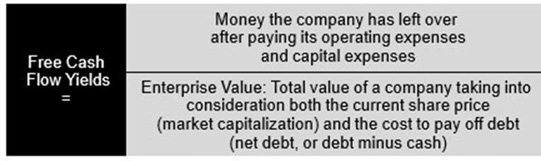
The Adviser believes that free cash flow is a useful measure for investors as it shows the cash a company has available after operating expenses and capital expenditures, indicating the company’s financial health and efficiency. A positive free cash flow indicates a company’s ability to generate sufficient revenue to maintain operations and potentially return value to shareholders.
The Index employs a rules-based methodology that assigns scores to certain attributes related to free cash flows. Securities that achieve a higher score, or “weighting,” comprise a proportionately higher amount of the Index. The rules-based methodology assigns weightings by measuring a combination of total free cash flow and free cash flow yield (that is, the yield that the company earns on its free cash flow). Individual companies are capped at 4% of the Index. The rules-based methodology also limits the amount of companies in any one sector. That is, companies in any one sector will not exceed 45% of the Index. In addition, the allocation of companies in any single sector (or “weighting”) will not exceed 20% of the weighting of that sector in the Vettafi US Equity Large/Mid-Cap 1000 Index.
The Fund will not invest in Excluded Securities. Excluded Securities are securities issued by any company that is involved in the production or wholesale distribution of alcohol, tobacco, or gambling equipment, gambling enterprises, or which is involved, either directly or indirectly, in abortion or pornography, or promoting anti-family entertainment or
unbiblical lifestyles. The Fund also reserves the right to exclude investments, in its best judgment, in other companies whose practices may not fall within the exclusions described above, but can be found offensive to basic, traditional Judeo-Christian values. In the event a company is subsequently discovered to be engaged in a prohibited practice, the Fund’s holdings in that company will be liquidated at the next re-balancing.
The Index and Fund each reconstitute every April/October and rebalance quarterly.
The Fund generally seeks to track the returns of the Index before fees and expenses by employing a replication strategy that seeks to hold all the stocks in the Index. The Fund also may invest up to 20% of its assets in instruments other than the securities in the Index, such as derivatives, including index futures, which the Fund may use for cash management to provide for liquidity to pay redemptions and fees (attempting to remain fully invested while maintaining liquidity).
The Fund will concentrate its investments (i.e., hold more than 25% of its assets) in a particular industry or group of industries to the extent that the Index is concentrated. As of the date of this Prospectus, the Fund is not concentrated in any industry or group of industries. The degree to which certain sectors, industries, or asset classes are represented in the Index may change over time. As of the date of this Prospectus, the Index has significant exposure to the energy, information technology and health care sectors.
Under normal circumstances, the Fund seeks to achieve its investment objective by investing at least 80% of its assets directly or indirectly in the securities included in the Victory Free Cash Flow Growth BRI Index (the “Index”). VettaFi LLC (the “Index Provider”) constructs the Index in accordance with a rules-based methodology that screens for positive free cash flow and selects 50 growth companies with the highest score (each as described below) within the Victory US Large/Mid Cap Volatility Weighted BRI Index (the “Parent Index”). The Parent Index universe begins with the stocks included in the Nasdaq Victory US Large Cap 500 Volatility Weighted Index, a volatility weighted index comprised of the 500 largest U.S. companies by market capitalization with positive earnings over the last twelve months. As of March 31, 2026, the Parent Index had a market capitalization range from $4.31billion to 1.47 trillion. The actual range of market capitalization will vary over time according to changes in market capitalization of the securities in the Parent Index.
The Index Provider is not affiliated with the Fund, the Adviser or the Sub-Adviser. The Index is designed to deliver exposure to equity securities of large-capitalization U.S. issuers of growth companies. To be included in the Index, these U.S. large-capitalization growth companies generally will have a positive “free cash flow growth trend” and have a high “free cash flow return on invested capital.” The initial Index universe is derived from the component companies of the Parent Index, excluding financial companies and real estate investment trusts.
“Free Cash Flow on Invested Capital” is a financial valuation metric that compares the free cash flow a company is expected to earn against its invested capital. The ratio is calculated by taking the free cash flow divided by invested capital, which is comprised of shareholder equity and long-term debt. The Index Provider screens the initial universe of companies based on their projected free cash flows and earnings. Companies with negative projected free cash flows or earnings are removed from the Index universe. Companies are then evaluated to remove any stocks that have a negative “free cash flow growth trend.” A negative “free cash flow growth trend” is defined as a decreasing trend in free cash flow generation over the trailing five years. Conversely, a positive “free cash flow growth trend” is defined as an increasing trend in free cash flow generation over the trailing five years. The remaining companies are ranked by their ratio of free cash flow on invested capital. A growth score is then derived from each company’s growth metrics (evaluated using sales and EBITDA trends, and consensus analyst estimated long-term growth projections) for the 75 companies with the highest free cash flow on invested capital.
The 50 companies with the highest growth scores are selected by the Index Provider for inclusion in the Index.

The rules-based methodology assigns weightings by measuring a combination of total free cash flow and “absolute momentum,” which is defined as the absolute value of a company’s trailing 12-month, risk-adjusted total return and accounts for the magnitude of price fluctuations over the specified period without regard to whether the return is positive or negative. Individual companies are capped at 4% of the Index. The rules-based methodology also limits the amount of companies in any one sector. That is, companies in any one sector will not exceed 45% of the Index. In addition, the allocation of companies in any single sector (or “weighting”) will not exceed a weighting of more than 20% greater than the weighting of that sector in the Parent Index.
The Fund will not invest in Excluded Securities. Excluded Securities are securities issued by any company that is involved in the production or wholesale distribution of alcohol, tobacco, or gambling equipment, gambling enterprises, or which is involved, either directly or indirectly, in abortion or pornography, or promoting anti-family entertainment or
unbiblical lifestyles. The Fund also reserves the right to exclude investments, in its best judgment, in other companies whose practices may not fall within the exclusions described above, but can be found offensive to basic, traditional Judeo-Christian values. In the event a company is subsequently discovered to be engaged in a prohibited practice, the Fund’s holdings in such company will be liquidated at the next re-balancing.
The Index and Fund each reconstitute every April/October and rebalance quarterly.
The Fund generally seeks to track the returns of the Index before fees and expenses by employing a replication strategy that seeks to hold all the stocks in the Index. The Fund also may invest up to 20% of its assets in instruments other than the securities in the Index, such as derivatives, including index futures, which the Fund may use for cash management to provide for liquidity to pay redemptions and fees (attempting to remain fully invested while maintaining liquidity).
The Fund will concentrate its investments (i.e., hold more than 25% of its assets) in a particular industry or group of industries to the extent that the Index is concentrated. As of the date of this Prospectus, the Fund is not concentrated in any industry or group of industries. The degree to which certain sectors, industries, or asset classes are represented in the Index may change over time. As of the date of this Prospectus, the Index has significant exposure to the industrials and information technology sectors.
Under normal circumstances, the Fund invests at least 80% of its assets in debt securities and in derivatives and other instruments that have economic characteristics similar to such securities. The Fund is actively managed. The effective duration of the Fund is generally within two years of that of the Bloomberg U.S. Aggregate Index. The debt securities in which the Fund may invest include government obligations (including U.S., state, and local governments, their agencies and instrumentalities); mortgage- and asset-backed securities (including collateralized debt obligations and collateralized mortgage obligations); corporate debt securities; repurchase agreements; and other securities believed to have debt-like characteristics.
Up to 65% of the Fund’s assets may be invested in corporate bonds. The Fund will invest primarily in investment-grade securities, but may invest up to 30% of its net assets in below-investment-grade securities, which are sometimes referred to as high-yield or “junk” bonds. The Fund may invest up to 30% of its net assets in U.S. dollar-denominated obligations of foreign and emerging market countries, corporations, and banks (i.e., Yankee Bonds). Emerging market countries are all countries of the world excluding countries and markets, which are referred to as developed countries. The Fund also may invest in securities not considered foreign securities that carry foreign credit exposure (e.g., any debt of a foreign company issued in U.S. dollars).
The Sub-Adviser uses a proprietary credit rating methodology in selecting investments for the Fund.
The Sub-Adviser’s credit rating methodology includes, in addition to the portfolio management team’s insights and experience, a number of proprietary credit rating models specific to asset class and industry categories. The Adviser uses these models to assess the credit risk of prospective securities for inclusion in the portfolio. The result of the credit assessment is the assignment of an internal credit rating. The same credit rating methodology is used both in initiating the prospective security’s internal credit rating and in the regular and periodic reviews conducted while the security is held.
The Fund will not invest in Excluded Securities. Excluded Securities are securities issued by any company that is involved in the production or wholesale distribution of alcohol, tobacco, or gambling equipment, gambling enterprises, or which is involved, either directly or indirectly, in abortion or pornography, or promoting anti-family entertainment or unbiblical lifestyles. The Fund also reserves the right to exclude investments, in its best judgment, in other companies whose practices may not fall within the exclusions described above, but can be found offensive to basic, traditional Judeo-Christian values. If the Fixed Income ETF is found to be engaged in a prohibited practice, it will be liquidated as soon as reasonably practicable to avoid adversely affecting shareholder value.
In applying its investment process, the Fund may also engage in relative value trading, a strategy in which the Fund reallocates assets across different asset classes, sectors, rating categories, structural characteristics, and issuers. Relative value trading is designed to take advantage of what the Adviser believes to be mispricing in the market and is intended to enhance the Fund’s returns, though it may increase the Fund’s portfolio turnover rate.
The Fund may use futures, including U.S. Treasury futures, to manage duration (e.g., the Sub-Adviser may buy or sell U.S Treasury futures to bring the Fund’s duration closer to the duration of the Fund’s benchmark), increase or decrease its exposure to changing security prices or other factors that affect security values, enhance income, hedge against certain risks, or keep cash on hand to meet shareholder redemptions or other needs while maintaining exposure to a market.